


Abstract
Soil fertility plays a crucial role in crop productivity, particularly in cocoa cultivation, which is highly dependent on soil quality that directly influences both productivity and sustainability. Understanding how to achieve and maintain soil fertility on cocoa farms is fundamental to sustaining higher yields. Cocoa production in Ghana and Togo remains low, at 350–600 kg/ha, compared to the potential yield of over 1–3 tons per hectare. Given the growing demand for cocoa and limited arable land, adequate soil nutrients are essential to optimise productivity. Soil fertility indices (SFIs) have been widely used as soil metrics by integrating multiple physical, chemical, and biological soil properties. In this study, standard analytical methods were employed to evaluate the SFI through laboratory analyses of 49 surface soil samples collected at a depth of 0–30 cm with an auger. Eleven soil chemical indicators were analysed: pH (water), organic matter (OM), potassium (K), calcium (Ca), magnesium (Mg), available phosphorus (P), total nitrogen (N), cation exchange capacity (CEC), electrical conductivity (EC), and carbon-to-nitrogen ratio (C/N). Principal component analysis, followed by normalisation, was used to select a minimum dataset, which was then integrated into an additive SFI. Results indicated that N, Ca, Mg, CEC, and pH were within the optimal range for most surveyed locations (96%, 94%, 92%, 73%, and 63%, respectively), while OM and C/N were within the optimal range in approximately half of the study area. Available P, K, and C/N were highly deficient in 100%, 67%, and 96% of surveyed locations, respectively. Soil fertility varied significantly among locations (p = 0.007) and was generally low, ranging from 0.15 to 0.66. Only 20% of the soils in the study area were classified as adequately fertile for cocoa cultivation. Therefore, it is necessary to restore soil nutrient balance, especially the critically low levels of K and P, through appropriate management practices that improve fertility over time and help close the yield gap.
1. Introduction
Cocoa (Theobroma cacao L.) is of economic importance for many tropical regions, contributing significantly to the livelihoods of millions. West Africa is the world’s leading cocoa-producing region, accounting for 65% of global production [1]. Despite this dominant position, cocoa productivity in the region remains below global average levels and tends to fluctuate [2], a pattern also observed with many other crops across Sub-Saharan Africa [3,4,5]. Improving cocoa productivity is a current challenge. According to [6], global cocoa production needs to increase by 60% by 2050 to meet rising demand. So far, this growth has come at the expense of forests [7,8] and other agricultural lands. Cocoa yields in West Africa remain low, averaging 350 to 400 kg ha−1 [9,10] compared to 700–900 kg ha−1 reported elsewhere [11]. However, there is high potential with yields reaching 1000 to 3000 kg/ha under optimal conditions [12]. Closing this yield gap sustainably requires addressing the causes of low productivity on smallholder cocoa farms. Several factors have been identified, including poor farm management practices, the use of low-yielding planting materials, pests and diseases, ageing cocoa trees and soil fertility decline [13,14,15]. Soil degradation further threatens productivity [16]. Ref. [17] stated that pod rot disease can cause yield losses of 20–30%, with potential losses reaching 100% in regions experiencing high rainfall. More recently, refs. [18,19] stated that a good cocoa yield depends on balanced soil nutrients. Moreover, ref. [20] previously identified low soil fertility as a major cause of yield decline.
Indeed, soils are typically highly variable due to the combined effects of physical, chemical and biological processes that operate under different environmental conditions [21]. Ref. [22] highlighted that soil fertility is primarily associated with soil nutrient availability, pH, and organic matter (OM) content. Moreover, ref. [23] reported that soil pH and yield are positively correlated with cation exchange capacity (CEC), soil organic matter (SOM) and base saturation (BS), while soil compaction compromises yield. Ref. [24] further highlighted that soil acidification leads to a reduction in crop yield and root length, as well as soil calcium (Ca), magnesium (Mg), and potassium (K).
Acknowledging the close relationship between soil chemistry, fertility and yield, this study focuses on soil chemical properties such as pH (measured in water), organic matter (OM), potassium (K), calcium (Ca) and magnesium (Mg), available phosphorous (P), and total nitrogen (N) to evaluate the soil fertility status of cocoa cultivation. N, P, and K are essential nutrients for the growth and development of crops, including cocoa. Ca and Mg contribute to nutrient availability, maintain pH balance, improve soil structure, and enhance fertility [25,26]. For instance, ref. [27] reported that every 1000 kg of cocoa beans produced removes 546 kg N, 96 kg P, 246 kg K, and other nutrients such as Mg, Ca, and Fe from the soil, underscoring the need for timely replenishment of these nutrients. OM and pH serve as important soil quality indicators as they affect several soil functions and play key roles in fertility and nutrient availability [28]. Therefore, spatial assessments in different cocoa-growing areas are needed to identify problematic areas and make strategic agronomic decisions. Soil Fertility Index (SFI) values can be used to develop fertility maps and make recommendations based on soil spatial variability for better fertility management.
Despite the obvious importance of understanding soil fertility for effective cocoa cultivation, particularly given the significant nutrient loss during production and the spatial variability of soil properties, studies on soil fertility in major cocoa-producing countries such as Ghana and Togo remain limited. This gap highlights the urgent need to assess soil fertility status and its spatial variation across different sites to support sustainable land management. Indeed, the spatial assessment of soil fertility is essential in cocoa-growing regions because soil properties are highly heterogeneous due to variations in parent material, land-use history, management practices, and topography. Such spatial variability directly influences cocoa productivity and the effectiveness of fertiliser recommendations. The spatial analysis will enable the prioritisation of sites requiring targeted soil management interventions. The originality of our study lies in the development and application of a Soil Fertility Index (SFI) tailored to cocoa-growing systems at the regional scale. This index integrates multiple chemical soil properties into a single, interpretable metric, allowing for a spatial comparison of soil fertility status across cocoa production zones. This approach provides a practical decision-support tool for extension services and policymakers to guide site-specific nutrient management and sustainable cocoa intensification strategies. This study aims, therefore, to assess soil fertility in cocoa-growing areas and provide valuable insights to improve cocoa management practices. The specific objectives of this study are to characterise the soil chemicals and estimate the fertility status for cocoa growth across the transboundary areas between Ghana and Togo.
2. Methodology
2.1. Study Area Description
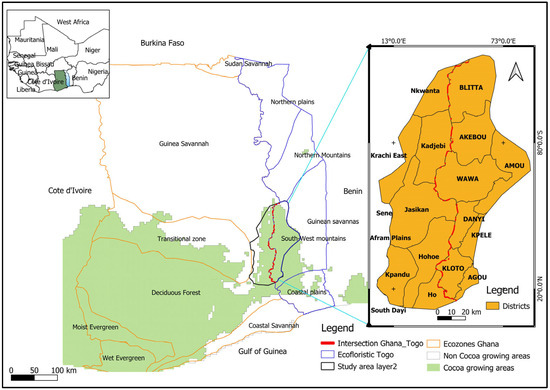
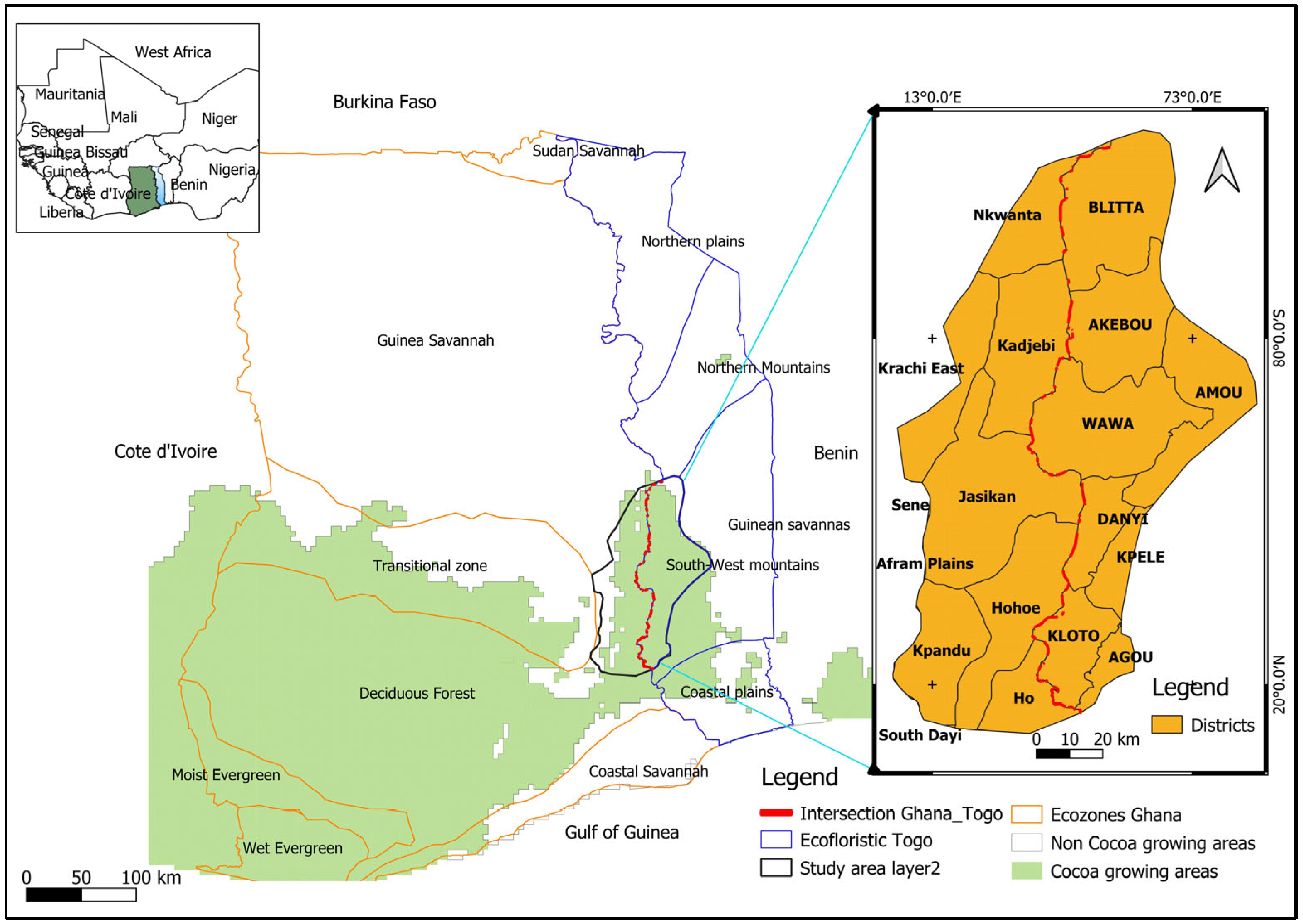
The study area covers the Southern part of the Atakora Mountains, southwest of Togo, sharing the border with Ghana (Figure 1). Ghana and Togo rank in the 2nd and 15th positions of cocoa-producing countries worldwide, respectively. The portion of Ghana included in the study area covers one agroecological zone (semi-deciduous forest zone) and is located between latitude 4.5° N and longitude 1.3° E. Administratively, the Ghanaian portion covers the Volta and Oti regions with 1300 mm y−1 as mean annual precipitation and 28 °C mean annual temperature. The region’s soils vary in texture, fertility, and organic matter content, making them ideal for this investigation. The Togolese side extends from Ghana’s humid and semi-humid forest zone and covers the entire area of the fourth agroecological zone named “Ecological Zone IV” [29]. The annual total rainfall and mean temperature cover a range of 1200 to 1800 mm/y and 21 to 28 °C, respectively. The geological structural unit is the Atakora, consisting of epimetamorphic formations.
Figure 1.
Study Area.
2.2. Data Collection
2.2.1. Soil Sampling and Analysis
The study was conducted from January to May 2024 in 49 locations in 15 districts (7 in Ghana and 8 in Togo) during a field campaign (Figure 1). From each location, 10 soil samples were collected, ensuring representative coverage of each location (village). The farm plot size varies from 0.25 to 1 ha. The sampling depth was 0 to 30 cm (which corresponds to the main rooting zone and nutrient uptake depth of cocoa trees) [30]. Five soil cores were collected per plot (25 m × 25 m) and thoroughly homogenised to form one composite sample. This approach is commonly recommended in soil fertility studies of perennial cropping systems, as it reduces 47 small-scale variability and provides a reliable estimate of average soil chemical properties at the farm level [31,32]. Each composite sample was air-dried and sieved (2 mm) to remove plant material and stones, and further subjected to standard chemical analyses. The chemical properties considered and analysed were pH (water), nutrient content of macro-nutrients (N, P, K), cation exchange capacity (CEC), total organic carbon (TOC) and organic matter (OM). Moreover, the electrical conductivity was analysed.
2.2.2. Soil Properties Analysis
The pH of the soil was measured using a standard electrode and a pH meter (OHAUS Model ST3100-F, OHAUS Corporation, 1.800.672.7722, 8 Campus Drive, Suite 105, Parsippany, NJ 07054 USA). A quantity of 20 g of soil was weighed into a clean container, to which 50 millilitres of distilled water was added. The mixture was then stirred using a STUART magnetic agitator for 120 min at a speed of 250 revolutions per minute. After stirring, the suspension was allowed to settle for 15 min. The mixture was then gently homogenised once more before measuring the pH using a calibrated pH meter. The pH meter had been previously calibrated with standard buffer solutions to ensure accurate readings.
Total nitrogen in the soil was determined using the Kjeldahl method [33,34]. A 2.5 g soil sample was weighed and placed into a 250 mL Kjeldahl flask, to which 10 mL of concentrated sulfuric acid (H2SO4) was added, along with 1.25 g of a catalyst composed of copper oxide and selenium. The mixture was digested using a BEHROTEST digestion unit first for 30 min at 70% power, then for 3 h at full strength. After digestion, the solution was distilled using a Kjeldahl distillation apparatus with the addition of 50 mL of 10 N sodium hydroxide (NaOH). The resulting distillate was collected in 25 mL of boric acid solution (H3BO3) and titrated with 0.1 N sulfuric acid (H2SO4). The volume of titrant used at the equivalence point was recorded to calculate the total nitrogen content of the sample.
Total organic carbon (TOC) in the soil was determined using the Walkley-Black method [35,36]. The procedure involved preparing a 1 N potassium dichromate (K2Cr2O7) solution by dissolving 100 g of the salt in distilled water and making up the volume to one litre. Soil samples were first ground, sieved, labelled, and referenced. A 0.5 g portion of the prepared soil sample was accurately weighed and transferred into a 30 mL test tube. For digestion, 2 mL of 10% potassium dichromate solution was added to the sample, followed by 5 mL of concentrated sulfuric acid (98%). The mixture was allowed to react for 45 min at room temperature. Subsequently, 18 mL of ultrapure distilled water was added, and the solution was left to stand overnight to allow for decantation. The final absorbance was measured using a spectrophotometer at a wavelength of 600 nm to determine the organic carbon content. The percentage of organic matter in the soil is calculated based on the carbon content in the organic matter, using the Van Bemmelen factor [37].
Soil extractable P was determined according to Olsen’s method [38]. Available phosphorus in the soil was measured using the sodium bicarbonate extraction method. A 10 g soil sample was placed in a container, and 50 mL of 1 N sodium bicarbonate (NaHCO3) solution, buffered at pH 8.5, was added. The mixture was stirred for 30 min at 250 revolutions per minute (rpm), then allowed to settle for 10 min. The solution was filtered using a filter paper with a mesh size of 1. From the resulting filtrate, a 2 mL aliquot was taken and transferred into a test tube. To this, 6 mL of distilled water and 2 mL of Reagent B were added. The mixture was left to react for 10 min before reading the absorbance at a wavelength of 882 nm using a colourimeter. This measurement was used to determine the concentration of available phosphorus in the soil.
Exchangeable potassium in the soil was determined using the potassium acetate extraction method. A 5 g soil sample was placed in a container, and 50 mL of 1 N potassium acetate (CH3COOK) solution was added. The mixture was shaken for 30 min at 250 revolutions per minute (rpm), then allowed to rest for 10 min to allow partial sedimentation. The suspension was then filtered through a filter paper with a mesh size of 1. The filtrate was analysed using a flame atomic absorption spectrophotometer to determine the concentration of exchangeable potassium present in the soil.
Exchangeable calcium (Ca2+), magnesium (Mg2+), and potassium (K+) were extracted from soil samples by saturating the cation exchange sites with 1 M ammonium acetate solution buffered at pH 7.0. Soil samples were shaken with the ammonium acetate solution to replace exchangeable cations with ammonium ions (NH4+). The resulting extracts were filtered and analysed for Ca, Mg, and K concentrations using inductively coupled plasma optical emission spectroscopy (ICP-OES) (Thermo IRIS Intrepid II XSP). Cation exchange capacity (CEC) was determined by saturating exchange sites with ammonium acetate, followed by displacement of NH4+ with 1 M potassium chloride (KCl), and quantification of the displaced NH4+ via steam distillation. This procedure is widely adopted due to its reliability and precision for assessing soil fertility parameters.
After the soil samples analysis, their chemical values were compared to optimum values for cocoa production, which were derived from literature and expert consultation.
2.2.3. Soil Fertility Index (SFI) Estimation
In this study, soil fertility is assessed through a composite index based on key chemical indicators directly linked to nutrient availability for cocoa. While physical and biological soil properties are not included, the index provides a chemical-based representation of soil fertility relevant to cocoa production systems. The SFI’s estimation method follows the description in [31,39] which employed a structured three-step approach, ensuring that only the most significant and non-redundant parameters are included and appropriately weighted, thereby making it a robust tool for assessing the soil fertility status. The process begins with (i) selecting a Minimum Data Set (MDS), which includes the most relevant soil parameters that effectively represent soil quality. The MDS can be selected using various methods such as principal component analysis (PCA), expert opinion (EO), and factor analysis [39]. According to [40], analysing the soil quality using the statistical model based on PCA seems to be more correlated to the cocoa yield compared to simple additive and weighted additive models. In this study, the selection is performed using PCA, which reduces data dimensionality while preserving essential information in addition to EO, to evaluate the agronomic importance of the MDS. Principal components with eigenvalues equal to or greater than one (≥1) are retained, and from these, only the parameters with high factor loadings are selected. The process ensures that in cases where multiple parameters are correlated (r > 0.70), only the most representative one is included in the MDS to avoid redundancy.
The second step (ii) involves a normalisation process, which aims to transform the variables into a comparable unit. The normalisation process generates intermediate dimensionless scores for each soil chemical parameter and is a prerequisite for index construction. When the variable has a direct functional (positive) relationship with soil fertility, Equation (1) was used; when it has an inverse functional (negative) relationship, Equation (2) was used.
where and specify the normalised value of the chemical variable in positive and negative relationship cases, respectively; and refer to the minimum and maximum values of each criterion, respectively, and n indicates the cell value of the criterion.
In this study, OM, N, P, K, Ca, and Mg were scored as “more is better” based on the available information on the optimum value of the soil chemical for cocoa growth in [31,41,42,43].
The final step (iii) combines the normalised scores (from step (ii)) of all selected parameters into a single index value, representing the overall SFI. Equal weights were assigned to all variables included in the MDS. Furthermore, the SFI was classified into five classes: ≤0.38, 0.38–0.48, 0.48–0.58, 0.58–0.68, and ≥0.68, representing very low (class V), low (class IV), moderate (class III), high (class II) and very high (class I) soil quality, respectively, as proposed by [44] for tropical soils.
2.2.4. Geospatial and Statistical Analysis
Observed data of soil chemicals were described and compared among districts and countries to assess variability. Geostatistical methods, including interpolation using kriging methods, were used to map spatial variability in soil quality indicators. Quantum Geographic Information System (QGIS 3.18) tool was employed to integrate and analyse the data.
3. Results
3.1. Descriptive Statistics of Measured Soil Chemical Properties
The soil properties were obtained from the results of the laboratory measurements and are summarised in Table 1. The soil data revealed moderately fertile conditions with some specific areas of concern. The total nitrogen (N) content in the soils has a mean value of 0.15%, which is above the critical threshold of 0.09%, indicating that nitrogen is generally adequate for supporting cocoa growth. Similarly, organic matter (OM) averages 3.4%, which is slightly above the >3% threshold, suggesting moderate to good organic enrichment. However, total organic carbon (TOC) has a mean of 1.97%, which is below the reference value of 2.03%, indicating a marginal insufficiency in carbon stocks that could affect long-term soil structure and microbial health and activities.
Table 1.
Summary statistics for soil chemical parameters.
The C:N ratio (mean: 16.87) is well below the critical limit of 22.55, suggesting that nitrogen mineralisation is likely not constrained and decomposition processes are proceeding efficiently. This is a positive indicator for nutrient cycling.
Phosphorus and potassium are both on the lower end, with mean values of 3.4 and 0.25, respectively. These are essential nutrients for root development and crop productivity, suggesting necessary nutrient supplementation. With a mean value of only 3.4 ppm compared to the threshold of 20 ppm, soils are severely deficient in available phosphorus, which can drastically limit root development, flowering, and overall productivity. Potassium (K), however, has a mean of 0.249 cmol kg−1, a value very close to the threshold (0.25 cmol kg−1), suggesting it is barely sufficient and may need monitoring or supplementation, especially in high-demand crops like cocoa.
Exchangeable bases, calcium (Ca) and magnesium (Mg), are both well above the respective thresholds of 7.5 cmol kg−1 and 2.0 cmol kg−1, indicating excellent availability of these nutrients. Cation exchange capacity (CEC) is another notable feature of soil quality. With an average of 20.05 cmol kg−1, the values are above the standard range of 3–15 cmol kg−1, indicating a high nutrient-holding capacity. This is favourable for fertility but may also reflect high clay or organic matter content.
The soil pH in water (mean: 5.97) is within the acceptable range of 5.6–7.2, indicating slightly acidic to near-neutral conditions, which are suitable for most crops and do not require immediate liming. Electrical conductivity (EC) is low across all samples, confirming the absence of salinity issues supporting healthy plant growth.
Situation on the Ghana site: The soil chemical characteristics of the Ghana site revealed mixed conditions for cocoa production (Table 2). N content (0.13%) is above the critical threshold (0.09%), indicating adequate nitrogen availability to support vegetative growth and leaf formation, key processes for young cocoa trees. However, the OM (2.74%) falls slightly below the ideal threshold of >3%, suggesting moderate but insufficient for cocoa. Likewise, the TOC level (1.6%) is below the desired value (2.03%), reinforcing the need for organic input enrichment such as compost or mulching. The C:N ratio of 13.6 remains in a healthy balance, meaning the decomposition of organic matter and nutrient release is occurring at a favourable pace for plant uptake. A major concern lies in the available phosphorus content (5.39 ppm), which is far below the cocoa requirement of 20 ppm. This deficiency could impair root development, pod formation, and flowering, requiring phosphorus amendment via fertilisers or organic phosphates.
Table 2.
Colour-coded table for the soil chemical components for the sampled locations.
In terms of exchangeable bases, the calcium (12.89 cmol kg−1) and magnesium (11.62 cmol kg−1) concentrations are well above cocoa thresholds, which support physiological functions such as root growth, cell structure, and enzyme activity. However, potassium (0.21 cmol kg−1) is still below the optimal 0.25 cmol kg−1, indicating a mild deficiency that could impact bean filling and yield unless addressed. The CEC is extremely high at 26.83 cmol kg−1, exceeding the typical upper threshold of 15. While this suggests an excellent ability to retain nutrients, it also requires balanced fertilisation strategies to avoid nutrient locking. The soil pH (5.81) falls within the optimal range for cocoa (5.6–7.2), favouring nutrient availability. Finally, the EC (85.73 µS/cm) is low, indicating no salinity issues, which is beneficial since cocoa is sensitive to salt.
Situation on the Togolese site: The soil chemical results indicated generally favourable conditions for cocoa cultivation, with some important considerations (Table 2). The total nitrogen level (0.15%) is above the recommended minimum of 0.09%, supporting good vegetative growth, which is essential during the early stages of cocoa development. The OM content (3.41%) is also above the threshold (>3%), which is beneficial for maintaining soil moisture, microbial activity, and long-term fertility, key factors for cocoa trees, which have deep root systems and long lifespans. Although the TOC level (1.9%) is slightly below the optimal threshold of 2.03%, it still reflects a relatively fertile soil. The C:N ratio (14.83) is within a desirable range for cocoa, suggesting that OM decomposition is well-balanced and that nitrogen is being released at a sustainable rate.
One of the major concerns of this region, however, is the very low level of available phosphorus (2.68 ppm), compared to the cocoa requirement of around 20 ppm. Phosphorus is critical for root development and flowering in cocoa, and such a low value could significantly limit plant performance if not corrected through phosphate fertilisation. In contrast, the levels of calcium (10.67 cmol kg−1) and magnesium (11.58 cmol kg−1) are above the minimum recommended for cocoa (7.5 and 2 cmol kg−1, respectively), which is advantageous, as these elements support cell wall strength, photosynthesis, and disease resistance. Potassium, another key nutrient for cocoa yield and bean quality, is slightly below the optimal threshold (0.22 vs. 0.25 cmol kg−1), indicating a mild deficiency that should be addressed through targeted fertilisation.
The CEC of 16.33 cmol kg−1 is slightly above the optimal range (3–15), indicating a high nutrient-holding capacity, which is beneficial for long-term nutrient availability. However, it also suggests that nutrient management should be carefully planned to avoid potential imbalances or leaching. The soil pH of 5.83 is within the suitable range for cocoa (ideally between 5.5 and 6.5), indicating favourable conditions for nutrient uptake, and preventing inhibitive actions from acidification. Finally, the electrical conductivity (80.22 µS/cm) is low, suggesting low salinity risk, which is ideal for cocoa, as the crop is sensitive to salt accumulation. In conclusion, the soil exhibits good potential for sustainable cocoa production due to its adequate levels of nitrogen, organic matter, and base cations. However, urgent phosphorus enrichment and mild potassium supplementation are required to optimise productivity and ensure healthy cocoa tree development over time.
Results showed that both the Ghana and Togo sides had adequate nitrogen, calcium, magnesium, and pH levels, creating a generally supportive environment for cocoa. However, both sites suffer from severe phosphorus deficiency. Additionally, potassium levels are slightly suboptimal in both cases, requiring special attention. No specific difference was found between Ghana and Togo for the N, P, K, C:N, Mg and the pH, highlighting similarities in soil nutrients management (the case of fertiliser supplementation) by cocoa farmers in these regions under the two countries. The sample from Togo showed better OM and TOC content compared to Ghana (p-value = 0.004), suggesting stronger moisture-holding potential. Indeed, dense agroforestry practices have been observed in Togo compared to Ghana, and could support the observed results. Conversely, the Ghana side has a much higher CEC and Ca (p-value = 0.0009 and 1.64 × 10⁻⁶, respectively), which helps in better nutrient retention but may also complicate other nutrients like P and K availability without proper management.
3.2. Soil Fertility Index Map
The SFI was computed with a minimum dataset selected from the PCA analysis. The latest included the soil parameters: N, OM, TOC, C:N, P, Ca, Mg, K, CEC, pH and EC. Four eigenvalues were greater than one; however, only the first three PCs were chosen (Table 3), since their cumulative percentage explained more than 50%. Only the parameters with high factor loadings were kept for indexing out of the three chosen PCs. OM, TOC, K, pH and EC were representative under PC1; N and C:N were selected for PC2; and P, Mg, and CEC parameters were selected under PC3 (Table 3). However, due to the high correlation between certain parameters, only N, C:N, P, Mg, K, CEC, pH and EC were considered for the analysis (Table 4).
Table 3.
Summary of variables’ contributions.
Table 4.
Correlation between soil variables.
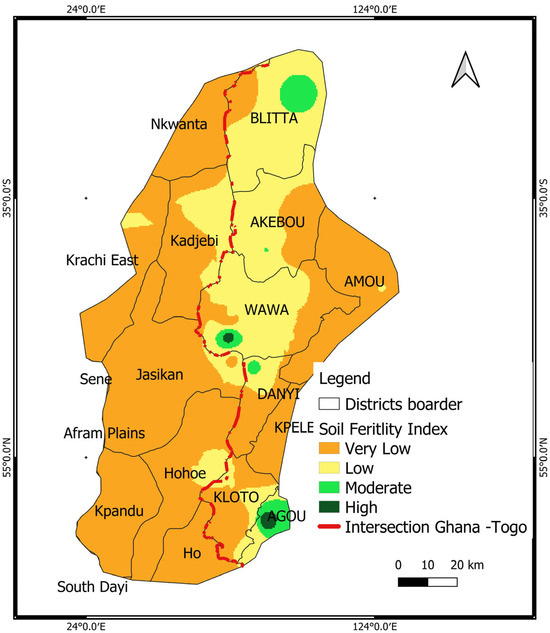
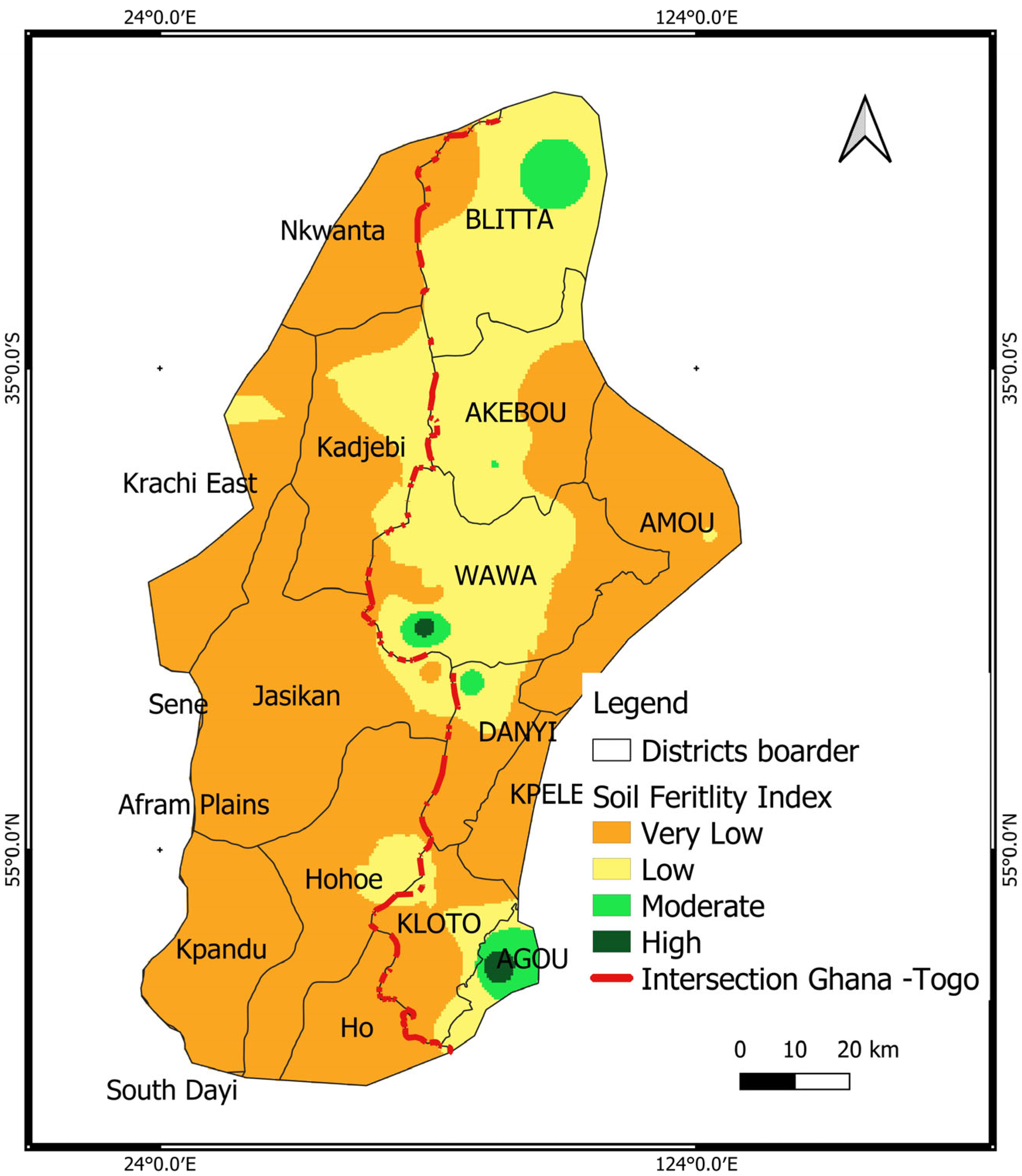
These normalised values from N, C:N, P, Mg, K, CEC, pH and EC were subsequently aggregated as described in step (iii) to compute the final Soil Fertility Index (SFI) for each study location. The spatial distribution map below (Figure 2), therefore, illustrates the integrated soil fertility status across the study area. For clarity and conciseness, the intermediate normalised scores are not presented individually, as the focus of the study is on the composite SFI used for spatial comparison and decision support. The SFI varies from 0.15 to 0.66 with a mean value of 0.34, indicating a generally low fertility status for cocoa growth across the study area. Table 5 presents the repartition of the resulting SFI, highlighting that 69% of the study area has a very low fertility status.
Figure 2.
SFI distribution across the study area.
Table 5.
Summary Statistics of the SFI classification across the study area.
Such values suggest potential deficiencies in key nutrients essential for cocoa development and may increase the vulnerability of cocoa systems to environmental stresses. These results likely reflect long-term nutrient depletion associated with continuous cocoa cultivation, limited organic matter inputs, and insufficient soil fertility management practices. Generally, the districts in the Togo side presented higher values (0.34) compared to the Ghana side (0.30), on average. The Agou district in Togo (SFI = 0.43) and the Ho district in Ghana (SFI = 0.37) presented the highest values, and both are located in the southern area of the study area. This could be linked to some environmental factors, like humidity linked to rainfall characteristics.
4. Discussion
Soil Fertility Index serves as a vital tool for assessing soil health and guiding sustainable agricultural practices, particularly in cocoa cultivation. Cocoa is sensitive to soil conditions [45,46], and maintaining optimal soil quality is essential for ensuring high yields and long-term productivity. For instance, nutrient-deficient areas need adequate fertilisation, while regions with suboptimal pH may benefit from liming.
4.1. Soil Fertility Index Assessment for Cocoa Growth
The SFI is constructed by selecting a minimum data set (MDS) of soil indicators that significantly influence soil functions. These indicators are normalised and weighted to reflect their importance in soil health. This study retains a total of 9 chemical properties out of 11 for the SFI, including OM, TOC, N, C:N, Mg, CEC, Ca, P, and K. Conversely, ref. [31] in their study used CEC, available P and pH as MDS in estimating soil fertility. These variations in soil chemical choices confirm the importance of each chemical parameter in assessing and maintaining soil fertility. Ref. [47] developed an SFI for cacao cropping systems, incorporating functions such as the Available Water Function (AWF), Root Growth Function (RGF), Mineral Nutrition of Plants Function (MNF), and Environmental Safety Function (ESF). Each function is represented by specific indicators, and the overall SFI is calculated as the sum of individual function scores, providing a holistic assessment of soil quality. He classified SFI scores into three categories: ‘high’ (≥0.7), ‘medium’ (0.41–0.69), and ‘low’ (≤0.4). These classifications help in identifying areas requiring soil management interventions. Even though typical classes have not been considered for our study, similarities were found in the reported results. In their study, over 66% of cacao fields were classified as having a medium SFI, with scores ranging between 0.42 and 0.61. This result is similar to those found in our case study, where SFI ranged from 0.15 to 0.60. Moreover, in Ghana, ref. [31] reported that soil fertility ranged from 0.20 to 0.85 with an average of 0.41 ± 0.14. In addition, a similar SFI value of 0.49 was reported in the cocoa agroforestry system in the Orinoco Region, Colombia [48]. The low-reported soil fertility indexes across regions indicate the need for improved soil management practices in many cocoa-producing regions worldwide. The highest SFI found in the Western region of Ghana [31], and the highest found in the south-west of Togo could be related to environmental conditions, such as climate. However, high rainfall (>1800 mm/year) in the cocoa-growing area could lead to nutrient leaching and more supplementation. Ref. [49] reported improved cases for soil quality in Colombia, where it has been observed at 52.42%, 11.29% and 36.29% for medium, low and high levels, respectively.
Indeed, several factors influence the SFI in cocoa production. Soil management practices, such as the application of organic amendments, have been reported to improve soil quality indicators and, consequently, the SFI [50] demonstrated that soil OM and CEC are key parameters influencing cocoa yield, while [19] found a positive correlation between soil fertility and cocoa yield in general [51] assessed the long-term effects of chemical and organic fertilisations on soil OC pools and soil quality in cacao agroecosystems, highlighting the importance of sustainable fertilisation practices. Land use and soil type also play significant roles in determining SFI [52] found that soil quality under cocoa plantations differed from that under other land uses, emphasising the impact of land management on soil health. Moreover, links have been shown between soil microbial activities and availability and soil quality in cocoa agroecosystems [53,54] showed that the accumulation of potassium is low in cocoa ecosystems.
4.2. Applications of SFI in Cocoa Farming
The SFI is a valuable tool for monitoring soil health and guiding soil management decisions in cocoa farming. The identification of areas with low SFI scores allows farmers and agronomists to implement targeted interventions, such as adjusting fertilisation formulas and practices, improving irrigation methods, or enhancing soil OM content, to restore and maintain soil health. Most soils under cocoa had lower fertility, although soil chemical properties appear to settle at optimum levels except for P and K contents. Similar results were found by [54,55]. The difference in soil chemical properties among districts suggests site-specific fertiliser recommendations rather than a single rate and formulation recommended to farmers nationwide, as reported by [56,57]. In Ghana, ref. [58] reported that 6 different fertiliser formulae are needed to cover 90% of the cocoa area. Composting and returning cocoa pod husks to the soil through biochar solution, and organic management offer a considerable opportunity to close the nutrient deficiency of P and K observed in this study [59,60]. The study of [61] reveals that the use of cocoa shells can improve the yield, in particular, the coconut yield. However, research is required to overcome the risk that recycling cocoa pod husks may contribute to the spread of black pod disease.
Ref. [62] suggested that access to information related to integrated soil fertility management, education, and awareness can improve cocoa soil management by farmers and therefore increase the yield. Such factors were also highlighted two decades ago by [20], and can guide farmers’ decisions. They also emphasise factors like the age, locations and type of cocoa production systems (food crop or tree crop systems) to control fertility management practices. This also reveals the importance of the role of socio-economic and ecological dynamics in maintaining cocoa soil fertility [63]. The diversity of agro-ecologies and soil types, and crop production systems, suggests a need to further strengthen and refine fertiliser recommendations. Ref. [64], for instance, in the Cameroonian case reported that even though cocoa farmers believe in the positive effect of fertilisers, they do consider the soil fertility to be of least importance for their farm management. The purchasing power of the farmer and his interests should also be taken into cognisance when expecting to maximise yield and profit [65].
Farmers’ soil fertility management practices included chemical and organic fertiliser application, erosion control, and mulching [20,64], and their effectiveness in improving cocoa yields compared to fertiliser application. An on-field trial is needed to confirm the contribution of such practices to yield improvement. The high content of N and soil OC found in our survey systems could also be attributed to the agroforestry practices used by cocoa farmers [66] as chemicals and biological parameters of soil tend to vary across different cocoa production systems (for example conventional, organic, monocultures, organic agroforestry, successional agroforestry, etc.) [67]. The low status of P and K is particularly critical, since on-field trials have revealed them as major determinants for cocoa productivity [57]. All discussed parameters should be integrated in formulating better fertilisers and application modes for cocoa-growing areas.
5. Conclusions
Soil fertility assessment is useful for identifying critical areas for timely and effective soil management interventions. The consistently low Soil Fertility Index observed across the study area, corroborated by similar findings in cocoa-producing regions globally, underscores the critical role of soil chemical properties as limiting factors in cocoa yield potential. However, the exclusion of soil physical and biological parameters from the SFI framework constitutes a methodological limitation, as these components significantly influence nutrient cycling and bioavailability. To enhance the precision of fertility diagnostics, future research should adopt an integrative approach that encompasses physicochemical and microbiological soil attributes. Given the spatial variability of SFI, it is imperative to revise and regionalise soil fertility management programs, emphasising capacity-building through agronomic education, expanding access to cost-effective soil fertility management, and facilitating financial mechanisms such as subsidies and microcredit schemes to empower smallholder farmers in adopting adequate soil fertility practices.
Author Contributions
Conceptualization, A.A.C.A., E.Q. and S.S.; Methodology, E.B. and S.K.A.; Investigation, A.A.C.A.; Writing—original draft, A.A.C.A.; Writing—review and editing, U.N., E.Q., E.B., S.S., J.M.S., E.N.P. and S.K.A.; Supervision, U.N., E.Q., J.M.S. and S.K.A. All authors have read and agreed to the published version of the manuscript.
Funding
This study was funded by the German Federal Ministry of Education and Research (BMBF) through the West African Science Service Centre on Climate Change and Adapted Land Use (WASCAL) PhD scholarship grant.
Institutional Review Board Statement
The study was conducted according to the guidelines of the Declaration of Helsinki, and approved by the Ethics Committee of Humanities and Social Sciences, Kwame Nkrumah University of Science and Technology, protocol code HuSSREC/AP/96/vol.1, on 19 April 2023.
Informed Consent Statement
Informed consent was obtained from all subjects involved in the study. Verbal informed consent has been obtained from the participants to publish this paper.
Data Availability Statement
The socio-economic data for cocoa farmers is available upon reasonable request to the authors.
Acknowledgments
The authors would like to express their sincere gratitude to the cocoa farmers, local communities, and cocoa research institutes that were involved in this study. Their cooperation and invaluable contributions have significantly advanced our understanding of drought adaptation in the cocoa sector. We also acknowledge the Federal Ministry of Education and Research (BMBF, Germany) through the WASCAL (West African Science Service Centre on Climate Change and Adapted Land Use) program for their financial support as well as KNUST (Kwame Nkrumah University of Science and Technology) for hosting this research.
Conflicts of Interest
The authors declare no conflict of interest.
References
- FAOSTAT. Food Balance. Available online: https://www.fao.org/faostat/en/#data/QCL (accessed on 21 November 2024).
- Okoffo, E.D.; Denkyirah, E.K.; Adu, D.T.; Fosu-Mensah, B.Y. A Double-Hurdle Model Estimation of Cocoa Farmers’ Willingness to Pay for Crop Insurance in Ghana. SpringerPlus 2016, 5, 873. [Google Scholar] [CrossRef] [Scilit]
- Jayne, T.S.; Sanchez, P.A. Agricultural Productivity Must Improve in Sub-Saharan Africa. Science 2021, 372, 1045–1047. [Google Scholar] [CrossRef] [Scilit]
- Ritchie, H. Increasing Agricultural Productivity across Sub-Saharan Africa Is One of the Most Important Problems This Century. Our World Data. 2022. Available online: https://ourworldindata.org/africa-yields-problem (accessed on 1 November 2025).
- Tian, X.; Yu, X. Crop Yield Gap and Yield Convergence in African Countries. Food Secur. 2019, 11, 1305–1319. [Google Scholar] [CrossRef] [Scilit]
- Bermudez, S.; Voora, V.; Larrea, C.; Luna, E. Cocoa Prices and Sustainability. 2022. Available online: https://www.iisd.org/system/files/2022-11/2022-global-market-report-cocoa.pdf (accessed on 6 September 2024).
- Kalischek, N.; Lang, N.; Renier, C.; Daudt, R.C.; Addoah, T.; Thompson, W.; Blaser-Hart, W.J.; Garrett, R.; Schindler, K.; Wegner, J.D. Satellite-Based High-Resolution Maps of Cocoa Planted Area for Côte d’Ivoire and Ghana 2023. arXiv 2022, arXiv:2206.06119. [Google Scholar] [CrossRef] [Scilit]
- Ruf, F.; Schroth, G.; Doffangui, K. Climate Change, Cocoa Migrations and Deforestation in West Africa: What Does the Past Tell Us about the Future? Sustain. Sci. 2015, 10, 101–111. [Google Scholar] [CrossRef] [Scilit]
- Beg, M.S.; Ahmad, S.; Jan, K.; Bashir, K. Status, Supply Chain and Processing of Cocoa-A Review. Trends Food Sci. Technol. 2017, 66, 108–116. [Google Scholar] [CrossRef] [Scilit]
- Wessel, M.; Quist-Wessel, P.M.F. Cocoa Production in West Africa, a Review and Analysis of Recent Developments. NJAS Wagening. J. Life Sci. 2015, 74–75, 1–7. [Google Scholar] [CrossRef] [Scilit]
- Jagoret, P.; Michel, I.; Ngnogué, H.T.; Lachenaud, P.; Snoeck, D.; Malézieux, E. Structural Characteristics Determine Productivity in Complex Cocoa Agroforestry Systems. Agron. Sustain. Dev. 2017, 37, 1–12. [Google Scholar] [CrossRef] [Scilit]
- Aneani, F.; Ofori-Frimpong, K. An Analysis of Yield Gap and Some Factors of Cocoa (Theobroma cacao) Yields in Ghana. Sustain. Agric. Res. 2013, 2, 117. [Google Scholar] [CrossRef] [Scilit]
- Asante, P.A.; Rahn, E.; Zuidema, P.A.; Rozendaal, D.M.A.; van der Baan, M.E.G.; Läderach, P.; Asare, R.; Cryer, N.C.; Anten, N.P.R. The Cocoa Yield Gap in Ghana: A Quantification and an Analysis of Factors That Could Narrow the Gap. Agric. Syst. 2022, 201, 103473. [Google Scholar] [CrossRef] [Scilit]
- Kongor, J.E.; Hinneh, M.; de Walle, D.V.; Afoakwa, E.O.; Boeckx, P.; Dewettinck, K. Factors Influencing Quality Variation in Cocoa (Theobroma cacao) Bean Flavour Profile—A Review. Food Res. Int. 2016, 82, 44–52. [Google Scholar] [CrossRef] [Scilit]
- Rubiyo, R.; Siswanto, S. Peningkatan Produksi Dan Pengembangan Kakao (Theobroma cacao L.) Di Indonesia. J. Ind. Beverage Crops 2012, 3, 33–48. [Google Scholar]
- Utomo, B.; Prawoto, A.A.; Bonnet, S.; Bangviwat, A.; Gheewala, S.H. Environmental Performance of Cocoa Production from Monoculture and Agroforestry Systems in Indonesia. J. Clean. Prod. 2016, 134, 583–591. [Google Scholar] [CrossRef] [Scilit]
- Harni, R.; Amaría, W.; Ferry, Y.; Marhaeni, L.S. Effect of Trichoderma Spp. and Potassium Fertilizer on Phytophthora Palmivora Infection in Cacao Seedlings. IOP Conf. Ser. Earth Environ. Sci. 2020, 418, 012015. [Google Scholar] [CrossRef] [Scilit]
- Marrocos, P.C.L.; Loureiro, G.A.H.D.A.; Araujo, Q.R.D.; Sodré, G.A.; Ahnert, D.; Escalona-Valdez, R.A.; Baligar, V.C. Mineral Nutrition of Cacao (Theobroma cacao L.): Relationships between Foliar Concentrations of Mineral Nutrients and Crop Productivity. J. Plant Nutr. 2020, 43, 1498–1509. [Google Scholar] [CrossRef] [Scilit]
- Santos, R.O.D.; Franco, L.B.; Silva, S.A.; Sodré, G.A.; Menezes, A.A. Spatial Variability of Soil Fertility and Its Relation with Cocoa Yield. Rev. Bras. Eng. Agríc. E Ambient. 2017, 21, 88–93. [Google Scholar] [CrossRef] [Scilit]
- Baah, F.; Anchirinah, V.; Amon-Armah, F. Soil Fertility Management Practices of Cocoa Farmers in the Eastern Region of Ghana. Agric. Biol. J. N. Am. 2011, 2, 173–181. [Google Scholar] [CrossRef] [Scilit]
- Goovaerts, P. Geostatistical Tools for Characterizing the Spatial Variability of Microbiological and Physico-Chemical Soil Properties. Biol. Fertil. Soils 1998, 27, 315–334. [Google Scholar] [CrossRef] [Scilit]
- Nguemezi, C.; Tematio, P.; Yemefack, M.; Tsozue, D.; Silatsa, T.B.F. Soil Quality and Soil Fertility Status in Major Soil Groups at the Tombel Area, South-West Cameroon. Heliyon 2020, 6, e03432. [Google Scholar] [CrossRef] [Scilit] [PubMed]
- Zhang, S.; Zhu, Q.; de Vries, W.; Ros, G.H.; Chen, X.; Muneer, M.A.; Zhang, F.; Wu, L. Effects of Soil Amendments on Soil Acidity and Crop Yields in Acidic Soils: A World-Wide Meta-Analysis. J. Environ. Manag. 2023, 345, 118531. [Google Scholar] [CrossRef] [Scilit]
- Du, L.; Zhang, Z.; Chen, Y.; Wang, Y.; Zhou, C.; Yang, H.; Zhang, W. Heterogeneous Impact of Soil Acidification on Crop Yield Reduction and Its Regulatory Variables: A Global Meta-Analysis. Field Crops Res. 2024, 319, 109643. [Google Scholar] [CrossRef] [Scilit]
- de Bang, T.C.; Husted, S.; Laursen, K.H.; Persson, D.P.; Schjoerring, J.K. The Molecular–Physiological Functions of Mineral Macronutrients and Their Consequences for Deficiency Symptoms in Plants. New Phytol. 2021, 229, 2446–2469. [Google Scholar] [CrossRef] [Scilit] [PubMed]
- Khan, M.I.R.; Nazir, F.; Maheshwari, C.; Chopra, P.; Chhillar, H.; Sreenivasulu, N. Mineral Nutrients in Plants under Changing Environments: A Road to Future Food and Nutrition Security. Plant Genome 2023, 16, e20362. [Google Scholar] [CrossRef] [Scilit]
- Ferry, Y.; Herman, M.; Tarigan, E.B.; Pranowo, D. Improvements of Soil Quality and Cocoa Productivity with Agricultural Waste Biochar. IOP Conf. Ser. Earth Environ. Sci. 2022, 974, 012045. [Google Scholar] [CrossRef] [Scilit]
- Askari, M.S.; Holden, N.M. Quantitative Soil Quality Indexing of Temperate Arable Management Systems. Soil Tillage Res. 2015, 150, 57–67. [Google Scholar] [CrossRef] [Scilit]
- Ern, H. Die Vegetation Togos. Gliederung, Gefährdung, Erhaltung. Willdenowia 1979, 295–312. [Google Scholar]
- Dawoe, E.K.; Quashie-Sam, J.S.; Oppong, S.K. Effect of Land-Use Conversion from Forest to Cocoa Agroforest on Soil Characteristics and Quality of a Ferric Lixisol in Lowland Humid Ghana. Agrofor. Syst. 2014, 88, 87–99. [Google Scholar] [CrossRef] [Scilit]
- Kongor, J.E.; Boeckx, P.; Vermeir, P.; Van De Walle, D.; Baert, G.; Afoakwa, E.O.; Dewettinck, K. Assessment of Soil Fertility and Quality for Improved Cocoa Production in Six Cocoa Growing Regions in Ghana. Agrofor. Syst. 2019, 93, 1455–1467. [Google Scholar] [CrossRef] [Scilit]
- Vanlauwe, B.; Descheemaeker, K.; Giller, K.E.; Huising, J.; Merckx, R.; Nziguheba, G.; Wendt, J.; Zingore, S. Integrated Soil Fertility Management in Sub-Saharan Africa: Unravelling Local Adaptation. Soil 2015, 1, 491–508. [Google Scholar]
- Gautam, V.; Mishra, S.; Ahmed, H. Comparison of Total Nitrogen Estimation by Kjeldahl Method and CHNS Analyzer in Dry Tropical Grassland. Int. J. Plant Environ. 2023, 9, 180–182. [Google Scholar] [CrossRef] [Scilit]
- Soulaimani, A.; Gharous, M.E.; Mejahed, K.E.; Oulfakir, R.; Fathallah, S.; Gmouh, S. Validation of Continuous Flow Analysis for Determining Total Nitrogen in Plants Compared to the Kjeldahl Method. Discov. Plants 2025, 2, 339. [Google Scholar] [CrossRef] [Scilit]
- Gessesse, T.A.; Khamzina, A. How Reliable Is the Walkley-Black Method for Analyzing Carbon-Poor, Semi-Arid Soils in Ethiopia? J. Arid Environ. 2018, 153, 98–101. [Google Scholar]
- Meersmans, J.; Van Wesemael, B.; Van Molle, M. Determining Soil Organic Carbon for Agricultural Soils: A Comparison between the Walkley & Black and the Dry Combustion Methods (North Belgium). Soil Use Manag. 2009, 25, 346–353. [Google Scholar] [CrossRef] [Scilit]
- Minasny, B.; McBratney, A.B.; Wadoux, A.M.-C.; Akoeb, E.N.; Sabrina, T. Precocious 19th Century Soil Carbon Science. Geoderma Reg. 2020, 22, e00306. [Google Scholar] [CrossRef] [Scilit]
- Olsen, S.R. Estimation of Available Phosphorus in Soils by Extraction with Sodium Bicarbonate; US Department of Agriculture: Washington, DC, USA, 1954. [Google Scholar]
- Vasu, D.; Singh, S.K.; Ray, S.K.; Duraisami, V.P.; Tiwary, P.; Chandran, P.; Nimkar, A.M.; Anantwar, S.G. Soil Quality Index (SQI) as a Tool to Evaluate Crop Productivity in Semi-Arid Deccan Plateau, India. Geoderma 2016, 282, 70–79. [Google Scholar] [CrossRef] [Scilit]
- Mukherjee, A.; Lal, R. Comparison of Soil Quality Index Using Three Methods. PLoS ONE 2014, 9, e105981. [Google Scholar] [CrossRef] [Scilit] [PubMed]
- Abdulai, I.; Hoffmann, M.P.; Jassogne, L.; Asare, R.; Graefe, S.; Tao, H.-H.; Muilerman, S.; Vaast, P.; Van Asten, P.; Läderach, P. Variations in Yield Gaps of Smallholder Cocoa Systems and the Main Determining Factors along a Climate Gradient in Ghana. Agric. Syst. 2020, 181, 102812. [Google Scholar] [CrossRef] [Scilit]
- Ahenkorah, Y.; Akrofi, G.S.; Adri, A.K. The End of the First Cocoa Shade and Manurial Experiment at the Cocoa Research Institute of Ghana. J. Hortic. Sci. 1974, 49, 43–51. [Google Scholar] [CrossRef] [Scilit]
- Asare, R.; Asare, R.A.; Asante, W.A.; Markussen, B.; Ræbild, A. Influences of shading and fertilization on on-farm yields of cocoa in ghana. Exp. Agric. 2017, 53, 416–431. [Google Scholar] [CrossRef] [Scilit]
- Isong, I.A.; John, K.; Okon, P.B.; Ogban, P.I.; Afu, S.M. Soil Quality Estimation Using Environmental Covariates and Predictive Models: An Example from Tropical Soils of Nigeria. Ecol. Process. 2022, 11, 66. [Google Scholar] [CrossRef] [Scilit]
- Ariza-Salamanca, A.J.; Navarro-Cerrillo, R.M.; Quero-Pérez, J.L.; Gallardo-Armas, B.; Crozier, J.; Stirling, C.; de Sousa, K.; González-Moreno, P. Vulnerability of Cocoa-Based Agroforestry Systems to Climate Change in West Africa. Sci. Rep. 2023, 13, 10033. [Google Scholar] [CrossRef] [Scilit]
- Lahive, F.; Hadley, P.; Daymond, A.J. The Physiological Responses of Cacao to the Environment and the Implications for Climate Change Resilience. A Review. Agron. Sustain. Dev. 2019, 39, 1–22. [Google Scholar] [CrossRef] [Scilit]
- Araujo, Q.; Ahnert, D.; Loureiro, G.; Faria, J.; Fernandes, C.; Baligar, V. Soil Quality Index for Cacao Cropping Systems. Arch. Agron. Soil Sci. 2018, 64, 1892–1909. [Google Scholar] [CrossRef] [Scilit]
- Parra-González, S.D.; Rodriguez-Valenzuela, J. Determination of the Soil Quality Index by Principal Component Analysis in Cocoa Agroforestry System in the Orinoco Region, Colombia. J. Agric. Ecol. Res. Int. 2017, 10, 1–8. [Google Scholar] [CrossRef] [Scilit]
- Manrique, A.D.; Medina, A.M.; Ortiz, L.E.V. Soil Quality Index in Cocoa Crops. TEM J. 2024, 13, 286–292. [Google Scholar] [CrossRef] [Scilit]
- Adeniyi, S.A.; de Clercq, W.P.; van Niekerk, A. Assessing the Relationship between Soil Quality Parameters of Nigerian Alfisols and Cocoa Yield. Agrofor. Syst. 2019, 93, 1235–1250. [Google Scholar] [CrossRef] [Scilit]
- Eduah, J.O.; Arthur, A.; Amoako-Attah, I.; Manso, E.F.; Quaye, A.K.; Dogbatse, J.A.; Padi, F.K. Differential Impacts of Organic and Chemical Fertilization on Soil Organic Carbon Pools and Stability, and Soil Quality in Cacao Agroforestry. Soil Environ. Health 2025, 3, 100147. [Google Scholar]
- Adeyolanu, O.D.; Ogunkunle, A.O.; Oluwatosin, G.A.; Adelana, A.O. Land Use and Soil Type Influence on Soil Quality: A Comparison between Tree and Arable Crops in Basement Complex Soils. Afr. J. Agric. Res. 2015, 10, 3348–3357. [Google Scholar] [CrossRef] [Scilit]
- Schmidt, J.; Addo-Danso, S.D.; Asare, R.; Tettey, A.; Isaac, M.E. Soil Quality Reflects Microbial Resource Availability and Drives Rhizosphere Microbiome Variation in Ghanaian Cocoa Farms. Appl. Soil Ecol. 2024, 198, 105378. [Google Scholar] [CrossRef] [Scilit]
- Hartemink, A.E. Nutrient Stocks, Nutrient Cycling, and Soil Changes in Cocoa Ecosystems: A Review. Adv. Agron. 2005, 86, 227–253. [Google Scholar]
- Dossa, E.L.; Arthur, A.; Dogbe, W.; Mando, A.; Afrifa, A.A.; Acquaye, S. An Assessment of Inherent Chemical Properties of Soils for Balanced Fertilizer Recommendations for Cocoa in Ghana. In Improving the Profitability, Sustainability and Efficiency of Nutrients Through Site Specific Fertilizer Recommendations in West Africa Agro-Ecosystems; Bationo, A., Ngaradoum, D., Youl, S., Lompo, F., Fening, J.O., Eds.; Springer International Publishing: Cham, Switzerland, 2018; pp. 325–336. ISBN 978-3-319-58788-2. [Google Scholar]
- Amponsah-Doku, B.; Daymond, A.; Robinson, S.; Atuah, L.; Sizmur, T. Improving Soil Health and Closing the Yield Gap of Cocoa Production in Ghana—A Review. Sci. Afr. 2022, 15, e01075. [Google Scholar] [CrossRef] [Scilit]
- Dossa, E.L.; Arthur, A.; Dogbe, W.; Mando, A.; Snoeck, D.; Afrifa, A.A.; Acquaye, S. Improving Fertilizer Recommendations for Cocoa in Ghana Based on Inherent Soil Fertility Characteristics. In Improving the Profitability, Sustainability and Efficiency of Nutrients Through Site Specific Fertilizer Recommendations in West Africa Agro-Ecosystems; Bationo, A., Ngaradoum, D., Youl, S., Lompo, F., Fening, J.O., Eds.; Springer International Publishing: Cham, Switzerland, 2018; pp. 287–299. ISBN 978-3-319-58788-2. [Google Scholar]
- Snoeck, D.; Koko, L.; Joffre, J.; Bastide, P.; Jagoret, P. Cacao Nutrition and Fertilization. In Sustainable Agriculture Reviews; Springer: Cham, Switzerland, 2016; pp. 155–202. [Google Scholar]
- Agbotui, D.K.; Ingold, M.; Buerkert, A. Carbon and Nutrient Cycling in Cocoa Agroforests under Organic and Conventional Management. Nutr. Cycl. Agroecosystems 2024, 129, 7–20. [Google Scholar] [CrossRef] [Scilit]
- Asigbaase, M.; Dawoe, E.; Lomax, B.H.; Sjogersten, S. Biomass and Carbon Stocks of Organic and Conventional Cocoa Agroforests, Ghana. Agric. Ecosyst. Environ. 2021, 306, 107192. [Google Scholar] [CrossRef] [Scilit]
- Andoh-Mensah, E.; Anthonio, C.K.; Sossah, F.L.; Fianko, D.A.; Yankey, E.N. Integrated Soil Fertility Management Using Cocoa Bean Shells Improves Soil Chemical Properties, Coconut Yield and Mitigates Environmental Pollution. J. Clean. Prod. 2023, 428, 139418. [Google Scholar] [CrossRef] [Scilit]
- Quaye, A.K.; Doe, E.K.; Amon-Armah, F.; Arthur, A.; Dogbatse, J.A.; Konlan, S. Predictors of Integrated Soil Fertility Management Practice among Cocoa Farmers in Ghana. J. Agric. Food Res. 2021, 5, 100174. [Google Scholar] [CrossRef] [Scilit]
- Bationo, A.; Fening, J.O.; Kwaw, A. Assessment of Soil Fertility Status and Integrated Soil Fertility Management in Ghana. In Improving the Profitability, Sustainability and Efficiency of Nutrients Through Site Specific Fertilizer Recommendations in West Africa Agro-Ecosystems; Bationo, A., Ngaradoum, D., Youl, S., Lompo, F., Fening, J.O., Eds.; Springer International Publishing: Cham, Switzerland, 2018; pp. 93–138. ISBN 978-3-319-58788-2. [Google Scholar]
- Essougong, U.P.; Slingerland, M.; Mathé, S.; Vanhove, W.; Tata Ngome, P.I.; Boudes, P.; Giller, K.E.; Woittiez, L.S.; Leeuwis, C. Farmers’ Perceptions as a Driver of Agricultural Practices: Understanding Soil Fertility Management Practices in Cocoa Agroforestry Systems in Cameroon. Hum. Ecol. 2020, 48, 709–720. [Google Scholar] [CrossRef] [Scilit]
- Klutse, A.R.; Bationo, A.; Mando, A. Socio-Economic Determinants and Trends on Fertilizer Use in West Africa. In Improving the Profitability, Sustainability and Efficiency of Nutrients Through Site Specific Fertilizer Recommendations in West Africa Agro-Ecosystems; Springer: Berlin/Heidelberg, Germany, 2018; pp. 253–274. [Google Scholar]
- Bayala, J.; Kalinganire, A.; Sileshi, G.W.; Tondoh, J.E. Soil Organic Carbon and Nitrogen in Agroforestry Systems in Sub-Saharan Africa: A Review. In Improving the Profitability, Sustainability and Efficiency of Nutrients Through Site Specific Fertilizer Recommendations in West Africa Agro-Ecosystems; Bationo, A., Ngaradoum, D., Youl, S., Lompo, F., Fening, J.O., Eds.; Springer International Publishing: Cham, Switzerland, 2018; pp. 51–61. ISBN 978-3-319-58788-2. [Google Scholar]
- Morales-Belpaire, I.; Alfaro-Flores, A.; Losantos-Ramos, K.; Palabral-Velarde, O.; Amurrio-Ordoñez, P.; Armengot, L. Soil Quality Indicators under Five Different Cacao Production Systems and Fallow in Alto Beni, Bolivia. Agrofor. Syst. 2024, 98, 2517–2532. [Google Scholar] [CrossRef] [Scilit]

Disclaimer/Publisher’s Note: The statements, opinions and data contained in all publications are solely those of the individual author(s) and contributor(s) and not of MDPI and/or the editor(s). MDPI and/or the editor(s) disclaim responsibility for any injury to people or property resulting from any ideas, methods, instructions or products referred to in the content. |
© 2026 by the authors. Licensee MDPI, Basel, Switzerland. This article is an open access article distributed under the terms and conditions of the Creative Commons Attribution (CC BY) license.