The following sections examine agrarian expansion in al-Andalus through a series of analytically interconnected perspectives. Irrigation systems, elite investment, peasant colonization, exchange networks, and fiscal pressure are not treated as isolated phenomena, but as dimensions of a broader process of economic and social transformation. The analysis moves from the formation and reorganization of irrigated landscapes to the growing involvement of state institutions and urban elites in agrarian production before turning to peasant strategies of settlement, production, and exchange. This perspective allows agrarian growth to be understood as the outcome of shifting interactions between productive initiative, commercialization, and political extraction, whose effects varied across regions and over time.
3.1. The Formation of Urban Irrigated Landscapes
The origins and formation processes of the large irrigation systems (
huertas) surrounding the main cities of eastern al-Andalus—such as Valencia, Murcia, Granada, Alcira, Orihuela, Elche, and Lorca—have long been a central issue in the historiography of Andalusi agriculture [
23] (pp. 18–22). In his 2023 monograph, Chris Wickham highlighted irrigation as one of the main drivers of the economic expansion that took place in al-Andalus, as in large parts of the Mediterranean basin, between roughly 950 and 1180, linking it closely to rising rural demand and growing agricultural prosperity [
3] (p. 654). Although the Andalusi origin of these macro-hydraulic systems is accepted by the great majority of scholars, interpretations continue to oscillate between two main hypotheses: either they were constructed by the same kin-based peasant groups responsible for small-scale irrigation works [
24] (p. XXXV), or their principal promoter was the state, acting in one way or another in conjunction with privileged urban groups [
25]. Proponents of the first interpretation argue that the scale of these huertas does not in itself rule out such an attribution, since there are examples showing that agreement among peasant tribes could make possible the design and operation of extensive and complex hydraulic systems [
26] (pp. 50–51). On this basis, they suggest that cooperation grounded in shared tribal solidarity may have enabled the collective construction and management of integrated large-scale irrigation systems [
27] (p. 93). There are indeed cases in which a communal origin appears plausible, as with the huertas of Castelló-Almassora, Benaguasil, and l’Alcúdia de Veo [
28]. It would therefore be methodologically unsound to identify all large hydraulic systems automatically with state initiative on the sole basis of their size.
In recent years, further important examples have been added to this body of scholarship, with some large Andalusi hydraulic systems being interpreted as the outcome of collectively organized peasant communities structured by tribal ties. Particularly influential in this regard has been Ferran Esquilache’s doctoral dissertation on the huerta of Valencia [
29] (pp. 212–213), which has shaped later work on, among other cases, the huerta of Ontinyent [
30] and the irrigation district of the Acequia Gorda in Granada [
31]. This line of interpretation also resonates with broader comparative approaches to small-scale irrigation systems, which have emphasized the capacity of local communities to organize, construct, and manage hydraulic infrastructures [
32]. Esquilache argues that in the Andalusi period there was no single Valencian huerta conceived from the outset as a unified system but rather a constellation of small, dispersed, and early irrigated spaces formed very soon after the Muslim conquest and constructed by tribal communities. This interpretation is based on several kinds of evidence: landscape archaeology, which would make it possible to identify a stratigraphy in the formation of the agricultural parcel pattern; chronological evidence provided by isolated excavations; toponymic analysis; and the limited information available from written sources. Yet, as Esquilache himself acknowledges, the available evidence has important limitations. The written sources do not allow the huerta of Valencia to be traced back beyond the eleventh century—or, at best, the tenth—and the excavations undertaken so far, although suggestive, are neither numerous nor conclusive enough to support a systematically early chronology [
29] (p. 215). This caution does not require rejecting the hypothesis of a tribal origin for some large hydraulic systems but rather recognizing that the evidence, in its present state, does not allow it to be confirmed unequivocally, which in turn underlines the need for further research and new methodological approaches.
It should also be stressed that the potential capacity of peasant clans to undertake major hydraulic works does not mean that such initiatives were necessarily realized in every context. This attribution is particularly problematic in the case of the vast peri-urban huertas associated with major medinas, whose close functional and economic relationship with urban space casts serious doubt on an exclusively communal origin. First, there is no sufficiently solid archaeological, documentary, or toponymic evidence to support indisputably a tribal origin for these large systems. Second, the available chronological indicators tend to place their formation in the tenth and eleventh centuries, that is, at a time when kin-based structures appear to have been progressively displaced by the consolidation of the Islamic state.
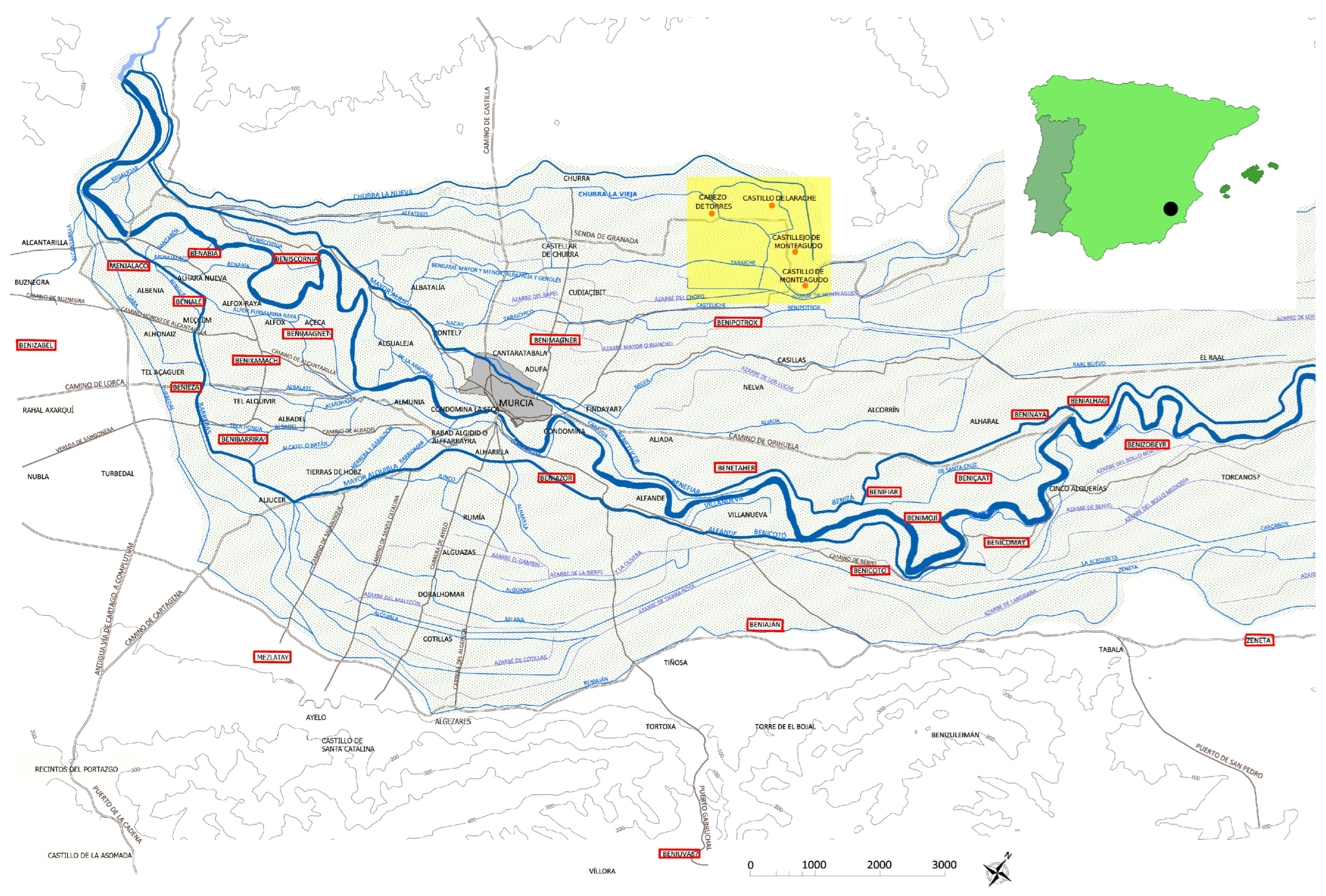
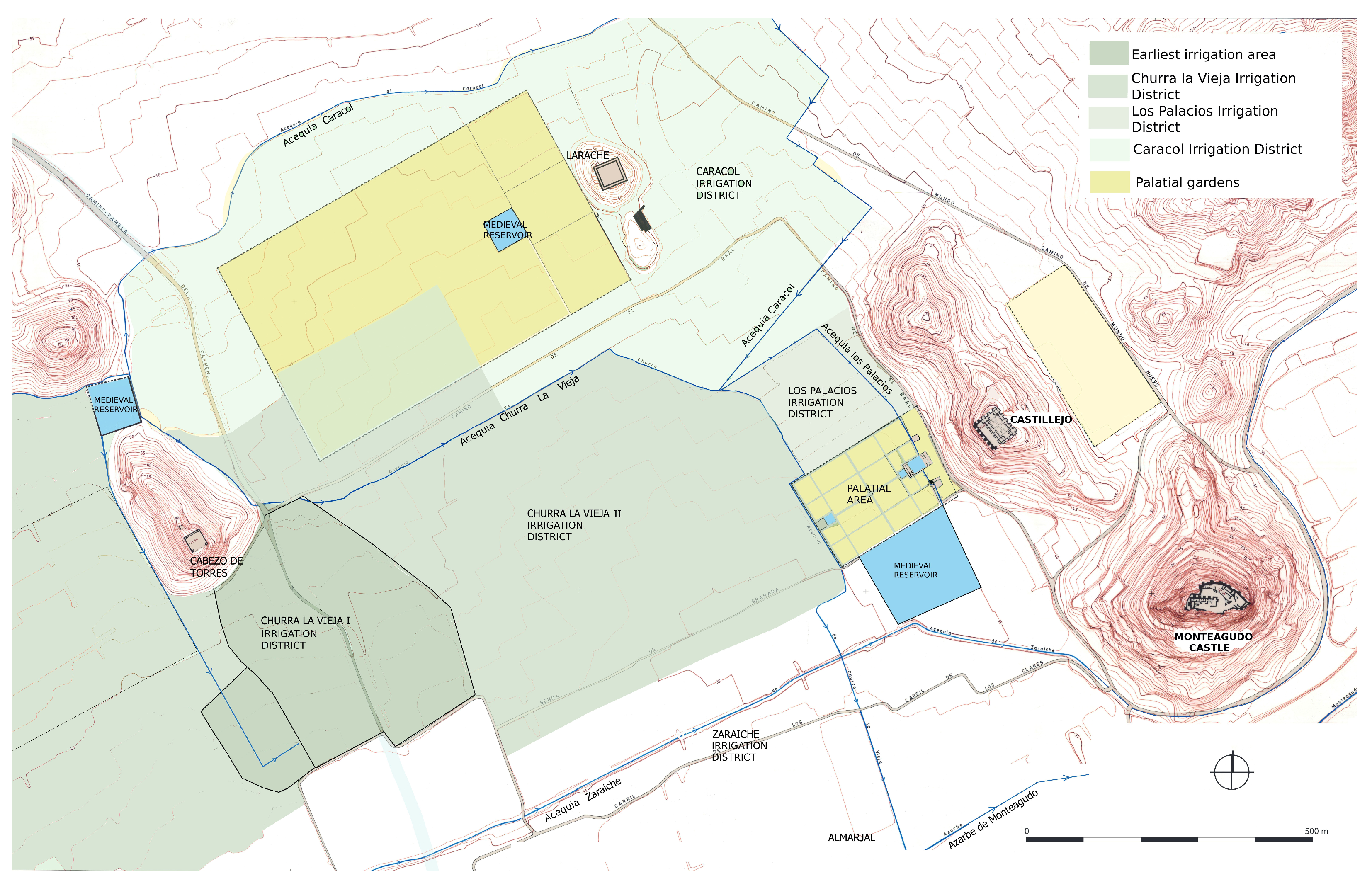
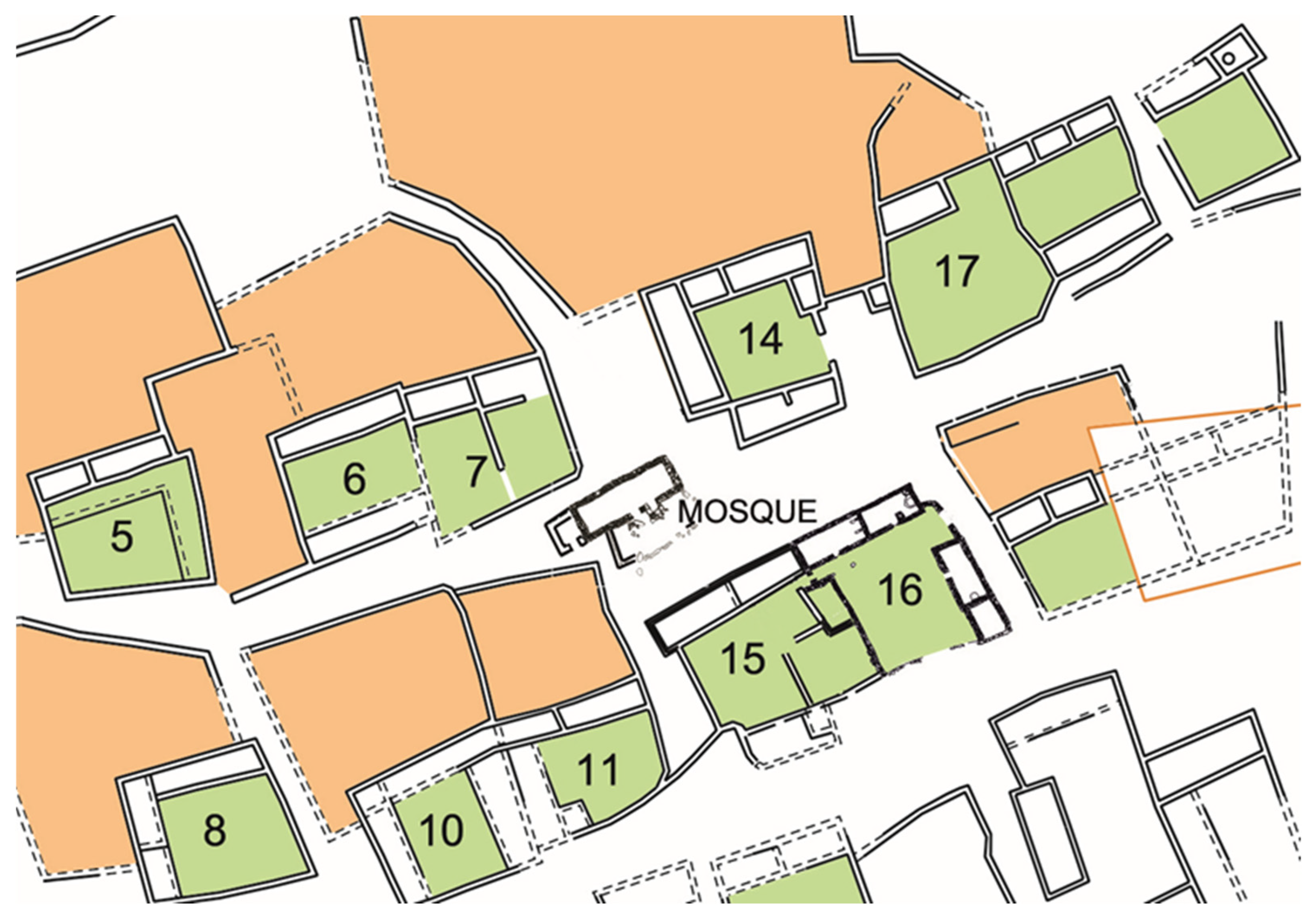
In this respect, recent archaeological evidence allows for interpretations that differ from—though are not necessarily incompatible with—those advanced for Valencia or Granada. The study of a well-defined sector of the huerta of Murcia, in the Monteagudo–Cabezo de Torres area, suggests that this was a single large state estate, or almunia, that of Monteagudo, whose internal organization was shaped by the successive construction of several palatial complexes closely linked to one and the same large-scale hydraulic system
1 (
Figure 1). The articulation between the traditional parcel network of the huerta and the evidence provided by archaeological survey and excavation—particularly the remains of the palatial complexes of Cabezo de Torres, the Castillejo of Monteagudo, and Larache, together with their associated canals—makes it possible to establish both the chronology and the promoters of these infrastructures, while also clarifying the internal logic of their development (
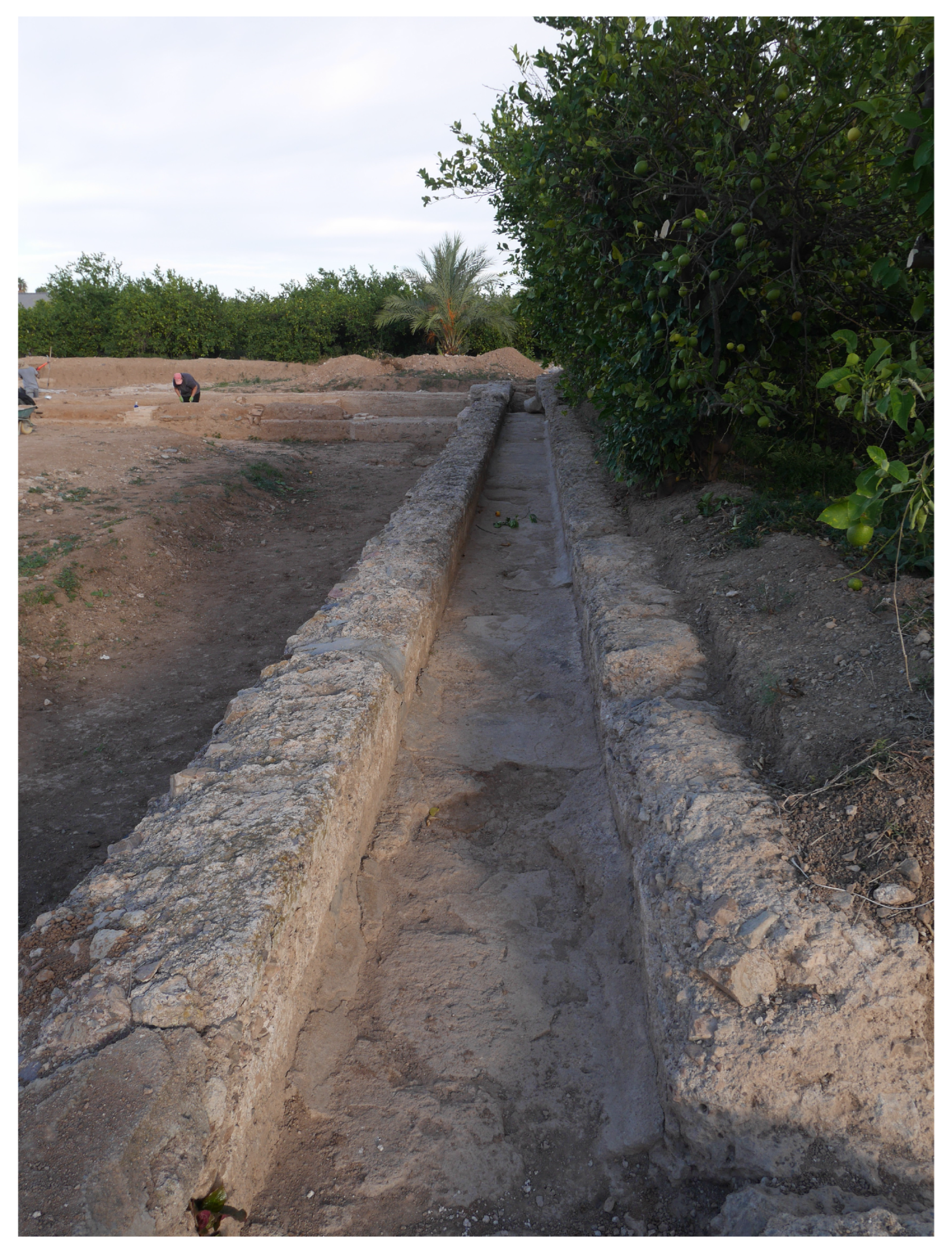
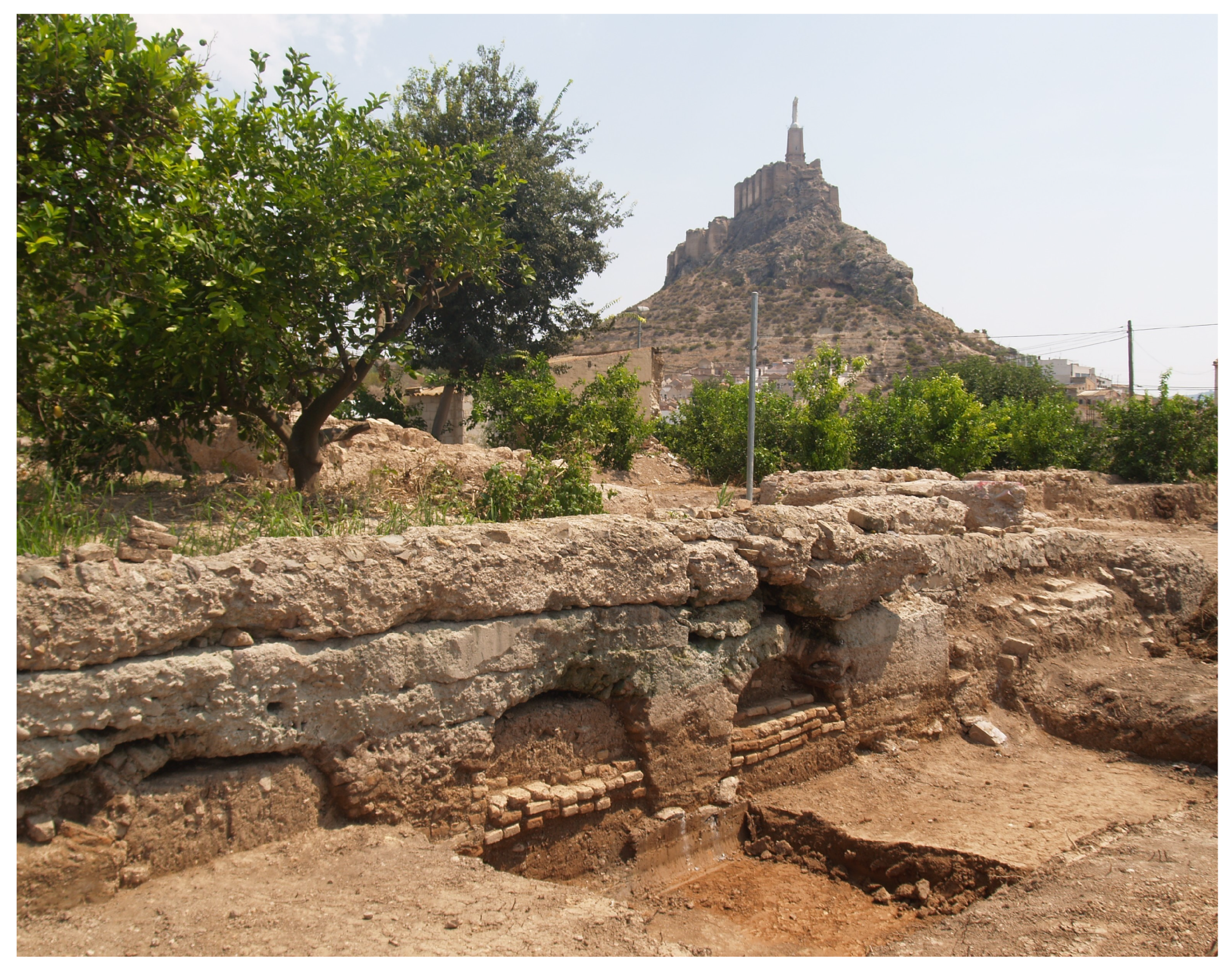
Figure 2). Archaeological analysis of the hydraulic system associated with this major state almunia further suggests a medieval sequence organized into several successive phases, of which the first three are the most relevant here. The first phase corresponds to the construction of the Churra la Vieja canal—the structural axis of the system—and of the palatial area of Cabezo de Torres, between the late eleventh century and the first half of the twelfth. In a second phase, around the middle of the twelfth century, the canal known as the Acequia de los Palacios was opened as a branch derived from Churra la Vieja, at the same time that the palatial area of the Castillejo of Monteagudo was established. Finally, in a third phase, during the first half of the thirteenth century, the Caracol Canal—again derived from the main canal—and the palatial complex of Larache were constructed (
Figure 3 and
Figure 4). The creation and gradual transformation of a substantial part of the northern sector of the huerta of Murcia, specifically the irrigation district of Churra la Vieja, can therefore only be understood as the result of intervention by a power endowed with considerable planning and investment capacity, which conceived and developed this hydraulic system in successive stages so as to serve, first and foremost, a major state almunia, while also allowing, secondarily, the incorporation of new irrigated land through the use of surplus flows.
The link between political power and the promotion of large hydraulic works is well documented in al-Andalus [
33] (pp. 271–272). Before 1010, for instance, Mubārak and Muẓaffar administered the canals of Valencia, a position that must in all likelihood have been closely tied to the city’s governor, while state intervention has also been proposed in the construction of the hydraulic system of Tortosa [
34] (p. 35). Other paradigmatic examples include the Garganta del Ciervo dam, attributed by al-Zuhrī to Ibrāhīm b. Hamušk [
35] (p. 309), [
36] and the qanāt of the Font de la Vila in Mallorca, referred to in the sources as ‘Ayn al-Amīr [
37] (p. 90).
Particularly revealing are the canals promoted by political power to secure the water supply of properties belonging to the sultan or the makhzan, whose surplus flow was redistributed among irrigable lands situated along their course and cultivated by owners and cultivators outside the direct domain of the state. This model, well documented in a range of Andalusi contexts, meant that an infrastructure originally intended to serve an estate or palatial residence could also generate, secondarily, new irrigated spaces whose exploitation helped amortize state investment through rents and taxation. The cases considered here point to a recurring pattern of political intervention in the expansion of peri-urban irrigation: initial investment in infrastructure serving state or courtly properties, followed by their integration into broader agrarian systems worked by private producers. This was the case, for example, with the conduits supplying the Alcázar of Córdoba and the Buḥayra of Seville, whose surplus waters were directed both to urban supply and to the irrigation of privately held land. In Almería, al-Mu’taṣim enlarged an earlier conduit serving both religious and palatial buildings, and part of its water was sold to cultivators, thereby generating income for the ruler [
38] (p. 92), [
39] (p. 322). Likewise, the Aynadamar canal, built in the eleventh century to bring water to the Zirid citadel in the Albaicín of Granada, irrigated agricultural districts and almunias outside the ruler’s direct domain, with part of its revenues devoted to public purposes such as the upkeep of the city walls [
40] (pp. 168–170). Murcia again offers particularly eloquent examples. The northern main canal, the Aljufía, derived from the Contraparada, ran as far as the Alcázar Seguir, the royal palace in the suburb of the Arrixaca, and there is strong evidence that its initial stretch was promoted by the state in order to guarantee water supply to the palatial complex, without excluding other complementary functions such as irrigation or urban distribution. An Arabic inscription further indicates that part of the revenue generated by this canal was assigned to the construction of a tower in the city wall [
41] (n
o 107), in a pattern comparable to that documented in Granada. A particularly significant parallel is provided by Valencia, where the taifa almunia of ‘Abd al-‘Azīz al-Manṣūr seems to have been associated with a hydraulic infrastructure initially designed to irrigate the palatial garden, but whose course—probably linked to the middle stretch of the Rovella canal—also enabled the cultivation of land worked by independent farmers [
29] (pp. 212, 213, 217). The extension of this canal as far as Ruzafa, another almunia of emiral origin, suggests a process of irrigation expansion in which state initiative acted as the driving force behind the agrarian transformation of sectors that did not strictly belong to the courtly estate, but whose exploitation nevertheless benefited political power in part. The Churra la Vieja Canal should be understood within the same framework. Excavated to serve the great courtly estate of Monteagudo–Cabezo de Torres, its course also contributed to the incorporation of new irrigated land in the northern sector of the Murcian huerta. These lands were cultivated by proprietors whose social structure is difficult to define. All the same, the available evidence strongly suggests that they were not kin-based groups, since the toponymy associated with these areas preserves no trace of tribal or clannic etymology, unlike what is found in the earlier colonization zones, especially in the sectors closest to the Segura River.
This kind of intervention suggests that, in certain contexts, the expansion of irrigation consisted less in the ex novo creation of agricultural landscapes than in the reorganization and integration of pre-existing systems within broader fiscal and political frameworks. The opening of new main canals, the derivation of secondary branches, and the bringing of marginal spaces under cultivation made it possible to expand the irrigated area significantly and, with it, the capacity for extracting surplus. From this perspective, the peri-urban huerta can be understood as a productive territorial infrastructure through which political power redefined land use, subordinated earlier peasant initiatives, and consolidated its fiscal base in a context of economic expansion. The benefits derived from these investments were both direct, stemming from the exploitation of estates belonging to the makhzan, and indirect, through the taxation imposed on aristocratic almunias and small peasant proprietors. It is significant, moreover, that lands brought under irrigation through state initiative did not have to be cultivated directly by political power itself, which derived its main return from taxation. Andalusi documentation and parallels from the wider Islamic world show clearly that the state generally assumed responsibility for financing and maintaining the main hydraulic infrastructures, while secondary conduits and agrarian exploitation remained in private hands
2 [
42,
43]. This division of functions allowed political power both to promote the expansion of irrigation and to secure a stable fiscal return derived from increased agricultural productivity.
Recognizing state initiative in the construction of large hydraulic systems does not mean denying the existence of comparable undertakings promoted by collectively organized peasant communities. On the contrary, all the evidence suggests that in different regions of al-Andalus—as has been argued for Valencia, Granada, and Ontinyent—small-scale hydraulic models linked to peasant colonization coexisted in earlier phases. In the Murcian territory, this first occupation of the landscape seems to have been articulated around segmentary hydraulic systems, built and managed by tribal groups, which would explain the presence of kin-based toponymy (Beni-) associated with
alquerías (rural settlements) irrigating small huerta plots along the Segura River and its immediate banks (
Figure 1). This pattern is consistent with what has been documented in other sectors of the Andalusi Mediterranean coast, such as the area around Tortosa, where concentrations of Beni- place names are associated with the installation of waterwheels used to exploit groundwater; the perimeter of the Moncada canal, fed by natural springs and linked to settlements of clannic origin; or the fringes of the Albufera and the marshland of Pego, where tiny irrigated plots watered by means of waterwheels and wells located beside ravines draining into the wetlands have been identified, always in association with small residential units [
16] (pp. 232–235).
This process was probably early. As J.A. Manzano showed in his study of the
Repartimiento (land distribution register drawn up after the conquest) of Murcia, by the thirteenth century no trace remained of the original inhabitants in settlements bearing clannic or tribal place names [
44], which points to a profound later transformation in settlement structures and patterns of land control. The state interventions discussed above must therefore have occurred subsequently, in connection with the construction of the great canals of Aljufía and Churra la Vieja, whose relatively late chronology for a substantial part of the Murcian huerta has already been established. Nor is this pattern confined to Murcia. In other Andalusi territories too, an initial agrarian phase characterized by the juxtaposition of small hydraulic systems has been documented prior to the creation of large, unitary-designed huertas in the same areas. Thus, the formation of Elche at the beginning of the eleventh century required a stricter management of the water resources of the Vinalopó basin—an irregular river system—which brought it into competition with a pre-existing network of small hydraulic systems associated with hilltop settlements that were eventually abandoned [
45] (p. 23). In much the same way, the huerta of Orihuela responded to a newly planned, markedly urban design, probably established in the late tenth century, and was associated with a new settlement pattern dispersed in alquerías located on the plain and integrated into the agricultural landscape, while earlier settlements on the margins of the Segura basin were abandoned [
46], [
47] (pp. 33–35), [
48] (p. 210).
The formation of these urban huertas does not therefore appear to conform to any single explanatory model, but rather to a complex and diachronic process in which early communal initiatives—strongly marked by peasant and tribal agency—converged with later processes of hydraulic expansion, integration, and reconfiguration driven by political power and urban elites in the context of the economic intensification of the tenth and eleventh centuries. Nor should one lose sight of the fact that such processes of hydraulic enlargement and fiscal integration can scarcely have unfolded without generating social tensions. The incorporation of new land into irrigation frequently entailed a redefinition of water-use rights, a progressive concentration of property, or increased fiscal pressure on small producers. Agrarian expansion in the eleventh century, then, not only contributed to economic growth; it also fostered processes of social differentiation in the countryside, while strengthening the capacity of the state and of urban elites to intervene in peasant territories.
3.2. Elite Agrarian Initiative
The
almunias associated with the
majzén—that is, estates belonging to the patrimony of the Islamic state—could fulfill residential, representational, and ceremonial functions complementary to those performed by urban citadels (
alcázares and
alcazabas). These properties typically included pleasure gardens, irrigated orchards, and, in many cases, extensive cultivated areas comprising both irrigated and dry-farming land, the exploitation of which generated substantial economic returns [
49]
3. Some of these
almunias were attached to the public treasury, whereas others formed part of the private patrimony of the ruler or the ruling family, although the boundary between these two spheres was often blurred both in administrative practice and in the written sources.
Alongside this initiative directly promoted by political authority, a substantial part of Andalusi agricultural expansion was driven by wealthy landowners, frequently closely connected to governing elites and, not infrequently, members or affiliates of ruling dynasties. Referred to in the sources through a varied terminology—bustān, ŷanna, buḥayra, real or almunia (Ar. munya)—these aristocratic estates became a structural component of the Andalusi agrarian landscape, combining residential, symbolic, and economic functions while playing a key role in productive intensification and in the growing commercial orientation of agriculture. These landowners, generally based in urban centers, invested actively in market-oriented agricultural enterprises, encouraged by the sustained increase in the profitability of the agrarian sector. Through such investments, previously marginal or underutilized lands were brought under cultivation, and new productive spaces—both irrigated and dry-farmed—were integrated into commercial circuits operating at regional and supra-regional scales. Far from representing a marginal or purely sumptuary phenomenon, these estates played a decisive role in Andalusi agrarian expansion by channeling urban capital into the creation or intensification of market-oriented agricultural production.
From the eleventh century onwards, the sources allow us to observe more clearly the multiplication of such establishments across different territories of al-Andalus, always in close connection with urban courts, governing elites, and the intensification of specialized agricultural production. Although aristocratic estates combining residential and productive functions are already documented in Umayyad Córdoba from the eighth century—most paradigmatically in the foundation of the Ruzafa by ‘Abd al-Raḥmān I, evoking the homonymous Syrian estate—it was from the eleventh century that such establishments expanded significantly throughout al-Andalus. Several taifa rulers founded
almunias with gardens and orchards around their capitals; for example, the “Huerta del Rey” (
Ŷannat al-Sulṭān) of al-Ma’mūn of Toledo, apparently designed by the agronomists Ibn Wāfid and Ibn Baṣṣāl, who introduced and acclimatized a wide range of crops including vegetables, fruit trees, spices, and aromatic herbs. The latter later moved to Seville, where he designed similar gardens and orchards for al-Mu’tamid [
50] (pp. 262–263). On the outskirts of Almería, al-Mu’taṣim (1051–1091) built one such
almunia which, according to al-‘Uḏrī, was a park where “besides commonly known plants, exotic species such as banana, in its various forms, and sugar cane were cultivated” [
51] (p. 45). In Valencia, Cordoban immigrants who settled in the city during the time of Mubārak and Muẓaffar “built residences and palaces, cultivated marvelous gardens and splendid orchards where they made water flow abundantly” [
52] (p. 157). In this period, aristocrats and members of urban elites thus emulated rulers in the construction of such estates, generally referred to as
bustān,
munya,
raḥ(a)l or
ŷanna [
53] (pp. 619–620), [
54].
A particularly revealing indicator of the penetration of urban elites into the countryside is the proliferation of agronomic treatises devoted to cultivation methods, water management, and the organization of agricultural production. The Andalusi agronomic tradition began to develop in the caliphal period, with works such as those of Abulcasis and agricultural calendars—including that of ‘Arīb b. Sa‘īd—and reached its peak in the eleventh century, when treatises conceived as genuine manuals of estate management were disseminated, such as those written by Ibn Wāfid, Ibn Ḥaŷŷāŷ, Ibn Baṣṣāl, Abū l-Jayr al-Išbīlī, or al-Ṭignarī [
55]. Many of these treatises are in fact compilatory in nature, incorporating material attributed to earlier authorities—both classical and Arabic—alongside observations derived from direct practice. This layered transmission of knowledge reflects the integration of al-Andalus into broader intellectual networks spanning the Mediterranean and the Islamic world. Beyond their technical value, the breadth and systematic nature of this literature constitute in themselves a significant indication of the consolidation of complex rural enterprises, oriented toward the market and controlled by affluent proprietors. These texts address in an ordered manner issues relating to soil types, fertilizers, crops, labor processes, agricultural techniques, water management, and product conservation, while also offering recommendations aimed at sustaining the productivity of intensively exploited lands through fertilization practices, tillage, and the selection of complementary crops designed to preserve or restore soil fertility. The continuity of this tradition in later works, such as those of Ibn al-‘Awwām in the twelfth century or Ibn Luyūn in the fourteenth, further confirms that commercially oriented agriculture remained a fundamental source of income for Andalusi elites over several centuries.
The treatises themselves provide fairly explicit indications regarding their intended social audience. This is evident, for instance, in chapters dealing with the hiring of laborers, the role of estate managers or overseers, or the construction of pleasure residences, pavilions, and guest accommodations, as described by Ibn Luyūn
4 [
56]. In the prologue to his work, Ibn al-‘Awwām [
57] (pp. 3–4) records advice attributed to Qays b. ‘Āṣim exhorting his sons to take care of their property (
māl) as a source of prestige and lasting profit, as opposed to blameworthy idleness. A passage such as this suggests that the intended readership consisted neither of princes nor of subsistence peasants, for whom idleness was not a real option. Similarly, Ibn Luyūn [
56] (pp. 53 Ar./198 trans.) states that he had gathered the most widely accepted and practiced knowledge in al-Andalus so that anyone interested could acquire, in a single work, everything that a cultivator (
fallāḥ) would learn over a lifetime. Taken together, Andalusi agronomic treatises—like comparable texts from Antiquity through the early modern period—were written by members of the intellectual elite and were primarily intended for well-to-do landowners with the economic resources and education necessary to access such works. Through them, estate holders obtained guidance on improving yields, introducing new species, organizing labor, and directing production toward the market, while peasants accessed this knowledge indirectly, through the instructions and supervision of their patrons. Agronomic treatises thus constitute a primary source not only for the study of agricultural techniques but also for understanding labor organization and the structure of rural enterprises; their very existence reflects the consolidation, from the eleventh century onwards, of an aristocratic landed property closely linked to productive intensification.
This evidence can be complemented by particularly significant archaeological finds, such as the assemblage of objects concealed in a cave at Liétor (Albacete), dated between the late tenth and the eleventh centuries [
58]. The hoard includes agricultural tools; implements associated with mining and forestry activities; weapons; artisanal and commercial instruments—such as balances—as well as domestic and luxury items, including carved furniture, bronze lamps, and a silver-embossed horse bit. The characteristics of the assemblage make it unlikely that it represents the belongings of a subsistence peasant clan, as suggested by the presence of luxury goods, while the hypothesis of an itinerant trader is also improbable given the absence of standardized product series. It is more plausibly interpreted as the household equipment of an aristocratic
almunia whose precise location has yet to be identified. The assemblage reflects the owner’s control not only over land but also over means of production and processing—as suggested by the presence of a hydraulic mill—and points to production primarily oriented toward the market. The presence of balances of different calibers, highly precise instruments, indicates commercial transactions involving goods of considerable value, probably precious metals, in line with the abundant Arabic technical literature on weights and measures composed between the ninth and twelfth centuries [
59]. Moreover, the Liétor find includes elements typical of the domestic equipment of affluent proprietors, demonstrating that such estates with aristocratic residences were not confined to the immediate surroundings of major cities but could also be located in fully rural contexts, associated with
ḥuṣūn and alquerías. From an archaeological perspective, finds such as Liétor suggest that these aristocratic estates were not merely spaces of residence and consumption but complex productive units equipped with processing facilities, measuring instruments, and prestige goods and fully integrated into commercial circuits.
A comparable case is that of the
almunia of Garví, in the territory of Alcaraz, known through post-conquest documentation and extensive archaeological research [
60]. Although clear remains of residential buildings have not been preserved, information is available on another estate of similar characteristics located within the territory of the
ḥiṣn of Caravaca, where a residence equipped with a small private bath has been documented [
61] (pp. 177–178), illustrating the high standard of living that could be achieved in such aristocratic country houses, even in areas distant from the principal
medinas.
Strong agricultural demand in this period also encouraged the cultivation of dry-farming lands that had previously been considered unattractive owing to their lower productivity or their distance from urban centers. This phenomenon is well documented in the Pla de Lleida, where extensive drylands exploited in the Andalusi period complemented riverine irrigated zones [
62]. In such areas, written sources and toponymy record the presence of
almunias belonging to urban proprietors, whose proliferation from the eleventh century onwards appears inseparable from a context of economic growth and intensified investment by urban oligarchies in rural property.
In sum, these indications suggest that the agrarian expansion of al-Andalus in the eleventh and twelfth centuries cannot be understood solely as the result of peasant initiative or demographic growth but also as the expression of sustained investment by urban and courtly elites in land, particularly in irrigated agriculture, though also in previously marginal drylands
5 [
63]. This process fostered productive intensification and the increasing commercial orientation of agriculture, while also facilitating the incorporation of broad sectors of the peasantry—including smallholders—into newly irrigated areas and wider processes of agrarian colonization. At the same time, however, these transformations entailed a progressive reconfiguration in the control of resources and agricultural surpluses, as well as the strengthening of fiscal mechanisms that weighed upon rural production, generating tensions and inequalities whose development will be examined below.
3.3. Peasant Colonization of Drylands
Agrarian expansion in al-Andalus during the expansionary cycle of the “long eleventh century” was not confined to the enlargement of peri-urban irrigation systems or to elite investment in almunias and large estates. A substantial part of this growth also rested on the peasant colonization of extensive dryland areas that had previously remained only lightly exploited because of their lower productivity, greater exposure to risk, and distance from the medinas. In such marginal environments, cultivation appears to have focused primarily on dry farming, especially cereals and legumes, while vine and, more unevenly, olive cultivation seem to have played a secondary role. If the expansionary conjuncture created sufficient incentives for urban landowners to invest in marginal lands, as some of the cases discussed above suggest, it also opened opportunities for sectors of the peasantry with limited resources and restricted access to irrigated land, who moved into still-available territories and developed forms of settlement based on mixed economies in which dry farming and livestock husbandry played complementary roles.
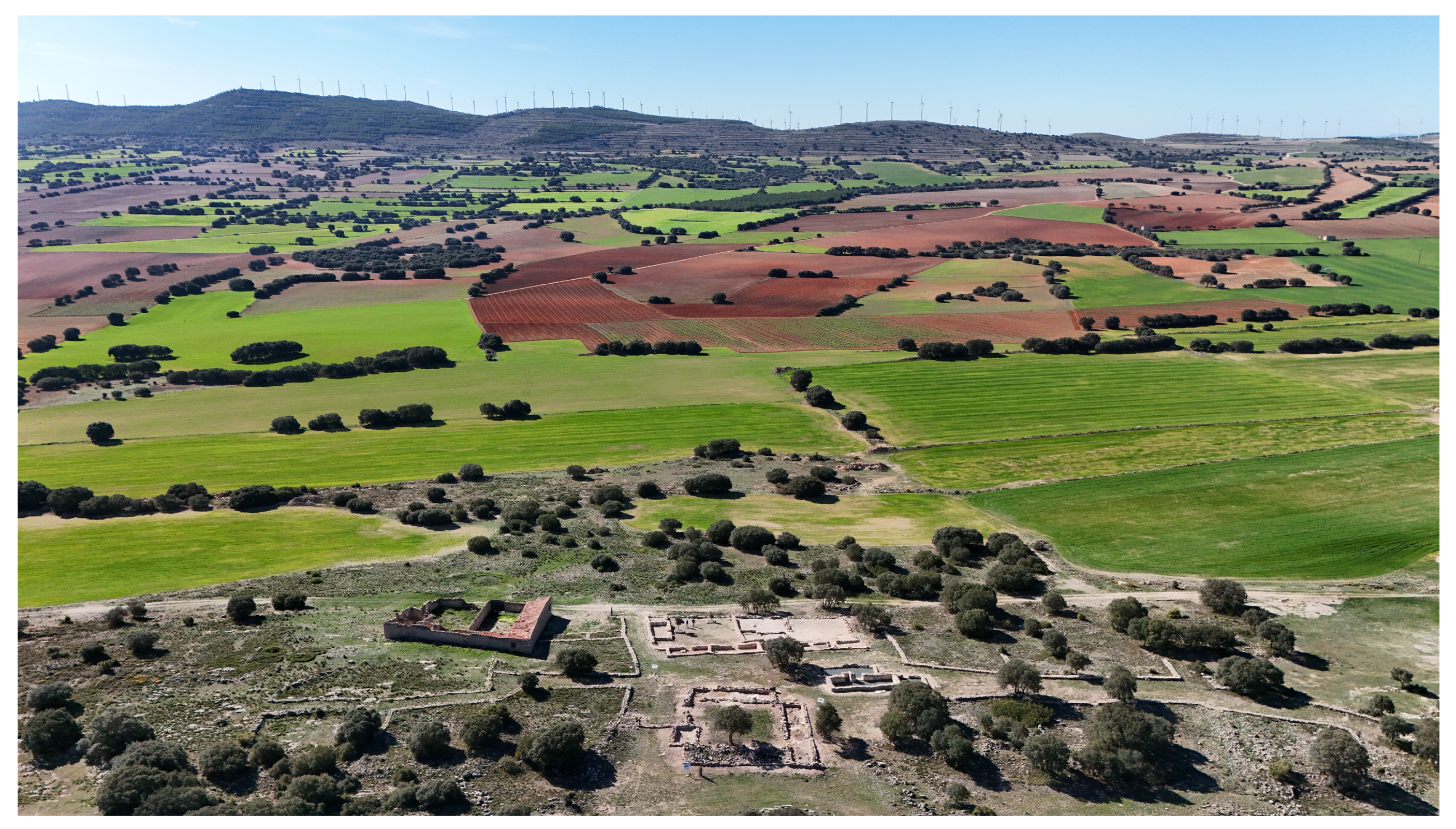
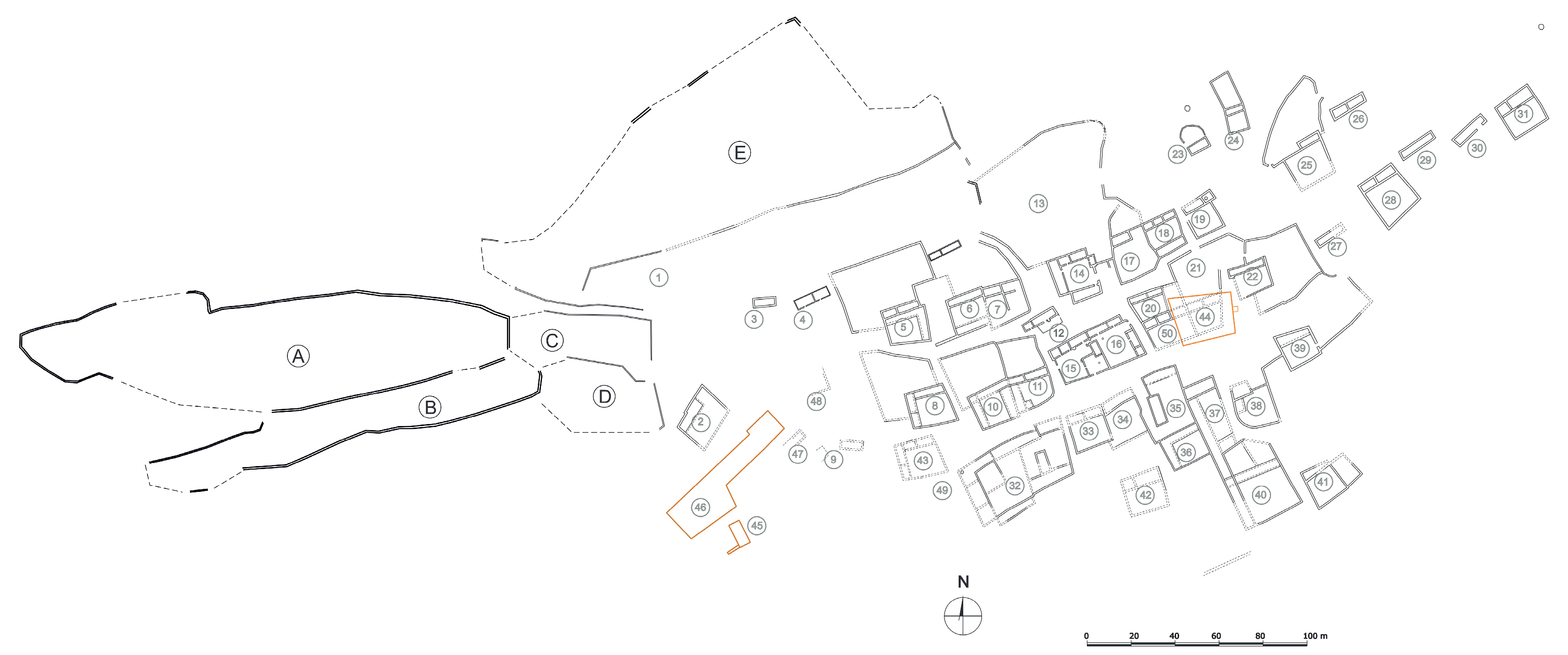
This process is documented with particular clarity in broad interior zones of Šarq al-Andalus, especially in the drylands of eastern La Mancha (
Figure 5). Systematic surveys carried out in recent years have revealed there a much denser Andalusi settlement pattern than had traditionally been assumed, composed of numerous newly founded sites of small size and modest architecture, which multiplied above all during the eleventh century [
64,
65] (
Figure 6 and
Figure 7). This was a region historically characterized by dispersed occupation, low population density, and an extensive use of the landscape, shaped by demanding environmental conditions and by the scarcity of opportunities for developing irrigation systems of any scale. For precisely that reason, historians had tended to project onto the Islamic period a similarly loose settlement pattern, apparently consistent with the image of an Islamic agriculture strongly oriented toward irrigated spaces. The archaeological record now requires a substantial revision of that view. Far from remaining on the margins of agrarian expansion, these territories were intensively occupied by peasant communities distributed across numerous small alquerías, established in contexts where irrigation was either marginal or practically absent.
The chronology of this phenomenon can now be established with reasonable precision thanks to the analysis of ceramic assemblages recovered in the survey and, above all, to excavations at sites such as La Graja and Hoya Honda, supported by reliable radiocarbon dates [
66] (p. 21). Taken together, the available evidence suggests that most of these alquerías emerged in the early eleventh century, that many were abandoned toward the end of the same century, and that only a limited number survived until the Christian conquest in the mid-thirteenth century. This sequence makes clear that we are not dealing with residual or archaic forms of occupation, but rather with a historically well-defined episode of peasant dryland colonization linked to the expansionary cycle of the eleventh century.
From a morphological point of view, these alquerías diverge from the best-known archetype of Andalusi rural settlement associated with small hillside irrigation systems or with irrigated zones close to permanent watercourses. In general, they were not situated in elevated positions overlooking
huertas, but rather on flat terrain or gentle slopes near cultivable land (
Figure 5). Their size varied considerably: some may have contained little more than a dozen domestic units, while others may have comprised forty or fifty houses. In urbanistic terms, they display loose and weakly hierarchical layouts, with dispersed buildings, broad and irregular circulation spaces, and no clear alignments that would justify speaking of a planned street network (
Figure 7). All this suggests forms of implantation resulting from collective decisions taken within village communities rather than from programs imposed by an external authority. In several cases one can observe respect for pre-existing tracks, rights of way, or minimum distances between dwellings that ensured a degree of domestic autonomy, as well as the reservation of specific communal spaces, including large peripheral corrals or central squares associated with the mosque, as at La Graja. Nor are there clear indications of sharply marked social hierarchy, although some differences in domestic architecture may reflect unequal levels of wealth within communities that remained relatively homogeneous. At La Graja, for example, the small initial capacity of the central oratory—barely sufficient for some twenty people—suggests a very modest founding nucleus, probably made up of a small group of settlers who divided up the space without the presence of a dominant household.
Nor is this a phenomenon confined to southeastern La Mancha. Other cases documented in recent years point in the same direction and allow this peasant colonization of drylands to be situated within a broader territorial framework. In the south of the present-day province of Teruel, a large number of small rural settlements have been identified, alongside some more substantial alquerías, dated to an advanced phase of the caliphal period on the basis of ceramic analysis [
67] (pp. 179–181). In central La Mancha, too, the consolidation of peasant communities settled in alquerías along the Cigüela has been documented from the tenth century onward, reaching its peak in the eleventh [
68] (p. 201). Excavation at Villajos has revealed the extreme modesty of its built structures, the predominance of features cut into the ground—pits, basins, planting hollows—and the presence of a well fitted with a waterwheel and accompanied by fragments of water-lifting jars. Its function may have been linked to a limited supplementary irrigation system or, perhaps more plausibly, to watering livestock, in keeping with the pastoral character of the site. In any case, the economy documented there, combined dry cereal farming with sheep husbandry, in a pattern very close to that observed in the alquerías of eastern La Mancha. Comparable phenomena have also been identified in more distant regions, such as Alcaria Longa in Mértola, where excavations document a rural settlement occupied for a relatively brief period between the late tenth or early eleventh century and the final taifa phase [
69] (p. 112). The chronological, functional, and morphological convergence of these cases strengthens the view that we are dealing with a supra-regional process of peasant dryland colonization, closely linked to the economic expansion of the eleventh century and unrelated to models of direct seigneurial or state implantation.
The case of La Graja makes it possible to analyze in greater detail the internal logic of this kind of settlement and the economic strategies that sustained it. In its earliest phase, the site was composed mainly of large stock enclosures accompanied by a small number of rectangular single-room dwellings arranged around a small central oratory (
Figure 7). The broad peripheral pens, designed for the protection and control of livestock, define a landscape clearly oriented toward pastoral activity (
Figure 6). All the evidence suggests that, at this initial stage, La Graja was not a mere stop along a pastoral route, but rather a seasonal station for herds situated at the point of departure or arrival of medium-distance transhumant movements. During the least favorable months, these herds must have moved toward more benign grazing zones, probably on the Levantine coastal plains. This hypothesis is consistent with the existence of long-distance pastoral corridors, such as the line later followed by the present-day Cañada Real de Andalucía, as well as with recent proposals pointing to transhumant circuits linking the interior districts of the Iberian system with the lagoon environments of the Levantine littoral [
70,
71]. To this may be added a significant datum: the ceramic repertoire of La Graja shows very close links with the Valencian sphere, which further reinforces the possibility of regular connections between the two areas.
The later evolution of the settlement, however, points toward a process of gradual sedentarization and economic diversification. The appearance of courtyard corrals, private pens attached to houses, and silos intended for cereal storage suggests the progressive transformation of this seasonal enclave into a more stable alquería, parallel to the development of cereal cultivation in the valley bottom. This change seems to reflect a transition from a system based on the communal use of pasture toward growing forms of land appropriation and productive diversification, aimed at reducing the risks inherent in dryland environments. Without mechanically transferring ethnographic parallels to the Andalusi world, it is worth recalling that in several Maghrebi regions one finds similar models in which seasonal occupation linked to livestock husbandry can evolve into more stable forms of settlement depending on herd mobility, pressure on resources, and collective management of territory [
72] (p. 11). In this respect, La Graja offers a particularly suggestive framework for interpreting the dynamics observed in other livestock-oriented alquerías of the Manchegan drylands.
Far from being limited to self-sufficiency, these mixed economies could also generate marketable surpluses. In the case of the alquerías of eastern La Mancha, specialization in sheep husbandry made it possible to obtain milk, meat, and, above all, wool, probably destined for the textile workshops of nearby
medinas such as Chinchilla, where the growth of such manufactures is well documented [
66] (pp. 35,36). This model finds close parallels in other rural settlements of the interior peninsula, such as Villajos or Quebrada de Saelices, where zooarchaeological studies reveal herds dominated by ovicaprids exploited primarily for secondary products—wool and milk—with selective slaughter of young males and prolonged retention of females [
54]. The composition of the herds, together with the presence of sheepdogs, points in these cases to livestock strategies operating on a local or comarcal scale and compatible with stable occupation. All this suggests that a significant part of Andalusi dryland peasant settlement was organized around integrated agro-pastoral economies in which livestock husbandry was not a marginal complement but a structural component of the productive system, relevant both for risk management and for the generation of surpluses. From this perspective, the available evidence invites a reconsideration of the analytical separation between agriculture and livestock husbandry that has weighed on much of the explanatory literature concerning Andalusi agrarian expansion. In these dryland landscapes, the two activities appear closely intertwined within complex agro-ecological systems, adapted to uncertain environmental conditions and to expanding markets.
The study of this peasant settlement associated with dry farming and livestock husbandry, to which an increasing number of scholars have contributed in recent years, is also making it possible to correct a long-standing historiographical bias. For decades, interpretations of the Andalusi rural world accorded an almost exclusively central place to irrigated agriculture, understood as the strategic option par excellence of peasant communities and as the principal space for generating surpluses appropriable by the state or by possible proto-feudal structures. As a collateral effect, dry farming and pastoral economies tended to be treated as secondary, marginal, or economically unimportant. Yet recent archaeological work in territories traditionally regarded as peripheral is revealing a much more varied picture, in which different models of occupation and exploitation of the landscape coexisted and evolved according to regional conditions and historical conjunctures.
In this respect, one of the best-documented processes is the progressive abandonment of numerous lowland alquerías from the late eleventh century onward, especially visible in regions such as the Almansa Corridor and La Manchuela. All indications suggest that this reordering of settlement was due not primarily to the economic exhaustion of the model, but rather to rising insecurity. As a consequence, part of the population tended to concentrate around ḥuṣūn and better-defended enclaves, above all in the Júcar valley, La Manchuela, the Almansa Corridor, and the southern sierras. Toward the end of the eleventh century, some centers such as Villar del Bachiller, Aguaza, or Torre de Bogarra absorbed part of the population from the lowland alquerías, while other minor settlements were completely abandoned. The general pattern was one of movement toward places dominated by a fortification, such as Almansa, Caudete, Chinchilla, or Higueruela, which experienced appreciable growth and, in some cases, evolved from the status of qarya to that of ḥiṣn. The principal reason for this transformation seems to lie in the growth of military and political pressure following the conquest of Toledo in 1085, the raids of El Cid and Alfonso VI, and the Castilian-Leonese presence in Aledo between 1086 and 1092, factors that drove broad sectors of the population to seek safer locations.
At the same time, one observes an expansion of occupation into mountainous and piedmont zones, with the appearance of fortified alquerías adapted to upland contexts, such as Haches in Bogarra. These settlements reveal strategies of refuge, territorial control, and extensive exploitation of mountain resources, once again supported by pastoral economies. In other cases, such as Isso in the district of Hellín, occupation of piedmont zones is associated in addition with population movements from the Middle March. The presence of notched cooking pots, a ceramic type characteristic of the Henares valley and the territories of the Middle March, documented in this southern part of Albacete from the beginning of the twelfth century, constitutes a fairly clear material indication of these movements and of the demographic reconfiguration linked to mounting pressure on frontier zones.
Taken as a whole, these data show that peasant dryland settlement was neither a residual phenomenon nor a merely impoverished extension of agrarian models centered on irrigation. On the contrary, it constituted a dynamic dimension of the Andalusi rural world, closely linked to the growth of the eleventh century, to the opening of new opportunities for colonization, and to the articulation of mixed economies capable of combining agriculture, livestock husbandry, and the production of surpluses. Its subsequent evolution, marked by abandonments, displacements, and processes of defensive concentration, highlights the extent to which these communities were exposed not only to ecological constraints but also to the political and military transformations of the final centuries of al-Andalus. Viewed from this perspective, peasant colonization of drylands does not represent a marginal note, but rather an essential element for understanding the diversity of trajectories assumed by Andalusi agrarian expansion and the tensions that accompanied that process.
3.4. Peasant Demand, Production and Inter-Rural Trade
The analysis of exchange offers a privileged perspective from which to understand the economic articulation of the Andalusi rural world beyond models focused exclusively on state action or on the initiatives of urban elites. Far from being limited to a unidirectional flow of surplus toward urban markets, peasant communities actively participated in commercial networks of varying scale that linked the countryside to the medinas, but also connected alquerías to one another.
The importance of peasant demand in the economic development of al-Andalus was already highlighted by Pierre Guichard, who challenged miserabilist readings of the rural world and argued for the existence of relatively cohesive communities capable of generating marketable surpluses and accessing manufactured goods [
73] (p. 232). This interpretative line has been further reinforced by Chris Wickham, who has emphasized the structural role of peasant consumption during the expansionary cycle extending roughly from the mid-tenth to the late twelfth century. Given that peasants accounted for between 75% and 90% of the population, their capacity both to produce and to demand goods had a decisive impact on the densification of exchange networks, the expansion of craft production, and urban growth across wide areas of the western Mediterranean, including al-Andalus [
3] (pp. 657, 688).
From this perspective, the economic integration of the peasantry cannot be explained solely in terms of fiscal mechanisms nor be reduced to forms of state redistribution. Alongside these processes, autonomous commercial circuits operated, channeling rural surpluses and facilitating access to consumer goods. Several archaeological indicators attest to the direct involvement of rural communities in such commercial and monetary practices. The discovery of small balance weights intended for precision weighing—probably related to the control of coinage—at sites such as La Graja or El Quemao [
23] (p. 14), [
67] (pp. 190–191), together with numismatic finds in rural contexts, including the Bonete hoard (Albacete) and materials associated with the rural market of Sant Rafel in Ibiza [
74], points to a significant degree of monetization in sectors of the peasant world. Although such evidence is necessarily fragmentary, its implications are clear: peasants not only produced surpluses but also participated actively in transactions linked both to taxation and to trade.
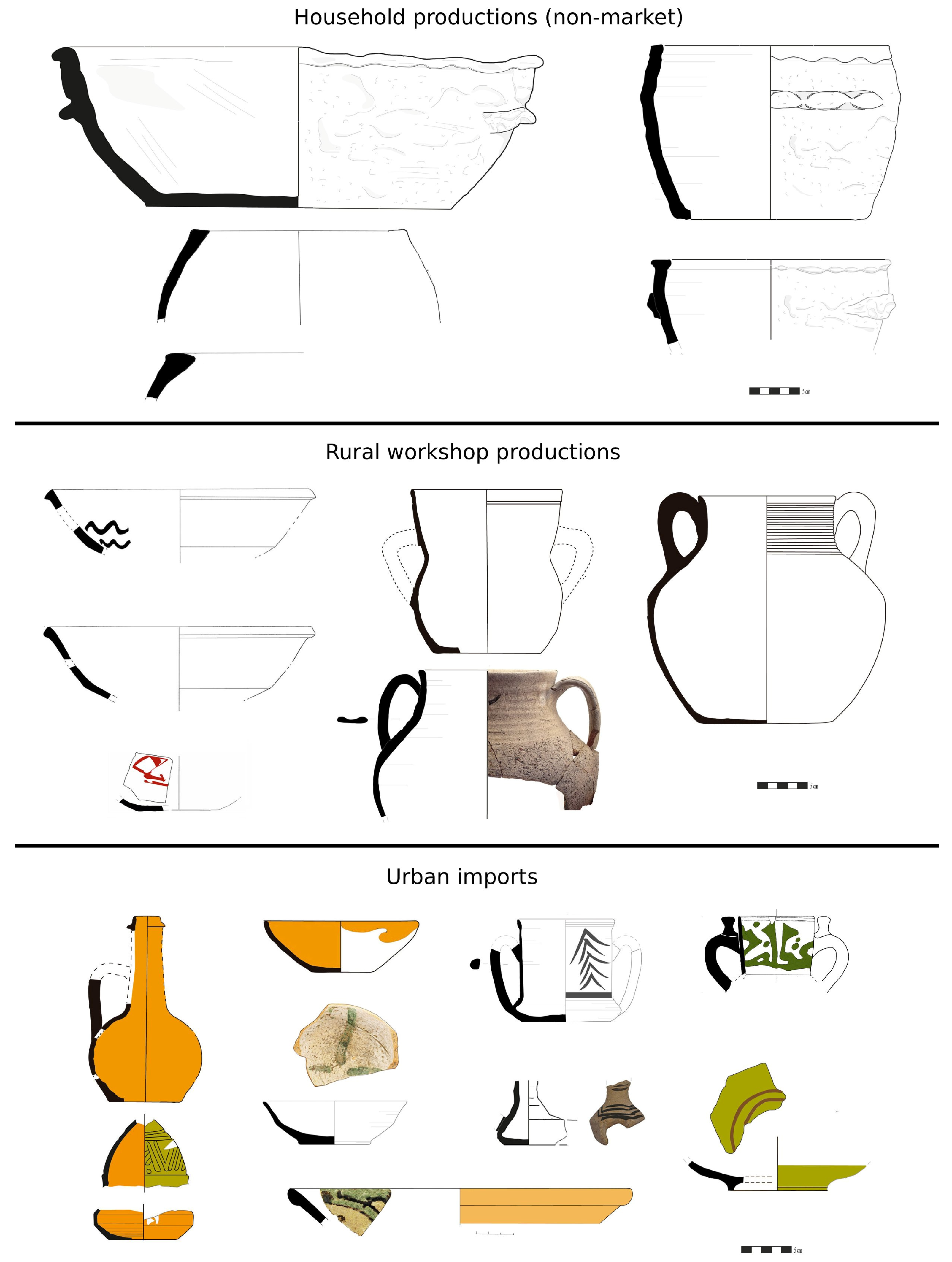
Ceramic assemblages provide a particularly useful observatory for analyzing these dynamics. In numerous alquerías in the southeastern Iberian Peninsula, such as La Graja [
64] or Castellar de Meca, urban imports represent only a limited proportion—around 10%—of the total assemblage, in contrast to the clear predominance of common wares produced in rural or regional workshops (
Figure 8). Among the imported materials, glazed tablewares stand out—monochrome pieces, green-and-manganese wares, or vessels decorated in green and purple—whose greater technical complexity and transport costs help explain their relatively low frequency. Their apparently luxury character is therefore contextual rather than intrinsic, deriving from their rarity within assemblages dominated by unglazed productions. Typological comparison consistently points to Levantine production areas, particularly in the regions of Valencia, Denia and Murcia [
75,
76].
Even more significant is the quantitative weight of specialized rural productions intended for exchange. At La Graja, approximately 80% of the ceramic assemblage consists of cooking pots and jars made on a tournette and originating from rural kilns, a pattern that rules out generalized household production and instead indicates the existence of specialized workshops whose output circulated among different peasant communities. The documentation of simple hillside kilns at Castellar de Meca confirms the presence of these intermediate forms of manufacture—situated between domestic production and urban workshops—oriented toward markets of local or subregional scale [
77]. Comparable models have been documented in other rural pottery centers in the Valencian region, such as Fadrell, Safra or Xaresa [
78], as well as in broader regional studies for the province of Alicante [
79], all of which confirm the segmented nature of distribution circuits and the importance of proximity markets.
During the twelfth and thirteenth centuries, these dynamics not only persisted but became more intense and diversified. Sites such as Isso reveal rural ceramic productions that are technically more advanced, wheel-thrown and even capable of imitating urban models, while at settlements such as Haches, Puça or the Villa Vieja de Calasparra a significant increase in urban imports has been documented [
61,
80,
81]. This pattern reflects greater fluidity in exchange networks and an increasing capacity to monetize peasant surpluses, without implying the disappearance of inter-rural circuits.
Beyond ceramics, alquerías developed a wide range of non-agrarian productive activities—such as domestic textile manufacture, leatherworking, basketry or rope-making from vegetal fibers—whose archaeological visibility is limited but whose economic relevance is evident. At La Graja, the presence of spindle whorls, metal needles, thimbles and awls, together with indirect indicators such as the predominance of ovicaprid herds or the occurrence of charred esparto, points to a diversified productive organization in which different domestic units may have specialized in specific stages of the textile chaîne opératoire [
82]. These activities were embedded in redistribution circuits of local or subregional scope that structured exchange between rural communities with complementary productive strategies.
Such economic networks relied in part on the existence of rural markets or periodic sūqs, well documented in textual and toponymic sources but archaeologically elusive due to their ephemeral and multifunctional character [
74,
83]. A
fatwā recorded by al-Wanšarīsī, for instance, refers to peasants from an alquería in the Axarquía who brought products such as salt, esparto or figs to exchange in the square located in front of the main mosque of Balliš/Vélez-Málaga [
84] (p. 430). Similarly, Adela Fábregas has identified the existence of weekly markets at Abrucena and Laujar de Andarax, both of which played a clear articulating role in subregional exchange [
85]. At La Graja, the presence of a congregational mosque associated with a large and well-connected central square allows the hypothesis of a periodic market linked to Friday prayer [
86] (
Figure 7).
Overall, this evidence invites us to rethink alquerías not as economically autarkic or urban-dependent units, but as active nodes embedded in complex exchange networks. Inter-rural trade thus emerges as a fundamental mechanism for the redistribution of surpluses, the compensation of ecological inequalities and the progressive integration of peasant communities into the expansionary economic dynamics of the period. This capacity to generate demand, organize exchange circuits and diversify production constitutes a clear expression of peasant economic agency, which interacted—and at times competed—with the investment initiatives of urban and courtly elites. Agrarian expansion in al-Andalus must therefore be understood as the result of the convergence and tension between these different levels of action, whose social and fiscal implications will be addressed in the following section.
3.5. Fiscal Pressure, Dispossession, and Social Conflict in the Rural World
The currently available evidence allows for a substantial reassessment of the interpretation according to which Andalusi peasant communities succeeded in imposing an agrarian model capable of preventing the emergence of a “hydraulic state” in the Wittfogelian sense, as proposed by Miquel Barceló. Rather, archaeological and textual data point to a complex and uneven scenario characterized by the coexistence of spaces initially managed on a communal basis—and progressively subjected to processes of privatization—alongside areas of direct intervention by political power and urban elites. This superimposition of productive logics and forms of land control generated increasing pressure on peasant economies and laid the foundations for structural tensions that repeatedly surface in written sources. In this context, the fact that feudalism, as defined for Christian Europe, did not fully develop in al-Andalus did not imply more favorable conditions for rural communities. On the contrary, these were subjected to an intense extraction of surplus through tributary mechanisms that fostered persistent dynamics of impoverishment, dispossession, and social conflict. Sources record recurrent episodes of crisis associated with droughts, scarcity, and poor harvests but also explicit complaints about fiscal pressure and abuses committed by intermediaries of political power [
23] (pp. 8–11). In the most extreme cases, such dynamics pushed the most vulnerable peasant groups into situations of structural poverty, making them particularly exposed to arbitrary practices of expropriation, as highlighted by Ana María Carballeira [
87] (pp. 145–154).
Some contemporary Arabic authors even linked the onset of the political and military decline of al-Andalus to the progressive deterioration of peasant living conditions and to the breakdown of the balance between agrarian exploitation, taxation, and state control. A particularly eloquent testimony is that of the pro-Almoravid jurist al-Ṭurṭūšī (d. 1127), who located the origins of the crisis in the last quarter of the tenth century. According to his account, the intensification of fiscal pressure promoted by Almanzor and the reform of territorial administration led to the ruin of numerous cultivators and the abandonment of their estates [
88] (pp. 92–93). In his well-known narrative, as long as the lands remained under the direct management of the troops, who treated the peasants benevolently “as the merchant cares for his merchandise,” fields were cultivated and resources were abundant. The situation changed, he argues, when the traditional system was replaced by monetary salaries and a new land tax whose collection was entrusted to the soldiers themselves, who “plundered the people, devastated their estates, and left them ruined.”
Beyond this specific testimony, sources consistently indicate that the state and elites close to power had two main avenues for expanding their control over land: the colonization of new agricultural spaces and the appropriation of already cultivated lands. The latter often operated through fiscal instruments that led to peasant indebtedness and the subsequent expropriation of their properties once the right of redemption had lapsed. Ibn Ḥazm, comparing earlier fiscal practices with those of the mid-eleventh century, denounced the proliferation of illegal taxes and concluded that such measures constituted “an infamous scandal, contrary to all the laws of Islam” [
89] (p. 67). Similarly, the Zīrid emir ‘Abd Allāh of Granada acknowledged the deep hostility of his subjects toward Andalusi rulers and the widespread resistance to taxation [
90] (p. 135).
Pierre Guichard analyzed these processes with particular clarity through a passage of Ibn Ḥayyān concerning the government of the Slavic co-princes Mubārak and Muẓaffar in Valencia. According to this testimony, fiscal exactions reached such levels that they degraded living conditions and prompted the progressive emigration of the rural population, while rulers, enriched by revenues from the ḥarāǧ, appropriated abandoned villages and converted them into private estates [
52] (pp. 160–164). Ibn Ḥayyān stresses that this phenomenon was not confined to the Valencian region but was replicated across wide areas of al-Andalus following the fragmentation of Umayyad central authority.
These dynamics contributed to the emergence of a stratum of urban landowners who, in the context of expanding market-oriented agriculture, enlarged their estates at the expense of small proprietors and communal lands held by peasant communities. Although al-Andalus did not develop a feudal system—as demonstrated by Manuel Acién [
91]—the Islamic tributary system functioned, from an economic perspective, as a coercive mechanism of surplus extraction analogous in its effects. Taxation and rent represent alternative institutional forms of coercive appropriation; although distinct in legal terms, they are economically comparable [
92] (p. 77). In practice, the Islamic state in al-Andalus succeeded—not without prolonged difficulties and conflicts—in establishing a fiscal structure capable of reaching even peasant groups located far from centers of political power. This system was organized around the rural community (alquería) as its basic unit. Defined in historiography as a tributary mode of production or distributive process, it essentially involved the appropriation, through coercion, of a portion of peasant labor in ways structurally comparable to feudal extraction.
The social consequences of this pressure were profound. Some dispossessed peasants migrated to cities, swelling the ranks of a precarious and vulnerable urban proletariat; others were pushed to colonize marginal agricultural zones located far from centers of power and less accessible to tax collectors. Both options should be understood as forced responses to the same underlying process of fiscal pressure and land appropriation. Ibn al-Jaṭīb offers a revealing illustration in recounting the story of a subject of Ibn Mardanīš who owned “a small estate from which he lived” near Játiva but whose tax obligations eventually exceeded his income, forcing him to flee to Murcia. There, despite managing to earn two mithqāls of gold through construction work, his situation did not improve: successive exactions and hardships imposed by the Mardanīsid state ultimately led to imprisonment and forced labor [
93] (p. 34). The former peasant, deprived of his land, thus became an unskilled urban worker—a choice that in pre-industrial societies was generally made only when no viable alternatives remained, given that artisanal labor did not ensure direct subsistence for a family and entailed greater risks and insecurity than even precarious agricultural exploitation [
94] (p. 193). This example underscores that urban migration did not always provide a sustainable solution for dispossessed peasants. In this context, it is plausible to assume that alongside urban growth there occurred a parallel—and partly complementary—movement toward the colonization of less favorable lands, usually distant from centers of power and difficult to access, where fiscal pressure was comparatively lighter.
Ibn Khaldūn [
95] (pp. 89–90) formulated this mechanism with particular clarity, noting that while courtiers and favorites were exempt from taxation due to their proximity to the sovereign, those who continued to cultivate the land were treated harshly, leading them to “abandon their estates, leave their houses empty, and seek refuge in remote lands that are difficult to reach, and settle there.” This was not a theoretical hypothesis but a historically documented behavior that helps explain the colonization of especially unfavorable agrarian regions previously uncultivated, such as the valley in which the alquería of La Graja and other nearby settlements were established.
Comparative historical anthropology suggests that processes of agrarian commercialization and fiscal centralization tend to exacerbate social inequality and generate conflict, particularly when surplus appropriation takes the form of direct land expropriation [
96] (pp. 201–308), [
97] (p. 291). In al-Andalus, fiscal pressure and the growing monetization of agriculture likewise fostered varying degrees of social conflict, visible both in episodes of open violence and in more subtle forms of resistance such as migration, non-cooperation, legal appeals, or adherence to religious movements critical of political authority. Sources document an increase in banditry, the insecurity of roads [
23] (pp. 26–27), and the abandonment of certain traditional routes, as well as episodes of extreme urban violence that must be situated within a context of acute economic and social tension, such as the revolt of Toledo in 1079 or the pogrom of Granada in 1066. Regarding the latter, García Sanjuán [
98] has emphasized its ideological and political dimensions; however, the economic conjuncture of the time allows for a complementary reading in which the initial violence was directed against those responsible for fiscal policy—tax collectors and state agents—and subsequently against a social group perceived as wealthy, whose plunder could be legitimized through a rhetoric of piety. As Pedro López de Ayala [
99] (pp. 738–739) observed with regard to the bloody pogroms that occurred in the kingdoms of Castile and Aragon following the severe economic and social crisis of the mid-fourteenth century, “all this was greed for plunder, as it seemed, more than devotion.”
Within this framework, religious scholars played an ambiguous role. Although in theory obliged to denounce illegal taxes and protect legitimate landowners, sources reveal the extent to which they often acted in complicity with the state, which ultimately controlled judicial appointments. Al-Ṭurṭūšī [
88] (p. 111) even records the protest of certain ulemas who reproached viziers by declaring: “You are the ones who devour the property of the people without benefit to them, who deem it lawful to oppress them without cause; who gradually strip them of their means of livelihood as the price of your bribery and corruption; who desire the land without right.” Political authorities nevertheless possessed sufficient mechanisms to compel jurists to adapt their legal opinions to state interests, as the protagonists themselves ultimately admit. Ibn al-Kardabūs [
100] (pp. 100–101) recounts that in Toledo under al-Qādir—burdened by the payment of parias to Alfonso VI—a riot broke out one night in 1079, during which “the hateful rabble (‘amma) raised cries and tumult, killed the faqīh Abū Bakr ibn al-Ḥarīrī and a group of his equals, and plundered the houses of the notables.” He leaves no doubt about the motives for the rebellion when he adds that al-Qādir “fled by night with his tax collectors (‘ummāl) and all his treasures.” In addition to looting aristocratic houses, whose owners were perceived as having enriched themselves through popular misery, the anger of impoverished groups was directed against religious scholars themselves. In this case, the motive seems not to have been the seizure of wealth but revenge, since they were expected to protect the populace from the abuses of the powerful and had failed to do so; consequently, they were viewed as accomplices in the multiplication of illegal taxes.
It is therefore not surprising that in periods of heightened social tension heterodox religious figures and popular holy men gained prominence as defenders of the poor and critics of fiscal injustice. Operating outside the framework of official religiosity represented by state-aligned scholars, these individuals often aroused suspicion among ruling elites. Their treatment varied—as Carballeira [
87] has shown—depending on the degree of confidence rulers felt in their own authority and legitimacy. Thus, impoverished ascetics enjoyed considerable prestige during the Umayyad period, whereas Sufis in the Nasrid era were frequently mistrusted or marginalized by political authorities wary of their influence among lower social strata. In moments when state stability was threatened and economic pressure on the peasantry intensified, governing circles appear to have feared explicitly that such charismatic figures might channel and mobilize popular discontent.
This phenomenon formed part of a long tradition of critical spirituality in al-Andalus. From Abū l-Ḥasan al-Baryī (d. 1115–1116), promoter of the collective fatwā defending the works of al-Ghazālī, through Aḥmad al-Gazzālī, his disciple Ibn al-ʿArīf, and other masters such as Abū l-ʿAbbās Aḥmad al-Qanṭā’ir or Abū Marwān al-Yuḥānisī (d. 1268), the tahas of Dalías, Berja, Andarax, and Lúchar became centers of intense mystical activity from the late twelfth century onward, reflected in the proliferation of rābitas and the consolidation of spiritual networks deeply rooted in the rural world [
101] (p. 77). The popularity of such figures—exemplified by Ibn Barraǧān, known as the “al-Ghazālī of al-Andalus”—was perceived by Almoravid authorities as a potential threat, leading to the summoning, imprisonment, or suspicious deaths of several masters in a context of fear regarding the emergence of charismatic leadership capable of challenging state legitimacy.
Within this same framework must be placed the figure of the Almerían holy man Abū Isḥāq Ibrāhīm, active in the Almohad period, who displayed a marked preference for peasants and shepherds. He is said not only to have founded some twenty mosques but also to have promoted the construction of eighteen cisterns in his territory [
102], actions revealing a form of spirituality closely linked to the improvement of material conditions of subsistence. A well-known anecdote recounts how, when approached by wandering seekers asking for instruction in alchemy, he led them to a barren field being brought under cultivation and told them that this was their true “alchemy,” thus illustrating an ethic centered on agricultural labor and the productive transformation of the landscape. It is perhaps not coincidental that he was later persecuted by the caliph al-Mustanṣir and died under obscure circumstances following a dispute involving the abuses of a tax collector.
Similarly, the Sufi master al-Yuḥānisī in the thirteenth century systematically refused any association with political authorities or economic elites, rejecting governors, officials, and landowners who benefited from peasant indebtedness and the forced depreciation of harvests, as recorded in his biography [
103] (p. 217). Yet far from adopting a passive stance, he actively defended the rights of the poor and oppressed through letters addressed to Sultan Muḥammad I, who even sent his vizier to discuss such matters. This episode illustrates both the social authority such figures could wield among popular classes and the concern of rulers about ignoring a moral authority capable of articulating social discontent in a context of mounting economic pressure on rural populations.
When considered within their wider social context, these developments suggest that the expansion of market-oriented agriculture and the intensification of exchange generated not only prosperity but also deep social tensions. Fiscal centralization and the monetization of the economy fostered urban growth and productive expansion, yet at the same time contributed to the dispossession of segments of the peasantry, the concentration of landed property, and the colonization of marginal environments by humble groups of herders and cultivators who, in many cases, had few alternatives other than urban migration or settlement in less favorable territories. In this sense, Andalusi agrarian expansion should be understood not only as a process of productive growth but also as the outcome of a complex—and often conflictive—interaction between the capacity for initiative displayed by peasant communities, the investment strategies pursued by urban and courtly elites, and the extractive dynamics of political power.