Review

Vernacular Cultural Landscapes and Community Well-Being: A Spatial Review of Health, Identity, and Resilience

by
Maria Mprouzgou
and
Evangelos Asprogerakas
*
Department of Planning and Regional Development, University of Thessaly, Pedion Areos, 38334 Volos, Greece
*
Author to whom correspondence should be addressed.
Land 2026, 15(5), 775; https://doi.org/10.3390/land15050775
Submission received: 1 April 2026 / Revised: 28 April 2026 / Accepted: 1 May 2026 / Published: 2 May 2026
(This article belongs to the Special Issue Land Planning to Integrate Ecosystem Resilience and Human Well-Being)

Abstract

This study examines how vernacular cultural landscapes (VCLs) contribute to community well-being, addressing fragmented evidence across cultural geography, environmental psychology, and public health. It aims to develop an integrated understanding of the mechanisms linking VCL characteristics to health outcomes. A hybrid narrative–scoping review, following the PRISMA-ScR guidelines, synthesizes the interdisciplinary literature (2016–2026). The findings show that VCLs support well-being through interconnected pathways, including physical activity, psychological restoration, social cohesion, and environmental sustainability, although these effects are shaped by governance, access, and socioeconomic conditions. The study concludes that VCLs function as context-dependent, health-supportive socio-ecological systems. Its key contribution lies in developing a conceptual framework that operationalizes VCL–health relationships and informs spatial planning and public health policy.

1. Introduction

1.1. Background and Theoretical Context

Vernacular cultural landscapes (VCLs) are socio-ecological environments shaped through long-term interactions between communities, cultural practices, and local ecosystems. They integrate natural processes with settlement patterns and cultural traditions [1,2]. Urban transformation, climate pressures, and evolving public health priorities are reshaping planning agendas. In this context, increasing attention is being directed toward the role of VCLs in supporting community well-being and resilience within spatial planning frameworks [3,4].
Emerging from every day, bottom-up practices, VCLs embed accumulated local knowledge, adaptive environmental strategies, and shared cultural identity. They function as socio-spatial systems in which ecological processes, cultural meanings, and social interactions co-evolve, shaping both individual and collective experiences of place [5,6].
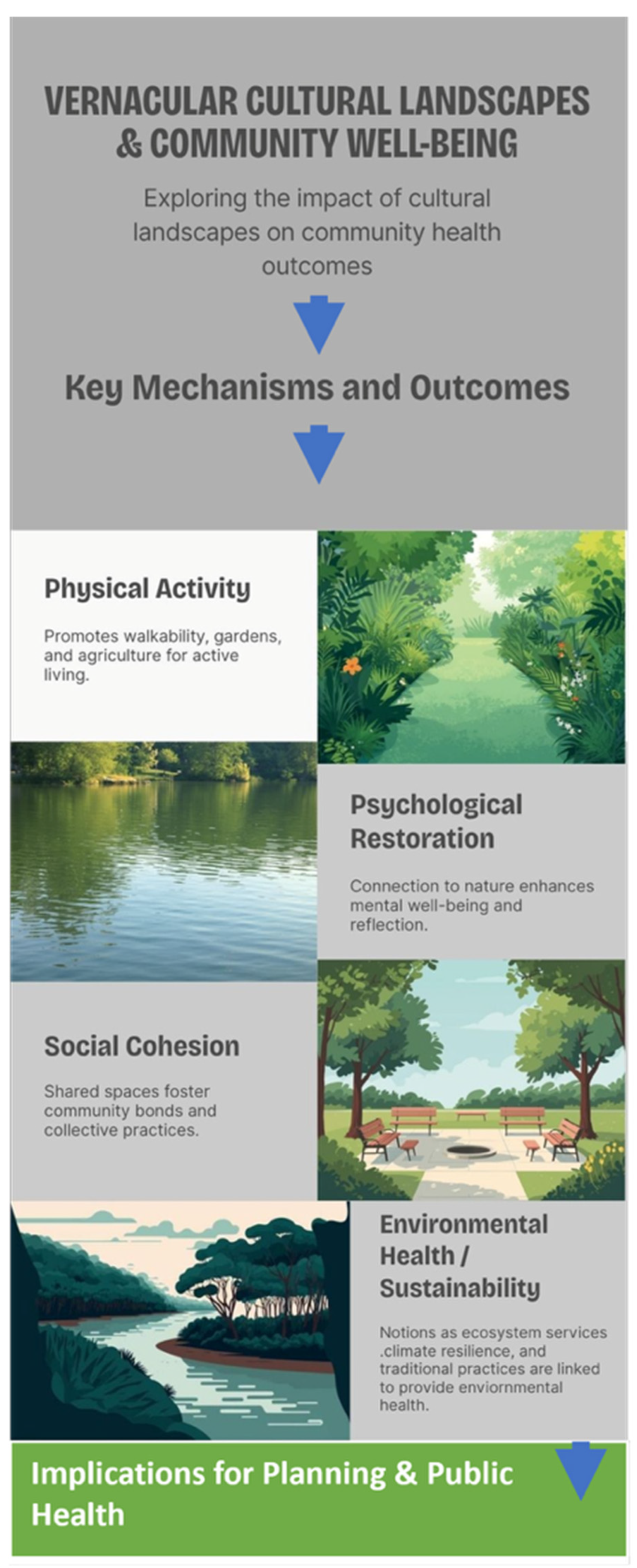
From this perspective, well-being is not solely an individual condition but a socially and spatially embedded process influenced by interactions between people and their environments [7]. To clarify these interrelations, Figure 1 presents a schematic representation of the links between vernacular cultural landscapes and community well-being.
Several theoretical approaches highlight the links between environment, culture, and well-being, including human–nature interaction, psychological restoration, and place-based identity [8,9,10,11,12,13], as well as approaches linking ecosystem services, sustainability, and social capital to community health and resilience [14,15].
While these perspectives provide valuable insights, they are often applied to natural or urban environments in general terms. In contrast, VCLs represent integrated socio-ecological systems in which cultural practices, environmental processes, and lived experiences are inseparable [16].
Despite a growing body of research linking cultural landscapes to human well-being, the field remains conceptually fragmented, with integration efforts often masking, rather than resolving, underlying theoretical tensions [17,18,19].
These studies often examine environmental, cultural, or health-related dimensions in isolation, leading to divergent and at times conflicting interpretations of how VCLs influence well-being. In addition, ongoing debates about the relative importance of cultural versus ecological attributes produce competing explanations of whether well-being emerges primarily from symbolic meaning or material environmental conditions. Additionally, challenges in distinguishing correlation from causation, along with tensions between heritage conservation and development priorities, add further complexity [20,21].
As a result, the mechanisms by which VCLs contribute to community well-being, particularly in relation to identity and resilience, remain insufficiently integrated and underdeveloped conceptually. Furthermore, research has given limited attention to how these relationships can be operationalized within spatial planning and public health frameworks, constraining their application in practice.
To address this gap, the present study develops an integrated analytical perspective on VCLs and community well-being. It adopts a hybrid narrative–scoping review to synthesize interdisciplinary evidence and examine how VCL characteristics relate to health outcomes across the physical, mental, social, and environmental dimensions.
In this context, the term “spatial review” refers to a hybrid scoping approach that emphasizes spatial characteristics and place-based mechanisms linking VCLs to community well-being. The study follows the PRISMA-ScR guidelines and does not constitute a spatial comparative case analysis, but rather an integrative review of spatially embedded relationships across disciplines.
In doing so, the study identifies key mechanisms linking landscape attributes to well-being and advances a conceptual framework that connects spatial, cultural, and health-related processes.
This study is guided by the following research questions:
(1)
Which characteristics of VCLs are associated with community health and well-being across the physical, mental, social, and environmental dimensions?
(2)
How do heritage-related aspects, such as sense of place, traditional knowledge, and intergenerational continuity, influence these health and well-being outcomes?
(3)
How do different disciplines, including cultural geography, environmental psychology, and public health, conceptualize and interpret the relationships between VCLs and health?
(4)
What gaps and limitations exist in the current literature, and what areas require further research?

1.2. Research Aim

This interdisciplinary study aims to clarify how VCLs contribute to community health and well-being. It identifies the key landscape characteristics and underlying mechanisms that support community resilience across the physical, mental, social, and environmental dimensions. Across different dimensions of well-being, fragmentation in the literature was identified, positioning VCLs as living socio-ecological systems relevant for planning and public health policy. To synthesize these relationships, the study developed an integrated conceptual framework that links spatial attributes of vernacular cultural landscapes with health-supporting pathways, cross-cutting processes, and multidimensional well-being outcomes.
Thus, the contribution of this study is to the growing body of research on landscape and health, advancing an integrated, spatially grounded understanding of vernacular cultural landscapes as health-supportive systems. Previous studies tended to examine the environmental, cultural, or health-related dimensions in isolation, however, this review synthesizes the evidence across disciplines to develop a unified analytical perspective.
Building on this integrative approach, the paper operationalizes the relationship between VCLs and community well-being by systematically identifying key landscape characteristics and linking them to specific health-supporting mechanisms. It organizes them within a structured framework that captures four interrelated dimensions of health: physical, mental, social, and environmental. In this way, landscape features are not examined as isolated elements, but as part of the interconnected pathways through which well-being is produced.
Thus, instead of simply outlining their cultural or spatial qualities, it explains how these qualities function in practice. The framework connects tangible and intangible landscape attributes, such as spatial patterns, cultural practices, and ecological processes, with concrete health outcomes. By doing so, it establishes clearer links between spatial form and lived experience.
Ultimately, the framework provides an integrated analytical structure that clarifies how VCLs operate as health-supportive socio-ecological systems. It demonstrates that well-being emerges through the interaction of spatial, cultural, and environmental processes, offering a more coherent and operational understanding of how landscape contributes to community health.
Within this conceptual scope, the study does not seek to provide a formal critical appraisal of individual studies; rather, it adopts a comparative and interpretive synthesis to highlight convergences, divergences, and key limitations across the literature.

2. Materials and Methods

2.1. Research Design

This study follows a scoping review methodology informed by narrative synthesis [22]. This was selected due to the field’s conceptual fragmentation and the need to integrate heterogeneous evidence across disciplines, where systematic comparison is limited. According to the scoping review methodology, the literature was broadly mapped, while narrative synthesis provided a structured summary of the findings, and conceptual synthesis provided a structured summary of the concepts.
To achieve transparency, this review was conducted in accordance with the PRISMA extension for scoping reviews (PRISMA-ScR) [23]. This provided a standardized, reproducible tool for tracking the selection process [24].

2.2. Review Process and Synthesis Approach

The review was structured around four objectives: (i) exploring the literature across cultural geography, environmental psychology, public health, and sustainable development; (ii) analyzing key features of VCLs and their impacts on community health and well-being; (iii) interpreting relevant theoretical frameworks; and (iv) identifying research gaps and future directions.
A five-step review process was followed. First, the research questions and objectives were defined. Second, a review protocol was developed. Third, a literature search was conducted, and sources were selected based on predefined inclusion and exclusion criteria. Fourth, key study characteristics were extracted and systematically organized to ensure transparency. Finally, the findings were synthesized and presented, along with identified research gaps.
In addition, disciplinary perspectives (e.g., cultural geography, environmental psychology, public health) were examined through a conceptual and interpretive synthesis of theoretical frameworks and analytical approaches, rather than through formal classification or coding. This enabled the identification of differences in how VCL–health relationships are conceptualized across fields.
A review protocol was developed to guide the search, selection, and synthesis process and is available on the Open Science Framework (OSF) (OSF, Center for Open Science, Charlottesville, VA, USA) https://doi.org/10.17605/OSF.IO/DSW7R.
Extracted data included study focus, subject correlations, and key findings, with particular attention to landscape characteristics and associated health outcomes.

2.3. Search Strategy and Data Sources

Literature searches were conducted primarily through Google Scholar, complemented by access to various scientific databases (e.g., PubMed, Scopus, Taylor & Francis Online, JSTOR). Search terms were developed iteratively to reflect the topic’s interdisciplinary scope. Initial exploratory research identified how key concepts were framed across cultural geography, landscape studies, public health, and environmental psychology. Identifying disciplinary variations in terminology finalized the keyword set.
The search strategy combined key terms related to VCLs, health and well-being, and spatial and social dimensions. The search strings provided are illustrative examples of a broader, iterative approach. Terminology was adapted across disciplines to reflect differences in how relevant concepts are framed, rather than relying solely on discipline-specific keywords. Although the review is structured around various disciplines, the search terms were intentionally expanded (e.g., to include planning-related terminology) to ensure comprehensive interdisciplinary coverage.

Core Search Strings

(“vernacular cultural landscapes” OR “cultural landscapes” OR “traditional landscapes” OR “cultural heritage landscapes”) AND (“health” OR “well-being” OR “mental health” OR “physical health” OR “social well-being” OR “quality of life”)
  • Planning-related search strings
(“cultural landscapes” OR “vernacular landscapes”) AND (“spatial planning” OR “land-use planning” OR “urban planning” OR “landscape planning”) AND (“health” OR “well-being” OR “resilience”)
2.
Broader interdisciplinary strings
(“place identity” OR “sense of place” OR “cultural identity”) AND (“health” OR “well-being” OR “mental health”)

2.4. Data Management and Extraction

Zotero (Corporation for Digital Scholarship, Vienna, VA, USA) was used to manage references and record the study characteristics and research design information.

2.5. Study Selection and Eligibility Criteria

Studies were included if they: (i) addressed VCLs or closely related concepts (e.g., cultural heritage, place identity, traditional landscapes), (ii) examined links to community health and well-being, either directly or indirectly, (iii) were published in peer-reviewed journals; and (iv) fell primarily within the 2016–2026 timeframe. Studies were excluded if they lacked full-text access, were only marginally relevant to the research focus, or did not establish a clear connection between landscape characteristics and health-related outcomes.
Although VCLs served as the central term, related concepts such as cultural heritage, place identity, traditional landscapes, and community well-being were included.
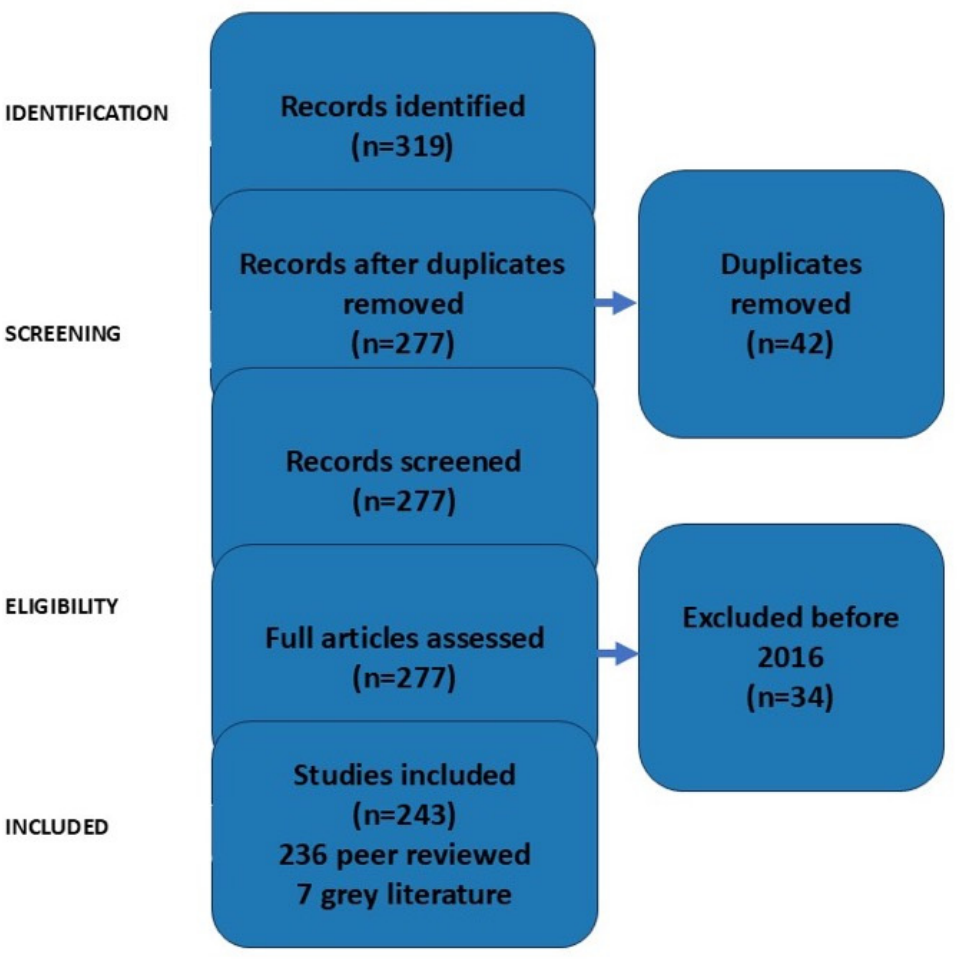
The first search identified 319 publications relevant to the topic, covering VCLs and their links to mental, physical, social, and environmental health. A second screening removed 42 duplicate records. A third step excluded 34 studies published before 2016, in line with the defined timeframe. A fourth screening involved a full-text review and assessment of the strength of the relationship between VCLs and the four health dimensions (physical, mental, social, and environmental), resulting in a core dataset of 243 references. The study selection process for the core dataset is illustrated in Figure 2.
Grey literature was included selectively to support conceptual framing, particularly from institutional sources (e.g., the WHO and UNESCO). These were retained due to their importance for the study’s conceptual framing. The final dataset included 243 references.
In addition to the core dataset, a targeted secondary search was conducted to deepen the analysis of heritage-specific dimensions, complementing the core dataset and strengthening the interpretive synthesis of the findings. This enhanced the methodological robustness by supporting the focused evidence presented in the Supplementary Tables.
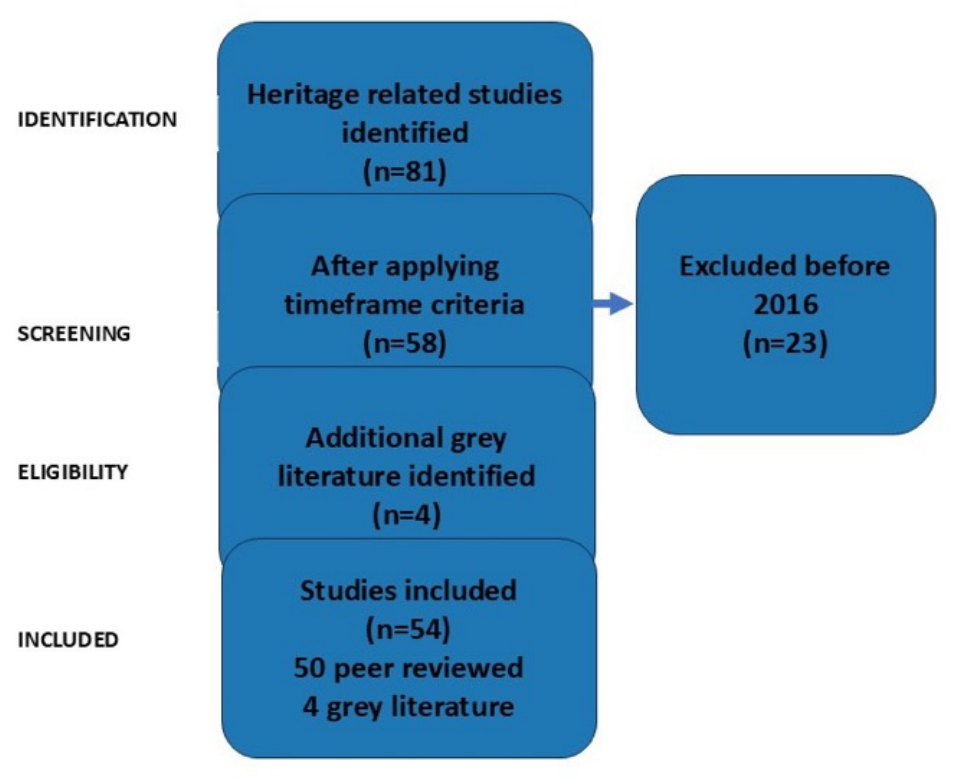
The secondary targeted search identified 81 relevant studies. After applying the timeframe criteria, 23 studies were excluded. A further step identified 4 additional grey literature sources to support the review’s interdisciplinary scope. In total, 54 studies were included in the final synthesis. The selection process for the complementary targeted search is presented in Figure 3.
The selection process was geared toward English-language work, including peer-reviewed papers and complementary reports of organizations such as UNESCO. Publications lacking full-text access, as well as books or book chapters, were excluded.
Much of the included literature was observational and context-dependent, supporting associations while simultaneously limiting causal claims and opening space for competing interpretations of underlying mechanisms. This also introduces an epistemological tension, as the selective construction of search strategies and keywords shapes which relationships become visible and which remain underrepresented. Finally, thematic synthesis was conducted by grouping recurring relationships between landscape characteristics and health outcomes across studies, enabling cross-disciplinary comparison.

2.6. Conceptual Framework: Vernacular Cultural Landscapes, Community Health, and Resilience

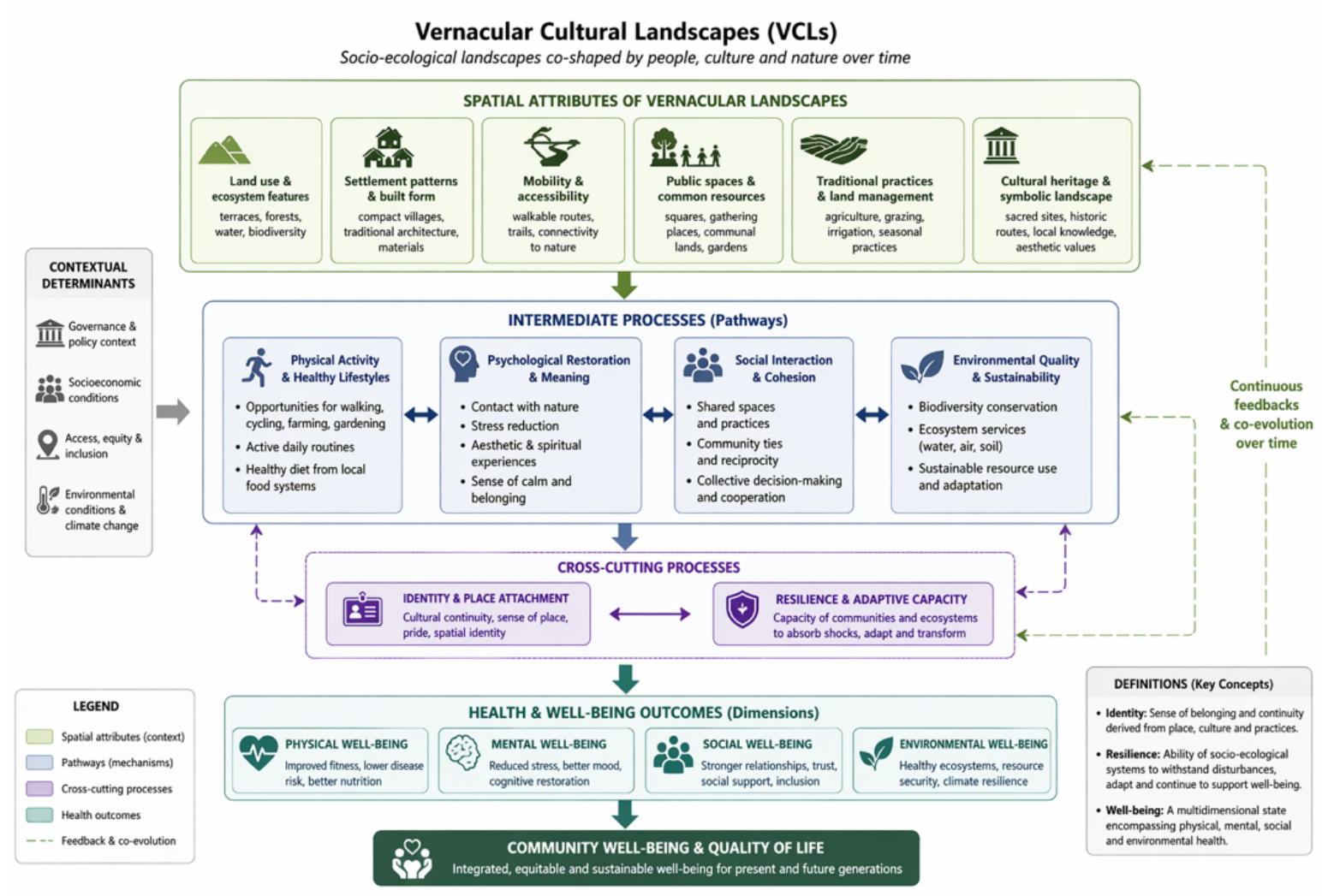
To operationalize the relationship between VCLs and community well-being, this study developed an integrated conceptual framework (Figure 4). The framework links key spatial attributes of VCLs to health outcomes through a set of intermediate pathways, including physical activity, psychological restoration, social interaction, and environmental quality, while being conditioned by contextual determinants (e.g., governance, socioeconomic conditions, and access), which mediate and shape all pathways.
These relationships are mediated and reinforced by cross-cutting processes, particularly identity and place attachment, as well as resilience and adaptive capacity, which operate across all dimensions. In this way, VCLs are conceptualized as dynamic socio-ecological systems in which spatial, cultural, and environmental processes interact to produce multidimensional well-being outcomes.
The framework should be read from left to right, illustrating how spatial attributes and contextual determinants influence intermediate pathways, which in turn generate multidimensional well-being outcomes, while cross-cutting processes operate across all levels.
As illustrated in Figure 4, the framework traces relationships from spatial attributes and contextual determinants through intermediate processes to four interrelated dimensions of health: physical, mental, social, and environmental well-being. This structured approach aligns with recent work in cultural heritage research, which highlights the need to systematically evaluate tangible and intangible assets using integrated qualitative and quantitative criteria [25].
Building on this conceptual structure, Table 1 synthesizes the relationships between VCL attributes and collective well-being by identifying specific health-supporting mechanisms. It presents VCLs as integrated systems in which cultural practices, ecological processes, and social interactions jointly shape health outcomes. While the framework organizes VCL characteristics into distinct health dimensions for analytical clarity, several features (e.g., natural elements) operate across multiple domains, reflecting the interconnected nature of socio-ecological systems.
Such cross-dimensional functionality becomes evident in the specific pathways through which landscape characteristics support well-being. More specifically, physical activity is facilitated through spatial patterns such as walkable settlements and agricultural landscapes. In addition, culturally meaningful environments and natural elements contribute to psychological restoration and emotional stability. Social cohesion emerges through shared spaces and collective practices, whereas environmental health is reinforced through vernacular architecture, ecosystem services, and adaptive land management.
By structuring these relationships into distinct yet interconnected pathways, the framework provides an analytical lens for examining how VCLs function as health-supportive infrastructures within communities.
Within this framework, health is organized into four interrelated dimensions (physical, mental, social, and environmental), which serve as the main analytical basis for the study. Concepts such as identity and resilience are not treated as separate dimensions; rather, they are understood as processes operating across these domains. Identity is expressed through elements such as sense of place, belonging, and cultural continuity, primarily within the social and mental dimensions. Resilience, in turn, relates to the capacity of socio-ecological systems to adapt and sustain these relationships over time, particularly across the environmental and social domains. These processes are interrelated, as place-based identity can reinforce social cohesion, which in turn supports resilience and contributes to overall well-being.
Building on this integrated perspective, the framework also reflects the dynamic, iterative nature of these relationships, in which feedback processes continuously reinforce and reshape interactions among landscape, community, and well-being over time.

3. Literature Review

3.1. Conceptualizing Vernacular Cultural Landscapes

There is a deep-seated ecological and cultural awareness through which a community’s relationship with nature becomes embedded in the landscape’s structure. Whether vernacular elements function as the structural “matrix” of development or as contextual “infill”, they occupy a key place in contemporary sustainability thinking, contributing to ongoing debates and practices [25].
What distinguishes VCLs from standard green spaces is this layer of “lived-in” local knowledge embedded in everyday practices and land-use systems. Empirical studies illustrate this clearly. For example, Satoyama landscapes in Japan integrate traditional ecological knowledge with biodiversity management and local livelihoods, supporting both environmental and community well-being [26]. Similarly, the milpa system in Oaxaca, Mexico, demonstrates how intergenerational farming knowledge enhances food security, nutrition, and cultural continuity [27], while research on community gardens shows that locally shared practices improve diet, social interaction, and mental well-being [28]. These examples indicate that unlike generic green spaces, VCLs are actively shaped by culturally embedded knowledge that influences how landscapes are used, experienced, and sustained over time.
These landscapes are better understood as a socio-spatial system, reshaped to fit local conditions while remaining connected to a community’s traditions [29]. VCLs are shaped by a combination of natural and climatic conditions, as well as by the local economy and architecture. The spatial organization is driven by a need for functional efficiency and adaptability. Methodological approaches throughout history, such as vernacular architecture and farming techniques, have relied on a community’s access to resources, contributing to a harmonious environment [30].
Moreover, VCLs can be understood through interrelated material, social, and symbolic dimensions, encompassing land-use patterns, everyday practices, and shared cultural meanings. Recent work highlights the value of integrative analytical approaches for examining how landscapes are produced and experienced across multiple dimensions. Such approaches link land-use patterns, everyday practices, and shared cultural meanings within a common analytical framework, enabling the exploration of how material configurations, social interactions, and symbolic interpretations co-evolve over time [31,32,33].
By simulating spatial dynamics and cultural processes, they enable the investigation of how local practices shape broader landscape patterns and reveal the meanings and identities embedded in specific places [32,34]. In this way, these perspectives offer a complementary lens for understanding VCLs as dynamic systems in which environmental, social, and symbolic dimensions are continuously negotiated [35,36,37].
VCLs can be further understood as mediating systems through which environmental conditions, cultural practices, and social relations converge to shape health and well-being. Across diverse contexts, these landscapes embed place-based knowledge that informs how communities adapt to local ecological and climatic conditions, influencing everyday behaviors, resource use, and collective practices [38,39]. Cultural practices such as foodways, land management, and architectural traditions not only sustain ecological balance but also reinforce social cohesion and health-supportive environments [40,41].
In many cases, such processes are mediated through social networks, place attachment, and culturally embedded forms of knowledge. Studies in indigenous and local contexts show that strong connections to land, supported by social capital and collective practices, are closely linked to mental, social, and emotional well-being [42]. Similarly, vernacular environments function as relational spaces in which everyday practices, cultural identity, and environmental conditions co-evolve, shaping both individual and collective health outcomes [43,44].
While VCLs often support resilience, social cohesion, and sustainable practices, their health-related effects are shaped by broader socio-economic, environmental, and governance conditions [45,46]. This highlights the need to understand VCLs not as static heritage forms, but as dynamic socio-ecological and cultural systems in which health emerges through ongoing interactions between people, place, and environment.
Such dynamics extend beyond spatial form; they influence how people live and relate to their surroundings. This highlights the importance of VCLs in shaping health and well-being by mediating the interactions among environmental conditions, cultural practices, and social relations.

3.2. Community Health and Well-Being

If health is to be understood as something more than a set of biomedical markers, it must be viewed through the lens of collective cohesion and life satisfaction, a shift that is gaining significant traction [47]. In this context, well-being is conceptualized as a broader, multidimensional condition that encompasses, but is not limited to, health. While health primarily refers to physical and mental states, well-being also includes social, cultural, and spatial dimensions shaped through interactions between people and their environments.
Within this broader framework, cultural settings could serve as active buffers that mediate the socioeconomic and environmental pressures on communities [48]. Accordingly, it is argued that health cannot be decoupled from the community perspectives and cultural values that govern behavioral patterns [49].
Physical and mental health constitute core dimensions of overall well-being and are central to enhancing quality of life and sustaining resilient communities. This multidimensional perspective is supported by empirical research demonstrating that subjective well-being and life satisfaction are closely linked to environmental, social, and cultural conditions, rather than being determined solely by individual factors [50]. As outlined in Table 1, physical health in VCLs is primarily associated with spatial characteristics such as walkable settlement patterns, traditional land-use systems, and productive landscapes, which support active daily routines.
Physical health refers to the condition and functioning of the body, encompassing physiological processes and related psychological dimensions, whereas mental health involves emotional states, cognitive functioning, and social well-being [51]. These outcomes are influenced by environmental and socio-demographic factors that shape daily living conditions and support health-promoting lifestyles [52]. In line with the framework presented in Table 1, mental health outcomes in VCLs are linked to culturally meaningful landscapes and natural elements that promote psychological restoration and emotional well-being. Physical activity, in particular, is widely recognized for its beneficial effects on both physical and mental health, including among individuals experiencing mental illness [53]. Thus, health is less an internal state and more a continuous interaction with one’s surroundings.
By embedding landscape elements into everyday routines, healthy behaviors become less dependent on individual choice and more the natural byproduct of a supportive environment [54,55]. In the context of VCLs, these health dimensions are not abstract categories, but are embedded within spatial practices, cultural routines, and environmental conditions.
On the other hand, social health includes access to healthcare, equity, supportive environments, and a sense of connectedness and cohesion within a community [56]. According to the conceptual pathways identified in Table 1, social health is supported through shared spaces, cultural practices, and intergenerational interactions embedded in VCLs. However, these dimensions do not exist in isolation, as socioeconomic conditions shape health, operating through the intersection of biological and social pathways [57].
This intersection highlights how the social environment can function as a formative space in which cultural norms and shared behaviors influence individual health decisions [58]. Strong social support networks, for example, are consistently associated with lower mortality rates and improved resilience, particularly among immigrant and other socially vulnerable groups [59,60]. Likewise, the quality of relationships within a community, as expressed through trust, civic norms, and participation, drives both physical and mental health relations [61]. Evidence from the meta-analysis by Ehsan et al. (2019) and Rodgers et al. (2019) suggests that higher levels of social capital are associated with improved health outcomes and, in some cases, lower mortality risk, although findings are heterogeneous across studies and social capital dimensions [62,63].
It is inadequate to view environmental health as a fixed condition. As highlighted in Table 1, it is associated with vernacular architecture, ecosystem services, and traditional land management practices that enhance sustainability and resilience. It evolves over time through ecological processes and cultural contexts, with these elements interacting in complex ways to shape sustainable societies [64].
For instance, evidence from recent systematic reviews indicates that vernacular building systems contribute to climate-responsive design and improved environmental quality. However, ecosystem services support health by mitigating pollution and regulating ecosystems. In parallel, adaptive land-use practices grounded in traditional ecological knowledge have been shown to enhance biodiversity and long-term environmental resilience [65,66].
Thus, the built and natural environments must not be viewed as separate silos. They form a singular, foundational architecture for community sustainability [67]. However, environmental health is also shaped by the interplay among the natural landscape dynamics [42], built environment factors [43], socioeconomic factors [44], institutional factors [45], and climate conditions [46].
Such perspectives position health as a relational and context-dependent condition. Thus, closer attention must be paid to how specific landscape forms may support or constrain well-being in everyday life. In this regard, VCLs offer a particularly relevant lens, as their spatial configurations, cultural practices, and environmental adaptations are closely intertwined with patterns of health.

4. Results

The synthesis of the reviewed literature identifies how VCLs relate to health in more concrete terms. These findings are interpreted through the conceptual framework presented in Figure 4, which structures the relationships between VCL characteristics, intermediate pathways, and multidimensional health outcomes. Their spatial structures and cultural patterns shape mobility and accessibility, influencing how people move, connect, and engage with their surroundings. In this way, different dimensions of well-being reveal identifiable links between landscape characteristics and community health outcomes. The World Health Organization (2016) highlights key pathways such as stress reduction, physical activity, and social cohesion [68], while Marselle et al. (2021) link biodiversity to health through harm reduction and restoration processes [69].
The first pathway through which VCLs influence well-being is physical health, as they structure everyday spatial practices that support active lifestyles. Evidence shows that features such as accessibility, connectivity, and activity-supportive infrastructure shape routine physical activity and health behaviors across diverse populations [70,71,72]. For example, a systematic review and meta-analysis of longitudinal studies found that walkable built environments are associated with reduced obesity, type 2 diabetes, and hypertension outcomes, partly through increased physical activity [73]
VCLs frequently incorporate health-supportive settings such as traditional markets and community gardens [28], which contribute to more sustainable dietary practices, including through nutritionally self-sufficient traditional systems [27] and complementary polycultural practices [74].
Cultural activities embedded in VCLs further reinforce these effects. Empirical studies show that festival participation can generate substantial physical activity, often exceeding the recommended thresholds [75], while active engagement is associated with stronger social cohesion [76]. Similarly, cultural participation has been linked to subjective well-being through its role in strengthening informal social ties [77] and in supporting collective engagement within socio-ecological systems [78].
Beyond physical health, VCLs contribute to mental well-being through culturally meaningful environments and relationships with nature. Indigenous and place-based perspectives demonstrate that health is closely tied to land, traditional practices, and ecological knowledge [79]. Cultural continuity, including language preservation, has also been associated with measurable health outcomes. At the same time, exposure to natural features supports stress reduction and psychological restoration [80]. This connection is further supported by quantitative evidence. For instance, a large population-based study (n = 14,641) found that greater residential greenspace exposure was significantly associated with lower depressive symptom scores, reduced burnout, and higher life satisfaction [81].
Integrating traditional knowledge and cultural practices into environmental settings enhances the overall quality of life [82]. Such restorative benefits are shaped by broader environmental and social conditions. Planning processes, ecological dynamics, and cultural practices influence how landscapes support well-being [83,84], while interdisciplinary research highlights that environmental, cultural, and social determinants jointly shape health outcomes [85]. At the same time, access to these benefits remains uneven, reflecting underlying patterns of environmental inequality and spatial injustice [86,87].
VCLs also function as social environments that strengthen community cohesion and support networks. Shared spaces such as markets, squares, and community gardens facilitate everyday interaction, reinforce trust, and sustain intergenerational knowledge exchange [88]. Strong social relationships have been consistently associated with improved health outcomes and resilience [61,89], while participatory and community-based initiatives have been shown to lead to measurable improvements in well-being [90].
At the same time, these effects are shaped by governance structures that influence access, participation, and land-use continuity [91,92]. Where inclusive planning and community engagement are supported, VCLs can strengthen social cohesion; where exclusion, commodification, or unequal governance persists, the same landscapes can reproduce or intensify existing inequalities [93]. This perspective resonates with critiques of hierarchical planning systems (e.g., in Greece), where spatial planning is not understood as a strictly top-down process but rather as a negotiated and legally mediated framework shaped by institutional interactions and case law [94].
In addition to these contextual determinants, traditional ecological management systems embedded in VCLs highlight the environmental dimension of health. They include agroecological practices, adaptive irrigation networks, and biodiversity-based land-use strategies. Together, these systems improve environmental quality, enhance climate responsiveness, and support the long-term sustainability of ecosystem-related health outcomes [95,96,97,98].
Moreover, environmental health as a dimension of well-being is supported by evidence from systematic studies. They indicate that improvements in environmental conditions, such as air and water quality, green spaces, and the built environment, are associated with reduced mortality and morbidity [65,66,99].
Furthermore, proximity to natural and blue spaces has been linked to increased physical activity and improved well-being, reinforcing the role of environmental context in shaping health outcome [100,101].
Examples such as Satoyama landscapes illustrate how biodiversity, traditional knowledge, and livelihood practices are integrated into sustainable socio-ecological systems [26]. Thus, these landscapes demonstrate that well-being can emerge from the continuity of cultural and ecological practices. However, this potential is not uniformly realized. Structural challenges persist. Geographic isolation, limited access to healthcare, and socioeconomic inequalities may constrain the health-supportive potential of VCLs [102]. Addressing these challenges requires community participation and context-sensitive interventions that reflect local needs and cultural conditions [90,103].
In light of these considerations, Table 2 synthesizes correlations identified in the literature between specific features of VCLs and different dimensions of health, including physical activity, psychological restoration, social interaction, and ecological sustainability.
While Table 2 synthesizes the primary pathways linking VCL characteristics to health dimensions, Table 3 complements this analysis by focusing on the heritage-related processes that underpin these relationships. While the main findings are derived from the core dataset, Table 3 draws on a secondary targeted search to examine how elements such as sense of place, traditional knowledge, and intergenerational continuity translate landscape characteristics into concrete health-supportive outcomes. It illustrates how VCLs transform spatial and ecological qualities into socially embedded well-being outcomes. The identified patterns reflect the interconnection of socio-ecological and cultural processes within VCLs.
The synthesized associations presented in Table 2 and Table 3 highlight recurring links between VCL characteristics and health outcomes while also revealing variation in how these relationships are framed across the literature. Such differences reflect a range of analytical emphases, from culturally embedded and place-based interpretations to perceptual and experience-based approaches, as well as more quantitatively oriented health assessments.
Despite this diversity, the literature consistently identifies VCLs as socio-ecological and cultural environments in which health emerges through interactions between cultural practices, environmental conditions, and social processes.

5. Discussion

5.1. Health Dimensions in Literature: Distribution Patterns and Evidentiary Gaps

The review findings indicate a clear distribution across health dimensions while also pointing to some gaps. Most studies focused on mental or psychological health, which was addressed in more than half of the cases. This was followed by the environmental and social dimensions, which were also widely represented. In many cases, these aspects are closely connected and shaped by cultural meanings, practices, and local identities.
In contrast, physical health was addressed less frequently, while the economic dimensions only appeared in a limited number of studies. This imbalance is not only descriptive but also affects how the relationship between VCLs and health is understood.
The literature is largely oriented toward mental and perceptual approaches. As a result, it emphasizes experiential and symbolic aspects of well-being. In comparison, less attention has been given to measurable physical health pathways such as activity patterns or chronic disease prevention. This creates a gap in the evidence base while it remains less aligned with planning and public health frameworks, which often rely on quantifiable indicators. Consequently, the integration of VCLs into policy and spatial practice is more difficult to operationalize.

5.2. Integrated Health Dynamics in Vernacular Cultural Landscapes

These interactions reflect the integrated relationships conceptualized in Figure 4, where spatial, cultural, and environmental processes co-evolve. Consistent with this integrated perspective, the literature rarely treats these dimensions separately. Most studies take a broader view and combine different aspects of health. Mental, environmental, and social dimensions often co-occur, frequently in relation to cultural processes linked to place.
Such a pattern suggests that the relationship between VCLs and well-being extends beyond individual outcomes. Instead, it reflects a more integrated socio-ecological context in which cultural and environmental factors interact. The increase in publications after 2020 also indicates growing interest in the connections between landscape, culture, health, and resilience.
Building on this trend, the review suggests that VCLs’ contribution extends beyond simple access to green space. Their significance lies in the ways that everyday practices, cultural meanings, and environmental conditions converge in specific places. In this sense, VCLs function as everyday settings where these processes unfold, aligning with broader relational and place-based approaches to health.
The evidence indicates that multiple health-supporting processes co-occur within the same environments, highlighting the integrated nature of VCLs. Exposure to natural features is associated with improved mental health and reduced depressive symptoms [69], while walkable environments and community gardens support physical activity and healthier dietary practices [120,121,122]. Although their influence is context-specific and not always consistently measured [28], traditional diversified systems demonstrate strong nutritional potential [27,74]. Together, these findings reinforce the role of culturally embedded practices in shaping health outcomes.
Recent studies also show that structured engagement with culturally meaningful environments, such as pilgrimage routes and heritage landscapes, is associated with reduced psychological distress and enhanced subjective well-being [50]. These outcomes are shaped by place-based connections and cultural identity, making causal relationships difficult to isolate.
Overall, the literature points to synergistic interactions between environmental, social, and cultural processes. However, most evidence remains correlational, limiting the ability to establish direct causal pathways between VCLs and specific health outcomes. This reflects both the complexity of socio-ecological systems and the methodological challenges of capturing culturally embedded and context-dependent processes within conventional research frameworks. As a result, uncertainty persists regarding the relative contributions of ecological, social, and symbolic factors, highlighting the need for more integrative research approaches.
Despite these limitations, the literature provides important insights into how heritage-related processes shape social experiences of well-being, particularly in relation to cohesion and belonging.

5.3. From Cohesion to Exclusion: Inequalities in Access and Belonging in VCLs

Table 3 further clarifies that the heritage-related dimensions, including intergenerational continuity, shared rituals, and traditional knowledge, mediate the relationship between landscape environments and social and emotional stability. These findings address the second research question by showing how heritage-related processes, such as sense of place, traditional knowledge, and intergenerational continuity, mediate the relationship between landscape characteristics and health outcomes.
Social connectivity, supported by shared spaces and collective memory, has consistently been linked to improved well-being and resilience [92,123]. In indigenous contexts, the connection to culturally meaningful land has been shown to underpin holistic health frameworks [87].
However, these cohesive dynamics are not experienced equally across contexts. Some landscapes foster a sense of belonging, while others may marginalize certain groups. This is particularly evident where tourism development, land commodification, or unequal governance reshape access to space [86].

5.4. Epistemological and Methodological Challenges in VCL–Health Research

These uneven outcomes are also reflected in how different disciplines conceptualize and interpret VCL–health relationships. A key challenge lies in the epistemological gap between VCL research and public health evaluation. Different disciplines approach the relationship in distinct yet complementary ways. However, they do so through partially incompatible epistemologies, producing parallel interpretations rather than cumulative knowledge.
Cultural geography understands VCLs as socio-spatial systems shaped by meaning, identity, and lived experience, with emphasis on place attachment and cultural practices. Environmental psychology focuses more on how people experience and perceive their surroundings, highlighting processes such as stress reduction and attention restoration. Public health, in contrast, examines these relationships through population-level outcomes, prioritizing measurable indicators such as physical activity, mental health, and social cohesion.
Although these perspectives differ in methods and focus, they share the view that health emerges from ongoing interactions between people, place, and environment. Recognizing these differences helps clarify both the strengths and the limits of existing research, and points to the need for more integrated approaches that bring together qualitative and quantitative insights. Future research could further explore this direction by developing methodological approaches that more systematically combine qualitative, culturally embedded dimensions with quantitative public health indicators, thereby supporting a more operational understanding of these relationships across disciplines.
However, integrating these perspectives into practice remains methodologically challenging. Many mechanisms identified in Table 2 and Table 3, such as symbolic continuity and collective memory, resist conventional quantification, creating a persistent tension between what can be measured and what may be most meaningful for well-being. Public health frameworks continue to prioritize measurable indicators such as morbidity rates or behavioral metrics, while the effects of identity and meaning unfold less visibly [124]. If these qualitative factors stay on the margins of evaluation systems, the health benefits of traditional landscapes may only be recognized in theory, and will not be fully included in formal planning.
Beyond these methodological constraints, the effects of VCLs are also shaped by broader socio-cultural and governance conditions. The health-supportive potential of traditional landscapes varies across socio-cultural conditions, governance structures, and environmental contexts. In settings shaped by exclusion, commercialization, or institutional neglect, these landscapes may instead reinforce structural inequalities rather than mitigate them. Recognizing this conditionality is important for policy and planning, as it frames VCLs as living environments in which health, identity, and resilience are continually shaped.
Addressing these dynamics helps position the study’s contributions within its broader analytical scope. In this context, the findings address the four research questions by identifying key landscape characteristics. The findings identified key landscape characteristics, demonstrated the mediating role of heritage-related processes, highlighted disciplinary differences, and pointed to key gaps, particularly regarding causality and structural inequalities.
While these contributions should be interpreted with awareness of the study’s methodological constraints (discussed in Section 5.6), the analysis provides a coherent synthesis of how VCL–health relationships are conceptualized across disciplines.
In this regard, these differences reflect how the relationships identified in Table 2 and Table 3 are interpreted across disciplines. Although the perspectives differ in their focus and methods, they converge in viewing health as emerging from interactions among people, places, and environment. This comparative, interpretive synthesis of disciplinary perspectives explicitly addresses Research Question 3, clarifying how different fields conceptualize and frame VCL–health relationships.

5.5. Implications for Planning and Public Health Practice

The evidence suggests that VCLs contribute to collective and place-based well-being in ways that are both substantial and context-dependent. Their impact appears most significant where cultural continuity coincides with participatory governance, responsible environmental management, and equitable access to resources [90,103]. However, translating these potentials into planning practice is not straightforward.
Contemporary urban planning frameworks often reflect structural governance tensions [94]. In Greece, for instance, persistent fragmentation, regulatory complexity, and limited implementation capacity endure despite reforms [125]. Moreover, the limited integration of spatial planning with disaster risk management and resilience strategies underscores the need for more interdisciplinary, adaptive approaches [126]. Within this setting, VCL integration is shaped by key tensions that define both opportunities and constraints.
A key tension arises between rapid urban transformation and the continuity of culturally embedded land-use systems. Planning does not follow a linear trajectory but requires constant negotiation between development and preservation [94]. At the same time, vernacular systems and traditional ecological knowledge are recognized for their adaptive and sustainability value [25], contributing to well-being through long-term human–environment relationships and cultural ecosystem services [124].
However, this localized resilience does not eliminate broader structural vulnerabilities, such as geographic isolation, limited healthcare access, and socioeconomic constraints [102].
Additional tensions emerge in planning practice. Conservation strategies may unintentionally disrupt traditional land-use patterns or restrict local access, while large-scale development can weaken social networks and livelihoods. Similarly, tourism-led economic development can generate opportunities but also pose risks of social exclusion, environmental degradation, and an uneven distribution of benefits. Residents’ support for conservation is closely linked to perceived improvements in quality of life, emphasizing the need to align economic strategies with local benefits [104]. Furthermore, heritage governance often privileges certain narratives, raising concerns about which histories are represented and which are marginalized.
These dynamics suggest that VCLs should not be romanticized as self-sufficient systems. Their health-supportive potential depends on their interaction with broader structural conditions, including governance, infrastructure, and access to resources. At the same time, they can function as foundational territorial structures, maintaining continuity between built form, identity, and everyday practices, while supporting civic participation and collective responsibility [127].
Conservation strategies must be carefully calibrated. Traditional knowledge systems may be weakened when formal protection measures fragment land-use patterns or restrict local access. Large-scale development interventions can disrupt established social networks and livelihoods, particularly where funding constraints limit inclusive planning processes. International collaboration and cross-sector partnerships may therefore be necessary, especially in regions with limited heritage resources.
From an economic perspective, conserving VCLs can support community-based development and shape territorial economies. In areas attracting tourism investment, such strategies require careful governance to avoid exclusionary outcomes. Evidence shows that residents’ willingness to support conservation is closely linked to perceived improvements in quality of life, reinforcing the need to align conservation with local social benefits [104].
Integrating VCLs into planning therefore requires moving beyond symbolic recognition toward operational inclusion through cross-sector coordination, participatory processes, and sustained investment in locally grounded initiatives. At the strategic level, this includes identifying and protecting culturally significant areas, while at the local scale, participatory tools can help integrate socially valued spaces into planning and design.
Spatial planning and landscape design can also benefit from place-based approaches rooted in cultural landscapes. Strategies may include integrating traditional features such as community gardens, local land-use patterns, and culturally meaningful public spaces into urban design frameworks. Access to walkable environments, localized food systems, and meaningful public spaces reinforces everyday practices that support societal well-being.
In periods of economic or energy instability, traditional landscapes may offer adaptive spatial resources such as community gardens, local food networks, and shared open spaces. While these cannot replace broader structural reforms, they can complement them by fostering resilient, socially cohesive environments.
Within this context, the study does not propose specific design typologies. Instead, the findings point toward context-sensitive principles, such as walkable spatial structures and culturally meaningful public spaces, which should be understood as guiding considerations rather than standardized solutions, reflecting the place-specific and socio-ecological nature of VCLs.

5.6. Research Limitations

This study adopted a hybrid narrative–scoping review approach to integrate interdisciplinary perspectives on VCLs and community well-being. While this enabled a broad and conceptually rich synthesis, certain limitations should be acknowledged. Although a structured search strategy and the PRISMA-ScR framework were applied, the selection and interpretation of sources were partly shaped by the study’s analytical perspective. In addition, the review was based predominantly on observational and correlational literature, which supports the identification of consistent relationships but limits the ability to establish direct causal links between landscape characteristics and health outcomes. The focus on English-language, accessible publications may also have resulted in the underrepresentation of studies from other contexts. Finally, the interdisciplinary scope, while necessary for capturing the complexity of VCL–health relationships, may have led to uneven depth across thematic areas. These considerations do not diminish the study’s overall contribution, but rather highlight the need for further empirical and comparative research to strengthen and extend the findings.

6. Conclusions

This review highlights the complex relationship between VCLs and community health, positioning these environments as socio-ecological systems that support physical, mental, social, and environmental well-being. By synthesizing insights from cultural geography, environmental psychology, and public health, the study demonstrates that VCLs embed health-supportive practices within everyday spatial and cultural contexts.
The findings show that access to culturally meaningful environments, natural features, and shared spaces contributes to physical activity, psychological restoration, and social cohesion while reinforcing place identity and collective resilience. At the same time, the health benefits of VCLs remain context-dependent, shaped by governance structures, access to resources, and broader socioeconomic conditions.
Rather than viewing VCLs as static heritage assets, this review emphasizes their role as living environments in which health, identity, and resilience are continually negotiated. Integrating traditional landscapes into planning and public health strategies therefore requires participatory, context-sensitive approaches that recognize cultural continuity alongside structural constraints. In this way, VCLs can serve as a critical foundation for more inclusive, resilient, and health-supportive communities.

Supplementary Materials

The following supporting information can be downloaded at: https://www.mdpi.com/article/10.3390/land15050775/s1, Data tables (VCL full table and health-wellbeing perspectives, VCL conceptual perception of each disciplinary in explicit VCL relevance, Data secondary research).

Author Contributions

Conceptualization, M.M. and E.A.; methodology, M.M.; investigation, M.M.; writing—original draft preparation, M.M.; writing—review and editing, E.A.; supervision, E.A. All authors have read and agreed to the published version of the manuscript.

Funding

The research was conducted within the operating framework of the University of Thessaly Innovation, Technology Transfer Unit and Entrepreneurship Center “One Planet Thessaly”, under the “University of Thessaly Grants for Scientific Publication Support” action, and was funded by the Special Account of Research Grants of the University of Thessaly (ELKE).

Data Availability Statement

No new data were created or analyzed in this study. This study was based on a narrative–scoping review of the published literature, and no datasets, code, or experimental protocols were generated. Secondary data were created and are available in the Supplementary Materials.

Acknowledgments

During the preparation of this review, the authors used (ChatGPT 5.3) to assist with the language, grammar, and text editing. The authors take full responsibility for the content.

Conflicts of Interest

The authors declare no conflicts of interest.

Abbreviations

The following abbreviations are used in this manuscript:
VCLsVernacular cultural landscapes
WHOWorld Health Organization

References

  1. Vuksanović-Macura, Z.; Ljubenov, G.; Gajić, T. Preservation of Vernacular Cultural Landscape and Sustainable Tourism: A Case Study from the Western Carpatho-Balkan Region. Heritage 2025, 8, 493. [Google Scholar] [CrossRef] [Scilit]
  2. Pan, Z.; Chen, Y.; Huang, Y.; Zheng, L. The Vernacular Cultural Landscape in Traditional Villages: Global Hotspots, Emerging Trends, and a Case Study of China’s Qilu Cultural District. Front. Earth Sci. 2024, 12, 1511292. [Google Scholar] [CrossRef] [Scilit]
  3. Li, H.; Xue, T.; Zhang, A.; Shen, J.; Luo, X.; Kong, L.; Huang, G. Impact of Urban and Cultural Landscape Heritage on Mental Health: A Systematic Review and Meta-Synthesis. BMC Public Health 2025, 25, 3095. [Google Scholar] [CrossRef] [Scilit]
  4. Lak, A. Cultural Landscapes in Climate Change: A Framework for Resilience in Developing Countries. J. Environ. Manag. 2024, 362, 121310. [Google Scholar] [CrossRef] [Scilit]
  5. Adami, E. Shaping Public Spaces from below: The Vernacular Semiotics of Leeds Kirkgate Market. Soc. Semiot. 2020, 30, 89–113. [Google Scholar] [CrossRef] [Scilit]
  6. Heidari, A.; Sahebzadeh, S.; Dalvand, Z. Natural Ventilation in Vernacular Architecture of Sistan, Iran; Classification and CFD Study of Compound Rooms. Sustainability 2017, 9, 1048. [Google Scholar] [CrossRef] [Scilit]
  7. Diener, E.; Lucas, R.E.; Oishi, S. Advances and Open Questions in the Science of Subjective Well-Being. Collabra Psychol. 2018, 4, 15. [Google Scholar] [CrossRef] [Scilit]
  8. Kemp, A.H.; Fisher, Z. Wellbeing, Whole Health and Societal Transformation: Theoretical Insights and Practical Applications. Glob. Adv. Health Med. 2022, 11, 216495612110730. [Google Scholar] [CrossRef] [Scilit]
  9. Dash, S.P.; Natarajan, L.T. “Creative Placemaking”: A Conceptual Model Fostering Social Cohesion in Community Spaces within Residential Environments. Creat. Stud. 2023, 16, 541–564. [Google Scholar] [CrossRef] [Scilit]
  10. Fukano, Y.; Soga, M. Greenery Hypothesis: An Evolutionary Explanation for Why Presence/Absence of Green Affects Humans. People Nat. 2024, 6, 422–434. [Google Scholar] [CrossRef] [Scilit]
  11. Johnson, K.A.; Pontvianne, A.; Ly, V.; Jin, R.; Januar, J.H.; Machida, K.; Sargent, L.D.; Lee, K.E.; Williams, N.S.G.; Williams, K.J.H. Water and Meadow Views Both Afford Perceived but Not Performance-Based Attention Restoration: Results from Two Experimental Studies. Front. Psychol. 2022, 13, 809629. [Google Scholar] [CrossRef] [Scilit]
  12. Neale, C.; Aspinall, P.; Roe, J.; Tilley, S.; Mavros, P.; Cinderby, S.; Coyne, R.; Thin, N.; Ward Thompson, C. The Impact of Walking in Different Urban Environments on Brain Activity in Older People. Cities Health 2020, 4, 94–106. [Google Scholar] [CrossRef] [Scilit]
  13. Marselle, M.R. Theoretical Foundations of Biodiversity and Mental Well-Being Relationships. In Biodiversity and Health in the Face of Climate Change; Marselle, M.R., Stadler, J., Korn, H., Irvine, K.N., Bonn, A., Eds.; Springer International Publishing: Cham, Switzerland, 2019; pp. 133–158. [Google Scholar]
  14. Vasseur, L.; Andrade, A. Using the Red List of Ecosystems and the Nature-Based Solutions Global Standard as an Integrated Process for Climate Change Adaptation in the Andean High Mountains. Philos. Trans. R. Soc. B Biol. Sci. 2024, 379, 20220326. [Google Scholar] [CrossRef] [Scilit] [PubMed]
  15. Counted, V.; Watts, F. Place Attachment in the Bible: The Role of Attachment to Sacred Places in Religious Life. J. Psychol. Theol. 2017, 45, 218–232. [Google Scholar] [CrossRef] [Scilit]
  16. McIntosh, J.; Marques, B.; Hatton, W. Indigenous Cultural Knowledge for Therapeutic Landscape Design; Open Access Te Herenga Waka-Victoria University of Wellington: Wellington, New Zealand, 2019. [Google Scholar]
  17. Keune, H.; Immovilli, M.; Keller, R.; Maynard, S.; McElwee, P.; Molnár, Z.; Olsson, G.A.; Payyappallimana, U.; Schneiders, A.; Schoolenberg, M. Defining Nature. Transform. Biodivers. Gov. 2022, 25–42. [Google Scholar] [CrossRef]
  18. Raymond, C.M.; Cebrian-Piqueras, M.A.; Andersson, E.; Andrade, R.; Schnell, A.A.; Romanelli, B.B.; Filyushkina, A.; Goodson, D.J.; Horcea-Milcu, A.; Johnson, D.N. Inclusive Conservation and the Post-2020 Global Biodiversity Framework: Tensions and Prospects. One Earth 2022, 5, 252–264. [Google Scholar] [CrossRef] [Scilit]
  19. Asubonteng, K.O.; Ros-Tonen, M.A.F.; Baud, I.; Pfeffer, K. Envisioning the Future of Mosaic Landscapes: Actor Perceptions in a Mixed Cocoa/Oil-Palm Area in Ghana. Environ. Manag. 2021, 68, 701–719. [Google Scholar] [CrossRef] [Scilit]
  20. Coombes, M.A.; Viles, H.A. Integrating Nature-Based Solutions and the Conservation of Urban Built Heritage: Challenges, Opportunities, and Prospects. Urban For. Urban Green. 2021, 63, 127192. [Google Scholar] [CrossRef] [Scilit]
  21. Zhao, L.; Li, Y.; Zhang, N.; Zhang, Z. Public Policies and Conservation Plans of Historic Urban Landscapes under the Sustainable Heritage Tourism Milieu: Discussions on the Equilibrium Model on Kulangsu Island, UNESCO World Heritage Site. Built Herit. 2023, 7, 6. [Google Scholar] [CrossRef] [Scilit]
  22. Furlong, D.E.; Lester, J.N. Toward a Practice of Qualitative Methodological Literature Reviewing. Qual. Inq. 2023, 29, 669–677. [Google Scholar] [CrossRef] [Scilit]
  23. Tricco, A.C.; Lillie, E.; Zarin, W.; O’Brien, K.K.; Colquhoun, H.; Levac, D.; Moher, D.; Peters, M.D.J.; Horsley, T.; Weeks, L.; et al. PRISMA Extension for Scoping Reviews (PRISMA-ScR): Checklist and Explanation. Ann. Intern. Med. 2018, 169, 467–473. [Google Scholar] [CrossRef] [Scilit]
  24. Page, M.J.; McKenzie, J.E.; Bossuyt, P.M.; Boutron, I.; Hoffmann, T.C.; Mulrow, C.D.; Shamseer, L.; Tetzlaff, J.M.; Akl, E.A.; Brennan, S.E. The PRISMA 2020 Statement: An Updated Guideline for Reporting Systematic Reviews. BMJ 2021, 372, n71. [Google Scholar] [CrossRef] [Scilit] [PubMed]
  25. Galan, J.; Bourgeau, F.; Pedroli, B. A Multidimensional Model for the Vernacular: Linking Disciplines and Connecting the Vernacular Landscape to Sustainability Challenges. Sustainability 2020, 12, 6347. [Google Scholar] [CrossRef] [Scilit]
  26. Takeuchi, K.; Ichikawa, K.; Elmqvist, T. Satoyama Landscape as Social–Ecological System: Historical Changes and Future Perspective. Curr. Opin. Environ. Sustain. 2016, 19, 30–39. [Google Scholar] [CrossRef] [Scilit]
  27. Novotny, I.P.; Tittonell, P.; Fuentes-Ponce, M.H.; López-Ridaura, S.; Rossing, W.A. The Importance of the Traditional Milpa in Food Security and Nutritional Self-Sufficiency in the Highlands of Oaxaca, Mexico. PLoS ONE 2021, 16, e0246281. [Google Scholar] [CrossRef] [Scilit] [PubMed]
  28. Hume, C.; Grieger, J.A.; Kalamkarian, A.; D’Onise, K.; Smithers, L.G. Community Gardens and Their Effects on Diet, Health, Psychosocial and Community Outcomes: A Systematic Review. BMC Public Health 2022, 22, 1247. [Google Scholar] [CrossRef] [Scilit]
  29. Tawayha, F.A.; Braganca, L.; Mateus, R. Contribution of the Vernacular Architecture to the Sustainability: A Comparative Study between the Contemporary Areas and the Old Quarter of a Mediterranean City. Sustainability 2019, 11, 896. [Google Scholar] [CrossRef] [Scilit]
  30. Dada, A.D.; Alibaba, H.Z. Comparison Analysis between the Components of Vernacular and Modern Architectures for Sustainable Housing in Niger State. In Proceedings of the IOP Conference Series: Earth and Environmental Science; IOP Publishing: Bristol, UK, 2023; Volume 1210, p. 012011. [Google Scholar]
  31. Liao, C.; Qiu, J.; Chen, B.; Chen, D.; Fu, B.; Georgescu, M.; He, C.; Jenerette, G.D.; Li, X.; Li, X.; et al. Advancing Landscape Sustainability Science: Theoretical Foundation and Synergies with Innovations in Methodology, Design, and Application. Landsc. Ecol. 2020, 35, 1–9. [Google Scholar] [CrossRef] [Scilit]
  32. Anderson, T.; Dragićević, S. Representing Complex Evolving Spatial Networks: Geographic Network Automata. ISPRS Int. J. Geo-Inf. 2020, 9, 270. [Google Scholar] [CrossRef] [Scilit]
  33. Sovacool, B.K.; Hess, D.J. Ordering Theories: Typologies and Conceptual Frameworks for Sociotechnical Change. Soc. Stud. Sci. 2017, 47, 703–750. [Google Scholar] [CrossRef] [Scilit]
  34. Anderson, J.E.; Ross, A.J.; Macrae, C.; Wiig, S. Defining Adaptive Capacity in Healthcare: A New Framework for Researching Resilient Performance. Appl. Ergon. 2020, 87, 103111. [Google Scholar] [CrossRef] [Scilit]
  35. García Bengoechea, P. Ruins in the Landscape: Tourism and the Archaeological Heritage of Chinchero. J. Mater. Cult. 2017, 22, 317–333. [Google Scholar] [CrossRef] [Scilit]
  36. Tzortzi, J.N.; Saxena, I. Bridging Matera’s Fragmented Identity: Unifying Disconnected Urban Spaces. Land 2024, 13, 1935. [Google Scholar] [CrossRef] [Scilit]
  37. Saleh, M.; Roo, G.D.; Shim, D. The Fuzzy Side of Publicness: Visualizing Street Politics of Everyday Life through the Lens of Distance. Space Cult. 2020, 24, 1206331220976725. [Google Scholar] [CrossRef] [Scilit]
  38. Calvagna, S. Landscape Sustainability of Architecture in Fernando Menis’s Work: A Sensitive Design Rooted in Volcanic Nature. Sustainability 2020, 12, 8711. [Google Scholar] [CrossRef] [Scilit]
  39. East, M.; Gibsone, K.U.P.; Combes, B. Design for Sustainable Cultural Landscapes—A Whole-Systems Framework. Ecocycles 2021, 7, 1–13. [Google Scholar] [CrossRef] [Scilit]
  40. Printsmann, A.; Pikner, T. The Role of Culture in the Self-Organisation of Coastal Fishers Sustaining Coastal Landscapes: A Case Study in Estonia. Sustainability 2019, 11, 3951. [Google Scholar] [CrossRef] [Scilit]
  41. Gravagnuolo, A.; Varotto, M. Terraced Landscapes Regeneration in the Perspective of the Circular Economy. Sustainability 2021, 13, 4347. [Google Scholar] [CrossRef] [Scilit]
  42. Marques, B.; Freeman, C.; Carter, L.; Pedersen Zari, M. Sense of Place and Belonging in Developing Culturally Appropriate Therapeutic Environments: A Review. Societies 2020, 10, 83. [Google Scholar] [CrossRef] [Scilit]
  43. Ekman, P. ‘This Scene Is Itself Living’: Buildings as Landscapes in Transatlantic Human Geography, 1870–1970. Hist. Hum. Sci. 2021, 34, 336–361. [Google Scholar] [CrossRef] [Scilit]
  44. Jenkins, A.; Horwitz, P.; Arabena, K. My Island Home: Place-Based Integration of Conservation and Public Health in Oceania. Environ. Conserv. 2018, 45, 125–136. [Google Scholar] [CrossRef] [Scilit]
  45. Di Fazio, S.; Modica, G. Historic Rural Landscapes: Sustainable Planning Strategies and Action Criteria. The Italian Experience in the Global and European Context. Sustainability 2018, 10, 3834. [Google Scholar] [CrossRef] [Scilit]
  46. Uysal Urey, Z.C. Creation of a New Vernacular Architecture and the Attainment of Sustainability: The Case of Akyaka Town Development. Sustainability 2023, 15, 2643. [Google Scholar] [CrossRef] [Scilit]
  47. Pronk, N.; Kleinman, D.V.; Goekler, S.F.; Ochiai, E.; Blakey, C.; Brewer, K.H. Promoting Health and Well-Being in Healthy People 2030. J. Public Health Manag. Pract. 2021, 27, S242. [Google Scholar] [CrossRef] [Scilit]
  48. Krueger, J.; Counts, N.; Riley, B. Promoting Mental Health and Well-Being in Public Health Law and Practice. J. Law Med. Ethics 2017, 45, 37–40. [Google Scholar] [CrossRef] [Scilit]
  49. Leuenberger, A.; Winkler, M.S.; Cambaco, O.; Cossa, H.; Kihwele, F.; Lyatuu, I.; Zabré, H.R.; Farnham, A.; Macete, E.; Munguambe, K. Health Impacts of Industrial Mining on Surrounding Communities: Local Perspectives from Three Sub-Saharan African Countries. PLoS ONE 2021, 16, e0252433. [Google Scholar] [CrossRef] [Scilit] [PubMed]
  50. Feliu-Soler, A.; Royuela-Colomer, E.; Navarrete, J.; Jørgensen, N.N.; Mariño, M.; Demarzo, M.; Soler, J.; García-Campayo, J.; Montero-Marín, J.; Luciano, J.V. Assessing the Impact of the Way of Saint James on Psychological Distress and Subjective Well-Being: The Ultreya Study. J. Happiness Stud. 2024, 25, 105. [Google Scholar] [CrossRef] [Scilit]
  51. Peng, X.; Tang, L. Exploring the Characteristics of Physical Exercise in Students and the Path of Health Education. Front. Psychol. 2021, 12, 663922. [Google Scholar] [CrossRef] [Scilit]
  52. Wheeler, A.J.; Roennfeldt, H.; Slattery, M.; Krinks, R.; Stewart, V. Codesigned Recommendations for Increasing Engagement in Structured Physical Activity for People with Serious Mental Health Problems in Australia. Health Soc. Care Community 2018, 26, 860–870. [Google Scholar] [CrossRef] [Scilit]
  53. Mugisha, J.; De Hert, M.; Stubbs, B.; Basangwa, D.; Vancampfort, D. Physical Health Policies and Metabolic Screening in Mental Health Care Systems of Sub-Saharan African Countries: A Systematic Review. Int. J. Ment. Health Syst. 2017, 11, 31. [Google Scholar] [CrossRef] [Scilit]
  54. Dunne, A.; Haake, S.; Quirk, H.; Bullas, A. Motivation to Improve Mental Wellbeing via Community Physical Activity Initiatives and the Associated Impacts—A Cross-Sectional Survey of UK Parkrun Participants. Int. J. Environ. Res. Public. Health 2021, 18, 13072. [Google Scholar] [CrossRef] [Scilit]
  55. Clancy, R.; Lewin, T.J.; Bowman, J.A.; Kelly, B.J.; Mullen, A.D.; Flanagan, K.; Hazelton, M.J. Providing Physical Health Care for People Accessing Mental Health Services: Clinicians’ Perceptions of Their Role. Int. J. Ment. Health Nurs. 2019, 28, 256–267. [Google Scholar] [CrossRef] [Scilit] [PubMed]
  56. Pashynska, S.L.; Antomonov, M.; Berdnyk, O.V.; Skochko, T.P.; Rudnytska, O.P. The Difference of the Concept of «disease» in the Context of Public Health: (Part 2—Experimental Research). Environ. Health 2023, 1, 4–10. [Google Scholar] [CrossRef] [Scilit]
  57. Ray, M.; Wallace, M.K.; Grayson, S.C.; Cummings, M.H.; Davis, J.A.; Scott, J.; Belcher, S.M.; Davis, T.S.; Conley, Y.P. Epigenomic Links Between Social Determinants of Health and Symptoms: A Scoping Review. Biol. Res. Nurs. 2023, 25, 404–416. [Google Scholar] [CrossRef] [Scilit]
  58. Khazaeian, S.; Kariman, N.; Ebadi, A.; Nasiri, M. The Impact of Social Capital and Social Support on the Health of Female-Headed Households: A Systematic Review. Electron. Physician 2017, 9, 6027. [Google Scholar] [CrossRef] [Scilit]
  59. Tegegne, M.A.; Glanville, J.L. The Immigrant-Native Gap in Subjective Well-Being in Western European Countries: Assessing the Role of Social Capital. Int. Migr. Rev. 2019, 53, 458–485. [Google Scholar] [CrossRef] [Scilit]
  60. Huot, S.; Brower, J.; Tham, A.; Yekta, A.R. Cultivating Social Occupations, Spaces, and Networks: Service Providers’ Perspectives on Enabling Immigrants’ Social Participation. Cad. Bras. Ter. Ocup. 2021, 29, e2184. [Google Scholar] [CrossRef] [Scilit]
  61. Koutsogeorgou, E.; Chiesi, A.M.; Leonardi, M. Social Capital Components and Social Support of Persons with Multiple Sclerosis: A Systematic Review of the Literature from 2000 to 2018. Disabil. Rehabil. 2020, 42, 3437–3449. [Google Scholar] [CrossRef] [Scilit]
  62. Ehsan, A.; Klaas, H.S.; Bastianen, A.; Spini, D. Social Capital and Health: A Systematic Review of Systematic Reviews. SSM-Popul. Health 2019, 8, 100425. [Google Scholar] [CrossRef] [Scilit] [PubMed]
  63. Rodgers, J.; Valuev, A.V.; Hswen, Y.; Subramanian, S.V. Social Capital and Physical Health: An Updated Review of the Literature for 2007–2018. Soc. Sci. Med. 2019, 236, 112360. [Google Scholar] [CrossRef] [Scilit]
  64. Salgado, M.; Madureira, J.; Mendes, A.S.; Torres, A.; Teixeira, J.P.; Oliveira, M.D. Environmental Determinants of Population Health in Urban Settings. A Systematic Review. BMC Public Health 2020, 20, 853. [Google Scholar] [CrossRef] [Scilit] [PubMed]
  65. Zong, J.; Wan Mohamed, W.S.; Zaky Jaafar, M.F.; Ujang, N. Sustainable Development of Vernacular Architecture: A Systematic Literature Review. J. Asian Archit. Build. Eng. 2025, 24, 3558–3574. [Google Scholar] [CrossRef] [Scilit]
  66. Marselle, M.R.; Lindley, S.J.; Cook, P.A.; Bonn, A. Biodiversity and Health in the Urban Environment. Curr. Environ. Health Rep. 2021, 8, 146–156. [Google Scholar] [CrossRef] [Scilit]
  67. Nasir, M.J.; Ahmad, W.; Iqbal, J.; Ahmad, B.; Abdo, H.G.; Hamdi, R.; Bateni, S.M. Effect of the Urban Land Use Dynamics on Land Surface Temperature: A Case Study of Kohat City in Pakistan for the Period 1998–2018. Earth Syst. Environ. 2022, 6, 237–248. [Google Scholar] [CrossRef] [Scilit]
  68. WHO. Urban Green Spaces and Health; World Health Organization, Regional Office for Europe: Copenhagen, Denmark, 2016. [Google Scholar]
  69. Marselle, M.R.; Hartig, T.; Cox, D.T.; De Bell, S.; Knapp, S.; Lindley, S.; Triguero-Mas, M.; Böhning-Gaese, K.; Braubach, M.; Cook, P.A. Pathways Linking Biodiversity to Human Health: A Conceptual Framework. Environ. Int. 2021, 150, 106420. [Google Scholar] [CrossRef] [Scilit]
  70. Wang, H.; Dai, X.; Wu, J.; Wu, X.; Nie, X. Influence of Urban Green Open Space on Residents’ Physical Activity in China. BMC Public Health 2019, 19, 1093. [Google Scholar] [CrossRef] [Scilit] [PubMed]
  71. Wu, Z.; Song, Y.; Wang, H.; Zhang, F.; Li, F.; Wang, Z. Influence of the Built Environment of Nanjing’s Urban Community on the Leisure Physical Activity of the Elderly: An Empirical Study. BMC Public Health 2019, 19, 1459. [Google Scholar] [CrossRef] [Scilit]
  72. Zheng, Z.; Liu, W.; Lu, Y.; Sun, N.; Chu, Y.; Chen, H. The Influence Mechanism of Community-Built Environment on the Health of Older Adults: From the Perspective of Low-Income Groups. BMC Geriatr. 2022, 22, 590. [Google Scholar] [CrossRef] [Scilit]
  73. Chandrabose, M.; Rachele, J.N.; Gunn, L.; Kavanagh, A.; Owen, N.; Turrell, G.; Giles-Corti, B.; Sugiyama, T. Built Environment and Cardio-metabolic Health: Systematic Review and Meta-analysis of Longitudinal Studies. Obes. Rev. 2019, 20, 41–54. [Google Scholar] [CrossRef] [Scilit] [PubMed]
  74. Pleasant, J. Food Yields and Nutrient Analyses of the Three Sisters: A Haudenosaunee Cropping System. Ethnobiol. Lett. 2016, 7, 87–98. [Google Scholar] [CrossRef] [Scilit]
  75. Bradley, E.; Close, L.; Whyte, I. Putting the Boom, Boom, Boom into Physical Activity and Health: Music Festivals as a Positive Health Alternative to Couch Fandom. Int. J. Environ. Res. Public. Health 2019, 16, 2105. [Google Scholar] [CrossRef] [Scilit]
  76. Irving, B.; Kavanagh, C.; Fischer, R.; Yuki, M. Dance for the Dead: The Role of Top-down Beliefs for Social Cohesion and Anxiety Management in Naturally Occurring Collective Rituals. PLoS ONE 2024, 19, e0291655. [Google Scholar] [CrossRef] [Scilit] [PubMed]
  77. Ahn, Y. Do Informal Social Ties and Local Festival Participation Relate to Subjective Well-Being? Int. J. Environ. Res. Public. Health 2021, 18, 16. [Google Scholar] [CrossRef] [Scilit] [PubMed]
  78. Dalla Torre, C.; Moriggi, A.; Elzenbaumer, B.; Favargiotti, S.; Ferretti, M. Co-Creating a Festival with and for Rural Commoning Initiatives: A Transdisciplinary Place-Based Process. Ecol. Soc. 2025, 2025, 1–16. [Google Scholar] [CrossRef] [Scilit]
  79. Day, A.; Magaña-González, C.R.; Wilson, K. Examining Indigenous Perspectives on the Health Implications of Large-scale Agriculture in Jalisco, Mexico. Can. Geogr. Géographies. Can. 2021, 65, 36–49. [Google Scholar] [CrossRef] [Scilit]
  80. Bratman, G.N.; Anderson, C.B.; Berman, M.G.; Cochran, B.; de Vries, S.; Flanders, J.; Folke, C.; Frumkin, H.; Gross, J.J.; Hartig, T.; et al. Nature and Mental Health: An Ecosystem Service Perspective. Sci. Adv. 2019, 5, eaax0903. [Google Scholar] [CrossRef] [Scilit] [PubMed]
  81. Klein, Y.; Lindfors, P.; Osika, W.; Magnusson Hanson, L.L.; Stenfors, C.U. Residential Greenspace Is Associated with Lower Levels of Depressive and Burnout Symptoms, and Higher Levels of Life Satisfaction: A Nationwide Population-Based Study in Sweden. Int. J. Environ. Res. Public. Health 2022, 19, 5668. [Google Scholar] [CrossRef] [Scilit]
  82. Marques, B.; Freeman, C.; Carter, L.; Pedersen Zari, M. Conceptualising Therapeutic Environments through Culture, Indigenous Knowledge and Landscape for Health and Well-Being. Sustainability 2021, 13, 9125. [Google Scholar] [CrossRef] [Scilit]
  83. Altaba Tena, P.; García-Esparza, J.A. The Heritagization of a Mediterranean Vernacular Mountain Landscape: Concepts, Problems and Processes. Herit. Soc. 2018, 11, 189–210. [Google Scholar] [CrossRef] [Scilit]
  84. Qianda, Z.; Guoquan, Z.; Hussein, M.K.; Ariffin, N.F.M.; Yunos, M.Y.M. Identification of Rural Vernacular Building Character and Conservation Strategy from the Perspective of Rural Tourism—A Case Study of Yayou Gou Village in Shandong Province, China. E3S Web Conf. 2021, 251, 02076. [Google Scholar] [CrossRef] [Scilit]
  85. Mak, H.; Gallou, E.; Fancourt, D. Is Social Capital Higher in Areas with a Higher Density of Historic Assets? Analyses of 11,112 Adults Living in England. Perspect. Public Health 2024, 144, 251–262. [Google Scholar] [CrossRef] [Scilit]
  86. Brugiatelli, V. The Shared Landscape. Strategies for Ethical and Democratic Living. Eur. J. Interdiscip. Stud. 2022, 8, 82–87. [Google Scholar] [CrossRef] [Scilit]
  87. Elman, A.; Etter, M.; Fairman, K.; Chatwood, S. Mental Health Services in the Northwest Territories: A Scoping Review. Int. J. Circumpolar Health 2019, 78, 1629783. [Google Scholar] [CrossRef] [Scilit]
  88. Cao, H.; Tamás, A.M.; Sztranyák, G.; Zhang, E. Regeneration and Sustainable Development of Vernacular Architecture. Pollack Period. 2022, 17, 151–156. [Google Scholar] [CrossRef] [Scilit]
  89. Emerson, E.; Hatton, C.; Robertson, J.; Baines, S. Perceptions of Neighbourhood Quality, Social and Civic Participation and the Self Rated Health of British Adults with Intellectual Disability: Cross Sectional Study. BMC Public Health 2014, 14, 1252. [Google Scholar] [CrossRef] [Scilit]
  90. Grumbach, K. Achieving Health Equity Through Community Engagement in Translating Evidence to Policy: The San Francisco Health Improvement Partnership, 2010–2016. Prev. Chronic. Dis. 2017, 14, E27. [Google Scholar] [CrossRef] [Scilit] [PubMed]
  91. Pascu, M.; Pătru-Stupariu, I. The Assessment of the Authenticity and Conservation Status of Cultural Landscapes in Southern Transylvania (Romania). Geographies 2021, 1, 3–21. [Google Scholar] [CrossRef] [Scilit]
  92. Seagle, E.S.; Xu, J.; Edwards, N.; McComb, S.A. Social Networking, Social Support, and Well-Being for the Military Spouse. J. Nurse Pract. 2021, 17, 600–604. [Google Scholar] [CrossRef] [Scilit]
  93. Cassetti, V.; Powell, K.; Barnes, A.; Sanders, T. A Systematic Scoping Review of Asset-Based Approaches to Promote Health in Communities: Development of a Framework. Glob. Health Promot. 2020, 27, 15–23. [Google Scholar] [CrossRef] [Scilit]
  94. Asprogerakas, E.; Melissas, D. Reflections on the Hierarchy of the Spatial Planning System in Greece (1999–2020). Int. Plan. Stud. 2023, 28, 332–346. [Google Scholar] [CrossRef] [Scilit]
  95. Savels, R.; Dessein, J.; Lucantoni, D.; Speelman, S. Assessing the Agroecological Performance and Sustainability of Community Supported Agriculture Farms in Flanders, Belgium. Front. Sustain. Food Syst. 2024, 8, 1359083. [Google Scholar] [CrossRef] [Scilit]
  96. Moussouri, T.; Rahman, D.; Alexopoulos, G. The Social Ecology of Food: Where Agroecology and Heritage Meet. Sustainability 2021, 13, 13981. [Google Scholar] [CrossRef] [Scilit]
  97. Ferretti, L.; Pacini, G.C.; Di Blasi, S.; Landers, L.; Elli, F.; O’Connor, R. Agroecology in wine production: Assessing the environmental, productive and social sustainability pillars of conventional, organic and biodynamic vineyard management through the AESIS framework. Ecol. Solut. Evid. 2025, 6, e70101. [Google Scholar] [CrossRef] [Scilit]
  98. Adedibu, P.A. Ecological Problems of Agriculture: Impacts and Sustainable Solutions. Sci. Prepr. 2023. [Google Scholar] [CrossRef] [Scilit]
  99. Patwary, M.M.; Bardhan, M.; Disha, A.S.; Dzhambov, A.M.; Parkinson, C.; Browning, M.H.; Labib, S.M.; Larson, L.R.; Haque, M.Z.; Rahman, M.A. Nature Exposure and Mental Health during the COVID-19 Pandemic: A Navigation Guide Systematic Review with Meta-Analysis. Environ. Pollut. 2024, 356, 124284. [Google Scholar] [CrossRef] [Scilit] [PubMed]
  100. Dean, A.J.; Uebel, K.; Schultz, T.; Fielding, K.S.; Saeck, E.; Ross, H.; Martin, V. Community Stewardship to Protect Coastal and Freshwater Ecosystems–Pathways between Recreation and Stewardship Intentions. People Nat. 2024, 6, 1452–1468. [Google Scholar] [CrossRef] [Scilit]
  101. Pasanen, T.P.; White, M.P.; Wheeler, B.W.; Garrett, J.K.; Elliott, L.R. Neighbourhood Blue Space, Health and Wellbeing: The Mediating Role of Different Types of Physical Activity. Environ. Int. 2019, 131, 105016. [Google Scholar] [CrossRef] [Scilit]
  102. Marmot, M. Health Equity in England: The Marmot Review 10 Years On. BMJ 2020, 368, m693. [Google Scholar] [CrossRef] [Scilit]
  103. Fagerholm, N.; Eilola, S.; Kisanga, D.; Arki, V.; Käyhkö, N. Place-Based Landscape Services and Potential of Participatory Spatial Planning in Multifunctional Rural Landscapes in Southern Highlands, Tanzania. Landsc. Ecol. 2019, 34, 1769–1787. [Google Scholar] [CrossRef] [Scilit]
  104. Feifei, W.; Salleh, N.H.M. Residents’ Willingness to Pay for Heritage Conservation: Insight from a Discrete Choice Experiment. Int. J. Geoheritage. Parks 2025, 13, 493–505. [Google Scholar] [CrossRef] [Scilit]
  105. Zeng, F.; Shen, Z. Study on the Impact of Historic District Built Environment and Its Influence on Residents’ Walking Trips: A Case Study of Zhangzhou Ancient City’s Historic District. Int. J. Environ. Res. Public. Health 2020, 17, 4367. [Google Scholar] [CrossRef] [Scilit]
  106. Ueno, M. Analysing the Impact of Participation in Community Activities (Festivals) on Mental Health. Particip. Community Act. Ment. Health 2022, 25, 267–280. [Google Scholar] [CrossRef] [Scilit]
  107. United Nations Environment Programme Global Alliance for Buildings and Construction. UN Global Status Report for Buildings and Construction. Glob. Alliance Build. Constr. 2020, 10, 1–136. [Google Scholar] [CrossRef] [Scilit]
  108. UNESCO. Recommendation on the Historic Urban Landscape. In Proceedings of the Records of the General Conference 36th Session; UNESCO: Prais, France, 2011. [Google Scholar]
  109. Wang, S.; Xu, Y.; Yang, X.; Zhang, Y.; Yan, P.; Jiang, Y.; Wang, K. Urban Cultural Heritage Is Mentally Restorative: An Experimental Study Based on Multiple Psychophysiological Measures. Front. Psychol. 2023, 14, 1132052. [Google Scholar] [CrossRef] [Scilit]
  110. Skogheim, R.; Simon, V.K.; Gao, L.; Dietze-Schirdewahn, A. Place Identity with a Historic Landscape–An Interview-Based Case Study of Local Residents’ Relationship with the Austrått Landscape in Norway. Herit. Soc. 2018, 11, 1–18. [Google Scholar] [CrossRef] [Scilit]
  111. Bo, L.; Abdul Rani, M.F. The Value of Current Sense of Place in Architectural Heritage Studies: A Systematic Review. Buildings 2025, 15, 903. [Google Scholar] [CrossRef] [Scilit]
  112. Keats, M.R.; Cui, Y.; DeClercq, V.; Grandy, S.A.; Sweeney, E.; Dummer, T.J. Associations between Neighborhood Walkability, Physical Activity, and Chronic Disease in Nova Scotian Adults: An Atlantic PATH Cohort Study. Int. J. Environ. Res. Public. Health 2020, 17, 8643. [Google Scholar] [CrossRef] [Scilit]
  113. Gil-Lespinard, M.; Canet-Vélez, O.; Ollé-Gonzalez, J.; Casas-Camí, A.; García Albertos, C.; Rofín Serrà, M.; Vilaró Casamitjana, J.; Jakszyn, P. Enhancing Urban Health Through a Community of Practice to Promote Active Lifestyle in a Population with Chronic Diseases: The+ ACTIU Project. Int. J. Environ. Res. Public. Health 2025, 22, 1833. [Google Scholar] [CrossRef] [Scilit]
  114. Qi, J.; Mazumdar, S.; Vasconcelos, A.C. Understanding the Relationship between Urban Public Space and Social Cohesion: A Systematic Review. Int. J. Community Well-Being 2024, 7, 155–212. [Google Scholar] [CrossRef] [Scilit]
  115. Agboola, O. Residents’ Social Interactions in Market Square and Its Impact on Community Well-Being. J. Contemp. Urban Aff. 2017, 2, 24–32. [Google Scholar] [CrossRef] [Scilit]
  116. Melaku, A.; Pastor Ivars, J. Urban Sacred Forests Support Human Well-Being through Cultural Ecosystem Services. J. Cult. Herit. Manag. Sustain. Dev. 2024. [Google Scholar] [CrossRef] [Scilit]
  117. Patel, S.K.; Sharma, A.; Singh, G.S. Traditional Agricultural Practices in India: An Approach for Environmental Sustainability and Food Security. Energy Ecol. Environ. 2020, 5, 253–271. [Google Scholar] [CrossRef] [Scilit]
  118. Sydora, B.C.; Listener, L.; Kung, J.Y.; Ross, S.; Voyageur, C. Traditional Crafting as a Catalyst for Indigenous Women’s Intergenerational Cohesion and Wellness: A Canadian Perspective. Int. J. Circumpolar Health 2023, 82, 2175763. [Google Scholar] [CrossRef] [Scilit]
  119. Burke, G.; Alfrey, L.; Hall, C.; O’Connor, J. Drawing with Art-Well-Being: Intergenerational Co-Creation with Seniors, Children and the Living Museum. Int. J. Art Des. Educ. 2021, 40, 630–654. [Google Scholar] [CrossRef] [Scilit]
  120. Sung, M.K. Influence of Cultural Landscapes on Visitors’ Behavior in the Context of COVID-19 Social Distancing Policies: A Case Study of Open Public Spaces inside Gyeongbok Palace. J. People Plants Environ. 2023, 26, 403–420. [Google Scholar] [CrossRef] [Scilit]
  121. Jennings, V.; Larson, L.; Yun, J. Advancing Sustainability through Urban Green Space: Cultural Ecosystem Services, Equity, and Social Determinants of Health. Int. J. Environ. Res. Public. Health 2016, 13, 196. [Google Scholar] [CrossRef] [Scilit] [PubMed]
  122. Mei, L.; Liu, K.; Zhu, B.-W. Enhancing the Health and Well-Being of People with Chronic Diseases: Assessment and Sustainable Development Planning for Therapeutic Landscapes after Urban Expansion. J. Healthc. Eng. 2021, 2021, 2828141. [Google Scholar] [CrossRef] [Scilit]
  123. Brownett, T. Social Capital and Participation: The Role of Community Arts Festivals for Generating Well-Being. J. Appl. Arts Health 2018, 9, 71–84. [Google Scholar] [CrossRef] [Scilit]
  124. Liu, Y.-B.; Xue, L.-L.; Xue, H.-P.; Hou, P. Health Literacy, Physical and Mental Health, and Activities of Daily Living Among Older Chinese Adults in Nursing Homes. Asia Pac. J. Public Health 2018, 30, 592–599. [Google Scholar] [CrossRef] [Scilit]
  125. Gourgiotis, A.; Tsilimigkas, G. Spatial Planning in Greece: Framework Critical Review, Challenges and Perspectives. Plan. Pract. Res. 2026, 41, 184–205. [Google Scholar] [CrossRef] [Scilit]
  126. Dandoulaki, M.; Lazoglou, M.; Pangas, N.; Serraos, K. Disaster Risk Management and Spatial Planning: Evidence from the Fire-Stricken Area of Mati, Greece. Sustainability 2023, 15, 9776. [Google Scholar] [CrossRef] [Scilit]
  127. Asprogerakas, E.; Tasopoulou, A. From Sustainability to Resilience: Tracing the Transition Path for Spatial Planning Policy in Greece. Eur. Spat. Res. Policy 2024, 31, 29–52. [Google Scholar] [CrossRef] [Scilit]
Figure 1. Schematic representation of the relationship between vernacular cultural landscapes (VCLs) and community well-being.
Land 15 00775 g001
Figure 2. PRISMA-style flow diagram of the core study selection process.
Land 15 00775 g002
Figure 3. PRISMA-style flow diagram of the complementary study selection process.
Land 15 00775 g003
Figure 4. Integrated conceptual framework of VCL–community well-being pathways and outcomes.
Land 15 00775 g004
Table 1. Conceptual pathways linking the characteristics of VCLs to community health dimensions.
VCL CharacteristicsHealth-Supporting MechanismsHealth Dimension
Walkable settlement patterns; traditional land-use systems; community gardens; agricultural and open landscapesIncreased physical activity; reduced risk of chronic disease; active daily routinesPhysical health
Culturally meaningful landscapes; natural elements (vegetation, water, topography); heritage symbolism and collective memoryStress reduction; cognitive restoration; emotional stability; psychological well-beingMental health
Traditional gathering places; cultural practices and festivals; shared public spaces; intergenerational knowledge exchangeSocial cohesion; sense of belonging; place attachment; social capitalSocial health
Vernacular architecture; traditional land management practices; ecosystem services; local materials and adaptive techniquesImproved environmental quality; climate responsiveness; resilience and sustainabilityEnvironmental health
Table 2. Synthesized associations between VCL features and health dimensions.
Vernacular Cultural Landscape FeaturesPhysical HealthMental HealthSocial HealthEnvironmental HealthRepresentative/Conceptual Sources
Access to natureLower obesity risk, improved air qualityStress reduction, reduced depressive symptomsCommunity interactionBiodiversity support[68,69]
Historical knowledge of land managementNutritional food access, dietary diversitySense of belonging, connection to landCommunity resilienceSustainable land systems[28,74]
Historical and sacred sitesEncourages physical activityEmotional balance, stress reductionStrengthens social cohesionHeritage conservation[50,85,104,105]
Cultural activitiesPhysical engagement through festivalsPositive emotions, reduced depressionSocial interaction, cultural diversityCultural-ecological continuity[75,77,78,106]
Traditional architectureClimate-responsive healthy livingPsychological comfort, aesthetic satisfactionCommunity pride, continuityReduced environmental impact[107,108,109]
Proximity to water and natural resourcesOutdoor activity, improved environmental qualityReduced mental fatigue, restorationStrengthened human–nature relationshipsEcosystem protection[100,108]
Table 3. Heritage-related aspects of VCLs and their associated health outcomes.
Heritage AspectDescriptionImpact on Community Health and Well-BeingExamplesReferences
Sense of Place and IdentityLandscapes reflect local traditions, culture, and values.Fosters a sense of belonging, emotional stability, and pride.Traditional villages, historic districts.[110,111]
Physical Activity and RecreationAccessible spaces, outdoor activities.Associated with increased physical activity and reduced risk of chronic disease.Walkable communities, community gardens.[112,113]
Social CohesionShared spaces for community interaction.Enhances social ties, reduces loneliness, and supports mental health.Village squares, local markets.[114,115]
Cultural Relationships with NatureIntegration of natural features (forests, rivers, or agricultural lands).Reduces stress and improves overall mental well-being.Sacred groves, terraced farming landscapes.[3,116]
Traditional KnowledgeSustaining cultural practices and traditional techniques.Promotes environmental health and food security while preserving heritage.Traditional irrigation systems, organic farming.[117]
Intergenerational ConnectionsPreservation and teaching of cultural heritage across generations.Enhances ties and a sense of continuity, enhancing emotional well-being.Passing down crafts and storytelling traditions.[118,119]
Disclaimer/Publisher’s Note: The statements, opinions and data contained in all publications are solely those of the individual author(s) and contributor(s) and not of MDPI and/or the editor(s). MDPI and/or the editor(s) disclaim responsibility for any injury to people or property resulting from any ideas, methods, instructions or products referred to in the content.