Assessing Sustainability and Socio-Economic Viability in Inhabited Protected Areas: A Framework Based on the West-Estonian Archipelago Biosphere Reserve
 , and
, and
Abstract
1. Introduction
2. Material and Methods
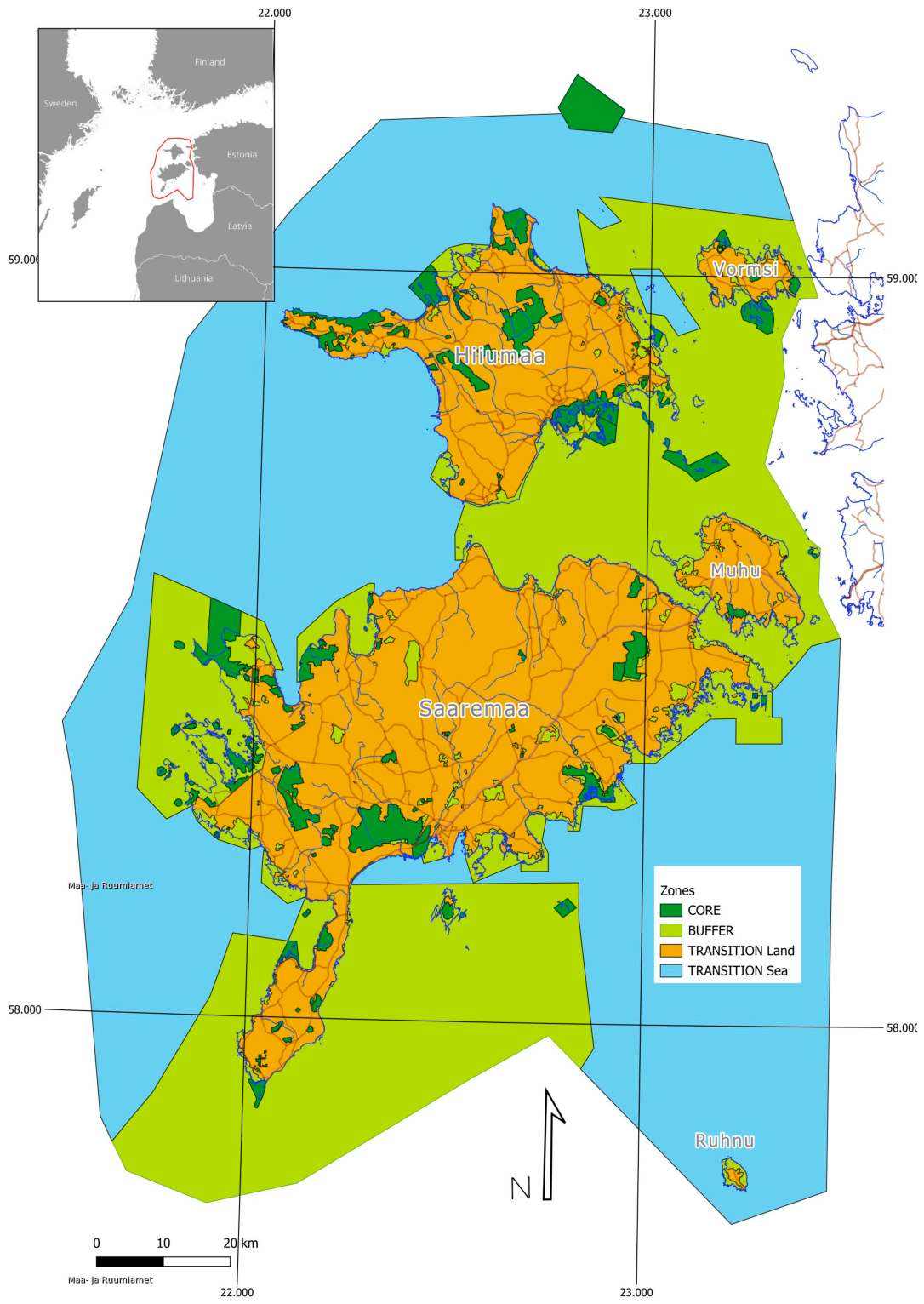
2.1. Study Area
2.2. Viability Assessment of Rural Settlements
2.2.1. Binary Evaluation Model of Indicators
- Population dynamics (growth-stability/decline)
- 2.
- Residential construction activity (built/not built)
- 3.
- Demographic balance (youth-to-elderly ratio ≥ 1 or <1)
2.2.2. Interpretation of Results
3. Results
3.1. Viability of Rural Settlements in WEABR
- Persistence of a strong core (viable settlements)
- 2.
- Continuous decline of the top tier (highly viable settlements)
- 3.
- Settlements in persistent stagnation
- 4.
- Abandoned settlements
3.2. Viability of WEABR Compared to the Rest of Estonia
- The economically dynamic and rapidly developing capital region (Harju County)
- Generally contracting rural counties (11 counties out of 15; four counties including towns with >20,000 inhabitants and >50% of the total population living in urban areas were excluded)
- The WEABR region, which is statistically similar to the average of rural Estonia but is shaped by a somewhat different spatial and functional context due to its archipelagic geography, coastal accessibility, and biosphere reserve governance framework.
- A deficit of highly viable settlements in WEABR and in rural Estonia as a whole
- 2.
- A strong “middle class” against all odds
- 3.
- Less “stagnating” settlements compared to the average of rural counties
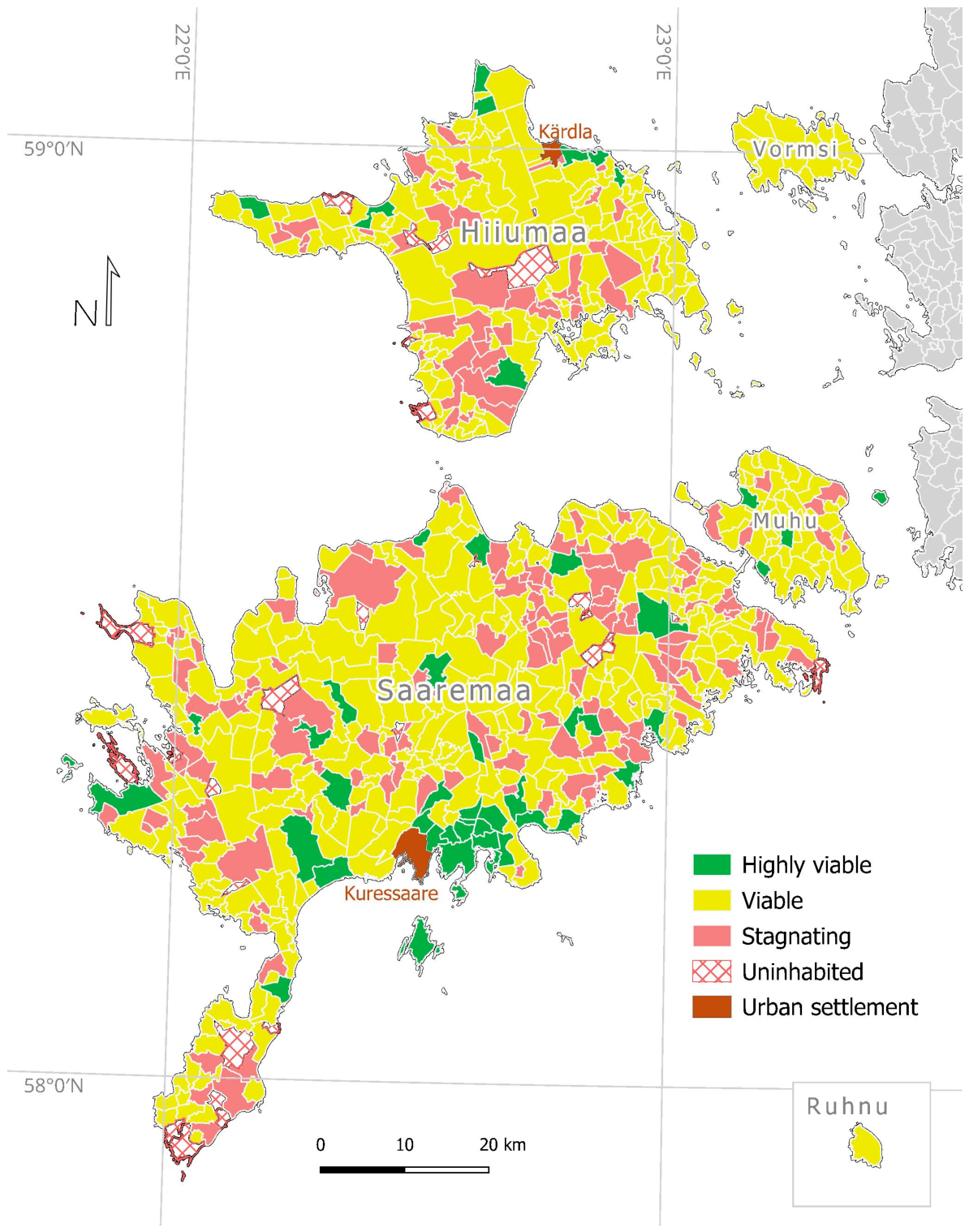
3.3. Spatial Distribution of Settlement Viability Within WEABR
4. Discussion
5. Conclusions
Author Contributions
Funding
Data Availability Statement
Conflicts of Interest
References
- Hajian, M.; Kashani, S.J. Evolution of the Concept of Sustainability. From Brundtland Report to Sustainable Development Goals. In Sustainable Resource Management; Velasco-Munoz, J.F., Chaudhery, M.H., Eds.; Elsevier: Amsterdam, The Netherlands, 2021; pp. 1–24. [Google Scholar] [CrossRef]
- United Nations. World Urbanization Prospects: The 2018 Revision; United Nations: New York, NY, USA, 2019. [Google Scholar]
- UN Environment Programme. Kunming-Montreal Post-2020 Global Biodiversity Framework; CBD/COP/DEC/15/4; UN: New York, NY, USA, 2022. [Google Scholar]
- UN Environment Programme World Conservation Monitoring Centre; International Union for Conservation of Nature; IUCN World Commission on Protected Areas (WCPA). Protected Planet Report 2024; UN Environment Programme World Conservation Monitoring Centre: Cambridge, UK; International Union for Conservation of Nature: Gland, Switzerland; IUCN World Commission on Protected Areas (WCPA): Gland, Switzerland, 2024. [Google Scholar]
- Locke, H.; Dearden, P. Rethinking Protected Area Categories and the New Paradigm. Environ. Conserv. 2005, 32, 1–10. [Google Scholar] [CrossRef]
- Shafer, C.L. Arguments for and against IUCN Protected Area Management Category VI with a Review of State versus Community Governance. J. Nat. Conserv. 2020, 53, 125697. [Google Scholar] [CrossRef]
- Terborgh, J. Reflections of a Scientist on the World Parks Congress. Conserv. Biol. 2004, 18, 619–620. [Google Scholar] [CrossRef]
- Mallarach, J.M.; Morrison, J.; Kothari, A.; Sarmiento, F.; Atauri, J.A.; Wishitemi, B. In Defence of Protected Landscapes: A Reply to Some Criticisms of Category V Protected Areas and Suggestions for Improvement. In Defining Protected Areas: An International Conference in Almeria, Spain; Dudley, N., Stolton, Sue., Eds.; IUCN: Gland, Switzerland, 2008; pp. 31–37. [Google Scholar]
- Wilson, A. All Parks Are Peopled Parks. In Policy Matters; Institute for Research on Public Policy: Montreal, QC, Canada, 2003; Volume 12, pp. 71–75. [Google Scholar]
- Elleason, M.; Guan, Z.; Deng, Y.; Jiang, A.; Goodale, E.; Mammides, C. Strictly Protected Areas Are Not Necessarily More Effective than Areas in Which Multiple Human Uses Are Permitted. Ambio 2021, 50, 1058–1073. [Google Scholar] [CrossRef]
- Vimal, R.; Navarro, L.M.; Jones, Y.; Wolf, F.; Le Moguédec, G.; Réjou-Méchain, M. The Global Distribution of Protected Areas Management Strategies and Their Complementarity for Biodiversity Conservation. Biol. Conserv. 2021, 256, 109014. [Google Scholar] [CrossRef]
- Adams, V.M.; Chauvenet, A.L.M.; Stoudmann, N.; Gurney, G.G.; Brockingon, D.; Kuempel, C.D. Multiple-Use Protected Areas Are Critical to Equitable and Effective Conservation. One Earth 2023, 6, 1173–1189. [Google Scholar] [CrossRef]
- Dudley, N.; Jonas, H.; Nelson, F.; Parrish, J.; Pyhälä, A.; Stolton, S.; Watson, J.E.M. The Essential Role of Other Effective Area-Based Conservation Measures in Achieving Big Bold Conservation Targets. Glob. Ecol. Conserv. 2018, 15, e00424. [Google Scholar] [CrossRef]
- Fischborn, M.; Sandwith, T. Solutions for Development Challenges: Insights from Protected and Conserved Areas; IUCN: Gland, Switzerland, 2021. [Google Scholar] [CrossRef]
- West, P.; Igoe, J.; Brockington, D. Parks and Peoples: The Social Impact of Protected Areas. Annu. Rev. Anthropol. 2006, 35, 251–277. [Google Scholar] [CrossRef]
- Gross, J.E.; Woodley, S.; Welling, L.A.; Watson, J.E.M. Adapting to Climate Change: Guidance for Protected Area Managers and Planners; IUCN: Gland, Switzerland, 2016. [Google Scholar] [CrossRef]
- Haight, J.; Hammill, E. Protected Areas as Potential Refugia for Biodiversity under Climatic Change. Biol. Conserv. 2020, 241, 108258. [Google Scholar] [CrossRef]
- Hannah, L. Protected Areas and Climate Change. Ann. N. Y. Acad. Sci. 2008, 1134, 201–212. [Google Scholar] [CrossRef]
- Hughes, K.A.; Convey, P.; Turner, J. Developing Resilience to Climate Change Impacts in Antarctica: An Evaluation of Antarctic Treaty System Protected Area Policy. Environ. Sci. Policy 2021, 124, 12–22. [Google Scholar] [CrossRef]
- Smith, R.; Cannizzo, Z.J.; Belle, E.; Wenzel, L. Role of Protected Areas in Climate Change Mitigation, Adaptation, and Disaster Risk Reduction. In Climate Action. Encyclopedia of the UN Sustainable Development Goals; Leal Filho, W., Azul, A.M., Brandli, L., Özuyar, P.G., Wall, T., Eds.; Springer: Cham, Switzerland, 2020; pp. 1–16. [Google Scholar] [CrossRef]
- CBD. The Strategic Plan for Biodiversity 2011–2020 and the Aichi Biodiversity Targets: Living in Harmony with Nature; Secretariat of the Convention on Biological Diversity: Montreal, QC, Canada, 2010. [Google Scholar]
- IUCN. Recommendations of the World National Parks Congress. Environ. Policy Law 1983, 10, 63–68. [Google Scholar] [CrossRef]
- Millenium Ecosystem Assessment. Ecosystems and Human Well-Being: Synthesis. In Millenium Ecosystem Assessment; Island Press/Center for Resource Economics: Washington, DC, USA, 2005; p. 155. [Google Scholar] [CrossRef]
- United Nations. Report of the United Nations Conference on Environment and Development; United Nations: New York, NY, USA, 1992; Volume l. [Google Scholar]
- Romagosa, F.; Eagles, P.F.J.; Lemieux, C.J. From the inside out to the Outside in: Exploring the Role of Parks and Protected Areas as Providers of Human Health and Well-Being. J. Outdoor Recreat. Tour. 2015, 10, 70–77. [Google Scholar] [CrossRef]
- Terraube, J.; Fernández-Llamazares, Á.; Cabeza, M. The Role of Protected Areas in Supporting Human Health: A Call to Broaden the Assessment of Conservation Outcomes. Curr. Opin. Environ. Sustain. 2017, 25, 50–58. [Google Scholar] [CrossRef]
- Venter, Z.S.; Barton, D.N.; Gundersen, V.; Figari, H.; Nowell, M.S. Back to Nature: Norwegians Sustain Increased Recreational Use of Urban Green Space Months after the COVID-19 Outbreak. Landsc. Urban Plan. 2021, 214, 104175. [Google Scholar] [CrossRef]
- Adams, W.M. Biodiversity Conservation and the Eradication of Poverty. Science 2004, 306, 1146–1149. [Google Scholar] [CrossRef] [PubMed]
- Naidoo, R.; Gerkey, D.; Hole, D.; Pfaff, A.; Ellis, A.M.; Golden, C.D.; Herrera, D.; Johnson, K.; Mulligan, M.; Ricketts, T.H.; et al. Evaluating the Impacts of Protected Areas on Human Well-Being across the Developing World. Sci. Adv. 2019, 5, eaav3006. [Google Scholar] [CrossRef]
- United Nations. Transforming Our World: The 2030 Agenda for Sustainable Development; United Nations: New York, NY, USA, 2015. [Google Scholar]
- Adams, W.M.; Hutton, J. People, Parks and Poverty: Political Ecology and Biodiversity Conservation. Conserv. Soc. 2007, 5, 147–183. [Google Scholar]
- Cernea, M.M.; Schmidt-Soltau, K. Poverty Risks and National Parks: Policy Issues in Conservation and Resettlement. World Dev. 2006, 34, 1808–1830. [Google Scholar] [CrossRef]
- Ferraro, P.J. The Local Costs of Establishing Protected Areas in Low-Income Nations: Ranomafana National Park, Madagascar. Ecol. Econ. 2002, 43, 261–275. [Google Scholar] [CrossRef]
- Kelboro, G.; Stellmacher, T. Protected Areas as Contested Spaces: Nech Sar National Park, Ethiopia, between ‘Local People’, the State, and NGO Engagement. Environ. Dev. 2015, 16, 63–75. [Google Scholar] [CrossRef]
- Joppa, L. Population Change in and around Protected Areas. J. Ecol. Anthropol. 2012, 15, 58–64. [Google Scholar] [CrossRef][Green Version]
- Agrawal, A.; Redford, K. Conservation and Displacement: An Overview. Conserv. Soc. 2009, 7, 1–10. [Google Scholar] [CrossRef]
- Kliimask, J.; Parts, P.K.; Järv, H.; Sepp, K.; Ward, R. Endangered Settlements and Protected Areas in Estonia: The Challenge of Maintaining Cultural Landscapes. Int. J. Agric. Resour. Gov. Ecol. 2015, 11, 346. [Google Scholar] [CrossRef]
- Fjellstad, W.; Mittenzwei, K.; Dramstad, W.; Øvren, E. Landscape Protection as a Tool for Managing Agricultural Landscapes in Norway. Environ. Sci. Policy 2009, 12, 1144–1152. [Google Scholar] [CrossRef]
- Schmitz, M.F.; Matos, D.G.G.; De Aranzabal, I.; Pineda, F.D. Effects of a Protected Area on Land-Use Dynamics and Socioeconomic Development of Local Populations. Biol. Conserv. 2012, 149, 122–135. [Google Scholar] [CrossRef]
- Geldmann, J.; Coad, L.; Barnes, M.; Craigie, I.D.; Hockings, M.; Knights, K.; Leverington, F.; Cuadros, I.C.; Zamora, C.; Woodley, S.; et al. Changes in Protected Area Management Effectiveness over Time: A Global Analysis. Biol. Conserv. 2015, 191, 692–699. [Google Scholar] [CrossRef]
- Järv, H.; Ward, R.D.; Raet, J.; Sepp, K. Socio-Economic Effects of National Park Governance and Management: Lessons from Post-Socialist Era Estonia. Land 2021, 10, 1257. [Google Scholar] [CrossRef]
- Balmford, A.; Whitten, T. Who Should Pay for Tropical Conservation, and How Could the Costs Be Met? Oryx 2003, 37, 238–250. [Google Scholar] [CrossRef]
- Järv, H.; Shkaruba, A.; Likhacheva, O.; Kireyeu, V.; Ward, R.; Sepp, K. A Tale of Two Protected Areas: “Value and Nature Conservation” in Comparable National Parks in Estonia and Russia. Land 2021, 10, 274. [Google Scholar] [CrossRef]
- Schreckenberg, K.; Franks, P.; Martin, A.; Lang, B. Unpacking Equity for Protected Area Conservation. Parks 2016, 22, 11–28. [Google Scholar] [CrossRef]
- Ghoddousi, A.; Loos, J.; Kuemmrle, T. An Outcome-Oriented, Social-Ecological Framework for Assessing Protected Area Effectiveness. Bioscience 2021, 72, 201–212. [Google Scholar] [CrossRef]
- Oldekop, J.A.; Holmes, G.; Harris, W.E.; Evans, K.L. A Global Assessment of the Social and Conservation Outcomes of Protected Areas. Conserv. Biol. 2016, 30, 133–141. [Google Scholar] [CrossRef]
- Urbano, F.; Viterbi, R.; Pedrotti, L.; Vettorazzo, E.; Movalli, C.; Corlatti, L. Enhancing Biodiversity Conservation and Monitoring in Protected Areas through Efficient Data Management. Environ. Monit. Assess. 2023, 196, 12. [Google Scholar] [CrossRef]
- Otamendi-Urroz, I.; Quintas-Soriano, C.; Hanspach, J.; Requena-Mullor, J.M.; Lagies, A.S.; Castro, A.J. Exploring Biocultural Diversity: A Systematic Analysis and Refined Classification to Inform Decisions on Conservation and Sustainability. Ambio 2025, 54, 1581–1597. [Google Scholar] [CrossRef] [PubMed]
- Vári, Á.; Gonzalez, A.; Bennett, E.M. Monitor Social–Ecological Systems to Achieve Global Goals for Biodiversity and Nature’s Contributions to People. Bioscience 2025, 75, 276–280. [Google Scholar] [CrossRef]
- Corrigan, C.; Robinson, C.J.; Burgess, N.D.; Kingston, N.; Hockings, M. Global Review of Social Indicators Used in Protected Area Management Evaluation. Conserv. Lett. 2018, 11, e12397. [Google Scholar] [CrossRef]
- Borie, M.; Hulme, M. Framing Global Biodiversity: IPBES between Mother Earth and Ecosystem Services. Environ. Sci. Policy 2015, 54, 487–496. [Google Scholar] [CrossRef]
- Intergovernmental Platform on Biodiversity and Ecosystem Services (IPBES). The IPBES Conceptual Framework; IPBES Secretariat: Bonn, Germany, 2013. [Google Scholar]
- Alba-Patiño, D.; Martín-López, B.; Delibes-Mateos, M.; Requena-Mullor, J.M.; Castro, A.J. Environmental Justice Gaps in Human-Wildlife Conflict Research from a Social-Ecological Systems Perspective. Biol. Conserv. 2025, 312, 111515. [Google Scholar] [CrossRef]
- Dobrovodská, M.; Raniak, A. Assessment and Perception of Rural Socio-Ecological System Development in Suburban Conditions in Central Europe. Land Use Policy 2026, 164, 107938. [Google Scholar] [CrossRef]
- Senghor, K.; Partelow, S.; Herrera, C.G.; Osemwegie, I. Conflicting Governance Realities: Aligning Historical and Cultural Practices with Formal Marine Protected Area Co-Management in Senegal. Mar. Policy 2023, 155, 105706. [Google Scholar] [CrossRef]
- Shkaruba, A.; Mnatsakanian, R.; Molodikova, I.; Kireyeu, V.; Sepp, K. Why Is the Eutrophication Governance over the Lake of Baikal Failing? Land Use Governance Solutions Need to Account for Barriers across Sectors, Scales, and Actor Groups. Land Use Policy 2024, 141, 107136. [Google Scholar] [CrossRef]
- Ostrom, E. A General Framework for Analyzing Sustainability of Social-Ecological Systems. Science 2009, 325, 419–422. [Google Scholar] [CrossRef]
- Turnhout, E.; Neves, K.; de Lijster, E. ‘Measurementality’ in Biodiversity Governance: Knowledge, Transparency, and the Intergovernmental Science-Policy Platform on Biodiversity and Ecosystem Services (Ipbes). Environ. Plan. A Econ. Space 2014, 46, 581–597. [Google Scholar] [CrossRef]
- Soberón, J.; Peterson, A.T. Biodiversity Governance: A Tower of Babel of Scales and Cultures. PLoS Biol. 2015, 13, e1002108. [Google Scholar] [CrossRef]
- Li, Y.; Westlund, H.; Liu, Y. Why Some Rural Areas Decline While Some Others Not: An Overview of Rural Evolution in the World. J. Rural Stud. 2019, 68, 135–143. [Google Scholar] [CrossRef]
- Schmeller, D.S.; Bridgewater, P. Transformative Change in a Nexus World: Product and Process in the Eleventh Plenary of the Intergovernmental Science-Policy Platform on Biodiversity and Ecosystem Services (IPBES-11). Biodivers. Conserv. 2025, 34, 715–721. [Google Scholar] [CrossRef]
- IPBES. Summary for Policymakers of the Thematic Assessment Report on the Underlying Causes of Biodiversity Loss and the Determinants of Transformative Change and Options for Achieving the 2050 Vision for Biodiversity of the Intergovernmental Science-Policy Platform on Biodiversity and Ecosystem Services; O’Brien, K., Garibaldi, L.A., Agrawal, A., Bennett, E., Biggs, R., Calderón Contreras, R., Carr, E.R., Frantzeskaki, N., Gosnell, H., Gurung, J., et al., Eds.; Zenodo: Bonn, Germany, 2024. [Google Scholar] [CrossRef]
- IPBES. Summary for Policymakers of the Thematic Assessment Report on the Interlinkages Among Biodiversity, Water, Food and Health (Nexus Assessment); McElwee, P.D., Harrison, P.A., van Huysen, T.L., Alonso Roldán, V., Barrios, E., Dasgupta, P., De Clerck, F., Harmáčková, Z., Hayman, D.T.S., Herrero, M., et al., Eds.; Zenodo: Bonn, Germany, 2024. [Google Scholar] [CrossRef]
- Liu, D.; Li, F.; Qiu, M.; Zhang, Y.; Zhao, X.; He, J. An Integrated Framework for Measuring Sustainable Rural Development towards the SDGs. Land Use Policy 2024, 147, 107339. [Google Scholar] [CrossRef]
- Rõigas, A.; Veemaa, J.; Rennu, M. Marketing Intentional Communities in Rural Estonia. Nor. Geogr. Tidsskr. 2025, 79, 10–22. [Google Scholar] [CrossRef]
- Waltert, F.; Schläpfer, F. Landscape Amenities and Local Development: A Review of Migration, Regional Economic and Hedonic Pricing Studies. Ecol. Econ. 2010, 70, 141–152. [Google Scholar] [CrossRef]
- Halfacree, K. Trial by Space for a ‘Radical Rural’: Introducing Alternative Localities, Representations and Lives. J. Rural Stud. 2007, 23, 125–141. [Google Scholar] [CrossRef]
- Halfacree, K. Rural Space: Constructing a Three-Fold Architecture. In The Handbook of Rural Studies; Cloke, P., Marsden, T., Mooney, P., Eds.; SAGE: London, UK, 2006; pp. 44–62. [Google Scholar] [CrossRef]
- Boyle, P.J.; Keith, H. Migration into Rural Areas: Theories and Issues; Wiley: Hoboken, NJ, USA, 1998. [Google Scholar]
- Ilbery, B.; Bowler, I. From Agricultural Productivism to Post-Productivism. In The Geography of Rural Change; Ilbery, B., Ed.; Routledge: London, UK, 1998; pp. 57–84. [Google Scholar] [CrossRef]
- Argent, N.; Brown, D.L. The Impacts of Population Change on Rural Society and Economy. In Routledge International Handbook of Rural Studies; Shucksmith, M., Brown, D.L., Eds.; Routledge: Abingdon, UK, 2016; pp. 85–96. [Google Scholar]
- Dax, T.; Fischer, M. An Alternative Policy Approach to Rural Development in Regions Facing Population Decline. Eur. Plan. Stud. 2018, 26, 297–315. [Google Scholar] [CrossRef]
- OECD; European Union; European Commission; Joint Research Centre. Handbook on Constructing Composite Indicators: Methodology and User Guide; OECD: Paris, France, 2008. [Google Scholar] [CrossRef]
- Sisask, M. The Estonian Human Development Report 2023 “Mental Health and Well-Being”; Estonian Cooperation Assembly: Tallinn, Estonia, 2023. [Google Scholar]
- Antrop, M.; Van Eetvelde, V. Landscape Perspectives: The Holistic Nature of Landscape; Springer: Dordrecht, The Netherlands, 2017. [Google Scholar] [CrossRef]
- Wilson, J.B.; Peet, R.K.; Dengler, J.; Pärtel, M. Plant Species Richness: The World Records. J. Veg. Sci. 2012, 23, 796–802. [Google Scholar] [CrossRef]
- Geldmann, J.; Barnes, M.; Coad, L.; Craigie, I.D.; Hockings, M.; Burgess, N.D. Effectiveness of Terrestrial Protected Areas in Reducing Habitat Loss and Population Declines. Biol. Conserv. 2013, 161, 230–238. [Google Scholar] [CrossRef]
- Brown, D.L.; Schafft, K.A. Rural People and Communities in the 21st Century: Resilience and Transformation, 2nd ed.; Polity Press: Cambridge, UK, 2018. [Google Scholar]
- Sørensen, J.F.L. The Importance of Place-Based, Internal Resources for the Population Development in Small Rural Communities. J. Rural Stud. 2018, 59, 78–87. [Google Scholar] [CrossRef]
- Vu, T.T. A Practical Framework for Selecting and Interpreting Regression Models for Binary Outcomes in Social Science and Public Health Studies. Discov. Soc. Sci. Health 2026, 6, 11. [Google Scholar] [CrossRef]
- Rivera-Garrido, N.; Ramos-Sosa, M.P.; Accerenzi, M.; Brañas-Garza, P. Continuous and Binary Sets of Responses Differ in the Field. Sci. Rep. 2022, 12, 14376. [Google Scholar] [CrossRef] [PubMed]
- Suarez-Garcia, A.; Alvarez-Hernandez, M.; Arce, H.; Ribas, J.R. Exploring the Efficacy of Binary Surveys versus Likert Scale in Assessing Student Perspectives Using Bayesian Analysis. Appl. Sci. 2024, 14, 4189. [Google Scholar] [CrossRef]
- Cohen, J. The Cost of Dichotomization. Appl. Psychol. Meas. 1983, 7, 249–253. [Google Scholar] [CrossRef]
- Altman, D.G.; Royston, P. The Cost of Dichotomising Continuous Variables. BMJ 2006, 332, 1080. [Google Scholar] [CrossRef]
- Järv, H.; Kliimask, J.; Ward, R.; Sepp, K. Socioeconomic Impacts of Protection Status on Residents of National Parks. Eur. Countrys. 2016, 8, 67–85. [Google Scholar] [CrossRef]
- Kliimask, J.; Järv, H.; Sepp, K.; Ward, R. Nature Conservation in Remote Rural Areas: A Win-Win Situation? In Think Rural! Dünkel, F., Herbst, M., Schlegel, T., Eds.; Springer VS: Wiesbaden, Germany, 2014; pp. 193–208. [Google Scholar] [CrossRef]
- Bonet-García, F.J.; Pérez-Luque, A.J.; Moreno-Llorca, R.A.; Pérez-Pérez, R.; Puerta-Piñero, C.; Zamora, R. Protected Areas as Elicitors of Human Well-Being in a Developed Region: A New Synthetic (Socioeconomic) Approach. Biol. Conserv. 2015, 187, 221–229. [Google Scholar] [CrossRef]
- Terres, J.M.; Scacchiafichi, L.N.; Wania, A.; Ambar, M.; Anguiano, E.; Buckwell, A.; Coppola, A.; Gocht, A.; Källström, H.N.; Pointereau, P.; et al. Farmland Abandonment in Europe: Identification of Drivers and Indicators, and Development of a Composite Indicator of Risk. Land Use Policy 2015, 49, 20–34. [Google Scholar] [CrossRef]
- Statistics Estonia. Available online: https://stat.ee/en (accessed on 18 February 2026).
- Eurostat. Demography of Europe—2025 Edition; Publications Office of the European Union: Luxembourg, 2025. [Google Scholar]
- Independent Group of Scientists Appointed by the Secretary-General. Global Sustainable Development Report 2019: The Future Is Now—Science for Achieving Sustainable Development; United Nations: New York, NY, USA, 2019. [Google Scholar]
- Printsmann, A.; Nugin, R.; Palang, H. Intricacies of Moral Geographies of Land Restitution in Estonia. Land 2022, 11, 235. [Google Scholar] [CrossRef]
- Balockaite, R. Post-Soviet Transitions of the Planned Socialist Towns: Visaginas, Lithuania. Stud. Transit. States Soc. 2010, 2, 63–81. [Google Scholar]
- Correa, M. Working from a New Home? Remote-Work Potential and Urban out-Migration in Sweden. Spat. Econ. Anal. 2025, 20, 266–290. [Google Scholar] [CrossRef]
- Stenseke, M. The Intergovernmental Science-Policy Platform on Biodiversity and Ecosystem Services and the Challenge of Integrating Social Sciences and Humanities. Bull. Geogr. Socio-Econ. Ser. 2016, 33, 119–129. [Google Scholar] [CrossRef][Green Version]
- Cumming, G.; Allen, C. Protected Areas as Social-Ecological Systems: Perspectives from Resilience and Social-Ecological Systems Theory. Ecol. Appl. 2017, 27, 1709–1717. [Google Scholar] [CrossRef] [PubMed]
- Leverington, F.; Costa, K.L.; Pavese, H.; Lisle, A.; Hockings, M. A Global Analysis of Protected Area Management Effectiveness. Environ. Manag. 2010, 46, 685–698. [Google Scholar] [CrossRef]
- Borrini-Feyerabend, G.; Johnston, J.; Pansky, D. Governance of Protected Areas. In Protected Areas Management: A Global Guide; Lockwood, M., Worboys, G.L., Kothari, A., Eds.; Earthscan: Sterling, VA, USA; London, UK, 2006; pp. 116–145. [Google Scholar]
- Boarini, R.; Kolev, A.; McGregor, A. Measuring Well-Being and Progress in Countries at Different Stages of Development: Towards a More Universal Conceptual Framework; OECD Publishing: Paris, France, 2014; Volume 325. [Google Scholar]
- Sánchez-Moral, S.; Arellano, A.; Díez-Pisonero, R. The Impact of Remote Working on Residential Mobility in the Metropolitan Region of Madrid. Cities 2026, 169, 106462. [Google Scholar] [CrossRef]
- Knuepling, L.; Sternberg, R.; Otto, A. Rural Areas as Winners of COVID-19, Digitalization and Remote Working? Empirical Evidence from Recent Internal Migration in Germany. Camb. J. Reg. Econ. Soc. 2025, 18, 227–248. [Google Scholar] [CrossRef]
- González-Leonardo, M.; Rowe, F.; Fresolone-Caparrós, A. Rural Revival? The Rise in Internal Migration to Rural Areas during the COVID-19 Pandemic. Who Moved and Where? J. Rural Stud. 2022, 96, 332–342. [Google Scholar] [CrossRef]
- Manapragada, N.V.S.K.; Mandelmilch, M.; Roitberg, E.; Kizel, F.; Natanian, J. Remote Sensing for Environmentally Responsive Urban Built Environment: A Review of Tools, Methods and Gaps. Remote Sens. Appl. 2025, 38, 101529. [Google Scholar] [CrossRef]
- Liu, P.; Liu, X.; Liu, M.; Shi, Q.; Yang, J.; Xu, X.; Zhang, Y. Building Footprint Extraction from High-Resolution Images via Spatial Residual Inception Convolutional Neural Network. Remote Sens. 2019, 11, 830. [Google Scholar] [CrossRef]
- Weng, Q. Remote Sensing of Impervious Surfaces in the Urban Areas: Requirements, Methods, and Trends. Remote Sens. Environ. 2012, 117, 34–49. [Google Scholar] [CrossRef]
- Matthiessen, C.W. The Öresund Area: Pre- and Post-Bridge Cross-Border Functional Integration: The Bi-National Regional Question. GeoJournal 2004, 61, 31–39. [Google Scholar] [CrossRef]
- Nauwelaers, C.; Maguire, K.; Marsan, G.A. The Case of Oresund (Denmark-Sweden)—Regions and Innovation: Collaborating Across Borders; OECD Regional Development Working Papers; OECD Publishing: Paris, France, 2013; Volume 21. [Google Scholar] [CrossRef]


| Number of Positive Indicators | Interpretation | Description |
|---|---|---|
| 3 | Highly viable | The number of residents is growing, new housing is being built, and the number of young residents exceeds that of older residents. These are the most dynamic and sustainable places. |
| 1–2 | Viable | One or two of the three indicators are positive. Although one or two components may be weaker (e.g., a predominance of older residents), positive development is nevertheless occurring, indicating principal potential. |
| 0 | Stagnating | No measurable positive development has occurred during the observed period. This does not necessarily mean the settlement is completely unviable, but at best, the current situation indicates stagnation. |
| 1979–1989 | 2000–2011 | 2011–2021 | |
|---|---|---|---|
| Population dynamics (stable or growing) | 26 | 29 | 42 |
| Residential construction activity (new housing was built) | 49 | 45 | 36 |
| Age structure of residents (ratio of population aged 0–17 to population aged 65+ is ≥1) | 55 | 34 | 27 |
| 1989 | 2011 | 2021 | |
|---|---|---|---|
| Highly viable settlements | 14 | 8 | 7 |
| Viable settlements | 60 | 63 | 63 |
| Stagnating settlements | 26 | 24 | 26 |
| Uninhabited settlements | 0 | 5 | 4 |
| TOTAL | 100 | 100 | 100 |
| WEABR | Estonia Total | Harju County | Average of 11 Rural Counties | |
|---|---|---|---|---|
| Highly viable | 7 | 8 | 28 | 5 |
| Viable | 63 | 58 | 57 | 57 |
| Stagnating | 26 | 32 | 13 | 35 |
| Uninhabited | 4 | 2 | 1 | 2 |
| Total | 100 | 100 | 100 | 100 |
Disclaimer/Publisher’s Note: The statements, opinions and data contained in all publications are solely those of the individual author(s) and contributor(s) and not of MDPI and/or the editor(s). MDPI and/or the editor(s) disclaim responsibility for any injury to people or property resulting from any ideas, methods, instructions or products referred to in the content. |
© 2026 by the authors. Licensee MDPI, Basel, Switzerland. This article is an open access article distributed under the terms and conditions of the Creative Commons Attribution (CC BY) license.
Share and Cite
Kliimask, J.; Järv, H.; Rõigas, A.; Rämson, R.; Kokovkin, T.; Shkaruba, A.; Raet, J.; Sepp, K. Assessing Sustainability and Socio-Economic Viability in Inhabited Protected Areas: A Framework Based on the West-Estonian Archipelago Biosphere Reserve. Land 2026, 15, 719. https://doi.org/10.3390/land15050719
Kliimask J, Järv H, Rõigas A, Rämson R, Kokovkin T, Shkaruba A, Raet J, Sepp K. Assessing Sustainability and Socio-Economic Viability in Inhabited Protected Areas: A Framework Based on the West-Estonian Archipelago Biosphere Reserve. Land. 2026; 15(5):719. https://doi.org/10.3390/land15050719
Chicago/Turabian StyleKliimask, Jaak, Henri Järv, Andres Rõigas, Raul Rämson, Toomas Kokovkin, Anton Shkaruba, Janar Raet, and Kalev Sepp. 2026. "Assessing Sustainability and Socio-Economic Viability in Inhabited Protected Areas: A Framework Based on the West-Estonian Archipelago Biosphere Reserve" Land 15, no. 5: 719. https://doi.org/10.3390/land15050719
APA StyleKliimask, J., Järv, H., Rõigas, A., Rämson, R., Kokovkin, T., Shkaruba, A., Raet, J., & Sepp, K. (2026). Assessing Sustainability and Socio-Economic Viability in Inhabited Protected Areas: A Framework Based on the West-Estonian Archipelago Biosphere Reserve. Land, 15(5), 719. https://doi.org/10.3390/land15050719