Article

Bacterial Communities Are Strongly Associated with Soil Multifunctionality During Revegetation of Copper Mine Wastelands


Key Laboratory of National Forestry and Grassland Administration on Forest Cultivation and Management in East China, Research Institute of Subtropical Forestry, Chinese Academy of Forestry, Hangzhou 311400, China
*
Author to whom correspondence should be addressed.
Land 2026, 15(5), 704; https://doi.org/10.3390/land15050704
Submission received: 22 March 2026 / Revised: 20 April 2026 / Accepted: 21 April 2026 / Published: 23 April 2026

Abstract

Vegetation restoration is critical for ecosystem recovery in abandoned mining areas, yet how restoration age affects soil multifunctionality (SMF) and the underlying microbial regulatory mechanisms remains poorly understood. The space-for-time substitution method was employed in this study. Along a revegetation chronosequence (Restoration 1 year (R1), Restoration 10 year (R10), Restoration 30 year (R30), Restoration 45 year (R45)) in copper mine wasteland in Tongling, China, the dynamics of soil functions, SMF, and microbial communities were quantified, with the key factors influencing soil functions and the most important predictors of SMF subsequently identified. The results showed that the soil moisture regulation function recovered relatively slowly, whereas nutrient cycling functions and SMF were generally enhanced with advancing revegetation. Specifically, these functions all reached their maximum values at R30 (0.39, 0.45, and 0.28, respectively), followed by declines at R45 (−0.74, −0.09, and −0.20, respectively). Furthermore, the soil microbial communities exhibited successional characteristics of increased diversity but reduced dominance. Redundancy analysis indicated that aboveground biomass (AGB), belowground biomass (UGB), and soil total copper were key environmental variables associated with variations in multiple soil functions. Linear regression analysis showed that fungal diversity indices, plant biomass (AGB and UGB), soil total cadmium, and soil total zinc exhibited significant linear relationships with SMF. Random forest analysis further identified UGB, bacterial Simpson index, and fungal Shannon–Wiener index as key predictors of SMF. Importantly, bacterial communities played a more important role in influencing SMF than fungal communities. These results advance the understanding of key drivers of ecosystem functional recovery in mine lands and provide a theoretical basis for optimizing soil function restoration strategies. Ultimately, these findings provide new insights for advancing efforts aimed at halting land degradation and safeguarding biodiversity in degraded mining ecosystems.

1. Introduction

Mining activities cause significant ecological damage via vegetation removal and soil destruction, resulting in the deterioration of soil structure, nutrient depletion, and severe pollution of heavy metals [1,2]. These harsh conditions significantly inhibit the colonization and development of organisms, and hinder the restoration of ecosystem structure and function [3,4]. Numerous studies have been conducted on the ecological restoration of different types of abandoned mines, generally focusing on the improvement of soil physicochemical properties, the succession of microbial community structure, and the evolution of soil quality [2,5,6]. However, such studies mostly emphasize changes in structural attributes or individual indicators, making it difficult to comprehensively reflect the responses of multiple key ecosystem functions during the restoration process. Soil functions such as nutrient cycling, productivity provision, and water retention are essential for ecosystem stability and service functions. Restoring these functions not only directly determines the effectiveness of ecological remediation in abandoned mining areas, but also significantly affects regional ecological security [7,8]. Therefore, under the specific context of heavy metal stress, systematically elucidating the recovery trajectories of soil functions in abandoned mines has become a critical scientific issue that urgently warrants attention in current ecological restoration research.
In recent years, soil multifunctionality (SMF) has gained increasing recognition as a crucial composite indicator for evaluating the quality and health status of ecosystems [6,9]. Unlike individual soil indicators (such as soil organic matter content and urease activity), SMF can holistically characterize the soil’s overall capacity to sustain multiple ecological functions and is therefore recognized as a vital link bridging ecosystem structure and function [10,11]. Notably, numerous studies in typical ecosystems (such as grasslands, forests and farmlands) have highlighted that SMF responses to ecosystem succession processes or anthropogenic disturbance intensity exhibit distinct stage-specific and nonlinear characteristics [12,13]. This phased response is attributed to shifts in the relative importance of the key biotic and abiotic drivers across different stages, among which plant communities play a pivotal role in regulating soil microorganisms [10,11,13]. To elaborate, changes in plant community composition, diversity, productivity, and functional traits can directly influence carbon inputs, nutrient acquisition, and microenvironmental conditions, and indirectly regulate soil physicochemical properties and microbial activity [10,11,13]. A growing body of research from croplands, grasslands, and forest ecosystems demonstrates that increases in plant diversity and functional complementarity enhance SMF by improving resource use efficiency and strengthening aboveground–belowground linkages [14,15,16]. Specifically, changes in plant functional traits (such as root length density and litter C/N ratio) during succession modify soil carbon inputs, which further affects soil microbial activity and functional potential, thereby regulating SMF dynamics [13]. However, in mine wasteland ecosystems, the superimposition of long-term pollution stress and vegetation restoration processes renders soil biological processes and their functional restoration highly uncertain and complex. Consequently, a systematic and clear understanding of the successional characteristics of SMF and the dominant influencing factors during vegetation restoration in copper mine wasteland ecosystems remains lacking.
Soil microorganisms, as a vital bridge linking plants and soil, play a central role in nutrient cycling, organic matter decomposition, and pollutant transformation [17,18,19]. High concentrations of heavy metal ions can disrupt the integrity of microbial cell walls, interfere with DNA and RNA synthesis, and inhibit the binding of cofactors to biomolecules, ultimately leading to cell death [20]. These effects impair microbial metabolic activity and diversity, constrain microbial proliferation, and reduce microbially mediated ecosystem functions, particularly those involved in carbon, nitrogen, and sulfur cycling [21]. Among soil microbial communities, bacteria and fungi are the most abundant and functionally critical components, exerting profound impacts on soil nutrient cycling, carbon transformation, and the maintenance of SMF [22,23,24]. Previous studies have demonstrated that the assembly of fungal communities is more strongly affected by the priority effects of vegetation restoration than that of bacterial communities [25]. In contrast, Yang et al. reported that bacterial communities exhibit better adaptability to the restoration process than fungi [26]. Further, Pan et al. and Sun et al. have indicated that soil bacterial and fungal communities display divergent restoration patterns during ecosystem recovery [27,28]. These findings suggest that bacteria and fungi may follow distinct successional trajectories during vegetation restoration and exhibit significantly heterogeneous responses to the restoration chronosequence. Therefore, revealing the response patterns of bacteria and fungi throughout the vegetation restoration process can provide a critical scientific basis for the precise optimization of vegetation restoration measures and the enhancement of ecosystem remediation efficiency in mining areas, owing to the substantial differences between bacteria and fungi in terms of life history strategies, resource utilization patterns, and environmental stress tolerance [29]. Accordingly, their relative contributions and dominant roles in the maintenance of soil functions may change during vegetation recovery in mining areas. For example, Jin et al. demonstrated that fungal communities determined SMF during vegetation restoration in mine tailings ponds [30], while Gong et al. found that soil bacterial diversity regulated SMF [31]. Furthermore, most existing studies have focused on individual microbial communities or discrete static time points [6,22], while overlooking microbial community associations with soil functions during ecosystem restoration.
To clarify the relationships between bacterial and fungal communities and SMF, this study selected the abandoned copper mines in Tongling, China (with a restoration chronosequence spanning 1 to 45 years), as the research area. The wastelands examined in this study were created through open-pit mining and waste deposition, followed by secondary succession after mining activities ceased. This legacy of prolonged industrial activity has resulted in distinct soil conditions with significant heavy metal concentrations and altered soil structure, providing a valuable chronosequence for studying ecological restoration processes in metal-contaminated environments. According to the space-for-time substitution method, soil individual functions, SMF, the successional characteristics of microbial communities, and key edaphic factors influencing soil functions were systematically evaluated. This study proposes the following three hypotheses: (1) During vegetation restoration in abandoned mining areas, individual soil functions and SMF exhibit nonlinear responses along the restoration chronosequence. (2) With the progression of vegetation restoration, the structure and diversity of soil bacterial and fungal communities undergo distinct stage-specific succession patterns. (3) Microbial communities differ in their relative contributions to SMF. This study aimed (1) to examine the response of soil functions and the diversity of soil microbial communities to copper mine wasteland restoration; (2) to analyze the factors influencing soil functions; (3) to elucidate the differential contributions of bacterial and fungal communities to SMF during natural restoration of copper mine wastelands. The results may help to reveal a synergistic evolution between belowground and aboveground systems during vegetation restoration in abandoned copper mines. This study may provide insights into the key factors limiting the enhancement of SMF and clarify the relationships between soil microbial communities and SMF, thereby informing efforts to halt land degradation and safeguard biodiversity.

2. Materials and Methods

2.1. Study Area

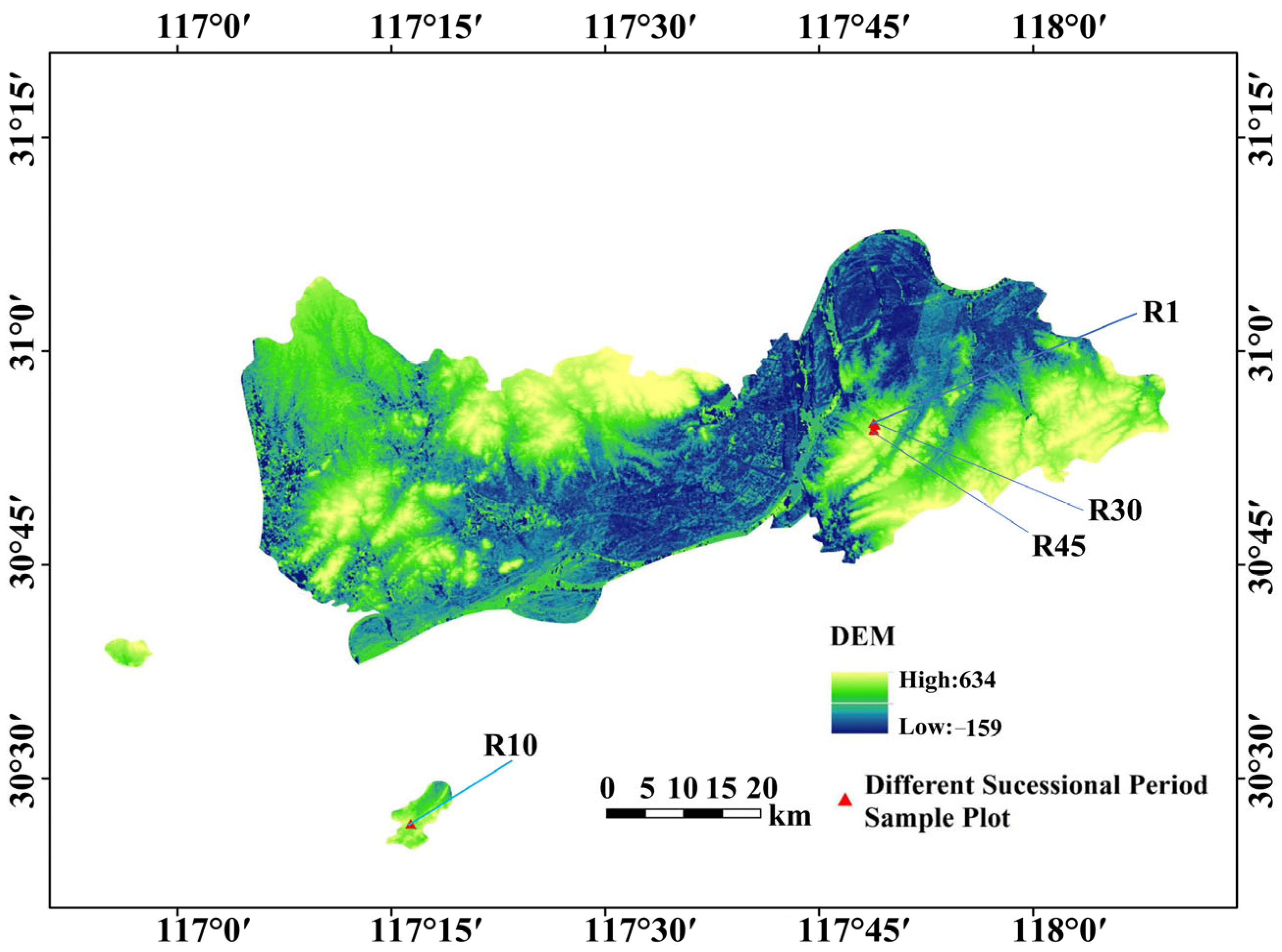
The research site is situated within the copper mining wastelands of Tongling City, Anhui Province, China (30°54′ N, 117°53′ E). This site exhibits a subtropical humid climate, characterized by distinct monsoonal features. The yearly average temperature is around 16.2 °C, and the yearly rainfall is about 1346 mm. There are 237–258 frost-free days with sufficient sunshine. Average monthly humidity is 75–81% year-round. Tongling has a long history of copper extraction dating back centuries, with intensive industrial-scale mining during much of the 20th century. This research adopted the “space-for-time substitution” approach [32]. To meet this assumption, all sites were located within the Tongling mining area, ensuring consistent climate and regional settings. Site selection further controlled for: (i) formation history—all sites originated from open-pit mining waste dumps with identical deposition processes; (ii) topography—minimal variation in elevation (<141 m) and slope (<36°) among sites; (iii) soil parent material—uniform mining waste substrate; (iv) contamination history—similar heavy metal profiles dominated by Cd, Pb, As, Cu, and Zn (Tables S1 and S2). All sites were naturally recovered without human intervention, eliminating management-related confounding. Four representative vegetation chronosequences were chosen to exemplify the successional processes in copper mining wastelands: 1 year (R1), 10 years (R10), 30 years (R30) and 45 years (R45) (Figure 1). The restoration chronosequences were determined using historical remote sensing imagery and documented mining restoration records. The specific information for each sampling plot is shown in Table S1.

2.2. Field Sampling Design and Collection

Methods for vegetation investigation were carried out as detailed in a previous study [33]. Briefly, five large plots (10 m × 10 m) were established for every restoration stage, with a 20 m separation zone separating neighboring plots to avoid edge effects. In every large plot, three 1 m × 1 m herbaceous subplots were systematically positioned for vegetation characterization, resulting in 60 herbaceous subplots for the study. Systematic investigations and recordings were conducted for the core vegetation indicators within the survey quadrats, including plant species, species richness, species coverage, and species height. The detailed calculation formulas and parameter definitions for the plant community indices are provided in Supplementary Materials S1. Upon completion of the vegetation survey, the aboveground biomass (AGB) and belowground biomass (UGB) of herbaceous plants were sampled using the harvesting method and the root auger method (diameter: 7.5 cm; soil layer: 0–10 cm), respectively. All collected plant samples were transported back to the laboratory and oven-dried to a constant weight for subsequent measurements. Soil samples were collected from the 1 m × 1 m herbaceous subplots after vegetation surveys. Three soil samples were procured diagonally from the upper 10 cm soil layer of every subplot and fully homogenized to form a composite soil sample. Thus, 15 composite soil samples were collected for every restoration stage, and 60 such samples were yielded across the four restoration stages. After sieving via a 2 mm sieve, all samples were split into two subsamples, one air-dried to assess soil characteristics, while the other was employed to determine microbial biomass and enzymatic activity. Within each large plot, one undisturbed soil aggregate sample was collected, yielding a total of five replicate samples per restoration stage. To minimize mechanical disturbance during transportation, the soil samples were carefully placed in rigid square containers to preserve their original aggregate structure. All samples were then transported to the laboratory and air-dried naturally at room temperature to a constant weight prior to subsequent analysis.

2.3. Soil and Microbial Analysis

To determine the responses of soil factors to vegetation restoration, the cutting ring method and drying constant weight method were used to evaluate soil bulk density (SBD) and soil water content (SWC), respectively. Specifically, one ring core was collected from each 10 m × 10 m plot, with a total of five ring cores per restoration stage. A pH meter (PB-10, Sartorius, Göttingen, Germany) was employed to determine soil pH at a soil-to-water ratio of 1:2.5. Soil available nitrogen (AN) was determined by the alkaline diffusion method. Available phosphorus (AP) and total phosphorus (TP) were determined using the molybdenum-antimony colorimetric method after extraction in NaHCO3 solution and acid digestion, respectively. Soil total carbon (TC) and soil organic carbon (SOC) were determined using an automatic C/N analyzer (multi C/N 2100S, Analytik Jena, Jena, Germany). Soil total nitrogen (TN) was determined by a fully automated Kjeldahl nitrogen analyzer after digestion with concentrated sulfuric acid [1]. Soil aggregate stability was assessed via the wet sieving method following standard protocols. Aggregates were separated into four size fractions, namely >2 mm, 2–0.25 mm, 0.25–0.053 mm, and <0.053 mm, based on the aggregate size distribution derived from wet sieving. The soil aggregate stability indices including mean weight diameter (MWD) and geometric mean diameter (GMD) were calculated to quantify soil structural stability. Detailed calculation formulas and parameter definitions are provided in Supplementary Materials S2. The total HMs in soil were quantified via inductively coupled plasma mass spectrometry (ICP-MS) following acid digestion with nitric and hydrofluoric acids, and available heavy metals (HMs) were quantified via inductively coupled plasma optical emission spectroscopy (ICP-OES) after extraction with diethylenetriamine pentaacetic acid (DTPA). Soil microbial biomass carbon (MBC), microbial biomass nitrogen (MBN), and microbial biomass phosphorus (MBP) were determined as indicators using the chloroform fumigation-extraction method [1]. The activities of soil enzymes including acid phosphatase (ACP), urease (UE), and sucrase (SC) were determined by the microtiter plate colorimetric method [34].
The structure and diversity of soil bacterial and fungal communities were analyzed by metagenomic shotgun sequencing on the Illumina HiSeq X-Ten platform (Majorbio Bio-pharm, Shanghai, China). Total microbial community DNA was extracted from 0.5 g of soil samples using the FastDNA® Spin Kit for Soil (MP Biomedicals, Solon, OH, USA) following the manufacturer’s instructions. After assessing DNA purity, high-quality DNA samples were selected and fragmented to approximately 300 bp using an ultrasonic disruptor (Majorbio, Shanghai, China). Subsequently, metagenomic sequencing was performed on the Illumina HiSeq X-Ten platform. Raw sequencing data were subjected to quality control and assembly using Fastp (https://github.com/OpenGene/fastp, accessed from 8 October 2025 to 30 January 2026) and MEGAHIT (https://github.com/voutcn/megahit, accessed from 8 October 2025 to 30 January 2026), respectively, with contig assembly conducted by MEGAHIT. Open reading frames (ORFs) in the assembled contig sequences were predicted using Prodigal (https://github.com/hyattpd/Prodigal, accessed from 8 October 2025 to 30 January 2026), and a non-redundant gene catalog was constructed using CD-HIT. For taxonomic annotation, the non-redundant gene sequences were aligned against the non-redundant protein (NR) database of the National Center for Biotechnology Information (NCBI, Bethesda, MD, USA) using DIAMOND (https://github.com/bbuchfink/diamond, accessed from 8 October 2025 to 30 January 2026) to obtain corresponding taxonomic information. Diversity indices, including the Chao1 index, Shannon–Wiener index, Simpson index, and Pielou index, were calculated to denote soil fungal and bacterial diversity [8].

2.4. Calculation of Individual Soil Functions and Multifunctionality

In this study, SMF was employed as an integrative metric to quantify the restoration of soil ecosystem functions in rehabilitated abandoned mining areas. Eighteen indicators were selected to quantify SMF, including SBD, SWC, soil aggregate indices (MWD and GMD), AN, TN, SOC, TC, TP, AP, enzyme activities (SC, UE, and ACP), microbial biomass parameters (MBC, MBN, and MBP), AGB, and UGB. These indicators were categorized into three functional groups based on their ecological roles. Specifically, AN, TN, SOC, TC, TP, AP, SC, UE, ACP, MBC, MBN, and MBP represent nutrient cycling functions, SBD, SWC, MWD, and GMD represent water regulation functions, and AGB and UGB represent production functions. SMF was calculated using the averaging method proposed by Hooper and Vitousek [35], which is an equal-weighted approach without additional weighting assigned to individual functions. First, the directionality of each soil functional indicator was evaluated prior to SMF calculation. Soil bulk density (BD) was identified as a negative indicator, where higher values represent poorer soil structure and function. Therefore, BD was inversely transformed prior to standardization to ensure that all functions were oriented in the same positive direction. Subsequently, the Z-score method was applied to standardize each single-function indicator across all quadrats. The normalization formula is as follows:
Zij = (Xijuj)/σj,
where Zij denotes the Z-score of the j-th soil functional indicator in the i-th quadrat; Xij is the measured value of the j-th soil functional indicator in the i-th quadrat; uj represents the mean value of the j-th soil functional indicator across all quadrats; σj is the standard deviation of the j-th soil functional indicator across all quadrats. Finally, the arithmetic mean of the standardized Z-scores for all single-function indicators within each quadrat was computed, which was defined as the SMF value for that quadrat.

2.5. Statistical Analyses

All statistical analyses were performed using R version 4.5.0. To account for the hierarchical structure of the experimental design (subplots nested within plots), linear mixed-effects models (LMMs) were fitted using the “lme4” package in R (version 4.5.0) to assess the effects of vegetation restoration on soil individual functions, SMF, and soil microbial diversity. Restoration stage was treated as a fixed effect, and plot was included as a random effect to account for the non-independence of subplots within plots. Post hoc pairwise comparisons were conducted using Tukey’s HSD test with the “emmeans” package in R (version 4.5.0), with degrees of freedom adjusted using the Kenward-Roger method to account for the mixed model structure. Significance was determined at p < 0.05.
To avoid pseudoreplication, values from the three subplots within each plot were averaged, and each plot was treated as the independent experimental unit (n = 5 per restoration stage) in redundancy analysis (RDA), the Mantel test, and the random forest model. RDA was used to explore the relationships between environmental variables and individual soil ecosystem functions, as well as SMF. Prior to RDA, all variables were standardized using Z-score transformation to eliminate the effects of different measurement scales. To reduce multicollinearity among predictors, variance inflation factor (VIF) values were calculated, and variables with high collinearity (VIF > 10) were excluded. Additionally, Pearson correlation analysis was conducted, and highly correlated variables (|r| > 0.6) were identified. Based on these criteria, a subset of environmental variables was selected for the final RDA model. Furthermore, the relative importance of environmental variables was evaluated using forward permutation tests (“anova.cca”) and vector lengths in the RDA ordination space.
Linear regression analysis was performed to assess the relationships between SMF and environmental factors. Variables with significant relationships (p < 0.05) were selected for further analysis and visualization using scatter plots with fitted regression lines. A random forest model was used to identify key environmental predictors of SMF. Prior to analysis, all variables were converted to a numeric format and samples with missing values were removed. To reduce overfitting and evaluate model performance, the dataset was randomly divided into a training set (70%) and a testing set (30%). The model was constructed using the “random Forest” package in R (version 4.5.0) with 500 trees (tree = 500). Model performance was assessed on the testing dataset using mean squared error (MSE) and the coefficient of determination (R2). To further evaluate the statistical significance of variable importance, a permutation-based random forest approach was implemented using the “rfPermute” package in R (version 4.5.0) with 1000 permutations. Variable importance was quantified as the percentage increase in mean squared error (%IncMSE), and corresponding p-values were used to identify significant predictors.
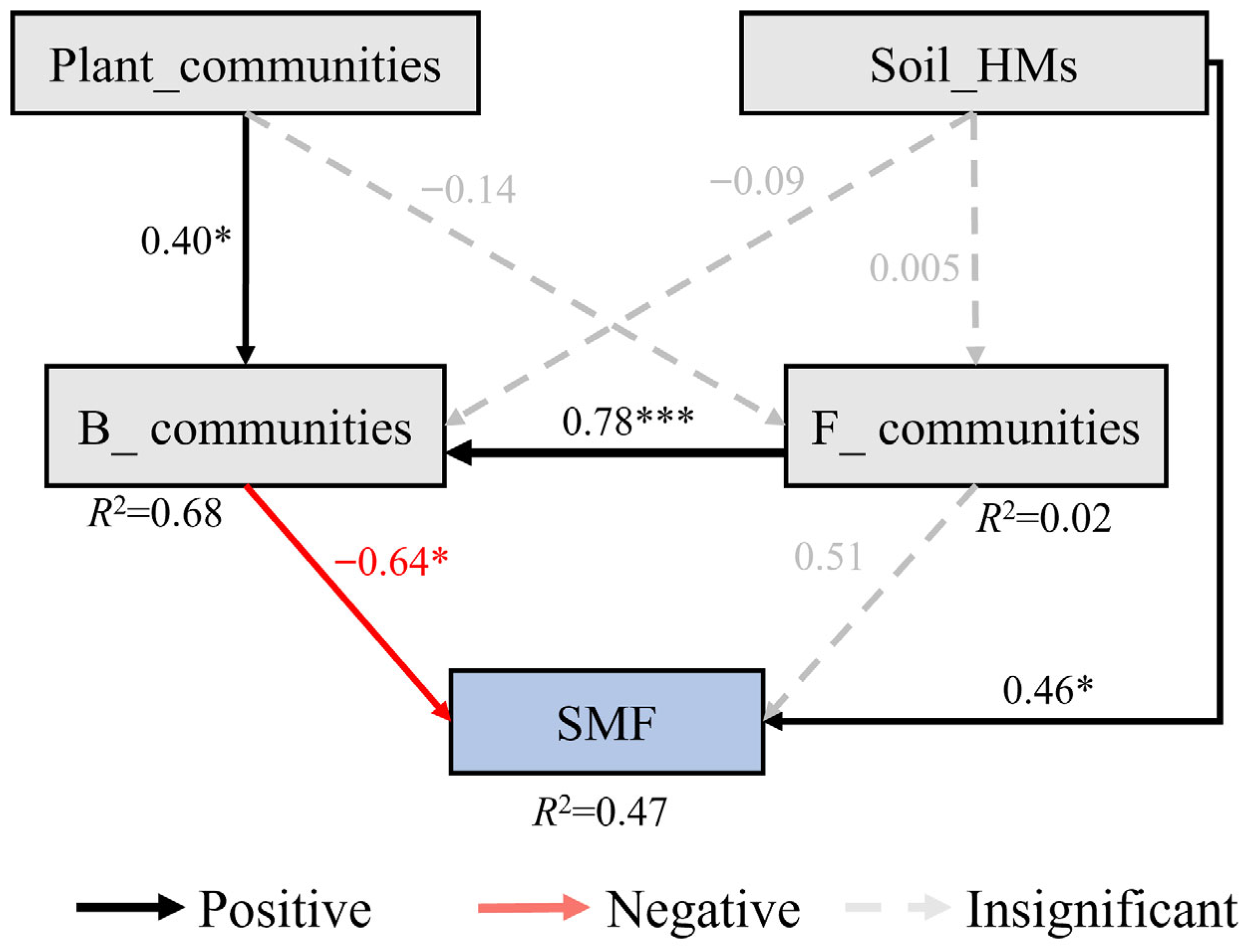
The partial least squares path modeling (PLS-PM) model was applied to explore the interactions among vegetation characteristics, heavy metal contamination, soil microbial diversity, and SMF [36]. Latent variables were constructed based on predefined indicator blocks, including plant community characteristics, soil heavy metal pollution, bacterial community characteristics, fungi community characteristics, and SMF. To reduce dimensionality and avoid multicollinearity, principal component analysis (PCA) was performed for each indicator block, with the first principal component (PC1) extracted as the representative variable. Prior to model construction, variables with near-zero variance were excluded, and simultaneously, all indicators were standardized to eliminate scale differences. Model estimation was conducted using the “plspm” package in R (version 4.5.0) with the path weighting scheme. Model performance was evaluated using path coefficients, coefficients of determination (R2) of endogenous latent variables, and total effects. The significance of path coefficients was assessed using a bootstrap procedure with 1000 resamples, and t-values were calculated as the ratio of original estimates to standard errors. Statistical significance thresholds were defined as |t| > 1.65, |t| > 1.96, and |t| > 2.58.

3. Results

3.1. Changes in Plant Communities, Soil Properties, and Soil Functions Under Different Restoration Stages

During restoration, plant community α-diversity indices (Shannon–Wiener, Simpson, and Pielou evenness) and biomass first increased (R1 and R10) then decreased (R30 and R45), while the Whittaker β index increased continuously (Table S3). Moreover, soil physical conditions improved, with increasing soil water content and decreasing pH. In terms of nutrient dynamics, TC and SOC declined, whereas TN, TP, and AP increased along the restoration gradient. Microbial activity exhibited divergent responses, with increases in MBC, SC, and ACP, but decreases in MBP and UE. Total contents of Cd, Cu, Pb, and Zn peaked at mid-restoration stages (R10/R30), and available Zn and Cu rose continuously and maximized at R45 (Table S2).
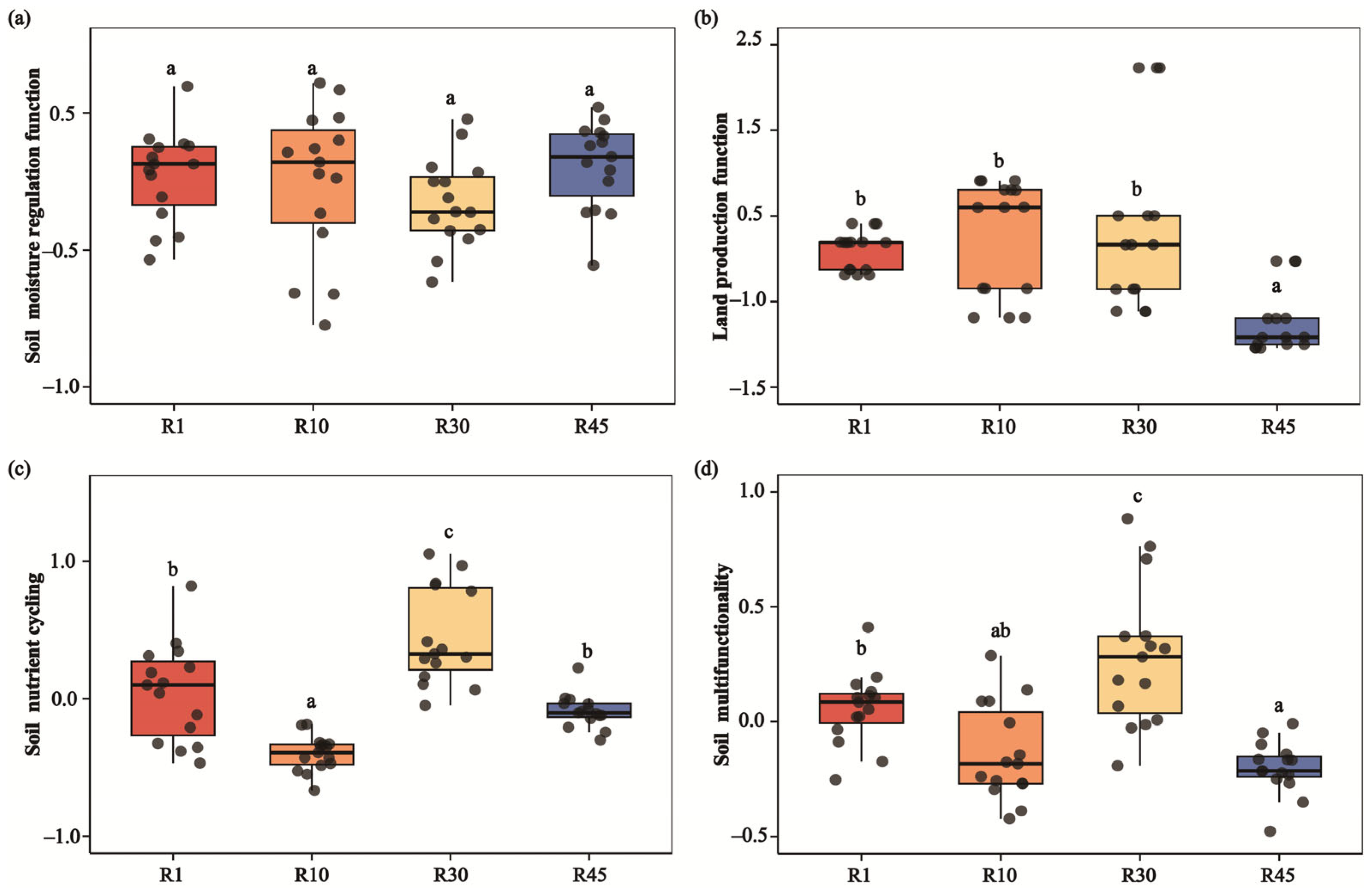
This study explored variations in overall SMF and single soil ecological functions during different restoration periods (R1, R10, R30, R45; Figure 2). Specifically, there was an insignificant change in the soil moisture regulation function (Figure 2a). The soil moisture regulation function remained relatively stable across all stages (Figure 2a), whereas the individual functions and SMF exhibited an initial increase followed by a decline across the restoration chronosequences in abandoned mining areas (Figure 2b–d). Specifically, land production, soil nutrient functions, and SMF all reached their maximum values at R30 (0.39, 0.45, and 0.28, respectively), followed by marked declines at R45 (−0.74, −0.09, and −0.20, respectively).

3.2. Soil Microbial Community Composition and Diversity

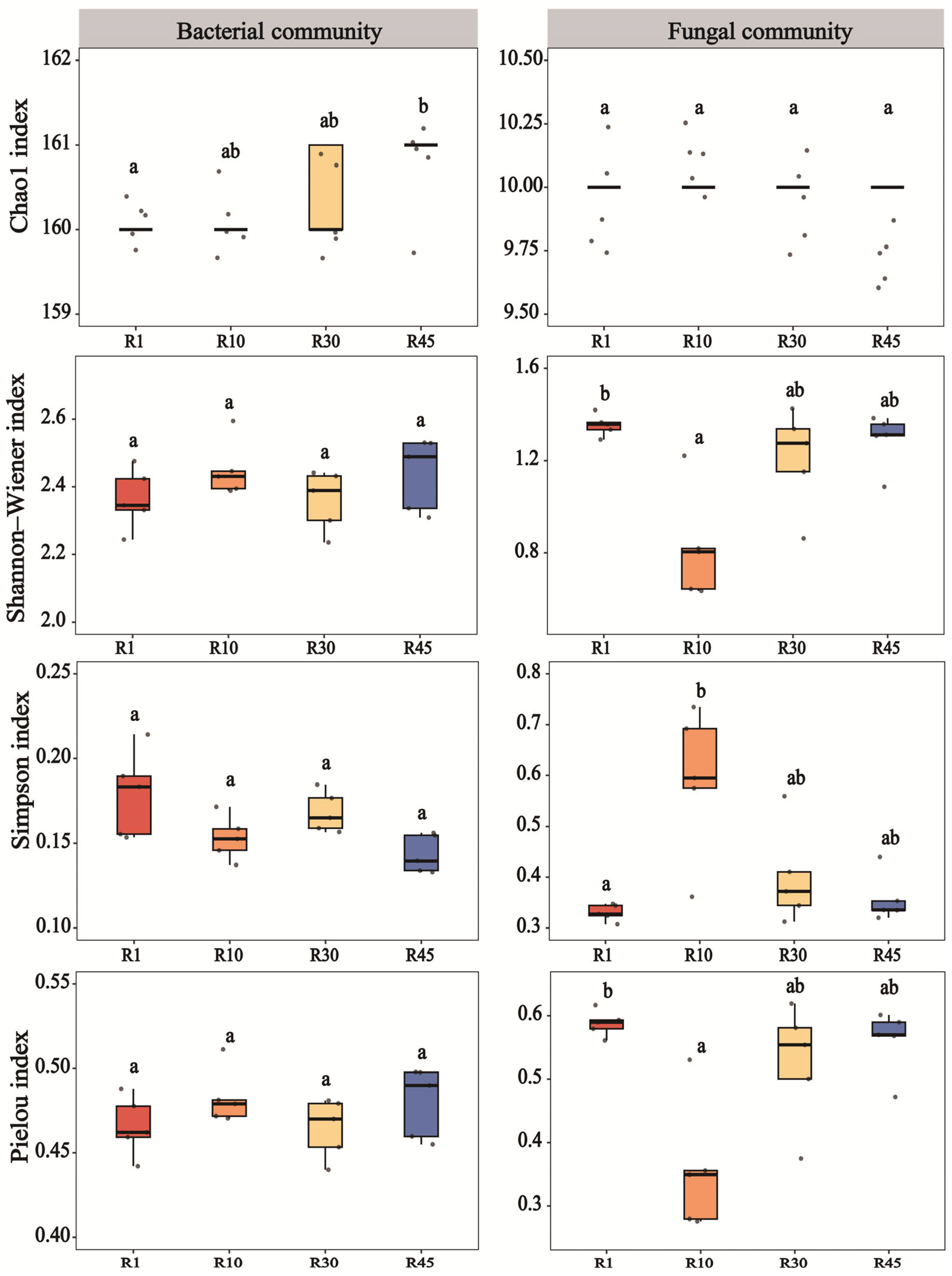
During vegetation restoration in abandoned mining areas, the richness and evenness of microbial communities were significantly enhanced. Specifically, except for the non-significant change in the Chao1 index of the fungal community, the Chao1 index of the bacterial community, as well as the Shannon–Wiener index and Pielou evenness index of both bacteria and fungi, showed an increasing trend, while the Simpson index of both fungal and bacterial communities exhibited a decreasing trend (Figure 3). At the phylum level, both bacterial and fungal communities exhibited pronounced stage-dependent succession patterns (Figure S1). In bacterial communities, Actinomycetota, Proteobacteria (Pseudomonadota), and Acidobacteriota dominated across all restoration stages. Notably, the relative abundance of Actinomycetota, Bacteroidota, Verrucomicrobiota, and Cyanophyta gradually declined, whereas Acidobacteriota and Chloroflexota increased progressively with restoration age (Figure S1). In fungal communities, Ascomycota and Mucoromycota were consistently dominant. The relative abundance of Ascomycota declined over time, while Mucoromycota and Cryptomycota showed a gradual increase during later restoration stages (Figure S1).

3.3. The Interplay Between Environmental Factors and SMF

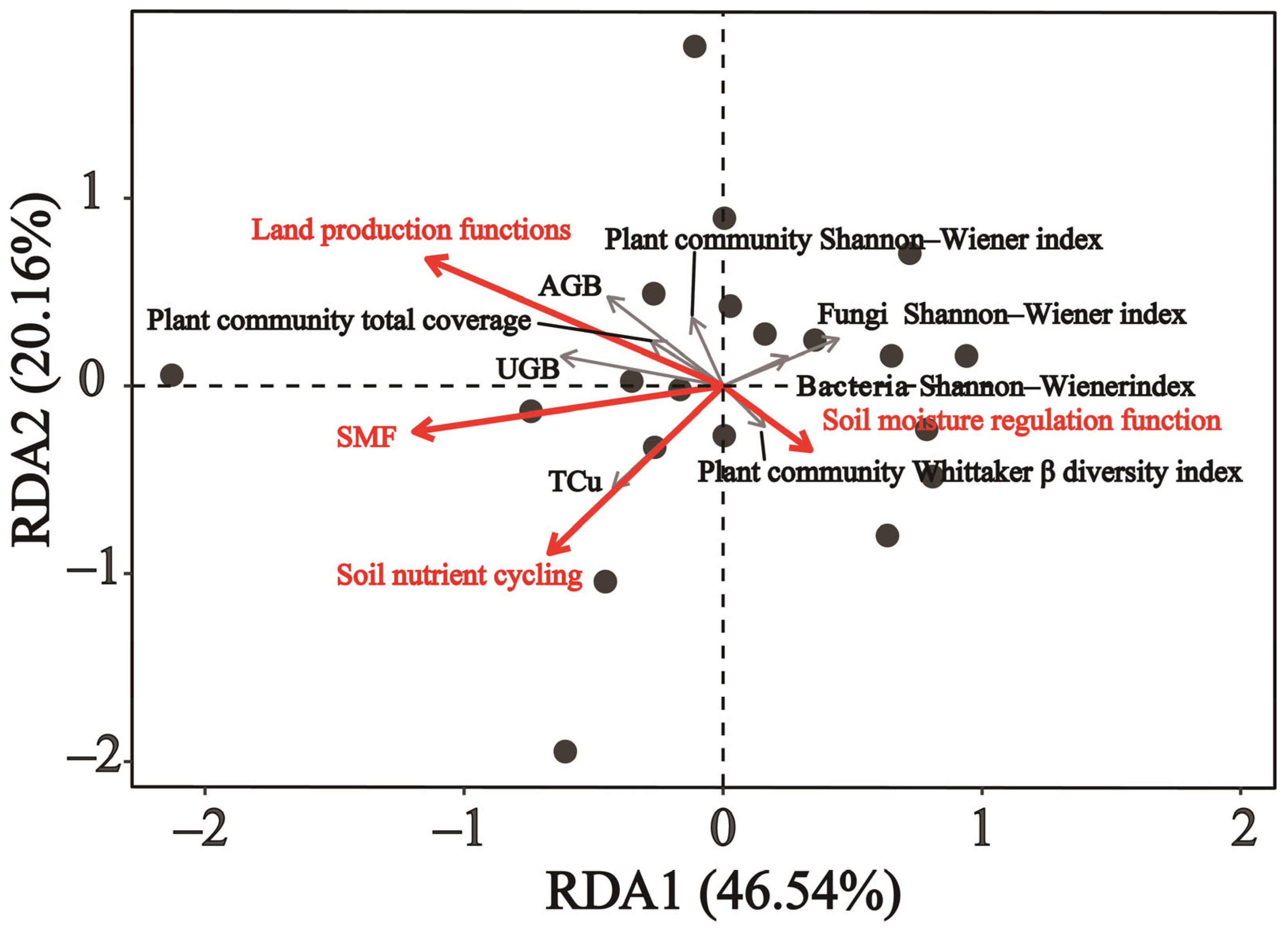
The RDA of environmental variables and multiple soil functions showed that the first and second axes accounted for 46.54% and 20.16% of the variation in multiple soil functions, respectively (Figure 4). Notably, UGB (R2 = 25.20), AGB (R2 = 17.09), and TCu (R2 = 18.41) are the key drivers influencing multiple soil functions (p < 0.01; Table S4).
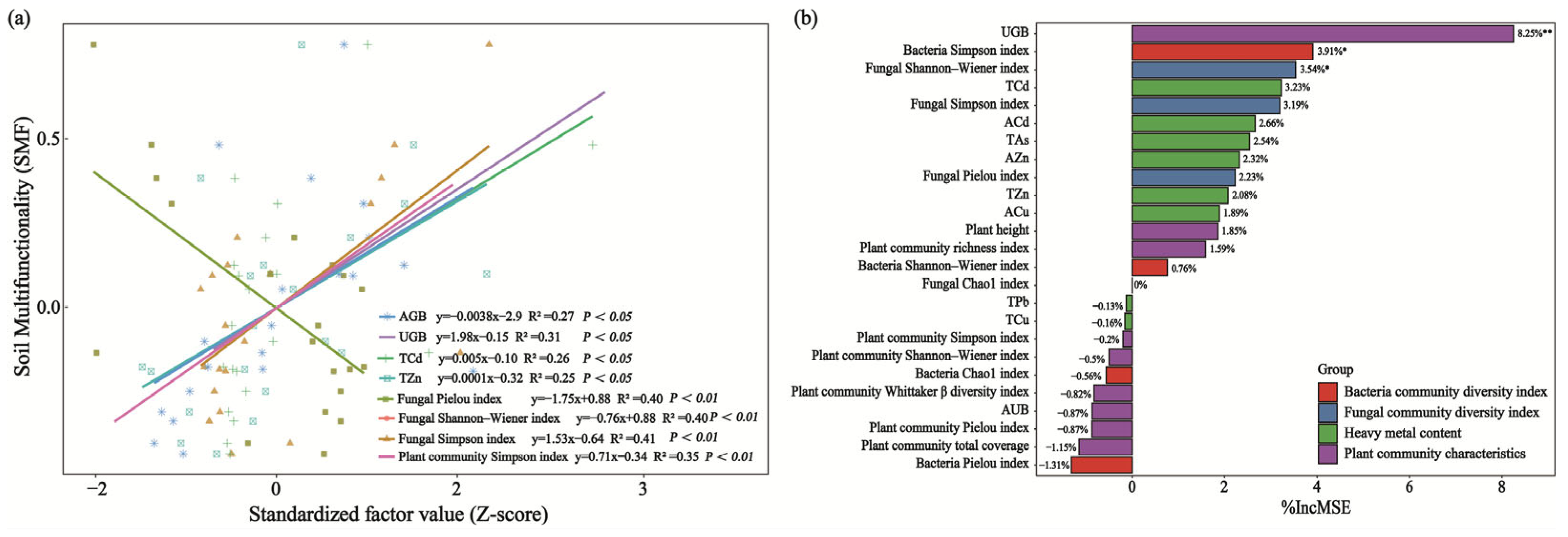
Linear regression analysis further indicates that the fungi Shannon–Wiener index and Pielou index showed significant negative correlations with SMF (Figure 5a, p < 0.05), while the fungal Simpson index, plant community Simpson index, AGB, UGB, TCd, and TZn all exhibited significant positive correlations with SMF (Figure 5a, p < 0.05). Other environmental factors showed no significant correlations with SMF (p > 0.05). The significant predictors of SMF included the UGB, bacterial Simpson index, and the fungal Shannon–Wiener index (p < 0.05; Figure 5b).
The partial least squares path model deciphered the pathways through which plant communities, soil heavy metal content, bacterial diversity, and fungal diversity influence SMF during vegetation restoration in copper mine wastelands (Figure 6). The results showed that plant communities exerted a significant positive effect on bacterial communities (p < 0.05), whereas their effect on fungal communities was not significant (p > 0.05). Heavy metals did not have significant direct effects on either bacterial or fungal communities (p > 0.05), but they showed a significant positive effect on SMF (p < 0.05). Although fungal diversity was closely associated with SMF (Figure 5a, p < 0.05), fungal communities did not exhibit a significant direct effect on SMF (Figure 6, p > 0.05). Instead, they influenced SMF indirectly by significantly affecting bacterial communities (p < 0.05).

4. Discussion

4.1. Differential Responses of Individual Soil Functions and SMF During the Restoration of Abandoned Copper Mines

Vegetation restoration exerted a significant impact on multiple soil functions and SMF in abandoned mining areas (Figure 2). This may be attributed to the combined action of multiple processes promoted by vegetation restoration, including litter accumulation, root exudate inputs, and the physical protection of soil aggregates, which jointly facilitate carbon source accumulation and microbial activity [37,38], consistent with the findings of previous studies [2,39]. Notably, the soil moisture regulation function did not exhibit a significant change with increasing restoration time (Figure 2a). A similar phenomenon has also been reported in previous studies on vegetation restoration in mining areas, which might be ascribed to incomplete root coverage, a loose soil aggregate structure, and lagged recovery of water retention capacity during the vegetation restoration process [40]. Production functions, nutrient cycling functions, and SMF exhibited distinct response patterns during the restoration process, which are the combined result of multiple processes such as plant community succession, improvement of soil physicochemical properties, microbial functional synergy and antagonism, and the accumulation of stress factors. In the early stages of succession, communities were dominated by fast-growing, resource-acquisitive species which typically exhibit high aboveground net primary productivity [41,42], which contributed to the restoration of various ecosystem functions in the initial phase. With the extension of restoration time, community structure gradually became simplified or dominated by a few dominant species, and plant functional traits shifted from a resource-acquisitive strategy to a resource-conservative strategy, thereby reducing biomass production [43]. Furthermore, long-term heavy metal stress may restrict belowground biomass and microbial functional expression [44]. It acts by impairing root growth, nutrient absorption efficiency, and microbial interactions [45,46], thereby inducing negative feedback on nutrient cycling and SMF. Soil water content is considered a key factor regulating SMF [7,47]. However, this study found no significant improvement in the soil moisture regulation function, which may explain the SMF decline in the late succession stage. The enhancement of the soil moisture regulation function in future restorations of mining areas should be emphasized.

4.2. Influences of Environmental Factors on Soil Functions

The results showed that UGB, AGB, and TCu were key factors influencing multiple soil functions (Figure 4 and Table S4). This finding is consistent with the mass ratio hypothesis, which emphasizes that plant community biomass plays a major role in regulating ecosystem processes [48]. Plant community biomass (AGB and UGB), as the primary source of soil carbon and nutrients, strongly influences soil organic matter accumulation, nutrient cycling, and microbial activity through litter decomposition and root turnover [49]. Specifically, aboveground litter provides carbon and energy inputs to surface soils, whereas belowground roots influence soil physicochemical properties by releasing organic compounds, improving soil pore structure, and interacting with microbial communities [50,51]. Therefore, plant community biomass represents an important source of material and energy input to soil ecosystems and is closely associated with multiple soil functions. As the dominant heavy metal contaminant in copper mine tailings, excessive copper accumulation can disrupt microbial cell membrane integrity, inhibit enzyme activity, and interfere with cellular metabolism [52]. These effects may reduce microbial diversity and activity, and may weaken microbial-mediated processes such as organic matter decomposition and nutrient transformation [45,46]. Consequently, copper contamination represents an important abiotic stress factor associated with soil health and multifunctionality.
Linear regression analyses revealed significant differences in the relationships between microbial communities and SMF. Specifically, fungal diversity indices were significantly associated with SMF, whereas no significant relationships were observed between bacterial diversity indices and SMF (Figure 5b). This discrepancy is likely attributable to fundamental differences in ecological strategies between bacteria and fungi [53]. Bacteria are characterized by rapid reproduction, a high dispersal capacity, and strong metabolic plasticity, enabling them to respond quickly to environmental changes [54,55]. Accordingly, their influence on SMF may depend more on the functional specialization of a limited number of key taxa rather than on overall community diversity. In contrast, fungi typically exhibit slower growth rates, more specific resource requirements, and stable symbiotic relationships with plants [54], making them more likely to maintain ecosystem functioning through community diversity, particularly under nutrient-poor and heavy metal stress conditions. Furthermore, random forest analysis identified the bacterial Simpson index and the fungal Shannon–Wiener index as important predictors of SMF (Figure 5b), further supporting the patterns revealed by the regression analyses. Therefore, during vegetation restoration of copper mine wastelands, the influence of bacterial communities on SMF appears to be primarily driven by dominant taxa, whereas fungal communities rely more on community diversity.

4.3. Bacterial Communities Play a More Important Role in Influencing Soil Multifunctionality than Fungal Communities

A growing body of evidence indicates that microbial communities play a critical role in regulating SMF [55,56], which is also supported by the present study. Notably, this study found that bacterial communities played a more important role in influencing SMF than fungal communities (Figure 6). This pattern may be explained by the ability of bacteria to survive under nutrient-poor conditions and their relatively complex species composition and interaction networks [32]. In contrast, under heavy metal stress, fungi may prioritize survival-related processes, potentially altering their interactions with bacterial communities and thereby weakening their contributions to SMF [57]. In addition, the contribution of bacterial communities to SMF appears to be closely linked to their associations with specific soil functions. This study found that multiple bacterial taxa were significantly correlated with soil water conservation and production functions, whereas no significant relationships were observed for fungal taxa (Figure S2). This finding is consistent with previous studies [12,56], highlighting the greater involvement of bacterial communities in regulating soil functions. However, the present study also found a significant negative relationship between bacterial communities and SMF (Figure 6), which may be associated with the nutrient-poor conditions and strong heavy metal stress in copper mine wastelands. Under such conditions, although certain bacterial taxa can tolerate heavy metals, their metabolic activities may require substantial energy investment for stress resistance, thereby limiting their contribution to key ecosystem processes. For example, Li et al. reported that rare bacterial taxa such as WPS-2 and Dependentiae were negatively correlated with SMF [56]. Thus, the presence of heavy metal-tolerant bacterial taxa may interfere with the stabilization of heavy metals in soils and hinder the recovery of soil ecological functions.
Heavy metals are generally considered to exert negative effects on soil ecosystem functioning due to their toxicity to microorganisms [55]. However, in the present study, heavy metals showed a direct positive association with SMF (Figure 6), which may be related to their environmental filtering effects on both plant and microbial communities [58,59]. Specifically, heavy metal stress can selectively exclude sensitive species while enriching metal-tolerant taxa, thereby reshaping community composition toward functionally adapted groups [60]. In plant communities, this filtering process favors metal-tolerant species that are better adapted to harsh conditions [59], potentially enhancing resource use efficiency and stabilizing ecosystem processes. Similarly, in microbial communities, heavy metals may promote the dominance of resistant taxa with specialized metabolic capabilities, including nutrient cycling and stress tolerance functions [28,61]. These shifts in community composition may enhance specific ecosystem functions, ultimately contributing to higher SMF. For instance, in abandoned rare earth mining areas, hyperaccumulator plants such as Dicranopteris dichotoma and Blechnum orientale can recruit copiotrophic bacteria (e.g., Actinomycetota and Bacteroidota) in their rhizosphere, which support soil functional recovery by enhancing nutrient cycling [62]. Therefore, future ecological restoration in mining areas should consider the distinct ecological characteristics of bacterial and fungal communities and adopt differentiated microbial management strategies to enhance SMF.

5. Conclusions

This study systematically revealed the successional patterns of individual soil functions, SMF, and microbial communities during vegetation restoration in abandoned mining areas. With the advancement of vegetation restoration, soil nutrient cycling functions and SMF generally improved, whereas the recovery of the soil moisture regulation function was relatively delayed, which may become a key bottleneck restricting the optimization of ecosystem functions in the later restoration stage. Meanwhile, soil microbial communities exhibited successional characteristics of increased diversity and decreased dominance. Plant community biomass and TCu were identified as key environmental variables related to multiple soil functions. Linear regression revealed that fungal diversity indices, plant community biomass, and certain heavy metals were significantly correlated with SMF. Random forest analysis further identified UGB, the bacterial Simpson index, and the fungal Shannon–Wiener index as key predictors of SMF. Compared to fungi, bacterial communities were more sensitive to copper mine restoration and contributed more to SMF. The research findings provide important theoretical support for a more in-depth understanding of ecosystem restoration in mining areas, as well as practical guidance for microbial regulation and soil function management in these areas and other similarly degraded ecosystems.

Supplementary Materials

The following supporting information can be downloaded at: https://www.mdpi.com/article/10.3390/land15050704/s1, Figure S1: Differences in the top ten taxa at phylum level are also shown for soil fungi (a) and bacteria (b); Figure S2: Relationships between soil multiple functions and soil microbial taxa; Table S1: Geographic features of the sampling sites; Table S2: Soil property variations across distinct successional stages; Table S3: Soil physicochemical properties at different successional stages; Table S4: The critical explanatory rate of the effect of major environmental factors on multiple soil functions in the Redundancy analysis (RDA).

Author Contributions

Conceptualization: G.C. and X.T.; Investigation: X.T., Z.D., N.D., K.L. and H.L.; Writing—original draft: X.T.; Visualization: X.T. and N.D.; Writing—review and editing: X.T., G.C. and X.G.; Supervision: G.C. and X.G. All authors have read and agreed to the published version of the manuscript.

Funding

This research was funded by the National Natural Science Foundation of China, grant number 32071736.

Data Availability Statement

The data presented in this study are available on request from the corresponding author (Guangcai Chen) due to the ongoing nature of the research project.

Conflicts of Interest

The authors declare no conflicts of interest.

Abbreviations

The following abbreviations are used in this manuscript:
SMFSoil Multifunctionality
SBDSoil Bulk Density
SWCSoil Water Content
ANSoil Available Nitrogen
APSoil Available Phosphorus
TPSoil Total Phosphorus
TCSoil Total Carbon
SOCSoil Organic Carbon
TNSoil Total Nitrogen
MWDSoil Mean Weight Diameter
GMDSoil Geometric Mean Diameter
DSoil Fractal Dimension
RSoil Aggregate Destruction Rate
HMsSoil Heavy Metals
MBCSoil Microbial Biomass Carbon
MBNSoil Microbial Biomass Nitrogen
MBPSoil Microbial Biomass Phosphorus
SCSoil Sucrase
UESoil Urease
ACPSoil Acid Phosphatase
AGBAboveground Biomass
UGBBelowground Biomass

References

  1. Wang, R.; Zhang, J.; Sun, H.; Sun, S.; Qin, G.; Song, Y. Effect of different vegetation on copper accumulation of copper-mine abandoned land in tongling, China. J. Environ. Manag. 2021, 286, 112227. [Google Scholar] [CrossRef]
  2. Yuan, X.; Guo, Z.; Wang, S.; Zhao, L.; Yuan, M.; Gao, Y.; Huang, L.; Liu, C.; Duan, C. Drivers and mechanisms of spontaneous plant community succession in abandoned PbZn mining areas in Yunnan, China. Sci. Total Environ. 2023, 904, 166871. [Google Scholar] [CrossRef]
  3. Cao, H.; Wang, Z.; Liao, X.; Li, Y.; Zhu, Y. Research on the Regional Environmental Impact and Risk Assessment Affected by Mineral Re-source Development: A Case Study of the Taojia River Watershed in Hunan. Front. Ecol. Evol. 2022, 10, 918446. [Google Scholar] [CrossRef]
  4. Chileshe, M.N.; Syampungani, S.; Festin, E.S.; Tigabu, M.; Daneshvar, A.; Odén, P.C. Physico-chemical characteristics and heavy metal concentrations of copper mine wastes in Zambia: Implications for pollution risk and restoration. J. For. Res. 2020, 31, 1283–1293. [Google Scholar] [CrossRef]
  5. Eldridge, D.J.; Oliver, I.; Powell, J.R.; Dorrough, J.; Carrillo, Y.; Nielsen, U.N.; Macdonald, C.A.; Wilson, B.; Fyfe, C.; Amarasinghe, A.; et al. Temporal dynamics in biotic and functional recovery following mining. J. Appl. Ecol. 2022, 59, 1632–1643. [Google Scholar] [CrossRef]
  6. Ke, W.; Li, C.; Zhu, F.; Luo, X.; Feng, J.; Li, X.; Jiang, Y.; Wu, C.; Hartley, W.; Xue, S. Effect of potentially toxic elements on soil multifunctionality at a lead smelting site. J. Hazard. Mater. 2023, 454, 131525. [Google Scholar] [CrossRef] [PubMed]
  7. Hu, Y.; Li, X.; Guo, A.; Yue, P.; Guo, X.; Lv, P.; Zhao, S.; Zuo, X. Species diversity is a strong predictor of ecosystem multifunctionality under altered precipitation in desert steppes. Ecol. Indic. 2022, 137, 108762. [Google Scholar] [CrossRef]
  8. Xiao, Y.; Wang, J.; Wang, B.; Fan, B.; Zhou, G. Soil microbial network complexity predicts soil multifunctionality better than soil microbial diversity during grassland-farmland-shrubland conversion on the Qinghai-Tibetan Plateau. Agric. Ecosyst. Environ. 2025, 379, 109356. [Google Scholar] [CrossRef]
  9. Long, X.; Li, J.; Liao, X.; Wang, J.; Zhang, W.; Wang, K.; Zhao, J. Stable Soil Biota Network Enhances Soil Multifunctionality in Agroecosystems. Glob. Change Biol. 2025, 31, e70041. [Google Scholar] [CrossRef]
  10. Ju, W.; Sardans, J.; Bing, H.; Wang, J.; Ma, D.; Cui, Y.; Duan, C.; Li, X.; Fan, Q.; Peñuelas, J.; et al. Diversified vegetation cover alleviates microbial resource limitations within soil aggregates in tailings. Environ. Sci. Technol. 2024, 58, 18744–18755. [Google Scholar] [CrossRef]
  11. Li, W.; He, E.; Van Gestel, C.A.M.; Peijnenburg, W.J.G.M.; Chen, G.; Liu, X.; Zhu, D.; Qiu, H. Pioneer plants enhance soil multifunctionality by reshaping underground multitrophic community during natural succession of an abandoned rare earth mine tailing. J. Hazard. Mater. 2024, 472, 134450. [Google Scholar] [CrossRef]
  12. Kang, Y.; Shen, L.; Li, C.; Huang, Y.; Chen, L. Increased soil multifunctionality is determined by altered bacterial-fungal-protistan compositions and cooccurrence network complexity during vegetation restoration in a Karst region, southwest China. J. Appl. Ecol. 2025, 62, 1216–1228. [Google Scholar] [CrossRef]
  13. Sun, Y.; Zhang, S.; Liang, Y.; Yu, X.; Pan, F. Plants Drive Microbial Biomass and Composition but Not Diversity to Promote Ecosystem Multifunctionality in Karst Vegetation Restoration. Microorganisms 2025, 13, 590. [Google Scholar] [CrossRef]
  14. Jiao, S.; Lu, Y.; Wei, G. Soil multitrophic network complexity enhances the link between biodiversity and multifunctionality in agricultural systems. Glob. Change Biol. 2022, 28, 140–153. [Google Scholar] [CrossRef]
  15. Wang, J.; Wang, X.; Liu, G.; Zhang, C.; Wang, G. Bacterial richness is negatively related to potential soil multifunctionality in a degraded alpine meadow. Ecol. Indic. 2021, 121, 106996. [Google Scholar] [CrossRef]
  16. Yang, L.; Barnard, R.; Kuzyakov, Y.; Tian, J. Bacterial communities drive the resistance of soil multifunctionality to land-use change in karst soils. Eur. J. Soil Biol. 2021, 104, 103313. [Google Scholar] [CrossRef]
  17. Adomako, M.O.; Roiloa, S.; Yu, F.H. Potential roles of soil microorganisms in regulating the effect of soil nutrient heterogeneity on plant performance. Microorganisms 2022, 10, 2399. [Google Scholar] [CrossRef] [PubMed]
  18. Iqbal, S.; Begum, F.; Nguchu, B.A.; Claver, U.P.; Shaw, P. The invisible architects: Microbial communities and their transformative role in soil health and global climate changes. Environ. Microbiome 2025, 20, 36. [Google Scholar] [CrossRef]
  19. Wang, X.; Chi, Y.; Song, S. Important soil microbiota’s effects on plants and soils: A comprehensive 30-year systematic literature review. Front. Microbiol. 2024, 15, 1347745. [Google Scholar] [CrossRef] [PubMed]
  20. Fakhar, A.; Gul, B.; Gurmani, A.R.; Khan, S.M.; Ali, S.; Sultan, T.; Chaudhary, H.J.; Rafique, M.; Rizwan, M. Heavy metal remediation and resistance mechanism of Aeromonas, Bacillus, and Pseudomonas: A review. Crit. Rev. Environ. Sci. Technol. 2022, 52, 1868–1914. [Google Scholar] [CrossRef]
  21. Yan, C.; Wang, F.; Liu, H.; Liu, H.; Pu, S.; Lin, F.; Geng, H.; Ma, S.; Zhang, Y.; Tian, Z.; et al. Deciphering the toxic effects of metals in gold mining area: Microbial community tolerance mechanism and change of antibiotic resistance genes. Environ. Res. 2020, 189, 109869. [Google Scholar] [CrossRef]
  22. Hart, M.; Gorzelak, M.A.; McAmmond, B.M.; Liu, H.; Pu, S.; Lin, F.; Geng, H.; Ma, S.; Zhang, Y.; Tian, Z.; et al. Fungal communities resist recovery in sand mine restoration. Front. For. Glob. Change 2019, 2, 78. [Google Scholar] [CrossRef]
  23. Ma, L.; Zhang, C.; Xu, X.; Wang, C.; Liu, G.; Liang, C.; Zuo, X.; Wang, C.; Lv, Y.; Wang, R. Different facets of bacterial and fungal communities drive soil multifunctionality in grasslands spanning a 3500 km transect. Funct. Ecol. 2022, 36, 3120–3133. [Google Scholar] [CrossRef]
  24. Zheng, Q.; Hu, Y.; Zhang, S.; Noll, L.; Böckle, T.; Dietrich, M.; Herbold, C.W.; Eichorst, S.A.; Woebken, D.; Richter, A.; et al. Soil multifunctionality is affected by the soil environment and by microbial community com-position and diversity. Soil Biol. Biochem. 2019, 136, 107521. [Google Scholar] [CrossRef] [PubMed]
  25. Peay, K.G.; Belisle, M.; Fukami, T. Phylogenetic relatedness predicts priority effects in nectar yeast communities. Proc. R. Soc. B Biol. Sci. 2012, 279, 749–758. [Google Scholar] [CrossRef]
  26. Yang, X.; Feng, Q.; Zhu, M.; Zhang, J.; Yang, L.; Li, R. The impact of artificial restoration of alpine grasslands in the Qilian mountains on vegetation, soil bacteria, and soil fungal community diversity. Microorganisms 2024, 12, 854. [Google Scholar] [CrossRef]
  27. Pan, C.; Yuan, F.; Liu, Y.; Yu, X.; Liu, J. Soil bacterial and fungal diversity and composition respond differently to desertified system restoration. PLoS ONE 2025, 20, e0309188. [Google Scholar] [CrossRef]
  28. Sun, S.; Li, S.; Avera, B.N.; Strahm, B.D.; Badgley, B.D. Soil bacterial and fungal communities show distinct recovery patterns during forest ecosystem restoration. Appl. Environ. Microbiol. 2017, 83, e00966-17. [Google Scholar] [CrossRef]
  29. Ji, L.; Shen, F.; Liu, Y.; Yang, Y.; Wang, J.; Purahong, W.; Yang, L. Contrasting altitudinal patterns and co-occurrence networks of soil bacterial and fungal communities along soil depths in the cold-temperate montane forests of China. Catena 2022, 209, 105844. [Google Scholar] [CrossRef]
  30. Jin, J.; Zhao, D.; Wang, J.; Wang, Y.; Zhu, H.; Wu, Y.; Fang, L.; Bing, H. Fungal community determines soil multifunctionality during vegetation restoration in metallic tailing reservoir. J. Hazard. Mater. 2024, 478, 135438. [Google Scholar] [CrossRef]
  31. Gong, X.; Jarvie, S.; Wen, J.; Su, N.; Yan, Y.; Liu, Q.; Zhang, Q. Compared with soil fungal diversity and microbial network complexity, soil bacterial diversity drives soil multifunctionality during the restoration process. J. Environ. Manag. 2024, 354, 120379. [Google Scholar] [CrossRef]
  32. Jiang, S.; Xing, Y.; Liu, G.; Hu, C.; Wang, X.; Yan, G.; Wang, Q. Changes in soil bacterial and fungal community composition and functional groups during the succession of boreal forests. Soil Biol. Biochem. 2021, 161, 108393. [Google Scholar] [CrossRef]
  33. Tan, X.; Sun, L.; Du, Z.; Li, H.; Dang, N.; Xiao, J.; Zhang, P.; Chen, G. Characteristics and stability of plant communities in abandoned copper mining Characteristics and stability of plant communities in abandoned copper mining. Acta Ecol. Sin. 2025, 45, 1900–1912. [Google Scholar] [CrossRef]
  34. Guan, S. Soil Enzymology; Agricultural Publishing House: Beijing, China, 1986. (In Chinese) [Google Scholar]
  35. Hooper, D.U.; Vitousek, P.M. Effects of plant composition and diversity on nutrient cycling. Ecol. Monogr. 1998, 68, 121–149. [Google Scholar] [CrossRef]
  36. Cohen, J. Statistical Power Analysis for the Behavioral Sciences; Routledge: London, UK, 2013. [Google Scholar]
  37. Bi, Y.; Zou, H.; Zhu, C. Dynamic monitoring of soil bulk density and infiltration rate during coal mining in sandy land with dif-ferent vegetation. Int. J. Coal Sci. Technol. 2014, 1, 198–206. [Google Scholar] [CrossRef]
  38. Yang, Y.; Wei, H.; Lin, L.; Deng, Y.; Duan, X. Effect of vegetation restoration on soil humus and aggregate stability within the Karst Region of southwest China. Forests 2024, 15, 292. [Google Scholar] [CrossRef]
  39. Wang, S.; Yuan, X.; Li, T.; Yang, J.; Zhao, L.; Yuan, D.; Guo, Z.; Liu, C.; Duan, C. Changes in soil microbe-mediated carbon, nitrogen and phosphorus cycling during spontaneous succession in abandoned PbZn mining areas. Sci. Total Environ. 2024, 920, 171018. [Google Scholar] [CrossRef]
  40. Batista, A.M.; Pessoa, T.N.; Putti, F.F.; Andreote, F.D.; Libardi, P.L. Root Influences Rhizosphere Hydraulic Properties through Soil Organic Carbon and Microbial Activity. Plants 2024, 13, 1981. [Google Scholar] [CrossRef]
  41. Garnier, E.; Cortez, J.; Billès, G.; Navas, M.L.; Roumet, C.; Debussche, M.; Laurent, G.; Blanchard, A.; Aubry, D.; Bellmann, A.; et al. Plant functional markers capture ecosystem properties during secondary succession. Ecology 2004, 85, 2630–2637. [Google Scholar] [CrossRef]
  42. Kohler, C.; Morvan-Bertrand, A.; Cliquet, J.B.; Klumpp, K.; Lemauviel-Lavenant, S. Tradeoff between the conservation of soil C stocks and vegetation productivity in temperate grasslands. Agronomy 2020, 10, 1024. [Google Scholar] [CrossRef]
  43. Wang, M.; Lu, N.; An, N.; Fu, B. Plant functional and phylogenetic diversity regulate ecosystem multifunctionality in semi-arid grassland during succession. Front. Environ. Sci. 2022, 9, 791801. [Google Scholar] [CrossRef]
  44. Ren, H.; Eviner, V.T.; Gui, W.; Wilson, G.W.; Cobb, A.B.; Yang, G.; Zhang, Y.; Hu, S.; Bai, Y. Livestock grazing regulates ecosystem multifunctionality in semi-arid grassland. Funct. Ecol. 2018, 32, 2790–2800. [Google Scholar] [CrossRef]
  45. Tian, H.; Li, L.; Zhu, Y.; Wang, C.; Wu, M.; Shen, W.; Li, C.; Li, K. Soil fungal community and co-occurrence network patterns at different successional stages of black locust coppice stands. Front. Microbiol. 2025, 16, 1528028. [Google Scholar] [CrossRef] [PubMed]
  46. Wagg, C.; Schlaeppi, K.; Banerjee, S.; Kuramae, E.E.; van der Heijden, M.G. Fungal-bacterial diversity and microbiome complexity predict ecosystem functioning. Nat. Commun. 2019, 10, 4841. [Google Scholar] [CrossRef] [PubMed]
  47. Lee, M.K.; Lee, Y.J.; Lee, C.B. Ecosystem multifunctionality in temperate forests of South Korea is primarily controlled by structural diversity and potential moisture availability with synergy effects between ecosystem functions. J. Environ. Manag. 2025, 382, 125449. [Google Scholar] [CrossRef] [PubMed]
  48. Grime, J.P. Benefits of plant diversity to ecosystems: Immediate, filter and founder effects. J. Ecol. 1998, 86, 902–910. [Google Scholar] [CrossRef]
  49. Hu, Y.L.; Zheng, Z.H.; Qin, C.Q.; Leuzinger, S. Effects of litter input on soil aggregation and aggregate carbon turnover differ among three subtropical forests in southeastern China. Front. Plant Sci. 2025, 16, 1516775. [Google Scholar] [CrossRef] [PubMed]
  50. Long, C.; Yang, F.; Chen, Q.; Zhang, Q.; Cheng, X. Different dynamics and controls of enzyme activities of leaf and root litter during decomposition. Funct. Ecol. 2024, 38, 586–599. [Google Scholar] [CrossRef]
  51. Man, J.; Tang, B.; Xing, W.; Wang, Y.; Zhao, X.; Bai, Y. Root litter diversity and functional identity regulate soil carbon and nitrogen cycling in a typical steppe. Soil Biol. Biochem. 2020, 141, 107688. [Google Scholar] [CrossRef]
  52. Zhang, Y.; Yang, C.; Liu, S.; Xie, Z.; Chang, H.; Wu, T. Phytohormones-mediated strategies for mitigation of heavy metals toxicity in plants focused on sustainable production. Plant Cell Rep. 2024, 43, 99. [Google Scholar] [CrossRef]
  53. Macías-Pérez, L.A.; Levard, C.; Barakat, M.; Angeletti, B.; Borschneck, D.; Poizat, L.; Achouak, W.; Auffan, M. Contrasted microbial community colonization of a bauxite residue deposit marked by a complex geochemical context. J. Hazard. Mater. 2022, 424, 127470. [Google Scholar] [CrossRef] [PubMed]
  54. Cao, J.; Yang, X.; Guo, M.; Wu, Y.; Wang, C. Reclamation of abandoned cropland switches fungal community assembly from deterministic to stochastic processes. Sci. Total Environ. 2024, 951, 175494. [Google Scholar] [CrossRef]
  55. Li, W.; Qiu, H. Asymmetric Microbial Succession Drives Soil Multifunctionality Recovery over a 25 Year Chronosequence of Rare Earth Tailings Restoration. Environ. Sci. Technol. 2025, 59, 26604–26615. [Google Scholar] [CrossRef]
  56. Li, T.; Wang, S.; Liu, C.; Yu, Y.; Zong, M.; Duan, C. Soil microbial communities’ contributions to soil ecosystem multifunctionality in the natural restoration of abandoned metal mines. J. Environ. Manag. 2024, 353, 120244. [Google Scholar] [CrossRef]
  57. Jiang, R.; Wang, M.; Chen, W. Heavy metal pollution triggers a shift from bacteria-based to fungi-based soil micro-food web: Evidence from an abandoned mining-smelting area. J. Hazard. Mater. 2023, 459, 132164. [Google Scholar] [CrossRef] [PubMed]
  58. Sazykin, I.; Khmelevtsova, L.; Azhogina, T.; Sazykina, M. Heavy metals influence on the bacterial community of soils: A review. Agriculture 2023, 13, 653. [Google Scholar] [CrossRef]
  59. Qin, J.; Jiang, X.; Yan, Z.; Zhao, H.; Zhao, P.; Yao, Y.; Chen, X. Heavy metal content and microbial characteristics of soil plant system in Dabaoshan mining area, Guangdong Province. PLoS ONE 2023, 18, e0285425. [Google Scholar] [CrossRef]
  60. Narayanan, M.; Ma, Y. Mitigation of heavy metal stress in the soil through optimized interaction between plants and microbes. J. Environ. Manag. 2023, 345, 118732. [Google Scholar] [CrossRef]
  61. Zhang, Z.; Deng, Q.; Ye, H.; Ge, G. Bacterial and fungal diversities examined through high-throughput sequencing in response to lead contamination of tea garden soil. Front. Microbiol. 2023, 14, 1121199. [Google Scholar] [CrossRef]
  62. Gil-Cardeza, M.L.; Müller, D.R.; Amaya-Martin, S.M.; Viassolo, R.; Gómez, E. Differential responses to high soil chromium of two arbuscular mycorrhizal fungi communities isolated from Cr-polluted and non-polluted rhizospheres of Ricinus communis. Sci. Total Environ. 2018, 625, 1113–1121. [Google Scholar] [CrossRef] [PubMed]
Figure 1. Location of the study areas in Tongling City.
Land 15 00704 g001
Figure 2. Changes in soil moisture regulation function (a), land production function (b), soil nutrient cycling (c), and soil multifunctionality (SMF) (d) with different recovery years. Note: Distinct lowercase letters signify significant differences among treatments (p < 0.05).
Land 15 00704 g002
Figure 3. Differences in community composition of soil bacteria (a–d) and fungi. Note: Distinct lowercase letters signify significant differences among treatments (p < 0.05).
Land 15 00704 g003
Figure 4. Redundancy analysis illustrating the explanatory power of environmental variables for multiple soil functions. Note: Red arrows and fonts represent soil functions, black arrows and fonts represent environmental factors.
Land 15 00704 g004
Figure 5. Linear regression of SMF against significant environmental factors (a). Random forest model for evaluating the relative importance of environmental factors in soil multifunctionality (b). Note: * and ** indicate p < 0.05 and p < 0.01, respectively.
Land 15 00704 g005
Figure 6. Links between plant community characteristics, soil heavy metal pollution, bacteria diversity, fungi diversity, and SMF. Note: * and *** indicate p < 0.05 and p < 0.001, respectively.
Land 15 00704 g006
Disclaimer/Publisher’s Note: The statements, opinions and data contained in all publications are solely those of the individual author(s) and contributor(s) and not of MDPI and/or the editor(s). MDPI and/or the editor(s) disclaim responsibility for any injury to people or property resulting from any ideas, methods, instructions or products referred to in the content.