Mapping Power: A Landscape Approach to Etruscan Urbanisation and Territorial Control

Abstract
1. Introduction
2. The Geographical Setting: Etruria
2.1. North Etruria: Murlo and Chiusi
2.2. South Etruria: Cerveteri and Tuscania
3. The Dataset and GIS Methodology
4. Results and Discussion
4.1. Orientalizing
4.2. Archaic
4.3. Classical
5. Conclusions
Funding
Data Availability Statement
Conflicts of Interest
Appendix A. Figures for the Locational Analyses


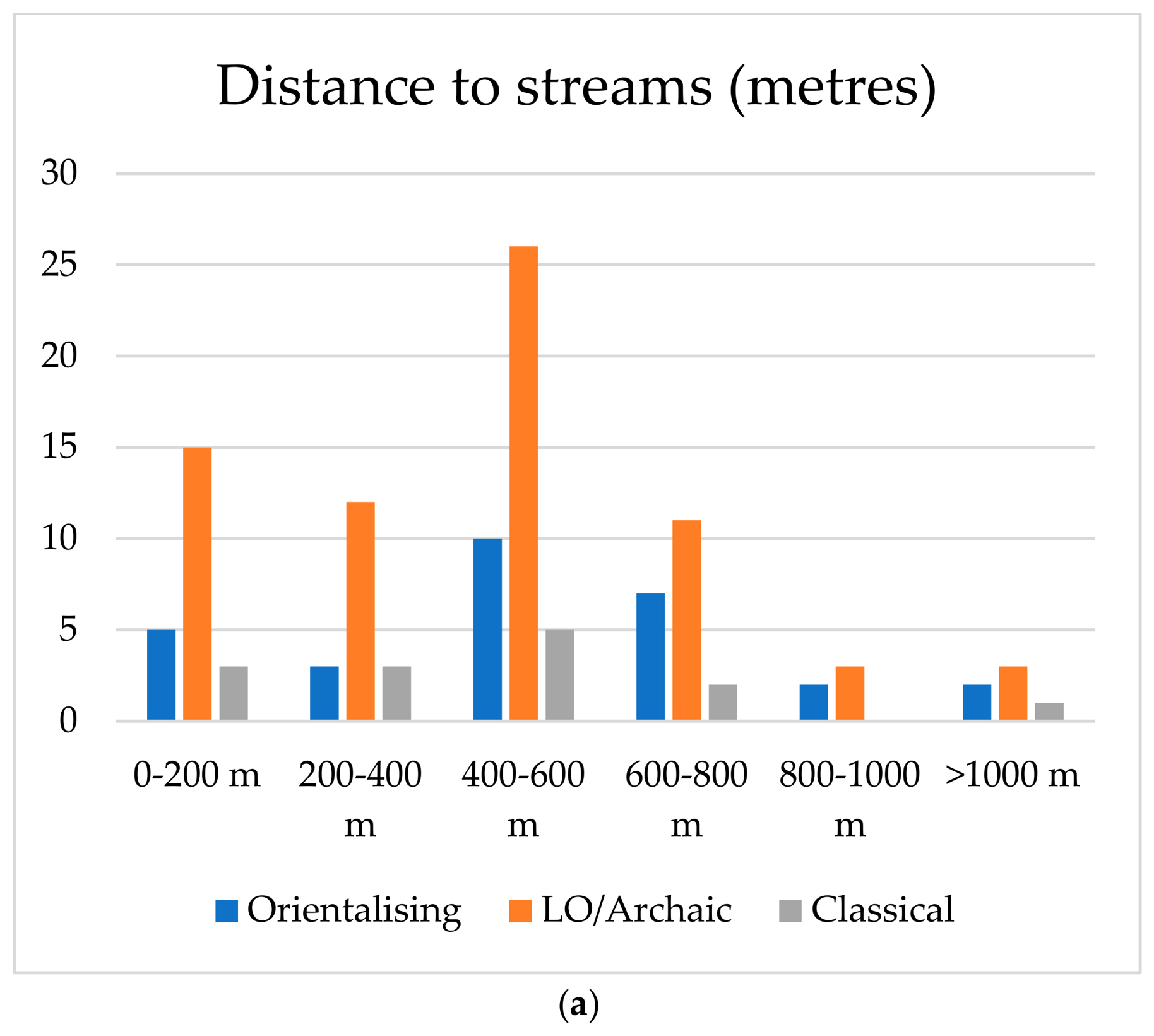


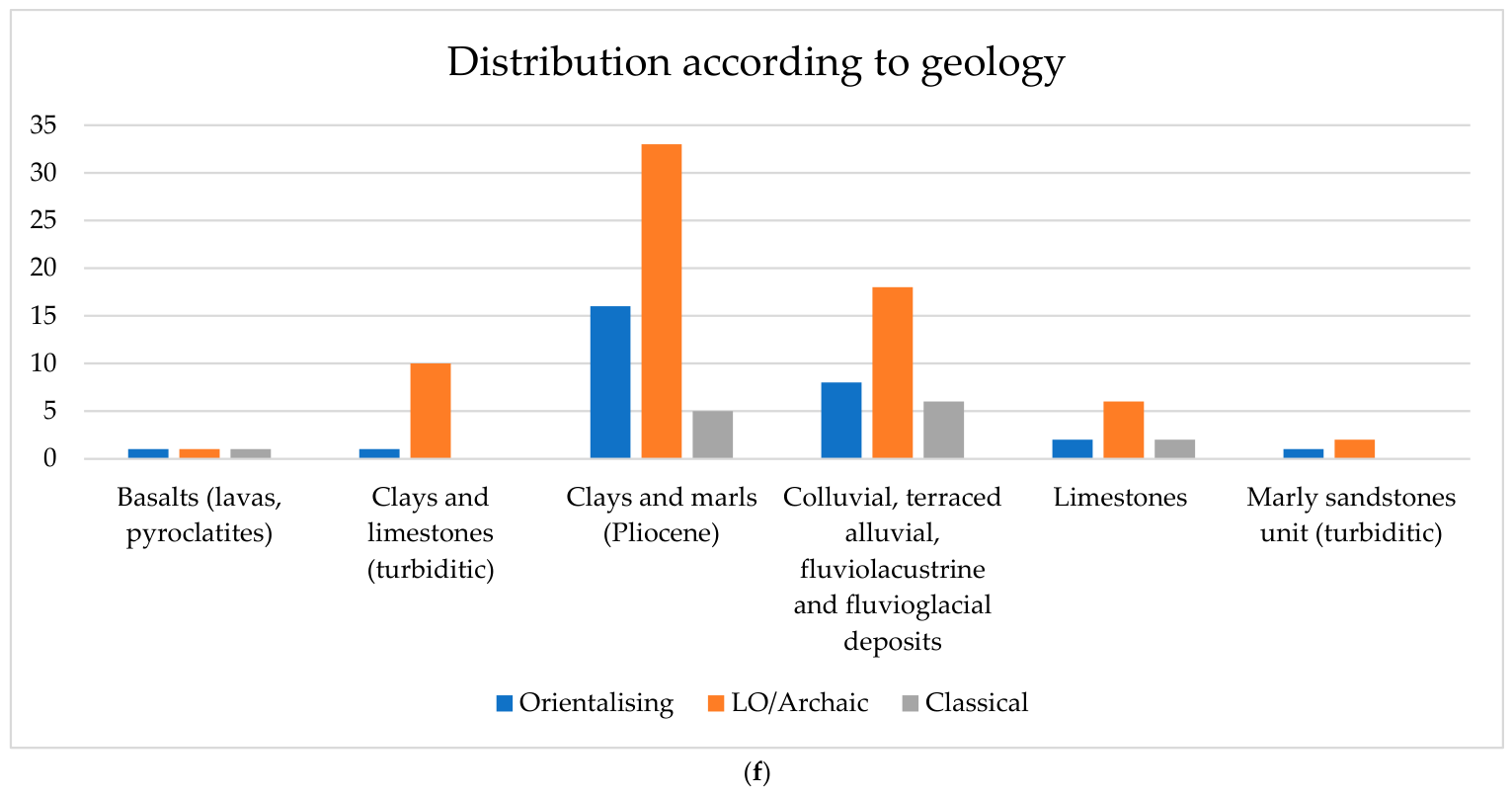
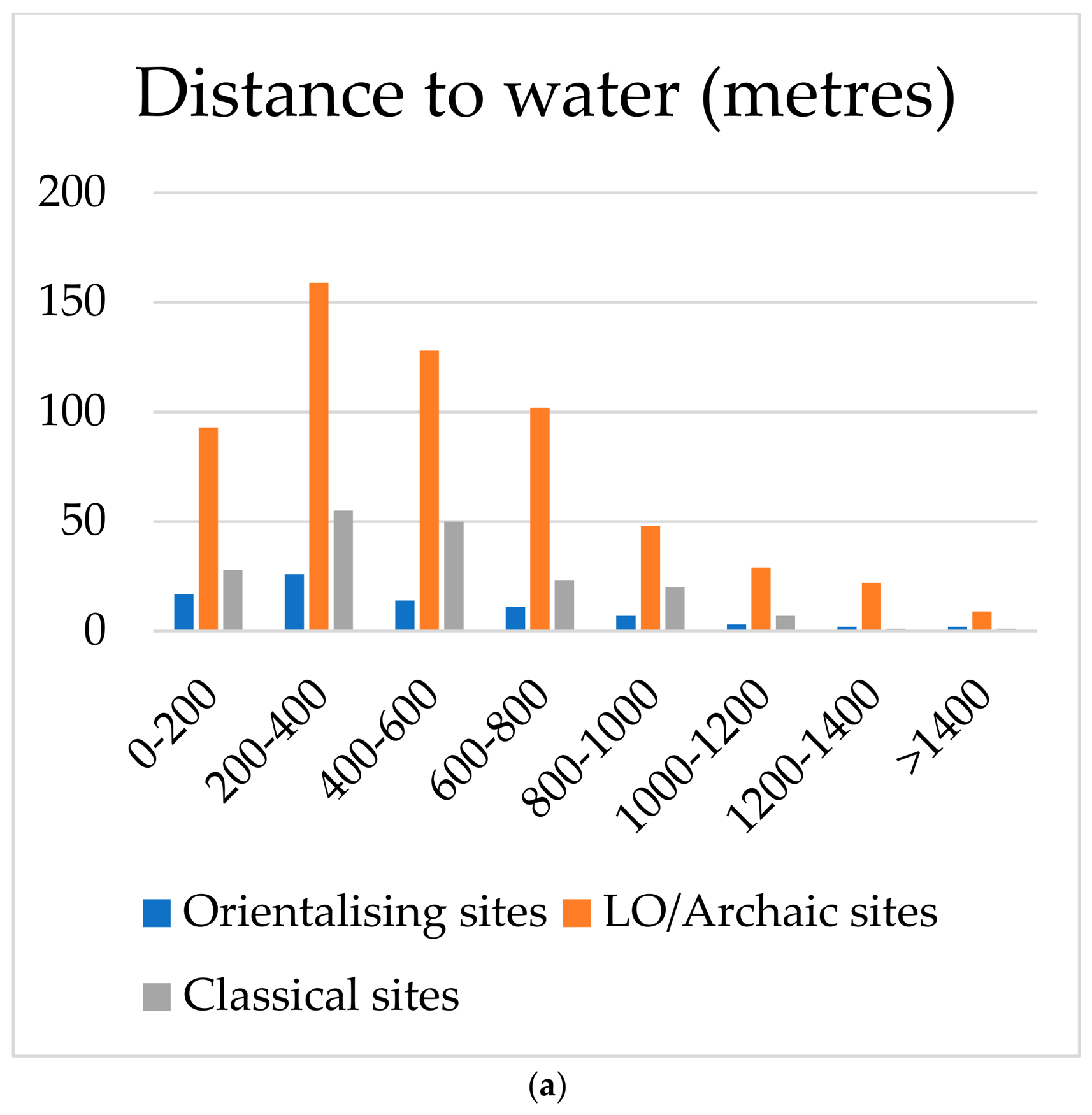


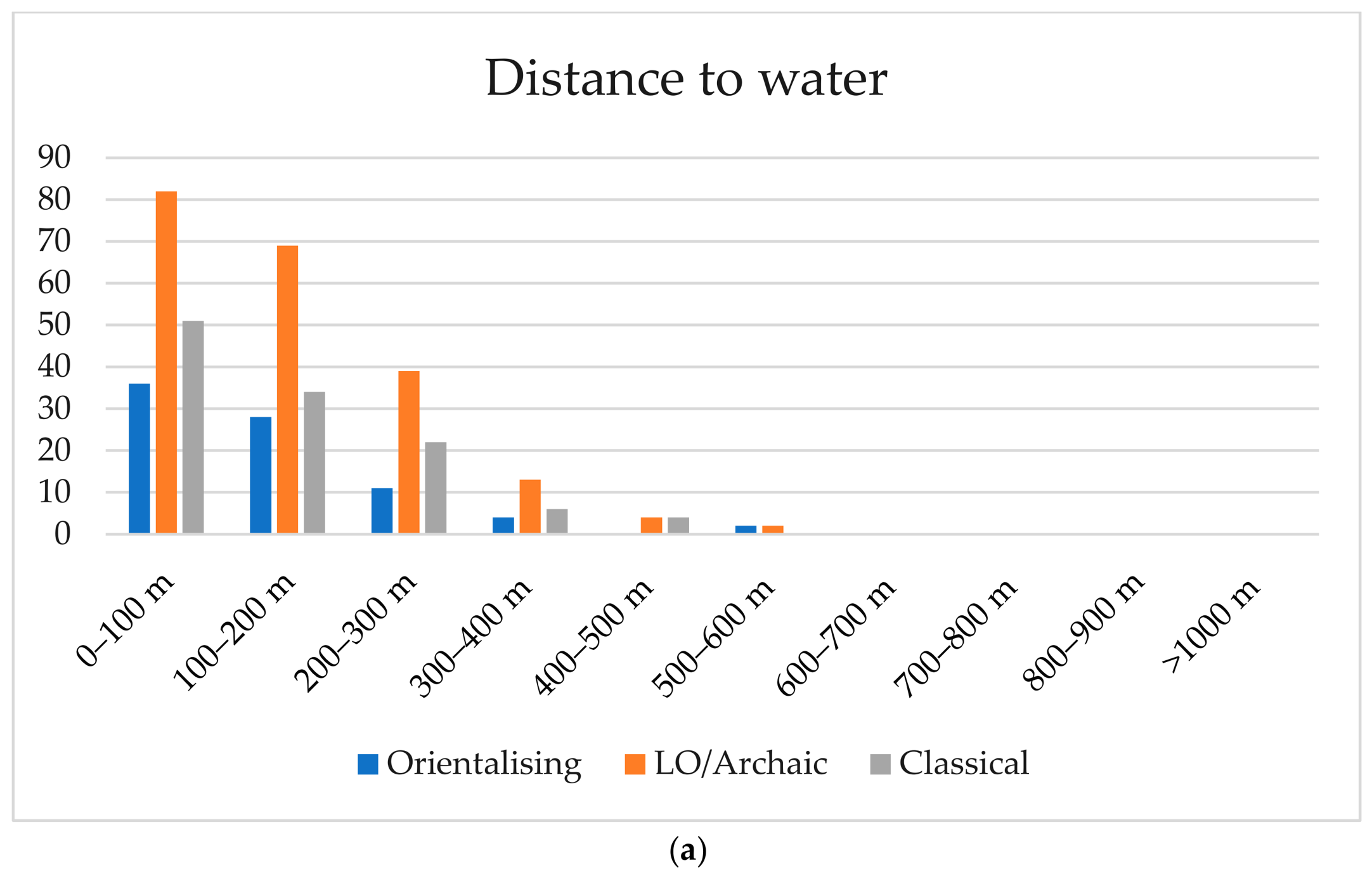
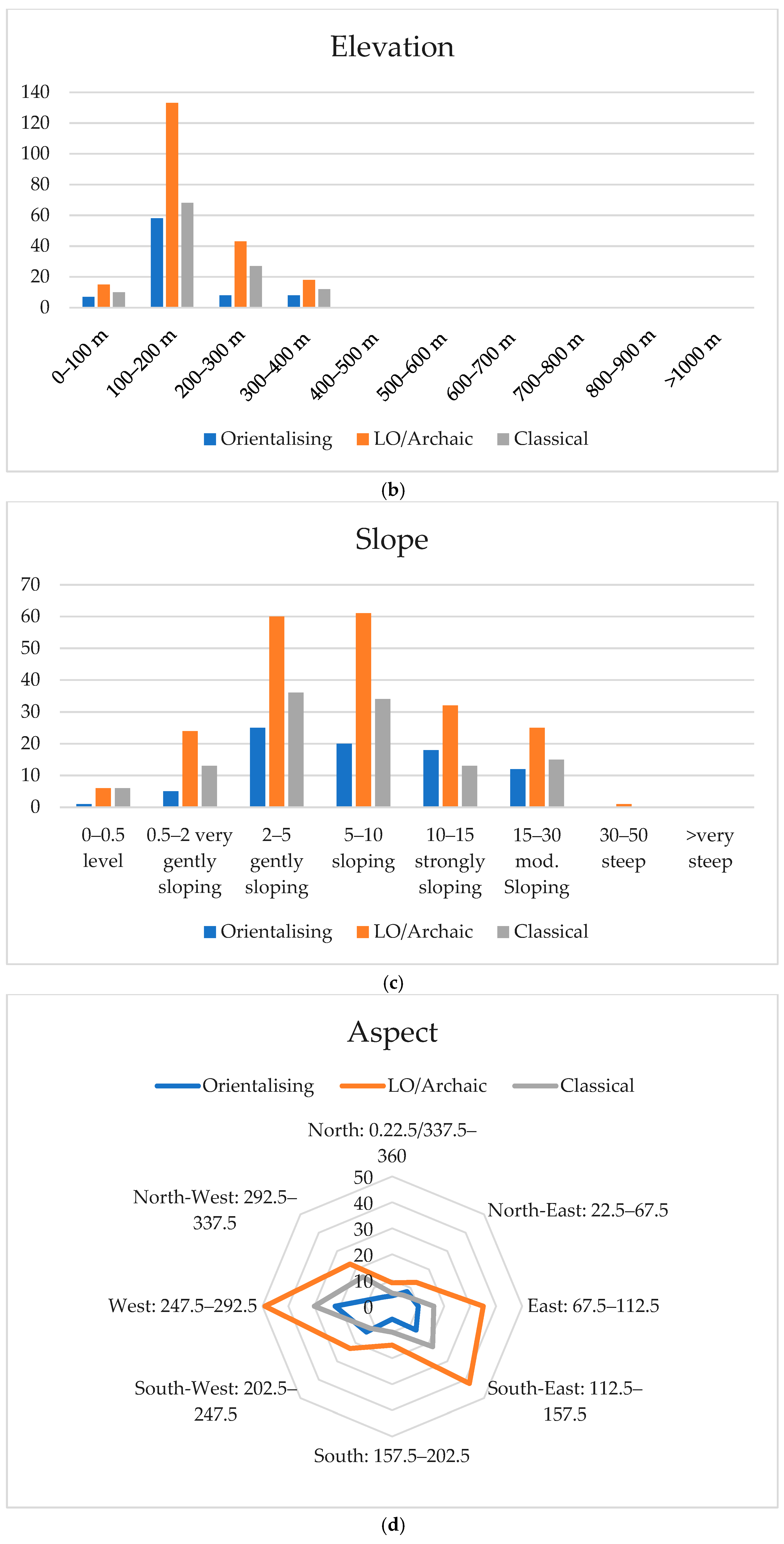

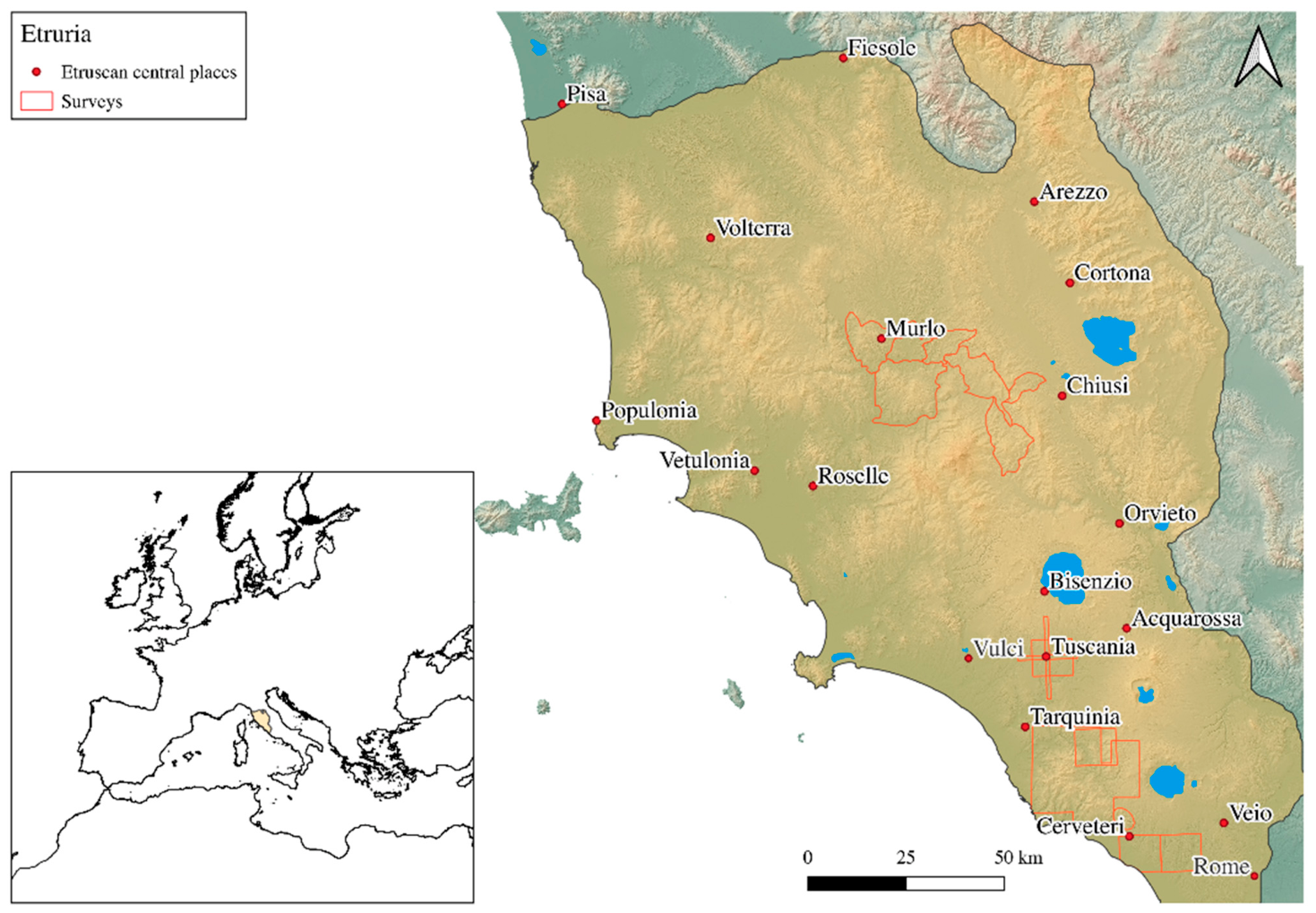
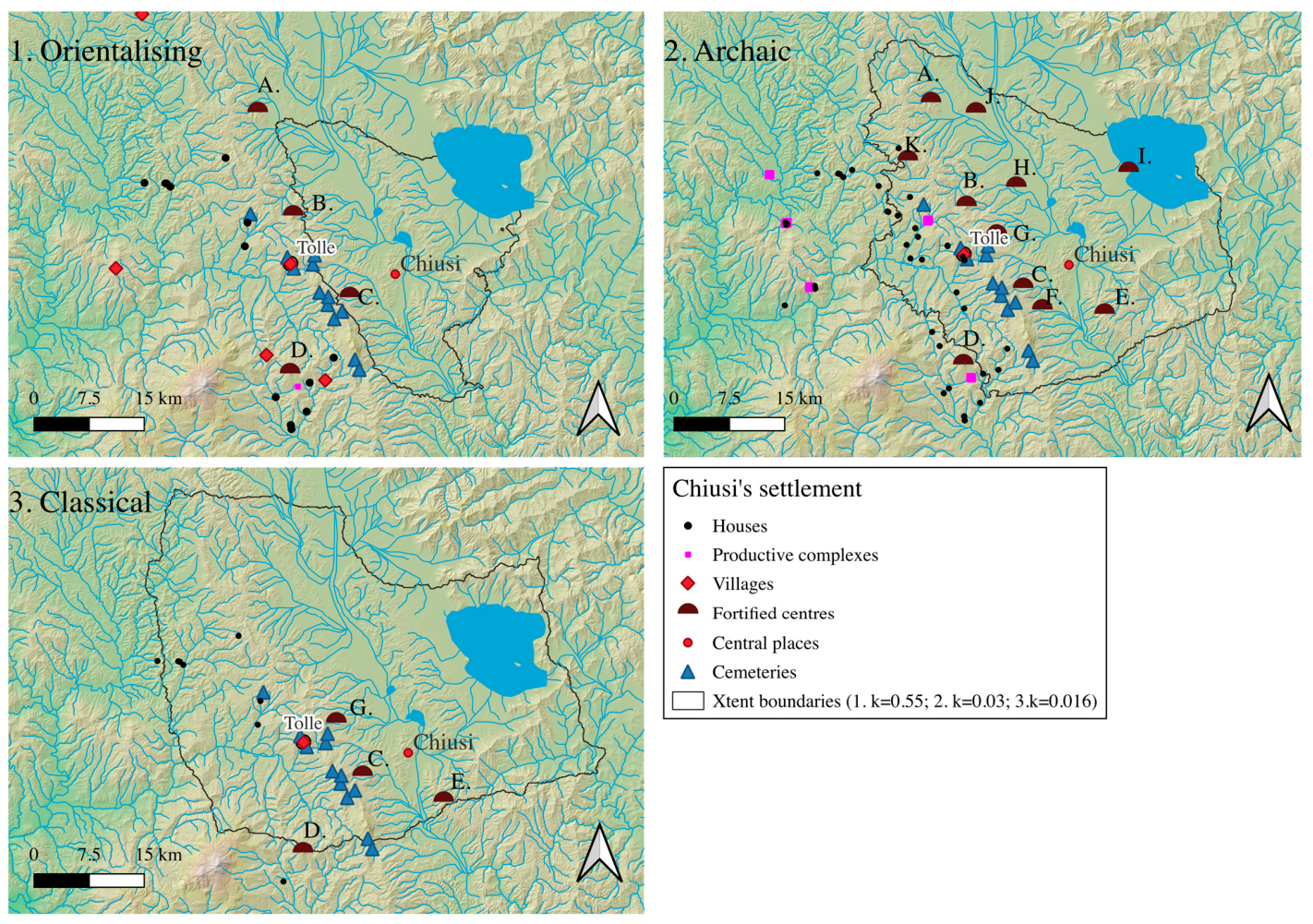
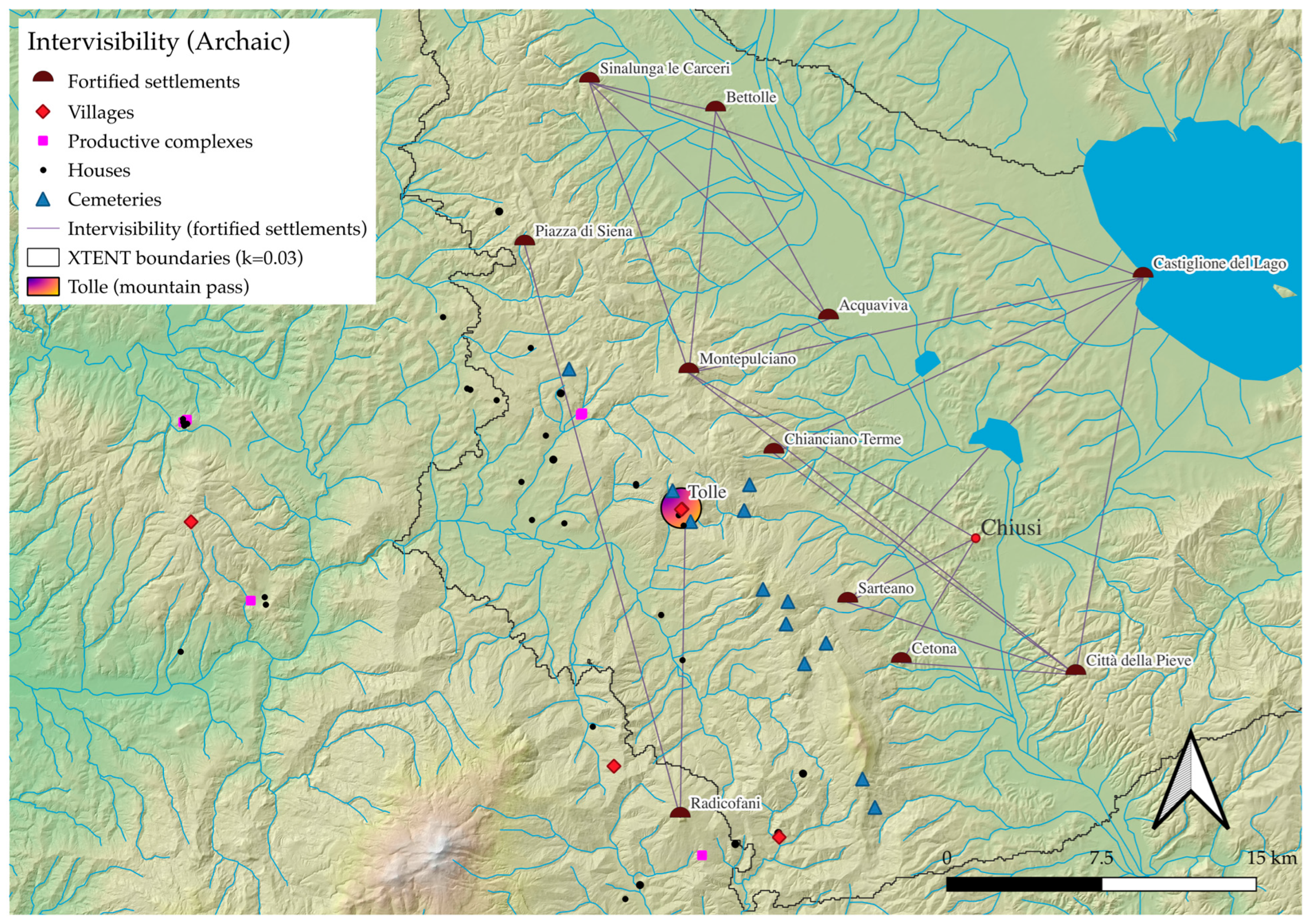
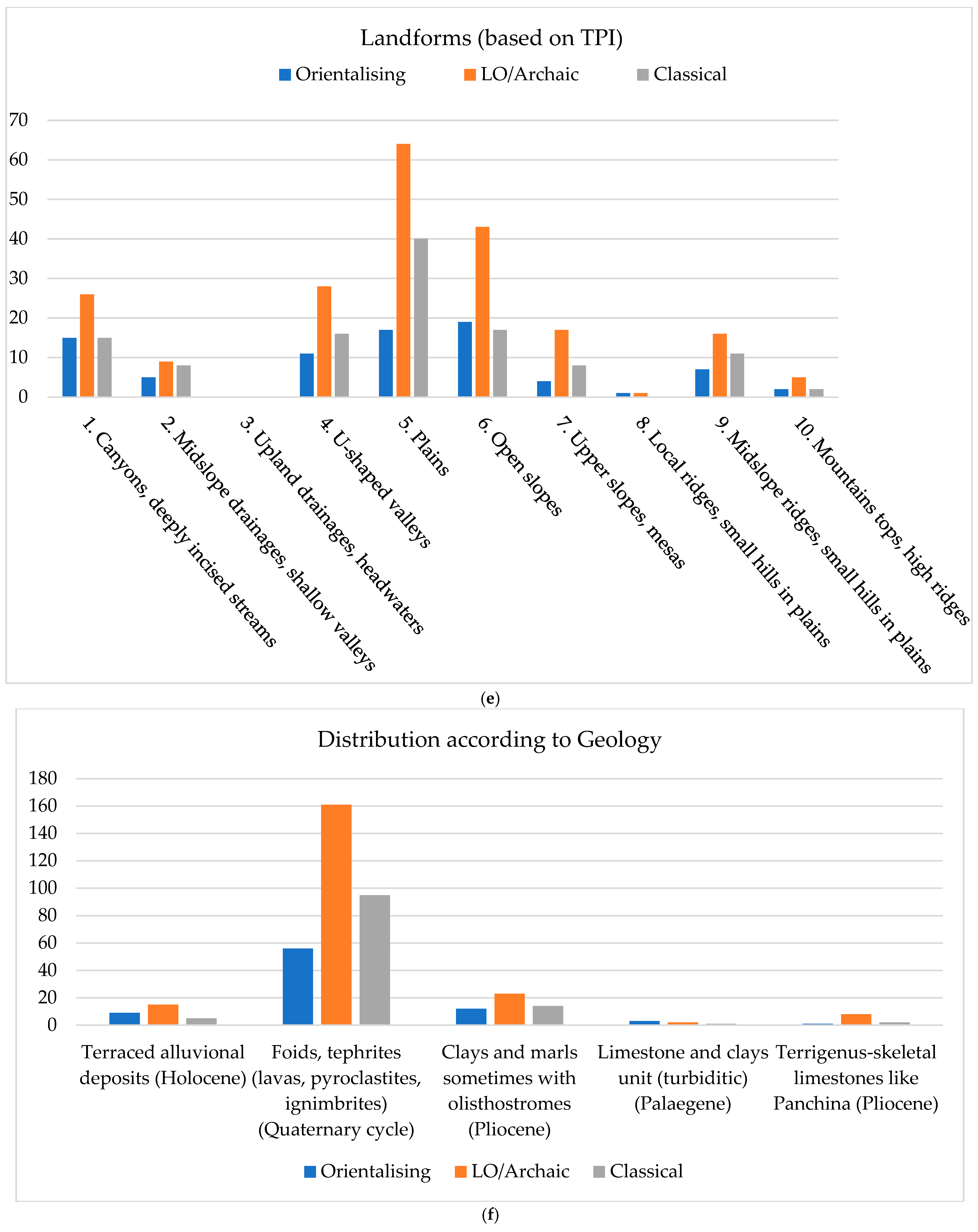
| 1 | Until recently, it was believed that the extension of the city coincided with the one of the modern town, measuring between 25 and 28 ha: if the areas that show traces of settlements of the Etruscan phase, located on surrounding peaks of Montevenere, Monte S. Paolo and the Badiola-Petriolo plateau, are included, the extension of the city reaches between 80 and 90 ha [18], p. 80, which could explain the position of the funerary complexes, quite far from the main hilltop of modern Chiusi, as well as their large dimensions. This extent does not include the spaces between these elevated locations, which, however, do bear archaeological materials from the Classical period onwards [18], p. 80. |
| 2 | More details can be found in the mentioned papers, but for a more information on the workings of the methodology used see [47] (Ch. 4.2.3). |
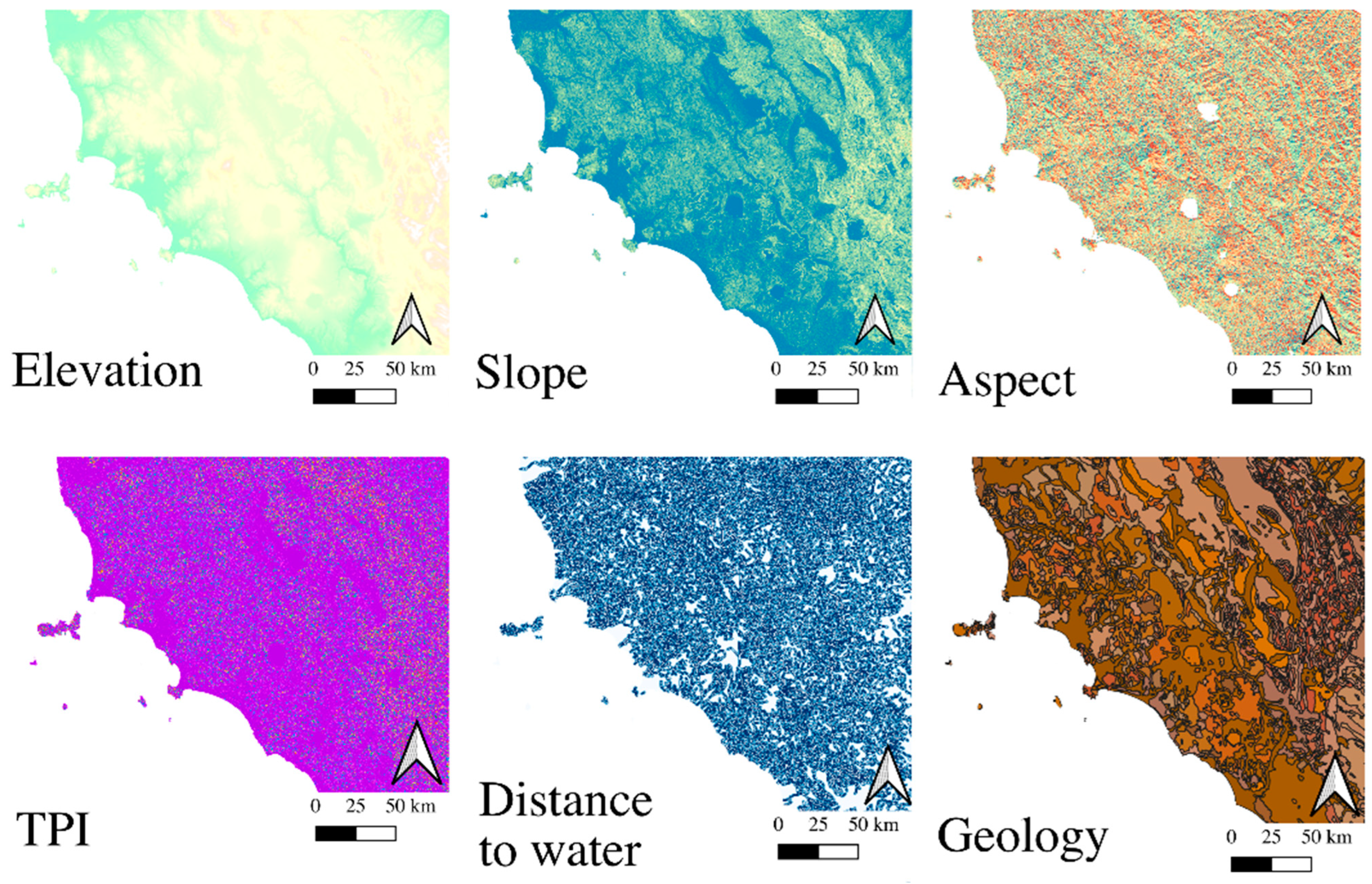
| 3 | Radii were kept as the standard values selected by SAGA, based on Weiss (2001) [49], which correspond to a small radius of 100 m and a large radius of 1000 m. These allow the identification of both local features and broader topographic contexts defining site location. |
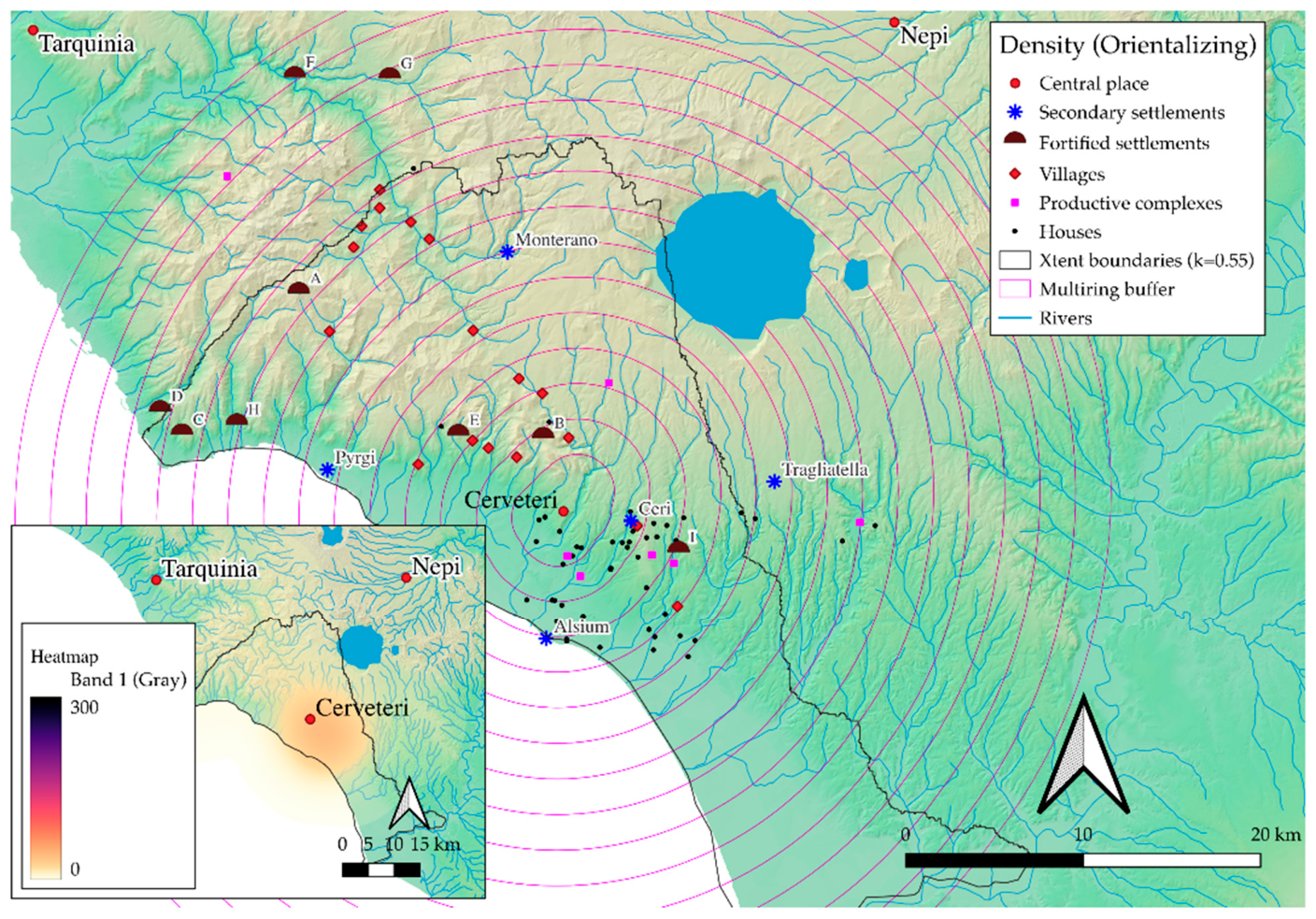
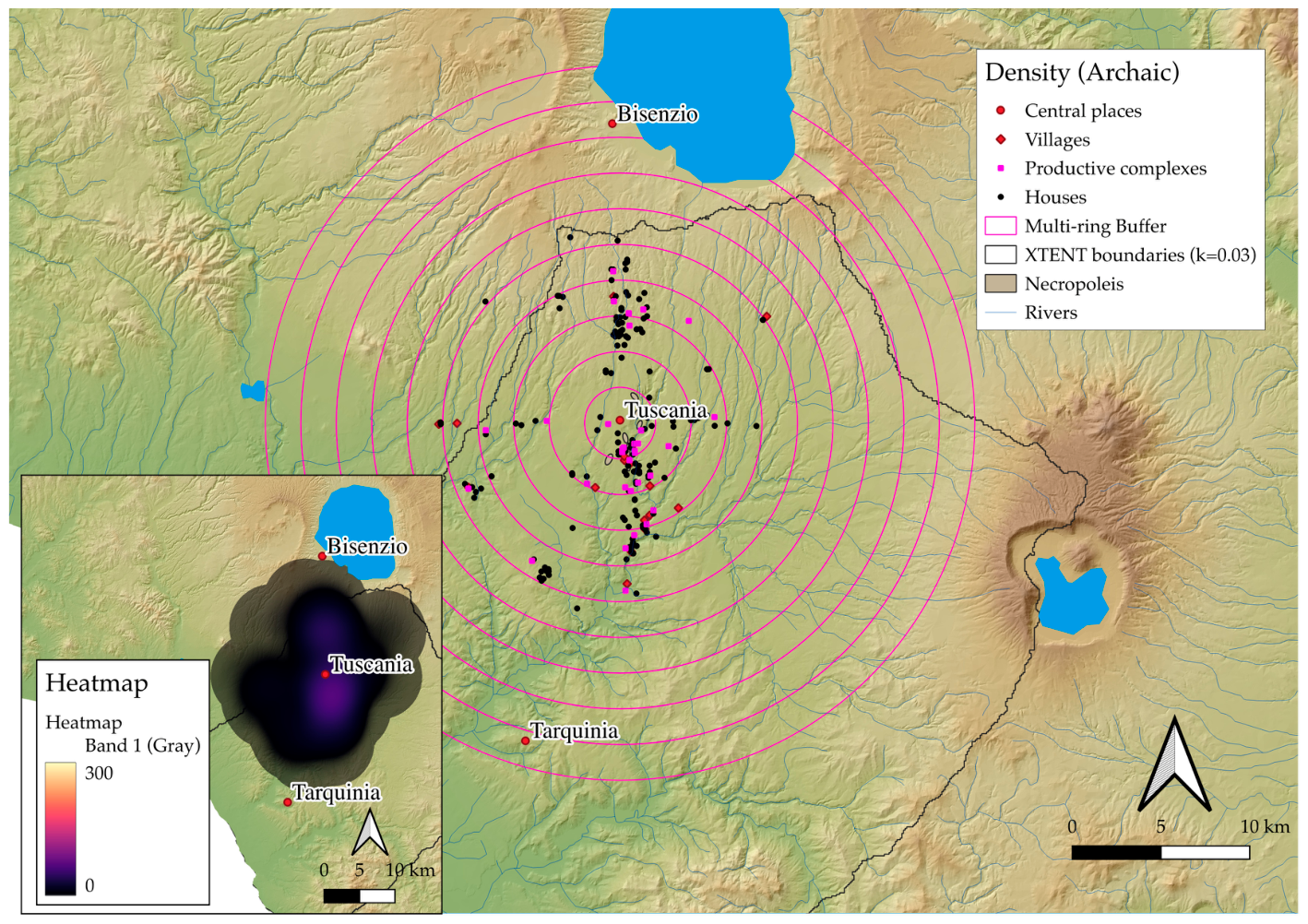
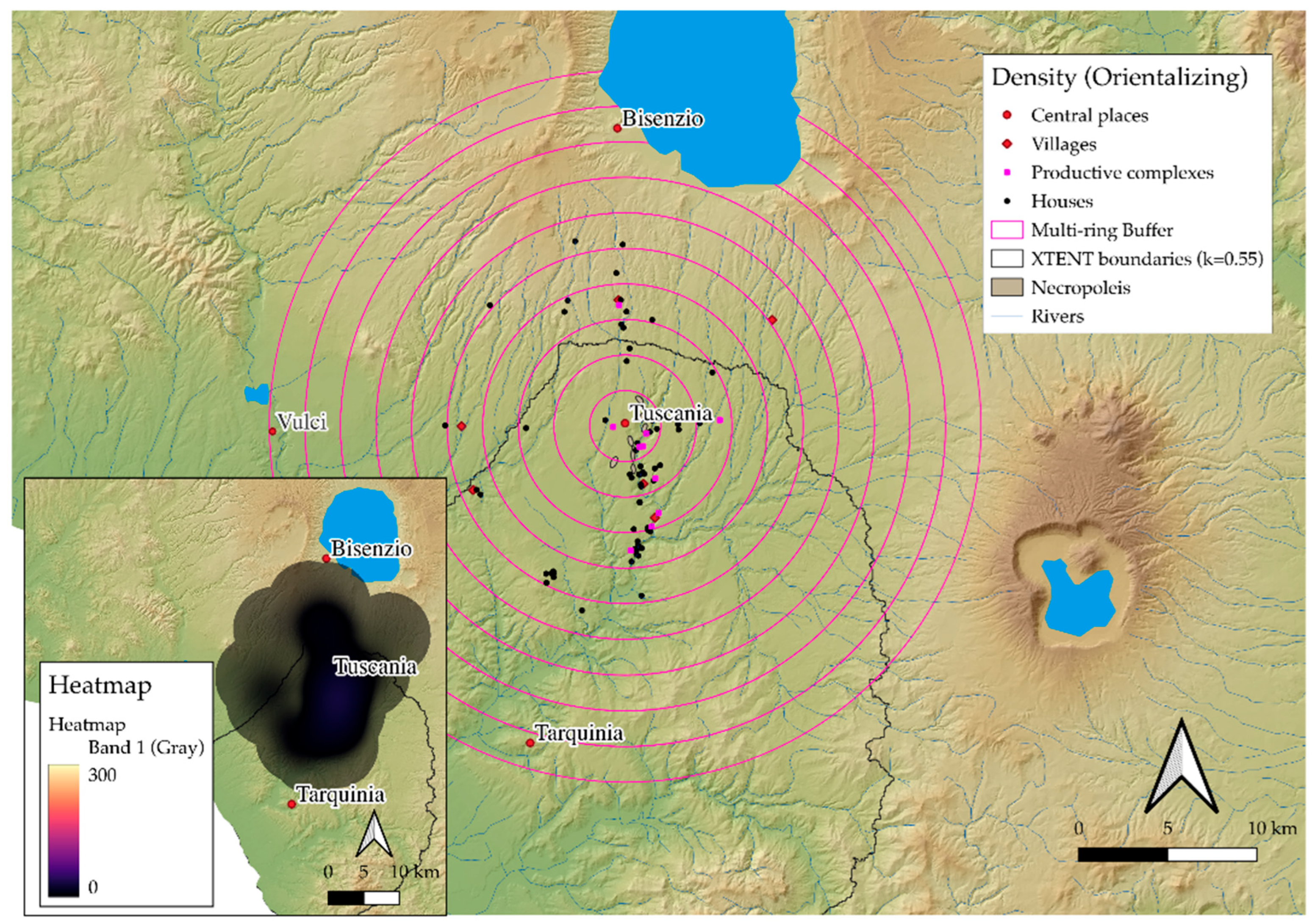
| 4 | Colle San Pietro, Tuscania’s plateau, started to be occupied since the latter part of the Iron Age [81], p. 182, with the most consistent evidence dating between the 8th and the 7th centuries BCE [82], p. 438. This occupation was mirrored in the countryside, with the evidence of Villanovan settlements found by the BSR survey, which could show this lack of participation of the communities located in Tuscania in the regional dynamics that contributed to the formation of Tarquinia [83], p. 38. |
| 5 | |
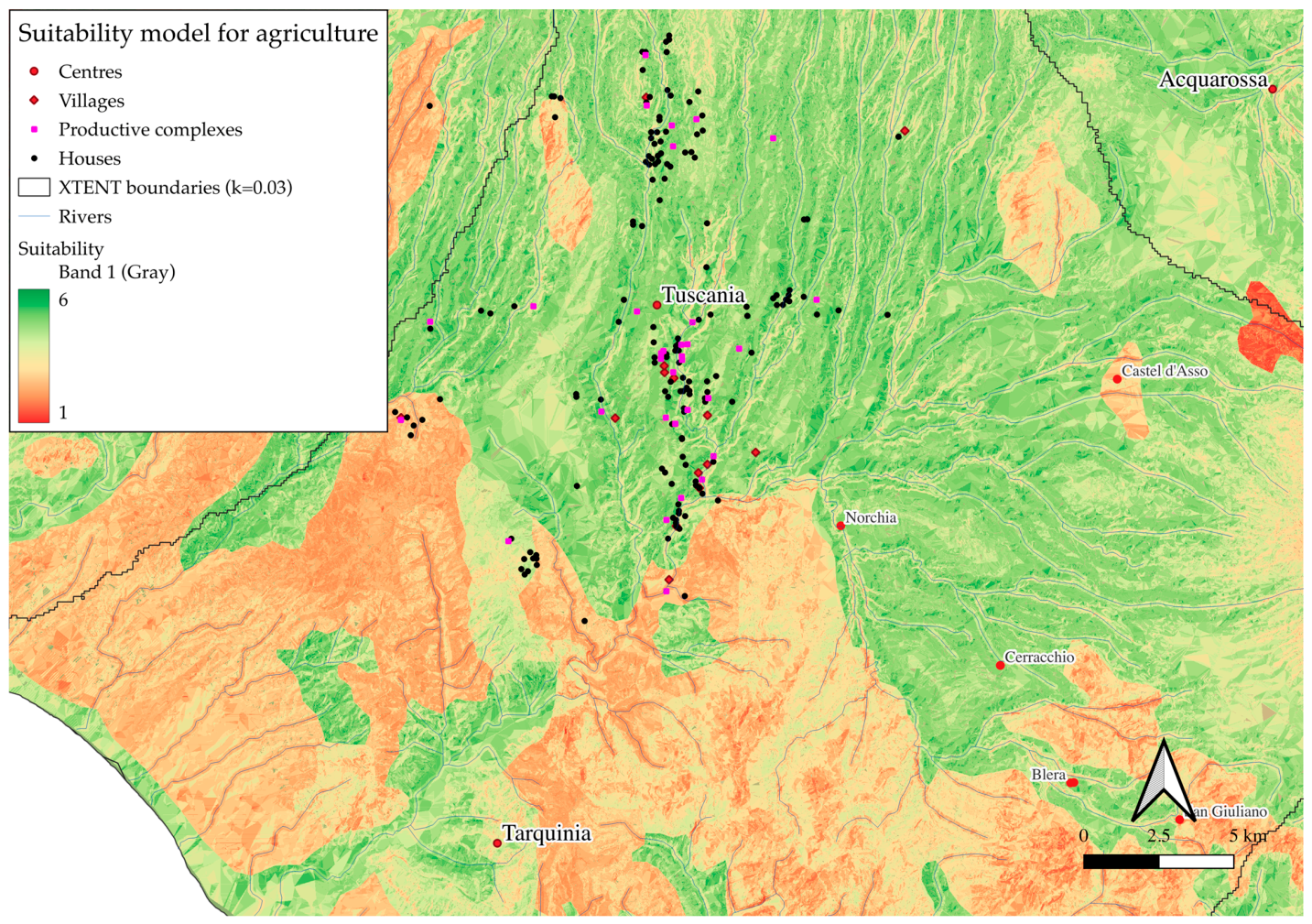
| 6 | The agricultural suitability map has been created following the procedure published in [12,14]. Briefly, the model consists in the creation of Land Utilisation Classes for each raster considered (elevation, slope, aspect, proximity to water, topographic wetness index, geology) to be evaluated on a scale from 1 (least suitable) to 10 (very suitable). This value depends on the social and technological context, as well as on the type of crop considered (in this wheat, vineyards, legumes and olive groves). Each resulting map is then summed to create a general agricultural suitability model. |
| 7 | Some of the ivory objects created by the artisans working in the workshop bear inscriptions written in Chiusine alphabet [99], which demonstrate that the residents were aware of the potential of writing and its ability to channel status, power, and authority. |
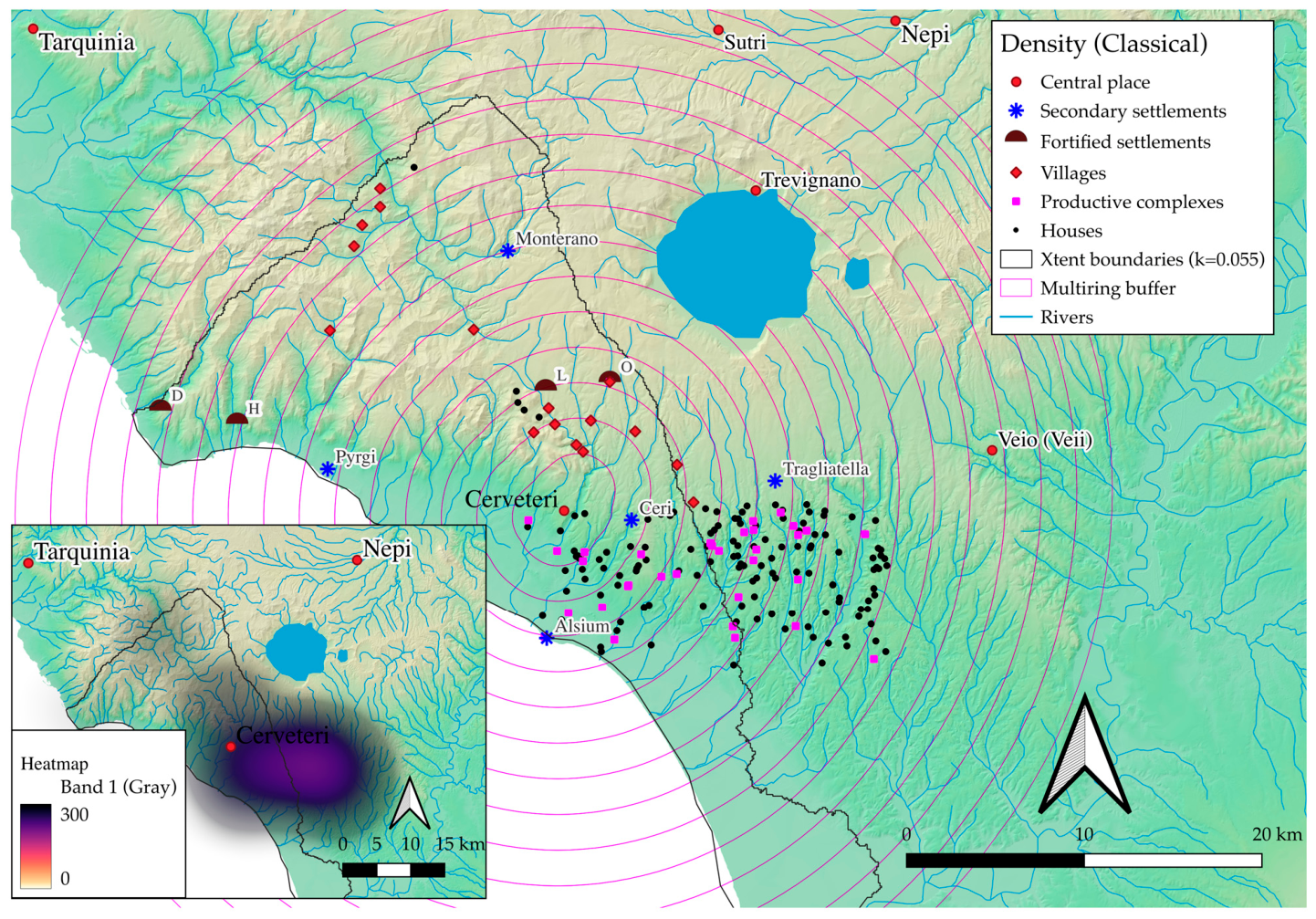
| 8 | The Classical period was defined by the worsening of Veiian–Roman relationships, while relations between Rome and Cerveteri continued to be notably good. As noted in [13] (note 56), signs of prosperity are visible in the renovations of the sacred extra-urban area of Pyrgi, during Thefarie Velianas’ rule (6th-5th centuries BCE), as it was filled with riches which were eventually sacked by Dionysios of Syracuse in 384 BCE [107]. |
References
- Marras, G.B.; Marzullo, M.; Schmidt, F.; French, C.; Sheldrake, M.; Motta, L.; Garzulino, A.; Tentori, D.; Zerboni, A.; Stoddart, S.; et al. Beneath the city: Micromorphological insights into Etruscan urban life, infrastructure, and ritual spaces from Tarquinia, central Italy. Archaeol. Anthropol. Sci. 2026, 18, 3. [Google Scholar] [CrossRef]
- Di Gennaro, F. Organizzazione del territorio nell’Etruria meridionale protostorica: Applicazione di un modello grafico. Dial. Archeol. 1982, 2, 102–112. [Google Scholar]
- Rendeli, M. Città Aperte: Ambiente e Paesaggio Rurale Organizzato Nell’etruria Meridionale Costiera Durante L’età Orientalizzante e Arcaica; Gruppi Editoriali Internazionali: Rome, Italy, 1993. [Google Scholar]
- Palmisano, A.; Bevan, A.; Shennan, S. Comparing archaeological proxies for long-term population patterns: An example from central Italy. J. Archaeol. Sci. 2017, 87, 59–72. [Google Scholar] [CrossRef]
- Palmisano, A.; Bevan, A.; Shennan, S. Regional demographic trends and settlement patterns in Central Italy: Archaeological sites and radiocarbon dates. J. Open Archaeol. Data 2018, 6, 2. [Google Scholar] [CrossRef]
- Forte, M. (Ed.) A New Etruscan Archaeology: Twenty-First Century Techniques and Methods; Oxford University Press: New York, NY, USA, 2025. [Google Scholar] [CrossRef]
- Pasquinucci, M.; Menchelli, S. 2.2. Landscape transformations in North Coastal Etruria. In Landscape Archaeology Between Art and Science: From a Multi- to an Interdisciplinary Approach; Kluiving, S.J., Guttmann-Bond, E., Eds.; Amsterdam University Press: Amsterdam, The Netherlands, 2012; pp. 179–196. [Google Scholar] [CrossRef]
- Redhouse, D.I.; Stoddart, S.K.F. Mapping Etruscan state formation. In State Formation in Italy and Greece: Questioning the Neoevolutionist Paradigm; Haggis, D., Terrenato, N., Eds.; Oxbow Books: Oxford, UK, 2011; pp. 162–178. [Google Scholar]
- Stoddart, S. Power and Place in Etruria. The Spatial Dynamics of a Mediterranean Civilization, 1200-500BC; Cambridge University Press: Cambridge, UK, 2020. [Google Scholar] [CrossRef]
- Stoddart, S.; Palmisano, A.; Redhouse, D.; Barker, G.; di Paola, G.; Motta, L.; Rasmussen, T.; Samuels, T.; Witcher, R. Patterns of Etruscan urbanism. Front. Digit. Humanit. 2020, 7, 1. [Google Scholar] [CrossRef]
- Zeviani, C. Invisible Etruscans: A Study on Rural Landscape and Settlement Organization During the Urbanization of Etruria (7th–5th Centuries BC). Unpublished Ph.D. Thesis, University of Cambridge, Cambridge, UK, 2023. [Google Scholar]
- Zeviani, C. Urbanization halted: Regional politics and demographic changes between the 7th and the 5th centuries BCE in north Etruria. World Archaeol. 2025, 1–17. [Google Scholar] [CrossRef]
- Zeviani, C. Beyond Cerveteri: Landscape, Lineage and Power Dynamics of an Etruscan City. Etruscan Ital. Stud. 2025, 1–30. [Google Scholar] [CrossRef]
- Zeviani, C.; Bilotti, G.; Simmons, C.; Stoddart, S. Pointing out the pattern: Modelling human-environmental dynamics in Etruria during the 1st millennium BCE. J. Archaeol. Sci. Rep. 2025, 62, 105052. [Google Scholar] [CrossRef]
- Renfrew, C.; Level, E. Exploring dominance: Predicting polities from centers. In Transformations: Mathematical Approaches to Culture Change; Renfrew, C., Cooke, K.L., Eds.; Academic Press: New York, NY, USA, 1979; pp. 145–166. [Google Scholar] [CrossRef]
- Ducke, B.; Kroefges, P. From points to areas: Constructing territories from archaeological site patterns using an enhanced Xtent model. In Layers of Perception, Proceedings of the 35th International Conference on Computer Applications and Quantitative Methods in Archaeology (CAA), Berlin, Germany, 2–6 April 2007; Posluschny, A., Lambers, K., Herzog, I., Eds.; Kolloquien zur Vor-und Frühgeschichte, Volume 10; Rudolf Habelt Verlag: Bonn, Germany, 2007; pp. 244–251. [Google Scholar]
- Stoddart, S. An Etruscan urban agenda: The weaving together of traditions. J. Urban Archaeol. 2020, 1, 99–121. [Google Scholar] [CrossRef]
- Cappuccini, L. Dinamiche Insediative a Chiusi nel VII e nel VI sec. a.C. In L’Etrurie et l’Ombrie Avant Rome. Cité et Territoire. Actes du Colloque International. Louvain-la-Neuve, Halles Universitaires, S.nat acad.mique, 13–14 Février 2004; Institut Historique Belge de Rome Artes 1; Institut Historique Belge de Rome: Brussels, Belgium; Rome, Italy, 2010; pp. 63–81. [Google Scholar]
- Campana, S. Murlo. Carta Archeologica Della Provincia di Siena, V; Nuova Immagine Editore: Siena, Italy, 2001. [Google Scholar]
- Campana, S. Montalcino. Carta Archeologica Della Provincia di Siena, XII; Nuova Immagine Editore: Siena, Italy, 2013. [Google Scholar]
- Botarelli, L. Radicofani. Carta Archeologica Della Provincia di Siena, VII; Nuova Immagine: Siena, Italy, 2005. [Google Scholar]
- Felici, C. Pienza. Carta Archeologica Della Provincia di Siena, VI; Nuova Immagine: Siena, Italy, 2004. [Google Scholar]
- Felici, C. San Giovanni d’Asso.Carta Archeologica Della Provincia di Siena; Nuova Immagine: Siena, Italy, 2012; Volume X. [Google Scholar]
- Boscato, P.; Coltorti, M.; Reggiani, P. Pliocene Anancus arvernensis (Croizet & Jobert, 1828) remains from Cetona (Siena): Stratigraphy, chronology and paleoenvironment. Ital. J. Geosci. 2008, 127, 151–162. [Google Scholar]
- Coltorti, M.; Fantozzi, P.; Pieruccini, P. Tuscany hills and valleys: Uplift, exhumation, valley downcutting and relict landforms. In Landscapes and Landforms in Italy; Soldati, M., Marchetti, M., Eds.; Springer: Cham, Switzerland, 2017; pp. 245–255. [Google Scholar] [CrossRef]
- Palazzi, M. Relazione. Piano Strutturale per il Comune di C.T.; Comune di Chianciano Terme: Chianciano Terme, Italy, 2013.
- Della Ventura, G.; Patanè, A. Le miniere dei Monti della Tolfa-Allumiere (Roma). Mem. Descr. Carta Geol. Ital. 2020, 106, 23–32. [Google Scholar]
- Petracchini, L.; Scrocca, D.; Spagnesi, S.; Minelli, F. 3D Geological Modeling to Support the Assessment of Conventional and Unconventional Geothermal Resources in the Latium Region (Central Italy). In Proceedings of the World Geothermal Congress, Melbourne, Australia, 19–24 March 2015; pp. 19–25. [Google Scholar]
- Poli, G.; Frey, F.; Ferrara, G. Geochemical Characteristics of the South Tuscany (Italy) Volcanic Province: Constraints on Lava Petrogenesis. Chem. Geol. 1984, 43, 203–221. [Google Scholar] [CrossRef]
- Villa, I.; Giuliani, O.; De Grandis, G.; Cioni, R. Datazioni K/Ar dei vulcani di Tolfa e Manziana. Boll. GNV 1989, 5, 1025–1026. [Google Scholar]
- Fulminante, F. The Urbanization of Rome and Latium Vetus from the Bronze Age to the Archaic Era; Cambridge University Press: Cambridge, UK, 2014. [Google Scholar]
- Tartara, P. Torrimpietra. Forma Italiae; Leo S. Olschki: Firenze, Italy, 1999. [Google Scholar]
- Enei, F. Progetto Ager Caeretanus. Il litorale di Alsium; Regione Lazio: Santa Marinella, Italy, 2001.
- Bozzano, F.; Floris, M.; Gaeta, M.; Martino, S.; Scarascia Mugnozza, G. Assetto geologico ed evoluzione per frana di rupi vulcaniche nel Lazio Settentrionale. Boll. Soc. Geol. Ital. 2005, 124, 413–436. [Google Scholar]
- De Rita, D.; Celant, A.; Magri, D. Volcanoclastic sedimentation in coastal environments: The interplay between volcanism and Quaternary Sea level change (Central Italy). Quat. Int. 2002, 95–96, 141–154. [Google Scholar] [CrossRef]
- Ciferri, S.; Menegoni, P. Geomorfologia, idrologia e rischio idrogeologico. In Progetto LIFE02 ENV/IT/000111: Pilot Testing and Demonstration Actions to Implement EMAS on the Territorial Scale in the Tuscia Romana District; European Commission: Brussels, Belgium, 2002; p. 1. [Google Scholar]
- Casadei, C. Il Recupero Della Rete dei Percorsi Antichi per la “Riattualizzazione” del Territorio Azioni Strategiche Lungo la via Clodia nel Paesaggio Dell’etruria Meridionale Interna. Ph.D. Thesis, Università Roma Tre, Rome, Italy, 2016. [Google Scholar]
- Mannoni, T. Le rocce e argille dell’Etruria meridionale. In Etruria Meridionale. Conoscenza, Conservazione, Fruizione. Atti del Convegno. Viterbo, 29/30 Novembre–1 Dicembre 1985; Edizioni Quasar: Rome, Italy, 1988; pp. 39–42. [Google Scholar]
- Quilici Gigli, S. Tuscana (Forma Italiae, Regio VII.2); De Luca: Rome, Italy, 1970. [Google Scholar]
- Nardi, G. Definizione e perimetrazione del parco. In Caere I. Il Parco Archeologico; Cristofani, M., Nardi, G., Rizzo, M.A., Eds.; Centro Nazionale delle Ricerche: Rome, Italy, 1988; pp. 65–73. [Google Scholar]
- Naso, A.; Zifferero, A. Etruscan settlement patterns in the Monti della Tolfa area (Lazio). In Papers in Italian Archaeology, Vol. IV: The Cambridge Conference. Part I: The Human Landscape; Malone, C., Stoddart, S., Eds.; BAR: Oxford, UK, 1985; pp. 239–259. [Google Scholar]
- Zifferero, A. Insediamenti ed economia: Appunti sulle risorse minerarie dei Monti della Tolfa. In Caere e il suo Territorio. Da Agylla a Centumcellae; Officina Carte e Valori dell’Istituto Poligrafico e Zecca dello Stato: Rome, Italy, 1990; pp. 71–75. [Google Scholar]
- Cenni, F. Buonconvento. Carta Archeologica Della Provincia di Siena, VIII; Nuova Immagine Editore: Siena, Italy, 2007. [Google Scholar]
- Barker, G.; Rasmussen, T. In the Footsteps of the Etruscans: Changing Landscapes around Tuscania from Prehistory to Modernity; Cambridge University Press: Cambridge, UK, 2023. [Google Scholar] [CrossRef]
- Hamphill, P. The Civitella di Cesi Survey; Svenska Institutet i Rom: Stockholm, Sweden, 2000. [Google Scholar]
- Ikeguchi, M. A comparative study of settlement patterns and agricultural structures in ancient Italy: A methodology for interpreting field survey evidence. Kodai J. Anc. Hist. 1999, 10, 1–59. [Google Scholar]
- Launaro, A. Peasants and Slaves: The Rural Population in Roman Italy (200 BC to AD 100); Cambridge Classical Studies: Cambridge, UK, 2011. [Google Scholar]
- Tarquini, S.; Isola, I.; Favalli, M.; Mazzarini, F.; Bisson, M.; Pareschi, M.T.; Boschi, E. TINITALY/01: A new Triangular Irregular Network of Italy. Ann. Geophys. 2007, 50, 407–425. [Google Scholar] [CrossRef]
- Weiss, A.D. Topographic Position and Landforms Analysis. Poster Presentation. In Proceedings of the ESRI User Conference, San Diego, CA, USA, 9–13 July 2001. [Google Scholar]
- Jenness, J. Topographic Position Index (tpi_jen.avx) Extension for ArcView 3.x, v.1.-3a. 2006. Available online: http://www.jennessent.com/arcview/tpi.htm (accessed on 18 March 2025).
- Baxter, M.J.; Beardah, C.C.; Wright, R.V.S. Some archaeological applications of kernel density estimates. J. Archaeol. Sci. 1997, 24, 347–354. [Google Scholar] [CrossRef]
- Bonnier, A.; Finné, M.; Weiberg, E. Examining land-use through GIS-based kernel density estimation: A re-evaluation of legacy data from the Berbati-Limnes Survey. J. Field Archaeol. 2019, 44, 70–83. [Google Scholar] [CrossRef]
- Conolly, J.; Lake, M. Geographical Information Systems in Archaeology; Cambridge University Press: Cambridge, UK, 2006. [Google Scholar] [CrossRef]
- Herzog, I.; Yépez, A. Least-cost kernel density estimation and interpolation-based density analysis applied to survey data. In CAA2010: Fusion of Cultures, Proceedings of the 38th Annual Conference on Computer Applications and Quantitative Methods in Archaeology, Granada, Spain, 6–9 April 2010; Contreras, F., Farjas, M., Melero, F.J., Eds.; BAR International Series 2494; Archaeopress: Oxford, UK, 2013; pp. 367–374. [Google Scholar]
- Lindholm, K.-J.; Sandström, E.; Ekman, A.-K. The archaeology of the commons. J. Archaeol. Anc. Hist. 2013, 10, 3–49. [Google Scholar] [CrossRef]
- McMahon, T.C. Discerning prehistoric landscapes in Colorado and the Mesa Verde region using a kernel density estimate (KDE) method. In Digital Discovery: Exploring New Frontiers in Human Heritage, CAA 2006; Clark, J.T., Hagemeister, E.M., Eds.; Archaeolingua: Budapest, Hungary, 2007; pp. 151–166. [Google Scholar] [CrossRef]
- Sayer, D.; Wienhold, M. A GIS-Investigation of four Early Anglo-Saxon cemeteries: Ripley’s K-function analysis of spatial groupings amongst graves. Soc. Sci. Comput. Rev. 2013, 31, 71–89. [Google Scholar] [CrossRef]
- Wheatley, D.; Gillings, M. Spatial Technology and Archaeology—The Archaeological Applications of GIS; CRC Press: Boca Raton, FL, USA; Taylor & Francis: London, UK, 2002. [Google Scholar] [CrossRef]
- Cope, M.; Elwood, S. (Eds.) Critical GIS: A Mixed Methods Approach; Sage Publications: Los Angeles, CA, USA; London, UK; New Delhi, India; Singapore; Washington, DC, USA, 2009. [Google Scholar]
- Daly, P.; Lock, G. Time, space and archaeological landscapes: Establishing connections in the first millennium BC. In Spatially Integrated Social Science; Goodchild, M.F., Janelle, D.G., Eds.; Oxford University Press: Oxford, UK, 2004; pp. 349–365. [Google Scholar] [CrossRef]
- Gaffney, V.; van Leusen, P.M. Postscript—GIS, environmental determinism and archaeology. In Archaeology and Geographical Information Systems; Lock, G., Stančič, Z., Eds.; Taylor & Francis: London, UK, 1995; pp. 367–382. [Google Scholar] [CrossRef]
- Harris, T.M. Pursuing social goals through participatory geographic information systems. In Ground Truth: The Social Implications of Geographic Information Systems; Pickles, J., Ed.; Guilford Press: New York, NY, USA, 1995; pp. 196–222. [Google Scholar]
- Huggett, J. Archaeology and the new technological fetishism. Archeol. Calc. 2004, 15, 81–92. [Google Scholar]
- Kwan, M.P. Is GIS for women? Reflections on the critical discourse in the 1990s. Gend. Place Cult. 2002, 9, 271–279. [Google Scholar] [CrossRef]
- Llobera, M. Exploring the topography of mind: GIS, social space and archaeology. Antiquity 1996, 269, 612–622. [Google Scholar] [CrossRef]
- Lock, G.; Stančič, G. (Eds.) Archaeology and Geographic Information Systems: A European Perspective; CRC Press: Cleveland, OH, USA, 1995. [Google Scholar]
- Richards-Rissetto, H. What can GIS + 3D mean for landscape archaeology? J. Archaeol. Sci. 2017, 84, 10–21. [Google Scholar] [CrossRef]
- Thomas, J. A Précis of Time, Culture and Identity; Routledge: London, UK, 1996. [Google Scholar] [CrossRef]
- Aines, E. The Memory of Forgotten Landscape. Ph.D. Thesis, University of Cambridge, Cambridge, UK, 2019. [Google Scholar]
- Kopytoff, I. The cultural biography of things: Commoditization as process. In The Social Life of Things: Commodities in Cultural Perspective; Appadurai, A., Ed.; Cambridge University Press: Cambridge, UK, 1986; pp. 70–73. [Google Scholar] [CrossRef]
- Gosden, C.; Marshall, Y. The cultural biography of objects. World Archaeol. 1999, 31, 169–178. [Google Scholar] [CrossRef]
- Olsen, B. In Defence of Things: Archaeology and the Ontology of Objects; Altamira: Lanham, MD, USA, 2010. [Google Scholar] [CrossRef]
- Hodder, I. The entanglements of human and things: A long-term view. New Lit. Hist. 2014, 45, 19–36. [Google Scholar] [CrossRef]
- Minetti, A. L’Orientalizzante a Chiusi e nel suo Territorio; L’Erma di Bretschneider: Rome, Italy, 2004. [Google Scholar]
- Vander Poppen, R. Rural Change and Continuity in Etruria: A Study of Village Communities from the 7th Century B.C. to the 1st Century A.D. Ph.D. Thesis, University of North Carolina, Chapel Hill, NC, USA, 2008. [Google Scholar]
- van Joolen, E. Archaeological Land Evaluation: A Reconstruction of the Suitability of Ancient Landscapes for Various Land Uses in Italy Focused on the First Millennium BC. Ph.D. Thesis, University of Groningen, Groningen, The Netherlands, 2003. [Google Scholar]
- Goodchild, H. Modelling Roman Agricultural Production in the Middle Tiber Valley, Central Italy. Ph.D. Thesis, University of Birmingham, Birmingham, UK, 2007. [Google Scholar]
- Sotgia, A. Live in Villages, Plow Fields before Cities: Aspects of the Primary Economy of the Communities of Southern Etruria Between the Bronze Age and the Early Iron Age. Ph.D. Thesis, Università La Sapienza, Rome, Italy, 2023. [Google Scholar]
- Tuck, A. Poggio Civitate: A community from inland Etruria. In A Companion to the Etruscans; Bell, S., Carpino, A., Eds.; Wiley-Blackwell: Chirchester, UK, 2015; pp. 105–116. [Google Scholar] [CrossRef]
- Tuck, A. The Necropolis of Poggio Civitate (Murlo). Burials from Poggio Aguzzo; Bretschneider: Rome, Italy, 2009. [Google Scholar]
- Camilli, A. Tuscania. In Luoghi e Tradizioni d’Italia. Lazio Settentrionale; Vlad, L., Emiliani, V., Sommella, P., Eds.; Editalia: Rome, Italy, 2000. [Google Scholar]
- Gianfrotta, C.; Potter, T. Tuscania 1974—Scavi sul Colle S. Pietro: Una prima lettura. Archeol. Mediev. 1980, VII, 437–456. [Google Scholar]
- Barker, G.; Rasmussen, T. The archaeology of an Etruscan polis: A preliminary report on the Tuscania Project (1986 and 1987 Seasons). Pap. Sch. Rome 1988, 56, 25–42. [Google Scholar] [CrossRef]
- Colonna, G. L’Etruria meridionale interna dal Villanoviano alle tombe rupestri. Studi Etruschi 1967, 35, 3–30. [Google Scholar]
- Barker, G.; Grant, A.; Rasmussen, T. Approaches to the Etruscan landscape: The development of the Tuscania survey. In Case Studies in European Prehistory; CRC Press: Boca Raton, FL, USA, 1993; pp. 229–257. [Google Scholar] [CrossRef]
- Riva, C. The Urbanisation of Etruria: Funerary Practices and Social Change; Cambridge University Press: Cambridge, UK, 2009. [Google Scholar] [CrossRef]
- Naso, A. L’Etruria meridionale. In Tumuli e Sepolture Monumentali Nella Protostoria Europea, Atti del Convegno Internazionale, Celano, Italy, 21–24 September 2000; Naso, A., Ed.; Romisch-Germanisches Zentralmuseum: Mainz, Germany, 2011; pp. 115–130. [Google Scholar]
- Acconcia, V. Paesaggi Etruschi in Terra di Siena; BAR: Oxford, UK, 2012. [Google Scholar]
- Paolucci, G. Chianciano Terme. Carta Archeologica della Provincia di Siena; Nuova Immagine: Siena, Italy, 2007; Volume IX. [Google Scholar]
- Paolucci, G. Sinalunga e Bettolle. Due centri Etruschi della Val di Chiana; Soprintendenza per i beni archeologici della Toscana: Firenze, Italy, 1996. [Google Scholar]
- Gastaldi, P. Chiusi: Lo Scavo del Petriolo; Edizioni Luì: Chiusi, Italy, 2009. [Google Scholar]
- Camporeale, G. Buccheri a Cilindretto di Fabbrica Orvietana; Olschki: Firenze, Italy, 1972. [Google Scholar]
- Cristofani Martelli, M. Per una definizione archeologica della Sabina: La situazione storico-culturale di Poggio Sommavilla. In Civiltà Arcaica dei Sabini Nella Valle del Tevere, III; Santoro, P., Ed.; Consiglio Nazionale delle Ricerche: Rome, Italy, 1977; pp. 9–48. [Google Scholar]
- Maggiani, A. La costruzione dell’immagine del princeps: I cinerari iconici di Chiusi. In Ascesa e Crisi Delle Aristocrazie Arcaiche in Etruria e Nell’italia Preromana. Atti del XXVII Convegno Internazionale di Studi Sulla Storia e l’Archeologia dell’Etruria. Annali Della Fondazione per il Museo Cl. Faina; Della Fina, G.M., Ed.; Edizioni Quasar: Orvieto, Italy, 2020; pp. 179–211. [Google Scholar]
- Giglioli, G. L’oinochoe di Tragliatella (tavv. XXII-XXVII). Studi Etruschi 1929, III, 111–162. [Google Scholar]
- Bergamini, M. Gli Etruschi Maestri di Idraulica; Electa Editori Umbri: Perugia, Italy, 1991. [Google Scholar]
- Driessen, P.; Deckers, J.; Spaargaren, O. (Eds.) Lecture Notes on the Major Soils of the World; Food and Agriculture Organization of the United Nations: Rome, Italy, 2001. [Google Scholar]
- Perego, L. Il Territorio Tarquiniese. Ricerche di Topografia Storica; Università degli Studi di Milano: Milano, Italy, 2005. [Google Scholar]
- Wallace, R. Etruscan inscriptions on ivory objects from the Orientalizing period residence at Poggio Civitate (Murlo). Etruscan Stud. 2008, 11, 67–80. [Google Scholar] [CrossRef]
- Neil, S. Ethnicity, Identity and Landscape: The Archaeology of Late Archaic Etruria. Ph.D. Thesis, Cambridge, UK, 2014. [Google Scholar]
- Donati, L.; Cappuccini, L. Poggio Civitella: La fortezza Ellenistica e le testimonianze cultuali del luogo. In La Città Murata in Etruria. XXV Convegno Internazionale di Studi Etruschi, Chianciano Terme-Sarteano-Chiusi (30 Marzo–3 Aprile 2005); Cambi, F., Ed.; Fabrizio Serra Editore: Pisa, Italy; Rome, Italy, 2008; pp. 221–244. [Google Scholar]
- Donati, L. Civitella (Montalcino, SI): Una fortezza d’altura fra l’Elba e la Val di Chiana. Rass. Archeol. 2018, 26, 292–309. [Google Scholar]
- Bianchi Bandinelli, R. Clusium: Ricerche archeologiche e topografiche su Chiusi e il suo territorio in età etrusca. Monum. Ant. 1925, 30, 210–578. [Google Scholar]
- Paolucci, G. Il Territorio di Chianciano Terme Dalla Preistoria al Medioevo. Ricerche Topografiche in Valdichiana I; Multigrafica Editrice: Rome, Italy, 1988. [Google Scholar]
- Colonna, G. Basi conoscitive per una storia economica dell’Etruria. In Contributi Introduttivi Allo Studio Della Monetazione Etrusca (Atti V Convegno de Centro Internazionale di Studi Numismatici Napoli 1975); Istituto Italiano di Numismatica: Rome, Italy, 1976; Volume 22, pp. 3–24. [Google Scholar]
- Luchi, O. I territori di Volterra e di Chiusi. In Società Romana e Produzione Schiavistica; Giardina, A., Schiavone, A., Eds.; Laterza: Bari, Italy; Rome, Italy, 1981; Volume II, pp. 417–420. [Google Scholar]
- Michetti, L. Chapter 7 Ports, Trade, Cultural Connections, Sanctuaries and Emporia. In Caere. Cities of the Etruscans; de Grummond, N., Pieraccini, L., Eds.; University of Texas: Austin, TX, USA, 2016; pp. 73–86. [Google Scholar] [CrossRef]
- Jennings, J. Killing Urbanization: A Reassessment of Early Urbanism and Its Consequences; University of New Mexico Press: Albuquerque, NM, USA, 2016. [Google Scholar]
- Jennings, J.; Frenette, S.; Harmacy, S.; Keenan, P.; Maciw, A. Cities, surplus and the state: A re-evaluation. J. Urban Archaeol. 2021, 4, 15–31. [Google Scholar] [CrossRef]
- Terrenato, N. The versatile clans. Archaic Rome and the nature of early city states in Central Italy. In State Formation in Italy and Greece. Questioning the Neoevolutionist Paradigm; Haggis, D., Terrenato, N., Eds.; Oxbow Books: Oxford, UK, 2011; pp. 231–244. [Google Scholar]
- Terrenato, N. The Early Roman Expansion into Italy. Elite Negotiation and Family Agendas; University of Michigan: Ann Arbor, MI, USA, 2019. [Google Scholar] [CrossRef]
- Naglak, M.; Terrenato, N. Central Italian elite groups as aristocratic houses in the ninth to sixth centuries BCE. In Roman Law Before the Twelve Tables. An Interdisciplinary Approach; Bell, S.W., du Plessis, P.J., Eds.; Edinburgh University Press: Edinburgh, UK, 2020; pp. 25–40. [Google Scholar] [CrossRef]





| Site Categories | Assemblage |
|---|---|
| Houses | Perishable materials and with very poor ceramics, coarse wares mainly, tied to domestic activities and limited storage, of low-ranking category. |
| Productive complexes | Richer in assemblage (a combination of fine wares, coarse ware, grey bucchero, metals and other objects, like storage ware, tied to agricultural production), mid-ranking category. |
| Villages | Rural nucleated and larger settlements, no defensive structures, presence of adjacent cemeteries. |
| Fortified centres | Nucleated settlements with artificial or natural defences, location on higher peaks dominating the surrounding landscapes. |
| Chronology | |
| Orientalizing | 730–630 BCE |
| Archaic | 630–480 BCE |
| Classical | 480–330 BCE |
| Case Study | Period | Standard Distance/KDE Radius (m) |
|---|---|---|
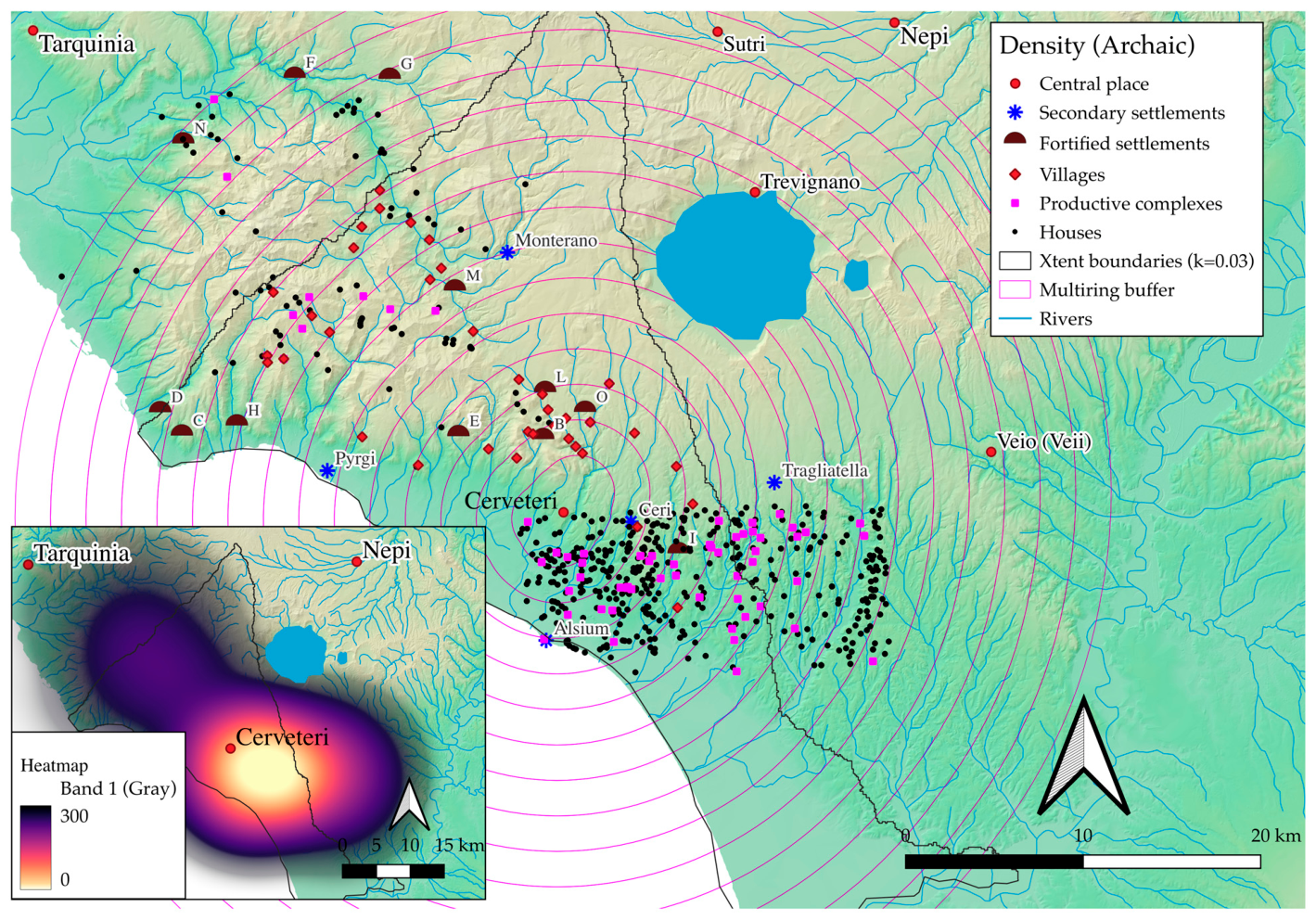
| Cerveteri | Orientalizing | 12,680 |
| Archaic | 14,485 | |
| Classical | 9812 | |
| Tuscania | Orientalizing | 5937 |
| Archaic | 5976 | |
| Classical | 5612 | |
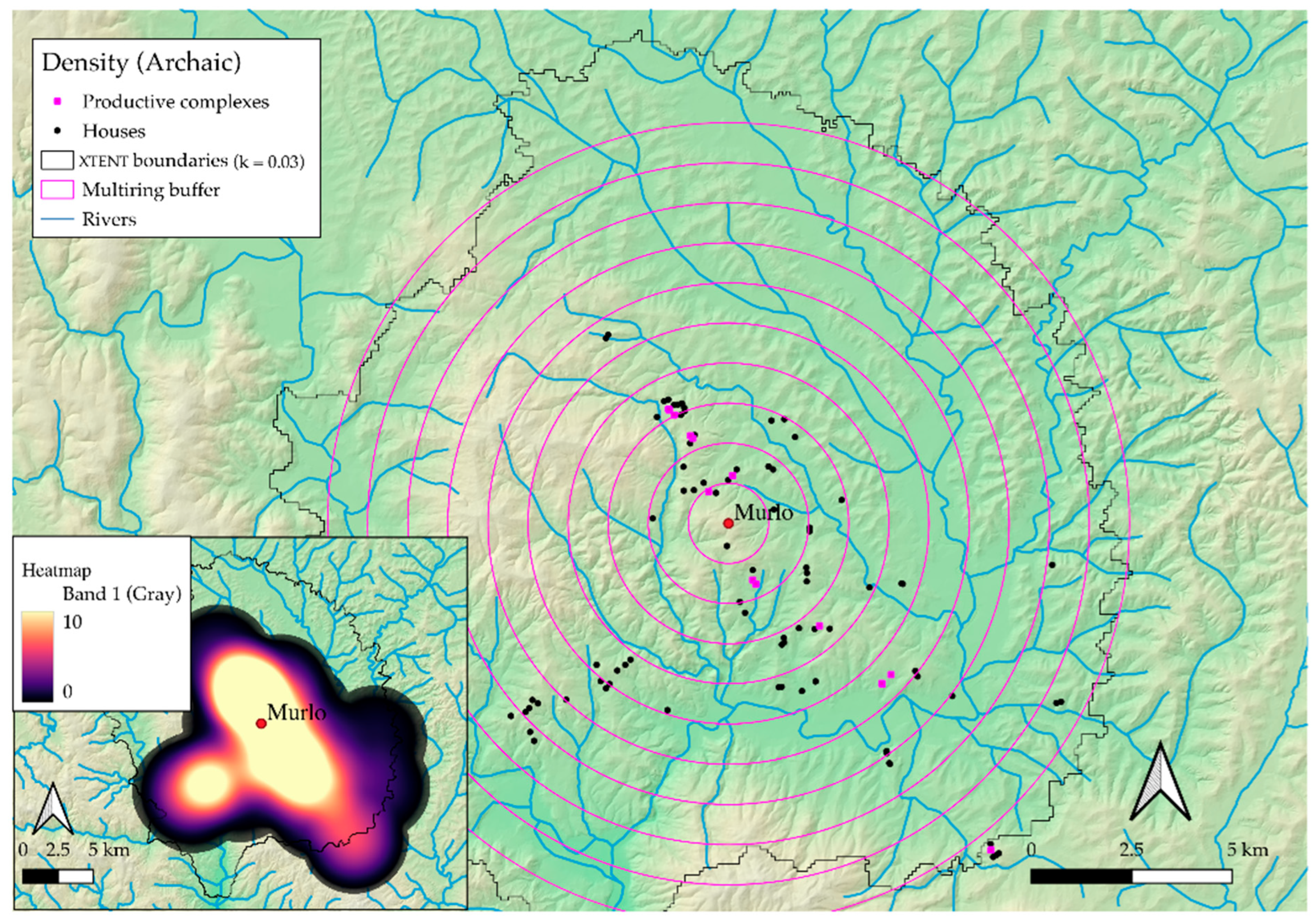
| Murlo | Archaic | 4584 |
| Classical | 3760 |
| Central Place | Sites | OV | AV | Trend (OV → AV) | AV | CV | Trend (AV → CV) |
|---|---|---|---|---|---|---|---|
| Murlo | Houses | – | 87.00 | n/a | 87.00 | 23.00 | −75.00% |
| Productive complexes | – | 13.00 | n/a | 13.00 | 4.00 | −69.00% | |
| Residences | – | 1.00 | n/a | 1.00 | 0.00 | −100.00% | |
| Total | – | 101.00 | n/a | 101.00 | 27.00 | −74.00% | |
| Density (sites/year) | – | 0.60 | n/a | 0.60 | 0.18 | −70.00% | |
| Chiusi | Houses | 16.50 | 47.00 | +185.00% | 47.00 | 8.00 | −83.00% |
| Productive complexes | 1.00 | 7.50 | +650.00% | 7.50 | 0.00 | −100.00% | |
| Villages | 4.00 | 7.00 | +75.00% | 7.00 | 3.00 | −57.00% | |
| Fortified Settlements | 6.00 | 12.00 | +100.00% | 12.00 | 5.00 | −58.00% | |
| Total | 27.50 | 73.50 | +167.00% | 73.50 | 16.00 | −78.00% | |
| Density (sites/year) | 0.27 | 0.49 | +69.00% | 0.49 | 0.10 | −77.00% | |
| Cerveteri | Houses | 47.00 | 492.00 | +947.00% | 492.00 | 134.50 | −72.00% |
| Productive complexes | 8.50 | 57.50 | +576.40% | 57.50 | 32.00 | −44.00% | |
| Villages | 17.00 | 36.50 | +114.70% | 36.50 | 15.50 | −57.50% | |
| Fortified Settlements | 9.00 | 12.00 | +33.33% | 12.00 | 4.00 | −66.66% | |
| Total | 81.50 | 588.00 | +621.00% | 588.00 | 186.00 | −68.00% | |
| Density (sites/year) | 0.80 | 3.92 | +390.00% | 3.92 | 1.24 | −68.30% | |
| Tuscania | Houses | 64.00 | 157.50 | +146.10% | 157.50 | 81.00 | −48.60% |
| Productive complexes | 8.00 | 30.00 | +275.00% | 30.00 | 22.00 | −26.60% | |
| Villages | 6.00 | 17.00 | +183.30% | 17.00 | 11.00 | −35.30% | |
| Residences | 0.50 | 0.50 | 0.00% | 0.50 | 0.33 | −33.30% | |
| Total | 78.50 | 205.00 | +161.14% | 205.00 | 114.00 | −44.40% | |
| Density (sites/year) | 0.78 | 1.37 | +82.60% | 1.37 | 0.76 | −44.50% |
Disclaimer/Publisher’s Note: The statements, opinions and data contained in all publications are solely those of the individual author(s) and contributor(s) and not of MDPI and/or the editor(s). MDPI and/or the editor(s) disclaim responsibility for any injury to people or property resulting from any ideas, methods, instructions or products referred to in the content. |
© 2026 by the author. Licensee MDPI, Basel, Switzerland. This article is an open access article distributed under the terms and conditions of the Creative Commons Attribution (CC BY) license.
Share and Cite
Zeviani, C. Mapping Power: A Landscape Approach to Etruscan Urbanisation and Territorial Control. Land 2026, 15, 699. https://doi.org/10.3390/land15050699
Zeviani C. Mapping Power: A Landscape Approach to Etruscan Urbanisation and Territorial Control. Land. 2026; 15(5):699. https://doi.org/10.3390/land15050699
Chicago/Turabian StyleZeviani, Camilla. 2026. "Mapping Power: A Landscape Approach to Etruscan Urbanisation and Territorial Control" Land 15, no. 5: 699. https://doi.org/10.3390/land15050699
APA StyleZeviani, C. (2026). Mapping Power: A Landscape Approach to Etruscan Urbanisation and Territorial Control. Land, 15(5), 699. https://doi.org/10.3390/land15050699