Article

Dynamic Conflict Footprints and Land-System Transformation in Large-Scale Mining: Evidence from Las Bambas, Peru


Departamento Académico de Ingeniería, Universidad del Pacífico, Lima 15072, Peru
*
Author to whom correspondence should be addressed.
Land 2026, 15(5), 698; https://doi.org/10.3390/land15050698
Submission received: 18 March 2026 / Revised: 17 April 2026 / Accepted: 20 April 2026 / Published: 22 April 2026
(This article belongs to the Section Land Systems and Global Change)

Abstract

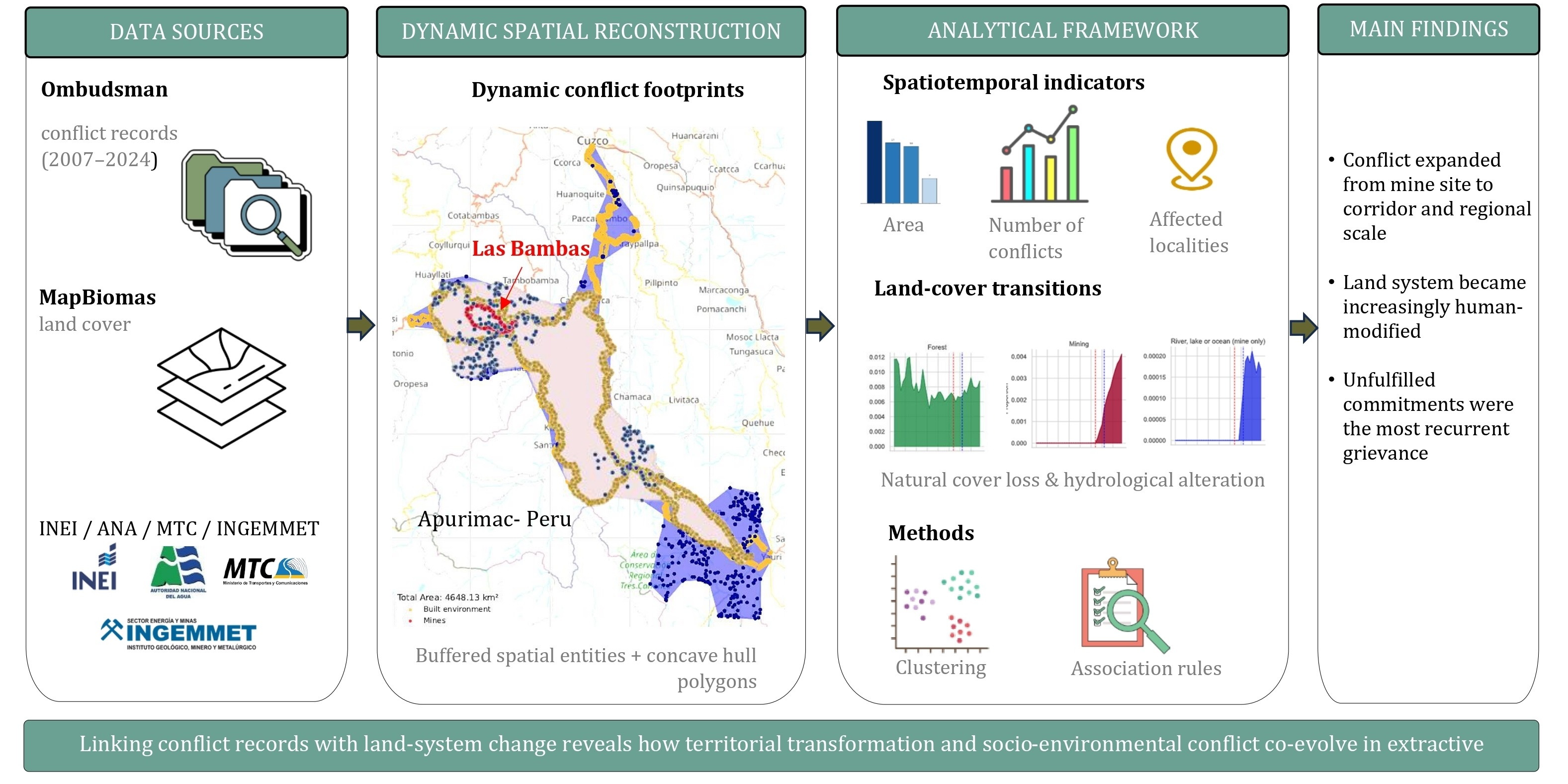
Socio-environmental conflicts in mining regions are often examined through political, economic, or social lenses, while the role of land-system transformation remains less integrated into quantitative analysis. This study examines the co-evolution of socio-environmental conflict and territorial change in Las Bambas (Apurímac, Peru) as a socio-territorial process. Annual conflict records from the Peruvian Ombudsman’s Office (2007–2024) were combined with annual land-cover data from MapBiomas. Yearly conflict influence zones were reconstructed from reported affected communities and geographic features using buffered spatial entities and concave hull polygons. Clustering methods (K-medoids, DBSCAN, and agglomerative hierarchical clustering) and FP-Growth association rule mining were applied to 23 unique conflicts consolidated from the original records and encoded with 10 root causes. The most intense conflict phases were accompanied by measurable landscape transformations, including the emergence of mining-related land cover from 2012 onward, sustained loss of high-Andean natural vegetation, expansion of agricultural mosaics, urban growth along the Apurímac–Cusco corridor, and hydrological alterations in wetlands and headwaters. Three conflict typologies were identified, with unfulfilled company commitments emerging as the most recurrent co-occurring grievance. The dynamic polygon approach offers a replicable framework for linking conflict records with land-system change in extractive regions.

Graphical Abstract

1. Introduction

Mining is central to Peru’s economy, contributing substantially to national exports and public revenues, but it also remains one of the country’s most persistent sources of socio-environmental conflict [1,2,3]. In the Peruvian Andes, disputes around large-scale mining often emerge from a combination of environmental concerns, territorial claims, uneven benefit distribution, and weak participatory governance [3,4,5]. Las Bambas, a large copper mine located in Apurímac, is one of the clearest expressions of this tension. Since the mid-2010s, the project has been associated with recurrent disputes over land access, water-related and pollution concerns, transport impacts, unfulfilled commitments, and the lack of effective consultation, particularly along the Apurímac–Cusco transport corridor [5,6,7].
The territorial footprint of large-scale mining extends well beyond the extraction site itself. Open-pit operations, waste deposits, roads, processing infrastructure, and transport corridors transform land systems across wider socio-ecological regions, affecting water regulation, vegetation cover, agricultural practices, and settlement dynamics [8,9,10]. In high-Andean settings such as Apurímac, these transformations are especially sensitive because puna grasslands, bofedal wetlands, and headwater systems support local livelihoods and ecological stability. As a result, land-cover change is not only a biophysical consequence of mining expansion, but also a socially perceived signal of dispossession, environmental risk, and territorial reconfiguration [6,11].
Previous research has examined mining conflicts through several lenses. A first body of work emphasizes governance failures, weak institutions, unequal negotiation processes, and the political economy of extraction in Peru and Latin America [2,3]. A second strand has explored case-specific socio-environmental impacts of mining projects, including Las Bambas, highlighting problems of community engagement, development asymmetries, and the persistence of conflict despite large economic flows [5,6,12]. A third strand has introduced computational and spatial approaches, including text mining of Ombudsman reports and remote-sensing-based monitoring of mining landscapes [10,13,14]. Together, these studies have advanced understanding of mining conflicts, but they have usually addressed social conflict dynamics and territorial transformation separately.
This separation leaves an important gap. In mining regions such as Las Bambas, conflicts do not unfold within fixed administrative units or around a static mine footprint; they expand through roads, watersheds, nearby settlements, and corridors of logistical influence. At the same time, land-system transformations accumulate over time and may reinforce grievances related to environmental degradation, territorial exclusion, and unfulfilled commitments. Las Bambas is therefore approached here as a socio-territorial process in which conflict and territorial transformation evolve together, rather than as a case explained solely by political disputes or solely by environmental degradation. This perspective is informed by political ecology approaches that understand extractive conflict as a multi-scalar process shaped by power asymmetries, territorial reordering, and uneven distributions of costs, benefits, and participation [15,16,17]. From this standpoint, territorial change is not treated as a simple deterministic cause of conflict, but as a constitutive dimension through which grievances intensify, expand spatially, and persist across conflict phases. Land-system change thus matters not only as a biophysical outcome, but also as a visible expression of dispossession, exclusion, and territorial restructuring in mining regions.
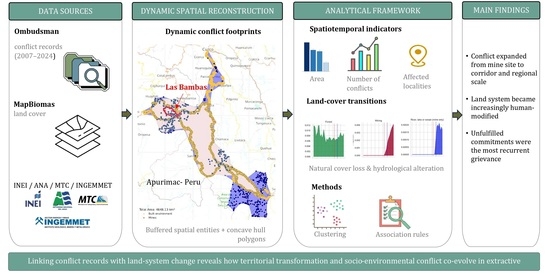
To address this gap, this study develops a data-driven framework to analyze the co-evolution of conflict and territorial transformation in Las Bambas. We combine annual conflict records from the Peruvian Ombudsman’s Office [18], land use and land cover (LULC) information from MapBiomas Perú [19], geospatial data from the National Institute of Statistics and Informatics (INEI) [20], and hydrological data from the National Water Authority (ANA) [21]. Using 896 conflict records together with LULC data, we reconstruct yearly conflict influence zones and examine how conflict dynamics evolved alongside territorial transformation between 2007 and 2024. The framework integrates three components: (i) dynamic polygon reconstruction based on affected communities and reported geographic features; (ii) clustering and association rule mining to identify conflict typologies and recurring combinations of root causes; and (iii) annual LULC analysis to quantify how mining-related territorial change unfolded across conflict phases.
This article makes three main contributions. First, it provides a spatially explicit and temporally dynamic reconstruction of Las Bambas conflict influence zones, moving beyond static administrative or concession-based approaches. Second, it links conflict typologies and co-occurring grievances to measurable changes in land systems, thereby bridging qualitative conflict narratives with quantitative environmental indicators. Third, it offers a replicable framework for monitoring conflict–environment interactions in extractive regions, with implications for early warning, environmental governance, and conflict prevention.

2. Materials and Methods

This section describes the study area, data sources, conflict data extraction and coding procedures, the reconstruction of yearly conflict influence zones, the integration of land use and land cover (LULC) data, and the analytical methods used to identify spatiotemporal patterns and conflict typologies in Las Bambas.

2.1. Study Area

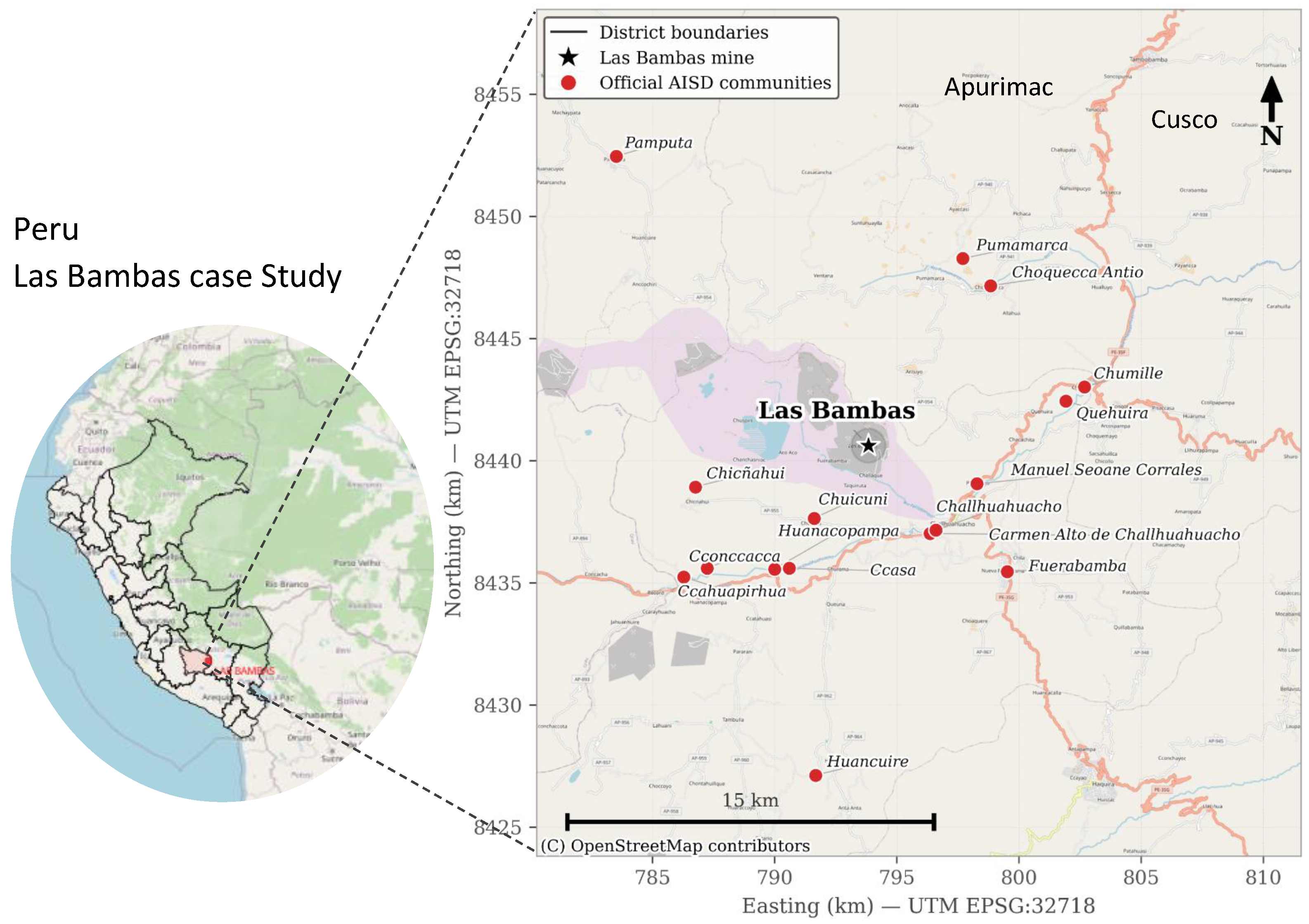
Las Bambas is a large copper mining operation located in the provinces of Cotabambas and Grau, Apurímac, Peru, approximately 75 km southwest of Cusco (Figure 1). The operation lies between 3800 and 4600 m above sea level in the Central Andean Puna ecoregion [22]. Official company information indicates that Las Bambas is one of the major copper operations in Peru, with expected production of 280,000–320,000 tonnes in 2024 and an annual average workforce of 8850 employees and contractors during 2016–2022 [23].
The analytical setting of this study comprises the mine area and the broader territorial context in which conflict relations unfolded during 2007–2024, including nearby communities and the Apurímac–Cusco transport corridor. This broader framing reflects the operational geography of Las Bambas, which relies on a bimodal concentrate transport system consisting of 450 km by truck to the Pillones transfer station and 285 km by rail to the port of Matarani [25].
After Las Bambas began operations, the broader regional context also evolved. According to official INEI statistics, Apurímac’s gross domestic product (GDP) at constant 2007 prices increased from 2.63 billion soles in 2015 to 6.29 billion in 2022, while GDP per capita rose from 6240 soles in 2015 to 15,012 in 2016, reached 18,173 in 2017, and stood at 14,646 soles in 2022 [26]. Official poverty statistics also placed Apurímac among the Peruvian departments with poverty levels in the 20–30% range in 2022 [27]. These figures are included only as regional context and are not interpreted here as evidence of a direct causal relationship between mining expansion and social outcomes.
The region is characterized by high-altitude puna grasslands, bofedal wetlands, and Polylepis woodlands, which support local biodiversity and provide key ecological functions. It is also inhabited by Quechua-speaking communities whose livelihoods depend largely on agriculture and livestock. Because conflict impacts extend beyond the extraction site, the study also considers the Apurímac–Cusco transport corridor, where recurrent disputes have emerged over environmental impacts, mobility, land access, and consultation processes [5].

2.2. Data Sources and Workflow

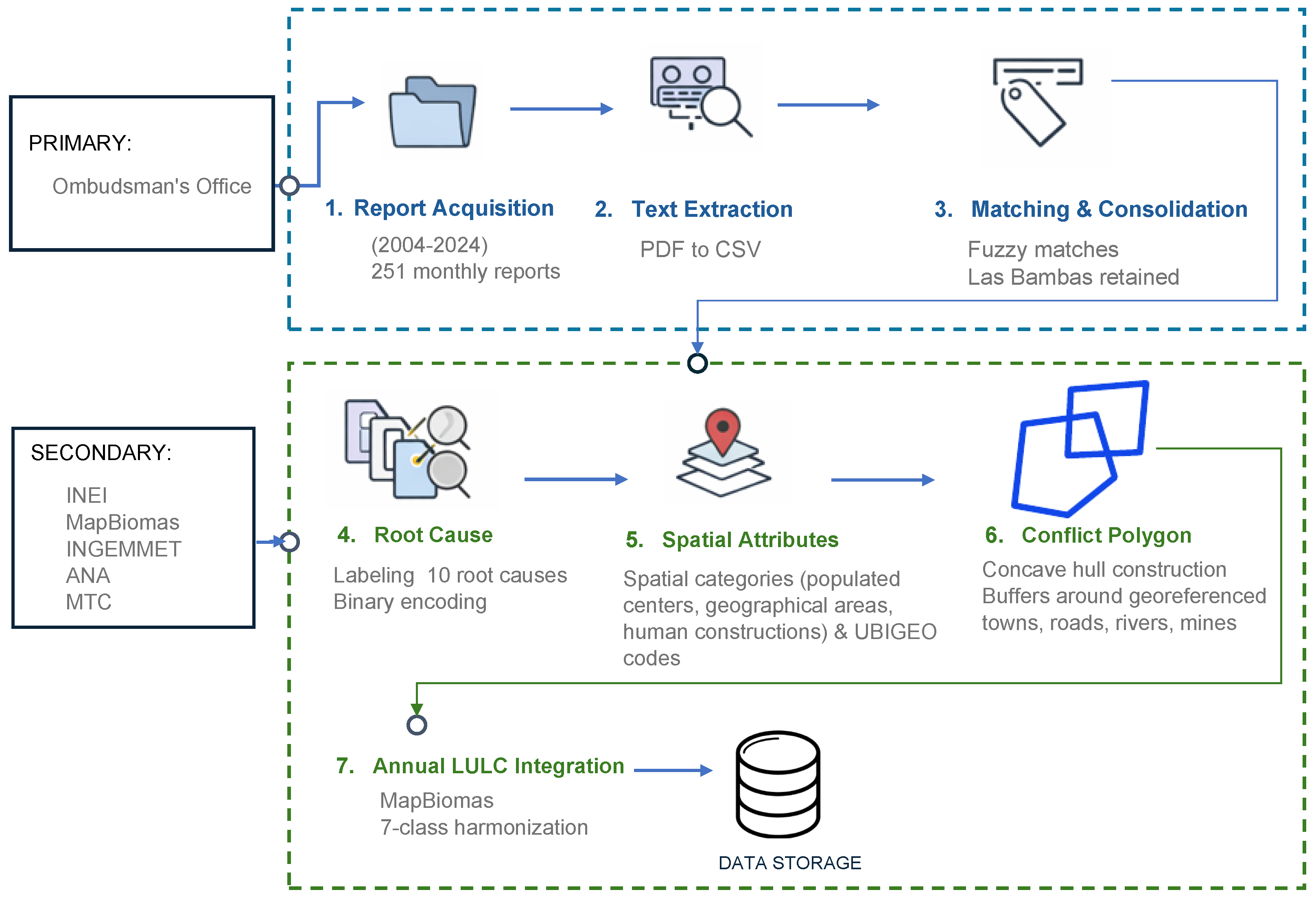
The methodology comprised seven stages for extracting, consolidating, and spatializing conflict records, and for integrating them with annual land use and land cover (LULC) data (Figure 2). Three main data sources were used: (i) monthly social conflict reports issued by the Peruvian Ombudsman’s Office [18]; (ii) spatial reference layers from the National Institute of Statistics and Informatics (INEI) [20], the National Water Authority (ANA) [21], the Geological, Mining and Metallurgical Institute (INGEMMET) [28], and the Ministry of Transport and Communications (MTC) [29]; and (iii) annual land use and land cover (LULC) data from MapBiomas Perú [19]. Together, these sources enabled the construction of a spatiotemporal analytical database linking conflict dynamics to territorial transformation.
Stage 1. Report acquisition. A total of 251 monthly social conflict reports published between April 2004 and December 2024 were collected from the Ombudsman’s Office database [18]. The full corpus was used for report extraction, conflict consolidation, and conflict tracking. However, the spatial reconstruction of yearly conflict influence zones was limited to 2007–2024, since 2007 is the first year in which Las Bambas-related reports contain sufficient geographic references for polygon construction.
Stage 2. Text extraction and structuring. Report text was extracted and structured using Python 3.12, including the PyPDF2 and pdfminer.six libraries, and converted into CSV format. This process preserved case descriptions, conflict status, temporal references, and other relevant attributes in a structured format suitable for subsequent coding and filtering.
Stage 3. Conflict matching, consolidation, and Las Bambas filtering. Because the Ombudsman reports do not provide stable unique identifiers for tracking the same conflict through time, conflict trajectories were reconstructed through fuzzy matching applied to the “Case” field. Pairwise textual similarity was computed using the RapidFuzz library [30], and entries with similarity scores of at least 90% were grouped as the same conflict. These groupings were subsequently verified manually to reduce false matches. The resulting records were then filtered using keywords related to the mine, the operating company, and nearby communities in order to retain only Las Bambas-related conflicts.
Stage 4. Root-cause coding. The retained records were coded according to 10 binary root causes, grouped into four broader dimensions:
1.
Environmental
(a)
Pollution and Environmental Damage: complaints regarding actual, alleged, or anticipated pollution caused by mining activities, including impacts on water sources, spills, soil degradation, air pollution, and noise.
(b)
Material Transport Issues: complaints related to the transport of minerals or operational materials through community territories, typically via pipelines or trucks, often without adequate consultation.
2.
Social
(a)
Displacement and Relocation of Communities: complaints arising from displacement or resettlement associated with mining project implementation.
(b)
Illegal/Informal Mining: conflicts of interest between informal miners and mining companies over territorial exploitation.
(c)
Community–Mine Disputes: disputes over access to, control of, or use of water, land, or protected areas.
(d)
Resource Competition Between Localities: competition between localities over land or water resources in mining-affected areas.
3.
Economic
(a)
Unfulfilled Company Commitments: breaches of formal or informal commitments concerning goods, services, infrastructure, or employment.
(b)
Poor Public Works Execution: deficient implementation of public works financed through mining-related revenues.
4.
Political-Legal
(a)
Decisions Without Community Consent: decisions affecting communities without adequate participation or prior consultation.
(b)
Exclusion from Environmental Impact Assessment (EIA) Area: exclusion of localities from the direct or indirect area of influence defined in the Environmental Impact Assessment.
These categories are conceptually related to the diagnostic framework proposed by [6], but differ in analytical emphasis. Whereas [6] classifies conflicts primarily by type, this study focuses on root causes. For example, water is treated there as a conflict type, whereas here water access, contamination, and transport-related impacts are represented as distinct causal mechanisms.
Stage 5. Spatial attribute integration. Spatial reference layers from INEI, ANA, INGEMMET and MTC were integrated to georeference the territorial elements mentioned in the Ombudsman reports, including populated centers, roads, rivers, bridges, and mining facilities. The extracted elements were standardized and organized into spatial reference categories to support the reconstruction of yearly conflict influence zones.
Stage 6. Conflict polygon construction. Annual conflict polygons were generated for the period 2007–2024 by georeferencing the spatial elements identified in the reports and applying feature-specific buffer distances: 500 m for roads and mining facilities, 300 m for rivers and hydroelectric plants, and 20 m for bridges. Population centers were assigned circular buffers scaled according to their demographic characteristics. The buffered features were then merged using the concave hull algorithm implemented in the Shapely library. Different ratio values were used according to conflict phase in order to preserve both compact and corridor-like configurations (Table 1); lower values produced more detailed geometries, which were especially useful for elongated spatial patterns such as roads and river corridors. Ratio values were selected through iterative visual calibration to obtain yearly conflict footprints that adequately covered the reported nearby populated centers. Additional details on the ratio values used for each conflict phase, together with an illustrative sensitivity comparison under alternative parameter settings, are provided in the Appendix A.1, Figure A1.
The resulting polygons represent the yearly socio-territorial footprint of conflict across populated areas, infrastructure corridors, and watersheds. Spatial overlaps with unrelated mining projects were removed to ensure attribution specifically to Las Bambas.
Stage 7. Annual land use and land cover integration. Finally, annual land use and land cover (LULC) data from MapBiomas Perú [19] were integrated for the period 2007–2024 using seven analytical categories: Forest Formation, Natural Non-Forest Formation, Agricultural Area, Other Area Without Vegetation, Water Body, Urban Infrastructure, and Mining. During preprocessing, the original MapBiomas classes were first recoded into eight macroclasses, including a separate Not observed class retained for technical purposes. This class was used to identify pixels without a valid land-cover assignment, but it was excluded from land-cover interpretation and from the final analytical legends. The preprocessing macroclasses and the original MapBiomas classes grouped into each one are reported in the Appendix A.2, Table A1. This stage enabled the analysis of land-cover composition and yearly transitions within the reconstructed conflict influence zones, allowing the assessment of how territorial transformation evolved alongside conflict dynamics.
For the descriptive hydrological comparison, the Water Body category was further grouped according to its location relative to the mine area. In the figures, these groupings are labeled as Water outside mine area and Water inside mine area. This distinction is used only for descriptive comparison within the reconstructed conflict polygons and should not be interpreted as direct evidence that all observed water changes were caused by mining activity.
Final analytical dataset. The resulting database comprised 896 Las Bambas-related records with temporal, spatial, and causal attributes linked to yearly conflict polygons and annual land use and land cover information.

2.3. Units of Analysis

This study uses two related but distinct analytical units, corresponding to different components of the methodology.
The first unit is the record-level unit. It consists of the 896 coded Las Bambas-related records extracted from the Ombudsman’s monthly reports. These records preserve the original temporal resolution of the source material and constitute the spatiotemporal basis for reconstructing yearly conflict influence zones, computing annual indicators, and examining land-cover composition and transitions within those polygons.
The second unit is the conflict-level unit. The 896 records were consolidated into 23 unique conflicts through fuzzy matching and manual verification, as described in Stage 3. Each of these 23 conflicts was then represented as a 10-variable binary vector of root causes, indicating the presence or absence of the conflict drivers identified in the reports. This unit was used for clustering and association rule mining, since these analyses aimed to identify recurrent conflict typologies and co-occurring grievance structures at the level of underlying conflicts rather than repeated monthly mentions of the same case.
Using both units avoids conflating two different analytical purposes. The record-level unit preserves temporal repetition and reporting continuity, which are necessary for annual spatial reconstruction and land-cover analysis. The conflict-level unit reduces duplication from repeated reporting of the same case over time and provides a more appropriate basis for exploratory pattern detection across distinct conflicts.
Accordingly, yearly spatial indicators and land-cover analyses were derived from the 896 coded records aggregated into annual polygons, whereas clustering and association rule mining were performed on the 23 consolidated conflicts.

2.4. Analytical Methods

2.4.1. Spatiotemporal Indicators

To characterize the temporal evolution and territorial reach of conflict, we analyzed three yearly indicators: (i) total conflict influence area (km2), calculated from the reconstructed yearly polygons; (ii) number of active conflicts; and (iii) number of affected localities. Conflict polygon areas were computed in a projected coordinate system and converted to square kilometers. Together, these indicators capture changes not only in the frequency of conflict, but also in its territorial extent and social reach over time.

2.4.2. Exploratory Clustering Analysis

Exploratory clustering analysis was conducted on the 23 consolidated Las Bambas conflicts. Each conflict was represented as a 10-variable binary vector of root causes, indicating the presence or absence of the conflict drivers identified in the coded reports. Given the limited number of distinct conflicts, clustering was used here as an exploratory device to identify broad conflict typologies rather than as a basis for confirmatory inference.
Because the dataset consists of binary presence–absence indicators, pairwise dissimilarity between conflicts was computed using Jaccard distance. Three complementary algorithms were applied: (i) K-medoids, (ii) agglomerative hierarchical clustering, and (iii) DBSCAN.
K-medoids clustering. K-medoids [31] was used as the main partitioning method because it is more appropriate than centroid-based approaches for binary dissimilarity data. The number of clusters was explored for k = 2 to k = 7 using the total within-cluster cost derived from the Jaccard distance matrix. A three-cluster solution was retained as the most interpretable and analytically useful compromise.
Hierarchical clustering. Agglomerative hierarchical clustering was applied using Jaccard distance and average linkage. Dendrogram inspection provided an independent assessment of the grouping structure and supported the same three-group partition identified by K-medoids.
DBSCAN clustering. DBSCAN [32] was implemented using Jaccard distance to evaluate whether the same broad structure could be recovered while allowing for the identification of peripheral or noise cases. Parameters were selected through inspection of the k-distance curve and sensitivity testing, with the final specification set to ε = 0.45 and min_samples = 3.
Cluster validation and interpretation. The number of clusters for the partition-based methods was set to k = 3 , based on three complementary criteria: (a) inspection of the K-medoids total-cost elbow plot, which showed diminishing improvement beyond three groups; (b) inspection of the hierarchical dendrogram, which also suggested a three-group structure; and (c) agreement across clustering solutions. Cluster robustness was evaluated through pairwise comparison of the final clustering outputs using the Adjusted Rand Index (ARI) [33] and Normalized Mutual Information (NMI) [34]. Because DBSCAN can assign some observations to noise, agreement involving DBSCAN was computed both for the full sample and for the subset of non-noise observations. Final cluster assignments were then linked back to the yearly record series to examine their temporal frequency and spatial distribution across conflict phases.

2.4.3. Association Rule Mining

To identify recurrent co-occurrence patterns among conflict causes, we applied the FP-Growth algorithm [35] to the binary-encoded dataset of 23 consolidated Las Bambas conflicts, represented by the same 10 root causes used in the clustering analysis. Rules were generated using minimum thresholds of support 0.10 , confidence 0.60 , and lift 1.20 .
To improve interpretability and reduce redundancy, rules were ranked by lift and duplicate rules sharing the same total itemset were removed, retaining only one representative antecedent–consequent formulation per itemset. The final rule set therefore emphasizes the most informative and non-redundant co-occurrence patterns among conflict grievances.

3. Results

This section presents the empirical results of the integrated framework applied to the Las Bambas case. The findings are organized into five components: (i) the spatiotemporal expansion of yearly conflict influence zones; (ii) land-system transformation across major conflict phases; (iii) annual land-cover transition dynamics within the evolving conflict influence area; (iv) conflict typologies identified through clustering; and (v) co-occurrence patterns among conflict causes identified through association rule mining.

3.1. Spatiotemporal Expansion of Conflict Influence Zones

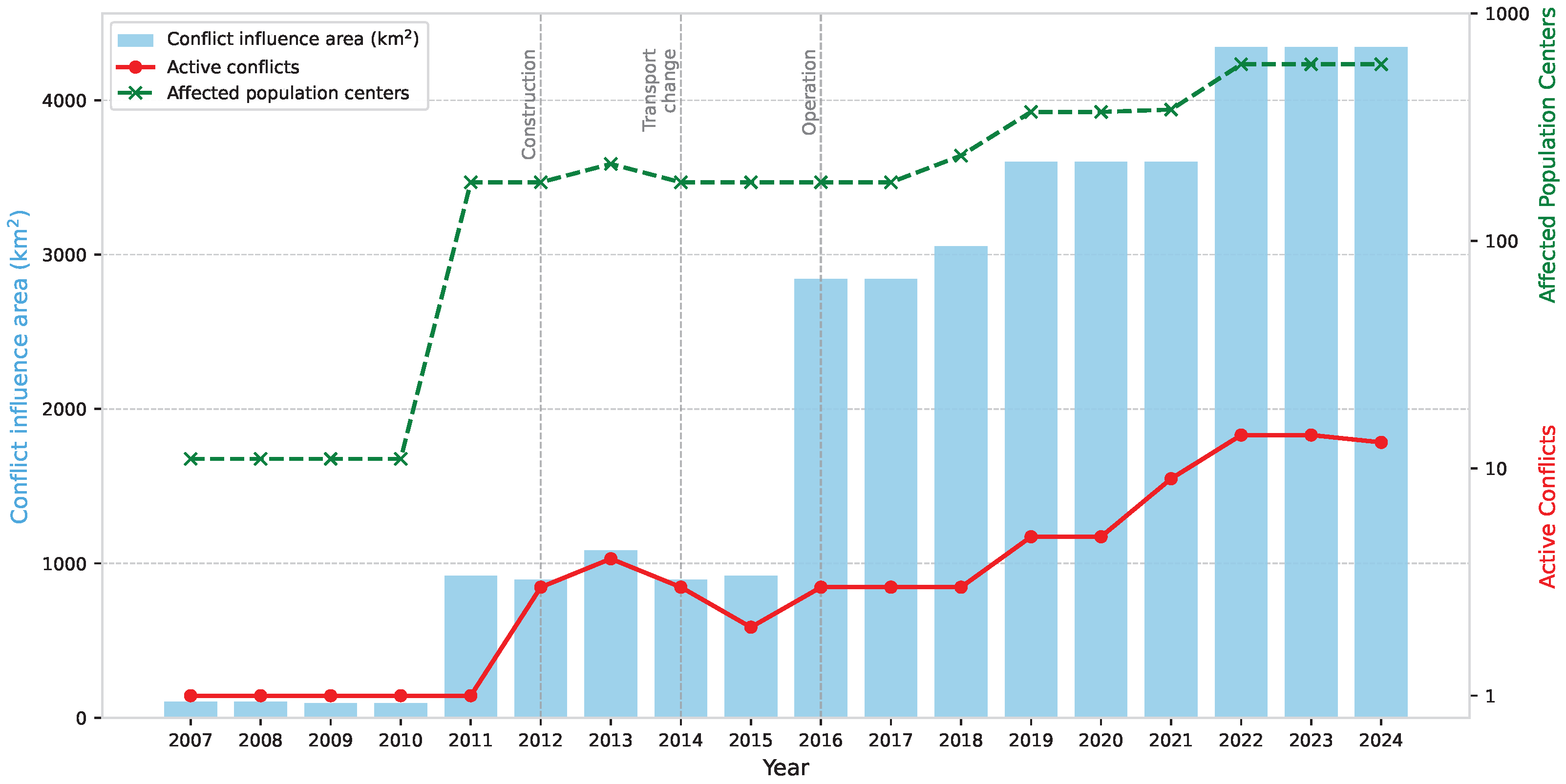
Figure 3 shows the temporal evolution of the yearly conflict influence area reconstructed for Las Bambas together with two complementary social indicators: the number of active conflicts and the number of affected localities. The figure captures the joint expansion of the territorial footprint of conflict and its social reach over the 2007–2024 period.
Over the study period, the reconstructed conflict influence area expanded from 102.09 to 4344.74 km2, while the number of active conflicts increased from 1 to 14 and the number of affected localities rose from 11 to 598. The largest territorial expansion occurred during the corridor-related conflict phase, particularly between 2014 and 2018, when the conflict influence area extended markedly along the Apurímac–Cusco transport route. This period also coincided with a visible increase in the number of active conflicts and affected localities.
Taken together, these indicators show that conflict in Las Bambas evolved not only in frequency, but also in territorial reach, progressively extending from the mine site to a wider regional footprint.

3.2. Land-System Transformation Across Conflict Phases

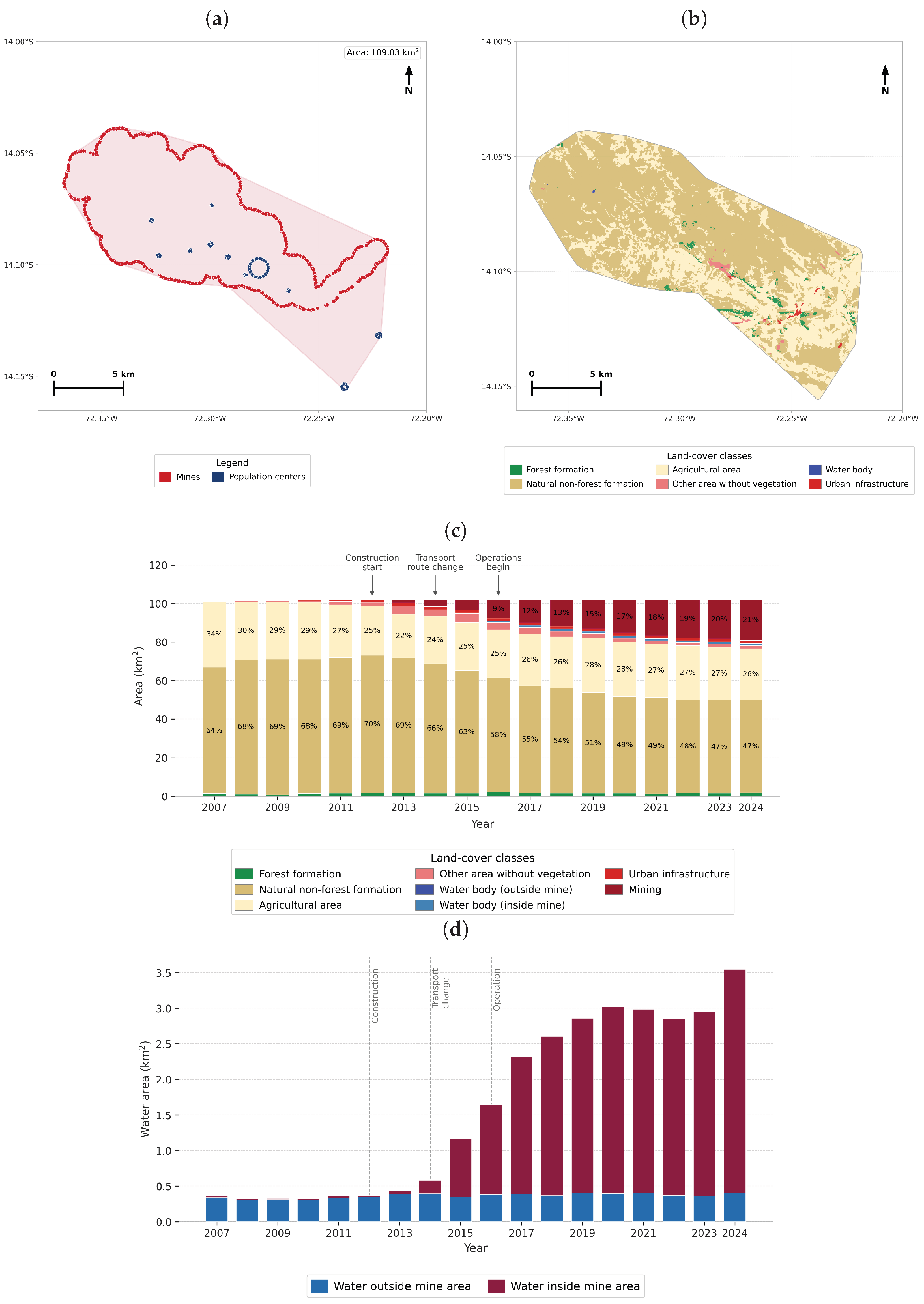
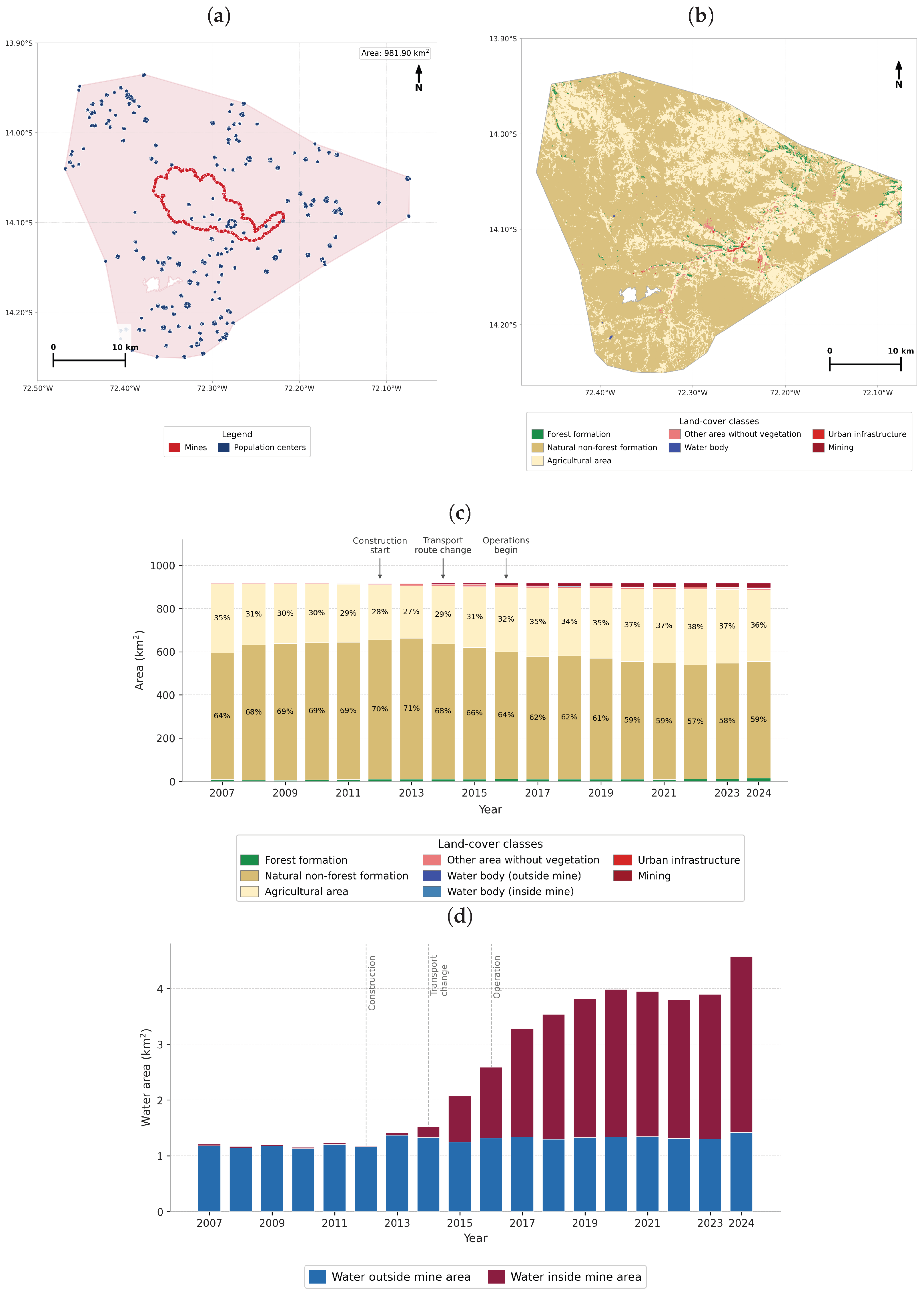
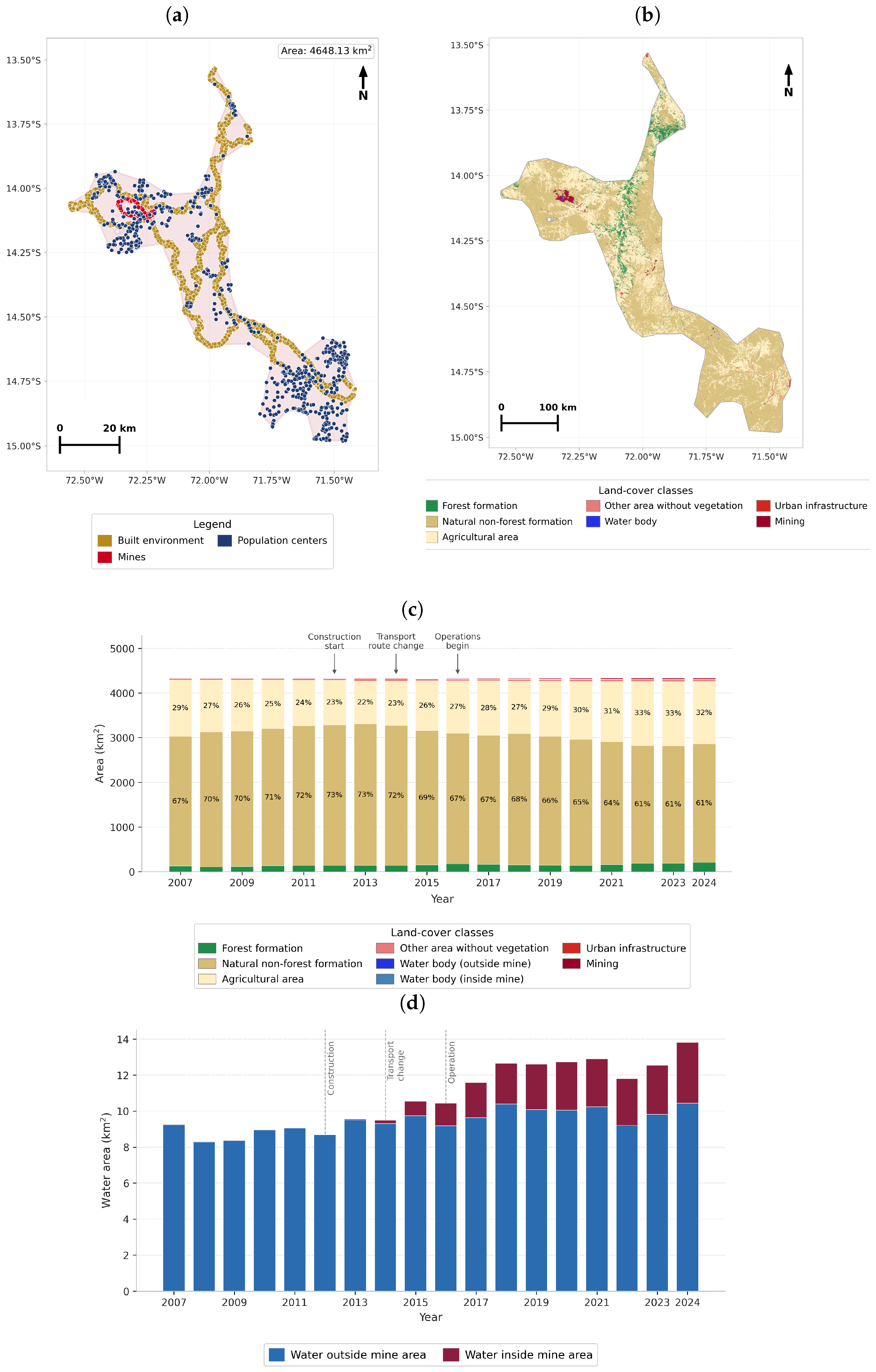
To examine how territorial transformation accompanied the expansion of conflict, five representative years were selected: 2007, 2011, 2013, 2018, and 2024. One year was chosen to represent each major conflict phase, thereby enabling a phase-based comparison of territorial transformation over time. These years capture the main stages of the conflict trajectory: the initial localized stage, the multi-focal expansion stage, the onset of corridor formation, the corridor consolidation stage, and the later regional expansion stage. Each year is represented through four complementary panels: (a) the reconstructed conflict influence polygon; (b) the land-cover map clipped to that polygon; (c) the temporal evolution of land-cover composition within the polygon from 2007 to 2024; and (d) the temporal evolution of water surfaces within the same polygon. Together, these phase-based views show how the conflict evolved from a localized mining setting to a corridor-based and later territorially expanded configuration, while the land system within the affected footprint became increasingly modified by human activity.
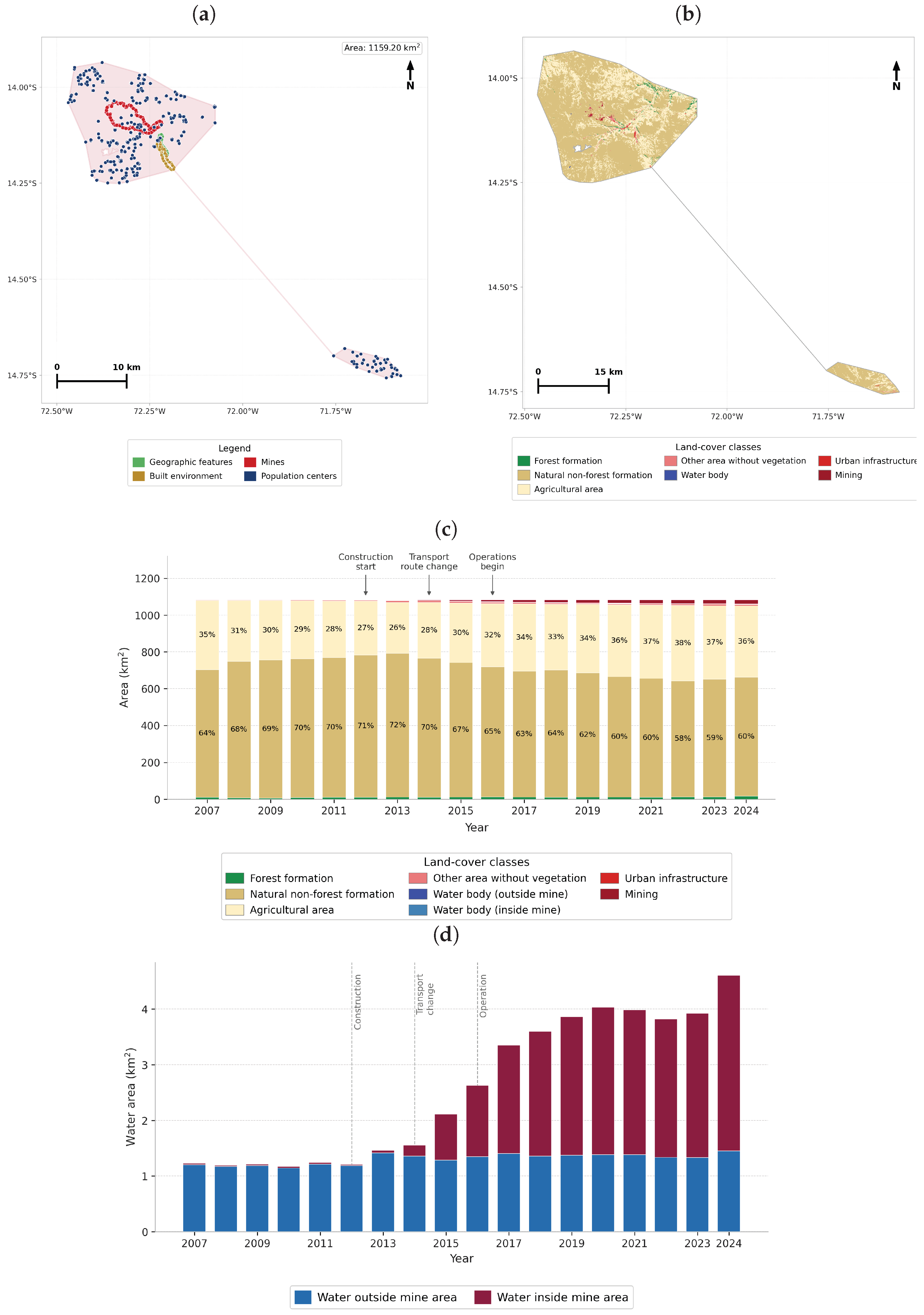
Phase I—Initial Mining Expansion (2007–2010). Conflicts remained concentrated near Challhuahuacho and Fuerabamba, associated with early exploration activities and resettlement processes. Figure 4 shows the 2007 polygon (102.09 km2), dominated by natural non-forest formations and limited built-up infrastructure. Between 2007 and 2012, agricultural land gradually declined as natural areas expanded. Starting in 2013, the year following the beginning of mine construction, this trend reversed: urban infrastructure expanded rapidly until 2016, while agricultural and mining areas continued to increase steadily. Natural non-forest formations declined continuously through 2024. Water bodies inside the mine area increased sharply and, by the end of the period, clearly exceeded those outside the mine area within the 2007 polygon.
Phase II—Multi-focal Expansion (2011–2012). Disputes extended to nearby populated centers, mainly over relocation processes, water access, and unfulfilled social commitments. Figure 5 shows the 2011 polygon (919.49 km2). The temporal trend in this area follows the pattern observed in the 2007 polygon: continuous mining area expansion from 2013, steady agricultural land increase between 2013 and 2022, and persistent decline of natural areas over the same period. By 2024, water bodies inside the mine area represented more than twice the extent of those outside the mine area within this enlarged polygon.
Phase III—Corridor Formation (2013). The announcement of a mineral transport pipeline triggered a linear expansion of conflicts along the projected route toward Espinar, extending the influence area to 1085.12 km2. Figure 6 shows the 2013 polygon, where the land-cover series marks the onset of a more visible increase in mining and infrastructure-related classes within the corridor-shaped footprint.
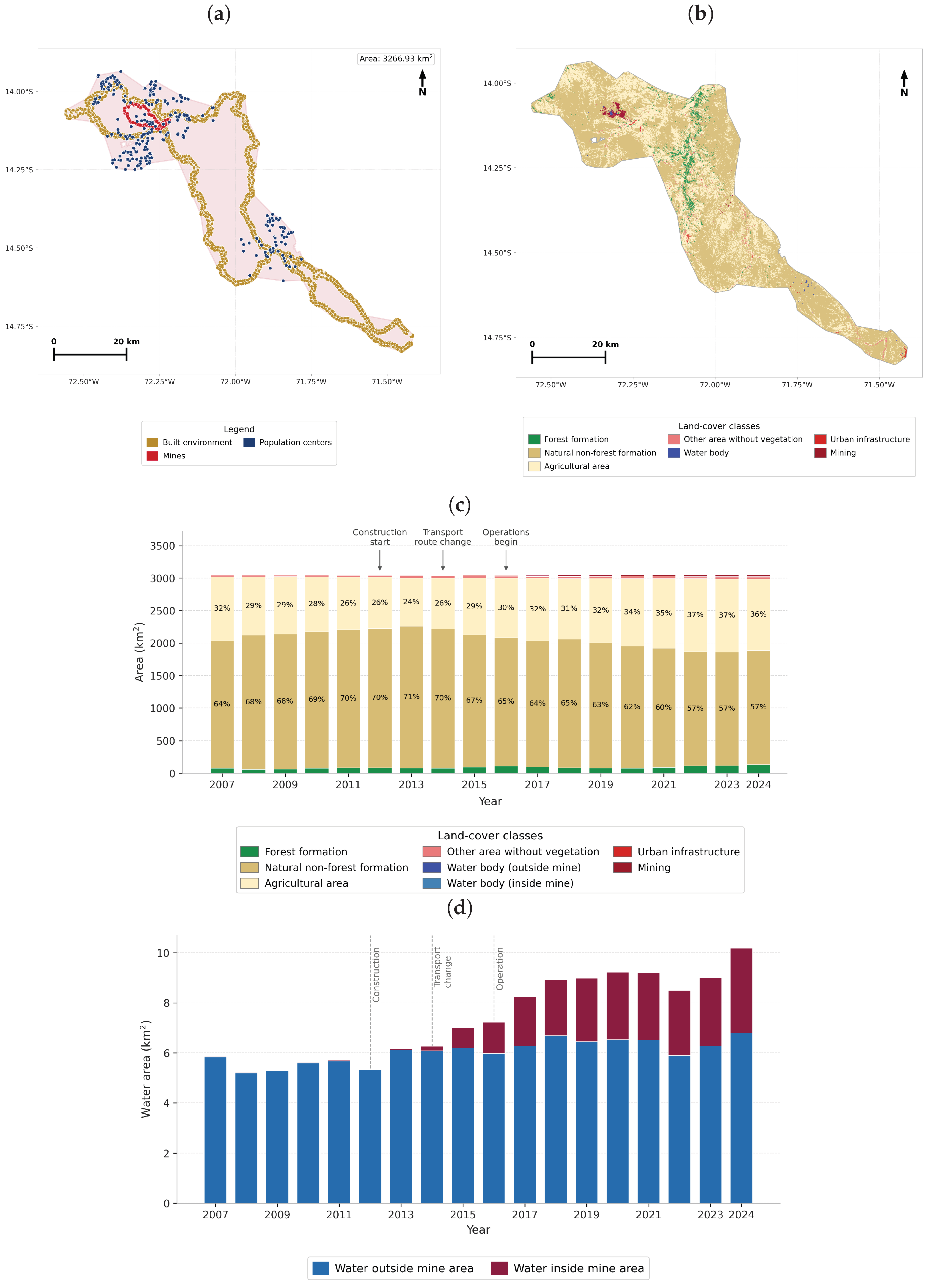
Phase IV—Corridor Consolidation (2014–2018). Conflict intensified along the Apurímac–Cusco corridor due to the unconsulted change in mineral transportation routes and lack of prior agreements with local communities. Figure 7 shows the 2018 polygon (3054.63 km2), by which point the conflict had consolidated as a corridor-based territorial configuration and the land system showed a clearer expansion of built-up, agricultural, and mining-related classes at the expense of natural cover.
Phase V—Regional Expansion (2019–2024). Conflicts expanded across a broader territorial scale, covering 4344.74 km2 and more than 598 populated centers, extending as far as the outskirts of Cusco city. Figure 8 shows the 2024 polygon. Water bodies inside the mine area continued to increase after 2014, remaining a prominent hydrological feature within the reconstructed conflict footprint.
Across the five phases, the territorial trajectory is one of progressive regional expansion and increasing human modification. Early conflict polygons were dominated by natural non-forest formations and agricultural uses, whereas later phases incorporated larger mining surfaces, more visible urban infrastructure, and a growing hydrological footprint associated with mining activities. In this sense, the expansion of conflict was accompanied not only by a widening geography of affected communities, but also by a measurable reconfiguration of the land system within the evolving conflict influence area.
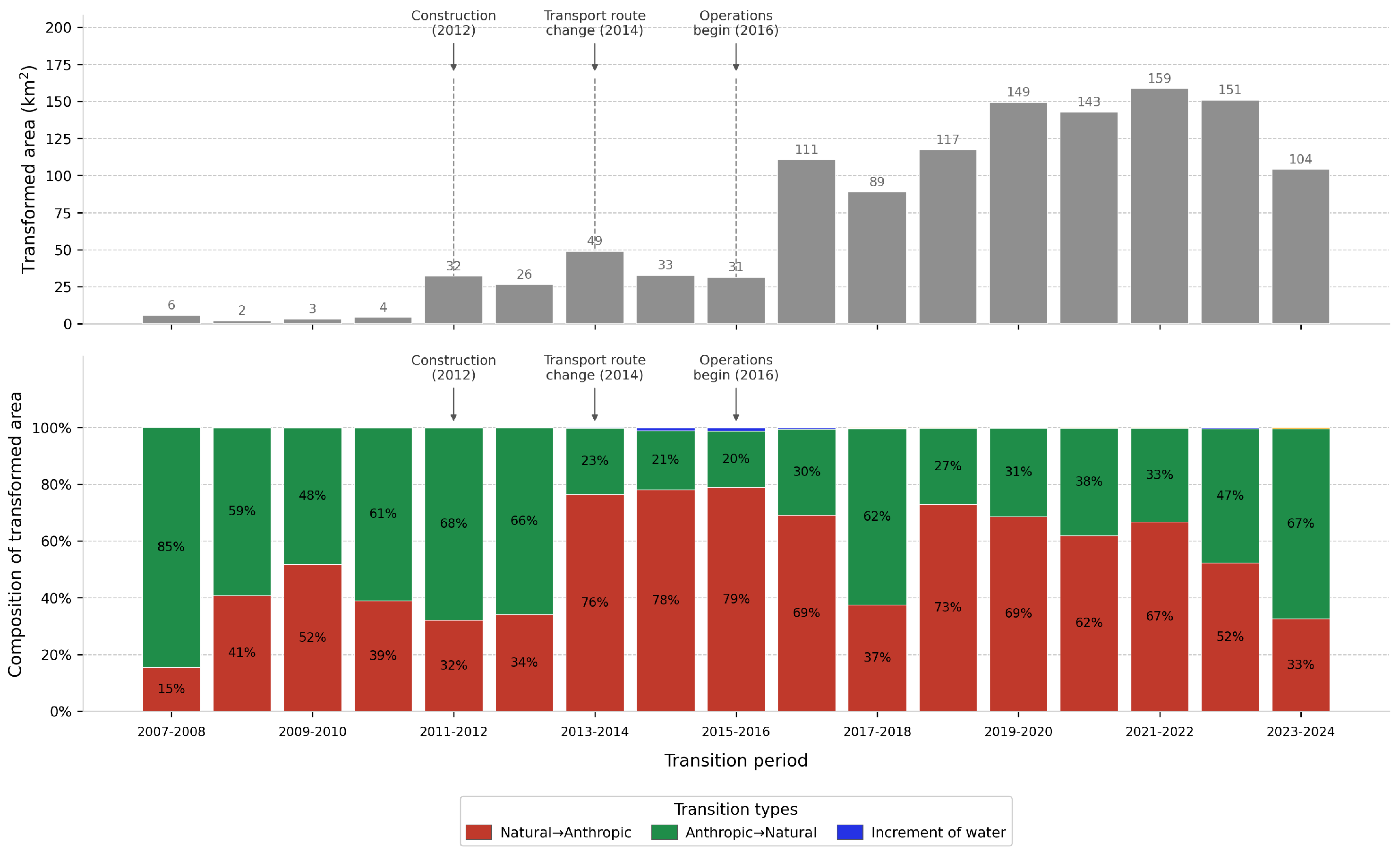
To summarize yearly territorial transformation within the evolving conflict influence area, Figure 9 presents two complementary views: the total transformed area in each transition period and the composition of that transformed area by major transition type. Unlike the phase-based analysis, which examines change within fixed representative polygons, this figure captures transformation as the conflict influence area expanded over time.
The total transformed area increased markedly after 2013, coinciding with the construction phase and the subsequent expansion of the transport corridor. Across the series, natural-to-human-modified conversions became the dominant transition type in most periods, especially from 2013 onward, while human-modified-to-natural transitions remained important but comparatively less prominent after the corridor-related phase. Water-related transitions were comparatively limited in areal terms throughout the series. Overall, the figure shows that territorial change was not continuous at the same intensity every year, but rather episodic and cumulative, with the strongest pulses of transformation occurring after major operational and logistical shifts in the project.

3.3. Conflict Typologies Across Space and Time

The 23 unique Las Bambas conflicts were grouped into three typologies based on the 10 binary-encoded root causes described in Section 2. The resulting clusters show differentiated thematic, spatial, and temporal profiles.

3.3.1. Robustness of the Three-Cluster Solution

The three-cluster solution was supported by a combination of internal inspection and cross-method comparison. The K-medoids total-cost curve showed diminishing reductions in within-cluster dissimilarity beyond k = 3 , while the hierarchical dendrogram also suggested a three-group structure. On that basis, three clusters were retained as the most interpretable and analytically useful partition.
Pairwise agreement between clustering methods is reported in Table 2. The highest agreement was observed between K-medoids and hierarchical clustering (ARI = 0.513; NMI = 0.491), indicating moderate convergence in the core partition structure. Agreement between DBSCAN and the other methods was lower when all observations were retained, reflecting the fact that DBSCAN classified 9 of the 23 conflicts (39.1%) as noise. When comparisons were restricted to the 14 non-noise observations, agreement improved (ARI = 0.401 and 0.471; NMI = 0.487 and 0.477), suggesting that DBSCAN recovered part of the same underlying structure while treating a substantial subset of conflicts as peripheral. Overall, these results support the three-cluster solution as a reasonable and interpretable typology, while also indicating that some Las Bambas conflicts occupy weaker or more transitional positions.

3.3.2. Summary Profile of Conflict Clusters

Table 3 summarizes the main thematic, spatial, and temporal characteristics of the three clusters identified in Las Bambas. Although all three clusters reflect multi-causal conflict configurations, they differ in the relative prominence of specific grievance structures.
The main distinction between Clusters 2 and 3 lies in the role of transport-related grievances. Cluster 2 is clearly structured around corridor-related disputes, with material transport issues acting as its defining feature, whereas Cluster 3 is characterized instead by compensation and community–mine grievances in a more spatially dispersed configuration around the mine area. A detailed prevalence matrix of the 10 coded root causes across the three clusters is provided in Appendix A.3 (Table A2).

3.3.3. Spatial Distribution of Conflict Clusters

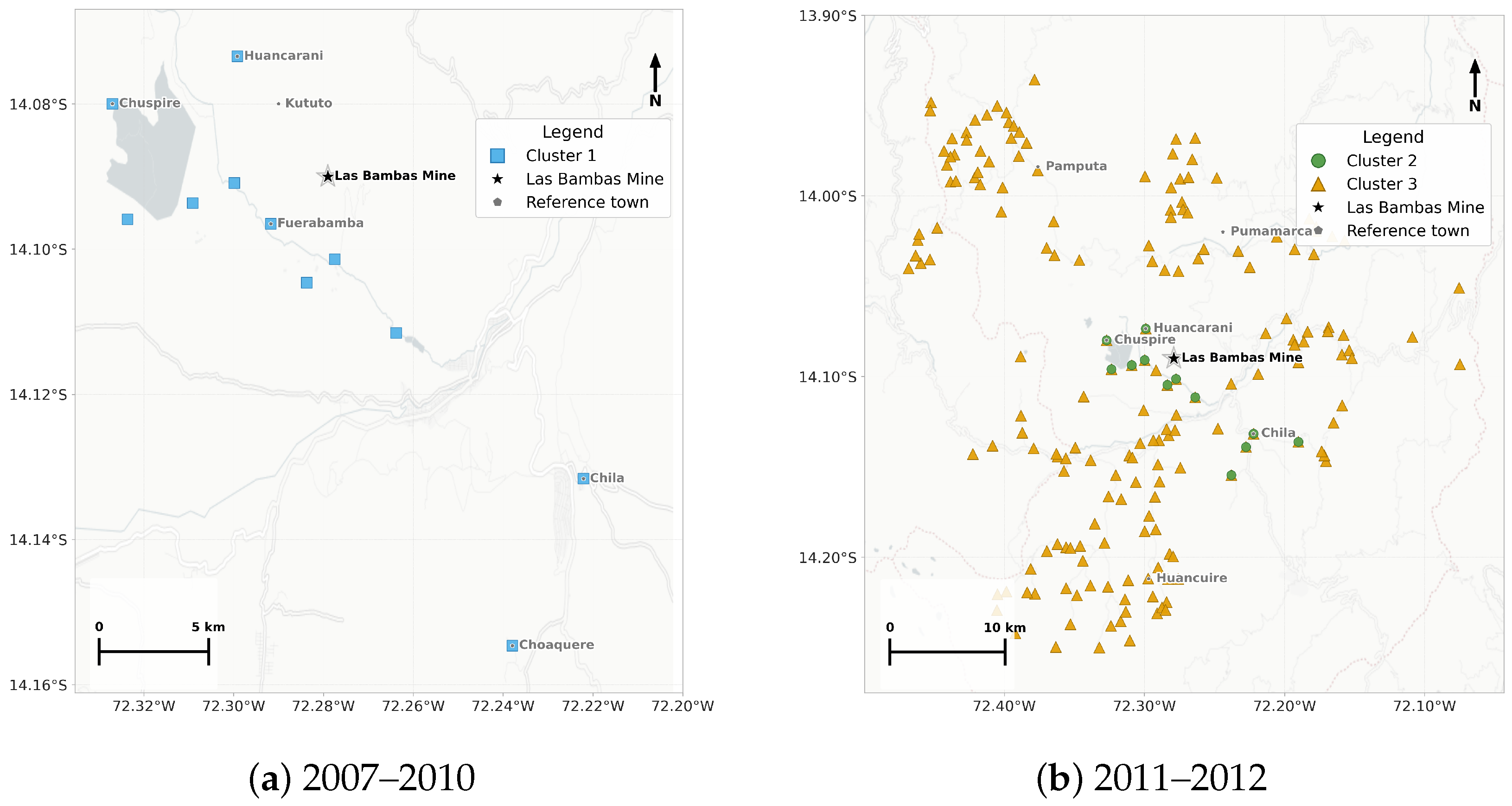
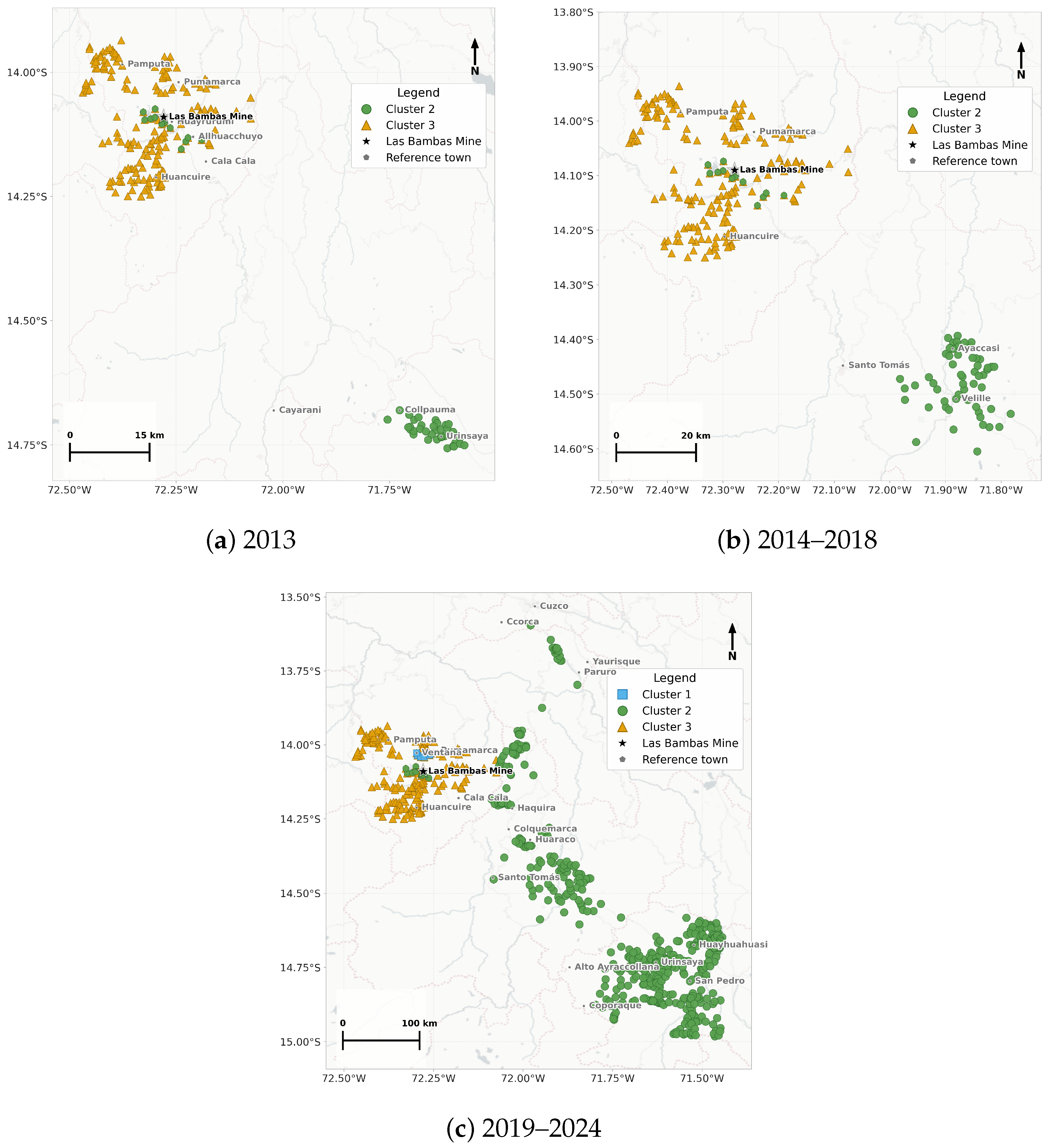
Figure 10 and Figure 11 show the spatial distribution of the three conflict types across successive phases of expansion.
Cluster 1 (sky-blue squares) comprises three conflicts concentrated in the initial and final phases of the series. These cases are primarily associated with grievances over decisions taken without community consent, including disputes related to the Las Bambas mining trust, exploration or expansion projects, and broader claims concerning land restitution and territorial governance.
Cluster 2 (green circles) includes twelve conflicts strongly associated with the mining corridor. These cases are characterized by complaints over pollution linked to mineral transport, compensation demands, and requests for formal recognition of environmental impacts. Several also include grievances related to unfulfilled commitments connected with public infrastructure.
Cluster 3 (yellow triangles) includes eight conflicts in a more spatially dispersed configuration around the mine area. These cases are predominantly compensation- and community-oriented, while also combining recurrent causes such as pollution, exclusion from the Environmental Impact Assessment (EIA) area, decisions without community consent, and displacement processes.

3.3.4. Temporal Evolution of Conflict Clusters

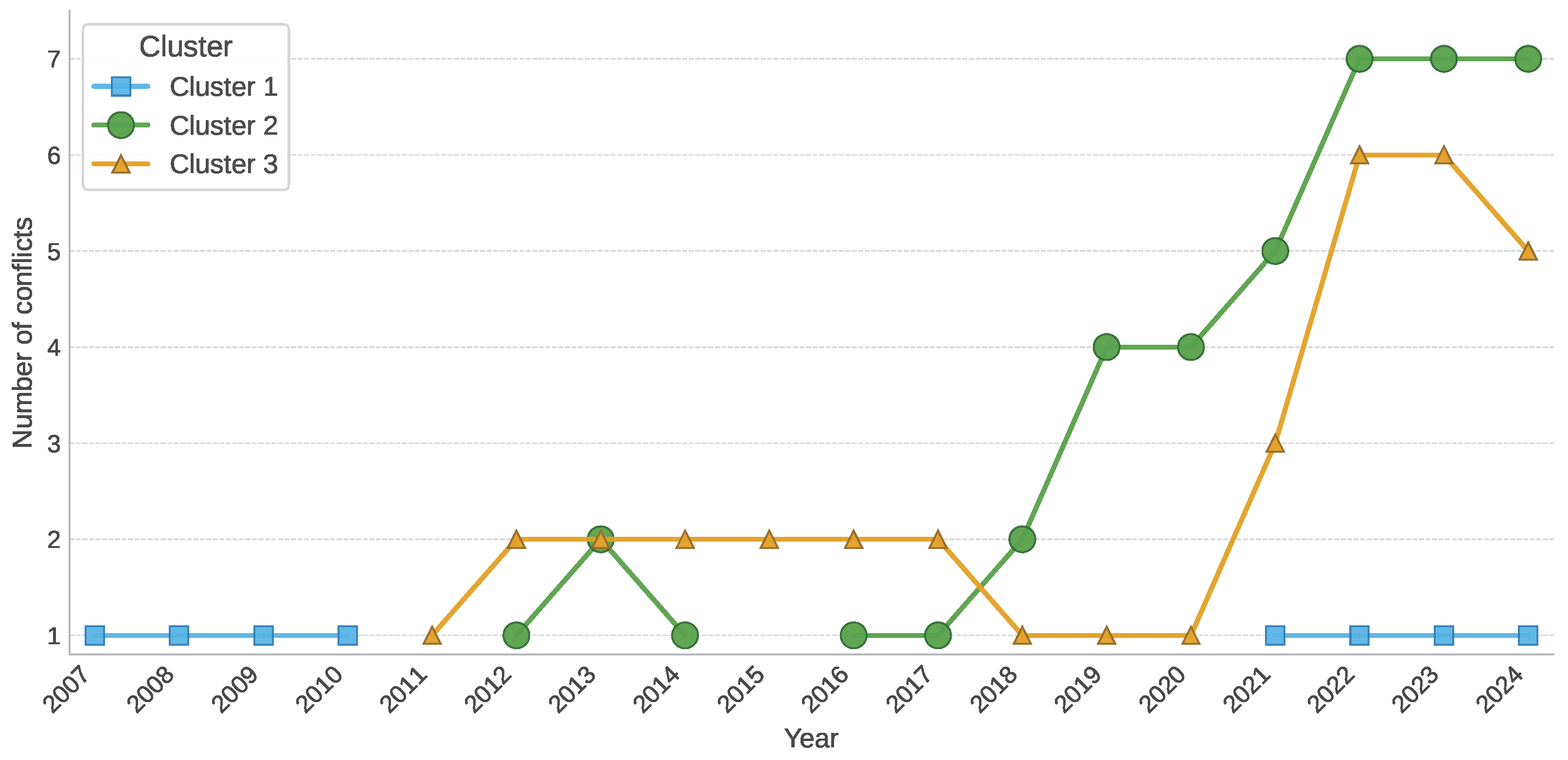
Figure 12 summarizes the yearly frequency of conflicts assigned to each cluster. Cluster 1 dominated the earliest phase (2007–2010) and reappeared after 2021. Cluster 3 first appeared in 2011 and remained present throughout most of the series, with a marked increase in frequency after 2021. Cluster 2 emerged in 2013, coinciding with the corridor formation phase, and became more frequent after 2019.
Together, these temporal patterns show that different conflict types emerged, expanded, coexisted, and reappeared across the study period.

3.3.5. Association Patterns Among Conflict Causes

Association rule mining identified a reduced set of seven non-redundant co-occurrence patterns among conflict causes, showing that grievances rarely occurred in isolation. The main rules retained after thresholding and redundancy reduction are reported in Table 4. Overall, the strongest patterns indicate that environmental, procedural, and logistical complaints tended to reinforce one another across the Las Bambas conflict trajectory.
For readability, Table 4 uses the following abbreviated labels: Pollution = Pollution and Environmental Damage; Transport Issues = Material Transport Issues; Unfulfilled Commitments = Unfulfilled Company Commitments; and No Community Consent = Decisions Without Community Consent.
Compound environmental and governance disputes:
  • Pollution + Transport Issues → No Community Consent + Unfulfilled Commitments
  • Unfulfilled Commitments + No Community Consent → Pollution
  • Transport Issues + No Community Consent → Pollution
These rules indicate that environmental complaints were closely tied to governance-related grievances. In substantive terms, pollution became especially salient when communities also perceived exclusion from decision-making and broken promises.
Infrastructure-related escalation:
  • Poor Public Works Execution → Transport Issues + Unfulfilled Commitments
  • Poor Public Works Execution → Transport Issues
  • Poor Public Works Execution → Unfulfilled Commitments
Infrastructure failures were systematically linked to broader dissatisfaction with both the mining project and state performance. Rather than remaining an isolated administrative complaint, poor public works execution became embedded in wider claims about transport impacts and unmet expectations.
Procedural exclusion reinforcing logistical grievances:
  • Unfulfilled Commitments + No Community Consent → Transport Issues
This rule suggests that when communities perceived both procedural exclusion and broken promises, transport-related grievances became more likely to emerge as part of the same conflict configuration.
Taken together, these rules show that conflict escalation in Las Bambas was shaped by overlapping environmental, procedural, and logistical grievances rather than by isolated single-cause disputes. More broadly, the rule set suggests that territorial conflict intensified when material transformations of the landscape were interpreted through a context of exclusion, weak participation, and unmet commitments.

4. Discussion

The results indicate that socio-environmental conflict in Las Bambas and territorial transformation evolved in parallel within the dynamically reconstructed influence zones. Rather than functioning as a passive background, land-system change appears to have been closely associated with how conflict expanded, intensified, and persisted over time. The decline of natural non-forest formations, the growth of agricultural and urban land, the emergence of mining-related surfaces, and the increasing hydrological footprint associated with mining did not by themselves determine conflict outcomes. However, when interpreted within a context of governance failures, procedural exclusion, and unfulfilled commitments, these material changes appear to have reinforced the basis of community grievances. In this sense, the Las Bambas case can be interpreted as a socio-territorial process in which territorial transformation and institutional shortcomings evolved together. In political ecology terms, these changes are significant not only as environmental outcomes, but also as territorial expressions of unequal governance, contested participation, and differentiated exposure to the costs and benefits of extraction.
This interpretation extends prior work on Las Bambas that has emphasized political-economic asymmetries, unequal participation, and the instability of extractive governance [7,12]. Our contribution is to show that these tensions were not only expressed in political or discursive terms, but were also embedded in visible territorial transformations. As the conflict influence area expanded from the mine site toward the Apurímac–Cusco corridor and later toward a broader regional scale, the affected land system also became more intensively modified by human activity. In particular, the emergence of mining-related land cover from 2012 onward suggests that visible landscape alterations—including pits, waste deposits, access roads, transport infrastructure, and mining-related water bodies—provided spatial markers through which communities could interpret exclusion, environmental risk, and uneven benefit distribution.
The expansion of agricultural mosaics from Phase III onward further illustrates the complexity of territorial change. This pattern may reflect adaptive land-use responses associated with market changes, resettlement dynamics, or compensation-related reallocation processes, but it may also indicate a broader reorganization of productive space under extractive pressure, especially when combined with the spread of urban infrastructure and corridor-related mobility. Thus, the increase in agricultural and built-up land should not be read simply as evidence of development, but as part of a wider territorial restructuring that may intensify competition over land and water resources. This interpretation is consistent with findings from other Andean and Latin American mining contexts [8,9].
Water-related change is particularly important in the later phases. Within the reconstructed polygons, the growth of mining-related water surfaces and the alteration of wetlands and headwater areas are consistent with the prominence of water grievances in reports issued by the Peruvian Ombudsman’s Office and in prior qualitative accounts [6,7]. These patterns do not demonstrate direct ecological causality in every dispute, but they do indicate that hydrological transformation became increasingly visible within the territorial footprint of conflict. In high-Andean environments, where bofedales, puna grasslands, and headwater systems support both livelihoods and ecological regulation, such alterations are likely to carry strong symbolic and practical significance.
The clustering and association-rule results reinforce this interpretation. The Las Bambas trajectory did not consist of a single recurring grievance, but of multiple conflict configurations that emerged, expanded, overlapped, and reappeared across successive territorial phases. At the same time, the association rules show that these configurations were connected rather than independent: environmental complaints repeatedly co-occurred with transport issues, lack of community consent, exclusion from the Environmental Impact Assessment area, and unfulfilled commitments. Across the rule set, broken promises emerged as the most recurrent co-occurring cause. Taken together, these findings suggest that conflict escalation in Las Bambas was shaped less by isolated sectoral disputes than by the accumulation of interacting grievances.
Methodologically, the study contributes a framework that links dynamic conflict geographies with measurable land-system change. Unlike approaches based on static administrative units, fixed buffers, or mine-concession boundaries, the yearly reconstructed polygons capture shifting socio-territorial influence zones derived from the conflict record itself. This makes it possible to interpret environmental indicators in relation to the evolving geography of conflict rather than within a fixed territorial container, thereby helping bridge qualitative conflict narratives and quantitative spatial evidence. From a policy perspective, this approach suggests that land-cover monitoring could be more explicitly incorporated into conflict prevention and environmental governance frameworks. In high-Andean extractive regions, annual changes in vegetation, hydrology, and human-modified surfaces may serve as early territorial signals of mounting tension, particularly when they coincide with procedural disputes and social claims recorded by institutions such as the Defensoría del Pueblo. In contexts like Las Bambas, where conflict operates simultaneously across mine sites, transport corridors, and regional networks of affected communities, integrating social and environmental monitoring could improve both the responsiveness and legitimacy of public intervention.
This study also has limitations. First, clustering and association rule mining were conducted on a limited number of consolidated conflicts ( N = 23 ), corresponding to the full set of unique Las Bambas conflicts identifiable in the Ombudsman records under the matching and consolidation procedure adopted here. The resulting typologies and co-occurrence patterns should therefore be understood as exploratory yet substantively informative rather than as definitive classifications. Future studies could examine their stability and transferability by applying the same approach to other mining cases or to a broader comparative corpus. Second, the delineation of yearly conflict polygons depends on the completeness and spatial specificity of the Ombudsman reports, which may underrepresent less visible disputes, omit relevant territorial references, and affect the resulting spatial reconstruction. Because these polygons were derived from institutional conflict records and were not independently validated with affected communities through participatory procedures, they should be understood as analytical reconstructions rather than as direct representations of community-defined conflict space. Third, although MapBiomas provides a robust and publicly accessible dataset, land-cover classifications remain subject to thematic and spatial uncertainty, particularly in heterogeneous high-Andean landscapes. Finally, the association-rule results indicate recurrent co-occurrence patterns rather than causal direction. Further work could refine the analysis by incorporating higher-frequency satellite time series, additional environmental indicators such as vegetation productivity or water quality, and participatory mapping approaches that better capture locally perceived territorial change.

5. Conclusions

This study examined the co-evolution of socio-environmental conflict and territorial transformation in Las Bambas by combining annually reconstructed conflict influence zones with land-cover data. The results show that conflict and land-system change were closely intertwined over time rather than unfolding as separate processes.
As the conflict influence area expanded from a localized setting near the mine to a corridor-based and later broader territorial configuration, the affected land system became progressively more modified by human activity. The most intense conflict phases were accompanied by visible and measurable territorial changes, including the expansion of mining-related surfaces, the growth of agricultural mosaics and urban infrastructure, and hydrological alterations in wetlands and headwater zones. These transformations did not mechanically produce conflict on their own, but they appear to have acquired greater conflictive significance when interpreted through a context of procedural exclusion, weak participation, transport-related impacts, and unfulfilled commitments.
The clustering and association-rule analyses reinforce this interpretation. Rather than reflecting a single recurring grievance, the Las Bambas trajectory was characterized by multiple conflict types that emerged, expanded, overlapped, and reappeared across successive territorial phases. At the same time, the recurrent co-occurrence of environmental complaints with governance failures and logistical grievances suggests that conflict escalation was shaped by interacting rather than isolated causes. Across these configurations, unfulfilled commitments emerged as the most persistent structural driver.
Methodologically, the dynamic polygon approach offers a replicable framework for linking conflict records with measurable land-system change. By moving beyond static administrative units or concession boundaries, the approach captures the shifting geography of dispute and connects it directly to environmental indicators. In doing so, it helps bridge qualitative conflict analysis and quantitative spatial evidence in extractive regions.
The implications extend beyond the Las Bambas case. Integrating social conflict monitoring with systematic land-cover observation could strengthen early-warning systems, improve environmental oversight, and support more adaptive and territorially informed governance strategies. Future research could refine and extend this framework by improving the spatial precision of conflict delineation, incorporating additional biophysical indicators such as water quality or vegetation productivity, and testing its applicability in other mining regions.

Author Contributions

Conceptualization, S.E. and Á.T.; methodology, S.E., R.C. and Á.T.; software, R.C. and L.S.; validation, S.E., Á.T. and L.S.; formal analysis, R.C. and L.S.; investigation, S.E. and R.C.; resources, S.E.; data curation, R.C. and L.S.; writing—original draft preparation, S.E.; writing—review and editing, S.E., R.C., Á.T. and L.S.; visualization, R.C., S.E. and L.S.; supervision, S.E. and Á.T.; project administration, S.E.; funding acquisition, S.E. All authors have read and agreed to the published version of the manuscript.

Funding

This research was supported by an internal research grant from the Vice Rectorate for Research (VRI) of Universidad del Pacífico, Lima, Peru (Project No. 3010108224).

Data Availability Statement

Conflict records used in this study were derived from the publicly available monthly reports of the Peruvian Ombudsman’s Office, accessible at https://www.defensoria.gob.pe, accessed on 19 April 2026. Land cover data are available from MapBiomas Perú at https://peru.mapbiomas.org/, accessed on 19 April 2026, under a Creative Commons CC-BY-SA license. The processed dataset and analysis scripts are available at https://github.com/Fergos14/las-bambas-conflict-analysis, accessed on 19 April 2026. The GitHub repository includes the processed binary conflict-level matrix used for clustering and association rule mining, together with a codebook describing the 10 root-cause categories and their coding rules, as well as an example script that reproduces the exploratory analyses.

Conflicts of Interest

The authors declare no conflicts of interest. The funders had no role in the design of the study; in the collection, analyses, or interpretation of data; in the writing of the manuscript; or in the decision to publish the results.

Appendix A. Supplementary Methodological Details

This appendix provides additional methodological detail to improve transparency and replicability. It includes (i) the concave hull ratio values used for each conflict phase together with an illustrative sensitivity comparison under alternative parameter settings, and (ii) the correspondence between the original MapBiomas Collection 3.0 classes and the seven analytical categories used in this study.

Appendix A.1. Concave Hull Ratio Settings and Sensitivity Check

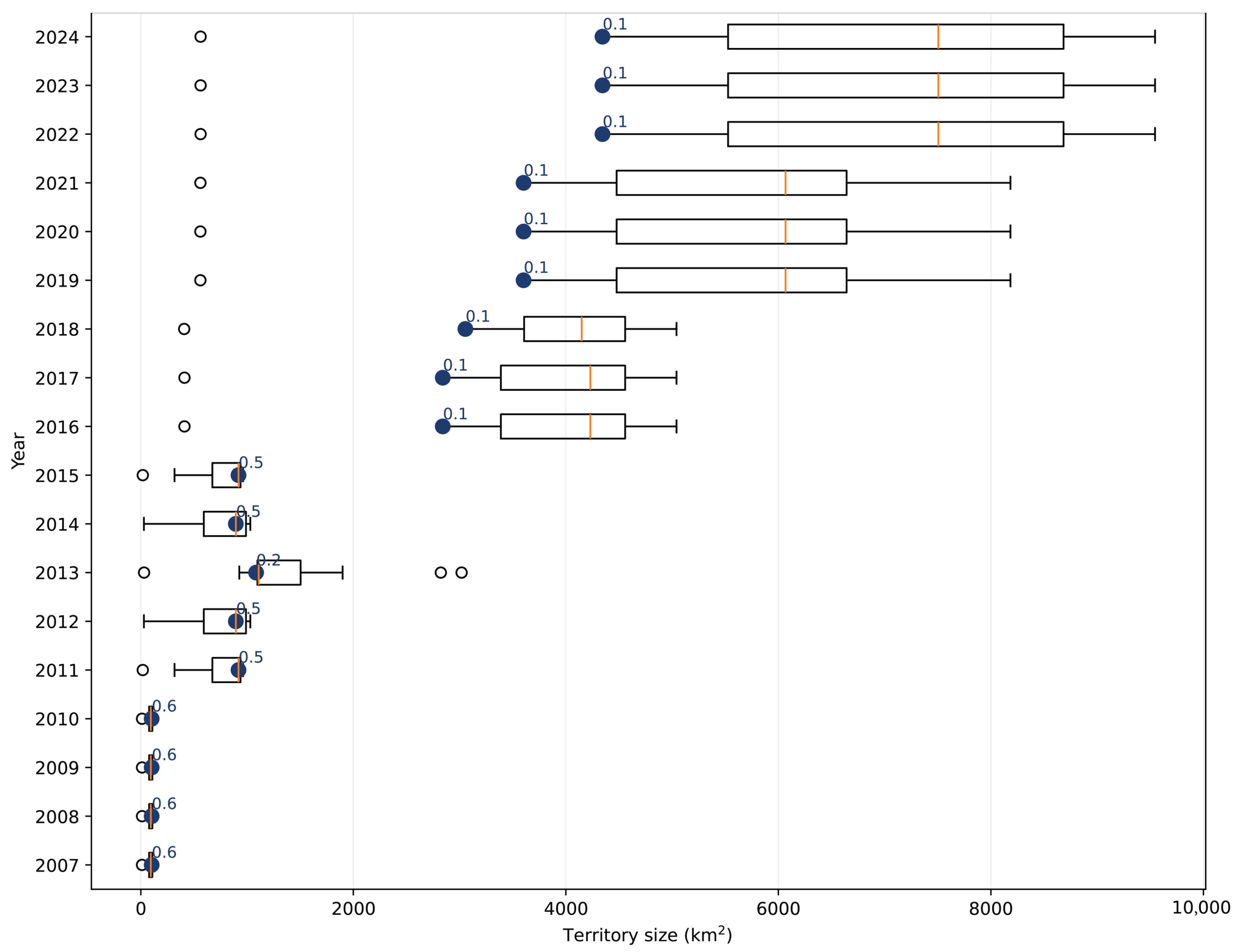
To assess the sensitivity of polygon construction to the concave hull parameter, ratios from 0.0 to 1.0 were evaluated at intervals of 0.1 for each year between 2007 and 2024. Higher ratio values retain fewer vertices and produce smoother polygons that increasingly resemble a convex hull, which may overestimate elongated territories. Lower values preserve more detail and generate narrower shapes, but in spatially concentrated territories they may produce overly abrupt boundaries.
Figure A1 summarizes the distribution of polygon area obtained under the evaluated ratios for each year. The selected ratios were chosen through visual calibration supported by this area-based sensitivity check, seeking yearly footprints that adequately covered the reported nearby populated centers while preserving the main spatial configuration of each conflict phase. The final values were 0.6 for 2007–2010, 0.5 for 2011–2012 and 2014–2015, 0.2 for 2013, and 0.1 for 2016–2024, when corridor-like geometries became more prominent.
Figure A1. Sensitivity of selected concave hull ratios to polygon area variability by year (2007–2024). Box plots summarize the polygon areas obtained by iterating ratios from 0.0 to 1.0 in steps of 0.1. Blue markers indicate the ratios selected for the representative yearly polygons. Areas are expressed in km2.
Land 15 00698 g0a1

Appendix A.2. MapBiomas Classes and Analytical Categories

Table A1 shows correspondence between original MapBiomas classes and the seven analytical categories.
Table A1. Preprocessing macroclasses used in this study and the original MapBiomas Peru Collection 3.0 classes grouped into each one [19].
CodeMacroclassOriginal MapBiomas classes grouped
1Forest formationForest; Dry forest; Mangrove; Flooded forest
2Natural non-forest formationSwamp or flooded grassland; Grassland/herbaceous vegetation; Rocky outcrop; Shrubland; Coastal hills; Other non-forest formation
3Agricultural areaGrass; Cropland; Oil palm; Rice; Other crops; Forest plantation; Agricultural mosaic
4Other area without vegetationBeach; Coastal salt flat; Salt flat; Other natural area without vegetation; Other area without vegetation
5Water bodyRiver, lake or ocean; Aquaculture; Glacier
6Not observedNot observed
7Urban infrastructureUrban infrastructure
8MiningMining
Note: The Not observed class follows the official MapBiomas legend and was retained only for preprocessing purposes to identify pixels without a valid land-cover assignment. It was excluded from land-cover interpretation and from the final analytical legends.

Appendix A.3. Relative Prevalence of Root Causes Across the Three Conflict Clusters

Table A2. Relative prevalence of coded root causes across the three conflict clusters (C1 = Cluster 1, C2 = Cluster 2, C3 = Cluster 3). Values indicate the proportion of conflicts within each cluster in which the corresponding cause is present.
Root CauseC1C2C3
Pollution/environmental damage0.0000.4170.375
Material transport issues0.0001.0000.000
Community–mine disputes0.6670.1670.500
Resource competition0.0000.0830.125
Displacement/relocation0.0000.0830.000
Illegal/informal mining0.3330.0000.125
Unfulfilled commitments0.0000.8331.000
Poor public works0.0000.3330.000
No community consent1.0000.3330.125
EIA area exclusion0.0000.4170.375
Note: Values range from 0 to 1 and indicate the share of conflicts within each cluster in which the corresponding root cause is present. Cell background color provides a heatmap-style representation of relative prevalence, with darker shades indicating higher values and lighter shades indicating lower values. Font color was adjusted only to maintain readability. Abbreviated labels are used for readability; full labels are reported in the main text.

References

  1. Ministerio de Energía y Minas. Anuario Minero 2024. 2025. Available online: https://www.gob.pe/institucion/minem/informes-publicaciones/6827926-anuario-minero-2024 (accessed on 16 March 2026).
  2. Arellano-Yanguas, J. Aggravating the Resource Curse: Decentralisation, Mining and Conflict in Peru. J. Dev. Stud. 2011, 47, 617–638. [Google Scholar] [CrossRef]
  3. Bebbington, A.; Humphreys Bebbington, D. Mining and Social Conflict in the Peruvian Andes. Dev. Change 2008, 39, 887–914. [Google Scholar] [CrossRef]
  4. Bury, J. Mining, Livelihoods and Development in Cajamarca, Peru. Geogr. J. 2005, 171, 79–93. [Google Scholar] [CrossRef]
  5. United Nations Working Group on Business and Human Rights. Statement at the End of Visit to Peru by the United Nations Working Group on Business and Human Rights. 2017. Available online: https://www.ohchr.org/en/statements-and-speeches/2017/07/statement-end-visit-peru-united-nations-working-group-business-and (accessed on 16 March 2026).
  6. Saenz, C. A Social Conflict Diagnostic Tool for Application in the Mining Industry: A Case Study in Peru. Corp. Soc. Responsib. Environ. Manag. 2019, 26, 690–700. [Google Scholar] [CrossRef]
  7. Mendoza Michilot, M. Actores, actantes y redes. Representación mediática de la acción colectiva en un conflicto socioambiental peruano. Comun. Y Soc. 2024, 21, e8703. [Google Scholar] [CrossRef]
  8. Uribe-Sierra, S.E.; Mansilla-Quiñones, P.; Mora-Rojas, A.I. Latent Rural Depopulation in Latin American Open-Pit Mining Scenarios. Land 2022, 11, 1342. [Google Scholar] [CrossRef]
  9. Mestanza-Ramón, C.; Cuenca-Cumbicus, J.; D’Orio, G.; Flores-Toala, J.; Segovia-Cáceres, S.; Bonilla-Bonilla, A.; Straface, S. Gold Mining in the Amazon Region of Ecuador: History and a Review of Its Socio-Environmental Impacts. Land 2022, 11, 221. [Google Scholar] [CrossRef]
  10. Montero, P.; Bustos, E.; Padró, J.C.; Carabassa, V. Monitoring of Open-Pit Mining Areas Using Landsat Series Imagery (1984–2023) and Cloud Processing. Land 2024, 13, 1301. [Google Scholar] [CrossRef]
  11. Boza Espinoza, T.E.; Salinas, N.; Cosio, E.G.; Tito, R.; Nina-Quispe, A.; Roman-Cuesta, R.M. Assessing Peru’s Land Monitoring System Contributions towards Fulfilment of Its International Environmental Commitments. Land 2024, 13, 205. [Google Scholar] [CrossRef]
  12. Maiza-Larrarte, A.; Claudio-Quiroga, G. The Impact of Las Bambas Megamine on Development in Apurímac, Peru. Miner. Econ. 2025, 38, 569–583. [Google Scholar] [CrossRef]
  13. Machicao, J.C.; Arosemena, G.M. Peruvian Ombudsman Monthly Social Conflict Reports Analysis Using Knowledge Management and Artificial Intelligence Tools. In 2019 IEEE XXVI International Conference on Electronics, Electrical Engineering and Computing (INTERCON); IEEE: Piscataway, NJ, USA, 2019; pp. 1–4. [Google Scholar] [CrossRef]
  14. Ang, M.L.E.; Arts, D.; Crawford, D.; Labatos, B.V., Jr.; Ngo, K.D.; Owen, J.R.; Gibbins, C.; Lechner, A.M. Socio-environmental land cover time-series analysis of mining landscapes using Google Earth Engine and web-based mapping. Remote Sens. Appl. Soc. Environ. 2021, 21, 100458. [Google Scholar] [CrossRef]
  15. Bebbington, A. Underground political ecologies: The second Annual Lecture of the Cultural and Political Ecology Specialty Group of the Association of American Geographers. Geoforum 2012, 43, 1152–1162. [Google Scholar] [CrossRef]
  16. Schilling, J.; Schilling-Vacaflor, A.; Flemmer, R.; Froese, R. A political ecology perspective on resource extraction and human security in Kenya, Bolivia and Peru. Extr. Ind. Soc. 2021, 8, 100826. [Google Scholar] [CrossRef]
  17. Szablowski, D. “Legal enclosure” and resource extraction: Territorial transformation through the enclosure of local and indigenous law. Extr. Ind. Soc. 2019, 6, 722–732. [Google Scholar] [CrossRef]
  18. Defensoría del Pueblo. Paz Social y Prevención de Conflictos. 2025. Available online: https://www.defensoria.gob.pe/areas_tematicas/paz-social-y-prevencion-de-conflictos/ (accessed on 16 March 2026).
  19. Proyecto MapBiomas Perú. Mapa Anual de Cobertura y Uso de la Tierra en el Perú—Colección 3. 2025. Available online: https://peru.mapbiomas.org/ (accessed on 16 March 2026).
  20. Instituto Nacional de Estadística e Informática. Infraestructura de Datos Espaciales del INEI. 2025. Available online: https://ide.inei.gob.pe/ (accessed on 16 March 2026).
  21. Autoridad Nacional del Agua. Visor por Cuencas. 2025. Available online: https://snirh.ana.gob.pe/ (accessed on 16 March 2026).
  22. MMG Limited. Las Bambas Operation. 2024. Available online: https://www.mmg.com/our-business/las-bambas/ (accessed on 16 March 2026).
  23. Las Bambas. Home-Las Bambas. 2026. Available online: https://www.elaportedelasbambas.pe/home-1.html (accessed on 10 April 2026).
  24. Servicio Nacional de Certificación Ambiental para las Inversiones Sostenibles (SENACE). Mapa del área de Influencia Social del Proyecto Minero Las Bambas, 2018. Third MEIA Documentation Submitted to SENACE in January 2018. Available online: https://www.senace.gob.pe/wp-content/uploads/filebase/comunicaciones/eia-meia/unidad-minera-las-bambas-3era-mod/Mapa-del-area-de-Influencia-Social-del-proyecto-minero-Las-Bambas.pdf (accessed on 10 April 2026).
  25. Las Bambas. Logística de Concentrado. 2026. Available online: https://www.elaportedelasbambas.pe/home-sobre-las-bambas-logistica-de-concentrado.html (accessed on 10 April 2026).
  26. Instituto Nacional de Estadística e Informática (INEI). Producto Bruto Interno por Departamentos 2007–2022: Año Base 2007; Technical report; Instituto Nacional de Estadística e Informática: Lima, Peru, 2023; Official departmental GDP publication.
  27. Instituto Nacional de Estadística e Informática (INEI). Pobreza Monetaria Afectó al 27,5% de la Población del país en el año 2022; Official press release; Instituto Nacional de Estadística e Informática: Lima, Peru, 2023.
  28. Instituto Geológico, Minero y Metalúrgico. GEOCATMIN: Sistema de Información Geológica y Catastral Minera. 2025. Available online: https://geocatmin.ingemmet.gob.pe/geocatmin/ (accessed on 16 March 2026).
  29. Ministerio de Transportes y Comunicaciones. GeoPortal del MTC. 2025. Available online: https://www.gob.pe/74825-geoportal-del-mtc (accessed on 16 March 2026).
  30. Bachmann, M. RapidFuzz, Version 3.13.0; GitHub, Inc.: San Francisco, CA, USA, 2025. Available online: https://github.com/rapidfuzz/RapidFuzz (accessed on 13 March 2026).
  31. Kaufman, L.; Rousseeuw, P.J. Finding Groups in Data: An Introduction to Cluster Analysis; John Wiley & Sons: Hoboken, NJ, USA, 1990. [Google Scholar] [CrossRef]
  32. Ester, M.; Kriegel, H.P.; Sander, J.; Xu, X. A density-based algorithm for discovering clusters in large spatial databases with noise. In Proceedings of the Second International Conference on Knowledge Discovery and Data Mining; KDD’96; AAAI Press: Washington, DC, USA, 1996; pp. 226–231. [Google Scholar]
  33. Hubert, L.; Arabie, P. Comparing partitions. J. Classif. 1985, 2, 193–218. [Google Scholar] [CrossRef]
  34. Strehl, A.; Ghosh, J. Cluster Ensembles—A Knowledge Reuse Framework for Combining Multiple Partitions. J. Mach. Learn. Res. 2002, 3, 583–617. [Google Scholar]
  35. Han, J.; Pei, J.; Yin, Y. Mining Frequent Patterns without Candidate Generation. In Proceedings of the 2000 ACM SIGMOD International Conference on Management of Data; Association for Computing Machinery: New York, NY, USA, 2000. [Google Scholar] [CrossRef]
Figure 1. Geographic setting of the Las Bambas case study in Apurímac, Peru. The main panel shows the Las Bambas mine, district boundaries, and communities reported within the official direct social influence area (AISD) in the Third MEIA documentation submitted to SENACE in 2018 [24]. The inset locates the case study within Peru. Coordinates are shown in UTM Zone 18S (EPSG:32718).
Land 15 00698 g001
Figure 2. Seven-stage workflow used to build the analytical database, including report extraction, matching, and consolidation (Stages 1–3), root-cause coding (Stage 4), spatial structuring and polygon construction (Stages 5–6), and annual land cover integration (Stage 7).
Land 15 00698 g002
Figure 3. Spatiotemporal evolution of the conflict influence area in Las Bambas. Bars represent the yearly conflict influence area (left axis). The red solid line and the green dashed line represent the number of active conflicts and affected population centers, respectively (right axis, logarithmic scale), which facilitates comparison between variables with different magnitudes. Vertical dashed lines indicate major project milestones: construction start (2012), transport route change (2014), and operation start (2016).
Land 15 00698 g003
Figure 4. Phase I (2007)—Initial mining expansion. (a) Reconstructed conflict influence polygon. (b) Land-cover classification within the 2007 polygon. (c) Land-cover evolution within the 2007 polygon, 2007–2024. (d) Temporal evolution of water bodies inside and outside the mine area within the 2007 conflict polygon, 2007–2024.
Land 15 00698 g004
Figure 5. Phase II (2011)—Multi-focal expansion. (a) Reconstructed conflict influence polygon. (b) Land-cover classification within the 2011 polygon. (c) Land-cover evolution within the 2011 polygon, 2007–2024. (d) Temporal evolution of water bodies inside and outside the mine area within the 2011 conflict polygon, 2007–2024.
Land 15 00698 g005
Figure 6. Phase III (2013)—Corridor formation. (a) Reconstructed conflict influence polygon. (b) Land-cover classification within the 2013 polygon. (c) Land-cover evolution within the 2013 polygon, 2007–2024. (d) Temporal evolution of water bodies inside and outside the mine area within the 2013 conflict polygon, 2007–2024.
Land 15 00698 g006
Figure 7. Phase IV (2018)—Corridor consolidation. (a) Reconstructed conflict influence polygon. (b) Land-cover classification within the 2018 polygon. (c) Land-cover evolution within the 2018 polygon, 2007–2024. (d) Temporal evolution of water bodies inside and outside the mine area within the 2018 conflict polygon, 2007–2024.
Land 15 00698 g007
Figure 8. Phase V (2024)—Regional expansion. (a) Reconstructed conflict influence polygon. (b) Land-cover classification within the 2024 polygon. (c) Land-cover evolution within the 2024 polygon, 2007–2024. (d) Temporal evolution of water bodies inside and outside the mine area within the 2024 conflict polygon, 2007–2024.
Land 15 00698 g008
Figure 9. Annual land-cover transition dynamics within the evolving conflict influence area of Las Bambas (2007–2024). The upper panel reports the total transformed area in each transition period, and the lower panel reports the proportional composition of that transformed area by major transition type. Natural-to-human-modified transitions become increasingly prominent after 2013, whereas water-related transitions remain comparatively limited. Vertical dashed lines mark major project milestones.
Land 15 00698 g009
Figure 10. Conflict cluster distribution during the early phases (2007–2012). Cluster 1 is concentrated near the mine site in the earliest phase, while Cluster 3 shows a more spatially dispersed configuration.
Land 15 00698 g010
Figure 11. Conflict cluster distribution during the advanced phases (2013–2024). By 2013, Cluster 2 becomes visible along the transport corridor. In the following phases, Cluster 3 remains spatially dispersed around the mine area, Cluster 2 expands regionally along the transport corridor, and Cluster 1 reappears in locations adjacent to the mine in the most recent phase.
Land 15 00698 g011
Figure 12. Temporal frequency of conflict clusters (2007–2024). Cluster 1 dominates the earliest phase and reappears after 2021; Cluster 3 emerges in 2011 and peaks after 2021; Cluster 2 appears in 2013 and becomes more frequent from 2019 onward. Discontinuous lines indicate years with no recorded conflicts for the corresponding cluster.
Land 15 00698 g012
Table 1. Concave hull ratio parameters used for each conflict phase.
PeriodRatio Value
2007–20100.6
2011–20120.5
20130.2
2014–20150.5
2016–20240.1
Table 2. Inter-method agreement for the final three-cluster solution.
ComparisonObservationsARINMI
K-medoids vs. Hierarchical230.5130.491
K-medoids vs. DBSCAN (all observations)230.1560.249
Hierarchical vs. DBSCAN (all observations)230.2180.323
K-medoids vs. DBSCAN (non-noise only)140.4010.487
Hierarchical vs. DBSCAN (non-noise only)140.4710.477
Table 3. Summary profile of the three conflict clusters identified in Las Bambas.
ClusterNDominant CausesMain Spatial PatternMain Temporal Pattern
13Decisions without community consent and territorial governance disputes, including cases linked to the mining trust, exploration, expansion, and land restitution claims.Concentrated near the mine area, especially in the earliest and latest phases.Dominant in the initial phase (2007–2010) and reappearing after 2021.
212Transport-centered conflicts combining material transport issues with unfulfilled company commitments, and moderate pollution- and EIA-related grievances. Some cases also include poor public works execution.Strongly associated with the Apurímac–Cusco mining corridor, later expanding regionally along the transport route.Emerging in 2012 and becoming more frequent from 2019 onward.
38Compensation- and community-centered conflicts combining unfulfilled company commitments with community–mine disputes, together with moderate pollution- and EIA-related grievances, but without transport issues as a defining driver.More spatially dispersed around the mine area than Cluster 2.First appearing in 2011 and remaining present through most of the series, with higher frequency after 2021.
Table 4. Main non-redundant association rules among retained conflict causes. Abbreviated labels are used for readability.
AntecedentConsequentSupportConfidenceLift
Pollution + Transport IssuesNo Community Consent + Unfulfilled Commitments0.1300.602.760
Unfulfilled Commitments + No Community ConsentPollution0.1740.802.300
Poor Public Works ExecutionTransport Issues + Unfulfilled Commitments0.1741.002.300
Transport Issues + No Community ConsentPollution0.1300.752.156
Poor Public Works ExecutionTransport Issues0.1741.001.917
Unfulfilled Commitments + No Community ConsentTransport Issues0.1740.801.533
Poor Public Works ExecutionUnfulfilled Commitments0.1741.001.278
Disclaimer/Publisher’s Note: The statements, opinions and data contained in all publications are solely those of the individual author(s) and contributor(s) and not of MDPI and/or the editor(s). MDPI and/or the editor(s) disclaim responsibility for any injury to people or property resulting from any ideas, methods, instructions or products referred to in the content.