A Bioregional Framework for Structuring Rural Self-Sufficiency in Dispersed Settlement Systems: The Case of Arbo, Galicia (Spain)


Abstract
1. Introduction
2. Materials and Methods
2.1. Methodological Approach and Scope
2.2. Conceptual Basis: Bioregionalism and Rural Self-Sufficiency
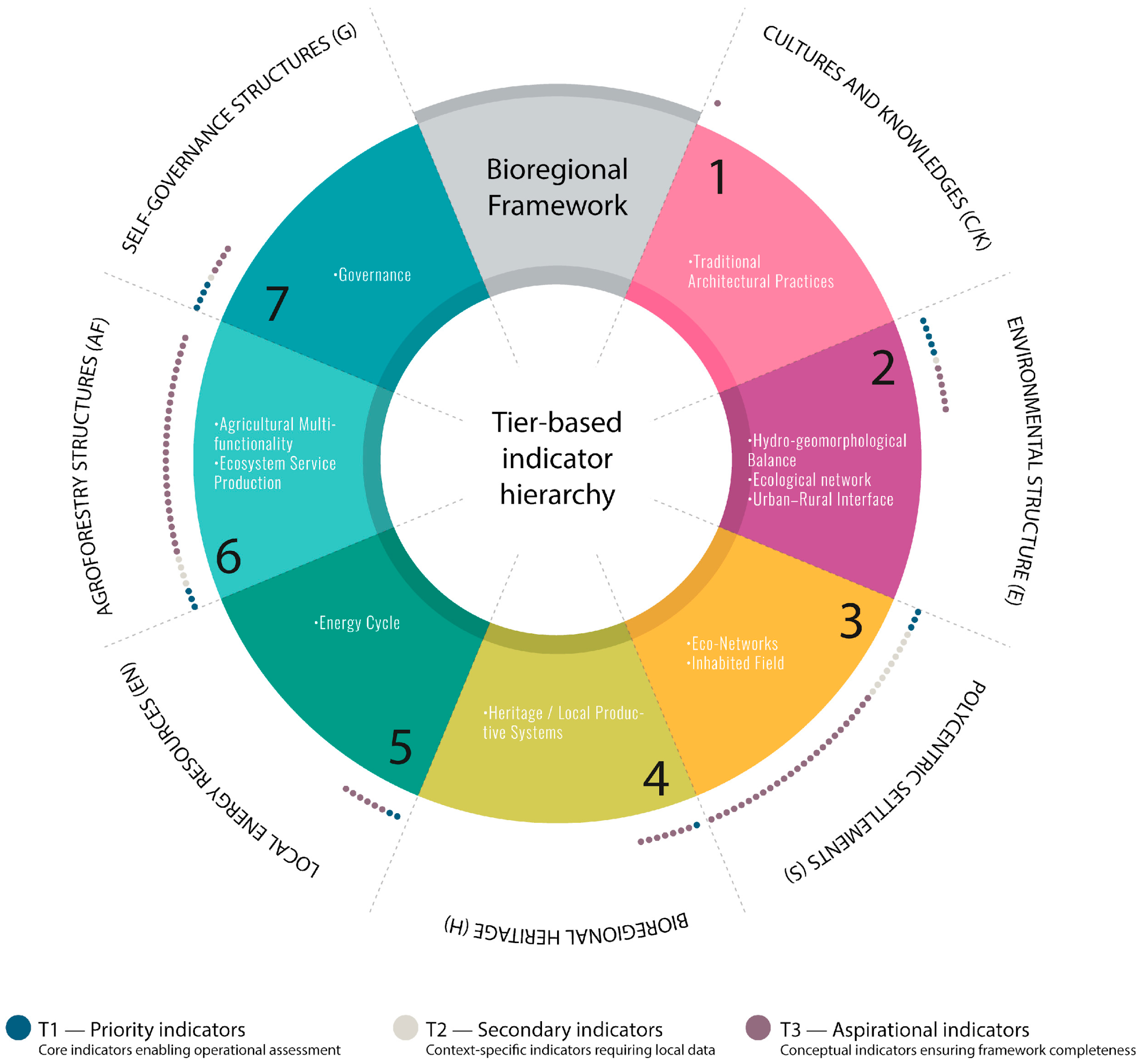
2.3. Development of the Tiered Indicator System
2.4. Scientific Justification of the Tiered Structure
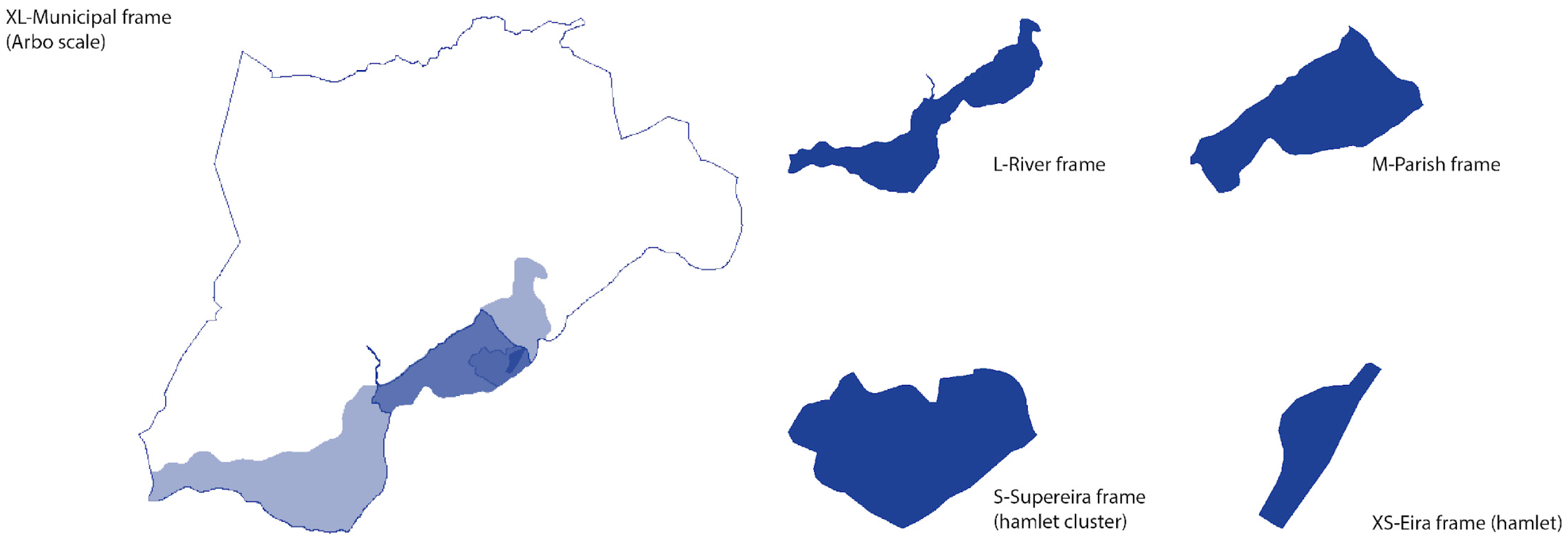
2.5. Multi-Scalar Territorial Frames
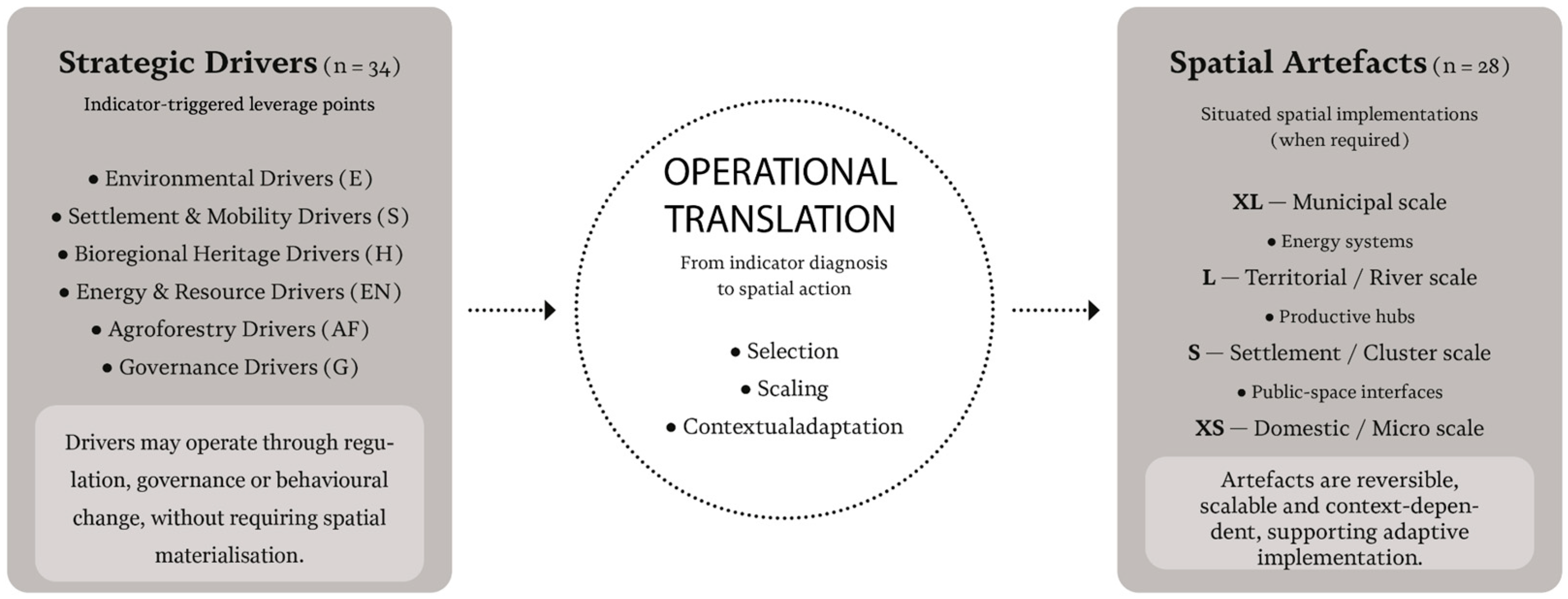
2.6. Strategic Drivers and Spatial Artefacts
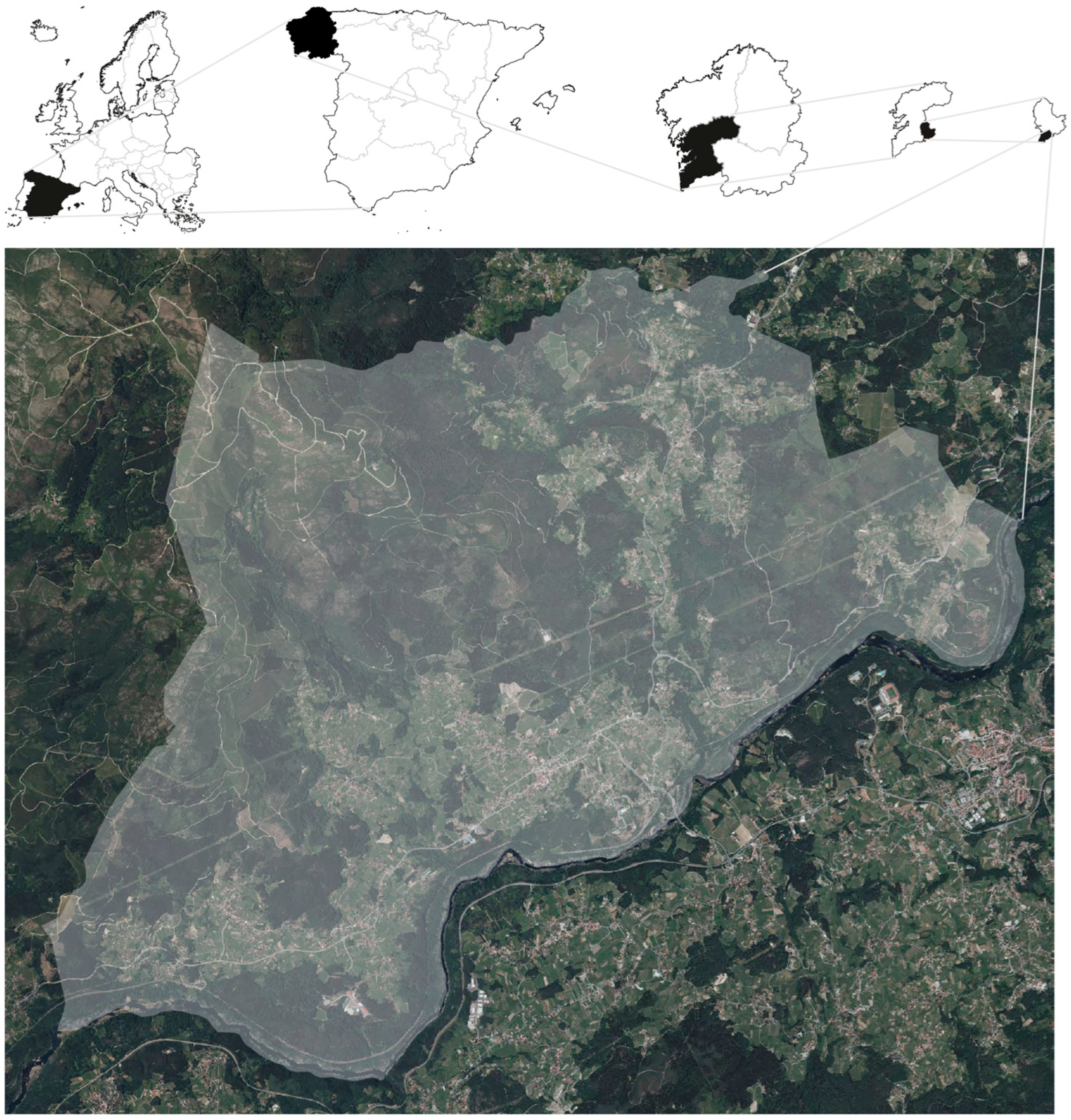
2.7. Case Demonstration: Arbo as a Rural Laboratory
2.8. Data Considerations and Replicability
3. Territorial Diagnosis: The Case of Arbo (Galicia, Spain)
3.1. Contextualisation of the Case Study
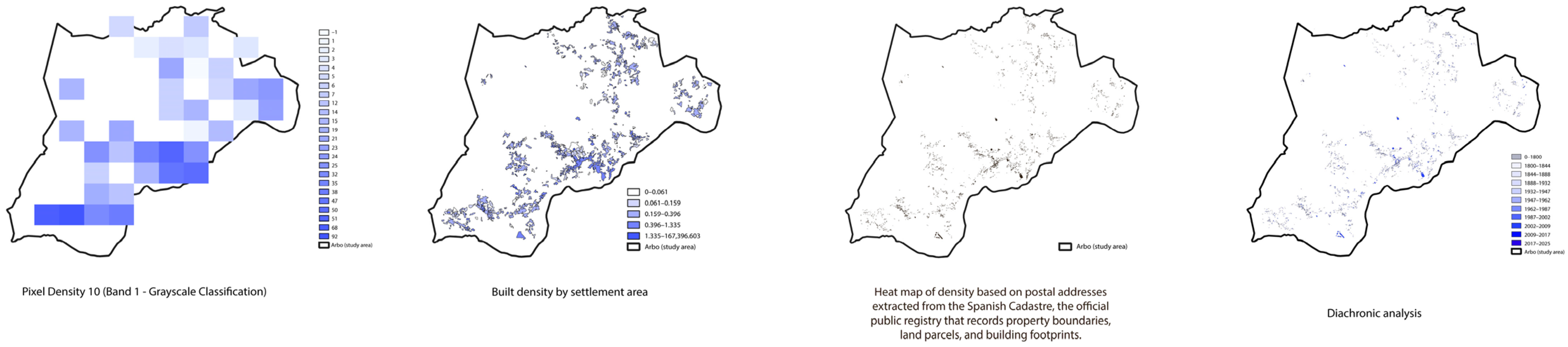
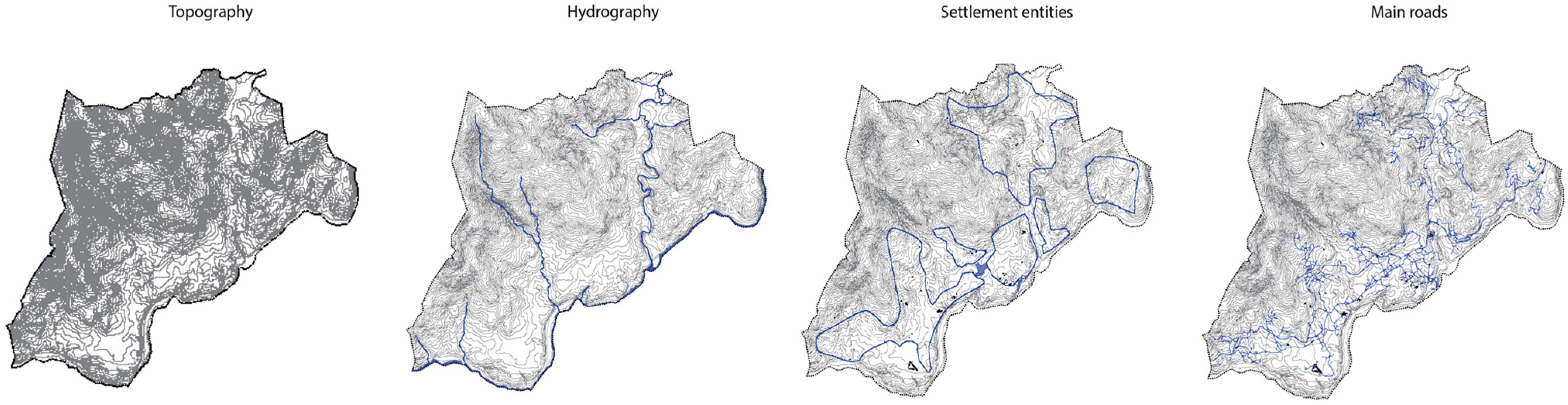
3.2. Settlement Structure and Dispersed Territorial Patterns
3.3. Environmental Structure and Landscape Systems
3.4. Productive Systems and Agroforestry Dynamics
3.5. Governance, Services and Socio-Spatial Relations
3.6. Synthesis: Diagnostic Implications for Framework Demonstration
4. Operational Framework: Tier 1 Implementation Pathways Across Nested Frames (XL–XS)
4.1. From Tier 1 Diagnosis to Action: Strategic Drivers vs. Spatial Artefacts
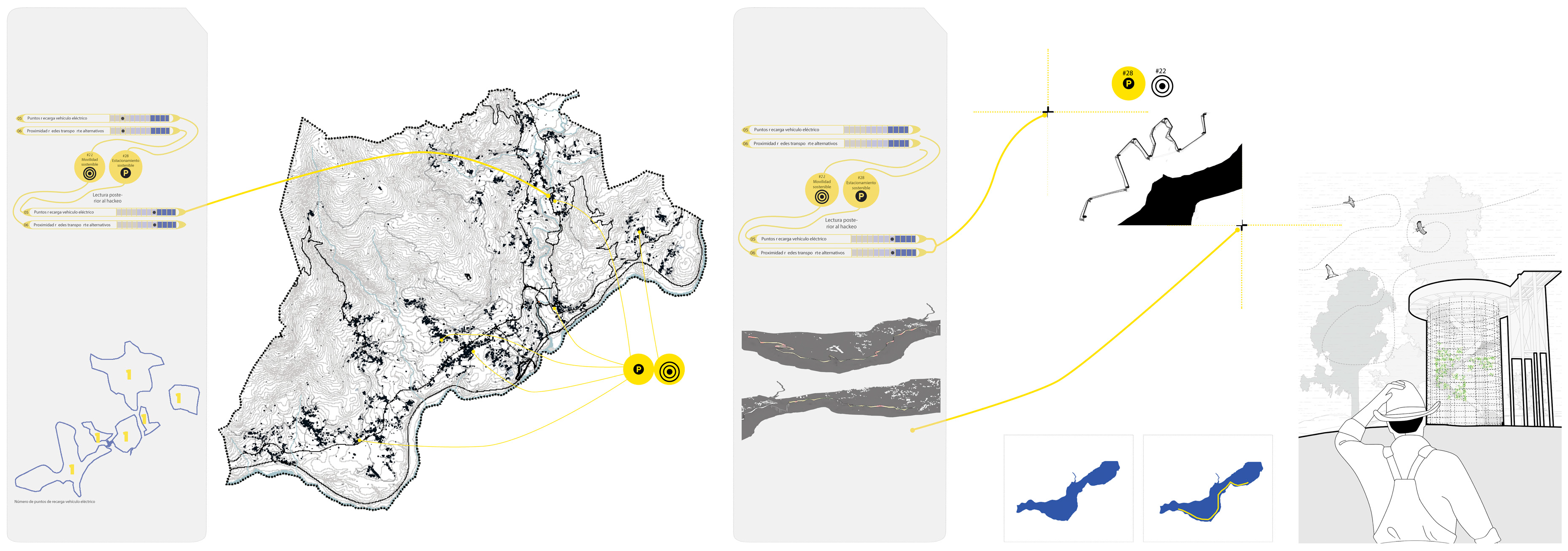
4.2. Frame-Based Deployment of Tier 1 Pathways in Arbo (XL–XS)
4.3. Operational Logic and Monitoring Implications
5. Discussion
5.1. Advancing Bioregional Planning Through Operational Tiering
5.2. Addressing Dispersed Settlement Systems Through a Multi-Scalar Operational Logic
5.3. From Indicator Proliferation to Strategic Selectivity
5.4. Transferability, Limits and Future Extensions
6. Conclusions
Supplementary Materials
Author Contributions
Funding
Data Availability Statement
Acknowledgments
Conflicts of Interest
References
- Woods, M. Rural Geography: Processes, Responses and Experiences in Rural Restructuring; Sage: London, UK, 2005. [Google Scholar]
- OECD. Rural 3.0: A Framework for Rural Development; OECD Publishing: Paris, France, 2019. [Google Scholar]
- ESPON. Shrinking Rural Regions in Europe; ESPON EGTC: Luxembourg, 2017. [Google Scholar]
- Antrop, M. Why landscapes of the past are important for the future. Landsc. Urban Plan. 2005, 70, 21–34. [Google Scholar] [CrossRef]
- Faludi, A. The performance of spatial planning. Plann. Pract. Res. 2000, 15, 299–318. [Google Scholar] [CrossRef]
- FAO. The Future of Food and Agriculture; FAO: Rome, Italy, 2017. [Google Scholar]
- Marsden, T. Mobilities, Vulnerabilities and Sustainabilities: Exploring Pathways from Denial to Sustainable Rural Development. Sociol. Rural. 2009, 49, 113–131. [Google Scholar] [CrossRef]
- Kneafsey, M.; Venn, L.; Schmutz, U.; Balázs, B.; Trenchard, L.; Eyden-Wood, T.; Bos, E.; Sutton, G.; Blackett, M. Short Food Supply Chains and Local Food Systems in the EU; JRC Scientific and Policy Reports; European Commission: Brussels, Belgium, 2013. [Google Scholar]
- Scoones, I. Sustainability. Dev. Pract. 2007, 17, 589–596. [Google Scholar] [CrossRef]
- Gibson, R.B. Sustainability assessment: Basic components of a practical approach. Impact Assess. Proj. Apprais. 2006, 24, 170–182. [Google Scholar] [CrossRef]
- Bossel, H. Indicators for Sustainable Development; IISD: Winnipeg, MB, Canada, 2001. [Google Scholar]
- Sharpe, A. Literature Review of Frameworks for Macro-Indicators; CSLS Research Report 2004-03; Centre for the Study of Living Standards: Ottawa, ON, Canada, 2004.
- Bell, S.; Morse, S. Sustainability Indicators: Measuring the Immeasurable? Earthscan: London, UK, 2008. [Google Scholar]
- Holden, E.; Linnerud, K.; Banister, D. Sustainable development: Our Common Future revisited. Glob. Environ. Change 2014, 26, 130–139. [Google Scholar] [CrossRef]
- Niemeijer, D.; de Groot, R.S. A conceptual framework for selecting environmental indicator sets. Ecol. Indic. 2008, 8, 14–25. [Google Scholar] [CrossRef]
- Magnaghi, A. The Urban Village: A Charter for Democracy and Local Self-Sustainable Development; Zed Books: London, UK, 2005. [Google Scholar]
- Magnaghi, A. Il Progetto Locale; Bollati Boringhieri: Turin, Italy, 2010. [Google Scholar]
- Sale, K. Dwellers in the Land: The Bioregional Vision; University of Georgia Press: Athens, GA, USA, 1991. [Google Scholar]
- Berkes, F.; Folke, C. Linking Social and Ecological Systems; Cambridge University Press: Cambridge, UK, 1998. [Google Scholar]
- Healey, P. Collaborative Planning; Macmillan: London, UK, 1997. [Google Scholar]
- Allmendinger, P.; Haughton, G. Soft spaces, fuzzy boundaries. Environ. Plan. A 2009, 41, 617–632. [Google Scholar] [CrossRef]
- Rueda, S. La ciudad compacta y diversa. In Ciudades para un Futuro más Sostenible; Universidad Politécnica de Madrid: Madrid, Spain, 1997. [Google Scholar]
- OECD. Measuring Distance to the SDGs; OECD Publishing: Paris, France, 2022. [Google Scholar]
- Brenner, N. New State Spaces; Oxford University Press: Oxford, UK, 2004. [Google Scholar]
- Lydon, M.; Garcia, A. Tactical Urbanism; Island Press: Washington, DC, USA, 2015. [Google Scholar]
- Silva, P. Tactical urbanism: Towards an evolutionary cities’ approach? Environ. Plan. B Plan. Des. 2016, 43, 1040–1051. [Google Scholar] [CrossRef]
- Bishop, P.; Williams, L. The Temporary City; Routledge: London, UK, 2012. [Google Scholar]
- Gehl, J. Cities for People; Island Press: Washington, DC, USA, 2010. [Google Scholar]
- Instituto Galego de Estatística (IGE). Municipal Statistical Data: Arbo; Xunta de Galicia: A Coruña, Spain, 2022.
- Eurostat. Degree of Urbanisation (DEGURBA); European Commission: Luxembourg, 2021. [Google Scholar]
- Copus, A.; Kahila, P.; Dax, T.; Kovács, K.; Tagai, G.; Weber, R.; Grunfelder, J.; Meredith, D.; Ortega-Reig, M.; Piras, S.; et al. European shrinking rural areas: Key messages for a refreshed long-term vision. Terra Rev. Desarro. Local 2021, 8, 280–309. [Google Scholar] [CrossRef]
- OECD. Regional Outlook 2023: The Longstanding Geography of Inequalities; OECD Publishing: Paris, France, 2023. [Google Scholar]
- European Commission. Demographic Change in Rural Areas; Directorate-General for Regional and Urban Policy: Brussels, Belgium, 2021. [Google Scholar]
- Shucksmith, M.; Brown, D.L. Framing rural studies in the global north. In Routledge International Handbook of Rural Studies; Shucksmith, M., Brown, D.L., Eds.; Routledge: London, UK, 2016; pp. 1–26. [Google Scholar]
- Indovina, F. La Città Diffusa; DAEST: Venice, Italy, 1990. [Google Scholar]
- Secchi, B. La Città del Ventesimo Secolo; Laterza: Rome, Italy, 2005. [Google Scholar]
- Sieverts, T. Cities Without Cities: An Interpretation of the Zwischenstadt; Spon Press: London, UK, 2003. [Google Scholar]
- Gallent, N.; Andersson, J.; Bianconi, M. Planning on the Edge: England’s Rural-Urban Fringe and the Spatial Planning of Land Use; Routledge: London, UK, 2018. [Google Scholar]
- Forman, R.T.T. Land Mosaics: The Ecology of Landscapes and Regions; Cambridge University Press: Cambridge, UK, 1995. [Google Scholar]
- Bennett, G.; Mulongoy, K.J. Review of Experience with Ecological Networks; IUCN: Gland, Switzerland, 2006. [Google Scholar]
- Navarro, L.M.; Pereira, H.M. Rewilding abandoned landscapes in Europe. Ecosystems 2012, 15, 900–912. [Google Scholar] [CrossRef]
- Opdam, P.; Steingröver, E.; Van Rooij, S. Ecological networks: A spatial concept for multi-actor planning of sustainable landscapes. Landsc. Urban Plan. 2006, 75, 322–332. [Google Scholar] [CrossRef]
- Pinto-Correia, T.; Breman, B. New roles for farming in a differentiated countryside. Reg. Environ. Change 2009, 9, 195–205. [Google Scholar] [CrossRef]
- Renting, H.; Marsden, T.; Banks, J. Understanding alternative food networks. Environ. Plan. A 2003, 35, 393–411. [Google Scholar] [CrossRef]
- van der Ploeg, J.D. The New Peasantries; Earthscan: London, UK, 2008. [Google Scholar]
- Lamine, C. Sustainability and resilience in agrifood systems: Reconnecting agriculture, food and environment. Sociol. Rural. 2015, 55, 41–61. [Google Scholar] [CrossRef]
- Rodríguez-Pose, A.; Fitjar, R.D. Buzz, archipelago economies and the future of cities. Reg. Stud. 2013, 47, 1343–1356. [Google Scholar] [CrossRef]
- Shucksmith, M. Disintegrated rural development? Neo-endogenous rural development, planning and place-shaping in diffused power contexts. Sociol. Rural. 2010, 50, 1–14. [Google Scholar] [CrossRef]
- OECD. Rural Well-Being: Geography of Opportunities; OECD Publishing: Paris, France, 2020. [Google Scholar]
- Alexander, E.R. Approaches to Planning: Introducing Current Planning Theories, Concepts and Issues; Gordon and Breach: London, UK, 1992. [Google Scholar]
- Davoudi, S.; Strange, I. (Eds.) Conceptions of Space and Place in Strategic Spatial Planning; Routledge: London, UK, 2009. [Google Scholar]
- Healey, P. The new institutionalism and the transformative goals of planning. Plan. Theory 2007, 6, 61–87. [Google Scholar]
- Meadowcroft, J. What about the politics? Sustainable development, transition management, and long term energy transitions. Policy Sci. 2009, 42, 323–340. [Google Scholar] [CrossRef]
- Boulanger, P.M. Sustainable development indicators: A scientific challenge, a democratic issue. Surv. Perspect. Integr. Environ. Soc. 2008, 1, 59–73. [Google Scholar] [CrossRef]
- Cash, D.W.; Clark, W.C.; Alcock, F.; Dickson, N.M.; Eckley, N.; Guston, D.H.; Jäger, J.; Mitchell, R.B. Knowledge systems for sustainable development. Proc. Natl. Acad. Sci. USA 2003, 100, 8086–8091. [Google Scholar] [CrossRef] [PubMed]
- Hezri, A.A.; Dovers, S.R. Sustainability indicators, policy and governance: Issues for ecological economics. Ecol. Econ. 2006, 60, 86–99. [Google Scholar] [CrossRef]
- Hák, T.; Moldan, B.; Dahl, A.L. Sustainability Indicators: A Scientific Assessment; Island Press: Washington, DC, USA, 2007. [Google Scholar]
- Meadows, D.H. Leverage Points: Places to Intervene in a System; Sustainability Institute: Hartland, VT, USA, 1999. [Google Scholar]
- Abson, D.J.; Fischer, J.; Leventon, J.; Newig, J.; Schomerus, T.; Vilsmaier, U.; von Wehrden, H.; Abernethy, P.; Ives, C.D.; Jager, N.W.; et al. Leverage points for sustainability transformation. Ambio 2017, 46, 30–39. [Google Scholar] [CrossRef] [PubMed]
- Fischer, J.; Riechers, M.; Loos, J.; Martin-López, B.; Temperton, V.M. Making the UN Decade on Ecosystem Restoration a social–ecological endeavour. Trends Ecol. Evol. 2021, 36, 20–28. [Google Scholar] [CrossRef]
- Folke, C.; Carpenter, S.R.; Walker, B.; Scheffer, M.; Chapin, T.; Rockström, J. Resilience thinking: Integrating resilience, adaptability and transformability. Ecol. Soc. 2010, 15, 20. [Google Scholar] [CrossRef]
- Hajer, M.A. The Politics of Environmental Discourse: Ecological Modernization and the Policy Process; Oxford University Press: Oxford, UK, 1995. [Google Scholar]
- Hillier, J. Strategic navigation across multiple planes: Towards a Deleuzean-inspired methodology for strategic spatial planning. Plan. Theory 2011, 10, 283–303. [Google Scholar] [CrossRef]
- Neuman, M. The compact city fallacy. J. Plan. Educ. Res. 2005, 25, 11–26. [Google Scholar] [CrossRef]
- Hooghe, L.; Marks, G. Multi-Level Governance; Rowman & Littlefield: Lanham, MD, USA, 2001. [Google Scholar]
- Termeer, C.J.A.M.; Dewulf, A.; Breeman, G.; Stiller, S.J. Governance capabilities for dealing wisely with wicked problems. Adm. Soc. 2015, 47, 680–710. [Google Scholar] [CrossRef]
- Cash, D.W.; Adger, W.N.; Berkes, F.; Garden, P.; Lebel, L.; Olsson, P.; Pritchard, L.; Young, O. Scale and cross-scale dynamics: Governance and information in a multilevel world. Ecol. Soc. 2006, 11, 8. [Google Scholar] [CrossRef]
- Pahl-Wostl, C. A conceptual framework for analysing adaptive capacity and multi-level learning processes in resource governance regimes. Glob. Environ. Change 2009, 19, 354–365. [Google Scholar] [CrossRef]
- Armitage, D.; Plummer, R.; Berkes, F.; Arthur, R.I.; Charles, A.T.; Davidson-Hunt, I.J.; Diduck, A.P.; Doubleday, N.C.; Johnson, D.S.; Marschke, M.; et al. Adaptive co-management for social–ecological complexity. Front. Ecol. Environ. 2009, 7, 95–102. [Google Scholar] [CrossRef]
- Schön, D.A. The Reflective Practitioner: How Professionals Think in Action; Basic Books: New York, NY, USA, 1983. [Google Scholar]





| Tier | Nº Indicators | Implementation | Scientific Function |
|---|---|---|---|
| Tier 1 Priority | 18 core | Year 1 annual monitoring | Immediate operationalisation using readily available datasets (e.g., statistical records, cadastral and environmental databases); supports initial territorial diagnosis and decision-making |
| Tier 2 Secondary | 15 extended | Years 2–3 biennial monitoring | Analytical deepening through context-specific indicators requiring local surveys, targeted measurements or institutional data integration |
| Tier 3 Aspirational | 75 framework | Years 4–10 quinquennial or qualitative monitoring | Preserves the conceptual integrity of the bioregional framework (Magnaghi–Rueda); supports qualitative diagnosis, scenario-building and long-term comparability without operational overload |
| Category | Subcategory | Indicator | Tier Code | Framework ID | Data Source | Frame |
|---|---|---|---|---|---|---|
| Environmental Structure | Hydro-geomorphological Balance | Level of protection of alluvial zones | T1-E1 | 1 | Planning Instrument; GIS | Ecological |
| Functional fluvial systems | T1-E2 | 4 | Hydrological maps | Ecological | ||
| Ecological Network | Biodiversity level | T1-E3 | 5 | Environmental databases | Ecological | |
| Continuity of ecological corridors | T1-E4 | 7 | GIS-based ecological planning | Ecological | ||
| Urban–Rural Interface | Containment of settlement dispersion | T1-E5 | 10 | Land-use data | Morphological | |
| Polycentric Settlements | Eco-Networks | Accessibility to services | T1-S1 | 17 | Network analysis (GIS) | Infrastructural |
| Level of pedestrian connectivity | T1-S2 | 20 | Mobility networks | Infrastructural | ||
| Inhabited Field | Balance between open and built spaces | T1-S3 | 23 | Land cover data (GIS) | Morphological | |
| Bioregional Heritage | Heritage/Local Productive Systems | Locally produced goods | T1-H1 | 50 | Economic statistics | Cultural |
| Local Energy Resources | Energy Cycle | Building energy quality | T1-EN1 | 59 | Energy certification | Infrastructural |
| Local renewable energy production | T1-EN2 | 62 | Energy agencies | Infrastructural | ||
| Agroforestry Structures & Multifunctional Values | Agricultural Multifunctionality | Urban–rural perimeter | T1-AF1 | 66 | Planning maps | Morphological |
| Ecosystem Service Production | Maintenance of natural habitats | T1-AF2 | 84 | Environmental agencies | Ecological | |
| Local agro-food chains | T1-AF3 | 85 | Food-system data | Cultural | ||
| Self-Governance Structures | Governance | Provision of basic facilities | T1-G1 | 103 | Municipal data | Social |
| Proximity to basic facilities | T1-G2 | 104 | GIS | Social | ||
| Public space | T1-G3 | 105 | Urban cartography | Social | ||
| Community relationship entities | T1-G4 | 108 | Institutional data | Social |
| Frame | Scale | Operational Focus |
|---|---|---|
| XL | Municipal | Territorial metabolism, structuring ecological and infrastructural corridors |
| L | River corridor (Miño River) | Riparian dynamics, cross-border interface, linear public-space systems |
| M | Parish | Settlement systems, local services and socio-productive structures |
| S | Hamlet cluster | Community life, shared facilities and collective infrastructures |
| XS | Household | Micro-ecological production, domestic metabolism and social interactions |
| Scale | Territorial Level | Functional Role | Indicator Types |
|---|---|---|---|
| XL | Supra-municipal/ Bioregional | Ecological regulation and territorial connectivity | Ecological continuity, biodiversity, landscape systems |
| L | Municipal | Structural territorial organisation | Land use, infrastructure, mobility, resource management |
| M | Parish/Intermediate | Socio-productive organisation | Agro-food systems, local economies, productive networks |
| S | Settlement/Cluster | Local accessibility and service provision | Services, accessibility, social infrastructure |
| XS | Household/Unit | Micro-scale self-sufficiency and resource cycles | Domestic production, energy, water, circular systems |
| Frame | Strategic Driver ID | Spatial Artefact | Tier 1–Priority |
|---|---|---|---|
| XL | 01 | Local timber as a construction material | Local goods/value chains (T1–H1) enabling bioregional production logic |
| XL | 20 | Biodiversity and landscape | Ecological structure & continuity (T1–E3/T1–E4) dispersion containment support (T1–E5) |
| XL | 22 | Sustainable mobility | Pedestrian connectivity/access logic (T1–S2; T1–S1) |
| L | 02 | Promenade | Pedestrian connectivity + access structuring (T1–S2; T1–S1) |
| L | 12 | Vertical gardens | Local agro-food chain support (T1–AF3) domestic-scale productive device |
| L | 23 | Viewpoints | Public space system/social use nodes (T1–G3) |
| L | 02 | Promenade | Connective structuring across parish (T1–S2; T1–S1) |
| M | 25 | Community service facilities | Basic facilities provision (T1–G1; T1–G2) |
| M | 27 | Social spaces | Public space + community anchoring (T1–G3; T1–G4) |
| M | 28 | Landscape integration | Supports ecological structure logic (T1–E3/T1–E4) |
| M | 30 | Energy adaptation of traditional systems | Local renewables/building-energy pathway (T1–EN2; T1–EN1) |
| M | 34 | Interior–exterior spatial continuity | Public-space habitability/social interface (T1–G3) |
| S | 17 | Stiva da morts | Public space/community node (T1–G3; T1–G4) |
| S | 21 | Green spaces | Public space system (T1–G3) |
| S | 24 | Public recreation facilities | Basic facilities + public space (T1–G1; T1–G3) |
| S | 26 | Viewpoints | Public space + territorial legibility (T1–G3) |
| XS | 04 | La Pinada Lab | Community relationship entities + facilities logic (T1–G4; T1–G1) |
| XS | 09 | Regen system | Local agro-food chain support (T1–AF3) + local goods logic (T1–H1) |
| XS | 11 | Flexible design | Supports housing/service usability → basic facilities proximity logic (T1–G2) |
| XS | 13 | Rainwater collection and greywater treatment | Supports ecological and settlement operability by reinforcing hydrological continuity (linked to Tier 1 indicators T1–E1 and T1–E2). |
| XS | 15 | Waste | Supports service provision operability (T1–G1) (indirect) |
| XS | 16 | Ethical purchasing and social clauses | Local goods/value chain enabling (T1–H1) |
| XS | 18 | Topographic adaptation | Dispersion containment/settlement performance (T1–E5) (indirect) |
| XS | 31 | Formal reinterpretation of the construction system | Building energy quality pathway (T1–EN1) |
| XS | 32 | Reinterpretation of openings | Building energy quality pathway (T1–EN1) |
| XS | 33 | Reinterpretation of traditional structure | Building energy quality + local production logic (T1–EN1; T1–H1) |
Disclaimer/Publisher’s Note: The statements, opinions and data contained in all publications are solely those of the individual author(s) and contributor(s) and not of MDPI and/or the editor(s). MDPI and/or the editor(s) disclaim responsibility for any injury to people or property resulting from any ideas, methods, instructions or products referred to in the content. |
© 2026 by the authors. Licensee MDPI, Basel, Switzerland. This article is an open access article distributed under the terms and conditions of the Creative Commons Attribution (CC BY) license.
Share and Cite
Lima, A.; Milão, S.; Viana, D.; Vázquez, J. A Bioregional Framework for Structuring Rural Self-Sufficiency in Dispersed Settlement Systems: The Case of Arbo, Galicia (Spain). Land 2026, 15, 689. https://doi.org/10.3390/land15040689
Lima A, Milão S, Viana D, Vázquez J. A Bioregional Framework for Structuring Rural Self-Sufficiency in Dispersed Settlement Systems: The Case of Arbo, Galicia (Spain). Land. 2026; 15(4):689. https://doi.org/10.3390/land15040689
Chicago/Turabian StyleLima, Ana, Susana Milão, David Viana, and Jesús Vázquez. 2026. "A Bioregional Framework for Structuring Rural Self-Sufficiency in Dispersed Settlement Systems: The Case of Arbo, Galicia (Spain)" Land 15, no. 4: 689. https://doi.org/10.3390/land15040689
APA StyleLima, A., Milão, S., Viana, D., & Vázquez, J. (2026). A Bioregional Framework for Structuring Rural Self-Sufficiency in Dispersed Settlement Systems: The Case of Arbo, Galicia (Spain). Land, 15(4), 689. https://doi.org/10.3390/land15040689