Article

Using Social Media Data in Coupling Analysis of Urban Habitat Quality and Public Perception

1
School of Civil Engineering and Architecture, Zhejiang Sci-Tech University, Hangzhou 310018, China
2
Zhejiang Key Laboratory of Green, Digital and Intelligent (GDI) Renovation for Urban Infrastructures, Hangzhou 310018, China
3
China United Engineering Corporation Limited, Hangzhou 310056, China
*
Author to whom correspondence should be addressed.
Land 2026, 15(5), 690; https://doi.org/10.3390/land15050690
Submission received: 12 March 2026 / Revised: 17 April 2026 / Accepted: 19 April 2026 / Published: 22 April 2026
(This article belongs to the Section Land Socio-Economic and Political Issues)

Abstract

The primary aim of this study is to validate the utility of Social Media Data (SMD) as a scientifically grounded tool for quantifying the spatial mismatch between objective ecological supply and subjective social demand. Assessing the spatial coupling and mismatch between Habitat Quality (HQ)—representing objective ecological supply—and Ecological Perception (EP)—representing subjective social demand—is essential for developing targeted urban management and development strategies. Focusing on the core urban area of Hangzhou, this study quantified ecological supply using the InVEST HQ model. To reflect social demand, 4958 geolocated Weibo posts were processed using contextual sentiment analysis. A Coupling Coordination Degree model served as a diagnostic tool to evaluate the synergy between these two dimensions. Additionally, a Geodetector model was employed to investigate the factors driving spatial differentiation in this coupling. The findings indicate that: (1) The regional average HQ is 0.56, reflecting a moderate overall level of degradation, while EP shows a preference for natural environments and exhibits a distinct “strip-like” spatial distribution. (2) The overall CCD value is 0.384; high-coupling areas are primarily concentrated in regions with superior natural conditions and dense vegetation, whereas low-coupling areas correspond to zones with intensive urban functions. (3) Driving factor analysis reveals that land-use type exerts the most significant influence on the overall degree of coupling. This study demonstrates that the HQ-EP coupling framework provides a reliable spatial diagnostic tool for urban planners to identify socio-ecological vulnerabilities. The results suggest that an appropriate integration of natural elements enhances coupling outcomes, with the highest synergy observed in environments characterized by high HQ and minimal anthropogenic disturbance.

1. Introduction

Humans and ecosystems share an interdependent relationship. As developmental activities increasingly disturb natural environments, sustainable social development faces growing challenges. From the perspective of complex ecosystems, natural resources constitute the material foundation and energy source for urban development. Conversely, stable socio-economic development relies on a continuous supply of these resources. Cities, as complex systems integrating socio-economic and environmental elements, should be examined holistically rather than analyzed as isolated components. It is particularly important to analyze internal interaction mechanisms and explore methods to effectively enhance urban development potential [1]. Furthermore, solutions must account for both natural and social factors, ensuring a synergistic approach [2]. To fully understand the impact of human activities, humans must be viewed as an integral part of the ecosystem [3]. Against this backdrop, the Social–Ecological Systems (SES) framework has emerged as a crucial method for investigating interactions between society and nature. SES is an intricate, dynamic system formed by the intertwining of social and ecological subsystems. These smaller coupled systems gradually evolve into complex systems with high adaptability. Interactions within SES manifest as the continuous integration of new elements into a static foundation, thereby constructing a system architecture that is both stable and resilient [4]. Consequently, this theoretical framework provides comprehensive methodological support for understanding the coupling relationship between urban and natural systems.
Urban habitats are landscape ecological units composed of natural elements such as vegetation, soil, and topography; the ecosystem services they provide are fundamental to human well-being [5]. Spatially mapping the structure and quality of these habitats offers critical insights for urban biodiversity conservation [6]. However, the negative impacts of habitat fragmentation have become increasingly prominent due to accelerating urbanization [7]. Concurrently, rising living standards have heightened public environmental awareness and fostered deeper Ecological Perception (EP). Consequently, modern urban planning requires an integrated assessment framework that not only maintains physical habitat stability but also addresses the non-material social demands of residents. In existing evaluation systems, Habitat Quality (HQ) typically characterizes the physical supply capacity of ecosystems at macro-ecological scales, such as landscape and species levels [8,9,10]. Conversely, EP focuses on the immediate subjective experiences of individuals at the micro-level [11], reflecting psychological preferences and emotional resonance within human–environment interactions. The core link between HQ and EP lies in the fact that EP is not independent of the habitat; rather, it is a socio-cultural extension of HQ. It directly translates physical habitat attributes into non-material spiritual benefits, such as aesthetics, recreation, and cultural identity. By integrating HQ as potential supply with EP as realized demand, researchers can bridge the gap between natural and social evaluations. This approach reveals the comprehensive service levels of urban ecosystems, providing a scientific basis for accurately matching ecological supply with social demand.
Within the dynamic interactions of Social–Ecological Systems (SES), Social Media Data (SMD) has emerged as a critical medium for capturing social feedback and environmental perceptions. As social media usage becomes ubiquitous, 90% of big data is now generated by urban populations, who increasingly share real-time emotional experiences on these platforms. This shift has opened new avenues for utilizing SMD to analyze public environmental perceptions [12], SMD has emerged as a disruptive scientific tool capable of bridging HQ and EP. In urban management and planning, SMD provides granular insights into public attitudes toward living environments. Recent studies have leveraged SMD to explore evaluations of urban green space planning [13], public preferences [14], and cultural ecosystem services [15]. While traditional surveys offer high demographic precision, they lack spatial fluidity and are time-consuming. Compared to traditional sentiment assessment methods, SMD significantly reduces time consumption while providing substantial sample sizes. Even data collected over short intervals can achieve extensive spatial coverage. Most importantly, SMD captures immediate, authentic psychological responses during human–environment interactions. This high-frequency, dynamic data attribute offers a level of temporal resolution that traditional research methods struggle to achieve [16]. Furthermore, SMD possesses a unique and complex set of attributes, including rapid acquisition and high perceived authenticity [17]. However, its application is not without limitations. Its reliability is often challenged by demographic biases—favoring digitally active users—and the risk of virtual perception, where posts may reflect aesthetic appreciation based solely on images rather than actual physical experiences of the site. Despite these drawbacks, when rigorously cleaned and spatially contextualized, SMD provides an unprecedented macroscopic lens to observe human–nature interactions.
As a bridge between individual perception and social structure, SMD profoundly reflects the intrinsic link between residents and the urban environment. Recent studies have utilized SMD to investigate public evaluations of parks [18] and blue spaces [19]. Such big data analytics offer deep insights into resident preferences and behaviors within urban spaces. Beyond natural landscapes, the application of SMD has extended to multiple dimensions influencing perceptual quality, including Points of Interest (POI) [20], streetscapes [21], heat island effects [22], accessibility [23], and environmental pollution [24]. Integrating SMD with multi-source urban data helps clarify the factors driving emotional responses, thereby providing a robust evidence base for urban planning. Functioning as a SES sensor, SMD provides high-resolution, real-time feedback on human preferences—data often lacking in traditional biophysical models. By integrating these subjective demands with objective supply, planners can move away from top-down, one-size-fits-all resource allocation in favor of precision management strategies. This approach not only reduces resource waste but also addresses deficiencies in ecosystem services, ultimately fostering more resilient, human-centered urban habitats.
In summary, this study focuses on the main urban area of Hangzhou, China, a region characterized by a distinct spatial distinction between natural and built environments. To ensure better localization, the SES framework was operationalized using high-precision, locally available data tailored to the conditions of high-density Chinese cities. Drawing upon the SES framework, this study conceptualizes urban biodiversity conservation as a dynamic interplay between biophysical supply and social demand. We define HQ, derived from the InVEST model, as the potential biophysical supply of the ecosystem. Conversely, EP extracted from social media big data is defined as the realized social demand for cultural ecosystem services. The integration of these two dimensions through a Supply–Demand Coupling lens allows us to identify spatial synergies and mismatches, providing a diagnostic basis for targeted urban interventions. Specifically, to account for the unique landscape characteristics of the study area, we refined the habitat threat factor weights and sensitivity matrices within the InVEST model based on expert consultations and local literature. By utilizing refined urban blue-green space units, this approach translates macro-level system theories into actionable urban micro-regeneration zones. These adjustments ensure that the SES framework accurately reflects the distinct socio-ecological dynamics of Hangzhou’s urban system. Based on land use data and SMD, the spatial distribution characteristics of the coupling coordination degree between HQ and EP were analyzed. Furthermore, interaction analyses and threshold analyses were conducted on the influencing factors. Modern highly urbanized regions have disrupted original habitat spaces and exacerbated internal ecological issues. This poses severe threats to living environments, economic development, and urban sustainability. This study offers a novel approach for quantifying urban ecological space and quantitatively analyzes the impact of various social and ecological factors on the overall system. It provides alternative perspectives for future urban planning and offers scientific guidance for achieving urban sustainability. Despite the growing body of international literature on urban ecosystem services, a critical research gap remains in systematically coupling the biophysical supply of HQ with the subjective, real-time demand of public perception, particularly using high-resolution SMD. Therefore, the primary aim of this study is to operationalize SMD as a core bridge to quantify the socio-ecological coupling between HQ and EP.The remainder of this study is organized as follows: Section 2 introduces the data and methodologies employed. Section 3 summarizes the relevant research findings. Section 4 presents and interprets the empirical results of the coupling analysis. Finally, Section 5 presents the conclusions and limitations of the study.

2. Materials and Methods

2.1. Study Area

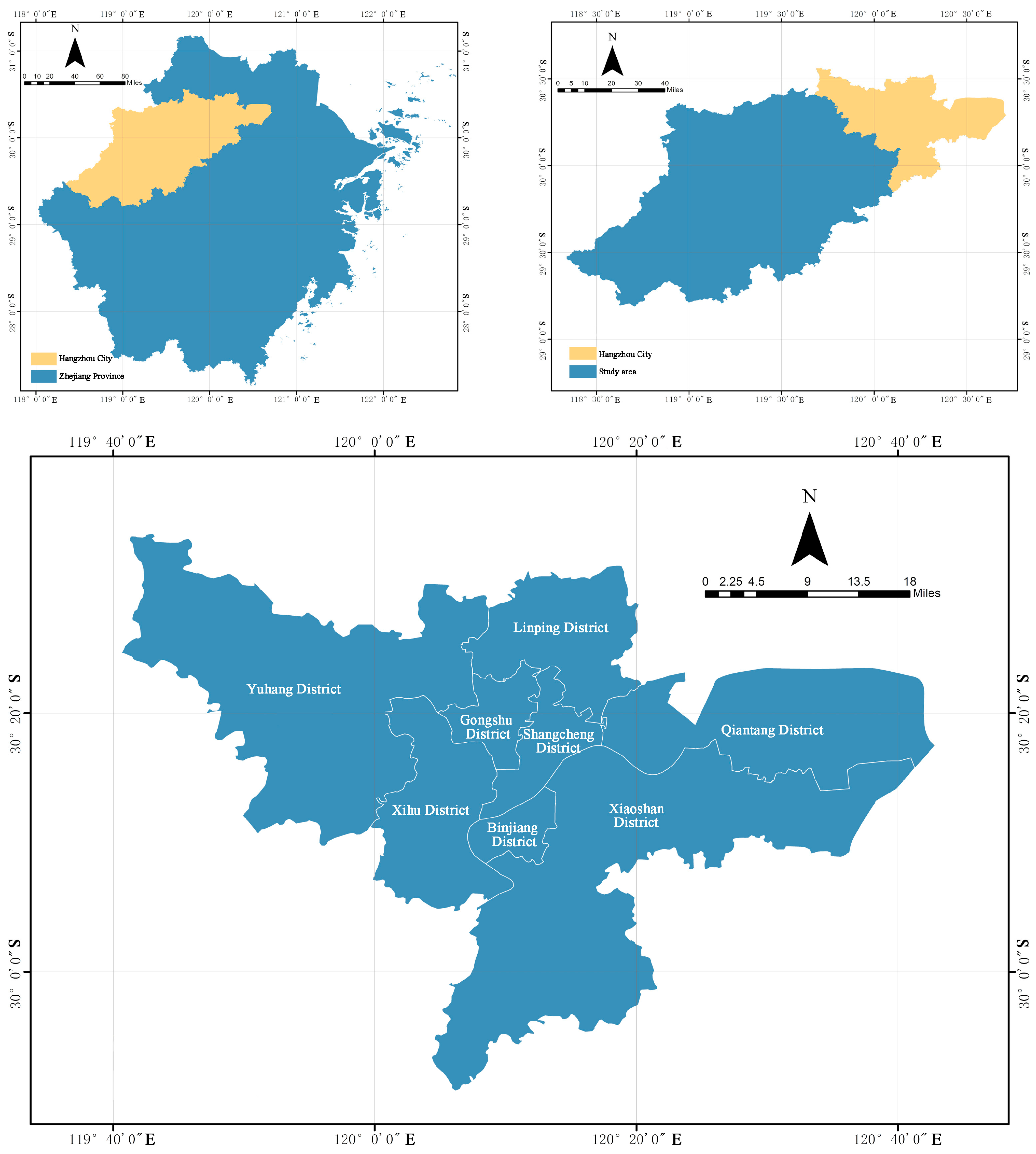
Hangzhou is situated in northern Zhejiang Province, China, along the lower reaches of the Qiantang River. Geographically, it spans from 29°11′ N to 30°34′ N latitude and 118°20′ E to 120°37′ E longitude (Figure 1). As of the end of 2023, the city’s resident population reached 8.516 million. Its economic structure is dominated by the tertiary industry, achieving a regional Gross Domestic Product (GDP) of 1.3 trillion RMB. The total area covered by this study is 3349 km2, comprising 21.6% arable land, 31.6% forest land, and 7% water bodies. Notably, the West Lake District in the central region is named after the renowned West Lake Cultural Landscape. Furthermore, the study area possesses diverse biological resources, relatively abundant land resources, and plentiful water resources. In summary, the region is characterized by both robust socio-economic conditions and abundant natural ecological resources.

2.2. Data Collection and Preprocessing

This study employed both raster and vector data. For raster data, land use information was derived from the 2020 global land cover dataset produced by the European Space Agency (ESA), based on Sentinel imagery at a 10 m resolution. Subsequently, landscape-level indices were calculated using Fragstats 4.2 software based on this resolution. Additionally, we utilized 12.5 m resolution AL
OS DEM data (https://www.earthdata.nasa.gov, accessed on 6 June 2025) and 10 m resolution NDVI data from Sentinel-2 (https://dataspace.copernicus.eu/data-collections/copernicus-sentinel-missions/sentinel-2, accessed on 6 June 2025). GDP and population density data were obtained from the Resource and Environment Science and Data Center of the Chinese Academy of Sciences (https://www.resdc.cn/, accessed on 6 June 2025). Regarding vector data, Weibo content within the study area from June 2024 was collected to construct SMD reflecting EP. Meanwhile, the latest urban road information was sourced from BigeMap 5.6.1.1 (www.bigemap.com, accessed on 6 June 2025). During the environmental assessment phase, a normalization method was applied to reduce the complexity associated with multi-source data. This process aimed to eliminate dimensional differences, ensure data comparability, and enhance the stability of the coupling process.
The integration of InVEST model outputs and SMD was achieved through a unified spatial framework. Both datasets were rasterized to a consistent 1 km × 1 km grid resolution, enabling a direct comparison and coupling analysis across the two dimensions. This standardization aims to eliminate dimensional discrepancies, ensure comparability between datasets, and enhance the stability of the coupling process [25]. HQ and EP represent complementary dimensions of urban ecosystem services: HQ captures the objective, biophysical supply of habitat functions, while EP reflects the subjective, human demand side of these services. Consequently, this approach allows for the identification of potential mismatches between ecological supply and social demand.

2.2.1. Ecological Perception

To evaluate the spatial coupling of HQ and EP within the study area, we retrieved data from the Sina Weibo platform (Version 16.4.2). A rigorous multi-stage preprocessing workflow was implemented to ensure spatial precision and semantic relevance. First, geofencing was applied to restrict the dataset to the administrative boundaries of Hangzhou’s core urban area, excluding any records lacking precise GPS coordinates. Second, the analysis focused exclusively on textual content to mitigate ‘virtual perception’ bias—a phenomenon where users share landscape imagery without firsthand physical experience. Subsequently, representative keywords (Table 1) were utilized to ensure the text accurately mapped to physical habitat features. Finally, a Python-based v3.12 cleaning algorithm was employed to filter out bot-generated content, duplicate posts, and advertisements, while the JIEBA algorithm was used for word segmentation and contextual semantic analysis. To ensure data integrity, potential biases were addressed through three main controls: (1) Temporal Bias Control: We deliberately excluded periods prone to abnormal spikes in post volume, such as the Spring Festival, National Day, and the West Lake Cultural Festival. These periods often exhibit surges in user activity that can undermine the representativeness and accuracy of long-term EP. For a tourism-oriented city like Hangzhou, holiday visitor traffic increases sharply. Unlike local residents, tourists often hold distinct perceptions of the built environment and tend to focus on major landmarks, which can distort sentiment analysis. Furthermore, the study period featured predominantly mild, sunny, or cloudy weather—ideal for outdoor activities—which naturally enhanced residents’ environmental interactions and perceptions. We utilized the EP embedded in the text as our primary metric. (2) Content Bias Control: Using a Python-based crawler (Houyi Collector 4.0.6), we systematically collected over 60,000 Sina Weibo posts from 1 June to 30 June 2024, including timestamps, content, and geolocation data [26]. The raw data underwent rigorous preprocessing to remove duplicates, invalid entries, and advertisements. To ensure objectivity, we analyzed text within its full context and employed a neutral keyword selection process to avoid leading users toward specific emotional leanings. After meticulous filtering, 4958 valid data points were retained. To identify EP elements accurately, we used the Weiciyun platform, which employs the JIEBA algorithm for precise word segmentation and part-of-speech tagging [27,28].
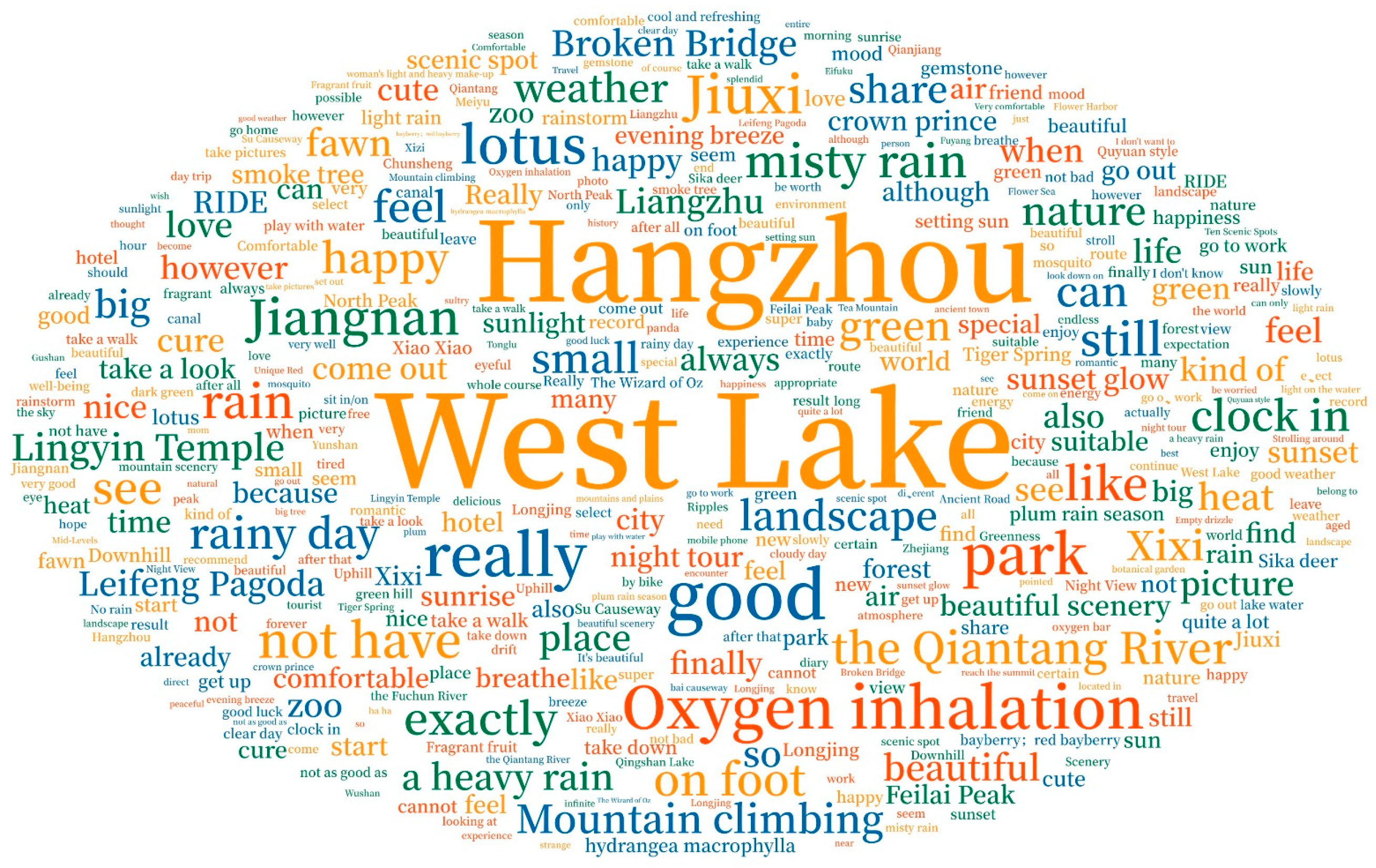
EP was then quantified by constructing a sentiment matrix based on an established emotion lexicon (Figure 2). The size of each word corresponds to its frequency of occurrence in the 4958 geolocated Weibo posts collected within Hangzhou’s core urban area. To address the semantic ambiguity of specific keywords (e.g., “wind” or “hot”), we did not rely merely on isolated word counts. Instead, the JIEBA algorithm was integrated with contextual natural language processing to evaluate phrases within their sentence structures. For instance, “gentle wind” was classified as a positive perception indicator, whereas “hot wind” or “typhoon” was categorized as negative or omitted from the high-perception matrix. (3) Statistical and Demographic Representation: While direct demographic weighting of social media users is challenging, our focus on collective perceptual trends rather than instantaneous peaks helps mitigate biases related to specific user attributes, such as occupation or personal interests. The large sample size ensures robust spatial coverage across the study area. Data were collected from Sina Weibo posts using a custom Python-based web scraping script. To ensure data stability, the collection period deliberately excluded holidays and major public events, which typically trigger atypical surges in posting volume. Data acquisition was facilitated through institutional accounts via the Sina Weibo Open Application Programming Interface. In strict accordance with data privacy and ethical standards, all collected posts were thoroughly anonymized, with all personally identifiable information removed. Although SMD is inherently subject to demographic biases—tending to represent younger, tech-savvy populations—the substantial sample size of 4958 valid data points provides a statistically robust macro-characterization of public sentiment.

2.2.2. InVEST

The HQ module of the InVEST model was employed to generate HQ maps by integrating land cover data with biodiversity threat factors. Based on the specific conditions of the study area, arable land, construction land, and roads were designated as threat factors (Table 2) [29]. Habitat suitability is typically directly proportional to natural complexity. Habitats that are more natural and complex generally exhibit higher suitability. Conversely, homogenized artificial environments demonstrate lower suitability [30]. Regarding sensitivity to external threats, natural environments rank highest, followed by semi-artificial environments. Artificial environments remain relatively stable and are largely unaffected (Table 3). To ensure that the InVEST model parameters accurately reflect the regional characteristics of Hangzhou, this study integrated expert consultation for correction and calibration, grounded in the model manual and relevant regional literature. An initial matrix was established based on habitat studies from similar areas within China’s Yangtze River Delta. This matrix was then subjected to a blind review and scoring process by experts, whose feedback was incorporated into the final adjustments. This approach significantly enhanced the model’s accuracy in identifying habitat degradation and vulnerable zones within the urban areas of Hangzhou. In the InVEST model, the degree of habitat degradation is calculated using the following equations, from Equations (1)–(3):
D x j = r = 1 R y = 1 Y r W r r = 1 R W r r y i r x y β x S j r
i r x y = 1 d x y d r m a x
i r x y = e x p 2.99 d r m a x d x y  
where D x j represents the degree of habitat degradation for grid cell x within land use type j ; R is the number of threat factors; Y r refers to the set of grid cells on the threat raster map; W r is the weight of the threat factor; r y denotes the intensity of the threat factor at grid cell y ; i r x y indicates the impact level of the threat factor at grid y on grid x ; β x represents the level of habitat resistance to disturbance; S j r is the sensitivity of the land use type to the threat factor; d x y is the linear distance between grid cells x and y ; and d r m a x is the maximum influence distance of the threat factor. In the InVEST model, HQ is calculated using the following Equation (4):
Q x j = H j 1 D x j z D x j z + k z
where Q x j represents the HQ of grid cell x within land use type j ; H j denotes the habitat suitability of land use type j ; D x j indicates the degree of habitat degradation for grid cell x in land use type j ; k is a scaling constant, typically set to the model’s default parameter value; and z is a half-saturation constant, generally set to half of the maximum habitat degradation value.

2.2.3. Coupling Coordination Degree Model

The coupling coordination degree model emerges as a potent evaluation and research instrument for exploring a region’s overall balanced development level [31]. Its widespread adoption in studying coupled development across diverse systems, spanning various scales and regions, is attributed to its simplicity, straightforward calculation process, and intuitive outcomes. The model enables the conversion of both physical and social demands into a unified, comparable dimension. To further minimize model errors, a refined version of the coupling coordination degree model, with enhanced validity, was employed. The CCD model is employed here as a spatially explicit diagnostic index. It quantifies the equilibrium state between ecological supply and social demand. A high CCD indicates a harmonious socio-ecological state where high-quality habitats are effectively perceived and utilized by the public, while a low CCD signals a functional mismatch. The CCD model is defined by the following equations, from Equations (5)–(7):
C = 2 U i U j U i + U j
T = i = 1 n α i × U i   ,   i = 1 n α i = 1
D = C × T
where U i U j represent subsystem values of EP and HQ, the coupling degree C functions as the pivotal element of the model, signifying the robustness of the coupling relationship between systems. Its range of distribution falls within [0, 1]. T represents the comprehensive evaluation index, whereas U i denotes the standardized value of the i-th subsystem. α i signifies the weight of the i-th subsystem, and D stands for the degree of coordinated development.

2.2.4. Geographic Detector

The Geodetector is a set of statistical methods designed to detect spatial differentiation and reveal underlying driving forces [32]. Its core premise rests on the assumption that if an independent variable significantly influences a dependent variable, their spatial distributions should exhibit similarity [33]. Consequently, the Geodetector is capable of analyzing both numerical and qualitative data, representing a significant methodological advantage [34]. Another distinct advantage is its capacity to detect the interaction effects of two factors on the dependent variable. It is defined by the following Equations (8) and (9):
q = 1 h = 1 L N h σ h 2 N σ 2 = 1 S S W S S T
S S W = h = 1 L N h σ h 2 , S S T = N σ 2
where h = 1 , , L represents the stratification of variable Y or factor X , denoting classifications or partitions; N h and N are the number of units in stratum h and the entire region, respectively; and σ h 2 and σ 2 denote the variances of Y values for stratum h and the entire region, respectively. S S W and S S T represent the Within Sum of Squares and the Total Sum of Squares. The q -value indicates the explanatory power of each driving factor regarding the spatial differentiation of the dependent variable. Its value ranges from 0 to 1, where a larger value signifies more pronounced spatial differentiation of Y .

2.2.5. Threshold of Driving Factors

To investigate the relationship between the coupling coordination degree and driving factors, Piecewise Linear Regression (PLR) was employed to determine the response threshold of the coupling coordination degree ( D ). The fundamental principle of PLR involves performing linear fitting on data segments preceding and succeeding breakpoints to identify the optimal segmented linear model [35,36]. Specifically, the optimal solution for segmented fitting is achieved when the sum of squared residuals is minimized. Compared to simple linear regression, PLR offers superior clarity and accuracy in revealing fitting trends within variable relationships. In this study, PLR analysis was conducted using the ‘SiZer’ and ‘segmented’ packages in R for the seven categories of factors that passed the driving factor test. The model is formulated as Equation (10):
y = β 0 + β 1 x i + e i                              x i α β 0 + ( β 1 + β 2 ) x i + β 2 α + e i      x i > α  
where y represents the coupling coordination degree; x i denotes the driving factors; α indicates the level of the driving factor at the turning point; β 0 , β 1   a n d   β 2 are coefficients; and e i   is the error term. Although the method is termed piecewise linear regression, implying that local regressions within each segment are linear, the model as a whole exhibits a non-linear response pattern. This is because the model describes distinct variable responses on either side of the breakpoint.

3. Results

3.1. Spatial Distribution and Coupling of Habitat Quality and Public Perception

3.1.1. Spatial Characteristics of Habitat Quality

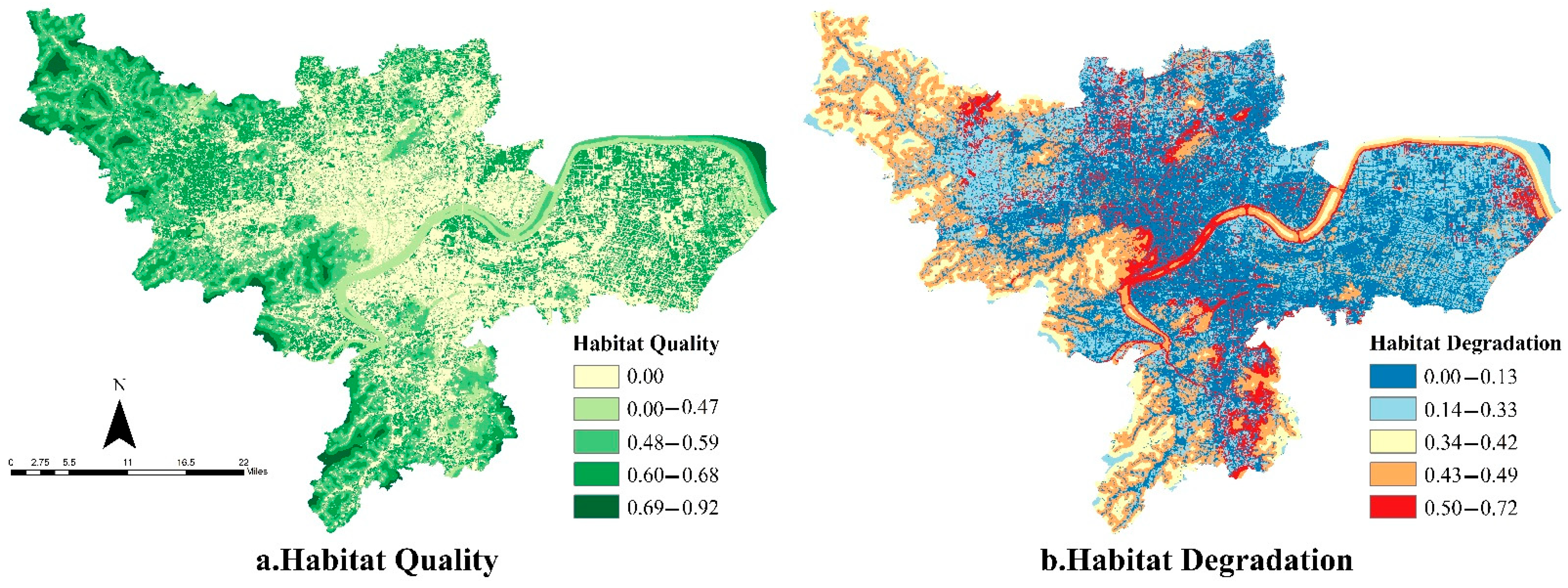
This study utilized the HQ module of the InVEST model to quantify habitat degradation and quality across the study area. Based on the findings, the data were classified into five categories using the natural breaks method. Our results reveal significant spatial heterogeneity in HQ, characterized by a high-periphery, low-center structure. High-quality habitats are heavily clustered in the low-lying hills of the western and southern regions (Figure 3a). Conversely, habitat degradation intensity exhibits a pronounced edge-effect: the most severely degraded areas are concentrated at the margins of built-up land and along major transportation arteries, reflecting the intense anthropogenic pressure exerted by urban expansion on adjacent natural habitats (Figure 3b). The mean habitat degradation in the study area was 0.38 ± 0.21, indicating an overall moderate degradation level. Specifically, the area proportions for Minimal, Slight, Moderate, Significant, and Severe Degradation were 0.385 (0.372–0.398), 0.234 (0.223–0.245), 0.092 (0.085–0.099), 0.195 (0.184–0.206), and 0.093 (0.086–0.100), respectively. Notably, highly degraded zones are primarily located within natural areas and display distinct longitudinal spatial patterns surrounding water systems, mountains, and farmland. These areas include the Xiaogucheng Village scenic area in the west, the Grand Canal and its tributaries in the center, the eastern side of West Lake, Banshan National Forest Park in the south, and the reclaimed areas in the east. HQ results were reclassified into five levels: Lowest (0.00), Lower (0.00–0.47), Medium (0.47–0.59), Higher (0.60–0.68), and Highest (0.69–0.92), accounting for 38.4%, 5.4%, 27.1%, 28.8%, and 0.1% of the total area, respectively. The analysis indicates a mean HQ of 0.56 ± 0.28, also representing a moderate level. However, the spatial distribution shows a sharp contrast between built-up environments and natural spaces. High-quality habitats are concentrated in core natural zones and evenly distributed reclaimed areas in the east, whereas the central urban environment contains dense, isolated points or linear corridors of high-quality habitat.

3.1.2. Spatial Characteristics of Ecological Perception

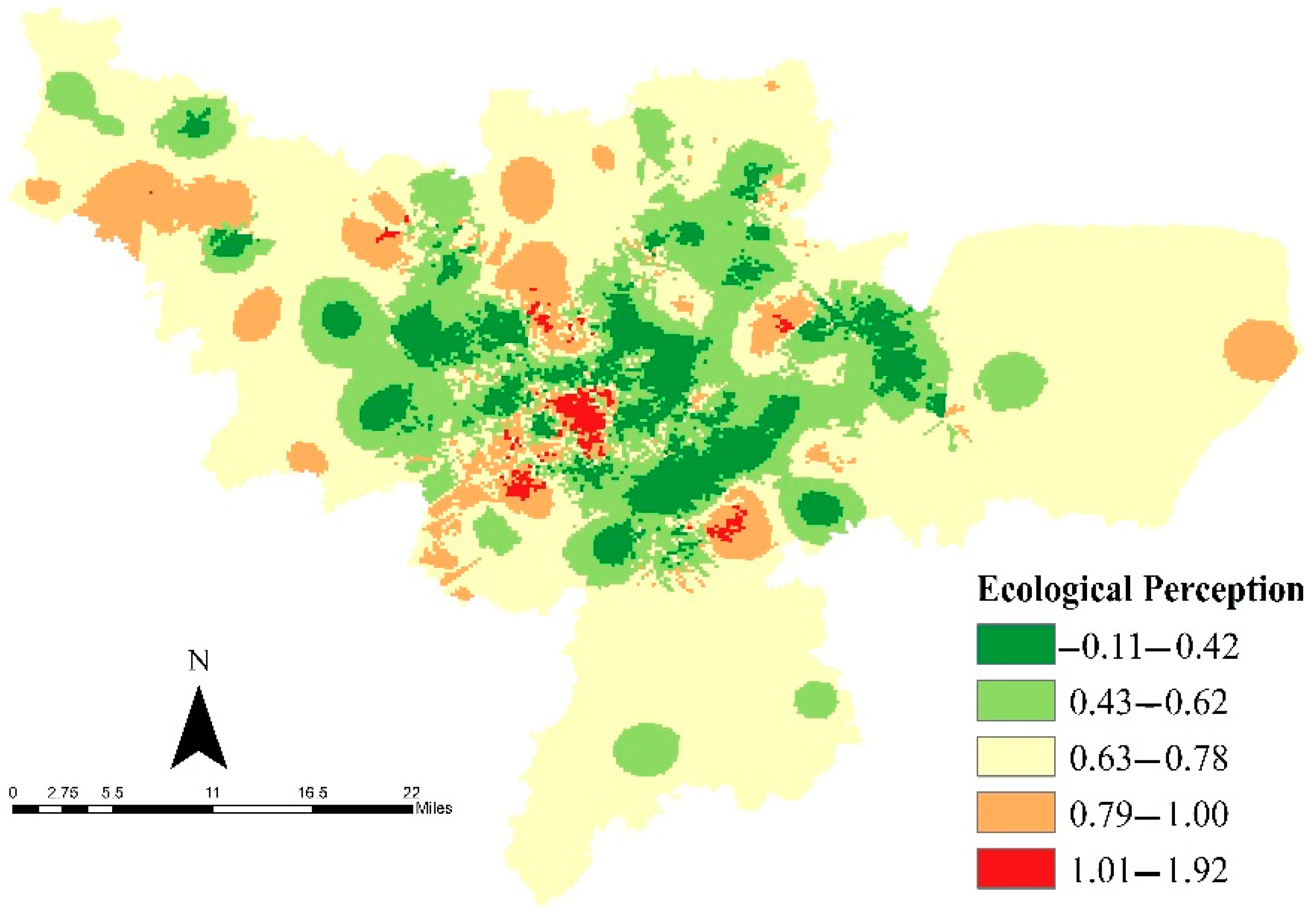
The study employed SMD to spatially visualize the EP index (Figure 4), aiming to assess the public’s subjective environmental experience and sentiment within the study area. The results indicate that, compared to HQ, the spatial distribution of EP is more extensive and is predominantly characterized by high values.
The visualization reveals that areas with high EP exhibit a distinct “strip-like” distribution pattern. In contrast, low-value areas are primarily concentrated in highly urbanized zones. These regions are characterized by high building and population densities, as well as noise pollution. Consequently, overall EP shows a stronger inclination toward the natural environments within the study area. High-value areas are generally distributed in the central and northern sections of the study area. These are particularly prominent near regions rich in natural and cultural landscapes, such as the West Lake Cultural Landscape, Liangzhu Culture Village, Banshan National Forest Park, and Xianghu Tourist Resort. Notably, due to its unique HQ value, the West Lake Cultural Landscape is the location most readily identified by the public as providing high-value, demonstrating significant spatial uniqueness. This corroborates the significance of West Lake as a landmark in Hangzhou with high value. Furthermore, effective restrictive measures for environmental protection and urban development in these areas have generated a positive radiating influence on the EP of surrounding regions. This not only enhances public perception and appreciation of high-quality urban habitats but also lays a solid foundation for regional sustainable development.

3.2. Analysis of Coupling Coordination Relationship

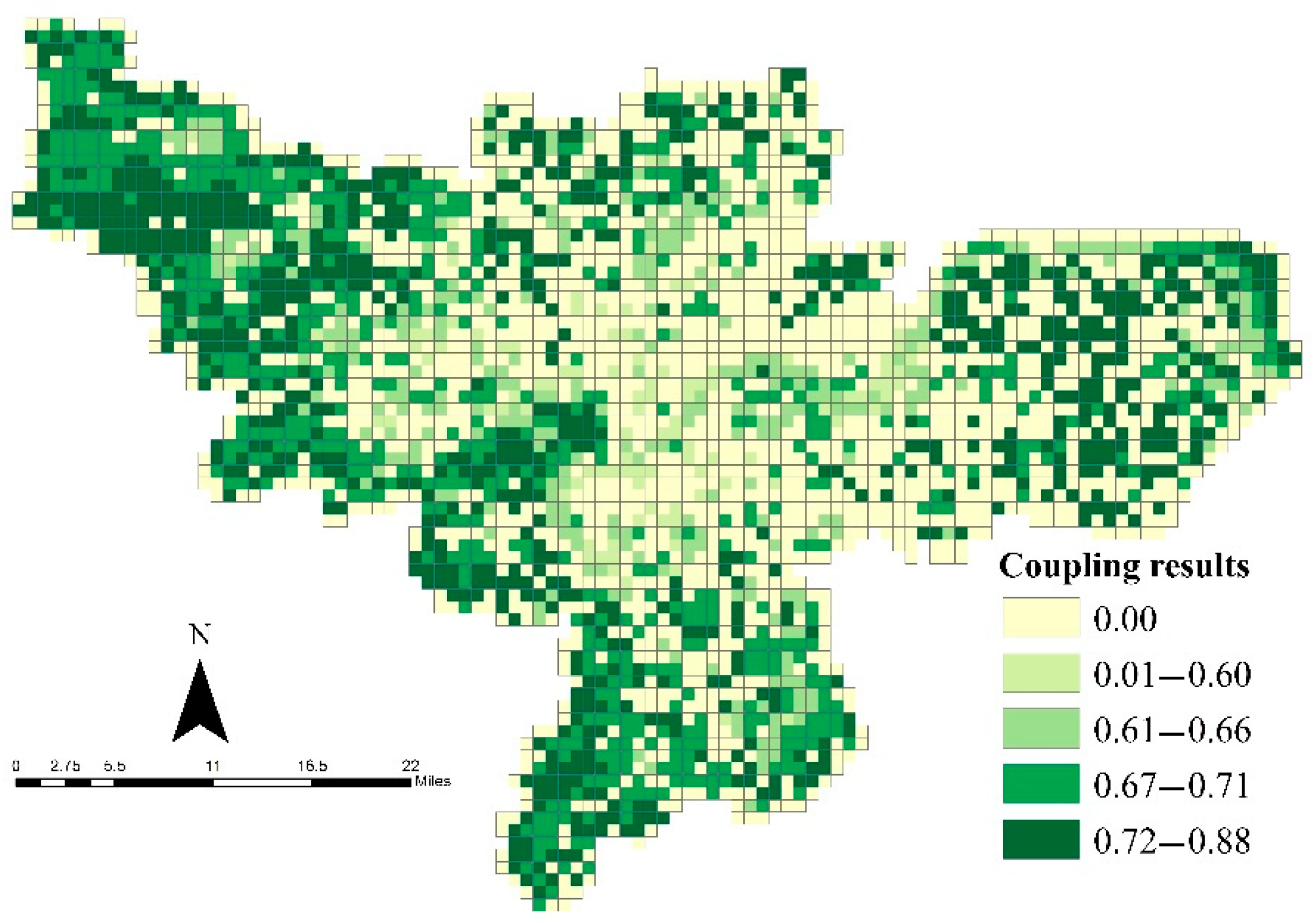
The size and boundary delineation of the assessment units may directly influence the observed coupling characteristics between HQ and EP. Specifically, the current street-level scale may have limitations in capturing either the micro-level perception of ‘pocket parks’ or the macro-level connectivity of ecological corridors. The detailed classifications are presented in Table 4. To accurately visualize the coupling coordination relationship between HQ and EP, a 1 km × 1 km spatial grid was constructed (Figure 5) to generate the corresponding visualized raster. The analysis indicates that the overall coupling degree of the study area is 0.532, while the coupling coordination degree is 0.384. This suggests a state of mild dissonance. It implies that the coordination between HQ and EP requires improvement across most of the area, a phenomenon particularly pronounced within the urban district.
Spatially, the coupling results exhibit a low-center, high-periphery pattern, which aligns with the current urban spatial structure of Hangzhou. Although the coupling degree in the central urban area is relatively low, the West Lake District stands out as a notable exception. It exhibits a high degree of coupling, containing numerous areas with good to extreme coordination. These areas are centered on the West Lake Cultural Landscape and supplemented by diverse urban green spaces, such as forest parks and wetlands. HQ here is significantly higher than in surrounding areas, thereby greatly enhancing residents’ direct perception of HQ-EP Supply–Demand Coupling. Additionally, large continuous zones of high coupling values are distributed in the northwestern part of Yuhang District and the eastern parts of Xiaoshan and Qiantang Districts. The superior natural environment in these regions stimulates public demand for and appreciation of green spaces. Conversely, areas of coupling dissonance are primarily concentrated in the central urban belt, although a few scattered pockets of high coupling can still be observed. Further analysis reveals that areas with medium-to-high coupling values are mainly concentrated in urban sections characterized by superior physical geographical conditions and dense vegetation cover. In contrast, low-coupling areas correspond primarily to regions with high impervious surface coverage, dense road networks, and highly concentrated urban functions.

3.3. Driving Factors of Coupling

3.3.1. Factors Influencing Coupling Coordination

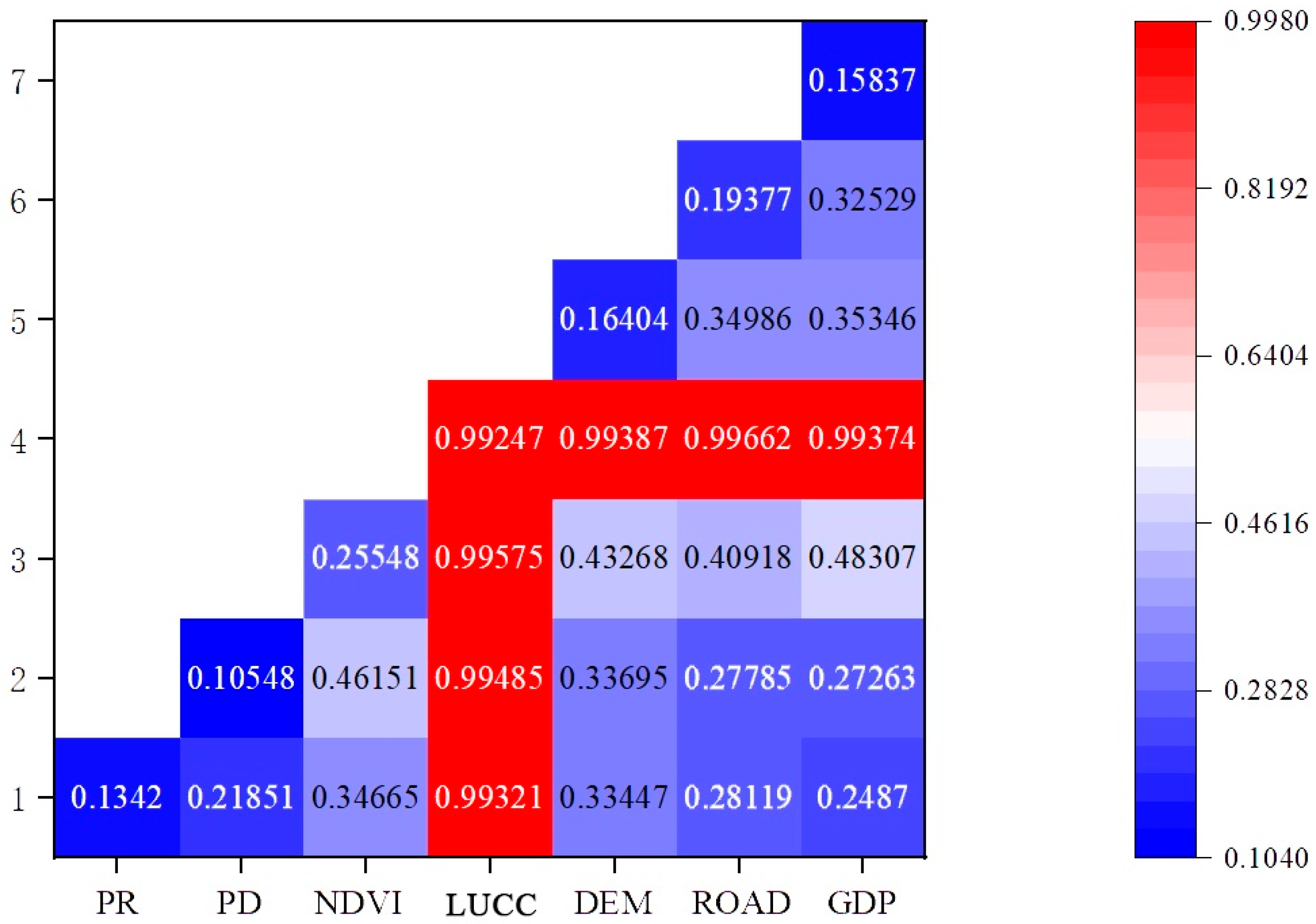
To deeply investigate the explanatory power of various factors within the study area regarding the degree of coupling coordination, this study utilized the Geodetector model. The HQ-EP coupling coordination degree served as the dependent variable, while the selected multivariate elements were designated as independent variables (Table 5). Following a preliminary analysis, the focus narrowed to the impact of each element on coupling coordination. The results indicate (Figure 6) that, with the exception of Population Density, Aggregation Index, Shannon’s Diversity Index, and Shannon’s Evenness Index, the remaining seven factors significantly passed the statistical test, demonstrating substantial explanatory power. These factors have shaped the spatial differentiation patterns of coupling coordination to varying degrees. Based on the magnitude of the q-values, the explanatory power of each factor was ranked as follows: LUCC (0.992) > NDVI (0.255) > Road (0.194) > DEM (0.164) > GDP (0.158) > PR (0.134) > PD (0.105). Notably, LUCC and NDVI demonstrated particularly strong explanatory power. This indicates that urban land use is the core factor driving HQ-EP coupling coordination. Furthermore, changes in the spatial layout of urban land can profoundly influence the dynamic evolution of this coupling relationship. Simultaneously, NDVI, as a key indicator of vegetation growth, directly reflects the status of HQ. Additionally, from a landscape ecology perspective, it was observed that the influence of Patch Richness (q = 0.134) exceeded that of Patch Density (q = 0.105). This phenomenon may be attributed to the fact that higher patch richness is typically associated with more complex ecological structures and greater biodiversity, thereby contributing to the enhanced overall quality and stability of the habitat.
The study further investigated the mechanisms by which interactions among various factors influence the HQ-EP coupling coordination degree. As illustrated in the figure, the interaction between any two factors was found to be more significant than that of individual factors. This suggests that the combined effects of multiple factors play a dominant role in the spatial differentiation of coupling coordination. These interactions predominantly manifested as either bi-factor enhancement or nonlinear enhancement, revealing the complexity involved in how multiple factors jointly shape the coordination pattern. Detailed analysis indicates that five factor pairs, involving GDP, DEM, and NDVI, exhibited nonlinear enhancement effects. This implies that these factors generate more complex synergistic effects when acting in concert. Additionally, 19 interaction pairs—including Road Density, LUCC, PD, and PR—demonstrated bi-factor enhancement characteristics, indicating a strengthened influence during interaction. These findings highlight the complex and subtle interactive relationships among driving factors and their profound impact on variations in HQ. Notably, interactions between LUCC and other key factors possessed extremely high explanatory power. The interaction between LUCC and Road Density was particularly significant (q = 0.996). This indicates that LUCC, acting as the dominant factor, interacts with socio-natural factors to significantly enhance explanatory power regarding the spatial differentiation of coupling coordination. This insight offers valuable implications for deeply understanding the complexity and dynamic evolution of urban ecosystems.

3.3.2. Threshold Identification of Driving Factors

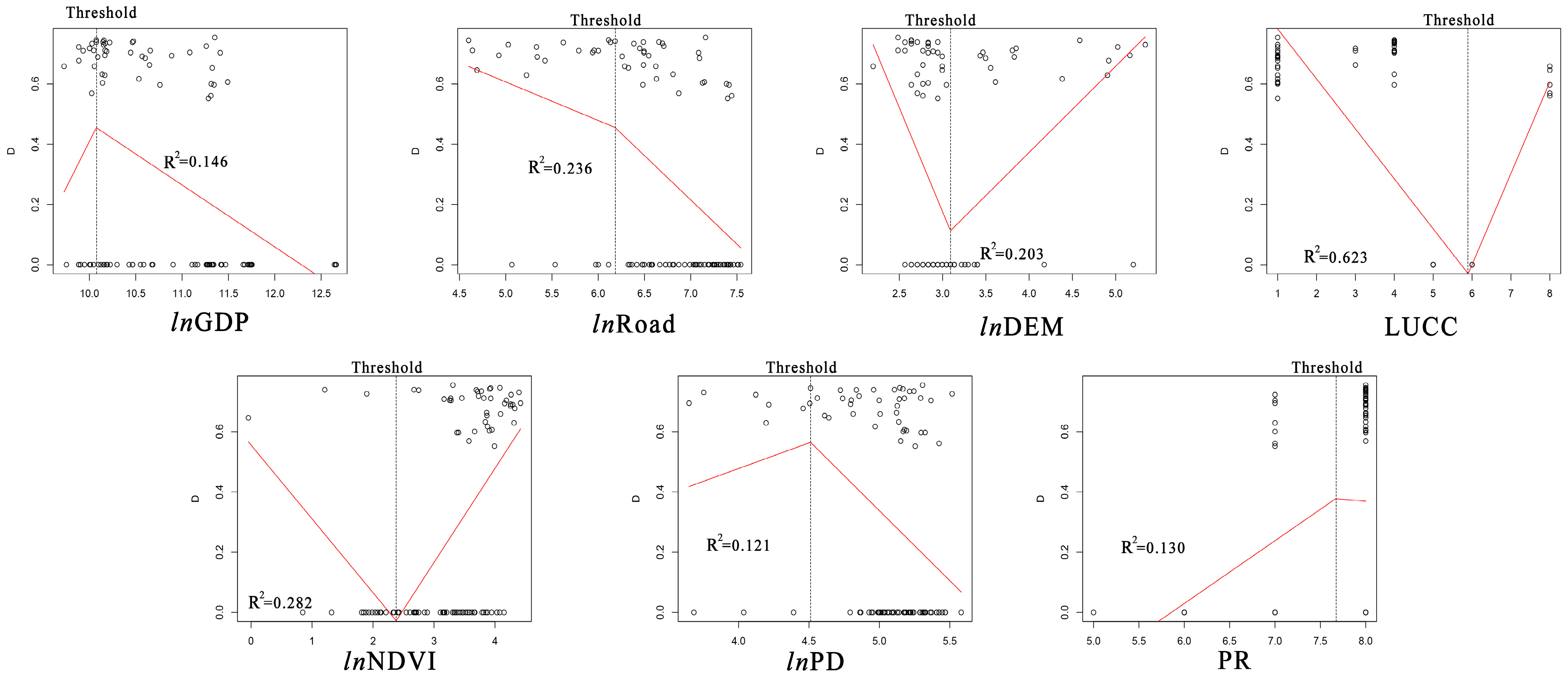
To further elucidate the critical tipping points where key driving factors influence coupling coordination, this study implemented a refined segmentation of data intervals (Figure 7). This approach aims to systematically reveal the nonlinear response mechanisms of coupling coordination to diverse environmental and social variables. Our analysis indicates that rather than exhibiting simple linear relationships, these driving factors influence the HQ-EP coupling through distinct threshold effects. Natural elements, such as NDVI and LUCC, function as foundational prerequisites; their positive impact on coupling coordination is sharply amplified only after crossing specific ecological thresholds (e.g., NDVI > 0.104). In contrast, socioeconomic factors like GDP and road density follow a ‘promotion-then-inhibition’ pattern. While moderate infrastructure initially facilitates public access to nature and enhances EP, excessive road density or commercialization eventually exceeds environmental carrying capacities. This triggers negative feedback—such as noise and congestion—leading to a rapid decline in coupling coordination [37]. Furthermore, relevant findings indicate that coupling results are often more favorable in environments with superior HQ and minimal anthropogenic disturbance [38].

4. Discussion

4.1. Interactions Between Residents and the Environment

The process of modern urbanization has profoundly impacted human society, altering traditional production modes while triggering a series of ecological and environmental issues. As critical spaces for human habitation, cities must prioritize the protection and restoration of the ecological environment. As a core element maintaining regional ecosystem stability, HQ plays a pivotal role in sustainable urban development. The perceptual hotspots identified via Weibo data in this study are highly consistent with findings from Haifa [39] and Shenzhen [40]. This consistency confirms that social media big data can effectively capture nonlinear public perceptions of urban green spaces, water bodies, and cultural heritage across diverse cultural contexts, establishing it as a reliable scientific tool for evaluating SES. Within the SES framework, utilizing SMD to explore the interplay between HQ and EP represents a proactive response to the increasingly diversified demands for habitat value. The results of the CCD analysis reveal significant spatial mismatches in certain high-density districts. These areas exhibit High Supply–Low Demand or Low Supply–High Demand patterns. Unlike traditional causal models, this coupling approach serves as a diagnostic map for urban planners. For instance, areas with high HQ but low EP (Supply > Demand) suggest a hidden ecological treasure that lacks public accessibility or aesthetic visibility, requiring interventions in infrastructure and connectivity rather than just ecological restoration. The results indicate significant heterogeneity in HQ within the main urban area of Hangzhou, particularly in the central region. This disparity primarily stems from the high HQ found in resource-rich natural areas such as West Lake. These high-quality habitats not only significantly enhance EP spatially but also highlight the close connection between HQ, urban structure, and social groups. However, high building density, population density, and widespread impervious surfaces in urban areas result in generally low HQ. Consequently, biodiversity and species richness are significantly lower compared to suburban areas [41]. Furthermore, habitat degradation is profoundly influenced by the urban built environment, exhibiting an intensifying trend. This is closely linked to anthropogenic disturbance, a finding consistent with related research [42].
As urban residents’ demand for outdoor activities continues to grow, exploring environmental preferences through the lens of EP becomes essential [43]. This approach serves as a basis for forecasting future trends in ecosystem service demands. Within the study area, we observed that low EP values exhibit an irregular strip-like structure, primarily concentrated in urban built-up zones. Research indicates that these areas frequently contribute to habitat fragmentation, thereby triggering a gradual decline in ecological functions [44]. Further analysis reveals a significant spatial correlation between HQ and EP. Notably, high EP values do not follow the low-center, high-periphery distribution pattern. Instead, they are primarily concentrated around natural ecological zones such as mountains, lakes, and wetlands. Significant clustering of high values is particularly evident surrounding West Lake. Environmental conditions in these regions are relatively stable, with minimal fluctuation in HQ. Concurrently, the government continues to implement preventive policies and protective measures to safeguard these critical areas from environmental degradation [45]. While mobility data from 317 Chinese cities suggest that residence-based evaluations tend to exaggerate green exposure inequality [46], our grid-level findings confirm that perception blind spots remain prevalent in high-density neighborhoods—even in a resource-abundant city like Hangzhou. These results imply that in rapidly urbanizing environments, mobility-based exposure fails to convert into meaningful social perception unless bolstered by localized ecological facilities. While these findings indicate that high building density undermines ecosystem supply capacity, our study expands upon this understanding by demonstrating that strategically designed micro-green spaces can sustain high ecosystem service potential even in high-density environments. This conclusion challenges the conventional wisdom that degraded environmental quality inevitably results in a deficit of social demand and supply. Although EP derived from SMD exhibits regional variations, this methodology remains applicable to other ecology-related fields. It provides robust support for urban sustainable development and the enhancement of ecosystem services. As the demand for outdoor activities grows among urban residents, we can leverage EP to explore environmental preferences and forecast future trends in ecosystem service needs.
When interpreting ecological EP patterns, a critical consideration is the potential discrepancy between tourist and resident perceptions. While our dataset does not allow for definitive group classification at the individual user level, multiple lines of evidence suggest differentiated perceptual patterns. The data collection period was intentionally selected to minimize tourist peaks; however, the presence of some visitors remains inevitable. The concentration of high EP values in areas such as the West Lake Cultural Landscape and Xixi National Wetland likely reflects a tourist perspective—one characterized by recreational or aesthetic interactions often focused on iconic landmarks and peak experiences. In contrast, areas removed from tourist hubs that consistently maintain high EP values likely represent resident perceptions. Regarding the coupling analysis, the presence of tourist data may generate an artificially high EP effect in certain zones compared to what might be expected from resident data alone. This could potentially mask mismatches between local demand and environmental supply. Conversely, areas that lack tourist appeal but provide vital daily functions for residents may be undervalued in social media-based assessments. Future research should employ user profiling, posting frequency analysis, and linguistic characterization to distinguish between tourist and resident contributions in SMD.

4.2. Intrinsic Driving Mechanisms Within Urban Social–Ecological Systems

As vital venues for human environmental perception, urban green spaces fulfill a significant social role. Based on the coupling analysis results, we observed that the degree of coupling is significantly influenced by the interaction between urbanization processes and ecological conditions. Areas with high coupling values are generally closely associated with the presence of natural features, underscoring the critical role of natural environmental elements in urban development. While traditional research often assumes a positive correlation between ecological supply and social demand, this study in Hangzhou identifies a significant spatial mismatch between high-quality habitats (such as peripheral mountain forests) and high-perception areas. This finding extends the conclusions of The Green Gap research [47]. While socioeconomic disparities drive inequalities in green space utilization in cities like Auckland, Hong Kong, and Taipei, our results in Hangzhou further demonstrate that a lack of high coordination is primarily driven by spatial accessibility and functional attractiveness, rather than a simple deficiency in total green space. Additionally, sporadic areas demonstrating good or high coupling are distributed within the central region. This may be attributed to the habitat service functions provided by urban green spaces and recreational areas within the study zone. Notably, extensive areas exhibiting extreme coordination were identified in the eastern sector of the study area. Historically, these regions transformed wastelands into farmland through reclamation, cumulatively developing over 500,000 mu of land. Following the shift in land use, unique agricultural landscapes have emerged. Furthermore, air quality in this region is significantly superior to that of the urban center, contributing to the generation of numerous high-coupling zones. Moreover, research indicates that climatic conditions significantly influence landscape formation [48], with effects varying according to north-south regional differences.
In-depth analysis using the Geodetector model reveals that the dynamics of coupling coordination are influenced by complex interactions between social and natural factors. The results indicate that LUCC and NDVI are the dominant factors influencing coupling coordination; both effectively reflect the evolutionary trends of HQ [49,50]. LUCC determines the physical supply of habitat quality. Land-use patterns directly define the ecological baseline of the surface, as different land-use types exhibit fundamental variations in habitat sensitivity and threat intensity. Furthermore, LUCC shapes the perceptual boundaries of human activity. EP does not emerge in a vacuum; rather, it is anchored in specific land functions. Consequently, LUCC constitutes the physical framework for the spatial heterogeneity of HQ. However, the specific trajectory of the relationship between NDVI and coupling outcomes remains somewhat uncertain. Further investigation suggests that NDVI exerts a positive driving effect on coupling results only after reaching a specific threshold. Concurrently, as elevation increases, anthropogenic disturbance diminishes, thereby facilitating habitat protection and restoration in certain areas. On the other hand, PD and PR inherently contribute positively to coupling outcomes. However, as landscape fragmentation intensifies, continuous ecological patches are severed by urban spaces, directly inducing changes in coupling coordination. Regarding social factors, the Kuznets Hypothesis posits an inverted “U-shaped” relationship between economic development and environmental quality. It suggests that environmental quality initially improves with economic development but begins to decline after reaching a peak. This theory offers a valuable perspective for understanding the impact of GDP on coupling coordination outcomes. In the middle and late stages of urbanization, high-GDP areas are typically characterized by higher-quality urban parks, linear green spaces, and greater investment in landscape maintenance. However, once GDP growth or road density exceeds a specific threshold, excessive commercialization can alter the natural attributes of the environment. This shift triggers negative feedback in SMD regarding ‘crowding’ and ‘noise’, thereby diminishing EP. Furthermore, the digitalization of life brought by urbanization has transformed how perception spreads. While confirming the risk of tourist preference bias in SMD—a phenomenon evident in the West Lake district—this study offers a novel insight: peripheral areas outside the primary tourism core maintain stable and highly coupled values. These values are uniquely shaped by the routine social interactions of local residents, rather than transient tourism activities. Improvements in HQ within a specific area are rapidly amplified through social media platforms; this social network effect is a crucial dimension often overlooked in traditional habitat assessments. Although the selected social factors generally possess weaker explanatory power than natural factors, they exert a non-negligible influence on urban HQ and engage in intricate interactions with other elements. Prevailing research indicates that urbanization often leads to significant, predominantly negative changes in original habitats [51]. Our results indicate that while the impact of land development on habitats is linear, its combination with high population density exerts an exponential negative shock on EP. This suggests that the interplay between physical development and demographic pressure creates a compounding degradation of the perceived environment that far exceeds the sum of their individual effects. During this process, habitat spaces are also jointly shaped and influenced by various social factors [52]. To better explore the ecological environment, each influencing factor requires further quantitative analysis. Current urban expansion threatens the ecological security of internal regions, which lack sufficient vegetated green spaces to support the integrity of habitat areas. In particular, landscape fragmentation within and surrounding the city significantly impacts the ecological environment. However, uncertainties regarding driving factors remain, particularly concerning whether variations among factors across spatiotemporal scales can be maintained within an acceptable range.

4.3. Policy Frameworks for Synergizing Habitat Quality Supply and Demand to Achieve SDGs

Human society has entered the new era of the Urbanocene. Cities should be viewed as the product of co-evolution between humans and nature, representing a complex system where social structures and natural environments intertwine. Currently, urban Sustainable Development Goals (SDGs) must align with ecosystem harmony to effectively address long-term challenges in future development.
China’s rapid urbanization has significantly expanded built-up areas and fostered population agglomeration. However, this has also caused indigenous ecological spaces to shrink or vanish, leading to a decline in overall ecological function [53]. As complex systems integrating natural ecology and socio-economics, cities concentrate resources within central areas, resulting in a significant divergence between natural and social spaces. As a long-term systemic issue, SDGs are closely linked to SES. In advancing SDGs, there is an urgent need to analyze and enrich the definition of urban development from a more profound perspective. Similar to the application of Twitter in urban flood management [54], this study demonstrates that social media serves not only as a disaster prevention tool but also as a socio-ecological sensor to guide daily planning. Our proposed zoning strategies prioritize dysfunctional zones for landscape enhancement. This offers a governance paradigm for globally expanding high-density, high-growth cities, facilitating a strategic shift from spatial expansion toward precision perceptual optimization. Furthermore, our threshold analysis reveals a more nuanced reality: excessive commercialization profoundly disrupts the social–ecological equilibrium—a dynamic shift that purely biophysical models fail to capture. In-depth analysis indicates that within the study area, regions with higher levels of urbanization typically exhibit lower habitat service efficacy. With the continuous expansion of urban scale and quantity, substantial amounts of arable land and green space have been converted into urban construction land. Consequently, public EP and the spatial distribution of high-quality HQ have become increasingly concentrated in natural areas strictly protected by policy [55]. The conflict between urban development and ecological protection is significantly reflected in public perception. Moreover, areas undergoing LUCC exert irreversible impacts on HQ [56]. These conflicts underscore the contrast between built-up areas and natural spaces while clarifying the critical importance of LUCC for ecosystem health. Currently, uneven urban development has emerged in Hangzhou, characterized by a misalignment between economic growth and environmental protection.

5. Conclusions

In conclusion, this study successfully operationalized Social Media Data as a scientific tool to bridge the gap between objective ecological supply and subjective social demand. Returning to our core research questions: (1) We found that HQ and EP exhibit fundamentally different spatial distributions, with HQ peaking in peripheral natural zones while EP is tightly clustered around accessible landmarks. (2) Through the coupling coordination model, we quantified a widespread spatial mismatch (overall CCD = 0.384), particularly identifying invisible high-value habitats and overloaded ecological zones. (3) We identified that land use type and vegetation cover are the primary drivers of this coupling, while socio-economic factors act as restrictive thresholds.
While this study explores a coupling framework between urban habitat quality and social perception, several limitations remain. First, due to the broad geographical scope, some parameters in the InVEST model rely on literature reviews and expert consultations. Future research should incorporate on-site biodiversity surveys for precise calibration to enhance local applicability. Second, although SMD provides high spatio-temporal resolution, it is subject to digital divide biases, potentially overlooking the needs of less active groups, such as the elderly and children. Subsequent studies should integrate field-based social surveys to cross-validate multi-source data, ensuring equity in ecological planning. Regarding the temporal scale, this study utilizes static cross-sectional data from June 2024, which cannot capture seasonal fluctuations or the long-term dynamic evolution of ecosystem services. Future efforts should construct multi-year spatio-temporal models to quantify the lagged effects of policy interventions on social–ecological system balance. Furthermore, the current analysis of driving factors remains relatively coarse; future work should refine land-use sub-classifications and road hierarchies while incorporating environmental variables such as microclimate and air quality. Finally, although the coupling results demonstrate robustness at a 1 km grid scale, spatial scale effects persist. Future research is needed to determine the optimal spatial analysis units and verify the portability and consistency of this framework across diverse urban contexts.

Author Contributions

Conceptualization, Z.L. and L.H.; methodology, Z.L. and L.H.; software, Z.L. and J.C.; validation, Z.L.; formal analysis, Z.L.; investigation, Z.L., J.C., Y.G. and Z.W.; resources, L.H.; data curation, Z.L. and Y.G.; writing—original draft preparation, Z.L.; writing—review and editing, Z.L., Z.W. and L.H.; visualization, Z.L.; supervision, L.H.; project administration, Z.L. and L.H.; funding acquisition, L.H. All authors have read and agreed to the published version of the manuscript.

Funding

This research was funded by the Zhejiang Provincial Philosophy and Social Sciences Planning Project [Grant No. 24NDJC285YBM]; Open Foundation of the Key Laboratory of Spatial Intelligent Planning Technology, Ministry of Natural Resources [Grant No. 20230304]; and the Science Foundation of Zhejiang Sci-Tech University [Grant No. 21052290-Y].

Data Availability Statement

The original contributions presented in this study are included in the article. Further inquiries can be directed to the corresponding author.

Conflicts of Interest

Zhe Wang is from China United Engineering Corporation Limited, other authors declare no conflicts of interest.

References

  1. Vázquez-González, C.; Ávila-Foucat, V.S.; Ortiz-Lozano, L.; Moreno-Casasola, P.; Granados-Barba, A. Analytical Framework for Assessing the Social-Ecological System Trajectory Considering the Resilience-Vulnerability Dynamic Interaction in the Context of Disasters. Int. J. Disaster Risk Reduct. 2021, 59, 102232. [Google Scholar] [CrossRef]
  2. McPhearson, T.; Cook, E.M.; Berbés-Blázquez, M.; Cheng, C.; Grimm, N.B.; Andersson, E.; Barbosa, O.; Chandler, D.G.; Chang, H.; Chester, M.V.; et al. A Social-Ecological-Technological Systems Framework for Urban Ecosystem Services. One Earth 2022, 5, 505–518. [Google Scholar] [CrossRef]
  3. Tidball, K.; Stedman, R. Positive dependency and virtuous cycles: From resource dependence to resilience in urban social-ecological systems. Ecol. Economics 2012, 86, 292–299. [Google Scholar] [CrossRef]
  4. Wang, K. Hexagonal Cyclical Network Structure and Operating Mechanism of the Social-Ecological System. Ecol. Indic. 2022, 141, 109099. [Google Scholar] [CrossRef]
  5. Zhao, Z.; Xue, L.; Zhang, J.; Wei, H.-Y. Urban Biotope Mapping and Nature Conservation Planning in Typical Area of Xi’ an City of China. Sci. Geogr. Sin. 2007, 4, 561–566. [Google Scholar] [CrossRef]
  6. Liu, W.; Yu, Z. Mapping urban habitat service based on GIS in Haidian District, Beijing. Ecol. Sci. 2017, 36, 144–151. [Google Scholar] [CrossRef]
  7. Zou, N.; Mi, X.; Xiao, Y.; Li, Y.; Hu, N. Assessing Urban Park Equity in Chaoyang District, Beijing Using Online Review Data. Sci. Rep. 2024, 14, 1160. [Google Scholar] [CrossRef]
  8. Lee, S.; Song, T.; Lim, U. How Are Happy and Unhappy People Differently Affected by Their Local Environments? The Heterogeneous Relationship between Happiness and Local Environments in Seoul, Korea. Cities 2022, 127, 103768. [Google Scholar] [CrossRef]
  9. Wang, R.; Feng, Z.; Pearce, J.; Liu, Y.; Dong, G. Are Greenspace Quantity and Quality Associated with Mental Health through Different Mechanisms in Guangzhou, China: A Comparison Study Using Street View Data. Environ. Pollut. 2021, 290, 117976. [Google Scholar] [CrossRef]
  10. Wu, J.; Xu, Z.; Jin, Y.; Chai, Y.; Newell, J.; Ta, N. Gender Disparities in Exposure to Green Space: An Empirical Study of Suburban Beijing. Landsc. Urban Plan. 2022, 222, 104381. [Google Scholar] [CrossRef]
  11. Zhang, W. Perception Study of Urban Green Spaces in Singapore Urban Parks: Spatio-Temporal Evaluation and the Relationship with Land Cover. Urban For. Urban Green. 2024, 99, 128455. [Google Scholar] [CrossRef]
  12. Ghermandi, A. Social Media Data for Environmental Sustainability: A Critical Review of Opportunities, Threats, and Ethical Use. One Earth 2023, 6, 236–250. [Google Scholar] [CrossRef]
  13. Li, J.; Gao, J.; Zhang, Z.; Fu, J.; Shao, G.; Zhao, Z.; Yang, P. Insights into Citizens’ Experiences of Cultural Ecosystem Services in Urban Green Spaces Based on Social Media Analytics. Landsc. Urban Plan. 2024, 244, 104999. [Google Scholar] [CrossRef]
  14. You, S. Identifying the Spatiotemporal Dynamics of Forest Ecotourism Values with Remotely Sensed Images and Social Media Data: A Perspective of Public Preferences. J. Clean. Prod. 2022, 341, 130715. [Google Scholar] [CrossRef]
  15. Wang, W.; Wu, C.; Fang, Q.; Harrison, O.I. Cultural ecosystem services evaluation in a coastal city of China using social media data. Ocean Coast. Manag. 2023, 242, 106693. [Google Scholar] [CrossRef]
  16. Guo, X.; Tu, X.; Huang, G.; Fang, X.; Kong, L.; Wu, J. Urban Greenspace Helps Ameliorate People’s Negative Sentiments during the COVID-19 Pandemic: The Case of Beijing. Build. Environ. 2022, 223, 109449. [Google Scholar] [CrossRef]
  17. Hadi, M.S.; Lawey, A.Q.; El-Gorashi, T.E.H.; Elmirghani, J.M.H. Big Data Analytics for Wireless and Wired Network Design: A Survey. Comput. Netw. 2018, 132, 180–199. [Google Scholar] [CrossRef]
  18. Guan, C.; Song, J.; Keith, M.; Zhang, B.; Akiyama, Y.; Da, L.; Shibasaki, R.; Sato, T. Seasonal Variations of Park Visitor Volume and Park Service Area in Tokyo: A Mixed-Method Approach Combining Big Data and Field Observations. Urban For. Urban Green. 2021, 58, 126973. [Google Scholar] [CrossRef]
  19. Ballesteros-Olza, M.; Palencia-González, F.J.; Blanco-Gutiérrez, I. Using Big Data to Analyze How and Why Users Value Urban Blue Spaces in Spain. Urban For. Urban Green. 2024, 95, 128308. [Google Scholar] [CrossRef]
  20. Qian, J. Quantify City-Level Dynamic Functions across China Using Social Media and POIs Data. Comput. Environ. Urban Syst. 2021, 85, 101552. [Google Scholar] [CrossRef]
  21. Wei, J. Mapping Human Perception of Urban Landscape from Street-View Images: A Deep-Learning Approach. Int. J. Appl. Earth Obs. Geoinf. 2022, 112, 102886. [Google Scholar] [CrossRef]
  22. Eker, S.; Mastrucci, A.; Pachauri, S.; Van Ruijven, B. Social Media Data Shed Light on Air-Conditioning Interest of Heat-Vulnerable Regions and Sociodemographic Groups. One Earth 2023, 6, 428–440. [Google Scholar] [CrossRef]
  23. Fang, L.; Zhang, D.; Liu, T.; Yao, S.; Fan, Z.; Xie, Y.; Wang, X.; Li, X. A Multi-Level Investigation of Environmental Justice on Cultural Ecosystem Services at a National Scale Based on Social Media Data: A Case of Accessibility to Five-A Ecological Attractions in China. J. Clean. Prod. 2021, 286, 124923. [Google Scholar] [CrossRef]
  24. Guo, M. Characterizing Environmental Pollution with Civil Complaints and Social Media Data: A Case of the Greater Taipei Area. J. Environ. Manag. 2023, 348, 119310. [Google Scholar] [CrossRef]
  25. Matuštík, J.; Paulu, A.; Kočí, V. Is Normalization in Life Cycle Assessment Sustainable? Alternative Approach Based on Natural Constraints. J. Clean. Prod. 2024, 444, 141234. [Google Scholar] [CrossRef]
  26. Wang, X.; Zhang, Y.; Yu, D.; Qi, J.; Li, S. Investigating the Spatiotemporal Pattern of Urban Vibrancy and Its Determinants: Spatial Big Data Analyses in Beijing, China. Land Use Policy 2022, 119, 106162. [Google Scholar] [CrossRef]
  27. Cui, C.; Wei, M.; Che, L.; Wu, S.; Wang, E. Hotel Recommendation Algorithms Based on Online Reviews and Probabilistic Linguistic Term Sets. Expert Syst. Appl. 2022, 210, 118503. [Google Scholar] [CrossRef]
  28. Xiang, G.; Zhang, Y.; Tan, J.; Ran, Z.; Shi, E. Research on the Construction of Event Corpus with Document-Level Causal Relations for Social Security. Inf. Process. Manag. 2023, 60, 103515. [Google Scholar] [CrossRef]
  29. Zhu, Y.; Xie, J.-J.; Liu, Y.-J.; Chen, X. Construction and Resilience Analysis of Avian Ecological Networks at the Urban Scale: A Case Study of Hangzhou City, Zhejiang Province. Chin. Landsc. Archit. 2025, 41, 102–106. [Google Scholar] [CrossRef]
  30. Tian, P.; Li, J.; Cao, L.; Pu, R.; Gong, H.; Zhang, H.; Chen, H.; Yang, X. Assessing Matching Characteristics and Spatial Differences between Supply and Demand of Ecosystem Services: A Case Study in Hangzhou, China. Land 2021, 10, 582. [Google Scholar] [CrossRef]
  31. Wang, S.-J.; Kong, W.; Ren, L.; Zhi, D.-D.; Dai, B.-T. Research on misuses and modification of coupling coordination degree model in China. J. Nat. Resour. 2021, 36, 793–810. [Google Scholar] [CrossRef]
  32. Wang, J.-F.; Li, X.-H.; Christakos, G.; Zhang, T.; Gu, X.; Zheng, X.-Y. Geographical Detectors-Based Health Risk Assessment and Its Application in the Neural Tube Defects Study of the Heshun Region, China. Int. J. Geogr. Inf. Sci. 2010, 24, 107–127. [Google Scholar] [CrossRef]
  33. Wang, J.-F. A Measure of Spatial Stratified Heterogeneity. Ecol. Indic. 2016, 67, 250–256. [Google Scholar] [CrossRef]
  34. Wang, J.; Haining, R.; Zhang, T.; Xu, C.; Hu, M.; Yin, Q.; Li, L.; Zhou, C.; Li, G.; Chen, H. Statistical Modeling of Spatially Stratified Heterogeneous Data. Ann. Am. Assoc. Geogr. 2024, 114, 499–519. [Google Scholar] [CrossRef]
  35. Debarre, T.; Denoyelle, Q.; Unser, M.; Fageot, J. Sparsest Piecewise-Linear Regression of One-Dimensional Data. J. Comput. Appl. Math. 2022, 406, 114044. [Google Scholar] [CrossRef]
  36. Yu, H. Integrating Species Distribution and Piecewise Linear Regression Model to Identify Functional Connectivity Thresholds to Delimit Urban Ecological Corridors. Environ. Urban Syst. 2024, 113, 102177. [Google Scholar] [CrossRef]
  37. Peng, J.; Tian, L.; Liu, Y.; Zhao, M.; Hu, Y.; Wu, J. Ecosystem Services Response to Urbanization in Metropolitan Areas: Thresholds Identification. Sci. Total Environ. 2017, 607–608, 706–714. [Google Scholar] [CrossRef]
  38. Li, D.; Cao, W.; Dou, Y.; Wu, S.; Liu, J.; Li, S. Non-Linear Effects of Natural and Anthropogenic Drivers on Ecosystem Services: Integrating Thresholds into Conservation Planning. J. Environ. Manag. 2022, 321, 116047. [Google Scholar] [CrossRef]
  39. Depietri, Y.; Ghermandi, A.; Campisi-Pinto, S.; Orenstein, D.E. Public Participation GIS versus Geolocated Social Media Data to Assess Urban Cultural Ecosystem Services: Instances of Complementarity. Ecosyst. Serv. 2021, 50, 101277. [Google Scholar] [CrossRef]
  40. Sun, Y.; Shao, Y. Measuring Visitor Satisfaction toward Peri-Urban Green and Open Spaces Based on Social Media Data. Urban For. Urban Green. 2020, 53, 126709. [Google Scholar] [CrossRef]
  41. Bai, L.; Xiu, C.; Feng, X.; Liu, D. Influence of Urbanization on Regional Habitat Quality:A Case Study of Changchun City. Habitat Int. 2019, 93, 102042. [Google Scholar] [CrossRef]
  42. Yue, W.-Z.; Xia, H.-X.; Wu, T.; Xiong, J.-H.; Zhong, P.-Y.; Chen, Y. Spatio-temporal evolution of habitat quality and ecological red line assessment in Zhejiang Province. Acta Ecol. Sin. 2022, 42, 6406–6417. [Google Scholar] [CrossRef]
  43. Nyelele, C.; Keske, C.; Chung, M.G.; Guo, H.; Egoh, B.N. Using Social Media Data and Machine Learning to Map Recreational Ecosystem Services. Ecol. Indic. 2023, 154, 110606. [Google Scholar] [CrossRef]
  44. Lin, Y.; Yu, R.; Lang, L.; Li, F.-T.; Zhang, H.-C.; Jie, Y. Spatiotemporal Impacts of Climate Change and Human Activities on Water Resources and Ecological Sensitivity in the Mekong Subregion in Cambodia. Environ. Sci. Pollut. Res. 2023, 30, 4023–4043. [Google Scholar] [CrossRef]
  45. Köse, M. Factors Affecting the Planning and Management of Urban Forests_ A Case Study of Istanbul. Urban For. Urban Green. 2020, 54, 126739. [Google Scholar] [CrossRef]
  46. Zhang, Y.; Kwan, M.-P.; Ma, H.; Fang, L.; Chen, Z.; Chen, N. Social Media Big Data Reveals How Mobility Reshapes Human Environmental Exposure Inequality. Landsc. Urban Plan. 2026, 270, 105600. [Google Scholar] [CrossRef]
  47. Chuang, I.-T.; Shen, D.; Poorthuis, A.; Colbert, J.; Wong, P.P.Y.; Cheung, W.K.S.; Tsang, D.; Hsueh, C.-L.; Sila-Nowicka, K. The Green Gap: Socio-Economic Disparities in the Utilisation of Urban Green Spaces in Auckland, Hong Kong, and Taipei. Urban For. Urban Green. 2026, 120, 129442. [Google Scholar] [CrossRef]
  48. Thomas, M.; Boulanger, Y.; Asselin, H.; Lamara, M.; Fenton, N.J. How Will Climate Change and Forest Harvesting Influence the Habitat Quality of Two Culturally Salient Species? Sci. Total Environ. 2024, 927, 172148. [Google Scholar] [CrossRef]
  49. Yue, Z.; Xiao, C.; Feng, Z.; Wang, Y.; Yan, H. Accelerating Decline of Habitat Quality in Chinese Border Areas. Resour. Conserv. Recycl. 2024, 206, 107665. [Google Scholar] [CrossRef]
  50. Du, Z.; Yu, L.; Chen, X.; Gao, B.-B.; Yang, J.-Y.; Fu, H.-H.; Gong, P. Land Use/Cover and Land Degradation across the Eurasian Steppe: Dynamics, Patterns and Driving Factors. Sci. Total Environ. 2024, 909, 168593. [Google Scholar] [CrossRef]
  51. An, M.; Xie, P.; He, W.; Wang, B.; Huang, J.; Khanal, R. Spatiotemporal Change of Ecologic Environment Quality and Human Interaction Factors in Three Gorges Ecologic Economic Corridor, Based on RSEI. Ecol. Indic. 2022, 141, 109090. [Google Scholar] [CrossRef]
  52. He, J. Examining the Relationship between Urbanization and the Eco-Environment Using a Coupling Analysis: Case Study of Shanghai, China. Ecol. Indic. 2017, 77, 185–193. [Google Scholar] [CrossRef]
  53. Wang, S.-H.; Huang, S.; Budd, W. Integrated Ecosystem Model for Simulating Land Use Allocation. Ecol. Model. 2012, 227, 46–55. [Google Scholar] [CrossRef]
  54. Soomro, S.; Boota, M.W.; Zwain, H.M.; Soomro, G.-Z.; Shi, X.; Guo, J.; Li, Y.; Tayyab, M.; Aamir Soomro, M.H.A.; Hu, C.; et al. How Effective Is Twitter (X) Social Media Data for Urban Flood Management? J. Hydrol. 2024, 634, 131129. [Google Scholar] [CrossRef]
  55. Han, P.; Hu, H.-Z.; Zhou, J.-Y.; Wang, M.; Zhou, Z.-X. Integrating Key Ecosystem Services to Study the Spatio-Temporal Dynamics and Determinants of Ecosystem Health in Wuhan’s Central Urban Area. Ecol. Indic. 2024, 166, 112352. [Google Scholar] [CrossRef]
  56. Gomes, E.; Inácio, M.; Bogdzevi, K.; Kalinauskas, M.; Karnauskaite, D.; Pereira, P. Future Scenarios Impact on Land Use Change and Habitat Quality in Lithuania. Environ. Res. 2021, 197, 111101. [Google Scholar] [CrossRef] [PubMed]
Figure 1. Map of Study Area.
Land 15 00690 g001
Figure 2. Word cloud.
Land 15 00690 g002
Figure 3. Habitat Quality and Habitat Degradation.
Land 15 00690 g003
Figure 4. Spatial distribution of the Ecological Perception index.
Land 15 00690 g004
Figure 5. Coupling results of Habitat Quality and Ecological Perception.
Land 15 00690 g005
Figure 6. Interaction detection results of factors influencing the coupling of Habitat Quality and Ecological Perception.
Land 15 00690 g006
Figure 7. Relationships between key driving factors and the degree of coupling coordination.
Land 15 00690 g007
Table 1. Keyword Classification for Ecological Perception.
CategoryKeywords
NounMountain, water, stream, river, rain, flower, grass, wind, scenery, vista, scenic area, park, oxygen bar, overcast, mosquito, zoo, botanical garden, good weather…
VerbInhale oxygen, zone out, clear the mind, rest, escape the heat, hike, heal, check-in, play in water, climb mountain, raft…
AdjectiveExhilarated, hot, cozy, cool, comfortable, fresh…
Note: The term “oxygen bar” refers to areas with high negative oxygen ion content, such as forests. “Check-in” refers to the social media practice of geotagging a specific location.
Table 2. Habitat threat factors.
Threat SourceMaximum Influence DistanceWeightDecay Type
Cropland40.4Linear
Construction Land80.8Exponential
Roads40.4Linear
Railways30.4Linear
Table 3. Habitat suitability and sensitivity to threat factors.
TypeHabitat SuitabilitySensitivity to Threat Factors
CroplandConstruction LandRoadsRailways
Forest Land10.30.70.70.6
Shrubland0.80.40.50.70.6
Grassland0.80.40.50.20.2
Cropland0.80.20.50.20.1
Construction Land00000
Bare Land00000
Water0.80.70.80.40.4
Table 4. Spatial Zoning Matrix of HQ-EP Coupling.
HQEPType
HighHighHigh-High Synergy Zone
HighLowPerceptual Deficit Zone
LowHighEcological Deficit Zone
LowLowLow-Low Lagging Zone
Table 5. Detection results of factors influencing the coupling coordination of Habitat Quality and Ecological Perception.
Influence FactorGDPRoadPopDEMLUCCNDVIPDPRAISHDISHEI
q 0.158 ***0.194 ***0.0650.164 **0.992 ***0.255 ***0.105 *0.134 ***0.0430.0250.082
Note: GDP: Gross Domestic Product, Road: Road Density, Pop: Population Density, DEM: Digital Elevation Model, LUCC: Land-use and Land-Use and Cover Change, NDVI: Normalized difference vegetation index, PD: Patch density, PR: Patch richness, AI: Aggregation index, SHDI: Shannon’s diversity index, SHEI: Shannon’s evenness index. *** p < 0.01, ** p < 0.05, * p < 0.1.
Disclaimer/Publisher’s Note: The statements, opinions and data contained in all publications are solely those of the individual author(s) and contributor(s) and not of MDPI and/or the editor(s). MDPI and/or the editor(s) disclaim responsibility for any injury to people or property resulting from any ideas, methods, instructions or products referred to in the content.