Rethinking Urban Intersections for Sustainable Micro-Mobility: A Kinematic Comparison of E-Scooters and Bicycles at Mini-Roundabouts



Abstract
1. Introduction
2. Literature Review
3. Materials and Methods
3.1. Site Selection and Recruitment of Test Drivers
3.2. Data Collection and Processing
- A paired t-test was used when the calculated differences followed a normal distribution, assessing the null hypothesis that the mean of the differences is zero by comparing the average difference to its standard error;
- Conversely, when the normality assumption was not met, the non-parametric Wilcoxon signed-rank test was applied, evaluating its respective W statistic, determined as the sum of the ranks of the absolute differences, and allowing for robust comparisons of the medians without homoscedasticity constraints.
4. Results
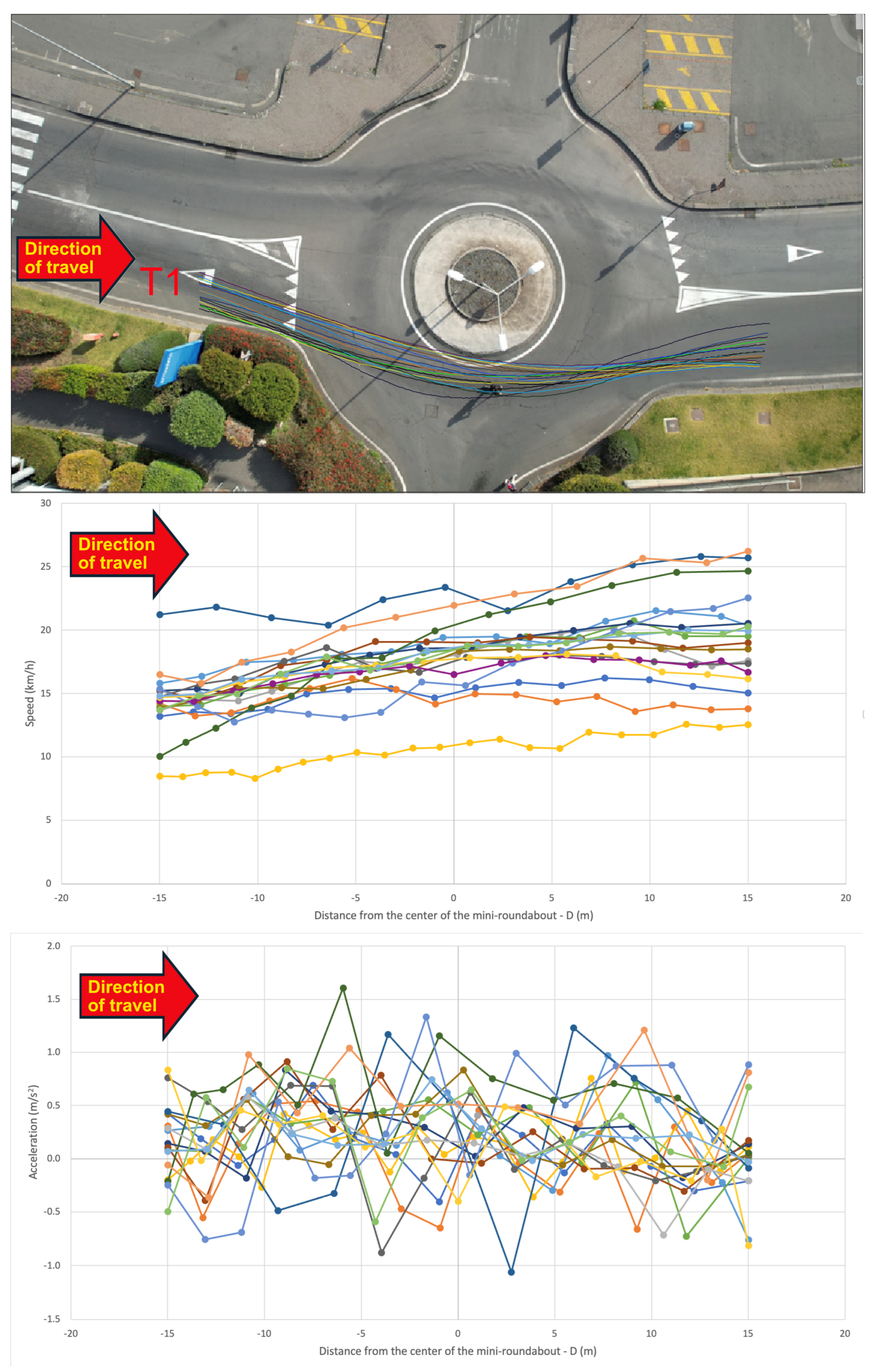
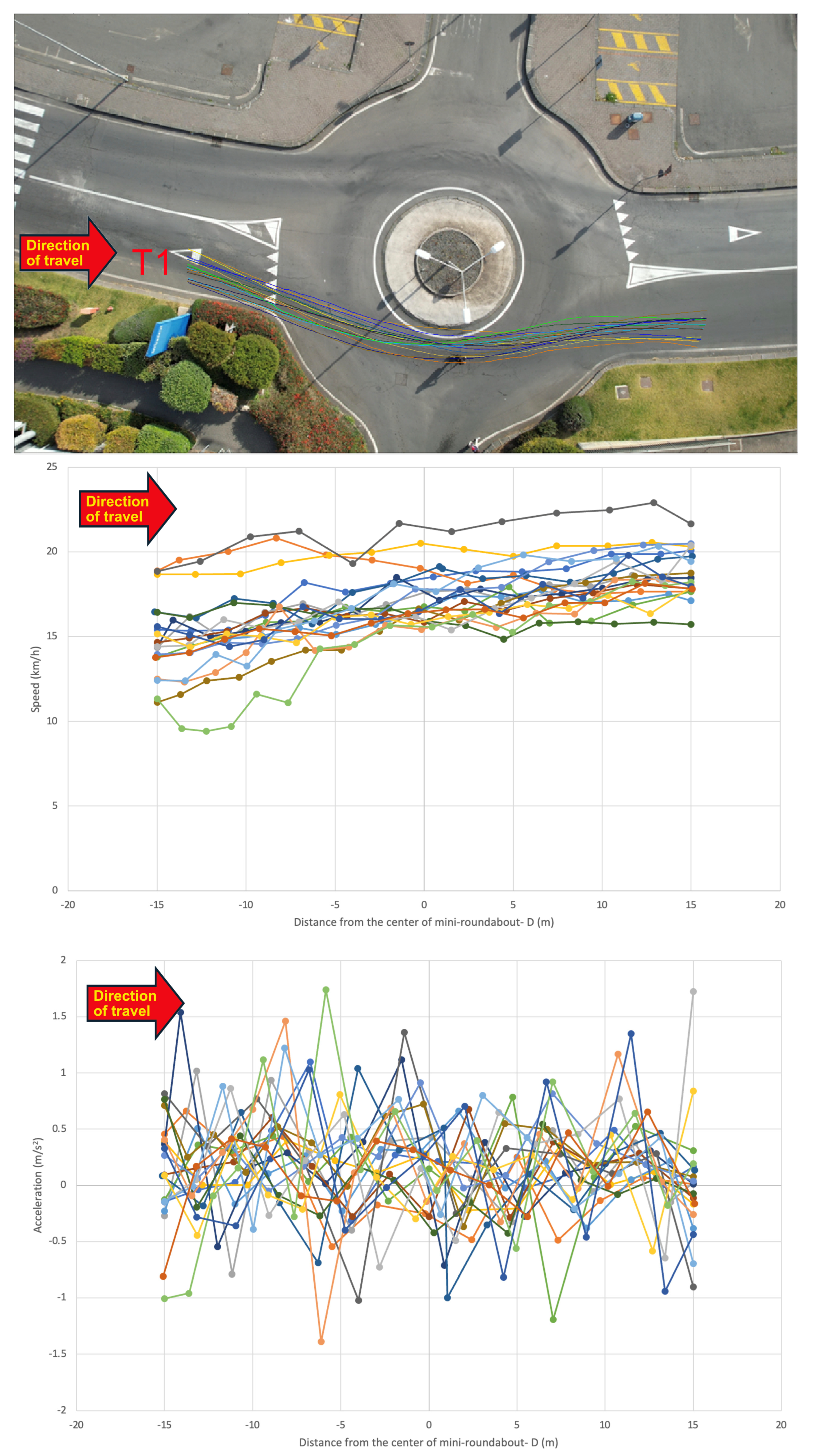
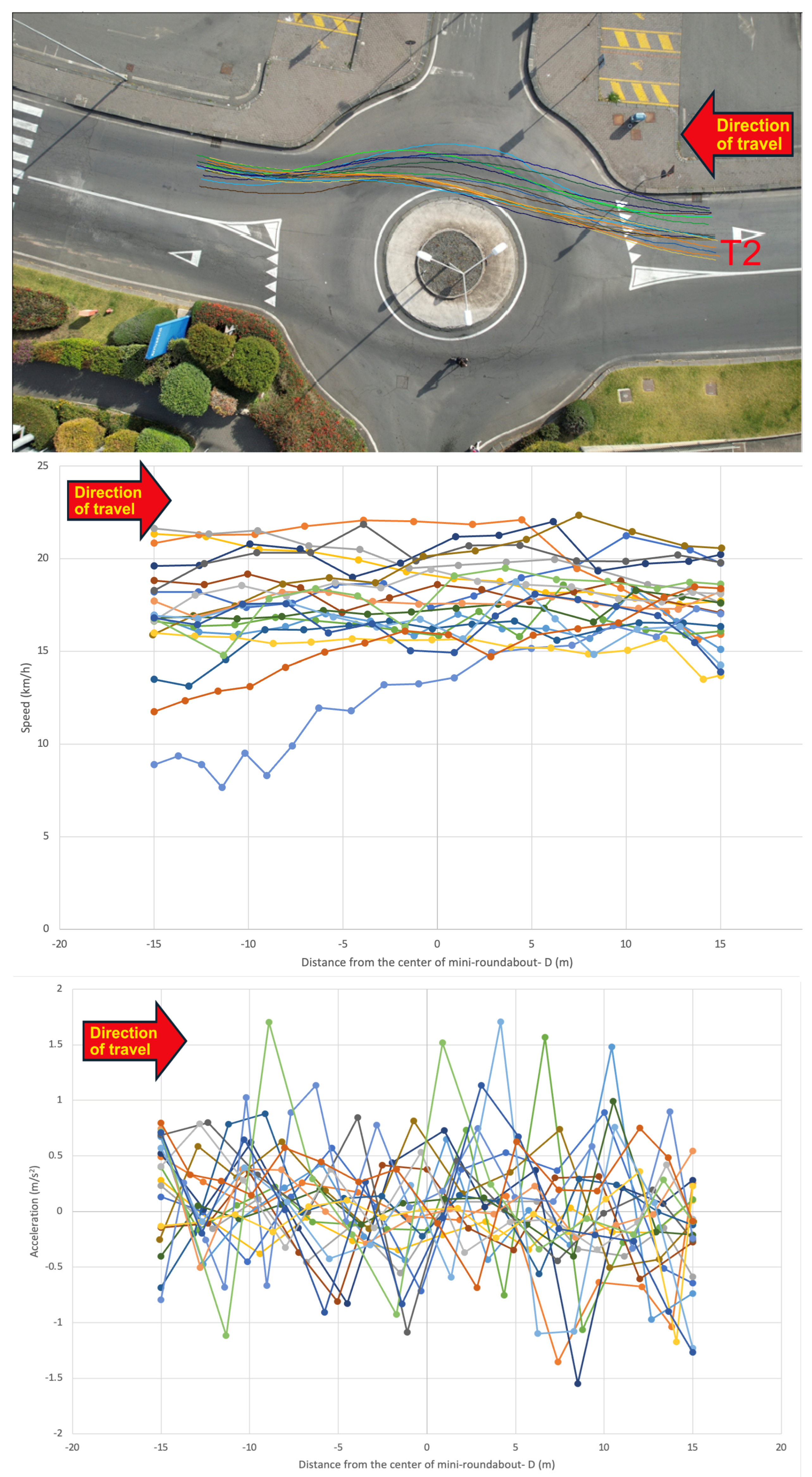
- Entry: No significant differences in speed (14.98 vs. 14.81 km/h, p = 0.315) were found. However, there is a significant difference in longitudinal acceleration (0.21 vs. 0.28 m/s2, p = 0.042); curvature radius was larger for e-scooters (50.35 vs. 42.44 m, p = 0.0005), indicating wider lines.
- Circulation: All variables differed; e-scooters had higher speeds (17.40 vs. 16.99 km/h, p = 0.002), greater acceleration (0.27 vs. 0.14 m/s2, p = 0.0015), and wider radii (64.14 vs. 23.26 m, p = 0.0001), consistent with smoother, less constrained riding.
- Exit: Differences in curvature radius (142.62 vs. 105.40 m, p = 0.003) and mean speed (18.98 vs. 18.01 km/h, p = 0.008) were found; the <1 km/h speed gap suggests limited operational disparity. Acceleration did not differ (0.08 vs. 0.12 m/s2, p = 0.21).
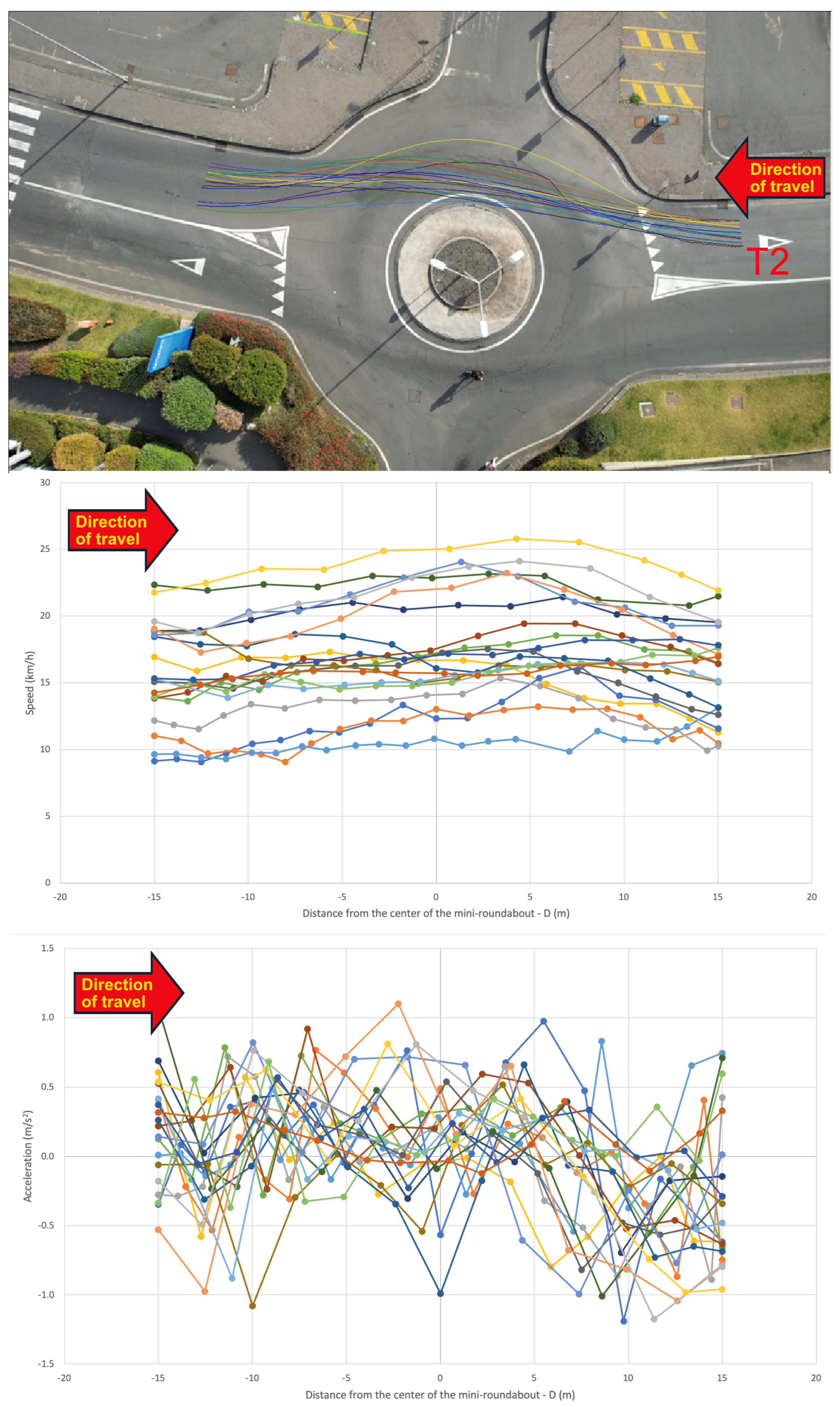
- Entry: Significant differences were found in speed and radius, but not acceleration. Bicycles were faster (16.79 vs. 15.04 km/h, p = 0.0001) and followed larger radii (30.10 vs. 24.02 m, p = 0.021); acceleration was 0.19 vs. 0.13 m/s2 (p = 0.31).
- Circulation: All variables differed; bicycles reached slightly higher speeds (17.79 vs. 17.08 km/h, p = 0.0015) but showed lower acceleration (0.06 vs. 0.15 m/s2, p = 0.001) and narrower radii (23.32 vs. 35.14 m, p = 0.0001), indicating a more conservative line.
- Exit: Differences were found across all variables; e-scooters exited at lower speeds (16.09 vs. 17.67 km/h, p = 0.0002), with larger radii (48.55 vs. 38.92 m, p = 0.008) and stronger deceleration (−0.31 vs. −0.11 m/s2, p = 0.0018), implying a less fluid transition.
- Entry: Speed differs significantly (14.98 km/h in T1 vs. 16.79 km/h in T2, p = 0.0001); curvature radius also differs (42.44 m vs. 30.10 m, p = 0.0005), while acceleration does not (0.21 vs. 0.19 m/s2, p = 0.65), indicating similar propulsive effort despite speed/path changes.
- Circulation: Speed is higher in T2 (17.79 vs. 16.99 km/h, p = 0.0001), but acceleration is lower (0.06 vs. 0.14 m/s2, p = 0.015); mean radius is similar (23.26 vs. 23.32 m, p = 0.78), implying adjustments via speed/acceleration rather than geometry.
- Exit: Acceleration and radius differ (0.12 to −0.11 m/s2, p = 0.0008; 105.40 to 38.92 m, p = 0.0001), while speed is similar (18.01 vs. 17.67 km/h, p = 0.15).
- Entry: Speed is similar (14.81 vs. 15.04 km/h, p = 0.45), but acceleration (0.28 vs. 0.13 m/s2, p = 0.004) and radius (50.35 vs. 24.02 m, p = 0.0001) differ, indicating trajectory and propulsion adjustments at entry.
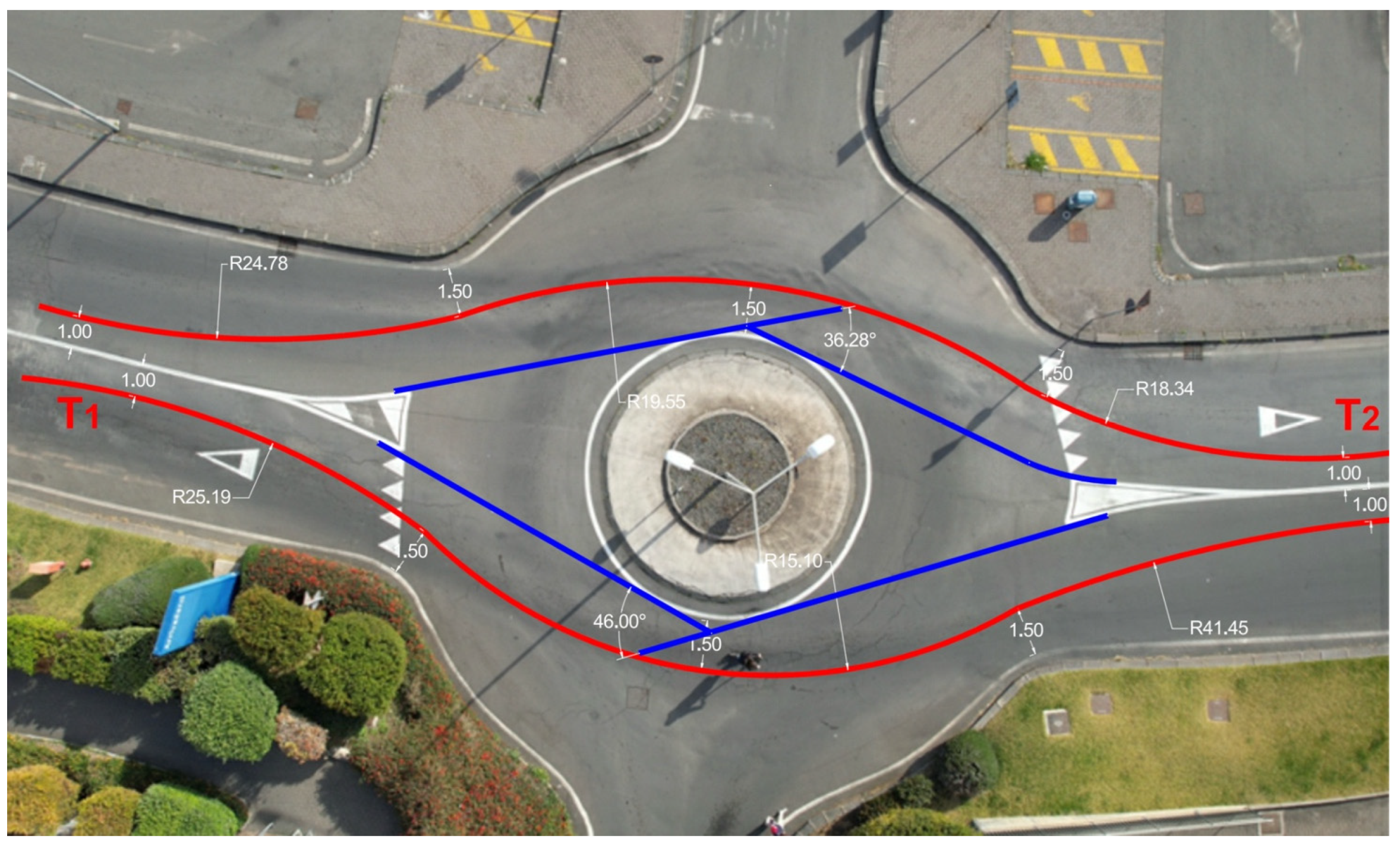
- Circulation: All variables differ—higher speed in T1 (17.40 vs. 17.08 km/h, p = 0.012), greater acceleration (0.27 vs. 0.15 m/s2, p = 0.001), and larger radius (64.14 vs. 35.14 m, p = 0.0001)—suggesting wider, stability-seeking lines under greater deflection angle.
- Exit: All variables differ—higher speed in T1 (18.98 vs. 16.09 km/h, p = 0.0001), acceleration shifts from positive to negative (0.08 to −0.31 m/s2, p = 0.0001), and larger exit radius (142.62 vs. 48.55 m, p = 0.0001)—indicating smoother T1 transitions and sharper, decelerated T2 maneuvers.
5. Discussion
6. Conclusions
Author Contributions
Funding
Data Availability Statement
Conflicts of Interest
References
- Hardt, C.; Bogenberger, K. Usage of e-scooters in urban environments. Transp. Res. Procedia 2019, 37, 155–162. [Google Scholar] [CrossRef]
- Plazier, P.A.; Weitkamp, G.; van den Berg, A.E. The potential for e-biking among the younger population: A study of Dutch students. Travel Behav. Soc. 2017, 8, 37–45. [Google Scholar] [CrossRef]
- Şengül, B.; Mostofi, H. Impacts of e-micromobility on the sustainability of urban transportation: A systematic review. Appl. Sci. 2021, 11, 5851. [Google Scholar] [CrossRef]
- Yang, H.; Ma, Q.; Wang, Z.; Cai, Q.; Xie, K.; Yang, D. Safety of micro-mobility: Analysis of e-scooter crashes by mining news reports. Accid. Anal. Prev. 2020, 143, 105608. [Google Scholar] [CrossRef]
- McQueen, M.; Abou-Zeid, G.; Macarthur, J.; Clifton, K. Transportation transformation: Is micromobility making a macro impact on sustainability? J. Plan. Lit. 2020, 36, 46–61. [Google Scholar] [CrossRef]
- Fong, B.; Fong, A.C.M.; Hong, G. Sustainable micromobility management in smart cities. IEEE Trans. Intell. Transp. Syst. 2023, 24, 15890–15896. [Google Scholar] [CrossRef]
- Teixeira, J.F.; Silva, C.; Moura e Sá, F. Empirical evidence on the impacts of bikesharing: A literature review. Transp. Rev. 2020, 41, 329–351. [Google Scholar] [CrossRef]
- Dill, J.; Rose, G. Electric bikes and transportation policy: Insights from early adopters. Transp. Res. Rec. 2012, 2314, 1–6. [Google Scholar] [CrossRef]
- Bretones, A.; Marquet, O. Sociopsychological factors associated with the adoption and usage of electric micromobility: A literature review. Transp. Policy 2022, 127, 230–249. [Google Scholar] [CrossRef]
- Macarthur, J.; Dill, J.; Person, M. Electric bikes in North America. Transp. Res. Rec. 2014, 2468, 123–130. [Google Scholar] [CrossRef]
- Esztergár-Kiss, D.; Lopez Lizarraga, J.C. Exploring user requirements and service features of e-micromobility in five European cities. Case Stud. Transp. Policy 2021, 9, 1531–1541. [Google Scholar] [CrossRef]
- Bateman, L.B.; Fouad, M.N.; Sullivan, A.; Heider, L.; Oates, G.R. Barriers and facilitators to bikeshare programs: A qualitative study in an urban environment. J. Transp. Health 2021, 21, 101062. [Google Scholar] [CrossRef]
- Botsman, A.; Ponkratov, D.; Roslavtsev, D.; Pavlov, M. Evaluation of the equivalent trip distance using micromobility and public transit. Munic. Econ. Cities 2022, 6, 199–205. [Google Scholar] [CrossRef]
- Glavić, D.; Trpković, A.; Milenković, M.; Jevremović, S. E-scooter potential to change urban mobility—Belgrade case study. Sustainability 2021, 13, 5948. [Google Scholar] [CrossRef]
- Krauss, K.; Krail, M.; Axhausen, K.W. What drives the utility of shared transport services for urban travellers? A stated preference survey in German cities. Travel Behav. Soc. 2022, 26, 206–220. [Google Scholar] [CrossRef]
- Fitt, H.; Curl, A. The early days of shared micromobility: A social practices approach. J. Transp. Geogr. 2020, 86, 102779. [Google Scholar] [CrossRef]
- Kopplin, C.S.; Brand, B.M.; Reichenberger, Y. Consumer acceptance of shared e-scooters for urban and short-distance mobility. Transp. Res. Part D Transp. Environ. 2021, 91, 102680. [Google Scholar] [CrossRef]
- Mitra, R.; Hess, P.M. Who are the potential users of shared e-scooters? An examination of socio-demographic, attitudinal and environmental factors. Travel Behav. Soc. 2021, 23, 100–107. [Google Scholar] [CrossRef]
- Folco, P.; Gauvin, L.; Tizzoni, M.; Szell, M. Data-driven micromobility network planning for demand and safety. Environ. Plan. B 2023, 50, 2087–2102. [Google Scholar] [CrossRef]
- Schneeberger, T.; Schaffer, S.; Tsovaltzi, D.; Chehayeb, L.; Gebhard, P. Workshop on smart urban micromobility. In Proceedings of the Mensch und Computer (MuC) 2023, Rapperswil, Switzerland, 3–6 September 2023; Volume 2023, p. 104. [Google Scholar] [CrossRef]
- Sokołowski, M.M. Laws and policies on electric scooters in the European Union: A ride to the micromobility directive? Eur. Energy Environ. Law Rev. 2020, 29, 148–158. [Google Scholar] [CrossRef]
- Buongiorno, L.; Stellacci, A.; Cazzato, G.; Caricato, P.; De Luca, B.P.; Tarantino, F.; Baldassarra, S.L.; Ingravallo, G.; Marrone, M. Slow and steady wins the race: A comparative analysis of standing electric scooters’ European regulations integrated with the aspect of forensic traumatology. Sustainability 2022, 14, 6160. [Google Scholar] [CrossRef]
- Boglietti, S.; Ghirardi, A.; Turri Zanoni, C.; Ventura, R.; Barabino, B.; Maternini, G.; Vetturi, D. First experimental comparison between e-kick scooters and e-bikes’ vibrational dynamics. Transp. Res. Procedia 2022, 60, 114–121. [Google Scholar] [CrossRef]
- Pai, R.R.; Dozza, M. Understanding factors influencing e-scooterist crash risk: A naturalistic study of rental e-scooters in an urban area. Accid. Anal. Prev. 2025, 209, 107839. [Google Scholar] [CrossRef]
- Sabbaghian, M.H.; Llopis-Castelló, D.; García, A. Assessing micromobility safety on horizontal curves of bike lanes: A video motion analysis methodology. Traffic Saf. Res. 2024, 7, e000057. [Google Scholar] [CrossRef]
- Kemžuraitė, K.; Pukalskas, S.; Bureika, G. Investigation of vehicle stability on road curve in winter conditions. J. KONES Powertrain Transp. 2011, 18, 4. [Google Scholar]
- Dozza, M.; Li, T.; Billstein, L.; Svernlöv, C.; Rasch, A. How do different micro-mobility vehicles affect longitudinal control? Results from a field experiment. J. Saf. Res. 2023, 84, 24–32. [Google Scholar] [CrossRef]
- Li, R.; Liang, G.; Chen, Y.; Zhang, D.; Wang, B. Analysis of conflict distribution characteristics between motor vehicles and e-bikes at roundabouts. Appl. Sci. 2023, 13, 3475. [Google Scholar] [CrossRef]
- Distefano, N.; Leonardi, S.; Litrico, A. Analysis of driving behavior of micromobility vehicle users at mini-roundabouts. Appl. Sci. 2024, 14, 11944. [Google Scholar] [CrossRef]
- Nee, P.J.; Herterich, J.G. Modelling road cycling as motion on a curve. Sports Eng. 2022, 25, 12. [Google Scholar] [CrossRef]
- Distefano, N.; Leonardi, S. Sustainable mobility: A comparative analysis of vehicle interactions involving cars, e-scooters, and bicycles at urban intersections. Transp. Res. Procedia 2025, 90, 535–542. [Google Scholar] [CrossRef]
- Boufous, S.; Hatfield, J.; Grzebieta, R. The impact of environmental factors on cycling speed on shared paths. Accid. Anal. Prev. 2018, 110, 171–176. [Google Scholar] [CrossRef]
- Terranova, P.; Liu, S.Y.; Jain, S.; Engström, J.; Perez, M.A. Kinematic characterization of micro-mobility vehicles during evasive maneuvers. J. Saf. Res. 2024, 91, 342–353. [Google Scholar] [CrossRef]
- Bailly, N.; Schäuble, A.; Guesneau, M.; Wei, W.; Petit, Y. Assessing bicycle helmet protection for head and neck in e-scooter falls. Traffic Inj. Prev. 2025, 26, 866–873. [Google Scholar] [CrossRef]
- Richetta, C.; Karepov, Y. E-bikes (electrical bicycles and scooters) related neurosurgical injuries in the adult population: A single-center experience. Neurotrauma Rep. 2023, 4, 797–804. [Google Scholar] [CrossRef]
- Murros, O.; Puolakkainen, T.; Abio, A.; Thoren, H.; Snäll, J. Urban drinking and driving: Comparison of electric scooter and bicycle related accidents in facial fracture patients. Med. Oral Patol. Oral Cir. Bucal 2022, 28, e238–e246. [Google Scholar] [CrossRef] [PubMed]
- James, A.; Harrois, A.; Abback, P.S.; Moyer, J.D.; Jeantrelle, C.; Hanouz, J.L. Comparison of injuries associated with electric scooters, motorbikes, and bicycles in France, 2019–2022. JAMA Netw. Open 2023, 6, e2320960. [Google Scholar] [CrossRef] [PubMed]
- Fernandez, A.N.; Li, K.; Patel, H.V.; Allen, I.E.; Ghaffar, U.; Hakam, N.; Breyer, B.N. Injuries with electric vs. conventional scooters and bicycles. JAMA Netw. Open 2024, 7, e2424131. [Google Scholar] [CrossRef] [PubMed]
- Savitsky, B.; Radomislensky, I.; Goldman, S.; Kaim, A.; Israel Trauma Group; Bodas, M. Electric bikes and motorized scooters—Popularity and burden of injury: Ten years of national trauma registry experience. J. Transp. Health 2021, 22, 101235. [Google Scholar] [CrossRef]
- Cicchino, J.B.; Kulie, P.; McCarthy, M. Injuries related to electric scooter and bicycle use in a Washington, DC, emergency department. Traffic Inj. Prev. 2021, 22, 401–406. [Google Scholar] [CrossRef]
- Spörri, E.; Halvachizadeh, S.; Gamble, J.; Berk, T.; Allemann, F.; Pape, H.; Rauer, T. Comparison of injury patterns between electric bicycle, bicycle and motorcycle accidents. J. Clin. Med. 2021, 10, 3359. [Google Scholar] [CrossRef]
- Cumming, B. Roundabouts: Why they are dangerous for cyclists and what can be done about it. Transp. Eng. Aust. 2011, 13, 27–40. [Google Scholar]
- Saul, H.; Junghans, M.; Leich, A. Identifying hazardous locations at intersections by automatic traffic surveillance. In Proceedings of the 28th ICTCT Conference, Ashdod, Israel, 29–30 October 2015. [Google Scholar]
- Pérez-Zuriaga, A.M.; Dols, J.; Nespereira, M.; García, A.; Sajurjo-de-No, A. Analysis of the consequences of car to micromobility user side impact crashes. J. Saf. Res. 2023, 87, 168–175. [Google Scholar] [CrossRef]
- Zhang, C.; Ma, Y.; Sayed, T.; Guo, Y.; Chen, S.; Fu, Y. Exploring the impact of right-turn safety measures on e-bike—Heavy vehicle conflicts at signalized intersections. Accid. Anal. Prev. 2024, 206, 107722. [Google Scholar] [CrossRef]
- Al-Haideri, R.; Ismail, K.; Weiss, A. Modeling cyclists’ behavior at a roundabout approach. In Proceedings of the Canadian Society of Civil Engineering Annual Conference; Springer: Cham, Switzerland, 2023; Volume 2024, p. 2. [Google Scholar] [CrossRef]
- Hels, T.; Orozova-Bekkevold, I. The effect of roundabout design features on cyclist accident rate. Accid. Anal. Prev. 2007, 39, 300–307. [Google Scholar] [CrossRef]
- Møller, M.; Hels, T. Cyclists’ perception of risk in roundabouts. Accid. Anal. Prev. 2008, 40, 1055–1062. [Google Scholar] [CrossRef]
- Pulvirenti, G.; De Ceunynck, T.; Daniels, S.; Distefano, N.; Leonardi, S. Safety of bicyclists in roundabouts with mixed traffic: Video analyses of behavioural and surrogate safety indicators. Transp. Res. Part F Traffic Psychol. Behav. 2021, 76, 72–91. [Google Scholar] [CrossRef]
- Distefano, N.; Leonardi, S.; Kieć, M.; D’Agostino, C. Comparison of e-scooter and bike users’ behavior in mixed traffic. Transp. Res. Rec. 2024, 2679, 505–518. [Google Scholar] [CrossRef]
- Petzoldt, T.; Schleinitz, K.; Heilmann, S.; Gehlert, T. Traffic conflicts and their contextual factors when riding conventional vs. electric bicycles. Transp. Res. Part F Traffic Psychol. Behav. 2017, 46, 477–490. [Google Scholar] [CrossRef]
- Haworth, N.; Schramm, A.; Twisk, D. Comparing the risky behaviours of shared and private e-scooter and bicycle riders in downtown Brisbane, Australia. Accid. Anal. Prev. 2021, 152, 105981. [Google Scholar] [CrossRef] [PubMed]
- Ministero delle Infrastrutture e dei Trasporti. Functional and Geometric Standards for the Construction of Road Intersections (Norme Funzionali e Geometriche per la Costruzione Delle Intersezioni Stradali); D.M. 19 April 2006; Gazzetta Ufficiale della Repubblica Italiana n. 170; Istituto Poligrafico e Zecca dello Stato: Rome, Italy, 2006; Available online: https://www.gazzettaufficiale.it/eli/id/2006/07/24/06A06657/sg (accessed on 21 November 2025).
- Yang, Q.; Lu, F.; Ma, J.; Wang, J.; Wu, J.; Jiang, R.; Hu, H. Analyzing the delays of target lane vehicles caused by vehicle lane-changing operation. Sci. Rep. 2021, 11, 262. [Google Scholar] [CrossRef] [PubMed]
- Rosas-López, C.D.; Gaviria-Mendoza, C.A.; Calero-Valenzuela, C.A. Classification of driver behavior in horizontal curves of two-lane rural roads. Rev. Fac. Ing. 2021, 30, e13410. [Google Scholar] [CrossRef]
- Qi, G.; Du, Y.; Wu, J.; Xu, M. Leveraging longitudinal driving behaviour data with data mining techniques for driving style analysis. IET Intell. Transp. Syst. 2015, 9, 792–801. [Google Scholar] [CrossRef]
- Eboli, L.; Mazzulla, G.; Pungillo, G. Combining speed and acceleration to define car users’ safe or unsafe driving behavior. Transp. Res. Part C Emerg. Technol. 2016, 68, 113–125. [Google Scholar] [CrossRef]
- Frej, D.; Grabski, P.; Jurecki, R.S.; Szumska, E.M. Experimental study on longitudinal acceleration of urban buses and coaches in different road maneuvers. Sensors 2023, 23, 3125. [Google Scholar] [CrossRef]
- Leonardi, S.; Distefano, N. Roundabout trajectory planning: Integrating human driving models for autonomous vehicles. Sustainability 2023, 15, 16288. [Google Scholar] [CrossRef]
- Gu, T.; Dolan, J.M. Toward human-like motion planning in urban environments. In Proceedings of the 2014 IEEE Intelligent Vehicles Symposium (IV), Dearborn, MI, USA, 8–11 June 2014. [Google Scholar]
- Singleton, P.; Poudel, N. Bicycling comfort at roundabouts: Effects of design and situational factors. Transp. Res. Part F Traffic Psychol. Behav. 2023, 94, 227–242. [Google Scholar] [CrossRef]
- Jensen, S. Safe roundabouts for cyclists. Accid. Anal. Prev. 2017, 105, 30–37. [Google Scholar] [CrossRef]
- Poudel, N.; Singleton, P. Bicycle safety at roundabouts: A systematic literature review. Transp. Rev. 2021, 41, 617–642. [Google Scholar] [CrossRef]
- Aumann, P.; Pratt, K.; Papamiltiades, A. Bicycle safety at roundabouts. In Austroads; Kernich, G., Ed.; Austroads: Sydney, Australia, 2017; Austroads Publ. No. AP-R542-17; Available online: https://westcycle.org.au/wp-content/uploads/2024/03/AP-R542-17-Bicycle_Safety_at_Roundabouts.pdf (accessed on 21 May 2025).
- Schramm, A.; Haworth, N.; van den Dool, D.; Murphy, J.; Qu, X.; McDonald, M. Roundabout design and cycling safety. In Proceedings of the 3rd International Cycling Safety Conference (ICSC2014); Shepers, P., Ed.; 3rd International Cycling Safety Conference Organizing Committee: Gothenburg, Sweden, 2014; pp. 1–15. Available online: https://eprints.qut.edu.au/79323/ (accessed on 21 May 2025).
- Al-Haji, G. The impact of traffic calming measures on cyclists’ and e-cyclists’ safety. J. Traffic Logist. Eng. 2020, 8, 29–33. [Google Scholar] [CrossRef]
- Cai, G.; Parepally, N.; Zheng, L.; Lin, M.C. GM3: A General Physical Model for Micro-Mobility Vehicles. arXiv 2025, arXiv:2510.07807. [Google Scholar] [CrossRef]
- Micucci, A.; Mantecchini, L.; Bettazzi, G.; Scattolin, F. A Kinematic Analysis of Vehicle Acceleration from Standstill at Signalized Intersections: Implications for Road Safety, Traffic Engineering, and Autonomous Driving. Sustainability 2025, 17, 9332. [Google Scholar] [CrossRef]
- Johnsson, C.; Laureshyn, A.; De Ceunynck, T. In search of surrogate safety indicators for vulnerable road users: A review of surrogate safety indicators. Transp. Rev. 2018, 38, 765–785. [Google Scholar] [CrossRef]
- Kong, D.; Zhang, C.; Chen, F.; Li, C. Evaluating e-bike safety at unsignalized roundabouts using a Bayesian mixed logit model. Accid. Anal. Prev. 2025, 215, 108004. [Google Scholar] [CrossRef] [PubMed]
- Arun, A.; Haque, M.M.; Bhaskar, A.; Washington, S.; Sayed, T. A systematic mapping review of surrogate safety assessment using traffic conflict techniques. Accid. Anal. Prev. 2021, 153, 106016. [Google Scholar] [CrossRef]
- Laureshyn, A.; Svensson, Å.; Hydén, C. Evaluation of traffic safety, based on micro-level behavioural data: Theoretical framework and first implementation. Accid. Anal. Prev. 2010, 42, 1637–1646. [Google Scholar] [CrossRef]
- Ma, Q.; Yang, H.; Mayhue, A.; Sun, Y.; Huang, Z.; Ma, Y. E-Scooter Safety: The Riding Risk Analysis based on Mobile Sensing Data. Accid. Anal. Prev. 2020, 151, 105954. [Google Scholar] [CrossRef]
- Mitropoulos, L.; Stavropoulou, E.; Tzouras, P.; Karolemeas, C.; Kepaptsoglou, K. E-scooter micromobility systems: Review of attributes and impacts. Transp. Res. Interdiscip. Perspect. 2023, 21, 100888. [Google Scholar] [CrossRef]
- della Mura, M.; Failla, S.; Gori, N.; Micucci, A.; Paganelli, F. E-Scooter Presence in Urban Areas: Are Consistent Rules, Paying Attention and Smooth Infrastructure Enough for Safety? Sustainability 2022, 14, 14303. [Google Scholar] [CrossRef]
- Gössling, S. Integrating e-scooters in urban transportation: Problems, policies, and the prospect of system change. Transp. Res. Part D Transp. Environ. 2020, 79, 102230. [Google Scholar] [CrossRef]



| Parameter—Segment | Mean Value (E-Scooter) | Mean Value (Bicycle) | Shapiro p-Value (Differences) | Normality Outcome (Differences) | Statistical Test | p-Value | Statistical Test Outcome |
|---|---|---|---|---|---|---|---|
| Speed (km/h)—Entry (T1) | 14.81 | 14.98 | 0.15 | Normal distribution | Paired t-test | 0.315 | No significant difference |
| Acceleration (m/s2)—Entry (T1) | 0.28 | 0.21 | 0.085 | Normal distribution | Paired t-test | 0.042 | Significant difference |
| Radius (m)—Entry (T1) | 50.35 | 42.44 | 0.012 | Non-normal distribution | Wilcoxon | 0.0005 | Significant difference |
| Speed (km/h)—Circulation (T1) | 17.4 | 16.99 | 0.22 | Normal distribution | Paired t-test | 0.002 | Significant difference |
| Acceleration (m/s2)—Circulation (T1) | 0.27 | 0.14 | 0.035 | Non-normal distribution | Wilcoxon | 0.0015 | Significant difference |
| Radius (m)—Circulation (T1) | 64.14 | 23.26 | 0.004 | Non-normal distribution | Wilcoxon | 0.0001 | Significant difference |
| Speed (km/h)—Exit (T1) | 18.98 | 18.01 | 0.41 | Normal distribution | Paired t-test | 0.008 | Significant difference |
| Acceleration (m/s2)—Exit (T1) | 0.08 | 0.12 | 0.18 | Normal distribution | Paired t-test | 0.21 | No significant difference |
| Radius (m)—Exit (T1) | 142.62 | 105.4 | 0.025 | Non-normal distribution | Wilcoxon | 0.003 | Significant difference |
| Parameter—Segment | Mean Value (E-Scooter) | Mean Value (Bicycle) | Shapiro p-Value (Differences) | Normality Outcome (Differences) | Statistical Test | p-Value | Statistical Test Outcome |
|---|---|---|---|---|---|---|---|
| Speed (km/h)—Entry (T2) | 15.04 | 16.79 | 0.18 | Normal distribution | Paired t-test | 0.0001 | Significant difference |
| Acceleration (m/s2)—Entry (T2) | 0.13 | 0.19 | 0.22 | Normal distribution | Paired t-test | 0.31 | No significant difference |
| Radius (m)—Entry (T2) | 24.02 | 30.1 | 0.045 | Non-normal distribution | Wilcoxon | 0.021 | Significant difference |
| Speed (km/h)—Circulation (T2) | 17.08 | 17.79 | 0.11 | Normal distribution | Paired t-test | 0.0015 | Significant difference |
| Acceleration (m/s2)—Circulation (T2) | 0.15 | 0.06 | 0.03 | Non-normal distribution | Wilcoxon | 0.001 | Significant difference |
| Radius (m)—Circulation (T2) | 35.14 | 23.32 | 0.015 | Non-normal distribution | Wilcoxon | 0.0001 | Significant difference |
| Speed (km/h)—Exit (T2) | 16.09 | 17.67 | 0.35 | Normal distribution | Paired t-test | 0.0002 | Significant difference |
| Acceleration (m/s2)—Exit (T2) | −0.31 | −0.11 | 0.42 | Normal distribution | Paired t-test | 0.0018 | Significant difference |
| Radius (m)—Exit (T2) | 48.55 | 38.92 | 0.025 | Non-normal distribution | Wilcoxon | 0.008 | Significant difference |
| Segment (Vehicle) | Parameter | Mean T1 | Mean T2 | Shapiro p-Value (Differences) | Normality Outcome (Differences) | Statistical Test | p-Value | Test Outcome |
|---|---|---|---|---|---|---|---|---|
| Entry (Bicycle) | Speed (km/h) | 14.98 | 16.79 | 0.02 | Non-normal distribution | Wilcoxon | 0.0001 | Significant difference |
| Entry (Bicycle) | Acceleration (m/s2) | 0.21 | 0.19 | 0.51 | Normal distribution | Paired t-test | 0.65 | No significant difference |
| Entry (Bicycle) | Radius (m) | 42.44 | 30.1 | 0.01 | Non-normal distribution | Wilcoxon | 0.0005 | Significant difference |
| Circulation (Bicycle) | Speed (km/h) | 16.99 | 17.79 | 0.035 | Non-normal distribution | Wilcoxon | 0.0001 | Significant difference |
| Circulation (Bicycle) | Acceleration (m/s2) | 0.14 | 0.06 | 0.14 | Normal distribution | Paired t-test | 0.015 | Significant difference |
| Circulation (Bicycle) | Radius (m) | 23.26 | 23.32 | 0.008 | Non-normal distribution | Wilcoxon | 0.78 | No significant difference |
| Exit (Bicycle) | Speed (km/h) | 18.01 | 17.67 | 0.62 | Normal distribution | Paired t-test | 0.15 | No significant difference |
| Exit (Bicycle) | Acceleration (m/s2) | 0.12 | −0.11 | 0.04 | Non-normal distribution | Wilcoxon | 0.0008 | Significant difference |
| Exit (Bicycle) | Radius (m) | 105.4 | 38.92 | 0.005 | Non-normal distribution | Wilcoxon | 0.0001 | Significant difference |
| Segment (Vehicle) | Parameter | Mean T1 | Mean T2 | Shapiro p-Value (Differences) | Normality Outcome (Differences) | Statistical Test | p-Value | Test Outcome |
|---|---|---|---|---|---|---|---|---|
| Entry (E-Scooter) | Speed (km/h) | 14.81 | 15.04 | 0.15 | Normal distribution | Paired t-test | 0.45 | No significant difference |
| Entry (E-Scooter) | Acceleration (m/s2) | 0.28 | 0.13 | 0.08 | Normal distribution | Paired t-test | 0.004 | Significant difference |
| Entry (E-Scooter) | Radius (m) | 50.35 | 24.02 | 0.002 | Non-normal distribution | Wilcoxon | 0.0001 | Significant difference |
| Circulation (E-Scooter) | Speed (km/h) | 17.4 | 17.08 | 0.015 | Non-normal distribution | Wilcoxon | 0.012 | Significant difference |
| Circulation (E-Scooter) | Acceleration (m/s2) | 0.27 | 0.15 | 0.025 | Non-normal distribution | Wilcoxon | 0.001 | Significant difference |
| Circulation (E-Scooter) | Radius (m) | 64.14 | 35.14 | 0.001 | Non-normal distribution | Wilcoxon | 0.0001 | Significant difference |
| Exit (E-Scooter) | Speed (km/h) | 18.98 | 16.09 | 0.03 | Non-normal distribution | Wilcoxon | 0.0001 | Significant difference |
| Exit (E-Scooter) | Acceleration (m/s2) | 0.08 | −0.31 | 0.12 | Normal distribution | Paired t-test | 0.0001 | Significant difference |
| Exit (E-Scooter) | Radius (m) | 142.62 | 48.55 | 0.04 | Non-normal distribution | Wilcoxon | 0.0001 | Significant difference |
Disclaimer/Publisher’s Note: The statements, opinions and data contained in all publications are solely those of the individual author(s) and contributor(s) and not of MDPI and/or the editor(s). MDPI and/or the editor(s) disclaim responsibility for any injury to people or property resulting from any ideas, methods, instructions or products referred to in the content. |
© 2026 by the authors. Licensee MDPI, Basel, Switzerland. This article is an open access article distributed under the terms and conditions of the Creative Commons Attribution (CC BY) license.
Share and Cite
Distefano, N.; Leonardi, S.; Lacagnina, M. Rethinking Urban Intersections for Sustainable Micro-Mobility: A Kinematic Comparison of E-Scooters and Bicycles at Mini-Roundabouts. Land 2026, 15, 686. https://doi.org/10.3390/land15040686
Distefano N, Leonardi S, Lacagnina M. Rethinking Urban Intersections for Sustainable Micro-Mobility: A Kinematic Comparison of E-Scooters and Bicycles at Mini-Roundabouts. Land. 2026; 15(4):686. https://doi.org/10.3390/land15040686
Chicago/Turabian StyleDistefano, Natalia, Salvatore Leonardi, and Michele Lacagnina. 2026. "Rethinking Urban Intersections for Sustainable Micro-Mobility: A Kinematic Comparison of E-Scooters and Bicycles at Mini-Roundabouts" Land 15, no. 4: 686. https://doi.org/10.3390/land15040686
APA StyleDistefano, N., Leonardi, S., & Lacagnina, M. (2026). Rethinking Urban Intersections for Sustainable Micro-Mobility: A Kinematic Comparison of E-Scooters and Bicycles at Mini-Roundabouts. Land, 15(4), 686. https://doi.org/10.3390/land15040686