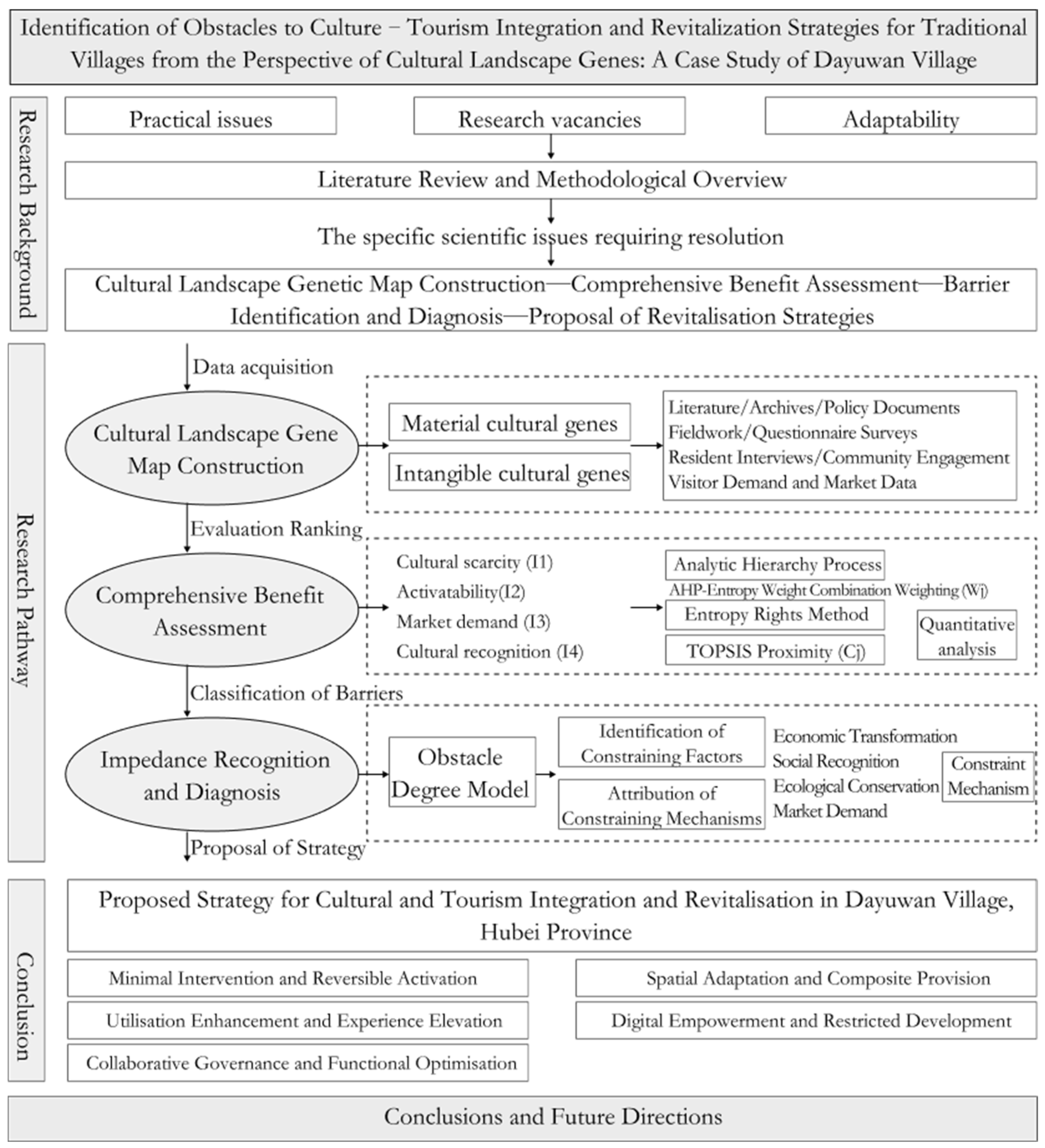
Identification of Obstacles to Culture–Tourism Integration and Revitalization Strategies for Traditional Villages from the Perspective of Cultural Landscape Genes: A Case Study of Dayuwan Village


Abstract
1. Introduction
2. Materials and Methods
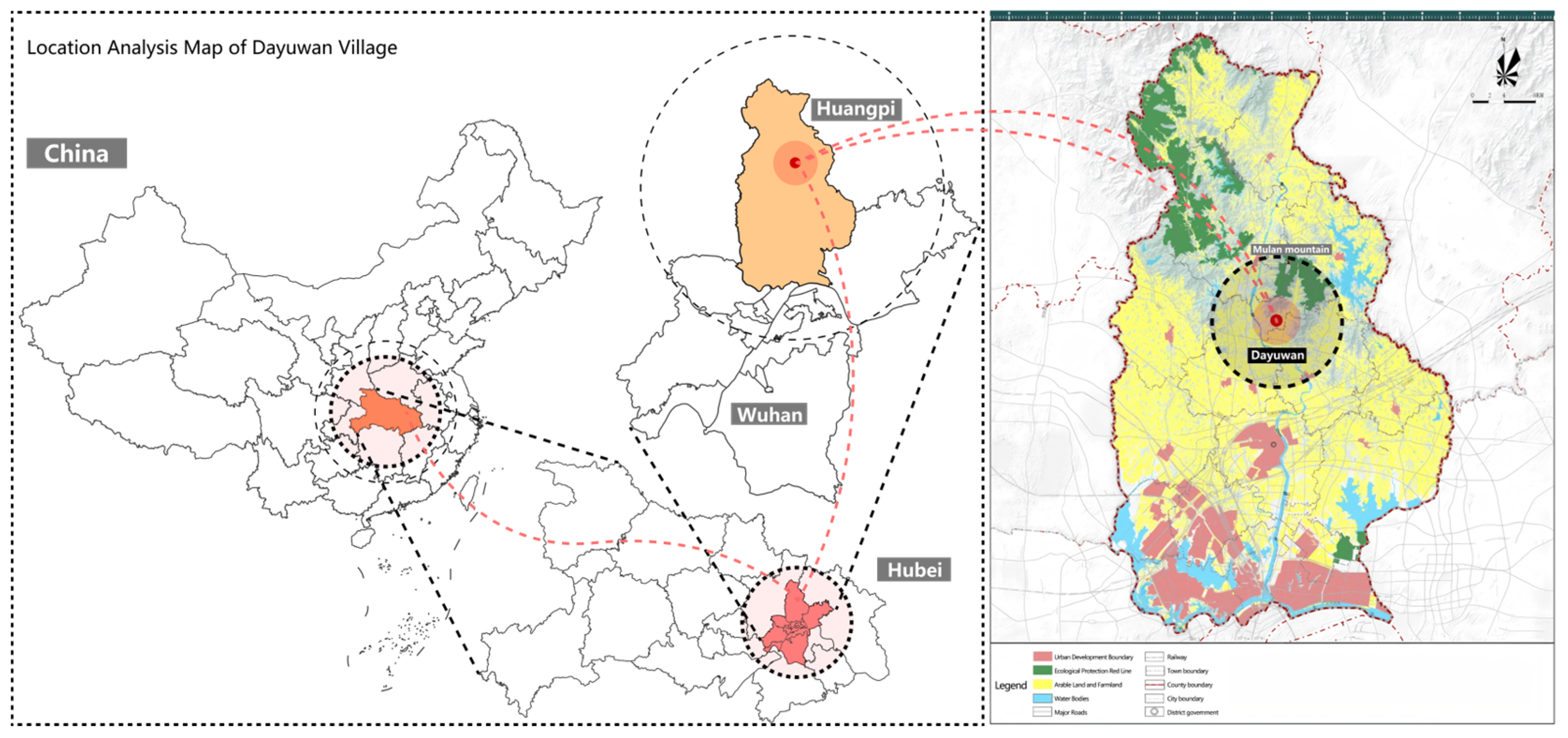
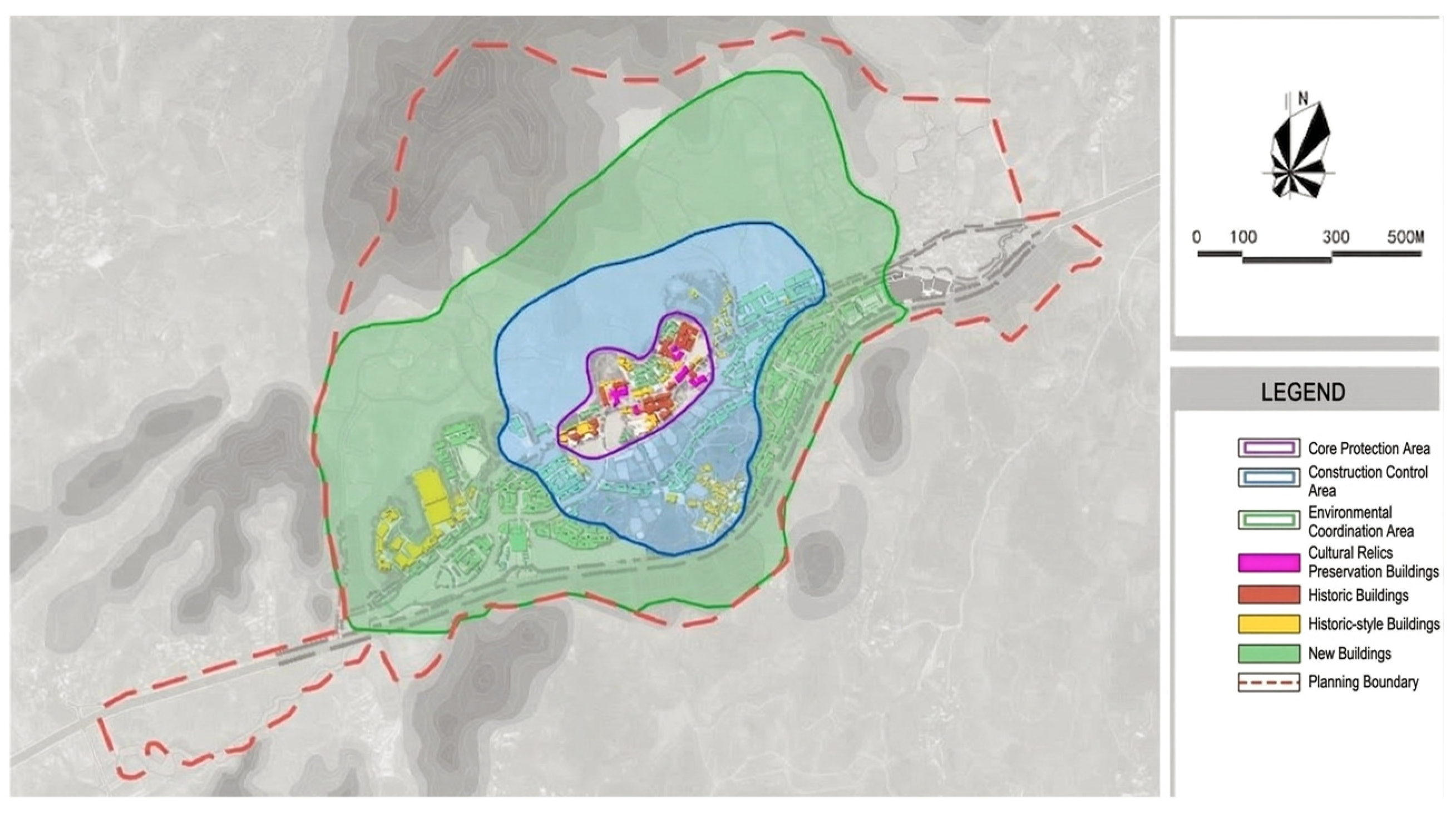
2.1. Study Area
2.2. Construction of the Cultural Landscape Gene Atlas
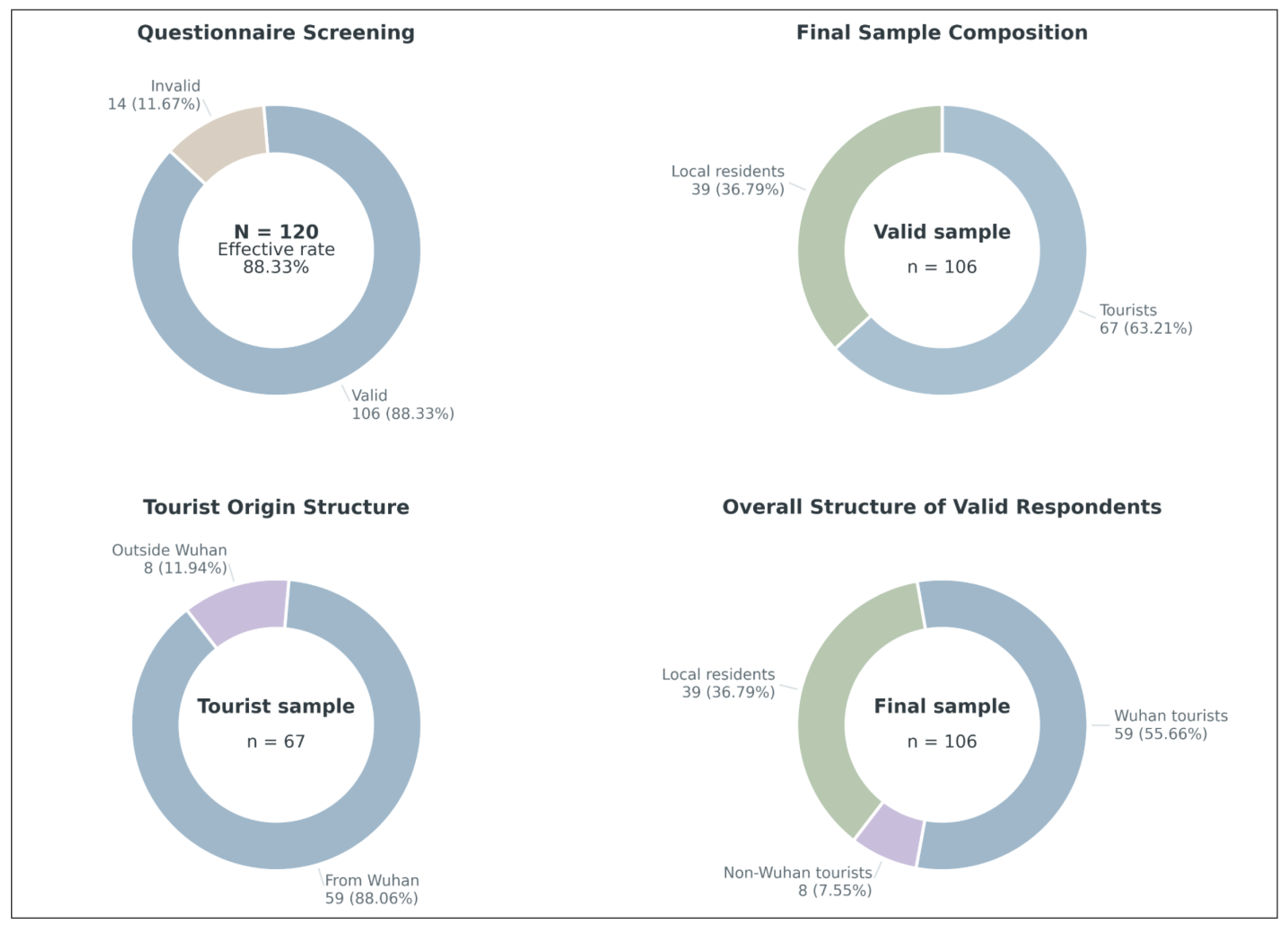
2.3. Evaluation Indicator System and Questionnaire Design
2.4. Combined Weighting Method
2.5. TOPSIS Model
2.6. Obstacle Degree Identification Model
3. Results
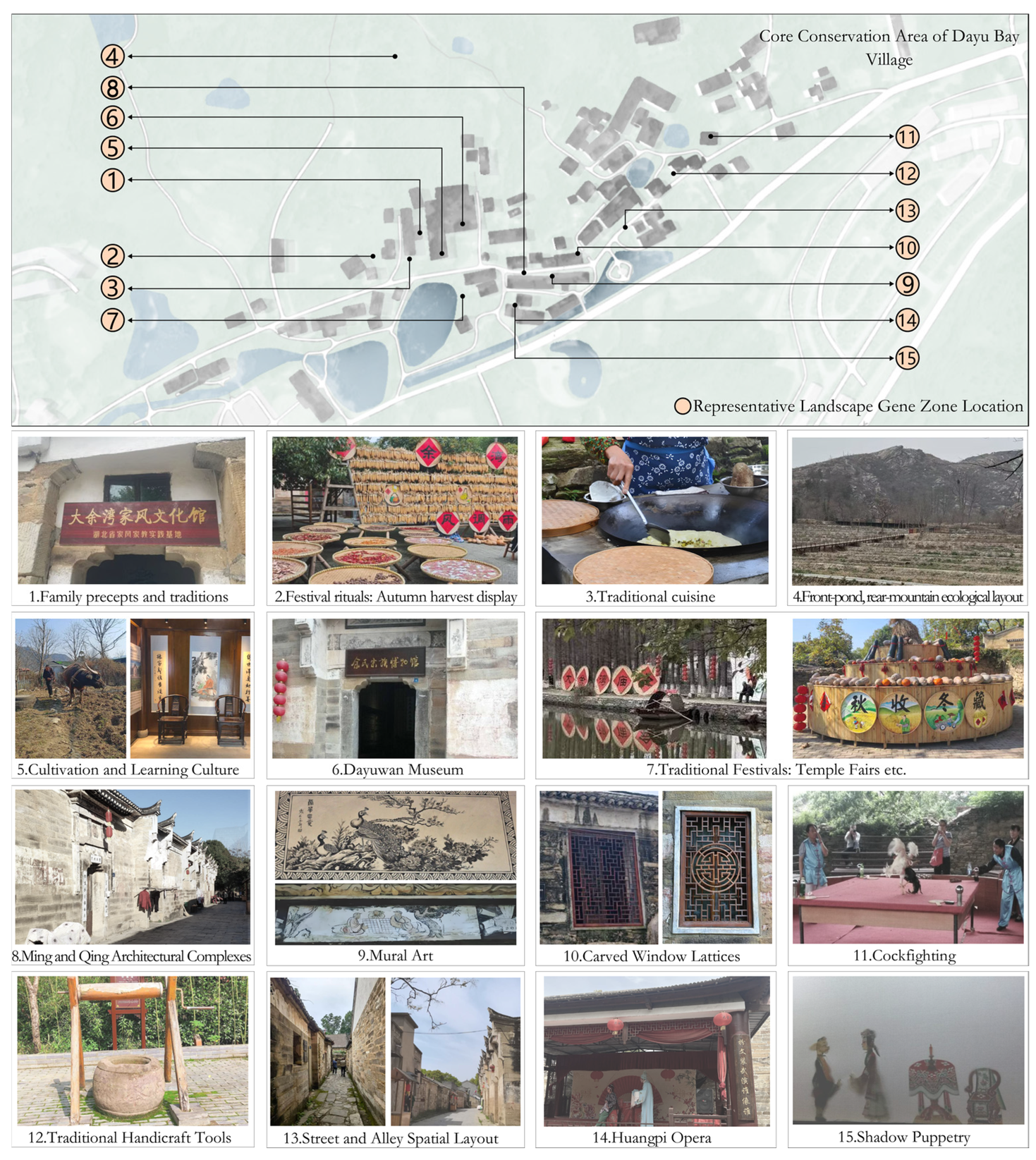
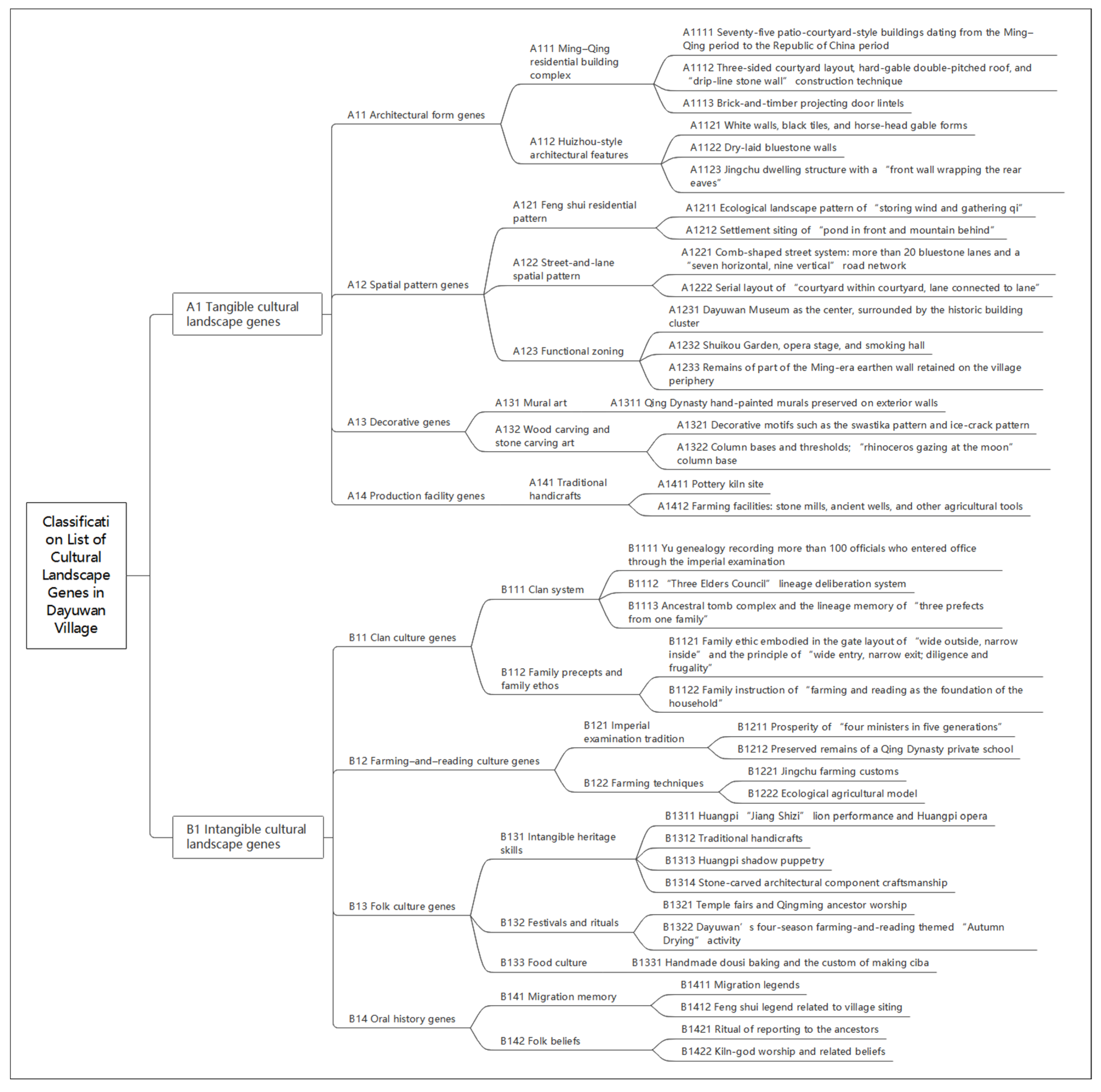
3.1. Cultural Landscape Gene Identification in Dayuwan Village
3.2. Weighting Results and Descriptive Comparison
3.3. Comprehensive Benefit Closeness and Benefit-Level Classification
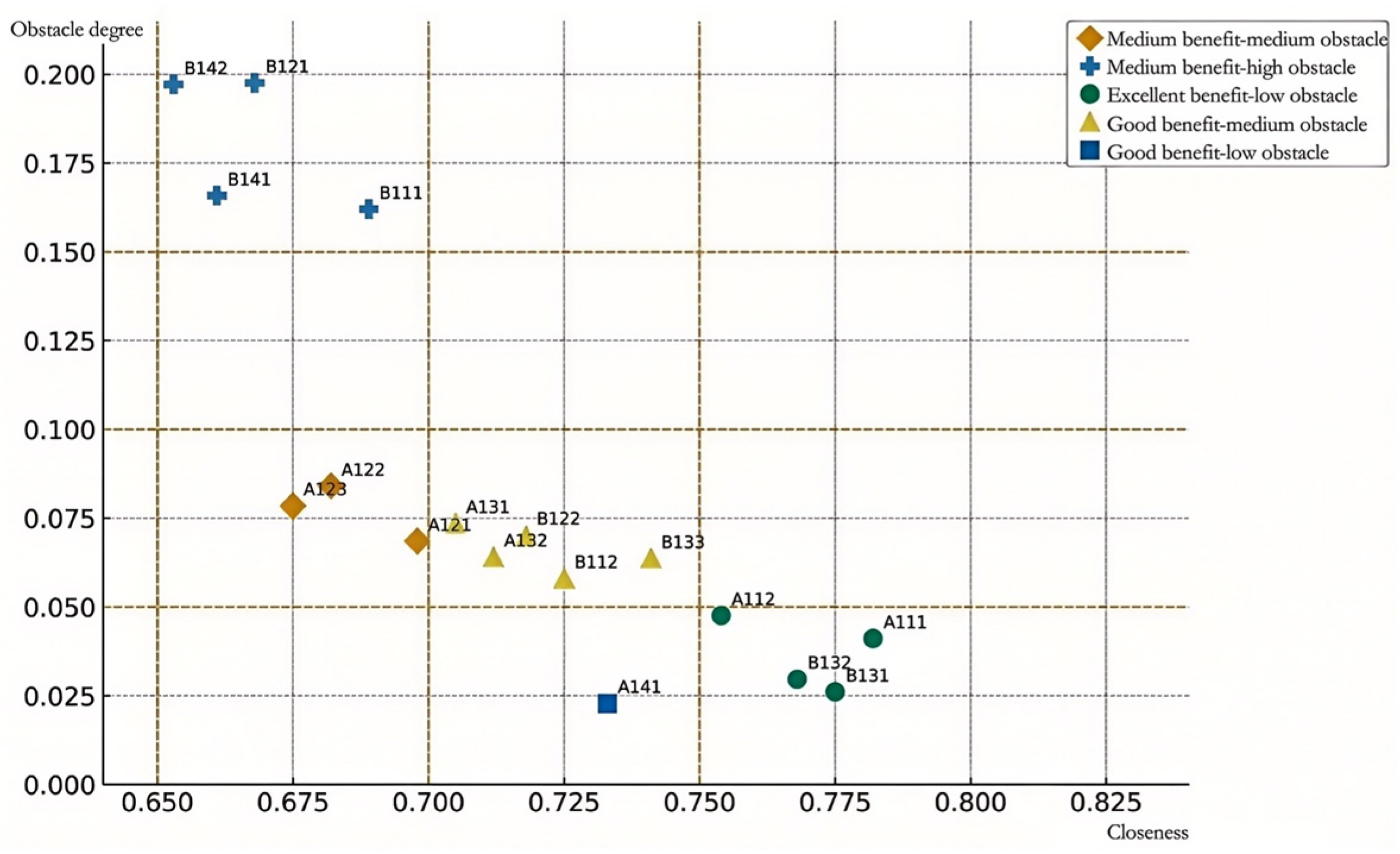
3.4. Obstacle Diagnosis Results
3.5. Supplementary Inferential Checks of the Analytical Expectations
4. Discussion
4.1. Constraint Mechanisms in the Culture–Tourism Transformation of Dayuwan Village
4.2. Four Major Constraint Mechanisms
- (1)
- Economic transformation constraint mechanism: constraints in functional integration and adaptive reuse.
- (2)
- Social identity constraint mechanism: misalignment between cultural narratives and pathways of understanding.
- (3)
- Landscape conservation constraint mechanism: weakening of regional landscape and original character.
- (4)
- Market demand constraint mechanism: mismatch between landscape supply and consumption willingness.
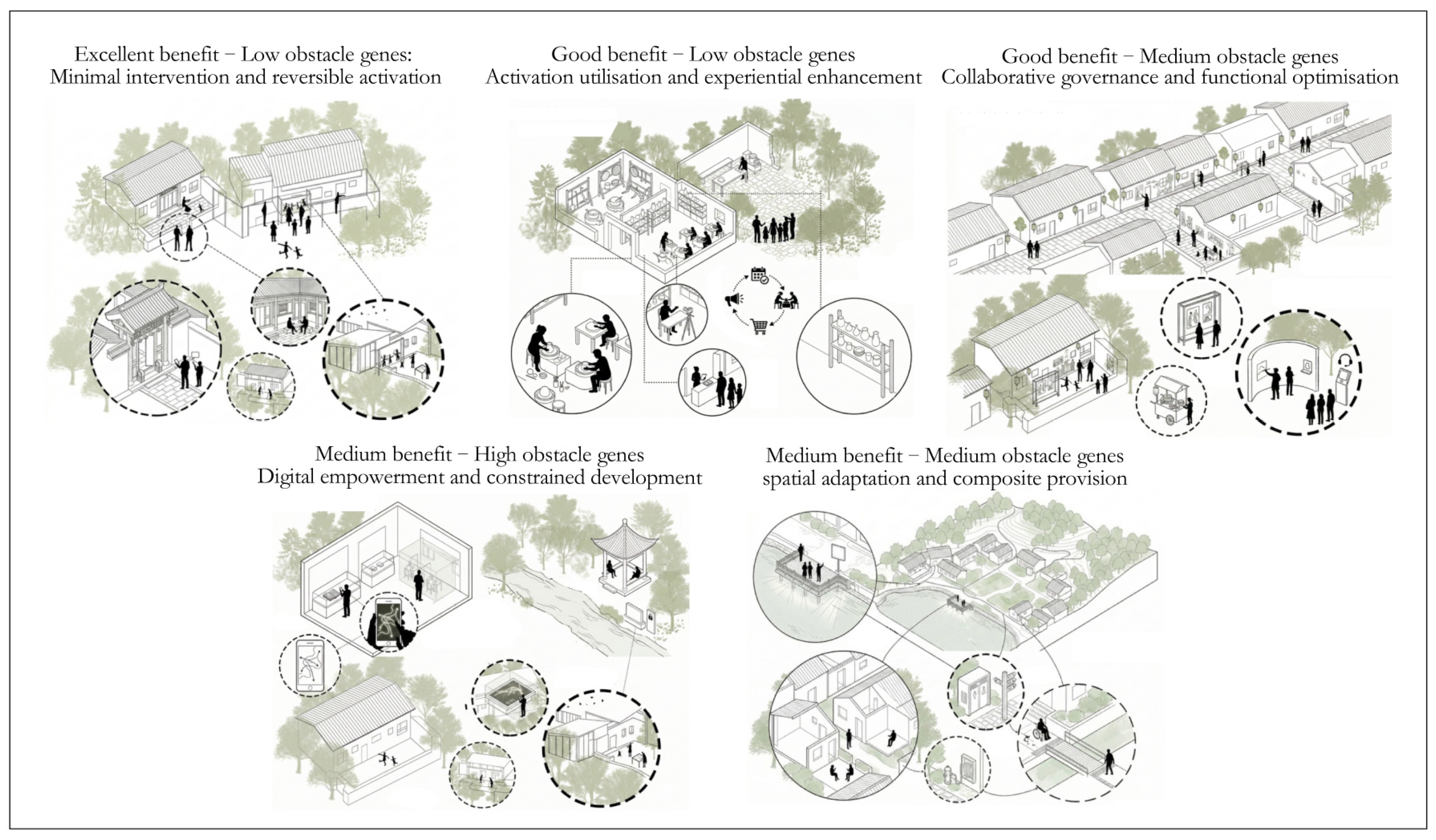
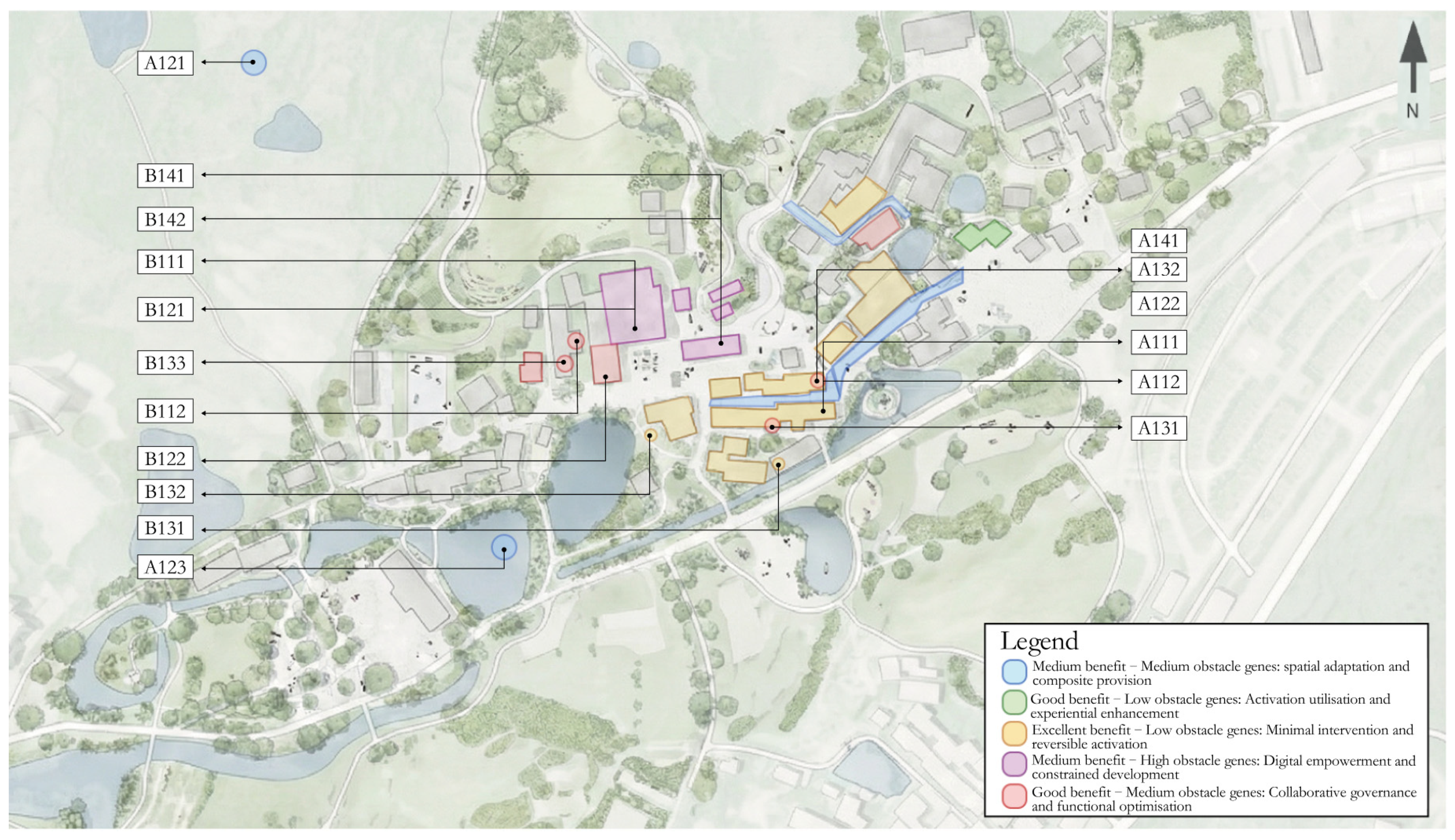
4.3. Revitalization Strategies Under the Five Benefit–Obstacle Scenarios
- (1)
- Excellent benefit–low obstacle: minimal intervention and reversible revitalization.
- (2)
- Good benefit–low obstacle: adaptive reuse and experience upgrading.
- (3)
- Good benefit–medium obstacle: collaborative governance and functional optimization.
- (4)
- Medium benefit–medium obstacle: spatial adaptation and composite supply.
- (5)
- Medium benefit–high obstacle: digital empowerment and restrictive development.
4.4. Limitations and Future Research
5. Conclusions
Author Contributions
Funding
Data Availability Statement
Conflicts of Interest
Abbreviations
| AHP | Analytic Hierarchy Process |
| TOPSIS | Technique for Order Preference by Similarity to an Ideal Solution |
| CLG/CLGs | Cultural Landscape Gene (s) |
| CR | Consistency Ratio |
Appendix A

| Coding Level | No. of Units | Percent Agreement | Cohen’s Kappa | Interpretation |
|---|---|---|---|---|
| Major-category level | 38 | 92.10% | 0.861 | Strong agreement |
| Gene-code level | 38 | 84.20% | 0.781 | Substantial agreement |
| Dimension | Tourists (n = 67), Mean ± SD | Residents (n = 39), Mean ± SD | Mann–Whitney U | p Value | Spearman’s Rho for Gene-Level Rankings |
|---|---|---|---|---|---|
| I1 Cultural scarcity | 4.107 ± 0.416 | 4.172 ± 0.357 | 1208 | 0.52 | 0.945 |
| I2 Activatability | 3.758 ± 0.397 | 3.798 ± 0.356 | 1211.5 | 0.535 | 0.939 |
| I3 Market demand | 3.927 ± 0.442 | 3.980 ± 0.426 | 1225.5 | 0.597 | 0.993 |
| I4 Cultural identity | 4.531 ± 0.284 | 4.519 ± 0.311 | 1303.5 | 0.987 | 0.888 |
References
- Wu, C.; Chen, M.; Zhou, L.; Liang, X.; Wang, W. Identifying the spatiotemporal patterns of traditional villages in China: A multiscale perspective. Land 2020, 9, 449. [Google Scholar] [CrossRef]
- Mu, Q.; Aimar, F. How are historical villages changed? A systematic literature review on European and Chinese cultural heritage preservation practices in rural areas. Land 2022, 11, 982. [Google Scholar] [CrossRef]
- Li, J.; Wang, J.; Li, X. Heritage value assessment and landscape preservation of traditional Chinese villages based on the daily lives of local residents: A study of Tangfang Village in China and the UNESCO HUL approach. Land 2024, 13, 1535. [Google Scholar] [CrossRef]
- Wang, W.; Shi, Q.; Wang, G. Exploration of the landscape gene characteristics of traditional villages along the Jinzhong section of the Wanli Tea Road from the perspective of the village temple system. Land 2024, 13, 1602. [Google Scholar] [CrossRef]
- Li, G.; Chen, B.; Zhu, J.; Sun, L. Traditional village research based on culture-landscape genes: A case of Tujia traditional villages in Shizhu, Chongqing, China. J. Asian Archit. Build. Eng. 2024, 23, 325–343. [Google Scholar] [CrossRef]
- Hu, Z.; Tan, M. A parameter to featuring the cultural landscape genes of traditional settlements in China: A perspective of geographical information. Herit. Sci. 2024, 12, 140. [Google Scholar] [CrossRef]
- Hu, Z.; Strobl, J.; Min, Q.W.; Tan, M.; Chen, F.L. Visualizing the cultural landscape gene of traditional settlements in China: A semiotic perspective. Herit. Sci. 2021, 9, 115. [Google Scholar] [CrossRef]
- Wang, L.; Wang, Y.; Huang, W.; Han, J. Analysis methods for landscapes and features of traditional villages based on digital technology—The example of Puping Village in Zhangzhou. Land 2024, 13, 1539. [Google Scholar] [CrossRef]
- Li, B.; Lu, Y.; Li, Y.; Zuo, H.; Ding, Z. Research on the spatiotemporal distribution characteristics and accessibility of traditional villages based on geographic information systems—A case study of Shandong Province, China. Land 2024, 13, 1049. [Google Scholar] [CrossRef]
- Wang, X.; Zhu, Q. Influencing factors of traditional village protection and development from the perspective of resilience theory. Land 2022, 11, 2314. [Google Scholar] [CrossRef]
- Liu, X.; Yuan, L.; Tan, G. Identification and hierarchy of traditional village characteristics based on concentrated contiguous development—Taking 206 traditional villages in Hubei Province as an example. Land 2023, 12, 471. [Google Scholar] [CrossRef]
- Fan, J.; Zheng, B.; Yuan, H.; Zhang, B.; Zhang, P. Spatial connectivity and development potential of traditional villages in clustered areas: A case study of Qiandongnan Prefecture. Land 2025, 14, 1929. [Google Scholar] [CrossRef]
- Zhang, M.; Shen, C.; Gu, W.; Chen, Q. Identification of traditional village aggregation areas from the perspective of historic layering: Evidence from hilly regions in Zhejiang Province, China. Land 2023, 12, 2088. [Google Scholar] [CrossRef]
- Tang, C.; Liu, Y.; Wan, Z.; Liang, W. Evaluation system and influencing paths for the integration of culture and tourism in traditional villages. J. Geogr. Sci. 2023, 33, 2489–2510. [Google Scholar] [CrossRef]
- Li, Q.; Lv, S.; Chen, Z.; Cui, J.; Li, W.; Liu, Y. Traditional villages’ cultural tourism spatial quality evaluation. Sustainability 2024, 16, 7752. [Google Scholar] [CrossRef]
- Fang, L.; Liu, Z.; Jin, C. How does the integration of cultural tourism industry affect rural revitalization? The mediating effect of new urbanization. Sustainability 2023, 15, 10824. [Google Scholar] [CrossRef]
- Weng, L.; He, B.-J.; Liu, L.; Li, C.; Zhang, X. Sustainability assessment of cultural heritage tourism: Case study of Pingyao Ancient City in China. Sustainability 2019, 11, 1392. [Google Scholar] [CrossRef]
- UNESCO. Recommendation on the Historic Urban Landscape; UNESCO World Heritage Centre: Paris, France, 2011; Available online: https://whc.unesco.org/en/hul/ (accessed on 13 February 2026).
- International Council on Monuments and Sites. The Nara Document on Authenticity; ICOMOS: Paris, France, 1994; Available online: https://www.icomos.org/charters/nara-e.pdf (accessed on 11 February 2026).
- Swanwick, C. Landscape Character Assessment: Guidance for England and Scotland; Countryside Agency & Scottish Natural Heritage: Inverness, UK, 2002. Available online: https://publications.naturalengland.org.uk/publication/2671754 (accessed on 15 February 2026).
- Dabaut, N.; Carrer, F. Historic landscape characterisation: Technical approaches beyond theory. Landscapes 2021, 21, 152–167. [Google Scholar] [CrossRef]
- Ashworth, G.J.; Tunbridge, J.E. The Tourist-Historic City; Routledge: London, UK, 2000. [Google Scholar] [CrossRef]
- Timothy, D.J.; Boyd, S.W. Heritage Tourism; Pearson Education: Singapore, 2003; Available online: https://www.pearson.com/en-gb/subject-catalog/p/heritage-tourism/P200000005601/9780582369702 (accessed on 13 February 2026).
- Tilden, F. Interpreting Our Heritage, 4th ed.; University of North Carolina Press: Chapel Hill, NC, USA, 2008; Available online: https://uncpress.org/book/9780807856727/interpreting-our-heritage/ (accessed on 13 February 2026).
- Smith, M.K.; Robinson, M. (Eds.) Cultural Tourism in a Changing World: Politics, Participation and (Re)Presentation; Channel View Publications: Fairfax VA, USA, 2006. [Google Scholar]
- Saaty, T.L. The Analytic Hierarchy Process: Planning, Priority Setting, Resource Allocation; McGraw-Hill: London, UK, 1980; Available online: https://openlibrary.org/books/OL4425444M/The_analytic_hierarchy_process (accessed on 23 February 2026).
- Hwang, C.-L.; Yoon, K. Multiple Attribute Decision Making: Methods and Applications—A State-of-the-Art Survey; Springer: Berlin/Heidelberg, Germany, 1981. [Google Scholar] [CrossRef]
- Shannon, C.E. A mathematical theory of communication. Bell Syst. Tech. J. 1948, 27, 379–423. [Google Scholar] [CrossRef]
- Park, E.; Choi, B.-K.; Lee, T.J. The role and dimensions of authenticity in heritage tourism. Tour. Manag. 2019, 74, 99–109. [Google Scholar] [CrossRef]
- Kolar, T.; Zabkar, V. A consumer-based model of authenticity: An oxymoron or the foundation of cultural heritage marketing? Tour. Manag. 2010, 31, 652–664. [Google Scholar] [CrossRef]
- Zhou, G.; Chen, W.; Wu, Y. Research on the effect of authenticity on revisit intention in heritage tourism. Front. Psychol. 2022, 13, 883380. [Google Scholar] [CrossRef]
- Lewicka, M. Place attachment: How far have we come in the last 40 years? J. Environ. Psychol. 2011, 31, 207–230. [Google Scholar] [CrossRef]
- Peng, J.; Strijker, D.; Wu, Q. Place identity: How far have we come in exploring its meanings? Front. Psychol. 2020, 11, 294. [Google Scholar] [CrossRef]
- Nicholas, L.N.; Thapa, B.; Ko, Y.J. Residents’ perspectives of a World Heritage Site: The Pitons Management Area, St. Lucia. Ann. Tour. Res. 2009, 36, 390–412. [Google Scholar] [CrossRef]
- Rasoolimanesh, S.M.; Jaafar, M.; Ahmad, A.G.; Barghi, R. Community participation in World Heritage Site conservation and tourism development. Tour. Manag. 2017, 58, 142–153. [Google Scholar] [CrossRef]
- Rasoolimanesh, S.M.; Ringle, C.M.; Jaafar, M.; Ramayah, T. Urban vs. rural destinations: Residents’ perceptions, community participation and support for tourism development. Tour. Manag. 2017, 60, 147–158. [Google Scholar] [CrossRef]
- Su, M.M.; Wall, G. Residents’ use and perceptions of the Summer Palace World Heritage Site in Beijing, China. Int. J. Tour. Anthropol. 2014, 3, 357–369. [Google Scholar] [CrossRef]
- Aas, C.; Ladkin, A.; Fletcher, J. Stakeholder collaboration and heritage management. Ann. Tour. Res. 2005, 32, 28–48. [Google Scholar] [CrossRef]
- Tosun, C. Limits to community participation in the tourism development process in developing countries. Tour. Manag. 2000, 21, 613–633. [Google Scholar] [CrossRef]
- Jimura, T. The impact of World Heritage Site designation on local communities—A case study of Ogimachi, Shirakawa-mura, Japan. Tour. Manag. 2011, 32, 288–296. [Google Scholar] [CrossRef]
- Poria, Y.; Butler, R.; Airey, D. The core of heritage tourism. Ann. Tour. Res. 2003, 30, 238–254. [Google Scholar] [CrossRef]
- Moscardo, G. Mindful visitors: Heritage and tourism. Ann. Tour. Res. 1996, 23, 376–397. [Google Scholar] [CrossRef]
- Prentice, R.C.; Witt, S.F.; Hamer, C. Tourism as experience: The case of heritage parks. Ann. Tour. Res. 1998, 25, 1–24. [Google Scholar] [CrossRef]
- Waitt, G. Consuming heritage: Perceived historical authenticity. Ann. Tour. Res. 2000, 27, 835–862. [Google Scholar] [CrossRef]
- Nowacki, M. Heritage interpretation and sustainable development: A systematic literature review. Sustainability 2021, 13, 4383. [Google Scholar] [CrossRef]
- Weng, L.; Liang, Z.; Bao, J. The effect of tour interpretation on perceived heritage values: A comparison of tourists with and without tour guiding interpretation at a heritage destination. J. Destin. Mark. Manag. 2020, 16, 100431. [Google Scholar] [CrossRef]
- Zins, A.H.; Adamu, A.A. Heritage storytelling in destination marketing: Cases from Malaysian states. J. Herit. Tour. 2024, 19, 669–681. [Google Scholar] [CrossRef]
- Wu, P.; Goh, H.C.; Hussin, H. Stakeholders’ perspectives of intangible cultural heritage tourism: A systematic review. J. Hosp. Tour. Manag. 2025, 64, 101303. [Google Scholar] [CrossRef]
- Lu, W.; Su, Y.; Su, S.; Zhao, J.; Zhang, L. Perceived authenticity and experience quality in intangible cultural heritage tourism: The case of Kunqu Opera in China. Sustainability 2022, 14, 2940. [Google Scholar] [CrossRef]
- Barrientos, F.; Martin, J.; De Luca, C.; Tondelli, S.; Gómez-García-Bermejo, J.; Zalama Casanova, E. Computational methods and rural cultural & natural heritage: A review. J. Cult. Herit. 2021, 49, 250–259. [Google Scholar] [CrossRef]
- Chen, Y.; Wu, Y.; Sun, X.; Ali, N.; Zhou, Q. Digital documentation and conservation of architectural heritage information: An application in modern Chinese architecture. Sustainability 2023, 15, 7276. [Google Scholar] [CrossRef]
- Chatsiopoulou, A.; Michailidis, P.D. Augmented reality in cultural heritage: A narrative review of design, development and evaluation approaches. Heritage 2025, 8, 421. [Google Scholar] [CrossRef]
- Jin, S.; Zhao, D.; Bao, B. Dynamic evaluation and obstacle factor diagnosis of rural human settlements quality in the Dabie Mountains old revolutionary base area under the background of rural revitalization. Habitat Int. 2025, 156, 103256. [Google Scholar] [CrossRef]
- Local Gazetteer Compilation Committee of Huangpi District, Wuhan. Huangpi District Gazetteer; Wuhan Publishing House: Wuhan, China, 2008. [Google Scholar]
- Huangpi District Bureau of Natural Resources and Urban–Rural Development of Wuhan. Master Plan for Dayuwan Historic and Cultural Village in Huangpi District, Wuhan; Huangpi District Bureau of Natural Resources and Urban–Rural Development of Wuhan: Wuhan, China, 2016.
- Wuhan Municipal Bureau of Statistics. Wuhan Statistical Yearbook 2024 . 2024. Available online: https://tjj.hubei.gov.cn/tjsj/sjkscx/tjnj/gsztj/whs/202504/P020250428351124999710.pdf (accessed on 19 February 2026).
- Ministry of Housing and Urban–Rural Development of the People’s Republic of China; Ministry of Culture of the People’s Republic of China; State Administration of Cultural Heritage; Ministry of Finance of the People’s Republic of China. (22 August 2012). Notice on Issuing the Evaluation and Identification Indicator System for Traditional Villages (Trial). Available online: https://www.mohurd.gov.cn/gongkai/zc/wjk/art/2012/art_17339_211267.html (accessed on 19 February 2026).



| Gene Category | Gene Identification | Coded Item | Description |
|---|---|---|---|
| A1 Tangible cultural landscape genes | A11 Architectural form genes | A111 Ming–Qing residential building complex | A1111 Seventy-five patio-courtyard-style buildings dating from the Ming–Qing period to the Republic of China period |
| A1112 Three-sided courtyard layout, hard-gable double-pitched roof, and “drip-line stone wall” construction technique | |||
| A1113 Brick-and-timber projecting door lintels | |||
| A112 Huizhou-style architectural features | A1121 White walls, black tiles, and horse-head gable forms | ||
| A1122 Dry-laid bluestone walls | |||
| A1123 Jingchu dwelling structure with a “front wall wrapping the rear eaves” | |||
| A12 Spatial pattern genes | A121 Feng shui residential pattern | A1211 Ecological landscape pattern of “storing wind and gathering qi” | |
| A1212 Settlement siting of “pond in front and mountain behind” | |||
| A122 Street-and-lane spatial pattern | A1221 Comb-shaped street system: more than 20 bluestone lanes and a “seven horizontal, nine vertical” road network | ||
| A1222 Serial layout of “courtyard within courtyard, lane connected to lane” | |||
| A123 Functional zoning | A1231 Dayuwan Museum as the center, surrounded by the historic building cluster | ||
| A1232 Shuikou Garden, opera stage, and smoking hall | |||
| A1233 Remains of part of the Ming-era earthen wall retained on the village periphery | |||
| A13 Decorative genes | A131 Mural art | A1311 Qing Dynasty hand-painted murals preserved on exterior walls | |
| A132 Wood carving and stone carving art | A1321 Decorative motifs such as the swastika pattern and ice-crack pattern | ||
| A1322 Column bases and thresholds; “rhinoceros gazing at the moon” column base | |||
| A14 Production facility genes | A141 Traditional handicrafts | A1411 Pottery kiln site | |
| A1412 Farming facilities: stone mills, ancient wells, and other agricultural tools | |||
| B1 Intangible cultural landscape genes | B11 Clan culture genes | B111 Clan system | B1111 Yu genealogy recording more than 100 officials who entered office through the imperial examination |
| B1112 “Three Elders Council” lineage deliberation system | |||
| B1113 Ancestral tomb complex and the lineage memory of “three prefects from one family” | |||
| B112 Family precepts and family ethos | B1121 Family ethic embodied in the gate layout of “wide outside, narrow inside” and the principle of “wide entry, narrow exit; diligence and frugality” | ||
| B1122 Family instruction of “farming and reading as the foundation of the household” | |||
| B12 Farming–and–reading culture genes | B121 Imperial examination tradition | B1211 Prosperity of “four ministers in five generations” | |
| B1212 Preserved remains of a Qing Dynasty private school | |||
| B122 Farming techniques | B1221 Jingchu farming customs | ||
| B1222 Ecological agricultural model | |||
| B13 Folk culture genes | B131 Intangible heritage skills | B1311 Huangpi “Jiang Shizi” lion performance and Huangpi opera | |
| B1312 Traditional handicrafts | |||
| B1313 Huangpi shadow puppetry | |||
| B1314 Stone-carved architectural component craftsmanship | |||
| B132 Festivals and rituals | B1321 Temple fairs and Qingming ancestor worship | ||
| B1322 Dayuwan’s four-season farming-and-reading themed “Autumn Drying” activity | |||
| B133 Food culture | B1331 Handmade dousi baking and the custom of making ciba | ||
| B14 Oral history genes | B141 Migration memory | B1411 Migration legends | |
| B1412 Feng shui legend related to village siting | |||
| B142 Folk beliefs | B1421 Ritual of reporting to the ancestors | ||
| B1422 Kiln-god worship and related beliefs |
| (a) | |||||
|---|---|---|---|---|---|
| Indicator Code | Meaning | Item Statement | |||
| I1 | Cultural scarcity | This gene is scarce and irreplaceable within this village or among similar traditional villages. | |||
| I2 | Activatability | This gene can be operationally translated into culture–tourism products or experiences. | |||
| I3 | Market demand | This gene can attract tourists and stimulate tourism consumption, thereby increasing their willingness to pay, stay longer, and revisit. | |||
| I4 | Cultural identity | This gene can trigger understanding, recognition, and emotional resonance with the village culture. | |||
| (b) | |||||
| CLG Code | CLG Name | I1 | I2 | I3 | I4 |
| A111 | Ming–Qing residential building cluster | 4.73 | 4.18 | 4.45 | 4.58 |
| A112 | Integrated Huizhou-style architectural features | 4.61 | 4.05 | 4.32 | 4.51 |
| A121 | Fengshui-based living pattern | 4.15 | 3.63 | 3.74 | 4.75 |
| A122 | Street–alley spatial pattern | 3.93 | 3.32 | 3.44 | 4.64 |
| A123 | Functional zoning | 3.72 | 3.43 | 3.64 | 4.53 |
| A131 | Mural art | 4.31 | 3.53 | 3.84 | 4.52 |
| A132 | Wood and stone carving art | 4.43 | 3.72 | 3.94 | 4.65 |
| A141 | Traditional handicrafts | 4.06 | 4.36 | 4.23 | 4.43 |
| B111 | Patriarchal/clan institutions | 4.03 | 3.22 | 3.54 | 4.83 |
| B112 | Family precepts and family ethos | 4.24 | 3.84 | 4.05 | 4.82 |
| B121 | Imperial examination tradition | 4.25 | 2.92 | 3.13 | 4.74 |
| B122 | Farming skills | 3.83 | 4.44 | 4.33 | 4.24 |
| B131 | Intangible heritage skills | 4.52 | 4.48 | 4.63 | 4.35 |
| B132 | Festivals and rituals | 4.33 | 4.55 | 4.72 | 4.26 |
| B133 | Food culture | 3.94 | 4.61 | 4.52 | 4.34 |
| B141 | Migration memory | 3.62 | 3.03 | 3.34 | 4.44 |
| B142 | Folk beliefs | 3.53 | 2.82 | 3.24 | 4.32 |
| Check Category | Statistic | Result | Interpretation |
|---|---|---|---|
| Overall internal consistency | Cronbach’s alpha | 0.877 | Good |
| I1 Cultural scarcity | Cronbach’s alpha | 0.812 | Good |
| I2 Activatability | Cronbach’s alpha | 0.739 | Acceptable |
| I3 Market demand | Cronbach’s alpha | 0.833 | Good |
| I4 Cultural identity | Cronbach’s alpha | 0.794 | Acceptable to good |
| Criterion-level structural adequacy | KMO | 0.641 | Acceptable |
| Bartlett’s test of sphericity | χ2 = 46.652, df = 6 | p < 0.001 | Significant |
| Cross-group stability | Mann–Whitney U tests | All p > 0.05 | No significant tourist–resident difference |
| Cross-group rank concordance | Spearman’s rho | 0.888–0.993 | High concordance |
| (a) | |||||
|---|---|---|---|---|---|
| Criterion-Level | I1 Cultural Scarcity | I2 Activatability | I3 Market Demand | I4 Cultural Identity | Weight (W) |
| I1 | 1 | 3 | 2 | 4 | 0.3 |
| I2 | 1/3 | 1 | 1/2 | 2 | 0.25 |
| I3 | 1/2 | 2 | 1 | 3 | 0.25 |
| I4 | 1/4 | 1/2 | 1/3 | 1 | 0.2 |
| (b) | |||||
| Criterion-Level | Sub-Criterion-Level | Weight (W) | |||
| I1 Cultural scarcity | C1 Uniqueness | 0.545 | |||
| I1 Cultural scarcity | C2 Historical value | 0.309 | |||
| I1 Cultural scarcity | C3 Cultural identifiability | 0.146 | |||
| I2 Activatability | C4 Technical feasibility | 0.600 | |||
| I2 Activatability | C5 Economic rationality | 0.400 | |||
| I3 Market demand | C6 Strength of tourist demand | 0.500 | |||
| I3 Market demand | C7 Market development potential | 0.500 | |||
| I4 Cultural identity | C8 Villagers’ identity | 0.500 | |||
| I4 Cultural identity | C9 Social influence | 0.500 | |||
| I1 Weight | I2 Weight | I3 Weight | I4 Weight | |
|---|---|---|---|---|
| 0.3 | 0.2398 | 0.2543 | 0.2494 | 0.2566 |
| 0.5 | 0.257 | 0.2531 | 0.2496 | 0.2403 |
| 0.7 | 0.285 | 0.2489 | 0.2501 | 0.216 |
| Benefit Level | Closeness Range | Number of Genes | Representative Genes | Characteristics |
|---|---|---|---|---|
| Excellent benefit | ≥ 0.75 | 4 | A111, B131, B132, A112 | High scarcity, strong demand, and strong transformation potential; core development carriers |
| Good benefit | < 0.75 | 6 | A131, A132, B112, B133, A141, B122 | Moderate scarcity, with development value; transformation needs to be strengthened |
| Medium benefit | < 0.70 | 7 | A121, A122, A123, B111, B121, B141, B142 | Medium demand or transformation capability; revitalization strategies need optimization |
| Low benefit | < 0.65 | 0 | — | Low scarcity or low demand |
| Code | Weighted Score | Benefit Level | Dominant Criterion-Level Obstacle Factor (s) | Obstacle Degree | Attributed Constraint Mechanism | |
|---|---|---|---|---|---|---|
| A111 | 4.4925 | 0.782 | Excellent | Activatability (I2) | 0.041 | Economic transformation constraint |
| A112 | 4.3775 | 0.754 | Excellent | Activatability (I2) | 0.0475 | Economic transformation constraint |
| A121 | 4.0375 | 0.698 | Medium | Activatability (I2) | 0.0685 | Economic transformation constraint |
| A122 | 3.797 | 0.682 | Medium | Activatability (I2) | 0.084 | Economic transformation constraint |
| A123 | 3.7895 | 0.675 | Medium | Activatability (I2) | 0.0785 | Economic transformation constraint |
| A131 | 4.0395 | 0.705 | Good | Activatability (I2) | 0.0735 | Economic transformation constraint |
| A132 | 4.174 | 0.712 | Good | Activatability (I2) | 0.064 | Economic transformation constraint |
| A141 | 4.2515 | 0.733 | Good | Cultural identity (I4) | 0.0228 | Social identity constraint |
| B111 | 3.865 | 0.689 | Medium | Activatability (I2), Market demand (I3) | 0.162 | Composite constraint (economic transformation + market demand) |
| B112 | 4.2085 | 0.725 | Good | Activatability (I2) | 0.058 | Economic transformation constraint |
| B121 | 3.7355 | 0.668 | Medium | Activatability (I2), Market demand (I3) | 0.1975 | Composite constraint (economic transformation + market demand) |
| B122 | 4.1895 | 0.718 | Good | Cultural scarcity (I1) | 0.0702 | Landscape conservation constraint |
| B131 | 4.5035 | 0.775 | Excellent | Cultural identity (I4) | 0.026 | Social identity constraint |
| B132 | 4.4685 | 0.768 | Excellent | Cultural identity (I4) | 0.0296 | Social identity constraint |
| B133 | 4.3325 | 0.741 | Good | Cultural scarcity (I1) | 0.0636 | Landscape conservation constraint |
| B141 | 3.5665 | 0.661 | Medium | Cultural scarcity (I1), Market demand (I3) | 0.1658 | Composite constraint (landscape conservation + market demand) |
| B142 | 3.438 | 0.653 | Medium | Cultural scarcity (I1), Activatability (I2) | 0.1972 | Composite constraint (landscape conservation + economic transformation) |
| Constraint Mechanism Category | Associated Indicator | Core Feature | Key Indicator Threshold | Obstacle Degree Range | Core Impact on Culture–Tourism Integration |
|---|---|---|---|---|---|
| Landscape character protection constraints | Cultural scarcity (I1) | Insufficient scarcity; uniqueness diluted | I1 ≤ 3.83 | 0.0636–0.1972 | Loss of regional cultural uniqueness; weakened differentiated competitive advantage |
| Economic transformation constraints | Activatability (I2) | Low activatability; cultural production function not activated | I2 ≤ 3.32 | 0.0410–0.1975 | Technical/mode bottlenecks in transforming resources into high value-added products |
| Social identity constraints | Cultural identity (I4) | Insufficient identity; lack of scenario fit | I4 ≤ 4.35 | 0.0228–0.0296 | Reduced recognition of cultural authenticity; fragmented experiences |
| Market demand constraints | Market demand (I3) | Low demand; weak consumption matching | I3 ≤ 3.54 | 0.1620–0.1975 | Insufficient attraction for target groups; weak motivation for facility investment |
| Activation Scenario Type | Indicators | Transformation Principle | Specific Genes |
|---|---|---|---|
| Excellent benefit–Low obstacle | ≥ 0.75, obstacle < 0.05 | Minimal intervention and reversible activation | A111, A112, B131, B132 |
| Medium benefit–Medium obstacle | < 0.70, 0.05 ≤ obstacle < 0.10 | Spatial adaptation and composite supply | A121, A122, A123 |
| Good benefit–Medium obstacle | < 0.75, 0.05 ≤ obstacle < 0.10 | Collaborative governance and functional optimization | A131, A132, B112, B122, B133 |
| Good benefit–Low obstacle | < 0.75, obstacle < 0.05 | Adaptive activation and experience upgrading | A141 |
| Medium benefit–High obstacle | < 0.70, obstacle ≥ 0.15 | Digital empowerment and restricted development | B111, B121, B141, B142 |
Disclaimer/Publisher’s Note: The statements, opinions and data contained in all publications are solely those of the individual author(s) and contributor(s) and not of MDPI and/or the editor(s). MDPI and/or the editor(s) disclaim responsibility for any injury to people or property resulting from any ideas, methods, instructions or products referred to in the content. |
© 2026 by the authors. Licensee MDPI, Basel, Switzerland. This article is an open access article distributed under the terms and conditions of the Creative Commons Attribution (CC BY) license.
Share and Cite
Yang, X.; Li, X.; Deng, K. Identification of Obstacles to Culture–Tourism Integration and Revitalization Strategies for Traditional Villages from the Perspective of Cultural Landscape Genes: A Case Study of Dayuwan Village. Land 2026, 15, 681. https://doi.org/10.3390/land15040681
Yang X, Li X, Deng K. Identification of Obstacles to Culture–Tourism Integration and Revitalization Strategies for Traditional Villages from the Perspective of Cultural Landscape Genes: A Case Study of Dayuwan Village. Land. 2026; 15(4):681. https://doi.org/10.3390/land15040681
Chicago/Turabian StyleYang, Xuesong, Xudong Li, and Kailing Deng. 2026. "Identification of Obstacles to Culture–Tourism Integration and Revitalization Strategies for Traditional Villages from the Perspective of Cultural Landscape Genes: A Case Study of Dayuwan Village" Land 15, no. 4: 681. https://doi.org/10.3390/land15040681
APA StyleYang, X., Li, X., & Deng, K. (2026). Identification of Obstacles to Culture–Tourism Integration and Revitalization Strategies for Traditional Villages from the Perspective of Cultural Landscape Genes: A Case Study of Dayuwan Village. Land, 15(4), 681. https://doi.org/10.3390/land15040681