Spatiotemporal Dynamics of Deep Soil Organic Carbon and Its Response to Agricultural Management: Evidence from Long-Term Monitoring Data in Typical Farmlands in China

Abstract
1. Introduction
2. Materials and Methods
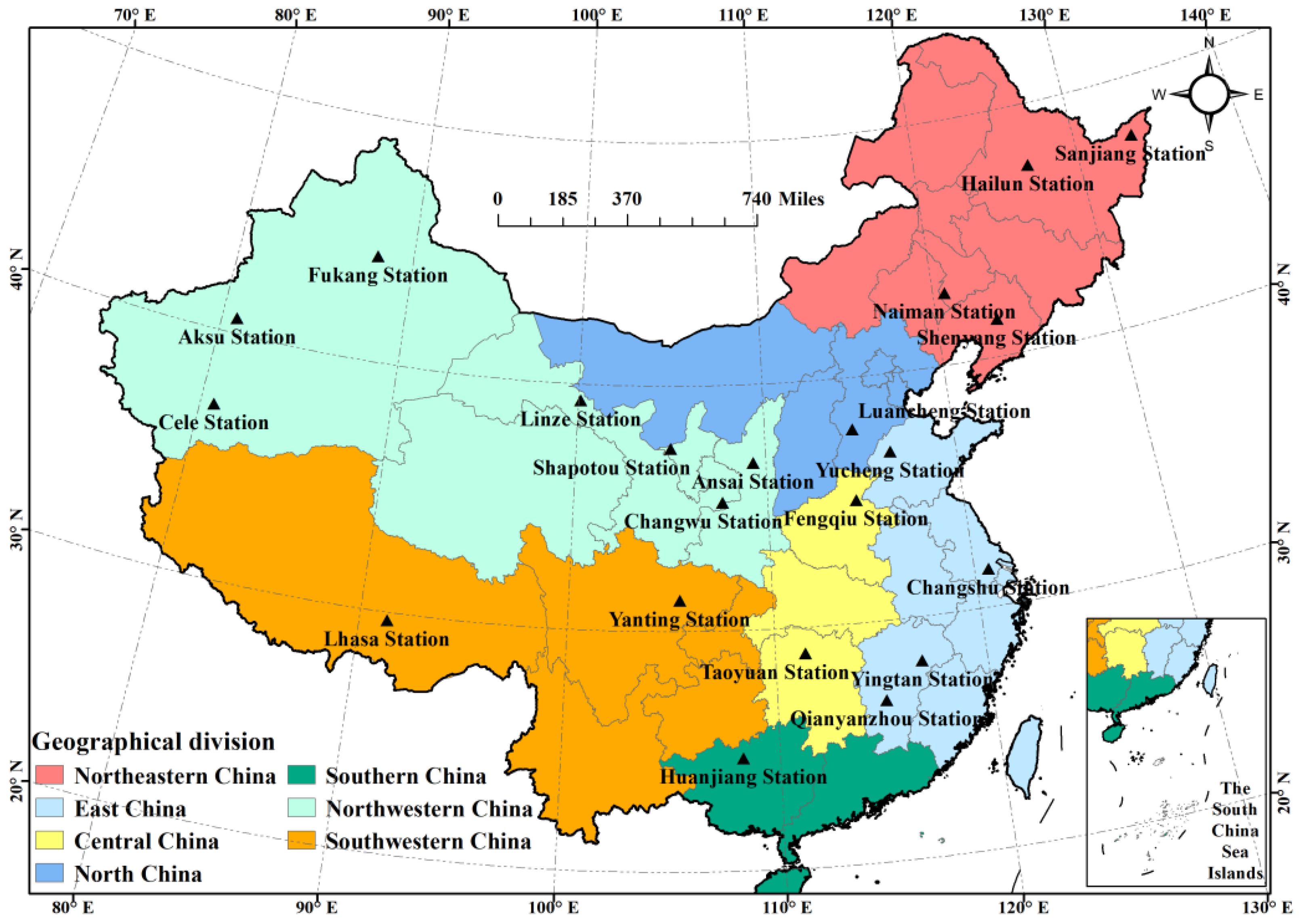
2.1. Study Area
2.2. Data Sources and Variable Selection
2.3. Soil Organic Carbon Calculation
2.4. Model Setting
2.4.1. Marginal Impact of Different Fertilization and Straw-Management Practices on Deep SOC
2.4.2. Marginal Impact of Different Tillage Modes on Deep SOC
2.4.3. Marginal Impact of Different Types of Farmland on Deep SOC
3. Results
3.1. Spatiotemporal Dynamics of Deep SOC in Typical Farmland
3.1.1. Temporal Variation
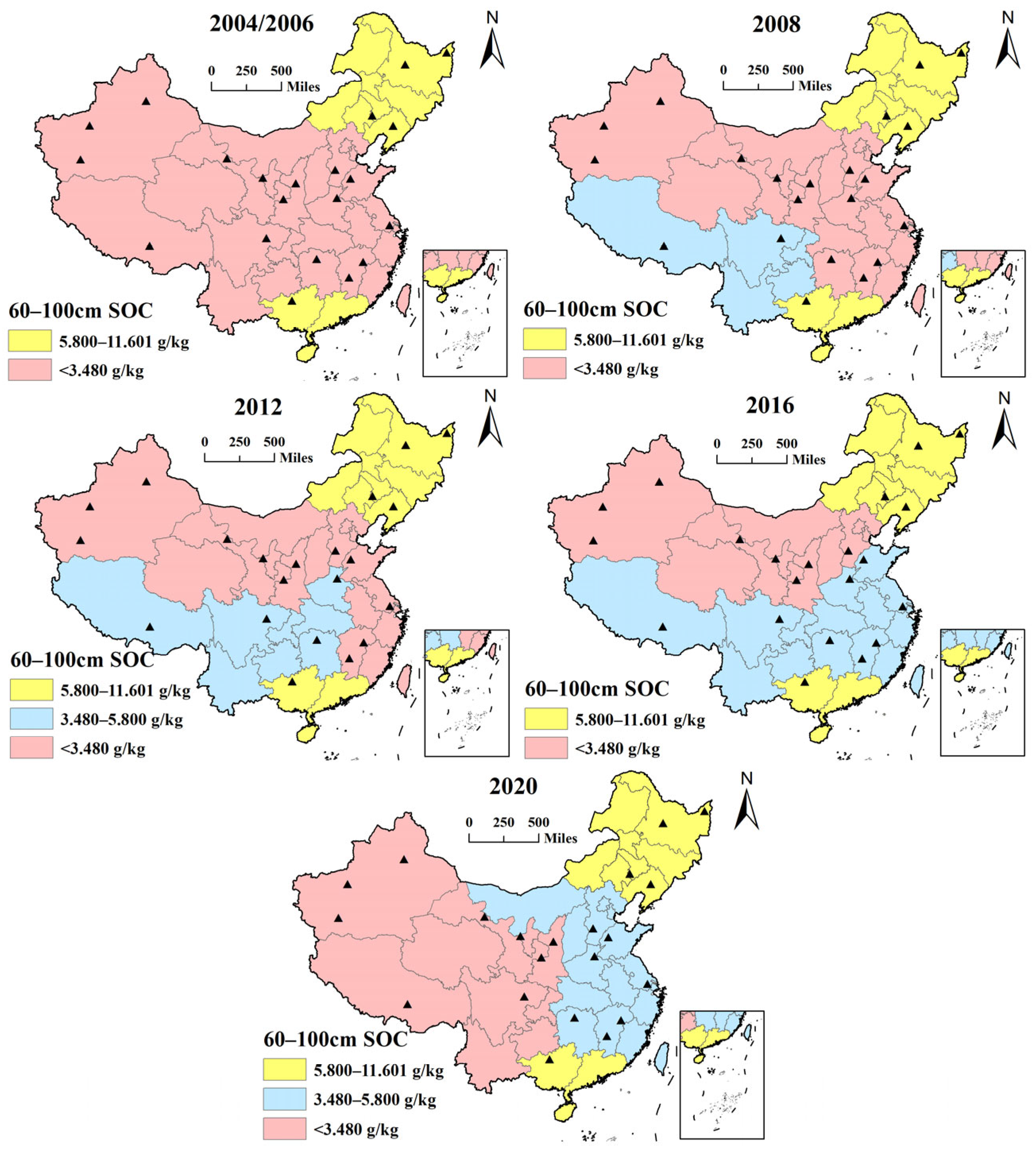
3.1.2. Spatial Variation
3.2. Response of Deep SOC to Different Fertilization and Straw-Management Methods
3.3. Response of Deep SOC to Different Tillage Modes
3.4. Response of Deep SOC to Different Farmland Types
4. Discussion
4.1. Potential for SOC Enrichment Within Subsoil Layers (>20 cm)
4.2. Differential Responses of Deep SOC to Agricultural Management and Management Strategies
4.3. Differences in the Response of Surface and Deep SOC to Agricultural Management
5. Conclusions
- (1)
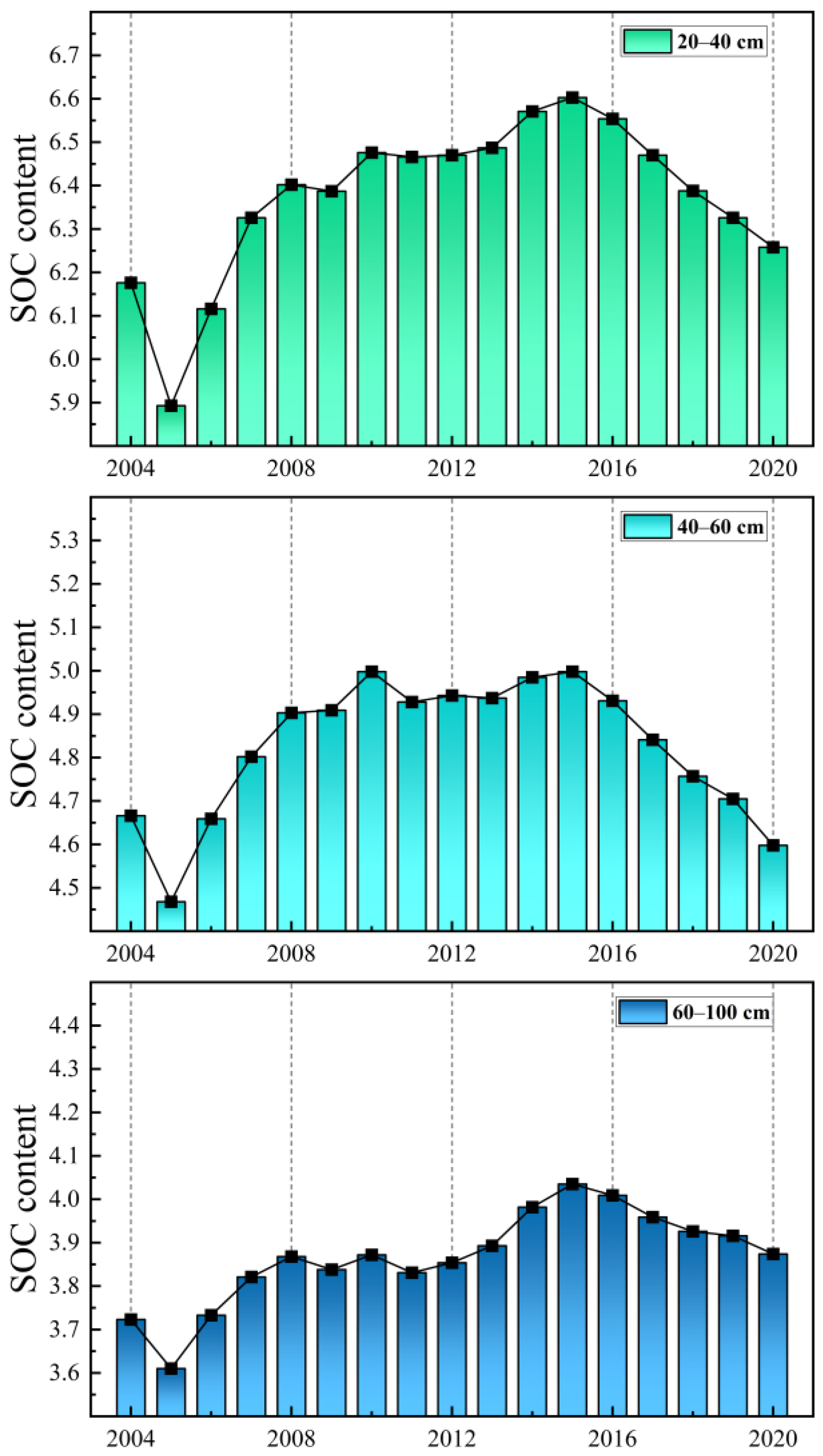
- The distribution of SOC below 20 cm in typical farmland soil profiles in China exhibits pronounced vertical heterogeneity. SOC content in the 20–40 cm soil layer shows a fluctuating accumulation trend from 2004 to 2020, with a cumulative increase of 1.33%. SOC content in the 40–60 cm soil layer decreases over the study period, with a cumulative decline of 1.46%. In contrast, SOC content in the 60–100 cm soil layer exhibits notable SOC enhancement, with a cumulative increase of 4.07% during this period, accounting for 62% of the total increase in SOC content below 20 cm.
- (2)
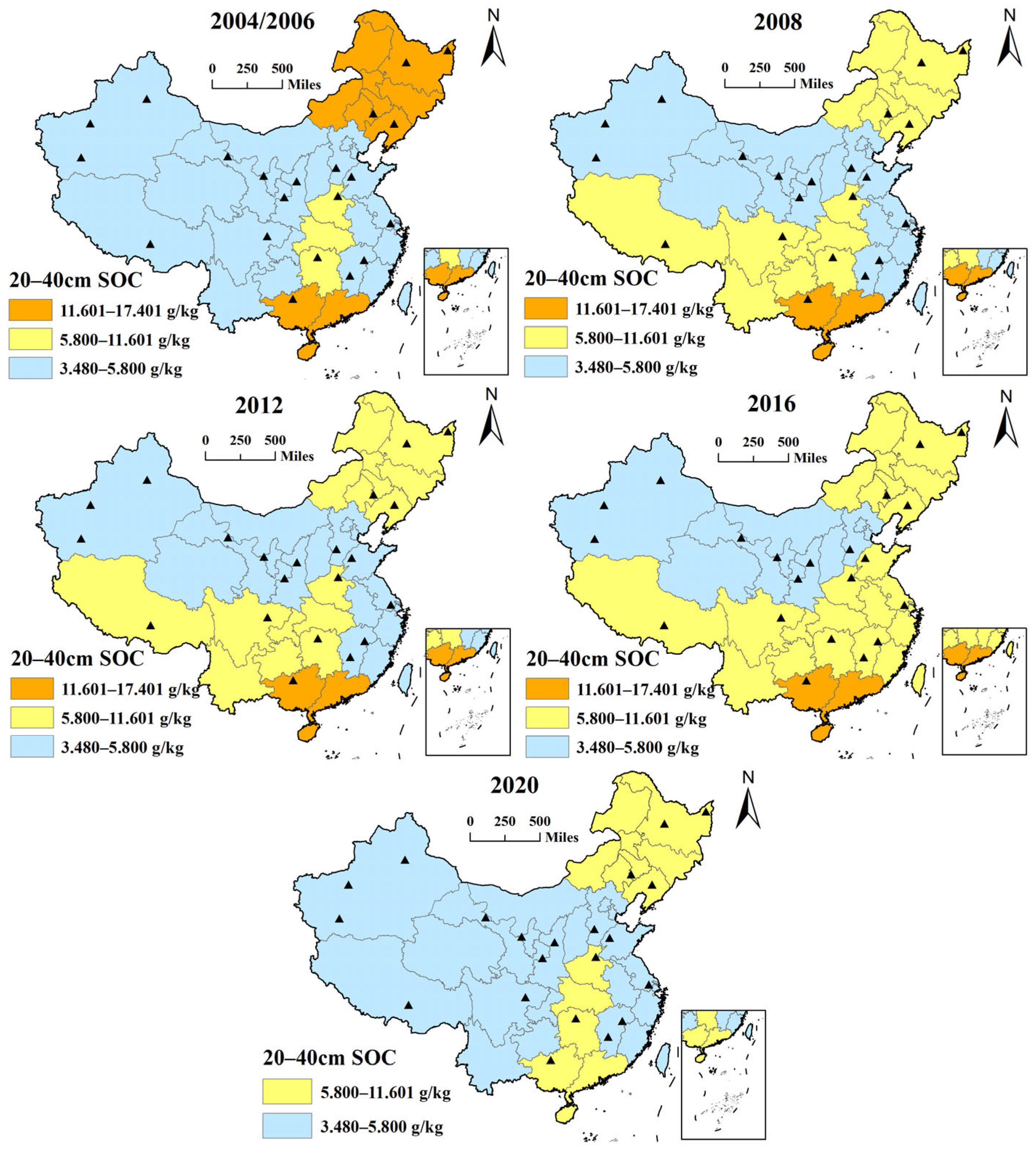
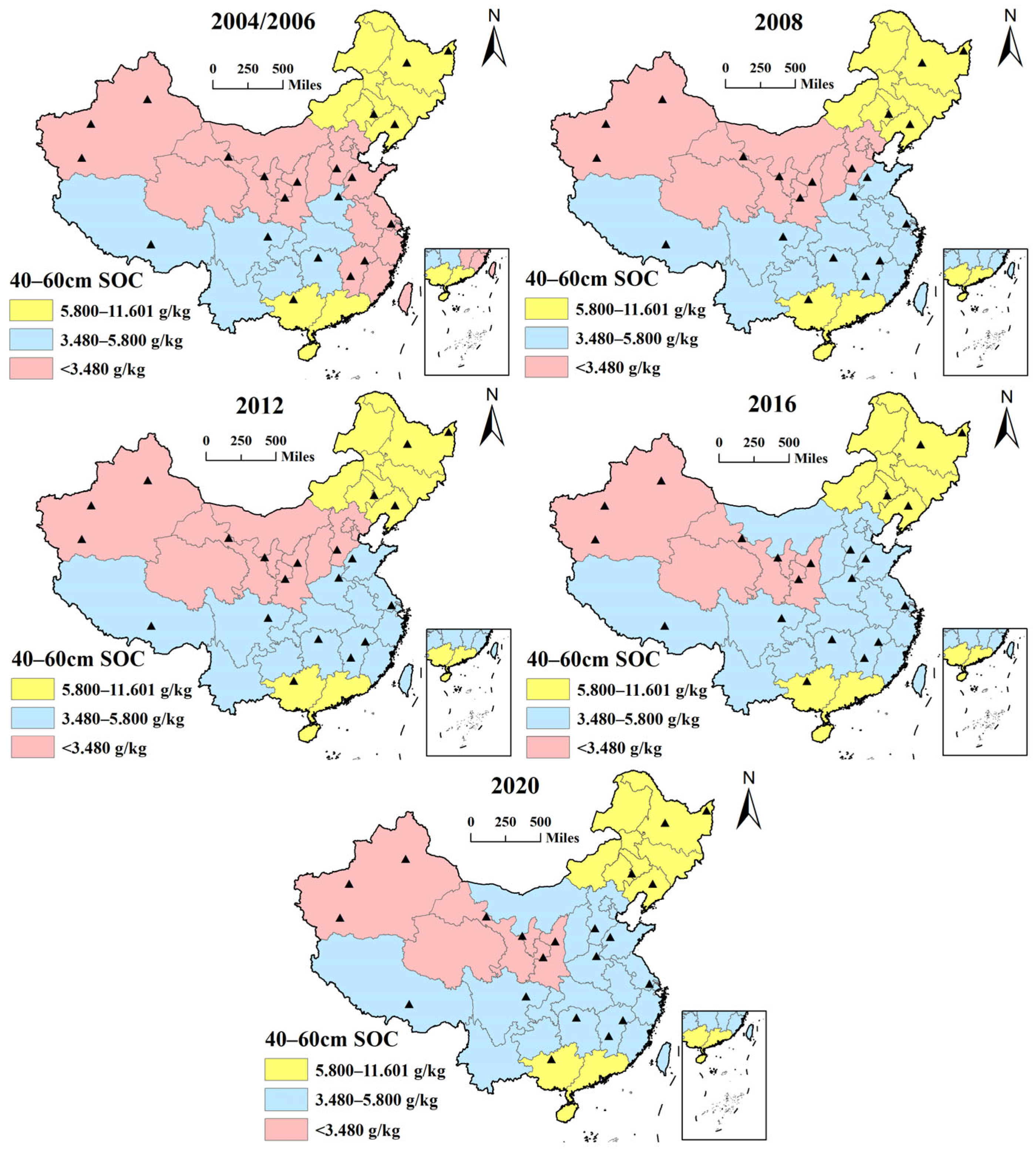
- In 2020, SOC content below 20 cm in typical farmland soil profiles in China exhibits a spatial gradient characterized by “higher values in the north and south, lower values in the east and west”. According to the nutrient classification criteria of the second national soil survey, SOC content in the 20–40 cm soil layer is at a suitable level only in the Northeastern, Southern, and Central China, whereas the remaining regions are at a deficient level. SOC content in the 40–60 cm soil layer is at a suitable level only in the Northeastern and Southern China, whereas it is at a deficient level in the Central, Eastern, Southwestern, and Northern China and at an extremely deficient level in the Northwestern China. SOC content in the 60–100 cm soil layer is at a suitable level only in the Northeastern and Southern China, at a deficient level in the Central and Northern China, and at an extremely deficient level in the Eastern, Northwestern, and Southwestern China.
- (3)
- Different fertilization and straw-management practices significantly affect SOC below 20 cm in farmland soil profiles. In the 20–40 cm soil layer, relative to sole chemical fertilizer application or no fertilization, the regression coefficients for single straw returning and sole organic fertilizer application are significantly negative. However, the estimated coefficients for straw returning combined with chemical fertilizer and organic fertilizer combined with chemical fertilizer are significantly positive (p < 0.01), with coefficient values of 0.299 and 1.154. Relative to no fertilization, applying chemical fertilizer alone significantly increases SOC content in the 20–40 cm soil layer but has no significant impact on SOC below 40 cm. Results for the 40–60 cm and 60–100 cm soil layers are broadly consistent with those for the 20–40 cm layer. Overall, relative to practices such as single organic inputs or sole chemical fertilizer application, the combined application of organic and inorganic fertilizers has a stronger effect on deep SOC.
- (4)
- Relative to reduced tillage or no-tillage, conventional tillage significantly increases SOC content in the 60–100 cm soil layer. Given this vertical disparity, a compound tillage system integrating “topsoil conservation tillage” with “subsoil interval tillage” should be promoted to facilitate deep SOC enhancement. Compared with dryland or irrigated land, paddy field management has no significant impact on SOC at depths below 20 cm.
Author Contributions
Funding
Data Availability Statement
Acknowledgments
Conflicts of Interest
References
- Rumpel, C.; Amiraslani, F.; Koutika, L.S.; Smith, P.; Whitehead, D.; Wollenberg, E. Put more carbon in soils to meet Paris climate pledges. Nature 2018, 564, 32–34. [Google Scholar] [CrossRef] [Scilit]
- Abdellatif, M.A.; Hassan, F.O.; Rashed, H.S.A.; El Baroudy, A.A.; Mohamed, E.S.; Kucher, D.E.; Abd-Elmabod, S.K.; Shokr, M.S.; Abuzaid, A.S. Assessing Soil Organic Carbon Pool for Potential Climate-Change Mitigation in Agricultural Soils—A Case Study Fayoum Depression, Egypt. Land 2023, 12, 1755. [Google Scholar] [CrossRef] [Scilit]
- Fontaine, S.; Barot, S.; Barré, P.; Bdioui, N.; Mary, B.; Rumpel, C. Stability of organic carbon in deep soil layers controlled by fresh carbon supply. Nature 2007, 450, 277–280. [Google Scholar] [CrossRef] [Scilit] [PubMed]
- Mathieu, J.A.; Hatté, C.; Balesdent, J.; Parent, É. Deep soil carbon dynamics are driven more by soil type than by climate: A worldwide meta-analysis of radiocarbon profiles. Glob. Change Biol. 2015, 21, 4278–4292. [Google Scholar] [CrossRef] [Scilit] [PubMed]
- Sun, R.J.; Sun, K.; Liu, L.R.; Wu, W.J.; Xu, Z.Z. Changes in soil carbon and nitrogen along a 3-m vertical profile and environmental regulation in alpine grassland on the Tibetan Plateau. J. Geophys. Res.-Biogeosci. 2024, 129, e2023JG007579. [Google Scholar] [CrossRef] [Scilit]
- Zheng, J.F.; Cheng, K.; Pan, G.X. Impact of biochar application on deep soil organic carbon pool. J. Nanjing Agric. Univ. 2020, 43, 589–593. [Google Scholar]
- Blanco-Canqui, H.; Jasa, P.; Ferguson, R.B.; Slater, G. Cover crops and deep-soil c accumulation: What does research show after 10 years? Soil Sci. Soc. Am. J. 2024, 88, 2167–2180. [Google Scholar] [CrossRef] [Scilit]
- Fan, Y.N.; Zhang, C.; Hu, W.Y.; Khan, K.S.; Zhao, Y.C.; Huang, B. Development of soil quality assessment framework: A comprehensive review of indicators, functions, and approaches. Ecol. Indic. 2025, 172, 113272. [Google Scholar] [CrossRef] [Scilit]
- Tautges, N.E.; Chiartas, J.L.; Gaudin, A.C.M.; O’Geen, A.T.; Herrera, I.; Scow, K.M. Deep soil inventories reveal that impacts of cover crops and compost on soil carbon sequestration differ in surface and subsurface soils. Glob. Change Biol. 2019, 25, 3753–3766. [Google Scholar] [CrossRef] [Scilit]
- Lehmann, J.; Kleber, M. The contentious nature of soil organic matter. Nature 2015, 528, 60–68. [Google Scholar] [CrossRef] [Scilit]
- Zheng, Y.T.; Zhao, X.N.; Li, X.Y.; Chen, H.Y.; Li, C.C.; Zhang, C.T. Mapping soil organic carbon density via geographically weighted regression with smooth terms: A case study in shanxi province. Ecol. Indic. 2024, 166, 112588. [Google Scholar] [CrossRef] [Scilit]
- Fang, J.Y.; Yu, G.R.; Liu, L.L.; Hu, S.J.; Chapin, F.S. Climate change, human impacts, and carbon sequestration in China. Proc. Natl. Acad. Sci. USA 2018, 115, 4015–4020. [Google Scholar] [CrossRef] [Scilit]
- Ding, Y.H.B.; Zhang, H.; Xu, L.; Guo, Z.H.; Duan, H.X.; Song, M.Y.; Xie, Y.Z.; Zhu, Y.F.; Wang, C. Regional differences in the impact of climate extremes on future global rice yield variability. Geomat. Nat. Hazards Risk 2026, 17, 2619862. [Google Scholar] [CrossRef] [Scilit]
- Hashimi, R.; Sato, T.; Someya, K.; Asagi, N.; Komatsuzaki, M. Impact of Long-Term Organic No-Tillage on Soil Aggregation, Aggregate-Associated Carbon, and Soil Water Retention. Soil Use Manag. 2025, 41, e70158. [Google Scholar] [CrossRef] [Scilit]
- Angst, G.; Messinger, J.; Greiner, M.; Häusler, W.; Hertel, D.; Kirfel, K.; Kögel-Knabner, I.; Leuschner, C.; Rethemeyer, J.; Mueller, C.W. Soil organic carbon stocks in topsoil and subsoil controlled by parent material, carbon input in the rhizosphere, and microbial-derived compounds. Soil Biol. Biochem. 2018, 122, 19–30. [Google Scholar] [CrossRef] [Scilit]
- Pries, C.E.H.; Ryals, R.; Zhu, B.; Min, K.; Cooper, A.; Goldsmith, S.; Pett-Ridge, J.; Torn, M.; Berhe, A.A. The deep soil organic carbon response to global change. Annu. Rev. Ecol. Evol. Syst. 2023, 54, 375–401. [Google Scholar] [CrossRef] [Scilit]
- Sierra, C.A.; Ahrens, B.; Bolinder, M.A.; Braakhekke, M.C.; von Fromm, S.; Kätterer, T.; Luo, Z.K.; Parvin, N.; Wang, G.C. Carbon sequestration in the subsoil and the time required to stabilize carbon for climate change mitigation. Glob. Change Biol. 2024, 30, e17153. [Google Scholar] [CrossRef] [Scilit] [PubMed]
- Wild, B.; Li, J.; Pihlblad, J.; Bengtson, P.; Rütting, T. Decoupling of priming and microbial n mining during a short-term soil incubation. Soil Biol. Biochem. 2019, 129, 71–79. [Google Scholar] [CrossRef] [Scilit]
- Skadell, L.E.; Schneider, F.; Gocke, M.I.; Guigue, J.; Amelung, W.; Bauke, S.L.; Hobley, E.U.; Barkusky, D.; Honermeier, B.; Kögel-Knabner, I.; et al. Twenty percent of agricultural management effects on organic carbon stocks occur in subsoils—Results of ten long-term experiments. Agric. Ecosyst. Environ. 2023, 356, 108619. [Google Scholar] [CrossRef] [Scilit]
- Samson, M.E.; Chantigny, M.H.; Vanasse, A.; Menasseri-Aubry, S.; Royer, I.; Angers, D.A. Response of subsurface c and n stocks dominates the whole-soil profile response to agricultural management practices in a cool, humid climate. Agric. Ecosyst. Environ. 2024, 320, 107590. [Google Scholar] [CrossRef] [Scilit]
- Fernandes, M.M.; Fernandes, M.R.D.; Garcia, J.R.; Matricardi, E.A.T.; de Almeida, A.Q.; Pinto, A.S.; Menezes, R.S.C.; Silva, A.d.J.; Lima, A.H.d.S. Assessment of land use and land cover changes and valuation of carbon stocks in the sergipe semiarid region, brazil: 1992–2030. Land Use Policy 2020, 99, 104795. [Google Scholar] [CrossRef] [Scilit]
- Lehmann, J.; Hansel, C.M.; Kaiser, C.; Kleber, M.; Maher, K.; Manzoni, S. Persistence of soil organic carbon caused by functional complexity. Nat. Geosci. 2020, 13, 529–534. [Google Scholar] [CrossRef] [Scilit]
- Fernando, E.A.J.; Selvaraj, M.; Uga, Y.; Busch, W.; Bowers, H.; Tohme, J. Going deep: Roots, carbon, and analyzing subsoil carbon dynamics. Mol. Plant 2024, 17, 1–3. [Google Scholar] [CrossRef] [Scilit] [PubMed]
- Potash, E.; Guan, K.Y.; Margenot, A.J.; Lee, D.K.; Boe, A.; Douglass, M.; Heaton, E.; Jang, C.; Jin, V.; Li, N.; et al. Multi-site evaluation of stratified and balanced sampling of soil organic carbon stocks in agricultural fields. Geoderma 2023, 438, 116587. [Google Scholar] [CrossRef] [Scilit]
- Wang, L.F.; Zhang, S.H.; Wang, L.J.; Xi, X. Spatiotemporal coupling dynamics and factors influencing soil organic carbon and crop yield in Chinese farmlands. Sci. Total Environ. 2024, 954, 176588. [Google Scholar]
- Meena, R.S.; Yadav, A.; Kumar, S.; Jhariya, M.K.; Jatav, S.S. Agriculture ecosystem models for CO2 sequestration, improving soil physicochemical properties, and restoring degraded land. Ecol. Eng. 2022, 176, 106546. [Google Scholar] [CrossRef] [Scilit]
- Ren, H.L.; Xu, S.J.; Zhang, F.Y.; Sun, M.M.; Zhang, R.P. Cultivation and Nitrogen Management Practices Effect on Soil Carbon Fractions, Greenhouse Gas Emissions, and Maize Production under Dry-Land Farming System. Land 2023, 12, 1306. [Google Scholar] [CrossRef] [Scilit]
- Zhang, S.T.; Ren, T.; Cong, W.F.; Fang, Y.T.; Zhu, J.; Zhao, J.; Cong, R.H.; Li, X.K.; Lu, J.W. Oilseed rape-rice rotation with recommended fertilization and straw returning enhances soil organic carbon sequestration through influencing macroaggregates and molecular complexity. Agric. Ecosyst. Environ. 2024, 367, 108960. [Google Scholar] [CrossRef] [Scilit]
- Han, H.; Fan, D.J.; Liu, S.X.; Jiang, R.; Song, D.P.; Zou, G.Y.; He, P.; Wang, M.Y.; He, W.T. Integrating straw return and tillage practices to enhance soil organic carbon sequestration in wheat-maize rotation systems in the north China plain. Agric. Ecosyst. Environ. 2025, 384, 109555. [Google Scholar] [CrossRef] [Scilit]
- Zhang, Y.J.; Zou, J.L.; Osborne, B.; Dang, W.; Xu, Y.X.; Ren, Y.Y.; Dang, S.A.; Wang, L.J.; Chen, X.; Yu, Y. Effect of straw return on soil respiration in dryland agroecosystem of China: A meta-analysis. Ecol. Eng. 2023, 196, 107099. [Google Scholar] [CrossRef] [Scilit]
- Hao, X.Y.; He, W.; Lam, S.K.; Li, P.; Zong, Y.X.; Zhang, D.S.; Li, F.Y. Enhancement of no-tillage, crop straw return and manure application on field organic matter content overweigh the adverse effects of climate change in the arid and semi-arid northwest China. Agric. For. Meteorol. 2020, 295, 108199. [Google Scholar] [CrossRef] [Scilit]
- Feng, W.H.; Ai, J.J.; Sánchez-Rodríguez, A.R.; Li, S.W.; Zhang, W.T.; Yang, H.S.; Apostolakis, A.; Muenter, C.; Li, F.M.; Dippold, M.A.; et al. Depth-dependent patterns in soil organic c, enzymatic stochiometric ratio, and soil quality under conventional tillage and reduced tillage after 55-years. Agric. Ecosyst. Environ. 2025, 385, 109584. [Google Scholar] [CrossRef] [Scilit]
- Bongiorno, G.; Bünemann, E.K.; Oguejiofor, C.U.; Meier, J.; Gort, G.; Comans, R.; Mäder, P.; Brussaard, L.; de Goede, R. Sensitivity of labile carbon fractions to tillage and organic matter management and their potential as comprehensive soil quality indicators across pedoclimatic conditions in europe. Ecol. Indic. 2021, 121, 107093. [Google Scholar] [CrossRef] [Scilit]
- Xie, W.; Zhu, A.F.; Ali, T.; Zhang, Z.T.; Chen, X.G.; Wu, F.; Huang, J.K.; Davis, K.F. Crop switching can enhance environmental sustainability and farmer incomes in China. Nature 2023, 618, E26. [Google Scholar] [CrossRef] [Scilit] [PubMed]
- Hobley, E.; Wilson, B.; Wilkie, A.; Gray, J.; Koen, T. Drivers of soil organic carbon storage and vertical distribution in eastern australia. Plant Soil 2015, 390, 111–127. [Google Scholar] [CrossRef] [Scilit]
- Liang, Z.Y.; Li, Y.N.; Wang, J.Y.Z.; Hao, J.Q.; Jiang, Y.H.; Shi, J.L.; Meng, X.T.; Tian, X.H. Effects of the combined application of livestock manure and plant residues on soil organic carbon sequestration in the southern loess plateau of China. Agric. Ecosyst. Environ. 2024, 368, 109011. [Google Scholar] [CrossRef] [Scilit]
- Li, Q.; Gao, M.F.; Li, Z.L. Soil organic carbon storage in australian wheat cropping systems in response to climate change from 1990 to 2060. Land 2022, 11, 1683. [Google Scholar] [CrossRef] [Scilit]
- Fierer, N.; Allen, A.S.; Schimel, J.P.; Holden, P.A. Controls on microbial CO2 production: A comparison of surface and subsurface soil horizons. Glob. Change Biol. 2003, 9, 1322–1332. [Google Scholar] [CrossRef] [Scilit]
- Dignac, M.F.; Derrien, D.; Barré, P.; Barot, S.; Cécillon, L.; Chenu, C.; Chevallier, T.; Freschet, G.T.; Garnier, P.; Guenet, B.; et al. Increasing soil carbon storage: Mechanisms, effects of agricultural practices and proxies. A review. Agron. Sustain. Dev. 2017, 37, 14. [Google Scholar] [CrossRef] [Scilit]
- GB/T 7857—1987; Determination of Organic Matter and Calculation of Carbon-Nitrogen Ratio for Forest Soil. China Standards Press: Beijing, China, 1987.
- Gattinger, A.; Muller, A.; Haeni, M.; Skinner, C.; Fliessbach, A.; Buchmann, N.; Mäder, P.; Stolze, M.; Smith, P.; Scialabba, N.E.H.; et al. Enhanced top soil carbon stocks under organic farming. Proc. Natl. Acad. Sci. USA 2012, 109, 18226–18231. [Google Scholar] [CrossRef] [Scilit] [PubMed]
- NY/T 1119-2019; Rules for Cultivated Land Quality Monitoring. China Agricultural Press: Beijing, China, 2019.
- Jawadi, F.; Pondie, T.M.; Cheffou, A.I. New challenges for green finance and sustainable industrialization in developing countries: A panel data analysis. Energy Econ. 2025, 142, 108120. [Google Scholar] [CrossRef] [Scilit]
- Salmerón, R.; García, C.B.; García, J. Variance Inflation Factor and Condition Number in multiple linear regression. J. Stat. Comput. Simul. 2018, 88, 2365–2384. [Google Scholar] [CrossRef] [Scilit]
- Xin, J.J.; Yan, L.; Cai, H.G. Response of soil organic carbon to straw return in farmland soil in China: A meta-analysis. J. Environ. Manag. 2024, 359, 121051. [Google Scholar] [CrossRef] [Scilit]
- Xu, Y.A.; Yu, Y.L.; Sheng, J.; Wang, Y.K.; Yang, H.S.; Li, F.M.; Liu, S.P.; Kan, Z.R. Long-term residue returning increased subsoil carbon quality in a rice-wheat cropping system. J. Environ. Manag. 2024, 360, 121088. [Google Scholar] [CrossRef] [Scilit]
- Shi, H.Y.; Umair, M. Balancing agricultural production and environmental sustainability: Based on Economic Analysis From North China Plain. Environ. Res. 2024, 252, 118784. [Google Scholar] [CrossRef] [Scilit]
- Yan, S.B.; Yin, L.M.; Dijkstra, F.A.; Wang, P.; Cheng, W.X. Priming effect on soil carbon decomposition by root exudate surrogates: A meta-analysis. Soil Biol. Biochem. 2023, 178, 108955. [Google Scholar] [CrossRef] [Scilit]
- Chioggia, F.; Grigatti, M.; Lavrnic, S.; Toscano, A. Constructed wetland biomass for compost production: Evaluation of effects on crops and soil. Ecol. Eng. 2024, 207, 107339. [Google Scholar] [CrossRef] [Scilit]
- Zhao, Y.; Wang, M.; Hu, S.; Zhang, X.; Ouyang, Z.; Zhang, G.; Huang, B.; Zhao, S.; Wu, J.; Xie, D.; et al. Economics- and policy-driven organic carbon input enhancement dominates soil organic carbon accumulation in Chinese croplands. Proc. Natl. Acad. Sci. USA 2018, 115, 4045–4050. [Google Scholar] [CrossRef] [Scilit] [PubMed]
- Button, E.S.; Pett, R.J.; Murphy, D.; Kuzyakov, Y.; Chadwick, D.R.; Jones, D.L. Deep-c storage: Biological, chemical and physical strategies to enhance carbon stocks in agricultural subsoils. Soil Biol. Biochem. 2022, 170, 108697. [Google Scholar] [CrossRef] [Scilit]
- Amundson, R.; Biardeau, L. Soil carbon sequestration is an elusive climate mitigation tool. Proc. Natl. Acad. Sci. USA 2018, 115, 11652–11656. [Google Scholar] [CrossRef] [Scilit] [PubMed]
- Khairallah, W.; Raclot, D.; Annabi, M.; Coulouma, G.; Guenet, B.; Rumpel, C.; Bahri, H. Evidence of high carbon biodegradability in the subsoil of Mediterranean croplands. Geoderma 2025, 455, 117212. [Google Scholar] [CrossRef] [Scilit]
- Xu, H.; Cai, A.D.; Yang, X.Y.; Zhang, S.L.; Huang, S.M.; Wang, B.R.; Zhu, P.; Colinet, G.; Sun, N.; Xu, M.G.; et al. Long-term organic substitution promotes carbon and nitrogen sequestration and benefit crop production in upland field. Agronomy 2023, 13, 2381. [Google Scholar] [CrossRef] [Scilit]
- He, H.; Peng, M.W.; Hou, Z.A.; Li, J.H. Unlike chemical fertilizer reduction, organic fertilizer substitution increases soil organic carbon stock and soil fertility in wheat fields. J. Sci. Food Agric. 2024, 104, 2798–2808. [Google Scholar] [CrossRef] [Scilit] [PubMed]
- Tang, H.M.; Cheng, K.K.; Shi, L.H.; Li, C.; Wen, L.; Li, W.Y.; Sun, M.; Sun, G.; Long, Z.D. Effects of long-term organic matter application on soil carbon accumulation and nitrogen use efficiency in a double-cropping rice field. Environ. Res. 2022, 213, 113700. [Google Scholar] [CrossRef] [Scilit]
- Patra, R.; Saha, D.; Neupane, A.; Jagadamma, S. Deep-rooted winter wheat cover crop promotes subsoil organic carbon storage through improved microbial functional traits. Appl. Soil Ecol. 2024, 199, 105413. [Google Scholar] [CrossRef] [Scilit]



| Variable | Meaning | Mean | SD | Max | Min |
|---|---|---|---|---|---|
| SOC (g/kg) | 20–40 cm | 6.384 | 4.572 | 23.492 | 0.238 |
| 40–60 cm | 4.833 | 3.049 | 14.849 | 0.180 | |
| 60–100 cm | 3.872 | 2.444 | 16.492 | 0.209 | |
| Exogenous carbon input | 1 = Organic fertilizer or straw returning 0 = No fertilizer or chemical fertilizer | 0.535 | 0.499 | 1.000 | 0.000 |
| Ground temperature (°C) | 20–40 cm | 14.214 | 4.111 | 22.300 | 4.400 |
| 40–60 cm | 14.177 | 4.072 | 22.400 | 4.500 | |
| 60–100 cm | 14.224 | 4.114 | 22.444 | 4.683 | |
| Soil bulk density | 20–40 cm | 1.489 | 0.188 | 2.765 | 0.988 |
| 40–60 cm | 1.492 | 0.180 | 2.655 | 1.170 | |
| 60–100 cm | 1.499 | 0.190 | 2.751 | 1.060 | |
| Soil pH | 20–40 cm | 7.668 | 1.300 | 9.938 | 4.008 |
| 40–60 cm | 7.701 | 1.300 | 9.999 | 4.000 | |
| 60–100 cm | 7.696 | 1.310 | 9.936 | 4.019 | |
| Proportion of clay particles | 20–40 cm | 21.687 | 15.484 | 75.203 | 0.034 |
| 40–60 cm | 23.505 | 17.177 | 86.505 | 0.000 | |
| 60–100 cm | 22.465 | 16.828 | 78.730 | 0.000 | |
| Initial SOC | 20–40 cm | 6.208 | 4.240 | 21.249 | 0.238 |
| 40–60 cm | 4.676 | 2.970 | 14.635 | 0.180 | |
| 60–100 cm | 3.665 | 2.338 | 11.961 | 0.209 | |
| Precipitation (mm) | Annual precipitation | 621.052 | 510.579 | 2571.000 | 5.600 |
| Altitude (m) | Vertical elevation relative to mean sea level | 690.129 | 988.235 | 3688.000 | 1.300 |
| (1) | (2) | (3) | (4) | (5) | |
|---|---|---|---|---|---|
| S | −0.364 * (0.202) | ||||
| SCF | 0.299 *** (0.082) | ||||
| OF | 0.312 (0.206) | ||||
| OCF | 1.154 *** (0.131) | ||||
| CF | 0.133 * (0.080) | ||||
| _cons | 32.758 *** (1.707) | 31.554 *** (1.543) | 32.648 *** (1.727) | 34.257 *** (1.736) | 32.677 *** (1.730) |
| Controls | Y | Y | Y | Y | Y |
| Site_FE | Y | Y | Y | Y | Y |
| Year_FE | Y | Y | Y | Y | Y |
| Obs | 939 | 1358 | 902 | 1299 | 873 |
| R-squared | 0.947 | 0.941 | 0.946 | 0.890 | 0.947 |
| (1) | (2) | (3) | (4) | (5) | |
|---|---|---|---|---|---|
| S | −0.413 * (0.220) | ||||
| SCF | 0.117 ** (0.064) | ||||
| OF | 0.309 ** (0.149) | ||||
| OCF | 0.764 *** (0.083) | ||||
| CF | 0.095 (0.082) | ||||
| _cons | 17.875 *** (1.087) | 16.889 *** (0.954) | 17.078 *** (1.093) | 18.542 *** (1.159) | 17.112 *** (1.104) |
| Controls | Y | Y | Y | Y | Y |
| Site_FE | Y | Y | Y | Y | Y |
| Year_FE | Y | Y | Y | Y | Y |
| Obs | 939 | 1358 | 902 | 1299 | 873 |
| R-squared | 0.918 | 0.913 | 0.920 | 0.879 | 0.920 |
| (1) | (2) | (3) | (4) | (5) | |
|---|---|---|---|---|---|
| S | 0.008 (0.129) | ||||
| SCF | 0.161 ** (0.069) | ||||
| OF | 0.209 (0.132) | ||||
| OCF | 1.042 *** (0.072) | ||||
| CF | −0.009 (0.066) | ||||
| _cons | 11.581 *** (0.890) | 11.746 *** (0.847) | 11.548 *** (0.912) | 13.026 *** (0.973) | 11.423 *** (0.912) |
| Controls | Y | Y | Y | Y | Y |
| Site_FE | Y | Y | Y | Y | Y |
| Year_FE | Y | Y | Y | Y | Y |
| Obs | 939 | 1358 | 902 | 1299 | 873 |
| R-squared | 0.909 | 0.893 | 0.911 | 0.877 | 0.912 |
| 20–40 cm SOC | 40–60 cm SOC | 60–100 cm SOC | |
|---|---|---|---|
| (1) | (2) | (3) | |
| Tillage mode | −0.304 (0.315) | −0.492 ** (0.250) | 0.509 ** (0.216) |
| _cons | 32.416 *** (1.562) | 18.599 *** (1.038) | 12.496 *** (0.965) |
| Controls | Y | Y | Y |
| Site_FE | Y | Y | Y |
| Year_FE | Y | Y | Y |
| Obs | 1851 | 1851 | 1851 |
| R-squared | 0.895 | 0.878 | 0.860 |
| 20–40 cm SOC | 40–60 cm SOC | 60–100 cm SOC | |
|---|---|---|---|
| (1) | (2) | (3) | |
| Farmland type | −0.039 (0.168) | 0.079 (0.147) | 0.120 (0.123) |
| _cons | 31.835 *** (1.535) | 17.917 *** (0.980) | 13.225 *** (0.846) |
| Controls | Y | Y | Y |
| Site_FE | Y | Y | Y |
| Year_FE | Y | Y | Y |
| Obs | 1879 | 1879 | 1879 |
| R-squared | 0.895 | 0.879 | 0.860 |
| Model | Independent Variable | Regression Coefficient | Standard Deviation | Controls | Site_FE | Year_FE | Obs | R-Squared |
|---|---|---|---|---|---|---|---|---|
| (1) | S | −0.406 | 0.337 | Y | Y | Y | 939 | 0.950 |
| (2) | SCF | 1.865 *** | 0.139 | Y | Y | Y | 1358 | 0.946 |
| (3) | OF | 2.030 *** | 0.327 | Y | Y | Y | 902 | 0.947 |
| (4) | OCF | 1.963 *** | 0.165 | Y | Y | Y | 1299 | 0.926 |
| (5) | CF | 0.868 *** | 0.104 | Y | Y | Y | 873 | 0.951 |
| (6) | Tillage mode | −1.098 *** | 0.423 | Y | Y | Y | 1851 | 0.928 |
| (7) | Farmland type | 2.109 *** | 0.315 | Y | Y | Y | 1879 | 0.932 |
Disclaimer/Publisher’s Note: The statements, opinions and data contained in all publications are solely those of the individual author(s) and contributor(s) and not of MDPI and/or the editor(s). MDPI and/or the editor(s) disclaim responsibility for any injury to people or property resulting from any ideas, methods, instructions or products referred to in the content. |
© 2026 by the authors. Licensee MDPI, Basel, Switzerland. This article is an open access article distributed under the terms and conditions of the Creative Commons Attribution (CC BY) license.
Share and Cite
Zhang, S.; Wang, C. Spatiotemporal Dynamics of Deep Soil Organic Carbon and Its Response to Agricultural Management: Evidence from Long-Term Monitoring Data in Typical Farmlands in China. Land 2026, 15, 676. https://doi.org/10.3390/land15040676
Zhang S, Wang C. Spatiotemporal Dynamics of Deep Soil Organic Carbon and Its Response to Agricultural Management: Evidence from Long-Term Monitoring Data in Typical Farmlands in China. Land. 2026; 15(4):676. https://doi.org/10.3390/land15040676
Chicago/Turabian StyleZhang, Shuhe, and Chengjun Wang. 2026. "Spatiotemporal Dynamics of Deep Soil Organic Carbon and Its Response to Agricultural Management: Evidence from Long-Term Monitoring Data in Typical Farmlands in China" Land 15, no. 4: 676. https://doi.org/10.3390/land15040676
APA StyleZhang, S., & Wang, C. (2026). Spatiotemporal Dynamics of Deep Soil Organic Carbon and Its Response to Agricultural Management: Evidence from Long-Term Monitoring Data in Typical Farmlands in China. Land, 15(4), 676. https://doi.org/10.3390/land15040676