1. Introduction
Global climate change poses critical challenges to sustainable regional development, particularly in terms of reducing carbon emissions while improving environmental efficiency [
1]. Among the indicators used to evaluate low-carbon development, carbon emission performance (CEP)—which measures the economic output achieved per unit of carbon emitted under specific input conditions—has emerged as a key indicator for assessing the efficiency of economic development relative to carbon emissions [
2,
3,
4,
5,
6,
7,
8]. Improving CEP is widely recognized as a crucial pathway to reconcile growth and emission reduction objectives [
9].
Recent studies have increasingly emphasized that urban–rural spatial patterns and land-use morphology play important roles in shaping regional carbon emissions and carbon efficiency [
10,
11,
12]. Existing research suggests that urban spatial configuration influences transportation demand, infrastructure utilization, land-use efficiency, and industrial agglomeration, thereby affecting carbon-related environmental performance [
13,
14,
15,
16]. Compact and contiguous urban forms are generally associated with lower commuting costs and more efficient infrastructure sharing, whereas dispersed and fragmented spatial patterns may increase energy consumption and reduce land-use efficiency [
17,
18].
At the landscape-pattern level, construction land metrics such as TA, AWMSI, and SPLIT have been widely used to characterize urban spatial morphology [
19,
20]. Previous studies indicate that larger and more concentrated construction land patches may improve carbon efficiency through economies of scale and centralized infrastructure systems [
21]. In contrast, fragmented landscapes are often associated with higher transportation demand and spatial separation of urban functions, which may negatively affect carbon performance. However, existing findings remain inconsistent regarding the effects of landscape morphology and spatial configuration on carbon-related efficiency, suggesting that these relationships may vary across regions and development stages [
22,
23].
Existing research, however, exhibits several limitations. First, most studies focus on the provincial or city scale, overlooking counties, which are crucial units linking urban and rural development with heterogeneous land-use patterns [
24,
25,
26,
27]. Second, many studies analyze landscape patterns using aggregate land-use types without explicitly focusing on construction land, which is the primary carrier of carbon emissions. This may dilute the specificity of conclusions regarding the role of urban development in carbon efficiency [
28,
29,
30]. Third, conventional cross-sectional multiple regression models often fail to capture spatial heterogeneity, limiting the identification of localized or mechanism-driven effects on CEP [
13,
31,
32,
33,
34].
In China, counties represent the fundamental units of territorial governance, responsible for land-use planning, economic development, and the coordination of urban–rural systems. Compared with larger administrative units such as provinces or municipal-level regions, counties provide a finer spatial scale for capturing urban–rural heterogeneity and land-use differences. The substantial variation in economic development, industrial structure, and land-use intensity across counties also allows for detailed spatial analysis of carbon emission performance.
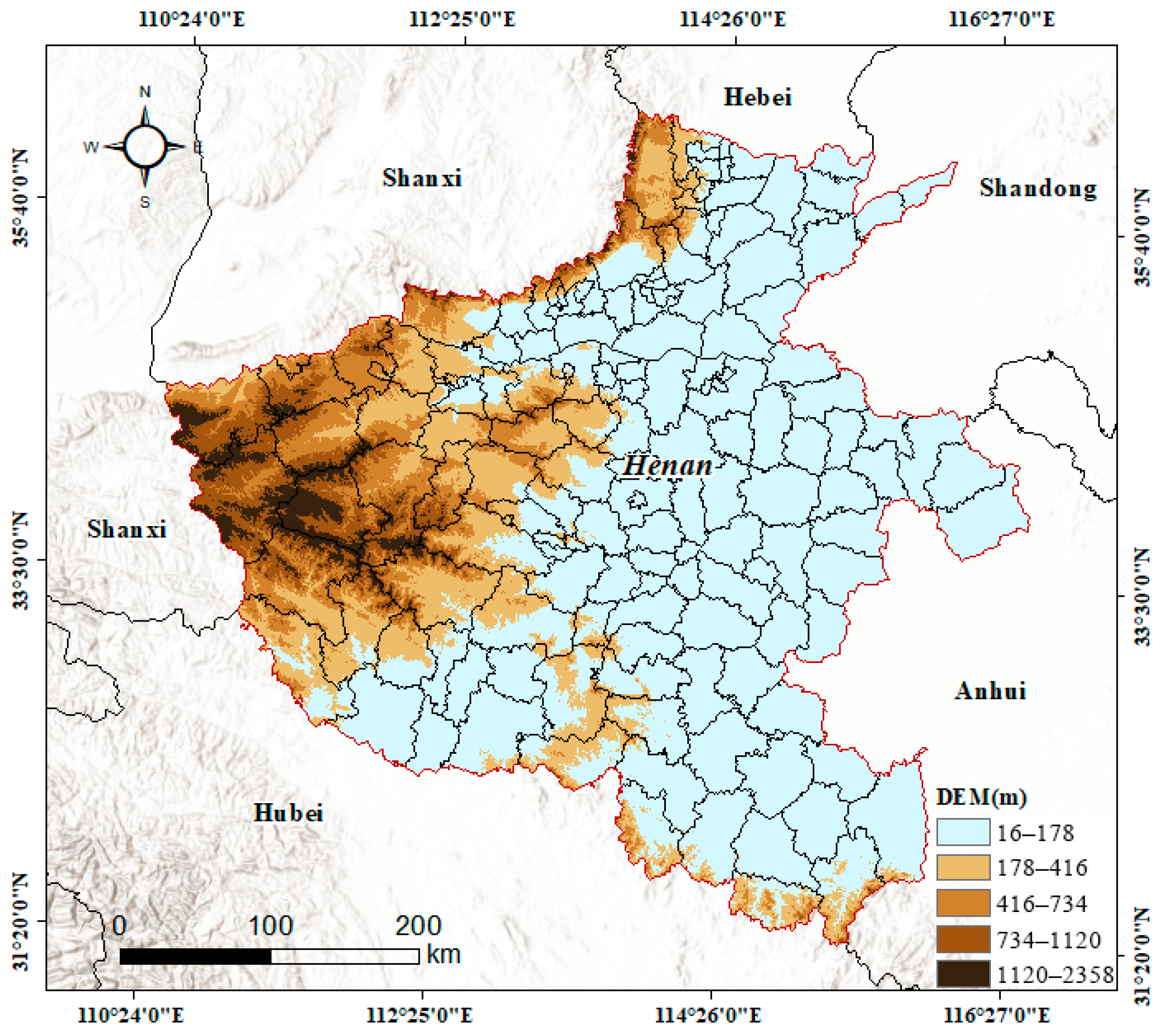
To address these gaps, this study focuses on 157 county-level administrative units in Henan Province, including both counties and county-level cities (hereafter collectively referred to as “counties”). Three time points (2013, 2018, and 2023) were selected to systematically measure CEP and analyze its spatiotemporal variation. The study is guided by three central research questions: (1) How do urban–rural spatial patterns, particularly construction land landscape characteristics, influence carbon emission performance at the county level? (2) Do these effects exhibit significant spatial heterogeneity across counties? (3) What mechanisms underlie the spatially varying impacts of landscape patterns on CEP? Answering these questions can provide insights for low-carbon spatial planning and targeted policy interventions at the county level.
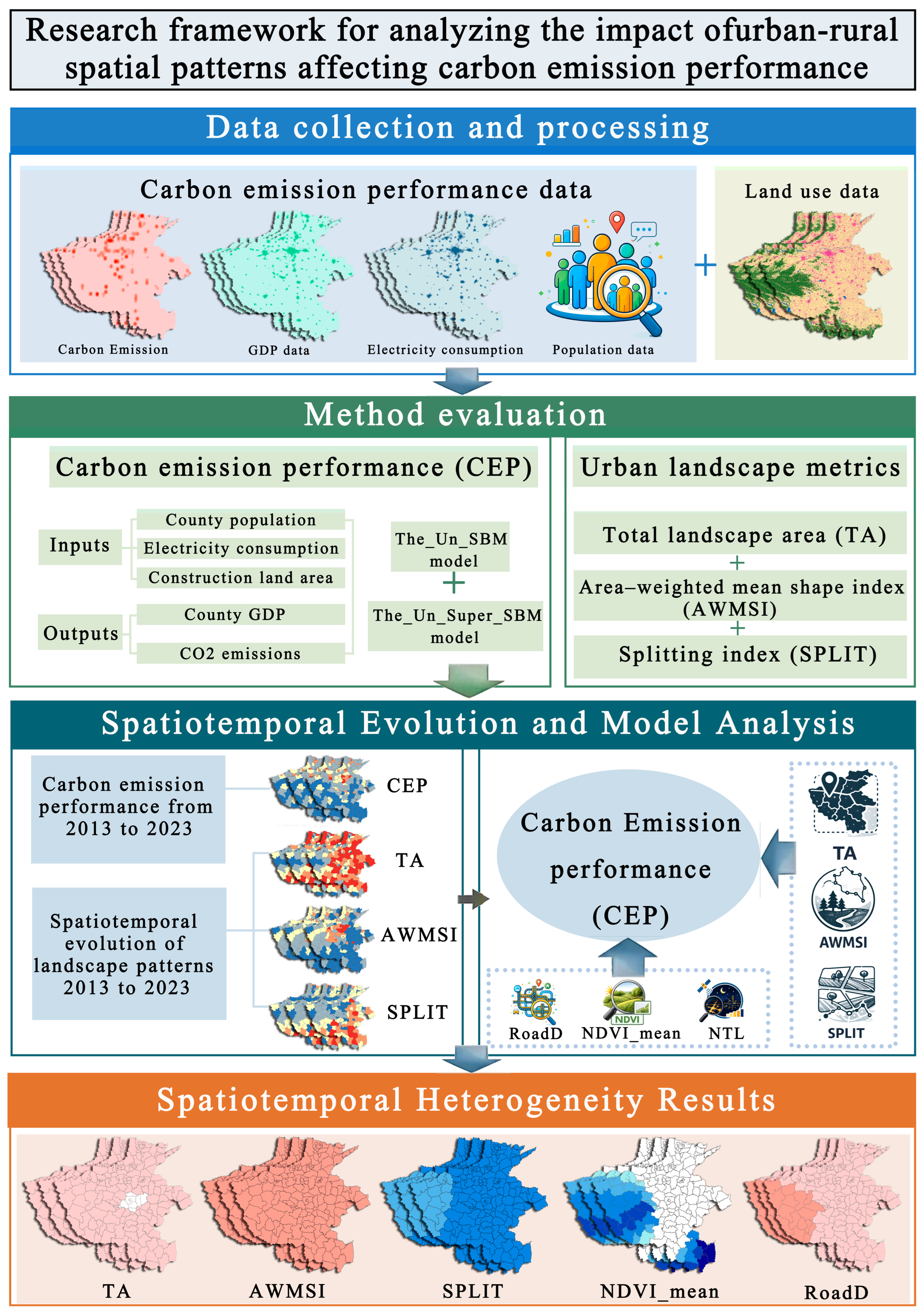
To answer these questions, we employ an integrated analytical framework. County-level CEP is quantified using the UN_SBM model and Un_Super_SBM model [
2,
3,
4]. Landscape metrics for construction land are constructed, including “Total landscape area” (TA), “Area-weighted mean shape index” (AWMSI), and “Splitting index” (SPLIT). Ecological and infrastructure variables, such as “Mean Normalized Difference Vegetation Index” (NDVI_mean), “Road network density” (RoadD), and “Night-time light” (NTL) as a proxy for industrial activity and energy consumption, are incorporated as control variables [
19,
20,
35]. Cross-sectional multiple regression is applied to identify global effects, while multiscale geographically weighted regression (MGWR) captures spatially varying local effects [
31].
This approach provides a comprehensive assessment of both the overall and localized impacts of urban–rural spatial patterns on CEP. The study contributes to the literature and practice in three main ways: (1) It delivers a county-level assessment of CEP and its temporal dynamics, providing a finer spatial-scale perspective compared with broader provincial and municipal-level studies. (2) It clarifies how construction land landscape patterns affect carbon efficiency and the mechanisms through which spatial heterogeneity emerges, bridging land-use planning and low-carbon development research. (3) By revealing spatially heterogeneous mechanisms through MGWR, it provides actionable evidence for targeted policy interventions and low-carbon land-use planning at the county level.
The remainder of this paper is organized as follows:
Section 2 introduces the study area, data sources, and methodology, including efficiency measurement and landscape pattern indicators.
Section 3 presents the empirical results, including cross-sectional multiple regression and MGWR analyses.
Section 4 discusses the spatial mechanisms and policy implications of urban–rural development patterns on CEP.
Section 5 concludes with key findings and recommendations for low-carbon regional development.
3. Results
3.1. Spatiotemporal Patterns of CEP in Henan Province
As shown in
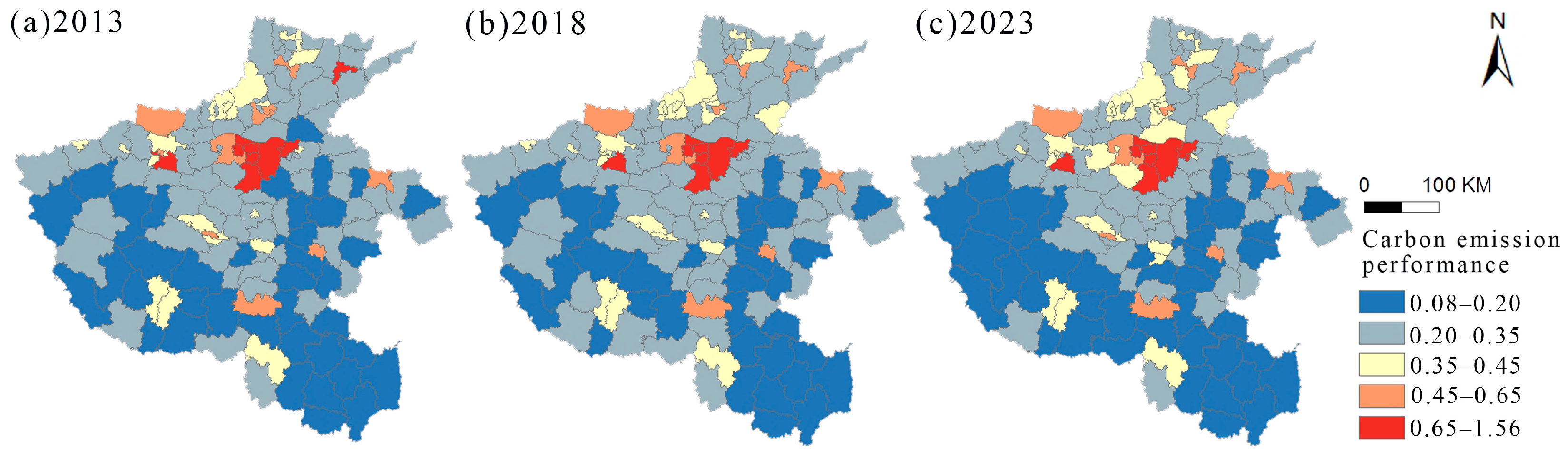
Table 2, the mean CEP of county-level units in Henan Province increased from 0.319 in 2013 to 0.335 in 2023, indicating a modest overall improvement in carbon emission performance. Meanwhile, the standard deviation remained relatively high, suggesting persistent spatial heterogeneity across counties. The spatial distribution of CEP is further illustrated in
Figure 4.
In 2013, county-level CEP in Henan Province exhibited pronounced spatial heterogeneity. Counties with high CEP values were mainly located in the northeastern and parts of the central-eastern regions, while counties with medium CEP values were distributed in the central and some eastern areas. Low-CEP counties were primarily found in the southwestern and southern regions. Statistical analysis indicates that high-CEP counties displayed significant spatial clustering, suggesting that these areas had achieved preliminary success in carbon management and industrial structure optimization. Many of these high-performance counties are located in regions with relatively advanced industrial development or ongoing low-carbon transition initiatives, which may partly contribute to their higher CEP levels through improved energy management and more efficient industrial organization.
By 2018, high-CEP counties had slightly expanded toward central regions, with northeastern counties remaining high performing. The coverage of medium-CEP counties further extended to parts of the central region, while low-CEP counties remained concentrated in the southwest and south. Notably, counties in the central-eastern region experienced relatively larger CEP increases, which may be partly associated with regional industrial upgrading and improvements in energy-use efficiency during the study period. For instance, some industrial clusters implemented the exit of high-energy-consuming industries and promoted the adoption of cleaner energy, thereby improving carbon emission efficiency per unit of GDP.
By 2023, high-CEP counties further stabilized in the northeastern and central-eastern regions, the coverage of medium-CEP counties continued to expand across central counties, and the number of low-CEP counties declined significantly. Statistical analysis demonstrates significant spatial heterogeneity of CEP at the county level. From a policy perspective, the observed improvements in CEP in some central and eastern counties may reflect broader trends of industrial upgrading and increasing attention to low-carbon development during recent years. Conversely, southwestern and southern counties, characterized by heavy industrial structures and a high proportion of energy-intensive enterprises, still exhibited low CEP, indicating differences in policy implementation and industrial transformation across regions. Overall, the spatial distribution of CEP is closely associated with local economic development levels, industrial restructuring, energy consumption management, and policy execution, providing empirical support for formulating regionally differentiated carbon reduction policies.
Overall, the spatiotemporal evolution of county-level CEP in Henan Province during the study period can be characterized by overall improvement, stable spatial structure, and increasing regional disparities. Both high-value and low-value clusters exhibited relatively strong spatial stability, providing an empirical basis for further analysis of the impacts of landscape patterns and related factors on carbon emission performance.
3.2. Spatiotemporal Patterns of Urban Landscape Pattern in Henan Province
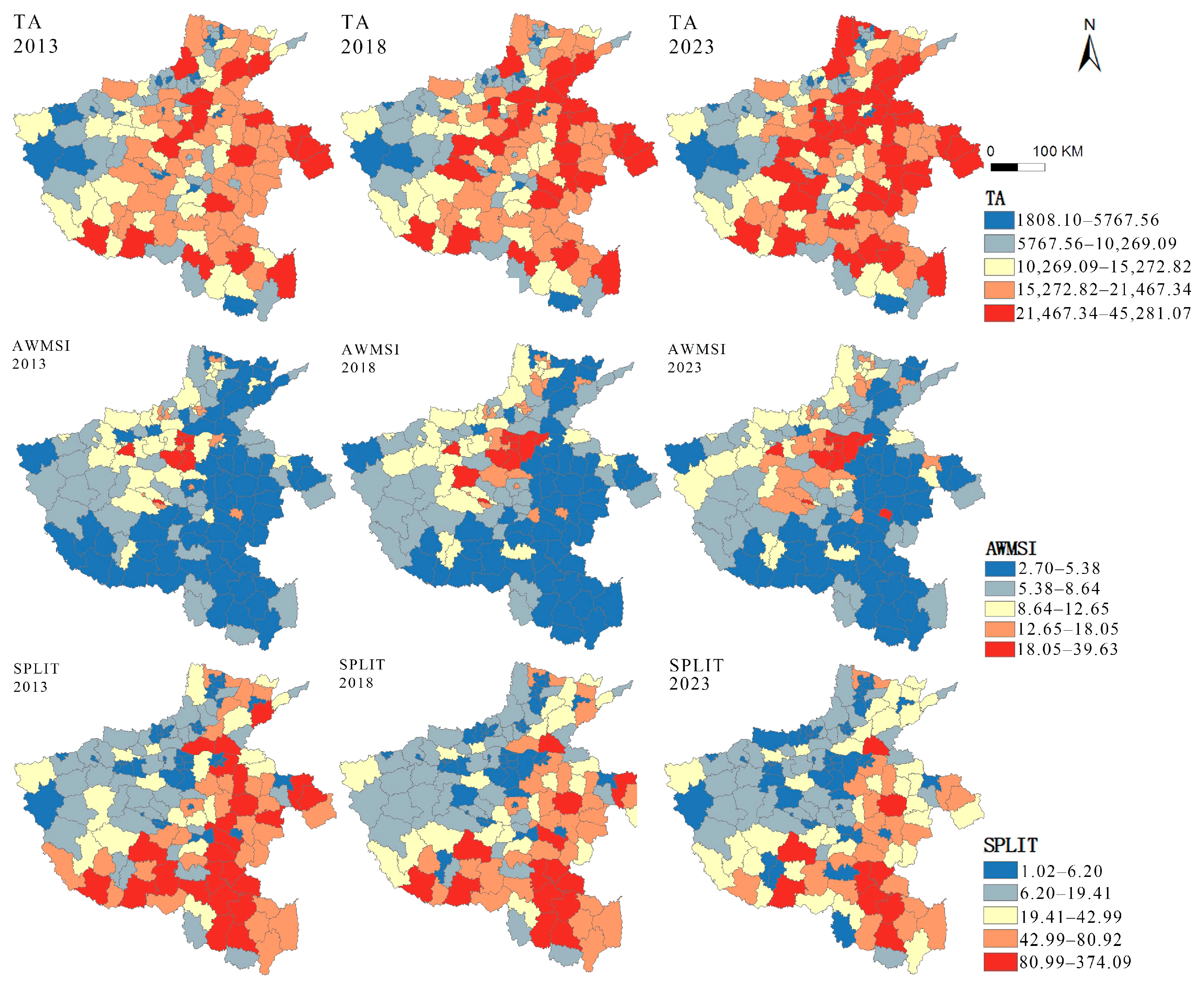
In 2013, counties with relatively high values of TA were mainly distributed in the central and some eastern parts of Henan Province, whereas counties in the western and southwestern regions were predominantly characterized by lower TA values. By 2018, the number of counties with high TA values increased significantly. The spatial distribution of these counties expanded from the central core region toward the eastern and southern parts of the province, and several counties that were previously at medium levels transitioned into high-value areas. Compared with 2018, the number of counties with high TA values further increased in 2023, forming a relatively continuous distribution pattern in the central region of the province. Overall, the scale of construction land exhibited a continuous expansion trend during the study period.
Counties with higher AWMSI values generally correspond to construction land patches with more complex shapes. In 2013, counties with high AWMSI values were mainly concentrated in the central region of the province, while counties in the western and southern areas exhibited relatively low values. By 2018, the number of counties with high AWMSI values increased and formed a more pronounced clustering pattern in the central region, while scattered high values also appeared in several counties in the eastern and northern parts of the province. By 2023, the spatial distribution pattern of high AWMSI counties remained relatively stable, still concentrated in the central core area, with only a few peripheral counties showing relatively low levels.
Higher SPLIT values indicate a higher degree of spatial fragmentation of construction land. In 2013, counties with high SPLIT values were mainly distributed in the southern and southeastern parts of Henan Province, whereas counties in the western and parts of the north-central regions exhibited relatively low values. In 2018, the spatial distribution of high-SPLIT counties showed some adjustments but remained largely concentrated in the southern region. By 2023, the number of counties with high SPLIT values decreased, and their spatial distribution gradually contracted. More counties exhibited medium or low levels, suggesting that the overall fragmentation of construction land in the province had somewhat alleviated. One possible explanation is that ongoing urbanization and infrastructure development have gradually increased the spatial connectivity of construction land, thereby reducing the degree of fragmentation. In addition, land consolidation and rural settlement reorganization policies implemented in some areas may have promoted the integration of scattered construction land patches. However, these potential mechanisms require further verification through policy and land-use transition analyses.
Overall, the landscape pattern of construction land across counties in Henan Province exhibited clear spatiotemporal dynamics during the study period. The scale of construction land continued to expand, counties with higher shape complexity remained largely concentrated in the central region, and the degree of construction land fragmentation showed a general shift from higher levels toward moderate or lower levels. The spatial distribution and evolutionary trends of different landscape pattern indicators varied considerably, reflecting the diversity of county-level construction land in terms of expansion scale, morphological evolution, and spatial organization (see
Figure 5).
3.3. Spatial Autocorrelation Analysis
Moran’s I is a widely used measure of global spatial autocorrelation that quantifies the degree to which a variable exhibits spatial clustering across a study region. Specifically, it evaluates whether similar or dissimilar values of a variable are spatially clustered, dispersed, or randomly distributed. The index ranges from −1 to +1: a positive value indicates spatial clustering of similar values, a negative value indicates spatial dispersion or neighboring dissimilar values, and a value near zero suggests a random spatial pattern. Moran’s I is commonly applied in geographic, environmental, and socioeconomic studies to assess the presence of spatial dependence, detect spatial patterns, and guide the selection of appropriate spatial econometric models. In the context of carbon emission performance analysis, Moran’s I provides insight into whether high- or low-performance counties tend to cluster geographically, which is critical for understanding regional patterns and informing policy interventions.
To examine the spatial distribution characteristics of county-level CEP, a global Moran’s I test was conducted for the years 2013, 2018, and 2023 (see
Table 3).
As shown in
Table 3, the Moran’s I values for all three years are positive and statistically significant (
p < 0.001), indicating that county-level CEP in Henan Province exhibits strong spatial dependence. High-CEP counties tend to be surrounded by other high-CEP counties, while low-CEP counties are near other low-CEP counties. Over time, the Moran’s I values and corresponding z-scores increase, demonstrating that the spatial clustering of CEP becomes more pronounced and the high- and low-performance counties show stronger spatial aggregation.
These spatial autocorrelation results suggest that CEP exhibits significant non-random spatial patterns, providing a theoretical basis for applying the MGWR model. MGWR allows for the capture of local effects and spatial heterogeneity of explanatory variables on CEP across counties, thereby complementing the limitations of traditional global regression models in addressing spatial effects.
3.4. Multicollinearity Test
Prior to regression analysis, Pearson correlation analysis and variance inflation factor (VIF) tests were conducted to assess multicollinearity among explanatory variables. The results indicate that all VIF values are below the commonly accepted threshold of 10, suggesting that severe multicollinearity does not pose a significant problem in the models (see
Table 4).
3.5. Regression Results
3.5.1. Cross-Sectional Multiple Regression Results
Here, we present the regression results of the cross-sectional multiple regression models for 2013, 2018, and 2023. All core explanatory variables, including the landscape pattern metrics TA, AWMSI, and SPLIT, and control variables NDVI_mean and RoadD, show statistically significant effects on county-level carbon emission performance in 2013 and 2018. By 2023, NTL is no longer significant, while the remaining variables remain robust, indicating stable influences over time (see
Table 5).
TA shows a consistently positive effect on county-level carbon emission performance across 2013, 2018, and 2023, with coefficients of 0.280, 0.202, and 0.165, respectively. All three years show statistically significant results, indicating that the expansion of construction land at the county level is associated with an increase in carbon emission performance. The magnitude of the effect slightly decreases over time, but TA remains an important positive contributor to CEP.
AWMSI shows a consistently positive and statistically significant effect on county-level carbon emission performance across the three years. The coefficients are 0.225 in 2013, 0.435 in 2018, and 0.333 in 2023, indicating that more complex and irregular urban patch shapes tend to enhance carbon emission performance. The positive effect is particularly strong in 2018, suggesting that during this period, shape complexity had the largest contribution to improving CEP, while it remains moderately strong in 2023.
SPLIT consistently exhibits a negative impact on county-level carbon emission performance across all three years. The coefficients are −0.262 in 2013, −0.216 in 2018, and −0.245 in 2023, all statistically significant. This indicates that higher landscape fragmentation, reflected by larger SPLIT values, tends to inhibit carbon emission performance. In other words, counties with more dispersed and fragmented construction land patches generally show lower carbon efficiency, highlighting the adverse effect of spatial disaggregation on CEP.
NDVI_mean shows a consistently negative effect on county-level carbon emission performance across the three years, with coefficients of −0.274 in 2013, −0.154 in 2018, and −0.139 in 2023. The variable is statistically significant in all years except 2023 at the 10% level, indicating that higher vegetation coverage within counties tends to slightly reduce measured CEP. This may reflect that areas with more natural vegetation have lower industrial activity or construction intensity, which affects the relationship between land use and carbon efficiency.
RoadD exhibits a positive effect on county-level carbon emission performance, with coefficients of 0.114 in 2013, 0.204 in 2018, and 0.341 in 2023. It is statistically significant only in 2018 and 2023, suggesting that higher road network density may contribute to better carbon efficiency in some years, potentially by facilitating more efficient transportation and energy distribution. However, the 2013 result is not significant, indicating that the impact of road infrastructure on CEP may vary over time and across counties.
NTL positively affects county-level CEP in 2013 and 2018, with coefficients of 0.196 and 0.145, both significant. By 2023, the effect weakens and becomes insignificant, suggesting that regions with higher industrial activity initially exhibit higher CEP, but this influence diminishes over time, likely due to improved energy efficiency or industrial restructuring.
Overall, the cross-sectional multiple regression results show substantial stability across the three study years. The directions of influence for the core explanatory variables, including TA, AWMSI, and SPLIT, remain consistent, while the control variables NDVI_mean, RoadD, and NTL generally retain their expected effects. Most variables are statistically significant across the years; however, NTL is no longer significant in 2023. These results suggest that the impact mechanism of urban–rural spatial development patterns on county-level carbon emission performance is largely persistent over time, providing a reliable foundation for subsequent spatial heterogeneity analysis using geographically weighted regression models [
14,
17].
3.5.2. MGWR Results
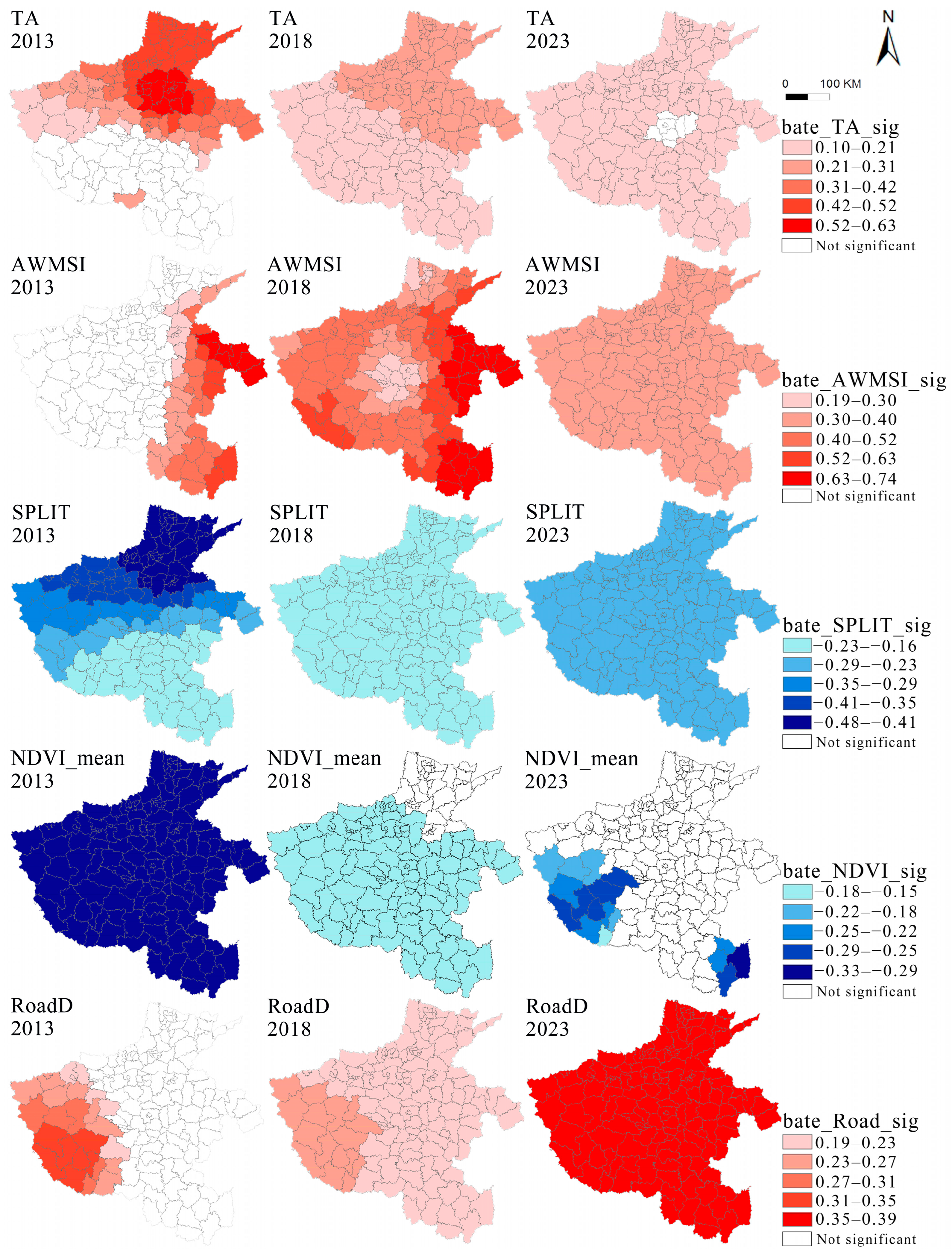
The MGWR results reveal substantial spatial heterogeneity in the effects of county-level landscape and ecological variables on CEP across Henan Province for 2013, 2018, and 2023. NTL was also included as a control, but its effect remained relatively stable across counties and years, showing limited spatial variation (see
Table 6 and
Figure 6).
For TA, the positive influence on CEP is most pronounced in the northeastern and central-eastern counties, particularly in 2013, while the effect weakens and becomes more uniform across the province in 2018 and 2023. This indicates that the scale of construction land has a locally variable effect on carbon efficiency, with the strongest benefits concentrated in counties with relatively intensive urban development. Counties with larger construction land in these regions often coincide with more advanced infrastructure, better access to energy-saving technologies, and more intensive industrial oversight, facilitating higher carbon efficiency.
AWMSI, representing shape complexity, shows a clear positive spatial effect, with higher values in central and eastern counties, especially in 2018 and 2023. Counties in the west and southwest exhibit lower or non-significant effects. This suggests that more irregular and complex urban land shapes, often resulting from compact and well-planned urban expansions, contribute to improved CEP by enabling efficient land utilization and spatially concentrated industrial activity.
The SPLIT index consistently exerts a negative effect on CEP, reflecting that landscape fragmentation inhibits carbon emission performance. This negative effect is strongest in central and southern counties in 2013, while by 2018 and 2023 it becomes more evenly distributed, suggesting that urban planning policies and land-use regulations gradually mitigate the detrimental impact of fragmented landscapes. Fragmented land may increase energy demand for transport and reduce the efficiency of industrial clustering, while more aggregated urban forms facilitate coordinated low-carbon interventions.
NDVI_mean shows negative effects in most counties in 2013, particularly in the south and west, suggesting that areas with denser vegetation tend to have lower CEP, likely due to lower industrial intensity or urbanization. By 2018 and 2023, this effect diminishes in central counties, reflecting a moderation of ecological influence as industrial and urban development patterns evolve. Road density positively affects CEP, especially in southern and central-eastern counties in 2023, highlighting the role of transportation connectivity in facilitating efficient logistics, centralized energy use, and better industrial distribution. Effects are weaker in northern counties due to differences in local economic structure and infrastructure capacity.
Overall, these MGWR results underscore the importance of accounting for spatial non-stationarity when examining the determinants of county-level CEP. The influence of urban–rural landscape configuration and ecological indicators is highly heterogeneous, and local effects vary across regions and over time. These findings complement the cross-sectional multiple regression analysis and provide empirical evidence for targeted regional policy interventions to improve carbon emission performance.
3.5.3. Comparison of Cross-Sectional Multiple Regression and MGWR for CEP Analysis
To verify the robustness of the relationships between urban–rural landscape patterns and county-level CEP, both the cross-sectional multiple regression model and the MGWR model were employed. The directions of influence for all explanatory variables remain largely consistent across the three study years under both models, indicating that the regression results are relatively robust (see
Table 7).
Specifically, TA and AWMSI exhibit positive effects in both models, suggesting that larger construction land scale and more complex patch shapes are generally associated with higher CEP. In contrast, SPLIT shows a negative effect, indicating that high spatial fragmentation tends to reduce carbon emission performance. RoadD generally has a positive effect, reflecting the contribution of improved transportation infrastructure to regional carbon efficiency. NDVI_mean shows a negative relationship with CEP, capturing the interactions between ecological background conditions and regional development stages. NTL has a positive effect in some years but is not consistently significant.
Regarding explanatory power, the MGWR model demonstrates higher goodness of fit than the cross-sectional multiple regression model across all three years, reflecting spatial heterogeneity of variable effects. Compared with the global regression model, MGWR is better able to capture regional differences and reveal the spatially varying relationships between landscape patterns and CEP, highlighting the importance of considering local effects in policy design and spatial planning.
4. Discussion
The analysis of county-level CEP in Henan Province reveals that urban–rural spatial patterns exert significant but spatially heterogeneous influences on carbon efficiency, as evidenced by both cross-sectional multiple regression and MGWR models. The cross-sectional multiple regression results indicate that total construction TA and AWMSI generally exert positive effects on CEP, while SPLIT consistently inhibits carbon efficiency [
11,
19,
20,
21]. NDVI_mean generally shows a negative association with CEP, reflecting the complex interactions between vegetation coverage, industrial activity, and urban development, whereas road density contributes positively to CEP. NTL, as a proxy for industrial activity and energy consumption, shows a positive effect in 2013 and 2018 but becomes insignificant by 2023.
MGWR results further highlight the spatial heterogeneity of these effects. The positive influence of TA is most pronounced in northeastern and central-eastern counties, particularly in 2013, suggesting that counties with relatively intensive urban development benefit most from construction land expansion. This effect diminishes and becomes more uniform across the province by 2018 and 2023, indicating that the influence of construction scale is context dependent, moderated by local development intensity and regional policy implementation. AWMSI exhibits stronger positive effects in central and eastern counties, where irregular and complex urban forms coincide with dense development, while western and southwestern counties show lower or non-significant effects. SPLIT maintains a negative effect across counties, though its spatial impact weakens over time, reflecting the gradual effectiveness of urban planning policies and land-use regulations that promote compact development [
13,
15].
NDVI_mean demonstrates negative local effects in 2013, particularly in southern and western counties, indicating that areas with higher vegetation coverage often exhibit lower CEP, likely due to lower industrial intensity or less urbanized activity. By 2018 and 2023, these negative effects moderate in central counties, as industrial and urban development patterns evolve, suggesting a dynamic interplay between ecological background and carbon efficiency [
30,
42]. RoadD positively affects CEP, with more pronounced impacts in southern and central-eastern counties in 2023. Better-connected road networks facilitate efficient logistics, centralized energy use, and more optimal distribution of industrial activity, thereby enhancing county-level carbon efficiency.
Overall, the comparison between cross-sectional multiple regression and MGWR results demonstrates that while global models capture general trends, MGWR uncovers local variation, revealing that the magnitude and direction of landscape effects on CEP differ across regions and over time.
Based on these results, several policy recommendations can be proposed to enhance CEP through targeted urban planning:
- (1)
Formulate targeted landscape strategies: Counties with intensive urban development should promote compact and complex urban land configurations to enhance carbon efficiency. Clear planning boundaries and coordination of land use can help reduce inefficient expansion and fragmentation.
- (2)
Integrate landscape considerations into master planning: Local governments should optimize land-use planning and functional zoning to support sustainable urban development. Mixed-use structures and better access to public facilities can improve energy utilization and promote low-carbon transitions.
- (3)
Promote rational land arrangements and ecological preservation: Consolidation of scattered parcels, protection of ecological land, and strategic industrial clustering can reduce CO2 emissions and improve carbon efficiency.
- (4)
Encourage regional collaboration for low-carbon governance: Establishing joint management systems, zoning guidance, and CO2 trading mechanisms can enhance inter-county coordination and facilitate emission reductions.
While these strategies can improve CEP and support long-term environmental sustainability, several challenges in policy implementation are noted. Heterogeneity in economic development, industrial structure, and urban scale across counties complicates the formulation of personalized urban strategies. Rapid urbanization can result in increased resource consumption and transportation infrastructure pressures, while technological capacities may be insufficient to fully mitigate carbon emissions. Coordinating multiple stakeholders, including government agencies, enterprises, and the public, further complicates the effective execution of these policies. In addition, the findings of this study also provide practical implications for spatial planning and regional governance. Counties characterized by fragmented construction land and dispersed spatial configurations may benefit from compact development strategies, coordinated infrastructure allocation, and optimized land-use arrangements to improve carbon efficiency. Future studies may further incorporate planning-oriented indicators, such as population density, impervious surface dynamics, and detailed urban development intensity, to enhance the practical applicability of county-level low-carbon development research.
Finally, some limitations of this study should be acknowledged. First, the temporal coverage of the data is limited to 2013, 2018, and 2023, which constrains the analysis of long-term trends. Second, some production inputs and energy consumption indicators are approximated, which may introduce measurement errors. Third, labor input and industrial heterogeneity are not fully captured, limiting the comprehensiveness of the efficiency measurement. Future research could extend the temporal range, incorporate additional multidimensional input–output indicators, and explore simulation-based scenarios to further understand the dynamic effects of urban–rural spatial development on CEP.
5. Conclusions
This study examined county-level CEP in Henan Province and investigated the impacts of urban–rural landscape patterns using SBM-based efficiency measurement, cross-sectional multiple regression, and MGWR for 2013, 2018, and 2023 [
3,
4,
38]. The analysis highlights substantial spatial heterogeneity in CEP across counties. High-performance counties are concentrated in northeastern and central-eastern regions, while low-performance counties persist in the southwest and south. Over time, CEP improved in central counties, reflecting industrial upgrading, enhanced energy efficiency, and targeted local policies.
Regarding landscape patterns, TA and AWMSI exhibit positive effects on CEP, suggesting that larger and more complex urban land configurations promote carbon efficiency. In contrast, SPLIT consistently shows a negative effect, indicating that fragmented land-use patterns inhibit CEP. NDVI_mean demonstrates negative local effects, particularly in southern and western counties, which may be associated with areas exhibiting lower levels of industrial activity or less intensive urban development. RoadD generally contributes positively, especially in well-connected central-eastern and southern counties, while NTL show positive effects in earlier years but diminish by 2023, suggesting that shifts in industrial activity and energy consumption alter their relationship with CEP over time [
11,
19,
20,
21].
MGWR results further reveal the importance of spatial heterogeneity. The local effects of landscape and ecological variables vary across regions and years, demonstrating that uniform policies may not fully capture county-level CEP dynamics. Compared with cross-sectional multiple regression models, MGWR effectively identifies these spatially varying relationships, providing nuanced insights into the mechanisms through which urban–rural spatial configurations influence carbon efficiency [
31].
These findings carry important implications for urban planning and low-carbon policy. Compact and complex urban landscapes, integrated landscape strategies in master planning, preservation of ecological land, and enhanced transportation infrastructure can improve county-level carbon efficiency. Tailored interventions are essential to account for heterogeneity in industrial structure, urbanization pace, and local conditions. The study provides empirical evidence to guide differentiated regional policies and sustainable urban development strategies.
In conclusion, county-level CEP is strongly shaped by urban–rural spatial patterns, and the combined application of SBM and MGWR offers a robust framework to assess both global and local effects, informing targeted interventions for low-carbon development.