From Regeneration to Stewardship: What Shapes Residents’ Willingness to Co-Manage Neighbourhood Micro-Public Spaces in Chongqing, China?


Abstract
1. Introduction
2. Materials and Methods
2.1. Study Setting and Survey Period
2.2. Participants, Eligibility, and Survey Procedure
2.3. Measures
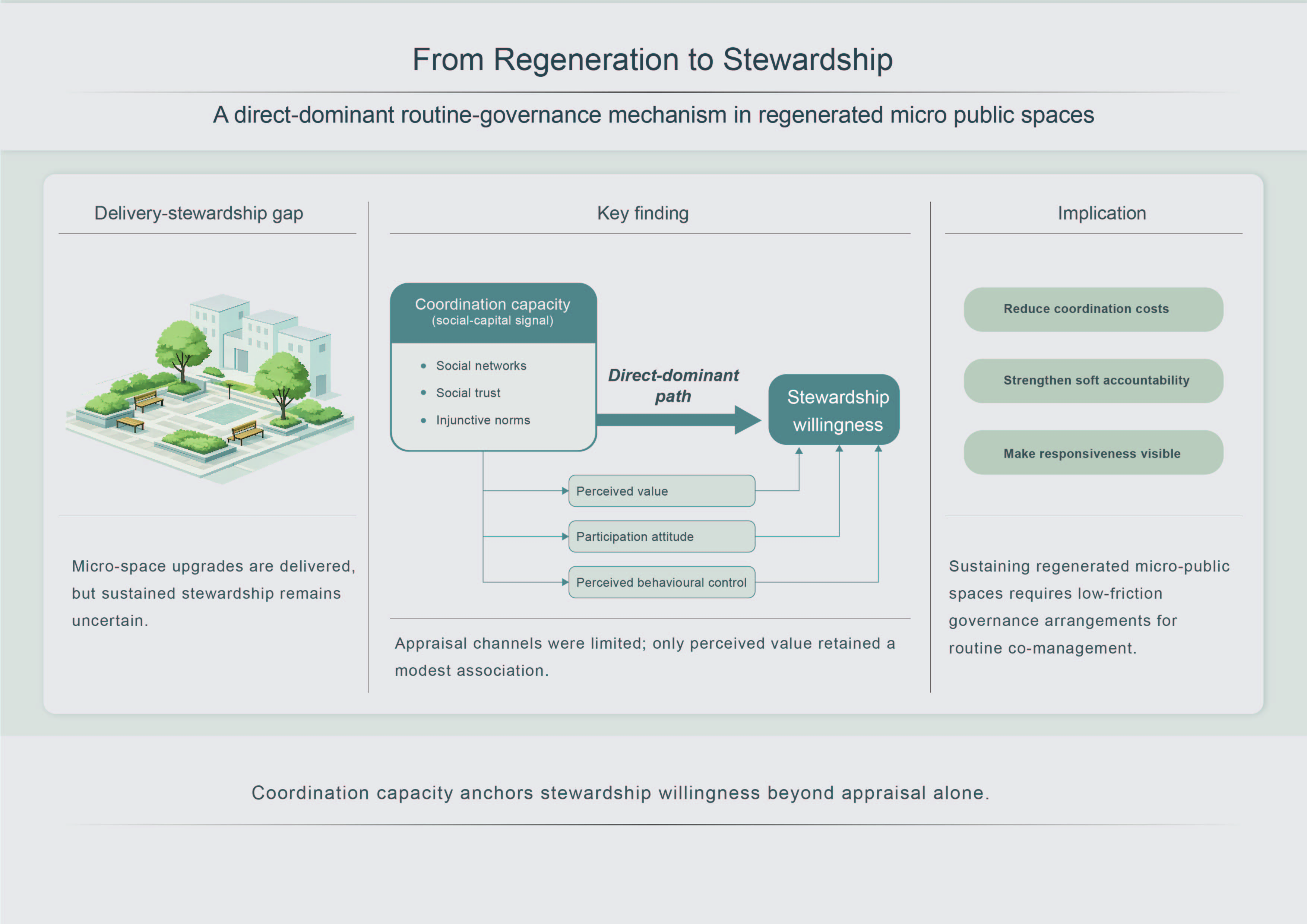
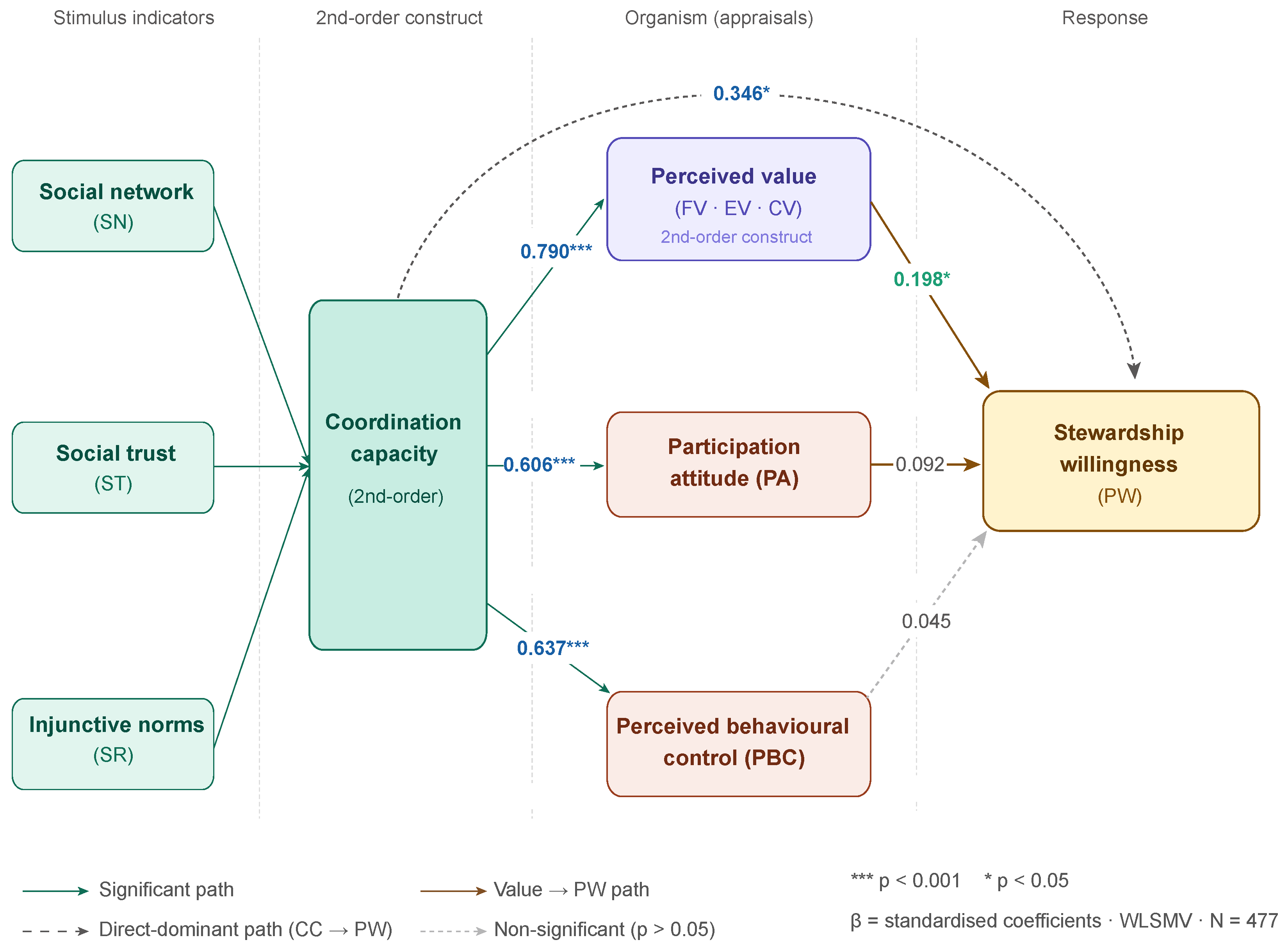
- Organism (appraisals): The organism block comprised perceived value and two TPB-consistent appraisal constructs [21]. Perceived value was operationalised as a second-order construct reflected by functional value (FV; 3 items), emotional value (EV; 3 items), and economic value (CV; 3 items) [35,36]. Participation attitude (PA; 3 items) and perceived behavioural control (PBC; 3 items) captured evaluative and feasibility-related appraisals, respectively [21]. Injunctive norms are treated as shared neighbourhood-level governance signals rather than individual-level normative beliefs, as they index the perceived local enforceability and social endorsement of stewardship tasks, which are features that function as environmental conditions for post-regeneration land management [13].
- Response (stewardship willingness): Stewardship willingness (PW) was assessed using five items [21]. One item was negatively worded and reverse-coded prior to analysis to ensure directional consistency across the scale.
2.4. Data Cleaning and Coding
2.5. Statistical Analysis
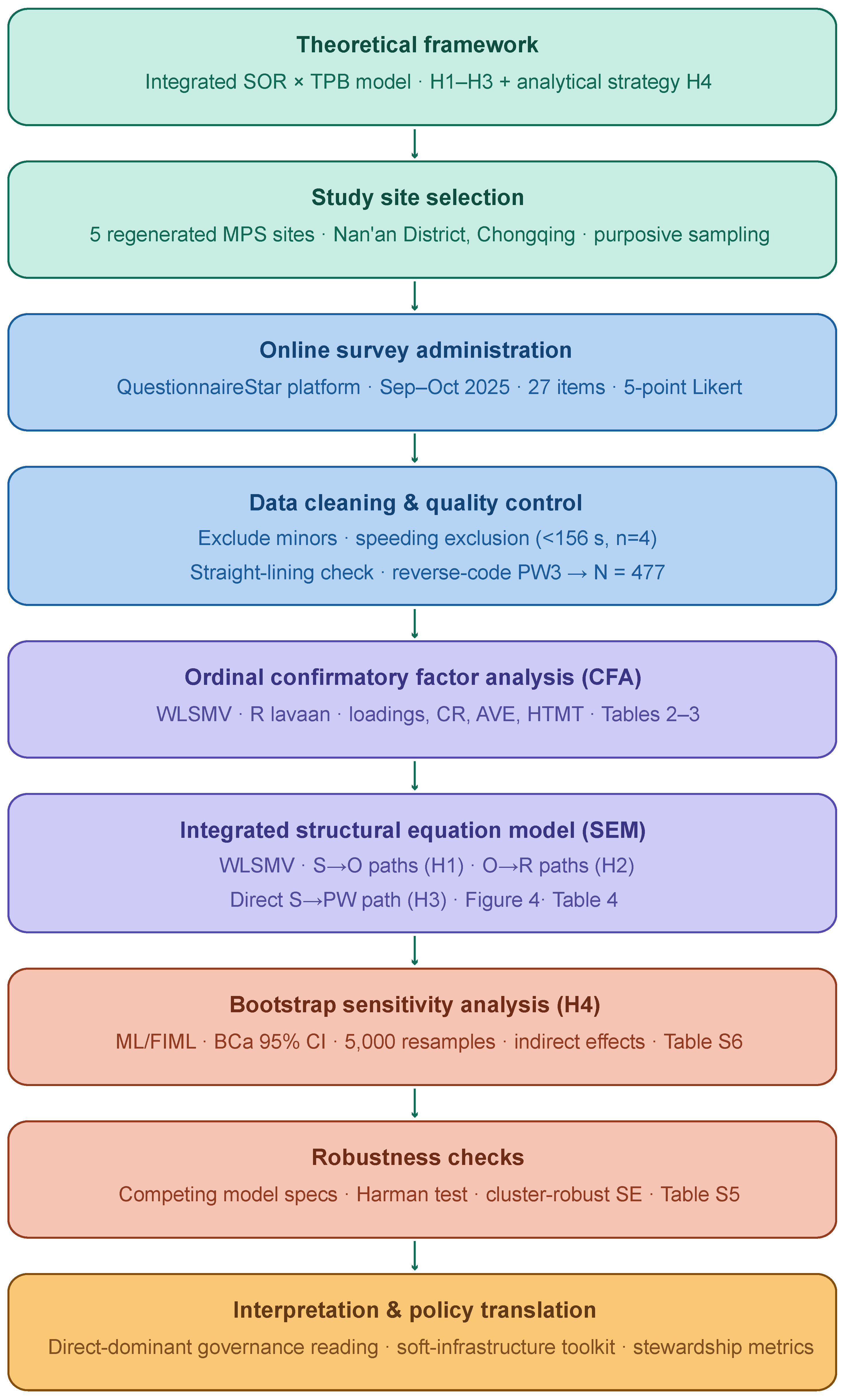
- Common method bias assessment: As a precautionary check, Harman’s single-factor test was conducted on the full item pool. The first unrotated factor accounted for 27.3% of the total item variance—well below the conventional 50% threshold—and nine factors with eigenvalues exceeding unity were extracted, suggesting that common method bias is unlikely to represent a dominant confounder [42].
- Within-site clustering: To assess potential non-independence arising from respondent clustering within sites, an alternative specification incorporating cluster-robust standard errors—with site as the clustering unit ()—was estimated. Focal structural paths remained substantively unchanged ( across all paths; see Table S5). It should be noted, however, that clusters falls below the minimum typically recommended for reliable cluster-robust inference (); this correction should therefore be regarded as exploratory. A multilevel SEM approach would require substantially more clusters and is recommended for future research with broader site coverage.
- Demographic controls robustness: The primary structural model specifies theoretically motivated SOR × TPB pathways without demographic covariates. As a robustness check, an alternative specification incorporating gender, age category, education level, homeownership status, and prior participation experience as exogenous controls was estimated. Focal structural paths remained substantively unchanged (; full results in Table S5).
3. Results
3.1. Sample and Data Processing
3.2. Structural Model and Hypothesis Tests
3.3. Sensitivity Evidence for Indirect Pathways
4. Discussion
4.1. Coordination Capacity Is Linked to Stewardship Willingness in a Direct-Dominant Structure
4.2. Interpreting the Direct Path as Routine Governance Rather than a TPB “Failure”
4.3. Implications for Post-Regeneration Tool Design and Stewardship-Capacity Metrics
4.4. Limitations and Future Research
5. Conclusions
Supplementary Materials
Author Contributions
Funding
Institutional Review Board Statement
Informed Consent Statement
Data Availability Statement
Acknowledgments
Conflicts of Interest
Abbreviations
| MPS | Micro-public space |
| SOR | Stimulus–Organism–Response |
| TPB | Theory of Planned Behaviour |
| SEM | Structural equation modelling |
| CFA | Confirmatory factor analysis |
| WLSMV | Weighted least squares mean- and variance-adjusted estimator |
| HTMT | Heterotrait–monotrait ratio |
| CR | Composite reliability |
| AVE | Average variance extracted |
| BCa | Bias-corrected and accelerated (bootstrap confidence interval) |
References
- Zhu, J. Micro-regeneration in Shanghai and the public-isation of space. Habitat Int. 2023, 132, 102741. [Google Scholar] [CrossRef] [Scilit]
- Zamanifard, H.; Alizadeh, T.; Bosman, C. Towards a framework of public space governance. Cities 2018, 78, 155–165. [Google Scholar] [CrossRef] [Scilit]
- de Magalhães, C.; Carmona, M. Dimensions and Models of Contemporary Public Space Management in England. J. Environ. Plan. Manag. 2009, 52, 111–129. [Google Scholar] [CrossRef] [Scilit]
- He, S.; Li, Y. Understanding Impacts of Neighbourhood Micro-Renewal Through a Lens of Place Value: A Case Study of Wuhan, China. Land 2024, 13, 1910. [Google Scholar] [CrossRef] [Scilit]
- Duivenvoorden, E.; Hartmann, T.; Brinkhuijsen, M.; Hesselmans, T. Managing public space: A blind spot of urban planning and design. Cities 2021, 109, 103032. [Google Scholar] [CrossRef] [Scilit]
- Carmona, M.; de Magalhaes, C. Public Space Management: Present and Potential. J. Environ. Plan. Manag. 2006, 49, 75–99. [Google Scholar] [CrossRef] [Scilit]
- Hölscher, K.; Frantzeskaki, N.; Kindlon, D.; Collier, M.J.; Dick, G.; Dziubała, A.; Lodder, M.; Osipiuk, A.; Quartier, M.; Schepers, S.; et al. Embedding co-production of nature-based solutions in urban governance: Emerging co-production capacities in three European cities. Environ. Sci. Policy 2024, 152, 103652. [Google Scholar] [CrossRef] [Scilit]
- Wang, Y.; Wu, F. Micro-regeneration and participatory governance: A local social governance experiment in China. J. Chin. Gov. 2025, 10, 394–418. [Google Scholar] [CrossRef] [Scilit]
- UN-Habitat. Global Public Space Toolkit: From Global Principles to Local Policies and Practice; United Nations Human Settlements Programme (UN-Habitat): Nairobi, Kenya, 2015. [Google Scholar]
- North, D.C. Institutions, Institutional Change and Economic Performance; Cambridge University Press: Cambridge, UK, 1990. [Google Scholar]
- Ostrom, E. Polycentric systems for coping with collective action and global environmental change. Glob. Environ. Change 2010, 20, 550–557. [Google Scholar] [CrossRef] [Scilit]
- Zhang, J.; Li, Z.; Zhong, J. From Health Risks to Environmental Actions: Research on the Pathway of Guiding Citizens to Participate in Pocket-Park Governance. Land 2024, 13, 1612. [Google Scholar] [CrossRef] [Scilit]
- Ostrom, E. Governing the Commons: The Evolution of Institutions for Collective Action; Cambridge University Press: Cambridge, UK, 1990. [Google Scholar]
- Olson, M. The Logic of Collective Action: Public Goods and the Theory of Groups, with a New Preface and Appendix; Harvard University Press: Cambridge, MA, USA; London, UK, 1965. [Google Scholar] [CrossRef] [Scilit]
- Coleman, J.S. Social capital in the creation of human capital. Am. J. Sociol. 1988, 94, S95–S120. [Google Scholar] [CrossRef] [Scilit]
- Putnam, R.D. Bowling Alone: The Collapse and Revival of American Community; Simon and Schuster: New York, NY, USA, 2000. [Google Scholar]
- Voorberg, W.H.; Bekkers, V.J.; Tummers, L.G. A systematic review of co-creation and co-production: Embarking on the social innovation journey. Public Manag. Rev. 2015, 17, 1333–1357. [Google Scholar] [CrossRef] [Scilit]
- Tang, D.; Gong, X.; Liu, M. Residents’ behavioral intention to participate in neighborhood micro-renewal based on an extended theory of planned behavior: A case study in Shanghai, China. Habitat Int. 2022, 129, 102672. [Google Scholar] [CrossRef] [Scilit]
- Li, J.; Guo, B.; Li, Y.; Hu, X.; Ma, L.; Qi, R. The impact of social network embeddedness, TPB, and danwei system on residents’ participation intention in old neighborhood regeneration. Sci. Rep. 2024, 14, 18920. [Google Scholar] [CrossRef] [Scilit]
- Nahapiet, J.; Ghoshal, S. Social capital, intellectual capital, and the organizational advantage. Acad. Manag. Rev. 1998, 23, 242–266. [Google Scholar] [CrossRef] [Scilit]
- Ajzen, I. The Theory of Planned Behavior. Organ. Behav. Hum. Decis. Processes 1991, 50, 179–211. [Google Scholar] [CrossRef] [Scilit]
- Armitage, C.J.; Conner, M. Efficacy of the Theory of Planned Behaviour: A meta-analytic review. Br. J. Soc. Psychol. 2001, 40, 471–499. [Google Scholar] [CrossRef] [Scilit]
- Wang, Y.; Wu, F.; Zhang, F. Participatory micro-regeneration: Governing urban redevelopment in Qinghe, Beijing. Urban Geogr. 2025, 46, 21–42. [Google Scholar] [CrossRef] [Scilit]
- Li, Y.; Zhang, S.; Zhu, D. Co-creation of community micro-renewals: Model analysis and case studies in Shanghai, China. Habitat Int. 2023, 142, 102951. [Google Scholar] [CrossRef] [Scilit]
- Mehrabian, A.; Russell, J.A. An Approach to Environmental Psychology; The MIT Press: Cambridge, MA, USA, 1974. [Google Scholar]
- Wu, J.; Xiong, J. How Governance Tools Facilitate Citizen Co-Production Behavior in Urban Community Micro-Regeneration: Evidence from Shanghai. Land 2022, 11, 1243. [Google Scholar] [CrossRef] [Scilit]
- Foster, S.R. Collective action and the urban commons. Notre Dame Law Rev. 2011, 87, 57. [Google Scholar]
- Preacher, K.J.; Hayes, A.F. Asymptotic and resampling strategies for assessing and comparing indirect effects in multiple mediator models. Behav. Res. Methods 2008, 40, 879–891. [Google Scholar] [CrossRef] [Scilit] [PubMed]
- Hayes, A.F. Introduction to Mediation, Moderation, and Conditional Process Analysis: A Regression-Based Approach, 2nd ed.; Guilford Press: New York, NY, USA, 2018. [Google Scholar]
- Eysenbach, G. Improving the Quality of Web Surveys: The Checklist for Reporting Results of Internet E-Surveys (CHERRIES). J. Med. Internet Res. 2004, 6, e34. [Google Scholar] [CrossRef] [Scilit]
- Meade, A.W.; Craig, S.B. Identifying Careless Responses in Survey Data. Psychol. Methods 2012, 17, 437–455. [Google Scholar] [CrossRef] [Scilit] [PubMed]
- Flora, D.B.; Curran, P.J. An Empirical Evaluation of Alternative Methods of Estimation for Confirmatory Factor Analysis with Ordinal Data. Psychol. Methods 2004, 9, 466–491. [Google Scholar] [CrossRef] [Scilit] [PubMed]
- Rhemtulla, M.; Brosseau-Liard, P.É.; Savalei, V. When Can Categorical Variables Be Treated as Continuous? A Comparison of Robust Continuous and Categorical SEM Estimation Methods under Suboptimal Conditions. Psychol. Methods 2012, 17, 354–373. [Google Scholar] [CrossRef] [Scilit]
- Li, C. Confirmatory factor analysis with ordinal data: Comparing robust maximum likelihood and diagonally weighted least squares. Behav. Res. Methods 2016, 48, 936–949. [Google Scholar] [CrossRef] [Scilit]
- Sheth, J.N.; Newman, B.I.; Gross, B.L. Why we buy what we buy: A theory of consumption values. J. Bus. Res. 1991, 22, 159–170. [Google Scholar] [CrossRef] [Scilit]
- Sweeney, J.C.; Soutar, G.N. Consumer perceived value: The development of a multiple item scale. J. Retail. 2001, 77, 203–220. [Google Scholar] [CrossRef] [Scilit]
- Fornell, C.; Larcker, D.F. Evaluating Structural Equation Models with Unobservable Variables and Measurement Error. J. Mark. Res. 1981, 18, 39–50. [Google Scholar] [CrossRef] [Scilit]
- Henseler, J.; Ringle, C.M.; Sarstedt, M. A new criterion for assessing discriminant validity in variance-based structural equation modeling. J. Acad. Mark. Sci. 2015, 43, 115–135. [Google Scholar] [CrossRef] [Scilit]
- Hu, L.t.; Bentler, P.M. Cutoff criteria for fit indexes in covariance structure analysis: Conventional criteria versus new alternatives. Struct. Equ. Model. 1999, 6, 1–55. [Google Scholar] [CrossRef] [Scilit]
- Foster, S.R.; Iaione, C. The city as a commons. Yale Law Policy Rev. 2016, 34, 281–349. [Google Scholar]
- Kline, R.B. Principles and Practice of Structural Equation Modeling, 5th ed.; The Guilford Press: New York, NY, USA, 2023. [Google Scholar]
- Podsakoff, P.M.; MacKenzie, S.B.; Lee, J.Y.; Podsakoff, N.P. Common method biases in behavioral research: A critical review of the literature and recommended remedies. J. Appl. Psychol. 2003, 88, 879–903. [Google Scholar] [CrossRef] [Scilit]
- Vallance, S.; Carlton, S.; Hoddinott, W. Urban governance: Public space management and ‘what’s in common’. Urban Des. Int. 2025, 30, 313–326. [Google Scholar] [CrossRef] [Scilit]
- Li, K.; Huang, R.; Liu, G.; Shrestha, A.; Fu, X. Social Capital in Neighbourhood Renewal: A Holistic and State of the Art Literature Review. Land 2022, 11, 1202. [Google Scholar] [CrossRef] [Scilit]
- Caitana, B.; Canto Moniz, G. Co-Production Boundaries of Nature-Based Solutions for Urban Regeneration: The Case of a Healthy Corridor. Urban Plan. 2024, 9, 7306. [Google Scholar] [CrossRef] [Scilit]
- Lee, D.; Scholten, N. Co-production of privately owned public space: Who, why, when, and how? Urban Des. Int. 2024, 29, 123–133. [Google Scholar] [CrossRef] [Scilit]
- Alvarado Vazquez, S.; Madureira, A.M.; Ostermann, F.O.; Pfeffer, K. Challenges and opportunities of public space management in Mexico. Cities 2024, 146, 104743. [Google Scholar] [CrossRef] [Scilit]
- Fritz, M.S.; MacKinnon, D.P. Required Sample Size to Detect the Mediated Effect. Psychol. Sci. 2007, 18, 233–239. [Google Scholar] [CrossRef] [Scilit] [PubMed]
- Alvarado Vazquez, S.; Madureira, A.M.; Ostermann, F.O.; Pfeffer, K. Social participation in planning, design, and management of public spaces: The case of Mexico. Plan. Pract. Res. 2024, 39, 565–596. [Google Scholar] [CrossRef] [Scilit]
- Arefi, M.; Aelbrecht, P. Musings on theorizing, co-producing, designing, and encountering the public space. Urban Des. Int. 2024, 29, 75–76. [Google Scholar] [CrossRef] [Scilit]
- Nguyen, N.T.; Collins, A.; Collins, C.M. Trends and patterns in the application of co-production, co-creation, and co-design methods in studies of green spaces: A systematic review. Environ. Sci. Policy 2024, 152, 103642. [Google Scholar] [CrossRef] [Scilit]
- Shen, Y.; Tan, R.; Zhang, S. Co-Creation, Co-Construction, and Co-Governance in Community Renewal: A Case Study of Civic Participation and Sustainable Mechanisms. Land 2025, 14, 1577. [Google Scholar] [CrossRef] [Scilit]
- Davies, C.; Muro, R.S. Stewardship and green infrastructure in England: Planning perspectives informed through an investigation of urban green infrastructure. J. Environ. Plan. Manag. 2024, 67, 2748–2773. [Google Scholar] [CrossRef] [Scilit]
- Kahane, F.; Ralph, M.; Shaw, R. Enabling effective urban green space stewardship through planning: A qualitative comparative analysis in Southwest England. People Nat. 2025, 1–17. [Google Scholar] [CrossRef] [Scilit]
- Zhang, J.; Lu, N. What Matters Most for Community Social Capital among Older Adults Living in Urban China: The Role of Health and Family Social Capital. Int. J. Environ. Res. Public Health 2019, 16, 558. [Google Scholar] [CrossRef] [Scilit]
- Francis, J.; Eccles, M.P.; Johnston, M.; Walker, A.E.; Grimshaw, J.M.; Foy, R.; Kaner, E.F.S.; Smith, L.; Bonetti, D. Constructing Questionnaires Based on the Theory of Planned Behaviour: A Manual for Health Services Researchers; Centre for Health Services Research, University of Newcastle upon Tyne: Newcastle upon Tyne, UK, 2004; Available online: https://openaccess.city.ac.uk/id/eprint/1735 (accessed on 12 April 2026).
- Fishbein, M.; Ajzen, I. Predicting and Changing Behavior: The Reasoned Action Approach; Psychology Press: New York, NY, USA, 2010. [Google Scholar] [CrossRef] [Scilit]



| Variable | Category | n | % |
|---|---|---|---|
| Gender | Male | 237 | 49.7 |
| Female | 240 | 50.3 | |
| Age group (years) | 18–24 | 83 | 17.4 |
| 25–34 | 102 | 21.4 | |
| 35–44 | 95 | 19.9 | |
| 45–54 | 89 | 18.7 | |
| 55–64 | 82 | 17.2 | |
| ≥65 | 26 | 5.5 | |
| Highest education | Primary | 0 | 0.0 |
| Secondary | 121 | 25.4 | |
| College | 159 | 33.3 | |
| Bachelor’s | 173 | 36.3 | |
| Master’s+ | 24 | 5.0 | |
| Occupation | Student | 83 | 17.4 |
| Public sector | 30 | 6.3 | |
| Private sector | 221 | 46.3 | |
| Self-employed | 35 | 7.3 | |
| Retired | 82 | 17.2 | |
| Unemployed | 26 | 5.5 | |
| Monthly income (RMB) | <3000 | 109 | 22.9 |
| 3000–5999 | 91 | 19.1 | |
| 6000–9999 | 143 | 30.0 | |
| 10,000–14,999 | 128 | 26.8 | |
| ≥15,000 | 6 | 1.3 | |
| Residence duration in neighbourhood | <1 yr | 61 | 12.8 |
| 1–3 yr | 70 | 14.7 | |
| 4–6 yr | 73 | 15.3 | |
| 7–10 yr | 126 | 26.4 | |
| >10 yr | 147 | 30.8 | |
| Housing tenure | Owner | 400 | 83.9 |
| Renter | 77 | 16.1 | |
| Local hukou (Chongqing) | Yes | 387 | 81.1 |
| No | 90 | 18.9 | |
| Household type | Single | 94 | 19.7 |
| Couple | 45 | 9.4 | |
| Nuclear w/children | 215 | 45.1 | |
| Multigenerational | 123 | 25.8 | |
| Prior participation experience | Yes | 227 | 47.6 |
| No | 250 | 52.4 |
| Construct | k | M | SD | CR | AVE |
|---|---|---|---|---|---|
| Stimulus (2nd-order) | 3 | 3.266 | 0.644 | 0.743 | 0.492 |
| Social network (SN) | 3 | 3.242 | 0.902 | 0.830 | 0.619 |
| Social trust (ST) | 3 | 3.226 | 0.930 | 0.840 | 0.637 |
| Injunctive norms (SR) | 3 | 3.331 | 0.926 | 0.867 | 0.684 |
| Value (2nd-order) | 3 | 3.276 | 0.740 | 0.807 | 0.582 |
| Functional value (FV) | 3 | 3.247 | 0.996 | 0.893 | 0.735 |
| Emotional value (EV) | 3 | 3.302 | 0.958 | 0.874 | 0.698 |
| Economic value (CV) | 3 | 3.278 | 0.956 | 0.874 | 0.699 |
| Participation attitude (PA) | 3 | 3.235 | 0.931 | 0.855 | 0.665 |
| Perceived behavioural control (PBC) | 3 | 3.245 | 0.974 | 0.890 | 0.730 |
| Willingness (PW) | 5 | 3.330 | 0.902 | 0.901 | 0.646 |
| Stimulus | Value | PA | PBC | PW | |
|---|---|---|---|---|---|
| Stimulus | — | 0.776 | 0.551 | 0.570 | 0.576 |
| Value | 0.601 *** | — | 0.535 | 0.575 | 0.541 |
| PA | 0.407 *** | 0.418 *** | — | 0.330 | 0.396 |
| PBC | 0.439 *** | 0.470 *** | 0.257 *** | — | 0.383 |
| PW | 0.457 *** | 0.456 *** | 0.317 *** | 0.321 *** | — |
| (A): Model Fit | ||||||
|---|---|---|---|---|---|---|
| N | chisq | df | cfi | tli | rmsea | srmr |
| 477 | 1312.294 | 370.000 | 0.953 | 0.949 | 0.073 | 0.068 |
| (B): Standardised Structural Paths | ||||||
| Outcome | Predictor | SE | z | p | ||
| Value | Stimulus | 0.790 | 0.104 | 12.338 | 0.000 | |
| PA | Stimulus | 0.606 | 0.078 | 9.818 | 0.000 | |
| PBC | Stimulus | 0.637 | 0.079 | 10.459 | 0.000 | |
| PW | Stimulus | 0.346 | 0.188 | 2.318 | 0.020 | |
| PW | Value | 0.198 | 0.077 | 1.982 | 0.048 | |
| PW | PA | 0.092 | 0.072 | 1.281 | 0.200 | |
| PW | PBC | 0.045 | 0.074 | 0.594 | 0.552 | |
Disclaimer/Publisher’s Note: The statements, opinions and data contained in all publications are solely those of the individual author(s) and contributor(s) and not of MDPI and/or the editor(s). MDPI and/or the editor(s) disclaim responsibility for any injury to people or property resulting from any ideas, methods, instructions or products referred to in the content. |
© 2026 by the authors. Licensee MDPI, Basel, Switzerland. This article is an open access article distributed under the terms and conditions of the Creative Commons Attribution (CC BY) license.
Share and Cite
Li, Y.; Zhou, J.; Hassan, A.S. From Regeneration to Stewardship: What Shapes Residents’ Willingness to Co-Manage Neighbourhood Micro-Public Spaces in Chongqing, China? Land 2026, 15, 667. https://doi.org/10.3390/land15040667
Li Y, Zhou J, Hassan AS. From Regeneration to Stewardship: What Shapes Residents’ Willingness to Co-Manage Neighbourhood Micro-Public Spaces in Chongqing, China? Land. 2026; 15(4):667. https://doi.org/10.3390/land15040667
Chicago/Turabian StyleLi, Yang, Jiasheng Zhou, and Ahmad Sanusi Hassan. 2026. "From Regeneration to Stewardship: What Shapes Residents’ Willingness to Co-Manage Neighbourhood Micro-Public Spaces in Chongqing, China?" Land 15, no. 4: 667. https://doi.org/10.3390/land15040667
APA StyleLi, Y., Zhou, J., & Hassan, A. S. (2026). From Regeneration to Stewardship: What Shapes Residents’ Willingness to Co-Manage Neighbourhood Micro-Public Spaces in Chongqing, China? Land, 15(4), 667. https://doi.org/10.3390/land15040667