Article

From Regeneration to Stewardship: What Shapes Residents’ Willingness to Co-Manage Neighbourhood Micro-Public Spaces in Chongqing, China?


School of Housing, Building and Planning, Universiti Sains Malaysia, Gelugor 11800, Malaysia
*
Author to whom correspondence should be addressed.
Land 2026, 15(4), 667; https://doi.org/10.3390/land15040667
Submission received: 2 March 2026 / Revised: 11 April 2026 / Accepted: 13 April 2026 / Published: 17 April 2026
(This article belongs to the Section Land Socio-Economic and Political Issues)

Abstract

Micro-public space (MPS) regeneration is typically evaluated at the point of delivery, yet long-term performance depends on whether everyday stewardship can be sustained thereafter. This study reframes neighbourhood social capital as a governance–environment signal reflecting coordination capacity and examines whether residents’ willingness to participate in post-regeneration co-management is primarily appraisal-driven (perceived value, attitude, and perceived behavioural control) or coordination-driven via a residual direct channel consistent with routine governance. A cross-sectional survey of adults residing within walkable catchments of five regenerated MPS sites in Nan’an District, Chongqing, China ( N = 477 ), was conducted. An integrated Stimulus–Organism–Response × TPB model was estimated using WLSMV with ordered categorical indicators; indirect effects were assessed via bias-corrected bootstrap confidence intervals. Coordination capacity was strongly associated with perceived value, participation attitude, and perceived behavioural control. In the joint model, only perceived value retained a statistically reliable positive association with stewardship willingness, whereas the incremental contributions of attitude and perceived behavioural control were negligible once the stimulus was included. A residual direct association from coordination capacity to willingness persisted beyond the appraisal block, supporting a direct-dominant interpretation; bootstrap analyses yielded no robust evidence for mediation (BCa 95% CIs crossed zero). These findings suggest that sustaining regenerated micro-spaces requires low-friction governance designs that minimise coordination costs, reinforce soft accountability, and render institutional responsiveness visible to residents.

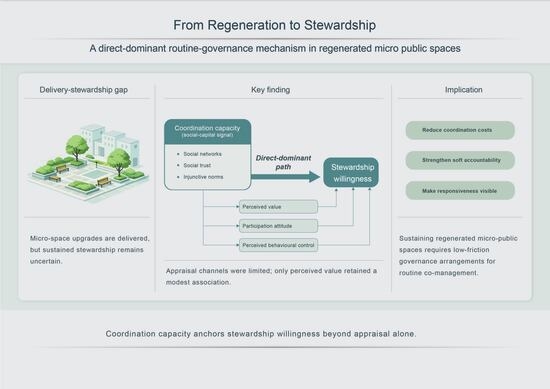
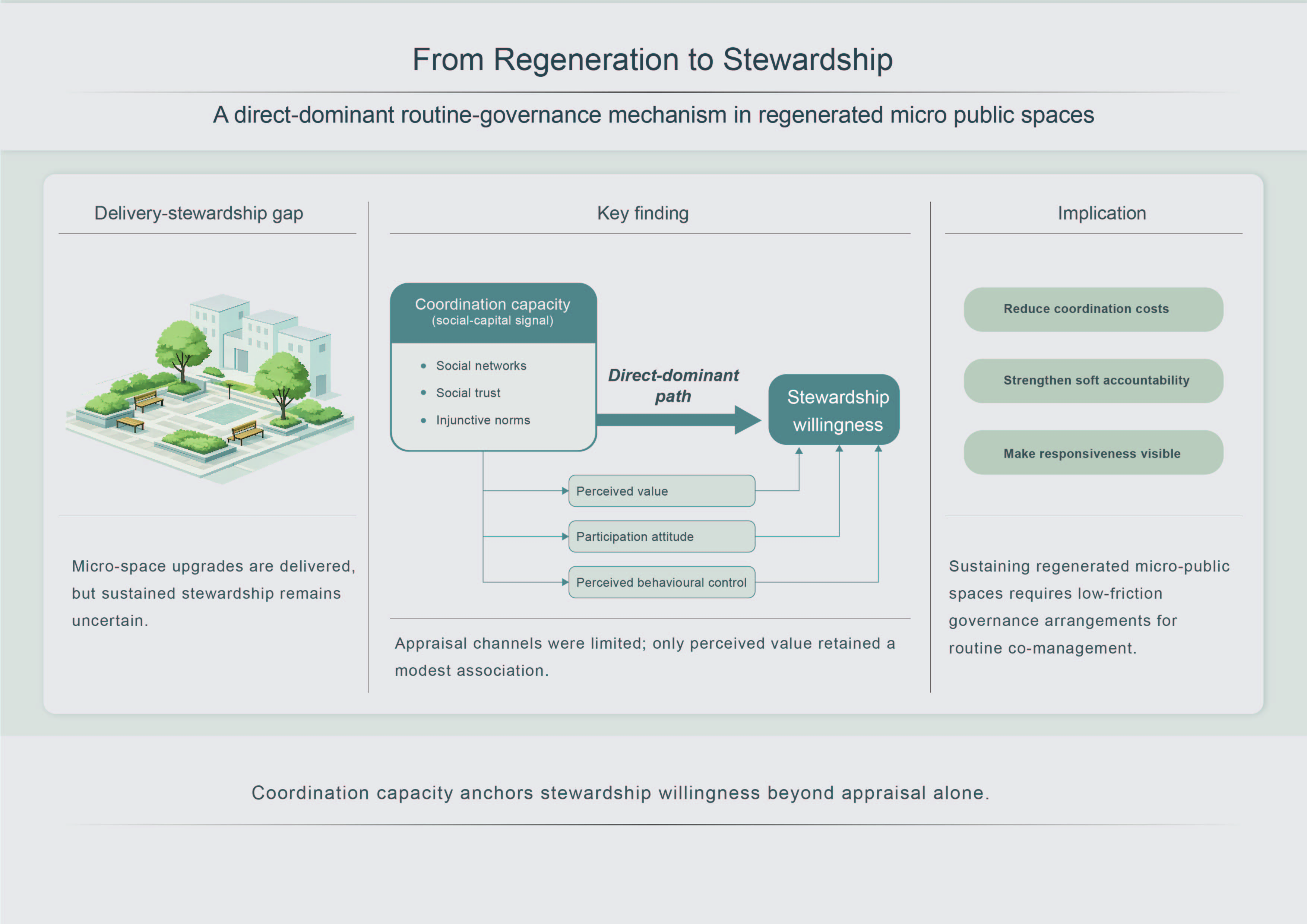
Graphical Abstract

1. Introduction

Micro-public spaces (MPSs) are small-scale, publicly accessible urban spaces—typically occupying residual, transitional, or underutilised land parcels within residential catchments—whose management boundaries, property rights, and governance responsibilities are shared or contested between residents, community organisations, and local authorities [1,2,3,4]. Although MPSs are commonly assessed at the point of completion—an improved pocket park, a stairway made safer, a neglected corner rendered usable—the enduring governance challenge emerges thereafter. Across neighbourhood programmes, many upgraded micro-spaces enter a delivery–stewardship gap: physical improvements are delivered, but routine care falters [3,5]. Facilities may deteriorate and minor disputes may accumulate when routine stewardship is not sustained [2,3,6]. In such settings, day-to-day management often defaults to either overstretched street-level institutions or a narrow pool of repeat volunteers [7,8]. Whether a regenerated micro-space endures as a shared neighbourhood asset, rather than a short-lived showcase, depends less on design quality at delivery than on the viability of everyday stewardship [5,9].
For the long-term management of public land and neighbourhood spatial assets, this gap is fundamentally a problem of institutional capacity [10,11]. Post-regeneration performance depends on residents’ recurring micro-actions, such as reporting defects, coordinating routine upkeep, discouraging misuse, and reinforcing shared rules [2,9,12]. Individually modest, these actions are collectively demanding, as they require ongoing coordination, monitoring, and sustained compliance [13,14]. Stewardship failures are rarely attributable to an absence of initial goodwill; more commonly, they reflect the lack of a governance environment capable of making collective micro-tasks executable at a low coordination cost and with credible responsiveness [5,10,13].
Prior research has approached this challenge from two directions, each leaving a key mechanism under-specified. Design-led studies emphasise spatial quality and usability, yet typically treat governance as background context rather than as a recurrent task chain with associated transaction costs [3,5]. Participation research examines mobilisation and willingness, but frequently conceptualises neighbourhood social capital as a generic civic attribute or an attitudinal proxy, rather than as an operational governance condition [15,16,17]. However, recent micro-renewal studies demonstrate that participation intent is shaped not only by individual appraisals but also by embeddedness in local networks and governance arrangements [18,19]. In post-regeneration stewardship, the operative question is therefore not simply whether residents hold positive attitudes towards participation, but whether they expect collective action to be organised, reciprocated, and responded to [18]. This points to a more operational role for social capital: a coordination condition that reduces uncertainty, lowers transaction and monitoring costs, and sustains routine compliance [13,15,20].
A central question in post-regeneration governance concerns whether stewardship willingness is primarily appraisal-driven— shaped by residents’ perceived value, attitudes, and perceived behavioural control—or primarily coordination-driven, linked to a broader governance environment that sustains participation even when the incremental explanatory power of individual appraisals is limited in a joint model [13,21,22]. If coordination capacity is the dominant driver, a residual direct association between coordination capacity and willingness should remain after appraisal variables are controlled for, which is consistent with a direct-dominant routine-governance mechanism rather than a purely persuasion-based pathway [2,5,13]. This framing aligns with recent evidence showing that micro-regeneration governance depends critically on practical coordination infrastructures that endure beyond the delivery phase [23,24].
The integration of SOR with TPB is grounded in a complementary scope argument. TPB models intra-individual appraisal processes—attitudes, perceived behavioural control, and normative beliefs—that predict behavioural intention, but treats the governance environment as background context rather than as a direct explanatory variable [21,22]. The SOR framework, by contrast, makes the environmental condition the stimulus: a structuring force that reaches the organism (and potentially the response) from outside the individual [25]. Nesting the TPB appraisal block within SOR’s S → O → R structure captures two theoretically distinct pathways: an indirect path in which a governance stimulus shapes individual appraisals that in turn predict willingness, and a direct path in which the stimulus reaches willingness without being fully mediated by elaborated attitudes. This two-pathway design makes it possible to test whether stewardship willingness is primarily appraisal-driven or coordination-driven—a distinction that cannot be assessed within TPB alone [12,26].
To examine this mechanism, the Stimulus–Organism–Response (SOR) framework was integrated with the Theory of Planned Behaviour (TPB) [21,25]. Accordingly, neighbourhood coordination capacity was conceptualised as the stimulus; residents’ feasibility- and meaning-related appraisals—comprising perceived value, participation attitude, and perceived behavioural control—as the organism block; and stewardship willingness as the response. Empirically, a cross-sectional survey of adults residing within walkable catchments of five regenerated MPS sites in Nan’an District, Chongqing, China ( N = 477 ), was administered, and the integrated model was estimated using WLSMV with ordered categorical indicators. The findings were further translated into a replicable soft-infrastructure toolkit and a minimal set of stewardship-capacity metrics to support post-regeneration programme evaluation and routine monitoring [3,9].
Three research questions guided the analysis: (RQ1) How strongly is neighbourhood coordination capacity associated with residents’ feasibility- and meaning-related appraisal states? (RQ2) In a joint model incorporating the stimulus, which appraisal states retain the most stable incremental association with stewardship willingness? (RQ3) Does a direct association between neighbourhood coordination capacity and stewardship willingness persist after accounting for residents’ appraisal-based pathways, and if so, what is its relative magnitude compared with the indirect appraisal-mediated pathways—and what does the dominant pathway imply for post-regeneration governance design?
The integrated SOR × TPB framework generated the following testable predictions: Coordination capacity, conceptualised as the environmental stimulus shaping residents’ appraisal environment, is expected to be positively associated with all three organismic states (H1). Within the joint model, appraisal-based pathways to willingness may be selective rather than uniformly strong, given the overlapping information conveyed by the stimulus (H2). A governance–environment interpretation further predicts that coordination capacity retains a residual direct association with willingness not fully accounted for by the measured appraisals (H3).
These competing mechanisms were examined within the integrated SOR × TPB framework [21,25]:
Social capital theory predicts that embedded network membership and interpersonal trust reduce uncertainty about collective behaviour, directly shaping residents’ perceived feasibility of participation (PBC), their evaluations of expected benefits (perceived value), and their responsiveness to shared normative expectations (attitude) [15,16,20]. Injunctive norms signal community-endorsed expectations that prior research identifies as primary inputs to attitudinal formation in neighbourhood governance contexts [18,19]. Accordingly:
H1. 
Coordination capacity is positively associated with perceived value, participation attitude, and perceived behavioural control [15,16,21].
While the TPB meta-analysis confirms that attitudes and PBC are reliable predictors of individual behavioural intention [22], their incremental contribution in a joint model that includes a strong upstream governance stimulus may be attenuated due to shared variance—a pattern documented in co-production settings where structural conditions absorb variance typically attributed to individual appraisals [26]. Accordingly:
H2. 
Perceived value, participation attitude, and perceived behavioural control are each positively associated with stewardship willingness, though incremental effects may be attenuated in a joint model [21,22].
Institutional theory holds that in commons governance, structural conditions—including monitoring, sanctioning, and the credibility of collective enforcement—shape behaviour independently of individual preferences [10,13,14]. In a neighbourhood context, coordination capacity can therefore function as a governance credibility signal that activates stewardship willingness directly: residents may be willing to participate when they perceive the local governance environment as capable of making their contributions effective and reciprocated, regardless of whether their attitude toward the specific task is independently high [13,27]. Accordingly:
H3. 
Coordination capacity retains a residual direct association with willingness beyond the appraisal block, consistent with a direct-dominant pattern shaped by routine-governance conditions [10,13].
Given the cross-sectional design, temporal ordering among the stimulus, organism, and response constructs cannot be established. Bootstrap confidence intervals are therefore used not as a test of causal mediation but as sensitivity evidence for whether product-of-coefficients indirect effects are detectable at the current sample size [28,29]. Accordingly:
H4. 
Analytical strategy: Indirect effects from coordination capacity to stewardship willingness via the organism block were assessed using bias-corrected bootstrap confidence intervals (BCa, 95%; 5000 resamples) as sensitivity evidence for appraisal-based mediation, following established cross-sectional mediation guidelines.
This study contributes to land and urban governance research by reconceptualising neighbourhood coordination capacity—comprising social networks, interpersonal trust, and injunctive normative signals—as a post-delivery governance condition, and by providing empirical evidence of a direct-dominant pathway to stewardship willingness. The findings indicate that the delivery–stewardship gap is not reducible to individual attitudes alone but is structurally shaped by the perceived governability of everyday maintenance tasks.
The remainder of this paper is organised as follows: Section 2 describes the study setting, sampling procedure, measurement instruments, and analytical strategy. Section 3 presents the results, encompassing the measurement quality assessment, structural model estimates, and bootstrap sensitivity evidence for indirect pathways. Section 4 discusses the findings regarding routine governance theory, alternative explanations, practical design implications, and study limitations. Section 5 provides a summary of the key contributions and directions for future research.

2. Materials and Methods

2.1. Study Setting and Survey Period

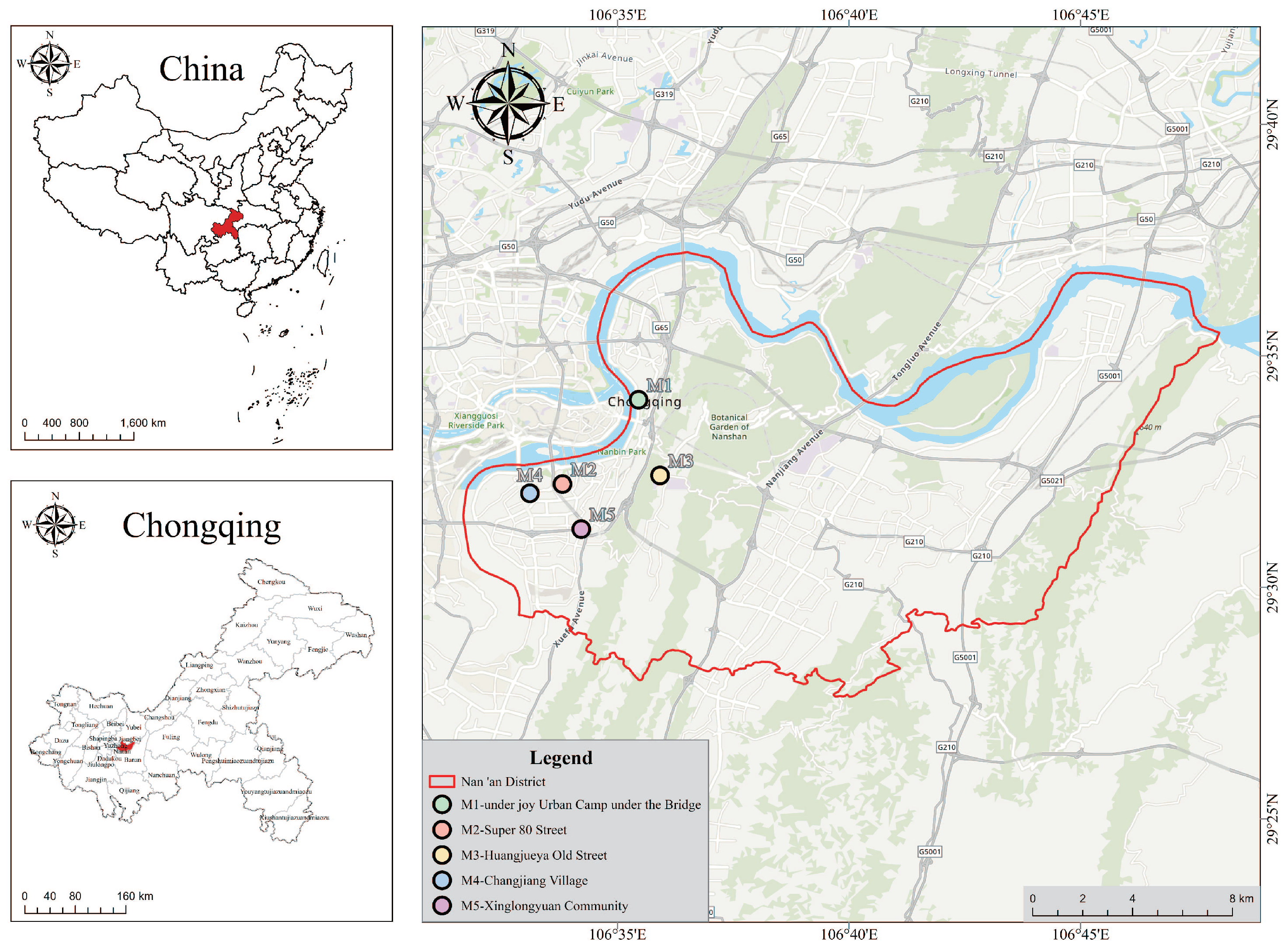
This study examined post-regeneration stewardship in neighbourhood micro-public spaces (MPSs) in Nan’an District, Chongqing, China. Data were collected via an online questionnaire administered from late September to October 2025 using the QuestionnaireStar (Wenjuanxing) online survey platform (available online: https://www.wjx.cn/, accessed on 12 April 2026). Respondents were adults residing within the walkable catchments of five regenerated MPS sites. The sites were selected through purposive sampling to maximise the variation in spatial typology and regeneration mode within a single administrative district, thereby holding district-level institutional arrangements approximately constant while capturing meaningful differences in the local governance context (Table S8). The five sites spanned distinct spatial settings: an under-flyover grey space reactivated for riverside leisure (M1); a 1980s residential neighbourhood with community-space and cultural upgrades (M2); a historic commercial street integrating heritage conservation with everyday use (M3); a former industrial workers’ community undergoing infrastructure renewal and memory-themed public realm improvement (M4); and a mixed-use neighbourhood in which idle micro-spaces were activated through resident-led co-built gardens (M5). This within-district design enables the analysis to capture heterogeneity in stewardship conditions—ranging from commercially oriented activation to grassroots co-building—while holding district-level policy, fiscal, and administrative factors approximately constant to minimise confounding in cross-site comparisons.

2.2. Participants, Eligibility, and Survey Procedure

Participants were recruited through two types of online neighbourhood channels: (a) official community governance platforms administered by residents’ committees (juweihui) associated with each study site, and (b) resident-led WeChat group chats linked to the same sites. The concurrent use of official and resident-led channels was intended to mitigate single-channel selection bias, though differential response rates across channel types were not tracked separately. Eligibility was restricted to adults; responses from minors were excluded from the analytical sample. Participation was voluntary and anonymous. Prior to the main survey items, respondents were presented with a brief information sheet and a consent item [30]. The final analytical sample comprised 477 adult respondents, who were retained after applying pre-specified eligibility and quality control criteria (Table S1) [30,31]. Demographic characteristics of the sample are reported in Table 1.

2.3. Measures

All psychometric items employed five-point ordered response options (1 = strongly disagree to 5 = strongly agree). Given the ordinal nature of these indicators, the subsequent analysis treated them as ordered categorical variables [32,33,34]. Measures were organised into three blocks corresponding to the integrated SOR × TPB framework [21,25]. The original item wording, response coding, and source references are reported in Supplementary Table S7.
  • Stimulus (coordination capacity): Neighbourhood coordination capacity was operationalised as a second-order construct reflected by three first-order dimensions: social network mobilisation (SN; 3 items), interpersonal trust (ST; 3 items), and injunctive norms (SR; 3 items) [16,21].
  • Organism (appraisals): The organism block comprised perceived value and two TPB-consistent appraisal constructs [21]. Perceived value was operationalised as a second-order construct reflected by functional value (FV; 3 items), emotional value (EV; 3 items), and economic value (CV; 3 items) [35,36]. Participation attitude (PA; 3 items) and perceived behavioural control (PBC; 3 items) captured evaluative and feasibility-related appraisals, respectively [21]. Injunctive norms are treated as shared neighbourhood-level governance signals rather than individual-level normative beliefs, as they index the perceived local enforceability and social endorsement of stewardship tasks, which are features that function as environmental conditions for post-regeneration land management [13].
  • Response (stewardship willingness): Stewardship willingness (PW) was assessed using five items [21]. One item was negatively worded and reverse-coded prior to analysis to ensure directional consistency across the scale.

2.4. Data Cleaning and Coding

Data cleaning adhered to pre-specified, objective rules [30]. First, responses from minors were excluded using the age-category variable (age category = 1). Second, extreme speeding cases were removed based on completion time screening (absolute minimum = 156 s; n = 4 ), on the grounds that such completion times were insufficient for attentive engagement given the questionnaire length [31]. As a supplementary quality check, responses were screened for straight-lining, defined as the selection of an identical response option across all items within a single construct block. No cases exhibiting perfectly invariant responses across all 27 psychometric items were identified. Furthermore, the inclusion of one reverse-coded item (PW3) in the stewardship willingness scale served as a built-in consistency check: respondents who straight-lined across the willingness block would have generated an internally inconsistent response pattern after reverse-coding, and no such cases were detected. The final analytical sample comprised N = 477 adults (Table S1).
All items were coded such that higher values correspond to higher construct levels. The negatively worded willingness item was reverse-coded prior to analysis as PW 3 = 6 raw ; the original item was retained for auditability. Construct mean scores reported in the descriptive statistics were computed as the unweighted average of their constituent items (scale range: 1–5).
The online platform (QuestionnaireStar) required completion of all psychometric items before submission; consequently, no missing values were present on any of the 27 psychometric items in the analytical dataset. Full information maximum likelihood (FIML) was therefore employed in the ML bootstrap specification as a precautionary sensitivity measure rather than as a primary missing-data strategy.

2.5. Statistical Analysis

All statistical analyses were conducted in R (v4.5.1; R Foundation for Statistical Computing, Vienna, Austria) using the lavaan package (v0.6-21).
Given that all indicators were measured on ordered Likert scales, ordinal confirmatory factor analysis (CFA) and structural equation modelling (SEM) were conducted using the weighted least squares mean- and variance-adjusted estimator (WLSMV), with all indicators treated as ordered categorical variables [32,33,34].
Because bootstrap standard errors are unavailable for WLSMV in lavaan, indirect effects were evaluated as a sensitivity specification estimated under maximum likelihood (ML) with full information maximum likelihood (FIML) for missingness, using 5000 bootstrap resamples and bias-corrected accelerated bootstrap 95% confidence intervals (BCa) for product-of-coefficients estimates [28]. The measurement quality was evaluated using standardised factor loadings, the composite reliability (CR), the average variance extracted (AVE), and the discriminant validity assessed via heterotrait–monotrait (HTMT) ratios (Table 2 and Table 3; full results in Tables S2–S4) [37,38].
The integrated structural model was subsequently estimated to examine the following: (i) stimulus-to-organism paths, (ii) organism-to-willingness paths representing incremental effects in the joint model, and (iii) a competing direct stimulus-to-willingness path to evaluate a direct-dominant routine-governance mechanism (Table 4). Competing model specifications were compared using global fit indices and focal path coefficients (Table S5) [11,39,40]. Indirect effects via the organism block were assessed using BCa bootstrap confidence intervals (95%; 5000 resamples) estimated under ML with FIML [28]. Following established methodological guidance on cross-sectional mediation [28,29,41], these estimates were treated as sensitivity evidence for the plausibility of indirect pathways rather than as formal tests of causal mediation, given that temporal ordering between the stimulus, organism, and response constructs cannot be established in a single-wave design. The statistical power available to detect indirect effects of the observed magnitude is considered further in the bootstrap results interpretation (Section 4.2).
The analytical sample of N = 477 provides an adequate basis for the estimated model. The structural model contains approximately 65 freely estimated parameters—comprising 29 factor loadings, 7 structural regression paths, 4 endogenous residual variances, and threshold parameters absorbed by the polychoric estimation—yielding an N:q ratio of approximately 7.3:1. Although this falls below the 10:1 benchmark sometimes recommended for ML estimation [41], WLSMV with ordered indicators imposes less stringent sample size requirements than ML under conditions of non-normality, and simulation evidence indicates that N 200 –400 generally produces stable WLSMV estimates for models of comparable complexity [32,33]. The model converged without warnings, all standardised loadings exceeded 0.60, and standard errors for focal structural paths remained within interpretable ranges, collectively suggesting adequate estimation precision for the present application.
The study employed a cross-sectional design; accordingly, all reported path coefficients represent contemporaneous associations rather than temporally ordered causal sequences. The directional specification of the structural model (Stimulus → Organism → Response) reflects theoretical priors derived from the SOR–TPB integration [21,25] and should not be interpreted as empirical evidence of causation. Reciprocal dynamics are plausible—for example, prior stewardship experience may strengthen perceived coordination capacity—and these possibilities are addressed explicitly in the limitations discussion (Section 4.4).
  • Common method bias assessment: As a precautionary check, Harman’s single-factor test was conducted on the full item pool. The first unrotated factor accounted for 27.3% of the total item variance—well below the conventional 50% threshold—and nine factors with eigenvalues exceeding unity were extracted, suggesting that common method bias is unlikely to represent a dominant confounder [42].
  • Within-site clustering: To assess potential non-independence arising from respondent clustering within sites, an alternative specification incorporating cluster-robust standard errors—with site as the clustering unit ( k = 5 )—was estimated. Focal structural paths remained substantively unchanged ( Δ β < 0.03 across all paths; see Table S5). It should be noted, however, that k = 5 clusters falls below the minimum typically recommended for reliable cluster-robust inference ( k 30 ); this correction should therefore be regarded as exploratory. A multilevel SEM approach would require substantially more clusters and is recommended for future research with broader site coverage.
  • Demographic controls robustness: The primary structural model specifies theoretically motivated SOR × TPB pathways without demographic covariates. As a robustness check, an alternative specification incorporating gender, age category, education level, homeownership status, and prior participation experience as exogenous controls was estimated. Focal structural paths remained substantively unchanged ( Δ β < 0.05 ; full results in Table S5).
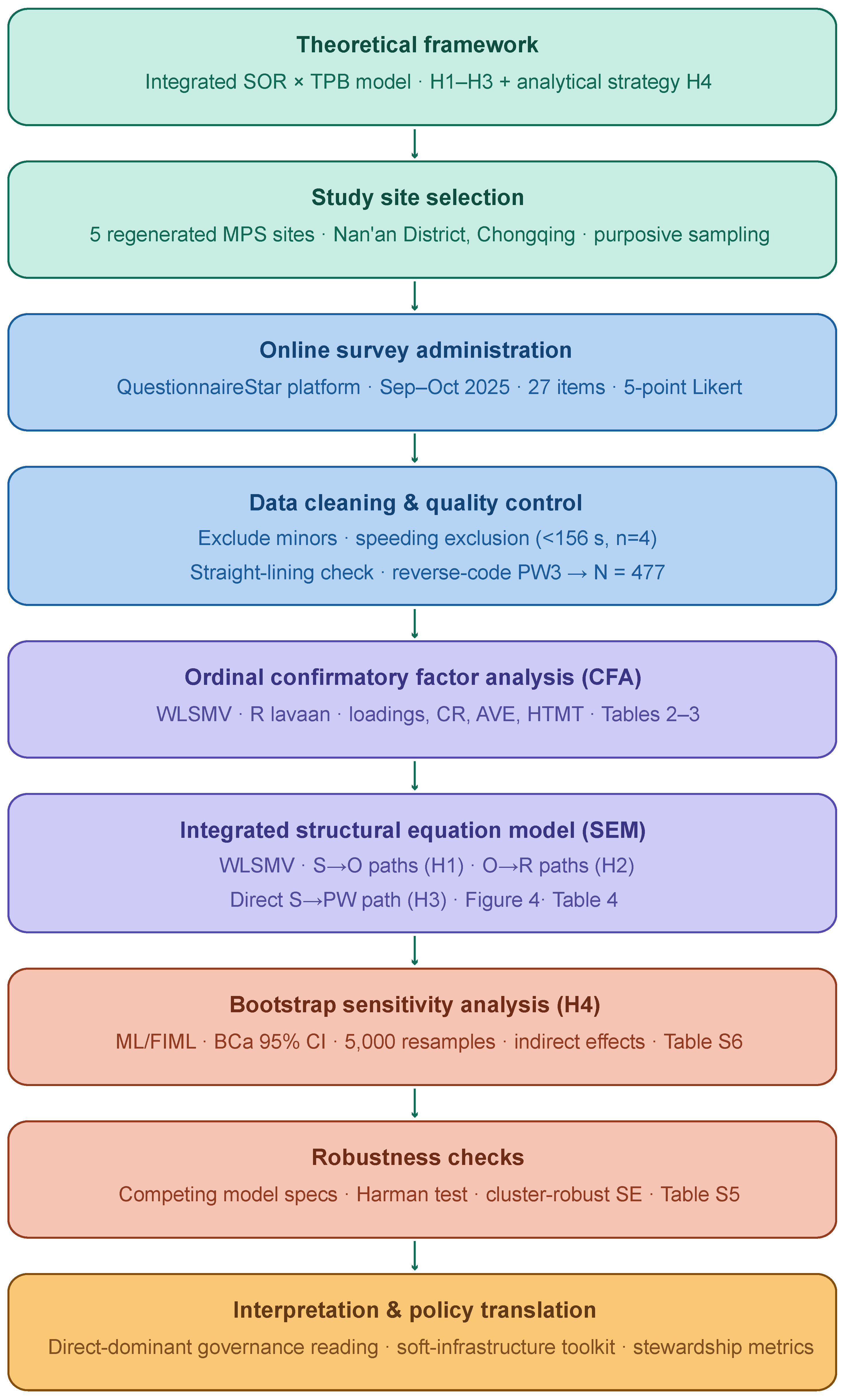
The complete methodological workflow from research design to interpretation is summarised in Figure 1.

3. Results

3.1. Sample and Data Processing

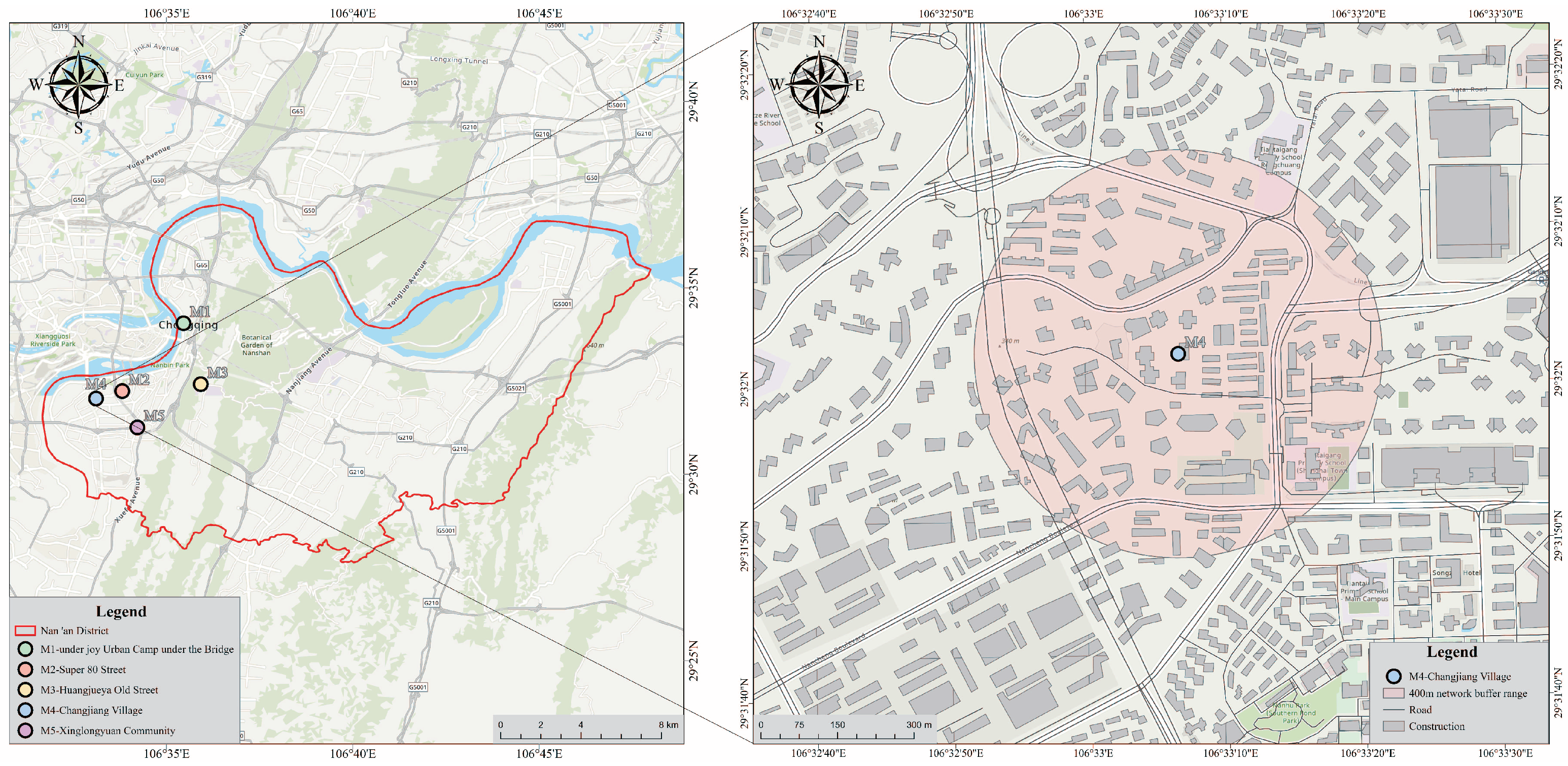
Following the application of pre-specified eligibility and quality-control criteria, the final analytical sample comprised 477 adult respondents (Table S1). The sample was balanced by gender and encompassed a broad range of ages, educational attainments, and residential tenures, with the full demographic characteristics reported in Table 1. All psychometric items were coded on five-point ordered scales; the negatively worded willingness item was reverse-coded prior to analysis ( PW 3 = 6 raw ) and applied consistently in the construct scoring and structural modelling. The study area and locations of the five regenerated MPS sites are displayed in Figure 2. An illustrative example of the network-based 400 m walkable catchment used as the sampling frame around a typical site is provided in Figure 3.
Table 2 reports the construct-level descriptive statistics and convergent validity indices. Mean scores cluster in the mid-to-upper range of the scale, indicating generally favourable appraisals and stewardship willingness across respondents. Reliability was satisfactory across all constructs, with composite reliability (CR) values exceeding conventional thresholds. The convergent validity was also generally acceptable: average variance extracted (AVE) values met or closely approached recommended levels, although the second-order stimulus construct was marginally below the conventional 0.50 benchmark (AVE = 0.492), and is therefore interpreted with appropriate caution (Table 2) [37].
Discriminant validity is supported by the inter-construct correlations and heterotrait–monotrait (HTMT) ratios reported in Table 3. All HTMT values remain below established cut-offs [38], indicating that the constructs are empirically distinguishable rather than reflections of a single underlying factor. Item-level standardised factor loadings are presented in Table S2; comprehensive reliability and validity diagnostics are provided in Tables S3 and S4.

3.2. Structural Model and Hypothesis Tests

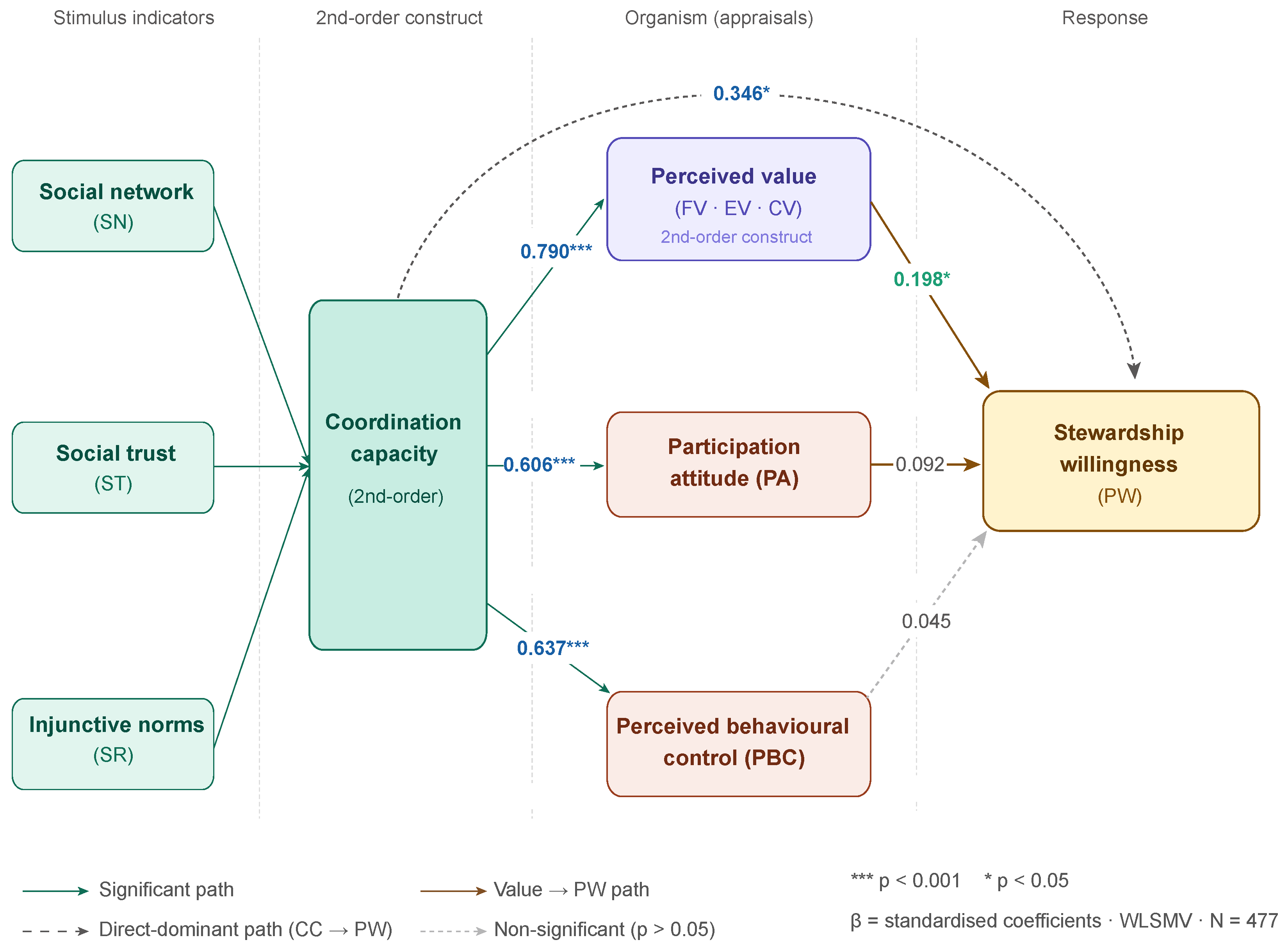
The integrated structural model was estimated with WLSMV using ordered categorical indicators [32,33,34]. The model demonstrated acceptable global fit (Table 4A) according to conventional fit-index criteria [39]. The results support the hypothesised Stimulus → Organism linkages (H1): neighbourhood coordination capacity is strongly and positively associated with perceived value, participation attitude (PA), and perceived behavioural control (PBC), with all paths being statistically significant (Table 4B).
Regarding the Organism → Response block (H2), the joint model reveals a selective pattern of associations. Perceived value retains a small but statistically reliable positive association with stewardship willingness (Value → PW: β = 0.198 , p = 0.048 ; Table 4B), whereas the associations of PA and PBC with willingness are not statistically reliable once coordination capacity and perceived value are jointly included in the model.
The integrated structural model is visualised in Figure 4.
The competing direct-dominant governance mechanism (H3) receives empirical support. A residual direct association between coordination capacity and stewardship willingness persists after accounting for the full organism block (Stimulus → PW: β = 0.346 , p = 0.020 ; Table 4B). This indicates that willingness is linked not only through appraisal-based pathways but also through a residual coordination-related association that is not fully accounted for by the measured appraisals. This association is consistent with a routine-governance interpretation, but it is not by itself proof of a specific mechanism. Alternative sources of the residual association, including omitted mediators and common method effects, are considered in Section 4.2 [13].

3.3. Sensitivity Evidence for Indirect Pathways

Bootstrap analyses were conducted to assess whether indirect associations from coordination capacity to stewardship willingness are detectable through the organism block (H4). Indirect effects are directionally positive but imprecisely estimated: the BCa bootstrap confidence intervals for all specific and total indirect effects include zero (Table S6). Mediation is accordingly treated as sensitivity evidence supporting the plausibility of appraisal-based pathways, rather than as a basis for strong causal claims [28]. Model comparison results for competing specifications are presented in Table S5, corroborating the interpretation that the residual direct association does not reflect an artefact of any single modelling choice. The second-order ML/FIML specification (Model 3) exhibited estimation instability: the Stimulus → Value path approached unity ( β = 0.997 ), rendering downstream coefficients substantively uninterpretable. Diagnostic analyses attribute this instability to a latent-level identification vulnerability arising from just-identified second-order factors (three first-order indicators each) in combination with a high implied latent-factor correlation (HTMT = 0.776; composite-level VIF = 1.72), rather than to observed-level multicollinearity (see the Technical Note below Table S5). This pathology is specific to the second-order parameterisation and does not affect Models 1 or 2, both of which yield consistent and interpretable structural path estimates.

4. Discussion

4.1. Coordination Capacity Is Linked to Stewardship Willingness in a Direct-Dominant Structure

This study examined the post-regeneration governance challenge of sustaining everyday stewardship in micro-public spaces, with particular focus on whether stewardship willingness is primarily appraisal-driven or coordination-driven. The results support a direct-dominant interpretation. Neighbourhood coordination capacity—conceptualised as a social–capital bundle comprising network mobilisation, interpersonal trust, and injunctive norms—exhibits strong associations with residents’ feasibility- and meaning-related appraisals (perceived value, participation attitude, and perceived behavioural control) [16,19,21]. This pattern is consistent with recent micro-renewal evidence demonstrating that participation intentions are shaped not only by individual attitudes but also by embeddedness in local networks and the organisational conditions of neighbourhood governance [18,23,24]. In the joint model, however, the incremental contribution of TPB-style appraisals to willingness is selective: perceived value retains a small but reliable positive association, whereas attitude and perceived behavioural control contribute negligible additional explanatory power once the coordination-capacity stimulus is included. Crucially, a residual direct association from coordination capacity to willingness persists beyond the appraisal block, indicating that willingness is linked not only through appraisal-based pathways but also through a governance channel consistent with routine stewardship conditions [5,13,43].
This finding has important implications for how post-regeneration participation readiness should be interpreted and supported. Were stewardship willingness primarily attitudinal, the principal policy lever would be persuasion and motivational framing. A direct-dominant structure instead implies that willingness is substantially conditioned by whether collective micro-actions are perceived as organisable, enforceable, and responsive in everyday practice [26,44]. Comparable debates in public space management and co-production research highlight that such routines depend on institutional embedding and clear boundary arrangements that render everyday coordination and responsiveness credible [7,45,46,47].

4.2. Interpreting the Direct Path as Routine Governance Rather than a TPB “Failure”

Before turning to the mechanistic interpretation, it is useful to clarify how the non-significant bootstrap confidence intervals should be read. They do not show that the SOR-TPB framework is inapplicable in this setting. Rather, they indicate that the indirect effects were not estimated with sufficient precision under the current design. Support for the framework comes primarily from the overall structural pattern: large stimulus-to-organism associations support the S→O linkage (H1), the selective retention of perceived value in the O→R block is consistent with an organism-mediated process, and the persistent direct path supports the direct-path prediction (H3). The non-significant indirect effects speak more specifically to the detectability of product-of-coefficients indirect effects under the current design conditions—limited power for a large-a× small-b configuration [48] and the indeterminate temporal ordering inherent in a single-wave cross-sectional design [41].
The residual direct association is best read as evidence of a governance-related pathway rather than as direct proof of a single mechanism or as evidence of TPB mediator failure. In neighbourhood commons, social capital functions as coordination capacity by reducing the transaction costs of organising micro-tasks—clarifying who does what, when, and with whom—lowering uncertainty about reciprocation, and sustaining informal enforcement through reputational pressure and shared expectations [13]. Social capital also operates as a credibility signal: residents form expectations that reports will be acknowledged and that their contributions will not be wasted. This anticipation of institutional responsiveness is central to sustaining routine stewardship. Recent public-space management and co-production scholarship likewise shows that everyday stewardship depends on institutional embedding, clear responsibility boundaries, and routine feedback infrastructures that make responsiveness visible and credible [7,45,49]. When these governance conditions are salient, the incremental variance explained by attitude or perceived behavioural control tends to be modest in a joint model because the stimulus already captures much of the organisational feasibility that makes participation viable.
This interpretation also accounts for why perceived value emerges as the more stable appraisal link. Value is directly tied to residents’ practical calculus in routine stewardship: specifically, whether the anticipated benefits of co-management justify the investment of repeated effort. Attitude and perceived behavioural control may continue to shape willingness in principle, but their incremental contribution diminishes when coordination capacity already provides a strong signal that collective action is feasible in this setting. Taken together, the evidence supports a contextual reading of TPB in which appraisal-based pathways are embedded within, and partially subsumed by, prevailing routine-governance conditions [21].
The sensitivity results reinforce this interpretation but warrant careful qualification. Bootstrap estimates for indirect effects are directionally positive but imprecise, with BCa confidence intervals crossing zero (Table S6). This pattern should not be construed as evidence that appraisal-based pathways are absent; rather, it reflects the confluence of three factors. First, statistical power to detect indirect effects of the observed magnitude is constrained at the current sample size. Following Fritz and MacKinnon [48], the a-paths are large (standardised a 1 = 0.79 , a 2 = 0.61 , a 3 = 0.64 ), whereas the b-paths are small ( b 1 = 0.20 , b 2 = 0.09 , b 3 = 0.05 ); for a large-a× small-b configuration, bias-corrected bootstrap estimation requires N 462 to achieve 80% power [48]. With N = 477 , the present study is at the boundary of adequate power for the largest indirect pathway (via perceived value) and below adequate power for the two smaller pathways (via attitude and perceived behavioural control). Second, organism-block variables share substantial covariance with the stimulus (Stimulus → Value: β = 0.79 ; Stimulus → PA: β = 0.61 ; Stimulus → PBC: β = 0.64 ), compressing the residual b-path variance available for incremental prediction of willingness in the joint model. This is consistent with a configuration in which appraisals and coordination capacity co-vary as concurrent governance conditions rather than operating in a strict sequential chain [21]. Third, cross-sectional mediation analysis presupposes temporal ordering that cannot be verified in a single-wave design; even a correctly specified indirect effect may be estimated imprecisely when the temporal lag between stimulus, organism, and response is indeterminate [28,41]. Accordingly, the indirect-effect estimates are treated as sensitivity evidence—directionally supportive but insufficient to warrant strong causal claims—rather than as confirmation or disconfirmation of appraisal-based mediation. The substantive conclusion remains unchanged: coordination capacity retains a direct association with willingness that is not fully explained by the measured appraisals.
Several alternative explanations for the residual direct association merit consideration. First, the direct path may partly capture omitted mediators that are absent from the current model—such as perceived institutional responsiveness of street-level managers, project-specific satisfaction, or residential place attachment—that covary with coordination capacity and independently predict willingness. Although the organism block already incorporates core evaluative and feasibility-related appraisals, future research could extend the model to include administrative responsiveness variables. Second, common method variance may inflate the direct path, given that all constructs were measured using the same self-report instrument within a single administration. As a precautionary check, a Harman single-factor test was conducted in the statistical analysis; the first unrotated factor accounts for 27.3% of the total item variance—well below the conventional 50% threshold—suggesting that common method bias is unlikely to be a dominant concern [42]. Future studies could nonetheless strengthen the causal inference by integrating survey measures with behavioural or administrative data (e.g., defect-report frequencies, maintenance-log entries). Third, although the HTMT ratio between coordination capacity and participation attitude (0.551) remains below conventional cut-offs (Table 3) [38], residual conceptual overlap between injunctive norms (SR) and attitudinal appraisals cannot be entirely excluded; this boundary condition warrants attention in future operationalisations. Fourth, the model assumes linear, additive relationships, yet the direct path may instead reflect interaction effects—for instance, coordination capacity may moderate the attitude → willingness association such that attitudinal appraisals translate into behavioural intention only when governance conditions are favourable. Examining moderated mediation specifications would help clarify whether the direct channel constitutes a genuine main effect or an averaged-out interaction [29]. Fifth, a deeper mechanistic explanation for the limited incremental contribution of attitude and perceived behavioural control lies in the fundamental distinction between individual psychological assessment and collective action. TPB was designed and validated for individual behaviours—dietary choices, health decisions, voting—where executing an intention does not depend on coordinated action by others [21,22]. Stewardship of shared neighbourhood spaces is, by contrast, an inherently collective action problem: whether an individual’s maintenance effort is worthwhile depends not only on that individual’s attitude or perceived capacity, but on whether sufficient others will also contribute, whether contributions will be reciprocated, and whether the governance structure will enforce compliance and acknowledge effort [13,14,27]. In such settings, individual appraisals become contingent on collective-level conditions—a structural contingency that explains why coordination capacity absorbs explanatory weight from attitude and PBC in the joint model. A resident may hold a favourable attitude toward co-management yet remain unwilling to act if local coordination is expected to fail; conversely, a resident with only moderate attitudinal investment may be willing to participate when the governance environment makes collective action credible and low-friction [26,40]. This is not a failure of TPB as such, but evidence of its boundary conditions when applied to commons-governance contexts where collective coordination, rather than individual intention, is the operative constraint [13,21]. Notwithstanding these caveats, the routine-governance interpretation remains the most parsimonious account of the observed pattern: a strong, stable direct association accompanied by limited incremental contributions of TPB appraisals in the joint model.

4.3. Implications for Post-Regeneration Tool Design and Stewardship-Capacity Metrics

The policy implications follow directly from the structural pattern rather than from general participation principles. The direct-dominant pathway identifies coordination capacity—operationalised as three distinct governance components: social network mobilisation (SN), interpersonal trust (ST), and injunctive norms (SR)—as the primary driver of stewardship willingness beyond individual appraisals. This has a specific practical corollary: the most productive governance interventions are not those targeting residents’ attitudes (the attitudinal pathway) but those building the collective-action enabling conditions captured by each stimulus dimension. Each of the three design levers below addresses one component of the coordination-capacity construct directly: reducing coordination costs targets the social network mobilisation dimension (SN), converting diffuse social connections into organised action; strengthening informal enforcement targets the injunctive norms dimension (SR), making community expectations visible and credible; and enhancing responsiveness targets the interpersonal trust dimension (ST), providing evidence that contributions will be acknowledged and reciprocated. This construct-to-lever mapping keeps the proposed toolkit closely aligned with the empirical pattern [13,26,44].
The practical implication is that programmes seeking to sustain regenerated micro-spaces should prioritise governance interventions targeting the direct channel: reducing coordination friction, strengthening informal compliance, and rendering institutional responsiveness visible [26,44]. This reorients programme emphasis from promoting participation as a one-off act towards embedding it as an executable routine [13].
First, coordination costs can be reduced by designing micro-tasks to be modular, time-bounded, and accessible. Clear task definitions (e.g., reporting defects, routine cleaning, minor repairs), straightforward entry points, and predictable responsibility allocation can convert diffuse willingness into sustained coordinated action. The “one-metre garden” co-building model at Site M5—in which residents adopt and maintain individual micro-plots within a shared amenity system—illustrates how modular task design can lower the threshold for sustained participation: each resident’s contribution is bounded, visible, and free from the need for complex negotiation with neighbours.
Second, informal enforcement can be reinforced without escalating conflict through the development of soft accountability mechanisms: visible behavioural norms, peer reminders, public recognition of contributions, and low-stigma feedback that discourages free-riding through reputational incentives. At Site M4, the industrial-memory-themed public realm draws on collective heritage narratives that function as shared normative anchors—reinforcing stewardship as an expression of community identity rather than an externally imposed obligation.
Third, responsiveness and institutional credibility can be enhanced by closing the governance feedback loop: rapid acknowledgement of resident reports, transparent tracking of actions taken, and low-latency communication between residents and street-level managers [5,9]. The “community living room” format at Site M2 provides a physical anchor for face-to-face interaction, rendering institutional responsiveness visible in everyday encounters rather than confining it to digital channels alone. These three levers resonate with contemporary debates that conceptualise public space as continuously produced through everyday encounters and practices, in which design, co-production, and maintenance are tightly coupled [50]. They also align with evidence that co-production arrangements are most effective when embedded in routine administrative systems rather than treated as episodic mobilisation efforts [7,45,46,51].
These governance levers also motivate a minimal set of stewardship-capacity metrics for programme evaluation. Given that willingness is directly linked to coordination conditions, monitoring frameworks should capture not only participation counts but also friction and responsiveness indicators that reflect routine governance performance [52]. Appropriate metrics include response latency to minor defects, report closure rates, participation retention versus attrition, regularity of micro-task completion, and the visibility of rule reinforcement [5,9]. Recent stewardship research further indicates that planning arrangements and institutional supports are critical determinants of whether such routines can be sustained over time [53,54]. Embedding these indicators in routine programme reporting would reorient evaluation from the measurement of delivered outputs to the assessment of maintained asset performance.

4.4. Limitations and Future Research

Several limitations constrain the inferential scope of the findings. First, the cross-sectional design and reliance on self-report measures preclude the establishment of causal direction or temporal ordering. Reciprocal dynamics between the key constructs are plausible through at least two channels. A reinforcement channel may arise when residents who have successfully participated in stewardship revise their perceptions of neighbourhood coordination capacity upwards, generating a willingness → coordination capacity feedback process [42]. A selection channel may operate when residents with higher pre-existing willingness are more likely to engage in neighbourhood networks, thereby contributing to—rather than merely responding to—the social capital that constitutes coordination capacity [16]. Both dynamics would upwardly bias the estimated Stimulus → Response association in a cross-sectional model. These reciprocal processes also entail endogeneity concerns that cannot be resolved within the present design. Longitudinal designs tracking governance perceptions before and after regeneration delivery, or quasi-experimental approaches exploiting the variation in regeneration timing across comparable neighbourhoods (e.g., difference-in-differences), would help disentangle these dynamics and establish temporal precedence.
Second, online recruitment may under-represent residents with limited digital access—particularly older adults who are less active on community messaging platforms. The ≥65 age group constituted only 5.5% of the analytical sample, well below its estimated share of approximately 14% in the urban residential population of Chongqing (2020 census). This under-representation is particularly consequential given that retired elderly residents are often the most active daily users and informal maintenance participants of micro-public spaces in Chinese urban communities. Their longer daily presence, stronger place attachment, deeper neighbourhood embeddedness, and established relationships with community staff render them a disproportionately important constituency for post-regeneration stewardship. Should older residents’ perceptions of coordination capacity or stewardship willingness differ systematically from those of younger residents—plausibly higher due to residential tenure and social embeddedness, or lower due to reduced physical capacity for maintenance tasks—the present findings may underestimate the governance significance of this demographic group. Future surveys should supplement online recruitment with offline methods (e.g., on-site paper questionnaires administered at community activity centres) to ensure adequate representation. The gender composition (49.7% male) and homeownership rate (83.9%) are broadly consistent with Chongqing urban demographics, providing some reassurance against a severe sample skew on these dimensions.
Third, all evidence derived from regenerated sites within a single administrative district of Chongqing. Local institutional arrangements—including the respective roles of street offices (jiedao banshichu), residents’ committees, owners’ committees, and property-management companies—may differ considerably across cities and programme types. The direct-dominant pattern documented here reflects a governance environment characterised by the coexistence of these layered neighbourhood institutions; whether equivalent patterns emerge under different administrative regimes (e.g., cities with more developed property-management markets or weaker community self-governance traditions) remains an open empirical question. Furthermore, although the five sample sites were purposively selected to maximise within-district typological variation, they represent meaningfully different governance contexts—ranging from commercially activated grey space (M1) to resident co-built gardens (M5)—whose underlying coordination-capacity mechanisms may differ in nature and intensity. Future studies should incorporate the regeneration mode as a moderating variable or employ multi-group SEM to examine whether structural path estimates vary systematically across site types. Comparative research spanning multiple neighbourhood types, governance tiers, and regeneration phases—particularly contrasting pre-delivery, active delivery, and post-delivery conditions—would help establish the boundary conditions and transferability of the coordination-capacity mechanism.
Fourth, coordination capacity is operationalised as a perceived governance signal derived entirely from self-report data. Future research should integrate survey-based measures with objective behavioural and administrative indicators—such as defect report frequencies, institutional response times, maintenance logs, and participation records—to strengthen causal inference and provide an empirical foundation for the proposed stewardship-capacity metrics.

5. Conclusions

The long-term performance of micro-public space regeneration is ultimately determined after the point of delivery, when everyday stewardship governs whether upgraded spaces endure as shared neighbourhood assets. Drawing on survey evidence from 477 adults residing near five regenerated MPS sites in Nan’an District, Chongqing, this study demonstrates that neighbourhood social capital—reconceptualised as coordination capacity—is strongly associated with residents’ feasibility- and meaning-related appraisals, encompassing perceived value, participation attitude, and perceived behavioural control. In the joint model, however, only perceived value retains a statistically reliable incremental association with stewardship willingness; the contributions of attitude and perceived behavioural control are negligible once coordination capacity is controlled for. Crucially, coordination capacity retains a residual direct association with willingness beyond the appraisal block, supporting a routine-governance interpretation of a direct-dominant pattern in which willingness is anchored in credible expectations of workable coordination, informal compliance, and institutional responsiveness. Bootstrap estimates indicate that indirect pathways via appraisals may exist but are imprecisely estimated; mediation is accordingly treated as sensitivity evidence rather than a basis for causal claims.
The findings carry practical implications across three domains. For planning and programme authorities, coordination-capacity assessments should be integrated into pre-delivery feasibility evaluations and post-delivery programme reviews. Stewardship-capacity metrics—including response latency to minor defects, report closure rates, participation retention, and regularity of micro-task completion—should supplement conventional delivery counts in evaluating the maintained performance of regenerated assets. For community governance practitioners, the evidence supports three low-cost governance levers: (a) modular task design comprising bounded, visible micro-tasks that reduce coordination friction; (b) soft accountability mechanisms such as peer reminders, public recognition of contributions, and reputational incentives that sustain informal compliance without escalating conflict; and (c) rapid feedback loops that render institutional responsiveness visible in everyday community interactions. For evaluators and researchers, a replicable, minimal measurement toolkit for coordination capacity—embeddable in routine post-regeneration monitoring—would enable longitudinal tracking of governance conditions without necessitating full survey cycles.
Sustaining regenerated micro-public spaces requires governance designs that reduce coordination friction, reinforce soft accountability, and render institutional responsiveness visible to residents. To this end, a replicable soft-infrastructure toolkit and a minimal set of stewardship-capacity metrics are proposed to support post-regeneration programme evaluation and routine monitoring.

Supplementary Materials

The following supporting information can be downloaded at: https://www.mdpi.com/article/10.3390/land15040667/s1. Refs. [16,21,35,36,55,56,57] have been cited in the Supplementary Materials.

Author Contributions

Conceptualisation, Y.L. and A.S.H.; methodology, Y.L. and A.S.H.; software, Y.L.; validation, Y.L. and J.Z.; formal analysis, Y.L.; investigation, Y.L.; resources, A.S.H.; data curation, Y.L.; writing—original draft preparation, Y.L.; writing—review and editing, A.S.H. and J.Z.; visualisation, Y.L.; supervision, A.S.H.; project administration, A.S.H. All authors have read and agreed to the published version of the manuscript.

Funding

This research received no external funding.

Institutional Review Board Statement

This study was conducted in accordance with the Declaration of Helsinki, and approved by the Chongqing Technology and Business University Science and Technology Ethics Committee (protocol code 202504027; date of approval 19 September 2025).

Informed Consent Statement

Informed consent was obtained from all subjects involved in the study.

Data Availability Statement

De-identified data and analysis scripts supporting the findings of this study are available from the corresponding author upon reasonable request. Any directly identifying information (e.g., IP addresses) is not included in the analytical dataset shared with readers.

Acknowledgments

The authors thank the participants for their time and responses. During the preparation of this manuscript, the authors used ChatGPT (OpenAI, San Francisco, CA, USA; GPT-5.4 Thinking) to assist with drafting and language refinement and to support the preparation of analysis scripts and table formatting. The authors reviewed and edited the output and take full responsibility for the content of this publication.

Conflicts of Interest

The authors declare no conflicts of interest.

Abbreviations

MPSMicro-public space
SORStimulus–Organism–Response
TPBTheory of Planned Behaviour
SEMStructural equation modelling
CFAConfirmatory factor analysis
WLSMVWeighted least squares mean- and variance-adjusted estimator
HTMTHeterotrait–monotrait ratio
CRComposite reliability
AVEAverage variance extracted
BCaBias-corrected and accelerated (bootstrap confidence interval)

References

  1. Zhu, J. Micro-regeneration in Shanghai and the public-isation of space. Habitat Int. 2023, 132, 102741. [Google Scholar] [CrossRef] [Scilit]
  2. Zamanifard, H.; Alizadeh, T.; Bosman, C. Towards a framework of public space governance. Cities 2018, 78, 155–165. [Google Scholar] [CrossRef] [Scilit]
  3. de Magalhães, C.; Carmona, M. Dimensions and Models of Contemporary Public Space Management in England. J. Environ. Plan. Manag. 2009, 52, 111–129. [Google Scholar] [CrossRef] [Scilit]
  4. He, S.; Li, Y. Understanding Impacts of Neighbourhood Micro-Renewal Through a Lens of Place Value: A Case Study of Wuhan, China. Land 2024, 13, 1910. [Google Scholar] [CrossRef] [Scilit]
  5. Duivenvoorden, E.; Hartmann, T.; Brinkhuijsen, M.; Hesselmans, T. Managing public space: A blind spot of urban planning and design. Cities 2021, 109, 103032. [Google Scholar] [CrossRef] [Scilit]
  6. Carmona, M.; de Magalhaes, C. Public Space Management: Present and Potential. J. Environ. Plan. Manag. 2006, 49, 75–99. [Google Scholar] [CrossRef] [Scilit]
  7. Hölscher, K.; Frantzeskaki, N.; Kindlon, D.; Collier, M.J.; Dick, G.; Dziubała, A.; Lodder, M.; Osipiuk, A.; Quartier, M.; Schepers, S.; et al. Embedding co-production of nature-based solutions in urban governance: Emerging co-production capacities in three European cities. Environ. Sci. Policy 2024, 152, 103652. [Google Scholar] [CrossRef] [Scilit]
  8. Wang, Y.; Wu, F. Micro-regeneration and participatory governance: A local social governance experiment in China. J. Chin. Gov. 2025, 10, 394–418. [Google Scholar] [CrossRef] [Scilit]
  9. UN-Habitat. Global Public Space Toolkit: From Global Principles to Local Policies and Practice; United Nations Human Settlements Programme (UN-Habitat): Nairobi, Kenya, 2015. [Google Scholar]
  10. North, D.C. Institutions, Institutional Change and Economic Performance; Cambridge University Press: Cambridge, UK, 1990. [Google Scholar]
  11. Ostrom, E. Polycentric systems for coping with collective action and global environmental change. Glob. Environ. Change 2010, 20, 550–557. [Google Scholar] [CrossRef] [Scilit]
  12. Zhang, J.; Li, Z.; Zhong, J. From Health Risks to Environmental Actions: Research on the Pathway of Guiding Citizens to Participate in Pocket-Park Governance. Land 2024, 13, 1612. [Google Scholar] [CrossRef] [Scilit]
  13. Ostrom, E. Governing the Commons: The Evolution of Institutions for Collective Action; Cambridge University Press: Cambridge, UK, 1990. [Google Scholar]
  14. Olson, M. The Logic of Collective Action: Public Goods and the Theory of Groups, with a New Preface and Appendix; Harvard University Press: Cambridge, MA, USA; London, UK, 1965. [Google Scholar] [CrossRef] [Scilit]
  15. Coleman, J.S. Social capital in the creation of human capital. Am. J. Sociol. 1988, 94, S95–S120. [Google Scholar] [CrossRef] [Scilit]
  16. Putnam, R.D. Bowling Alone: The Collapse and Revival of American Community; Simon and Schuster: New York, NY, USA, 2000. [Google Scholar]
  17. Voorberg, W.H.; Bekkers, V.J.; Tummers, L.G. A systematic review of co-creation and co-production: Embarking on the social innovation journey. Public Manag. Rev. 2015, 17, 1333–1357. [Google Scholar] [CrossRef] [Scilit]
  18. Tang, D.; Gong, X.; Liu, M. Residents’ behavioral intention to participate in neighborhood micro-renewal based on an extended theory of planned behavior: A case study in Shanghai, China. Habitat Int. 2022, 129, 102672. [Google Scholar] [CrossRef] [Scilit]
  19. Li, J.; Guo, B.; Li, Y.; Hu, X.; Ma, L.; Qi, R. The impact of social network embeddedness, TPB, and danwei system on residents’ participation intention in old neighborhood regeneration. Sci. Rep. 2024, 14, 18920. [Google Scholar] [CrossRef] [Scilit]
  20. Nahapiet, J.; Ghoshal, S. Social capital, intellectual capital, and the organizational advantage. Acad. Manag. Rev. 1998, 23, 242–266. [Google Scholar] [CrossRef] [Scilit]
  21. Ajzen, I. The Theory of Planned Behavior. Organ. Behav. Hum. Decis. Processes 1991, 50, 179–211. [Google Scholar] [CrossRef] [Scilit]
  22. Armitage, C.J.; Conner, M. Efficacy of the Theory of Planned Behaviour: A meta-analytic review. Br. J. Soc. Psychol. 2001, 40, 471–499. [Google Scholar] [CrossRef] [Scilit]
  23. Wang, Y.; Wu, F.; Zhang, F. Participatory micro-regeneration: Governing urban redevelopment in Qinghe, Beijing. Urban Geogr. 2025, 46, 21–42. [Google Scholar] [CrossRef] [Scilit]
  24. Li, Y.; Zhang, S.; Zhu, D. Co-creation of community micro-renewals: Model analysis and case studies in Shanghai, China. Habitat Int. 2023, 142, 102951. [Google Scholar] [CrossRef] [Scilit]
  25. Mehrabian, A.; Russell, J.A. An Approach to Environmental Psychology; The MIT Press: Cambridge, MA, USA, 1974. [Google Scholar]
  26. Wu, J.; Xiong, J. How Governance Tools Facilitate Citizen Co-Production Behavior in Urban Community Micro-Regeneration: Evidence from Shanghai. Land 2022, 11, 1243. [Google Scholar] [CrossRef] [Scilit]
  27. Foster, S.R. Collective action and the urban commons. Notre Dame Law Rev. 2011, 87, 57. [Google Scholar]
  28. Preacher, K.J.; Hayes, A.F. Asymptotic and resampling strategies for assessing and comparing indirect effects in multiple mediator models. Behav. Res. Methods 2008, 40, 879–891. [Google Scholar] [CrossRef] [Scilit] [PubMed]
  29. Hayes, A.F. Introduction to Mediation, Moderation, and Conditional Process Analysis: A Regression-Based Approach, 2nd ed.; Guilford Press: New York, NY, USA, 2018. [Google Scholar]
  30. Eysenbach, G. Improving the Quality of Web Surveys: The Checklist for Reporting Results of Internet E-Surveys (CHERRIES). J. Med. Internet Res. 2004, 6, e34. [Google Scholar] [CrossRef] [Scilit]
  31. Meade, A.W.; Craig, S.B. Identifying Careless Responses in Survey Data. Psychol. Methods 2012, 17, 437–455. [Google Scholar] [CrossRef] [Scilit] [PubMed]
  32. Flora, D.B.; Curran, P.J. An Empirical Evaluation of Alternative Methods of Estimation for Confirmatory Factor Analysis with Ordinal Data. Psychol. Methods 2004, 9, 466–491. [Google Scholar] [CrossRef] [Scilit] [PubMed]
  33. Rhemtulla, M.; Brosseau-Liard, P.É.; Savalei, V. When Can Categorical Variables Be Treated as Continuous? A Comparison of Robust Continuous and Categorical SEM Estimation Methods under Suboptimal Conditions. Psychol. Methods 2012, 17, 354–373. [Google Scholar] [CrossRef] [Scilit]
  34. Li, C. Confirmatory factor analysis with ordinal data: Comparing robust maximum likelihood and diagonally weighted least squares. Behav. Res. Methods 2016, 48, 936–949. [Google Scholar] [CrossRef] [Scilit]
  35. Sheth, J.N.; Newman, B.I.; Gross, B.L. Why we buy what we buy: A theory of consumption values. J. Bus. Res. 1991, 22, 159–170. [Google Scholar] [CrossRef] [Scilit]
  36. Sweeney, J.C.; Soutar, G.N. Consumer perceived value: The development of a multiple item scale. J. Retail. 2001, 77, 203–220. [Google Scholar] [CrossRef] [Scilit]
  37. Fornell, C.; Larcker, D.F. Evaluating Structural Equation Models with Unobservable Variables and Measurement Error. J. Mark. Res. 1981, 18, 39–50. [Google Scholar] [CrossRef] [Scilit]
  38. Henseler, J.; Ringle, C.M.; Sarstedt, M. A new criterion for assessing discriminant validity in variance-based structural equation modeling. J. Acad. Mark. Sci. 2015, 43, 115–135. [Google Scholar] [CrossRef] [Scilit]
  39. Hu, L.t.; Bentler, P.M. Cutoff criteria for fit indexes in covariance structure analysis: Conventional criteria versus new alternatives. Struct. Equ. Model. 1999, 6, 1–55. [Google Scholar] [CrossRef] [Scilit]
  40. Foster, S.R.; Iaione, C. The city as a commons. Yale Law Policy Rev. 2016, 34, 281–349. [Google Scholar]
  41. Kline, R.B. Principles and Practice of Structural Equation Modeling, 5th ed.; The Guilford Press: New York, NY, USA, 2023. [Google Scholar]
  42. Podsakoff, P.M.; MacKenzie, S.B.; Lee, J.Y.; Podsakoff, N.P. Common method biases in behavioral research: A critical review of the literature and recommended remedies. J. Appl. Psychol. 2003, 88, 879–903. [Google Scholar] [CrossRef] [Scilit]
  43. Vallance, S.; Carlton, S.; Hoddinott, W. Urban governance: Public space management and ‘what’s in common’. Urban Des. Int. 2025, 30, 313–326. [Google Scholar] [CrossRef] [Scilit]
  44. Li, K.; Huang, R.; Liu, G.; Shrestha, A.; Fu, X. Social Capital in Neighbourhood Renewal: A Holistic and State of the Art Literature Review. Land 2022, 11, 1202. [Google Scholar] [CrossRef] [Scilit]
  45. Caitana, B.; Canto Moniz, G. Co-Production Boundaries of Nature-Based Solutions for Urban Regeneration: The Case of a Healthy Corridor. Urban Plan. 2024, 9, 7306. [Google Scholar] [CrossRef] [Scilit]
  46. Lee, D.; Scholten, N. Co-production of privately owned public space: Who, why, when, and how? Urban Des. Int. 2024, 29, 123–133. [Google Scholar] [CrossRef] [Scilit]
  47. Alvarado Vazquez, S.; Madureira, A.M.; Ostermann, F.O.; Pfeffer, K. Challenges and opportunities of public space management in Mexico. Cities 2024, 146, 104743. [Google Scholar] [CrossRef] [Scilit]
  48. Fritz, M.S.; MacKinnon, D.P. Required Sample Size to Detect the Mediated Effect. Psychol. Sci. 2007, 18, 233–239. [Google Scholar] [CrossRef] [Scilit] [PubMed]
  49. Alvarado Vazquez, S.; Madureira, A.M.; Ostermann, F.O.; Pfeffer, K. Social participation in planning, design, and management of public spaces: The case of Mexico. Plan. Pract. Res. 2024, 39, 565–596. [Google Scholar] [CrossRef] [Scilit]
  50. Arefi, M.; Aelbrecht, P. Musings on theorizing, co-producing, designing, and encountering the public space. Urban Des. Int. 2024, 29, 75–76. [Google Scholar] [CrossRef] [Scilit]
  51. Nguyen, N.T.; Collins, A.; Collins, C.M. Trends and patterns in the application of co-production, co-creation, and co-design methods in studies of green spaces: A systematic review. Environ. Sci. Policy 2024, 152, 103642. [Google Scholar] [CrossRef] [Scilit]
  52. Shen, Y.; Tan, R.; Zhang, S. Co-Creation, Co-Construction, and Co-Governance in Community Renewal: A Case Study of Civic Participation and Sustainable Mechanisms. Land 2025, 14, 1577. [Google Scholar] [CrossRef] [Scilit]
  53. Davies, C.; Muro, R.S. Stewardship and green infrastructure in England: Planning perspectives informed through an investigation of urban green infrastructure. J. Environ. Plan. Manag. 2024, 67, 2748–2773. [Google Scholar] [CrossRef] [Scilit]
  54. Kahane, F.; Ralph, M.; Shaw, R. Enabling effective urban green space stewardship through planning: A qualitative comparative analysis in Southwest England. People Nat. 2025, 1–17. [Google Scholar] [CrossRef] [Scilit]
  55. Zhang, J.; Lu, N. What Matters Most for Community Social Capital among Older Adults Living in Urban China: The Role of Health and Family Social Capital. Int. J. Environ. Res. Public Health 2019, 16, 558. [Google Scholar] [CrossRef] [Scilit]
  56. Francis, J.; Eccles, M.P.; Johnston, M.; Walker, A.E.; Grimshaw, J.M.; Foy, R.; Kaner, E.F.S.; Smith, L.; Bonetti, D. Constructing Questionnaires Based on the Theory of Planned Behaviour: A Manual for Health Services Researchers; Centre for Health Services Research, University of Newcastle upon Tyne: Newcastle upon Tyne, UK, 2004; Available online: https://openaccess.city.ac.uk/id/eprint/1735 (accessed on 12 April 2026).
  57. Fishbein, M.; Ajzen, I. Predicting and Changing Behavior: The Reasoned Action Approach; Psychology Press: New York, NY, USA, 2010. [Google Scholar] [CrossRef] [Scilit]
Figure 1. Methodological workflow of the study. Stages are colour-coded by category: design (green), data collection and preparation (blue), statistical modelling (purple), sensitivity and validation (orange), and interpretation and application (amber).
Land 15 00667 g001
Figure 2. Study area and locations of the five regenerated MPS sites in Nan’an District, Chongqing, China.
Land 15 00667 g002
Figure 3. Example of a network-based 400 m walkable catchment (sampling frame) around a typical regenerated MPS site.
Land 15 00667 g003
Figure 4. Integrated SOR × TPB structural model with standardised path coefficients ( N = 477 ). Solid lines indicate statistically significant paths ( p < 0.05 ); the bold dashed line indicates the direct-dominant path from coordination capacity to stewardship willingness; grey dashed lines indicate non-significant paths ( p > 0.05 ). *** p < 0.001 ; * p < 0.05 . β —standardised coefficients; WLSMV estimator with ordered indicators.
Land 15 00667 g004
Table 1. Characteristics of the analytical sample (N= 477).
VariableCategoryn%
GenderMale23749.7
Female24050.3
Age group (years)18–248317.4
25–3410221.4
35–449519.9
45–548918.7
55–648217.2
≥65265.5
Highest educationPrimary00.0
Secondary12125.4
College15933.3
Bachelor’s17336.3
Master’s+245.0
OccupationStudent8317.4
Public sector306.3
Private sector22146.3
Self-employed357.3
Retired8217.2
Unemployed265.5
Monthly income (RMB)<300010922.9
3000–59999119.1
6000–999914330.0
10,000–14,99912826.8
≥15,00061.3
Residence duration in neighbourhood<1 yr6112.8
1–3 yr7014.7
4–6 yr7315.3
7–10 yr12626.4
>10 yr14730.8
Housing tenureOwner40083.9
Renter7716.1
Local hukou (Chongqing)Yes38781.1
No9018.9
Household typeSingle9419.7
Couple459.4
Nuclear w/children21545.1
Multigenerational12325.8
Prior participation experienceYes22747.6
No25052.4
Table 2. Constructs and reliability/validity summary (N = 477).
ConstructkMSDCRAVE
Stimulus (2nd-order)33.2660.6440.7430.492
Social network (SN)33.2420.9020.8300.619
Social trust (ST)33.2260.9300.8400.637
Injunctive norms (SR)33.3310.9260.8670.684
Value (2nd-order)33.2760.7400.8070.582
Functional value (FV)33.2470.9960.8930.735
Emotional value (EV)33.3020.9580.8740.698
Economic value (CV)33.2780.9560.8740.699
Participation attitude (PA)33.2350.9310.8550.665
Perceived behavioural control (PBC)33.2450.9740.8900.730
Willingness (PW)53.3300.9020.9010.646
Notes: M and SD were based on construct mean scores (1–5). CR—composite reliability; AVE—average variance extracted.
Table 3. Inter-construct correlations (below diagonal) and HTMT ratios (above diagonal) (N = 477).
StimulusValuePAPBCPW
Stimulus0.7760.5510.5700.576
Value0.601 ***0.5350.5750.541
PA0.407 ***0.418 ***0.3300.396
PBC0.439 ***0.470 ***0.257 ***0.383
PW0.457 ***0.456 ***0.317 ***0.321 ***
Notes: Pearson correlations between construct mean scores are reported below the diagonal; HTMT ratios computed from item-level indicators are reported above the diagonal. An em dash on the diagonal indicates that the entry is not applicable. All reported correlations are statistically significant: *** p < 0.001 .
Table 4. Structural model results (WLSMV; ordered indicators) (N = 477).
(A): Model Fit
Nchisqdfcfitlirmseasrmr
4771312.294370.0000.9530.9490.0730.068
(B): Standardised Structural Paths
OutcomePredictor β SEzp
ValueStimulus0.7900.10412.3380.000
PAStimulus0.6060.0789.8180.000
PBCStimulus0.6370.07910.4590.000
PWStimulus0.3460.1882.3180.020
PWValue0.1980.0771.9820.048
PWPA0.0920.0721.2810.200
PWPBC0.0450.0740.5940.552
Notes: All numeric values are rounded to three decimal places. WLSMV—weighted least squares mean- and variance-adjusted estimator; indicators treated as ordered. β denotes standardised coefficients.
Disclaimer/Publisher’s Note: The statements, opinions and data contained in all publications are solely those of the individual author(s) and contributor(s) and not of MDPI and/or the editor(s). MDPI and/or the editor(s) disclaim responsibility for any injury to people or property resulting from any ideas, methods, instructions or products referred to in the content.