Article

Soil Fertility and Carbon Stocks in Cacao (Theobroma cacao L.) Production Systems Under Acid Soils


by
Andrés Felipe Góngora-Duarte
1,
Francisco José Morales-Espitia
1,
Juan Manuel Trujillo-González
1,*,
Marco Aurelio Torres-Mora
1 and
Raimundo Jimenez-Ballesta
2
1
Grupo de Investigación en Gestión Ambiental Sostenible-GIGAS, Facultad de Ciencias Básicas e Ingeniería, Instituto de Ciencias Ambientales de la Orinoquia Colombiana ICAOC, Universidad de los Llanos, Campus Barcelona, Villavicencio 500001, Colombia
2
Department of Geology and Geochemistry, Autonomous University of Madrid, 28049 Madrid, Spain
*
Author to whom correspondence should be addressed.
Land 2026, 15(4), 607; https://doi.org/10.3390/land15040607
Submission received: 3 March 2026 / Revised: 2 April 2026 / Accepted: 4 April 2026 / Published: 7 April 2026

Abstract

Soil organic carbon (SOC) stocks in cacao agroecosystems are characterized by accumulating large amounts. They depend on the balance between organic matter inputs (plant residues, roots) and losses (decomposition, erosion), being closely related to climatic conditions, soil nature, vegetation type, topography, and land management practices. The objective of this study was to quantify SOC stocks (0–30 cm) and assess key soil fertility indicators across 107 georeferenced sampling locations in cacao production systems of Guamal (Meta, Colombian Llanos Piedmont). Soil pH varies between extremely acidic and moderately acidic (3.8–6.0; mean 4.57), while available P (Bray II) and exchangeable bases showed low concentrations. Organic carbon concentration averaged 1.18% and bulk density averaged 1.17 g cm−3. SOC stocks averaged 41.10 Mg C ha−1, ranging from 7.49 to 81.55 Mg C ha−1, evidencing marked spatial contrasts in carbon storage. Spearman correlations highlighted coupled soil chemical controls, including positive associations of pH with Ca2+ and P availability and strong negative associations of pH and P with exchangeable Al3+, consistent with acidity-driven fertility constraints. Principal component analysis (PCA) further identified a dominant fertility gradient structured by pH, P availability, and Ca2+, and a second axis related to organic carbon and cation retention. Spatial modeling using inverse distance weighting (IDW) in ArcGIS supported the visualization of SOC stock variability across the study area. Overall, the results indicate that SOC stocks in these predominantly sandy soils are strongly influenced by acidity-related constraints and heterogeneous nutrient status, underscoring the need for site-specific management to jointly enhance soil fertility and climate-mitigation potential in cacao systems. Therefore, it would be advisable in the future to address the study of differential variations in soil C storage related to chemical fertilizer application rates, especially in the long term.

1. Introduction

Atmospheric CO2 concentrations have risen worldwide due to anthropogenic activities, intensifying global warming and affecting ecosystems and biodiversity [1,2]. Population growth and increasing food demand further increase pressure on natural resources and associated greenhouse gas (GHG) emissions [3,4]. A key challenge is therefore to sustain food production while mitigating climate change [5]. Agroecosystems can contribute to mitigation by capturing atmospheric CO2 through photosynthesis and storing it as carbon, thereby helping regulate the global carbon balance [6,7]. In this context, soils are a major carbon sink and increases in soil organic carbon (SOC) within agricultural systems can yield substantial mitigation benefits [8].
Soil carbon sequestration is the transfer of carbon from the atmosphere into terrestrial reservoirs, particularly soils, which reduces atmospheric CO2 concentrations [9]. In agroecosystems, SOC is commonly the dominant carbon pool and a widely used indicator of soil quality and ecosystem functioning [10,11]. SOC dynamics are controlled by land use, management, and intrinsic soil properties, especially in highly weathered tropical soils where edaphic and geochemical constraints regulate carbon stabilization and nutrient availability [12,13]. In cacao systems, SOC underpins both the production function (soil fertility and crop nutrition) and the climate-regulation function (carbon storage and mitigation potential) [14]. Recent syntheses have emphasized that SOC sequestration depends on context-specific interactions among soil properties, climate, and management, and may involve important trade-offs and synergies; this reinforces the need for site-based assessments in tropical production systems [15].
Soil gradients in acidity, exchangeable aluminum (Al) toxicity, base saturation, effective cation exchange capacity (ECEC), and available phosphorus (Pavail) may restrict cocoa nutrition and regulate SOC stabilization through organo-mineral interactions and physical protection mechanisms. Under these conditions, fertility-oriented interventions, such as liming, base cation replenishment, phosphorus management, and organic amendments, may also modify SOC dynamics, depending on the edaphic context and the degree to which major constraints, including Al saturation and low ECEC, are alleviated [15,16].
Cacao (Theobroma cacao L.) is central to tropical agri-food systems, supporting rural livelihoods and shaping land-use mosaics where perennial crops contribute to food security and economic stability [17,18,19]. Under climate change, cocoa production faces a dual imperative: maintaining yield stability under increasing hydroclimatic variability and contributing to mitigation by strengthening carbon sinks within agroecosystems [20,21]. Cacao agroforestry is promoted as an ecological-intensification pathway because it can provide microclimate buffering, biodiversity support, improved water regulation, and climate regulation via carbon sequestration and storage [21,22,23]. However, these benefits are not determined by canopy cover or biomass inputs alone; they are mediated by soil functioning, which integrates nutrient cycling, the rooting environment, and carbon stabilization processes. Consistently, studies report that cacao agroforestry can enhance productivity while promoting soil carbon accumulation and conservation, strengthening soils as carbon sinks and improving physical and biological properties [24,25,26,27].
In the Orinoquía region, carbon stocks have been estimated across several agricultural systems, including coffee, rubber (Hevea brasiliensis), and cashew (Anacardium occidentale L.) [28,29,30]. Although carbon storage has been reported for agroforestry systems and other perennial crops in the Colombian Orinoquía, the available evidence for cacao systems is still limited, particularly for studies that jointly evaluate SOC stocks and operational soil fertility indicators under acidic soil conditions [31,32]. However, evidence for cacao production agroecosystems remains fragmented. Fertility assessments are often presented as agronomic diagnostics, whereas carbon studies frequently emphasize aboveground biomass or report SOC as concentration rather than stock, limiting comparability and applicability to monitoring frameworks. Integrated datasets that quantify SOC stocks and explicitly relate them to operational fertility indicators under real production conditions are therefore needed. Accordingly, the objective of this study was to quantify SOC stocks (0–30 cm), characterize key soil fertility attributes, and examine their interrelationships and spatial variability in cacao production systems under acidic soil conditions in Guamal (Meta, Colombia), in order to discuss their implications for carbon storage and site-specific management.

2. Materials and Methods

2.1. Description of the Study Site

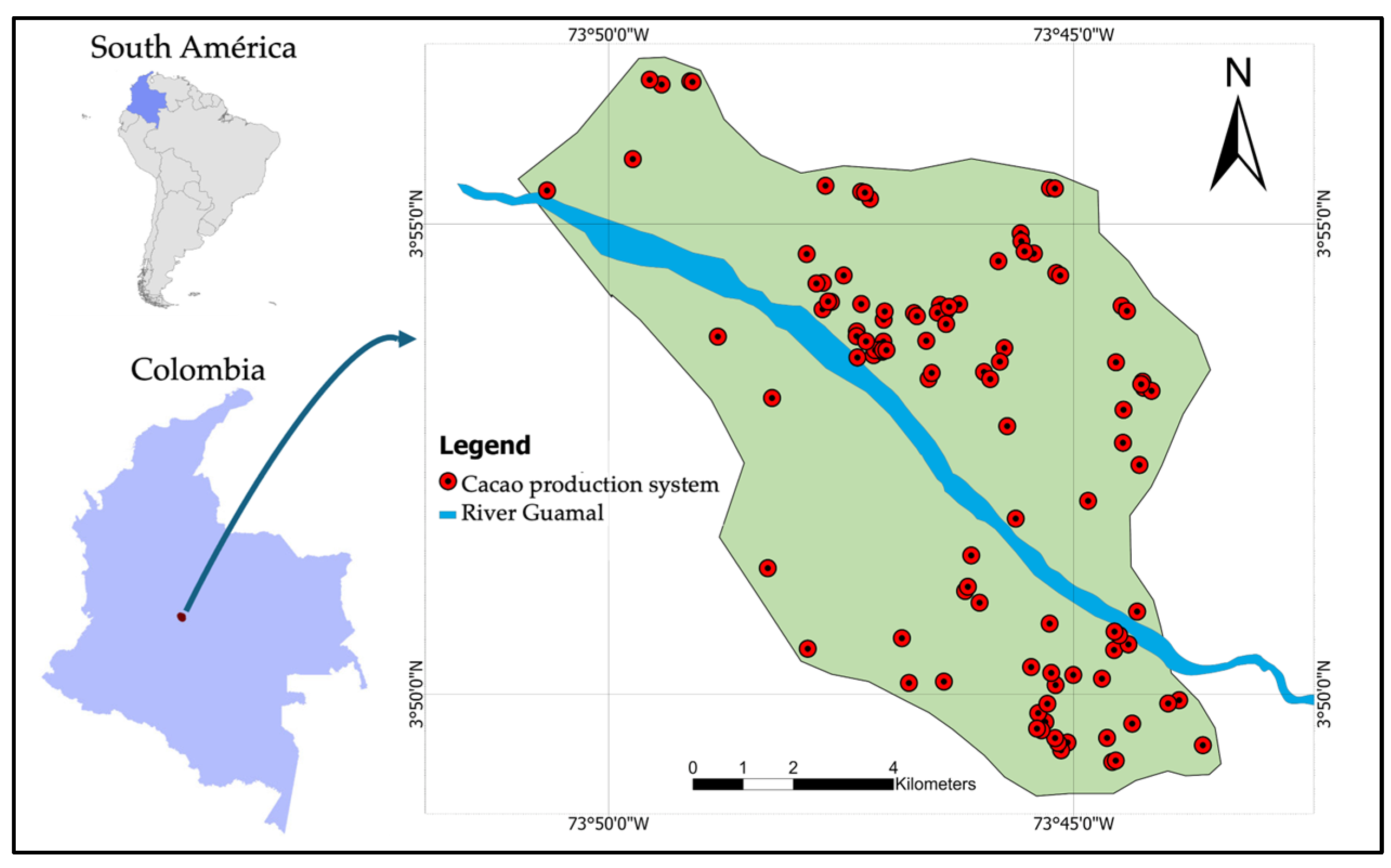
The research was conducted in selected cacao production systems in the municipality of Guamal (Meta, Colombia), located in the Llanos Piedmont subregion (Figure 1). The study area has a humid tropical climate, with a mean annual temperature of 25.1 °C, average annual precipitation of 4578.8 mm, elevations ranging from 440 to 857 m above sea level, a marked dry season from December to March, and a rainy season from April to November [33]. The area is characterized by a humid tropical climate, with vegetation dominated by foothill forests and lowland plains. The landscape forms part of a fluvial–piedmont setting, with predominantly gently undulating to nearly level relief. Soils have developed from alluvial and fluvial sandy deposits, showing local textural variation related to depositional processes. In the Llanos Piedmont, soils are commonly acidic, as reflected here by pH values between 3.8 and 6.0 (mean = 4.57) and exchangeable Al3+ contents of 0.05 to 4.90 cmolc kg−1, conditions that may constrain nutrient availability and crop performance. This geomorphological setting contributes to spatial differences in drainage, particle-size distribution, bulk density, and soil chemical properties. The dominant soils in the study area include Oxisols, Entisols, and Inceptisols, which are generally acidic and may present high aluminum saturation [34,35].

2.2. Soil Sampling

This study was based on an observational field survey designed to characterize soil fertility attributes and SOC stocks across commercial cacao production units distributed within the study area. Prior to sampling, reconnaissance surveys involving transect walks and auger observations had been conducted in the area as part of previous projects. Because the selected sampling points were located on smallholder farms under active cacao cultivation, site access was managed directly with landholders, and formal permits were not required in all cases. A total of 107 soil samples were collected across the study area. Samples were taken from 0 to 0.30 m, representing the management-sensitive topsoil layer that strongly influences nutrient availability, root development, microbial activity, and SOC dynamics. At each site, georeferenced sampling locations were recorded using a Garmin GPSMAP 76CSx (Garmin International, Inc., Olathe, KS, USA) to ensure spatial accuracy and reproducibility. Sampling was carried out between July and November 2025. At each location, one composite sample was obtained by pooling five subsamples collected within the plot using a cross-shaped pattern (one central point and four peripheral points). This pattern was applied consistently across plots to reduce microscale heterogeneity and improve representativeness. Subsamples were thoroughly mixed in the field, placed in clean, labeled bags, transported to the laboratory, and processed upon arrival prior to analysis to minimize physicochemical alteration.

2.3. Laboratory Analysis

Previously, samples were air-dried, gently disaggregated, and sieved prior to analysis. Soil pH was measured potentiometrically in a 1:1 (w/v) soil-to-water suspension. Soil organic carbon (SOC) was determined using the Walkley–Black method and corrected using a recovery factor (1.33) to approximate total organic carbon [35]. Available phosphorus (Pavail) was extracted using the Bray II method. Exchangeable bases (Ca2+, Mg2+, K+, and Na+) were extracted with 1 N ammonium acetate (NH4OAc). Micronutrients (Fe, Mn, Zn, and Cu) were determined using the DTPA extraction method to estimate their plant-available fraction. Particle-size distribution was determined by the pipette method after organic-matter removal and dispersion [35,36]. Bulk density (BD) was determined using a 5 cm graduated cylinder of known volume. Samples were oven-dried at 105 °C to constant weight, and BD was calculated as oven-dry mass per cylinder volume [35]. Visible roots and crop residues were removed before measurement, and no correction for coarse fragments was applied because they were negligible in the sampled topsoil layer. Effective cation exchange capacity (ECEC) was calculated as the sum of exchangeable bases and exchangeable Al (ECEC = Ca + Mg + K + Na + Al). Aluminum saturation (Al sat, %) was computed as (Al/ECEC) × 100. All reagents and solutions were of analytical grade. Quality control included duplicate analyses.

2.4. Soil Organic Carbon Stock Calculation

Soil organic carbon (SOC) stocks (Mg C ha−1) were calculated for a depth of 0–0.30 m in accordance with the methodology proposed by the Intergovernmental Panel on Climate Change [37] (Equation (1)). SOC stock was estimated based on total soil organic carbon content, bulk density, and sampling depth, according to the following equation:
SOC stock (Mg C ha−1) = OC (%) × (ρ × 100) × Depth
where
SOC stock = soil organic carbon stock (Mg C ha−1);
OC = soil organic carbon content (%);
ρ = soil bulk density (g cm−3);
Depth = sampling depth (m).

2.5. Statistical Analysis and Spatial Interpolation

Descriptive statistics (minimum, maximum, standard deviation, and coefficient of variation) were computed in IBM SPSS Statistics, version 25.0 (IBM Corp., Armonk, NY, USA), to characterize the magnitude and variability of soil fertility attributes and SOC stocks across the sampled cacao production systems. Normality was assessed using the Kolmogorov–Smirnov test (α = 0.05). Because several variables deviated from normality (p < 0.05), Spearman’s rank correlation was used to examine the interrelationships among soil variables and SOC-related attributes. Principal component analysis (PCA) was used to reduce dimensionality and identify dominant patterns of variation among the measured soil variables, including pH, organic carbon (OC%), available phosphorus (Pavail), exchangeable Al3+, K+, Ca2+, Mg, Na+, and bulk density (BD); variables were standardized (z-scores) prior to PCA to account for differences in measurement units. The spatial distribution of SOC stocks (0–30 cm) and selected soil fertility attributes was represented using inverse distance weighting (IDW) interpolation in ArcGIS 10.1, according to:
Z ^ x 0 = i = 1 n w i Z ( x i ) i = 1 n w i ,   w i = 1 d i p  
where Z ^ (x0) is the predicted value at location x0, Z(xᵢ) is the observed value at sampled point xᵢ, dᵢ is the distance between locations, and p is the power parameter. Default ArcGIS settings were used for interpolation. These analyses were used to: (i) describe the variability of soil fertility indicators and SOC stocks, (ii) examine their interrelationships through correlation and PCA, and (iii) visualize the spatial distribution of SOC stocks and selected fertility attributes across the study area.

3. Results and Discussion

Across the studied cacao systems, soil acidity, nutrient status, and SOC stocks showed marked variability and clear interrelationships. The following subsections examine these patterns from complementary descriptive, multivariate, and spatial perspectives.

3.1. Descriptive Characterization of Soil Fertility Attributes

Table 1 summarizes the descriptive statistics of soil physicochemical properties in the sampled cacao production systems. Soil pH ranged from 3.8 to 6.0 (mean = 4.57). Although the coefficient of variation was numerically low (CV = 8.94%), the logarithmic nature of pH indicates substantial differences in acidity across sampling points, spanning from extremely acidic to moderately acidic conditions. At the more acidic end of the pH range, soil acidity may reduce nutrient availability and increase the risk of Al toxicity, whereas this constraint is less likely at sites with pH above 5.5 [38]. Soil organic carbon (SOC, %) displayed moderate variability (CV = 29.57%), ranging from 0.24 to 1.87%. This spatial heterogeneity may reflect differences in organic inputs, ground cover, and site-specific management practices. Comparable variability has been reported in cocoa-based systems, where stand age, shade structure, and non-uniform soil fertility management generate short-distance differences in SOC and nutrient availability [23,26,31,39]. In line with this, cacao-based agroforestry systems are frequently reported to promote SOC accumulation through sustained litter inputs and belowground carbon contributions [40]. The particle-size distribution indicates predominantly sandy soils (mean sand = 68.3%) with low clay contents (mean = 5.2%). This texture is consistent with limited mineral surface area for organo–mineral protection and, therefore, a lower capacity to stabilize SOC as mineral-associated organic matter (MAOM), making SOC more dependent on recent organic inputs and management. The strong heterogeneity in Pavail (CV = 115.33%) further suggests pronounced spatial variability in fertility constraints, likely driven by site-specific management history and the interaction between soil acidity and P availability in highly weathered tropical environments. Similar patchy nutrient patterns have been described in cocoa agroecosystems, where localized fertilizer inputs, liming history, litter redistribution, and differences in canopy cover contribute to marked within-farm variation in soil chemical properties [32,40].
Exchangeable base cations showed pronounced spatial variability across the sampled cacao production systems. Calcium exhibited the highest relative variability (CV = 86.59%), followed by Mg2+ (CV = 79.78%) and K+ (CV = 68.30%), whereas Na+ showed moderate variability (CV = 44.55%). This pattern may reflect contrasts in soil management (e.g., fertilization and liming) and inherent soil variability among production units. Mean concentrations of exchangeable bases were generally low, and the wide ranges observed for Ca2+ (0.12–8.25 cmol_c kg−1) and Mg2+ (0.01–1.62 cmol_c kg−1) indicate strong differences in base status across sites. The low minima suggest nutrient limitations under acidic conditions (mean pH = 4.57), consistent with Al-related constraints on nutrient supply [41]. Conversely, the highest values suggest that some locations retain appreciable base cations, likely associated with more favorable soil chemical conditions and/or sustained amendments such as liming. Pavail showed the greatest heterogeneity (CV = 115.33%), ranging from 1.2 to 196.7 mg kg−1, indicating highly contrasting P availability across production units. This variability is consistent with differences in fertilization history and the strong chemical control of P under acidic, highly weathered tropical soils, where sorption and precipitation reactions involving Fe/Al oxides can sharply limit plant-available P.
Exchangeable Al3+ also varied widely (CV = 67.57%; 0.05–4.90 cmol_c kg−1). In strongly acidic soils, elevated Al is a key fertility constraint because it can restrict root growth and reduce the effective uptake of Ca2+, Mg2+, and P, reinforcing the need to interpret base status and P availability jointly with acidity and Al-related constraints. Bulk density (BD) showed moderate variability (CV = 16.02%), with a mean of 1.17 g cm−3. However, BD ranged from 0.76 to 1.93 g cm−3. The upper end of this range is consistent with localized compaction, which can restrict root penetration, reduce aeration and infiltration, and indirectly affect nutrient uptake and microbial activity. Because BD is also a direct component of SOC stock calculations, its variability is critical for interpreting spatial differences in carbon storage across agroecosystems, and the particle-size distribution indicates predominantly sandy soils (mean sand = 68.3%) with low clay contents (mean clay = 5.2%; range 2–24%). This texture implies limited mineral surface area for organo–mineral protection and, therefore, reduced capacity to stabilize SOC as mineral-associated organic matter (MAOM). Under these conditions, SOC retention is expected to depend more strongly on recent organic inputs, ground cover, and management practices than on long-term mineral stabilization.

3.2. Spearman Correlation Analysis of Soil Fertility Attributes

To explore pairwise associations among the measured soil fertility attributes, Spearman’s rank correlation analysis was applied to the 107 sampled sites. Table 2 reports Spearman’s rank correlation coefficients (ρ) among soil physicochemical variables (n = 107). Values of ρ range from −1 to 1, where coefficients close to 1 indicate strong positive associations, coefficients close to −1 indicate strong negative associations, and values near 0 indicate weak or no monotonic association. Statistical significance was evaluated using two-tailed tests (p < 0.05 and p < 0.01).
The correlation matrix shows positive associations between pH and Ca2+ (ρ = 0.56, p < 0.01) and between pH and Pavail (ρ = 0.54, p < 0.01), suggesting that less acidic conditions are linked to higher base status and greater P availability. Conversely, exchangeable Al3+ was strongly and negatively associated with pH (ρ = −0.75, p < 0.01) and with Pavail (ρ = −0.66, p < 0.01), consistent with acidity-driven constraints in which Al increases under low pH and P availability decreases. OC% showed positive correlations with K+ (ρ = 0.49, p < 0.01) and Na+ (ρ = 0.43, p < 0.01), which may indicate greater retention of exchangeable cations in soils with higher organic matter and/or co-variation with management practices. In addition, K+ and Na+ were positively associated (ρ = 0.44, p < 0.01), reflecting their coupled behavior within the exchange complex, and BD was negatively correlated with OC% (ρ = −0.29, p < 0.01), suggesting that soils with higher organic carbon tend to exhibit lower BD, consistent with improved structural condition. These relationships highlight the coupled nature of soil acidity, exchange chemistry, and nutrient availability, and they provide a mechanistic basis for interpreting fertility and SOC patterns across the agroecosystems.

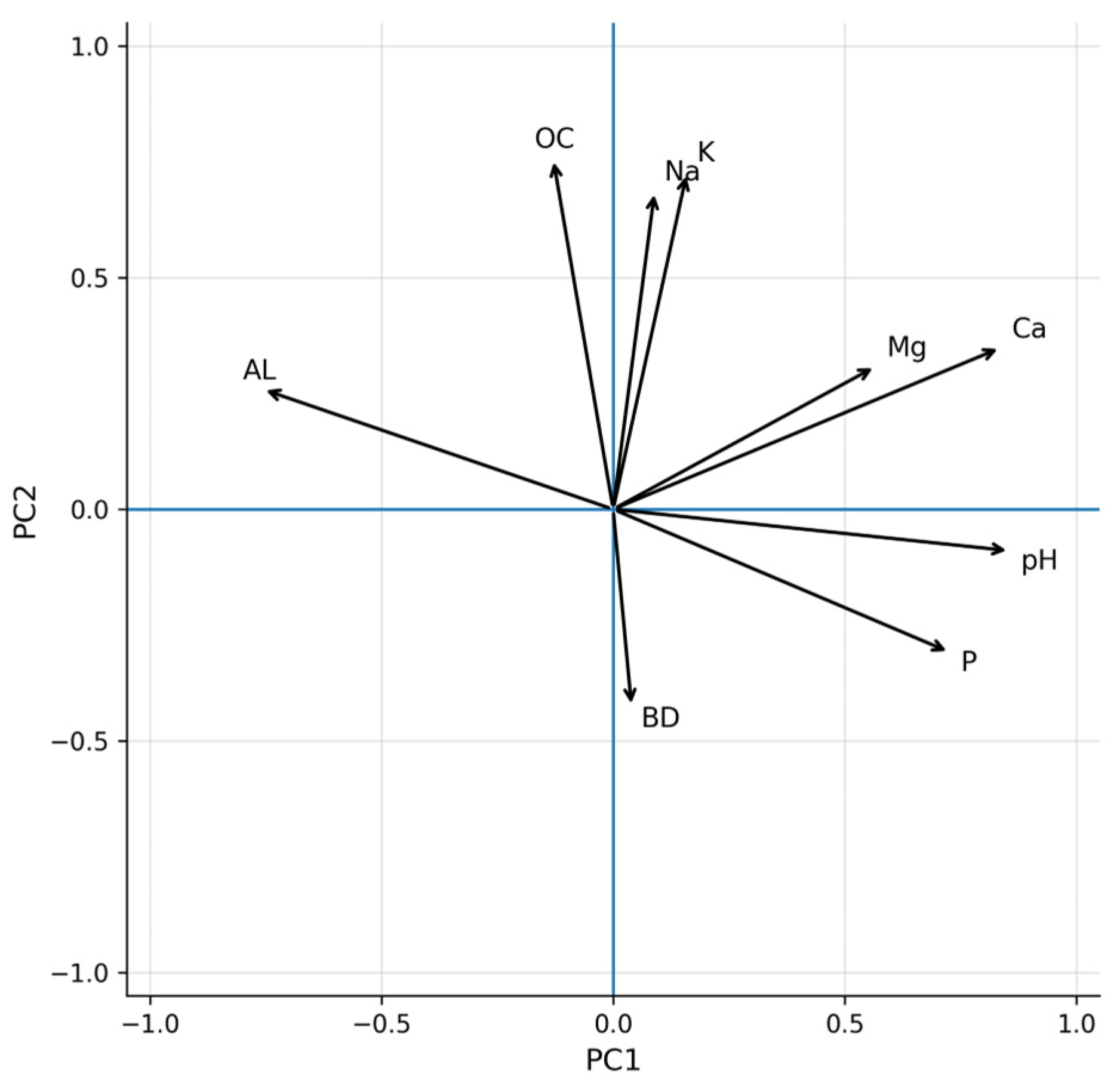
3.3. Multivariate Structure of Soil Fertility Gradients: Principal Component Analysis (PCA)

To complement the bivariate correlation analysis, PCA was used to identify the main multivariate gradients underlying variation in soil physicochemical properties across the sampled cacao production systems. The PCA results for the soil samples are summarized in Table 3, which reports the variance explained by each component based on the measured physicochemical variables. For interpretation, sample scores were projected onto the plane defined by the first two principal components (Figure 2). PC1 accounted for 32.50% of the total variance, whereas PC2 explained 24.24%, yielding a cumulative variance of 56.74%. The corresponding eigenvalues were 2.93 for PC1 and 2.18 for PC2. PC1 was primarily driven by positive loadings for pH (0.29), Pavail (0.24), and exchangeable Ca2+ (0.28), variables that jointly reflect soil chemical fertility and the status of the exchange complex. Collectively, this pattern indicates that the dominant differences among sampling locations are structured along a soil chemical gradient governed by base saturation and its interaction with soil acidity, thereby modulating nutrient availability.
In contrast, PC2 exhibited strong positive loadings for organic carbon (SOC; 0.35), exchangeable K+ (0.33), and Na+ (0.32), suggesting that this axis captures variation related to the retention of exchangeable base cations, consistent with the role of organic matter as a key contributor to cation exchange processes [42]. Functionally, PC2 can be interpreted as an index of the soil’s capacity to store and retain nutrients within cacao production systems. Taken together, the ordination indicates that PC1 primarily reflects a gradient of nutrient availability regulated by soil acidity, whereas PC2 describes organic carbon accumulation as the underpinning for cation retention and chemical buffering. Accordingly, soils scoring high on both components tend to exhibit a more balanced edaphic condition, combining greater nutrient supply with an organic matrix that helps sustain fertility in cacao agroecosystems.

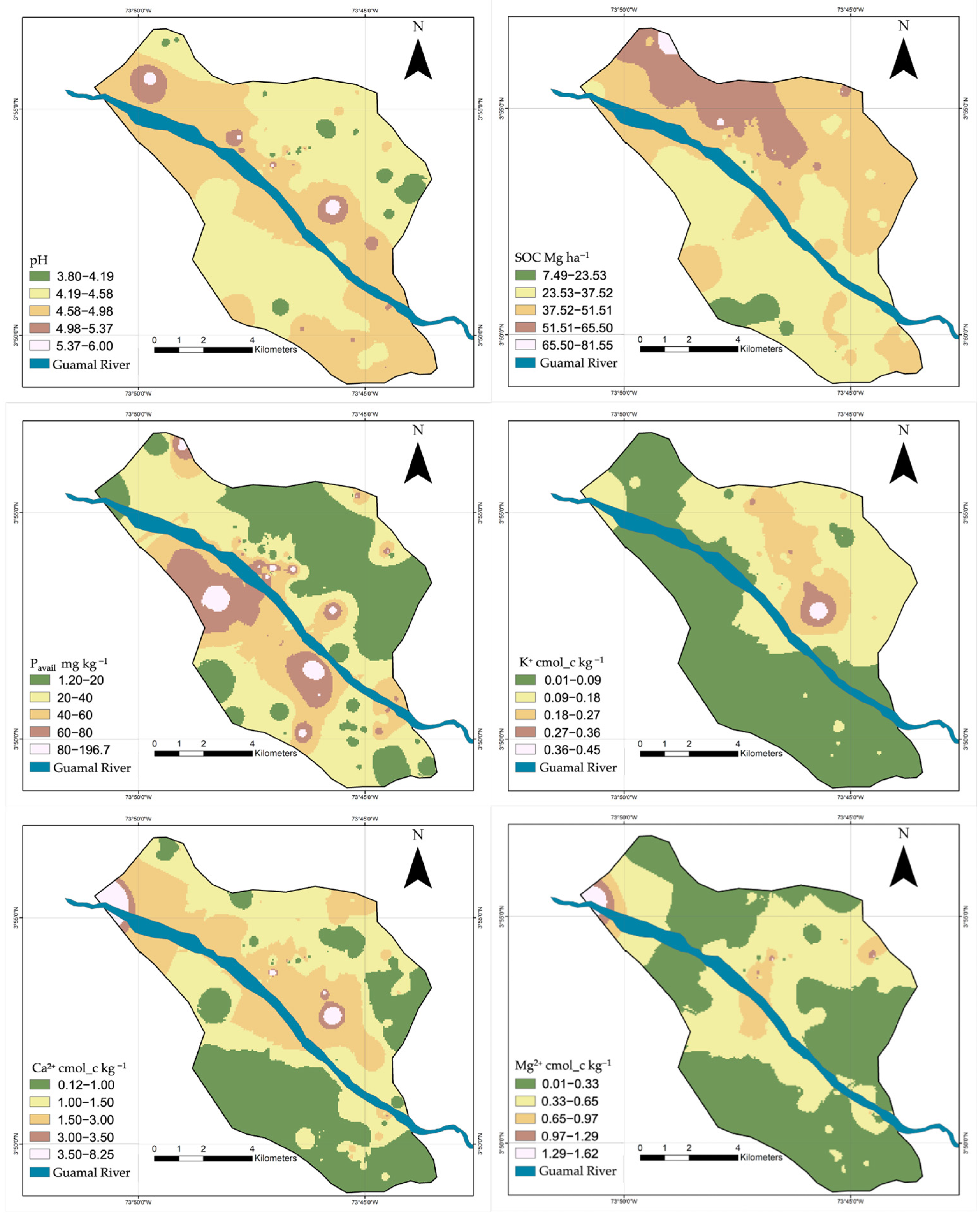
3.4. Spatial Variability of Soil Fertility Attributes and SOC Stocks

Figure 3 reveals a spatially heterogeneous distribution of soil fertility attributes and soil organic carbon (SOC) stocks (Mg ha−1) across the cacao systems, forming a mosaic pattern consistent with the concurrent influence of edaphic constraints and management-driven variability at the farm scale. Soil pH is largely within strongly to moderately acidic ranges (3.8–6.0), whereas localized areas with comparatively higher pH suggest spatially uneven acidity amelioration (e.g., liming) and/or legacy effects linked to differences in historical management intensity. Consistent with this heterogeneity, SOC stocks span a wide range (7.49–81.55 Mg ha−1) and display short-range gradients, as expected in tropical agroecosystems where C storage is highly sensitive to the spatial distribution of necromass inputs (litterfall and fine-root turnover), shade-tree cover, soil disturbance, and bulk density, the latter directly constraining stock estimates. Pavail shows a distinctly leptokurtic pattern, with discrete hotspots reaching 196.7 mg kg−1 embedded within a broader matrix of low-to-moderate concentrations, consistent with localized phosphate fertilizer applications superimposed on the acid–soil geochemical control of P (sorption and/or precipitation with reactive Fe and Al phases). Exchangeable base cations (K+, Ca2+, and Mg2+) also exhibit pronounced spatial variability, with areas of higher base status/base saturation tending to co-occur with relatively higher pH, supporting a coupled influence of the pedogenic setting and site-specific management on fertility conditions. This spatial behavior is consistent with the coexistence of plots with contrasting stand ages and management trajectories in predominantly smallholder systems [43,44], where agronomic practices and fertilization are typically non-standardized (variable sources, rates, frequencies, and point applications), generating localized nutrient accumulation and patchy acidity correction [45,46]. In addition, the generally low level of agronomic intensification in many farms likely promotes fertility dynamics dominated by irregular nutrient replenishment, selective depletion, and leaching losses, thereby amplifying short-distance variability and reinforcing the observed mosaic of fertility and SOC storage across the landscape [39,47].

3.5. Magnitude and Variability of SOC Stocks in Cacao Production Systems

Table 4 shows the descriptive statistics of the variables used to estimate SOC stocks, including organic carbon concentration (OC%), bulk density (BD), and SOC stocks (0–30 cm). OC% showed moderate spatial variability (CV = 29.57%), while BD exhibited lower variability (CV = 16.02%). SOC stocks ranged from 7.49 to 81.55 Mg ha−1 (mean = 41.10 Mg ha−1; CV = 31.05%), indicating substantial spatial contrasts in carbon storage across sampling locations. This variability may reflect differences in management practices that influence organic inputs (e.g., compost application) as well as variation in tree cover within cacao production systems. Given the predominantly sandy texture and low clay contents observed in the study area (Table 1), the capacity for long-term mineral stabilization of SOC as MAOM is likely constrained, making SOC stocks more dependent on recent organic inputs and surface residue dynamics (i.e., POM-related pathways). In contrast, BD variability is consistent with spatial heterogeneity in soil physical condition and particle-size distribution, which can be shaped by local relief and pedogenetic processes that control soil formation and, consequently, the spatial distribution of soil properties.
Soil organic carbon (SOC) stock averaged 41.10 Mg C ha−1 in the 0–30 cm layer, which can be considered moderate for tropical production systems. SOC stocks showed moderate spatial variability (CV = 31.05%) and ranged from 7.49 to 81.55 Mg C ha−1, indicating pronounced contrasts in carbon storage across sampling locations. The lowest values may reflect localized degradation and/or limited organic matter inputs, whereas the highest values suggest strong sequestration potential in specific production units, likely linked to differences in agronomic management and vegetation cover, particularly under agroforestry conditions. In this study, mean SOC stock (41.10 Mg C ha−1) was lower than values reported for assessments using deeper sampling intervals (0–150 cm), where cacao agroforestry systems reach 135–190 Mg C ha−1 and forests up to 209 Mg C ha−1 [20]. This contrast is expected because carbon stored in surface layers represents only a fraction of the total stock across the soil profile. When focusing on the topsoil alone, however, the values observed here fall within the range reported for tropical agricultural systems such as cacao.
Several studies have quantified SOC stocks in cacao systems across geographic regions, as summarized in Table 5. In Latin America, available evidence includes Brazil, Bolivia, Colombia, and Peru, whereas in Africa a substantial body of work has been reported for major cocoa-producing countries such as Ghana, Cameroon, and Ivory Coast. The mean SOC stock in the present study (41.10 Mg C ha−1; 0–30 cm) is lower than values reported for Bolivia (86.3 Mg C ha−1; 0–25 cm) [48] and Peru (119.96–131.96 Mg C ha−1; 0–30 cm) [49], and below the estimate reported for Brazil (81.7 Mg C ha−1; 0–20 cm) [50]. Differences among studies are expected and likely reflect variation in production system (agroforestry versus full-sun cocoa), stand age, and sampling depth used for stock calculations. Stand age, in particular, has been identified as an important determinant of carbon storage in cocoa-based systems, with higher SOC stocks often observed as plantations mature [23].
The maximum SOC stock recorded in the present study was 81.55 Mg C ha−1 (0–30 cm). Comparable magnitudes have been reported for cacao systems in Bolivia evaluated at 0–25 cm with a bulk density of 1.20 g cm−3 [48], close to the bulk density observed here (mean = 1.17 g cm−3). This comparison highlights bulk density as a key parameter in SOC stock estimation because it directly determines soil mass per unit volume and therefore affects the amount of carbon quantified per unit area. In addition, sampling depth remains critical for cross-study comparisons, as differences in the depth interval used for stock calculations can generate substantial discrepancies in estimated SOC stocks.
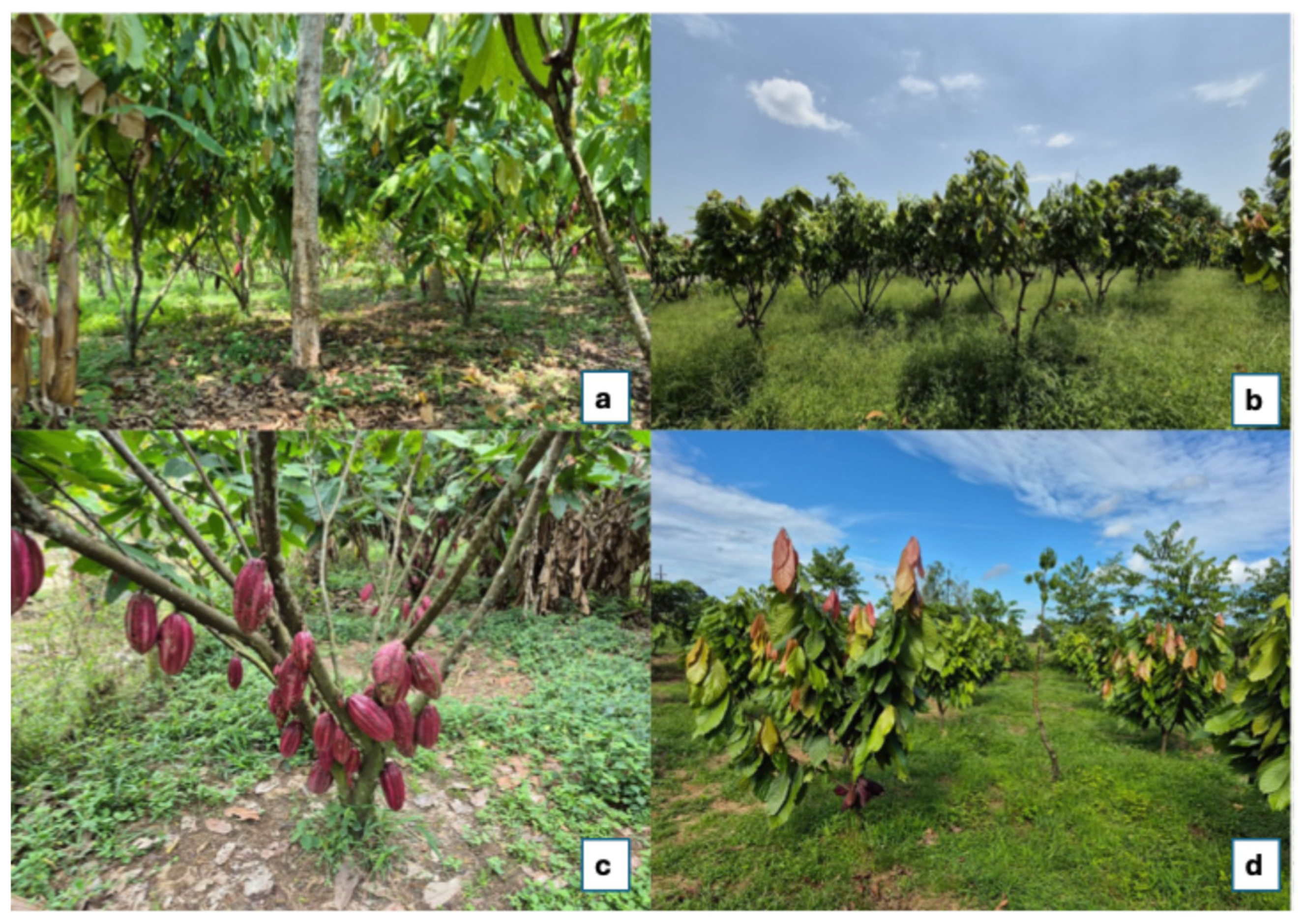
Similarly high SOC stocks have been reported for cacao systems in Brazil and Côte d’Ivoire, with values of 81.7 and 83.4 Mg C ha−1, respectively [50,52]. This convergence may reflect comparable production conditions, as cacao in these study areas is commonly cultivated in association with trees under agroforestry arrangements (Figure 4). Such systems can promote sustained organic matter inputs through litterfall and root turnover and maintain more continuous soil cover, which may enhance SOC accumulation and persistence [26,55,56]. In addition, functional interactions between shade trees and cacao can increase biomass production and diversify organic inputs, further supporting carbon sequestration in cacao-based agroecosystems [23,57].

4. Conclusions

Cacao soils in the Llanos Piedmont of Colombia vary between extremely acidic and moderately acidic and exhibited strong spatial heterogeneity in key fertility indicators, particularly available P and exchangeable bases, reflecting contrasting constraints across production units. SOC stocks in the 0–30 cm layer averaged 41.10 Mg C ha−1 and ranged widely (7.49–81.55 Mg C ha−1), indicating marked within-agroecosystem variability in carbon storage. Correlation patterns and multivariate structure supported an acidity-controlled mechanism in which higher pH was associated with greater Ca2+ and P availability, whereas exchangeable Al3+ increased under more acidic conditions, reinforcing Al-related limitations on nutrient supply. Our findings highlight the role of cacao production systems as relevant soil carbon reservoirs under acidic tropical conditions, while showing marked within-system variability linked to soil fertility constraints and local management heterogeneity. Overall, these results highlight the need for site-specific management that jointly addresses acidity correction, targeted nutrient replenishment, and practices that maintain organic inputs and soil cover, thereby improving soil fertility while strengthening the climate-mitigation potential of cacao production systems.

Author Contributions

Conceptualization, M.A.T.-M. and R.J.-B.; methodology, M.A.T.-M., J.M.T.-G. and R.J.-B.; formal analysis, A.F.G.-D. and M.A.T.-M.; investigation, F.J.M.-E., J.M.T.-G. and A.F.G.-D.; resources, M.A.T.-M.; data curation, A.F.G.-D. and J.M.T.-G.; writing—original draft preparation, M.A.T.-M. and A.F.G.-D.; writing—review and editing, R.J.-B., M.A.T.-M., J.M.T.-G. and F.J.M.-E.; visualization, A.F.G.-D. and M.A.T.-M.; supervision, R.J.-B. and M.A.T.-M. All authors have read and agreed to the published version of the manuscript.

Funding

This study was supported by financial resources provided by the Mayor’s Office of Guamal, Meta, Colombia (Alcaldía Municipal de Guamal), Pro-Gua-001-2025.

Data Availability Statement

All the data are contained in the article.

Acknowledgments

The authors gratefully acknowledge the Mayor’s Office of Guamal (Meta, Colombia), through the Secretaría de Agricultura y Desarrollo Económico, for authorizing the use of soil analysis data from cacao production units sampled in 2025 and for supporting the generation of applied knowledge for the rural productive context.

Conflicts of Interest

The authors declare no conflicts of interest.

References

  1. Bellard, C.; Marino, C.; Courchamp, F. Ranking threats to biodiversity and why it doesn’t matter. Nat. Commun. 2022, 13, 2616. [Google Scholar] [CrossRef]
  2. Wang, Y.; Liang, D.; Wang, J.; Zhang, Y.; Chen, F.; Ma, X. An analysis of regional carbon stock response under land use structure change and multi-scenario prediction, a case study of Hefei, China. Ecol. Indic. 2023, 151, 110293. [Google Scholar] [CrossRef]
  3. Ntiamoah, E.B.; Chandio, A.A.; Yeboah, E.N.; Twumasi, M.A.; Siaw, A.; Li, D. How do carbon emissions, economic growth, population growth, trade openness and employment influence food security? Recent evidence from the East Africa. Environ. Sci. Pollut. Res. 2023, 30, 51844–51860. [Google Scholar] [CrossRef]
  4. Kabato, W.; Getnet, G.T.; Sinore, T.; Nemeth, A.; Molnár, Z. Towards climate-smart agriculture: Strategies for sustainable agricultural production, food security, and greenhouse gas reduction. Agronomy 2025, 15, 565. [Google Scholar] [CrossRef]
  5. Wang, X. Managing land carrying capacity: Key to achieving sustainable production systems for food security. Land 2022, 11, 484. [Google Scholar] [CrossRef]
  6. Liang, Y.; Hashimoto, S.; Liu, L. Integrated assessment of land-use/land-cover dynamics on carbon storage services in the Loess Plateau of China from 1995 to 2050. Ecol. Indic. 2021, 120, 106939. [Google Scholar] [CrossRef]
  7. Moukanni, N.; Brewer, K.M.; Gaudin, A.C.; O’Geen, A.T. Optimizing carbon sequestration through cover cropping in Mediterranean agroecosystems: Synthesis of mechanisms and implications for management. Front. Agron. 2022, 4, 844166. [Google Scholar] [CrossRef]
  8. Brewer, K.M.; Muñoz-Araya, M.; Martinez, I.; Marshall, K.N.; Gaudin, A.C. Long-term integrated crop-livestock grazing stimulates soil ecosystem carbon flux, increasing subsoil carbon storage in California perennial agroecosystems. Geoderma 2023, 438, 116598. [Google Scholar] [CrossRef]
  9. Rodrigues, C.I.D.; Brito, L.M.; Nunes, L.J. Soil carbon sequestration in the context of climate change mitigation: A review. Soil Syst. 2023, 7, 64. [Google Scholar] [CrossRef]
  10. Mandal, A.; Toor, A.S.; Dhaliwal, S.S. Assessment of sequestered organic carbon and its pools under different agricultural land-uses in the semi-arid soils of south-western Punjab, India. J. Soil Sci. Plant Nutr. 2020, 20, 259–273. [Google Scholar] [CrossRef]
  11. Kumar, U.; Cheng, M.; Islam, M.J.; Maniruzzaman, M.; Nasreen, S.S.; Haque, M.E.; Rahman, M.T.; Jahiruddin, M.; Bell, R.W.; Jahangir, M.M.R. Long-term conservation agriculture increases sulfur pools in soils together with increased soil organic carbon compared to conventional practices. Soil Tillage Res. 2022, 223, 105474. [Google Scholar] [CrossRef]
  12. Reichenbach, M.; Fiener, P.; Garland, G.; Griepentrog, M.; Six, J.; Doetterl, S. The role of geochemistry in organic carbon stabilization against microbial decomposition in tropical rainforest soils. Soil 2021, 7, 453–475. [Google Scholar] [CrossRef]
  13. Das, A.; Mishra, G.; Lakra, P.C.; Kumar, S.; Mishra, S.N. Impact of land uses on soil organic carbon dynamics in the Indian Himalayan Region. In Soil Carbon Dynamics in Indian Himalayan Region; Mishra, G., Giri, K., Nath, A.J., Francaviglia, R., Eds.; Springer Nature: Singapore, 2023; pp. 55–75. [Google Scholar] [CrossRef]
  14. Awazi, N.P.; Tsufac, A.R. Conceptual and Empirical Overview on Soils, Soil Fertility, and Soil Macro-Fauna in Cocoa-Based Agroforests. In Agroforestry for a Sustainable Future: The Place of Carbon Credits and Markets; Palgrave Macmillan: Cham, Switzerland, 2025; pp. 79–124. [Google Scholar] [CrossRef]
  15. Maenhout, P.; Di Bene, C.; Cayuela, M.L.; Diaz-Pines, E.; Govednik, A.; Keuper, F.; Mavsar, S.; Mihelic, R.; O’Toole, A.; Schwarzmann, A.; et al. Trade-offs and synergies of soil carbon sequestration: Addressing knowledge gaps related to soil management strategies. Eur. J. Soil Sci. 2024, 75, e13515. [Google Scholar] [CrossRef]
  16. Adiyah, F.; Fuchs, M.; Micheli, E.; Dawoe, E.; Kovács, E. Cocoa farmers perceptions of soil organic carbon effects on fertility, management and climate change in the Ashanti region of Ghana. Afr. J. Agric. Res. 2021, 17, 714–725. [Google Scholar] [CrossRef]
  17. Rojas González, S.; Pesca Moreno, A.; Tarazona Yanes, M.; Calderón Medina, C.L.; Zapata Arango, P.C. CACAO Agricultura Climáticamente Inteligente con Énfasis en Agroforestería: Experiencias en el Ariari, Meta, Colombia; AGROSAVIA: Mosquera, Colombia, 2019. [Google Scholar] [CrossRef]
  18. Zuliani, L. Assessing Agroecology in Small-Scale Cocoa Production Systems in São Tomé: From Indicator Co-development to Measurement. Master’s Thesis, Master’s Degree Program in Environmental Sciences, ETH Zurich, Zurich, Switzerland, 2025. [Google Scholar] [CrossRef]
  19. Vallejos-Torres, G.; Chuchon-Remon, R.; Gaona-Jimenez, N.; Marín, C.; Cruz, J.; Solórzano, R. Geospatial distribution of cadmium in soil profiles of cacao (Theobroma cacao L.) plantations in the Peruvian Amazon basin. Front. Environ. Sci. 2026, 14, 1710127. [Google Scholar] [CrossRef]
  20. Suárez, J.C.; Almario-Cabrera, E.; Lavelle, P. Cocoa based agroforestry systems enhance carbon storage in deep horizons of Amazonian soils. Agrofor. Syst. 2025, 99, 218. [Google Scholar] [CrossRef]
  21. Somarriba, E.; Cerda, R.; Orozco, L.; Cifuentes, M.; Dávila, H.; Espin, T.; Mavisoy, H.; Ávila, G.; Alvarado, E.; Poveda, V.; et al. Carbon stocks and cocoa yields in agroforestry systems of Central America. Agric. Ecosyst. Environ. 2013, 173, 46–57. [Google Scholar] [CrossRef]
  22. Asigbaase, M.; Dawoe, E.; Lomax, B.H.; Sjogersten, S. Biomass and carbon stocks of organic and conventional cocoa agroforests, Ghana. Agric. Ecosyst. Environ. 2021, 306, 107192. [Google Scholar] [CrossRef]
  23. Arthur, A.; Acquaye, S.; Cheng, W.; Dogbatse, J.A.; Konlan, S.; Domfeh, O.; Quaye, A.K. Soil carbon stocks and main nutrients under cocoa plantations of different ages. Soil Sci. Plant Nutr. 2022, 68, 99–103. [Google Scholar] [CrossRef]
  24. Sonwa, D.J.; Weise, S.F.; Nkongmeneck, B.A.; Tchatat, M.; Janssens, M.J. Profiling carbon storage/stocks of cocoa agroforests in the forest landscape of Southern Cameroon. In Agroforestry: Anecdotal to Modern Science; Dagar, J.C., Tewari, V.P., Eds.; Springer: Singapore, 2018; pp. 739–752. [Google Scholar] [CrossRef]
  25. Schneidewind, U.L.F.; Niether, W.; Armengot, L.; Schneider, M.; Sauer, D.; Heitkamp, F.; Gerold, G. Carbon stocks, litterfall and pruning residues in monoculture and agroforestry cacao production systems. Exp. Agric. 2019, 55, 452–470. [Google Scholar] [CrossRef]
  26. Adiyah, F.; Csorba, Á.; Dawoe, E.; Ocansey, C.M.; Asamoah, E.; Szegi, T.; Fuchs, M.; Michéli, E. Soil organic carbon changes under selected agroforestry cocoa systems in Ghana. Geoderma Reg. 2023, 35, e00737. [Google Scholar] [CrossRef]
  27. Miharza, T.; Wijayanto, N.; Roshetko, J.M.; Siregar, I.Z. Carbon stocks and footprints of smallholder cacao systems in Polewali Mandar, West Sulawesi. Front. Environ. Sci. 2023, 11, 680984. [Google Scholar] [CrossRef]
  28. Hernández-Núñez, H.E.; Andrade, H.J.; Suárez-Salazar, J.C.; Sánchez, J.R.; Gutiérrez, D.R.; Gutiérrez-García, G.A.; Trujillo-Trujillo, E.; Casanoves, F. Almacenamiento de carbono en sistemas agroforestales en los Llanos Orientales de Colombia. Rev. Biol. Trop. 2021, 69, 352–368. [Google Scholar] [CrossRef]
  29. Maldonado Coy, J.F.; Wilches Fonseca, M.A. Modelo alométrico para la estimación de biomasa y carbono almacenado en árboles de marañón (Anacardium occidentale L.) en agroecosistemas del Vichada, Colombia. Nat. Soc. Desafíos Medioambient. 2026, 14, 150–175. [Google Scholar] [CrossRef]
  30. Castañeda Garzón, S.L.; Mora Garcés, A.A.; Tarazona Yanes, M.; Moreno Barragán, J. Almacenamiento y acumulación de carbono en clones de caucho en la Orinoquía colombiana. Colomb. For. 2026, 29, 1. [Google Scholar] [CrossRef]
  31. Jamioy-Orozco, D.D.; Flores, J.C.M.; Sanabria, Y.R. Indicadores químicos de calidad de suelos en sistemas productivos del Piedemonte de los Llanos Orientales de Colombia. Acta Agronómica 2015, 64, 302. [Google Scholar] [CrossRef]
  32. Castro-Franco, M.; García Ramírez, D.Y.; Jiménez López, A.F. Comparación de técnicas de interpolación espacial de propiedades del suelo en el piedemonte llanero colombiano. Tecnura 2017, 21, 78–95. [Google Scholar] [CrossRef]
  33. IDEAM. Consulta y descarga de datos hidrometeorológicos—DHIME. Instituto de Hidrología, Meteorología y Estudios Ambientales. Available online: http://dhime.ideam.gov.co/atencionciudadano/ (accessed on 2 March 2026).
  34. Cárdenas, C.A.N. La Potencialidad del Turismo Sostenible en los Municipios de Cubarral y Guamal, en el Departamento del Meta. 2022. Available online: https://repository.cesa.edu.co/server/api/core/bitstreams/1b710347-5458-41c2-a7ed-20585915d80c/content (accessed on 2 March 2026).
  35. Instituto Geográfico Agustín Codazzi (IGAC). Métodos Analíticos del Laboratorio de Suelos, 6th ed.; IGAC: Bogotá, Colombia, 2006; p. 648. Available online: https://books.google.co.jp/books/about/M%C3%A9todos_anal%C3%ADticos_del_laboratorio_de.html?id=Zz7eXwAACAAJ&redir_esc=y (accessed on 1 March 2026).
  36. Robert, U.W.; Etuk, S.E.; Agbasi, O.E. Modified water displacement method and its use for determination of bulk density of porous materials. J. Renew. Energy Mech. 2019, 2, 1–16. [Google Scholar] [CrossRef]
  37. Delmotte, V.; Zhai, P.; Pörtner, H.-O.; Roberts, D.; Skea, J.; Shukla, P.R.; Pirani, A.; Moufouma-Okia, W.; Péan, C.; Pidcock, R.; et al. (Eds.) Calentamiento Global de 1.5 °C; IPCC: Geneva, Switzerland, 2018; Available online: https://www.ipcc.ch/site/assets/uploads/sites/2/2019/09/IPCC-Special-Report-1.5-SPM_es.pdf (accessed on 3 March 2026).
  38. Dogbatse, J.A.; Arthur, A.; Padi, F.K.; Konlan, S.; Quaye, A.K.; Owusu-Ansah, F.; Awudzi, G.K. Influence of acidic soils on growth and nutrient uptake of cocoa (Theobroma cacao L.) varieties. Commun. Soil Sci. Plant Anal. 2020, 51, 2280–2296. [Google Scholar] [CrossRef]
  39. Hartemink, A.E. Nutrient stocks, nutrient cycling, and soil changes in cocoa ecosystems: A review. Adv. Agron. 2005, 86, 227–253. [Google Scholar]
  40. Krause, H.M.; Saj, S.; Rüegg, J.; Schneidewind, U.; Lory, S.; Cotter, M.; Niether, W.; Schneider, M.; Milz, J.; Cadisch, G.; et al. Successional agroforestry promotes biomass carbon storage in cocoa production systems: Results from a long-term system comparison experiment on organic and conventional systems. Agric. Ecosyst. Environ. 2025, 393, 109820. [Google Scholar] [CrossRef]
  41. Rosas Patiño, G.; Avila Pedraza, E.A.; Sánchez Castillo, V. La acidez del suelo limita la producción agrícola: Una revisión enfocada en la amazonia colombiana. Revista Investig. Agrar. Y Ambient. 2024, 16, 185–211. [Google Scholar] [CrossRef]
  42. Cooper, J.; Greenberg, I.; Ludwig, B.; Hippich, L.; Fischer, D.; Glaser, B.; Kaiser, M. Effect of biochar and compost on soil properties and organic matter in aggregate size fractions under field conditions. Agric. Ecosyst. Environ. 2020, 295, 106882. [Google Scholar] [CrossRef]
  43. Numbisi, F.N.; Alemagi, D.; Degrande, A.; Van Coillie, F. Farm rejuvenation-induced changes in tree spatial pattern and live biomass species of Cocoa Agroforests in Central Cameroon: Insights for tree conservation incentives in cocoa landscapes. Sustainability 2021, 13, 8483. [Google Scholar] [CrossRef]
  44. Góngora-Duarte, A.F.; Morales-Espitia, F.J.; Trujillo-González, J.M.; Torres-Mora, M.A. Caracterización de los procesos en el beneficio del cacao (Theobroma cacao L.) en producciones a pequeña escala en el municipio de Guamal del Piedemonte llanero colombiano. TecnoLógicas 2023, 26, e2633. [Google Scholar] [CrossRef]
  45. Imran, I. Technological Innovations in Cocoa Cultivation for Enhancing Productivity and Bean Quality. J. Agric. Agribus. Welf. Technol. Humanit. Environ. Soc. Econ. 2025, 1, 90–99. [Google Scholar]
  46. Waldburger, T.; Monney, P.; Anken, T.; Cockburn, M.; Etienne, A.; Lecoeur, J.; Brini, M.; Forster, D.; Jöhr, H. Growing Cocoa in semi-arid climate—A scalable use case for digital agriculture. Agroscope Sci. 2019, 86, 1–65. [Google Scholar]
  47. Kenfack Essougong, U.P.; Slingerland, M.; Mathé, S.; Vanhove, W.; Tata Ngome, P.I.; Boudes, P.; Giller, K.E.; Woittiez, L.S.; Leeuwis, C. Farmers’ perceptions as a driver of agricultural practices: Understanding soil fertility management practices in cocoa agroforestry systems in Cameroon. Hum. Ecol. 2020, 48, 709–720. [Google Scholar] [CrossRef]
  48. Jacobi, J.; Andres, C.; Schneider, M.; Pillco, M.; Calizaya, P.; Rist, S. Carbon stocks, tree diversity, and the role of organic certification in different cocoa production systems in Alto Beni, Bolivia. Agrofor. Syst. 2014, 88, 1117–1132. [Google Scholar] [CrossRef]
  49. Goñas, M.; Rojas-Briceño, N.B.; Culqui-Gaslac, C.; Arce-Inga, M.; Marlo, G.; Pariente-Mondragón, E.; Oliva-Cruz, M. Carbon sequestration in fine aroma cocoa agroforestry systems in Amazonas, Peru. Sustainability 2022, 14, 9739. [Google Scholar] [CrossRef]
  50. Monroe, P.H.M.; Gama-Rodrigues, E.F.; Gama-Rodrigues, A.C.; Marques, J.R.B. Soil carbon stocks and origin under different cacao agroforestry systems in Southern Bahia, Brazil. Agric. Ecosyst. Environ. 2016, 221, 99–108. [Google Scholar] [CrossRef]
  51. Norgrove, L.; Hauser, S. Carbon stocks in shaded Theobroma cacao farms and adjacent secondary forests of similar age in Cameroon. Trop. Ecol. 2013, 54, 15–22. [Google Scholar]
  52. N’Gbala, F.N.G.; Guéi, A.M.; Tondoh, J.E. Carbon stocks in selected tree plantations, as compared with semi-deciduous forests in centre-west Côte d’Ivoire. Agric. Ecosyst. Environ. 2017, 239, 30–37. [Google Scholar] [CrossRef]
  53. Sterling, A.; Suárez-Córdoba, Y.D.; Orlandi, F.D.B.; Rodríguez-León, C.H. Soil–Atmosphere GHG Fluxes in Cacao Agroecosystems on São Tomé Island, Central Africa: Toward Climate-Smart Practices. Land 2025, 14, 1918. [Google Scholar] [CrossRef]
  54. Gusli, S.; Sumeni, S.; Sabodin, R.; Muqfi, I.H.; Nur, M.; Hairiah, K.; Useng, D.; Van Noordwijk, M. Soil organic matter, mitigation of and adaptation to climate change in cocoa–based agroforestry systems. Land 2020, 9, 323. [Google Scholar] [CrossRef]
  55. Ballesteros-Possú, W.; Valencia, J.C.; Navia-Estrada, J.F. Assessment of a Cocoa-Based Agroforestry System in the Southwest of Colombia. Sustainability 2022, 14, 9447. [Google Scholar] [CrossRef]
  56. Tinoco-Jaramillo, L.; Vargas-Tierras, Y.; Habibi, N.; Caicedo, C.; Chanaluisa, A.; Paredes-Arcos, F.; Viera, W.; Almeida, M.; Vásquez-Castillo, W. Agroforestry Systems of Cocoa (Theobroma cacao L.) in the Ecuadorian Amazon. Forests 2024, 15, 195. [Google Scholar] [CrossRef]
  57. Faria, D.; Mariano-Neto, E.; Sambuichi, R.H.R.; Rocha-Santos, L. Estimating Carbon Acquisition in a Shade Cocoa Plantation in Southern Bahia, Brazil. Forests 2025, 16, 929. [Google Scholar] [CrossRef]
Figure 1. Geographic location of the study area in Guamal, Meta, Colombia, and spatial distribution of the 107 sampling sites in cacao production systems.
Land 15 00607 g001
Figure 2. Principal component analysis (PCA) of standardized soil physicochemical variables in cacao production systems located in Guamal, Meta, Colombia.
Land 15 00607 g002
Figure 3. Spatial distribution of selected soil fertility attributes and SOC stocks in cacao production systems of Guamal, Meta, Colombia, obtained by inverse distance weighting (IDW) interpolation from 107 georeferenced sampling sites.
Land 15 00607 g003
Figure 4. Representative field views of cacao production systems in Guamal (Meta, Colombia): (a) cacao under a shaded agroforestry arrangement, (b) cacao under a low-shade/open-canopy arrangement, (c) cacao pods on the trunk (in situ), and (d) representative canopy architecture of cacao trees in the study area.
Land 15 00607 g004
Table 1. Descriptive statistics of soil physicochemical properties in cacao production systems (n = 107).
ParameterMeanSDCV%MaxMin
pH4.570.418.946.003.80
OC%1.180.3529.571.870.24
Pavail30.5735.26115.33196.701.20
Al3+1.370.9267.574.900.05
K+0.120.0868.300.450.01
Ca2+1.361.1886.598.250.12
Mg0.380.3079.781.620.01
Na+0.030.0144.550.070.01
BD1.170.1916.021.930.76
Sand68.312.818.796.038.0
Silt26.511.342.658.02.0
Clay5.24.179.024.02.0
Standard deviation (SD), coefficient of variation (CV), minimum (Min), and maximum (Max) are reported for pH, soil organic carbon (SOC, %), available P (Pavail, mg kg−1), exchangeable Al3+ and bases (Ca2+, Mg2+, K+, Na+; cmol_c kg−1), bulk density (BD, g cm−3), and particle-size fractions (sand, silt, clay; %).
Table 2. Spearman’s rank correlation matrix among soil physicochemical properties in cacao production systems (n = 107).
pHOC%PavailAl3+K+Ca2+MgNa+BD
pH1.00
OC%−0.161.00
Pavail0.54 **−0.33 **1.00
Al3+−0.75 **0.26 **−0.66 **1.00
K+−0.140.49 **−0.34 **0.21 *1.00
Ca2+0.56 **0.20 *0.35 **−0.59 **0.31 **1.00
Mg0.160.160.26 **−0.20 *0.170.38 **1.00
Na+−0.110.43 **−0.160.090.44 **0.27 **0.27 **1.00
BD−0.01−0.29 **0.15−0.01−0.13−0.13−0.06−0.121.00
Values correspond to Spearman’s rank correlation coefficients (ρ). ** p < 0.01; * p < 0.05 (two-tailed).
Table 3. Loadings of standardized soil physicochemical variables on the first two principal components (PC1 and PC2), together with the percentage of explained and cumulative variance.
ParameterComponent
12
pH0.29−0.05
OC%−0.040.35
Pavail0.24−0.15
Al3+−0.260.12
K+0.060.33
Ca2+0.280.15
Mg0.190.14
Na+0.030.32
BD0.01−0.20
Eigenvalue2.932.18
% Variance32.5024.24
% Cumulative32.5056.74
Table 4. Descriptive statistics of soil organic carbon concentration, bulk density, and SOC stocks (0–30 cm) in cacao production systems located in Guamal, Meta, Colombia (n = 107).
ParameterMeanSDCV%MaxMinSkewness
OC (%)1.180.3529.571.870.24−0.195
Bulk density (g cm−3)1.170.1916.021.930.761.127
SOC (Mg ha−1)41.1012.7631.0581.557.490.407
Table 5. Reported soil organic carbon (SOC) stocks in cacao production systems worldwide.
LocationpHBulk Density (g/cm3)Depth (cm)Carbon Stock Mg C/HaReference
Llanos Piedmont4.571.170.3041.10Present Study
Ghana—New Tafo-Akim4.58–5.291.380–15-[23]
Cameroon—Mbalmayo southern Cameroon-0.90–2014.4[51]
Colombia—Amazonas-1.450–150135.6[20]
Bolivia—Alto Beni-1.200–2586.3[48]
Ghana—Ashanti-≤1.6≤600–121[26]
Perú—Province of Bagua--0–30119.96–131.96[49]
Brazil—Province of Bahía-1.00–1.430–2081.7[50]
Ivory Coast—Centre–West Region6.3–7.3--83.4[52]
Democratic Republic of São Tomé—Central Africa5.35–5.771.190–2055.7–75.9[53]
Indonesia—Sulawesi region 3.4–4.41.300–3075–150[54]
Disclaimer/Publisher’s Note: The statements, opinions and data contained in all publications are solely those of the individual author(s) and contributor(s) and not of MDPI and/or the editor(s). MDPI and/or the editor(s) disclaim responsibility for any injury to people or property resulting from any ideas, methods, instructions or products referred to in the content.