
Biochar Enhances Vineyard Resilience: Soil Improvement and Physiological Benefits for Sangiovese Vineyards in Varied Soils of the Chianti Classico (Tuscany, Central Italy)

 ,
,  ,
,  ,
,  ,
,  , ,
, ,  , and
, and
Abstract
1. Introduction
2. Materials and Methods
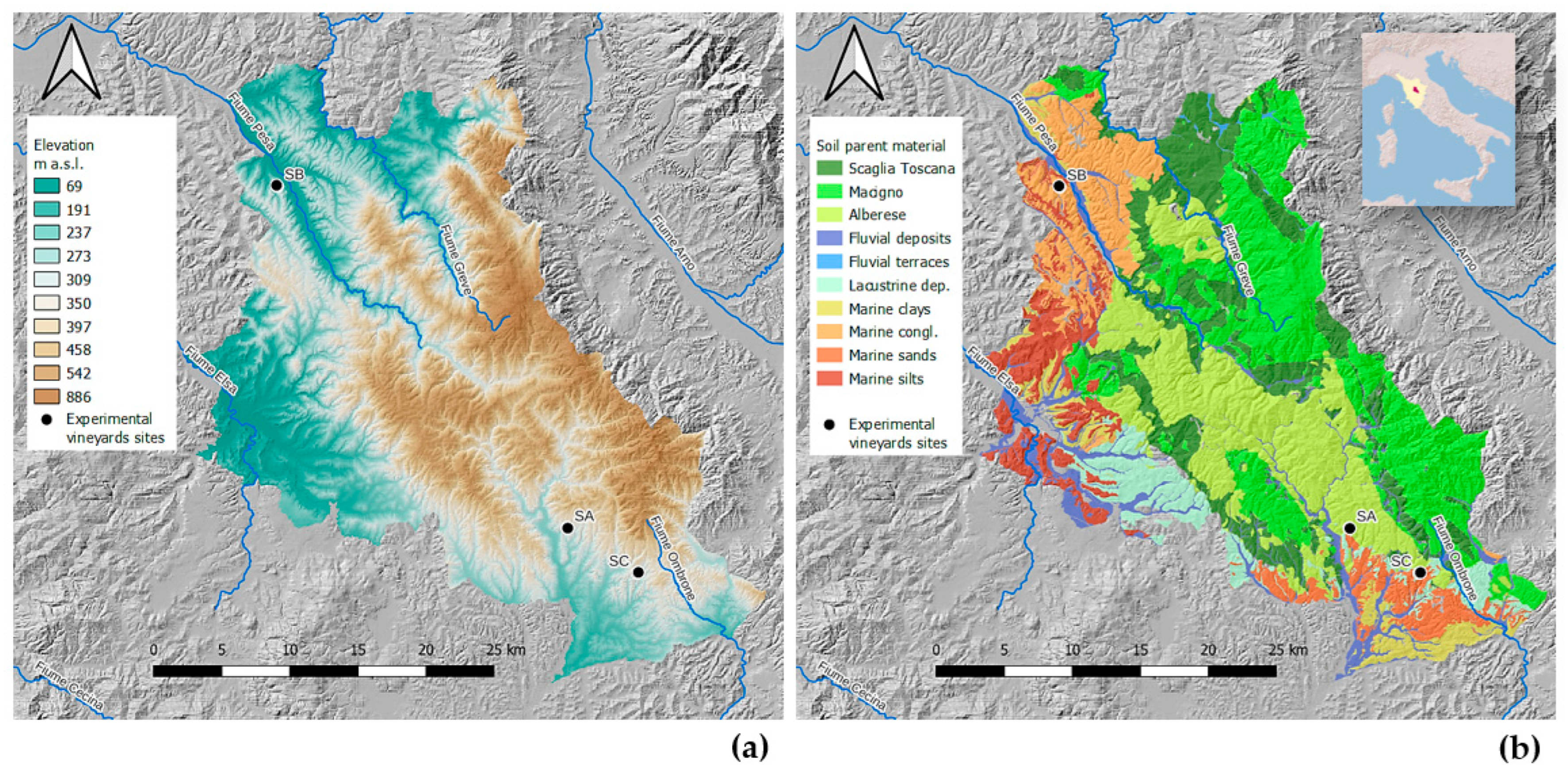
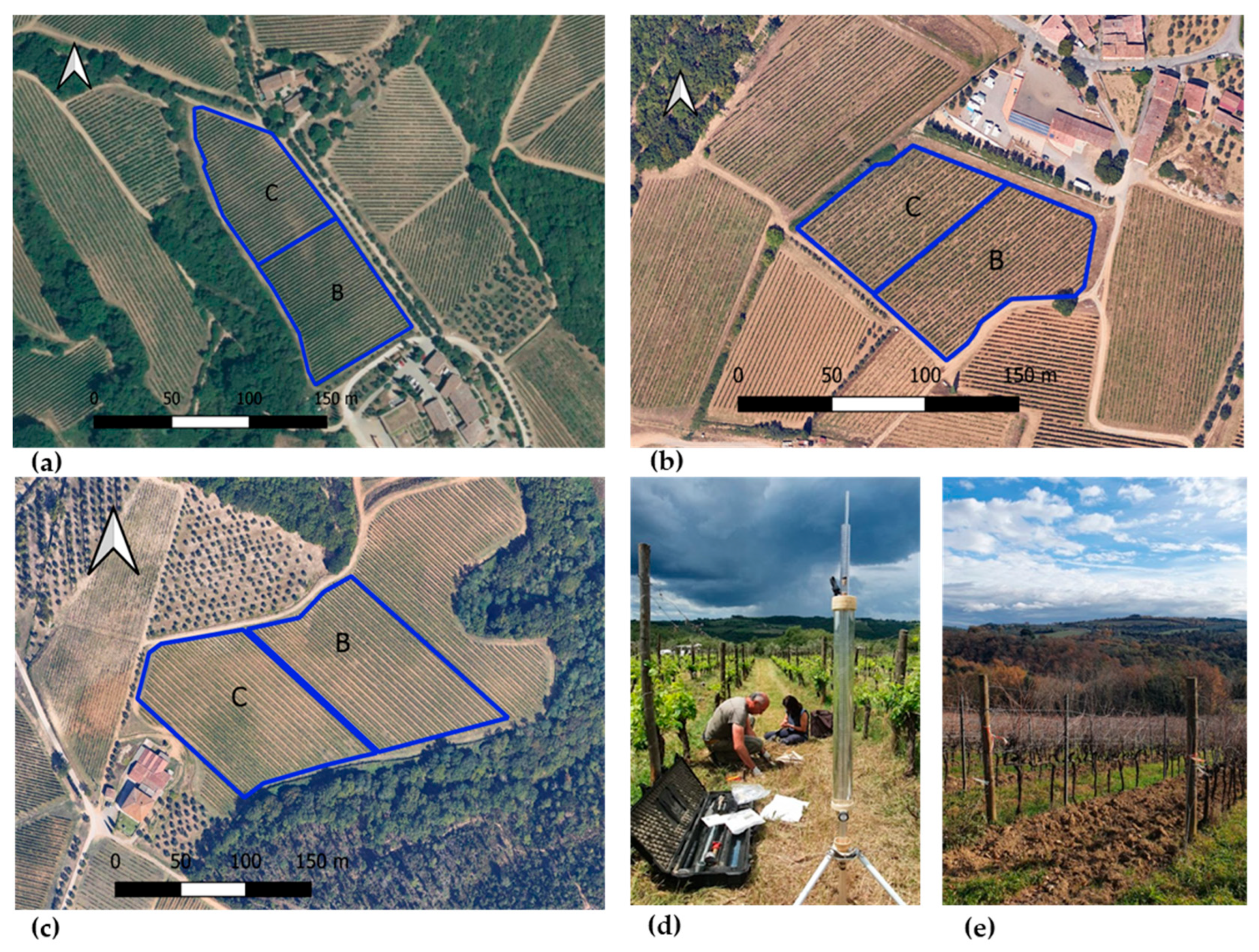
2.1. Study Area and Experimental Sites
2.2. Soil Sampling and Analysis
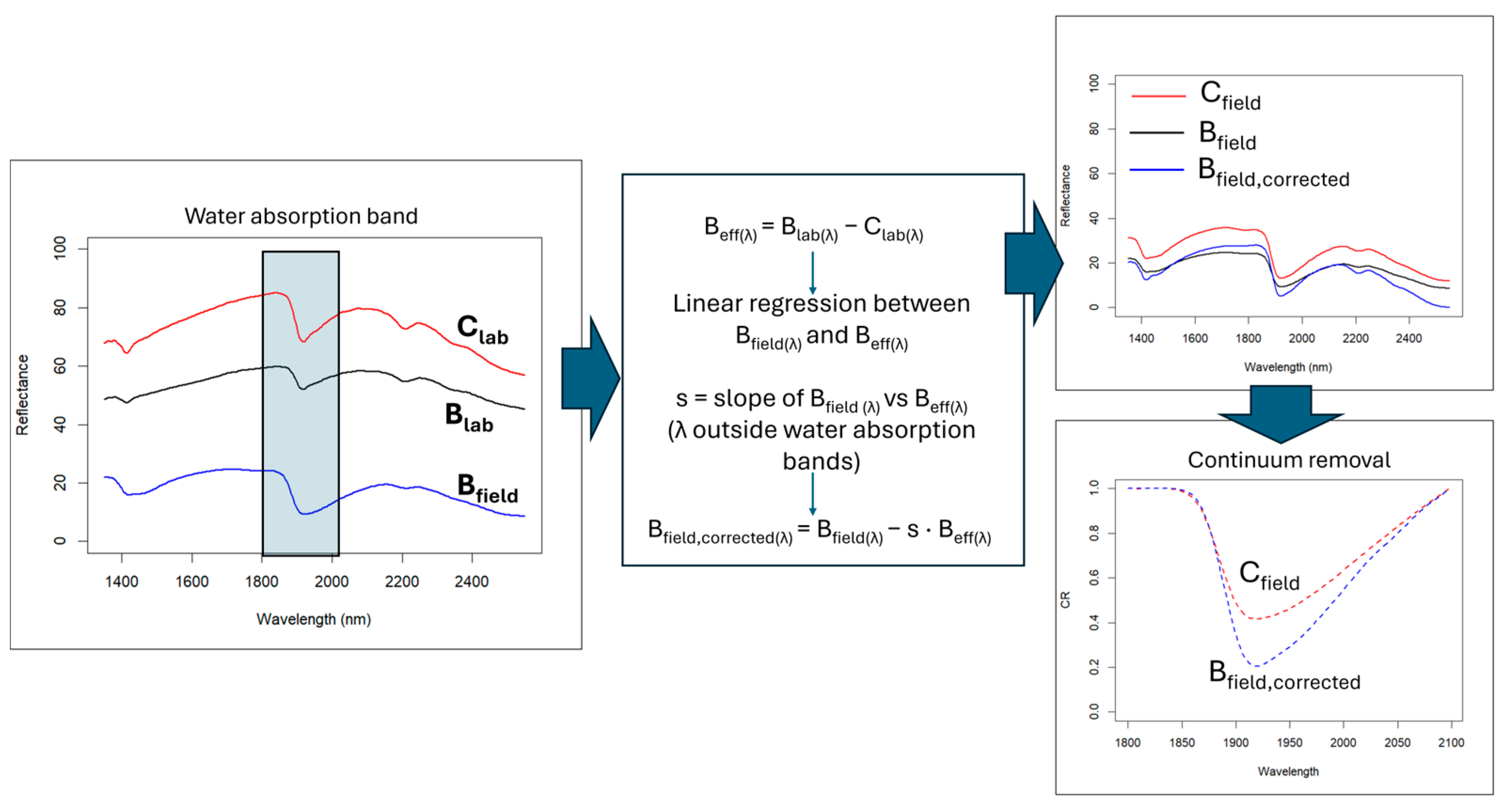
2.3. NIR Soil Spectral Measurements
2.4. Eco-Physiological Measurements
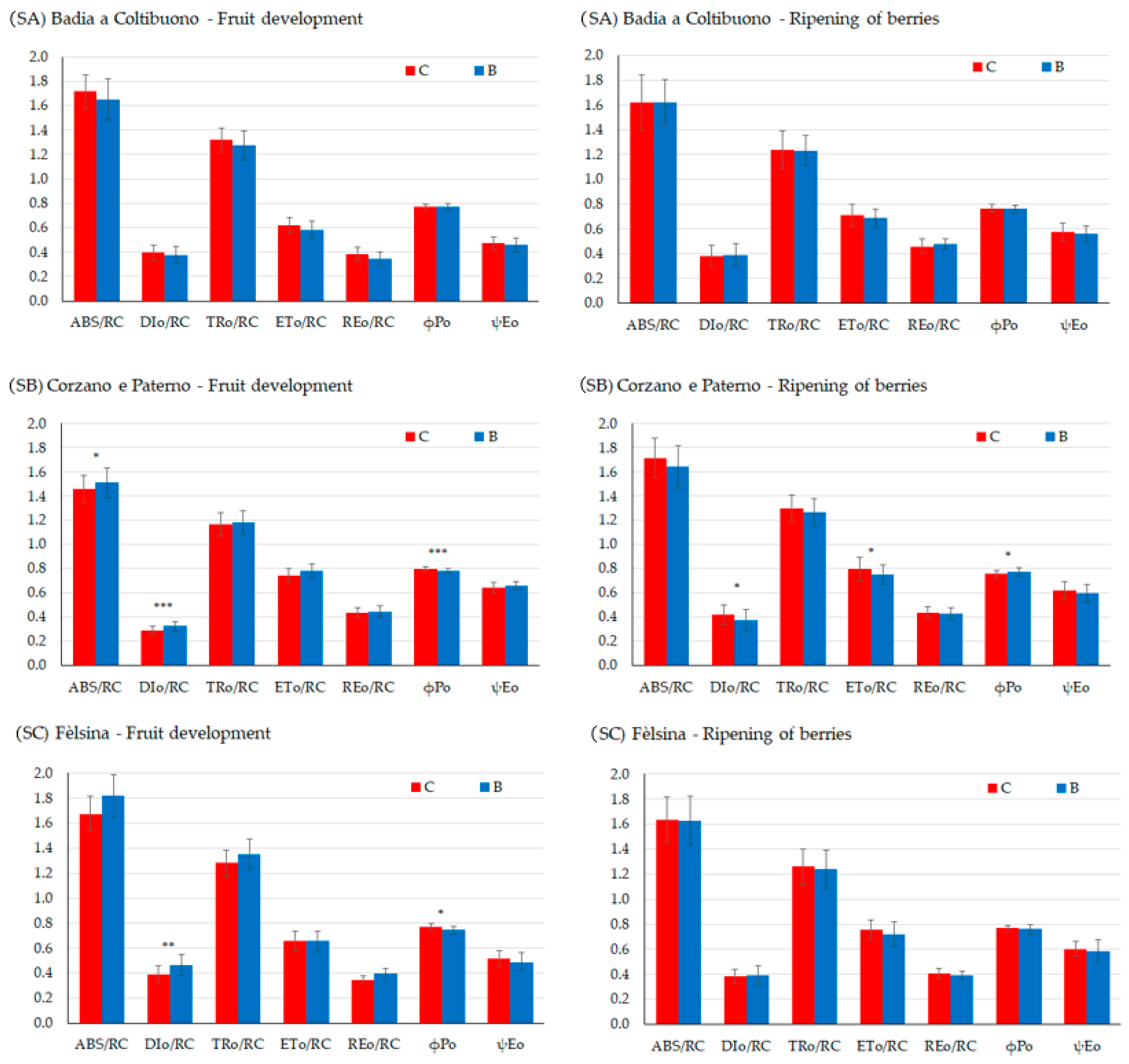
- ABS/RC = light energy absorption (ABS) per reaction center (RC);
- TRo/RC = trapping phase of light energy (TRo) per reaction center (RC);
- DIo/RC = energy dissipation per reaction (DIo) center (RC);
- ETo/RC = electron transfer from the reduced plastoquinone QA− to cytochrome b6f (ETo) per reaction center (RC);
- REo/RC = electron transport up to the final acceptors of the PSI (REo) per reaction center (RC);
- ϕPo = maximum quantum yield of primary photochemistry ((Fm − Fo)/Fm = TRo/ABS) corresponding to the capacity of trapping exciton per absorbed energy;
- ψEo = probability of electron transfer beyond QA− ((1 − (FJ − Fo)/(Fm − Fo)) = ETo/TRo), corresponding to the probability than an electron reduces PQ;
- PIabs = potential performance index, based the density of active RCs, light conversion efficiency (ϕPo), and the probability of transferring electrons beyond QA (ψEo);
- PItot = total performance index for energy conservation, from photons absorbed by PSII to the reduction of PSI end acceptors, namely ferredoxin and NADP+.
2.5. Vineyard Production
2.6. Statistical Analysis
3. Results
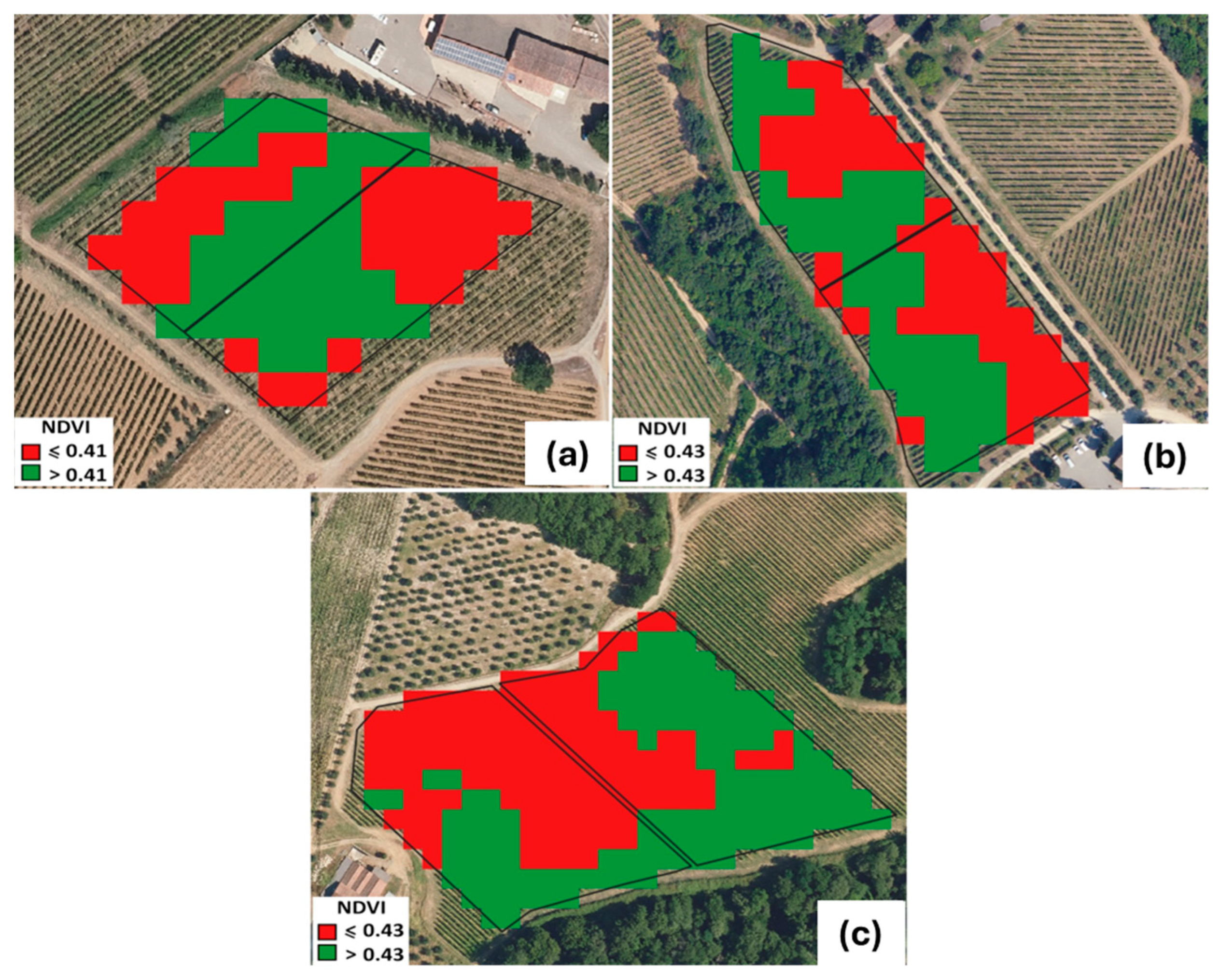
3.1. Experimental Design Assessment Using Remote Sensing Approach
3.2. Soil Analysis
3.3. Monitoring Biochar-Induced Changes by NIR Spectroscopy
3.4. Eco-Physiological Measurements
3.5. Vineyard Production
4. Discussion
5. Conclusions
Author Contributions
Funding
Data Availability Statement
Acknowledgments
Conflicts of Interest
Abbreviations
| ABS/RC | Light energy absorption per reaction center |
| B | Biochar-amended parcels at vineyard sites |
| BD | Bulk density |
| BET | Brunauer–Emmett–Teller |
| C | Control parcels at vineyard sites |
| CEC | Cation exchange capacity |
| DIo/RC | Energy dissipation per reaction per reaction center |
| DOCG | Denomination of Controlled and Guaranteed Origin |
| ETo/RC | Electron transfer from the reduced plastoquinone QA− to cytochrome b6f per reaction center |
| ϕPo | Maximum quantum yield of primary photochemistry |
| HV | High-vigor vineyard |
| NDVI | Normalized Difference Vegetation Index |
| NIR | Near-infrared |
| Ksat | Saturated hydraulic conductivity |
| LV | Low-vigor vineyard |
| ψEo | Probability of electron transfer beyond QA− |
| PIabs | Potential performance index |
| PItot | Total performance index |
| PSR | Rural development program |
| REo/RC | Electron transport up to the final acceptors of the PSI per reaction center |
| SA | Badia a Coltibuono experimental vineyard site |
| SB | Corzano e Paterno experimental vineyard site |
| SC | Fèlsina experimental vineyard site |
| TOC | Total organic carbon |
| TRo/RC | Trapping phase of light energy per reaction center |
| UAV | Unmanned aerial vehicle |
References
- Intergovernmental Panel on Climate Change (IPCC). Climate Change 2021—The Physical Science Basis; Cambridge University Press: Cambridge, UK, 2023. [Google Scholar]
- Morales-Castilla, I.; de Cortázar-Atauri, I.G.; Cook, B.I.; Lacombe, T.; Parker, A.; Van Leeuwen, C.; Nicholas, K.A.; Wolkovich, E.M. Diversity buffers winegrowing regions from climate change losses. Proc. Natl. Acad. Sci. USA 2020, 117, 2864–2869. [Google Scholar] [CrossRef]
- Mozell, M.R.; Thach, L. The Impact of Climate Change on the Global Wine Industry: Challenges & Solutions. Wine Econ. Policy 2014, 3, 81–89. [Google Scholar] [CrossRef]
- Van Leeuwen, C.; Sgubin, G.; Bois, B.; Ollat, N.; Swingedouw, D.; Zito, S.; Gambetta, G.A. Climate Change Impacts and Adaptations of Wine Production. Nat. Rev. Earth Environ. 2024, 5, 258–275. [Google Scholar] [CrossRef]
- Van Leeuwen, C.; Destrac-Irvine, A.; Dubernet, M.; Duchêne, E.; Gowdy, M.; Marguerit, E.; Pieri, P.; Parker, A.; De Rességuier, L.; Ollat, N. An Update on the Impact of Climate Change in Viticulture and Potential Adaptations. Agronomy 2019, 9, 514. [Google Scholar] [CrossRef]
- Alba, V.; Russi, A.; Caputo, A.R.; Gentilesco, G. Climate Change and Viticulture in Italy: Historical Trends and Future Scenarios. Atmosphere 2024, 15, 885. [Google Scholar] [CrossRef]
- Alikadic, A.; Pertot, I.; Eccel, E.; Dolci, C.; Zarbo, C.; Caffarra, A.; De Filippi, R.; Furlanello, C. The Impact of Climate Change on Grapevine Phenology and the Influence of Altitude: A Regional Study. Agric. For. Meteorol. 2019, 271, 73–82. [Google Scholar] [CrossRef]
- Ewing-Mulligan, M.; McCarthy, E. Wine for Dummies, 2nd ed.; Hungry Minds, Inc., Ed.; Hungry Minds, Inc.: New York, NY, USA, 2001. [Google Scholar]
- Varia, F.; Macaluso, D.; Agosta, I.; Spatafora, F.; Guccione, G.D. Transitioning towards Organic Farming: Perspectives for the Future of the Italian Organic Wine Sector. Sustainability 2021, 13, 2815. [Google Scholar] [CrossRef]
- Baronti, S.; Magno, R.; Maienza, A.; Montagnoli, A.; Ungaro, F.; Vaccari, F.P. Long Term Effect of Biochar on Soil Plant Water Relation and Fine Roots: Results after 10 Years of Vineyard Experiment. Sci. Total Environ. 2022, 851, 158225. [Google Scholar] [CrossRef] [PubMed]
- García-Jaramillo, M.; Meyer, K.M.; Phillips, C.L.; Acosta-Martínez, V.; Osborne, J.; Levin, A.D.; Trippe, K.M. Biochar Addition to Vineyard Soils: Effects on Soil Functions, Grape Yield and Wine Quality. Biochar 2021, 3, 565–577. [Google Scholar] [CrossRef]
- Baronti, S.; Vaccari, F.P.; Miglietta, F.; Calzolari, C.; Lugato, E.; Orlandini, S.; Pini, R.; Zulian, C.; Genesio, L. Impact of Biochar Application on Plant Water Relations in Vitis vinifera (L.). Eur. J. Agron. 2014, 53, 38–44. [Google Scholar] [CrossRef]
- Blanco-Canqui, H. Biochar and Soil Physical Properties. Soil Sci. Soc. Am. J. 2017, 81, 687–711. [Google Scholar] [CrossRef]
- Phillips, C.L.; Light, S.E.; Gollany, H.T.; Chiu, S.; Wanzek, T.; Meyer, K.; Trippe, K.M. Can Biochar Conserve Water in Oregon Agricultural Soils? Soil Tillage Res. 2020, 198, 104525. [Google Scholar] [CrossRef]
- Wei, B.; Peng, Y.; Lin, L.; Zhang, D.; Ma, L.; Jiang, L.; Li, Y.; He, T.; Wang, Z. Drivers of Biochar-Mediated Improvement of Soil Water Retention Capacity Based on Soil Texture: A Meta-Analysis. Geoderma 2023, 437, 116591. [Google Scholar] [CrossRef]
- Han, L.; Lu, C.; Chen, L.; Wang, F.; Chen, Q.; Gao, K.; Yu, Y.; Xu, C. Carbon Sequestration Potential of Biochar in Soil from the Perspective of Organic Carbon Structural Modification. Appl. Soil Ecol. 2024, 198, 105389. [Google Scholar] [CrossRef]
- Enebe, M.C.; Ray, R.L.; Griffin, R.W. The Impacts of Biochar on Carbon Sequestration, Soil Processes, and Microbial Communities: A Review. Biochar 2025, 7, 107. [Google Scholar] [CrossRef]
- Tsolis, V.; Barouchas, P. Biochar as Soil Amendment: The Effect of Biochar on Soil Properties Using VIS-NIR Diffuse Reflectance Spectroscopy, Biochar Aging and Soil Microbiology—A Review. Land 2023, 12, 1580. [Google Scholar] [CrossRef]
- Allen, R.M.; Laird, D.A. Quantitative Prediction of Biochar Soil Amendments by Near-Infrared Reflectance Spectroscopy. Soil Sci. Soc. Am. J. 2013, 77, 1784–1794. [Google Scholar] [CrossRef]
- Zanchin, A.; Cogato, A.; Sozzi, M.; Tomasi, D.; Marinello, F. Satellite Monitoring of Italian Vineyards and Spatio-Temporal Variability Assessment. AgriEngineering 2024, 6, 4107–4134. [Google Scholar] [CrossRef]
- Regione Toscana DataBase Pedologico. Available online: https://www502.regione.toscana.it/geoscopio/pedologia.html (accessed on 10 December 2025).
- Soil Survey Staff. Keys to Soil Taxonomy, 13th ed.; USDA-Natural Resources Conservation Service: Washington, DC, USA, 2022.
- SIR Toscana. Sistema Informativo Regionale Della Toscana. Available online: https://www.sir.toscana.it/ (accessed on 10 December 2025).
- QGIS Development Team. QGIS Geographic Information System; QGIS Software. Available online: https://www.qgis.org (accessed on 10 December 2025).
- Major, J. Guidelines on Practical Aspects of Biochar Application to Field Soil in Various Soil Management Systems. Int. Biochar Initiat. 2010, 8, 5–7. [Google Scholar]
- Food and Agriculture Organization of the United Nations; Intergovernmental Technical Panel on Soils. Recarbonizing Global Soils: A Technical Manual of Recommended Sustainable Soil Management; Food and Agriculture Organization of the United Nations: Rome, Italy, 2021. [Google Scholar]
- Walkley, A.B.I.A. An Examination of the Degtjareff Method for Determining Soil Organic Matter, and a Proposed Modification of the Chromic Acid Titration Method. Soil Sci. 1934, 37, 29–38. [Google Scholar] [CrossRef]
- ISO Standard No 10694:1995; Soil quality—Determination of organic and total carbon after dry combustion (elementary analysis). International Organization for Standardization: Geneva, Switzerland, 1995.
- ISO Standard No 10693:2014; Soil quality—Determination of carbonate content — Volumetric method. International Organization for Standardization: Geneva, Switzerland, 2014.
- Grossman, R.B.; Reinsch, T.G. The Solid Phase: Bulk Density and Linear Extensibility. In Methods of Soil Analysis: Part 4 Physical Methods; Wiley: Hoboken, NJ, USA, 2018; pp. 201–228. [Google Scholar]
- Amoozegar, A.; Warrick, A.W. Hydraulic Conductivity of Saturated Soils: Field Methods. In Methods of Soil Analysis: Part 1 Physical and Mineralogical Methods; Wiley: Hoboken, NJ, USA, 2018; pp. 735–770. [Google Scholar]
- Reynolds, W.D.; Elrick, D.E. Ponded Infiltration From a Single Ring: I. Analysis of Steady Flow. Soil Sci. Soc. Am. J. 1990, 54, 1233–1241. [Google Scholar] [CrossRef]
- Reynolds, W.D.; Eldrick, D.E.; Topp, G.C. A Reexamination of the Constant Head Well Permeameter Method for Measuring Saturated Hydraulic Conductivity Above the Water Table. Soil Sci. 1983, 136, 250–260. [Google Scholar] [CrossRef]
- Cichota, R.; Vogeler, I.; Snow, V.O.; Webb, T.H. Ensemble Pedotransfer Functions to Derive Hydraulic Properties for New Zealand Soils. Soil Res. 2013, 51, 94–111. [Google Scholar] [CrossRef]
- Guber, A.K.; Pachepsky, Y.A.; van Genuchten, M.T.; Rawls, W.J.; Simunek, J.; Jacques, D.; Nicholson, T.J.; Cady, R.E. Field-Scale Water Flow Simulations Using Ensembles of Pedotransfer Functions for Soil Water Retention. Vadose Zone J. 2006, 5, 234–247. [Google Scholar] [CrossRef]
- Padgett-Johnson, M.; Williams, L.E.; Walker, M.A. The Influence of Vitis Riparia Rootstock on Water Relations and Gas Exchange of Vitis vinifera Cv. Carignane Scion Under Non-Irrigated Conditions. Am. J. Enol. Vitic. 2000, 51, 137–143. [Google Scholar] [CrossRef]
- Scholander, P.F.; Bradstreet, E.D.; Hemmingsen, E.A.; Hammel, H.T. Sap Pressure in Vascular Plants: Negative hydrostatic pressure can be measured in plants. Science 1965, 148, 339–346. [Google Scholar] [CrossRef]
- Strasser, R.J.; Tsimilli-Michael, M.; Srivastava, A. Analysis of the Chlorophyll a Fluorescence Transient. In Chlorophyll a Fluorescence: A Signature of Photosynthesis; Springer: Dordrecht, The Netherlands, 2004; pp. 321–362. [Google Scholar]
- R Core Team. R: A Language and Environment for Statistical Computing; R Foundation for Statistical Computing: Vienna, Austria, 2024. [Google Scholar]
- Snijders, T.A.B.; Bosker, R. Multilevel Analysis: An Introduction to Basic and Advanced Multilevel Modeling; Sage Publications: Thousand Oaks, CA, USA, 2011. [Google Scholar]
- Serrano, J.; Mau, V.; Rodrigues, R.; Paixão, L.; Shahidian, S.; da Silva, J.M.; Paniagua, L.L.; Moral, F.J. Definition and Validation of Vineyard Management Zones Based on Soil Apparent Electrical Conductivity and Altimetric Survey. Environments 2023, 10, 117. [Google Scholar] [CrossRef]
- Ortuani, B.; Mayer, A.; Bianchi, D.; Sona, G.; Crema, A.; Modina, D.; Bolognini, M.; Brancadoro, L.; Boschetti, M.; Facchi, A. Effectiveness of Management Zones Delineated from UAV and Sentinel-2 Data for Precision Viticulture Applications. Remote Sens. 2024, 16, 635. [Google Scholar] [CrossRef]
- Vallarino, G.; Genzano, N.; Gianinetto, M. The Potential of Deep Learning for Studying Wilderness with Copernicus Sentinel-2 Data: Some Critical Insights. Land 2025, 14, 2333. [Google Scholar] [CrossRef]
- Pascucci, S.; Carfora, M.F.; Palombo, A.; Pignatti, S.; Casa, R.; Pepe, M.; Castaldi, F. A Comparison between Standard and Functional Clustering Methodologies: Application to Agricultural Fields for Yield Pattern Assessment. Remote Sens. 2018, 10, 585. [Google Scholar] [CrossRef]
- Pastonchi, L.; Di Gennaro, S.F.; Toscano, P.; Matese, A. Comparison between Satellite and Ground Data with UAV-Based Information to Analyse Vineyard Spatio-Temporal Variability. OENO One 2020, 54, 919–934. [Google Scholar] [CrossRef]
- Ghilardi, F.; Virano, A.; Prandi, M.; Borgogno-Mondino, E. Zonation of a Viticultural Territorial Context in Piemonte (NW Italy) to Support Terroir Identification: The Role of Pedological, Topographical and Climatic Factors. Land 2023, 12, 647. [Google Scholar] [CrossRef]
- Mucalo, A.; Matić, D.; Morić-Španić, A.; Čagalj, M. Satellite Solutions for Precision Viticulture: Enhancing Sustainability and Efficiency in Vineyard Management. Agronomy 2024, 14, 1862. [Google Scholar] [CrossRef]
- Di Gennaro, S.; Dainelli, R.; Palliotti, A.; Toscano, P.; Matese, A. Sentinel-2 Validation for Spatial Variability Assessment in Overhead Trellis System Viticulture Versus UAV and Agronomic Data. Remote Sens. 2019, 11, 2573. [Google Scholar] [CrossRef]
- Vélez, S.; Rançon, F.; Barajas, E.; Brunel, G.; Rubio, J.A.; Tisseyre, B. Potential of Functional Analysis Applied to Sentinel-2 Time-Series to Assess Relevant Agronomic Parameters at the within-Field Level in Viticulture. Comput. Electron. Agric. 2022, 194, 106726. [Google Scholar] [CrossRef]
- Gross, A.; Bromm, T.; Glaser, B. Soil Organic Carbon Sequestration after Biochar Application: A Global Meta-Analysis. Agronomy 2021, 11, 2474. [Google Scholar] [CrossRef]
- Kingston, K.; Pratt, C.; Mackay, B.; Petrie, P.R.; Ellis, J.; Xu, Z. The Potential of Integrating Biochar and Stable Isotope Technologies for Regenerative Viticulture under Climate Change. J. Soils Sediments 2025, 25, 2916–2930. [Google Scholar] [CrossRef]
- Johnstone, I.; Fuss, S.; Walsh, N.; Höglund, R. Carbon Markets for Carbon Dioxide Removal. Clim. Policy 2025, 1–8. [Google Scholar] [CrossRef]
- Chiaramonti, D.; Lehmann, J.; Berruti, F.; Giudicianni, P.; Sanei, H.; Masek, O. Biochar Is a Long-Lived Form of Carbon Removal, Making Evidence-Based CDR Projects Possible. Biochar 2024, 6, 81. [Google Scholar] [CrossRef]
- Bolan, S.; Sharma, S.; Mukherjee, S.; Kumar, M.; Rao, C.S.; Nataraj, K.C.; Singh, G.; Vinu, A.; Bhowmik, A.; Sharma, H.; et al. Biochar Modulating Soil Biological Health: A Review. Sci. Total Environ. 2024, 914, 169585. [Google Scholar] [CrossRef]
- Farrag, H.M. Effect of Applying Banana Waste Biochar on Soil Properties and Growth of Cultivated Plants in Sandy Soil. SVU-Int. J. Agric. Sci. 2023, 5, 54–66. [Google Scholar] [CrossRef]
- Lippi, P.; Mattii, G.B.; Cataldo, E. Biochar, Properties and Skills with a Focus on Implications for Vineyard Land and Grapevine Performance. Phyton 2025, 94, 33–64. [Google Scholar] [CrossRef]
- Joseph, S.D.; Camps-Arbestain, M.; Lin, Y.; Munroe, P.; Chia, C.H.; Hook, J.; Van Zwieten, L.; Kimber, S.; Cowie, A.; Singh, B.P.; et al. An Investigation into the Reactions of Biochar in Soil. Aust. J. Soil Res. 2010, 48, 501–515. [Google Scholar] [CrossRef]
- Prayogo, C.; Jones, J.E.; Baeyens, J.; Bending, G.D. Impact of Biochar on Mineralisation of C and N from Soil and Willow Litter and Its Relationship with Microbial Community Biomass and Structure. Biol. Fertil. Soils 2014, 50, 695–702. [Google Scholar] [CrossRef]
- Tusar, H.M.; Uddin, M.K.; Mia, S.; Suhi, A.A.; Wahid, S.B.A.; Kasim, S.; Sairi, N.A.; Alam, Z.; Anwar, F. Biochar-Acid Soil Interactions—A Review. Sustainability 2023, 15, 13366. [Google Scholar] [CrossRef]
- Kabir, E.; Kim, K.-H.; Kwon, E.E. Biochar as a Tool for the Improvement of Soil and Environment. Front. Environ. Sci. 2023, 11, 1324533. [Google Scholar] [CrossRef]
- Zhou, W.; Xing, S.; Wu, Y.; Zou, R.; Li, S.; Sun, X.; Zhang, H. Exploring the Effects of Biochar and Compost on Ameliorating Coastal Saline Soil. Agronomy 2025, 15, 2093. [Google Scholar] [CrossRef]
- López-Pérez, M.C.; Juárez-Maldonado, A.; Benavides-Mendoza, A.; González-Morales, S.; Pérez-Labrada, F. Aqueous Extract of Coconut Shell Biochar as a Pre-Germination Treatment Increases Seed Germination and Early Seedling Growth in Chiltepín Pepper (Capsicum annuum var. glabriusculum). Not. Bot. Horti Agrobot. Cluj Napoca 2023, 51, 13097. [Google Scholar] [CrossRef]
- Cataldo, E.; Fucile, M.; Mattii, G.B. A Review: Soil Management, Sustainable Strategies and Approaches to Improve the Quality of Modern Viticulture. Agronomy 2021, 11, 2359. [Google Scholar] [CrossRef]
- Blanco-Canqui, H. Does Biochar Application Alleviate Soil Compaction? Review and Data Synthesis. Geoderma 2021, 404, 115317. [Google Scholar] [CrossRef]
- Acharya, B.S.; Dodla, S.; Wang, J.J.; Pavuluri, K.; Darapuneni, M.; Dattamudi, S.; Maharjan, B.; Kharel, G. Biochar Impacts on Soil Water Dynamics: Knowns, Unknowns, and Research Directions. Biochar 2024, 6, 34. [Google Scholar] [CrossRef]
- Esmaeelnejad, L.; Shorafa, M.; Gorji, M.; Hosseini, S. mossa Impacts of Woody Biochar Particle Size on Porosity and Hydraulic Conductivity of Biochar-Soil Mixtures: An Incubation Study. Commun. Soil Sci. Plant Anal. 2017, 48, 1710–1718. [Google Scholar] [CrossRef]
- Igalavithana, A.D.; Mandal, S.; Niazi, N.K.; Vithanage, M.; Parikh, S.J.; Mukome, F.N.D.; Rizwan, M.; Oleszczuk, P.; Al-Wabel, M.; Bolan, N.; et al. Advances and Future Directions of Biochar Characterization Methods and Applications. Crit. Rev. Environ. Sci. Technol. 2017, 47, 2275–2330. [Google Scholar] [CrossRef]
- Karhu, K.; Mattila, T.; Bergström, I.; Regina, K. Biochar Addition to Agricultural Soil Increased CH4 Uptake and Water Holding Capacity—Results from a Short-Term Pilot Field Study. Agric. Ecosyst. Environ. 2011, 140, 309–313. [Google Scholar] [CrossRef]
- Atkinson, C.J. How Good Is the Evidence That Soil-applied Biochar Improves Water-holding Capacity? Soil Use Manag. 2018, 34, 177–186. [Google Scholar] [CrossRef]
- Bohara, H.; Dodla, S.; Wang, J.J.; Darapuneni, M.; Acharya, B.S.; Magdi, S.; Pavuluri, K. Influence of Poultry Litter and Biochar on Soil Water Dynamics and Nutrient Leaching from a Very Fine Sandy Loam Soil. Soil Tillage Res. 2019, 189, 44–51. [Google Scholar] [CrossRef]
- Duong, V.T.; Khanh, N.M.; Nguyen, N.T.H.; Phi, N.N.; Duc, N.T.; Xo, D.H. Impact of biochar on the water holding capacity and moisture of basalt and grey soil. Ho Chi Minh City Open Univ. J. Sci.—Eng. Technol. 2017, 7, 36–43. [Google Scholar]
- Bongiovanni, M. 4.1 Fruit Trees and Vines. In Crop Yield Response to Water; FAO Irrigation and Drainage Paper 66; Food and Agriculture Organization of the United Nations: Rome, Italy, 2012; p. 297. [Google Scholar]
- Genesio, L.; Miglietta, F.; Baronti, S.; Vaccari, F.P. Biochar Increases Vineyard Productivity without Affecting Grape Quality: Results from a Four Years Field Experiment in Tuscany. Agric. Ecosyst. Environ. 2015, 201, 20–25. [Google Scholar] [CrossRef]
- Van Leeuwen, C.; Trégoat, O.; Choné, X.; Bois, B.; Pernet, D.; Gaudillère, J.-P. Vine Water Status Is a Key Factor in Grape Ripening and Vintage Quality for Red Bordeaux Wine. How Can It Be Assessed for Vineyard Management Purposes? OENO One 2009, 43, 121. [Google Scholar] [CrossRef]
- Deloire, A.; Carbonneau, A.; Wang, Z.; Ojeda, H. Vine and Water: A Short Review. OENO One 2004, 38, 1. [Google Scholar] [CrossRef]
- Damásio, M.; Barbosa, M.; Deus, J.; Fernandes, E.; Leitão, A.; Albino, L.; Fonseca, F.; Silvestre, J. Can Grapevine Leaf Water Potential Be Modelled from Physiological and Meteorological Variables? A Machine Learning Approach. Plants 2023, 12, 4142. [Google Scholar] [CrossRef]
- Pellegrino, A.; Lebon, E.; Voltz, M.; Wery, J. Relationships between Plant and Soil Water Status in Vine (Vitis vinifera L.). Plant Soil 2005, 266, 129–142. [Google Scholar] [CrossRef]
- Gu, B.W.; Yang, J.F.; Lu, X.L.; Wu, Y.H.; Li, N.; Liu, N.; An, N.; Han, X.R. Effects of Continuous Application of Biochar on Chlorophyll Fluorescence Characteristics of Peanut at Different Growth Stages. Sci. Agric. Sin. 2021, 54, 4552–4561. [Google Scholar] [CrossRef]
- Wilhelm, C.; Selmar, D. Energy Dissipation Is an Essential Mechanism to Sustain the Viability of Plants: The Physiological Limits of Improved Photosynthesis. J. Plant Physiol. 2011, 168, 79–87. [Google Scholar] [CrossRef] [PubMed]
- Demmig-Adams, B.; Adams, W.W. Photoprotection in an Ecological Context: The Remarkable Complexity of Thermal Energy Dissipation. New Phytol. 2006, 172, 11–21. [Google Scholar] [CrossRef]
- Zhu, Z.; Zhang, H.; Tian, H.; Chai, G.; Muhammad, R.; Wang, Q.; Liang, B.; Wu, X. Comprehensive Analysis of the Effects on Photosynthesis and Energy Balance in Tomato Leaves under Magnesium Deficiency. Plant Physiol. Biochem. 2025, 222, 109671. [Google Scholar] [CrossRef]
- Abadía, J. Leaf Responses to Fe Deficiency: A Review. J. Plant Nutr. 1992, 15, 1699–1713. [Google Scholar] [CrossRef]
- Ciompi, S.; Gentili, E.; Guidi, L.; Soldatini, G.F. The Effect of Nitrogen Deficiency on Leaf Gas Exchange and Chlorophyll Fluorescence Parameters in Sunflower. Plant Sci. 1996, 118, 177–184. [Google Scholar] [CrossRef]
- Laing, W.; Greer, D.; Sun, O.; Beets, P.; Lowe, A.; Payn, T. Physiological Impacts of Mg Deficiency in Pinus radiata: Growth and Photosynthesis. New Phytol. 2000, 146, 47–57. [Google Scholar] [CrossRef]
- Kalaji, H.M.; Oukarroum, A.; Alexandrov, V.; Kouzmanova, M.; Brestic, M.; Zivcak, M.; Samborska, I.A.; Cetner, M.D.; Allakhverdiev, S.I.; Goltsev, V. Identification of Nutrient Deficiency in Maize and Tomato Plants by in Vivo Chlorophyll a Fluorescence Measurements. Plant Physiol. Biochem. 2014, 81, 16–25. [Google Scholar] [CrossRef]
- Teng, X.; Huang, D.; Zhi, Y.; Li, Y.; Dong, D.; Wu, X.; Wang, Y.; Jiang, Z.; Huang, H.; Tang, Y.; et al. Effects of Biochar on Soil Properties as Well as Available and TCLP-Extractable Cu Contents: A Global Meta-Analysis. Sci. Rep. 2025, 15, 32853. [Google Scholar] [CrossRef]
- Chen, D.; Liu, X.; Bian, R.; Cheng, K.; Zhang, X.; Zheng, J.; Joseph, S.; Crowley, D.; Pan, G.; Li, L. Effects of Biochar on Availability and Plant Uptake of Heavy Metals—A Meta-Analysis. J. Environ. Manag. 2018, 222, 76–85. [Google Scholar] [CrossRef]
- Barón, M.; Arellano, J.B.; Gorgé, J.L. Copper and Photosystem II: A Controversial Relationship. Physiol. Plant. 1995, 94, 174–180. [Google Scholar] [CrossRef]
- Yruela, I.; Alfonso, M.; Barón, M.; Picorel, R. Copper Effect on the Protein Composition of Photosystem II. Physiol. Plant. 2000, 110, 551–557. [Google Scholar] [CrossRef]
- Fu, C.; Li, M.; Zhang, Y.; Zhang, Y.; Yan, Y.; Wang, Y. Morphology, Photosynthesis, and Internal Structure Alterations in Field Apple Leaves under hidden and acute zinc deficiency. Sci. Hortic. 2015, 193, 47–54. [Google Scholar] [CrossRef]
- Lobell, D.B.; Asner, G.P. Moisture Effects on Soil Reflectance. Soil Sci. Soc. Am. J. 2002, 66, 722–727. [Google Scholar] [CrossRef]
- Castaldi, F.; Stenberg, B.; Liebisch, F.; Metzger, K.; Ben-Dor, E.; Knadel, M.; Koganti, T.; Wetterlind, J.; Barbetti, R.; Debaene, G.; et al. Estimating Soil Organic Carbon Using Field VNIR-SWIR Spectroscopy and Existing Soil Spectral Libraries: Mitigating Heterogeneity, Roughness and Moisture Effects. Smart Agric. Technol. 2025, 12, 101353. [Google Scholar] [CrossRef]
- Knadel, M.; Castaldi, F.; Barbetti, R.; Ben-Dor, E.; Gholizadeh, A.; Lorenzetti, R. Mathematical Techniques to Remove Moisture Effects from Visible–near-Infrared–Shortwave-Infrared Soil Spectra—Review. Appl. Spectrosc. Rev. 2023, 58, 629–662. [Google Scholar] [CrossRef]
- Gholamahmadi, B.; Ferreira, C.S.S.; Gonzalez-Pelayo, O.; Bastos, A.C.; Verheijen, F.G.A. Soil Conservation Benefits of Biochar in Mediterranean Vineyards: Enhancing the Soil Sponge Function and Mitigating Water Erosion. Biochar 2025, 7, 106. [Google Scholar] [CrossRef]
- Li, B.; Guo, Y.; Liang, F.; Liu, W.; Wang, Y.; Cao, W.; Song, H.; Chen, J.; Guo, J. Global Integrative Meta-Analysis of the Responses in Soil Organic Carbon Stock to Biochar Amendment. J. Environ. Manag. 2024, 351, 119745. [Google Scholar] [CrossRef] [PubMed]
- Sun, W.; Li, Y.; Xu, Z.; Bai, Y.; Bai, S.H. Biochar Application for Enhancing Water and Nitrogen Use Efficiency of Understory Acacia Species in a Suburban Native Forest Subjected to Nitrogen Deposition in Southeast Queensland. Plant Soil 2024, 504, 607–624. [Google Scholar] [CrossRef]



| Farm Site | Location | Lat | Long | Elevation m a.s.l. | Soil Classification [22] | Sand% | Silt% | Clay% |
|---|---|---|---|---|---|---|---|---|
| SA: Badia a Coltibuono | Gaiole in Chianti (SI) | 43.3967 | 11.4224 | 339 | Typic Haplustepts, fine, mixed, mesic | 22.3 | 40.2 | 37.5 |
| SB: Corzano e Paterno | San Casciano in Val di Pesa (FI) | 43.6281 | 11.1672 | 280 | Typic Haplustepts, loamy–skeletal, mixed, mesic | 34.2 | 37.3 | 28.5 |
| SC: Fèlsina | Castelnuovo Berardenga (SI) | 43.3658 | 11.4849 | 350 | Typic Ustorthents, coarse-loamy, mixed calcareous, mesic | 55.0 | 32.9 | 13.1 |
| Biochar Characteristics | Unit | Value |
|---|---|---|
| Ctot | % | 77.81 |
| Ntot | % | 0.91 |
| C/N | - | 63.53 |
| pH | - | 9.8 |
| CEC | cmolc kg−1 | 101 |
| BET | m2 g−1 | 410 ± 6 |
| Total porosity | mm3 g−1 | 2722 |
| Transmission pores | mm3 g−1 | 318 |
| Storage pores | mm3 g−1 | 1997 |
| Residual pores | mm3 g−1 | 406 |
| PAHs (∑16 US EPA) | mg kg−1 d.m. | ≤4 |
| Bulk density | Mg m−3 | 0.4 ± 0.02 |
| Treatment | Vigor | SA (NDVI) | SB (NDVI) | SC (NDVI) |
|---|---|---|---|---|
| C | LV | 0.37 ± 0.01 | 0.38 ± 0.03 | 0.33 ± 0.01 |
| HV | 0.45 ± 0.01 | 0.45 ± 0.01 | 0.49 ± 0.01 | |
| B | LV | 0.38 ± 0.01 | 0.39 ± 0.01 | 0.36 ± 0.01 |
| HV | 0.46 ± 0.01 | 0.46 ± 0.02 | 0.49 ± 0.01 |
| Farm Site | Soil Textural Class | Treatment | Ctot (g kg−1) | TOC (g kg−1) | Ntot (g kg−1) | C/N | CaCO3 (g kg−1) |
|---|---|---|---|---|---|---|---|
| SA | Clay–loam | C | 26.33 ± 2.97 | 13.73 ± 1.32 | 1.47 ± 0.01 | 9.32 | 10.50 ± 1.47 |
| B | 25.74 ± 2.11 | 20.22 ± 1.59 *** | 1.81 ± 0.16 * | 11.13 ** | 4.60 ± 0.43 * | ||
| SB | Silty–clay–loam | C | 39.55 ± 0.91 | 14.55 ±1.19 | 1.67 ± 0.01 | 8.71 | 20.83 ± 0.51 |
| B | 34.39± 3.88 * | 21.71 ± 3.75 *** | 2.06 ± 0.16 * | 10.51 ** | 10.56 ± 0.25 *** | ||
| SC | Sandy–loam | C | 6.56 ± 0.22 | 2.90 ± 0.23 | 0.40 ± 0.02 | 7.51 | 29.67 ± 0.23 |
| B | 11.01 ± 0.78 ** | 9.09 ± 1.10 ** | 0.65 ± 0.26 * | 13.84 ** | 17.33 ± 0.23 * |
| Farm Site | Treatment | Bulk Density (Mg m−3) | Porosity (m3 m−3) | Ksat (mm h−1) | pH |
|---|---|---|---|---|---|
| SA | C | 1.529 ± 0.05 | 0.423 ± 0.02 | 7.53 ± 5.03 | 7.5 ± 0.1 |
| B | 1.388 ± 0.13 ** | 0.476 ± 0.05 ** | 9.88 ± 6.60 | 7.5 ± 0.2 | |
| SB | C | 1.446 ± 0.07 | 0.454 ± 0.03 | 9.43 ± 6.38 | 8.1 ± 0.3 |
| B | 1.313 ± 0.06 ** | 0.505 ± 0.02 ** | 6.98 ± 4.43 | 8.2 ± 0.1 | |
| SC | C | 1.431 ± 0.08 | 0.460 ± 0.03 | 56.56 ± 56.32 | 7.6 ± 0.3 |
| B | 1.387 ± 0.11 * | 0.529 ± 0.17 * | 38.66 ± 14.21 | 7.4 ± 0.2 |
| Farm Site | Treatment | Mean Beff | DP1900nm | A1900nm |
|---|---|---|---|---|
| SC | C | 0.58 | 15.1 | |
| B | −20 | 0.80 | 19.1 | |
| SB | C | 0.56 | 14.6 | |
| B | −31 | 0.75 | 17.1 |
| Development of Fruits | Ripening of Berries | ||||
|---|---|---|---|---|---|
| C | B | C | B | ||
| SA | PIabs | 1.85 ± 0.56 | 1.88 ± 0.72 | 3.15 ± 1.35 | 2.81 ± 1.26 |
| PItot | 3.11 ± 1.08 | 2.87 ± 1.10 | 6.14 ± 2.58 | 6.74 ± 2.88 | |
| SB | PIabs | 5.14 ± 1.31 | 4.82 ± 1.31 | 3.33 ± 1.53 | 3.64 ± 1.76 |
| PItot | 7.35 ± 2.36 | 6.51 ± 1.63 | 4.01 ± 1.15 | 4.73 ± 1.61 | |
| SC | PIabs | 2.28 ± 0.84 | 1.69 ± 0.80 | 3.33 ± 1.29 | 3.16 ± 1.38 |
| PItot | 2.55 ± 0.76 | 2.57 ± 4.97 | 3.98 ± 1.51 | 3.85 ± 1.76 | |
Disclaimer/Publisher’s Note: The statements, opinions and data contained in all publications are solely those of the individual author(s) and contributor(s) and not of MDPI and/or the editor(s). MDPI and/or the editor(s) disclaim responsibility for any injury to people or property resulting from any ideas, methods, instructions or products referred to in the content. |
© 2026 by the authors. Licensee MDPI, Basel, Switzerland. This article is an open access article distributed under the terms and conditions of the Creative Commons Attribution (CC BY) license.
Share and Cite
Biancalani, A.; Ungaro, F.; Castaldi, F.; Ugolini, F.; Di Gennaro, S.F.; Berton, A.; Dainelli, R.; Lanini, G.M.; Baronti, S. Biochar Enhances Vineyard Resilience: Soil Improvement and Physiological Benefits for Sangiovese Vineyards in Varied Soils of the Chianti Classico (Tuscany, Central Italy). Land 2026, 15, 245. https://doi.org/10.3390/land15020245
Biancalani A, Ungaro F, Castaldi F, Ugolini F, Di Gennaro SF, Berton A, Dainelli R, Lanini GM, Baronti S. Biochar Enhances Vineyard Resilience: Soil Improvement and Physiological Benefits for Sangiovese Vineyards in Varied Soils of the Chianti Classico (Tuscany, Central Italy). Land. 2026; 15(2):245. https://doi.org/10.3390/land15020245
Chicago/Turabian StyleBiancalani, Arianna, Fabrizio Ungaro, Fabio Castaldi, Francesca Ugolini, Salvatore Filippo Di Gennaro, Andrea Berton, Riccardo Dainelli, Giuseppe Mario Lanini, and Silvia Baronti. 2026. "Biochar Enhances Vineyard Resilience: Soil Improvement and Physiological Benefits for Sangiovese Vineyards in Varied Soils of the Chianti Classico (Tuscany, Central Italy)" Land 15, no. 2: 245. https://doi.org/10.3390/land15020245
APA StyleBiancalani, A., Ungaro, F., Castaldi, F., Ugolini, F., Di Gennaro, S. F., Berton, A., Dainelli, R., Lanini, G. M., & Baronti, S. (2026). Biochar Enhances Vineyard Resilience: Soil Improvement and Physiological Benefits for Sangiovese Vineyards in Varied Soils of the Chianti Classico (Tuscany, Central Italy). Land, 15(2), 245. https://doi.org/10.3390/land15020245