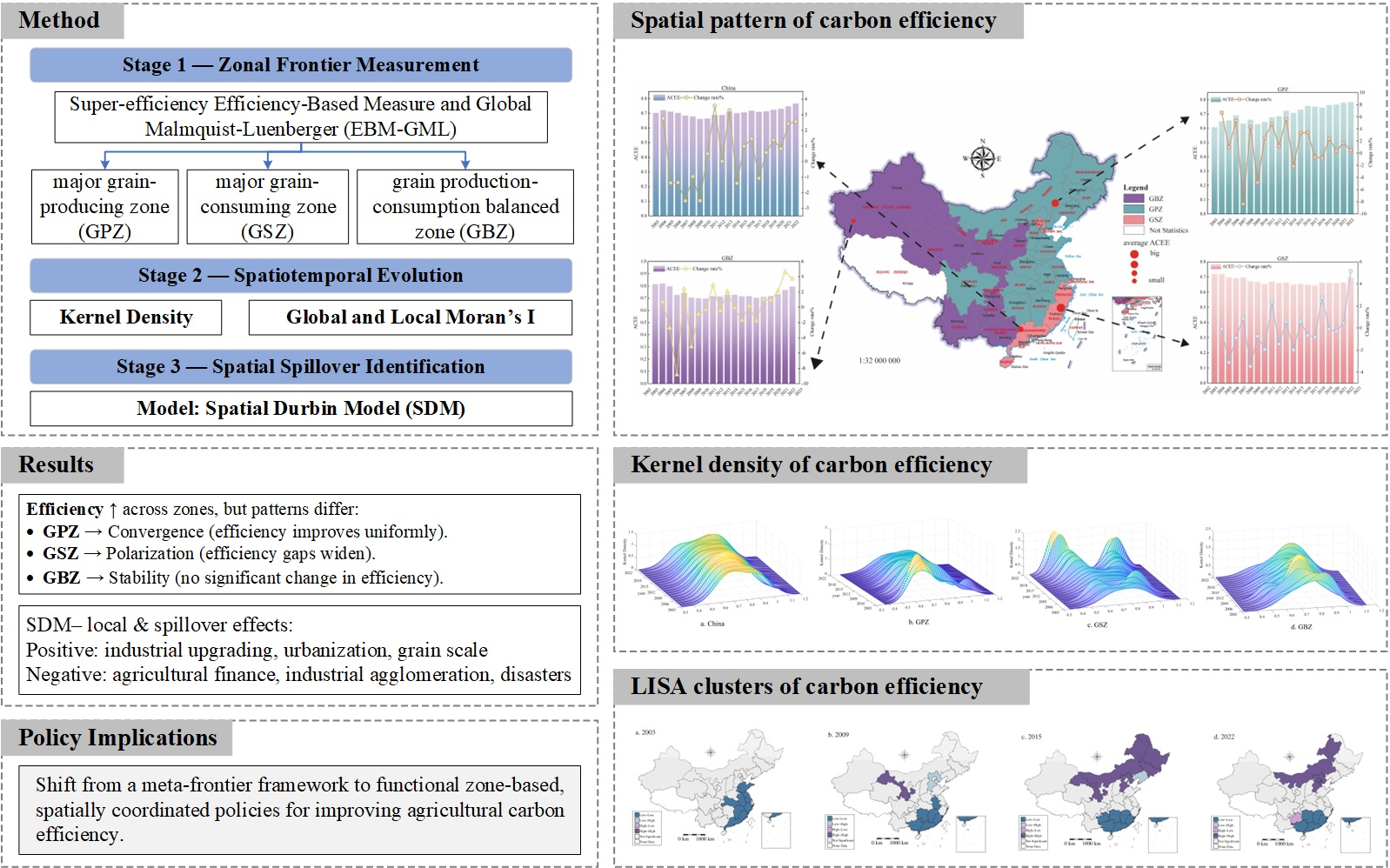
Re-Evaluating Agricultural Carbon Efficiency Across Functional Grain Zones: From Spatial Analysis


Abstract
1. Introduction
2. Methods and Data
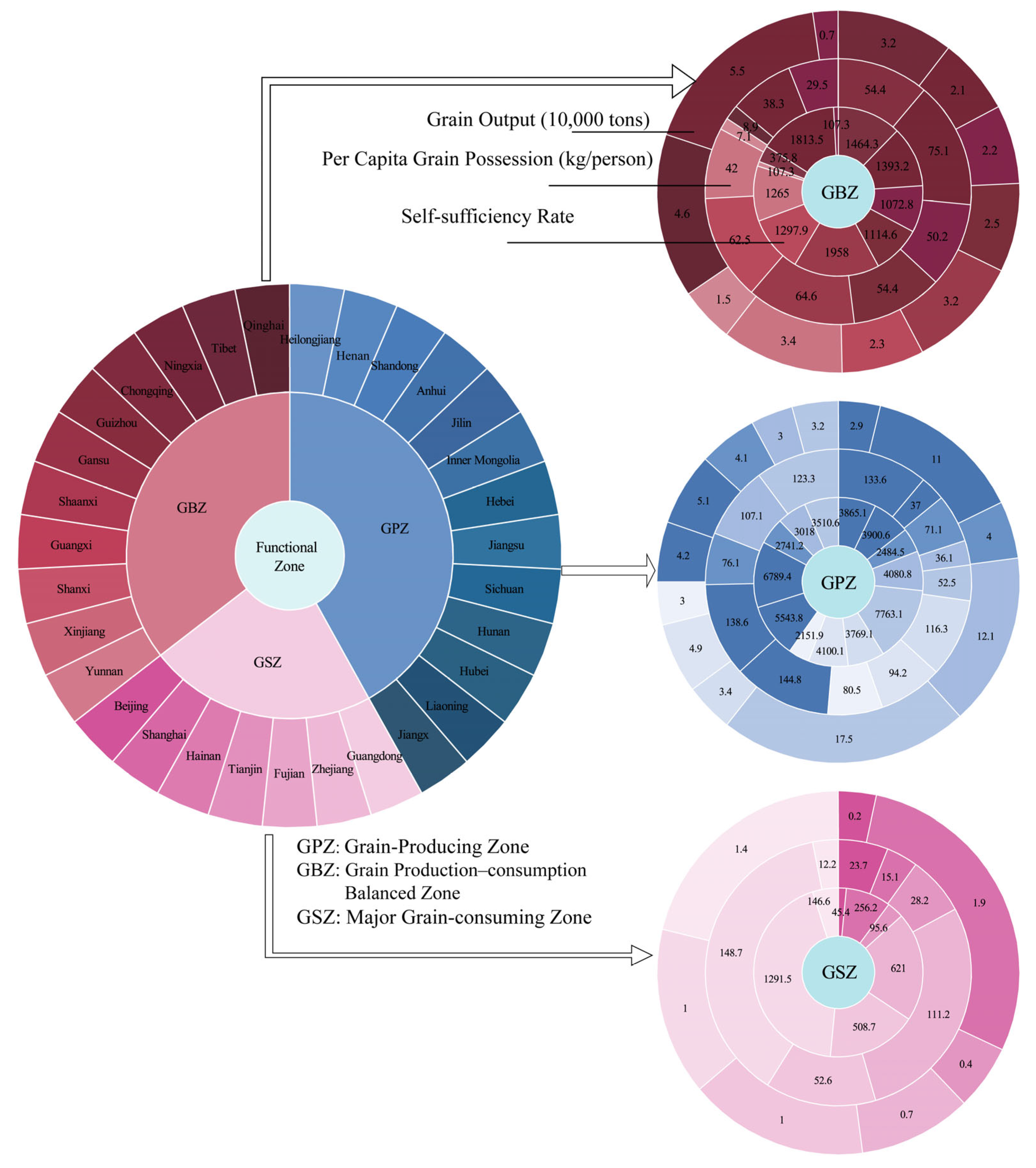
2.1. Study Area
2.2. Method for Measuring ACEE
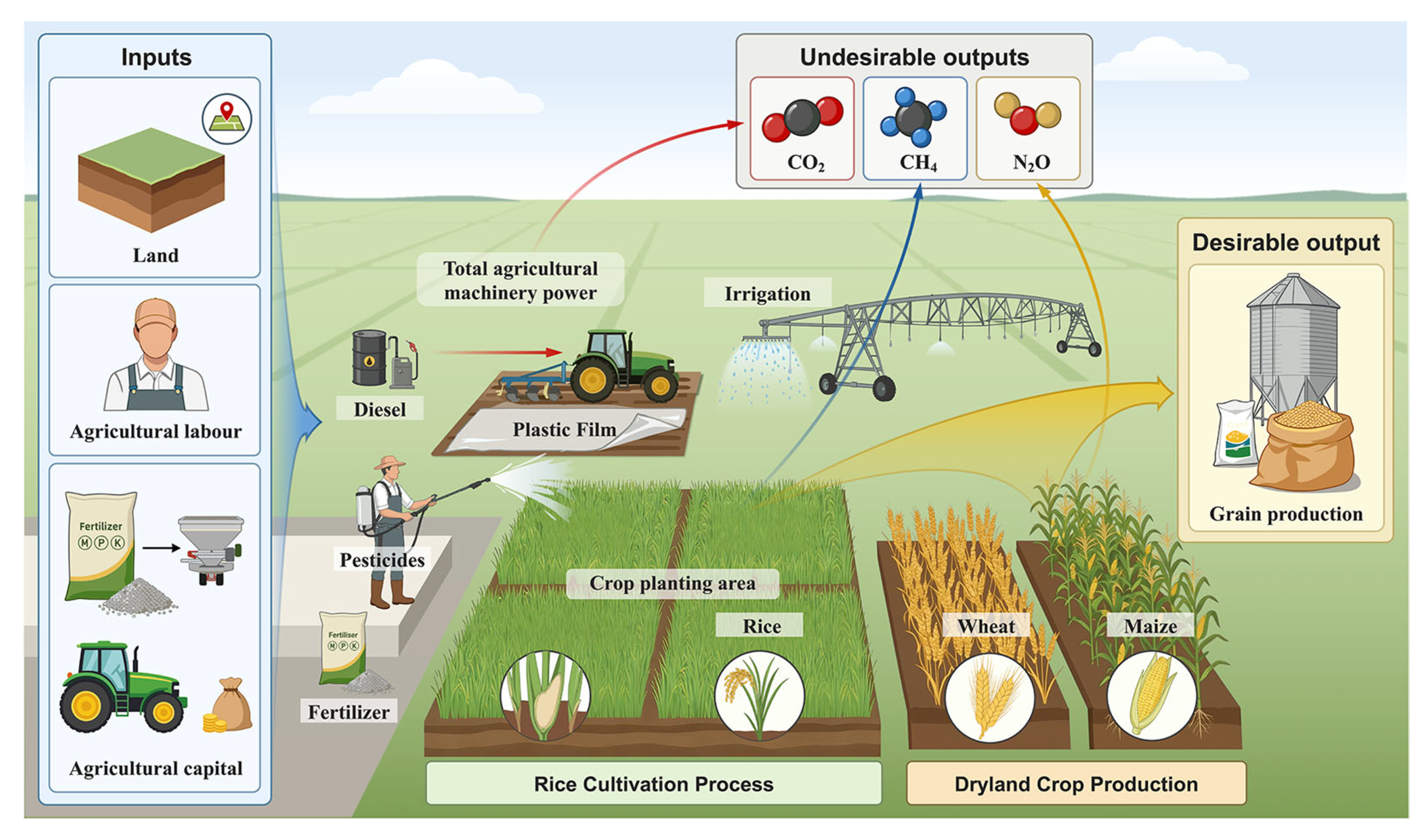
2.2.1. Indicator System and Carbon Emissions Estimation
2.2.2. Super-Efficiency EBM-GML Model
2.3. Spatiotemporal Analysis Methods for ACEE
2.3.1. Kernel Density Estimation
2.3.2. Global and Local Spatial Autocorrelation
- (1)
- Global Spatial Autocorrelation
- (2)
- Local Spatial Autocorrelation
2.3.3. SDM
2.4. Data Sources and Processing
3. Results
3.1. Dynamic Evolution of Agricultural Carbon Efficiency from a Zonal Perspective
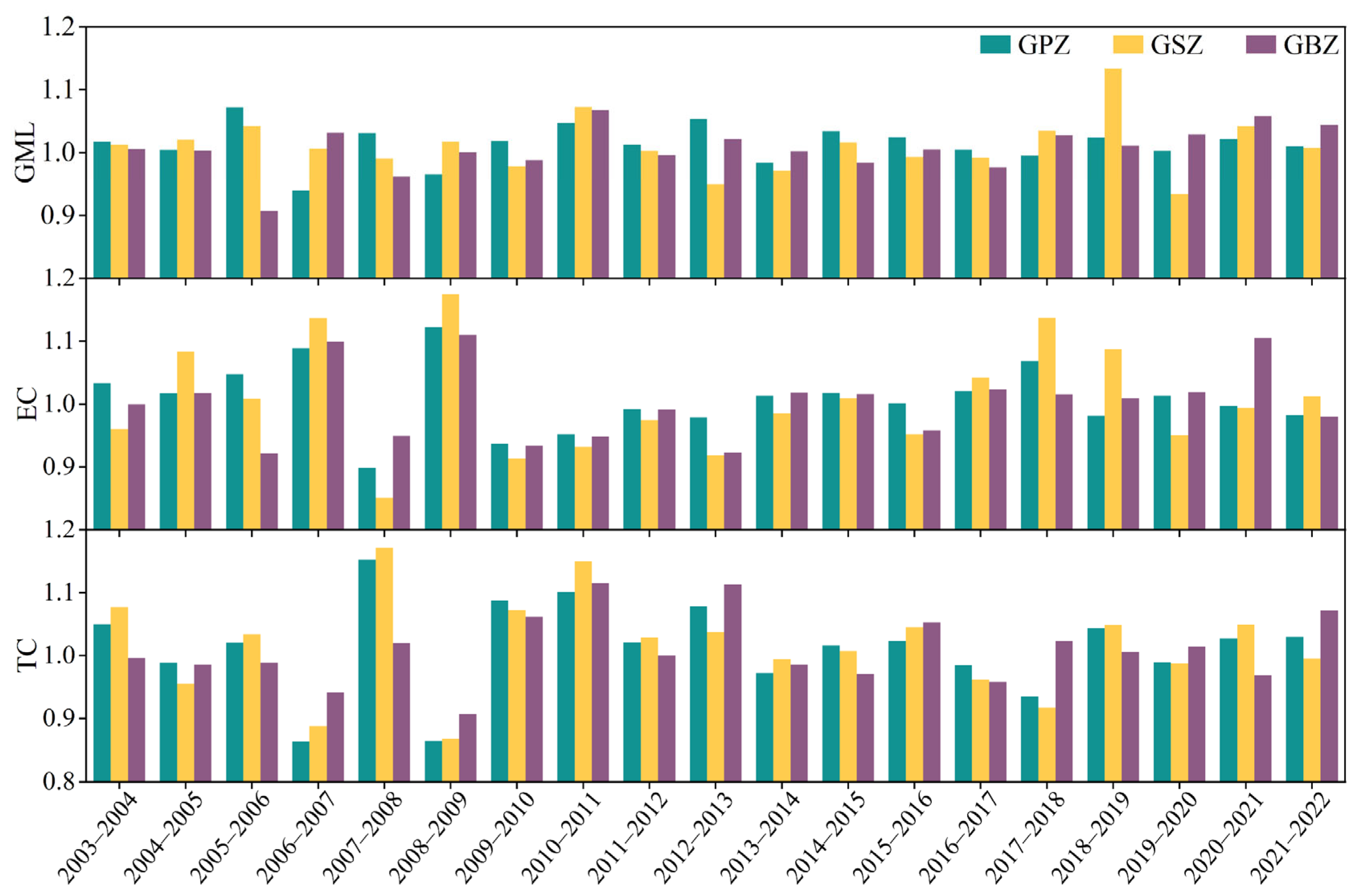
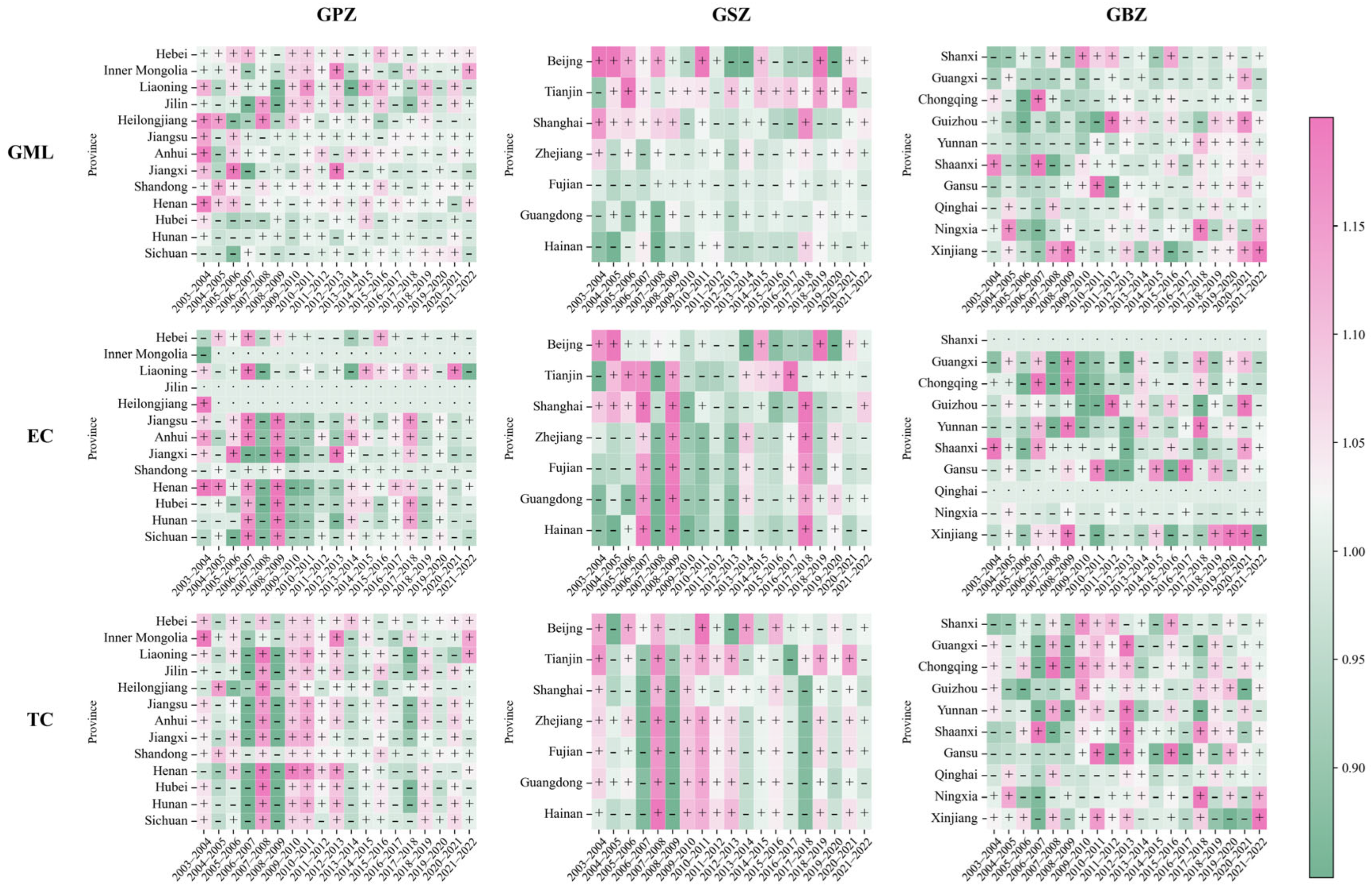
3.2. GML-Based Productivity Change
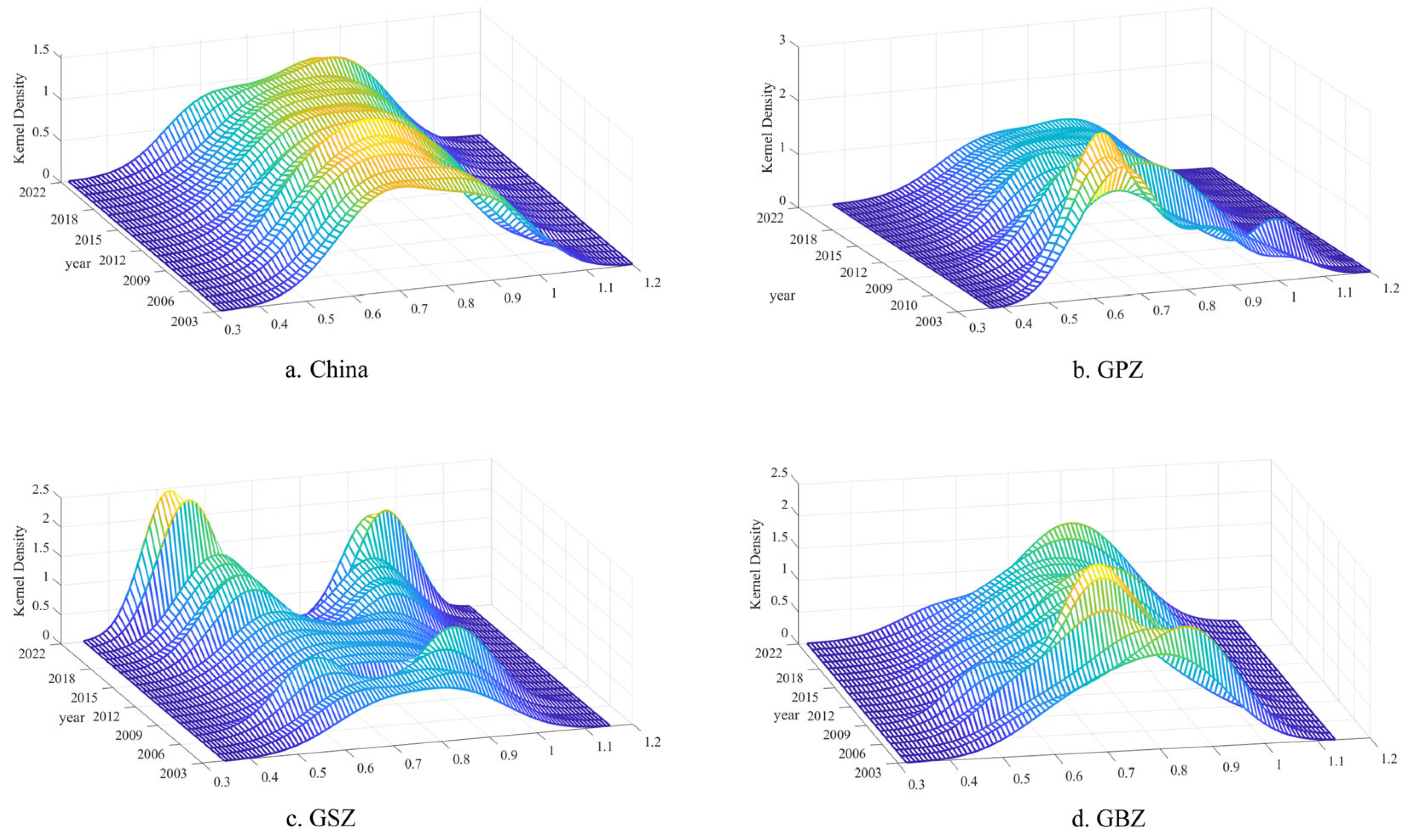
3.3. Dynamic Evolution of ACEE
3.4. Global Spatial Autocorrelation Analysis
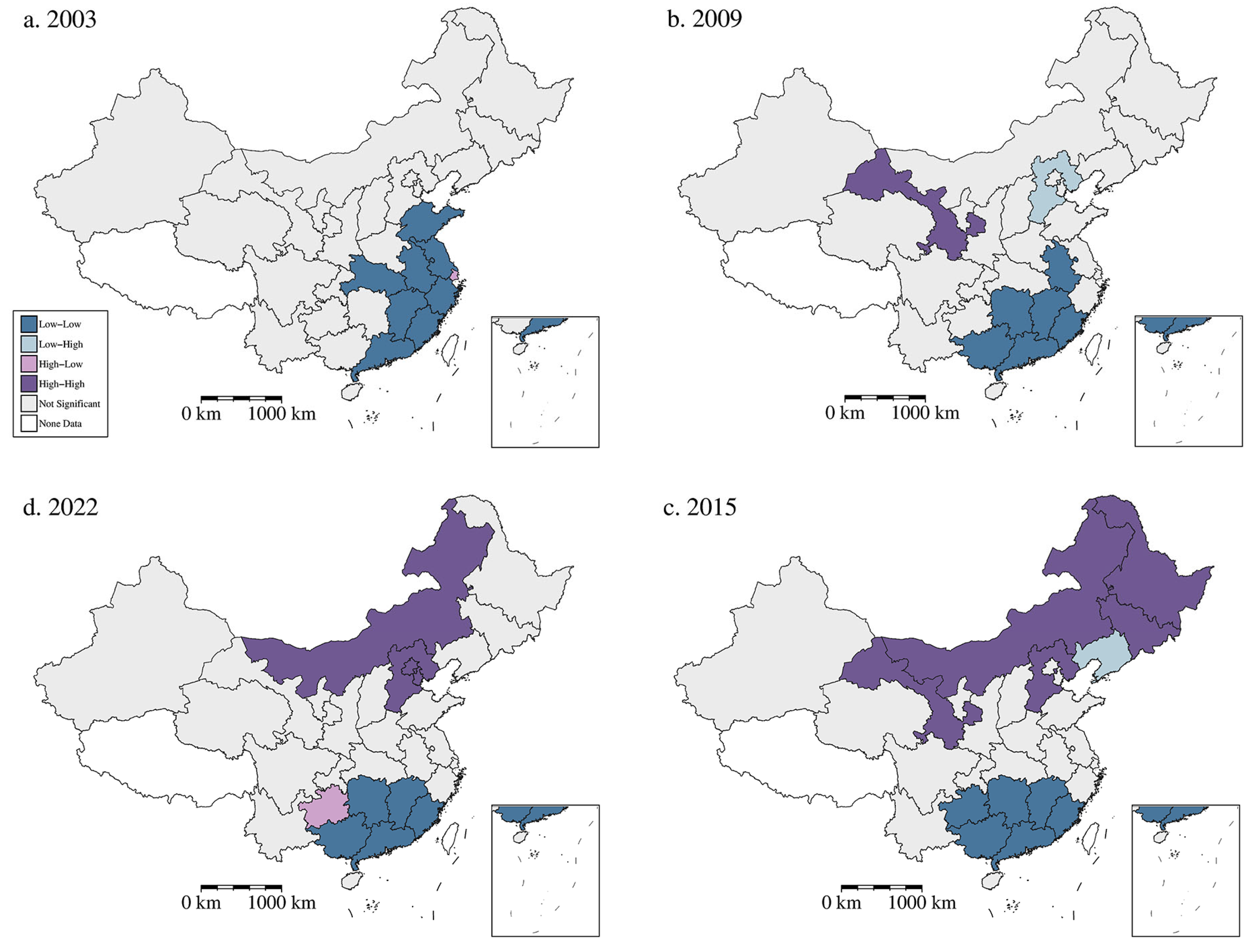
3.5. Local Spatial Structure Characteristics
3.6. Spatial Regression Estimation Results of Influencing Factors
3.7. Spatial Effect Decomposition of Influencing Factors
4. Conclusions
5. Discussion
Supplementary Materials
Author Contributions
Funding
Data Availability Statement
Conflicts of Interest
Appendix A

References
- United Nations Environment Programme. Emissions Gap Report 2023: Broken Record—Temperatures Hit New Highs, Yet World Fails to Cut Emissions (Again); UN Environment Programme: Nairobi, Kenya, 2023. [Google Scholar]
- Bilgili, M.; Tumse, S.; Nar, S. Comprehensive overview on the present state and evolution of global warming, climate change, greenhouse gasses and renewable energy. Arab. J. Sci. Eng. 2024, 49, 14503–14531. [Google Scholar] [CrossRef]
- Jones, M.W.; Peters, G.P.; Gasser, T.; Andrew, R.M.; Schwingshackl, C.; Gütschow, J.; Le Quéré, C. National contributions to climate change due to historical emissions of carbon dioxide, methane, and nitrous oxide since 1850. Sci. Data 2023, 10, 155. [Google Scholar] [CrossRef] [PubMed]
- Xing, Y.; Wang, X. Impact of agricultural activities on climate change: A review of greenhouse gas emission patterns in field crop systems. Plants 2024, 13, 2285. [Google Scholar] [CrossRef] [PubMed]
- Forster, P.M.; Smith, C.; Walsh, T.; Lamb, W.F.; Lamboll, R.; Hall, B.; Hauser, M.; Ribes, A.; Rosen, D.; Gillett, N.P.; et al. Indicators of global climate change 2023: Annual update of key indicators of the state of the climate system and human influence. Earth Syst. Sci. Data 2024, 16, 2625–2658. [Google Scholar] [CrossRef]
- Lamboll, R.D.; Nicholls, Z.R.; Smith, C.J.; Kikstra, J.S.; Byers, E.; Rogelj, J. Assessing the size and uncertainty of remaining carbon budgets. Nat. Clim. Change 2023, 13, 1360–1367. [Google Scholar] [CrossRef]
- Galanakis, C.M. The “vertigo” of the food sector within the triangle of climate change, the post-pandemic world, and the Russian-Ukrainian war. Foods 2023, 12, 721. [Google Scholar] [CrossRef]
- Du, M.; Kang, X.; Liu, Q.; Du, H.; Zhang, J.; Yin, Y.; Cui, Z. City-level livestock methane emissions in China from 2010 to 2020. Sci. Data 2024, 11, 251. [Google Scholar] [CrossRef]
- Gao, Y.; Shao, Y.; Wang, J.; Hu, B.; Feng, H.; Qu, Z.; Liu, Y. Effects of straw returning combined with blended controlled-release urea fertilizer on crop yields, greenhouse gas emissions, and net ecosystem economic benefits: A nine-year field trial. J. Environ. Manag. 2024, 356, 120633. [Google Scholar] [CrossRef]
- Qian, H.; Zhu, X.; Huang, S.; Linquist, B.; Kuzyakov, Y.; Wassmann, R.; Jiang, Y. Greenhouse gas emissions and mitigation in rice agriculture. Nat. Rev. Earth Environ. 2023, 4, 716–732. [Google Scholar] [CrossRef]
- Duan, Y.; Gao, Y.; Zhao, J.; Xue, Y.; Zhang, W.; Wu, W.; Jiang, H.; Cao, D. Agricultural methane emissions in China: Inventories, driving forces and mitigation strategies. Environ. Sci. Technol. 2023, 57, 13292–13303. [Google Scholar] [CrossRef]
- Jin, B.; Cui, C.; Wen, L.; Shi, R.; Yang, J. Regional differences and convergence of agricultural carbon efficiency in China. Ecol. Indic. 2024, 169, 112929. [Google Scholar] [CrossRef]
- Shang, Z.; Cui, X.; van Groenigen, K.J.; Kuhnert, M.; Abdalla, M.; Luo, J.; Zhou, F. Global cropland nitrous oxide emissions in fallow period are comparable to growing-season emissions. Glob. Change Biol. 2024, 30, e17165. [Google Scholar] [CrossRef]
- Frank, S.; Lessa Derci Augustynczik, A.; Havlík, P.; Boere, E.; Ermolieva, T.; Fricko, O.; Wögerer, M. Enhanced agricultural carbon sinks provide benefits for farmers and the climate. Nat. Food 2024, 5, 742–753. [Google Scholar] [CrossRef]
- Rencricca, G.; Froldi, F.; Moschini, M.; Trevisan, M.; Lamastra, L. Mitigation actions scenarios applied to the dairy farm management systems. Foods 2023, 12, 1860. [Google Scholar] [CrossRef]
- Wang, G.; Zhao, M.; Zhao, B.; Liu, X.; Wang, Y. Reshaping agriculture eco-efficiency in China: From greenhouse gas perspective. Ecol. Indic. 2025, 172, 113268. [Google Scholar] [CrossRef]
- Liu, H.; Wen, S.; Wang, Z. Agricultural production agglomeration and total factor carbon productivity: Based on NDDF–MML index analysis. China Agric. Econ. Rev. 2022, 14, 709–740. [Google Scholar] [CrossRef]
- Moresi, M.; Cimini, A. A comprehensive study from cradle-to-grave on the environmental profile of malted legumes. Foods 2024, 13, 655. [Google Scholar] [CrossRef] [PubMed]
- Yang, H.; Wang, X.; Bin, P. Agriculture carbon-emission reduction and changing factors behind agricultural eco-efficiency growth in China. J. Clean. Prod. 2022, 334, 130193. [Google Scholar] [CrossRef]
- Bernini, C.; Galli, F. Economic and environmental efficiency, subsidies and spatio-temporal effects in agriculture. Ecol. Econ. 2024, 218, 108120. [Google Scholar] [CrossRef]
- Liu, Y.; Tian, L.; Wang, Z.; He, P.; Li, M.; Wang, N.; Yu, Y. Spatial–temporal evolution of interprovincial ecological efficiency and its determinants in China: A super-efficiency SBM model approach. Sustainability 2023, 15, 13864. [Google Scholar] [CrossRef]
- Niu, H.; Zhang, Z.; Xiao, Y.; Luo, M.; Chen, Y. A study of carbon emission efficiency in Chinese provinces based on a three-stage SBM-undesirable model and an LSTM model. Int. J. Environ. Res. Public Health 2022, 19, 5395. [Google Scholar] [CrossRef]
- Pan, Z.; Tang, D.; Kong, H.; He, J. An analysis of agricultural production efficiency of Yangtze River economic belt based on a three-stage DEA malmquist model. Int. J. Environ. Res. Public Health 2022, 19, 958. [Google Scholar] [CrossRef]
- Li, J.; Peng, Z. Impact of digital villages on agricultural green growth based on empirical analysis of Chinese provincial data. Sustainability 2024, 16, 9590. [Google Scholar] [CrossRef]
- Fan, Q.; Zheng, Y.; Jia, W. The spatial non-equilibrium and convergence of Chinese grain enterprises’ total factor productivity—Evidence from China. Foods 2022, 11, 2843. [Google Scholar] [CrossRef]
- Shen, N.; Tan, J.; Wang, W.; Xue, W.; Wang, Y.; Huang, L.; Yan, G.; Song, Y.; Li, L. Long-term changes of methane emissions from rice cultivation during 2000–2060 in China: Trends, driving factors, predictions and policy implications. Environ. Int. 2024, 191, 108958. [Google Scholar] [CrossRef] [PubMed]
- Cui, D.; Yang, S.; Song, X.; Huang, X.; Duan, C.; Ji, M.; Liu, Z. Monthly methane emissions in Chinese mainland provinces from 2013–2022. Sci. Data 2025, 12, 948. [Google Scholar] [CrossRef]
- Zhao, L.; Liu, Y.; Shi, J. The environmental performance of agricultural production trusteeship from the perspective of planting carbon emissions. China Agric. Econ. Rev. 2023, 15, 853–870. [Google Scholar] [CrossRef]
- He, D.; Deng, X.; Wang, X.; Zhang, F. Livestock greenhouse gas emission and mitigation potential in China. J. Environ. Manag. 2023, 348, 119494. [Google Scholar] [CrossRef]
- Chen, Y.; Qi, L.; Hussain, H.A. Greenhouse gas emissions from chinese livestock sector can be decreased by one third in 2030 by the improvement in management. Carbon Res. 2024, 3, 66. [Google Scholar] [CrossRef]
- Gao, Y.; Li, Z.; Hong, S.; Yu, L.; Li, S.; Wei, J.; Wang, X. Recent stabilization of agricultural non-CO2 greenhouse gas emissions in China. Natl. Sci. Rev. 2025, 12, nwaf040. [Google Scholar] [CrossRef]
- Peng, C.; Wang, X.; Xiong, X.; Wang, Y. Assessing carbon emissions from animal husbandry in China: Trends, regional variations and mitigation strategies. Sustainability 2024, 16, 2283. [Google Scholar] [CrossRef]
- Simmons, A.T.; Simpson, M.; Bontinck, P.A.; Golding, J.; Grant, T.; Fearnley, J.; Falivene, S. Emissions reduction strategies for the orange and cherry industries in New South Wales. Foods 2023, 12, 3328. [Google Scholar] [CrossRef] [PubMed]
- Zheng, L.; Zhang, Q.; Chen, J.; Gu, B.; Zhan, X.; Yu, B.; Jing, X. Livestock rearing as a key component of mitigation efforts for non-CO2 greenhouse gas emissions in global crop-livestock system. Resour. Environ. Sustain. 2025, 100248. [Google Scholar] [CrossRef]
- Lu, H.; Chen, Y.; Luo, J. Development of green and low-carbon agriculture through grain production agglomeration and agricultural environmental efficiency improvement in China. J. Clean. Prod. 2024, 442, 141128. [Google Scholar] [CrossRef]
- Khatri-Chhetri, A.; Sapkota, T.B.; Maharjan, S.; Konath, N.C.; Shirsath, P. Agricultural emissions reduction potential by improving technical efficiency in crop production. Agric. Syst. 2023, 207, 103620. [Google Scholar] [CrossRef]
- Zhao, L.; Rao, X.; Hu, D. The spatial impact of digitalization on carbon emission intensity in agricultural production: Empirical evidence from rural China. China Agric. Econ. Rev. 2025, 17, 415–440. [Google Scholar] [CrossRef]
- Fan, S.; Lin, H.; Luo, N.; Sima, H.; Liu, Y. Spatial temporal trends and inequality in agricultural eco-efficiency under carbon constraints in China. Sci. Rep. 2025, 15, 21557. [Google Scholar] [CrossRef]
- Li, T.; Liu, X.; Tian, J.; Yuan, W.; Wang, X.; Yang, X.Q.; Qin, Z. Methane and nitrous oxide budget for Chinese natural terrestrial ecosystems. Natl. Sci. Rev. 2025, 12, nwaf094. [Google Scholar] [CrossRef] [PubMed]
- Khanna, N.; Lin, J.; Liu, X.; Wang, W. An assessment of China’s methane mitigation potential and costs and uncertainties through 2060. Nat. Commun. 2024, 15, 9694. [Google Scholar] [CrossRef] [PubMed]
- Intergovernmental Panel on Climate Change. 2013 Supplement to the 2006 IPCC Guidelines for National Greenhouse Gas Inventories: Wetlands; IPCC: Geneva, Switzerland, 2013; Available online: https://www.ipcc-nggip.iges.or.jp/public/wetlands/ (accessed on 26 March 2026).
- Tian, Y.; Zhang, J.B.; Li, B. Agricultural carbon emissions in China: Calculation, spatial-temporal comparison and decoupling effects. Resour. Sci. 2012, 34, 2097–2105. [Google Scholar]
- Xie, T.; Huang, Z.; Tan, T.; Chen, Y. Forecasting China’s agricultural carbon emissions: A comparative study based on deep learning models. Ecol. Inform. 2024, 82, 102661. [Google Scholar] [CrossRef]
- Huang, X.; Zhang, T.; Wang, X.; Zheng, J.; Xu, G.; Wu, X. Regional differences of agricultural total factor carbon efficiency in China. Humanit. Soc. Sci. Commun. 2024, 11, 845. [Google Scholar] [CrossRef]




| Variables | Indicator Specification (with Unit) | Obs. | Mean | Std. | Min | Max |
|---|---|---|---|---|---|---|
| Crop sown area | 103 ha | 600 | 5371.044 | 3759.939 | 88.55 | 15,209.41 |
| Total agricultural machinery power | 104 kW | 600 | 3070.915 | 2795.458 | 93.97 | 13,353 |
| Effective irrigated area | 103 ha | 600 | 2081.439 | 1590.545 | 109.24 | 6666.39 |
| Pesticide use | ton | 600 | 52,450.87 | 41,415.66 | 1000 | 173,461 |
| Rural labor | 104 persons | 600 | 1782.258 | 1286.11 | 147.94 | 4914.67 |
| Grain output | 104 tons | 600 | 1970.685 | 1681.887 | 28.76 | 7867.72 |
| CO2 | 104 tons | 600 | 320.0776 | 226.4324 | 14.3546 | 995.7526 |
| CH4 (CO2e) | 104 tons | 600 | 526.6576 | 637.4659 | 0 | 2660.641 |
| N2O (CO2e) | 104 tons | 600 | 559.6604 | 412.7101 | 1.7554 | 1493.199 |
| Variables | Definition (Unit) | Obs. | Mean | Std. | Min | Max |
|---|---|---|---|---|---|---|
| Agricultural Industrial Structure (AIS) | Agricultural industrial structure (dimensionless) | 600 | 0.5200 | 0.0849 | 0.3388 | 0.7396 |
| Environmental Regulation Intensity (ERI) | Investment in environmental pollution control/regional gross domestic product (dimensionless) | 600 | 1.2234 | 0.7454 | 0.2017 | 4.6252 |
| Industrial Agglomeration (IA) | (Industrial added value of each province/total industrial added value)/(regional GDP/total GDP) (dimensionless) | 600 | 1.2259 | 0.7020 | 0.0423 | 4.2328 |
| Urbanization Rate (UR) | Urban permanent population/total permanent population (dimensionless) | 600 | 0.5459 | 0.1507 | 0.1489 | 0.8958 |
| Agricultural Fixed Asset Investment (AFAI) | Annual agricultural fixed asset investment (billion CNY) | 600 | 7.3889 | 6.7805 | 0 | 51.27 |
| Grain Crop Sown Area (GSA) | Sown area of grain crops (million hectares) | 600 | 3.7415 | 3.022 | 0.4652 | 14.6823 |
| Disaster-Affected Area (DAA) | Area affected by natural disasters (105 hectares) | 600 | 10.1461 | 9.9488 | 0 | 73.937 |
| Year | I | Z | p-Value * | Year | I | Z | p-Value * |
|---|---|---|---|---|---|---|---|
| 2003 | 0.2573 ** | 2.3250 | 0.0201 | 2013 | 0.5620 *** | 4.7575 | 0.0000 |
| 2004 | 0.2466 ** | 2.2362 | 0.0253 | 2014 | 0.4827 *** | 4.1246 | 0.0000 |
| 2005 | 0.3213 *** | 2.8371 | 0.0046 | 2015 | 0.5450 *** | 4.6240 | 0.0000 |
| 2006 | 0.1066 | 1.1277 | 0.2594 | 2016 | 0.5568 *** | 4.7129 | 0.0000 |
| 2007 | 0.3286 *** | 2.9048 | 0.0037 | 2017 | 0.5719 *** | 4.8304 | 0.0000 |
| 2008 | 0.4012 *** | 3.4923 | 0.0005 | 2018 | 0.5464 *** | 4.6256 | 0.0000 |
| 2009 | 0.3658 *** | 3.2115 | 0.0013 | 2019 | 0.5662 *** | 4.7841 | 0.0000 |
| 2010 | 0.4722 *** | 4.0472 | 0.0001 | 2020 | 0.5592 *** | 4.7292 | 0.0000 |
| 2011 | 0.5692 *** | 4.8085 | 0.0000 | 2021 | 0.5955 *** | 5.0179 | 0.0000 |
| 2012 | 0.5494 *** | 4.6571 | 0.0000 | 2022 | 0.6209 *** | 5.2234 | 0.0000 |
| Variables | SDM (Contiguity Matrix) | SDM (Inverse Distance Matrix) | SDM (Inverse Squared Distance Matrix) | |||
|---|---|---|---|---|---|---|
| Coefficient | z-Value | Coefficient | z-Value | Coefficient | z-Value | |
| AIS | 0.315 ** | 2.77 | 0.397 *** | 3.50 | 0.414 *** | 3.54 |
| ERI | 0.0061 | 1.09 | 0.0066 | 1.16 | 0.0053 | 0.93 |
| IA | −0.0819 *** | −5.63 | −0.0812 *** | −5.47 | −0.0870 *** | −5.90 |
| UR | 0.241 ** | 3.04 | 0.399 *** | 4.94 | 0.234 ** | 2.92 |
| AFAI | −0.0019 * | −2.54 | −0.0025 *** | −3.31 | −0.0018 * | −2.37 |
| GSA | 0.0530 *** | 6.27 | 0.0683 *** | 9.13 | 0.0677 *** | 8.70 |
| DAA | −0.0022 *** | −4.35 | −0.0024 *** | −4.98 | −0.0026 *** | −5.15 |
| W×AIS | −0.0343 | −0.15 | −1.051 | −1.44 | −0.4580 | −1.62 |
| W×ERI | −0.0033 | −0.34 | −0.0068 | −0.18 | −0.0022 | −0.14 |
| W×IA | −0.0855 ** | −2.81 | −0.307 *** | −3.54 | −0.0739 * | −2.05 |
| W×UR | 0.172 | 1.33 | 1.854 *** | 3.61 | 0.336 | 1.85 |
| W×AFAI | 0.0001 | 0.03 | −0.0315 *** | −5.01 | −0.0127 *** | −5.04 |
| W×GSA | 0.0590 *** | 3.85 | 0.332 *** | 6.92 | 0.0655 ** | 3.21 |
| W×DAA | 0.0001 | 0.14 | 0.0014 | 0.50 | 0.0021 | 1.76 |
| ρ | 0.365 *** | 7.28 | 0.281 * | 2.34 | 0.367 *** | 5.86 |
| R2 | 0.0788 | 0.0543 | 0.0385 | |||
| observations | 600 | 600 | 600 | |||
| Variables | Direct Effects | Indirect Effects | Total Effects | |||
|---|---|---|---|---|---|---|
| Coefficient | z-Value | Coefficient | z-Value | Coefficient | z-Value | |
| AIS | 0.320 *** | 2.69 | 0.0693 | 0.22 | 0.390 | 1.05 |
| ERI | 0.0054 | 1.10 | −0.0020 | −0.14 | 0.0035 | 0.22 |
| IA | −0.0924 *** | −6.05 | −0.167 *** | −3.14 | −0.259 *** | −4.27 |
| UR | 0.275 *** | 3.11 | 0.405 * | 1.91 | 0.680 *** | 2.69 |
| AFAI | −0.0021 ** | −2.31 | −0.0011 | −0.42 | −0.0032 | −1.06 |
| GSA | 0.0613 *** | 7.72 | 0.114 *** | 6.53 | 0.176 *** | 9.82 |
| DAA | −0.0023 *** | −4.68 | −0.0009 | −0.80 | −0.0031 *** | −2.62 |
Disclaimer/Publisher’s Note: The statements, opinions and data contained in all publications are solely those of the individual author(s) and contributor(s) and not of MDPI and/or the editor(s). MDPI and/or the editor(s) disclaim responsibility for any injury to people or property resulting from any ideas, methods, instructions or products referred to in the content. |
© 2026 by the authors. Licensee MDPI, Basel, Switzerland. This article is an open access article distributed under the terms and conditions of the Creative Commons Attribution (CC BY) license.
Share and Cite
Bu, M.; Xi, W.; Mi, L.; Gao, M.; Wang, G. Re-Evaluating Agricultural Carbon Efficiency Across Functional Grain Zones: From Spatial Analysis. Land 2026, 15, 571. https://doi.org/10.3390/land15040571
Bu M, Xi W, Mi L, Gao M, Wang G. Re-Evaluating Agricultural Carbon Efficiency Across Functional Grain Zones: From Spatial Analysis. Land. 2026; 15(4):571. https://doi.org/10.3390/land15040571
Chicago/Turabian StyleBu, Miaoling, Weiming Xi, Lingchen Mi, Mingyan Gao, and Guofeng Wang. 2026. "Re-Evaluating Agricultural Carbon Efficiency Across Functional Grain Zones: From Spatial Analysis" Land 15, no. 4: 571. https://doi.org/10.3390/land15040571
APA StyleBu, M., Xi, W., Mi, L., Gao, M., & Wang, G. (2026). Re-Evaluating Agricultural Carbon Efficiency Across Functional Grain Zones: From Spatial Analysis. Land, 15(4), 571. https://doi.org/10.3390/land15040571