Spatial Evolution and Driving Mechanisms of Rural Settlements in National New-Type Urbanization Pilot Areas: A Case Study of She County




Abstract
1. Introduction
2. Study Area and Data Sources
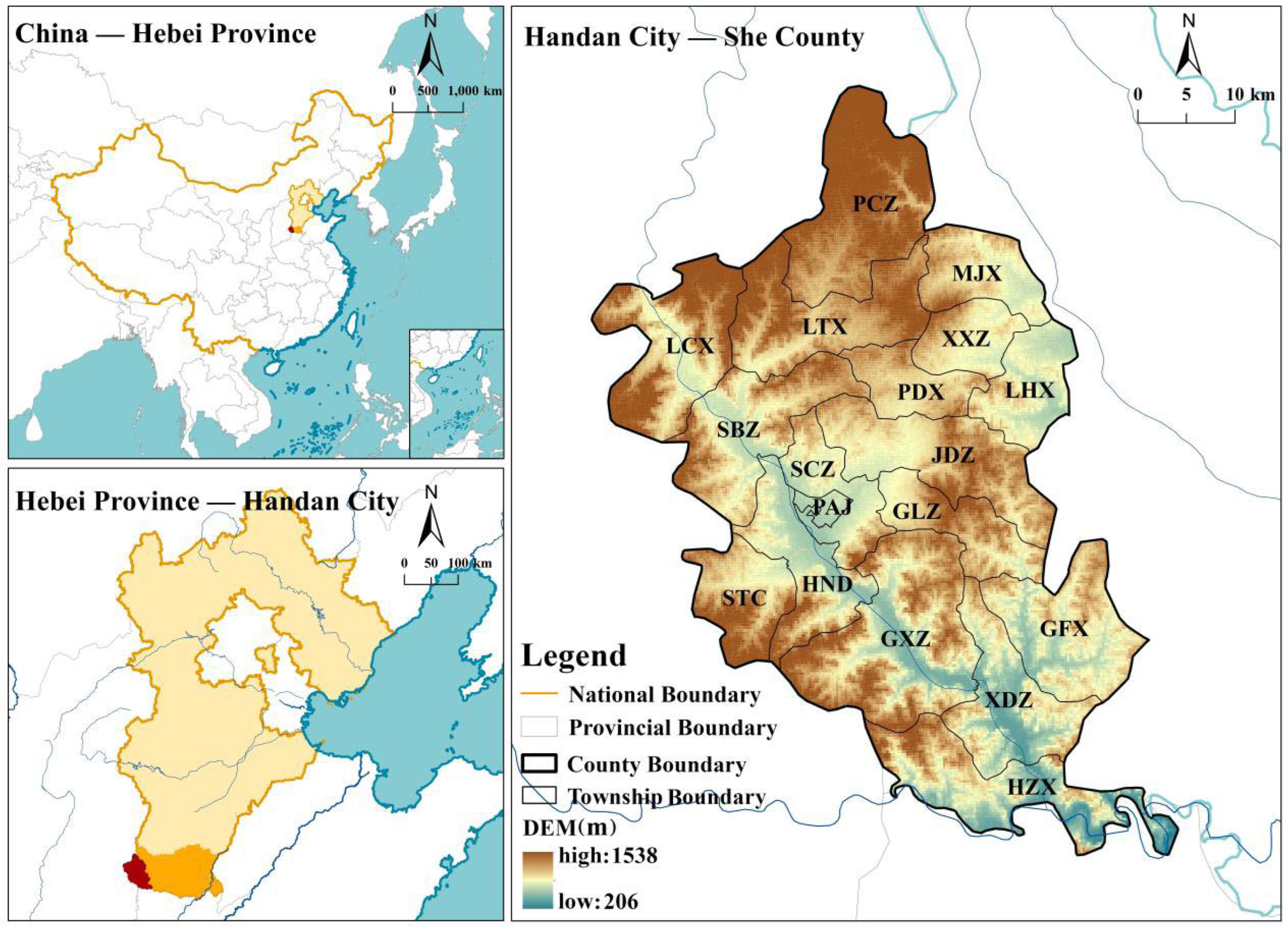
2.1. Study Area
2.2. Data Sources
3. Methodology
3.1. Analysis of Static Spatial Pattern Characteristics
3.1.1. Identification of Distribution Morphology and Aggregation Characteristics of Rural Settlements Based on Average Nearest Neighbor (ANN)
3.1.2. Characterization of Spatial Aggregation Centers and Gradient Patterns Based on Kernel Density and Cold/Hot Spot Analysis
- (1)
- Kernel Density Estimation (KDE)
- (2)
- Cold/Hot Spot Analysis
3.1.3. Assessment of Spatial Structure Fragmentation and Diversity Based on Landscape Pattern Indices
3.2. Analysis of Dynamic Spatial Pattern Evolution
3.3. Identification of Driving Factors for Rural Settlement Spatial Patterns
3.3.1. Selection of Driving Factors
3.3.2. Geodetector Analysis
4. Research Results
4.1. Spatial and Scale Agglomeration Characteristics
4.2. Evolution of Landscape Patterns
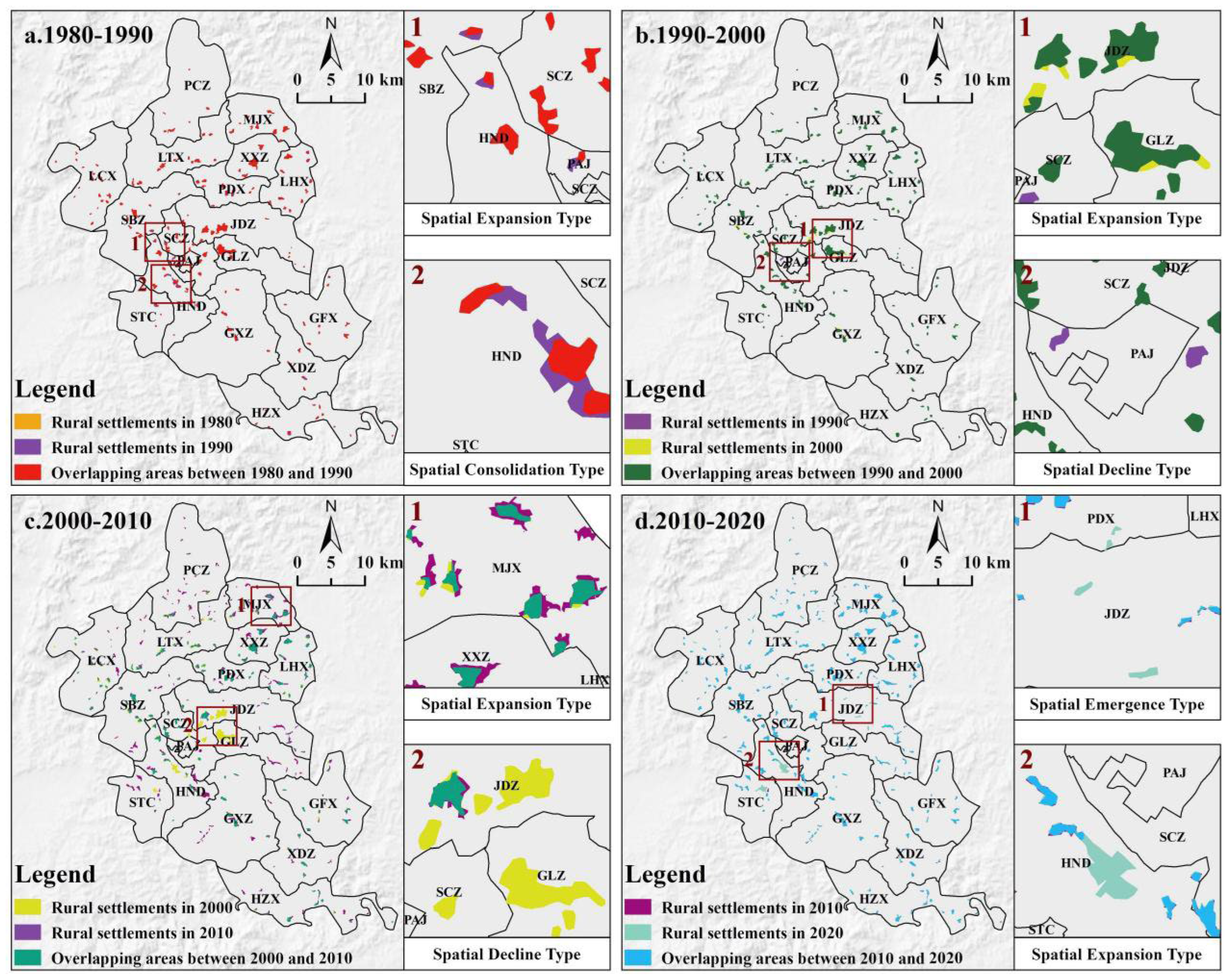
4.3. Evolutionary Patterns of Rural Settlements
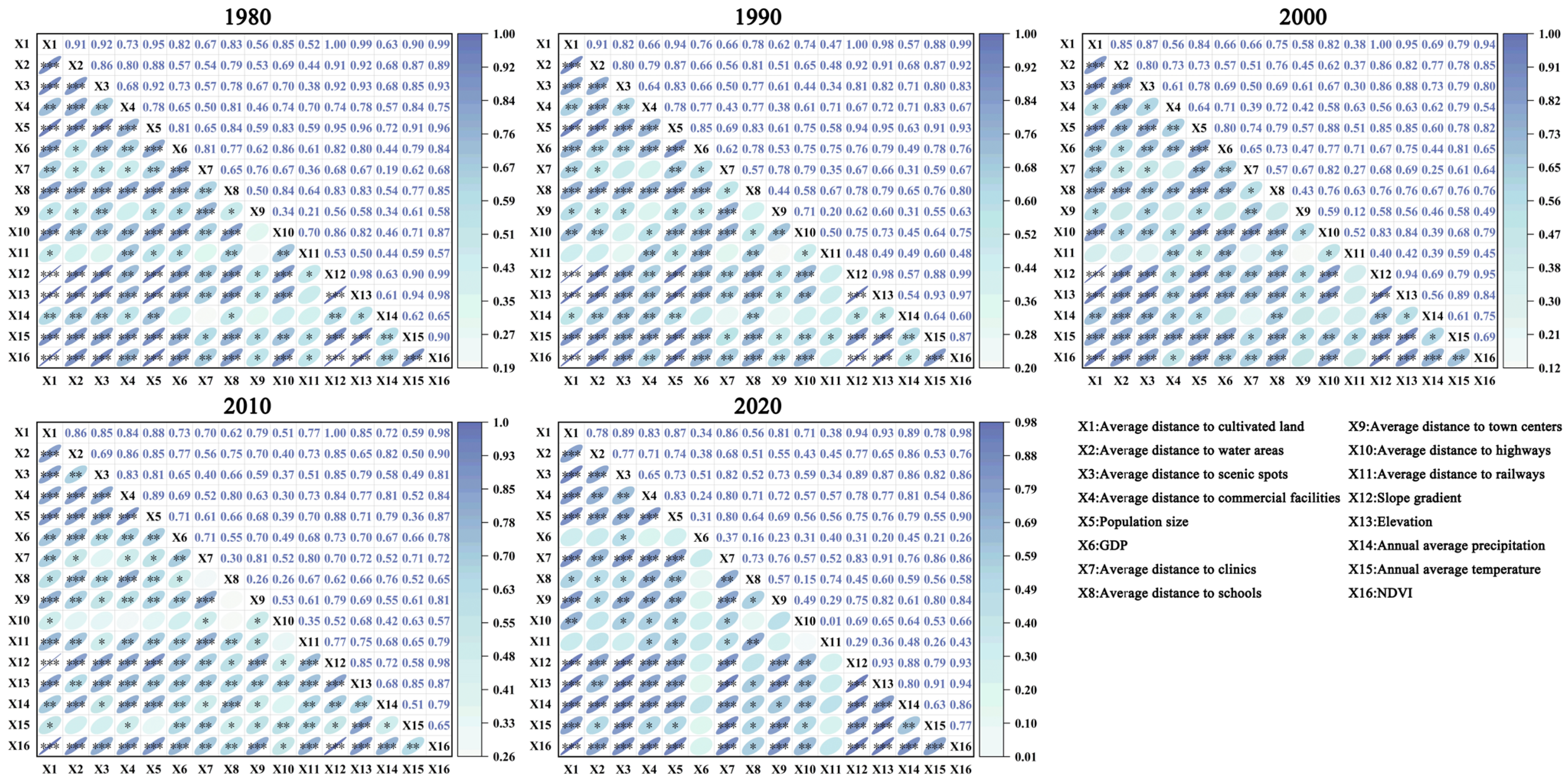
4.4. Driving Factors Analysis
5. Discussion
5.1. Driving Mechanism Affecting the Spatial Distribution of Rural Settlements
5.2. Limitations and Applicability of the Study
5.3. Policy Implications
6. Conclusions
Author Contributions
Funding
Data Availability Statement
Acknowledgments
Conflicts of Interest
References
- Zou, Y.; Rao, Y.; Luo, F.; Yi, C.; Du, P.; Liu, H.; Wu, P.; Song, Y.; Zhou, Y. Evolution of rural settlements and its influencing mechanism in the farming-pastoral ecotone of Inner Mongolia from a production-living-ecology perspective. Habitat Int. 2024, 151, 103137. [Google Scholar] [CrossRef]
- Doussard, C.; Fonticelli, C. Ecologizing planning policies and practices in France: Insights from peri-urban and rural ecoquartier certified neighborhoods. Environ. Sci. Policy 2022, 136, 588–598. [Google Scholar] [CrossRef]
- Hofstede, H.; Salemink, K.; Haartsen, T. Beyond the (im)mobility and social-environmental dichotomy: Young adults’ motives to reside in rural northwest Europe. Popul. Space Place 2023, 29, e32. [Google Scholar] [CrossRef]
- Zhang, M.; Tong, Y.; Ge, Y.; Guo, J.; Nie, H.; Wang, Z.; Fan, L. Residents’ future residential preference and its affecting factors in the rapid urbanization zone of rural China from a family life cycle perspective. Sci. Rep. 2024, 14, 13766. [Google Scholar] [CrossRef] [PubMed]
- Sheng, S.; Zhang, P.; Huang, J.; Ning, L. Research Advances and Emerging Trends in the Impact of Urban Expansion on Food Security: A Global Overview. Agriculture 2025, 15, 1509. [Google Scholar] [CrossRef]
- Topole, M.; Bole, D.; Petek, F.; Repolusk, P. Spatial and functional changes in built-up areas in selected slovene rural settlements after 1991. Acta Geogr. Slov. 2006, 46, 189–249. [Google Scholar] [CrossRef]
- Wang, J.; Qu, L.; Li, Y.; Feng, W. Identifying the structure of rural regional system and implications for rural revitalization: A case study of Yanchi County in northern China. Land Use Policy 2023, 124, 106436. [Google Scholar] [CrossRef]
- Figlus, T.; Musiaka, U. Analysis of morphological changes of rural settlement patterns after World War II in the metropolitan area of ód using a graph theory based method. Environ. Socio-Econ. Stud. 2020, 8, 57–72. [Google Scholar] [CrossRef]
- Kaya, A.T. Interpreting Vernacular Settlements Using the Spatial Behavior Concept. Gazi Univ. J. Sci. 2020, 33, 297–316. [Google Scholar] [CrossRef]
- Gražulevičiūtė-Vileniškė, I.; Vitkuvienė, J. How Rural Becomes Rurban–Rural Manor Residencies in the Urban Context: Lithuanian Case. Archit. Urban Plan. 2013, 7, 32–37. [Google Scholar] [CrossRef]
- Bański, J.; Wesołowska, M. Transformations in housing construction in rural areas of Poland’s Lublin region—Influence on the spatial settlement structure and landscape aesthetics. Landsc. Urban Plan. 2010, 94, 116–126. [Google Scholar] [CrossRef]
- Carson, D.A.; Carson, D.B.; Argent, N. Cities, hinterlands and disconnected urban-rural development: Perspectives from sparsely populated areas. J. Rural Stud. 2022, 93, 104–111. [Google Scholar] [CrossRef]
- Rodriguez, E.D.; Garcia, I.G. Morphological problems in rural municipalities: Their difficult addressing through conventional urban planning tools. Ciudad.-Rev. Inst. Univ. Urban. Univ. Valladolid 2021, 24, 119–144. [Google Scholar] [CrossRef]
- Duan, Y.; Wang, H.; Huang, A.; Xu, Y.; Lu, L.; Ji, Z. Identification and spatial-temporal evolution of rural “production-living-ecological” space from the perspective of villagers’ behavior—A case study of Ertai Town, Zhangjiakou City. Land Use Policy 2021, 106, 105457. [Google Scholar] [CrossRef]
- Yang, L.; Tian, G.; Li, L.; Duan, J. The transition characteristics and driving mechanisms of rural residential land in metropolitan areas—A case study of Tianjin, China. Environ. Sci. Pollut. Res. 2023, 30, 54130–54148. [Google Scholar] [CrossRef]
- Sheng, S.; Lian, H. The Spatial Pattern Evolution of Rural Settlements and Multi-Scenario Simulations since the Initiation of the Reform and Opening up Policy in China. Land 2023, 12, 1763. [Google Scholar] [CrossRef]
- Shi, L.; Wang, Y. Evolution characteristics and driving factors of negative decoupled rural residential land and resident population in the Yellow River Basin. Land Use Policy 2021, 109, 105685. [Google Scholar] [CrossRef]
- Liu, S.; Ma, L.; Yao, Y.; Cui, X. Man-land relationship based on the spatial coupling of population and residential land—A case study of Yuzhong County in Longzhong Loess Hilly Region, China. Land Use Policy 2022, 116, 106059. [Google Scholar] [CrossRef]
- Batisse, C.; Truchet, S.; Zhu, N. Residential mobility to the rural and peri-urban areas: A segregative process? [Migration résidentielle vers le rural et le périurbain: Un processus ségrégatif?]. Cah. Agric. 2021, 197–224. [Google Scholar] [CrossRef]
- Keita, M.A.; Ruan, R.Z.; An, R. Spatiotemporal change of urban sprawl patterns in Bamako district in Mali based on time series analysis. Urban Sci. 2021, 5, 4. [Google Scholar] [CrossRef]
- Cao, C.; Song, W. Discerning Spatiotemporal Patterns and Policy Drivers of Rural Settlement Changes from 1962 to 2020. Land 2022, 11, 1317. [Google Scholar] [CrossRef]
- Makinde, A.A.; Gbenga, O.J.; Popoola, K.O. Urban expansion and rural landscape transformations in selected communities of Obafemi Owode local government area of Ogun State Nigeria. SN Soc. Sci. 2021, 1, 191. [Google Scholar] [CrossRef]
- Yang, D.; Liu, Y. Human activities unevenly disturbed climatic impacts on vegetation dynamics across natural-anthropogenic-integrated ecosystem types in China. Habitat Int. 2025, 162, 103451. [Google Scholar] [CrossRef]
- Wang, J.; Zhang, H.; Liu, Y.; Zhang, Y.; Wang, H. Identifying the pollution risk pattern from industrial production to rural settlements and its countermeasures in China. Sci. Total Environ. 2024, 951, 175442. [Google Scholar] [CrossRef]
- Shi, Y.; Li, X.; Hu, X.; Li, Z. Spatiotemporal Evolution and Influencing Factors of Urban-rural Construction Land in Rural Industrialized Areas in China: Case Studies in Changyuan City and Xinxiang County of Henan Province. Chin. Geogr. Sci. 2023, 33, 850–864. [Google Scholar] [CrossRef]
- Krassowski, A. Analysis of the reflection of the most important events of the XVI–XIX centuries in the names of rural of the Ruza district of the Moscow province, used in the documents and applied to cartographic materials. InterCarto. InterGIS 2021, 27, 445–460. [Google Scholar] [CrossRef]
- Shafie, B.; Javid, A.H.; Behbahani, H.I.; Darabi, H.; Lotfi, F.H. An analysis of the landscape structure changes as an ecological approach to achieve sustainable regional planning (case study: Latian Dam watershed). J. Environ. Eng. Landsc. Manag. 2023, 31, 9–22. [Google Scholar] [CrossRef]
- Guo, J.; Song, W.; Guo, L.; Zhang, Y. Simulating the Impacts of the New-Type Urbanization Policy on Rural Settlement Changes: A Case Study in Dingzhou, China. J. Resour. Ecol. 2022, 13, 285–298. [Google Scholar] [CrossRef]
- Duan, Z.; Lu, C.; Wang, X.; Tang, X.; Sheng, S. Spatiotemporal Evolution and Multi-Scenario Simulation of Rural Settlements in Liangzhou District: Evidence from an Oasis Region in the Arid Northwest. Land 2025, 14, 2397. [Google Scholar] [CrossRef]
- Cao, N.; Wen, Y.; Wang, J.; Gao, X.; Sun, P. Identifying shrinking cities from a physical city perspective and influencing factors: A case study of the Chengdu-Chongqing economic circle in China. Appl. Geogr. 2024, 168, 103314. [Google Scholar] [CrossRef]
- Ou, C.; Liu, Y.; Wang, J.; Zhang, X.; Liu, Y. Assessing the hollowing risk of rural settlements in China using a bottom-up and region-adapted framework. Habitat Int. 2026, 167, 103659. [Google Scholar] [CrossRef]
- Zhuang, L.; Ye, C. Spatial production in the process of rapid urbanisation and ageing: A case study of the new type of community in suburban Shanghai. Habitat Int. 2023, 139, 102883. [Google Scholar] [CrossRef]
- Sheng, S.; Song, W. Preferential encroachment of high-quality cropland by urban expansion across China: Past trends and future projections. Habitat Int. 2026, 167, 103655. [Google Scholar] [CrossRef]
- Alphan, H.; Karamanli, E.; Derse, M.A.; Uslu, C. Analyzing pattern features of urban/rural residential land use change: The case of the southern coast of Turkey. Land Use Policy 2022, 122, 106348. [Google Scholar] [CrossRef]
- Lu, Y.; Song, W.; Lyu, Q. Assessing the effects of the new-type urbanization policy on rural settlement evolution using a multi-agent model. Habitat Int. 2022, 127, 102622. [Google Scholar] [CrossRef]
- Tong, D.; Sun, Y.; Tang, J.; Luo, Z.; Lu, J.; Liu, X. Modeling the interaction of internal and external systems of rural settlements: The case of Guangdong, China. Land Use Policy 2023, 132, 106830. [Google Scholar] [CrossRef]
- Zou, Y.; Du, P.; Liu, Y.; Luo, Z.; Liu, H.; Luo, F.; Yi, C.; Wu, P.; Song, Y. Evolution of rural settlements and its mechanism under the influence of A-class scenic spots in karst region: A case study of Guizhou Province in southwestern China. Habitat Int. 2025, 164, 103504. [Google Scholar] [CrossRef]
- Xu, Y.; Wang, T.; Liu, W.; Zhang, R.; Hu, Y.; Gao, W.; Chen, Y. Rural system sustainability evaluation based on emergy analysis: An empirical study of 321 villages in China. J. Clean. Prod. 2023, 389, 136088. [Google Scholar] [CrossRef]
- Amidu, M.; Mensah, J.K.; Ahenkan, A.; Bawole, J.N. Insulating highly vulnerable populations from global pandemics: The case of Ghanaian informal settlements. Cities 2023, 141, 104504. [Google Scholar] [CrossRef]
- von Seidlein, L.; Alabaster, G.; Deen, J.; Knudsen, J. Crowding has consequences: Prevention and management of COVID-19 in informal urban settlements. Build. Environ. 2021, 188, 107472. [Google Scholar] [CrossRef]





| Category | Data Type and Source | Resolution | Time Period |
|---|---|---|---|
| Physical geographical data | Land use data (https://www.resdc.cn/) | 30 m | 1980–2020 |
| DEM data (https://www.resdc.cn/) | 30 m | - | |
| Water body data (https://www.resdc.cn/) | - | - | |
| Annual precipitation data (https://www.resdc.cn/) | 1000 m | 1980–2020 | |
| Mean annual temperature data (https://www.resdc.cn/) | 1000 m | 1980–2020 | |
| NDVI (https://www.resdc.cn/) | 1000 m | 1980–2020 | |
| Socio-economic data | Population densit (https://www.resdc.cn/) | 1000 m | 1995–2020 |
| GDP (https://www.resdc.cn/) | 1000 m | 1995–2020 | |
| Railways (https://www.resdc.cn/) | - | 1995–2020 | |
| Roads (https://www.resdc.cn/) | - | 1995–2020 | |
| POI (Scenic spots, Commercial facilities, Schools, Clinics) (https://www.resdc.cn/) | - | 2005–2020 |
| Primary Index | Secondary Index | Description | Formula | Note |
|---|---|---|---|---|
| Density and Differentiation Indices | Number of Patches (NP) | The total number of patches of a specific landscape type. | represents the number of patches of a specific type in the landscape (unit: count). | |
| Mean Patch Size (MPS) | Represents the average condition and indicates the degree of landscape fragmentation. A smaller MPS value implies a more dispersed patch type and higher fragmentation. | CA is the area in hm2;NP is the total number of patches. | ||
| Area Indices | Class Area (CA) | Reflects the scale of a specific patch type in the landscape; serves as the basis for calculating other indices. | is the area of patch ij (unit: m2), with CA ≥ 0. The converted unit for CA is hm2. | |
| Largest Patch Index (LPI) | Identifies the dominant patch type in the landscape; indirectly reflects the direction and magnitude of human disturbance. | a is the area of the largest patch of a specific type (unit: hm2);CA is the total area of that patch type (unit: hm2). | ||
| Shape Index | Landscape Shape Index (LSI) | Reflects the irregularity or complexity of patches. A larger LSI value indicates more irregular and elongated patch shapes. | is the perimeter of the i-th patch (unit: m); is the area of the i-th patch (unit: m2). |
| Category | Indicator | Function/Mechanism |
|---|---|---|
| Location & Accessibility | X1: Distance to cultivated land | Influences settlement expansion and location choice; optimizes production efficiency. |
| X2: Distance to water bodies | Constraints related to agricultural production and convenience of daily life. | |
| X3: Distance to scenic spots | Proximity to scenic spots provides more economic opportunities (e.g., tourism). | |
| X4: Distance to commercial facilities | Enhances living convenience and agglomeration of economic activities. | |
| X9: Distance to town centers | Proximity to urban centers attracts more settlements. | |
| X10: Distance to roads | Improves transport connectivity and logistics; promotes agglomeration. | |
| X11: Distance to railways | Enhances long-distance transport accessibility; influences layout. | |
| Socio-economic Conditions | X5: Population size | Population concentration drives the agglomeration of economic and social resources. |
| X6: GDP | Regions with a strong economic foundation attract settlements, affecting density and scale. | |
| X7: Distance to clinics | Living convenience and accessibility to medical services influence layout. | |
| X8: Distance to schools | Educational resources attract family settlement; influences spatial clustering. | |
| Natural Environment Conditions | X12: Slope | Steep slopes are unsuitable for construction and agriculture, limiting spatial expansion. |
| X13: Elevation | Climate and production conditions in high-altitude areas constrain settlement layout. | |
| X14: Annual precipitation | Influences agricultural production and water supply; constrains distribution. | |
| X15: Mean annual temperature | Agricultural and residential suitability conditions influence spatial layout. | |
| X16: NDVI | Vegetation cover and ecological quality affect production and living conditions. |
| Index | Year | |||||
|---|---|---|---|---|---|---|
| Primary Index | Secondary Index | 1980 | 1990 | 2000 | 2010 | 2020 |
| Density and Differentiation Indices | Number of Patches (NP) | 152.00 | 151.00 | 149.00 | 234.00 | 241.00 |
| Mean annual change rate | −0.07% | −0.13% | 5.70% | 0.30% | ||
| Mean Patch Size (MPS) (ha) | 19.89 | 21.29 | 22.01 | 17.74 | 18.56 | |
| Area Indices | Class Area (CA) (ha) | 3023.73 | 3214.35 | 3279.24 | 4150.17 | 4471.92 |
| Mean annual change rate | 0.63% | 0.20% | 2.66% | 0.78% | ||
| Largest Patch Index (LPI) (%) | 7.30 | 6.88 | 7.41 | 3.54 | 3.68 | |
| Shape Index | Landscape Shape Index (LSI) | 15.22 | 15.27 | 15.08 | 24.61 | 22.65 |
Disclaimer/Publisher’s Note: The statements, opinions and data contained in all publications are solely those of the individual author(s) and contributor(s) and not of MDPI and/or the editor(s). MDPI and/or the editor(s) disclaim responsibility for any injury to people or property resulting from any ideas, methods, instructions or products referred to in the content. |
© 2026 by the authors. Licensee MDPI, Basel, Switzerland. This article is an open access article distributed under the terms and conditions of the Creative Commons Attribution (CC BY) license.
Share and Cite
Yang, Q.; Song, W.; Sheng, S.; Wei, S. Spatial Evolution and Driving Mechanisms of Rural Settlements in National New-Type Urbanization Pilot Areas: A Case Study of She County. Land 2026, 15, 539. https://doi.org/10.3390/land15040539
Yang Q, Song W, Sheng S, Wei S. Spatial Evolution and Driving Mechanisms of Rural Settlements in National New-Type Urbanization Pilot Areas: A Case Study of She County. Land. 2026; 15(4):539. https://doi.org/10.3390/land15040539
Chicago/Turabian StyleYang, Qiong, Wei Song, Shuangqing Sheng, and Shukun Wei. 2026. "Spatial Evolution and Driving Mechanisms of Rural Settlements in National New-Type Urbanization Pilot Areas: A Case Study of She County" Land 15, no. 4: 539. https://doi.org/10.3390/land15040539
APA StyleYang, Q., Song, W., Sheng, S., & Wei, S. (2026). Spatial Evolution and Driving Mechanisms of Rural Settlements in National New-Type Urbanization Pilot Areas: A Case Study of She County. Land, 15(4), 539. https://doi.org/10.3390/land15040539