3.1. Analysis of Changes in Land Area by Type in Xinjiang
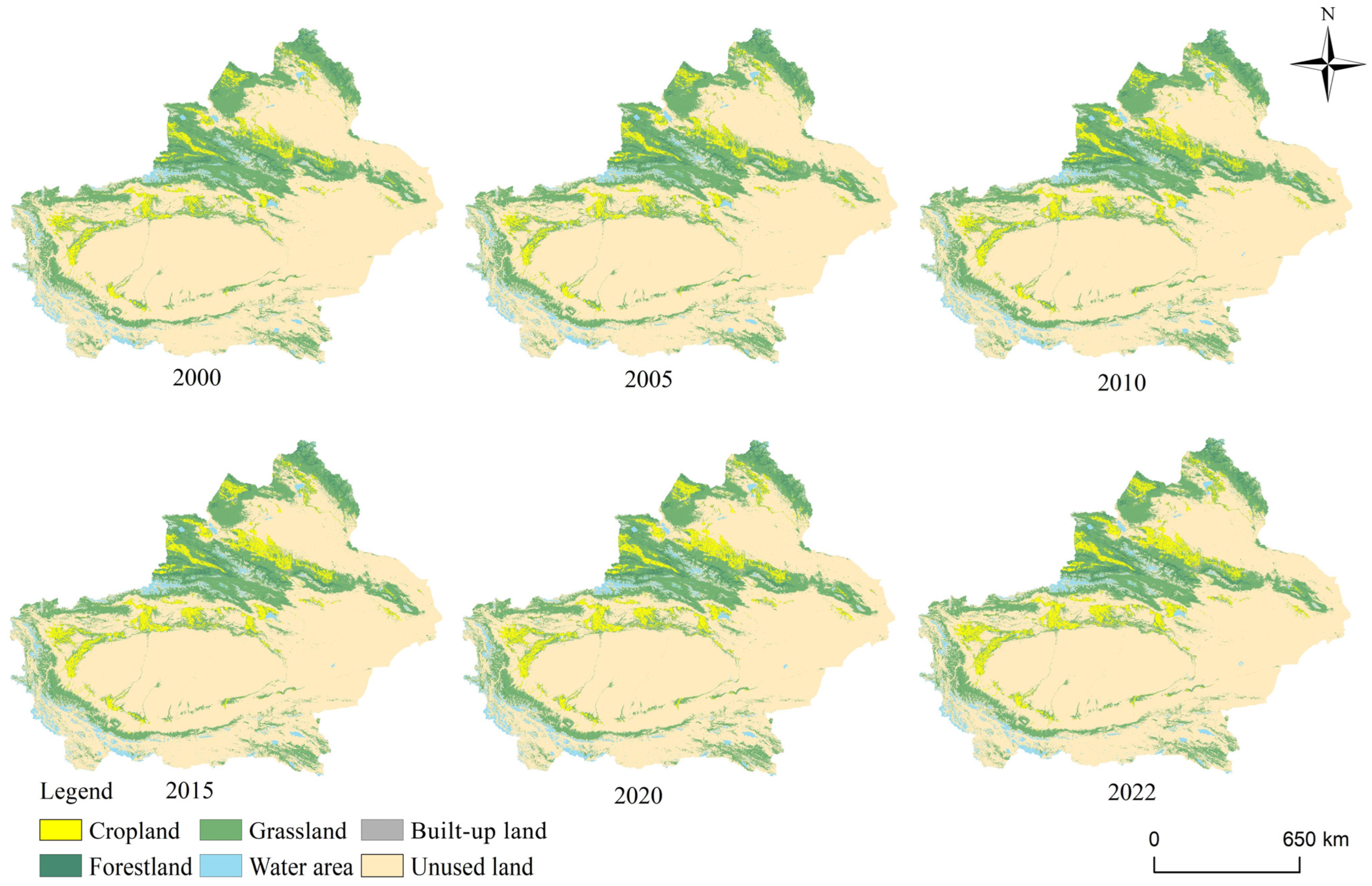
Figure 2 and
Table 3 clearly depict the dynamic changes in the areas of the six LUCC types in Xinjiang from 2000 to 2022: cropland, forestland, grassland, built-up land, water area, and unused land. The analysis is conducted in three dimensions: total area, change trend, and magnitude of increase or decrease. This systematic analysis, considering the ecological and environmental characteristics of the arid and semi-arid regions of the study area and the intensity of human intervention, provides a foundational support for subsequent carbon emission accounting and ESV evolution analysis.
From the perspective of area structure, unused land accounted for the highest proportion among the LUCC types in Xinjiang during the study period, followed by grassland, with built-up land having the lowest proportion. Specifically, the area of unused land remained above 1.13 million km2 from 2000 to 2022, making it the dominant land cover type in Xinjiang’s arid areas. The area of grassland, the second largest, stabilized between 370,000 and 390,000 km2, forming the most important ecological cover base in the region. The areas of cropland, forestland, and water area decreased in size in descending order, with built-up land being the smallest but showing a significant expansion trend.
In terms of temporal evolution characteristics, there are distinct differences among various LUCC types. Forestland and built-up land showed a consistent growth trend, with forestland area increasing from 14,614.70 km2 to 18,474.97 km2 and built-up land expanding from 1146.67 km2 to 5292.14 km2. In contrast, the area of grassland continuously decreased from 392,647.89 km2 to 372,694.51 km2. Cropland, water area, and unused land generally exhibited a growth trend but experienced fluctuations during the study period. The area of cropland increased from 61,125.81 km2 to 86,781.55 km2, with a slight decline from 2015 to 2020. The water area increased to 11,068.47 km2 from 2000 to 2020 and then experienced a slight decrease from 2020 to 2022.
In terms of the magnitude of increase and decrease, the expansion of built-up land was the most significant, with a growth rate of 361.49%. Cropland and forestland increased by 41.97% and 26.41%, respectively. Grassland experienced a cumulative decrease of 5.08%, being the only land type that continuously shrank during the study period. In contrast, the changes in unused land and water area were relatively minor. Overall, from 2000 to 2022, the adjustment of LUCC structure in Xinjiang exhibited a basic pattern of expansion in built-up land, cropland, water area, and forestland and a contraction in grassland.
3.1.1. Characteristics of LUCC Carbon Emissions
LUCC is a crucial carrier of regional carbon cycling, with different LUCC types exhibiting significant differences in their carbon source and sink, directly determining the regional carbon balance. Based on the LUCC area data and carbon emission accounting methods presented earlier, and combined with the carbon emission accounting results for Xinjiang from 2000 to 2022 in
Table 4, this study systematically analyzes the evolution characteristics of carbon emissions from LUCC in Xinjiang from three dimensions: changes in net carbon emissions, composition of carbon sources and sinks, and the contribution of various LUCC types to carbon emissions.
Based on the data in
Table 3, the net carbon emission from LUCC in Xinjiang showed a dramatic increase from 2000 to 2022, soaring from 27.7907 million tons in 2000 to 226.4319 million tons in 2022, a cumulative increase of approximately 7.15 times, with an annual growth rate as high as 10.2%. This growth rate far exceeds the national average during the same period, suggesting that regional economic activities and changes in land use in Xinjiang significantly disturbed the carbon balance during the study period. The net carbon emissions particularly jumped after 2010, rising from 76.1534 million tons to 220 million tons by 2022, reflecting that Xinjiang entered a period of high-intensity energy consumption and carbon emission growth during this stage.
Carbon emissions from built-up land are the core driving force for the sharp surge in net carbon emissions. The carbon emissions from built-up land stood at 27.7049 million tons in 2000 and soared to 225.478 million tons in 2022, accounting for an extremely high proportion of the total carbon sources. Their contribution rate rose further from 91.3% in 2000 to 99.6% in 2022, almost monopolizing the growth source of regional carbon emissions. This data characteristic profoundly reflects the rapid industrialization and urbanization process in Xinjiang over the past two decades. The construction of infrastructure, the expansion of the energy and chemical industries, and the extensive expansion of urban boundaries in Xinjiang have become the main engines for the growth of carbon emissions. In contrast, the proportion of carbon emissions from other types of LUCC is relatively small.
From the perspective of carbon sinks, the ecological land types including forestland, grassland and water areas exert a certain carbon sequestration effect, yet the growth rate of their carbon sequestration capacity lags far behind that of carbon sources. As the primary carbon sink, forestland saw its carbon sequestration volume rise from −0.8944 tons in 2000 to −1.1307 million tons in 2022, with an absolute increase of merely 0.2362 million tons. The growth in carbon sequestration volume of grassland and unused land is relatively slight. The carbon sink capacity of water areas fluctuates; it dropped after reaching −0.2601 million tons in 2020, which is associated with the shrinkage of water area coverage. The data results show that although Xinjiang’s fragile ecological environment alleviates carbon emission pressure to a certain extent, the potential for incremental carbon sequestration of its ecosystem is limited, making it unable to offset the emission increments brought by industrialization. A comparison of the evolution of carbon source and carbon sink trends reveals a widening gap between them. The total carbon source volume stood at 30.2844 million tons in 2000 and rose to 229.1402 million tons in 2022, an increase of 6.57 times, with built-up land being the absolute dominant force of carbon sources. In the same period, the total carbon sink volume only slightly increased from −2.4937 million tons to −2.7082 million tons, with a growth rate of less than 10%. During the period covered by the research, the total carbon sequestration volume in Xinjiang increased with fluctuations but remained limited in overall scale, failing to offset the rapid growth of carbon source emissions and thus leading to a continuous rise in regional net carbon emissions.
Overall, the formation of the carbon emission pattern from LUCC in Xinjiang during 2000–2022 is the combined result of the carbon source growth dominated by built-up land and the weak carbon sequestration of ecological land. The processes of industrialization and urbanization are the core driving factors. In the future, it is necessary to optimize the LUCC structure, strengthen the control of carbon emissions from built-up land, and improve the carbon sequestration capacity of ecological land to promote the balance of regional carbon budget.
3.1.2. Analysis of Land Use Intensity Change Characteristics
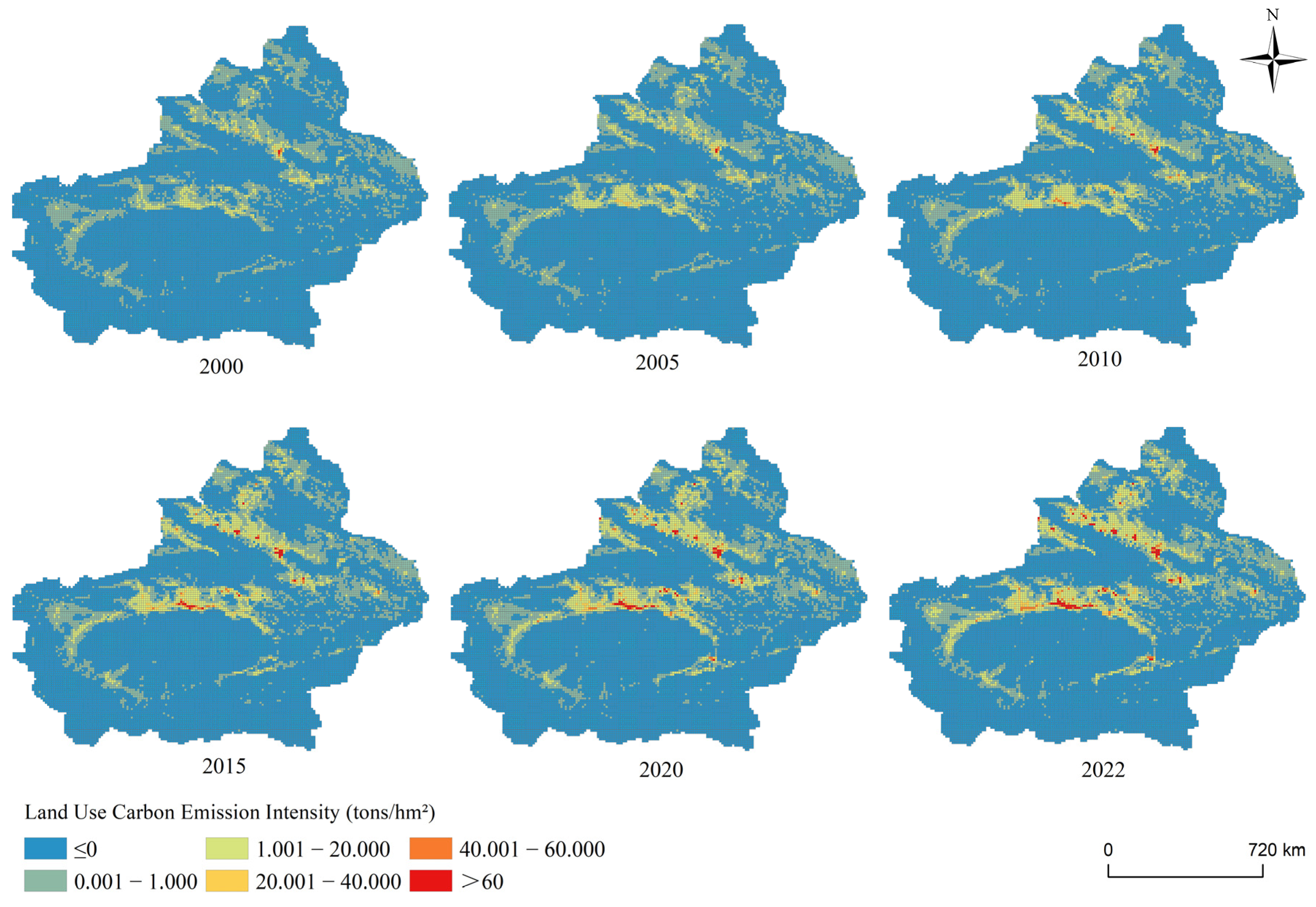
Figure 3 illustrates the spatial evolution of carbon emission intensity from LUCC in Xinjiang from 2000 to 2022. During the period of the study, the spatial pattern and temporal evolution of regional carbon emission intensity show distinct regularities. Overall, the carbon emission intensity of LUCC in Xinjiang consistently maintains a differentiated pattern of “high in the peripheral areas and low in the hinterland”. Extensive Gobi Desert areas, including the Tarim Basin and Junggar Basin, have long maintained carbon emission intensities below 0, which are typical low-emission zones in the region. In contrast, the oases and urban core areas on the northern and southern slopes of the Tianshan Mountains and the Ili River Valley show yellow, orange and even red patches, forming concentrated zones of high carbon emission intensity.
From a temporal perspective, high-value areas were only sporadically distributed in the core areas of a few cities such as Urumqi from 2000 to 2010, with an extremely small spatial scope. From 2010 to 2022, the scope of high-value areas expanded significantly, especially in cities such as Urumqi, Changji, Korla and Kashgar, as well as their surrounding oasis areas. The area of red patches continued to expand, which clearly reflects the evolution process in which the expansion of built-up land and the increase in human activity intensity directly drive the significant rise of regional carbon emission intensity with the acceleration of urbanization and industrialization. At the same time, the carbon emission intensity in the vast Gobi Desert areas always remained at a low level, revealing a high spatial coupling between carbon emission intensity from LUCC and human activity intensity in Xinjiang.
3.2. Temporal and Spatial Change Analysis of ESV in Xinjiang from 2000 to 2020
3.2.1. Temporal Change Trend Analysis of ESV in Xinjiang from 2000 to 2020
Based on the unit ESV in
Table 2, the ESV of different land types in Xinjiang from 2000 to 2020 was calculated, as shown in
Table 5.
Based on the data in
Table 5, the ESV of different types of LUCC in Xinjiang showed an overall fluctuating upward trend from 2000 to 2022. The ESV of Xinjiang was 1880.5284 billion yuan in 2000 and increased to 1894.1982 billion yuan in 2022, indicating an overall improvement in the regional ecosystem service value. From the perspective of temporal evolution, the ESV of Xinjiang showed a phased characteristic of first increasing and then decreasing from 2000 to 2022. It rose rapidly from 2000 to 2020 and declined after 2020. In terms of structural contribution, the ESV of Xinjiang is highly dependent on grassland and water areas, with their combined contribution rate exceeding 80%, which constitute the core support of the regional ecosystem service value. By type, the ESV of cropland continued to grow during the study period, increasing from 59.8131 billion yuan to 84.9178 billion yuan, and its contribution rate increased from 3.181% to 4.483% accordingly; both the ESV and contribution rate of forestland and water areas showed a fluctuating upward trend, with consistent change characteristics; the contribution rate of grassland ESV fluctuated between 60% and 70%, always occupying a dominant position; although the contribution rate of water areas fluctuated, it remained at a high level for a long time, serving as an important component of Xinjiang’s ESV; the ESV of unused land showed a downward trend, but the decline range was relatively limited.
Table 6 shows the change characteristics of the ESV of various ecosystem services in Xinjiang from 2000 to 2022. Based on the data, the total ESV of Xinjiang’s ecosystem services showed a trend of first increasing and then slightly declining. The total ESV was 1880.5283 billion yuan in 2000, then gradually rose to the peak of 1946.3755 billion yuan in 2020, and fell back to 1894.1982 billion yuan in 2022. Overall, it was still higher than that in 2000, highlighting the overall growth trend of regional ESV. The ESV of water temperature regulation and climate regulation was the highest, accounting for nearly 50% of the total.
There were significant differences in ESV changes among different types of ecosystem services, and the internal differentiation of supply services was obvious. The ESV of food production showed a trend of first increasing and then decreasing: it continued to grow from 42.5430 billion yuan in 2000 to 49.3973 billion yuan in 2015 and then slightly declined to 48.9379 billion yuan in 2022. The ESV of grain production fluctuated gently overall: it increased slightly to 48.3770 billion yuan from 2000 to 2015 and then gradually decreased to 47.7054 billion yuan in 2022, with a limited overall change range. The ESV of water resource supply showed a fluctuating downward trend, decreasing from 21.3451 billion yuan in 2000 to 14.7351 billion yuan in 2022, which was the sub-item with the most significant decline in supply services.
The ESV trends of each sub-item of regulating services varied. The ESV of gas regulation showed an overall trend of a slight fluctuating increase followed by a decline: it was 167.2938 billion yuan in 2000, increased to 170.8097 billion yuan in 2015, and fell back to 168.5081 billion yuan in 2022. The ESV of climate regulation showed a continuous fluctuating downward trend, gradually decreasing from 398.0771 billion yuan in 2000 to 389.6820 billion yuan in 2022, maintaining a long-term downward trend. The ESV of environmental purification fluctuated gently overall with a slight decrease, dropping from 190.2759 billion yuan in 2000 to 188.0505 billion yuan in 2022, with a small change range. The ESV of hydrological regulation continued to grow from 548.3727 billion yuan in 2000 to 616.0184 billion yuan in 2020 and then dropped sharply to 577.4652 billion yuan in 2022, which was an important sub-item affecting the fluctuation in the total ESV. Among supporting services, the ESV of soil conservation showed a slow fluctuating downward trend: it was 194.0719 billion yuan in 2000 and decreased to 191.9742 billion yuan in 2022. The ESV of biodiversity showed an overall trend of slight fluctuating increase, rising from 16.2944 billion yuan in 2000 to 16.8732 billion yuan in 2022, maintaining a steady growth overall. Among cultural services, the ESV of aesthetic landscape showed a continuous fluctuating downward trend, gradually decreasing from 175.9583 billion yuan in 2000 to 172.6180 billion yuan in 2022, maintaining a slow long-term downward trend.
3.2.2. Spatial Analysis of ESV Changes in Xinjiang from 2000 to 2020
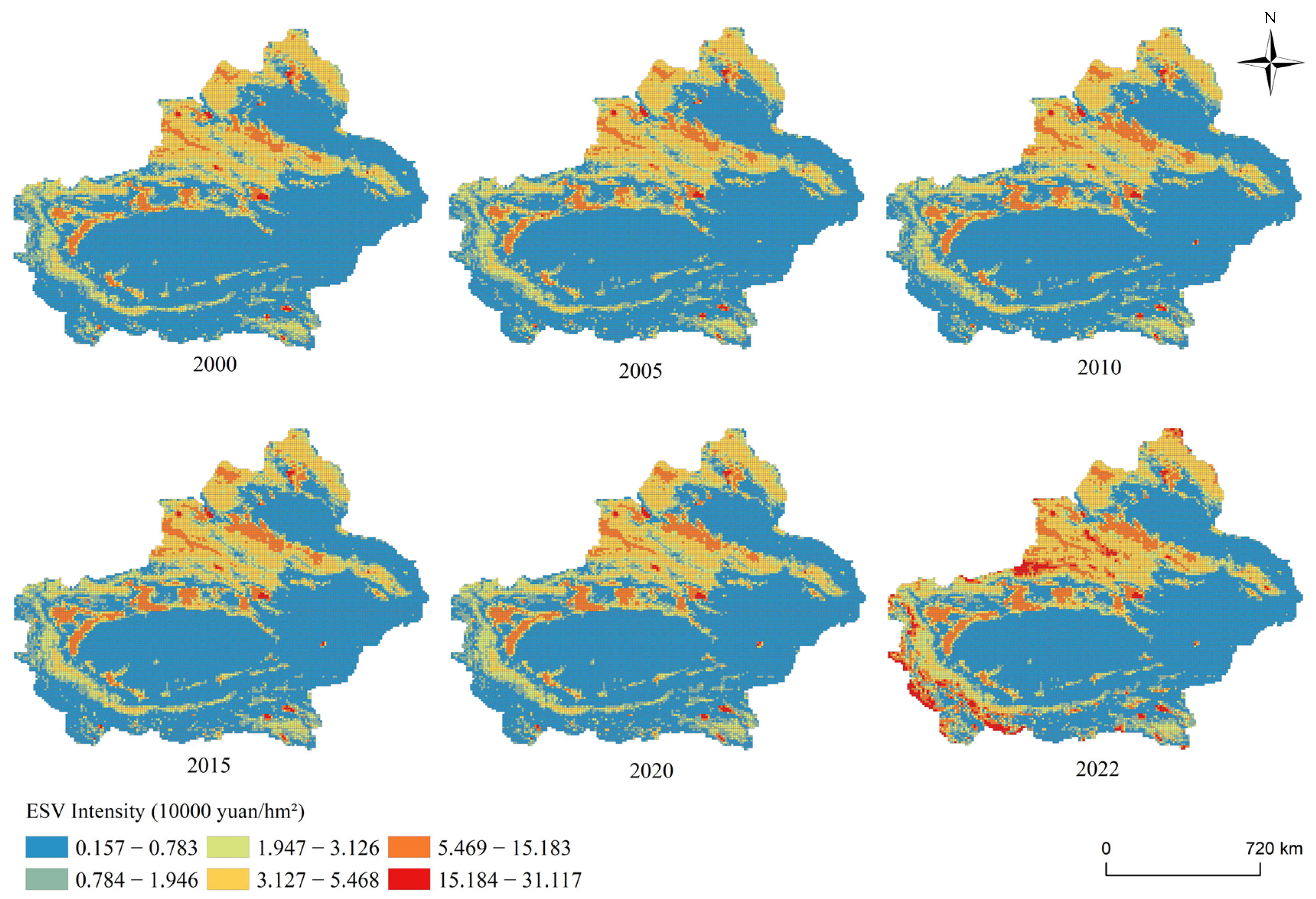
Using the Fishnet tool in the ArcGIS 10.8, the ESV intensity for Xinjiang from 2000 to 2022 was obtained, and a spatiotemporal evolution map of ESV intensity from 2000 to 2022 was created for Xinjiang (
Figure 4).
Figure 4 shows the perspective of spatial distribution and the ESV density in Xinjiang presents a significant pattern of “high in mountainous areas and low in basins”. High-value areas are mainly concentrated in mountainous regions such as the Altai Mountains, Tianshan Mountains, Kunlun Mountains and the Ili River Valley. These areas are dominated by forestland, grassland and water areas, with complex ecosystem structures, prominent functions of water conservation and biodiversity maintenance, and the highest ecosystem service value per unit area. Medium-value areas are distributed in the transition zones from mountainous areas to basins, mainly composed of grasslands and desert steppes, with moderate ecosystem service functions. Low-value areas cover large areas of Gobi Desert in the Tarim Basin and Junggar Basin, with extremely low vegetation coverage and the lowest ecosystem service value per unit area.
The temporal evolution perspective indicates the scope of high-value areas shows a slow expansion trend, especially in the northern slope of the Tianshan Mountains and the Ili River Valley, reflecting the gradual improvement in ecosystem service functions in these areas. The distribution of medium-value areas has also expanded, indicating that the ecosystem service value of some transition zones has been improved, while the area of blue desert low-value areas remained basically stable.
This spatial differentiation and temporal change not only reflect the high fragility of the ecosystem in the arid area of Xinjiang but also clarify the key direction of ecological protection. High-value areas need to focus on protecting the forestland, grassland and water area ecosystems to maintain key functions such as water conservation and climate regulation. The expansion trend of medium-value areas suggests that ecological restoration and protection measures can provide support for regional ecological security and sustainable development.
3.2.3. SI Analysis of ESV Intensity
The SI of ESV for different land types in Xinjiang was calculated using Formula (7), and the results are presented in
Table 7. According to the calculation results, all SI of ESV for land in Xinjiang are less than 1, indicating the high reliability of the results. Among them, the SI of cropland, forestland, water areas and unused land are relatively small, and their land ESV is also relatively small. The sensitivity coefficient of grassland is relatively large, and its land ESV is also relatively large.
3.3. Spatial Correlation Analysis Between LUCC Carbon Emission and ESV Intensity in Xinjiang
To analyze the spatial correlation of ESV intensity in Xinjiang, the ArcGIS Fishnet tool was used to grid the study area.
Table 8 shows the global spatial autocorrelation between LUCC carbon emission intensity and ESV intensity in Xinjiang from 2000 to 2022. During the study period, the global Moran’s I indices of Xinjiang were all positive, indicating a positive spatial correlation between LUCC carbon emission intensity and ESV intensity in Xinjiang; that is, they tend to agglomerate spatially. All
p-values were 0.001, and all Z-values were much higher than the critical value, which indicates that the spatial correlation between LUCC carbon emission intensity and ESV intensity in Xinjiang was very significant during 2000–2022.
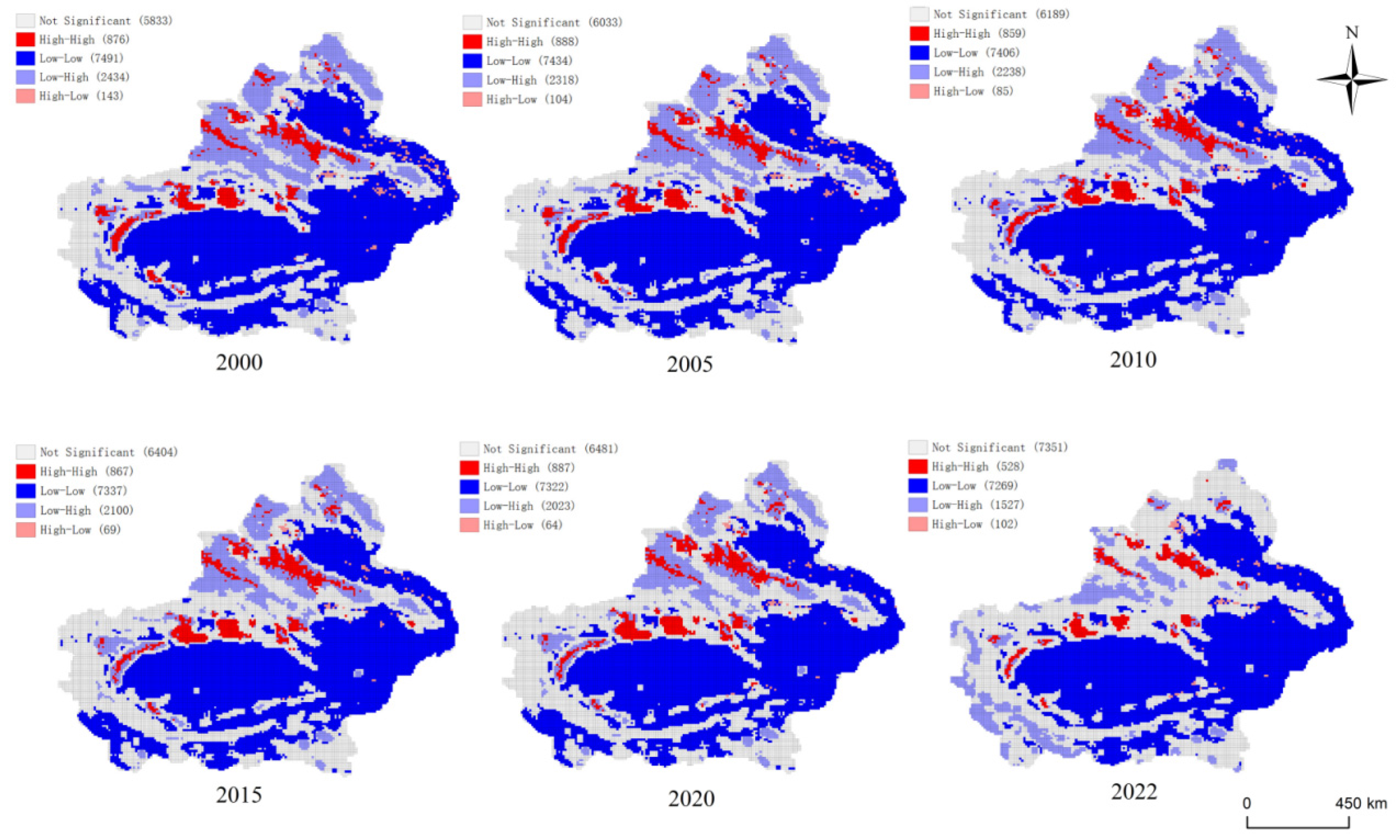
Figure 5 clearly reveals the local spatial correlation pattern and its dynamic evolution between LUCC carbon emission and ESV in Xinjiang from 2000 to 2022. From the perspective of spatial correlation types corresponding to colors, the local spatial correlation between LUCC carbon emission and ESV in Xinjiang is mainly dominated by “low–low” clusters and “low–high” clusters. The “high–high” cluster areas are mainly concentrated in ecological barrier zones such as the Tianshan Mountains and Altai Mountains, indicating that these areas have high local LUCC carbon emissions and high ESV in surrounding areas. These areas are rich in natural resources such as forests, grasslands and wetlands, which provide important ecological values for the ecosystem, such as water conservation, climate regulation and soil conservation. At the same time, the spatial overlap between high ecological value areas and high carbon emission areas caused by human activities interference indicates the contradiction and coordination needs between ecological protection and carbon emission control.
The “low–low” cluster areas mean low local carbon emissions and low ESV in surrounding areas, which are mainly distributed in the desert core areas of the Tarim Basin and Junggar Basin. The Tarim Basin and Junggar Basin are typical arid climate zones with scarce precipitation and high evaporation, leading to fragile ecological environments. Meanwhile, due to the low intensity of human activities, the carbon emission level is also low. The “low–high” clusters indicate low local carbon emissions but high ESV in surrounding areas, which are mostly located in the peripheral transition zones of high ecological value areas. This shows that these areas are radiated and influenced by the high ecological service value of surrounding areas, but their own carbon emissions have not yet increased significantly.
From the perspective of temporal evolution trends, the scope of the “high–high” cluster areas slightly decreases between 2000 and 2020. This is more obvious on the northern slope of the Tianshan Mountains. It reflects that with regional development, the carbon emission pressure in high ecological value areas increases. The scope of “low–low” cluster areas decreases to a certain extent. This indicates that the pattern of low ecosystem service value and low carbon emission in the desert core areas is further consolidated. The fragility of the ecosystem and the low intensity of human activities still continue. The distribution of “low–high” and “high–low” cluster areas fluctuates slightly. This shows that the correlation between carbon emission and ESV in ecological transition zones is in dynamic adjustment. Overall, this spatial correlation pattern not only reflects the spatial coupling characteristics between the ecosystem and human activities in Xinjiang. It also provides a spatial basis for the region to formulate differentiated dual-carbon goals and coordinated ecological protection strategies.