Assessing the Trophic Condition of a Reservoir: A Combined Analysis of Watershed, Inter-Lake Connections and Internal Nutrient Loads

 ,
, 
 and
and
Abstract
1. Introduction
2. Materials and Methods
2.1. Study Area
2.2. Experimental Design
2.3. Estimation of Spatial Nutrient Loads from Watershed

| Type | Source | Sub Category | Units | P Export | N Export | Reference |
|---|---|---|---|---|---|---|
| Point | LA | ovine/caprine | Kg × unit y−1 | 0.8 | 0.2482 | [41,42] |
| bovine | Kg × unit y−1 | 7.4 | 2.74115 | |||
| equine | Kg × unit y−1 | 8.7 | 3.09885 | |||
| swine | Kg × unit y−1 | 3.8 | 0.5694 | |||
| poultry | Kg × unit y−1 | 0.17 | 0.02555 | |||
| Non-point | UA | All areas identified in the preceding subdivision 1 (artificial surfaces) of the 4th-level CORINE LC | kg × ha y−1 | 0.4 | 8 | [43,44] |
| NsNA | All areas identified in category 3 (forests and semi-natural areas), except the category 3315 (beds of streams wider than 25 m) + category 244 (agroforestry areas) of the 4th-level CORINE LC | kg × ha y−1 | 0.30 | 2.0002 | ||
| AA | All areas identified in category 2 (used agricultural surfaces), except category 244 (agroforestry areas) of the 4th level CORINE LC | kg × ha y−1 | 0.60 | 15.99795 |
2.3.1. Point Sources
2.3.2. Non-Point Sources
2.4. Estimation of Inter-Lake Connection Nutrient Loads from Lake Alto Temo
2.5. Estimation of Internal Nutrient Loads from Lake Cuga Sediments
2.6. Total Mass Balance and Predictive Modeling
2.7. Trophic State Evaluation
3. Results
3.1. Lake Water Conditions
Trophic State
3.2. Spatial Nutrient Loads from Watershed
3.2.1. Point Sources
3.2.2. Non-Point Sources
3.3. Nutrient Loads from Lake Alto Temo Inter-Connection
3.4. Internal Nutrient Loads
3.5. Total Mass Balance
4. Discussion
- (a)
- sediment capping to limit internal phosphorus release. This technique involves covering phosphorus-rich sediments with inert materials (such as sand or bentonite), thereby limiting resuspension and phosphorus release into the water. This requires careful selection of materials, as unsuitable ones may fail to provide the necessary barrier and could even release harmful substances. Furthermore, constant monitoring is necessary to ensure its effectiveness over time, requiring additional resources and expertise, which, combined with periodic material maintenance, can further increase costs and complications [46]. Use of chemical additives (phosphorus precipitants), such as compost or clays, can bind phosphorus in the sediments, reducing its availability for phytoplankton and consequently limiting algal blooms and associated problems. However, the effectiveness of this approach depends on various factors, including the choice of additive materials. Some composts, for example, may contain additional nutrients that could contribute to further system enrichment. This solution, therefore, proves to be extremely difficult to implement, also due to the basin’s nature, being shallow and thus susceptible to sediment resuspension caused by wind, currents, and waves, but especially due to the long periods of strong anoxia at the hypolimnetic sediment-water interface.
- (b)
- hypolimnetic oxygenation to mitigate anoxia and reduce nutrient mobilization from sediments. Under anoxic conditions, as observed in our case study, redox dynamics play a crucial role: the shift from oxidizing to reducing environments can release phosphorus from insoluble sediment compounds, making it bioavailable. Phosphorus is mainly found in deep waters as phosphate ions (PO43−), which, under oxidizing conditions (documented from late October to March), bind to iron, forming insoluble compounds. These compounds are vulnerable to background bacterial activity (from May to early October), causing the reduction of iron from Fe3+ to Fe2+ and making phosphorus compounds bound to ferric oxides unstable, releasing phosphates (HPO42−) into the water and making them bioavailable again, especially for phytoplankton that naturally prefer this ionic form. An oxygen injection system in the hypolimnetic waters during stratification could help limit the bioavailability of phosphorus. Several technologies are available to reduce anoxic conditions, such as micro-diffuser plates [63], full-air lift systems [64], siphoning [65], and pipeline aeration along the lakeshore [66]. The key with these techniques is to minimize turbulence in order to avoid resuspending sediments or, even worse, disrupting stratification [67]. These approaches, of course, cannot be applied extensively across the entire lake surface, but they can be optimized when implemented near the lake’s water intake points.
5. Conclusions
Author Contributions
Funding
Data Availability Statement
Acknowledgments
Conflicts of Interest
References
- Smith, V.H.; Tilman, G.D.; Nekola, J.C. Eutrophication: Impacts of Excess Nutrient Inputs on Freshwater, Marine, and Terrestrial Ecosystems. Environ. Pollut. 1999, 100, 179–196. [Google Scholar] [CrossRef] [Scilit]
- Schindler, D.W. Recent Advances in the Understanding and Management of Eutrophication. Limnol. Oceanogr. 2006, 51, 356–363. [Google Scholar] [CrossRef] [Scilit]
- Álvarez, X.; Valero, E.; Santos, R.M.B.; Varandas, S.G.P.; Sanches Fernandes, L.F.; Pacheco, F.A.L. Anthropogenic Nutrients and Eutrophication in Multiple Land Use Watersheds: Best Management Practices and Policies for the Protection of Water Resources. Land Use Policy 2017, 69, 1–11. [Google Scholar] [CrossRef] [Scilit]
- Xia, P.; Peng, J.; Gu, T.; Yu, S.; Xu, Z. Lake-Related Ecosystem Services Facing Social–Ecological Risks. People Nat. 2025, 7, 734–751. [Google Scholar] [CrossRef] [Scilit]
- Carpenter, S.R.; Caraco, N.F.; Correll, D.L.; Howarth, R.W.; Sharpley, A.N.; Smith, V.H. Nonpoint Pollution of Surface Waters with Phosphorus and Nitrogen. Ecol. Appl. 1998, 8, 559. [Google Scholar] [CrossRef]
- Jeppesen, E.; Sondergaard, M.; Jensen, J.P.; Havens, K.E.; Anneville, O.; Carvalho, L.; Coveney, M.F.; Deneke, R.; Dokulil, M.T.; Foy, B.; et al. Lake Responses to Reduced Nutrient Loading—An Analysis of Contemporary Long-Term Data from 35 Case Studies. Freshw. Biol. 2005, 50, 1747–1771. [Google Scholar] [CrossRef] [Scilit]
- Vollenweider, R.A. Scientific Fundamentals of the Eutrophication of Lakes and Flowing Waters, with Particular Reference to Nitrogen and Phosphorus as Factors in Eutrophication. Tech. Rep. DAS/CSI/68.27; OECD: Paris, France, 1968; Volume 192, p. 14. [Google Scholar]
- Carvalho, L.; Mackay, E.B.; Cardoso, A.C.; Baattrup-Pedersen, A.; Birk, S.; Blackstock, K.L.; Borics, G.; Borja, A.; Feld, C.K.; Ferreira, M.T.; et al. Protecting and Restoring Europe’s Waters: An Analysis of the Future Development Needs of the Water Framework Directive. Sci. Total Environ. 2019, 658, 1228–1238. [Google Scholar] [CrossRef] [Scilit]
- Brett, M.T.; Benjamin, M.M. A Review and Reassessment of Lake Phosphorus Retention and the Nutrient Loading Concept. Freshw. Biol. 2008, 53, 194–211. [Google Scholar] [CrossRef] [Scilit]
- Withers, P.J.A.; Sharpley, A.N. Characterization and Apportionment of Nutrient and Sediment Sources in Catchments. J. Hydrol. 2008, 350, 127–130. [Google Scholar] [CrossRef] [Scilit]
- Schindewolf, M.; Schmidt, J. Parameterization of the EROSION 2D/3D Soil Erosion Model Using a Small-Scale Rainfall Simulator and Upstream Runoff Simulation. Catena 2012, 91, 47–55. [Google Scholar] [CrossRef] [Scilit]
- Van Heyst, A.; A, S.; Jamieson, R. Application of Phosphorus Loading Models to Understand Drivers of Eutrophication in a Complex Rural Lake-Watershed System. J. Environ. Manag. 2022, 302, 114010. [Google Scholar] [CrossRef] [Scilit] [PubMed]
- Sharpley, A.; Jarvie, H.P.; Buda, A.; May, L.; Spears, B.; Kleinman, P. Phosphorus Legacy: Overcoming the Effects of Past Management Practices to Mitigate Future Water Quality Impairment. J. Environ. Qual. 2013, 42, 1308–1326. [Google Scholar] [CrossRef] [Scilit] [PubMed]
- Hejzlar, J.; Šámalová, K.; Boers, P.; Kronvang, B. Modelling Phosphorus Retention in Lakes and Reservoirs. Water Air Soil Pollut. Focus 2006, 6, 487–494. [Google Scholar] [CrossRef] [Scilit]
- Bocaniov, S.A.; Scavia, D.; Van Cappellen, P. Long-Term Phosphorus Mass-Balance of Lake Erie (Canada-USA) Reveals a Major Contribution of in-Lake Phosphorus Loading. Ecol. Inform. 2023, 77, 102131. [Google Scholar] [CrossRef] [Scilit]
- Cappellen, P. Van Phosphorus and Lake Eutrophication: Recent Findings and Emerging Challenges. ARPHA Conf. Abstr. 2023, 6, e107183. [Google Scholar] [CrossRef] [Scilit]
- Corella, J.P.; Benito, G.; Wilhelm, B.; Montoya, E.; Rull, V.; Vegas-Vilarrúbia, T.; Valero-Garcés, B.L. A Millennium-Long Perspective of Flood-Related Seasonal Sediment Yield in Mediterranean Watersheds. Glob. Planet. Change 2019, 177, 127–140. [Google Scholar] [CrossRef] [Scilit]
- Garnier, M.; Pappagallo, G.; Holman, I.P. Sediment and Phosphorus Transport during Flood Events in a Mediterranean Temporary River. Environ. Earth Sci. 2024, 83, 212. [Google Scholar] [CrossRef] [Scilit]
- Zhang, H.; Zhou, J.; Miao, T.; Zhou, N.; Yu, T.; Zhang, Y.; He, C.; Shen, L.; Zhou, C.; Huang, Y. Multidimensional Analysis of Phosphorus Release Processes from Reservoir Sediments and Implications for Water Quality and Safety. Processes 2025, 13, 2495. [Google Scholar] [CrossRef] [Scilit]
- Kowalczewska-Madura, K.; Dondajewska-Pielka, R.; Gołdyn, R. The Assessment of External and Internal Nutrient Loading as a Basis for Lake Management. Water 2022, 14, 2844. [Google Scholar] [CrossRef] [Scilit]
- Vollenweider, R.A.; Kerekes, J. Eutrophication of Waters. Monitoring, Assessment and Control; OECD Cooperative Programme on Monitoring of Inland Waters (Eutrophication Control): Paris, France, 1982. [Google Scholar]
- Soranno, P.A.; Hubler, S.L.; Carpenter, S.R.; Lathrop, R.C. Phosphorus Loads to Surface Waters: A Simple Model to Account for Spatial Pattern of Land Use. Ecol. Appl. 1996, 6, 865–878. [Google Scholar] [CrossRef] [Scilit]
- Schindler, D.W.; Hecky, R.E.; Findlay, D.L.; Stainton, M.P.; Parker, B.R.; Paterson, M.J.; Beaty, K.G.; Lyng, M.; Kasian, S.E.M. Eutrophication of Lakes Cannot Be Controlled by Reducing Nitrogen Input: Results of a 37-Year Whole-Ecosystem Experiment. Proc. Natl. Acad. Sci. USA 2008, 105, 11254–11258. [Google Scholar] [CrossRef] [Scilit] [PubMed]
- Søndergaard, M.; Jensen, J.P.; Jeppesen, E. Role of Sediment and Internal Loading of Phosphorus in Shallow Lakes. Hydrobiologia 2003, 506, 135–145. [Google Scholar] [CrossRef] [Scilit]
- Hupfer, M.; Lewandowski, J. Oxygen Controls the Phosphorus Release from Lake Sediments—A Long-Lasting Paradigm in Limnology. Int. Rev. Hydrobiol. 2008, 93, 415–432. [Google Scholar] [CrossRef] [Scilit]
- Nürnberg, G.K. The Prediction of Internal Phosphorus Load in Lakes with Anoxic Hypolimnia. Limnol. Oceanogr. 1984, 29, 111–124. [Google Scholar] [CrossRef] [Scilit]
- Grøterud, O.; Haaland, S. A Simple Approach to Calculate Internal Phosphorus Loads in Shallow Lakes—Depotbiblioteket. VANN 2012, 47, 458–489. [Google Scholar]
- Zhang, M.; Li, Y.; Wang, H.J.; Yu, Y.X.; Liu, J.H.; Qiao, R.T.; Liu, M.; Ma, S.N.; Wang, H.Z. Decreased Internal Phosphorus Loading from Eutrophic Sediment After Artificial Light Supplement: Preliminary Evidence from a Microcosm Experiment. Front. Environ. Sci. 2022, 10, 801469. [Google Scholar] [CrossRef] [Scilit]
- de Lucena Barbosa, J.E.; dos Santos Severiano, J.; Cavalcante, H.; de Lucena-Silva, D.; Mendes, C.F.; Barbosa, V.V.; dos Santos Silva, R.D.; de Oliveira, D.A.; Molozzi, J. Impacts of Inter-Basin Water Transfer on the Water Quality of Receiving Reservoirs in a Tropical Semi-Arid Region. Hydrobiologia 2021, 848, 651–673. [Google Scholar] [CrossRef] [Scilit]
- Maavara, T.; Chen, Q.; Van Meter, K.; Brown, L.E.; Zhang, J.; Ni, J.; Zarfl, C. River Dam Impacts on Biogeochemical Cycling. Nat. Rev. Earth Environ. 2020, 1, 103–116. [Google Scholar] [CrossRef] [Scilit]
- Gupta, J.; van der Zaag, P. Interbasin Water Transfers and Integrated Water Resources Management: Where Engineering, Science and Politics Interlock. Phys. Chem. Earth Parts A/B/C 2008, 33, 28–40. [Google Scholar] [CrossRef] [Scilit]
- Padedda, B.M.; Sechi, N.; Lai, G.G.; Mariani, M.A.; Pulina, S.; Sarria, M.; Satta, C.T.; Virdis, T.; Buscarinu, P.; Lugliè, A. Consequences of Eutrophication in the Management of Water Resources in Mediterranean Reservoirs: A Case Study of Lake Cedrino (Sardinia, Italy). Glob. Ecol. Conserv. 2017, 12, 21–35. [Google Scholar] [CrossRef] [Scilit]
- Li, N.; Yang, B.; Huang, T.; Si, F.; Gao, Y.; Zhao, L. Hypolimnetic Anoxia and Sediment Oxygen Demand during Stratification in a Drinking Water Reservoir. J. Soils Sediments 2021, 21, 3380–3391. [Google Scholar] [CrossRef] [Scilit]
- Vinci, G.; Maddaloni, L.; Mancini, L.; Prencipe, S.A.; Ruggeri, M.; Tiradritti, M.; Vinci, G.; Maddaloni, L.; Mancini, L.; Prencipe, S.A.; et al. The Health of the Water Planet: Challenges and Opportunities in the Mediterranean Area. An Overview. Earth 2021, 2, 894–919. [Google Scholar] [CrossRef] [Scilit]
- Rocha, J.; Carvalho-Santos, C.; Diogo, P.; Beça, P.; Keizer, J.J.; Nunes, J.P. Impacts of Climate Change on Reservoir Water Availability, Quality and Irrigation Needs in a Water Scarce Mediterranean Region (Southern Portugal). Sci. Total Environ. 2020, 736, 139477. [Google Scholar] [CrossRef] [Scilit]
- Enas—Ente Acque Della Sardegna—RAS—Cuga. Available online: https://www.enas.sardegna.it/il-sistema-idrico-multisettoriale/laghi-artificiali/cuga.html (accessed on 17 November 2025).
- Padedda, B.M.; Buscarinu, P.; Caddeo, T.; Casiddu, P.; Farina, P.; Lai, G.G.; Manca, B.; Pulina, S.; Satta, C.T.; Sarria, M.; et al. IT10-A Ecosistemi Lacustri Della Sardegna. In La Rete Italiana per la Ricerca Ecologica di Lungo Termine. Lo Studio Della Biodiversità e dei Cambiamenti; Capotondi, L., Ravaioli, M., Acosta, A., Chiarini, F., Lami, A., Stanisci, A., Tarozzi, L., Mazzocchi, M.G., Eds.; CNR-Edizioni: Roma, Italy, 2021; pp. 331–370. ISBN 978-88-8080-208-2. [Google Scholar]
- Lipps, W.C.; Braun-Howland, E.B.; Baxter, T.E. (Eds.) Standard Methods for the Examination of Water and WastewaterTM, 24th ed.; American Public Health Association: Washington, DC, USA, 2022. [Google Scholar]
- Golterman, H.L.; Clymo, R.S.; Ohnstadt, M.A.M. Methods for Physical and Chemical Analysis of Freshwaters, 2nd ed.; Blackwell Scientific Publications: London, UK, 1978. [Google Scholar]
- Johnes, P.J. Evaluation and Management of the Impact of Land Use Change on the Nitrogen and Phosphorus Load Delivered to Surface Waters: The Export Coefficient Modelling Approach. J. Hydrol. 1996, 183, 323–349. [Google Scholar] [CrossRef] [Scilit]
- Chiaudani, G.; Gerletti, M.; Marchetti, R.; Provini, A.; Vighi, M. Il Problema Dell’Eutrofizzazione in Italia. Quad. IRSA 1978, 42, 93. [Google Scholar]
- Sechi, N.; Botti, P.; Vacca, S.; Mosello, R. Deflusso e Rilascio Di Nutrienti Nel Bacino Del Rio Uvini (Sardegna Centro-Meridionale). In Proceedings of the Atti del III° Seminario Della Seconda Sezione Tecnica AIGR “Insediamenti Zootecnici e Protezione Dell’ambiente”, Udine, Italy, 26–27 September 1991; Associazione Italiana di Ingegneria Agraria: Rome, Italy, 1991; pp. 609–616. [Google Scholar]
- Marchetti, R.; Gerletti, M.; Calamari, D.; Chiaudani, G. Elementi e Criteri per La Definizione Del Livello Di Accettabilità Delle Acque Di Scarico. Quad. IRSA 1973, 24, 228. [Google Scholar]
- Marchetti, R.; Verna, N. Quantification of the Phosphorus and Nitrogen Loads in the Minor Rivers of the Emilia-Romagna Coast (Italy). A Methodological Study on the Use of Theoretical Coefficients in Calculating the Loads. In Marine Coastal Eutrophication; Vollenweider, R.A., Marchetti, R., Viviani, R., Eds.; Elsevier Science: Amsterdam, The Netherlands, 1992; pp. 315–336. [Google Scholar] [CrossRef] [Scilit]
- Istituto Zooprofilattico Sperimentale dell’Abruzzo e del Molise «G. Caporale» Centro Servizi Nazionale—Ministero Della Salute Banca Dati Nazionale Dell’Anagrafe Zootecnica. Available online: https://www.vetinfo.it/j6_statistiche/#/ (accessed on 17 November 2025).
- CORINE Land Cover. Europe, 6-Yearly—Version, May 2020. European Environment Agency: Copenhagen, Denmark, 2018. [Google Scholar] [CrossRef]
- Marchetto, A.; Padedda, B.M.; Mariani, M.A.; Lugliè, A.; Sechi, N. A Numerical Index for Evaluating Phytoplankton Response to Changes in Nutrient Levels in Deep Mediterranean Reservoirs. J. Limnol. 2009, 68, 106–121. [Google Scholar] [CrossRef] [Scilit]
- Mariani, M.A.; Padedda, B.M.; Kaštovský, J.; Buscarinu, P.; Sechi, N.; Virdis, T.; Lugliè, A. Effects of Trophic Status on Microcystin Production and the Dominance of Cyanobacteria in the Phytoplankton Assemblage of Mediterranean Reservoirs. Sci. Rep. 2015, 5, 17964. [Google Scholar] [CrossRef] [Scilit]
- Sechi, N.; Mosello, R. Nutrient Budget and Trophic Level of Lake Oschiri (Sardinia, Italy). Mem. Dell’istituto Ital. Di Idrobiol. 1985, 43, 55–75. [Google Scholar]
- Mosello, R.; Sechi, N.; Cossu, A. Il Carico Chimico Veicolato al Lago Oschiri. In Proceedings of the Qualità Dell’acqua in Sardegna, Cagliari, Italy, 15–16 May 1989; Provincia di Cagliari: Cagliari, Italy, 1989. [Google Scholar]
- Padedda, B.M.; Sechi, N.; Lai, G.G.; Mariani, M.A.; Pulina, S.; Satta, C.T.; Bazzoni, A.M.; Virdis, T.; Buscarinu, P.; Lugliè, A. A Fast-Response Methodological Approach to Assessing and Managing Nutrient Loads in Eutrophic Mediterranean Reservoirs. Ecol. Eng. 2015, 85, 47–55. [Google Scholar] [CrossRef] [Scilit]
- Padedda, B.M.; Lugliè, A.; Lai, G.G.; Giadrossich, F.; Satta, C.T.; Pulina, S. Land-Based Impact of Nutrient Loads and Eutrophication on an Ancient Mediterranean Natural Lake. Hydrology 2022, 9, 7. [Google Scholar] [CrossRef] [Scilit]
- Regione Autonoma della Sardegna Bollettini Invasi—Autorità Di Bacino. Available online: https://autoritadibacino.regione.sardegna.it/invasi/ (accessed on 17 November 2025).
- Cao Pinna, C.; Silvano, R.; Fadda, A.; Buffa, F.; Orrù, N.; Pes, M.; Petruso, A. Nuovo Studio Dell’Idrologia Superficiale Della Sardegna; Ente Autonomo del Flumendosa (EAF): Cagliari, Italy, 1998. [Google Scholar]
- Harmel, R.D.; Cooper, R.J.; Slade, R.M.; Haney, R.L.; Arnold, J.G. Cumulative Uncertainty in Measured Streamflow and Water Quality Data For Small Watersheds. Trans. ASABE 2006, 49, 689–701. [Google Scholar] [CrossRef] [Scilit]
- Carlson, R.E. A Trophic State Index for Lakes. Limnol. Oceanogr. 1977, 22, 361–369. [Google Scholar] [CrossRef] [Scilit]
- Tzoraki, O.; De Girolamo, A.M.; Gamvroudis, C.; Skoulikidis, N. Assessing the Flow Alteration of Temporary Streams under Current Conditions and Changing Climate by Soil and Water Assessment Tool Model. Int. J. River Basin Manag. 2016, 14, 9–18. [Google Scholar] [CrossRef] [Scilit]
- Sun, C.; Wang, S.; Wang, H.; Hu, X.; Yang, F.; Tang, M.; Zhang, M.; Zhong, J. Internal Nitrogen and Phosphorus Loading in a Seasonally Stratified Reservoir: Implications for Eutrophication Management of Deep-Water Ecosystems. J. Environ. Manag. 2022, 319, 115681. [Google Scholar] [CrossRef] [Scilit]
- Song, K.; Burgin, A.J. Perpetual Phosphorus Cycling: Eutrophication Amplifies Biological Control on Internal Phosphorus Loading in Agricultural Reservoirs. Ecosystems 2017, 20, 1483–1493. [Google Scholar] [CrossRef] [Scilit]
- Petticrew, E.L.; McConnachie, J.L. Sediment-Water Interactions. In Sediment Dynamics and Pollutant Mobility in Rivers; Westrich, B., Förstner, U., Eds.; Springer: Berlin/Heidelberg, Germany, 2007; pp. 217–268. [Google Scholar] [CrossRef] [Scilit]
- Zhang, K.; Li, T.; Chai, Y.; Dai, B.; Pan, Q.; Wu, J.; Zhou, Q.; Zhao, L.; Huang, Y. Internal Cycling Influences Nutrient Changes Leading to Altered Nutrient Limitation in Eutrophic Lake. Water 2025, 17, 2604. [Google Scholar] [CrossRef] [Scilit]
- Liu, X.; Lu, X.; Chen, Y. The Effects of Temperature and Nutrient Ratios on Microcystis Blooms in Lake Taihu, China: An 11-Year Investigation. Harmful Algae 2011, 10, 337–343. [Google Scholar] [CrossRef] [Scilit]
- Naderi, H.; Javid, A.H.; Borghei, S.M.; Eslamizadeh, M. Investigation of Short-Time Artificial Aeration on Water Quality Parameters and Phytoplankton Structure: A Case Study “Mamloo Reservoir”. Desalination Water Treat 2022, 254, 217–228. [Google Scholar] [CrossRef] [Scilit]
- Soltero, R.A.; Sexton, L.M.; Ashley, K.I.; McKee, K.O. Partial and Full Lift Hypolimnetic Aeration of Medical Lake, WA to Improve Water Quality. Water Res. 1994, 28, 2297–2308. [Google Scholar] [CrossRef] [Scilit]
- Nürnberg, G.K. Lake Responses to Long-Term Hypolimnetic Withdrawal Treatments. Lake Reserv. Manag. 2007, 23, 388–409. [Google Scholar] [CrossRef] [Scilit]
- Dunalska, J.A. How the Integrated Engineering Solutions Can Support the Lakes Restoration? Ecohydrol. Hydrobiol. 2021, 21, 36–45. [Google Scholar] [CrossRef] [Scilit]
- Toffolon, M.; Ragazzi, M.; Righetti, M.; Teodoru, C.R.; Tubino, M.; Defrancesco, C.; Pozzi, S. Effects of Artificial Hypolimnetic Oxygenation in a Shallow Lake. Part 1: Phenomenological Description and Management. J. Environ. Manag. 2013, 114, 520–529. [Google Scholar] [CrossRef] [Scilit] [PubMed]
- Zema, D.A.; Lucas-Borja, M.E. Theoretical and Practical Approaches in Watershed Management Across Different Environmental Contexts. Resources 2025, 14, 14. [Google Scholar] [CrossRef] [Scilit]
- Jilbert, T.; Couture, R.M.; Huser, B.J.; Salonen, K. Preface: Restoration of Eutrophic Lakes: Current Practices and Future Challenges. Hydrobiologia 2020, 847, 4343–4357. [Google Scholar] [CrossRef] [Scilit]
- Ding, X.; Shen, Z.; Hong, Q.; Yang, Z.; Wu, X.; Liu, R. Development and Test of the Export Coefficient Model in the Upper Reach of the Yangtze River. J. Hydrol. 2010, 383, 233–244. [Google Scholar] [CrossRef] [Scilit]
- Håkanson, L. Internal Loading: A New Solution to an Old Problem in Aquatic Sciences. Lakes Reserv. Sci. Policy Manag. Sustain. Use 2004, 9, 3–23. [Google Scholar] [CrossRef] [Scilit]
- Chapra, S.C.; Reckhow, K.H. Expressing the Phosphorus Loading Concept in Probabilistic Terms. J. Fish. Res. Board Can. 2011, 36, 225–229. [Google Scholar] [CrossRef] [Scilit]
- Politi, E.; Cutler, M.E.J.; Carvalho, L.; Rowan, J.S. A Global Typological Approach to Classify Lakes Based on Their Eutrophication Risk. Aquat. Sci. 2024, 86, 52. [Google Scholar] [CrossRef] [Scilit]


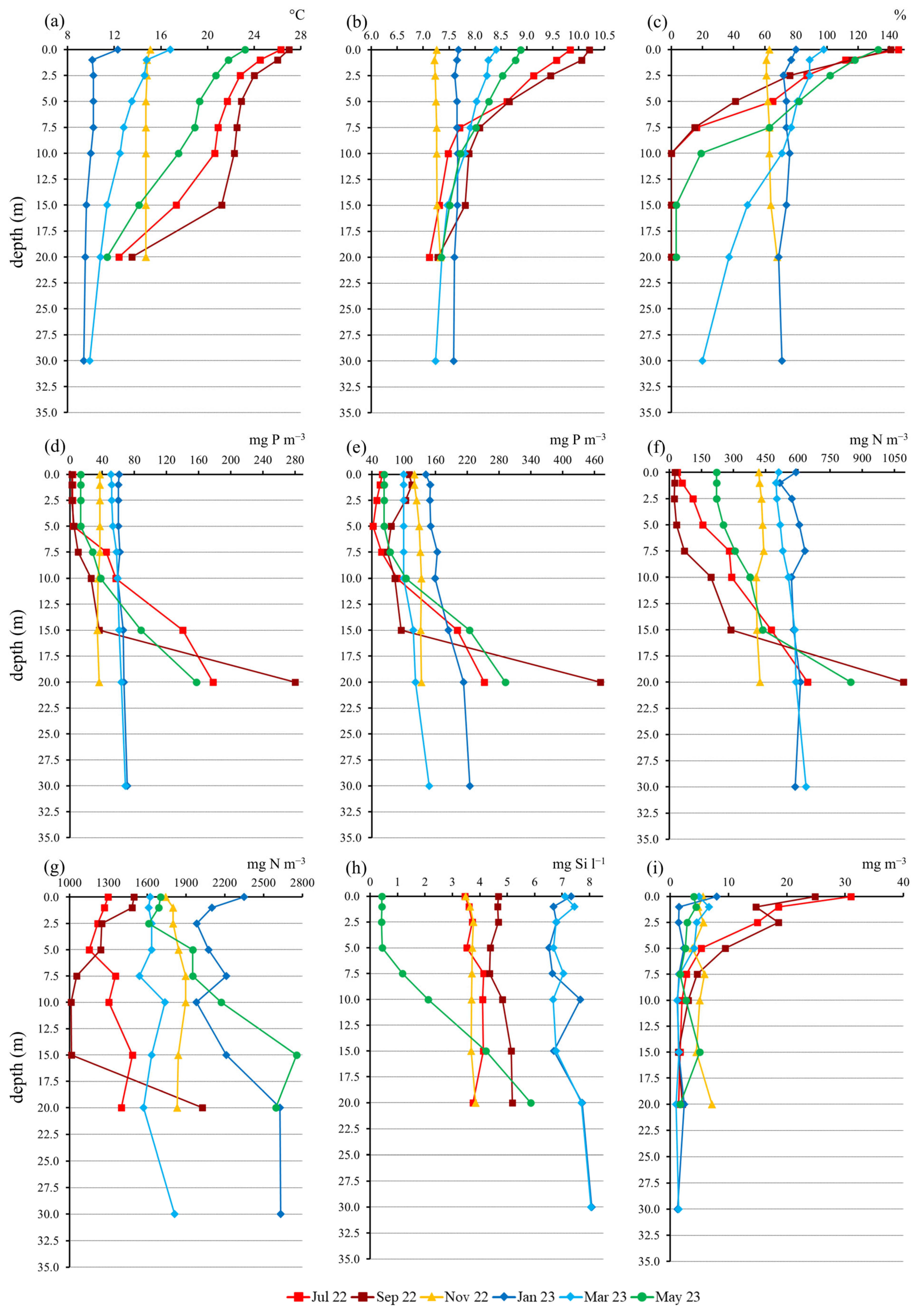
| Month | LV Volume Volume | CP | WI | TEM | pH | DOS | TP | RP | DIN | TN | RSS | CHL |
|---|---|---|---|---|---|---|---|---|---|---|---|---|
| 106 m3 | mm | 103 m3 | °C | % | mg P m−3 | mg P m−3 | mg N m−3 | mg N m−3 | mg Si l−1 | mg m−3 | ||
| Jun 22 | 8.67 | 1.2 | 19.6 | |||||||||
| Jul 22 | 7.24 | 0 | 0.0 | 20.8 | 8.35 | 53.3 | 100 | 54 | 257 | 1310 | 3.80 | 9.7 |
| Aug 22 | 8.3 | 67.2 | 1099.2 | |||||||||
| Sep 22 | 9.31 | 78.8 | 1288.9 | 22.4 | 8.68 | 48.6 | 140 | 45 | 219 | 1323 | 4.74 | 9.8 |
| Oct 22 | 7.77 | 13 | 212.6 | |||||||||
| Nov 22 | 10.1 | 126.8 | 2074.1 | 14.8 | 7.26 | 63.1 | 128 | 36 | 423 | 1833 | 3.70 | 5.3 |
| Dec 22 | 11.27 | 43.4 | 709.9 | |||||||||
| Jan 23 | 14.65 | 89.39 | 1462.2 | 10.2 | 7.64 | 74.1 | 171 | 63 | 585 | 2241 | 7.01 | 2.3 |
| Feb 23 | 13.47 | 31.48 | 514.9 | |||||||||
| Mar 23 | 13.36 | 18.54 | 303.3 | 13.0 | 7.86 | 67.9 | 110 | 58 | 547 | 1644 | 7.03 | 3.0 |
| Apr 23 | 10.75 | 26.15 | 427.7 | |||||||||
| May 23 | 7.51 | 6.35 | 103.9 | 18.4 | 8.13 | 65.4 | 118 | 45 | 360 | 2054 | 1.89 | 3.1 |
| Method | Trophic State | SDT | TP | CHLmean | CHLmax | Mean |
|---|---|---|---|---|---|---|
| OECD % | Ultra-oligotrophy | 0 | 0 | 0 | 0 | 0 |
| Oligotrophy | 0 | 0 | 2 | 0 | 1 | |
| Mesotrophy | 0 | 8 | 38 | 32 | 20 | |
| Eutrphy | 11 | 59 | 53 | 50 | 43 | |
| Iper-eutrophy | 89 | 33 | 7 | 18 | 37 | |
| TSI | score | 63 | 74 | 53 | - | 63 |
| Type | Source | Sub-Category | Extent | Pload (t ha−1 y−1) | Nload (t ha−1 y−1) | Pload (%) | Nload (%) |
|---|---|---|---|---|---|---|---|
| Point | LA | ovine/caprine | 156 | 0.135 | 0.827 | 4.3 | 1.1 |
| bovine | 13,459 | 0.014 | 0.107 | 0.4 | 0.1 | ||
| equine | 59 | 0.006 | 0.046 | 0.2 | 0.1 | ||
| swine | 269 | 0.013 | 0.038 | 0.4 | 0.0 | ||
| poultry | - | - | - | - | - | ||
| Non-point | UA | Discontinuous urban fabric | 75.3 | 0.158 | 0.527 | 5.0 | 0.7 |
| NsNA | Forests | 107.5 | 0.011 | 0.215 | 0.3 | 0.3 | |
| Shrub and/or grasslands | 937.0 | 0.092 | 1.874 | 2.9 | 2.5 | ||
| AA | Arable land | 1180.2 | 0.706 | 18.880 | 22.4 | 24.7 | |
| Permanent crops | 2796.8 | 1.674 | 44.744 | 53.1 | 58.6 | ||
| Pastures | 131.9 | 0.079 | 2.109 | 2.5 | 2.8 | ||
| Heterogeneous agricultural areas | 440.5 | 0.264 | 7.046 | 8.4 | 9.2 | ||
| Total | - | 3.152 | 76.414 | 100 | 100 |
| Parameters | Units | Values | |
|---|---|---|---|
| Input | Lake surface area | m2 | 1.450.000 |
| Lake outflow | m3 | 31.855.570 | |
| Daily lake outflow (q) | m3 d−1 | 87.276 | |
| Concentration at the beginning of stratification (P0) | mg P m3 | 124 | |
| measured concentration after time t (Pt mea) | mg P m3 | 216 | |
| Concentration in the inflow (Pi) | mg P m3 | 186 | |
| Lake volume (V) | m3 | 10.200.000 | |
| Start of stratification period | dd/mm/yy | 15/05/2022 | |
| End of stratification period | dd/mm/yy | 15/10/2022 | |
| Stratification days (t) | no. of days | 153 | |
| Result | Internal load (Pint) | mg P m3 | 46.5 |
| Parameters | Units | Values |
|---|---|---|
| Lake volume | m−3 | 10.200.000 |
| Volume inflow | m−3 | 31.855.570 |
| Water residence time | y | 0.320 |
| Concentration from spatial and transfers from Lake Alto Temo | mg P m−3 | 78.0 |
| Concentration from internal load | mg P m−3 | 46.5 |
| Final expected total phosphorus concentration | mg P m−3 | 124.5 |
Disclaimer/Publisher’s Note: The statements, opinions and data contained in all publications are solely those of the individual author(s) and contributor(s) and not of MDPI and/or the editor(s). MDPI and/or the editor(s) disclaim responsibility for any injury to people or property resulting from any ideas, methods, instructions or products referred to in the content. |
© 2026 by the authors. Licensee MDPI, Basel, Switzerland. This article is an open access article distributed under the terms and conditions of the Creative Commons Attribution (CC BY) license.
Share and Cite
Padedda, B.M.; Buscarinu, P.; Virdis, T.; Satta, C.T.; Virdis, S.G.P.; Pulina, S. Assessing the Trophic Condition of a Reservoir: A Combined Analysis of Watershed, Inter-Lake Connections and Internal Nutrient Loads. Land 2026, 15, 520. https://doi.org/10.3390/land15030520
Padedda BM, Buscarinu P, Virdis T, Satta CT, Virdis SGP, Pulina S. Assessing the Trophic Condition of a Reservoir: A Combined Analysis of Watershed, Inter-Lake Connections and Internal Nutrient Loads. Land. 2026; 15(3):520. https://doi.org/10.3390/land15030520
Chicago/Turabian StylePadedda, Bachisio Mario, Paola Buscarinu, Tomasa Virdis, Cecilia Teodora Satta, Salvatore Gonario Pasquale Virdis, and Silvia Pulina. 2026. "Assessing the Trophic Condition of a Reservoir: A Combined Analysis of Watershed, Inter-Lake Connections and Internal Nutrient Loads" Land 15, no. 3: 520. https://doi.org/10.3390/land15030520
APA StylePadedda, B. M., Buscarinu, P., Virdis, T., Satta, C. T., Virdis, S. G. P., & Pulina, S. (2026). Assessing the Trophic Condition of a Reservoir: A Combined Analysis of Watershed, Inter-Lake Connections and Internal Nutrient Loads. Land, 15(3), 520. https://doi.org/10.3390/land15030520