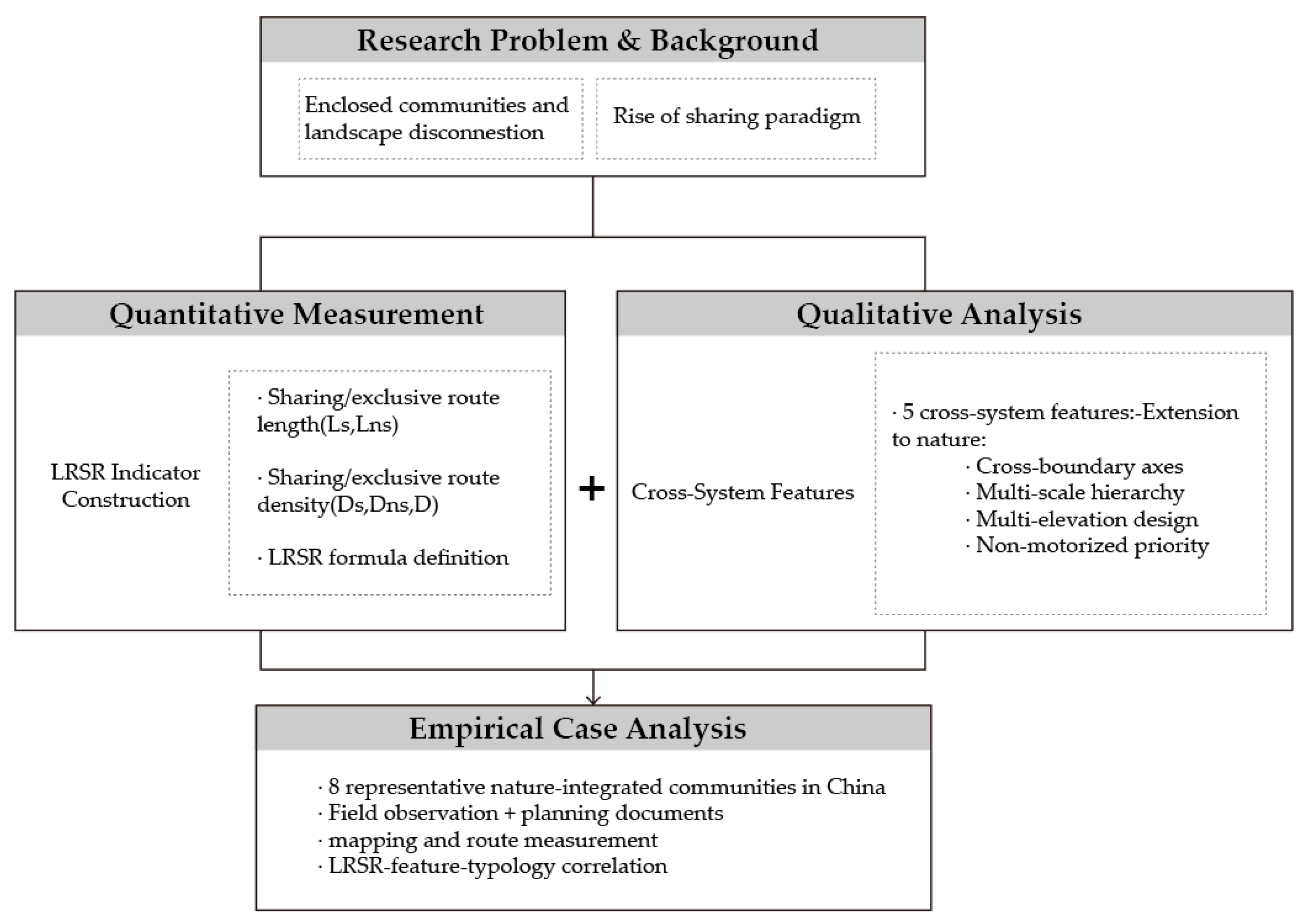
Landscape Route Sharing Ratio in Nature-Integrated Community: Cross-Boundary Features and Design Implications


Abstract
1. Introduction
2. Literature Review
2.1. Urban and Peri-Urban Nature-Integrated Communities
2.2. Sharing Spatial Networks, Green-Blue Infrastructure and Slow Mobility
2.3. Quantitative Evaluation of Sharing Routes and Research Gap
3. Materials and Methods
3.1. Case Selection and Data Collection
- (1)
- Diversity of landscape types. China is rich in diverse mountain-water resources, generally categorized into three major types: mountain landscapes, waterfront landscapes and composite landscapes. It selects representative cities for each category, and further screens research cases from them.
- (2)
- Forward-looking spatial characteristics: Since the housing reform in the 1990s, a large number of residential communities have been built in China. However, most communities developed with a strong commercial orientation exhibit homogenized and enclosed characteristics. The 8 selected cases are all completed community projects publicly published in professional design journals by renowned architects or design institutes (Table 1), featuring certain experimental and forward-looking attributes. They hold guiding significance for the design of China’s nature-integrated communities, which are still in the exploration stage.
3.2. Research Methods
3.2.1. Qualitative Analysis: Urban Morphological and Typological Method
3.2.2. Quantitative Analysis: Measurement and Comparison of the LRSR Index
4. Results
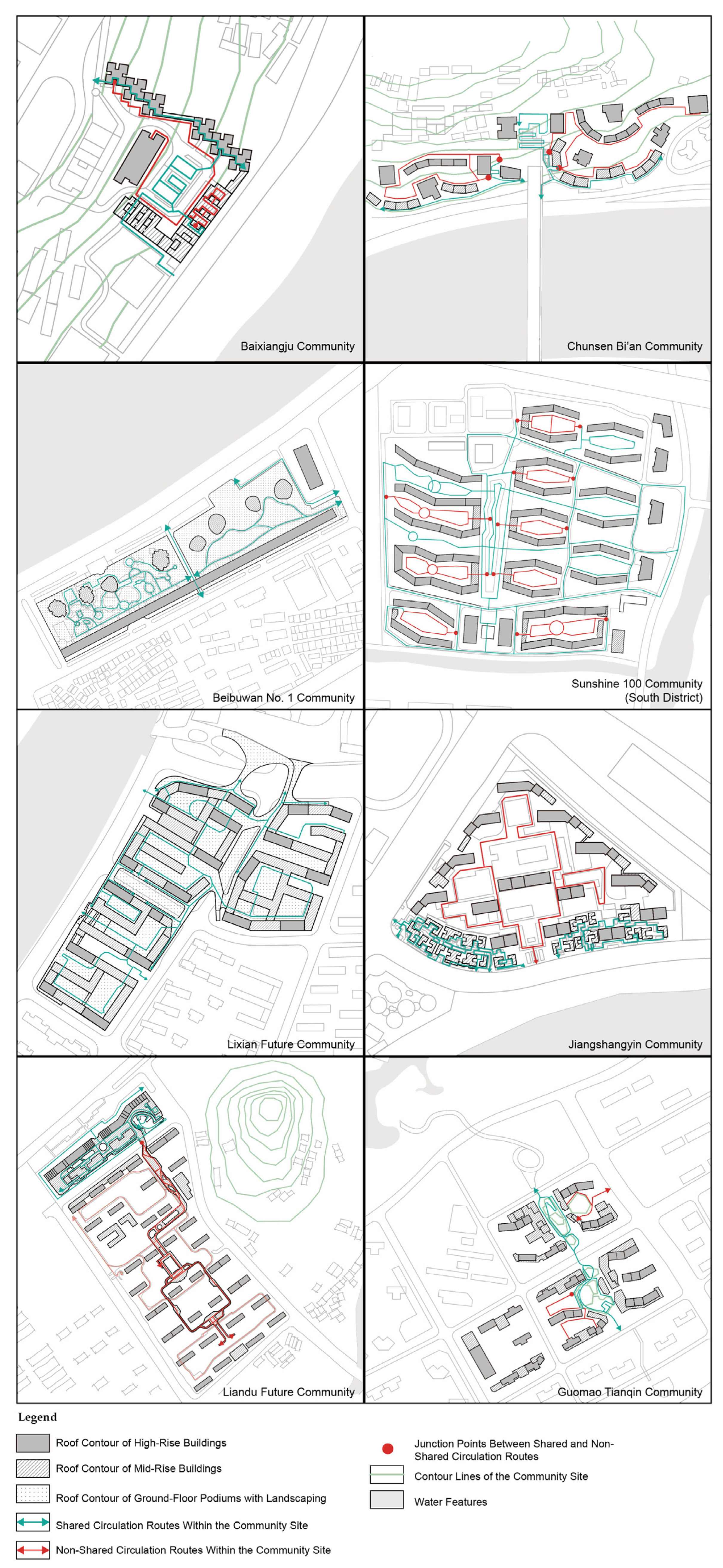
4.1. LRSR Measurement Results
4.2. Spatial Characteristics of Cross-System Shared Routes
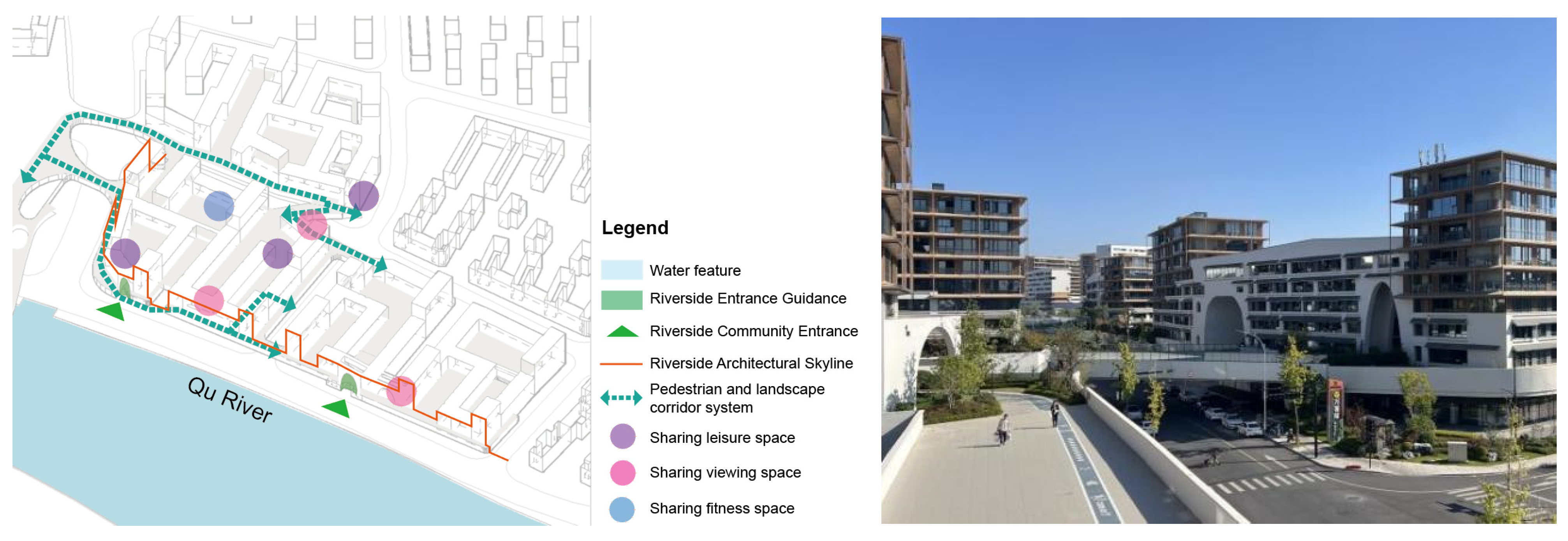
4.2.1. Extension to Natural Landscapes (ENL)
4.2.2. Cross-Boundary Landscape Axes (CBLA)
4.2.3. Multi-Scale Hierarchy (MSH)
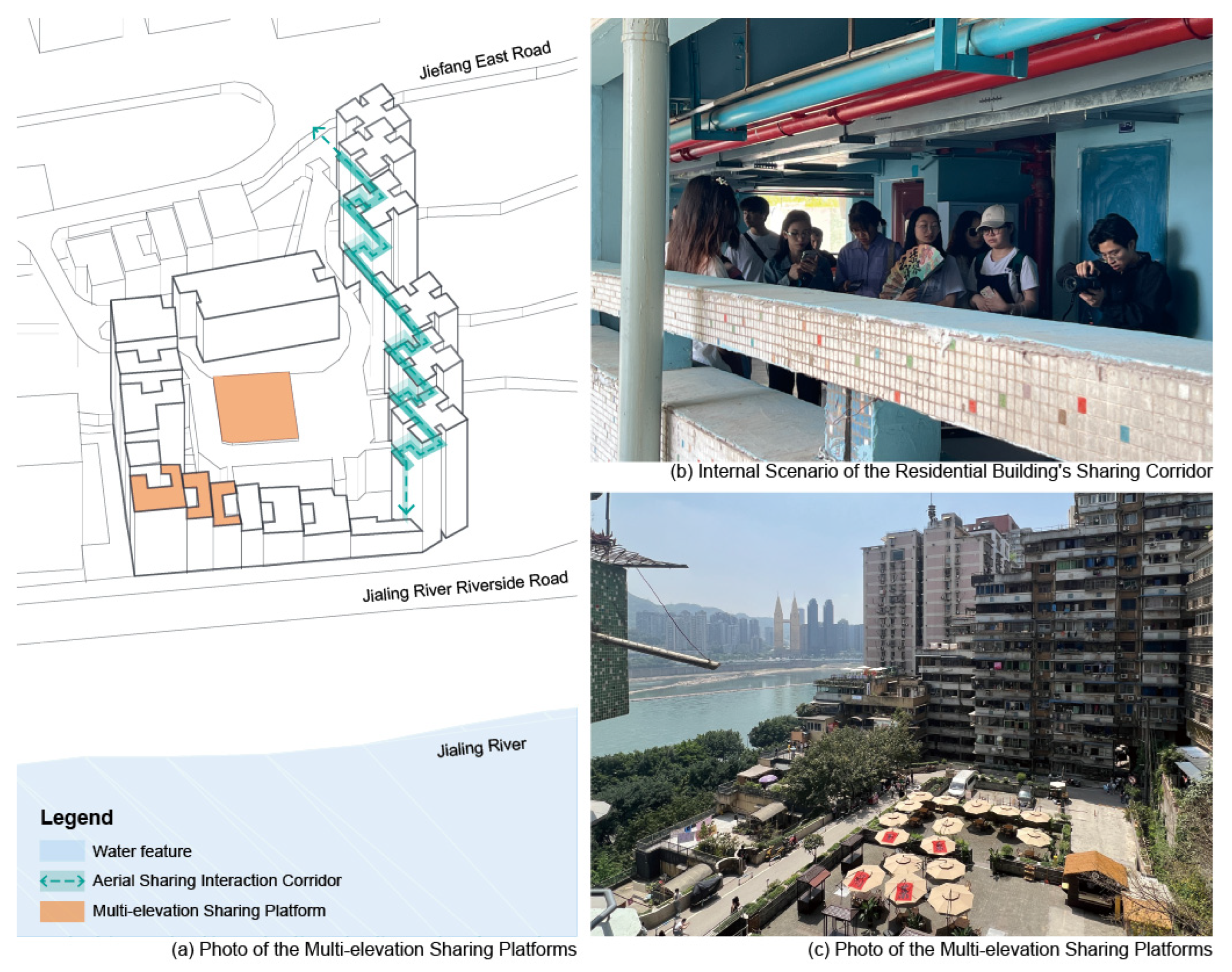
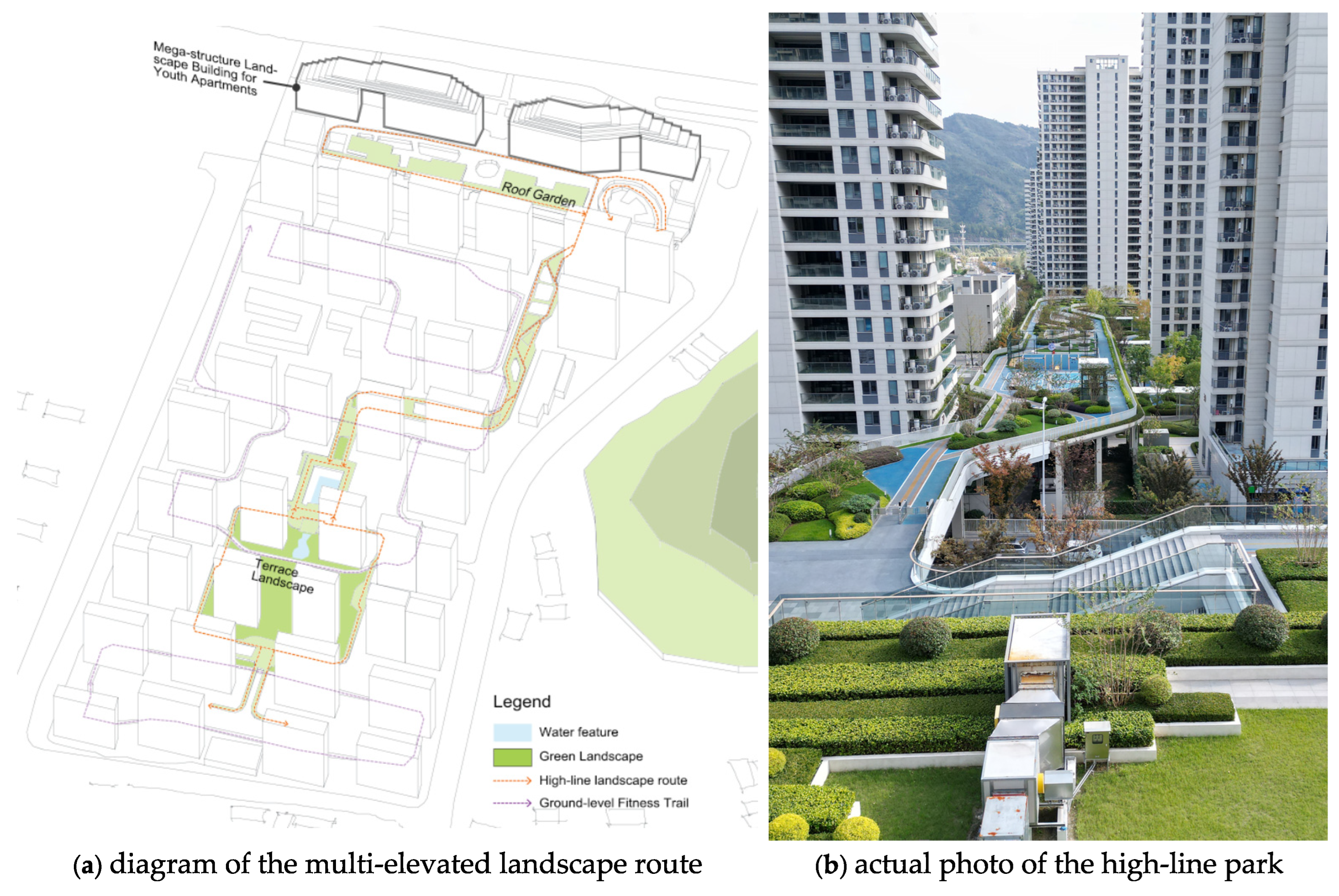
4.2.4. Multi-Elevation Systems (MES)
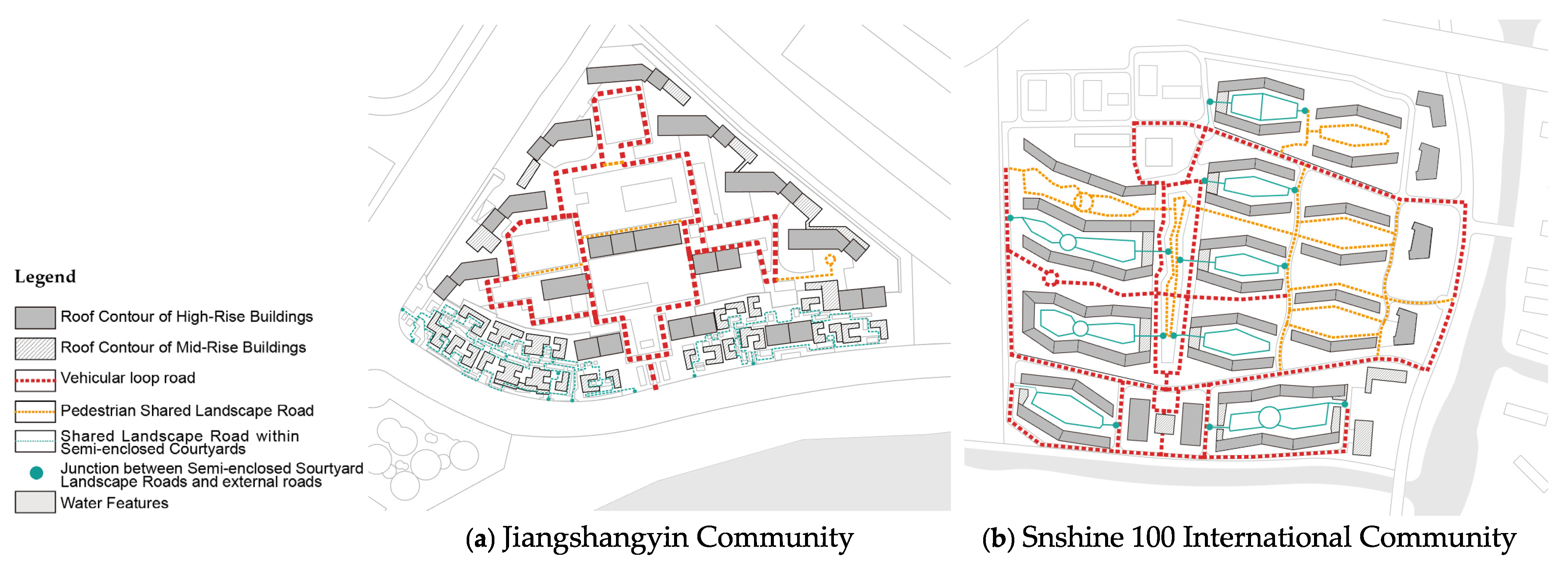
4.2.5. Non-Motorized Priority (NMP)
5. Discussion
5.1. Mechanism for LRSR Enhancement and the Coupling Effect of Spatial Design Features
5.2. Correlation Between Planning Intervention Modes and Route Sharing Quality
5.3. LRSR Theoretical Contributions
6. Conclusions
Author Contributions
Funding
Data Availability Statement
Acknowledgments
Conflicts of Interest
Abbreviations
| LRSR | Landscape route sharing ratio |
| Ls | Length of shared landscape route |
| Lns | Length of non-shared landscape route |
| Ds | Density of shared landscape route |
| Dns | Density of non-shared landscape route |
| S0 | Spatium of land area |
| ENL | Extension to natural landscapes |
| CBLA | Cross-boundary landscape axes |
| MSH | Multi-scale hierarchy |
| MES | Multi-elevation systems |
| NMP | Non-motorized priority |
Appendix A

| Respondent ID | Case | Role/Position | Interview Type | Core Interview Topics |
|---|---|---|---|---|
| P1 | Guomao Tianqin Community, Xiamen | Project Operations Manager | Semi-structured interview | Community management boundaries, strategies for the openness of waterfront paths data |
| P2 | Beibuwan No. 1 Community, Beihai | Project Operations Manager | Semi-structured interview | |
| P3 | Jiangshangyin Community, Ningbo | Expert from Planning Department | In-depth on-site interview | Systematic requirements for cross-system landscape axes during regulatory planning; community management boundaries; strategies for the openness of waterfront paths; conflicts and sharing mechanisms between shared landscape flow lines and resident flow lines |
| P4 | Lead Architect of Urban Design Scheme | In-depth on-site interview | Implementation difficulties of cross-system landscape axes during regulatory planning; impacts on floor area ratio and sharing; spatial design concepts and optimization schemes |
Appendix B
| Core Element | Score | Spatial Chacteristics |
|---|---|---|
| Extension to Natural Landscapes (ENL) | 5 | The route is adjacent to natural landscapes throughout, with no building/facility obstruction, and is equipped with landscape experience nodes; non-residents can reach core landscape areas directly via the route, with no breaks in landscape extension. |
| 4 | The core section is adjacent to natural landscapes, with no obstruction on the main viewing side; the route partially integrates with the landscape, equipped with 1–2 basic landscape nodes; non-residents can reach landscape edge areas. | |
| 3 | Some sections can access natural landscapes, with partial landscape obstruction; the route has basic connection with the landscape, no dedicated landscape experience facilities; only residents can access core landscape sections. | |
| 2 | Only edge sections allow distant views of natural landscapes, with significant obstruction; the route has no active connection design with the landscape, only passive distant viewing; non-residents cannot access landscape-related sections. | |
| 1 | No contact with natural landscapes, the route is completely disconnected from natural landscapes; landscape extension is not included in design goals, only meeting basic circulation needs. | |
| Cross-boundary Landscape Axes (CBLA) | 5 | Forms a city-community cross-boundary landscape axis, clearly connecting ≥3 external core nodes (urban parks, riverside belts, etc.), with no breaks in the axis, and seamlessly integrating with the urban public space system; the axis is the core planning goal. |
| 4 | Forms a community-level landscape axis, connecting 2 external landscape nodes, the axis is generally continuous with minor non-critical breaks; the axis connects with urban public spaces but is not fully integrated. | |
| 3 | There is an internal landscape axis, but it only connects 1 external node or no external nodes, limiting the axis to the community; the axis is basically continuous with no major breaks, but is not included in urban space connection planning. | |
| 2 | Only scattered landscape fragments exist, with no complete axis or external connection nodes; the axis is fragmented and only exists in a single functional area. | |
| 1 | No landscape axis planning, the route layout has no landscape orientation, only meeting internal circulation needs, with no landscape connection to external spaces. | |
| Multi-scale Hierarchy (MSH) | 5 | Constructs a three-level (city-community-cluster) spatial hierarchy, with clear boundaries and functional adaptation at each level, achieving gradual penetration through elevated spaces, semi-enclosed courtyards, open plazas, etc.; the hierarchy management logic is clear, balancing publicity and privacy, with no hierarchy confusion. |
| 4 | Constructs a two-level (community-cluster) spatial hierarchy, with relatively clear boundaries and good functional adaptation; achieves hierarchical transition through greenery, terrain, etc., basically balancing publicity and privacy, with only minor local hierarchy confusion. | |
| 3 | There is a single-scale hierarchy or two-level hierarchy with vague boundaries; the hierarchy management logic is unclear, with minor overlap between public and private spaces and no obvious conflicts. | |
| 2 | Only scattered space fragments exist, with no clear hierarchical system; the space layout is chaotic, with no distinction between public and private spaces, and minor usage conflicts. | |
| 1 | No multi-scale hierarchy planning, no spatial grading design, complete overlap between public and private spaces, and frequent usage conflicts | |
| Multi-elevation Systems (MES) | 5 | Designs a route system with ≥3 elevations based on terrain conditions; each elevation system is independent and smoothly connected, creating characteristic spatial experiences using height differences; equipped with barrier-free facilities, suitable for all groups. |
| 4 | Designs a route system with 2 elevations, each elevation is smoothly connected, effectively utilizing terrain height differences to create 1 characteristic elevation space; suitable for mainstream groups. | |
| 3 | There are elevation differences, but no systematic design, only partial single-elevation adjustments; no characteristic spatial experience, only meeting basic circulation needs. | |
| 2 | There are terrain height differences, but no elevation adaptation design, the route is laid out along a single elevation with circulation inconveniences; no barrier-free facilities, only suitable for healthy people. | |
| 1 | No elevation design, the route is completely dependent on the original terrain, with obvious circulation obstacles; the impact of elevation on usage is not considered, and the multi-elevation system is not implemented. | |
| Non-motorized Priority (NMP) | 5 | Motor vehicles are completely prohibited on the route, realizing “non-motorized exclusivity”; the non-motorized space width is ≥3 m, with complete facilities; seamlessly connecting with the urban non-motorized system, with no conflicts between non-motorized traffic and motor vehicles. |
| 4 | Non-motorized traffic is prioritized on the route, only emergency vehicles are allowed; the non-motorized space width is 2–3 m, with relatively complete facilities; connecting with the urban non-motorized system, with basically no conflicts between non-motorized traffic and motor vehicles. | |
| 3 | The route accommodates both non-motorized and motorized traffic (by time or area); the non-motorized space width is 1–2 m, with basic lighting facilities; no direct connection with the urban non-motorized system, with minor circulation conflicts. | |
| 2 | Motor vehicles are prioritized on the route, the non-motorized space is narrow (<1 m), with no dedicated non-motorized facilities; no connection with the urban non-motorized system, with frequent circulation conflicts. | |
| 1 | No non-motorized priority design, the route is completely used for motor vehicle traffic, no non-motorized space, unable to meet non-motorized needs. |
References
- Alkhafagie; Karrar, H.; Dheah, H.B. The Social Divide: Impact of Gated Communities on Urban Interaction. Acad. Open 2024, 9, 1. [Google Scholar] [CrossRef] [Scilit]
- Levin, S.; Ceccato, V.; Lord, J.R. A systematic review of gated communities and their implications for safety and broader social outcomes between 2000 and 2024. Discov. Cities 2026, 3, 4. [Google Scholar] [CrossRef] [Scilit]
- Qiao, X.; Liu, Y.; Feng, J. Evaluating the Landscape Quality of Residential Communities: A Case Study of the Chinese City Yangling. Land 2023, 12, 57. [Google Scholar] [CrossRef] [Scilit]
- Tong, A.; Xu, L.; Ma, Q.; Shi, Y.; Feng, M.; Lu, Z.; Wu, Y. Evaluation of the level of park space service based on the residential area demand. Urban For. Urban Green. 2024, 93, 128214. [Google Scholar] [CrossRef] [Scilit]
- Zhu, Y.; Li, Z. ‘Sharing’ as a Critical Framework for Waterfront Heritage Regeneration: A Case Study of Suzhou Creek, Shanghai. Land 2024, 13, 1280. [Google Scholar] [CrossRef] [Scilit]
- Jordan, S.; Babuder, A.; Boyer, R. Shared Spaces as a Promising Contribution to Sustainable Renovation of Residential Neighborhoods. Proceedings 2025, 131, 73. [Google Scholar] [CrossRef] [Scilit]
- Mukhija, V.; Takahashi, L. Enhancing Sharing Capabilities. J. Am. Plan. Assoc. 2022, 89, 175–182. [Google Scholar] [CrossRef] [Scilit]
- Mundula, L.; Di Fazio, C.; Leccis, F.; Paradiso, M. Urban Green Infrastructures as Tools for Urban Interconnection: The Case of San Bartolomeo District in Cagliari, Italy. Sustainability 2024, 16, 11246. [Google Scholar] [CrossRef] [Scilit]
- Melon, M.; Sikorski, P.; Archiciński, P.; Łaszkiewicz, E.; Hoppa, A.; Zaniewski, P.; Zaniewska, E.; Strużyński, W.; Sudnik-Wójcikowska, B.; Sikorska, D. Nature on our doorstep: How do residents perceive urban parks vs. biodiverse areas? Landsc. Urban Plan. 2024, 247, 105059. [Google Scholar] [CrossRef] [Scilit]
- Fang, X.; Li, J.; Ma, Q. Integrating green infrastructure, ecosystem services and nature-based solutions for urban sustainability: A comprehensive literature review. Sustain. Cities Soc. 2023, 98, 104843. [Google Scholar] [CrossRef] [Scilit]
- Alves, A.; van Opstal, C.; Keijzer, N.; Sutton, N.; Chen, W. Planning the multifunctionality of nature-based solutions in urban spaces. Cities 2024, 146, 104751. [Google Scholar] [CrossRef] [Scilit]
- Zahoor, A.; Xu, T.; Wang, M.; Dawood, M.; Afrane, S.; Li, Y.; Chen, J.L.; Mao, G. Natural and artificial green infrastructure (GI) for sustainable resilient cities: A scientometric analysis. Environ. Impact Assess. Rev. 2023, 101, 107139. [Google Scholar] [CrossRef] [Scilit]
- Salem, M.; Tsurusaki, N. Impacts of Rapid Urban Expansion on Peri-Urban Landscapes in the Global South: Insights from Landscape Metrics in Greater Cairo. Sustainability 2024, 16, 2316. [Google Scholar] [CrossRef] [Scilit]
- Ashiagbor, G.; Amoako, C.; Asabere, S.B.; Quaye-Ballard, J.A. Landscape Transformations in Rapidly Developing Peri-urban Areas of Accra, Ghana: Results of 30 years. Open Geosci. 2019, 11, 172–182. [Google Scholar] [CrossRef] [Scilit]
- Cheshmehzangi, A. The Changing Urban Landscape of Chinese Cities: Positive and Negative Impacts of Urban Design Controls on Contemporary Urban Housing. Sustainability 2018, 10, 2839. [Google Scholar] [CrossRef] [Scilit]
- Zhifang, W. Evolving landscape-urbanization relationships in contemporary China. Landsc. Urban Plan. 2017, 171, 30–41. [Google Scholar] [CrossRef] [Scilit]
- Wang, S.; Song, Y. The Study of the Cognitive Tendency of Chinese Y and Z Generations towards the Design Element Shan-Shui in Architectural Environments. Buildings 2024, 14, 1656. [Google Scholar] [CrossRef] [Scilit]
- Bai, X.; Sadia, S. Park city leads the way of urban development and innovation in China. J. Environ. Eng. Landsc. Manag. 2023, 31, 240–247. [Google Scholar] [CrossRef] [Scilit]
- Vinczeová, Z.; Tóth, A. Urban Green Spaces and Collective Housing: Spatial Patterns and Ecosystem Services for Sustainable Residential Development. Sustainability 2025, 17, 2538. [Google Scholar] [CrossRef] [Scilit]
- Wolff, E.; Natakun, B.; Marome, W.; Chew, G.; Tang, K.S.; Hamel, P. Nature for the people, by the people: Negotiating values, attitudes and behaviours for implementing urban nature-based solutions in social housing. Urban For. Urban Green. 2025, 112, 128973. [Google Scholar] [CrossRef] [Scilit]
- Li, Z.; Zhu, Y. Towards a Sharing Architecture. Archit. J. 2017, 12, 60–65. [Google Scholar]
- Ryu, H.; Basu, M.; Saito, O. What and how are we sharing? A systematic review of the sharing paradigm and practices. Sustain. Sci. 2018, 14, 515–527. [Google Scholar] [CrossRef] [Scilit]
- Zhang, X.; Wang, X.; Zhang, C.; Zhai, J. Development of a cross-scale landscape infrastructure network guided by the new Jiangnan watertown urbanism: A case study of the ecological green integration demonstration zone in the Yangtze River Delta, China. Ecol. Indic. 2022, 143, 109317. [Google Scholar] [CrossRef] [Scilit]
- Wu, Y.; Liu, Y. Transforming Industrial Waterfronts into Inclusive Landscapes: A Project Method and Investigation of Landscape as a Medium for Sustainable Revitalization. Sustainability 2023, 15, 5060. [Google Scholar] [CrossRef] [Scilit]
- Huang, Y.; Huang, Y.; Chen, Y.; Song, J.; Yang, S.; Huang, L.; Zheng, L.; Gao, Y. The evolution and construction of Shan-shui cities: Evidence from the ancient city of Hangzhou from the sixth to the twenty-first century via geographical information systems and space syntax. Front. Earth Sci. 2025, 13, 1551117. [Google Scholar] [CrossRef] [Scilit]
- Jurečka, M.; Andrášik, R.; Čermák, P.; Danzinger, F.; Plutzar, C.; Grillmayer, R.; Mikita, T.; Bartonička, T. Influence of land use intensity on ecological corridors and wildlife crossings’ effectiveness: Comparison of 2 pilot areas in Austria. Nat. Conserv. 2024, 57, 143–171. [Google Scholar] [CrossRef] [Scilit]
- Bertrand-Krajewski, J.-L. Integrated urban stormwater management: Evolution and multidisciplinary perspective. J. Hydro-Environ. Res. 2020, 38, 72–83. [Google Scholar] [CrossRef] [Scilit]
- Li, X.; Jia, B.; Wang, Z.; Li, T.; Feng, F. Residential heat environment in relation to blue-green space sustainability in Beijing, China. Urban For. Urban Green. 2024, 102, 128577. [Google Scholar] [CrossRef] [Scilit]
- Zhai, C.; Geng, R.; Ren, Z.; Wang, C.; Zhang, P.; Guo, Y.; Hong, S.; Hong, W.; Meng, F.; Fang, N. Spatiotemporal Dynamics of Urban Green Space Coverage and Its Exposed Population under Rapid Urbanization in China. Remote Sens. 2024, 16, 2836. [Google Scholar] [CrossRef] [Scilit]
- Ramakreshnan, L.; Aghamohammadi, N.; Fong, C.S.; Sulaiman, N.M. A comprehensive bibliometrics of ‘walkability’ research landscape: Visualization of the scientific progress and future prospects. Environ. Sci. Pollut. Res. 2020, 28, 1357–1369. [Google Scholar] [CrossRef] [Scilit]
- Colwell, R.K. The projected timing of abrupt ecological disruption from climate change. Nature 2020, 580, 496–501. [Google Scholar] [CrossRef] [Scilit] [PubMed]
- Siehr, S.A.; Sun, M.; Aranda Nucamendi, J.L. Blue-green infrastructure for climate resilience and urban multifunctionality in Chinese cities. Wiley Interdiscip. Rev. Energy Environ. 2022, 11, e447. [Google Scholar] [CrossRef] [Scilit]
- Laura, S.; Marc, E.; José, A.; Wan-Yu, S. Urban green and blue infrastructure: A critical analysis of research on developing countries. J. Clean. Prod. 2021, 313, 127898. [Google Scholar] [CrossRef] [Scilit]
- Jose, A.; Rodrigo, A.B.; Wan-yu, S.; Bogachan, B. Innovations in Urban Green and Blue Infrastructure: Tackling local and global challenges in cities. J. Clean. Prod. 2022, 362, 132355. [Google Scholar] [CrossRef] [Scilit]
- Xin, L.; Yuan, L.; Tao, J.; Lin, Z.; Ihab Hamzi, H. The six dimensions of built environment on urban vitality: Fusion evidence from multi-source data. Cities 2021, 121, 103482. [Google Scholar] [CrossRef] [Scilit]
- Zhao, J.; Sun, G.; Webster, C. Walkability scoring: Why and how does a three-dimensional pedestrian network matter? Environ. Plan. B Urban Anal. City Sci. 2020, 48, 2418–2435. [Google Scholar] [CrossRef] [Scilit]
- Dogan, O.; Han, J.; Lee, S. Opening Gated Communities and Neighborhood Accessibility Benefits: The Case of Seoul, Korea. Int. J. Environ. Res. Public Health 2021, 18, 4255. [Google Scholar] [CrossRef] [Scilit]
- Sun, G.; Webster, C.; Chiaradia, A. Ungating the city: A permeability perspective. Urban Stud. 2017, 55, 2586–2602. [Google Scholar] [CrossRef] [Scilit]
- Banai, R. Planning Paradigms: Contradictions and Synthesis. J. Archit. Plan. Res. 1988, 5, 14–34. [Google Scholar]
- Rosa, A.A.; Lima, F. A Framework for Informing Complete Street Planning: A Case Study in Brazil. Buildings 2025, 15, 125. [Google Scholar] [CrossRef] [Scilit]
- Liu, X.; Zhou, J. Mind the missing links in China’s urbanizing landscape: The phenomenon of broken intercity trunk roads and its underpinnings. Landsc. Urban Plan. 2017, 165, 64–72. [Google Scholar] [CrossRef] [Scilit]
- Hsu, W.; Zhang, Y.; Long, Y. Valuing the Micropublic Space: A Perspective from Beijing Housing Prices. J. Urban Plan. Dev. 2022, 148, 04022012. [Google Scholar] [CrossRef] [Scilit]
- Zhang, X. Green real estate development in China: State of art and prospect agenda—A review. Renew. Sustain. Energy Rev. 2015, 47, 1–13. [Google Scholar] [CrossRef] [Scilit]
- Steiner, F.; Simmons, M.; Gallagher, M.; Ranganathan, J.; Robertson, C. The ecological imperative for environmental design and planning. Front. Ecol. Environ. 2013, 11, 355–361. [Google Scholar] [CrossRef] [Scilit]
- Ross, M.R.V.; Bernhardt, E.S.; Doyle, M.W.; Heffernan, J.B. Designer Ecosystems: Incorporating Design Approaches into Applied Ecology. Annu. Rev. Environ. Resour. 2015, 40, 419–443. [Google Scholar] [CrossRef] [Scilit]
- Grose, M.J. Gaps and futures in working between ecology and design for constructed ecologies. Landsc. Urban Plan. 2014, 132, 69–78. [Google Scholar] [CrossRef] [Scilit]
- Manivannan, A.; Chin, W.C.B.; Gopalakrishnan, S.; Wong, D.K.H.; Schroepfer, T.; Bouffanais, R. Effects of the interplay between topology and function of an integrated urban development on patterns of user movement. Sci. Rep. 2024, 14, 7021. [Google Scholar] [CrossRef] [Scilit]
- Ozbil, A.; Gurleyen, T.; Yesiltepe, D.; Zunbuloglu, E. Comparative Associations of Street Network Design, Streetscape Attributes and Land-Use Characteristics on Pedestrian Flows in Peripheral Neighbourhoods. Int. J. Environ. Res. Public Health 2019, 16, 1846. [Google Scholar] [CrossRef] [Scilit]
- Mei, L.; Ying, J. Measuring accessibility of urban scales: A trip-based interaction potential model. Adv. Eng. Inform. 2021, 48, 101293. [Google Scholar] [CrossRef] [Scilit]
- Liu, Y.; Cao, X.; Li, T. Influence of Accessibility on Land Use and Landscape Pattern Based on Mapping Knowledge Domains: Review and Implications. J. Adv. Transp. 2020, 2020, 1. [Google Scholar] [CrossRef] [Scilit]
- Lee, S.; Yoo, C.; Seo, K.W. Determinant Factors of Pedestrian Volume in Different Land-Use Zones: Combining Space Syntax Metrics with GIS-Based Built-Environment Measures. Sustainability 2020, 12, 8647. [Google Scholar] [CrossRef] [Scilit]
- Zhu, M.; Zuo, Y.; Liang, X.; Cui, H. Urban–rural public transport accessibility evaluation based on improved gravity model with actual time. Proc. Inst. Civ. Eng.-Munic. Eng. 2025, 178, 55–67. [Google Scholar] [CrossRef] [Scilit]
- Ma, X.; Zeng, T.; de Dear, R.; Xie, Y.; Yuan, C.; Lu, S. Active route choice to minimize pedestrian thermal discomfort in a high-density subtropical city. Sustain. Cities Soc. 2025, 131, 106697. [Google Scholar] [CrossRef] [Scilit]
- Monteiro, C. Becoming an urban morphologist: Michael P. Conzen. Urban Morphol. 2024, 28, 151–166. [Google Scholar] [CrossRef] [Scilit]
- Conzen, M.P. Thinking About Urban Form: Papers on Urban Morphology, 1932–1998; Peter Lang Publishing: New York, NY, USA, 2004. [Google Scholar]
- Oliveira, V.; Porta, S. Quantitative and qualitative analysis in urban morphology: Systematic legacy and latest developments. Proc. Inst. Civ. Eng.-Urban Des. Plan. 2025, 178, 75–87. [Google Scholar] [CrossRef] [Scilit]
- Beatley, T. Island Press/Center for Resource Economics Ebooks; Island Press/Center for Resource Economics: Washington, DC, USA, 2011. [Google Scholar]
- Ren, Z. Extreme Riverside Human Settlement Pattern under Extreme Topography: A Case Study of Chongqing Longhu Chunsen Bi’an. Chongqing Archit. 2014, 4, 20–23. [Google Scholar] [CrossRef]
- Tang, L. Structural General Drawing Design of Chongqing Longhu Chunsen Bi’an Phase I Project. Sichuan Archit. 2010, 30, 76–78,80. [Google Scholar]
- Zhang, L.; Ma, Y. Interview with Ma Yansong. World Archit. 2016, 2, 126–129,133. [Google Scholar]
- Fabos, J.G. Greenway Planning in the United States: Its Origins and Recent Case Studies. Landsc. Urban Plan. 2004, 68, 321–342. [Google Scholar] [CrossRef] [Scilit]
- Wang, J. Analysis of Community Life Circle Planning and Design Based on the Healthy City Concept: A Case Study of Xiamen Poly·Gumaco Tianqin Community. Fujian Constr. Sci. Technol. 2024, 2, 8–12. [Google Scholar] [CrossRef]
- Chen, L. Openness and Shortage: On High-rise Housing in the Social Transformation of the Early Period of Reform and Opening-up—A Case Study of Baixiangju, Chongqing. Community Des. 2023, 5, 40–48. [Google Scholar] [CrossRef]
- Zhang, Y.; Chen, H. Practice of Land Transfer with Planning Scheme in Lishui Liandu Lingshan Community. Zhejiang Constr. 2020, 37, 67–69. [Google Scholar] [CrossRef]
- Zhang, Y. Practical Application of Future Architectural Scenarios: A Case Study of Lishui Liandu Lingshan Future Community. Anhui Archit. 2020, 27, 22–24. [Google Scholar] [CrossRef]
- Wu, X.; Tang, C.; Zhang, C. Commercial Housing of Quzhou Lixian Future Community. Archit. Tech. 2024, 30, 78–89. [Google Scholar] [CrossRef]
- Perez-Ramos, J.L.; Ramirez-Rosales, S.; Canton-Enriquez, D.; Diaz Jimenez, L.A.; Hernandez-Ramirez, H.; Herrera-Navarro, A.M.; Jimenez-Hernandez, H. Connecting Cities: A Case Study on the Application of Morphological Shortest Paths. Symmetry 2025, 17, 114. [Google Scholar] [CrossRef] [Scilit]
- Karimi, K. The Configurational Structures of Social Spaces: Space Syntax and Urban Morphology in the Context of Analytical, Evidence-Based Design. Land 2023, 12, 2084. [Google Scholar] [CrossRef] [Scilit]
- Ye, Y. Towards an Open Block Space: An Analysis of Derivative Problems of Super-Large Closed Communities. Front. Interdiscip. Appl. Sci. 2025, 2, 165–172. [Google Scholar] [CrossRef] [Scilit]
- Balon, N.; Hrdalo, I.; Mrđa, A.; Kamenečki, M.; Tomić Reljić, D.; Pereković, P. Landscape Urbanism—Retrospective on Development, Basic Principles and Application. Architecture 2023, 3, 739–752. [Google Scholar] [CrossRef] [Scilit]





| Case | Master Plan (Drawn to Scale) | Landscape and Location | Built Year and Designer | Floor Area | FAR |
|---|---|---|---|---|---|
| 1. Baixiangju Community |  | Jia Ling River, Mountainous Terrain (Chongqing) | 1992 Chongqing Jianzhu University | / | / |
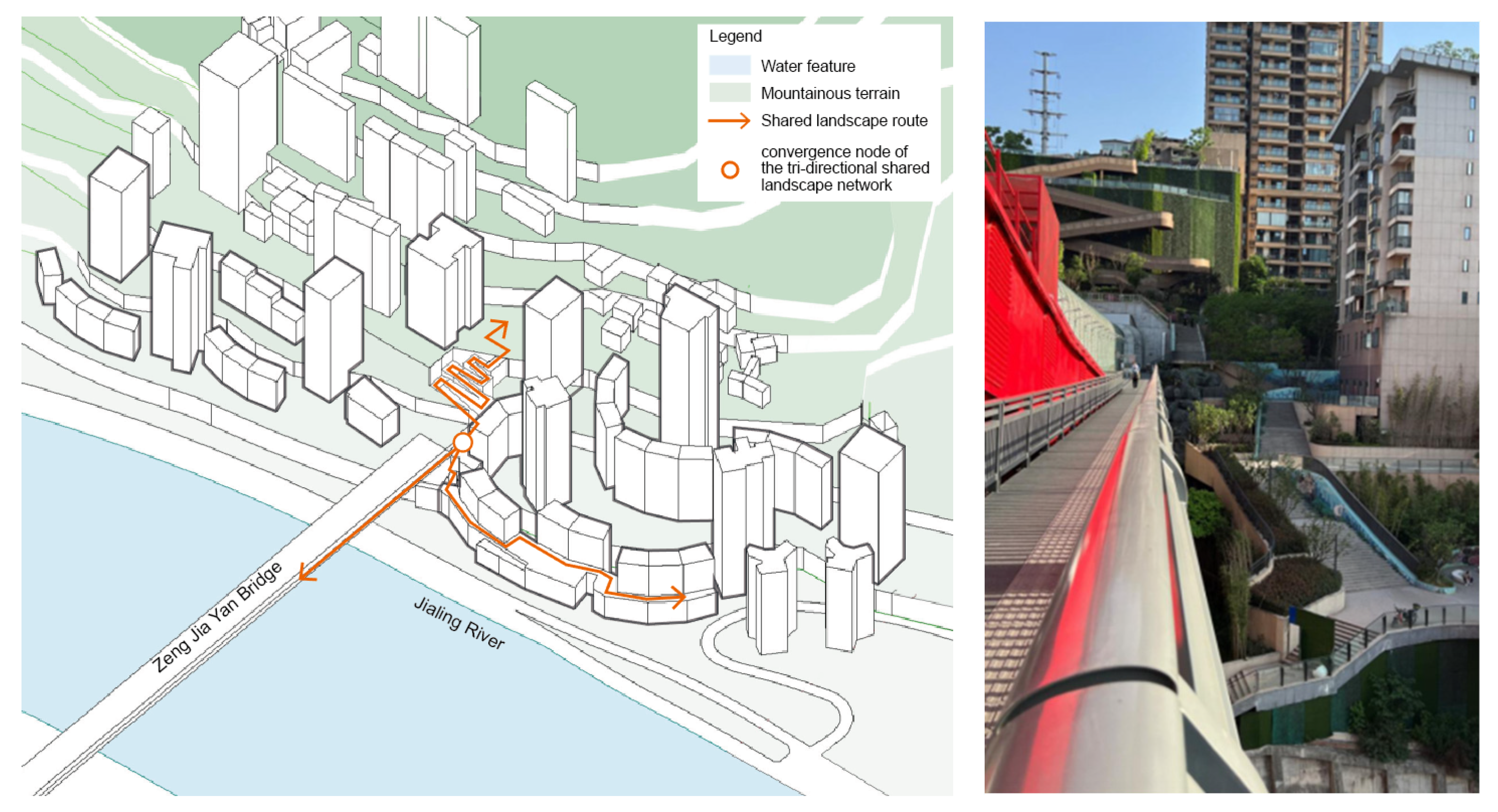
| 2. Chunsen Bi’an Community |  | Jia Ling River, Mountainous Terrain (Chongqing) | 2009 MRY Architects & Chongqing Architectural Design Institute | 160,200 m2 | 4.9 |
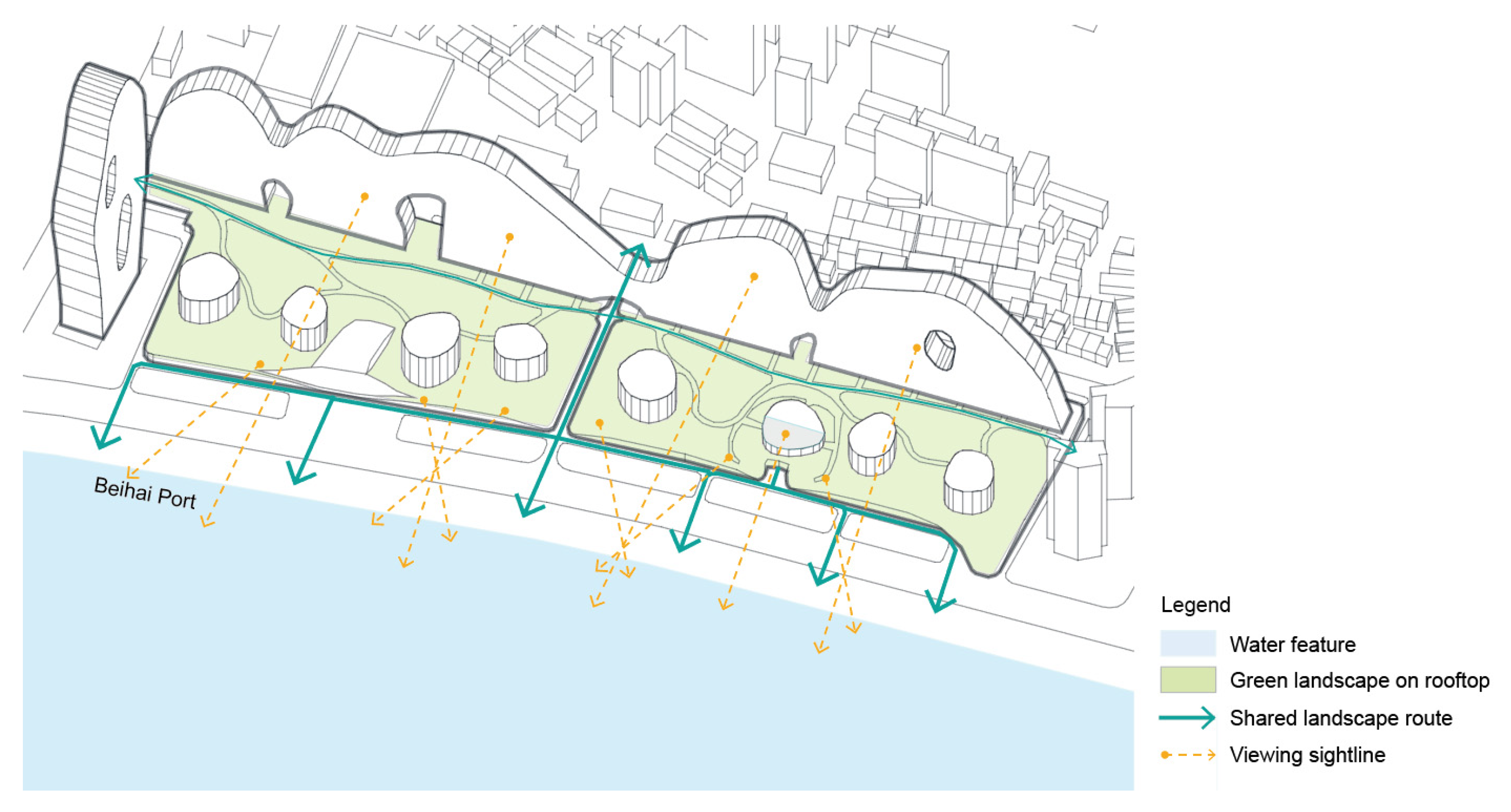
| 3. Beibuwan No. 1 Community |  | Beihai Bay, Landscape Garden (Beihai) | 2015 MAD Architects | 109,200 m2 | 3.5 |
| 4. Sunshine 100 Community (South District) |  | 6-Kilometer Riverside (Wuxi) | 2016 SHL Architects | 400,000 m2 | 1.8 |
| 5. Lixian Future Community |  | Qu River (Quzhou) | 2024 gad Design | 107,000 m2 | 2.0 |
| 6. Jiangshangyin Community |  | Fenghua River (Ningbo) | 2021 Lacime Architects | 119,340 m2 | 2.7 |
| 7. Liandu Future Community |  | Mountain View (Lishui) | 2022 Zhejiang Provincial Architectural Design Institute | 220,200 m2 | 2.0 |
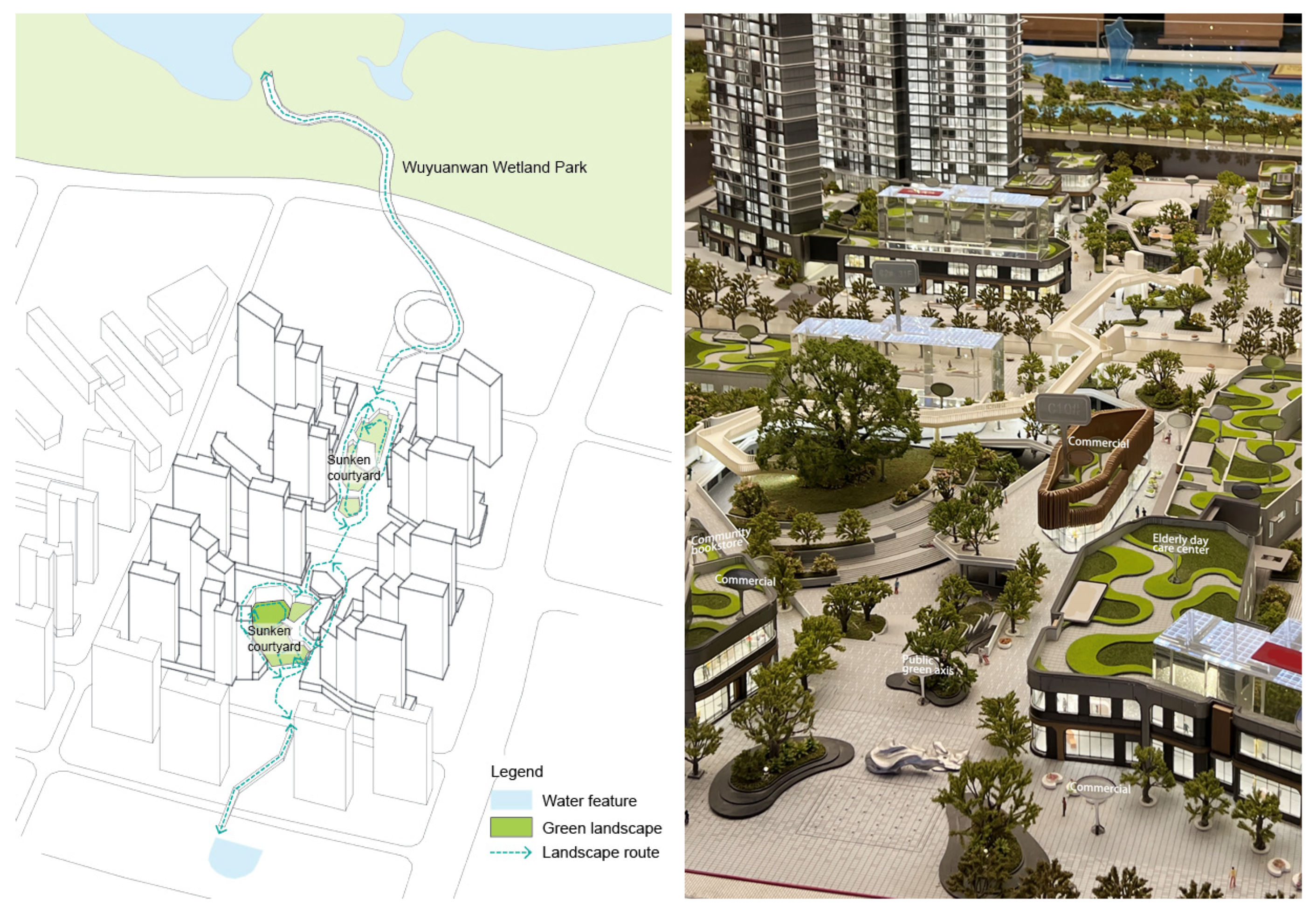
| 8. Guomao Tianqin Community |  | Wuyuanwan Wetland, Ecological Green Axis (Xiamen) | 2022 Xiamen Tefang Construction Engineering Group Co., Ltd. | 79,400 m2 | 4.7 |
| Indicator | Definition | Purpose |
|---|---|---|
| S0 | Total land area of the community | / |
| Ds | Density of shared landscape route in the nature-integrated community | micro-scale intensity |
| Dns | Density of non-shared landscape route in the nature-integrated community | exclusivity intensity |
| D | Overall density of landscape route in the community | overall accessibility |
| Ls | Total length of shared landscape routes in the community | measures openness |
| Lns | Total length of non-shared landscape routes in the community | measures privacy |
| LRSR | Landscape Route Sharing Ratio: Micro-scale indicator of shared-route balance | core indicator |
| No. | Case | S0 (ha) | L (km) | D (km/ha) | LRSR | ||||
|---|---|---|---|---|---|---|---|---|---|
| Ls | Lns | Total | Ds | Dns | Total | ||||
| 1 | Liandu Future Community, Lishui | 22.0 | 2.47 | 4.15 | 6.62 | 0.11 | 0.19 | 0.30 | 0.37 |
| 2 | Chunsen Bi’an Community, Chongqing | 16.0 | 1.35 | 1.46 | 2.82 | 0.08 | 0.10 | 0.18 | 0.48 |
| 3 | Jiangshangyin Community, Ningbo | 12.7 | 1.11 | 1.00 | 2.11 | 0.09 | 0.08 | 0.17 | 0.53 |
| 4 | Baixiangju Community, Chongqing | 1.6 | 0.91 | 0.47 | 1.38 | 0.58 | 0.30 | 0.88 | 0.66 |
| 5 | Guomao Tianqin Community, Xiamen | 6.8 | 0.90 | 0.40 | 1.30 | 0.13 | 0.06 | 0.19 | 0.69 |
| 6 | Sunshine 100 South District, Wuxi | 40.0 | 6.00 | 2.30 | 8.30 | 0.15 | 0.06 | 0.21 | 0.72 |
| 7 | Lixian Future Community, Quzhou | 10.7 | 3.20 | 0.00 | 3.19 | 0.30 | 0.00 | 0.30 | 1.00 |
| 8 | Beibuwan No. 1 Community, Beihai | 4.3 | 1.72 | 0.00 | 1.72 | 0.40 | 0.00 | 0.40 | 1.00 |
Disclaimer/Publisher’s Note: The statements, opinions and data contained in all publications are solely those of the individual author(s) and contributor(s) and not of MDPI and/or the editor(s). MDPI and/or the editor(s) disclaim responsibility for any injury to people or property resulting from any ideas, methods, instructions or products referred to in the content. |
© 2026 by the authors. Licensee MDPI, Basel, Switzerland. This article is an open access article distributed under the terms and conditions of the Creative Commons Attribution (CC BY) license.
Share and Cite
Lu, T.; Xu, C.; Li, Z. Landscape Route Sharing Ratio in Nature-Integrated Community: Cross-Boundary Features and Design Implications. Land 2026, 15, 519. https://doi.org/10.3390/land15030519
Lu T, Xu C, Li Z. Landscape Route Sharing Ratio in Nature-Integrated Community: Cross-Boundary Features and Design Implications. Land. 2026; 15(3):519. https://doi.org/10.3390/land15030519
Chicago/Turabian StyleLu, Tingying, Chenghao Xu, and Zhenyu Li. 2026. "Landscape Route Sharing Ratio in Nature-Integrated Community: Cross-Boundary Features and Design Implications" Land 15, no. 3: 519. https://doi.org/10.3390/land15030519
APA StyleLu, T., Xu, C., & Li, Z. (2026). Landscape Route Sharing Ratio in Nature-Integrated Community: Cross-Boundary Features and Design Implications. Land, 15(3), 519. https://doi.org/10.3390/land15030519