An Adaptive Transformer-Based Language-Model Framework for Assessing Urban Expansion



Abstract
1. Introduction
2. Method and Data
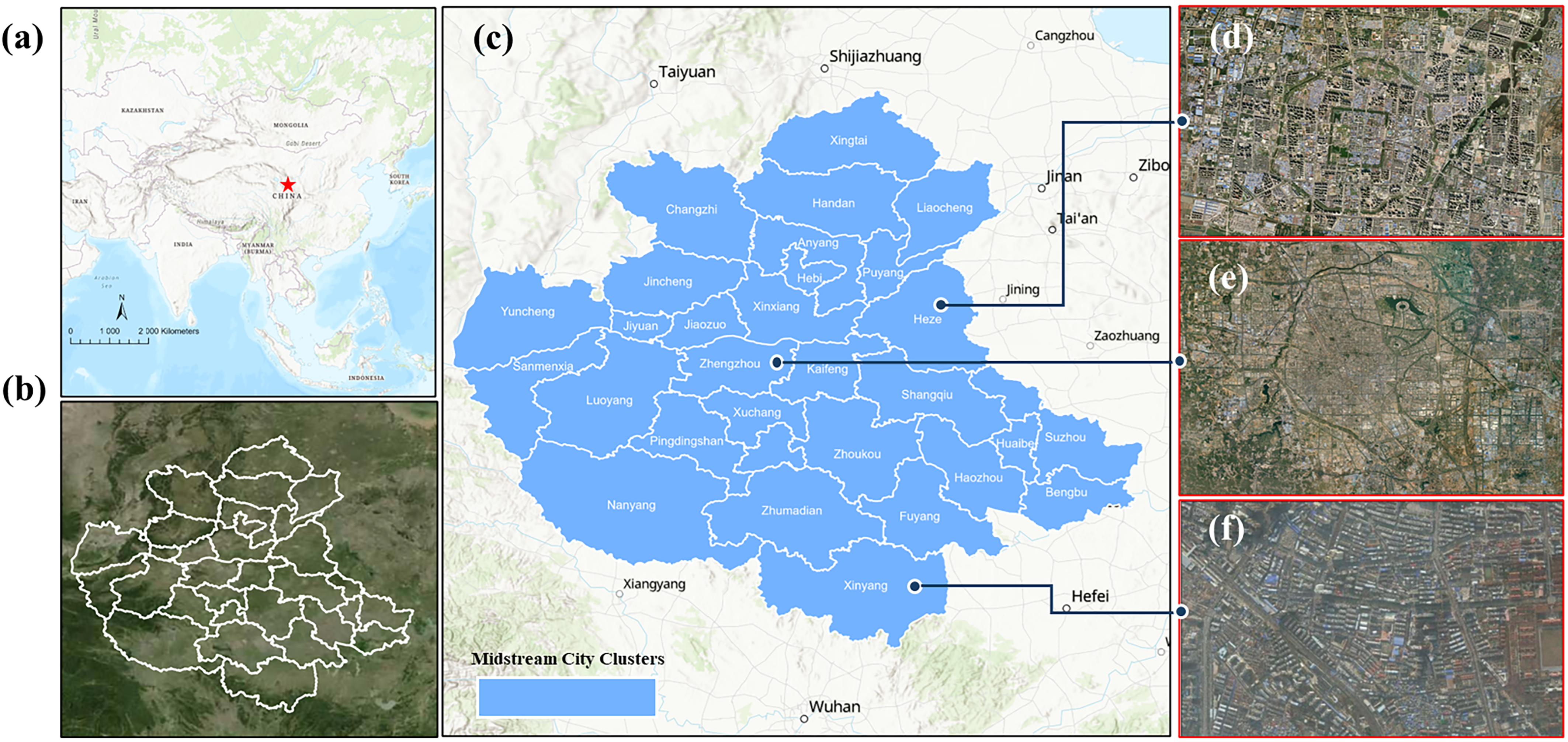
2.1. Research Region
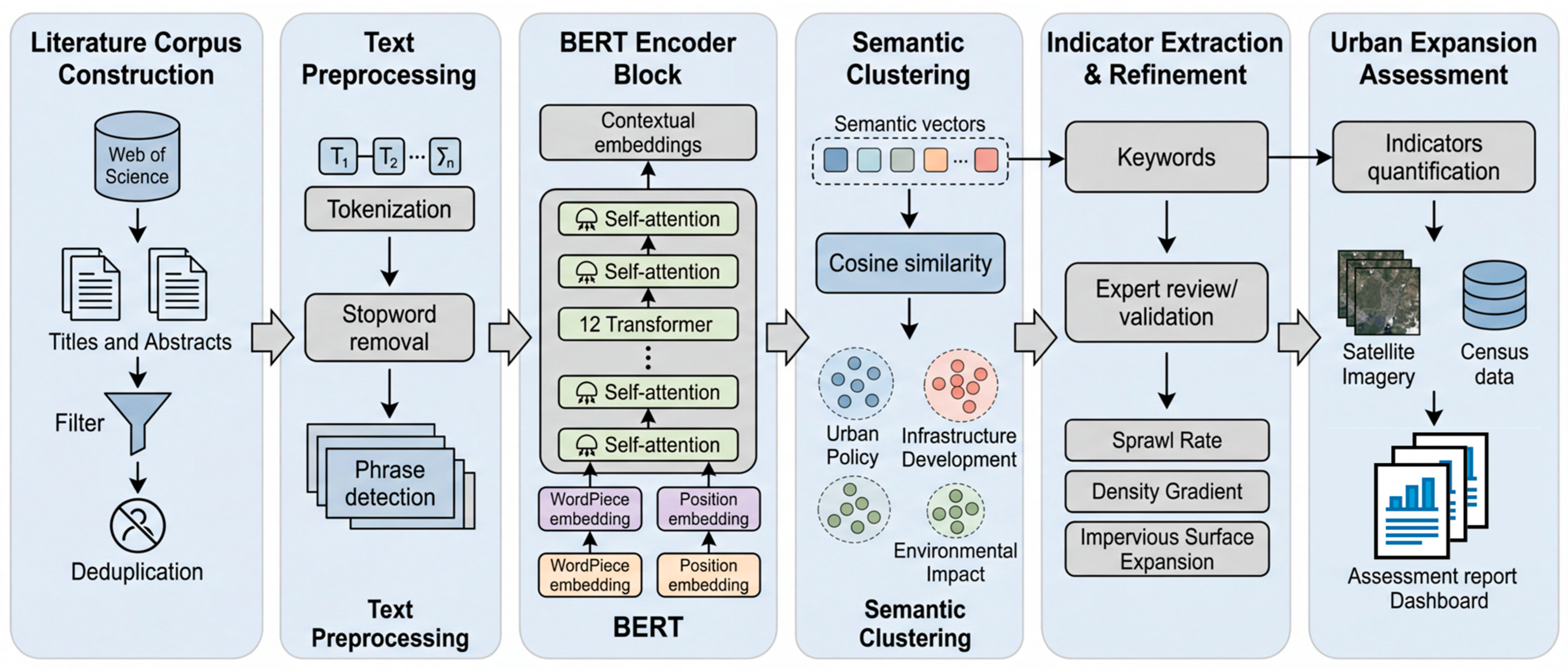
2.2. Transformer-Based Language-Model Framework
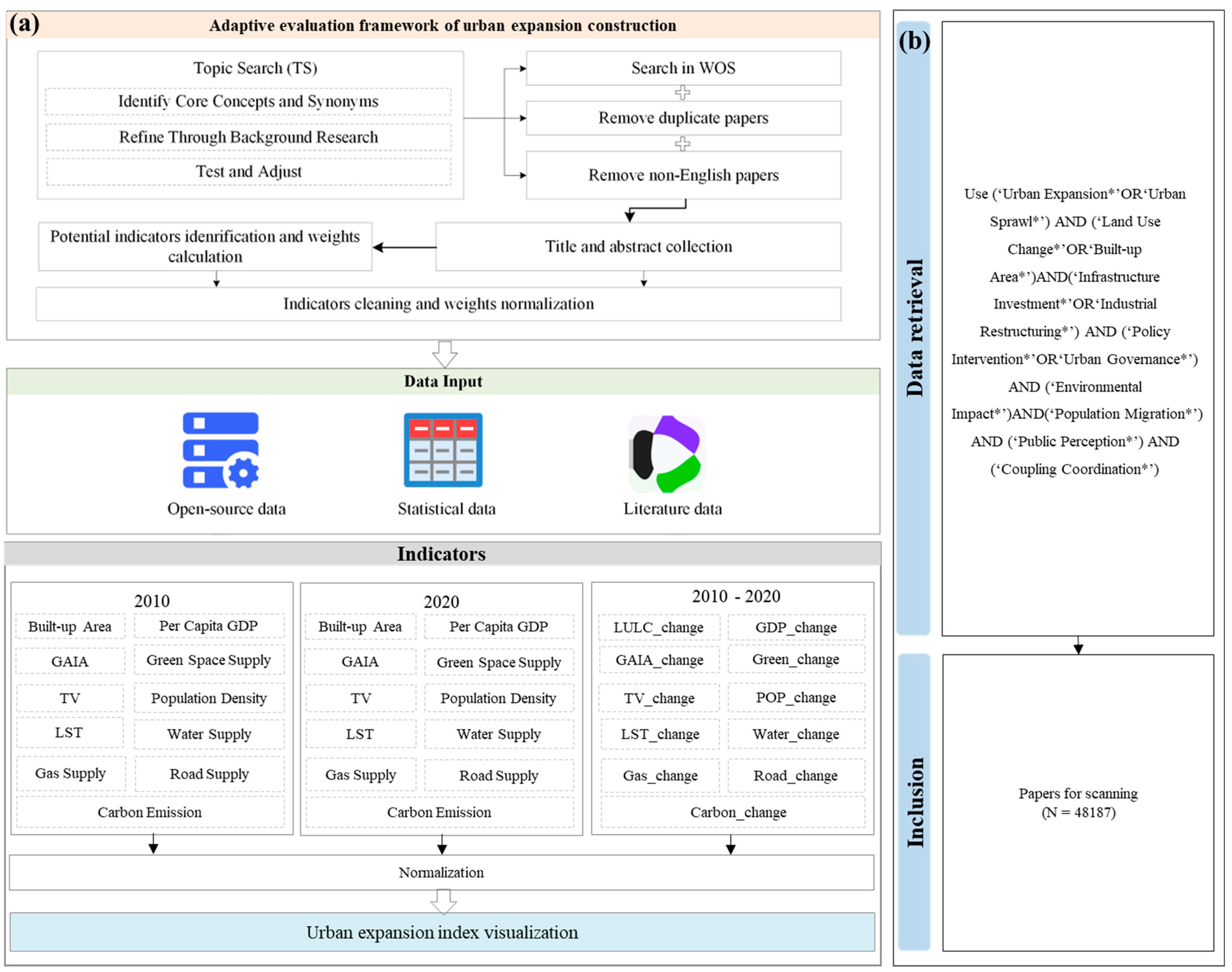
2.3. Topic Search Selection and Data Collection
- TS = (“urban expansion”) OR (“urban growth”) OR (“urban sprawl*”) OR (“built-up expansion*”) OR (“urban land use change*”) OR (“urban development patterns*”).
2.4. UEI Calculation
2.5. Data
3. Results
3.1. Framework and Weight Distribution of UEI
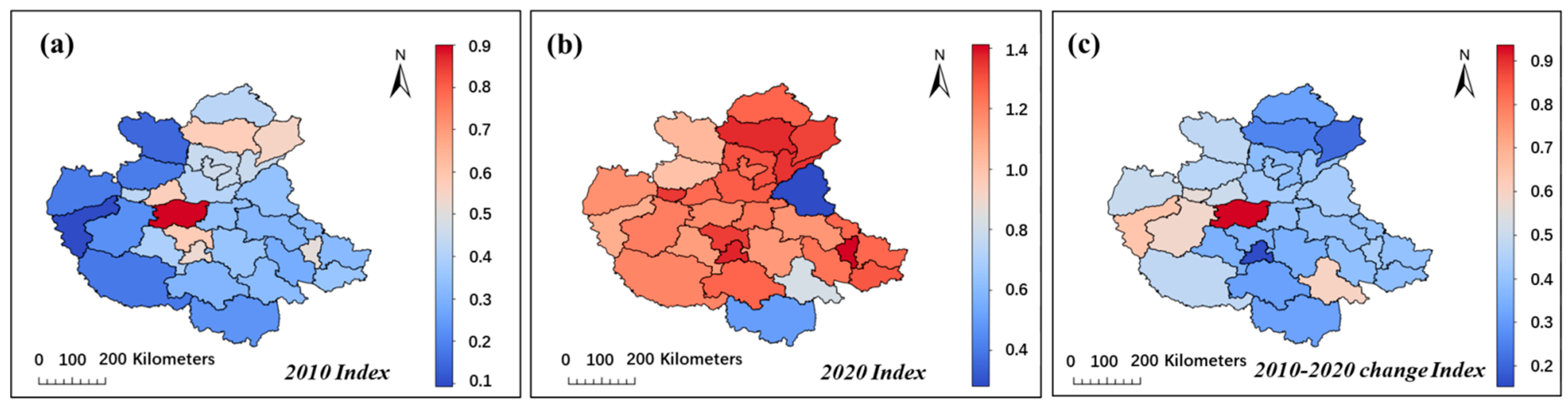
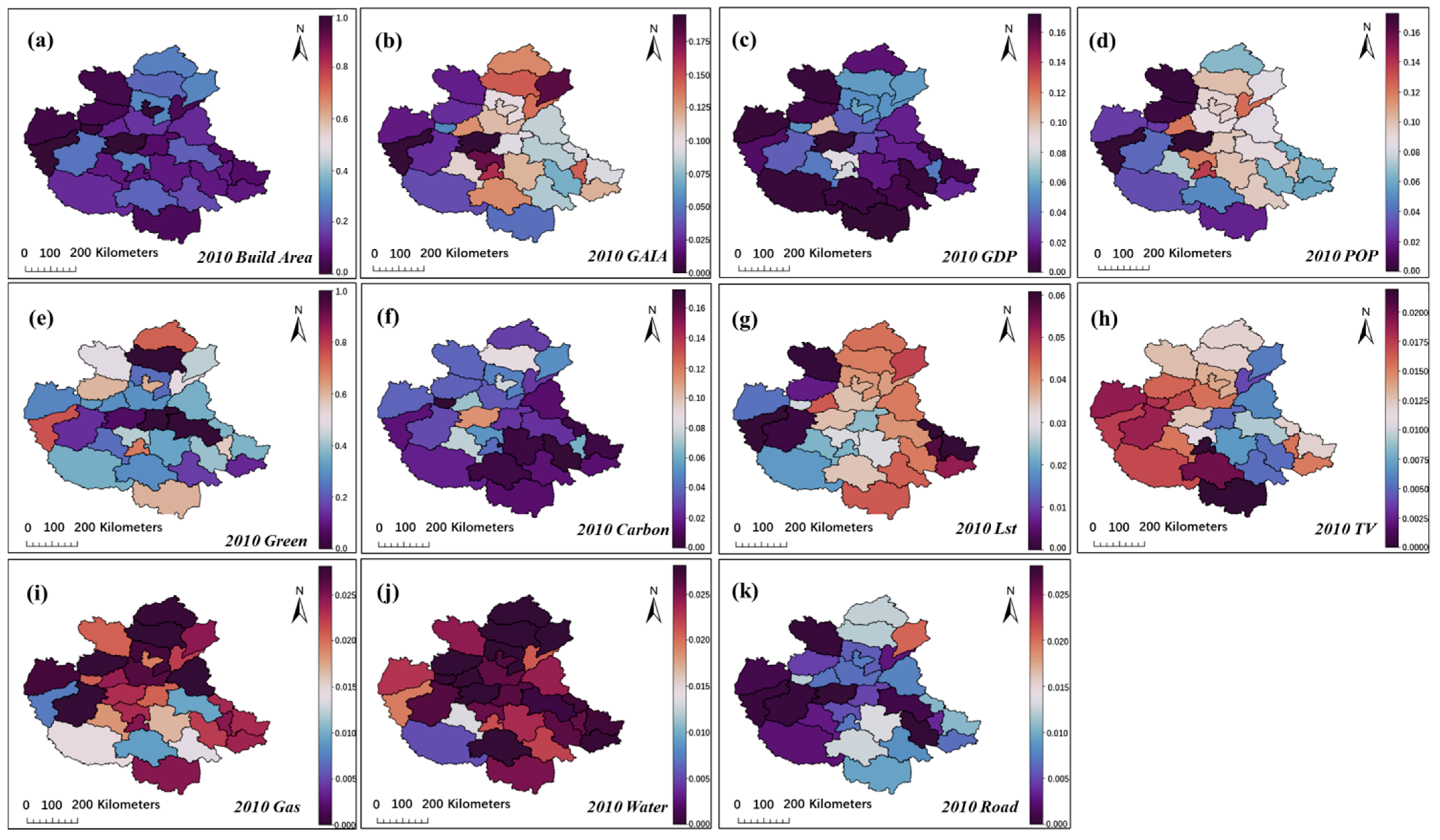
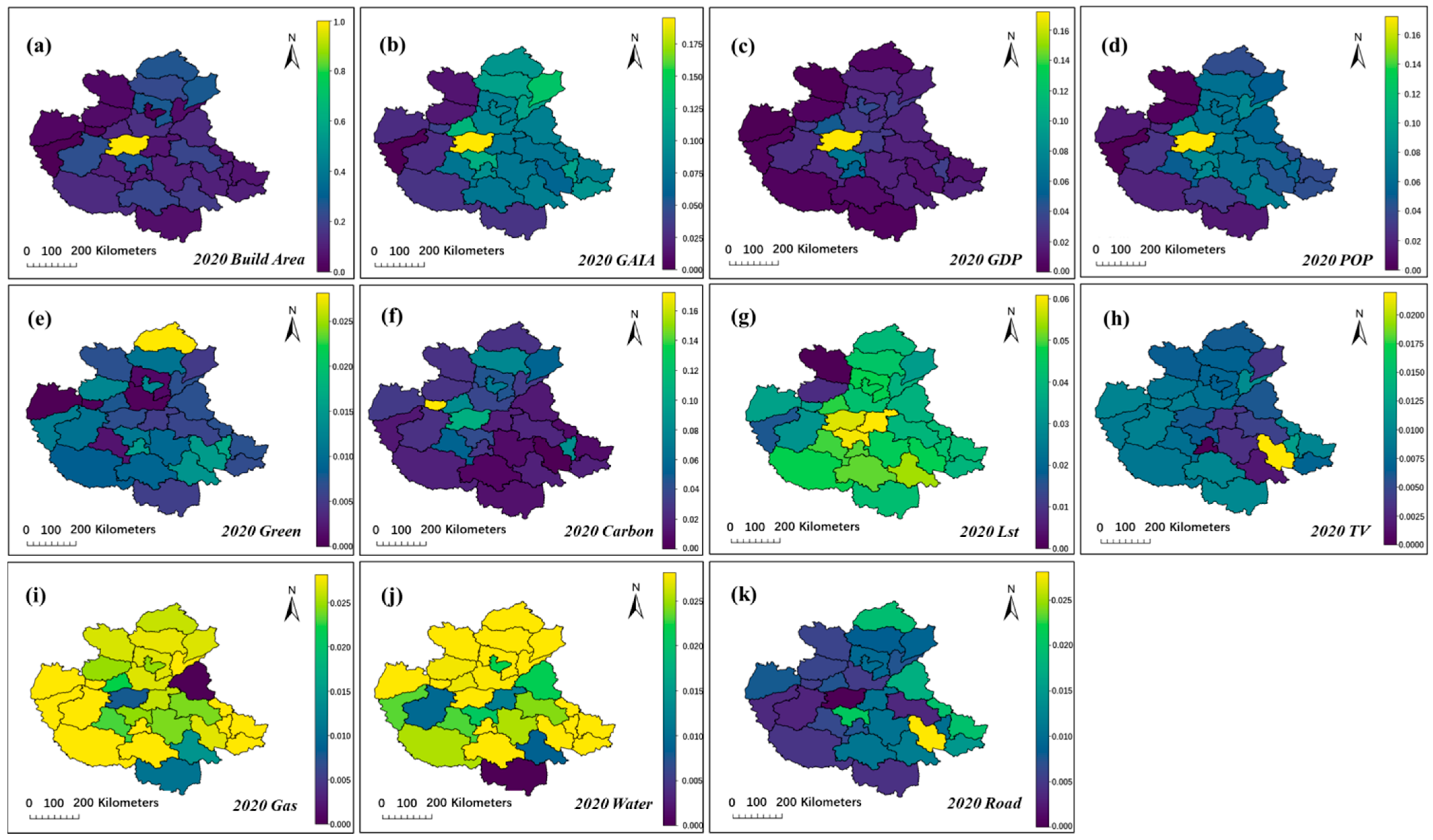
3.2. Spatial Patterns of Individual Indicators Across the CPMR in 2010 and 2020
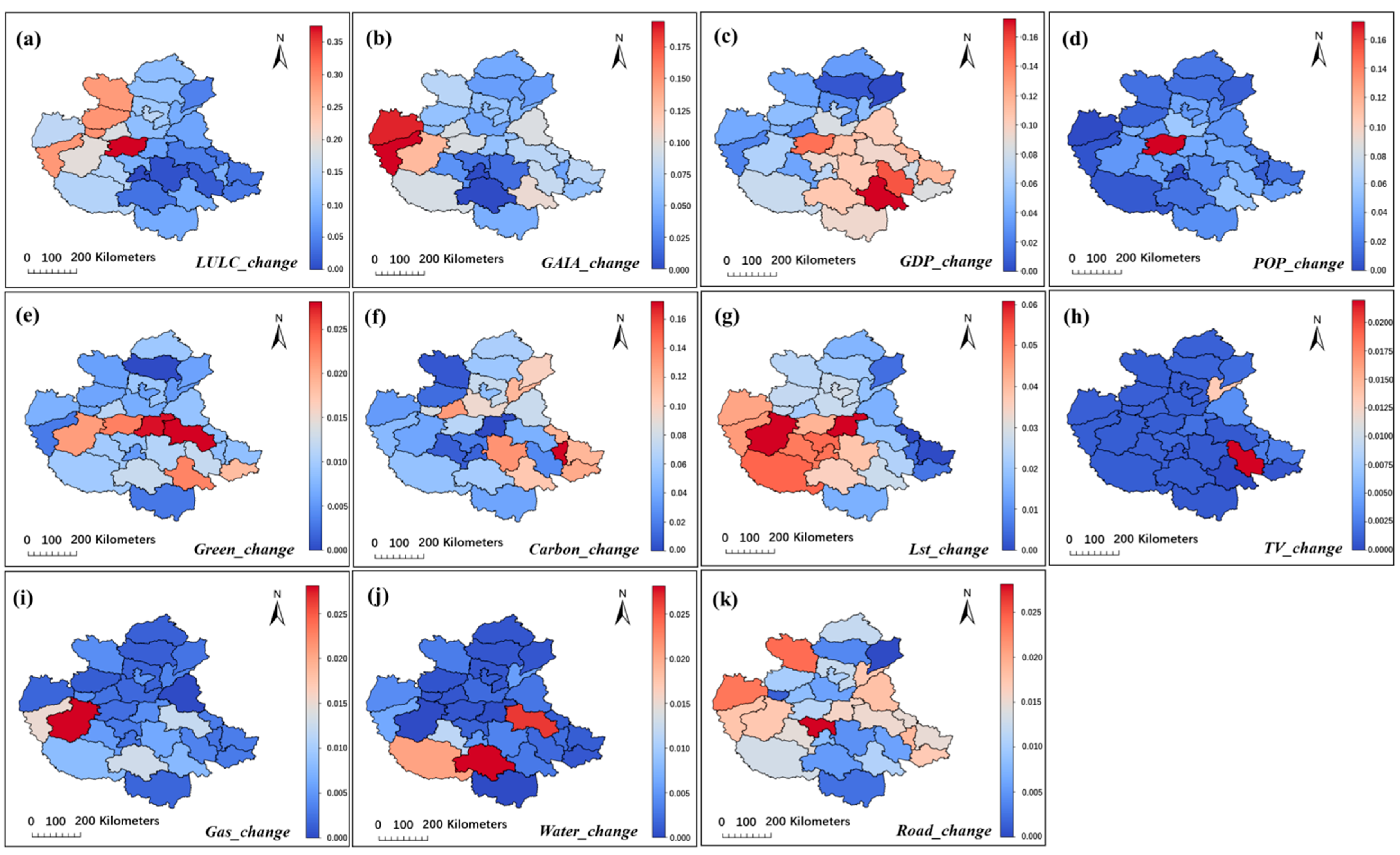
3.3. Spatial Changes of Indicators Across the CPMR Between 2010 and 2020
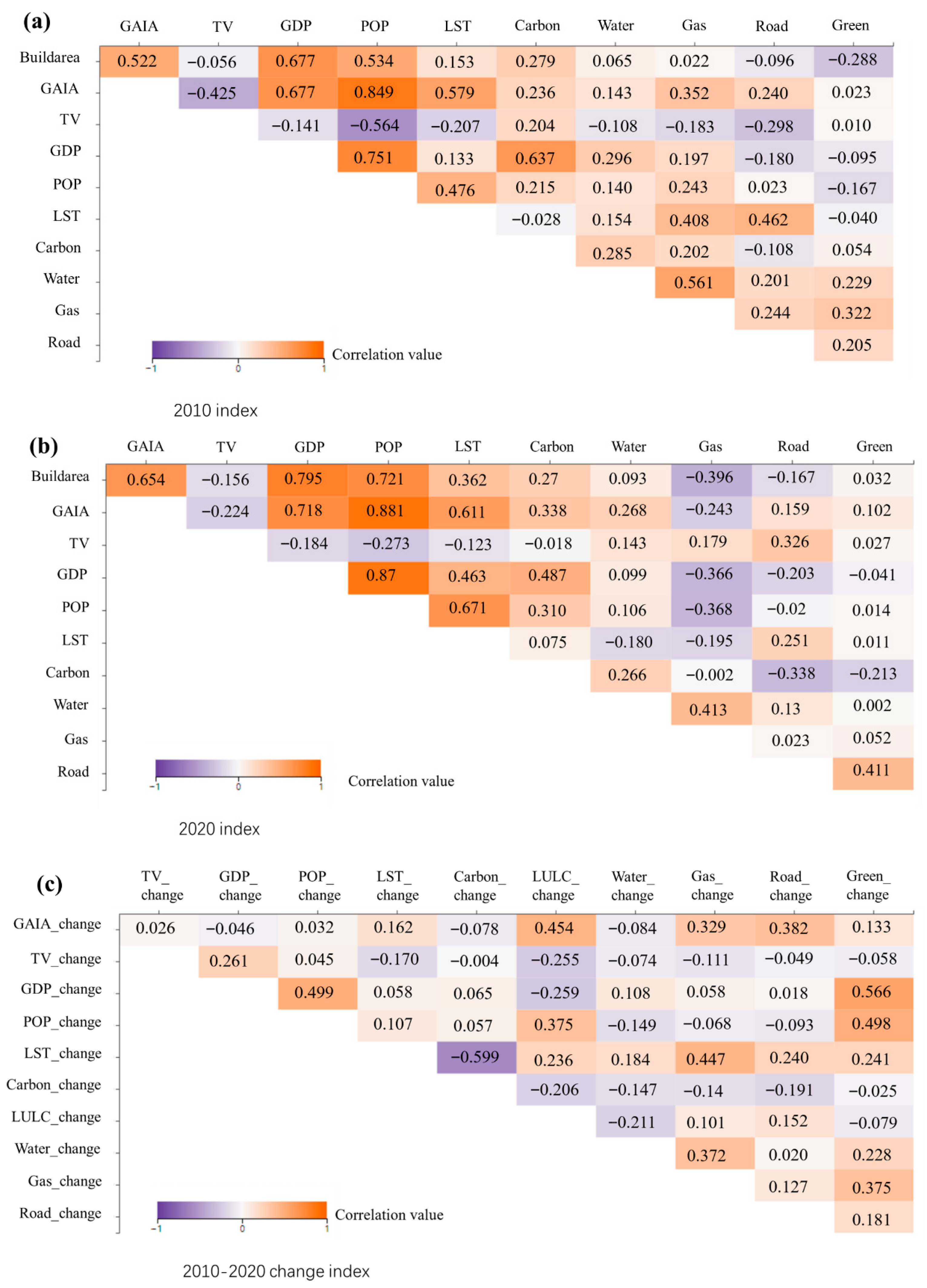
3.4. Inter-Indicator Correlation Structure and Temporal Dynamics Across the CPMR
3.5. Shifting Centers of Urban Expansion Within the Agglomeration
4. Discussion
4.1. Positioning the Transformer-Based Language-Model Framework Within Existing Urban Expansion Assessments
4.2. Spatial Persistence and Path Dependence of Urban Expansion
4.3. Environmental Feedbacks and Differentiated Expansion Responses
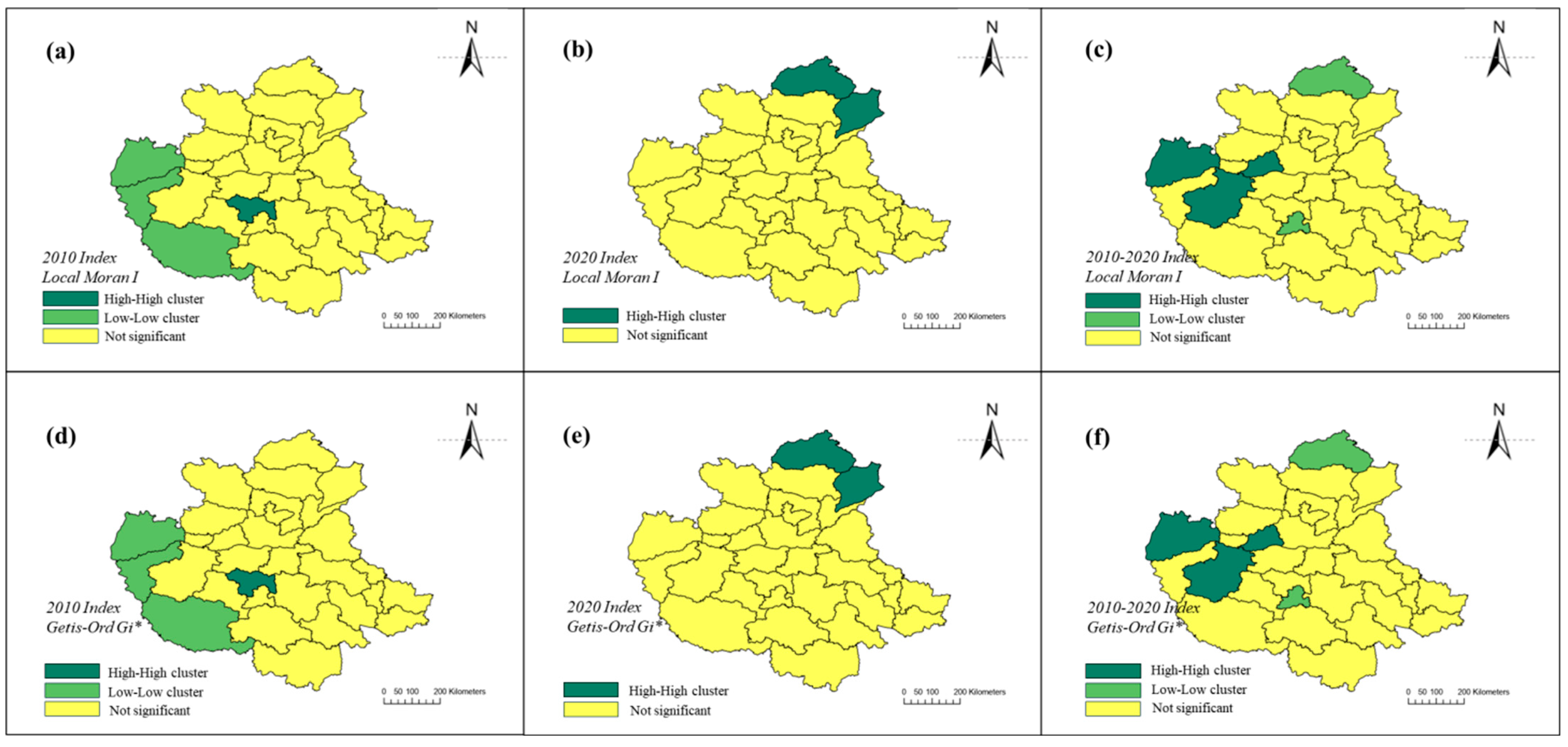
4.4. Spatial Clustering and Reorganization of Expansion Intensity
4.5. Architecture-Level Limitations and Future Improvement of the Transformer-Based Language-Model Component
4.6. Implications for Transferability and Planning Practice
5. Conclusions
Author Contributions
Funding
Data Availability Statement
Conflicts of Interest
References
- Zhang, X.Q. The Trends, Promises and Challenges of Urbanisation in the World. Habitat Int. 2016, 54, 241–252. [Google Scholar] [CrossRef]
- Sun, L.; Chen, J.; Li, Q.; Huang, D. Dramatic Uneven Urbanization of Large Cities throughout the World in Recent Decades. Nat. Commun. 2020, 11, 5366. [Google Scholar] [CrossRef]
- Mahtta, R.; Fragkias, M.; Güneralp, B.; Mahendra, A.; Reba, M.; Wentz, E.A.; Seto, K.C. Urban Land Expansion: The Role of Population and Economic Growth for 300+ Cities. npj Urban Sustain. 2022, 2, 5. [Google Scholar] [CrossRef]
- Zhang, Y.; Mao, W.; Zhang, B. Distortion of Government Behaviour under Target Constraints: Economic Growth Target and Urban Sprawl in China. Cities 2022, 131, 104009. [Google Scholar] [CrossRef]
- Wei, Y.D.; Ewing, R. Urban Expansion, Sprawl and Inequality. Landsc. Urban Plan. 2018, 177, 259–265. [Google Scholar] [CrossRef]
- Li, Y.; Jia, N.; Zhang, Z.; Cheng, J.; Song, W.; Liu, L.; Bao, S.; Zheng, L.; Chen, R. Mapping Global Urban Inequality under Climate Change and Its Interaction with Sustainable Development. GISci. Remote Sens. 2025, 62, 2513104. [Google Scholar] [CrossRef]
- Fernández, J.E.; Angel, M. Ecological City-States in an Era of Environmental Disaster: Security, Climate Change and Biodiversity. Sustainability 2020, 12, 5532. [Google Scholar] [CrossRef]
- Yu, W.; Zhou, W. The Spatiotemporal Pattern of Urban Expansion in China: A Comparison Study of Three Urban Megaregions. Remote Sens. 2017, 9, 45. [Google Scholar] [CrossRef]
- Forget, Y.; Shimoni, M.; Gilbert, M.; Linard, C. Mapping 20 Years of Urban Expansion in 45 Urban Areas of Sub-Saharan Africa. Remote Sens. 2021, 13, 525. [Google Scholar] [CrossRef]
- Xie, H.; Zhang, Y.; Duan, K. Evolutionary Overview of Urban Expansion Based on Bibliometric Analysis in Web of Science from 1990 to 2019. Habitat Int. 2020, 95, 102100. [Google Scholar] [CrossRef]
- Rillig, M.C.; Ågerstrand, M.; Bi, M.; Gould, K.A.; Sauerland, U. Risks and Benefits of Large Language Models for the Environment. Environ. Sci. Technol. 2023, 57, 3464–3466. [Google Scholar] [CrossRef]
- Areshey, A.; Mathkour, H. Transfer Learning for Sentiment Classification Using Bidirectional Encoder Representations from Transformers (BERT) Model. Sensors 2023, 23, 5232. [Google Scholar] [CrossRef] [PubMed]
- Gardazi, N.M.; Daud, A.; Malik, M.K.; Bukhari, A.; Alsahfi, T.; Alshemaimri, B. BERT Applications in Natural Language Processing: A Review. Artif. Intell. Rev. 2025, 58, 166. [Google Scholar] [CrossRef]
- Fu, X.; Li, C.; Quan, S.J.; Yigitcanlar, T.; Wasserman, D. Large language models in urban planning. Nat. Cities 2025, 2, 585–592. [Google Scholar] [CrossRef]
- Zheng, Y.; Xu, F.; Lin, Y.; Santi, P.; Ratti, C.; Wang, Q.R.; Li, Y. Urban planning in the era of large language models. Nat. Comput. Sci. 2025, 5, 727–736. [Google Scholar] [CrossRef]
- Xu, F.; Wang, Q.; Moro, E.; Chen, L.; Miranda, A.S.; González, M.C.; Tizzoni, M.; Song, C.; Ratti, C.; Bettencourt, L.; et al. Using human mobility data to quantify experienced urban inequalities. Nat. Hum. Behav. 2025, 9, 654–664. [Google Scholar] [CrossRef]
- Wang, S.; Hu, T.; Xiao, H.; Li, Y.; Zhang, C.; Ning, H.; Zhu, R.; Li, Z.; Ye, X. GPT, large language models (LLMs) and generative artificial intelligence (GAI) models in geospatial science: A systematic review. Int. J. Digit. Earth 2024, 17, 2353122. [Google Scholar] [CrossRef]
- Luo, H.; Li, L.; Lei, Y.; Wu, S.; Yan, D.; Fu, X.; Luo, X.; Wu, L. Decoupling Analysis between Economic Growth and Resources Environment in Central Plains Urban Agglomeration. Sci. Total Environ. 2021, 752, 142284. [Google Scholar] [CrossRef]
- Peng, L.; Zhang, L.; Li, X.; Wang, Z.; Wang, H.; Jiao, L. Spatial Expansion Effects on Urban Ecosystem Services Supply-Demand Mismatching in Guanzhong Plain Urban Agglomeration of China. J. Geogr. Sci. 2022, 32, 806–828. [Google Scholar] [CrossRef]
- Wang, Z.; Wang, L.; Zhao, B.; Pei, Q. Analysis of Spatiotemporal Interaction Characteristics and Decoupling Effects of Urban Expansion in the Central Plains Urban Agglomeration. Land 2023, 12, 772. [Google Scholar] [CrossRef]
- Zhao, S.; Da, L.; Tang, Z.; Fang, H.; Song, K.; Fang, J. Ecological consequences of rapid urban expansion: Shanghai, China. Front. Ecol. Environ. 2025, 4, 341–346. [Google Scholar] [CrossRef]
- Jiang, Z.; Wu, H.; Xu, Z.; Shen, F.; Jia, N.; Huang, J.; Lin, A. Optimizing Land Use Spatial Patterns to Balance Urban Development and Resource-Environmental Constraints: A Case Study of China’s Central Plains Urban Agglomeration. J. Environ. Manag. 2025, 380, 125173. [Google Scholar] [CrossRef] [PubMed]
- Maia, S.C.; De Benedicto, G.C.; Do Prado, J.W.; Robb, D.A.; De Almeida Bispo, O.N.; De Brito, M.J. Mapping the Literature on Credit Unions: A Bibliometric Investigation Grounded in Scopus and Web of Science. Scientometrics 2019, 120, 929–960. [Google Scholar] [CrossRef]
- Pranckutė, R. Web of science (WoS) and Scopus: The titans of bibliographic information in today’s academic world. Publications 2023, 9, 12. [Google Scholar] [CrossRef]
- Zhang, H.; Luo, M.; Zhao, Y.; Lin, L.; Ge, E.; Yang, Y.; Ning, G.; Cong, J.; Zeng, Z.; Gui, K.; et al. HiTIC-Monthly: A monthly high spatial resolution (1 km) human thermal index collection over China during 2003–2020. Earth Syst. Sci. Data 2023, 15, 359–381. [Google Scholar] [CrossRef]
- Brkic, S.; Vucenovic, M.; Djokic, Z. Title, Abstract, Key Words and References in Biomedical Articles. Arch. Oncol. 2003, 11, 207–209. [Google Scholar] [CrossRef]
- Seto, K.C.; Güneralp, B.; Hutyra, L.R. Global Forecasts of Urban Expansion to 2030 and Direct Impacts on Biodiversity and Carbon Pools. Proc. Natl. Acad. Sci. USA 2012, 109, 16083–16088. [Google Scholar] [CrossRef]
- Trinder, J.; Liu, Q. Assessing environmental impacts of urban growth using remote sensing. Geo-Spat. Inf. Sci. 2020, 23, 20–39. [Google Scholar] [CrossRef]
- Ding, Q.; Shao, Z.; Huang, X.; Altan, O.; Hu, B. Time-series land cover mapping and urban expansion analysis using OpenStreetMap data and remote sensing big data: A case study of Guangdong-Hong Kong-Macao Greater Bay Area, China. Int. J. Appl. Earth Obs. Geoinf. 2022, 113, 103001. [Google Scholar] [CrossRef]
- Doe, B.; Amoako, C.; Adamtey, R. Spatial expansion and patterns of land use/land cover changes around Accra, Ghana–Emerging insights from Awutu Senya East Municipal Area. Land Use Policy 2022, 112, 105796. [Google Scholar] [CrossRef]
- Yang, J.; Tang, W.; Gong, J.; Shi, R.; Zheng, M.; Dai, Y. Simulating urban expansion using cellular automata model with spatiotemporally explicit representation of urban demand. Landsc. Urban Plan. 2023, 31, 104640. [Google Scholar] [CrossRef]
- Bhopale, A.P.; Tiwari, A. Transformer based contextual text representation framework for intelligent information retrieval. Expert Syst. Appl. 2024, 238, 121629. [Google Scholar] [CrossRef]
- Wang, Y.; Yin, S.; Fang, X.; Chen, W. Interaction of economic agglomeration, energy conservation and emission reduction: Evidence from three major urban agglomerations in China. Energy 2022, 241, 122519. [Google Scholar] [CrossRef]
- Acheampong, R.A.; Asabere, S.B. Urban expansion and differential accessibility by car and public transport in the Greater Kumasi city-region, Ghana—A geospatial modelling approach. J. Transp. Geogr. 2022, 98, 103257. [Google Scholar] [CrossRef]
- Fang, C.; Yu, D. Urban Agglomeration: An Evolving Concept of an Emerging Phenomenon. Landsc. Urban Plan. 2017, 162, 126–136. [Google Scholar] [CrossRef]
- Zhong, S.; Huang, X.; Mao, X. Deciphering China’s urban-rural income gap: A multi-level analysis, 2006–2020. Cities 2026, 168, 106488. [Google Scholar] [CrossRef]
- Güneralp, B.; Ahasan, R. Urban land-change futures: Current understanding, challenges, and implications. npj Urban Sustain. 2025, 6, 7. [Google Scholar] [CrossRef]
- Angel, S.; Blei, A. Atlas of Urban Expansion—2016 Edition; Lincoln Institute of Land Policy: Cambridge, MA, USA, 2016; ISBN 978-0-9981758-0-5. [Google Scholar]
- Imhoff, M.L.; Zhang, P.; Wolfe, R.E.; Bounoua, L. Remote sensing of the urban heat island effect across biomes in the continental USA. Remote Sens. Environ. 2010, 114, 504–513. [Google Scholar] [CrossRef]
- Parker, D.E. Urban heat island effects on estimates of observed climate change. Wiley Interdiscip. Rev. Clim. Change 2010, 1, 123–133. [Google Scholar] [CrossRef]
- Haase, D.; Haase, A.; Rink, D. Conceptualizing the nexus between urban shrinkage and ecosystem services. Landsc. Urban Plan. 2014, 132, 159–169. [Google Scholar] [CrossRef]
- Kabisch, N.; Korn, H.; Stadler, J.; Bonn, A. Nature-Based Solutions to Climate Change Adaptation in Urban Areas: Linkages Between Science, Policy and Practice; Springer Nature: Berlin/Heidelberg, Germany, 2017. [Google Scholar]
- Frantzeskaki, N. Seven lessons for planning nature-based solutions in cities. Environ. Sci. Policy 2019, 93, 101–111. [Google Scholar] [CrossRef]
- Xu, T.; Umair, M.; Cheng, W.; Hakimova, Y.; Mang, G. Evaluating Eco-Efficiency as a metric for sustainable urban Growth: A comparative study of provincial capital cities in China. Ecol. Indic. 2024, 169, 112959. [Google Scholar] [CrossRef]
- Tang, X.; Xu, J.; Wang, R.; Li, J.V.; Jiang, L.; Li, C.Z. Drivers of Cross-Boundary Land Use and Cover Change in a Megacity Region: Evidence from the Guangdong–Hong Kong–Macao Greater Bay Area. Sustainability 2026, 18, 470. [Google Scholar] [CrossRef]
- Wang, J.; Fleischmann, M.; Venerandi, A.; Romice, O.; Kuffer, M.; Porta, S. EO+ Morphometrics: Understanding cities through urban morphology at large scale. Landsc. Urban Plan. 2023, 233, 104691. [Google Scholar] [CrossRef]
- Anselin, L. Local indicators of spatial association—LISA. Geogr. Anal. 1995, 27, 93–115. [Google Scholar] [CrossRef]
- Ord, J.K.; Getis, A. Local spatial autocorrelation statistics: Distributional issues and an application. Geogr. Anal. 1995, 27, 286–306. [Google Scholar] [CrossRef]
- Rey, S.J.; Anselin, L. PySAL: A Python library of spatial analytical methods. In Handbook of Applied Spatial Analysis: Software Tools, Methods and Applications; Springer: Berlin/Heidelberg, Germany, 2009; pp. 175–193. [Google Scholar]
- Batty, M. Inventing Future Cities; MIT Press: Cambridge, UK, 2018. [Google Scholar]
- Kandt, J.; Batty, M. Smart cities, big data and urban policy: Towards urban analytics for the long run. Cities 2021, 109, 102992. [Google Scholar] [CrossRef]



| Indicator Category | Indicator (Abbreviation) | Description | Normalized Weight |
|---|---|---|---|
| Spatial expansion | LULCP | Land-use and land-cover change intensity | 0.375 |
| Spatial expansion | GAIA | Built-up land proportion | 0.341 |
| Socioeconomic | GDP | Gross domestic product | 0.172 |
| Socioeconomic | Population | Total population size | 0.172 |
| Environmental response | Carbon | Carbon emissions | 0.172 |
| Infrastructure | LST | Land surface temperature | 0.061 |
| Infrastructure | TVP | Transportation infrastructure proxy | 0.022 |
| Infrastructure | Water | Water supply capacity | 0.028 |
| Infrastructure | Gas | Gas supply capacity | 0.028 |
| Infrastructure | Road | Road density | 0.028 |
| Environmental response | Green | Green space coverage | 0.028 |
Disclaimer/Publisher’s Note: The statements, opinions and data contained in all publications are solely those of the individual author(s) and contributor(s) and not of MDPI and/or the editor(s). MDPI and/or the editor(s) disclaim responsibility for any injury to people or property resulting from any ideas, methods, instructions or products referred to in the content. |
© 2026 by the authors. Licensee MDPI, Basel, Switzerland. This article is an open access article distributed under the terms and conditions of the Creative Commons Attribution (CC BY) license.
Share and Cite
Wan, F.; Zhang, Z.; Wang, R.; Shu, D.; Ning, B.; Gong, J.; Li, X. An Adaptive Transformer-Based Language-Model Framework for Assessing Urban Expansion. Land 2026, 15, 514. https://doi.org/10.3390/land15030514
Wan F, Zhang Z, Wang R, Shu D, Ning B, Gong J, Li X. An Adaptive Transformer-Based Language-Model Framework for Assessing Urban Expansion. Land. 2026; 15(3):514. https://doi.org/10.3390/land15030514
Chicago/Turabian StyleWan, Fang, Zhan Zhang, Ru Wang, Daoyu Shu, Beile Ning, Jianya Gong, and Xi Li. 2026. "An Adaptive Transformer-Based Language-Model Framework for Assessing Urban Expansion" Land 15, no. 3: 514. https://doi.org/10.3390/land15030514
APA StyleWan, F., Zhang, Z., Wang, R., Shu, D., Ning, B., Gong, J., & Li, X. (2026). An Adaptive Transformer-Based Language-Model Framework for Assessing Urban Expansion. Land, 15(3), 514. https://doi.org/10.3390/land15030514