1. Introduction
Urban spatial structure plays a critical role in shaping commuting efficiency because it determines how housing, employment, and transport networks are arranged and connected. Commuting time, in particular, is a practical performance indicator for sustainable and “smart” transport planning: it reflects not only distance but also congestion, network capacity constraints, and the functional alignment of daily activity locations. In cities facing demographic decline, commuting efficiency is not a marginal concern—longer and more complex commutes can undermine accessibility, increase household travel burdens, and weaken the viability of local service centers that compact-city strategies aim to sustain.
In South Korea, this issue has become increasingly salient as many small and medium-sized cities confront population decline while continuing to experience outward expansion and fragmented development. Recent policy debates highlight a persistent mismatch: despite forecasts of population shrinkage, underused land remains in city centers, while development continues in non-urbanized areas, creating higher long-run infrastructure and mobility costs [
1,
2]. This “shrinkage-with-sprawl” dynamic provides a strong motivation to reassess whether compact-city strategies, often framed as densification and land-use intensification, translate into commuting efficiency in declining urban contexts.
In this context, the compact city model that emphasizes higher density, mixed land use, and improved accessibility, has gained renewed attention in Korea’s small and medium-sized cities as a response to shrinkage and fiscal pressure [
3,
4]. Internationally, compact-city policy has also been repositioned as a “right-sizing” strategy in shrinking contexts where the goal is to maintain viable urban functions and service accessibility under demographic decline rather than simply to accommodate growth [
5,
6].
However, the commuting implications of compactness are theoretically ambiguous. While densification may shorten travel distances, it can also intensify congestion, intersection delay, and competition for network capacity, potentially increasing travel time. The built environment literature operationalizes the relationship between land use and travel behavior through the 3Ds framework, encompassing density, diversity, and design, and its subsequent extension into the 5Ds framework, which incorporates destination accessibility and distance to transit. These frameworks conceptualize compact urban form as a multidimensional construct in which higher density, mixed land use, and improved accessibility are associated with reduced automobile dependence and shorter trips [
7,
8]. However, empirical evidence suggests that the magnitude of these effects is often modest and context dependent. More importantly for this study, neighborhood compactness alone may not generate efficient commuting flows when employment is dispersed or reorganized across a wider urban labor market. Recent evidence from large and small metropolitan areas suggests that the commuting effects of decentralization and polycentric development vary by urban scale and labor-market structure, through cross-commuting and spatial mismatch [
9,
10,
11].
This ambiguity is likely to be even more pronounced in Korea’s small and medium-sized cities where the employment base is limited and spatial structure can be fragmented. In such settings, residential densification does not necessarily imply functional proximity to jobs and may simply concentrate population in locations that remain weakly aligned with employment cores. Consequently, the commuting consequences of “compactness” cannot be evaluated meaningfully without considering city-level employment spatial structure—including the hierarchy and dominance of employment centers and the extent to which employment is spatially clustered.
Despite the city-wide nature of compact-city discourse, empirical research has predominantly operationalized compactness using neighborhood-scale indicators (e.g., density, land-use mix, transit proximity) [
12,
13]. City-level employment structure is often examined as a separate dimension rather than an integral component of compact development. This creates an unresolved question that is particularly policy-relevant for shrinking cities: Can compact-city strategies improve commuting efficiency when embedded within fragmented city-wide employment structures, and do the commuting impacts of densification vary systematically across urban contexts?
This study addresses this gap by examining how multi-scalar compactness measured at both neighborhood (Dong) and city (Si/Gun/Gu) levels, and employment spatial structure jointly shape commuting time in South Korea. Using individual travel survey data and a multilevel modeling framework, we test whether densification improves commuting efficiency and how its effect is shaped by employment spatial structure and concentration. Empirically, our results point to a consistent disparity between residential and employment density. Residential density is not a reliable mechanism for commuting reduction, whereas employment-side structure, including job–housing balance and the presence of dominant employment cores, plays a more decisive role, especially outside the capital region. These findings support reframing compact-city strategies in shrinking cities as functional consolidation that sustains viable employment cores and aligns them with transport networks and nearby residential areas, rather than as densification alone.
2. Literature Review
2.1. Compact Urban Form, Travel Behavior, and Commuting Efficiency
A large body of research examines how compact urban form, typically characterized by high residential and employment density, mixed land use, functional proximity, and pedestrian- and transit-supportive street design, shapes travel behavior and commuting efficiency. Early compact-city arguments emphasized the concentration of urban activities as a means to reduce travel distances and car dependence [
14,
15]. Contemporary empirical work commonly builds on the 3Ds or 5Ds framework, which conceptualizes travel behavior as a function of density, diversity, and design, subsequently expanded to include destination accessibility and distance to transit. Meta-analysis and the literature reviews suggest that built environment effects on travel are generally significant but often modest in magnitude. Although compact development is associated with reductions in vehicle miles traveled and, to a lesser extent, commuting time, the effect sizes are typically modest and are generally insufficient to conclude that higher density alone guarantees shorter commuting durations [
8,
16].
These modest and context-dependent effects reflect the inherent complexity of time-based travel efficiency. Commuting time depends not only on distance but also on travel speed and network conditions; while densification may shorten distances, it can simultaneously reduce travel speeds through congestion and network saturation. Moreover, when employment is spatially dispersed across a wider urban area, neighborhood compactness alone may not generate efficient commuting flows [
10]. These mechanisms help explain why empirical findings on compactness and commuting time remain mixed, and why relatively long commute durations can persist even in dense, transit-oriented urban environments.
2.2. Measuring Compactness Across Neighborhood and City Scales
To empirically assess the effects of compact development, researchers have developed a range of spatial indicators that capture urban form across multiple geographic scales [
17,
18,
19,
20]. Compactness is not a single measurable attribute but a multidimensional construct that can manifest differently at neighborhood and city levels. Accordingly, recent research examining multiple spatial scales emphasizes the need to interpret local built-environment indicators within the context of broader metropolitan structure. Recent research examining multiple spatial scales further suggests that neighborhood-scale indicators should be interpreted together with metropolitan-scale urban form. For example, Lee [
21] shows that neighborhood proximity to employment centers and metropolitan-scale urban structure jointly shape commuting-related travel outcomes in U.S. metropolitan areas.
At the neighborhood scale, compactness is often operationalized using built-environment indicators aligned with the 5Ds framework, reflecting micro-scale conditions that directly shape travel behavior, influencing mode choice, trip frequency, and travel distance. At the city scale, compactness reflects broader patterns of land development and spatial structure, including overall density gradients, centrality, and the distribution of population and employment across urban space. A key insight from the urban form literature suggests that compactness is inherently multidimensional, encompassing not only the intensity of development but also its spatial configuration [
8,
18]. In this view, compactness relates to whether urban growth is concentrated or dispersed, and whether cities are organized around a single dominant center or multiple employment and activity centers.
This multi-scalar perspective is particularly important for shrinking city contexts. Under demographic decline, neighborhood-level densification may coexist with city-wide spatial fragmentation, resulting in dense residential enclaves embedded within an expanded yet discontinuous development trend. As a result, compactness measured solely through local density indicators may obscure broader structural patterns that shape accessibility and commuting outcomes.
2.3. Monocentric Versus Polycentric Employment Structure and Commuting
Employment decentralization and suburbanization have reshaped metropolitan regions, contributing to the emergence of polycentric urban structures. Traditional approaches identify employment centers and subcenters using threshold-based criteria, typically based on employment density and total employment levels. From a theoretical perspective, polycentricity may enhance commuting efficiency by distributing travel flows across multiple centers and enabling households to locate closer to decentralized job clusters. However, such benefits depend critically on whether subcenters are functionally integrated with residential locations and supported by transport infrastructure that facilitates effective job–housing alignment.
Empirical evidence suggests that the commuting consequences of decentralization and dispersion vary by metropolitan scale and structural context. In Seoul, polycentric evolution has generated mixed outcomes: while some subcenter-linked commutes have become faster, particularly where rail investment strengthened connectivity, the emergence of suburban employment has also attracted workers from broader labor markets, lengthening average commuting times [
9]. Similar scale-dependent patterns appear in other national contexts. In the Netherlands, Schwanen et al. [
22] show that commute distances and times for car commuters are often longer in polycentric cities than in monocentric urban regions. More recently, Hipp et al. [
23] demonstrate for U.S. metropolitan areas that employment deconcentration lengthens commuting in very small regions but shortens it in larger metropolitan areas. They argue that in larger metropolitan areas, partial employment dispersion can alleviate central congestion and bring jobs closer to subsets of residents, leading to modest reductions in average commuting times. In contrast, in small labor markets, decentralized employment tends to fragment already limited job concentrations without sufficient residential adjustment, thereby increasing cross-commuting.
Evidence from rapidly urbanizing Asian contexts further reinforces this scale-dependent relationship. In Beijing, Zhao et al. [
24] show that jobs–housing balance remains significantly associated with commuting time under rapid spatial restructuring. Because employment decentralization proceeded faster than residential adjustment and transport reconfiguration, newly formed subcenters often drew workers from across the metropolitan region rather than from adjacent neighborhoods. This imbalance generated cross-commuting patterns and limited the expected commuting gains from decentralization. Similarly, Lin et al. [
25] find that the commuting effects of polycentric development depend on the characteristics of subcenters and their functional integration with surrounding residential areas and transport networks.
Taken together, cross-national evidence suggests that the commuting implications of polycentricity cannot be reduced to a simple monocentric versus polycentric dichotomy. Rather than decentralization per se, commuting efficiency appears to depend on how employment is internally organized, whether structured around a dominant hierarchical core or fragmented into multiple weakly connected clusters, and how this structure aligns with the spatial scale of the labor market [
23]. This perspective underscores the importance of examining employment spatial configuration, rather than relying solely on binary classifications of urban form.
2.4. Compactness, Fragmentation, and Commuting in Shrinking-City Contexts: Relevance for Korea
In shrinking-city settings, compact-city policy has increasingly been framed as a strategy to preserve service accessibility and contain long-term infrastructure costs under conditions of demographic decline. By concentrating urban functions within viable centers, planners seek to counteract spatial fragmentation and mitigate the fiscal and environmental burdens associated with outward expansion. However, a persistent challenge in many declining regions is the coexistence of underutilized central land and continued development at the urban periphery. This spatial mismatch raises the costs of dispersed growth and complicates efforts to achieve functional accessibility through densification alone.
Evidence from smaller urban systems suggests that city size and structural conditions must be treated explicitly, rather than assuming that the commuting effects of compact development documented in large metropolitan areas can be directly generalized to smaller urban contexts. In Christchurch, a medium-sized New Zealand city, fringe urban growth reinforced automobile dependence and lengthened journey-to-work patterns [
26]. The expansion of low-density residential development at the urban periphery occurred without a corresponding redistribution of employment or adequate public transport provision, resulting in increased spatial separation between homes and workplaces. As a consequence, commuting became more car-oriented and longer in distance and duration.
Similarly, in small and medium-sized Norwegian cities, Tennøy et al. [
27] find that proximity of both residences and workplaces to the city center is associated with shorter commuting distances. However, they also show that the magnitude of this relationship is weaker than in larger metropolitan areas, partly because smaller labor markets offer fewer opportunities for fine-grained job–housing matching and because transport networks are less complex but also less diversified. These findings suggest that in smaller cities, compactness improves commuting efficiency primarily when employment remains functionally concentrated and well-integrated with residential areas, rather than through density increases alone.
For Korea’s small and medium-sized cities, this perspective carries important implications for commuting research. First, commuting efficiency should be understood as an accessibility outcome rather than as a simple byproduct of higher density. Second, the relevant mechanism is likely functional compactness, defined as the consolidation and effective integration of employment and service centers within the urban structure, rather than compactness measured through residential density alone. This reasoning motivates an empirical approach that integrates neighborhood-scale compactness indicators with city-level employment spatial structure.
3. Methods
3.1. Conceptual Framework and Empirical Expectations
Building on the theoretical discussion presented in
Section 2, this study develops a multi-scalar framework linking neighborhood-level compactness, city-level employment spatial structure, and commuting time. While prior research has largely examined built environment effects at a single spatial scale, the commuting implications of compactness are likely conditioned by broader urban labor-market organization and spatial structure. This framework therefore integrates neighborhood density and land-use characteristics with citywide employment distribution patterns to assess their combined and moderating effects on commuting outcomes.
Three analytical expectations guide the empirical analysis. First, residential densification has an ambiguous relationship with commuting time. While higher density may shorten distances, it can also increase travel time through congestion, particularly in already compact metropolitan systems. Second, employment-side compactness is expected to play a more direct role in commuting efficiency in non-capital cities, where lower congestion and simpler spatial structures make job proximity and job–housing balance more effective in reducing commute time. Third, city-level employment spatial structure moderates neighborhood effects. A dominant employment core may organize commuting flows efficiently, whereas dispersed or weakly structured employment patterns may induce cross-commuting and spatial mismatch, potentially offsetting neighborhood-scale compactness advantages; also, clustering without sufficient transport capacity can increase delays.
3.2. Study Area
South Korea exhibits a highly centralized urban system, with the Seoul Capital Region (SCR) serving as its dominant metropolitan core. As of 2025, the Seoul Capital Region accommodates approximately 51.02% of the national population (26.08 million) within only 11.8% of the national land area [
28]. The region functions as the country’s primary political, economic, and cultural core, characterized by high population density, an extensive public transit network, and a strong concentration of knowledge-intensive industries and corporate headquarters.
Outside the SCR, regional metropolitan cities serve as secondary economic and administrative hubs. In Korea, cities with populations below 500,000 are generally classified as small and medium-sized cities. These cities generally display lower densities, more limited transit provision, and more localized employment structures. These spatial and functional disparities imply systematic differences in commuting behavior across regions and city sizes. While the Seoul Capital Region is often described as polycentric at the metropolitan scale, smaller cities tend to exhibit more fragmented and weakly structured employment distributions. This study explores these contrasts by comparing commuting patterns across city size and region, providing a contextual examination of how compact urban form and employment spatial structure relate to commuting time across cities in Korea.
In this study, cities are classified at the Si/Gun/Gu administrative level, which represents the basic municipal unit in South Korea. Si (cities) and Gun (counties) are typically independent municipalities located outside metropolitan areas. Gu (districts) are submunicipal administrative units within large cities (population ≥ 500,000) and metropolitan areas, operating as subdivisions in highly urbanized contexts. For analytical consistency, all Si/Gun/Gu units are collectively referred to as “cities” throughout the paper.
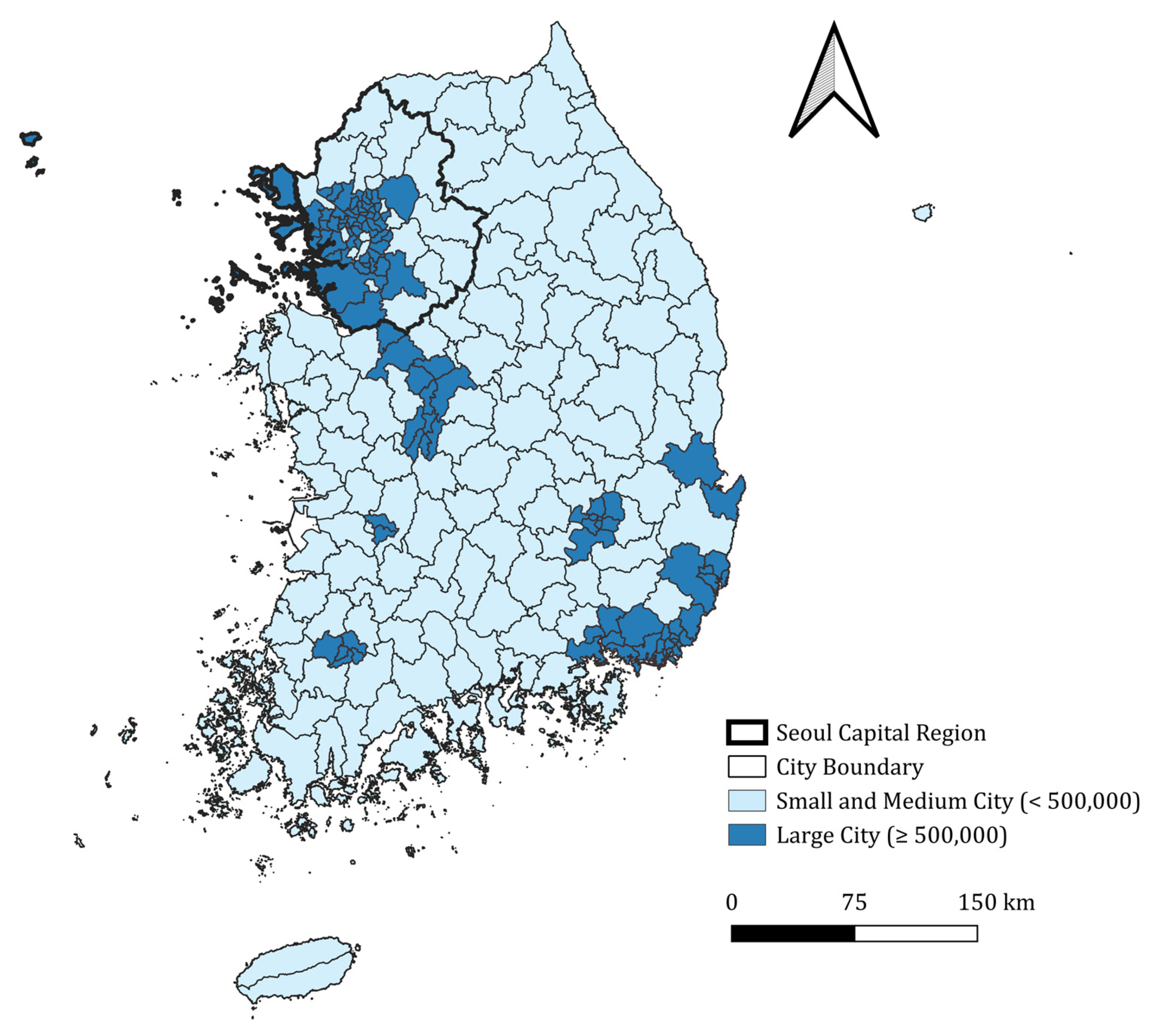
Figure 1 illustrates the spatial distribution of cities by size across South Korea, providing an overview of the study area. Large cities (population ≥ 500,000) are concentrated mainly in the Seoul Capital Region and in regional metropolitan areas such as Busan, Daegu, and Daejeon. Small and medium-sized cities are more evenly distributed across other regions of the country. This pattern reflects the strong concentration of population in the Seoul Capital Region within the national urban structure.
The neighborhood-level analysis is conducted at the dong level, the smallest administrative unit in urban areas of South Korea. Dong units represent localized residential and employment environments and serve as the primary spatial scale for measuring population density, employment density, and job–housing balance. Individual commuting trips are therefore nested within dong units, which are in turn nested within cities (Si/Gun/Gu), reflecting the hierarchical structure of the data.
3.3. Data
The two primary data sources for the study are the 2021 population and employment data at the dong level obtained from the Korean Statistical Information Service, and the 2021 Individual Travel Survey from the Korean Transport Database (KTDB). The survey provides trip-level information linked to individual and household characteristics, including age, gender, income, housing type, and car ownership, as well as detailed travel attributes such as trip purpose, travel modes, origin and destination (dong), and departure and arrival times. The main travel mode for each trip is defined as the mode accounting for the longest travel time within the trip, ensuring consistent identification of the dominant mode in multimodal journeys.
3.4. Measures of Urban Form and Employment Spatial Structure
Urban spatial characteristics are measured at both the dong (neighborhood) and city levels to distinguish between local compactness and citywide employment structure.
At the dong level, urban compactness is captured using population density, employment density, and the job-to-resident ratio. At the city level, employment spatial structure is measured using employment Moran’s I and the employment concentration index to capture both spatial clustering and the degree of dominance among employment centers. Moran’s I is a global measure of spatial autocorrelation that assesses the extent to which similar levels of employment densities are spatially clustered or dispersed across spatial units within a city. The employment concentration index is used to assess whether employment within a city is dominated by a single major center or more evenly distributed across multiple centers. The index is estimated using a rank–size distribution model [
29], specified as:
where
Rank denotes the rank of an employment center based on total employment, with
Rank = 1 representing the largest center,
Rank = 2 the second largest, and so forth. In this formulation,
α is the intercept and
β represents the slope of the distribution.
The slope parameter β indicates the rate at which employment concentration declines as rank increases. A steeper slope (higher
β) reflects a monocentric employment structure, in which a small number of dominant dong units account for a large share of total employment and employment density decreases sharply across lower-ranked areas. A flatter slope (lower
β) indicates a more balanced distribution of employment across centers, consistent with a polycentric urban structure. This index therefore captures the degree of functional hierarchy within a city’s employment spatial structure [
30].
3.5. Multilevel Mixed-Effects Model
To examine the association between urban spatial structure and commuting time, this study employs a multilevel mixed-effects modeling framework that accounts for the hierarchical structure of the data. Individual commuting trips are nested within neighborhoods (dong), which are nested within cities, reflecting the multiscale nature of urban form and travel behavior.
The natural logarithm of commute time is used as the dependent variable. Independent variables include individual- and household-level socioeconomic characteristics (e.g., age, gender, income, housing type, and car ownership), neighborhood-level urban form indicators (e.g., population density, employment density, and job–housing ratio), and city-level employment spatial structure measures (e.g., employment Moran’s I and employment concentration index).
Random intercepts are specified at both the dong and city levels to capture unobserved heterogeneity in commuting conditions across neighborhoods and cities. The model is specified as follows:
where
i denotes individual trips,
j denotes neighborhoods (dong), and
k denotes cities (Si/Gun/Gu).
is the fixed intercept,
represents a vector of fixed-effect coefficients,
is the random effect at the neighborhood level,
is the random effect at the city level, and
is the individual-level error term. This model allows us to disentangle the effects of individual characteristics, local urban form, and citywide employment spatial structure on commuting time, while appropriately accounting for spatial and institutional clustering in the data.
4. Empirical Results
4.1. Descriptive Statistics of Commuting Time
This section first examines descriptive patterns of commuting time across regions and city sizes to provide baseline context for the subsequent multilevel analysis.
Table 1 presents descriptive statistics for individual- and urban-level variables used in the analysis, stratified by region and city size. The average commute time shows a clear regional and size-based gradient.
Average commuting time exhibits a pronounced regional gradient. Commutes are substantially longer in the Seoul Capital Region than in non-capital regions, regardless of city size. Large cities in the SCR record the longest average commute times (40.16 min), followed by small and medium-sized cities within the SCR. In contrast, non-capital regions, particularly small and medium-sized cities, exhibit markedly shorter commute times (24.44 min). This pattern suggests that regional hierarchy plays a stronger role in shaping commuting duration than city size alone. Travel mode choice exhibits spatial variation as well. Public transit usage is most prevalent in large cities within the Seoul Capital Region (29.0%). In contrast, private car dependence increases sharply outside the capital region, reaching 78.1% in non-capital small and medium-sized cities, while public transit shares drop to 6.4%.
Urban form indicators further reveal contrasts. Residential and employment densities at the dong level are substantially higher in the Seoul Capital Region, while non-capital small and medium-sized cities exhibit lower densities and dispersed patterns. These descriptive results highlight that, in the Seoul Capital Region, longer commute times are observed in contexts commonly associated with compact development—namely high-density and transit-oriented environments—suggesting that density alone does not guarantee commuting efficiency.
4.2. Employment Spatial Structure Across Regions and City Sizes
The study assesses city-level employment spatial structure using two complementary indicators: employment Moran’s I and the employment concentration index (ECI).
Across all regions and city sizes, employment Moran’s I values are close to zero and slightly negative, indicating little to no global spatial autocorrelation in employment distribution at the city level. This pattern suggests that employment is neither strongly clustered nor systematically dispersed across neighborhoods within cities. The near-zero values of employment Moran’s I suggest little evidence of global spatial autocorrelation, indicating that employment is, on average, neither strongly clustered nor systematically dispersed at the neighborhood scale. The employment concentration index reveals substantial variation across city types. Non-capital small and medium-sized cities exhibit particularly high ECI values, indicating a strong dominance of a limited number of employment centers. Large cities in the Seoul Capital Region also display relatively high concentration, although to a lesser extent than non-capital small and medium-sized cities.
Taken together, these findings indicate that employment dominance and spatial clustering represent distinct dimensions of urban spatial structure. A city may exhibit a highly dominant employment center—as captured by the employment concentration index—without displaying strong neighborhood-level clustering of employment, as reflected in near-zero Moran’s I values. This pattern is consistent with a spatial structure characterized by functional monocentricity combined with spatial fragmentation.
4.3. Multilevel Regression Results
Table 2 reports the results of the multilevel mixed-effects models estimating the effects of individual characteristics, neighborhood-level built environment variables, and city-level employment spatial structure on commuting time. Separate models are estimated by region (Seoul Capital Region versus non-capital regions) and by city size (large cities versus small and medium-sized cities), allowing direct comparison across urban contexts.
Across all models, individual- and household-level characteristics show consistent associations with commuting time. Higher-income individuals tend to experience longer commute times, particularly in the Seoul Capital Region. Car ownership is associated with longer commutes in capital-region large cities, while its effect is weaker or negative in non-capital small and medium-sized cities, reflecting differences in spatial structure and automobile dependence across regions. Relative to walking and non-motorized travel, private car, public transit, and intercity rail use are all associated with longer commuting times, with the largest coefficients observed for intercity rail travel. The number of trip modes is positively associated with commuting time across all contexts.
Clear differences emerge in how neighborhood-level built environment characteristics relate to commuting time across city contexts. Residential population density at the dong level is consistently associated with longer commutes, even in non-capital regions. This finding suggests that residential densification alone does not necessarily improve commuting efficiency and may be linked to longer travel distances or congestion, particularly when higher residential density is not accompanied by corresponding employment concentration or job–housing balance.
By contrast, workplace employment density is associated with shorter commuting times only in non-capital regions, while its effect in the Seoul Capital Region is positive. This pattern indicates that proximity to dense employment locations contributes to commuting efficiency primarily in non-capital cities. In the capital region, however, the potential benefits of employment concentration appear to be offset by congestion, complex travel patterns, and the prevalence of long-distance, cross-jurisdictional commuting. The job–housing ratio at the residential dong is negatively associated with commuting time in most models, especially in capital-region cities, indicating that neighborhoods with a greater balance tend to facilitate shorter commutes. However, this effect weakens or becomes insignificant in non-capital small and medium-sized cities.
5. Discussion
5.1. Effects of Compactness on Commuting Across Urban Contexts
The findings indicate that the commuting effects of compact urban form are highly context-dependent, rather than uniform across city sizes. Residential and employment density exhibit systematically different relationships with commuting time. Higher residential density at the neighborhood (dong) level is generally associated with longer commutes, suggesting that densification alone does not guarantee improved commuting efficiency. Although higher employment density may shorten travel distances, it can also intensify congestion and prolong commuting time by increasing pressure on already saturated transport networks, particularly in highly compact metropolitan areas such as the Seoul Capital Region.
In contrast, higher workplace employment density is associated with shorter commuting times in non-capital regions, where lower congestion levels and simpler spatial structures may allow job proximity to translate more effectively into reduced commute duration. In the Seoul Capital Region, however, further increases in employment density do not generate commuting benefits and are instead linked to longer commute times, likely reflecting complex metropolitan-scale travel patterns and system-wide congestion. These results reinforce the argument that density-based measures of compactness have conditional effects that depend on broader urban structure and scale.
5.2. Employment Spatial Structure and Commuting Efficiency
Beyond density effects, employment spatial structure plays a distinct role in shaping commuting outcomes. In the Seoul Capital Region, commuting efficiency improves primarily when job–housing balance is relatively high and employment is strongly concentrated in a dominant center, indicating that functional alignment between employment centers and commuting networks matters more than additional densification.
In non-capital regions, however, positive associations between Moran’s I and commuting time indicate that localized employment clustering may intensify congestion or induce cross-commuting across dispersed sub-centers. At the same time, employment concentration at the city level shows a consistently negative association with commuting time in large cities, implying that stronger dominance of major employment centers can help structure commuting flows more efficiently. These findings suggest that employment clustering and employment dominance operate through different mechanisms: localized clustering may generate fragmented travel patterns and delay, whereas a clear employment hierarchy may facilitate more coordinated commuting networks.
Taken together, the results indicate that compactness defined narrowly in terms of density provides an incomplete and potentially misleading account of commuting efficiency. While density captures the intensity of development, it does not fully reflect how employment is organized across urban space. Instead, the broader spatial configuration of employment, particularly the interaction between localized clustering and the hierarchical dominance of major centers, plays a decisive role in structuring commuting flows. In small and medium-sized non-capital cities, where labor markets tend to be less spatially complex yet more vulnerable to structural imbalances, the organization of employment centers appears to exert a stronger influence on commuting outcomes than further densification.
6. Conclusions
The findings of this study suggest that compact city policies should be applied in a context-sensitive manner, rather than relying on density-based strategies alone. In highly urbanized metropolitan regions such as the Seoul Capital Region, further residential or employment densification appears to offer limited benefits for commuting efficiency and may instead intensify congestion. In these contexts, policy efforts are likely to be more effective when they focus on functional alignment between dominant employment centers, transport infrastructure, and surrounding residential areas, rather than additional densification.
In non-capital and smaller cities, commuting efficiency depends more strongly on employment spatial structure than on residential density. Strengthening key employment centers and improving accessibility to them may therefore be more effective than uniform compact development. Overall, the results highlight the need to move beyond density-focused notions of compactness and to incorporate employment concentration, job–housing balance, and transport capacity into urban and transport policy design. This perspective is particularly relevant in the context of population decline in small and medium-sized Korean cities, where policies aimed at increasing residential density may be neither feasible nor desirable. Under conditions of declining and aging populations, compact city strategies based on residential densification risk intensifying vacancy, increasing housing oversupply, or concentrating decline rather than improving urban efficiency. Instead, the findings suggest that selective concentration of employment and services, combined with targeted improvements in accessibility, may offer a more realistic and effective approach to maintaining urban functionality and commuting efficiency. In this sense, compact city policies in shrinking cities should be reframed not as strategies of densification, but as strategies of functional consolidation, focusing on sustaining viable employment cores and aligning them with transport networks and residential areas.
Several limitations of this study point to important directions for future research. First, while this study distinguishes between residential density, employment density, and employment concentration, urban spatial structure is simplified through a limited set of indicators. Spatial structure is a multidimensional concept encompassing not only concentration and hierarchy, but also dispersion, continuity, and spatial configuration, which are not fully captured by the measures employed here. In addition, housing types are measured using aggregated categories and do not distinguish morphological variation, such as differences between low-rise and high-rise apartment forms. More detailed building-level spatial data could improve the precision of compactness measures in future research. Second, the analysis relies on global indicators, such as employment Moran’s I and the employment concentration index, which summarize overall patterns but do not capture local variations in dispersion or clustering within cities. In addition, the statistical significance testing of Moran’s I was not explicitly incorporated, and the results should be interpreted as indicative of spatial tendencies rather than definitive evidence of statistically significant spatial clustering. Future research could extend this approach by incorporating local spatial statistics (e.g., local Moran’s I or spatial regimes) or by explicitly distinguishing different forms of dispersion, such as fragmented polycentricity versus structured decentralization. Such approaches would allow a more refined assessment of how different modes of employment dispersion influence commuting outcomes. Finally, the cross-sectional nature of the data limits causal interpretation. Longitudinal analyses tracking changes in employment spatial structure over time would provide stronger evidence on how evolving patterns of concentration and dispersion affect commuting efficiency.
Author Contributions
Conceptualization, H.E.; Methodology, J.L. and H.E.; Formal analysis, J.L.; Data curation, J.L.; Writing—original draft preparation, J.L.; Writing—review and editing, H.E.; Supervision, H.E.; Funding acquisition, H.E. All authors have read and agreed to the published version of the manuscript.
Funding
This research was supported by the Basic Research Laboratory program through the National Research Foundation of Korea, funded by the Ministry of Education, Science and Technology (RS-2023-00219271).
Data Availability Statement
The original contributions presented in the study are included in the article, further inquiries can be directed to the corresponding author.
Conflicts of Interest
We declare that there are no competing interests and we do not have any conflicts of interest we are aware of.
References
- Hwang, U.; Woo, M. Analysis of Inter-Relationships between Urban Decline and Urban Sprawl in City-Regions of South Korea. Sustainability 2020, 12, 1656. [Google Scholar] [CrossRef]
- Kang, M.-K.; Park, H.-N.; Song, J. Spatial Patterns of Urban Shrinkage in Depopulating Municipalities in South Korea. J. Korea Plan. Assoc. 2025, 60, 5–23. [Google Scholar] [CrossRef]
- Fuminori, T.; Kwon, K. Limitation of the Compact City Policy in Japan and Implications to Korean Urban Policy: The Case of Toyama City and Aomori City. J. Korean Urban Geogr. Soc. 2019, 22, 93–110. [Google Scholar] [CrossRef]
- Li, Y.; Xiong, W.; Wang, X. Does Polycentric and Compact Development Alleviate Urban Traffic Congestion? A Case Study of 98 Chinese Cities. Cities 2019, 88, 100–111. [Google Scholar] [CrossRef]
- Bibri, S.E.; Krogstie, J.; Kärrholm, M. Compact City Planning and Development: Emerging Practices and Strategies for Achieving the Goals of Sustainability. Dev. Built Environ. 2020, 4, 100021. [Google Scholar] [CrossRef]
- Yoon, C.-J. Between the Ideal and Reality of City Resizing Policy: Focused on 25 Cases of Compact City Plans in Japan. Sustainability 2020, 12, 989. [Google Scholar] [CrossRef]
- Cervero, R.; Kockelman, K. Travel Demand and the 3Ds: Density, Diversity, and Design. Transp. Res. Part D Transp. Environ. 1997, 2, 199–219. [Google Scholar] [CrossRef]
- Ewing, R.; Cervero, R. Travel and the Built Environment. J. Am. Plan. Assoc. 2010, 76, 265–294. [Google Scholar] [CrossRef]
- Jun, M.-J. The Effects of Polycentric Evolution on Commute Times in a Polycentric Compact City: A Case of the Seoul Metropolitan Area. Cities 2020, 98, 102587. [Google Scholar] [CrossRef]
- Rao, Y.; Yang, J.; Dai, D.; Wu, K.; He, Q. Urban Growth Pattern and Commuting Efficiency: Empirical Evidence from 100 Chinese Cities. J. Clean. Prod. 2021, 302, 126994. [Google Scholar] [CrossRef]
- Zolnik, E.J. The Effects of Sprawl on Private-Vehicle Commuting Distances and Times. Environ. Plan. B-Plan. Des. 2011, 38, 1071–1084. [Google Scholar] [CrossRef]
- Dieleman, F.M.; Dijst, M.; Burghouwt, G. Urban Form and Travel Behaviour: Micro-Level Household Attributes and Residential Context. Urban Stud. 2002, 39, 507–527. [Google Scholar] [CrossRef]
- Næss, P. Built Environment, Causality and Travel. Transp. Rev. 2015, 35, 275–291. [Google Scholar] [CrossRef]
- Dantzig, G.; Saaty, T.L. Compact City: Plan for a Liveable Urban Environment; W. H. Freeman: New York, NY, USA, 1973. [Google Scholar]
- Kenworthy, J.R.; Laube, F.B. Patterns of Automobile Dependence in Cities: An International Overview of Key Physical and Economic Dimensions with Some Implications for Urban Policy. Transp. Res. Part A Policy Pract. 1999, 33, 691–723. [Google Scholar] [CrossRef]
- Stevens, M.R. Does Compact Development Make People Drive Less? J. Am. Plan. Assoc. 2017, 83, 7–18. [Google Scholar] [CrossRef]
- Burton, E. The Compact City: Just or Just Compact? A Preliminary Analysis. Urban Stud. 2000, 37, 1969–2006. [Google Scholar] [CrossRef]
- Galster, G.; Hanson, R.; Ratcliffe, M.R.; Wolman, H.; Coleman, S.; Freihage, J. Wrestling Sprawl to the Ground: Defining and Measuring an Elusive Concept. Hous. Policy Debate 2001, 12, 681–717. [Google Scholar] [CrossRef]
- Lee, B. “Edge” or “Edgeless” cities? Urban spatial structure in U.S. metropolitan areas, 1980 to 2000*. J. Reg. Sci. 2007, 47, 479–515. [Google Scholar] [CrossRef]
- Tsai, Y.-H. Quantifying Urban Form: Compactness versus “Sprawl”. Urban Stud. 2005, 42, 141–161. [Google Scholar] [CrossRef]
- Lee, C. Impacts of Two-Scale Urban Form and Their Combined Effects on Commute Modes in U.S. Metropolitan Areas. J. Transp. Geogr. 2020, 88, 102821. [Google Scholar] [CrossRef]
- Schwanen, T.; Dieleman, F.M.; Dijst, M. The Impact of Metropolitan Structure on Commute Behavior in the Netherlands: A Multilevel Approach. Growth Change 2004, 35, 304–333. [Google Scholar] [CrossRef]
- Hipp, J.R.; Lee, S.; Kim, J.H.; Forthun, B. Employment Deconcentration and Spatial Dispersion in Metropolitan Areas: Consequences for Commuting Patterns. Cities 2022, 131, 103947. [Google Scholar] [CrossRef]
- Zhao, P.; Lü, B.; Roo, G. de Impact of the Jobs-Housing Balance on Urban Commuting in Beijing in the Transformation Era. J. Transp. Geogr. 2011, 19, 59–69. [Google Scholar] [CrossRef]
- Lin, D.; Allan, A.; Cui, J. The Impact of Polycentric Urban Development on Commuting Behaviour in Urban China: Evidence from Four Sub-Centres of Beijing. Habitat Int. 2015, 50, 195–205. [Google Scholar] [CrossRef]
- Buchanan, N.; Barnett, R.; Kingham, S.; Johnston, D. The Effect of Urban Growth on Commuting Patterns in Christchurch, New Zealand. J. Transp. Geogr. 2006, 14, 342–354. [Google Scholar] [CrossRef]
- Tennøy, A.; Gundersen, F.; Øksenholt, K.V. Urban Structure and Sustainable Modes’ Competitiveness in Small and Medium-Sized Norwegian Cities. Transp. Res. Part D Transp. Environ. 2022, 105, 103225. [Google Scholar] [CrossRef]
- Statistics Korea. Population and Housing Census; Korean Statistical Information Service (KOSIS): Daejeon, Republic of Korea, 2025. [Google Scholar]
- Gabaix, X.; Ibragimov, R. Rank −1/2: A Simple Way to Improve the OLS Estimation of Tail Exponents. J. Bus. Econ. Stat. 2011, 29, 24–39. [Google Scholar] [CrossRef]
- Burger, M.; Meijers, E. Form Follows Function? Linking Morphological and Functional Polycentricity. Urban Stud. 2012, 49, 1127–1149. [Google Scholar] [CrossRef]
| Disclaimer/Publisher’s Note: The statements, opinions and data contained in all publications are solely those of the individual author(s) and contributor(s) and not of MDPI and/or the editor(s). MDPI and/or the editor(s) disclaim responsibility for any injury to people or property resulting from any ideas, methods, instructions or products referred to in the content. |