1. Introduction
Urban systems worldwide are increasingly exposed to multi-hazard disturbances, ranging from natural disasters and climate extremes to cascading infrastructure failures. These disturbances highlight the growing need to enhance urban resilience, defined as the capacity of cities to absorb shocks, maintain essential functions, and recover or adapt in the face of disruptions [
1,
2,
3]. Over the past decade, resilience has evolved from a conceptual metaphor to a core paradigm guiding sustainable urban development [
1,
3]. International initiatives such as the UN Sustainable Development Goals—particularly SDG 11—and the New Urban Agenda have further emphasized the importance of resilient infrastructure and land systems in achieving sustainable cities [
4,
5]. Within this global context, urban road networks (URNs) serve as the backbone of urban infrastructure, sustaining not only mobility but also access to essential services such as hospitals and shelters. As demonstrated in recent studies, disruptions to these networks can severely diminish system-wide accessibility and compromise critical urban functions [
6,
7,
8].
Existing research on URN resilience has made substantial progress. At the network-wide level, scholars have employed global indicators—such as connectivity, network efficiency, and the size of the Largest Connected Component (LCC)—to evaluate robustness against random or targeted attacks [
9,
10,
11,
12], as well as to track performance fluctuations under specific hazard scenarios such as flooding or rainstorms [
13,
14], and under routine traffic disturbances including congestion propagation, demand fluctuations, and non-recurrent incidents [
6,
15,
16]. These studies provide valuable assessments of overall robustness and vulnerability at the network scale, but they remain limited in their ability to reveal the spatial configuration of robustness and vulnerability within urban space, where connectivity is inherently structured in heterogeneous and hierarchical patterns [
17]. At the local level, research has focused on identifying critical links or nodes based on intrinsic structural importance [
18,
19]. By characterizing network-wide robustness and identifying structurally critical road segments, these studies have provided important insights for physical network reconfiguration and segment-level engineering interventions.
However, as cities transition into an era of stock-based development, opportunities for physical network reconfiguration and segment-level engineering interventions are increasingly constrained. Enhancing urban resilience therefore requires a shift toward optimizing facility locations to adapt to the existing spatial configuration of network vulnerability, rather than relying on further physical modification of the road network itself. This shift exposes critical gaps in current methodological approaches. Correspondingly, research aligned with this planning logic has developed along three main strands: facility location planning, infrastructure interdependencies, and integrated facility–road network resilience assessment.
First, regarding facility location planning, prior research has widely employed optimization-based modeling approaches, particularly mathematical programming, to address multi-type and hierarchical facility location problems—such as differentiating between Advanced Life Support and Basic Life Support units or between central and local warehouses—in order to balance efficiency, effectiveness, and equity [
20,
21,
22,
23]. More advanced studies have incorporated stochastic or robust optimization frameworks to account for disaster dynamics, including modeling spatially dependent link failures [
24] and integrating deprivation or unmet-demand costs into objective functions [
25,
26]. Despite these advances, critical gaps remain in representing infrastructure uncertainty and network failure heterogeneity [
27,
28]. In most existing models, key parameters—such as facility hierarchy, service coverage, and reliability constraints—are specified a priori or applied uniformly across cities, without explicit reference to the city-specific spatial configuration of connectivity vulnerability or performance degradation under disruption. While such assumptions may be adequate for relatively homogeneous and highly redundant networks, they become problematic in cities with complex topography or constrained road structures, where connectivity degradation is highly uneven and spatially concentrated. Consequently, even sophisticated optimization methods may struggle to adapt to the context-dependent vulnerability configurations observed in real-world URNs.
Second, concerning infrastructure interdependencies, the literature remains heavily dominated by the bidirectional structural coupling between utility lifelines. As highlighted in the meta-research by Haggag et al. [
29], while robust frameworks exist for modeling physical and cyber interdependencies, empirical studies typically focus on systems such as water supply and power grids [
30] or the coupling between roads and urban drainage. Less attention has been paid to the uni-directional functional dependency of public service facilities (e.g., hospitals, shelters) on the spatial configuration of road networks. Unlike utility coupling, this dependency is characterized by spatial accessibility, where topological fragmentation directly leads to area-specific service interruption.
Third, regarding integrated facility–road network resilience assessment, isolated attempts have been made to move beyond a purely road-network-centric perspective and to evaluate resilience from a facility-related service perspective. Notably, Anderson et al. developed simulation-based approaches to quantify losses in access to essential amenities under hazard scenarios [
31]. Nevertheless, such studies primarily function as ex post impact assessments or recovery-oriented planning tools for predefined scenarios. They generally do not aim to support ex ante facility location optimization, nor do they systematically account for city-specific spatial configurations of network disconnection when supporting ex ante facility location planning.
To address these methodological and planning gaps under stock-based urban development, this study adopts a spatial-configuration-oriented analytical route grounded in disconnection patterns. The overarching aim is to examine whether degradation-conditioned spatial configurations of vulnerability can be systematically identified and translated into operationally interpretable inputs for resilience-oriented facility planning.
Accordingly, the study advances two interrelated objectives. First, it develops a disconnection-pattern-based (DPB) connectivity vulnerability mapping approach, using topological-based connectivity vulnerability as a deliberately minimal analytical entry point. Through empirical application to four Chinese cities with contrasting network morphologies, the study evaluates whether DPB can reveal differentiated spatial configurations of vulnerability under disruption. Comparative analysis with conventional static network measures—such as betweenness centrality, articulation-based indicators, and community detection—is conducted to clarify analytical scope and highlight the analytical limitations of single-state metrics in capturing degradation-conditioned reorganization of connectivity.
Second, the study examines whether the resulting vulnerability configurations provide operationally relevant insights for resilience-oriented facility location planning. By exploring how LID and GSF patterns relate to service-area thresholds, facility hierarchy, and response-area delineation, the study assesses the practical value of configuration-oriented vulnerability mapping for supporting context-sensitive facility deployment strategies under stock-based development constraints.
Taken together, the study provides an initial feasibility assessment of a configuration-oriented analytical approach to road-network vulnerability, and clarifies its prospective role in resilience-informed facility planning under stock-based urban development conditions.
2. Materials and Methods
2.1. Conceptual Definitions: Distinguishing Vulnerability from Resilience
Urban Resilience is a rich and multidimensional concept [
1,
16,
32,
33,
34,
35]. As articulated by Bruneau et al., resilience encompasses four fundamental dimensions: robustness, redundancy, resourcefulness, and rapidity [
36]. In the context of this study, which focuses on the spatial patterns of areas that maintain or lose effective service under network disruption, our attention is primarily directed toward the dimensions of robustness and redundancy. Specifically, robustness refers to the capacity to withstand stress without functional degradation, while redundancy denotes the availability of alternative components to sustain operations.
To operationalize the assessment of URN performance under disruption, the structural dimensions of resilience—namely robustness and redundancy—are commonly examined through several interrelated concepts, including survivability, reliability, and vulnerability. Survivability is defined as the ability of a transportation network to withstand disruptive conditions while continuing to satisfy the original level of demand, rendering it conceptually comparable to robustness and, in effect, the inverse of vulnerability [
37]. Reliability, in general terms, refers to the probability that travelers can successfully complete trips between specified origin–destination (OD) pairs under uncertain conditions [
18]. Conversely, vulnerability characterizes the propensity of a transportation network to become inoperable or to experience substantial performance degradation when subjected to disruption [
37,
38].
Given that this study is motivated by resilience-oriented facility location aimed at hedging spatially uneven risks of network performance degradation, vulnerability is adopted as the core analytical concept. In transportation research, vulnerability is commonly conceptualized as the inverse or complement of reliability, and can be operationalized along several corresponding dimensions. Three widely used forms are:
Connectivity Vulnerability, which reflects the propensity for origin–destination (OD) pairs or service areas to become disconnected under disruption, corresponding to the inverse of connectivity reliability [
39];
Travel Time Vulnerability, which can be interpreted as the likelihood of failing to arrive within a specified time threshold [
40], the degree of variability or instability in travel times under disruption [
15], or the exposure to excessive travel times beyond an acceptable confidence level [
41];
Capacity Reliability, defined as the probability that a transportation network can accommodate a specified travel demand while maintaining a desired level of service [
42].
As an exploratory study aimed at identifying the spatial configuration of areas that maintain versus lose network performance under disruption, this research prioritizes methodological feasibility over detailed traffic performance modeling. Accordingly, the analysis focuses on the topological integrity of URNs and is restricted to Connectivity Vulnerability, which provides a clear and operational basis for examining spatial variations in network performance degradation under disruption.
Given the exploratory nature of this study and its focus on validating a spatially oriented configuration-oriented analytical approach, the analysis prioritizes conceptual clarity over operational detail. Connectivity Vulnerability is therefore adopted as the primary indicator to characterize network performance degradation, as it avoids the need for introducing hazard-specific parameters, traffic flow modeling, and scenario-dependent calibration, and allows the core analytical logic to remain focused on the spatial configuration of vulnerability under disruption.
Consistently with this focus, network disruption in this study is not defined with reference to specific hazard mechanisms. Instead, it is conceptualized as an uncertain and non-deterministic condition under which connectivity degradation is sufficient to compromise effective service. Such disruption can be represented through a stochastic, length-weighted edge removal process, allowing the spatial emergence of connectivity vulnerability to be examined under increasing levels of disruption.
2.2. Disconnection-Pattern-Based Analytical Framework
While connectivity vulnerability can be quantified using global performance indicators or analyzed through the identification of critical elements, such measures are often insufficient for planning-oriented applications under the constraints of stock-based urban development. As opportunities for large-scale physical network reconfiguration and segment-level engineering interventions are increasingly constrained, enhancing urban resilience relies less on direct physical modification of the network itself and more on adapting facility location strategies to the spatial configuration of vulnerability within existing networks. This shift requires not only assessing whether connectivity degrades or identifying isolated critical elements, but explicitly identifying where connectivity loss is likely to occur and the probability of such loss.
From a topological perspective, connectivity loss in URNs—owing to their dense structure, high redundancy, and complex spatial embedding—does not typically manifest as isolated edge or vertex failures, as is often the case in sparse infrastructure networks such as power grids or interregional highway systems. Instead, connectivity degradation in URNs is better understood as involving the combined failure of multiple road segments constrained by the underlying network structure, rather than isolated link disruptions. Consequently, from a theoretical perspective, identifying where and how likely connectivity loss occurs requires a shift from element-based diagnostics toward a disconnection-pattern-based perspective, in which vulnerability is examined through the spatial organization of disconnection processes.
Drawing on fundamental properties of graph connectivity and insights from percolation theory [
43] (pp. 2–10), two generic disconnection patterns are derived to characterize the basic ways in which URNs lose connectivity under disruption: Local Island Disconnection (LID) and Global Structural Fragmentation (GSF). These patterns capture connectivity failure at both micro- and macro-scales and form the analytical basis for the pattern-specific connectivity vulnerability mapping methods developed in
Section 2.3 and
Section 2.4.
While analytically distinguished for clarity, LID and GSF are not assumed to be mutually exclusive in real-world networks. Under increasing levels of connectivity degradation, localized islanding and macro-scale structural fragmentation may coexist or become salient at different disruption intensities. In this study, they are treated as complementary, configuration-based typologies for representing vulnerability at distinct spatial scales, rather than as sequential phases in a modeled transition process.
2.2.1. Local Island Disconnection (LID)
Local Island Disconnection (LID) refers to a disconnection pattern in which localized portions of an urban road network become isolated from the largest connected component once a sufficient number of connecting links are rendered ineffective in maintaining connectivity, thereby forming small-scale connected components. In redundant URNs, such isolation is rarely triggered by the failure of a single cut-edge; instead, it results from the joint loss of multiple links, which exhaust alternative paths and give rise to isolated islands. The impact of LID is confined to micro-scale accessibility loss: nodes within these isolated islands lose reachability to the broader network, while system-wide connectivity—represented by the size of the largest connected component—remains largely preserved. LID therefore characterizes a failure of accessibility rather than a collapse of global network connectivity.
2.2.2. Global Structural Fragmentation (GSF)
Global Structural Fragmentation (GSF) refers to a system-wide disconnection pattern in which the global structural integrity of an URN collapses under severe disruption, manifested by a sharp reduction in the size of the Giant Connected Component (GCC) and the loss of network-wide connectivity. This pattern reflects a breakdown of connectivity at the macro scale associated with the exhaustion of topological redundancy, leading to the division of the network into multiple disconnected large-scale components. Unlike localized disconnection, GSF represents a fundamental collapse of system-wide connectivity.
Importantly, the breakdown of global connectivity under GSF does not necessarily result in a set of clearly separated or spatially fixed blocks. Although GSF is defined by the emergence of multiple large-scale connected components, the resulting vulnerability configuration cannot be fully captured by static block partitioning alone. From an analytical perspective, node affiliation to connected structures may vary across disruption contexts, and connectivity vulnerability may be expressed not only through large-scale separation, but also through boundary instability and internal structural heterogeneity within connected components.
From a vulnerability-configuration perspective under GSF conditions, nodes can be analytically distinguished into three archetypal structural roles:
Stable-block nodes, which tend to form relatively persistent connectivity blocks and are highly likely to remain mutually connected across a wide range of disruption contexts, thereby constituting large-scale connected components;
Contested nodes, whose connectivity affiliation is not fixed and may shift among different stable blocks depending on the specific pattern of network disruption;
Fragmented nodes, which are structurally predisposed to disconnection and are unlikely to belong to any large connected structure under GSF conditions, instead forming small and incoherent components.
Moreover, even among nodes belonging to the same stable connectivity block, substantial heterogeneity may exist in their internal robustness, reflecting differentiated structural roles within the block. In particular, a subset of highly robust core nodes—here termed robust seeds—may exhibit stronger persistence across disruption realizations and contribute disproportionately to block-level cohesion. This intra-block heterogeneity indicates that GSF cannot be adequately represented as a uniform connectivity state, motivating further analysis of vulnerability patterns beyond simple component membership.
2.3. Method for Mapping City-Specific Connectivity Vulnerability Under LID
This section presents a quantitative method for estimating node-level LID vulnerability, defined as the edge-removal ratio at which the service area associated with a given node falls below a predefined island-area threshold, and for mapping the resulting city-specific spatial configuration of LID vulnerability.
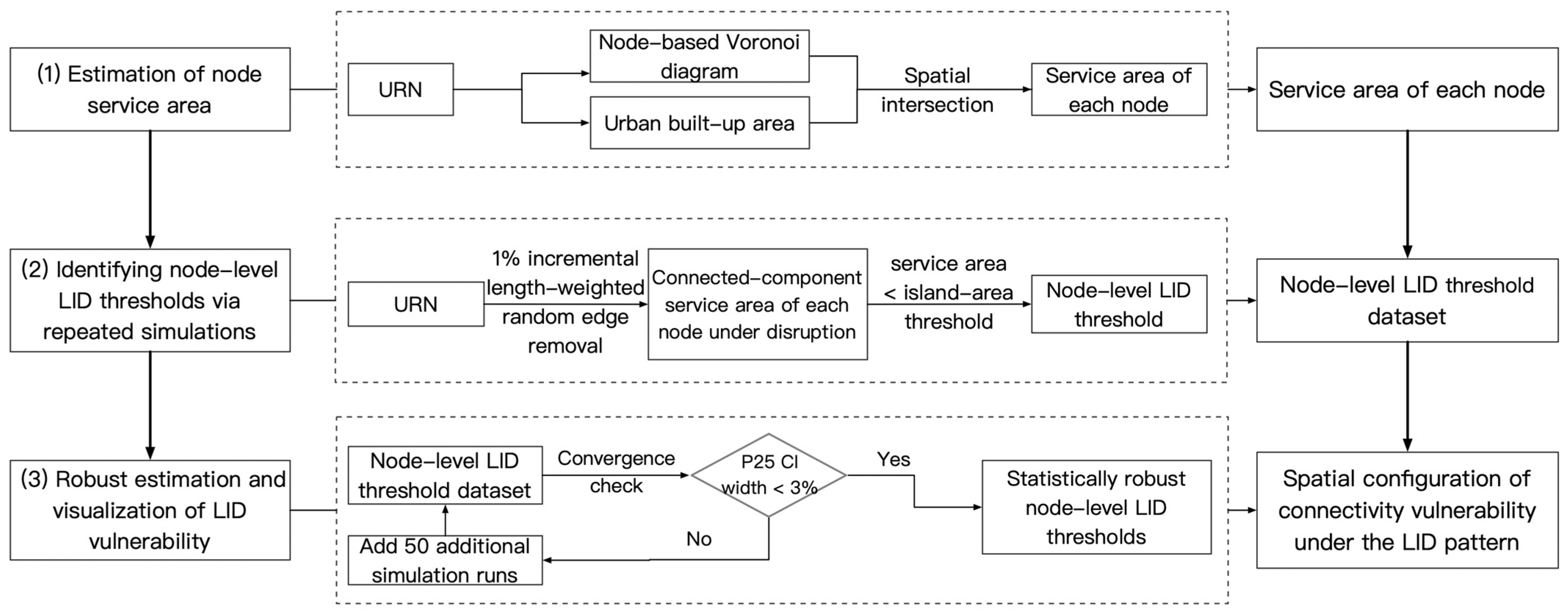
The overall workflow (
Figure 1) consists of three main steps: (1) estimating the spatial service area associated with each network node; (2) simulating different degrees of network degradation through repeated, length-weighted stochastic edge removal and, for each node, recording the LID threshold, defined as the edge-removal ratio at which the service area of its connected component falls below a predefined minimum size; and (3) aggregating node-level LID thresholds across simulations using a robust percentile-based summary to derive LID vulnerability indicators and resulting spatial vulnerability maps.
The detailed implementation of each step is described below.
2.3.1. Estimation of Node Service Area
To translate topological connectivity into spatial service areas, a Voronoi-based method is employed to estimate the service area of each node, which is then aggregated at the connected-component level to support LID identification based on an island-area threshold.
Specifically, a bounded Voronoi diagram is first constructed using all road network nodes as generators over the built-up area. The service area
of node
is then defined as the intersection between its Voronoi cell and the built-up area extent, which can be formally expressed as:
where
represents the Voronoi cell of node
,
represents the built-up area extent, and
denotes the service area of node
.
2.3.2. Identifying Node-Level LID Thresholds via Repeated Simulations
To quantify node-level susceptibility to LID, Monte Carlo simulations are conducted to estimate the edge removal thresholds at which LID under repeated stochastic network disruption. Here, LID is operationally defined as a service-area-conditioned disconnection event, occurring when the total service area associated with a node’s connected component falls below a predefined threshold, which can be set according to the analytical coverage requirements relevant to facility location planning.
In each simulation run, road segments are removed from the network in discrete 1% increments, following a length-weighted random strategy in which longer segments have a higher removal probability. This removal process is not intended to represent a temporal damage sequence, but rather to sample network states under increasing levels of disruption intensity.
At each discrete edge removal ratio
r within a simulation, the connected component containing node
i is identified, and the total service area associated with that component is calculated. This total service area is defined as:
where
denotes the service area of node
j as defined in
Section 2.3.1, and
represents the set of nodes belonging to the connected component containing node
at edge removal ratio
r in the
-th simulation.
For each simulation, the edge removal ratio at which
first falls below a predefined threshold
is recorded as the LID threshold for node
i in simulation
m:
where
denotes the critical area threshold for the connected component, and
is the set of discrete removal steps (e.g., 1%, 2%, …, 100%).
2.3.3. Robust Estimation and Visualization of Vulnerability
To obtain statistically stable estimates of node-level LID vulnerability, disconnection thresholds derived from repeated stochastic simulations are aggregated using a robust percentile-based approach.
For each node , the distribution of simulated LID thresholds is summarized by its 25th percentile (P25), which is adopted as the node-level vulnerability indicator:
For each node
, the 25th percentile (P25) of its simulated disconnection thresholds is adopted as a conservative vulnerability indicator:
The use of the 25th percentile emphasizes early-onset LID and yields a conservative characterization of connectivity vulnerability, which is particularly suitable for risk-sensitive planning contexts where precautionary assessment is required.
To balance computational efficiency with estimation stability, an adaptive convergence control strategy is employed. Simulations are initialized with 200 runs and extended in increments of 50 runs. After each increment, convergence is assessed using the width of an approximate 95% rank-based uncertainty interval for the P25 estimate, constructed from the corresponding lower and upper order statistics obtained via a normal approximation to the sampling distribution of the 25th-percentile rank. Simulations are terminated when more than 90% of the considered nodes satisfy an interval width smaller than 0.03 (in edge-removal-ratio units), indicating that the P25 estimates have stabilized sufficiently for stable vulnerability mapping to support resilience-oriented facility location planning. This stopping rule operationalizes a network-level stabilization criterion, ensuring that convergence is not determined by a small subset of nodes and that residual uncertainty in node-level LID thresholds remains small relative to the evaluated edge-removal range.
Finally, the estimated values are classified into discrete levels (e.g., 5%, 10%, 15%, 30%, and 40%) to visualize the spatial configuration of connectivity vulnerability under LID pattern. The classification uses fixed edge-removal thresholds to retain a direct, cross-city comparable interpretation of LID risk and to emphasize early-onset vulnerability most relevant to facility location planning.
2.4. Method for Mapping City-Specific Connectivity Vulnerability Under GSF
This section presents a GSF-specific method for mapping city-specific spatial configurations of connectivity vulnerability. As established in
Section 2.2.2, GSF is characterized by the breakdown of network-wide connectivity and the emergence of multiple large-scale connected components. Under such conditions, connectivity vulnerability cannot be adequately represented as a set of fixed and clearly separated blocks. Instead, vulnerability manifests through the combined effects of block-like structure formation, boundary instability, and internal structural heterogeneity.
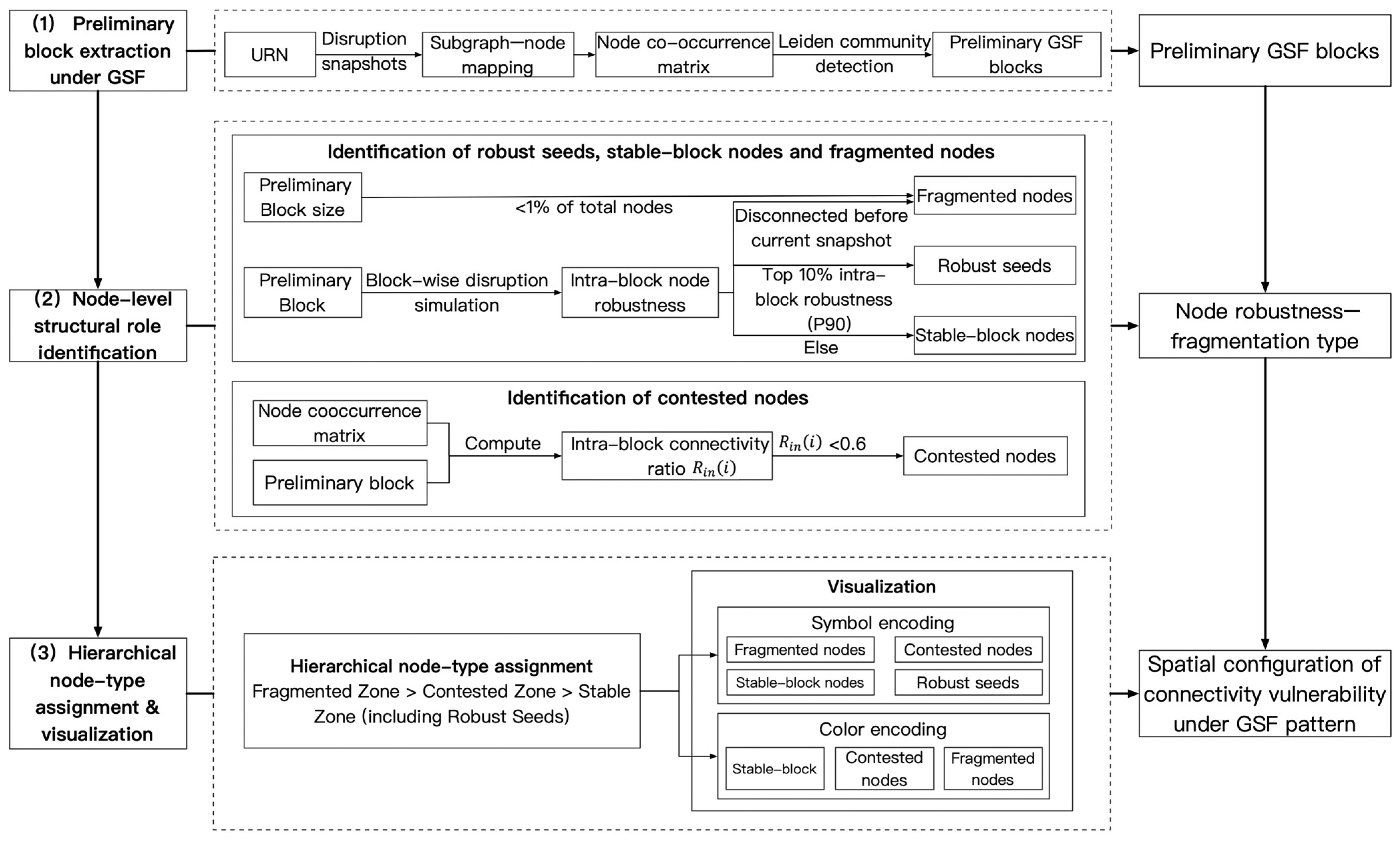
This multi-faceted fragmentation challenges conventional single-state network analysis approaches that rely on static topological representations. To address this limitation, a node co-occurrence-based identification method is developed to capture the block-segmentation behavior associated with GSF. By statistically analyzing how frequently node pairs remain mutually connected across repeated stochastic disruption scenarios, the method extracts preliminary fragmented blocks and assigns nodes to distinct structural roles, including robust seeds, stable-block nodes, contested nodes, and fragmented nodes.
2.4.1. Extraction of Preliminary Fragmented Blocks via Node Co-Occurrence Analysis
To identify the spatial configuration of connectivity vulnerability under the GSF pattern, the first step employs a node co-occurrence-based analysis to extract preliminary fragmented blocks from repeated network disruption scenarios.
A length-weighted random edge removal strategy is used to represent network disruption. To capture connectivity degradation associated with the GSF pattern, edge removal is evaluated at a set of discrete disruption levels (5%, 10%, 15%, 20%, 25%, 30%, and 35%), covering early, intermediate, and severe stages of network fragmentation. For each evaluated disruption level, the correspondence between nodes and their connected components is recorded across independent stochastic simulations, where denotes the number of simulations required for convergence.
For each disruption level, node co-occurrence is quantified by computing the frequency with which pairs of nodes appear within the same connected component across simulations. This frequency serves as a measure of structural affinity between nodes and is defined as:
where
if nodes
and
belong to the same connected component in simulation
, and
otherwise.
A weighted co-occurrence matrix is constructed from . To reduce computational burden, the matrix is sparsified prior to community detection. For connected components with size , full pairwise co-occurrence is computed. For larger connected components, approximate counting is implemented by randomly sampling candidate neighbors per node. The resulting weighted graph is further truncated by retaining only the top-k co-occurrence links for each node, yielding an edge count of approximately (typically for this study), where is the number of nodes.
Finally, the Leiden algorithm with the RBConfigurationVertexPartition objective is applied to the sparse weighted co-occurrence graph to extract preliminary fragmented blocks. The RBConfigurationVertexPartition objective is adopted instead of standard modularity because modularity-based partitioning can merge smaller communities during optimization, thereby obscuring size heterogeneity in the resulting partition—an undesirable effect when delineating the block structures expected under the GSF pattern. The objective incorporates a resolution parameter (), which controls the granularity of community detection. To determine an appropriate setting, a limited set of candidate values () was examined. The resulting partitions were compared against recurrent block-fragmentation structures observed across disruption simulations at GSF-relevant degradation levels. Across the tested values, varying primarily affected partition granularity, while the identification of major stable connectivity blocks was broadly preserved in the studied cases. The value was adopted as a pragmatic balance between overly coarse and overly fine partitions, providing a block delineation that is most consistent with the recurrent fragmentation structures observed in the simulation ensemble for the purpose of GSF mapping.
This setting prioritizes recovery of dominant block-level fragmentation structures from the ensemble-derived co-occurrence graph, rather than resolution-dependent refinements that are not essential to the GSF mapping objective. The selected is therefore context-dependent rather than universally fixed; alternative values may be appropriate for urban road networks that fall outside the structural range represented by the empirical cases analyzed in this study. These blocks represent recurrent large-scale connectivity structures under the GSF pattern and provide the block-level basis for subsequent node-role identification.
2.4.2. Node-Level Structural Role Identification Within Preliminary Fragmented Blocks
- (1)
Identification of robust seeds, stable-block nodes and fragmented nodes
Following the extraction of preliminary fragmented blocks under the GSF pattern, node-level structural roles within each block are further identified by assessing intra-block robustness. This step distinguishes structurally fragile nodes that are prone to early isolation from robust core nodes that sustain block-level connectivity under severe disruption.
As an initial screening step, nodes belonging to structural blocks of negligible size—defined as blocks containing fewer than 1% of the total nodes in the original network—are directly classified as Fragmented Nodes, as such blocks are too small to sustain stable large-scale connectivity structures.
For the remaining blocks, an intra-block robustness assessment is conducted. Specifically, independent length-weighted random edge removal simulations are performed within each block to evaluate the susceptibility of individual nodes to detachment from the block’s largest connected component under different degrees of network degradation. In each simulation
, the detachment threshold of node
is defined as the minimum edge removal ratio at which the node becomes disconnected from the block’s largest connected component:
where
denotes the set of nodes belonging to the largest connected component of the block at edge removal ratio
in simulation
, and
represents the set of discrete disruption levels (defined consistently with the GSF observation snapshots). If node
remains in the largest connected component for all
, we set
.
After repeating the simulations, the intra-block robustness of each node is quantified as the 25th percentile (P25) of its detachment threshold distribution . This conservative measure reflects the tendency of a node to lose connectivity at an early stage of disruption within the block.
Based on this robustness metric, a two-criterion classification is applied:
Fragmented node identification: If a node’s robustness value is lower than the edge removal ratio corresponding to the current GSF observation snapshot, the node is classified as a Fragmented Node.
Robust Seed identification: If a node’s robustness value exceeds the 90th percentile (P90) of robustness values within the same block, the node is classified as a Robust Seed, representing a structural core that anchors block-level connectivity under GSF conditions.
To ensure statistical reliability, block-wise simulations are conducted with an adaptive convergence control strategy, in which convergence is assessed using the Jaccard similarity coefficient
1 of classification results between successive simulation batches (e.g., after 500 and 550 simulations), with a convergence threshold of 0.85.
Nodes not classified as fragmented nodes or robust seeds are provisionally designated as stable-block nodes, consistent with the definition provided in
Section 2.2.2.
- (2)
Identification of contested nodes
Following the identification of fragmented nodes and robust seeds (with remaining nodes assigned to stable blocks by exclusion), this step focuses on nodes whose structural affiliation remains ambiguous under the GSF pattern. These nodes correspond to contested nodes, whose connectivity association with specific structural blocks varies across disruption contexts.
To quantify this ambiguity, an intra-block co-occurrence ratio is computed for each node based on the node co-occurrence matrix obtained in
Section 2.4.1. For node
, the ratio is defined as:
where
denotes the set of nodes belonging to the same block as node
i, and
represents the co-occurrence weight between nodes
and
as defined in Equation (5). This ratio measures the extent to which a node’s co-occurrence mass is concentrated within its assigned preliminary fragmented block, as opposed to being distributed across multiple preliminary fragmented blocks.
An operational threshold is adopted as a minimal stability requirement, meaning that a node must have a clear majority of its co-occurrence mass concentrated within a single block to be regarded as structurally stable. For nodes not previously classified as Fragmented Nodes, those with are labeled as Contested Nodes, indicating the absence of a dominant block affiliation. From a planning perspective, nodes failing to meet this minimum stability criterion warrant differentiated treatment from nodes exhibiting stronger block attachment. This step captures boundary instability under the GSF pattern by identifying nodes located at the interface between competing connectivity structures.
2.4.3. Hierarchical Node-Type Assignment and Visualization
To resolve potential overlaps arising from the multi-stage, multi-criterion node classification, a hierarchical priority rule is applied:
The ordering reflects a monotonic gradient of connectivity instability under GSF conditions. Fragmented nodes correspond to structural detachment from large-scale connectivity and therefore represent the highest connectivity-vulnerability state. Contested nodes remain connected but exhibit affiliation instability across disruption realizations, indicating an intermediate vulnerability state. Robust seeds and stable-block nodes remain integrated within persistent connectivity blocks; however, robust seeds constitute a structurally more specific subset characterized by high intra-block robustness. The hierarchy therefore prioritizes states associated with greater structural instability while preserving more specific structural roles when classification criteria overlap.
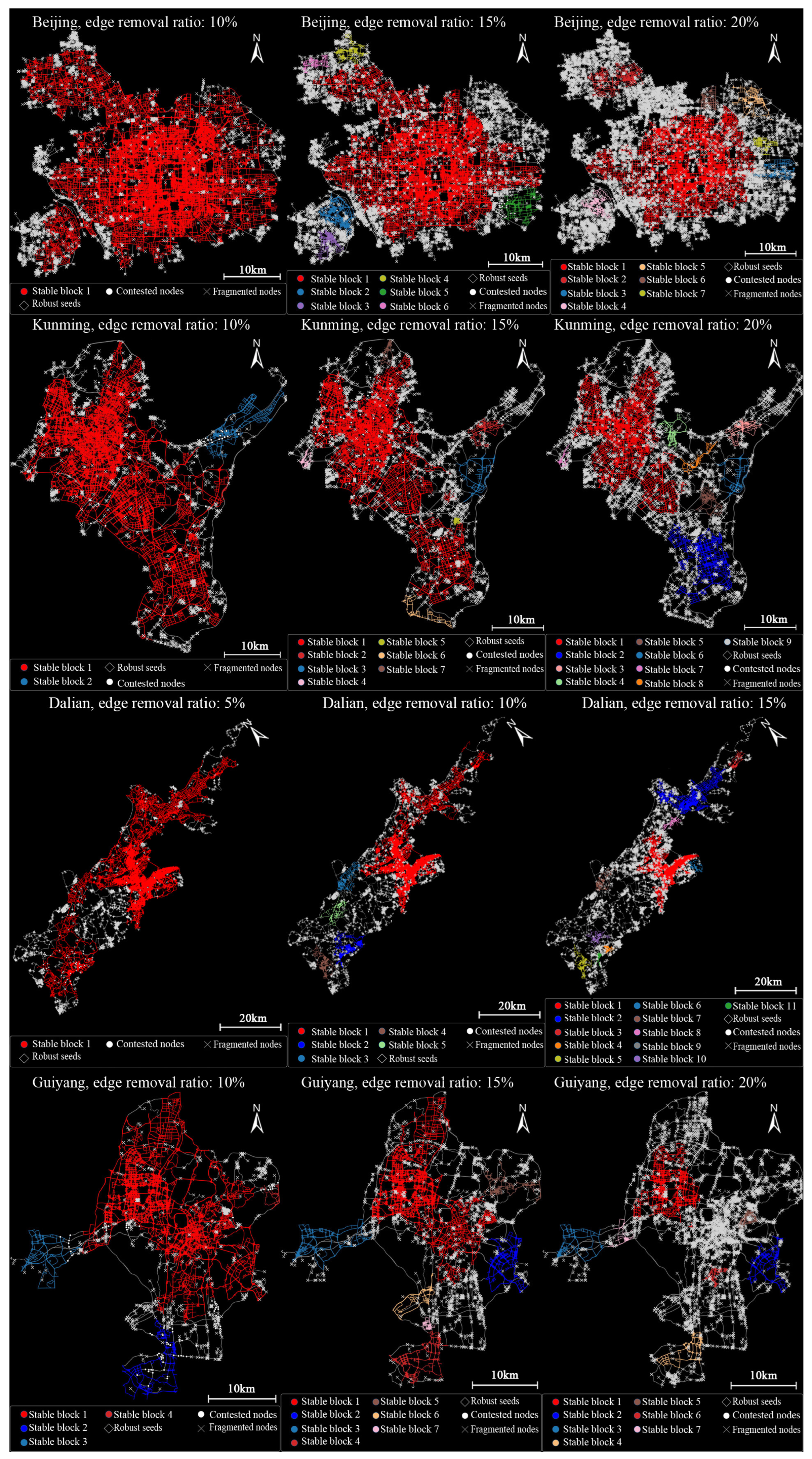
The final spatial representation of GSF-related connectivity vulnerability integrates block-level structures with node-level roles. Fragmented structural blocks are visualized using distinct colors, while node roles are encoded using distinct symbols to denote robust seeds, contested nodes, and fragmented nodes. By mapping these elements across the selected observation snapshots, the resulting visualization reveals city-specific spatial configurations of connectivity vulnerability under GSF conditions.
2.5. Conventional Static Baselines for Contextualization and Comparison
To contextualize the proposed disconnection-pattern-based vulnerability mapping approach, a set of conventional static network analysis methods is adopted as conceptual baselines. The purpose is not to provide an exhaustive review of network metrics, but to establish reference representations against which the analytical scope and added value of the proposed LID- and GSF-based methods can be assessed.
Conventional static analyses of urban road networks (URNs) can be broadly grouped according to the structural properties they emphasize, including flow-oriented importance measures (e.g., betweenness centrality), articulation-based vulnerability measures (e.g., cut-edge and cut-vertex identification), and cohesion- or partition-oriented methods (e.g., connected component analysis and community detection). These methods are widely used in infrastructure vulnerability and resilience studies and are effective for addressing the specific questions they are designed to answer, such as shortest-path importance, single-point structural sensitivity, or static network partitioning.
However, despite their differences, these approaches share a common analytical characteristic: they all provide static, single-state descriptions of network structure. They evaluate importance, sensitivity, or clustering based on a fixed network realization, without explicitly accounting for how connectivity reorganizes under varying degrees of network degradation or through the combined failure of multiple links. As a result, they are not designed to directly identify disconnection patterns that emerge via threshold-conditioned isolation or block-level reorganization, which constitute the core mechanisms underlying both Local Island Disconnection (LID) and Global Structural Fragmentation (GSF).
Within this framework, connected component analysis and articulation-based measures (cut-edge and cut-vertex identification) provide structural references for understanding island formation and potential separation under LID, while articulation measures, betweenness centrality, and community detection offer complementary perspectives for contextualizing block-level fragmentation and corridor dependence under GSF. Accordingly, these methods are introduced as structural baselines rather than competing solutions, allowing the proposed LID- and GSF-based results to be interpreted in relation to what conventional static approaches can and cannot reveal.
All baseline analyses were implemented using standard routines in the NetworkX Python library, including betweenness centrality, cut-edge and cut-vertex identification, connected component analysis, and modularity-based community detection, ensuring reproducibility and consistency with widely adopted graph-theoretic definitions.
2.6. Study Areas for Method Validation and Data Preparation
2.6.1. Case Selection for Method Validation
To validate the applicability of the proposed LID- and GSF-based connectivity vulnerability mapping methods, four Chinese cities were selected as empirical cases based on structural contrast and method-validation considerations, rather than statistical representativeness.
First, network scale and structural complexity were emphasized to test the computational feasibility and discriminative power of the proposed methods. Accordingly, four large Chinese cities were selected, each characterized by a large and structurally complex central urban area—Beijing (826 km2), Kunming (429 km2), Dalian (438 km2), and Guiyang (379 km2). Such large-scale and structurally complex URNs pose nontrivial challenges for mapping spatial configurations of connectivity vulnerability beyond conventional resilience metrics.
Second, for LID-based validation, we intentionally selected structurally contrasting cases along a qualitative contrast in network redundancy and spatial homogeneity. Beijing represents a relatively homogeneous, grid-like URN with high redundancy, where localized islanding under stochastic connectivity degradation is generally harder to differentiate spatially. In contrast, Dalian exhibits pronounced terrain constraints and an irregular network morphology, characterized by spatially uneven structural redundancy. By focusing on these two structurally distinct extremes, the LID framework is examined under both relatively homogeneous and more structurally constrained network conditions, enabling a stringent assessment of its sensitivity to morphological contrast.
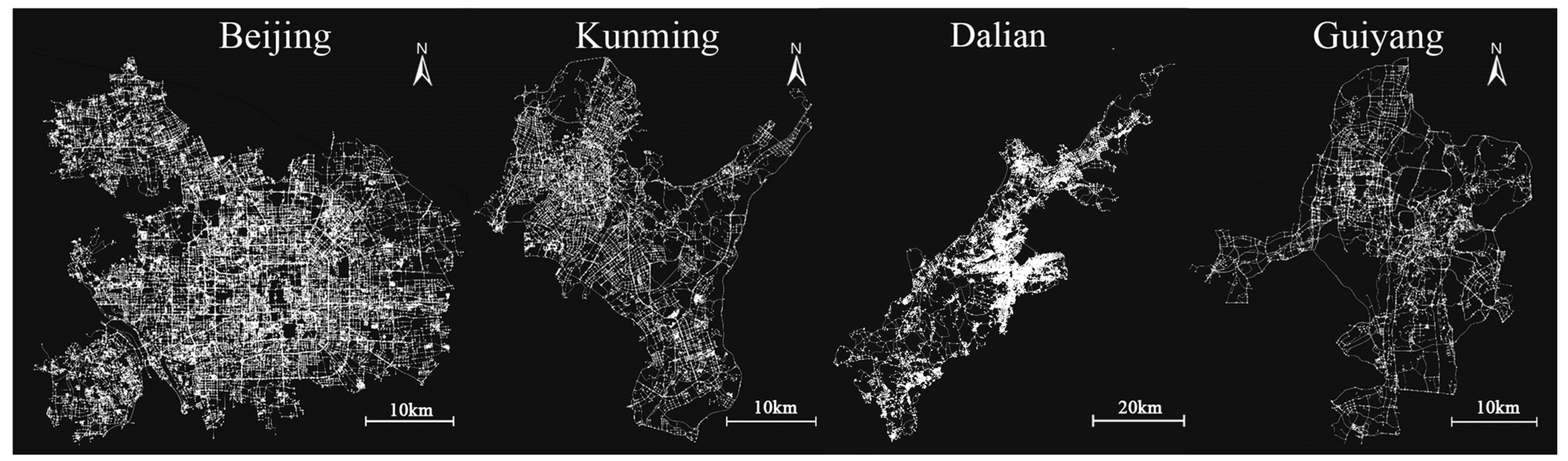
Third, typological diversity was considered to assess the generalizability of the GSF mapping method. Kunming and Guiyang are included primarily to broaden the morphological coverage for GSF validation. The selected cities—Beijing, Kunming, Dalian, and Guiyang—span diverse URN morphologies, ranging from regular grid-like structures to irregular urban forms with pronounced internal spatial segmentation. This diversity allows the proposed method to be evaluated across contrasting structural contexts, testing its ability to consistently identify spatial configurations of connectivity vulnerability associated with GSF.
The selected cases and their key network characteristics are summarized in
Table 1, and the corresponding road network morphologies are illustrated in
Figure 3.
2.6.2. Data Sources and Preprocessing
Road network data were obtained from OpenStreetMap (OSM) and retrieved using the OSMnx Python package (version 2.1.0) [
44]. For each city, the URN was initially extracted within the central urban area boundary as defined in the statutory Territorial Spatial Master Plan of China. Within this boundary, peripheral fringe subareas characterized by incomplete, transitional, or sparsely developed road infrastructure were excluded to avoid edge-of-city artifacts associated with incomplete network closure at the urban boundary, and to ensure that the analyzed networks represent the mature structural morphology of each city.
Different network representations were adopted to match the analytical requirements of the LID- and GSF-based mapping procedures. For the LID analysis, two island-area thresholds were considered: 3 km2 and 20 km2. These thresholds correspond to nationally specified service coverage standards for emergency (immediate) and short-term emergency shelters in China, respectively. According to national standards, shelters are classified into emergency, short-term, and long-term categories based on walkability-oriented service requirements, with approximate service coverage areas of 3 km2, 20 km2, and 80 km2. In this study, the 3 km2 and 20 km2 thresholds were selected to represent two practically meaningful yet contrasting service-area scales for diagnosing localized islanding under stochastic connectivity degradation within the LID framework. The 80 km2 long-term category was not included because it reflects macro-scale coverage expectations that exceed the spatial resolution targeted by LID mapping. For the LID mapping (under both the 3 km2 and 20 km2 thresholds), road networks were constructed using the all network type in OSMnx to preserve pedestrian-accessible local connectivity, consistent with the walkability-oriented service logic underlying the 3 km2 and 20 km2 shelter thresholds in national standards. For GSF-related analyses, road networks were constructed using the drive network type, as GSF is interpreted in the context of emergency zoning and strategic facility location, for which vehicular accessibility constitutes the primary mode of inter-area connectivity.
The resulting URNs were represented as undirected graphs, in which nodes correspond to road intersections or terminal points and edges represent road segments with their geometric lengths preserved. This undirected representation is adopted to capture structural reachability under disruption conditions, consistent with the connectivity-based definition of vulnerability adopted in this study; direction-specific constraints (e.g., one-way regulations) are thus not explicitly modeled, as the analysis focuses on connectivity loss (weak connectivity) rather than traffic-flow performance. Prior to analysis, standard preprocessing procedures were applied, including the removal of isolated components, correction of topological inconsistencies, and projection of all networks to a unified coordinate reference system.
For the LID analysis, a delineation of built-up areas was required to define spatially meaningful island units. Rather than aiming to reproduce exact built-up boundaries—an effort that is unnecessary at this feasibility-testing stage of the proposed disconnection-pattern-based analytical approach—built-up areas were operationally approximated using a 200 m buffer applied to the road network. This approximation provides a consistent spatial envelope sufficient for island-area thresholding and yields built-up extents that visually align with the observed urbanized areas of all four study cities.
3. Results
3.1. Connectivity Vulnerability Mapping Under the LID Pattern
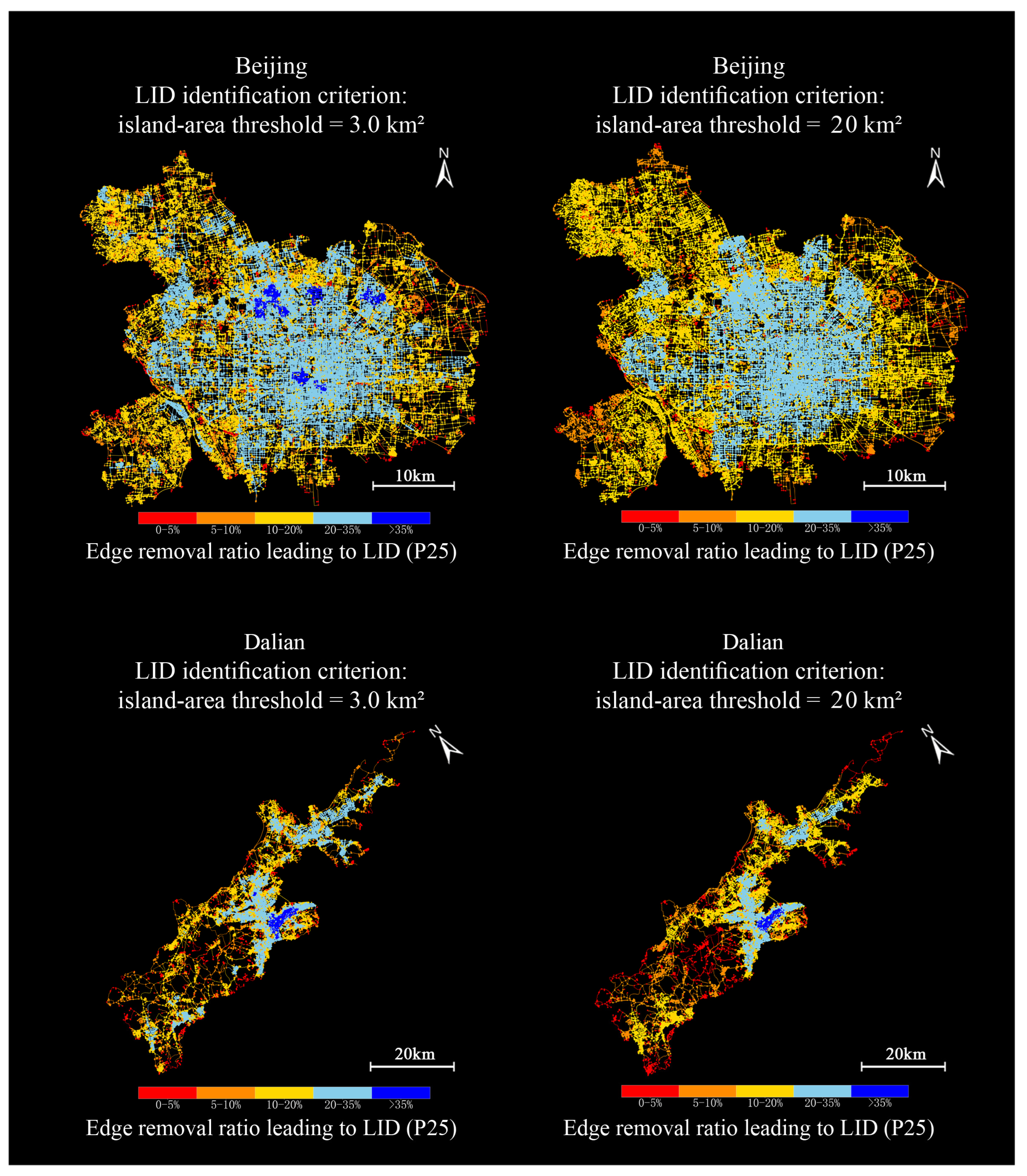
Figure 4 and
Table 2 present the spatial configurations of connectivity vulnerability under the LID pattern for the central urban areas of Beijing and Dalian. The results were generated using two island-area thresholds in the LID method (3 km
2 and 20 km
2), corresponding to national coverage standards for emergency and short-term shelters in China.
In Beijing, the LID-based mapping reveals spatially differentiated vulnerability patterns despite the presence of a highly homogeneous and redundant grid network. Under both island-area thresholds, most areas maintain stable connectivity even under moderate disruption, with the majority of the area exhibiting LID onset values ≥ 10% (79.9% under 3 km2 and 76.8% under 20 km2), while LID high-risk zones (0–5%) emerge only in limited (4.6% and 4.7%, respectively) and elevated-risk zones (5–10%) account for 14.5% and 18.5%. This result shows that spatial configurations of localized connectivity vulnerability can be identified in a highly redundant and spatially homogeneous grid network.
In contrast, the Dalian case exhibits a markedly different vulnerability configuration. Owing to strong terrain constraints and corridor-dependent connectivity, a non-negligible share of LID high-risk zones are identified under both island-area thresholds: the high-risk category (0–5%) accounts for 11.9% and 21.2% of the area under the 3 km2 and 20 km2 thresholds, respectively, while the elevated-risk category (5–10%) accounts for 28.3% and 30.5%. In parallel, the share of areas with onset values ≥ 10% decreases from 59.8% to 48.3% as the threshold increases. These vulnerable areas are spatially concentrated rather than sporadic, reflecting the uneven distribution of network redundancy across the urban area.
Across both cities, increasing the island-area threshold from 3 km2 to 20 km2 results in a redistribution of area toward higher nominal risk classes. The proportions of high- and elevated-risk categories increase in both Beijing and Dalian, and the spatial concentration of identified high-risk areas remains comparable between the two service scales.
3.2. Connectivity Vulnerability Mapping Under the GSF Pattern
Figure 5 and
Table 3 present the spatial configurations of connectivity vulnerability under the GSF conditions for the central urban areas of Beijing, Kunming, Dalian, and Guiyang. For each city, the results are derived from snapshot analyses at representative edge-removal ratios, illustrating GSF-related spatial fragmentation configurations under different disruption intensities.
Across all four cities, a consistent set of elements is identified under GSF conditions, including stable blocks, contested nodes, fragmented nodes, and robust seeds. This consistency indicates that the proposed mapping method represents global fragmentation through block-level configurations and differentiated node roles, rather than through uniform disconnection.
Clear inter-city differences are observed in the severity and spatial organization of global fragmentation. Beijing exhibits comparatively stronger resistance to GSF, with stable-block nodes accounting for approximately 90% of the network at 10% edge removal. Even at 15% disruption—despite partitioning into multiple stable blocks—the largest block remains spatially dominant within the overall configuration. Kunming shows a comparable pattern, retaining a high share of stable-block nodes at 10% (90.9%) and 15% (80.5%), with the largest block continuing to anchor the network structure.
In contrast, Guiyang and Dalian display earlier and more extensive fragmentation. Guiyang is partitioned into four stable blocks already at 10% disruption, and at 15% the spatial extent of the largest block appears reduced relative to Beijing and Kunming. Dalian exhibits the most pronounced tendency toward GSF: at 5% disruption its configuration resembles the 10% stage of Beijing and Kunming; by 10–15% disruption, stable-block nodes decrease from 80.7% to 67.4%, and the spatial configuration becomes increasingly segmented into multiple smaller blocks. Dalian, in particular, exhibits extensive fragmented areas aligned with terrain-induced corridors, consistent with its corridor-oriented network structure.
3.3. Comparison with Conventional Static Network Analysis Approaches
3.3.1. Comparison for LID Contextualization
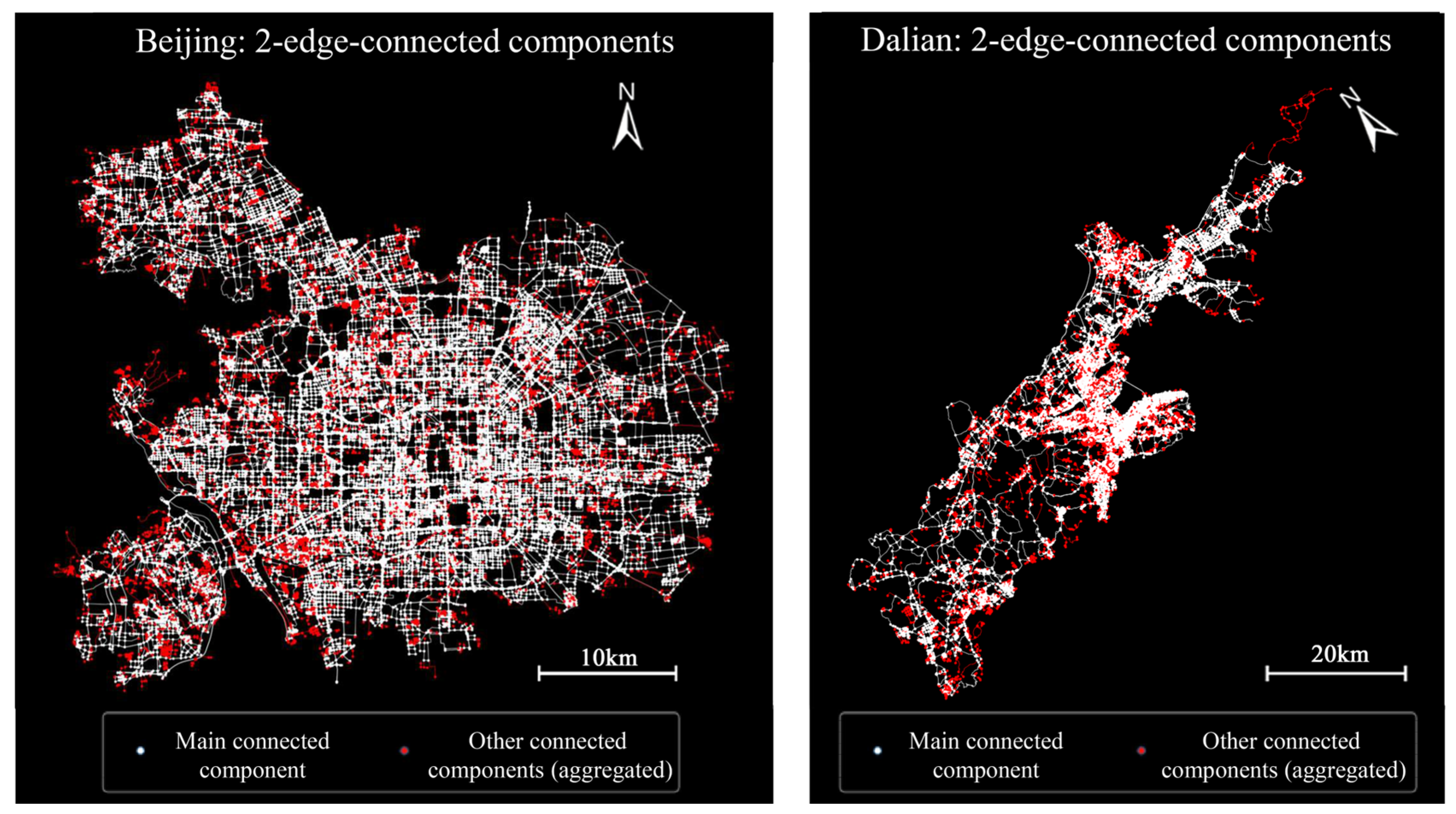
Figure 6 shows the partition of Beijing’s and Dalian’s URNs obtained using a 2-edge-connected component decomposition.
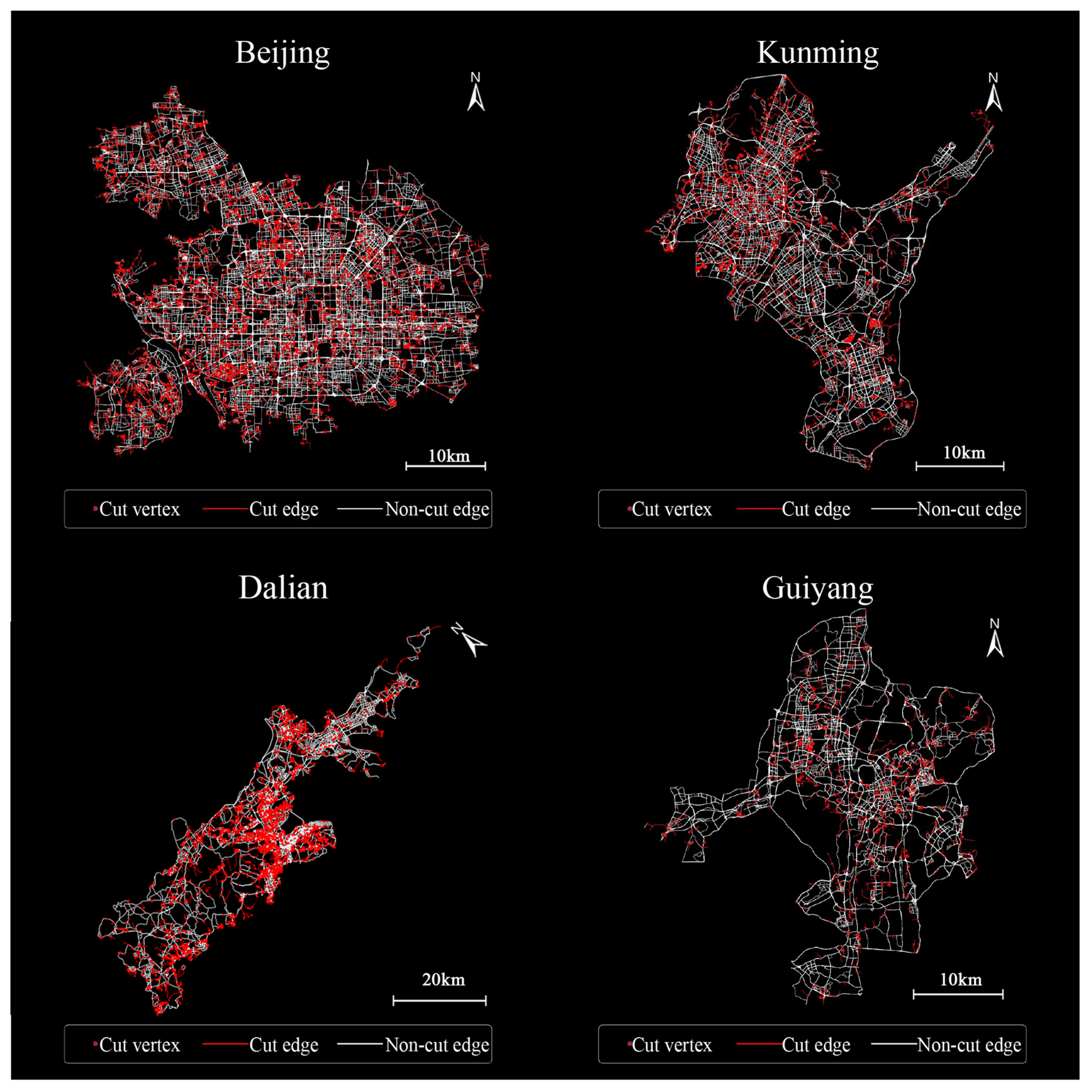
Figure 7 further reports articulation-based structural vulnerability (cut-edges and cut-vertices) as an additional static baseline (Beijing and Dalian panels), highlighting elements whose single removal would disconnect the network.
The comparison highlights two fundamental differences in vulnerability representation. First, both connected-component analysis and cut-edge/cut-vertex identification describe disconnection in a binary, topology-only manner, without conditioning on spatial service-area thresholds; therefore, their outputs cannot be directly aligned with the island-area criteria required by LID-based facility-coverage requirements. Second, these static baselines do not encode disruption intensity or disconnection likelihood. While they identify whether a separation can occur under the removal of specific elements, they do not indicate how likely localized islands emerge under different degrees of network degradation. In contrast, the LID-based results quantify threshold-conditioned islanding risk via edge-removal ratios aggregated across repeated simulations, enabling risk-differentiated mapping that is not derivable from purely static partitions or articulation elements.
Accordingly,
Figure 6 and
Figure 7 serve as minimal structural references that contextualize what purely topological, single-state methods can reveal about LID, and what remains unresolved without a LID framework explicitly conditioned on both network degradation intensity and service-area thresholds.
3.3.2. Comparison for GSF Contextualization
Articulation-based structural vulnerability analysis, based on static cut-edge and cut-vertex identification (
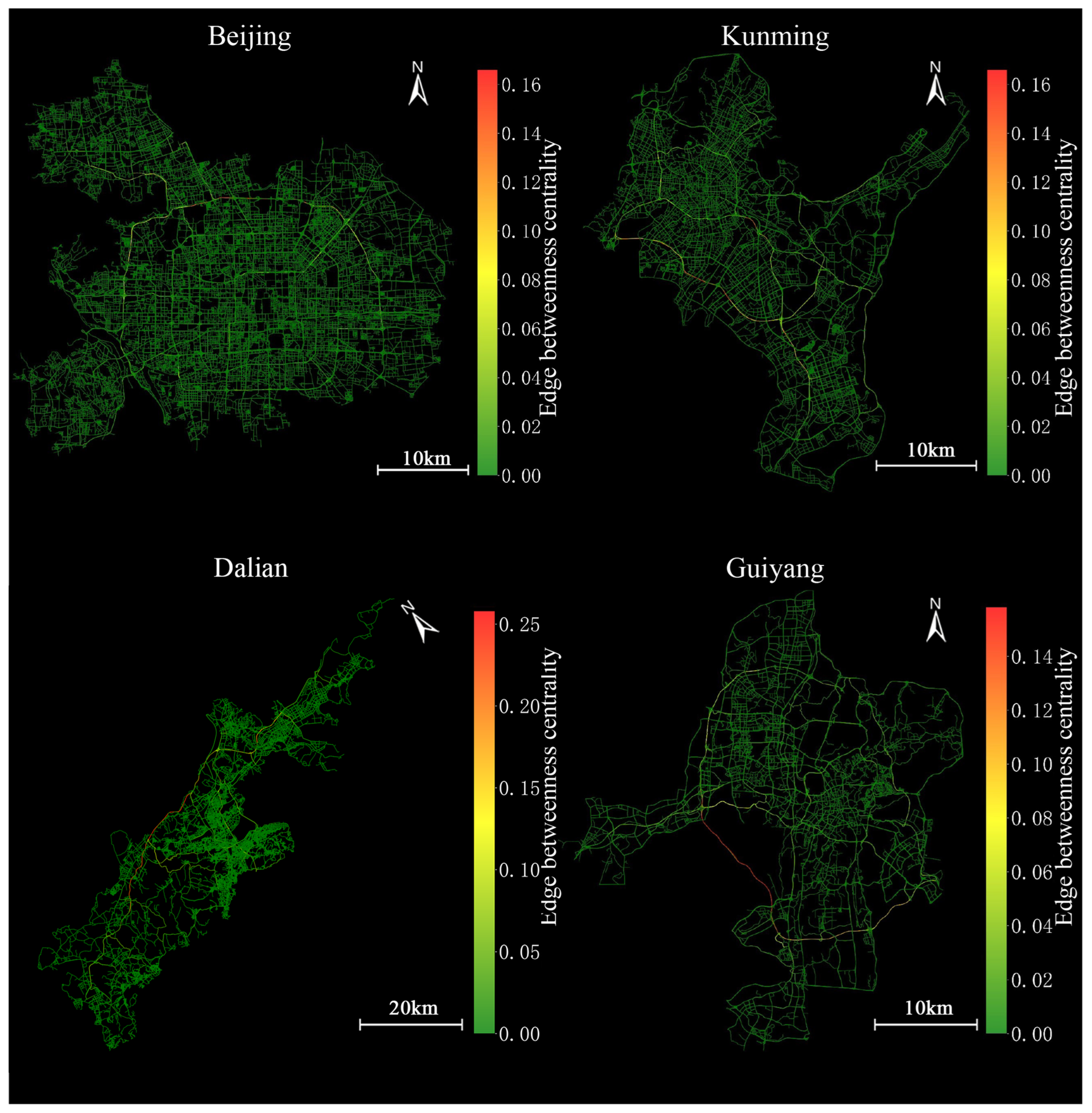
Figure 7), directly identifies edges or nodes whose removal leads to topological disconnection. Edge betweenness centrality (
Figure 8), by contrast, evaluates flow-oriented importance by quantifying the concentration of shortest-path traffic on individual edges. Although these two approaches capture different aspects of network sensitivity, their outputs remain localized, highlighting isolated critical elements rather than resolving large-scale block-level fragmentation or spatial configurations of connectivity vulnerability under the GSF pattern.
Static community detection algorithms (
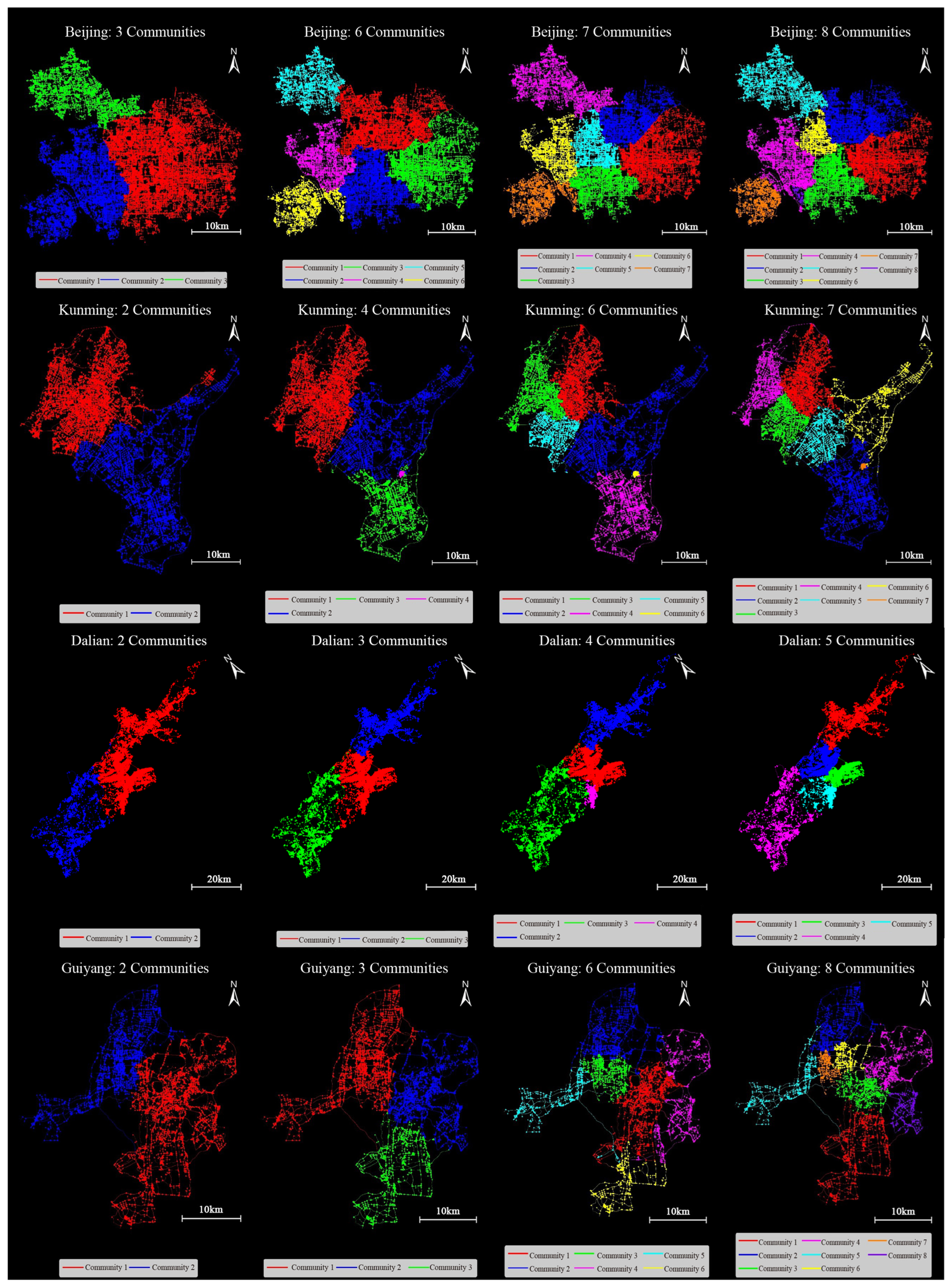
Figure 9) partition the network into clusters based on topological similarity. However, the resulting partitions are highly sensitive to resolution parameters and lack a degradation-based criterion, making it difficult to distinguish stable fragmentation structures from algorithm-dependent artifacts.
Across these static approaches, none provide an explicit basis for distinguishing the node-level structural roles that underpin the GSF pattern, such as stable blocks, contested nodes, fragmented nodes, or robust seeds. Moreover, because all three methods are defined on a single, fixed network realization, they do not characterize how block-level fragmentation configurations vary across different degrees of network degradation. Consequently, while these static analyses reveal important local sensitivities or algorithm-dependent partitions, they do not resolve degradation-conditioned fragmentation structures that are relevant to representing realistic network disconnection patterns.
4. Discussion
4.1. Empirical Evaluation of the Disconnection-Pattern-Based (DPB) Approach
The empirical results indicate that the DPB approach is able to identify city-specific vulnerability configurations under progressive network degradation. Across cities with contrasting morphologies, LID and GSF mapping reveal differentiated spatial patterns of connectivity loss that are not captured by aggregate robustness metrics. In grid-like contexts such as Beijing, degradation-induced isolation remains relatively dispersed and requires higher disruption levels to produce pronounced fragmentation. In contrast, terrain-constrained cities such as Dalian exhibit earlier and spatially clustered island formation, reflecting uneven structural redundancy embedded in the network morphology. These findings suggest that vulnerability reorganizes spatially in morphology-conditioned ways under progressive degradation, rather than being adequately represented by uniform or aggregate descriptors.
Compared with conventional single-state network measures, the DPB approach provides analytical information that static diagnostics cannot deliver. Indicators such as betweenness centrality or articulation-based measures identify structurally important elements under a fixed network realization, yet they do not reveal how spatial accessibility reorganizes as degradation progresses. By tracing the emergence of threshold-conditioned isolation and block-level fragmentation, the DPB approach captures spatial vulnerability configurations that complement traditional structural importance analysis. This empirical contrast supports the added analytical value of the DPB approach in configuration-oriented vulnerability assessment.
4.2. Configuration Stability Under Parameter Variation
Although the DPB framework involves parameter choices in both LID and GSF identification, it is important to clarify how parameter variation influences configuration delineation and under what conditions the identified vulnerability configurations remain structurally coherent.
For the LID mapping, sensitivity primarily relates to the island-area threshold used to define service-scale isolation. Increasing this threshold mechanically expands the spatial footprint of high-risk zones and shifts onset values toward earlier degradation levels. Parameter variation therefore directly affects the absolute extent and numerical expression of isolation risk. However, comparison across alternative island-area thresholds suggests that the relative spatial differentiation of vulnerability is largely preserved: areas exhibiting earlier-onset isolation under stricter thresholds tend to remain comparatively more vulnerable under relaxed thresholds. In this sense, threshold variation adjusts risk stringency rather than fundamentally reshuffling the spatial ordering of vulnerability. The percentile summary adopted in this study (P25) represents a conservative interpretation aligned with emergency-planning contexts; alternative percentile choices primarily recalibrate risk tolerance rather than altering the clustering tendency observed in the examined cases.
For the GSF mapping, sensitivity arises mainly from the community-detection resolution parameter and the contested-node threshold governing affiliation instability. Adjusting these settings can widen or narrow contested-node belts and refine stable-block boundaries. In the more redundant urban networks examined, such changes primarily affect boundary granularity, while the identification of stable blocks, fragmented-node regions, and robust seeds remains broadly consistent. In contrast, in structurally fragile, low-redundancy configurations (e.g., corridor-dominated networks effectively supported by only one or two trunk routes), the spatial extent of delineated stable blocks becomes more sensitive to parameter choice. Notably, such sensitivity is typically accompanied by low GSF onset levels, reflecting that large-scale fragmentation can occur under limited degradation. Under these conditions, the principal resilience challenge lies less in precise block delineation and more in addressing intrinsic structural fragility through redundancy enhancement or alternative resilience strategies.
Taken together, parameter variation primarily influences delineation granularity and risk stringency, while the core configuration elements—stable blocks, fragmented-node zones, and robust seeds—are largely governed by underlying network morphology. Sensitivity becomes most visible where structural redundancy is inherently low, underscoring that parameter effects are morphology-conditioned rather than arbitrary artifacts of the DPB framework.
4.3. From Connectivity Disconnection to Service Degradation Mechanisms
Although this study uses connectivity disconnection as a deliberately minimal structural observable, the LID and GSF configurations identified have direct implications for service degradation under disruption. Disconnection provides an unambiguous structural reference point for accessibility failure and thus clarifies how travel time, accessibility, and congestion may deteriorate as degradation unfolds.
Under LID conditions, localized components detach from the main network once disruption exceeds island-specific thresholds, producing abrupt reachability loss at the service scale implied by the island-area criterion. From a facility-planning perspective, this corresponds to a direct breakdown of intended service coverage: if a facility is located outside an LID high-risk zone, the isolated area becomes unreachable and coverage fails; if the facility is located within the zone, its service becomes effectively confined to the isolated component, and its planned cross-area reach cannot be maintained. LID therefore captures a binary coverage-failure mechanism under disruption, where service transitions from feasible to infeasible due to loss of reachability.
GSF reflects a qualitatively different fragmentation pattern. Rather than producing numerous small islands, the network reorganizes into multiple large-scale connectivity blocks that remain internally connected while losing network-wide connectivity. From a service-system perspective, this corresponds to segmentation of emergency coordination and allocation units at the subregional scale, because the connectivity domains that remain mutually reachable under disruption may no longer coincide with predefined emergency subregions, which are often delineated with reference to administrative divisions.
Emergency facility systems are typically hierarchical: lower-tier facilities rely on higher-tier strategic facilities (e.g., command centers, logistics depots, major medical hubs) for coordination, replenishment, and reinforcement. These dependencies are commonly operationalized through predefined emergency subregions and the implied functional service domains of strategic facilities. When GSF-induced connectivity blocks diverge from such planning subregions, the functional service domains embedded in the hierarchy no longer align with the connectivity domains that remain reachable under disruption. As a result, lower-tier facilities within a given connectivity block can lose operational linkage to the higher-tier facilities designated to support them.
Moreover, the GSF-based role typology further conditions system-level operability. If strategically critical facilities are located at nodes classified as fragmented or contested—rather than in robust-seed or stable-block nodes—fragmentation can more readily disrupt hierarchical coupling and compromise system-level operability. In such cases, degradation manifests not merely as accessibility discontinuity at block boundaries, but as hierarchical service breakdown driven by the loss of reachability that the emergency service chain implicitly relies on.
4.4. Integrating Vulnerability Configuration into Facility Location Decisions
The vulnerability configurations identified through LID and GSF mapping do not prescribe specific facility locations. Rather, they provide a structural conditioning layer that translates degradation-sensitive connectivity risks into planning-relevant inputs—shaping how coverage expectations are defined, how emergency subregions are organized, and how candidate sites are prioritized under network disruption.
This framework is particularly relevant for emergency and resilience-critical facilities whose functionality depends on sustained post-disruption reachability. By embedding LID/GSF outputs into facility planning logic, vulnerability configuration mapping establishes an explicit structural linkage between network degradation patterns and resilience-oriented siting decisions.
Two complementary integration dimensions are distinguished: incorporation within emergency planning frameworks and embedding within formal optimization-based location models.
4.4.1. Integration Within Emergency Planning Frameworks
In emergency planning practice, facility siting and response-area organization are typically embedded within broader strategic and institutional settings and are therefore not necessarily determined solely through formal optimization. Within such contexts, LID/GSF configurations can be used as structural reference layers that inform how coverage expectations, response zoning, and siting priorities should be interpreted under degradation-sensitive connectivity constraints.
LID mapping provides a coverage-conditioned diagnostic of localized isolation risk. For emergency facilities whose primary function is defined by service-area expectations—such as emergency shelters and fire stations—LID thresholds indicate where early-onset disconnection is likely to arise under disruption. Facilities intended to serve broader areas can therefore benefit from being sited in locations characterized by higher LID onset thresholds, as this improves the plausibility of maintaining cross-area reachability during degradation. Conversely, in spatially clustered high-risk LID zones, preparedness strategies may place greater emphasis on locally embedded facilities and resources at scales commensurate with anticipated island size, so that basic sheltering and support remain available when external access is interrupted. For micro-scale high-risk islands, distributed emergency supplies and basic medical resources may be pre-positioned through community-level outlets to mitigate the consequences of abrupt isolation. In this respect, LID configurations do not replace conventional coverage standards; rather, they provide an evidence base for spatially differentiating how such standards are operationalized under disruption.
GSF mapping complements this perspective by revealing stable connectivity blocks that persist under severe degradation. These blocks constitute degradation-persistent structural domains that can inform the delineation of emergency response subregions, thereby reducing the risk that administrative zoning becomes misaligned with post-fragmentation reachability. Within each stable block, robust-seed areas identify comparatively persistent core locations that can be treated as preferred candidates for anchoring strategically critical facilities such as command centers, major medical hubs, and logistics depots. Fragmented-node and contested-node zones, by contrast, indicate locations where inter-area reachability is structurally fragile under fragmentation; in such areas, reliance on facility placement alone is less likely to secure post-disruption accessibility, and planning may place greater emphasis on conservative coordination assumptions and supplementary preparedness arrangements.
Through these translation routes, DPB-derived vulnerability configurations are embedded as structural diagnostics to guide emergency facility siting and response zoning.
4.4.2. Model-Based Integration: Parameterization and Constraint Design
When formal optimization-based emergency facility-location models are employed, LID/GSF configurations can inform model specification through three complementary mechanisms.
- (1)
Threshold–Coverage Alignment under LID.
LID island-area thresholds operationalize the spatial scale at which isolation may emerge under degradation. These thresholds can be aligned with facility-specific coverage definitions (e.g., walkable shelter catchments). High-risk LID zones identified under service-relevant thresholds may be incorporated as prioritized coverage requirements—either as explicit constraints or weighted penalty terms—ensuring that siting decisions internalize degradation-conditioned accessibility loss rather than assuming uniform post-disruption reachability.
- (2)
Feasibility Diagnosis and Spatial Differentiation of Coverage Parameters.
The spatial extent and clustering of LID high-risk zones indicate whether homogeneous coverage parameters remain viable within a given urban road network under disruption. Where high-risk zones are limited and dispersed, uniform service parameters may be feasible. Where clustering is extensive, homogeneous coverage may imply disproportionate facility density or unstable coverage persistence.
Rather than fixing a single island-area threshold, multiple thresholds (km2) can be examined to evaluate the sensitivity of high-risk zones to alternative coverage sizes. Threshold ranges within which high-risk patterns change only modestly indicate relatively stable coverage levels, whereas rapid expansion of risk zones signals diminishing structural returns in isolation mitigation or coverage scales weakly supported by the network morphology. This sensitivity-based calibration provides an evidence-grounded basis for adjusting facility hierarchy and coverage parameters within location models.
- (3)
Candidate Prioritization and Structural Filtering under GSF.
GSF mapping identifies stable connectivity blocks and intra-block node roles across degradation realizations. Within facility-location models, robust-seed areas may be treated as preferred candidate sites—or assigned higher selection weights—for strategically critical facilities, reflecting their structural persistence under fragmentation. Fragmented-node zones, by contrast, indicate contexts in which facility placement alone may not ensure sustained post-disruption reachability, informing the specification of reachability-preserving constraints and inter-block redundancy requirements within model formulations.
Taken together, these model-conditioning logics enable vulnerability configurations to inform parameter calibration, constraint specification, and candidate prioritization without altering the mathematical structure of existing optimization formulations. The DPB-based mapping therefore complements, rather than replaces, conventional emergency facility-location models.
4.5. Toward a Configuration-Oriented Analytical Paradigm: Implications, Limitations, and Future Directions
Under stock-based urban development, resilience gains increasingly depend on adapting facility systems to degradation-conditioned accessibility constraints, rather than on large-scale road-network reconfiguration or segment-level engineering interventions. In this context, the present study adopts a configuration-oriented analytical approach and develops a disconnection-pattern-based (DPB) mapping framework as a deliberately minimal, topology-based entry point for vulnerability identification. Using LID and GSF as two complementary disconnection typologies, the empirical results across contrasting urban road-network morphologies demonstrate that degradation-conditioned vulnerability configurations can be systematically delineated, and that these configurations provide a decision-structuring basis for resilience-oriented facility planning (e.g., coverage conditioning under LID and block-consistent zoning/anchoring logic under GSF) beyond what conventional single-state diagnostics can reveal.
At the same time, this feasibility-oriented implementation is intentionally constrained: disruption is represented stochastically rather than by hazard mechanisms, vulnerability is characterized by connectivity loss rather than performance degradation, and the analysis focuses on a single network layer. These constraints limit immediate operational deployment in hazard-specific or performance-sensitive planning tasks, while also clarifying a coherent pathway for advancing configuration-oriented vulnerability analysis toward broader planning integration.
4.5.1. Toward Hazard-Specific Vulnerability Representation
This study is designed as an initial feasibility test of a configuration-oriented vulnerability mapping approach, aimed at delineating spatial vulnerability configurations relevant to resilience-oriented facility planning, rather than reproducing hazard-specific disruption processes. Network disruption are therefore represented stochastically, operationalized via length-weighted random edge removal. This abstraction prioritizes whether the approach can generate spatial delineations that are relevant for resilience-oriented planning across different urban contexts, rather than reproducing the mechanisms of specific hazard processes. For applications that require resource prioritization against locally recurrent or high-impact hazards, future work should couple the mapping framework with hazard-specific damage scenarios and spatially explicit exposure processes.
4.5.2. Extending from Disconnection to Performance-Based Vulnerability
The current study adopts connectivity disconnection as a deliberately minimal structural entry point to demonstrate the feasibility of configuration-oriented vulnerability mapping. While disconnection provides a clear and implementation-neutral observable, it represents an extreme (boundary) case of performance degradation. For planning tasks that require closer correspondence with service processes, the same configuration-oriented logic can be extended to performance-based vulnerability measures—such as travel-time inflation, generalized service cost increases, or congestion-induced accessibility loss—under moderate disturbance intensities. Such extensions would allow vulnerability configurations to be expressed in terms of facility-relevant service mechanisms, moving beyond disconnection-focused assessment toward a broader representation of service-performance risk.
4.5.3. Scaling the Spatially Oriented Configuration-Oriented Approach to Multi-Layer Transport Systems
This study treats the URN as an initial focus for configuration-oriented vulnerability mapping. A further direction is to extend the spatially oriented configuration-oriented logic to multi-layer urban transport systems that combine roads with rail-based transit and water-based transport. Achieving this requires explicit modeling of inter-layer interactions and transfer constraints so that vulnerability configurations can be mapped at the system level rather than within a single network layer. Such developments would strengthen the applicability of configuration-oriented vulnerability mapping for resilience-oriented facility planning under multi-modal accessibility conditions.
5. Conclusions
In the context of stock-based urban development, enhancing urban resilience increasingly relies on strategies that go beyond large-scale physical network reconfiguration and segment-level engineering. To support such strategies, this study advances a spatial configuration-oriented perspective on urban road network connectivity vulnerability, shifting attention from aggregate robustness indicators and critical-element identification to the spatial configuration of vulnerability under disruption.
Specifically, two complementary mapping methods—Local Island Disconnection (LID) and Global Structural Fragmentation (GSF)—were developed and applied to capture distinct but interrelated disconnection patterns. Across cities with contrasting network morphologies, the results show that spatial configurations of connectivity vulnerability can be systematically identified in a consistent and spatially explicit manner. Taken together, these findings demonstrate that degradation-conditioned spatial configurations of vulnerability can be systematically delineated across contrasting urban morphologies and translated into operationally interpretable inputs for resilience-oriented facility planning.
Beyond methodological contributions, the study illustrates how vulnerability-configuration mapping can bridge road-network analysis and resilience-oriented planning. By explicitly identifying where and how likely connectivity degradation is to occur under disruption, the proposed approach provides a spatially grounded basis for facility siting and service-allocation decisions, reducing reliance on spatially uniform accessibility assumptions or network-wide upgrading as the primary means of risk mitigation. In this sense, configuration-oriented vulnerability mapping reframes URN resilience assessment from aggregate robustness evaluation toward degradation-conditioned spatial structuring of planning constraints.
While the applicability of the LID- and GSF-based methods was empirically demonstrated, the proposed spatially oriented configuration-oriented approach represents an initial step that requires further extension toward hazard-specific scenarios, performance-based vulnerability measures, and integrated multi-network systems to support operational decision-making.
Overall, this study advances a configuration-oriented analytical framework for URN resilience by demonstrating how degradation-conditioned spatial configurations of vulnerability can inform facility-planning strategies that adapt to existing road-network vulnerability configurations under stock-based development.