An Analysis of the Structural Traits and Drivers of Virtual Land Trade Networks Within the G20 Countries


Abstract
1. Introduction
2. Materials and Methods
2.1. Research Method
2.1.1. Virtual Land Accounting Method
2.1.2. Virtual Land Trade Network for Grain Products
2.1.3. Network Structural Indicators for Virtual Land Trade in Grain Products
2.1.4. Exponential Random Graph Model
2.2. Data and Sources
3. Results
3.1. Analysis of Virtual Land Area in the Grain Trade
3.1.1. Analysis of Annual Average Virtual Land Area in the Grain Trade
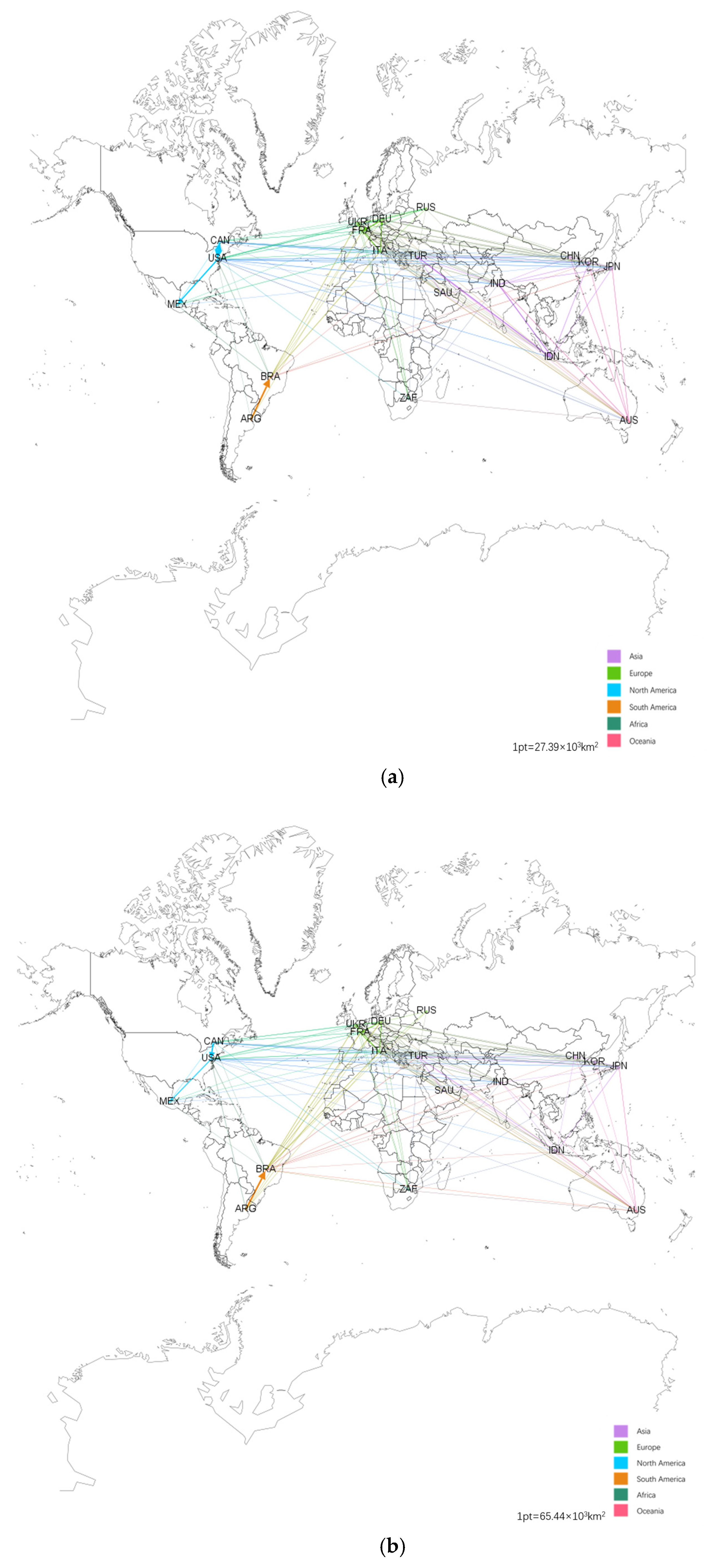
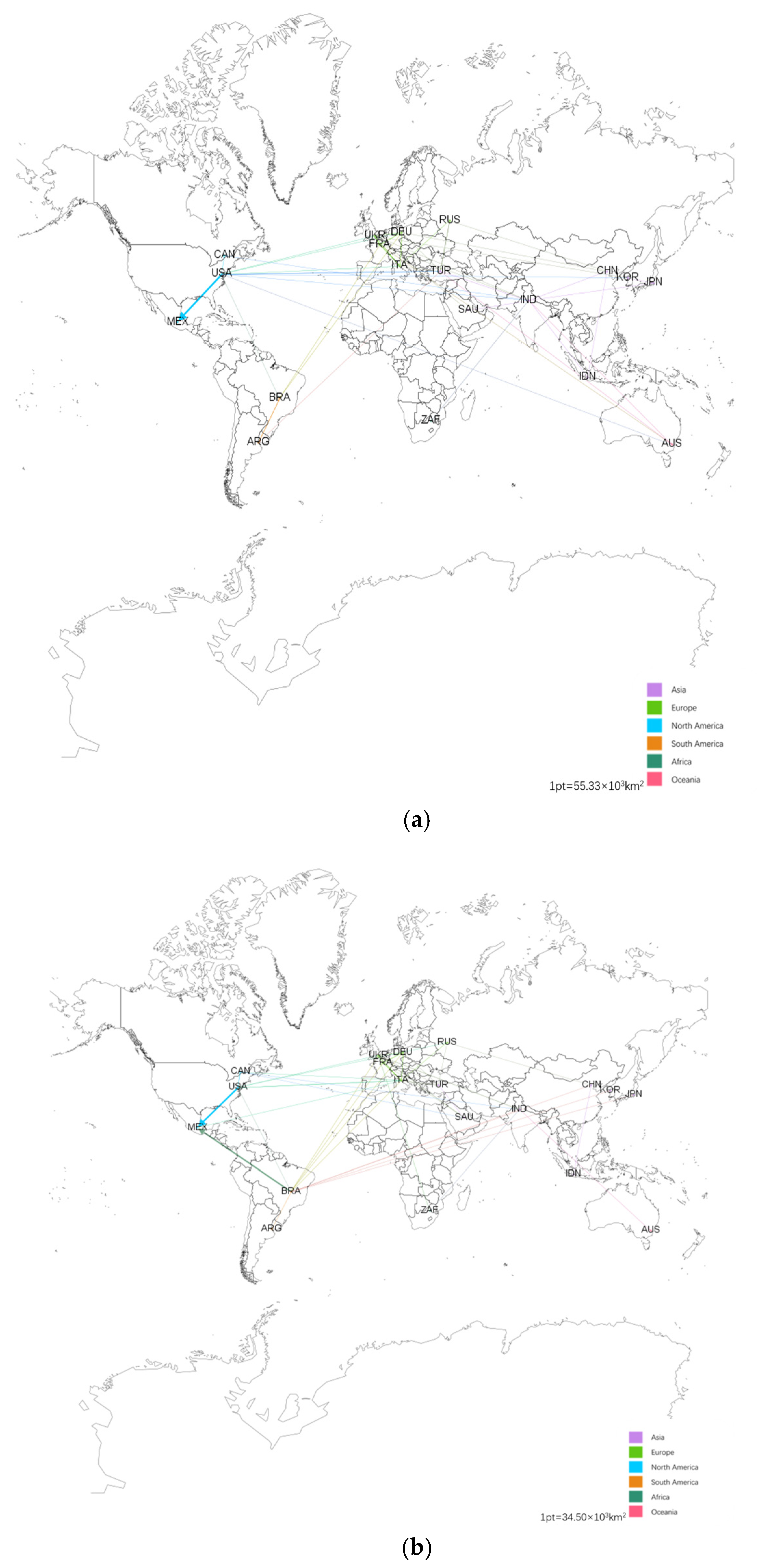
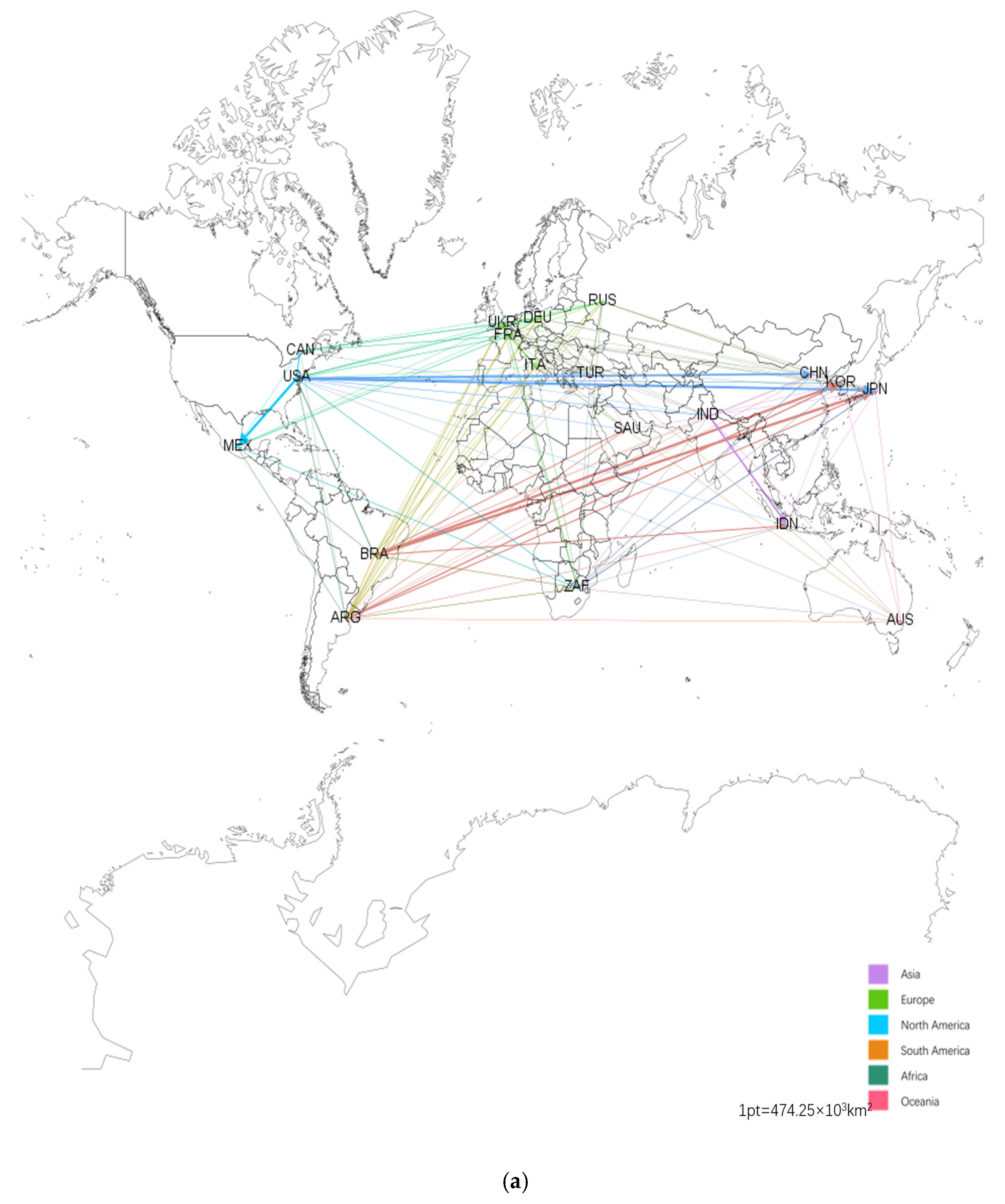
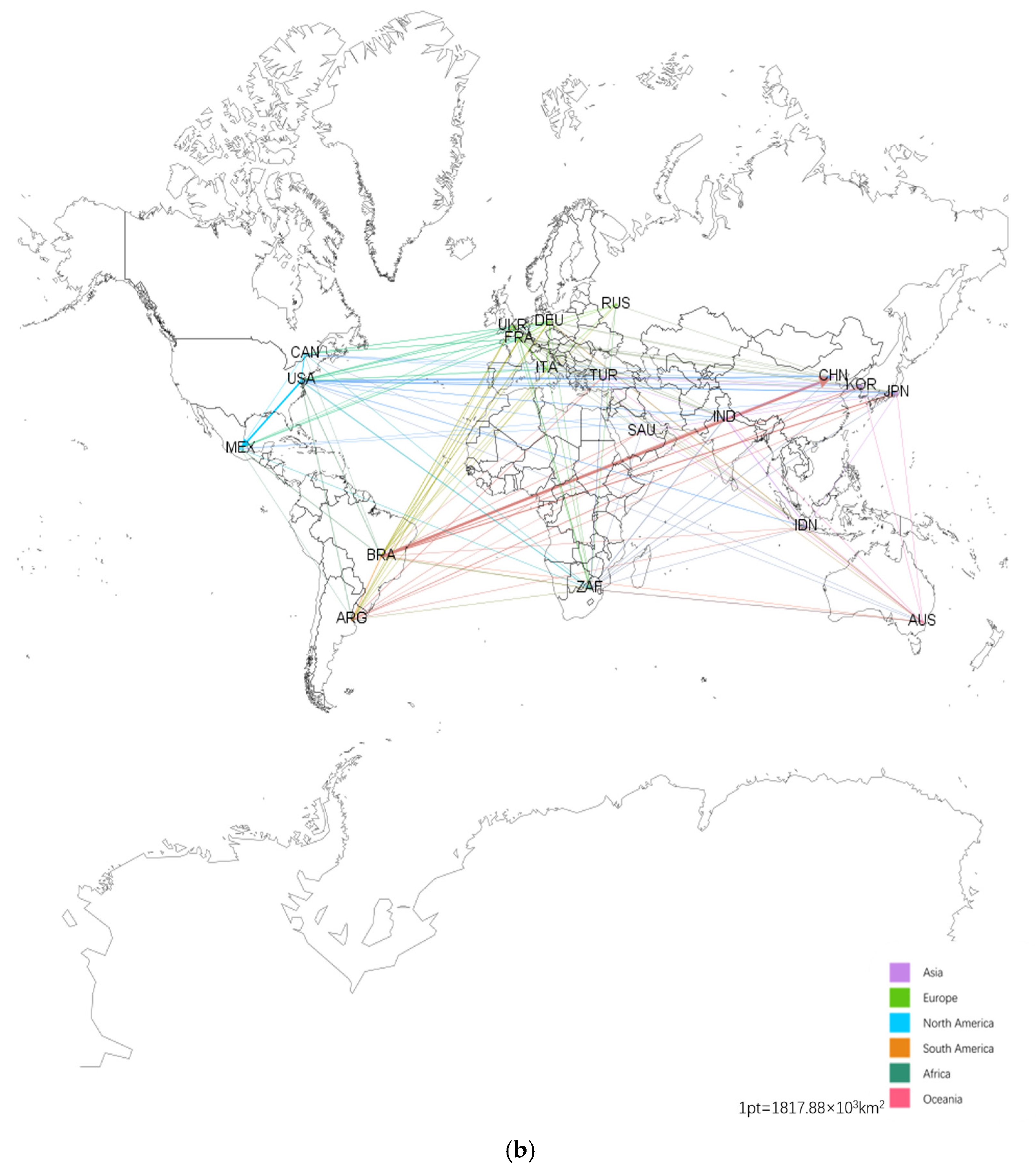
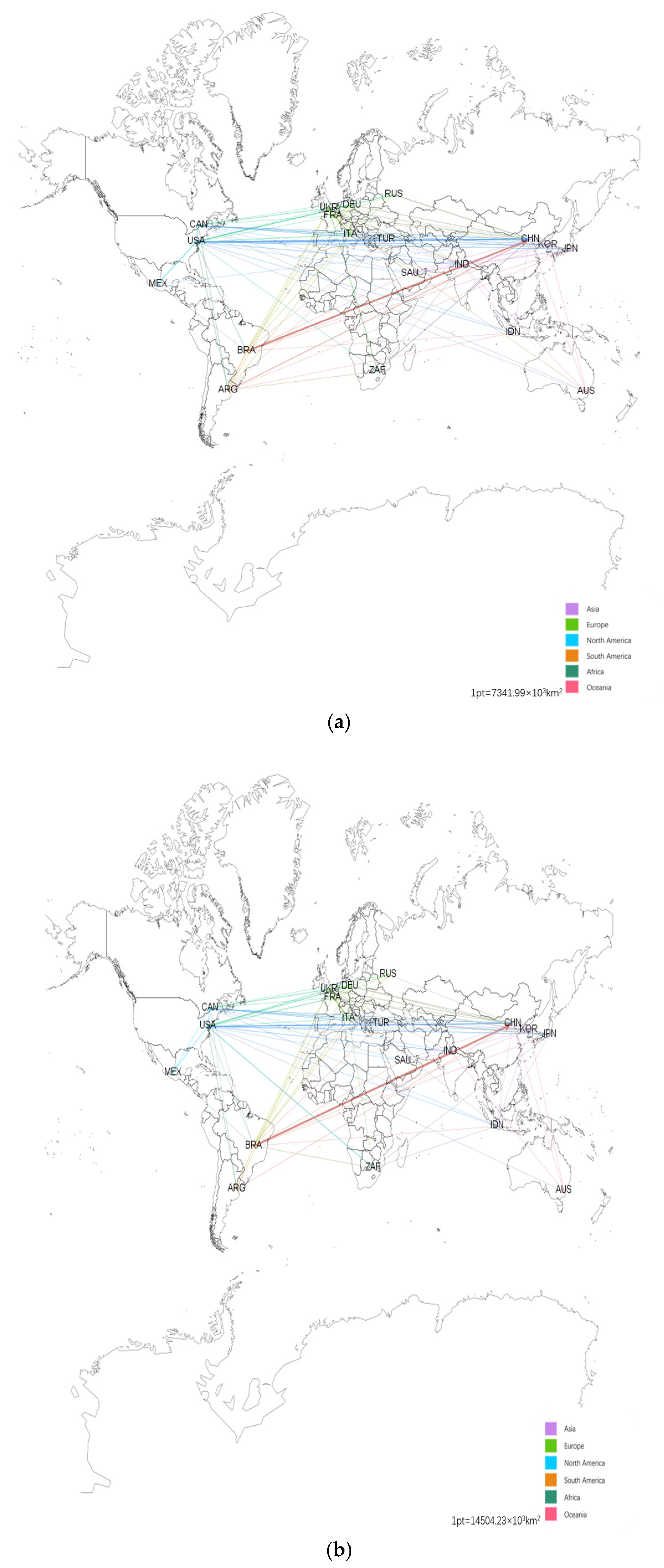
3.1.2. Analysis of Virtual Land Trading Pattern of Grain Products
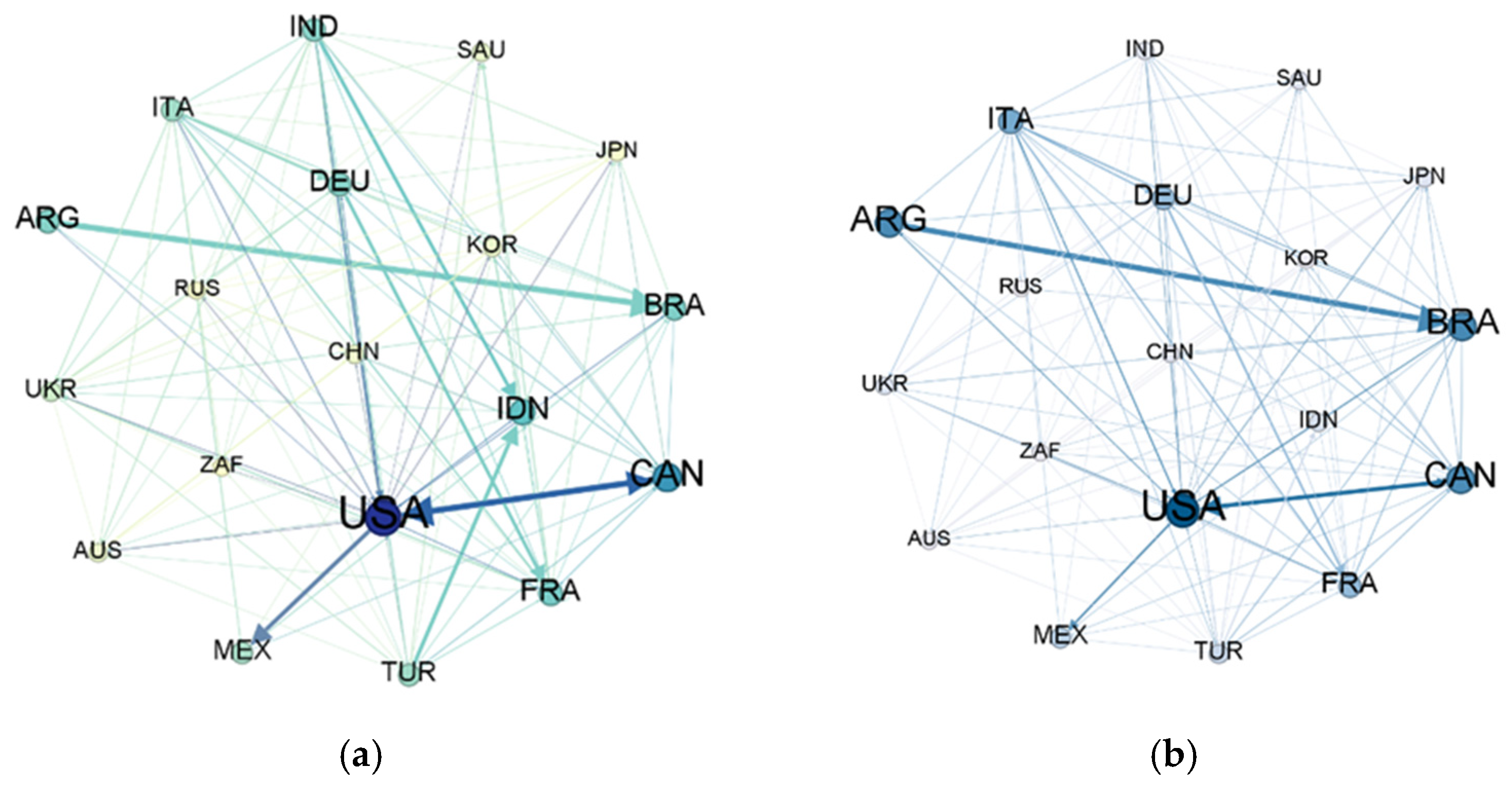
3.2. Analysis of Virtual Land Trade Network of Grain Products
3.2.1. Comprehensive Assessment of Virtual Land Trade Networks
3.2.2. Individual Characteristics of Virtual Land Trading Network
3.3. Research on Influencing Factors: Exponential Random Graph Model
3.3.1. Role of Endogenous Network Structure
3.3.2. Role of Exogenous Node Attributes
3.3.3. Analysis of Empirical Results
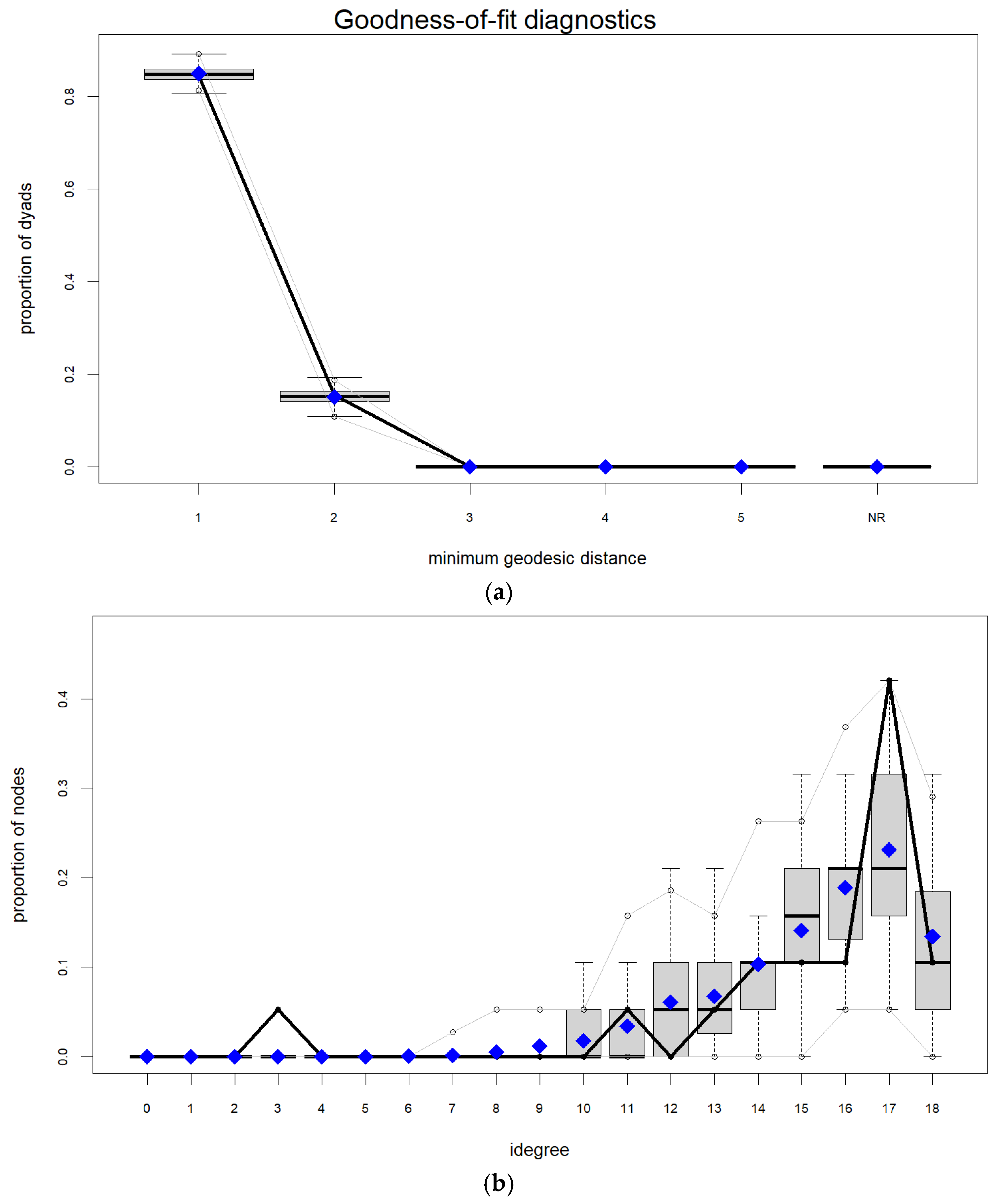
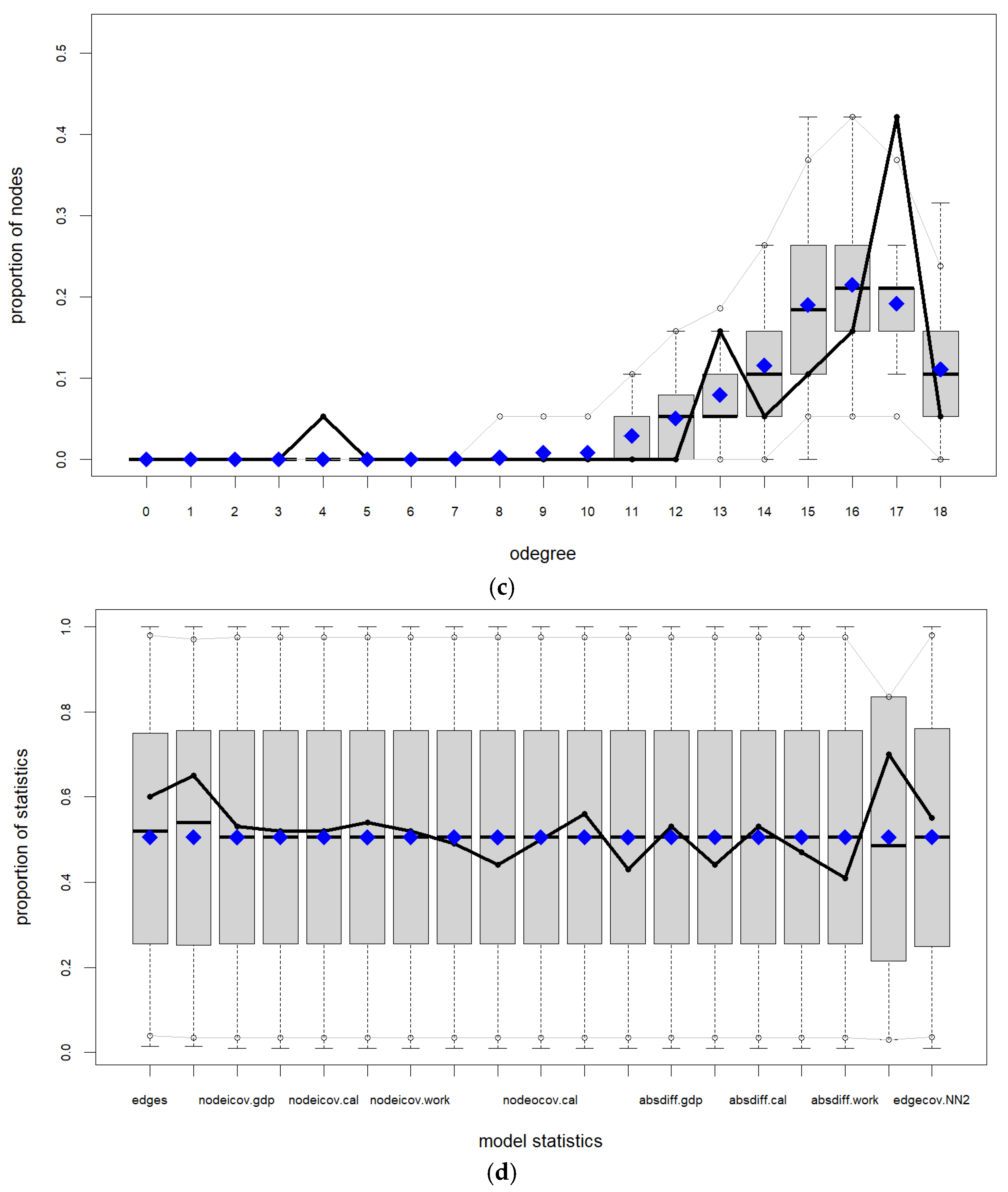
3.3.4. Goodness of Fit Diagnosis
3.4. Dual Heterogeneity Analysis of Country and Grain Types
3.4.1. Country Differentiation in Food Grain Networks
3.4.2. Core-Periphery Structure in Feed Grain Networks
4. Discussion
4.1. Comparison with Existing Literature
4.2. Normative Significance: Efficiency, Fairness and Risk
5. Conclusions and Suggestions
5.1. Main Findings
- Virtual land trade is essentially a redistribution mechanism of land use pressure, not just the flow of food. The United States and Brazil dominate the export of virtual land, while China, Japan and Germany are the main importers. This finding reflects the global division of labor in land use: land-rich countries with high PCAL export virtual land, while land-scarce, labor-scarce or high-income countries import virtual land. The virtual land perspective reveals the problems covered by the volume of physical trade. Argentina’s central position in the corn network has improved. Although it is not the largest physical exporter, it reflects its low production, so the content of land per ton is high.
- The formation of network is driven by exogenous economic factors and endogenous relations. While GDP and population size have positive effects on export and import propensity, which confirms the role of economic scale and consumer demand. Reciprocity is significantly positive at the 1% level, indicating that virtual land trade is self-organized. Trade relations have a reverse relationship, indicating that trust, familiarity with logistics, institutional linkages and resource flows develop together. This kind of endogenous dynamics that cannot be observed in the gravity model means that once established, the bilateral trade dependency will strengthen itself and form the path dependency of the long-term resource allocation model.
- The role of the state in the network is not single and unchanged, but changes systematically with food types and development stages. Developed countries are mainly the recipients of virtual land (Japan, Germany) or two-way participants (the United States, Canada), while developing countries are divided into senders (Brazil, Argentina) and recipients (China, Mexico), reflecting the differentiated positioning of countries based on resource endowment and food security strategies. The grain ration trade is strongly constrained by the food security policy, the network pattern is relatively stable, and the control power of the main producing countries continues. Feed grain trade is driven by market mechanism, with higher network density and closer trade links, and the status of emerging market countries has increased significantly. The intermediary centrality of major producing countries in the network reflects their key role in the redistribution of global land resources.
5.2. Policy Implications
5.3. Limitations and Future Research
Author Contributions
Funding
Data Availability Statement
Conflicts of Interest
Appendix A


References
- FAO. World Food and Agriculture Statistical Yearbook 2023; FAO: Rome, Italy, 2023. [Google Scholar] [CrossRef]
- Chen, Y.M.; Li, X.; Liu, X.P.; Zhang, Y.Y.; Huang, M. Quantifying the teleconnections between local consumption and domestic land uses in China. Landsc. Urban Plan. 2019, 187, 60–69. [Google Scholar] [CrossRef]
- Luo, L.; Xing, Z.C.; Chu, B.W.; Zhang, H.B.; Wang, H.K. Virtual land trade and associated risks to food security in China. Environ. Impact Assess. Rev. 2024, 106, 107461. [Google Scholar] [CrossRef]
- Qiang, W.L.; Niu, S.W.; Liu, A.M.; Thomas, K.; Qiang, B.; Wang, X.; Cheng, S.K. Trends in global virtual land trade in relation to agricultural products. Land Use Policy 2020, 92, 104439. [Google Scholar] [CrossRef]
- O’Brien, M.; Schütz, H.; Bringezu, S. The land footprint of the EU bioeconomy: Monitoring tools, gaps and needs. Land Use Policy 2015, 47, 235–246. [Google Scholar] [CrossRef]
- Tamea, S.; Carr, J.A.; Laio, F.; Ridolfi, L. Drivers of the virtual water trade. Water Resour. Res. 2014, 50, 17–28. [Google Scholar] [CrossRef]
- Meyfroidt, P.; Lambin, E.F.; Erb, K.H. Globalization of land use: Distant drivers of land change and geographic displacement of land use. Curr. Opin. Environ. Sustain. 2013, 5, 438–444. [Google Scholar] [CrossRef]
- Vivanco, D.F.; Sprecher, B.; Hertwich, E. Scarcity-weighted global land and metal footprints. Ecol. Indic. 2017, 83, 323–327. [Google Scholar] [CrossRef]
- Weinzettel, J.; Hertwich, E.G.; Peters, G.P.; Steen-Olsen, K.; Galli, A. Affluence drives the global displacement of land use. Glob. Environ. Change Hum. Policy Dimens. 2013, 23, 433–438. [Google Scholar] [CrossRef]
- Han, M.Y.; Chen, G.Q. Global arable land transfers embodied in Mainland China’s foreign trade. Land Use Policy 2018, 70, 521–534. [Google Scholar] [CrossRef]
- Chen, G.Q.; Han, M.Y. Virtual land use change in China 2002-2010: Internal transition and trade imbalance. Land Use Policy 2015, 47, 55–65. [Google Scholar] [CrossRef]
- Bosire, C.K.; Krol, M.S.; Mekonnen, M.M.; Joseph, O.O.; Jande, L.; Mats, L.; Arjen, Y.H. Meat and milk production scenarios and the associated land footprint in Kenya. Agric. Syst. 2016, 145, 64–75. [Google Scholar] [CrossRef]
- Khoo, H.H. Review of bio-conversion pathways of lignocellulose-to-ethanol: Sustainability assessment based on land footprint projections. Renew. Sustain. Energy Rev. 2015, 46, 100–119. [Google Scholar] [CrossRef]
- Taherzadeh, O.; Caro, D. Drivers of water and land use embodied in international soybean trade. J. Clean. Prod. 2019, 223, 83–93. [Google Scholar] [CrossRef]
- Zhou, M.; Wang, J.; Ji, H. Virtual Land and Water Flows and Driving Factors Related to Livestock Products Trade in China. Land 2023, 12, 1493. [Google Scholar] [CrossRef]
- Wang, Y.; Sheng, Y.; Li, L.; Song, T.; Han, H. Study on the Evaluation and Driving Factors of Interprovincial Virtual Cultivated Land Risk Transfer Under China’s Food Security Objective. Land 2026, 15, 16. [Google Scholar] [CrossRef]
- Cao, C.; Xie, W.B.; Yuan, G.J. Evaluation of Factors Influencing International Trade of China’s Grain Virtual Farmland Resources. Technol. Rev. 2023, 41, 127–137. (In Chinese) [Google Scholar]
- Qiang, W.L.; Liu, A.M.; Cheng, S.K.; Thomas, K.; Xie, G.D. Agricultural trade and virtual land use: The case of China’s crop trade. Land Use Policy 2013, 33, 141–150. [Google Scholar] [CrossRef]
- Wang, K.; Wu, W.; Jabbar, A.; Wolde, Z.; Ou, M. Dynamic Evolution and Spatial Convergence of the Virtual Cultivated Land Flow Intensity in China. Int. J. Environ. Res. Public Health 2021, 18, 7164. [Google Scholar] [CrossRef]
- Jiang, L.J.; Hu, B.C. Calculation and structural adjustment analysis of virtual soil content in international trade of Chinese agricultural products: Based on the perspective of food security. Ecol. Econ. 2021, 37, 96–103+110. (In Chinese) [Google Scholar]
- Guan, J.; Song, Z.; Liu, W. Analysis of the Evolution and Driving Factors of Global Grain Trade Network. Prog. Geogr. Sci. 2022, 41, 755769. [Google Scholar]
- Wasserman, S.; Faust, K. Social Network Analysis: Methods and Applications; Cambridge University Press: Cambridge, UK, 1994. [Google Scholar]
- Lusher, D.; Koskinen, J.; Robins, G. Exponential Random Graph Models for Social Networks: Theory, Methods, and Applications. Bull. Sociol. Methodol./Bull. Méthodologie Sociol. 2012, 123, 80–87. [Google Scholar]
- Herman, P.R. Identifying Multilateral Dependencies in the World Trade Network; U.S. International Trade Commission: Washington, DC, USA, 2017.
- Robins, G.; Pattison, P.; Kalish, Y.; Dean, L. An introduction to exponential random graph(p*) models for social networks. Soc. Netw. 2006, 29, 173–191. [Google Scholar] [CrossRef]
- Odin, B.; Nohrstedt, D. Formation and performance of collaborative disaster management networks: Evidence from a Swedish wildfire response. Glob. Environ. Change 2016, 41, 183–194. [Google Scholar]
- Williams, N.; Hristov, D. An examination of DMO network identity using exponential random graph models. Tour. Manag. 2017, 68, 177–186. [Google Scholar] [CrossRef]
- Chaney, T. The network structure of international trade. Am. Econ. Rev. 2014, 104, 3600–3634. [Google Scholar] [CrossRef]
- Ye, W.; Li, Z. Will the Grain Imports Competition Effect Reverse Land Green Efficiency of Grain Production? Analysis Based on Virtual Land Trade Perspective. Agriculture 2023, 13, 2220. [Google Scholar] [CrossRef]
- Thomas, K.; Karl-Heinz, E.; Helmut, H. Rapid growth in agricultural trade: Effects on global area efficiency and the role of management. Environ. Res. Lett. 2014, 9, 034015. [Google Scholar] [CrossRef]
- Christian, D.; Alf, H.; David, J.; Henrikvon, W.; Anke, S.; Stefan, G.; John-Oliver, E.; Robert, L.F.; Klaus, H.; Hanspeter, W. Global patterns of ecologically unequal exchange: Implications for sustainability in the 21st century. Ecol. Econ. 2021, 179, 106824. [Google Scholar] [CrossRef]
- Yu, Y.; Feng, K.; Klaus, H. Tele-connecting local consumption to global land use. Glob. Environ. Change 2013, 23, 1178–1186. [Google Scholar] [CrossRef]
- Michael, J.P.; Satyajit, B.; So, Y.C.; Benjamin, I.C. Assessing the evolving fragility of the global food system. Environ. Res. Lett. 2015, 10, 024007. [Google Scholar] [CrossRef]



| Category | Network Indicators | Explanation |
|---|---|---|
| Overall network indicators | Network density | The ratio of the actual number of edges in the network to the upper limit of the number of edges that can be accommodated |
| Degree center potential | Ratio of maximum degree to average degree in network | |
| Average degree | Average degree of all nodes in the network | |
| Average clustering coefficient | Usually the average of the clustering coefficients of all nodes | |
| Average path length | The average length of the minimal path between any two nodes |
| Variable Name | Variable Properties | Meaning |
|---|---|---|
| edges | Edge | The number of edges in the network reflects the network density |
| mutual | Reciprocity | Tendency of network nodes to link with each other |
| nodeicov.gdp | Sender | The impact of economic strength of nodes on the sending relationship in the network |
| nodeicov.pop | The influence of node population size on the outgoing relationship in the network | |
| nodeicov.cal | Influence of arable land area of nodes on emission relationship in network | |
| nodeicov.pcal | The impact of per capita arable land area of nodes on the emission relationship in the network | |
| nodeicov.work | The impact of labor resources of nodes on the outgoing relationship in the network | |
| nodeocov.gdp | Receiver | The impact of economic strength of nodes on the receiving relationship in the network |
| nodeocov.pop | Influence of node population size on receiving relationship in network | |
| nodeocov.cal | Influence of arable land area of node on receiving relationship in network | |
| nodeocov.pcal | Influence of per capita arable land area of node on receiving relationship in network | |
| nodeocov.work | The impact of labor resources of nodes on the receiving relationship in the network | |
| edgecov.NN1 | Language proximity | The influence of language proximity on the formation of virtual land trade network |
| edgecov.NN2 | Distance between countries | The influence of the distance between national capitals on the formation of virtual land trade network |
| Wheat virtual land exporter | Net exports | Wheat virtual land importer | Net imports |
| ARG | 0.92 | BRA | 2.10 |
| ITA | 0.43 | MEX | 0.26 |
| IND | 0.29 | FRA | 0.20 |
| TUR | 0.23 | IDN | 0.17 |
| Rice virtual land exporter | Net exports | Rice virtual land importer | Net imports |
| ZAF | 1.28 | MEX | 1.07 |
| USA | 0.80 | TUR | 0.12 |
| RUS | 0.10 | SAU | 0.07 |
| BRA | 0.10 | DEU | 0.01 |
| Corn virtual land exporter | Net exports | Corn virtual land importer | Net imports |
| USA | 32.15 | JPN | 55.78 |
| BRA | 17.72 | MEX | 38.22 |
| ARG | 8.55 | KOR | 16.63 |
| RUS | 3.95 | CHN | 9.32 |
| Exporter of soybean virtual land | Net exports | Soybean virtual land importer | Net imports |
| BRA | 182.04 | CHN | 453.37 |
| USA | 119.72 | MEX | 25.06 |
| ARG | 17.15 | JPN | 19.69 |
| CAN | 7.04 | IDN | 15.33 |
| Grain Type | Year | Network Density | Degree Center Potential | Average Degree | Average Clustering Coefficient | Average Path Length |
|---|---|---|---|---|---|---|
| Wheat | 2013 | 0.497 | 0.3529 | 8.947 | 0.642 | 1.484 |
| 2023 | 0.468 | 0.2476 | 8.421 | 0.666 | 1.469 | |
| Rice | 2013 | 0.146 | 0.2348 | 2.632 | 0.226 | 1.921 |
| 2023 | 0.143 | 0.3455 | 2.579 | 0.253 | 2.35 | |
| Corn | 2013 | 0.439 | 0.3417 | 7.895 | 0.552 | 1.595 |
| 2023 | 0.465 | 0.2476 | 8.368 | 0.579 | 1.458 | |
| Soybean | 2013 | 0.374 | 0.4779 | 6.737 | 0.539 | 1.682 |
| 2023 | 0.322 | 0.4505 | 5.789 | 0.514 | 1.672 |
| Grain Type | Year | Relative Centrality | |||||||||
|---|---|---|---|---|---|---|---|---|---|---|---|
| Wheat | in-degree | ||||||||||
| 2013 | USA | IDN | BRA | CAN | FRA | MEX | DEU | UKR | SAU | CHN | |
| 2023 | BRA | USA | FRA | MEX | CAN | DEU | IDN | UKR | SAU | CHN | |
| out-degree | |||||||||||
| 2013 | USA | CAN | IND | TUR | ITA | DEU | FRA | AUS | RUS | IDN | |
| 2023 | ARG | CAN | ITA | DEU | TUR | IND | JPN | FRA | MEX | UKR | |
| Rice | in-degree | ||||||||||
| 2013 | MEX | TUR | BRA | ZAF | ITA | FRA | CHN | IDN | SAU | USA | |
| 2023 | MEX | FRA | ITA | UKR | RUS | DEU | CAN | USA | BRA | IDN | |
| out-degree | |||||||||||
| 2013 | USA | RUS | IND | ARG | FRA | ITA | CHN | DEU | UKR | BRA | |
| 2023 | USA | BRA | ITA | FRA | SAU | DEU | CAN | TUR | UKR | CHN | |
| Corn | in-degree | ||||||||||
| 2013 | JPN | KOR | IDN | MEX | CHN | USA | SAU | TUR | ITA | UKR | |
| 2023 | CHN | MEX | JPN | KOR | SAU | CAN | IDN | USA | ITA | UKR | |
| out-degree | |||||||||||
| 2013 | BRA | USA | ARG | IND | RUS | ZAF | FRA | CAN | DEU | AUS | |
| 2023 | BRA | USA | ARG | ZAF | CAN | FRA | TUR | DEU | AUS | MEX | |
| Soybean | in-degree | ||||||||||
| 2013 | CHN | MEX | JPN | DEU | IDN | USA | KOR | ITA | UKR | SAU | |
| 2023 | CHN | MEX | ARG | JPN | DEU | ITA | IDN | TUR | KOR | RUS | |
| out-degree | |||||||||||
| 2013 | BRA | USA | ARG | CAN | IND | RUS | ITA | AUS | DEU | FRA | |
| 2023 | BRA | USA | ARG | CAN | CHN | TUR | IND | FRA | ITA | DEU | |
| Grain Type | Year | Intermediary Centrality | ||||
|---|---|---|---|---|---|---|
| Wheat | 2013 | USA | FRA | ITA | BRA | KOR |
| 12.792 | 9.442 | 6.458 | 3.868 | 3.274 | ||
| 2023 | FRA | ITA | BRA | USA | DEU | |
| 4.285 | 4.285 | 4.285 | 4.285 | 2.2 | ||
| Rice | 2013 | TUR | UKR | USA | IND | DEU |
| 9.7 | 8.917 | 8.838 | 8.576 | 7.031 | ||
| 2023 | BRA | IND | UKR | DEU | USA | |
| 21.442 | 13.537 | 12.536 | 9.38 | 7.852 | ||
| Corn | 2013 | ARG | USA | ZAF | BRA | IND |
| 7.008 | 7.008 | 4.802 | 4.078 | 3.615 | ||
| 2023 | BRA | ZAF | USA | FRA | DEU | |
| 3.558 | 3.558 | 3.558 | 2.913 | 2.027 | ||
| Soybean | 2013 | USA | CHN | CAN | BRA | IND |
| 16.483 | 12.912 | 7.366 | 7.299 | 6.886 | ||
| 2023 | USA | BRA | CHN | CAN | UKR | |
| 13.502 | 7.502 | 5.752 | 4.986 | 2.633 | ||
| Grain type | Year | Centrality of eigenvector | ||||
| Wheat | 2013 | USA | AUS | JPN | CHN | KOR |
| 1 | 0.928205 | 0.79255 | 0.792149 | 0.763876 | ||
| 2023 | BRA | FRA | USA | ITA | TUR | |
| 0.292 | 0.292 | 0.292 | 0.292 | 0.284 | ||
| Rice | 2013 | DEU | USA | UKR | ITA | TUR |
| 0.391 | 0.389 | 0.373 | 0.356 | 0.314 | ||
| 2023 | BRA | UKR | USA | DEU | ITA | |
| 0.388 | 0.348 | 0.335 | 0.31 | 0.308 | ||
| Corn | 2013 | ARG | USA | FRA | BRA | ZAF |
| 0.315 | 0.315 | 0.292 | 0.289 | 0.282 | ||
| 2023 | BRA | USA | ZAF | FRA | DEU | |
| 0.3 | 0.3 | 0.3 | 0.283 | 0.27 | ||
| Soybean | 2013 | USA | CHN | CAN | BRA | UKR |
| 0.341 | 0.303 | 0.3 | 0.28 | 0.279 | ||
| 2023 | USA | BRA | CAN | CHN | ITA | |
| 0.351 | 0.343 | 0.329 | 0.304 | 0.293 | ||
| Network Statistics | Model 1 | Model 2 | Model 3 | Model 4 | Model 5 |
|---|---|---|---|---|---|
| edges | 1.69422 *** | 0.73263 ** | −2.21857 *** | ||
| mutual | 2.31072 *** | 1.66632 ** | |||
| nodeicov.gdp | 17.98956 *** | 23.74397 *** | |||
| nodeicov.pop | 40.02059 * | 76.96755 ** | |||
| nodeicov.cal | −1.77723 | −3.86616 * | |||
| nodeicov.pcal | 1.30386 | 2.70538 * | |||
| nodeicov.work | −38.89923 | −73.43941 ** | |||
| nodeocov.gdp | 16.85255 *** | 21.91453 *** | |||
| nodeocov.pop | 42.85092 * | 82.31502 ** | |||
| nodeocov.cal | −1.02113 | −2.66600 | |||
| nodeocov.pcal | 0.93802 | 2.10366 | |||
| nodeocov.work | −43.34987 * | −81.53349 ** | |||
| absdiff.gdp | −15.45694 *** | −20.41380 *** | |||
| absdiff.pop | −33.99972 * | −71.53208 ** | |||
| absdiff.cal | −0.66924 | 0.33090 | |||
| absdiff.pcal | −0.24733 | 0.07474 | |||
| absdiff.work | 33.60258 | 70.16371 * | |||
| edgecov.NN1 | 2.54893 * | 1.51478 | |||
| edgecov.NN2 | 1.08095 *** | −0.83722 * | |||
| AIC | −176.59658 | −204.57366 | −202.85059 | −53.60870 | −220.19409 |
| BIC | −172.76177 | −200.73885 | −145.32843 | −45.93908 | −147.33269 |
| Log Likelihood | 89.29829 | 103.28683 | 116.42530 | 28.80435 | 129.09705 |
Disclaimer/Publisher’s Note: The statements, opinions and data contained in all publications are solely those of the individual author(s) and contributor(s) and not of MDPI and/or the editor(s). MDPI and/or the editor(s) disclaim responsibility for any injury to people or property resulting from any ideas, methods, instructions or products referred to in the content. |
© 2026 by the authors. Licensee MDPI, Basel, Switzerland. This article is an open access article distributed under the terms and conditions of the Creative Commons Attribution (CC BY) license.
Share and Cite
Deng, G.; Wang, Y. An Analysis of the Structural Traits and Drivers of Virtual Land Trade Networks Within the G20 Countries. Land 2026, 15, 416. https://doi.org/10.3390/land15030416
Deng G, Wang Y. An Analysis of the Structural Traits and Drivers of Virtual Land Trade Networks Within the G20 Countries. Land. 2026; 15(3):416. https://doi.org/10.3390/land15030416
Chicago/Turabian StyleDeng, Guangyao, and Yansu Wang. 2026. "An Analysis of the Structural Traits and Drivers of Virtual Land Trade Networks Within the G20 Countries" Land 15, no. 3: 416. https://doi.org/10.3390/land15030416
APA StyleDeng, G., & Wang, Y. (2026). An Analysis of the Structural Traits and Drivers of Virtual Land Trade Networks Within the G20 Countries. Land, 15(3), 416. https://doi.org/10.3390/land15030416