Article

Synergistic Optimization of Land Use and Ecosystem Services in Arid Regions: Scenario Simulation of the Hexi Corridor Based on the PLUS Model

1
School of Information Science and Technology, Gansu Agricultural University, Lanzhou 730070, China
2
School of Finance and Economics, Gansu Agricultural University, Lanzhou 730070, China
*
Author to whom correspondence should be addressed.
Land 2026, 15(3), 414; https://doi.org/10.3390/land15030414
Submission received: 22 January 2026 / Revised: 24 February 2026 / Accepted: 28 February 2026 / Published: 3 March 2026

Abstract

Arid ecological transition zones are highly sensitive to climate change and human activities, but land use optimization strategies for them often lack policy-oriented quantitative analysis. This study uses the Hexi Corridor in China as a case study, integrating multi-level policy planning indicators with the PLUS model to construct four scenarios: natural changes, economic growth, ecological protection, and planning-constrained development. This approach enhances policy compatibility (Kappa = 0.86). The study analyzes land use changes from 2000 to 2020 and simulates changes for 2030, with a focus on their impact on ecosystem service value (ESV). Key findings include the following: (1) Between 2000 and 2020, unused land and grassland dominated the area, with construction land expanding by 164.73%. (2) The planning-constrained development scenario maximized ESV (CNY 220.46 billion, up 7.7% from 2020), while controlling construction land growth (+30.11%). (3) Hydrological and climate regulation are the primary contributors to ESV, with the expansion of water areas by 113,032.60 hectares under ecological protection showing the effectiveness of policy intervention. Innovations in this study include the proposal of a “policy–model” coupling framework, offering actionable guidance for ecological protection and economic development in arid regions.

1. Introduction

Ecosystem Services (ESs) refer to the essential products and services that ecosystems provide to humans [1,2], establishing a crucial connection between natural systems and socio-economic frameworks [3]. As a fundamental indicator for assessing regional sustainable development, Ecosystem Service Value (ESV) reflects the overall value of ecosystem functions. With increasing human activities disrupting the natural environment [4], land use change (LUCC) has emerged as a primary driver of alterations in ESV, affecting both ecosystem structure and function [5,6]. This is particularly critical in the arid ecological transition zone of Northwest China, where water-resource constraints are severe, ecosystem carrying capacity is low, and spatial heterogeneity is pronounced. Even marginal changes in LUCC can trigger intense ESV responses and cumulative ecological risks. Therefore, scenario-based simulations oriented toward policy objectives and a spatially explicit assessment framework are urgently needed to support synergistic “development-conservation” decision making.
Despite significant progress in the quantitative study of ESV, with the first proposal by Costanza et al. [7], and the Millennium Ecosystem Assessment (MA) classifying ecosystem services into four categories: provisioning, regulating, cultural, and supporting services [8], existing studies have primarily focused on economically developed regions and nature reserves, while paying insufficient attention to arid transition zones like Northwest China, where human–land conflicts are pronounced and ecological baselines are fragile [9]. This has led to a gap in applying ESV assessments and scenario simulations to support regional ecological security and development strategies.
The estimation of ESV based on equivalent factors has limited applicability across different ecological regions and is characterized by significant uncertainties. Previous studies have quantified these uncertainties using Monte Carlo sensitivity analyses and systematic evaluation frameworks [10,11]. Additionally, some researchers have used Net Primary Productivity (NPP) and Normalized Difference Vegetation Index (NDVI) for localized corrections to enhance robustness [12]. When conducting macro-scale ESV estimations using national equivalent factors, it is crucial to fully explain the sources of uncertainty and their potential impacts on conclusions, particularly in scenario comparisons and policy interpretations, to improve the robustness of the results.
The impact of LUCC on ESV has become a significant focus in international ecological remote sensing research. In practice, ecosystem service assessments are increasingly used to inform policy making and support spatial governance frameworks [13]. However, LUCC spatial simulation models, such as CA-Markov, ANN-CA, FLUS, and CLUE-S, have limitations in representing multi-type competition in complex regions, reproducing patch morphology, and spatially expressing policy constraints [14,15,16,17]. Therefore, this study adopts a coupled Markov–PLUS framework: Markov is used to project land-demand quantities, while PLUS is used for spatial allocation. Multi-level policy constraints are translated into scenario parameters to guide the simulation. The PLUS model is better suited for reproducing complex patch evolution and multi-type competition processes in arid regions, providing a more reliable spatial pattern basis for examining the policy–goal-driven coupling between LUCC and ESV [18,19,20].
However, existing research has predominantly focused on the general relationship between LUCC and ESV [21,22], with insufficient attention paid to the specific characteristics of arid ecological transition zones. Specifically: (1) scenario-based, spatially explicit assessments tailored to the high sensitivity and strong spatial heterogeneity of arid regions remain lacking; (2) there is a lack of clear pathways to systematically translate local/provincial policies (e.g., construction land control, ecological redlines, and wetland protection) into computable parameters, making it difficult to align research outputs directly with policy implementation; and (3) most existing studies emphasize total ESV changes but rarely address trade-offs and synergies among different ecosystem services, limiting explanations of the underlying “ecology–economy” conflicts and synergies and their spatial implications [23]. To address these gaps, this study uses the Hexi Corridor as a case area to characterize LUCC-ESV responses within a multi-scenario simulation framework that integrates policy constraints and provides interpretable, implementation-oriented quantitative evidence for territorial spatial governance.
The Hexi Corridor, located in the core of Northwest China’s arid ecological transition zone, is a critical ecological security barrier along the “Belt and Road” route [24]. The region’s water resources depend primarily on meltwater from the Qilian Mountains, and land use is dominated by unused land and grasslands, forming a fragile ecological foundation. In recent years, driven by policies such as the “Western Development” and “Dual Carbon Goals,” significant agricultural expansion, mineral development, and urban land use have increased, leading to a desertification rate of 28.3% [25] and water resource development and utilization exceeding 90%. Concurrently, issues such as oasis shrinkage and water-body degradation are prominent [26,27], making the region an urgent case for testing a coupled “policy constraints–scenario simulation–ESV response” framework.
Therefore, this study uses the Hexi Corridor as a typical case of an arid ecological transition zone and, for the first time, integrates multi-level policy constraint indicators, such as the “Gansu Provincial Territorial Space Plan (2021–2035)” and the “National Wetland Protection Plan,” into the PLUS model. The study constructs four scenarios: Natural Changes, economic growth, ecological protection, and planning-constrained development. Through the Markov–PLUS joint simulation, it predicts land pattern changes for 2030 and estimates the differences in ESV across different scenarios. The innovation of this research lies in: (1) proposing a “policy–model” coupling framework that translates multi-scale policy objectives into computable parameters; (2) constructing a closed-loop mechanism integrating remote sensing monitoring, model simulation, and policy constraints to support territorial spatial governance in arid regions; (3) verifying the feasibility of ecological–economic synergy in arid regions and proposing an ecologically and economically balanced pathway for controlling construction land growth. The results of this study can provide scalable methodological frameworks and policy regulation references for ecologically fragile arid regions such as Central Asia and North Africa.
To enhance the operationality of the research objectives, this study specifies the following research questions: (1) Under multiple scenarios and policy constraints, how will the land use structure and spatial pattern of the Hexi Corridor evolve by 2030? (2) How will total ESV change across scenarios? How do the contributions of key land use types and key ecosystem service functions differ, and what differences emerge in their spatial differentiation patterns? (3) Under different scenarios, do the direction and magnitude of changes in individual ecosystem services indicate potential trade-offs or synergies? What implications do these patterns have for land use regulation priorities and policy orientations under the spatial planning-guided development scenario?

2. Materials and Analysis

2.1. Study Area

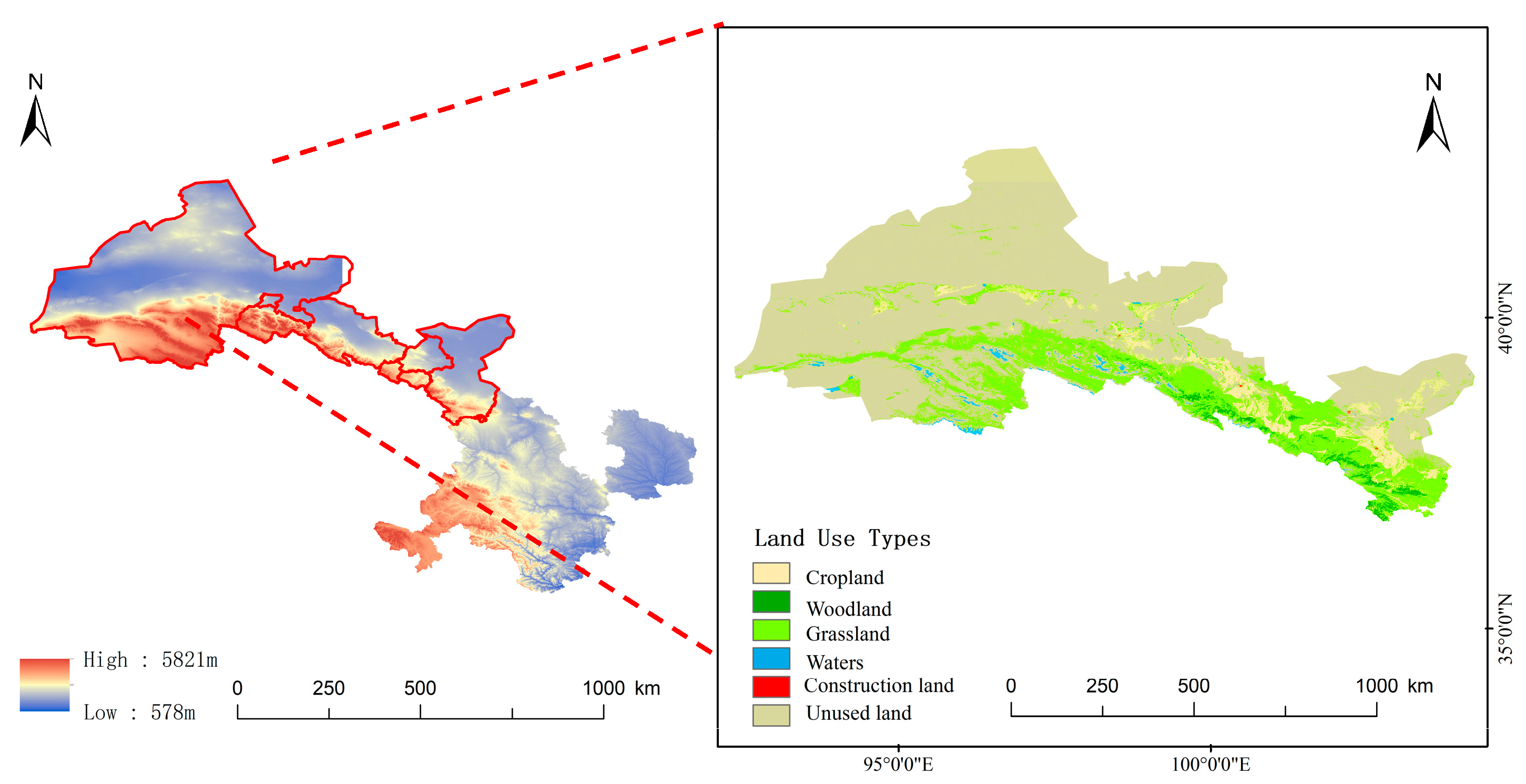
The Hexi Corridor is located in the northwestern part of Gansu Province, China, with geographical coordinates ranging from 93°02′ E to 104°00′ E and 37°10′ N to 42°50′ N. Situated west of the Yellow River, this corridor extends between the Qilian Mountains and the Badain Jaran Desert, following a narrow orientation from northwest to southeast. It has an approximate length of 1000 km and covers an area of about 247,000 square kilometers. The region is characterized by a distinctive geomorphological structure described as two mountains flanking a valley, “with the Qilian Mountains in the south and the Heli and Longshou Mountains in the north. This corridor plays a crucial role in linking the Central Plains with the Western Regions and constitutes a significant segment of the “Silk Road Economic Belt.”
The area features an elevation that ranges from 1000 to 2500 m and is characterized by a temperate continental arid climate. Annual precipitation decreases gradually from east to west, with amounts varying from 300 mm to below 50 mm. The water supply primarily depends on meltwater from the snow and ice of the Qilian Mountains, which give rise to three significant inland river systems: the Heihe River, Shiyang River, and Shule River. Oasis corridors have developed along these river networks, representing approximately 4.5% of the entire regional landscape. These oases serve as crucial hubs for population density and agricultural activities.
The vegetation and soils exhibit pronounced vertical zonation and regional differentiation, forming a typical “mountain–oasis–desert” ecological transition pattern. Mountain areas are dominated by forest-meadow ecosystems, oasis areas by irrigated cropland and associated vegetation, and desert areas by sparse drought-tolerant vegetation. Soil types vary with topography and moisture conditions and are generally characterized by aridity, salinization risk, and nutrient limitations. Together, these natural conditions determine the fragility of the regional ecosystem and its strong dependence on water resources.
The predominant type of land use in the studied area is classified as unused land, which primarily consists of Gobi and desert landscapes, accounting for over 70% of the total area. In contrast, cultivated land, grasslands, and construction areas are mainly concentrated in the oasis regions, resulting in a spatially complex ‘oasis–desert’ mosaic. This study encompasses five prefecture-level cities—Wuwei, Jinchang, Zhangye, Jiuquan, and Jiayuguan City—and their 19 subordinate counties or districts. In the oasis regions, irrigated agriculture is the primary focus, with key crops including wheat, corn, and various seed-producing plants. The northern area has established a resource-based industrial framework centered on mineral smelting, leveraging the nickel resources in Jinchang and the iron and steel materials in Jiuquan. Furthermore, the southern Qilian Mountains play a vital role in ecological preservation and the protection of water sources, constituting an essential component of the regional ecological security barrier (Figure 1). The above “oasis–desert” mosaic pattern and strong water-resource constraints make the Hexi Corridor a representative arid transition region for testing the coupled “policy constraints–scenario simulation–ESV response” framework.

2.2. Data and Preprocessing

The source of the land use information is the China Land Cover Dataset (CLCD) provided by Wuhan University, which has a spatial resolution of 30 m. This dataset represents a standardized classification of land cover, produced through the classification of remote sensing images derived from Landsat satellite data, thereby demonstrating the application of remote sensing information. The land use data used in this study are from the years 2000, 2010, and 2020, and the data format is GeoTIFF raster data. According to the “Classification Standard for Land Resource Survey” (GB/T 21010-2017) [28], various land cover types were categorized into six distinct groups: cropland, forestland, grassland, water bodies, construction land, and unused land. Table 1 outlines the specific sources of socioeconomic and natural environmental data. The data on population density and per capita GDP were sourced from the China Statistical Yearbook (2000–2020). These data were obtained through spatial interpolation at the county level to generate continuous raster data. Additionally, the natural environment data, which includes climate, hydrology, and soil data, were derived from the China Meteorological Administration and the National Soil Database, also with a spatial resolution of 1 km and a temporal resolution of annual values.
To meet the Markov–PLUS coupled framework’s requirement for consistency among multi-source raster inputs and to ensure comparability across scenarios, all raster datasets from different sources were reprojected to a unified coordinate system and standardized in spatial resolution. Considering both patch-pattern preservation and computational efficiency at the scale of the Hexi Corridor, a 100 m grid was selected as the unified simulation resolution. Land use datasets for 2000, 2010, and 2020 were used to characterize two decadal transition processes and to support scenario projections for 2030. During resampling, continuous and categorical factors were processed using methods consistent with their data properties, so as to minimize numerical distortion and class mixing caused by scale conversion.
Considering the actual conditions of the Hexi Corridor region, eleven driving factors were selected from the perspectives of physical geography, socioeconomics, and accessibility. These factors include elevation, slope, soil type, population density, GDP per capita, annual average precipitation, annual average evaporation, annual average temperature, NDVI, distance to government offices at or above the county level, and distance to nature reserves. The selection of driving factors adheres to the principle of ‘covering natural constraints and human activity pressures.’ Natural factors such as elevation, slope, climate, hydrology, vegetation, and soil reflect the sensitivity of arid regions to water resources and topography. Notably, ‘distance to water sources’ was not included separately in the model due to its high correlation with precipitation, evaporation, and NDVI in the preliminary selection. Socio-economic factors, including population density and per capita GDP, are employed to depict the intensity of human activities. Accessibility factors, such as distance to government offices and distance to nature reserves, represent the constraints of policy control and spatial accessibility on land use patterns. The temporal resolution of socio-economic data is annual, with population and GDP data spatially interpolated using the Inverse Distance Weighting (IDW) method. The interpolation error is validated by comparing it with county-level statistical values to ensure the reliability of the spatialized results.
To standardize the spatial reference systems and classification criteria of land use data from various years, this research executed a series of preprocessing steps on the ArcGIS 10.8.1 platform. Initially, the “Extract by Mask” function was utilized to retrieve land using raster data specific to the designated study area. Next, the “Project Raster” feature was applied to consistently project the raster data into the WGS_1984_UTM_Zone_47N coordinate system, with a cell size adjusted to 100 m to enhance the accuracy of model simulations and ensure data uniformity. The pixel size was resampled to 100 m using the nearest neighbor resampling method to preserve the discreteness of the classified data. Given that the resampling process may blur the boundaries of small patch land classes or potentially lead to the loss of small area types, particular attention was paid to minor land types, such as construction land and water bodies, during data processing. Errors were mitigated by comparing the area distribution changes before and after resampling. Finally, the “Reclassify” function was implemented to normalize the raster values, establishing a consecutive numbering system for land use categories from 1 to 6 for all years. These categories correspond to cultivated land, forest land, grassland, water bodies, construction land, and unused land, respectively, thereby facilitating the ongoing transfer matrix analysis and scenario simulations.
Data limitations: (1) Socioeconomic variables (population density and per capita GDP) were derived from county-level statistical data using IDW interpolation, which may introduce a smoothing effect and local biases in highly heterogeneous “oasis–desert” transition areas. Therefore, these variables are mainly used as relative indicators of human activity intensity, and we avoid over-interpreting their local absolute values. (2) Reclassifying the CLCD land-cover dataset into six categories helps maintain consistency with the Markov–PLUS framework and the ESV equivalent-factor system. However, class aggregation may mask within-class heterogeneity, thereby affecting absolute ESV estimates. (3) Resampling from 30 m to 100 m may lead to the loss of small patches and blurred boundaries. To mitigate this effect, we applied nearest-neighbor resampling for categorical data, checked the consistency of area statistics before and after resampling, and conducted targeted verification for small-percentage types (e.g., construction land and waters). Given these limitations, we emphasize inter-scenario comparisons and relative changes rather than local absolute values when interpreting the results.

2.3. Data Limitations and Uncertainty Analysis

Any large-scale spatial modeling study carries inherent constraints, and this one is no exception. The aggregation of CLCD’s nine land cover classes into six categories was necessary for model compatibility, but it came at a cost: ecological functional heterogeneity within the same land use type was effectively smoothed away. Grassland illustrates this well—high-coverage meadow and desert steppe, both classified simply as “grassland,” differ fundamentally in their water retention and climate regulation capacities. By assigning them a single averaged coefficient, we replaced an ecological spectrum with a statistical mean, potentially biasing ESV estimates for vegetation-sensitive services. Similarly, downscaling county-level socioeconomic data via IDW interpolation produces smooth surfaces that cannot capture the sharp gradients of human activity across the oasis–desert ecotone. These variables are therefore best interpreted as relative indicators rather than precise local measures.
Spatial resampling from 30 m to 100 m involved an unavoidable trade-off between computational feasibility and information retention. The cost was partial loss of small but ecologically critical patches—fragmented wetlands along oasis margins, isolated water bodies, and expanding construction land. We applied nearest-neighbor resampling to preserve categorical discreteness and validated area consistency for minor land types, yet some loss is irreversible. Crucially, these limitations primarily affect absolute ESV estimates, while their influence on relative scenario comparisons is limited because systematic errors remain consistent across all four scenarios. Our policy recommendations therefore rest on inter-scenario differences rather than absolute values—an approach consistent with mainstream practice in navigating uncertainty within ecosystem service assessments.

3. Research Methodology

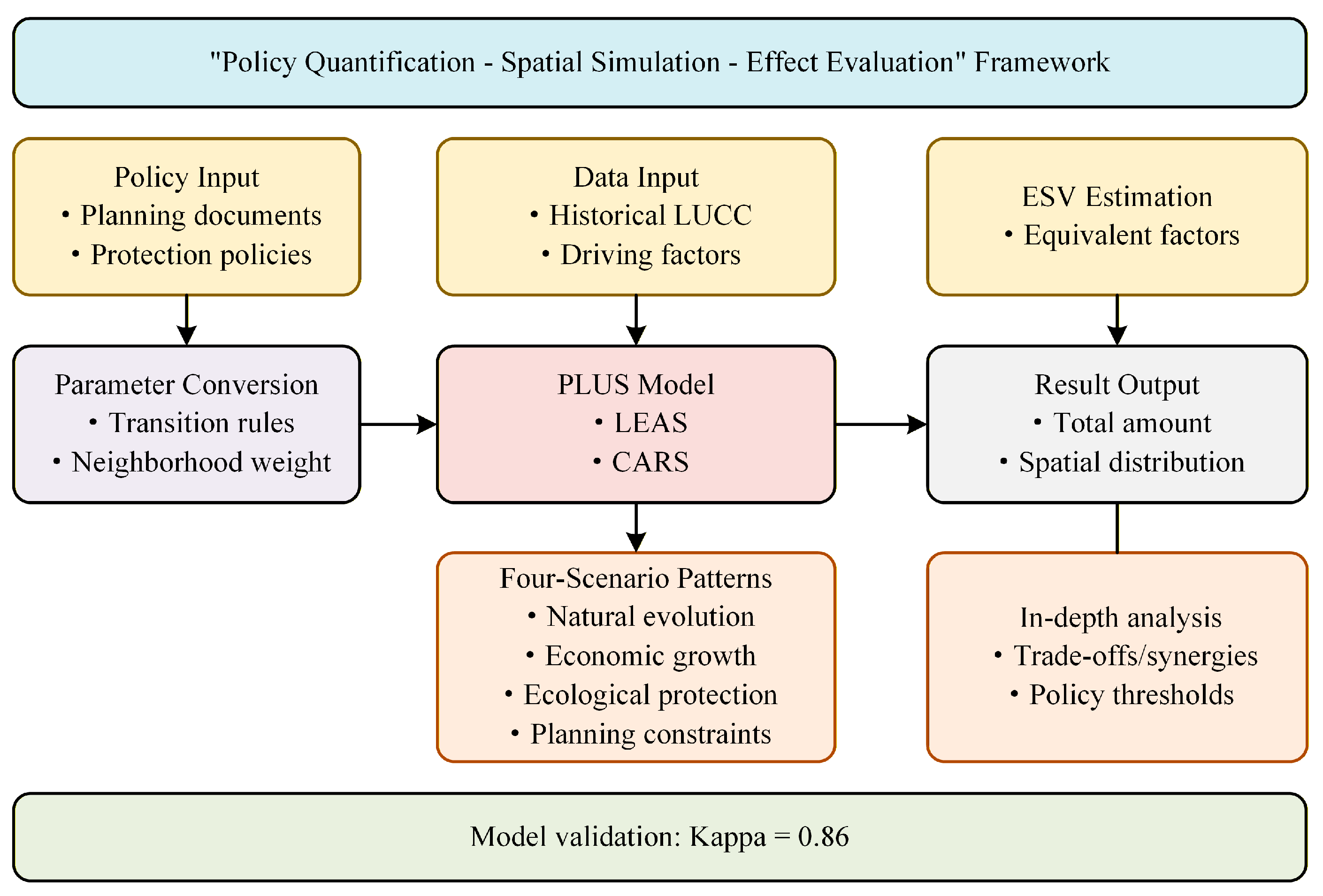
To systematically integrate land use simulation with ecosystem service assessment and achieve the spatial expression of policy objectives, this study constructs a three-stage coupled framework of “policy quantification—spatial simulation—effect assessment” (Figure 2). The core logic of this framework is as follows: First, regulatory indicators from policy documents such as the “Gansu Provincial Territorial Spatial Plan (2021–2035)”—including construction land growth caps and wetland no-conversion zones—are transformed into conversion rules and neighborhood weight parameters recognizable by the PLUS model. Second, based on historical land use data from 2000 to 2020, combined with physical geographical and socio-economic driving factors, the Markov–PLUS model is employed to conduct spatially explicit simulations of land use patterns under four scenarios for 2030. Finally, the revised unit area equivalent factor method is applied to estimate ecosystem service values under different scenarios, with a focus on analyzing spatial differentiation characteristics and trade-off/synergy relationships among services. This framework undergoes dual validation through the Kappa coefficient (0.86) and FoM coefficient (0.095), ensuring the reliability of the simulation results.

3.1. Estimation of Ecosystem Service Values Using Equivalent Factors

The estimation of ecosystem service values (ESV) is a key aspect of this study. Here, we outline the method for using equivalent factors, discussing the challenges and rationale behind opting for national versus regional adjustments tailored to the Hexi Corridor’s unique characteristics.
The equivalent factor system has been a topic of considerable debate within academia regarding the preference for a nationally unified equivalent factor versus the implementation of regional adjustments. The primary advantage of a national equivalent factor is that it ensures comparability of results across various regions. Conversely, local adjustments can more accurately reflect regional disparities. Given the spatial heterogeneity of the Hexi Corridor’s ecosystem and the broader Chinese ecosystem, coupled with the insufficient systematic measurement data in this area, establishing a localized equivalent factor system proves to be challenging. Therefore, based on the basic equivalent table of ecosystem service value per unit area in Xie et al.’s latest research findings [8], and integrates data from the “Gansu Statistical Yearbook” and the “National Agricultural Product Cost and Income Data Compilation” to derive average grain prices, sown areas, and yields per unit area from 2000 to 2020. The economic value of grain crops per unit area was revised to 1833.85 CNY/hm2. The revision method is as follows [29]:
V s t d = 1 7 × t = 2000 2020 ( P t Y t ) S t t = 2000 2020 S t
where V s t d is the annual market value of grain crops per unit area of farmland in the study area (CNY/hm2); P t is the average price of grain crops in the study area (CNY/kg); Y t is the annual grain yield per unit area (kg/hm2); and S t is the grain-sown area in year t (hm2).
In the process of obtaining equivalence factors, Xie Gaodi’s revised equivalence factor provides service values for secondary classifications. The CLCD dataset utilized in this study encompasses only nine primary land types: cropland, forest land, shrubland, grassland, water body, ice and snow, bare land, impervious surface, and wetland. It does not include further subdivisions into secondary categories, such as paddy fields and drylands. Consequently, this paper reclassifies the nine land types of the CLCD into six categories—namely, cropland, forest land, grassland, water body, wetland, and unused land—using ArcGIS to align the data with the equivalence factor table. For secondary factors within the same primary category, the arithmetic mean is adopted as the equivalent factor for that category. For example, the average value of drylands and paddy fields is used for cultivated land, while the average of coniferous forests, broad-leaved forests, and mixed coniferous–broad-leaved forests is applied for forest land. Similarly, the average of grasslands, shrublands, and meadows is calculated for grassland, the average of water systems and glaciers/snow for water bodies, and the average of deserts and bare land for unused land. Although this method does not accurately reflect the area proportions of the subcategories, it is a widely accepted and comparable approach in existing studies, particularly in the absence of higher-resolution land use data. It is important to note that in the CLCD classification, unused land uniformly encompasses types such as deserts, gobi, and bare land, which cannot be further distinguished. Therefore, this paper employs the average value of deserts and bare land as the service value equivalent factor for unused land, acknowledging that this does not capture the ecological functional differences between gobi and deserts. In future research, as higher precision datasets become available, this section will be further refined and optimized. The ecosystem service value coefficients per unit area for the Hexi Corridor were calculated (Table 2).
V C i , m = E i , m × V s t d
where V C i , m is the value coefficient per unit area of land use i for ecosystem service sub-function m (CNY/hm2), and E i , m is the equivalent factor of the reclassified land use   i . Among them, the contribution of construction land to the increment of ecosystem service value is almost negligible; therefore, the ESV of construction land is set to 0 in this study. This treatment has been adopted in numerous domestic and international studies [6,7,8] and is a common practice in the equivalent factor method.
After revision, ArcGIS 10.8 was used to calculate the annual area of each land use type in the study area and to compute the ESV. This enabled further analysis of the spatiotemporal evolution of ecosystem service value in the Hexi Corridor. The calculation formulas are as follows:
E S V = S i × V C i , m
where E S V denotes the total ecosystem service value, and S i is the area of the i land use type.

3.2. Sensitivity Analysis of Ecosystem Service Values

To assess the robustness of our results, a sensitivity analysis was performed on the value coefficient matrix. This analysis helps to understand the impact of uncertainty on the scenario comparisons and ensures the reliability of the model outcomes.
To quantify how uncertainty in the unit-area value coefficients of the equivalent factor method affects scenario-comparison conclusions, this study conducted a Monte Carlo-based sensitivity analysis on the value coefficient matrix (“service sub-item × land use type”) in Table 2. Let ( V C i , m ) denote the unit-area value coefficient of the (m)-th ecosystem service sub-item for the ( i )-th land use type. In the ( k )-th simulation, a common co-movement factor ( G k ~ U n i f o r m   ( 0.8,1.2 ) ) was introduced to capture “all-up/all-down” joint fluctuations, and an independent perturbation factor ( U m , i , k ~ U n i f o r m   ( 0.8,1.2 ) ) was simultaneously applied to each “sub-item × land use type” entry. To ensure that the overall perturbation magnitude remained within ±20%, the perturbation multiplier was constructed using a weighted mixture:
M m , i , k = G k + ( 1 ) U m , i , k
We set ( = 0.5) to reflect the joint influence of the common factor and the independent perturbations. The perturbed coefficient is then given by:
  V C i , m , k = V C i , m × M m , i , k
Built-up land was not perturbed because its ESV was set to zero. Wetlands were merged into the “water bodies” category and were treated using the coefficients for water bodies. Given the land use areas ( A i , s ) under scenario (s), the total ESV for scenario (s) in the (k)-th simulation was calculated as:
E S V s , k = i A i , s m V C m , i , k
A total of simulations were performed. Using the baseline ranking of total ESV across the four scenarios under the unperturbed condition as the reference, two robustness metrics were reported: (1) the strict ranking preservation rate (the proportion of simulations in which the complete ranking exactly matched the baseline); and (2) Spearman’s rank correlation coefficient, which measures overall rank concordance.

3.3. Ecological Compensation Fund Calculation

Following the estimation of ecosystem service values, the next step involves calculating the ecological compensation amount. This calculation is based on the changes in ecosystem service values resulting from land use changes.
To quantify the ecological compensation amount in the Hexi Corridor, this study adopts a two-step “total accounting-benefit allocation” framework. In Step 1, the baseline total ecological compensation is calculated based on the increase or decrease in ecosystem service value (ESV) induced by land use change. In Step 2, downstream water savings are used as a proxy for the intensity of downstream benefits; weights are then constructed to allocate the baseline total to different buffer zone scenarios (10/20/30 km).
The calculation formula for the baseline total ecological compensation is:
C 0 = i = 1 n = 6 E S V i × A i
In this study, n   i s   t h e   n u m b e r   o f   l a n d   u s e   t y p e s ,   A i represents the area change of different land use types in the Hexi Corridor region under various scenarios (simulated by the PLUS model), while E S V i is derived from the ecosystem service values of the land use types. To characterize the intensity of downstream benefits under different buffer zone scenarios, this study converts “downstream water resource savings” into a comparable benefit indicator. Let the buffer width scenario be r   ϵ {10, 20, 30} km; the corresponding downstream benefit intensity is defined as:
B r = W r × p w
Here, where B r denotes the downstream benefit intensity under buffer scenario r (CNY); W r is the amount of downstream water savings under scenario r (m3); and p w is the unit value of water (CNY/m3).
To allocate the baseline total compensation to different buffer zone scenarios, the downstream benefit intensity of each scenario is normalized to obtain the allocation weights:
F r = B r r   ϵ { 10 ,   20 ,   30 }   B r
where F r is the allocation weight for buffer scenario r, satisfying r   ϵ { 10 ,   20 ,   30 }   F r = 1 . A larger weight indicates stronger downstream benefits under that buffer scenario and therefore a higher share of the compensation amount allocated to it.
After obtaining the allocation weights   F r for different buffer zone scenarios, the baseline total compensation C 0 is allocated to each buffer zone scenario as follows:
C r = C 0 × F r
where r denotes the buffer-width scenario ( r   ϵ { 10 ,   20 ,   30 } ); C r is the compensation amount for scenario r (CNY); is C 0 the baseline total compensation (CNY). Since r { 10,20,30 } F r = 1 , it follows that r { 10,20,30 } C r = C 0 .

3.4. Land Use Simulation with the PLUS Model

This section explains how the PLUS model is employed to simulate land use changes. We use the Land Expansion Analysis Strategy (LEAS) and Cellular Automata models to predict how land types will evolve, incorporating key regional factors to guide these projections.
This framework simulates changes in land use using raster data and consists of two main components: (1) The Land Expansion Analysis Strategy (LEAS), which employs the random forest algorithm to explore how different land types expand and the factors influencing this growth, thereby determining the development probabilities for each land category; and (2) The CA-based model that employs multiple random patch seeds (CARS), which integrates random seed generation along with a mechanism that progressively lowers thresholds to model the automatic creation of patches bounded by development probabilities.
Multicollinearity Test. This paper employs the Variance Inflation Factor (VIF) for diagnosis, which measures the extent to which an independent variable can be linearly explained by other independent variables. The formula for calculating the VIF value is as follows:
V I F i = 1 1 R i 2
where R i 2 represents the coefficient of determination of the regression of the factor on the remaining factors. Previous studies have indicated that when the VIF value is less than 10, there is no severe multicollinearity among the variables [30,31]. The results of this study show that the VIF values of all 11 driving factors are less than 10, indicating that there is no severe multicollinearity among the variables, and the selection of driving factors is reasonable.
Neighborhood Weight Parameter Setting The neighborhood weight parameter represents the intensity of expansion for each land category, reflecting their capacity for expansion under the influence of spatial driving factors. This parameter ranges from 0 to 1, with values closer to 1 indicating a stronger capability for expansion. Wang Baosheng et al. [32] conducted dimensionless processing on the total area changes of various land types (1), normalizing their thresholds to the 0–1 range. They utilized this parameter for simulation prediction research. Practical verification demonstrates that the dimensionless values of total area changes satisfy the requirements for neighborhood weights in terms of both parameter significance and data structure.
x * = X X m i n X m a x X m i n
In the formula, x * represents the deviation standardized value, X wheredenotes the change area of each land use type between two periods of land use data; X m a x is the maximum value of area changes across all land use types, and X m i n is the minimum value of area changes across all land use types.
This study is based on data from 2010 and 2020, and projected 2030 data, incorporating x* to establish the following neighborhood factor parameter table (Table 3).
Accuracy test [33,34,35,36].
① Kappa coefficient is a common method to verify the accuracy, which is calculated as follows (2)
K a p p a = P a P b 1 P b
Here, P a represents the proportion of correctly simulated grids; P b   denotes the preset proportion of correctly simulated grids. A value of 1 indicates the ideal proportion of correctly simulated grids. The Kappa coefficient ranges from 0 to 1, with higher values indicating greater simulation accuracy. Based on land use data from 2000 and 2010 in the Hexi Corridor region, the PLUS model was used to simulate 2020 land use, which was then compared with actual 2020 land use data. With a sampling rate set at 5%, the validation results are detailed in Table 4.
Through the analysis of the confusion matrix, the K a p p a coefficient was calculated as 0.86 based on the formula, with an overall accuracy of 0.93. Comparison with the table shows that K a p p a > 0.8, indicating good simulation performance with high accuracy.
② FOM coefficient
The FOM coefficient is used to quantitatively evaluate the simulation accuracy at the cellular scale. A higher value indicates greater precision in the simulation results, with typical values generally ranging between 0.01–0.25 [37]. The calculation formula for the FoM coefficient is:
F O M = B A + B + C + D
In the equation, A represents the area of error caused by actual land use changes that were predicted as unchanged; B represents the area of accurate predictions; C represents the area of error caused by incorrect predictions; D represents the area of error caused by predicted changes where land use remained unchanged. The calculated F O M coefficient for this study area is 0.095, falling within the specified range.

3.5. Incorporating Policy Constraints into Land Use Simulation

The integration of policy constraints into our simulations is essential for ensuring that the results align with real-world regulatory frameworks. This section elaborates on how policy goals, such as limiting construction land expansion, are transformed into specific model parameters that guide the simulations.
Building upon traditional scenarios [38,39,40], this study translates the upper limit of construction land growth (≤30%) as stipulated in the “Gansu Provincial Territorial Spatial Plan (2021–2035)” into the expansion probability constraints of the PLUS model. With reference to the “National Wetland Protection Plan (2022–2030)”, water areas and their buffer zones are designated as prohibited conversion zones, and the transition probability of ecological land to construction land is set to 0, thereby achieving the spatial mapping and constraint control of policy objectives.
In this study, “ecological land” refers to land use types that primarily provide regulating/supporting ecosystem functions and are critical to the regional ecological security pattern. Under our six-class land use system, ecological land is specifically defined as the sum of grassland and waters.
(1)
Setting of land use transfer probabilities in Markov Chain
The Markov model generates a probability matrix through the statistical analysis of land use transitions over historical periods [41] and integrates with the Cellular Automata (CA) model to achieve spatial dynamic simulation [35,42]. Building on this foundation, the PLUS model introduces a patch-generation mechanism and incorporates multi-source driving factors, enabling a more accurate depiction of land use expansion processes [43]. In China, scholars have conducted dynamic simulations of national and regional land use patterns based on the Markov–CA and PLUS models [44,45,46,47,48]. The study sets the probability of land use transfer with key control variables for different scenarios based on different objectives and rationale (Table 5).
(2)
Setting conversion rules for land use in CAS
In a variety of situations, relevant matrices for land use transition restrictions were created to illustrate the conversion rules among distinct land types. The scenario focused on planning-constrained development aims to balance ecological conservation with urban–rural development. It specifies that urban–rural construction land may only be transformed into water bodies and not into any other type of land. At present, converting forest land, grassland, and water bodies into construction land is strictly forbidden. In the economic growth scenario, the demands for expanding construction land take precedence. This permits the conversion of urban–rural construction land solely into water bodies, while disallowing the transformation of other land types into non-construction land. On the other hand, the ecological conservation scenario follows the principle of prioritizing ecological concerns, resulting in strict limitations against converting ecological lands; specifically, forest land, grassland, and water bodies cannot be transformed into any other land types. Transition rules for scenarios involving Natural Changes are constructed based on historical trends in land use changes. This method more effectively mimics the land use succession process that occurs under natural conditions. The land use transition relationships for each scenario are illustrated in matrix format in Table 6, where ‘0’ signifies a prohibited conversion and ‘1’ indicates a conversion that is allowed. Additionally, the research categorizes current water bodies and nature reserves as restricted areas in both the ecological protection and planning-constrained development scenarios to strengthen ecological control measures.

4. Results and Analysis

4.1. Analysis of Land Use Structure Changes in the Hexi Corridor from 2000 to 2020

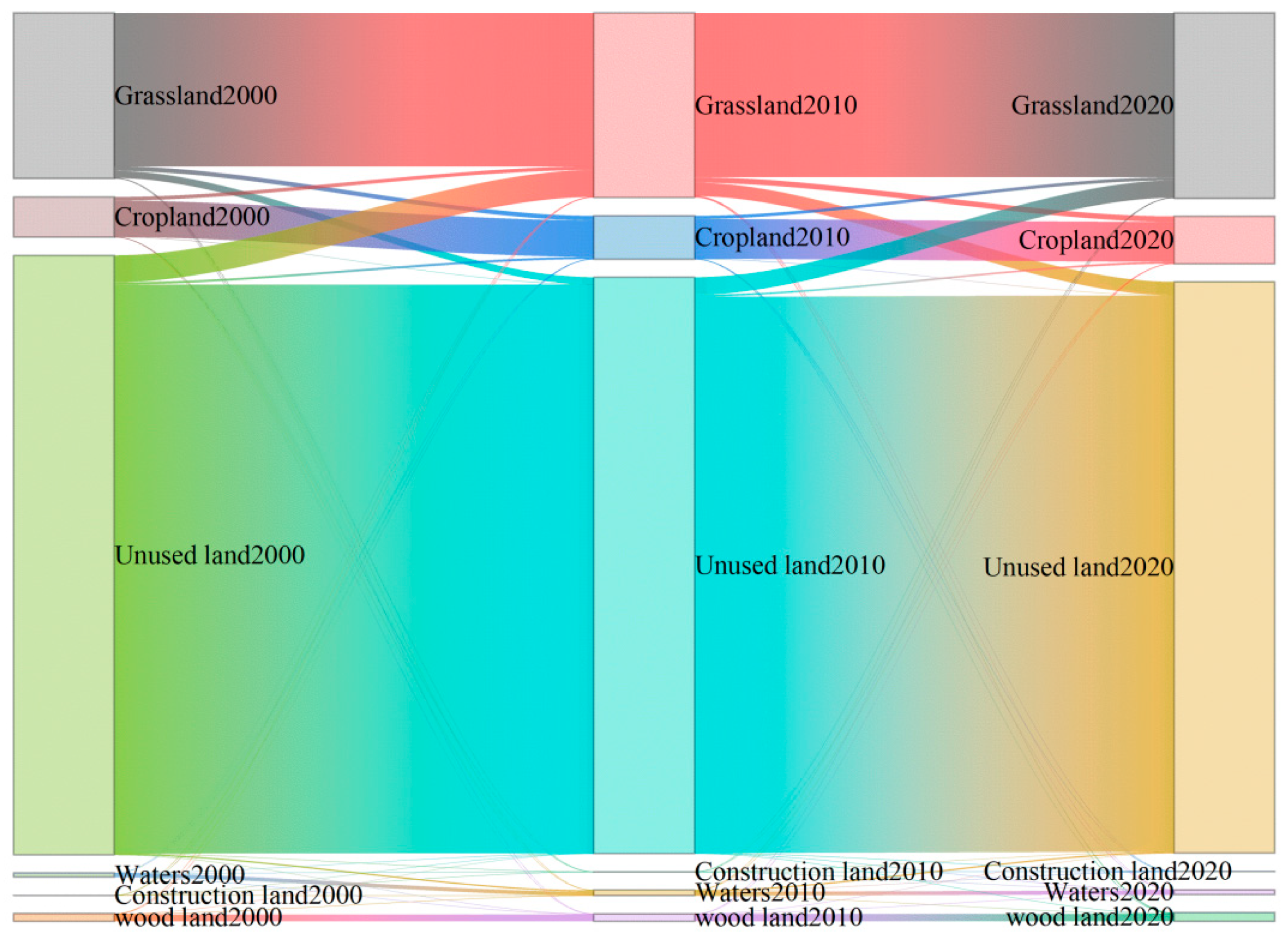
Grassland and unused land were the dominant land use types in the Hexi Corridor throughout the study period. From 2000 to 2020, construction land experienced the most pronounced expansion, increasing by 164.73%, followed by cultivated land (17.44%), water bodies (15.86%), grassland (11.73%), and forest land (10.66%). These changes indicate a persistent intensification of human land use, despite fluctuations in ecological land types.
During 2000–2010, construction land and water bodies expanded rapidly by 97.20% and 32.64%, respectively, accompanied by moderate increases in grassland (11.41%) and cultivated land (7.49%), while forest land and unused land declined. In contrast, between 2010 and 2020, construction land, cultivated land, and forest land continued to increase (34.24%, 13.33%, and 9.35%, respectively), whereas water bodies and unused land showed notable reductions, and grassland growth slowed significantly (0.29%). This shift reflects a transition from extensive expansion toward more regulated development under strengthened policy constraints.
The evolution of land use structure is closely associated with regional development strategies. Prior to 2010, agricultural expansion and energy development dominated, accompanied by ecological management aimed at mitigating desertification and water scarcity. After 2010, development increasingly emphasized ecological protection, renewable energy, and Ecological Compensation policies, which moderated construction land expansion but intensified pressures on grassland and water resources. Reduced river recharge, irrigation water consumption, and upstream water regulation further contributed to the contraction of water bodies and wetlands.
Unused land served as the primary source of land conversion, mainly transitioning to grassland, cropland, and construction land. Grassland exhibited clear bidirectional conversion characteristics, shifting alternately to cropland, forest land, and unused land, driven by policies such as “Grain for Green” and agricultural reclamation. Construction land expansion occurred primarily at the expense of unused and forest land, reflecting ongoing urbanization pressures. In contrast, forest land remained relatively stable, benefiting from ecological restoration programs, while water bodies showed limited spatial conversion, indicating the effectiveness of targeted protection measures. Overall, these results highlight the need to balance construction land control with grassland and water resource conservation to support sustainable land use in the Hexi Corridor (Figure 3).

4.2. Multi-Scenario Simulation of Land Use Change in the Hexi Corridor Region

Utilizing land use data from the Hexi Corridor region for the years 2010 and 2020, the Markov model was applied to forecast land use requirements for 2030. The PLUS model integrated eleven driving factors, along with neighborhood weights and parameters tailored to four distinct scenarios. Subsequently, the Cellular Automata (CARS) module was employed to model the quantities and spatial distributions of land use demand under four scenarios for the year 2030.
The land use structures under different scenarios exhibit distinct policy orientations (Table 7). The economic growth scenario expands construction land and cropland at the expense of ecological land, increasing by 5406.67 hectares and 217,020.09 hectares, respectively, compared to 2020. Notably, its construction land area (13,975.32 hectares) exceeds the upper limit (11,139.25 hectares) set by the Gansu Provincial Territorial Spatial Plan, revealing the risk of policy redline violation under purely economic-oriented development. In contrast, the ecological conservation scenario, through strict use regulation, dramatically increases water area by 113,032.60 hectares—a 78.5% growth compared to 2020—while grassland and forestland areas also improve significantly. This demonstrates the effectiveness of policy interventions such as “returning farmland to wetland” and “converting grazing land to grassland” in restoring critical ecological spaces. The planning-constrained development scenario achieves a balance between the two extremes: it controls construction land expansion (+30.11%, lower than the +63.1% in the economic growth scenario) while ensuring the stability of cropland and grassland through moderate development of unused land, reflecting the policy intention of “development-conservation” synergy.
It is worth noting that even under the ecological conservation scenario, which enforces stringent protection measures, construction land area and proportion still increase to some extent, indicating that the pressure of socio-economic development on land use remains challenging to fully eliminate. Under the Natural Changes scenario, cultivated land, forestland, grassland, and construction land are all projected to expand by 2030 compared to 2020 (increases of 113,382.98 hm2, 479.78 hm2, 408,564.30 hm2, and 2579.81 hm2, respectively), while water bodies and unused land are expected to decline (decreases of 5595.55 hm2 and 602,935.76 hm2, respectively).
The scenario for planning-constrained development thoroughly considers food security, ecological sustainability, and socio-economic growth. When compared to the ecological protection scenario, it shows a more pronounced increase in cultivated land, accompanied by a slight rise in forest land area, a decrease in land that is not in use, and an increase in construction land area. Unlike the economic growth scenario, the planning-constrained development scenario successfully manages the growth of construction land.
In the context of economic growth, the changes in land use categories are mainly marked by notable increases in both farmland and built-up areas, with rises of 217,020.09 hectares and 5406.67 hectares, respectively. The land allocated for construction has now reached 13,975.32 hectares, exceeding the maximum threshold for construction land expansion in the Hexi Corridor, which is established at 11,139.25 hectares as per Gansu Province’s territorial spatial framework. At the same time, the sizes of forested and grassland areas have shown a steady rise relative to other scenarios, whereas the decrease in water bodies and uncultivated land has become more pronounced.
In the context of ecological conservation, alterations in land use categories follow the guidelines of regional Ecological Compensation. In comparison to alternative scenarios, the extents of forests, pastures, and aquatic regions rose notably by 475.65 hm2, 133,737.92 hm2, and 113,032.60 hm2, respectively. The increase in built-up areas was rigorously constrained, amounting to merely 847.65 hm2, whereas the expansion of agricultural land was also managed, escalating by 147,426.13 hm2.
In the context of the Natural Changes scenario, it is anticipated that by the year 2030, there will be substantial growth in cultivated land, forested areas, grasslands, and construction zones when compared to 2020, with expected increases of 113,382.98 hm2, 479.78 hm2, 408,564.30 hm2, and 2579.81 hm2, respectively. Conversely, it is forecasted that water bodies and unused land will see a decline, with reductions amounting to 5595.55 hm2 and 602,935.76 hm2, respectively.
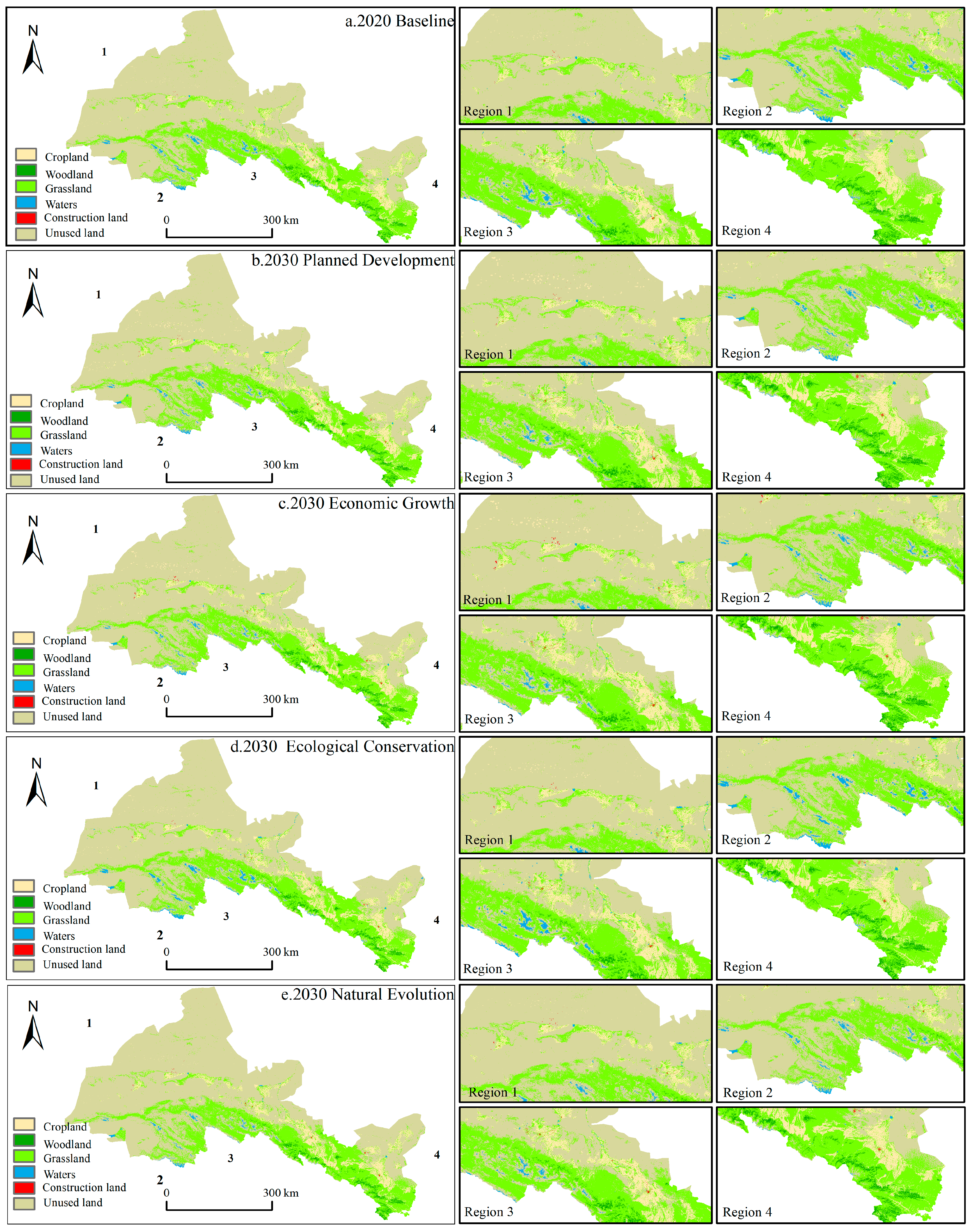
As shown in Figure 3, the Hexi Corridor demonstrates localized changes in land use across different scenarios in Regions 1 to 4. In times of economic growth, the need for construction land increases, leading to the encroachment on agricultural land and grasslands near urban settings. As a result, the agricultural areas and grasslands are forced to extend outward, which leads to the reclamation of land that was previously unutilized.
In Figure 4, Regions 1–4 illustrate the land use changes in local areas of the Hexi Corridor under various scenarios. The economic development process typically involves an increased demand for construction land, which encroaches upon farmland and grassland surrounding urban areas. This encroachment forces farmland and grassland to relocate, resulting in the reclamation of previously unused land. From a regional perspective, Figure 3 distinctly highlights the driving mechanisms behind land use changes across different scenarios. Region 1 (the western area of Jiuquan–Dunhuang) demonstrates significant expansion of construction land under the economic growth scenario, primarily driven by urbanization and energy development, which leads to the encroachment of grassland and some farmland. Conversely, under the ecological protection scenario, grassland and water bodies are preserved, while the conversion of unused land is regulated. Region 2 (Zhangye Oasis Area) shows the most notable variations, with substantial farmland expansion under the economic growth scenario. In contrast, the ecological protection scenario facilitates the conversion of farmland into grassland and the restoration of wetlands, resulting in an increase in both grassland and water areas. Region 3, located in the northern foothills of the Qilian Mountains, experiences a slight increase in forest area under the ecological protection scenario, attributed to the influence of ecological conservation policies. Conversely, under the economic growth scenario, forest area remains stable or may even slightly decrease due to development pressures. In Region 4, specifically in the Wuwei direction, the economic growth scenario leads to a significant expansion of cultivated and construction land, resulting in further compression of grassland area. However, under the planning-constrained development and ecological protection scenarios, this expansion is effectively controlled. Overall, the economically driven scenario is primarily characterized by a reduction in grassland and water areas due to the expansion of construction and cultivated land. In contrast, the ecological protection scenario effectively mitigates the adverse impacts of regional land use changes on ecosystems through measures such as returning farmland to grassland, wetland restoration, and forest protection.

4.3. Analysis of ESV Changes in the Hexi Corridor

In the Hexi Corridor region, the ecosystem service value (ESV) rose by CNY 19.588 billion from 2000 to 2010 but then saw a decrease of CNY 268 million by 2020 in comparison to 2010. This suggests that the ESV experienced an initial increase followed by a decline in the Hexi Corridor area. Several key factors contribute to this trend: Before 2010, during the early phases of agricultural expansion in the Hexi Corridor, the growth of farmland was still restricted, ecological pressures were minimal, initiatives for restoring forests and grasslands were launched, water resources remained stable without significant depletion, and there was a sustainable balance between development and ecological preservation, all of which encouraged ongoing growth of the ESV. Following 2010, the rapid development of oasis agriculture and urban infrastructure in the Hexi Corridor region led to significant farmland expansion and heightened resource pressures. This has caused grassland degradation, a shortage of water resources, diminishing water bodies, reduced regulatory services, growing policy focus yet notable implementation gaps, and inadequate investments in ecological development. The intensity of development is on the rise, the ecological carrying capacity is being pushed beyond its limits, and the ecosystem service value is experiencing a decline.
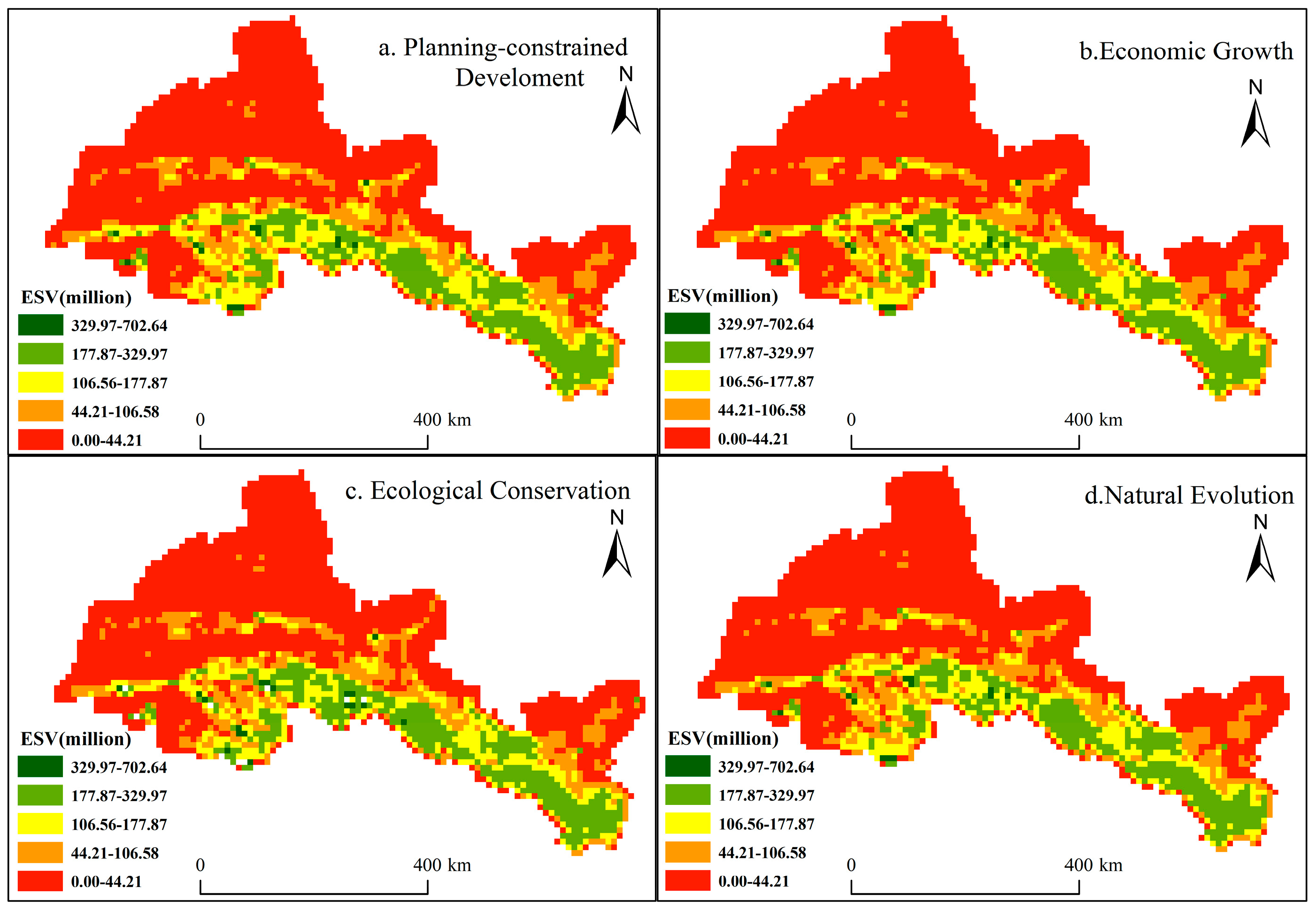
From the viewpoint of individuals (Table 8), the functions of services such as the production of food, regulation of hydrology, maintenance of nutrient cycling, and regulation of climate have demonstrated considerable advancement. Supporting services uphold the ecological base, which reflects the structural integrity of ecosystems. The detrimental growth in water supply necessitates caution regarding the ecological pressures stemming from the structure of cultivated land. Among regulatory services, the process of environmental purification has shown relatively sluggish progress, underscoring the necessity to enhance the management of wetlands, water bodies, and associated resources. The spatial diagnosis of ESV under different scenarios (Figure 5 provides direct evidence for formulating differentiated ecological compensation policies. The spatial pattern of ESV is highly coupled with the “mountain–oasis–desert” landscape of the Hexi Corridor. High-value areas (dark green), concentrated in the northern foothills of the Qilian Mountains and the middle section of the corridor, function as critical water conservation zones supplied by glacial meltwater (water bodies and forestland) and host contiguous high-quality grasslands that provide essential hydrological and climate regulation services. These areas should be strictly managed as core protection zones, with development activities restricted to maintain their water conservation and biodiversity functions. Low-value areas (red), widely distributed in the western and northern desert regions, reflect the scarcity of ecosystem services provided by unused land (Gobi and desert). Although unused land accounts for over 60% of the total area across all scenarios, its ESV contribution rate never exceeds 12%. These areas can appropriately accommodate economic development activities, serving as spatial carriers for regional growth while safeguarding the ecological security baseline. Notably, medium-value areas (yellow), mainly distributed along oasis edges and riverbanks, exhibit typical “patch–boundary–gradient” spatial differentiation: ESV decreases in a gradient from the oasis core outward, with the most dramatic changes occurring in the oasis–desert transition zone. This indicates that these boundary areas are the most ecologically fragile and sensitive to land use changes. They should be prioritized for restoration as ecological buffer zones, with measures such as returning farmland to wetland and converting grazing land to grassland to enhance their stability. This spatially explicit diagnosis suggests that land use planning should move beyond total quantity control and adopt a zone-specific regulation approach: strictly control core protection zones, prioritize restoration of buffer zones, and appropriately develop low-value areas.

4.4. Analysis of ESV Changes Under Different Scenarios in the Hexi Corridor

4.4.1. Multi-Scenario Spatial and Temporal Variations in Total ESV Values in the Hexi Corridor

Table 9 illustrates that grassland ESV is consistently the primary contributor to the total ESV within the Hexi Corridor region across all scenarios. This dominance reflects the dual role of grassland: Notably, the ESV contribution of grassland varies significantly across scenarios: it reaches CNY 146.875 billion under the ecological protection scenario, while showing a slight decline under the economic growth scenario. This contrast reveals a potential ecological–economic trade-off: the conversion of grassland to cropland and construction land under the economic growth scenario may enhance agricultural output in the short term, but at the expense of long-term ecological stability.
Further analysis indicates that as the width of the buffer zone surrounding the water body increases, the relationship between grassland and water conservation services becomes more pronounced. Within the 10 km buffer zone, the ecosystem service value (ESV) contribution of grassland is CNY 5.02 billion, which increases to CNY 5.73 billion in the 20 km buffer zone, and further rises to CNY 6.31 billion in the 30 km buffer zone. These findings suggest that expanding the buffer zone enhances the supportive role of grassland in water conservation, with the most significant effects observed under ecological protection scenarios.
The contribution of water bodies to ecosystem service value (ESV) is the lowest, second only to construction land, due to their comparatively small area within the study region. In the ecological protection scenario, the ESV for water bodies attains CNY 34.155 billion, which is markedly greater than in other scenarios, yielding a contribution rate of 14.91%. This suggests that ecological protection efforts may have either expanded the water surface area or enhanced water quality. In contrast, the diminished ESV of water bodies in both natural and economic scenarios indicates a lack of effective protection or management of water resources.
A preliminary quantitative analysis of various buffer zone widths indicates that the contributions of ecosystem services, such as water conservation and climate regulation, increase progressively as the width of the buffer zones surrounding water bodies expands (e.g., 10 km, 20 km, 30 km). Specifically, the contribution to water conservation within the 10 km buffer zone is CNY 1.54 billion, which increases to CNY 1.87 billion in the 20 km buffer zone, and reaches CNY 2.12 billion in the 30 km buffer zone. This trend suggests that wider buffer zones significantly enhance water conservation and ecological regulation capabilities.
The economic value of ecosystem services (ESVs) associated with cultivated land displayed minor variations across different scenarios, showing a slightly elevated figure in the scenario focused on economic growth (CNY 13.815 billion), which suggests possible increases in agricultural land utilization. Conversely, the ESV for forest land exhibited relative stability, approximately valued at CNY 10.9 billion, indicating negligible changes in both its area and quality under anticipated development scenarios, most likely because of policy protections that limit development activities. Unused land represents the largest share of land use types within the study area; however, its contribution rate is one of the lowest, never surpassing 12%, only outdone by construction land and water bodies. This situation arises as the per-unit ESV of unused land is the lowest, except for construction land. Despite forest land having the highest per-unit ESV, its contribution rate is still less than that of grassland, primarily due to its restricted distribution in the area under investigation.
In comparison to 2020, there has been an increase in the Ecosystem Service Value (ESV) across all four scenarios, with the ecological protection scenario exhibiting the highest ESV value at CNY 229.048 billion. This suggests that prioritizing ecological considerations in development strategies results in superior environmental quality. The planning-constrained development scenario reflects a rise of CNY 15.765 billion in ESV since 2020, placing it second to the ecological protection scenario, although it falls short by CNY 8.588 billion compared to the latter. This discrepancy arises from the planning-constrained development scenario’s focus on the integrated development of economic, social, and ecological factors. The economic growth scenario has shown an increase of CNY 7.186 billion in ESV since 2020, indicating that striving for economic expansion in this context does not significantly detract from ESV. Conversely, the Natural Changes scenario has recorded the lowest ESV increase, at just CNY 4.391 billion compared to 2020. While this approach is somewhat conservative, it ultimately fails to achieve the most effective ecological outcomes.
It is noteworthy that the expansion of grasslands significantly slowed after 2010: the increase in grassland area was 11.41% from 2000 to 2010, but only 0.29% from 2010 to 2020, with some regions experiencing degradation. Meanwhile, the area of water bodies decreased significantly by 12.65% from 2010 to 2020. This trend directly contributed to the limited growth or even decline in the ecosystem service value (ESV) of grasslands and water bodies. For instance, the ESV of water bodies under the Natural Changes scenario was only CNY 17.175 billion, far lower than the CNY 34.155 billion under the ecological protection scenario; similarly, the ESV of grasslands under the Natural Changes scenario was CNY 143.786 billion, also lower than the CNY 146.875 billion under the ecological protection scenario. These results indicate that grassland degradation and water resource scarcity are key factors contributing to the slowdown and even decline in regional ESV growth after 2010.
The value of ecosystem services (ESVs) in the Hexi Corridor region was analyzed statistically and visualized through a grid measuring 10 km by 10 km (see Figure 5). The characteristics of ESV’s spatial distribution align closely with the geographical attributes of the Hexi Corridor, displaying a structure characterized by patches, boundaries, and gradients. Patch characteristics: Localized green areas can be found in locations like Zhangye and the northern slopes of the Qilian Mountains, indicating significant ecological source regions or oasis agricultural systems that require protection through enhanced ecological corridor development. Boundary characteristics: There are clear transition zones between high and low ESV values, particularly at the peripheries of oases and deserts, where pronounced ecological gradients are observed. These regions are ideal for creating ecological buffer zones aimed at combating desertification and erosion. Gradient characteristics: The ESV exhibits a noticeable declining trend from the central oasis zone to surrounding desert regions, creating a classic north–south and center-periphery ecological gradient, which is beneficial for management zoning and the formulation of ecological compensation strategies.
The results indicate that Ecosystem Service Value (ESV) exhibits significant spatial and temporal heterogeneity, with marked differences in service provision across various ecological zones and periods [49]. The trade-offs and synergies among these services dynamically change with regional factors. Both natural conditions and human activities jointly shape local patterns, and the differences between high-value plots and vulnerable areas are pronounced [50,51]. Therefore, zonal discussions are essential to prevent the average over the entire region from obscuring these differences. Based on this analysis, this paper provides a zonal interpretation of ESV changes in different sub-regions and further elucidates the driving mechanisms through multi-scale temporal and spatial regression analyses.
The patterns of spatial distribution for ecosystem service values (ESV) across the four scenarios are quite similar, with the primary low-value areas located in the western and northern regions, which exhibit very weak ecological service functions. These regions are often characterized by desertification or a low intensity of human utilization. Nevertheless, there are some medium-value zones intermittently found along river valleys in the west, indicating limited human activity and weak natural system services in these six locations. Low ESV scores reveal ecological vulnerability or functional shortcomings, underscoring the necessity of focusing Ecological Compensation efforts in both the northern and western areas. Conversely, the high-value regions are primarily situated in the transitional areas between mountainous regions and oases in the central–southern zone, as well as in the irrigated agricultural sectors along the mountains and oasis farming areas in the central locality. The existence of irrigated farming systems, river habitats, and areas combining forests and grasslands offers substantial food supply and ecosystem regulation services. This stability is particularly evident in protected natural regions like the Qilian Mountains, where the nature reserve showcases well-preserved coverage of forests and grasslands, significant capabilities in water conservation, biodiversity, and soil retention, alongside government-imposed limitations on human activities. The importance of this area is especially highlighted in the contexts of “ecological conservation” and “Natural Changes,” underscoring its recognition as a “Key Ecological Area.” This region is a vital contributor to high Ecosystem Service Value (ESV) and is critically significant for ecological preservation. The eastern segment (in proximity to Zhangye and Wuwei) demonstrates a certain distribution of medium to high values, which overlap with agricultural areas and may result from the ecological services provided by cultivated lands and oasis systems.
The illustration indicates that in the proposed development scenario, the central ESV remains at a medium-high level, with areas designated for protection retaining significant values and showing a relatively equitable spatial distribution of ESV. This suggests that careful planning can effectively harmonize ecological needs with development through more scientifically informed spatial layouts. In the economic growth scenario, regions of high value contract sharply, with yellow-green areas decreasing significantly, while red regions expand, ultimately leading to a decline in overall ESV. This situation reflects considerable ecological pressures arising from development that prioritizes economic growth, which ought to be alleviated by means of compensation frameworks or green development initiatives. Conversely, the ecological protection scenario demonstrates an increase in high-value regions, with concentrated green areas and a reduction in low-value zones, resulting in an overall enhancement of ESV. Implementing an ecology-first strategy markedly improves ecosystem health, supporting the efficacy of conservation measures. The structure of ESV in Natural Changes scenarios bears resemblance to that in planning-constrained development scenarios yet reveals more pronounced disparities in marginal zones characterized by increased fragmentation. The lack of “natural ecological processes” in the absence of intervention signifies potential instability in local ecosystems.
From the perspective of driving mechanisms, the increase in Ecosystem Service Value (ESV) under the economic growth scenario is constrained, primarily due to the rapid expansion of construction and arable land, which encroaches upon grasslands and water bodies. This phenomenon indicates that increased economic activities come at the relative expense of ecological regulatory functions. In contrast, the ecological protection scenario, facilitated by policy measures such as converting farmland back to grassland, wetland restoration, and forest conservation, enhances both the area and quality of grasslands, water bodies, and forests. Consequently, this scenario significantly improves ecosystem services, including water conservation and climate regulation. The planning-constrained development scenario achieves a balance between economic growth and ecological control, ensuring moderate economic advancement while reinforcing ecological safeguards, thereby reflecting an ecological–economic equilibrium. Conversely, the Natural Changes scenario, devoid of human intervention, demonstrates limited improvement in ESV, suggesting that reliance solely on natural processes is inadequate to address the challenges posed by regional economic development and environmental pressures.

4.4.2. Uncertainty Analysis

Under the unperturbed condition, the total ESV in 2030 (billion CNY) across the four scenarios is 22.0460 for Planned Development, 21.1882 for Economic Growth, 22.9048 for Ecological Conservation, and 20.9086 for Natural Evolution. The baseline ranking is therefore Ecological Conservation > Planned Development > Economic Growth > Natural Evolution. In this study, the value coefficients in Table 2 (“service sub-item × land use type”) were perturbed individually by ± 20% using a uniform distribution (Uniform [0.8, 1.2]). In addition, a common factor was introduced to induce co-movement (i.e., coefficients rise and fall together). This was implemented as a weighted mixture of correlated and independent perturbations with = 0.5, while ensuring that all perturbation multipliers remained within [0.8, 1.2]. A total of 2000 Monte Carlo simulations were conducted.
The results show that the ranking of total ESV across the four scenarios remained unchanged in all simulations, yielding a 100% strict ranking preservation rate. Because only four scenarios are compared, Spearman’s rank correlation coefficient is discrete; when rankings are identical, ρ equals 1.000. Accordingly, all 2000 simulations produced ρ = 1.000 , indicating that the scenario ranking is highly robust within the uncertainty range considered. Meanwhile, the absolute magnitude of total ESV still exhibits variability. The 90% uncertainty intervals (P5-P95, billion CNY) are 19.9971–24.1079 for Planned Development, 19.24–23.16 for Economic Growth, 20.79–25.04 for Ecological Conservation, and 18.97–22.86 for Natural Evolution. The coefficient of variation across scenarios is approximately 5.93%.
To further explain why the ranking preservation rate is 100%, we conducted a worst-case boundary test. Under the constraint that each “service sub-item × land use type” coefficient is bounded within [0.8, 1.2], even the extreme combinations that minimize inter-scenario differences still yield positive minimum adjacent gaps: Ecological Conservation–Planned Development CNY 0.3849 billion, Planned Development–Economic Growth CNY 0.6396 billion, and Economic Growth–Natural Evolution CNY 0.2040 billion. Therefore, within the ±20% coefficient perturbation range, rank reversals cannot occur. Notably, total ESV across scenarios shows synchronous fluctuations under perturbation (driven by the common factor), implying that uncertainty is expressed mainly as a scaling effect on absolute levels, whereas relative comparisons among scenarios remain stable within the specified uncertainty bounds.

4.4.3. Analysis of the Impact of Parameter Settings on ESV Trend Similarity

In the multi-scenario simulations, although land use changes exhibit certain differences across the four scenarios, the trends in ecosystem service value (ESV) remain highly similar. To further investigate this similarity, this study analyzed the impact of parameter settings. Firstly, the primary drivers of land use, including the expansion rate of construction land, the maintenance ratio of grassland and water bodies, and changes in arable land, were kept relatively consistent across the four scenarios. This parameterization setup contributed to the observed similarity in ESV trends, particularly concerning key ecological functions such as water conservation and climate regulation.
Moreover, the policy settings across scenarios—such as the intensity of ecological protection measures and the prioritization of planning-constrained development versus economic growth—did not significantly alter the relative contribution ratios of various ecosystem service values (ESVs). This consistency is one reason why ESV trends across the four scenarios tend to converge. Despite differing policy backgrounds, the fundamental structure of land use remained largely unchanged across scenarios, resulting in similar patterns of impact on ESVs. Therefore, future research should further refine the distinctions between scenarios, particularly by adjusting the initial distribution of various land use types and the sensitivity of ecological functions, to more accurately capture the dynamics of ESV under each scenario.

4.4.4. Changes in Single ESV Values in the Multi-Scenario Hexi Corridor Region

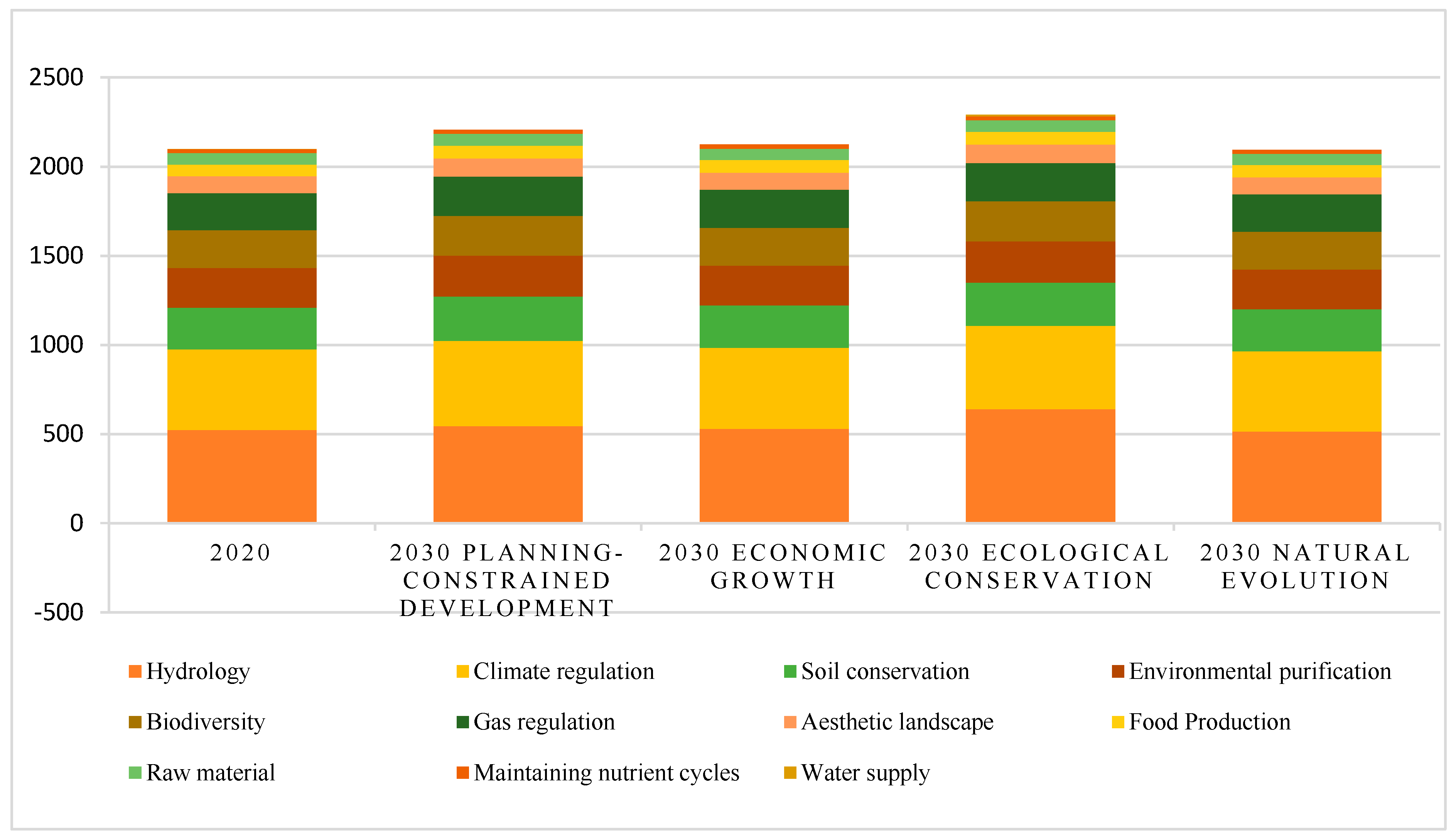
When examining individual changes in ecosystem service values (Figure 5), it is evident that hydrological regulation services represent the greatest contribution to the overall ecosystem service value (ESV), whereas water supply services represent the smallest. In comparison to 2020, the value attributed to climate regulation demonstrates a positive trend across all four scenarios, with increases surpassing CNY 100 million and ultimately reaching CNY 2.878 billion in the planning-constrained development scenario—marking the most significant rise among various ecosystem service functions. Following this, gas regulation services also display upward trends in each of the four scenarios. Notably, the value associated with water supply shows negative figures in all scenarios, except for the ecological protection scenario. In scenarios aside from Natural Changes, the ESV values within the Hexi Corridor region are observed to rise. The main factors contributing to this are that each of the three scenarios entails some level of restoration or upkeep of vegetable areas and aquatic environments, which enhances water retention in watersheds and improves the ability to buffer against drought, thus generally refining hydrological regulatory functions. The consistent increase in forest and grassland area enhances the capacity for carbon sequestration, maintaining a stable growth in climate regulation services within the region under study. The functions of provisioning services remain intact and even show marginal growth, suggesting that the current land use structure preserves specific economic output capabilities while supporting fundamental ecological regulation. Moreover, none of the three scenarios permit ecosystems to experience unchecked natural succession; rather, they incorporate deliberate human interventions for oversight and management, including wetland rehabilitation, grassland expansion, and the safeguarding of water resources.
From the perspective of spatial variation, the hydrological regulation service forms significant high-value hotspots in the glacial meltwater zones, oasis irrigation areas, and valley wetlands of the Qilian Mountains, playing a crucial role in regional water conservation and drought buffering. In contrast, it manifests as low-value cold spots in the western desert and northern arid regions, where the capacity for hydrological regulation is extremely weak. The climate regulation service forms a continuous high-value belt in the forested and grassland concentrated areas of the Qilian Mountains, demonstrating excellent carbon sequestration and evapotranspiration functions, while appearing as low-value cold spots in extensive areas of unused land and desert regions. The hotspot analysis results indicate that the spatial distribution of hydrological and climate regulation functions exhibits significant differences, presenting a gradient pattern of “mountainous areas—oases—deserts,” which is highly coupled with land use types and natural conditions. This regional heterogeneity suggests that priority should be given to protecting the core ecological functional zones at the interface between mountainous areas and oases, while simultaneously strengthening Ecological Compensation and compensation in low-value areas.
Despite the upward trend in total ESV across all scenarios, deconstructing individual ecosystem services (Figure 6) reveals significant trade-offs and synergies among services. First, trade-off relationships are most pronounced in the economic growth scenario: although provisioning services such as food production increased by approximately CNY 0.182 billion compared to 2020 due to cropland expansion, hydrological regulation services increased by only CNY 0.78 billion—far lower than the CNY 3.41 billion increase under the ecological protection scenario. Simultaneously, the growth in climate regulation services (+CNY 0.87 billion) was significantly lower than that under the planning-constrained development scenario (+CNY 2.88 billion). This clearly reveals a trade-off pathway that prioritizes provisioning services at the expense of regulating services, particularly hydrological regulation. Second, synergistic relationships are evident in the ecological protection scenario: multiple services—including hydrological regulation (+191.2%), climate regulation (+22.3%), and biodiversity maintenance (+18.7%)—increased substantially and simultaneously, while food provision did not decline significantly. This demonstrates that high-quality ecosystems can deliver multiple services concurrently. As Cord et al. (2017) emphasize, identifying such nonlinear relationships is central to understanding the complexity of social-ecological systems [23]. In this study, the superior performance of the planning-constrained development scenario stems precisely from its policy-guided approach—such as controlling construction land expansion and protecting water buffer zones—which minimizes detrimental trade-offs between regulating and provisioning services and promotes multi-service synergy. The policy implication of this finding is that land use planning should not pursue the mere maximization of total ESV, but rather should balance different service types through optimized spatial configuration, avoiding the degradation of overall system stability caused by one-sided pursuit of certain services.

4.4.5. The Synergistic Effect of Ecological Compensation and Land Use Policy

Comparing the ESV (Ecosystem Service Value) results with economic indicators provides a more direct insight into the ecological–economic trade-off. Under the economic growth scenario, accompanied by rapid urban expansion and increased agricultural scale, regional GDP and per capita income show a faster growth trend. However, the ESV only increases by CNY 7.186 billion compared to 2020, a significant increase lower than that under the ecological protection scenario. In the ecological protection scenario, where development activities are strictly restricted, GDP and income growth rates slow down. Nevertheless, the total ESV reaches CNY 229.048 billion, an increase of CNY 19.127 billion compared to 2020, representing the optimal ecological benefits among all scenarios. The planning-constrained development scenario presents a relatively balanced outcome, maintaining moderate economic growth while also enhancing the ecosystem service value, reflecting the characteristics of coordinated economic–social–ecological development. This result suggests that purely pursuing economic growth may lead to ecological pressure, whereas a balanced development model under policy regulation better accommodates both economic benefits and ecological protection, achieving a win–win outcome.
Through multi-scenario simulations in this study, combined with the relationship between land use changes and ESV fluctuations, the implementation of ecological compensation policies is particularly critical. Especially in the face of pressures from land use transformation, the improvement of water conservation and climate regulation services under the ecological protection scenario validates the key role of ecological protection measures in improving environmental quality. The following strategies should be strengthened:
Strengthening the differentiated ecological compensation mechanism: Establish tiered compensation standards based on the importance of key ecological areas, such as grasslands, water bodies, the Qilian Mountain water source conservation zone, and the oasis buffer zone. These standards should be adjusted in conjunction with dynamic monitoring data to ensure that compensation funds are accurately directed towards ecologically fragile and high-value areas.
These strategies, while necessary, should be informed by a process-based understanding of service flows. Ecological compensation is not simply about transferring funds to high-ESV areas—it is about paying for the ecological processes that generate downstream benefits. The hydrological regulation services provided by Qilian Mountain grasslands, for example, accrue value primarily through water availability in downstream oases. This spatial disconnect between service production (mountains) and service benefit (oases) creates a classic externality problem: those who bear the cost of conservation are not those who reap the rewards. Effective compensation must therefore trace these service pathways and align payment mechanisms with the actual beneficiary shed. This implies moving beyond static compensation zones toward dynamic models that link upstream land stewardship to downstream water security—for instance, through water funds that pool contributions from water users and disburse payments to upstream land managers based on measurable hydrological outcomes. Such outcome-based mechanisms not only improve efficiency but also create feedback loops that incentivize adaptive management: when downstream benefits increase, compensation flows rise, reinforcing conservation efforts in a virtuous cycle.

5. Discussion

5.1. Nonlinear Response Mechanism of ESV Driven by Land Use Change

This study reveals a significant coupling relationship between land use types and the spatial distribution of ecosystem service value (ESV) in the Hexi Corridor. High-value areas are predominantly located in ecological lands, such as forests, grasslands, and water bodies, while low-value areas are primarily found in unused and construction lands. This indicates that the structure of land use directly influences the regional ecosystem service capacity. The observed spatial differentiation pattern aligns with the conclusion proposed by Xie Gaodi et al. [52]. which states that there is a high consistency between ecological types and service functions. From 2000 to 2020, the expansion of construction land in the region reached 164.73%. Although this expansion has driven socio-economic development, it has also intensified encroachment on grasslands and water bodies, leading to a decline in regulatory and supporting services. Consequently, ESV exhibited a trend of ‘first rising and then falling.’ This finding confirms the sensitivity of ESV to land use and cover change (LUCC) and reveals the potential negative feedback of human development activities on ecosystem functions [53].
Existing empirical studies on the Hexi Corridor have revealed similar patterns. For instance, multi-scenario simulations in Zhangye indicate that the increase in Ecosystem Service Value (ESV) under construction scenarios is significantly lower than that under ecological protection scenarios [54,55], Research on the Heihe Wetland and forest ecosystems further demonstrates the critical contributions of water bodies and woodlands to regional ESV [56,57]; Meanwhile, studies on land use and cover change in Wuwei and Jiuquan show that overexploitation leads to a decline in regulating and supporting services, with overall ESV exhibiting a downward trend or diminishing marginal benefits [58]. These results corroborate the findings of this paper, indicating that, as a typical arid region, the fragile coupling relationship between land use/cover change (LUCC) and ESV in the Hexi Corridor exhibits significant consistency and regional representativeness.
In the scenario simulation, the Ecosystem Service Value (ESV) did not exhibit a steady increase with the continuous expansion of construction land; rather, it displayed a significant nonlinear response. By comparing the results from four scenario simulations, this study identifies a critical system response threshold: when the expansion rate of construction land is maintained within 30.11% (corresponding to the planning-constrained development scenario), the ESV growth is maximized at +CNY 15.765 billion, achieving a relatively optimal balance within the ecological–economic system. However, once the expansion rate surpasses this threshold (e.g., exceeding +40% in the economic growth scenario), the ESV growth rate declines significantly, increasing by only CNY 7.187 billion. This phenomenon illustrates diminishing marginal returns and presents the risk of ecological degradation. The identification of this inflection point suggests an ecological tolerance limit for land use in arid regions, with the system demonstrating critical point behavior, thus validating the nonlinear feedback mechanism of ecosystem services in response to development intensity [59].
The identified threshold for Ecosystem Service Value (ESV) inflection points is consistent with findings from other arid regions globally. For instance, Kubiszewski et al. (2020) determined that approximately 30% of land development serves as the elastic boundary for ESV in the Sahel region of Africa [13]. Similarly, Liu et al. conducted machine learning simulations in the Lanzhou area of Gansu, revealing that when grassland coverage falls below 20%, the provision of hydrological and climate regulation services declines rapidly [60]. In the existing research on the Hexi Corridor region, Zhang et al. found that locally in Hexi, ESV/ESP is more favorable when restricting the expansion of construction land or increasing the proportion of ecological land [61,62]; Wang et al. emphasized that the maintenance of grassland and water bodies is key to regulating/supporting services [63,64], which indicates that restricting the expansion of construction land and maintaining the proportion of grassland and water bodies helps to enhance or stabilize ESV and ecological security patterns, and ESV is more sensitive to changes in the area of grassland/wetland/water bodies. Meanwhile, evidence from the supply–demand perspective shows that areas with higher development intensity exhibit ecological supply pressure and spatial agglomeration, suggesting the presence of nonlinear degradation risks [65]. These findings are directionally consistent with the structural proportion identified in this study, specifically ‘the expansion of construction land within approximately 30% and the maintenance of grassland + water bodies at ≥15%’, provides a quantitative baseline for spatial development in the arid regions of Northwest China and further validates the feasibility of the ‘ecological–economic synergistic pathway’ in areas characterized by high ecological sensitivity.
In contrast to most studies that focus solely on natural trends or social drivers, this paper is the first to translate multi-level policy objectives-such as the “Gansu Provincial Territorial Spatial Plan (2021–2035)” and the “National Wetland Protection Plan (2022–2030)” into modeling parameters. It facilitates explicit calculations and spatial mappings of soft constraint policies, proposes a “policy–model-assessment” closed-loop mechanism, and addresses the limitations of traditional models that fail to convey policy intentions. This approach exhibits enhanced real-world adaptability and responsiveness to policy changes [66].
This study employs a nationally standardized equivalence factor table for ecosystem service value estimation. Although the economic value of grain per unit area was calibrated using multi-source data, unavoidable uncertainties remain. These uncertainties primarily originate from two sources. First, when the CLCD land use data were reclassified into six categories, secondary classes such as grassland and forestland were merged by taking arithmetic means, which may mask the ecological functional differences among sub-categories within the same land use type. Second, when national-scale equivalence factors are applied to the Hexi Corridor—a typical arid region—certain local ecosystem services (e.g., water conservation in the Qilian Mountains, weak regulating services in desert areas) may be overestimated or underestimated.
It should be emphasized that the aforementioned uncertainties primarily affect the absolute values of ESV estimates, while their impact on relative comparisons between scenarios is limited. This is because, in the simulations of the four scenarios, the systematic errors of the equivalence factors remain consistent. Therefore, the ESV differences between scenarios (e.g., the ecological protection scenario exceeds the natural changes scenario by CNY 19.962 billion) primarily reflect the net effects of land use pattern changes, with their directionality and relative magnitude exhibiting high robustness. As Córdoba Hernández and Camerin (2024) emphasize when discussing the application of ecosystem assessments to land use planning, understanding the inherent uncertainties of assessment is a critical step in transitioning from academic models to operational planning tools [67]. This study maintains caution when interpreting absolute ESV values (e.g., CNY 229.048 billion) and relies primarily on inter-scenario comparisons to support policy recommendations, which aligns with the prevailing international practices in addressing such uncertainties.

5.2. The Innovation and Advantages of the Policy–Model–Evaluation Framework

The proposed ‘policy–model–evaluation’ framework in this study introduces several innovations to existing land use simulation methods. It particularly highlights unique advantages in policy quantification, model coupling efficiency, and the assessment of multi-dimensional ecosystem service value (ESV).
In terms of policy quantification and adaptability, traditional models often integrate land use changes with socio-economic driving factors but tend to overlook the quantified impact of policy drivers. By transforming the policy objectives of the ‘Gansu Provincial Territorial Spatial Plan (2021–2035)’ and the ‘National Wetland Protection Plan (2022–2030)’ into specific modeling parameters, this study addresses this gap. This approach not only enhances the model’s responsiveness to policy objectives but also clarifies the relationship between land use planning and policy goals, thereby contributing to the improvement of the operability and precision of policy implementation.
Secondly, coupling efficiency and dynamic feedback represent significant innovations within this framework. Traditional models, such as FLUS, predominantly utilize a unidirectional simulation approach, which neglects the potential feedback effects that may emerge during policy implementation. This study introduces a closed-loop mechanism of ‘policy–model–evaluation,’ facilitating dynamic adjustments to land use decisions based on real-time feedback. This dynamic feedback mechanism substantially enhances the model’s flexibility, enabling it to effectively monitor policy implementation outcomes and provide timely decision-making support.
In terms of multi-dimensional assessment, this study addresses the limitations of traditional methods that rely solely on static evaluations of Ecosystem Service Values (ESV). By integrating dynamic land use change scenarios with multi-dimensional ESV calculations, it offers a comprehensive assessment of the long-term effects of policy implementation on ecological services, including water conservation and climate regulation. Furthermore, by incorporating changes in both spatial and temporal dimensions into the assessment framework, this research not only evaluates policies at a single point in time but also elucidates the effects of these policies over long-term evolution. This approach significantly enhances the predictability and practicality of the assessment results.
Furthermore, the framework of this study demonstrates significant spatial adaptability. In addition to its application in China’s Hexi Corridor, this methodology is applicable to other ecologically sensitive regions, such as the inland river basins of Central Asia, the arid zones of North Africa, and Western Australia. These areas encounter similar challenges in land use optimization under policy guidance, and this framework can provide a scientific foundation for regional land management and ecological conservation policies. Notably, in striving to achieve the goal of ‘Land Degradation Neutrality (SDG 15.3)’ as outlined in the United Nations’ ‘2030 Agenda for Sustainable Development,’ this framework can offer actionable decision-making support for various countries, thereby enhancing both the theoretical contribution and practical value of global ecological management.
In summary, the policy–model–evaluation framework presented in this study utilizes innovative policy quantification methods, dynamic feedback mechanisms, and multi-dimensional ecosystem service valuation (ESV) assessments. This framework significantly addresses the limitations of existing methodologies regarding policy adaptability, dynamic adjustment, and long-term evaluation. Consequently, it provides both a theoretical foundation and practical tools for the formulation of land use optimization and ecological protection policies in arid regions.

5.3. Policy Implications and Regional Scalability

Changes in ESV, in addition to being influenced by natural factors, are also strongly affected by socio-economic drivers such as population, economy, and policy. Previous studies have revealed their coupling mechanisms through methods such as CCD, GWR, and GeoDetector [68,69,70]. Due to data limitations, this paper only points out the possible pathways; future research could combine county-level or gridded data and employ coupling models to more systematically characterize the interactions between LUCC and ESV. Against this background, a key issue for achieving eco-economic synergy in arid regions lies in how to translate research findings into concrete policy regulation and practical pathways. To this end, the following recommendations are proposed:
(1)
Establish a mechanism for “policy computability”: Control indicators in planning documents, such as the growth coefficient of construction land and the restoration of water areas, should be quantified as input parameters and constraints in models. This approach facilitates the transformation of policy objectives into spatially operable models, thereby enhancing the implementation capabilities of territorial spatial planning [71].
(2)
Optimize the spatial development control pathway by implementing stringent development restrictions in areas with high ecosystem service value (ESV) sensitivity, such as the edges of oases and the northern foothills of the Qilian Mountains. In regions with moderate ecological functions, adopt strategies such as ‘replacing unused land with construction land’ and ‘optimizing grassland to woodland’ to achieve a flexible optimization of spatial structure [72].
(3)
Establish a closed-loop management system encompassing ‘remote sensing monitoring—model simulation—feedback assessment.’ This system should leverage dynamic remote sensing monitoring and PLUS model simulation to conduct regular assessments of critical ecological indicators, including the intensity of construction land expansion, water connectivity, and the integrity of grassland patches, allowing for timely corrections of land use deviation [73,74].
(4)
Establishing a horizontal ecological compensation mechanism is essential for upstream protected areas that demonstrate significant enhancements in ecosystem service value (ESV) yet have limited economic output, such as the source area of the Shule River. It is recommended that downstream beneficiary areas provide financial ecological compensation, thereby creating a novel spatial governance model characterized by “ecological output—benefit sharing” [75].
The policy-driven + ESV assessment framework proposed in this study exhibits broad international applicability, particularly in ecologically sensitive regions characterized by urgent development needs and distinct policy orientations. Examples include inland river basins in Central Asia, arid zones in North Africa, and Western Australia. This framework can provide spatial decision-making support for the ‘Land Degradation Neutrality (SDG 15.3)’ target outlined in the United Nations’ ‘2030 Agenda for Sustainable Development.’ Furthermore, it enhances the theoretical contributions and application value of China’s land use simulation methods within the context of global ecological management [76].
The “policy–model–evaluation” framework presented in this study illustrates significant applicability in arid regions under the Belt and Road Initiative, particularly in ecologically sensitive areas such as Central Asia and North Africa. These regions, akin to the Hexi Corridor, encounter challenges such as land degradation, ecological fragility, and pressing development needs. By converting policy objectives into modeling parameters, this framework can aid relevant countries in achieving a coordinated development of ecology and economy throughout the land use optimization process.
In regions such as Central Asia and North Africa, the challenges of water scarcity and land degradation are particularly pronounced. The water conservation and climate regulation services outlined in this framework provide a scientific foundation for these regions, guiding the management of water resources and the restoration of land. Furthermore, the multi-level policy transformation mechanism embedded in the framework can aid countries in defining policy objectives, such as territorial spatial planning and wetland protection, and implementing these objectives through models, thereby offering targeted decision-making support.
However, the applicability of the framework in different regions must also consider regional disparities, especially regarding data availability and the enforceability of policies. For example, certain arid regions along the ‘Belt and Road’ may be deficient in high-resolution remote sensing data and long-term land use change data, necessitating additional data collection and model adjustments.
The framework of this study not only provides decision-making support for land use and ecological protection in the Hexi Corridor of China, but its cross-regional applicability also offers theoretical foundations and practical tools for land management and Ecological Compensation in arid regions along the Belt and Road Initiative.

6. Conclusions

This study systematically investigated land use change and ecosystem service dynamics in the Hexi Corridor, an arid ecological transition zone, by integrating policy constraints into a Markov–PLUS coupled modeling framework and conducting multi-scenario simulations. Several key conclusions can be drawn.
First, from 2000 to 2020, the land use structure of the Hexi Corridor was dominated by unused land (over 60%) and grassland (approximately 20%), while construction land exhibited the most significant expansion, increasing by 164.73% and mainly encroaching upon unused land and grassland. Land use transitions were concentrated among unused land, grassland, and cultivated land, reflecting the long-term interaction between development demand and ecological vulnerability in arid regions. By embedding multi-level territorial planning policies into the PLUS model, this study establishes a policy-oriented land use simulation framework and constructs four development scenarios—Natural Changes, economic growth, ecological conservation, and planning-constrained development—thereby overcoming the limitation of traditional LUCC simulations that lack explicit policy representation.
Second, scenario simulation results indicate that ecosystem service value (ESV) will increase under all four scenarios by 2030 compared to 2020; however, the magnitude and composition of ESV gains differ substantially across scenarios. The ecological conservation scenario yields the highest ESV (CNY 229.048 billion), whereas the planning-constrained development scenario achieves a 7.7% increase in ESV (CNY 220.460 billion) while constraining construction land expansion to within 30.11%. Hydrological regulation and climate regulation consistently dominate ESV contributions, with grassland and water bodies serving as the primary ecological carriers. These findings demonstrate that ecosystem service responses to land use change in arid regions are nonlinear, and that moderate, policy-guided development can achieve ecological–economic synergy rather than a simple trade-off.
Third, the spatial distribution of ESV exhibits a distinct “patch–boundary–gradient” pattern. High-value zones are concentrated in mountainous areas and oasis margins in the central and southern Hexi Corridor, while low-value zones are mainly distributed in desert regions in the north and west. High-ESV areas are dominated by grassland, water bodies, and woodland, collectively accounting for over 80% of land composition and forming the core source of regional ecosystem services. Boundary areas are particularly sensitive to land use transitions among grassland, water bodies, and cultivated land. Under the economic growth scenario, accelerated conversion of ecological land into arable and construction land leads to a decline in regulating and supporting services, whereas the ecological conservation and planning-constrained development scenarios effectively restrict such transitions and maintain or restore ecological land. This spatially explicit diagnosis provides a scientific basis for zone-specific governance strategies: high-value areas should be strictly managed as core protection zones, medium-value boundary areas should be prioritized for restoration as ecological buffer zones, and low-value areas can appropriately accommodate economic development activities while safeguarding the ecological security baseline.
Fourth, this study identifies critical thresholds for ecological–economic synergy in arid regions: construction land expansion should be constrained to approximately 30%, and the proportion of ecological land (grassland and water bodies) should not fall below 15% to avoid rapid degradation of ecosystem service values. These thresholds reflect the nonlinear feedback mechanisms between land development intensity and ecosystem service provision—when the construction land expansion rate is maintained within 30.11% (planning-constrained development scenario), ESV growth is maximized (+CNY 15.765 billion); once this threshold is exceeded (>40% in the economic growth scenario), the ESV growth rate declines significantly (+CNY 7.187 billion), exhibiting diminishing marginal returns and ecological degradation risks. Based on these findings, three operational policy tools are proposed:
(1)
Establish a “growth threshold” early warning and control system that automatically triggers ecological compensation or development restrictions when construction land expansion approaches the 30% upper limit;
(2)
Implement differentiated spatial regulation based on ESV zoning, recommending the establishment of 20–30 km ecological buffer zones around water bodies, prioritizing restoration measures such as returning farmland to wetland and converting grazing land to grassland;
(3)
Institutionalize a “monitoring-simulation-feedback” adaptive management cycle, updating land use data and re-running models at regular intervals (e.g., every 5 years) to enable dynamic policy evaluation and timely adjustments.
Fifth, this study has several methodological and data limitations that point toward future research directions. At the methodological level, the use of nationally standardized equivalence factors, while ensuring cross-regional comparability, may not fully capture local ecological specificities in arid regions—particularly regulating services in the glacial meltwater zones of the Qilian Mountains and edge effects in oasis–desert ecotones. Future research should incorporate locally calibrated factors based on biophysical indicators (e.g., NPP, evapotranspiration) and conduct multi-source sensitivity analyses to establish robust confidence intervals for ESV estimates. At the data level, the interpolation of county-level socioeconomic data introduces smoothing effects that may obscure local-scale human activity heterogeneity; integrating emerging geospatial big data (e.g., nighttime light imagery, mobile phone signaling data) offers a promising pathway to improve simulation fidelity. At the model coupling level, the current study remains at the stage of land cover-based value assessment and does not delve into ecological process simulation. Future research should couple PLUS with process-based models (e.g., InVEST, ARIES) to more mechanistically understand how land use change translates into ecological outcomes and to provide a systematic framework for analyzing trade-offs and synergies among individual services.

Author Contributions

Conceptualization, Q.W.; Methodology, Q.W. and Z.Y.; Software, Q.W.; Validation, Q.W.; Formal analysis, Q.W.; Investigation, Q.W.; Resources, Q.W., Z.Y. and W.L.; Data curation, Q.W.; Writing—original draft, Q.W.; Writing—review & editing, Q.W.; Visualization, Z.Y. and W.L.; Supervision, Z.Y. and W.L.; Project administration, Z.Y. and W.L.; Funding acquisition, Z.Y. All authors have read and agreed to the published version of the manuscript.

Funding

This research was funded by Phase Research Results of the Gansu Provincial Philosophy and Social Sciences Planning Project (2025YB032).

Data Availability Statement

The original contributions presented in this study are included in the article. Further inquiries can be directed to the corresponding author.

Conflicts of Interest

The authors declare no conflict of interest.

References

  1. Zhang, C.; Bai, Y.; Yang, X.; Li, L.; Liang, J.; Wang, Q.; Chen, Z. Ecosystem service cluster identification under multi-scenario simulations in the Ningxia Plain. Geogr. Res. 2022, 41, 3364–3382. [Google Scholar]
  2. Jiang, W.; Wu, T.; Fu, B. The value of ecosystem services in China: A systematic review for twenty years. Ecosyst. Serv. 2021, 52, 101365. [Google Scholar] [CrossRef]
  3. Qu, Y.; Ding, J.; Bao, Q.; Wang, Y.; Xu, M. Ecosystem service value assessment of Xinjiang under multi-scenario simulations. Environ. Sci. Technol. 2023, 46, 195–204. [Google Scholar]
  4. Yang, S.; Su, S.; Zhao, G. Multi-scenario simulation of urban ecosystem service value based on the PLUS model: A case study of Hanzhong. Arid. Zone Resour. Environ. 2022, 36, 86–95. [Google Scholar]
  5. Zuo, L.; Liu, G.; Zhao, J.; Li, J.; Zheng, S.; Wang, J.; Su, X. Ecosystem services and their impacts on sustainable development goals in the western Sichuan region. Acta Ecol. Sin. 2024, 44, 4203–4216. [Google Scholar]
  6. Ouyang, X.; He, Q.; Zhu, X. The impact of land use change on ecosystem service value in city clusters under multiple scenarios: A case study of Chang-Zhu-Tan city cluster. Econ. Geogr. 2020, 40, 93–102. [Google Scholar]
  7. Costanza, R.; d’ Arge, R.; de Groot, R.; Farber, S.; Grasso, M.; Hannon, B.; Limburg, K.; Naeem, S.; O’Neill, R.V.; Paruelo, J.; et al. The value of the world’s ecosystem services and natural capital. Nature 1997, 387, 253–260. [Google Scholar] [CrossRef]
  8. Xie, G.; Zhang, C.; Zhang, L.; Chen, W.; Li, S. Improvement of the ecosystem service value estimation method based on unit area value equivalent factors. J. Nat. Resour. 2015, 30, 1243–1254. [Google Scholar]
  9. Gao, R.; Zhang, C.; Bai, H. Climate change characteristics in the northwest arid and semi-arid transitional zone over the last 50 years and their impacts on crop yield. Anhui Agric. Sci. 2009, 37, 6493–6497+6519. [Google Scholar]
  10. Watson, L.; Verstegen, J.A. Uncertainty and Sensitivity of Global Ecosystem Service Values. In Proceedings of the 11th International Congress on Environmental Modelling and Software, Brussels, Belgium, 5 June 2022. [Google Scholar]
  11. Alshehri, K. Multi-Level Sustainability Assessment of Nature-Based Resource Recovery Systems. Doctoral Dissertation, Cardiff University, Cardiff, UK, 2024. [Google Scholar]
  12. Lu, Y.; Xu, C.; Wang, X. Evaluation and Driving Factor Analysis of Freshwater Lake Ecosystem Service Value in China Based on Coefficient Revision: A Case Study of Five Major Freshwater Lakes. Available online: https://ssrn.com/abstract=5181778 (accessed on 23 February 2026).
  13. Kubiszewski, I.; Costanza, R.; Anderson, S.; Sutton, P. The future value of ecosystem services: Global scenarios and national implications. In Environmental Assessments; Edward Elgar Publishing: Cheltenham, UK, 2020; pp. 81–108. [Google Scholar]
  14. Hu, X.; Zhu, W.; Shen, X.; Bai, R.; Shi, Y.; Li, C.; Zhao, L. Exploring the predictive ability of the CA-Markov model for urban functional area in Nanjing old city. Sci. Rep. 2024, 14, 18453. [Google Scholar] [CrossRef]
  15. Zhang, Y.; Lin, J.; Huang, Y.; Chen, Z.; Zhu, C.; Yuan, H. Delineation of urban growth boundary based on FLUS model under the perspective of land use evaluation in hilly mountainous areas. J. Mt. Sci. 2024, 21, 1647–1662. [Google Scholar] [CrossRef]
  16. Liu, X.; Liang, X.; Li, X.; Xu, X.; Ou, J.; Chen, Y.; Li, S.; Wang, S.; Pei, F. A future land use simulation model (FLUS) for simulating multiple land use scenarios by coupling human and natural effects. Landsc. Urban Plan. 2017, 168, 94–116. [Google Scholar] [CrossRef]
  17. Song, W.; Yang, D.; Wang, Y. Integrating an abandoned farmland simulation model (AFSM) using system dynamics and CLUE-S for sustainable agriculture. Agric. Syst. 2024, 219, 104063. [Google Scholar] [CrossRef]
  18. Liu, J.; Liu, B.; Wu, L.; Miao, H.; Liu, J.; Jiang, K.; Ding, H.; Gao, W.; Liu, T. Prediction of land use for the next 30 years using the PLUS model’s multi-scenario simulation in Guizhou Province, China. Sci. Rep. 2024, 14, 13143. [Google Scholar] [CrossRef] [PubMed]
  19. Cao, J.; Cao, W.; Cao, Y.; Wang, X.; Zhang, Y.; Ma, J. Multi-scenario land use prediction and layout optimization in Nanjing Metropolitan Area based on the PLUS model. J. Geogr. Sci. 2024, 34, 1415–1436. [Google Scholar] [CrossRef]
  20. Xu, L.; Liu, X.; Tong, D.; Liu, Z.; Yin, L.; Zhen, W. Forecasting urban land use change based on cellular automata and the PLUS model. Land 2022, 11, 652. [Google Scholar] [CrossRef]
  21. Zhang, Y.; Naerkezi, N.; Zhang, Y.; Wang, B. Multi-scenario land use/cover change and its impact on carbon storage based on the coupled GMOP-PLUS-InVEST model in the Hexi Corridor, China. Sustainability 2024, 16, 1402. [Google Scholar] [CrossRef]
  22. Shi, J.; Shi, P.; Wang, Z.; Wang, L.; Li, Y. Multi-scenario simulation and driving force analysis of ecosystem service value in arid areas based on PLUS model: A case study of Jiuquan City, China. Land 2023, 12, 937. [Google Scholar] [CrossRef]
  23. Cord, A.F.; Bartkowski, B.; Beckmann, M.; Dittrich, A.; Hermans-Neumann, K.; Kaim, A.; Lienhoop, N.; Locher-Krause, K.; Priess, J.A.; Schröter-Schlaack, C.; et al. Towards systematic analyses of ecosystem service trade-offs and synergies: Main concepts, methods and the road ahead. Ecosyst. Serv. 2017, 28, 264–272. [Google Scholar] [CrossRef]
  24. Sharma, L.K.; Raj, A.; Somawat, K.A.; Somawat, K. Spatio-temporal assessment of Environmentally Sensitive Areas (ESA) in The Thar Desert India, to combat desertification under UNCCD framework. J. Arid Environ. 2021, 194, 104609. [Google Scholar] [CrossRef]
  25. Huang, J.; Xue, D.Q.; Dong, C.Y.; Wang, C.S.; Zhang, C.; Ma, B.B.; Song, Y.Y. Ecological environmental effects and differentiation mechanisms of land use transformation in arid oasis agricultural areas: A case study based on the three-dimensional spatial dominant functional perspective. Prog. Geogr. 2022, 41, 2044–2060. [Google Scholar] [CrossRef]
  26. Wen, Y. Comprehensive evaluation and spatiotemporal evolution characteristics of ecological environment quality in Gansu Province from 2011 to 2021. Arid Zone Resour. Environ. 2024, 38, 110–119. [Google Scholar]
  27. Wang, W. Urban and Rural Green Space Simulation and Prediction Based on the PLUS Model. Master’s Thesis, Shandong Jianzhu University, Jinan, China, 2023. [Google Scholar]
  28. GB/T 21010-2017; Current Land Use Classification. Standardization Administration of China: Beijing, China, 2017.
  29. Zhao, H. Study on Ecosystem Service Value Accounting and Its Influencing Factors in Anhui Province. Master’s Thesis, Hefei University of Technology, Hefei, China, 2019. [Google Scholar]
  30. O’brien, R.M. A caution regarding rules of thumb for variance inflation factors. Qual. Quant. 2007, 41, 673–690. [Google Scholar] [CrossRef]
  31. Yuan, Z.; Song, S. Multivariate Statistical Analysis; Science Press: Beijing, China, 2009. [Google Scholar]
  32. Wang, B.; Liao, J.; Zhu, W. Setting neighborhood weights in the FLUS model based on historical scenarios: A case study of land use simulation in the Min Triangle city cluster for 2030. Acta Ecol. Sin. 2019, 39, 4284–4298. [Google Scholar]
  33. Yuan, X. Scenario Simulation and Landscape Ecological Risk Research of Land Use Change in Wuhan Based on the PLUS Model. Master’s Thesis, East China University of Technology, Nanchang, China, 2022. [Google Scholar] [CrossRef]
  34. Niu, T.L.; Xiong, L.H.; Chen, J.; Zhou, Y.L.; Yin, J.B.; Liu, D.D. Simulation of land use change in the Yangtze River Basin and multi-scenario prediction based on the PLUS model. J. Wuhan Univ. (Eng. Ed.) 2024, 57, 129–141+151. [Google Scholar]
  35. Pontius, R.G., Jr.; Boersma, W.; Castella, J.-C.; Clarke, K.; de Nijs, T.; Dietzel, C.; Duan, Z.; Fotsing, E.; Goldstein, N.; Kok, K.; et al. Comparing the input, output, and validation maps for several models of land change. Ann. Reg. Sci. 2008, 42, 11–37. [Google Scholar] [CrossRef]
  36. Wang, B. Spatial-Temporal Pattern Evolution and Multi-Scenario Simulation of Land Use Conflict in Poyang Lake Area Based on PLUS Model. Master’s Thesis, Jiangxi Normal University, Nanchang, China, 2023. [Google Scholar]
  37. Wang, X.; Ma, B.; Li, D.; Chen, K.; Yao, H. Multi-scenario simulation and prediction of ecological space in Hubei Province based on the FLUS model. J. Nat. Resour. 2020, 35, 230–242. [Google Scholar] [CrossRef]
  38. Tang, X.; Cai, L.; Zhang, B. Land use and ecosystem service value in ecological transition zones: A multi-scenario simulation based on Gansu Province. J. Ecol. Rural. Environ. 2025, 41, 852–865. [Google Scholar]
  39. Shi, Y.; Wang, R.; Huang, J.; Yang, W. Spatiotemporal variation analysis of China’s terrestrial ecosystem services. Sci. Bull. 2012, 57, 720–731. [Google Scholar] [CrossRef]
  40. Hou, X.; Chang, B.; Yu, X. Land use change in the Hexi Corridor based on the CA-Markov model. Agric. Eng. J. 2004, 20, 286–291. [Google Scholar]
  41. Hamad, R.; Balzter, H.; Kolo, K. Predicting land use/land cover changes using a CA-Markov model under two different scenarios. Sustainability 2018, 10, 3421. [Google Scholar] [CrossRef]
  42. Clarke, K.C.; Hoppen, S.; Gaydos, L. A self-modifying cellular automaton model of historical urbanization in the San Francisco Bay area. Environ. Plan. B Plan. Des. 1997, 24, 247–261. [Google Scholar] [CrossRef]
  43. Liang, X.; Guan, Q.; Clarke, K.C.; Liu, S.; Wang, B.; Yao, Y. Understanding the drivers of sustainable land expansion using a patch-generating land use simulation (PLUS) model: A case study in Wuhan, China. Comput. Environ. Urban Syst. 2021, 85, 101569. [Google Scholar] [CrossRef]
  44. Jiang, S.; Shi, X.F.; Guo, C.L.; Feng, Y.L.; Sun, X.B.; Sun, J.Q.; Ni, J. Land use change and simulation in the Daling River Basin based on the CA-Markov model. Geol. Resour. 2023, 32, 624–632. [Google Scholar]
  45. Yang, H.; Jiang, C.; Zheng, R.; Shi, C. Land use change and scenario simulation of Fuzhou city based on the Markov-PLUS model. J. Anhui Agric. Sci. 2024, 52, 2. [Google Scholar]
  46. Sun, D.; Liang, Y. Multi-scenario simulation of the Loess Plateau’s land use based on the improved Markov-CA model. J. Earth Inf. Sci. 2021, 23, 825–836. [Google Scholar]
  47. Wu, D.; Li, H.; Ai, N.; Huang, T.; Gu, J. Land use spatiotemporal change and habitat quality prediction based on CA-Markov in the central arid region of Ningxia. Chin. J. Eco-Agric. 2020, 28, 1969–1978. [Google Scholar]
  48. Li, H.; Liu, H.; Wang, J.; Guo, Y. Land use spatiotemporal evolution and ecosystem service value of Jinzhong city based on the Markov-FLUS-MCR model. Trans. Chin. Soc. Agric. Eng. 2025, 41, 279–287. [Google Scholar]
  49. Xia, H.; Yuan, S.; Prishchepov, A.V. Spatial-temporal heterogeneity of ecosystem service interactions and their social-ecological drivers: Implications for spatial planning and management. Resour. Conserv. Recycl. 2023, 189, 106767. [Google Scholar] [CrossRef]
  50. Zeng, C.; Zhang, G.; Li, T.; He, B.; Zhang, D. Spatial-Temporal heterogeneity of ecosystem service value driven by Nature-Human Activity-Policy in a representative fragile karst trough valley, SW China. Land 2024, 13, 256. [Google Scholar] [CrossRef]
  51. Qiao, J.; Deng, L.; Liu, H.; Wang, Z. Spatiotemporal heterogeneity in ecosystem service trade-offs and their drivers in the Huang-Huai-Hai Plain, China. Landsc. Ecol. 2024, 39, 42. [Google Scholar] [CrossRef]
  52. Xie, G.D.; Zhang, C.X.; Zhang, C.S.; Xiao, Y.; Lu, C.X. The value of ecosystem services in China. Resour. Sci. 2015, 37, 1740–1746. [Google Scholar]
  53. Deng, Y.; Hou, M.; Xie, Y.; Gao, Q.; Yao, S.; Gong, Z.; Lu, Y.; Jia, L.; Li, Y. Impact of the Grain-to-Green Program on the spatiotemporal evolution of ecosystem service value in Northern Shaanxi. Acta Ecol. Sin. 2020, 40, 6597–6612. [Google Scholar]
  54. Bai, Y.; Wang, J.; Liu, L.; Du, Y.; Deng, X.; Chen, J. Ecosystem service value prediction and trade-off analysis in the Heihe River Basin: A case study of Zhangye City. Acta Ecol. Sin. 2022, 42, 5187–5199. [Google Scholar]
  55. Yao, L.T.; Zhang, X.B.; Zhou, L.; Luo, J.; Wang, Z.; Lei, Y.; Li, Y. Trade-offs and synergy effects of land use change in mountain-oasis-desert complex systems: A case study of Zhangye City. Prog. Geogr. 2022, 42, 8138–8151. [Google Scholar]
  56. Yang, X.; Xin, H.; Yang, Y. Ecosystem service value evaluation of Heihe Wetland based on meta-analysis. J. Ecol. Rural Environ. 2023, 39, 60–68. [Google Scholar]
  57. Ma, C.; Wang, H.; Ma, X.; Chen, Y.; Zhou, X. Ecosystem service value estimation in the upper Heihe River Basin of Zhangye County. Wetl. Sci. 2021, 19, 762–766. [Google Scholar]
  58. Zhang, Z.; Kang, H. Spatiotemporal variation and driving force analysis of land use/cover in Wuwei city from 2000 to 2020. Sci. Technol. Eng. 2023, 23, 8579–8587. [Google Scholar]
  59. Turner, R.K.; Daily, G. The ecosystem services framework and natural capital conservation. Environ. Resour. Econ. 2008, 39, 25–35. [Google Scholar] [CrossRef]
  60. Liu, J.; Xiao, B.; Jiao, J.; Li, Y.; Wang, X. Modeling the response of ecological service value to land use change through deep learning simulation in Lanzhou, China. Sci. Total Environ. 2021, 796, 148981. [Google Scholar] [CrossRef]
  61. Zhang, B.; Feng, Q.; Li, Z.; Lu, Z.; Zhang, B.; Cheng, W. Land Use/Cover-related ecosystem service value in fragile ecological environments: A case study in hexi region, China. Remote Sens. 2024, 16, 563. [Google Scholar] [CrossRef]
  62. Li, Y.; Liu, W.; Feng, Q.; Zhu, M.; Yang, L.; Zhang, J.; Yin, X. The role of land use change in affecting ecosystem services and the ecological security pattern of the Hexi Regions, Northwest China. Sci. Total Environ. 2023, 855, 158940. [Google Scholar] [CrossRef]
  63. Wang, Z.; Shi, P.; Li, X. Response mechanism and improvement paths of habitat quality to land use change in the Hexi Corridor region. Environ. Sci. 2023, 12, 2024-08. [Google Scholar]
  64. Xue, J.; Zhang, X.; Wang, Y.; Liu, H.; Chen, Y. Spatiotemporal variation and influencing factors of ecosystem services in the Hexi Corridor from 2000 to 2020. Environ. Ecol. 2023, 5, 1–12. [Google Scholar]
  65. Nan, S.; Wei, W.; Liu, C.; Zhou, J. Ecological environmental effects and spatiotemporal evolution characteristics of land use change in the Hexi Corridor. Chin. J. Appl. Ecol. 2022, 33, 3055–3064. [Google Scholar]
  66. Duan, L.; Yang, S.; Xiang, M.; Li, W.; Li, J. Spatiotemporal evolution and driving factors of ecosystem service value in the Upper Minjiang River of China. Sci. Rep. 2024, 14, 23398. [Google Scholar] [CrossRef]
  67. Córdoba Hernández, R.; Camerin, F. The application of ecosystem assessments in land use planning: A case study for supporting decisions toward ecosystem protection. Futures 2024, 161, 103399. [Google Scholar] [CrossRef]
  68. Yang, L.; Liu, F. Spatio-temporal evolution and driving factors of ecosystem service value of urban agglomeration in central yunnan. Sustainability 2022, 14, 10823. [Google Scholar] [CrossRef]
  69. Zhang, C.; Yu, S. Ecosystem service value spatiotemporal characteristics and interactive driving research based on land use scenario simulation in Hetian region. J. Agric. Resour. Environ. 2024, 41, 780–793. [Google Scholar]
  70. Kass, M.J. Summary for policymakers of the global assessment report on biodiversity and ecosystem services. Nat. Resour. Environ. 2020, 34, 62. [Google Scholar]
  71. Wang, Y.; Liang, Z.; Yu, H. Landscape ecological risk spatiotemporal differentiation and multi-scenario simulation in the Fenhe River Basin based on the PLUS model. Ecol. Sci. 2024, 43, 35–45. [Google Scholar]
  72. Fisher, B.; Turner, R.K.; Zylstra, M.; Brouwer, R.; de Groot, R.; Farber, S.; Ferraro, P.; Green, R.; Hadley, D.; Harlow, J.; et al. Ecosystem services and economic theory: Integration for policy-relevant research. Ecol. Appl. 2008, 18, 2050–2067. [Google Scholar] [CrossRef]
  73. Bryan, B.A.; Ye, Y.; Zhang, J.; Connor, J.D. Land-use change impacts on ecosystem services value: Incorporating the scarcity effects of supply and demand dynamics. Ecosyst. Serv. 2018, 32, 144–157. [Google Scholar] [CrossRef]
  74. Castro, A.J.; Verburg, P.H.; Martín-López, B.; Garcia-Llorente, M.; Cabello, J.; Vaughn, C.C.; López, E. Ecosystem service trade-offs from supply to social demand: A landscape-scale spatial analysis. Landsc. Urban Plan. 2014, 132, 102–110. [Google Scholar] [CrossRef]
  75. Alcamo, J.; van Vuuren, D.; Cramer, W.; Alder, J.; Bennett, E.; Carpenter, S.; Christensen, V.; Foley, J.; Maerker, M.; Masui, T.; et al. Changes in ecosystem services and their drivers across the scenarios. Ecosyst. Hum. Well-Being 2005, 2, 297–373. [Google Scholar]
  76. Li, Y.; Wu, H.; Zhu, L.; Wang, Y.; Shao, W. Identification of ecosystem service degradation risks in Zhengzhou based on multi-scenario land use simulation. J. Nat. Resour. 2025, 40, 493–513. [Google Scholar] [CrossRef]
Figure 1. Overview of the Hexi Corridor, illustrating the region’s geographical and ecological features, including key mountains, rivers, and land use patterns that contribute to its unique ecological characteristics.
Land 15 00414 g001
Figure 2. The “policy quantification–spatial simulation–effect assessment” coupling framework of this study. The figure illustrates how policy constraints are transformed into model parameters, and how PLUS simulation and ESV assessment ultimately output the ecological–economic effects under different scenarios.
Land 15 00414 g002
Figure 3. Land Use Transfer Sankey Chart (2000–2020) showing the shifts between different land types in the Hexi Corridor over two decades. The chart highlights the growth of construction and water bodies, as well as the changes in grassland and unused land areas.
Land 15 00414 g003
Figure 4. Land Use in the Hexi Corridor in 2030 under different scenarios: planning-constrained development, Economic Growth, Ecological Conservation, and Natural Evolution. The figure shows projected land use patterns for 2030, demonstrating the influence of various development strategies on the region’s land types.
Land 15 00414 g004
Figure 5. Spatial distribution of Ecosystem Services Value (ESV) in the Hexi Corridor under different scenarios for 2030. The map visualizes the geographic variation in ESV across the region, indicating areas with high ecological value under different land use policies.
Land 15 00414 g005
Figure 6. Individual Ecosystem Services Value (ESV) in 2020 and 2030 under different scenarios. The figure compares the contribution of various ecosystem services (e.g., climate regulation, water conservation) across multiple development scenarios, showing both temporal and spatial variations.
Land 15 00414 g006
Table 1. Data Sources for the Hexi Corridor land use, socio-economic, and natural environmental data. This table outlines the origins and details of all data utilized in the study, including land use, demographic, economic, and environmental data sources for years 2000, 2010, and 2020.
CategoryData NameData Source
Land Use DataLand use data for 2000, 2010 and 2020Wuhan University China Land Cover Dataset
Socio-Economic DataSocio-economic data and grain production data of Gansu ProvinceChina Statistical Yearbook, Gansu Provincial Statistical Yearbook
Administrative DistrictsNational Geographic Information Service Platform “https://www.tianditu.gov.cn” (accessed on 23 February 2026)
Population DensityGlobal Change Scientific Research Data Publication System “https://www.geodoi.ac.cn/” (accessed on 23 February 2026)
GDP
Distance to government above county levelNational Geographic Information Resources Catalog Service System “https://www.webmap.cn/” (accessed on 23 February 2026)
Distance to Nature Reserve Distance to Nature Reserve
Natural environmental dataNDVIResource and Environment Science Data Center, Chinese Academy of Sciences
https://www.resdc.cn/” (accessed on 23 February 2026)
National Earth System Science Data Center
http://www.geodata.cn/” (accessed on 23 February 2026)
Soil type
Average annual precipitation
Average annual temperature
DEMGeospatial Data Cloud “https://www.gscloud.cn/
(accessed on 23 February 2026)
Based on the DEM data, the slope analysis with the help of ArcGIS 10.8.1 software obtained
Slope
Table 2. Ecosystem Services Value (ESV) in the Hexi Corridor region, showing the service values for various land types. (Yuan·hm−2).
Type of ServiceFunction TypeEcosystem Services Value
CroplandWoodlandGrasslandWatersConstruction LandUnused Land
Supply serviceFood Production2026.41 463.05 427.84 800.84 09.17
Raw material production449.29 1063.64 629.56 446.18 055.02
Water supply−2393.18 550.16 348.43 7971.21 018.34
Regulatory servicesGas regulation1632.13 3498.08 2212.91 1742.16 0119.20
Climate regulation852.74 10,466.72 5849.99 3930.50 091.69
Environmental purification247.57 3067.12 1931.60 5691.00 0375.94
Hydrology2741.61 6849.44 4285.17 81,667.56 0220.06
Support servicesSoil conservation953.60 4259.13 2695.76 1980.56 0137.54
Maintaining nutrient cycles284.25 325.51 207.78 152.76 09.17
Biodiversity311.76 3878.60 2451.31 6375.76 0128.37
Cultural servicesAesthetic landscape137.54 1700.90 1081.97 4101.78 055.02
Table 3. Neighborhood Factor Parameter Table for land use types in the Hexi Corridor under different scenarios. The table shows the parameters used to define the likelihood of land type expansion or contraction based on regional policies and environmental factors.
TypeCroplandWoodlandGrasslandWatersConstruction LandUnused Land
Natural Changes1.000.680.630.500.570.01
Economic Growth1.000.690.640.510.580.01
Ecological Conservation1.000.750.870.600.650.01
Planning-Constrained Development0.810.681.000.590.620.01
Table 4. Confusion matrix between actual and projected land use patterns in 2020, used to calculate Kappa coefficient. This matrix compares simulated and actual land use data to evaluate the accuracy of the PLUS model’s predictions.
Land Use TypesCroplandWoodlandGrasslandWatersConstruction LandUnused LandTotal
Projections for 2020Cropland61,1672048443349368669,799
Woodland011,61012200011,732
Grassland79771810258,0442603637,740305,867
Waters31021165480381810,608
Construction land301228758351
Unused land1875117,91458034820,038840,442
Total71,05313,441281,1367423406865,3401,238,799
Table 5. Land use transfer rules for different scenarios, specifying conversion probabilities under various land use policies. The table outlines the rules for land use changes in scenarios such as planning-constrained development, economic growth, and ecological conservation, and the factors influencing these conversions.
Scenario TypeSetting BasisScenario ObjectivesKey Control Variables
Planning-Constrained DevelopmentGansu Province Land Space Planning (2021–2035)Sustainable development that balances economic development, ecological protection and food security.Construction land growth factor is controlled to 1.3 or less to control the transfer of Cropland to Construction land, and for the general area, the probability of transfer from Grassland to Woodland and Waters is increased by 20 percent, the transfer from Grassland to Cropland and Unused land is probability by 20%, Unused land to Grassland by 50%, and Unused land to Cropland, Woodland, and Waters by 20%.
Economic GrowthRapid economic development increasedPursuing rapid economic growth and vigorously developing the economy of Northwest China.Increase the probability of transferring land other than Waters to Construction land by 40%, decrease the probability of transferring Construction land to other land uses by 40%, and establish Waters, Nature Preserve as a restricted area.
Ecological ConservationImplementation Plan for the Wetland Protection and Restoration System in Gansu Province.Implement the national wetland protection goals, prioritize the restoration of inland river wetlands, and build an ecological barrier in the northwest. The probability of transferring forest land and grassland to construction land is reduced by 60%, the probability of transferring unused land and cultivated land to construction land is reduced by 30%, the probability of transferring grassland to forest land is increased by 10%, the probability of transferring unused land to grassland and water bodies is increased by 20%, and the transfer of water bodies is prohibited.
Natural ChangesFollowing the historical development-No change in land use transfer probability.
Table 6. Conversion rules for land use types in different scenarios, showing allowed and restricted transitions. This table details the specific rules for how different land types can be converted under each scenario, helping to model realistic land use changes.
Land Use Transfer Rules for Different Scenarios
Planning-Constrained DevelopmentEconomic GrowthEcological ConservationNatural Changes
ABCDEF ABCDEF ABCDEF ABCDEF
A111011A111011A111111A111011
B010000B010000B011100B011000
C111011C111011C011100C011000
D111111D111111D011111D011111
E000010E000010E111111E000010
F111011F111011F111111F111011
Representing each site type with A–F, it has the correspondence of: A: Cropland, B: Woodland, C: Grassland, D: Waters, E: Construction land, F: Unused land.
Table 7. Land use prediction results for 2030 under multiple scenarios, showing the area and rate of change for different land types. This table presents the forecasted land use distribution for 2030, highlighting the differences between the four development scenarios.
Land Use TypesArea of Each Land Use Type in 2030 Under Different Scenarios (hm2)
Planning-Constrained Development Economic Growth Ecological Conservation Natural Changes
Cropland1,629,577.97 1,649,690.64 1,580,096.68 1,546,053.53
rate6.588%6.669%6.388%6.250%
Woodland262,987.0598262,661.8568262,982.9249262,898.5383
rate1.063%1.062%1.063%1.063%
Grassland6,017,652.58 5,640,900.08 5,742,826.20 5,622,028.20
rate24.328%22.805%23.217%22.728%
Waters138,587.46 141,758.92 257,215.61 129,339.65
rate0.560%0.573%1.040%0.523%
Construction land11,148.46 13,975.32 9416.30 10,703.32
rate0.045%0.056%0.038%0.043%
Unused land16,675,657.21 17,026,623.92 16,883,073.01 17,164,587.50
rate67.416%68.834%68.254%69.392%
Table 8. Changes in Ecosystem Services Value by Function in the Hexi Corridor from 2000 to 2020. This table compares the ESV changes across different ecosystem service functions, such as food production, climate regulation, and water supply, between 2000 and 2020.
Type of ServiceFunction TypeEcosystem Services Value (Billion Yuan)
20002020Rate of Change
Supply serviceFood Production5.78 6.59 14.07%
Raw material production5.80 6.32 9.08%
Water supply0.33 0.16 −52.09%
Regulatory servicesGas regulation18.85 20.79 10.25%
Climate regulation40.51 45.01 11.10%
Environmental purification21.10 22.32 5.81%
Hydrology46.98 52.42 11.58%
Support servicesSoil conservation21.33 23.43 9.87%
Maintaining nutrient cycles1.91 2.13 11.27%
Biodiversity19.34 21.22 9.71%
Cultural servicesAesthetic landscape8.68 9.54 9.90%
Table 9. Changes in ESV by Land Use Types in the Riverside Corridor Region under Different Scenarios (Billions of Yuan).
Land Use TypesEcosystem Services Value
2020Planning-Constrained Development Economic GrowthEcological ConservationNatural Changes
Cropland12.00 13.65 13.82 13.23 12.95
Contribution rate/%5.72%6.19%6.52%5.78%6.19%
Woodland10.96 11.00 10.97 10.98 10.98
Contribution rate/%5.22%4.99%5.18%4.79%5.25%
Grassland143.45 153.90 144.27 146.88 143.79
Contribution rate/%68.34%69.81%68.09%64.12%68.77%
Waters19.15 18.40 18.82 34.16 17.17
Contribution rate/%9.12%8.35%8.88%14.91%8.21%
Construction land0.00 0.00 0.00 0.00 0.00
Contribution rate/%0%0%0%0%0%
Unused land24.36 23.51 24.01 23.80 24.20
Contribution rate/%12%11%11%11%12%
Total209.9213249220.4603352211.8816576229.0480342209.0863569
Contribution rate/%100%100%100%100%100%
Disclaimer/Publisher’s Note: The statements, opinions and data contained in all publications are solely those of the individual author(s) and contributor(s) and not of MDPI and/or the editor(s). MDPI and/or the editor(s) disclaim responsibility for any injury to people or property resulting from any ideas, methods, instructions or products referred to in the content.