Article

A GeoDetector–MGWR Framework for Place-Based Cultural Heritage Strategies: Evidence from the Chungcheong Region, South Korea


Department of Architecture, Chungbuk National University, Cheongju 28644, Republic of Korea
*
Author to whom correspondence should be addressed.
Land 2026, 15(3), 384; https://doi.org/10.3390/land15030384
Submission received: 8 February 2026 / Revised: 23 February 2026 / Accepted: 24 February 2026 / Published: 27 February 2026

Abstract

This study applies an integrated analytical framework combining GeoDetector and multiscale geographically weighted regression (MGWR) to examine how the spatial distribution of cultural heritage values in the Chungcheong region of South Korea (Chungcheongnam-do and Chungcheongbuk-do) relates to regional socio-spatial contexts. Using the Korea Heritage Service’s heritage basic survey data (coordinates, attributes, and value assessments), we aggregated heritage value scores to a 1 km grid and modeled six value dimensions—historical, artistic, academic, social, rarity, and conservation—as separate dependent variables. We then integrated socio-spatial indicators derived from statistical grid maps published by the National Geographic Information Institute (official land price, building density, green space, road accessibility, total population, working-age population share, and aging rate). GeoDetector was first used to identify key determinants and interaction effects by value dimension, and MGWR was then used to estimate local effect heterogeneity and variable-specific operating scales. Results show that heritage values are better explained by multi-factor configurations—urbanization, land value, green space, accessibility, and demographic structure—whose importance varies by value dimension, and that the same factor can exert different directions and strengths across local contexts. By linking “what matters” (key determinants) with “where and at what scale it matters” (local effects and bandwidths), this study provides quantitative evidence to support place-based conservation and utilization strategies. The proposed GeoDetector–MGWR framework is transferable to other regions where spatial heritage inventories and comparable socio-spatial indicators are available.

1. Introduction

1.1. Research Background

Many local cities in South Korea face the risk of mid- to long-term decline due to population decrease, concentration toward the Seoul Capital Area, and structural changes in the industrial economy. In particular, in small and medium-sized cities outside the capital region and on the periphery of the metropolitan area, youth outmigration and population aging occur simultaneously, reducing the population base that sustains everyday life; this is accompanied by rising vacancies in downtown commercial districts and the contraction of public services. These trends go beyond a simple decline in population and directly weaken local social networks and erode the historical, cultural, and everyday living environments that have supported place-based identity [1].
After the armistice that ended the Korean War in the 1950s, national reconstruction progressed, and rapid economic growth from the 1960s onward intensified population concentration in large cities, resulting in development-led growth at scale. Such strategies often prioritized apartment complex construction, new town development, and expansion of road infrastructure, without sufficiently considering the value of distinctive local landscapes and everyday cultural life. As a result, while the physical form of cities became increasingly homogenized, the accumulated historicity and sense of place embedded in each locality were not adequately expressed, raising concerns about the “loss of place” [2,3]. Against this backdrop, place-based regeneration strategies grounded in local historical, cultural, and community assets have gained international attention [2,3,4], and in South Korea, a variety of policies have been promoted to leverage unique local resources [1]. Nevertheless, historical and cultural heritage that could effectively convey local distinctiveness is often left underused or neglected, and policy efforts to systematically connect these assets to regional revitalization strategies remain relatively limited.
The Chungcheong region, located in the central part of the Korean Peninsula, contains a dense concentration of historical and cultural heritage ranging from ancient capitals of the Three Kingdoms period to Eupseong (walled towns) of the Joseon period, and further to modern industrial heritage and everyday-life heritage. In this context, institutional and data environments are also evolving. The Framework Act on National Heritage provides a legal foundation by defining the basic principles of national heritage policy and clarifying the responsibilities of the central and local governments for the conservation, management, and utilization of national heritage [5]. In addition, the Korea Heritage Service and the National Heritage Spatial Information Service have expanded survey- and data-based infrastructures by advancing heritage investigations, management planning, and the accumulation of spatial databases [6]. Although such policy support has enabled baseline surveys, practical research that identifies the spatial distribution of historical and cultural heritage and links it to social factors in the region remains insufficient, limiting its translation into regional revitalization policies. Therefore, this study aims to provide a foundation for evidence-based, locally grounded strategies by integrating historical and cultural heritage values with socio-spatial indicators and analyzing their relationships using spatial statistical methods.

1.2. Regional Revitalization Through Historical and Cultural Heritage

Research on urban regeneration and regional revitalization using cultural heritage has been accumulated across domestic and international contexts, and its effects have been repeatedly discussed. Evans analyzed culture-led regeneration cases in various European cities and suggested that cultural projects can contribute to improving urban image and stimulating local economies [2]. UNESCO also emphasized, in the report Culture: Urban Future, that urban heritage and creative industries constitute a key pillar of sustainable urban development, arguing that cities should pursue place identity, inclusiveness, and sustainability in balance based on historical and cultural assets [3].
In South Korea, Jeong and Han applied Importance–Performance Analysis (IPA) to Bukchon and Jeonju Hanok Village to identify priorities for improving destination attributes in urban regeneration tourism as perceived by visitors [7]. Their results indicated that historical authenticity, the distinctiveness of local culture, and interaction with residents were both core strengths and areas requiring further improvement, implying the need for balanced strategies between conservation and commercialization of historical and cultural heritage [7]. In addition, Kim and Jang analyzed diverse domestic cases such as Namhansanseong Fortress and Naksan Village and emphasized that institutional design integrating heritage conservation with improvements to the residential environment, along with resident participation, is essential for successful heritage-based regeneration [1]. Overall, these studies consistently highlight the importance of balancing conservation and utilization, fostering community participation, and reinforcing local distinctiveness in heritage-led revitalization [1,2,3,7].

1.3. Resource-Based Regeneration Research Using Spatial Analytical Methods

Studies employing spatial analytical methods have also emerged. Kim and Shon applied KDE (Kernel Density Estimation), Moran’s I (spatial autocorrelation coefficient), and LISA (Local Indicators of Spatial Association) to historical and cultural heritage in the Chungcheong region, identifying spatial clusters of heritage value and analyzing imbalances between the distributions of designated and non-designated heritage [8]. This study is meaningful in that it presented both areas where high-value heritage is concentrated and areas that remain overlooked despite potential, thereby suggesting macro-level strategic directions [8]. However, it has limitations in that it relied primarily on a single composite value indicator and did not sufficiently disentangle the influence of exogenous factors such as population, accessibility, and land value.
Meanwhile, in fields such as environment, public health, and land use, studies using GeoDetector and Multiscale Geographically Weighted Regression (MGWR) to analyze spatial heterogeneity and factor-specific effects have been increasing [9,10,11]. For example, Shi et al. analyzed the distribution of heavy metals in soil using GeoDetector and quantified both the main effects and interaction effects of explanatory factors [12]. Wang et al. analyzed soil organic matter distribution using a model that combined GeoDetector and MGWR, demonstrating that the effects of human activities and soil-related factors operate at different spatial scales across regions [11]. Fotheringham et al. introduced the MGWR concept and discussed the need to incorporate variable-specific spatial scales into modeling [13], and Li and Fotheringham proposed computational improvements to MGWR [14]. Oshan et al. provided a Python implementation (mgwr), facilitating the diffusion of applied MGWR studies [15]. As an applied method, MGWR has been extended to various topics including air quality determinants [16], infectious disease incidence [17], and environmental equity analyses of fine particulate matter in South Korea [18].
In these studies, combining the two methods is less a “parallel use of techniques” than a division of analytical roles. GeoDetector provides relatively robust comparisons of (i) which factors best explain the spatial pattern of a dependent variable from the perspective of spatial stratified heterogeneity (factor detection), and (ii) how explanatory power changes when factors are combined (interaction detection) [10,19]. By contrast, MGWR estimates where (locality), how strongly (coefficient magnitude), and at what spatial scale (variable-specific bandwidth) selected factors operate, enabling the mapping of place-contingent effects of the same factor [13,14,15]. In other words, if GeoDetector clarifies “what (and which combinations) matter,” MGWR clarifies “where and at what scale that importance manifests,” thereby filling each other’s interpretive gaps.
However, these advanced spatial analytical techniques have only been applied in a limited way in historical and cultural heritage research. In particular, few studies have used spatial statistical methods to examine the combined relationships between the spatial distribution of heritage values and regional characteristics such as socio-spatial conditions, and to evaluate region-specific revitalization potential. Because heritage value formation is multi-factorial, and because interaction effects and contextual dependence are likely to be strong, it is difficult for a single method to simultaneously satisfy both “selection of core factors (and interactions)” and “multi-scale estimation of local effects.” To address this research gap, this study employs GeoDetector and MGWR to examine the relationships between heritage values and regional characteristics from multiple perspectives [19,20].
Recent international scholarship increasingly employs spatial-statistical and multi-scale approaches in cultural heritage research to support place-based governance and decision-making. GeoDetector (including its optimal-parameter variants) has been applied to quantify the explanatory power of natural, socioeconomic, and socio-cultural factors and to examine their interaction effects on the spatial patterns of cultural heritage and intangible cultural heritage [21,22]. In parallel, MGWR has been introduced to reveal spatially varying relationships and variable-specific operating scales, distinguishing broadly acting determinants from locally contingent effects [23]. Together with place-based perspectives that emphasize the contextual and territorially embedded nature of heritage governance [24], these advances suggest that integrating factor detection with multi-scale local modeling can strengthen both theoretical interpretation and practical decision support, particularly where heritage values and local contexts are heterogeneous [21,22,23,24].

1.4. Research Objectives and Scope

The purpose of this study is to analyze the relationships between the detailed value dimensions of historical and cultural heritage in the Chungcheong region (historical value, artistic value, social value, academic value, rarity, and conservation) and regional characteristics (building density, green space, road accessibility, officially assessed land price, total population, working-age population share, and aging rate) using GeoDetector and MGWR (Table 1). Specifically, this study aims to: (1) identify core factors explaining the spatial heterogeneity of each value dimension; (2) examine how these effects differ across space; and (3) propose directions for tailored revitalization by regional type based on the results. The research questions are as follows.
First, what spatial heterogeneity is observed in the distributions of the six value dimensions across 1 km grid cells in the Chungcheong region?
Second, to what extent do regional characteristic variables—such as officially assessed land price; population size and structure (total population, aging rate, and working-age population share); building density; green space; and road accessibility—explain the spatial heterogeneity of each value dimension?
Third, how do these influences vary spatially, and what differences emerge in the operating scales by variable?
Fourth, how can the combined GeoDetector–MGWR findings be translated into policy and strategic recommendations for context-sensitive conservation and utilization of cultural heritage in the Chungcheong region?
Building on cluster-based spatial analyses in previous research [8], this study applies GeoDetector and MGWR to quantitatively analyze the relationships between socio-spatial variables and heritage value dimensions, thereby providing more precise evidence on linkages between value distributions and local conditions and supporting discussions on differentiated, region-specific revitalization strategies [10,11,13].

2. Research Data and Methods

2.1. Study Area and Analytical Overview

The study area encompasses the entire Chungcheong region, including Chungcheongnam-do and Chungcheongbuk-do. To capture spatial heterogeneity more finely, the unit of analysis is set to a 1 km × 1 km grid [30] (Table 1). Adopting a 1 km × 1 km grid allows us to (i) capture intra-regional heterogeneity beyond administrative boundaries, (ii) harmonize heritage point data with publicly available statistical grid-map indicators, and (iii) maintain a sufficient number of heritage observations per cell for stable aggregation of Likert-type value scores. Nevertheless, we acknowledge the modifiable areal unit problem (MAUP): alternative grid sizes could yield different spatial patterns, and a systematic sensitivity analysis across grid resolutions is suggested as an avenue for future research.
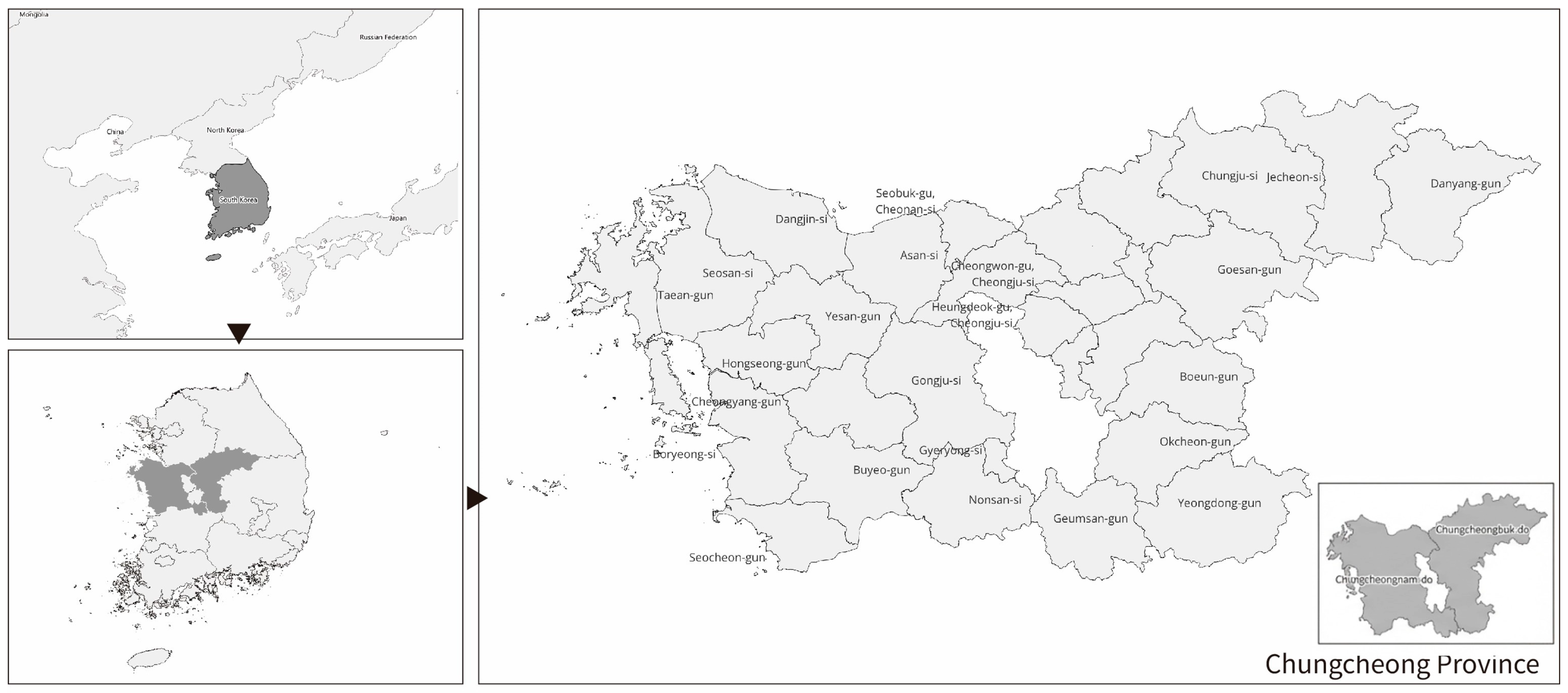
The Chungcheong region contains layered accumulations of heritage, including core ancient hubs such as the Baekje royal capital area (Gongju and Buyeo), Joseon-period administrative and educational/ritual centers (e.g., Eupseong and Hyanggyo), and modern industrial and everyday-life heritage (Figure 1). Accordingly, the spatial distribution of historical and cultural heritage is likely to be intertwined with regional contexts such as urbanization and population structure.
This study adopts a stepwise integrated framework in which GeoDetector is first used to identify global factor importance, and MGWR is then applied to analyze local effects and the spatial operating scales of the identified factors. GeoDetector has strengths in explaining “what matters,” whereas MGWR is strong in explaining “where and how it matters”; combining the two enables a multi-layered interpretation of spatial heterogeneity in heritage values.
The analytical procedure proceeds as follows (Table 1). First, at the 1 km grid level, the scores of the six heritage value dimensions are aggregated separately (as means) to construct a set of dependent variables. For example, by analyzing “the spatial distribution of historical-value scores” separately from “the spatial distribution of conservation-value scores,” it becomes possible to assess whether areas of high historical significance coincide with areas where actual management and conservation conditions are favorable. Next, descriptive statistics, spatial visualization, and checks for correlation and multicollinearity are performed to examine the characteristics of the input data [31]. GeoDetector is then applied to evaluate the explanatory power of each explanatory variable for spatial stratified heterogeneity and to examine factor interactions, thereby selecting key factors [10,19]. Subsequently, MGWR is applied to estimate local impacts (grid-specific regression coefficients) and operating ranges at variable-specific spatial scales, and the results are mapped to interpret spatial variation in effects [13,14,15]. Finally, GeoDetector results (factor importance and interactions) and MGWR results (local coefficients and scales) are integrated to derive regional types in the Chungcheong region and propose tailored revitalization directions.

2.2. Historical and Cultural Heritage and Socio-Spatial Data

Historical and cultural heritage data are constructed based on outcomes accumulated through the Korea Heritage Service’s research on heritage surveys and management strategies [25]. This effort has been pursued in response to policy needs to complement a designation-centered management system by inventorying non-designated and potential heritage and by expanding the evidence base for management and utilization, and it is also aligned with the legal foundation that institutionally supports the responsibilities of the central and local governments for conservation, management, and utilization [5].
The integrated database used in this study includes, for each heritage asset, location (coordinates) and basic attributes such as name, type, and period, as well as management-related attributes such as conservation status and utilization status (Table 1). It also includes value information assessed on a 1–5 scale across six dimensions: historical value, artistic value, academic value, social value, rarity, and conservation [25,26,27,28]. Coordinate information was preprocessed based on the coordinate reference system (UTM-K) specified by the National Heritage Spatial Information Service [6]. For analysis, heritage-level value assessments are converted to grid-level indicators by calculating the mean value score (by dimension) of heritage assets contained within each 1 km grid cell.
Socio-spatial characteristics are drawn from statistical grid-map data provided by public agencies to ensure reliability and reproducibility (Table 1). Population structure indicators such as total population, working-age population share, and aging rate are derived from the NGII’s (National Geographic Information Institute) statistical grid maps (population) [29]. Officially assessed land price is derived from statistical grid maps (land) and is used as a proxy that indirectly reflects land value level, development pressure, and locational preference [32,33]. Building density is derived from statistical grid maps (buildings) and is used as a physical indicator of building concentration and urbanization [32]. Green space and road accessibility indicators are derived from statistical grid maps (national land indicators) to reflect differences in living environment and infrastructure accessibility at the grid level [34]. Because these variables represent land value and development pressure (land price), urban concentration (building density), environmental conditions (green space), mobility and connectivity (road accessibility), and settlement size and population structure (total/working-age/older population), they are valid core contextual variables for explaining how the spatial distribution of historical and cultural heritage values is intertwined with regional conditions. These indicators were selected to operationalize key dimensions of socio-spatial context frequently emphasized in place-based heritage and regeneration research: development pressure and land-market conditions (official land price), built-environment intensity (building density), environmental setting and amenity (green space), infrastructural connectivity (road accessibility), and demographic demand and vulnerability (population size and age structure). Together, they provide a parsimonious yet interpretable representation of the regional context in which heritage values are embedded.

2.3. Analytical Model and Methodology: An Integrated GeoDetector–MGWR Framework

This study designed an integrated analytical framework that sequentially combines GeoDetector and multiscale geographically weighted regression (MGWR), based on the premise that cultural heritage values are embedded in heterogeneous socio-spatial contexts. GeoDetector is suitable for screening key determinants because it quantifies spatial stratified heterogeneity without assuming linear relationships [10,19]. However, while the q-statistic provides a global measure of how strongly an explanatory factor aligns with the spatial variance of a dependent variable, it does not directly reveal whether the same factor operates in the same direction and strength across space (spatial nonstationarity).
Accordingly, we used GeoDetector results to support factor screening and interpretation (including interaction patterns), and then applied MGWR to estimate spatially varying coefficients and variable-specific operating scales (bandwidths). This sequential integration links “what matters” (key determinants and interactions) with “where and at what scale it matters” (local effects and bandwidths), thereby improving interpretability and policy relevance [13,14,15]. In this study, “strata” (or “classes”) refer to discretized groups of each continuous explanatory variable created through quantile classification into five classes (L = 5), ensuring approximately balanced sample sizes across strata. For variables with highly skewed distributions, log transformation was applied prior to discretization to improve stratification stability and comparability across variables.
GeoDetector is a spatial statistical method that quantifies factor explanatory power by evaluating how closely the spatial distribution of a dependent variable Y matches the stratified classes (discretized intervals) of an explanatory variable X [19,30]. Its key indicator is the q statistic, which measures spatial stratified heterogeneity as the ratio of within-stratum variance to total variance when X is divided into L strata h .
The q statistic is defined as:
q = 1 h = 1 L N h σ h 2 N σ 2
where N is the total number of observations (grid cells), σ 2 is the overall variance of Y , and N h and σ h 2 denote the number of observations and the variance of Y within stratum h , respectively. The q value ranges from 0 to 1; a larger value indicates that X better explains the spatial heterogeneity of Y . In addition, GeoDetector includes an interaction detector, which evaluates how explanatory power changes when two factors are combined, thereby enabling interpretation of factor interaction effects.
For GeoDetector application, continuous explanatory variables are discretized into five strata (five classes). To ensure cross-variable comparability and balanced sample sizes, we primarily adopt quantile-based discretization into five classes. For variables with highly skewed distributions, we apply log transformation first and then discretize under the same rule to improve the stability of spatial stratification.
MGWR (Multiscale Geographically Weighted Regression) is a form of spatial regression that relaxes the assumption of spatially constant effects and allows each explanatory variable to have its own spatial operating scale (bandwidth) [13,14]. Whereas ordinary least squares (OLS) estimates a single global coefficient β k for each variable, MGWR allows coefficients to vary by location ( u i , v i ) and permits variable-specific bandwidths b k .
The basic MGWR model is expressed as:
Y i = β 0 u i , v i + k = 1 K β k b k u i , v i · X i k + ε i
where Y i is the dependent variable in grid cell i (heritage value score), X i k is explanatory variable k , β k b k u i , v i is the location-specific coefficient estimated under bandwidth b k , and ε i is the error term. By selecting variable-specific bandwidths, MGWR quantifies differences in the spatial operating scales of factors and is therefore useful for locally tailored interpretation and policy application [14].

3. Results

3.1. GeoDetector Results

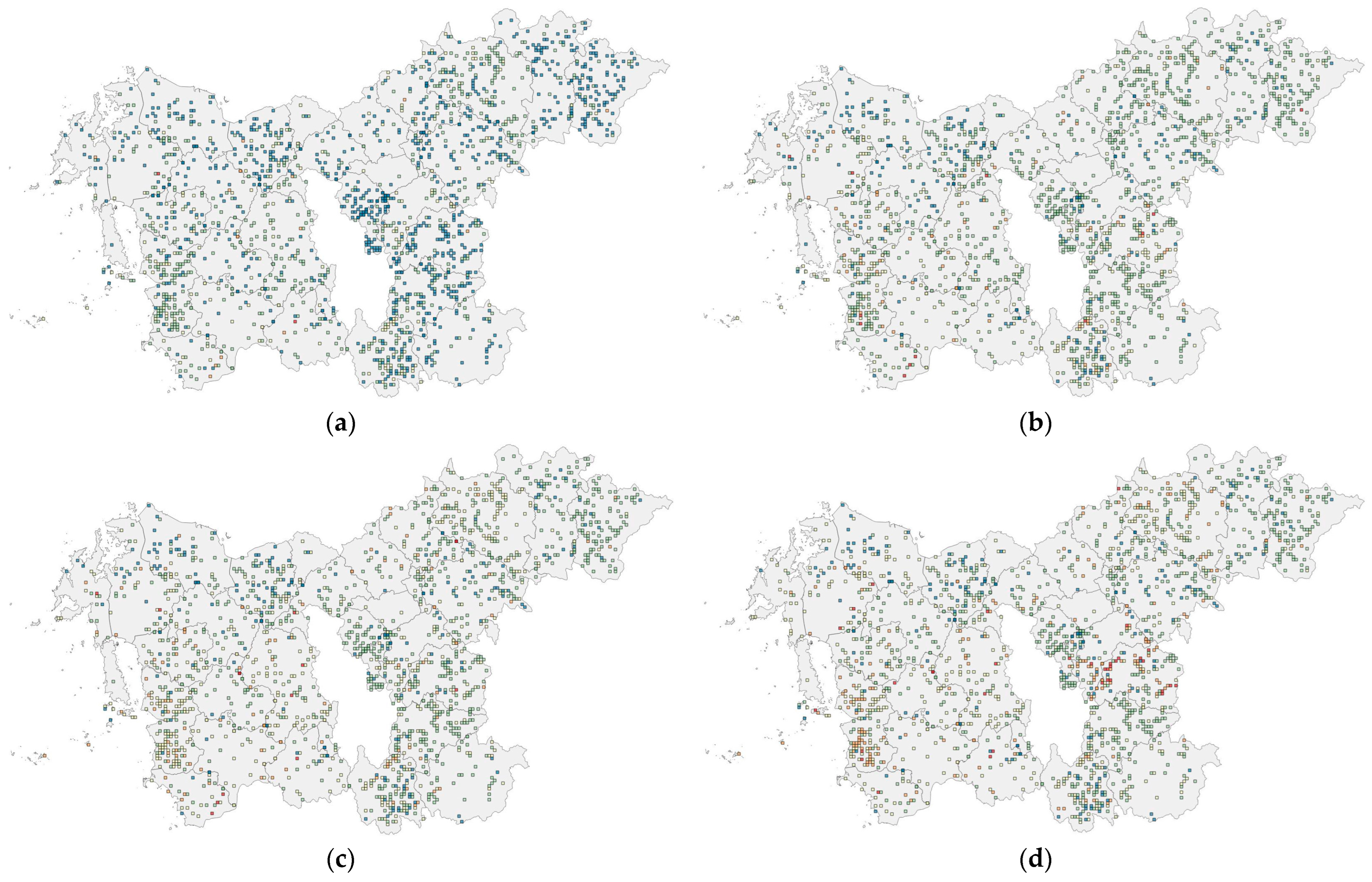
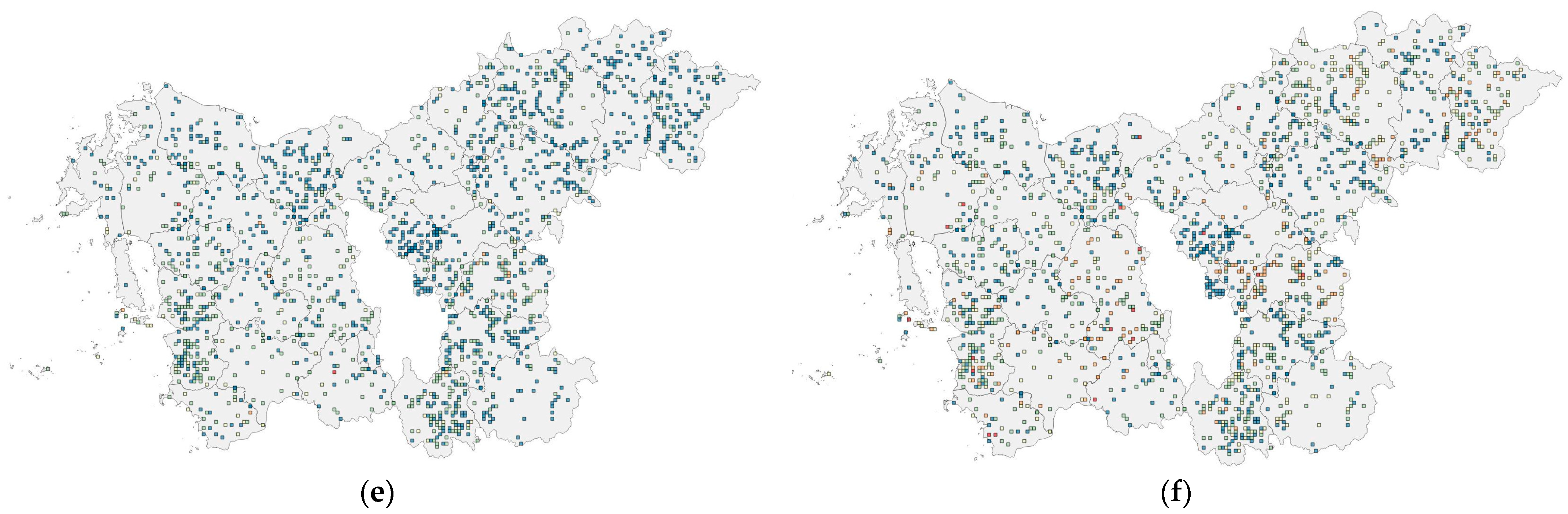
Figure 2 visualizes the grid-based mean scores for the six value dimensions, showing that each dimension exhibits a distinct spatial pattern across the Chungcheong region. To facilitate interpretation, we first report global factor importance and interaction patterns derived from GeoDetector (factor detector and interaction detector). We then present MGWR outputs in terms of (i) sign consistency and coefficient distributions and (ii) variable-specific bandwidths, which indicate the spatial operating scale of each determinant.
The factor detector results for GeoDetector, comparing combinations of six value dimensions and seven explanatory variables, indicate that q values are generally low, yet the composition and ranking of the top factors differ clearly across value dimensions. This suggests that the extent to which a given socio-spatial factor explains spatial patterns depends on the type of heritage value (see Table 2 for detailed rankings and q values).
The relatively low absolute q values may be attributed to (1) limited variation in the dependent variables due to the use of 1–5 Likert-scale mean scores aggregated to 1 km grids, and (2) the GeoDetector evaluation approach, which assesses explanatory power through variance structures across strata after discretizing explanatory variables into five classes. Therefore, rather than emphasizing the absolute magnitude of q, this section focuses on the relative ranking of factors by value dimension and on patterns of explanatory-power enhancement revealed by interaction detection.
For the historical value dimension, green space, officially assessed land price, building density, and road accessibility ranked among the top factors (Table 2). This suggests that historical value tends to be strengthened in regional contexts where natural environment, urbanization level, and mobility/access conditions jointly converge.
For artistic value, land price and population-size factors ranked at the top, with green space and building density playing supplementary roles (Table 2). In other words, artistic value appears to be associated with centrality and demand bases, and it is explained together with environmental and urban concentration factors.
For academic value, land price, green space, and road accessibility were relatively important (Table 2), implying that academic value may be more prominent in areas where locational/access conditions and environmental context intersect.
For social value, green space and building density occupied relatively high ranks (Table 2), indicating that this value dimension may be spatially differentiated in relation to everyday living environments and the concentration of urban activities.
For rarity, green space and land price simultaneously emerged as the top factors, followed by building density and population-related variables (Table 2). Thus, rarity tends to be more pronounced where environmental conditions and urban locational conditions are jointly present.
For conservation, land price and road accessibility ranked at the top, with green space following (Table 2). This suggests that conservation value is strongly linked to management and access conditions, with environmental context functioning as a complementary factor.
Overall, land price and green space repeatedly appear among the top factors across all value dimensions, suggesting that land-value structure and environmental context operate as common background conditions shaping the spatial distribution of historical and cultural heritage values. In contrast, building density and road accessibility vary in relative importance across value dimensions, indicating that the combination patterns of urbanization and accessibility differ depending on the specific type of value (Table 2).
Interaction detector results show that, for most value dimensions, combining two factors increases explanatory power relative to single factors, and nonlinear enhancement is repeatedly observed (Table 3). Enhancement effects are especially notable for combinations of land price with population variables, land price with road accessibility, and green space with land price. These findings support the interpretation that the spatial distribution of heritage values is strengthened under multi-factor conditions rather than being driven by a single determinant.
In summary, GeoDetector provides global evidence of value-specific core factor structures and factor interaction patterns. The next section applies MGWR to examine how these relationships vary by location, focusing on local effects and differences in spatial operating scales.

3.2. MGWR Results

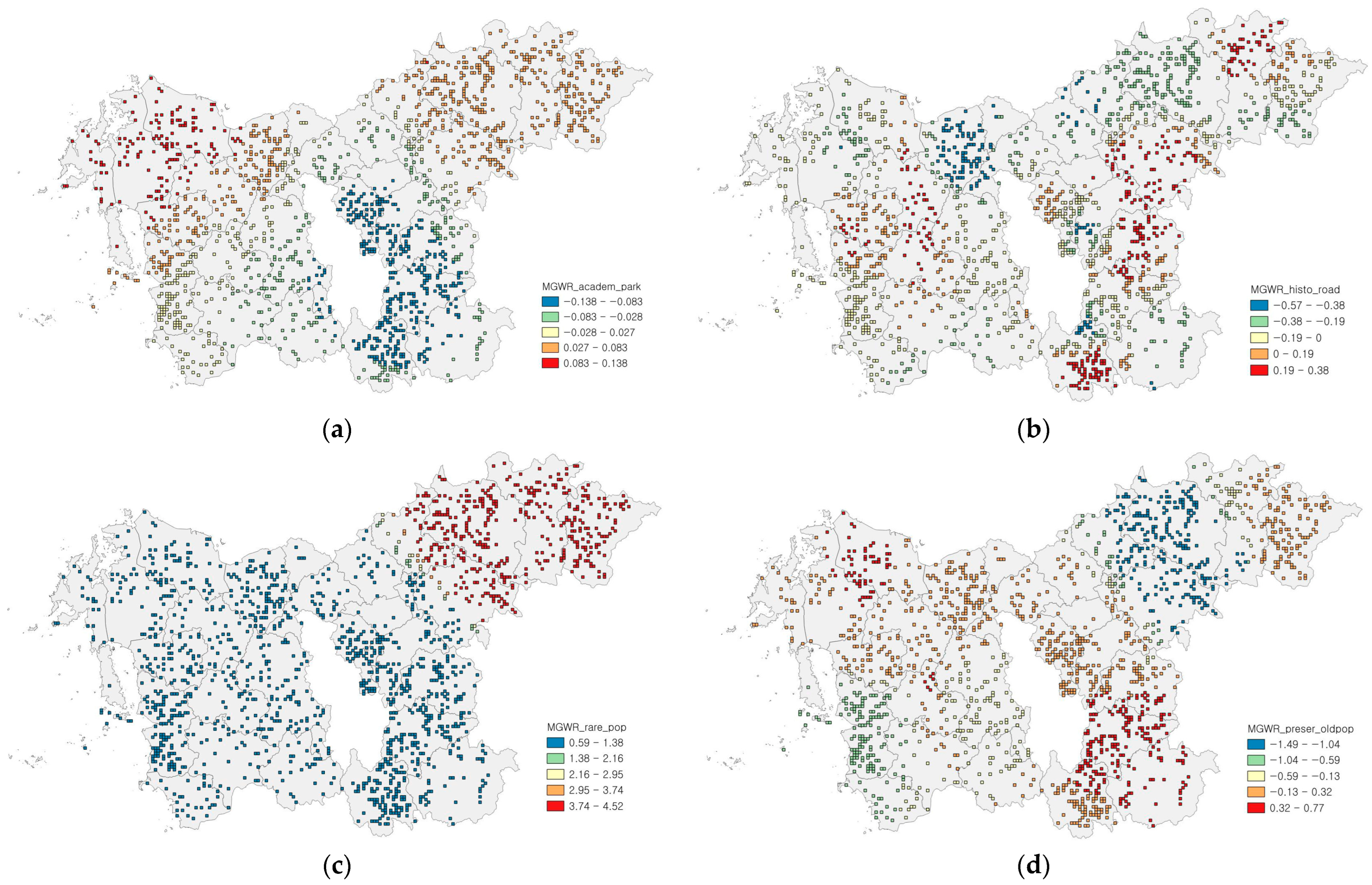
This study estimated separate MGWR models for each of the six heritage value dimensions (historical, artistic, academic, social, rarity, and conservation) (Figure 3). To ensure comparability, explanatory variables were standardized before model estimation. Results are organized into two components: (1) the direction (sign) and variability of local coefficients, and (2) the spatial operating scale (bandwidth) of each variable. Table 4 summarizes whether coefficient signs are spatially consistent across the region or mixed, while Table 5 presents coefficient distributions and bandwidth information in a panel format.
According to Table 4, officially assessed land price exhibits a consistently negative (−) relationship across all value dimensions, indicating that it is a factor with stable directionality throughout the study area. In contrast, green space shows mixed signs across all dimensions, suggesting that the same factor can operate in opposite directions depending on local context. Building density and road accessibility are predominantly negative (−) for most value dimensions; however, sign consistency weakens for conservation (building density) and for historical value (road accessibility), highlighting differences across value types.
Population variables exhibit clear differences in directionality and spatial variability by value dimension (Table 4 and Table 5). Total population tends to show predominantly positive (+) relationships for artistic, academic, social, and rarity values, whereas for historical and conservation values, sign patterns vary across locations. Working-age population and older population variables also show mixed signs depending on the value dimension, implying that population-structure effects may be conditionally coupled with the distribution of heritage values.
Bandwidth comparisons (Table 5, Panel B) reveal differences in spatial operating scales by variable. Officially assessed land price is estimated with bandwidths close to the maximum across all value dimensions, indicating a near-global factor. Green space, by contrast, is estimated with moderate bandwidths, reflecting within-region heterogeneity at the level of living areas or urban zones. In the historical-value model, road accessibility and population-related variables have relatively smaller bandwidths, suggesting that historical value may be more sharply differentiated in specific local contexts. These bandwidth results provide a quantitative basis for discussing appropriate policy implementation scales (e.g., regional/provincial, municipal, or neighborhood/living-area levels) in subsequent interpretation.
In sum, MGWR results confirm that key factors identified through GeoDetector do not operate uniformly across the entire region; local impacts and operating scales differ by value dimension. Officially assessed land price appears relatively stable in both direction and scale, whereas green space and population-structure variables show greater spatial variability, emphasizing the context-dependent nature of heritage value formation.
Taken together (Table 4 and Table 5), official land price shows consistent directionality and near-global operating scale, suggesting that it functions as a “background factor.” Green space, however, exhibits mixed signs combined with moderate bandwidths, making it a representative factor whose effects differ by local context. Population-structure variables vary in both sign and scale depending on value dimension, implying that they act as “conditional factors,” particularly with relatively large local variation for historical and conservation values. These findings show that even when the same explanatory variable is used, the way it operates can differ across value dimensions.

4. Discussion

This study combined GeoDetector and MGWR to connect global factor screening with local, multi-scale effect estimation for six cultural heritage value dimensions. The results collectively suggest that heritage values are not driven by a single dominant determinant; rather, they emerge from multi-factor configurations whose relative importance and spatial operating scales differ by value dimension and local context.

4.1. Interpreting GeoDetector q-Statistics Under Grid-Based Aggregation

Although the q values in this study are modest in absolute terms, they should be interpreted in relation to the data structure and the GeoDetector mechanism. First, the dependent variables are grid-level means derived from 1–5 Likert-type value scores, which compress variance and smooth local extremes. Second, GeoDetector evaluates spatial stratified heterogeneity based on discretized classes of explanatory variables; with five quantile strata, only the between-strata component of variance is captured. Under these conditions, low q values do not imply that socio-spatial contexts are irrelevant. Rather, they indicate that (i) heritage values are multi-causal, and (ii) each single factor explains only a limited share of the overall spatial variance. Therefore, emphasizing relative factor ranking and interaction enhancement is appropriate for identifying key configurations rather than a single dominant driver.

4.2. Explaining Sign Patterns in MGWR: Development Pressure and Context Dependence

MGWR results indicate that official land price tends to show a stable negative association with heritage value dimensions across the study area. Interpreted in the regional context, this pattern suggests that higher land-price grids often represent areas with stronger development pressure and functional urban centrality, where heritage assets may be fewer, more fragmented, or more affected by redevelopment dynamics. Conversely, many historically significant towns, cultural landscapes, and conservation areas are often located in relatively lower land-price environments; thus, when other factors are controlled for, land price can act as a proxy for development pressure rather than for the accumulation of heritage value.
In contrast, green space exhibits mixed signs across space, highlighting context dependence. In some local contexts, green space can enhance heritage values by representing cultural landscapes, protected buffers, and amenity environments that strengthen setting and conservation. In other contexts, extensive green space may correspond to sparsely settled mountainous or agricultural areas where built heritage density and related value scores are lower, or where accessibility and supporting infrastructure are limited. This heterogeneity aligns with the purpose of MGWR: to reveal how the same factor may operate differently across local contexts.

4.3. From Bandwidths to Decision-Making Scales

A key contribution of MGWR is the estimation of variable-specific bandwidths, which can be interpreted as the spatial scale at which each factor operates most consistently. Determinants with near-global bandwidths imply the need for region-wide instruments (e.g., shared monitoring standards, harmonized guidance, and cross-municipal coordination). Determinants with moderate or smaller bandwidths imply that policy design should be tailored at subregional scales (e.g., city/county or local living-area units), where the sign and magnitude of effects differ. This provides an empirical basis for aligning intervention scale with the spatial scale of the underlying mechanism.

4.4. Transferability of the Framework

While this study is grounded in data produced for the Chungcheong region, the analytical logic—screening key determinants and interaction patterns with GeoDetector, followed by diagnosing local effects and operating scales with MGWR—is not region-specific. The framework can be applied to other regions where spatial heritage inventories and comparable socio-spatial indicators are available, supporting comparative studies and transferable evidence production for place-based heritage governance.

5. Policy and Strategic Recommendations

Building on the discussion above, this section translates the GeoDetector–MGWR findings into policy and strategic recommendations. In particular, we emphasize (i) value-dimension-specific priorities (what to focus on) and (ii) scale-sensitive implementation (at which administrative or functional scale interventions are likely to be most effective).

5.1. Policy Context and Recent Directions in Chungcheong-Region Heritage Policy

At the national level, since the enactment of the Framework Act on National Heritage, responsibilities for the conservation, management, and utilization of national heritage have been strengthened [5], and a medium-term policy framework has been implemented through the Basic Plan for the Conservation, Management, and Utilization of Cultural Heritage (2022–2026) [35]. This policy trajectory requires a shift beyond a designation-centered system toward both “data-driven management” and the institutionalization of heritage utilization, including diverse local and potential heritage assets.
At the provincial level, Chungcheongnam-do publicly announced an annual implementation plan for heritage conservation, management, and utilization [36] and has pursued expansion of information infrastructure through initiatives such as digital platforms [28]. In addition, major historical cities such as Buyeo have sustained experiential programs (e.g., night-time heritage events) that link resident participation with tourism demand [37,38]. Chungcheongbuk-do has also advanced policy implementation through program-level plans for world heritage conservation and utilization [39], and the need to connect heritage with regional revitalization has been repeatedly discussed in provincial assembly proceedings [40]. Overall, these policy contexts suggest that rather than treating “conservation” and “utilization” as separate domains, practical policy design increasingly depends on tailoring implementation to local conditions [41].

5.2. Policy Foci Suggested by the Analytical Findings

The findings of this study indicate that linking “what factors matter (GeoDetector)” with “where and at what scale those effects operate (MGWR)” can concretely inform both policy priorities and spatial implementation units.
First, a value-dimension–specific policy framework is needed. Although historical, artistic, academic, social, rarity, and conservation values are often grouped under the single label of “heritage value,” the relative importance and interaction patterns of explanatory factors differ across dimensions. Therefore, rather than applying a uniform “heritage utilization policy package” across all areas, policy tools should be assembled by distinguishing the key drivers for each value dimension (e.g., land value/urbanization/environment/accessibility/population structure) and combining them accordingly.
Second, in areas exposed to high land value and urbanization pressure, balanced governance between conservation and utilization becomes crucial. The MGWR sign-consistency results, where land price tends to show a negative association across multiple value dimensions, suggest potential tension between development pressure and heritage value distribution. In such contexts, the policy objective should not be limited to “expanding utilization,” but should also include regulatory and management measures to prevent over-commercialization, landscape degradation, and gentrification, alongside protection of residents’ living environments. This aligns with national legal and planning frameworks emphasizing conservation and management responsibilities [5,35].
Third, green space and accessibility are sensitive to local conditions, implying that fine-grained interventions at the living-area scale may be effective. Because green space and road accessibility may operate positively in some contexts but show mixed signs and spatial variation in others, expanding “green space” or “roads” cannot be assumed to produce uniform effects across all regions. Instead, context-specific improvements—such as heritage-adjacent landscape management, pedestrian routes, dwell spaces, and guidance/interpretation systems—may be prioritized. In particular, Chungcheongnam-do’s digital platform initiatives [37] and experiential programs [38] can be expanded as tools that improve both physical accessibility and information accessibility.
Fourth, variable-specific bandwidths provide a basis for distinguishing policy implementation scales. Factors with large bandwidths are more suitable for broader-scale common strategies (e.g., regional cultural-route linkage, shared management standards, data standardization), whereas factors with small bandwidths may require tailored execution at municipal or neighborhood levels (e.g., micro-scale circulation improvements, everyday cultural programs, and support for management in vulnerable areas). In other words, MGWR bandwidths offer quantitative hints about “at what scale policies should be designed and implemented.”

5.3. Implementation Strategies: Data and Governance

The heritage survey database used in this study [25], together with national heritage spatial information services [6] and NGII statistical-grid indicators [29,32,33,34], has high integration potential. However, for policy application, stronger metadata governance is needed for (1) survey frequency and update systems, (2) standardization of value-assessment criteria, and (3) documentation of coordinate systems, grid units, and aggregation methods. In addition, translating complex analytical outputs into policy requires participatory governance structures in which local governments, experts, and residents jointly interpret results and discuss priorities [36,39,40,41]. Although GeoDetector and MGWR results may appear technically complex, they can function as practical decision-support tools if presented through focused visualization—e.g., selected key coefficient maps (1–2 representative variables per value dimension) and compact summary tables for sign consistency and bandwidth.

5.4. Strategy Pathways by Value Dimension and Operating Scale

Based on the combined results, strategy design should differentiate (a) region-wide baseline instruments for determinants operating at broader scales and (b) locally tailored interventions for determinants showing strong spatial nonstationarity and smaller operating scales. For example, (i) historical and academic values may benefit from protecting heritage settings and cultural landscapes while improving context-specific accessibility and interpretation; (ii) artistic and socio-cultural values may be strengthened through place-based cultural programming and adaptive reuse aligned with local demographic demand; and (iii) conservation value requires targeted maintenance and monitoring, prioritizing areas where demographic vulnerability and accessibility constraints coincide. This scale-sensitive approach helps avoid one-size-fits-all heritage programs and supports differentiated implementation across provinces, cities/counties, and local living-area units.

6. Conclusions

This study examined how six cultural heritage value dimensions relate to socio-spatial contexts in the Chungcheong region of South Korea by sequentially integrating GeoDetector and MGWR on a 1 km grid. GeoDetector results suggest that factor importance differs by value dimension and that interaction effects frequently enhance explanatory power, supporting a multi-factor interpretation of heritage value patterns. MGWR further reveals strong spatial nonstationarity: some determinants exhibit stable, broad-scale effects, while others show locally varying directions and magnitudes, implying that heritage values are shaped by context-dependent mechanisms.
These findings indicate that heritage governance should move beyond one-size-fits-all approaches. Region-wide instruments may be appropriate for broad-scale determinants linked to development pressure, whereas locally tailored interventions are necessary where environmental, accessibility, and demographic factors operate at smaller scales and with mixed directions. Methodologically, the study demonstrates how linking “what matters” (GeoDetector) with “where and at what scale it matters” (MGWR) can generate interpretable evidence for place-based conservation and utilization strategies.
Limitations include the use of cross-sectional data, potential sensitivity to grid resolution (MAUP), and reliance on expert-scored value assessments. Future research should test temporal dynamics with multi-year data, conduct sensitivity analyses across grid sizes, and integrate qualitative evidence such as community perceptions and utilization outcomes.

Author Contributions

Conceptualization and methodology, D.S. and B.K.; software, formal analysis, and data curation, E.L.; writing—original draft preparation, D.S. and E.L.; writing—review and editing, D.S. and E.L.; visualization and supervision, D.S. and E.L.; funding acquisition, D.S. All authors have read and agreed to the published version of the manuscript.

Funding

This work was supported by Chungbuk National University NUDP program (2025).

Data Availability Statement

The original contributions presented in the study are included in the article, further inquiries can be directed to the corresponding author.

Acknowledgments

The authors, with each individual’s consent, wish to express their gratitude to the four anonymous reviewers for their valuable comments and suggestions, which have been very helpful in improving the paper. We would also like to thank the National Heritage Administration of Korea and the Architecture and Urban Research Institute (AURI) for their cooperation in providing the historical and cultural resource data utilized in this study.

Conflicts of Interest

The authors declare no conflicts of interest.

References

  1. Kim, J.-S.; Jang, J.-H. Cultural Heritage Utilization and Neighborhood Regeneration; Korea Research Institute for Human Settlements (KRIHS): Sejong, Republic of Korea, 2014. (In Korean) [Google Scholar]
  2. Evans, G. Measure for Measure: Evaluating the Evidence of Culture’s Contribution to Regeneration. Urban Stud. 2005, 42, 959–983. [Google Scholar] [CrossRef]
  3. UNESCO. Culture: Urban Future. Global Report on Culture for Sustainable Urban Development; UNESCO: Paris, France, 2016; Available online: https://unesdoc.unesco.org/ (accessed on 8 February 2026).
  4. Burnham, B. A Blended Finance Framework for Heritage-Led Urban Regeneration. Land 2022, 11, 1154. [Google Scholar] [CrossRef]
  5. Republic of Korea. Framework Act on National Heritage (Act No. 19409; Enacted 16 May 2023; Effective 17 May 2024). Available online: https://www.law.go.kr/lsInfoP.do?lsiSeq=250955 (accessed on 8 February 2026).
  6. National Heritage Spatial Information Service (Korea). Data Open—Coordinate System (UTM-K). Available online: https://gis-heritage.go.kr/newMap.do (accessed on 8 February 2026).
  7. Jeong, J.-W.; Han, J.-H. An Importance–Performance Analysis of Urban Regeneration Tourism Destination Attributes Using Historical and Cultural Heritage Resources. Landsc. Geogr. 2021, 31, 15–27. (In Korean) [Google Scholar] [CrossRef]
  8. Kim, B.; Shon, D. Spatial Distribution of Historical and Cultural Resources and Regional Revitalization Strategies in Chungcheong Province, South Korea. Land 2025, 14, 1167. [Google Scholar] [CrossRef]
  9. Liang, Y.; Xu, C. Knowledge Diffusion of Geodetector: A Perspective of the Literature Review and Geotree. Heliyon 2023, 9, e19651. [Google Scholar] [CrossRef]
  10. Wang, J.-F.; Zhang, T.-L.; Fu, B.-J. A Measure of Spatial Stratified Heterogeneity. Ecol. Indic. 2016, 67, 250–256. [Google Scholar] [CrossRef]
  11. Wang, Q.; Jiang, D.; Gao, Y.; Zhang, Z.; Chang, Q. Examining the Driving Factors of Soil Organic Matter Using a Multi-Scale GWR Model Augmented by Geodetector and GWPCA Analysis. Agronomy 2022, 12, 1697. [Google Scholar] [CrossRef]
  12. Shi, T.; Hu, Z.; Shi, Z.; Guo, L.; Chen, Y.; Li, Q.; Wu, G. Geo-Detection of Factors Controlling Spatial Patterns of Heavy Metals in Urban Topsoil Using Multi-Source Data. Sci. Total Environ. 2018, 643, 451–459. [Google Scholar] [CrossRef]
  13. Fotheringham, A.S.; Yang, W.; Kang, W. Multiscale Geographically Weighted Regression (MGWR). Ann. Am. Assoc. Geogr. 2017, 107, 1247–1265. [Google Scholar] [CrossRef]
  14. Li, Z.; Fotheringham, A.S. Computational Improvements to Multiscale Geographically Weighted Regression. Int. J. Geogr. Inf. Sci. 2020, 34, 1378–1397. [Google Scholar] [CrossRef]
  15. Oshan, T.M.; Li, Z.; Kang, W.; Wolf, L.J.; Fotheringham, A.S. mgwr: A Python Implementation of Multiscale Geographically Weighted Regression for Investigating Process Spatial Heterogeneity and Scale. ISPRS Int. J. Geo-Inf. 2019, 8, 269. [Google Scholar] [CrossRef]
  16. Fotheringham, A.S.; Han, Y.; Li, Z. Examining the Influences of Air Quality in China’s Cities Using Multi-Scale Geographically Weighted Regression. Trans. GIS 2019, 23, 1444–1464. [Google Scholar] [CrossRef]
  17. Mansour, S.; Al Kindi, A.; Al-Said, A.; Al-Said, A.; Atkinson, P. Sociodemographic Determinants of COVID-19 Incidence Rates in Oman: Geospatial Modelling Using Multiscale Geographically Weighted Regression (MGWR). Sustain. Cities Soc. 2021, 65, 102627. [Google Scholar] [CrossRef]
  18. Cho, E.; Jun, B.-W. Environmental Equity Analysis of Fine Particulate Matter in Daegu Using MGWR and KT Sensor Data. J. Korean Assoc. Geogr. Inf. Stud. 2023, 26, 218–236. (In Korean) [Google Scholar]
  19. Wang, J.-F.; Xu, C.-D. Geodetector: Principle and Prospective. Acta Geogr. Sin. 2017, 72, 116–134. (In Chinese) [Google Scholar]
  20. Wang, J.-F.; Li, X.-H.; Christakos, G.; Liao, Y.-L.; Zhang, T.; Gu, X.; Zheng, X. Geographical Detectors-Based Health Risk Assessment and Its Application in the Neural Tube Defects Study of the Heshun Region, China. Int. J. Geogr. Inf. Sci. 2010, 24, 107–127. [Google Scholar] [CrossRef]
  21. Shen, W.; Chen, Y.; Cao, W.; Yu, R.; Rong, P.; Cheng, J. Spatial pattern and its influencing factors of national-level cultural heritage in China. Herit. Sci. 2024, 12, 384. [Google Scholar] [CrossRef]
  22. Zhang, Z.; Cui, Z.; Fan, T.; Ruan, S.; Wu, J. Spatial distribution of intangible cultural heritage resources in China and its influencing factors. Sci. Rep. 2024, 14, 4960. [Google Scholar] [CrossRef]
  23. Wang, F.; Zhang, T.; Zhang, S. MGWR reveals scale heterogeneity shaping intangible cultural heritage distribution in China. npj Herit. Sci. 2025, 13, 367. [Google Scholar] [CrossRef]
  24. Li, J.; Wu, X.; Du, Y. Reframing Cultural Heritage Policy Through Place-Based Perspectives: The Evolution of China’s ICH Governance Amid Historical Continuity and Global Convergence. Land 2025, 14, 1425. [Google Scholar] [CrossRef]
  25. National Heritage Administration (Korea). Third-Year Survey of Historical and Cultural Resources and Management Plan Study; National Heritage Portal (Publication); Korea Heritage Service: Daejeon, Republic of Korea, 2023. Available online: https://www.heritage.go.kr/heri/cul/linkSelectEbookDetail.do?nttId=85798 (accessed on 8 February 2026).
  26. Cultural Heritage Administration. Official Website of the Cultural Heritage Administration of Korea; Cultural Heritage Admin-istration: Daejeon, Republic of Korea. Available online: https://www.cha.go.kr (accessed on 15 May 2025).
  27. Cultural Heritage Administration. Cultural Heritage Report 2023; Cultural Heritage Administration: Daejeon, Republic of Korea, 2023. [Google Scholar]
  28. Cultural Heritage Administration. A Comprehensive Survey and Management Plan for Historical and Cultural Resources 2020; Cultural Heritage Administration: Daejeon, Republic of Korea, 2020. [Google Scholar]
  29. National Geographic Information Institute (NGII), Ministry of Land, Infrastructure and Transport. Statistical Map—Population (20240924) [Data Set]. Public Data Portal. Available online: https://www.data.go.kr/data/15062291/fileData.do (accessed on 8 February 2026).
  30. Statistics Korea. SGIS Grid Boundary Data (Used: 1 km). Available online: https://sgis.mods.go.kr/view/index (accessed on 8 February 2026).
  31. O’Brien, R.M. A Caution Regarding Rules of Thumb for Variance Inflation Factors. Qual. Quant. 2007, 41, 673–690. [Google Scholar] [CrossRef]
  32. National Geographic Information Institute (NGII), Ministry of Land, Infrastructure and Transport. Statistical Map—Land (20240924) [Data Set]. Public Data Portal. Available online: https://www.data.go.kr/data/15062289/fileData.do (accessed on 8 February 2026).
  33. National Geographic Information Institute (NGII), Ministry of Land, Infrastructure and Transport. Statistical Map—Buildings (20240731) [Data Set]. Public Data Portal. Available online: https://www.data.go.kr/data/15062298/fileData.do (accessed on 8 February 2026).
  34. National Geographic Information Institute (NGII), Ministry of Land, Infrastructure and Transport. Statistical Map—National Land Indicators (20231231) [Data set]. Public Data Portal. Available online: https://www.data.go.kr/data/15062304/fileData.do (accessed on 8 February 2026).
  35. National Heritage Administration (Korea). Basic Plan for Preservation, Management, and Utilization of Cultural Heritage (2022–2026). Available online: https://www.heritage.go.kr/ (accessed on 8 February 2026).
  36. Chungcheongnam-do (Korea). 2025 Implementation Plan for Preservation, Management, and Utilization of Cultural Heritage (Public Notice No. 2025-382). Available online: https://www.chungnam.go.kr/cnportal/province/province/view.do?menuNo=500487&nttId=2152374 (accessed on 8 February 2026).
  37. Chungcheongnam-do (Korea). Chungnam Digital Cultural Heritage Platform. Available online: https://www.chungnam.go.kr/cnh/cmm/main/mainPageServc.do?utm_source=chatgpt.com (accessed on 8 February 2026).
  38. Buyeo-gun (Korea). 2026 Buyeo National Heritage Night (Press Release, 19 January 2026). Available online: https://www.buyeo.go.kr/ (accessed on 8 February 2026).
  39. Chungcheongbuk-do (Korea). 2025 World Heritage Conservation/Management and Utilization Project Plan (Public Notice). Available online: https://www.chungbuk.go.kr/www/selectGosiPblancView.do?key=422&no=62961 (accessed on 8 February 2026).
  40. Chungcheongbuk-do Provincial Council (Korea). Administrative and Culture Committee Minutes, 420th Session, 2nd Meeting (15 July 2024). Available online: https://council.chungbuk.go.kr/ (accessed on 8 February 2026).
  41. Chungcheongbuk-do (Korea). Cultural Heritage Division: Major Duties and Information. Available online: https://chungbuk.go.kr/www/selectEmployeeList.do?key=2729&searchDeptCode=6431051 (accessed on 8 February 2026).
Figure 1. The provinces of Chungcheongnam-do and Chungcheongbuk-do in the Chungcheong region, South Korea.
Land 15 00384 g001
Figure 2. Spatial distribution of historical and cultural heritage value scores in the Chungcheong region: (a) Historic Value; (b) Artistic Value; (c) Academic Value; (d) Social Value; (e) Rarity; (f) Conservation Value. A blue-to-red color scale is used, with red indicating higher values and blue indicating lower values (based on the 1–5 evaluation scale).
Land 15 00384 g002aLand 15 00384 g002b
Figure 3. Key MGWR outputs: (a) Green space in the academic-value model; (b) Road accessibility in the historical-value model; (c) Total population in the rarity-value model; (d) Older population in the conservation-value model.
Land 15 00384 g003
Table 1. Overview of analysis design and variables.
ItemDescription
Study area & unitChungcheong region (Chungcheongnam-do & Chungcheongbuk-do), 1 km × 1 km grid
Explanatory variables (X) [25,26,27,28]Official land price, building density, green area indicator, road accessibility, population density, working-age share, aging rate
(value dimensions: 1–5 scale/Survey year: 2022)
Dependent variables (Y) [29]Historic/Artistic/Academic/Social/Rarity/Conservation (each analyzed separately)
(value dimensions: 1–5 scale/Points → aggregated to 1 km grid/Base year 2024)
GeoDetector objectiveIdentify key factors (q-statistics) and compare interaction effects by value dimension
MGWR objectiveEstimate local effects and variable-specific spatial scales (bandwidths) by value dimension
Policy relevanceDiagnose imbalances across value dimensions → derive place-based, differentiated strategies
Table 2. Top factors and q values by heritage value dimension.
Value DimensionTop Three Factors
Historical valueGreen space (0.0073), Officially assessed land price (0.0057), Building density (0.0055)
Artistic valueOfficially assessed land price (0.0119), Total population (0.0094), Green space (0.0091)
Academic valueOfficially assessed land price (0.0078), Green space (0.0064), Road accessibility (0.0060)
social valueGreen space (0.0114), Building density (0.0078), Officially assessed land price (0.0072)
Rarity valueGreen space (0.0128), Officially assessed land price (0.0128), Building density (0.0083)
Conservation valueOfficially assessed land price (0.0096), Road accessibility (0.0046), Green space (0.0030)
Table 3. Key interaction detector results by heritage value dimension.
Value DimensionFactor 1Factor 2 q Value
Historical valueRoad accessibilityTotal population0.0246
Officially assessed land priceTotal population0.0224
Artistic valueOfficially assessed land priceTotal population0.0301
Officially assessed land priceWorking-age population0.0250
Academic valueOfficially assessed land priceTotal population0.0292
Officially assessed land priceRoad accessibility0.0282
social valueOfficially assessed land priceTotal population0.0273
Green spaceOfficially assessed land price0.0201
Rarity valueOfficially assessed land priceTotal population0.0291
Officially assessed land priceWorking-age population0.0266
Conservation valueOfficially assessed land priceRoad accessibility0.0249
Officially assessed land priceTotal population0.0214
Table 4. Summary of spatial consistency in MGWR coefficient signs.
Value DimensionOfficially Assessed Land PriceBuilding DensityRoad AccessibilityGreen SpaceTotal PopulationWorking-Age PopulationOlder Population
Historical valueConsistently negative (−)Partially mixed signsPartially mixed signsMixed signs (±)Partially mixed signsPartially mixed signsPartially mixed signs
Artistic valueConsistently negative (−)Consistently negative (−)Consistently negative (−)Partially mixed signsConsistently positive (+)Consistently negative (−)Consistently negative (−)
Academic valueConsistently negative (−)Consistently negative (−)Consistently negative (−)Mixed signs (±)Consistently positive (+)Consistently negative (−)Mixed signs (±)
social valueConsistently negative (−)Consistently negative (−)Consistently negative (−)Partially mixed signsConsistently positive (+)Consistently negative (−)Partially mixed signs
Rarity valueConsistently negative (−)Consistently negative (−)Consistently negative (−)Partially mixed signsConsistently positive (+)Consistently negative (−)Partially mixed signs
Conservation valueConsistently negative (−)Consistently positive (+)Consistently negative (−)Partially mixed signsPartially mixed signsPartially mixed signsMixed signs (±)
Table 5. Summary of MGWR local coefficient distributions and spatial operating scales (bandwidths).
Panel A. Distribution of Local Coefficients (Median [IQR]; Percentage of Positive (+) Coefficients, %).
VariableHistorical ValueArtistic ValueAcademic ValueSocial ValueRarityConservation
Officially assessed land price−0.052(0.000);0−0.025(0.001);0−0.036(0.001);0−0.032(0.003);0−0.031(0.002);0−0.125(0.002);0
Building density−0.026(0.018);14.1−0.024(0.001);0−0.016(0.001);0−0.040(0.003);0−0.035(0.002);00.020(0.005);100
Green space−0.012(0.073);41.3−0.017(0.086);35.80.009(0.139);52.7−0.047(0.083);19.6−0.039(0.108);36.0−0.050(0.131);32.6
Road accessibility−0.066(0.329);35.5−0.021(0.004);0−0.021(0.005);0−0.025(0.009);0−0.062(0.019);0−0.075(0.012);0
Total population1.553(2.349);83.70.448(0.002);1000.739(1.249);1002.087(1.980);1000.721(1.003);1001.218(6.728);72.1
Working-age population−1.565(1.856);18.6−0.471(0.001);0−0.874(1.464);0−2.086(1.909);0−0.800(0.760);0−1.931(5.570);23.6
Older population−0.057(0.235);17.0−0.027(0.001);00.009(0.131);58.4−0.085(0.156);24.3−0.032(0.163);22.10.004(0.846);51.5
Panel B. Variable-specific bandwidths (number of grid cells; percentage of total, %).
VariableHistorical valueArtistic valueAcademic valuesocial valueRarityConservation
Intercept258 (14.9%)92 (5.3%)92 (5.3%)51 (2.9%)102 (5.9%)67 (3.9%)
Total population237 (13.7%)1733 (99.9%)291 (16.8%)209 (12.1%)311 (17.9%)155 (8.9%)
Older population392 (22.6%)1733 (99.9%)369 (21.3%)466 (26.9%)376 (21.7%)181 (10.4%)
Working-age population245 (14.1%)1733 (99.9%)275 (15.9%)146 (8.4%)303 (17.5%)142 (8.2%)
Officially assessed land price1733 (99.9%)1733 (99.9%)1733 (99.9%)1733 (99.9%)1733 (99.9%)1733 (99.9%)
Road accessibility113 (6.5%)1733 (99.9%)1733 (99.9%)1733 (99.9%)1733 (99.9%)1733 (99.9%)
Green space943 (54.4%)852 (49.1%)556 (32.1%)852 (49.1%)762 (43.9%)737 (42.5%)
Building density620 (35.8%)1733 (99.9%)1733 (99.9%)1733 (99.9%)1733 (99.9%)1733 (99.9%)
Note: In Panel A, values are reported as “median (IQR); percentage of positive (+) coefficients (%).” Panel B reports each variable’s bandwidth (number of neighboring grid cells used) and its percentage relative to the total number of grids.
Disclaimer/Publisher’s Note: The statements, opinions and data contained in all publications are solely those of the individual author(s) and contributor(s) and not of MDPI and/or the editor(s). MDPI and/or the editor(s) disclaim responsibility for any injury to people or property resulting from any ideas, methods, instructions or products referred to in the content.