


Does Land Consolidation Reduce Farmland Abandonment? Plot-Level Evidence from Hilly China



Abstract
1. Introduction
2. Theoretical Analysis
3. Materials and Methods
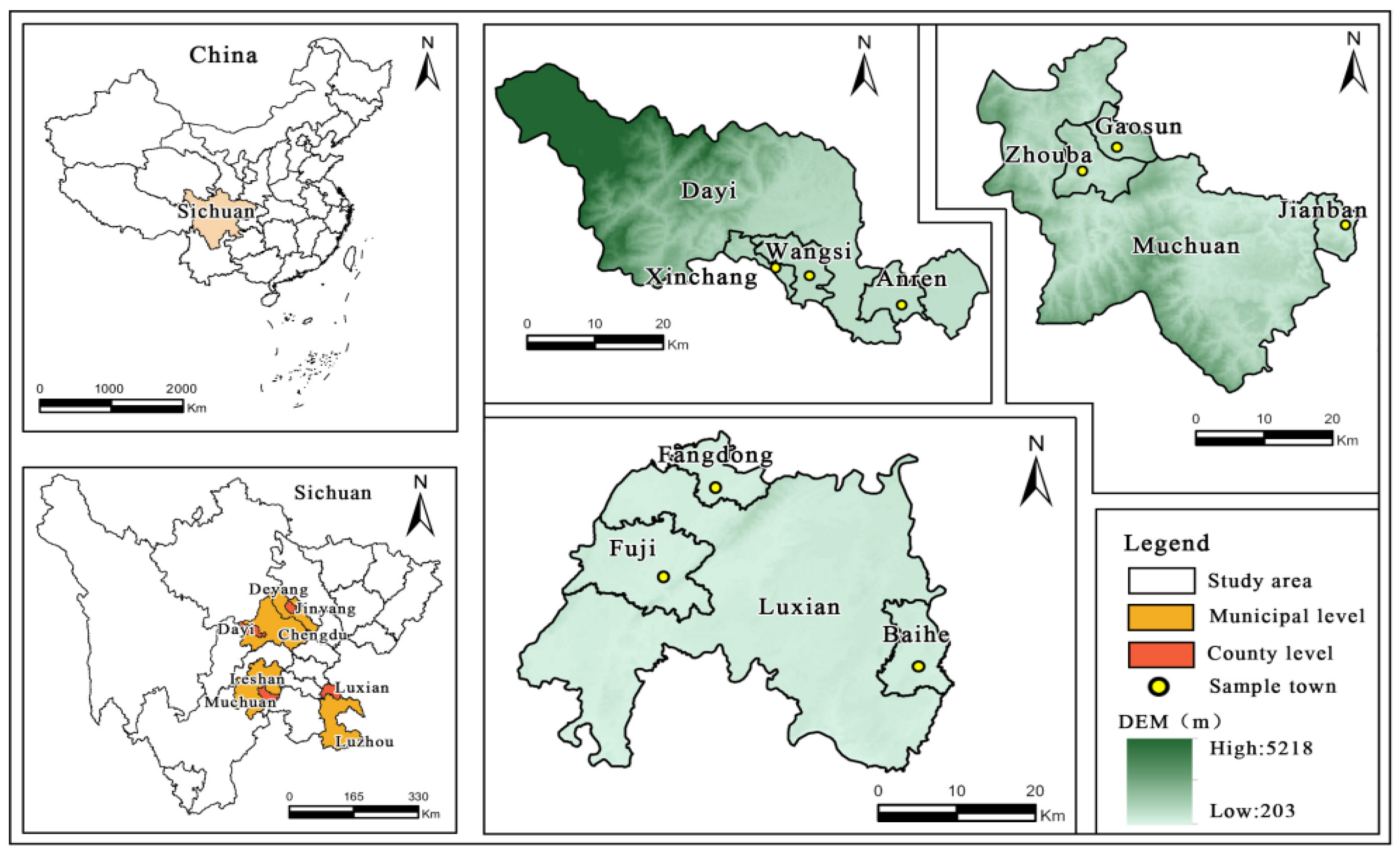
3.1. Data Source
3.2. Variable Selection
3.3. Model Specification
4. Results
4.1. Analysis of Regression Results
4.2. Robustness Tests
4.3. Endogeneity Discussion
4.4. Mediation Effects
- (1)
- Land Consolidation—Service Depth—Farmland Abandonment
- (2)
- Land Consolidation—Service Breadth—Farmland Abandonment
- (3)
- Land Consolidation—Service Quality—Farmland Abandonment

| Plot Size | Operating Scale | Contiguous Plot Size | Farmers’ Abandonment Behavior | |||
|---|---|---|---|---|---|---|
| LC | 0.611 *** | 0.130 *** | 0.232 *** | −0.670 *** | −0.618 *** | −0.712 *** |
| (0.082) | (0.012) | (0.043) | (0.183) | (0.183) | (0.182) | |
| Plot Size | −0.087 *** | |||||
| (0.029) | ||||||
| Operating Scale | −0.624 *** | |||||
| (0.112) | ||||||
| Contiguous Plot Size | −0.046 | |||||
| (0.031) | ||||||
| Control variables | Control | Control | Control | Control | Control | Control |
| Regional Variables | Control | Control | Control | Control | Control | Control |
| F | 111.029 *** | 517.211 *** | 22.421 *** | |||
| Chi2 | 307.264 *** | 327.886 *** | 291.419 *** | |||
| N | 5014 | 5014 | 5014 | 5014 | 5014 | 5014 |
4.5. Heterogeneity Analysis
5. Discussion
6. Conclusions
- (1)
- Farmland abandonment in the sample area remains both prevalent and structurally patterned, occurring more frequently under constrained terrain conditions, poor plot accessibility, and strong labor constraints among ordinary smallholders. The baseline Probit estimates indicate that LC significantly reduces the likelihood of plot abandonment. This suggests that engineering investments—such as plot reshaping and improvements in field roads and irrigation and drainage facilities—effectively lower marginal cultivation costs, increase the feasibility of farming operations, and strengthen farmers’ willingness to continue cultivation, thereby generating a governance effect that curbs abandonment.
- (2)
- Robustness checks and endogeneity treatments further enhance the credibility of the results. For robustness, we re-estimated the models by (i) altering the measurement of the key explanatory variable, (ii) refining the household sample, and (iii) modifying the measurement of the dependent variable. Across these specifications, the estimated inhibitory effect of LC on abandonment remains consistent in sign and statistically significant. To further mitigate potential endogeneity arising from unobserved factors and reverse causality, we additionally employed an instrumental variable two-stage least squares (2SLS) approach. First-stage results show that the instrument is strongly correlated with LC and does not suffer from weak-instrument concerns, while the second-stage estimates remain consistent with the baseline results. Together, these exercises indicate that the governance effect of LC in reducing abandonment is highly robust.
- (3)
- Mechanism tests show that mechanization service scale is a key channel through which LC reduces abandonment, although the strength of transmission differs across dimensions. LC significantly increases both service depth and service breadth. Greater service depth is reflected in a shift from single-task services toward multi-stage outsourcing across key production links (e.g., tillage, sowing, management, and harvest), accompanied by stronger service entrustment, which helps alleviate the “cannot do or cannot manage” constraint caused by labor shortages and tight farming-season schedules. Greater service breadth is reflected in a wider coverage of services, enabling more households and more plots to access timely services at critical farming seasons, thereby reducing search costs and transaction frictions and mitigating abandonment driven by service unavailability. By contrast, the mediating role of service quality may be more context-dependent in the short run, relying on the maturity and organizational capacity of local service systems. Nevertheless, the overall pattern underscores a tight linkage among “engineering-based LC, service organization, and behavioral response”. These results imply that the policy effect of LC is not determined solely by engineering improvements; rather, it crucially depends on whether LC can activate and agglomerate socialized mechanization service supply so that the benefits of LC can be converted into farmers’ capacity for continued cultivation at lower cost and with greater certainty.
- (4)
- Heterogeneity analyses reveal that the governance effect of LC is strongly context-dependent. Compared with steep plots, LC exhibits a stronger inhibitory effect on abandonment for relatively flat plots. Compared with new-type agricultural business entities, the marginal effect of LC is larger for ordinary farm households. Moreover, the “corrective effect” of LC is more pronounced for distant plots. A plausible explanation is that flat plots more readily translate LC-induced improvements into feasible mechanization and organized services; ordinary smallholders rely more on services as a substitute for household labor; and distant plots typically face higher baseline abandonment risk, leaving greater room for improvement when LC enhances accessibility and operational conditions.
- (1)
- Optimize the spatial allocation and engineering standards of LC to enable precision governance for high-risk plots. Given the clear context dependence of LC’s abandonment-reducing effect, policy should shift from uniform expansion toward zoned and graded targeting, prioritizing plot types and local units with higher abandonment risk and greater marginal improvement potential—especially distant plots characterized by poor accessibility, long cultivation radii, and weak infrastructure. Engineering design should be explicitly oriented toward improving mechanization operability by tailoring the combination of plot reshaping, road connectivity, irrigation and drainage systems, and land leveling to the realities of hilly production environments. Planning, acceptance, and performance appraisal should incorporate quantifiable indicators such as mechanization-operability compliance, key-season accessibility, and operation-transfer efficiency, so as to avoid construction that is formally completed but does not substantively improve cultivation conditions. At the same time, greater emphasis should be placed on network synergies and spillover effects by integrating road, water, and plot-layout connectivity so that non-project plots nearby can also benefit from improved accessibility and expected returns, thereby generating a broader governance effect.
- (2)
- Our results suggest that the governance effect of LC depends critically on the expansion of mechanization services—particularly greater service depth and broader service coverage. Therefore, the development of socialized mechanization services should be embedded throughout the full LC project cycle, with indicators such as service availability, coverage during peak farming seasons, and the capacity to provide multi-stage, chained operations treated as core performance components of LC. In LC project areas, policymakers may pilot an integrated “LC + services” package by (i) investing in basic supporting infrastructure; (ii) using public procurement, operation subsidies, and order-based contracting to encourage providers to extend services from single tasks to multi-stage service chains; and (iii) aggregating dispersed demand at the village or cluster level to reduce providers’ coordination costs and farmers’ search costs. Such institutional arrangements are essential for translating LC-induced operational improvements into sustained behavioral outcome.
- (3)
- Improve differentiated support policies with a focus on ordinary smallholders, enhancing affordability and sustained willingness to use services. The heterogeneity results show that the marginal effect of LC is larger for ordinary households, suggesting that policy should concentrate on alleviating smallholders’ structural constraints in labor, capital, and production organization. We recommend establishing service-entrustment support and risk-sharing mechanisms for smallholders in LC project areas—for example, providing targeted subsidies for key mechanized operations or time-sensitive service vouchers to lower outsourcing costs and strengthen stable reliance on services. Village collectives, cooperatives, or regional platforms can be encouraged to organize services through collective ordering, collective bargaining, and collective supervision, thereby improving bargaining power and reducing transaction frictions. In addition, training and demonstration programs should enhance farmers’ ability to recognize and evaluate service quality, reinforcing a positive loop of satisfaction, trust, and continued use.
- (4)
- Strengthen the evaluation and maintenance mechanism linking engineering quality, service quality, and governance performance to prevent attenuation of effects. LC has a long-term character and strong public-good attributes; without maintenance and supervision, deterioration in engineering quality will weaken mechanization suitability and service supply, potentially triggering a rebound in abandonment. We suggest establishing a post-evaluation system at the township or cluster level that incorporates outcome indicators—such as changes in abandonment, mechanization service coverage, and the uptake of entrustment services—into performance assessments. Maintenance responsibilities and funding channels for infrastructure should be clearly defined to form a sustainable maintenance mechanism. Meanwhile, a feedback and accountability system for service quality should be developed through operational standards, complaint-handling procedures, and third-party evaluations to improve service reliability and reduce the risk that services are available but quality is unstable, which could otherwise undermine farmers’ expectations. Integrating engineering investments, service provision, and behavioral outcomes into a single governance loop is essential for transforming LC from project construction into sustained cultivation capacity, thereby strengthening the foundation of cultivated land use and food security in hilly regions.
Author Contributions
Funding
Institutional Review Board Statement
Informed Consent Statement
Data Availability Statement
Conflicts of Interest
References
- Li, Y.; Li, R.; Guo, S.; Xu, D. Why do aging households in agriculture prefer land abandonment to transfer? Evidence from hill plots in Sichuan, China. Land Degrad. Dev. 2024, 35, 4985–4996. [Google Scholar] [CrossRef]
- Lian, Z.; Li, Y.; Liu, S.; Xu, D. Returning to Revive: The Role of Returning Migrant Laborers in Cropland Abandonment in the Hilly and Mountainous Areas of Sichuan Province, China. Land Degrad. Dev. 2026, 1–13. [Google Scholar] [CrossRef]
- Zhang, M.; Li, G.; He, T.; Zhai, G.; Guo, A.; Chen, H.; Wu, C. Reveal the severe spatial and temporal patterns of abandoned cropland in China over the past 30 years. Sci. Total Environ. 2023, 857, 159591. [Google Scholar] [CrossRef] [PubMed]
- Deng, X.; Lian, P.; Zeng, M.; Xu, D.; Qi, Y. Does farmland abandonment harm agricultural productivity in hilly and mountainous areas? evidence from China. J. Land Use Sci. 2021, 16, 433–449. [Google Scholar] [CrossRef]
- Liu, G.; Ma, Z.; Guo, S.; Deng, X.; Song, J.; Xu, D. How does farmers’ differentiation affect farmland abandonment from the perspective of land attachment and generational differences? Evidence from Sichuan Province, China. Environ. Dev. 2023, 48, 100924. [Google Scholar] [CrossRef]
- Xu, D.; Deng, X.; Guo, S.; Liu, S. Labor migration and farmland abandonment in rural China: Empirical results and policy implications. J. Environ. Manag. 2019, 232, 738–750. [Google Scholar] [CrossRef]
- Xu, D.; Deng, X.; Huang, K.; Liu, Y.; Yong, Z.; Liu, S. Relationships between labor migration and cropland abandonment in rural China from the perspective of village types. Land Use Policy 2019, 88, 104164. [Google Scholar] [CrossRef]
- Xu, D.; Chen, M.; Li, R. How high-standard farmland construction can affect farmers’ grain cultivation behavior: Evidence from rural China. Habitat Int. 2025, 160, 103384. [Google Scholar] [CrossRef]
- Jiang, G.; Ma, W.; Li, Y.; Zhou, D.; Zhou, T. Mapping Abandoned Cultivated Land in China: Implications for Grain Yield Improvement. Appl. Sci. 2025, 15, 165. [Google Scholar] [CrossRef]
- Lisec, A.; Primožič, T.; Ferlan, M.; Šumrada, R.; Drobne, S. Land owners’ perception of land consolidation and their satisfaction with the results—Slovenian experiences. Land Use Policy 2014, 38, 550–563. [Google Scholar] [CrossRef]
- Yang, R.; Li, P.; Zhu, Z.; Wang, Y.; Zhong, Y. Fragmented landscapes or fragmented futures? Multi-scale mechanistic insights into cultivated land fragmentation in mountainous areas. Habitat Int. 2026, 167, 103662. [Google Scholar] [CrossRef]
- Ying, L.; Dong, Z.; Wang, J.; Mei, Y.; Shen, Z.; Zhang, Y. Rural economic benefits of land consolidation in mountainous and hilly areas of southeast China: Implications for rural development. J. Rural Stud. 2020, 74, 142–159. [Google Scholar] [CrossRef]
- Liu, Y.; Dai, L.; Long, H. Theories and practices of comprehensive land consolidation in promoting multifunctional land use. Habitat Int. 2023, 142, 102964. [Google Scholar] [CrossRef]
- Xu, D.; Guo, S.; Xie, F.; Liu, S.; Cao, S. The impact of rural laborer migration and household structure on household land use arrangements in mountainous areas of Sichuan Province, China. Habitat Int. 2017, 70, 72–80. [Google Scholar] [CrossRef]
- Deng, X.; Xu, D.; Zeng, M.; Qi, Y. Landslides and Cropland Abandonment in China’s Mountainous Areas: Spatial Distribution, Empirical Analysis and Policy Implications. Sustainability 2018, 10, 3909. [Google Scholar] [CrossRef]
- de Castro, P.I.B.; Lautenbach, S.; Vicens, R. Predisposing factors of sugarcane abandonment in Rio de Janeiro: Exploring policy implications. Land Use Policy 2026, 160, 107845. [Google Scholar] [CrossRef]
- Mejlumyan, D.; Maru, T.; Kusadokoro, M.; Urutyan, V.; Yeghiazaryan, G.; Kawabata, Y. Understanding farmers’ intentions to abandon farmland in mountainous regions of Armenia. J. Environ. Manag. 2025, 391, 126573. [Google Scholar] [CrossRef]
- Wen, Y.; Feng, L.; Liu, W. Labor transfer, market development, and the outsourcing of forestry production by farmers: A case study in Fujian, China. Front. Sustain. Food Syst. 2023, 7, 1282444. [Google Scholar] [CrossRef]
- Shen, L.; Wang, F. Can Market-Oriented Allocation of Land Factors Promote the Adoption of Cropland Quality Protection Behaviors by Farmers: Evidence from Rural China. Land 2024, 13, 665. [Google Scholar] [CrossRef]
- Nizamettin, E.; Gökalp, C. Abandonment of Agricultural Lands, Reasons and Sustainability: Evidence from Turkey. Cuad. Desarro. Rural 2024, 21. [Google Scholar] [CrossRef]
- Chen, Z.B.; Chen, Y.L.; Li, C.J. Characteristics and driving factors of abandoned cultivated land in the hilly regions of southern China: A case study in Longnan, Jiangxi Province. J. Mt. Sci. 2023, 20, 1483–1498. [Google Scholar] [CrossRef]
- Tian, Y.; Gao, Y.; Pu, C. Do agricultural productive services alleviate farmland abandonment? Evidence from China rural household panel survey data. Front. Environ. Sci. 2023, 11, 1072005. [Google Scholar] [CrossRef]
- Xue, P.; Han, X.; Wang, Y.; Wang, X. Can Agricultural Machinery Harvesting Services Reduce Cropland Abandonment? Evidence from Rural China. Agriculture 2022, 12, 901. [Google Scholar] [CrossRef]
- Li, R.; Zhou, W.; Guo, S.; Song, J.; Xu, D. The impact of high-standard farmland construction on farmland abandonment by farm households: Evidence from rural China. Appl. Econ. 2025, 1–17. [Google Scholar] [CrossRef]
- Yu, X.; Yin, X.; Liu, Y.; Li, D. Do Agricultural Machinery Services Facilitate Land Transfer? Evidence from Rice Farmers in Sichuan Province, China. Land 2021, 10, 466. [Google Scholar] [CrossRef]
- Zhou, Y.; Li, P.; Zhang, Q.; Cheng, G. Socio-economic impacts, challenges, and strategies for whole-region comprehensive land consolidation in China. Land Use Policy 2025, 150, 107461. [Google Scholar] [CrossRef]
- Peng, J.; Huang, A.; Chen, J.; Chen, L. Farmland’s Comprehensive Improvement and Agricultural Total Factor Productivity Increase: Empirical Evidence from China’s National Construction of High-Standard Farmland. Land 2025, 14, 2218. [Google Scholar] [CrossRef]
- Ren, T.; Yang, X.; Zhang, W.; Tang, W.; Li, Y.; Tian, Y.; Ren, J.; Yan, J.; Guo, X.; An, Z.; et al. Smallholder farmers can achieve more sustainable wheat production through Consolidating Land for Uniform Practice. Front. Plant Sci. 2025, 16, 1517683. [Google Scholar] [CrossRef]
- Zhang, W. The impact of agricultural machinery services on farmland transfer: A analytical perspective based on the profitability of grain production. Front. Sustain. Food Syst. 2024, 8, 1431005. [Google Scholar] [CrossRef]
- Zou, Y. Evaluating the potential of agri-environmental measures (AEM) in mitigating biodiversity loss due to land consolidation in China: Understanding the function of linear habitats. Basic Appl. Ecol. 2024, 74, 83–89. [Google Scholar] [CrossRef]
- Niu, W.; Luo, L.; Shi, Y.; Chai, C.; Wang, H.; Tian, Q.; Jin, Y.; Kong, X.; Yu, Q.; Ren, L.; et al. Impacts of “One Household One Plot” and “One Village Group One Plot” fragmentation consolidation models on cultivated land use transition from perspective of human-land system. Habitat Int. 2025, 156, 103252. [Google Scholar] [CrossRef]
- Shen, S.; Cui, M.; Zheng, F. How does land fragmentation affect farmers’ decision-making for agricultural socialized services? J. Rural Stud. 2025, 119, 103803. [Google Scholar] [CrossRef]
- Belton, B.; Win, M.T.; Zhang, X.; Filipski, M. The rapid rise of agricultural mechanization in Myanmar. Food Policy 2021, 101, 102095. [Google Scholar] [CrossRef]
- Zhang, Z.; Zhao, W.; Gu, X. Changes resulting from a land consolidation project (LCP) and its resource–environment effects: A case study in Tianmen City of Hubei Province, China. Land Use Policy 2014, 40, 74–82. [Google Scholar] [CrossRef]
- Liao, L.; Long, H.; Gao, X.; Ma, E. Effects of land use transitions and rural aging on agricultural production in China’s farming area: A perspective from changing labor employing quantity in the planting industry. Land Use Policy 2019, 88, 104152. [Google Scholar] [CrossRef]
- Wang, X.; Zheng, L.; Zhang, S.; Xi, C.; Zhang, Y. Regional Differentiation of Agricultural Land–Service Scale Coupling and Grain Yield in the Beijing–Tianjin–Hebei Region. Land Degrad. Dev. 2025, 1–15. [Google Scholar] [CrossRef]
- Sun, Y.; Miao, Y.; Xie, Z.; Jiang, X. Address the challenge of cultivated land abandonment by cultivated land adoption: An evolutionary game perspective. Land Use Policy 2025, 149, 107412. [Google Scholar] [CrossRef]
- Gao, P.; Yang, C.; Liu, Y.; Xin, G.; Chen, R. Evaluating the effect of comprehensive land consolidation on spatial reconstruction of rural production, living, and ecological spaces. Ecol. Indic. 2024, 168, 112785. [Google Scholar] [CrossRef]
- Van Loon, J.; Woltering, L.; Krupnik, T.J.; Baudron, F.; Boa, M.; Govaerts, B. Scaling agricultural mechanization services in smallholder farming systems: Case studies from sub-Saharan Africa, South Asia, and Latin America. Agric. Syst. 2020, 180, 102792. [Google Scholar] [CrossRef]
- Nguyen, H.Q.; Warr, P. Land consolidation as technical change: Economic impacts in rural Vietnam. World Dev. 2020, 127, 104750. [Google Scholar] [CrossRef]
- Chen, M.; Lu, H.; Xu, D. “Absorbing in” or “Crowding out”: The impact of high-standard farmland construction on farmers’ land withdrawal. Land Use Policy 2025, 157, 107661. [Google Scholar] [CrossRef]
- Zhang, C.; Zhang, J.; Fu, Z.; Tian, M. A Study on the Impact of Population Aging on the Agricultural Socialized Services. Agriculture 2025, 15, 577. [Google Scholar] [CrossRef]
- Wang, Y.; Li, X.; Xin, L.; Tan, M. Farmland marginalization and its drivers in mountainous areas of China. Sci. Total Environ. 2020, 719, 135132. [Google Scholar] [CrossRef]
- Long, M.; Zhao, Y.; Zhou, C.; Li, X.; Su, L.; Zou, Y. Analysis of factors influencing terrace abandonment based on unmanned aerial photography and farmer surveys: A case study in Jianhe, Guizhou. Land Degrad. Dev. 2024, 35, 757–771. [Google Scholar] [CrossRef]
- Zhang, Y.; Zhang, X.; Zhou, W.; Li, J.; Weng, Z.; Gao, X. The Impact of and Mechanism behind High-Standard Farmland Construction in Farmland Abandonment: A Moderated Mediating Analysis. Land 2024, 13, 846. [Google Scholar] [CrossRef]
- Hong, B.; Wang, J.; Xiao, J.; Yuan, Q.; Ren, P. Spatiotemporal Patterns and Determinants of Cropland Abandonment in Mountainous Regions of China: A Case Study of Sichuan Province. Land 2025, 14, 647. [Google Scholar] [CrossRef]
| Variable | Definition and Measure | Mean | SD a |
|---|---|---|---|
| Abandonment Behavior | Whether the plot is abandoned: Yes = 1, No = 0 | 0.105 | 0.306 |
| Land Consolidation | Whether the plot underwent Land Consolidation: Yes = 1, No = 0 | 0.064 | 0.244 |
| Household Head’s Age | Age (years) | 60.05 | 9.852 |
| Household Head’s Gender | Gender: Male = 1, Female = 0 | 0.902 | 0.297 |
| Years of Education | Years of education (years) | 6.552 | 3.381 |
| Share of elderly members | The proportion of elderly household members in the total household population. | 0.229 | 0.279 |
| Village Official | Whether a household member is a village official: Yes = 1, No = 0 | 0.166 | 0.372 |
| Household Size | Number of household members living together (persons) | 4.234 | 1.729 |
| Distance from Home | Distance from the plot to home (in meters) | 5.550 | 1.384 |
| Basic Farmland | Whether the plot is designated as basic farmland: Yes = 1, No = 0 | 0.919 | 0.273 |
| Plot Terrain | Plot characteristics (Plain = 1, Hill = 2, Mountain = 3) | 1.845 | 0.721 |
| Land Transfer Behavior | Whether the plot participates in land transfer: Yes = 1, No = 0 | 0.677 | 0.468 |
| Share of agricultural income | Agricultural household income divided by total household income (%) | 0.244 | 0.300 |
| Agricultural Insurance | Whether the household purchases agricultural insurance: Yes = 1, No = 0 | 0.090 | 0.286 |
| Distance from Village to County | Distance from the village committee to the county center (kilometers) | 3.221 | 0.647 |
| Road Hardening Rate | Road hardening rate in the village (%) | 2.511 | 2.103 |
| Village irrigation facilities | Whether the village has irrigation infrastructure: Yes = 1, No = 0 | 0.858 | 0.349 |
| Service depth | The number of production stages for which the household uses agricultural machinery services. | 0.955 | 1.197 |
| Service breadth | The coverage rate of agricultural machinery service use among households in the village (%) | 0.523 | 0.319 |
| Service quality | The household’s overall assessment of the service provider’s operational quality (1 = very poor, 5 = very good). | 4.002 | 0.801 |
| Dependent Variable: Farmers’ Abandonment Behavior | ||||||
|---|---|---|---|---|---|---|
| (1) | (2) | (3) | (4) | (5) | (6) | |
| LC | −0.792 *** | −0.744 *** | −0.735 *** | −0.716 *** | −0.681 *** | −0.718 *** |
| (0.158) | (0.159) | (0.163) | (0.174) | (0.177) | (0.181) | |
| Household Head’s Age | 0.006 ** | 0.009 *** | 0.013 *** | 0.012 *** | 0.012 *** | |
| (0.003) | (0.003) | (0.003) | (0.003) | (0.003) | ||
| Household Head’s Gender | 0.018 | 0.020 | −0.006 | 0.029 | 0.007 | |
| (0.082) | (0.082) | (0.084) | (0.086) | (0.086) | ||
| Years of Education | −0.020 *** | −0.018 ** | −0.007 | −0.009 | −0.007 | |
| (0.008) | (0.008) | (0.008) | (0.008) | (0.008) | ||
| Share of elderly members | −0.245 ** | −0.318 *** | −0.275 ** | −0.243 ** | ||
| (0.107) | (0.112) | (0.111) | (0.111) | |||
| Household Size | 0.069 *** | 0.077 *** | 0.073 *** | 0.075 *** | ||
| (0.014) | (0.015) | (0.015) | (0.015) | |||
| Distance from Home | 0.078 *** | 0.077 *** | 0.078 *** | |||
| (0.021) | (0.021) | (0.021) | ||||
| Basic Farmland | −0.227 *** | −0.201 ** | −0.217 ** | |||
| (0.085) | (0.085) | (0.085) | ||||
| Plot Terrain | 0.437 *** | 0.371 *** | 0.319 *** | |||
| (0.036) | (0.037) | (0.045) | ||||
| Land Transfer Behavior | −0.331 *** | −0.324 *** | ||||
| (0.052) | (0.054) | |||||
| Share of agricultural income | −0.185 * | −0.192 * | ||||
| (0.101) | (0.102) | |||||
| Agricultural Insurance | 0.229 ** | 0.238 *** | ||||
| (0.091) | (0.090) | |||||
| Distance from Village to County | 0.016 | |||||
| (0.052) | ||||||
| Road Hardening Rate | −0.032 ** | |||||
| (0.013) | ||||||
| Village irrigation facilities | −0.219 *** | |||||
| (0.070) | ||||||
| Constant | −1.225 *** | −1.471 *** | −1.926 *** | −3.335 *** | −2.942 *** | −2.665 *** |
| (0.024) | (0.200) | (0.217) | (0.272) | (0.273) | (0.305) | |
| Regional Variables | Control | Control | Control | Control | Control | Control |
| Chi2 | 24.979 *** | 46.402 *** | 68.413 *** | 242.087 *** | 279.674 *** | 290.488 *** |
| N | 5014 | 5014 | 5014 | 5014 | 5014 | 5014 |
| Farmers’ Abandonment Behavior | |||
|---|---|---|---|
| Replacement of the Core Explanatory Variable | Filtering Plot Samples | Replacement of the Explained Variable | |
| LC | −0.635 *** | −0.055 *** | |
| (0.191) | (0.014) | ||
| High-standard farmland construction | −0.758 *** | ||
| (0.178) | |||
| Control variables | Control | Control | Control |
| Regional Variables | Control | Control | Control |
| F | 19.437 *** | ||
| Chi2 | 288.784 *** | 252.602 *** | |
| N | 5014 | 3465 | 5014 |
| Variables | First Stage | Second Stage |
|---|---|---|
| LC | FAB | |
| LC | −0.6273 *** | |
| (0.753) | ||
| IV | 0.8588 *** | |
| (0.064) | ||
| Control variables | Control | Control |
| Regional Variables | Control | Control |
| Kleibergen-Paap rk LM statistic | 357.85 *** | |
| N | 5014 | 5014 |
| Variables | Farmers’ Abandonment Behavior | |||||
|---|---|---|---|---|---|---|
| Type of Terrain | Type of Farmer | Distance of Plot | ||||
| Steep | Flat | New Agricultural Business Entities | Ordinary Farmers | Distant | Near | |
| LC | −0.348 | −0.648 *** | −0.115 ** | −0.765 *** | −1.109 *** | −0.443 *** |
| (0.231) | (0.076) | (0.050) | (0.102) | (0.192) | (0.076) | |
| Control variables | Control | Control | Control | Control | Control | Control |
| Regional Variables | Control | Control | Control | Control | Control | Control |
| Component difference p-value | 0.010 | 0.000 | 0.000 | |||
| N | 975 | 4039 | 933 | 4081 | 1839 | 3175 |
Disclaimer/Publisher’s Note: The statements, opinions and data contained in all publications are solely those of the individual author(s) and contributor(s) and not of MDPI and/or the editor(s). MDPI and/or the editor(s) disclaim responsibility for any injury to people or property resulting from any ideas, methods, instructions or products referred to in the content. |
© 2026 by the authors. Licensee MDPI, Basel, Switzerland. This article is an open access article distributed under the terms and conditions of the Creative Commons Attribution (CC BY) license.
Share and Cite
Ma, Z.; Tang, H.; Xu, D.; Ran, R. Does Land Consolidation Reduce Farmland Abandonment? Plot-Level Evidence from Hilly China. Land 2026, 15, 374. https://doi.org/10.3390/land15030374
Ma Z, Tang H, Xu D, Ran R. Does Land Consolidation Reduce Farmland Abandonment? Plot-Level Evidence from Hilly China. Land. 2026; 15(3):374. https://doi.org/10.3390/land15030374
Chicago/Turabian StyleMa, Zhixing, Hong Tang, Dingde Xu, and Ruiping Ran. 2026. "Does Land Consolidation Reduce Farmland Abandonment? Plot-Level Evidence from Hilly China" Land 15, no. 3: 374. https://doi.org/10.3390/land15030374
APA StyleMa, Z., Tang, H., Xu, D., & Ran, R. (2026). Does Land Consolidation Reduce Farmland Abandonment? Plot-Level Evidence from Hilly China. Land, 15(3), 374. https://doi.org/10.3390/land15030374

