The Impact of the Farmland Protection Policy on the Adjustment of Grain Planting Structure: Evidence in China


Abstract
1. Introduction
2. Materials and Methods
3. Data, Model, and Variables
3.1. Data Sources
- (1)
- Based on 2013 production volumes and output values, producer prices for seven major crops are obtained, and historical prices are back-calculated using the corresponding producer price indices. For provinces where wheat and rice producer price indices are unavailable, the general grain producer price index is used as a proxy.
- (2)
- To adjust for inflation, nominal prices of the seven crops are deflated using the rural consumer price index, yielding real price series.
- (3)
- For the Hainan Province, where wheat and corn data are missing, a small constant value of 0.1 is assigned to avoid computational errors when taking natural logarithms.
3.2. Variables
3.2.1. Dependent Variable
3.2.2. Independent Variables
3.2.3. Control Variables
3.2.4. Mechanism Variables
- (1)
- The combined area of low- and medium-yield farmland transformation and high-standard farmland development, expressed as a percentage of total farmland, is used to reflect improvements in soil fertility resulting from land consolidation efforts under the arable land occupation–compensation balance policy.
- (2)
- Total agricultural production-related fees, excluding irrigation water and electricity charges, are used to capture the extent of farmers’ adoption of outsourced agricultural services.
- (3)
- Although the China Agricultural Machinery Industry Yearbook reports data on the cross-regional operation area of agricultural machinery, this information has only been available since 2008, which substantially reduces the usable sample size. Moreover, the concept overlaps with that of outsourced services. Therefore, total agricultural mechanical power is adopted as an alternative indicator to approximate the scale of cross-regional mechanized operations.
3.3. Econometric Model
3.3.1. Dynamic Analysis Model of Grain Crop Sown Area
3.3.2. Specific Form of Empirical Model
4. Results
4.1. The Impact of the Land Occupation–Compensation Balance Policy on the Crop Planting Structure
4.2. Mechanism Test of the Impact of the Land Occupation–Compensation Balance Policy on the Crop Planting Structure Under Changes in Land Use Patterns
4.3. Response of Crop Planting Structure to the Occupation–Compensation Balance Policy in Grain-Producing and Non-Grain-Producing Areas
4.4. A Mechanism Test of the Impact of the Grain Production Area Classification on the Grain Crop Planting Structure
5. Conclusions, Policy Implications and Discussion
5.1. Conclusions
- (1)
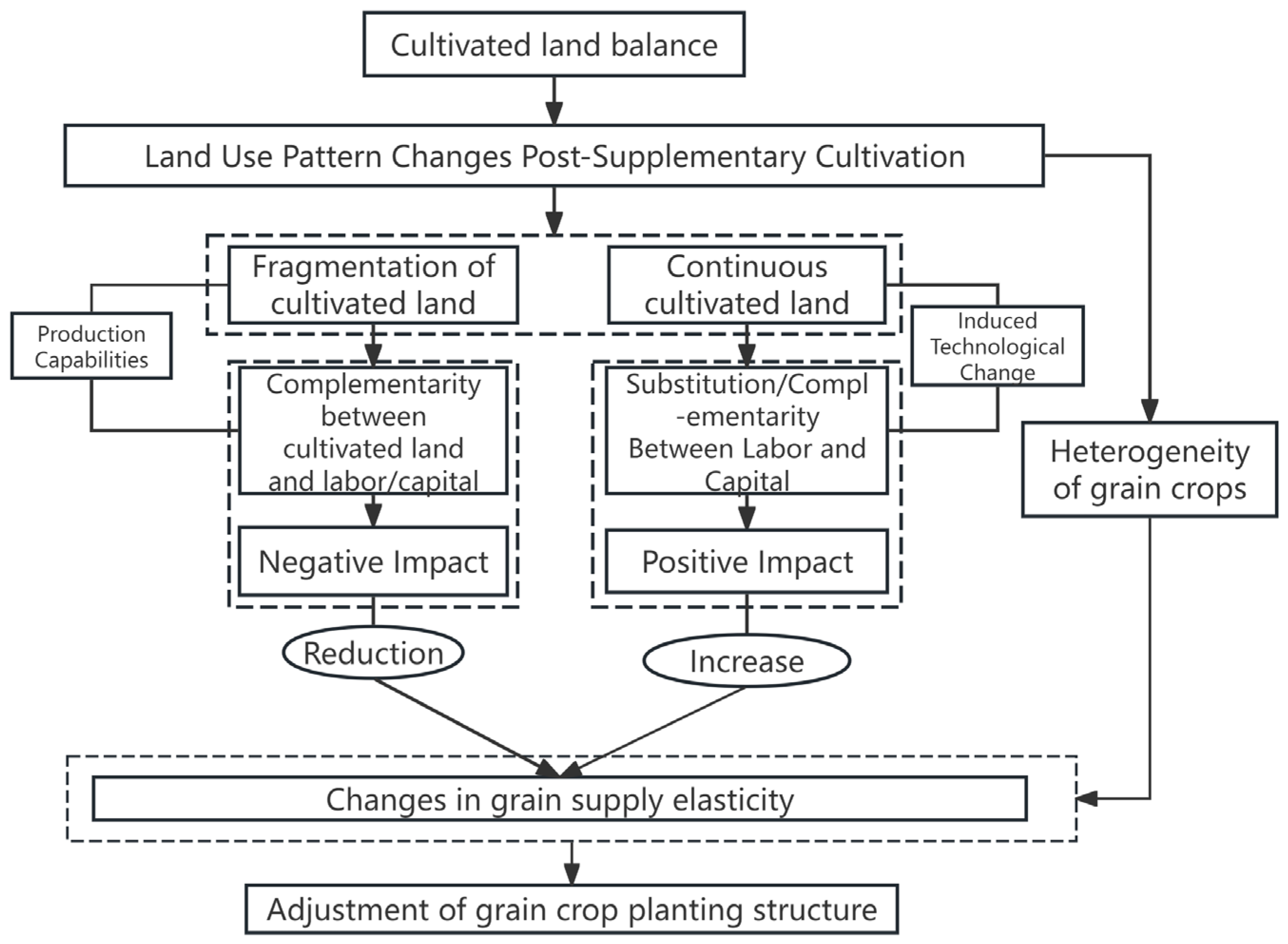
- Benchmark estimation based on the extended Nerlove model. The results reveal that when land-use adjustments following replenishment do not induce technological change, the policy primarily alters crop allocation through cost reconfiguration, increasing the planting shares of wheat and maize. Once land-use changes trigger technological progress, however, the policy exerts a deeper structural impact: wheat supply elasticity rises, while the planting proportions of rice and maize expand. These differentiated responses indicate that land replenishment operates through both production-cost and technological-shock effects, generating dynamic adjustments between “grain-oriented” and “non-grain-oriented” cultivation systems rather than producing uniform expansion.
- (2)
- Land remediation, cross-regional mechanization, and outsourcing services. The empirical analysis identifies three concrete transmission channels through which the policy reshapes crop structure. First, land replenishment stimulates land remediation efforts, improving plot quality and production conditions, thereby reinforcing the economic viability of grain cultivation. Second, it facilitates the expansion of cross-regional mechanized farming services, enabling farmers to overcome fragmentation constraints and maintain grain production within diversified systems. Third, the growth of outsourced agricultural services significantly reduces transaction and operational costs associated with fragmented land, lowering the threshold for continued grain cultivation. Importantly, however, the effectiveness of these mechanisms is not automatic. Their success critically depends on the density and connectivity of existing rural settlement networks and the maturity of local logistics and service infrastructures. Where rural transport systems, machinery circulation networks, and service platforms are well developed, land remediation and mechanization services can translate more effectively into structural adjustments in crop production.
- (3)
- Heterogeneity test based on grain-producing versus non-grain-producing areas. The regional heterogeneity analysis further highlights that non-grain-producing areas exhibit stronger structural responsiveness to the policy than major grain-producing provinces. In non-grain-producing regions, land compensation not only offsets the negative effects of land occupation but also, when coupled with technological change, significantly increases both planting shares and supply elasticity for most food crops. In contrast, in major grain-producing areas, institutional rigidity, baseline production specialization, and limited marginal land-quality gains constrain the magnitude of adjustment. This contrast underscores that the policy’s structural effectiveness is conditioned by regional land endowments and institutional environments. In regions facing tighter “man–land” constraints and possessing adaptable service networks, land compensation—together with remediation and mechanization—plays a more decisive role in safeguarding grain production and enhancing food security.
5.2. Policy Implications
- (1)
- Differences in growth cycles, characteristics, and planting habits of different crops. Given that food crops differ in growth duration, agronomic characteristics, and planting preferences, and considering the time lag in farmers’ adjustment of planting areas, shifts in crop varieties and input use are inevitable. Future adjustments to the occupation–compensation balance policy should refine land replenishment coefficients in alignment with the biological and ecological characteristics of different crops, thereby addressing the trade-off between land protection and food production. The policy design should also incorporate regional natural endowments to enhance the “quantity elasticity, quality elasticity, and ecological elasticity” of land replenishment (Zhong, 2022; Estoque et al., 2023) [49,50].
- (2)
- Significant differences between grain-producing and non-grain-producing areas. Grain-producing and non-grain-producing regions vary considerably in terms of natural endowments, socio-economic development needs, and land supply capacity. A uniform policy approach may not be appropriate. While the current framework allows for cross-regional compensation within provincial boundaries, further policy differentiation is needed to meet the diverse needs of agricultural development. In grain-producing provinces, policy emphasis should be placed on promoting large-scale cultivation and supporting “grain-oriented” agriculture through land replenishment and technological advancement. In contrast, non-grain-producing provinces should strengthen land requisition controls and implement macro-level price regulations to prevent excessive land demand from driving up food prices and incentivizing a shift toward “non-grain” crops. At the same time, integrating price support policies, industrial upgrading, and the development of agricultural socialized services can help stabilize planting behavior and prevent unintended shifts away from food crop cultivation, thereby promoting balanced functional compensation in land use across regions.
- (3)
- Need for timely follow-up after land replenishment. Effective policy implementation requires timely follow-up actions in land remediation, mechanization, and the provision of agricultural services. Expanding outsourcing services and promoting cross-regional mechanization can enhance land fertility and operational efficiency, thereby supporting the continuation of food crop cultivation under diversified cropping systems. Simultaneously, strict enforcement of the occupation–compensation balance policy is essential to maintain land market stability and avoid policy effects that disproportionately benefit or disadvantage specific crops, which could result in structural imbalances in the overall food crop production system.
5.3. Discussion
Author Contributions
Funding
Data Availability Statement
Acknowledgments
Conflicts of Interest
References
- Bindraban, P.S.; van der Velde, M.; Ye, L.M.; van den Berg, M.; Materechera, S.; Kiba, D.I.; Tamene, L.; Ragnarsdottir, K.V.; Jongschaap, R.; Hoogmoed, M.; et al. Assessing the impact of soil degradation on food production. Curr. Opin. Environ. Sustain. 2012, 4, 478–488. [Google Scholar] [CrossRef]
- Tyczewska, A.; Wozniak, E.; Gracz, J.; Kuczynski, J.; Twardowski, T. Towards food security: Current state and future prospects of agrobiotechnology. Trends Biotechnol. 2018, 36, 1219–1229. [Google Scholar] [CrossRef]
- Bren d’Amour, C.; Reitsma, F.; Baiocchi, G.; Barthel, S.; Güneralp, B.; Erb, K.H.; Haberl, H.; Creutzig, F.; Seto, K.C. Future urban land expansion and implications for global croplands. Proc. Natl. Acad. Sci. USA 2017, 114, 8939–8944. [Google Scholar] [CrossRef] [PubMed]
- Xue, S.; Fang, Z.; van Riper, C.; He, W.; Li, X.; Zhang, F.; Wang, T.; Cheng, C.; Zhou, Q.; Huang, Z.; et al. Ensuring China’s food security in a geographical shift of its grain production: Driving factors, threats, and solutions. Resour. Conserv. Recycl. 2024, 210, 107845. [Google Scholar] [CrossRef]
- Fan, Y.P.; Fang, C.L.; Zhang, Q. Coupling coordinated development between social economy and ecological environment in Chinese provincial capital cities: Assessment and policy implications. J. Clean. Prod. 2019, 229, 289–298. [Google Scholar] [CrossRef]
- Zhong, T.; Mitchell, B.; Scott, S.; Huang, X.; Li, Y.; Lu, X. Growing centralization in China’s farmland protection policy in response to policy failure and related upward-extending unwillingness to protect farmland since 1978. Environ. Plan. C Polit. Space 2017, 35, 1075–1097. [Google Scholar]
- Liu, Y.; Fang, F.; Li, Y. Key issues of land use in China and implications for policy making. Land Use Policy 2014, 40, 6–12. [Google Scholar] [CrossRef]
- Wang, J.; Chen, Y.; Shao, X.; Zhang, Y.; Cao, Y. Land-use changes and policy dimension driving forces in China: Present, trend and future. Land Use Policy 2012, 29, 737–749. [Google Scholar] [CrossRef]
- Liu, C.; Song, C.; Ye, S.; Cheng, F.; Zhang, L.; Li, C. Estimate provincial-level effectiveness of the arable land requisition-compensation balance policy in mainland China in the last 20 years. Land Use Policy 2023, 131, 106733. [Google Scholar]
- Chen, W.; Ye, X.; Li, J.; Fan, X.; Liu, Q.; Dong, W. Analyzing requisition–compensation balance of farmland policy in China through telecoupling: A case study in the middle reaches of Yangtze River Urban Agglomerations. Land Use Policy 2019, 83, 134–146. [Google Scholar] [CrossRef]
- Yu, F.; Dai, M.; Lin, S. Farmland protection based on bottom-line thinking of food security: Current situation, dilemmas and countermeasures. Econ. Horiz. 2022, 12, 9–16. [Google Scholar] [CrossRef]
- Heilig, G.K. Anthropogenic factors in land-use change in China. Popul. Dev. Rev. 1997, 23, 139–168. [Google Scholar] [CrossRef]
- Ash, R.F.; Edmonds, R.L. China’s land resources, environment, and agricultural production. Chin. Q. 1998, 156, 836–879. [Google Scholar] [CrossRef]
- Ministry of Land and Resources. Communique on Land and Resources of China, 2002; Ministry of Land and Resources of the People’s Republic of China: Beijing, China, 2004. [Google Scholar]
- Li, Y.; Wu, W.; Liu, Y. Land consolidation for rural sustainability in China: Practical reflections and policy implications. Land Use Policy 2018, 74, 137–141. [Google Scholar] [CrossRef]
- Su, B.; Li, Y.; Li, L.; Wang, Y. How does nonfarm employment stability influence farmers’ farmland transfer decisions? Implications for China’s land use policy. Land Use Policy 2018, 74, 66–72. [Google Scholar] [CrossRef]
- Turinawe, A.; Mugisha, J.; Drake, L. Soil and water conservation agriculture in subsistence systems: Determinants of adoption in southwestern Uganda. J. Soil Water Conserv. 2015, 70, 133–142. [Google Scholar] [CrossRef]
- Chen, F.; Liu, J.; Chang, Y.; Zhang, Q.; Yu, H.; Zhang, S. Spatial differentiation and driving mechanisms of arable land non-grainization in China. China Land Sci. 2021, 35, 33–43. [Google Scholar]
- Huang, S.; Hu, X. The impact of arable land quality on grain production under the occupation-compensation balance system. J. Financ. Econ. 2019, 12, 121–129. [Google Scholar]
- Hao, W.; Hu, X.; Wang, J.; Zhang, Z.; Shi, Z.; Zhou, H. The impact of farmland fragmentation in China on agricultural productivity. J. Clean. Prod. 2023, 425, 138962. [Google Scholar] [CrossRef]
- Zhang, Y.; Lei, M.; Lan, X.; Zhang, X.; Fan, S.; Gao, J. The multiple effects of farmland infrastructure investment on agrifood systems in China—An interdisciplinary model analysis. China Agric. Econ. Rev. 2024, 16, 320–339. [Google Scholar] [CrossRef]
- Zhou, Z.; Zhang, K.; Wu, H.; Liu, C.; Yu, Z. Land transfer or trusteeship: Can agricultural production socialization services promote grain scale management? Land 2023, 12, 797. [Google Scholar] [CrossRef]
- Xu, W.; Jin, X.; Liu, J.; Zhou, Y. Analysis of influencing factors of cultivated land fragmentation based on hierarchical linear model: A case study of Jiangsu Province, China. Land Use Policy 2021, 101, 105119. [Google Scholar] [CrossRef]
- Zhou, C.; Zhao, Y.; Long, M.; Li, X. How does land fragmentation affect agricultural technical efficiency? Based on mediation effects analysis. Land 2024, 13, 284. [Google Scholar] [CrossRef]
- Lan, Y.; Xu, B.; Huan, Y.; Guo, J.; Liu, X.; Han, J.; Li, K. Food security and land use under sustainable development goals: Insights from food supply to demand side and limited arable land in China. Foods 2023, 12, 4168. [Google Scholar] [CrossRef]
- Zhang, B. Dilemmas and suggestions of the occupation-compensation balance system: A case study of Fujian Province. China Land 2016, 4, 33–34. [Google Scholar]
- Simon, H.A. Administrative Behavior: A Study of Decision-Making Processes in Administrative Organizations; Macmillan: New York, NY, USA, 1971. [Google Scholar]
- Chen, S.; Chen, H.; Liang, X.; Liu, J. Effect of the Household Bounded Rationality Decision-making about Land Use Behavior: A Case Study for Gaoxigou Village of Mizhi County in Shaanxi Province. J. Nat. Resour. 2012, 27, 1286–1295. [Google Scholar] [CrossRef]
- Luo, B. New Institutional Economics; Shanxi Economic Publishing House: Taiyuan, China, 2005. [Google Scholar]
- Hayami, Y.; Ruttan, V. Agricultural Development: An International Perspective; Johns Hopkins University Press: Baltimore, MD, USA; London, UK, 1985. [Google Scholar]
- Solow, R.M. Technical change and the aggregate production function. Rev. Econ. Stat. 1957, 39, 312–320. [Google Scholar] [CrossRef]
- Zaplata, K.; Hecker, P. Convergence in tourism and divergence in agriculture as a perspective to foster sustainability all round. Adv. Appl. Sociol. 2018, 8, 464–469. [Google Scholar] [CrossRef]
- Zeng, L.; Li, X.; Sun, Q. The impact of cropping specialization on agricultural eco-efficiency. China Agric. Resour. Reg. Plan. 2022, 43, 10–21. [Google Scholar]
- Lu, H.; Hu, H. Effects of land fragmentation and crop diversification on agricultural profit and efficiency: Evidence from Jiangsu farmers. J. Agrotech. Econ. 2015, 7, 4–15. [Google Scholar]
- Yang, Z.; Ji, Y. The impact of land parcel scale operation on farmers’ agricultural structure adjustment: From the perspective of decision-making freedom and scale economy. Arid. Reg. Resour. Environ. 2021, 35, 97–102. [Google Scholar]
- Song, H.; Luan, J.; Zhang, S.; Jiang, J. Land fragmentation, crop diversification, and agricultural technical efficiency: Evidence based on a stochastic frontier model and mediation analysis. J. Agrotech. Econ. 2021, 2, 18–29. [Google Scholar] [CrossRef]
- Yang, X.; Mu, Y. Irrigation water pressure, supply elasticity and grain production structure based on heterogeneous coefficient Nerlove model. J. Nat. Resour. 2020, 35, 728–742. [Google Scholar] [CrossRef]
- Qian, L.; Yuan, H.; Liu, J.; Hong, M. The impact of farmland transfer on grain cropping structure. J. Agrotech. Econ. 2018, 8, 63–74. [Google Scholar] [CrossRef]
- Duan, J.; Ren, C.; Wang, S.; Zhang, X.; Reis, S.; Xu, J.; Gu, B. Consolidation of agricultural land can contribute to agricultural sustainability in China. Nat. Food 2021, 2, 1014–1022. [Google Scholar] [CrossRef] [PubMed]
- Nerlove, M. Estimates of the elasticities of supply of selected agricultural commodities. J. Farm Econ. 1956, 38, 496–509. [Google Scholar] [CrossRef]
- Shao, F.; Lu, Q. Regional corn supply response in China based on the Nerlove model. Econ. Issues 2011, 7, 73–76. [Google Scholar]
- Chen, Q. Advanced Econometrics and Stata Applications, 2nd ed.; Higher Education Press: Beijing, China, 2014. [Google Scholar]
- Arellano, M.; Bond, S. Some tests of specification for panel data: Monte Carlo evidence and an application to employment equations. Rev. Econ. Stud. 1991, 58, 277–297. [Google Scholar] [CrossRef]
- Ma, W.; Feng, Z. Wheat supply response in China based on the Nerlove model. Technol. Econ. 2009, 28, 50–52+128. [Google Scholar]
- Chen, H.; Tan, Y.; Xiao, W.; Li, G.; Meng, F.; He, T.; Li, X. Urbanization in China drives farmland uphill under the constraint of the requisition–compensation balance. Sci. Total Environ. 2022, 831, 154895. [Google Scholar] [CrossRef] [PubMed]
- Qian, L.; Lu, H.; Gao, Q.; Lu, H. Household-owned farm machinery vs. outsourced machinery services: The impact of agricultural mechanization on the land leasing behavior of relatively large-scale farmers in China. Land Use Policy 2022, 115, 106008. [Google Scholar] [CrossRef]
- Luo, B.; Wan, Y.; Hong, W.; Zhong, W. Land fragmentation, service outsourcing, and farmland abandonment: Evidence from a survey of 2,704 farmers in nine provinces. Econ. Horiz. 2019, 7, 63–73. [Google Scholar] [CrossRef]
- Song, G.; Ren, G. Spatial response of cultivated land use efficiency to the maize structural adjustment policy in the “Sickle Bend” region of China: An empirical study from the cold area of northeast. Land Use Policy 2022, 123, 106421. [Google Scholar] [CrossRef]
- Zhong, Y. Food security and the inherent logic of “storing grain in the land”. People’s Forum Acad. Front. 2022, 22, 78–85. [Google Scholar] [CrossRef]
- Estoque, R.C.; Wu, J. The resilience–sustainability–quality of life nexus. Sci. Total Environ. 2024, 912, 169526. [Google Scholar] [CrossRef] [PubMed]


| Variable | Variable Symbols | Obs | Mean | Standard Deviation | Min | Max |
|---|---|---|---|---|---|---|
| Proportion of cultivated land replenishment (%) | 364 | 86.624 | 18.737 | 13.933 | 100.000 | |
| Rice planting ratio (%) | 364 | 19.991 | 16.787 | 0.002 | 62.157 | |
| Wheat planting ratio (%) | 364 | 11.919 | 11.949 | 0.002 | 38.789 | |
| Corn planting ratio (%) | 364 | 19.184 | 16.311 | 0.012 | 68.417 | |
| Rice price (RMB/kg) | 364 | 1.855 | 0.404 | 0.779 | 3.088 | |
| Wheat price (RMB/kg) | 364 | 1.749 | 0.667 | 0.064 | 4.647 | |
| Corn price (RMB/kg) | 364 | 1.626 | 0.550 | 0.802 | 4.311 | |
| Bean price (RMB/kg) | 364 | 3.696 | 1.134 | 1.276 | 12.354 | |
| Potato price (RMB/kg) | 364 | 3.019 | 1.758 | 0.097 | 7.836 | |
| Oil price (RMB/kg) | 364 | 4.281 | 0.981 | 2.180 | 8.873 | |
| Vegetable price (RMB/kg) | 364 | 1.504 | 0.439 | 0.724 | 2.856 | |
| Number of people employed in agriculture (10,000 people) | 364 | 1122.827 | 669.250 | 130.800 | 4377.900 | |
| Agricultural labor price/RMB | 364 | 2767.170 | 2143.133 | 138.230 | 15,457.100 | |
| Area of expropriated cultivated land (hectares) | 364 | 6716.859 | 4422.477 | 159.310 | 26,719.690 | |
| Area of converted cultivated land (hectares) | 364 | 7015.989 | 4343.941 | 248.610 | 27,827.590 | |
| Urbanization rate (%) | 364 | 49.139 | 9.792 | 26.250 | 69.850 | |
| Land consolidation level (%) | 364 | 0.357 | 0.229 | 0.068 | 1.671 | |
| Total mechanical power (10 million watts) | 364 | 3408.458 | 2784.205 | 244.000 | 13,353.000 | |
| Agricultural production charges (10,000 yuan/RMB) | 312 | 2213.310 | 3360.753 | 0.000 | 23,881.600 |
| Parameter Estimated (Natural Logarithm) | Rice | Wheat | Corn | |||
|---|---|---|---|---|---|---|
| Constant coefficient Nerlove | Variable coefficient Nerlove | Constant coefficient Nerlove | Variable coefficient Nerlove | Constant coefficient Nerlove | Variable coefficient Nerlove | |
| Corresponding crop planting ratio t − 1 | 0.970 *** | 1.002 *** | 0.996 *** | 0.999 *** | 1.015 *** | 1.030 *** |
| (0.023) | (0.004) | (0.024) | (0.005) | (0.139) | (0.020) | |
| k-type food crop price t – 1 × cultivated land replenishment elasticity i, t − 1 | / | −0.037 *** | / | 0.028 * | / | −0.054 ** |
| (0.013) | (0.016) | (0.024) | ||||
| Cultivated land replenishment elasticity i, t − 1 | −0.017 *** | 0.067 *** | 0.016 * | −0.050 * | 0.068 ** | 0.135 ** |
| (0.006) | (0.026) | (0.009) | (0.028) | (0.031) | (0.053) | |
| Rice price i, t − 1 | 0.004 | 0.032 *** | 0.002 | 0.002 * | −0.005 | 0.013 * |
| (0.006) | (0.012) | (0.006) | (0.001) | (0.032) | (0.007) | |
| Wheat price i, t − 1 | −0.001 | −0.001 | 0.001 | −0.027 * | −0.016 | 0.000 |
| (0.004) | (0.001) | (0.003) | (0.015) | (0.061) | (0.003) | |
| Corn price i, t − 1 | −0.004 | −0.004 *** | 0.004 | 0.000 | −0.043 | 0.040 * |
| (0.004) | (0.001) | (0.006) | (0.002) | (0.029) | (0.023) | |
| Bean price i, t − 1 | 0.005 | 0.002 * | −0.000 | 0.002 *** | 0.004 | −0.001 |
| (0.003) | (0.001) | (0.002) | (0.001) | (0.005) | (0.002) | |
| Potato price i, t − 1 | −0.000 | 0.000 | 0.002 | 0.001 * | 0.012 | 0.002 |
| (0.002) | (0.000) | (0.001) | (0.000) | (0.008) | (0.002) | |
| Oil price i, t − 1 | −0.004 ** | −0.002 * | −0.004 * | −0.003 ** | 0.001 | −0.008 ** |
| (0.002) | (0.001) | (0.002) | (0.001) | (0.008) | (0.003) | |
| Vegetable price i, t − 1 | 0.012 * | 0.003 | −0.007 | −0.003 * | −0.021 | 0.009 |
| (0.007) | (0.002) | (0.013) | (0.002) | (0.026) | (0.007) | |
| Constant term | 0.001 | −0.056 ** | −0.065 * | 0.034 | 0.107 | −0.106 ** |
| (0.015) | (0.024) | (0.038) | (0.025) | (0.140) | (0.049) | |
| Control variables | Yes | Yes | Yes | Yes | Yes | Yes |
| AR (1) | 0.012 | 0.020 | 0.004 | 0.006 | 0.013 | 0.014 |
| AR (2) | 0.445 | 0.715 | 0.804 | 0.784 | 0.587 | 0.678 |
| Hansen Value | 0.999 | 0.999 | 0.972 | 0.999 | 0.165 | 0.678 |
| Observations | 338 | 338 | 338 | 338 | 338 | 338 |
| (1) | (2) | (3) | |
|---|---|---|---|
| Land Consolidation Level | Agricultural Mechanization Level | Productive Charges | |
| Cultivated land replenishment elasticity | 0.097 *** | 0.268 *** | −0.758 *** |
| (0.033) | (0.053) | (0.230) | |
| Control variables | Yes | Yes | Yes |
| Year fixed effects | Yes | Yes | Yes |
| Province fixed effects | Yes | Yes | Yes |
| Constant term | 0.273 *** (0.029) | 7.897 *** (0.010) | 6.590 *** (0.035) |
| Observations | 364 | 364 | 311 |
| Parameters to Be Estimated | Rice | Wheat | Corn | |||
|---|---|---|---|---|---|---|
| Main Production Areas | Non-Main Production Area | Main Production Areas | Non-Main Production Area | Main Production Areas | Non-Main Production Area | |
| Corresponding crop planting area t − 1 | 1.021 *** | 0.999 *** | 1.016 *** | 0.970 *** | 0.985 *** | 0.992 *** |
| (0.010) | (0.009) | (0.038) | (0.031) | (0.018) | (0.009) | |
| Cultivated land replenishment elasticity i, t − 1 | −0.000 | −0.012 * | 0.009 | 0.014 * | 0.009 | 0.015 ** |
| (0.003) | (0.007) | (0.010) | (0.008) | (0.014) | (0.007) | |
| Rice price i, t − 1 | 0.010 *** | −0.000 | 0.003 | 0.003 | 0.023 * | 0.001 |
| (0.002) | (0.003) | (0.006) | (0.004) | (0.012) | (0.005) | |
| Wheat price i, t − 1 | 0.005 ** | 0.001 | 0.004 | −0.010 | 0.016 * | −0.010 *** |
| (0.002) | (0.003) | (0.004) | (0.007) | (0.009) | (0.004) | |
| Corn price i, t − 1 | −0.008 | 0.001 | 0.005 | −0.001 | −0.030 | −0.012 ** |
| (0.008) | (0.003) | (0.011) | (0.007) | (0.020) | (0.005) | |
| Bean price i, t − 1 | −0.001 | 0.004 | −0.001 | −0.000 | −0.002 | 0.003 |
| (0.001) | (0.003) | (0.002) | (0.001) | (0.001) | (0.003) | |
| Potato price i, t − 1 | 0.001 * | 0.001 | 0.000 | 0.005 * | 0.000 | 0.003 *** |
| (0.001) | (0.001) | (0.002) | (0.003) | (0.001) | (0.001) | |
| Oil price i, t − 1 | −0.002 ** | −0.002 | −0.006 * | 0.005 | 0.002 | −0.006 ** |
| (0.001) | (0.002) | (0.003) | (0.004) | (0.002) | (0.002) | |
| Vegetable price i, t − 1 | 0.005 * | −0.004 | 0.007 | −0.012 | 0.007 | −0.002 |
| (0.003) | (0.003) | (0.009) | (0.012) | (0.008) | (0.008) | |
| Constant term | −0.066 *** | 0.012 * | −0.035 | −0.010 | −0.134 ** | 0.018 *** |
| (0.018) | (0.006) | (0.031) | (0.020) | (0.054) | (0.006) | |
| Control variables | Yes | Yes | Yes | Yes | Yes | Yes |
| AR (1) | 0.135 | 0.025 | 0.047 | 0.034 | 0.118 | 0.003 |
| AR (2) | 0.494 | 0.232 | 0.097 | 0.544 | 0.867 | 0.836 |
| Hansen Value | 0.999 | 0.999 | 0.999 | 0.999 | 0.999 | 0.999 |
| Observations | 169 | 169 | 169 | 169 | 169 | 169 |
| Parameters to Be Estimated | Rice | Wheat | Corn | |||
|---|---|---|---|---|---|---|
| Main Production Areas | Non-Main Production Area | Main Production Areas | Non-Main Production Area | Main Production Areas | Non-Main Production Area | |
| Corresponding crop planting ratio t − 1 | 1.014 *** | 0.993 *** | 0.985 *** | 0.939 *** | 0.993 *** | 0.985 *** |
| (0.010) | (0.012) | (0.051) | (0.096) | (0.022) | (0.017) | |
| k-type food crop price t−1×cultivated land replenishment elasticity i, t − 1 | −0.017 | −0.063 ** | 0.016 | −0.069 * | 0.270 ** | −0.020 * |
| (0.016) | (0.027) | (0.028) | (0.041) | (0.135) | (0.011) | |
| Cultivated land replenishment elasticity i, t − 1 | 0.029 | 0.118 ** | −0.007 | 0.156 * | −0.388 ** | 0.057 * |
| (0.031) | (0.054) | (0.048) | (0.085) | (0.196) | (0.030) | |
| Rice price i, t − 1 | −0.007 | 0.002 | −0.013 | −0.000 | −0.275 ** | 0.002 |
| (0.009) | (0.004) | (0.014) | (0.012) | (0.112) | (0.013) | |
| Wheat price i, t − 1 | 0.004 | 0.001 | −0.009 | 0.045 | 0.009 | −0.008 ** |
| (0.003) | (0.004) | (0.031) | (0.036) | (0.007) | (0.004) | |
| Corn price i, t − 1 | 0.021 | 0.061 ** | −0.010 | 0.012 | 0.029 *** | −0.000 |
| (0.013) | (0.025) | (0.015) | (0.014) | (0.009) | (0.004) | |
| Bean price i, t − 1 | −0.001 | 0.003 | −0.003 | −0.001 | 0.003 | −0.000 |
| (0.001) | (0.003) | (0.002) | (0.002) | (0.002) | (0.001) | |
| Potato price i, t − 1 | 0.001 | 0.001 ** | 0.005 | 0.012 ** | −0.002 * | 0.003 *** |
| (0.001) | (0.001) | (0.003) | (0.006) | (0.001) | (0.001) | |
| Oil price i, t − 1 | −0.002 | −0.001 | −0.004 | 0.009 | 0.004 | −0.007 ** |
| (0.002) | (0.002) | (0.004) | (0.008) | (0.004) | (0.003) | |
| Vegetable price i, t − 1 | 0.007 * | −0.005 | 0.008 | 0.002 | 0.004 | 0.003 |
| (0.003) | (0.005) | (0.012) | (0.022) | (0.006) | (0.007) | |
| Constant term | −0.068 ** | −0.101 * | 0.051 | −0.116 | 0.212 | −0.024 |
| (0.028) | (0.052) | (0.073) | (0.096) | (0.142) | (0.027) | |
| Control variables | Yes | Yes | Yes | Yes | Yes | Yes |
| AR (1) | 0.143 | 0.027 | 0.025 | 0.156 | 0.050 | 0.007 |
| AR (2) | 0.873 | 0.118 | 0.059 | 0.428 | 0.714 | 0.975 |
| Hansen Value | 0.999 | 0.999 | 0.999 | 0.999 | 0.999 | 0.999 |
| Observations | 169 | 169 | 169 | 169 | 169 | 169 |
| Land Consolidation Level | Agricultural Mechanization Level | Productive Charges | ||||
|---|---|---|---|---|---|---|
| Non-Main Production Area | Main Production Areas | Non-Main Production Area | Main Production Areas | Non-Main Production Area | Main Production Areas | |
| Cultivated land replenishment elasticity | 0.160 *** | 0.033 | 0.274 *** | 0.262 *** | −0.770 * | −0.744 *** |
| (0.050) | (0.033) | (0.086) | (0.071) | (0.408) | (0.203) | |
| Control variables | Yes | Yes | Yes | Yes | Yes | Yes |
| Year fixed effects | Yes | Yes | Yes | Yes | Yes | Yes |
| Province fixed effects | Yes | Yes | Yes | Yes | Yes | Yes |
| Constant term | 0.214 *** (0.043) | 0.332 *** (0.029) | 8.032 *** (0.015) | 7.762 *** (0.013) | 6.378 *** (0.064) | 6.802 *** (0.031) |
| Observations | 182 | 182 | 182 | 182 | 155 | 156 |
Disclaimer/Publisher’s Note: The statements, opinions and data contained in all publications are solely those of the individual author(s) and contributor(s) and not of MDPI and/or the editor(s). MDPI and/or the editor(s) disclaim responsibility for any injury to people or property resulting from any ideas, methods, instructions or products referred to in the content. |
© 2026 by the authors. Licensee MDPI, Basel, Switzerland. This article is an open access article distributed under the terms and conditions of the Creative Commons Attribution (CC BY) license.
Share and Cite
Liu, Y.; Zhang, J.; Wang, J.; Hu, Y.; Hu, N. The Impact of the Farmland Protection Policy on the Adjustment of Grain Planting Structure: Evidence in China. Land 2026, 15, 425. https://doi.org/10.3390/land15030425
Liu Y, Zhang J, Wang J, Hu Y, Hu N. The Impact of the Farmland Protection Policy on the Adjustment of Grain Planting Structure: Evidence in China. Land. 2026; 15(3):425. https://doi.org/10.3390/land15030425
Chicago/Turabian StyleLiu, Yongchang, Jing Zhang, Jingchun Wang, Yonghao Hu, and Nanyan Hu. 2026. "The Impact of the Farmland Protection Policy on the Adjustment of Grain Planting Structure: Evidence in China" Land 15, no. 3: 425. https://doi.org/10.3390/land15030425
APA StyleLiu, Y., Zhang, J., Wang, J., Hu, Y., & Hu, N. (2026). The Impact of the Farmland Protection Policy on the Adjustment of Grain Planting Structure: Evidence in China. Land, 15(3), 425. https://doi.org/10.3390/land15030425