Article

Reinterpreting the Garden City: Green-Built Relations in Tel Aviv’s Metropolitan Planning

Faculty of Architecture and the Built Environment, Delft University of Technology, 2628 BL Delft, The Netherlands
*
Author to whom correspondence should be addressed.
Land 2026, 15(3), 359; https://doi.org/10.3390/land15030359
Submission received: 20 November 2025 / Revised: 5 February 2026 / Accepted: 16 February 2026 / Published: 24 February 2026
(This article belongs to the Special Issue Human–Nature Relations in Urban Landscape Planning)

Abstract

The Garden City concept, first presented by Howard and further developed by Patrick Geddes, was adapted in his 1925 plan for Tel Aviv, where built form and green space were conceived as interdependent elements—green-built relations. While Garden City planning has been recognised as urban heritage, how its principles are interpreted in contemporary metropolitan planning remains underexplored. This study investigates how planning documents across the Tel Aviv metropolis address the attributes of Geddes’ plan that underpin the UNESCO World Heritage inscription of the White City, and whether these attributes extend beyond the core heritage area. The research analyses strategic plans, conservation frameworks, and master plans, by means of a workshop held during the 2024 Livable Neighbourhoods in the 21st Century Garden City conference. Eighteen participants reviewed six municipal planning documents against thirty-one predefined attributes to contemporary green-built relations. Findings reveal that attributes from Geddes’ plan, which underpin to Outstanding Universal Value, extend beyond the World Heritage area but are unevenly recognised, with variation across municipalities and document types. Results demonstrate green-built relations as a useful lens for linking heritage management with metropolitan planning and for supporting Nature–Culture governance approaches.

1. Introduction

Planning documents—including strategic plans, master plans, and conservation frameworks—embody institutional priorities and shape discourse around the built environment [1,2,3]. They mediate between abstract principles and spatial management, operating at the intersection of heritage discourse and municipal governance [4,5,6]. However, limited research examines how heritage attributes are recognised and interpreted in planning documents beyond formally protected boundaries. Systematic literature reviews identify significant gaps in bridging heritage conservation theory with planning practice [7,8], particularly in integrating heritage into broader landscape and urban planning frameworks [9].
Heritage attributes are defined here as tangible and intangible elements, tactics, and objectives that convey cultural significance. They also provide a diagnostic means for examining how planning documents address them [10,11,12]. The prioritisation of specific attributes in planning practice often indicates the cultural significance professionals ascribe to them [13,14]: what they deem essential to preserve, what they perceive as absent, and/or what they consider redundant.
Substantial scholarship addresses values-based heritage management within designated properties and advocates Nature–Culture approaches that integrate ecological and cultural processes in heritage policy for sustainable development [15,16,17,18,19,20,21,22,23]. However, little research addresses how Nature-Culture heritage attributes are recognised and prioritised across jurisdictions in metropolitan regions, where inherited planning principles must be negotiated across diverse natural and cultural contexts [24,25,26,27]. Understanding and recognising heritage attributes at this scale is particularly relevant given UNESCO’s 2011 Recommendation on the Historic Urban Landscape (HUL) [28] and the Council of Europe’s 2005 Faro Convention [29], both of which advocate for integrating heritage conservation within broader territorial and sustainable development frameworks [30,31].
The Tel Aviv metropolitan region provides a particularly relevant case for examining these processes. Patrick Geddes’ 1925 plan for Tel Aviv (hereafter GP), developed within the intellectual lineage of the Garden City concept, integrated built forms and green spaces as interdependent systems [32,33,34]. Geddes viewed the city as a living “bio-polis,” where the evolution of the urban fabric was inextricably linked to its regional context [35,36]. GP materialised this vision through specific planning principles for Tel Aviv, framed in this study as green-built relations, including block-scale private gardens, hierarchical streets and boulevard networks, and the provision of access to nature at varied scales [32]. In 2003, the White City of Tel Aviv was inscribed in the World Heritage (WH) List for its Outstanding Universal Value (OUV) as an exemplary case of early twentieth-century new town planning, recognised for conveying the significance of GP as contributing to the Garden City concept in a Mediterranean context [37,38]. GP fundamentally shaped Tel Aviv’s early development, with scholarship suggesting GP’s planning principles influenced development across the broader metropolitan region [39,40,41,42,43]. The WH designation formalises which attributes of GP convey cultural significance, creating a framework for examining how these attributes are recognised in contemporary planning beyond the designated property.
The research question guiding this study is: What do contemporary planning documents across different municipalities in the Tel Aviv metropolis reveal as culturally significant in GP’s green-built relations? To address this, the study used a participatory assessment framework adapted from HUL practices [44,45,46]. A structured workshop was conducted with 18 participants, including municipal planners, heritage professionals, and graduate students, to evaluate six municipal planning documents using a 31-attribute framework that captures the tangible and intangible dimensions of GP’s green-built relations. The study develops a transferable methodology for examining heritage attributes at the metropolitan scale. Findings demonstrate uneven prioritisation of green-built attributes beyond WH boundaries, with implications for metropolitan heritage governance.

2. Materials and Methods

2.1. Study Area and Attribute Framework

The Tel Aviv District, comprising 14 municipalities, forms the metropolitan region’s core area, while the Central District forms its outer ring [47]. This study examines how GP attributes are recognised in planning documents across the Tel Aviv District.
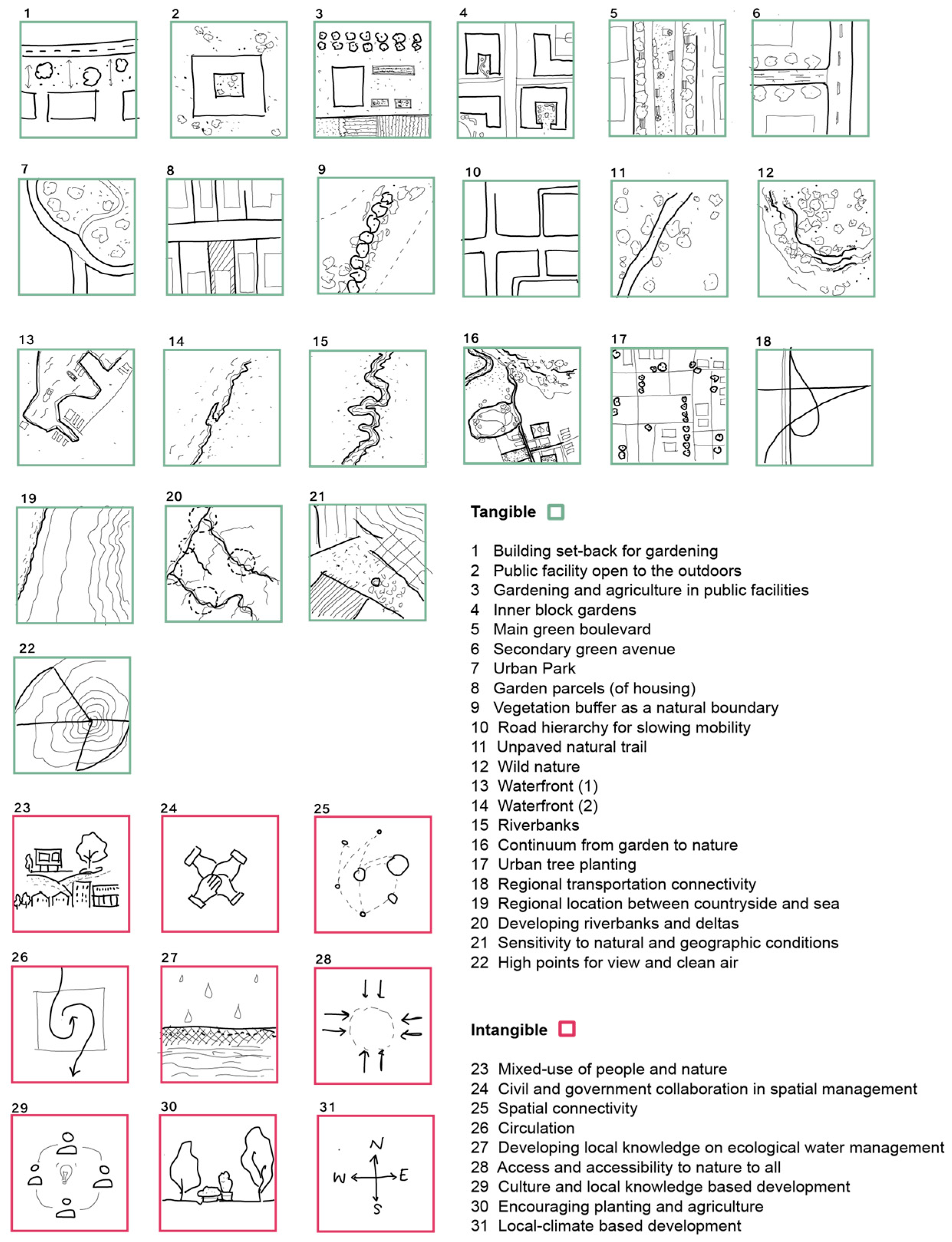
The framework of GP attributes was developed through systematic coding of GP [32] and the WH inscription documents [37,38], following a multi-level taxonomy of heritage components comprising tangible categories at Asset, Area, and Landscape levels, and intangible categories at Asset-related, Societal, and Process levels [48]. Components in which the Natural Element category co-occurred with any other category were retained, representing planning principles of Geddes’ integrative approach [49]. The dually coded components were thematically clustered into 31 distinct attributes that embody green-built relations, spanning from building to regional scales and encompassing both tangible and intangible dimensions. These attributes and their visual representations (Figure 1) provided the basis for the participatory evaluation workshop, following heritage-planning scholarship that uses attributes as diagnostic tools for assessing cultural significance [50,51].

2.2. Participatory Workshop Design

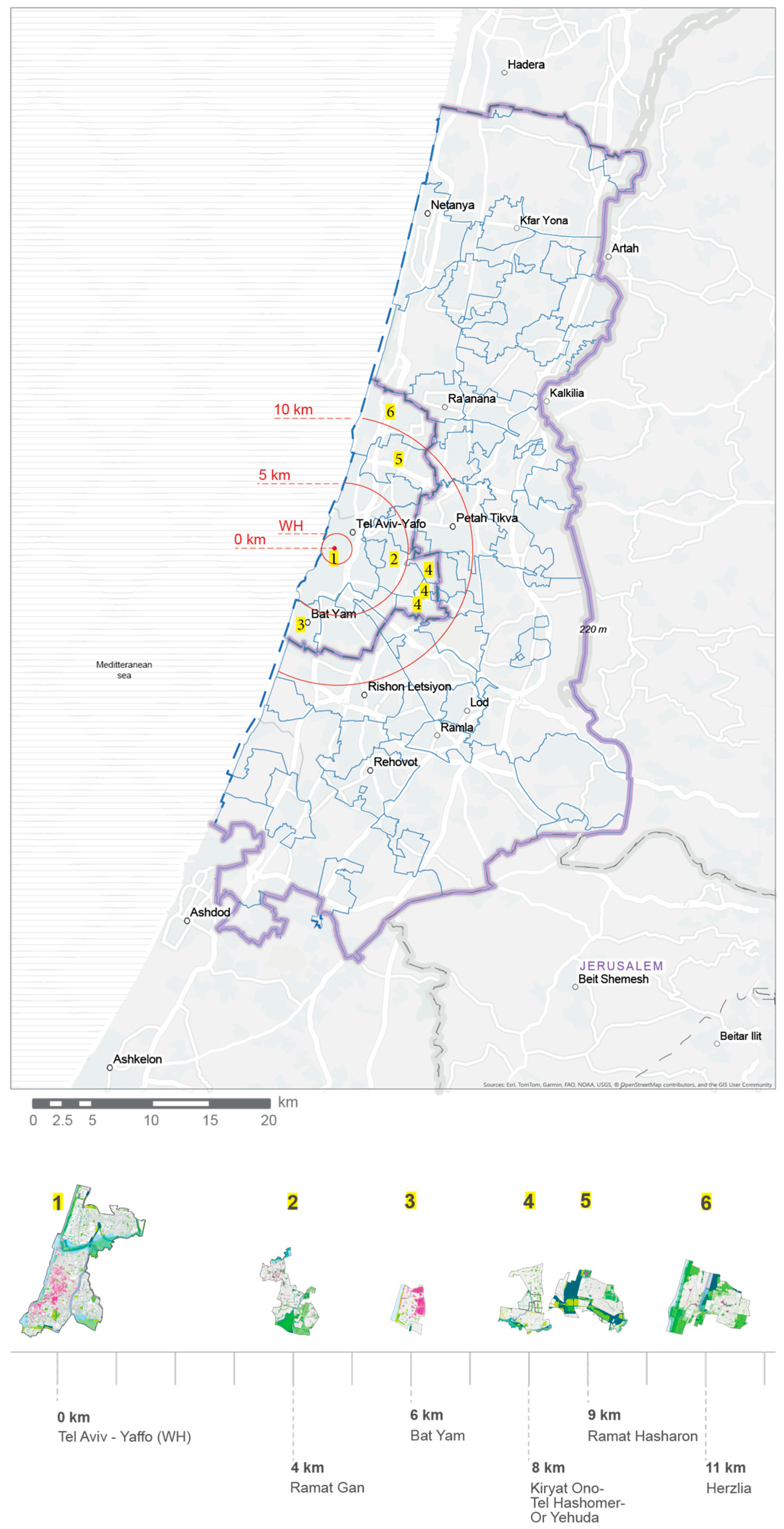
The core empirical component of this research was an evaluation workshop, conducted during the Urban Living Environments in the Metropolis: Garden Cities in the 21st Century conference, part of the UN-Habitat Urban Thinkers Campus in Jerusalem, November 2024. Eighteen participants—including municipal planners, planning administration representatives, heritage and conservation professionals, academics, and master’s students (Table 1)—were organised into five working groups of 3–4 participants each. This mixed composition was designed to capture diverse professional perspectives on heritage planning across career stages. During a 3h workshop, groups collectively evaluated six planning documents (Figure 2), selecting from nine available documents based on group interest and expertise, using the 31-attribute framework. Each group evaluated one or two documents, and classified each attribute under three categories: “Keep” (the attribute is addressed in the document and should be kept or strengthened), “Add” (not adequately or at all addressed but should be included), or “Skip” (either not relevant or should not be prioritised). Classification patterns enabled analysis of attribute recognition across planning documents.

2.3. Document Selection and Participatory Evaluation Method

The sample of planning documents was compiled based on two criteria: (1) availability of documents through the district’s planning administration; (2) documents include policy towards heritage, natural, and/or built, either as conservation plans or other urban plan types (either formally adopted or under statutory approval). The sample comprised statutory conservation plans (Tel Aviv–Yafo, Herzliya, Ramat Gan, Givatayim, Bat Yam), comprehensive master plans (Ramat Hasharon, Bnei Brak, Kiryat Ono-Tel Hashomer-Or Yehuda—hereafter referred to as Kiryat Ono), and hybrid statutory documents combining conservation and comprehensive planning (Holon-Azur-Ariel Sharon Park). Seven documents represent individual municipalities, and two represent a merger of municipal entities, grouped for analytical purposes due to geographic contiguity. Documents varied in statutory status, geographic scale, and planning focus, reflecting the diversity of governance and planning instruments operating in the metropolitan region.
A questionnaire was designed to capture working groups’ satisfaction with the contribution of document(s) to green-built relations at two levels, urban and metropolitan, following mixed-methods questionnaire design protocols used in heritage assessment research [18]. The questionnaire included quantitative satisfaction ratings on a 6-point scale (1 = very dissatisfied, 6 = very satisfied) and space for additional open-ended remarks. It comprised four questions, identical for each scale, reflecting whether (1) the evaluated document includes attributes that integrate natural and built at the urban/metropolitan level; (2) these attributes, some or all, are necessary for the city/metropolis; (3) the attribute affects the balance of natural and built in the city/metropolis; and (4) the group deem it necessary to add any more attributes to the document. The two-scale structure was designed to enable reflective validation of prioritisation results and attribute recognition within and beyond the municipal boundaries of the planning documents.
Groups worked collaboratively through a shared digital platform (Miro) following a structured protocol based on participatory evaluation methods [52,53]. Groups prioritised the 31 attributes in each planning document—to Keep, to Add, or to Skip. Each working group received (1) a digital copy of the planning document(s) for evaluation, including the document’s identifier, type, planning goals, statutory status, maps, and site photographs to familiarise participants with the area; (2) a visual index of the 31-attribute framework; and (3) a questionnaire sheet. In total, the working groups completed evaluations and questionnaires for six documents (and only one questionnaire for one additional document).

2.4. Data Analysis

Data analysis focused on pattern identification through descriptive statistics, reflecting the study’s exploratory approach to attribute recognition. It proceeded in three stages: First, groups’ classification results were systematically coded into a dataset recording each attribute’s classification (Keep/Add/Skip/Not classified) for each planning document. Statistics included (1) distribution of classifications across the six documents; (2) distribution of classifications by distance from WH property, to provide a framework for examining prioritisation patterns in relation to GP heritage core across the metropolitan region; (3) distribution of classifications across the 31 attributes, and (4) further distribution patterns. Second, questionnaire results were analysed using descriptive statistics for satisfaction ratings and thematic content analysis for open-ended responses. Third, integrated analysis examined relations among classification patterns, questionnaire responses, and distances from WH to identify prioritisation patterns across documents and attributes.

2.5. Limitations

This study has several limitations. Participant recruitment occurred through open conference registration without researcher control over composition. Together with self-selection of planning documents, it means voluntary participation was enabled but also that the chosen sample reflects conference attendees rather than predetermined sampling. The document sample was limited to the Tel Aviv District area; therefore, findings are specific to the metropolitan core. The participatory interpretive approach documented qualitative prioritisations rather than quantified rankings. Multi-criteria analysis would be a valuable complementary approach for future research.

3. Results

The five working groups evaluated six planning documents, completing attribute classifications and questionnaires for each assigned document. Each group presented their classifications to all participants, enabling discussion of prioritisation rationale. The following sections analyse classification patterns by document, attribute, scale, and theme.

3.1. Classification Patterns by Document

3.1.1. Document Variation in Attribute Prioritisation

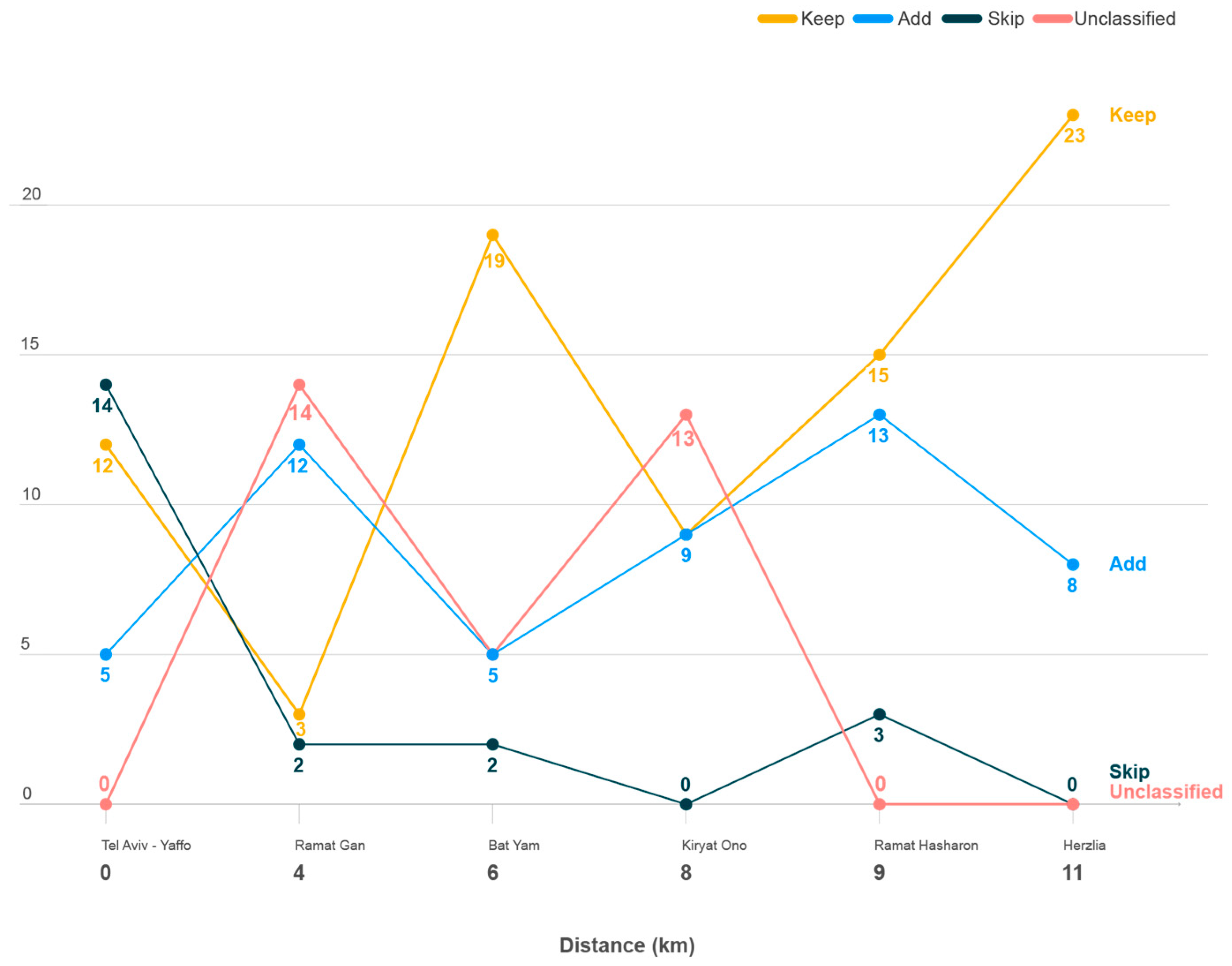
The evaluation of the six planning documents reveals distinct prioritisation profiles across the metropolitan region (Figure 3). Participants assessing Herzliya and Bat Yam plans prioritised the highest number of attributes to Keep, 23 (75%) and 19 (61%), respectively. Both groups prioritised similar tangible attributes to Keep (Inner block gardens, Road hierarchy, Regional transportation connectivity) and intangible attributes (Mixed-use of people and nature, Local ecological water knowledge). However, they diverged on several attributes: participants assessing Herzliya prioritised Unpaved natural trail and Wild nature to Keep, while participants assessing Bat Yam prioritised these to Add; conversely, participants assessing Bat Yam prioritised Public facilities open to outdoors and Culture-based development to Keep, while participants assessing Herzliya prioritised these to Add.
Three municipalities—Ramat Hasharon, Kiryat Ono–Or Yehuda, and Ramat Gan—show balanced or Add-dominant profiles. Participants assessing Ramat Hasharon prioritised nearly equal numbers of attributes to Keep (15, 48%) and to Add (13, 42%). Participants assessing Kiryat Ono–Or Yehuda also balanced Keep and Add prioritisations (9 each) but left 13 attributes (42%) unclassified. Participants assessing Ramat Gan left 14 attributes (45%) unclassified while prioritising Add (12, 38%) over Keep (3, 10%). Across these three municipalities, participants prioritised 34 of 66 classified attributes (51.5%) to Add, though only one attribute—Spatial connectivity—appeared consistently across all three. Together, participants assessing these three municipalities left 27 of 32 total unclassified attributes (84%).
Participants assessing Tel Aviv–Yafo demonstrated a different pattern, prioritising nearly equal numbers of attributes to Skip (14, 45%) and Keep (12, 39%), with only 5 prioritised to Add. Participants assessing Tel Aviv–Yafo prioritised 14 of 21 total Skip classifications across the metropolitan region (67%), making it the only municipality with such concentration. Only two attributes—Riverbanks and Developing riverbanks and deltas—were prioritised to Skip in multiple municipalities (Tel Aviv–Yafo and Bat Yam).

3.1.2. Distance from WH and Cross-Classification Patterns

To examine prioritisation patterns in relation to distance from WH property, distances were clustered into three ranges: close distances (0–4 km: Tel Aviv–Yafo at 0 km, Ramat Gan at 4 km), middle distances (6–9 km: Bat Yam at 6 km, Kiryat Ono at 8 km, Ramat Hasharon at 9 km), and far distances (11 km: Herzliya).
Classification results reveal participants prioritised more attributes to Keep at greater distances from the WH property. Participants assessing Tel Aviv–Yafo (0 km) prioritised 12 attributes to Keep, rising to 15 at Ramat Gan (4 km), 19 at Bat Yam (6 km), and 23 at Herzliya (11 km). However, middle-distance municipalities show intermediate patterns in this regard: 9 attributes were prioritised to Keep at Kiryat Ono (8 km) and 15 for Ramat Hasharon (9 km). Tangible attributes dominate the Keep prioritisations at middle and far distances: Classification results indicate 15 of 22 tangible attributes were prioritised to Keep at least once across the six municipalities, with seven attributes—Regional transportation connectivity, Mixed-use of people and nature, Local ecological water knowledge, Green boulevard systems, Urban parks, Garden parcels, and Main green boulevard—prioritised to Keep in both middle and far municipalities. Five intangible attributes were also prioritised to Keep across multiple municipalities (Environmental social culture, Urban-rural connectivity, Civic-governmental partnership, Local economy planning, Mixed-use of people and nature), appearing primarily at middle and far distances. Notably, participants assessing Bat Yam prioritised all five intangible attributes to Keep.
Additionally, classification patterns reveal attributes were prioritised to Add more at middle distances (4–9 km). Participants assessing Ramat Gan (4 km) prioritised 12 attributes to Add, Bat Yam (6 km) prioritised 5, Kiryat Ono (8 km) prioritised 9, Ramat Hasharon (9 km) prioritised 13, and Herzliya (11 km) prioritised 8. Participants assessing Tel Aviv–Yafo (0 km) prioritised only 5 attributes to Add. Across distances, eight attributes (5 tangible, 3 intangible) were prioritised to Add in multiple municipalities, all within the 4–9 km range, including Gardening in public facilities, Encouraging urban planting, and Unpaved natural trail.
Seven attributes show transitional patterns between Keep and Add prioritisations across distances, primarily within the middle and far ranges (6–11 km): Wild nature, Unpaved natural trail, Public facilities open to outdoors, Garden-nature continuity, Culture-based development, Local climate-based development, and Local ecological water knowledge. For instance, participants prioritised Culture-based development and Local climate-based development to Add at 9–11 km but to Keep at 6 km. No such transitional patterns appear at close distances (0–4 km) or exclusively at far distances (11 km).
The data show participants prioritised more attributes to Skip at close distances. Participants assessing Tel Aviv–Yafo prioritised 14 attributes to Skip, while participants assessing Bat Yam (6 km) prioritised 2 and Ramat Hasharon (9 km) prioritised 3. Riverbanks and Developing riverbanks were the only attributes prioritised to Skip across multiple municipalities. Participants at 8 km and 11 km did not prioritise any attributes to Skip.
Unclassified attributes concentrate at middle distances (4–8 km) and are absent at both edge ranges. Participants assessing Ramat Gan (4 km) left 14 attributes unclassified and participants assessing Kiryat Ono (8 km) left 13 unclassified, together accounting for 27 of 32 total unclassified cases (84%). The 32 unclassified cases include 16 tangible and 11 intangible attributes, with no consistent pattern between attribute type and distance.
Across the planning documents, Keep prioritisations increase with distance from WH property, Add prioritisations concentrate at middle distances (4–9 km), Skip prioritisations concentrate at close distances (0–6 km), and unclassified cases cluster at middle distances (4–8 km) while absent at both edge ranges (0 km and 11 km). Attribute type patterns also vary by distance: At far distances, prioritisation patterns reveal a predominance of tangible attributes to Keep, while at middle distances, intangible attributes were prioritised both to Keep and Add. At close distances, tangible and intangible attributes prioritised to Add were nearly balanced. At middle distances, tangible attributes prioritised to Add slightly outnumbered intangible attributes, whereas at far distances both types were almost exclusively prioritised to Keep.
The following section examines how individual attributes were prioritised across documents in the metropolitan region.

3.2. Classification Patterns by Attribute

3.2.1. Overall Classification Distribution

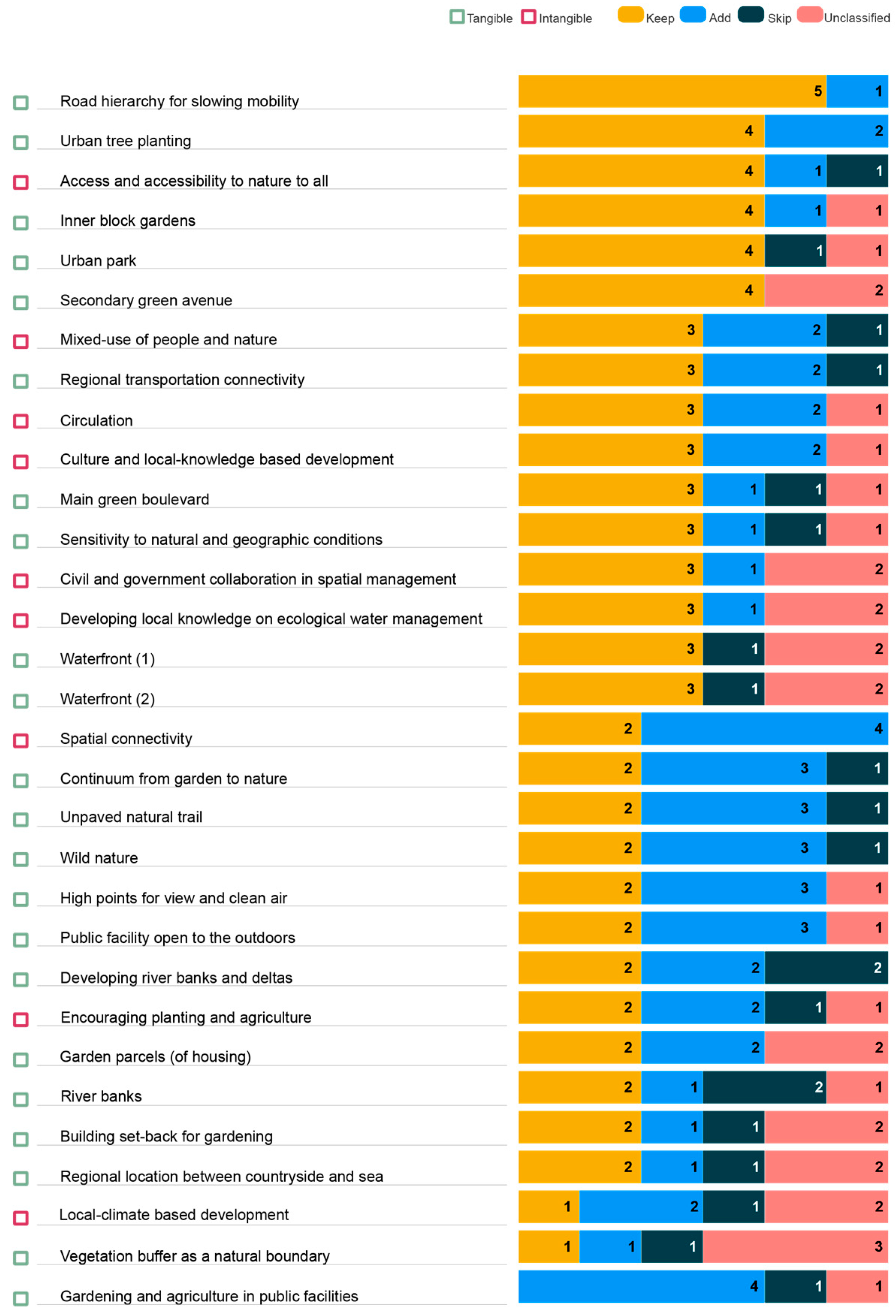
Of 186 possible attribute evaluations across six planning documents (31 attributes × 6 documents), participants classified 154 cases definitively across Keep, Add, and Skip categories (Figure 4). Overall, participants prioritised attributes to Keep in 52.6% of classified cases (81 of 154), to Add in 33.8%, and to Skip in 13.6%. Participants left 32 cases (17.2%) unclassified. A total of 10 attributes received classifications in all 6 municipalities, with no unclassified cases, while 21 attributes had 1–3 unclassified cases, yielding 3–5 valid classifications per attribute. Among the partially classified attributes, 16 were tangible, and 5 were intangible.

3.2.2. Keep, Add, and Skip Patterns Across Attributes

Classification results indicate Keep as the most frequent classification, applied 81 times across 30 of 31 attributes. Participants prioritised tangible attributes to Keep substantially more than intangible attributes: 57 Keep prioritisations for tangible attributes compared to 24 for intangible attributes. Twenty-eight attributes (20 tangible, 8 intangible) were prioritised to Keep in 2–5 municipalities, 2 attributes (1 tangible, 1 intangible) in one municipality, and 1 tangible attribute (Gardening and agriculture in public facilities) received no Keep prioritisations.
Road hierarchy for slowing mobility received the highest Keep prioritisations—five across the planning documents—representing the highest prioritisation count for any attribute in any category. Four other tangible attributes were prioritised to Keep in four municipalities each: Inner block gardens, Urban tree planting, Urban park, and Secondary green avenue. Five tangible attributes received three Keep prioritisations (Main green boulevard, Waterfront (1), Waterfront (2), Regional transportation connectivity, Sensitivity to location), while the remaining ten tangible attributes received two Keep prioritisations each.
Among intangible attributes, Access and accessibility to nature was prioritised to Keep in four municipalities (Bat Yam, Kiryat Ono, Ramat Hasharon, Herzliya). Three other intangible attributes were prioritised to Keep in three municipalities each—Mixed-use of people and nature, Civic-governmental collaboration, and Local ecological water knowledge—all appearing in Bat Yam, Ramat Hasharon, and Herzliya. Tangible attributes prioritised to Keep appeared across all distance ranges, with concentrations at close (Tel Aviv–Yafo: 11 cases) and far distances (Herzliya: 17 cases). Of the intangible attributes prioritised to Keep, concentrations revealed at middle and far distances (Bat Yam: 9 prioritisations; Ramat Hasharon and Herzliya: 6 each).
Participants prioritised to Add 52 times total, with tangible attributes comprising 35 cases and intangible attributes 17. Sixteen attributes (10 tangible, 6 intangible) were prioritised to Add in multiple municipalities: Two attributes received Add prioritisations in four municipalities—Gardening and agriculture in public facilities (tangible, in Bat Yam, Kiryat Ono, Ramat Hasharon, Herzliya) and Spatial connectivity (intangible, in Tel Aviv–Yafo, Ramat Gan, Kiryat Ono, Ramat Hasharon). Five tangible attributes were prioritised to Add in three municipalities each: Public facilities open to outdoors, Unpaved natural trail, Wild nature, Garden-nature continuity, and High points for view. These Add prioritisations concentrated at middle distances (6–9 km), with several appearing at far distances (11 km). Five intangible attributes were prioritised to Add in two municipalities each: Culture-based development and Local climate-based development were prioritised to Add in Ramat Hasharon and Herzliya; Encouraging planting was prioritised to Add in Ramat Gan and Herzliya). Mixed-use of people and nature was prioritised to Add in Ramat Gan and Kiryat Ono.
Participants prioritised to Skip least frequently, only 21 times overall, with tangible attributes accounting for 17 cases and intangible attributes for 4. Two tangible attributes, Riverbanks and Developing riverbanks, were prioritised to Skip in both Tel Aviv–Yafo and Bat Yam. Thirteen other tangible attributes were prioritised, each to Skip only once. Four intangible attributes were also prioritised to Skip only once: Access and accessibility to nature, Mixed-use of people and nature, Encouraging planting, and Local climate-based development. Skip prioritisations concentrated at close to middle distances (0–6 km), with some appearing at 9 km, but none at 11 km.
Participants left 19 attributes (13 tangible, 6 intangible) unclassified in 32 cases, accounting for 17.2% of all possible classifications. Twenty-three unclassified cases involved tangible attributes, and 9 involved intangible attributes. Ten attributes were left unclassified in multiple cases: Vegetation buffer remained unclassified in three municipalities (Ramat Gan, Bat Yam, Kiryat Ono), resulting in the highest unclassified count. Nine attributes, all intangible, were left unclassified in two municipalities. All 32 unclassified cases appeared at middle distances (4–8 km) in Ramat Gan, Bat Yam, and Kiryat Ono. Participants assessing Tel Aviv–Yafo (0 km), Ramat Hasharon (9 km), and Herzliya (11 km) left no attributes unclassified. Both tangible and intangible attributes had unclassified cases, with no systematic correlation with attribute type.

3.2.3. Cross-Municipality Classification Patterns

Three attribute pairs demonstrate identical classification patterns across municipalities. Unpaved natural trail and Wild nature both followed a Skip–Add–Add–Add–Keep–Keep pattern: participants prioritised them to Skip in Tel Aviv–Yafo, to Add in Ramat Gan, Bat Yam, and Kiryat Ono, and to Keep again in Ramat Hasharon and Herzliya. Waterfront (1) and Waterfront (2) followed a Keep–unclassified–Keep–unclassified–Skip–Keep pattern: to Keep in Tel Aviv–Yafo, Bat Yam, and Herzliya, to Skip in Ramat Hasharon, and were left unclassified in Ramat Gan and Kiryat Ono. Civic–governmental collaboration and Local ecological water knowledge both followed an Add–unclassified–Keep–unclassified–Keep–Keep pattern: participants prioritised to Add them in Tel Aviv–Yafo, to Keep in Bat Yam, Ramat Hasharon, and Herzliya, and left them unclassified in Ramat Gan and Kiryat Ono.
In conclusion, only one attribute received the same classification across all municipalities—Secondary green avenue—which was prioritised to Keep in the cases it was classified. No attribute received exclusively to Add or to Skip classifications across all municipalities. The most common classification combination for an attribute was Keep and Add (without Skip), appearing in 11 attributes, including, among others, Road hierarchy, Inner block gardens, Urban tree planting, and Public facilities open to outdoors. Fifteen attributes were prioritised across all three categories in different municipalities, representing nearly half of all attributes; these include Unpaved natural trail, Wild nature, Riverbanks, Regional transportation connectivity, and Mixed-use of people and nature. Three attributes were prioritised to Keep and Skip only, (without Add): Urban park, Waterfront (1), and Waterfront (2). Only one attribute—Gardening and agriculture in public facilities—was prioritised to Add and Skip only, without Keep. Tangible attributes appeared across all classification categories, including Skip, while intangible attributes were prioritised toward Add and rarely received Skip classifications or were unclassified.

3.3. Questionnaire Results: Participant Satisfaction with Green-Built Integration

3.3.1. Urban Level Satisfaction

Participants rated their satisfaction with four aspects of green-built integration at the urban level, using a 6-point scale (1 = very dissatisfied, 6 = very satisfied), for the six planning documents. Participants completed an additional questionnaire for Bnei Brak, 6 km from WH (though it was not classified under the Keep, Add, and Skip categories).
The document’s inclusion of attributes integrating built and natural elements at the urban level received moderate satisfaction overall (mean: 3.71). Participants assessing Herzliya rated highest (6.00), followed by Bat Yam (5.00), Ramat Gan and Kiryat Ono (4.00), Tel Aviv–Yafo and Bnei Brak (3.00), and Ramat Hasharon lowest (1.00). By distance from WH, close municipalities (0–4 km) averaged 3.50, middle distances showed variation (6 km averaged 4.00; 8–9 km averaged 2.50), and far distances rated highest (6.00). Notably, the two municipalities at 6 km—Bnei Brak and Bat Yam—diverged substantially (Bat Yam: 5.00, Bnei Brak: 3.00).
Regarding the necessity of integrating built and natural attributes at the urban level, participants reported overall high satisfaction (mean: 5.33). Participants assessing Bnei Brak, Bat Yam, and Ramat Hasharon reported the highest satisfaction (6.00); Tel Aviv–Yafo and Herzliya reported 5.00; and Kiryat Ono reported 4.00. All distance clusters averaged 5.00, except the 6 km municipalities, which averaged 6.00. This metropolitan-wide consensus contrasts sharply with the former satisfaction about current inclusion: The gap between satisfaction with inclusion (average 3.71) and necessity (average 5.33) reached a maximum in Ramat Hasharon (necessity: 6.00, inclusion: 1.00), with Bnei Brak second, showing a three-point gap (necessity: 6.00, inclusion: 3.00).
Regarding whether attributes integrating built and natural are balanced at the urban level, the lowest satisfaction was received across all documents (mean: 2.57). Only Herzliya was rated positively (5.00) by participants, while Tel Aviv–Yafo, Bat Yam, and Kiryat Ono were rated 3.00, Ramat Gan was rated 2.00, and Bnei Brak and Ramat Hasharon were rated 1.00. By distance, close municipalities averaged 2.50, middle distances (8–9 km) also averaged 2.00, and only far distances were rated positively (5.00).
To the question whether they would like to add elements to the document, participants gave high rate (mean: 5.40). In the written comments’ section, participants shared further priorities, notably the need for heritage equity (such as extending conservation beyond established heritage zone in Tel Aviv–Yafo), green infrastructure connectivity (boulevards linking to waterfront in Bat Yam, streets as alternative green public spaces in Bnei Brak), and the need to address ecological and agricultural conditions of the broader context in Herzliya). Ramat Hasharon participants explained their exceptionally low satisfaction ratings due to the document’s “lack in various aspects”.

3.3.2. Metropolitan Scale Satisfaction

Participants’ satisfaction with documents’ inclusion of attributes integrating built and natural at the metropolitan level was moderate overall (mean: 3.43). Bat Yam participants rated the highest (6.00), followed by Bnei Brak (5.00), Herzliya and Kiryat Ono (4.00), Tel Aviv–Yafo and Ramat Gan (2.00), while Ramat Hasharon was rated lowest (1.00). By distance, close municipalities averaged 2.00 in satisfaction, middle-distance municipalities averaged 2.50, and far-distance municipalities averaged 4.00. Participants assessing 6 km municipalities averaged 5.50—substantially higher satisfaction with metropolitan inclusion than any other distance cluster.
Regarding the necessity attributes integrating built and natural in the metropolitan level, high satisfaction was received from participants overall (mean: 5.43). Ramat Gan, Bnei Brak, Bat Yam, and Ramat Hasharon participants rated 6.00, Tel Aviv–Yafo and Herzliya participants rated 5.00, and Kiryat Ono participants rated 4.00. By distance, close municipalities averaged 5.50, municipalities at 6 km averaged 6.00, middle-distance municipalities (8–9 km) averaged 5.00, and far municipalities averaged 5.00. The gap between satisfaction with inclusion (3.43) and necessity (5.43) in the metropolitan level mirrors that of the urban level.
Regarding whether attributes integrating built and natural are balanced in the metropolitan level, high satisfaction was received overall (mean: 5.00). Ramat Gan, Bnei Brak, and Bat Yam participants rated 6.00, Herzliya’s rated 5.00, and Tel Aviv–Yafo, Kiryat Ono, and Ramat Hasharon participants rated 4.00. By distance, close municipalities averaged 5.00, the 6 km municipalities averaged 6.00 (mirroring the result in the urban level), the 8–9 km municipalities averaged 4.00, and far municipalities rated 5.00.
To the question whether they would like to add elements to the document, participants gave a high rate (mean: 5.00), across only four responding municipalities. Bat Yam and Ramat Hasharon participants rated 6.00, Bnei Brak’s rated 5.00, and Tel Aviv–Yafo’s rated 3.00 (Participants of Kiryat Ono and Herzliya did not respond). In the written comments section, comments further emphasised the need for cross-boundary infrastructure, including inter-city parks (for Ramat Hasharon), green transportation routes between the built and the sea (for Herzliya), and water flow management (for Bat Yam).

3.3.3. Cross-Scale and Distance Patterns

Comparing satisfaction ratings across urban and metropolitan levels shows divergent patterns across municipalities. Bat Yam participants rated metropolitan inclusion higher (6.00) than urban inclusion (5.00). Bnei Brak participants also rated metropolitan inclusion higher (5.00) than urban inclusion (3.00), showing a two-point increase. The remaining five municipalities showed declining satisfaction (Tel Aviv–Yafo, Ramat Gan, Herzliya) or identical satisfaction (Kiryat Ono, Ramat Hasharon) between the urban and metropolitan levels. Close municipalities (0–4 km) averaged lowest metropolitan inclusion satisfaction (2.00) than any distance cluster.
Despite variable satisfaction with inclusion across levels and distances, participants consistently reported high satisfaction with the question of necessity at metropolitan and urban levels, with municipalities within 6 km of WH rated highest (6.00 in both levels).
Questionnaire satisfaction patterns mostly align with classification patterns across the six municipalities that were assessed in both tasks. Participants assessing Herzliya and Bat Yam—which received the highest Keep classifications (23 and 19 attributes, respectively)—also rated substantially higher satisfaction with inclusion at the urban level (6.00 and 5.00, respectively). Tel Aviv–Yafo participants, who classified 14 attributes as Skip and only 12 as Keep, also rated moderate to low satisfaction with inclusion (3.00 at the urban level, 2.00 at the metropolitan level). On the contrary, Ramat Hasharon participants rated 1.00 for inclusion and balance at the urban level and for inclusion at the metropolitan level, yet classified 15 Keep and 13 Add, with only 3 Skip.
Distance patterns in the questionnaire show non-linearity: The 6 km distance shows a satisfaction peak for inclusion (5.50), necessity, and balance (6.00) on the metropolitan level, substantially higher than both closer distances (0–4 km: 2.00 for inclusion) and slightly more distant municipalities (8–9 km: 2.50 for inclusion). However, satisfaction with the balance at the urban level shows the opposite pattern, with the 6 km municipalities averaging 2.00 (Bnei Brak: 1.00, Bat Yam: 3.00), among the lowest ratings.

4. Discussion

This research examined how attributes representing green-built relations from Patrick Geddes’ 1925 plan are recognised in contemporary municipal planning documents across the Tel Aviv metropolis. The findings reveal that these attributes remain present and perceived as relevant across multiple municipal contexts, but their valuation is fundamentally context-dependent rather than uniform. The same attribute can represent redundancy in one municipality and a critical gap in another, challenging notions that heritage attributes possess inherent, transferable value independent of local conditions. This pattern exemplifies Nature–Culture dynamics at the metropolitan scale: green-built relations are not preserved as static heritage objects but continuously re-interpreted through the lens of contemporary urban challenges, infrastructure saturation, and geographic context [15,17,54].
The context-dependency observed across municipalities reflects what Geddes himself conceptualised as “place-work-folk” synergies—the inseparability of environment, function, and community [36,41,42]. Participants assessing Herzliya (11 km from WH) and Bat Yam (6 km) prioritised substantially more attributes to Keep than those assessing Tel Aviv–Yafo (0 km), which concentrated most Skip classifications. Rather than decreasing with distance from the WH core, attribute recognition follows a non-linear pattern shaped by the interaction between inherited planning principles and current urban conditions. In coastal municipalities with established waterfront access, attributes such as Riverbanks and Developing riverbanks and deltas were prioritised to Skip, while in inland municipalities they were prioritised to Keep or Add. Similarly, Urban parks deemed excessive in saturated contexts while considered essential where green infrastructure remains scarce.
This geographic and infrastructural contingency demonstrates how Nature–Culture relations operate dynamically: the cultural significance of attributes that embody green-built relations is not fixed by their historical derivation but actively produced through ongoing negotiations between built and natural systems across diverse municipal contexts [46,55]. These findings challenge the notion of OUV as articulated in the WH inscription: if attribute recognition varies fundamentally with local context and infrastructure saturation, their ‘universal’ significance might be better understood as contextually negotiated relevance rather than inherent, transferable value. This suggests a potential gap between the OUV and the bottom-up cultural significance attributed to green-built relations.
Tangible attributes (parks, green boulevards, regional transportation connectivity) dominated both Keep and Skip classifications, reflecting their visibility in planning practice but also their critical evaluation. Participants assessing municipalities with extensive green infrastructure questioned whether additional elements would meaningfully improve quality, while those in contexts with limited infrastructure prioritised additions. This pattern demonstrates that recognition of heritage attributes depends on perceived gaps rather than historical continuity alone.
Intangible attributes (environmental, social culture, civic-governmental partnership, local ecological knowledge) received fewer Keep votes but almost no Skip classifications, suggesting conceptual consensus even where implementation remains underdeveloped. This divergence between tangible and intangible recognition [45] points to a persistent challenge in operationalising Nature–Culture approach: while professionals may acknowledge the interdependence of ecological and cultural processes conceptually, in planning documents they more readily articulate physical interventions than governance mechanisms or cultural practices.
The clustering of Add classifications at middle distances (4–9 km) and unclassified cases at intermediate distances (4–8 km) reveal metropolitan zones where attribute interpretation becomes most contested. These are municipalities experiencing rapid transformation—neither clearly within the historic core nor fully peripheral—in contexts where planning and heritage management face contemporary development pressures most directly. The concentration of uncertainty in these transitional zones suggests that attribute-based frameworks function most diagnostically where heritage and development tensions are explicit, revealing not a consensus but rather the active negotiation of competing underlying values [11,50]. This finding challenges heritage management approaches that seek singular, authoritative determinations of significance, instead supporting participatory frameworks that expose divergent professional perspectives as evidence of metropolitan-scale heritage dynamics [55,56].
Methodologically, the research demonstrates the value of combining systematic attribute-based analysis with participatory professional evaluations [52,53]. By examining conservation plans and urban planning documents, the study operationalises heritage knowledge within planning practice, where implementation decisions occur [1,2,5]. Unlike policy document analysis alone, which captures formal positions, participatory evaluations reveal how planning professionals interpret and prioritise attributes based on tacit knowledge of local conditions, implementation feasibility, and political constraints. This approach treats heritage attributes not merely as preservation goals but as diagnostic tools for evaluating contemporary planning alignment with planning objectives. The 31-attribute framework, derived through systematic coding of GP [32] and the WH inscription documents [37,38], proved operationally clear—every attribute was identified at least once, with only 17.2% left unclassified. This relatively low unclassified rate indicates that the framework can function as a diagnostic tool across diverse municipal contexts; though future applications would benefit from more explicit definitions to reduce interpretive ambiguity, particularly for intangible attributes where consensus was weakest. The framework’s transferability lies not in prescribing which attributes municipalities should adopt, but in exposing which attributes are perceived as present, absent, or excessive/inadequately implemented—patterns that reveal metropolitan heritage governance challenges invisible in individual municipal plans.
The questionnaire results reinforce this understanding: satisfaction with necessity of green-built integration substantially exceeds satisfaction with current plan inclusion. Such discrepancies indicate that professionals recognise the relevance of GP attributes to contemporary planning challenges (ecological resilience, connectivity, mixed-use integration), but perceive implementation as constrained, either by jurisdictional boundaries, resource limitations, or political will. The consistent satisfaction with necessity across the metropolis, despite the variable satisfaction with inclusion, points to a shared discourse around green-built relations that transcends municipal boundaries but lacks coordinated mechanisms for metropolitan-scale governance [24,26].
Examining heritage attributes at the metropolitan scale through participatory assessment thus reveals Nature–Culture processes as they operate across jurisdictional boundaries: not as stable heritage properties transmitted from past to present, but as ongoing negotiations between heritage management and urban context. This approach aligns with UNESCO’s Historic Urban Landscape recommendation (HUL), which positions heritage not as static fabric but as dynamic processes within territorial development [28,44]. However, the findings also reveal the challenge of operationalising HUL at the metropolitan scale, where coordinated governance structures remain underdeveloped and attribute recognition varies substantially across municipalities [7,31]. Future research, integrating spatial mapping with policy analysis, could test whether policy articulation corresponds to actual implementation, identifying opportunities for metropolitan strategies that manage attribute distribution across municipal boundaries, rather than treating each jurisdiction independently [57,58].
Ultimately, the study demonstrates that the heritage significance of GP extends beyond its designated WH core, but this extension is mediated through diverse, sometimes contested, interpretations, that reflect on each municipality’s green-built relations. Understanding these relations as heritage attributes of Nature–Culture at the urban and metropolitan scale—rather than as static elements to be preserved—offers a more nuanced foundation for planning policies that integrate heritage management within broader sustainable development.

5. Conclusions

This study examined how attributes representing green-built relations from Patrick Geddes’ 1925 plan (GP) are recognised in contemporary municipal planning documents across the Tel Aviv metropolis. Through participatory assessment of six planning documents by eighteen professionals, the research reveals three concrete findings. First, attribute recognition operates context-dependently rather than uniformly: the same attribute (such as Urban parks or Riverbank development) can represent redundancy in infrastructure-saturated municipalities and critical gaps in others. Second, proximity to the WH core does not predict attribute preservation—Tel Aviv–Yafo (0 km) recorded 67% of metropolitan Skip classifications while Herzliya (11 km) prioritised 75% of attributes to Keep. Third, tangible attributes dominate planning discourse (57 Keep prioritisations) but receive critical evaluation, while intangible attributes (24 Keep prioritisations) gain conceptual acceptance without operational implementation. These patterns demonstrate that heritage attributes function diagnostically rather than prescriptively at the metropolitan scale, thereby exposing governance challenges that are invisible in individual municipal plans.
The methodological approach—combining a systematic 31-attribute framework with participatory professional assessment—offers three advantages over document analysis alone. It captures tacit professional knowledge about implementation feasibility and political constraints that formal policy documents omit. It reveals divergent interpretations as evidence of metropolitan heritage dynamics rather than treating them as methodological noise. It exposes gaps between perceived necessity (mean satisfaction: 5.33 urban, 5.43 metropolitan) and current inclusion (mean satisfaction: 3.71 urban, 3.43 metropolitan), thereby indicating on shared discourse around green-built relations that lacks coordinated governance mechanisms. The framework proved operationally clear with only 17.2% of cases unclassified, suggesting transferability to other metropolitan heritage contexts where attribute-based assessment could diagnose planning alignment across jurisdictions.
The study’s limitations, detailed in Section 2.5, include participant recruitment through conference attendance rather than predetermined sampling, geographic specificity to the Tel Aviv District core, and an exploratory, descriptive approach that documents prioritisations rather than quantified rankings. These constraints position the findings as demonstrating methodological feasibility and revealing metropolitan patterns rather than producing generalisable statistical claims about heritage attribute recognition.
Future research should pursue three directions. First, spatial mapping of attribute distribution could test whether policy articulation corresponds to on-ground implementation, completing the operationalisation cycle from heritage documentation through planning discourse to the built environment. This would identify municipalities where discourse diverges from implementation. Second, a comparative application of the 31-attribute framework to other Garden City-influenced metropolitan regions (such as Greater London or Amsterdam) could test its transferability and refine attribute definitions for greater cross-context clarity. Third, longitudinal tracking of attribute recognition across planning document revisions could reveal how metropolitan heritage discourse evolves in response to development pressures and governance reforms.
For planning practitioners and heritage managers, the findings suggest actionable strategies. Metropolitan heritage governance requires coordinated frameworks that acknowledge context-dependent valuation rather than assuming uniform attribute relevance. Participatory assessment can expose implementation gaps, revealing where professional consensus on necessity exceeds satisfaction with current plans, and targeting interventions where they matter most. Attribute-based frameworks should function diagnostically—revealing strengths, gaps, and contested zones—rather than prescriptively imposing standardised solutions across diverse municipal contexts. Strategic territorial planning could use attribute recognition patterns to identify municipalities experiencing rapid transformation (indicated by high unclassified rates at 4–8 km), where heritage and development tensions require deliberate governance attention.
Ultimately, this research challenges traditional notions of OUV by demonstrating that cultural significance operates through context-dependent negotiation rather than uniform attribution. Understanding green-built relations as Nature–Culture processes at the metropolitan scale—where relevance emerges through ongoing negotiation between natural and cultural heritage and evolving urban conditions—offers a foundation for planning policies that integrate heritage planning within broader sustainable development.

Author Contributions

Conceptualisation, A.M.; methodology, A.M., A.P.R. and D.C.; validation, A.M., A.P.R. and D.C.; formal analysis, A.M.; investigation, A.M.; resources, A.M.; data curation, A.M.; writing—original draft preparation, A.M.; writing—review and editing, A.M., A.P.R. and D.C.; visualisation, A.M.; supervision, A.M., A.P.R. and D.C.; project administration, A.M.; funding acquisition, A.M. All authors have read and agreed to the published version of the manuscript.

Funding

This research received institutional support from the Tel Aviv Municipality (Contract ID 202-2023-683).

Institutional Review Board Statement

The study was conducted in accordance with the Declaration of Helsinki, and the protocol was approved by the Ethics Committee of TU Delft (6334) on 19 December 2025.

Data Availability Statement

The original contributions presented in this study are included in the article. Further inquiries can be directed to the corresponding author.

Acknowledgments

The author thanks Gitit Linker for her assistance in preparing the workshop materials, and to the workshop participants for their contributions which have greatly supported this study. The support of the Tel Aviv Municipality, Liebling Haus, and the Bezalel Academy of Arts and Design in facilitating the workshop is gratefully acknowledged. The author also acknowledges the Tel Aviv District Planning Administration for providing mapping data.

Conflicts of Interest

The authors declare no conflicts of interest. The sponsors had no role in the design, execution, interpretation, or writing of the study.

Abbreviations

The following abbreviations are used in this manuscript:
UNESCOThe United Nations Educational, Scientific and Cultural Organisation
HULHistoric Urban Landscapes
GPGeddes’ Plan
WHWorld Heritage
OUVOutstanding Universal Value

References

  1. van Hulst, M.; Yanow, D. From Policy “Frames” to “Framing”: Theorizing a More Dynamic, Political Approach. Am. Rev. Public Adm. 2016, 46, 92–112. [Google Scholar] [CrossRef]
  2. Healey, P. Collaborative Planning: Shaping Places in Fragmented Societies; Red Globe Press: London, UK, 1997. [Google Scholar] [CrossRef]
  3. Fischer, F.; Forester, J. (Eds.) The Argumentative Turn in Policy Analysis and Planning; Duke University Press: Durham, NC, USA, 1993. [Google Scholar]
  4. Hajer, M.A.; Wagenaar, H. (Eds.) Deliberative Policy Analysis: Understanding Governance in the Network Society; Cambridge University Press: Cambridge, UK, 2003. [Google Scholar]
  5. Alexander, E.R. Introduction: Does Planning Theory Affect Practice, and If so, How? Plan. Theory 2010, 9, 99–107. [Google Scholar] [CrossRef]
  6. Friedmann, J. Planning in the Public Domain: From Knowledge to Action; Princeton University Press: Princeton, NJ, USA, 1987. [Google Scholar]
  7. Ginzarly, M.; Houbart, C.; Teller, J. The Historic Urban Landscape Approach to Urban Management: A Systematic Review. Int. J. Herit. Stud. 2019, 25, 999–1019. [Google Scholar] [CrossRef]
  8. Rey-Pérez, J.; Pereira Roders, A. Historic Urban Landscape: A Systematic Review, Eight Years after the Adoption of the HUL Approach. J. Cult. Herit. Manag. Sustain. Dev. 2020, 10, 233–258. [Google Scholar] [CrossRef]
  9. López Sánchez, M.; Tejedor Cabrera, A.; Linares Gómez Del Pulgar, M. Guidelines from the Heritage Field for the Integration of Landscape and Heritage Planning: A Systematic Literature Review. Landsc. Urban Plan. 2020, 204, 103931. [Google Scholar] [CrossRef]
  10. Janssen, J.; Luiten, E.; Renes, H.; Stegmeijer, E. Heritage as Sector, Factor and Vector: Conceptualizing the Shifting Relationship between Heritage Management and Spatial Planning. Eur. Plan. Stud. 2017, 25, 1654–1672. [Google Scholar] [CrossRef]
  11. Sánchez-Carretero, C. Significance and Social Value of Cultural Heritage: Analyzing the Fractures of Heritage. In Science and Technology for the Conservation of Cultural Heritage; Rogerio-Candelera, M.A., Lazzari, M., Cano, E., Eds.; CRC Press: London, UK, 2013; pp. 399–404. [Google Scholar]
  12. Tarrafa Silva, A.; Pereira Roders, A. The Cultural Significance of World Heritage Cities: Portugal as Case Study. In Proceedings of the 2nd International Conference on Heritage and Sustainable Development (HERITAGE 2010), Évora, Portugal, 22–26 June 2010. [Google Scholar]
  13. Zancheti, S.M.; Ferreira Hidaka, L.T.; Ribeiro, C.; Aguiar, B. Judgement and Validation in the Burra Charter Process: Introducing Feedback in Assessing the Cultural Significance of Heritage Sites. City Time 2009, 4, 47–53. [Google Scholar]
  14. Chen, Y.; Zhang, L.; Dong, Q. Using Natural Language Processing to Evaluate Local Conservation Text: A Study of 624 Documents from 303 Sites of the World Heritage Cities Programme. J. Cult. Herit. 2024, 70, 259–270. [Google Scholar] [CrossRef]
  15. ICOMOS; IUCN. Connecting Practice Project: Final Report; ICOMOS: Paris, France; IUCN: Gland, Switzerland, 2015; Available online: https://publ.icomos.org/publicomos/ (accessed on 17 November 2025).
  16. Aplin, G. World Heritage Cultural Landscapes. Int. J. Herit. Stud. 2007, 13, 427–446. [Google Scholar] [CrossRef]
  17. Palacio, R.D.; Goli, S. Bridging the Nature-Culture Divide: A Biocultural Reclassification of the World Heritage Sites. Ecol. Soc. 2025, 30, 31. [Google Scholar] [CrossRef]
  18. de la Torre, M. Values and Heritage Conservation. Herit. Soc. 2013, 6, 155–166. [Google Scholar] [CrossRef]
  19. Petti, L.; Trillo, C.; Makore, B.N. Cultural Heritage and Sustainable Development Targets: A Possible Harmonisation? Insights from the European Perspective. Sustainability 2020, 12, 926. [Google Scholar] [CrossRef]
  20. Avrami, E.; Macdonald, S.; Mason, R.; Myers, D. (Eds.) Values in Heritage Management: Emerging Approaches and Research Directions, 1st ed.; The Getty Conservation Institute: Los Angeles, LA, USA, 2019. [Google Scholar]
  21. Tarrafa Silva, A.; Pereira Roders, A.; Cunha Ferreira, T.; Nevzgodin, I. Critical Analysis of Policy Integration Degrees between Heritage Conservation and Spatial Planning in Amsterdam and Ballarat. Land 2023, 12, 1040. [Google Scholar] [CrossRef]
  22. Labadi, S.; Giliberto, F.; Rosetti, I.; Shetabi, L.; Yildirim, E. Heritage and the Sustainable Development Goals: Policy Guidance for Heritage and Development Actors; International Council on Monuments and Sites—ICOMOS: Paris, France, 2021; pp. 1–69. [Google Scholar]
  23. Nocca, F. The Role of Cultural Heritage in Sustainable Development: Multidimensional Indicators as Decision-Making Tool. Sustainability 2017, 9, 1882. [Google Scholar] [CrossRef]
  24. Huybrechts, E. The Historic Urban Landscape and the Metropolis. Built Herit. 2018, 2, 20–30. [Google Scholar] [CrossRef]
  25. Eremenko, I.; Kraski, T. Local Voices, Global Goals: Participatory Planning for Localizing the UN SDGs in UNESCO Heritage Site Management. Urban Plan. 2025, 10, 9039. [Google Scholar] [CrossRef]
  26. Cunha Ferreira, T.; Rey-Pérez, J.; Pereira Roders, A.; Tarrafa Silva, A.; Coimbra, I.; Breda Vazquez, I. The Historic Urban Landscape Approach and the Governance of World Heritage in Urban Contexts: Reflections from Three European Cities. Land 2023, 12, 1020. [Google Scholar] [CrossRef]
  27. Chen, F.; Ludwig, C.; Sykes, O. Heritage Conservation through Planning: A Comparison of Policies and Principles in England and China. Plan. Pract. Res. 2021, 36, 578–601. [Google Scholar] [CrossRef]
  28. UNESCO. Recommendation on the Historic Urban Landscape; UNESCO: Paris, France, 2011. [Google Scholar]
  29. Council of Europe. Council of Europe Framework Convention on the Value of Cultural Heritage for Society; Council of Europe: Faro, Portugal, 2005. [Google Scholar]
  30. Taylor, K. The Historic Urban Landscape Paradigm and Cities as Cultural Landscapes. Challenging Orthodoxy in Urban Conservation. Landsc. Res. 2016, 41, 471–480. [Google Scholar] [CrossRef]
  31. Erkan, Y. The Way Forward with Historic Urban Landscape Approach Towards Sustainable Urban Development. Built Herit. 2018, 2, 82–89. [Google Scholar] [CrossRef]
  32. Geddes, P. Town Planning Report—Jaffa and Tel Aviv; The National Library of Israel: Jerusalem, Israel, 1925. [Google Scholar]
  33. Howard, E. Garden Cities of To-Morrow; Swan Sonnenschein & Co., Ltd.: London, UK, 1902. [Google Scholar]
  34. Hall, P.; Ward, C. Sociable Cities: The 21st-Century Reinvention of the Garden City, 2nd ed.; Routledge: London, UK, 2014. [Google Scholar]
  35. Geddes, P. Cities in Evolution; Williams & Norgate: London, UK, 1915. [Google Scholar]
  36. Welter, V. Biopolis: Patrick Geddes and the City of Life; MIT Press: Cambridge, MA, USA, 2002. [Google Scholar]
  37. UNESCO World Heritage Centre. White City of Tel-Aviv—The Modern Movement. Available online: https://whc.unesco.org/en/list/1096/ (accessed on 27 August 2025).
  38. ICOMOS. Evaluations of Nominations of Cultural and Mixed Properties to the World Heritage List; ICOMOS: Paris, France, 2003. [Google Scholar]
  39. Payton, N.I. The Machine in the Garden City: Patrick Geddes’ Plan for Tel Aviv. Plan. Perspect. 1995, 10, 359–381. [Google Scholar] [CrossRef]
  40. Mualam, N. Geddes Resurrected: The Legacy of Sir Patrick Geddes in Contemporary Urban Planning in Tel Aviv. Landsc. Urban Plan. 2017, 166, 57–70. [Google Scholar] [CrossRef]
  41. Young, R.F.; Clavel, P. Planning Living Cities: Patrick Geddes’ Legacy in the New Millennium. Landsc. Urban Plan. 2017, 166, 1–3. [Google Scholar] [CrossRef]
  42. Hysler-Rubin, N. Patrick Geddes and Town Planning: A Critical View, 1st ed.; Taylor and Francis: London, UK, 2013. [Google Scholar]
  43. Pozzer, C.E.; Leite, D.A.; De Argollo Ferrão, A.M.; Sobrinho, F.G. Thinking about Regional Planning Based on the Studies of Ebenezer Howard, Patrick Geddes and Milton Santos. J. Integr. Des. Process Sci. 2012, 15, 57–61. [Google Scholar] [CrossRef]
  44. UNESCO. The HUL Guidebook; UNESCO: Paris, France, 2016; p. 59. [Google Scholar]
  45. Deacon, H.J. Conceptualising Intangible Heritage in Urban Environments: Challenges for Implementing the HUL Recommendation. Built Herit. 2018, 2, 72–81. [Google Scholar] [CrossRef]
  46. Bandarin, F.; van Oers, R. Reconnecting the City: The Historic Urban Landscape Approach and the Future of Urban Heritage; Wiley Blackwell: Hoboken, NJ, USA, 2015. [Google Scholar]
  47. Central Bureau of Statistics (Israel). Statistical Abstract of Israel 2025; Central Bureau of Statistics: Jerusalem, Israel, 2025. Available online: https://www.cbs.gov.il/en/publications/Pages/2025/Statistical-Abstract-of-Israel-2025-No-76.aspx (accessed on 23 January 2026).
  48. Veldpaus, L. Historic Urban Landscapes: Framing the Integration of Urban and Heritage Planning in Multilevel Governance. PhD Thesis, Eindhoven University of Technology, Eindhoven, The Netherlands, 2015. [Google Scholar]
  49. Matar, A.; Cannatella, D.; Pereira Roders, A. Built Heritage From Urban Planning to World Heritage: Decoding the Cultural Significance of Nature-Culture Relations in Tel Aviv Metropolis and Its Origins. Built Heritage, in revision.
  50. Fredheim, L.H.; Khalaf, M. The Significance of Values: Heritage Value Typologies Re-Examined. Int. J. Herit. Stud. 2016, 22, 466–481. [Google Scholar] [CrossRef]
  51. de la Torre, M. Assessing the Values of Cultural Heritage; The Getty Conservation Institute: Los Angeles, LA, USA, 2002. [Google Scholar]
  52. Spoormans, L.; de Jonge, W.; Czischke, D.; Pereira Roders, A. Discovering the Significance of Housing Neighbourhoods by Assessing Their Attributes with a Digital Tool. Urban Plan. 2024, 9, 219–243. [Google Scholar] [CrossRef]
  53. Foroughi, M.; de Andrade, B.; Pereira Roders, A.; Wang, T. Public Participation and Consensus-Building in Urban Planning from the Lens of Heritage Planning: A Systematic Literature Review. Cities 2023, 135, 104235. [Google Scholar] [CrossRef]
  54. Sijmons, D. Contrast, Contact, Contract; Pathways to Pacify Urbanization and Natural Processes. In Nature Driven Urbanism; Contemporary Urban Design Thinking; Springer: Cham, Switzerland, 2020; pp. 9–42. [Google Scholar] [CrossRef]
  55. He, Q.; Larkham, P.; Wu, J. Evaluating Historic Preservation Zoning Using a Landscape Approach. Land Use Policy 2021, 109, 105737. [Google Scholar] [CrossRef]
  56. Viki, N.H.; Al-Harithy, H. Cultural Heritage-Led Regeneration of Historic Cities: A Strategic Intervention for the Metropolis of Tehran. Int. J. Islam. Archit. 2024, 13, 205–230. [Google Scholar] [CrossRef]
  57. Contin, A.; Galiulo, V.; Pandolfi, A.M. Coevolution through Metropolitan Cartography. An Epistemology Approach to Understand the Metropolitan Complexity. Ital. J. Plan. Pract. 2024, 14, 1–19. [Google Scholar]
  58. Markova, O.I. Principles of Incorporating Data about the Environmental Condition of Natural-Historical Parks of Metropolises in the Atlas Information System (on the Example of the Moskvoretsky Park). InterCarto InterGIS 2021, 27, 387–408. [Google Scholar] [CrossRef]
Figure 1. The 31-attribute framework representing green-built relations derived from Geddes’ plan (GP) for Tel Aviv (1925) [32]. Green frames: tangible attributes; pink frames: intangible attributes. Framework derived from systematic analysis of GP and World Heritage (WH) inscription documents.
Land 15 00359 g001
Figure 2. Study area showing evaluated planning documents according to distances from World Heritage (WH) property (at 0 km). Purple boundary: Tel Aviv and Central District administrative boundaries. Blue boundaries: individual municipal boundaries. Numbered circles indicate municipalities with distances from WH: (1) Tel Aviv–Yafo (0 km), (2) Ramat Gan (4 km), (3) Bat Yam (6 km), (4) Kiryat Ono-Tel Hashomer-Or Yehuda (8 km), (5) Ramat Hasharon (9 km), (6) Herzliya (11 km). Numbers correspond to distance-based ranking used in analysis. Small maps below show the individual planning documents with land-use patterns which were used during the workshop.
Land 15 00359 g002
Figure 3. Prioritisation patterns according to distance from World Heritage (WH). The X-axis shows distance in kilometres from WH; the Y-axis shows attribute count. Colours represent classification categories: Keep (orange), Add (blue), Skip (teal), Unclassified (pink). Lines connect discrete municipal observations at 0 km (Tel Aviv–Yafo), 4 km (Ramat Gan), 6 km (Bat Yam), 8 km (Kiryat Ono-Or Yehuda), 9 km (Ramat Hasharon), and 11 km (Herzliya). Notable patterns include Keep increasing with distance, and Skip concentrated at close distances.
Land 15 00359 g003
Figure 4. Attributes classification aggregated across six municipalities, ordered by Keep count (high to low). Each row represents one of 31 attributes. Stacked bars show classification distribution: Keep (orange), Add (blue), Skip (teal), Unclassified (pink). Numbers within bars indicate the number of different working groups that classify each attribute in that category. Tangible attributes are shown with green markers; intangible attributes with pink markers. Top attributes show the strongest Keep consensus; bottom attributes show varied or Add-dominant patterns.
Land 15 00359 g004
Table 1. Workshop’s participants, according to group, field, and sector.
GroupNumber of ParticipantsFields RepresentedSectors Represented
13Heritage expert; urban designPolicy maker; master’s students
23Architecture; archaeologyMaster’s students
34Heritage expert; architecture; urban planning; social sciences; designPolicy makers; master’s students
44Architecture; urban planningPolicy maker; master’s students
54Landscape architecture; architecture; urban planningPolicy maker; master’s students; NGO
Disclaimer/Publisher’s Note: The statements, opinions and data contained in all publications are solely those of the individual author(s) and contributor(s) and not of MDPI and/or the editor(s). MDPI and/or the editor(s) disclaim responsibility for any injury to people or property resulting from any ideas, methods, instructions or products referred to in the content.