Article

Short-Term Rentals, Tourism Pressure and Spatial Externalities in Insular Destinations: Evidence from Santorini, Greece


by
Sevasti Chalkidou
* and
Alexandros Mavridis
Laboratory of Cadastre and Geographic Information Systems, School of Rural and Surveying Engineering, Faculty of Engineering, Aristotle University of Thessaloniki, 54124 Thessaloniki, Greece
*
Author to whom correspondence should be addressed.
Land 2026, 15(2), 325; https://doi.org/10.3390/land15020325
Submission received: 19 January 2026 / Revised: 8 February 2026 / Accepted: 12 February 2026 / Published: 14 February 2026

Abstract

The present research examines the spatial dynamics and impact of Short-Term Rentals (STRs) in highly touristic and spatially constrained insular territories, using the island of Santorini (Thira), Greece, as a case study. Unlike large metropolitan areas, where tourism pressure can diffuse across space, islands present limited land availability and infrastructure capacity, thereby intensifying the potential externalities of uncontrolled STR expansion. The study examines how STRs are spatially distributed, their interactions with formal accommodation facilities, and the extent to which they have penetrated residential, rural, and other legally protected areas. The analysis integrates Airbnb listings with land use, regulatory, environmental, and other datasets, applying specific metrics, including the Average Nearest Neighbor Index, Kernel Density Estimation, Standard Deviation Ellipses, Global Bivariate Moran’s I, and Local Collocation Quotient. The results reveal increased spatial clustering in high-amenity areas, a high degree of professionalization, and increased presence of STRs outside formal settlements. STRs exhibit colocation with formal accommodation in high-tourism zones, as well as a spillover effect in areas where hotel activity is prohibited. This underscores the need for an island-specific spatial analysis to support integrated planning and regulatory approaches that address STR-related impacts on tourism-dependent islands.

1. Introduction

International Tourism has regained significant momentum in recent years following the severe disruption caused by the COVID-19 pandemic, during which international tourist arrivals declined by more than 70% [1,2,3,4,5,6]. According to the World Tourism Organization, global international arrivals reached approximately 1.3 billion in 2023 and a total direct GDP contribution of USD 3.4 trillion, indicating a gradual return to pre-pandemic levels and confirming the sector’s resilience and significant contribution to the global economy [7]. Europe remains the leading destination region, recording approximately 707 million international arrivals in 2023 [7]. This recovery has been particularly evident in the Mediterranean E.U. countries during the summer months, with tourists benefiting from extensive coastal regions and islands, which combine historic, cultural, and leisure activities despite their relatively limited area. Spain recorded more than 91.5 million international visitors in 2025 [8] while the sector contributes around 16% to the country’s GDP. In Portugal, tourism accounts for 12% of the country’s GDP, with more than 29 million international arrivals [9], and fosters direct and indirect employment opportunities [9]. In comparison, tourism accounts for more than 10% of Italy’s economy, with more than 67.9 million international arrivals in 2023, according to preliminary figures from Istat and Eurostat [10,11]. Greece also represents a particular case of a tourism-dependent economy, with more than 40.7 million international visitors in 2024, generating €21.6 billion in direct tourism receipts, a trend that has been consistently increasing [12,13]. The total direct and indirect contribution of tourism accounts for almost a third of national GDP [13]. However, Mediterranean tourism exhibits high seasonality, with Eurostat reports indicating that July and August are the peak months, particularly in the more insular parts of the region [11,14,15,16,17]. The causes of this high seasonality include the climatic conditions of the area, common global vacation periods, and limited off-season attraction service availability. At the same time, the implications can be divided into economic, including fluctuations in the employment rate, compressed income during peak months, and challenges for year-round businesses, and spatial, including infrastructure sustainability, environmental congestion and pressure, as well as urban planning challenges [14,15,16,18,19,20,21,22].
In this context of tourism growth, macroeconomic dependence, and increased seasonal pressure, the expansion of platform-mediated short-term rentals (STRs)—with Airbnb being the most prominent paradigm—emerged as a critical facilitator but also posed spatial challenges [23,24,25]. Particularly over the past decade, STR platforms have assisted in transforming accommodation markets by lowering entry barriers and enabling the monetization of residential housing towards short-term tourist use [26,27]. However, extensive empirical evidence demonstrates that STR growth is associated with higher rents and housing affordability [28,29,30,31,32,33,34,35], reduced long-term rental supply [30,32,36,37,38,39,40], and accelerated neighborhood changes both in terms of touristification and gentrification [26,41,42,43]. STR activity is often unevenly distributed in space, creating clusters around locations of high amenity value and accessibility, with a strong focus on historic centers, waterfronts, and iconic urban sites [44,45,46,47,48,49]. However, such spatial analysis in literature is generally restricted to large Metropolitan Areas (e.g., Barcelona, London, Berlin, Sidney) where pressure from STR can eventually diffuse across space [30,50,51,52].
On the other hand, smaller but highly touristic islands represent a fundamentally different spatial scenario that remains understudied. Islands are essentially bounded systems characterized by a network of small formal settlements, a limited stock of land for development, fragile ecosystems, limited infrastructure, and, often, a local economy dominated by a single sector (e.g., agriculture, tourism) [53,54,55,56]. These unique characteristics, followed by extreme levels of seasonality, have a twofold spatial impact. Firstly, the lack of suburban space leads to fewer options for residents or non-permanent workforce (e.g., health-related employees, teachers, seasonal workers) to move because of high housing prices [31,57]. Secondly, the effect of STR expansion is often more rapid and intense, leading to the transformation of entire neighborhoods into tourism-exclusive zones, thus assisting in promoting a functional tourism monoculture [58,59,60,61].
In Mallorca, STRs have spread from coastal resorts into more rural areas, leading to the conversion of agricultural land and the increase in housing prices [53]. In the city of Palma, tourism-related gentrification has led to increased property speculation, evictions, and a shift towards a tourist-oriented retail sector and land uses [62]. In the Balearics, a mono-functional tourism economy has increased the local economy’s exposure to seasonal shocks, leading to greater everyday disruptions, including noise, congestion, water stress, increased waste production, and pressure on vulnerable coastal ecosystems [63]. Ibiza also demonstrated a highly professionalized STR market that prioritized yield and speculative dynamics over community considerations regarding the island’s development prospects [64]. In Sardinia and Sicily (Italy), coastal and historic urban areas are experiencing increased tourist flows, with negative impacts including overcrowding phenomena, rising housing costs, loss of traditional commerce, increased pressure on water and waste services, and coastal site degradation [65,66,67,68]. In Greece, STRs have outpaced planning and statutory regulations, resulting in coastal urbanization, inflated living costs, overcrowding, and strain on existing infrastructure [59,69,70]. More specifically, in Crete (Chania), Airbnb listings have more than tripled in a period of three years, with researchers stressing the danger of a serious housing crisis underway and loss of the unique local identity [71]. In Rhodes, tourism and STRs have exacerbated urban sprawl, thereby increasing development pressure near cultural assets and sites [69]. In the Cyclades complex, water consumption has doubled since 2020, and waste increases by 350% during peak season, placing significant strain on local authorities and the population [56].
In this spectrum, STR impacts on insular areas are not solely economic but also spatial, social, and political [30,50,51,72,73]. The rapid and continuous transformation of housing stock to tourist accommodation reshapes the often traditional urban morphology [74], redistributes populations to less accessible areas [30,75,76] and exacerbates labour–housing mismatch, especially for the seasonal workforce who are essential, but face increased accommodation insecurity [77,78]. The problem is often exacerbated by the fragmented policy frameworks across Europe that differ significantly even at a country or city level, as can be witnessed by the contrasting approaches of Barcelona’s strict urban planning regulations, Paris’s housing-sector controls, and Milan’s more positive and tourism-oriented approach [51]. At a national level, Mediterranean countries such as France, Spain, Italy, Portugal, and Greece have implemented regulatory policies that often fail to distinguish between professional operators and casual hosts or ensure the enforcement of existing measures, allowing STR externalities to persist and grow unevenly [79]. According to Bei and Celata [80], cities that have regulated their STRs recorded a 28.8% decline in entire apartment registrations and 25.2% decline in multi-hosts. From a visitor’s perspective, these STR restrictions have, in some cases, shifted demand towards the hotel sector, with regulated cities experiencing an average increase of around 9% in hotel overnight stays [81].
Greece’s approach to short-term rentals places the country among those with limited regulatory and spatial planning intervention in this area. To date, policy responses have largely framed STRs through a fiscal lens, prioritizing the control of undeclared economic activity over addressing broader housing, urban, and tourism concerns. The existing regulatory framework treats STRs primarily as purely an entrepreneurial activity. Properties leased for periods shorter than one year are subject either to licensing requirements comparable to formal tourist facilities or to mandatory registration in the national STR registry, while generated income from STRs is classified as business income due to the provision of hospitality-related services. Although current registration allows for the introduction of spatial and quantitative restrictions—such as annual rent caps, limits on the number of STRs per person, and differentiated thresholds for small islands—these measures remain largely inert, as their enforcement and monitoring are contingent on the issuance of secondary policy instruments that have not yet been implemented. This institutional inertia reinforces the public perception that the state’s primary objective is revenue generation through taxation rather than mitigating social, spatial, and environmental externalities. The most recent legislative update introduced new minimum standards related to safety, hygiene, and primary land-use designation, aiming to curb the exploitation of spaces unsuitable for residential use. Nevertheless, the overall regulatory framework continues to reflect a reactive, fiscally oriented model, with limited integration of STRs into comprehensive housing or spatial planning policies.
The island of Santorini (Thira) constitutes a highly constrained insular environment in which tourism pressure, strict land-use regulations, and extensive environmental and heritage protection intersect. Unlike larger metropolitan areas where tourism growth can diffuse spatially, Santorini functions like a bounded territorial system with limited land availability and infrastructure operating near capacity. More recently, the island has experienced rapid growth in platform-mediated STRs, like Airbnb listings, raising concerns regarding their expansion into residential, rural, and protected areas where formal accommodation development is restricted or even prohibited. These unique conditions make Santorini an appropriate case study for examining how STRs reshape tourism space in insular destinations and for investigating how digital accommodation platforms interact with spatial planning systems in territorially bounded environments.
In this context, the present research examines the spatial configuration and intensity of STR activity on the island and its interaction with formal accommodation facilities and regulatory constraints. The study adopts a spatially analytical framework to assess whether STRs function primarily as flexible complements within established tourism zones or as drivers of the spatial expansion of tourism into rural and protected landscapes where hotel facilities are limited. The main hypothesis of the research is that in spatially constrained island systems, STRs present two distinct patterns: they cluster in high-demand tourism areas while simultaneously penetrating residential and rural zones that are less accessible to formal accommodation development. The objectives of the study are therefore to analyze the spatial distribution and clustering patterns of STRs across Santorini, to examine the spatial interaction between STRs and formal accommodation facilities, and to assess the extent to which STR activity extends into rural and protected zones. By linking observed STR locations with formal planning regulations, the study moves beyond descriptive mapping to evaluate the compatibility or conflict between platform-based accommodation growth and the existing spatial regime. In doing so, the research aims at providing answers to the following questions:
  • What are the dominant spatial distribution and clustering patterns of short-term rentals in Santorini?
  • To what extent do STRs spatially co-locate with formal accommodation facilities, and where do they diverge?
  • Do STRs primarily operate as gap-fillers within established tourism zones, or do they drive spatial expansion of tourism into rural, residential, and protected areas?
  • How does the spatial behavior of STRs relate to Santorini’s land-use regulations and environmental protection framework?
Through these questions, the research aims to contribute to the growing literature on STRs by shifting the analytical focus from large metropolitan areas to a spatially bounded insular system where land scarcity, environmental sensitivity, and infrastructure limitations exacerbate tourism-related pressures. It advances existing studies by integrating spatial statistics algorithms with regulatory land-use and environmental protection frameworks, thereby linking observed STR patterns to planning constraints rather than examining distribution in isolation. These metrics can provide a transferable framework for monitoring and managing STR-related spatial pressures in tourism-dependent islands.

2. Materials and Methods

2.1. Data and Algorithm Implementation

The data necessary for the current research essentially includes the material described in Table 1. All data was collected from open-access and institutional sources, downloaded and transformed into a common Coordinate Reference System (CRS), namely the Greek Grid (EPSG: 2100), to ensure spatial consistency and metric accuracy. Geospatial data were organized in a geopackage for subsequent analysis in GIS software (ArcGIS Pro v3.3.2). Airbnb listings included csv datasets from InsideAirbnb (https://insideairbnb.com/, accessed on 1 December 2025) for the period from December 2023 to September 2025, subject to data availability. Using this time series enables the analysis to capture STR dynamics across multiple seasonal cycles, rather than relying on a single snapshot. It should be noted, however, that according to the 2024 annual assessment of Greek tourism, the country remains in its post-pandemic recovery phase, followed by subsequent structural adjustments; thus, this time frame still captures the influence of non-ordinary conditions rather than representing a fully stabilized market environment [82]. In fact, the same report notes that the country’s recent performance is still benchmarked against 2019, with overnight stays remaining slightly below pre-pandemic levels, underscoring an ongoing normalization process [82]. For subsequent spatial analysis and the calculation of spatial metrics, September 2025 was selected because it represents the most recent and complete observation point, following a renewed growth phase and peaks in operational intensity, thereby offering a mature and representative snapshot of the STR spatial footprint on the island. The spatial extent of the analysis was defined by the official administrative boundary for the Municipality of Thira, and all spatial datasets were clipped to this boundary prior to analysis to ensure that all spatial metrics and Euclidean distances refer strictly to the island system under study.
The location information for each listing is provided in latitude and longitude (WGS 84) format, with an estimated accuracy of 150 m relative to the actual address; consequently, listings in the same building often appear scattered across the area surrounding their true location. This data noise introduces an inherent limitation in the spatial analysis of the provided data, potentially constraining locational insights [83,84,85,86,87,88,89]. However, it is not considered a major concern in the present research, given the study’s scale, and, in any case, is beyond the authors’ control. The listings file also contains useful descriptive information including the “host_id”, which is a unique code assigned to each host, host location which illustrates if the host is a local resident or not, the accommodation type (e.g., entire home/apartment, private room, hotel room, etc.), the number of people that each listing can accommodate, the price per night, the estimated availability for next year, etc. A Python (version 3.14) script was developed to scrape listings for formal accommodation facilities on the island using keywords such as hotel, suite, villa, and retreat via the Google Places API. This data was validated for potential duplicate records based on facility names or very close latitude-longitude coordinates within an indicative radius of 50 m. Furthermore, only records marked as “operational” or “closed_temporarily” in the Business Status field of the Places API response were selected. Ancillary spatial data include administrative boundaries and the locations of settlements, land-cover and land-use classifications, environmental and cultural protected zones, and building-regulation zones.
Table 1. Spatial and descriptive datasets used in the research.
TitleDescriptionSource
listingsPoint data regarding Airbnb listings in the region of South AegeanInsideAirbnb
Municipal Units boundariesPolygon Data regarding the administrative division of SantoriniUnified Map Infrastructure (UMI) for Greece (https://sdigmap.tee.gov.gr/sdmquery/public/, accessed on 15 December 2025)
Settlements Point geometry data regarding formal and informal settlement locations in SantoriniUMI
Population 2021Census data for 2021 regarding SantoriniHellenic Statistical Authority
DEMDigital Elevation Model from FABDEM v1.2 [90] University of Bristol
Road NetworkLine geometry data regarding the roads belonging to the secondary network of GreeceOpenStreetMap
Transportation FacilitiesPoint geometry data regarding transportation infrastructure (e.g., ports, airports)OpenStreetMap
CLC2018Corine Land Cover data for 2018Copernicus Land Monitoring Service
ParcelsTemporary Cadastral parcel polygon data from the Hellenic Cadastre AgencyUMI
ZoningSpecial Regulatory Zones for rural space in SantoriniUMI
NATURA2000Sites belonging to the NATURA 2000 networkLIFE-IP4 Natura
Wildlife RefugePolygon data regarding protected sites classified as a Wildlife RefugeLIFE-IP4 Natura
Island WetlandsPolygon data regarding sites classified as small island wetlandsLIFE-IP4 Natura
Archaeological SitesPolygon data regarding archaeological sites in SantoriniUMI
Protected ZonesPolygon data regarding statutory zones for safeguarding archaeological sitesUMI
Sites of Historic ImportancePolygon data regarding sites of historic importance in SantoriniUMI
Formal AccommodationPoint data regarding formal accommodation locationsGoogle Places API
Data preprocessing involved classifying Airbnb listings by location (within or outside formally delineated settlements) using spatial overlay operations in GIS, and additional spatial joins were employed to assign each listing to regulatory zones and protected areas. In parallel, discrete aggregation approaches were used to standardize comparisons. More specifically, listings were counted within regular grid cells and within predefined administrative and regulatory zones. This allowed the calculation of densities and ratios per unit area, facilitating comparisons across different spatial reference units. Price variables were normalized on a per-person, per-night basis using the “accommodates” attribute of the Airbnb listings layer, enabling more meaningful comparisons across accommodation types and locations. Outlier detection was also conducted using descriptive statistics to assess skewness and dispersion, particularly for high-end listings, without excluding high values that reflect market heterogeneity. To assess the degree of market professionalization, hosts were classified according to the number of active listings associated with each unique host_id. Hosts managing more than five listings within the South Aegean region were categorized as professional operators, while those with five or fewer listings were considered individual or semi-professional hosts. This classification distinguishes occasional hosts from commercially oriented activity and was used to compare spatial distribution patterns, locational preferences, and pricing variation between these categories.
Spatial processing and analysis were conducted in a GIS environment. Point datasets representing Airbnb listings and formal accommodation facilities were used as inputs to distance- and density-based analyses. All Euclidean distance calculations used in the following point-pattern analyses were computed between listing points located within the defined municipal boundary, ensuring that spatial relationships reflect internal island dynamics rather than external geographic area. Average Nearest Neighbor Index analysis was employed as a critical spatial statistical tool to identify the distribution patterns of Airbnb listings and formal accommodation facilities. ANN quantifies whether accommodation clusters are spatially concentrated or dispersed by calculating the ratio of the observed mean distance between accommodations to the expected mean distance under a random distribution [91,92,93]. In insular areas, ANN can help identify spatial stress zones in which STRs may saturate coastal areas more than formal accommodation facilities [94,95,96]. Kernel Density Estimation (KDE) and Standard Deviation Ellipse (SDE) were also used to visualize the intensity and orientation of accommodation distributions, both STR and formal accommodation. KDE is used to generate a smooth density surface over point data by applying a distance attenuation rule. This enables identification of hotspots where STRs can act as gap fillers, or places where STRs exhibit a spill-over effect [23,97]. In this research, Kernel Density Estimation (KDE) surfaces were generated using a Gaussian kernel function, which yields a continuous, smoothly decaying surface and is commonly used in point-pattern analysis. An 800 m fixed bandwidth was used, as a typical “walkability” standard of approximately a 10-min walk, to define a local tourism neighborhood. This adopted threshold value is consistent with well-established empirical evidence on pedestrian behavior and transit-oriented accessibility. Numerous studies have demonstrated that distances of approximately 800 m are commonly accepted as the upper threshold for walking trips, particularly for accessing services and public transport stops [98,99]. Moreover, transport and walkability studies frequently apply 800 m network buffers when assessing contiguity or access to transit, amenities, and mixed land uses, as this distance reflects realistic pedestrian catchments in dense or tourism-oriented landscapes [100,101]. This threshold is particularly relevant for insular tourism destinations such as Santorini, where walking is an integral component of visitor mobility due to compact settlement patterns, limited parking availability, and seasonal pressures on infrastructure. The KDE output raster has a 10 m resolution, enabling fine-scale visualization of spatial concentration patterns. In addition, the SDE quantifies the global spatial pattern, including directional orientation, dispersion, and center of gravity, demonstrating clustering of accommodation across coastal settlements and key attractions, particularly on major touristic islands such as Santorini.
Global Bivariate Moran’s I was also calculated, using a custom Python script, to quantify the spatial relationship between Airbnb listings and formal accommodation facilities. This particular statistic measures the correlation of one variable at a given location and the average value of the second variable in neighboring locations [63]. A significant positive value indicates spatial co-occurrence, i.e., that Airbnbs and hotels are attracted to the same geographic locations [46,95,102]. On the other hand, a negative value indicates spatial substitution, meaning the possibility that Airbnb listings proliferate in residential zones where land-use regulations do not permit large-scale hotel development. This global trend value can assess whether Airbnbs act as gap fillers or expand tourism activity into lesser-known areas.
Finally, the Local Collocation Quotient (LCLQ) was calculated to analyze point-level attraction or avoidance between Airbnb listings and formal accommodation locations. The LCLQ is used to assess whether Airbnb listings are more likely to be found in the immediate vicinity of a hotel than would be expected by chance alone. An 800 m distance was also used here to proxy a 10-min walking distance. Overall, LCLQ is a powerful spatial statistic that identifies competitive co-location [103,104,105], where professional hosts cluster near formal accommodations to capture spillover demand, or spatial diversification patterns, in which Airbnbs are situated in locations that hotels cannot be due to various constraints (e.g., land-use regulations). LCLQ visualization provides insights into tourism-intensive corridors in which STRs and formal accommodation strategically cluster, or into areas where STRs are the sole provider of lodging.

2.2. Study Area

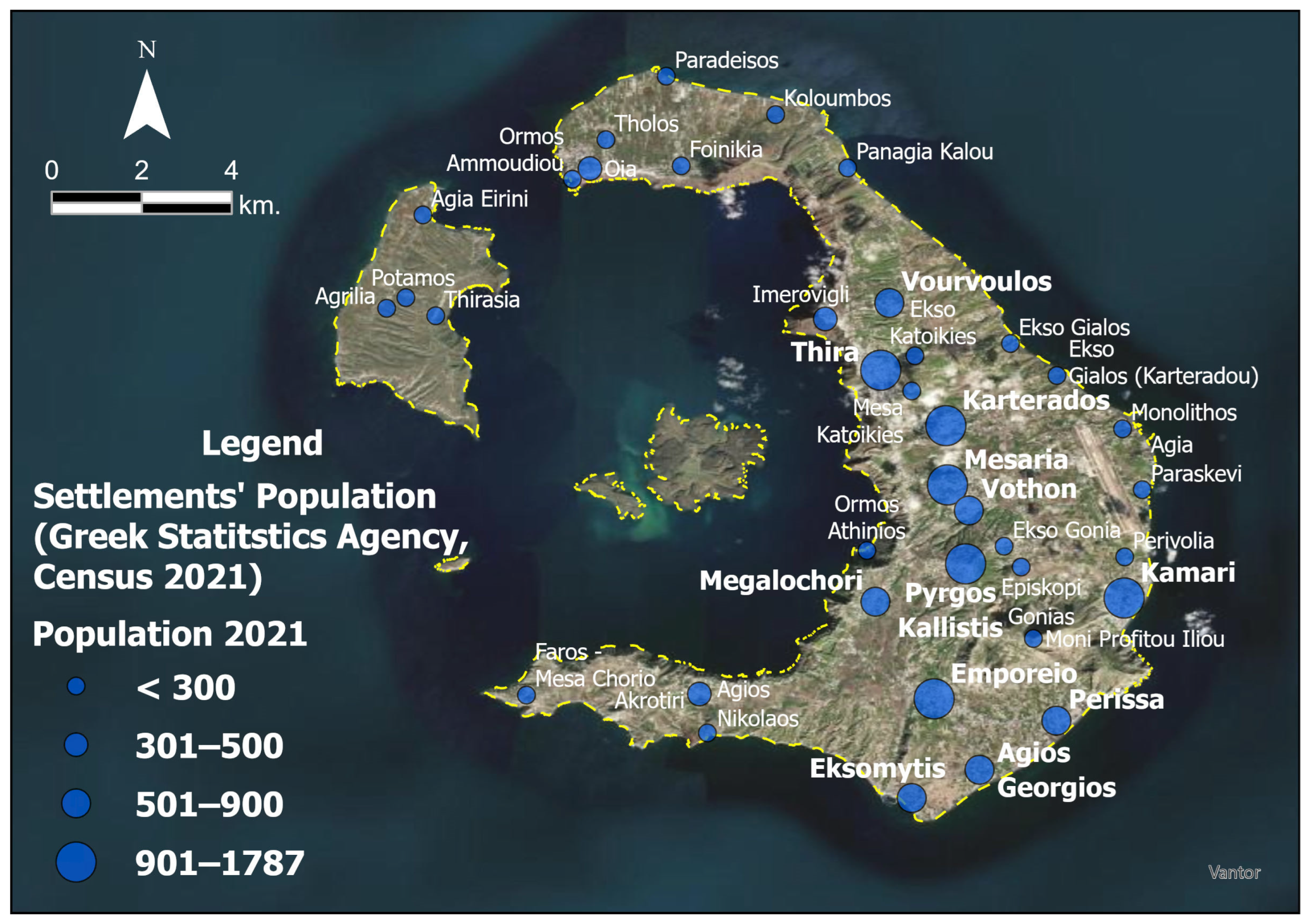
The study area was defined by the official administrative boundary of the Municipality of Thira. Santorini (or Thira) is located in the southern part of the Cyclades island complex in the Aegean Sea. It is part of the administrative regional unit of Thira, along with the islands of Ios, Anafi, and Sikinos. The Municipality of Thira extends across thirteen islands, covering a total area of approximately 90.5 km2. Only two of the islands are inhabited, namely Thira and Thirasia, with a total registered population of approximately 15.5 thousand residents, according to the 2021 census. Out of the 47 formal or informal settlements included in the census, of which Thira is the capital, only 12 present a population of more than 500 residents, with Emporeio and Mesaria having approximately 1750 residents each, while Thira, Oia, and Imerovigli have 1346, 477, and 419 residents respectively (Figure 1).
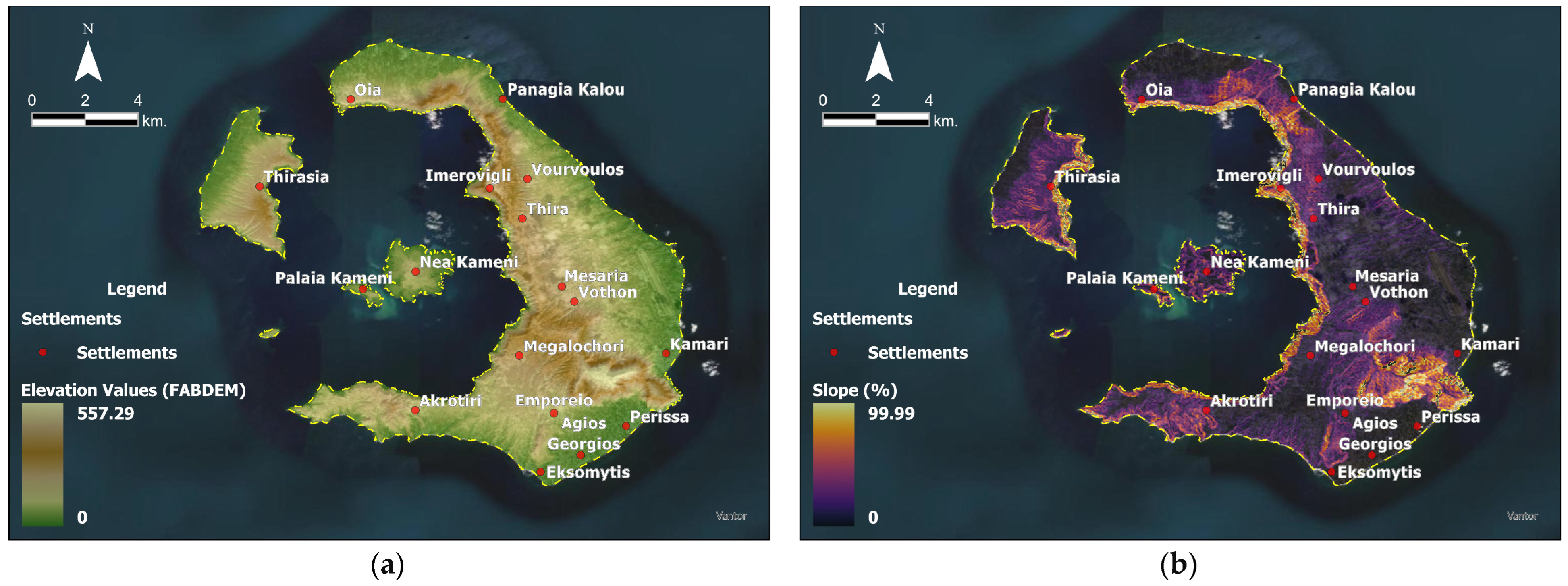
In terms of topography and landscape, most of the island’s terrain is quite flat. The area between the villages of Finikia and Megalochori, along the western coastline, is characterized by higher elevations. Next to Megalochori, on the southeastern tip of the island, is Mount Profitis Ilias, which reaches an altitude of 557 m. The slopes of the terrain follow the same pattern, while steep slopes can also be found on the eastern coast of Thirasia (Figure 2).
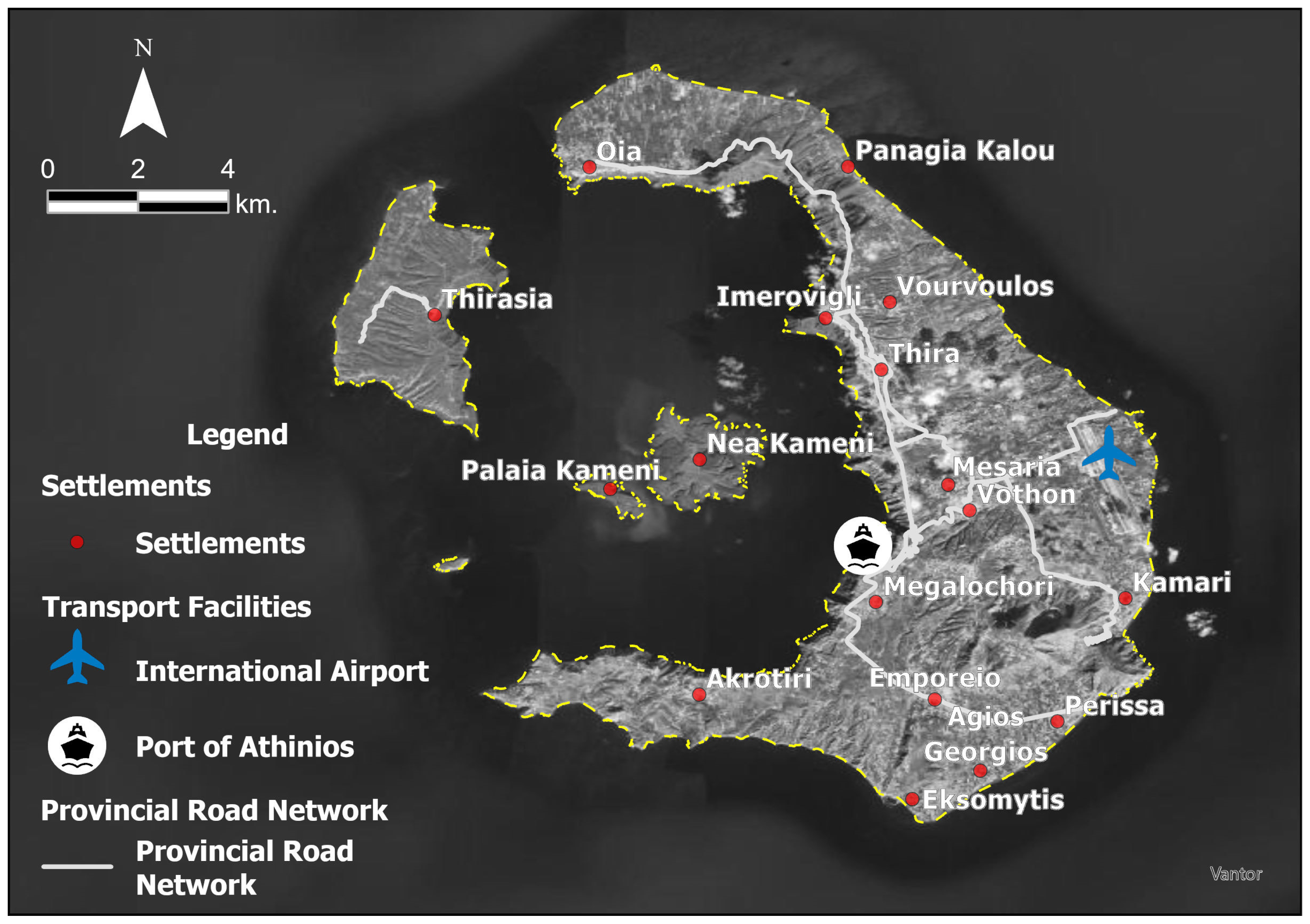
Santorini has an international airport operating since 1976, located in the central eastern part of the island near the area named “Monolithos” (Figure 3). By the end of 2020, Fraport, the administrator of the facility since 2015, proceeded to significant renovation and reconstruction works that included the increase in the square footage of the airport by 236%, the increase in the check-in stations by 113%, the increase in the gates by 20%, etc. [82]. The island is also served by the port of Athinios, located on the central western coast, which can accommodate large cruise ships (Figure 3). In 2024, approximately 750 cruise ships carrying more than 1.3 million passengers called at the port [82]. Provincial and rural roads serve the island with limited capacity.
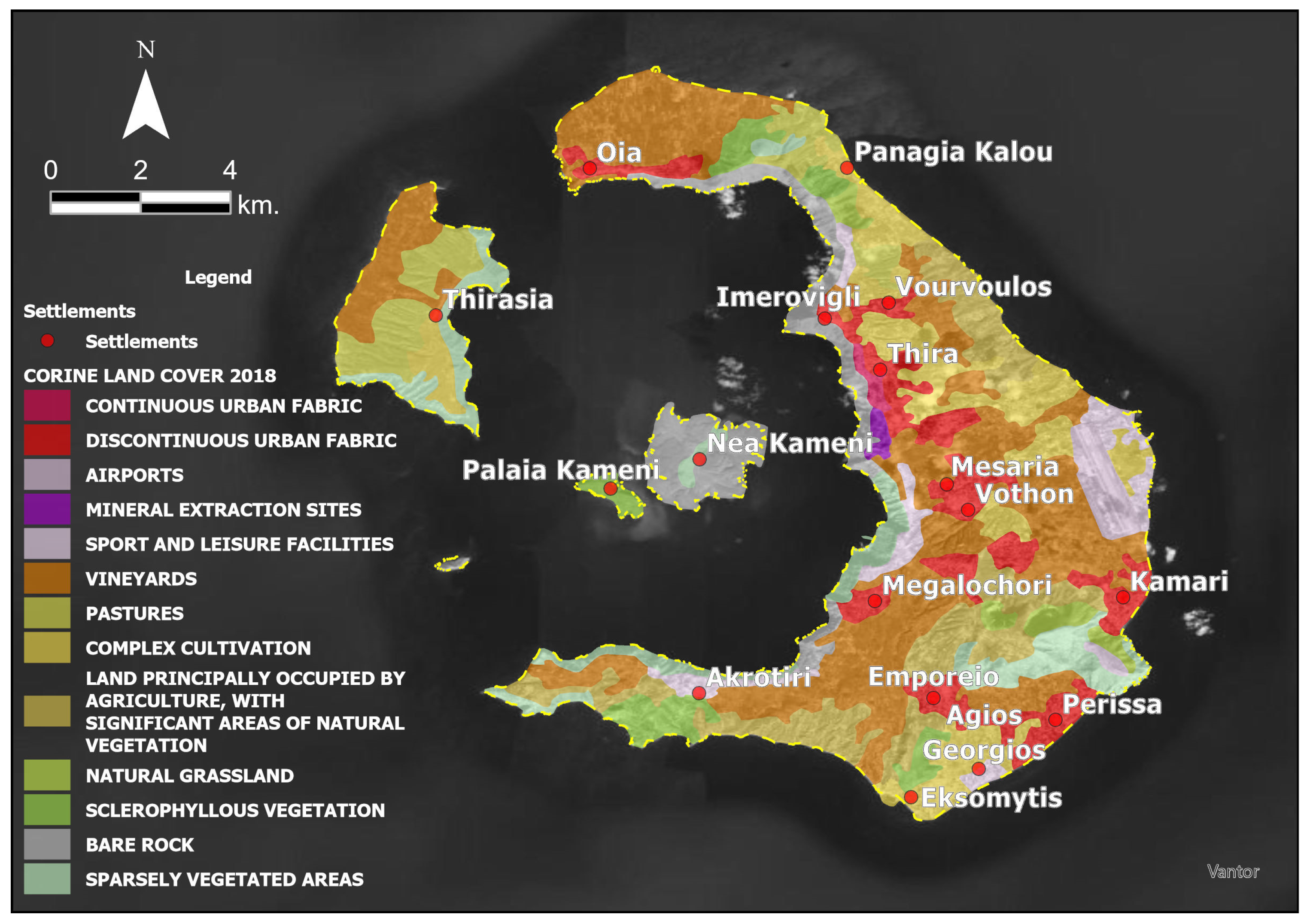
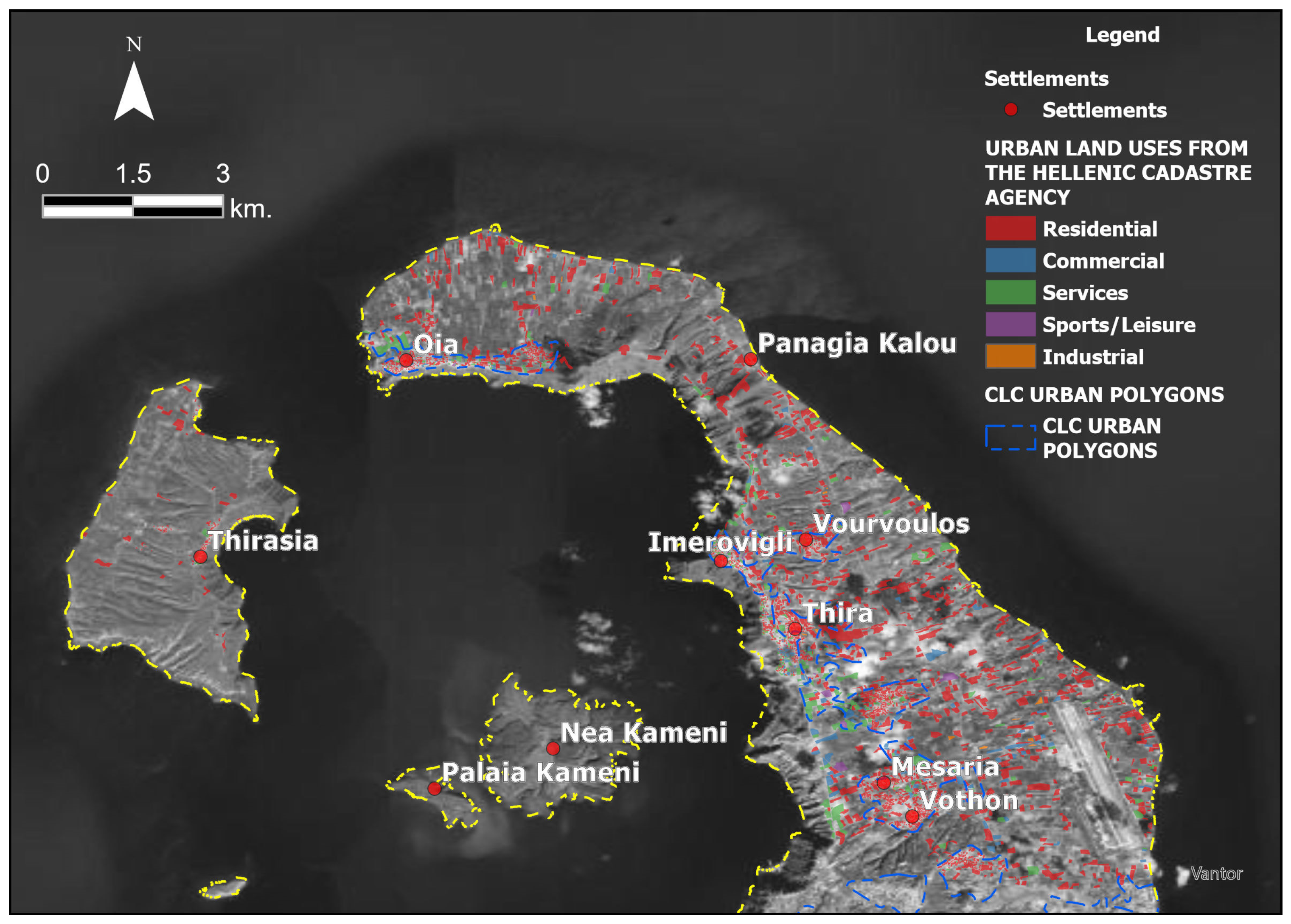
According to the CORINE Land Cover dataset for 2018, vineyard cultivation constitutes the dominant land cover of the island, with a strong concentration on the northern and central parts of Thira and the western part of Thirasia (Figure 4). Other agricultural land uses include complex cultivation and agricultural land with significant areas of natural vegetation. Large portions of the island are covered by sparse vegetation and pastures. In contrast, sclerophyllous vegetation is predominantly found in the northern and southern parts of Thira and the island of Palaia Kammeni. Regarding urban land uses, CORINE identifies 10 distinct clusters that encompass all major settlements on Thira. However, land use records from the Hellenic Cadastre Agency for the northern part of Thira and Thirasia indicate that residential development extends beyond formal settlements, resulting in the formation of dispersed micro-clusters across the island (Figure 5).
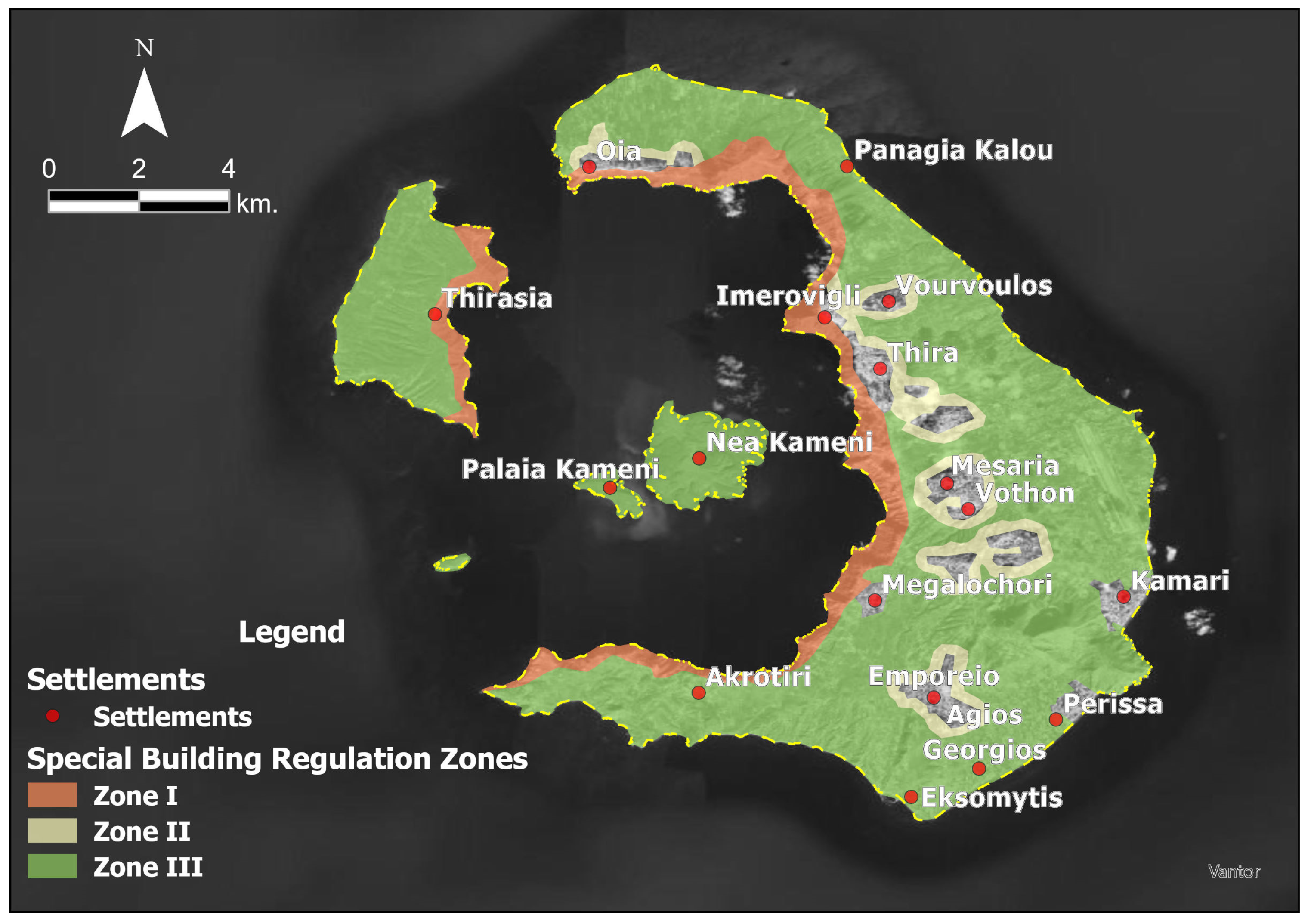
With specific reference to urban land uses, a recent report from the INSETE (Institute of the Greek Tourism Confederation), focusing on the regional unit of Thira as its reference area, indicates that the area contains more than 38,000 residential units, according to the latest population census for 2021 [82]. More than 19,000 of these are permanently occupied, while more than 6840 units function as secondary/vacation residences [82]. In addition, more than 12,100 residences are recorded as vacant, placing Thira second to Naxos in this category [82]. According to the same report, the regional unit of Thira hosts 416 registered hotel units with approximately 21,600 beds, representing one-third of the total accommodation capacity of the Cyclades island complex [82]. Slightly fewer than half of these establishments fall into the luxury category (4- and 5-star hotels), followed by 3-star hotels (123 units) [82]. It is worth noting that Thira is subject to a strict regulatory framework regarding construction outside formally designated settlements. This framework delineates three distinct zones, each with specific building regulations and permitted land uses (Figure 6). Zone I, which includes the slopes facing the Gulf of Caldera and Thirasia, requires a minimum parcel size of 8000 m2 for development and prohibits both tourist facilities and extensions to existing legally constructed buildings. Zone II, extending 200 m around the island’s major settlements, permits residential development and hotels with a capacity of up to 50 beds. Finally, Zone III allows for both residential and tourist land uses. However, tourist facilities are permitted only on properties exceeding 15,000 m2 in area.
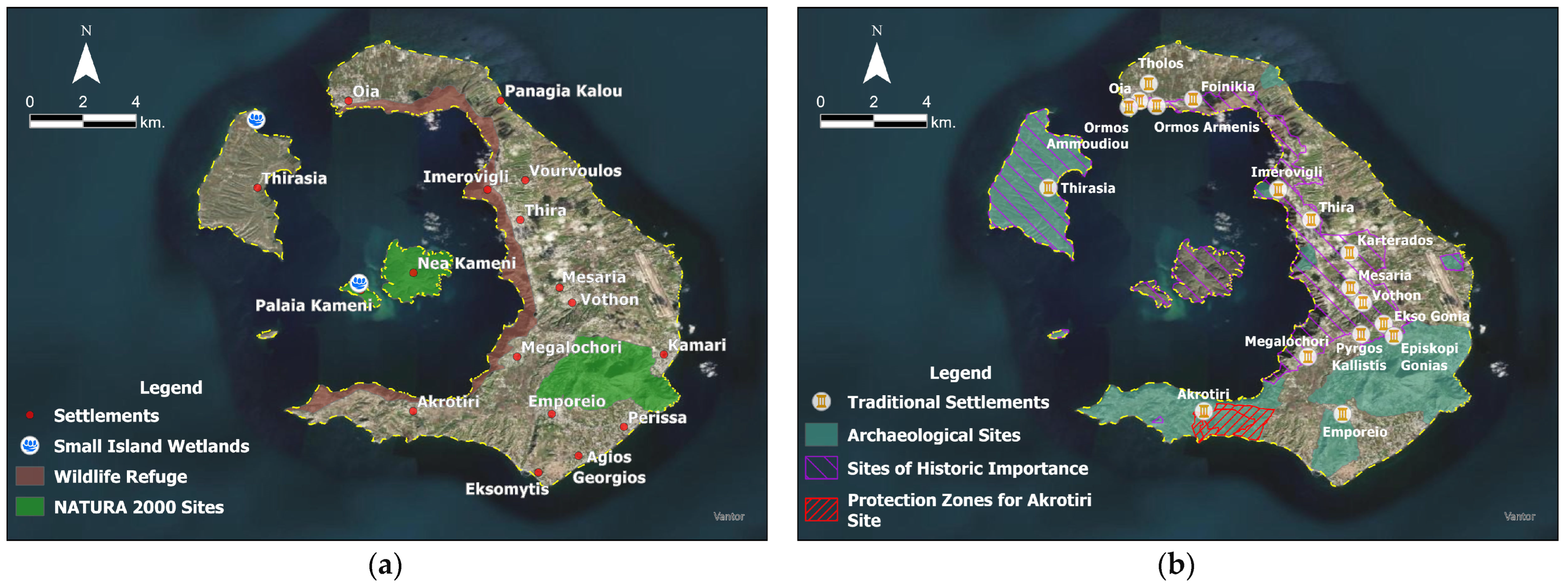
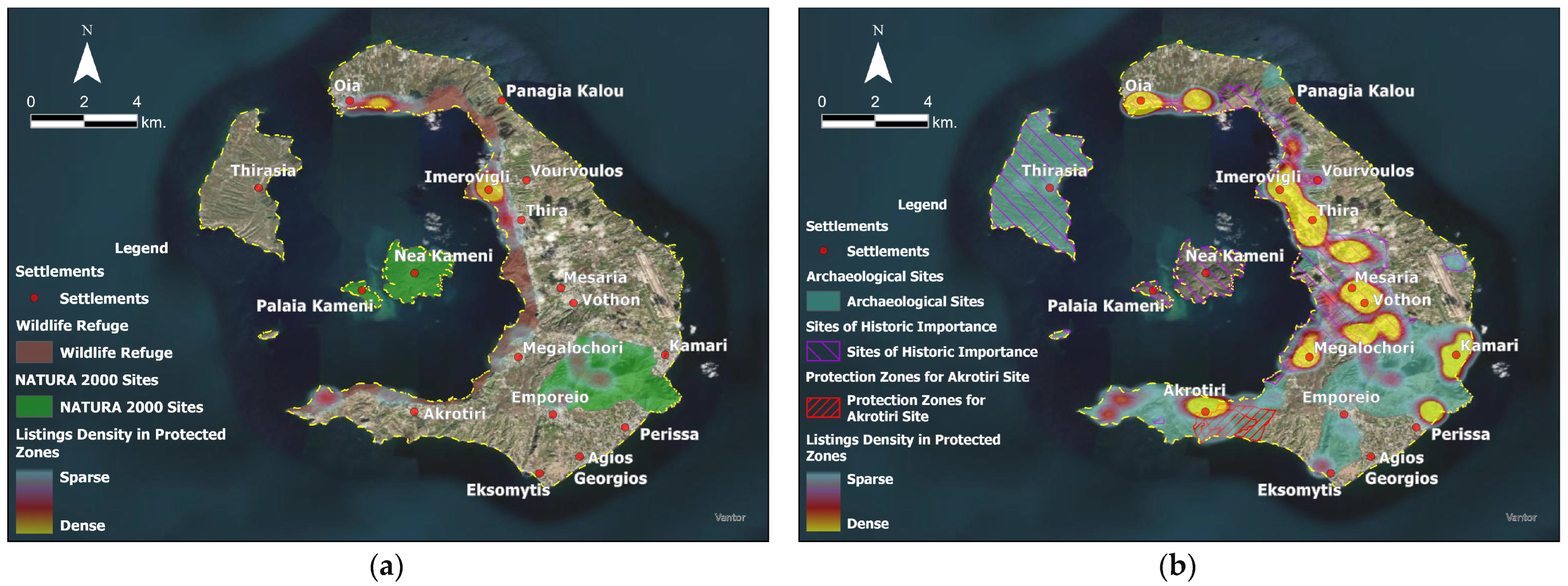
Finally, with regard to areas subject to protective regulatory status, Santorini hosts a Site of Community Importance (SCI) within the NATURA 2000 network (code: GR4220003) which covers the broader area of Mount Profitis Ilias as well as the islands of Palaia Kameni and Nea Kameni (Figure 7a). In addition, two sites are designated as small island wetlands, namely “Limnoula” on Palaia Kameni and “Alyki” on Thirasia. The island’s western coastline is designated a Wildlife Refuge, while the entire island of Santorini is designated a Site of Special Natural Beauty under Greek legislation. Santorini is also home to many sites of historical and cultural importance (Figure 7b). A significant part of the island of Thira, the island of Thirasia, as well as the islands of Palaia Kameni, Nea Kameni, and Aspronisi, have been officially designated as historical sites. Moreover, seventeen settlements across the island have been classified as traditional sites and are therefore subject to specific planning and building regulations. The island contains eighteen designated archeological sites, covering extensive portions of southern Thira, the island of Thirasia, and the island of Aspronisi. The archeological zone of Akrotiri includes two extensive protection zones, designed to safeguard the site from intensive human activity and land-use pressure. Consequently, only primary sector activities are permitted, and all forms of residential development are strictly prohibited.

3. Results

3.1. Spatial Characteristics of the Airbnb Market in Santorini

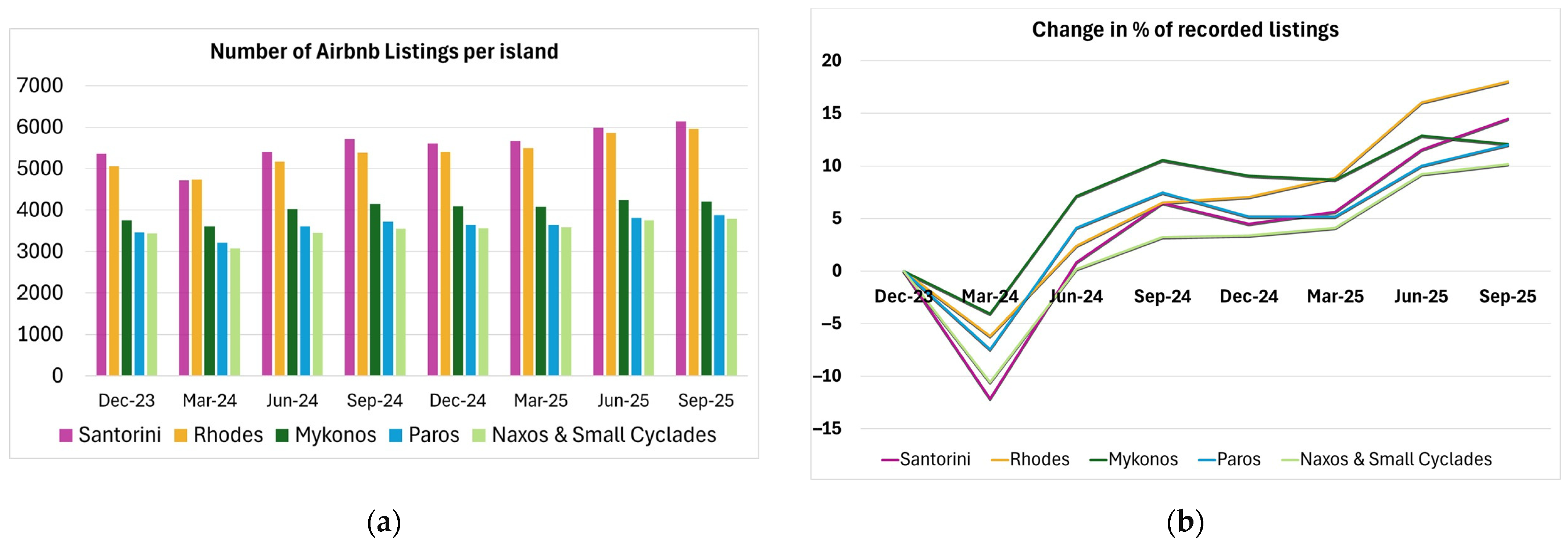
According to datasets compiled by InsideAirbnb for the period from December 2023 to September 2025, the South Aegean region has an average of 34,000 to 37,000 short-term rental listings annually. In this regional context, Santorini accounts for one-seventh of the total recorded listings. It ranks first in absolute numbers, surpassing Rhodes, which is more than eighteen times larger, and Mykonos, which is internationally renowned for its vibrant nightlife. The average spatial density of STR reaches approximately 67 entries per square kilometer. This figure exceeds corresponding densities in London, Berlin, Munich, Athens, and other major European metropolitan destinations. As illustrated in Figure 8a, despite the introduction of stricter regulations in late 2024 and 2025, there is a consistent upward trend across all major tourist islands, indicating sustained growth and resilient demand. More specifically, from June 2024 onward, Santorini recorded an additional 800 listings, whereas Rhodes recorded the largest absolute gain (≈900 listings). The temporal distribution of the data also suggests a narrowing of seasonal fluctuations, with December and March figures remaining high and approaching peak summer levels. Furthermore, when the relative growth of each market is examined as of December 2023, there appears to be a sharp overall contraction in March 2024 (Figure 8b). In contrast, for the remainder of the year, the hosts increased supply by adding more listings during peak season. A second surge occurred between March and September 2025, with Rhodes and Santorini exhibiting the most pronounced growth, followed by Mykonos and Paros at a relatively more moderate pace. These trends should be considered along with the evidence from recent reports stating that STR supply is highly elastic, with property owners often switching between long-term and short-term rentals, particularly during the spring, to capture early international demand [106]. Furthermore, the lower growth rates that are presented in Mykonos, Paros, and Naxos could be attributed to the extreme cost of real estate in these areas, which can act as a natural barrier for further Airbnb activity [107].
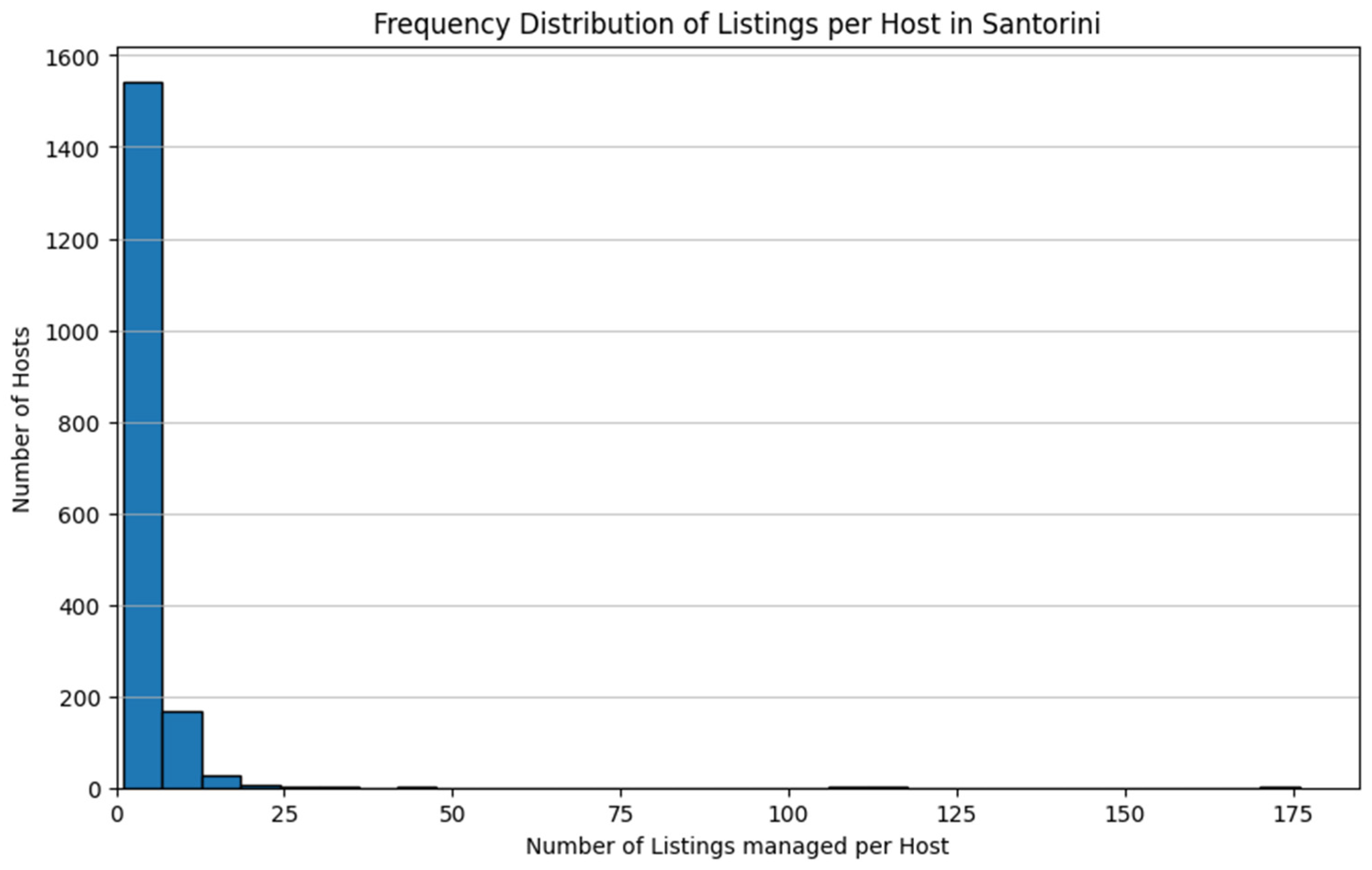
When examining the dataset for September 2025, it appears that the STR market in Santorini exhibits a high degree of professionalization. Of the 1753 unique hosts identified in the dataset for September 2025, 1099 (over 62%) manage more than one listing, while 283 hosts manage more than five listings, and three hosts manage more than a hundred listings (Figure 9). These figures illustrate a concentration of market control among multi-hosts rather than individual hosts. Furthermore, fifty-one hosts also operate STRs in other locations in the South Aegean, displaying a strong preference for the Cyclades island complex. More specifically, these hosts manage 594 STRs in Santorini, 577 STRs in Mykonos, followed by Rhodes (Dodecanese), Paros, Naxos and Small Cyclades, and Kalymnos (Dodecanese) with 281, 184, 178 and 101 listings respectively. The geographical origin of these specific multi-hosts is heterogeneous. Several declare Rhodes, Zakynthos, and Corfu as their residence or business headquarters, while others are based in other countries, including France, Spain, Bulgaria, and Ireland. This spatial dispersion underscores the increasingly professional and transregional nature of STR operations in Santorini and in the broader South Aegean area.
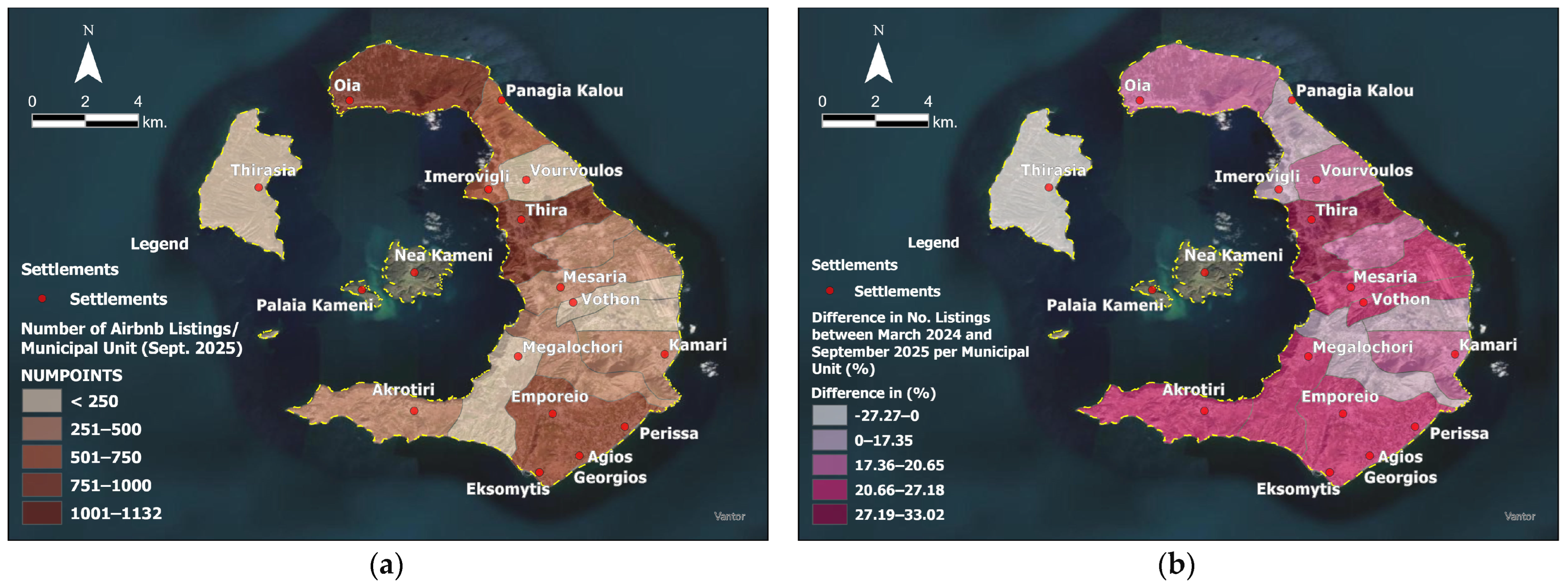
The spatial distribution of the short-term rental listings exhibits significant variations across the island. The municipal units of Oia and Thira host more than 1000 active listings each as of September 2025, followed by Emporeio, which constitutes the island’s most populous settlement (Figure 10a). The municipal unit of Thira also experienced an increase of more than 33% in the number of listings between March 2024 and September 2025, while other areas recorded more moderate growth rates (Figure 10b).
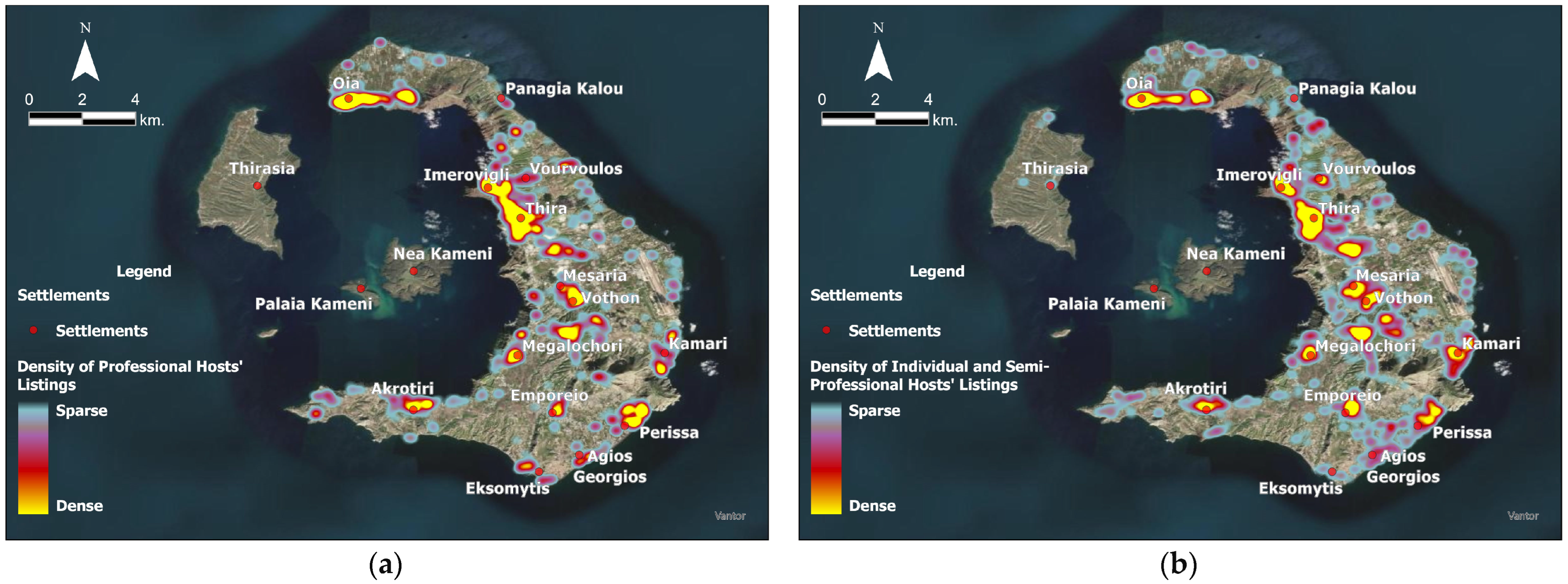
Further analysis of the spatial patterns of the market’s professionalization reveals both strong spatial overlap and differences. In both cases, the most intense clustering patterns are recorded on the Caldera rim, and secondary listings also appear around the settlements of Kamari, Mesaria, Vothon, Megalochori, etc. (Figure 11). However, professional hosts exhibit more compact spatial patterns, with their activity concentrated in key touristic coastal areas and fewer hotspots in the island’s interior (Figure 11a). In contrast, individual or semi-professional hosts (less than or equal to 5 listings/host) present a more spatially dispersed pattern, with additional medium-intensity clusters in secondary settlements and transitional rural–residential areas (Figure 11b). This overall pattern suggests that professional operators prioritize prime, high-return locations, whereas semi-professional or individual hosts contribute to the geographic spread of STR activity into secondary and perhaps more rural zones.
Perhaps more critically, only 58.6% of all listings are located within formally delineated settlements, leaving 2538 entries situated in rural areas where human activity, particularly residential development, is strongly discouraged under national building regulations, to prevent strain on limited infrastructure and the emergence of unplanned and fragmented settlements. Moreover, it is estimated that more than 320 listings are located within Zone A, as defined by the special building regulation of the island, where tourist facilities and, in general, any form of new construction, even residential, are strictly prohibited to safeguard the island’s natural environment and address the increased risk of ground subsidence. The phenomenon is particularly evident in Oia, Imerovigli, Thira, Megalochori, and Akrotiri. A similar pattern is observed along the Caldera, which is a designated wildlife refuge, where a significant concentration of listings is recorded in environmentally protected zones. More than 550 entries are located in this area, with additional high concentrations in Mount Profitis Ilias, which is a designated Natura 2000 network site (Figure 12a). Finally, approximately 4190 listings are located on designated archaeological zones or zones of historic importance, putting pressure on the island’s unique cultural heritage and posing a risk to the integrity of its protected landscape (Figure 12b).
Approximately 71% of the island’s listings consist of entire homes or apartments, followed by private rooms, which count for more than 25% of the remaining entries. Based on a statistical analysis of the “accommodates” variable of the Airbnb dataset, it can be viewed that these particular STRs can typically host three to four guests per night with no significant variation between rural and urban areas. In contrast, price levels per guest vary substantially by location, as shown in Table 2: Oia is the most expensive, followed by Thira; the villages of Perissa, Kamari, Emporeio, and Vothon are more affordable. Right-skewed distributions in all locations are driven primarily by the presence of high-end listings. While rural listings exhibit lower central tendency measures, they still demonstrate considerable price dispersion, thus emphasizing the heterogeneity of the island’s accommodation market.
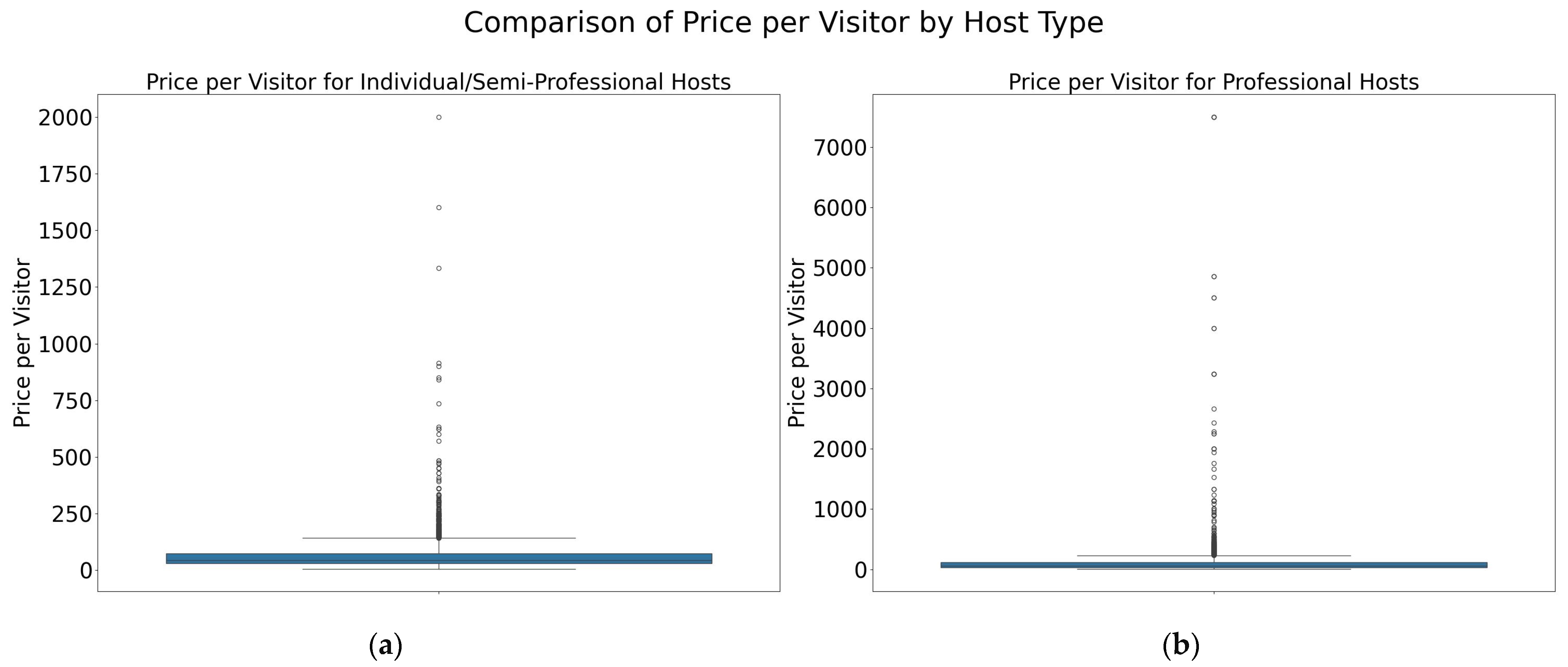
Boxplot graph comparison of prices per visitor between professional and semi-professional operators indicates clear differences. Across the full dataset, professional hosts exhibit substantially greater price dispersion and a much heavier upper tail, with extreme values exceeding €7000 per visitor, whereas individual and semi-professional hosts have a maximum of around €2000 per visitor (Figure 13). Although the central boxes overlap, the median price per visitor for professional hosts is visibly higher (approximately €60/night) than that for smaller operators (approximately €45/night). The interquartile range is also broader, indicating greater internal price variation among professional portfolios. This pattern highlights the strong presence of professionals in the ultra-luxury segment, where higher per-visitor prices appear to be almost exclusively linked to multi-hosts.
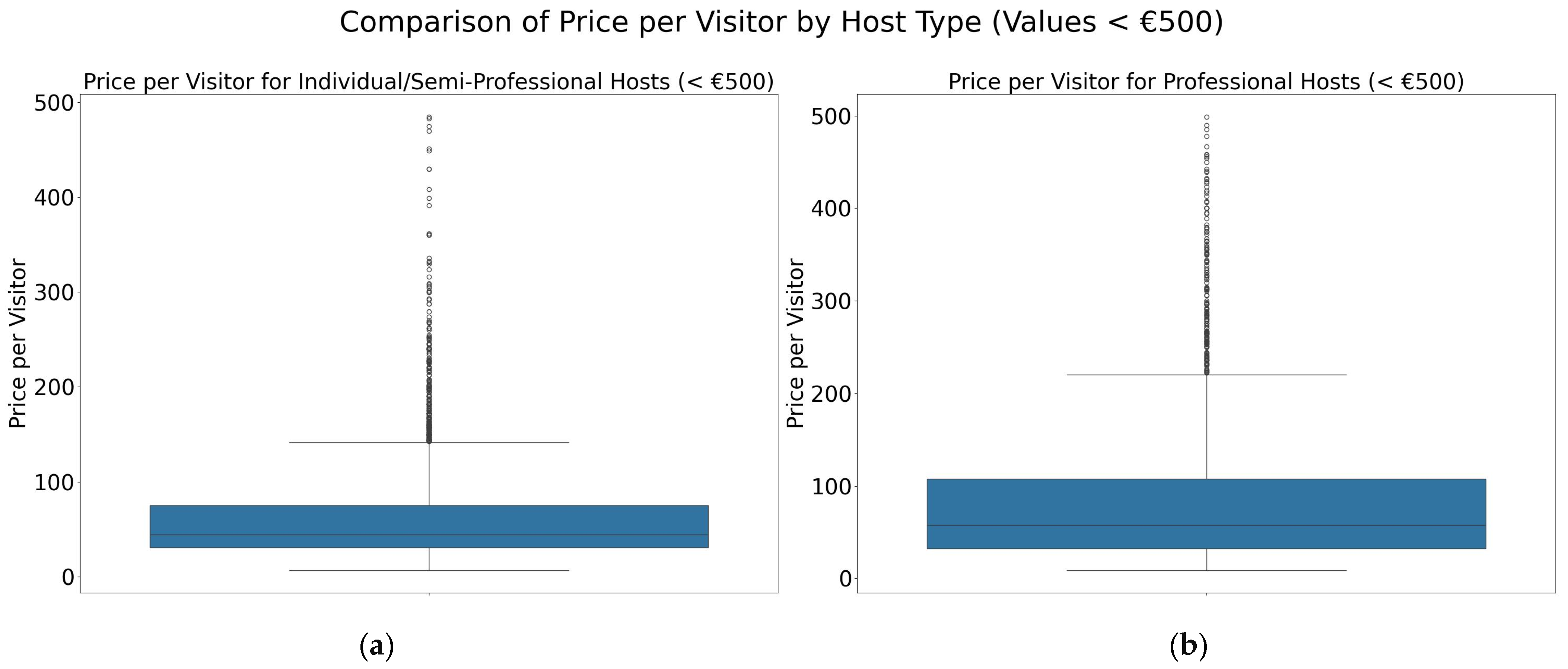
When focusing on listings priced below €500 per visitor, the differences persist more systematically, with an additional wider interquartile range of roughly €35–100 versus €35–70 (Figure 14). The upper whisker for professional hosts also extends further to approximately €220 than that of individual or semi-professional hosts (≈€140), indicating that professional hosts tend to price more aggressively. These data indicate a clear correlation between professionalization and market positioning: professional operators dominate the luxury segment and drive a general upward trend in pricing across the STR sector, whereas individual and semi-professional hosts occupy the lower- to mid-price brackets, serving more price-sensitive travelers.

3.2. Spatial Metrics and the Spatial Interaction Between Airbnbs and Official Accommodation

The Average Nearest Neighbor Index (ANNI) was calculated to assess the spatial distribution of Airbnb listings in Santorini, using Euclidean (rather than Manhattan) distance within the study area. The algorithm compares the observed mean distance between each listing and its nearest neighbor to the expected mean distance under the null hypothesis of complete spatial randomness. The results indicate an Observed Mean Distance of 25.50 m, which is significantly lower than the Expected Mean Distance of 90.64 m. This discrepancy is summarized by a Nearest Neighbor Ratio (NNR) of 0.28, indicating a highly clustered spatial pattern rather than a random or uniform distribution. The clustering pattern is further reinforced by an exceptionally low z-score of −107.74 and a p-value effectively equal to zero. The clustering pattern indicates strong spatial concentration in specific areas of Santorini, such as Oia and Thira, which provide high scenic value, proximity to key attractions, established infrastructure, and accessibility.
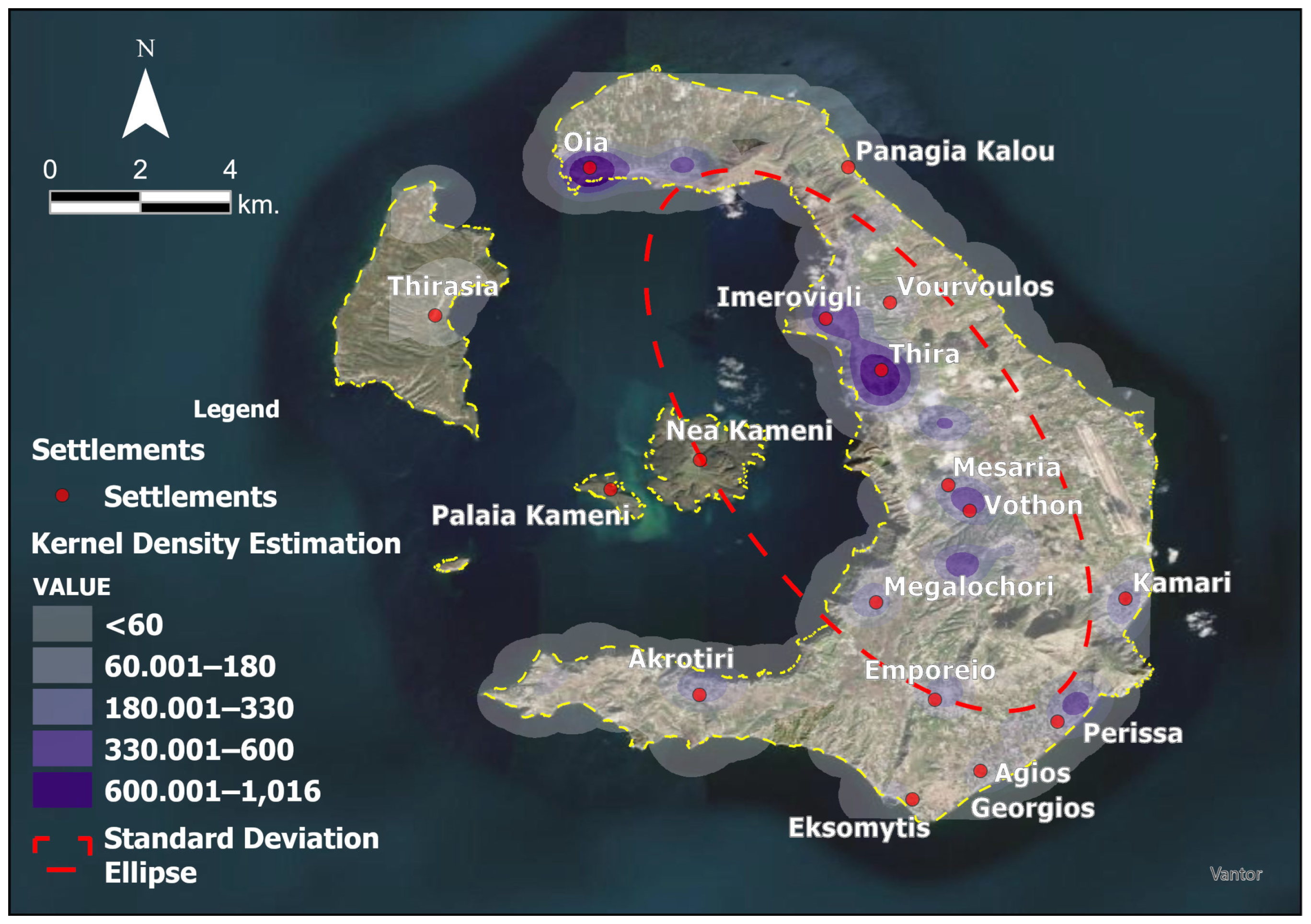
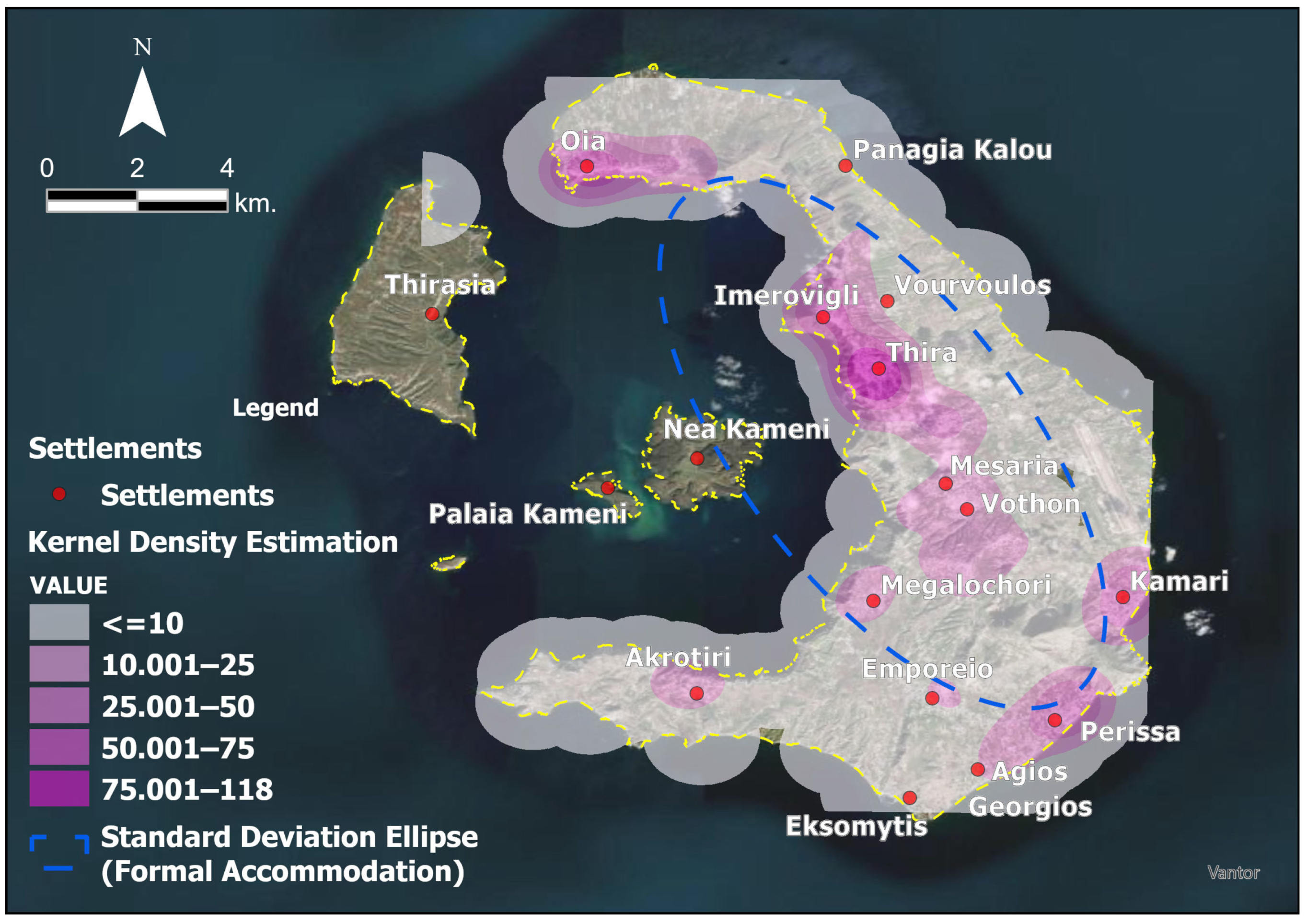
The following Kernel Density Estimation (KDE) analysis reveals a pronounced spatial concentration of STRs along the Caldera-facing settlements of northern and central Santorini (Figure 15). Higher density values can be observed in the Oia–Imerovigli–Thira corridor, indicating intense clustering of STRs in these locations. The standard deviation ellipse further clarifies this spatial pattern by delineating a dominant north–south orientation around the Caldera rim. More moderate clustering patterns, also falling within the ellipse, are observed in the central part of the island, particularly around Mesaria, Megalochori, and Vothon, suggesting strong secondary concentration zones (Figure 15). In contrast, the southern and eastern parts of the island, as well as Thirasia, display lower densities, reflecting a more dispersed or limited presence of STRs.
More than 920 records of formal accommodation facilities such as hotels, suites, rooms-to-let, etc., were retrieved and validated using Google Places API. When applying the same spatial metrics as Airbnb’s listings, an Observed Mean Distance of 81.45 m was recorded, effectively lower than the Expected Mean Distance of 230.71 m, yielding a Nearest Neighbor Ratio of 0.353. This value (significantly lower than 1) and the corresponding z-score of −37.58 also indicate strong clusters of formal accommodation that should be expected as these facilities tend to agglomerate in areas of high accessibility, in proximity to major attractions, existing infrastructure, and, perhaps more importantly, where zoning and land-use planning regulations allow such activity. Kernel Density Estimation and Standard Deviation Ellipse also reveal an increased clustering pattern—as in the case of Airbnbs—in Oia, Imerovigli, and Santorini, as well as other secondary settlements along the Caldera rim (Figure 16). Lower KDE values in the southern coastal areas and in Thirasia, in conjunction with their exclusion from the SDE, reflect their more peripheral role in formal lodging provision.
A Global Bivariate Moran’s I of 0.2617 with a p-value of 0.001 at 800 m resolution was calculated, indicating the systematic spatial relationship between Airbnbs and formal accommodation venues. Tourism demand often leads to clustering of the two types of accommodation. However, Moran’s I value indicates a weak-to-moderate positive co-location, in which high concentrations of Airbnb listings typically accompany high concentrations of formal accommodation. These high concentrations occur in specific clusters, whereas in many other areas the presence of these two distinct categories diverges significantly, indicating a ‘spillover’ effect in which Airbnbs occupy residential buildings within and around settlements that lack large-scale hotel footprints.
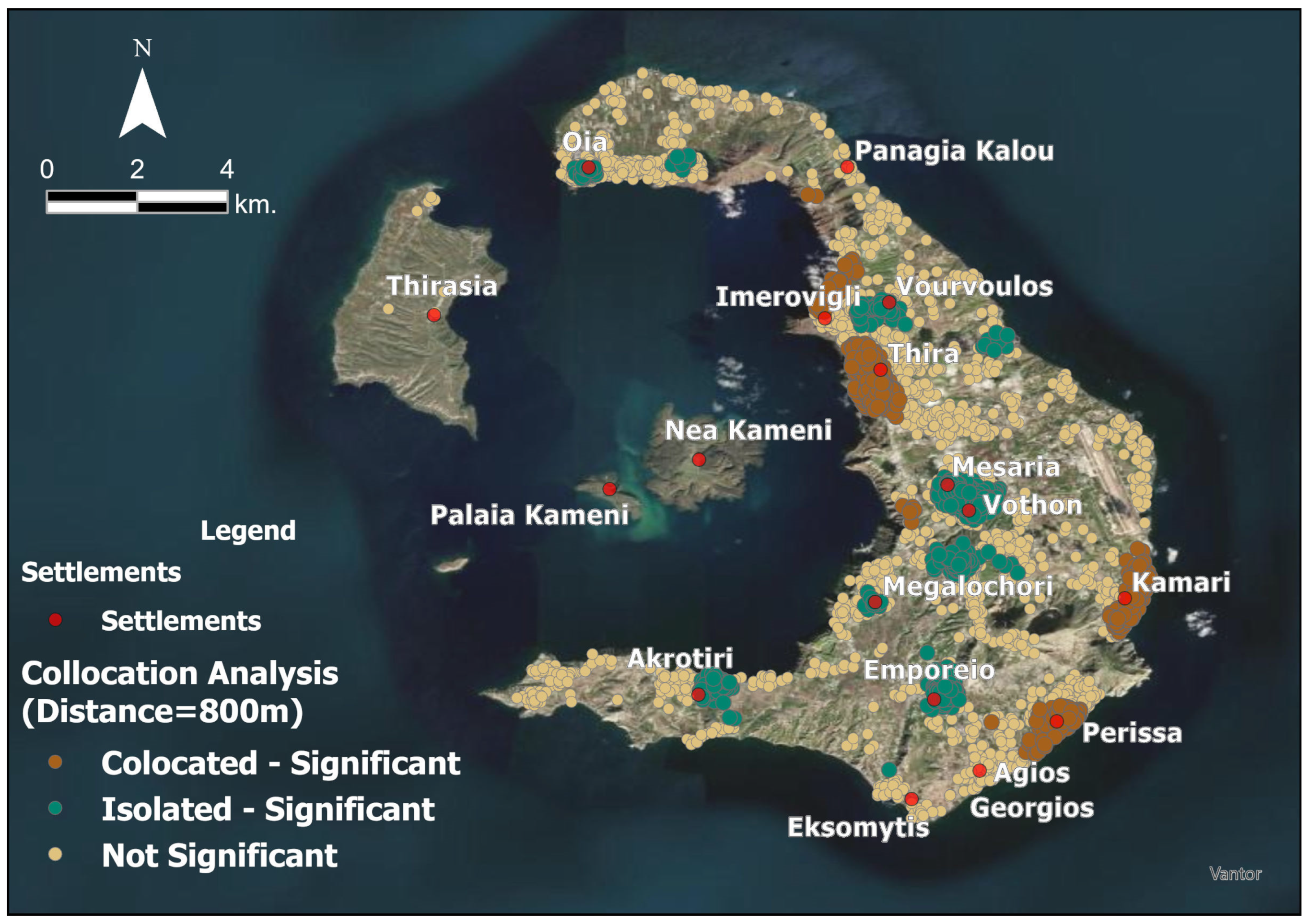
The Local Collocation Quotient (LCLQ) was subsequently used to assess whether Airbnb listings are locally over- or underrepresented in relation to formal accommodation entries. An 800 m distance was used, as a typical “walkability” standard of approximately a 10-min walk, to define a local tourism neighborhood. As can be viewed in Figure 17, in the areas of Imerovigli, Thira, Kamari, and Perissa, there appears to be a statistically significant attraction between the two accommodation options. Conversely, within and around the more residentially oriented settlements of Vourvoulos, Mesaria, Vothon, Emporeion, Megalochori, and Akrotiri, Airbnbs appear to strategically avoid proximity to hotels. In the rural part of the island, any proximity, or lack thereof, to a formal accommodation point is considered a result of the general density of the findings.

4. Discussion

Santorini constitutes a fundamentally distinct case compared with most European and international metropolitan destinations that dominate the STR literature, owing to its insular, spatially bounded, and environmentally sensitive nature. Unlike metropolitan areas, where STRs may diffuse across extensive urban and suburban land, Santorini operates more like a closed territorial system with limited land availability, fragile ecosystems, extensive protected zones, and limited infrastructure capacity. All these factors amplify the spatial impacts of tourism-related accommodation growth, as silent changes in land uses and infrastructure stress cannot be absorbed or mitigated by adjacent areas. This characteristic aligns with prior research on Mediterranean islands, which emphasizes that insularity increases tourism pressure and accelerates the emergence of overtourism dynamics. The findings of the present research also confirm and extend the existing literature by demonstrating that STR expansion in Santorini is spatially concentrated in environmental protection zones, near archaeological sites, and in more rural landscapes. While the island is subject to a strict planning framework in which building and land-use regulations apply outside formally designated settlements, particularly in environmentally and culturally protected zones, these regulations generally target new development. They are less effective at monitoring changes within the existing building stock. As a result, a significant share of STR activity has expanded into rural areas and around protected landscapes, where intensive land use and human activities are generally prohibited, as documented in other similar areas (e.g., Mallorca, Ibiza). This imperfect regulatory framework distinguishes the island from typical metropolitan contexts, where robust planning and housing regulations are in place.
The Airbnb market in Santorini is also characterized by a high degree of professionalization, as expressed by the high concentration of listings among multi-host operators and the presence of transregional and international actors managing a substantial number of accommodations across multiple islands in the South Aegean. This pattern illustrates a clear departure from the original peer-to-peer model associated with Airbnbs, at least in Santorini. This level of professionalization, consistent with previous studies documenting Airbnb’s transformation into a practical investment vehicle, is closely linked to the island’s exceptionally strong tourism demand, further reinforced by its international airport connectivity, cruise tourism, and limited seasonal fluctuations. In fact, according to INSETE’s latest 2025 report, arrivals at Santorini Airport have increased from approximately 182,000 in 2010 to more than 756,000 in 2024, of which 90% were international tourists. Furthermore, arrivals at the island’s port increased to more than 1,775,000 in 2024, up from 1,102,000 in 2010. Given that the regional unit’s total formal accommodation capacity is approximately 48,000 beds, STRs appear particularly attractive to professional operators, as they offer high investment returns. Similar patterns of commercial consolidation have also been documented in cities such as Barcelona, Lisbon, and Amsterdam, where a growing share of STRs is controlled by professional hosts rather than occasional home sharers. In those destinations, as in Santorini, the platform increasingly operates in parallel with the official accommodation sector, embedding real estate investment practices rather than serving as a mechanism for temporary income supplementation. This broader empirical evidence reinforces the argument that, at least in mature tourism markets, STR activity has evolved well beyond the original “sharing-economy” narrative.
Several place-specific factors further explain the high spatial concentration of STRs on the island and the market’s professionalization. The island’s housing stock is characterized by numerous secondary and vacant residences that, in their current state, do not generate any profit or passive income for their owners. In addition, dispersed residential development beyond formal settlements creates opportunities for STR conversion in areas with limited land-use monitoring and, perhaps more importantly, in areas where formal accommodation is prohibited or restricted.
From a spatial analysis perspective, the Airbnb market of the island exhibits patterns consistent with tourism-driven clustering and extreme spatial concentration in more popular areas—in terms of attractiveness, high scenic value, accessibility, etc. The very low ANNI indicates a highly clustered distribution of Airbnbs around high-amenity areas, such as the Caldera-facing settlements. KDE and SDE analysis also demonstrate a significant north–south orientation around the Caldera rim. These findings are consistent with previous research regarding both urban and insular landscapes, which emphasizes the attraction of STRs to areas of high amenity value and established primary and secondary tourism infrastructure. At the same time, the moderate yet statistically significant Global Bivariate Moran’s I indicates that Airbnbs and formal accommodation are often located close to each other, suggesting that STRs both complement and compete with hotels by concentrating in high-demand tourism corridors, where hotels cannot meet the increased demand, and by expanding into residential areas and rural areas where formal accommodation is often constrained by planning regulations. The Local Collocation Quotient analysis further reinforces this dual role, revealing STRs’ increased attraction to established tourism settlements and more systematic avoidance of secondary, more residential locations. Within that spectrum, STR appears capable of penetrating locations that are less accessible to large-scale formal accommodation development.
In Santorini, calculated spatial metrics demonstrate that STRs intensify tourism activity in existing hotspots and also drive spatial expansion into rural and environmentally sensitive areas. This dynamic is particularly evident in insular settings where limited land availability, zoning regulations, and tourism monoculture often magnify the footprint of platform-based accommodation. The identification of spatial stress zones is more evident through the selected spatial metrics than by aggregated statistics alone. It should be noted, however, that the positional uncertainty of approximately 150 m in each Airbnb’s location and the sensitivity of these spatial algorithms to distance thresholds suggest that the results should be interpreted very cautiously.
The research’s findings highlight that, in insular and spatially constrained environments such as Santorini, the impacts of STR expansion extend beyond housing affordability and tourism-market competition to encompass land-use regulation, environmental protection, and infrastructure management. The observed penetration of STRs into more rural zones, environmentally protected areas, and heritage-sensitive landscapes indicates that platform-mediated accommodation can effectively bypass planning mechanisms primarily designed to regulate new construction rather than changes in use within the existing building stock. This creates a regulatory blind spot in which tourism-related intensification occurs without corresponding spatial oversight. For island territories with limited land reserves and fragile ecosystems, this dynamic suggests the need for spatially differentiated STR governance rather than uniform national-level regulation. Instead of focusing predominantly on fiscal registration, policy frameworks could incorporate zoning-based restrictions that limit or even prohibit STR operation in environmentally sensitive and other legally protected areas. Integrating STR datasets into municipal GIS systems would allow local authorities to monitor spatial concentration patterns and identify emerging stress zones where accommodation density—formal and platform-based—may exceed infrastructure capacity.
The dual spatial role of STRs identified in this research, including clustering with formal accommodation units in high-demand areas and expanding into zones where hotels are restricted, further indicates that STRs can function as substitutes for strictly regulated tourist facilities. This raises questions of equity and regulatory consistency, as formal accommodation development is subject to stringent land-use controls and safety regulations while STR activity largely remains spatially unregulated. A more coherent planning approach could therefore involve aligning STR permissions with existing zoning frameworks for tourist accommodation, ensuring that platform-based growth does not undermine spatial planning objectives and directives.
Finally, the spatial metrics employed in this study demonstrate their practical utility as diagnostic tools for planning authorities. Indicators such as nearest-neighbor ratios, density surfaces, and local colocation measures can support evidence-based policymaking by revealing where STR activity intensifies tourism pressure, competes with residential land uses, and encroaches on protected landscapes. These tools could form the basis of an early-warning system for tourism-driven land-use change in insular environments, where spatial thresholds are quickly exceeded, and impacts are difficult to reverse.
Despite offering a detailed spatial assessment of STR dynamics in Santorini, the research is subject to several limitations that should be acknowledged. As previously mentioned, the Airbnb dataset provides approximate positional accuracy of up to 150 m. While this does not significantly affect island-scale clustering patterns, it may influence fine-grained analysis near regulatory boundaries and protected zones. The analysis also captures a specific temporal window (December 2023–September 2025) that corresponds to a post-pandemic recovery period characterized by volatile but increased demand and structural market adjustments. Consequently, the observed spatial patterns may reflect a phase of rapid expansion rather than a fully stabilized STR market. Finally, the classification of professional versus individual or semi-professional hosts is based on listing counts within the platform dataset and may not fully capture complex ownership or management arrangements operating through corporate entities.
Future research could build on the present work in several directions. Longitudinal studies over extended periods could help determine whether the spatial spillover of STRs into rural and protected landscapes reflects a temporary symptom of rapid growth or a more structural transformation of land-use patterns, particularly in insular territories. Integrating STR data with housing market indicators, cadastral ownership records, and demographic data could enable a more analytic understanding of how spatial concentration relates to housing displacement, labor-market pressure, and recorded changes in settlement structure. Furthermore, comparative research across multiple islands in the Mediterranean could reveal whether the dual clustering-spillover pattern identified in Santorini constitutes a more generally observed STR dynamic. Finally, future work could explore the integration of near-real-time platform data into municipal monitoring systems and evaluate how spatial analytics can support adaptive and evidence-based tourism governance.

Author Contributions

Conceptualization, S.C. and A.M.; methodology, S.C. and A.M.; validation, A.M.; formal analysis, S.C.; resources, S.C.; writing—original draft preparation, S.C.; writing—review and editing, A.M.; visualization, A.M. All authors have read and agreed to the published version of the manuscript.

Funding

This research received no external funding.

Data Availability Statement

The original contributions presented in this study are included in the article. Further inquiries can be directed to Assist. Prof. Sevasti Chalkidou (schalkidou@topo.auth.gr).

Conflicts of Interest

The authors declare no conflicts of interest.

Abbreviations

The following abbreviations are used in this manuscript:
ANNIAverage Nearest Neighbor Index
APIApplication Programming Interface
CRSCoordinate Reference System
EPSGEuropean Petroleum Survey Group
GDPGross Domestic Product
GISGeographic Information System
INSETE Institute of the Greek Tourism Confederation
KDEKernel Density Estimation
LCLQLocal Collocation Quotient
SCISite of Community Importance
SDEStandard Deviation Ellipse
StDStandard Deviation
STRShort Term Rental
USDUnited States Dollars

References

  1. De Fátima Brilhante, M.; Rocha, M.L. COVID-19 Pre-Pandemic Tourism Forecasts and Post-Pandemic Signs of Recovery Assessment for Portugal. Res. Glob. 2023, 7, 100167. [Google Scholar] [CrossRef] [Scilit]
  2. Duro, J.A.; Fernández-Fernández, M.; Perez-Laborda, A.; Rosselló, J. Resilience Dynamics and Their Determinants: The Transition to Coronavirus Pandemic Recovery. Tour. Rev. 2024, 79, 1560–1575. [Google Scholar] [CrossRef] [Scilit]
  3. Fragkoudis, A.; Vrana, V.; Karavasilis, G.; Kehris, E. Tourism Agents in Greece Recovering from COVID-19. In Strategic Innovative Marketing and Tourism; Kavoura, A., Borges-Tiago, T., Tiago, F., Eds.; Springer Proceedings in Business and Economics; Springer Nature: Cham, Switzerland, 2024; pp. 361–369. [Google Scholar]
  4. UNWTO. World Tourism Barometer; United Nations World Tourism Organization: Madrid, Spain, 2021; Available online: https://www.wto.org/english/tratop_e/envir_e/unwto_barom21.pdf (accessed on 10 December 2025).
  5. Deyá-Tortella, B.; Leoni, V.; Ramos, V. COVID-Led Consumption Displacement: A Longitudinal Analysis of Hotel Booking Patterns. Int. J. Hosp. Manag. 2022, 107, 103343. [Google Scholar] [CrossRef] [Scilit]
  6. León, C.J.; González Hernández, M.M.; Lam-González, Y. COVID-19 Effects on Travel Choices under Climate Risks. Ann. Tour. Res. 2023, 103, 103663. [Google Scholar] [CrossRef] [Scilit]
  7. World Tourism Organization. International Tourism Highlights, 2024 Edition; UN Tourism: Madrid, Spain, 2024. [Google Scholar]
  8. Instituto Nacional de Estadistica Tourist Movements at Borders (FRONTUR) 2025. Available online: https://www.ine.es/dyngs/Prensa/en/FRONTUR1125.htm (accessed on 15 December 2025).
  9. Cardoso, C.; Ferreira, L. The Effects of European Economic Integration on Tourism: Challenges and Opportunities for Portuguese Tourism Development. Int. J. Contemp. Hosp. Manag. 2000, 12, 401–409. [Google Scholar] [CrossRef] [Scilit]
  10. Instituto Nazionale di Statistica. Tourist Arrivals-Country of Origin 2023. Available online: https://esploradati.istat.it/databrowser/#/en/dw/categories/IT1,Z0700SER,1.0/SER_TOURISM/DCSC_TUR_OCCMONTH/IT1,122_54_DF_DCSC_TUR_5,1.0 (accessed on 20 December 2025).
  11. Eurostat. Seasonality in the Tourist Accommodation Sector; Eurostat: Luxembourg, 2025. Available online: https://ec.europa.eu/eurostat/statistics-explained/index.php?title=Seasonality_in_the_tourist_accommodation_sector (accessed on 21 December 2025).
  12. Bank of Greece. Developments in the Balance of Travel Services. 2024. Available online: https://www.bankofgreece.gr/en/news-and-media/press-office/news-list/news?announcement=a6b6b92e-908e-455e-a7e5-bce16001ea5c#:~:text=Travel%20receipts%20in%202024%20totalled,Table%202%20and%20Chart%202 (accessed on 22 December 2025).
  13. INSETE. Statistical Bulletin No. 100 Special Edition 2024. 2025. Available online: https://insete.gr/wp-content/uploads/2025/04/Bulletin_EN_2024.pdf (accessed on 21 December 2025).
  14. Agius, K.; Briguglio, M. Mitigating Seasonality Patterns in an Archipelago: The Role of Ecotourism. Marit. Stud. 2021, 20, 409–421. [Google Scholar] [CrossRef] [Scilit]
  15. Garanti, Z. Alternative and Special Interest Tourism to Mitigate the Effects of Tourism Seasonality: The Debate from Cyprus. Worldw. Hosp. Tour. Themes 2022, 14, 451–460. [Google Scholar] [CrossRef] [Scilit]
  16. Krabokoukis, T.; Polyzos, S. Analyzing the Tourism Seasonality for the Mediterranean Countries. J. Knowl. Econ. 2023, 15, 8053–8076. [Google Scholar] [CrossRef] [Scilit]
  17. Niavis, S. Evaluating the Spatiotemporal Performance of Tourist Destinations: The Case of Mediterranean Coastal Regions. J. Sustain. Tour. 2020, 28, 1310–1331. [Google Scholar] [CrossRef] [Scilit]
  18. Andolina, C.; Signa, G.; Tomasello, A.; Mazzola, A.; Vizzini, S. Environmental Effects of Tourism and Its Seasonality on Mediterranean Islands: The Contribution of the Interreg MED BLUEISLANDS Project to Build up an Approach towards Sustainable Tourism. Environ. Dev. Sustain. 2021, 23, 8601–8612. [Google Scholar] [CrossRef] [Scilit]
  19. Andriotis, K. Seasonality in Crete: Problem or a Way of Life? Tour. Econ. 2005, 11, 207–224. [Google Scholar] [CrossRef] [Scilit]
  20. Rita, C. University Of Bologna An Overview of Tourism Seasonality: Key Concepts and Policies. An Overview of Tourism Seasonality: Key Concepts and Policies. Almatourism—J. Tour. Cult. Territ. Dev. 2012, 3, 4058. [Google Scholar] [CrossRef] [Scilit]
  21. Esteve-Perez, J.; Garcia-Sanchez, A. Characteristics and Consequences of the Cruise Traffic Seasonality on Ports: The Spanish Mediterranean Case. Marit. Policy Manag. 2017, 44, 358–372. [Google Scholar] [CrossRef] [Scilit]
  22. Ruggieri, G.; Platania, M. Islands’ Tourism Seasonality: A Data Analysis of Mediterranean Islands’ Tourism Comparing Seasonality Indicators (2008–2018). Sustainability 2024, 16, 3674. [Google Scholar] [CrossRef] [Scilit]
  23. Gutiérrez, A.; Domènech, A. Understanding the Spatiality of Short-Term Rentals in Spain: Airbnb and the Intensification of the Commodification of Housing. Geogr. Tidsskr.-Dan. J. Geogr. 2020, 120, 98–113. [Google Scholar] [CrossRef] [Scilit]
  24. Gurran, N.; Phibbs, P. When Tourists Move In: How Should Urban Planners Respond to Airbnb? J. Am. Plann. Assoc. 2017, 83, 80–92. [Google Scholar] [CrossRef] [Scilit]
  25. Antunes, G.; Ferreira, J. Short-Term Rentals: How Much is too Much—Spatial Patterns in Portugal and Lisbon. Tour. Hosp. Manag. 2021, 27, 581–603. [Google Scholar] [CrossRef] [Scilit]
  26. Wachsmuth, D.; Weisler, A. Airbnb and the Rent Gap: Gentrification through the Sharing Economy. Environ. Plan. Econ. Space 2018, 50, 1147–1170. [Google Scholar] [CrossRef] [Scilit]
  27. Zervas, G.; Proserpio, D.; Byers, J.W. The Rise of the Sharing Economy: Estimating the Impact of Airbnb on the Hotel Industry. J. Mark. Res. 2017, 54, 687–705. [Google Scholar] [CrossRef] [Scilit]
  28. Barron, K.; Kung, E.; Proserpio, D. The Effect of Home-Sharing on House Prices and Rents: Evidence from Airbnb. Mark. Sci. 2021, 40, 23–47. [Google Scholar] [CrossRef] [Scilit]
  29. Bei, G. The Spatial Effect of Short-Term Rental Regulations: The Comparison between Barcelona and Paris. Cities 2025, 158, 105603. [Google Scholar] [CrossRef] [Scilit]
  30. Garay-Tamajón, L.; Lladós-Masllorens, J.; Meseguer-Artola, A.; Morales-Pérez, S. Analyzing the Influence of Short-Term Rental Platforms on Housing Affordability in Global Urban Destination Neighborhoods. Tour. Hosp. Res. 2022, 22, 444–461. [Google Scholar] [CrossRef] [Scilit]
  31. Garcia-López, M.-À.; Jofre-Monseny, J.; Martínez Mazza, R.; Segú, M. Do Short-Term Rental Platforms Affect Housing Markets? Evidence From Airbnb in Barcelona. SSRN Electron. J. 2019, 119, 103278. [Google Scholar] [CrossRef] [Scilit]
  32. Kim, Y.R.; Yeon, J. Do Short-Term Rental Platforms Affect Housing Markets? Evidence from Airbnb in London. Tour. Manag. 2025, 111, 105204. [Google Scholar] [CrossRef] [Scilit]
  33. Perles-Ribes, J.F.; Ramón-Rodríguez, A.; Torregrosa-Martí, T.; Ivars-Baidal, J. The Relationship among Short-Term Rentals, House Prices and Rental Prices in Consolidated Tourism Destinations. J. Policy Res. Tour. Leis. Events 2025, 1–16. [Google Scholar] [CrossRef] [Scilit]
  34. Rabiei-Dastjerdi, H.; McArdle, G.; Hynes, W. Which Came First, the Gentrification or the Airbnb? Identifying Spatial Patterns of Neighbourhood Change Using Airbnb Data. Habitat Int. 2022, 125, 102582. [Google Scholar] [CrossRef] [Scilit]
  35. Shabrina, Z.; Arcaute, E.; Batty, M. Airbnb and Its Potential Impact on the London Housing Market. Urban Stud. 2022, 59, 197–221. [Google Scholar] [CrossRef] [Scilit]
  36. Ardura Urquiaga, A.; Lorente-Riverola, I.; Ruiz Sanchez, J. Platform-Mediated Short-Term Rentals and Gentrification in Madrid. Urban Stud. 2020, 57, 3095–3115. [Google Scholar] [CrossRef] [Scilit]
  37. Duso, T.; Michelsen, C.; Schaefer, M.; Tran, K.D. Airbnb and Rental Markets: Evidence from Berlin 2022. Reg. Sci. Urban Econ. 2024, 106, 104007. [Google Scholar] [CrossRef] [Scilit]
  38. Gauß, P.; Gensler, S.; Kortenhaus, M.; Riedel, N.; Schneider, A. Regulating the Sharing Economy: The Effects of Day Caps on Short- and Long-Term Rental Markets and Stakeholder Outcomes. J. Acad. Mark. Sci. 2024, 52, 1627–1650. [Google Scholar] [CrossRef] [Scilit]
  39. Kim, Y.; Li, H.; Srinivasan, K. Market Shifts in the Sharing Economy: The Impact of Airbnb on Housing Rentals. SSRN Electron. J. 2019, 1–53. [Google Scholar] [CrossRef] [Scilit]
  40. Li, H.; Kim, Y.; Srinivasan, K. Market Shifts in the Sharing Economy: The Impact of Airbnb on Housing Rentals. Manag. Sci. 2022, 68, 8015–8044. [Google Scholar] [CrossRef] [Scilit]
  41. Albuquerque, H.; Quintela, J.A.; Marques, J. The Impact of Short-Term Rental Accommodation in Urban Tourism: A Comparative Analysis of Tourists’ and Residents’ Perspectives. Urban Sci. 2024, 8, 83. [Google Scholar] [CrossRef] [Scilit]
  42. Cocola-Gant, A. Place-Based Displacement: Touristification and Neighborhood Change. Geoforum 2023, 138, 103665. [Google Scholar] [CrossRef] [Scilit]
  43. Neuts, B.; Kourtit, K.; Nijkamp, P. Space Invaders? The Role of Airbnb in the Touristification of Urban Neighbourhoods. In Tourism and Regional Science; Suzuki, S., Kourtit, K., Nijkamp, P., Eds.; New Frontiers in Regional Science: Asian Perspectives; Springer: Singapore, 2021; Volume 53, pp. 103–125. [Google Scholar]
  44. Fierro, A.; Aranburu, I. Airbnb Branding: Heritage as a Branding Element in the Sharing Economy. Sustainability 2018, 11, 74. [Google Scholar] [CrossRef] [Scilit]
  45. Gant, A.C. Holiday Rentals: The New Gentrification Battlefront. Sociol. Res. Online 2016, 21, 112–120. [Google Scholar] [CrossRef] [Scilit]
  46. Gutiérrez, J.; García-Palomares, J.C.; Romanillos, G.; Salas-Olmedo, M.H. The Eruption of Airbnb in Tourist Cities: Comparing Spatial Patterns of Hotels and Peer-to-Peer Accommodation in Barcelona. Tour. Manag. 2017, 62, 278–291. [Google Scholar] [CrossRef] [Scilit]
  47. Rubino, I.; Coscia, C.; Curto, R. Identifying Spatial Relationships between Built Heritage Resources and Short-Term Rentals before the Covid-19 Pandemic: Exploratory Perspectives on Sustainability Issues. Sustainability 2020, 12, 4533. [Google Scholar] [CrossRef] [Scilit]
  48. Sun, S.; Wang, X.; Hu, M. Spatial Distribution of Airbnb and Its Influencing Factors: A Case Study of Suzhou, China. Appl. Geogr. 2022, 139, 102641. [Google Scholar] [CrossRef] [Scilit]
  49. Xu, F.; Hu, M.; La, L.; Wang, J.; Huang, C. The Influence of Neighbourhood Environment on Airbnb: A Geographically Weighed Regression Analysis. Tour. Geogr. 2020, 22, 192–209. [Google Scholar] [CrossRef] [Scilit]
  50. Wrede, M. How Short-Term Rentals Are Changing the Neighborhood. Int. Reg. Sci. Rev. 2022, 45, 417–443. [Google Scholar] [CrossRef] [Scilit]
  51. Aguilera, T.; Artioli, F.; Colomb, C. Explaining the Diversity of Policy Responses to Platform-Mediated Short-Term Rentals in European Cities: A Comparison of Barcelona, Paris and Milan. Environ. Plan. Econ. Space 2021, 53, 1689–1712. [Google Scholar] [CrossRef] [Scilit]
  52. Su, X.; Zhi, Y.; Jiang, C.; Zhang, K. Spatial Dynamics of Airbnb: Locational Factors in Birth and Survival. Tour. Econ. 2025, 13548166251382857. [Google Scholar] [CrossRef] [Scilit]
  53. Almeida-García, F.; Monserrat-Febrer, A.; Cortés-Macías, R.; Coll-Ramis, M.À. Touristification and Expansion of Short-Term Rentals in Mediterranean Destinations: The Case of Rural Areas. Land 2025, 14, 881. [Google Scholar] [CrossRef] [Scilit]
  54. Armas-Díaz, A.; Murray, I.; Sabaté-Bel, F.; Blázquez-Salom, M. Environmental Struggles and Insularity: The Right to Nature in Mallorca and Tenerife. Environ. Plan. C Politics Space 2024, 42, 639–657. [Google Scholar] [CrossRef] [Scilit]
  55. Lagarias, A.; Stratigea, A.; Theodora, Y. Overtourism as an Emerging Threat for Sustainable Island Communities—Exploring Indicative Examples from the South Aegean Region, Greece. In Computational Science and Its Applications—ICCSA 2023 Workshops; Gervasi, O., Murgante, B., Rocha, A.M.A.C., Garau, C., Scorza, F., Karaca, Y., Torre, C.M., Eds.; Lecture Notes in Computer Science; Springer Nature: Cham, Switzerland, 2023; Volume 14110, pp. 404–421. [Google Scholar]
  56. Ntalakos, A.; Skagias, K.; Belias, D.; Rossidis, I. Navigating Sustainable Features: A Comparative Analysis of Sustainable Tourism in Santorini, Mykonos, and Paros. Tour. Hosp. 2025, 6, 183. [Google Scholar] [CrossRef] [Scilit]
  57. Aranda-Cuéllar, P.; Mas-Pérez, V.; Such-Devesa, M.J. Examining the Role of Airbnb on Population Displacement in Urban Neighbourhoods: A Quantile Regression Study for Madrid and Barcelona. Curr. Issues Tour. 2025, 1–17. [Google Scholar] [CrossRef] [Scilit]
  58. Amore, A. Overtourism: Issues, Realities and Solutions: Edited by Rachel Dodds and Richard W. Butler, Berlin, de Gruyter, 2019, vi + 288 Pp, £ 98.00 (Hbk), £ 39.00 (Pbk), £ 98.00 (Ebk), ISBN 978-3-11-060408-5 (Hbk), ISBN 978-3-11-062045-0 (Pbk), ISBN 978-3-11-060570-9 (Ebk). J. Herit. Tour. 2020, 15, 592–593. [Google Scholar] [CrossRef] [Scilit]
  59. Leka, A.; Lagarias, A.; Stratigea, A.; Prekas, P. A Methodological Framework for Assessing Overtourism in Insular Territories—Case Study of Santorini Island, Greece. ISPRS Int. J. Geo-Inf. 2025, 14, 106. [Google Scholar] [CrossRef] [Scilit]
  60. Macià, B.-S. A Gold Cage. From Mass Tourism to a Safe Haven. Geogr. Sci. 2022, 76, 157–177. [Google Scholar] [CrossRef]
  61. Żemła, M. Reasons and Consequences of Overtourism in Contemporary Cities—Knowledge Gaps and Future Research. Sustainability 2020, 12, 1729. [Google Scholar] [CrossRef] [Scilit]
  62. Rossello-Geli, J. Tourism-Related Gentrification: The Case of Sóller (Mallorca). Urban Sci. 2025, 9, 246. [Google Scholar] [CrossRef] [Scilit]
  63. Adamiak, C.; Szyda, B.; Dubownik, A.; García-Álvarez, D. Airbnb Offer in Spain—Spatial Analysis of the Pattern and Determinants of Its Distribution. ISPRS Int. J. Geo-Inf. 2019, 8, 155. [Google Scholar] [CrossRef] [Scilit]
  64. Leoni, V. Stars vs Lemons. Survival Analysis of Peer-to Peer Marketplaces: The Case of Airbnb. Tour. Manag. 2020, 79, 104091. [Google Scholar] [CrossRef] [Scilit]
  65. Balletto, G.; Ladu, M.; Battino, S.; Attard, M. A Methodological Perspective on Understanding Overtourism in Mediterranean Islands. The Case of Sardinia Region, Italy. City Territ. Archit. 2025, 12, 31. [Google Scholar] [CrossRef] [Scilit]
  66. Bencardino, M.; Esposito, V. Evaluation of Tourist Intensity in the South Italy and Empirical Evidence. In Networks, Markets & People; Calabrò, F., Madureira, L., Morabito, F.C., Piñeira Mantiñán, M.J., Eds.; Lecture Notes in Networks and Systems; Springer Nature: Cham, Switzerland, 2024; Volume 1184, pp. 319–330. [Google Scholar]
  67. Cusumano, M. An Integrated Analysis of Sustainable Tourism in Sicily (Italy). In Sustainable Approaches and Business Challenges in Times of Crisis; Negrușa, A.L., Coroş, M.M., Eds.; Springer Proceedings in Business and Economics; Springer Nature: Cham, Switzerland, 2024; pp. 29–43. [Google Scholar]
  68. Leccis, F. Urban Regeneration and Touristification in the Sardinian Capital City of Cagliari, Italy. Sustainability 2023, 15, 4061. [Google Scholar] [CrossRef] [Scilit]
  69. Chatzi, E.; Derdemezi, E.-T.; Tsilimigkas, G. Cultural Heritage on Islands: Pressures from Tourism, Airbnb and Conservation Challenges: Evidence from Rhodes Island, Greece. Plan. Pract. Res. 2025, 40, 1240–1262. [Google Scholar] [CrossRef] [Scilit]
  70. Leka, A.; Lagarias, A.; Panagiotopoulou, M.; Stratigea, A. Development of a Tourism Carrying Capacity Index (TCCI) for Sustainable Management of Coastal Areas in Mediterranean Islands—Case Study Naxos, Greece. Ocean Coast. Manag. 2022, 216, 105978. [Google Scholar] [CrossRef] [Scilit]
  71. Georgoula, V.; Skoultsos, S.; Temponera, E. Mapping the Tourism Impacts of the Sharing Economy: The Case of Chania. In Proceedings of the 3rd International Scientific Conference ‘Tourism, Travel and Hospitality at Crossroads: The Way Ahead’, Thessaloniki, Greece, 24–27 October 2019; International Hellenic University: Thermi, Greece, 2019. [Google Scholar]
  72. Cocola-Gant, A.; Hof, A.; Smigiel, C.; Yrigoy, I. Short-Term Rentals as a New Urban Frontier—Evidence from European Cities. Environ. Plan. Econ. Space 2021, 53, 1601–1608. [Google Scholar] [CrossRef] [Scilit]
  73. Marques Pereira, S. Regulation of Short-Term Rentals in Lisbon: Strike a Balance between Tourism Dependence and Urban Life. Urban Res. Pract. 2022, 15, 477–504. [Google Scholar] [CrossRef] [Scilit]
  74. García-Hernández, M.; De La Calle-Vaquero, M.; Yubero, C. Cultural Heritage and Urban Tourism: Historic City Centres under Pressure. Sustainability 2017, 9, 1346. [Google Scholar] [CrossRef] [Scilit]
  75. Mínguez, C.; Piñeira, M.J.; Fernández-Tabales, A. Social Vulnerability and Touristification of Historic Centers. Sustainability 2019, 11, 4478. [Google Scholar] [CrossRef] [Scilit]
  76. Stojčić, N.; Vizek, M.; Glaurdić, J. Short-Term Rental Expansion and Residential Displacement in Tourism Communities: Evidence from Croatia. Reg. Stud. 2024, 58, 2115–2128. [Google Scholar] [CrossRef] [Scilit]
  77. Mixa, M.W.; Loftsdóttir, K. ‘People Need Housing to Live in’: Precarity and the Rental Market during Tourism Gentrification. Hous. Stud. 2025, 40, 1157–1178. [Google Scholar] [CrossRef] [Scilit]
  78. Theophilus, A.; Ulrich-Schad, J.D. “Your Neighbors Are New Every Week”: Short-Term Rentals, Housing, and Community Wellbeing in High-Amenity Rural Places. Popul. Environ. 2025, 47, 37. [Google Scholar] [CrossRef] [Scilit]
  79. Pantazi, T.; Vlachos, V. Regulation of Short-Term Rentals: Policy Responses from Europe. In Building Resilience Through Digital Transformation and Sustainable Innovation; Bartuseviciene, I., Antanas, B., Karasavvoglou, A., Polychronidou, P., Eds.; Springer Proceedings in Business and Economics; Springer Nature: Cham, Switzerland, 2025; pp. 8–125. [Google Scholar]
  80. Bei, G.; Celata, F. Challenges and Effects of Short-Term Rentals Regulation. Ann. Tour. Res. 2023, 101, 103605. [Google Scholar] [CrossRef] [Scilit]
  81. Falk, M.T.; Yang, Y. Hotels Benefit from Stricter Regulations on Short-Term Rentals in European Cities. Tour. Econ. 2021, 27, 1526–1539. [Google Scholar] [CrossRef] [Scilit]
  82. INSETE. Annual Report on Competitiveness and Structural Adjustment in the Tourism Sector for the Year 2024; Institute of SETE-INSETE: Athens, Greece, 2025; Available online: https://insete.gr/wp-content/uploads/2020/05/25-12_South_Aegean.pdf (accessed on 20 December 2025). (In Greek)
  83. Türk, U.; Östh, J.; Kourtit, K.; Nijkamp, P. The Path of Least Resistance Explaining Tourist Mobility Patterns in Destination Areas Using Airbnb Data. J. Transp. Geogr. 2021, 94, 103130. [Google Scholar] [CrossRef] [Scilit]
  84. Rusu, A.; Stoleriu, O.M.; Istrate, M.; Groza, O. Mapping Visitors Experiences—A Case Study on Selected Airbnb Datasets in Southern Europe. Sustainability 2025, 17, 3105. [Google Scholar] [CrossRef] [Scilit]
  85. Quattrone, G.; Greatorex, A.; Quercia, D.; Capra, L.; Musolesi, M. Analyzing and Predicting the Spatial Penetration of Airbnb in U.S. Cities. EPJ Data Sci. 2018, 7, 31. [Google Scholar] [CrossRef] [Scilit]
  86. Li, J.; Biljecki, F. The Implementation of Big Data Analysis in Regulating Online Short-Term Rental Business: A Case of Airbnb in Beijing. ISPRS Ann. Photogramm. Remote Sens. Spat. Inf. Sci. 2019, IV-4/W9, 79–86. [Google Scholar] [CrossRef] [Scilit]
  87. Aversa, J.; Rice, M. Available Short Term Rental Data: The Need for More Spatial Research. Pap. Appl. Geogr. 2023, 9, 359–372. [Google Scholar] [CrossRef] [Scilit]
  88. Brunila, M.; Verma, P.; McKenzie, G. When Everything Is “Nearby”: How Airbnb Listings in New York City Exaggerate Proximity (Short Paper). LIPIcs GIScience 2023, 277, 16:1–16:8. [Google Scholar] [CrossRef]
  89. Wang, Y.; Livingston, M.; McArthur, D.P.; Bailey, N. The Challenges of Measuring the Short-Term Rental Market: An Analysis of Open Data on Airbnb Activity. Hous. Stud. 2024, 39, 2260–2279. [Google Scholar] [CrossRef] [Scilit]
  90. Neal, J.; Hawker, L. FABDEM V1-2 2023; University of Bristol: Bristol, UK, 2023. [Google Scholar]
  91. Li, L.; Lu, L.; Xu, Y.; Sun, X. The Spatiotemporal Evolution and Influencing Factors of Hotel Industry in the Metropolitan Area: An Empirical Study Based on China. PLoS ONE 2020, 15, e0231438. [Google Scholar] [CrossRef] [Scilit]
  92. Wang, T.; Wang, W.; Li, M.; Chen, M.-H.; Sun, J. Examining the Spatial Dependency between Shared Accommodations and Points of Interest. J. Hosp. Tour. Manag. 2024, 60, 347–359. [Google Scholar] [CrossRef] [Scilit]
  93. Han, L.; Xu, F.; Xu, F.; Hu, M.; Hou, G. Inside Airbnb Titles: The Location Choices of Listings from Chinese Hosts’ Advertising Expressions. Tour. Manag. Perspect. 2023, 48, 101151. [Google Scholar] [CrossRef] [Scilit]
  94. Cerezo-Medina, A.; Romero-Padilla, Y.; García-López, A.; Navarro-Jurado, E.; Sortino-Barrionuevo, J.F.; Guevara-Plaza, A. Comparative Analysis of Short-Term Rental Homes and Traditional Accommodation in Andalusian Tourist Cities: Intensity, Density, and Potential Expansion Areas. Curr. Issues Tour. 2022, 25, 1782–1797. [Google Scholar] [CrossRef] [Scilit]
  95. Eugenio-Martin, J.L.; Cazorla-Artiles, J.M.; González-Martel, C. On the Determinants of Airbnb Location and Its Spatial Distribution. Tour. Econ. 2019, 25, 1224–1244. [Google Scholar] [CrossRef] [Scilit]
  96. Bai, H.; Liu, J.; Cao, X. The Spatial Layout and Block Development Correlation Analysis of Tropical Island Towns Based on GIS Approaches: A Case Study of Hainan Province. IEEE Access 2025, 13, 25995–26007. [Google Scholar] [CrossRef] [Scilit]
  97. Sun, A.; Chen, L.; Yoshida, K.; Qu, M. Spatial Patterns and Determinants of Bed and Breakfasts in the All-for-One Tourism Demonstration Area of China: A Perspective on Urban–Rural Differences. Land 2023, 12, 1720. [Google Scholar] [CrossRef] [Scilit]
  98. Gunn, L.D.; King, T.L.; Mavoa, S.; Lamb, K.E.; Giles-Corti, B.; Kavanagh, A. Identifying Destination Distances That Support Walking Trips in Local Neighborhoods. J. Transp. Health 2017, 5, 133–141. [Google Scholar] [CrossRef] [Scilit]
  99. Villanueva, K.; Knuiman, M.; Nathan, A.; Giles-Corti, B.; Christian, H.; Foster, S.; Bull, F. The Impact of Neighborhood Walkability on Walking: Does It Differ across Adult Life Stage and Does Neighborhood Buffer Size Matter? Health Place 2014, 25, 43–46. [Google Scholar] [CrossRef] [Scilit]
  100. Duncan, D.T.; Aldstadt, J.; Whalen, J.; Melly, S.J.; Gortmaker, S.L. Validation of Walk Score® for Estimating Neighborhood Walkability: An Analysis of Four US Metropolitan Areas. Int. J. Environ. Res. Public Health 2011, 8, 4160–4179. [Google Scholar] [CrossRef] [Scilit]
  101. Duncan, D.T.; Aldstadt, J.; Whalen, J.; Melly, S.J. Validation of Walk Scores and Transit Scores for Estimating Neighborhood Walkability and Transit Availability: A Small-Area Analysis. GeoJournal 2013, 78, 407–416. [Google Scholar] [CrossRef] [Scilit]
  102. Gyódi, K. The Spatial Patterns of Airbnb Offers, Hotels and Attractions: Are Professional Hosts Taking over Cities? Curr. Issues Tour. 2024, 27, 2757–2782. [Google Scholar] [CrossRef] [Scilit]
  103. La, L.; Xu, F.; Hu, M.; Xiao, C. Location of Airbnb and Hotels: The Spatial Distribution and Relationships. Tour. Rev. 2022, 77, 209–224. [Google Scholar] [CrossRef] [Scilit]
  104. Li, H.; Srinivasan, K. Competitive Dynamics in the Sharing Economy: An Analysis in the Context of Airbnb and Hotels. Mark. Sci. 2019, 38, 365–391. [Google Scholar] [CrossRef] [Scilit]
  105. Su, L.; Kirilenko, A.; Stepchenkova, S. Compete or Avoid? Assessing Brand Competition Strategies with Spatial Colocation Analysis. Tour. Hosp. 2024, 5, 160–166. [Google Scholar] [CrossRef] [Scilit]
  106. Athanassiou, E.; Kotsi, A. Short-Stay Accommodation via Collaborative Platforms: Regulatory Framework and Supply of Services in Greece; Kentro Programmatismou kai Oikonomikwn Erevnwn: Athens, Greece, 2022; ISBN 978-960-341-133-8. Available online: https://www.kepe.gr/wp-content/uploads/2022/12/ek_83.pdf (accessed on 3 January 2025).
  107. Nikiforos, M.; Missos, V.; Pierros, C.; Rodousakis, N. The Café Economy: Structural Transformation in Greece in the Wake of Austerity and “Reforms”. 2025. Available online: https://www.lse.ac.uk/Hellenic-Observatory/Assets/Documents/Publications/GreeSE-Papers/GreeSE-212.pdf (accessed on 5 January 2026).
Figure 1. Settlements’ population in the Municipality of Thira according to the Census for 2021.
Land 15 00325 g001
Figure 2. (a) Elevation values in Santorini according to FABDEM data; (b) Calculated slopes in percentage (%) as a byproduct of FABDEM elevations.
Land 15 00325 g002
Figure 3. Transport Infrastructure in Santorini.
Land 15 00325 g003
Figure 4. CORINE Land Cover 2018 data for Santorini.
Land 15 00325 g004
Figure 5. Urban land uses taken from the Hellenic Cadastre Agency’s database, demonstrating urban sprawl, outside CORINE’s designated urban islands.
Land 15 00325 g005
Figure 6. Zones of special regulatory status governing permitted land uses and building regulations outside designated settlements.
Land 15 00325 g006
Figure 7. (a) Protected Sites under environmental regulations; (b) Designated archaeological and historic sites, protection zones, and traditional settlements.
Land 15 00325 g007
Figure 8. (a) Absolute number of Airbnb listings in the five most tourist islands of the South Aegean Region; (b) Change in percentage of recorded listings as of December 2023.
Land 15 00325 g008
Figure 9. Frequency distribution histogram of listings per host in Santorini for September 2025.
Land 15 00325 g009
Figure 10. (a) No. of Airbnb listings in the Santorini per municipal unit for September 2025; (b) Difference in number (in percentage) of listings per municipal unit between March 2024 and September 2025.
Land 15 00325 g010
Figure 11. (a) Density or Airbnb listings managed by professional hosts (more than 5 listings in the South Aegean Region); (b) Density or Airbnb listings managed by individual or semi-professional hosts (less than or equal to 5 listings in the South Aegean Region).
Land 15 00325 g011
Figure 12. (a) Density of Airbnb listings in environmentally protected locations, (b) Density of Airbnb listings in designated archaeological sites or sites of historical significance.
Land 15 00325 g012
Figure 13. (a) Distribution of price per visitor for individual or semi-professional hosts in Santorini (≤5 listings in the South Aegean Region), (b) Distribution of price per visitor for professional hosts in Santorini (>5 listings in the South Aegean Region).
Land 15 00325 g013
Figure 14. (a) Distribution of price per visitor for individual or semi-professional hosts in Santorini after excluding extreme luxury listings, (b) Distribution of price per visitor for professional hosts in Santorini after excluding extreme luxury listings.
Land 15 00325 g014
Figure 15. Kernel Density Estimation of Airbnbs in Santorini at a 10 m resolution, followed by a Standard Deviation Ellipse.
Land 15 00325 g015
Figure 16. Kernel Density Estimation of formal accommodation in Santorini at a 10 m resolution, followed by a Standard Deviation Ellipse.
Land 15 00325 g016
Figure 17. Local Collocation Quotient Analysis of Airbnb and formal accommodations’ locations.
Land 15 00325 g017
Table 2. Statistics on prices (in euros) per person/night in major settlements, as well as Airbnbs located in rural areas. The analysis regards only entire homes/apartments.
Settlement/AreaMin PriceMax PriceMean PriceMedian PriceStd.
Oia16.006450.00160.3389.25485.94
Thira11.611376.0087.8957.10112.52
Akrotiri11.01369.8057.6343.5749.42
Vothon9.46202.9633.5229.2419.50
Vourvoulos18.28248.1147.6235.3740.56
Emporeio7.6083.4227.5725.8013.31
Episkopi Gonias9.172784.9760.7631.25257.52
Kamari8.943440.0089.9525.30426.49
Karterados8.60210.2733.8027.7424.49
Megalochori12.181720.0089.5837.05242.59
Monolithos20.64141.4744.5432.0429.03
Perissa10.324177.45182.5725.80686.67
Rural STRs6.713870.0080.4342.91178.91
Disclaimer/Publisher’s Note: The statements, opinions and data contained in all publications are solely those of the individual author(s) and contributor(s) and not of MDPI and/or the editor(s). MDPI and/or the editor(s) disclaim responsibility for any injury to people or property resulting from any ideas, methods, instructions or products referred to in the content.