Analysis of Cultivated Land Quality Protection Policy in China Based on the Content Analysis Method

Abstract
1. Introduction
2. Materials and Methods
2.1. Content Analysis
2.2. Data Source and Sample Selection
2.3. Framework for Policy Text Analysis
2.4. Content Coding and Policy Text Keywords
2.5. Text Frequency Statistics
2.6. Analytical Framework and Strength Measurement Method
2.6.1. Theoretical Framework
- (1)
- Institutional Change Theory
- (2)
- Policy Instrument Theory
2.6.2. Measurement of Policy Instrument Intensity

3. Results
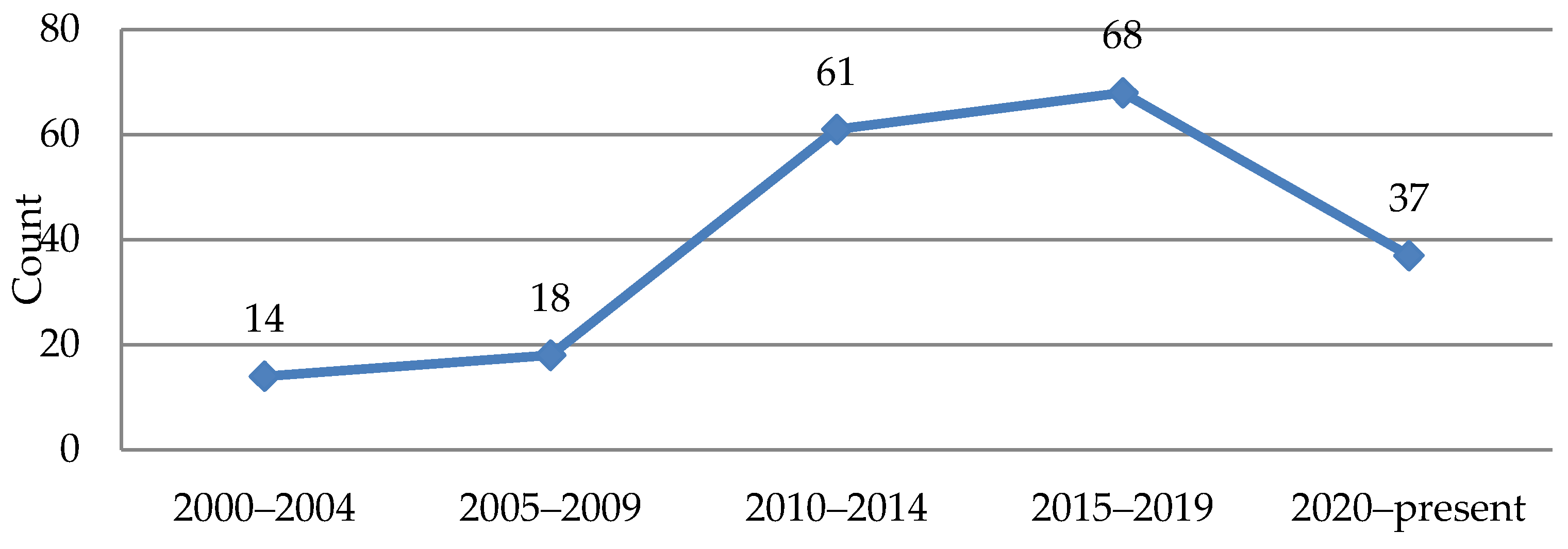
3.1. Analysis of Changes in Policy Quantity
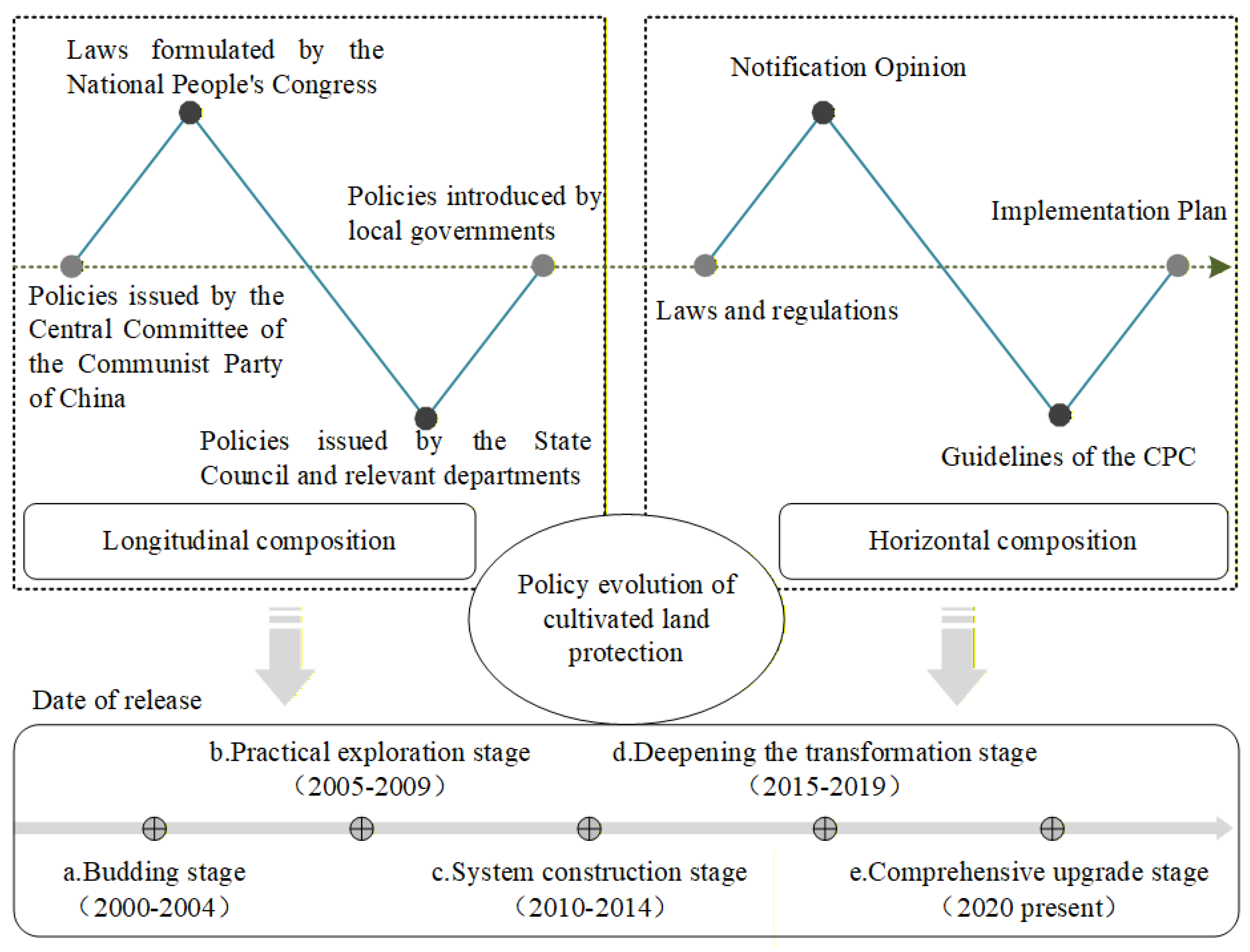
3.2. Analysis of Vertical and Horizontal Structure of Policy
3.2.1. Vertical Hierarchical Dimension
3.2.2. Horizontal Composition Dimension
3.2.3. Comparison of Vertical Levels and Horizontal Composition
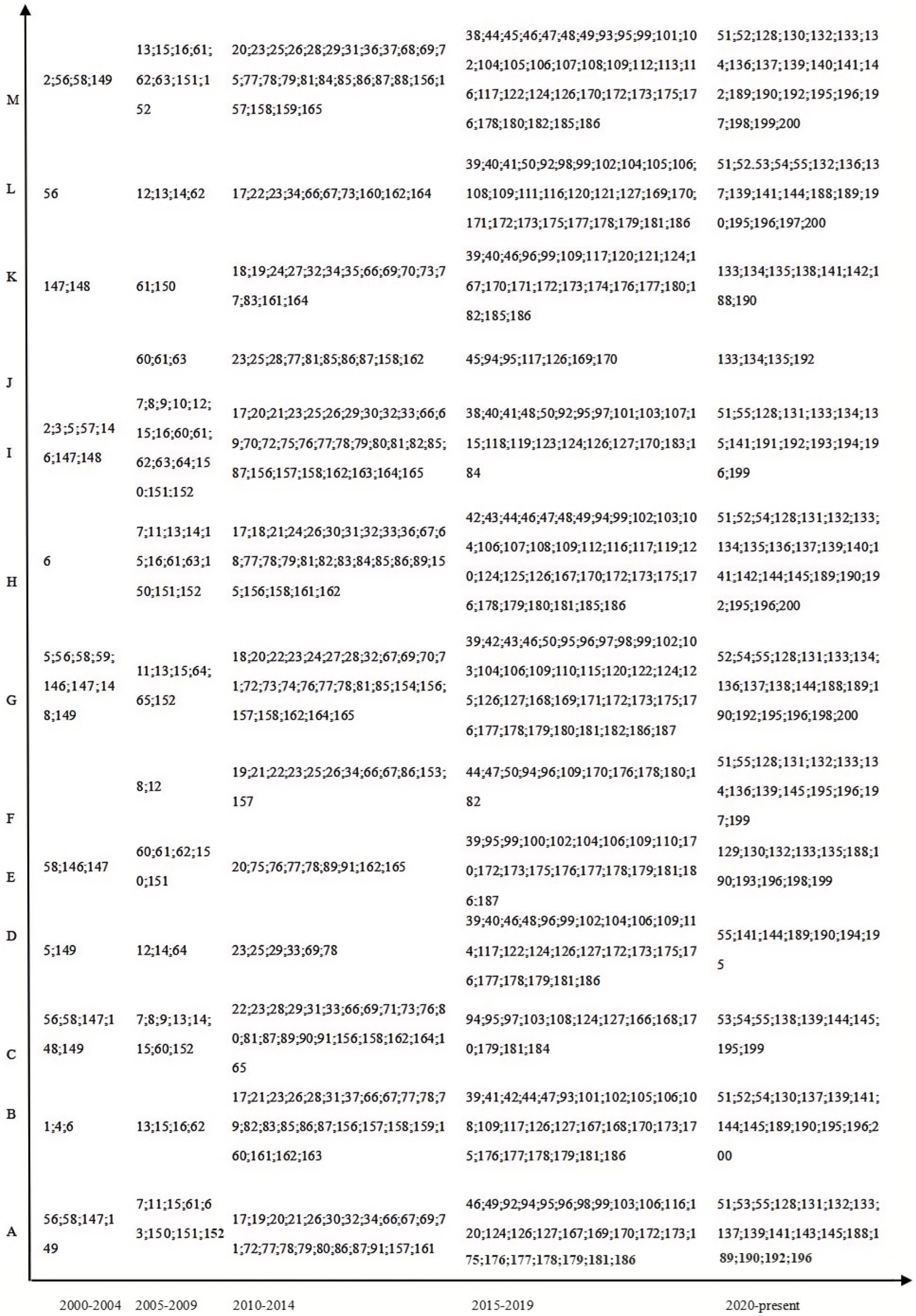
3.3. Analysis of the Evolution of Policy Content
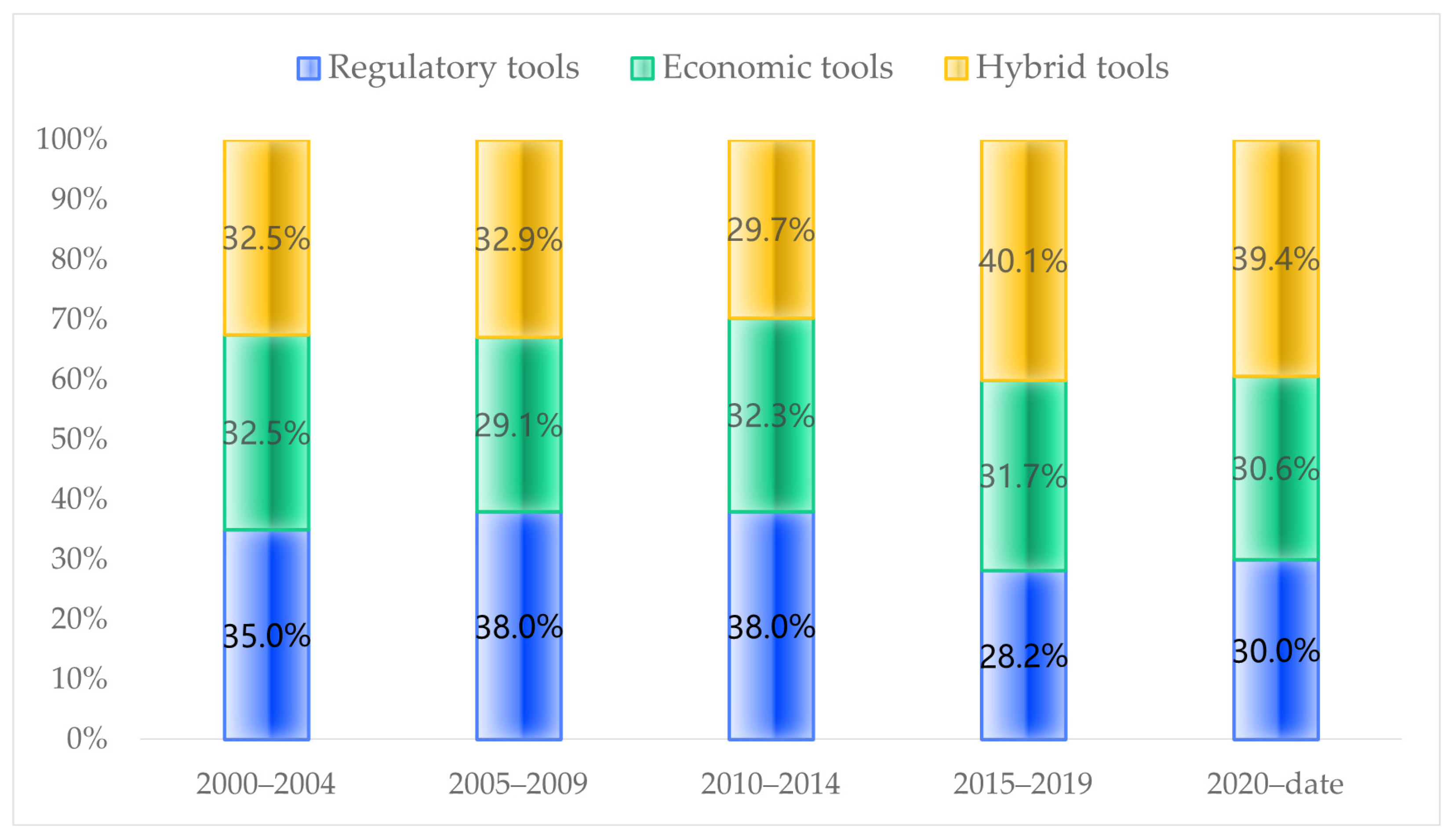
3.4. Analysis of the Structural Evolution of Policy Tools
4. Discussion
4.1. Insufficient Depth and Breadth of Implementation of Cultivated Land Quality Protection Policy
4.2. The Evolution Logic of Cultivated Land Protection Policy Objectives and Instruments in Different Periods
5. Conclusions
5.1. Conclusions
5.2. Recommendations
Author Contributions
Funding
Data Availability Statement
Acknowledgments
Conflicts of Interest
Appendix A

| Number | Coding | Keyword | Number | Coding | Keyword | Number | Coding | Keyword |
|---|---|---|---|---|---|---|---|---|
| 1 | 1-2 | B | 68 | 68-1 68-17 | HM | 135 | 135-22-3 135-8 135-11 135-5 135-8 | EHIJK |
| 2 | 2-3 2-2 | IM | 69 | 69-10 69-15 69-4 69-14 69-32 69-24 69-29 | ACDGIKM | 136 | 136-2 136 136-4 136-3 136-2 | FGHLM |
| 3 | 3-2 | I | 70 | 70-2 70-3 70-11 | GIK | 137 | 137-4-4 137-4-2 137-1-1 137-1-2 137-1-3 137-2-2 | ABGHLM |
| 4 | 4-2 | B | 71 | 71-17 71-15 71-2 | ACG | 138 | 138-5 138-9-1 138-9-4 | CGK |
| 5 | 5-1-12 5-2-5 5-1-18 | DGI | 72 | 72-18 72-2 72-3 | AGI | 139 | 139-5 | ABCFHLM |
| 6 | 6-3 6-1 | BH | 73 | 73-11 73-43 73-16 73-20 | CGKL | 140 | 140 | HM |
| 7 | 7-2 7-4 7-5 7-3 | ACHI | 74 | 74-1 | G | 141 | 141-11 141-11 141-17 141-12 141-9 141-11 141-17 | ABDHIKLM |
| 8 | 8-6-2 8-4-1 8-4-4 8-2 8 | CFI | 75 | 75-15 75-2 75-14 | EIM | 142 | 142-2 142-4 142-2 | HKM |
| 9 | 9-3-5 9-3-4 | CI | 76 | 76-4 76-11 76-4 76-12 | CEGI | 143 | 143 | A |
| 10 | 10 | I | 77 | 77-16 77-4 77-9 77-18 77-3 77-5 77-4 77-5 77-15 | ABEGHIJKM | 144 | 144-1 144-5-18 144-3-9 144-1 144-3-9 144-1 | BCDGHL |
| 11 | 11-2-2 11-2-8 11-1-2 | AGH | 78 | 78-26 78-19 78-4 78-15 78-17 78-5 78-4 78-11 | ABDEGHIM | 145 | 145-2-7 145-3 145-1-17 145-2-7 145-2-8 | ABCFH |
| 12 | 12-2 12-1 | DFIL | 79 | 79-2 79 79-1 79-2 79-1 | ABHIM | 146 | 146-14 146-2 146-5 | EGI |
| 13 | 13-1-1 13-3-4 13-6-1 13-5-2 13-5-3 13-3-4 | BCGHLM | 80 | 80-23 80-15 80-3 | ACI | 147 | 147-21 147-17 147-21 147-8-1 147-4 147-8-5 | ACEGIK |
| 14 | 14-3-4 14-3-5 14-2-2 14-2-6 | CDHL | 81 | 81-6 81-1 81-5 81-12 81-3 81-26 | CGHIJM | 148 | 148-18 148-10-1 148-3 148-10-5 | CGIK |
| 15 | 15-2 15 15-4 15-1 15-3 15-5 15-3 | ABCGHIM | 82 | 82 | BHI | 149 | 149-10 149-8 149-8 149-2 149-6 | ACDGM |
| 16 | 16-1 16-2 16-3 16-3 | BHIM | 83 | 83 | BHK | 150 | 150-15 150-11 150-2 150-1 150-6 | AEHIK |
| 17 | 17-3 17-1 17-3 17-4 17-1 | ABHIL | 84 | 84 | HM | 151 | 151-16 151-11 151-2 151-1 151-12 | AEHIM |
| 18 | 18 18-2 | GHK | 85 | 85-17 85-25 85-31 85-5 85-4 85-20 | BGHIJM | 152 | 152-7-1 152-4-4 152-4-1 152-4-1 152-2 152-6 | ACGHIM |
| 19 | 19 | AFK | 86 | 86-18 86-3 86-6 86-2 86-5 86-17 | ABFHJM | 153 | 153 | F |
| 20 | 20-3-16 20-3-19 20-1-2 20-4 20-3-20 | AEGIM | 87 | 87-12 87-31 87-4 87-11 87-3 87-26 | ABCIJM | 154 | 154-9-5 | G |
| 21 | 21-13 21-1 21-8 21-9 21-14 | ABFHI | 88 | 88-2 | M | 155 | 155-3 | FI |
| 22 | 22-61 22-7-5 27-appendix 27-4-3 | CFGL | 89 | 89-16 89-17 89-16 | CEH | 156 | 156-6-1 156-4-5 156-4-1 156-1 156-2 156-4-1 | BCGHIM |
| 23 | 23-4-3 23-4-2 23-7-1 23-4-2 23-3-2 23-5-3 23-4-2 23-2-1 23-4-1 | BCDFGIJLM | 90 | 90 | C | 157 | 157-3-2 157 157-2-3 157-1 157-1 157-3-1 | ABFGIM |
| 24 | 24 | GHK | 91 | 91-17 91-13 91-15 | ACE | 158 | 158-7-1 158-5 158-5 158-2 158-2 158-3 158-5 | BCGHIJM |
| 25 | 25-6-2 25-2 25-6-3 25-4 25-3 | DFIJM | 92 | 92-4 92-2 92-4 | AIL | 159 | 159-1 | BM |
| 26 | 26-13 26-1 26-8 26-2 26-14 26-12 | ABFHIM | 93 | 93 | BM | 160 | 160-1 160-3-2 | BL |
| 27 | 27 | GK | 94 | 94-1 94-3-3 94-4-1 94-3-1 94-3-1 | ACFHJ | 161 | 161-4-2 161-1 161-3 161-3 | ABHK |
| 28 | 28-3 28-1-5 28-5-12 28-4-10 28-2-8 | BCGJM | 95 | 95-12 95-14-2 95-13 95-1 95-3 95-4 95-21 | ACEGIJM | 162 | 162-2-6 162-2-2 162-2-4 162-1 162-2-5 162-2-6 162-2-1 162-2-3 | BCEGHIJL |
| 29 | 29-3-3 29-3-1 29-3-4 29-3-3 | CDIM | 96 | 96-9 96-1 96-7 96-2 96-9 | ADFGK | 163 | 163-3 163-2 | BI |
| 30 | 30-1-3 30-2 30-1-2 | AHI | 97 | 97-12 97-7-1 97-2 | CGI | 164 | 164-3 164-3 164-41 164-17-2 164-32 | CGIKL |
| 31 | 31-3-2 31-3-1 31-3-1 31-4-1 | BCHM | 98 | 98-1 98-3-2 98-4-1 | AGL | 165 | 165-4-4 165-10-6 165-1 165-2 165-6-1 | CEGIM |
| 32 | 32 | AGHIK | 99 | 99-4-4 99-1 99-4-1 99-1 99-4-2 99-4-1 99-4-2 99-4-2 | ADEGHKLM | 166 | 166 | C |
| 33 | 33-2-1 33-2 33-1-1 33-3 | CDHI | 100 | 100 | E | 167 | 167-11 167-3 167-2 167-5 | ABHK |
| 34 | 34 34-1 34 34-3-2 | AFKL | 101 | 101-1 101-3-1 101-3-3 | BIM | 168 | 168 168-2-1 168-3-4 | BCG |
| 35 | 35-2-2 | K | 102 | 102-1 102-1 102-3-1 102-1 102-4-2 102-2-1 102-4-2 | BDEGHLM | 169 | 169-2-2 169-2-7 169-2-5 169-2-7 | AGJL |
| 36 | 36 36-1 | HM | 103 | 103-20 103-20 103-9-5 103-23 103-3 | ACGHI | 170 | 170-11 170-13 17--12 170-17-5 170-11 170-7 170-9 170-3 170-7 170-18 170-25 | ABCEFHIJKLM |
| 37 | 37-4 | BM | 104 | 104-1 104-3-3 104-5-4 104-5-1 104-1 104-5-1 | DEGHLM | 171 | 171-4-1 171-4-3 171-2-2 | GKL |
| 38 | 38-3-1 38-3-2 | IM | 105 | 105-1 105-2 105-2 | BLM | 172 | 172-2-1 172-1-1 172-2-1 172-1-1 172-4-2 172-2-2 172-1-1 172-3-6 | ADEGHKLM |
| 39 | 39-1-1 39-2-1 39-3-1 39-3-2 39-5-4 39-2-2 | BDEGKL | 106 | 106-3-1 106-1 106-1 106-3-1 106-1 106-4-1 106-2-1 106-4-7 | ABDEGHLM | 173 | 173-3-2 173-4-5 173-2-1 173-3-1 173-1-2 173-4-6 173-5-4 173-2-2 173-4-6 | ABDEGHKLM |
| 40 | 40-5-4 40-5-3 40-1 | DIKL | 107 | 107-2 107-19 107-12 | HIM | 174 | 174 | K |
| 41 | 41 41-5 41-1-2 | BIL | 108 | 108 108-2-2 108-2-1 108-2-2 108-3-1 | BCHLM | 175 | 175-3-1 175-1 175-1 175-3-1 175-1 175-4-2 175-2-1 175-4-2 | ABDEGHLM |
| 42 | 42-2-15 42-3-20 42-4-24 | BGH | 109 | 109-1-1 109-2-1 109-3-1 109-4-4 109-1-2 109-5-5 109-5-4 109-2-2 109-1-1 | BDEFGHKLM | 176 | 176-1 176-7-2 176-1 176-4 176-6-7 176-1 176-6-1 176-6-5 176-2 | ABDEFGHKL |
| 43 | 43-2-3 43-2-1 | GH | 110 | 110 110-3 | EG | 177 | 177-6-2 177-1 177-1 177-4 177-6-2 177-7-4 177-6-2 | ABDEGKL |
| 44 | 44-3 44-2-3 44 | BFHM | 111 | 111-1-1 | L | 178 | 178-2-2 178-3-2 178-2-5 178-2-3 178-2-5 178-2-6 178-1-2 178-2-3 | ADEFGHLM |
| 45 | 45-2 45-3-3 | JM | 112 | 112-2 | HM | 179 | 179-3-1 179-5-2 179-3-2 179-1 179-3-1 179-1 179-4-2 179-2-1 | ABCDEGHL |
| 46 | 46-1 46-2-3 46-1 46-3-2 46-appendix 46-2-2 | ADGHKM | 113 | 113-3-3 | M | 180 | 180-4-1 180-3-2 180-1 180-3-2 180-1 | FGHKM |
| 47 | 47 47-2-3 47 | BFHM | 114 | 114-4-4 | D | 181 | 181-3-1 181-5-2 181-3-2 181-1 181-3-1 181-1 181-4-2 181-3-1 | ABCDEGHL |
| 48 | 48-1 48-2 48-8 48-2 | DHIM | 115 | 115-3 115-2 | GI | 182 | 182-4-1 182-3-2 182-appendix 2 182-1 | FGKM |
| 49 | 49-1 49-2 49-1 | AHM | 116 | 116-3-1 116-3-3 116-3-1 116-2-3 | AHLM | 183 | 183 | I |
| 50 | 50-5-11 50-1-1 50-2-6 | FGIL | 117 | 117-5 117 117-1 117-2 117-2 117-1 | BDHJKM | 184 | 184-6 184-9-2 | CI |
| 51 | 51-2 51-2-3 51-2 51-2-3 51-4-3 51-3-2 51-1 | ABFHILM | 118 | 118-2 | I | 185 | 185-2 | HKM |
| 52 | 52-2-3 52-1 52-2-2 52-2-2 52-2-1 | BGHLM | 119 | 119-1 119-2 | HI | 186 | 186-3-2 186-4-5 186-2-1 186-3-1 186-1-2 186-4-6 186-5-4 186-2-2 186-4-6 | ABDEGHKLM |
| 53 | 53-2-1 53-2-2 53-2-2 | ACL | 120 | 120-3-1 120 120-2-3 120-4-2 120-4-2 | AGHKL | 187 | 187-15 186-3 | EG |
| 54 | 54-1 54-1 54-1 54-3-10 54-1 | BCGHL | 121 | 121-4-2 121-2 | KL | 188 | 188-2-5 188-3-4 188-2-4 188-2-3 188-2-4 | AEGKL |
| 55 | 55-2-2 55-4-10 55-5-15 55-3-8 55-1 55-4-10 55-2-2 | ACDFGIL | 122 | 122-15 122-2 122-10 | DGM | 189 | 189-4-3 189-1 189-1 189-4-2 189-5-6 189-2 189-5-6 | ABDGHLM |
| 56 | 56-11 56-17 56-2 56-18 56-17 | ACGLM | 123 | 123 | I | 190 | 190-3-2 190-2-2 190-2-2 190-3-1 190-1-2 190-4-6 190-5-4 190-2-2 190-4-6 | ABDEGHKLM |
| 57 | 57-2 | I | 124 | 124-10 124-15-1 124-4 124-14 124-28 124-32 124-24 124-29 | ACDGHIKM | 191 | 191-2 | I |
| 58 | 58-25 58-28 58-29 58-18 58-2 | ACEGM | 125 | 125-1 | GH | 192 | 192-16 192-14 192-22 192-29 192-4 192-22 | AGHIJM |
| 59 | 59-3-1 | G | 126 | 126-4-12 126 126-4-12 126-1-1 126-5-14 126-2-4 126-4-11 126-4-11 | ABDGHIJM | 193 | 193-8-3 193-14 | EI |
| 60 | 60-6 60-21 60-4 60-3 | CEIJ | 127 | 127-4-3 127-3-3 127-4-1 127-4-1 127-2-2 127-2-4 127-2-4 | ABCDGIL | 194 | 194-2 194-12 | DI |
| 61 | 61-12 61-20 61-8 61-4 61-5 61-8 61-16 | AEHIJKM | 128 | 128-5-12 128-5-12 128-1-1 128-5-13 128-2-5 125-1-2 | AFGHIM | 195 | 195-2-4 195-2-1 195-2-1 195-2-1 195-2-3 195-2-5 195-2-2 195-2-4 | BCDFGHLM |
| 62 | 62-5 62-24 62-7 62-20 62-12 | BEILM | 129 | 129 | E | 196 | 196-3-1 196-3-1 196-1-2196-5-1 196-1-3 196-2-1 196-7-4 196-2-1 196-1-1 | ABEFGHILM |
| 63 | 63-11 63-28 63-2 63-3 62-11 | AHIJM | 130 | 130-15 130-23 130-22 | BEM | 197 | 197-2-1 197-2-2 197-2-4 | FLM |
| 64 | 64-2 64-5 64-2 | DGI | 131 | 131-12 131-12 131-1 131-4 131-5 | AFGHI | 198 | 198-25 198-2 190-30 | EGM |
| 65 | 65-3 | G | 132 | 132-2 132-3 132-2 132-4 132-2 132-4 | AEFHLM | 199 | 199-38 199-21 199-2 199-39 199-23 | CEFIM |
| 66 | 66-3 66 66-2 66-4 66-7 66-3 66-4 | ABCFIKL | 133 | 133-18 133-19 133-28 133-1 133-25 133-5 133-3 133-13 133-15 | AEFGHIJKM | 200 | 200-4 200-6-21 200-3-8 200-2-4 200-3-11 | BGHLM |
| 67 | 67-2-2 67 67-2-1 67-1 67-3-1 67-2-1 | ABFGHL | 134 | 134-7 134-1 134-12 134-2 134-3 134-8 134-10 | FGHIJKM |
| Hierarchy | Number | Name of the Policy |
|---|---|---|
| National policies | [1] | Notice of the MLR and the Ministry of Agriculture on Printing and Distributing the “Measures for the Acceptance of the Adjustment and Delineation of Basic Farmland Protection Zones” (Guo Tu Zi Fa [2000] No. 126) |
| [2] | Notice of the Ministry of Agriculture on Further Strengthening the Protection of Basic Farmland (Nong Nong Fa [2000] No. 10) | |
| [3] | Notice of the MLR and the Ministry of Agriculture on Printing and Distributing the “Work Plan for the National Inspection of Basic Farmland Protection” (Guo Tu Zi Fa [2004] No. 32) | |
| [4] | Emergency Notice of the State Council on Resolutely Stopping Acts Such as Tree Planting on Basic Farmland (Guo Fa Ming Dian [2004] No. 1) | |
| [5] | Notice of the MLR and the Ministry of Agriculture on Printing and Distributing the “Rectification Opinions on Relevant Issues in Basic Farmland Protection” (Guo Tu Zi Fa [2004] No. 223) | |
| [6] | Notice of the MLR and the Ministry of Agriculture on Earnestly Doing a Good Job in the Inspection of Basic Farmland Protection (Guo Tu Zi Fa [2004] No. 251) | |
| [7] | Opinions of the MLR, the Ministry of Agriculture, the National Development and Reform Commission, the Ministry of Finance, the Ministry of Housing and Urban-Rural Development, the Ministry of Water Resources, and the State Forestry Administration on Further Improving the Protection of Basic Farmland (Guo Tu Zi Fa [2005] No. 196) | |
| [8] | Notice of the MLR on Carrying Out the Work of Establishing Basic Farmland Protection Demonstration Areas (Guo Tu Zi Fa [2005] No. 197) | |
| [9] | Notice of the MLR on Formulating the Construction Plan for Basic Farmland Protection Demonstration Areas (Guo Tu Zi Ting Fa [2006] No. 42) | |
| [10] | Letter of the MLR on Printing and Distributing the “Work Conception and Relevant Requirements for the Informatization Construction of Supervision and Management of Basic Farmland Protection Demonstration Areas” | |
| [11] | Notice of the General Office of the Ministry of Agriculture on Issuing the “Application Guidelines and Organization of Application for the Key Project ‘Research and Demonstration of Key Technologies for Cultivated Land Quality Regulation’ under the National Science and Technology Support Program for the 11th Five-Year Plan” (Nong Ban Ke [2006] No. 61) | |
| [12] | Notice of the MLR on Officially Determining the National Basic Farmland Protection Demonstration Areas (Guo Tu Zi Fa [2006] No. 270) | |
| [13] | Notice of the State Council on Printing and Distributing the National Land Use Master Plan (2006–2020) (Guo Fa [2008] No. 33) | |
| [14] | Notice of the General Office of the MLR on Printing and Distributing the Guidelines for the Formulation of Land Use Master Plans at the City, County, and Township Levels (Guo Tu Zi Ting Fa [2009] No. 51) | |
| [15] | Notice of the MLR and the Ministry of Agriculture on Strengthening the Construction and Management of Supplementary Cultivated Land Quality for the Balance of Occupation and Compensation (Guo Tu Zi Fa [2009] No. 168) | |
| [16] | Notice of the General Office of the Ministry of Agriculture on Further Implementing the Spirit of the National Forum on Basic Farmland Protection (Nong Ban Nong [2009] No. 150) | |
| [17] | Notice of the General Office of the Ministry of Agriculture on Printing and Distributing the “Work Plan for the Pilot Project of Quality Construction, Management, and Acceptance of Supplementary Cultivated Land Nationwide” (Nong Ban Nong [2010] No. 19) | |
| [18] | Notice of the General Office of the Ministry of Agriculture on Establishing the Expert Advisory Group for Cultivated Land Quality Construction and Management of the Ministry of Agriculture (Nong Ban Nong [2010] No. 23) | |
| [19] | Notice of the General Office of the Ministry of Agriculture on Holding the National Conference on Soil Testing and Formulated Fertilization and Cultivated Land Quality Construction and Management (Nong Ban Nong [2010] No. 103) | |
| [20] | Regulations on the Protection of Basic Farmland (2011 Amendment) (Decree No. 588 of the State Council of the People’s Republic of China) | |
| [21] | Notice of the Ministry of Agriculture on Printing and Distributing the “Work Specifications for the Acceptance and Evaluation of Supplementary Cultivated Land Quality (Trial)” (Nong Nong Fa [2011] No. 4) | |
| [22] | Notice of the MLR on Printing and Distributing the “Specifications for the Construction of High-Standard Basic Farmland (Trial)” (Guo Tu Zi Fa [2011] No. 144) | |
| [23] | Notice of the MLR on Issuing and Implementing the “National Land Consolidation Plan (2011–2015)” (Guo Tu Zi Fa [2012] No. 55) | |
| [24] | Notice of the Ministry of Agriculture on Allocating Funds for Cultivated Land Quality Protection Projects in 2012 (Nong Cai Fa [2012] No. 49) | |
| [25] | Notice of the MLR and the Ministry of Finance on Accelerating the Formulation and Implementation of Land Consolidation Plans and Vigorously Promoting the Construction of High-Standard Basic Farmland (Guo Tu Zi Fa [2012] No. 63) | |
| [26] | Notice of the General Office of the Ministry of Agriculture on Printing and Distributing the “Technical Specifications for the Acceptance and Evaluation of Supplementary Cultivated Land Quality (Trial)” (Nong Ban Nong [2012] No. 35) | |
| [27] | Notice of the General Office of the Ministry of Agriculture on Doing a Good Job in the Performance Evaluation of Special Funds for Cultivated Land Quality Protection in 2012 (Nong Ban Nong [2012] No. 41) | |
| [28] | Notice of the MLR on Improving the Level of Cultivated Land Protection and Comprehensively Strengthening the Construction and Management of Cultivated Land Quality (Guo Tu Zi Fa [2012] No. 108) | |
| [29] | Opinions of the MLR on Accelerating the Construction of 500 High-Standard Basic Farmland Demonstration Counties (Guo Tu Zi Fa [2012] No. 147) | |
| [30] | Notice of the General Office of the Ministry of Agriculture on Carrying Out Inspection and Supervision Activities for the Acceptance and Evaluation of Supplementary Cultivated Land Quality (Nong Ban Nong [2012] No. 78) | |
| [31] | Notice of the General Office of the MLR on Printing and Distributing the “Work Plan for the Investigation, Evaluation, and Monitoring of Cultivated Land Quality Grades” (Guo Tu Zi Ting Fa [2012] No. 60) | |
| [32] | Notice of the Ministry of Agriculture on Allocating Funds for Cultivated Land Quality Protection Projects in 2013 (Nong Cai Fa [2013] No. 45) | |
| [33] | Notice of the General Office of the MLR on Deploying the 2014 National Investigation, Evaluation, and Monitoring of Cultivated Land Quality Grades (Guo Tu Zi Ting Fa [2014] No. 8) | |
| [34] | Notice of the General Office of the Ministry of Agriculture on Printing and Distributing the “2014 Technical Models for Cultivated Land Quality Protection and Improvement” (Nong Ban Nong [2014] No. 39) | |
| [35] | Notice of the General Office of the Ministry of Agriculture on Holding the National On-Site Meeting on Cultivated Land Quality Construction (Nong Ban Nong [2014] No. 44) | |
| [36] | Bulletin of the Ministry of Agriculture on the Status of National Cultivated Land Quality Grades (Bulletin of the Ministry of Agriculture [2014] No. 1) | |
| [37] | Announcement of the MLR 2014 No. 30—Announcement on Issuing the Main Achievements of the National Investigation and Evaluation of Cultivated Land Quality Grades (Announcement of the MLR 2014 No. 30) | |
| [38] | Notice of the MLR and the Ministry of Agriculture on Carrying Out Supervision Work for the Delineation of Permanent Basic Farmland (Guo Tu Zi Fa [2015] No. 131) | |
| [39] | Notice of the Ministry of Agriculture on Printing and Distributing the “Action Plan for Cultivated Land Quality Protection and Improvement” (Nong Nong Fa [2015] No. 5) | |
| [40] | Notice of the General Office of the Ministry of Agriculture and the General Office of the Ministry of Finance on Carrying Out Pilot Projects for the Comprehensive Utilization of Crop Straw to Promote the Improvement of Cultivated Land Quality (Nong Ban Cai [2016] No. 39) | |
| [41] | Guiding Opinions of the MLR on Implementing the Balance of Occupation and Compensation by Supplementing Cultivated Land Quantity and Improving Cultivated Land Quality (Guo Tu Zi Gui [2016] No. 8) | |
| [42] | Measures for the Investigation, Monitoring, and Evaluation of Cultivated Land Quality (Decree No. 2 of the Ministry of Agriculture of the People’s Republic of China 2016) | |
| [43] | Notice of the General Office of the Ministry of Agriculture on Printing and Distributing the “Monitoring Plan for Cultivated Land Quality in Rotation and Fallow Pilot Areas” (Nong Ban Nong [2016] No. 28) | |
| [44] | Announcement of the MLR 2017 No. 3—Announcement on Issuing the Main Data Achievements of the 2015 National Update and Evaluation of Cultivated Land Quality Grades (Announcement of the MLR 2017 No. 3) | |
| [45] | Notice of the General Office of the MLR on Printing and Distributing the “Work Plan for the Special Inspection on the Implementation of the Comprehensive Delineation of Permanent Basic Farmland” (Guo Tu Zi Ting Fa [2017] No. 3) | |
| [46] | Notice of the General Office of the Ministry of Agriculture on Doing a Good Job in the Investigation and Evaluation of Cultivated Land Quality Grades (Nong Ban Nong [2017] No. 18) | |
| [47] | Announcement of the MLR on Issuing the Main Data Achievements of the 2016 National Update and Evaluation of Cultivated Land Quality Grades (Announcement of the MLR 2017 No. 42) | |
| [48] | Notice of the Ministry of Agriculture on Printing and Distributing the “Measures for the Administration of Special Funds for Cultivated Land Quality Protection” (Nong Cai Fa [2018] No. 6) | |
| [49] | Notice of the Office of the Leading Group for the Third National Land Survey of the State Council on Printing and Distributing the “Work Plan for the Investigation and Evaluation of Cultivated Land Quality Grades in the Third National Land Survey” | |
| [50] | Notice of the MNR and the MOA on Strengthening and Improving the Protection of Permanent Basic Farmland (Zi Ran Zi Gui [2019] No. 1) | |
| [51] | Notice of the General Office of the MOA on Doing a Good Job in the Management of Degraded Cultivated Land and the Investigation and Evaluation of Cultivated Land Quality Grades in 2020 (Nong Ban Jian [2020] No. 4) | |
| [52] | Notice of the Office of the Leading Group for the Third National Land Survey of the State Council on Doing a Good Job in the Connection Between the Results of the Investigation and Evaluation of Cultivated Land Quality Grades and the Classification of Cultivated Land Resource Quality in the Third National Land Survey (Guo Tu Diao Cha Ban Fa [2020] No. 15) | |
| [53] | Notice of the General Office of the MOA on Actively Using Policy-Based Financial Funds to Accelerate the Construction of High-Standard Basic Farmland and the Improvement of Cultivated Land Quality (Nong Ban Jian [2023] No. 1) | |
| [54] | Opinions of the General Office of the CPC Central Committee and the General Office of the State Council on Strengthening Cultivated Land Protection, Improving Cultivated Land Quality, and Improving the Balance of Occupation and Compensation | |
| [55] | Implementation Plan for Gradually Converting Permanent Basic Farmland into High-Standard Basic Farmland (Issued by the General Office of the CPC Central Committee and the General Office of the State Council) | |
| Provincial policies | [56] | Regulations of Hunan Province on the Protection of Basic Farmland (2000 Amendment) |
| [57] | Measures of the Xinjiang Uygur Autonomous Region for the Protection of Basic Farmland (2000) | |
| [58] | Regulations of the Ningxia Hui Autonomous Region on the Protection of Basic Farmland (2001) | |
| [59] | Decision of the Standing Committee of the Fujian Provincial People’s Congress on Amending the “Regulations of Fujian Province on the Protection of Basic Farmland” (2001) | |
| [60] | Measures of Liaoning Province for the Protection of Basic Farmland (2006) | |
| [61] | Measures of Liaoning Province for the Protection of Cultivated Land Quality (2006) | |
| [62] | Measures of Tianjin Municipality for the Administration of Cultivated Land Quality (2007) | |
| [63] | Regulations of Hunan Province on the Administration of Cultivated Land Quality (2008) | |
| [64] | Notice of the Jiangsu Provincial Department of Agriculture on Printing and Distributing the “Measures for the Administration of Cultivated Land Quality Monitoring in Jiangsu Province” (2008) | |
| [65] | Feedback Opinions of the Zhejiang Provincial Department of Environmental Protection on the “Measures for the Administration of Cultivated Land Quality in Zhejiang Province (Draft for Review)” (Zhe Huan Ban Han [2009] No. 285) | |
| [66] | Notice of the Guangdong Provincial Department of Land and Resources on Implementing the Opinions of the MLR and the Ministry of Agriculture on Strengthening the Construction and Management of Supplementary Cultivated Land Quality for the Balance of Occupation and Compensation (Yue Guo Tu Zi Gui Bao Fa [2010] No. 67) | |
| [67] | Notice of the Hainan Provincial Department of Land, Environment, and Resources and the Hainan Provincial Department of Agriculture on Strengthening the Construction and Management of Supplementary Cultivated Land Quality (Qiong Tu Huan Zi Geng Zi [2010] No. 3) | |
| [68] | Notice of the Hunan Provincial Department of Agriculture and the Hunan Provincial Department of Land and Resources on Printing and Distributing the “Interim Measures for the Evaluation of Cultivated Land Quality in Hunan Province” (Xiang Nong Ye Lian [2010] No. 76) | |
| [69] | Regulations of Jilin Province on the Protection of Cultivated Land Quality (2010) | |
| [70] | Regulations of Henan Province on the Protection of Basic Farmland (2010 Amendment) | |
| [71] | Regulations of Guizhou Province on the Protection of Basic Farmland (2010 Amendment) | |
| [72] | Regulations of Tianjin Municipality on the Protection of Basic Farmland (2010 Amendment) | |
| [73] | Regulations of Jiangsu Province on the Protection of Basic Farmland (2010 Amendment) | |
| [74] | Decision of the Standing Committee of the Jiangsu Provincial People’s Congress on Amending the “Regulations of Jiangsu Province on the Protection of Basic Farmland” (2010) | |
| [75] | Measures of the Xinjiang Uygur Autonomous Region for the Protection of Basic Farmland (2010 Amendment) | |
| [76] | Several Provisions of Shanghai Municipality on the Protection of Basic Farmland (2010 Amendment) | |
| [77] | Measures of Gansu Province for the Administration of Cultivated Land Quality (Decree No. 74 of the People’s Government of Gansu Province) | |
| [78] | Measures of Zhejiang Province for the Administration of Cultivated Land Quality (Zhe Zheng Ling [2010] No. 285) | |
| [79] | Notice of the Zhejiang Provincial Department of Agriculture on Standardizing and Strengthening the Evaluation of Supplementary Cultivated Land Quality (Zhe Nong Zhuan Fa [2011] No. 144) | |
| [80] | Regulations of Shandong Province on the Protection of Basic Farmland (2012 Amendment) | |
| [81] | Regulations of Jiangsu Province on the Administration of Cultivated Land Quality (2012) | |
| [82] | Notice of the Inner Mongolia Autonomous Region Department of Agriculture and Animal Husbandry on Further Carrying Out Pilot Projects for the Acceptance and Evaluation of Supplementary Cultivated Land Quality (Nei Nong Mu Zhong Zhi Fa [2012] No. 150) | |
| [83] | Notice of the Shanghai Municipal Agriculture Commission on Forwarding the “Notice of the General Office of the Ministry of Agriculture on Printing and Distributing the ‘Technical Specifications for the Acceptance and Evaluation of Supplementary Cultivated Land Quality (Trial)’” (Hu Nong Wei [2012] No. 282) | |
| [84] | Notice of the Office of the Hebei Provincial Department of Land and Resources on Issues Concerning Accelerating the Supplementary Improvement of Cultivated Land Quality Grade Achievements (Ji Guo Tu Zi Ban Fa [2012] No. 21) | |
| [85] | Measures of Henan Province for the Administration of Cultivated Land Quality (2013) | |
| [86] | Notice of the Jiangsu Provincial Department of Agriculture and the Jiangsu Provincial Department of Land and Resources on Printing and Distributing the Specifications for the Evaluation of Supplementary Cultivated Land Quality in Jiangsu Province (Su Nong Ye [2013] No. 30) | |
| [87] | Regulations of Hubei Province on the Protection of Cultivated Land Quality (2014) | |
| [88] | Notice of the Jilin Provincial Department of Land and Resources on Standardizing the Evaluation and Verification of Newly Added Cultivated Land Quality Grades (Ji Guo Tu Zi Yong Fa [2014] No. 33) | |
| [89] | Regulations of Hebei Province on the Protection of Basic Farmland (2014 Amendment) | |
| [90] | Notice of the Chongqing Municipal Agriculture Commission and the Chongqing Municipal Finance Bureau on Printing and Distributing the Application Guidelines for the 2015 Grain and Oil High-Yield Creation Demonstration and Cultivated Land Quality Protection and Improvement Projects in Chongqing Municipality (Yu Nong Fa [2014] No. 313) | |
| [91] | Regulations of Guangdong Province on the Administration of Basic Farmland Protection Zones (2014 Amendment) | |
| [92] | Notice of the Office of the Fujian Provincial Department of Agriculture on Conducting a Survey on the Implementation of Soil Organic Matter Improvement (Cultivated Land Quality Protection and Improvement) Projects (Min Nong Ting Ban [2015] No. 13) | |
| [93] | Notice of the Office of the Zhejiang Provincial Department of Land and Resources on Printing and Distributing the “Measures for the Evaluation of Cultivated Land Quality Grades in Land Consolidation Projects in Zhejiang Province (Trial)” (Zhe Tu Zi Ban [2015] No. 18) | |
| [94] | Notice of the Guangxi Zhuang Autonomous Region Department of Land and Resources on Earnestly Strengthening the Construction of Supplementary Cultivated Land Quality (Gui Guo Tu Zi Fa [2015] No. 13) | |
| [95] | Measures of Shaanxi Province for the Protection of Cultivated Land Quality (2015) | |
| [96] | Notice of the Jiangsu Provincial Department of Finance on Printing and Distributing the “Measures for the Administration of Provincial Special Funds for Cultivated Land Quality Construction in Jiangsu Province” (Su Cai Gui [2015] No. 35) | |
| [97] | Regulations of Yunnan Province on the Protection of Basic Farmland (2015 Amendment) | |
| [98] | Notice of the Shandong Provincial Department of Agriculture on Printing and Distributing the Technical Models for Cultivated Land Quality Improvement (Lu Nong Sheng Tai Zi [2015] No. 15) | |
| [99] | Notice of the Ningxia Hui Autonomous Region Department of Agriculture and Animal Husbandry on Printing and Distributing the “Action Plan for Cultivated Land Quality Protection and Improvement in Ningxia” (Ning Nong [Zhong] Fa [2016] No. 6) | |
| [100] | Notice of the Office of the Anhui Provincial Department of Agriculture on Carrying Out Centralized Acceptance Activities for Soil Testing and Formulated Fertilization and Cultivated Land Quality Protection and Improvement Subsidy Projects in the Province (Wan Nong Ban Tu Han [2016] No. 35) | |
| [101] | Notice of the Office of the Zhejiang Provincial Department of Land and Resources on Standardizing and Strengthening the Evaluation of Cultivated Land Quality Grades in Land Consolidation Projects in Zhejiang Province (Zhe Tu Zi Ban [2016] No. 48) | |
| [102] | Notice of the Fujian Provincial Department of Agriculture on Printing and Distributing the Implementation Plan for Cultivated Land Quality Protection and Improvement in Fujian Province (Min Nong Tu [2016] No. 212) | |
| [103] | Regulations of Beijing Municipality on the Protection of Basic Farmland (2016 Amendment) | |
| [104] | Notice of the Shanghai Municipal Agriculture Commission on Printing and Distributing the Implementation Plan for Cultivated Land Quality Protection and Improvement in Shanghai Municipality (Hu Nong Wei [2016] No. 329) | |
| [105] | Notice of the Zhejiang Provincial Department of Land and Resources on Implementing the “Guiding Opinions of the MLR on Implementing the Balance of Occupation and Compensation by Supplementing Cultivated Land Quantity and Improving Cultivated Land Quality” (Zhe Tu Zi Fa [2016] No. 38) | |
| [106] | Notice of the General Office of the People’s Government of Xiamen City on Printing and Distributing the Implementation Plan for Cultivated Land Quality Protection and Improvement in Xiamen City (Xia Men Fu Ban [2016] No. 230) | |
| [107] | Notice of the Jilin Provincial Department of Land and Resources on Printing and Distributing the “Measures for the Evaluation and Monitoring of Cultivated Land Quality Grades in Jilin Province” (Ji Guo Tu Zi Fa Wen [2016] No. 8) | |
| [108] | Notice of the Shanxi Provincial Department of Land and Resources on Implementing the Balance of Occupation and Compensation by Supplementing Cultivated Land Quantity and Improving Cultivated Land Quality (2017) | |
| [109] | Notice of the Office of the Chongqing Municipal Agriculture Commission on Printing and Distributing the “Action Plan for Cultivated Land Quality Protection and Improvement in Chongqing Municipality” (Yu Nong Ban Fa [2017] No. 6) | |
| [110] | Notice of the Shanghai Municipal Agriculture Commission and the Shanghai Municipal Finance Bureau on Improving the Relevant Policies for Cultivated Land Quality Protection and Improvement Subsidies in This Municipality (Hu Nong Wei [2017] No. 111) | |
| [111] | Notice of the Jiangsu Provincial Station of Cultivated Land Quality and Agricultural Environmental Protection on Submitting Technical Models for Cultivated Land Quality Protection and Improvement (Su Geng Huan [2017] No. 30) | |
| [112] | Notice of the Heilongjiang Provincial Department of Land and Resources on Deploying the 2017 Provincial Investigation, Evaluation, and Monitoring of Cultivated Land Quality Grades (2017) | |
| [113] | Notice of the Fujian Provincial Department of Agriculture on Printing and Distributing the 2017 Implementation Plan for Cultivated Land Quality Protection and Improvement in Fujian Province (Min Nong Tu [2017] No. 155) | |
| [114] | Notice of the Guizhou Provincial Department of Agriculture on Allocating Funds for Cultivated Land Quality Protection Projects in 2017 (Qian Nong Cai [2017] No. 102) | |
| [115] | Measures of the Tibet Autonomous Region for Implementing the “Regulations on the Protection of Basic Farmland” (2018 Revision) | |
| [116] | Notice of the Guizhou Provincial Department of Agriculture on Carrying Out the Application for Demonstration Counties for Cultivated Land Quality Protection and Improvement and Chemical Fertilizer Reduction and Efficiency Enhancement in 2018 (Qian Nong Han [2018] No. 109) | |
| [117] | Reply of the Liaoning Provincial Department of Agriculture to the No. 1433 Proposal of the First Session of the 13th Provincial People’s Congress on Improving Cultivated Land Quality Protection Measures (Liao Nong Jian [2018] No. 52) | |
| [118] | Notice of the Guizhou Provincial Department of Agriculture on Allocating Funds for Cultivated Land Quality Protection Projects in 2018 (Qian Nong Cai [2018] No. 52) | |
| [119] | Approval of the Guizhou Provincial Department of Agriculture on the 2018 Demonstration Implementation Plan for Cultivated Land Quality Protection and Improvement and Chemical Fertilizer Reduction and Efficiency Enhancement in Guizhou Province (Qian Nong Fa [2018] No. 84) | |
| [120] | Notice of the Office of the Guizhou Provincial Department of Agriculture on Printing and Distributing the “2018 Implementation Plan for Cultivated Land Quality Protection and Improvement in Guizhou Province” (Qian Nong Ban Fa [2018] No. 152) | |
| [121] | Implementation Opinions of the Jilin Provincial Department of Agriculture and the Jilin Provincial Department of Finance on Accelerating the Promotion of Straw Covering and No-Tillage Conservation Tillage Technology to Promote the “Green Growth” of Cultivated Land Quality, Tillage Ecology, and Tillage Benefits (Ji Nong Ji Fa [2018] No. 22) | |
| [122] | Regulations of Zhejiang Province on the Protection of Basic Farmland (2018 Amendment) | |
| [123] | Notice of the Guizhou Provincial Department of Agriculture and Rural Affairs on Allocating Funds for the 2018 Provincial Pilot Project of Rotation and Fallow System (Fallow Cultivated Land Quality Monitoring) (Qian Nong Cai [2018] No. 15) | |
| [124] | Regulations of Jilin Province on the Protection of Cultivated Land Quality (2019 Revision) | |
| [125] | Notice of the Shandong Provincial Department of Agriculture and Rural Affairs on Doing a Good Job in the Monitoring and Evaluation of Cultivated Land Quality in Rotation and Fallow Pilot Areas (Lu Nong Zhong Zhi Zi [2019] No. 15) | |
| [126] | Implementation Opinions of the Liaoning Provincial Department of Natural Resources and the Liaoning Provincial Department of Agriculture and Rural Affairs on Strengthening and Improving the Protection of Permanent Basic Farmland (Liao Zi Ran Zi Gui [2019] No. 1) | |
| [127] | Implementation Opinions of the Zhejiang Provincial Department of Natural Resources and the Zhejiang Provincial Department of Agriculture and Rural Affairs on Strengthening and Improving the Protection of Permanent Basic Farmland (Zhe Zi Ran Zi Gui [2019] No. 16) | |
| [128] | Implementation Opinions of the Chongqing Municipal Bureau of Planning and Natural Resources and the Chongqing Municipal Department of Agriculture and Rural Affairs on Strengthening and Improving the Protection of Permanent Basic Farmland (Yu Gui Zi Gui Fan [2020] No. 1) | |
| [129] | Notice of the Guizhou Provincial Department of Agriculture and Rural Affairs on Printing and Distributing the “2020 Work Plan for Cultivated Land Quality Protection and Improvement and Negative Growth of Chemical Fertilizer Use in Guizhou Province” (2020) | |
| [130] | Provisions of Hainan Province on the Protection of Permanent Basic Farmland (2020 Amendment) | |
| [131] | Implementation Opinions of the Chongqing Municipal Bureau of Planning and Natural Resources and the Chongqing Municipal Department of Agriculture and Rural Affairs on Strengthening and Improving the Protection of Permanent Basic Farmland (Yu Gui Zi Gui Fan [2020] No. 1) | |
| [132] | Notice of the Guangdong Provincial Department of Agriculture and Rural Affairs on Further Doing a Good Job in the Construction and Protection of Cultivated Land Quality (2020) | |
| [133] | Regulations of Guangdong Province on the Administration of Cultivated Land Quality (2020) | |
| [134] | Notice of the Yunnan Provincial Department of Agriculture and Rural Affairs on Printing and Distributing the Measures for Cultivated Land Quality Protection and Improvement in Yunnan Province (2021) | |
| [135] | Measures of Liaoning Province for the Protection of Cultivated Land Quality (2021 Amendment) | |
| [136] | Notice of the Anhui Provincial Department of Agriculture and Rural Affairs on Further Strengthening the Construction and Grade Evaluation of High-Standard Basic Farmland Cultivated Land Quality (Wan Nong Jian [2021] No. 132) | |
| [137] | Opinions of the Jiangsu Provincial Department of Agriculture and Rural Affairs on Earnestly Strengthening the Monitoring and Evaluation of Cultivated Land Quality in the Province (Su Nong Ye [2021] No. 37) | |
| [138] | Regulations of Anhui Province on the Protection of Basic Farmland (2023 Amendment) | |
| [139] | Reply of the Jiangsu Provincial Department of Natural Resources to the No. 3034 Proposal of the Second Session of the 14th Provincial People’s Congress (Proposal on Strengthening the Protection of Supplementary Cultivated Land Quality in the Process of Balancing Occupation and Compensation) (2024) | |
| [140] | Announcement of the Department of Cultivated Land Quality Protection and State Farms of the Guizhou Provincial Department of Agriculture and Rural Affairs on the Open Selection of Procurement Agencies for the 2023 Provincial Cultivated Land Quality Grade Evaluation Project (2024) | |
| [141] | Implementation Opinions of the General Office of the CPC Jiangsu Provincial Committee and the General Office of the Jiangsu Provincial People’s Government on Strengthening Cultivated Land Protection, Improving Cultivated Land Quality, and Improving the Balance of Occupation and Compensation (2024) | |
| [142] | Notice of the Shandong Provincial Department of Agriculture and Rural Affairs on Further Doing a Good Job in the Protection and Improvement of Cultivated Land Quality in 2024 (Lu Nong Jian Zi [2024] No. 14) | |
| [143] | Announcement of the Department of Cultivated Land Quality Protection and State Farms of the Guizhou Provincial Department of Agriculture and Rural Affairs on the Open Selection of Procurement Agencies for Technical Services for the Collation of Basic Data for the Compilation of Soil Type Maps in the Third National Soil Survey of Guizhou Province (2024) | |
| [144] | Implementation Opinions of the General Office of the CPC Xinjiang Production and Construction Corps Committee and the General Office of the Xinjiang Production and Construction Corps on Strengthening Cultivated Land Protection, Improving Cultivated Land Quality, and Improving the Balance of Occupation and Compensation (2024) | |
| [145] | Implementation Opinions of the General Office of the CPC Yunnan Provincial Committee and the General Office of the Yunnan Provincial People’s Government on Strengthening Cultivated Land Protection, Improving Cultivated Land Quality, and Improving the Balance of Occupation and Compensation (2025) | |
| City and county level policies | [146] | Regulations of Jilin City on the Protection of Basic Farmland (2001 Revision) |
| [147] | Regulations of Hefei City on the Protection of Basic Farmland (2001) | |
| [148] | Regulations of Qiqihar City on the Protection of Basic Farmland (2001 Revision) | |
| [149] | Regulations of Benxi City on the Protection of Basic Farmland (2002 Revision) | |
| [150] | Notice of the People’s Government of Lianyungang City on Printing and Distributing the Measures for the Administration of Cultivated Land Quality in Lianyungang City (Lian Zheng Fa [2005] No. 137) | |
| [151] | Notice of the People’s Government of Taizhou City on Printing and Distributing the Measures for the Administration of Cultivated Land Quality in Taizhou City (Tai Zheng Ban Fa [2005] No. 137) | |
| [152] | Notice of the People’s Government of Shaoyang City on Printing and Distributing the “Several Provisions of Shaoyang City on Strengthening the Administration of Cultivated Land Quality” (Shi Zheng Fa [2009] No. 6) | |
| [153] | Notice of the Chengdu Municipal Agriculture Commission on Submitting the Plan for Modern Agricultural Development and Cultivated Land Quality Protection and Improvement in 198 Municipal Strategic Functional Areas (Cheng Nong Ban [2010] No. 106) | |
| [154] | Regulations of Handan City on the Administration of Basic Farmland Protection (2010 Amendment) | |
| [155] | Notice of the Chengdu Municipal Agriculture Commission on Strengthening Cultivated Land Protection and Improving Cultivated Land Quality (Cheng Nong Ban [2010] No. 154) | |
| [156] | Notice of the General Office of the People’s Government of Xiangxi Tujia and Miao Autonomous Prefecture on Printing and Distributing the “Measures for the Administration of Cultivated Land Quality in Xiangxi Autonomous Prefecture” (Zhou Zheng Ban Fa [2011] No. 16) | |
| [157] | Notice of the General Office of the People’s Government of Guilin City on Further Strengthening the Construction and Management of Supplementary Cultivated Land Quality for the Balance of Occupation and Compensation (Shi Zheng Ban [2011] No. 246) | |
| [158] | Notice of the General Office of the People’s Government of Xiangtan City on Printing and Distributing the Measures for the Administration of Cultivated Land Quality in Xiangtan City (Tan Zheng Ban Fa [2012] No. 55) | |
| [159] | Notice of the General Office of the People’s Government of Taizhou City on Forwarding the Opinions of the Provincial Department of Land and Resources on Carrying Out the Supplementary Improvement of Cultivated Land Quality Grade Achievements in the Province (Tai Zheng Ban Fa [2012] No. 175) | |
| [160] | Implementation Opinions of the People’s Government of Hangzhou City on Further Strengthening the Quality Management and Subsequent Maintenance of Reclaimed Cultivated Land (Hang Zheng Han [2013] No. 47) | |
| [161] | Notice of the General Office of the People’s Government of Wenzhou City on Forwarding the Opinions of the Municipal Agriculture Office (Agriculture Bureau) and Other Departments on Earnestly Strengthening the Quality Improvement and Subsequent Maintenance of Reclaimed Cultivated Land (Wen Zheng Ban [2013] No. 166) | |
| [162] | Implementation Opinions of the General Office of the People’s Government of Jingzhou City on Implementing the “Regulations of Hubei Province on the Protection of Cultivated Land Quality” (Jing Zheng Ban Fa [2016] No. 46) | |
| [163] | Notice of the People’s Government of Ningde City on Further Strengthening the Supplementary Cultivated Land Work and Improving Cultivated Land Quality (Ning Zheng Wen [2014] No. 151) | |
| [164] | Measures of Shenzhen City for the Administration of Basic Farmland Protection Zones (2014) | |
| [165] | Notice of the General Office of the People’s Government of Yiyang City on Printing and Distributing the “Measures for the Administration of Cultivated Land Quality in Yiyang City” (Yi Zheng Ban Fa [2014] No. 14) | |
| [166] | Notice of the People’s Government of Honghe Hani and Yi Autonomous Prefecture on Adjusting the Payment Method of Cultivated Land Quality Compensation Fees in Dam Areas (Hong Zheng Fa [2015] No. 48) | |
| [167] | Notice of the Suzhou Municipal Agriculture Commission on Printing and Distributing the “Implementation Rules for the Evaluation of Supplementary Cultivated Land Quality in Suzhou City (Trial)” (Su Shi Nong Ye [2015] No. 18) | |
| [168] | Notice of the General Office of the People’s Government of Wuzhishan City on Printing and Distributing the Implementation Plan for the 2015 Annual Update Evaluation and Monitoring of Cultivated Land Quality Grades in Wuzhishan City (Wu Fu Ban [2015] No. 200) | |
| [169] | Implementation Opinions of the People’s Government of Yantai City on Improving the Cultivated Land Quality in Yantai City (2015) | |
| [170] | Notice of the General Office of the People’s Government of Baoji City on Printing and Distributing the Implementation Rules for the Protection of Cultivated Land Quality in Baoji City (Bao Zheng Ban Fa [2015] No. 115) | |
| [171] | Implementation Opinions of the People’s Government of Yanbian Korean Autonomous Prefecture on Doing a Good Job in the Protection and Improvement of Cultivated Land Quality (Yan Zhou Zheng Fa [2016] No. 3) | |
| [172] | Notice of the General Office of the People’s Government of Bayannur City on Printing and Distributing the “Implementation Plan for Promoting the Action for Cultivated Land Quality Protection and Improvement in Bayannur City” (Ba Zheng Ban Fa [2016] No. 60) | |
| [173] | Notice of the Nanning Municipal Agriculture Commission on Printing and Distributing the Action Plan for Cultivated Land Quality Protection and Improvement in Nanning City (2016) | |
| [174] | Notice of the Fuzhou Municipal Agriculture Bureau on Establishing the Leading Group for Cultivated Land Quality Protection and Improvement in Fuzhou City (Rong Nong Han [2016] No. 326) | |
| [175] | Notice of the Fuzhou Municipal Agriculture Bureau (Agriculture Office) on Printing and Distributing the Implementation Plan for Cultivated Land Quality Protection and Improvement in Fuzhou City (Rong Nong [2016] No. 352) | |
| [176] | Notice of the General Office of the Guangzhou Municipal Agriculture Bureau on Printing and Distributing the Action Plan for Cultivated Land Quality Protection and Improvement in Guangzhou City (Sui Nong Ban [2016] No. 257) | |
| [177] | Notice of the People’s Government of Qinzhou City on Printing and Distributing the Action Plan for Cultivated Land Quality Protection and Improvement in Qinzhou City (Qin Zheng Ban [2016] No. 130) | |
| [178] | Notice of the General Office of the People’s Government of Debao County on Printing and Distributing the 13th Five-Year Work Plan for Cultivated Land Quality Protection and Improvement in Debao County (De Zheng Ban Fa [2016] No. 177) | |
| [179] | Notice of the General Office of the People’s Government of Xiamen City on Printing and Distributing the Implementation Plan for Cultivated Land Quality Protection and Improvement in Xiamen City (Xia Men Fu Ban [2016] No. 230) | |
| [180] | Notice of the People’s Government of Haiyan County on Printing and Distributing the “Action Plan for Cultivated Land Quality Protection and Improvement in Haiyan County” (Yan Nong [2017] No. 10) | |
| [181] | Notice of the General Office of the People’s Government of Quanzhou City on Printing and Distributing the Implementation Plan for Cultivated Land Quality Protection and Improvement in Quanzhou City (Quan Zheng Ban [2017] No. 27) | |
| [182] | Notice of the Xiamen Municipal Agriculture Bureau and the Xiamen Municipal Finance Bureau on Printing and Distributing the Implementation Plan for Cultivated Land Quality Protection and Fertility Improvement Projects in Xiamen City (2017) | |
| [183] | Notice of the General Office of the People’s Government of Daxing District, Beijing on Strengthening the Management of Delimited Permanent Basic Farmland (2017) | |
| [184] | Notice of the People’s Government of Huizhou City on Printing and Distributing the “Implementation Measures for Basic Farmland Protection Subsidies in Huizhou City (2017)” (Hui Fu [2017] No. 195) | |
| [185] | Notice of the Huainan Municipal Agriculture Commission on Printing and Distributing the “2018 Work Plan for Promoting the Zero-Growth Action of Chemical Fertilizer Use in Huainan City” and the “2018 Guiding Plan for the Action of Cultivated Land Quality Protection and Improvement in Huainan City” (Huai Nong [2018] No. 50) | |
| [186] | Notice of the General Office of the People’s Government of Debao County on Printing and Distributing the 2018 Action Plan for Cultivated Land Quality Protection and Improvement in Debao County (De Zheng Ban Fa [2018] No. 186) | |
| [187] | Regulations of Baotou City on the Protection of Permanent Basic Farmland (2019) | |
| [188] | Notice of the Qingdao Municipal Department of Agriculture and Rural Affairs on Printing and Distributing the “2020 Responsibility Division for Cultivated Land Quality Protection and Improvement Work in Qingdao City” (2020) | |
| [189] | Notice of the Hohhot Municipal Bureau of Agriculture and Animal Husbandry on Printing and Distributing the “Implementation Plan for Cultivated Land Quality Protection and Improvement in Hohhot City” (2020) | |
| [190] | Notice of the General Office of the People’s Government of Debao County on Printing and Distributing the “2020 Action Plan for Cultivated Land Quality Protection and Improvement in Debao County” (De Zheng Ban Fa [2020] No. 124) | |
| [191] | Notice of the Guangzhou Municipal Bureau of Planning and Natural Resources, the Guangzhou Municipal Finance Bureau, and the Guangzhou Municipal Department of Agriculture and Rural Affairs on Printing and Distributing the Implementation Measures for Basic Farmland Protection Subsidies in Guangzhou City (Sui Gui Hua Zi Yuan Gui Zi [2021] No. 2) | |
| [192] | Regulations of Shenyang City on the Protection of Cultivated Land Quality (2021) | |
| [193] | Notice of the Zhuhai Municipal Bureau of Natural Resources, the Zhuhai Municipal Finance Bureau, and the Zhuhai Municipal Department of Agriculture and Rural Affairs on Printing and Distributing the “Economic Compensation Measures for Permanent Basic Farmland Protection in Zhuhai City” (Zhu Zi Ran Zi Zi [2022] No. 364) | |
| [194] | Notice of the People’s Government of Shantou City on Printing and Distributing the Measures for the Administration of Special Funds for Permanent Basic Farmland Protection Subsidies in Shantou City (Shan Fu [2022] No. 84) | |
| [195] | Notice of the Qingdao Municipal Department of Agriculture and Rural Affairs on Printing and Distributing the 2023 Action Plan for Cultivated Land Quality Protection and Improvement in Qingdao City (Qing Nong Zi [2023] No. 20) | |
| [196] | Notice of the General Office of the People’s Government of Jiayuguan City on Printing and Distributing the Plan for Cultivated Land Quality Protection and Construction in Jiayuguan City (2021–2025) (Jia Zheng Ban Fa [2023] No. 58) | |
| [197] | Notice of the Qingdao Municipal Department of Agriculture and Rural Affairs on Printing and Distributing the 2024 Action Plan for Cultivated Land Quality Protection and Improvement (Qing Nong Zi [2024] No. 26) | |
| [198] | Regulations of Zhengzhou City on the Protection of Basic Farmland (2024 Amendment) | |
| [199] | Regulations of Changchun City on the Protection of Permanent Basic Farmland (2025 Amendment) | |
| [200] | Notice of the General Office of the People’s Government of Yangzhou City on Printing and Distributing the “Implementation Measures for Strengthening Cultivated Land Protection, Improving Cultivated Land Quality, and Improving the Balance of Occupation and Compensation” (Yang Fu Ban Fa [2025] No. 15) |
References
- Yu, T. Review on Ecological Protection of Cultivated Land in China. Rural Econ. Technol. 2024, 35, 4–6. [Google Scholar]
- Yu, F.; Zhang, Y.; Wang, L. Analysis on the Optimal Path of Cultivated Land Protection Policy Facing Climate Change. China Land Resour. Econ. 2024, 37, 13–19+58. [Google Scholar]
- Zhang, Y.T.; Cai, C.-H.; Zhong, C.-C. Evolution of land system reforms in China: Dynamics of stakeholders and policy transitions toward sustainable farmland use (2004–2019). Heliyon 2024, 10, e37471. [Google Scholar] [CrossRef] [PubMed]
- Sun, Y.; Jiang, H.J.; Zhu, X.L. Driving factors, constraints, and policy abandonment of farmland: Insights from China. Land 2024, 13, 2096. [Google Scholar] [CrossRef]
- Li, H.; Liu, H.N.; Zhang, W.Y. Extrinsic and intrinsic motivations: Key factors influencing farmers’ land quality protection behavior in China. J. Environ. Manag. 2025, 75, 1520–1537. [Google Scholar] [CrossRef]
- Liu, T.; Hu, X. The Evolution Logic and Effectiveness of Cultivated Land Protection Policy from the Perspective of Ecological Civilization. China Popul. Resour. Environ. 2024, 34, 187–196. [Google Scholar]
- Ma, L.; Long, H.L.; Tu, S.S.; Zhang, Y.N.; Zheng, Y.H. Farmland transition in China and its policy implications. Land Use Policy 2020, 92, 104470. [Google Scholar] [CrossRef]
- Chen, G.; Zhang, L.; Cheng, F.; Yun, W. Research on Cultivated Land Protection Policy with Equal Emphasis on Quantity and Quality. China Land Sci. 2009, 23, 39–43. [Google Scholar]
- Hu, Q.; Yuan, M. Functional Outline and Policy Regulation of National Cultivated Land Protection Responsibility System. Agric. Econ. Manag. 2024, 81–92. [Google Scholar]
- Wang, L.L.; Li, Z.; Yuan, C.C.; Liu, L.M. Exploring the causes of low cultivated land efficiency protection policy in China: An evolutionary game theory model. Environ. Dev. Sustain. 2024, 26, 25173–25198. [Google Scholar] [CrossRef]
- Liu, T.; Chen, M. Current situation and promotion path of execution of cultivated land protection system in China. China Land Sci. 2020, 34, 32–37+47. [Google Scholar]
- Zhou, J.; Yang, X.; Chen, K.; Tou, L. Farmers’ preference and heterogeneity of farmland quality protection policy. J. Anhui Agric. Univ. (Soc. Sci. Ed.) 2025, 34, 1–11. [Google Scholar]
- Liu, H.; Wang, Q.; Wu, Y.; Wang, D.; Yan, Y. Study on Farmers’ Cognition, Behavioral Decision-making Response and Influence Mechanism in Cultivated Land Quality Protection. China Land Sci. 2018, 32, 52–58. [Google Scholar]
- Liu, S.; Han, J.; Liu, Y. Study on the Impact of Farmland Right Confirmation on Farmers’ Investment in Cultivated Land Quality Protection. Agric. Econ. Manag. 2021, 12, 20–29. [Google Scholar]
- Guo, F.; Ren, J. Impact and mechanism of full cost insurance on farmers’ investment in cultivated land quality protection. Resour. Sci. 2023, 45, 2183–2195. [Google Scholar]
- Yan, Y.; Chen, M.; Zhang, J.; Li, X.; Liu, Y. Farmers’ willingness to adopt environment-friendly farmland protection technology and behavioral response: An empirical study based on the application of soil testing and formula fertilization technology in 1092 farmers in Jiangxi Province. China Land Sci. 2021, 35, 85–93. [Google Scholar]
- Tan, K.; Huang, G.; Xia, Z.; Guo, X. Study on the Application Effect of Cultivated Land Protection and Quality Improvement Technology. Anhui Agric. Sci. 2018, 46, 140–143. [Google Scholar]
- Nie, L. Technical measures and application of cultivated land protection and quality improvement. Anhui Agron. Bull. 2023, 29, 103–109. [Google Scholar]
- Zhao, J.; Cheng, J.; Pu, N.; Xie, N.; Zhao, Z. Study on the policy system of cultivated land protection under the background of recuperation system. J. China Agric. Univ. 2024, 29, 1–14. [Google Scholar]
- Ge, K.; Xu, H.F.; Liu, X.Y.; Ke, S.; Tang, Y.; Lu, X. Dynamic evolution, regional differences, and spatial convergence of high-standard farmland construction efficiency under rural industrial revitalization. Environ. Dev. Sustain. 2025, 27, 4129–4152. [Google Scholar]
- Qian, F.K.; Jiao, S.Y.; Yu, Y.J.; Wang, X.G.; Shao, T.Y. Cultivated land quality assessment and obstacle factor diagnosis in Changtu County, Northeast China. Land Degrad. Dev. 2024, 35, 5065–5077. [Google Scholar] [CrossRef]
- Liu, S.; Liu, F. The Impact of External Factors on Farmers’ Cultivated Land Quality Protection Behavior: Empirical Evidence from Henan Province, Jilin Province and Inner Mongolia Autonomous Region. Rural Econ. 2024, 40, 32–44. [Google Scholar]
- Zhang, J.; Mei, L.; Zhang, X.; Xu, L.; Zhang, A. Spatio-temporal characteristics and differential compensation mechanism of ecological value of cultivated land protection in the Yangtze River Economic Zone. China Popul. Resour. Environ. 2022, 32, 173–183. [Google Scholar]
- Li, L.; Zheng, S.Y.; Zhao, K.F.; Liu, X.Y.; Chen, M.H.; Wang, Q.; Zhang, L.P.; Huang, Y.; Wu, J.; Deng, L.; et al. The Quantitative Impact of Cultivated Land Protection Policies on Abandoned Farmland Landscapes in Guangdong Province, China. Remote Sens. 2024, 14, 4991. [Google Scholar] [CrossRef]
- Tang, Z.; Song, W.; Zou, J. Farmland protection and fertilization intensity: Empirical evidence from preservation policy of Heilongjiang’s black soil. J. Environ. Manag. 2024, 356, 120629. [Google Scholar] [CrossRef]
- Yi, F.; Lu, Q.; Li, Y.H.; Wang, Z.; Yao, B.; Yang, Q.; Wang, J. Ecological vulnerability assessment of natural oases in arid regions: Application in Dunhuang, China. Ecol. Indic. 2023, 149, 110139. [Google Scholar] [CrossRef]
- Berelson, B. Content Analysis in Communications Research; Freepress: Glencoe, IL, USA, 1952. [Google Scholar]
- Bista, S.; Holland, J.B.; Situ, M. A content analysis of transportation planning documents in Toronto and Montreal. Case Stud. Transp. Policy 2021, 9, 1–11. [Google Scholar] [CrossRef]
- Allan, A.; Soltani, A.; Abdi, M.H.; Zarei, M. Driving Forces behind Land Use and Land Cover Change: A Systematic and Bibliometric Review. Land 2022, 11, 1222. [Google Scholar] [CrossRef]
- North, D.C. Institutions, Institutional Change and Economic Performance; Cambridge University Press: Cambridge, UK, 1990. [Google Scholar]
- Cui, N.B.; Fan, Y.Y.; Ba, X.Z. Evolution, logic and prospect of China’s conservation tillage policy change: From the perspective of institutional change theory. Acad. J. Zhongzhou 2021, 48, 33–40. [Google Scholar]
- Guo, Z. Institutional change, cognitive bias and farmers’ cultivated land use behavior. J. Nantong Univ. (Soc. Sci. Ed.) 2020, 36, 92–98. [Google Scholar]
- Zhang, M.; Du, P.P.; Qin, J.Y. Factor driving mechanism and interest coordination mechanism of rural land system reform from the perspective of food security. Issues Agric. Econ. 2023, 44, 27–35. [Google Scholar]
- Howlett, M.; Ramesh, M. Studying Public Policy: Policy Cycles and Policy Subsystems; Oxford University Press: Oxford, UK, 1995. [Google Scholar]
- Cai, Z.Y.; Song, G.; Su, R.Q.; Wang, Y. New insights into sustainable cultivated land use: A synergistic path based on multi-stakeholder coordination of cultivated land use competition. Environ. Dev. Sustain. 2025, 27, 2895–2918. [Google Scholar] [CrossRef]
- Liu, H.L.; Zhao, L.; Shi, X.J. A four-category evolutionary game of rural farmland transfer in China: A simulation method. Environ. Dev. Sustain. 2025, 27, 5321–5340. [Google Scholar]


| Keywords Label | Definition |
|---|---|
| A | Policy measures aimed at enhancing the physical, chemical, and biological properties of cultivated land. |
| B | A regulatory principle requiring non-agricultural land occupation to be compensated by reclaiming an equivalent area and quality of cultivated land elsewhere. |
| C | Policies supporting the construction and management of water infrastructure to ensure stable supply and efficient use for agriculture. |
| D | Fiscal tools and direct funding allocated specifically for cultivated land protection and improvement projects. |
| E | Regulations to promote the reduction, efficient use, and safety of agricultural chemicals to prevent soil degradation. |
| F | Designation of specific geographical zones for targeted investment and concentrated management of land protection. |
| G | Policies linking land quality management to output value, using product certification and branding as economic incentives. |
| H | Systems and procedures for monitoring, assessing, and grading cultivated land quality based on standardized indicators. |
| I | Institutional mechanisms for overseeing and enforcing land protection regulations and accountability. |
| J | Spatial planning and zoning tools to designate and protect agricultural land based on scientific assessment. |
| K | Policies for disseminating and applying advanced, suitable technologies for land conservation and improvement. |
| L | A guiding principle emphasizing regionally tailored protection strategies rather than uniform solutions. |
| M | Classification of cultivated land into tiers to guide differentiated management and protection intensity. |
| Number | Coding | Keyword | Number | Coding | Keyword | Number | Coding | Keyword | Number | Coding | Keyword | Number | Coding | Keyword |
|---|---|---|---|---|---|---|---|---|---|---|---|---|---|---|
| 1 | 1-2 | B | 41 | 41 | B | 81 | 81-6 | C | 121 | 121-4-2 | K | 161 | 161-4-2 | A |
| 2 | 2-3 | I | 42 | 42-2-15 | B | 82 | 82 | B | 122 | 122-15 | D | 162 | 162-2-6 | B |
| 3 | 3-2 | I | 43 | 43-2-3 | G | 83 | 83 | B | 123 | 123 | I | 163 | 163-3 | B |
| 4 | 4-2 | B | 44 | 44-3 | B | 84 | 84 | H | 124 | 124-10 | A | 164 | 164-3 | C |
| 5 | 5-1-12 | D | 45 | 45-2 | J | 85 | 85-17 | B | 125 | 125-1 | G | 165 | 165-4-4 | C |
| 6 | 6-3 | B | 46 | 46-1 | A | 86 | 86-18 | A | 126 | 126-4-12 | A | 166 | 166 | C |
| 7 | 7-2 | A | 47 | 47 | B | 87 | 87-12 | A | 127 | 127-4-3 | A | 167 | 167-11 | A |
| 8 | 8-6-2 | C | 48 | 48-1 | D | 88 | 88-2 | M | 128 | 128-5-12 | A | 168 | 168 | B |
| 9 | 9-3-5 | C | 49 | 49-1 | A | 89 | 89-16 | C | 129 | 129 | E | 169 | 169-2-2 | A |
| 10 | 10 | I | 50 | 50-5-11 | F | 90 | 90 | C | 130 | 130-15 | B | 170 | 170-11 | A |
| 11 | 11-2-2 | A | 51 | 51-2 | A | 91 | 91-17 | A | 131 | 131-12 | A | 171 | 171-4-1 | G |
| 12 | 12-2 | D | 52 | 52-2-3 | B | 92 | 92-4 | A | 132 | 132-2 | A | 172 | 172-2-1 | A |
| 13 | 13-1-1 | B | 53 | 53-2-1 | A | 93 | 93 | B | 133 | 133-18 | A | 173 | 173-3-2 | A |
| 14 | 14-3-4 | C | 54 | 54-1 | B | 94 | 94-1 | A | 134 | 134-7 | F | 174 | 174 | K |
| 15 | 15-2 15 | A | 55 | 55-2-2 | A | 95 | 95-12 | A | 135 | 135-22-3 | E | 175 | 175-3-1 | A |
| 16 | 16-1 | B | 56 | 56-11 | A | 96 | 96-9 | A | 136 | 136-2 | F | 176 | 176-1 | A |
| 17 | 17-3 | A | 57 | 57-2 | I | 97 | 97-12 | C | 137 | 137-4-4 | A | 177 | 177-6-2 | A |
| 18 | 18 | G | 58 | 58-25 | A | 98 | 98-1 | A | 138 | 138-5 | C | 178 | 178-2-2 | A |
| 19 | 19 | A | 59 | 59-3-1 | G | 99 | 99-4-4 | A | 139 | 139-5 | A | 179 | 179-3-1 | A |
| 20 | 20-3-16 | A | 60 | 60-6 | C | 100 | 100 | E | 140 | 140 | H | 180 | 180-4-1 | F |
| 21 | 21-13 | A | 61 | 61-12 | A | 101 | 101-1 | B | 141 | 141-11 | A | 181 | 181-3-1 | A |
| 22 | 22-61 | C | 62 | 62-5 | B | 102 | 102-1 | B | 142 | 142-2 | H | 182 | 182-4-1 | F |
| 23 | 23-4-3 | B | 63 | 63-11 | A | 103 | 103-20 | A | 143 | 143 | A | 183 | 183 | I |
| 24 | 24 | G | 64 | 64-2 | D | 104 | 104-1 | D | 144 | 144-1 | B | 184 | 184-6 | C |
| 25 | 25-6-2 | D | 65 | 65-3 | G | 105 | 105-1 | B | 145 | 145-2-7 | A | 185 | 185-2 | H |
| 26 | 26-13 | A | 66 | 66-3 | A | 106 | 106-3-1 | A | 146 | 146-14 | E | 186 | 186-3-2 | A |
| 27 | 27 | G | 67 | 67-2-2 | A | 107 | 107-2 | H | 147 | 147-21 | A | 187 | 187-15 | E |
| 28 | 28-3 | B | 68 | 68-1 | H | 108 | 108 | B | 148 | 148-18 | C | 188 | 188-2-5 | A |
| 29 | 29-3-3 | C | 69 | 69-10 | A | 109 | 109-1-1 | B | 149 | 149-10 | A | 189 | 189-4-3 | A |
| 30 | 30-1-3 | A | 70 | 70-2 | G | 110 | 110 | E | 150 | 150-15 | A | 190 | 190-3-2 | A |
| 31 | 31-3-2 | B | 71 | 71-17 | A | 111 | 111-1-1 | L | 151 | 151-16 | A | 191 | 191-2 | I |
| 32 | 32 | A | 72 | 72-18 | A | 112 | 112-2 | H | 152 | 152-7-1 | A | 192 | 192-16 | A |
| 33 | 33-2-1 | C | 73 | 73-11 | C | 113 | 113-3-3 | M | 153 | 153 | F | 193 | 193-8-3 | E |
| 34 | 34 | A | 74 | 74-1 | G | 114 | 114-4-4 | D | 154 | 154-9-5 | G | 194 | 194-2 | D |
| 35 | 35-2-2 | K | 75 | 75-15 | E | 115 | 115-3 | G | 155 | 155-3 | F | 195 | 195-2-4 | B |
| 36 | 36 | H | 76 | 76-4 | C | 116 | 116-3-1 | A | 156 | 156-6-1 | B | 196 | 196-3-1 | A |
| 37 | 37-4 | B | 77 | 77-16 | A | 117 | 117-5 | B | 157 | 157-3-2 | A | 197 | 197-2-1 | F |
| 38 | 38-3-1 | I | 78 | 78-26 | A | 118 | 118-2 | I | 158 | 158-7-1 | B | 198 | 198-25 | E |
| 39 | 39-1-1 | B | 79 | 79-2 | A | 119 | 119-1 | H | 159 | 159-1 | B | 199 | 199-38 | C |
| 40 | 40-5-4 | D | 80 | 80-23 | A | 120 | 120-3-1 | A | 160 | 160-1 | B | 200 | 200-4 | B |
| Number | Coding | Keyword | 2000–2004 | 2005–2009 | 2010–2014 | 2015–2019 | 2020 to Date | Totally | ||||||
|---|---|---|---|---|---|---|---|---|---|---|---|---|---|---|
| Frequency | Proportion (%) | Frequency | Proportion (%) | Frequency | Proportion (%) | Frequency | Proportion (%) | Frequency | Proportion (%) | Frequency | Proportion (%) | |||
| 1 | A | Soil improvement | 4 | 2.00 | 8 | 4.00 | 20 | 10.00 | 27 | 13.50 | 17 | 8.50 | 76 | 9.08 |
| 2 | B | Balance of occupation and compensation | 3 | 1.50 | 4 | 2.00 | 23 | 11.50 | 25 | 12.50 | 14 | 7.00 | 69 | 8.24 |
| 3 | C | Irrigation and water conservancy | 5 | 2.50 | 8 | 4.00 | 22 | 11.00 | 13 | 6.50 | 9 | 4.50 | 57 | 6.81 |
| 4 | D | Capital input | 2 | 1.00 | 3 | 1.50 | 5 | 2.50 | 25 | 12.50 | 7 | 3.50 | 42 | 5.02 |
| 5 | E | Chemical fertilizers and pesticides | 3 | 1.50 | 5 | 2.50 | 8 | 4.00 | 20 | 10.00 | 11 | 5.50 | 47 | 5.62 |
| 6 | F | Project area | 0 | 0.00 | 2 | 1.00 | 12 | 6.00 | 11 | 5.50 | 14 | 7.00 | 39 | 4.66 |
| 7 | G | Agricultural products | 8 | 4.00 | 6 | 3.00 | 26 | 13.00 | 38 | 19.00 | 19 | 9.50 | 97 | 11.59 |
| 8 | H | Quality evaluation | 1 | 0.50 | 11 | 5.50 | 24 | 12.00 | 36 | 18.00 | 23 | 11.50 | 95 | 11.35 |
| 9 | I | Supervision and management | 7 | 3.50 | 15 | 7.50 | 31 | 15.50 | 21 | 10.50 | 14 | 7.00 | 88 | 10.51 |
| 10 | J | Scientific planning | 0 | 0.00 | 3 | 1.50 | 9 | 4.50 | 7 | 3.50 | 4 | 2.00 | 23 | 2.75 |
| 11 | K | Technology promotion | 2 | 1.00 | 2 | 1.00 | 15 | 7.50 | 22 | 11.00 | 8 | 4.00 | 49 | 5.85 |
| 12 | L | Adjust measures to local conditions | 1 | 0.50 | 4 | 2.00 | 10 | 5.00 | 30 | 15.00 | 18 | 9.00 | 63 | 7.53 |
| 13 | M | Quality grade | 4 | 2.00 | 8 | 4.00 | 24 | 12.00 | 34 | 17.00 | 22 | 11.00 | 92 | 10.99 |
| Total | 40 | 20.00 | 79 | 39.50 | 229 | 114.50 | 309 | 154.50 | 180 | 90.00 | 837 | 100.00 | ||
| Tool Type | Analytical Dimension | Policy Objective | Corresponding Keywords |
|---|---|---|---|
| Regulatory tools | Regulation and Control | Establish the basic order and bottom-line constraints for cultivated land protection, and ensure the effectiveness of policy implementation | B, I, J, M |
| Economic tools | Investment and Incentive | Proactively improve the quality and productive capacity of cultivated land through resource input and interest regulation | A, C, D, F, K |
| Hybrid tools | Guidance and Restoration | Mitigate the negative impacts of agricultural production on the cultivated land ecosystem and guide its sustainable utilization | E, G, H, L |
| Vertical Hierarchy | The Central Committee of the Chinese Communist Party | The State Council and All Ministries and Commissions | Local Governments | Total | ||
|---|---|---|---|---|---|---|
| Subtotal | Provincial Level | City and County Level | ||||
| Quantity | 2 | 53 | 145 | 89 | 56 | 200 |
| Proportion (%) | 1 | 26.50 | 72.50 | 44.50 | 28.00 | 100.00 |
| Horizontal Composition | Laws and Regulations | Regulations | Normative Documents | Working Papers | Total |
|---|---|---|---|---|---|
| Quantity | 31 | 15 | 83 | 71 | 200 |
| Proportion (%) | 15.50 | 7.50 | 41.50 | 35.50 | 100.00 |
| Level | Number of Texts | Regulatory Tools | Economic Tools | Hybrid Tools | |||
|---|---|---|---|---|---|---|---|
| Frequency | Proportion (%) | Frequency | Proportion (%) | Frequency | Proportion (%) | ||
| Subtotal | 55 | 51 | 27.0 | 66 | 34.9 | 72 | 38.1 |
| Provincial Level | 90 | 89 | 26.6 | 105 | 31.4 | 140 | 41.9 |
| City and County Level | 55 | 47 | 22.0 | 61 | 28.5 | 106 | 49.5 |
| Totally | 200 | 187 | 22.3 | 232 | 27.7 | 318 | 38.0 |
| Stage (Period) | Core Theme | Key Policy Keywords (Prominent) | Representative Policy Document/Event | Policy Logic Shift |
|---|---|---|---|---|
| Embryonic (2000–2004) | Quantity Primacy | B, G, I | Decision of the State Council on Deepening Reform… (2004) | From pure quantity control to initial conceptualization of quality |
| Practical Exploration (2005–2009) | Linking Quality to Yield | A, C, H, M | Central Document No.1 (2005) proposes “high-standard farmland” | Quality becomes a tangible goal linked to grain production |
| System Construction (2010–2014) | Institutionalization | H, I, M, K | National Master Plan for High-standard Farmland Construction (2012) | “Dual control” (quantity and quality) framework solidified |
| In-Depth Transformation (2015–2019) | Integration and Refinement | D, E, L, (H, M peak) | Measures for the Investigation, Monitoring, and Evaluation… (2017) | “Trinity” (quantity, quality, ecology) framework formed; emphasis on local adaptation |
| Comprehensive Upgrade (2020-present) | Holistic Governance | H, M, (Broad integration) | Draft Law on the Protection of Cultivated Land (2022) | Integration into national strategies (food security, ecology); legal upgrading |
Disclaimer/Publisher’s Note: The statements, opinions and data contained in all publications are solely those of the individual author(s) and contributor(s) and not of MDPI and/or the editor(s). MDPI and/or the editor(s) disclaim responsibility for any injury to people or property resulting from any ideas, methods, instructions or products referred to in the content. |
© 2026 by the authors. Licensee MDPI, Basel, Switzerland. This article is an open access article distributed under the terms and conditions of the Creative Commons Attribution (CC BY) license.
Share and Cite
Wang, Y.; Ding, W.; Zhu, H.; Mo, J. Analysis of Cultivated Land Quality Protection Policy in China Based on the Content Analysis Method. Land 2026, 15, 298. https://doi.org/10.3390/land15020298
Wang Y, Ding W, Zhu H, Mo J. Analysis of Cultivated Land Quality Protection Policy in China Based on the Content Analysis Method. Land. 2026; 15(2):298. https://doi.org/10.3390/land15020298
Chicago/Turabian StyleWang, Yanqing, Weilai Ding, Hongbo Zhu, and Junxiong Mo. 2026. "Analysis of Cultivated Land Quality Protection Policy in China Based on the Content Analysis Method" Land 15, no. 2: 298. https://doi.org/10.3390/land15020298
APA StyleWang, Y., Ding, W., Zhu, H., & Mo, J. (2026). Analysis of Cultivated Land Quality Protection Policy in China Based on the Content Analysis Method. Land, 15(2), 298. https://doi.org/10.3390/land15020298