MuRaF-LULC: A Systematic Multivariate Random Forest Framework for Annual Land-Use and Land-Cover Mapping and Long-Term Change Detection


Abstract
1. Introduction
2. Study Area
3. Materials and Methods
3.1. Candidate Input Variables

| Acronym | Full Name | Formulation/Description | Data Source |
|---|---|---|---|
| SWIR1640 | Shortwave Infrared1 | Spectral region from 1.55 to 1.75 μm | Atmospherically corrected surface reflectance from Landsat Thematic Mapper (TM), Landsat Enhanced Thematic Mapper + (ETM+), and/or Landsat Operational Land Imager (OLI) (Courtesy of the U.S. Geological Survey) |
| SWIR2130 | Shortwave Infrared2 | Spectral region from 2.08 to 2.35 μm | |
| NDVI | Normalized Difference Vegetation Index | (NIR − Red)/(NIR + Red) | |
| NDFI | Normalized Difference Fraction Index | (GVshade − (NPV + Soil))/(GVshade + (NPV + Soil)), where
| |
| NDMI1640 | Normalized Difference Moisture Index1 | (NIR − SWIR1640)/(NIR + SWIR1640) | |
| NDMI2130 | Normalized Difference Moisture Index2 | (NIR − SWIR2130)/(NIR + SWIR2130) | |
| SAVI | Soil-Adjusted Vegetation Index | 1.5 ×(NIR − Red)/(NIR + Red + 0.5) | |
| NDWI | Normalized Difference Water Index | (Green − NIR)/(Green + NIR) | |
| — | Elevation | Elevation in meters above sea level | Copernicus Digital Elevation Model (DEM) [37] |
| — | Location | Geographic coordinates (latitude and longitude) in decimal degrees | EPSG:4326 Geographic Coordinate System (GCS) based on the WGS 84 datum [38] |
3.2. MuRaF-LULC Framework
- (1)
- Reference observation collection. MuRaF-LULC begins with the compilation of spatially and thematically representative reference observations for a selected training year. Each observation is assigned a LULC class label and represents conditions that are stable and clearly identifiable at the spatial resolution of Landsat imagery. For the study area examined here, 10,000 reference observations were collected for the year 2020. The observations were obtained through visual interpretation of true-color composites derived from Planet-Norwegian International Climate and Forest Initiative (NICFI) (4.77 m spatial resolution) and PlanetScope imagery (3 m). The collection process was supported by the Collect Earth Online (CEO) platform [39] and Planet imagery access.
- (2)
- Annual Landsat compositing. For each year of analysis, MuRaF-LULC constructs an annual Landsat surface-reflectance composite using the LandTrendr library [13,40]. Cloud, cloud-shadow, snow, and water pixels are masked, and annual pixel values for blue, green, red, NIR, SWIR1640, and SWIR2130 are summarized using a medoid approach, which selects the observation closest to the median reflectance across all valid observations for the year. As a result, all valid Landsat observations within each calendar year contribute to the annual composites, which ensures consistent temporal representation across years without reliance on fixed acquisition dates. For the MBR application presented here, annual composites were generated for the 2018–2024 period, with selected two-year intervals used in subsequent classification and validation steps.
- (3)
- Candidate input variable generation. From each annual Landsat composite, MuRaF-LULC derives a multi-band image containing the candidate input variables listed in Table 1. These variables include two spectral bands (SWIR1640 and SWIR2130); six spectral indices related to vegetation condition, moisture, and canopy cover (NDVI, NDFI, NDMI1640, NDMI2130, and SAVI); a water sensitive index (NDWI); and ancillary environmental variables (elevation and geographic coordinates). The resulting multi-band image constitutes the candidate predictor stack used for model training and classification.
- (4)
- Initial Random Forest training and variable-importance analysis. An initial Random Forest classifier is trained using the reference observations described in step (1) and the full set of candidate input variables generated in step (3) for the reference year. The classifier consists of 500 decision trees, each built from a bootstrap sample of the training data. Following standard Random Forest parameter settings, the number of variables considered at each split was set to the square root of the total number of predictors, and trees were grown to full depth without explicit node-size or depth constraints. During the training, Random Forests compute impurity-based variable-importance metrics that quantify the contribution of each predictor to class discrimination across all trees in the Random Forest ensemble [41,42]. When a predictor is used to split a node within a decision tree, the split partitions the data into child nodes that are more homogeneous with respect to LULC class membership than the parent node. The improvement achieved by a split is quantified as a reduction in node impurity, which reflects enhanced class separation. For each predictor, these impurity reductions are accumulated across all splits and all trees in the ensemble, which yields an importance score that represents the predictor’s overall contribution to separating LULC classes. This initial model is used exclusively for variable-importance assessment and is not used for final LULC classification.
- (5)
- Top-ranked variable selection. Based on the variable-importance rankings obtained in step (4), MuRaF-LULC performs feature selection to define an optimized subset of predictors. This selection is implemented using one of two user-defined criteria: (i) a top-K approach, in which the K highest-ranked variables are retained, or (ii) a cumulative-importance approach, in which variables are retained until a user-defined proportion of the total importance is reached (e.g., 90–95%). Variable-importance scores are retrieved from the metadata of the trained Random Forest classifier in GEE, where impurity-based importance metrics are computed automatically during model training and stored as part of the classifier diagnostics. This selection strategy reduces predictor redundancy and limits the inclusion of weakly informative or correlated variables, while preserving those that contribute most strongly to class separability. Feature selection prior to final model training has been shown to improve classification stability, reduce overfitting, and enhance computational efficiency in Random Forest–based remote sensing applications [41,42]. These criteria are provided as configurable options within the MuRaF-LULC framework. In this study, the cumulative-importance approach was used with a threshold of 90%.
- (6)
- Final Random Forest training. A final Random Forest classifier is trained using the optimized predictor subset identified in Step (5) and the reference observations sampled from the selected training year described in Step (1). The classifier is trained with 500 decision trees. This final model constitutes the operational MuRaF-LULC classifier and is applied consistently to all target years.
- (7)
- Year-by-year LULC classification. The final Random Forest classifier is applied independently to each target year after restricting the multiband image generated in step (3) to the optimized predictor subset. LULC class labels are assigned to individual pixels using majority voting across the decision trees in the ensemble. This process produces temporally consistent annual LULC maps for the entire study period.
- (8)
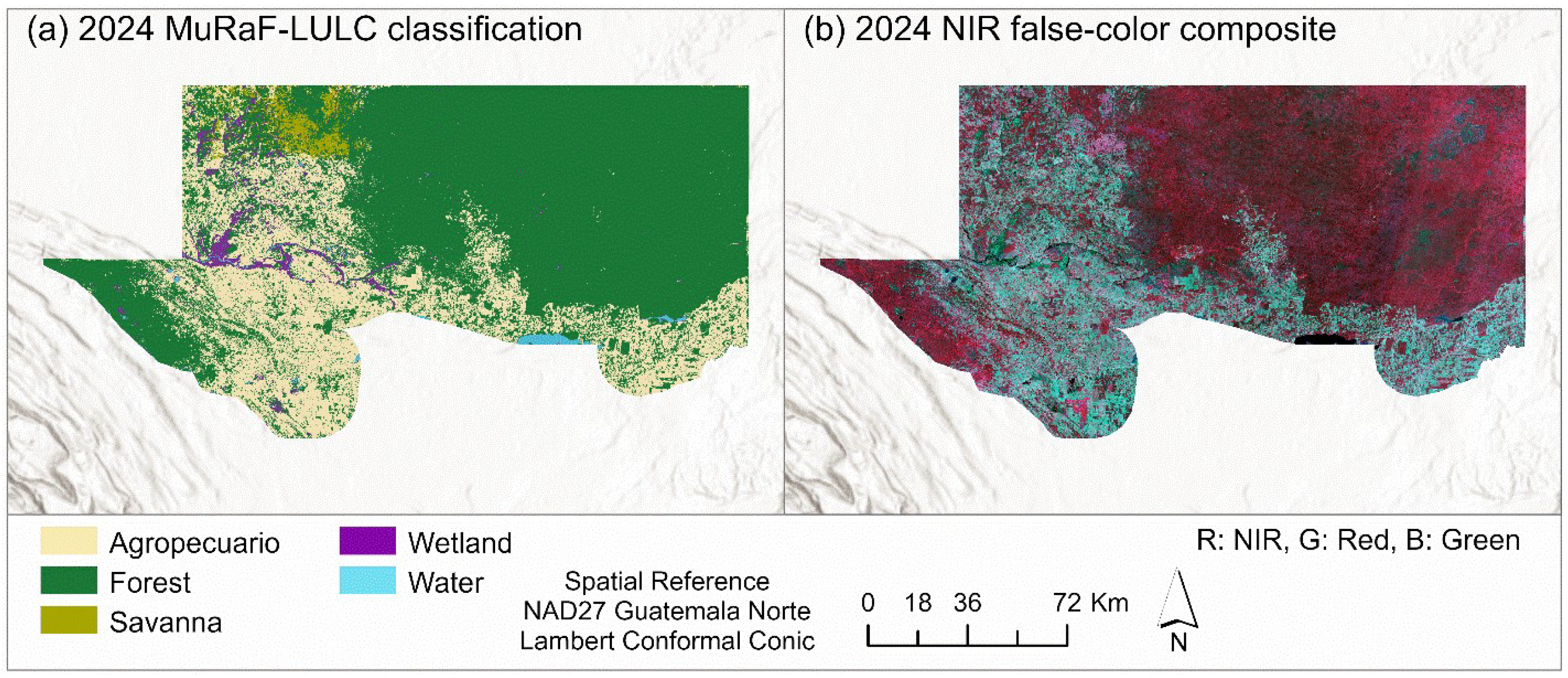
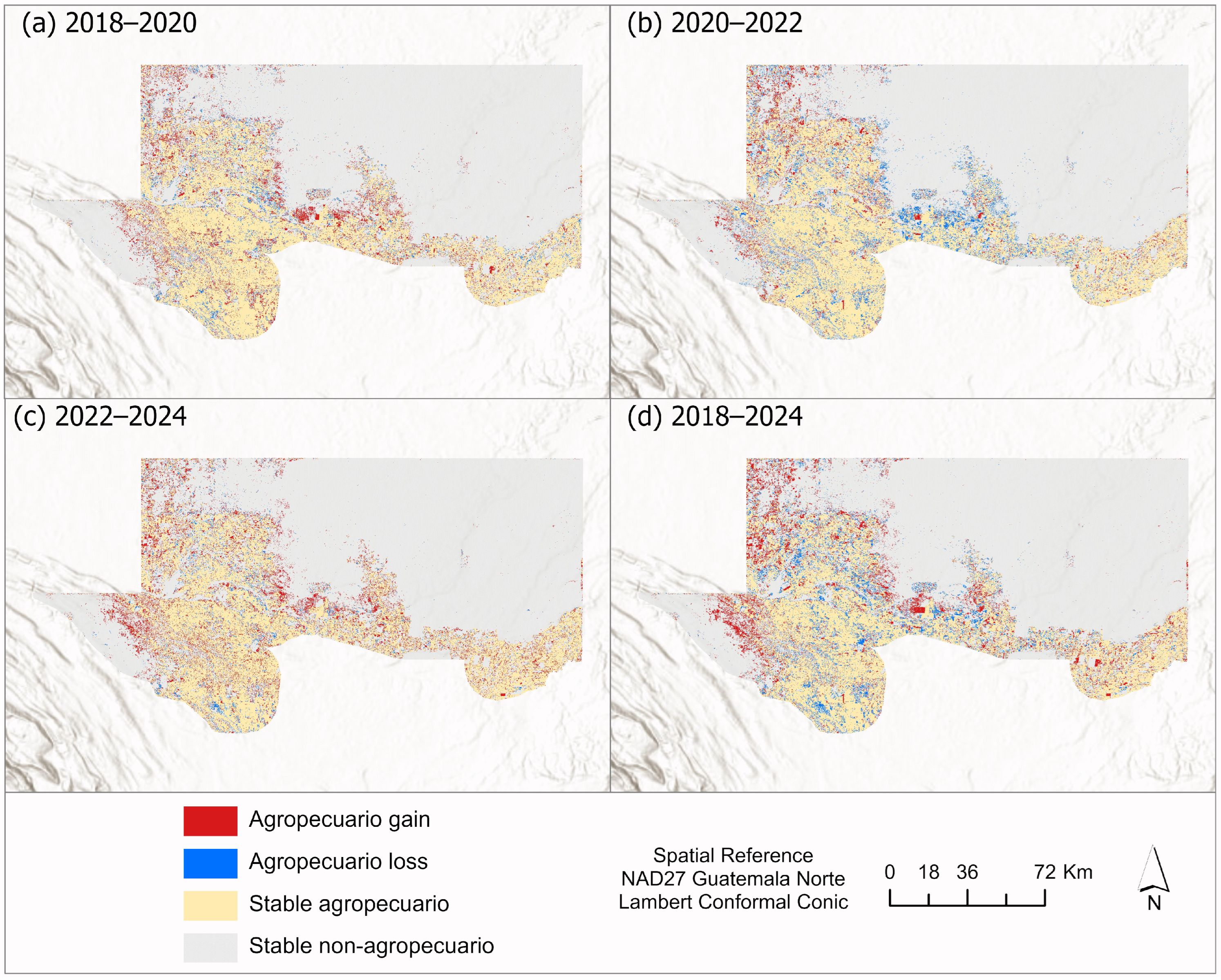
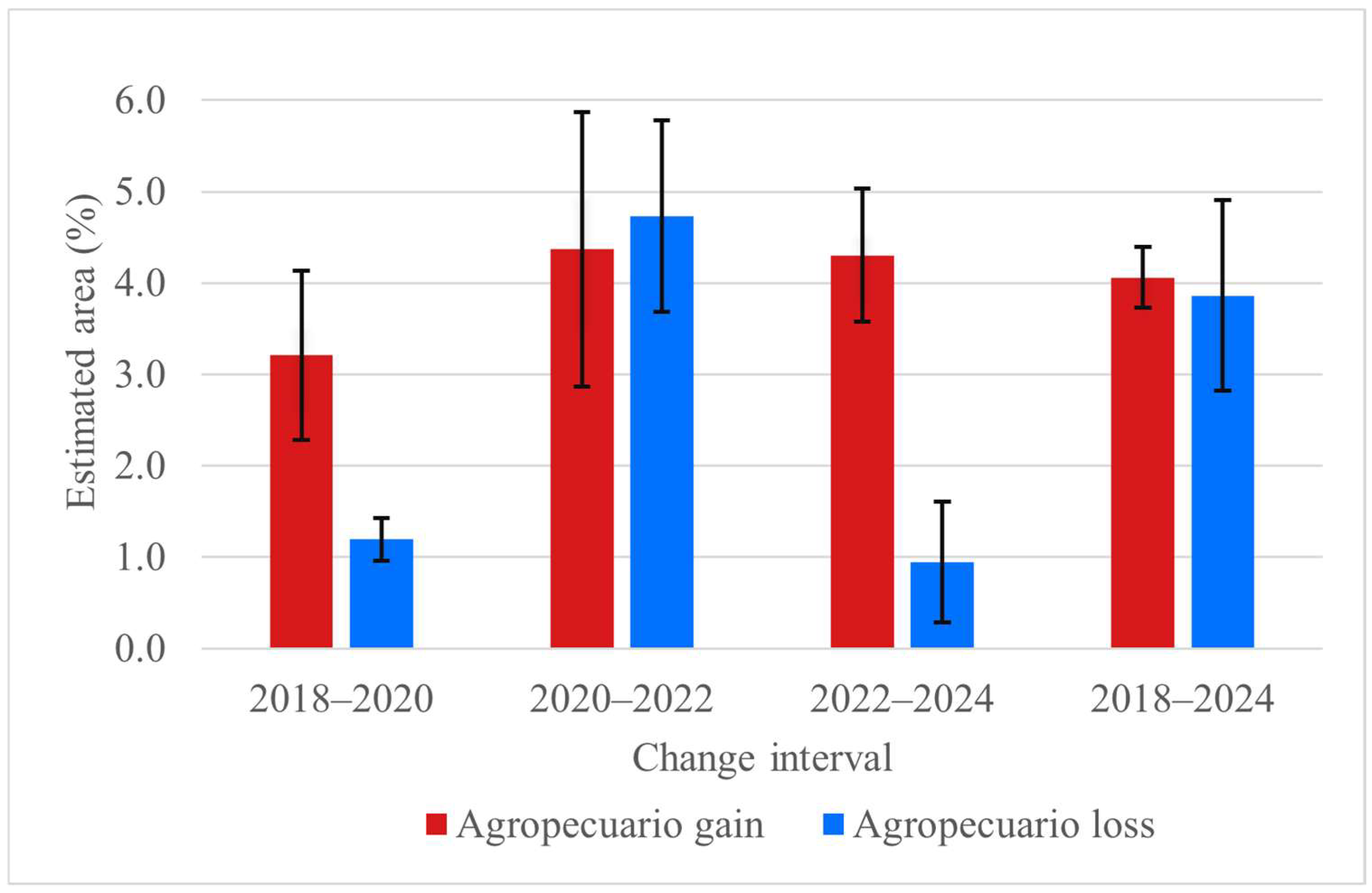
- LULC change-map derivation. After annual LULC maps are generated, MuRaF-LULC derives change maps through pixel-wise comparisons of class labels between consecutive years. No additional temporal consistency rules, persistence constraints, or post-classification filtering are applied. Change detection is implemented with respect to a user-defined target class, allowing the identification of specific interannual transitions (e.g., loss or gain of a given LULC type). The resulting change maps explicitly capture the spatial and temporal patterns of LULC transitions across the study period. In this study, change maps focus on gain and loss of the agropecuario class, which is the dominant LULC transition in the study area.
3.3. Validation Strategy
3.3.1. Collection of Reference Observations
3.3.2. Validation of Single-Date LULC Maps
3.3.3. Validation of Multi-Year LULC Change Maps
4. Results
4.1. MuRaF-LULC Outputs
4.2. Single-Date LULC Classification Accuracy
4.3. Multi-Year LULC Change Map Accuracy and Area Estimation
5. Discussion
5.1. MuRaF-LULC Performance
5.2. Comparison with Existing Algorithms
5.3. Limitations and Future Directions
6. Conclusions
Supplementary Materials
Funding
Data Availability Statement
Acknowledgments
Conflicts of Interest
References
- IPBES. Summary for Policymakers of the Global Assessment Report on Biodiversity and Ecosystem Services; Intergovernmental Science-Policy Platform on Biodiversity and Ecosystem Services (IPBES): Bonn, Germany, 2019; p. 1148.
- FAO. Land Statistics 2001–2022. Global, Regional and Country Trends; FAO: Rome, Italy, 2024. [Google Scholar]
- West, C.; Rabeschini, G.; Singh, C.; Kastner, T.; Lima, M.B.; Dermawan, A.; Croft, S.; Persson, U.M. The Global Deforestation Footprint of Agriculture and Forestry. Nat. Rev. Earth Environ. 2025, 6, 325–341. [Google Scholar] [CrossRef]
- Pendrill, F.; Gardner, T.A.; Meyfroidt, P.; Persson, U.M.; Adams, J.; Azevedo, T.; Lima, M.G.B.; Baumann, M.; Curtis, P.G.; Sy, V.D.; et al. Disentangling the Numbers behind Agriculture-Driven Tropical Deforestation. Science 2022, 377, eabm9267. [Google Scholar] [CrossRef]
- Newbold, T.; Hudson, L.N.; Hill, S.L.; Contu, S.; Lysenko, I.; Senior, R.A.; Börger, L.; Bennett, D.J.; Choimes, A.; Collen, B. Global Effects of Land Use on Local Terrestrial Biodiversity. Nature 2015, 520, 45–50. [Google Scholar] [CrossRef]
- Turner, B.L.; Lambin, E.F.; Reenberg, A. The Emergence of Land Change Science for Global Environmental Change and Sustainability. Proc. Natl. Acad. Sci. USA 2007, 104, 20666–20671. [Google Scholar] [CrossRef]
- Rindfuss, R.R.; Walsh, S.J.; Turner, B.L.; Fox, J.; Mishra, V. Developing a Science of Land Change: Challenges and Methodological Issues. Proc. Natl. Acad. Sci. USA 2004, 101, 13976–13981. [Google Scholar] [CrossRef]
- Gutman, G.; Janetos, A.C.; Justice, C.O.; Moran, E.F.; Mustard, J.F.; Rindfuss, R.R.; Skole, D.; Turner, B.L., II; Cochrane, M.A. Land Change Science: Observing, Monitoring and Understanding Trajectories of Change on the Earth’s Surface; Springer Science & Business Media: Berlin/Heidelberg, Germany, 2004; ISBN 978-1-4020-2561-7. [Google Scholar]
- Serra, P.; Salvati, L. Land Change Science and the STEPLand Framework: An Assessment of Its Progress. Land 2022, 11, 1065. [Google Scholar] [CrossRef]
- Woodcock, C.E.; Allen, R.; Anderson, M.; Belward, A.; Bindschadler, R.; Cohen, W.; Gao, F.; Goward, S.N.; Helder, D.; Helmer, E. Free Access to Landsat Imagery. Science 2008, 320, 1011. [Google Scholar] [CrossRef]
- Hemati, M.; Hasanlou, M.; Mahdianpari, M.; Mohammadimanesh, F. A Systematic Review of Landsat Data for Change Detection Applications: 50 Years of Monitoring the Earth. Remote Sens. 2021, 13, 2869. [Google Scholar] [CrossRef]
- Ustin, S.L.; Middleton, E.M. Current and Near-Term Advances in Earth Observation for Ecological Applications. Ecol. Process 2021, 10, 1. [Google Scholar] [CrossRef]
- Kennedy, R.E.; Yang, Z.; Cohen, W.B. Detecting Trends in Forest Disturbance and Recovery Using Yearly Landsat Time Series: 1. LandTrendr—Temporal Segmentation Algorithms. Remote Sens. Environ. 2010, 114, 2897–2910. [Google Scholar] [CrossRef]
- Verbesselt, J.; Hyndman, R.; Newnham, G.; Culvenor, D. Detecting Trend and Seasonal Changes in Satellite Image Time Series. Remote Sens. Environ. 2010, 114, 106–115. [Google Scholar] [CrossRef]
- Zhu, Z.; Woodcock, C.E.; Olofsson, P. Continuous Monitoring of Forest Disturbance Using All Available Landsat Imagery. Remote Sens. Environ. 2012, 122, 75–91. [Google Scholar] [CrossRef]
- Chen, S.; Woodcock, C.E.; Bullock, E.L.; Arévalo, P.; Torchinava, P.; Peng, S.; Olofsson, P. Monitoring Temperate Forest Degradation on Google Earth Engine Using Landsat Time Series Analysis. Remote Sens. Environ. 2021, 265, 112648. [Google Scholar] [CrossRef]
- Bullock, E.L.; Woodcock, C.E.; Olofsson, P. Monitoring Tropical Forest Degradation Using Spectral Unmixing and Landsat Time Series Analysis. Remote Sens. Environ. 2020, 238, 110968. [Google Scholar] [CrossRef]
- Reygadas, Y.; Spera, S.; Galati, V.; Salisbury, D.S.; Silva, S.; Novoa, S. Mapping Forest Disturbances Across the Southwestern Amazon: Tradeoffs Between Open-Source, Landsat-Based Algorithms. Environ. Res. Commun. 2021, 3, 091001. [Google Scholar] [CrossRef]
- Zhu, Z.; Woodcock, C.E. Continuous Change Detection and Classification of Land Cover Using All Available Landsat Data. Remote Sens. Environ. 2014, 144, 152–171. [Google Scholar] [CrossRef]
- Breiman, L. Random Forests. Mach. Learn. 2001, 45, 5–32. [Google Scholar] [CrossRef]
- Lambin, E.F.; Geist, H.J.; Lepers, E. Dynamics of Land-Use and Land-Cover Change in Tropical Regions. Annu. Rev. Environ. Resour. 2003, 28, 205–241. [Google Scholar] [CrossRef]
- Devine, J.A.; Currit, N.; Reygadas, Y.; Liller, L.I.; Allen, G. Drug Trafficking, Cattle Ranching and Land Use and Land Cover Change in Guatemala’s Maya Biosphere Reserve. Land Use Policy 2020, 95, 104578. [Google Scholar] [CrossRef]
- Davis, A.; Sauls, L. Evaluating the Effectiveness of Control and Prevention of Forest Fires in the Maya Biosphere Reserve, Guatemala—If Not Us Then Who; ACOFOP: Flores, Guatemala; PRISMA: San Salvador, El Salvador, 2017. [Google Scholar]
- Wrathall, D.J.; Devine, J.; Aguilar-González, B.; Benessaiah, K.; Tellman, E.; Sesnie, S.; Nielsen, E.; Magliocca, N.; McSweeney, K.; Pearson, Z.; et al. The Impacts of Cocaine-Trafficking on Conservation Governance in Central America. Glob. Environ. Change 2020, 63, 102098. [Google Scholar] [CrossRef]
- Ritchie, H. Deforestation and Forest Loss. 2021. Available online: https://ourworldindata.org/deforestation (accessed on 2 February 2026).
- Lawson, S. Consumer Goods and Deforestation: An Analysis of the Extent and Nature of Illegality in Forest Conversion for Agriculture and Timber Plantations; Forest Trends: Washington, DC, USA, 2014. [Google Scholar]
- Devine, J.A.; Wrathall, D.; Aguilar-González, B.; Benessaiah, K.; Tellman, B.; Ghaffari, Z.; Ponstingel, D. Narco-Degradation: Cocaine Trafficking’s Environmental Impacts in Central America’s Protected Areas. World Dev. 2021, 144, 105474. [Google Scholar] [CrossRef]
- Ray, D.K.; Welch, R.M.; Lawton, R.O.; Nair, U.S. Dry Season Clouds and Rainfall in Northern Central America: Implications for the Mesoamerican Biological Corridor. Glob. Planet. Change 2006, 54, 150–162. [Google Scholar] [CrossRef]
- Thornton, P.K.; Rodriguez, A.M.L.; Campbell, B.M.; Mercado, L.; Shackleton, S.; Kavikumar, K.S. Rural Livelihoods, Food Security and Rural Transformation Under Climate Change; Global Commission on Adaptation: Rotterdam, The Netherlands; Washington, DC, USA, 2019. [Google Scholar]
- Devine, J.A.; Wrathall, D.; Currit, N.; Tellman, B.; Reygadas, Y. Narco-Cattle Ranching in Political Forests. Antipode 2018, 52, 1018–1038. [Google Scholar] [CrossRef]
- Rouse, J.W.; Haas, R.H.; Schell, J.A.; Deering, D.W. Monitoring Vegetation Systems in the Great Plains with ERTS. In Proceedings of the Third Earth Resources Technology Satellite-1 Symposium; NASA: Washington, DC, USA, 1973; pp. 309–371. [Google Scholar]
- Souza, C.M.; Roberts, D.A.; Cochrane, M.A. Combining Spectral and Spatial Information to Map Canopy Damage from Selective Logging and Forest Fires. Remote Sens. Environ. 2005, 98, 329–343. [Google Scholar] [CrossRef]
- Schultz, M.; Clevers, J.G.P.W.; Carter, S.; Verbesselt, J.; Avitabile, V.; Quang, H.V.; Herold, M. Performance of Vegetation Indices from Landsat Time Series in Deforestation Monitoring. Int. J. Appl. Earth Obs. Geoinf. 2016, 52, 318–327. [Google Scholar] [CrossRef]
- Gao, B.C. NDWI—A Normalized Difference Water Index for Remote Sensing of Vegetation Liquid Water from Space. Remote Sens. Environ. 1996, 58, 257–266. [Google Scholar] [CrossRef]
- Huete, A.R. A Soil-Adjusted Vegetation Index (SAVI). Remote Sens. Environ. 1988, 25, 295–309. [Google Scholar] [CrossRef]
- McFeeters, S.K. The Use of the Normalized Difference Water Index (NDWI) in the Delineation of Open Water Features. Int. J. Remote Sens. 1996, 17, 1425–1432. [Google Scholar] [CrossRef]
- ESA-EU Copernicus DEM 2022. Available online: https://dataspace.copernicus.eu/explore-data/data-collections/copernicus-contributing-missions/collections-description/COP-DEM (accessed on 2 February 2026).
- IOGP EPSG Geodetic Parameter Dataset 2020. Available online: https://www.iogp.org/bookstore/product/epsg-dataset-policies-and-procedures-for-data-management/ (accessed on 2 February 2026).
- Saah, D.; Johnson, G.; Ashmall, B.; Tondapu, G.; Tenneson, K.; Patterson, M.; Poortinga, A.; Markert, K.; Quyen, N.H.; Aung, K.S.; et al. Collect Earth: An Online Tool for Systematic Reference Data Collection in Land Cover and Use Applications. Environ. Model. Softw. 2019, 118, 166–171. [Google Scholar] [CrossRef]
- Kennedy, R.E.; Yang, Z.; Gorelick, N.; Braaten, J.; Cavalcante, L.; Cohen, W.B.; Healey, S. Implementation of the LandTrendr Algorithm on Google Earth Engine. Remote Sens. 2018, 10, 691. [Google Scholar] [CrossRef]
- Belgiu, M.; Drăguţ, L. Random Forest in Remote Sensing: A Review of Applications and Future Directions. ISPRS J. Photogramm. Remote Sens. 2016, 114, 24–31. [Google Scholar] [CrossRef]
- Genuer, R.; Poggi, J.-M.; Tuleau-Malot, C. Variable Selection Using Random Forests. Pattern Recognit. Lett. 2010, 31, 2225–2236. [Google Scholar] [CrossRef]
- Olofsson, P.; Foody, G.M.; Herold, M.; Stehman, S.V.; Woodcock, C.E.; Wulder, M.A. Good Practices for Estimating Area and Assessing Accuracy of Land Change. Remote Sens. Environ. 2014, 148, 42–57. [Google Scholar] [CrossRef]
- Tyukavina, A.; Stehman, S.V.; Foody, G.M.; Bontemps, S.; See, L.; Olofsson, P.; Tsendbazar, N.E.; Radoux, J.; Komarova, A.; Serre, B.M. Land Cover and Change Map Accuracy Assessment and Area Estimation Good Practices Protocol; CEOS WGCV LPV: Frascati, Italy, 2025. [Google Scholar]
- Stehman, S.V. Estimating Area from an Accuracy Assessment Error Matrix. Remote Sens. Environ. 2013, 132, 202–211. [Google Scholar] [CrossRef]
- Meyer, H.; Reudenbach, C.; Wöllauer, S.; Nauss, T. Importance of Spatial Predictor Variable Selection in Machine Learning Applications–Moving from Data Reproduction to Spatial Prediction. Ecol. Model. 2019, 411, 108815. [Google Scholar] [CrossRef]
- Huang, C.; Goward, S.N.; Masek, J.G.; Thomas, N.; Zhu, Z.; Vogelmann, J.E. An Automated Approach for Reconstructing Recent Forest Disturbance History Using Dense Landsat Time Series Stacks. Remote Sens. Environ. 2010, 114, 183–198. [Google Scholar] [CrossRef]



| Change Interval | Agropecuario Loss | Agropecuario Gain | Stable Agropecuario | Stable Non-Agropecuario |
|---|---|---|---|---|
| 2018–2020 | 30 | 75 | 37 | 78 |
| 2020–2022 | 30 | 75 | 33 | 83 |
| 2022–2024 | 30 | 75 | 34 | 81 |
| 2018–2024 | 30 | 75 | 32 | 83 |
| Predictor Variable | Rank | Importance Score | Retained in the Final Model |
|---|---|---|---|
| Latitude | 1 | 4539 | Yes |
| Longitude | 2 | 4301 | Yes |
| DEM | 3 | 4184 | Yes |
| SWIR1640 | 4 | 3450 | Yes |
| SWIR2130 | 5 | 3177 | Yes |
| NDWI | 6 | 2937 | Yes |
| NDMI2130 | 7 | 2812 | Yes |
| NDMI1640 | 8 | 2770 | Yes |
| NDVI | 9 | 2768 | Yes |
| SAVI | 10 | 2740 | No |
| NDFI | 11 | 2712 | No |
| Reference | |||||||||
|---|---|---|---|---|---|---|---|---|---|
| Agropecuario | Forest | Savanna | Wetland | Water | Total | Producer’s Accuracy | |||
| MuRaF-LULC | 2018 | Agropecuario | 56 | 5 | 0 | 1 | 0 | 62 | 0.90 |
| Forest | 6 | 138 | 0 | 0 | 0 | 144 | 0.96 | ||
| Savanna | 4 | 0 | 21 | 0 | 0 | 25 | 0.84 | ||
| Wetland | 3 | 2 | 0 | 20 | 0 | 25 | 0.80 | ||
| Water | 0 | 0 | 0 | 0 | 20 | 20 | 1.00 | ||
| Total | 69 | 145 | 21 | 21 | 20 | 276 | |||
| User’s Accuracy | 0.81 | 0.95 | 1.00 | 0.95 | 1.00 | ||||
| 2020 | Agropecuario | 75 | 13 | 1 | 3 | 0 | 92 | 0.82 | |
| Forest | 3 | 113 | 1 | 0 | 0 | 117 | 0.97 | ||
| Savanna | 0 | 0 | 25 | 0 | 0 | 25 | 1.00 | ||
| Wetland | 2 | 0 | 0 | 22 | 0 | 24 | 0.92 | ||
| Water | 0 | 0 | 0 | 1 | 20 | 21 | 0.95 | ||
| Total | 80 | 126 | 27 | 26 | 20 | 279 | |||
| User’s Accuracy | 0.94 | 0.90 | 0.93 | 0.85 | 1.00 | ||||
| 2022 | Agropecuario | 69 | 3 | 0 | 1 | 0 | 73 | 0.95 | |
| Forest | 9 | 126 | 1 | 1 | 0 | 137 | 0.92 | ||
| Savanna | 7 | 0 | 26 | 0 | 0 | 33 | 0.79 | ||
| Wetland | 3 | 0 | 0 | 22 | 0 | 25 | 0.88 | ||
| Water | 0 | 0 | 0 | 0 | 20 | 20 | 1.00 | ||
| Total | 88 | 129 | 27 | 24 | 20 | 288 | |||
| User’s Accuracy | 0.78 | 0.98 | 0.96 | 0.92 | 1.00 | ||||
| 2024 | Agropecuario | 90 | 14 | 1 | 2 | 0 | 107 | 0.84 | |
| Forest | 4 | 97 | 0 | 0 | 0 | 101 | 0.96 | ||
| Savanna | 3 | 0 | 22 | 0 | 0 | 25 | 0.88 | ||
| Wetland | 2 | 1 | 0 | 20 | 0 | 23 | 0.87 | ||
| Water | 0 | 0 | 0 | 0 | 20 | 20 | 1.00 | ||
| Total | 99 | 112 | 23 | 22 | 20 | 276 | |||
| User’s Accuracy | 0.91 | 0.87 | 0.96 | 0.91 | 1.00 | ||||
| Class | Estimated Area Proportion | SE Estimated Area Proportion | User’s Accuracy | SE User’s Acc. | Producer’s Accuracy | SE Producer’s Accuracy | |
|---|---|---|---|---|---|---|---|
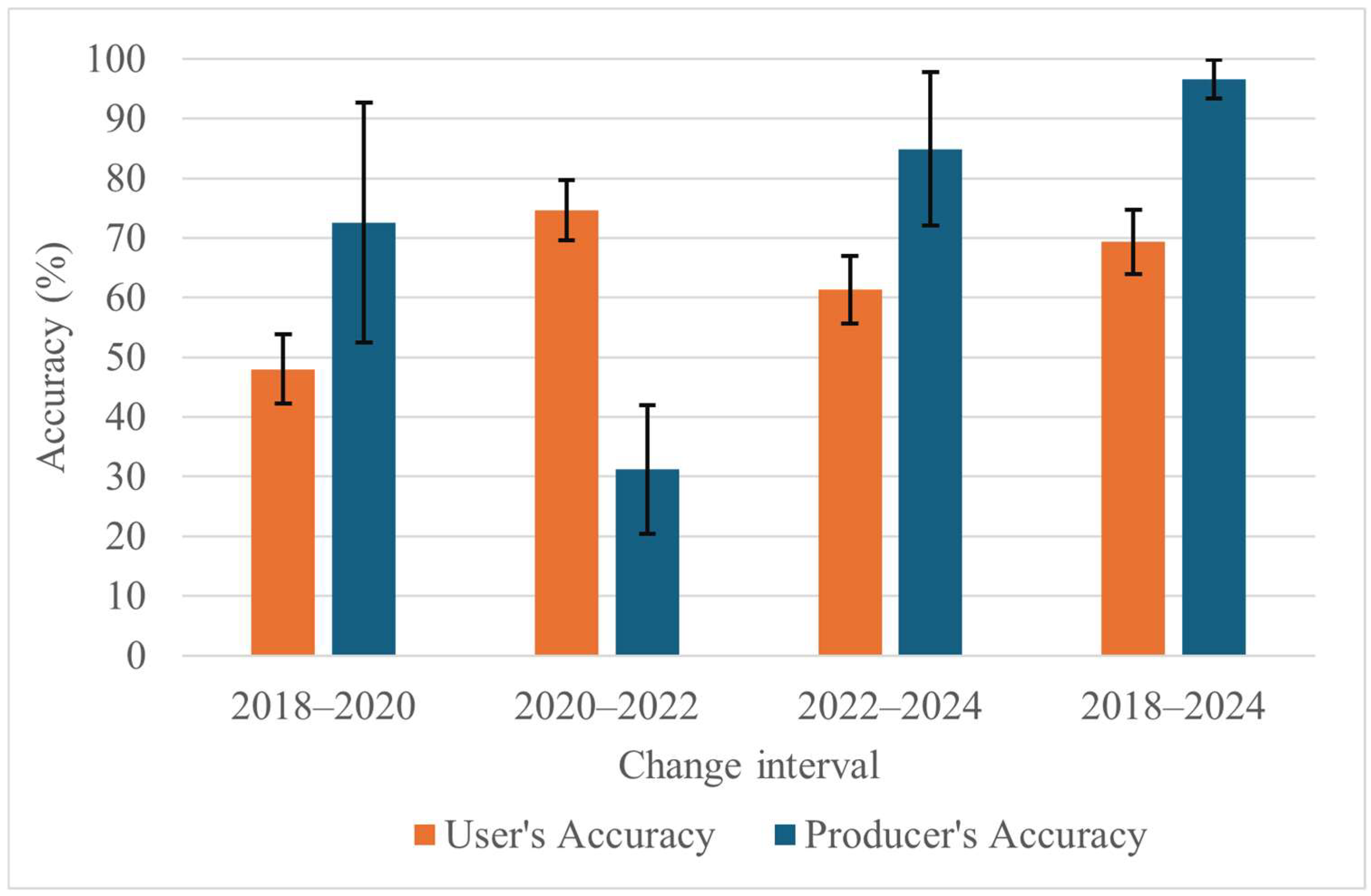
| 2018–2020 | Agropecuario gain | 0.03 | 0.01 | 0.48 | 0.06 | 0.73 | 0.2 |
| Agropecuario loss | 0.01 | 0 | 0.47 | 0.09 | 0.95 | 0.05 | |
| Stable agropecuario | 0.26 | 0.01 | 0.95 | 0.04 | 0.89 | 0.03 | |
| Stable non-agropecuario | 0.7 | 0.02 | 0.97 | 0.02 | 0.96 | 0.01 | |
| 2020–2022 | Agropecuario gain | 0.04 | 0.01 | 0.75 | 0.05 | 0.31 | 0.11 |
| Agropecuario loss | 0.05 | 0.01 | 0.57 | 0.09 | 0.82 | 0.15 | |
| Stable agropecuario | 0.22 | 0.02 | 0.88 | 0.06 | 0.88 | 0.04 | |
| Stable non-agropecuario | 0.69 | 0.02 | 0.95 | 0.02 | 0.96 | 0.01 | |
| 2022–2024 | Agropecuario gain | 0.04 | 0.01 | 0.61 | 0.06 | 0.85 | 0.13 |
| Agropecuario loss | 0.01 | 0.01 | 0.17 | 0.07 | 0.31 | 0.23 | |
| Stable agropecuario | 0.23 | 0.01 | 0.91 | 0.05 | 0.87 | 0.03 | |
| Stable non-agropecuario | 0.72 | 0.01 | 0.99 | 0.01 | 0.97 | 0.01 | |
| 2018–2024 | Agropecuario gain | 0.04 | 0 | 0.69 | 0.05 | 0.97 | 0.03 |
| Agropecuario loss | 0.04 | 0.01 | 0.6 | 0.09 | 0.64 | 0.16 | |
| Stable agropecuario | 0.22 | 0.01 | 0.94 | 0.04 | 0.94 | 0.02 | |
| Stable non-agropecuario | 0.7 | 0 | 1 | 0 | 0.97 | 0.01 |
| Algorithm | Main Objective | Core Output (Representative, Not Exhaustive) | Comparison Relative to MuRaF-LULC |
|---|---|---|---|
| VCT [47] | Detection of forest disturbances using spectral trajectories | Disturbance timing and magnitude | Forest-focused; not designed to produce multi-class annual LULC maps |
| LandTrendr [13] | Detection of vegetation disturbance and recovery using segmented spectral trajectories | Disturbance year, magnitude, duration, and rate of change | Vegetation-focused; not designed to produce multi-class annual LULC maps |
| BFAST [14] | Detection of change events in trend and seasonal components of spectral time series | Time and magnitude of change events | Generic change detection; no explicit LULC labeling |
| CMFDA [15] | Detection of forest disturbances based on deviations from modeled trends | Disturbance timing and signal magnitude | Forest-focused; not designed to produce multi-class annual LULC maps |
| CCDC [19] | Detection and classification of change events based on deviations from modeled trends | Change timing and segment-based LULC labels | LULC class labels remain fixed within segments; not independent annual LULC classifications |
| CCDC-SMA [16] | Detection of forest degradation based on deviations from modeled trends using spectral mixture trajectories | Timing of degradation events and subpixel fraction trajectories | Forest degradation-focused; not designed to produce multi-class annual LULC maps |
| CODED [17] | Detection of forest disturbances based on changes in NDFI trajectories | Change timing, magnitude, and forest condition classes | Forest degradation and deforestation mapping; produces stratified forest condition fixed to change timing; not designed to produce multi-class annual LULC maps |
| MTDD [18] | Detection of annual forest disturbance events using multivariate trajectory metrics | Annual forest disturbance maps | Focused on forest disturbances rather than full multi-class LULC mapping |
| MuRaF-LULC | Detection of annual LULC classes and interannual transitions | Annual LULC maps and derived changes | Reference framework |
Disclaimer/Publisher’s Note: The statements, opinions and data contained in all publications are solely those of the individual author(s) and contributor(s) and not of MDPI and/or the editor(s). MDPI and/or the editor(s) disclaim responsibility for any injury to people or property resulting from any ideas, methods, instructions or products referred to in the content. |
© 2026 by the author. Licensee MDPI, Basel, Switzerland. This article is an open access article distributed under the terms and conditions of the Creative Commons Attribution (CC BY) license.
Share and Cite
Reygadas, Y. MuRaF-LULC: A Systematic Multivariate Random Forest Framework for Annual Land-Use and Land-Cover Mapping and Long-Term Change Detection. Land 2026, 15, 268. https://doi.org/10.3390/land15020268
Reygadas Y. MuRaF-LULC: A Systematic Multivariate Random Forest Framework for Annual Land-Use and Land-Cover Mapping and Long-Term Change Detection. Land. 2026; 15(2):268. https://doi.org/10.3390/land15020268
Chicago/Turabian StyleReygadas, Yunuen. 2026. "MuRaF-LULC: A Systematic Multivariate Random Forest Framework for Annual Land-Use and Land-Cover Mapping and Long-Term Change Detection" Land 15, no. 2: 268. https://doi.org/10.3390/land15020268
APA StyleReygadas, Y. (2026). MuRaF-LULC: A Systematic Multivariate Random Forest Framework for Annual Land-Use and Land-Cover Mapping and Long-Term Change Detection. Land, 15(2), 268. https://doi.org/10.3390/land15020268