Article

From Competition to Collaboration: The Evolutionary Dynamics Between Economic and Ecological Departments in Sustainable Land-Use Planning


1
College of Arts, Humanities and Social Sciences, University of Edinburgh, Edinburgh EH8 9YL, UK
2
School of Government, Nanjing University, Nanjing 210023, China
*
Author to whom correspondence should be addressed.
Land 2026, 15(2), 249; https://doi.org/10.3390/land15020249
Submission received: 15 December 2025 / Revised: 28 January 2026 / Accepted: 30 January 2026 / Published: 31 January 2026
(This article belongs to the Section Land Socio-Economic and Political Issues)

Abstract

The collaboration between economic and ecological departments in land-use planning is crucial for advancing sustainable development. However, existing research has largely focused on macro-level policies and technical instruments, paying insufficient attention to the micro-level logics of behavior and strategic interactions between these two departments. This research employs a rigorous mixed-methods approach to bridge empirical depth with analytical rigor. The qualitative phase, encompassing 41 semi-structured interviews and analysis of 327 internal documents, examines the departments’ real-world motivations, strategic behaviors, and the cost–benefit structures underlying their decision-making. Based on these empirical findings, a tailored evolutionary game theory model is constructed to formally simulate the dynamic pathways and stable equilibria of collaboration between the Economic and Ecological Departments. Our analysis reveals that the evolutionary game system converges toward a dichotomy of stable states: a non-cooperative equilibrium characterized by development-oriented land-use planning with adaptive regulation, and a cooperative equilibrium underpinned by green-coordinated planning supported by stringent regulatory enforcement. A cooperative equilibrium is more readily achieved when both departments demonstrate a willingness to simultaneously increase their cost investment parameters in sustainable land-use planning. Conditions contrary to this mutual commitment lead to a non-cooperative equilibrium. Building on these findings, the study synthesizes this interplay into a novel “Institutional-Situational-Behavioral” (ISB) framework. This framework provides a cohesive theoretical lens for diagnosing and fostering interdepartmental collaboration in sustainable land governance. The research thus offers a theoretical foundation for analyzing the evolutionary dynamics of interdepartmental collaboration and delivers mechanism-informed policy guidance for enhancing sustainable land-use planning.

1. Introduction

Land is the fundamental spatial carrier for economic development and ecological conservation, constituting a critical nexus for achieving sustainable development goals globally [1]. The tension between land supply for economic growth and the imperative for ecological conservation has become increasingly acute in many rapidly urbanizing and industrializing countries, testing the limits of sustainable land governance [2]. This challenge is institutionalized within the government’s administrative structure [3], where the Economic Department and the Ecological Department operate with overlapping yet often competing mandates over land-use planning. The former is primarily driven by goals of economic growth, investment promotion, and urban expansion [4], while the latter is charged with enforcing environmental regulations, protecting ecological red lines, and mitigating pollution [5]. This institutional arrangement, designed for comprehensive oversight, frequently sets the stage for strategic interactions. In these interactions, overlapping responsibilities and divergent performance metrics transform potential synergy into tangible competition over land resources and planning authority [6].
Existing research has extensively documented the symptoms and consequences of this sectoral fragmentation, highlighting issues such as urban sprawl, farmland loss, and vegetation degradation [7,8,9]. Scholars widely acknowledge that effective and sustainable land-use planning necessitates well-coordinated, collaborative governance across departmental boundaries [10]. However, a significant research gap persists. While existing literature has focused on macro-level policy analysis [11], technological solutions like spatial planning support systems [12], or economic instruments such as transferable development rights [13], there is insufficient scholarly attention on the micro-foundational mechanisms of interdepartmental interactions. We know little about the endogenous behavioral logics, strategic calculations, and evolutionary pathways that characterize how the Economic and Ecological Departments navigate competition and collaboration in concrete planning decisions.
In China, the scale of this challenge is particularly evident. With an urbanization rate reaching 67.89% in 2025 [14], rapid urban and industrial expansion has fueled intense competition for land. This is reflected in the significant fluctuation of national cropland area, which decreased from approximately 134.99 million hectares in 2015 to 127.44 million hectares in 2020, before recovering slightly to 128.61 million hectares by 2023, amidst continuous pressure for conversion to construction uses [15]. These tangible land-use outcomes are not merely the result of technical miscalculations or policy failures; they are fundamentally shaped by the strategic interactions between the government departments tasked with managing these competing land demands [16]. Therefore, to understand and navigate the profound tensions highlighted by China’s rapid development trajectory, a micro-level analysis of how these departments interact becomes indispensable.
To address this gap, the study investigates both the evolutionary dynamics of strategic interactions between the Economic and Ecological Departments in land-use planning and the micro-mechanisms that drive the system toward competition or collaboration. We employ an evolutionary game theory approach within a mixed-methods framework, a perspective particularly relevant for analyzing boundedly rational actors such as government departments [17]. This approach captures how strategies are not fixed but adapt over time through learning, imitation, and adjustment based on observed outcomes [18]. By moving beyond static depictions, this approach enables the modeling of the dynamic evolution of interdepartmental relations, revealing how stable behavioral patterns, whether competitive or collaborative, emerge from repeated interactions.
By adopting a rigorous mixed-methods approach, this study integrates in-depth qualitative fieldwork with formal evolutionary game modeling. The qualitative phase, which draws on extensive interviews with officials and analysis of internal government documents, enables us to uncover the practical decision-making motivations, behavioral strategies, and cost–benefit structures that shape the interactions between the two departments. This empirically grounded understanding then directly informs the construction of a tailored evolutionary game model, ensuring that its structure and parameters reflect the real-world logics underlying interdepartmental dynamics [19]. The rationale for employing formal modeling is to systematically trace the consequences of the strategic interactions identified qualitatively [20]. Formulated as boundedly rational actors, the two departments in the model continuously learn and adapt their strategies based on the payoffs observed through interaction. This approach enables us to simulate the dynamic pathways of interdepartmental relations, identify stable equilibria (both cooperative and non-cooperative), and pinpoint the critical parameters, such as costs and benefits, that shift the system from one state to another [17].
More importantly, this research synthesizes these findings into a novel ISB framework. This framework elucidates the micro-mechanisms that drive the evolution from interdepartmental competition toward sustained collaboration. It shows how collaboration is driven by reshaping institutional incentives to reward joint outcomes, creating enabling situational contexts via embedded procedures and shared platforms, and fostering adaptive behavioral change through capacity building and norm reinforcement.
This research makes three key contributions. First, it develops an ISB framework to elucidate the micro-mechanisms of interdepartmental dynamics, thereby demonstrating how the transition from cross-sector competition to collaborative governance occurs in land-use planning. Second, it employs a robust application of mixed methods in this domain. By grounding a formal evolutionary game model in rich qualitative evidence, we bridge deep contextual understanding with generalizable analytical rigor. This replicable approach provides a new analytical lens for examining bureaucratic behaviors in complex governance contexts like land-use planning. Third, the findings offer actionable, mechanism-based policy insights. By revealing the specific cost and benefit structures that incentivize competition or collaboration, the study provides a clear blueprint for policymakers to redesign performance evaluations, accountability systems, and inter-departmental coordination platforms to foster stable collaborative governance in land-use planning.
The remainder of this paper is structured as follows. Section 2 clarifies the core concepts and reviews the literature on land-use governance challenges and interdepartmental collaboration. Section 3 details the mixed-methods research design. Section 4 presents the model’s results, identifying evolutionary stable strategies and the conditions for convergence toward these equilibria. Section 5 develops and discusses an integrative theoretical framework derived from the findings, along with its scholarly contributions and policy implications. Section 6 concludes by summarizing the key insights of the study.

2. Literature Review

This section first clarifies the core conceptual underpinnings of the study and then reviews the existing scholarship on land-use governance challenges and interdepartmental collaboration.

2.1. Conceptual Clarification

This part clarifies three core concepts to delineate the study’s scope and establish a coherent conceptual foundation for the analysis.
First, sustainable land-use planning refers to a spatial decision-making process aimed at balancing long-term economic, social, and environmental imperatives [2,21]. It transcends traditional growth-oriented planning by emphasizing the integration of strategies such as ecological conservation redlines, land-use efficiency enhancement, and compact urban development to reconcile the inherent tension between economic growth and ecological preservation [4]. The ultimate goal is to achieve intergenerational equity and systemic resilience in land resource management. This study focuses specifically on the interdepartmental interaction mechanisms that either facilitate or hinder the realization of this sustainable land-use planning ideal.
Second, interdepartmental collaboration in this context denotes the structured interactions between the Economic Department and the Ecological Department to achieve shared sustainable land-use objectives. This collaboration moves beyond mere information exchange or ad hoc consultation. It involves joint goal-setting, shared decision-making, resource pooling, and collective accountability for outcomes [22]. The essence lies in transforming potential inter-sectoral competition into synergistic collective action through institutionalized platforms and procedures [17], thereby overcoming the collective action dilemmas and efficiency losses stemming from fragmented mandates and divergent performance metrics.
Third, the evolutionary dynamics examined here capture the adaptive and path-dependent nature of strategic interactions between the two departments. Conceptualized through evolutionary game theory, these dynamics depict how boundedly rational departments continuously adjust their strategies based on observed payoffs and imitation [19]. These include the Economic Department’s choice between growth-priority and green-coordination, and the Ecological Department’s choice between stringent and adaptive regulation. The system evolves over time, potentially converging towards stable equilibria characterized either by entrenched competition or sustained collaboration [17]. This conceptual lens allows us to analyze not static outcomes but the endogenous processes, feedback loops, and critical thresholds that shape the trajectory of interdepartmental relations in land-use planning.

2.2. The Core Challenges in Sustainable Land-Use Planning

Land serves as the finite spatial carrier for all human activities. The competition for land is a fundamental challenge to sustainable development [1]. Economic growth demands land for urbanization, industrial expansion, and infrastructure development [4]. Meanwhile, ecological health requires protected spaces for natural habitats, water conservation, and climate regulation [5,23]. This zero-sum competition creates a persistent tension. Scholars argue that this tension has been intensified by decades of rapid urbanization, pushing land governance to its sustainable limits [24]. The visible consequences of this competition are well-documented. Scholars have detailed the outcomes of uncoordinated or growth-biased land use: uncontrolled urban sprawl that consumes surrounding farmland and natural areas [25], the irreversible loss of productive agricultural land, which threatens food security [26], and the fragmentation and degradation of critical ecosystems that undermine environmental sustainability [27].
Research has moved beyond simply documenting these symptoms to analyzing the underlying drivers. A significant focus has been on policy and economic instruments designed to manage land-use trade-offs. Studies have evaluated the effectiveness of tools like transferable development rights [13], which aim to redirect development pressure from ecologically sensitive areas to more suitable zones. Similarly, spatial planning support systems and land-use zoning have been promoted as technological solutions to optimize land allocation scientifically [12]. However, a recurring critique in the literature is that these tools often operate within a fragmented governance framework [28]. Their success is limited not by their technical design, but by the institutional environment in which they are implemented. Scholars emphasize that sustainable land-use planning is fundamentally a governance problem, necessitating collaboration across the administrative boundaries that separate economic and environmental mandates [16,24]. This acknowledgment points to a significant gap: while the need for collaboration is universally recognized, the internal workings of the bureaucratic machinery tasked with this collaboration remain underexplored.

2.3. Institutional Dynamics and the Imperative for Collaborative Land Governance

The challenge of land-use planning is institutionalized within government structures. It is not merely a technical or policy problem, but a problem of interdepartmental relations. As many scholars note, distinct administrative departments embody the competing imperatives of development and conservation [29]. The Economic Department, driven by growth targets, investment promotion, and urban expansion, views land primarily as a factor of production [4]. In contrast, the Ecological Department, charged with enforcing environmental regulations and protecting ecological red lines, views land as a life-supporting system to be safeguarded [5]. This institutional arrangement, designed for specialized oversight, often creates overlapping responsibilities and divergent performance metrics. The potential for synergy is frequently lost, replaced by competition over planning authority and land resources.
This dynamic aligns with broader theories of bureaucratic politics and collective action. Departments operate as boundedly rational actors, seeking to maximize their institutional interests as defined by their specific mandates and performance evaluations [17]. When responsibilities overlap, strategic interactions emerge. Each department may engage in behaviors such as turf protection, blame avoidance, or free-riding, hoping the other will bear the costs of sustainable management while it reaps its preferred benefits [22]. This creates a classic collective action dilemma: individually rational strategies pursued by each department ultimately result in collectively suboptimal outcomes, such as inefficient land use and environmental degradation [24,30].
In response, the concept of collaborative governance has been advanced as a critical solution for land-use planning. Collaborative governance involves bringing multiple stakeholders, particularly different government departments, into structured processes of mutual trust, shared decision-making, and joint action [31]. For land use, this means creating platforms and procedures that force the Economic and Ecological Departments to negotiate, share information, and align their plans. The theoretical benefits are clear: it can internalize environmental externalities into economic planning, optimize resource allocation across sectors, and produce more coherent and legitimate policies.
Despite the recognized importance of collaborative governance as a solution, the existing literature exhibits two key limitations that hinder its practical application in land-use planning. First, there is a paucity of detailed, micro-level analyses that elucidate the endogenous mechanisms, such as motivations, cost–benefit calculations, and behavioral logics, guiding departments toward competition or collaboration in their day-to-day interactions. Second, although collaborative governance frameworks have been proposed, they remain largely normative and have not been adequately operationalized or empirically tested within the specific land governance context. To bridge these gaps, this study dissects the micro-foundations of interdepartmental interactions in Chinese land-use planning, aiming to provide a mechanistic understanding of how collaboration can be initiated and sustained in practice.

3. Methods and Model

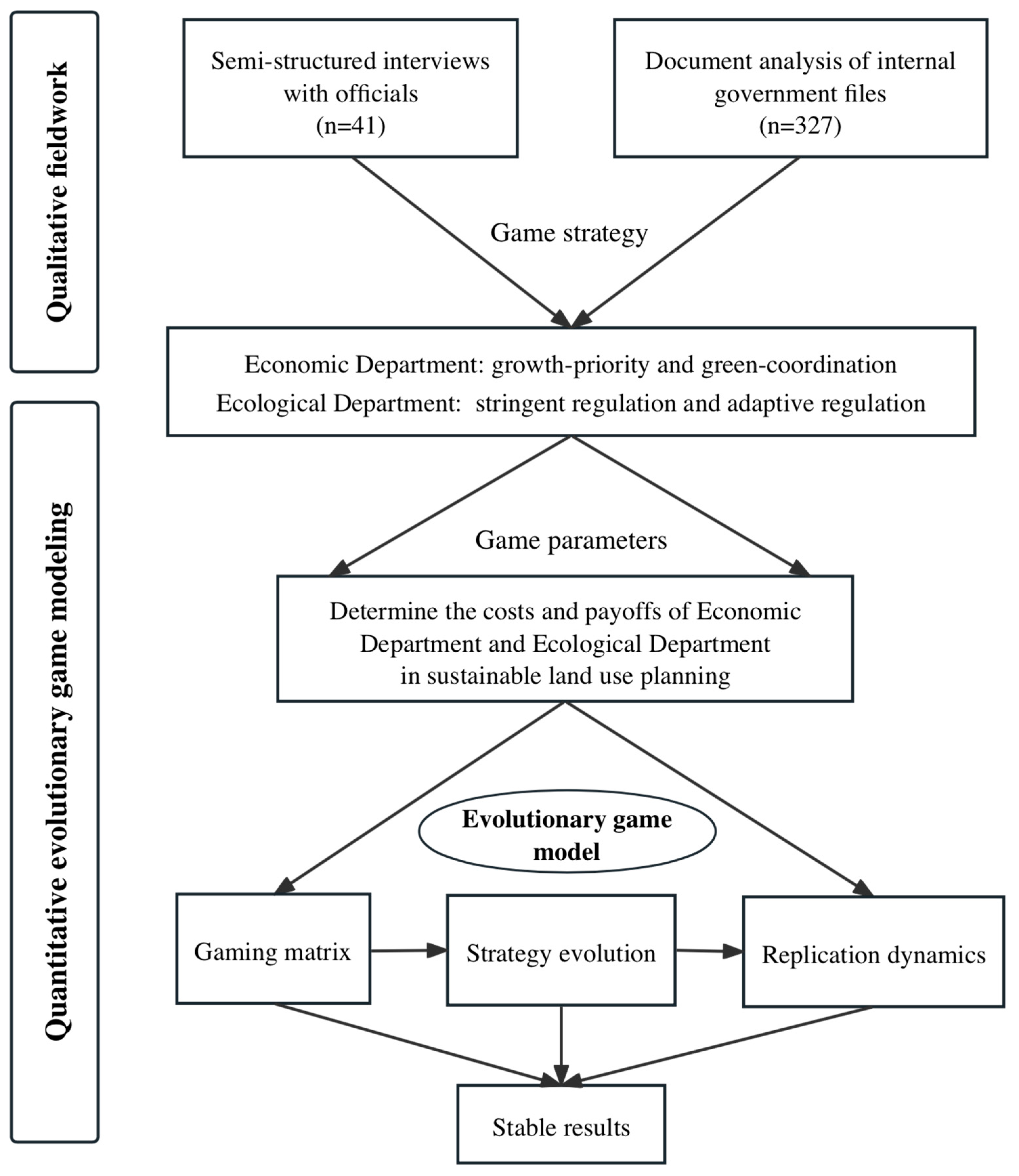
To systematically analyze the complex micro-dynamics driving their competition or collaboration, we employ an integrative mixed-methods approach. This approach synergizes in-depth qualitative fieldwork with formal evolutionary game theory modeling, ensuring the analysis is both empirically grounded and analytically rigorous (Figure 1).

3.1. Qualitative Interviews and Document Analysis

The foundation of our quantitative model is extensive qualitative fieldwork conducted across several Chinese provinces and municipalities known for their active land-use planning and ecological conservation efforts.

3.1.1. Semi-Structured Interviews

We conducted 41 in-depth, semi-structured interviews with governmental officials actively involved in land-use planning processes. Interviewees were selected using a purposive and snowball sampling strategy to ensure representation from both the Economic Department (e.g., officials from development and reform commissions, departments of housing and urban-rural development, and administrative committees of development zones) and the Ecological Department (e.g., officials from bureaus of ecology and environment, and departments of natural resources). Recruitment was facilitated through professional networks and institutional referrals, with all participants providing informed consent prior to the interviews.
Each interview followed a standardized protocol designed to explore officials’ decision-making logics, cost–benefit structures of different planning strategies, institutional pressures, and experiences of interdepartmental interactions. Interviews lasted approximately 60 min on average and were transcribed in full. To ensure confidentiality, all transcripts were anonymized by removing any identifying information before analysis.
Interview data were analyzed using a thematic analysis approach. The coding process was facilitated by NVivo software (version 14). Three researchers independently conducted the initial coding of the interview transcripts to identify recurring themes and concepts related to strategic behavior, cost–benefit structures, and collaborative dynamics. This process involved both inductive (emerging from the data) and deductive (informed by the research questions and theoretical framework) coding. The researchers then compared, discussed, and refined their respective code sets, resolving discrepancies through consensus. This iterative process led to the consolidation of codes into a coherent thematic framework that directly informed the identification and parameterization of key variables for the subsequent evolutionary game model. The semi--structured interview protocol used in this phase is provided in Appendix A.

3.1.2. Systematic Document Analysis

In parallel, a systematic analysis of 327 internal government documents was carried out to triangulate and contextualize the interview findings. These documents were obtained directly from the interviewed officials during the fieldwork, which ensured access to authentic and policy-relevant materials. The corpus included land-use master plans, environmental impact assessment reports, interdepartmental meeting minutes, and performance evaluation guidelines.
To ensure relevance and rigor, three researchers independently screened all documents based on predefined criteria: documents had to (1) explicitly address land-use planning or interdepartmental coordination, and (2) originate from the Economic or Ecological Departments within the studied regions. Documents not meeting these criteria were excluded. The retained documents were then analyzed using qualitative content analysis. The analysis, also supported by NVivo, focused on identifying formal procedures, institutional discourses, and evidence of strategic interactions. Coding was performed separately by the three researchers, following a similar collaborative process as with the interview data, with disagreements resolved through discussion to enhance reliability and consistency.
The integration of interview and document data provided a rich, triangulated understanding of the strategic landscape in which the two departments operate. This empirical foundation was essential for deriving the core assumptions of our evolutionary game model. Both departments are conceptualized as boundedly rational actors driven by distinct, and often competing, institutional mandates and performance metrics. This foundational insight is consistently reflected across both interview narratives and documentary records. The tension between them is not merely ideological but rooted in tangible competition over finite land resources and planning authority, as evidenced across multiple data sources. To enhance the transparency of our mixed-methods design and to succinctly summarize the qualitative data that grounds the subsequent model, Table 1 provides an overview of the interview and document distributions, alongside the key empirical themes that directly informed the specification of the evolutionary game model’s strategies and parameters.

3.2. Quantitative Evolutionary Game Modeling

Evolutionary game theory is used to analyze the strategic interactions between the Economic and Ecological Departments over repeated decision-making cycles. This framework is well-suited for studying boundedly rational actors, such as government departments, that learn from past outcomes and adjust their strategies through imitation and adaptation [17]. Unlike classical game theory, which assumes perfect rationality, evolutionary game theory captures the dynamic process by which actors adjust their strategies based on observed payoffs and imitation of more successful behaviors [22]. This approach is particularly well-suited for analyzing interactions among multiple stakeholders, including government departments with competing mandates, as it can model how departmental behavioural decisions accumulate into broader patterns of competition or collaboration over time [19].
The evolutionary process is formalized using replicator dynamics, which describe how the proportion of departments adopting a particular strategy changes according to its relative success [20]. This approach enables us to simulate how interdepartmental relations may gradually stabilize into either competitive or collaborative equilibria over the long term. In the following sections, we first define the strategy sets, then present the empirically grounded game parameters and matrix.

3.2.1. Game Strategies

Informed by the qualitative fieldwork, the Economic Department’s strategic choice is framed as a trade-off between “growth-priority” and “green-coordination”. A growth-priority strategy signifies the Economic Department focusing predominantly on its core economic mandate, expediting land approvals for development with minimal proactive ecological considerations beyond baseline compliance. A green-coordination strategy involves the Economic Department proactively integrating environmental objectives into its planning proposals, such as promoting compact development or setting aside ecological spaces, even if it entails additional coordination costs or potential delays.
Similarly, the Ecological Department’s strategic choice lies between “stringent regulation” and “adaptive regulation”. A stringent regulation strategy means the Ecological Department actively enforces high environmental standards, conducts rigorous reviews of land conversion proposals, and insists on substantial ecological compensation measures. An adaptive regulation strategy represents a more flexible or passive stance, where the Ecological Department limits itself to routine compliance checks and may avoid confronting development projects that have strong political or economic backing, potentially free-riding on the Economic Department’s own green-coordination efforts when they occur.
These strategy pairs reflect the fundamental trade-offs observed in practice. The payoffs for each combination of strategies are not fixed but are shaped by a set of key parameters that capture the costs and benefits associated with each action.

3.2.2. Game Parameters and Matrix

To formalize the strategic interactions between the Economic and Ecological Departments, we first define the core cost and benefit parameters that structure their decision-making. These parameters are not assigned arbitrarily; rather, they are systematically derived from our qualitative fieldwork, ensuring the model is empirically grounded and interpretable. Each parameter corresponds to specific administrative logics, cost structures, and incentive mechanisms identified through interviews and document analysis. To enhance transparency and provide clear justification, we summarize these parameters alongside their empirical basis and operational definitions in Table 2.
Building on these empirically informed parameters, we then construct the payoff matrix presented in Table 3, which outlines the net payoff for each department under the four possible strategy combinations. The model assumes an infinite time horizon and repeated interactions between the two departments, reflecting the long-term and iterative nature of land-use planning and interdepartmental policy engagement. Unlike one-shot games, this repeated structure allows departments to learn, adapt, and adjust their strategies over time based on observed outcomes and the behavior of their counterpart. This adaptive dynamic is formally captured through replicator dynamics equations, which describe how the proportion of departments adopting a particular strategy evolves within a population of boundedly rational actors. The payoff matrix in Table 3 thus represents the per-period payoffs for each strategy profile. These payoffs accumulate and are compared across repeated rounds, ultimately driving the evolutionary trajectory of the system toward either competitive or collaborative equilibria.
First, when the Economic Department pursues a growth-priority strategy and the Ecological Department maintains adaptive regulation, both departments operate under a conventional, business-as-usual paradigm in land-use planning. For the Economic Department, this entails fulfilling its core mandate by planning and approving land for industrial or urban expansion to stimulate economic growth. In doing so, it incurs its standard administrative and planning cost C 1 and receives the corresponding base benefit P , which represents the economic benefits derived from facilitating such development. The Ecological Department, adhering to a minimal-intervention stance, limits its role to conducting routine compliance checks. It thus bears its standard operational cost C 2 and secures the base benefit Q , associated with meeting basic regulatory performance metrics. This combination leads to a development-oriented outcome with minimal environmental oversight, which risks inefficient land use and the long-term depletion of ecological assets.
Second, when the Economic Department chooses green-coordination and the Ecological Department opts for adaptive regulation, the Economic Department proactively integrates environmental considerations into its land-use plans, such as proposing mixed-use development to conserve land. It incurs an effort cost ( M ) for this proactive coordination and may receive some additional recognition or benefit ( R ) for its sustainable planning efforts, resulting in a net payoff of P C 1 M + R . The Ecological Department, by choosing a less active regulatory stance, avoids additional costs and simply fulfills its baseline duties, securing a net payoff of Q C 2 . This scenario represents a moderate sustainability effort, where green planning lacks the regulatory teeth for full implementation.
Third, when the Economic Department adopts growth-priority but the Ecological Department implements stringent regulation, a scenario of constrained development emerges. The Economic Department focuses on its core mandate of fostering economic growth but exercises restraint. It does not invest extra resources in green development, nor does it aggressively pursue additional or more intensive construction permits that would directly confront the Ecological Department’s stringent stance. Consequently, its payoff remains at the baseline level of P C 1 . The Ecological Department, however, actively upholds high standards, incurring a significant cost ( N ) for comprehensive oversight and enforcement against even routine development proposals. This enforcement yields a benefit ( S ), which contributes to a net payoff of Q C 2 N + S . This dynamic represents a tense but contained standoff, where development continues but within strictly policed environmental boundaries.
The last scenario occurs when the Economic Department practices green-coordination and the Ecological Department provides stringent regulation. Here, the Economic Department’s sustainable planning is fully backed by strong enforcement. It incurs a cooperation cost ( K ) for meeting high standards and receives a substantial collaboration benefit ( R 1 ) for achieving verified sustainable development, netting P C 1 K + R 1 . The Ecological Department invests resources ( L ) in supportive monitoring and guidance and gains a clear benefit ( S 1 ) from achieving superior environmental outcomes efficiently, netting Q C 2 L + S 1 . From a long-term perspective, this combination gives rise to a high-benefit, cooperative equilibrium. This outcome aligns with the enduring national strategies for ecological civilization and sustainable land-use planning.

3.3. Model Validation Strategy

To ensure the robustness and external validity of the evolutionary game model, a two-pronged validation strategy was employed, integrating internal consistency checks with empirical grounding.
First, internal validation was planned through systematic sensitivity analyses, where key model parameters would be varied within plausible ranges derived from the qualitative data to test the stability of the identified evolutionary stable strategies.
Second, external validation was designed to assess the model’s real-world relevance. This involved comparing the model’s predicted pathways and equilibrium conditions (e.g., the parameter thresholds leading to cooperation or competition) against the empirical patterns and narratives uncovered during the qualitative fieldwork, including follow-up consultations with practitioners to assess the face validity of the simulated dynamics.

4. Results

This section formalizes the interdepartmental dynamics between Economic Department and Ecological Department into an evolutionary game model. It proceeds by analyzing strategic dynamics, adaptation, and the system’s stability.

4.1. Strategy Dynamics

In the strategic dynamics between the Economic Department and the Ecological Department, each entity dynamically adjusts its approach in response to the other’s behavior. This iterative adaptation not only drives the evolutionary trajectory of the game, but also fundamentally shapes the unfolding and eventual results of their chosen strategies. To formalize this dynamic, we analyze the strategic evolution from the perspective of the Ecological Department. Let y denote the proportion of the Ecological Department (EC) opting for “stringent regulation”.
Based on the payoff matrix, the expected payoff for the Ecological Department when choosing “stringent regulation” is formulated as a weighted average of its potential returns across different interactive scenarios. This formulation enables the department to evaluate the prospective performance of an active regulatory stance amid strategic uncertainty:
U E C y = ( Q C 2 L + S 1 ) x + ( Q C 2 N + S ) ( 1 x )
Conversely, the expected payoff for the Ecological Department when choosing an “adaptive regulation” strategy reflects a fundamentally different logic. This approach represents a passive stance where the Ecological Department consistently secures its baseline payoff by performing routine oversight without proactive engagement, thus yielding a payoff that remains invariant regardless of external strategic interactions:
U E C 1 y = ( Q C 2 ) x + ( Q C 2 ) ( 1 x )
The average expected payoff for the Ecological Department captures the overall performance of the entire departmental population, blending the expected returns from both stringent and adaptive regulatory postures. This weighted average reflects the collective payoff outcome emerging from the current mix of strategic choices among departmental actors:
U E C ¯ = U E C y · y + U E C 1 y · ( 1 y )
According to the replicator dynamics principle, the rate of change in the propensity for stringent regulation y is proportional to its payoff advantage over the population average. This dynamic is captured by the following replicator equation:
G ( y ) = d y d t = y ( U E C y U E C ¯ ) = y ( 1 y ) [ ( S 1 S L + N ) x + ( S N ) ]
The evolutionarily stable state, where the strategic propensity no longer changes ( d y d t = 0 ), yields two possible solutions: y * = 0 and y * = 1 . These correspond to two homogeneous equilibria in strategy space.

4.2. Strategic Adaptation

The stability of the strategic adaptation can be analyzed by examining the first derivative of the replicator dynamics, which indicates whether a small deviation from an equilibrium will persist or diminish:
G ( y ) =   ( 1 2 y ) [ ( S 1 S L + N ) x + ( S N ) ]
When x = N S S 1 S L + N , G ( y ) = 0 . This indicates that the Ecological Department perceives no differential payoff between “stringent regulation” and “adaptive regulation”, regardless of its own strategic propensity y. All values of y are technically steady states, implying a strategic equilibrium where the department lacks a clear incentive to shift its current posture.
When x > N S S 1 S L + N , y * = 0 and y * = 1 are two possible stability points. Due to G ( 1 ) < 0 , y * = 1 is the evolutionary stable strategy. This condition suggests that when the Economic Department demonstrates a sufficiently high commitment to green-coordination strategies, the Ecological Department finds it increasingly beneficial to reciprocate with stringent regulation. The Economic Department’s proactive environmental stance lowers the transaction costs of enforcement and increases the potential for achieving superior collaborative outcomes, making active regulatory engagement a more rewarding strategy for the Ecological Department.
When x < N S S 1 S L + N , y * = 0 and y * = 1 are two possible stability points. Because G ( 0 ) < 0 , y * = 0 is the stable evolutionary strategy. In this scenario, a lower level of green-coordination from the Economic Department diminishes the Ecological Department’s incentive for stringent regulation. When economic planning lacks substantial environmental consideration, the costs of rigorous oversight may outweigh the contested benefits, and the potential for achieving high collaborative payoffs is limited. Consequently, the Ecological Department evolves toward a more passive, adaptive regulatory stance to avoid interdepartmental friction or resource-intensive competitions with growth-oriented initiatives.

4.3. Stability Analysis and Model Validation

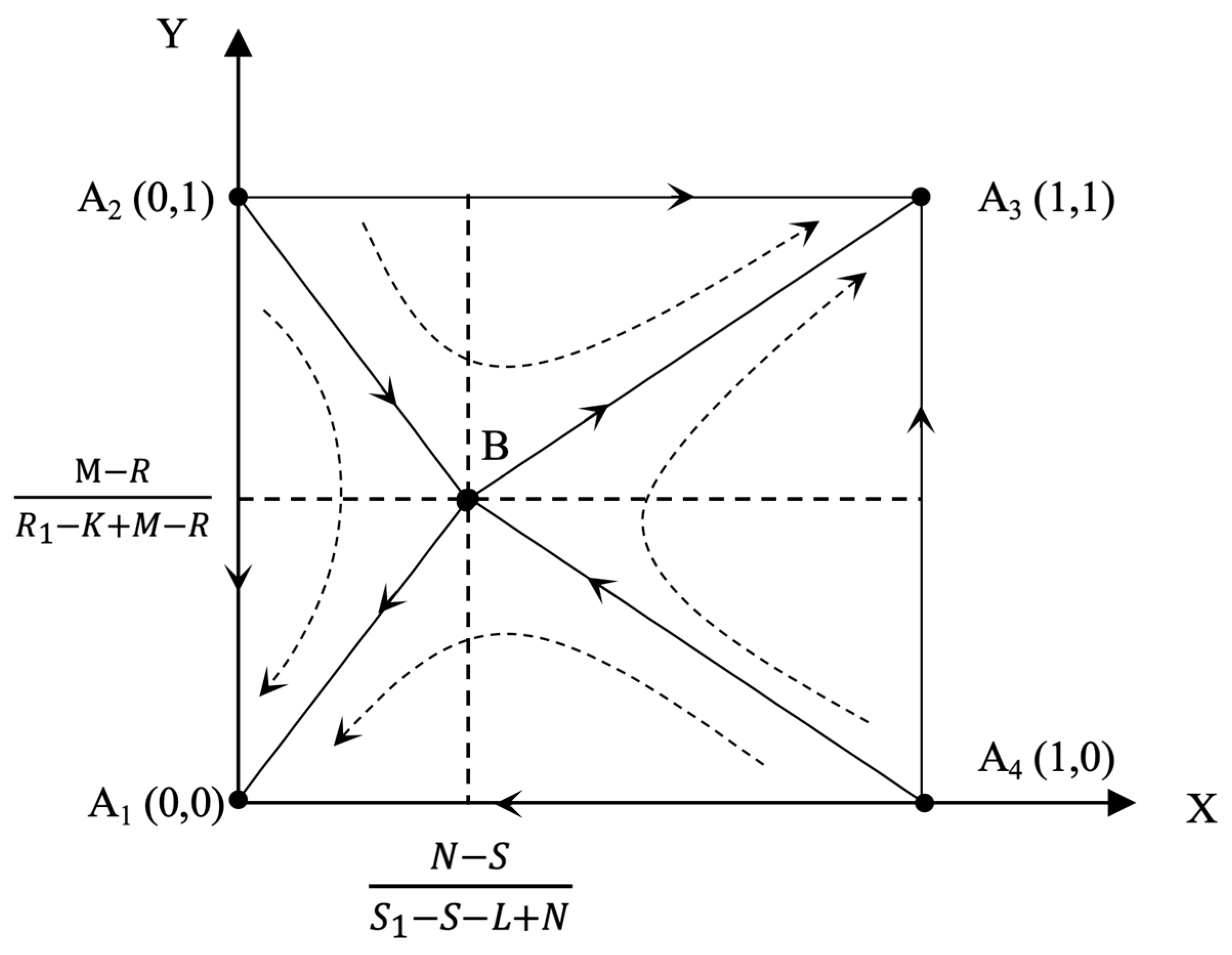
The system achieves replicator equilibrium when the strategic proportions of both parties stabilize [32,33]. The replicator dynamic equations yields five potential equilibrium points: A 1 ( 0 , 0 ) , A 2 ( 0 , 1 ) , A 3 ( 1 , 1 ) , A 4 ( 1 , 0 ) , B ( N S S 1 S L + N , M R R 1 K + M R ) . Through the construction and evaluation of a Jacobian matrix with parameters derived from fieldwork and documentary evidence, the stability of the hypothesized equilibria was assessed, as visually represented in the phase diagram (Figure 2).
At point A 1 ( 0 , 0 ) , both departments settle into a non-cooperative equilibrium. The Economic Department consistently chooses growth-priority, while the Ecological Department consistently chooses adaptive regulation. This outcome reflects a state of minimal interdepartmental engagement, where development proceeds with baseline, passive environmental oversight. This “business-as-usual” mode is a stable, self-reinforcing outcome. As one veteran planner bluntly put it, “Most of the time, we each do our own thing. They focus on hitting their growth targets, we focus on avoiding big environmental incidents. There’s not much real talking unless something goes wrong”. This mutual retreat to core mandates, with minimal proactive engagement, is the behavioral essence of the A 1 equilibrium. Conversely, A 3 ( 1 , 1 ) represents the desired cooperative equilibrium. In the context, the Economic Department consistently adopts green-coordination, and the Ecological Department consistently employs stringent regulation, fostering a synergistic alignment toward sustainable land-use planning.
The stability analysis reveals that the evolutionary outcome is highly path-dependent, heavily influenced by the initial strategic predispositions of the two departments. The basins of attraction for the two stable equilibria are separated by a separatrix passing through the saddle point B and connecting the unstable points A 2 and A 4 . This separatrix acts as a critical threshold dividing the phase plane into two basins of attraction. Initial conditions within the region A 1 - A 2 - B - A 4 lead the system toward the non-cooperative equilibrium A 1 ( 0 , 0 ) . In contrast, an initial strategic mix falling within A 2 - A 3 - A 4 - B drives the system toward the cooperative equilibrium A 3 ( 1 , 1 ) .
The persistence of the non-cooperative equilibrium A 1 ( 0 , 0 ) , characterized by routine growth-priority planning and adaptive regulation, was frequently described in interviews as the “default” or “business-as-usual” state. Officials attributed this to the immediate security of fulfilling core mandates without interdepartmental friction. An Ecological Department official explained this adaptive stance: “When faced with a large-scale development project that has strong political backing, our strictest review might only delay it, not stop it. A rigid stance costs us significant political capital and resources, and can poison relationships for future projects”. This rationale for choosing adaptive regulation aligns perfectly with the payoff structure leading to A 1 , where both departments retreat to their baseline, non-collaborative strategies to avoid the higher costs (M, N) of unreciprocated action.
The size and shape of these basins of attraction are not merely geometrical features; they encapsulate the system’s inherent resistance to change. The basin leading to the non-cooperative equilibrium A 1 ( 0 , 0 ) typically encompasses a larger region of the phase space under common institutional settings where unilateral action is costly and collaborative rewards are uncertain. This reflects a real-world tendency for departments to lapse into siloed, growth-prioritizing routines unless initial collaborative momentum is strong. Conversely, the basin for the cooperative equilibrium A 3 ( 1 , 1 ) is often narrower, indicating that achieving and sustaining collaboration requires a more specific set of initial conditions, namely, a sufficient level of mutual willingness to invest in coordination from the outset. The separatrix thus acts as a critical threshold: systems starting on one side evolve toward entrenched competition, while those on the other are drawn toward self-reinforcing collaboration. This structural property implies that once the system is trapped in the basin of A 1 , external interventions, such as enhancing collaborative benefits (R1, S1) or reducing the costs of unreciprocated effort (M, N), are necessary to shift the separatrix and expand the attraction area for A 3 . In policy terms, this explains why merely advocating for collaboration is often insufficient; deliberate, parameter-specific institutional reforms are needed to alter the underlying dynamics and reduce the system’s resistance to transitioning from competition to collaboration.
In other words, the system thus confirms that a stable cooperative equilibrium is attainable. The key to promoting it lies in strategically shifting the separatrix to enlarge the basin of attraction for A 3 ( 1 , 1 ) . This can be achieved by adjusting the underlying benefit parameters through institutional redesign. Specifically, cooperation becomes more attractive when: (1) The collaborative benefit ( R 1 and S 1 ) for the green-coordination and stringent regulation combination are enhanced; (2) A reduction in the costs ( M and N ) of unreciprocated proactive strategies constitutes a condition that promotes the system’s evolution from a competitive standoff to a stable, cooperative equilibrium. It demonstrates that the superior benefits of synergy are contingent upon a shared commitment, materializing fully only when both departments engage proactively in concert. (3) The relative appeal of free-riding or maintaining a passive stance is diminished, for instance, by lowering the contested benefit a department might receive from acting unilaterally against an uncooperative counterpart, or by introducing clear accountability mechanisms for inaction.
To validate the model’s robustness, we conducted sensitivity analyses, varying key parameters (e.g., costs and benefits) within plausible ranges derived from our qualitative data. The ESS status of A 1 ( 0 , 0 ) and A 3 ( 1 , 1 ) remained consistent, confirming the stability of these outcomes is not an artifact of specific parameter values. Furthermore, the model’s predictions demonstrate external validity by aligning with empirical observations from our fieldwork. This alignment was further probed and substantiated during follow-up discussions with a subset of the interviewed officials, who confirmed that the model’s dynamics, such as the conditions leading to either competition or collaboration, resonated with their practical experiences in interdepartmental dynamics. The convergence toward A 3 under conditions of high mutual incentive mirrors successful collaborative practices observed in regions like Jiangsu province, where integrated planning has been implemented. Conversely, the persistence of the A 1 equilibrium in contexts of low institutional rewards echoes documented instances of departmental silos and free-riding. This empirical consonance reinforces the model’s explanatory power and its utility as a diagnostic tool for designing mechanisms that foster collaborative land-use planning.

4.4. Numerical Simulation and Illustrative Dynamics

To concretely illustrate the evolutionary dynamics identified in the model, we provide a numerical simulation based on empirically informed parameter values. These values are derived from the qualitative themes summarized in Table 2 and reflect typical cost–benefit structures observed in our fieldwork. The following baseline parameter values were set to represent a plausible scenario of moderate institutional incentives and medium coordination costs (Table 4).
Under these parameters, the threshold values for the Economic Department’s green-coordination proportion x and the Ecological Department’s stringent regulation proportion y are calculated as follows:
x * = N S S 1 S L + N = 0.4
y * = M R R 1 K + M R 0.3
The system’s saddle point is therefore approximately B(0.4,0.3), which divides the phase plane into two basins of attraction. If initial strategy proportions fall in the region above the separatrix (e.g., x = 0.6, y = 0.7), both departments gradually increase their cooperative tendencies. The Economic Department observes that the Ecological Department is frequently stringent, which lowers the perceived cost of green-coordination and enhances expected benefits from collaboration. Similarly, the Ecological Department sees proactive planning from the Economic Department, making stringent regulation less economically costly and more rewarding. Over time, the system converges to A 3 ( 1 , 1 ) , representing a stable cooperative equilibrium. If initial proportions lie below the separatrix (e.g., x = 0.2, y = 0.1), both departments tend to reduce their cooperative efforts. The Economic Department, perceiving weak regulatory pressure, opts for growth-priority to avoid unnecessary costs. The Ecological Department, facing growth-oriented planning without reciprocation, retreats to adaptive regulation to avoid bureaucratic conflict. This creates a downward spiral. As one Ecological Department official explained the rationale for withdrawing, “You look at their plan, see it’s the same old growth-first approach, and you think, ‘What’s the point of us putting in extra work? They’re not meeting us halfway’. So you just switch to routine mode”. The system then evolves toward A 1 ( 0 , 0 ) , a non-cooperative equilibrium.
The study further examines how changes in key parameters influence the system’s evolution. For instance, increasing the collaborative benefits R1 or S1 shifts the separatrix downward, thereby enlarging the basin of attraction for A 3 . If R1 rises from 6 to 8, y * decreases, meaning cooperation becomes attractive even with a lower initial level of regulatory stringency. Conversely, reducing the costs of unreciprocated action (M or N) also favors cooperation. These sensitivity tests demonstrate that by institutionally redesigning the cost and benefit parameters, policymakers can effectively steer the strategic evolution of both departments toward the sustainable, cooperative equilibrium.
This numerical example demonstrates how parameter values, which reflect underlying institutional incentives and situational costs, shape the evolutionary path of the system toward either competitive or collaborative outcomes. It visually reinforces the model’s key insight: collaboration is not merely a normative goal but an attainable equilibrium when costs and benefits are aligned through institutional design.

5. Discussion and Implications

This section discusses the broader implications of these findings. It synthesizes the results into a novel theoretical framework, outlines the study’s contributions to existing literature, and proposes concrete policy pathways for fostering collaborative land-use governance.

5.1. Integrating Strategic Dynamics into a Micro-Foundational Framework for Interdepartmental Collaboration

The evolutionary game analysis reveals a governance system characterized by strategic adaptation and path dependency, converging towards one of two stable equilibria. This dynamic perspective directly addresses the core research gap by moving beyond static descriptions of interdepartmental competition or normative prescriptions for collaboration [34]. Specifically, it elucidates the endogenous micro-mechanisms, such as cost–benefit calculations and adaptive learning, that shape how these departments engage in either competitive or collaborative behaviors in practice.
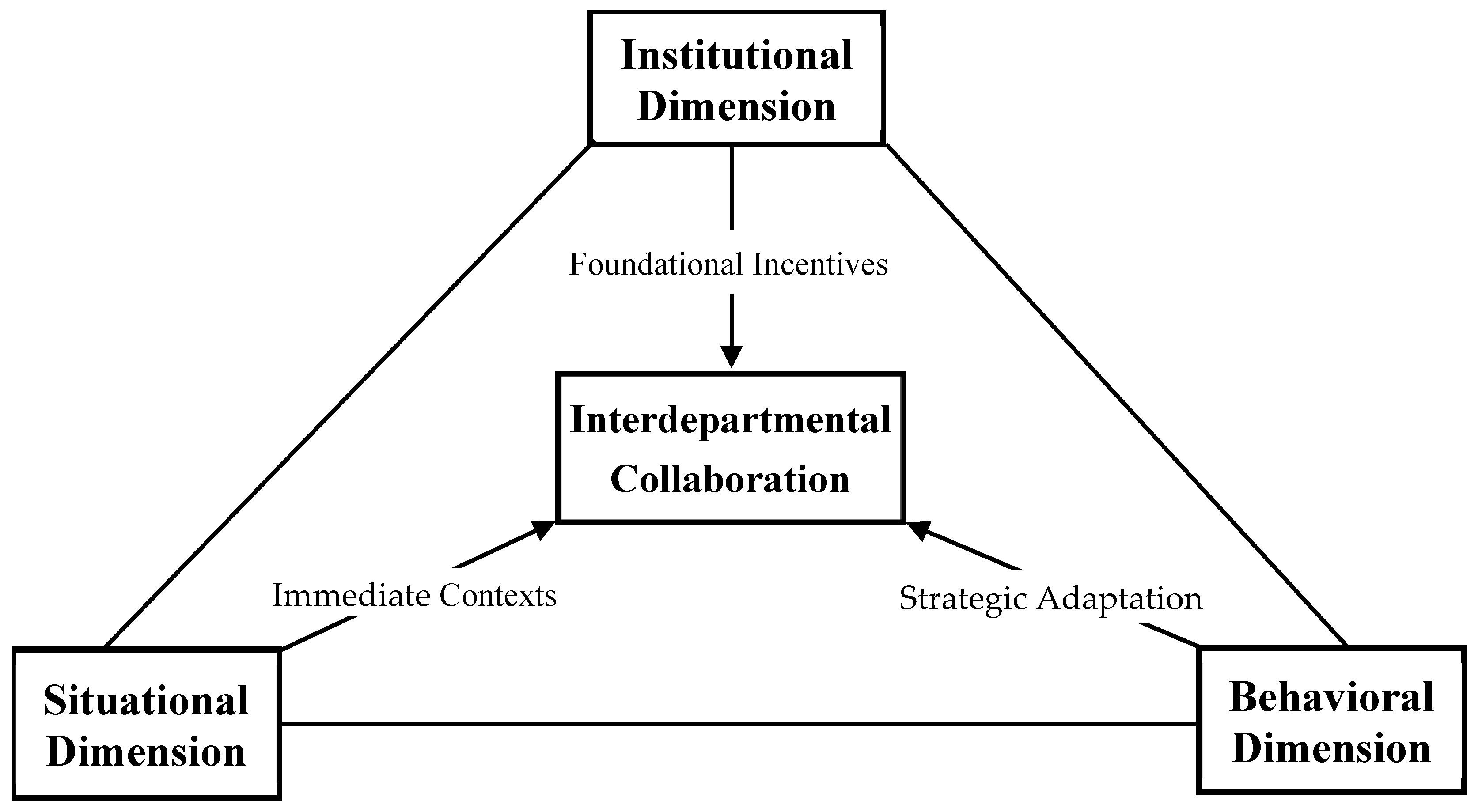
To integrate these micro-dynamics into a cohesive and actionable theoretical lens, we synthesize our findings into the Institutional-Situational-Behavioral (ISB) framework (Figure 3). This framework posits that the evolution of interdepartmental collaboration can be understood through the interplay of three analytical layers: the foundational institutional incentives, the immediate situational context, and the resulting adaptive behaviors of departments.
First, the institutional dimension constitutes the foundational layer, comprising the relatively stable formal rules, informal conventions, and incentive structures that define the long-term strategic landscape for each department [35]. This dimension is rooted in institutional theory and is directly represented in our model by the core cost–benefit parameters and the performance metrics that shape them. Institutions determine the fundamental rules of the game [36], establishing what constitutes success or failure for each department. Crucially, our framework posits that for collaboration to become a stable strategy, institutional reforms must shift these metrics toward rewarding the achievement of shared, superordinate goals. These goals move beyond narrow sectoral targets to encompass outcomes like the quality of integrated spatial plans [37], the enhanced efficiency of land resource use [38], or verifiable progress on composite ecological-economic indicators [39]. Thus, the ISB framework posits that reshaping the deep-seated incentives that typically favor competition requires systematically rewarding contributions to such integrated outcomes. The core logic underpinning this dimension, which posits that stable collaboration necessitates institutional incentives aligned with superordinate goals, holds potential for transferability beyond the Chinese context. While specific incentive instruments (e.g., particular performance metrics) may vary, the fundamental need to reshape benefit structures (model parameters like R1 and S1) to reward collaborative outcomes is a universal governance challenge in managing cross-sectoral tensions.
Second, the situational dimension forms the immediate context of interaction. It encompasses the specific, dynamic conditions of a given planning decision, including the characteristics of the project, the current hierarchical pressures, the quality of existing inter-department relationships, and the availability of collaborative platforms [40,41]. In our model, this is reflected in parameters like the costs of coordination (e.g., K, L, M, N) and the initial strategy mix, which can vary from case to case. Even with favorable long-term institutions, collaboration can falter in a situation marked by high distrust, time pressure, or lack of effective communication channels. This dimension highlights that collaboration is not automatic but is negotiated within specific, often constrained, circumstances [42]. This situational dimension captures a universal reality: interdepartmental interactions are always mediated by immediate contexts. The relevance of factors such as project characteristics, time pressures, and the quality of pre-existing relationships transcends specific national settings. The framework’s emphasis on managing these situational costs to lower collaboration barriers is applicable wherever administrative silos exist.
Third, the behavioral dimension captures the observable strategic choices and their evolution over time [43]. This is the outcome layer, where boundedly rational departments, navigating the constraints of institutions and the pressures of the situation, select strategies like growth-priority or green-coordination. Our evolutionary game model formalizes this dimension, simulating how behaviors adapt, learn, and stabilize into either competitive or collaborative patterns. The framework emphasizes that behavior is not random but is a predictable response to the combined signals from the institutional and situational layers [44]. When institutions clearly signal that rewards are tied to collaborative outcomes, and situations provide feasible pathways to achieve them, departments are more likely to learn and adopt collaborative behavioral strategies. The behavioral premise of boundedly rational actors adapting strategies based on expected benefits is a cornerstone of strategic interaction theory, making this dimension broadly applicable. The evolutionary dynamic of learning, imitation, and path-dependence modeled in our study is a general mechanism describing how organizations, not limited to Chinese bureaucracies, develop routines of competition or cooperation over time.
In essence, the ISB framework provides a diagnostic and prescriptive tool. A persistent collaboration deficit can be analyzed by examining each layer: Is the problem rooted in perverse institutional incentives? Is it due to a situational context that amplifies competition? Or is it a behavioral lock-in that resists change? Successful intervention requires a holistic understanding of how these three dimensions interact to produce the observed dynamics in land-use planning.
While the ISB framework’s tripartite logic and evolutionary mechanisms have broad analytical relevance, several empirical aspects of our findings are particular to the Chinese context. The intense competition modeled stems partly from China’s unique “cadre evaluation system”, which historically prioritized economic growth and environmental compliance as separate, powerful mandates. The high political and relational costs (e.g., parameter N of stringent regulation against growth-priority) reflect the specific authority structures and bargaining dynamics within China’s hierarchical governance system. The framework is therefore portable yet context-sensitive; its general logic travels, but the quantitative calibration of interdepartmental tensions and the design of effective interventions require contextual adaptation in each institutional setting.

5.2. Theoretical Contributions and Novelty

This research makes several contributions that advance scholarly understanding of land governance and interdepartmental collaboration.
First, the study illustrates how a rigorous mixed-methods approach can advance the study of bureaucratic strategy in land-use planning. Existing literature on interdepartmental dynamics often relies on either macro-level policy analysis or descriptive case studies [45,46]. While these approaches identify problems and normative solutions, they frequently lack the analytical tools to unpack the micro-level behavioral logics and the dynamic pathways through which competition or collaboration emerge [47]. By systematically constructing a formal evolutionary game model based on in-depth qualitative fieldwork, which includes both interviews with officials and analysis of internal government documents, we achieve a distinctive methodological synergy. The qualitative component ensures the model’s parameters and strategies are empirically grounded and contextually valid, capturing the real-world motivations and constraints of the departments [17,48]. This methodology bridges deep contextual understanding with generalizable analytical rigor, setting a new standard for opening the “black box” of bureaucratic interactions in complex governance systems.
Second, the primary theoretical innovation lies in the development and empirical grounding of the Institutional-Situational-Behavioral (ISB) framework. Much of the collaborative governance literature, while strong in normative advocacy [49], has been noted for its relative weakness in unpacking the micro-foundations and logics that underpin how collaboration is initiated and maintained in practice [31]. Prior frameworks often present collaboration as an ideal endpoint without adequately dissecting the process. Our ISB framework addresses this gap through its tripartite lens, decomposing the collaborative process into three interconnected yet analytically distinct layers: the foundational institutional rules that shape long-term incentives, the immediate situational context that defines specific interactions, and the adaptive behaviors that departments exhibit over time. This framework thus provides a more granular, testable, and actionable model for diagnosing collaboration deficits and designing interventions. It offers a valuable analytical lens applicable beyond land-use planning, useful for addressing complex challenges and for designing synergistic mechanisms in multiple environmental and sustainability contexts [50,51,52,53,54,55].
Third, the study provides mechanism-based insights into environmental governance within hierarchical systems, thereby challenging oversimplified portrayals of bureaucratic behavior [48]. Prevailing scholarly interpretations of bureaucratic dynamics tend to oscillate between two contrasting models: one emphasizing centralized command structures, and the other highlighting fragmented institutional silos. Our analysis moves beyond this dichotomy to reveal a more interactive and adaptive strategic field of interdepartmental engagement. It shows that departments like the Economic and Ecological Departments are not passive rule-followers nor purely adversarial competitors; they are active, boundedly rational players who adapt their strategies based on perceived costs, benefits, and the actions of others. Their interactions are patterned and predictable, fundamentally shaped by the incentive structures and performance metrics established by institutional design and situational behaviors [19,56]. This perspective highlights that even within a hierarchical system, policy implementation outcomes are not preordained but are contested and negotiated through interdepartmental strategic interplay [57].

5.3. Policy Implications and Practical Pathways

The analytical insights derived from the model and the ISB framework lead to concrete, mechanism-based policy recommendations. The overarching goal is to intentionally design interventions that expand the basin of attraction for the cooperative equilibrium A 3 ( 1 , 1 ) . This requires aligned action across the institutional, situational, and behavioral dimensions identified by the framework.
Strengthening the institutional dimension demands more than incremental adjustments; it calls for a foundational recalibration of the incentive landscape. Current performance evaluation systems, which often prioritize narrow sectoral metrics like GDP growth or pollution control rates in isolation, must be reformed. A pivotal step is the introduction of hybrid performance evaluation systems. These systems should explicitly measure and reward contributions to superordinate outcomes such as: the quality of integrated spatial plans, land-use efficiency targets, and progress on composite ecological-economic indicators. By tying career advancement, budgetary allocations, and organizational prestige to these shared goals, institutions can make the pursuit of collaborative gains a core component of a department’s success calculus. This directly enhances the institutional benefit parameters ( R 1 and S 1 ) in the model. Complementing this, the creation of formal interdepartmental funds, such as ecological compensation or sustainable development funds, can provide direct, tangible financial incentives.
To manage the situational dimension and foster conducive contexts for interaction, procedural innovations are essential. A critical step is to mandate the creation of embedded joint planning cells for major projects. These should be established as standing committees endowed with equal representation and shared decision-making authority. Such arrangements ensure that environmental and economic considerations are integrated from the earliest planning stages, thereby proactively reducing the potential for costly disputes and delays, which are reflected in the model as high competition costs (M, N). Beyond formal structures, investing in shared digital planning platforms represents a critical technological upgrade. By providing real-time, transparent access to data on ecological redlines, development plans, and land use inventories, these platforms serve to build a single, authoritative source of truth. This common factual basis mitigates misunderstandings born of information asymmetry and makes unilateral, non-compliant actions more visible and difficult to execute.
Interventions targeting the behavioral dimension must address the established patterns, habits, and capabilities of officials. Although behavioral change tends to be the most gradual, it can be fostered through structured reinforcement and capacity building. Implementing regular and transparent audits of collaborative governance processes, combined with the public recognition of departments that demonstrate excellence, establishes a powerful mechanism for social and professional reinforcement. These practices make effective partnership visible and valued, shaping professional norms and identities around collaboration. At the same time, dedicated leadership and staff training programs are necessary. These programs should move beyond technical knowledge to focus on competencies in collaborative negotiation, systems thinking, competition mediation, and the co-creation of integrative solutions. Equipping officials with these skills lowers the perceived personal risk and increases the perceived efficacy of engaging in collaborative strategies, making such behavior more feasible in high-pressure situations. Furthermore, creating opportunities for sustained professional interaction across departments, such as through joint working groups or staff exchange programs, can foster interpersonal trust and break down stereotypes.

5.4. Limitations and Future Research

While this study provides novel insights, it is subject to limitations that suggest productive avenues for future research.
First, this study’s methodological approach holds potential for further refinement. While the qualitative fieldwork provides essential empirical grounding, the interview and documentary data may emphasize strategic narratives and formal procedures, potentially underrepresenting the informal dimensions of interdepartmental negotiation. Similarly, the evolutionary game model, though analytically rigorous, simplifies complex bureaucratic behavior into a set of strategies and static parameters, which may not fully capture departmental heterogeneity or the fluidity of real-world planning contexts. Future research should pursue longitudinal case studies to track strategic evolution over time. Employing more nuanced modeling techniques, for example, agent-based simulations, would also help incorporate greater actor diversity and context-sensitive parameter variation.
Second, the generalizability of the ISB framework warrants active and systematic exploration. The tripartite lens of institutions, situations, and behaviors offers a portable analytical schema for dissecting interdepartmental tensions beyond land-use planning. Future research should actively apply this framework to other critical policy domains characterized by cross-sectoral competition, such as governing the interconnected water-energy-land-food nexus, managing complex urban-rural integration processes, or coordinating economic and environmental strategies. Comparative studies across national governance systems could illuminate how the salience and interplay of institutional, situational, and behavioral dimensions vary across political-administrative cultures.

6. Conclusions

This study examines the evolutionary dynamics between economic and ecological departments in land-use planning through a mixed-methods design. Integrating qualitative fieldwork with evolutionary game modeling reveals that interdepartmental interactions are not static but evolve along distinct pathways toward either cooperative or non-cooperative equilibria. This evolution is shaped by initial strategic predispositions, cost–benefit calculations, and adaptive learning processes. Building on these insights, we develop the Institutional-Situational-Behavioral (ISB) framework. This framework systematically links micro-level strategic interactions and evolutionary pathways to broader land governance outcomes, offering a diagnostic lens for identifying and addressing collaboration deficits. By grounding formal theory in empirical evidence from China’s governance context, this research moves beyond normative prescriptions to explain the endogenous mechanisms driving competition and collaboration.
This study advances scholarly understanding of interdepartmental collaborative governance and provides implementable strategies for sustainable land use planning, based on its systematic analysis of evolutionary dynamics.
Theoretically, this study advances the literature on collaborative governance by elucidating the micro-foundations of interdepartmental interaction. It does so through a rigorous mixed-methods approach that grounds evolutionary game modeling in rich qualitative fieldwork. This methodology not only validates the model empirically but also reveals systemic dynamics often missed in pure observational studies. Furthermore, the study proposes the ISB framework to clarify that collaboration is not merely a product of top-down mandates but the outcome of interacting institutional incentives, situational constraints, and adaptive departmental learning.
In practical terms, this study delivers actionable policy insights by pinpointing the specific institutional parameters that incentivize interdepartmental collaboration. The findings suggest that policymakers should systematically recalibrate incentive structures, for instance by introducing hybrid performance metrics that reward integrated ecological-economic outcomes, thereby formally aligning departmental interests with superordinate sustainability goals. Moreover, embedding collaborative procedures—such as mandated joint planning committees and shared digital platforms—can reduce transaction costs and build the situational capacity necessary for routine cooperation. Overall, these interventions aim to enlarge the basin of attraction for the cooperative equilibrium, transforming collaboration into a strategically stable and administratively rational choice within sustainable land-use governance.

Author Contributions

Conceptualization, G.L. and C.Z.; methodology, G.L. and C.Z.; software, G.L. and C.Z.; validation, G.L., and C.Z.; formal analysis, G.L., and C.Z.; investigation, G.L., and C.Z.; resources, G.L. and C.Z.; data curation, G.L. and C.Z.; writing—original draft preparation, G.L. and C.Z.; writing—review and editing, G.L., and C.Z.; visualization, G.L., and C.Z.; supervision, C.Z.; project administration, C.Z.; funding acquisition, C.Z. All authors have read and agreed to the published version of the manuscript.

Funding

This research was supported by the Humanities and Social Science fund of the Ministry of Education of China (25YJC630204), the Social Science Foundation of Jiangsu of China (25ZZD002), and the National Social Science Foundation of China (25FGLB030 and 21&ZD174).

Data Availability Statement

The raw data supporting the conclusions of this article will be made available by the authors on request.

Acknowledgments

The authors would like to thank the editor and the anonymous reviewers for their support in improving this manuscript.

Conflicts of Interest

The authors declare no conflicts of interest.

Appendix A. Semi-Structured Interview Protocol

Interview Format: Semi-structured, in-depth interviews
Interviewees: Government officials from the Economic Department (e.g., Development and Reform Commission, Housing and Urban-Rural Development Bureau, Development Zone Administrative Committee) and the Ecological Department (e.g., Bureau of Ecology and Environment, Department of Natural Resources) in selected provinces and municipalities in China.
Interview Duration: Approximately 60 min
Main Interview Questions:
  • Could you describe a recent land-use planning project in which your department was involved? What were your primary objectives and considerations in that project?
  • How do you perceive the role of your department in balancing economic development and ecological conservation in land-use planning?
  • When making planning decisions, do you consider the actions or strategies of the other department (Economic/Ecological)? If yes, how does that influence your own strategy?
  • What are the key performance indicators or evaluation criteria for your department in land-use planning? How are they linked to economic growth or ecological conservation?
  • How do these metrics influence your willingness to collaborate with the other department?
  • Are there any formal or informal rewards or penalties associated with collaborative or non-collaborative behaviors?
  • What types of costs (e.g., administrative, political, financial, relational) does your department typically incur when engaging in land-use planning?
  • How do these costs change when you adopt a more proactive or cooperative approach?
  • Can you provide an example where your department invested additional resources to align with ecological/economic goals? What motivated that investment?
  • What benefits does your department gain from collaborating with the other department in land-use planning? (e.g., political recognition, project success, resource efficiency)
  • Conversely, what are the perceived benefits of maintaining a non-collaborative stance?
  • Have you observed instances where one department benefited at the expense of the other? How did that affect subsequent interactions?
  • Over time, how has your department’s approach to dealing with the other department evolved? What factors drove those changes?
  • Do you observe and learn from the strategies adopted by the other department? If so, how does that influence your future decisions?
  • Can you describe situations where initial competition later turned into collaboration, or vice versa?
  • What situational factors (e.g., project scale, political priority, leadership support, public attention) most influence whether your department chooses to collaborate or compete?
  • How do existing coordination platforms or procedures (e.g., joint committees, digital planning systems) affect your ability to collaborate?
  • What role do higher-level policies or directives (e.g., ecological civilization, sustainable development goals) play in shaping interdepartmental dynamics?
  • How would you characterize the typical relationship between your department and the other department in land-use planning? Is it more collaborative, competitive, or variable?
  • What institutional or cultural barriers hinder deeper collaboration?
  • What changes in incentives or procedures would encourage more sustained collaboration between your department and the other?
  • Based on your experience, what do you think are the most important factors that determine whether the Economic and Ecological Departments work together or apart in land-use planning?
  • How would you weigh the importance of costs, benefits, institutional pressures, and relational trust in shaping these outcomes?
  • Is there anything else you would like to add regarding interdepartmental collaboration in land-use planning that we haven’t covered?

References

  1. Nhamo, L.; Mpandeli, S.; Liphadzi, S.; Mabhaudhi, T. Securing land and water for food production through sustainable land reform: A nexus planning perspective. Land 2022, 11, 974. [Google Scholar] [CrossRef]
  2. Chen, Y.; Zhou, C.; Richardson-Barlow, C. Towards Stringent Ecological Protection and Sustainable Spatial Planning: Institutional Grammar Analysis of China’s Urban–Rural Land Use Policy Regulations. Land 2025, 14, 1896. [Google Scholar] [CrossRef]
  3. Cobbinah, P.B.; Asibey, M.O.; Gyedu-Pensang, Y.A. Urban land use planning in Ghana: Navigating complex coalescence of land ownership and administration. Land Use Policy 2020, 99, 105054. [Google Scholar] [CrossRef]
  4. Collier, P.; Glaeser, E.L.; Venables, A.; Manwaring, P. Urban Land Use Planning for Economic Growth; International Growth Centre: London, UK, 2020. [Google Scholar]
  5. Guo, X.; Zhang, Y.; Guo, D.; Lu, W.; Xu, H. How does ecological protection redline policy affect regional land use and ecosystem services? Environ. Impact Assess. Rev. 2023, 100, 107062. [Google Scholar] [CrossRef]
  6. Zhang, Y.; Liu, X.; Zhang, M. Boundary restructuring reshapes land use: The impact of administrative division adjustment on urban land use efficiency. Trans. Plan. Urban Res. 2025, 4, 367–387. [Google Scholar] [CrossRef]
  7. Steurer, M.; Bayr, C. Measuring urban sprawl using land use data. Land Use Policy 2020, 97, 104799. [Google Scholar] [CrossRef]
  8. Malakoff, K.L.; Nolte, C. Estimating the parcel-level impacts of agricultural conservation easements on farmland loss using satellite data in New England. Land Use Policy 2023, 132, 106814. [Google Scholar] [CrossRef]
  9. Zhang, E.; Meng, C.; Qu, J.; Zhu, Z.; Niu, J.; Wang, L.; Song, N.; Yin, Z. Dual effects of Caragana korshinskii introduction on herbaceous vegetation in Chinese desert areas: Short-term degradation and long-term recovery. Plant Soil 2025, 518, 1–19. [Google Scholar] [CrossRef]
  10. Maliene, V.; Mansberger, R.; Paulsson, J.; Köhler, T.; Seher, W. (Eds.) Sustainable and Equitable Land Management: Legal Framework, Planning Tools, Assessment; Hochschulverlag AG: Zürich, Switzerland, 2024. [Google Scholar]
  11. Eberl, J.; Gordeeva, E.; Weber, N. The policy coherence framework approach in a multi-level analysis of European, German and Thuringian climate policy with a special focus on land use, land-use change and forestry (LULUCF). World 2021, 2, 415–424. [Google Scholar] [CrossRef]
  12. Guzman, L.A.; Escobar, F.; Peña, J.; Cardona, R. A cellular automata-based land-use model as an integrated spatial decision support system for urban planning in developing cities: The case of the Bogotá region. Land Use Policy 2020, 92, 104445. [Google Scholar] [CrossRef]
  13. Bruno, E.; Falco, E.; Shahab, S.; Geneletti, D. Integrating ecosystem services in transfer of development rights: A literature review. Land Use Policy 2023, 131, 106694. [Google Scholar] [CrossRef]
  14. The Economic Development in 2025 Progressed with Renewed Vitality and Improved Quality, Achieving All Expected Targets Successfully. Available online: https://www.stats.gov.cn/sj/zxfbhjd/202601/t20260119_1962330.html (accessed on 20 January 2026).
  15. China Statistical Yearbook. 2024. Available online: https://www.stats.gov.cn/sj/ndsj/2024/indexch.htm (accessed on 17 January 2026).
  16. Wang, G.; Wang, J.; Wang, L.; Zhang, Y.; Zhang, W. Land-use conflict dynamics, patterns, and drivers under rapid urbanization. Land 2024, 13, 1317. [Google Scholar] [CrossRef]
  17. Wu, H.; Lu, Y.; Zhou, C.; Zhang, W. Navigating water sustainability: Evolutionary game analysis of cross-sectoral collaborative governance in China. Water Econ. Policy 2025, 11, 2540011. [Google Scholar] [CrossRef]
  18. Zhang, Z.; Zhang, G.; Hu, Y.; Jiang, Y.; Zhou, C.; Ma, J. The evolutionary mechanism of haze collaborative governance: Novel evidence from a tripartite evolutionary game model and a case study in China. Humanit. Soc. Sci. Commun. 2023, 10, 69. [Google Scholar] [CrossRef]
  19. Zhou, C.; Richardson-Barlow, C.; Fan, L.; Cai, H.; Zhang, W.; Zhang, Z. Towards organic collaborative governance for a more sustainable environment: Evolutionary game analysis within the policy implementation of China’s net-zero emissions goals. J. Environ. Manag. 2025, 373, 123765. [Google Scholar] [CrossRef]
  20. Zhang, Z.; Shi, K.; Gao, Y.; Feng, Y. How does environmental regulation promote green technology innovation in enterprises? A policy simulation approach with an evolutionary game. J. Environ. Plan. Manag. 2025, 68, 979–1008. [Google Scholar] [CrossRef]
  21. Le Boennec, R.; Lucas, S. Is neighborhood satisfaction related to density perception? Promoting liveable and sustainable land use planning. J. Environ. Plan. Manag. 2022, 65, 2081–2098. [Google Scholar] [CrossRef]
  22. Zhou, C.; Qian, Z.; Han, Z. Evolutionary Game Analysis of Post-relocation Support Projects for Reservoir Resettlement: Evidence from China. Soc. Indic. Res. 2023, 167, 135–152. [Google Scholar] [CrossRef]
  23. Zhong, Y.; Yan, H.; Xia, Z. Who is Lifting the Green Veil? Climate Physical Risks and Supply Chain Spillovers of Corporate Carbon Greenwashing. Technol. Soc. 2025, 85, 103203. [Google Scholar] [CrossRef]
  24. Dale, P.; McLaughlin, J. Land Administration; Oxford University Press: Oxford, UK, 2000. [Google Scholar]
  25. Öncel, H.; Levend, S. The effects of urban growth on natural areas: The three metropolitan areas in Türkiye. Environ. Monit. Assess. 2023, 195, 816. [Google Scholar] [CrossRef]
  26. Sarwar, S. Consequences of Land Utilization, Agriculture and Water to Handle the Food Security Issues. Land Degrad. Dev. 2025, 36, 1962–1976. [Google Scholar] [CrossRef]
  27. Zhu, X.; Zhou, C.; Richardson-Barlow, C. Assessing Policy Consistency and Synergy in China’s Water–Energy–Land–Food Nexus for Low-Carbon Transition. Land 2025, 14, 1431. [Google Scholar] [CrossRef]
  28. Sahide, M.A.K.; Giessen, L. The fragmented land use administration in Indonesia—Analysing bureaucratic responsibilities influencing tropical rainforest transformation systems. Land Use Policy 2015, 43, 96–110. [Google Scholar] [CrossRef]
  29. Cheng, Y.; Li, P. Technical thinking: How does e-land administration system promote the efficiency of cross-sectoral collaborative land governance in China? Surv. Rev. 2024, 56, 348–366. [Google Scholar] [CrossRef]
  30. Shi, G.; Liu, J.; Yang, C.; An, Q.; Tian, Z.; Chen, C.; Zhang, J.; Li, X.; Zhang, Y.; Xu, J. Study on the spatiotemporal evolution of urban spatial structure in Nanjing’s main urban area: A coupling study of POI and nighttime light data. Front. Archit. Res. 2025, 14, 1780–1793. [Google Scholar] [CrossRef]
  31. Emerson, K.; Nabatchi, T.; Balogh, S. An integrative framework for collaborative governance. J. Public Adm. Res. Theory 2012, 22, 1–29. [Google Scholar] [CrossRef]
  32. Weibull, J.W. Evolutionary Game Theory; MIT Press: Cambridge, MA, USA, 1997. [Google Scholar]
  33. Zhou, C.; Richardson-Barlow, C. Climate promotion tournaments and collaborative governance: Central-local dynamics in China’s carbon neutrality policy implementation. J. Environ. Pol. Plan. 2026, 28, 1–18. [Google Scholar] [CrossRef]
  34. Sangawongse, S.; Fisher, R.; Prabudhanitisarn, S. From centralised planning to collaborative urban land use planning: The case of Wat Ket, Chiang Mai, Thailand. Soc. Sci. Humanit. Open 2021, 4, 100154. [Google Scholar] [CrossRef]
  35. Ostsrom, E. Incentives, Rules of the Game and Development; World Bank: Washington, DC, USA, 1995; pp. 207–234. [Google Scholar]
  36. Pelikan, P. The Formation of Incentive Mechanisms in Differentt Economic Systems. In Incentives and Economic Systems; Routledge: London, UK, 2022; pp. 27–56. [Google Scholar]
  37. Liu, Y.; Zhou, Y. Territory spatial planning and national governance system in China. Land Use Policy 2021, 102, 105288. [Google Scholar] [CrossRef]
  38. de Jong, L.; De Bruin, S.; Knoop, J.; van Vliet, J. Understanding land-use change conflict: A systematic review of case studies. J. Land Use Sci. 2021, 16, 223–239. [Google Scholar] [CrossRef]
  39. Niewöhner, J.; Bruns, A.; Haberl, H.; Hostert, P.; Krueger, T.; Lauk, C.; Lutz, J.; Müller, D.; Nielsen, J.Ø. Land use competition: Ecological, economic and social perspectives. In Land Use Competition: Ecological, Economic and Social Perspectives; Springer International Publishing: Cham, Switzerland, 2016; pp. 1–17. [Google Scholar]
  40. Boschken, H.L. Aligning a multi-government network with situational context: Metropolitan governance as an organizational systems problem. Am. Rev. Public Adm. 2017, 47, 189–208. [Google Scholar] [CrossRef]
  41. Emerson, K.; Nabatchi, T. Collaborative Governance Regimes; Georgetown University Press: Washington, DC, USA, 2015. [Google Scholar]
  42. Carstensen, M.B.; Sørensen, E. Using bricolage and robustness theory to explain the dynamism of collaborative governance. Policy Politics 2025, 53, 315–337. [Google Scholar] [CrossRef]
  43. Cristofaro, M.; Giardino, P.L.; Camilli, R.; Hristov, I. Understanding behavioral strategy: A historical evolutionary perspective in “Management Decision”. Manag. Decis. 2024, 62, 426–455. [Google Scholar] [CrossRef]
  44. Greve, H.R. Microfoundations of management: Behavioral strategies and levels of rationality in organizational action. Acad. Manag. Perspect. 2013, 27, 103–119. [Google Scholar] [CrossRef]
  45. Hegele, Y. The impact of department structure on policy-making: How portfolio combinations affect interdepartmental coordination. Public Policy Adm. 2021, 36, 429–451. [Google Scholar] [CrossRef]
  46. Zhou, C.; Zhang, W.; Richardson-Barlow, C.; Zhang, Z. Navigating carbon neutrality: Policy pathways and consistency on industrial decarbonization in China. Carbon Balance Manag. 2025, 20, 66. [Google Scholar] [CrossRef] [PubMed]
  47. Hustedt, T.; Danken, T. Institutional logics in inter-departmental coordination: Why actors agree on a joint coordination output. Public Adm. 2017, 95, 730–743. [Google Scholar] [CrossRef]
  48. Chen, S.; Zhou, C.; Zhang, W. From evolutionary game to collaborative governance: A geographical observation of intergovernmental interactions in China’s water ecosystems protection. Reg. Environ. Chang. 2026, 26, 25. [Google Scholar] [CrossRef]
  49. Zhang, Z.; Yan, Z.; Meng, X. The effects of intergovernmental networks on intercity collaborative innovation in China. Asia Pac. Policy Stud. 2025, 12, 1–13. [Google Scholar] [CrossRef]
  50. Gan, X.; Chen, Z.; Ma, W.; Zhang, Y.; Qu, J. Research on carbon structure evolution, surface chemical properties, microstructure, and mechanism of low-rank coal pyrolysis under different atmospheres. J. Anal. Appl. Pyrolysis. 2024, 195, 107607. [Google Scholar] [CrossRef]
  51. Yan, H.; Li, Y.; Zhong, Y.; Xia, Z. Will the ‘government-court coordination’ of corporate bankruptcy disposal improve ESG performance? Evidence from China. Appl. Econ. Lett. 2024, 32, 2998–3002. [Google Scholar] [CrossRef]
  52. Shi, G.; Sun, L.; An, Q.; Tang, L.; Shi, J.; Chen, C.; Feng, L.; Ma, H. Quantifying Urban Park Cooling Effects and Tri-Factor Synergistic Mechanisms: A Case Study of Nanjing’s Central Districts. Systems 2026, 14, 130. [Google Scholar] [CrossRef]
  53. Xu, C.; Yao, X.; Yan, H.; Li, Y. Does ESG Disclosure Improve Green Innovation Performance of New Energy Enterprises? Evidence from China. Pol. J. Environ. Stud. 2025, 34, 4859–4868. [Google Scholar] [CrossRef] [PubMed]
  54. Han, X.; Yu, H.; Wu, Y.; Song, P.; Wang, T.; Ma, R.; Lu, J.; Wang, Y. Experimental Investigation on the Countercurrent Imbibition Distance and Factors Influencing the Imbibition Recovery of Carbonated Fracturing Fluid. SPE J. 2025, 30, 1474–1491. [Google Scholar] [CrossRef]
  55. Gan, X.; Chen, Z.; Ma, W.; Zhang, Y.; Qu, J.; Han, C.; Li, Z. Kinetic and thermodynamic analyses of multigranular low-rank coal: Synergistic effect of particle size on reactivity and coke properties. Fuel 2026, 406, 137065. [Google Scholar] [CrossRef]
  56. Zhou, C.; Zhang, W.; Richardson-Barlow, C. Navigating ecological civilisation: Polycentric environmental governance and policy regulatory framework in China. Energy Res. Soc. Sci. 2025, 128, 104347. [Google Scholar] [CrossRef]
  57. Danken, T. Coordination of Wicked Problems: Comparing Inter-Departmental Coordination of Demographic Change Policies in Five German States. Ph.D. Thesis, Universität Potsdam, Potsdam, Germany, 2017. [Google Scholar]
Figure 1. Qualitative fieldwork and quantitative evolutionary game modeling. It illustrates the integrated mixed-methods design of the study. The qualitative phase, involving interviews and document analysis, provides empirical data to ground the subsequent formal evolutionary game model, which simulates the dynamic strategic interactions between the two departments.
Land 15 00249 g001
Figure 2. Dynamics and stability in the evolutionary game system. It presents the phase diagram of the evolutionary game system. The system converges toward one of two stable equilibria: A 1 ( 0 , 0 ) and A 3 ( 1 , 1 ) are evolutionary stable strategies (ESS). Points A 2 ( 0 , 1 ) and A 4 ( 1 , 0 ) are unstable, while B is a saddle point that delineates their respective basins of attraction.
Land 15 00249 g002
Figure 3. Institutional-Situational-Behavioral (ISB) framework.
Land 15 00249 g003
Table 1. Qualitative data collection and key themes informing model parameters.
AspectDistributionDetailsKey Qualitative Themes Informing Model Strategies and Parameters
InterviewsBy DepartmentEconomic Department: 22 interviews (e.g., Development & Reform Commission, Housing & Urban-Rural Development, Development Zone committees).
Ecological Department: 19 interviews (e.g., Ecology & Environment Bureau, Natural Resources Department).
Theme 1: Divergent Institutional Mandates & Performance Metrics.
Evident in interview narratives and policy documents; underpins the distinct base benefits (P and Q) and the fundamental strategic tension in the model.
 
Theme 2: Costs of Proactive/Unilateral Action.
Officials described economic risks, resource burdens, and coordination efforts. Informed the cost parameters M, N, K, L, C1, and C2.
 
Theme 3: Payoff Structures of Strategic Interaction.
Discussions revealed the differential rewards associated with different strategic scenarios. These included the high collaborative benefits (R1, S1) from successful joint projects, as well as the typically lower and uncertain contested benefits (R, S) that a department might receive when acting cooperatively without reciprocation from the other side.
 
Theme 4: Strategic Adaptation & Learning.
Officials described observing counterparts’ behavior and adjusting strategies over time. Supported the choice of evolutionary game theory as the modeling framework, emphasizing bounded rationality and adaptive dynamics.
 
Theme 5: Contextual Factors Influencing Cooperation.
Factors such as project scale, political priority, and pre-existing interdepartmental relationships were frequently noted in the interview narratives. While these contextual factors inform the situational dimension of the ISB framework and help interpret initial strategic conditions, they are ultimately abstracted into variations in strategic choices and cost–benefit parameters within the formal model.
Regional CoverageFieldwork conducted across multiple provinces and municipalities in eastern, central, and western China, selected for active land-use planning and ecological conservation efforts.
Document AnalysisDocument TypesLand-use master plans, environmental impact assessment reports, interdepartmental meeting minutes, performance evaluation guidelines.
Selection CriteriaExplicitly address land-use planning or interdepartmental coordination. Originate from the Economic or Ecological Departments within the studied regions.
Table 2. Empirical grounding and operational definitions of game parameters.
Parameter (s)DefinitionsEmpirical Basis and Justification
P, QP captures the economic and political benefits accrued by the Economic Department from facilitating land development (e.g., GDP growth). Q reflects the Ecological Department’s performance rewards from conducting routine regulatory oversight. Represent the base benefits each department receives from fulfilling its core institutional mandate under a conventional, non-collaborative mode. These parameters emerged consistently in interviews that explored departments’ distinct priorities and success metrics, and are likewise reflected in the performance evaluation guidelines analyzed.
C1, C2C1 includes costs related to land-use planning, approval processes, and administrative overhead for the Economic Department. C2 encompasses costs of environmental monitoring, reporting, and regulatory compliance for the Ecological Department. Denote the standard operational costs incurred by each department in performing baseline duties. These costs were repeatedly referenced in internal documents (e.g., land-use master plans, environmental impact assessment reports) and interview discussions as “business-as-usual” expenditures.
MThe cost to the Economic Department of pursuing green-coordination unilaterally, without reciprocation from the Ecological Department. Interview narratives highlighted that when the Economic Department proactively integrates ecological considerations but faces a passive regulator, it incurs additional economic costs, coordination burdens, and potential project delays. The parameter M is designed to capture these tangible and perceived costs of acting without reciprocation.
NThe cost to the Ecological Department of enforcing stringent regulation against a growth-priority partner. Officials described this scenario as economically contentious and resource-intensive, involving comprehensive reviews, potential confrontations with development-oriented agencies, and heightened administrative burdens. N thus quantifies the economic, operational, and relational costs of rigorous oversight in a non-cooperative context.
KThe cost to the Economic Department of engaging in full collaboration with a stringent regulator. This includes the additional resources, time, and procedural adjustments required to align planning proposals with high environmental standards. Unlike M, K arises in a mutually committed context and reflects the investment needed to achieve synergistic outcomes, as noted in discussions of successful collaborative projects.
LThe cost to the Ecological Department of providing supportive, stringent regulation to a green-coordinating partner. This involves proactive monitoring, technical guidance, and joint review processes that go beyond routine enforcement. Officials indicated that such efforts, while costly, are more efficient and less adversarial than unilateral enforcement.
RThe contested benefit to the Economic Department when it adopts green-coordination while the Ecological Department remains adaptive. This may include reputational gains, social recognition, or preliminary sustainability credits, but these are often limited and uncertain without regulatory backing. Interview data suggested such rewards are perceived as “soft” and insufficient to offset costs unless institutionalized.
SThe contested benefit to the Ecological Department when it enforces stringent regulation against a growth-priority Economic Department. This includes regulatory achievements (e.g., stopping environmentally harmful projects) and professional validation, but often at high political cost and with limited long-term impact. Thus, parameter S captures precisely this trade-off: the contested benefit stemming from regulatory rigor must be weighed against the relational strain it incurs.
R1The collaborative benefit to the Economic Department when both departments cooperate. This encompasses enhanced political recognition, project success, access to joint funding, and career advancement linked to verified sustainable development outcomes. It is substantially higher than R and reflects the tangible benefits of institutional alignment, as observed in regions with integrated planning practices.
S1The collaborative benefit to the Ecological Department under full cooperation. This includes clear ecological improvements, efficient use of regulatory resources, strengthened interdepartmental credibility, and professional rewards from achieving composite environmental-economic targets. S1 is derived from cases where collaborative governance led to measurable and mutually acknowledged successes.
Note: As consistently reported in the qualitative data, parameters are generally asymmetric, reflecting differing institutional priorities, cost-benefit structures, and performance metrics across departments.
Table 3. Game matrix of Economic Department and Ecological Department.
Ecological Department
Stringent Regulation
(y)
Adaptive Regulation
(1 − y)
Economic DepartmentGreen-coordination
(x)
P C 1 K + R 1 ,
Q C 2 L + S 1
P C 1 M + R ,
Q C 2
Growth-priority
(1 − x)
P C 1 ,
Q C 2 N + S
P C 1 ,
Q C 2
Table 4. Baseline parameter values for numerical simulation.
ParameterValueEmpirical Interpretation
P10Base benefit for Economic Department from growth-oriented planning
Q8Base benefit for Ecological Department from routine oversight
C12Standard operational cost for Economic Department
C21Standard operational cost for Ecological Department
M3Cost to Economic Department of unreciprocated green-coordination
N4Cost to Ecological Department of stringent regulation against a growth-priority partner
K2Cost to Economic Department of collaborating with a stringent regulator
L2Cost to Ecological Department of providing supportive regulation to a green-coordinating partner
R1Contested benefit to Economic Department from green-coordination without regulatory backing
S2Contested benefit to Ecological Department from stringent regulation against a non-cooperative partner
R16Collaborative benefit to Economic Department under full cooperation
S15Collaborative benefit to Ecological Department under full cooperation
Disclaimer/Publisher’s Note: The statements, opinions and data contained in all publications are solely those of the individual author(s) and contributor(s) and not of MDPI and/or the editor(s). MDPI and/or the editor(s) disclaim responsibility for any injury to people or property resulting from any ideas, methods, instructions or products referred to in the content.