Article

Can a Rural Collective Property Rights System Reform Narrow Income Gaps? An Effect Evaluation and Mechanism Identification Based on Multi-Period DID


1
School of Economics, Sichuan University of Science and Engineering, Yibin 644005, China
2
School of Public Administration, Sichuan University, Chengdu 610065, China
3
Rural Development Research Center, Sichuan University, Chengdu 611130, China
*
Author to whom correspondence should be addressed.
Land 2026, 15(2), 243; https://doi.org/10.3390/land15020243
Submission received: 29 December 2025 / Revised: 22 January 2026 / Accepted: 29 January 2026 / Published: 30 January 2026

Abstract

For a long time, low efficiency in the transfer of rural collective land use rights and the ambiguous attribution of collective land property rights have not only restricted the mobility of rural labor factors but have also hindered the release of vitality in the rural collective economy. This has resulted in lagging growth in the income that rural residents obtain from collective economic factors, contributing to the persistent widening of the urban/rural income gap. As an important institutional innovation to address these issues, the effects of the reform of the rural collective property rights system urgently need to be clarified. The reform of the rural collective property rights system constitutes a major initiative in the transformation of the rural land system. Centered on asset verification and valuation, as well as the demarcation of membership rights and the restructuring towards a shareholding cooperative system, it aims to establish a collective property rights regime characterized by clearly defined ownership and fully functional entitlements. This study takes the national pilot reform of rural collective property rights launched in 2016 as a quasi-natural policy experiment, systematically examining the impact of this pilot policy on the internal income gap within households and its spillover effects on the urban–rural income gap. Based on microdata from the China Household Finance Survey (CHFS) and the China Longitudinal Night Light Data Set (PANDA-China), this study constructs a five-period balanced panel dataset covering 2304 rural households across 25 provinces. A relative exploitation index based on the Kawani index is constructed, and empirical analysis is conducted using a combination of multi-period difference-in-differences (Multi-period DID), discrete binary models, and propensity score matching-difference-in-differences (PSM-DID) models. The results show that: First, the pilot reform significantly reduced the level of income inequality within rural areas in the pilot regions, and its policy benefits further generated positive spillovers via market-driven factor allocation mechanisms, effectively bridging the urban–rural income gap. Second, institutional reforms activated the potential of rural non-agricultural economic factors, establishing new channels for a two-way flow of urban and rural factors, becoming an important path to achieve the goal of common prosperity. Third, the policy effects exhibited significant heterogeneity, specifically manifested in the attributes of major grain-producing regions, initial household income levels, and the human capital characteristics of household heads having significant moderating effects on reform outcomes. This study not only provides theoretical support and empirical evidence for deepening rural property rights reforms under the new rural revitalization strategy, but it also reveals the driving role of institutional innovation in factor mobility, thereby influencing the transmission mechanism of income distribution patterns. This finding offers a China-based solution for developing countries to address the imbalance in urban–rural development and the widening income gap.

1. Introduction

In 2025, the rural permanent resident population of China stood at 451.09 million, accounting for 32% of the total population1. Against the backdrop of accelerated industrialization and urbanization, the economic and social structures of China’s rural areas are undergoing profound transformations. Among these, the sustained growth of rural collective assets has become a crucial material foundation for driving rural development and achieving common prosperity between urban and rural areas. Rural collective assets encompass resource-based assets such as land, forests, mountains, grasslands, wastelands, and tidal flats owned collectively by farmers; operating assets including buildings, structures, machinery, tools, agricultural infrastructure, enterprises established through collective investment, equity shares in other economic organizations, and intangible assets; and non-operating assets used for public services in education, science and technology, culture, health, and sports. Among them, the most valuable and largest-proportion category is undoubtedly the resource-based land assets of rural collectives. The total value of rural collective assets nationwide is 6.5 trillion yuan (928.3 billion USD)2, with collectively owned land resources (including arable, forest, grassland, and other uncontracted types) not yet allocated to households covering 103.33 million hectares, a vital component of these assets. Effectively utilizing these land assets will thereby inject greater vitality into the rural economy.
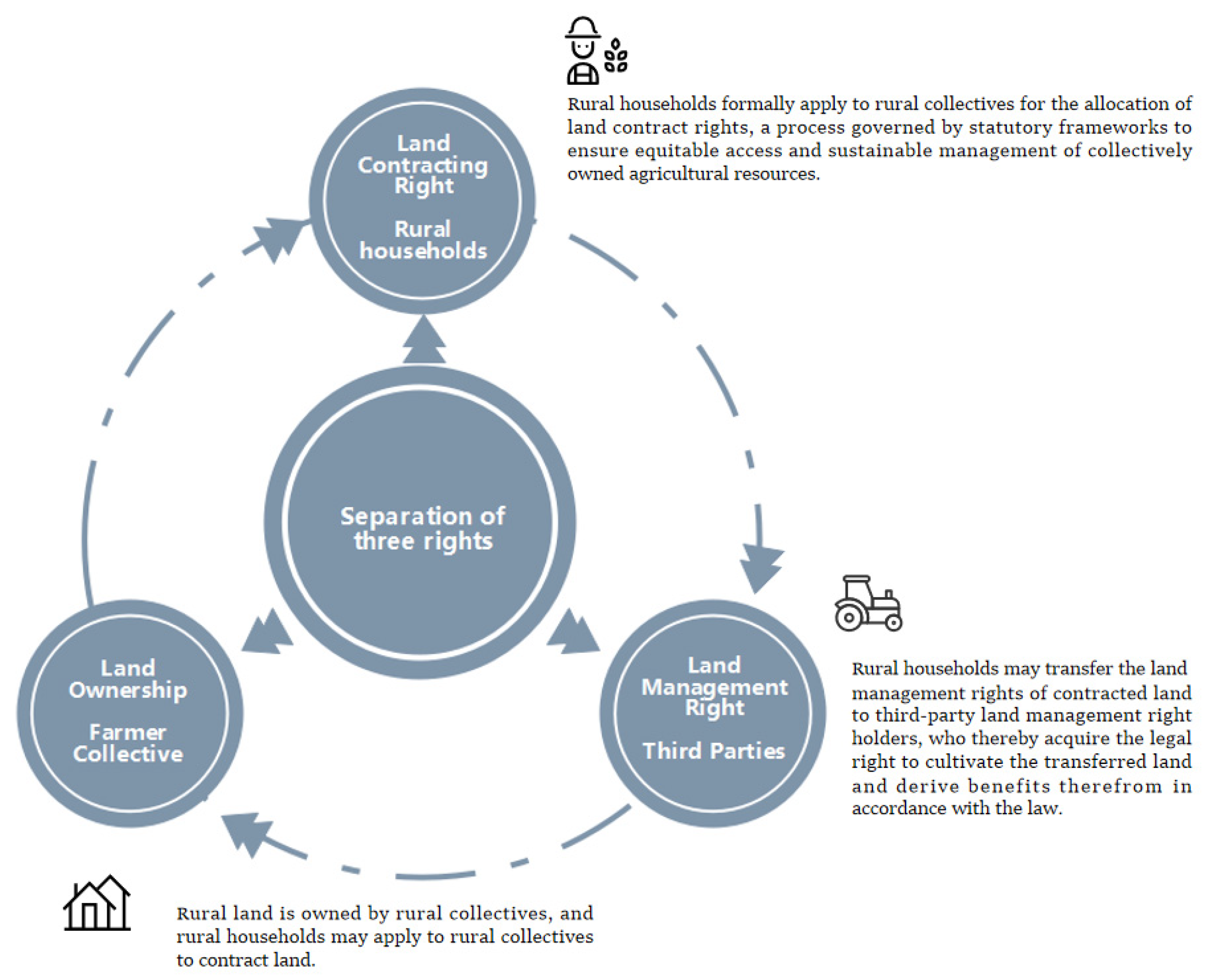
At the same time, influenced by social systems, the property rights system of China’s rural land differs from that of other countries, giving China’s rural land unique property rights attributes: The ownership of all rural land in China—including arable land, homesteads, and other categories—is vested in the village/peasants’ collectives rather than in the state or private entities. Building on the system of ownership by peasants’ collectives, China has innovatively developed an institutional design featuring the “separation and parallel operation of ownership, contract rights, and management rights” (the Separation of Three Rights, as illustrated in Figure 1). Specifically, the ownership of land is vested in the village/peasants’ collectives. However, in each administrative village, the local village committee is entrusted with the overall management of the land on behalf of the village/peasants’ collectives, acting as its representative. It ensures that land is not subject to private monopoly and safeguards the collective interests of members. Contract rights entitle members of the rural collective to the qualification for contracting collective land and associated property rights. These rights are established through contracts signed on a household basis, granting long-term and stable contract rights (with a 30-year term for arable land contracts, which is extended for another 30 years upon expiration). Management rights allow contracting households to transfer their land management rights to new types of agricultural business entities (e.g., cooperatives, family farms) through means such as leasing, shareholding, and entrustment. This facilitates the optimal allocation of land resources and enhances utilization efficiency. Within China’s collective ownership framework, these rights circulate under reform principles, though permitted transactions vary by land type (contracted land, commercial construction land, homesteads).
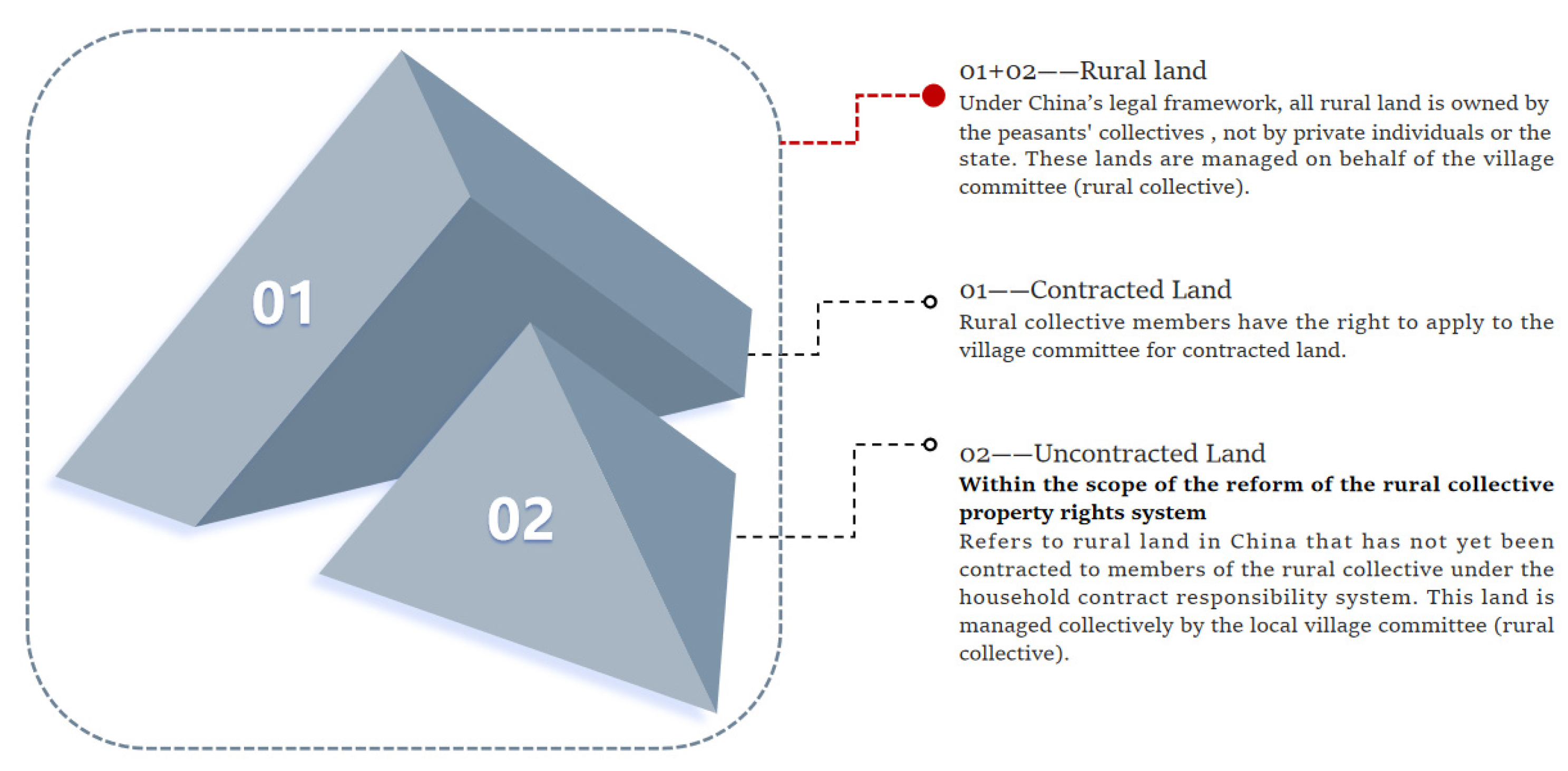
For resources such as land, forest land, idle houses, and factory buildings that are not contracted by the village/peasants’ collective members, their management and operation rights belong to the local villagers’ committee, which administers them on their behalf. These assets are referred to as rural collective assets and are the primary targets of the reform of the rural collective property rights system (in Figure 2). Due to the inherently ambiguous definition of the village/peasants’ collectives, such ambiguity enables the village committee to engage in unauthorized exploitation of collective assets (e.g., illegal leasing, conversion for non-agricultural use without member consent) or leave valuable resources idle due to mismanagement, both of which constitute violations of the collective’s ownership rights [1].
Undoubtedly, if the current massive scale of collective assets cannot be effectively activated, it may lead to abuse of power at the rural grassroots level, resulting in the loss of collective assets and hindering the full realization of their value appreciation potential. Therefore, advancing the reform of rural collective property rights is imperative. Moreover, unlike urban areas with numerous non-agricultural economic elements, the most typical economic foundation of China’s rural areas is land resources. The Chinese government proposed “building a unified national market” and emphasized that both urban and rural areas should strive for “common prosperity,” which has set higher requirements for the development of rural collective economies in China and urgently requires optimizing the current allocation pattern of rural collective assets. To this end, the Chinese government has initiated systematic property rights reforms for rural collective economic resources.
In December 2016, the Chinese government issued the “Opinions on Steadily Advancing the Reform of Rural Collective Property Rights,” which clarified specific goals for asset inventory and quantification. The opinions outline four key policy measures: First, it clarifies the ownership of rural property rights by conducting a comprehensive verification and quantification of rural collective assets, with a focus on resource-based assets such as rural collective land. Second, it comprehensively confirms the membership status of individuals within rural collective economic organizations. Third, it steadily advances the shareholding cooperative reform of operating assets, which involves establishing rural collective economic organizations across China’s vast rural areas and converting collective assets into shares or equity holdings for each rural member. Fourth, it leverages the various resource-based assets associated with collective land as a foundation, with a focus on developing new business models that integrate culture, tourism, and agriculture, thereby fostering new forms of rural collective economy tailored to local conditions.
Since 2016, China’s Ministry of Agriculture and Rural Affairs has jointly established a joint meeting with 16 government departments to launch pilot reforms of the rural collective property rights system. By August 2020, China had advanced the reform pilot in five batches, covering 28 provinces, 89 prefecture-level cities, and 442 counties. Nationwide, 602,000 villages and 2.38 million groups have completed the reporting of asset verification data, while over 330 townships, 260,000 villages, and 180,000 groups have completed the shareholding cooperative reform of collective operating assets. By 2022, the rural collective property rights reform had verified 7.7 trillion yuan (1.1 trillion USD) in rural collective assets and 436.67 million hectares of collective land and other resources, confirming the identities of 900 million rural collective members. Nationwide, approximately 960,000 organizations at the township, village, and group levels have been established, all registered with the Ministry of Agriculture and Rural Affairs and issued the “Rural Collective Economic Organization Registration Certificate,” providing strong support for collective economic organizations to participate in market activities3. Therefore, whether in terms of breadth or depth, the rural collective property rights reform is a transformative initiative of profound significance, occupying a central position in the Chinese government’s efforts to deepen rural reforms and advance the comprehensive revitalization of rural areas [2].
Outside China, most regions do not have a Chinese-style “separation of three rights” system for rural land property rights. However, collectively owned land remains the most prevalent type of land asset globally, with approximately 3 billion people relying on it for their livelihoods. Therefore, the reform of China’s collective property rights system—under this unique property rights framework—also holds practical significance that is applicable worldwide. At present, the academic community pays attention to the effects of collective economies (such as cooperatives) on enhancing rural welfare. Agricultural cooperatives are regarded as an important institutional tool for improving the welfare of small farmers. This is consistent with the logic of China promoting common prosperity for farmers through the development of new rural collective economies. Cooperatives organized by farmers can drive agricultural transformation. This supports the rationality of China’s rural collective property rights reform in organizing farmers and changing the traditional smallholder economic model [3,4]. Cooperation among smallholder farmers positively impacts income and productivity; therefore, rural production organizations should be expanded [5]. This indirectly confirms that China’s path of vigorously developing new rural collective economies is universal. In the process of developing new rural collective economies, the role played by the property rights system is undoubtedly extremely important.
The academic community generally agrees that among the many socio-economic systems affecting the growth of rural household income and rural economic development in China, the rural collective ownership property rights system is a core mechanism with far-reaching influence. Granting farmers more stable and complete land rights, such as longer contract periods and transferable management rights, significantly increases farmers’ medium-and long-term investments in land, such as fertilization and water conservancy facilities, thereby enhancing agricultural productivity and income [6,7]. Promoting property rights reform and optimizing the allocation of farmers’ rights can effectively stimulate farmers’ enthusiasm for participating in local social affairs and create conditions for them to explore diversified income channels. Furthermore, scholars have conducted systematic research on the specific measures and practical steps taken by the Chinese government to implement rural collective property rights reform, covering aspects such as asset verification, member identity recognition, share quantification, and the establishment of shareholding economic cooperatives [8,9,10,11]. In rural areas, the effectiveness of rural collective property rights reform has been widely discussed in academic circles. Some studies indicate that the reform has significantly boosted household incomes, with most conclusions based on provincial-level data [12,13]. Other research reveals that the reform has positively driven county-level economic development in pilot counties, strengthening rural collective economies through the reform initiatives [10,14].
The reform of rural collective property rights has significantly contributed to narrowing income disparities and boosting rural incomes. Empirical studies indicate that this reform substantially increased household incomes, particularly benefiting low-income families [15]. Clear delineation of collective property rights facilitated the transfer of cultivated land and specialization in agricultural production, creating diversified income channels for low-income households [16,17]. Regarding urban–rural income inequality, the reform indirectly contributed through optimized resource allocation. Research suggests that the reform partially promotes income growth via financial literacy enhancement, which enables farmers to better participate in modern economic systems and benefit from urbanization, thereby helping mitigate long-term urban–rural income gaps [18]. Additionally, the reform reshapes resource distribution patterns by attracting industrial capital to rural areas and guiding labor migration. The expansion of collective economies has also strengthened rural public services, positively impacting urban–rural disparity reduction [19,20]. However, the reforms’ effects vary; differences exist in collective economic foundations and resource endowments. The income increase and income gap reduction effects of property rights reform may vary in different regions, and policies need to be tailored to local conditions [21].
However, the aforementioned existing studies mostly focus on the overall impact of reforms on agriculture and rural areas, or the data foundation is relatively macroscopic, lacking more persuasive empirical methods. The academic community pays insufficient attention to the impact of rural collective property rights reform on internal rural income inequality and urban–rural income disparity. Most related discussions remain at the level of theoretical deduction, lacking systematic empirical verification based on long-term micro-level household survey data, and failing to delve into the operational mechanisms. Additionally, existing research often confines itself to case analyses of partial regional experiences or typical models, lacking a holistic and systematic perspective, and thus making it difficult to fully reveal the internal mechanisms through which reforms influence income distribution patterns.
To address these research shortcomings, this study focuses on the impact and dynamic effects of the national rural collective property rights reform launched in 2016 on internal rural income inequality and urban–rural income disparity. Pilot reform areas are treated as the experimental group, while non-pilot areas serve as the control group, simulating a quasi-natural experiment. Based on data from the China Household Finance Survey (CHFS) microdata and the China Longitudinal Night Light Data Set (PANDA-China), this study constructs a five-period balanced panel dataset covering 2304 rural households across 25 provinces. A relative exploitation index based on the Kawani index is developed to identify internal rural income inequality and urban–rural income inequality. The income gap level was analyzed using a combination of econometric methods, including the multi-period difference-in-differences (multi-period DID) model, discrete bivariate model, and propensity score matching-difference-in-differences (PSM-DID) model.
This study primarily draws the following conclusions: First, the empirical results confirm that the pilot reform of rural collective property rights effectively reduced income inequality within rural areas, with the effect generating positive spatial spillover through the market-oriented allocation of factors, thereby contributing to narrowing the urban–rural income gap. Second, the reform activated the potential of rural non-agricultural economic factors, establishing a two-way flow channel between urban and rural elements, providing a key pathway for advancing common prosperity. Finally, heterogeneity analysis revealed that the reform’s effectiveness was significantly moderated by regional and household characteristics. Key moderating factors included whether an area was a major grain-producing region, as well as a household’s initial income level and the age and education level of its head, indicating that the policy effects are condition-dependent.
This study aims to systematically summarize the experience of China’s rural collective property rights reform, providing solid theoretical support and empirical evidence for promoting effective practical models. The research findings not only offer references for improving China’s local institutional mechanisms, promoting rural economic development, narrowing the urban–rural income gap, and assisting in achieving the national goal of common prosperity for all people, but it also aims to distill actionable insights that can. The institutional innovation logic and policy implementation paradigm of China’s experience provide a “China solution” for other developing countries to explore rural reform and anti-poverty paths suitable for their national conditions, contributing Eastern wisdom to accelerate the global poverty reduction process, promote inclusive growth, and ultimately achieve the goals of the UN 2030 Agenda for Sustainable Development.

2. Theoretical Analysis and Research Hypothesis

2.1. China Rural Property Rights System

In 2010, China’s rural property rights reform entered a new phase of systematic deepening and comprehensive advancement. Its core feature was the evolution from “separation of two rights” to “separation of three rights” as the cornerstone, while simultaneously advancing the shareholding cooperative reform of collective operating assets. This stage aims to address new demands such as agricultural modernization and the flow of urban–rural elements, systematically resolving long-standing issues like insufficient contractual management rights and ambiguous collective asset ownership.
The reform first achieved a key breakthrough in the land system. Through the “separation of three rights” reform, the contractual management rights of farmers were clearly divided into collective ownership, farmers’ contracting rights, and land management rights. While strictly protecting the basic right of farmers’ contracting rights, it significantly expanded the circulation space of land management rights, laying the institutional foundation for developing appropriately scaled operations and modern agriculture. Meanwhile, for non-land-based rural collective assets, the national level initiated a comprehensive rural collective property rights reform. This involved asset verification to clarify the status, confirming the identity of members of collective economic organizations, quantifying assets into shares and assigning them to individuals, and establishing shareholding economic cooperatives. These measures granted farmers rights to possess, benefit from, and exit shares of collective assets, thereby strengthening the new type of rural collective economy.
This series of reforms was ultimately consolidated in legal form, with the 2018 revised “Rural Land Contract Law of the Peoples Republic of China” that established the legal status of the “separation of three rights”, while the “Rural Collective Economic Organization Law of the Peoples Republic of China”, which came into effect in May 2025, provided top-level legal safeguards for the operation of new collective economic organizations and the rights and interests of farmer members, marking the basic maturity and stabilization of the rural property rights system with Chinese characteristics.

2.2. Collective Property Rights and Rural Incomes

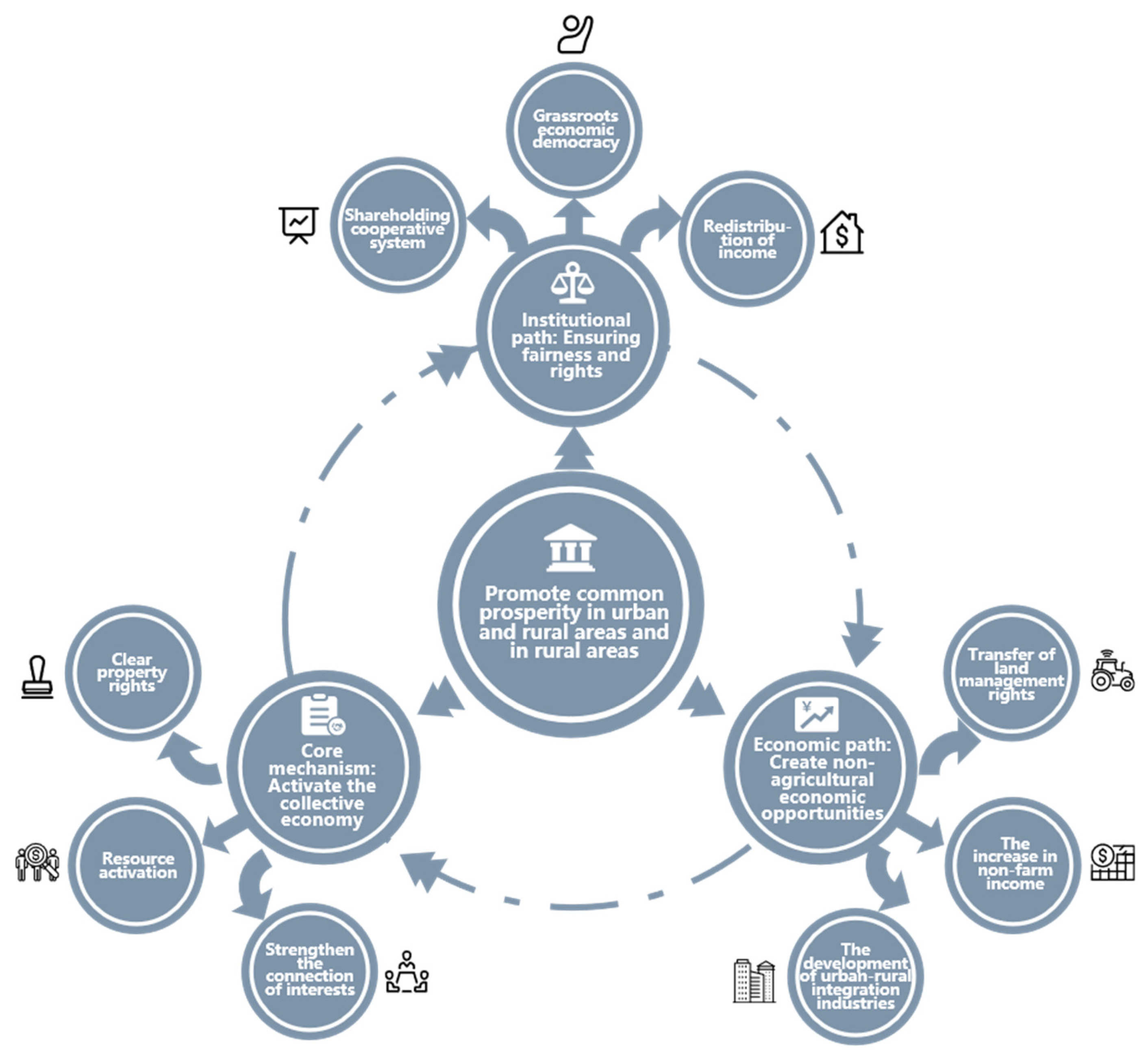
The rural collective property rights reform has become a core driver of farmers’ income growth by systematically restructuring resource allocation methods. As depicted in Figure 3, first, the reform directly boosts farmers’ property income through land resource redistribution. Under the shareholding cooperative framework, collective land and other resource assets are converted into quantified shares allocated to households. Farmers obtain rental income and dividends by transferring land management rights as shares, transforming idle resources into tradable capital, and establishing stable property income channels. Second, the reform significantly enhances farmers’ wage income through labor resource reallocation. While land transfers liberate household labor, the local secondary and tertiary industries developed alongside collective economic growth, along with new agricultural business entities, creating abundant non-agricultural job opportunities. This facilitates labor migration from less efficient agricultural sectors to more productive non-agricultural fields, enabling higher labor compensation. Third, the reform effectively increases farmers’ operational income by incentivizing agricultural input. Clear property rights enhance investment confidence, while collective economic organizations provide unified agricultural input procurement, technical guidance, and credit support. These measures reduce production costs, improve land productivity, and allow even specialized agricultural households to benefit from intensive farming practices. Thus, modern management such as intensive farming practices can achieve increased income.

2.3. Impact of Reforms on Income Inequality

The income growth effects described above are not evenly distributed but profoundly impact income disparities. In narrowing rural income gaps, the reforms demonstrate a “poverty-reducing” characteristic. For low-income households with limited resources, the marginal gains from wage income and property income far exceed those of high-income households. These gains stem from sources such as local non-agricultural employment and collective dividends, respectively. Meanwhile, the collective shareholding system and profit redistribution mechanism ensure equitable sharing of development benefits, effectively preventing the Matthew effect of “the rich getting richer.” In bridging urban–rural income gaps, the reforms act as a “bridge.” By revitalizing rural economic vitality and boosting farmers’ absolute income levels—potentially growing faster than urban residents—they facilitate two-way flows of resources: rural land and labor support urban development, while urban capital, technology, and management expertise return to rural industries. This interactive integration fundamentally transforms the rural sectors’ pattern of merely exporting cheap labor, shifting urban–rural income from “binary differentiation” to “convergent integration.” Thus, the rural collective property rights reform not only achieves quantitative growth in farmers’ income but also realizes qualitative improvements in social benefits through optimized income structures and an equitable distribution of development outcomes. This has laid a solid foundation for promoting common prosperity.

3. Materials and Methods

3.1. Overview of the Study Area

This study identifies pilot counties for rural collective property rights reform as a key variable. Through multi-dimensional pilot initiatives, the reform focuses on strengthening collective asset management, confirming membership status in collective economic organizations, advancing shareholding cooperative reforms for operational assets, enhancing share rights of farmers’ collective assets, optimizing organizational functions, and expanding development pathways for collective economies.
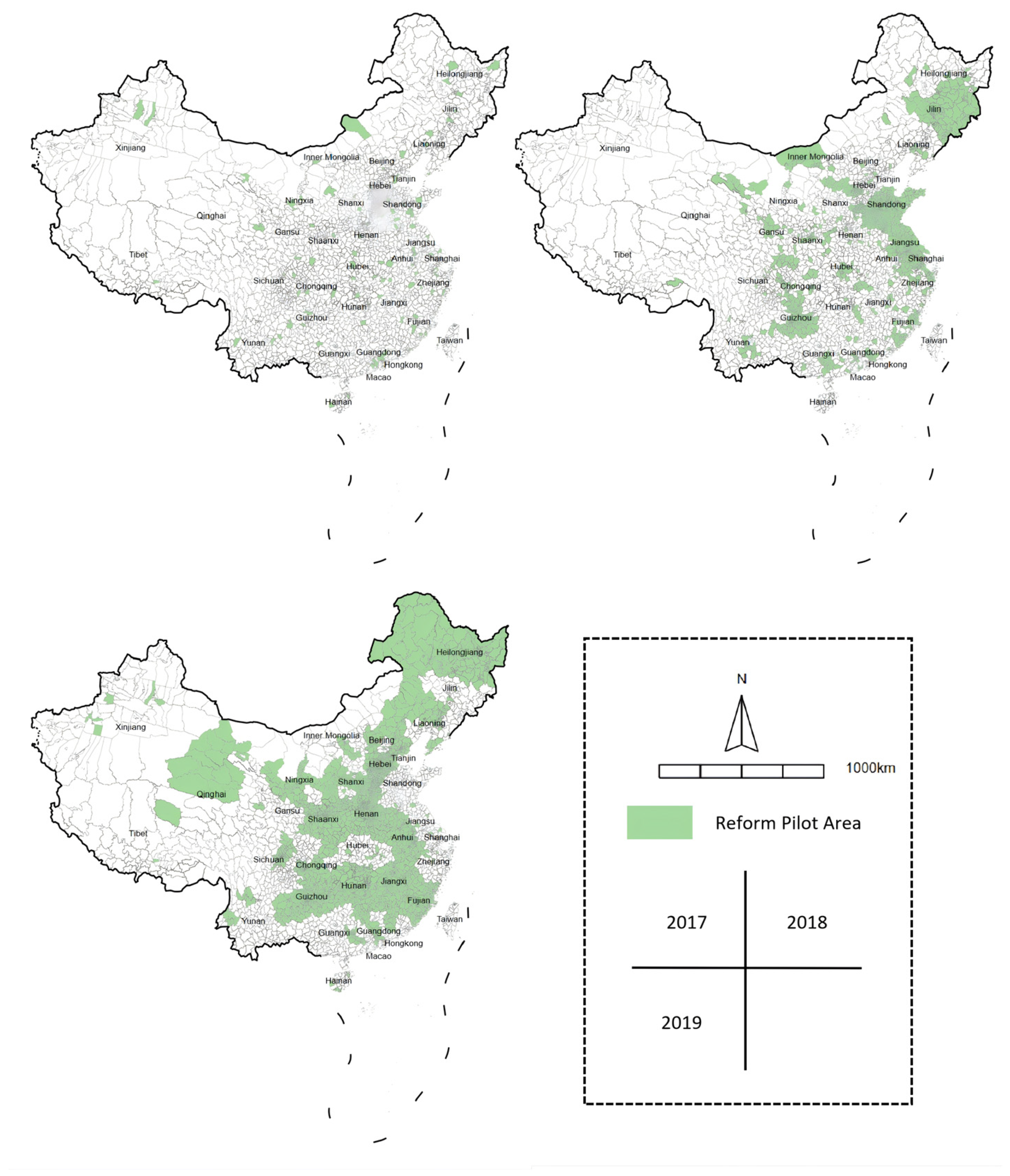
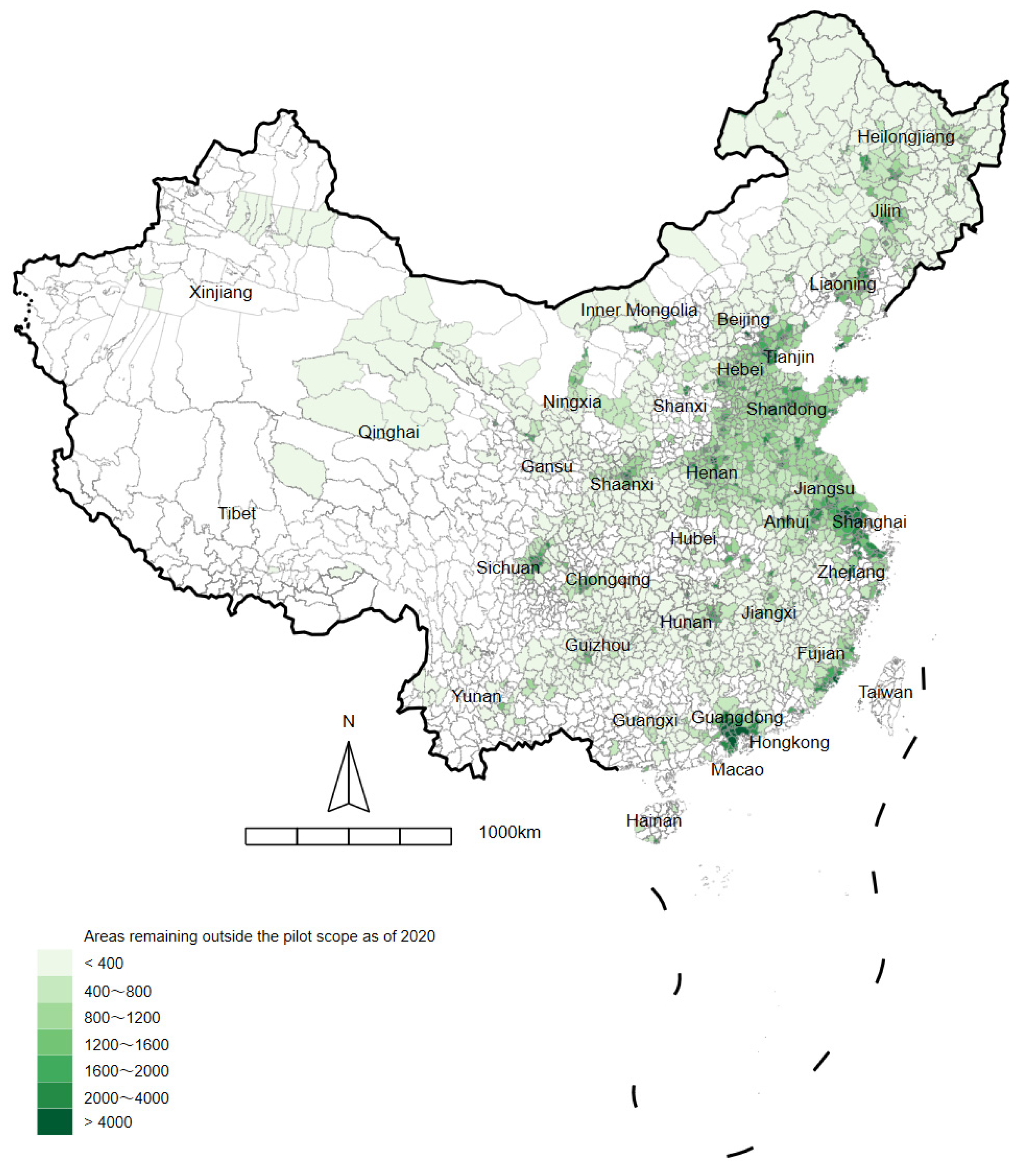
The pilot county list originates from reform pilot directories that are published by the Ministry of Agriculture and Rural Affairs and the National Development and Reform Commission. In 2017, pilot programs were launched in over 100 counties (cities, districts); in 2018, the scope expanded to 50 prefecture-level cities and 150 counties (cities, districts); and in 2019, 12 additional provinces, 39 prefecture-level cities, and 163 counties (cities, districts) were included. This phased implementation strategy provides an exogenous policy shock for assessing reform effects. The geographical distribution of pilot regions across years is illustrated in Figure 4.

3.2. Data Sources

In terms of data processing, this study utilizes the CHFS database, spanning from 2011 to 2019, covering a period of nine years. Some survey items underwent revisions, and there were missing values to some extent. To align with the research objectives and construct balanced panel data, we ultimately selected urban and rural households that participated continuously in the survey throughout the entire period, using them as the data foundation for measuring income disparities within rural households and between urban and rural areas. In subsequent benchmarking models and empirical analyses, only the continuous rural household samples over the nine-year period were retained, providing robust data support for applying the difference-in-differences (DID) method for causal identification. After preliminary screening and exclusion of samples with poor data quality, we ultimately constructed a five-period balanced panel dataset comprising 25 provinces, 158 counties, and 2304 farming households, with a total sample size of 11,520.

3.3. Variable Design

(1) Dependent Variable: The dependent variable in this study primarily serves to depict income disparity levels, encompassing both urban–rural income gaps and intra-rural income disparities. To this end, we adopted the relative deprivation index (RD) calculated using the Kakwani Index, which was further categorized into two sub-indices based on household registration attributes: the rural relative deprivation index (RRD) for samples with rural household registration, and the Overall Relative Deprivation Index (ORD) for all samples. The Kakwani Index overcomes limitations of the Podder Index and Yitazhaki Index by addressing issues of dimensionless measurement and transferability, offering a distinct individual measurement method from Gini coefficients and Theil indices that objectively reflects sensitivity to changes in individual circumstances. The application of the Kakwani Index to measure economic disparities among individuals has gained widespread academic recognition [22,23,24], significantly enhancing the persuasiveness of our income disparity identification in this study. The calculation formula for the relative deprivation index is as follows:
RD x , x i = 1 n μ x j = i + 1 n x j     x i = γ x i + μ x i +     x i / μ x
(2) Core explanatory variable: If the county (city, district) where the farming household is located is a pilot area for rural collective property rights reform in the current year, the value is 1; otherwise, it is 0.
(3) Control Variables: In selecting control variables, this study follows the conventional approach of income determination equations and existing research [25,26]. Based on data availability, the factors influencing household income are categorized into two groups: household head characteristics, which include gender, age, education level, and health status, and household endowment characteristics, which encompass total savings, total assets, family size, per capita net income, and social status.
(4) Mediating Variables: In previous studies, one important avenue for increasing rural residents’ income is participation in the non-agricultural economy. Will the implementation of rural collective property rights reform produce differentiated effects of common prosperity due to differences in individual and regional participation in the non-agricultural economy? To this end, this study selects the indicator of whether households engage in non-agricultural employment at the individual level (NAE) and the long-term nighttime light data set of China (PANDA-China) at the regional level. Nighttime light data, as a “proxy indicator” of human socio-economic activities, has unique advantages in identifying the level of non-agricultural economic activity in regions and has been widely adopted and applied in academia. Its theoretical basis lies in the strong positive correlation between nighttime light brightness and the intensity of non-agricultural economic activities such as electricity consumption, industrial production, commercial activities, and infrastructure construction. Compared with traditional statistical indicators, light data possess characteristics such as objectivity, high frequency, cross-regional comparability, and resistance to human interference. Light data can not only effectively capture macro trends such as urban expansion and industrial park development, but it can also finely depict the dynamics of the non-agricultural economy at the county and even township levels [27,28,29,30].
The specific definitions and descriptive statistics of all the above variables are shown in Table 1 and Table 2.

3.4. Model Construction

This study employs the difference-in-differences (DID) model to evaluate the impact of rural collective property rights reform pilot programs on the relative deprivation index within rural communities and at the overall level. Households in counties (cities, districts) participating in the pilot reform are designated as the treatment group, while those in other regions form the control group. Given the staggered implementation timelines across regions, we adopted the multi-period DID model as proposed by Beck et al. (2010) [31]. The constructed model is as follows:
xRD it = α + β · Did it + k = 1 K γ k X it ( k ) + ρ t + θ i + ρ t · θ i + ε it
x   = R / O X it ( k ) = Sa ,   Ta ,   Fa ,   Age ,   Status ,   Health ,   Edu ,   Light ,   Income ,   Sex
In Formula (1), the subscript i denotes the county/district, while t represents the year (t = 2011, 2013, 2015, 2017, 2019). xRD it is the dependent variable, where x = R denotes the rural relative deprivation index and x = O denotes the overall relative deprivation index between urban and rural areas. X it ( k ) is the vector of control variables.
Furthermore, to investigate whether participation in the non-agricultural economy mediates at the individual level, this study develops a mediation model using a logit framework. We first constructed a discrete binary model examining how rural collective property rights reform influences participation in the non-agricultural economy, then incorporated this participation variable into the baseline regression analysis. If the discrete binary model shows, and if the effect of Did it on NAE it is significant in the discrete dichotomous model, and if NAE it remains significant after inclusion in the baseline regression, then the mediating effect of NAE it is significant (For mediation analysis, see Section 5).
Logit NAE it = ln P NAE it = 1 | Did it 1     P NAE it = 1 | Did it = α   + β · Did it + k = 1 K γ k X it ( k ) + ε ij xRD it = α   + β · Did it + λ · NAE it + k = 1 K γ k X it ( k ) +   ρ t + θ i + ρ t · θ i + ε it

4. Empirical Analysis Results

4.1. Benchmark Regression

This article uses Stata 18 for empirical calculations. The benchmark regression results are presented in Table 3. This study employs four regression models: Models (1) and (2) use RRD as the dependent variable, while models (3) and (4) use ORD. All models control provincial fixed effects (Province FE), year fixed effects (Year FE), and their interaction effects (Province × Year FE) to mitigate omitted variable bias. Models (1) and (3) exclude control variables, whereas models (2) and (4) include them.
In all models, the coefficient of DID is negative and statistically significant. This indicates that the reform of rural collective property rights has a significant negative impact on both internal and overall income disparities in rural areas. For instance, in models (2) and (4) incorporating the control variables, the absolute value of DIDs’ coefficient increases to −2.01 and −1.68, respectively, with enhanced significance levels. This demonstrates that after controlling for other factors, the negative impact of the rural collective property rights reform remains robust.
After introducing control variables, the goodness of fit (R2) of models (2) and (4) significantly increased from 0.078 and 0.072 to 0.285 and 0.270, respectively, with F-values also rising substantially, indicating that the control variables collectively enhanced the models’ explanatory power. Specifically, the coefficients of household size (Fa) were significantly negative in both RRD and ORD models, suggesting that larger family populations effectively reduce relative deprivation, while economies of scale or internal mutual aid help mitigate income disparities. The coefficient of household head age (Age) was significantly positive, reflecting that advanced age may exacerbate deprivation due to declining income capacity. Both social status (Status) and education level (Edu) coefficients were significantly negative, indicating that higher social status and education levels alleviate deprivation through resource acquisition advantages, with more pronounced effects in rural areas (RRD). The coefficient of health status (Health) was significantly positive, suggesting that deteriorating health significantly increases deprivation, particularly concerning the phenomenon of returning to poverty due to illness. Savings (Sa) and total assets (Ta) coefficients were significantly negative. Additionally, the introduction of control variables increased the absolute values of the core variable DID coefficients and enhanced their significance. In summary, control variables not only effectively capture the influence of household characteristics but also demonstrate their role in explaining socioeconomic disparities. It also enhances the reliability of DID estimation. Future policies should focus more on education, health, and other dimensions to collaboratively reduce income disparities.

4.2. Endogeneity Test

Furthermore, this study employs a counterfactual PSM-DID model to address potential endogeneity issues. Table 4 presents the endogeneity test results, demonstrating that the core conclusions remain robust after controlling for selection bias through propensity score matching (PSM). First, the regression results in Table 4 show that the coefficient of the core variable DID remains significantly negative in both RRD and ORD models after incorporating a series of control variables. This indicates that the policy treatment effect persists even after controlling for endogeneity, meaning the policy significantly reduced relative deprivation. Although the absolute value of the coefficient decreased compared to the uncontrolled variable model, robustness was enhanced. The signs of control variables align with the benchmark regression, such as household size (Fa) and education level (Edu) being significantly negative, and household head age (Age) being significantly positive, further validating the stable influence of these household characteristics variables.
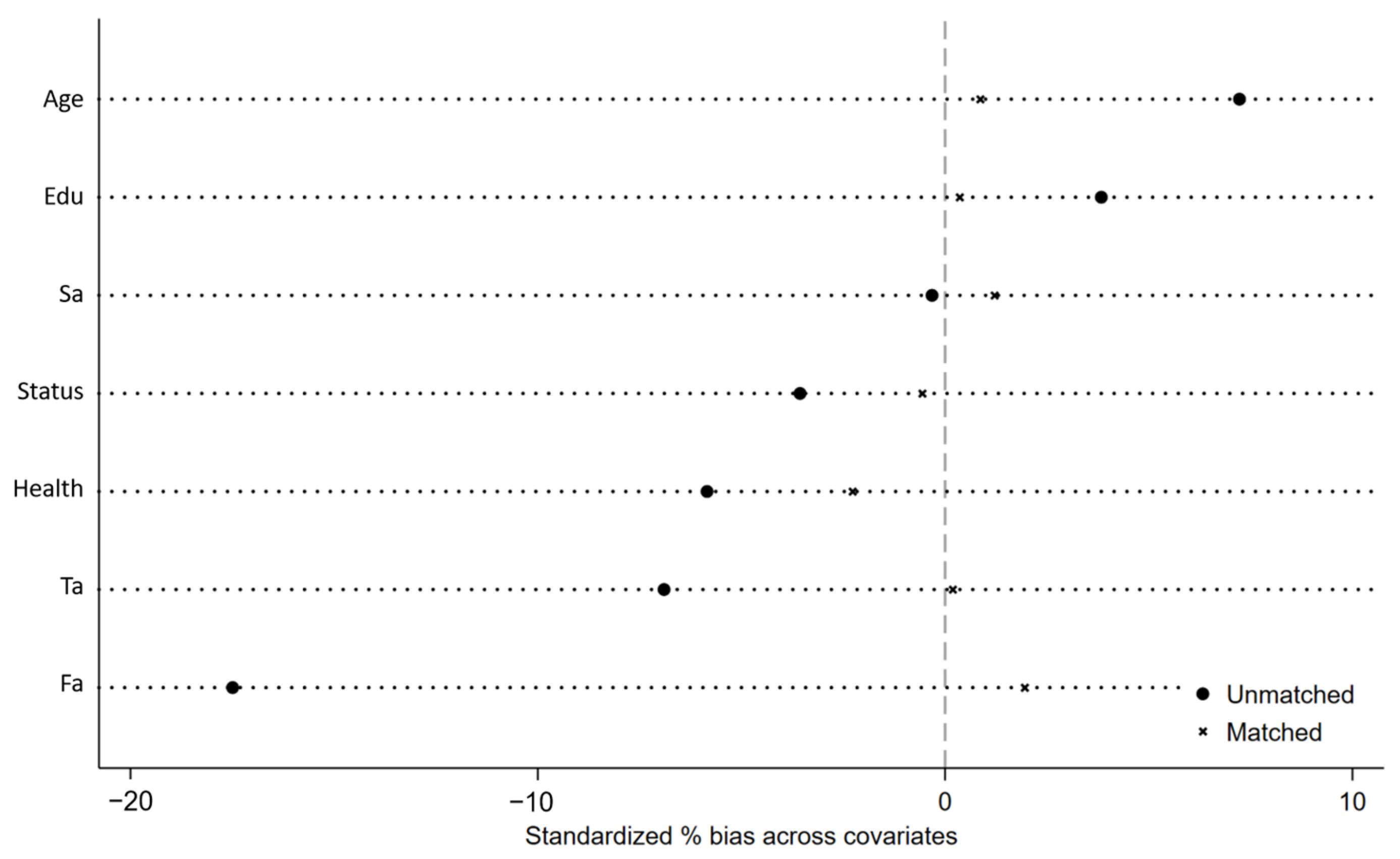
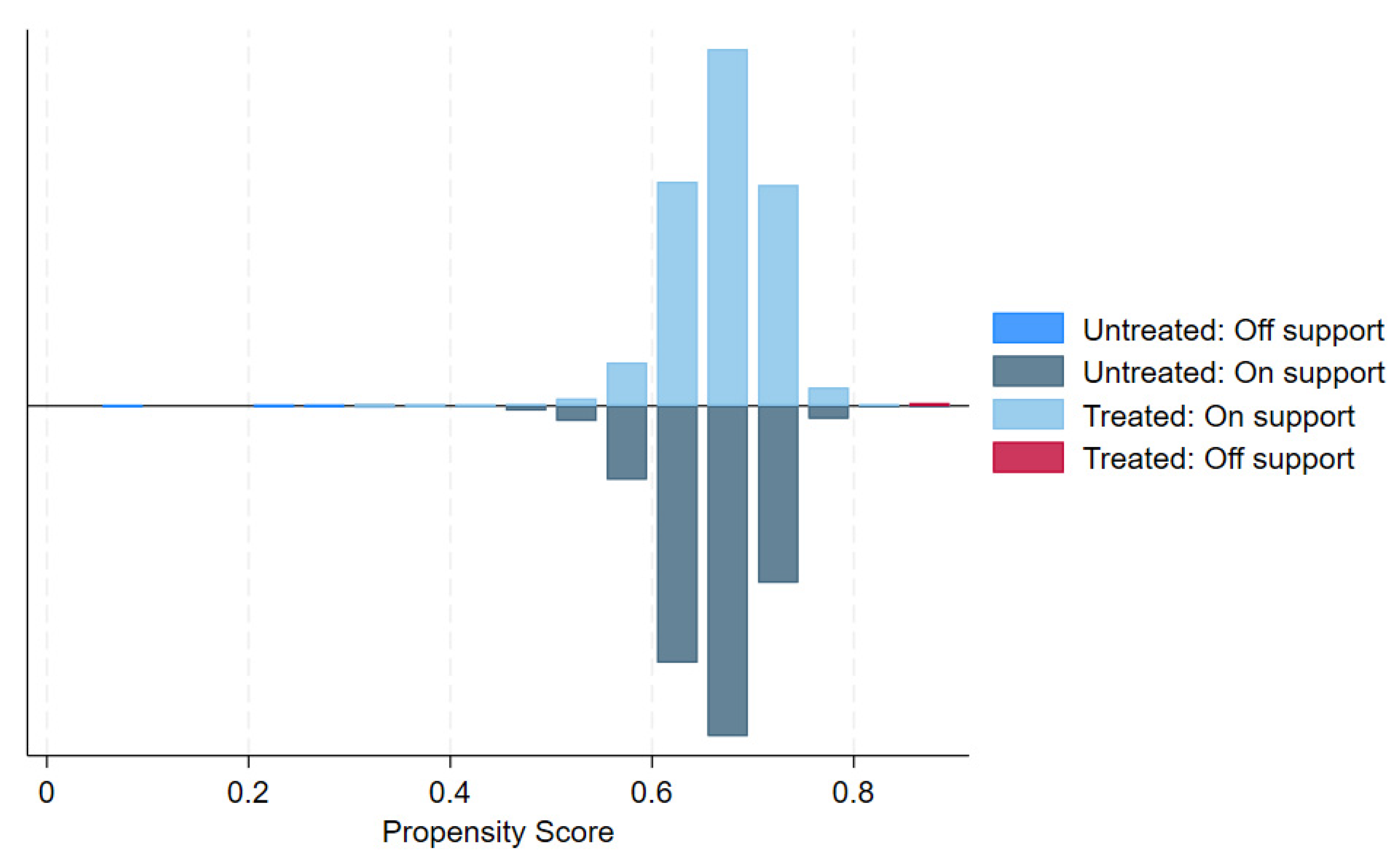
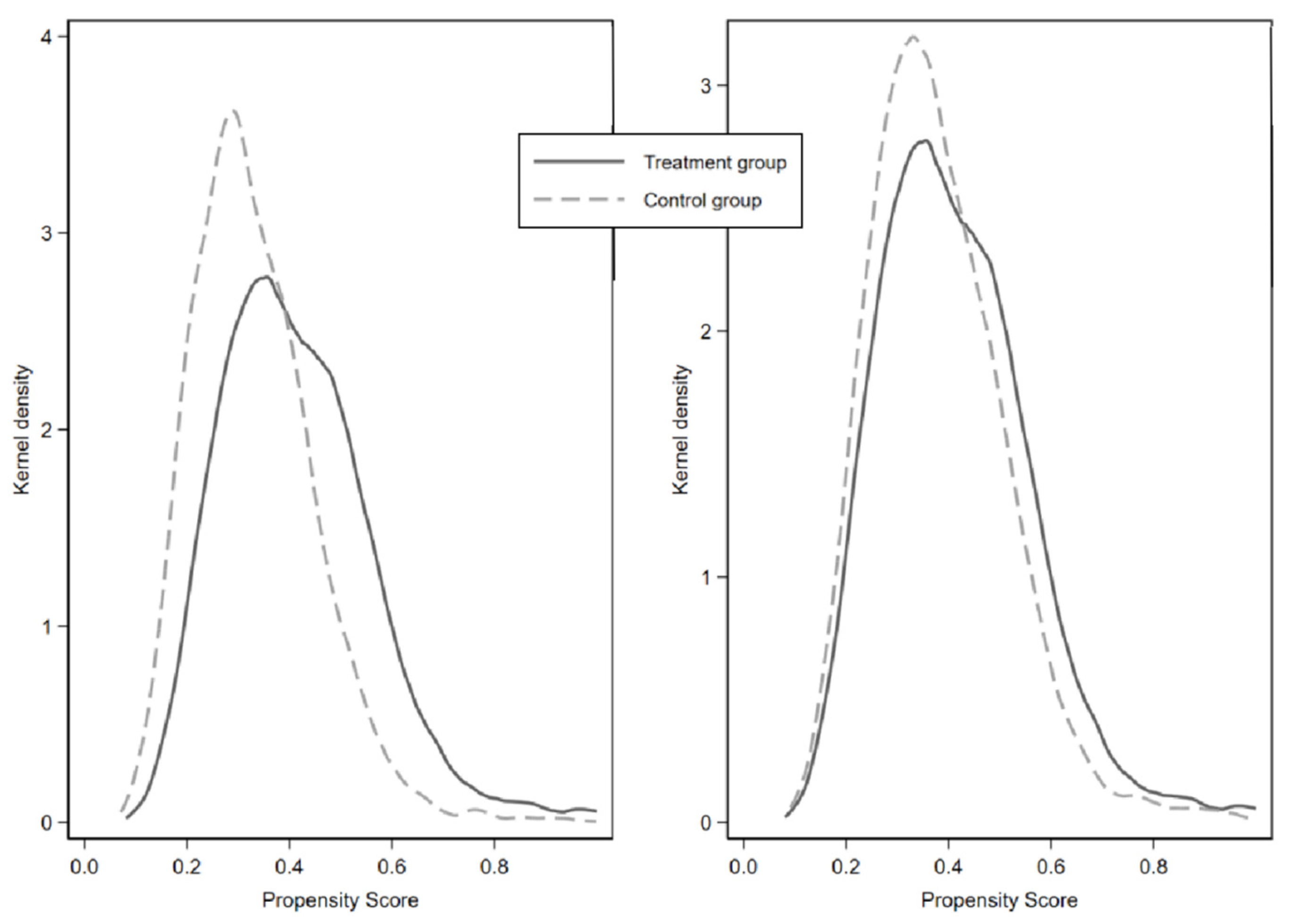
More importantly, the balance test diagram (Figure 5) visually demonstrates the effectiveness of PSM. Before matching, multiple covariates—including Health and Sa—exhibited significant standardized deviations. After matching, all variables’ deviations were substantially reduced and clustered around zero, with their absolute values dropping below 5%. This indicates that the treatment and control groups became highly similar across all observable characteristics, effectively mitigating endogeneity issues caused by initial sample differences. Additionally, the common trend range plot (Figure 6) and kernel density plot (Figure 7) reveal that the matched treatment and control groups share common support regions across most propensity score intervals, with their score distribution curves exhibiting highly similar patterns. These findings satisfy the common trend assumption required for DID analysis. In summary, the PSM-DID test systematically confirms that the poverty reduction effects identified in the benchmark regression are not driven by observable sample selection bias, thereby ensuring the reliability of the results.

4.3. Robustness Test

(1) Parallel trend test
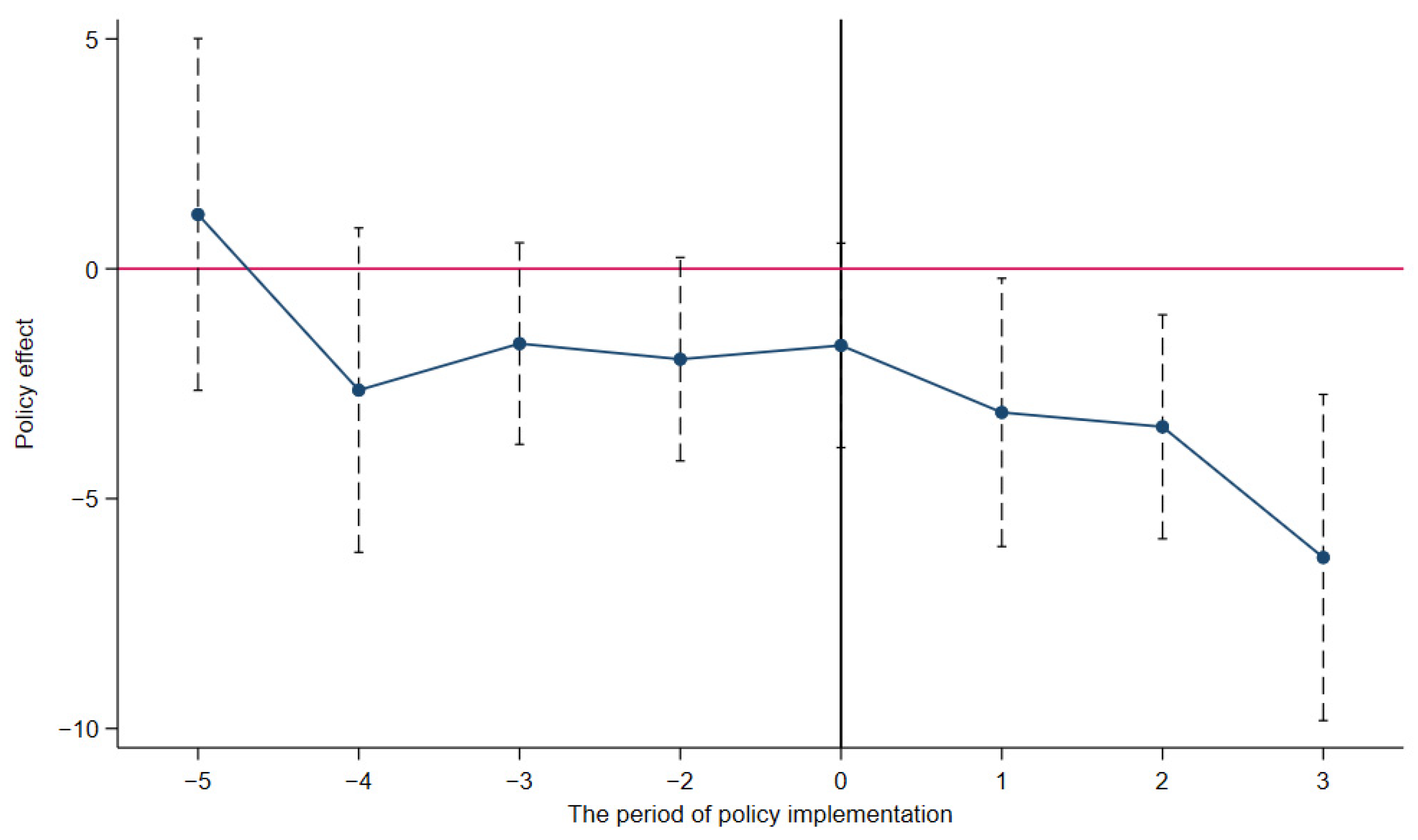
To validate the effectiveness of the multiple-period difference-in-differences (DID) model, this study conducted a parallel trend test. The model specification is shown in Equation (4), with the results illustrated in Figure 8. The graph depicts the dynamic effects of rural collective property rights reform on the relative deprivation index (RRD). Here, the horizontal axis represents time periods, ranging from five periods before to three periods after the policy implementation, while the vertical axis shows the estimated coefficients of the policy effects, with confidence intervals indicated by the surrounding bands. The key to the test lies in observing effects prior to policy implementation. The results indicate that before the reform officially took effect, all estimated coefficients fluctuated around the zero-effect line (red reference line), with confidence intervals containing zero values. This demonstrates that there was no systematic difference in the RRD change trends between pilot and non-pilot regions before the policy shock, satisfying the core assumption of the DID model—the parallel trend hypothesis. Meanwhile, the post-implementation dynamic effects reveal that the reforms’ immediate impact was insignificant, but starting from the second period, the coefficient maintained a negative value with gradually increasing statistical significance. This “gradual” influence pattern suggests that the income gap-reduction effects of the reform are not instantaneous but rather emerge as the reform deepens and policy dividends are progressively realized, ultimately reducing internal disparities within rural communities. The positive effects of deprivation are becoming increasingly evident and well-established. In conclusion, the fulfillment of the parallel trends hypothesis and the presence of a reasonable dynamic effect pattern jointly validate the reliability and explanatory power of this DID estimation.
R RD it = α   + t 5 4 β · Did it + k = 1 K γ k X it ( k ) + ρ t + θ i + ρ t · θ i + ε it  
(2) Placebo test
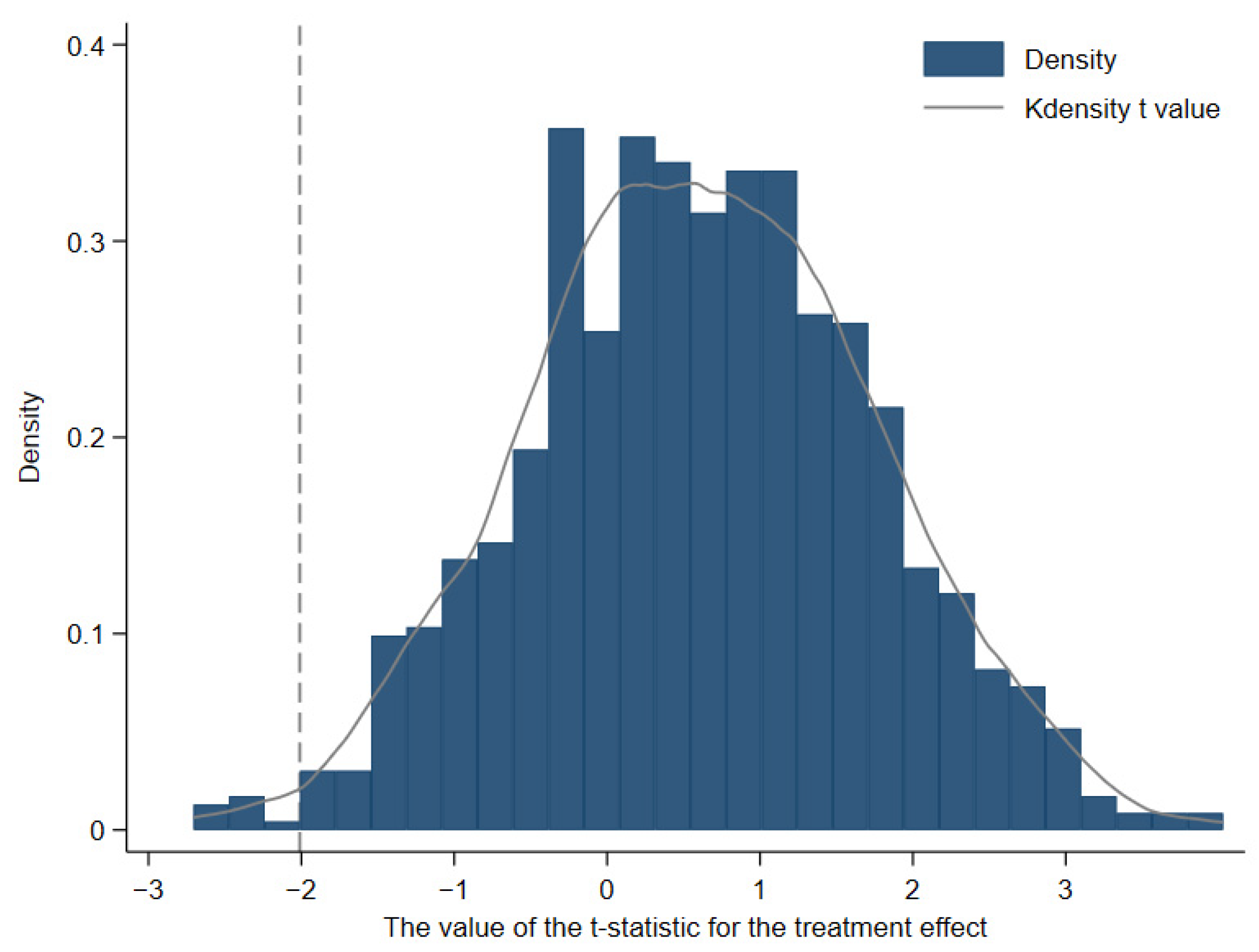
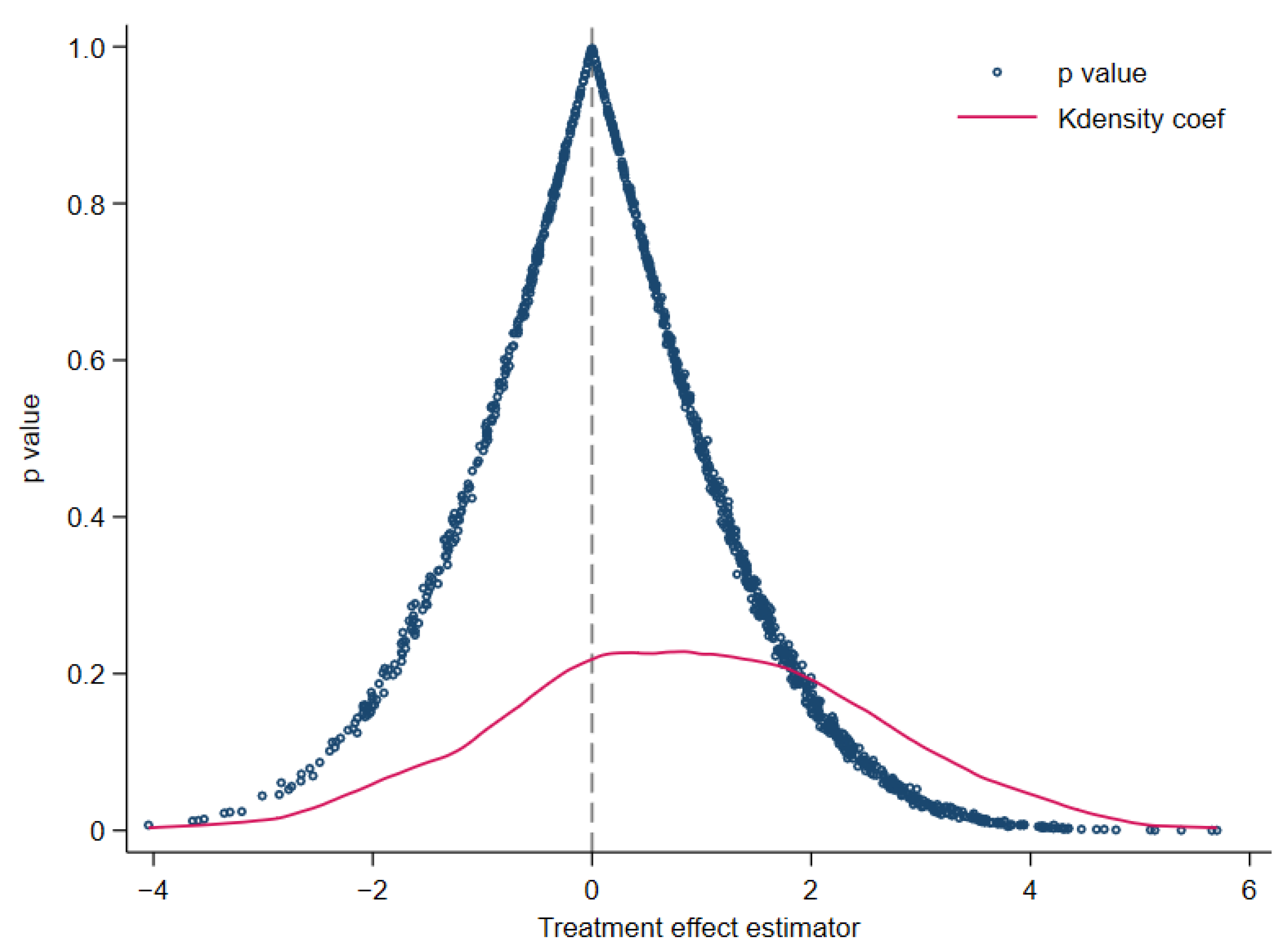
This study further evaluates the robustness of the benchmark model’s estimation results through placebo tests, with all three tests collectively supporting the reliability of the core conclusions. As shown in Figure 9, the simulated t-statistic of the coefficients from the first placebo test follows a zero-centered nearly normal distribution. The actual significant t-statistic from the benchmark regression lies at the extreme tail of this distribution, indicating that the observed significant effects are unlikely to be attributable to random factors. Figure 10 presents the same results from another perspective by illustrating the relationship between simulated treatment effect estimates and their corresponding p-values. The graph shows that a large number of simulated estimates, represented by blue scatter points, correspond to p-values exceeding the 0.1 significance level, meaning that most simulations failed to produce significant effects.
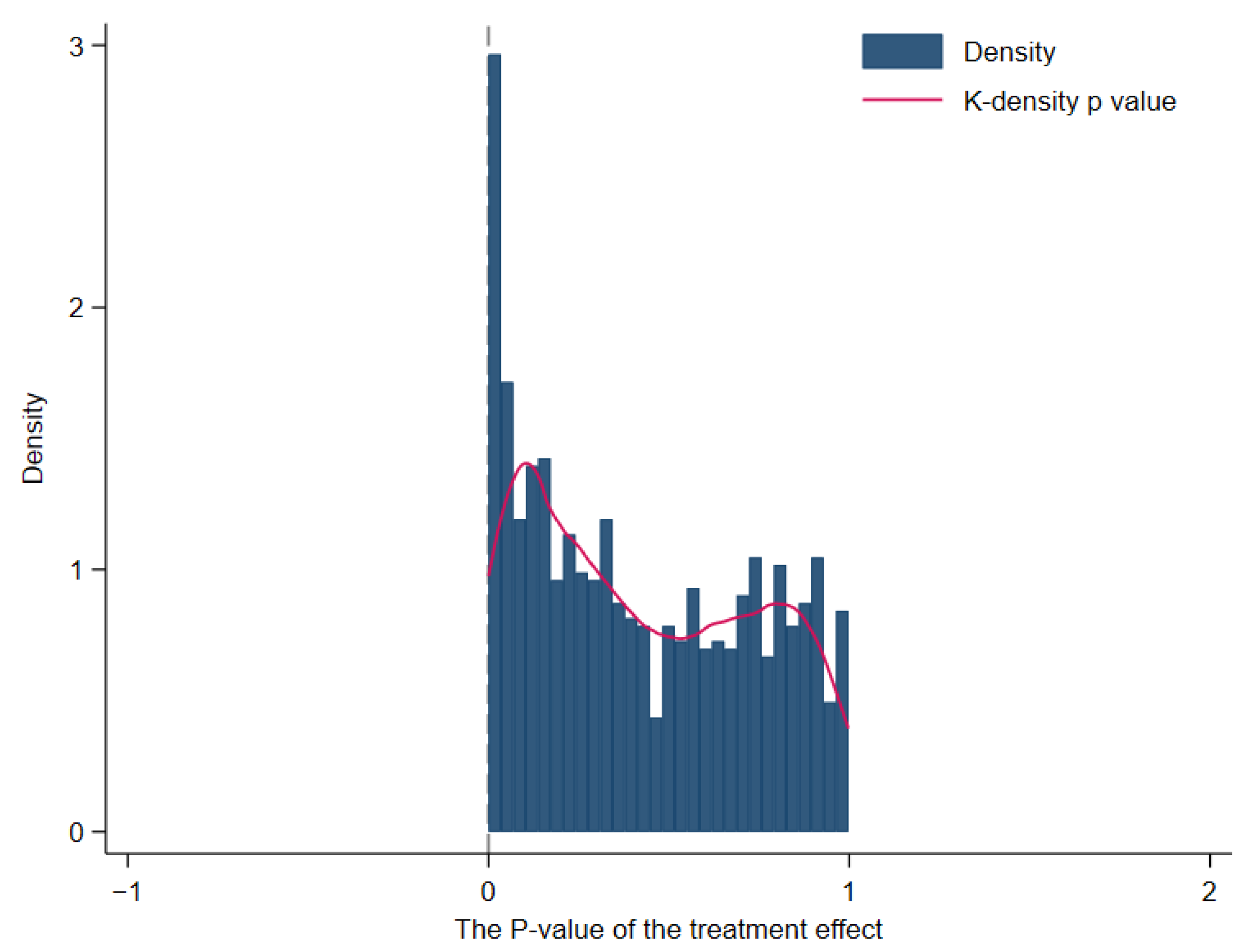
The peak of the kernel density curve, plotted as a pink line, is also concentrated in regions where the estimates approach zero. Finally, Figure 11 directly displays the p-values distribution of the simulated coefficients. Here, the p-values are highly concentrated in the higher numerical range, close to 1, rather than clustered around conventional significance levels such as 0.05 or 0.1. This further confirms that the significant treatment effect observed in the benchmark regression has an extremely low probability of occurring in random simulations. In summary, the three placebo tests consistently validate (from different dimensions) that the significant negative impact of the policy examined is not accidental, and the research conclusions demonstrate strong robustness.
(3) Other robustness tests
Table 5 presents the results of four robustness tests, which collectively demonstrate that the conclusion from the benchmark regression (namely, that the rural collective property rights reform pilot reduces relative deprivation) is robust and reliable.
First, after applying logarithmic transformations to continuous variables, as shown in columns (1) and (5), the coefficient of the core variable DID remains significantly negative at the 10% level in both the RRD and ORD models. This indicates that the benchmark results are not substantially affected by extreme values or skewed distributions.
Second, when control variables are lagged by one period to mitigate potential reverse causality—see columns (2) and (6)—the absolute value of the DID coefficient increases, and its significance rises to the 1% level, further strengthening the causal interpretation of the policy effect. Third, after excluding the 2017 sample listed in columns (3) and (7), the DID coefficient remains statistically significant at the 5% level, indicating that the results persist even after accounting for policy lags.
Finally, when the policy shock timing is artificially shifted to post-2013, shown in columns (4) and (8), the DID coefficient becomes statistically insignificant. This aligns with expectations, as introducing hypothetical policy timing eliminates the originally significant effect, thereby indirectly verifying that the observed results in the benchmark regression stem from the actual policy intervention. Across all tests, the specifications for control variables and fixed effects remain consistent with the benchmark model, and both the model goodness of fit, measured by R2, and overall significance, reflected in the F-value, remain stable.
In summary, this series of rigorous robustness tests confirms that the pilot reform of the rural collective property rights system exerts a robust negative effect on reducing the sense of relative deprivation.

5. Mechanism Analysis

5.1. Micro-Individual Data Perspective

The reform of rural collective property rights has effectively boosted farmers’ engagement in non-agricultural sectors. First, through asset verification and equity quantification, the reform transformed idle collective resources, such as vacant homesteads, factories, and forest land, into tradable market capital. This provided the material basis to develop rural industries like tourism, warehousing, logistics, and specialty processing. Second, clear property rights attracted industrial and commercial capital to collaborate in rural areas, creating numerous localized non-agricultural job opportunities. Meanwhile, village-established shareholding cooperatives emerged as key market entities, directly organizing farmers to participate in non-agricultural operations. Finally, the reform granted farmers clear shareholder status and stable property income expectations, enhancing their ability to withstand entrepreneurial risks while stimulating their intrinsic motivation to achieve asset appreciation through non-agricultural ventures. Consequently, farmers transitioned from traditional agricultural producers to participants, entrepreneurs, and beneficiaries in the non-agricultural economy, significantly elevating rural non-agricultural economic engagement. In the course of reform implementation, numerous cases have emerged where collectively owned properties, including idle houses, factories, and workshops, in addition to land and forestry resources, have been repurposed for non-agricultural operations, yielding significant income growth. Specific examples are detailed in Table 6.
Table 7 presents the mediation effect analysis results, which validate the crucial role of “participation in non-agricultural economy” in the process of policy-induced relative deprivation. The findings demonstrate that this variable exerts a significant partial mediation effect. First, the rural collective property rights reform significantly boosted household participation in non-agricultural employment (NAE), with an estimated coefficient of −0.87, which is highly significant at the 1% level, demonstrating the policy’s effective promotion of labor transfer to non-agricultural sectors. Second, after controlling for policy variables, the mediating variable NAE showed coefficients of −8.48 for the rural relative deprivation index and −7.90 for the overall relative deprivation index, both highly significant at the 1% level. This indicates that increased non-agricultural employment directly and substantially reduces relative deprivation perception. Meanwhile, the direct effect of the policy variable DID on RRD and ORD remained significantly negative at the 5% level after introducing NAE, though its absolute value decreased compared to the baseline regression. This suggests that the pilot policy influences relative deprivation through two distinct mechanisms: an indirect pathway that operates via the promotion of non-agricultural employment, and an independent direct effect. Bootstrap tests confirmed the mediation effect, with the direct effect remaining significant after bias correction, supporting the “partial mediation” mechanism. Therefore, the rural collective property rights reform can partially alleviate rural residents’ relative deprivation through promoting non-agricultural employment.

5.2. Regional Non-Agricultural Economy Perspective

In addition to examining the level of non-farm economic participation from the perspective of individual involvement, we can also adopt a different approach by analyzing the mediating effect based on the level of regional non-farm economic activity. This study utilizes the long-term nighttime light data set of China (PANDA-China), taking the average nighttime light data over the past nine years as an indicator to distinguish non-farm economic activity. Regions exceeding 800 units are considered non-farm economically active, and a grouped regression is constructed accordingly. Figure 12 shows the heat map of the nighttime light index in the pilot regions in recent years.
Table 8 presents the results of regression analysis based on the nighttime lighting index. The impact of rural collective property rights reform on relative deprivation perception exhibits significant regional heterogeneity, with its effectiveness strongly dependent on local non-agricultural economic development levels. In regions with nighttime lighting indices below 800 and relatively underdeveloped non-agricultural economies (columns (1) and (3)), the estimated coefficients of the policy variable DID are −0.09 (RRD) and 0.23 (ORD), respectively, neither of which is statistically significant. This indicates that pilot reforms failed to effectively reduce residents’ relative deprivation in these areas. The weak non-agricultural economic foundation in these regions makes it relatively difficult for collective economies to participate in non-agricultural sectors, hindering the successful allocation of non-agricultural resources and weakening the reforms’ impact. In stark contrast, in regions with nighttime lighting indices above 800 and developed non-agricultural economies (columns (2) and (4)), the coefficient of DID is significantly negative at the 5% level, with absolute values far exceeding those in lagging regions. This demonstrates that in areas with active non-agricultural economies and high marketization, property rights reform can significantly alleviate farmers’ relative deprivation and narrow income gaps within rural communities and between urban and rural areas by activating collective economies and creating non-agricultural income opportunities. These findings suggest that subsequent policies for rural collective property rights reform should prioritize enhancing collective economies in non-agricultural sectors. In order to ensure the universality of the reform results, the participation intensity should be supplemented with stronger measures to cultivate diversified industries in the economically backward regions.

6. Heterogeneity Analysis

6.1. Whether It Is a Major Grain Producing Area (MGPA)

This study investigates the differential impacts of rural collective property rights reform pilot programs by distinguishing between major grain-producing areas (MGPA) and non-major grain-producing areas (non-MGPA). Table 9 reveals significant regional heterogeneity in the reforms’ effect on relative deprivation. Specifically, in non-major grain-producing regions, the policy variable (DID) demonstrates highly significant negative coefficients in both RRD and ORD models, indicating a substantial reduction of relative deprivation. However, in 13 major grain-producing provinces, including Heilongjiang, Henan, and Shandong, the policy effects remain statistically insignificant. This suggests that the poverty-reduction benefits of pilot policies primarily concentrate in non-major grain-producing areas. Mediation analysis indicates this heterogeneity may stem from the core mechanism—expanding non-agricultural economic factors—which faces relative constraints in major grain-producing regions. Given these areas’ critical role in national food security, their industrial structures tend to prioritize agricultural production, limiting the policies’ effectiveness in facilitating labor migration to non-agricultural sectors.
The findings of this study are highly consistent with the typical reform outcomes of the reform of the rural collective property rights system in major grain-producing provinces such as Heilongjiang, Shandong, and Henan. The reforms in these aforementioned regions have significantly promoted the growth of their grain output (in Table 10). In contrast, non-major grain-producing regions, leveraging their unique resource endowments, have prioritized diversified operations—shifting from singular grain production to integrated models combining specialty agriculture, rural tourism, and value-added processing—thereby enhancing economic resilience through institutional innovation under the same reform framework (in Table 11). Therefore, future policies for major grain-producing areas should adopt more targeted measures that balance food security with farmers’ income growth to effectively improve income distribution.

6.2. Income Groups

This study categorizes income levels into three tiers: high, medium, and low. The top 33% constitute the high-income group, followed by subsequent tiers. Specifically, in Table 12, for both the low-income group (columns (1) and (4)) and the high-income group (columns (3) and (6)), the coefficient of the policy variable DID is negative but statistically insignificant, indicating that the policy has no statistically significant impact on either the relative deprivation of rural residents (RRD) or the overall deprivation (ORD). However, in the middle-income group (columns (2) and (5)), the coefficient of DID shows statistically significant negative effects at the 5% and 10% levels, with its absolute value exceeding that of the other two groups. This suggests that the pilot policy effects are primarily evident among the middle-income population.
The middle-income group, typically endowed with substantial resources and proactive capabilities, demonstrates exceptional effectiveness in leveraging property rights reforms to revitalize assets and access non-agricultural employment opportunities. This dynamic enables significant income enhancement while effectively reducing relative deprivation. Moreover, targeted policies influencing this demographic may create positive spillover effects that help curb the widening income gap. These findings underscore the critical need for future collective economy reform policies to prioritize the pivotal role of the middle-income group, amplifying their positive contributions to income redistribution and the advancement of shared prosperity.

6.3. Gender Breakdown of Different Household Heads

Table 13 presents regression results categorized by household head gender. The rural collective property rights reform demonstrates significant gender heterogeneity in its impact on income inequality. Specifically, in male-headed households, the policy variable (DID) shows significant negative coefficients of −2.13 for the rural relative deprivation index and −1.80 for the overall relative deprivation index, both at the 5% significance level. This indicates that the reform significantly reduced relative deprivation perception among male-headed households. However, in female-headed households, while the policy coefficients remain negative, with values of −1.43 and −1.17, respectively, neither is statistically significant. This disparity may stem from men’s traditional advantages in resource acquisition, social capital, and market participation within rural communities, while female heads may face structural constraints that limit the policies’ full impact. Notably, the small sample size of female-headed households and the model’s low goodness of fit suggest greater internal heterogeneity within this group.
In addition, in the process of devising the reform plan for the rural collective property rights system, the Chinese government has repeatedly underscored the imperative to safeguard the legitimate rights and interests of rural women (particularly “Wai Jia Nv”—a term referring to married-out women, defined as females registered as separate households within rural collective organizations) pertaining to collective land. This further reflects, from an alternative perspective, the heightened vulnerability of such groups to rights infringement during the distribution of entitlements. These findings highlight the need for gender equality considerations in future policy implementation, requiring targeted measures to ensure equitable benefits from reform outcomes for women (Table 14).

6.4. Age Groups

The policy effects exhibited significant age-specific heterogeneity, demonstrating the core finding that “the younger the age group, the more pronounced the policy impact.” Specifically in Table 15, among the youth group (under 40), the reform pilot program showed the strongest and most statistically significant negative effects on both the rural relative deprivation index and the overall relative deprivation index, with coefficients of −7.03 and −6.25, respectively, indicating the policy’s most powerful impact on reducing income disparities among younger populations. In the middle-aged group (40–60 years), the policy effects remained negative but showed reduced absolute coefficients, suggesting diminished policy influence. For the elderly group (over 60 years), the policy effects became statistically insignificant, with coefficients even turning into weak positive values.
This clear gradient pattern demonstrates that rural youth are better positioned to benefit from collective property rights reforms in rural areas, both in increasing income and narrowing the income gap. Younger generations typically exhibit higher mobility, learning capacity, and risk tolerance, enabling them to swiftly capitalize on policy-driven non-agricultural employment and entrepreneurial opportunities. This allows them to more effectively convert the policy dividends of the collective economy into tangible earnings. In contrast, older adults face limitations in skills, mindset, and physical capacity, resulting in relatively limited direct benefits from these reforms. In the process of advancing the reform of the rural collective property rights system, outstanding cases abound where the younger generation leads collective economies, and this study lists several such cases in Table 16. Moreover, they remain constrained by traditional collective economic management models. Therefore, as this policy advances common prosperity, it should fully leverage the upward mobility potential of middle-aged and young adults.

6.5. Education Groups

A grouped regression analysis was conducted based on household completion of compulsory education, with this grouping used because the low proportion of higher education recipients in the sample rendered a related grouping statistically insignificant. The results are shown in Table 17. The rural collective property rights reform demonstrated significant educational heterogeneity in income disparity effects, fully supporting the conclusion that “higher education levels show more pronounced policy impacts.” Specifically, among those who completed compulsory education (columns (2) and (4)), the policy variable (DID) exhibited highly significant negative effects on both the rural relative deprivation index and the overall relative deprivation index, with coefficients of −2.78 and −2.26, respectively, indicating a substantial reduction in relative deprivation perception. Conversely, among those who did not complete compulsory education (columns (1) and (3)), policy effects were limited and statistically insignificant, with coefficients of −0.97 and −0.88. This stark contrast reveals that higher education levels are far more crucial than the baseline of compulsory education completion for enabling households to effectively capture and convert the collective economic dividends generated by reform pilot policies.
Households with higher education levels possess greater advantages in information acquisition, policy comprehension, risk-bearing capacity, and participation in non-agricultural employment or business activities, thereby enabling more comprehensive utilization of collective property rights. In Table 18, we selected several successful cases of active participation by highly educated individuals in the reform of the rural collective property rights system. In these cases, the highly educated individuals fully utilized their knowledge capital to drive innovation and create value during the process of the rural collective property rights system reform. Therefore, when implementing the follow-up policies of rural collective property rights reform, it must be supplemented with human capital investment, such as strengthening vocational skills training and popularizing basic education, so as to improve the ability of the overall farmer group, especially the group with low education level, to use the policy opportunities and ensure the sharing of the reform results.

7. Conclusions

This study employs research tools, such as multi-period DID models, discrete binary models, and PSM-DID models, to study the rural collective property rights reform pilot in 2016. The empirical analysis confirms that this reform pilot effectively reduced income disparities within rural areas and between urban and rural regions by enhancing non-agricultural economic participation and promoting market-oriented interaction of urban–rural economic factors, thereby verifying the dual role of revitalizing the collective economy in “enlarging the pie” and “distributing the pie fairly.” The rural collective property rights reform is a key institutional innovation that breaks the rigidity of rural factor mobility and unleashes economic vitality, with profound implications for narrowing income gaps and advancing common prosperity. This finding not only holds significant implications for guiding China’s rural reforms but also provides valuable insights for numerous developing countries in formulating rural development policies.
Building on this, this study further reveals through heterogeneity analysis that the dividends of reform are not homogeneous, with their effectiveness highly dependent on regional industrial foundations, village locational endowments, and household human and capital levels. This discovery profoundly exposes the core challenges faced by the current phase of collective property rights reform, transitioning from “pilot exploration” to “comprehensive deepening”. If resource endowment constraints and human capital bottlenecks are not effectively addressed, the reform may face diminishing marginal returns. Therefore, the strategic significance of deepening the reform has gone beyond the simple definition of property rights. It must be shifted to a set of precise implementation strategies that take into account both efficiency and fairness and benefit all farmers, which is directly related to the quality of the strategy of comprehensive rural revitalization and the realization of the goal of common prosperity.
The key research findings summarized in this article are as follows:
a. Core policy effect—Significantly reduces intra-rural income inequality in pilot areas, as measured by the rural relative deprivation Index (RRD).
b. Core policy effect—Exerts a positive impact on narrowing the urban–rural income gap, as measured by the Overall Relative Deprivation Index (ORD).
c. Mechanism of action—Activating non-agricultural economy: Promotes farmers’ non-agricultural employment and business by revitalizing resources and attracting external capital; the “non-agricultural employment” (NAE) variable is confirmed to have a significant partial mediating effect.
d. Mechanism of Action—Spatial Spillover Effect: The poverty reduction and income growth effects generated by reform produce positive spatial spillover effects through the market-based allocation of factors. This not only narrows income disparities within rural areas but also reduces the income gap between urban and rural areas.
e. Time dynamic effect—The policy effect is gradual with limited immediate impact; the effect of reducing income inequality gradually emerges and strengthens.
f. Difference by main grain producing areas—The improvement in income distribution in non-main grain producing areas is significant, while the effect in main grain producing areas is statistically insignificant because non-main grain areas tend to develop diversified operations like characteristic agriculture.
g. Difference by regional economic foundation—The reform’s effect on narrowing the income gap is significant in areas with higher nighttime light data, indicating greater economic activity; however, it is insignificant in those with lower data, influenced by the foundation of non-agricultural economic development.
h. Difference by income stratum—The reform’s effect on reducing inequality concentrates on the middle-income group, with statistically insignificant impacts on high- and low-income groups.
i. Difference by household head’s age—The effect follows a stronger as-age-decreases trend; this is most significant for youth under 40, is weakened but still significant for middle-aged 40- to 60-year-olds, and is insignificant for the elderly over 60.
j. Difference by household head’s education level—The effect is more significant in households with more highly educated household heads.
k. Difference by household head’s gender—The effect of narrowing the income gap RRD\ORD is significantly negative in male-headed households but insignificant in female-headed households, possibly due to the small sample size and the vulnerability of rural women’s rights and interests.

8. Policy Recommendations

8.1. Policy Recommendations for China

Based on the above conclusions, future China’s policies should establish a three-dimensional support system rooted in macro-level strategic planning, reinforced by mid-level industrial development, and enhanced through micro-level human capital cultivation. First, at the macro level, we should expedite the implementation of supporting regulations for the Rural Collective Economic Organization Law, strengthen trading platforms and regulatory mechanisms for collective assets, and drive the transformation of property rights from “static confirmation” to “dynamic activation”. This will enable a substantial number of certified collective assets to genuinely enter the market, providing a solid institutional foundation for resource mobility. Second, at the mid-level, differentiated regional industrial support policies should be implemented to guide underdeveloped non-agricultural economies in developing specialized processing industries and rural tourism. Encouraging inter-village collaboration through “group development” will help integrate resources and compensate for individual villages’ resource limitations. Finally, at the micro level, policy focus must shift toward “human modernization”, with enhancing farmers’ human capital serving as the fundamental strategy to ensure inclusive reform benefits. Customized vocational training programs targeting low-income and educationally disadvantaged groups, combined with an employment information service network, will comprehensively improve farmers’ market adaptability and non-agricultural employment capabilities. This ensures that reform dividends reach all demographics, particularly vulnerable groups, thereby realizing the original intent of institutional innovation.

8.2. Policy Recommendations for the Global South

Based on research on the 2016 pilot reform of China’s rural collective property rights system, its core experience lies in activating collective resources such as land and promoting non-agricultural economic development and the market-oriented flow of factors through clear property rights delineation and organizational innovation, all under the premise of safeguarding collective ownership and the basic rights and interests of farming households. This approach enhances overall income while prioritizing the narrowing of the wealth gap to achieve inclusive growth. This stands in sharp contrast to the common international practice of compulsory expropriation of community land; China’s prudent revitalization model emphasizes empowering communities, sharing value-added benefits, and fostering endogenous development, thereby providing an alternative path for the global response to land issues and the promotion of equitable development.
Given the diversity of Global South countries, this study proposes the following recommendations:
a. Clearly defining the division between food security zones and diversified development zones can effectively enhance the vitality of the rural collective economy. For major grain-producing areas and ecologically sensitive areas, policies should both ensure food security and ecological protection while increasing farmers’ incomes. In these regions, integrated coordination of land resources is achieved by combining land share cooperation with large-scale planting, modern technologies are applied to improve production efficiency and added value, and stable guarantees for agricultural dividends and employment opportunities are ensured. For non-major grain-producing areas or resource-rich areas, encouraging the development of characteristic industries, supporting characteristic agriculture, tourism, and processing industries, and constructing a virtuous cycle mechanism should be prioritized.
b. Studies indicate that policy effects are most pronounced among younger populations under 40 and highly educated individuals. Special funds should be established and training programs implemented to provide returning youth with technical support, financial assistance, and market access services. Drawing on experiences from youth-led cooperatives or enterprises in China, community participation should be promoted through innovative approaches such as e-commerce, technological innovation, and eco-agriculture. Integrating adult vocational education with basic education enhances residents’ participation in non-agricultural sectors—particularly among women and low-literacy groups—while it strengthens awareness of property rights and ensures shared benefits from development.
c. Ensure gender equality by embedding clauses in reform design, clarifying women’s equal rights in membership, equity, and decision-making, referencing judicial cases that protect married-out women’s land rights to prevent inequality via laws and community rules.
d. Operate via piloting, then scaling. Select diverse communities to test asset inventory, membership, shareholding, and planning, expanding with toolkits. Strengthen capacity by building collective asset management bodies, training in finance and operations, and setting up regional trading platforms. Evaluate multidimensionally, including income gaps, women and youth participation, ecology, and public services, refining policies in a learn, adapt, and improve cycle.
e. Build an inclusive land governance platform with China and partners, sharing reform tools and cases. Promote developing countries pilots for localized practice, with China providing technical advice while locals lead.

Author Contributions

Conceptualization, X.S.; Methodology, X.S.; Software, X.S., Y.T. and D.H.; Validation, Y.T.; Formal analysis, Y.T. and D.H.; Investigation, Y.T.; Resources, Y.T.; Data curation, X.S., Y.T. and D.H.; Writing—original draft, D.H.; Writing—review & editing, Y.T.; Visualization, D.H.; Supervision, D.H.; Funding acquisition, D.H. All authors have read and agreed to the published version of the manuscript.

Funding

This research was funded by the Sichuan Province Philosophy and Social Sciences 14th Five-Year Plan 2025 Project (grant number SC25TJ015), the Sichuan Provincial Bureau of Statistics 2025 Statistical Science Research Program Project (grant number 2025SC14), and the 2025 First Cohort of Talent Recruitment Research Projects at Sichuan University of Science & Engineering (grant number RCS2025021). The APC was also funded by the same funders.

Data Availability Statement

The original contributions presented in the study are included in the article. Further inquiries can be directed to the corresponding author.

Conflicts of Interest

The authors declare no conflict of interest.

Notes

1
National Bureau of Statistics of China—https://www.stats.gov.cn/sj/xwfbh/fbhwd/202601/t20260119_1962330.html (accessed on 1 December 2025).
2
The exchange rate standard adopted in this document is the central parity rate of the Renminbi against the US dollar announced by the People’s Bank of China on 22 December 2025 (subsequent conversions shall follow this standard): 1 USD = 7.0019 CNY.
3
Official website of the Ministry of Agriculture and Rural Affairs of the Peoples Republic of China—https://www.moa.gov.cn/xw/bmdt/202202/t20220225_6389728.htm (accessed on 1 December 2025).

References

  1. Guo, Y.; Liu, Y. Poverty Alleviation Through Land Assetization and Its Implications for Rural Revitalization in China. Land Use Policy 2021, 105, 105418. [Google Scholar] [CrossRef]
  2. Zhang, H.; Hu, Z.; Hu, L. Exploring the Practice of Rural Collective Property Rights Reform: A Survey of 24 Villages (Communities) in 4 Provinces. Reform 2020, 8, 5–17. [Google Scholar]
  3. Tafesse, W.G.; Van Passel, S.; Berhanu, T.; D’Haese, M.; Maertens, M. Big Is Efficient: Evidence from Agricultural Cooperatives in Ethiopia. Agric. Econ. 2019, 50, 555–566. [Google Scholar] [CrossRef]
  4. Nowak, P.; Jastrzębiec-Witowska, A.; Glorach, K. Cooperative Movements in Rural Areas in Contemporary Poland: A Comparison of Farmers Attitudes of Members and Non-Members of Cooperatives. East. Eur. Countrys. 2016, 22, 151–164. [Google Scholar] [CrossRef]
  5. Debela, M.; Diriba, S.; Bekele, H. Impact of Cooperatives Membership on Economy in Eastern Oria: The Case Haramaya Agricultural Farmers Cooperative Union (HAFU). Ann. Public Coop. Econ. 2018, 89, 361–375. [Google Scholar] [CrossRef]
  6. Rozelle, S.; Boisvert, R.N. Quantifying the Impact of Land Tenure in China: A Framework for Analysis and Evidence from Hebei Province; Cornell University: Ithaca, NY, USA, 1995. [Google Scholar]
  7. Deininger, K.; Jin, S. The Potential of Land Rental Markets in the Process of Economic Development: Evidence from China. J. Dev. Econ. 2005, 78, 241–270. [Google Scholar] [CrossRef]
  8. Huang, Y.; Yu, K.; Shi, G.; Wang, G.; Li, Y.; Hu, S.; Wang, A. Reflections on Several Issues in the Reform of Rural Collective Property Rights. Agric. Econ. Iss 2014, 35, 8–14. [Google Scholar]
  9. Hui, J. Womens Rights Protection in the Reform of Rural Collective Property Rights System: A Perspective from Feminist Economics. China Rural Obs. 2018, 6, 73–88. [Google Scholar]
  10. Peng, L.; Zhao, M. The Impact of Rural Collective Property Rights Reform on County Economic Development: Evidence from 1873 Counties in China. Chin. Rural Econ. 2024, 112–130. [Google Scholar]
  11. Zhang, X. Community-Based Market Entities: Defining the Role of Rural Collective Economic Organizations. J. Anhui Norm. Univ. (Soc. Sci. Ed.) 2024, 52, 79–89. [Google Scholar]
  12. Li, Z.; Tang, H. The Income Effect of China’s Rural Collective Property Rights Reform: An Empirical Study Based on the Three Transformations Reform in Rural Areas. Econ. Horiz. 2023, 12, 64–75. [Google Scholar]
  13. Jiang, F.; Li, C.; Xing, M.; Zheng, G. Does China’s Rural Collective Property Rights Reform Promote Farmers Income Growth? An Empirical Test Based on a Multi-Period DID Model. World Agric. 2021, 3, 70–79+107. [Google Scholar]
  14. Luo, M.; Wei, B. Rural Collective Property Rights Reform and the Urban-Rural Income Gap at the County Level. J. S. China Agric. Univ. (Soc. Sci. Ed.) 2022, 21, 78–90. [Google Scholar]
  15. Tian, H.; Wang, J. Can Digital Inclusive Finance Narrow the Income Gap Within Rural Areas?—Evidence from the Perspective of Diversified Livelihood Resources. China Agric. Resour. Reg. Plan. 2023, 1–13. [Google Scholar]
  16. Gong, M.; Zhang, M. The Impact of the Three Rights Separation of Contracted Land and Agricultural Subsidies on Mechanization: An Empirical Analysis Using the PSM-DID Method. J. Stat. Res. 2022, 39, 64–79. [Google Scholar]
  17. Chen, Z.; Guo, H. Measuring the Impact of Targeted Poverty Alleviation Policy on Reducing Rural Income Disparities: An Empirical Study Using RIF Method and CHFS Data. J. Southeast Univ. (Philos. Soc. Sci. Ed.) 2024, 90–106. [Google Scholar]
  18. Zhai, X. Rural Collective Property Rights System Reform, Financial Literacy, and Rural Household Income. Financ. Res. Lett. 2025, 85, 107965. [Google Scholar] [CrossRef]
  19. Zhao, Y.; Yi, Y.; Niu, L. Does the Rural Collective Property Rights Reform Enhance Villages Self-Sufficiency in Public Goods?—An Empirical Analysis of 171 Villages Across 8 Provinces (Autonomous Regions). J. Hunan Agric. Univ. (Soc. Sci. Ed.) 2022, 23, 52–62. [Google Scholar]
  20. Wang, F.; Zhang, D. The Impact of Rural Collective Property Rights Reform on Rural Governance: A Study from the Perspective of Village Community. J. Hefei Univ. 2024, 41, 20–30+53. [Google Scholar]
  21. Liu, N.; Zhang, Z. Research on the Efficiency Characteristics and Influencing Factors of Agricultural Machinery Subsidies: An Empirical Analysis Based on China Household Panel Survey (CFPS) Data. Macroecon. Res. 2023, 3, 99–115. [Google Scholar]
  22. Kakwani, N. Pro-Poor Growth Strategies in Africa: Poverty Equivalent Growth Rate: With Applications to Korea and Thailand. In Proceedings of the Economic Commission for Africa, Economic Policy Research Center, Expert Group Meeting, Addis Ababa, Ethiopia, 20–21 June 2023. [Google Scholar]
  23. Yang, J.; Deng, Y. Research on the Impact of China’s Rural Pension Insurance System on Household Income Inequality. Quant. Econ. Res. 2020, 37, 83–100. [Google Scholar]
  24. Li, F.; Zhang, H. Does Intergenerational Mobility Affect Subjective Well-Being?—Empirical Evidence from CGSS 2015. Stat. Res. 2021, 38, 107–121. [Google Scholar]
  25. Ning, J.; Yin, H.; Wang, S.; Liu, M. The Impact Mechanism and Effectiveness of Poverty Alleviation Through Industrial Development on Farmers Income: A Quasi-Experimental Study Based on Pilot Projects in Wumeng Mountain and Liupan Mountain Regions. J. Zhongnan Univ. Econ. Law 2019, 4, 58–66+88+159–160. [Google Scholar]
  26. Wang, S.; Zhou, S. Analysis of the Effectiveness and Mechanism of Rural Collective Property Rights Reform in Promoting Household Income Growth: Evidence from 2628 Households in the CFPS Database. Agric. Technol. Econ. 2025, 8, 4–22. [Google Scholar]
  27. Henderson, J.V.; Storeygard, A.; Weil, D.N. Measuring Economic Growth from Outer Space. Am. Econ. Rev. 2012, 102, 994–1028. [Google Scholar] [CrossRef]
  28. Zhang, X.; Wan, G.; Zhang, J.; He, Z. Digital Economy, Inclusive Finance, and Inclusive Growth. Econ. Res. 2019, 54, 71–86. [Google Scholar]
  29. Li, Y.; Shen, Y. Digital Inclusive Finance and Regional Economic Imbalance. Econ. Q. 2022, 22, 1805–1828. [Google Scholar]
  30. Wu, Y.; Shi, K.; Chen, Z.; Liu, S.; Chang, Z. Developing Improved Time-Series DMSP-OLS-Like Data (1992–2019) in China by Integrating DMSP-OLS and SNPP-VIIRS. IEEE Trans. Geosci. Remote Sens. 2021, 60, 4407714. [Google Scholar] [CrossRef]
  31. Beck, T.; Levine, R.; Levkov, A. Big Bad Banks? The Winners and Losers from Bank Deregulation in the United States. J. Financ. 2010, 65, 1637–1667. [Google Scholar] [CrossRef]
Figure 1. China’s rural land system and the separation of three rights.
Land 15 00243 g001
Figure 2. Classification of rural land based on contractual status and scope of reform application.
Land 15 00243 g002
Figure 3. Schematic diagram of the impact of rural property rights reform on income gap.
Land 15 00243 g003
Figure 4. Map of annual pilot areas for rural property rights reform (Note: Due to the limited counties surveyed in the CHFS data, this study sample cannot fully cover all pilot regions. The map’s scope differs from the subsequent non-farm economic nighttime light map).
Land 15 00243 g004
Figure 5. Standardized deviation plot.
Land 15 00243 g005
Figure 6. Common trend range plot.
Land 15 00243 g006
Figure 7. Kernel density plot.
Land 15 00243 g007
Figure 8. The dynamic effect of rural collective property rights system reform on the rural relative deprivation index.
Land 15 00243 g008
Figure 9. The placebo test for DID (1).
Land 15 00243 g009
Figure 10. The placebo test for DID (2).
Land 15 00243 g010
Figure 11. The placebo test for DID (3).
Land 15 00243 g011
Figure 12. Heat map of nighttime lighting index in pilot areas.
Land 15 00243 g012
Table 1. Variable definition table.
Variable TypeVariable NameVariable
Symbol
Definition
Dependent
Variable
Rural Relative Deprivation IndexRRDThe relative deprivation index is calculated based on the agricultural population, indicating the income disparity within rural areas
Overall Relative Deprivation IndexORDThe relative deprivation index, which takes into account both urban and rural populations, indicates the overall income disparity in the entire society
Independent
Variable
Reform of Rural Collective Property Rights SystemDID0 before the sample is designated as a reform pilot; 1 from the period when it is designated as a reform pilot onwards
Mediating
Variable
Engaged in non-agricultural employmentNAE0 indicates the sample did not participate in business operations; 1 indicates the sample participated in business operations
Control VariableSavingsSaFamily savings
Total assetsTaTotal household assets, including liabilities
Family sizeFaNumber of family members under the same registered residence
Age of head of householdAgeAge of the registered residence head
Social statusStatusPolitical affiliation status in the database: 1 = masses; 2 = CYL member; 3 = party member; 4 = Democratic party or other political party
Health levelHealthThe health level index of household heads obtained through a questionnaire survey ranges from 1 to 5 points, with higher scores indicating poorer health.
Educational levelEdu1 = illiterate; 2 = elementary school; 3 = junior high school; 4 = senior high school; 5 = technical secondary school/vocational high school; 6 = junior college/higher vocational college; 7 = undergraduate degree; 8 = master’s degree; 9 = doctoral degree
Night light intensityLightThe annual nighttime light intensity data from the annual prolonged artificial nighttime light dataset (PANDA) in China as an indicator of non-agricultural business activities in counties and districts
Household per capita net incomeIncome
GenderSexGender of the head of household, 0 = Female, 1 = Male
Table 2. Descriptive statistical analysis.
VariableObsMeanSDMinMax
RRD11,52047.5126.93882097.93403
ORD11,52055.5823.86383096.56263
DID11,5200.260.436289201
NAE78250.100.297877201
Sa11,49727,409.1885,548.6304,500,000
Ta11,160290,640.80741,517.1−833,9003.90 × 107
Fa11,5204.151.908153115
Age11,52052.7812.331811590
Status11,5202.031.17039214
Health11,5203.161.27230715
Edu11,5122.431.18881819
Light7755667.48661.419930.094165907.597
Income11,28213,870.4217,614.060400,000
Sex11,5200.670.47173101
Table 3. Results of the main regression test.
.(1)(2)(3)(4)
RRDRRDORDORD
DID−1.57 *−2.01 ***−1.32 *−1.68 ***
(0.86)(0.73)(0.76)(0.64)
Sa −0.00 *** −0.00 ***
(0.00) (0.00)
Ta −0.00 *** −0.00 ***
(0.00) (0.00)
Fa −4.53 *** −3.88 ***
(0.13) (0.12)
Age 0.31 *** 0.25 ***
(0.02) (0.02)
Status −0.94 *** −0.76 ***
(0.19) (0.17)
Health 0.67 *** 0.55 ***
(0.17) (0.15)
Edu −2.10 *** −1.78 ***
(0.20) (0.18)
Constant−803.98 ***−824.77 ***−690.97 ***−728.87 ***
(285.28)(260.86)(254.89)(233.86)
Province FEYesYesYesYes
Year FEYesYesYesYes
Province × Year FEYesYesYesYes
N11,52010,97011,52010,970
R20.0780.2850.0720.270
F2.1087.832.3081.75
Standard errors in parentheses; * p < 0.1, ** p < 0.05, *** p < 0.01.
Table 4. Endogeneity analysis (PSM-DID).
(1)(2)(3)(4)
RRDRRDORDORD
DID−2.93 **−1.79 *−2.57 **−1.51 *
(1.32)(1.00)(1.16)(0.88)
Sa −0.00 −0.00
(0.00) (0.00)
Ta −0.00 *** −0.00 ***
(0.00) (0.00)
Fa −4.43 *** −3.79 ***
(0.18) (0.16)
Age 0.28 *** 0.23 ***
(0.03) (0.03)
Status −0.66 ** −0.51 **
(0.28) (0.25)
Health 0.38 0.31
(0.25) (0.22)
Edu −1.46 *** −1.24 ***
(0.28) (0.25)
Constant124.8258.64 ***134.4665.63 ***
(364.23)(2.23)(326.87)(2.01)
Province FEYesYesYesYes
Year FEYesYesYesYes
Province × Year FEYesYesYesYes
N5306530653065306
R20.0820.2690.0780.258
F2.48142.852.54133.51
Standard errors in parentheses; * p < 0.1, ** p < 0.05, *** p < 0.01.
Table 5. Other robustness regression results.
(1)(2)(3)(4)
RRD-lnRRD-(lag)RRD-(t-2017)RRD-(impact)
DID−1.32 *−2.31 ***−1.88 **−1.25
(0.71)(0.86)(0.88)(1.38)
Constant−194.77−833.26 ***−1096.59 ***−768.66 ***
(257.66)(262.02)(336.34)(235.71)
ControlYesYesYesYes
Province FEYesYesYesYes
Year FEYesYesYesYes
Province × Year FEYesYesYesYes
N10,59410,970929510,809
R20.3580.2850.2670.579
F129.8487.8967.0320.06
(5)(6)(7)(8)
ORD-lnORD-(lag)ORD-(t-2017)ORD-(impact)
DID−1.08 *−2.04 ***−1.53 **−1.08
(0.63)(0.76)(0.77)(1.29)
Constant−161.06−742.86 ***−956.68 ***−678.27 ***
(232.51)(235.02)(302.37)(211.92)
ControlYesYesYesYes
Province FEYesYesYesYes
Year FEYesYesYesYes
Province × Year FEYesYesYesYes
N10,59410,970929510,809
R20.3370.2700.2510.556
F118.7681.8661.3718.35
Standard errors in parentheses; * p < 0.1, ** p < 0.05, *** p < 0.01.
Table 6. Non-agricultural business cases in rural collective property rights system reform.
Gaoding Village, Huaying CityDuring the reform of the rural collective property rights system, 23 idle farmhouses were transformed into boutique homestays through asset inventory and verification. After clarifying property ownership, a professional operation team was introduced. Villagers contributed house use rights as shares to a cooperative, receiving dividends proportionally, with an annual per household income increase of 8000 yuan (1147.06 USD). Post-reform, the village integrated idle resources to build 15 characteristics business venues, generating over one million yuan (143,383 USD) in annual income for farmers.
Pu’an Village, Lijia Town, Changzhou CityAfter confirming ownership of collectively owned operational factory land and obtaining real estate ownership certificates, a mortgage loan was secured to invest 50 million yuan (7,169,000 USD) in upgrading a new energy vehicle parts production line. Post-reform, the village’s collective factory annual rental income exceeded 8 million yuan (1,142,600 USD), with per capita villager dividends increasing by 15%.
Nanyucheng Community, Zibo CityOperational collective assets, such as street-side commercial buildings and factories, were quantified into shares. The community established the city’s first rural collective asset shareholding cooperative for unified operation and management, allocating 5% of the annual rate of return to dividends. Villagers received an annual per capita dividend of 1750 yuan (250.92 USD). Post-reform, total collective assets reached 127 million yuan (18,198,260 USD), creating employment for over 200 people.
Zaonantai Community, Weihai CityThree industrial parks were built on rural collective construction land, with a floor area of 60,000 square meters and over 30 enterprises settled in, generating annual rental income exceeding 8 million yuan (1,147,079.76 USD). Meanwhile, property rights of apartments for migrant workers were quantified into shares for members, with an annual dividend of 3800 yuan (544.86 USD) per share. Post-reform, the community’s collective assets totaled 185 million yuan (26,426,178.15 USD), and annual per-member dividends exceeded 10,000 yuan (1433.85 USD).
Table 7. Regression results of the mediating effect of non-farm employment (NAE).
(1)(2)(3)
NAERRDORD
DID−0.87 ***−1.86 **−1.57 **
(0.10)(0.73)(0.64)
NAE −8.48 ***−7.90 ***
(0.99)(0.91)
Constant−1.58 ***−1018.87 **−879.60 **
(0.25)(424.92)(376.62)
ControlYesYesYes
Province FEYesYesYes
Year FEYesYesYes
Province × Year FEYesYesYes
N732673267326
R2 0.3570.362
F 95.0195.18
Standard errors in parentheses; * p < 0.1, ** p < 0.05, *** p < 0.01.
Table 8. Regression analysis of non-farm economic activity regions.
(1)(2)(3)(4)
RRDRRDORDORD
DID−0.09−2.60 **0.23−2.14 **
(1.81)(1.09)(1.59)(0.95)
Constant248.68−1305.75 ***−192.84−1162.10 ***
(1841.79)(359.08)(1657.38)(318.10)
ControlYesYesYesYes
Province FEYesYesYesYes
Year FEYesYesYesYes
Province × Year FEYesYesYesYes
N2287509922875099
R20.3930.3100.3760.295
F44.7857.2642.1352.30
Standard errors in parentheses; * p < 0.1, ** p < 0.05, *** p < 0.01.
Table 9. Regression results for major grain producers (MGPA) vs. non-MGPA regions.
(1)(2)(3)(4)
RRD
(non-MGPA)
RRD
(MGPA)
ORD
(non-MGPA)
ORD
(MGPA)
DID−3.30 ***−0.97−3.04 ***−0.52
(1.02)(1.04)(0.90)(0.91)
Constant−623.86 ***−2122.75 ***−596.95 ***−1690.58 **
(221.83)(805.58)(200.86)(730.42)
ControlYesYesYesYes
Province FEYesYesYesYes
Year FEYesYesYesYes
Province × Year FEYesYesYesYes
N5335563553355635
R20.2530.3340.2390.320
F60.0785.6256.1678.89
Standard errors in parentheses; * p < 0.1, ** p < 0.05, *** p < 0.01.
Table 10. Reform case study of China’s MGPA.
Yian County, HeilongjiangThe national key commercial grain base, since 2023, integrated farmers’ contracted land management rights and village-collective operational farmland usage rights into shareholding agricultural cooperatives, driving scale-intensive land consolidation to achieve 1.25 billion kg of grain output; a 3.6% increase.
Zhucheng City, ShandongThe major grain base adopted a land share cooperation model via rural shareholding system reform, establishing 151 cooperatives with 3000 hectares of land equity, up by 5200 hectares, and boosting output.
Luhe Town, HenanThe plain agricultural town, with 4680 hectares of cultivated land, launched the Land Post Station platform to address informal small-scale land transfers, enabling collective integration to achieve 1666.67 hectares of scale operation in 2021.
Table 11. Reform case study of China’s non-MGPA.
Shaqiao Town, Nanhua County, Yunnan ProvinceLocated in a non-major grain-producing region of the mountainous areas of Southwest China. Historically, it faced challenges such as idle resources and a weak collective economy. Seizing the opportunity of the reform of the rural collective property rights system, the town integrated 113.27 hectares of forest land resources and 0.27 hectares of idle collective land to establish a Yi embroidery-themed cultural tourism complex project (represented by the Fengshan Lake Hotel) and a poverty alleviation workshop for the entire industrial chain of fungi, thereby implementing a diversified business model.
Hongya County, Sichuan ProvinceLocated in the Qinba Mountainous Area, a non-major grain-producing region. Historically, it faced a single industrial structure and insufficient development momentum. In recent years, taking the reform of the rural collective property rights system as a key approach, the county has promoted the integration of its four major industries—tea, bamboo, pepper, and tourism—and explored a diversified operational path centered on revitalizing idle assets, advancing industrial integration, and strengthening market alignment.
Xiangshan County, Zhejiang ProvinceA shareholding cooperative system for marine area use rights was implemented. This system converts collectively owned shallow seas, tidal flats, and other resources into shares allocated to households and establishes marine area share-based economic cooperatives. For instance, the Shibu Town integrated 1533 hectares of aquaculture waters, introduced modern aquaculture technologies such as recirculating water systems, and developed high-value species like large yellow croaker and swimming crab. In 2024, the cooperative distributed dividends totaling 3.8 million yuan (542,725.56 USD), increasing the per capita income of fishermen by 25,000 yuan (3570.34 USD). Furthermore, the local collective property rights reform explored marine area mortgage loans to provide low-interest financing support for aquaculture farmers.
Table 12. Regression results by income group.
(1)(2)(3)(4)(5)(6)
RRD
(low)
RRD
(middle)
RRD
(high)
ORD
(low)
ORD
(middle)
ORD
(high)
DID−0.57−1.09 **−0.75−0.43−0.82 *−0.67
(0.77)(0.52)(0.59)(0.60)(0.43)(0.58)
Constant−118.73−32.13655.32 ***−74.068.84670.10 ***
(220.42)(157.66)(232.32)(171.85)(133.48)(234.24)
ControlYesYesYesYesYesYes
Province FEYesYesYesYesYesYes
Year FEYesYesYesYesYesYes
Province × Year FEYesYesYesYesYesYes
N359835853563359835853563
R20.4380.7300.4570.4400.7390.465
F67.48166.9654.5866.11188.7061.93
Standard errors in parentheses; * p < 0.1, ** p < 0.05, *** p < 0.01.
Table 13. Regression results by gender.
(1)(2)(3)(4)
RRD (male)RRD (female)ORD (male)ORD (female)
DID−2.13 **−1.43−1.80 **−1.17
(0.85)(1.48)(0.75)(1.28)
Constant−380.05−1925.84 ***−339.58−1655.41 ***
(286.80)(603.11)(256.78)(542.14)
ControlYesYesYesYes
Province FEYesYesYesYes
Year FEYesYesYesYes
Province × Year FEYesYesYesYes
N7272369872723698
R20.3060.2730.2960.252
F65.8528.9262.6326.85
Standard errors in parentheses; * p < 0.1, ** p < 0.05, *** p < 0.01.
Table 14. Cases of safeguarding the legitimate rights and interests of rural women.
Lingchuan County, Guangxi ProvinceIn the case adjudicated by the Lingchuan County People’s Court—Ms. Lin v. Rural Collectives Group—the court clarified that “divorce is not a statutory ground for loss of membership qualification.” Ms. Lin had moved her household registration to her husband’s rural collectives group upon marriage, thereby acquiring membership status. After the divorce, her household registration remained untransferred, yet the group refused to distribute land transfer dividends on the grounds of her “divorce.” The court held that Ms. Lin retained her membership qualification and ordered the group to pay the dividends. This case emphasized that membership in a rural collective economic organization should not be deprived due to changes in marital status, thereby establishing a judicial precedent for safeguarding the rights of divorced women.
Qingxin District, Qingyuan City, Guangdong ProvinceIn the case adjudicated by the Qingxin District People’s Court—Ms. Pan v. Village Committee—the protection of “divorced women” was further strengthened. After marriage, Ms. Pan had moved her household registration to her husband’s rural collectives group and did not transfer it out following divorce. Starting in 2019, the group refused to pay dividends from the income of collective property rights, citing her “divorce” as justification. The court ordered the payment of dividends and clarified that “untransferred household registration + unmarried status” constitutes the key criterion for maintaining membership qualification. It further affirmed that even after divorce, women retain equal rights to income as original members.
Table 15. Regression results by age group.
(1)(2)(3)(4)(5)(6)
RRD-youthRRD-mid-ageRRD-old ageORD-youthORD-mid-ageORD-old age
DID−7.03 ***−1.58 *0.85−6.25 ***−1.280.84
(1.82)(0.91)(1.41)(1.63)(0.81)(1.21)
Constant−1215.61 **−408.51−157.15−1000.13 **−339.92−369.13
(526.96)(316.08)(710.59)(487.74)(283.76)(621.23)
ControlYesYesYesYesYesYes
Province FEYesYesYesYesYesYes
Year FEYesYesYesYesYesYes
Province × Year FEYesYesYesYesYesYes
N180962212940180962212940
R20.2840.2560.3770.2640.2470.361
F6.1027.2241.986.1126.0338.64
Standard errors in parentheses; * p < 0.1, ** p < 0.05, *** p < 0.01.
Table 16. Cases of youth leadership in the reform of the rural collective property rights system.
Zhao Shuangwa, a 32-year-old youth from Zhaojiamao Village, Shaanxi ProvinceInitiated the rural collective property rights system reform after assuming the role of village head. Through asset inventory and verification, he quantified 50-million-yuan worth of collective assets into shares and established the first village-level collective shareholding economic cooperative in Shaanxi Province. Leading villagers in developing rural tourism and modern agriculture, he built an ecological agricultural park and a northern Shaanxi folk culture park. In 2017, the village distributed its first dividend of one million yuan, with the per capita annual income rising from less than 3000 yuan to 16,800 yuan. This transformation elevated the village from a poverty-stricken area to a “National Civilized Village.”
Xu Xuming, a 35-year-old youth from Guangming Village, Zhejiang ProvinceSpearheaded the establishment of the city’s first village-level collective economic development company during his tenure as village head. By transferring 33.5 hectares of land, converting idle school buildings into an oil mill, and expanding into project contracting and property leasing, the company achieved a revenue of 1.24 million yuan in 2020. This initiative enabled over 50 villagers to earn more than 4000 yuan per month and doubled the collective income.
Liu Xiaojun, a 33-year-old youth from Sanfeng Village, Anhui ProvinceReturned to establish a nectarine family farm. He facilitated a 300,000-yuan investment of rural collective supporting funds to form a subsidiary under the “rural collectives + youth” model. Expanding cultivation and linking the farm with a resort project, the farm generated 800,000 yuan in income in 2017, with the rural collectives receiving 60,000 yuan in dividends. This effort increased annual income for 20 households by 20,000 yuan, achieving a win-win outcome for the collective and farming households.
Wang Yani, a 28-year-old youth from Qinjiazhuang Village, Shanxi ProvinceSold rural collectives’ agricultural specialty products (sea buckthorn juice, black millet) via Douyin (Chinese TikTok) live streaming, doubling the unit price of these goods. Organizing live-streaming training for villagers, she enabled 10 households to become streamers. In 2024, the cooperative’s sales reached 5 million yuan, with the rural collectives receiving 150,000 yuan in dividends and the per capita annual income of villagers increasing by 12,000 yuan, thus connecting a small mountain village with large markets.
Chen Hongqiu, a 38-year-old youth from Wan’an Village, Sichuan ProvinceUnited eight surrounding villages to establish the “Nine-Village Alliance.” Integrating 153.3 hectares of arable land for unified planting of high-quality rice and renovating a sweet potato vermicelli processing workshop, the alliance achieved revenue exceeding 4 million yuan in 2024 through sales contracts and deep processing. Wan’an Village received 1.2 million yuan in dividends, with an average household income increase of 6000 yuan, resolving development challenges for underdeveloped villages.
Tao Shunshun, a 30-year-old youth from Xiangshan County, Zhejiang ProvinceEngaged in research and development of marine fish fry. Through technological innovation, he increased the seedling density by 30% and reduced production costs by 35%. Partnering with a rural collectives cooperative, he supplied fry to 100 aquaculture farmers, boosting annual income from large yellow croaker aquaculture by over 50,000 yuan per household. In 2024, the cooperative distributed 200,000 yuan in dividends for marine ecological protection projects.
Table 17. Results by educational level.
(1)(2)(3)(4)
RRDRRDORDORD
DID−0.97−2.78 ***−0.88−2.26 **
(1.05)(1.01)(0.92)(0.90)
Constant−787.13 **−570.14−685.35 **−548.73 *
(372.73)(372.61)(334.49)(332.06)
ControlYesYesYesYes
Province FEYesYesYesYes
Year FEYesYesYesYes
Province × Year FEYesYesYesYes
N5743506157435061
R20.2800.2790.2590.274
F51.9031.9647.2831.08
Standard errors in parentheses; * p < 0.1, ** p < 0.05, *** p < 0.01.
Table 18. Cases of higher-educated talent participation in the reform of the rural collective property rights system.
Zhang XiangA Jiangsu Gezhuang committee assistant with a bachelor’s degree quit a high-paying city job to return home and join collective forest reform. On collective land, he founded the county’s first under-forest co-op for grad-village officials, leasing 36.7 ha of poplar forests and recruiting 220 households. Promoting dandelion tech and innovating the “share-contracting + co-op mgmt” model, he hit 45 k yuan/ha yield, boosting villagers’ income by 1.65 M yuan (235,657 USD). His model, promoted countywide, made Siyang a key national dandelion base, adding 510 M yuan/year.
Liu XiaojunAn Anhui returnee with a bachelor’s from Anhui University of Finance and Economic, founded Taohuayuan Farm, received a 300 k yuan collective fund for a “collective + farm” subsidiary. Via online/offline nectarine festivals/e-commerce, he expanded farming to ~13.33 ha, hitting > 150 k yuan/ha. In 2023, the collective received 30 k yuan (4284 USD) dividends; nearby households saw a 75 k yuan/ha income rise.
Wang YaniA Shanxi returnee youth with a master’s degree sold sea buckthorn juice and black millet via Douyin (Chinese TikTok) live streaming, trained villagers, and in 2024, drove cooperative sales to 5 M yuan (714,201 USD), yielding 150 k yuan (21,508 USD) dividends for the rural collective. She pushed for a live-streaming center and cold-chain facilities to ease supply gluts, helping 10 households become streamers and raising per capita income by 12 k yuan (1721 USD).
Chen HongqiuA Sichuan returnee youth, agronomy master, united eight villages into the “Nine-Village Alliance,” integrated 153.3 ha for unified rice planting, and renovated a noodle workshop. The 2024 revenue: 4 M yuan (573,548 USD); Wan’an collective received 1.2 M yuan (172,064 USD). R&D’d “rice-crayfish co-culture,” cut fertilizer 30%, and boosted the avg income by 6 k yuan (860 USD).
Disclaimer/Publisher’s Note: The statements, opinions and data contained in all publications are solely those of the individual author(s) and contributor(s) and not of MDPI and/or the editor(s). MDPI and/or the editor(s) disclaim responsibility for any injury to people or property resulting from any ideas, methods, instructions or products referred to in the content.