Can a Rural Collective Property Rights System Reform Narrow Income Gaps? An Effect Evaluation and Mechanism Identification Based on Multi-Period DID


Abstract
1. Introduction
2. Theoretical Analysis and Research Hypothesis
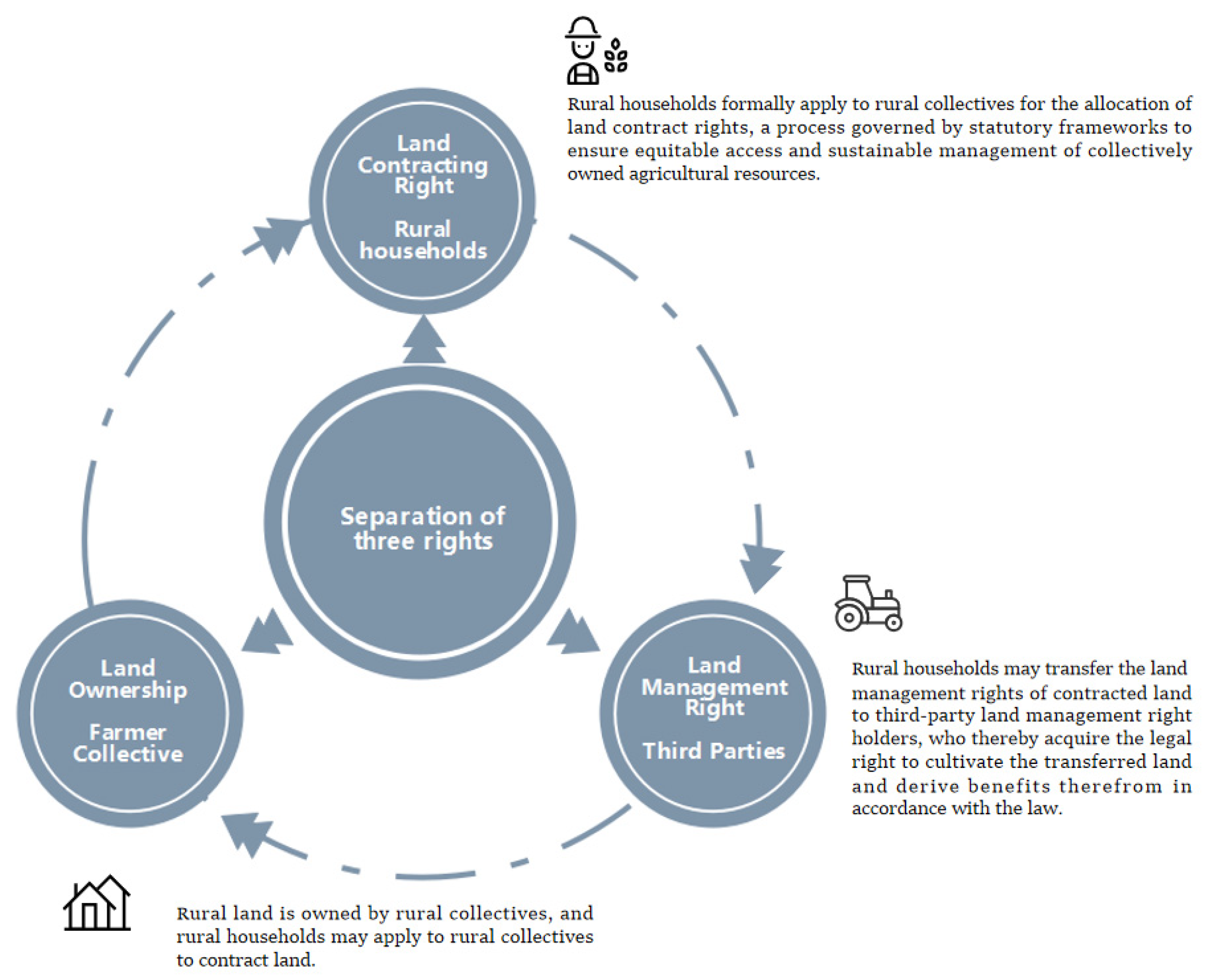
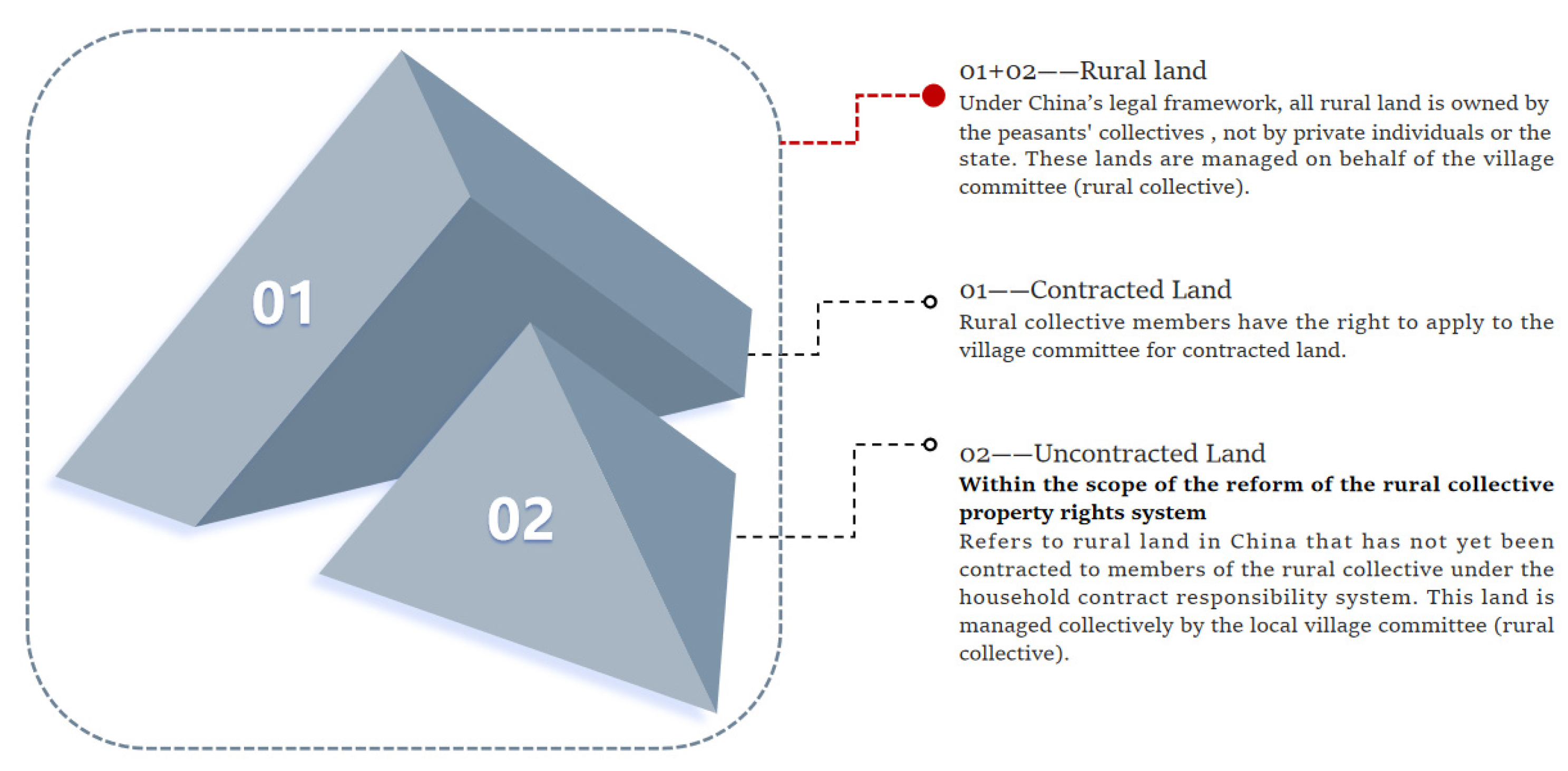
2.1. China Rural Property Rights System
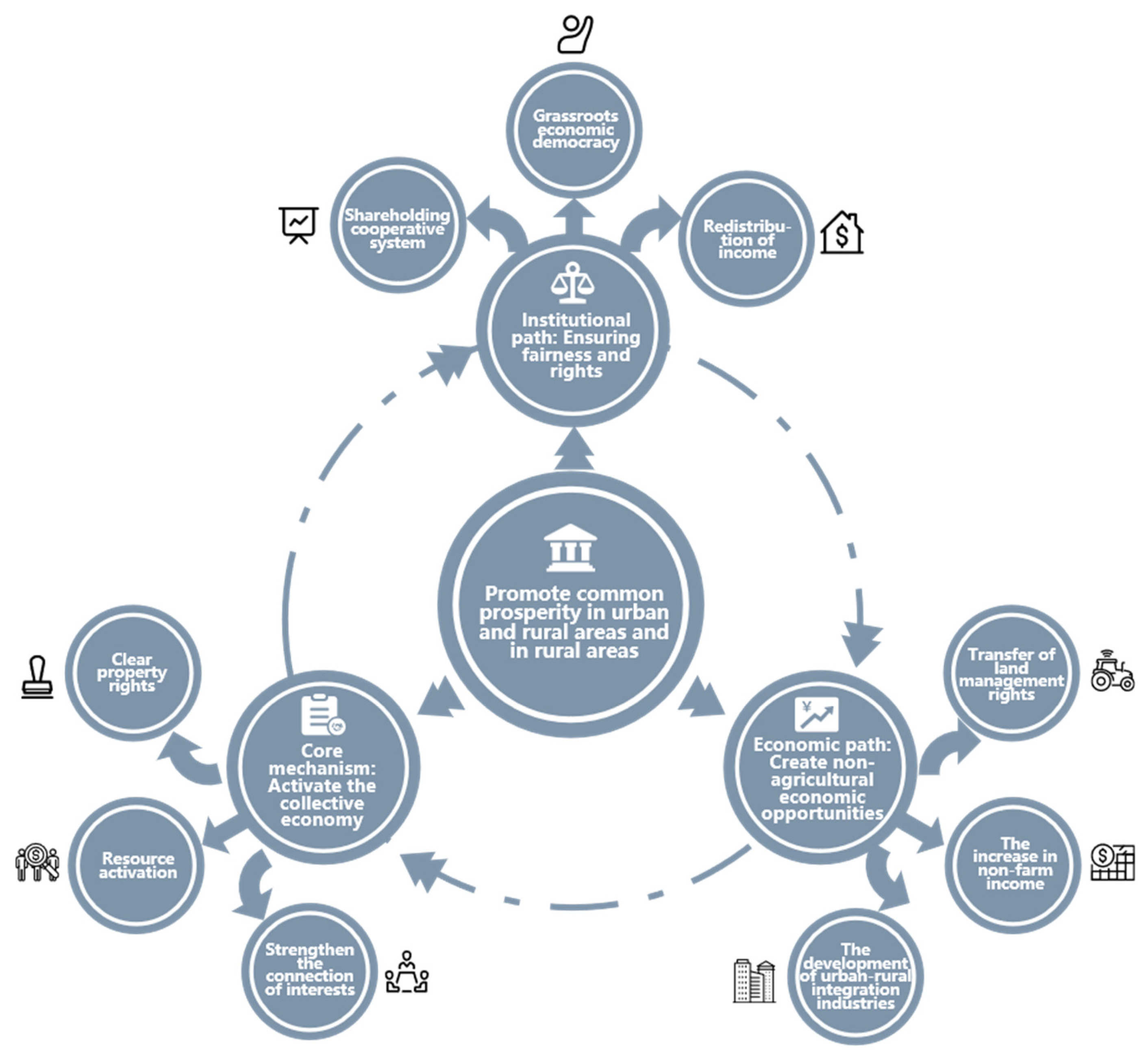
2.2. Collective Property Rights and Rural Incomes
2.3. Impact of Reforms on Income Inequality
3. Materials and Methods
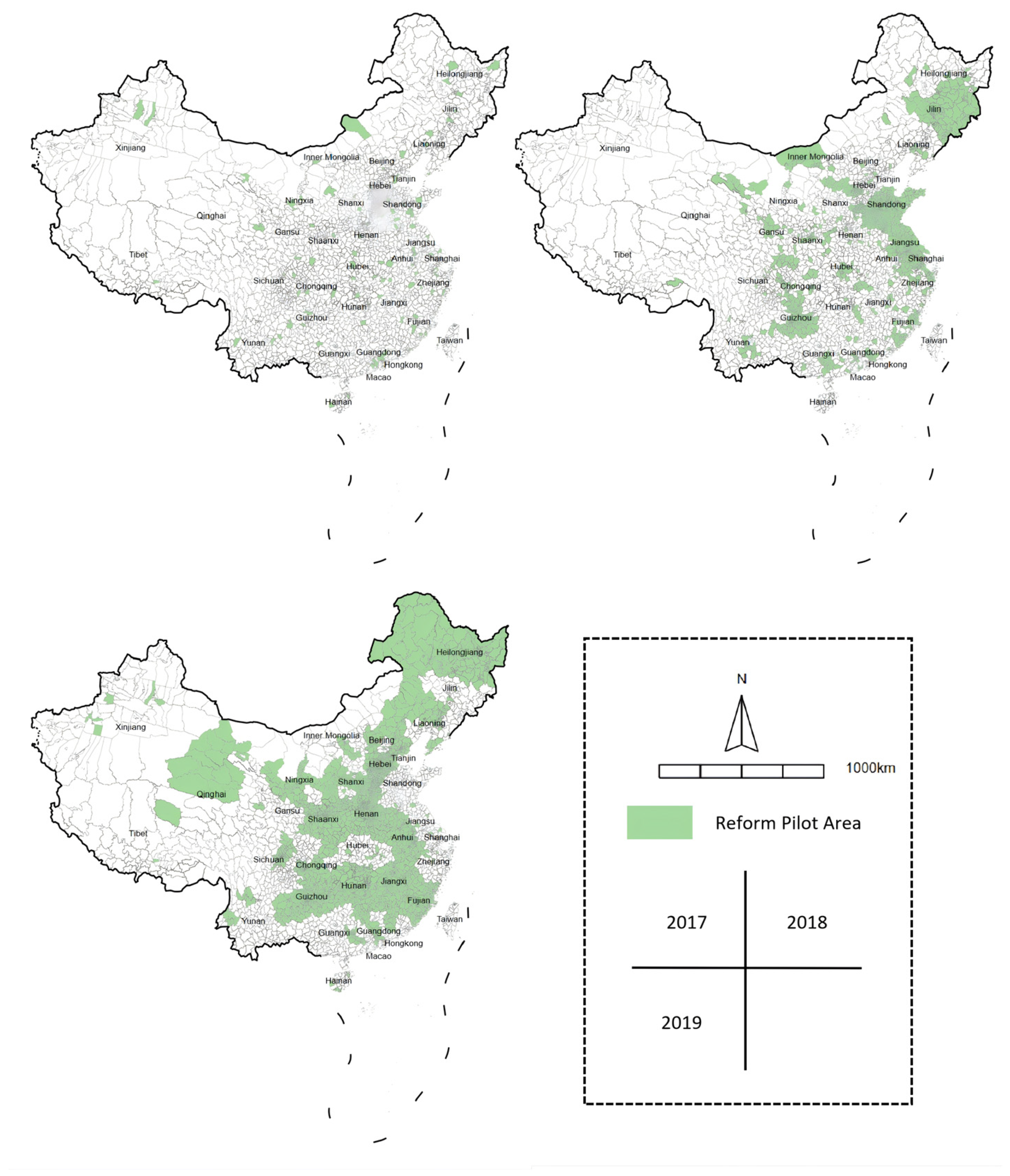
3.1. Overview of the Study Area
3.2. Data Sources
3.3. Variable Design
3.4. Model Construction
4. Empirical Analysis Results
4.1. Benchmark Regression
4.2. Endogeneity Test
4.3. Robustness Test
5. Mechanism Analysis
5.1. Micro-Individual Data Perspective
5.2. Regional Non-Agricultural Economy Perspective
6. Heterogeneity Analysis
6.1. Whether It Is a Major Grain Producing Area (MGPA)
6.2. Income Groups
6.3. Gender Breakdown of Different Household Heads
6.4. Age Groups
6.5. Education Groups
7. Conclusions
8. Policy Recommendations
8.1. Policy Recommendations for China
8.2. Policy Recommendations for the Global South
Author Contributions
Funding
Data Availability Statement
Conflicts of Interest
| 1 | National Bureau of Statistics of China—https://www.stats.gov.cn/sj/xwfbh/fbhwd/202601/t20260119_1962330.html (accessed on 1 December 2025). |
| 2 | The exchange rate standard adopted in this document is the central parity rate of the Renminbi against the US dollar announced by the People’s Bank of China on 22 December 2025 (subsequent conversions shall follow this standard): 1 USD = 7.0019 CNY. |
| 3 | Official website of the Ministry of Agriculture and Rural Affairs of the Peoples Republic of China—https://www.moa.gov.cn/xw/bmdt/202202/t20220225_6389728.htm (accessed on 1 December 2025). |
References
- Guo, Y.; Liu, Y. Poverty Alleviation Through Land Assetization and Its Implications for Rural Revitalization in China. Land Use Policy 2021, 105, 105418. [Google Scholar] [CrossRef]
- Zhang, H.; Hu, Z.; Hu, L. Exploring the Practice of Rural Collective Property Rights Reform: A Survey of 24 Villages (Communities) in 4 Provinces. Reform 2020, 8, 5–17. [Google Scholar]
- Tafesse, W.G.; Van Passel, S.; Berhanu, T.; D’Haese, M.; Maertens, M. Big Is Efficient: Evidence from Agricultural Cooperatives in Ethiopia. Agric. Econ. 2019, 50, 555–566. [Google Scholar] [CrossRef]
- Nowak, P.; Jastrzębiec-Witowska, A.; Glorach, K. Cooperative Movements in Rural Areas in Contemporary Poland: A Comparison of Farmers Attitudes of Members and Non-Members of Cooperatives. East. Eur. Countrys. 2016, 22, 151–164. [Google Scholar] [CrossRef]
- Debela, M.; Diriba, S.; Bekele, H. Impact of Cooperatives Membership on Economy in Eastern Oria: The Case Haramaya Agricultural Farmers Cooperative Union (HAFU). Ann. Public Coop. Econ. 2018, 89, 361–375. [Google Scholar] [CrossRef]
- Rozelle, S.; Boisvert, R.N. Quantifying the Impact of Land Tenure in China: A Framework for Analysis and Evidence from Hebei Province; Cornell University: Ithaca, NY, USA, 1995. [Google Scholar]
- Deininger, K.; Jin, S. The Potential of Land Rental Markets in the Process of Economic Development: Evidence from China. J. Dev. Econ. 2005, 78, 241–270. [Google Scholar] [CrossRef]
- Huang, Y.; Yu, K.; Shi, G.; Wang, G.; Li, Y.; Hu, S.; Wang, A. Reflections on Several Issues in the Reform of Rural Collective Property Rights. Agric. Econ. Iss 2014, 35, 8–14. [Google Scholar]
- Hui, J. Womens Rights Protection in the Reform of Rural Collective Property Rights System: A Perspective from Feminist Economics. China Rural Obs. 2018, 6, 73–88. [Google Scholar]
- Peng, L.; Zhao, M. The Impact of Rural Collective Property Rights Reform on County Economic Development: Evidence from 1873 Counties in China. Chin. Rural Econ. 2024, 112–130. [Google Scholar]
- Zhang, X. Community-Based Market Entities: Defining the Role of Rural Collective Economic Organizations. J. Anhui Norm. Univ. (Soc. Sci. Ed.) 2024, 52, 79–89. [Google Scholar]
- Li, Z.; Tang, H. The Income Effect of China’s Rural Collective Property Rights Reform: An Empirical Study Based on the Three Transformations Reform in Rural Areas. Econ. Horiz. 2023, 12, 64–75. [Google Scholar]
- Jiang, F.; Li, C.; Xing, M.; Zheng, G. Does China’s Rural Collective Property Rights Reform Promote Farmers Income Growth? An Empirical Test Based on a Multi-Period DID Model. World Agric. 2021, 3, 70–79+107. [Google Scholar]
- Luo, M.; Wei, B. Rural Collective Property Rights Reform and the Urban-Rural Income Gap at the County Level. J. S. China Agric. Univ. (Soc. Sci. Ed.) 2022, 21, 78–90. [Google Scholar]
- Tian, H.; Wang, J. Can Digital Inclusive Finance Narrow the Income Gap Within Rural Areas?—Evidence from the Perspective of Diversified Livelihood Resources. China Agric. Resour. Reg. Plan. 2023, 1–13. [Google Scholar]
- Gong, M.; Zhang, M. The Impact of the Three Rights Separation of Contracted Land and Agricultural Subsidies on Mechanization: An Empirical Analysis Using the PSM-DID Method. J. Stat. Res. 2022, 39, 64–79. [Google Scholar]
- Chen, Z.; Guo, H. Measuring the Impact of Targeted Poverty Alleviation Policy on Reducing Rural Income Disparities: An Empirical Study Using RIF Method and CHFS Data. J. Southeast Univ. (Philos. Soc. Sci. Ed.) 2024, 90–106. [Google Scholar]
- Zhai, X. Rural Collective Property Rights System Reform, Financial Literacy, and Rural Household Income. Financ. Res. Lett. 2025, 85, 107965. [Google Scholar] [CrossRef]
- Zhao, Y.; Yi, Y.; Niu, L. Does the Rural Collective Property Rights Reform Enhance Villages Self-Sufficiency in Public Goods?—An Empirical Analysis of 171 Villages Across 8 Provinces (Autonomous Regions). J. Hunan Agric. Univ. (Soc. Sci. Ed.) 2022, 23, 52–62. [Google Scholar]
- Wang, F.; Zhang, D. The Impact of Rural Collective Property Rights Reform on Rural Governance: A Study from the Perspective of Village Community. J. Hefei Univ. 2024, 41, 20–30+53. [Google Scholar]
- Liu, N.; Zhang, Z. Research on the Efficiency Characteristics and Influencing Factors of Agricultural Machinery Subsidies: An Empirical Analysis Based on China Household Panel Survey (CFPS) Data. Macroecon. Res. 2023, 3, 99–115. [Google Scholar]
- Kakwani, N. Pro-Poor Growth Strategies in Africa: Poverty Equivalent Growth Rate: With Applications to Korea and Thailand. In Proceedings of the Economic Commission for Africa, Economic Policy Research Center, Expert Group Meeting, Addis Ababa, Ethiopia, 20–21 June 2023. [Google Scholar]
- Yang, J.; Deng, Y. Research on the Impact of China’s Rural Pension Insurance System on Household Income Inequality. Quant. Econ. Res. 2020, 37, 83–100. [Google Scholar]
- Li, F.; Zhang, H. Does Intergenerational Mobility Affect Subjective Well-Being?—Empirical Evidence from CGSS 2015. Stat. Res. 2021, 38, 107–121. [Google Scholar]
- Ning, J.; Yin, H.; Wang, S.; Liu, M. The Impact Mechanism and Effectiveness of Poverty Alleviation Through Industrial Development on Farmers Income: A Quasi-Experimental Study Based on Pilot Projects in Wumeng Mountain and Liupan Mountain Regions. J. Zhongnan Univ. Econ. Law 2019, 4, 58–66+88+159–160. [Google Scholar]
- Wang, S.; Zhou, S. Analysis of the Effectiveness and Mechanism of Rural Collective Property Rights Reform in Promoting Household Income Growth: Evidence from 2628 Households in the CFPS Database. Agric. Technol. Econ. 2025, 8, 4–22. [Google Scholar]
- Henderson, J.V.; Storeygard, A.; Weil, D.N. Measuring Economic Growth from Outer Space. Am. Econ. Rev. 2012, 102, 994–1028. [Google Scholar] [CrossRef]
- Zhang, X.; Wan, G.; Zhang, J.; He, Z. Digital Economy, Inclusive Finance, and Inclusive Growth. Econ. Res. 2019, 54, 71–86. [Google Scholar]
- Li, Y.; Shen, Y. Digital Inclusive Finance and Regional Economic Imbalance. Econ. Q. 2022, 22, 1805–1828. [Google Scholar]
- Wu, Y.; Shi, K.; Chen, Z.; Liu, S.; Chang, Z. Developing Improved Time-Series DMSP-OLS-Like Data (1992–2019) in China by Integrating DMSP-OLS and SNPP-VIIRS. IEEE Trans. Geosci. Remote Sens. 2021, 60, 4407714. [Google Scholar] [CrossRef]
- Beck, T.; Levine, R.; Levkov, A. Big Bad Banks? The Winners and Losers from Bank Deregulation in the United States. J. Financ. 2010, 65, 1637–1667. [Google Scholar] [CrossRef]



| Variable Type | Variable Name | Variable Symbol | Definition |
|---|---|---|---|
| Dependent Variable | Rural Relative Deprivation Index | RRD | The relative deprivation index is calculated based on the agricultural population, indicating the income disparity within rural areas |
| Overall Relative Deprivation Index | ORD | The relative deprivation index, which takes into account both urban and rural populations, indicates the overall income disparity in the entire society | |
| Independent Variable | Reform of Rural Collective Property Rights System | DID | 0 before the sample is designated as a reform pilot; 1 from the period when it is designated as a reform pilot onwards |
| Mediating Variable | Engaged in non-agricultural employment | NAE | 0 indicates the sample did not participate in business operations; 1 indicates the sample participated in business operations |
| Control Variable | Savings | Sa | Family savings |
| Total assets | Ta | Total household assets, including liabilities | |
| Family size | Fa | Number of family members under the same registered residence | |
| Age of head of household | Age | Age of the registered residence head | |
| Social status | Status | Political affiliation status in the database: 1 = masses; 2 = CYL member; 3 = party member; 4 = Democratic party or other political party | |
| Health level | Health | The health level index of household heads obtained through a questionnaire survey ranges from 1 to 5 points, with higher scores indicating poorer health. | |
| Educational level | Edu | 1 = illiterate; 2 = elementary school; 3 = junior high school; 4 = senior high school; 5 = technical secondary school/vocational high school; 6 = junior college/higher vocational college; 7 = undergraduate degree; 8 = master’s degree; 9 = doctoral degree | |
| Night light intensity | Light | The annual nighttime light intensity data from the annual prolonged artificial nighttime light dataset (PANDA) in China as an indicator of non-agricultural business activities in counties and districts | |
| Household per capita net income | Income | ||
| Gender | Sex | Gender of the head of household, 0 = Female, 1 = Male |
| Variable | Obs | Mean | SD | Min | Max |
|---|---|---|---|---|---|
| RRD | 11,520 | 47.51 | 26.93882 | 0 | 97.93403 |
| ORD | 11,520 | 55.58 | 23.86383 | 0 | 96.56263 |
| DID | 11,520 | 0.26 | 0.4362892 | 0 | 1 |
| NAE | 7825 | 0.10 | 0.2978772 | 0 | 1 |
| Sa | 11,497 | 27,409.18 | 85,548.63 | 0 | 4,500,000 |
| Ta | 11,160 | 290,640.80 | 741,517.1 | −833,900 | 3.90 × 10⁷ |
| Fa | 11,520 | 4.15 | 1.908153 | 1 | 15 |
| Age | 11,520 | 52.78 | 12.33181 | 15 | 90 |
| Status | 11,520 | 2.03 | 1.170392 | 1 | 4 |
| Health | 11,520 | 3.16 | 1.272307 | 1 | 5 |
| Edu | 11,512 | 2.43 | 1.188818 | 1 | 9 |
| Light | 7755 | 667.48 | 661.4199 | 30.09416 | 5907.597 |
| Income | 11,282 | 13,870.42 | 17,614.06 | 0 | 400,000 |
| Sex | 11,520 | 0.67 | 0.471731 | 0 | 1 |
| . | (1) | (2) | (3) | (4) |
|---|---|---|---|---|
| RRD | RRD | ORD | ORD | |
| DID | −1.57 * | −2.01 *** | −1.32 * | −1.68 *** |
| (0.86) | (0.73) | (0.76) | (0.64) | |
| Sa | −0.00 *** | −0.00 *** | ||
| (0.00) | (0.00) | |||
| Ta | −0.00 *** | −0.00 *** | ||
| (0.00) | (0.00) | |||
| Fa | −4.53 *** | −3.88 *** | ||
| (0.13) | (0.12) | |||
| Age | 0.31 *** | 0.25 *** | ||
| (0.02) | (0.02) | |||
| Status | −0.94 *** | −0.76 *** | ||
| (0.19) | (0.17) | |||
| Health | 0.67 *** | 0.55 *** | ||
| (0.17) | (0.15) | |||
| Edu | −2.10 *** | −1.78 *** | ||
| (0.20) | (0.18) | |||
| Constant | −803.98 *** | −824.77 *** | −690.97 *** | −728.87 *** |
| (285.28) | (260.86) | (254.89) | (233.86) | |
| Province FE | Yes | Yes | Yes | Yes |
| Year FE | Yes | Yes | Yes | Yes |
| Province × Year FE | Yes | Yes | Yes | Yes |
| N | 11,520 | 10,970 | 11,520 | 10,970 |
| R2 | 0.078 | 0.285 | 0.072 | 0.270 |
| F | 2.10 | 87.83 | 2.30 | 81.75 |
| (1) | (2) | (3) | (4) | |
| RRD | RRD | ORD | ORD | |
| DID | −2.93 ** | −1.79 * | −2.57 ** | −1.51 * |
| (1.32) | (1.00) | (1.16) | (0.88) | |
| Sa | −0.00 | −0.00 | ||
| (0.00) | (0.00) | |||
| Ta | −0.00 *** | −0.00 *** | ||
| (0.00) | (0.00) | |||
| Fa | −4.43 *** | −3.79 *** | ||
| (0.18) | (0.16) | |||
| Age | 0.28 *** | 0.23 *** | ||
| (0.03) | (0.03) | |||
| Status | −0.66 ** | −0.51 ** | ||
| (0.28) | (0.25) | |||
| Health | 0.38 | 0.31 | ||
| (0.25) | (0.22) | |||
| Edu | −1.46 *** | −1.24 *** | ||
| (0.28) | (0.25) | |||
| Constant | 124.82 | 58.64 *** | 134.46 | 65.63 *** |
| (364.23) | (2.23) | (326.87) | (2.01) | |
| Province FE | Yes | Yes | Yes | Yes |
| Year FE | Yes | Yes | Yes | Yes |
| Province × Year FE | Yes | Yes | Yes | Yes |
| N | 5306 | 5306 | 5306 | 5306 |
| R2 | 0.082 | 0.269 | 0.078 | 0.258 |
| F | 2.48 | 142.85 | 2.54 | 133.51 |
| (1) | (2) | (3) | (4) | |
|---|---|---|---|---|
| RRD-ln | RRD-(lag) | RRD-(t-2017) | RRD-(impact) | |
| DID | −1.32 * | −2.31 *** | −1.88 ** | −1.25 |
| (0.71) | (0.86) | (0.88) | (1.38) | |
| Constant | −194.77 | −833.26 *** | −1096.59 *** | −768.66 *** |
| (257.66) | (262.02) | (336.34) | (235.71) | |
| Control | Yes | Yes | Yes | Yes |
| Province FE | Yes | Yes | Yes | Yes |
| Year FE | Yes | Yes | Yes | Yes |
| Province × Year FE | Yes | Yes | Yes | Yes |
| N | 10,594 | 10,970 | 9295 | 10,809 |
| R2 | 0.358 | 0.285 | 0.267 | 0.579 |
| F | 129.84 | 87.89 | 67.03 | 20.06 |
| (5) | (6) | (7) | (8) | |
| ORD-ln | ORD-(lag) | ORD-(t-2017) | ORD-(impact) | |
| DID | −1.08 * | −2.04 *** | −1.53 ** | −1.08 |
| (0.63) | (0.76) | (0.77) | (1.29) | |
| Constant | −161.06 | −742.86 *** | −956.68 *** | −678.27 *** |
| (232.51) | (235.02) | (302.37) | (211.92) | |
| Control | Yes | Yes | Yes | Yes |
| Province FE | Yes | Yes | Yes | Yes |
| Year FE | Yes | Yes | Yes | Yes |
| Province × Year FE | Yes | Yes | Yes | Yes |
| N | 10,594 | 10,970 | 9295 | 10,809 |
| R2 | 0.337 | 0.270 | 0.251 | 0.556 |
| F | 118.76 | 81.86 | 61.37 | 18.35 |
| Gaoding Village, Huaying City | During the reform of the rural collective property rights system, 23 idle farmhouses were transformed into boutique homestays through asset inventory and verification. After clarifying property ownership, a professional operation team was introduced. Villagers contributed house use rights as shares to a cooperative, receiving dividends proportionally, with an annual per household income increase of 8000 yuan (1147.06 USD). Post-reform, the village integrated idle resources to build 15 characteristics business venues, generating over one million yuan (143,383 USD) in annual income for farmers. |
| Pu’an Village, Lijia Town, Changzhou City | After confirming ownership of collectively owned operational factory land and obtaining real estate ownership certificates, a mortgage loan was secured to invest 50 million yuan (7,169,000 USD) in upgrading a new energy vehicle parts production line. Post-reform, the village’s collective factory annual rental income exceeded 8 million yuan (1,142,600 USD), with per capita villager dividends increasing by 15%. |
| Nanyucheng Community, Zibo City | Operational collective assets, such as street-side commercial buildings and factories, were quantified into shares. The community established the city’s first rural collective asset shareholding cooperative for unified operation and management, allocating 5% of the annual rate of return to dividends. Villagers received an annual per capita dividend of 1750 yuan (250.92 USD). Post-reform, total collective assets reached 127 million yuan (18,198,260 USD), creating employment for over 200 people. |
| Zaonantai Community, Weihai City | Three industrial parks were built on rural collective construction land, with a floor area of 60,000 square meters and over 30 enterprises settled in, generating annual rental income exceeding 8 million yuan (1,147,079.76 USD). Meanwhile, property rights of apartments for migrant workers were quantified into shares for members, with an annual dividend of 3800 yuan (544.86 USD) per share. Post-reform, the community’s collective assets totaled 185 million yuan (26,426,178.15 USD), and annual per-member dividends exceeded 10,000 yuan (1433.85 USD). |
| (1) | (2) | (3) | |
|---|---|---|---|
| NAE | RRD | ORD | |
| DID | −0.87 *** | −1.86 ** | −1.57 ** |
| (0.10) | (0.73) | (0.64) | |
| NAE | −8.48 *** | −7.90 *** | |
| (0.99) | (0.91) | ||
| Constant | −1.58 *** | −1018.87 ** | −879.60 ** |
| (0.25) | (424.92) | (376.62) | |
| Control | Yes | Yes | Yes |
| Province FE | Yes | Yes | Yes |
| Year FE | Yes | Yes | Yes |
| Province × Year FE | Yes | Yes | Yes |
| N | 7326 | 7326 | 7326 |
| R2 | 0.357 | 0.362 | |
| F | 95.01 | 95.18 |
| (1) | (2) | (3) | (4) | |
|---|---|---|---|---|
| RRD | RRD | ORD | ORD | |
| DID | −0.09 | −2.60 ** | 0.23 | −2.14 ** |
| (1.81) | (1.09) | (1.59) | (0.95) | |
| Constant | 248.68 | −1305.75 *** | −192.84 | −1162.10 *** |
| (1841.79) | (359.08) | (1657.38) | (318.10) | |
| Control | Yes | Yes | Yes | Yes |
| Province FE | Yes | Yes | Yes | Yes |
| Year FE | Yes | Yes | Yes | Yes |
| Province × Year FE | Yes | Yes | Yes | Yes |
| N | 2287 | 5099 | 2287 | 5099 |
| R2 | 0.393 | 0.310 | 0.376 | 0.295 |
| F | 44.78 | 57.26 | 42.13 | 52.30 |
| (1) | (2) | (3) | (4) | |
|---|---|---|---|---|
| RRD (non-MGPA) | RRD (MGPA) | ORD (non-MGPA) | ORD (MGPA) | |
| DID | −3.30 *** | −0.97 | −3.04 *** | −0.52 |
| (1.02) | (1.04) | (0.90) | (0.91) | |
| Constant | −623.86 *** | −2122.75 *** | −596.95 *** | −1690.58 ** |
| (221.83) | (805.58) | (200.86) | (730.42) | |
| Control | Yes | Yes | Yes | Yes |
| Province FE | Yes | Yes | Yes | Yes |
| Year FE | Yes | Yes | Yes | Yes |
| Province × Year FE | Yes | Yes | Yes | Yes |
| N | 5335 | 5635 | 5335 | 5635 |
| R2 | 0.253 | 0.334 | 0.239 | 0.320 |
| F | 60.07 | 85.62 | 56.16 | 78.89 |
| Yian County, Heilongjiang | The national key commercial grain base, since 2023, integrated farmers’ contracted land management rights and village-collective operational farmland usage rights into shareholding agricultural cooperatives, driving scale-intensive land consolidation to achieve 1.25 billion kg of grain output; a 3.6% increase. |
| Zhucheng City, Shandong | The major grain base adopted a land share cooperation model via rural shareholding system reform, establishing 151 cooperatives with 3000 hectares of land equity, up by 5200 hectares, and boosting output. |
| Luhe Town, Henan | The plain agricultural town, with 4680 hectares of cultivated land, launched the Land Post Station platform to address informal small-scale land transfers, enabling collective integration to achieve 1666.67 hectares of scale operation in 2021. |
| Shaqiao Town, Nanhua County, Yunnan Province | Located in a non-major grain-producing region of the mountainous areas of Southwest China. Historically, it faced challenges such as idle resources and a weak collective economy. Seizing the opportunity of the reform of the rural collective property rights system, the town integrated 113.27 hectares of forest land resources and 0.27 hectares of idle collective land to establish a Yi embroidery-themed cultural tourism complex project (represented by the Fengshan Lake Hotel) and a poverty alleviation workshop for the entire industrial chain of fungi, thereby implementing a diversified business model. |
| Hongya County, Sichuan Province | Located in the Qinba Mountainous Area, a non-major grain-producing region. Historically, it faced a single industrial structure and insufficient development momentum. In recent years, taking the reform of the rural collective property rights system as a key approach, the county has promoted the integration of its four major industries—tea, bamboo, pepper, and tourism—and explored a diversified operational path centered on revitalizing idle assets, advancing industrial integration, and strengthening market alignment. |
| Xiangshan County, Zhejiang Province | A shareholding cooperative system for marine area use rights was implemented. This system converts collectively owned shallow seas, tidal flats, and other resources into shares allocated to households and establishes marine area share-based economic cooperatives. For instance, the Shibu Town integrated 1533 hectares of aquaculture waters, introduced modern aquaculture technologies such as recirculating water systems, and developed high-value species like large yellow croaker and swimming crab. In 2024, the cooperative distributed dividends totaling 3.8 million yuan (542,725.56 USD), increasing the per capita income of fishermen by 25,000 yuan (3570.34 USD). Furthermore, the local collective property rights reform explored marine area mortgage loans to provide low-interest financing support for aquaculture farmers. |
| (1) | (2) | (3) | (4) | (5) | (6) | |
|---|---|---|---|---|---|---|
| RRD (low) | RRD (middle) | RRD (high) | ORD (low) | ORD (middle) | ORD (high) | |
| DID | −0.57 | −1.09 ** | −0.75 | −0.43 | −0.82 * | −0.67 |
| (0.77) | (0.52) | (0.59) | (0.60) | (0.43) | (0.58) | |
| Constant | −118.73 | −32.13 | 655.32 *** | −74.06 | 8.84 | 670.10 *** |
| (220.42) | (157.66) | (232.32) | (171.85) | (133.48) | (234.24) | |
| Control | Yes | Yes | Yes | Yes | Yes | Yes |
| Province FE | Yes | Yes | Yes | Yes | Yes | Yes |
| Year FE | Yes | Yes | Yes | Yes | Yes | Yes |
| Province × Year FE | Yes | Yes | Yes | Yes | Yes | Yes |
| N | 3598 | 3585 | 3563 | 3598 | 3585 | 3563 |
| R2 | 0.438 | 0.730 | 0.457 | 0.440 | 0.739 | 0.465 |
| F | 67.48 | 166.96 | 54.58 | 66.11 | 188.70 | 61.93 |
| (1) | (2) | (3) | (4) | |
|---|---|---|---|---|
| RRD (male) | RRD (female) | ORD (male) | ORD (female) | |
| DID | −2.13 ** | −1.43 | −1.80 ** | −1.17 |
| (0.85) | (1.48) | (0.75) | (1.28) | |
| Constant | −380.05 | −1925.84 *** | −339.58 | −1655.41 *** |
| (286.80) | (603.11) | (256.78) | (542.14) | |
| Control | Yes | Yes | Yes | Yes |
| Province FE | Yes | Yes | Yes | Yes |
| Year FE | Yes | Yes | Yes | Yes |
| Province × Year FE | Yes | Yes | Yes | Yes |
| N | 7272 | 3698 | 7272 | 3698 |
| R2 | 0.306 | 0.273 | 0.296 | 0.252 |
| F | 65.85 | 28.92 | 62.63 | 26.85 |
| Lingchuan County, Guangxi Province | In the case adjudicated by the Lingchuan County People’s Court—Ms. Lin v. Rural Collectives Group—the court clarified that “divorce is not a statutory ground for loss of membership qualification.” Ms. Lin had moved her household registration to her husband’s rural collectives group upon marriage, thereby acquiring membership status. After the divorce, her household registration remained untransferred, yet the group refused to distribute land transfer dividends on the grounds of her “divorce.” The court held that Ms. Lin retained her membership qualification and ordered the group to pay the dividends. This case emphasized that membership in a rural collective economic organization should not be deprived due to changes in marital status, thereby establishing a judicial precedent for safeguarding the rights of divorced women. |
| Qingxin District, Qingyuan City, Guangdong Province | In the case adjudicated by the Qingxin District People’s Court—Ms. Pan v. Village Committee—the protection of “divorced women” was further strengthened. After marriage, Ms. Pan had moved her household registration to her husband’s rural collectives group and did not transfer it out following divorce. Starting in 2019, the group refused to pay dividends from the income of collective property rights, citing her “divorce” as justification. The court ordered the payment of dividends and clarified that “untransferred household registration + unmarried status” constitutes the key criterion for maintaining membership qualification. It further affirmed that even after divorce, women retain equal rights to income as original members. |
| (1) | (2) | (3) | (4) | (5) | (6) | |
|---|---|---|---|---|---|---|
| RRD-youth | RRD-mid-age | RRD-old age | ORD-youth | ORD-mid-age | ORD-old age | |
| DID | −7.03 *** | −1.58 * | 0.85 | −6.25 *** | −1.28 | 0.84 |
| (1.82) | (0.91) | (1.41) | (1.63) | (0.81) | (1.21) | |
| Constant | −1215.61 ** | −408.51 | −157.15 | −1000.13 ** | −339.92 | −369.13 |
| (526.96) | (316.08) | (710.59) | (487.74) | (283.76) | (621.23) | |
| Control | Yes | Yes | Yes | Yes | Yes | Yes |
| Province FE | Yes | Yes | Yes | Yes | Yes | Yes |
| Year FE | Yes | Yes | Yes | Yes | Yes | Yes |
| Province × Year FE | Yes | Yes | Yes | Yes | Yes | Yes |
| N | 1809 | 6221 | 2940 | 1809 | 6221 | 2940 |
| R2 | 0.284 | 0.256 | 0.377 | 0.264 | 0.247 | 0.361 |
| F | 6.10 | 27.22 | 41.98 | 6.11 | 26.03 | 38.64 |
| Zhao Shuangwa, a 32-year-old youth from Zhaojiamao Village, Shaanxi Province | Initiated the rural collective property rights system reform after assuming the role of village head. Through asset inventory and verification, he quantified 50-million-yuan worth of collective assets into shares and established the first village-level collective shareholding economic cooperative in Shaanxi Province. Leading villagers in developing rural tourism and modern agriculture, he built an ecological agricultural park and a northern Shaanxi folk culture park. In 2017, the village distributed its first dividend of one million yuan, with the per capita annual income rising from less than 3000 yuan to 16,800 yuan. This transformation elevated the village from a poverty-stricken area to a “National Civilized Village.” |
| Xu Xuming, a 35-year-old youth from Guangming Village, Zhejiang Province | Spearheaded the establishment of the city’s first village-level collective economic development company during his tenure as village head. By transferring 33.5 hectares of land, converting idle school buildings into an oil mill, and expanding into project contracting and property leasing, the company achieved a revenue of 1.24 million yuan in 2020. This initiative enabled over 50 villagers to earn more than 4000 yuan per month and doubled the collective income. |
| Liu Xiaojun, a 33-year-old youth from Sanfeng Village, Anhui Province | Returned to establish a nectarine family farm. He facilitated a 300,000-yuan investment of rural collective supporting funds to form a subsidiary under the “rural collectives + youth” model. Expanding cultivation and linking the farm with a resort project, the farm generated 800,000 yuan in income in 2017, with the rural collectives receiving 60,000 yuan in dividends. This effort increased annual income for 20 households by 20,000 yuan, achieving a win-win outcome for the collective and farming households. |
| Wang Yani, a 28-year-old youth from Qinjiazhuang Village, Shanxi Province | Sold rural collectives’ agricultural specialty products (sea buckthorn juice, black millet) via Douyin (Chinese TikTok) live streaming, doubling the unit price of these goods. Organizing live-streaming training for villagers, she enabled 10 households to become streamers. In 2024, the cooperative’s sales reached 5 million yuan, with the rural collectives receiving 150,000 yuan in dividends and the per capita annual income of villagers increasing by 12,000 yuan, thus connecting a small mountain village with large markets. |
| Chen Hongqiu, a 38-year-old youth from Wan’an Village, Sichuan Province | United eight surrounding villages to establish the “Nine-Village Alliance.” Integrating 153.3 hectares of arable land for unified planting of high-quality rice and renovating a sweet potato vermicelli processing workshop, the alliance achieved revenue exceeding 4 million yuan in 2024 through sales contracts and deep processing. Wan’an Village received 1.2 million yuan in dividends, with an average household income increase of 6000 yuan, resolving development challenges for underdeveloped villages. |
| Tao Shunshun, a 30-year-old youth from Xiangshan County, Zhejiang Province | Engaged in research and development of marine fish fry. Through technological innovation, he increased the seedling density by 30% and reduced production costs by 35%. Partnering with a rural collectives cooperative, he supplied fry to 100 aquaculture farmers, boosting annual income from large yellow croaker aquaculture by over 50,000 yuan per household. In 2024, the cooperative distributed 200,000 yuan in dividends for marine ecological protection projects. |
| (1) | (2) | (3) | (4) | |
|---|---|---|---|---|
| RRD | RRD | ORD | ORD | |
| DID | −0.97 | −2.78 *** | −0.88 | −2.26 ** |
| (1.05) | (1.01) | (0.92) | (0.90) | |
| Constant | −787.13 ** | −570.14 | −685.35 ** | −548.73 * |
| (372.73) | (372.61) | (334.49) | (332.06) | |
| Control | Yes | Yes | Yes | Yes |
| Province FE | Yes | Yes | Yes | Yes |
| Year FE | Yes | Yes | Yes | Yes |
| Province × Year FE | Yes | Yes | Yes | Yes |
| N | 5743 | 5061 | 5743 | 5061 |
| R2 | 0.280 | 0.279 | 0.259 | 0.274 |
| F | 51.90 | 31.96 | 47.28 | 31.08 |
| Zhang Xiang | A Jiangsu Gezhuang committee assistant with a bachelor’s degree quit a high-paying city job to return home and join collective forest reform. On collective land, he founded the county’s first under-forest co-op for grad-village officials, leasing 36.7 ha of poplar forests and recruiting 220 households. Promoting dandelion tech and innovating the “share-contracting + co-op mgmt” model, he hit 45 k yuan/ha yield, boosting villagers’ income by 1.65 M yuan (235,657 USD). His model, promoted countywide, made Siyang a key national dandelion base, adding 510 M yuan/year. |
| Liu Xiaojun | An Anhui returnee with a bachelor’s from Anhui University of Finance and Economic, founded Taohuayuan Farm, received a 300 k yuan collective fund for a “collective + farm” subsidiary. Via online/offline nectarine festivals/e-commerce, he expanded farming to ~13.33 ha, hitting > 150 k yuan/ha. In 2023, the collective received 30 k yuan (4284 USD) dividends; nearby households saw a 75 k yuan/ha income rise. |
| Wang Yani | A Shanxi returnee youth with a master’s degree sold sea buckthorn juice and black millet via Douyin (Chinese TikTok) live streaming, trained villagers, and in 2024, drove cooperative sales to 5 M yuan (714,201 USD), yielding 150 k yuan (21,508 USD) dividends for the rural collective. She pushed for a live-streaming center and cold-chain facilities to ease supply gluts, helping 10 households become streamers and raising per capita income by 12 k yuan (1721 USD). |
| Chen Hongqiu | A Sichuan returnee youth, agronomy master, united eight villages into the “Nine-Village Alliance,” integrated 153.3 ha for unified rice planting, and renovated a noodle workshop. The 2024 revenue: 4 M yuan (573,548 USD); Wan’an collective received 1.2 M yuan (172,064 USD). R&D’d “rice-crayfish co-culture,” cut fertilizer 30%, and boosted the avg income by 6 k yuan (860 USD). |
Disclaimer/Publisher’s Note: The statements, opinions and data contained in all publications are solely those of the individual author(s) and contributor(s) and not of MDPI and/or the editor(s). MDPI and/or the editor(s) disclaim responsibility for any injury to people or property resulting from any ideas, methods, instructions or products referred to in the content. |
© 2026 by the authors. Licensee MDPI, Basel, Switzerland. This article is an open access article distributed under the terms and conditions of the Creative Commons Attribution (CC BY) license.
Share and Cite
Shao, X.; Tian, Y.; He, D. Can a Rural Collective Property Rights System Reform Narrow Income Gaps? An Effect Evaluation and Mechanism Identification Based on Multi-Period DID. Land 2026, 15, 243. https://doi.org/10.3390/land15020243
Shao X, Tian Y, He D. Can a Rural Collective Property Rights System Reform Narrow Income Gaps? An Effect Evaluation and Mechanism Identification Based on Multi-Period DID. Land. 2026; 15(2):243. https://doi.org/10.3390/land15020243
Chicago/Turabian StyleShao, Xuyang, Yihao Tian, and Dan He. 2026. "Can a Rural Collective Property Rights System Reform Narrow Income Gaps? An Effect Evaluation and Mechanism Identification Based on Multi-Period DID" Land 15, no. 2: 243. https://doi.org/10.3390/land15020243
APA StyleShao, X., Tian, Y., & He, D. (2026). Can a Rural Collective Property Rights System Reform Narrow Income Gaps? An Effect Evaluation and Mechanism Identification Based on Multi-Period DID. Land, 15(2), 243. https://doi.org/10.3390/land15020243