Article

Citrus Orchard Abandonment Reduces the Economic Value of Carbon Sequestration in a Mediterranean Climate: An Economic Assessment Using the InVEST Model


by
Gila Abílio João
1,*,
Kevin Alain Salamanca Lopez
1,
Hewlley Maria Acioli Imbuzeiro
1,
Daniela Vanella
2,
Giuseppe Longo Minnolo
2,
Simona Consoli
2 and
Gustavo Bastos Lyra
3
1
Department of Agricultural Engineering, Universidade Federal de Viçosa (UFV), Viçosa 36570-900, MG, Brazil
2
Dipartimento di Agricoltura, Alimentazione e Ambiente (Di3A), Università degli Studi di Catania, Via S. Sofia, 100, 95123 Catania, Italy
3
Department of Environmental Sciences, Universidade Federal Rural do Rio de Janeiro (UFRRJ), BR-465, Km 7, Seropédica 23897-000, RJ, Brazil
*
Author to whom correspondence should be addressed.
Land 2026, 15(2), 241; https://doi.org/10.3390/land15020241
Submission received: 16 December 2025 / Revised: 10 January 2026 / Accepted: 15 January 2026 / Published: 30 January 2026
(This article belongs to the Section Land Use, Impact Assessment and Sustainability)

Abstract

Citrus orchards provide essential ecosystem services and mitigate atmospheric CO2 through carbon sequestration, but increasing abandonment in the Mediterranean, which is expected to intensify in coming decades, threatens ecosystem services, food security, and climate regulation by raising atmospheric CO2 concentration levels. This study aims to quantify the economic value of carbon sequestration associated with the abandonment of citrus orchards in the Mediterranean region. The InVEST model was applied to estimate the economic value of carbon sequestration in abandoned citrus orchards in Lentini from 2018 to 2030. Citrus orchard abandonment results in an average loss of 4.4 Mg C ha−1 in carbon storage and 3.6 Mg C ha−1 in carbon sequestration over time. The economic assessment of carbon sequestration under abandonment conditions indicates average economic losses ranging from −89.3 to −393.0 EUR ha−1 and from −268.0 to −1179.1 EUR per microfarm as social carbon prices increase from EUR 25 to EUR 110. Severe orchard abandonment, affecting up to 50% (≈118 microfarms) and 75% (≈177 microfarms) of the total area, would generate substantial economic losses in carbon sequestration, amounting to −0.9 × 10⁵ EUR ha−1 and −1.3 × 10⁵ EUR ha−1, respectively. Citrus orchard abandonment reduces carbon sequestration, causing economic losses and weakening climate mitigation.

1. Introduction

Agricultural land abandonment has become a widespread land-use issue in recent decades, with notable environmental and climatic implications [1,2,3,4,5,6,7,8,9], particularly in Europe and the Mediterranean basin [10], including Italy. Projections indicate a 3.4% increase in abandoned areas in the country by the year 2030 [1]. Sicily, Italy, is a region traditionally well-suited for agricultural activity [11,12], with farming systems that encompass the full range of Italian agricultural practices, which are typically carried out on micro-farms [12]. Specifically, the Sicilian region’s rural landscape is primarily characterized by citrus orchards [12]. However, this rural landscape is undergoing a transformation [13,14,15,16] due to environmental [8,17] and economic [15] challenges that introduce agricultural uncertainties, potentially leading to the abandonment of citrus orchards. In Sicily, abandoned agricultural land totals 14,337 ha [5], representing approximately 13.4% of the 106,644 ha of cultivated land [18]. Concerningly, projections indicate that the extent of abandoned land in Sicily is expected to increase [2]. The abandonment of agricultural crops, such as citrus, has been studied by several researchers [13,14,15,16,19,20,21,22,23].
Several socioeconomic factors have contributed to the massive abandonment of citrus orchards in the Mediterranean region [23]. Traditional irrigated orange plantations in the Mediterranean, particularly in Southern Italy, have been abandoned due to declining market prices, an aging population [13,20], and quality issues, such as skin cracks and reduced fruit sizes that limit commercial viability [24,25]. Beyond these factors, the adverse effects of climate change on commercial citrus production are currently considered the primary driver of traditional orchard abandonment in the Mediterranean [24,25], as it amplifies air warming and drought events, creating new challenges for crop adaptability [26].
Projections indicate that climate change will impact crop growth and carbon allocation to both aboveground and belowground biomass [27]. With pronounced global warming predicted by the IPCC [28], elevated temperatures during flowering or early fruit development may trigger fruit abscission and reduce quality, restricting commercial citrus production to cooler seasons [24,25]. Research further indicates that climate change is projected to increase evaporative demand while reducing precipitation, thereby severely which could substantially constrain irrigation practices due to declining water availability [11,29,30]. These hydrological constraints are expected to accelerate the decline of citrus production across the Mediterranean by directly undermining the agronomic viability of irrigated citrus systems, as evidenced in the province of Siracusa, Sicily [11].
Agricultural land abandonment is a complex, non-linear, and multiscalar process with contrasting impacts on biodiversity and the environment [3,8,31,32]. Although it is often regarded as a low-cost strategy for enhancing carbon sequestration and mitigating anthropogenic CO2 emissions [5], the recovery of soil carbon stocks is typically slow and may require more than a century to approach pre-abandonment levels [33]. Agricultural land abandonment may increase vulnerability to erosion, landslides [6,32], wildfires and may erode traditional agricultural and cultural values [8]. Such abandonment can serve as reservoirs for the Asian citrus psyllid (Diaphorina citri Kuwayama), whose activity may cause branch dieback, fruit drop or deformation, reduced fruit sizes, compromised internal quality, and even tree mortality [34]. The spread of this pest to managed orchards [34] can reduce citrus production in neighboring areas, potentially contributing to further orchard abandonment, and can induce multiple environmental changes in the surrounding landscape.
Additionally, abandoned citrus orchards also drive changes in land use and land cover (LULC) [8]. LULC change can affect vegetation growth and directly alter ecosystem carbon storage, potentially leading to carbon release into the atmosphere [35,36] and thus impairing the ecosystem service of atmospheric carbon sequestration. The functioning of these services is further shaped by changes in carbon allocation across aboveground and belowground biomass [27]. Zhu et al. [31] reported that LULC change contributed to a declining trend in carbon storage in coastal ecosystems.
Ivona et al. [12] highlight the importance of conserving citrus orchards in Sicily, even under climatic conditions that are driving the irreversible loss of these iconic Mediterranean landscapes. Although several studies have examined agricultural land abandonment in the Mediterranean region [1,2,5,6,26], as well as the decline of traditional crops [13,14,15,16,20,21,22,23], to our knowledge, no study has provided an economic evaluation of carbon sequestration in abandoned citrus orchards in Lentini using the InVEST model. By quantifying the economic impacts of carbon sequestration losses in abandoned citrus orchards, this study links ecosystem service degradation to regional economic vulnerability, offering strategic insights for policymakers and land managers in semi-arid Mediterranean landscapes. Abandonment of traditional Mediterranean agroecosystems, such as citrus orchards, diminishes carbon sequestration, causes economic losses, and threatens a key climate mitigation service, highlighting the need for targeted policies and carbon market support.

2. Materials and Methods

2.1. Description of the Study Area

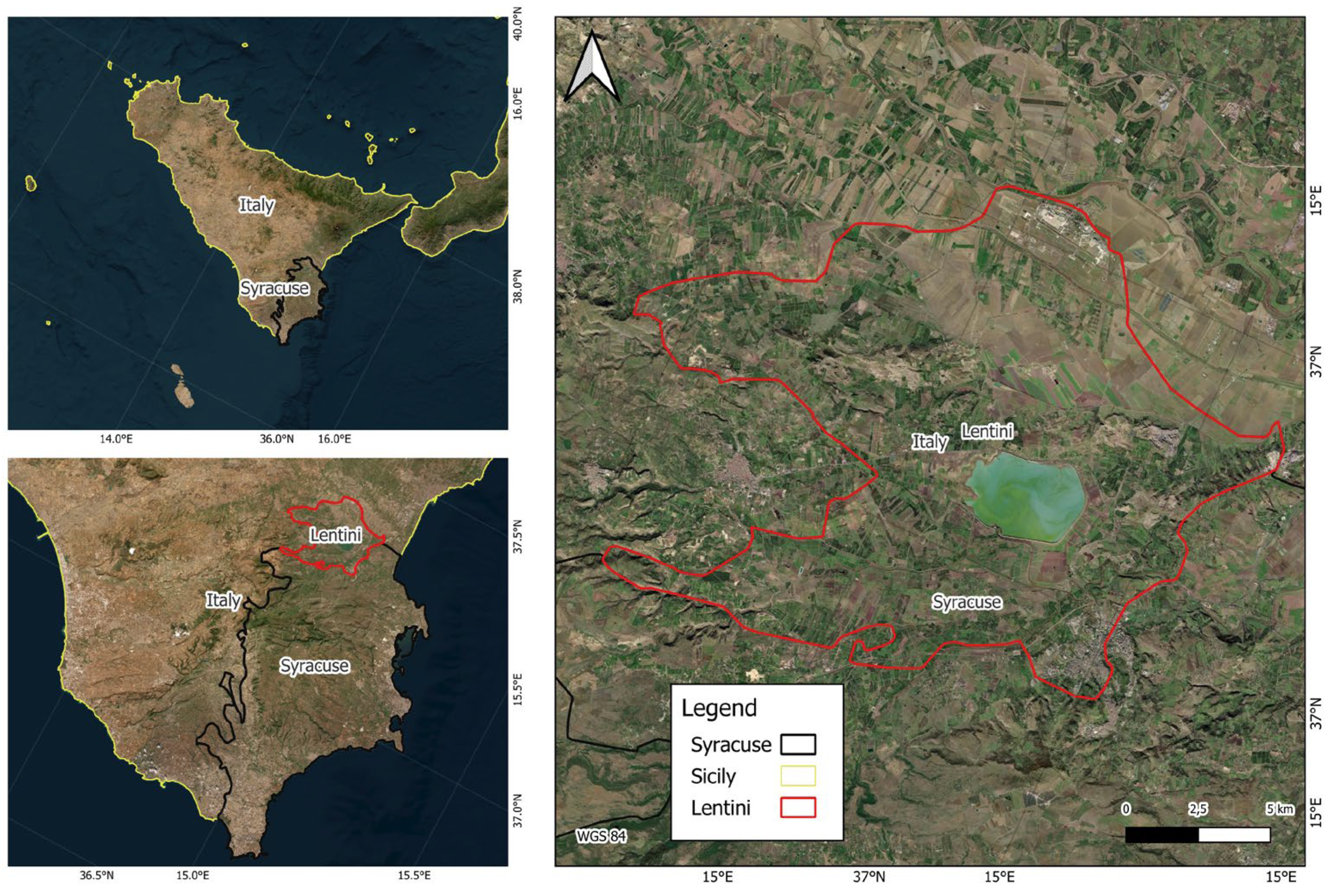
The study area is situated in Lentini, within the province of Syracuse, Sicily, southern Italy (Figure 1). The landscape of Sicily is dominated by fertile fields cultivated with woody perennial crops, including olive trees, vineyards, and citrus orchards [12,15]. In particular, the rural landscape of the region is predominantly characterized by citrus orchards [12,15]. According to Ciriminna et al. [18], citrus crops occupy approximately 84,000 hectares, comprising 58,000 ha of oranges (Citrus sinensis, 70%), 21,000 ha of lemons (C. limon, 25%), and 5000 ha of mandarins (C. reticulata, 5%). The rural landscape of Lentini exhibits features typical of Sicily, being predominantly shaped by mature orange orchards (Citrus sinensis) [37].
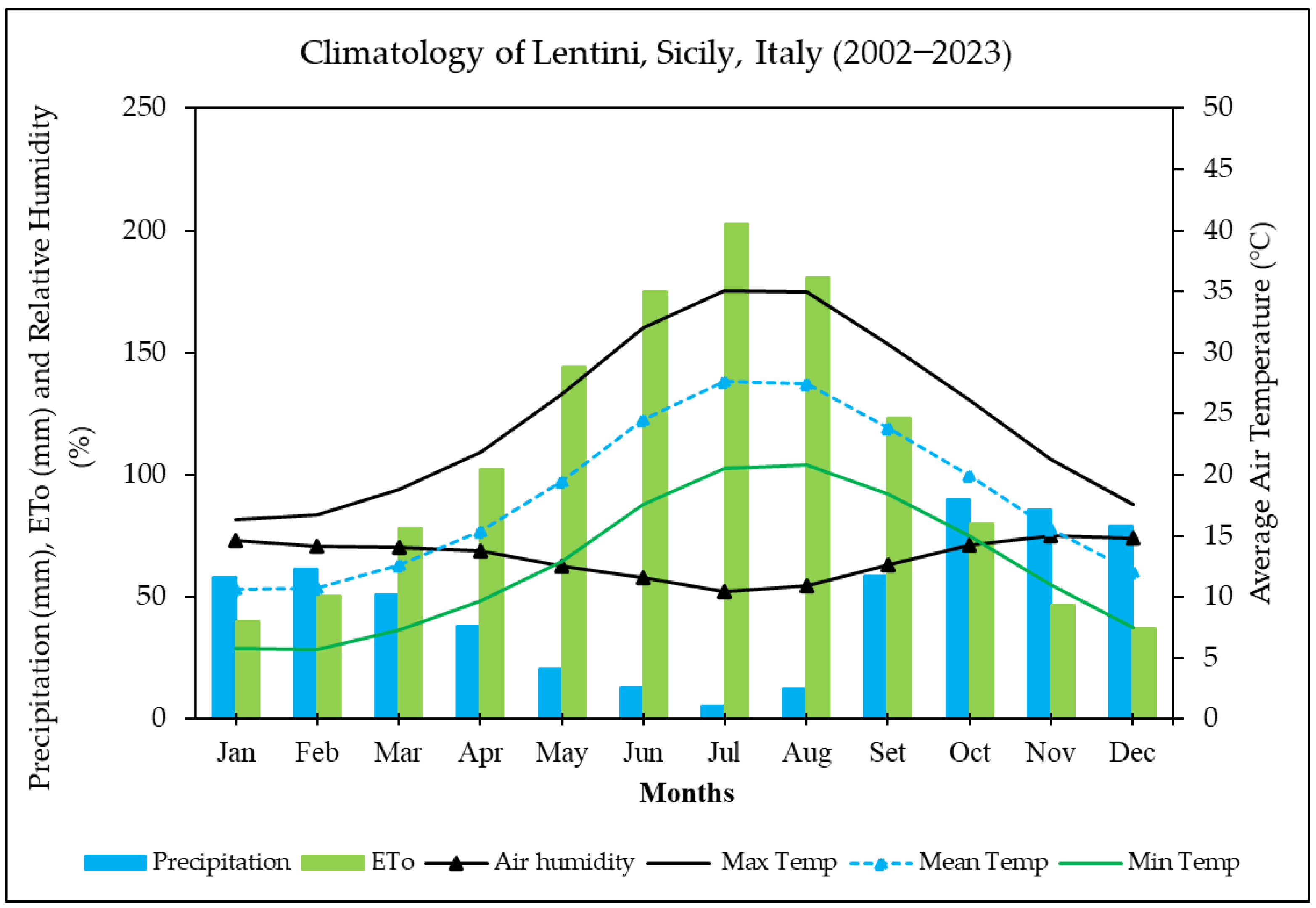
The study area is characterized by a Mediterranean climate [38] with a pronounced rainy season in winter [39], corresponding to the Csa classification under the Köppen–Geiger climate system [40]. Summers are typically hot and dry [39]. Figure 2 presents a summary of the climatological patterns observed in the Lentini study area over the reference period (2002–2023), based on data from the local agrometeorological station of the Agrometeorological Information Service of Sicily (SIAS).
In the study area of Lentini (SR), between 2002 and 2023, the average annual precipitation was approximately 572.6 mm, while monthly average air temperatures ranged from 12.7 °C to 24.8 °C, with a mean of 18.3 °C. The mean relative humidity over the same period was 66.1%, and the monthly average potential evapotranspiration was around 105.1 mm, peaking between April and October (Figure 2). These climatic conditions suggest a moderately warm and semi-arid environment, which may impose water stress on citrus orchards during the peak evapotranspiration months, highlighting the importance of effective irrigation management.
The topsoil of Lentini’s citrus orchards, approximately 0.1 m thick, is uniform and exhibits a sandy-loam texture comprising 69.7% sand, 10.5% clay, and 19.8% silt, with a relatively low organic matter content of 1.25% [41]. The soil has a bulk density of approximately 1.25 g·cm−3 [40,42], a field capacity of 0.28 m3·m−3, and a wilting point of 0.14 m3·m−3 [40], indicating moderate water retention and aeration conditions suitable for citrus growth, although limited organic matter may constrain nutrient availability.

2.2. Experimental Data Processing

The InVEST model was applied in this study. First, spatial maps of land use and land cover (LULC) were generated for the study area, including both current and projected future scenarios. Second, carbon stocks were estimated for each LULC class, accounting for both aboveground and belowground biomass. Third, the market price per ton of carbon and the corresponding annual discount rate were determined to facilitate economic valuation. Finally, the model was used to quantify the economic value of carbon sequestration in abandoned citrus orchards in Lentini over 2018–2030, providing an integrated assessment of the ecological and economic implications of land-use dynamics.

2.2.1. InVEST Model Data

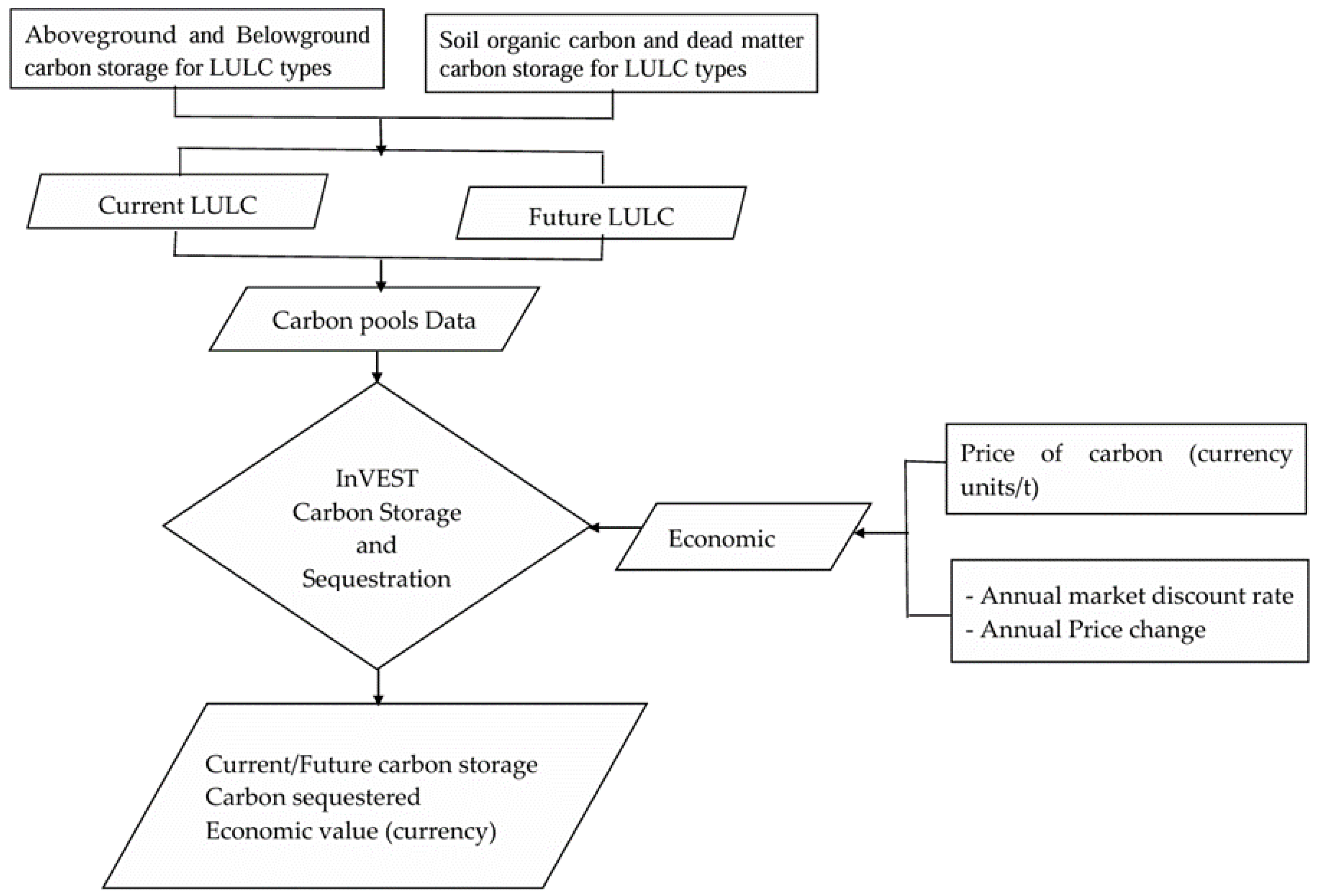
The InVEST model aims to determine the economic value of ecosystem services [43] and to provide GIS-based solutions for managing the multiple ecosystem services included in its 19 modules [44]. In this study, the InVEST carbon storage and sequestration model was applied (Figure 3). The model estimates the net carbon stored in a land parcel, the carbon sequestered over time, and the corresponding economic value of the service provided [43,45]. It requires input data on carbon stocks in different pools (aboveground and belowground biomass, soil organic matter, and dead organic matter) together with current and projected LULC maps, enabling the estimation of both current carbon stocks and sequestration over time [43]. Model outputs are presented in two sets, reflecting biophysical and economic results, respectively [46].
The InVEST model calculates the amount of carbon on a space-time scale by summing the values of the amounts of carbon in four carbon pools according to Equation (1) [45,47,48]:
C x j t = A x j t · ( C a j + C b j + C s j + C d j )
where
  • C x j t : Amount of total carbon stored in parcel x of land use j at time t;
  • A x j t : Area of parcel x of land use j at time t;
  • C a j : Amount of aboveground carbon from land use j;
  • C b j : Amount of belowground carbon from land use j;
  • C s j : Amount of carbon stored in soil from land use j;
  • C d j : Amount of carbon in dead matter from land use j.
Carbon sequestration in the model is determined by the net change (presented in the current and future LULC maps) in carbon storage in a specific parcel over time [45]. Carbon sequestration (Sx) in parcel x is calculated using Equations (2) and (3) according to the studies by Maanan et al. [48], Adelisardou et al. [45], and Kafy et al. [49].
S x = C t T 2 C t T 1
C t = x = 1 x C x j t
where
  • T 2   a n d   T 1 ( T 2 > T 1 ) : Time in years;
  • C t : Total carbon stored in t in years;
  • C t T 1 : Carbon stored in the current year T1;
  • C t T 2 : Carbon stored in the future year T2.

2.2.2. Current and Future Maps of LULC

The LULC classification was obtained from the European CORINE (Coordination of Information on the Environment) Land Cover (CLC) dataset, available at https://land.copernicus.eu/en/products/corine-land-cover (accessed on 4 March 2025) for the years 2006–2018. The LULC classes, based on the CLC classification, are described in the CLC Nomenclature Guidelines Manual [50]. Using the CLC data, both current and future LULC maps were generated for the study area. The current map represents LULC conditions in 2018, whereas the future map depicts the proposed LULC scenario for 2030. These maps were created using QGIS (version 3.34.6) and subsequently used as input for the InVEST model (Workbench version 3.14.1). The maps provide spatially explicit representations of land-use and land-cover classes, forming the basis for associating each land unit with corresponding carbon stock values and for evaluating the biophysical and economic impacts of land-use changes over time [50].

2.2.3. Carbon Stocks in Citrus Orchards and Abandoned Cultivated Land

The carbon storage data used as input parameters for the InVEST model are presented in the biophysical table. This table reports carbon pool values for each land-use and land-cover (LULC) class shown in the classification maps [46]. These values are derived either from field-based experiments conducted within the land parcels under analysis or from parameter values reported in the literature for comparable systems [47,48,51].
Carbon pool data (above- and belowground) for citrus orchards and abandoned areas used to construct the biophysical table in the present study were obtained from field measurements conducted in Sicily (aboveground biomass for citrus) and from the scientific literature (belowground biomass for citrus and both above- and belowground biomass for abandoned areas). Aboveground carbon concentration data for citrus were derived from the study by Consoli et al. [52], who assessed the carbon balance in orange orchards in Lentini, Sicily, while belowground carbon data for citrus were obtained from the study by Sahoo et al. [53]. Both studies were based on field measurements of the same citrus variety (Citrus sinensis L.). Accordingly, above- and belowground carbon stock estimates for unused land were obtained from the literature following the studies by Liang et al. [54] and Maanan et al. [48]. Carbon pool data (above- and belowground) for citrus orchards and abandoned land uses are summarized in Table 1.
The present study focused on the assessment of carbon storage in the living components of citrus trees (aboveground and belowground biomass). This assumption is adopted, as the exclusion of certain carbon pools does not affect the evaluation of changes in aboveground and belowground carbon storage over time [35].
Building on carbon stock data for citrus orchards and abandoned land, a set of alternative future scenarios was developed to capture plausible trajectories of carbon storage in abandoned citrus orchards, as detailed in Section 2.2.4.

2.2.4. Carbon Storage Prospects Under Citrus Orchard Abandonment Scenarios

Projections of carbon storage following citrus orchard abandonment were derived from the data reported in Table 1, which describe current aboveground and belowground carbon stocks under baseline LULC conditions, as well as projected stocks for 2030 under future LULC scenarios (G1–G3). In scenario G1, aboveground and belowground carbon stocks were estimated at 3.5 Mg C ha−1 [48] and 1.46 Mg C ha−1 [53], respectively. For scenario G2, aboveground carbon stocks remained consistent with G1, whereas belowground stocks were estimated at 1.43 Mg C ha−1, following Liang et al. [54]. Scenario G3 was characterized by reduced aboveground carbon stocks (1.8 Mg C ha−1) and belowground stocks of 1.43 Mg C ha−1, as reported by Liang et al. [54].
The LULC scenarios (G1–G3) were developed by integrating evidence of the ongoing citrus market crisis in the Mediterranean [13], widespread orchard abandonment documented in previous studies [12,13,14,15,16,19,20,21,22,23,26], projected reductions in irrigation water availability [11], and the increasing frequency of extreme climate events under Mediterranean climate change scenarios [26,28,30,55]. In addition, the scenarios account for plant adaptive responses to drought stress, particularly the increased allocation of biomass to belowground compartments [27].
Catalano et al. [11] demonstrated that declining irrigation water availability substantially reduces the viability of citrus cultivation in Siracusa, the province encompassing the study area. The projected scenario of citrus orchard abandonment in the Lentini study area (the future LULC map) was established using the probabilistic decline in citrus cultivation reported by Catalano et al. [11], as described in this section.
Scenarios G1, G2, and G3 represent alternative carbon storage assumptions for these abandoned areas, explicitly capturing uncertainty and providing a range of plausible above- and belowground carbon storage outcomes under orchard abandonment driven by climate-induced water constraints.

2.2.5. Economic Variables

The InVEST model incorporates the social cost of sequestered carbon, the monetary discount rate, and the annual variation in sequestered carbon prices as economic inputs [46]. The value of carbon sequestration for a given land parcel x ( V a l u e _ s e q x ) was calculated using Equation (4) [45,51]:
V a l u e _ s e q x = V · S x / ( q p ) · t = 0 q p 1 1 / ( ( 1 + r / 100 ) t · 1 + c / 100 t )
where
  • V: Price of a ton of carbon;
  • Sx: Amount of carbon sequestered in plot x in tons;
  • q: Future year;
  • p: Current year;
  • r: Annual market discount rate on carbon price;
  • c: Annual rate of change in the price of carbon.
The economic evaluation in the InVEST model begins with the definition of the variable V, which represents the carbon price [45]. This value corresponds to the monetary unit (any currency) per metric ton of elemental carbon and is based on estimates of the Social Cost of Carbon (SCC) [45,46]. The annual discount rate r reflects societal preferences for present versus future benefits and is defined according to cost–benefit assessments of environmental projects, varying with site-specific ecological conditions and management requirements [45,46,47].
The c rate denotes the annual variation in the carbon price and adjusts the value of sequestered carbon over time to reflect changes in the expected economic damages of climate change driven by emissions [45,46].
In light of the high global variability in carbon prices, driven by the absence of a standardized or consensual methodology for their estimation [56] and the considerable uncertainties surrounding the potential trajectories of emission trading markets and their underlying drivers [57], this study adopted three carbon price levels (EUR 25, EUR 71, and EUR 110) to represent distinct economic analysis scenarios. In the optimistic scenario, a value of EUR 25 per metric ton of carbon was considered, in accordance with the study by Johansson et al. [58], reflecting prices currently applied in the sale of carbon credits by some agricultural-sector companies in Europe.
As the price of agricultural emissions has not yet been formally established [59,60], the intermediate scenario adopted a carbon price of EUR 71 per metric ton, as projected by the European Union and scheduled for implementation under the Second Emissions Trading System (EU ETS 2) in 2030, with the objective of limiting emissions from the buildings, road transport, and small industrial sectors not covered by the existing European Union Emissions Trading System [57]. Finally, a carbon price of EUR 110 per metric ton was adopted based on the study by Adelisardou et al. [45], who identified projected spatio-temporal changes in carbon storage and sequestration in arid ecosystems by 2046. A uniform discount rate, r, of 7% was applied across all scenarios, and no annual variation in the carbon price, c, was assumed. Both parameters were defined according to the study by Adelisardou et al. [45]. InVEST simulations were performed for the 2018–2030 period.

2.2.6. Simulations of the InVEST Model and Economic Valuation of Carbon Sequestration

To quantify changes in carbon sequestration and its economic value over time, InVEST simulations were performed for scenarios G1–G3 using identical land-use and land-cover (LULC) maps for 2018 and 2030. Uniform economic parameters (r and c) and carbon prices (EUR 25, EUR 71, and EUR 110 per metric ton for 2030) were applied across all scenarios. Scenario-specific above- and belowground carbon stocks are reported in Section 2.2.4, and economic assumptions are shown in Section 2.2.5. Model outputs were subsequently subjected to economic valuation.
For the economic assessment, areas corresponding to one hectare (as reported by the InVEST outputs), microfarms (~3 ha), and 50% and 75% of the projected abandoned citrus area (~706 ha) were evaluated. The partial-area assumptions were adopted because the CLC, fruit trees, and the berry plantation class (222) may include non-citrus crops; thus, not all mapped areas necessarily represent abandoned citrus orchards. These proportions allowed the estimation of economic impacts under varying degrees of citrus abandonment.

3. Results

3.1. Characterization of LULC from 2006 to 2018

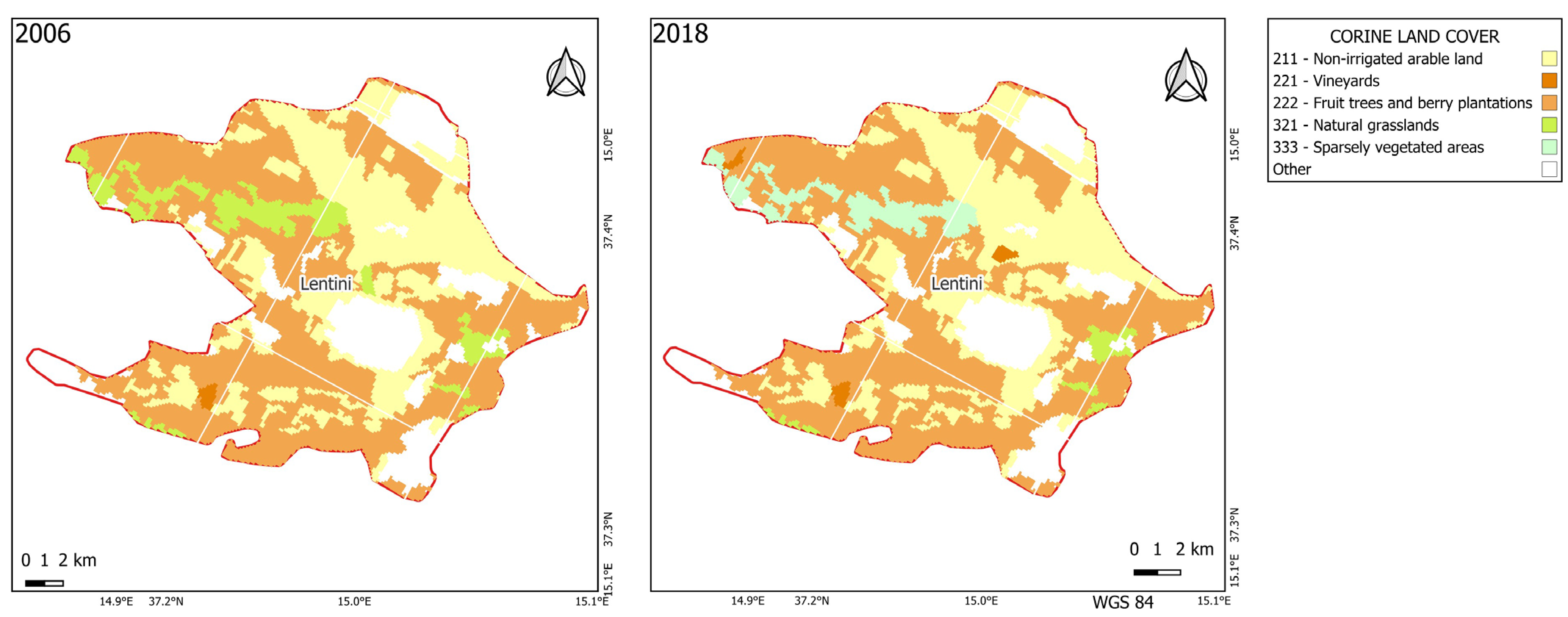
Figure 4 presents the CLC-based LULC maps for the Lentini study area in 2006 and 2018. Between these years, both gains and losses were observed across LULC classes. The dominant changes included a loss of 1175 ha of natural grasslands (321) and a gain of 1091 ha of sparsely vegetated areas (333). Map analysis indicated that portions of the grassland losses were converted into sparsely vegetated areas (333) and fruit tree and berry plantations (222). Results from Figure 4 and Table 2 show a net increase of 47 ha in the fruit tree and berry plantation class (222) in Lentini between 2006 and 2018, primarily driven by conversions from natural grasslands (321) and non-irrigated arable land (211). Over the same period, vineyards (221) expanded by 89 ha, largely through the conversion of non-irrigated arable land into vineyards.

3.2. The LULC Perspective for Lentini

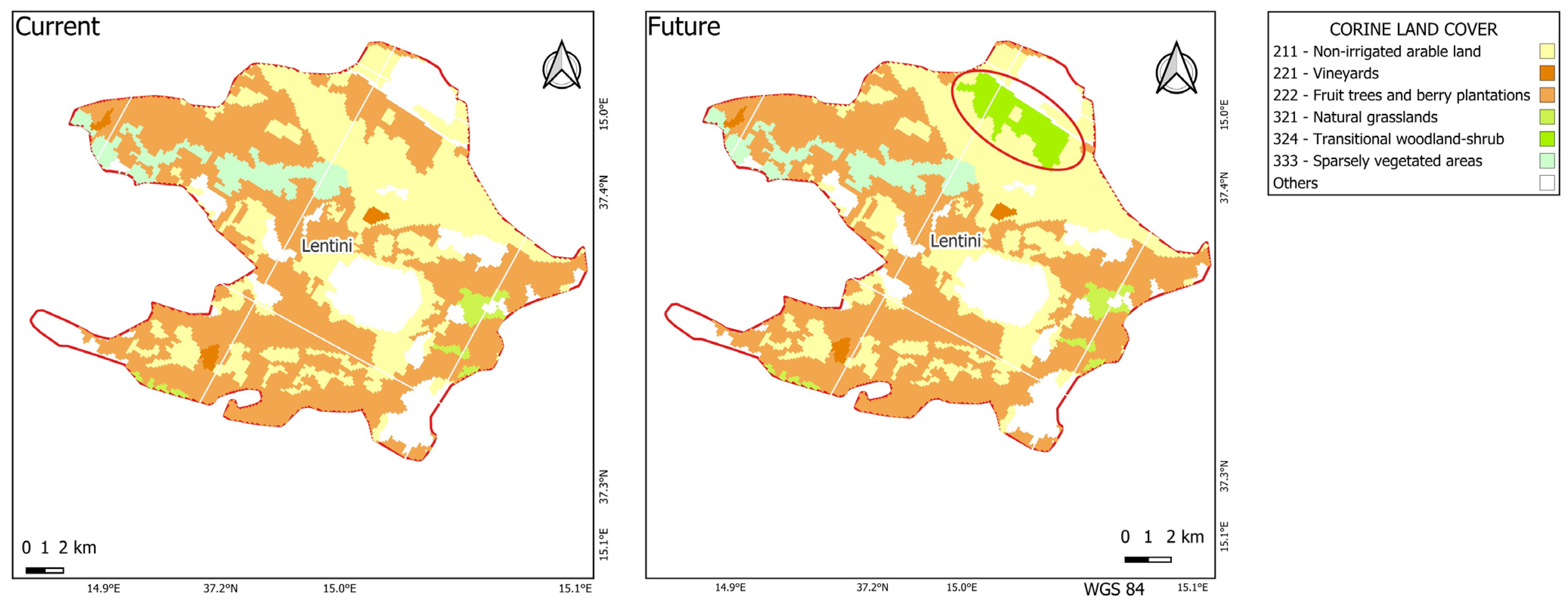
Figure 5 shows the projected LULC scenario for Lentini, in which areas currently classified as fruit tree and berry plantations (class 222) transition to shrublands (class 324) following abandonment. The projection indicates a loss of ~706 ha of citrus orchards until the year 2030, corresponding to ~7% of the current fruit tree cover (~10,362 ha).
The area selected (highlighted in red) to construct the citrus orchard abandonment scenario in Lentini was primarily based on the results by Catalano et al. [11], who indicate a probabilistic decline in citrus cultivation across the Syracuse (Lentini) region, including the area shown in Figure 5. Further justification is provided in Section 2.2.4.
Given that citrus is the dominant crop in the region [11], the projected loss of 706 ha in class 222 represents a substantial contraction of the citrus cultivation area in Lentini. Considering the fragmented microfarm system, with an average holding of ~3 ha [12,18], this level of abandonment corresponds to approximately 235 affected microfarms in the study area.

3.3. Carbon Storage Under the LULC Perspective

Table 3 summarizes InVEST carbon storage simulations, reporting net changes in carbon sequestration and associated economic values. InVEST model outputs are expressed as carbon stock (Mg C pixel−1) and monetary value (ha−1 yr−1).
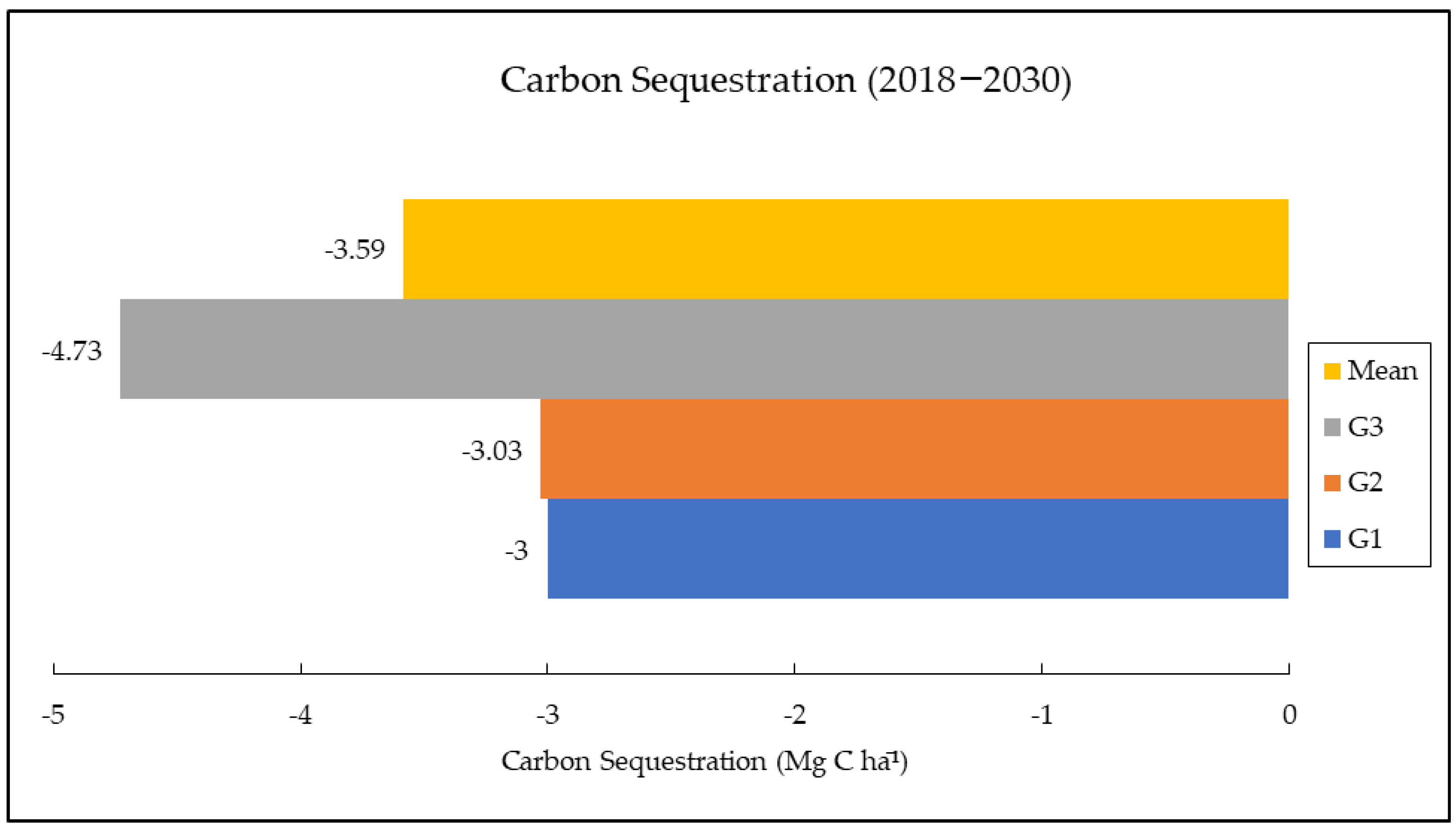
Results in Table 3 show that existing citrus orchards in the study area (Figure 5) store approximately 7.96 Mg C ha−1 yr−1, comprising 6.50 Mg C ha−1 in aboveground biomass [52] and 1.46 Mg C ha−1 in belowground biomass [53]. Across the abandonment scenarios simulated with InVEST, total carbon storage declined to 4.96, 4.93, and 3.23 Mg C ha−1 for G1, G2, and G3, respectively. Compared to current conditions, orchard abandonment resulted in an average reduction of ~4.37 Mg C ha−1 in carbon stocks, indicating a negative carbon storage trajectory consistent with the declining sequestration patterns shown in Figure 6.
Using Equation (2), carbon sequestration over the reference period (2018–2030) was quantified. Model results indicate net reductions in sequestration of −3.00, −3.03, and −4.73 Mg C ha−1 for scenarios G1, G2, and G3, respectively (Figure 6). On average, the observed 4.37 Mg C ha−1 decline in carbon stocks corresponded to a sequestration loss of approximately −3.59 Mg C ha−1 over the study period (Figure 6)

3.4. Economic Valuation of Carbon Sequestration

The economic assessment reveals negative trade-offs (economic losses) across all scenario groups simulated using the InVEST model. These losses are associated with a reduction in ecosystem service provision, particularly carbon sequestration by abandoned citrus orchards. The associated economic impacts under future land abandonment scenarios are presented in Table 4 and Figure 7 and are expressed as euros per unit area of citrus land. The results reveal economic losses across all scenario groups (G1, G2, and G3) and for all spatial scales considered (hectare, microfarm, 50%, and 75%, respectively). Economic assessments related to this loss of carbon sequestration indicate substantial financial impacts.
Table 4 presents the assessment of the economic impact of carbon sequestration, expressed in euros (EUR), per unit area of abandoned citrus orchards, corresponding to one hectare (as defined by the InVEST model output) and per microfarm (approximately 3 hectares), based on the future scenario projections shown in Figure 5.
Economic losses associated with the reduction in the carbon sequestration ecosystem service differed among scenarios G1, G2, and G3 depending on the carbon price applied to abandoned citrus areas. The highest carbon price (EUR 110) produced the largest losses, amounting to −328.7, −332.0, and −518.3 EUR ha−1 for scenarios G1, G2, and G3, respectively. The lowest price (EUR 25), resulted in the smallest losses, with values of −74.7, −75.5, and −117.8 EUR ha−1. The average carbon price (EUR 71) led to intermediate losses of −212.2; −214.3 and −334.5 EUR ha−1 across scenarios G1, G2, and G3, respectively.
The use of different Social-Cost-of-Carbon (SCC) values per metric ton of carbon (2030 reference year) to represent distinct economic analysis scenarios while assuming a uniform discount rate (r) of 7% and no annual variation in the carbon price (c) across scenarios resulted in average economic losses of −89.3, −253.7, and −393.0 EUR ha−1 for SCC values of EUR 25, EUR 71, and EUR 110, respectively.
Considering the average across scenarios G1, G2, and G3 and the application of SCC values of EUR 25, EUR 71, and EUR 110 in the InVEST model’s simulations, the estimated average economic losses amounted to −268.0, −761.0, and −1179.1 EUR per microfarm, respectively. These results indicate that greater economic losses in the carbon sequestration ecosystem service were observed in larger areas of abandoned citrus orchards (Table 4).
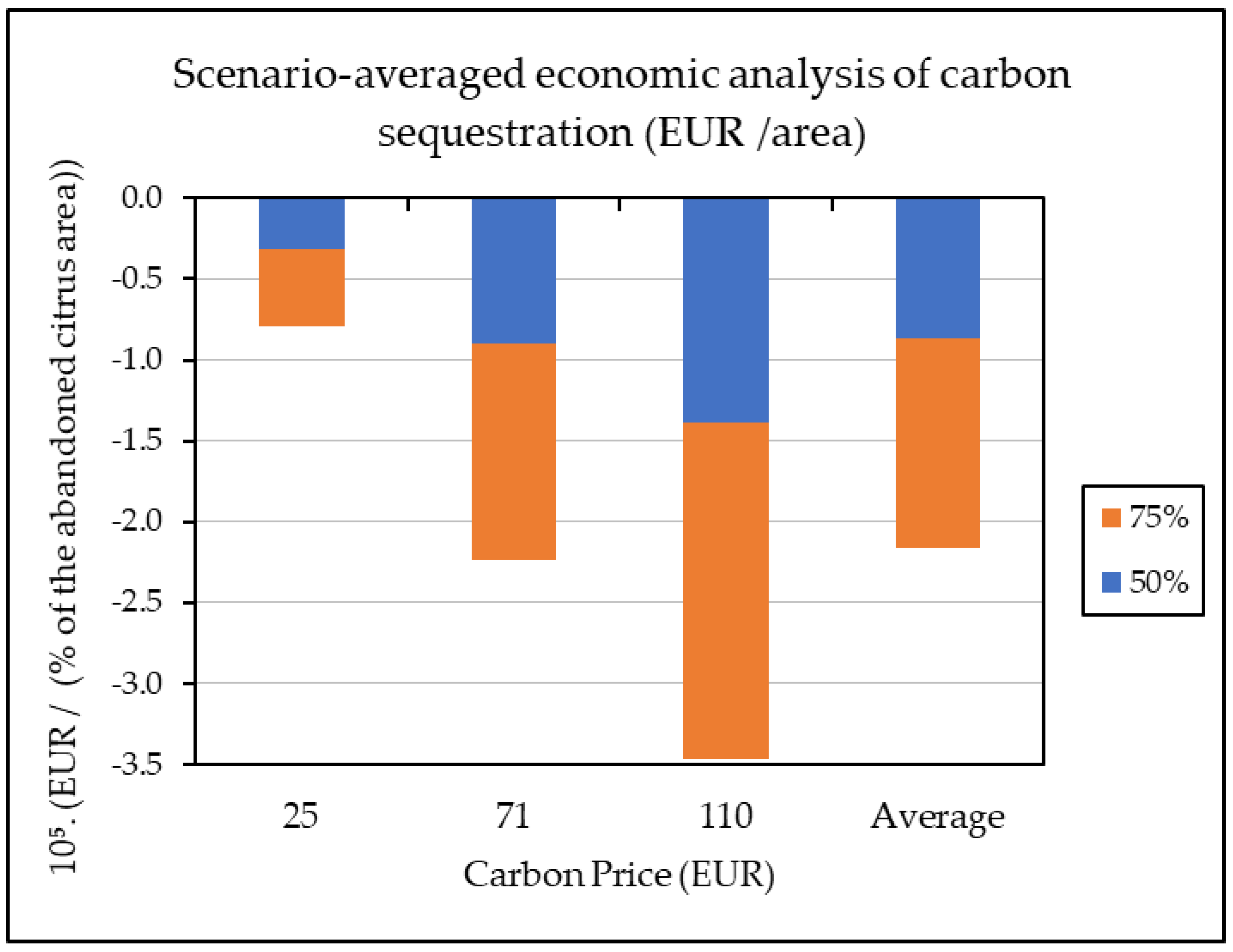
Figure 7 illustrates the economic analysis of carbon sequestration based on the average across scenarios, expressed in Euros per proportions of 50% and 75% of the total abandoned citrus area (approximately 706 ha). The results indicate that, if the phenomenon of agricultural land abandonment reaches proportions equivalent to 50% and 75% of the area currently occupied by citrus orchards in the Lentini region, substantial economic losses may occur in carbon sequestration ecosystem services.
The economic analysis of carbon sequestration, based on the average of scenarios G1, G2, and G3 in the present study and presented in Figure 7, reveals that the higher the carbon price (Social Cost of Carbon, SCC), the greater the economic loss resulting from citrus orchard abandonment. These economic losses are exacerbated as the abandoned area increases, as observed when abandonment reached 75% of the total area.
Carbon prices of EUR 25, EUR 71, and EUR 110 generated carbon sequestration economic losses of −0.5, −1.3, and −2.1 × 10⁵ EUR ha−1, respectively, for 75% of the abandoned citrus area. In contrast, abandonment of 50% of the citrus area resulted in carbon sequestration economic losses of −0.3, −0.9, and −1.4 × 10⁵ EUR ha−1, respectively, for the same SCC values.
Figure 7 also shows the average economic impact of carbon sequestration under severe abandonment scenarios, affecting 50% (≈118 microfarm) and 75% (≈177 microfarm) of the total area, where estimated losses for carbon sequestration were −0.9 × 10⁵ EUR ha−1 and −1.3 × 10⁵ EUR ha−1, respectively, highlighting a substantial reduction in ecosystem services in the Lentine region by 2030.

4. Discussion

Agricultural land abandonment entails significant trade-offs across environmental and socioecological dimensions. Although it is often regarded as a low-cost strategy for enhancing carbon sequestration and mitigating anthropogenic CO2 emissions [5], the recovery of soil carbon stocks is typically slow and may require more than a century to approach pre-abandonment levels [33]. At the same time, land abandonment can exacerbate vulnerability to natural hazards, including soil erosion, landslides [6,32], and wildfires [61], while also undermining traditional agricultural systems and the historical, cultural, and esthetic values of agricultural landscapes [8]. These findings highlight that the potential climate benefits of land abandonment must be carefully weighed against its environmental risks and socio-cultural costs.
In the European Union, for example, the abandonment of agricultural land has not been successful, as only negligible reductions in agricultural emissions have been observed, mainly due to the ineffectiveness of the current policy instruments aimed at reducing these emissions [60], within a context in which carbon farming has been one of the strategies adopted to achieve climate decarbonization [58]. In light of these factors, this study focused on assessing the negative impacts of citrus orchard abandonment in Lentini, Sicily, particularly its contribution to the reduction in the carbon sequestration ecosystem service due to declines in woody biomass following orchard abandonment.
Despite a notable increase of approximately +47 hectares in fruit tree and berry plantations (222 class) between 2006 and 2018 in Lentini (Table 2 and Figure 4), declining citrus prices [20] and the occurrence of extreme events, such as droughts [30] and high temperatures [24,25] driven by climate change in the Mediterranean basin, have likely hindered citrus production and contributed to orchard abandonment. The size of aboveground and belowground carbon pools in abandoned citrus orchards will depend on the successional changes that occur during the abandonment period. Abandoned agricultural lands have experienced changes that can lead to the emergence of different types of secondary vegetation, including grasslands [62].
Following the abandonment of citrus orchards, structural changes in the remaining trees can also be expected. Estornell et al. [22], in a study on biomass estimation of abandoned orange trees, reported that citrus trees under abandonment conditions experience changes in canopy geometry and biomass, which in turn influence the orchard’s carbon balance. Future LULC trajectories presented in this research (Table 3) suggest a significant reduction in carbon storage, down to 4.96 Mg C ha−1 (G1), 4.93 Mg C ha−1 (G2), and 3.23 Mg C ha−1 (G3), representing losses of up to 40% (G1 and G2) and 60% (G3) compared to present levels (7.96 Mg C ha−1). The results indicate a negative outlook for carbon storage as a result of orchard abandonment, with an average reduction of 4.37 Mg C ha−1 in plant carbon stock (Table 3).
The outlook on carbon storage in the scenarios (G1, G3 and G3) was developed from the perspective that agricultural land abandonment is a highly complex and non-linear phenomenon. It also involves factors such as the duration of abandonment, climatic conditions, topography, and soil characteristics and has impacts across multiple dimensions, including biodiversity [3,8,63]. In this context, abandoned agricultural lands can store varying amounts of carbon in both aboveground and belowground carbon pools [45,48,54].
The decrease in total biomass obtained in our scenarios (to 4.96, 4.93, and 3.23 Mg C ha−1 for G1, G2, and G3 by 2030) could be partly attributed to extreme drought events projected for the Mediterranean Basin [30]. Such extreme droughts are expected to reduce carbon sequestration during their occurrence, potentially leading to a 39–53% decline in the ecosystem’s annual net carbon sink [64]. Under drought conditions, plants tend to allocate a greater proportion of belowground biomass [27], which explains the persistence of belowground carbon allocation across all scenarios of this study despite substantial declines in aboveground biomass in these scenarios.
The carbon allocation presented in the future scenarios (G1, G2, and G3) primarily reflects the complexity of dealing with the abandonment of agricultural land in a climate with trends toward desertification driven by climate change. Considering the irregularity of precipitation patterns and extreme events such as droughts and heatwaves, which have become frequent in arid and semi-arid climate regions [8,65,66], and since, in Mediterranean region ecosystems, projections indicate that climate change will increase the occurrence and intensity of meteorological droughts, with extreme drought events occurring 5 to 10 times more frequently compared to the current period [30], this may justify the reduction in total carbon storage in the future scenarios.
The intensification of meteorological droughts conditioned by future global warming could transform terrestrial ecosystems from carbon sinks into carbon sources [67]. Under drought conditions, a decline in the rate of carbon uptake by agricultural crops can be observed, which will influence the total accumulation of carbon stored in plant biomass. Since the carbon absorbed by plants is stored in different photosynthetic or non-photosynthetic parts of the plants, such as trunks, branches, leaves, and roots [68], which constitute the aboveground and belowground biomass [46], a reduction in carbon absorption will result in a decrease in carbon allocation to both the aboveground and belowground components of the plant, which reflects the total amount of carbon stored by the plant (Equation (1)).
Since the carbon cycle is also a function of biomass density and its variations [69], such as fallen branches and citrus fruits, the potential death of citrus trees due to infestation by the Asian citrus psyllid in abandoned orchards [34], or even harsh environmental conditions such as heatwaves and drought [64] and elevated temperatures [25], which are common in the region where the orchards were abandoned, may contribute to both the release of soil carbon into the atmosphere and a decrease in atmospheric carbon sequestration, factors that can significantly affect the overall carbon balance.
Beyond estimating the net amount of carbon stored in a land parcel, the InVEST model quantifies the amount of carbon sequestered over time and the economic value of the ecosystem service provided [43,45]. Since carbon sequestration in the InVEST model is determined by the difference in carbon storage according to the types of LULCs present in the current and future LULC classification maps (Equation (2)) at a given time [45], the results regarding carbon sequestration by citrus undergoing the abandonment process showed negative values (Figure 6). The negative sign of the model outputs across all simulation groups indicates a substantial reduction in carbon sequestration during the citrus abandonment period (2018–2030), according to the LULC perspective adopted in this study. This result reflects carbon storage losses and consequent atmospheric release, as evidenced by the negative InVEST values representing carbon loss (Mg per pixel) [45,46].
The results indicate that citrus trees currently store approximately 7.96 Mg C ha−1 per year (Table 3). Values corresponding to 7.69 Mg C ha−1 of the total biomass carbon were determined by Sahoo et al. [53] in their study on the estimation and assessment of biomass and carbon stock in the orange orchard ecosystem. The LULC presented in this study (Figure 5) resulted in losses of −3.0; −3.03 and −4.73 Mg C ha−1 in carbon sequestered in the citrus agroecosystem for all groups (G1, G2, and G3, respectively), corresponding to an average loss in the future scenario of approximately −3.59 Mg C ha−1 over the period 2018–2030 (Figure 6) and reinforcing the negative implications of orchard abandonment for long-term carbon dynamics.
LULC change is responsible for the increase in greenhouse gases and aerosols in the atmosphere [70]. The study by Cheng et al. [71] indicates that 25% of the historical increase in atmospheric carbon dioxide concentration is due to LULC change, highlighting the significant impact of LULC on the global carbon cycle. The InVEST model simulation results presented in this study indicate a compromise of the carbon sequestration ecosystem service provided by planted ecosystems, such as citrus orchards, which are considered efficient atmospheric CO2 sinks [53,68].
The reduction in carbon sequestration over time has economic implications, leading to a decrease in the social cost over time [45]. Since the economic assessment of the InVEST model is based on estimating the economic value of the amount of carbon sequestered, considering economic variables such as V, r, and c [43,46] over time, the reduction in carbon sequestration had implications for generating negative trade-offs. The economic assessment shown in Table 4 and Figure 7 is based on three carbon price values (EUR 25, EUR 71, and EUR 110 per metric ton for 2030) and a uniform r rate (7%), assuming no c rate across scenarios G1, G2, and G3. In light of the prevailing uncertainty and variability in carbon pricing within the carbon market [56,58,72], this study considers three alternative carbon price scenarios to capture potential fluctuations.
Economic losses associated with carbon sequestration in scenarios G1 and G3 ranged from −74.7 to −117.8 EUR ha−1 at a carbon price of EUR 25, from −212.2 to −334.5 EUR ha−1 at EUR 71, and from −328.7 to −518.3 EUR ha−1 at EUR 110 per metric ton of carbon, respectively. The values obtained from the economic assessment of carbon sequestration for the intermediate scenario (G2; −75.5, −214.3, and −332.0 EUR ha−1 at EUR 25, EUR 71, and EUR 110, respectively) fall within the ranges observed between scenarios G1 and G3.
Considering the results of the InVEST simulations across all scenarios (G1, G2, and G3) and calculating the average economic values for areas equivalent to one hectare and to a microfarm, average economic losses of −89.3, −253.7, and −393.0 euros (EUR) per hectare were obtained for social carbon prices of EUR 25, EUR 71, and EUR 110, respectively, and of −268.0, −761.0, and −1179.1 euros (EUR) per microfarm for the same SCC values.
The economic assessment results indicate that carbon sequestration losses increased with the extent of abandoned citrus orchard areas. The results indicate that agricultural land abandonment in the Lentini region could lead to substantial economic losses in carbon sequestration, particularly under more severe scenarios where 50–75% of citrus orchards are abandoned. Economic losses increase with both the carbon price and the extent of abandonment, reaching −0.5, −1.3, and −2.1 × 10⁵ EUR ha−1 for 75% abandonment and −0.3, −0.9, and −1.4 × 10⁵ EUR ha−1 for 50% abandonment at carbon price values of EUR 25, EUR 71, and EUR 110, respectively.
Figure 7 indicates that severe land abandonment affecting 50% (≈118 microfarm) and 75% (≈177 microfarm) of the total area would result in average economic losses in carbon sequestration of −0.9 × 10⁵ EUR ha−1 and −1.3 × 10⁵ EUR ha−1, respectively. These findings highlight the increasing vulnerability of carbon-related ecosystem services in the Lentine region by 2030 and suggest that large-scale abandonment may undermine the effectiveness of carbon-oriented land management strategies. These estimates align with prior research using InVEST in Mediterranean and semi-arid contexts, where land-use changes such as agricultural abandonment or deforestation have been shown to result in economic losses ranging from −EUR 100 to over −EUR 500 per hectare, depending on biomass density and carbon pricing assumptions [44,46,73].
These values fall within the upper range reported by Mukhopadhyay et al. [44], who estimated carbon-related economic losses exceeding EUR 200,000.0 for comparable land-use changes in high-biomass agroecosystems. Such projections underscore the economic vulnerability of regional agroeconomies in the absence of carbon compensation mechanisms and emphasize the need for policy frameworks that recognize the climate regulation services provided by maintained agricultural systems.
The economic assessment of carbon sequestration in the study by Adelisardou et al. [45] ranged from USD −470.41 ha−1 yr−1 to USD 27.72 ha−1 yr−1. These variations may arise from uncertainties in carbon pricing, differences in emission trajectories reflecting societal preferences for climate change mitigation [45], and the spatial scale of the LULC maps used in the InVEST model’s simulations. According to Maanan et al. [48], valuing carbon sequestration as a climate regulation service based on LULC change analysis is crucial, as it informs climate policy decision-making by integrating carbon quantification with land-use planning for sustainable development.
The InVEST model results indicate that future reductions in carbon storage due to citrus abandonment in Lentini have economic implications, as decreased carbon sequestration leads to potential emissions that would otherwise be stored as biomass. Designed to support natural resource management [46,51] by quantifying the economic value of ecosystem services [44,46], the InVEST model highlights the importance of conserving key ecosystem services, such as carbon sequestration, particularly in the context of efforts to mitigate anthropogenic carbon emissions and climate change [74]. Although the InVEST model does not include the complexity of the carbon cycle’s dynamics, it is an excellent tool that can aid in natural resource management and provide ecosystem services to society [46].
This study suggests that preserving citrus orchards is crucial for avoiding their transition into net carbon sources. Considering the potential social and economic costs of conservation, particularly in Sicily and the broader Mediterranean region, policy frameworks may need to incorporate compensation mechanisms to ensure that orchard protection does not impose disproportionate burdens on farmers. Such compensation appears to be closely linked to emission trading policies in the agricultural sector under the European Emissions Trading System, which has been widely regarded as ineffective to date [60], despite agriculture being identified by the European Union as a key pathway for emissions offsetting [75].
There is an urgent need for coordinated efforts to ensure the long-term maintenance of planted ecosystems, such as citrus orchards, as they play a dual role in providing essential ecosystem services, particularly atmospheric carbon sequestration [53,68], while also sustaining food production systems [76]. Based on the results, this study identifies key directions for future research. InVEST model simulations should incorporate above- and belowground biomass of abandoned citrus orchards at different developmental stages, as well as dead biomass and soil organic matter. Additionally, multiple simulation scenarios considering both varying carbon prices and other critical economic variables are essential to capture the carbon market’s dynamics and volatility.

5. Conclusions

This study contributes to the growing body of research on the environmental and economic consequences of agricultural land abandonment by providing an integrated assessment of carbon storage losses and associated financial impacts in a semi-arid Mediterranean context. By employing the InVEST model to simulate future land-use changes, this study quantifies the economic value of carbon sequestration associated with the abandonment of citrus orchards. This dual approach provides policymakers and land managers with valuable insights by linking ecosystem service degradation to regional economic vulnerability.
InVEST simulations show that citrus orchard abandonment leads to a consistent decline in carbon storage, reducing stocks from about 7.96 Mg C ha−1 to 3.23–4.96 Mg C ha−1. Overall, this represents an average loss of approximately 4.4 Mg C ha−1 and a mean carbon sequestration reduction of −3.6 Mg C ha−1 between 2018 and 2030. This shift signals the potential for reduced carbon sequestration and increased atmospheric emissions, particularly if abandoned lands fail to regenerate woody vegetation. These outcomes underscore the importance of land-use continuity in maintaining carbon reservoirs in Mediterranean agroecosystems. Economic assessments associated with this loss of carbon sequestration indicate significant financial impacts.
The InVEST simulations across all scenarios (G1, G2, and G3) indicate average economic losses ranging from −89.3 to −393.0 EUR ha−1 and from −268.0 to −1179.1 EUR per microfarm as social carbon prices increase from EUR 25 to EUR 110, highlighting the sensitivity of economic outcomes to carbon price assumptions. Overall, the findings demonstrate that severe orchard abandonment, affecting up to 50% (≈118 microfarm) and 75% (≈177 microfarm) of the total area, would generate substantial economic losses in carbon sequestration (−0.9 × 10⁵ EUR ha−1 and −1.3 × 10⁵ EUR ha−1, respectively), ultimately undermining the long-term provision of ecosystem services in the Lentine region by 2030. Economic losses from reduced carbon sequestration varied across scenarios G1–G3 and were strongly driven by carbon price levels, with higher prices (EUR 110) producing the greatest losses and lower prices (EUR 25) producing the smallest ones. Across all price assumptions, scenario G3 incurred the highest losses, while scenario G1 had the lowest, and scenario G2 showed intermediate impacts.
This study provides critical insights into the consequences of agricultural cessation increasingly observed in traditional Mediterranean agroecosystems, such as citrus orchards. The findings indicate that orchard abandonment reduces carbon sequestration capacity, leading to economic losses for farmers and compromising a vital ecosystem service for climate change mitigation. These findings underscore the need for policies that discourage agricultural land abandonment and for effective carbon market regulation to support compensation mechanisms aimed at preserving vegetation-based carbon sequestration services.

Author Contributions

Conceptualization, H.M.A.I. and G.A.J.; methodology, H.M.A.I. and G.A.J.; software, G.A.J. and K.A.S.L.; formal analysis, H.M.A.I. and G.A.J.; investigation, G.A.J.; resources, H.M.A.I. and S.C.; data curation, S.C., K.A.S.L. and G.A.J.; writing—original draft preparation, G.A.J. and K.A.S.L.; writing—review and editing, H.M.A.I., D.V., G.B.L., G.L.M. and G.A.J. supervision, H.M.A.I. All authors have read and agreed to the published version of the manuscript.

Funding

This research was funded by CAPES (Coordenação de Aperfeiçoamento de Pessoal de Nível Superior), Brazil, through the Graduate Program in Applied Meteorology at the Federal University of Viçosa, which supported the doctoral scholarship (Funding Code 001). The study was also partially funded by the PRIMA Programme through the project “Operational Adaptation Nexus-Based Systems Solutions in the Mediterranean—DIONYSUS” (Grant Agreement No. 2341).

Data Availability Statement

The original contributions presented in the study are included in the article. Further inquiries can be directed to the corresponding author.

Conflicts of Interest

The authors declare no conflicts of interest.

References

  1. Castillo, C.P.; Kavalov, B.; Diogo, V.; Jacobs-Crisione, C.; Batista e Silva, F.; Lavalle, C. Agricultural Land Abandonment in the EU within 2015–2030; Joint Research Centre: Ispra, Italy, 2018; pp. 1–7. [Google Scholar]
  2. Fazia, C.; Nahiduzzaman, K.M.; Al-Ramadan, B.; Aldosary, A.; Moraci, F. Counteract Soil Consumption through Ecosystem Services and Landscape Restoration for an Efficient Urban Regeneration. Land 2024, 13, 323. [Google Scholar] [CrossRef]
  3. García-Ruiz, J.M.; Lana-Renault, N. Hydrological and Erosive Consequences of Farmland Abandonment in Europe, with Special Reference to the Mediterranean Region—A Review. Agric. Ecosyst. Environ. 2011, 140, 317–338. [Google Scholar] [CrossRef]
  4. Lasanta, T.; P~rez-Rontom61, C.; Garcla-Ruiz, J.M.; Machin, J.; Navas, A. Hydrological Problems Resulting from Farmland Abandonment in Semi-Arid Environments: The Central Ebro Depression. Phys. Chem. Earth 1995, 20, 309–314. [Google Scholar] [CrossRef]
  5. Novara, A.; Gristina, L.; Sala, G.; Galati, A.; Crescimanno, M.; Cerdà, A.; Badalamenti, E.; La Mantia, T. Agricultural Land Abandonment in Mediterranean Environment Provides Ecosystem Services via Soil Carbon Sequestration. Sci. Total Environ. 2017, 576, 420–429. [Google Scholar] [CrossRef]
  6. Pepe, G.; Mandarino, A.; Raso, E.; Scarpellini, P.; Brandolini, P.; Cevasco, A. Investigation on Farmland Abandonment of Terraced Slopes Using Multitemporal Data Sources Comparison and Its Implication on Hydro-Geomorphological Processes. Water 2019, 11, 1552. [Google Scholar] [CrossRef]
  7. Perpiña Castillo, C.; Jacobs-Crisioni, C.; Diogo, V.; Lavalle, C. Modelling Agricultural Land Abandonment in a Fine Spatial Resolution Multi-Level Land-Use Model: An Application for the EU. Environ. Model. Softw. 2021, 136, 104946. [Google Scholar] [CrossRef]
  8. Subedi, Y.R.; Kristiansen, P.; Cacho, O. Drivers and Consequences of Agricultural Land Abandonment and Its Reutilisation Pathways: A Systematic Review. Environ. Dev. 2022, 42, 100681. [Google Scholar] [CrossRef]
  9. Pérez-Hernández, J.; Gavilán, R.G. Impacts of Land-Use Changes on Vegetation and Ecosystem Functioning: Old-Field Secondary Succession. Plants 2021, 10, 990. [Google Scholar] [CrossRef]
  10. Vallés-Planells, M.; Galiana, F.; Torrijos, I.D. Agricultural Abandonment and Resilience in a Mediterranean Periurban Traditional Agroecosystem: A Landscape Approach. Ecol. Soc. 2020, 25, 5. [Google Scholar] [CrossRef]
  11. Catalano, G.A.; Maci, F.; D’Urso, P.R.; Arcidiacono, C. GIS and SDM-Based Methodology for Resource Optimisation: Feasibility Study for Citrus in Mediterranean Area. Agronomy 2023, 13, 549. [Google Scholar] [CrossRef]
  12. Ivona, A.; Privitera, D. The Rediscovery of Characteristic Rural Landscapes. An Opportunity to Create New Activities? Belgeo 2022, 4, 1–20. [Google Scholar] [CrossRef]
  13. Guarnaccia, V.; Vitale, A.; Cirvilleri, G.; Aiello, D.; Susca, A.; Epifani, F.; Polizzi, G. Characterisation and Pathogenicity of Fungal Species Associated with Branch Cankerd and Stem-End Rot of Avacado in Italy. Eur. J. Plant Pathol. 2016, 146, 963–976. [Google Scholar] [CrossRef]
  14. Migliore, G.; Farina, V.; Tinervia, S.; Matranga, G.; Schifani, G. Consumer Interest towards Tropical Fruit: Factors Affecting Avocado Fruit Consumption in Italy. Agric. Food Econ. 2017, 5, 24. [Google Scholar] [CrossRef]
  15. Testa, R.; Tudisca, S.; Schifani, G.; Trapani, A.M.D.; Migliore, G. Tropical Fruits as an Opportunity for Sustainable Development in Rural Areas: The Case of Mango in Small-Sized Sicilian Farms. Sustainability 2018, 10, 1436. [Google Scholar] [CrossRef]
  16. Migliore, G.; Farina, V.; Dara Guccione, G.; Giorgio, S. Quality Determinants of Avocado Fruit Consumption in Italy. Implications for Small Farms. Food Saf. Manag. 2018, 19, 148–154. [Google Scholar]
  17. Bhawana, K.C.; Race, D. Outmigration and Land-Use Change: A Case Study from the Middle Hills of Nepal. Land 2019, 9, 2. [Google Scholar] [CrossRef]
  18. Ciriminna, R.; Angellotti, G.; Luque, R.; Pagliaro, M. The Citrus Economy in Sicily in the Early Bioeconomy Era: A Case Study for Bioeconomy Practitioners. Biofuels Bioprod. Biorefin. 2024, 18, 356–364. [Google Scholar] [CrossRef]
  19. Cerdà, A.; González Peñaloza, F.A.; Burguet, M.; Pereira, P. Soil Erosion as a Consequence of Wildfires on Recently Abandoned Citrus Orchards in Eastern Spain. FLAMMA 2013, 4, 85–89. [Google Scholar]
  20. Cerdà, A.; Ackermann, O.; Terol, E.; Rodrigo-Comino, J. Impact of Farmland Abandonment on Water Resources and Soil Conservation in Citrus Plantations in Eastern Spain. Water 2019, 11, 824. [Google Scholar] [CrossRef]
  21. de Paz, V.; Asís, J.D.; Holzschuh, A.; Baños-Picón, L. Effects of Traditional Orchard Abandonment and Landscape Context on the Beneficial Arthropod Community in a Mediterranean Agroecosystem. Insects 2023, 14, 277. [Google Scholar] [CrossRef]
  22. Estornell, J.; Martí, J.; Hadas, E.; López-Cortés, I.; Velázquez-Martí, B.; Fernández-Sarría, A. Biomass Estimation of Abandoned Orange Trees Using UAV-SFM 3D Points. Int. J. Appl. Earth Obs. Geoinf. 2024, 130, 103931. [Google Scholar] [CrossRef]
  23. Morell-Monzó, S.; Sebastiá-Frasquet, M.T.; Estornell, J.; Moltó, E. Detecting Abandoned Citrus Crops Using Sentinel-2 Time Series. A Case Study in the Comunitat Valenciana Region (Spain). ISPRS J. Photogramm. Remote Sens. 2023, 201, 54–66. [Google Scholar] [CrossRef]
  24. Abobatta, W.F. Managing Citrus Orchards under Climate Change. MOJ Ecol. Environ. Sci. 2021, 6, 43–44. [Google Scholar] [CrossRef]
  25. Rosenzweig, C.; Phillips, J.; Goldberg, R.; Carrollh, J.; Hodges’, T. Potential Impacts of Climate Change on Citrus and Potato Production in the US. Agric. Syst. 1996, 52, 455–479. [Google Scholar] [CrossRef]
  26. Fraga, H.; Moriondo, M.; Leolini, L.; Santos, J.A. Mediterranean Olive Orchards under Climate Change: A Review of Future Impacts and Adaptation Strategies. Agronomy 2021, 11, 56. [Google Scholar] [CrossRef]
  27. Liu, Y.; Xu, M.; Li, G.; Wang, M.; Li, Z.; De Boeck, H.J. Changes of Aboveground and Belowground Biomass Allocation in Four Dominant Grassland Species Across a Precipitation Gradient. Front. Plant Sci. 2021, 12, 13. [Google Scholar] [CrossRef]
  28. Calvin, K.; Dasgupta, D.; Krinner, G.; Mukherji, A.; Thorne, P.W.; Trisos, C.; Romero, J.; Aldunce, P.; Barret, K.; Blanco, G.; et al. Climate Change 2023: Synthesis Report, Summary for Policymakers. Contribution of Working Groups I, II and III to the Sixth Assessment Report of the Intergovernmental Panel on Climate Change; Arias, P., Bustamante, M., Elgizouli, I., Flato, G., Howden, M., Méndez-Vallejo, C., Pereira, J.J., Pichs-Madruga, R., Rose, S.K., Saheb, Y., et al., Eds.; IPCC: Geneva, Switzerland, 2023. [Google Scholar] [CrossRef]
  29. Moreira da Silva, M.; Resende, F.C.; Freitas, B.; Aníbal, J.; Martins, A.; Duarte, A. Urban Wastewater Reuse for Citrus Irrigation in Algarve, Portugal—Environmental Benefits and Carbon Fluxes. Sustainability 2022, 14, 10715. [Google Scholar] [CrossRef]
  30. Tramblay, Y.; Koutroulis, A.; Samaniego, L.; Vicente-Serrano, S.M.; Volaire, F.; Boone, A.; Le Page, M.; Llasat, M.C.; Albergel, C.; Burak, S.; et al. Challenges for Drought Assessment in the Mediterranean Region under Future Climate Scenarios. Earth Sci. Rev. 2020, 210, 103348. [Google Scholar] [CrossRef]
  31. Todde, P.; Debolini, M.; Roggero, P.P.; Giannini, V. Disentangling the Drivers of Marginalisation in Mediterranean Inlands: A Case Study in the Sardinian Mountains. Catena 2024, 242, 108110. [Google Scholar] [CrossRef]
  32. Santarsiero, V.; Lanorte, A.; Nolè, G.; Cillis, G.; Tucci, B.; Murgante, B. Analysis of the Effect of Soil Erosion in Abandoned Agricultural Areas: The Case of NE Area of Basilicata Region (Southern Italy). Land 2023, 12, 645. [Google Scholar] [CrossRef]
  33. Yang, Y.; Tilman, D.; Furey, G.; Lehman, C. Soil Carbon Sequestration Accelerated by Restoration of Grassland Biodiversity. Nat. Commun. 2019, 10, 718. [Google Scholar] [CrossRef] [PubMed]
  34. Grafton-Cardwell, E.E.; Stelinski, L.L.; Stansly, P.A. Biology and Management of Asian Citrus Psyllid, Vector of the Huanglongbing Pathogens. Annu. Rev. Entomol. 2013, 58, 413–432. [Google Scholar] [CrossRef] [PubMed]
  35. Zhu, L.; Song, R.; Sun, S.; Li, Y.; Hu, K. Land Use/Land Cover Change and Its Impact on Ecosystem Carbon Storage in Coastal Areas of China from 1980 to 2050. Ecol. Indic. 2022, 142, 109178. [Google Scholar] [CrossRef]
  36. Chen, A.; Xie, X.; Ge, T.; Hou, H.; Wang, W.; Wei, W.; Kuzyakov, Y. Rapid Decrease of Soil Carbon after Abandonment of Subtropical Paddy Fields. Plant Soil 2017, 415, 203–214. [Google Scholar] [CrossRef]
  37. Guarrera, S.; Vanella, D.; Consoli, S.; Giudice, G.; Toscano, S.; Ramírez-Cuesta, J.M.; Milani, M.; Ferlito, F.; Longo, D. Analysis of Small-Scale Soil CO2 Fluxes in an Orange Orchard under Irrigation and Soil Conservative Practices. Heliyon 2024, 10, e30543. [Google Scholar] [CrossRef]
  38. Vanella, D.; Ferlito, F.; Torrisi, B.; Giuffrida, A.; Pappalardo, S.; Saitta, D.; Longo-Minnolo, G.; Consoli, S. Long-Term Monitoring of Deficit Irrigation Regimes on Citrus Orchards in Sicily. J. Agric. Eng. 2021, 52, 9. [Google Scholar] [CrossRef]
  39. Bonaccorso, B.; Cancelliere, A.; Rossi, G. Probabilistic Forecasting of Drought Class Transitions in Sicily (Italy) Using Standardized Precipitation Index and North Atlantic Oscillation Index. J. Hydrol. 2015, 526, 136–150. [Google Scholar] [CrossRef]
  40. Ramírez-Cuesta, J.M.; Consoli, S.; Longo, D.; Longo-Minnolo, G.; Intrigliolo, D.S.; Vanella, D. Influence of Short-Term Surface Temperature Dynamics on Tree Orchards Energy Balance Fluxes. Precis. Agric. 2022, 23, 1394–1412. [Google Scholar] [CrossRef]
  41. Vanella, D.; Cassiani, G.; Busato, L.; Boaga, J.; Barbagallo, S.; Binley, A.; Consoli, S. Use of small-scale electrical resistivity tomography to identify soil–root interactions during deficit irrigation. J. Hydrol. 2018, 556, 310–324. [Google Scholar] [CrossRef]
  42. Consoli, S.; Stagno, F.; Vanella, D.; Boaga, J.; Cassiani, G.; Roccuzzo, G. Partial Root-Zone Drying Irrigation in Orange Orchards: Effects on Water Use and Crop Production Characteristics. Eur. J. Agron. 2017, 82, 190–202. [Google Scholar] [CrossRef]
  43. Babbar, D.; Areendran, G.; Sahana, M.; Sarma, K.; Raj, K.; Sivadas, A. Assessment and Prediction of Carbon Sequestration Using Markov Chain and InVEST Model in Sariska Tiger Reserve, India. J. Clean. Prod. 2021, 278, 123333. [Google Scholar] [CrossRef]
  44. Mukhopadhyay, A.; Hati, J.P.; Acharyya, R.; Pal, I.; Tuladhar, N.; Habel, M. Global Trends in Using the InVEST Model Suite and Related Research: A Systematic Review. Ecohydrol. Hydrobiol. 2024, 25, 389–405. [Google Scholar] [CrossRef]
  45. Adelisardou, F.; Zhao, W.; Chow, R.; Mederly, P.; Minkina, T.; Schou, J.S. Spatiotemporal Change Detection of Carbon Storage and Sequestration in an Arid Ecosystem by Integrating Google Earth Engine and InVEST (the Jiroft Plain, Iran). Int. J. Environ. Sci. Technol. 2022, 19, 5929–5944. [Google Scholar] [CrossRef]
  46. Nelson, E.; Ennaanay, D.; Wolny, S.; Olwero, N.; Vigerstol, K.; Penning-ton, D.; Mendoza, G.; Aukema, J.; Foster, J.; Forrest, J.; et al. InVEST 3.6.0 User’s Guide; The Natural Capital: Stanford, CA, USA, 2018. [Google Scholar]
  47. Ersoy Mirici, M.; Berberoglu, S. Terrestrial Carbon Dynamics and Economic Valuation of Ecosystem Service for Land Use Management in the Mediterranean Region. Ecol. Inform. 2024, 81, 102570. [Google Scholar] [CrossRef]
  48. Maanan, M.; Maanan, M.; Karim, M.; Ait Kacem, H.; Ajrhough, S.; Rueff, H.; Snoussi, M.; Rhinane, H. Modelling the Potential Impacts of Land Use/Cover Change on Terrestrial Carbon Stocks in North-West Morocco. Int. J. Sustain. Dev. World Ecol. 2019, 26, 560–570. [Google Scholar] [CrossRef]
  49. Kafy, A.A.; Saha, M.; Fattah, M.A.; Rahman, M.T.; Duti, B.M.; Rahaman, Z.A.; Bakshi, A.; Kalaivani, S.; Nafiz Rahaman, S.; Sattar, G.S. Integrating Forest Cover Change and Carbon Storage Dynamics: Leveraging Google Earth Engine and InVEST Model to Inform Conservation in Hilly Regions. Ecol. Indic. 2023, 152, 110374. [Google Scholar] [CrossRef]
  50. Kosztra György Büttner, B.; Hazeu Stephan Arnold, G. Updated CLC Illustrated Nomenclature Guidelines; European Environment Agency: Copenhagen, Denmark, 2018; Volume 2. [Google Scholar]
  51. Rachid, L.; Elmostafa, A.; Mehdi, M.; Hassan, R. Assessing Carbon Storage and Sequestration Benefits of Urban Greening in Nador City, Morocco, Utilizing GIS and the InVEST Model. Sustain. Futures 2024, 7, 100171. [Google Scholar] [CrossRef]
  52. Consoli, S.; Facini, O.; Motisi, A.; Nardino, M.; Papa, R.; Rossi, F.; Barbagallo, S. Carbon Balance and Energy Fluxes of a Mediterranean Crop. J. Agric. Eng. 2013, 44, 26–30. [Google Scholar] [CrossRef]
  53. Sahoo, U.K.; Nath, A.J.; Lalnunpuii, K. Biomass Estimationmodels, Biomass Storage and Ecosystem Carbon Stock in Sweet Orange Orchards: Implications for Land Use Management. Acta Ecol. Sin. 2021, 41, 57–63. [Google Scholar] [CrossRef]
  54. Liang, Y.; Liu, L.; Huang, J. Integrating the SD-CLUE-S and InVEST Models into Assessment of Oasis Carbon Storage in Northwestern China. PLoS ONE 2017, 12, e0172494. [Google Scholar] [CrossRef]
  55. Carvalho, D.; Pereira, S.C.; Silva, R.; Rocha, A. Aridity and Desertification in the Mediterranean under EURO-CORDEX Future Climate Change Scenarios. Clim. Change 2022, 174, 28. [Google Scholar] [CrossRef]
  56. Tol, R.S.J. Trends and Biases Inthe Social Cost of Carbon. Ann. N. Y. Acad. Sci. 2025, 1548, 248–259. [Google Scholar] [CrossRef] [PubMed]
  57. Günther, C.; Pahle, M.; Govorukha, K.; Osorio, S.; Fotiou, T. Carbon Prices on the Rise? Shedding Light on the Emerging Second EU Emissions Trading System (EU ETS 2). Clim. Policy 2025, 1–12. [Google Scholar] [CrossRef]
  58. Johansson, E.; Andersson, E.; Fischer, K. The Race for Carbon in Farmland: Global Mapping of the Emerging Voluntary Market for Soil Carbon Credits. Int. J. Sustain. Dev. World Ecol. 2025, 32, 810–826. [Google Scholar] [CrossRef]
  59. Bullock, D. Emissions Trading in New Zealand: Development, Challenges and Design. Environ. Polit. 2012, 21, 657–675. [Google Scholar] [CrossRef]
  60. Verschuuren, J.; Fleurke, F.; Leach, M.C. Integrating Agricultural Emissions into the European Union Emissions Trading System: Legal Design Considerations. Sustainability 2024, 16, 5091. [Google Scholar] [CrossRef]
  61. Sil, Â.; Fernandes, P.M.; Rodrigues, A.P.; Alonso, J.M.; Honrado, J.P.; Perera, A.; Azevedo, J.C. Farmland Abandonment Decreases the Fire Regulation Capacity and the Fire Protection Ecosystem Service in Mountain Landscapes. Ecosyst. Serv. 2019, 36, 100908. [Google Scholar] [CrossRef]
  62. Zhang, K.; Cheng, X.; Dang, H.; Ye, C.; Zhang, Y.; Zhang, Q. Linking Litter Production, Quality and Decomposition to Vegetation Succession Following Agricultural Abandonment. Soil. Biol. Biochem. 2013, 57, 803–813. [Google Scholar] [CrossRef]
  63. Asner, G.P.; Archer, S.; Hughes, R.F.; Ansley, R.J.; Wessman, C.A. Net Changes in Regional Woody Vegetation Cover and Carbon Storage in Texas Drylands, 1937–1999. Glob. Change Biol. 2003, 9, 316–335. [Google Scholar] [CrossRef]
  64. Yuan, W.; Cai, W.; Chen, Y.; Liu, S.; Dong, W.; Zhang, H.; Yu, G.; Chen, Z.; He, H.; Guo, W.; et al. Severe Summer Heatwave and Drought Strongly Reduced Carbon Uptake in Southern China. Sci. Rep. 2016, 6, 18813. [Google Scholar] [CrossRef]
  65. Essa, Y.H.; Hirschi, M.; Thiery, W.; El-Kenawy, A.M.; Yang, C. Drought Characteristics in Mediterranean under Future Climate Change. NPJ Clim. Atmos. Sci. 2023, 6, 133. [Google Scholar] [CrossRef]
  66. Haghighi, A.T.; Zaki, N.A.; Rossi, P.M.; Noori, R.; Hekmatzadeh, A.A.; Saremi, H.; Kløve, B. Unsustainability Syndrome-from Meteorological to Agricultural Drought in Arid and Semi-Arid Regions. Water 2020, 12, 838. [Google Scholar] [CrossRef]
  67. Zheng, Q.; Ha, T.; Prishchepov, A.V.; Zeng, Y.; Yin, H.; Koh, L.P. The Neglected Role of Abandoned Cropland in Supporting Both Food Security and Climate Change Mitigation. Nat. Commun. 2023, 14, 6083. [Google Scholar] [CrossRef] [PubMed]
  68. Sharma, S.; Rana, V.S.; Prasad, H.; Lakra, J.; Sharma, U. Appraisal of Carbon Capture, Storage, and Utilization Through Fruit Crops. Front. Environ. Sci. 2021, 9, 10. [Google Scholar] [CrossRef]
  69. Houghton, R.A.; Hall, F.; Goetz, S.J. Importance of Biomass in the Global Carbon Cycle. J. Geophys. Res. Biogeosci. 2009, 114, G00E03. [Google Scholar] [CrossRef]
  70. Pongratz, J.; Schwingshackl, C.; Butan, S.; Obermeier, W.; Havermann, F.; Guo, S. Land Use Effects on Climate: Current State, Revente Progress and Emerging Topics. Curr. Clim. Change Rep. 2021, 7, 99–120. [Google Scholar] [CrossRef]
  71. Cheng, Y.; Luo, P.; Yang, H.; Li, M.; Ni, M.; Li, H.; Huang, Y.; Xie, W.; Wang, L. Land Use and Cover Change Accelerated China’s Land Carbon Sinks Limits Soil Carbon. npj Clim. Atmos. Sci. 2024, 7, 199. [Google Scholar] [CrossRef]
  72. Cepni, O.; Gil-Alana, L.A.; Gupta, R.; Polat, O. Time-Variation in the Persistence of Carbon Price Uncertainty: The Role of Carbon Policy Uncertainty. Q. Rev. Econ. Financ. 2025, 102, 102004. [Google Scholar] [CrossRef]
  73. ZHao, L.; Yu, W.; Meng, P.; Zhang, J.; Zhang, J. InVEST Model Analysis of the Impact of Land Use Change on Landscape Pattern and Habitat Quality in the Xiaolangdi Reservoir Ares of Tha River Basin, China. Land Degrad. Dev. 2022, 33, 2870–2884. [Google Scholar] [CrossRef]
  74. Yasin, G.; Nawaz, M.F.; Zubair, M.; Qadir, I.; Saleem, A.R.; Ijaz, M.; Gul, S.; Bashir, M.A.; Rehim, A.; Rahman, S.U.; et al. Assessing the Contribution of Citrus Orchards in Climate Change Mitigation through Carbon Sequestration in Sargodha District, Pakistan. Sustainability 2021, 13, 12412. [Google Scholar] [CrossRef]
  75. Günther, P.; Garske, B.; Heyl, K.; Ekardt, F. Carbon Farming, Overestimated Negative Emissions and the Limits to Emissions Trading in Land-Use Governance: The EU Carbon Removal Certification Proposal. Environ. Sci. Eur. 2024, 36, 72. [Google Scholar] [CrossRef]
  76. Duarte, A.; Fernandes, J.; Bernardes, J.P.; Miguel, M.; Bernardes, J.; Miguel, G. Citrus as a Component of the Mediterranean Diet. J. Spat. Organ. Dyn. 2016, 4, 289–304. [Google Scholar]
Figure 1. Overview of study site location (37°20′12.65″ N, 14°53′33.04″ E, WGS84, 50 m).
Land 15 00241 g001
Figure 2. Climate characterization of Lentini.
Land 15 00241 g002
Figure 3. Flowchart of the InVEST model.
Land 15 00241 g003
Figure 4. CORINE land cover classification map for the past (2006) and current (2018) for the Lentini study area.
Land 15 00241 g004
Figure 5. Land-use change scenario for Lentini.
Land 15 00241 g005
Figure 6. Carbon sequestration over time (2018–2030).
Land 15 00241 g006
Figure 7. Economic analysis of carbon sequestration averaged across scenarios in Euros per percentage of the total abandoned citrus area (706 ha).
Land 15 00241 g007
Table 1. Carbon pools of land-use types.
LULC TypeAboveground Carbon
( M g   C   h a 1 )
Belowground Carbon
( M g   C   h a 1 )
Literature
Citrus6.5 *1.46 **[52] *
[53] **
Grassland1.81.43[54]
Unused land3.5-[48]
Aboveground and belowground carbon data for citrus were obtained from Consoli et al. [52] * and Sahoo et al. [53] **, respectively.
Table 2. Land-use changes from 2006 to 2018 according to the CLC classification for the Lentini study area (Sicily, Italy).
ClassDescriptionArea of Hectare Classes
20062018Changes (2006–2018)
211Non-irrigated arable land63526285−67
221Vineyards64153+89
222Fruit trees and berry plantations10,31510,362+47
321Natural grasslands1485310−1175
333Sparsely vegetated areas01.091+1.091
“+” denotes a gain in area, whereas “−” denotes a loss in area.
Table 3. Changes in carbon storage (2018–2030).
ScenarioLULC ChangeTotal Stored Carbon (Mg C ha−1)
CurrentFuture
G1From citrus to unused land7.964.96
G24.93
G33.23
Average 4.37
Table 4. Assessment of the economic impact of carbon sequestration in Euros (EUR) per abandoned citrus orchard area (hectare and microfarm).
Carbon Price
(EUR)
Scenario (EUR/ha)Average Across Scenarios
G1G2G3(EUR/ha)(EUR/Microfarm)
25−74.7−75.5−117.8−89.3−268.0
71−212.2−214.3−334.5−253.7−761.0
110−328.7−332.0−518.3−393.0−1179.1
Disclaimer/Publisher’s Note: The statements, opinions and data contained in all publications are solely those of the individual author(s) and contributor(s) and not of MDPI and/or the editor(s). MDPI and/or the editor(s) disclaim responsibility for any injury to people or property resulting from any ideas, methods, instructions or products referred to in the content.