Article

Prediction of PM2.5 Concentrations in the Pearl River Delta by Integrating the PLUS and LUR Models

1
School of Geography and Remote Sensing, Guangzhou University, Guangzhou 510006, China
2
Huangpu Research School, Guangzhou University, Guangzhou 510006, China
*
Author to whom correspondence should be addressed.
Land 2026, 15(2), 240; https://doi.org/10.3390/land15020240
Submission received: 30 December 2025 / Revised: 21 January 2026 / Accepted: 27 January 2026 / Published: 30 January 2026

Abstract

Since land use considerably affects the spatial variation of PM2.5 levels, it is crucial to predict PM2.5 concentrations under future land use changes. However, prior research has primarily concentrated on meteorological factors influencing PM2.5 predictions, while neglecting the effect of land use configurations. Consequently, in our study, a novel Patch-generating Land Use Simulation–Land Use Regression (PLUS-LUR) method was developed by integrating the PLUS model’s dynamic prediction capability with the LUR model’s spatial interpretation strength. The incorporation of landscape indices as key variables was essential for predicting PM2.5 concentrations. First, the random forest-optimized LUR method was trained with PM2.5 datasets from the Pearl River Delta (PRD) monitoring stations and multi-source spatial datasets. We assessed the modeling accuracy with and without considering landscape indices using the test dataset. Subsequently, the PLUS approach was applied to forecast land use as well as associated landscape indices in 2028. Based on these projections, grid-scale influencing factors were input into the previously constructed LUR model to forecast future PM2.5 distributions at a grid scale. The results reveal a spatial pattern with higher PM2.5 levels in central areas and lower levels in peripheral regions. Furthermore, the PM2.5 concentrations in the PRD are all below the Grade II threshold of the China Ambient Air Quality Benchmark in 2028. Notably, the predictions incorporating landscape indices demonstrate higher accuracy and reliability compared to those excluding them. These results provide methodological support for future PM2.5 assessment and land use management.

1. Introduction

Atmospheric pollution represents a considerable constraint on sustainable urban growth and threatens human welfare [1,2,3]. As the primary atmospheric pollutant, PM2.5 serves as an essential metric of air quality and poses significant health risks [4,5,6]. While global PM2.5 levels have declined over recent years, new emission demands resulting from continuous economic and population growth have offset some of the achievements in pollution control [7]. Land use is undergoing significant changes under the dual impact of worldwide climate alteration and rapid urbanization, which have pronounced implications for PM2.5 levels [8,9,10,11]. In this regard, predicting how changes in land use reshape PM2.5 spatial patterns is beneficial for air quality management.
Future air quality predictions are generally conducted through two primary paradigms, which are numerical simulation and data-driven statistical modeling. Numerical simulation models, such as the Community Multiscale Air Quality (CMAQ) and Weather Research and Forecasting with Chemistry (WRF-Chem) models, are widely utilized to analyze atmospheric chemical and physical processes based on complex emission inventories [12,13]. These models are particularly effective for understanding the chemical transformation and long-range transport of pollutants under various meteorological conditions [14,15]. However, numerical models often require substantial computational resources and high-resolution emission data, which can be challenging to obtain or update for long-term future scenarios [16,17,18]. In contrast, data-driven modeling provides a more efficient alternative by focusing on the statistical relationships between environmental variables and pollutant concentrations, making it highly suitable for regional-scale assessments where computational speed and spatial refinement are prioritized.
Under the paradigm of data-driven modeling, earlier research has primarily concentrated on time-series forecasting and spatial modeling. The former uses historical data to analyze the patterns of pollutant concentrations over time. Common approaches involve support vector machine, autoregressive integrated moving average, and the Markov chain [19,20,21]. Notably, the Markov chain has also been shown to reliably predict conversions in land use area, in addition to its application in time-series analysis of pollutants [22,23,24,25]. However, the preceding methods are limited in effectively capturing the complexity of spatial heterogeneity and are more suitable for predictions at the level of monitoring stations [26,27].
Spatial modeling typically involves the implementation of spatial interpolation or regression techniques, which are used to establish associations between geographic features and contaminants. This approach facilitates a comprehensive evaluation of the spatial pattern of contaminants. Common techniques include Kriging interpolation, geographically weighted regression, and Land Use Regression (LUR) [28,29,30,31]. LUR model has become the prevailing method for air pollutant spatial modeling due to its simple data requirements and high accuracy [32,33]. To overcome the constraints of conventional LUR models in capturing nonlinear relationships, an increasing amount of research employs machine learning as an alternative to linear regression for constructing LURs [34,35,36]. Random forest has gained extensive application owing to its notable advantages, including its ability to assess variable importance, fast computation speed, and effectiveness in avoiding overfitting [37,38,39,40]. However, conventional LUR frameworks did not consider the effect associated with future land use evolution, leading to inaccurate predictions of pollutant spatial distributions.
Recent studies have attempted to forecast the future spatial pattern of atmospheric pollutants by considering changes in land use area. For instance, Xu et al. [27] integrated LUR and CLUE-S methods to forecast how PM10 concentrations will be spatially distributed in the Changchun urban agglomeration. Tang et al. [41] utilized Futureland and spatial lag models to predict pixel-level PM2.5 concentrations. Ref. [42] utilized the Community Earth System Model and CMIP6-SSPs land cover data to forecast the spatial pattern of PM2.5 levels. Ref. [43] integrated the future land use simulation and random forest to predict the spatial evolution of PM2.5 concentrations in China. However, conventional land use methods rely on linear systems, limiting their ability to capture complex nonlinear relationships. In addition, spatial expansion is usually represented through uniform transition rules, which makes it difficult to reproduce the intricate formation of land use patches. These drawbacks can be effectively addressed by the PLUS method. The PLUS method integrates a land expansion evaluation scheme with a random forest technique to depict the spatial heterogeneity of land use conversion featuring notable precision [44,45,46]. Consequently, integrating LUR with the PLUS method is expected to overcome the constraints of conventional methods, thereby providing a new way for predicting future air pollutant concentrations.
Moreover, prior studies have primarily concentrated on the influence of land use area conversions on air quality, with limited focus directed toward the spatial layout characteristics of land use during the prediction process. Landscape indices serve as essential tools for examining the spatial layout characteristics of land use and have been widely used in spatial analyses [47,48,49]. As a case in point, edge density and aggregation indices can be utilized to assess the complexity and fragmentation of land patches. Recent research has shown that landscape patterns can affect the generation and spatial pattern of air contaminants [50,51]. Nevertheless, limited research has employed landscape indices to forecast the future spatial pattern of air pollutants. Thus, our study is intended to introduce an innovative PLUS-LUR method that incorporates landscape indices as key parameters in predicting the future spatial pattern of PM2.5 concentrations. Our results are anticipated to provide spatial-based decision support for optimizing land use structures and formulating precise atmospheric environmental management policies.

2. Materials and Methods

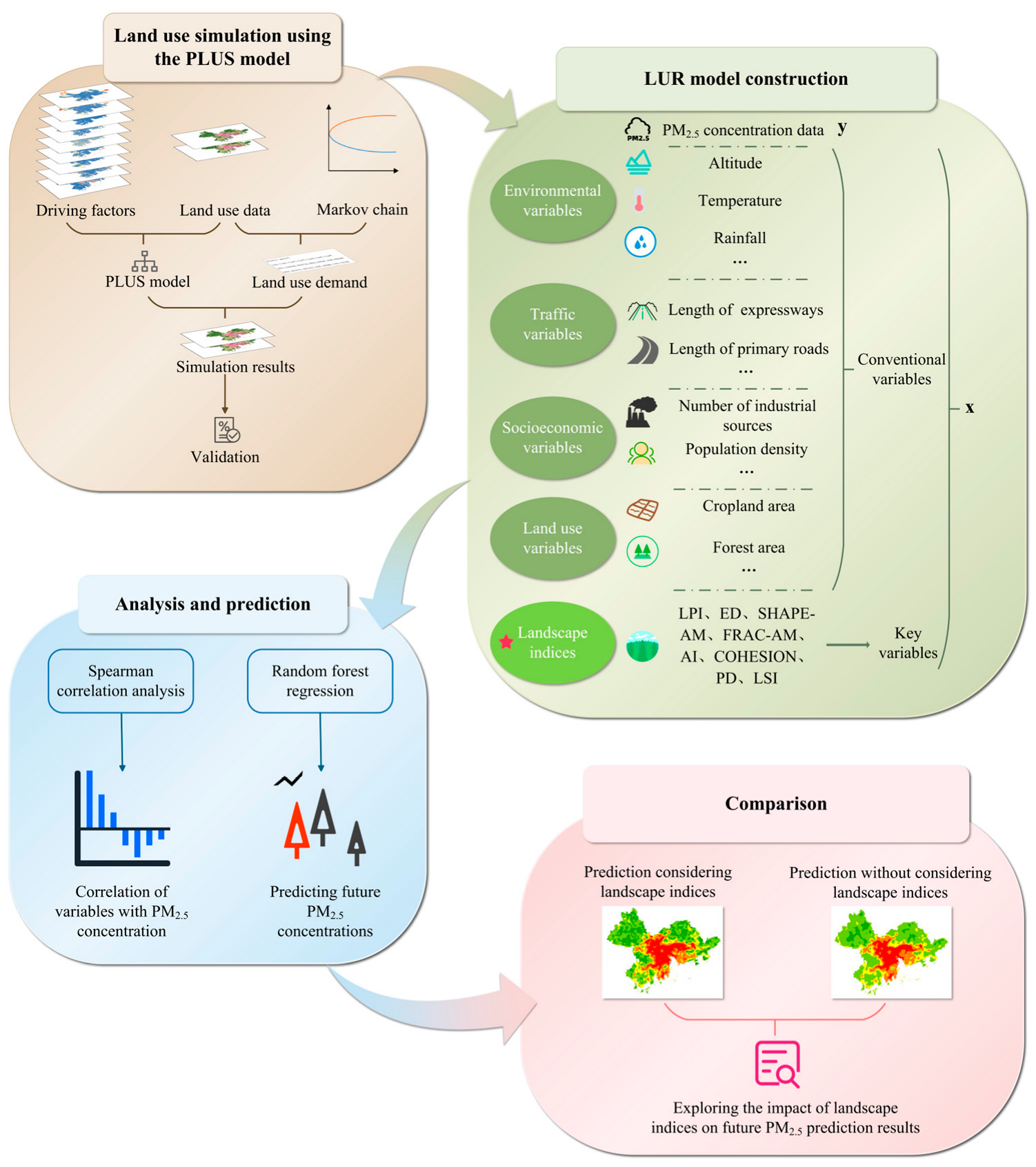
The proposed PLUS-LUR method intends to forecast the future spatial pattern of PM2.5 levels by integrating future land use conditions with historical PM2.5 data (Figure 1). First, a bivariate correlation analysis was conducted on historical PM2.5 data and potential influencing factors to identify variables with significant correlations. Subsequently, an LUR model was constructed using random forest, and its accuracy was evaluated. Second, the PLUS model was constructed using land use data and relevant influencing elements, and its accuracy was also evaluated. The Markov chain was then employed to estimate the area requirements for every land use category in the target year, enabling the forecasting of future land use and associated landscape indices. Third, the future land use projections from the PLUS method and grid-scale influencing factors were input into the validated LUR method to forecast PM2.5 levels at a grid scale for the target year. Finally, the PM2.5 levels predicted with and without considering landscape indices were compared.

2.1. Data

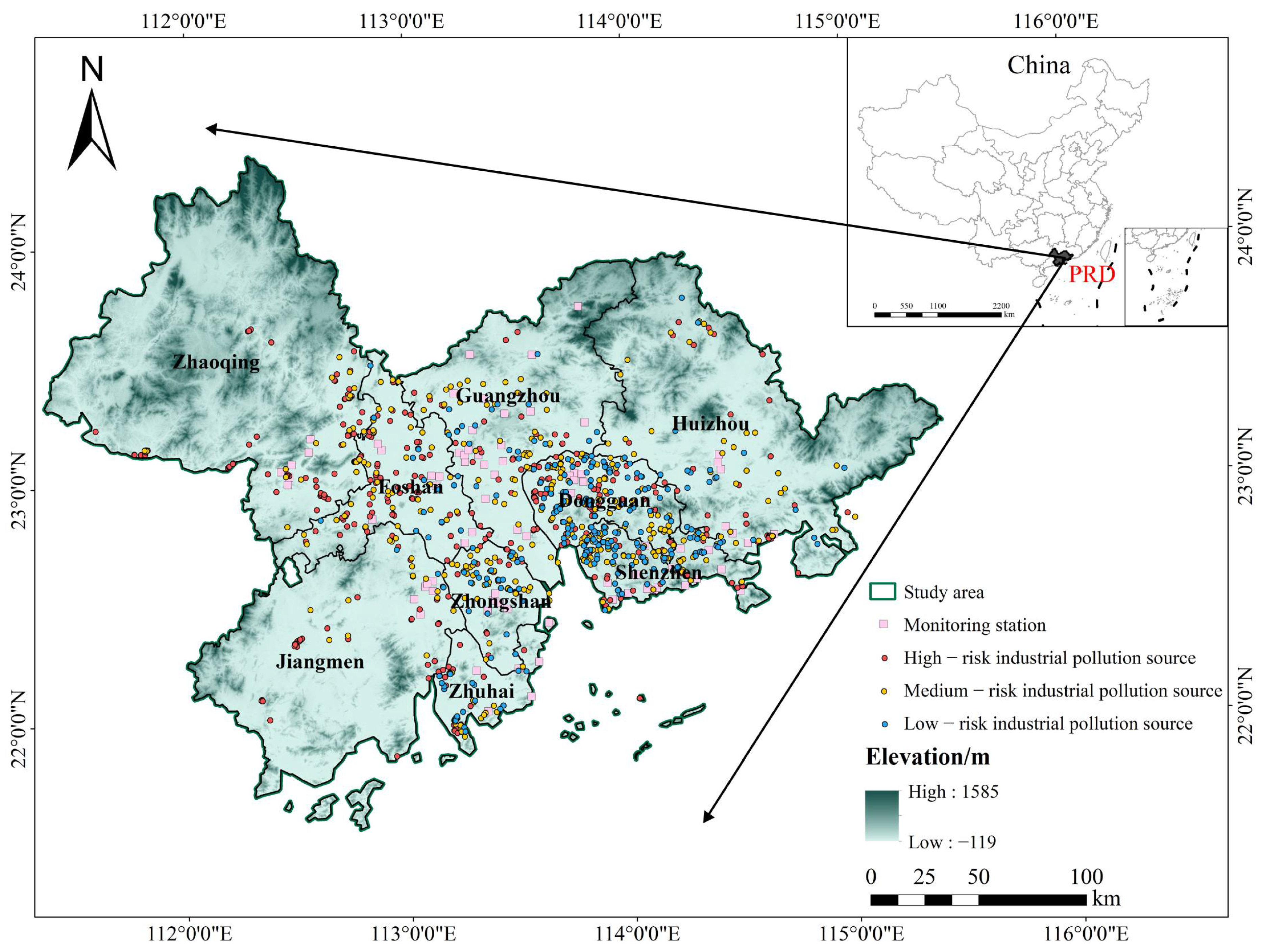
This study focused on the Pearl River Delta (PRD), a region that stands as a prominent example of economic development and high population density in Asia (Figure 2). This region covers approximately 55,000 square kilometers. This study specifically selected the PRD as the study area because industrial pollution here is not the dominant factor influencing PM2.5 concentrations, owing to stringent regional controls and industrial restructuring in recent years. This allows our study to more effectively highlight the role of land use changes and landscape patterns in shaping PM2.5 spatial heterogeneity.
In recent years, the PRD has witnessed air quality improvements [52]. From 2021 to 2024, the annual average PM2.5 concentrations in the PRD were recorded at 21.44, 19.48, 20.88, and 20.22 μg/m3, respectively, maintaining a consistently high attainment rate. To further optimize air quality in alignment with the Guangdong Provincial Air Pollution Prevention and Control Regulations, regional governance is shifting toward refined spatial management. Consequently, modeling PM2.5 spatial heterogeneity has become a priority for identifying localized hotspots and implementing the targeted pollution control measures mandated by the legislation. Consequently, the PRD is a pivotal region for examining the spatial characteristics of air pollution and developing predictive models.
An overview of the data utilized in this research is presented in Table 1. Hourly PM2.5 concentration data for the year 2022 were sourced through 80 national-level air monitoring stations across the PRD. The dependent variable referred to the annual mean PM2.5 (hereafter referred to as “PM2.5 concentrations”). All spatial datasets were reprojected to WGS 1984 UTM 49N coordinate. To characterize the heterogeneity of industrial activities, these sources were categorized into three levels based on industry attributes: high-risk (e.g., power plants and heavy industry), medium-risk (e.g., chemicals and manufacturing), and low-risk (e.g., electronics and food processing). The spatial distribution of these three categories is explicitly illustrated in Figure 2.

2.2. PM2.5 Concentration Prediction Based on LUR

2.2.1. LUR Model

The LUR model is a robust approach for characterizing the spatial distribution of air pollutant concentrations. Its modeling process relies on variables that exhibit significant correlations with pollutant concentrations, including land use, socioeconomic and physical conditions [56,57]. Specifically, the LUR method employs pollutant concentrations (dependent variables) and various variables (independent variables) to create multiple linear regression equations for predicting pollutant concentrations in regions without monitoring stations. The mathematical expression for this model is as follows:
Y i = β 0 + k = 1 p β k X i k + ε i
where Y i signifies the dependent variable, representing the pollutant concentration at the i-th monitoring station; X i k signifies the independent variable, corresponding to the score of the k-th spatial variable at the i-th station; β 0 signifies the regression intercept; β k corresponds to the regression coefficient for variable k; and ε i denotes error.
Finally, all samples were partitioned into training and test subsets with a 7:3 proportion to assess the LUR model’s effectiveness.

2.2.2. Random Forest

The random forest serves as a potent machine learning approach proposed by Leo Breiman [58]. The random forest method utilizes the principles of ensemble learning to combine the results of multiple decision trees. This approach effectively addresses both classification and regression tasks and is particularly suitable for nonlinear simulations and predictions. Compared to multiple linear regression models, the random forest method demonstrates higher accuracy and superior generalization capability. Through experimental tests and adjustments, we configured the random forest with a maximum depth of 5 and 40 iterations, using a random seed of 2 to ensure the consistency of the results.

2.2.3. Landscape Indices

The spatial configuration and structural composition of land use can be intuitively characterized through landscape indices. Changes in landscape patterns are closely associated with variations in air pollutant concentrations [59,60,61]. According to the findings of previous studies [50,51,62], eight widely utilized landscape indices were selected, encompassing morphological, connectivity, and fragmentation characteristics (Table S1 in the Supplementary Materials).

2.2.4. Selection of Input Variables for LUR

Grounded in prior research [33,63,64,65] and local conditions of the study area, potential variables were selected from five categories: natural environment, socioeconomics, land use, transportation, and landscape indices. Furthermore, buffer zones were established separately for these variables to investigate their correlations with PM2.5 concentrations, with buffer radii determined according to prior studies [5,50,66,67]. All data were from the year 2022. The specific variables and buffer radii are presented in Table 2. Spearman correlation analysis was then performed to determine variables showing notable associations with PM2.5 concentrations. For variables measured at multiple buffer radii, only the buffer radius exhibiting the strongest correlation with PM2.5 concentrations was retained. Finally, the random forest was used to construct LUR models with and without considering landscape indices. The selected variables were designated as explanatory variables, and PM2.5 concentration was designated as response variable.

2.3. Land Use Change Modeling

2.3.1. PLUS

The PLUS method is a geographic process modeling tool based on cellular automaton to capture patch-level land use dynamics [44]. It improves the accuracy of land use conversion simulations by integrating a land expansion evaluation and a multi-type random patch-seeding strategy. Compared to conventional prediction methods, the PLUS method has exhibited superior capability in accurately reproducing land use dynamics at the patch level. This advantage renders the PLUS method an appropriate tool for patch-scale land use research [68,69,70].
Considering a thorough review of prior research [69,71,72,73], the land use features of the PRD, and data availability, ten key factors influencing land use change were identified, covering natural environment, socioeconomic, and transportation aspects. Specifically, these driving factors include elevation, slope, distance from waterways, distance from town centers, population density, and distances from primary, secondary, and tertiary roads, highways, and railways.
Furthermore, the optimal parameters for the PLUS model were established through debugging and relevant studies [74,75]. The LEAS section was set up with 20 regression trees, mTry configured as 10, and sampling rate was set up with 0.5. The CARS section parameters were defined with a patch generation threshold of 0.8, a neighborhood size of 3, and an expansion factor of 0.1. All simulations were implemented using the PLUS software (Version 1.4).

2.3.2. Markov Chain

The Markov chain refers to an effective stochastic process model with a temporal sequence. This model has the capacity to forecast quantitative changes in land use, while providing the necessary data to support the operation of the PLUS model [76]. The calculation is as follows:
S t + 1 = P i j S t
where S t + 1 and S t represent land use conditions at times t + 1 and t correspondingly, while P i j signifies the chance of changing from condition i to j within a matrix of transition probabilities.
The land use area in the PRD for 2028 was forecasted using the Markov chain. The forecasting process required actual land use datasets for 2016 and 2022, together with the land use transition probability matrix during this period.

2.4. Future PM2.5 Prediction with the PLUS-LUR Approach

To balance computational efficiency and the accuracy of spatial analysis, a 3 km × 3 km grid was established across the study area [77]. Buffers were generated around the centroid of each grid to extract independent variables for the year 2028. Subsequently, the validated LUR method was employed to forecast future PM2.5 levels at a grid scale. To avoid large errors in the sparse regions of monitoring stations, Kriging interpolation was applied for further processing. Finally, PM2.5 concentration distributions across the PRD for 2028 were predicted, both with and without consideration of landscape indices.

3. Results

3.1. Modeling Results from LUR

To enhance the precision and robustness of the predictive model, only variables showing statistical significance (p < 0.01) in the Spearman correlation analysis were selected for subsequent modeling. The magnitude of r lies between −1 and +1, with lower absolute values implying weaker correlation. The final selection comprised 11 highly relevant variables, as summarized in Table 3.
Notably, Spearman’s correlation analysis revealed that industrial pollution sources did not meet the stringent significance threshold required for inclusion in the LUR model, exhibiting weak and directionally inconsistent coefficients. This suggests that industrial pollution sources may not be a dominant influencing factor, consistent with the PRD’s stringent and persistent efforts in industrial pollution mitigation, which have diminished the role of these sources as a primary driver of spatial variability. Consequently, this variable was excluded from future projections to minimize statistical noise and more accurately isolate the independent impacts of urban expansion and landscape configuration.
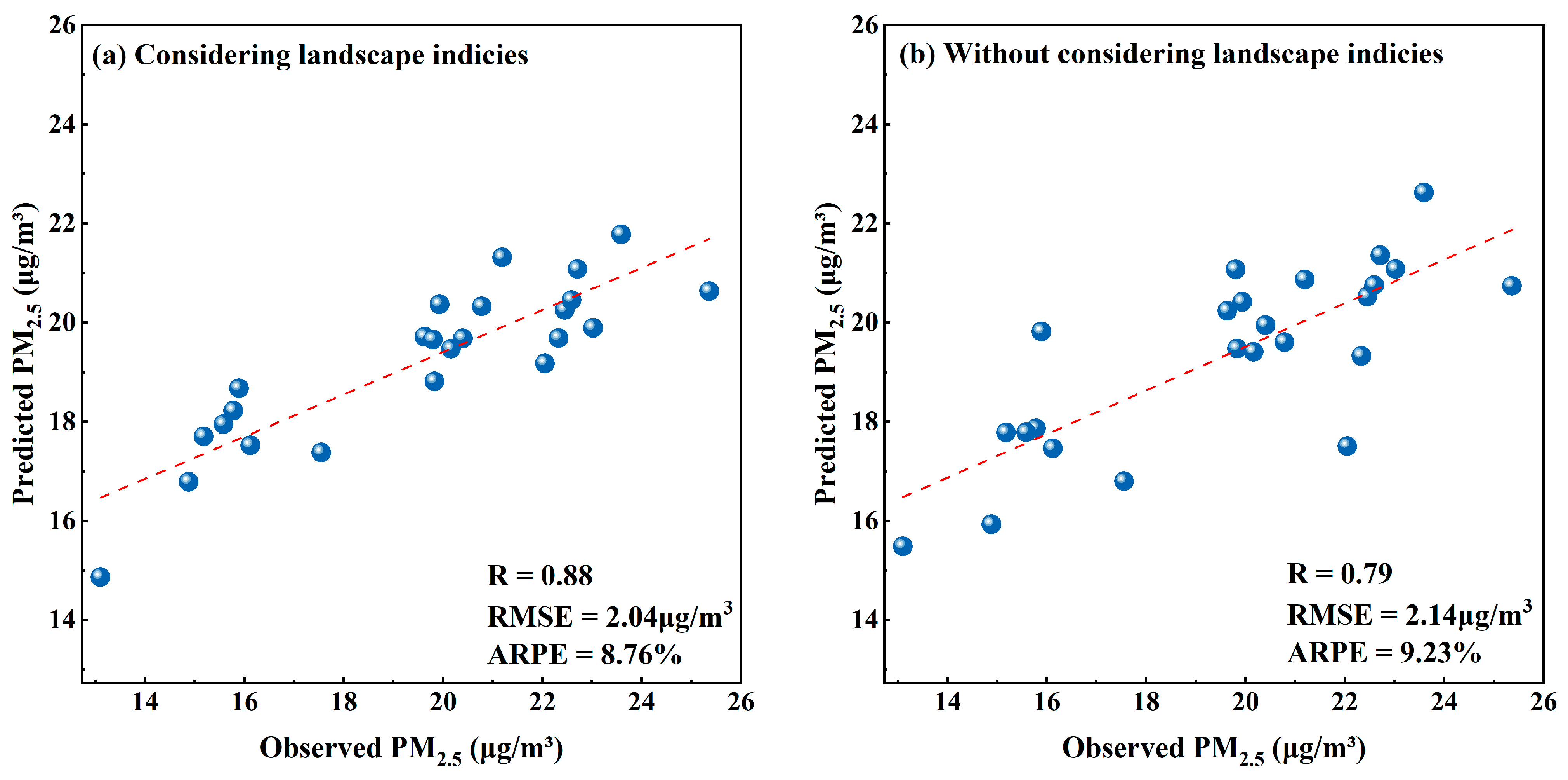
After constructing the LUR model using training samples, its accuracy was validated through test samples. Figure 3 presents the validation results with and without considering landscape indices. The absolute relative percentage error (ARPE) and root mean squared error (RMSE) of the LUR method considering landscape indices were 8.76% and 2.04 μg/m3, respectively. These values were 0.10 μg/m3 and 0.47% lower than those of the model without landscape indices. Furthermore, the correlation coefficient (R) increased to 0.88 for the model with landscape indices, compared to only 0.79 for the conventional model. These findings indicate that the LUR model considering landscape indices yields more reliable estimations.

3.2. Land Use Simulation and Forecasting with the PLUS Method

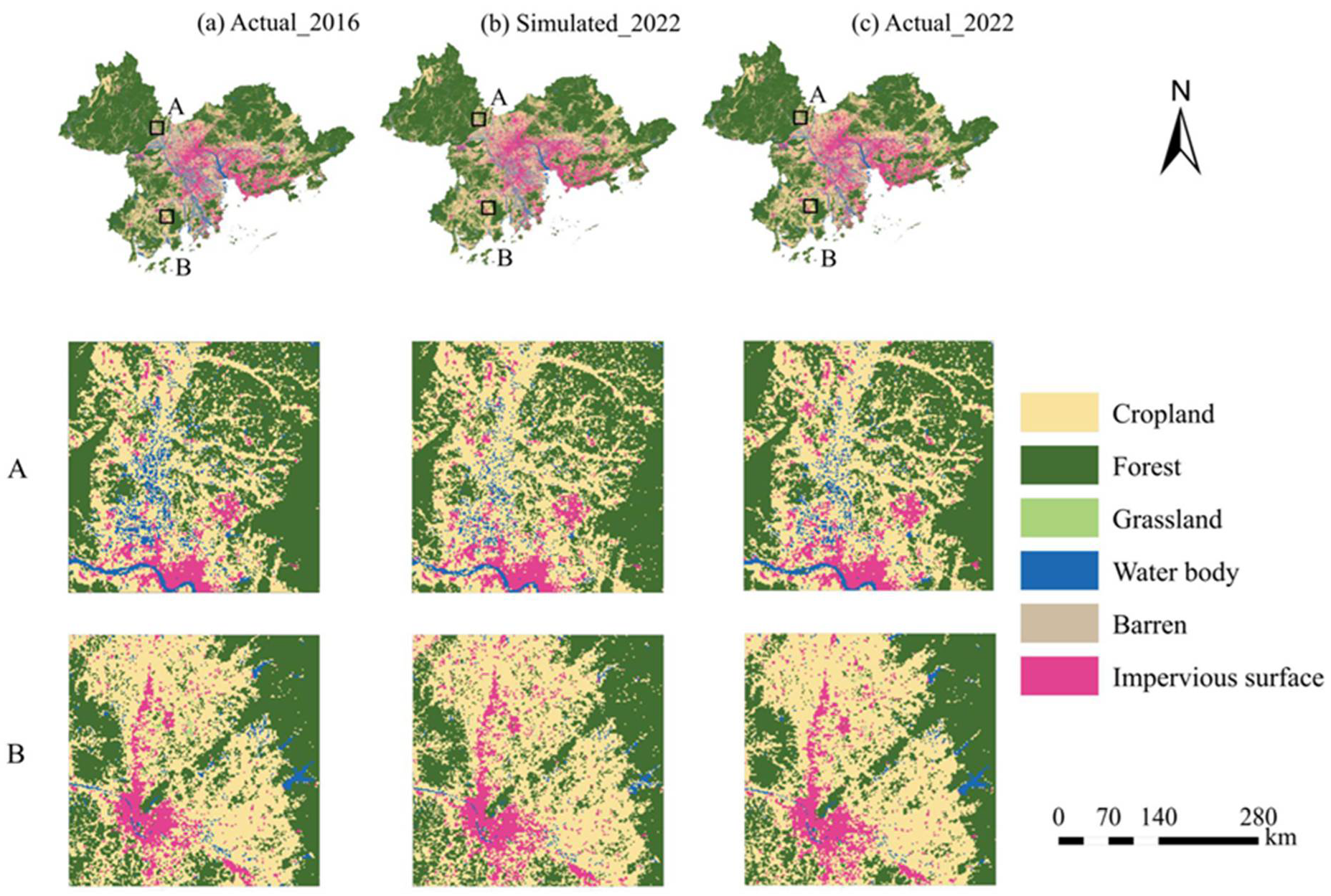
First, a simulation was conducted to forecast land use for 2022. This process was informed by the relevant land use data and associated driving factors in 2016 (Figure 4 and Table 4). Subsequently, a comparative analysis was conducted to contrast the simulation outcomes with the observed land use for 2022. The comparison demonstrates that the PLUS method yielded 0.929 for overall accuracy, 0.882 for the Kappa coefficient, and 0.192 for the FoM, indicating its strong ability to simulate land use. Therefore, this model was employed to forecast future land use in 2028.
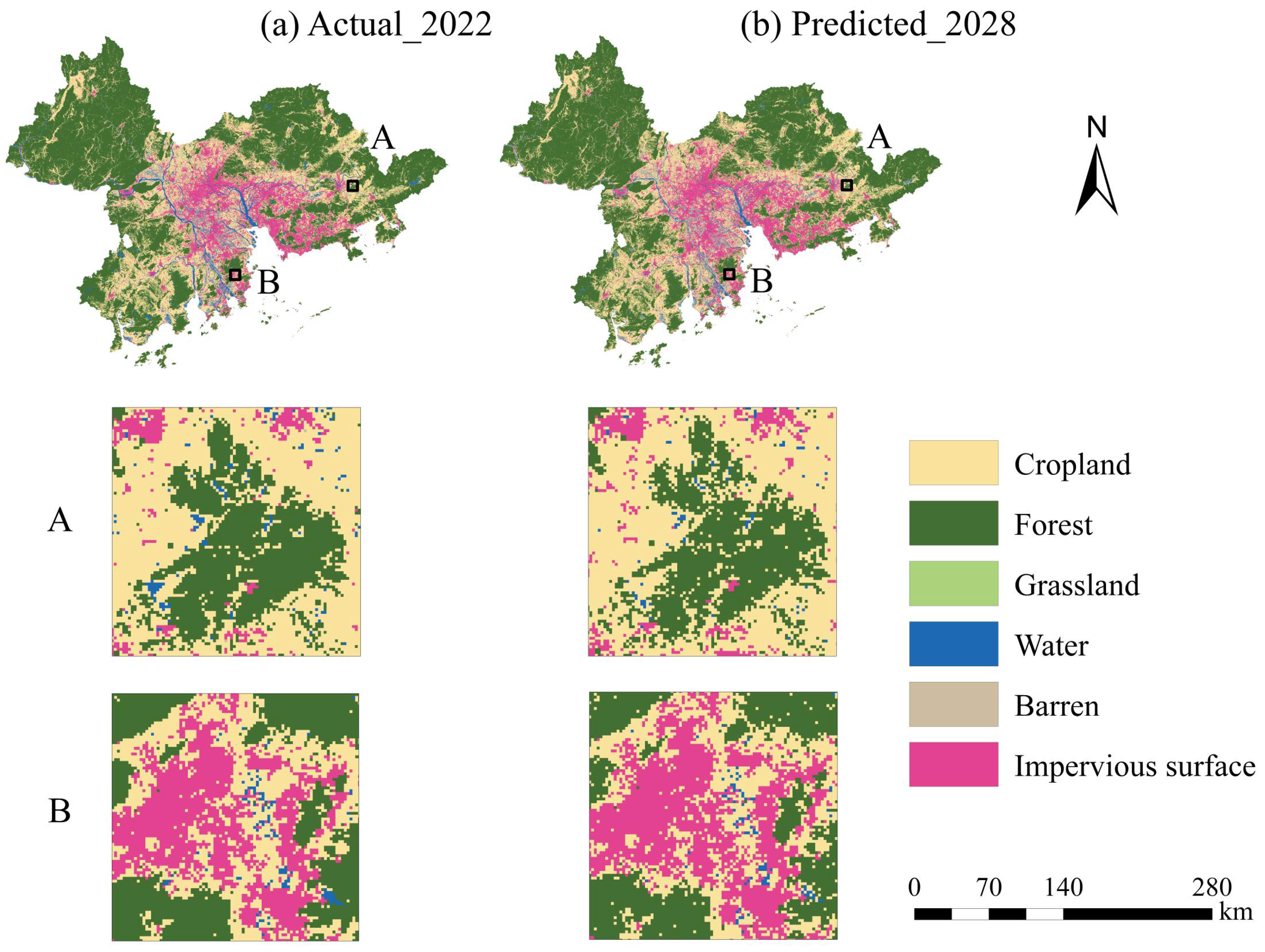
As illustrated in Figure 5 and Table 4, the projections for 2028 suggest that land use will remain predominantly composed of croplands, forests, water bodies, and impervious surfaces, which collectively cover more than 99% of the area. Croplands and impervious surfaces are projected to increase, whilst forests, grasslands, and water bodies are anticipated to decline. With respect to spatial pattern, forests will be clustered mainly in the PRD’s northeast and northwest. Moreover, croplands will be primarily distributed throughout the central part, and impervious surfaces will be concentrated around the Pearl River Estuary.

3.3. Predictions of Future PM2.5 Levels

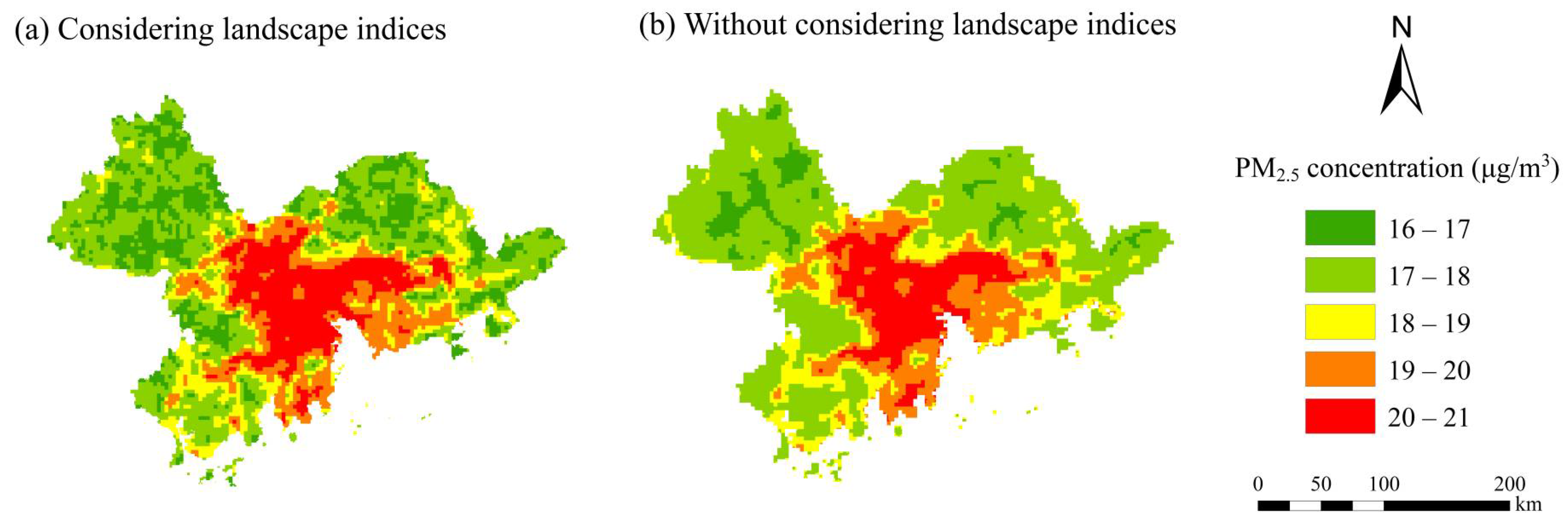
Figure 6 illustrates the predicted spatial pattern of PM2.5 levels in 2028, with and without the consideration of landscape indices. Both predictions indicate a clear pattern: higher levels in the central part and lower levels in the periphery. In accordance with the China Ambient Air Quality Benchmark, PM2.5 levels in the PRD are projected to fall below the Grade II threshold of 35 μg/m3 by 2028. Among them, the central region is characterized by clusters of high PM2.5 concentrations and contiguous spatial distribution. The high-concentration zone (19–21 µg/m3) exhibits a high degree of spatial concurrence with impervious surfaces, while the low-concentration area (16–18 µg/m3) aligns with forests. Furthermore, the medium-concentration area (18–19 µg/m3) is primarily present in regions where croplands are interspersed with grasslands.
This spatial distribution pattern is primarily attributed to variations in land use and the intensity of human activities. The central area of the PRD is dominated by intensive built-up land, where highly concentrated transportation, industrial, and commercial activities have elevated the area’s PM2.5 levels [78]. Furthermore, the presence of substantial impervious surfaces exacerbates the accumulation of pollutants by intensifying localized heat accumulation and reducing near-surface ventilation, which results in the generation of continuous high-concentration areas. In comparison, the outlying areas are characterized by extensive forests and grasslands, with minimal human activity and low pollutant emission levels. Forest vegetation efficiently removes particulate matter through interception and adsorption processes, thereby forming the primary low-concentration areas [79,80]. Furthermore, the agro-grassland ecotone situated between the two extremes exhibits medium concentrations and transitional characteristics, due to its moderate ventilation and anthropogenic disturbance.
Relative to the prediction excluding landscape indices (Figure 6b), the incorporation of landscape indices (Figure 6a) yields a more refined and heterogeneous spatial distribution of PM2.5 concentrations. In high-concentration areas, Figure 6a exhibits slight spatial expansion and increased internal heterogeneity, characterized by the emergence of multiple smaller high-concentration patches, particularly in central urban areas such as Guangzhou, Foshan, Dongguan, and Shenzhen. Conversely, Figure 6b depicts smoother and more continuous high-concentration zones with simplified geometric configurations and reduced internal stratification. In low-concentration areas, Figure 6a reveals greater fragmentation, especially in peripheral regions such as Huizhou, Zhaoqing, and Jiangmen where forests, croplands, and grasslands are interspersed, whereas Figure 6b shows more uniform and contiguous low-concentration zones. In summary, the inclusion of landscape indices captures finer-scale variations that better reflect the influence of land use configuration on pollutant dispersion and accumulation.

4. Discussion

4.1. Comparison with Prior Research

Prior predictive research has primarily focused on meteorological factors [81,82], while paying less attention to how future land use affects PM2.5 concentrations. In particular, the effect of future landscape patterns on PM2.5 predictions has received even less attention. Consequently, the methodology for forecasting the future spatial pattern of air contaminants still requires improvement. Although a number of studies have investigated the influence of land use and landscape patterns on air pollutants [50,62], the incorporation of these factors into predictive models remains underexplored. To bridge this gap, we developed an innovative prediction model that considers the influence of landscape patterns. Our findings indicate that considering landscape patterns can substantially improve the performance of PM2.5 prediction outcomes in comparison with common approaches.
Spearman correlation analysis revealed that the majority of landscape indices exhibited stronger correlation with PM2.5 concentrations than common influencing factors. The correlation results obtained in this study align closely with those of previous studies, which also exhibited a scale effect [50,83,84]. Regarding water landscapes, Water body_LPI_2500 m and Water body_COHESION_2500 m were negatively correlated with PM2.5 concentrations at the 2500 m scale. This finding suggests that large and well-connected water bodies can significantly enhance local ventilation efficiency, thereby suppressing particulate matter accumulation at smaller scales. With regard to forest landscapes, Forest_LPI_5000 m, Forest_ED_5000 m, and Forest_COHESION_5000 m all demonstrate a substantial negative correlation with PM2.5 concentrations at the 5000 m scale. The effectiveness of forests in purifying the air depends on the formation of a complete, morphologically complex, and highly connected landscape pattern at a large spatial scale. Regarding impervious surface landscapes, Impervious surface_LSI_4500 m demonstrates a positive correlation with PM2.5 levels at the 4500 m scale. This suggests that the fragmentation of impervious surfaces is associated with diminished efficacy in dispersing pollutants and diluting them, thereby leading to an exacerbation of local pollution levels. The influence of landscape indices on PM2.5 levels varies by category and scale, highlighting the necessity of considering landscape patterns when forecasting PM2.5 concentrations.
In the prediction outcomes that consider landscape indices, the spatial distribution of PM2.5 exhibits more refined structural features. The extent of high-concentration areas will expand slightly, accompanied by a substantial increase in internal heterogeneity. This leads to the formation of a complex structure consisting of multiple small high-concentration patches, while the edge areas exhibit more pronounced fragmentation characteristics. These results indicate that considering landscape indices enables the model to more sensitively capture subtle differences among various land use types within urban areas, thereby leading to a more precise alignment between the spatial contours of high-concentration areas and the actual distribution patterns of PM2.5. Low-concentration areas also exhibit a more fragmented and finer distribution pattern, particularly in regions where forests, farmlands, and grasslands intersect. The distribution of low-concentration patches becomes more diverse, reflecting the role of land use patterns in improving local ventilation conditions and facilitating pollutant dilution.
In comparison, the prediction results that did not consider landscape indices exhibited a smoother overall structure. The boundaries of both high- and low-concentration areas will become more continuous, with a noticeable reduction in fine-scale local variations. High-concentration areas exhibit simpler shapes, smoother edge transitions, and less internal concentration stratification when compared with the results considering landscape indices. This phenomenon leads to a more uniform pollution pattern in urban cores. The contiguity of low-concentration areas is stronger, with fewer patches, and local variations diminish to a certain extent. These findings suggest that the model is unable to effectively identify the moderating effect of surface landscape variations on the spatial pattern of PM2.5 when landscape indices are excluded, resulting in an inadequate characterization of local-scale details. While there are no apparent inconsistencies in the aggregate predictions, the model’s depiction of spatial structural variations in PM2.5 is less detailed than the results considering landscape indices.
All of the above analyses demonstrate that the developed model can effectively capture the influence of landscape configurations on PM2.5 concentrations, thereby enhancing the reasonability of prediction. The incorporation of landscape patterns into the prediction of PM2.5 concentrations offers a novel idea to enhance the traditional method. This approach is expected to establish a more reliable foundation for land use planning and PM2.5 pollution control.

4.2. Policy Recommendations

The future development of most developing countries is still challenged by the contradiction between the rapid urban sprawl and PM2.5 pollution management. Owing to the predicted spatial pattern of PM2.5 levels under the influence of land use patterns, the following recommendations are offered for policymakers.
First, land use patterns should be rationally designed, and landscape indices should be adopted as key indicators in the planning process. A rational land use pattern not only promotes the diffusion and deposition of particulate matter by optimizing surface ventilation and underlying characteristics, but also improves air quality through ecological processes, such as vegetation adsorption and dry deposition [85]. Consequently, this research emphasizes the consideration of key landscape indices as essential evaluation metrics for PM2.5 pollution control in future spatial planning and air quality management. Based on our findings, land use patterns can be optimized in two ways to enhance PM2.5 mitigation, which include strengthening the integrity and connectivity of ecological spaces and strategically controlling the excessive expansion and fragmentation of impervious surfaces. To translate these principles into actionable strategies, differentiated measures are proposed for three urban functional zones.
In high-density built-up areas, the priority is to address the high aggregation of construction land. These areas are dominated by highly aggregated impervious surfaces, which create pollution hotspots and impede ventilation, leading to complex exposure dynamics [86]. Measures include the implementation of permeable pavements, rooftop greening, and strategically embedding or connecting small green spaces and blue spaces (water bodies) such as pocket parks. Such actions can effectively disrupt the continuous impervious matrix, create local ventilation pathways and deposition nodes, thereby alleviating localized PM2.5 accumulation.
For industrial zones and major transportation corridors, which serve as major sources of PM2.5 emissions, the priority is to establish efficient protective barriers to intercept pollutants before dispersion. General greenery alone is insufficient to address high-intensity pollution. Building on field evidence, compound-structured greenbelts (integrating trees, shrubs, and grass) achieve higher removal efficiency for traffic-related particles compared to single-layer vegetation [87]. Therefore, such multi-layered shelter forests should be between pollution sources and adjacent residential areas to systematically capture and retain pollutants, thereby reducing downwind exposure and protecting public health.
In urban-rural transitional zones and ecological control areas, the primary objective is to enhance the integrity and connectivity of natural landscapes to bolster their integrated purification and ventilation services, which is vital for mitigating the higher PM2.5 exposure levels often observed in non-hotspot peripheral areas [86]. The strategy requires two coordinated actions. First, it is imperative to rigorously conserve large patches of forest, wetland, and water-bodies and connect water bodies and forest patches along the prevailing wind direction. This can help establish efficient ventilation corridors and dust-mitigating green cores [88]. Concurrently, agricultural areas should prioritize intensive and ecological land use practices. The construction of farmland shelterbelts must be strengthened to reduce dust emissions and bare soil exposure, thereby preventing secondary pollution caused by human activities.
Second, the PM2.5 monitoring network requires further improvement. Despite the establishment of a ground-based monitoring network in China, challenges such as limited coverage and weak early warning capability for PM2.5 pollution still persist [89,90]. To acquire more thorough basic data on PM2.5 and better forecast the prospective status of PM2.5 pollution, local authorities should consider the establishment of additional air monitoring stations, especially in key regions such as urban centers and major transportation routes. Furthermore, an integrated PM2.5–land use synergistic management platform can be established to monitor the dynamic influence of landscape pattern changes on PM2.5 levels in real time. These platforms would provide policymakers with a scientific foundation for early warnings and regulations.

4.3. Pros and Cons

In this research, we innovatively integrated the PLUS and LUR methods to forecast the future spatial pattern of PM2.5 levels and considered the effects of landscape patterns. Specifically, the PLUS approach was utilized for predicting future land use and related landscape patterns [44]. Moreover, the LUR method elucidated the nonlinear relationship between PM2.5 concentrations and a variety of influencing elements, such as land use [32]. Based on these two models, the spatial distribution of future PM2.5 levels was predicted by integrating time-series analyses with spatial modeling and using landscape indices as key factors. The incorporation of landscape indices into PM2.5 concentration predictions improves the rationality of prediction results.
However, several limitations must be considered when implementing this approach. First, this study did not account for PM2.5 chemical processes and related policies, which could result in deviations between predicted and actual values. In the future, the atmospheric chemical transport model for PM2.5 and local policies could be further integrated with the PLUS-LUR model to enable more accurate predictions of PM2.5 concentrations. In addition, owing to data constraints, the PLUS-LUR model was operated on a long-term timescale and at a medium spatial resolution. This limits its ability to capture intra-city variations. Future studies can concentrate on optimizing the simulation capabilities of the PLUS-LUR model at higher spatiotemporal resolutions to more accurately predict the PM2.5 concentration distributions. Finally, while this study concentrates on the Pearl River Delta, the influence of landscape configurations on air quality may vary across distinct geographical and climatic contexts. Consequently, future research should extend the application of the PLUS-LUR framework to other representative urban agglomerations, such as the Beijing–Tianjin–Hebei (BTH) and Yangtze River Delta (YRD) regions. Undertaking such comparative analyses will facilitate the identification of regional heterogeneities in landscape–PM2.5 dynamics and further validate the robustness and generalizability of the proposed model.

5. Conclusions

This research proposed a novel PLUS-LUR model considering land use landscape patterns to forecast the spatial pattern of PM2.5 levels. The rationality of our methodology and the key role of landscape indices in prediction were demonstrated by a case study in the PRD. Model validation outcomes showed that the R of the test set reached 0.88, the RMSE was controlled at 2.04 μg/m3, and the ARPE was only 8.76%. All these metrics were markedly superior to the traditional approach, which did not consider landscape indices. In conclusion, the proposed method effectively accounts for the effect of future land use and landscape patterns on PM2.5 concentrations, which could enhance the reliability of the prediction results. Our results provide new insights into future PM2.5 spatial distribution assessments and support land use planning and landscape-based air quality management through predictive modeling.

Supplementary Materials

The following supporting information can be downloaded at https://www.mdpi.com/article/10.3390/land15020240/s1.

Author Contributions

Conceptualization, J.L.; methodology, X.Z.; validation, X.Z.; formal analysis, X.Z., P.C. and Y.C.; resources, J.L.; data curation, X.Z., P.C. and Y.C.; writing—original draft preparation, X.Z.; writing—review and editing, J.L.; visualization, X.Z. and P.C.; supervision, J.L.; project administration, J.L.; funding acquisition, J.L. All authors have read and agreed to the published version of the manuscript.

Funding

This research was funded by Humanities and Social Science Fund of the Ministry of Education of China (Grant No. 23YJCZH125) and National Natural Science Foundation of China (Grant No. 42371406).

Data Availability Statement

The data presented in this study are available on request from the corresponding author.

Conflicts of Interest

The authors declare no conflicts of interest.

References

  1. Murray, C.J.L.; Aravkin, A.Y.; Zheng, P.; Abbafati, C.; Abbas, K.M.; Abbasi-Kangevari, M.; Abd-Allah, F.; Abdelalim, A.; Abdollahi, M.; Abdollahpour, I.; et al. Global Burden of 87 Risk Factors in 204 Countries and Territories, 1990–2019: A Systematic Analysis for the Global Burden of Disease Study 2019. Lancet 2020, 396, 1223–1249. [Google Scholar] [CrossRef]
  2. Yang, Z.; Li, Z.; Cheng, F.; Lv, Q.; Li, K.; Zhang, T.; Zhou, Y.; Zhao, B.; Xue, W.; Wei, J. Two-Decade Surface Ozone (O3) Pollution in China: Enhanced Fine-Scale Estimations and Environmental Health Implications. Remote Sens. Environ. 2025, 317, 114459. [Google Scholar] [CrossRef]
  3. Zhao, X.; Zhou, W.; Hong, M.; Neophytou, A.M. Urbanization Exacerbates Disparities in Exposure to Air Pollution in China. Environ. Res. 2025, 267, 120661. [Google Scholar] [CrossRef]
  4. Shi, T.; Hu, Y.; Liu, M.; Li, C.; Zhang, C.; Liu, C. Land Use Regression Modelling of PM2.5 Spatial Variations in Different Seasons in Urban Areas. Sci. Total Environ. 2020, 743, 140744. [Google Scholar] [CrossRef] [PubMed]
  5. Shi, Y.; Bilal, M.; Ho, H.C.; Omar, A. Urbanization and Regional Air Pollution across South Asian Developing Countries—A Nationwide Land Use Regression for Ambient PM2.5 Assessment in Pakistan. Environ. Pollut. 2020, 266, 115145. [Google Scholar] [CrossRef]
  6. Wei, Q.; Chen, Y.; Zhang, H.; Jia, Z.; Yang, J.; Niu, B. Simulation and Prediction of PM2.5 Concentrations and Analysis of Driving Factors Using Interpretable Tree-Based Models in Shanghai, China. Environ. Res. 2025, 270, 121003. [Google Scholar] [CrossRef] [PubMed]
  7. Li, C.; Van Donkelaar, A.; Hammer, M.S.; McDuffie, E.E.; Burnett, R.T.; Spadaro, J.V.; Chatterjee, D.; Cohen, A.J.; Apte, J.S.; Southerland, V.A.; et al. Reversal of Trends in Global Fine Particulate Matter Air Pollution. Nat. Commun. 2023, 14, 5349. [Google Scholar] [CrossRef]
  8. Cao, J.; Pan, G.; Zheng, B.; Liu, Y.; Zhang, G.; Liu, Y. Significant Land Cover Change in China during 2001–2019: Implications for Direct and Indirect Effects on Surface Ozone Concentration. Environ. Pollut. 2023, 335, 122290. [Google Scholar] [CrossRef] [PubMed]
  9. Qiu, J.; Fang, C.; Tian, N.; Wang, H.; Wang, J. Impacts of Land Use and Land Cover Changes on Local Meteorology and PM2.5 Concentrations in Changchun, Northeast China. Atmos. Res. 2023, 289, 106759. [Google Scholar] [CrossRef]
  10. Tian, J.; Wang, J.; Wang, D.; Fang, C. Influence of Urbanization on Meteorological Conditions and Ozone Pollution in the Central Plains Urban Agglomeration, China. Environ. Pollut. 2024, 356, 124290. [Google Scholar] [CrossRef]
  11. Zhan, C.; Xie, M.; Lu, H.; Liu, B.; Wu, Z.; Wang, T.; Zhuang, B.; Li, M.; Li, S. Impacts of Urbanization on Air Quality and the Related Health Risks in a City with Complex Terrain. Atmos. Chem. Phys. 2023, 23, 771–788. [Google Scholar] [CrossRef]
  12. Anav, A.; Sorrentino, B.; Collalti, A.; Paoletti, E.; Sicard, P.; Coulibaly, F.; Manzini, J.; Hoshika, Y.; De Marco, A. Meteorological, Chemical and Biological Evaluation of the Coupled Chemistry-Climate WRF-Chem Model from Regional to Urban Scale. An Impact-Oriented Application for Human Health. Environ. Res. 2024, 257, 119401. [Google Scholar] [CrossRef]
  13. Dou, X.; Yu, S.; Li, J.; Sun, Y.; Song, Z.; Yao, N.; Li, P. The WRF-CMAQ Simulation of a Complex Pollution Episode with High-Level O3 and PM2.5 over the North China Plain: Pollution Characteristics and Causes. Atmosphere 2024, 15, 198. [Google Scholar] [CrossRef]
  14. Liu, W.; Xue, Y.; Ling, X.; He, B.; Li, C.; Han, L. Simulation and Analysis of CO2 Concentration in China from 2009 to 2021 Based on the WRF-Chem Model. Atmos. Res. 2026, 333, 108732. [Google Scholar] [CrossRef]
  15. Chen, G.; Liu, Y.; Wang, H.; Wang, M.; Chen, L.; Hu, H.; Zhang, S.; Ai, B.; Cai, M.; Zhang, Z.; et al. Lifetime Exposure to Health-Related Air Pollutants in the United Kingdom: A Spatiotemporal Evaluation (1930–2010) through WRF-CMAQ Modeling. Atmos. Environ. 2025, 346, 121093. [Google Scholar] [CrossRef]
  16. Lee, Y.; Park, J.; Kim, J.; Woo, J.-H.; Lee, J.-H. Conditional UNet Emulation of CMAQ Simulations for Fine Particulate Matter Concentration Prediction. Sci. Rep. 2025, 15, 38616. [Google Scholar] [CrossRef]
  17. Gao, Z.; Zhou, X. A Review of the CAMx, CMAQ, WRF-Chem and NAQPMS Models: Application, Evaluation and Uncertainty Factors. Environ. Pollut. 2024, 343, 123183. [Google Scholar] [CrossRef]
  18. Shin, K.-H.; Hong, S.-C.; Lee, J.-B.; Lee, Y.; Eun, S.-H.; Choi, D.-R.; Sung, J.-W. Evaluation of PM2.5 Prediction Performance of CMAQ and AI Models (LSTM and Transformer) in an Operational Air Quality Forecasting System. J. Ind. Eng. Chem. 2025, in press. [Google Scholar] [CrossRef]
  19. Liu, H.; Yan, G.; Duan, Z.; Chen, C. Intelligent Modeling Strategies for Forecasting Air Quality Time Series: A Review. Appl. Soft Comput. 2021, 102, 106957. [Google Scholar] [CrossRef]
  20. Chen, J.-C.; Wu, Y.J. Discrete-Time Markov Chain for Prediction of Air Quality Index. J. Ambient Intell. Hum. Comput. 2020. [Google Scholar] [CrossRef]
  21. Latif, S.D.; Lai, V.; Hahzaman, F.H.; Ahmed, A.N.; Huang, Y.F.; Birima, A.H.; El-Shafie, A. Ozone Concentration Forecasting Utilizing Leveraging of Regression Machine Learnings: A Case Study at Klang Valley, Malaysia. Results Eng. 2024, 21, 101872. [Google Scholar] [CrossRef]
  22. Aburas, M.M.; Ho, Y.M.; Ramli, M.F.; Ash’aari, Z.H. Improving the Capability of an Integrated CA-Markov Model to Simulate Spatio-Temporal Urban Growth Trends Using an Analytical Hierarchy Process and Frequency Ratio. Int. J. Appl. Earth Obs. Geoinf. 2017, 59, 65–78. [Google Scholar] [CrossRef]
  23. Gharaibeh, A.; Shaamala, A.; Obeidat, R.; Al-Kofahi, S. Improving Land-Use Change Modeling by Integrating ANN with Cellular Automata-Markov Chain Model. Heliyon 2020, 6, e05092. [Google Scholar] [CrossRef] [PubMed]
  24. Halmy, M.W.A.; Gessler, P.E.; Hicke, J.A.; Salem, B.B. Land Use/Land Cover Change Detection and Prediction in the North-Western Coastal Desert of Egypt Using Markov-CA. Appl. Geogr. 2015, 63, 101–112. [Google Scholar] [CrossRef]
  25. Yue, W.; Qin, C.; Su, M.; Teng, Y.; Xu, C. Simulation and Prediction of Land Use Change in Dongguan of China Based on ANN Cellular Automata-Markov Chain Model. Environ. Sustain. Indic. 2024, 22, 100355. [Google Scholar] [CrossRef]
  26. Ding, J.; Ren, C.; Wang, J.; Feng, Z.; Cao, S.-J. Spatial and Temporal Urban Air Pollution Patterns Based on Limited Data of Monitoring Stations. J. Clean. Prod. 2024, 434, 140359. [Google Scholar] [CrossRef]
  27. Xu, S.; Zou, B.; Shafi, S.; Sternberg, T. A Hybrid Grey-Markov/ LUR Model for PM10 Concentration Prediction under Future Urban Scenarios. Atmos. Environ. 2018, 187, 401–409. [Google Scholar] [CrossRef]
  28. Shen, Y.; De Hoogh, K.; Schmitz, O.; Clinton, N.; Tuxen-Bettman, K.; Brandt, J.; Christensen, J.H.; Frohn, L.M.; Geels, C.; Karssenberg, D.; et al. Europe-Wide Air Pollution Modeling from 2000 to 2019 Using Geographically Weighted Regression. Environ. Int. 2022, 168, 107485. [Google Scholar] [CrossRef]
  29. Van Zoest, V.; Osei, F.B.; Hoek, G.; Stein, A. Spatio-Temporal Regression Kriging for Modelling Urban NO2 Concentrations. Int. J. Geogr. Inf. Sci. 2020, 34, 851–865. [Google Scholar] [CrossRef]
  30. Wang, B.; Ji, Y.; Yang, X.; Shi, J.; Xu, W.; Ma, J.; Shen, R.; Wang, B.; Zhang, J.; Feng, Y. Population Exposure Evaluation and Value Loss Analysis of PM2.5 and Ozone in China. J. Environ. Manag. 2025, 376, 124480. [Google Scholar] [CrossRef] [PubMed]
  31. Wang, L.; Qin, K.; Zhao, B. Spatiotemporal Variations in the Association between PM2.5 and Ozone in the Yangtze River Economic Belt: Impacts of Meteorological and Emissions Factors. Atmos. Environ. 2024, 329, 120534. [Google Scholar] [CrossRef]
  32. Ma, X.; Zou, B.; Deng, J.; Gao, J.; Longley, I.; Xiao, S.; Guo, B.; Wu, Y.; Xu, T.; Xu, X.; et al. A Comprehensive Review of the Development of Land Use Regression Approaches for Modeling Spatiotemporal Variations of Ambient Air Pollution: A Perspective from 2011 to 2023. Environ. Int. 2024, 183, 108430. [Google Scholar] [CrossRef]
  33. Mo, Y.; Booker, D.; Zhao, S.; Tang, J.; Jiang, H.; Shen, J.; Chen, D.; Li, J.; Jones, K.C.; Zhang, G. The Application of Land Use Regression Model to Investigate Spatiotemporal Variations of PM2.5 in Guangzhou, China: Implications for the Public Health Benefits of PM2.5 Reduction. Sci. Total Environ. 2021, 778, 146305. [Google Scholar] [CrossRef]
  34. Kerckhoffs, J.; Hoek, G.; Portengen, L.; Brunekreef, B.; Vermeulen, R.C.H. Performance of Prediction Algorithms for Modeling Outdoor Air Pollution Spatial Surfaces. Environ. Sci. Technol. 2019, 53, 1413–1421. [Google Scholar] [CrossRef]
  35. Lim, C.C.; Kim, H.; Vilcassim, M.J.R.; Thurston, G.D.; Gordon, T.; Chen, L.-C.; Lee, K.; Heimbinder, M.; Kim, S.-Y. Mapping Urban Air Quality Using Mobile Sampling with Low-Cost Sensors and Machine Learning in Seoul, South Korea. Environ. Int. 2019, 131, 105022. [Google Scholar] [CrossRef]
  36. Wong, P.-Y.; Lee, H.-Y.; Chen, Y.-C.; Zeng, Y.-T.; Chern, Y.-R.; Chen, N.-T.; Candice Lung, S.-C.; Su, H.-J.; Wu, C.-D. Using a Land Use Regression Model with Machine Learning to Estimate Ground Level PM2.5. Environ. Pollut. 2021, 277, 116846. [Google Scholar] [CrossRef]
  37. Alzu’bi, F.; Al-Rawabdeh, A.; Almagbile, A. Predicting Air Quality Using Random Forest: A Case Study in Amman-Zarqa. Egypt. J. Remote Sens. Space Sci. 2024, 27, 604–613. [Google Scholar] [CrossRef]
  38. Chadalavada, S.; Faust, O.; Salvi, M.; Seoni, S.; Raj, N.; Raghavendra, U.; Gudigar, A.; Barua, P.D.; Molinari, F.; Acharya, R. Application of Artificial Intelligence in Air Pollution Monitoring and Forecasting: A Systematic Review. Environ. Modell. Software 2025, 185, 106312. [Google Scholar] [CrossRef]
  39. Wang, C.-Y.; Young, L.-H.; Chen, B.-T.; Hwang, B.-F.; Jung, C.-R. Development of Daily 1 Km Resolution Estimation Models for Outdoor BTEX Using Random Forest with Land-Use Data and Meteorological Variables. J. Hazard. Mater. 2025, 489, 137599. [Google Scholar] [CrossRef] [PubMed]
  40. Wang, J.; Cohan, D.S.; Xu, H. Spatiotemporal Ozone Pollution LUR Models: Suitable Statistical Algorithms and Time Scales for a Megacity Scale. Atmos. Environ. 2020, 237, 117671. [Google Scholar] [CrossRef]
  41. Tang, P.; Feng, Y.; Tong, X.; Xi, M.; Li, P.; Chen, S.; Wang, R.; Xu, X.; Wang, C.; Chen, P. Pixel-Level Projection of PM2.5 Using Landsat Images and Cellular Automata Models in the Yangtze River Delta, China. IEEE J. Sel. Top. Appl. Earth Obs. Remote Sens. 2023, 16, 6656–6670. [Google Scholar] [CrossRef]
  42. Bhattarai, H.; Tai, A.P.K.; Val Martin, M.; Yung, D.H.Y. Responses of Fine Particulate Matter (PM2.5) Air Quality to Future Climate, Land Use, and Emission Changes: Insights from Modeling across Shared Socioeconomic Pathways. Sci. Total Environ. 2024, 948, 174611. [Google Scholar] [CrossRef] [PubMed]
  43. Zou, B.; Xu, S.; Liu, N.; Li, S.; Liu, X.; Guo, Y.; Zhan, F.B. PM2.5 Exposure and Associated Premature Mortality to 2100 in China under Climate and Socioeconomic Change Scenarios. Earth’s Future 2023, 11, e2022EF003416. [Google Scholar] [CrossRef]
  44. Liang, X.; Guan, Q.; Clarke, K.C.; Liu, S.; Wang, B.; Yao, Y. Understanding the Drivers of Sustainable Land Expansion Using a Patch-Generating Land Use Simulation (PLUS) Model: A Case Study in Wuhan, China. Comput. Environ. Urban Syst. 2021, 85, 101569. [Google Scholar] [CrossRef]
  45. Wu, T.; An, M.; Zhang, L.; Wu, X.; Li, M. Modeling Urban Expansion and Its Impacts on Carbon Storage through Integrative Scenario Analysis for Sustainable Development in the Changchun-Jilin-Tumen Region. Sustain. Cities Soc. 2024, 117, 105970. [Google Scholar] [CrossRef]
  46. Yao, Y.; Jiang, Y.; Sun, Z.; Li, L.; Chen, D.; Xiong, K.; Dong, A.; Cheng, T.; Zhang, H.; Liang, X.; et al. Applicability and Sensitivity Analysis of Vector Cellular Automata Model for Land Cover Change. Comput. Environ. Urban Syst. 2024, 109, 102090. [Google Scholar] [CrossRef]
  47. Lin, J.; Li, X.; Wen, Y.; He, P. Modeling Urban Land-Use Changes Using a Landscape-Driven Patch-Based Cellular Automaton (LP-CA). Cities 2023, 132, 103906. [Google Scholar] [CrossRef]
  48. Xu, L.; Yu, H.; Zhong, L. Sustainable Futures for Transformational Forestry Resource-Based City: Linking Landscape Pattern and Administrative Policy. J. Clean. Prod. 2025, 496, 145087. [Google Scholar] [CrossRef]
  49. Yue, H.; Huang, Q.; He, C.; Zhang, X.; Fang, Z. Spatiotemporal Patterns of Global Air Pollution: A Multi-Scale Landscape Analysis Based on Dust and Sea-Salt Removed PM2.5 Data. J. Clean. Prod. 2020, 252, 119887. [Google Scholar] [CrossRef]
  50. Li, Y.; Huang, L.; Li, S.; Cao, M.; Tan, P.; Wang, Q.; Meng, H.; Yin, S.; Zhang, W. The Role of Urban Green Space Landscape Patterns in the Synergistic Prevention of PM2.5 and Ozone Pollution: A Case Study in Shenyang City, China. Atmos. Pollut. Res. 2024, 15, 102278. [Google Scholar] [CrossRef]
  51. Zhu, H.; Zhang, P.; Wang, N.; Zhang, F.; Ma, W.; Wen, F.; Li, M.; Wang, Y.; Fan, X.; Hou, K.; et al. Investigating the Multiscale Associations between Urban Landscape Patterns and PM1 Pollution in China Using a New Combined Framework. J. Cleaner Prod. 2024, 456, 142306. [Google Scholar] [CrossRef]
  52. Tian, H.; Zhao, Y.; Luo, M.; He, Q.; Han, Y.; Zeng, Z. Estimating PM2.5 from Multisource Data: A Comparison of Different Machine Learning Models in the Pearl River Delta of China. Urban Clim. 2021, 35, 100740. [Google Scholar] [CrossRef]
  53. Yang, J.; Huang, X. The 30 m Annual Land Cover Dataset and Its Dynamics in China from 1990 to 2019. Earth Syst. Sci. Data 2021, 13, 3907–3925. [Google Scholar] [CrossRef]
  54. Hu, Y.; Zhang, L. Added Value of Merging Techniques in Precipitation Estimates Relative to Gauge-Interpolation Algorithms of Varying Complexity. J. Hydrol. 2024, 645, 132214. [Google Scholar] [CrossRef]
  55. Zhang, L.; Li, X.; Zheng, D.; Zhang, K.; Ma, Q.; Zhao, Y.; Ge, Y. Merging Multiple Satellite-Based Precipitation Products and Gauge Observations Using a Novel Double Machine Learning Approach. J. Hydrol. 2021, 594, 125969. [Google Scholar] [CrossRef]
  56. Han, L.; Zhao, J.; Gao, Y.; Gu, Z.; Xin, K.; Zhang, J. Spatial Distribution Characteristics of PM2.5 and PM10 in Xi’an City Predicted by Land Use Regression Models. Sustain. Cities Soc. 2020, 61, 102329. [Google Scholar] [CrossRef]
  57. Zhang, L.; Tian, X.; Zhao, Y.; Liu, L.; Li, Z.; Tao, L.; Wang, X.; Guo, X.; Luo, Y. Application of Nonlinear Land Use Regression Models for Ambient Air Pollutants and Air Quality Index. Atmos. Pollut. Res. 2021, 12, 101186. [Google Scholar] [CrossRef]
  58. Breiman, L. Random Forests. Mach. Learn. 2001, 45, 5–32. [Google Scholar] [CrossRef]
  59. Li, Y.; Cao, M.; Yan, S.; Meng, H.; Wang, Q.; Li, S.; Zhang, T.; Zhang, Z.; Liang, L.; Zhang, W. Assessing the Contribution of Urban Green Space Landscape Patterns to Ozone Concentration Variations. Environ. Res. 2025, 275, 121434. [Google Scholar] [CrossRef] [PubMed]
  60. Łowicki, D. Landscape Pattern as an Indicator of Urban Air Pollution of Particulate Matter in Poland. Ecol. Indic. 2019, 97, 17–24. [Google Scholar] [CrossRef]
  61. Meng, J.; Han, W.; Yuan, C. Seasonal and Multi-Scale Difference of the Relationship between Built-up Land Landscape Pattern and PM2.5 Concentration Distribution in Nanjing. Ecol. Indic. 2023, 156, 111079. [Google Scholar] [CrossRef]
  62. Chen, X.; Wei, F. Impact of Territorial Spatial Landscape Pattern on PM2.5 and O3 Concentrations in the Yangtze River Delta Urban Agglomeration: Exploration and Planning Strategies. J. Cleaner Prod. 2024, 452, 142172. [Google Scholar] [CrossRef]
  63. Chen, W.; Zhang, F.; Zhu, Y.; Yang, L.; Bi, P. Analysis of the Impact of Multiscale Green Landscape on Urban PM2.5. Air Qual. Atmos. Health 2022, 15, 1319–1332. [Google Scholar] [CrossRef]
  64. Wong, P.-Y.; Su, H.-J.; Lung, S.-C.C.; Wu, C.-D. An Ensemble Mixed Spatial Model in Estimating Long-Term and Diurnal Variations of PM2.5 in Taiwan. Sci. Total Environ. 2023, 866, 161336. [Google Scholar] [CrossRef] [PubMed]
  65. Xu, X.; Qin, N.; Zhao, W.; Tian, Q.; Si, Q.; Wu, W.; Iskander, N.; Yang, Z.; Zhang, Y.; Duan, X. A three-dimensional LUR framework for PM2.5 exposure assessment based on mobile unmanned aerial vehicle monitoring. Environ. Pollut. 2022, 301, 118997. [Google Scholar] [CrossRef] [PubMed]
  66. Chen, L.; Wu, Z.; Tu, W.; Cao, Z. Applying LUR model to estimate spatial variation of PM2.5 in the Greater Bay Area, China. In Spatiotemporal Analysis of Air Pollution and Its Application in Public Health; Li, L., Zhou, X., Tong, W., Eds.; Elsevier: Amsterdam, The Netherlands, 2020; pp. 207–215. ISBN 978-0-12-815822-7. [Google Scholar]
  67. Ndiaye, A.; Shen, Y.; Kyriakou, K.; Karssenberg, D.; Schmitz, O.; Flückiger, B.; Hoogh, K.D.; Hoek, G. Hourly Land-Use Regression Modeling for NO2 and PM2.5 in the Netherlands. Environ. Res. 2024, 256, 119233. [Google Scholar] [CrossRef] [PubMed]
  68. Gao, L.; Tao, F.; Liu, R.; Wang, Z.; Leng, H.; Zhou, T. Multi-Scenario Simulation and Ecological Risk Analysis of Land Use Based on the PLUS Model: A Case Study of Nanjing. Sustain. Cities Soc. 2022, 85, 104055. [Google Scholar] [CrossRef]
  69. Huang, C.; Zhou, Y.; Wu, T.; Zhang, M.; Qiu, Y. A Cellular Automata Model Coupled with Partitioning CNN-LSTM and PLUS Models for Urban Land Change Simulation. J. Environ. Manag. 2024, 351, 119828. [Google Scholar] [CrossRef]
  70. Rao, Z.; Li, J.; Lin, J. Forecasting Carbon Emissions by Considering the Joint Influences of Urban Form and Socioeconomic Development—An Empirical Study in Guangdong, China. ISPRS Int. J. Geo-Inf. 2025, 14, 270. [Google Scholar] [CrossRef]
  71. Chen, X.; Wang, Z.; Yang, H.; Ford, A.C.; Dawson, R.J. Enhanced Urban Growth Modelling: Incorporating Regional Development Heterogeneity and Noise Reduction in a Cellular Automata Model-a Case Study of Zhengzhou, China. Sustain. Cities Soc. 2023, 99, 104959. [Google Scholar] [CrossRef]
  72. Du, L.; Peng, C.; Ren, H.; Wu, Z.; Gao, W. Assessing Annual Carbon Emissions and Its Peak Year in the Yangtze River Economic Belt (2021-2035) through Land Use/Land Cover Analysis. Sustain. Cities Soc. 2025, 127, 106453. [Google Scholar] [CrossRef]
  73. Yang, D.; Zhang, P.; Zhang, J.; Liu, Y.; Liu, Z.; Chen, Z. Land Use Assessment under Dynamic Evolution: Multi-Objective Optimization and Multi-Scenario Simulation Analysis. J. Environ. Manag. 2025, 373, 123456. [Google Scholar] [CrossRef]
  74. Tian, L.; Tao, Y.; Fu, W.; Li, T.; Ren, F.; Li, M. Dynamic Simulation of Land Use/Cover Change and Assessment of Forest Ecosystem Carbon Storage under Climate Change Scenarios in Guangdong Province, China. Remote Sens. 2022, 14, 2330. [Google Scholar] [CrossRef]
  75. Zhao, X.; Rao, Z.; Lin, J.; Zhang, X. Scenario Forecasting of Carbon Neutrality by Combining the LEAP Model and Future Land-Use Simulation: An Empirical Study of Shenzhen, China. Sustain. Cities Soc. 2025, 125, 106367. [Google Scholar] [CrossRef]
  76. Mohamed, A.; Worku, H. Simulating Urban Land Use and Cover Dynamics Using Cellular Automata and Markov Chain Approach in Addis Ababa and the Surrounding. Urban Clim. 2020, 31, 100545. [Google Scholar] [CrossRef]
  77. Choudhary, R.; Agarwal, A. Impact of Grid Size on Spatiotemporal Prediction of Fine Particulate Matter. Atmos. Pollut. Res. 2023, 14, 101887. [Google Scholar] [CrossRef]
  78. Geng, X.; Hu, J.; Zhang, Z.; Li, Z.; Chen, C.; Wang, Y.; Zhang, Z.; Zhong, Y. Exploring Efficient Strategies for Air Quality Improvement in China Based on Its Regional Characteristics and Interannual Evolution of PM2.5 Pollution. Environ. Res. 2024, 252, 119009. [Google Scholar] [CrossRef] [PubMed]
  79. Guo, Y.; Wang, C.; Hong, S.; Hong, W.; Geng, R.; Ren, Z.; He, X. Dynamic Evolution of PM2.5 Removal by Urban Forests during Rapid Urbanization: From Forest Landscape Pattern Dominance to Impervious Surfaces. J. Cleaner Prod. 2025, 493, 144930. [Google Scholar] [CrossRef]
  80. Yang, W.; Lin, W.; Li, Y.; Shi, Y.; Xiong, Y. Estimating the Seasonal and Spatial Variation of Urban Vegetation’s PM2.5 Removal Capacity. Environ. Pollut. 2025, 369, 125800. [Google Scholar] [CrossRef] [PubMed]
  81. Li, H.; Yang, Y.; Jin, J.; Wang, H.; Li, K.; Wang, P.; Liao, H. Climate-Driven Deterioration of Future Ozone Pollution in Asia Predicted by Machine Learning with Multi-Source Data. Atmos. Chem. Phys. 2023, 23, 1131–1145. [Google Scholar] [CrossRef]
  82. Li, H.; Yang, Y.; Su, H.; Wang, H.; Wang, P.; Liao, H. Ozone Pollution in China Affected by Climate Change in a Carbon Neutral Future as Predicted by a Process-Based Interpretable Machine Learning Method. Geophys. Res. Lett. 2024, 51, e2024GL109520. [Google Scholar] [CrossRef]
  83. Chen, Z.; Zhang, Z. Analysis of Spatiotemporal Variation and Relationship to Land Use–Landscape Pattern of PM2.5 and O3 in Typical Arid Zone. Sustain. Cities Soc. 2024, 113, 105689. [Google Scholar] [CrossRef]
  84. Lu, D.; Mao, W.; Yang, D.; Zhao, J.; Xu, J. Effects of Land Use and Landscape Pattern on PM2.5 in Yangtze River Delta, China. Atmos. Pollut. Res. 2018, 9, 705–713. [Google Scholar] [CrossRef]
  85. Yang, H.; Leng, Q.; Xiao, Y.; Chen, W. Investigating the Impact of Urban Landscape Composition and Configuration on PM2.5 Concentration under the LCZ Scheme: A Case Study in Nanchang, China. Sustain. Cities Soc. 2022, 84, 104006. [Google Scholar] [CrossRef]
  86. Ma, D.; Li, C.; Liu, M.; Deng, L.; Zhu, H.; Sandberg, M.; Huang, Z. Beyond urban–rural divide: Urban hotspots benefit more than non-hotspots in PM2.5 reduction. Appl. Geogr. 2026, 186, 103843. [Google Scholar] [CrossRef]
  87. Chen, X.; Pei, T.; Zhou, Z.; Teng, M.; He, L.; Luo, M.; Liu, X. Efficiency Differences of Roadside Greenbelts with Three Configurations in Removing Coarse Particles (PM10): A Street Scale Investigation in Wuhan, China. Urban For. Urban Green. 2015, 14, 354–360. [Google Scholar] [CrossRef]
  88. Xing, Y.; Brimblecombe, P. Role of Vegetation in Deposition and Dispersion of Air Pollution in Urban Parks. Atmos. Environ. 2019, 201, 73–83. [Google Scholar] [CrossRef]
  89. Xi, J.; Zhang, B.; Yang, Y. Optimizing Air Quality Monitoring Spatial Layout by Maximizing the Coverage of the Population in Beijing–Tianjin–Hebei and Surrounding Areas. Sci. Total Environ. 2024, 955, 177029. [Google Scholar] [CrossRef]
  90. Zhou, C.; Gao, M.; Li, J.; Bai, K.; Tang, X.; Lu, X.; Liu, C.; Wang, Z.; Guo, Y. Optimal Planning of Air Quality-Monitoring Sites for Better Depiction of PM2.5 Pollution across China. ACS Environ. Au 2022, 2, 314–323. [Google Scholar] [CrossRef]
Figure 1. Framework of PLUS-LUR model, red star denotes key metric.
Land 15 00240 g001
Figure 2. Locations of PRD, monitoring stations, and industrial pollution sources.
Land 15 00240 g002
Figure 3. Validation of LUR model using the testing set (n = 24): (a) considering landscape indices, and (b) without considering landscape indices. The red dashed line represents the fitted line.
Land 15 00240 g003
Figure 4. Land use simulation results: (a) actual land use for 2016, (b) simulated land use for 2022, and (c) actual land use for 2022.
Land 15 00240 g004
Figure 5. Land use prediction results: (a) actual land use for 2022, and (b) predicted land use for 2028.
Land 15 00240 g005
Figure 6. Predicted PM2.5 concentrations for 2028: (a) considering landscape indices, and (b) without considering landscape indices.
Land 15 00240 g006
Table 1. Data type and sources.
TypeDetailSource
PM2.5 concentration-China Air Quality Real-time Data Platform
Land use30 m resolutionWuhan University [53]
SocioeconomicPopulation density data; 1000 m resolutionLandScan
Administrative center; vectorNational Geographic Information Resources Catalog Service System
TransportationHighway, primary, secondary, tertiary roads; vector
Waterway; vector
Railroad; vectorOpenStreetMap
Industrial pollution sourcesPointGuangdong Provincial Department of Ecology and Environment
MeteorologyMean wind speed, mean air temperature, mean precipitation, mean relative humidity, mean air pressure; 1000 m resolutionNational Cryosphere Desert Database [54,55]
DEM30 m resolutionGeospatial Data Cloud Platform
NVDI1000 m resolutionMOD13A3 (NASA, Washington, DC, USA)
Table 2. Potential variables for PM2.5 concentration predictions.
CategoryVariableBuffer Radius (m)
Natural environmentElevation, slope, NDVI, mean wind speed, mean air temperature, mean precipitation, mean relative humidity, mean air pressure-
SocioeconomicsPopulation density-
Number of high-risk, medium-risk, and low-risk industrial pollution sources1000, 1500, 2000, 2500, 3000, 3500, 4000, 4500, 5000
Land useAreas of cropland, forest, grassland, water body, barren, and impervious surface
TransportationLengths of highways, primary roads, secondary roads, and tertiary roads
Landscape indicesLPI, ED, SHAPE-AM, FRAC-AM, AI, COHESION, PD, LSI
Table 3. Variables selected by Spearman correlation analysis.
Mean Wind SpeedMean Relative HumidityWater Body_Area_5000 mForest_Area_5000 m
−0.500 **−0.580 **0.401 **−0.399 **
Impervious surface_area_5000 mWater body_LPI_2500 mWater body_ COHESION_2500 mImpervious surface_LSI_4500 m
0.350 **−0.443 **−0.403 **0.333 **
Forest_LPI_5000 mForest_ED_5000 mForest_ COHESION_5000 m
−0.367 **−0.327 **−0.298 **
Annotation: ** p < 0.01.
Table 4. Area and proportion of land use for actual_2016, simulated_2022, actual_2022, simulated_2028.
TypeActual_2016Simulated_2022Actual_2022Simulated_2028
Area (km2)Proportion (%)Area (km2)Proportion (%)Area (km2)Proportion (%)Area (km2)Proportion (%)
Cropland14,352.8726.5915,456.5328.6415,455.3628.6316,237.5130.08
Forest30,081.2055.7329,187.5454.0729,187.5454.0728,374.1552.57
Grassland51.370.1026.840.0526.840.0519.360.04
Waterbody3199.035.932393.454.432393.454.431804.663.34
Barren16.940.0317.290.0318.460.0317.630.03
Impervious surface6274.7311.636894.4912.776894.4912.777522.8313.94
Disclaimer/Publisher’s Note: The statements, opinions and data contained in all publications are solely those of the individual author(s) and contributor(s) and not of MDPI and/or the editor(s). MDPI and/or the editor(s) disclaim responsibility for any injury to people or property resulting from any ideas, methods, instructions or products referred to in the content.