Article

Structural-Functional Suitability Assessment of Yangtze River Waterfront in the Yichang Section: A Three-Zone Spatial and POI-Based Approach


1
Hubei Provincial Engineering Research Center of Waterfront Space Planning and Design, Wuhan 430062, China
2
Changjiang Survey, Planning, Design and Research Co., Ltd., Wuhan 430062, China
3
School of Resource and Environmental Sciences, Wuhan University, 129 Luoyu Road, Wuhan 430079, China
4
School of Urban Design, Wuhan University, Wuhan 430072, China
*
Author to whom correspondence should be addressed.
Land 2026, 15(1), 91; https://doi.org/10.3390/land15010091 (registering DOI)
Submission received: 15 November 2025 / Revised: 26 December 2025 / Accepted: 30 December 2025 / Published: 1 January 2026

Abstract

The Yangtze River Economic Belt is a crucial driver of China’s economy, and its shoreline is a strategic, finite resource vital for ecological security, flood control, navigation, and socioeconomic development. However, intensive development has resulted in functional conflicts and ecological degradation, underscoring the need for accurate identification and suitability assessment of shoreline functions. Conventional methods, which predominantly rely on land use data and remote sensing imagery, are often limited in their ability to capture dynamic changes in large river systems. This study introduces an integrated framework combining macro-level “Three-Zone Space” (urban, agricultural, ecological) theory with micro-level Point of Interest (POI) data to rapidly identify shoreline functions along the Yichang section of the Yangtze River. We further developed a multi-criteria evaluation system incorporating ecological, production, developmental, and risk constraints, utilizing a combined AHP-Entropy weight method to assess suitability. The results reveal a clear upstream-downstream gradient: ecological functions dominate upstream, while agricultural and urban functions increase downstream. POI data enabled refined classification into five functional types, revealing that ecological conservation shorelines are extensively distributed upstream, port and urban development shorelines concentrate in downstream nodal zones, and agricultural production shorelines are widespread yet exhibit a spatial mismatch with suitability scores. The comprehensive evaluation identified high-suitability units, primarily in downstream urban cores with superior development conditions and lower risks, whereas low-suitability units are constrained by high geological hazards and poor infrastructure. These findings provide a scientific basis for differentiated shoreline management strategies. The proposed framework offers a transferable approach for the sustainable planning of major river corridors, offering insights applicable to similar contexts.

1. Introduction

The Yangtze River, revered as the cradle of Chinese civilization, hosts one of the world’s busiest and most influential inland waterway systems. The regions along its course form the Yangtze River Economic Belt (YREB), which serves as a pivotal engine driving China’s economic growth [1]. The Yangtze riverbank zone, a critical interface between the river and adjacent land, constitutes a valuable and non-renewable strategic resource [2]. It supports urban development, industrial activity, ecological conservation [3], and cultural heritage. The rational and scientifically informed utilization of its functions is essential for ensuring ecological security, flood control, navigation safety, and sustainable socio-economic development throughout the Yangtze River Basin [4].
In recent years, the guiding principle of “prioritizing ecological protection and rejecting excessive development” has fundamentally influenced the development strategy for the YREB, raising standards for the protection and utilization of the riverbank [5]. Historically, extensive development practices have led to challenges such as functional disorder, ecological degradation, and inefficient resource use along certain sections [6]. Examples include underutilized port shoreline resources and pressures on wetland ecosystems [7]. As a result, accurately identifying the current functional types of riverbank utilization and systematically evaluating their suitability has become an important research and practical objective [8]. Such efforts can support optimized resource allocation, integration of existing resources, and improved management, thereby aiding decision-making for basin governance and territorial spatial planning [9].
Traditional approaches, including land use data analysis and remote sensing, have demonstrated specific advantages for broad-scale environmental assessment: (1) Temporal monitoring capability, enabling the detection of seasonal vegetation changes and land cover transitions through multi-temporal imagery [10,11]; (2) Cost-effectiveness for large-scale spatial coverage, particularly valuable for vast river systems [12]; (3) Systematic classification accuracy for dominant land cover types, achieving >85% overall accuracy in general land use mapping [13]. However, the efficacy of these approaches diminishes when confronting the unique spatial complexity of large river corridors like the Yangtze. The riparian zone here is characterized by intense spatial compression and functional hybridization, where ecological, agricultural, and urban uses compete and intermingle within a narrow linear belt. This fine-grained, socio-economic mosaic defines shoreline utilization patterns and management challenges, constituting a complexity that conventional pixel-based classifications are fundamentally ill-equipped to decode [14]. Specifically, land use data, despite its systematic accuracy at a coarse level, struggles to differentiate between functionally distinct yet spectrally similar areas—such as active port terminals versus general industrial waterfronts, or tourism facilities versus urban residential zones. Similarly, remote sensing, while excellent for monitoring biophysical changes, often fails to capture the sub-pixel-scale dynamics of human activities and economic functions that are critical for understanding functional conflicts and utilization suitability. This inherent methodological gap highlights the necessity for alternative data sources capable of directly reflecting socioeconomic footprints with high spatial granularity. Consequently, Points of Interest (POI) data, which record the location and type of socioeconomic facilities, emerge as a critical complement to bridge this gap, enabling the direct mapping of human activity patterns onto the compressed shoreline space for refined functional identification [15]. POI data provide unique advantages for shoreline functional identification by revealing actual socio-economic functions and human activities along riverbanks, which are often invisible to traditional land use classification. The spatial aggregation patterns of POIs enable more precise functional division of shoreline segments—such as port operations, tourism activities, or urban services—providing crucial insights for riverbank management [16]. Such patterns have been shown to reflect the dominant functions of specific areas, supporting broader spatial assessments [17].
Despite these advances, several research gaps remain. First, approaches for riverbank function identification still require further development. Although POI data have been applied to urban functional zoning, their systematic use in identifying functions along extensive and complex riverbanks is less common [18]. In particular, a clear and transferable framework linking macro-level territorial spatial theory with micro-level POI data to rapidly identify multi-level and composite riverbank functions is still needed [19,20]. Moreover, existing studies often lack a well-defined mapping system between POI categories and riverbank-specific functions, such as agricultural production or ecological conservation [21]. Second, many evaluation indicator systems do not fully account for the unique natural and socio-economic attributes of the Yangtze riverbank [9]. Unlike evaluations designed for more homogeneous terrestrial landscapes, riverbank systems present a fundamental assessment challenge: the need to simultaneously account for and weigh a multitude of often competing, spatially compressed functions and constraints within a narrow linear zone. Generic land suitability models, often developed for broader land use planning, tend to oversimplify this complexity. They frequently fail to adequately integrate the distinct socio-economic imperatives that define a major waterway with the stringent natural and regulatory constraints characteristic of dynamic riverfront environments [22]. This oversight underscores a critical gap: the need for an evaluation framework capable of capturing the multidimensional trade-offs inherent in sustainable riverfront management, rather than optimizing for a single objective. Third, many studies focus on a single perspective, such as functional identification or ecological evaluation, rather than adopting a holistic framework that integrates macro-theoretical guidance, micro-data identification, and comprehensive multi-criteria evaluation [23].
In addition, from a theoretical perspective, as a typical linear ecological space, the functional conflicts and synergies of the riverbank zone reflect the complex coupling between landscape patterns and ecological processes, as well as between human activities and natural systems, within specific geographical contexts. Therefore, the identification and evaluation of riverbank zone functions should not be limited to simple land use classification but should be conducted within a composite analytical framework integrating the “social-ecological systems” and territorial spatial planning [24]. In China, the recently implemented “Three Zones and Three Lines” territorial spatial control system, together with the “ecological priority and green development” strategy for the Yangtze River Economic Belt, provides important planning guidance and policy basis for striking a balance between the conservation and development of river corridors [25]. However, there is still a notable lack of practical approaches to translate these macro-level strategies into refined spatial management plans for riverbank zones, which highlights the imperative to establish a methodological framework that effectively bridges macro-scale spatial governance theories, micro-scale human activity data, and multi-objective decision-making models.
To address these needs, this study focuses on the riverbank of the Yichang section of the Yangtze River, a strategically important area that exemplifies the prevalent functional conflicts within the Yangtze River Economic Belt [26]. This study attempts to interpret the spatial differentiation of the shoreline from the “pattern-function-process” perspective of landscape ecology, aiming to construct an integrated research framework that combines rapid functional identification with scientific suitability evaluation. This framework begins with the macro-level “Three-Zone” theory (Urban, Agricultural, Ecological Spaces) to establish a top-level classification of riverbank functions. It then employs POI data for precise, rapid, and automated identification and sub-classification of these functions. Finally, a comprehensive evaluation index system is constructed, incorporating natural, social, economic, and Yangtze-specific factors, and a combined AHP-Entropy weight method is employed to assess the utilization suitability of different riverbank functions quantitatively. This research seeks to provide technical support for the scientific planning and management of the Yangtze riverbank. The integrated framework may also serve as a valuable reference for addressing similar functional conflicts in other major river corridors.

2. Theoretical Framework

2.1. Shoreline Suitability from the Human–Land Relationship Perspective

Riverine shorelines represent a typical interface of the human–land relationship, where natural processes and human activities are highly coupled. As linear ecological spaces, shorelines are shaped by geomorphological conditions, hydrological dynamics, and ecological sensitivity, while simultaneously accommodating intensive human utilization, including urban development, industrial production, transportation, and recreational activities. This dual nature makes shoreline space one of the most spatially constrained and functionally sensitive land systems.
From the perspective of human–land relationship theory, land use patterns and spatial suitability are jointly determined by natural constraints and human demands [27]. In shoreline areas, natural factors such as terrain stability, ecological vulnerability, and geological hazards impose fundamental constraints on land development, while socioeconomic forces continuously reshape shoreline functions through infrastructure construction, population aggregation, and policy intervention. The interaction between these forces leads to differentiated functional outcomes along the shoreline, necessitating a comprehensive framework to evaluate suitability under multiple, and often competing, objectives [28].

2.2. Multifunctional Compression of Shoreline Space

Unlike inland territorial spaces, shoreline space is characterized by a high degree of multifunctional compression. Ecological, production, and living functions are spatially juxtaposed within narrow corridors along riverbanks, resulting in frequent functional overlap and conflict [29]. Ecological functions emphasize habitat conservation, flood regulation, and environmental buffering; production functions focus on industrial activities, port operations, and logistics; while living functions prioritize residential development, public services, and recreational amenities.
This multifunctional compression intensifies competition among different land use demands and amplifies the consequences of inappropriate spatial allocation. As a result, shoreline management cannot rely on single-function optimization but must account for the relative dominance, compatibility, and constraints of multiple functions. The suitability of shoreline utilization therefore depends not only on development potential but also on ecological sensitivity and safety considerations, highlighting the necessity of an integrated evaluation framework that reflects multifunctional land use characteristics.

2.3. Constraint–Suitability Logic and Indicator Mapping

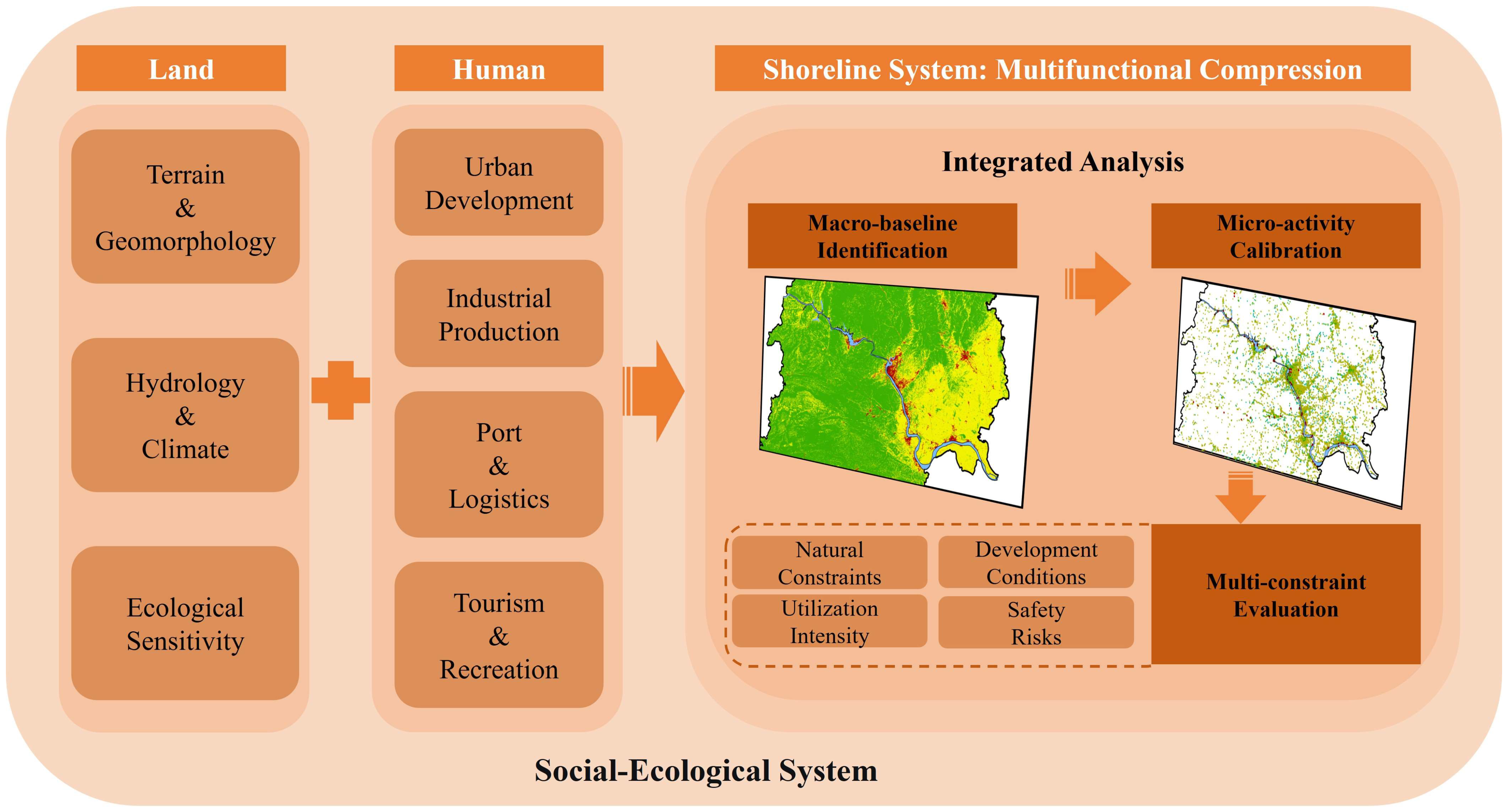
Based on the human–land relationship perspective and the multifunctional characteristics of shoreline space, shoreline suitability can be conceptualized as the combined outcome of natural constraints, development conditions, utilization intensity, and safety risks. Natural constraints define the baseline limits of shoreline use, development conditions determine the feasibility of productive utilization, utilization intensity reflects existing human activities and service capacity, and safety risks constrain long-term sustainability (Figure 1).
Accordingly, the indicator system in this study was designed to map these theoretical dimensions into observable variables. Ecological importance indicators (e.g., proportion of ecological shoreline, vegetation coverage, and elevation variation) represent ecological constraints on shoreline utilization [30]; production suitability indicators (e.g., proportion of port and harbor shoreline, nighttime light intensity, and transportation accessibility) reflect the feasibility of industrial and economic development [31]; living suitability indicators (e.g., urban POI density, population agglomeration, and GDP per capita) capture the intensity of human activities and service functions [32]; and safety importance indicators (e.g., weighted geohazard risk index) characterize natural risk constraints [33,34]. Through this theoretical mapping, the indicator selection is not arbitrary but derived from a structured conceptual framework that links human–land interactions, multifunctional land use, and spatial suitability evaluation.

3. Materials and Methods

3.1. Study Area

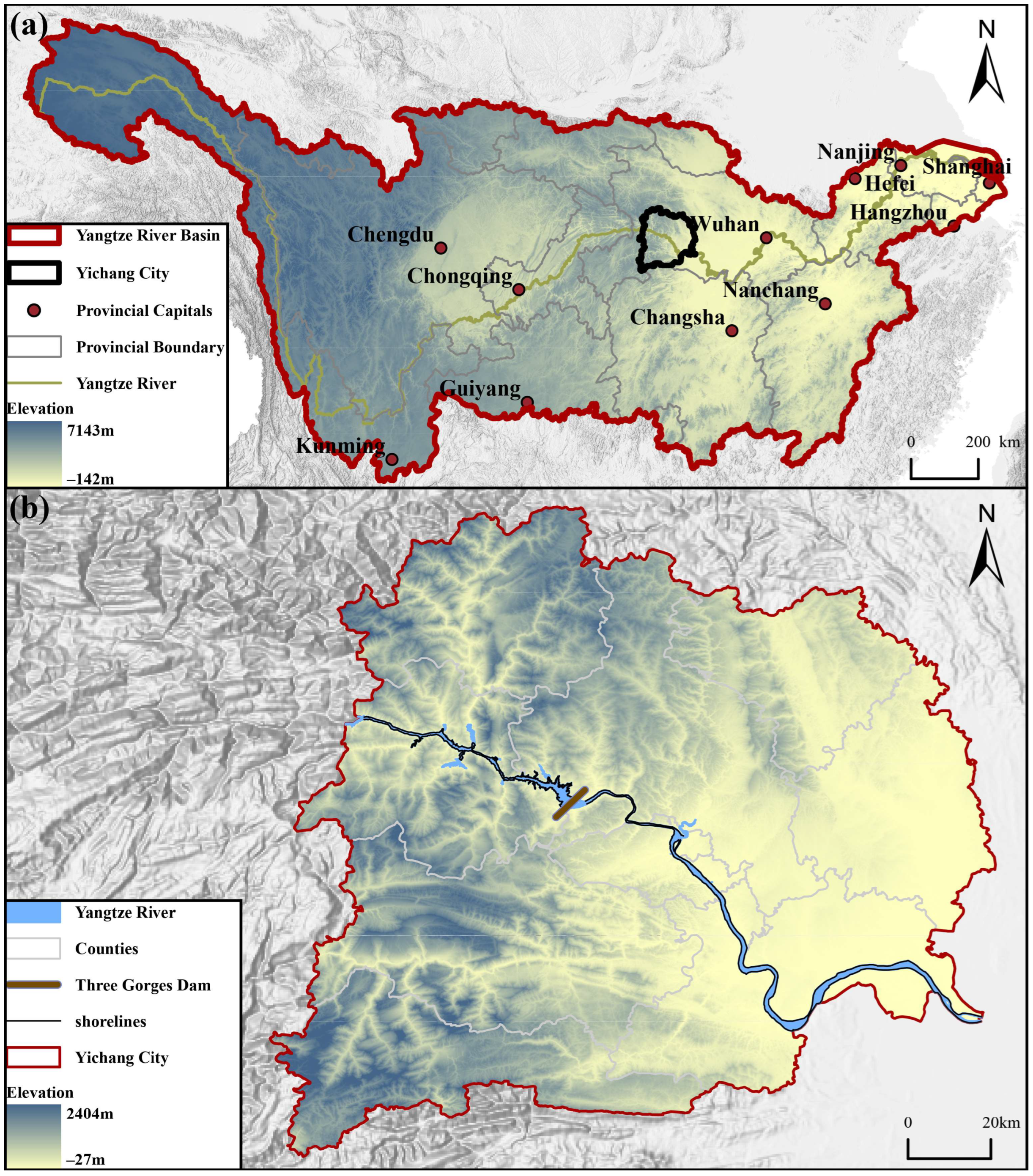
This study focuses on the Yichang section of the main stem of the Yangtze River (Figure 2), specifically encompassing the riverbanks on both sides and their associated landward buffer zones. The research area extends from the upstream boundary within the Three Gorges Reservoir area to the downstream boundary beyond the Gezhouba Dam and the Yichang City proper. For the purpose of this study, the Three Gorges Dam (TGD) serves as the key physiographic demarcation, dividing the research area into two distinct segments: the upstream reservoir-influenced section and the downstream fluvial section. The study area exhibits distinct environmental contrasts: the upstream reservoir area (above the TGD) is characterized by substantial water level fluctuations, steep mountainous terrain, and altered flow regimes, while the downstream section features a gentle alluvial plain with stabilized flow conditions. This environmental gradient provides a valuable setting for analyzing riverbank functions under different natural conditions.

3.2. Data Sources

The primary data used in this study is the annual China Land Cover Dataset (CLCD), which was developed by Professor Huang Xin’s team from Wuhan University based on 335,709 Landsat images on Google Earth Engine, with a spatial resolution of 30 m [35]. In this study, the CLCD data of the study area in 2022 are selected. In addition, data describing social and economic development are obtained from the statistical yearbooks at both prefecture and county levels. Combined with the DEM data of the study area. These detailed information, including social and economic indicators such as GDP, as well as information such as average elevation, slope, and topographic relief, provide important support for constructing the evaluation index system of shoreline function utilization. To ensure data consistency and the reliability of research results, necessary data preprocessing such as coordinate system unification has been carried out for all geospatial data. Finally, administrative boundaries, government locations, roads, and river networks were obtained from the 1:1 million Chinese-based geographic database (www.webmap.cn, accessed on 10 June 2025). This database provides accurate and up-to-date spatial data, laying a solid foundation for mapping and spatial analysis in this study.

3.3. Methods

The methodological framework is structured as a hierarchical, three-tiered analytical cascade designed to translate spatial theory into actionable planning intelligence. This cascade logically progresses from (1) establishing a macro-functional baseline derived from physical land cover, to (2) overlaying micro-scale socioeconomic signatures, and finally to (3) integrating these functional layers within a multi-dimensional suitability calculus. This three-tiered design constitutes a bottom-up, systematic methodological framework that progresses from foundational land-cover classification to nuanced socio-economic interpretation, and culminates in a synthesized evaluative decision-support model.

3.3.1. Dividing Dominant Functions of Shorelines Based on Three-Zone Space

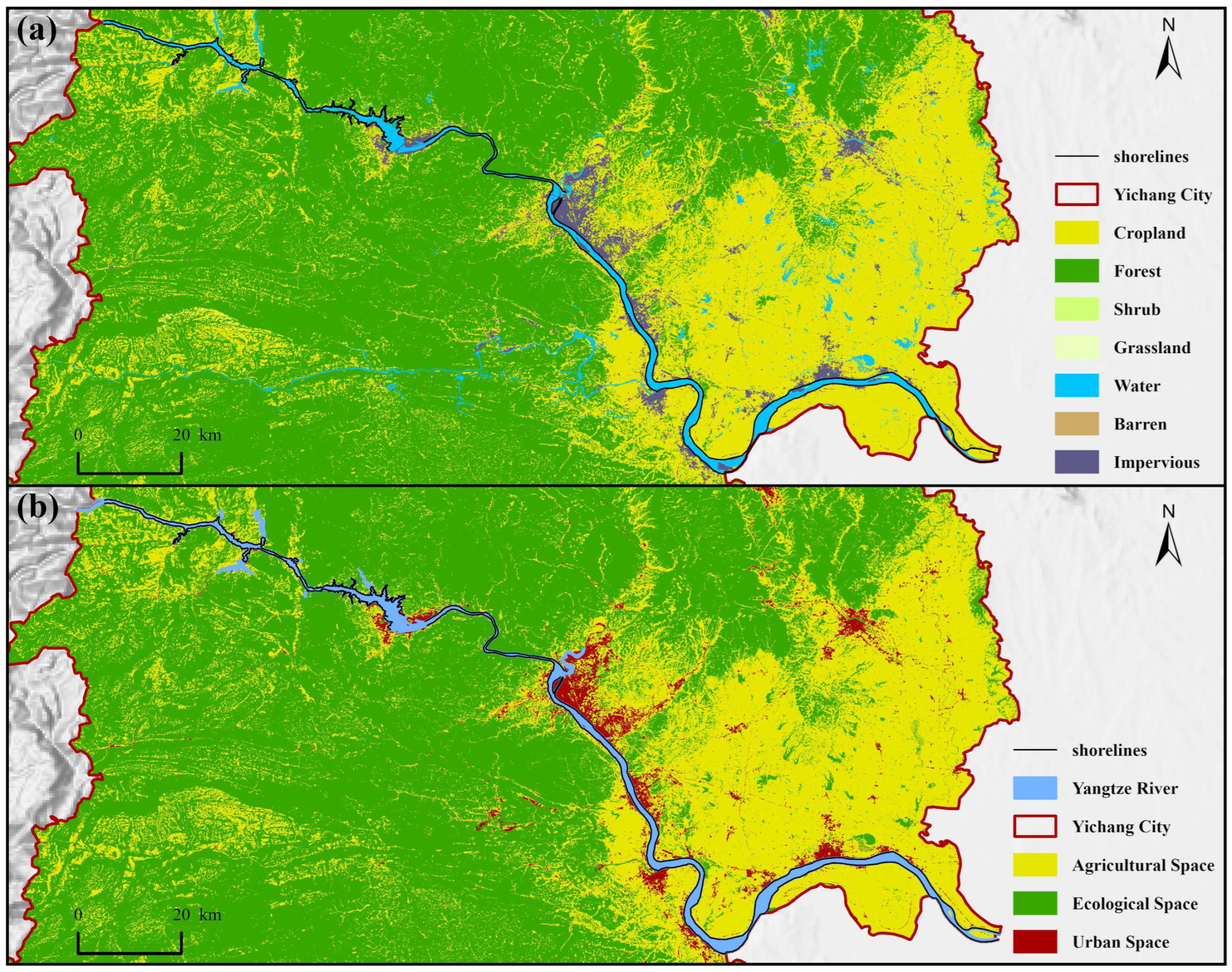
Followed the theoretical understanding of multifunctional compression in shoreline spaces, the dominant function of each shoreline segment was first identified using the ‘Three-Zone Space’ framework. This macro-level classification reclassified land cover into Urban Space (impervious surfaces), Agricultural Space (cropland), and Ecological Space (forest, shrub, grassland, water, wetland, barren, etc.), establishing a foundational functional baseline for subsequent refinement. The land use types of the study area are shown in Figure 3.
Additionally, the delineation of landward buffer zones was strategically differentiated to align with the distinct geo-environmental and socio-economic contexts of the two river sections. This approach ensures that the spatial extent of analysis corresponds to the actual scale of functional influence along the shoreline.
For the upstream reservoir section (above the Three Gorges Dam), a 500 m buffer was applied. This width is justified by three converging rationales: (1) The constraining geomorphology of steep slopes and narrow valleys, which physically limits extensive land use to a narrow corridor adjacent to the bank; (2) Policy frameworks for reservoir management, which emphasize ecological protection and risk control within the near-shore zone, a scale reflected in similar studies [36]; (3) The objective of capturing the immediate hinterland where land use most directly interacts with reservoir water levels and ecological processes.
For the downstream fluvial section, a 1000 m buffer was adopted. This wider extent is supported by: (1) the broader floodplains and gentler terrain that support extensive and diverse inland land uses (urban, industrial, agricultural); (2) the high intensity and spatial spread of socio-economic activities (ports, factories, settlements), whose influence extends farther inland [37]; and (3) alignment with the regulatory logic of the Yangtze River Protection Law. The Law establishes special state control over shoreline areas and, for instance, prohibits certain high-risk industrial activities within 1 km of major tributaries, institutionalizing the critical relationship between the river and its adjacent 1 km zone. The 1000 m buffer operates within this recognized zone of influence and policy attention. This differentiated buffer design, 500 m upstream and 1000 m downstream, aims to precisely capture the functionally relevant hinterland for each subsection, thereby enhancing the representativeness and accuracy of the subsequent functional identification and suitability evaluation.
For the division of the dominant functions of specific shorelines, ArcGIS Pro software (version 3.1.5) was used to generate equidistant points for segmenting the continuous shoreline, with the specific formula as follows:
N = L 200 + 1
where L is the total length of the original shoreline in meters. Buffer zones were generated for the segmented shorelines, and binary raster data of each space type within the buffer zones were created. The number of pixels of each type in the buffer zones was obtained through statistics, with the formula (taking agricultural space as an example) as follows:
N a g r i c u l t u r e = N a g r i c u l t u r e i ,   j
The proportion of each space within the buffer zones was calculated to determine the dominant function of each shoreline segment. A decisive classification step followed: for each segment, the single space type attaining the highest proportion was designated as its dominant function. This unambiguous criterion resolves the inherent mixture of land covers into a single, predominant functional label for each segment, which is essential for establishing a clear macroscopic functional pattern. Finally, adjacent segments assigned the same dominant function were aggregated into continuous functional reaches.

3.3.2. Refining Shoreline Functions by Integrating POI Data

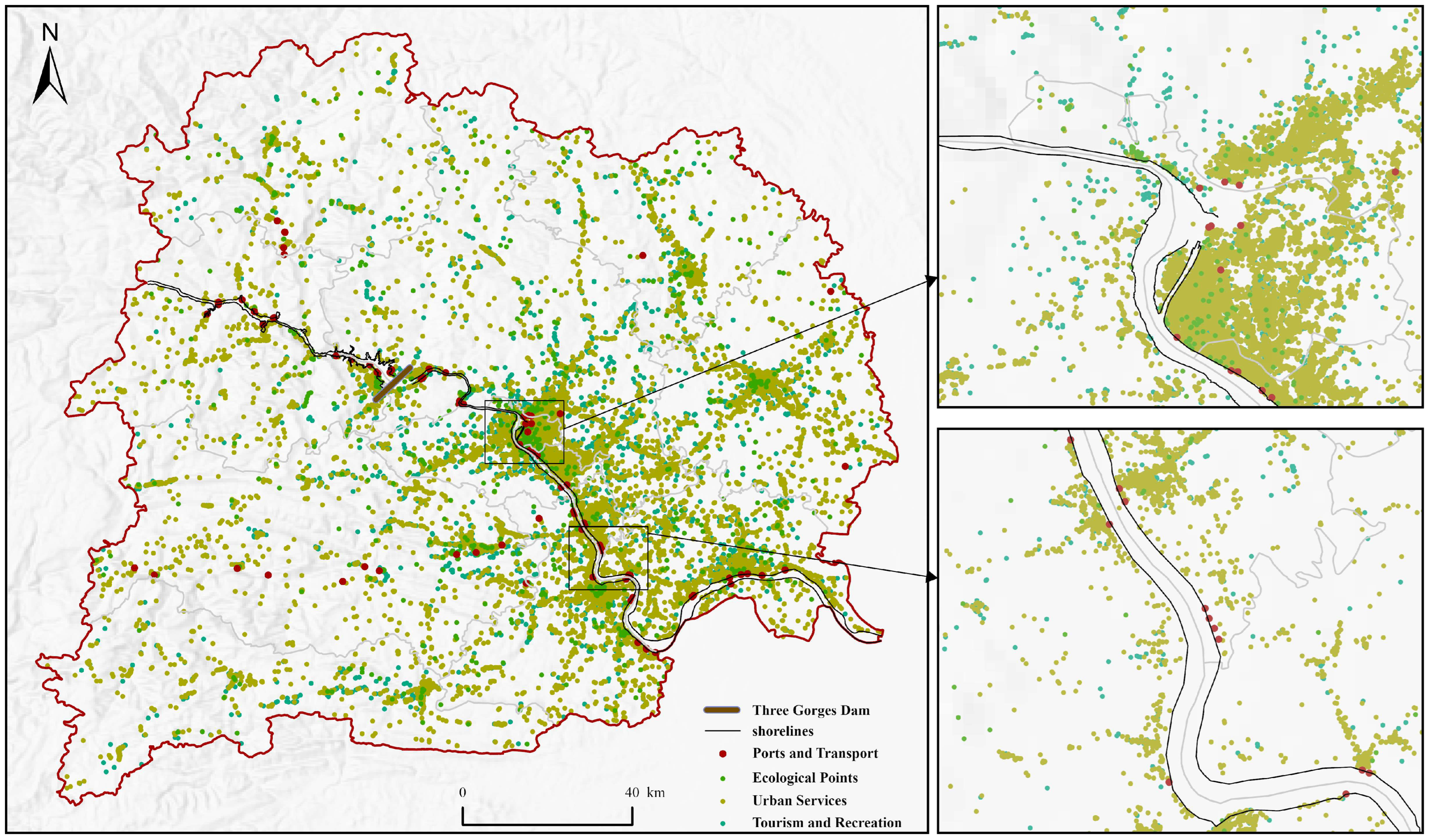
Building upon the three-zone spatial framework, this research further incorporates Point-of-Interest (POI) data to refine shoreline functional classification into five distinct categories: Ecological Conservation Shorelines, Port and Harbor Shorelines, Tourism and Recreation Shorelines, Urban Development Shorelines, and Agricultural Production Shorelines. POI data, encompassing commercial, industrial, and recreational facilities, serves as a critical indicator of human activities and economic functions along shorelines. The distribution of POI points in the study area is shown in Figure 4.
The classification employed a spatial proximity model. The functional weight for each shoreline segment was calculated as:
W j = i = 1 n [ 1 1 + α · d p i , s j β · I ( p i , T k ) ]
where W j represents the cumulative weight of POI influence on shoreline segment s j , d ( p i , s j ) denotes the geodetic distance between POI p i and shoreline segment s j , α and β are distance decay parameters modulating the spatial attenuation effect, and the values of these parameters were informed by relevant research findings on facility influence in the field of human geography and were assigned differentially based on POI type attributes, reflecting the variation in spatial influence ranges among different types of facilities (e.g., ports versus local service facilities) [38,39]. This approach ensures that the calculated POI weights exhibit clear and spatially coherent functional differentiation within the 500 m interaction buffer, aligning with the observed land use patterns. And I ( p i , T k ) is an indicator function scoring the relevance of POI type T k to specific shoreline functions. A 500 m buffer was applied to constrain POI-shoreline interactions, reflecting the typical spatial influence range of shoreline-based activities. For segments where multiple POI types coexisted, a hierarchical decision rule was implemented: port-related POIs were prioritized as Port and Harbor Shorelines, followed by tourism-related POIs classified as Tourism and Recreation Shorelines. Segments without significant POIs retained their dominant three-zone classification—Ecological Conservation Shorelines for ecological zones, Urban Development Shorelines for urban zones, and Agricultural Production Shorelines for agricultural zones.
This integrated approach, particularly the hierarchical decision rule, was explicitly designed to address the inherent limitations of POI data as a source for functional identification. As commercially sourced data, POIs are biased toward formal, economic activities, leading to potential under-representation in non-urban areas such as ecological reserves, extensive farmlands, or undeveloped shores—a systemic bias that could, if unaddressed, result in the underestimation of ecological or agricultural functions. Our methodological design incorporates two key strategies to mitigate this bias and ensure robustness. First, the POI-based refinement is not applied in isolation but is explicitly built upon the prior, comprehensive macro-level classification derived from land use data (the “Three-Zone Space” framework). This foundational step ensures that segments within ecological or agricultural zones retain their core functional identity from the outset, regardless of POI presence. Second, the hierarchical decision rule itself operationalizes this safeguard by prioritizing the land use-derived dominant function for segments with no or minimal POI influence, thereby preventing an urban-centric data bias from overwriting the actual physical land cover characteristics. Collectively, these measures ensure that the final functional classification remains anchored in robust physical land use while being informatively enhanced by POI data where it is most reliable.

3.3.3. Indicator Standardization and Weight Assignment

To facilitate a spatially explicit suitability evaluation, the continuous shoreline was partitioned into discrete evaluation units. The delineation of these units followed a hierarchical principle aimed at maximizing internal homogeneity in terms of dominant shoreline function, geomorphological conditions, and administrative jurisdiction, while also ensuring practical relevance for management. The procedure comprised three sequential steps: (1) Primary Division by Administrative Boundaries: The shoreline was initially segmented according to county-level administrative boundaries. This ensures each evaluation unit aligns with a single jurisdictional authority, which is fundamental for downstream management implementation. (2) Secondary Refinement by Key Geographical Features: These preliminary segments were further subdivided at the locations of major physiographic discontinuities—specifically the TGD and the Gezhouba Dam. These hydraulic infrastructures create fundamental alterations in hydrology, geomorphology, and human activity, thereby demarcating functionally distinct shoreline environments. (3) Tertiary Adjustment for Functional and Geomorphic Consistency: Within the above framework, segments were reviewed and adjusted to enhance internal homogeneity. If a segment spanned dramatically different topographic settings or contained markedly different dominant functions, it was split at the transition point. Conversely, adjacent segments with highly similar characteristics and very short lengths were merged to avoid excessive fragmentation. Through this iterative process, 15 evaluation units were derived. This number represents a balanced compromise between capturing meaningful spatial heterogeneity and maintaining analytical tractability. Each resulting unit exhibits relative internal consistency in its dominant physical constraints and anthropogenic influences, thereby providing a robust spatial foundation for the subsequent comparative suitability assessment.
To operationalize the constraint–suitability logic developed in our theoretical framework (Section 2.3), a multi-level evaluation indicator system was constructed. This system maps the four theoretical dimensions—natural constraints, development conditions, utilization intensity, and safety risks—onto measurable variables. Indicator selection adhered to principles of systematic coverage, representativeness, operability, and regional relevance, ensuring the system comprehensively characterizes the ecological baseline, development potential, and risk constraints of shoreline units within the specific context of the Yangtze River Basin. The final system comprises 4 criterion layers and 14 indicator layers (Table 1).
Due to differences in dimensions and attributes (positive/negative) among indicators, raw data were normalized to a dimensionless [0, 1] range using the Min-Max method [40]. To balance objectivity with expert judgment, this study combined the Analytic Hierarchy Process (AHP) and Entropy Weight Method (EWM). AHP captures expert experience through structured comparisons, while EWM provides objective weighting based on data variability. This combination enhances the scientific rigor of the evaluation by integrating both subjective insights and objective statistical patterns.
The EMW determines objective weights based on the variation degree of each indicator’s values [41]. The calculation procedure is as follows: (1) Calculate the proportion P i j of the i sample value under the j indicator:
P i j = x i j i = 1 m x i j
where x i j is the normalized value of the j indicator for the i sample, and m is the total number of samples. Standard mathematical convention: if x i j = 0 , then P i j ln P i j = 0 ; (2) Calculate the entropy value e j for the j indicator:
e j = 1 ln m i = 1 m p i j ln ( p i j )
(3) Calculate the entropy weight w j e for the j indicator:
w j e = g j j = 1 n g j
where g j is the divergence coefficient, reflecting the degree of variation among values within the j indicator. The objective weight vector is obtained as w e = w 1 e , w 2 e , w 3 e , , w n e , satisfying j = 1 n w j e = 1 , n is the number of indicators.
The AHP incorporates expert experience and qualitative judgment systematically by constructing hierarchical structures and pairwise comparison matrices [42]. Based on expert demonstration specific to the strategic importance of the Yangtze River conservation and the regional characteristics of the Yichang section, pairwise comparisons were conducted for the four criterion layers (A1, B1, C1, D1) using the Saaty 1 to 9 scale. The resulting judgment matrix M was constructed as follows:
M = 1 5 5 1 1 5 1 3 1 5 1 5 1 3 1 1 7 1 5 7 1
The criterion layer weights were calculated from this matrix using the eigenvector method. Consistency was verified ( λ m a x = 4.225 , C I = 0.075 , R I = 0.90 , C R 0.083 < 0.10 ).
The final combined weight for each individual indicator w j c o m b is calculated by multiplying the AHP-derived weight of its parent criterion layer ( w k c , where k A 1 , B 1 , C 1 , D 1 ) by its own EWM-derived objective weight w j e , followed by normalization across all indicators:
w j c o m b = w k c · w j e j = 1 n w k c · w j e
This combined weighting model effectively integrates the objective information from the data itself with subjective expert judgment reflecting strategic priorities, thereby enhancing the scientific rigor and practical rationality of the weight assignment for the shoreline suitability evaluation.

4. Results

4.1. Classification of Shoreline Dominant Functions Based on “Three-Zone Space”

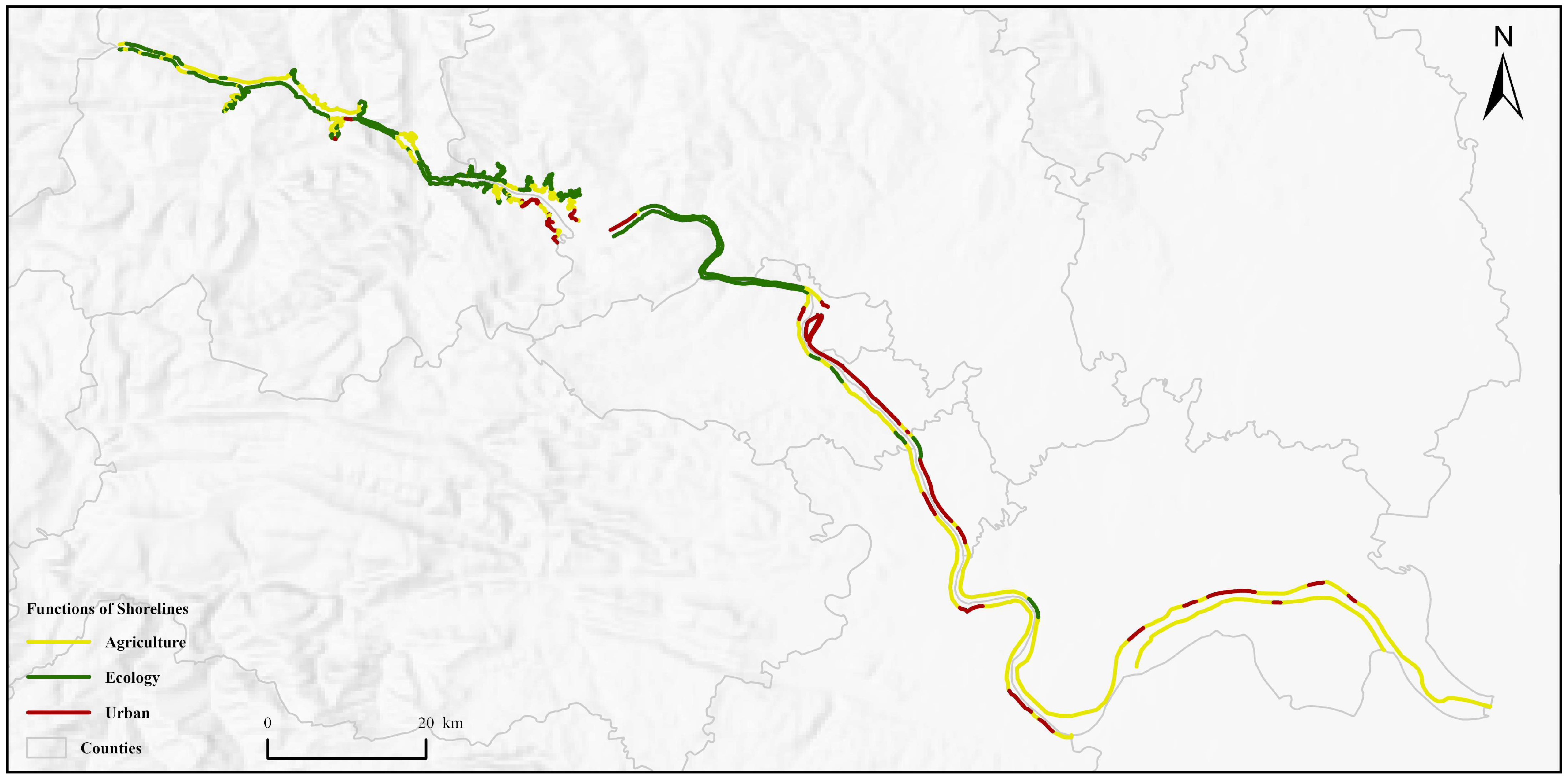
A segment of the downstream south bank exceeding the administrative boundary of Yichang City was excluded from the analysis. Based on the 2022 China Land Cover Dataset (CLCD), the dominant functions of the Yangtze River shoreline in the Yichang section were determined by calculating the proportional area of each space type within 500 m/1000 m buffers, as shown in Table 2 and Figure 5. In terms of total length, ecological space constitutes the longest shoreline type in the study area, followed by agricultural space, while urban space represents the shortest overall length. In the upstream segments (above the TGD), both the north and south banks are predominantly characterized by ecological space, with the south bank exhibiting a particularly notable dominance in this function. Agricultural space is widely distributed along the upstream north bank and both downstream banks, forming a significant component of these sections, especially demonstrating a clear length advantage on the downstream south bank. Urban space displays a highly concentrated distribution pattern, primarily clustered along the extended urban core of Yichang City on the downstream north bank, where urban functions are continuous and development intensity is high. Additionally, distinct urban agglomerations are evident in localized areas on the upstream south bank near the TGD. Overall, the spatial pattern of shoreline functions in the Yichang section exhibits a clear gradient from upstream to downstream: ecological functions overwhelmingly dominate the upstream areas, gradually transitioning to a composite spatial utilization pattern where agricultural and urban functions become significantly enhanced further downstream.

4.2. Refinement of Shoreline Functions Based on POI Data Integration

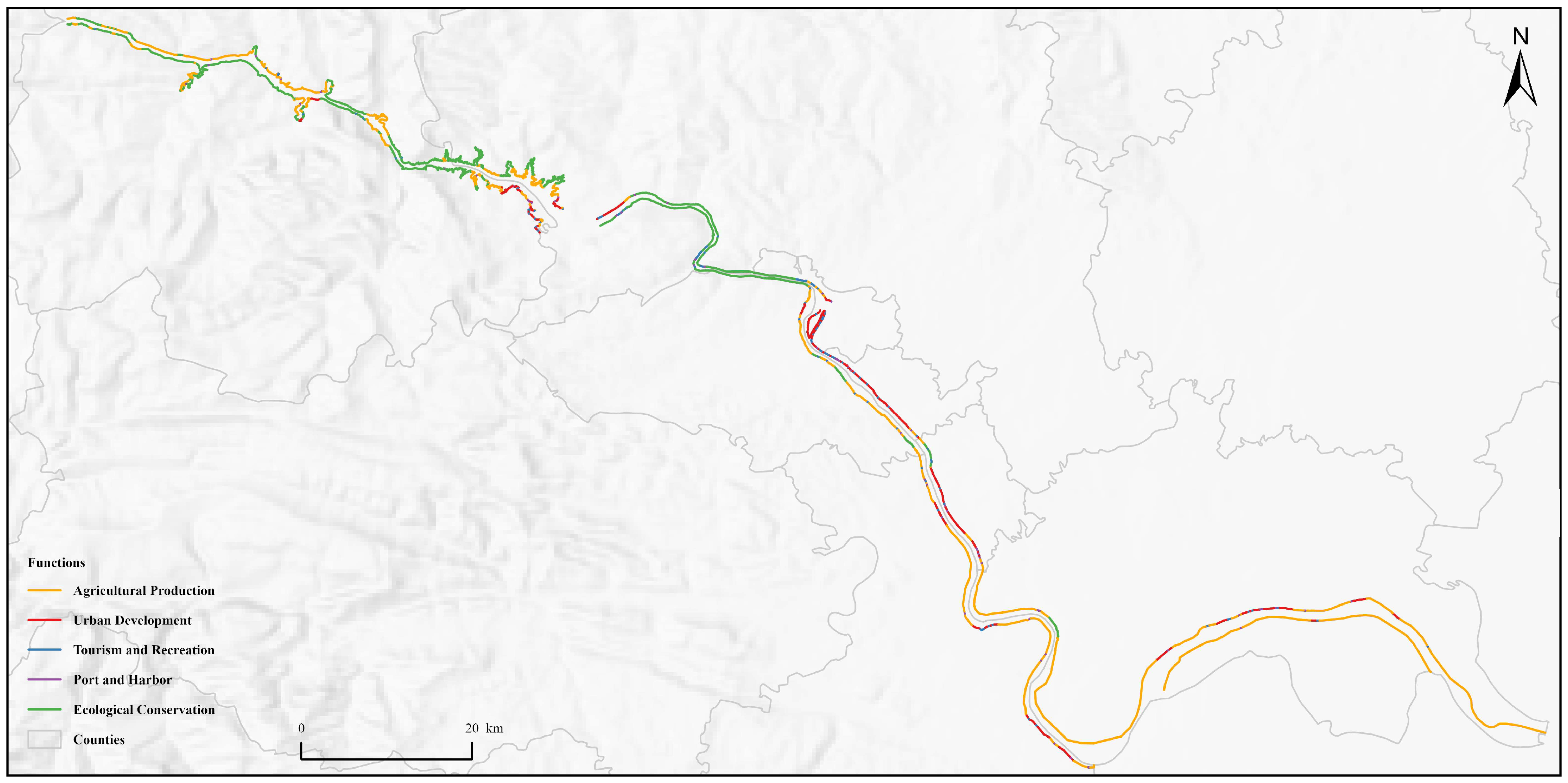
Building upon the macro-level “three-zone space” classification, this study further integrated POI data to refine shoreline functions into five specific categories, with detailed results presented in Figure 6 and Table 3. Ecological Conservation shorelines were the most extensive type in the study area, forming a broad, continuous band along the upstream section. Agricultural Production shorelines are comparable in total length to the ecological ones, extensively distributed across the alluvial plains of the downstream south bank and the gentle slopes and hilly areas of the upstream north bank. Urban Development shorelines exhibit a high degree of spatial agglomeration. The majority of their length is concentrated along the central urban area of Yichang City on the downstream north bank, where the shoreline displays distinct urban characteristics and high development intensity. Concurrently, contiguous Urban Development shorelines are also formed in localized urban agglomerations on the upstream south bank.
Port and Harbor shorelines, though relatively limited in total length, show highly specific locational attributes. They are intensely concentrated around key nodes with superior navigation conditions, such as the area near the dam, the surroundings of the Gezhouba Hydraulic Complex, and the main port zone of Yichang City. Tourism and Recreation shorelines also account for a shorter length but possess distinct spatial distribution characteristics. They are primarily interspersed within the backdrop of Ecological Conservation shorelines, often located in areas with high scenic value such as river confluences, ecological landscape nodes within the reservoir’s hydro-fluctuation zone, and along the shores of developed major scenic spots.

4.3. Comprehensive Evaluation Results of Shoreline Utilization Suitability

The weight allocation results (Table 4), determined by the combined AHP-Entropy Weight Method, indicate that among the criterion layers, D1 holds the highest weight (0.416), followed by A1 (0.380), B1 (0.141), and C1 (0.063). At the indicator level, under the A1 criterion, A11 (Proportion of Ecological Shoreline) carries the highest weight (0.187). For the B1 criterion, B15 (Shoreline Curvature) has the highest weight (0.127). Under the C1 criterion, C13 (Urban POI Density) possesses the highest weight (0.084), and for the D1 criterion, D11 (Weighted Geohazard Risk Index) has a weight of 0.060.
The comprehensive evaluation scores of the 15 shoreline units range from 0.138 to 0.477. Unit X3 achieves the highest comprehensive score (0.477), ranking first, followed by X5 and X8, ranking second and third, respectively. In contrast, units X12 and X13 receive the lowest scores, ranking 15th and 14th. The remaining units have scores between 0.246 and 0.413, with specific rankings detailed in Table 5.
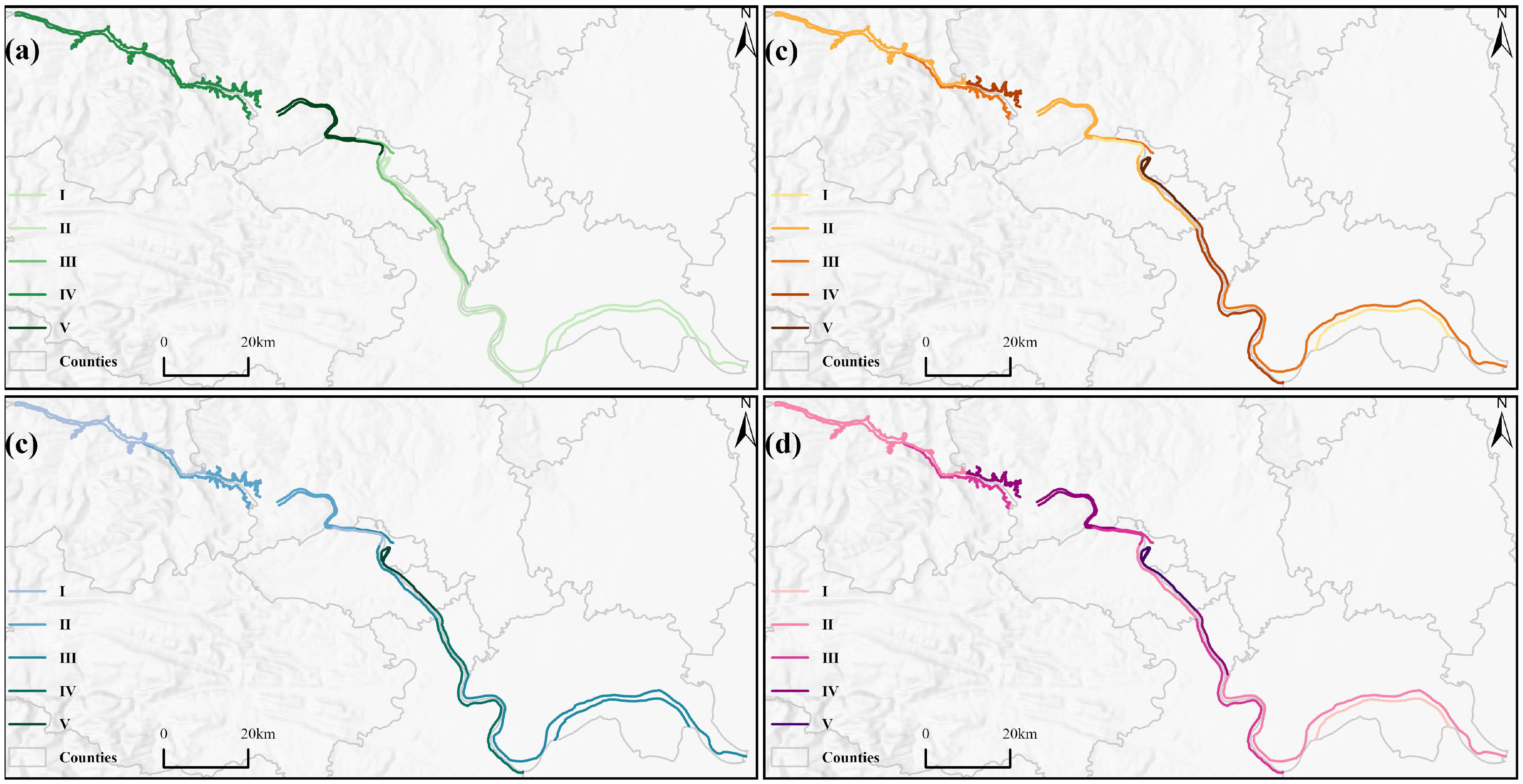
To better visualize the spatial differentiation characteristics of each evaluation result, this study employed the Natural Breaks classification method (Jenks Optimization) to categorize the scores of three criterion layers [43]—A1, B1, and C1—into five grades, as shown in Table 6. This method identifies inherent natural grouping boundaries within the data, minimizing intra-class differences and maximizing inter-class differences, making it suitable for highlighting the intrinsic distribution patterns of the data. The grades range from Level I (Poor) to Level V (Excellent), corresponding to different evaluation levels. The spatial distribution of the comprehensive shoreline suitability evaluation is visualized in Figure 7.
In terms of the ecological protection importance (A1), the scores range from 0.008 to 0.298. Units X8, X4 and X1 rank the top three. Units X3 and X5 score the lowest. Spatially, high-value units are primarily concentrated in the upstream sections, particularly the reservoir area, while low-value units are distributed in the downstream sections. For the suitability for production development (B1), scores vary between 0.013 and 0.205. Unit X5 scores the highest, followed by X3 and X10. Unit X1 has the lowest score. Geographically, units with higher scores are mainly located in the downstream north bank (X3, X5) and parts of the downstream south bank (X10) close to port facilities and industrial zones, whereas units with lower scores are found in the upstream north bank (X1, X13) and certain downstream south bank areas (X12). Regarding the suitability for construction development (C1), scores span from 0.002 to 0.222. Unit X3 scores significantly higher than others, followed by X5 and X7. Unit X13 has the lowest score. High-score units are clustered in the downstream north bank (X3, X5), encompassing urban cores and areas with well-developed transportation networks, while low-score units are situated in the upstream sections (X13, X14) and remote downstream south bank regions (X12). The comprehensive evaluation results demonstrate that units with higher scores (>0.400) are predominantly distributed along the downstream north bank and parts of the upstream south bank. Units with medium scores (0.300–0.400) include X1, X4, X6, X9, X10, X15, covering the upstream ecological transition zone and downstream suburban sections. Units with lower scores (<0.300) are primarily located in the upstream north bank and downstream south bank.

5. Discussion

5.1. Functional Zoning of Shorelines Based on the “Three-Zone Space” Classification

The “Three-Zone Space” classification reveals a distinct macro-scale spatial order along the Yichang shoreline: a dominant ecological function upstream that systematically transitions to a mixed agricultural-urban landscape downstream. This spatial pattern is a direct spatial manifestation of the human–land relationship dynamics conceptualized in our theoretical framework. It illustrates how the interplay between natural constraints and human development demands shapes competitive land allocation under starkly varying environmental gradients.
The upstream ecological dominance primarily reflects a land use outcome constrained by stringent biophysical limits [44]. The steep topography, significant water-level fluctuations, and high ecological sensitivity of the Three Gorges Reservoir area create a natural “carrying capacity bottleneck,” where the costs and risks of intensive development overwhelmingly outweigh potential benefits. Consequently, this zone functionally aligns with the strategic concept of an “ecological security barrier,” where conservation emerges as the spatially rational and predominant land use [45]. In contrast, the downstream expansion of agricultural and urban spaces signifies a shift in the dominant allocation logic [46]. Here, gentler terrain, stable hydrological conditions, and superior accessibility lower the threshold for human modification. The observed pattern embodies the spatial-economic principle of competitive advantage: agriculture occupies the fertile alluvial plains (e.g., downstream south bank), while urban functions agglomerate in areas with the highest transportation connectivity and development potential (e.g., downstream north bank near urban cores).
The presence of clustered urban patches within the upstream ecological zone (e.g., south bank near TGD) represents a notable deviation from this environmentally determined gradient, highlighting the influence of strong, localized anthropogenic drivers (e.g., dam-related resettlement) that can override broader geomorphic tendencies.

5.2. Enhanced Identification of Shoreline Functions Through POI Data Integration

The integration of Point of Interest (POI) data with the macro-level “Three-Zone Space” classification refined the functional interpretation of the shoreline, distinguishing five specific types. This result provides a nuanced, micro-scale view of how human activity is spatially organized within the multifunctionally compressed riparian zone, directly mapping the theoretical concept of superimposed ‘utilization intensity’ onto the foundational land-cover-based functional potential. It reveals specialized economic patterns that land cover data alone cannot discern.
The sharp concentration of Port and Harbor shorelines at major infrastructure nodes (e.g., Gezhouba Dam, Yichang’s urban core) reflects a spatial logic of strategic convergence. Socio-economic functions that critically depend on deep-water access, intermodal transfer, and existing heavy infrastructure are naturally drawn to these discrete, high-investment locations. This pattern effectively maps the operational skeleton of the Yangtze as a national logistics corridor onto the shoreline’s geography [47]. In contrast, the dispersed distribution of Tourism and Recreation shorelines, often embedded within broader Ecological Conservation segments, suggests a different logic—one of value parasitism on ecological and scenic assets [48]. This spatial relationship indicates that recreational use, while economically significant, remains constrained by and secondary to the underlying ecological matrix in these areas, presenting a distinct management context compared to port-industrial concentrations.
The refined classification thus stems from interpreting POI activity patterns within the stable functional context provided by the physical land cover. This approach allows for the mapping to simultaneously represent two realities: the foundational, land-cover-based functional potential and the superimposed layer of intensive human use. Consequently, the results avoid a bias toward commercial centers by preserving the ecological or agricultural identity of segments where POI data is sparse, while still capturing the specialized economic functions that define intensively used waterfront areas.

5.3. Decision Value and Practical Implications of the Suitability Evaluation

The comprehensive suitability evaluation provides a multi-dimensional synthesis of shoreline potential. Its outcomes offer a diagnostic lens through which the inherent trade-offs and functional tensions along the riparian corridor become quantitatively legible, thereby addressing the need for holistic assessment frameworks in complex linear systems.

5.3.1. Spatial Patterns and the Significance of Weight Allocation

The evaluation reveals a distinct spatial hierarchy, with high-suitability units (e.g., X3, X5) concentrated in downstream urban cores and low-suitability units (e.g., X12, X13) constrained by ecological sensitivity and geohazard risks upstream. This spatial differentiation fundamentally arises from the inherent heterogeneity of the shoreline’s natural and socio-economic conditions. High-suitability units typically possess a combination of favorable locational assets—such as developed infrastructure, economic agglomeration, and gentler topography—coupled with relatively lower ecological sensitivities and managed risks [49]. In contrast, low-suitability units are characterized by an accumulation of constraining factors, including steep slopes, high conservation value, or significant geological hazards [50].
The applied weighting scheme, derived from the combined AHP-Entropy method, amplifies this inherent differentiation by prioritizing specific dimensions of sustainability. Recent studies, such as those on the Yangtze River Basin, have demonstrated that integrating objective entropy weights with expert-driven AHP effectively balances data variability with strategic priorities [51]. The assignment of the highest composite weights to ecological importance (A1) and disaster risk constraints (D1) reflects a deliberate precautionary logic aligned with contemporary river basin governance, particularly the “prioritizing ecological protection” directive for the Yangtze. Consequently, units with significant ecological value or high risk exposure are accentuated in the low-suitability category, while those achieving a balance between development potential and environmental/resilience considerations are highlighted as highly suitable [52,53]. Thus, the spatial pattern of scores can be interpreted as the landscape’s configuration when viewed through a priority lens that emphasizes long-term ecological security and risk mitigation. This approach moves the model beyond a neutral description of “potential” towards a normative framework that actively reflects strategic environmental priorities.

5.3.2. The Agriculture-Suitability Mismatch: Unpacking Systemic Inertia

A salient finding is the spatial disconnect between extensive Agricultural Production shorelines (notably on the downstream south bank) and their moderate-to-low composite suitability scores. This mismatch serves as a diagnostic signal of land use rigidity within the socio-ecological system. The persistence of agriculture in areas of modeled suboptimal suitability arises from interconnected drivers:
(1) Historical-Path Dependency and Sunk Costs: The fertile alluvial plains historically provided an irresistible attractor for agricultural settlement, initiating a land use trajectory that has persisted for generations. This history has led to substantial sunk investments in landscape capital, including intricate irrigation networks, terraced fields, and soil management systems. Beyond physical infrastructure, socio-economic dependencies have become deeply entrenched, with local communities’ identities, knowledge systems, and intergenerational wealth tied to the agricultural landscape [54]. This creates a powerful inertia or lock-in effect, wherein the costs of transition (both economic and social) are perceived as prohibitively high, even when new risk assessments suggest vulnerability [55]. (2) Multi-Scale Policy Incentives and Local Rationality: Agricultural land use is sustained by a complex interplay of incentives operating at different scales. National and regional policies emphasizing food security and rural stability can create a supportive, sometimes subsidized, environment for maintaining agricultural output. However, at the household and community scale, the decision-making calculus is dominated by immediate livelihood security, reliable income streams, and the utilization of existing assets (land, equipment, skills) [56]. This local rationality often prioritizes known risks and returns over the probabilistic, long-term environmental risks highlighted in our suitability model. The tension between these scales can perpetuate land use patterns that are rational from a micro-economic or policy-compliance perspective but appear suboptimal from an integrated, place-based sustainability perspective [57]. (3) Fragmented Governance and Sectoral Planning: The mismatch also points to a disconnect in governance frameworks. Land use planning, agricultural development, and disaster risk reduction are often administered by separate agencies with distinct mandates and success metrics. This sectoral approach can lead to situations where agricultural expansion or persistence is encouraged by one set of policies (e.g., agricultural subsidies) in areas where land use zoning or hazard maps (from other sectors) indicate significant constraints. Our integrated suitability index, by combining these typically separate dimensions, makes the consequences of this siloed decision-making spatially explicit, revealing where sectoral policies may be working at cross-purposes [58].
This mismatch underscores a central tenet of human–land relationship theory: that realized land use is not a simple function of biophysical potential but is mediated by complex socio-institutional and historical path dependencies. Our integrated suitability index, by combining the typically separated dimensions of development conditions and safety risks, makes the consequences of this mediation spatially explicit. It therefore highlights that sustainable shoreline management requires frameworks, like the one proposed here, capable of diagnosing these multifaceted interactions. Governance in such areas must move beyond simple zoning to address the underlying systemic drivers revealed by the constraint–suitability analysis.

5.4. Differentiated Management Strategies

The integrated framework of functional identification and suitability evaluation provides a diagnostic basis for spatially targeted governance. The following strategies are based on the specific spatial correlations and mismatches revealed in our results, aiming to translate analytical findings into concrete, context-sensitive interventions.
(1)
For high-suitability units with concentrated urban/port functions, these areas represent zones of alignment between high development potential and current intensive use. Management should focus on qualitative intensification and ecological modernization within this high-potential envelope, rather than spatial expansion. First, implementing smart logistics to reduce congestion and pollution, and mandating shoreline ecological restoration projects within port boundaries to mitigate local environmental impacts. Second, strategic urban waterfront regeneration. Rejuvenating underutilized or obsolete urban shoreline parcels (identified through fine-grained POI analysis) for mixed-use development that integrates public access, green space, and climate-adaptive design, thereby enhancing value without spatial expansion.
(2)
For low-suitability, high-constraint units. Characterized by an accumulation of ecological sensitivities and high geohazard risks, policy must enforce absolute protection and proactive risk governance. First, enforcing ecological red lines with monitoring. Legally formalizing the boundaries of low-suitability ecological zones (as per evaluation results) and establishing real-time geohazard monitoring and early-warning systems. Furthermore, developing compensated stewardship programs. Creating payment for ecosystem services (PES) schemes or other fiscal mechanisms to support communities in these areas for maintaining protective land uses, rather than high-risk economic activities.
(3)
For agricultural production shorelines with moderate-low suitability. Management must address the systemic inertia revealed by the spatial mismatch. Strategy should pivot from supporting general production to facilitating a structured, risk-informed transition. First, implementing differentiated agricultural zoning. Subdividing agricultural zones based on micro-scale suitability scores to promote climate-resilient and precision agriculture in stable areas, while guiding the conversion of highest-risk marginal farmland (e.g., units with very low scores in flood-prone areas) to constructed wetlands or riparian buffers, supported by targeted ecological compensation. Moreover, fostering alternative livelihoods. Supporting the development of agri-ecology, eco-tourism, or non-farm industries in communities within mismatch zones to reduce dependency on vulnerable agricultural systems.
(4)
For tourism and recreation shorelines within ecological settings, given their symbiotic yet potentially impactful relationship with ecological conservation areas, management must ensure that tourism development remains within the ecological carrying capacity. First, implementing carrying capacity-based management. Setting and enforcing strict visitor caps for scenic nodes within ecological shorelines to prevent ecosystem damage. In addition, promoting community-integrated ecotourism. Developing tourism models where local communities are the primary beneficiaries and custodians, ensuring economic incentives are aligned with long-term conservation of the landscape and cultural heritage.

5.5. Research Limitations and Future Directions

Despite the comprehensive nature of this study, several limitations warrant acknowledgment. First, the reliance on POI data, while effective for functional identification, may not fully capture informal or temporary land uses along shorelines. Second, the fixed buffer widths (500 m and 1000 m), though justified by local conditions, may not represent optimal solutions across all riverfront contexts, as the optimal buffer size is likely dynamic and varies across different riverfront areas. Third, the evaluation framework remains static and does not account for temporal dynamics such as seasonal variations or climate change impacts.
Future research should explore dynamic buffer determination methods to address this constraint and integrate multi-temporal data to enhance the framework’s adaptability. Additionally, the methodology presented here could be extended to the entire Yangtze River basin or other river systems to enable comparative studies and validate its transferability. The framework’s modular design provides a foundation for systematic replication at basin scale, ensuring comparability across different geographical environments through standardized evaluation indicators and weighting systems, making the approach particularly suitable for comprehensive basin-wide assessments. This scalability enables applications ranging from local shoreline management to entire river basin planning, providing decision-makers with a unified analytical framework for sustainable water resource management.

6. Conclusions

This study successfully integrated ‘Three-Zone Space’ theory with POI data to classify Yichang’s shoreline functions, revealing distinct upstream-downstream gradients. The AHP-Entropy suitability evaluation identified high-suitability zones in downstream urban cores and low-suitability areas in ecologically sensitive upstream regions. The strong spatial concordance between functional classification and suitability outcomes demonstrates the framework’s practical value for differentiated shoreline management and offers a transferable approach for sustainable river corridor planning.
Analytically, this research reveals that the spatial distribution of shoreline functions is not random but systematically constrained by natural geography and modulated by human activities. The observed mismatch between agricultural shorelines and suitability scores underscores the complex interplay between historical land use patterns, policy imperatives, and risk considerations. This analytical insight suggests that effective shoreline management must move beyond simple functional classification to integrate multi-dimensional suitability assessments that account for both development potential and risk constraints.
Notwithstanding these contributions, this study acknowledges limitations related to POI data coverage and the static nature of the evaluation framework, which could benefit from incorporating temporal dynamics in future research.

Author Contributions

Conceptualization, J.A. and J.X.; Methodology, J.A. and J.X.; Software, J.A. and J.X.; Validation, F.Q. and Y.J.; Formal Analysis, X.L. and J.X.; Investigation, X.L. and F.Q.; Resources, K.L. and J.X.; Data Curation, J.A., J.X. and F.Q.; Writing—Original Draft Preparation, J.A.; Writing—Review and Editing, X.L.; Visualization, X.L.; Supervision, J.X. and X.L.; project administration, X.L.; funding acquisition, X.L. and K.L. All authors have read and agreed to the published version of the manuscript.

Funding

This research was funded by the Independent Innovative Project of Changjiang Survey Planning Design and Research Co., Ltd. (Grant Number: CX2023Z10-1), supported by the China Postdoctoral Science Foundation (Grant Number: 2024M752473), and supported by the Open Fund of the Technology Innovation Center for 3D Real Scene Construction and Urban Refined Governance, Ministry of Natural Resources (Grant Number: 2024PF-4).

Data Availability Statement

Publicly available datasets were analyzed in this study. Digital elevation model data can be found here: [https://www.gscloud.cn/], accessed on 1 August 2025. Land use data can be found here: [http://www.zenodo.org/], accessed on 1 August 2025. The basic geographic information base map can be found here: [http://www.webmap.cn/], accessed on 1 August 2025. MOD13A3 data can be found here: [https://ladsweb.modaps.eosdis.nasa.gov/], accessed on 1 August 2025. PCNL data can be found here: [https://zenodo.org/records/10989889], accessed on 1 August 2025. GHS-POP data can be found here: [https://ghsl.jrc.ec.europa.eu/download.php?ds=pop], accessed on 5 August 2025. Geohazard point data can be found here: [http://www.gisrs.cn], accessed on 5 August 2025.

Conflicts of Interest

The authors Xiaofen Li, Fan Qiu, Yichen Jia and Kai Li were employed by the company Changjiang Survey, Planning, Design and Research Co., Ltd. The remaining authors declare that the research was conducted in the absence of any commercial or financial relationships that could be construed as potential conflicts of interest.

References

  1. Liu, Y.; Fang, Z. Spatial Pattern Change and Influencing Factors of Industrial Eco-Efficiency of Yangtze River Economic Belt (Yreb). SAGE Open 2022, 12, 21582440221113849. [Google Scholar] [CrossRef]
  2. Arif, M.; Petrosillo, I.; Li, C. Effects of Changing Riparian Topography on the Decline of Ecological Indicators Along the Drawdown Zones of Long Rivers in China. Front. For. Glob. Change 2024, 7, 1293330. [Google Scholar] [CrossRef]
  3. Duan, X.-J.; Hui, Z.O.U.; Chen, W.-X.; Min, M.I.N. The Concept, Assessment and Control Zoning Theory and Method of Waterfront Resources: Taking the Resources Along the Yangtze River as an Example. J. Nat. Resour. 2019, 34, 2209–2222. [Google Scholar] [CrossRef]
  4. Sun, J.; Tang, D.; Kong, H.; Boamah, V. Impact of Industrial Structure Upgrading on Green Total Factor Productivity in the Yangtze River Economic Belt. Int. J. Environ. Res. Public Health 2022, 19, 3718. [Google Scholar] [CrossRef]
  5. Cui, J.; Kong, X.; Chen, J.; Sun, J.; Zhu, Y. Spatially Explicit Evaluation and Driving Factor Identification of Land Use Conflict in Yangtze River Economic Belt. Land 2021, 10, 43. [Google Scholar] [CrossRef]
  6. Wang, Z.; Xiong, Y.; Zhang, C. Quantitative Evaluation of Eco-Environmental Protection Policy in the Yangtze River Economic Belt: A Pmc-Index Model Approach. Sustainability 2024, 16, 805. [Google Scholar] [CrossRef]
  7. Yang, G.; Xu, X. Foundation and Strategy of Well Coordinated Environmental Foundation and Strategy of Well-Coordinated Environmental Conservation and Avoiding Excessive Development in the Yangtze River Economic Belt. Bull. Chin. Acad. Sci. (Chin. Version) 2020, 35, 940–950. [Google Scholar] [CrossRef]
  8. Qin, H.; Ye, Y. Resilient Strategies for Disaster Prevention and Ecological Restoration of River and Lake Benggang and Bank Erosion. Water 2025, 17, 2744. [Google Scholar] [CrossRef]
  9. Liu, R.; Pu, L.; Huang, S. Simulation of Coastal Resource and Environmental Carrying Capacity in the Yangtze River Delta Coastal Zone Based on Shared Socioeconomic Pathways. Front. Mar. Sci. 2023, 10, 1008231. [Google Scholar] [CrossRef]
  10. Qu, F.; Sun, Y.; Zhou, M.; Liu, L.; Yang, H.; Zhang, J.; Huang, H.; Hong, D. Vegetation Land Segmentation with Multi-Modal and Multi-Temporal Remote Sensing Images: A Temporal Learning Approach and a New Dataset. Remote Sens. 2024, 16, 3. [Google Scholar] [CrossRef]
  11. Indifrag V2.1: An Object-Based Fragmentation Analysis Software Tool; 2017; Available online: https://www.cgat.webs.upv.es/BigFiles/indifrag/IndiFrag_BriefUserGuide_EN.pdf (accessed on 1 August 2025).
  12. Boryan, C.; Craig, M.E. Multiresolution Landsat Tm and Awifs Sensor Assessment for Crop Area Estimation in Nebraska. Proc. Pecora 2005, 16, 22–27. [Google Scholar]
  13. Wang, Q.; Shi, W.; Atkinson, P.M. Sub-Pixel Mapping of Remote Sensing Images Based on Radial Basis Function Interpolation. ISPRS J. Photogramm. Remote Sens. 2014, 92, 1–15. [Google Scholar] [CrossRef]
  14. Du, P.; Liu, S.; Liu, P.; Tan, K.; Cheng, L. Sub-Pixel Change Detection for Urban Land-Cover Analysis Via Multi-Temporal Remote Sensing Images. Geo-Spat. Inf. Sci. 2014, 17, 26–38. [Google Scholar] [CrossRef]
  15. Zhou, Y. Urban Functional Area Identification Based on Poi Data. Acad. J. Manag. Soc. Sci. 2023, 2, 167–169. [Google Scholar] [CrossRef]
  16. Yang, X.; Ma, X.A. A Spatial Semantic Feature Extraction Method for Urban Functional Zones Based on Pois. ISPRS Int. J. Geo-Inf. 2024, 13, 220. [Google Scholar] [CrossRef]
  17. Bai, B.; Chen, F.; Zhou, G. Functions of Village Classification Based on Poi Data and Social Practice in Rural Revitalization. Arab. J. Geosci. 2021, 14, 1690. [Google Scholar] [CrossRef]
  18. Sun, Z.; Li, P.; Wang, D.; Meng, Q.; Sun, Y.; Zhai, W. Recognizing Urban Functional Zones by Gf-7 Satellite Stereo Imagery and Poi Data. Appl. Sci. 2023, 13, 6300. [Google Scholar] [CrossRef]
  19. Yu, R.; Qin, Y.; Xu, Y.; Chuai, X. Study on the Optimization of Territory Spatial “Urban–Agricultural–Ecological” Pattern Based on the Improvement of “Production–Living–Ecological” Function under Carbon Constraint. Int. J. Environ. Res. Public Health 2022, 19, 6149. [Google Scholar] [CrossRef]
  20. Wang, G.; Zhou, Z.; Xia, J.; Ou, D.; Fei, J.; Gong, S.; Xiang, Y. Optimal Allocation of Territorial Space in the Minjiang River Basin Based on a Double Optimization Simulation Model. Land 2023, 12, 1989. [Google Scholar] [CrossRef]
  21. Qin, Q.; Xu, S.; Du, M.; Li, S. Urban Functional Zone Identification by Considering the Heterogeneous Distribution of Points of Interests. ISPRS Ann. Photogramm. Remote Sens. Spat. Inf. Sci. 2022, 5, 83–90. [Google Scholar] [CrossRef]
  22. Zhao, F.; Guo, G. Study on the Effectiveness of Navigation Safety Measures for Nanjing Yangtze River Bridge. MATEC Web Conf. 2020, 308, 03004. [Google Scholar] [CrossRef]
  23. Luo, G.; Ye, J.; Wang, J.; Wei, Y. Urban Functional Zone Classification Based on Poi Data and Machine Learning. Sustainability 2023, 15, 4631. [Google Scholar] [CrossRef]
  24. Li, Q.; Wang, L.; Ma, X.; Nie, R. Experimental Study of the Effects of Riverbank Vegetation Conditions on Riverbank Erosion Processes. Environ. Fluid Mech. 2023, 23, 621–632. [Google Scholar] [CrossRef]
  25. Guo, Y.; Yao, Y.; Wang, Z.; Ren, C. Green Development Evaluation and Problem Areas Identification of the Yangtze River Economic Belt from the Perspective of Major Function Oriented Zones. Acta Ecol. Sin. 2023, 43, 2569–2582. [Google Scholar] [CrossRef]
  26. Zhou, Y.; Li, Z.; Yao, S.; Shan, M.; Guo, C. Case Study: Influence of Three Gorges Reservoir Impoundment on Hydrological Regime of the Acipenser Sinensis Spawning Ground, Yangtze River, China. Front. Ecol. Evol. 2021, 9, 624447. [Google Scholar] [CrossRef]
  27. Guo, J.; Yin, S.; Wang, S.; Han, Z.; Xu, Y.; Wang, L.; Dong, M. The Theory of Regional Function Identification of Coastal Territorial Space under the Shaping of the Flowing Space. J. Nat. Resour. 2023, 38, 1447–1463. [Google Scholar] [CrossRef]
  28. Jin, C.; Huang, Z.; Xu, J. Assessment on Suitability of Scenic Spots Location Inthe Yangtze River Delta. J. Nat. Resour. 2013, 28, 1196–1208. [Google Scholar]
  29. Zhang, K.; Wei, W.; Yin, L.; Zhou, J. Spatial-Temporal Evolution Characteristics and Mechanism Analysis of Urban Space in China’s Three-River-Source Region: A Land Classification Governance Framework Based on “Three Zone Space”. Land 2023, 12, 1380. [Google Scholar] [CrossRef]
  30. Tao, G.; Xue, W.; Yuan, B.; Li, T.; Li, W.; Li, J.; Zhao, L.; Cui, Y.; Xu, W.; Wei, X.; et al. A comprehensive assessment framework for water ecological space health based on remote sensing technology. Natl. Remote Sens. Bull. 2025, 29, 689–699. [Google Scholar]
  31. Yelistratova, L.; Apostolov, A.; Khodorovskyi, A.; Khyzhniak, A.V.; Tomchenko, O.V.; Lialko, V.I. Use of Satellite Information for Evaluation of Socio-Economic Consequences of the War in Ukraine. Ukr. Geogr. J. 2022, 2022, 11–18. [Google Scholar] [CrossRef]
  32. Xu, Z.; Gao, X. A Novel Method for Identifying the Boundary of Urban Built-Upareas with Poi Data. Acta Geogr. Sin. 2016, 71, 928–939. [Google Scholar] [CrossRef]
  33. Klimov, S.; Martynov, S.; Kunitskyi, S.; Kupchyk, L. Risk and Hazard Analysis of Riverbank Filtration Water Intakes for Water Safety Planning. In Modeling, Control and Information Technologies: Proceedings of VIII International Scientific and Practical Conference; National University of Water and Environmental Engineering: Rivne, Ukraine, 2025; pp. 17–21. [Google Scholar] [CrossRef]
  34. Porter, M.; Lato, M.; Quinn, P.; Whittall, J. Challenges with use of Risk Matrices for Geohazard Risk Management for Resource Development Projects. In Proceedings of the First International Conference on Mining Geomechanical Risk, Perth, Australia, 9–11 April 2019. [Google Scholar]
  35. Yang, J.; Huang, X. The 30 M Annual Land Cover Dataset and Its Dynamics in China from 1990 to 2019. Earth Syst. Sci. Data 2021, 13, 3907–3925. [Google Scholar] [CrossRef]
  36. Miao, F.; Zhao, F.; Wu, Y.; Li, L.; Török, Á.L. andslide Susceptibility Mapping in Three Gorges Reservoir Area Based on Gis and Boosting Decision Tree Model. Stoch. Environ. Res. Risk Assess. 2023, 37, 2283–2303. [Google Scholar] [CrossRef]
  37. Hu, Y.; He, N.; Wu, M.; Wu, P.; He, P.; Yang, Y.; Wang, Q.; Wang, M.; Fang, S. The Scale Identification Associated with Priority Zone Management of the Yangtze River Estuary. Ambio 2022, 51, 1739–1751. [Google Scholar] [CrossRef] [PubMed]
  38. Xu, R.; Chen, Z.; Li, F.; Zhou, C. Identification of Urban Functional Zones Based on Poi Density and Marginalized Graph Autoencoder. ISPRS Int. J. Geo-Inf. 2023, 12, 343. [Google Scholar] [CrossRef]
  39. Peng, X.; Yang, Y.; Cai, Y.; Li, J.; Mo, Y.; Wang, W. Identification and Spatio-Temporal Characterization of Urban Functional Areas Based on Poi Data. In Proceedings of the SPIE; SPIE: Bellingham, WA, USA, 2024; p. 130642D. [Google Scholar]
  40. Li, Y.; Zhang, L.; Wang, X.; Zhang, X.; Zhang, Q. A Novel Invariant Based Commutative Encryption and Watermarking Algorithm for Vector Maps. ISPRS Int. J. Geo-Inf. 2021, 10, 718. [Google Scholar] [CrossRef]
  41. Ji, J.; Wang, D. Evaluation Analysis and Strategy Selection in Urban Flood Resilience Based on Ewm-Topsis Method and Graph Model. J. Clean. Prod. 2023, 425, 138955. [Google Scholar] [CrossRef]
  42. Li, J. Exploratory Simplification of Collaborative Evaluation Model Based on Ahp. Oper. Res. Fuzziol. 2023, 13, 5316. [Google Scholar] [CrossRef]
  43. Cabidoche, M.; Vanbrabant, Y.; Brouyère, S.; Stenmans, V.; Meyvis, B.; Goovaerts, T.; Petitclerc, E.; Burlet, C. Spring Water Geochemistry: A Geothermal Exploration Tool in the Rhenohercynian Fold-and-Thrust Belt in Belgium. Geosciences 2021, 11, 437. [Google Scholar] [CrossRef]
  44. Ye, L.; Chen, K.; Cheng, J.; Tan, L.; Zhang, M.; Zhang, X.; Cai, Q. Ecological Water Quality of the Three Gorges Reservoir and Its Relationship with Land Covers in the Reservoir Area: Implications for Reservoir Management. Front. Environ. Sci. 2023, 11, 1196089. [Google Scholar] [CrossRef]
  45. Zhao, J.; Zhao, Y.; Yang, X. Evolution Characteristics and Driving Mechanism of the Territorial Space Pattern in the Yangtze River Economic Belt, China. Land 2022, 11, 1447. [Google Scholar] [CrossRef]
  46. Niu, G.; Wang, G.; Lu, Q.; Xiong, C. Function Evaluation and Optimal Strategies of Three Types of Space in Cross-Provincial Areas from the Perspective of High-Quality Development: A Case Study of Yangtze River Delta, China. Pol. J. Environ. Stud. 2022, 31, 2763–2777. [Google Scholar] [CrossRef]
  47. Song, W.; Chen, M.; Tang, Z. A 10-M Scale Chemical Industrial Parks Map Along the Yangtze River in 2021 Based on Machine Learning. Sci. Data 2024, 11, 843. [Google Scholar] [CrossRef]
  48. Wang, L.C.; Yang, Z.P.; Liu, Y.H.; DEStech Publications, Inc. Analysis on Spatial Structure of Tourist Resources of Yellow River Three Gorges Scenic Area in Gansu Province. In Proceedings of the 2nd International Conference on Social Science (ICSS), Changsha, China, 6–8 June 2025; pp. 21–27. [Google Scholar]
  49. Zhou, M.; Xu, J.; Hong, X.; Liu, J. Study on Comprehensive Evaluation of Protection and Utilization of Artificial Canal in Yichang City. IOP Conf. Ser. Mater. Sci. Eng. 2020, 794, 012013. [Google Scholar] [CrossRef]
  50. Liu, Y.; Tan, J.; Li, Y.; Li, M.; Xie, J.; Liu, Z. Suitability Evaluation of Port Construction Site in Three Gorges Reservoir Based on Hybrid Units. Geol. Surv. China 2019, 6, 107–114. [Google Scholar] [CrossRef]
  51. Zhou, J.-R.; Li, X.-Q.; Yu, X.; Zhao, T.-C.; Ruan, W.-X. Exploring the Ecological Security Evaluation of Water Resources in the Yangtze River Basin under the Background of Ecological Sustainable Development. Sci. Rep. 2024, 14, 15475. [Google Scholar] [CrossRef] [PubMed]
  52. Li, Z.; Tang, X.; Li, L.; Chu, Y.; Wang, X.; Yang, D. Gis-Based Risk Assessment of Flood Disaster in the Lijiang River Basin. Sci. Rep. 2023, 13, 6160. [Google Scholar] [CrossRef] [PubMed]
  53. Yuan, M.; Li, L.; Yu, H.; Xiong, J.; Yu, J. Considering Human Interference to Prioritize Spatial Conservation in a Transboundary River Basin Using Zonation. Sci. Rep. 2025, 15, 22002. [Google Scholar] [CrossRef]
  54. Yu, Q.; Wu, W.; Chen, Y.; Yang, P.; Meng, C.; Zhou, Q.; Tang, H. Model Application of an Agent-Based Model for Simulating Crop Pattern Dynamics at Regional Scale Based on Matlab. Trans. Chin. Soc. Agric. Eng. 2014, 30, 105–114. [Google Scholar]
  55. Hou, Q.; Chen, S.; Miao, Y.; Zhang, Y.; Chen, S.; Fan, X.; Duan, Y.; Zhang, L. Management and Control of Agricultural Production Space in the Yanhe River Basin Based on Peasant Household Behavior. Sustainability 2023, 15, 8399. [Google Scholar] [CrossRef]
  56. Chen, X.; An, Y.; Pan, W.; Wang, Y.; Chen, L.; Gu, Y.; Liu, H.; Yang, F. Dynamic Transfer and Driving Mechanisms of the Coupling and Coordination of Agricultural Resilience and Rural Land Use Efficiency in China. J. Geogr. Sci. 2024, 34, 1589–1614. [Google Scholar] [CrossRef]
  57. Dobbie, S.; Schreckenberg, K.; Dyke, J.; Schaafsma, M.; Balbi, S. Agent-Based Modelling to Assess Community Food Security and Sustainable Livelihoods. J. Artif. Soc. Soc. Simul. 2018, 21, 1–23. [Google Scholar] [CrossRef]
  58. Jiang, Z.; Wang, Y. Analysis of Multiple Paths to Improve Agricultural Land Use Efficiency in the Tarim River Basin. Chin. J. Eco-Agric. 2025, 33, 143–152. [Google Scholar] [CrossRef]
Figure 1. Theoretical framework of the integrated shoreline suitability assessment.
Land 15 00091 g001
Figure 2. Geographical location and segmentation of the study area: (a) Yichang location within the Yangtze River Basin; (b) Yichang section of the Yangtze River and the location of the Three Gorges Dam.
Land 15 00091 g002
Figure 3. Land use types in the study area: (a) Land use types along the Shoreline; (b) “Three-Zone Space” classification along the Shoreline.
Land 15 00091 g003
Figure 4. Spatial distribution and density of different types of POI.
Land 15 00091 g004
Figure 5. Spatial Distribution of Dominant Functions along the Shoreline.
Land 15 00091 g005
Figure 6. Spatial Distribution of Refined Shoreline Functions Based on POI Data.
Land 15 00091 g006
Figure 7. Spatial distribution of suitability evaluation results: (a) Suitability for Ecological Protection; (b) Suitability for Production Development; (c) Suitability for Construction Development; (d) Comprehensive suitability evaluation.
Land 15 00091 g007
Table 1. Indicator System for Shoreline Utilization Suitability Evaluation.
Criterion Layer AttributeIndicator LayerData Source
A1 Importance of Ecological ProtectionA11+Proportion of Ecological ShorelineCalculated based on the length of Ecological Conservation shorelines
A12+Mean Vegetation Coverage (NDVI)Calculated from MOD13A3 data
A13+Elevation Variation CoefficientCalculated from DEM data
B1 Suitability for Production DevelopmentB11+Nighttime Light IntensityCalculated from PCNL (Pontaneous Composite Nighttime Light) data (https://zenodo.org/records/10989889) (accessed on 1 August 2025)
B12+Proportion of Port and Harbor ShorelineCalculated based on the length of Port and Harbor shorelines
B13+Factory POI DensityCalculated from POI data
B14+Transportation AccessibilityCalculated from OSM data (https://www.openstreetmap.org) (accessed on 1 August 2025)
B15+Shoreline CurvatureCalculated from shoreline geometry
C1 Suitability for Construction DevelopmentC11+Proportion of Urban Leisure ShorelineCalculated based on the length of Tourism and Recreation shorelines and Urban Development shorelines
C12+Population Aggregation DegreeCalculated from GHS-POP data
(https://ghsl.jrc.ec.europa.eu/download.php?ds=pop) (accessed on 1 August 2025)
C13+Urban POI DensityCalculated from POI data
C14+GDP per CapitaCalculated from regional statistical yearbook data
C15Mean SlopeCalculated from DEM data
D1 Constraint of Disaster RiskD11Weighted Geohazard Risk IndexCalculated from geohazard point data (www.gisrs.cn) (accessed on 1 August 2025)
Note: The "+" and "−" indicate positive and negative attribute of the indicator.
Table 2. Composition and Proportion of Dominant Functions along the Shoreline (km).
Bank LinesAgriculturalEcologicalUrbanTotalProportion
Upstream north banks of TGD58.5865.882.37126.830.46:0.52:0.02
Upstream south banks of TGD32.1859.6610.65102.490.31:0.58:0.11
Downstream north banks of TGD89.2432.6153.78175.620.51:0.18:0.31
Downstream south banks of TGD91.8236.7614.24142.820.64:0.26:0.10
Table 3. Refined Classification of Shoreline Functions Based on POI Data (km).
ShorelinesEcological Conservation ShorelinesPort and Harbor ShorelinesTourism and Recreation ShorelinesUrban Development ShorelinesAgricultural Production Shorelines
Upstream north banks of TGD65.43 (51.59%)1.50 (1.19%)0.87 (0.68%)2.16 (1.71%)56.86 (44.83%)
Upstream south banks of TGD57.96 (56.56%)1.90 (1.86%)3.01 (2.94%)8.72 (8.51%))30.89 (30.14%)
Downstream north banks of TGD29.45 (16.77%)5.53 (3.15%)12.00 (6.83%)43.00 (24.48%)85.64 (48.76%)
Downstream south banks of TGD33.07 (23.16%)3.49 (2.44%)6.71 (4.70%)11.67 (8.18%)87.84 (61.52%)
Table 4. Weight Allocation Results for Evaluation Indicators.
CriterionAHP WeightIndicatorEntropy WeightCombined Weight
A10.380A110.0670.191
A120.0170.049
A130.0240.069
B10.141B110.0410.044
B120.0570.061
B130.0760.081
B140.0660.070
B150.1220.130
C10.063C110.0860.041
C120.1570.075
C130.1810.086
C140.0550.026
C150.0310.015
D10.416D110.0190.061
Table 5. Evaluation Results of Shoreline Units.
ShorelinesA1B1C1ComprehensiveRanking
X1Dianjun District Upstream to Gezhouba Dam Shoreline0.2710.0130.0060.3507
X2Gezhouba Dam to Dianjun District Downstream Shoreline0.1110.0600.0240.24912
X3Gezhouba Dam to Xiling District Downstream Shoreline0.0080.1860.2220.4771
X4Three Gorges Dam to Yiling District North Bank Downstream Shoreline0.2870.0560.0160.4045
X5Wujiagang District Shoreline Segment0.0240.2050.1660.4562
X6Xiling District Upstream to Gezhouba Dam Shoreline0.1250.1050.0370.3199
X7Xiaoting District Shoreline Segment0.1300.1570.0640.4134
X8Yiling District South Bank Shoreline0.2980.0570.0150.4263
X9Yiling District Upstream to Three Gorges Dam North Bank Shoreline0.1940.1450.0160.3906
X10Yidu City Section Shoreline0.0510.1630.0490.3208
X11Zhijiang City North Bank Section Shoreline0.0790.0740.0310.24613
X12Zhijiang City South Bank Section Shoreline0.0270.0220.0280.13815
X13Zigui County Upstream Section North Bank Shoreline0.1890.0430.0020.23614
X14Zigui County Upstream Section South Bank Shoreline0.2140.0400.0070.26111
X15Zigui County Downstream Section South Bank Shoreline0.1710.0780.0140.29710
Table 6. Classification Criteria for Evaluation Results Based on Natural Breaks.
GradeGrade Characteristics
IPoor
IIFair
IIIModerate
IVGood
VExcellent
Disclaimer/Publisher’s Note: The statements, opinions and data contained in all publications are solely those of the individual author(s) and contributor(s) and not of MDPI and/or the editor(s). MDPI and/or the editor(s) disclaim responsibility for any injury to people or property resulting from any ideas, methods, instructions or products referred to in the content.