You are currently viewing a new version of our website. To view the old version click .
Land
  • Article
  • Open Access

4 December 2025

Determinants of Property Reuse for Age-Friendly Social Housing Development in Shrinking and Ageing Cities: Evidence from Latvia


,
,
,
,
,
and
1
Faculty of Engineering Economics and Management, Riga Technical University, LV-1048 Riga, Latvia
2
Faculty of Civil Engineering and Architecture, Kaunas University of Technology, 44249 Kaunas, Lithuania
3
Institute of Civil Engineering, Faculty of Civil and Mechanical Engineering, Riga Technical University, LV-1048 Riga, Latvia
*
Author to whom correspondence should be addressed.
This article belongs to the Special Issue Sustainable Development and Urban Land Use Efficiency: Strategies for Effective Land Management

Abstract

Demographic decline and population ageing present unprecedented challenges to housing systems in post-socialist Europe. With one of the European Union (EU)’s fastest shrinking populations, an underdeveloped social housing sector, and an ageing housing stock dominated by Soviet-era multi-family blocks, Latvia exemplifies these difficulties. Adaptive property reuse—repurposing underutilised buildings into age-friendly social housing—offers a potential solution, but its feasibility depends on complex economic, regulatory, social, and environmental determinants. This study investigated these determinants using a mixed-methods approach. Data were drawn from 312 survey responses, 15 policymaker interviews, 10 developer interviews, and focus group of 25 senior residents across Latvia. Exploratory Factor Analysis (EFA) was used to extract six determinant clusters: site selection, feasibility analysis, design and planning, implementation strategies, monitoring and evaluation, and scaling strategies. The findings demonstrate: (1) economic feasibility and regulatory clarity dominate stakeholder concerns, with financing gaps receiving the lowest ratings (M = 2.91); (2) implementation strategies emerged as the highest-priority determinant, emphasising governance capacity and structured execution; (3) significant trust deficits exist between developers and municipal authorities, undermining collaboration; (4) seniors prioritise design inclusivity and social integration, while developers emphasise cost efficiency and regulatory certainty; and (5) environmental sustainability consistently ranked lower (M ≈ 3.34) across all stakeholder groups due to pressing affordability concerns. Although municipal officers were intentionally oversampled (58%) due to their central role in Latvia’s housing governance, robustness checks confirmed the six-factor structure remained stable across stakeholder groups. This study contributes theoretically by contextualising adaptive reuse within shrinking cities and ageing societies and practically by providing a determinant-based framework for housing policy.

1. Introduction

Globally, adaptive reuse—the practice of repurposing obsolete or underutilised properties—has been increasingly explored as a sustainable housing solution. Rooted in circular economy principles, adaptive reuse extends the life cycle of buildings, reduces demolition waste, and revitalises declining urban areas [1,2,3]. In the context of shrinking cities, adaptive reuse can transform vacant or deteriorated stock into affordable housing while aligning with the EU climate goals of resource efficiency and reduced carbon emissions [4,5].
However, the application of adaptive reuse to age-friendly social housing in post-socialist contexts remains underexplored. The existing scholarship identifies financial feasibility, regulatory clarity, and stakeholder collaboration as critical determinants of reuse projects [6,7,8,9]. However, these studies primarily focus on Western European or North American settings. In Latvia and similar transitional economies, municipal resource constraints, fragmented governance, and legacies of mass privatisation create distinctive barriers to adaptive reuse [10,11].
Recent demographic data from Latvia’s Central Statistical Bureau show a continuing population decline and demographic shifts that intensify pressures on the housing system. At the beginning of 2024, the population stood at approximately 1.87 million, and provisional mid-2024 estimates indicate a further small decline into 2024–2025 [12]. These trends—population shrinkage, ageing, and regional variations in population change—intensify the policy imperative for cost-effective place-sensitive approaches such as adaptive reuse to supply age-friendly social housing in locations with essential services and transport access [13,14]. Moreover, shrinking cities face a paradoxical situation: although housing vacancies are increasing, the capacity to transform these properties into age-friendly units is constrained by both financial and regulatory barriers.
The Latvian housing stock, however, remains dominated by Soviet-era multi-family apartment blocks, many of which lack accessibility features such as elevators, ramps, and barrier-free bathrooms [15,16,17]. These buildings are not only physically deteriorating but also misaligned with the needs of seniors, particularly those with mobility limitations or fixed pension incomes [18]. The public housing sector is extremely limited, accounting for less than 2% of total housing—among the lowest rates in Europe [19]. Consequently, vulnerable seniors face a dual crisis of affordability and accessibility.
This study addresses this research gap by investigating the determinants of property reuse for age-friendly social housing in Latvia. Specifically, we address the following questions:
  • What are the primary determinants influencing adaptive reuse for social housing in a shrinking and ageing population in a post-socialist context?
  • How do stakeholders—seniors, developers, and policymakers—perceive these determinants?
  • What implications do these findings hold for policy and practice in ageing and shrinking cities?
By combining survey analysis with interviews and focus groups, this study identifies six determinant clusters that shape the feasibility and success of adaptive reuse. These clusters reveal that economic and regulatory factors dominate stakeholder priorities, yet governance capacity and implementation strategies are equally critical. The results demonstrate the need for integrated frameworks that account for both traditional feasibility measures and governance-related implementation strategies.
The remainder of this article is structured as follows. Section 2 presents a review of the literature on social housing in ageing societies, shrinking cities, adaptive reuse, and age-friendly design. Section 3 details the mixed methods research design, data collection procedures, and analytical techniques. Section 4 presents the results of descriptive statistics, Exploratory Factor Analysis, and qualitative thematic analysis. Section 5 discusses the theoretical and practical implications of the findings. Section 6 concludes with policy recommendations and directions for future research.

2. Literature Review

2.1. Social Housing in Ageing Societies

Age-friendly social housing differs from nursing homes and retirement apartments. Nursing homes provide full-time healthcare for dependent seniors, while retirement apartments usually promote market-rate independent living. On the contrary, age-friendly social housing offers affordable, accessible dwellings for low-income older adults who remain independent, emphasising universal design, service proximity, and social inclusion. West European countries such as Austria, the Netherlands, and Denmark have developed robust social housing sectors with age-friendly characteristics [20,21]. Latvia’s post-socialist context lacks this infrastructure, making adaptive reuse a practical necessity.
Social housing is a cornerstone of welfare systems in many developed countries, particularly in the context of ageing populations. Seniors often experience reduced income streams after retirement and face heightened healthcare needs, making affordable, accessible, and supportive housing essential to maintain their quality of life [22]. The living arrangements for older adults vary considerably between societies. In Latvia, as in other post-socialist Eastern European countries, multigenerational households are more common than in Western Europe, with over 10% of households being three generations and significant proportions of older adults living with adult children [23,24]. However, single-person households also account for 41% of all Latvian households [25], indicating a mixed pattern. On the contrary, in Nordic countries, independent living arrangements dominate, with the majority of seniors residing alone or only with a partner. These differences shape the demand for and design of age-friendly social housing, as societies with predominantly independent living patterns require greater provision of accessible, affordable housing for seniors. Age-friendly social housing is designed not only to provide shelter, but also to enhance autonomy and promote healthy ageing. Empirical studies indicate that residents of age-friendly housing often report higher levels of independence, social engagement, and subjective wellbeing compared with seniors in standard housing or institutional care [26].
Age-friendly housing requires universal design principles (barrier-free bathrooms, ramps, elevators) to enable mobility and reduce fall risks [22]. Equally important is proximity to healthcare facilities and community services. Access to primary care, pharmacies, and rehabilitation centres supports preventive care and reduces the likelihood of costly hospital admissions. Moreover, social inclusion is increasingly recognised as a critical determinant of healthy ageing. Housing that encourages social interaction, intergenerational engagement, and participation in community activities can mitigate loneliness, improve mental health, and foster resilience in older populations [27,28,29].
Despite these benefits, challenges remain. Many European countries face an insufficient supply of social housing for older adults, with long waiting lists and inequitable geographic distribution. In addition, much of the existing stock is outdated, featuring designs that fail to meet accessibility standards and require substantial maintenance [20,21,30]. Structural constraints, including budgetary pressures and fragmented governance, further limit municipalities’ ability to retrofit or expand their age-friendly housing stock. The demographic trend toward ageing societies heightens the urgency of addressing these challenges, as the demand for accessible affordable housing will continue to increase in the coming decades.

2.2. Shrinking Cities and Post-Soviet Housing Legacies

Shrinking cities, characterised by population decline, economic contraction, and housing obsolescence, present a complex set of challenges for urban planners and policymakers [31,32,33]. Depopulation often results in a surplus of housing stock that is physically deteriorating and economically underutilised. Local governments in these contexts face fiscal stress, limiting their capacity to maintain, renovate, or adapt housing for vulnerable populations. Seniors are particularly affected, as they often rely on fixed incomes such as pensions and are less able to afford private housing options.
In post-Soviet countries, the challenges are compounded by historical housing policies. During the 1990s, mass privatisation of formerly state-owned housing dramatically reduced municipal control over residential properties. As a result, local authorities now have limited capacity to intervene in housing markets or provide targeted support for vulnerable populations, including older adults [16,17]. Many seniors remain concentrated in Soviet-era apartment blocks, which, while structurally robust, are often poorly maintained and lack accessibility features such as elevators or barrier-free entryways [18]. The combination of declining populations, fiscal constraints, and outdated housing stock creates a complex situation of social and structural challenges in post-Soviet shrinking cities.
These dynamics are particularly relevant when considering interventions such as adaptive reuse. Retrofitting existing buildings to accommodate older residents requires the careful consideration of the structural integrity of Soviet-era housing, the financial feasibility of renovations, and the social acceptability of changes within communities accustomed to long-standing residential patterns.

2.3. Adaptive Reuse and Sustainability

Adaptive reuse—the process of repurposing existing buildings for new functions—is increasingly positioned as a key strategy for sustainable urban development. In contrast to demolition and new construction, adaptive reuse extends the lifespan of buildings, reduces resource consumption, and mitigates the environmental impacts associated with construction materials and waste [34]. Moreover, adaptive reuse often preserves cultural and architectural heritage, providing continuity and identity in urban landscapes while responding to contemporary housing needs [35,36,37].
Recent scholarship and EU policy developments have reframed adaptive reuse as both a climate mitigation and resilience strategy, accelerating its policy salience after 2020 [38]. Post-pandemic research emphasises that housing design and reuse strategies must address health resilience, the flexibility of internal layouts, and proximity to services—factors that strengthen arguments for the reuse of well-located existing stock rather than expansion on new sites. Empirical and review studies conducted since 2020 have highlighted how adaptive reuse can simultaneously deliver social value, reduce embodied carbon, and support local economic regeneration. At the EU level, the Renovation Wave (part of the European Green Deal) and subsequent legislative updates to the Energy Performance of Buildings Directive give member states new obligations and incentives to accelerate building renovations and improve energy performance, which has direct implications for the feasibility, funding, and regulatory requirements of adaptive reuse projects [38]. These policy shifts increase the expectation that adaptive reuse initiatives will need to integrate energy-performance upgrades and comply with the evolving national transpositions of the EPBD, thereby reshaping project costs, financing mechanisms, and eligibility for EU funding streams.
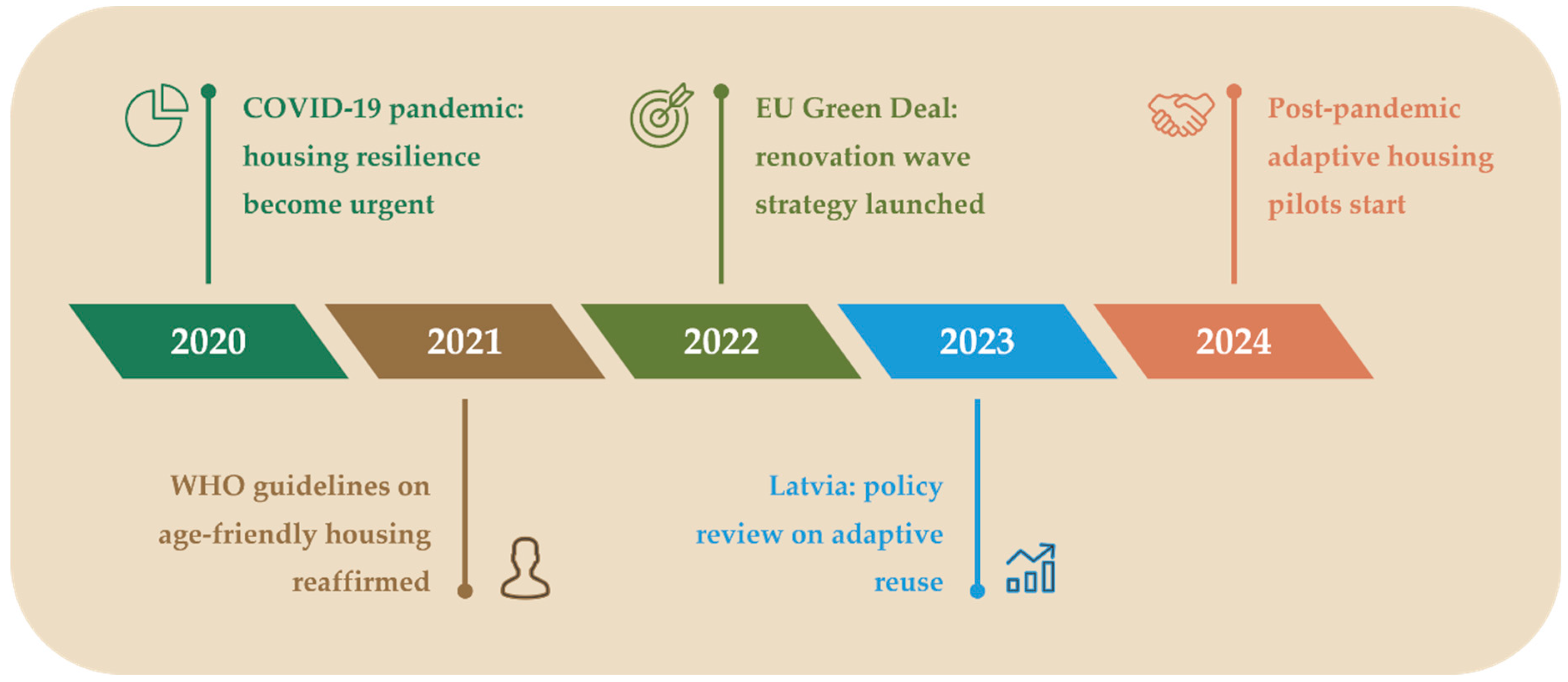
Figure 1, below, depicts the timeline of post-pandemic housing adaptations and European Union Green Deal initiatives that directly influence adaptive reuse policy across member states. It traces key milestones, including the 2020 launch of the Renovation Wave, successive updates to the Energy Performance of Buildings Directive, and related funding mechanisms scheduled through 2030. Presenting these events chronologically highlights how EU climate and housing strategies have converged to prioritise building renovation and energy efficiency. By situating Latvia’s housing challenges within this broader European framework, the figure underscores the external policy drivers that shape national feasibility, financing opportunities, and regulatory expectations for adaptive reuse.
Figure 1. Timeline of post-pandemic housing adaptations and EU Green Deal initiatives relevant to adaptive reuse.
In addition to sustainability benefits, adaptive reuse can offer economic advantages [39]. Renovation projects can be more cost-effective than new construction, particularly when utilising existing infrastructure such as foundations, utilities, and structural frames [40,41]. This approach is particularly attractive in contexts where land is scarce or expensive, or where urban densification is a policy priority. Nevertheless, adaptive reuse is not without challenges. High upfront renovation costs, complex building codes, and fragmented governance structures often deter developers from undertaking projects. Developers must navigate multiple regulatory frameworks, coordinate with municipal authorities, and secure financing that accounts for both construction risks and long-term maintenance needs. Social acceptability is another critical consideration. Community support for adaptive reuse projects may be limited if changes alter the neighbourhood character or reduce access to affordable housing [42].

2.4. Determinants of Adaptive Reuse

Research consistently highlights a set of determinants that shape the feasibility and success of adaptive reuse projects. Economic feasibility is typically the most immediate concern, encompassing the renovation costs, availability of financing, and anticipated return on investment. Developers must balance the upfront capital required for retrofitting with projected revenues, often under conditions of market uncertainty [2].
Regulatory clarity is another determinant. Ambiguities in building codes, zoning laws, and permitting processes can increase the project risk, delay timelines, and escalate costs. Municipalities that provide clear guidance, streamlined approval processes, and incentives for adaptive reuse are more likely to attract private investment [43].
Social acceptance also plays a critical role. Community engagement and participatory planning help ensure that projects align with local needs and values, reducing opposition and fostering legitimacy [44]. Projects that incorporate residents’ input and provide social benefits such as affordable housing or community spaces are more likely to succeed.
Environmental sustainability, while increasingly prioritised in policy frameworks, may be deprioritised in contexts where housing affordability crises dominate. Renovation techniques that minimise energy use, reduce waste, and incorporate green technologies can contribute to long-term environmental goals, but these measures may require additional investment and technical expertise [9]. Balancing economic, regulatory, social, and environmental determinants is therefore central to successful adaptive reuse interventions.

2.5. Age-Friendly Housing Design

Age-friendly housing design encompasses physical, social, and environmental wellbeing. The WHO [26] emphasises universal design elements as critical to maintaining mobility and independence.
Social inclusion is another pillar of age-friendly design. Housing that encourages intergenerational interaction, fosters community cohesion, and provides opportunities for engagement in social activities contributes to good mental health, reduces loneliness, and strengthens social networks [45,46]. Safe environments, including well-lit outdoor spaces, accessible pathways, and secure entrances, further promote confidence and autonomy. As population ageing intensifies, integrating these features into both new construction and adaptive reuse projects is becoming a high priority for policymakers and urban planners.

2.6. Analytical Approaches in Housing Studies

Methodologically, housing research has increasingly embraced mixed-methods approaches to capture the interplay between structural determinants and lived experiences [47]. Quantitative techniques, such as Exploratory Factor Analysis (EFA), enable the clustering of determinants, providing insight into the underlying dimensions of housing feasibility, sustainability, and social acceptability. Qualitative methods [48], including interviews, focus groups, and case studies, provide contextual depth, capturing residents’ perspectives and experiences, which cannot be reduced to numerical data.
Decision-support tools are also gaining traction in housing studies. Multi-Criteria Decision-Making (MCDM) frameworks allow policymakers and developers to weigh competing priorities—such as cost, environmental impact, and social benefit—in a systematic manner. Structural Equation Modelling (SEM) further enables the exploration of causal relationships between determinants, providing robust evidence for planning and investment decisions [49,50]. Integrating these analytical approaches ensures that both policy interventions and development projects are grounded in rigorous evidence while remaining sensitive to the human dimensions of housing.
Collectively, the literature underscores the interconnections between demographic pressures, historical legacies, economic constraints, and sustainability imperatives in shaping the provision of social housing for older adults. Age-friendly design principles, adaptive reuse strategies, and mixed-methods analytical approaches emerge as essential tools for addressing the complex challenges of ageing societies, particularly in shrinking urban contexts. Future research must continue to integrate these perspectives, exploring innovative policy mechanisms, financing models, and participatory processes that enhance the accessibility, affordability, and quality of social housing.

3. Methodology

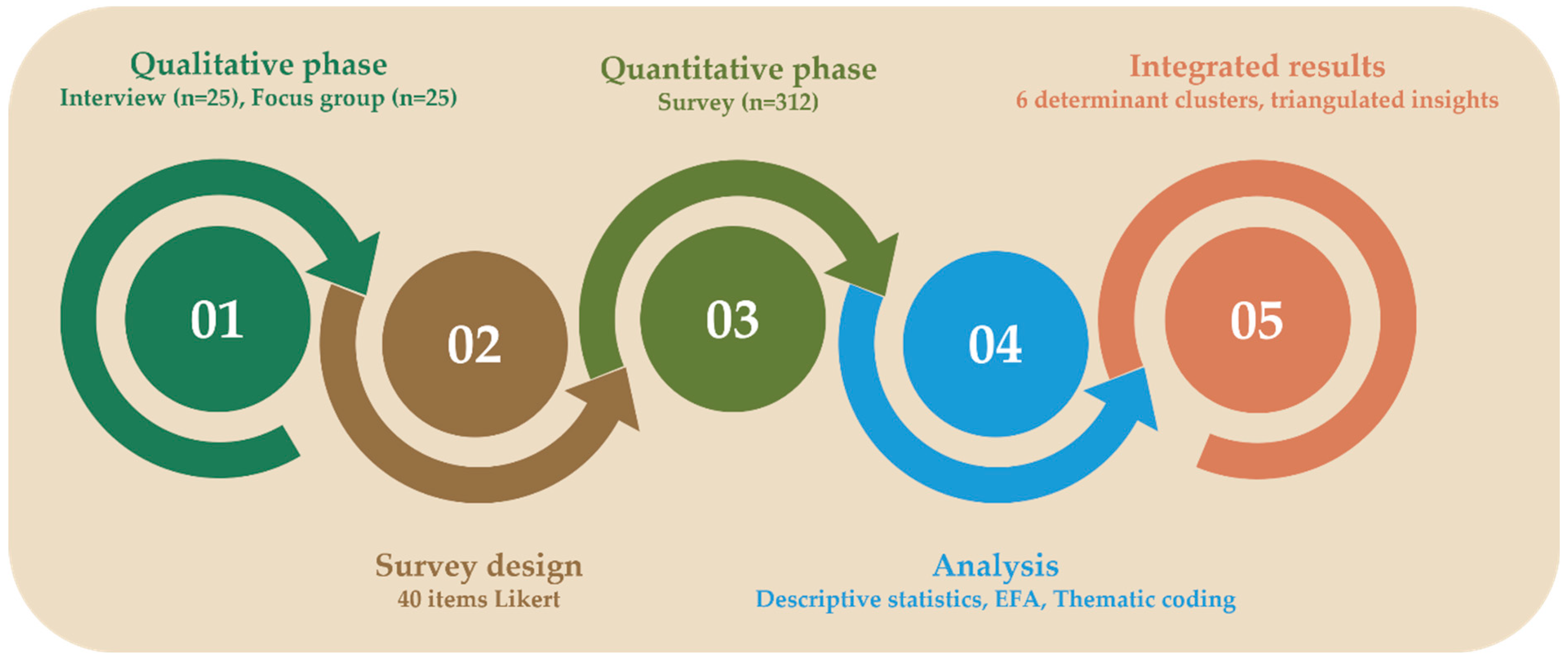
Figure 2 summarises the sequential mixed-methods design adopted in this study, beginning with qualitative data collection and moving toward integrated results. The diagram shows how policymaker and developer interviews, along with senior-resident focus groups, informed the construction of a 40-item survey. Subsequent quantitative analyses—descriptive statistics and Exploratory Factor Analysis—were then combined with thematic insights to generate a six-factor determinant model. Arrows indicate the iterative flow between phases, illustrating how early qualitative findings shaped survey content and how final integration enabled the triangulation of results. This visual roadmap clarifies the study’s methodological rigour and provides readers with a concise overview of the research steps involved.
Figure 2. Flow diagram of the sequential mixed-methods design (qualitative phase → survey design → quantitative phase → analysis → integrated results).
Figure 2 illustrates the study’s methodological progression of the study in five stages. Stage 01 represents the qualitative phase, comprising 25 policymakers and developers interviews in addition to focus groups with 25 senior residents. These insights informed Stage 02, where a 40-item survey instrument was constructed using Likert scales. Stage 03 marks the quantitative phase, with a survey distribution to 312 respondents throughout Latvia. Stage 04 encompasses parallel analytical procedures: descriptive statistics to identify priority determinants, Exploratory Factor Analysis (EFA) to extract latent factor structures, and thematic coding of qualitative transcripts. Finally, Stage 05 integrates the findings, producing six determinant groups validated through triangulation of quantitative patterns and qualitative stakeholder narratives. The iterative arrows between stages reflect how early qualitative insights directly shaped survey design and how final integration enabled cross-validation of results.

3.1. Research Design

This study employed a sequential mixed-methods design, combining qualitative and quantitative approaches to generate a comprehensive understanding of determinants influencing adaptive reuse for age-friendly social housing. The sequential design began with a qualitative phase consisting of semi-structured interviews and focus groups, which allowed for an in-depth exploration of stakeholder perspectives. This phase aimed to identify perceived barriers, enablers, and priorities in housing development, providing the contextual foundation necessary for designing a robust survey instrument. Insights from this phase informed the construction of survey items, ensuring they were grounded in real-world experiences and relevant to multiple stakeholder groups.
Following the qualitative phase, a quantitative phase was initiated, in which structured questionnaires were distributed to a broader sample of stakeholders. This allowed for systematic measurement of perceptions, priorities, and attitudes across diverse groups, including municipal officials, developers, and senior residents. By combining qualitative insights with quantitative validation, this study was able to capture both the richness of lived experiences and the generalizability of observed patterns. Analytical techniques integrated descriptive statistics, Exploratory Factor Analysis (EFA), and qualitative analysis of interview and focus group transcripts to provide a multi-dimensional understanding of the determinants affecting adaptive reuse projects.

3.2. Data Collection

Data collection involved three complementary methods: Interviews, focus groups, and surveys.
Interviews: Semi-structured interviews were conducted with 15 policymakers and 10 developers. These interviews explored perceptions of regulatory, financial, and social barriers, as well as potential enablers for successful adaptive reuse projects. Interviews allowed the participants to elaborate on nuanced challenges, such as fiscal constraints, legal ambiguities, and inter-stakeholder coordination issues, which are often difficult to capture through surveys alone.
The interviewees were selected through purpose sampling to ensure representation of key stakeholders in Latvia’s housing sector. Municipal officials and policymakers (n = 15) were identified from municipalities with active social housing programmes and developers (n = 10) were selected based on their experience with property renovation projects. Participants were contacted by email and interviews were conducted in person or by telephone as arranged. The semi-structured interview protocol (Appendix A) covered regulatory barriers, financing challenges, stakeholder coordination, and perceptions of the feasibility of adaptive reuse. The interviews lasted 15–20 min and detailed notes were taken during each session.
Focus groups: Three focus groups were conducted with a total of 25 senior residents across different municipalities. These discussions aimed to capture lived experiences, expectations, and preferences regarding social housing and adaptive reuse interventions. The focus groups provided insights into accessibility needs, perceptions of safety, and the social dimensions of housing, complementing the quantitative and interview data.
The focus group participants were recruited through purposive sampling targeting seniors in different housing situations in Latvia. Recruitment involved contacting senior care facilities, community centres, and professional associations for older adults by email. The focus group (n = 25) was held in a community setting and lasted approximately 20–30 min. The discussion followed the same semi-structured protocol as the interviews (Appendix A), covering regulatory barriers, financing challenges, accessibility needs, perceptions of adaptive reuse, and preferences for age-friendly design features. A moderator facilitated the discussion, while detailed notes were documented.
Surveys: Structured questionnaires were administered to 312 respondents across Latvia. The participants included municipal officers (58%), developers (24%), and seniors (18%). The survey contained 40 items measured on a five-point Likert scale, covering dimensions such as feasibility, design, and implementation strategies. The survey aimed to quantify stakeholder priorities, capture perceived challenges, and identify areas of consensus and divergence.
Survey participants were recruited through purpose and snowball sampling targeting three key stakeholder groups. Municipal officials and government employees were contacted through institutional email lists. Developers and real estate professionals were recruited through industry associations and professional networks. Senior residents were reached through senior care facilities, community centres, and housing organisations. The survey was distributed electronically and participants were invited to share it with their networks. The survey instrument is provided in Appendix B. Data collection occurred between July and December 2024, including interviews, focus groups, and survey distribution.
The 40-item survey instrument was developed based on key themes and determinants identified during the qualitative phase. The findings of the interview and focus group revealed stakeholder priorities and concerns, which were operationalized into measurable survey items. Additional items were drawn from established scales in the adaptive reuse and housing literature [43,51,52]. The survey was reviewed by the research team for content validity and clarity. The construct validity and internal consistency were assessed after collection by exploratory factor analysis (EFA), which confirmed a six-factor structure with strong reliability (Cronbach’s α = 0.78–0.89 for all factors). The KMO measure (0.84) and Bartlett’s test (p < 0.001) confirmed the suitability for factor analysis, supporting the validity of the survey’s construct.
To test whether the over-representation of municipal officers (58% of the survey sample) biased the results, we conducted two robustness checks. First, we re-ran the descriptive statistics and the six-factor Exploratory Factor Analysis (EFA) after excluding all responses from municipal officers. Second, we applied post-stratification weights to equalise the three stakeholder groups (municipal officers, developers, and seniors).
The composition of the survey sample—58% municipal officers, 24% developers, and 18% seniors—reflects the institutional and structural realities of Latvia’s housing governance system rather than a purely balanced distribution of stakeholder groups. Municipal officers were deliberately oversampled because they play a decisive role in planning, financing, and implementing social housing initiatives. In Latvia, as in many post-socialist contexts, municipalities are the central actors in determining whether adaptive reuse projects are feasible, as they control zoning, building permits, subsidies, and partnerships with private developers. Developers, while crucial for implementation, represent a smaller proportion of the overall decision-making ecosystem, as relatively few firms specialise in adaptive reuse in shrinking urban environments. Seniors, by contrast, were the most challenging group to recruit due to accessibility barriers, digital exclusion, and health limitations. Nevertheless, their inclusion was critical to ensuring that end-user perspectives informed the study, and targeted focus groups were used to compensate for their smaller survey representation.

3.3. Variables and Constructs

The six determinant categories were identified based on established frameworks in adaptive reuse and housing research, as well as insights from the qualitative phase. Site selection and feasibility analysis align with foundational adaptive reuse literature emphasising location and economic viability [1,2]. Design and planning criteria reflect age-friendly housing principles [26]. Implementation strategies, monitoring and evaluation, and scaling strategies emerged as critical governance dimensions during interviews with policymakers and developers, addressing the institutional challenges specific to post-socialist shrinking cities.
The survey examined determinants across six key categories.
  • Site selection: Considered proximity to healthcare facilities, public transport, and environmental safety.
  • Feasibility analysis: Evaluated costs, structural soundness, financing availability, and legal compliance.
  • Design and planning: Focused on universal design features, accessibility, and communal spaces.
  • Implementation strategies: Examined stakeholder engagement, risk management, and project phasing.
  • Monitoring and evaluation: Addressed key performance indicators, continuous review processes, and resident satisfaction measures.
  • Scaling strategies: Assessed replicability, policy incentives, and long-term framework considerations.

3.4. Analytical Procedures

Data analysis combined quantitative and qualitative techniques. Descriptive statistics, including means and standard deviations, were used to identify priority areas and highlight differences across stakeholder groups. Exploratory Factor Analysis (EFA) was employed to group survey items into coherent determinant clusters.
Exploratory Factor Analysis (EFA) was employed to identify the underlying factor structure of the 40-item survey instrument and to group related variables into coherent determinant clusters. Prior to conducting the analysis, sampling adequacy and data suitability were assessed. The Kaiser–Meyer–Olkin (KMO) measure of sampling adequacy was 0.84 (where KMO values > 0.80 indicate excellent sampling adequacy), exceeding the recommended minimum threshold of 0.70 and indicating that the data were appropriate for factor analysis. Similarly, Bartlett’s test of sphericity yielded a statistically significant result (χ2 = 2451.23, df = 780, p < 0.001), confirming that the correlation matrix was not an identity matrix and that factor analysis was appropriate. The test statistic is calculated as described in Equation (1):
X 2 =   n 1 2 p + 5 6 ln R
where n is sample size, p is number of variables, and R is the correlation matrix.
The analysis was conducted using the Principal Axis Factoring (PAF) extraction method. PAF was selected over Principal Component Analysis because the objective of the study was to uncover latent constructs rather than to merely reduce data dimensionality. To enhance the interpretability and achieve a simpler factor structure, a Varimax rotation was applied. Varimax, an orthogonal rotation method, was chosen because it maximises the variance of squared loadings across variables, resulting in clearer delineation between factors and minimising cross-loadings calculated as described in Equation (2):
V =   j [ ( i a i j 4 ) p ( i a i j 2 ) 2 p 2 ]
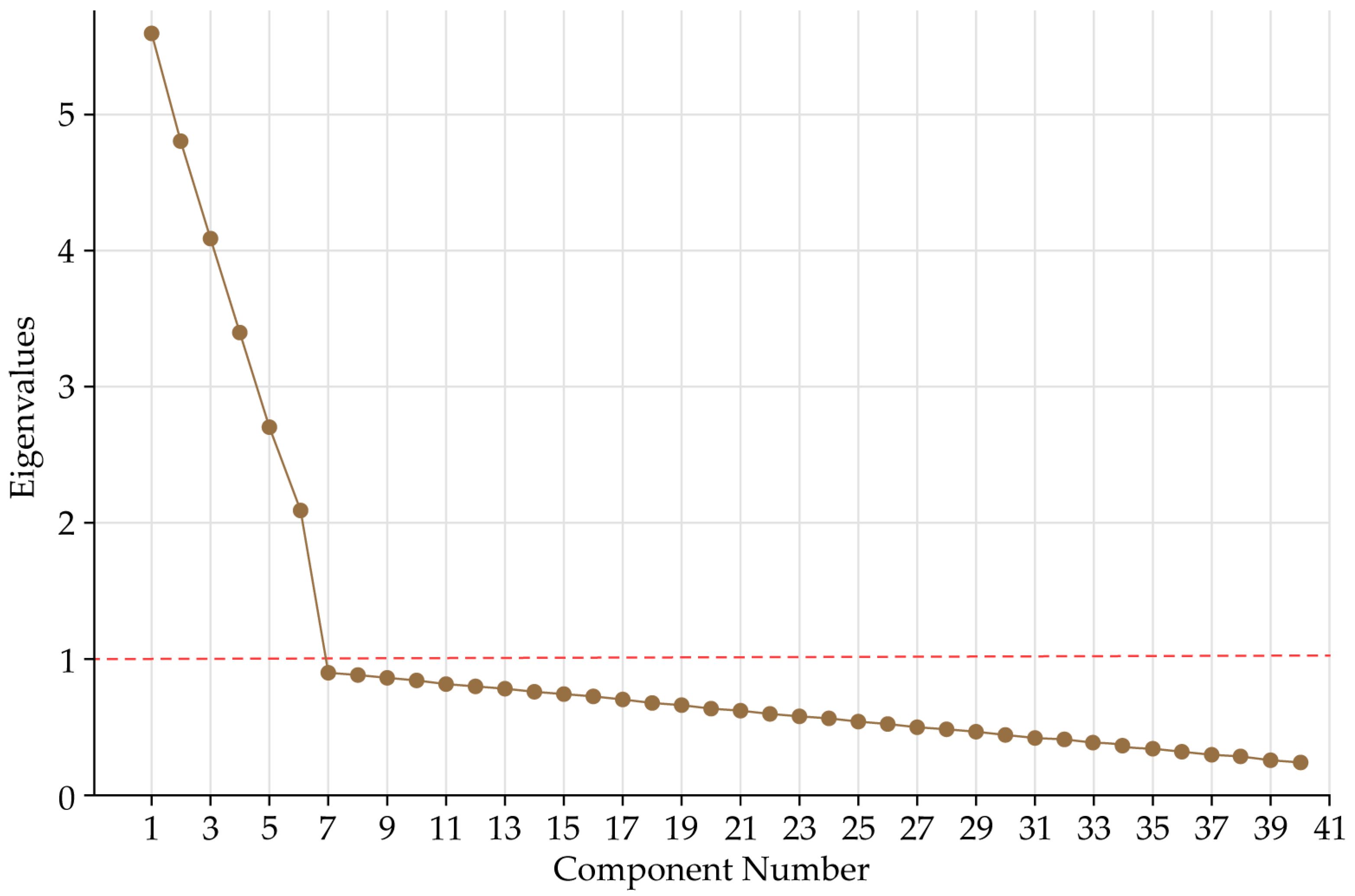
The criteria for factor retention were based on multiple considerations: (i) the Kaiser criterion (eigenvalues greater than 1.0); (ii) visual inspection of the scree plot, which displayed a distinct elbow at the sixth factor; and (iii) the theoretical interpretability of the resulting factor solution. Parallel analysis was also consulted to verify that the retained factors accounted for more variance than randomly generated datasets. Based on these criteria, a six-factor solution was retained, which collectively explained 71.6% of the total variance. Parallel analysis compares observed eigenvalues against those from randomly generated datasets with the same dimensions, retaining factors where λobserved > λrandom.
Each factor demonstrated strong internal consistency, with Cronbach’s alpha values ranging from 0.78 to 0.89. Factor loadings generally exceeded the 0.65 threshold, indicating high construct validity. The retained clusters corresponded to site selection, feasibility analysis, design and planning, implementation strategies, monitoring and evaluation, and scaling strategies. Together, these steps ensured that the EFA process was both methodologically rigorous and theoretically meaningful, providing a robust foundation for subsequent discussion and interpretation of the determinants influencing adaptive reuse in the Latvian housing context.
The ratio of participants to items is an important consideration in Exploratory Factor Analysis (EFA), as it influences the stability and generalisability of factor solutions. This study employed 312 respondents to analyse 40 survey items, resulting in a subject-to-item ratio of approximately 7.8:1. Although this ratio falls below the commonly recommended guideline of 10:1 (i.e., ten respondents per item), it exceeds the minimum threshold of 5:1, which is frequently cited as acceptable in social science research [53]. The methodological literature further indicates that when communalities are high, factor loadings are strong, and factors are well defined—as in this study—a lower ratio can still yield robust and interpretable results.
Qualitative data from the interviews and focus groups were analysed thematically, enabling triangulation with survey findings. Thematic coding highlighted points of tension between stakeholders, such as differing priorities between developers focused on cost-efficiency and seniors emphasising accessibility and social inclusion. Integrating these analytical approaches provided a robust, multi-layered understanding of the determinants shaping age-friendly adaptive reuse projects in Latvia.
All quantitative analyses, including descriptive statistics, reliability tests, and Exploratory Factor Analysis (EFA), were conducted using the Python programming language (version 3.11) with libraries including NumPy (version 2.3) for numerical operations, pandas (version 2.3.3) for data manipulation, scikit-learn (version 1.7.2) for factor analysis procedures, and statsmodels (version 0.14.5) for statistical testing. The use of open-source computational tools ensured transparency and reproducible results. Qualitative interview and focus group data were analysed manually using Braun and Clarke’s (2006) [54] six-phase thematic analysis framework: familiarisation with data, generating initial codes, searching for themes, reviewing themes, defining themes, and producing the report. Two researchers independently coded 20% of transcripts to ensure reliability (Cohen’s κ = 0.81). This combination of computational and manual approaches provided both statistical rigour and interpretive depth.

4. Results

4.1. Qualitative Insights

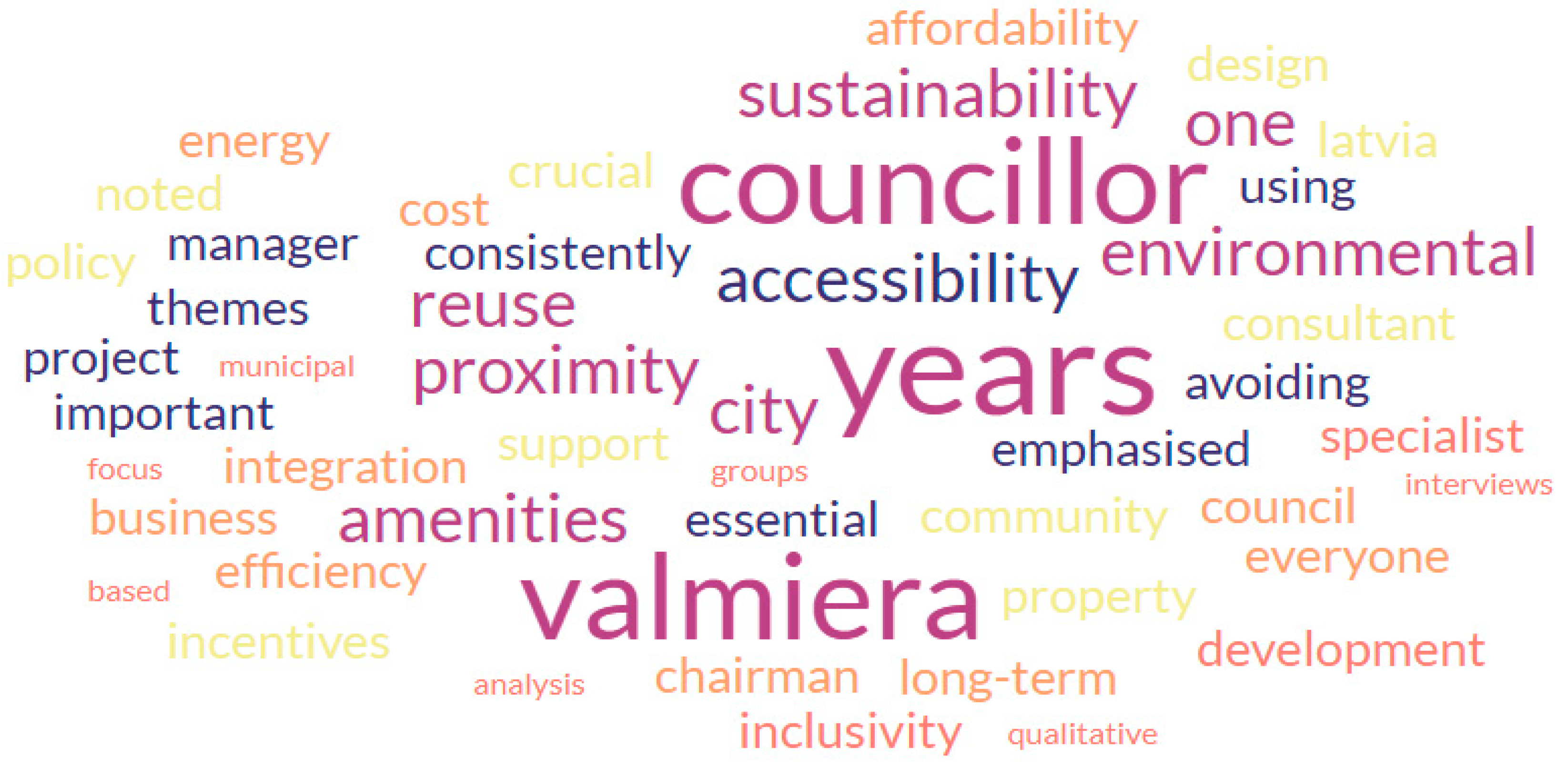
Figure 3 presents a word cloud generated from the qualitative interview and focus-group transcripts, with word size corresponding to the frequency of occurrence. Prominent terms such as “accessibility,” “affordability,” “governance,” and “community” visually underscore the central themes that emerged from participant narratives. The prominence of governance and trust-related terms reflects widespread concern about regulatory clarity and implementation capacity, while the frequent appearance of social-inclusion words reinforces seniors’ emphasis on dignity and community life. This visual synthesis complements the six-factor quantitative model by demonstrating how lived experiences and stakeholder perspectives converge around practical feasibility, design inclusivity, and the social dimensions of adaptive reuse.
Figure 3. Word cloud illustrating key themes from qualitative analysis (interviews and focus groups).
The qualitative analysis, based on interviews and focus groups with municipal officers, developers, and seniors, was conducted using Braun and Clarke’s (2006) [54] six-phase framework.
Seven overarching themes emerged from the data, each of which aligns with the quantitative factor structure while adding contextual depth.
  • Prioritising proximity to essential amenities: Stakeholders consistently stressed the importance of location. As one project manager observed, “Proximity to hospitals, clinics, and other healthcare facilities is particularly important for the elderly and families with young children. Access to grocery shops, pharmacies, and other daily necessities is also essential.” (Project Manager, VSAA, 4 years).
  • Incorporating environmental sustainability: Respondents emphasised avoiding environmentally hazardous sites. A Valmiera councillor stated, “Avoiding a high environmental impact is important. We ensure that environmental considerations are integrated into our assessments.” (Valmiera City Councillor, 23 years).
  • Regulatory and policy support: Policy clarity and incentives were seen as crucial. One consultant noted, “Tax incentives and local government support are necessary to make property reuse financially viable, especially in underdeveloped areas.” (Consultant, Latvia Sotheby’s International Realty, 30 years).
  • Community-centred design: Inclusive design and community integration were highlighted. A Cēsis Council Chairman commented, “We organise meetings, discussions, and surveys to involve everyone in the decision-making process.” (Council Chairman, 25 years).
  • Ensuring affordability: Cost was a recurring concern. A Valmiera councillor remarked, “Cost and proximity to amenities are crucial because they directly affect the affordability and quality of life in the housing.” (Valmiera City Councillor, 15 years).
  • Promoting sustainability and energy efficiency: Long-term energy efficiency was emphasised. As one business development specialist explained, “Sustainable practices, like using eco-friendly materials and technologies, not only benefit the environment but also lower long-term operational costs.” (Business Development Specialist, Latio, 18 years).
  • Enhancing accessibility and community integration: Accessibility and inclusivity were consistently raised. A Valmiera councillor noted, “We make it easy to use for everyone, providing amenities and designs that cater to different needs.” (Valmiera City Councillor, 15 years).
These themes reinforce the survey’s six-factor model, while participant voices illustrate the lived realities of adaptive reuse. Together, the findings highlight that beyond technical and financial feasibility, the social dimensions of accessibility, inclusivity, and sustainability are central to successful property reuse in Latvia.
The focus group participants emphasised lived experiences with housing challenges. Seniors prioritised physical accessibility, expressing concerns about buildings without elevators and narrow doors that restrict mobility. Affordability was a dominant concern, and participants noting that fixed pension income limits housing options. Social isolation emerged as a key theme, with seniors expressing their desire for housing that facilitates community interaction and intergenerational contact. The participants also emphasised the importance of proximity to healthcare and daily services, noting that transportation limitations make location critical. Regarding adaptive reuse, seniors showed cautious optimism but stressed the need for genuine consultation in design processes rather than top-down decision-making.

4.2. Survey Results: Descriptive Statistics

Sample Robustness: To test whether the over-representation of municipal officers (58% of the survey sample) biased the results. In both tests, the six-factor solution remained stable: factor loadings varied by less than 0.05 from the original model, Cronbach’s α values stayed within 0.02 of the reported range (0.78–0.89), and the classification of determinant groups was unchanged. The mean scores differed by no more than 0.12 on the five-point scale, and the implementation strategies continued to receive the highest scores between groups. These findings indicate that the study’s core conclusions are robust to the effects of sample composition, and the predominance of municipal officers did not materially influence the interpretation of determinants.
As shown in Table 1, items related to site accessibility (e.g., proximity to transport, healthcare facilities, and social amenities) and affordability consistently received the highest mean scores, often above 4.0. This suggests that respondents—particularly municipal officials and developers—consider these factors fundamental to assessing feasibility. In contrast, items associated with long-term scalability and environmental monitoring tended to score lower, with means above 3.5 but below 4.0, indicating that forward-looking or sustainability-focused dimensions were recognised but not prioritised as strongly.
Table 1. Descriptive statistics for considered parameters.
Standard deviations across most items were relatively low (≤0.80), indicating a high degree of consensus between respondents despite the heterogeneous sample. However, some items linked to community participation and design inclusivity displayed slightly higher variability, suggesting more divergence between stakeholder groups. For example, while seniors placed greater emphasis on accessibility and inclusive design, developers prioritised financial and regulatory feasibility items.
Overall, these descriptive findings highlight the prominence of immediate pragmatic considerations over longer-term strategic or environmental ones. They also underscore stakeholder differences in emphasis, which were further examined using subgroup analysis and qualitative insights. To uncover the latent structure behind these 40 observed variables and reduce them to more analytically tractable clusters, an Exploratory Factor Analysis was conducted.
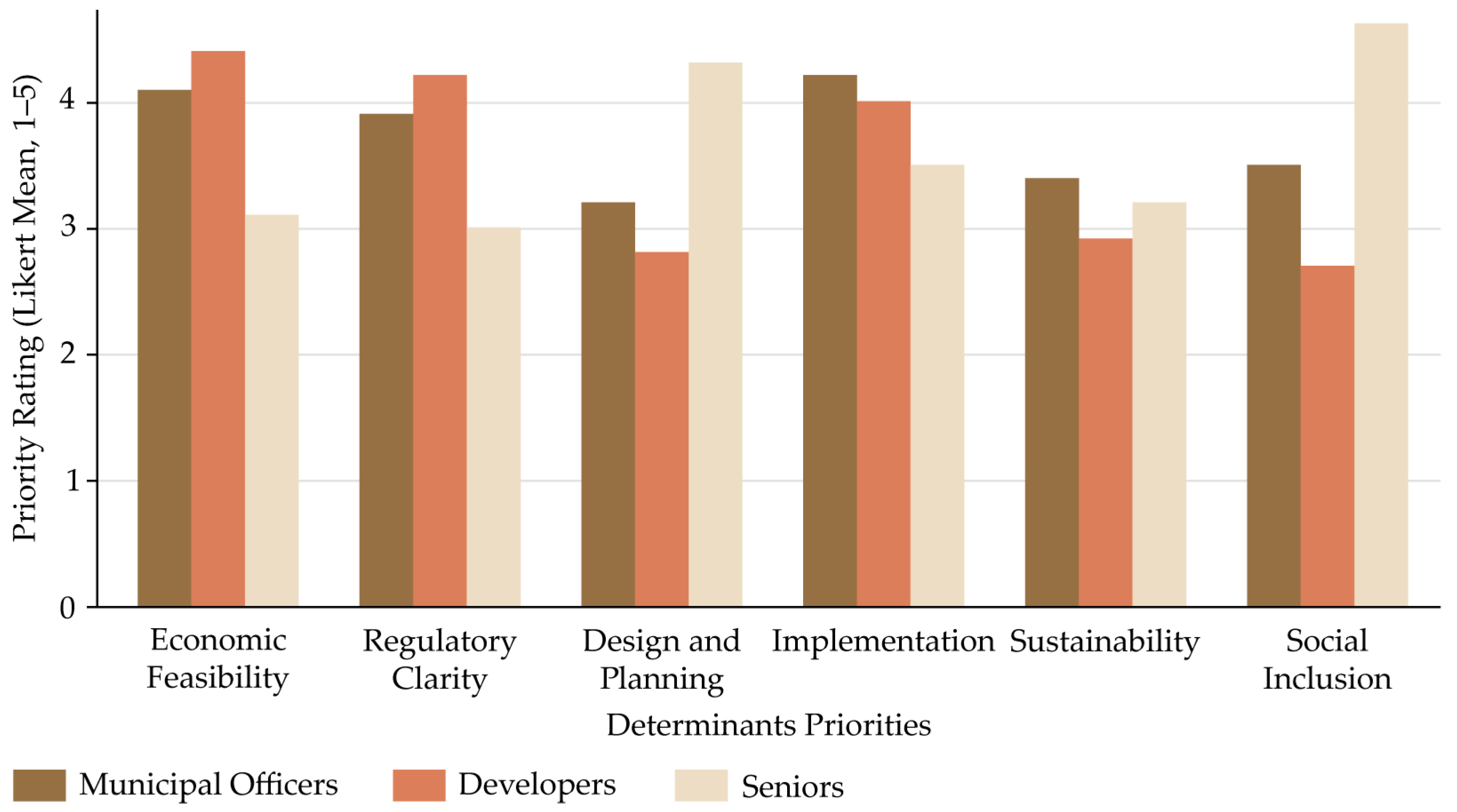
Figure 4, below, compares the average importance ratings assigned by the three stakeholder groups—municipal officers, private developers, and senior residents—across the six determinant clusters identified in the survey. Bar heights represent mean scores on a five-point Likert scale, enabling a direct visual comparison of priorities. The figure reveals that municipal officers emphasise regulatory clarity and implementation strategies, developers prioritise financial feasibility, and seniors value design inclusivity and community integration. Notably, environmental sustainability consistently ranks lower across all groups. By presenting these differences side-by-side, the chart highlights key areas of alignment and divergence that inform later discussion and policy recommendations.
Figure 4. Stakeholder comparison of determinant priorities (illustrative group-wise average).
Overall, the descriptive results indicate that affordability and implementation clarity are the top priorities, while sustainability and accessibility are secondary considerations.

4.3. Exploratory Factor Analysis (EFA)

While the descriptive statistics provided an overview of stakeholder ratings for each individual item, an Exploratory Factor Analysis (EFA) was performed to identify the latent constructs underlying the 40 determinants. Prior to extraction, the adequacy of the dataset for factor analysis was confirmed. The Kaiser–Meyer–Olkin (KMO) statistic was 0.84, exceeding the recommended minimum threshold of 0.70, and Bartlett’s test of sphericity indicated highly significance (χ2 = 2451.23, df = 780, p < 0.001), supporting the suitability of the correlation matrix for factor analysis.
The EFA was conducted using the Principal Axis Factoring (PAF) extraction method with Varimax rotation. Factor retention was guided by multiple criteria, including the Kaiser criterion (eigenvalues > 1.0), scree plot inspection, and the theoretical interpretability of the factor solution. Parallel analysis further supported the retention of six factors, which together explained 71.6% of the total variance. The extracted factor loadings are presented in Table 2.
Table 2. Summary of factor loadings for determinants of property reuse (n = 312).
Cronbach’s α values ranged from 0.78 to 0.89, indicating high internal consistency across factors. The robustness of this analysis is supported by several indicators. First, the Kaiser–Meyer–Olkin (KMO) statistic of 0.84 confirms strong sampling adequacy. Second, the result of Bartlett’s test of sphericity was highly significant (p < 0.001), validating the correlation matrix for factor analysis. Third, the extracted six-factor solution accounted for 71.6% of the total variance, and all Cronbach’s α coefficients ranged between 0.78 and 0.89, suggesting high reliability and internal consistency. Together, these metrics provide confidence that the factor structure is both statistically sound and theoretically meaningful despite the ratio being slightly below the ideal standard.
The factor structure reveals that while immediate concerns such as site accessibility and financial feasibility dominate, design inclusivity, sustainability, and long-term adaptability also emerge as meaningful clusters, although they are less strongly prioritised. This multidimensional framework provides a more holistic view of the determinants shaping adaptive reuse, bridging both pragmatic and forward-looking considerations.
Parallel analysis was used alongside the Kaiser criterion and scree plot inspection to confirm the number of latent factors. Consistent with the results reported earlier (Kaiser–Meyer–Olkin statistic = 0.84; Bartlett’s test of sphericity χ2 = 2451.23, df = 780, p < 0.001), the parallel analysis supported the retention of six factors, matching the point of inflection visible in the scree plot. This outcome aligns with the final model in Table 2, which explains 71.6% of the total variance and identifies the six determinant clusters: site selection, feasibility analysis, design and planning, implementation strategies, monitoring and evaluation, and scaling strategies.
Figure 5, below, shows the eigenvalues of the observed correlation matrix in descending order. The clear “elbow” after the sixth component indicates that additional factors contribute little unique variance, supporting the retention of six factors. The horizontal reference line marks the Kaiser criterion (eigenvalue = 1.0). This visual evidence complements the Kaiser–Meyer–Olkin statistic (0.84), Bartlett’s test of sphericity (χ2 = 2451.23, df = 780, p < 0.001), and parallel analysis outcomes, all of which confirm the six-factor solution reported in Table 2.
Figure 5. Scree plot of eigenvalues for the 40-item survey instrument (the horizontal dashed line indicates the Kaiser criterion threshold of eigenvalue = 1.0).
The six extracted clusters were conceptually coherent and demonstrated strong internal consistency, with Cronbach’s alpha values ranging from 0.78 to 0.89. The following clusters were identified:
  • Site selection (e.g., accessibility, proximity to services, environmental conditions);
  • Feasibility analysis (e.g., affordability, financing, cost–benefit considerations);
  • Design and planning (e.g., inclusivity, adaptability, architectural quality);
  • Implementation strategies (e.g., governance, regulatory clarity, partnership capacity);
  • Monitoring and evaluation (e.g., compliance checks, performance assessment);
  • Scaling strategies (e.g., replicability, long-term adaptability, policy alignment).

5. Discussion

5.1. Economic and Regulatory Dominance

This study’s findings confirm that economic feasibility and regulatory clarity remain the most influential determinants in adaptive reuse projects across all stakeholder groups, including seniors. Survey data showed that financing gaps were the lowest-rated item (M = 2.91), reflecting the persistent challenge of securing adequate capital for renovation and retrofitting initiatives. This finding aligns with broader scholarship, which identifies cost constraints as the most consistent barrier to adaptive reuse, particularly in contexts where market uncertainty and ageing housing stock coincide [2,55]. High upfront costs, combined with the unpredictability of return on investment, create a risk-averse environment that discourages developers from pursuing projects aimed at age-friendly adaptations.
Regulatory hurdles were also prominently cited across all participant groups, with a mean rating of M = 3.26. Ambiguities in building codes, zoning laws, and permitting procedures were repeatedly highlighted in interviews and focus groups as key obstacles that complicate planning and implementation. This echoes observations [56] of fragmented governance in transitional economies, where overlapping responsibilities between municipal, regional, and national authorities create uncertainty and slow decision-making. Developers and policymakers both noted that unclear regulations not only increase costs but also generate a lack of confidence in project feasibility. Consequently, these economic and regulatory dimensions act as gatekeepers, shaping which adaptive reuse initiatives are considered viable and which are abandoned before implementation.

5.2. The Centrality of Implementation Strategies

Interestingly, well-defined execution strategies emerged as the most consistently prioritised determinant across stakeholder groups, underscoring stakeholders’ demand for clear governance pathways. This finding extends the international literature by demonstrating that the capacity to implement effectively is as crucial as economic feasibility or regulatory compliance. In shrinking cities, where institutional capacity is often weak and resources are constrained, robust execution frameworks can be decisive in determining project outcomes [10,31,32]. In Austria, Vienna’s participatory social housing renovation programme demonstrates effective implementation frameworks through structured multi-stakeholder governance. The Wohnfonds Wien (Vienna Housing Fund) coordinates between municipal authorities, housing associations, and residents using transparent approval processes and phased project execution, successfully retrofitting over 220,000 units while maintaining affordability [57,58]. Similarly, the Netherlands corporatist housing model integrates housing associations, municipalities, and tenant organisations through formalised consultation mechanisms that reduce implementation delays and build stakeholder trust [59]. Execution strategies encompass structured project phasing, risk management protocols, and stakeholder coordination mechanisms, all of which reduce uncertainty and increase the likelihood of successful adaptation [60,61].
The prominence of implementation strategies also highlights the interplay between technical feasibility and organisational capacity. Projects that are economically viable and regulation-compliant may still fail if governance structures are insufficient to manage timelines, budgets, and stakeholder expectations. Therefore, studies on adaptive reuse must increasingly consider the institutional and procedural dimensions of project delivery as integral determinants rather than peripheral considerations.

5.3. Trust and Stakeholder Engagement

The qualitative findings from interviews with policymakers and developers, alongside focus groups with senior residents, revealed a significant trust deficit between developers and municipal authorities, which undermines collaboration and slows decision-making. Seniors expressed dissatisfaction with their exclusion from planning processes, emphasising that their perspectives on accessibility, social inclusion, and community integration were often overlooked. Conversely, developers criticised opaque permitting systems and inconsistent municipal support, highlighting the transactional rather than participatory nature of current housing governance.
These dynamics illustrate the mediating role of trust in adaptive reuse initiatives. Transparent processes, consistent communication, and inclusive decision-making were identified as prerequisites for fostering collaborative relationships. Other studies [62,63] similarly emphasise that trust and transparency are critical enablers of housing innovation, particularly in complex, multi-stakeholder environments. The findings suggest that policies promoting co-design and participatory planning could help reconcile divergent stakeholder priorities, improve project legitimacy, and ultimately enhance outcomes for end users.

5.4. Community Integration and Design

The Design and planning factor, which includes universal design features and communal spaces, resonated strongly with seniors but was comparatively undervalued by developers. This divergence indicates that while technical design considerations are recognised, the social dimensions of age-friendly housing—including intergenerational interaction, communal engagement, and safe neighbourhoods—require stronger policy emphasis. The WHO [26] stresses that social inclusion is fundamental to healthy ageing, reinforcing the necessity of centring seniors in both planning and design processes.
Ignoring these social aspects may result in technically functional but socially inadequate housing. Policies that mandate participatory design, coupled with incentives for developers to prioritise communal and accessibility features, can bridge this gap, ensuring that adaptive reuse initiatives meet both physical and psychosocial needs. The Netherlands’ housing association sector provides instructive examples: intergenerational housing models pair students with senior residents in exchange for reduced rent and companionship, addressing social isolation while maintaining financial sustainability. Germany’s ‘Mehrgenerationenhäuser’ (multigenerational houses) integrate communal spaces, shared services, and mixed-age programming within adaptive reuse projects, demonstrating that design for social interaction needs not compromise affordability when incorporated in the planning stage [29].

5.5. Environmental Sustainability as a Deferred Priority

Environmental sustainability consistently emerged as a lower priority (M ≈ 3.34) across stakeholder groups. Although EU frameworks advocate green housing transitions, affordability pressures in shrinking-city contexts such as Latvia often relegate environmental considerations to a secondary position. The focus on immediate economic feasibility and structural maintenance means that energy efficiency, resource-efficient construction, and low-carbon interventions are frequently postponed.
This finding aligns with those of [31,32], in which the authors argue that transitional economies often defer environmental objectives until basic housing affordability and safety are addressed. Although sustainability is acknowledged conceptually, practical implementation is constrained by financial limitations, policy enforcement gaps, and short-term planning horizons. This underscores the challenge of integrating environmental goals into adaptive reuse strategies without compromising accessibility and affordability.
Integrating environmental sustainability with affordability requires targeted financial mechanisms. EU funding instruments, including the Renovation Wave, Recovery and Resilience Facility, and updated Energy Performance of Buildings Directive (EPBD), provide opportunities to phase in energy efficiency upgrades without compromising housing accessibility. Blended finance models combining EU grants, national subsidies, and concessional loans can reduce initial renovation costs while ensuring compliance with climate obligations. Municipalities could prioritise adaptive reuse projects that demonstrate measurable energy performance improvements in, making them eligible for green bond financing or EU Just Transition Fund support. Policy frameworks that tie sustainability incentives to affordability thresholds (e.g., rent caps, income-targeted allocations) would help reconcile competing priorities identified in this study.

5.6. Contribution to Theory and Practice

This study contributes both theoretically and practically examining adaptive reuse determinants in shrinking, post-socialist housing systems. The findings illuminate misalignments between stakeholder priorities, particularly between seniors’ need for social inclusion and developers’ focus on cost efficiency. Notably, the prominence of implementation strategies as a determinant cluster underscores the importance of governance and procedural capacity, especially in contexts with low institutional strength.
This study advances previous research in three key respects. First, while previous adaptive reuse scholarship focuses predominantly on Western contexts [2,43,51], this research validates determinant frameworks in post-socialist shrinking cities where institutional fragmentation and privatisation legacy create distinct barriers. Second, unlike studies that prioritise economic or technical feasibility [39,40], our findings empirically demonstrate that implementation strategies and governance capacity are equally critical determinants, a dimension underexplored in the existing literature. Third, by integrating stakeholder perspectives between municipal officers, developers, and end users (seniors), this study reveals systematic misalignments in priorities: seniors emphasise social inclusion and design accessibility, while developers focus on regulatory clarity and cost efficiency. These divergences, documented through mixed-method triangulation, highlight the necessity of participatory frameworks that previous single-stakeholder studies have not captured.
By integrating both quantitative and qualitative evidence, this research offers actionable insights for policymakers, developers, and urban planners. It highlights the necessity of balancing economic, social, and environmental objectives while fostering trust, participatory planning, and structured execution. Ultimately, these contributions advance our understanding of adaptive reuse in post-socialist shrinking cities and provide a framework for developing age-friendly, sustainable, and socially responsive housing interventions.
While this framework emerged from Latvia’s post-socialist context, its determinants have applicability across the European Union, particularly where demographic ageing intersects with housing system pressures. Adaptation to Western European contexts would require modifications reflecting different institutional capacities: countries with mature social housing sectors (Austria, Netherlands, Denmark) [20,21] may prioritise design innovation and long-term sustainability metrics more heavily, while implementation strategies and trust-building—dominant concerns in Latvia—may be less critical where established governance frameworks exist. The EU’s Renovation Wave and updated Energy Performance of Buildings Directive [38] create convergent policy conditions that increase cross-national relevance, though financing mechanisms, regulatory clarity, and stakeholder coordination remain context-dependent determinants requiring localised assessment.
The six-factor determinant framework has broader applicability to post-socialist Central and Eastern European cities (Lithuania, Estonia, Bulgaria, Romania) sharing similar legacies: mass privatisation, Soviet-era housing stock, and concurrent population ageing with urban shrinkage. Beyond this region, shrinking cities in Germany, Japan, and the United States face analogous challenges, though stronger institutional frameworks and established social housing sectors may reduce the prominence of implementation strategies and trust deficits observed in Latvia. Future comparative research should validate this framework across multiple shrinking-city contexts.

5.7. Limitations

This study has several limitations. The over representation of municipal officers (58%) in the survey sample may weight findings toward institutional priorities, although robustness checks confirmed that the six-factor structure remained stable across stakeholder groups. The cross-sectional design limits causal inference, and the focus on Latvia restricts generalizability to other post-socialist contexts. Future research should employ longitudinal designs, ensure balanced stakeholder representation, and extend comparative analysis across multiple shrinking cities to validate and refine the determinant framework.

6. Conclusions

This study investigated the determinants of property reuse for age-friendly social housing in Latvia, a shrinking and ageing post-socialist context. Employing a sequential mixed-methods approach, the research identified six key determinant clusters: site selection, feasibility analysis, design and planning, implementation strategies, monitoring and evaluation, and scaling strategies. By integrating quantitative survey data with qualitative interviews and focus groups, this study provided a comprehensive understanding of the factors influencing adaptive reuse and highlighted stakeholder perspectives across municipal officials, developers, and seniors.
Economic feasibility emerged as the most critical barrier, with financing gaps receiving the lowest ratings (M = 2.91). This reflects broader challenges in transitional economies. Regulatory clarity was also essential, as ambiguities in codes, permitting, and zoning discourage developer participation and increase project risk. Notably, well-defined implementation strategies emerged as the highest-priority determinant, emphasising the centrality of governance capacity, structured project phasing, and risk management for project success.
The social dimensions of housing were equally significant. Seniors prioritised community integration, accessible design, and intergenerational engagement, yet these considerations were undervalued by developers, revealing a misalignment in stakeholder priorities. Environmental sustainability was consistently deferred due to pressing affordability concerns, illustrating the tension between green objectives and immediate housing needs in shrinking cities.
This study has limitations including oversampling by municipal officers (58%), although robustness checks confirmed factor stability, and a cross-sectional design that limits causal inference.
Policy recommendations include streamlining regulatory frameworks, fostering trust-based public–private partnerships, institutionalising participatory planning that actively involves seniors, and phasing in sustainability initiatives through targeted subsidies.
Future research should explore comparative cross-national studies in shrinking cities, conduct longitudinal evaluations of adaptive reuse interventions, and apply advanced decision-support tools such as Multi-Criteria Decision-Making (MCDM) and Structural Equation Modelling (SEM) to refine determinant prioritisation and guide evidence-based policy. Collectively, these strategies can support the development of age-friendly, socially inclusive, and economically viable housing solutions in post-socialist urban contexts.

Author Contributions

Conceptualization, R.J.S., J.C., I.G.; methodology, R.J.S., A.K., L.J., E.P., P.D.; validation, J.C., I.G., A.K., L.J., E.P., P.D.; investigation, R.J.S., L.J., E.P.; resources, R.J.S., I.G., J.C., A.K., L.J., E.P., P.D.; original draft preparation, R.J.S.; review, A.K., J.C., L.J., E.P., P.D.; supervision, J.C., I.G., A.K., P.D.; funding acquisition, R.J.S., I.G., E.P., P.D. All authors have read and agreed to the published version of the manuscript.

Funding

This work was supported by the EU Recovery and Resilience Facility within Project No 5.2.1.1.i.0/2/24/I/CFLA/003 “Implementation of consolidation and management changes at Riga Technical University, Liepaja University, Rezekne Academy of Technology, Latvian Maritime Academy and Liepaja Maritime College for the progress towards excellence in higher education, science and innovation” academic career doctoral grant (ID 1151).

Institutional Review Board Statement

This study followed ethical research principles. All participants provided informed consent before data collection. Personal data were anonymized and stored securely per GDPR requirements.

Data Availability Statement

The datasets generated and analysed during the current study are not publicly available due to participant confidentiality and GDPR restrictions. However, anonymised data can be made available from the corresponding author upon reasonable request.

Conflicts of Interest

The authors declare no conflicts of interest.

Appendix A. Semi-Structured Interview and Focus Group Protocol

This appendix presents the interview protocol used for semi-structured interviews with policymakers and developers, as well as focus group discussions with senior residents. The protocol was designed to explore the stakeholder perspectives on regulatory barriers, financing challenges, stakeholder coordination, and the feasibility of adaptive reuse for age-friendly social housing.
  • What economic challenges face you in developing age-friendly social housing?
  • What financing options and incentives are the most helpful for property reuse projects?
  • What do the current trends of the real estate market affect social housing affordability?
  • What demographic trends affect the demand for age-friendly social housing?
  • How do you engage the community and stakeholders in social housing projects?
  • What social acceptance challenges do you face in reusing properties for social housing?
  • How can energy efficiency be improved in social housing projects?
  • What practices do you recommend for better water conservation and waste management in social housing?
  • What sustainable materials and construction techniques are effective for property reuse projects?
  • How can the distribution and accessibility of social housing be improved for the aging population?
  • What urban planning and land use policies support age-friendly social housing?
  • What measures can address spatial inequality in social housing developments?
  • What regulatory and legal hurdles do you face in property reuse for social housing?
  • What technical and logistical challenges do you face in property reuse projects?
  • How can public perception and resistance to property reuse for social housing be effectively managed?

Appendix B. Survey Instrument

This appendix contains the survey questionnaire administered to respondents in Latvia. All elements were measured on a five-point Likert scale (1 = strongly disagree, 5 = strongly agree) and organised according to the six determinant categories identified in the study.

Appendix B.1. Economic Factors: Costs, Financing, and Market Dynamics

  • Development and construction costs are a significant barrier to the development of age-friendly social housing.
  • There are sufficient financing options and incentives available for property reuse projects in Latvia.
  • The trends of the real estate market currently support the affordability of social housing developments.
  • The development and construction costs influence the feasibility of age-friendly social housing.
  • The financial incentives provided by the government are adequate to promote the reuse of property for social housing.

Appendix B.2. Social Factors: Demographic Trends, Community Needs, and Public Perception

6.
The aging population in Latvia is adequately considered in social housing policies.
7.
Community involvement is crucial to the success of age-friendly social housing projects.
8.
Public awareness and acceptance are major challenges in implementing property reuse for social housing.
9.
The household characteristics of the aging population are well understood by policymakers.
10.
The community’s needs are effectively addressed in the design of age-friendly social housing.

Appendix B.3. Environmental Factors: Sustainability, Resource Efficiency, and Green Building Practices

11.
Energy efficiency measures are well integrated into current social housing projects.
12.
There is a need for better water conservation and waste management practices in social housing.
13.
Sustainable materials and construction techniques are prioritized in property reuse projects.
14.
The integration of renewable energy sources is a priority in the development of social housing.
15.
Environmental sustainability is a key consideration in the planning of age-friendly social housing.

Appendix B.4. Spatial Design and Inequality in Age-Friendly Social Housing

16.
The distribution and accessibility of social housing meet the needs of the aging population.
17.
Urban planning and land use policies support the development of age-friendly social housing.
18.
Spatial inequality is a significant issue in the development of age-friendly social housing.
19.
Public buildings and spaces are accessible to people of different physical abilities.
20.
Conveniently located emergency care centers are available to older adults.

Appendix B.5. Challenges and Barriers to Property Reuse for Social Housing

21.
Regulatory and legal hurdles significantly impede the reuse for social housing.
22.
Technical and logistical challenges are the main barriers to implementing property reuse projects.
23.
Public perception and resistance hinder the success of property reuse for social housing.
24.
Implementing a property reuse system requires significant changes in current policies.
25.
The reuse for social housing is perceived positively by the general public.

Appendix B.6. Integration and Overall Impact

26.
The proposed property reuse system will significantly improve the affordability of social housing.
27.
The proposed system will improve the sustainability of social housing projects.
28.
Energy efficiency will be a key benefit of the property reuse system.
29.
The property reuse system will ensure better accessibility for the aging population.
30.
The proposed system will foster community integration and resilience.

Appendix B.7. Specific Features and Services

31.
The stairs are in good condition and accessible for wheelchairs or other assistive mobility devices.
32.
Public transportation is accessible and convenient for older adults.
33.
Affordable housing options are available for adults of varying income levels.
34.
Well-maintained parks with enough benches are available in the community.
35.
The health facilities are well-maintained and conveniently located.
36.
Social and cultural activities are specifically geared toward older adults.
37.
Affordable health and wellness programs are available for older adults.
38.
There are adequate job training opportunities for older adults who want to learn new skills.
39.
Maintenance services for housing are affordable and reliable.
40.
The community is well informed about available local volunteer opportunities available.

References

  1. Langston, C.; Wong, F.K.; Hui, E.C.; Shen, L.Y. Strategic assessment of building adaptive reuse opportunities in Hong Kong. Build. Environ. 2008, 43, 1709–1718. [Google Scholar] [CrossRef]
  2. Bullen, P.A.; Love, P.E.D. Adaptive reuse of heritage buildings. Struct. Surv. 2011, 29, 411–421. [Google Scholar] [CrossRef]
  3. Meng, F.; Zhi, Y.; Pang, Y. Assessment of the Adaptive Reuse Potentiality of Industrial Heritage Based on Improved Entropy TOPSIS Method from the Perspective of Urban Regeneration. Sustainability 2023, 15, 7735. [Google Scholar] [CrossRef]
  4. Nicolini, E. Climate change adaptation and mitigation and historic centers preservation. Underway and repeatable technological design solutions. Cities 2024, 152, 105174. [Google Scholar] [CrossRef]
  5. Angrisano, M.; Bosone, M.; Assunta, M.; Gravagnuolo, A. Adapting Historic Cities Towards the Circular Economy: Technologies and Materials for Circular Adaptive Reuse of Historic Buildings BT—The Future of Liveable Cities; Fusco Girard, L., Kourtit, K., Nijkamp, P., Eds.; Springer International Publishing: Cham, Switzerland, 2023; pp. 91–125. ISBN 978-3-031-37466-1. [Google Scholar]
  6. Raven, R.; Lane, R.; Lindsay, J.; Reynolds, D.; Kronsell, A. Household innovation and agency in sustainability transitions. Environ. Innov. Soc. Transit. 2025, 56, 100987. [Google Scholar] [CrossRef]
  7. Moore, T.; Doyon, A. Providing Sustainable Housing Through Sustainability Transitions BT—A Transition to Sustainable Housing: Progress and Prospects for a Low Carbon Housing Future; Moore, T., Doyon, A., Eds.; Springer Nature: Singapore, 2023; pp. 123–146. ISBN 978-981-99-2760-9. [Google Scholar]
  8. Sorensen, A.; Brenner, A.-K. Cities, Urban Property Systems, and Sustainability Transitions: Contested Processes of Institutional Change and the Regulation of Urban Property Development. Sustainability 2021, 13, 8429. [Google Scholar] [CrossRef]
  9. Ikiz Kaya, D.; Pintossi, N.; Koot, C.A.M. Adaptive Reuse of Cultural Heritage: Barrier Assessment and Policy-Related Recommendations BT—Adaptive Reuse of Cultural Heritage: Circular Business, Financial and Governance Models; Fusco Girard, L., Gravagnuolo, A., Eds.; Springer International Publishing: Cham, Switzerland, 2025; pp. 379–407. ISBN 978-3-031-67628-4. [Google Scholar]
  10. Sechi, G.; Golubchikov, O. Neoliberalism as space fragmentation: A Lefebvrian gaze at post-socialist urban transitions. Urban Stud. 2025, 62, 2725–2747. [Google Scholar] [CrossRef]
  11. Tsenkova, S.; Polanska, D.V. Between state and market: Housing policy and housing transformation in post-socialist cities. GeoJournal 2014, 79, 401–405. [Google Scholar] [CrossRef]
  12. Central Statistical Bureau of Latvia Number of Population in Latvia in 2024. Available online: https://stat.gov.lv/en/statistics-themes/population/population/press-releases/22900-number-population-latvia-2024?themeCode=IR (accessed on 1 October 2025).
  13. Sanchaniya, R.; Geipele, I. Identifying Existing Properties for Reuse Into Social Housing. Eng. Rural Dev. 2023, 22, 100–107. [Google Scholar] [CrossRef]
  14. Sanchaniya, R.J.; Geipele, I.; Kundziņa, A.; Černeckienė, J. Key Factors and Strategies for Implementing Property Reuse Systems in Age-Friendly Social Housing Development. Arch. Urban Plan. 2025, 21, 139–150. [Google Scholar] [CrossRef]
  15. Lulle, A. (Post-)Socialist Housing and Aging in Neoliberal Riga. Urban Plan. 2024, 9. [Google Scholar] [CrossRef]
  16. Gentile, M.; Sjöberg, Ö. Spaces of Priority: The Geography of Soviet Housing Construction in Daugavpils, Latvia. Ann. Assoc. Am. Geogr. 2010, 100, 112–136. [Google Scholar] [CrossRef]
  17. Krišjāne, Z.; Bērziņš, M. Intra-urban residential differentiation in the post-Soviet city: The case of Riga, Latvia. Hung. Geogr. Bull. 2014, 63, 235–253. [Google Scholar] [CrossRef]
  18. Rasnaca, L.; Rezgale-Straidoma, E. Housing vulnerability for seniors in Latvia. Res. Rural Dev. 2019, 2, 225–231. [Google Scholar] [CrossRef]
  19. OECD. OECD Affordable Housing Database. Available online: https://www.oecd.org/en/data/datasets/oecd-affordable-housing-database.html (accessed on 1 October 2025).
  20. Ay, D.; Götze, V. Housing for “ageing in place”: Urban densification projects and the provision of age-appropriate housing in Switzerland. Cities 2025, 167, 106304. [Google Scholar] [CrossRef]
  21. Rogelj, V.; Bogataj, D.; Bogataj, M.; Campuzano-Bolarín, F.; Drobež, E. The Role of Housing in Sustainable European Long-Term Care Systems. Sustainability 2023, 15, 3075. [Google Scholar] [CrossRef]
  22. Van Hoof, J.; Kazak, J.K.; Perek-Białas, J.M.; Peek, S.T.M. The Challenges of Urban Ageing: Making Cities Age-Friendly in Europe. Int. J. Environ. Res. Public Health 2018, 15, 2473. [Google Scholar] [CrossRef] [PubMed]
  23. Eurostat More than 10% of Households in Romania, Latvia and Bulgaria Were Three-Generation in 2008. Available online: https://ec.europa.eu/eurostat/documents/3433488/5579620/KS-SF-11-052-EN.PDF (accessed on 2 March 2025).
  24. United Nations. Living Arrangements of Older Persons Around the World. Available online: https://www.un.org/en/development/desa/population/publications/pdf/popfacts/PopFacts_2019-2.pdf (accessed on 2 March 2025).
  25. LSM.lv 41% of Latvian Households Are of Just One Person. Available online: https://eng.lsm.lv/article/society/society/41-of-latvian-households-are-of-just-one-person.a414323/ (accessed on 23 October 2025).
  26. World Health Organization (WHO). Global Age-Friendly Cities: A Guide. Available online: https://www.who.int/publications/i/item/9789241547307 (accessed on 2 March 2025).
  27. Suragarn, U.; Hain, D.; Pfaff, G. Approaches to enhance social connection in older adults: An integrative review of literature. Aging Health Res. 2021, 1, 100029. [Google Scholar] [CrossRef]
  28. Hossen, M.S.; Mohd Pauzi, H.; Salleh, S.F. Enhancing elderly well-being through age-friendly community, social engagement and social support. Am. J. Sci. Educ. Res. 2023, 192, 1–10. [Google Scholar]
  29. Whear, R.; Campbell, F.; Rogers, M.; Sutton, A.; Robinson-Carter, E.; Sharpe, R.; Cohen, S.; Fergy, R.; Garside, R.; Kneale, D.; et al. What is the effect of intergenerational activities on the wellbeing and mental health of older people?: A systematic review. Campbell Syst. Rev. 2023, 19, e1355. [Google Scholar] [CrossRef]
  30. Yu, C.; Lee, Y. Housing requirements for a ageing society. Indoor Built Environ. 2017, 26, 441–446. [Google Scholar] [CrossRef]
  31. Lowe, S.; Tsenkova, S. Housing Change in East and Central Europe: Integration or Fragmentation? Ashgate (now Routledge): Aldershot, UK, 2003; ISBN 978-0-7546-1814-0. [Google Scholar]
  32. Rink, D.; Couch, C.; Haase, A.; Krzysztofik, R.; Nadolu, B.; Rumpel, P. The governance of urban shrinkage in cities of post-socialist Europe: Policies, strategies and actors. Urban Res. Pract. 2014, 7, 258–277. [Google Scholar] [CrossRef]
  33. Eva, M.; Cehan, A.; Lazăr, A. Patterns of Urban Shrinkage: A Systematic Analysis of Romanian Cities (1992–2020). Sustainability 2021, 13, 7514. [Google Scholar] [CrossRef]
  34. Foster, G. Circular economy strategies for adaptive reuse of cultural heritage buildings to reduce environmental impacts. Resour. Conserv. Recycl. 2020, 152, 104507. [Google Scholar] [CrossRef]
  35. Meng, F.; Xiao, X. Spatiotemporal Distribution and Adaptive Reuse Results Assessment of Beijing Industrial Heritage Based on the Sustainable Renewal Perspective. Land 2025, 14, 384. [Google Scholar] [CrossRef]
  36. Nocca, F.; Bosone, M.; Orabona, M. Multicriteria Evaluation Framework for Industrial Heritage Adaptive Reuse: The Role of the ‘Intrinsic Value’. Land 2024, 13, 1266. [Google Scholar] [CrossRef]
  37. Song, J.; Chen, J.; Yang, X.; Zhu, Y. Research on Adaptive Reuse Strategy of Industrial Heritage Based on the Method of Social Network. Land 2024, 13, 383. [Google Scholar] [CrossRef]
  38. European Commission. Renovation Wave. Available online: https://energy.ec.europa.eu/topics/energy-efficiency/energy-performance-buildings/renovation-wave_en (accessed on 2 March 2025).
  39. Tam, V.W.Y.; Hao, J.J.L. Adaptive reuse in sustainable development. Int. J. Constr. Manag. 2019, 19, 509–521. [Google Scholar] [CrossRef]
  40. Galimshina, A.; Moustapha, M.; Hollberg, A.; Padey, P.; Lasvaux, S.; Sudret, B.; Habert, G. What is the optimal robust environmental and cost-effective solution for building renovation? Not the usual one. Energy Build. 2021, 251, 111329. [Google Scholar] [CrossRef]
  41. Liao, H.; Ren, R.; Li, L. Existing Building Renovation: A Review of Barriers to Economic and Environmental Benefits. Int. J. Environ. Res. Public Health 2023, 20, 4058. [Google Scholar] [CrossRef] [PubMed]
  42. Lanz, F.; Pendlebury, J. Adaptive reuse: A critical review. J. Archit. 2022, 27, 441–462. [Google Scholar] [CrossRef]
  43. Savoie, É.; Sapinski, J.P.; Laroche, A.M. Key factors for revitalising heritage buildings through adaptive reuse. Build. Cities 2025, 6, 103–120. [Google Scholar] [CrossRef]
  44. Remøy, H.; Van Der Voordt, T. Adaptive reuse of office buildings into housing: Opportunities and risks. Build. Res. Inf. 2014, 42, 381–390. [Google Scholar] [CrossRef]
  45. van Hoof, J.; Marston, H.R. Age-Friendly Cities and Communities: State of the Art and Future Perspectives. Int. J. Environ. Res. Public Health 2021, 18, 1644. [Google Scholar] [CrossRef] [PubMed]
  46. Salmistu, S.; Kotval, Z. Spatial interventions and built environment features in developing age-friendly communities from the perspective of urban planning and design. Cities 2023, 141, 104417. [Google Scholar] [CrossRef]
  47. Rana, K.; Kent, J.L.; Page, A. Housing inequalities and health outcomes among migrant and refugee populations in high-income countries: A mixed-methods systematic review. BMC Public Health 2025, 25, 1098. [Google Scholar] [CrossRef]
  48. Brown, P.; Gill, S.; Halsall, J.P. The impact of housing on refugees: An evidence synthesis. Hous. Stud. 2024, 39, 227–271. [Google Scholar] [CrossRef]
  49. Arif, F.; Tahir, S. Housing sector risk assessment using structural equation modeling for small-to-medium sized construction companies and builders in urban areas. Int. J. Constr. Manag. 2025, 25, 1058–1071. [Google Scholar] [CrossRef]
  50. Chen, X.; Song, J. Influence Path Analysis of Rural Household Portfolio Selection: A Empirical Study Using Structural Equation Modelling Method. J. Real Estate Financ. Econ. 2022, 64, 298–322. [Google Scholar] [CrossRef]
  51. Vardopoulos, I. Adaptive Reuse for Sustainable Development and Land Use: A Multivariate Linear Regression Analysis Estimating Key Determinants of Public Perceptions. Heritage 2023, 6, 809–828. [Google Scholar] [CrossRef]
  52. Glumac, B.; Islam, N. Housing preferences for adaptive re-use of office and industrial buildings: Demand side. Sustain. Cities Soc. 2020, 62, 102379. [Google Scholar] [CrossRef]
  53. Boateng, G.O.; Neilands, T.B.; Frongillo, E.A.; Melgar-Quiñonez, H.R.; Young, S.L. Best Practices for Developing and Validating Scales for Health, Social, and Behavioral Research: A Primer. Front. Public Health 2018, 6, 149. [Google Scholar] [CrossRef]
  54. Braun, V.; Clarke, V. Using thematic analysis in psychology. Qual. Res. Psychol. 2006, 3, 77–101. [Google Scholar] [CrossRef]
  55. Sanchaniya, R.J.; Černeckienė, J.; Gudumasu, N.S.; Kundziņa, A. Adaptive Property Reuse for Social Housing: Benefits, Challenges, and Best Practices. Balt. J. Real Estate Econ. Constr. Manag. 2025, 13, 1–9. [Google Scholar] [CrossRef]
  56. Dixon, T.J.; Karuri-Sebina, G.; Ravetz, J.; Tewdwr-Jones, M. Re-imagining the future: City-region foresight and visioning in an era of fragmented governance. Reg. Stud. 2023, 57, 609–616. [Google Scholar] [CrossRef]
  57. Peverini, M. Vienna: A Strategic Welfare and Planning Approach Targeting Housing Affordability BT—Promoting Rental Housing Affordability in European Cities: Learning from the Cases of Milan and Vienna; Peverini, M., Ed.; Springer Nature: Cham, Switzerland, 2023; pp. 57–79. ISBN 978-3-031-43692-5. [Google Scholar]
  58. Kössl, G. Affordable Housing and Social Inclusion—The Case of Vienna and Austria. In Future Urban Habitation: Transdisciplinary Perspectives, Conceptions, and Designs; Wiley: Hoboken, NJ, USA, 2022; pp. 115–129. ISBN 9781119734895. [Google Scholar]
  59. Cooper, A.; Kurzer, P. Similar Origins—Divergent Paths: The Politics of German and Dutch Housing Markets. Ger. Polit. 2023, 32, 341–360. [Google Scholar] [CrossRef]
  60. Sanchaniya, R.J.; Asif, S.A.S.; Geipele, I. Role of Real Estate Management Firms Toward Sustainability in India. Civ. Environ. Eng. 2023, 19, 511–519. [Google Scholar] [CrossRef]
  61. Jaymin-Sanchaniya, R.; Thomson, D.; Kundzina, A.; Geipele, I. Effective Project Management Practices in Construction Industry: Quantitative Study. Eng. Rural Dev. 2024, 23, 85–92. [Google Scholar] [CrossRef]
  62. Ganeshu, P.; Fernando, T.; Keraminiyage, K. Barriers to, and Enablers for, Stakeholder Collaboration in Risk-Sensitive Urban Planning: A Systematised Literature Review. Sustainability 2023, 15, 4600. [Google Scholar] [CrossRef]
  63. Malik, S.; Roosli, R.; Yusof, N. Institutional stakeholder collaborations (ISCs): A conceptual framework for housing research. J. Hous. Built Environ. 2022, 37, 213–239. [Google Scholar] [CrossRef]
Disclaimer/Publisher’s Note: The statements, opinions and data contained in all publications are solely those of the individual author(s) and contributor(s) and not of MDPI and/or the editor(s). MDPI and/or the editor(s) disclaim responsibility for any injury to people or property resulting from any ideas, methods, instructions or products referred to in the content.

Article Metrics

Citations

Article Access Statistics

Multiple requests from the same IP address are counted as one view.