Article

Homestead, Urban Homeownership and Long-Term Residence of Rural–Urban Migrants: Evidence from China

1
School of Business, Anhui University of Technology, Ma’anshan 243032, China
2
College of Public Finance and Investment, Shanghai University of Finance and Economics, Shanghai 200433, China
3
School of Economics, Nanjing University of Posts and Telecommunications, Nanjing 210023, China
4
School of Architecture and the Built Environment, KTH Royal Institute of Technology, 100 44 Stockholm, Sweden
*
Author to whom correspondence should be addressed.
Land 2026, 15(1), 9; https://doi.org/10.3390/land15010009 (registering DOI)
Submission received: 5 November 2025 / Revised: 16 December 2025 / Accepted: 18 December 2025 / Published: 20 December 2025

Abstract

This study utilizes the push–pull framework to examine the impact of homestead and urban homeownership on Chinese migrants’ willingness to settle in urban areas in the long term, as well as the moderating role of local homeownership. The results show that homestead has a significant pushing effect on migrants’ long-term residence, whereas local homeownership has a significant pulling and positive moderating effect. In addition, we conducted multiple robustness tests to confirm the validity of our findings. Moreover, urban homeownership exerts significantly heterogeneous effects on long-term migration across different ages, income levels and regions. Also, migrants who own homesteads and housing are more inclined to relocate to urban areas within the same provinces rather than moving to major cities. Furthermore, we identified the mechanism that local homeownership promotes social integration, which, in turn, strengthens migrants’ long-term residence intentions in urban areas. This study enriches research on China’s land systems and urban migration and aims to shed light on enhancing existing migrant welfare, optimizing housing policies and facilitating urban integration.

1. Introduction

Globally, issues of migration and settlement have been widely discussed over the past few decades. For instance, internal migration in Australia, the United States and Europe shows that migration and settlement are always embedded in specific spaces and places and different types of regions have distinct migration and settlement patterns [1,2,3,4,5]. In destination countries, homeownership is a key indicator of long-term commitment to place and an important driver of settlement intentions, which secures migrants’ legal status and strong local ties, and a lower probability of returning to the place of origin [5,6,7]. In addition, migrant long-term settlement decisions depend on the balance between integration in the societal destination and continued ties to origin. Higher sociocultural integration in destinations is usually associated with lower intentions to return to origins [8,9]. Migrants often face physical and social segregation, which is regarded as an exclusion, reinforcing inequality and relative deprivation. In this sense, inclusive institutions and community networks are important for integration outcomes [10,11]. Together, these findings suggest that spatial context, housing tenure and social integration are central elements in understanding long-term settlement behavior.
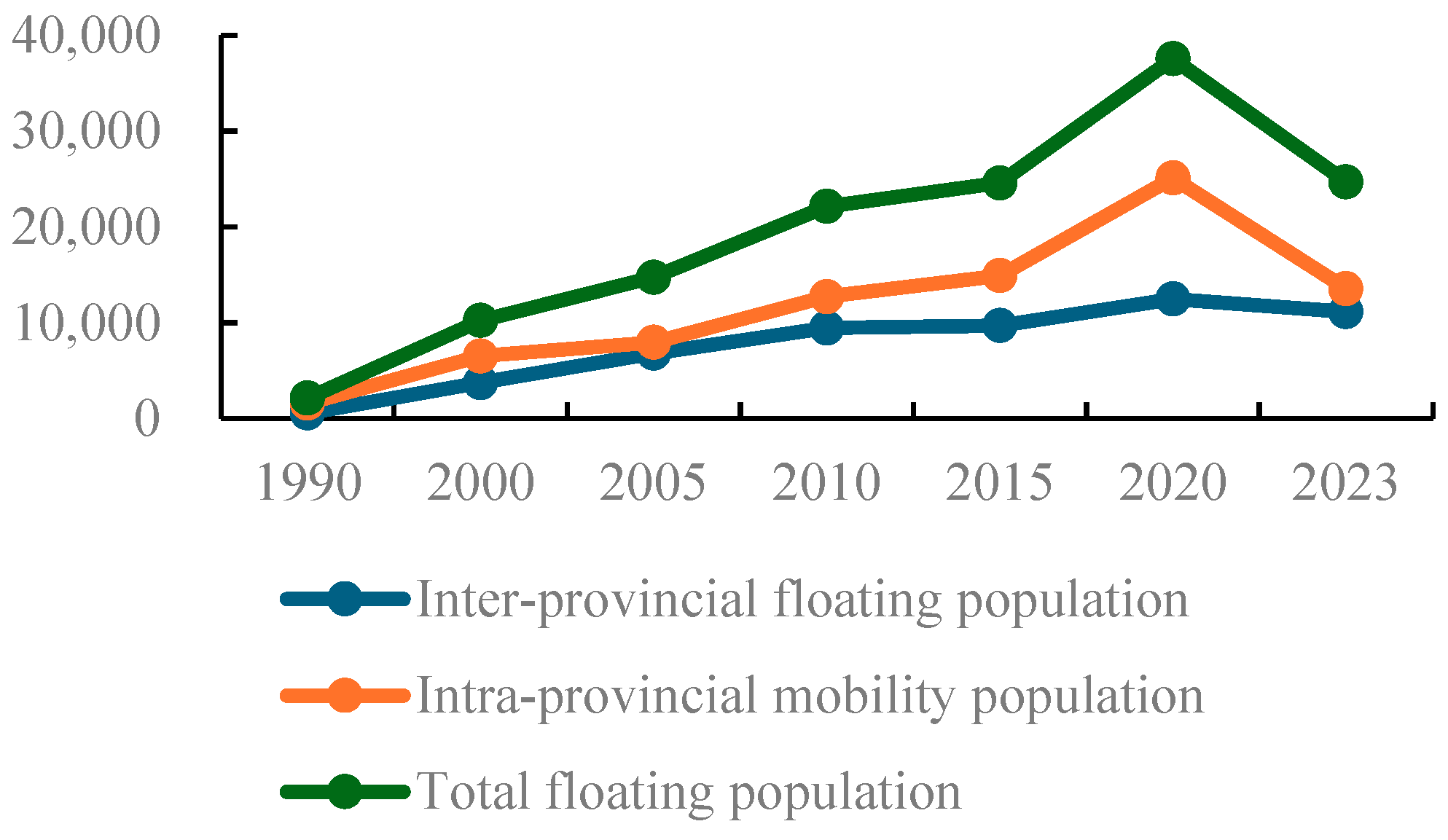
Distinguished from other countries, China established a rural–urban dual economy institution in the 1950s. During the past few decades, China has experienced rapid urbanization with a large and sustained influx of migrants into cities. According to the National Bureau of Statistics, the urbanization rate of the resident population reached 66.14 percent in 2023. As shown in Figure 1, the number of migrants reached 247 million in 2023, accounting for about 18 percent of the total population. Most migrants move for work or business opportunities and help to fill labor shortages in urban areas, which supports economic growth. According to the Rostow takeoff model, China is in the late takeoff and early maturity stage of economic development [12]. However, the urbanization rate of the registered Hukou population is only 45.4 percent (Hukou is China’s unique household registration system. It records an individual’s place of birth and official place of origin, and determines access to a wide range of social benefits tied to locality, including education, healthcare, social security and public services (Song and Wu, 2022 [13])). This is far behind the resident population. This gap indicates structural challenges in China’s urbanization process, as the disparity between the residents and registered urbanization rates suggests that full integration remains a long-term goal. Many rural migrants face a dilemma. They earn little income in their home villages but find it difficult to obtain equal rights and stable lives in cities. This has created a widespread condition of semi-urbanization, in which migrants live and work in cities for long periods without full legal or social recognition. With the implementation of a new, people-centered urbanization strategy and a series of Hukou reform policies, promoting the transition of migrant workers into long-term urban residents and ensuring equal access to basic public services have become key policy objectives. Achieving these goals requires not only supportive government policies but also migrants’ willingness to settle permanently in destination cities [14]. Understanding the determinants of long-term settlement intention and finding ways to strengthen migrants’ integration into urban life are, therefore, crucial for urban governance and sustainable development.
Data Sources: China Migrant Population Service Center and The Seventh China Population Census Bulletin.
In China, housing plays a crucial role in shaping migrants’ long-term residence decisions. The rooted notion of “Live and work in peace and contentment” has been embedded in Chinese culture, influencing housing preferences and economic behaviors. Ensuring access to adequate housing is a fundamental prerequisite for migrants’ long-term settlement and social integration in cities [15]. In recent years, migrants have tended to have more stable jobs and longer durations of residence in destination cities [16], and large-scale population movement has been an inevitable outcome of structural change and industrial upgrading [17]. Migrants increasingly hope to own housing in cities, but high housing prices create serious affordability problems, especially for rural migrants [18]. As a result, migrants often have higher residential mobility than local residents and face more housing instability. Many live in peripheral locations, move frequently and have a weak sense of belonging in destination cities [19]. Empirical studies for China confirm that urban homeownership promotes migrants’ urban integration and their willingness to stay, while the lack of secure housing is associated with a continued floating status [18,20,21,22].
In the process of rural–urban migration, many rural migrants keep their ownership of homestead land in their home villages while at the same time trying to invest in housing in cities for long-term relocation [23]. Homestead land is a core part of rural collective construction land and gives rural households the right to build and occupy a dwelling. It also provides a basic safety net for rural livelihoods. An increasing number of studies show that homestead land and rural land rights more generally can have important effects on migration and settlement intentions [15,24,25,26,27,28]. Some studies argue that the security function of homestead land discourages permanent urban settlement because a retained rural house provides a fallback option and reduces the need to build a permanent life in the city [24,25,29,30]. Other studies suggest that the ability to withdraw, transfer or mortgage rural land can support migration and settlement by relaxing liquidity constraints and providing resources for urban housing and consumption [26,27,28]. Most of this literature, however, looks at rural land or urban housing separately and does not analyze how rural property in origin areas and urban property in destination cities work together to shape long-term settlement intentions.
Social integration is another critical factor influencing migrants’ decisions to settle permanently in cities [27]. Unlike conventional migration studies, which often emphasize economic factors, social integration research highlights the role of urban inclusivity and migrant decision-making. Social integration encompasses not only personal satisfaction with urban life and future family prospects but also broader perceptions of environmental and policy support [31]. From the perspective of social exclusion, migrants often face both physical and social segregation [10]. Social exclusion reinforces existing inequalities, limiting migrants’ access to resources and creating a sense of relative deprivation [11]. A well-developed urban environment, inclusive community networks and accessible public services are essential for fostering migrants’ economic integration and social adaptation [32]. Enhancing social cohesion can help reduce urban–rural disparities, improve migrants’ sense of belonging and encourage long-term settlement [20].
Therefore, this study aims to examine the impact of homestead and urban homeownership on migrants’ long-term settlement intentions in Chinese cities. Using microdata from the 2017 China Migrants Dynamic Survey (CMDS), it explores how local homeownership moderates this relationship.
This study makes three main contributions. First, it extends the classic push–pull framework by placing China’s dual property rights structure at the center of the analysis. It jointly models rural homestead land ownership (HLO) and local urban homeownership (LH) as origin-based and destination-based forces, rather than examining rural land or urban housing in isolation or treating them only as control variables. Second, it clarifies the conditions under which homestead land discourages urban settlement using nationally representative CMDS data and systematic heterogeneity analysis by age, income, migration distance, region and city type, and it shows that the fallback function of homesteads is stronger among older, low-income and inter provincial migrants in North, Central and Northeast China, which helps to reconcile the mixed findings in earlier studies. Third, it identifies the mechanisms through which dual property rights affect settlement intentions by showing that LH moderates the negative association between HLO and long-term settlement intention. Local homeownership also reinforces settlement intention through higher levels of social integration, and it further shows that these moderating and mediating effects vary across China’s different regional and urban contexts.
The remainder of this paper is structured as follows. Section 2 sets out the theoretical framework and research hypotheses. Section 3 describes the data, key variables and empirical strategy, and Section 4 presents the main estimation results, including the baseline models and a series of robustness checks. This is followed by Section 5 with the heterogeneity analysis and Section 6 with the mechanism analysis. Section 7 provides the discussion and indicates possible limitations, and Section 8 concludes this paper.

2. The Theoretical Framework

2.1. The Push–Pull Model and the Conceptual Framework

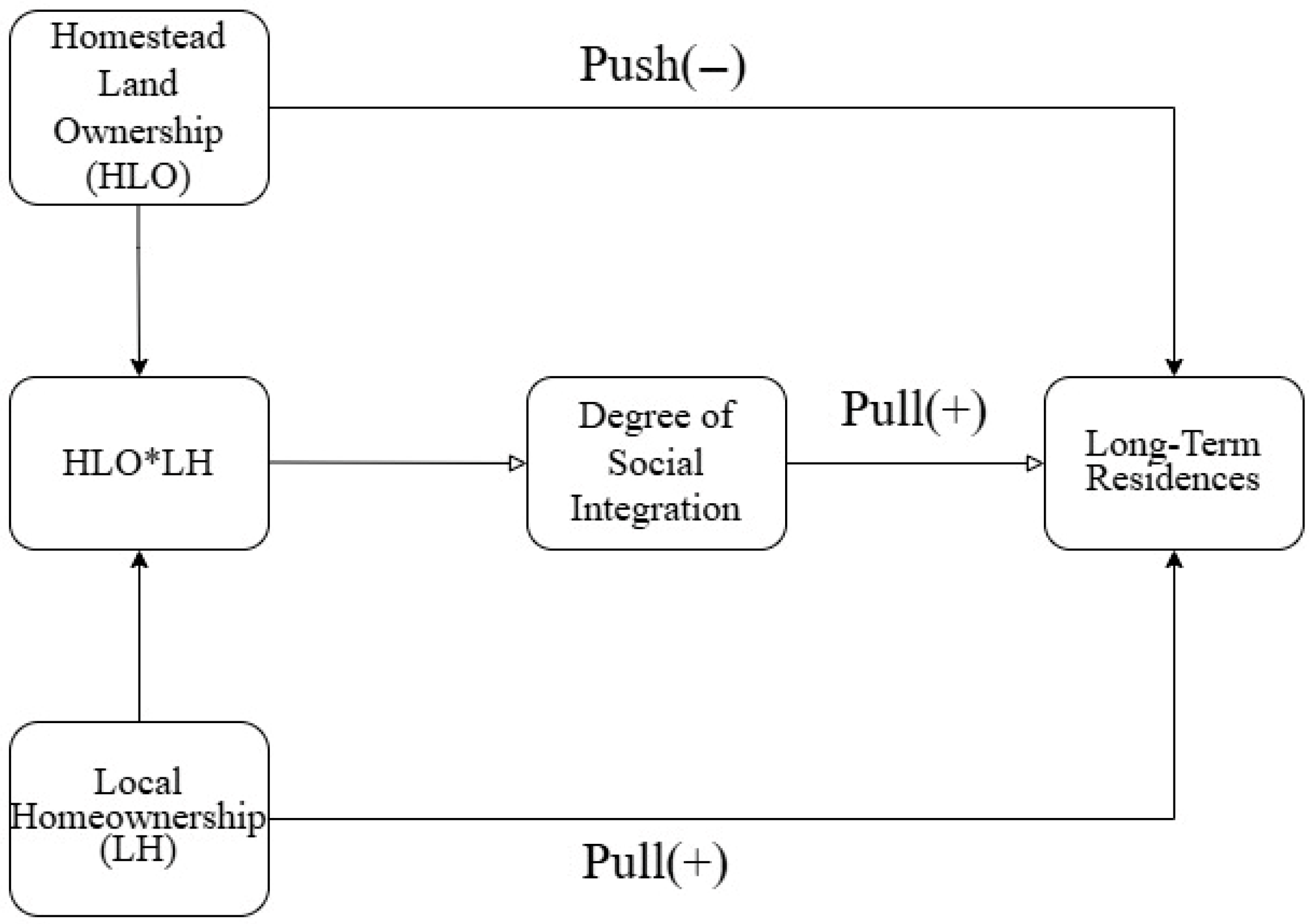
Figure 2 presents the conceptual framework that guides this study. It builds on the push–pull model, which is one of the most widely used theories in migration research. The push–pull model argues that individuals make migration and settlement decisions by comparing the perceived disadvantages of their origin with the perceived advantages of the destination [13,33]. Later developments emphasize that migrants also evaluate risk, livelihood security, social incorporation and long-term stability when deciding whether to move and whether to stay [34]. International research further shows that secure legal rights, stable housing and strong local ties are key determinants of long-term settlement for migrant and immigrant populations [35,36].
This study applies the push–pull model to China’s dual property rights system, where rural and urban property rights create competing institutional forces. Homestead land ownership (HLO) is an origin-based force. As a key component of rural collective construction land, homestead land grants long-term residential use rights, functions as a socioeconomic safety net and provides a fallback option when migrants experience employment or income shocks in cities [24,37]. These features reduce the perceived benefits of permanent urban residence and create a push effect that weakens migrants’ willingness to settle in cities [17,25]. In contrast, local homeownership (LH) is a destination-based force. It provides stable housing, improves migrants’ position in the urban system, strengthens their sense of belonging and promotes socioeconomic integration [20,31,38,39]. These characteristics create a pull effect that increases long-term settlement intentions. International evidence shows that homeownership is strongly associated with long-term residence, stronger attachment to place and a lower probability of return migration [35,36].
Figure 2 also incorporates the interaction between HLO and LH and the mediating role of social integration. Owning housing at the destination can reduce dependence on rural homestead land by providing a more secure and attractive urban living environment. This weakens the negative push effect of HLO. Meanwhile, local homeownership tends to increase social integration, while homestead land may anchor migrants’ emotional and economic ties to their origin and reduce investment in urban social networks. Social integration, therefore, mediates the influence of HLO and LH on long-term residence. Together, these institutional, social and spatial components form a unified theoretical foundation for the hypotheses tested in this study.

2.2. Hypotheses

In China, the transition of rural migrants into urban citizenship is shaped by an institutional tradeoff between retaining rural land and gaining full access to urban benefits. Urbanization policies introduced by central and local governments often require migrants to give up rural land rights, including contracted farmland and homestead land [26,27]. For rural households, however, homestead land provides long-term residential security, economic fallback protection and intergenerational value [24,37]. These characteristics reduce the perceived gains from permanent urban settlement and weaken migrants’ willingness to transfer Hukou or commit to long-term residence in cities [15,25]. This pattern is consistent with the push side of the push–pull model. Local homeownership, by contrast, signals successful incorporation into the urban socioeconomic system. It stabilizes residential status, enhances access to public services and strengthens emotional attachment and community involvement [19,20,38,39]. International evidence also shows that homeownership is closely linked to long-term settlement intentions and reduced mobility [35,36]. These dynamics reflect the pull side of the push–pull model. Therefore, we propose Hypothesis 1 as follows:
H1. 
Homestead land ownership acts as a push factor that reduces migrants’ long-term settlement intention in cities, while local homeownership acts as a pull factor that increases migrants’ long-term settlement intention.
The effects of rural and urban property rights are not uniform across individuals and locations. Rural revitalization programs have improved living conditions in many rural areas and reduced the economic pressure to migrate [40]. The fallback value of homestead land is, therefore, likely to be stronger for older migrants, lower-income households and inter-provincial migrants who face greater uncertainty in urban labor markets and higher barriers to urban integration [28,29]. These groups may have a stronger negative association between homestead land and long-term urban settlement. Regional variation further shapes these relationships. Housing affordability, labor demand, migration opportunities and the importance of rural land for household strategies differ sharply across China’s regions. In North China, Central China and Northeast China, where rural and urban areas are closely connected, the role of homestead land as a safety net is more important. In more developed coastal regions with higher housing costs and stronger labor markets, local homeownership signals successful integration and tends to play a stronger pull role [26,27]. These regional and group differences help explain inconsistent findings in the literature and motivate the heterogeneity analysis conducted in this study under Hypothesis 2.
H2. 
The effects of homestead land ownership and local homeownership on long-term settlement intention differ across social groups and regions.
As shown in Figure 2, social integration is a central mechanism that links property rights to long-term residence. Local homeownership tends to increase social integration by stabilizing residence, improving access to public services, strengthening local social networks and fostering emotional attachment to the city [38,39]. Higher levels of social integration, in turn, increase migrants’ likelihood of remaining in the city in the long run. In contrast, homestead land can anchor migrants’ emotional and economic ties to their rural origin, reduce their incentives to invest in urban relationships and lower their level of social integration [24,41]. The interaction between rural and urban property rights further shapes this mechanism. For migrants who retain homestead land, acquiring urban housing reduces dependence on rural fallback options and encourages deeper engagement with the destination city. This weakens the negative effect of homestead land on settlement intention. International migration research also shows that secure housing enhances psychological and social embeddedness and supports long-term residence [35,36]. If social integration is an important pathway, then part of the influence of HLO and LH on long-term residence should operate through migrants’ degree of social integration. Thus, Hypothesis 3 is proposed as follows.
H3. 
Social integration serves as an important mechanism through which homestead and local homeownership shape migrants’ long-term settlement intentions.

3. Data and Model Setting

3.1. Data Source and Sample Selection

The data for this study is from the 2017 China Migrant Dynamic Survey (CMDS), a national-level survey conducted by the National Health and Wellness Commission of China. This survey employs a stratified, multi-stage, probability-proportional-to-size (PPS) sampling method to ensure broad coverage and representativeness. The dataset encompasses 31 provinces, municipalities directly under the central government, and autonomous regions of China, making it one of the most comprehensive sources for studying internal migration patterns in China. The sample in this study was selected from Part A of the individual questionnaire in the CMDS (Part A), which defines migrants as individuals holding non-local hukou (registered outside the county or city of current residence) and having lived at the destination for no less than one month. To align with the research objectives, 81,469 samples were obtained after removing outliers and invalid responses in the raw sample dataset.

3.2. Spatial Distribution of China’s Migrants

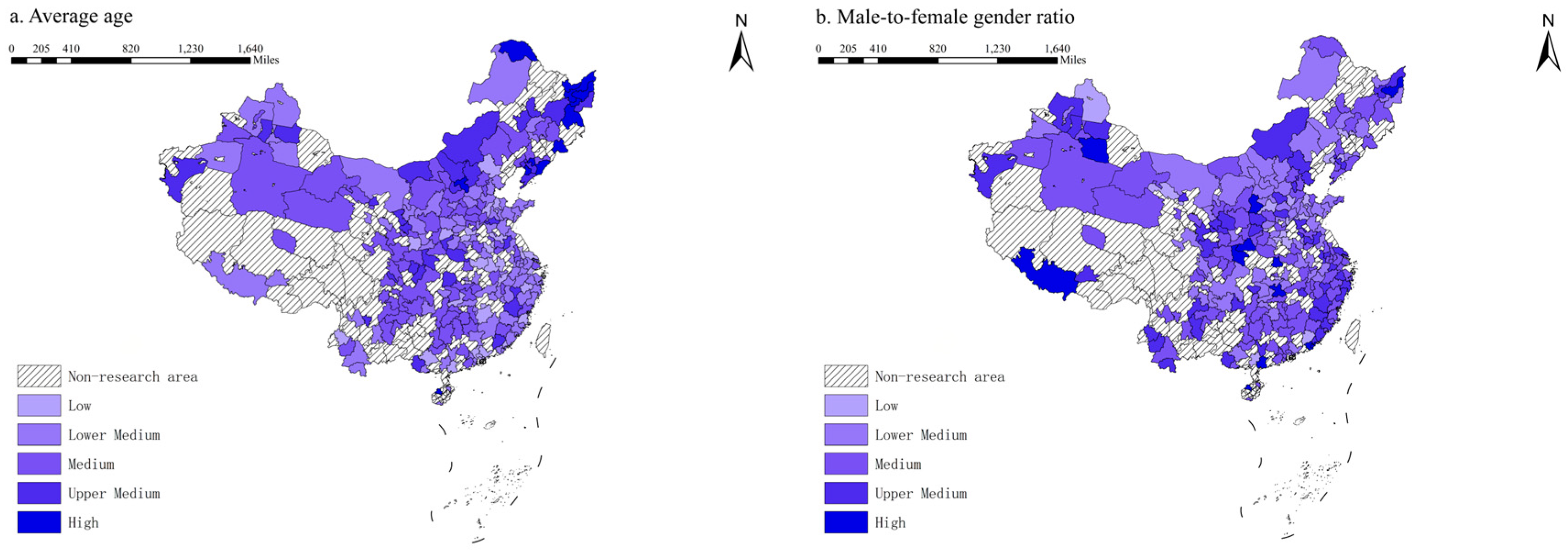
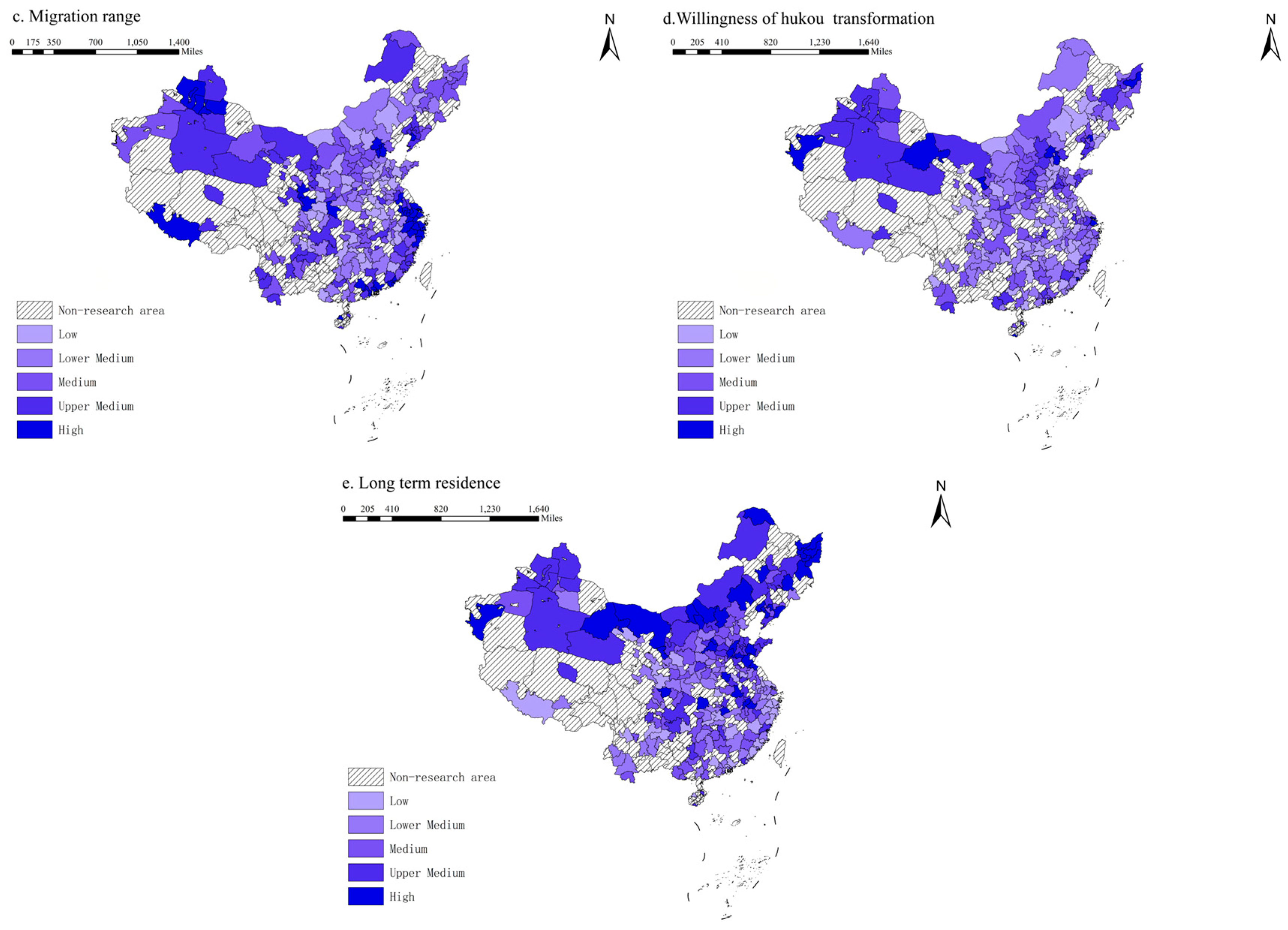
Figure 3 provides a descriptive geography of China’s migrant population across five dimensions: migrant age, gender ratio, migration range, Hukou transfer willingness and long-term residence intention. The findings reveal clear socio-spatial sorting across regions. First, younger migrants (18–35) cluster more strongly in the east and parts of Central China, especially in the Yangtze River Delta, the Pearl River Delta and the middle reaches of the Yangtze River Economic Belt. This pattern is consistent with stronger employment pull in major economic corridors and with life-course selectivity in mobility, whereby younger cohorts are more responsive to spatial opportunity gradients [17]. Second, the male-to-female ratio exhibits pronounced regional variation. Several southeastern coastal provinces show a moderately higher male share, which may reflect the gendered labor demand in sectors such as construction, manufacturing and logistics, while many inland areas appear more balanced with diversified employment profiles. Third, inter-provincial migration is most visible in national-scale core urban regions—particularly the Beijing–Tianjin–Hebei region, the Yangtze River Delta and the Guangdong–Hong Kong–Macao Greater Bay Area—as well as parts of Northwest China. Interpreted through an origin–destination pairing lens, such concentrations suggest that longer-distance mobility is not only destination-driven but also shaped by the combined characteristics of sending and receiving places, reinforcing the need for geographically grounded interpretations of migration outcomes [14,42]. Fourth, Hukou transfer willingness displays spatial clustering, with stronger propensity in first-tier cities and some northwest localities. This is consistent with the view that institutional regimes and place-based livability jointly structure migrants’ incentives to pursue local membership, while Hukou reforms in selected cities can further amplify these spatial differences [21,43]. Finally, intentions of long-term residence appear relatively stronger in parts of Northern and Northeast China but weaker in many eastern and central localities. From a sociological perspective, long-term settlement is not merely an economic calculus; it also reflects migrants’ capacity to build durable social ties and to develop local citizenship identification. Where return distance is shorter and origin ties are readily maintainable, migrants may adopt a dual-anchor strategy that reduces settlement risk, whereas in coastal growth poles, high housing costs, intense competition and a larger share of inter-provincial movers can elevate integration barriers and sustain more transient mobility [39,44].

3.3. Research Design and Variable Processing

Existing research commonly measures migrants’ intention to relocate in a city by assessing whether they intend to reside there permanently [45]. Following this approach, this study utilizes data from the 2017 China Migrant Dynamic Survey (CMDS) and measures long-term residence intention using responses to the survey question “If you plan to stay in the region, how long do you expect to stay in the region?”. The dependent variable, denoted as L o n g   T e r m   R e s i d e n c e s L T R i captures the respondent’s expected duration of residence in the city and is measured as an ordered categorical variable, with values ranging from 1 to 5, where 1 means “1–2 years”, 2 indicates “3–5 years”, 3 means “6–10 years”, 4 indicates “ more than 10 years” and 5 means “ Permanent Settlement”.
The primary explanatory variable of this study is homestead land ownership ( H L O i ), which is derived from the question “Do you have homestead land in your hometown?” This variable is assigned a value of 1 if the respondent owns homestead land in the origin, and 0 otherwise. Additionally, local homeownership ( L H i ), is used as a moderating variable to assess its potential influence on the relationship between homestead land ownership and settlement intention. It is derived from the question “Do you own a house in your current city or town of residence?” The variable equals 1 if the respondent owns housing in the residence town or city, and 0 otherwise.
Also, this study incorporates a comprehensive set of control variables, categorized into three dimensions: (1) individual demographics, including age, gender, education level, marital status and self-reported health status; (2) migration characteristics, involving employment contract, migration range (short- vs. long-distance migration) and migration duration (measured by length of stay in the host city); and (3) household characteristics, such as family size, annual household income and annual household expenditure. More detailed definitions of variables are presented in Table 1.
Since the dependent variable L T R i is an ordered categorical variable, applying an OLS estimation may lead to biased and inconsistent estimates due to the assumption of equal spacing between the response categories. To address this issue, we adopted an ordered probit model for the estimation, which is widely used in migration studies [20,31]. The empirical specification is as follows:
L T R i = α 0 + α 1 H L O i + α 2 X i + θ i + ε i
L T R i = β 0 + β 1 H L O i + β 2 L H i + β 3 H L O i L H i + β 4 X i + δ i + φ i
In Equation (1), L T R i represents the long-term residence intention of respondent i; H L O i denotes respondents’ homestead land ownership; X i represents a vector of control variables, accounting for individual demographics, migration and family characteristics; θ i and δ i are the regional fixed effects; and ε i and φ i are the error terms. In Equation (2), L H i , denoting local homeownership, is a moderating variable. Additionally, the interaction term between H L O i and L H i , H L O i × L H i .   F ( ) is a nonlinear function. The specific form is as follows:
F L T R i * = 1   L T R i * <   μ 1   2   μ 1 < L T R i * <   μ 2     J     L T R i * >   μ J 1    
In Formula (3), L T R i * is the invisible continuous latent variable, in accordance with Formula (4).
L T R i * = β 0 + β 1 H L O i + β 2 L H i + β 3 H L O i × L H i + β 4 X i + δ i + φ i
μ 1 < μ 2 < μ 3 < < μ J 1 is the tangent point, and all parameters are to be estimated.

3.4. Descriptive Statistics

As shown in Table 2, long-term residence (LTR) intention has a mean value of 3.5677, which means that, on average, migrants expect to stay in the city for 6–10 years or more than 10 years, suggesting a strong inclination toward long-term urban settlement. Homestead land ownership has a mean value of 0.6984, meaning that 69.84% of migrants retain homestead land in their hometowns. Conversely, local homeownership has a mean value of 0.2688, indicating that only 26.88% of migrants own a home in their destination city. This gap underscores the continued reliance of many migrants on rural homesteads, while homeownership in urban areas remains limited.
For the control variables, the mean age of respondents is 36.40 years, with a balanced gender ratio (52.81% male). The majority of respondents are married (84.22%), and most have attained at least a middle school education. In terms of migration patterns, migrants predominantly relocate within the same province, with an average migration duration of 6.78 years. The mean family size is 3.2582, reflecting a standard household structure in China. Lastly, substantial variations are observed in annual household income (86,444.47 yuan) and expenditure (44,693.07 yuan), indicating significant income disparities among migrants.

4. Analysis of Empirical Results

4.1. The Benchmark Regression

Table 3 presents the ordered probit regression results assessing the impact of homestead ownership and local homeownership on migrants’ long-term residence intentions, progressively incorporating control variables and interaction terms. Column (1) only controls for explanatory variables, homestead land ownership and regional fixed effects, capturing the direct effect on migrants’ long-term settlement intention. The coefficient for homestead land ownership is negative and statistically significant at the 1% level, indicating that migrants who retain homestead land in their hometowns are significantly less likely to plan long-term residence in the city. Column (2) introduces control variables (demographic, migration and household characteristics), and the effect of homestead ownership remains negative and highly significant, demonstrating that this relationship is robust even after accounting for individual differences. Column (3) incorporates local homeownership and the interaction term with homestead ownership H L O i × L H i . The coefficient for local homeownership is positive and highly significant, suggesting that migrants who own property in the city are much more likely to commit to long-term settlement. Additionally, the interaction term H L O i × L H i is positive and statistically significant, suggesting that homeownership in the city weakens the negative effect of homestead ownership on long-term residence intentions. This finding suggests that while homestead land serves as a fallback option, urban homeownership can offset its deterrent effect on urban settlement.
For control variables, no strong nonlinear effect of age is observed, while female migrants show a higher likelihood of undertaking long-term settlement than males. Higher educational attainment and marriage are positively associated with long-term residence intentions, reinforcing the role of family and human capital in migration decisions. Migrants with longer durations of stay demonstrate a higher probability of long-term settlement, whereas those who migrate across provinces are less likely to commit to urban residence. Household expenditure is positively associated with settlement intentions, suggesting that greater financial investment in the city encourages long-term residence, while household income has a weaker effect.

4.2. The Robustness Check

To further validate the reliability of the baseline results, we conducted robustness tests, applying alternative estimation techniques and addressing potential self-selection bias. The results are presented in Table 4. First, we replaced the ordered probit model with ordered logit (Ologit) and ordinary least squares (OLS) regressions. As shown in Columns (1) and (2), the coefficient for homestead land ownership remains negative and statistically significant across both models (−0.633 in Ologit and −0.471 in OLS), confirming that migrants who retain homestead land in their hometowns are less likely to settle in cities permanently. The effect of local homeownership is consistently positive and highly significant (1.331 in the Ologit estimation and 0.630 in OLS), reinforcing its role in facilitating urban integration. The interaction term H L O i × L H i is also positive and significant at the 5% and 1% significance levels, respectively, confirming that urban homeownership moderates the negative impact of rural homestead land on settlement intentions.
Additionally, we replace the explained variable of long-term residences (LTR) with Settlement Will, which is a binary indicator derived from the CMDS question, “If you plan to stay in the region, how long do you expect to stay in the region?”. The variable is equal to 1 if the respondent selects “Settlement” and 0 otherwise. In Column (3), the results of the probit model are shown, and the coefficient for homestead ownership remains negative (−0.442) while local homeownership remains positive (0.710) at the 1% significance level. These results are fully consistent with previous findings, indicating that the estimation remains stable when using an alternative measure of settlement intention. Given potential self-selection bias, we further employed the Heckman two-stage selection model to account for unobserved factors affecting migrants’ settlement decisions. In the first stage (probit model), we estimated the Inverse Mills Ratio (IMR) using “Settlement Will” as the dependent variable while incorporating all control variables and regional fixed effects. In the second stage, we introduced IMR as an additional control variable to the main regression model.
Column (4) reports that the coefficient of IMR is negative and significant (−1.243) at a 1% significance level, confirming the presence of self-selection bias and validating the appropriateness of the Heckman correction. The coefficients for homestead land ownership (−0.370) and local homeownership (0.797) remain consistent with results in previous models, reinforcing the robustness of our conclusions. The signs and significance of the interaction term H L O i × L H i remain consistent with Table 3, further confirming that urban homeownership weakens the negative effect of rural land ownership on settlement intentions.

4.3. The Propensity Score Matching (PSM)

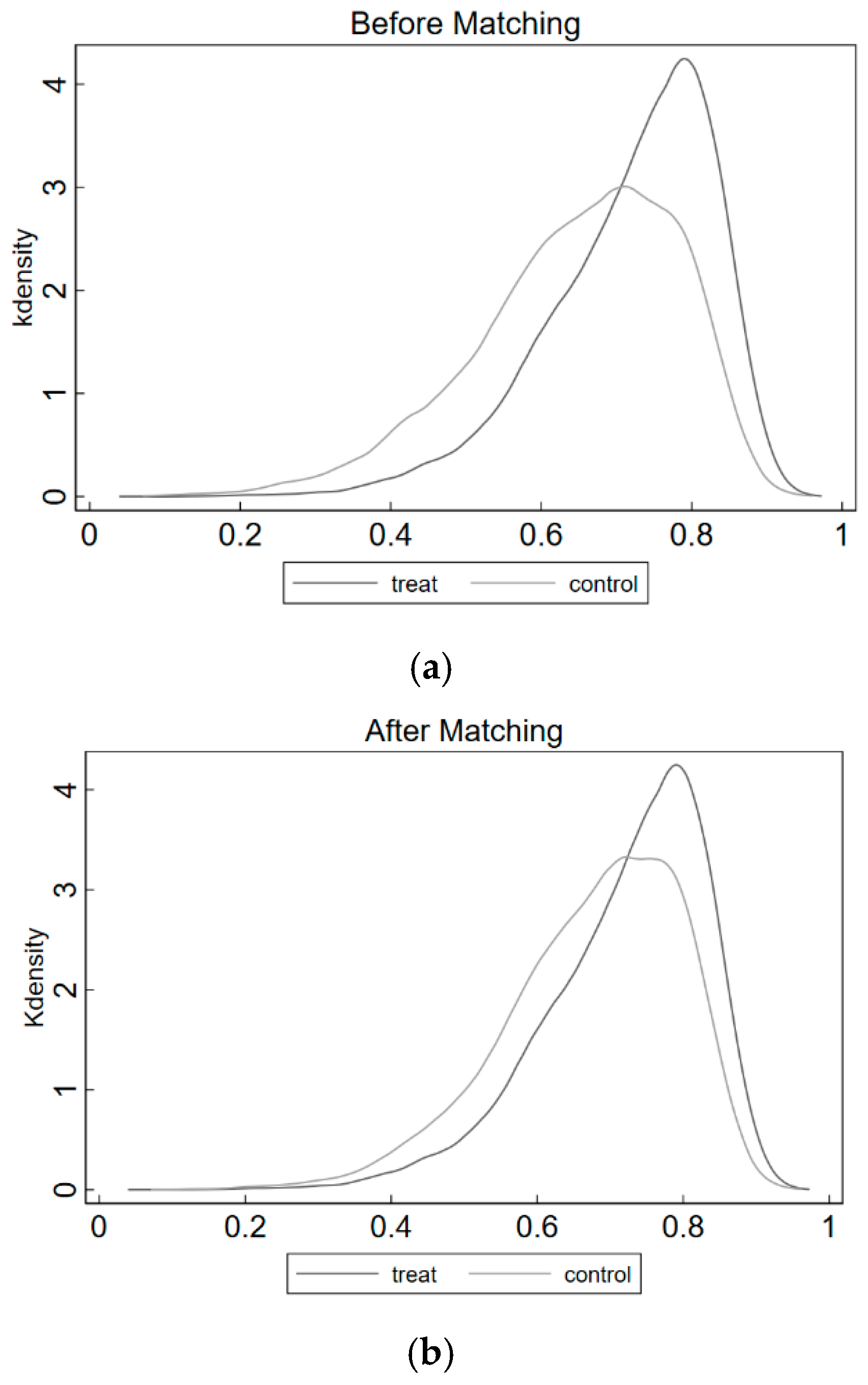
Our previous estimation is based on the linear relationship between long-term residence and homestead. However, if the relationship is nonlinear, our estimation would be biased due to modeling misspecification. To address this concern, we employ the propensity score matching approach (PSM) and regard homestead land ownership as a treatment variable among migrants to estimate the relationship between LTR and homestead land ownership. We implemented two primary PSM methods, the nearest neighbor matching (NNM) in Columns 1–5 and kernel matching in Column 6. The nearest neighbor matching method identifies the closest propensity score match for each observation in the treatment group (migrants with homestead land) from the control group (migrants without homestead land). Depending on the specification, each treated unit can be matched to one or multiple control units (one-to-one, one-to-two, etc.), minimizing differences in observable characteristics between the two groups. Unlike NNM, which selects a fixed number of matches, kernel matching assigns a weighted average to all control units based on their distance from the treated unit in terms of propensity scores. Control units that are closer in propensity score receive higher weights, while those farther away receive lower weights. This approach smooths the estimation process and reduces variance by utilizing more information from the sample. To verify the validity of the matching process, Figure 4a (Before Matching) reveals noticeable differences between the treatment and control groups, indicating the presence of selection bias. In contrast, Figure 4b (After Matching) demonstrates a significant overlap between the two groups, confirming that the common support assumption is satisfied and validating the effectiveness of the matching process.
As shown in Table 5, homestead land ownership consistently shows a negative and significant effect on long-term settlement intentions across all models at the 1% significance level, with coefficients ranging from −0.359 to −0.346 for the nearest neighbor matching and −0.355 for the kernel matching, reinforcing the fact that migrants with rural homestead land are less likely to settle in cities. Additionally, local homeownership remains positively significant at the 1% significance level across all models, with the coefficients ranging between 0.762 and 0.798, confirming that owning urban property strongly promotes long-term settlement intentions. The interaction term H L O i × L H i is also positive and significant across all models, indicating that urban homeownership reduces the negative effect of rural land ownership on urban settlement. The six different matching specifications yield highly consistent results, indicating the robustness of the PSM findings. The inclusion of control variables and regional fixed effects ensures that the estimates are not biased by omitted variables or unobserved regional disparities.

4.4. Random Sampling

To ensure the representativeness of the sample and verify the robustness of our findings, we conducted a random sample analysis. Using both sampling without replacement and sampling with replacement, we randomly selected 25%, 50% and 75% of the total sample and re-estimated the model using the ordered probit model. The results are shown in Table 6. The coefficients of homestead land ownership remain negative and highly significant across all samples, suggesting that owning rural homestead land reduces the probability of long-term urban settlement by around 35–39 percent. These results reinforce the fact that rural land serves as an economic fallback option. In addition, the coefficient of local homeownership is positive and statistically significant, indicating that migrants who own urban property are 75–79 percent more likely to settle long-term, indicating that homeownership fosters urban integration. The interaction term H L O i × L H i is also positive and significant, indicating that urban homeownership weakens the negative effect of rural land ownership on settlement intentions. Migrants who own both rural and urban property are more likely to settle in cities than those with only rural land.

4.5. Placebo Test

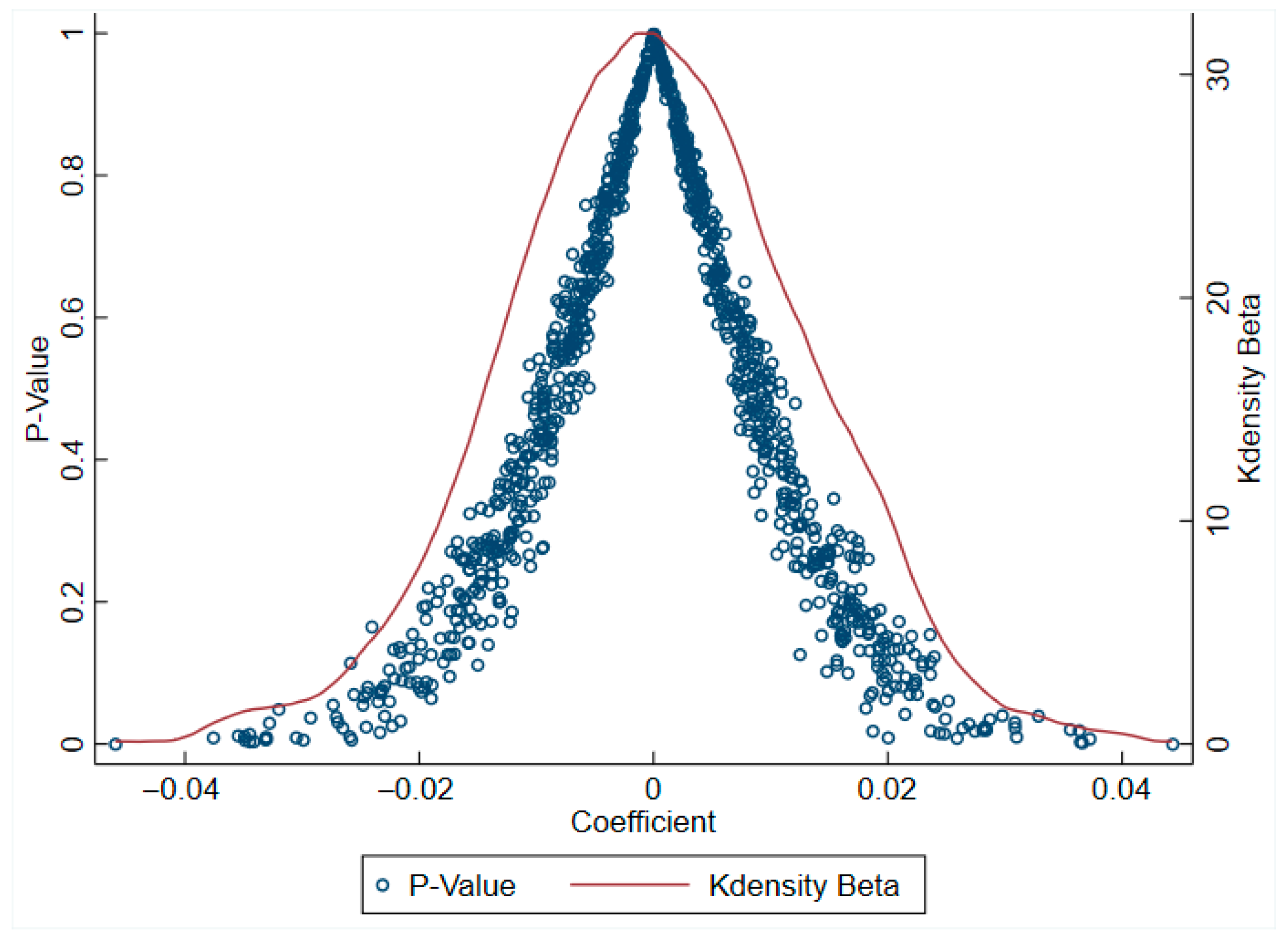
Given the substantial variation in regional characteristics, such as levels of economic development, across Chinese provinces, municipalities and autonomous regions, there remains a risk that unobserved regional factors could influence the results, even after controlling for regional fixed effects. To ensure that the observed effects, particularly the interaction term H L O i × L H i , are not driven by random noise or sample-specific artifacts, we conducted a placebo test using randomized assignment. In this procedure, we randomly generated placebo versions of the interaction term H L O i × L H i and substituted them into the baseline regression model. This simulation was repeated 1000 times, yielding a distribution of placebo coefficient β ^ 1 , β ^ 2 ,   ,   β ^ 1000 . As shown in Figure 5, the resulting distribution of β ^ is approximately normal and centered near zero, indicating no systematic relationship under random assignment. The true coefficient from the baseline model (the vertical line) lies well outside the simulated distribution, confirming the fact that the observed effect is not the result of random variation.

5. The Heterogeneity Analysis

This section examines how homestead land ownership and local homeownership influence long-term settlement intentions across different demographic and socio-economic subgroups. By segmenting the sample by age, household income, region and migration range, we assess whether the effects observed in the baseline model remain consistent under varying conditions.

5.1. Age

To explore the influence of life cycle factors on settlement decisions [46], we divide the sample into three age groups: 18–35 years, 35–60 years and over 60 years. The results are shown in Table 7. Homestead land ownership (HLO) is negatively significant across all age groups at the 1% significance level, with the effect being strongest for older migrants, suggesting that they are least likely to settle permanently in cities if they own rural land due to their dependency on children, retirement preferences, or cultural ties to rural areas [22]. Among older migrants, one unit increase in homestead land ownership decreases the probability of settling in the city by 48.6%. In contrast, young and middle-aged migrants possibly consider urban opportunities and urban–rural tradeoffs more and are less likely to commit to a homestead when deciding long-term residence in cities. Additionally, local homeownership remains positively significant for all age groups, with the largest impact being among young migrants of 18–35 years old, implying that homeownership plays a stronger role in shaping urban settlement preferences among younger individuals. The interaction term H L O i × L H i is positive and significant for younger and middle-aged groups but not significant for the older population. This indicates that urban homeownership can offset a negative effect of rural land ownership on settlement intentions, with a 1% increase in local homeownership raising the probability of long-term settlement by approximately 8.09% for younger migrants.

5.2. Annual Household Income

Given that households have different annual household incomes, we categorize households into low-, middle- and high-income groups to assess the role of economic capacity in settlement decisions. As shown in Table 8, across all models, homestead land ownership has a negative and significant effect, while local homeownership has a positive and significant impact, confirming that rural land attachment discourages urban settlement, while urban property ownership promotes it. The homestead land ownership effect weakens as income increases. The negative coefficient is largest among low-income households (−0.415) and declines for middle-income (−0.346) and high-income households (−0.273). This suggests that as income increases, the negative effect of homestead land ownership on urban settlement decreases, possibly because wealthier individuals have greater financial flexibility and are less reliant on rural land as an economic fallback.
Local homeownership has the strongest positive effect on high-income migrant households, with a coefficient of 0.881 at the 1% significance level, suggesting that homeownership plays a stronger role in promoting long-term urban settlement among wealthier migrants. The interaction term is only significant for low-income households, suggesting that for lower-income groups, having both rural and urban property strongly influences settlement decisions, while higher-income households may prioritize career mobility over property ownership. Lower-income households face greater barriers to mobility due to unfavorable socioeconomic conditions, limited access to resources and the daily challenges of sustaining livelihoods, making it more difficult for them to relocate to other cities [47].

5.3. Regional Heterogeneity

Table 9 reveals pronounced regional heterogeneity in the association between dual property rights and migrants’ long-term residence intention. Across all seven regions, homestead land ownership is consistently linked to a substantially lower likelihood of long-term residence, with estimated marginal effects implying roughly a 23 percent to 50 percent reduction in the probability of long-term residence. Local homeownership is uniformly linked to a higher likelihood of long-term residence across all regions, increasing the probability by about 52 percent to 96 percent.
The interaction between homestead land ownership and local homeownership shows clear spatial contingency. It is positive and statistically significant in North China, Central China and Northwest China, but small and statistically insignificant in East China, South China, Southwest China and Northeast China. This interaction pattern suggests that complementarity between origin with fallback security and destination with long-term commitment depends on regional mobility regimes and origin–destination linkage. Where migrants remain embedded in geographically and socially connected mobility circuits, feasibility of return is higher and circular mobility is more practicable. Under such conditions, acquiring urban housing can more effectively attenuate the settlement-deterring role of homestead land and translate dual holding into a detectable settlement premium. This finding is consistent with the evidence of migration range heterogeneity in Figure 3. Specifically, the negative association of homestead land decreases with greater migration distance, and the settlement-promoting association of local homeownership is not significant among inter-provincial migrants, suggesting that mobility over a longer distance limits systematic complementarity.
Such regional heterogeneity also reflects differences in socio-cultural attachment to places of origin. In parts of North China and Central China, rural rootedness can be stronger, including the perception that “one’s roots lie in the countryside.” In these regions, homestead land often serves both as an economic fallback and as a symbolic basis for origin attachment, commonly viewed as ancestral property and a symbol of rural heritage. As a result, holding a rural homestead while owning urban housing can create a dual fulfillment mechanism. Migrants can pursue opportunities in cities while retaining a psychologically salient and secure option tied to their origin and identity. In East China and South China, settlement decisions are more strongly shaped by market opportunities and urban living conditions. The symbolic value attached to homestead land may, therefore, be weaker. In this context, homestead land and urban homeownership tend to influence settlement through separate channels, which helps explain the insignificant interaction despite strong main effects. In Southwest China, and in some contexts of Northeast China, this insignificant interaction is consistent with more livelihood-focused and temporary mobility. Here, the idea of “fallen leaves returning to their roots” can coexist with pragmatic temporary settlement. In Northwest China, the significant interaction suggests that in some local institutional environments, migrants can still translate urban homeownership into greater residential stability and stronger local integration even when origin ties remain important.

5.4. Migration Range Heterogeneity

Migrants’ settlement decisions may also be influenced by how far they have moved from their original place of residence [48]. Table 10 shows that homestead land ownership significantly reduces the probability of long-term urban settlement across all migration distances, but this magnitude declines with distance, reducing the probability of settlement by 38.4% for intra-county, 37.6% for intra-province and 33.3% for inter-provincial migration. These results indicate that rural land is a stronger constraint when migrants remain geographically and socially close to their place of origin.
In contrast, local homeownership significantly increases the probability of long-term settlement for intra-county (0.721) and intra-province (0.716) migrants but is not significant for inter-provincial migrants. This suggests that urban property is a stronger driver of integration when migrants remain within regions that share similar cultural and administrative contexts. As prior research suggests, migrants are more likely to settle when moving within familiar environments where dialects, social customs and community norms align with their own, reducing psychological distance and alleviating the feeling of “I’m not a local” [49]. Furthermore, staying closer to one’s region of origin often ensures better continuity in social networks, education, healthcare and infrastructure access, which helps accelerate the process of social integration in the host city [43]. The interaction term is positive and significant for intra-county and intra-province migrants, but insignificant for inter-provincial migrants. This indicates that owning both rural and urban property facilitates settlement only when migrants remain within culturally or geographically proximate regions. For long-distance movers, settlement decisions may be driven more by structural and institutional conditions, such as Hukou policy, job opportunities and access to public services, than by landholding patterns.

6. Mechanism Analysis

The integration of long-term rural–urban migrants remains a persistent challenge in China’s urban transition [50]. To further identify the mechanisms underlying migrants’ long-term residence intentions, it is essential to account for their level of social integration, which captures both their sense of belonging and the quality of their interpersonal connections within the destination city. The China Migrants Dynamic Survey (CMDS) provides several items measuring emotional and social identification within the local area, including “I like the city/place where I live now” (X1), “I am concerned about the changes in the city/place where I live now” (X2), “I would like to be part of the local people” (X3), “I feel that the local people would like to accept me as part of them” (X4) and “I feel that I am already a local person” (X5). All items are recorded on a four-point Likert scale (1 = strongly disagree; 4 = strongly agree), where higher values denote stronger social integration.
To ensure comparability across items, all variables were standardized prior to analysis. As shown in Table A1, the Kaiser–Meyer–Olkin (KMO) statistic is 0.830, and Bartlett’s test of sphericity is significant at the 1% level, confirming the suitability of the data for factor analysis. Principal component analysis, following the criterion of retaining eigenvalues greater than one, yields a single common factor that explains 60.91% of the total variance (Table A2). This factor is interpreted as the underlying construct of social integration and is constructed by aggregating the five items using their respective factor loadings. The rotated component matrix was derived using varimax rotation, and factor scores were computed with the regression method based on the rotated loadings shown in Table A3 (According to Table A3, the summation of each factor score status can be calculated as follows: F 1 = 0.26312 × X 1 + 0.26312 × X 2 + 0.27794 × X 3 + 0.26435 × X 4 + 0.20678 × X 5 . Since only one factor is extracted, the total score is F = 0.6091 / ( 0.6091 × F 1 ) ).
On this basis, the relationship between homestead land ownership and migrants’ degree of social integration can be estimated using the following OLS models:
F = α 0 + α 1 H L O i + α 3 X i + θ i + ε i
F = α 0 + α 1 H L O i + α 2 L H i + α 3 H L O i × L H i + α 4 X i + θ i + ε i
In Equation (5), F represents the degree of social integration of migrants i , which is the explained variable; H L O i is an explanatory variable that represents homestead land ownership; X i is a series of control variables, including personal, migration and family characteristics; θ i is the regional fixed effect; and ε i is the random interference term. In Equation (6), L H i is a moderating variable, and the interaction term H L O i × L H i is also included.
Table 11 provides clear evidence that social integration serves as an important mechanism through which property-rights structures shape migrants’ long-term settlement intentions. Across all model specifications, homestead land ownership (HLO) is negatively and significantly associated with the level of social integration. This pattern is consistent even after the inclusion of extensive demographic, migration and household controls. The negative association indicates that migrants who retain rural homestead land tend to report weaker emotional attachment to the destination city, lower perceived acceptance by local residents, and a reduced sense of local identity. These findings reinforce the interpretation of homestead land as an origin-based anchor that constrains migrants’ urban incorporation. By contrast, local homeownership (LH) exhibits a positive and statistically significant relationship with social integration. Migrants who own housing in the destination city consistently display stronger identification with the host community, greater willingness to become part of local society, and a higher perceived acceptance by local residents. This confirms the role of urban property as an integrative asset: it stabilizes residence, strengthens local ties and facilitates migrants’ embedding into urban social networks.
Importantly, the interaction between HLO and LH is also positive and statistically significant. This suggests that owning a home in the destination city mitigates the negative effect of homestead land on social integration. In other words, among migrants who retain homestead land in their place of origin, those who acquire housing in the destination city show higher levels of social integration than those who do not. Urban homeownership, therefore, partially offsets the psychological and social pull associated with rural landholding, reducing migrants’ dependence on rural fallback security and facilitating their reorientation toward urban life.


7. Discussion

7.1. Discussion of Main Findings

This study provides new evidence on how China’s dual property rights system shapes the long-term settlement intentions of rural–urban migrants. The results show a consistent negative association between homestead land ownership and long-term settlement intention and a positive association between local homeownership and urban settlement. These findings support earlier work that highlights the security function of rural land and the anchoring role of urban housing [20,24,25]. In addition, the strength of these push–pull effects varies across regions and population groups, which echoes existing evidence that migration and settlement decisions differ by life cycle stage, local development conditions and the spatial proximity between origin and destination [29,31,40]. The mediating role of social integration further suggests that urban settlement is not solely an economic choice but also reflects migrants’ community embeddedness and sense of belonging, which is in line with previous studies on integration and urban adaptation [39,51]. The heterogeneity analysis indicates that the push and pull dynamics vary by age, income, migration distance and region. This is consistent with prior research emphasizing differentiated migration trajectories and the importance of spatial context [29,31,51]. Older and lower-income migrants, as well as inter-provincial migrants who maintain strong ties to their rural origins, experience stronger land-based push effects and face higher barriers to urban integration. Furthermore, young and middle-aged migrants benefit most from stable employment opportunities and predictable institutional environments [15,40]. The positive pull effect of local homeownership and the mediating role of social integration also have direct implications for urban housing and community policies. The finding that local homeownership significantly increases long-term settlement intention is in line with research showing that stable housing and secure tenure promote urban attachment and community belonging in both Chinese and international contexts [20,36,39].

7.2. Limitations and Future Research

This study has several limitations. First, the analysis relies on a single cross-sectional dataset from the 2017 CMDS, which limits our ability to examine how migrants’ settlement intentions and housing-related property rights evolve over time. Second, although we controlled for a rich set of individual, migration and household characteristics, some contextual determinants, including policy environments, local institutional arrangements and social networks, could not be explicitly incorporated due to data constraints.
Future research may address these limitations in two ways. First, using longitudinal data would allow scholars to track changes in homestead land ownership and urban homeownership over time and to better assess how institutional reforms shape long-term settlement trajectories. Second, incorporating contextual and relational information at both the city and individual levels would help clarify how place-specific institutions and social embeddedness affect the association between dual property rights and settlement intentions.

8. Conclusions and Policy Implications

8.1. Conclusions

This study explores the impact of homestead land ownership on Chinese immigrants’ intention to live permanently in cities and highlights the moderating role of local homeownership. The findings demonstrate that homestead land ownership has a significant negative effect on migrants’ intentions to settle in cities, whereas local homeownership significantly offsets this effect, promoting urban settlement. We also used the Heckman test to rule out sample self-selection bias. The heterogeneity analysis reveals important group differences. Among young and middle-aged migrants, the positive effect of local homeownership on long-term residence is substantially greater than the negative impact of homestead land ownership. Low-income families and migrants from the central region have the desire to live in the area for a long time if they have property and homestead land. Moreover, migrants who hold both types of property are more likely to settle within counties or cities in the same province, where social and institutional environments are familiar. Mechanism analysis further confirms that local homeownership enhances migrants’ social integration, which, in turn, fosters a stronger willingness to remain in the city long-term.

8.2. Policy Implications

Several implications would be helpful for the management of homestead land, including reducing rural–urban institutional friction. Because homestead land continues to provide fallback security for many migrants, the negative push effect observed here is consistent with prior evidence that rural land rights discourage full commitment to urban life [24,37]. Policy reforms need to reduce the uncertainty and institutional costs associated with giving up homestead land. Improving voluntary withdrawal mechanisms, clarifying compensation standards, strengthening the regulation and reclamation of idle homestead plots and protecting the legitimate rights of rural households can mitigate the deterrent effect of homestead land and support migrants who wish to transition to urban settlement [26,27]. Ensuring that migrants who withdraw from homestead land retain effective access to urban benefits, including employment services, housing support and social security, is crucial for enabling a smoother and more equitable settlement process. These differences suggest that policy design should recognize group-specific needs and regional development conditions rather than applying uniform national templates. Regional governments can refine urbanization strategies by improving employment support, public service provision, education for migrants’ children and social welfare in ways that reflect local economic structures and observed migrant settlement patterns. This implies that strengthening urban housing security systems, including public rental housing, regulated rental markets and accessible pathways to home acquisition, can play an important role in encouraging migrants to put down roots in cities. Expanding housing fund coverage and reducing the cost burden of housing can further support permanent settlement, especially for rural migrants who voluntarily withdraw from homestead land [26]. Moreover, community-level interventions that promote participation in local affairs, organize community activities and foster inclusive community cultures can improve migrants’ social integration and foster a sense of belonging [19,39]. By simultaneously addressing property rights arrangements, differentiated needs across groups and regions and the social foundations of integration, policy makers can better align land, housing and urbanization policies with the settlement intentions of China’s rural–urban migrants.

Author Contributions

Conceptualization, Y.W. (Yidong Wu), Y.W. (Yanbo Wu) and Z.S.; Methodology, Y.W. (Yidong Wu), Y.W. (Yanbo Wu) and Y.Z.; Software, Y.W. (Yanbo Wu); Formal Analysis, Y.W. (Yidong Wu), Y.W. (Yanbo Wu), Y.Z. and Z.S.; Resources and Data Curation, Y.W. (Yidong Wu); Writing—Original Draft Preparation, Y.W. (Yidong Wu), Y.W. (Yanbo Wu), Y.Z. and Z.S.; Writing—Review and Editing, Y.W. (Yidong Wu), Y.W. (Yanbo Wu), Y.Z. and Z.S.; Visualization, Y.W. (Yanbo Wu); Supervision and Project Administration, Z.S.; Funding Acquisition, Y.W. (Yidong Wu). All authors have read and agreed to the published version of the manuscript.

Funding

This research was funded by the National Natural Science Foundation of China Youth Program [grant number 72404002; 72404145] and Ministry of Education Humanities and Social Sciences Youth Foundation [grant number 23YJC790154; 23YJCZH308].

Institutional Review Board Statement

The data utilized in this study is micro-level survey data derived from the 2017 China Migrant Dynamic Survey (CMDS), a publicly available dataset officially released by the National Health Commission of the People’s Republic of China. During the original survey, all participants were fully informed of the investigation’s purpose, content and data usage norms in advance, and voluntary informed consent was obtained from each respondent in accordance with standardized procedures. This research is exempt from formal ethical review, as it complies with Article 32 of the Ethical Review Measures for Life Sciences and Medical Research Involving Humans (Guo Wei Ke Jiao Fa [2023] No. 4), jointly issued by the National Health Commission, the Ministry of Education, the Ministry of Science and Technology and the National Administration of Traditional Chinese Medicine. Specifically, the study falls under the scope of exemption because it uses legally acquired public data (the CMDS dataset) that has undergone strict anonymization processing. It does not involve any physical harm to humans, collection of sensitive personal information (e.g., identifiable details, private health records), or commercial interests. This exemption is designed to reduce unnecessary administrative burdens on researchers while ensuring the ethical compliance of research activities, in line with the objectives of promoting the development of life sciences and medical research involving humans. All data analysis procedures in this study adhere to the data sharing policies of the CMDS issuing authority and international academic ethics standards, with strict protection of respondents’ privacy and personal information throughout the research process. National Legislation Information Source: https://www.gov.cn/zhengce/zhengceku/2023-02/28/content_5743658.htm, accessed on 12 December 2025.

Data Availability Statement

This research uses the 2017 China Migrant Dynamic Survey (CMDS), which is a public dataset provided by the National Health and Wellness Commission of China. More details can be found at doi:10.12213/11.A000T.202306.185.V1.0.

Acknowledgments

We give thanks for the funding support received from the National Natural Science Foundation of China Youth Program and Ministry of Education Humanities and Social Sciences Youth Foundation for this research. We also appreciate the reviewers’ insightful comments on this study.

Conflicts of Interest

The authors declare no conflicts of interest.

Appendix A

Table A1. The KMO Test and Bartlett’s Test.
KMO Test0.830
Bartlett’s TestChi-square159,000
Degrees of freedom10
p-value0.000
Table A2. The extraction of common factors.
FactorEigenvalueDifferenceProportionCumulative
Factor13.045492.296700.60910.6091
Factor20.748800.244530.14980.7589
Factor30.504270.143380.10090.8597
Factor40.360890.020350.07220.9319
Factor50.34054-0.06811.0000
Table A3. The common factor score.
VariableX1X2X3X4X8
Factor10.263120.263120.277940.264350.20678

References

  1. Hugo, J.G.; Smailes, P.J. Urban-rural migration in Australia: A process view of the turnaround. J. Rural. Stud. 1985, 1, 11–30. [Google Scholar] [CrossRef]
  2. Johnson, K.M.; Beale, C.L. The Recent Revival of Widespread Population Growth in Nonmetropolitan Areas of the United States. Rural Sociol. 1994, 59, 655–667. [Google Scholar] [CrossRef]
  3. Halfacree, K.H. The importance of ‘the rural’ in the constitution of counterurbanization: Evidence from England in the 1980s. Sociol. Rural. 1994, 34, 164–189. [Google Scholar] [CrossRef]
  4. Fischer, P.A.; Malmberg, G. Settled People Don’t Move: On Life Course and (Im-)Mobility in Sweden. Int. J. Popul. Geogr. 2001, 7, 357–371. [Google Scholar] [CrossRef]
  5. Bijker, R.A.; Haartsen, T.; Strijker, D. Migration to less-popular rural areas in the Netherlands: Exploring the motivations. J. Rural. Stud. 2012, 28, 490–498. [Google Scholar] [CrossRef]
  6. Constant, A.; Massey, D.S. Return Migration by German Guestworkers: Neoclassical versus New Economic Theories. Int. Migr. 2002, 40, 5–38. [Google Scholar] [CrossRef]
  7. Zhang, B.; Druijven, P.; Strijker, D. Does ethnic identity influence migrants’ settlement intentions? Evidence from three cities in Gansu Province, Northwest China. Habitat Int. 2017, 69, 94–103. [Google Scholar] [CrossRef]
  8. de Haas, H.; Fokkema, T. The effects of integration and transnational ties on international return migration intentions. Demogr. Res. 2011, 25, 755–782. [Google Scholar] [CrossRef]
  9. Carling, J.; Pettersen, S.V. Return Migration Intentions in the Integration–Transnationalism Matrix. Int. Migr. 2014, 52, 13–30. [Google Scholar] [CrossRef]
  10. Portes, A.; Borocz, J. Contemporary immigration: Theoretical perspectives on its determinants and modes of incorporation. Int. Migr. Rev. 1989, 23, 606–630. [Google Scholar] [CrossRef]
  11. Toruńczyk-Ruiz, S.; Brunarska, Z. Through attachment to settlement: Social and psychological determinants of migrants’ intentions to stay. J. Ethn. Migr. Stud. 2020, 46, 3191–3209. [Google Scholar] [CrossRef]
  12. Zilibotti, F. A Rostovian model of endogenous growth and underdevelopment traps. Eur. Econ. Rev. 1995, 39, 1569–1602. [Google Scholar] [CrossRef]
  13. Song, Z.; Wu, Y. Effects of residential push–pull factors on tenants’ intentions to relocate from megacities: Evidence from a Beijing, China survey. Habitat Int. 2022, 129, 102663. [Google Scholar] [CrossRef]
  14. Lin, L.; Zhu, Y. Types and determinants of migrants’ settlement intention in China’s new phase of urbanization: A multi-dimensional perspective. Cities 2022, 124, 103622. [Google Scholar] [CrossRef]
  15. Zou, J.; Deng, X. Housing tenure choice and socio-economic integration of migrants in rising cities of China. China Econ. Rev. 2022, 74, 101830. [Google Scholar] [CrossRef]
  16. Chen, W.; Liu, J. Migration Transition in China, 1950–2015. Chin. Political Sci. Rev. 2022, 7, 181–196. [Google Scholar]
  17. Zou, J.; Chen, J.; Chen, Y. Hometown landholdings and rural migrants’ integration intention: The case of urban China. Land Use Policy 2022, 121, 106307. [Google Scholar] [CrossRef]
  18. Huang, X.; Chen, M. Understanding the role of housing in rural migrants’ intention to settle in cities: Evidence from China. Habitat Int. 2022, 128, 102650. [Google Scholar] [CrossRef]
  19. Liu, L.; Huang, Y.; Zhang, W. Residential segregation and perceptions of social integration in Shanghai, China. Urban Stud. 2018, 55, 1484–1503. [Google Scholar] [CrossRef]
  20. Chen, S.; Liu, Z. What determines the settlement intention of rural migrants in China? Economic incentives versus sociocultural conditions. Habitat Int. 2016, 58, 42–50. [Google Scholar] [CrossRef]
  21. Gu, H.; Liu, Z.; Shen, T. Spatial pattern and determinants of migrant workers’ interprovincial hukou transfer intention in China: Evidence from a National Migrant Population Dynamic Monitoring Survey in 2016. Popul. Space Place 2020, 26, e2250. [Google Scholar] [CrossRef]
  22. MacLachlan, I.; Gong, Y. China’s new age floating population: Talent workers and drifting elders. Cities 2022, 131, 103960. [Google Scholar] [CrossRef]
  23. Wang, Z.; Guo, M.; Ming, J. Effect of hometown housing investment on the homeownership of rural migrants in urban destinations: Evidence from China. Cities 2020, 105, 102619. [Google Scholar] [CrossRef]
  24. Chen, H.; Zhao, L.; Zhao, Z. Influencing factors of farmers’ willingness to withdraw from rural homesteads: A survey in zhejiang, China. Land Use Policy 2017, 68, 524–530. [Google Scholar] [CrossRef]
  25. Xiao, W.; Zhao, G. Agricultural land and rural-urban migration in China: A new pattern. Land Use Policy 2018, 74, 142–150. [Google Scholar] [CrossRef]
  26. Hong, W.; Luo, B.; Hu, X. Land titling, land reallocation experience, and investment incentives: Evidence from rural China. Land Use Policy 2020, 90, 104271. [Google Scholar] [CrossRef]
  27. Kan, K. Creating land markets for rural revitalization: Land transfer, property rights and gentrification in China—ScienceDirect. J. Rural. Stud. 2020, 81, 68–77. [Google Scholar] [CrossRef]
  28. Li, X.; Chen, H. Two-Way Floating or Irreversible Floating? The Transition of Migrants from Urban Social Integration to Permanent Settlement in the Cities in China. Sustainability 2021, 13, 9442. [Google Scholar] [CrossRef]
  29. Mohabir, N.; Jiang, Y.; Ma, R. Chinese floating migrants: Rural-urban migrant labourers’ intentions to stay or return. Habitat Int. 2017, 60, 101–110. [Google Scholar] [CrossRef]
  30. Wu, Y.; Xu, M.; Li, S.; Wang, H.; Dong, Q. The land of homesickness: The impact of homesteads on the social integration of rural migrants. PLoS ONE 2024, 19, e0307605. [Google Scholar] [CrossRef]
  31. Wang, C.; Shen, J. Settlement intention of migrants in urban China: The effects of labor-market performance, employment status, and social integration. Appl. Geogr. 2022, 147, 102773. [Google Scholar] [CrossRef]
  32. Zou, J.; Chen, Y.; Chen, J. The complex relationship between neighbourhood types and migrants’ socio-economic integration: The case of urban China. J. Hous. Built Environ. 2020, 35, 65–92. [Google Scholar] [CrossRef]
  33. Lee, E.S. A theory of migration. Demography 1966, 3, 47–57. [Google Scholar] [CrossRef]
  34. Taylor, J.E.; Rozelle, S.; de Brauw, A. Migration and Incomes in Source Communities: A New Economics of Migration Perspective from China. Econ. Dev. Cult. Change 2003, 52, 75–101. [Google Scholar] [CrossRef]
  35. Amuedo-Dorantes, C.; Mundra, K. Immigrant Homeownership and Immigration Status: Evidence from Spain. Rev. Int. Econ. 2013, 21, 204–218. [Google Scholar] [CrossRef]
  36. Constant, A.; Roberts, R.; Zimmermann, K. Ethnic Identity and Immigrant Homeownership. Urban Stud. 2009, 46, 1879–1898. [Google Scholar] [CrossRef]
  37. Liu, R.; Jiang, J.; Yu, C.; Rodenbiker, J.; Jiang, Y. The endowment effect accompanying villagers’ withdrawal from rural homesteads: Field evidence from Chengdu, China. Land Use Policy 2021, 101, 105107. [Google Scholar] [CrossRef]
  38. Cui, C.; Geertman, S.; Hooimeijer, P. Access to homeownership in urban China: A comparison between skilled migrants and skilled locals in Nanjing. Cities 2016, 50, 188–196. [Google Scholar] [CrossRef]
  39. Huang, X.; Liu, Y.; Xue, D.; Li, Z.; Shi, Z. The effects of social ties on rural-urban migrants’ intention to settle in cities in China. Cities 2018, 83, 203–212. [Google Scholar] [CrossRef]
  40. Qiu, T.; He, Q.; Choy, S.B.; Li, Y.; Luo, B. The impact of land renting-in on farm productivity: Evidence from maize production in China. China Agric. Econ. Rev. 2020, 13, 78–95. [Google Scholar] [CrossRef]
  41. Zheng, B.; Gu, Y.; Zhu, H. Land tenure arrangements and rural-to-urban migration: Evidence from implementation of China’s rural land contracting law. J. Chin. Gov. 2020, 5, 322–344. [Google Scholar] [CrossRef]
  42. Hou, A.; Song, Z.; Hui, E.C.M. Does interstate migration alter U.S. state-level income inequality? A paired origin-destination perspective. Habitat Int. 2025, 163, 103436. [Google Scholar] [CrossRef]
  43. He, S.Y.; Chen, X.; Es, M.; Guo, Y.; Sun, K.K.; Lin, Z. Liveability and migration intention in Chinese resource-based economies: Findings from seven cities with potential for population shrinkage. Cities 2022, 131, 103961. [Google Scholar] [CrossRef]
  44. Hu, M.; Xie, J.; Song, Z. Entrepreneurship and local citizenship identification among migrants: Evidence from China. Cities 2025, 165, 106201. [Google Scholar] [CrossRef]
  45. You, Z.; Yang, H.; Fu, M. Settlement intention characteristics and determinants in floating populations in Chinese border cities. Sustain. Cities Soc. 2018, 39, 476–486. [Google Scholar] [CrossRef]
  46. İmrohoroğlu, A.; Zhao, K. Rising wealth inequality: Intergenerational links, entrepreneurship, and the decline in interest rate. J. Monet. Econ. 2022, 127, 86–104. [Google Scholar] [CrossRef]
  47. Tao, S.; He, S.Y.; Kwan, M.P.; Luo, S. Does low income translate into lower mobility? An investigation of activity space in Hong Kong between 2002 and 2011. J. Transp. Geogr. 2020, 82, 102583. [Google Scholar] [CrossRef]
  48. Mai, X.; Wang, J. Situational differences, migratory duration, and social integration of internal migrants in urban China. Cities 2022, 125, 103596. [Google Scholar] [CrossRef]
  49. Tian, M.; Tian, Z.; Sun, W. The impacts of city-specific factors on social integration of Chinese migrant workers: A study using multilevel modeling. J. Urban Aff. 2019, 41, 324–337. [Google Scholar] [CrossRef]
  50. Wang, W.W.; Fan, C.C. Migrant Workers’ Integration in Urban China: Experiences in Employment, Social Adaptation, and Self-Identity. Eurasian Geogr. Econ. 2012, 53, 731–749. [Google Scholar] [CrossRef]
  51. Ren, G.; Zhu, X.; Heerink, N.; Feng, S. Rural household migration in China—The roles of actual and perceived tenure security. China Econ. Rev. 2020, 63, 101534. [Google Scholar] [CrossRef]
Figure 1. Changes in the size of China’s migrant population.
Land 15 00009 g001
Figure 2. The push–pull framework of migrants’ long-term residence.
Land 15 00009 g002
Figure 3. Spatial distribution of China’s migrants across different dimensions. Notes: (1) the data source is the 2017 China Migrant Dynamic Survey (CMDS); (2) it was produced using the standard map with map review number GS (2024) 4628, which was downloaded from the Standard Map Service Website of the Ministry of Natural Resources of China. No modifications were made to the base map.
Land 15 00009 g003aLand 15 00009 g003b
Figure 4. (a) Before Matching. (b) After Matching.
Land 15 00009 g004
Figure 5. Placebo test.
Land 15 00009 g005
Table 1. Variable definitions.
VariableDescription
Long-term residence (LTR)“1–2 years” = 1; “3–5 years” = 2; “6–10 years” = 3; “more than 10 years” = 4; “Permanent Settlement” = 5
Homestead land ownership (HLO)Otherwise = 0; Homestead landowner = 1
Local homeownership (LH)Otherwise = 0; Housing owner = 1
AgeThe specific figures filled in by the respondents in the questionnaire shall prevail
GenderFemale = 0; Male = 1
Education degreeUnschooled = 1; Elementary school = 2; Middle school = 3; High school = 4; Junior college = 5; Undergraduate = 6; Master or doctoral = 7
MarriageUnmarried = 0; Married = 1
HealthExtremely unhealthy = 1; Relatively unhealthy = 2; Relatively healthy = 3; Extremely healthy = 4
Labor contractNo labor contract signed = 0; Signing labor contract = 1
Migration rangeInter-county mobility within the city = 1; Inter-city flow within the province = 2; Inter-provincial mobility = 3
Migration periodThe specific figures filled in by the respondents in the questionnaire shall prevail
Family sizeThe specific figures filled in by the respondents in the questionnaire shall prevail
Annual household incomeNatural logarithm of annual household income
Annual household expenditureNatural logarithm of annual household expenditures
Table 2. Variable descriptive statistics.
VariablesObservationsMeanStd. DevMinMax
Long-Term residences81,4693.56771.502815
Homestead land ownership81,4690.69840.459001
Local homeownership81,4690.26880.443301
HLO × LH81,4690.16010.366701
Age81,46936.402210.58171595
Gender81,4690.52810.499201
Education degree81,4693.32681.070717
Marriage81,4690.84220.364601
Healthy81,4693.80360.463414
Labor contract81,4690.82850.376901
Migration range81,4692.28830.760213
Migration period81,4696.77796.3291064
Family size81,4693.25821.1708110
Annual household income81,46986,444.4766,537.2010441,440,000
Annual household expenditure81,46944,693.0733,733.088401,200,000
Table 3. The baseline regression.
VariablesExplained Variable: Long-Term Residences
(1)(2)(3)
Homestead land ownership (HLO)−0.452 ***−0.388 ***−0.371 ***
(0.033)(0.023)(0.029)
Local homeownership (LH) 0.781 ***
(0.058)
HLO × LH 0.123 ***
(0.043)
Age −0.011−0.008
(0.008)(0.008)
Age2/1000 0.191 **0.128
(0.088)(0.092)
Gender −0.069 ***−0.058 ***
(0.013)(0.013)
Education Degree 0.161 ***0.118 ***
(0.013)(0.014)
Marriage 0.175 ***0.134 ***
(0.029)(0.027)
Healthy −0.037 **−0.033 **
(0.017)(0.017)
Labor contract −0.255 ***−0.211 ***
(0.023)(0.021)
Migration range −0.280 ***−0.241 ***
(0.025)(0.026)
Migration period 0.045 ***0.039 ***
(0.001)(0.001)
Family size 0.032 ***0.027 **
(0.011)(0.011)
Annual household income −0.005−0.052 **
(0.021)(0.023)
Annual household expenditure 0.311 ***0.247 ***
(0.024)(0.022)
Regional fixed effectYesYesYes
/cut1−1.486 ***1.514 ***0.281
(0.028)(0.52)(0.542)
/cut2−0.667 ***2.423 ***1.220 **
(0.024)(0.53)(0.552)
/cut3−0.424 ***2.695 ***1.507 ***
(0.025)(0.533)(0.556)
/cut4−0.0283.129 ***1.968 ***
(0.027)(0.537)(0.561)
Observations81,46981,46981,469
Note: Robust standard errors in parentheses, *** p < 0.01, ** p < 0.05.
Table 4. Robustness and instrumental checks.
VariablesLong-Term ResidencesSettlement Will
(1) Ologit(2) OLS(3) Probit(4) Heckman
Homestead land ownership (HLO)−0.633 ***−0.471 ***−0.442 ***−0.370 ***
(0.051)(0.036)(0.032)(0.029)
Local homeownership (LH)1.331 ***0.630 ***0.710 ***0.797 ***
(0.102)(0.047)(0.057)(0.058)
HLO × LH0.167 **0.359 ***0.189 ***0.113 ***
(0.076)(0.045)(0.043)(0.042)
IMR---−1.243 ***
(0.187)
Control variablesYesYesYesYes
Regional fixed effectYesYesYesYes
Observations81,46981,46981,46981,469
R-squared-0.303--
Note: Robust standard errors in parentheses, *** p < 0.01, ** p < 0.05.
Table 5. Propensity score matching.
Variables(1)(2)(3)(4)(5)(6)
One to One MatchingOne to Two MatchingOne to Three MatchingOne to Four MatchingOne to Five MatchingKernel Matching
Homestead land ownership (HLO)−0.359 ***−0.366 ***−0.349 ***−0.349 ***−0.346 ***−0.355 ***
(0.028)(0.027)(0.026)(0.026)(0.025)(0.024)
Local homeownership (LH)0.762 ***0.787 ***0.797 ***0.797 ***0.797 ***0.798 ***
(0.057)(0.054)(0.053)(0.052)(0.053)(0.052)
HLO × LH0.159 ***0.132 ***0.096 **0.097 **0.098 **0.084 **
(0.055)(0.046)(0.046)(0.047)(0.046)(0.041)
Control variablesYesYesYesYesYesYes
Regional fixed effectYesYesYesYesYesYes
Observations35,00350,26959,06564,89868,93281,460
Note: *** p < 0.01, ** p < 0.05.
Table 6. Random sampling.
VariablesExplained Variable: Long-Term Residences
Sampling Without ReplacementSampling with Replacement
(1) 25%(2) 50%(3) 75%(4) 25%(5) 50%(6) 75%
Homestead land ownership (HLO)−0.372 ***−0.388 ***−0.376 ***−0.355 ***−0.365 ***−0.359 ***
(0.033)(0.032)(0.032)(0.032)(0.033)(0.033)
Local homeownership (LH)0.786 ***0.778 ***0.785 ***0.752 ***0.769 ***0.787 ***
(0.059)(0.055)(0.058)(0.074)(0.064)(0.064)
HLO × LH0.151 **0.135 ***0.111 **0.145 **0.128 **0.109 **
(0.061)(0.047)(0.046)(0.074)(0.058)(0.049)
Control variablesYesYesYesYesYesYes
Regional fixed effectYesYesYesYesYesYes
Observations20,36740,73561,10220,36740,73561,102
Note: Robust standard errors in parentheses, *** p < 0.01, ** p < 0.05.
Table 7. The heterogeneity analysis from the perspectives of age.
VariablesExplained Variable: Long-Term Residences
(1) 18–35(2) 35–60(3) More Than 60
Homestead land ownership (HLO)−0.294 ***−0.442 ***−0.486 ***
(0.033)(0.032)(0.065)
Local homeownership (LH)0.809 ***0.752 ***0.736 ***
(0.065(0.063)(0.098)
HLO × LH0.128 ***0.167 ***−0.024
(0.044(0.055)(0.125)
Control variablesYesYesYes
Regional fixed effectYesYesYes
Observations40,21338,8542402
Note: Robust standard errors in parentheses, *** p < 0.01.
Table 8. Heterogeneity analysis from the perspective of annual household income.
VariablesExplained Variable: Long-Term Residences
(1) Low-Income(2) Middle-Income(3) High-Income
Homestead land ownership (HLO)−0.415 ***−0.346 ***−0.273 ***
(0.036)(0.029)(0.025)
Local homeownership (LH)0.687 ***0.877 ***0.881 ***
(0.067)(0.069)(0.06)
HLO × LH0.160 **0.0880.019
(0.072)(0.054)(0.041)
Control variablesYesYesYes
Regional fixed effectYesYesYes
Observations24,84722,94033,682
Note: Robust standard errors in parentheses, *** p < 0.01, ** p < 0.05.
Table 9. Heterogeneity analysis from the perspective of region.
VariablesExplained Variable: Long-Term Residences
(1) East(2) South(3) North(4) Central(5) Southwest(6) Northwest(7) Northeast
Homestead land ownership (HLO)−0.265 ***−0.231 ***−0.382 ***−0.421 ***−0.353 ***−0.500 ***−0.363 ***
(0.025)(0.028)(0.027)(0.044)(0.027)(0.029)(0.046)
Local homeownership (LH)0.913 ***0.938 ***0.813 ***0.779 ***0.955 ***0.522 ***0.784 ***
(0.046)(0.069)(0.043)(0.072)(0.053)(0.044)(0.046)
HLO × LH0.0330.0520.187 ***0.143 *−0.0100.234 ***0.048
(0.050)(0.084)(0.056)(0.080)(0.060)(0.055)(0.074)
Control variablesYesYesYesYesYesYesYes
Regional fixed effectYesYesYesYesYesYesYes
Observations23,852880412,372740211,92110,6035392
Notes: Robust standard errors in parentheses, *** p < 0.01, * p < 0.1.
Table 10. Heterogeneity analysis from the perspective of migration range.
VariablesExplained Variable: Long-Term Residences
(1) Inter-County Mobility Within the City(2) Inter-City Flow Within the Province(3) Inter-Provincial Mobility
Homestead land ownership (HLO)−0.384 ***−0.376 ***−0.333 ***
(0.04)(0.036)(0.034)
Local homeownership (LH)0.721 ***0.716 ***0.907 ***
(0.069)(0.061)(0.075)
HLO × LH0.197 ***0.150 ***0.033
(0.061)(0.052)(0.052)
Control variablesYesYesYes
Regional fixed effectYesYesYes
Observations15,18327,61438,672
Notes: Robust standard errors in parentheses, *** p < 0.01.
Table 11. Mechanism inspection.
VariablesExplained Variable: Degree of Social Integration (F)
(1)(2)(3)
Homestead land ownership (HLO)−0.067 ***−0.047 ***−0.051 ***
(0.01)(0.008)(0.01)
Local homeownership (LH) 0.094 ***
(0.014)
HLO × LH 0.040 ***
(0.014)
Control variablesNoYesYes
Regional fixed effectYesYesYes
Observations81,46981,46981,469
R-squared0.070.0990.105
Notes: Robust standard errors in parentheses, *** p < 0.01.
Disclaimer/Publisher’s Note: The statements, opinions and data contained in all publications are solely those of the individual author(s) and contributor(s) and not of MDPI and/or the editor(s). MDPI and/or the editor(s) disclaim responsibility for any injury to people or property resulting from any ideas, methods, instructions or products referred to in the content.