Spatial Effects of Implicit Land Use Transition on Land Use Carbon Emissions: A Spatial Econometric Analysis at the County Level in Hebei Province, China

Abstract
1. Introduction
2. Materials and Methods
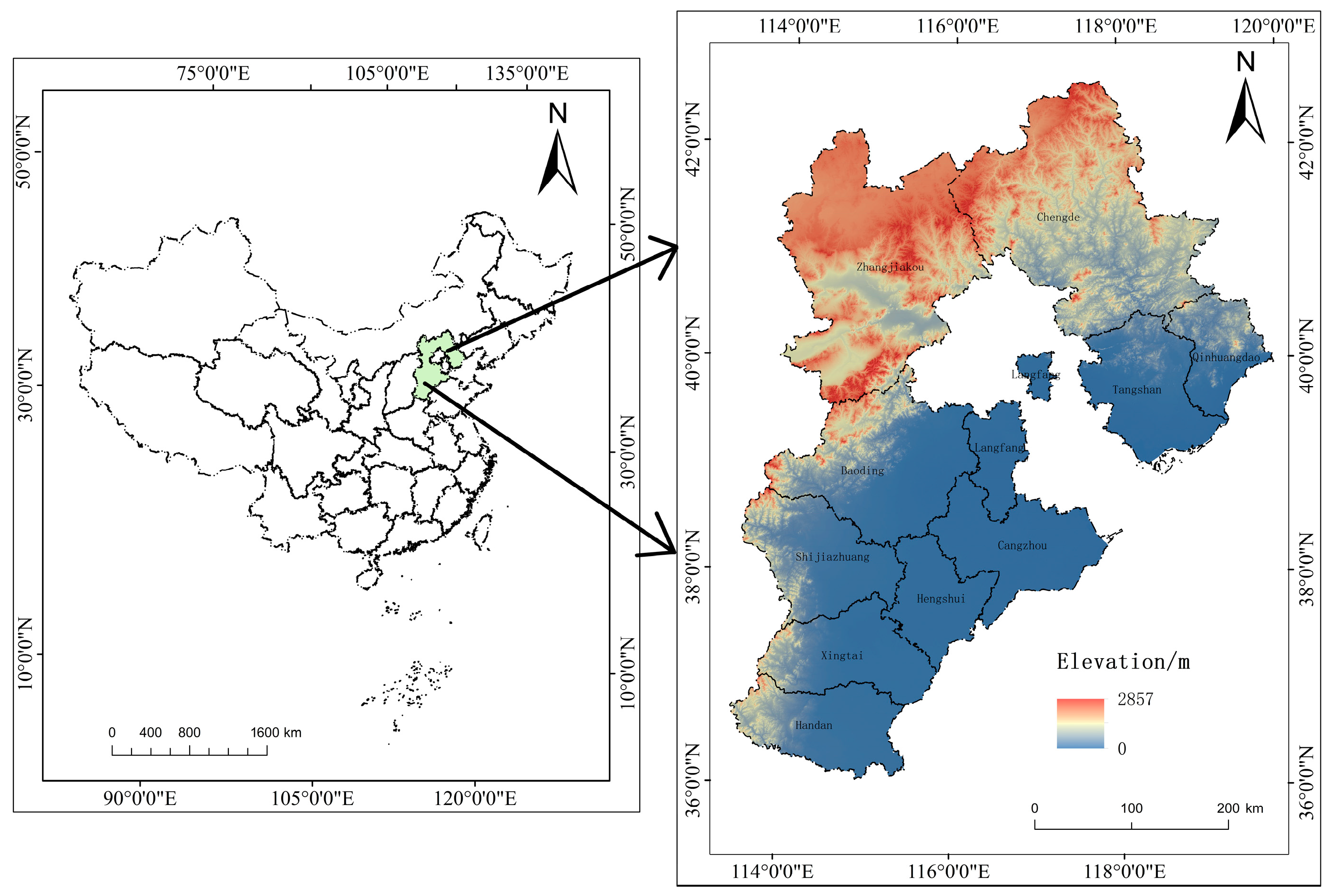
2.1. Study Region Overview
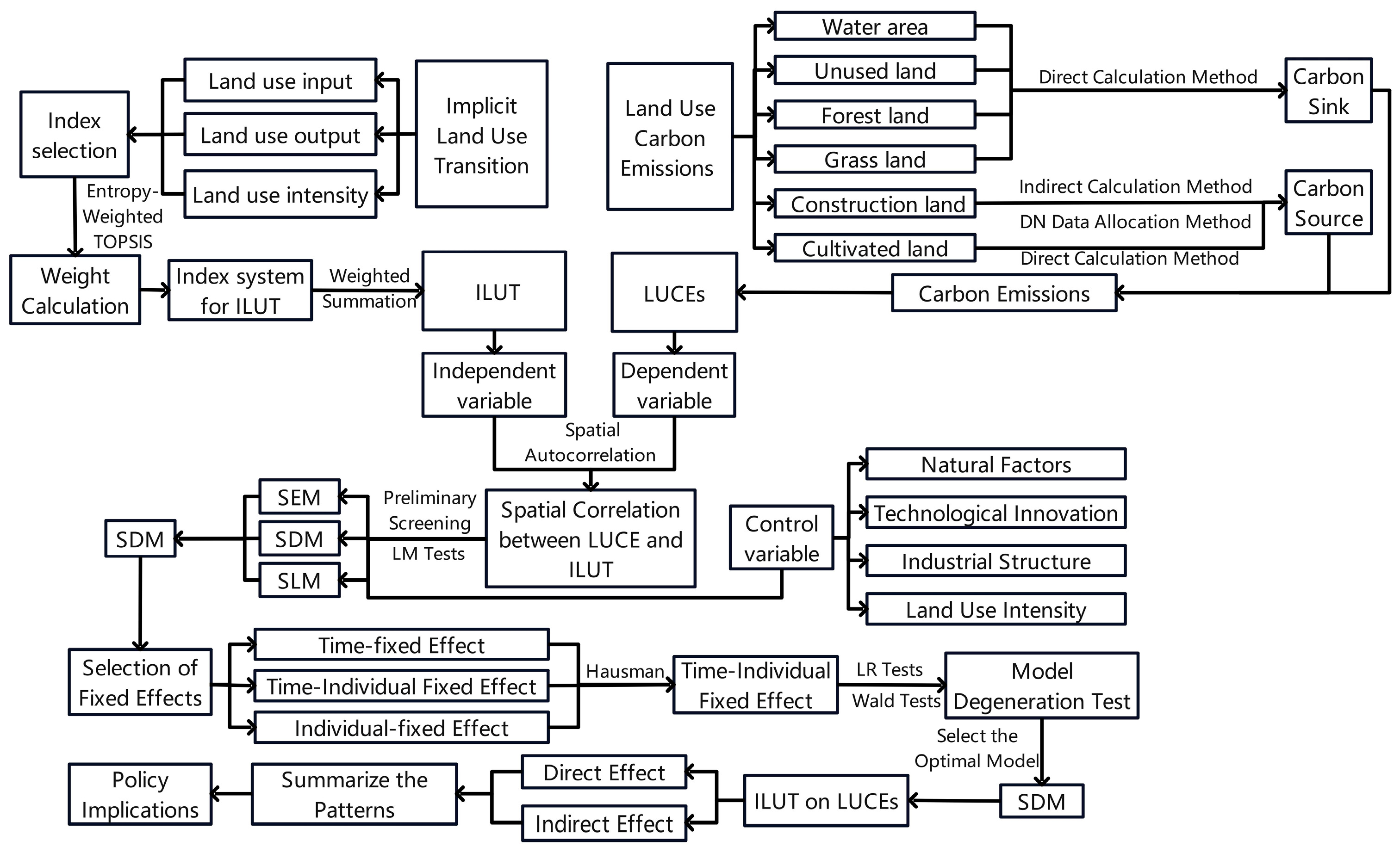
2.2. Research Approach
2.3. Data Sources and Preprocessing
2.4. Index Selection
2.4.1. Dependent Variable
- (1)
- Direct calculation method
- (2)
- Indirect calculation method
2.4.2. Independent Variables
2.4.3. Control Variable
- (1)
- Natural Factors
- (2)
- Land Use Intensity
- (3)
- Technological Innovation
- (4)
- Industrial Structure
2.5. Research Methods
2.5.1. Entropy-Weighted TOPSIS Combined with Weighted Summation for Index Calculation
2.5.2. Kernel Density Estimation
2.5.3. Spatial Correlation Test
2.5.4. Spatial Econometric Model
3. Results
3.1. LUCEs’ Spatiotemporal Evolution
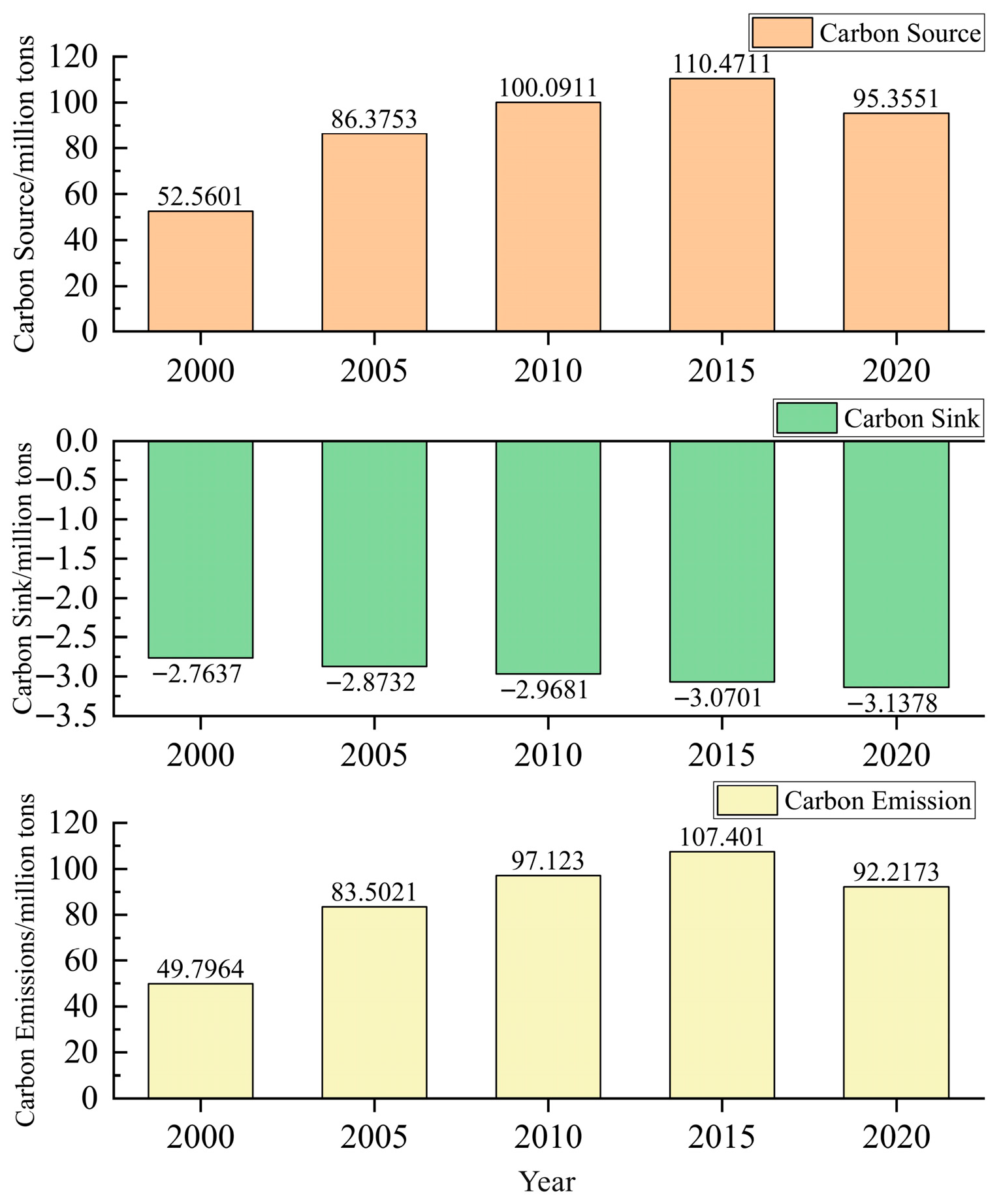
3.1.1. Time-Varying Process Trend of LUCEs
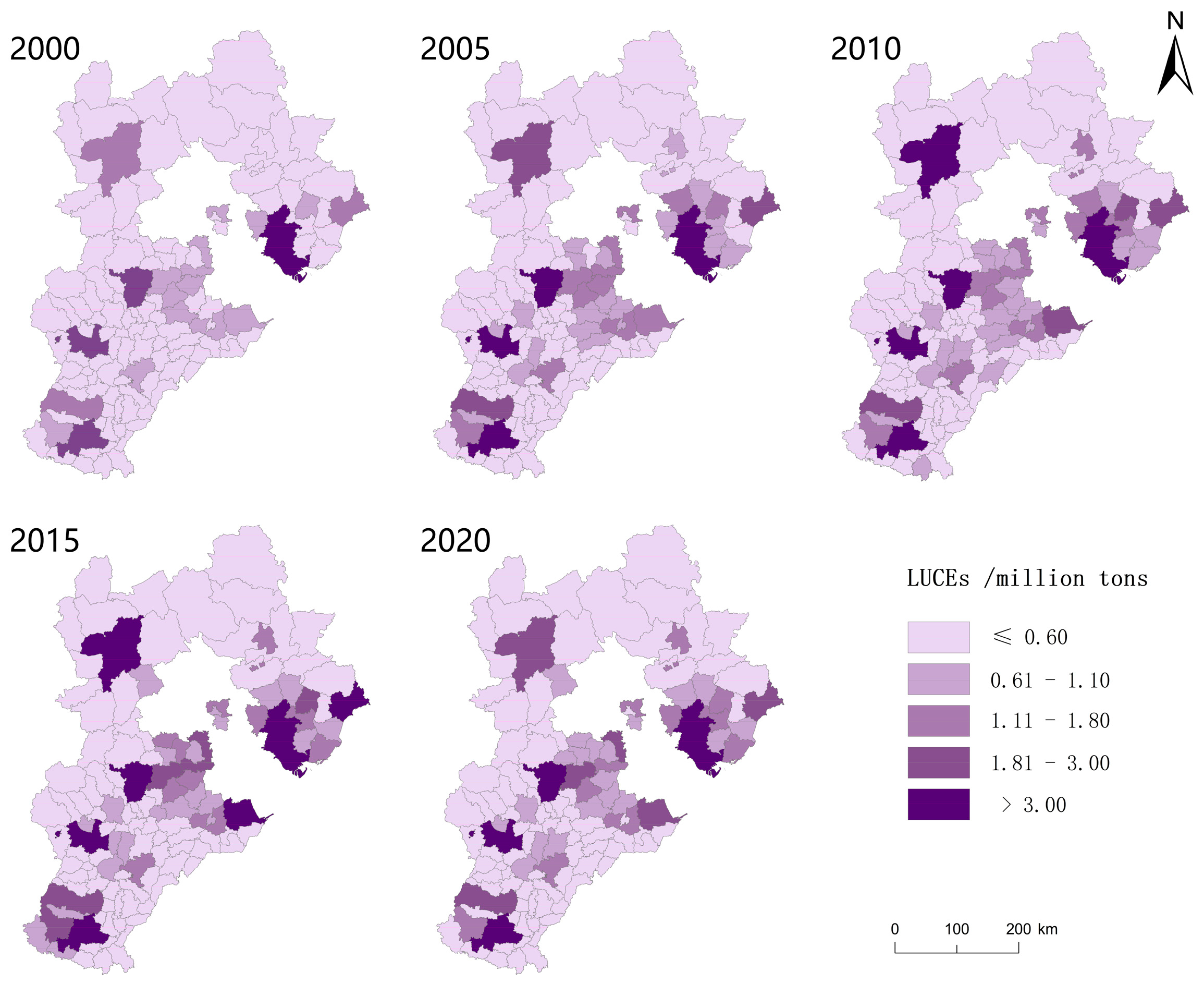
3.1.2. LUCEs’ Spatial Evolution Characteristics
3.2. ILUT’s Spatiotemporal Evolutionary Features
3.2.1. Temporal Sequence Evolution Properties of ILUT
3.2.2. ILUT’s Spatial Evolution Features
3.3. Impact of ILUT on LUCEs
3.3.1. Spatial Autocorrelation Test
3.3.2. Selection of Econometric Spatial Model
3.3.3. Regression Results
3.3.4. Effect Decomposition
3.3.5. Robustness Tests
4. Discussion
- (1)
- Optimize the input structure of the implicit transition to consolidate the foundation for low-carbon development. Concentrate on implicit investment in industrial/urban land by creating a low-carbon-driven capital allocation mechanism. Shift fixed-asset investment from traditional high-carbon sectors (e.g., steel and chemicals) towards clean energy (e.g., PV and wind) and energy-efficiency technologies. Integrate carbon intensity per unit of investment into the project approval process to limit investment-driven carbon growth at the source [91]. Boost spending on low-carbon public services (e.g., parks, woodlands, and green transport) [92]. Tie budget expenditures to regional carbon intensity reduction goals to check the implicit spread of high-carbon public projects.
- (2)
- Increase land use output efficiency to advance low-carbon value realization. Cap carbon emissions per unit of GDP to drive industries toward sustainable and smart upgrades, for example, by cultivating digital and circular economies. This decouples land-use GDP growth from carbon emissions [30]. Guide commercial land use toward low-carbon consumption scenarios (e.g., green malls) and promote subsidies for low-carbon products [93]. Upgrade consumption models to reduce the carbon footprint of retail sales growth per unit of land. Implement eco-agricultural technologies to lower agricultural carbon intensity while maintaining stable grain output [39] to achieve both high yield and low carbon goals.
- (3)
- Manage intensity thresholds to curb high-carbon, low-efficiency sprawl. Set low-carbon redlines for electricity use per unit of industrial/urban land and cap approvals for high-energy-use projects in exceedance areas. Boost distributed solar/wind power to cut carbon from energy use per unit of land [94]. Steer urban population distribution to avoid overcrowding. Build low-carbon communities in dense areas to prevent sprawl-related emissions. Control per capita carbon intensity via compact development, green space integration, and upgrades like district heating and smart, efficient buildings [25].
- (4)
- Spatial spillover effects facilitate collaborative governance to block carbon emissions’ transfer to neighboring areas. Establish a regional platform for sharing investment information and implement a joint review mechanism for cross-county high-carbon investment projects. This prevents the relocation of high-carbon industries from counties with strict emission reduction policies to neighboring areas, achieving regionally coordinated low-carbon investment steering. Create a coordinated regional low-carbon fiscal mechanism to provide cross-regional financial support to counties developing carbon sink forests or low-carbon infrastructure in neighboring areas. Thus, the positive spillover effects of public budgets are amplified. Define county-specific low-carbon industrial positioning based on regional resource endowments to avoid homogeneous competition in high-carbon industries and reduce overall regional emissions through industrial specialization. Implement an ecological compensation mechanism between primary grain production areas and consumption areas [95]. Offer cross-regional payments to major grain-producing counties adopting low-carbon farming techniques. This controls the spatial spillover of agricultural carbon emissions while ensuring food security. Develop an early warning system for regional energy consumption. For areas where electricity use per unit land in neighboring regions exceeds standards and poses a spillover risk, initiate cross-regional clean energy allocation to curb the spatial spillover of high energy consumption. Optimize population density distribution at the city cluster and metropolitan area level. Guide rational population flow through the equalization of regional public services. Prevent the spatial transmission of carbon emissions caused by excessive population concentration in any single county.
5. Conclusions
- (1)
- LUCEs in Hebei Province first increased and then decreased. Emissions increased from 49.80 (2000) to a peak of 107.40 million tons (2015), marking a significant increase of 115.68%. Subsequently, they declined to 92.22 million tons by 2020, a decrease of 14.14% from the peak in 2015. Significant disparities existed in LUCEs across counties. A distinct southeast-northwest gradient was observed, with the southeast exhibiting higher emission levels along with lower emissions within the northwest. Zones with high carbon emissions were agglomerated in various cities’ main urban areas.
- (2)
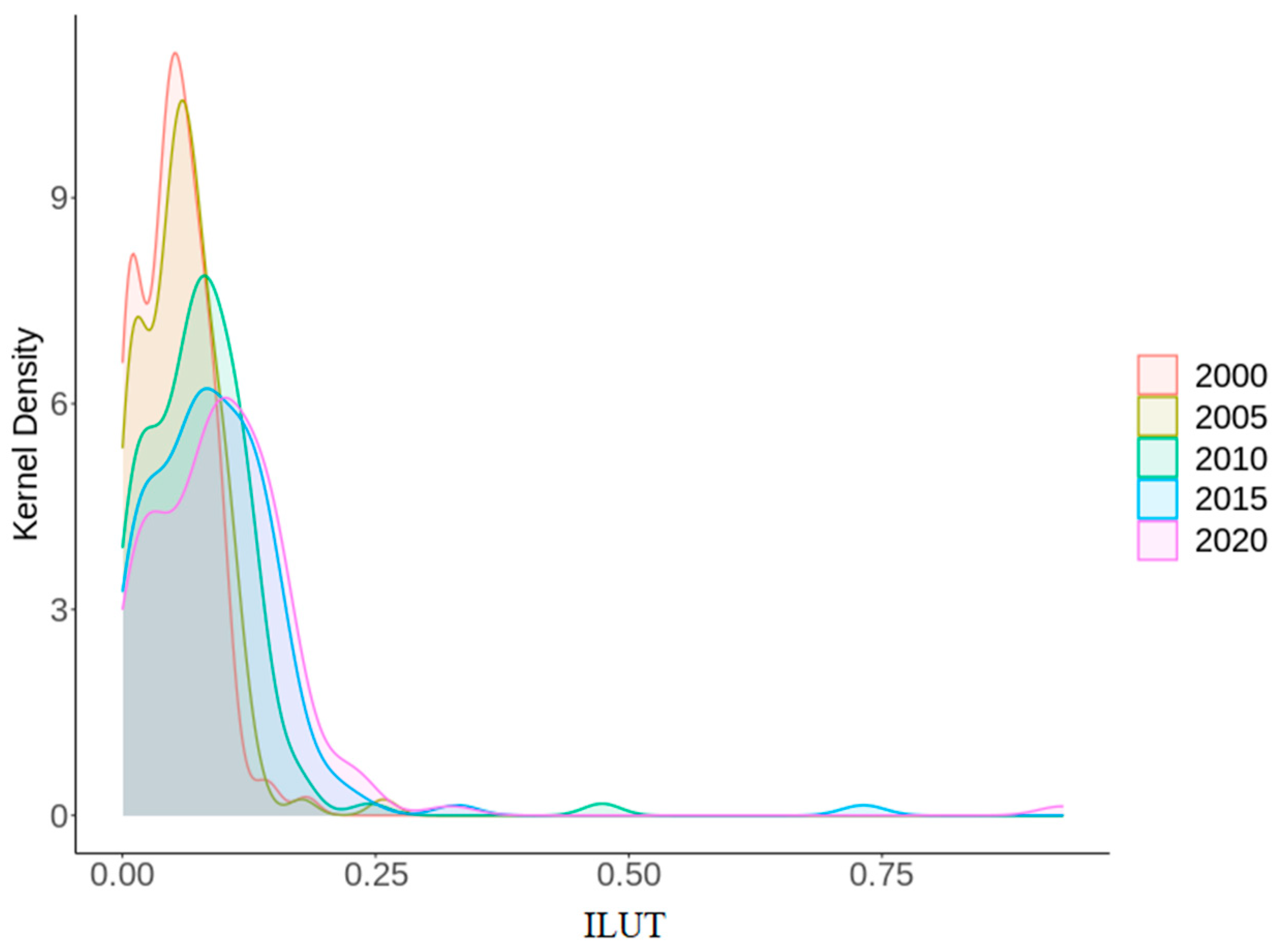
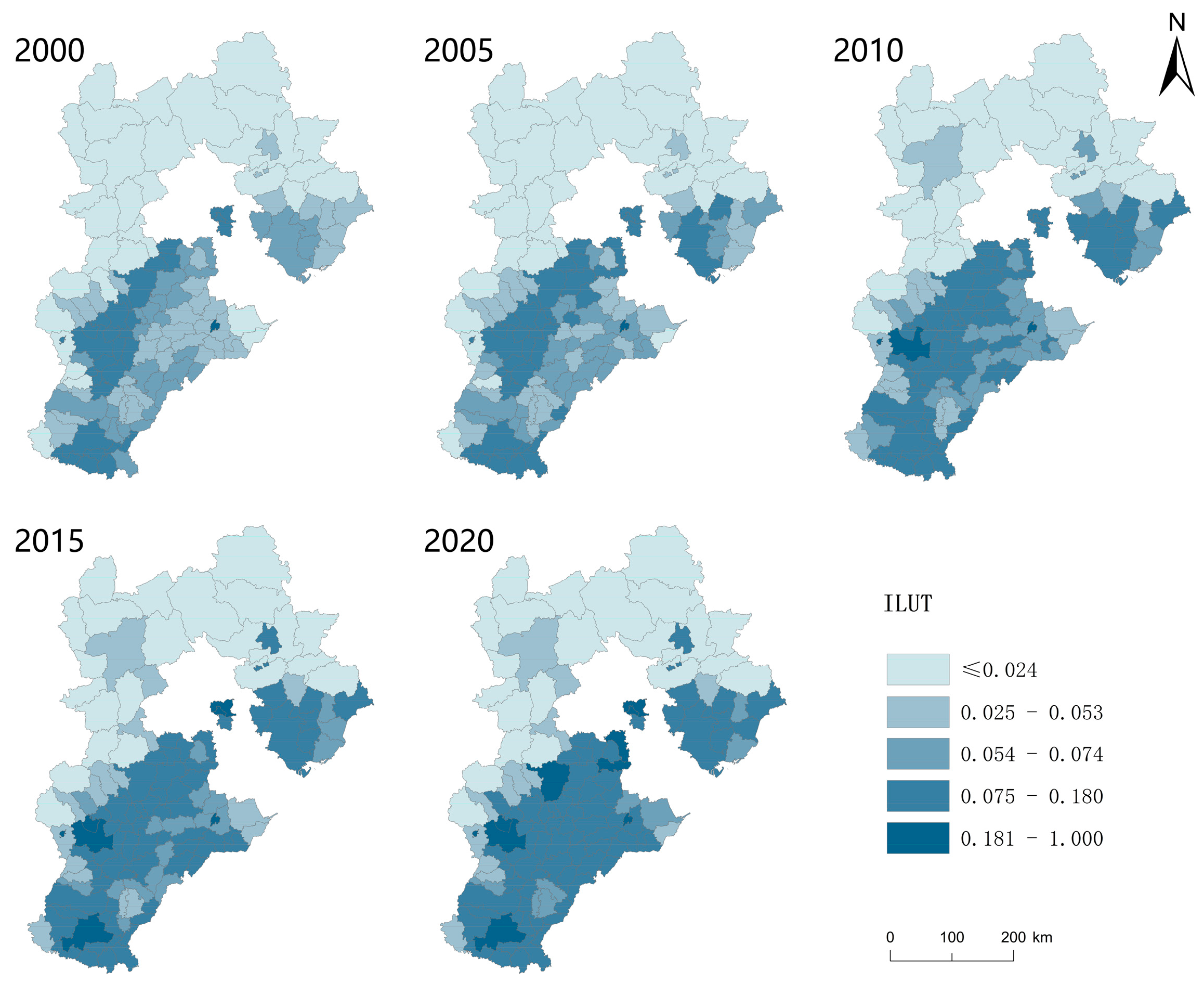
- The ILUT level in the counties of Hebei Province increased steadily. The polarization disparity in ILUT among counties widened, rising from 0.182 in 2000 to 0.925 in 2020. The spatial distribution of ILUT across counties was characterized by lower levels in the northwest and higher levels in the southeast. The pattern of ILUT evolved from a single-core cluster with isolated high values to a multi-core cluster with high values in the southeastern counties. In contrast, the northwestern counties remained at relatively lower levels.
- (3)
- Both ILUT and LUCEs exhibited significant spatial correlation among counties in Hebei Province. ILUT had a significantly positive direct as well as a negative spatial spillover effect on LUCEs. A positive spatial correlation exists between ILUT as well as land use-related carbon emissions within the county, while a negative spatial correlation exists with land use-related carbon emissions within neighboring counties.
Author Contributions
Funding
Data Availability Statement
Conflicts of Interest
References
- Infante-Amate, J.; Travieso, E.; Aguilera, E. The history of a+ 3 °C future: Global and regional drivers of greenhouse gas emissions (1820–2050). Glob. Environ. Change 2025, 92, 103009. [Google Scholar] [CrossRef]
- Wu, H.; Deng, K.; Dong, Z.; Meng, X.; Zhang, L.; Jiang, S.; Yang, L.; Xu, Y. Comprehensive assessment of land use carbon emissions of a coal resource-based city, China. J. Clean. Prod. 2022, 379, 134706. [Google Scholar] [CrossRef]
- Hong, C.; Burney, J.A.; Pongratz, J.; Nabel, J.E.; Mueller, N.D.; Jackson, R.B.; Davis, S.J. Global and regional drivers of land-use emissions in 1961–2017. Nature 2021, 589, 554–561. [Google Scholar] [CrossRef]
- Chen, N.; Xin, C.; Zhang, B.; Xin, S.; Tang, D.; Chen, H.; Ma, X. Contribution of multi-objective land use optimization to carbon neutrality: A case study of Northwest China. Ecol. Indic. 2023, 157, 111219. [Google Scholar] [CrossRef]
- Chivhenge, E.; Mabaso, A.; Museva, T.; Zingi, G.K.; Manatsa, P. Zimbabwe’s roadmap for decarbonisation and resilience: An evaluation of policy (in) consistency. Glob. Environ. Change 2023, 82, 102708. [Google Scholar] [CrossRef]
- Guo, Y.; Tong, Z.; Chen, H.; Wang, Z.; Yao, Y. Heterogeneity study on mechanisms influencing carbon emission intensity at the county level in the Yangtze River Delta urban Agglomeration: A perspective on main functional areas. Ecol. Indic. 2024, 159, 111597. [Google Scholar] [CrossRef]
- Li, S.; Liu, Y.; Wei, G.; Bi, M.; He, B.J. Carbon surplus or carbon deficit under land use transformation in China? Land Use Policy 2024, 143, 107218. [Google Scholar] [CrossRef]
- Beillouin, D.; Cardinael, R.; Berre, D.; Boyer, A.; Corbeels, M.; Fallot, A.; Feder, F.; Demenois, J. A global overview of studies about land management, land-use change, and climate change effects on soil organic carbon. Glob. Change Biol. 2022, 28, 1690–1702. [Google Scholar] [CrossRef]
- Mather, A.S. Global Trends in Forest Resources. Geography 1987, 72, 1–15. [Google Scholar] [CrossRef]
- Mather, A.S. The forest transition. Area 1992, 24, 367–379. [Google Scholar]
- Long, H.L.; Li, X.B. Analysis on regional land use transition: A case study in Transect of the Yangtze River. J. Nat. Resour. 2002, 17, 144–149. [Google Scholar]
- Long, H. Theorizing land use transitions: A human geography perspective. Habitat Int. 2022, 128, 102669. [Google Scholar] [CrossRef]
- Long, H.; Zhang, Y.; Ma, L.; Tu, S. Land use transitions: Progress, challenges and prospects. Land 2021, 10, 903. [Google Scholar] [CrossRef]
- Long, H.; Qu, Y. Land use transitions and land management: A mutual feedback perspective. Land Use Policy 2018, 74, 111–120. [Google Scholar] [CrossRef]
- Zhang, Y.; Dai, Y.; Chen, Y.; Ke, X. The study on spatial correlation of recessive land use transformation and land use carbon emission. China Land Sci. 2022, 36, 100–112. [Google Scholar] [CrossRef]
- Zhou, G.; Long, H.; Ge, D.; Xu, L.; Li, S. Study on three-dimensional measurement of recessive farmland use morphology and its regional types: A case of the Huang-Huai-Hai Region. Geogr. Res. 2024, 43, 180–199. [Google Scholar] [CrossRef]
- Xia, C.; Dong, Z.; Wu, P.; Dong, F.; Fang, K.; Li, Q.; Li, X.; Shao, Z.; Yu, Z. How urban land-use intensity affected CO2 emissions at the county level: Influence and prediction. Ecol. Indic. 2022, 145, 109601. [Google Scholar] [CrossRef]
- Zhang, C.Y.; Zhao, L.; Zhang, H.; Chen, M.N.; Fang, R.Y.; Yao, Y.; Zhang, Q.; Wang, Q. Spatial-temporal characteristics of carbon emissions from land use change in Yellow River Delta region, China. Ecol. Indic. 2022, 136, 108623. [Google Scholar] [CrossRef]
- Liu, C.; Hu, S.; Wu, S.; Song, J.; Li, H. County-level land use carbon emissions in China: Spatiotemporal patterns and impact factors. Sustain. Cities Soc. 2024, 105, 105304. [Google Scholar] [CrossRef]
- Li, W.; Chen, Z.; Li, M.; Zhang, H.; Li, M.; Qiu, X.; Zhou, C. Carbon emission and economic development trade-offs for optimizing land-use allocation in the Yangtze River Delta, China. Ecol. Indic. 2023, 147, 109950. [Google Scholar] [CrossRef]
- Hubacek, K.; Chen, X.; Feng, K.; Wiedmann, T.; Shan, Y. Evidence of decoupling consumption-based CO2 emissions from economic growth. Adv. Appl. Energy 2021, 4, 100074. [Google Scholar] [CrossRef]
- Raihan, A.; Tuspekova, A. The nexus between economic growth, renewable energy use, agricultural land expansion, and carbon emissions: New insights from Peru. Energy Nexus 2022, 6, 100067. [Google Scholar] [CrossRef]
- Azam, A.; Rafiq, M.; Shafique, M.; Zhang, H.; Yuan, J. Analyzing the effect of natural gas, nuclear energy and renewable energy on GDP and carbon emissions: A multi-variate panel data analysis. Energy 2021, 219, 119592. [Google Scholar] [CrossRef]
- Ou, Y.; Bao, Z.; Ng, S.T.; Song, W.; Chen, K. Land-use carbon emissions and built environment characteristics: A city-level quantitative analysis in emerging economies. Land Use Policy 2024, 137, 107019. [Google Scholar] [CrossRef]
- Shah, S.A.A.; Shah, S.Q.A.; Tahir, M. Determinants of CO2 emissions: Exploring the unexplored in low-income countries. Environ. Sci. Pollut. Res. 2022, 29, 48276–48284. [Google Scholar] [CrossRef]
- Deng, W.; Meng, T.; Kharuddin, S.; Ashhari, Z.M.; Zhou, J. The impact of renewable energy consumption, green technology innovation, and FDI on carbon emission intensity: Evidence from developed and developing countries. J. Clean. Prod. 2024, 483, 144310. [Google Scholar] [CrossRef]
- Dong, B.; Ma, X.; Zhang, Z.; Zhang, H.; Chen, R.; Song, Y.; Shen, M.; Xiang, R. Carbon emissions, the industrial structure and economic growth: Evidence from heterogeneous industries in China. Environ. Pollut. 2020, 262, 114322. [Google Scholar] [CrossRef]
- Tian, J.; Wang, B.; Zhang, C.; Li, W.; Wang, S. Mechanism of regional land use transition in underdeveloped areas of China: A case study of northeast China. Land Use Policy 2020, 94, 104538. [Google Scholar] [CrossRef]
- Drummond, M.A.; Griffith, G.E.; Auch, R.F.; Stier, M.P.; Taylor, J.L.; Hester, D.J.; Riegle, J.L.; McBeth, J.L. Understanding recurrent land use processes and long-term transitions in the dynamic south-central United States, c. 1800 to 2006. Land Use Policy 2017, 68, 345–354. [Google Scholar] [CrossRef]
- Avashia, V.; Garg, A. Implications of land use transitions and climate change on local flooding in urban areas: An assessment of 42 Indian cities. Land Use Policy 2020, 95, 104571. [Google Scholar] [CrossRef]
- Lambin, E.F.; Meyfroidt, P. Land use transitions: Socio-ecological feedback versus socio-economic change. Land Use Policy 2010, 27, 108–118. [Google Scholar] [CrossRef]
- de Oliveira, R.E.; de Magalhães, L.P.; de Souza Gallo, A.; de Oliveira, J.A.; Sais, A.C. Land use transitions and the decline of family farming in Southeastern Brazil: Patterns, pressures, and environmental trade-offs. Land Use Policy 2025, 159, 107802. [Google Scholar] [CrossRef]
- Long, H.; Qu, Y.; Tu, S.; Zhang, Y.; Jiang, Y. Development of land use transitions research in China. J. Geogr. Sci. 2020, 30, 1195–1214. [Google Scholar] [CrossRef]
- Yang, Y.; Yang, M.; Zhao, B.; Lu, Z.; Sun, X.; Zhang, Z. Spatially explicit carbon emissions from land use change: Dynamics and scenario simulation in the Beijing-Tianjin-Hebei urban agglomeration. Land Use Policy 2025, 150, 107473. [Google Scholar] [CrossRef]
- Zhou, Y.; Chen, M.; Tang, Z.; Mei, Z. Urbanization, land use change, and carbon emissions: Quantitative assessments for city-level carbon emissions in Beijing-Tianjin-Hebei region. Sustain. Cities Soc. 2021, 66, 102701. [Google Scholar] [CrossRef]
- Tubiello, F.N.; Conchedda, G.; Wanner, N.; Federici, S.; Rossi, S.; Grassi, G. Carbon emissions and removals from forests: New estimates, 1990–2020. Earth Syst. Sci. Data 2021, 13, 1681–1691. [Google Scholar] [CrossRef]
- Kafy, A.A.; Saha, M.; Fattah, M.A.; Rahman, M.T.; Duti, B.M.; Rahaman, Z.A.; Bakshi, A.; Kalaivani, S.; Rahaman, S.N.; Sattar, G.S. Integrating forest cover change and carbon storage dynamics: Leveraging Google Earth Engine and InVEST model to inform conservation in hilly regions. Ecol. Indic. 2023, 152, 110374. [Google Scholar] [CrossRef]
- Ke, S.; Wu, Y.; Cui, H.; Lu, X. The mechanisms and spatial-temporal effects of farmland spatial transition on agricultural carbon emission: Based on 2018 counties in China. Environ. Sci. Pollut. Res. 2023, 30, 107716–107732. [Google Scholar] [CrossRef]
- Escobar, N.; Tizado, E.J.; zu Ermgassen, E.K.; Löfgren, P.; Börner, J.; Godar, J. Spatially-explicit footprints of agricultural commodities: Mapping carbon emissions embodied in Brazil’s soy exports. Glob. Environ. Change 2020, 62, 102067. [Google Scholar] [CrossRef]
- Yang, Y.; Li, H. Spatiotemporal dynamic decoupling states of eco-environmental quality and land-use carbon emissions: A case study of Qingdao City, China. Ecol. Inf. 2023, 75, 101992. [Google Scholar] [CrossRef]
- Zhou, K.; Yang, J.; Yang, T.; Ding, T. Spatial and temporal evolution characteristics and spillover effects of China’s regional carbon emissions. J. Environ. Manag. 2023, 325, 116423. [Google Scholar] [CrossRef]
- Basu, T.; Das, A. Urbanization induced changes in land use dynamics and its nexus to ecosystem service values: A spatiotemporal investigation to promote sustainable urban growth. Land Use Policy 2024, 144, 107239. [Google Scholar] [CrossRef]
- Grabska-Szwagrzyk, E.; Khiabani, P.H.; Pesoa-Marcilla, M.; Chaturvedi, V.; de Vries, W.T. Exploring land use dynamics in rural areas. An analysis of eight cases in the Global North. Land Use Policy 2024, 144, 107246. [Google Scholar] [CrossRef]
- LeSage, J.; Pace, R.K. Introduction to Spatial Econometrics; CRC Press: New York, NY, USA, 2009; Volume 31. [Google Scholar]
- Liu, F.; Liu, C. Regional disparity, spatial spillover effects of urbanisation and carbon emissions in China. J. Clean. Prod. 2019, 241, 118226. [Google Scholar] [CrossRef]
- You, W.; Lv, Z. Spillover effects of economic globalization on CO2 emissions: A spatial panel approach. Energy Econ. 2018, 73, 248–257. [Google Scholar] [CrossRef]
- Shahnazi, R.; Dehghan Shabani, Z. The effects of spatial spillover information and communications technology on carbon dioxide emissions in Iran. Environ. Sci. Pollut. Res. 2019, 26, 24198–24212. [Google Scholar] [CrossRef]
- Li, H.; Chen, K.; Yan, L.; Zhu, Y.; Liao, L.; Chen, Y. Urban land use transitions and the economic spatial spillovers of central cities in China’s urban agglomerations. Land 2021, 10, 644. [Google Scholar] [CrossRef]
- Wang, M.; Huang, X. Inhibit or promote: Spatial impacts of multifunctional farmland use transition on grain production from the perspective of major function-oriented zoning. Habitat Int. 2024, 152, 103172. [Google Scholar] [CrossRef]
- Wang, M.; Huang, X.; Song, Y.; Sun, R. The spatial impacts of multifunctional farmland use transition on the urban-rural income gap: A major function-oriented zoning perspective. Cities 2025, 167, 106385. [Google Scholar] [CrossRef]
- Jia, S.; Yang, C.; Wang, M.; Failler, P. Heterogeneous impact of land-use on climate change: Study from a spatial perspective. Front. Environ. Sci. 2022, 10, 840603. [Google Scholar] [CrossRef]
- Meng, J.; Wang, C.; Zou, Y.; Han, Z.; Zou, G. Multi-scale spatiotemporal interactions between land use transformation and carbon emissions in China from 1980 to 2020. Resour. Conserv. Recycl. 2026, 226, 108653. [Google Scholar] [CrossRef]
- Qi, Q.Q.; Xu, Z.J. Analysis on the spatio-temporal evolution of ecological security patterns: A case study over Taiyuan Urban Agglomeration. China Environ. Sci. 2023, 43, 5987–5997. [Google Scholar]
- Yang, J.; Huang, X. 30 m annual land cover and its dynamics in China from 1990 to 2019. Earth Syst. Sci. Data Discuss. 2021, 2021, 3907–3925. [Google Scholar] [CrossRef]
- Eggleston, H.S.; Buendia, L.; Miwa, K.; Ngara, T.; Tanabe, K. 2006 IPCC Guidelines for National Greenhouse Gas Inventories; Institute for Global Environmental Strategies: Hayama, Japan, 2006. [Google Scholar]
- Bastos, A.; Hartung, K.; Nützel, T.B.; Nabel, J.E.; Houghton, R.A.; Pongratz, J. Comparison of uncertainties in land-use change fluxes from bookkeeping model parameterization. Earth Syst. Dyn. Discuss. 2021, 2021, 745–762. [Google Scholar] [CrossRef]
- Kok, R.; Benders, R.M.; Moll, H.C. Measuring the environmental load of household consumption using some methods based on input–output energy analysis: A comparison of methods and a discussion of results. Energy Policy 2006, 34, 2744–2761. [Google Scholar] [CrossRef]
- Tang, Z.; Wang, Y.; Fu, M.; Xue, J. The role of land use landscape patterns in the carbon emission reduction: Empirical evidence from China. Ecol. Indic. 2023, 156, 111176. [Google Scholar] [CrossRef]
- Zhang, X.; Cai, Z.; Song, W.; Yang, D. Mapping the spatial-temporal changes in energy consumption-related carbon emissions in the Beijing-Tianjin-Hebei region via nighttime light data. Sustain. Cities Soc. 2023, 94, 104476. [Google Scholar] [CrossRef]
- Zhang, X.; Fan, H.; Hou, H.; Xu, C.; Sun, L.; Li, Q.; Ren, J. Spatiotemporal evolution and multi-scale coupling effects of land-use carbon emissions and ecological environmental quality. Sci. Total Environ. 2024, 922, 171149. [Google Scholar] [CrossRef]
- Gui, D.; He, H.; Liu, C.; Han, S. Spatio-Temporal dynamic evolution of carbon emissions from land use change in Guangdong Province, China, 2000–2020. Ecol. Indic. 2023, 156, 111131. [Google Scholar] [CrossRef]
- Yu, Z.; Chen, L.; Tong, H.; Chen, L.; Zhang, T.; Li, L.; Yuan, L.; Xiao, J.; Wu, R.; Bai, L.; et al. Spatial correlations of land-use carbon emissions in the Yangtze River Delta region: A perspective from social network analysis. Ecol. Indic. 2022, 142, 109147. [Google Scholar] [CrossRef]
- Sun, H.; Liang, H.; Chang, X.; Cui, Q.; Tao, Y. Land use patterns on carbon emission and spatial association in China. Econ. Geogr. 2015, 35, 154–162. [Google Scholar] [CrossRef]
- Li, A.; Yin, X.; Wei, H. Spatiotemporal Evolution and Driving Factors of the Relationship Between Land Use Carbon Emissions and Ecosystem Service Value in Beijing-Tianjin-Hebei. Land 2025, 14, 1698. [Google Scholar] [CrossRef]
- Yuan, X.; Bai, X.; Zhou, Z.; Luo, G.; Li, J.; Ran, C.; Zhang, S.; Xiong, L.; Liao, J.; Du, C.; et al. Global impacts of land use on terrestrial carbon emissions since 1850. Sci. Total Environ. 2025, 963, 178358. [Google Scholar] [CrossRef]
- Rong, T.; Zhang, P.; Zhu, H.; Jiang, L.; Li, Y.; Liu, Z. Spatial correlation evolution and prediction scenario of land use carbon emissions in China. Ecol. Inf. 2022, 71, 101802. [Google Scholar] [CrossRef]
- Yan, H.; Guo, X.; Zhao, S.; Yang, H. Variation of net carbon emissions from land use change in the Beijing-Tianjin-Hebei region during 1990–2020. Land 2022, 11, 997. [Google Scholar] [CrossRef]
- Pu, J.H.; Chen, S.L.; Du, F.Y. Factors Influencing Recessive Transformation of Land Use in Fujian Province During 2000–2020. Bull. Soil Water Conserv. 2023, 43, 402–411. [Google Scholar] [CrossRef]
- Yin, D.; Yu, H.; Ma, J.; Liu, J.; Liu, G.; Chen, F. Interaction and coupling mechanism between recessive land use transition and food security: A case study of the Yellow River Basin in China. Agriculture 2022, 12, 58. [Google Scholar] [CrossRef]
- Wang, Y.; Song, M.; Han, Y.; Wang, Y. Multi-scale Coupling Measurement and Driving Factor Analysis between Carbon Emission from Energy Consumption and Ecological Environment-The Case Study of Pearl River Delta Urban Agglomeration. Sustain. Cities Soc. 2025, 127, 106425. [Google Scholar] [CrossRef]
- He, X.; Guan, D.; Yang, X.; Zhou, L.; Gao, W. Quantifying the trends and affecting factors of CO2 emissions under different urban development patterns: An econometric study on the Yangtze river economic belt in China. Sustain. Cities Soc. 2024, 107, 105443. [Google Scholar] [CrossRef]
- Song, S.; Kong, M.; Su, M.; Ma, Y. Study on carbon sink of cropland and influencing factors: A multiscale analysis based on geographical weighted regression model. J. Clean. Prod. 2024, 447, 141455. [Google Scholar] [CrossRef]
- Wu, K.; Wang, D.; Lu, H.; Liu, G. Temporal and spatial heterogeneity of land use, urbanization, and ecosystem service value in China: A national-scale analysis. J. Clean. Prod. 2023, 418, 137911. [Google Scholar] [CrossRef]
- Yang, M.; Chen, Y.; Yang, Y.; Yan, Y. Nonlinear relationship and threshold-based zones between ecosystem service supply-demand ratio and land use intensity: A case study of the Beijing-Tianjin-Hebei region, China. J. Clean. Prod. 2024, 481, 144148. [Google Scholar] [CrossRef]
- Liu, X.; Guo, R.; Zhang, Y.; Liu, N.; Zhang, J. Spatiotemporal evolution and influencing mechanisms of carbon pressure at the county scale: A case study of central-south Liaoning urban agglomeration, China. Ecol. Indic. 2024, 169, 112900. [Google Scholar] [CrossRef]
- Liu, G.; Cui, F.; Wang, Y. Spatial effects of urbanization, ecological construction and their interaction on land use carbon emissions/absorption: Evidence from China. Ecol. Indic. 2024, 160, 111817. [Google Scholar] [CrossRef]
- Jing, X.; Tao, S.; Hu, H.; Sun, M.; Wang, M. Spatio-temporal evaluation of ecological security of cultivated land in China based on DPSIR-entropy weight TOPSIS model and analysis of obstacle factors. Ecol. Indic. 2024, 166, 112579. [Google Scholar] [CrossRef]
- Wu, N.; Zhou, Y.; Yin, S.; Gong, H.; Zhang, C. Revealing the nonlinear impact of environmental regulation on ecological resilience using the XGBoost-SHAP model: Evidence from the Yangtze River Delta region, China. J. Clean. Prod. 2025, 514, 145700. [Google Scholar] [CrossRef]
- Wu, F.; Wang, C.; Ibrahim, H.; Zhao, J. Research on the spatial and temporal evolution and spatial spillover effects of regional green innovation in China under the ESG context. J. Clean. Prod. 2025, 520, 146116. [Google Scholar] [CrossRef]
- Wang, M.; Lin, N.; Huang, X.; Tang, Y. Mitigating farmland use carbon emissions: The dynamic role of farmland use transition. J. Clean. Prod. 2024, 450, 141866. [Google Scholar] [CrossRef]
- Wang, M.; Dong, Y.; Lin, N.; Ql, X.; Huang, X. Impact of farmland use transition on farmland use carbon emissions and its spatial spillover effects under the double carbon background: A case study of Huang-Huai-Hai Plain. J. Nat. Resour. 2024, 39, 352. [Google Scholar] [CrossRef]
- Luo, Y.; Chen, S.; Liu, W.; Wang, X.; Qi, A. Analysis and prediction on the spatiotemporal evolution of carbon emissions from land use in Hebei province. Chin. J. Environ. Eng. 2024, 11, 3360–3373. [Google Scholar]
- Yuan, Y.; Duan, H.; Tsvetanov, T.G. Synergizing China’s energy and carbon mitigation goals: General equilibrium modeling and policy assessment. Energy Econ. 2020, 89, 104787. [Google Scholar] [CrossRef]
- Udeagha, M.C.; Ngepah, N. The asymmetric effect of technological innovation on CO2 emissions in South Africa: New evidence from the QARDL approach. Front. Environ. Sci. 2022, 10, 985719. [Google Scholar] [CrossRef]
- Hosein, A.S.; Whale, J.; Simsek, Y.; Urmee, T. Exploring energy policy scenarios to transition to a low carbon economy by 2050: A case study on the Northern Territory of Australia. Energy Policy 2023, 180, 113663. [Google Scholar] [CrossRef]
- Hao, P.; Liu, Z. Coordination characteristics between land use implicit forms and land ecological security in Xinjiang oasis: The Ili River Valley as a case study. Arid. Zone Res. 2024, 41, 1605–1614. [Google Scholar]
- Dang, A.N.; Kawasaki, A. Integrating biophysical and socio-economic factors for land-use and land-cover change projection in agricultural economic regions. Ecol. Modell. 2017, 344, 29–37. [Google Scholar] [CrossRef]
- Ramírez-Mejía, D.; Zinngrebe, Y.; Ellis, E.C.; Verburg, P.H. Land-use spillovers from environmental policy interventions. Glob. Environ. Change 2025, 92, 103013. [Google Scholar] [CrossRef]
- Ge, K.; Wang, Y.; Liu, X.; Hu, L.; Ke, S.; Jiang, X.; Zhang, W. Spatial effects and influence mechanisms of urban land use green transition on urban carbon emissions. Ecol. Indic. 2025, 172, 113261. [Google Scholar] [CrossRef]
- Martínez-Valderrama, J.; Ibáñez, J.; Del Barrio, G.; Alcalá, F.J.; Sanjuán, M.E.; Ruiz, A.; Hirche, A.; Puigdefábregas, J. Doomed to collapse: Why Algerian steppe rangelands are overgrazed and some lessons to help land-use transitions. Sci. Total Environ. 2018, 613, 1489–1497. [Google Scholar] [CrossRef]
- Liang, J.; Wang, S.; Liao, Y.; Feng, K. Carbon emissions embodied in investment: Assessing emissions reduction responsibility through multi-regional input-output analysis. Appl. Energy 2024, 358, 122558. [Google Scholar] [CrossRef]
- Nguyen, T.C.; Kim, J. Exploring resource-efficient urban mobility for sustainable low emission solutions: A case study of Ile-de-France, France. Sci. Total Environ. 2024, 955, 176968. [Google Scholar] [CrossRef]
- Babatunde, K.A.; Said, F.F.; Nor, N.G.M.; Begum, R.A.; Mahmoud, M.A. Coherent or conflicting? Assessing natural gas subsidy and energy efficiency policy interactions amid CO2 emissions reduction in Malaysia electricity sector. J. Clean. Prod. 2021, 279, 123374. [Google Scholar] [CrossRef]
- Caglar, A.E.; Demirdag, I.; Destek, M.A.; Daştan, M. Achieving ecological sustainability in European countries: Does low carbon energy lead to a carbon neutrality pathway? Sci. Total Environ. 2025, 958, 177915. [Google Scholar] [CrossRef] [PubMed]
- Shehzad, K.; Xue, Q. Can technology in terms of finance, environment, and communication boost food production while facilitating a low-carbon transition? Evidence from a high-tech and low-tech state. J. Clean. Prod. 2024, 477, 143859. [Google Scholar] [CrossRef]



| Variable | Data Source |
|---|---|
| Administrative divisions | National Geospatial Information Public Service Platform (https://www.tianditu.gov.cn/ accessed on 13 February 2025) |
| Altitude data | Geospatial Data Cloud (https://www.gscloud.cn/ accessed on 13 February 2025) |
| Land use data | China Land Cover Dataset (CLCD) published by the team of Prof. Yang and Prof. Huang, Wuhan University (https://zenodo.org/ accessed on 15 January 2025) [54] |
| Nighttime Light Data | Harvard Dataverse (10.7910/DVN/YGIVCD) |
| Population density | WorldPop (https://hub.worldpop.org/ accessed on 16 February 2025) |
| Normalized differential vegetation index (NDVI) | MOD13A3 Dataset (https://www.earthdata.nasa.gov/ accessed on 21 April 2025) |
| Precipitation and temperature data | Institute of Tibetan Plateau Research, Chinese Academy of Sciences (https://data.tpdc.ac.cn/ accessed on 23 April 2025) |
| Number of patent applications and grants | China National Intellectual Property Administration(https://www.cnipa.gov.cn/ accessed on 25 April 2025) |
| Number of newly registered enterprises | Industrial and Commercial Enterprise Registration Database provided by the State Administration for Industry and Commerce (https://www.macrodatas.cn/ accessed on 26 April 2025) |
| Number of high-tech enterprises | Office of the National Leading Group for the Recognition and Management of High-tech Enterprises (http://www.innocom.gov.cn/gqrdw/index.shtml accessed on 27 April 2025) |
| Energy data and socio-economic data | China Energy Statistical Yearbook, IPCC Guidelines for National Greenhouse Gas Inventories (2006) [55], China County Statistical Yearbook, Hebei Statistical Yearbook, Municipal statistical yearbooks, and Statistical bulletins on national economic and social development at various levels |
| Type | Cultivated Land | Forest Land | Grass Land | Water Area | Unused Land |
|---|---|---|---|---|---|
| Carbon emission coefficient [kg·(m2·a)−1] | 0.0422 | −0.0664 | −0.0021 | −0.0252 | −0.0005 |
| Reference Sources | [63,64] | [65] | [63,64,66] | [63,66] | [63,64,66] |
| Energy | Coal | Coke | Crude Oil | Gasoline | Kerosene | Diesel Oil | Fuel Oil | Natural Gas | Electricity |
|---|---|---|---|---|---|---|---|---|---|
| Standard coal conversion coefficient | 0.7143 | 0.9714 | 1.4286 | 1.4714 | 1.4714 | 1.4571 | 1.4286 | 1.2143 | 0.1229 |
| Carbon emission coefficient | 0.7559 | 0.855 | 0.5857 | 0.5538 | 0.5714 | 0.5921 | 0.6185 | 0.4483 | 0.2132 |
| Element Layer | Criterion Layer | Index Layer | Index Type | Weight |
|---|---|---|---|---|
| ILUT | Land use input | Fixed assets investment per unit area (yuan/km2) | + | 0.187 |
| Local general public budget revenue per unit area (yuan/km2) | + | 0.173 | ||
| Land use output | GDP per unit area (yuan/km2) | + | 0.158 | |
| Sales of consumer goods’ total retail per unit area (yuan/km2) | + | 0.161 | ||
| Grain output per unit area (t/km2) | + | 0.095 | ||
| Land use intensity | Electricity consumption per unit area (kW·h/km2) | + | 0.152 | |
| Population density (persons/km2) | + | 0.074 |
| Years | ILUT | LUCEs | ||
|---|---|---|---|---|
| z-Value | z-Value | |||
| 2000 | 0.313 *** | 7.665 | 0.137 *** | 3.431 |
| 2005 | 0.307 *** | 7.482 | 0.117 *** | 3.005 |
| 2010 | 0.302 *** | 7.338 | 0.117 *** | 2.987 |
| 2015 | 0.286 *** | 6.984 | 0.207 *** | 5.082 |
| 2020 | 0.287 *** | 6.991 | 0.122 *** | 3.090 |
| Test | Statistic | p-Value |
|---|---|---|
| LM-Spatial-lag | 43.051 | 0.000 |
| Robust LM-Spatial-lag | 31.692 | 0.000 |
| LM-Spatial-error | 152.341 | 0.000 |
| Robust LM-Spatial-error | 140.981 | 0.000 |
| LR Spatial lag | 207.380 | 0.000 |
| LR Spatial error | 83.470 | 0.000 |
| Wald test Spatial lag | 20.350 | 0.001 |
| Wald test Spatial error | 13.480 | 0.019 |
| Hausman | 121.550 | 0.000 |
| LR test individual fixed | 36.330 | 0.000 |
| LR test Time fixed | 916.850 | 0.000 |
| Variable | Pool Regression Model | Spatial Econometric Model | ||
|---|---|---|---|---|
| OLS (1) | SAR (2) | SEM (3) | SDM (4) | |
| ILUT | 0.243 *** (4.461) | 0.206 *** (3.806) | 0.472 *** (7.981) | 0.548 *** (9.035) |
| Natural Factors | 0.464 *** (3.835) | 0.605 *** (5.200) | 1.150 *** (10.412) | 1.143 *** (10.656) |
| Land Use Intensity | 1.082 ** (2.470) | 1.093 *** (2.595) | 1.280 ** (2.433) | 2.083 *** (3.477) |
| Technological Innovation | 0.199 *** (10.102) | 0.172 *** (8.879) | 0.180 *** (9.018) | 0.186 *** (9.507) |
| Industrial Structure | 0.623 *** (7.279) | 0.602 *** (7.319) | 0.446 *** (5.183) | 0.368 *** (4.378) |
| Constant | 14.708 *** (26.644) | |||
| W × LUCEs | 0.248 *** (5.830) | 0.534 *** (13.593) | ||
| Lambda | 0.636 *** (18.354) | |||
| W × ILUT | −0.493 *** (−5.610) | |||
| W × Natural Factors | −1.713 *** (−9.780) | |||
| W × Land Use Intensity | −2.909 *** (−3.505) | |||
| W × Technological Innovation | −0.053 * (−1.838) | |||
| W × Industrial Structure | 0.041 (0.327) | |||
| Log-likelihood | −643.971 | −582.020 | −540.281 | |
| adjusted R2 | 0.497 | 0.530 | 0.480 | 0.678 |
| N | 635 | 635 | 635 | 635 |
| Variable | Direct Effect | Spatial Spillover Effect | Total Effect |
|---|---|---|---|
| ILUT | 0.448 *** (3.023) | −0.331 *** (−2.153) | 0.116 *** (2.052) |
| Natural Factors | 0.595 *** (3.284) | −1.817 *** (−4.324) | −1.223 *** (3.652) |
| Land Use Intensity | 1.189 *** (3.457) | −2.959 *** (−3.486) | −1.774 *** (−3.524) |
| Technological Innovation | 0.209 ** (2.125) | 0.076 * (1.656) | 0.286 ** (2.314) |
| Industrial Structure | 0.486 * (3.225) | 0.391 (1.567) | 0.877 (4.152) |
| Variable | (1) | (2) | (3) |
|---|---|---|---|
| ILUT | 0.349 *** (6.449) | 0.655 *** (10.896) | 0.333 *** (4.313) |
| W × ILUT | −1.298 *** (−2.846) | −0.626 *** (−7.144) | −0.260 *** (−2.800) |
| Control variables | YES | YES | YES |
| Time-fixed effect | YES | YES | YES |
| Individual-fixed effect | YES | YES | YES |
| Log-likelihood | −592.470 | −490.458 | −454.73 |
| adjusted R2 | 0.592 | 0.707 | 0.610 |
| N | 635 | 635 | 575 |
Disclaimer/Publisher’s Note: The statements, opinions and data contained in all publications are solely those of the individual author(s) and contributor(s) and not of MDPI and/or the editor(s). MDPI and/or the editor(s) disclaim responsibility for any injury to people or property resulting from any ideas, methods, instructions or products referred to in the content. |
© 2025 by the authors. Licensee MDPI, Basel, Switzerland. This article is an open access article distributed under the terms and conditions of the Creative Commons Attribution (CC BY) license.
Share and Cite
Zhang, W.; Zhou, Z.; Zhao, L.; Zhang, G.; Zhang, P. Spatial Effects of Implicit Land Use Transition on Land Use Carbon Emissions: A Spatial Econometric Analysis at the County Level in Hebei Province, China. Land 2026, 15, 74. https://doi.org/10.3390/land15010074
Zhang W, Zhou Z, Zhao L, Zhang G, Zhang P. Spatial Effects of Implicit Land Use Transition on Land Use Carbon Emissions: A Spatial Econometric Analysis at the County Level in Hebei Province, China. Land. 2026; 15(1):74. https://doi.org/10.3390/land15010074
Chicago/Turabian StyleZhang, Weijie, Zhi Zhou, Li Zhao, Guijun Zhang, and Pengtao Zhang. 2026. "Spatial Effects of Implicit Land Use Transition on Land Use Carbon Emissions: A Spatial Econometric Analysis at the County Level in Hebei Province, China" Land 15, no. 1: 74. https://doi.org/10.3390/land15010074
APA StyleZhang, W., Zhou, Z., Zhao, L., Zhang, G., & Zhang, P. (2026). Spatial Effects of Implicit Land Use Transition on Land Use Carbon Emissions: A Spatial Econometric Analysis at the County Level in Hebei Province, China. Land, 15(1), 74. https://doi.org/10.3390/land15010074