Article

Land Use and Land Cover Dynamics and Their Association with Fire in Indigenous Territories of Maranhão, Brazil (1985–2023)

by
Helen Giovanna Pereira Fernandes
1,*,
Taíssa Caroline Silva Rodrigues
2,
Felipe de Luca dos Santos Nogueira
3,
Maycon Henrique Franzoi de Melo
4,
Ricardo Dalagnol
5,*,
Ana Talita Galvão Freire
6 and
Celso Henrique Leite Silva-Junior
7,8
1
Graduate Program in Geography, Department of Geography, Federal University of Maranhão, São Luís 65085-580, MA, Brazil
2
Department of Geography, Tocantina Region State University of Maranhão, Imperatriz 65919-450, MA, Brazil
3
Graduate Program in Biodiversity and Conservation, Department of Biology, Federal University of Pará, Altamira 68372-970, PA, Brazil
4
Department of Social Sciences, Federal University of Maranhão, São Luís 65085-580, MA, Brazil
5
CTrees, Pasadena, CA 91105, USA
6
Graduate Program in Development and Environment, Federal University of Maranhão, São Luís 65085-580, MA, Brazil
7
Amazon Environmental Research Institute, Brasilia 71620-430, DF, Brazil
8
Graduate Program in Biodiversity and Conservation, Federal University of Maranhão, São Luís 65085-580, MA, Brazil
*
Authors to whom correspondence should be addressed.
Land 2026, 15(1), 132; https://doi.org/10.3390/land15010132
Submission received: 25 November 2025 / Revised: 29 December 2025 / Accepted: 6 January 2026 / Published: 9 January 2026
(This article belongs to the Special Issue Digital Earth and Remote Sensing for Land Management, 2nd Edition)

Abstract

The protection of Indigenous Territories - ITs in the state of Maranhão, located in the Northeast region of Brazil, represents a major challenge at the intersection of environmental conservation and territorial rights. Situated between the Amazon and Cerrado biomes and within the MATOPIBA agricultural frontier, the state faces increasing anthropogenic pressures that accelerate land use changes, intensify fire regimes, and increase greenhouse gas emissions. This study assessed the temporal dynamics of land use and land cover and their relationship with fire in officially recognized Indigenous Territories from 1985 to 2023 using remote sensing, geoprocessing, and spatial analysis in Google Earth Engine. Indigenous Territories lost 185,327 ha of native vegetation, of which 66.9% corresponded to forest and 33.1% to savanna, yet still retained 2028.755 ha in 2023, with 81.2% classified as forest. Fire recurrence reached up to 37 events per pixel, with Araribóia, Kanela, and Porquinhos dos Canela Apãnjekra exhibiting the highest frequencies. During the 2015–2016 El Niño, Araribóia recorded the largest fire episode, with 200,652 ha burned (48.5%). Between 2013 and 2023, total greenhouse gas emissions reached approximately 709 Mt CO2eq, with 85% originating from fires and 15% from deforestation. The findings highlight the need to integrate traditional knowledge, territorial governance, and Integrated Fire Management strategies to strengthen the protection of Indigenous Territories and support the preservation of Indigenous livelihoods in Maranhão.

1. Introduction

Brazil contains the two largest biomes in South America, the Amazon and the Cerrado. Both play a central role in climate regulation, biodiversity conservation, and the provision of ecosystem services at a global scale [1,2,3]. The interaction between these biomes creates an extensive ecological transition zone, where land-use and land-cover changes are particularly pronounced [4,5].
Within this context, Maranhão, the second-largest state in Northeastern Brazil, lies in the transitional area between the Amazon and the Cerrado, forming an ecological mosaic highly sensitive to anthropogenic pressures. Since the 1990s, the state’s integration into global agricultural commodity chains, particularly in soybeans and maize, has stimulated the expansion of the farming frontier and the conversion of large areas of forests and savanna formations into pastures and croplands [6,7]. At the same time, illegal logging, predatory mining, hunting, and infrastructure expansion have intensified deforestation and the use of fire, placing Maranhão among the states with the highest annual records of fire foci in both the Legal Amazon and the Cerrado [8].
In terms of land tenure, the state encompasses an estimated 19 Indigenous Territories officially recognized by the National Foundation of Indigenous Peoples—FUNAI, of which 17 have been ratified [9]. These Indigenous Territories function as true preservation islands amid agricultural expansion, playing a crucial role in maintaining forest remnants and protecting socio-biodiversity in biogeographic transition areas [10]. Nevertheless, external pressures such as land grabbing, illegal logging, pasture opening, mining, and intentional fires have intensified, directly affecting Indigenous livelihoods.
The intensification of such illicit activities has exacerbated land tenure conflicts in the Amazon, which not only accelerate deforestation but also result in violence against Indigenous peoples and local communities [11]. Maranhão, in this regard, is considered among the most dangerous states for Indigenous peoples as a whole, with even greater vulnerability for leaders engaged in territorial defense [12,13]. Vegetation loss reduces areas available for hunting, gathering, and traditional cultivation, degrades watercourses, and disrupts cultural and cosmological circuits that are intrinsically dependent on territorial integrity [14,15].
Data from the National Institute for Space Research—INPE indicate that, in Maranhão, deforestation alerts are concentrated primarily on private properties, followed by agrarian settlements and, to a lesser extent, within Indigenous Territories - ITs [8]. However, the surroundings of these territories have shown increasing rates of forest suppression and conversion to pasture, thereby increasing the likelihood that deliberate fires for land clearing and pasture management will reach their boundaries. In this scenario, fire assumes a dual role: on the one hand, it remains a socially regulated ancestral practice among Indigenous peoples; on the other, it is instrumentalized by external actors who, under more severe climatic conditions, trigger extensive and difficult-to-control wildfires [16,17]. During periods of extreme drought, the thin boundary between controlled burning and uncontrolled wildfire tends to collapse, revealing the convergence between climatic stressors and illegal anthropogenic practices.
Indigenous Territories are more effective in limiting deforestation and fire when territorial rights are formally recognized, and enforcement mechanisms are effectively implemented [14]. Nonetheless, weak public policies, discontinuities in monitoring, and external economic pressures undermine this capacity, particularly in the Cerrado’s agricultural frontiers in Maranhão. The outcome is a progressive replacement of heterogeneous landscapes with homogeneous land-use matrices, leading to the loss of ecosystem services, biodiversity, and food security, as well as increased greenhouse gas emissions.
Understanding the spatiotemporal dynamics of fire, including its frequency, intensity, and seasonality, as well as its relationship with land-use and land-cover changes, is essential for supporting effective prevention, control, and integrated management policies. Remote sensing, through multitemporal historical series, has become a key tool for characterizing fire regimes, mapping vulnerable areas, and distinguishing traditional fire practices from those associated with deforestation and agricultural expansion [7].
Accordingly, this study aims to analyze the temporal dynamics of land use and land cover and their interactions with fire in the Indigenous Territories of Maranhão between 1985 and 2023. Using remote sensing, geoprocessing, and spatial analysis in the Google Earth Engine environment, the study seeks to identify the magnitude of land-use and land-cover changes, quantify forest remnants and deforestation within ITs, assess the incidence and recurrence of burned areas, determine critical periods of vegetation suppression and fire occurrence, and estimate greenhouse gas emissions particularly carbon dioxide (CO2), methane (CH4), and nitrous oxide (N2O) associated with deforestation and biomass burning.
Building on this analytical approach, the study further seeks to: (i) highlight external pressures on Indigenous Territories; (ii) assess direct impacts on Indigenous livelihoods; and (iii) examine the challenges of territorial management in the context of fire and deforestation. In conclusion, safeguarding Indigenous Territories in Maranhão entails more than conserving biodiversity and carbon stocks; it is also fundamental to sustaining Indigenous livelihoods and cultural sovereignty. Recognizing the diversity and complexity of these territories is indispensable for developing prevention and management strategies that are genuinely effective in addressing the interplay of anthropogenic pressures, climatic vulnerabilities, and threats to territorial integrity.

2. Materials and Methods

2.1. Study Area

The state of Maranhão, located in Northeastern Brazil, covers approximately 331,983.29 km2. It borders the Atlantic Ocean to the north, Piauí to the east, Tocantins to the south, and Pará to the west [18].
Maranhão encompasses two major biomes: the Amazon and the Cerrado. Within the state, 19 Indigenous Territories have been identified, of which 17 are officially ratified (Figure 1). According to the 2022 National Census, the Indigenous population in Maranhão is estimated at 57,214 individuals [19].
The physical environment is characterized by plains, coastal plateaus, and lowlands shaped by sedimentary and tectonic processes. Native vegetation includes ombrophilous forests in preserved areas, although deforestation has led to fragmentation and the formation of secondary vegetation in many regions [20]. Native vegetation in Maranhão includes Amazon forest in the west, Cerrado formations in the south and east, and the Mata dos Cocais formations concentrated in the central-northern and eastern portions of the state, characterized by extensive palm formations such as babaçu, in addition to mangroves and restingas along the coastal zone [20,21].
The state has an average annual temperature of approximately 27 °C and yearly precipitation ranging between 1.600 and 2.300 mm, with significant interannual variability [22,23]. This study analyzed 19 Indigenous Territories based on official shapefiles from the National Foundation for Indigenous Peoples. Of these, 17 are ratified, while Kanela Memortumré and Porquinhos dos Canela-Apãnjekra remain under delimitation procedures, and Governador IT is under boundary reassessment.

2.2. Data Sources and Temporal Scope

This study integrated open datasets and official cartography with multi-temporal coverage. We used the annual land use and land cover series from MapBiomas Collection 9 for 1985–2023, with emphasis on Forest Formation (class code 3) and Savanna Formation (class code 4) following the official legend. Fire occurrence data were obtained specifically from MapBiomas Fire, Collection 3, Annual Burned Area product for the years 1985–2023, based on annual layers that represent the area burned each year. For the deforestation analysis, we used data from PRODES/INPE https://terrabrasilis.dpi.inpe.br (accessed on 12 October 2025), which provides annual deforestation maps for both the Amazon and Cerrado biomes from 2013 to 2023. Although PRODES includes earlier records, deforestation data in the Cerrado before 2013 are available only biannually. To ensure temporal consistency in the analysis, these earlier data were not considered.
Estimates of carbon stocks by compartment, including above-ground, below-ground, dead wood, and litter, were derived from biomass maps of the Fourth National Communication of Brazil to the United Nations Framework Convention on Climate Change https://www.gov.br/mcti/pt-br/acompanhe-o-mcti/sirene/publicacoes/comunicacoes-nacionais-do-brasil-a-unfccc/arquivos/4comunicacao/4_com_nac_brasil_web.pdf (accessed on 12 October 2025). The Indigenous Territory - IT boundaries were obtained from FUNAI, and municipal base cartography was provided by IBGE [18]. Qualitative contextual information was obtained from reports produced by the Indigenist Missionary Council CIMI, an organization that monitors and documents land conflicts, invasions, and violations of Indigenous rights across Brazil. All computations were spatially restricted to the official IT geometries.

2.3. Computational Environment, Projections, and Preprocessing

All geospatial analyses were performed on the Google Earth Engine (GEE) platform, which supported the processing of the long-term series (1985–2023), area calculations, and the extraction of land-cover and fire information. Additional data organization, descriptive statistics, and figure generation were carried out in Python (v3.10), while cartographic layouts were finalized in QGIS 3.22. All analyses followed the native spatial resolution and projection of the MapBiomas products, ensuring methodological consistency across datasets and years.

2.4. Fire Recurrence over Stable Vegetation

Fire recurrence was estimated with MapBiomas Fire, Collection 3. Each annual band was binarized with 1 for burned and 0 for unburned, and the stack was summed over time to produce a raster of absolute burn frequency per pixel for 1985–2023 with values ranging from 0 to 39. This raster was clipped to IT geometries and masked by the stable vegetation layers so that only burn events over stable forest and stable savanna were counted.

2.5. Critical Fire Years and Quantification of Burned Areas

The identification of critical fire years and the quantification of burned areas per Indigenous Territory (IT) followed three complementary steps. First, we iterated over the MapBiomas Fire annual series for 1985–2023, applied class masks for Forest (3) and Savanna (4), and computed the annual burned area in hectares for each IT. This processing produced a per-IT table with 39 annual records and automatically identified the critical year, defined as the year with the largest burned area recorded in each territory, as well as a raster that spatializes this year. Second, we ranked the annual peaks, estimated burned extents in the critical years, and highlighted the ITs with the greatest accumulation of burned area throughout the study period.

2.6. Natural-Vegetation Trajectories and Critical Years of Net Loss

Natural-vegetation dynamics in the Indigenous Territories were analyzed using MapBiomas Collection 9. For each territory and year from 1985 to 2023, we calculated the area (in hectares) of Forest and Savanna by applying class masks and multiplying by the pixel-area layer in Google Earth Engine. We then calculated year-to-year net changes to identify the most critical year of loss, defined as the year with the greatest negative change relative to the previous year. This approach also allowed us to determine the territories with the largest cumulative losses across the series and to plot annual trajectories for comparing trends in the reduction in natural formations over the 39-year period.

2.7. CO2 Emission Estimates from Deforestation and Fire

The estimation of these emissions is based on internationally recognized methodologies, particularly the guidelines of the Intergovernmental Panel on Climate Change (IPCC), integrated with data from MapBiomas and PRODES.
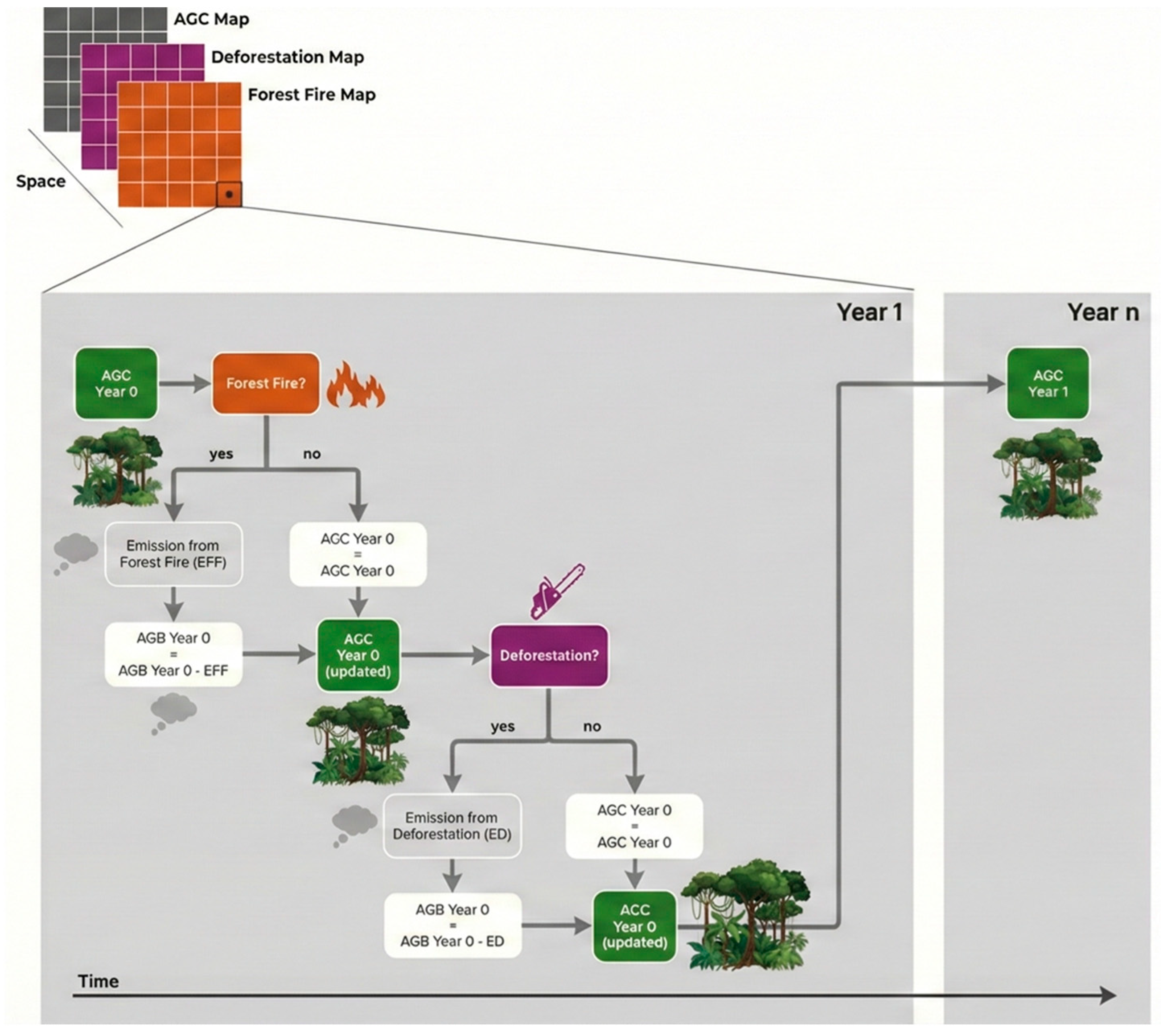
Our approach was grounded in Brazil’s National Forest Reference Emission Level National FREL https://redd.unfccc.int/media/brazil-national-frel_modified_v3_clean-13-mar-2024.pdf (accessed on 20 October 2025) for Results-Based Payments under REDD+, as established by the United Nations Framework Convention on Climate Change. Figure 2 presents the methodological workflow adopted to estimate biomass-based greenhouse gas emissions across different forest compartments as a function of disturbance events. The process begins with the initial carbon stock (Year 0) and, for each subsequent year, identifies the occurrence of forest fires and/or deforestation.
When such events are detected, carbon dioxide (CO2) originating from forest fires (EFF) or deforestation (ED) is quantified, and the carbon stock is updated accordingly. This procedure is iteratively applied annually until the final year of analysis (Year n), enabling the monitoring of temporal trajectories of methane (CH4) and nitrous oxide (N2O) emissions, as well as changes in carbon stocks.
Therefore, the equations below were used to calculate CO2 and non-CO2 emissions. For each deforestation pixel i in each year (t), the associated gross CO2 emission is estimated using Equation (1). The associated gross non-CO2 (CH4 and N2O) emissions from deforestation are estimated using Equation (2).
D e f ( C O 2 ) t , i = A t , i × C t , i × 44 12
where
Def(CO2)t,i: CO2 emissions (t CO2) associated with deforestation of a given pixel i for a given year t.
At,i: The area (hectare) of a given pixel i for a given year t.
Ct,i: Total carbon stock (the sum of the AGB, BGB, LI, and DW pools; t C ha−1) for given pixel i in a given year t.
44/12: The conversion factor used to convert carbon to CO2.
D e f ( n o n C O 2 ) t , i = A t , i × C t , i 0.47 × E f × C f × 10 3
where,
Def(non-CO2)t,i: CH4 or N2O emissions (t CO2 eq) associated with deforestation of a given pixel i for a given year t.
At,i: The area of a given pixel i for a given year t.
Ct,i: Carbon stock (the sum of the AGB, LI, and DW pools; t C ha−1) for given pixel i each year t.
0.47: Carbon content (t C/t dry matter).
Ef: Emission factor. The emission factor (g/kg dry matter) is 6.8 for the CH4 and 0.2 for the N2O.
Cf: Combustion factor. The combustion factor (dimensionless) is 0.368 for the Amazon and 0.379 for the Cerrado biomes.
10−3: Grams to tons conversion factor.
For each forest fire pixel i, identified in each year (t), the associated gross CO2 emission is estimated by Equation (3), derived from the equation developed by [24]. The associated gross non-CO2 (CH4 and N2O) emission from forest fire is estimated by Equation (4).
Since the original equation by [24] was defined in terms of biomass, we assumed a carbon fraction of 47% (dimensionless factor of 0.47) for aboveground biomass, following the National FREL, to directly estimate post-fire above ground carbon (AGC). Accordingly, AGC = AGB × 0.47 (for both pre- and post-fire conditions). By isolating AGB as a function of AGC (AGB = AGC/0.47) and substituting it into Equation (3).
A G B p o s t f i r e = 0.0548 ×   A G B p r e f i r e 1.4702
A G C p o s t f i r e 0.47 = 0.0548 × A G C p r e f i r e 0.47 1.4702
A G C p o s t f i r e = 0.0548 × 0.47 × A G C p r e f i r e 0.47 1.4702
A G C p o s t f i r e = 0.0548 × 0.47 1 0.4702 × A G C p r e f i r e 1.4702
A G C p o s t f i r e = 0.07816 ×   A G C p r e f i r e 1.4702
F i r e ( C O 2 ) t , i = A t , i × ( A G C p r e f i r e A G C p o s t f i r e ) × 44 12
F i r e ( C O 2 ) t , i = A t , i × ( A G C p r e f i r e ( 0.07816 ×   A G C p r e f i r e 1.4702 ) ) × 44 12
where
Fire(CO2)t,i: CO2 emissions (t CO2) associated with forest fire of a given pixel i for a given year t.
At,i: The area (hectare) of a given polygon (or pixel) i for a given year t.
AGC: Above Ground Carbon pool (pre- or post-fire).
44/12: The conversion factor used to convert carbon to CO2.
The associated gross non-CO2 (CH4 and N2O) emission from forest fires is estimated by Equation (4) following the National FREL.
F i r e ( n o n C O 2 ) t , i = A t , i × C t , i 0.47 × E f × C f × 10 3
where
Fire(non-CO2)t,i: CH4 or N2O emissions (t CO2 eq) associated with forest fire of a given pixel i for a given year t.
At,i: The area of a given pixel i for a given year t.
Ct,i: Carbon stock (the sum of the AGB, LI, and DW pools; t C ha−1) for given pixel i each year t.
0.47: Carbon content (t C/t dry matter).
Ef: Emission factor. The emission factor (g/kg dry matter) is 6.8 for the CH4 and 0.2 for the N2O.
Cf: Combustion factor. The combustion factor (dimensionless) is 0.368 for the Amazon and 0.379 for the Cerrado biomes.
10−3: Grams to tons conversion factor.
Non-CO2 greenhouse gas emissions were converted to CO2 equivalents (CO2eq) using the 100-year Global Warming Potentials (GWPs) from the IPCC Fifth Assessment Report, applying factors of 28 for CH4 and 265 for N2O, in accordance with IPCC guidelines [25].

3. Results and Discussion

3.1. Fire Recurrence in Indigenous Territories of Maranhão State (1985–2023)

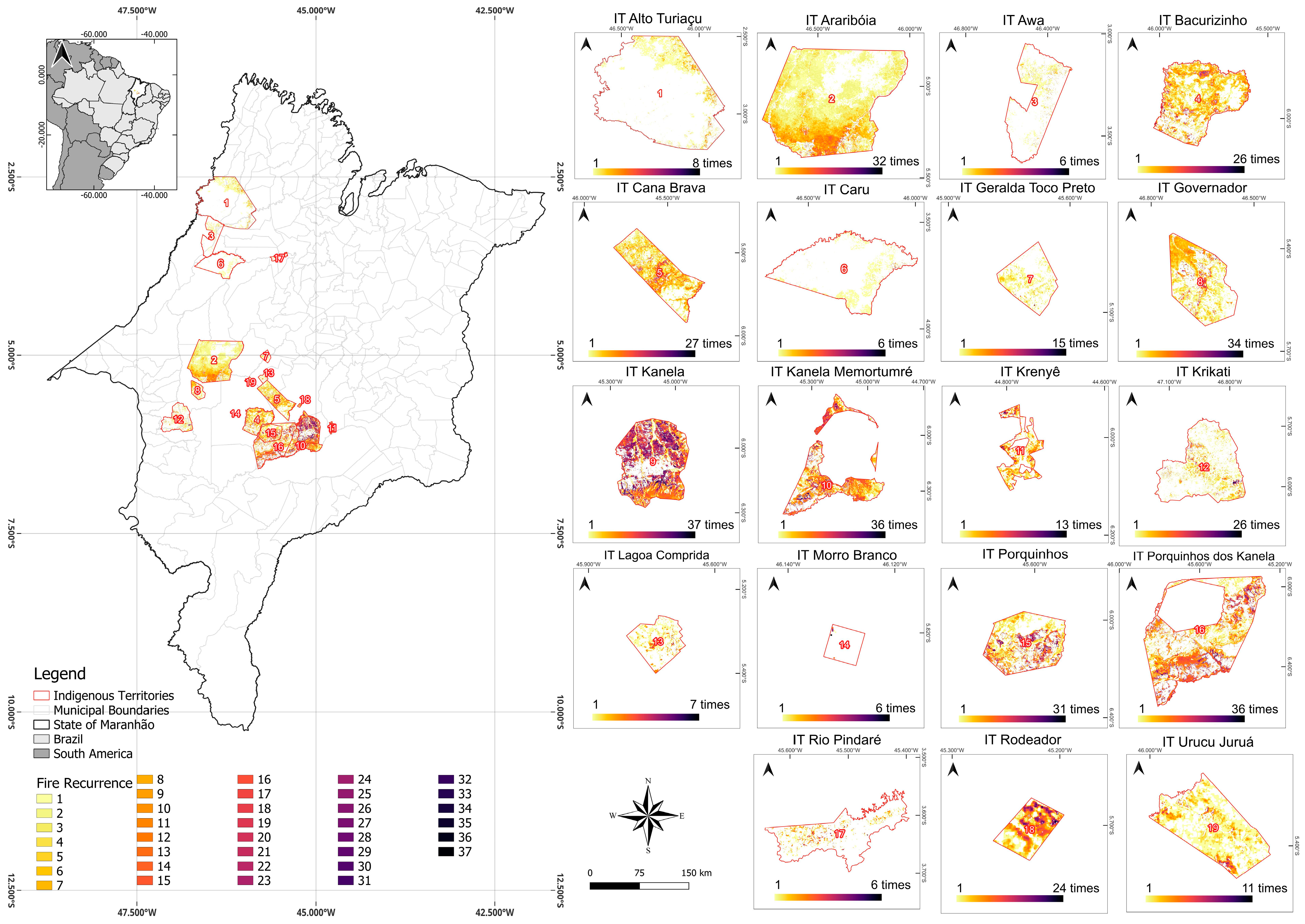
The analysis of fire recurrence data from MapBiomas Fire Collection 3, covering 1985–2023 and restricted to the classes of forest and savanna formation, reveals markedly distinct profiles among the Indigenous Territories of Maranhão, both in terms of spatial extent and burning frequency. The recurrence map reports the number of times each pixel was affected by fire across the historical series, enabling the identification of the most affected territories and the temporal gradients in recurrence intensity (Figure 3).
Among the cases analyzed, the Araribóia IT shows the largest total burned area, approximately 293,375 hectares. The highest recurrence values (20–32 events) are concentrated mainly in the southeastern portion of the territory. The central, northern, and northwestern regions exhibit significantly lower recurrence, with a predominance of 1–3 events, as indicated by the frequency mapping. This spatial distribution suggests zones of higher pressure associated with external drivers such as adjacent agricultural-use areas or proximity to access roads.
Bacurizinho IT (80,196 ha burned) also stands out for recurrence. The maximum number of recorded events is 37, with the highest concentrations located along the territory’s central belt. In this area, the density of high-frequency pixels is elevated, indicating persistence of fire over decades. The northern and western portions show reduced frequency, with a predominance of single or double events. This spatial variation may relate to internal accessibility or the presence of clearings.
In Kanela Memortumré IT, there is a broad and relatively homogeneous distribution of high-recurrence areas, particularly in the southern and eastern halves. Recurrence reaches 36 events, with values above 20 in several sectors. The northern and southwestern portions show lower intensity, concentrated between 1 and 10 events. Elevated values across nearly the entire lower half of the IT suggest long-term persistence of fire in recurrent sectors.
Kanela IT shows a similar spatial pattern, with the most intense foci located in the western and south-central portions, where recurrence reaches up to 37 events. The eastern and northeastern areas maintain lower values, with a predominance of 1–5 occurrences. Differences between regions may reflect both internal environmental variation and interference associated with land use in surrounding areas.
In Krikati IT, the highest-intensity foci occur in the southwestern strip, with records up to 34 events. The central part shows intermediate recurrence, whereas the northern and eastern edges display lower frequency. In Governador IT, the highest concentration occurs in the south-central region, with values ranging from 25 to 34; single-event burns dominate the northern and western edges.
Cana Brava/Guajajara, Rodeador, and Rio Pindaré ITs also exhibit higher recurrence in their central zones. In Cana Brava/Guajajara, data indicate up to 27 events in the east-central portion, with an apparent reduction toward the extremities. Rodeador and Rio Pindaré present a similar pattern, with intermediate-to-high concentrations in the south-central areas and lower intensity along the edges.
Conversely, ITs such as Alto Turiaçu, Awá, Caru, and Lagoa Comprida exhibit predominantly low recurrence rates. In Alto Turiaçu, 78.3% of the burned areas were affected only once. The spatial distribution exhibits higher values (6–8 events) in small nuclei in the southern sector, with most of the area showing 1–3 occurrences (Table 1). Awá IT, with 13,759 ha burned, maintains similar patterns: the highest recurrence is 15 events, recorded in a single pixel, and most of the area burned only once. Caru IT shows a maximum recurrence of 6 events in the east-central region, with the remaining areas at low levels. Lagoa Comprida IT reaches up to 7 events, with the highest concentrations in the south-central portion.
Landscape ecology literature emphasizes that fire events tend to concentrate along forest edges, especially in areas fragmented by roads, logging tracks, or other human occupations [26,27]. These edges are characterized by greater solar exposure, reduced soil and air moisture, increased fuel accumulation, and higher connectivity with external areas subject to ignition. Such factors contribute to greater susceptibility to fire propagation and to its recurrence over time. In the results obtained, Indigenous Territories such as Araribóia, Krikati, Governador, and Kanela Memortumré exhibit high-recurrence fire foci located in border zones or linear access strips, whereas the interior of the territory, when more continuous, tends to maintain lower burn frequencies.
Furthermore, the distribution of fire events is associated with the regional location of the ITs. Those situated in northern Maranhão (Alto Turiaçu, Awá, Caru, Lagoa Comprida) display reduced recurrence, whereas those in the south (Bacurizinho, Kanela, Krikati, Governador, Rodeador) concentrate higher values. This spatial pattern coincides with the inclusion of these areas in the MATOPIBA frontier, a region marked by agricultural expansion and greater use of fire as a management technique. Previous studies indicate that proximity to pasturelands or deforested areas directly influences fire frequency in adjacent Indigenous territories [28].

3.2. Mapping of Peak Years of Burned Area in the Indigenous Territories of Maranhão (1985–2023)

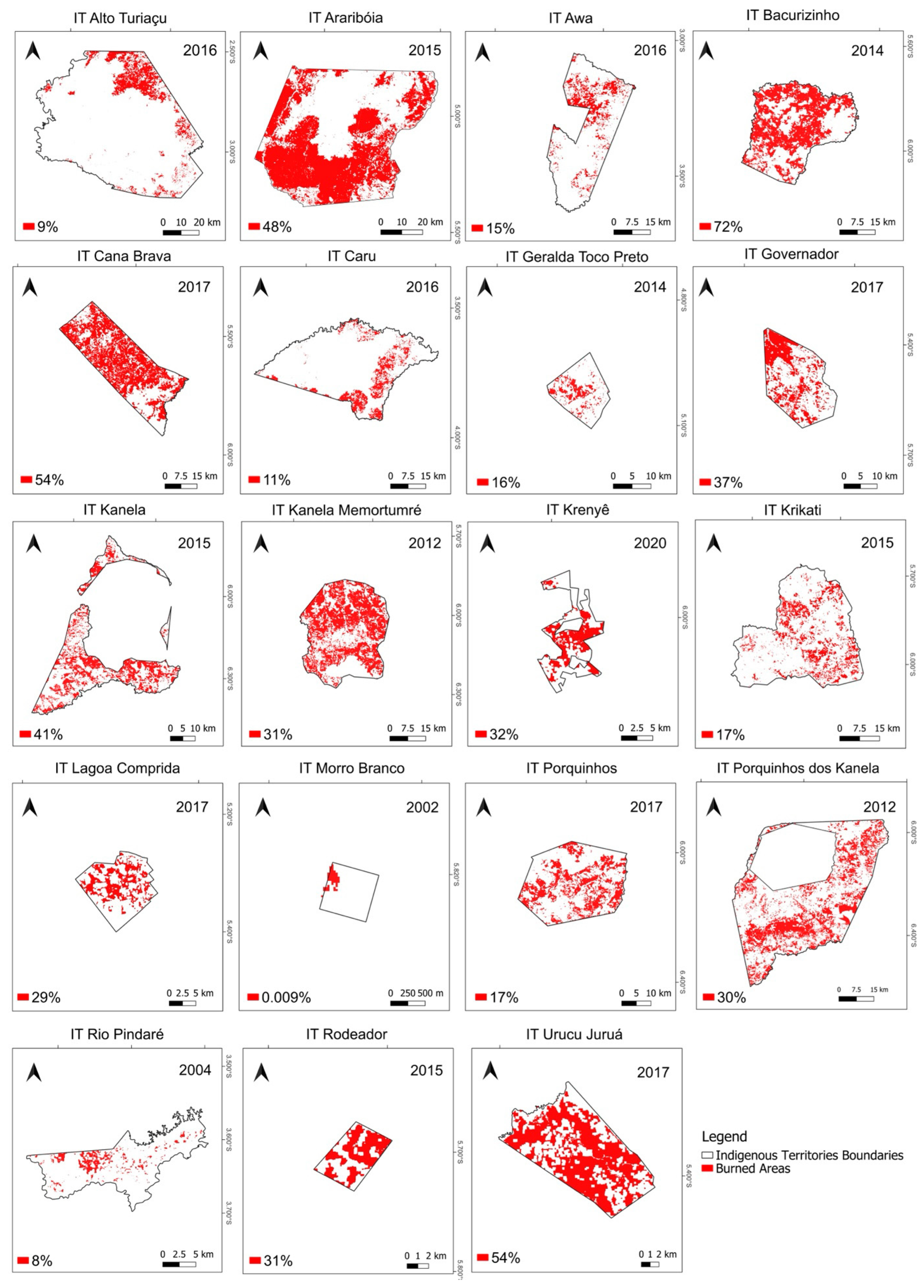
Nineteen Indigenous Territories in Maranhão were analyzed from 1985 to 2023 to identify, for each IT, the year with the largest burned area (peak) and to quantify its magnitude. Across the 19 ITs, 2015 was the most recurrent peak year (six territories, including Araribóia, Krikati, and Kanela), followed by 2016 (five ITs such as Alto Turiaçu, Awá, Caru, and Rodeador) and 2017 (four: Cana Brava, Governador, Lagoa Comprida, and Morro Branco). The years 2012 and 2014 concentrated peaks in Kanela Memortumré and Porquinhos dos Kanela, while 2014 appears as a critical year for Bacurizinho. Finally, 2004, 2002, and 1992 occur in isolation (Figure 4).
Among the most affected territories, Bacurizinho burned approximately 60,000 ha in 2014 (72.8%), followed by Cana Brava/Guajajara with 75,206 ha in 2017 (54.8%) and Urucu/Juruá with 6902 ha in 2017 (54.4%). Kanela recorded 52,183 ha in 2015 (41.7%), while Araribóia burned 200,652 ha in 2015 (48.6%). Because this calculation considers only forest and savanna, the effectively affected area is likely to have surpassed 50% when other land-use or land-cover classes are included.
Burning was concentrated in the IT comprising the municipality of Amarante (MA), resulting in the largest wildfire on record in the region and, within the 1985–2023 window, the most significant value among the 19 ITs. Amidst the escalation, on 8 October 2015, the State Government declared an emergency in 11 ITs due to the multiplication of hotspots [29].
During the critical period, the fire advanced for more than 20 days over the ITS “heart of the forest” and lasted about two months, being extinguished with the onset of rains despite firefighting efforts. Approximately 300 personnel were mobilized (IBAMA/Prevfogo, Fire Department, FUNAI), and communities, especially the Forest Guardians, deployed firebreaks, manual beaters, and territorial surveillance; effective control coincided with the weather change [30].
The social and cultural impacts were immediate, as the loss of hunting and gathering areas directly affected Awá-Guajá groups, both those in recent contact and those in voluntary isolation, whose subsistence depends exclusively on the forest. In villages near the municipality of Arame, such as Jussaral, houses were destroyed by the fires; however, local leaders emphasized that the most severe loss was the devastation of the forest, already weakened by illegal logging, since it affected species of food, medicinal, and symbolic importance [31]. During firefighting operations, Awá-Guajá individuals in voluntary isolation were observed near the burned areas, attempting to contain the fire, underscoring the seriousness of the situation [32].
Furthermore, the Araribóia IT has historically been among the most pressured Indigenous Territories, facing land conflicts, land grabbing, illegal logging, and the assassination of indigenous leaders. In this context, the Forest Guardians have organized to protect the territory [30,33].
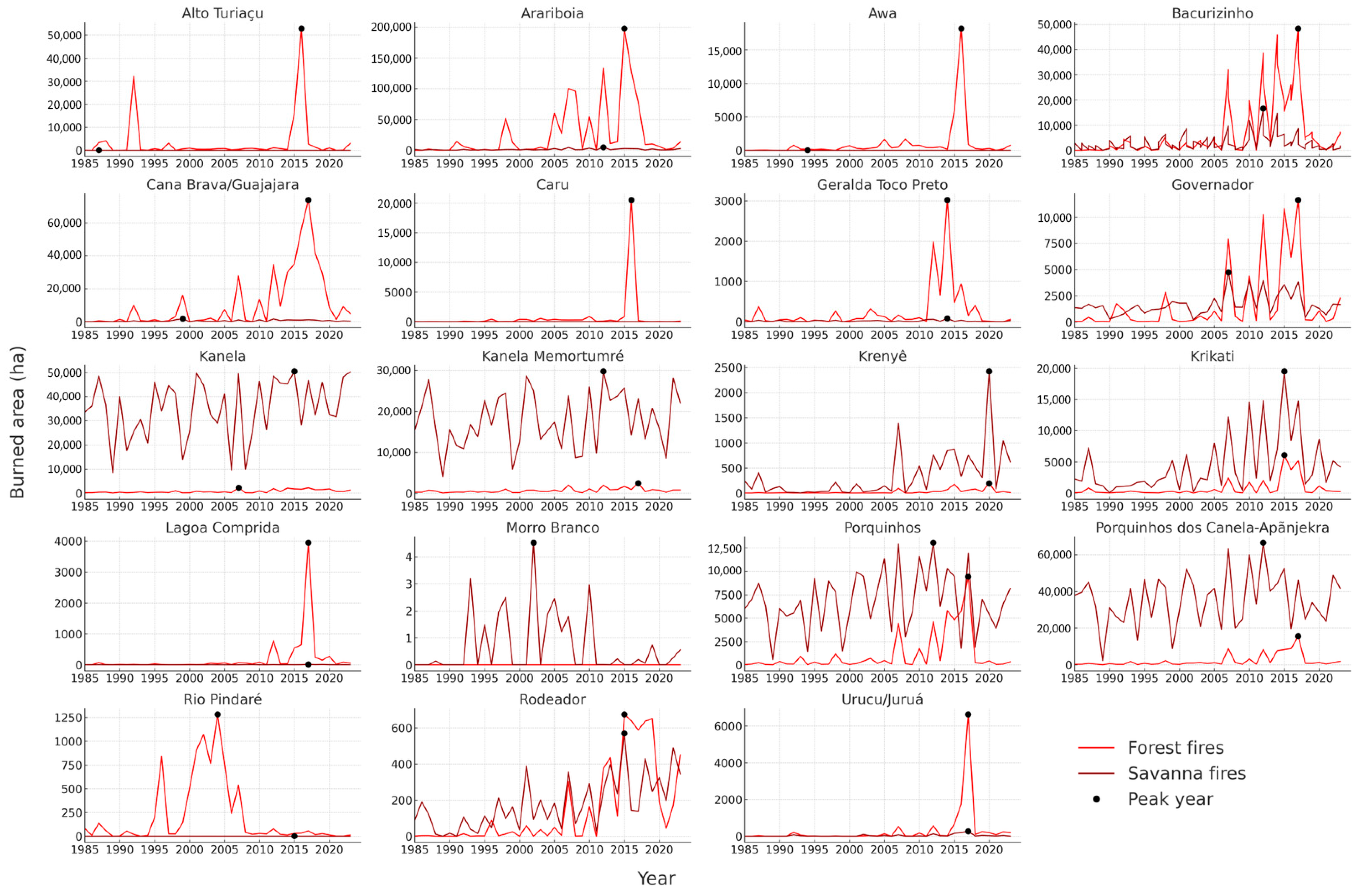
The synchronization of peak fire years between 2015 and 2017 corresponds with the 2015–2016 El Niño, which reduced precipitation and increased temperatures across northern and northeastern Brazil, thereby amplifying fuel flammability and extending the fire-spread window [34,35,36] (Figure 5). Fire severity is also associated with low soil moisture and reduced vegetation resilience, particularly in eastern Amazonia [37,38]. This broader context helps explain the simultaneity of peaks even where detailed local reports are lacking, as it interacts with frontier pressures such as illegal logging, land grabbing, agricultural expansion, and with vegetation-matrix differences: Cerrado savannas are more fire-prone, while forests degraded by edges, roads, and clearings become increasingly continuous in available fuels [39,40,41].
In the case of Krikati IT, with 145,000 ha, it was found that in 2015, 25,623 ha were burned, including 6100 ha of forest and 19,522 ha of savanna, equivalent to 17.7% of the territory. Thus, the predominance of burning in savanna areas highlights the vulnerability of these environments during severe drought years and under intensified land-tenure pressures.
In the Gurupi Mosaic, which includes Alto Turiaçu, Awá, Caru, Rio Pindaré, and Araribóia ITs, large burned areas were also observed. In particular, it was identified that Alto Turiaçu IT showed a progressive increase between 2015 and 2016, reaching 52,932 ha of burned forest in 2016 (10% of its 530,524 ha). Similarly, Awá IT recorded its peak in 2016, with 18,223 ha of forest burned (15.6% of its area), while Caru IT reached 20,513 ha (11.9%) in the same period. In 2017, Lagoa Comprida IT registered 3957 ha of burned forest, equivalent to 30% of its territory. The impacts compromised circulation routes, gathering areas, and sacred spaces of the Ka’apor and of recently contacted Awá-Guajá groups. In the Awá IT, part of the fires was attributed to reprisals following land-vacating actions, with re-ignitions in areas already controlled [42].
Outside the Gurupi Mosaic, the 2015–2017 cycle also significantly impacted Indigenous Territories characterized by savanna formations. In 2015, the Kanela IT burned 46,996 ha (46,714 ha of savanna and 282 ha of forest), representing 37.5% of its total area of 125,212 ha. That same year, Maranhão recorded 30,066 hotspots, ranking behind only Pará and Mato Grosso [43]. In this context, the high density of fires in Kanela was associated with the recurrent use of burning by loggers and ranchers as a form of land tenure pressure and to expand illegal pastures [30,39,40,44].
In 2017, three ITs reached their maximum burned areas: Cana Brava with 75,205 ha of forest (54.8% of 137,329 ha), Governador with 15,416 ha (37.0% of 41,643 ha), and Lagoa Comprida with 3957 ha of forest (30% of 13,198 ha). Even in the absence of detailed reports on causes and propagation dynamics, the residual effects of drought after El Niño, the accumulation of fuel, and edge pressures help explain the severity of these events [36]. In 2002, Morro Branco IT registered 4 ha of forest burned, equivalent to 8.2% of its 49 ha, in a context of extreme fragmentation and favorable propagation conditions.
Earlier peaks also highlight the interaction between anthropogenic pressures and regional seasonality. In 2014, Bacurizinho IT recorded 60,478 ha burned (45,805 ha of forest and 14,673 ha of savanna), equivalent to 73.4% of its total area of 82,432 ha, indicating a structural vulnerability already elevated on the eve of the 2015–2016 El Niño [43]. In 2012, Kanela Memortumré IT registered 31,769 ha burned (31.7% of 100,221 ha) in a recently delimited territory [45] with 96.6% savanna cover, a condition that favors rapid fire propagation. In the same year, Porquinhos dos Kanela IT recorded 66,645 ha burned exclusively in savanna (30.2% of 221,000 ha).
Geralda Toco Preto, IT, also experienced a significant event in 2014, with 3106 ha of forest burned out of a total of 19,000 ha. Although there is no specific causal dossier for that year, the regional pattern of intentional fire use, combined with the dry season and edge effects associated with fragmentation, provides a consistent explanation [46]. In 2004, Rio Pindaré IT burned 1281 ha of forest (8.54% of the 15,000 ha), further increasing its historical vulnerability. By 2016, this IT had already lost 56% of its original forest cover, making it the most deforested territory within the Gurupi Mosaic [47,48].
In 2020, the Krenyê IT recorded 2615 ha of burned vegetation, equivalent to 32.6% of its total area of 8035 ha. This suggests repeated burning over the same areas. Krenyê is a fully savanna-dominated territory, officially demarcated in 2018 [48], with accumulated vegetation suppression exceeding 2800 ha by 2020. It is located in a Cerrado–forest transition zone that has shown a notable increase in hotspots.
From a climatic perspective, the 2015–2016 El Niño acted as a significant aggravating factor by reducing rainfall, raising temperatures, and increasing fuel flammability, thus synchronizing fire peaks across Maranhão [34,36,38]. Nevertheless, the primary ignition sources are consistently human and often criminal, involving post-eviction reprisals, opening of areas for illegal logging, coercive land grabbing, and pasture expansion. This diagnosis is supported by evidence of artificial fire lines, re-ignitions shortly after suppression, and temporal coincidence between burning and surges of territorial conflict [30,42,44]. Even though transitional Amazon–Cerrado areas are highly susceptible to fire, climate alone does not determine its occurrence. Fire requires an ignition source, almost always anthropogenic, especially during the dry season [49].
In the transition zone between the Amazon and Cerrado, environmental transformations affect Indigenous peoples not only in terms of subsistence but also in the symbolic and cosmological dimensions of their lives, since nature and its beings are fundamental to their socio-cosmological organization [50]. Ultimately, the impacts go beyond the material dimension. In the Indigenous cosmologies of the region, understood as systems of knowledge that explain the relationships between humans, animals, plants, and spirits, all these beings are regarded as relatives, each playing nutritional, healing, and spiritual roles. These beings inhabit a shared world composed of multiple subjects connected through reciprocal relationships. Thus, when the forest burns, it is not only the vegetation that is lost but also the network of bonds that sustains the life, memory, and spirituality of Indigenous communities [32,51].

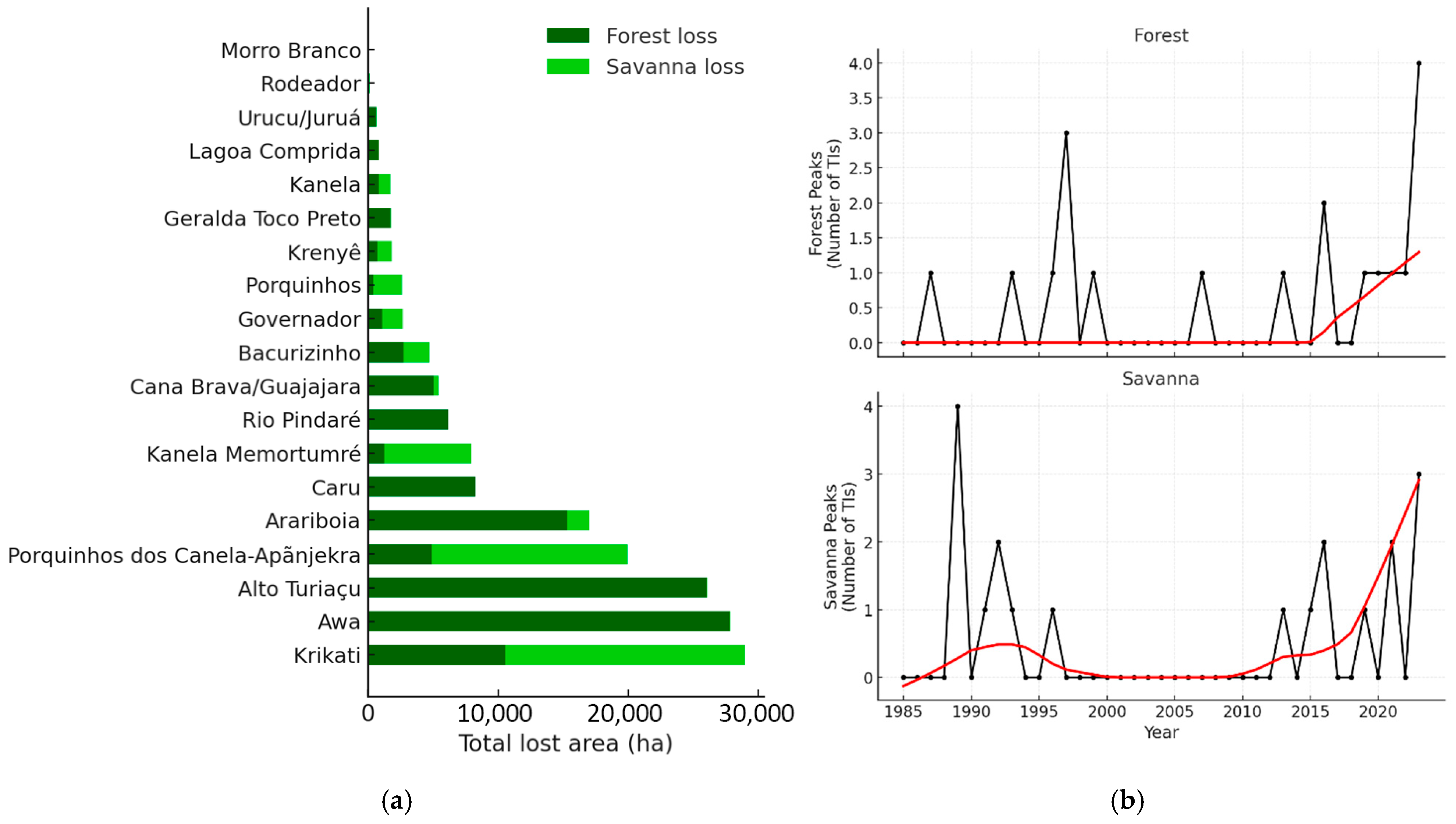
3.3. Vegetation Cover Dynamics in Maranhão and Impacts on Indigenous Territories (1985–2023)

Between 1985 and 2023, the Indigenous Territories of Maranhão lost a total of 185,327 hectares of native vegetation, comprising 124,051 hectares (66.9%) of forest formations and 61,276 hectares (33.1%) of savanna formations. Although the state-level aggregate indicates a predominance of forest losses, the spatial distribution reveals heterogeneous patterns across the territories, reflecting the diversity of environmental pressures acting upon them. These contrasts are illustrated in Figure 6a, which shows the cumulative losses per IT and highlights whether pressures fell predominantly on forest or savanna formations. This trend is consistent with the broader Amazonian context: between 2013 and 2021, deforestation within Indigenous Territories increased by 129%, and during 2019–2021 it advanced 30% further into the territories’ interiors, no longer restricted to the edges [52].
In absolute terms, the most affected territories were Krikati (29,016 ha, with 63.6% in savanna), Awá (27,913 ha, predominantly forest), and Alto Turiaçu (26,132 ha, forest). Bacurizinho recorded 25,063 ha of loss, with a balanced composition between forest and savanna. In comparison, Porquinhos dos Canela-Apãnjekra lost 19,970 ha, 75.4% of which were in savanna, and Araribóia lost 17,043 ha, with 89.9% of the area in forest formations. Intermediate values were observed in Caru (8261 ha), Kanela Memortumré (7943 ha, savanna), Rio Pindaré (6186 ha, forest), and Cana Brava/Guajajara (5436 ha). Minimal losses occurred in Morro Branco (38 ha), Rodeador (151 ha), Urucu/Juruá (651 ha), Lagoa Comprida (849 ha), and Kanela (1735 ha). It is essential to acknowledge that logging frequently serves as a gateway to degradation, with the opening of tracks, the removal of commercially valuable timber, and the subsequent expansion of clear-cutting and fire use, further intensifying pressures on these territories [48,53].
When losses are measured relative to each territory’s total area, important contrasts emerge. Rio Pindaré lost 41.2% of its area, followed by Bacurizinho (30.4%), Krenyê (22.6%), and Krikati (20.0%). In contrast, larger ITs, such as Porquinhos dos Canela-Apãnjekra (6.6%) and Alto Turiaçu (4.9%), show proportionally lower percentages, despite their significant absolute values. The temporal dimension of vegetation loss is depicted in Figure 6b, which presents the time series of the number of ITs that reached their peak loss year between 1985 and 2023. This figure emphasizes the concentration of critical events in specific windows, when multiple territories simultaneously registered their maximum losses, thereby revealing the temporal variability of anthropogenic pressures.
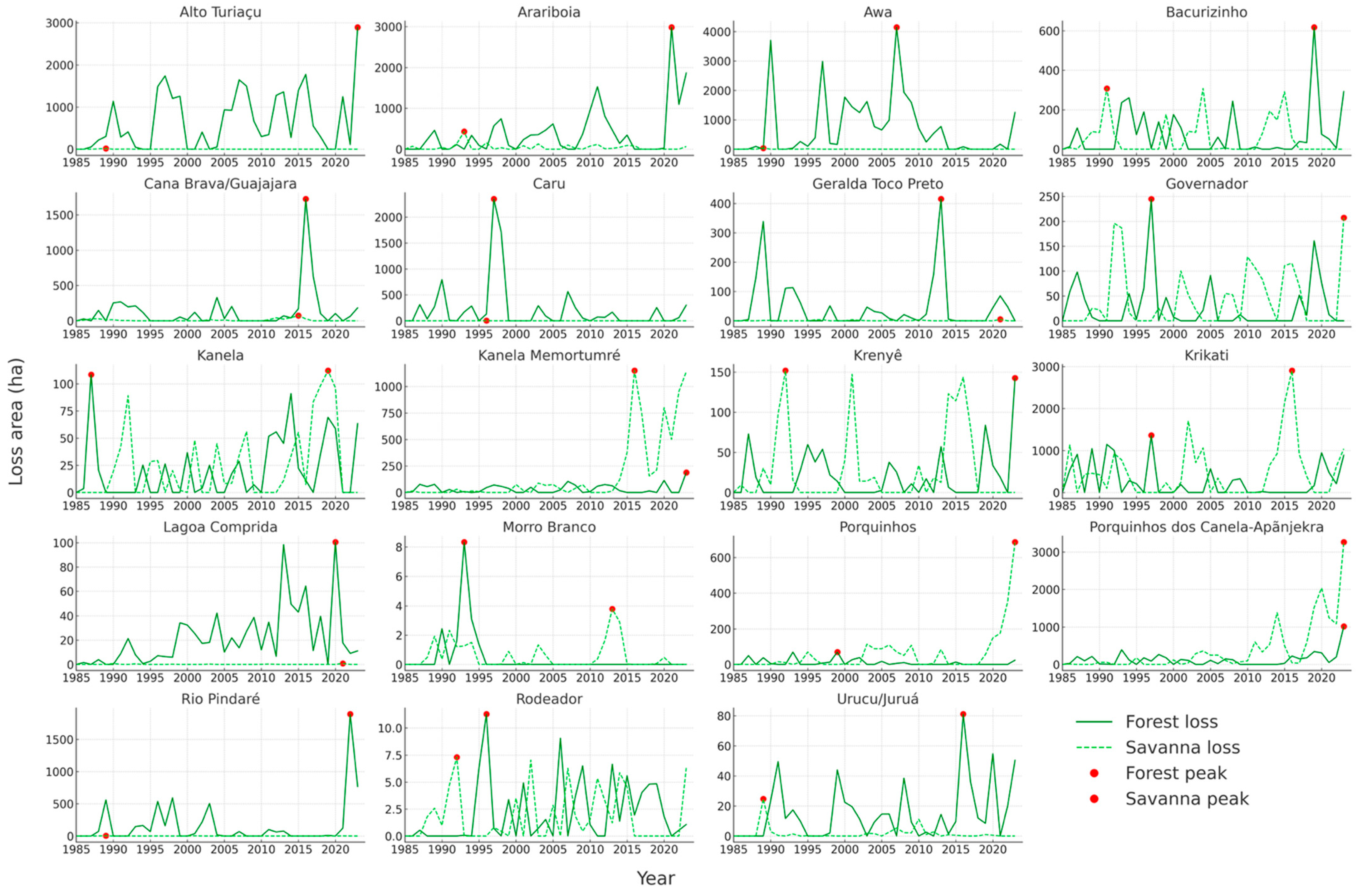
At the territory level, the temporal analysis confirms these patterns. Among forest-dominated ITs, major peaks were observed in Awá in 2007 (4148.3 ha), Caru in 1997 (2351.7 ha), Araribóia in 2021 (2982.8 ha), and Rio Pindaré in 2022 (1893.0 ha). Bacurizinho showed a peak in 2019 (2325.7 ha), with forests contributing more in that year and savanna in 2004. In savanna-dominated ITs, the largest areas were recorded in Krikati in 2016 (2905.9 ha), Porquinhos in 2023 (710.4 ha), and Porquinhos dos Canela-Apãnjekra in 2023 (4279.2 ha, along with 1016.9 ha of forest in the same year). In Alto Turiaçu, the maximum peak occurred in 2023 (2894.1 ha of forest), while Kanela Memortumré also showed a recent increase in 2023 (1330.7 ha, mixed composition). These results are detailed in Figure 7, which shows the annual losses of forest and savanna vegetation for each IT.
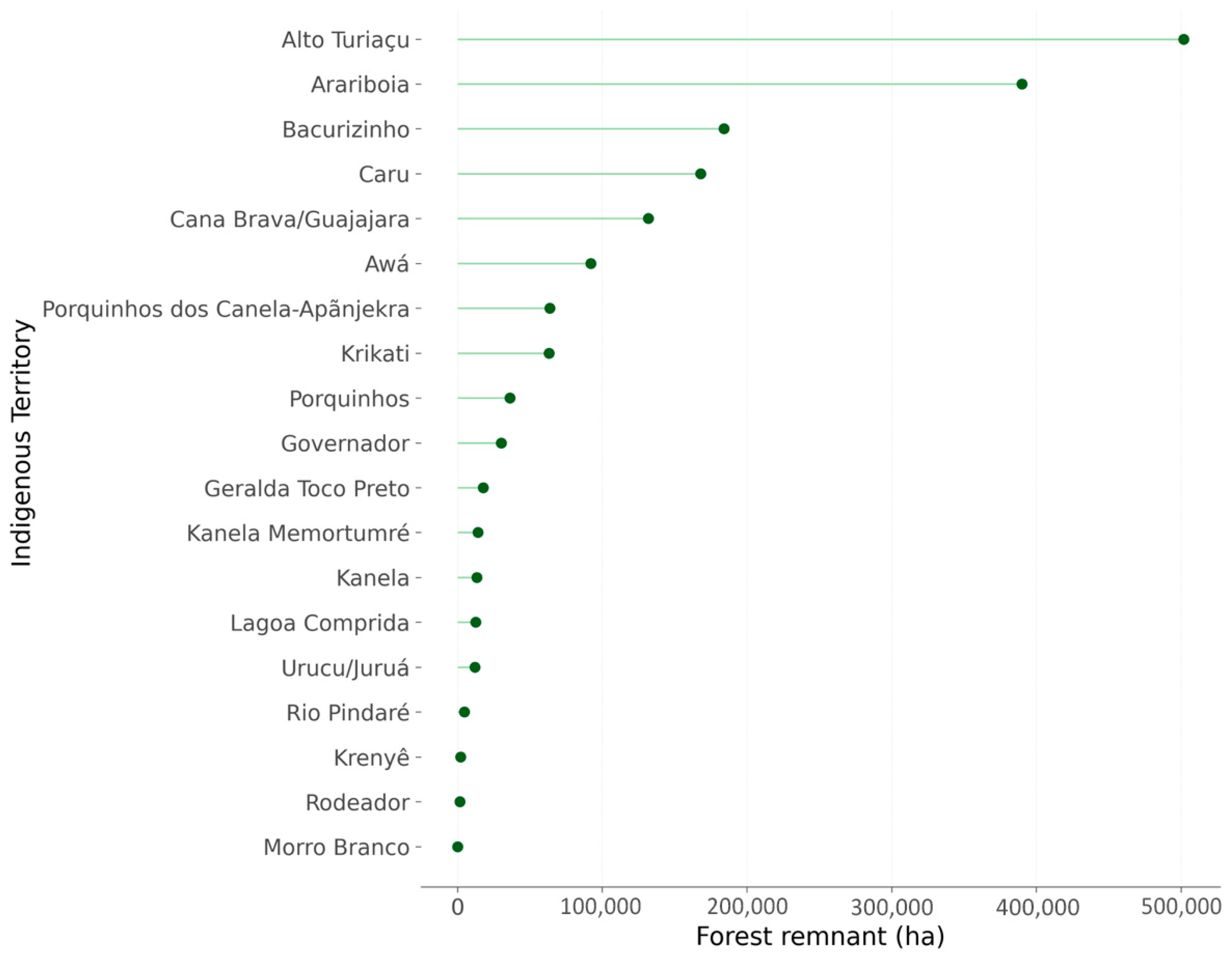
Despite the accumulated losses, vegetation remnants within the Indigenous Territories of Maranhão totaled approximately 2,029,771 hectares in 2023, of which about 1,639,991 hectares (80.8%) corresponded to forest formations and 389,780 hectares (19.2%) to savanna formations. Among the most significant remaining areas are Alto Turiaçu (approximately 501,795 ha, forest), Araribóia around 390,108 ha, forest), Porquinhos dos Canela-Apãnjekra (approximately 200,594 ha, predominantly savanna), Caru (about 167,933 ha, forest), and Cana Brava/Guajajara (approximately 131,867 ha, forest). These areas form strategic conservation mosaics amid advancing deforestation and ongoing forest fragmentation [41]. Figure 8 presents the forest remnants by territory across the Indigenous Territories of Maranhão in 2023.
Indigenous Territories function as effective shields against deforestation, with the potential to reduce vegetation loss by up to 66% when territorial rights are fully guaranteed [52]. However, invasions associated with illegal logging and predatory hunting by non-Indigenous actors intensify pressure on these territories. In the Governador Indigenous Land, this process affects food security, as hunting constitutes a dietary basis for the Gavião people, and it also compromises their cultural practices, since hunting plays a central role in rituals and festivities [54].

3.4. CO2 Emissions in Indigenous Territories of Maranhão State (2013–2023)

Brazilian Indigenous Territories play a fundamental role in environmental conservation and climate change mitigation. These areas exhibit significantly lower deforestation rates due to the sustainable management practices of Indigenous peoples, which favor biodiversity preservation and the maintenance of substantial carbon stocks that are essential for the sequestration and storage of atmospheric CO2 [55]. In recent decades, however, this scenario has undergone progressive changes due to increasing external pressures, including agricultural expansion, illegal resource exploitation, and uncontrolled use of fire. These factors have led to higher deforestation rates, intensified wildfires, and, consequently, increased carbon dioxide (CO2) emissions [35].
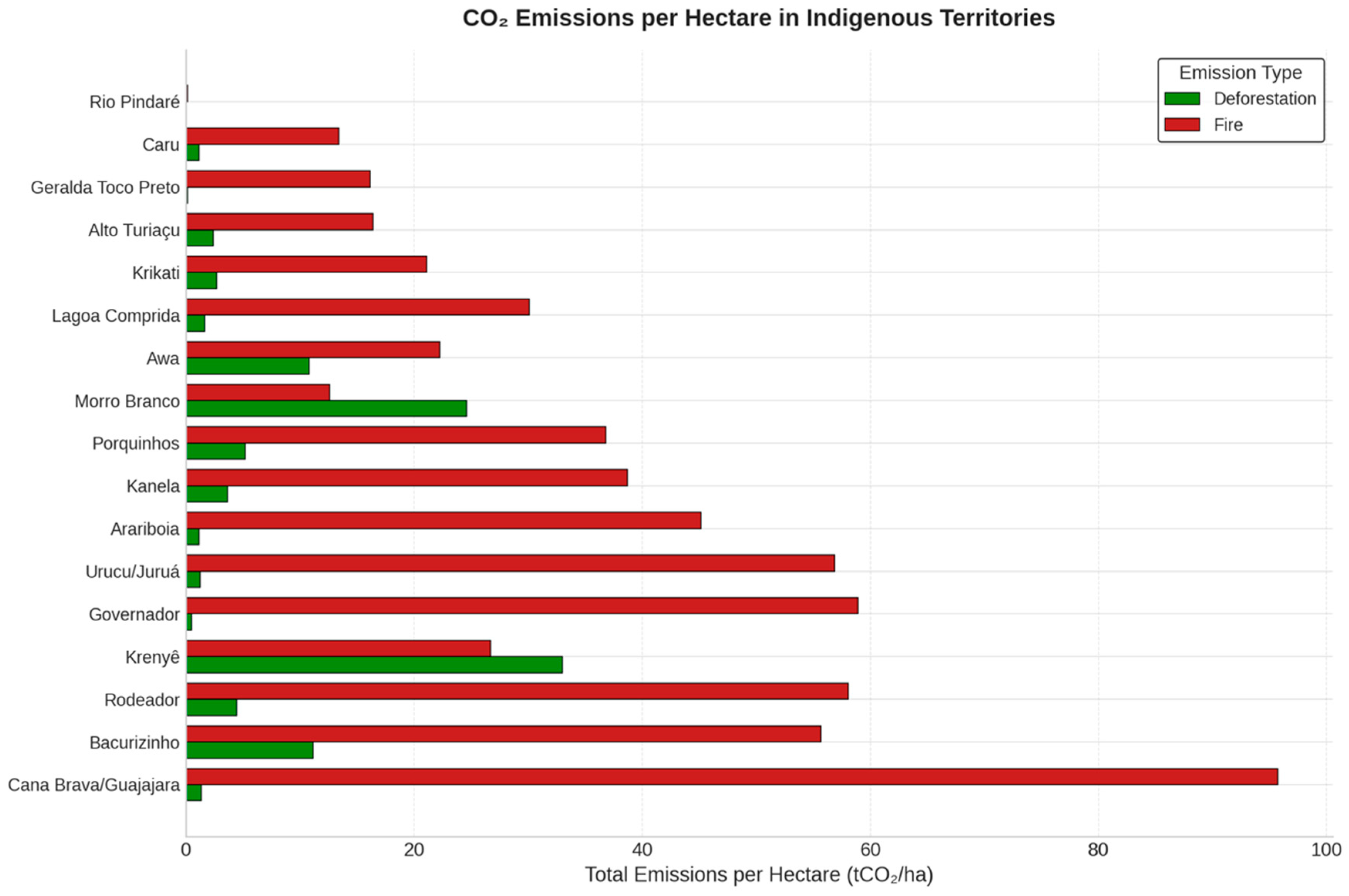
In the state of Maranhão, the 19 territories analyzed in this study comprise 2,029,771 hectares of remaining vegetation, representing 41.7% of all protected areas in the state when considering both Indigenous Territories and Conservation Units. This figure underscores the strategic role of these territories as carbon reservoirs at the state level. Emission intensity was measured in tons of carbon dioxide per hectare (tCO2/ha), calculated for each Indigenous Territory by summing emissions from deforestation and wildfires mapped within its boundaries. This procedure ensured that only events effectively recorded inside each IT were accounted for.
The analysis shows that the highest emission intensities occurred in Cana Brava/Guajajara (97.12 tCO2/ha; 1.38 from deforestation and 95.74 from fire), Bacurizinho (66.84; 11.17 and 55.67), Rodeador (62.51; 4.44 and 58.07), Krenyê (59.75; 33.02 and 26.73), and Governador (59.40; 0.49 and 58.91). These were followed by Urucu/Juruá (58.15; 1.27 and 56.89), Araribóia (46.34; 1.14 and 45.19), Kanela (42.39; 3.66 and 38.73), Porquinhos (42.04; 5.20 and 36.84), and Morro Branco (37.27; 24.64 and 12.63). Other territories also presented relevant values: Awá (33.06; 10.80 and 22.26), Lagoa Comprida (31.78; 1.66 and 30.12), Krikati (23.83; 2.71 and 21.13), Alto Turiaçu (18.81; 2.41 and 16.40), Geralda Toco Preto (16.33; 0.14 and 16.19), Caru (14.54; 1.14 and 13.40), and Rio Pindaré (0.16, fire only) (Figure 9).
The temporal evolution confirms this pattern. Considering all Indigenous Territories together, the highest annual totals of emissions were recorded in 2015 (22.46 million tons of CO2, of which 21.63 million from fire), in 2016 (21.60 million; 21.12 million from fire), and in 2014 (13.70 million; 12.63 million from fire). In the same years, average intensities also peaked, reaching 8.91 tCO2/ha in 2015, 7.88 in 2016, and 7.81 in 2017. Thus, 2015 and 2016 stand out, both in terms of absolute volumes and relative intensities, with a strong predominance of fire. This pattern is consistent with the literature linking the 2015–2016 El Niño and severe droughts to the significant increase in burned area and emissions in the Amazon [35,55,56,57,58].
Over the period from 2013 to 2023, the Indigenous Territories of Maranhão accounted for approximately 605 million tons of CO2 from fires and 104 million tons from deforestation. These results reinforce the importance of tCO2/ha indicators for distinguishing levels of pressure and risk among territories, in line with IPCC guidelines and national monitoring practices [59,60]. In this context, the predominance of fire suggests that prevention, preparedness, and integrated fire management strategies may be the most effective means of reducing average emissions per area, especially in drought years.
Fire is a widely used management tool for transforming and converting areas by different peoples and cultures since the earliest historical records [61]. In general, fire management by indigenous populations needs to be differentiated from that by external, non-indigenous agents. Fire management by indigenous peoples is integrated into a set of guidelines for land use, being used to fertilize and open spaces reserved for specific crops, based on the accumulated knowledge and responsibility of the elders [15].
One alternative to forest fires was to revive the traditional use of fire for environmental preservation [62]. The research and projects developed from these reflections led to the creation of the National Policy for Integrated Fire Management in 2012 and, later, to Integrated Fire Management in Indigenous Territories [63]. Furthermore, the concentration of critical values in 2015 and 2016 highlights the need for seasonal management plans that combine drought monitoring, risk alerts, temporary restrictions on fire use, and strengthened local response capacity.

4. Conclusions

The findings of this study demonstrate that the Indigenous Territories of Maranhão, situated at the Amazon–Cerrado transition and embedded within the MATOPIBA agricultural frontier, are territories of exceptional socio-environmental importance, yet they are subject to escalating pressures. Fire and deforestation emerge not only as drivers of landscape transformation but also as forces that disrupt the continuity of Indigenous ways of life, undermining food security, eroding forest-based resources, and exacerbating patterns of violence against Indigenous peoples and their leaders.
The analysis highlights distinct spatial and temporal dynamics across territories. While ITs in the northern portion of the state, such as Alto Turiaçu, Awá, and Caru, maintain extensive continuous forests with lower rates of loss and fire recurrence, those in the south and southeast, including Bacurizinho, Kanela, Krikati, and Governador, concentrate the most critical events, reflecting their position within zones of rapid agro-pastoral expansion. This heterogeneity underscores that prevention and management strategies cannot be uniform but must be calibrated to the specific dynamics of each territory, integrating traditional ecological knowledge with contemporary monitoring and governance tools.
Systematic accounting of fire events, deforestation, and emissions within ITs, as undertaken here, is crucial for evaluating the magnitude of impacts, identifying priority areas for intervention, and informing conservation and territorial management policies. Despite accumulated losses, the forest and savanna remnants within ITs function as strategic conservation mosaics and carbon reservoirs, whose maintenance is crucial for regional climate stability and for meeting global mitigation commitments.
Finally, despite the robustness of the datasets and methods applied, this study presents some limitations that should be acknowledged. First, the spatial resolution of remote sensing products can limit the detection of small-scale disturbances and small deforestation or forest fire events, leading to conservative estimates in heterogeneous landscapes. Second, uncertainties in emission and combustion factors, as well as in carbon maps, can propagate to final emission estimates, as is commonly reported in large-scale assessments of this type. Future work integrating higher-resolution data, improved field calibration, and more spatially explicit emission factors will further reduce these uncertainties and refine regional estimates.

Author Contributions

Conceptualization, H.G.P.F., T.C.S.R. and C.H.L.S.-J.; Methodology, H.G.P.F., F.d.L.d.S.N. and A.T.G.F.; Software, H.G.P.F. and F.d.L.d.S.N.; Validation, H.G.P.F. and F.d.L.d.S.N.; Investigation, H.G.P.F.; Resources, H.G.P.F.; Data curation, H.G.P.F. and F.d.L.d.S.N.; Writing—original draft, H.G.P.F.; Writing—review and editing, H.G.P.F., T.C.S.R., F.d.L.d.S.N., M.H.F.d.M., R.D. and C.H.L.S.-J.; Visualization, H.G.P.F. and F.d.L.d.S.N.; Supervision, T.C.S.R. and C.H.L.S.-J. All authors have read and agreed to the published version of the manuscript.

Funding

This study was supported by funding from the Fundação de Amparo à Pesquisa e ao Desenvolvimento Científico e Tecnológico do Maranhão—FAPEMA (Process BM-03056/24) and the National Council for Scientific and Technological Development—CNPq (Processes 304664/2024-3, 400634/2024-4 and 401741/2023-0). This study was financed in part by the Coordenação de Aperfeiçoamento de Pessoal de Nível Superior—Brasil (CAPES), Finance Code 001.

Data Availability Statement

All datasets used in this study are publicly accessible through their original sources. The data products generated in this research, as well as the analytical codes, are available from the corresponding author upon reasonable request.

Conflicts of Interest

The authors declare no conflicts of interest.

References

  1. Nobre, C.A.; Sampaio, G.; Borma, L.S.; Castilla-Rubio, J.C.; Silva, J.S.; Cardoso, M. Land-use and climate change risks in the Amazon and the need of a novel sustainable development paradigm. Proc. Natl. Acad. Sci. USA 2016, 113, 10759–10768. [Google Scholar] [CrossRef] [PubMed]
  2. Silva, J.M.C.; Bates, J.M. Biogeographic patterns and conservation in the South American Cerrado: A tropical savanna hotspot. BioScience 2002, 52, 225–234. [Google Scholar] [CrossRef]
  3. Bustamante, M.M.; Roitman, I.; Aide, T.M.; Alencar, A.; Anderson, L.O.; Aragão, L.; Asner, G.P.; Barlow, J.; Berenguer, E.; Chambers, J.; et al. Toward an integrated monitoring framework to assess the effects of tropical savanna and forest degradation and recovery on carbon stocks and biodiversity. Glob. Change Biol. 2016, 22, 92–109. [Google Scholar] [CrossRef]
  4. Lapola, D.M.; Martinelli, L.A.; Peres, C.A.; Ometto, J.P.H.B.; Ferreira, M.E.; Nobre, C.A.; Aguiar, A.P.D.; Bustamante, M.M.C.; Cardoso, M.F.; Costa, M.H.; et al. Pervasive transition of the Brazilian land-use system. Nat. Clim. Change 2014, 4, 27–35. [Google Scholar] [CrossRef]
  5. Myers, N.; Mittermeier, R.A.; Mittermeier, C.G.; Fonseca, G.A.B.; Kent, J. Biodiversity hotspots for conservation priorities. Nature 2000, 403, 853–858. [Google Scholar] [CrossRef]
  6. Aragão, L.E.O.C.; Malhi, Y.; Roman-Cuesta, R.M.; Saatchi, S.; Anderson, L.O.; Shimabukuro, Y.E. Spatial patterns and fire response of recent Amazonian droughts. Geophys. Res. Lett. 2007, 34, L07701. [Google Scholar] [CrossRef]
  7. Alves, D.B.; Alvarado, S.T. Variação espaço-temporal da ocorrência do fogo nos biomas brasileiros com base na análise de produtos de sensoriamento remoto. Geografia 2019, 44, 321–345. [Google Scholar] [CrossRef]
  8. Instituto Nacional de Pesquisas Espaciais (INPE). Monitoramento do Desmatamento e das Queimadas na Amazônia e no Cerrado; INPE: São José dos Campos, Brasil, 2023. Available online: https://terrabrasilis.dpi.inpe.br (accessed on 8 August 2025).
  9. Instituto Socioambiental (ISA); Fundação Nacional dos Povos Indígenas (FUNAI). Situação Territorial e Extensão Jurídica das Terras Indígenas no Brasil; ISA/FUNAI: Brasília, Brazil, 2025. Available online: https://terrasindigenas.org.br (accessed on 15 August 2025).
  10. Constanino, P.A.L.; Benchimol, M.; Antunes, A.P. Designing Indigenous Lands in Amazonia: Securing indigenous rights and wildlife conservation through hunting management. Land Use Policy 2018, 77, 652–660. [Google Scholar] [CrossRef]
  11. de Oliveira, J.A.P. Property rights, land conflicts and deforestation in the Eastern Amazon. For. Policy Econ. 2008, 10, 303–315. [Google Scholar] [CrossRef]
  12. Conselho Indigenista Missionário (CIMI). Violência contra os Povos Indígenas no Brasil–Dados de 2024; CIMI: Brasília, Brazil, 2025; Available online: https://cimi.org.br/wp-content/uploads/2025/07/relatorio-violencia-povos-indigenas-2024-cimi.pdf (accessed on 11 October 2025).
  13. Mongabay. Deforestation and Threats to Indigenous Leaders in Maranhão. 2021. Available online: https://news.mongabay.com/ (accessed on 10 September 2025).
  14. Fellows, M.; Alencar, A.; Bandeira, M.; Castro, I.; Guyot, C. Amazon on Fire: Deforestation and Fire in Indigenous Lands in the Amazon; Technical Note No. 6; Amazon Environmental Research Institute (IPAM): Brasília, Brazil, 2021; Available online: https://ipam.org.br/wp-content/uploads/2021/03/Amazo%CC%82nia-em-Chamas-6-TIs-na-Amazo%CC%82nia.pdf (accessed on 2 September 2025).
  15. Leonel, M. O uso do fogo: o manejo indígena e a piromania da monocultura. Estud. Avanç. 2000, 14, 231–250. [Google Scholar] [CrossRef]
  16. Latorre, N.S.; Aragão, L.E.O.C.; Anderson, L.O.; Andere, L.; Duarte, V.; Arai, E.; Lima, A. Fire Impact on Diff erent Land Cover Types in the Eastern Part of the Brazilian Legal Amazon. Rev. Bras. Cartogr. 2017, 69, 179–192. [Google Scholar] [CrossRef]
  17. Anderson, L.; Marchezini, V. Mudanças na exposição da população à fumaça gerada por incêndios florestais na Amazônia: o que dizem os dados sobre desastres e qualidade do ar? Saúde Debate 2020, 44, 284–302. [Google Scholar] [CrossRef]
  18. Instituto Brasileiro de Geografia e Estatística (IBGE). Maranhão—Panorama. Available online: https://www.ibge.gov.br/cidades-e-estados/ma.html (accessed on 11 September 2025).
  19. Instituto Brasileiro de Geografia e Estatística (IBGE). Censo Demográfico 2022: População Indígena no Maranhão; IBGE: Rio de Janeiro, Brazil, 2022. Available online: https://www.ibge.gov.br (accessed on 16 August 2024).
  20. Feitosa, A.C.; Trovão, J.R. Atlas Escolar do Maranhão: Espaço Geo—Histórico e Cultural; Editora Grafset: João Pessoa, PB, Brazil, 2006. [Google Scholar]
  21. Bandeira, I.C.N. Geodiversidade do Estado do Maranhão; CPRM: Teresina, Brasil, 2013. Available online: https://rigeo.sgb.gov.br/handle/doc/14761 (accessed on 1 September 2025).
  22. Spinelli- Araújo, L.; Bayma Siqueira da Silva, G.; Torresan, F.E.; de Castro Victoria, D.; Vicente, L.E.; Bolfe, E.L.; Manzatto, C.V. Conservação da Biodiversidade do Estado do Maranhão: Cenário Atual em Dados Geoespaciais; Embrapa Meio Ambiente: Jaguariúna, Brazil, 2016; Available online: https://www.infoteca.cnptia.embrapa.br/infoteca/bitstream/doc/1069715/1/SerieDocumentos108Luciana.pdf (accessed on 4 November 2025).
  23. Aparecido, L.E.O.; Meneses, K.C.; Lorençone, P.A.; Lorençone, J.A.; Rolim, G.S.; Faria, R.T. Climate Classification by Thornthwaite (1948) Humidity Index in Future Scenarios for Maranhão State, Brazil. Environ. Dev. Sustain. 2022, 25, 6352–6374. [Google Scholar] [CrossRef]
  24. Pessoa, A.C.M.; Anderson, L.O.; Carvalho, N.S.; Campanharo, W.A.; Junior, C.H.L.S.; Rosan, T.M.; Reis, J.B.C.; Pereira, F.R.S.; Assis, M.; Jacon, A.D.; et al. Intercomparison of burned area products and its implication for carbon emission estimations in the Amazon. Remote Sens. 2020, 12, 3864. [Google Scholar] [CrossRef]
  25. Intergovernmental Panel on Climate Change (IPCC). 2006 IPCC Guidelines for National Greenhouse Gas Inventories. Volume 4: Agriculture, Forestry and Other Land Use (AFOLU); IGES: Hayama, Japan, 2006; Available online: https://www.ipcc-nggip.iges.or.jp/public/2006gl/vol4.html (accessed on 12 August 2025).
  26. Cochrane, M.A.; Alencar, A.; Schulze, M.D.; Souza, C.M.; Nepstad, D.C.; Lefebvre, P.; Davidson, E.A. Positive Feedbacks in the Fire Dynamic of Closed Canopy Tropical Forests. Science 1999, 284, 1832–1835. [Google Scholar] [CrossRef] [PubMed]
  27. Cochrane, M.A.; Laurance, W.F. Fire as a large-scale edge effect in Amazonian forests. J. Trop. Ecol. 2002, 18, 311–325. [Google Scholar] [CrossRef]
  28. Pereira Fernandes, H.G.; Sousa Costa, W.; dos Santos Nogueira, F.L.; Vaz Braga, E.; Alves Leão, P.H.; Silva Rodrigues, T.C.; Leite Silva Júnior, C.H. Análise do uso e cobertura da terra e suas relações com o fogo nas terras indígenas do município de Amarante, Maranhão, Brasil. Rev. Bras. Geogr. Física 2024, 17, 1738–1753. [Google Scholar] [CrossRef]
  29. Governo do Estado do Maranhão. Decreto nº 31.186, de 8 de Outubro de 2015: Declara Situação de Emergência em 11 Terras Indígenas Atingidas por Incêndios Florestais; Diário Oficial do Estado do Maranhão: São Luís, Brazil, 2015. Available online: https://pge.ma.gov.br/uploads/pge/docs/DECRETO-N%C2%BA-31.157-DE-01_.10-A-31_.418-DE-18_.12.15.pdf (accessed on 29 August 2025).
  30. Conselho Indigenista Missionário (CIMI). Relatório de Violência Contra os Povos Indígenas no Brasil; CIMI: Brasília, Brazil, 2015; Available online: https://cimi.org.br/pub/relatorio/Relatorio-violencia-contra-povos-indigenas_2015-Cimi.pdf (accessed on 2 August 2025).
  31. Instituto Socioambiental (ISA). Indígenas Protestam Exigindo Fim do Incêndio Gigante na Terra Indígena Araribóia (MA); ISA: São Paulo, Brazil, 2015; Available online: https://www.terrasindigenas.org.br/pt-br/noticia/156222 (accessed on 10 September 2025).
  32. Instituto de Trabalho Indigenista. Estado de Alerta: Incêndios no MA Afetam Indígenas e Acuam Isolados. Boletim Isolados, 2016. Available online: http://boletimisolados.trabalhoindigenista.org.br (accessed on 5 August 2025).
  33. Organization of American States (OAS). Inter-American Commission on Human Rights (IACHR). Precautionary Measure MC-754/20—Members of the Guajajara and Awá Indigenous Peoples of the Araribóia Indigenous Land regarding Brazil; OAS/IACHR: Washington, DC, USA, 2021. Available online: https://www.oas.org/en/iachr/decisions/mc/2021/res_1-21_mc_754-20_br_en.pdf (accessed on 17 October 2025).
  34. Jiménez-Muñoz, J.C.; Mattar, C.; Barichivich, J.; Santamaría-Artigas, A.; Takahashi, K.; Malhi, Y.; Sobrino, J.A.; Schrier, G.v.d. Record-breaking warming and extreme drought in the Amazon rainforest during the course of El Niño 2015–2016. Sci. Rep. 2016, 6, 33130. [Google Scholar] [CrossRef]
  35. Aragão, L.E.O.C.; Anderson, L.O.; Fonseca, M.G.; Rosan, T.M.; Vedovato, L.B.; Wagner, F.H.; Silva, C.V.J.; Silva Junior, C.H.L.; Arai, E.; Aguiar, A.P.; et al. 21st Century drought-related fires counteract the decline of Amazon deforestation carbon emissions. Nat. Commun. 2018, 9, 536. [Google Scholar] [CrossRef]
  36. Panisset, J.S.; Libonati, R.; Gouveia, C.M.P.; Machado-Silva, F.; França, D.A.; França, J.R.A.; Peres, L.F.; Silva, F. C Contrasting patterns of the extreme drought episodes of 2005, 2010 and 2015 in the Amazon Basin. Int. J. Climatol. 2018, 38, 1096–1104. [Google Scholar] [CrossRef]
  37. Silva Junior, C.H.L.; Anderson, L.O.; Silva, A.L.; Almeida, C.T.; Dalagnol, R.; Pletsch, M.A.J.S.; Penha, T.V.; Paloschi, R.A.; Aragão, L.E.O.C. Fire Responses to the 2010 and 2015/2016 Amazonian Droughts. Front. Earth Sci. 2019, 7, 160. [Google Scholar] [CrossRef]
  38. Berenguer, E.; Lennox, G.D.; Ferreira, J.; Malhi, Y.; Aragão, L.E.O.C.; Barreto, J.R.; Espírito-Santo, F.D.B.; Figueiredo, A.E.S.; França, F.; Gardner, T.A.; et al. Tracking the impacts of El Niño drought and fire in human-modified Amazonian forests. Proc. Natl. Acad. Sci. USA 2021, 118, e2019377118. [Google Scholar] [CrossRef] [PubMed]
  39. Instituto Maranhense de Estudos Socioeconômicos e Cartográficos (IMESC). Análise dos Focos de Queimadas no Maranhão; IMESC: São Luís, Brazil, 2015. Available online: https://imesc.ma.gov.br/wp-content/uploads/2025/03/2-tri-2016.pdf (accessed on 3 August 2025).
  40. Masullo, Y.A.G.; Castro, C.E. Aspectos socioeconômicos e a incidência de queimadas nas terras indígenas do estado do Maranhão. Rev. Geografar 2015, 10, 112–139. Available online: https://revistas.ufpr.br/geografar/article/view/44814/28115 (accessed on 18 August 2025).
  41. Instituto Socioambiental (ISA). Ficha Técnica da Terra Indígena Krenyê; ISA: São Paulo, Brazil, 2023. Available online: https://terrasindigenas.org.br/pt-br/terras-indigenas/5387 (accessed on 6 August 2025).
  42. Instituto Socioambiental (ISA). Fogo Cerca os Awá-Guajá, Mais uma Vez; Boletim Socioambiental; ISA: Brasília, Brazil, 2016; Available online: https://site-antigo.socioambiental.org/pt-br/noticias-socioambientais/fogo-cerca-os-awa-guaja-mais-uma-vez (accessed on 5 August 2025).
  43. Instituto Nacional de Pesquisas Espaciais (INPE). INPE Registra 30.066 Focos de Queimadas em 2015 no Maranhão. Available online: http://www.inpe.br/noticias/noticia.php?Cod_Noticia=3822 (accessed on 17 September 2024).
  44. Garcia, E. Fogo e Conflito Fundiário em Terras Indígenas do Cerrado; Universidade de Brasília: Brasília, Brazil, 2015. [Google Scholar]
  45. Fundação Nacional dos Povos Indígenas (FUNAI). Despacho nº 549, de 29 de agosto de 2012. Aprova os Estudos de Identificação da Terra Indígena Kanela/Memortumré. Available online: https://acervo.socioambiental.org/acervo/noticias/funai-aprova-identificacao-e-delimitacao-da-terra-indigena-kanela-memortumre-no (accessed on 6 August 2025).
  46. Silva Bezerra, D.; Dias, B.C.C.; Rodrigues, L.H.d.S.; Tomaz, R.B.; Santos, A.L.S.; Silva Junior, C.H.L. Análise dos focos de queimadas e seus impactos no Maranhão durante eventos de estiagem no período de 1998 a 2016. Rev. Bras. Climatol. 2018, 22, 468–482. [Google Scholar] [CrossRef]
  47. Gerude, C.E.F.; Pinheiro, A.S.; Lima, J.S. Análise da Distribuição Espacial e Temporal dos Focos de Calor nas Terras Indígenas do Maranhão (2008–2012). In Proceedings of the Anais do XVI Simpósio Brasileiro de Sensoriamento Remoto, Foz do Iguaçu, Brazil, 13–18 April 2013; INPE: São José dos Campos, Brazil, 2013; pp. 7281–7288. Available online: https://dataserver-coids.inpe.br/queimadas/queimadas/Publicacoes-Impacto/material3os/2013_Gerude_Focos_XVISBSR_DE3os.pdf (accessed on 6 August 2025).
  48. Celentano, D.; Miranda, M.V.C.; Mendonça, E.N.; Rousseau, G.X.; Muniz, F.H.; Loch, V.D.C.; Varga, I.V.D.; Freitas, L.; Araújo, P.; Narvaes, I.D.S.; et al. Desmatamento, degradação e violência no “Mosaico Gurupi”—A região mais ameaçada da Amazônia. Estud. Avanç. 2018, 32, 315–339. [Google Scholar] [CrossRef]
  49. Alencar, A.A.; Brando, P.M.; Asner, G.P.; Putz, F.E. Landscape fragmentation, severe drought, and the new Amazon forest fire regime. Ecol. Appl. 2015, 25, 1493–1505. [Google Scholar] [CrossRef]
  50. Melo, M.H.F.; Silva, F.B.; Santos Filho, O.O. Conhecimento indígena, sistema de manejo e mudanças ambientais na região de transição Amazônia–Cerrado. Desenvolv. Meio Ambient. 2022, 59, 1–22. [Google Scholar] [CrossRef]
  51. Viveiros de Castro, E. Os Pronomes Cosmológicos e o Perspectivismo Ameríndio. Mana 1996, 2, 115–144. [Google Scholar] [CrossRef]
  52. Silva-Junior, C.H.L.; Silva, F.B.; Arisi, B.M.; Mataveli, G.; Pessôa, A.C.M.; Carvalho, N.S.; Reis, J.B.C.; Júnior, A.R.S.; Motta, N.A.C.S.; e Silva, P.V.M.; et al. Brazilian Amazon indigenous territories under deforestation pressure. Sci. Rep. 2023, 13, 5851. [Google Scholar] [CrossRef]
  53. Brasil. Ministério do Meio Ambiente e Mudança do Clima. Plano de Ação para a Prevenção e Controle do Desmatamento na Amazônia Legal (PPCDAm): 5ª Fase (2023–2027); Ministério do Meio Ambiente e Mudança do Clima: Brasília, Brazil, 2023. Available online: https://www.gov.br/mma/pt-br/ppcdam_2023_sumario-rev.pdf (accessed on 16 October 2025).
  54. de Melo, M.H.F. O Nome e a Pele: Nominação e Decoração Corporal Gavião (Amazônia Maranhense). Ph.D. Thesis, Universidade Federal do Maranhão, São Luís, Brazil, 2017; p. 411. [Google Scholar]
  55. Nepstad, D.C.; Schwartzman, S.; Bamberger, B.; Santilli, M.; Ray, D.; Schlesinger, P.; Lefebvre, P.; Alencar, A.; Prinz, E.; Fiske, G.; et al. Indigenous lands and protected areas in the Brazilian Amazon: Conserving biodiversity, reducing deforestation, and protecting carbon stocks. Conserv. Biol. 2006, 20, 65–73. [Google Scholar] [CrossRef]
  56. Berenguer, E.; Ferreira, J.; Gardner, T.A.; Aragão, L.E.O.C.; de Camargo, P.B.; Cerri, C.E.; Barlow, J. A large-scale field assessment of carbon stocks in human-modified tropical forests. Glob. Change Biol. 2014, 20, 3713–3726. [Google Scholar] [CrossRef] [PubMed]
  57. Silveira, M.V.F.; Silva-Junior, C.H.L.; Anderson, L.O.; Aragão, L.E.O.C. Amazon fires in the 21st century: The year of 2020 in evidence. Glob. Ecol. Biogeogr. 2022, 31, 2026–2040. [Google Scholar] [CrossRef]
  58. van der Werf, G.R.; Randerson, J.T.; Giglio, L.; van Leeuwen, T.T.; Chen, Y.; Rogers, B.M.; Mu, M.; van Marle, M.J.E.; Morton, D.C.; Collatz, G.J.; et al. Global fire emissions estimates during 1997–2016. Earth Syst. Sci. Data 2017, 9, 697–720. [Google Scholar] [CrossRef]
  59. Intergovernmental Panel on Climate Change (IPCC). Climate Change and Land: An IPCC Special Report on Climate Change, Desertification, Land Degradation, Sustainable Land Management, Food Security, and Greenhouse Gas Fluxes in Terrestrial Ecosystems; IPCC: Geneva, Switzerland, 2019; Available online: https://www.ipcc.ch/site/assets/uploads/2019/11/SRCCL-Full-Report-Compiled-191128.pdf (accessed on 11 October 2025).
  60. SEEG Brasil. Sistema de Estimativas de Emissões e Remoções de Gases de Efeito Estufa. 2024. Available online: https://seeg.eco.br (accessed on 10 September 2025).
  61. Pyne, S. The Fires This Time, and Next. Science 2001, 2942, 1005–1006. [Google Scholar] [CrossRef]
  62. Myers, R.L. Living with Fire: Sustaining Ecosystems & Livelihoods Through Integrated Fire Management; Global Fire Initiative/The Nature Conservancy: Tallahassee, FL, USA, 2006; Available online: https://sbfiresafecouncil.org/wp-content/uploads/2020/05/LivingWithFire_Myers_2006-1.pdf (accessed on 4 November 2025).
  63. de Moraes Falleiro, R.; Santana, M.T.; Berni, C.R. As contribuições do manejo integrado do fogo para o controle dos incêndios florestais nas Terras Indígenas do Brasil. Biodivers. Bras. 2016, 6, 88–105. [Google Scholar] [CrossRef]
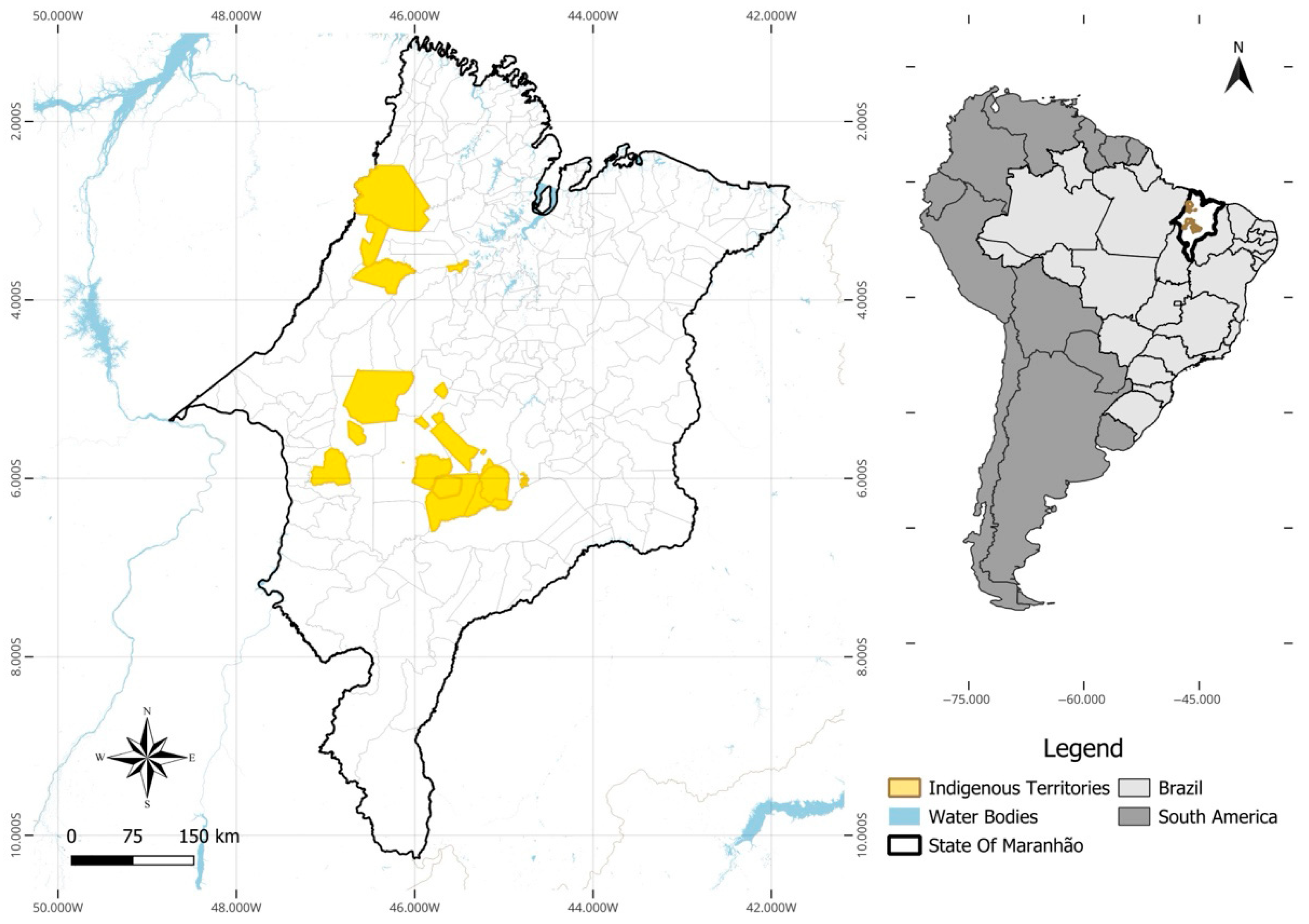
Figure 1. Location map of Indigenous Territories in Maranhão State.
Land 15 00132 g001
Figure 2. Methodological flow for calculating CO2 emissions from aboveground biomass (AGB; applied to other pools) as a function of forest disturbances.
Land 15 00132 g002
Figure 3. Map of fire recurrence in the Indigenous Territories of Maranhão State.
Land 15 00132 g003
Figure 4. Critical years of burned areas in the Indigenous Territories of Maranhão, Brazil (1985–2023). The red color represents the total burned area between 1985 and 2023.
Land 15 00132 g004
Figure 5. Total Annual burned areas in forest and savanna formations in the Indigenous Territories of Maranhão, Brazil from 1985 to 2020.
Land 15 00132 g005
Figure 6. (a) Total vegetation loss (forest and savanna) in each Indigenous Territories of Maranhão between 1985 and 2023. The chart highlights the spatial distribution of cumulative losses, identifying the most affected territories and indicating whether the pressure fell predominantly on forest or savanna formations. (b) Time series of the count of Indigenous Territories that experienced their peak year of loss in forest and savanna formations between 1985 and 2023. Each point indicates the number of territories that coincided in reaching their maximum loss in a given year, emphasizing periods of higher concentration of critical events and revealing the temporal variability of anthropogenic pressure on these territories.
Land 15 00132 g006
Figure 7. Annual loss of forest and savanna formations per Indigenous Territories in Maranhão, Brazil (1985–2023).
Land 15 00132 g007
Figure 8. Forest remnants (ha) in the Indigenous Territories of Maranhão in 2023.
Land 15 00132 g008
Figure 9. CO2 emissions per hectare in the Indigenous Territories of Maranhão, Brazil, for the period 2013–2023.
Land 15 00132 g009
Table 1. Summary of fire recurrence in forest formation and savanna formation across the Indigenous Territories of Maranhão State (1985–2023).
Indigenous TerritoryBurned Area (ha)1–3 Burns (%)4–9 Burns (%)≥10 Burns (%)Max. Recurrence
Araribóia293,37566.4%28.7%4.9%32
Porquinhos dos Canela-Apãnjekra141,70225.5%27.6%46.9%36
Cana Brava94,27147.5%44.7%7.9%27
Kanela82,2387.5%11.7%80.7%37
Bacurizinho80,19643.7%48.1%8.2%26
Alto Turiaçu71,68698.6%1.4%0.0%8
Kanela Memortumré64,53016.4%31.8%51.8%36
Porquinhos39,20138.0%28.6%33.4%31
Krikati38,29171.9%23.0%5.1%28
Governador22,68847.1%43.4%9.5%34
Caru21,65499.8%0.2%0.0%6
Awá17,73099.5%0.5%0.0%6
Urucu/Juruá730591.8%8.1%0.0%11
Geralda Toco Preto617998.3%1.6%0.1%15
Lagoa Comprida471896.9%3.1%0.0%7
Krenyê443773.9%25.4%0.6%13
Rio Pindaré190097.4%2.6%0.0%6
Rodeador177930.0%44.3%25.7%24
Disclaimer/Publisher’s Note: The statements, opinions and data contained in all publications are solely those of the individual author(s) and contributor(s) and not of MDPI and/or the editor(s). MDPI and/or the editor(s) disclaim responsibility for any injury to people or property resulting from any ideas, methods, instructions or products referred to in the content.