1. Introduction
The growing world population has significantly contributed to the exponential growth in global demand for food and energy. Energy and food security are essential for each country’s human welfare. Sustainable Development Goal 13 (SDG-13) reports actions to mitigate climate change, aiming to ensure affordable, sustainable, and innovative energy access for all by 2030 [
1]. Land-use conflicts could arise globally in how we produce food and generate electricity. A potential solution to overcome this challenge is Agrivoltaics (AVs), which combine agricultural land use with electricity generation. They have been recognized as a promising approach that enables the production of renewable energy, while also allowing for the cultivation of agricultural products on the same land. The agrivoltaic idea, combining solar energy generation and food crop cultivation, can optimize land use and increase overall productivity [
2,
3]. In fact, by applying AVs, 80–90% of the land under them can be cultivated using common agricultural practices [
4]. In this way, AVs can address several current and future social and environmental challenges, including climate change and food security.
Planting under PV (Photovoltaic) panels is particularly recommended for crops with low agronomic requirements and for shade-tolerant species. Recent studies have reported yield increases associated with co-production systems, particularly in the cultivation of crops, medicinal plants, leafy vegetables, and orchards and berries [
5,
6,
7]. According to Amaducci et al. [
8], under conditions of water stress and extreme weather events, certain crops—such as maize—can perform better in AVs than in conventional open-field cultivation. AVs can create favorable microclimatic conditions for crops by reducing wind and hail exposure [
9,
10], enhancing soil moisture retention, and lowering evapotranspiration rates [
6]. Furthermore, crops grown in rows and not reliant on large-scale farm equipment tend to perform well, as lower-mounted panels pose fewer obstacles to cultivation [
6].
PVs can also be used in conjunction with livestock farming activities [
5,
11]. In such systems, PV panel structures are installed at appropriate heights to allow unobstructed movement of grazing animals. To date, published research has primarily focused on evaluating the impacts of such co-production systems on the livestock performance of sheep [
12] and rabbits [
13], highlighting the co-location of solar panels and farming as a viable form that increases overall revenue for farmers, while providing a high-value agricultural product, with significantly less environmental impact. In addition, AVs can be used in aquaculture animal farming by installing a PV system in the water of ponds, which enhances the fish growth rate [
14].
The benefits of agrivoltaic co-production extend to environmental gains, as integrating renewable energy sources into agriculture can help reduce greenhouse gas emissions [
15]. Proper vegetation management within PV parks helps prevent soil erosion [
5], minimizes the risk of wildfire spread by removing grazing biomass, and eliminates the need for chemical herbicides, which can otherwise pollute soil and water resources. For these reasons, some studies demonstrate the use of AVs as a possible ecological weapon to counter the harmful effects of climate change [
9,
16].
AV systems have also been increasingly acknowledged as a promising avenue for entrepreneurial development in the agricultural sector, as they enable farmers to diversify their income streams through both the commercialization of solar-generated electricity and the sustained engagement in conventional farming practices, such as crop cultivation and livestock grazing [
5,
17]. These revenues range from 18% to 113%, depending on the type of crop cultivated or livestock raised [
13,
18]. Additional economic benefits are also highlighted, particularly through the reduction in costs associated with chemical vegetation control, which is instead managed by grazing livestock [
19].
Literature Review on Factors Influencing Farmers’ Willingness and Behavior Toward Agrivoltaic (AV) Systems
However, despite the clear economic, environmental, and energy-related benefits associated with agrivoltaic systems (AVs), their effective integration into agricultural practices remains largely dependent on social acceptance and on farmers’ beliefs, perceptions, and attitudes toward new technologies. Adoption decisions are shaped by farmers’ subjective assessments of risk, perceived usefulness, and alignment with their existing farming practices and values.
Recognizing this, several scholars have devoted efforts to examining the social and behavioral dimensions of AV uptake. Moerkerken et al. [
20], for instance, investigated the determinants influencing Dutch farmers’ propensity to adopt AVs. Their findings indicated that behavioral intentions—shaped by personal motivation and perceived benefits—along with the perceived importance of renewable energy and the general level of innovativeness among farmers, were significant predictors of adoption. This highlights that farmers who are more open to experimentation and who place a higher value on sustainability are more likely to embrace AV technologies.
Similarly, Li et al. [
21] conducted a comprehensive quantitative survey aimed at deepening the understanding of the factors that influence both the willingness and actual behavior of Chinese farmers regarding the adoption of photovoltaic agriculture. Their evidence demonstrated that positive perceptions of AVs, combined with access to technical training, significantly enhance farmers’ willingness to adopt and effectively implement the technology. Conversely, high photovoltaic investment costs were identified as a major barrier, exerting a negative influence on both willingness and behavior. These findings underscore the central role of financial considerations and the importance of support mechanisms, such as subsidies, training programs, and knowledge dissemination, in facilitating broader AV uptake.
By conducting a qualitative study, Torma and Aschemann-Witzel [
22] tried to investigate the perceptions of AVs by different stakeholder types in three countries (Germany, Belgium, and Denmark). It was found that the innovation diffusion of AVs is associated with the perceived feasibility and usefulness of them [
22]. To achieve a better understanding of the factors influencing farmers’ willingness to adopt AV systems, Wagner et al. [
2] conducted a quantitative survey among 214 German farmers, as well. The results reveal that 72.4% of the participants would be willing to use AVs. For farmers, the most powerful incentive for solar PV uptake is the additional source of income and the perspective for future development of their farm, whereas the “perceived usefulness” of the technology has the strongest impact. Farmers’ individual motivations to integrate activities related to renewable energy (RE) production were explored by Frantal and Prousek [
23], as well. They concluded that the area of cultivated land influences the adoption of renewable energy technologies and is negatively correlated with the degree of focus on livestock production. Mbzibain et al. [
24] surveyed 393 British farmers to conclude that they use Renewable Energy (RE) technologies primarily to mitigate costs and diversify farm incomes. They also noted that the barriers to adopting renewable energy enterprises are not only economic, but are positively correlated with the degree of knowledge and driven by social acceptance [
24]. Following a similar line of inquiry, the study conducted by Elahi et al. [
25] examines Pakistan farmers’ intention and willingness to install RE technologies. The evidence presented indicates that young, more educated, and wealthier farmers were more likely to adopt this kind of technology. Their findings also highlighted that the lack of financial resources and the lack of understanding of green energy technology were the main reasons for the stated unwillingness to adopt RE technologies [
25].
Despite the potential of AVs to address global food–energy conflicts, the specific socio-economic challenges faced by farmers in the study area, such as rising energy costs, unemployment pressures, and limited adoption of renewable technologies, remain poorly understood. This gap is significant because regional socio-economic and institutional factors may cause adoption patterns to differ from those observed elsewhere. By analyzing how these local factors interact to influence AV adoption, the study highlights context-specific adoption patterns that may not be captured in other regions.
To make research on the acceptance of photovoltaic agriculture among farmers more robust and to obtain a more comprehensive picture of the acceptance of AVs, the present study aims to investigate, for the first time in Greece, the willingness of farmers to adopt the agrivoltaic idea, integrating either agricultural or livestock activities with photovoltaic energy production on their farmland. In parallel, the study examines the factors that affect their decision.
The remainder of this manuscript is structured as follows.
Section 2 describes the study’s methodology, including the study area, research design, and data collection procedures.
Section 3 presents the results of the analysis.
Section 4 discusses the findings in relation to existing literature, and
Section 5 concludes the paper by summarizing the main conclusions and implications.
2. Methodology
2.1. Study Area
The Region of Western Macedonia (and especially the Regional Unit of Kozani) constitutes both an industrial and agricultural region. It has been an energy hub for Greece since 2019, when the country faced an urgent need to transform its energy production system. In line with its international commitments, Greece replaced the lignite power plants that had operated for decades in the region and transitioned to a low-carbon economy. The rapid delignification in Greece has had a significant impact on the social and economic status of the region of Western Macedonia [
26,
27]. To reinforce the shift in the country’s energy sector from fossil fuels to renewable energy sources, the Greek government established a Steering Committee to coordinate the preparation of the Just Transition Development Plan 2021–27 of Western Macedonia [
28]. The JTDP aims to support a sustainable post-lignite, minimizing social and economic decline, and attracting new investments. A special mention is made in renewable energy projects, as RE is recognized to be a key component of the trajectory toward this low-carbon transition. At the same time, the agricultural sector continues to provide many jobs in Western Macedonia and constitutes an alternative pillar for supporting the regional economy in the near future. According to a current survey, a large part of Kozani’s population has already moved to the agricultural sector [
29]. For the aforementioned reasons, a dual land use approach could be an innovative solution with high potential to reduce land use competition and address land-use conflicts.
2.2. Research Design and Data Collection
To understand the varied perspectives on AVs, a quantitative survey was conducted among Greek farmers in the region of Western Macedonia (mainly in Kozani, Greece), between December 2022 and February 2023. The target population of this survey was the 22,796 farmers, based on 2022 data provided by OPEKEPE (Greek Payment and Control Agency for Guidance and Guarantee Community Aid). Participants were selected using purposive convenience sampling. Specifically, farmers who agreed to participate in the questionnaire survey were interviewed in person, resulting in a total sample of 287 respondents. Data were gathered using a structured questionnaire, which consists of several sections. Section one determines the demographic and socioeconomic profile of participants. Section two measures farmers’ environmental concern, perceived ecological knowledge, and awareness. Section three measures farmers’ knowledge of AVs and estimates their intention to install AVs. Farmers’ willingness to adopt AVs, which constituted the dependent variable, was measured through a direct question included in the questionnaire: ‘Would you be willing to install agrivoltaic systems in the future?’ Responses were coded as a binary variable (1 = Yes, 0 = No). The final section determines farmers’ perceptions of the functions and barriers of AVs. All factors potentially influencing this willingness were used as independent variables. Before data collection, the questionnaire was reviewed by experts in agricultural economics, policy, and solar PV to assess the selected items of the questionnaire. To evaluate reliability, Cronbach’s alpha coefficients were calculated for all multi-item constructs. The coefficients exceeded the commonly accepted threshold of 0.70, indicating satisfactory internal consistency and reliability of the questionnaire items.
2.3. Statistical Analysis
Data exploration was performed to gain a comprehensive understanding of the questionnaire responses and identify missing or inconsistent values [
30]. By exploring the dataset before statistical analysis, the accuracy, validity, and reliability of the findings were ensured. To answer the research aim, the logistic regression was undertaken to predict which factors affect the binary dependent variable, “willingness to adopt AVs” (no = 0, yes = 1). This statistical modeling technique is widely used to identify the probability of an outcome related to a series of potential explanatory variables by an equation of the form [
31]. Logistic regression requires a minimum sample size, which in the case of a binary response variable, is 50 observations [
32], a number that is exceeded in the current survey. Before undertaking the logistic regression analysis, a multicollinearity test among the independent variables was assessed to ensure the reliability of the estimations. Variance Inflation Factor (VIF) values were calculated for all predictors, with all values lying below 5, indicating no significant collinearity. All analyses were performed using IBM SPSS Statistics version 29.
2.4. Sample Description
The structure of the survey sample is presented in
Table 1. As indicated, the vast majority of respondents were female (93%), highlighting a strong gender imbalance within the sample. The average age of participants was 45.28 years (±12.14), suggesting a mature and experienced farming population. Farms included in the sample covered on average 7.88 hectares, indicating that the respondents predominantly represent small- to medium-scale farming enterprises. Regarding educational attainment, 42.6% of the respondents reported having completed secondary education (both lower and upper), while an additional 38.7% had pursued post-secondary studies. This relatively high level of education may influence awareness and openness toward emerging innovations.
A significant proportion of participants (41.8%) stated that between 41 and 60% of their total income comes from agricultural activities, indicating a strong dependence on the sector. Moreover, approximately one third of respondents (33.3%) identified agriculture as their primary source of income, underscoring the central role of farming in their livelihoods. With respect to employment status, most participants (64.1%) declared farming as their main occupation, which further emphasizes their direct engagement with agricultural production. Additionally, 36.2% of farmers reported being members of an agricultural co-operative association, a factor that may impact their access to information, support networks, and innovation adoption.
Although only seven respondents had already installed AVs on their farms, awareness of the broader concept of “agro-energy” was relatively high (79.8%). This suggests that, despite the limited current adoption of AVs, there is substantial knowledge of the technology and its potential applications, indicating promising conditions for future uptake.
3. Results
The results of the analysis revealed that 46.3% of the surveyed participants (133 farmers) expressed a willingness to adopt Agrovoltaic Systems (AVs) on their farmlands. This indicates a relatively high level of willingness to integrate renewable energy technologies into agricultural production. To further identify the determinants that influence farmers’ adoption decisions, a stepwise logistic regression analysis was conducted. The model demonstrated an overall predictive accuracy of 71.1%, suggesting that it performs well in explaining the likelihood of adoption among the respondents.
The logistic regression results (
Table 2) show that, among the range of socio-economic and attitudinal variables examined, three factors emerged as statistically significant predictors of farmers’ willingness to adopt AVs. First, the level of education was positively associated with adoption intention, implying that farmers with higher levels of education tend to adopt its implementation in a higher percentage, as education facilitates better access to and understanding of relevant information. Second, participation in farmers’ organizations or associations significantly increased the probability of adoption. This finding highlights the role of social capital, knowledge exchange, and peer influence in shaping attitudes toward new agricultural technologies. Finally, awareness of the concept of “agro-energy” was found to be an important determinant, suggesting that familiarity with renewable energy concepts and their agricultural applications enhances acceptance of AV systems. During the model development process, several socio-demographic and farm-related variables (e.g., age, farm size, income level, full-time vs. part-time farming status) were tested, but did not reach statistical significance at conventional levels.
The odds of the results indicate that educational level and knowledge have the strongest impact on the probability of farmers’ willingness to adopt AVs, while participation in farmers’ organizations also contributes positively, though to a lesser extent. The explanatory power of the model was assessed using the pseudo R2 measures. The Cox & Snell R2 value of 0.277 indicates that the model explains approximately 27.7% of the variation in the dependent variable. Since the Cox & Snell R2 cannot reach a maximum value of 1, the Nagelkerke R2 was also considered. The Nagelkerke R2 value of 0.370 suggests that the model explains about 37.0% of the variance, indicating a moderate explanatory power. Overall, the results suggest that the model adequately explains the outcome, which is acceptable for logistic regression models in social and agricultural research.
At the end of the survey, respondents were presented with an open-ended question aimed at clarifying the underlying reasons behind their agreement or disagreement with the installation of Agrovoltaic Systems (AVs) on agricultural land. The responses revealed a complex interplay of economic, informational, and attitudinal factors shaping farmers’ perceptions of this emerging technology.
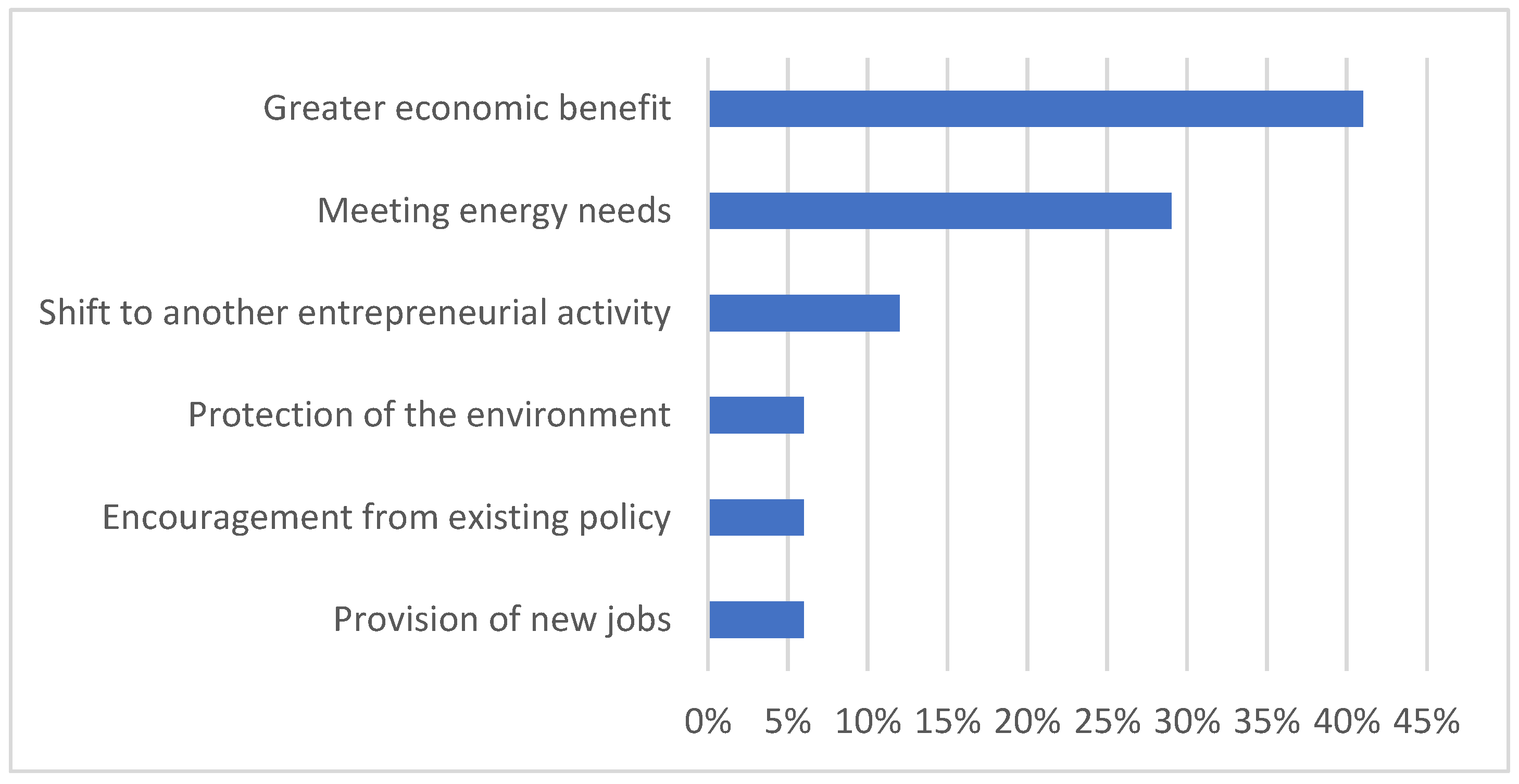
Among those who expressed a positive attitude toward AV adoption, the expected increase in farm income emerged as the predominant motivation, cited by 41% of farmers (
Figure 1). This finding highlights the central role of economic incentives in driving technology uptake within the agricultural sector. The ability to meet on-farm energy needs was identified as the second most influential factor (29%), suggesting that farmers are increasingly aware of the potential for AVs to enhance energy self-sufficiency and reduce dependence on external power sources. A further 12% of respondents viewed AVs as an opportunity for economic diversification, facilitating a transition toward alternative entrepreneurial activities such as agritourism or renewable energy production. Interestingly, environmental protection motives were mentioned by 6% of participants, indicating that while ecological awareness exists, economic motivations remain dominant in shaping adoption behavior.
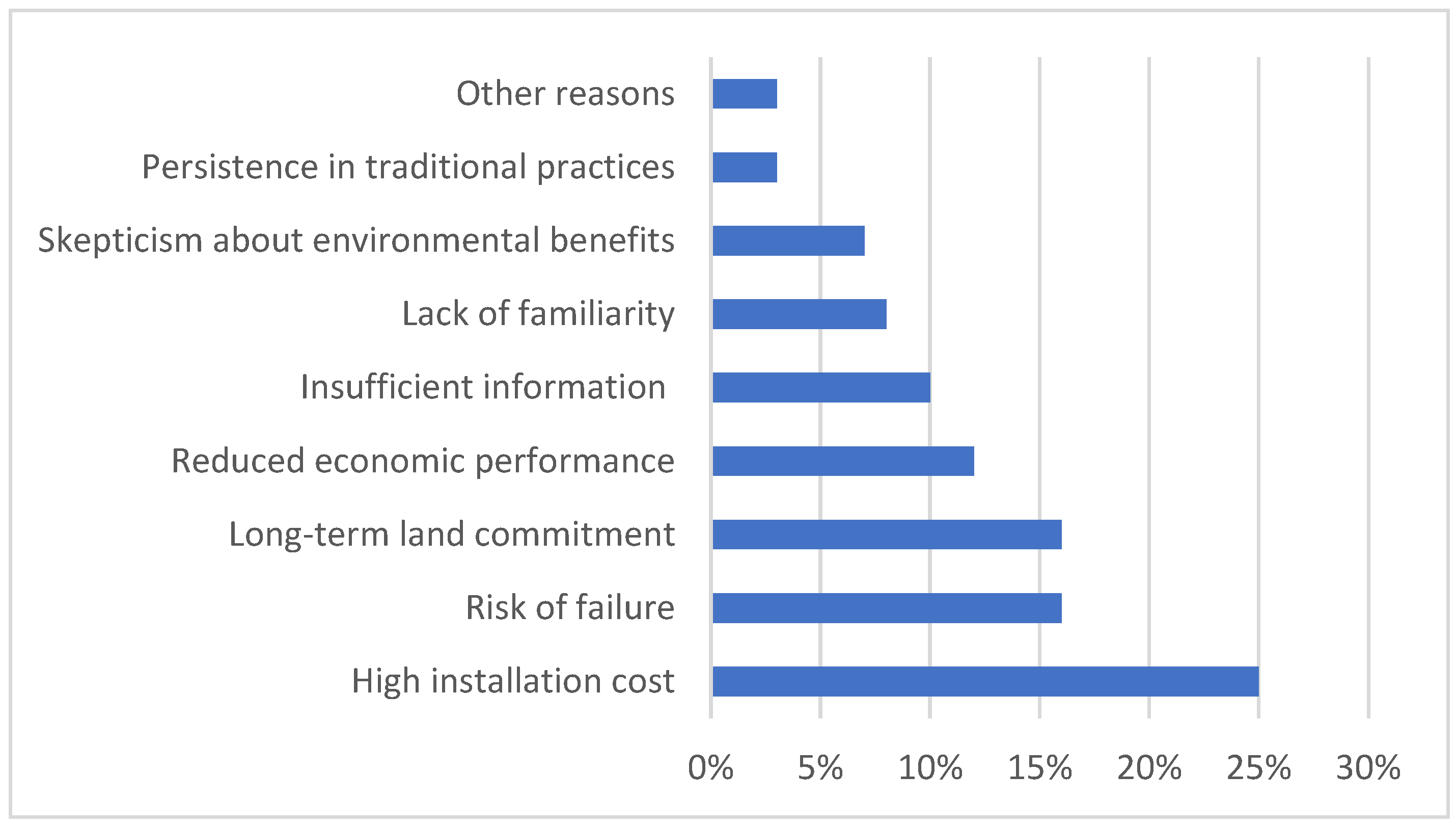
Conversely, among farmers who were unwilling to adopt AVs, economic barriers constituted the most frequently reported deterrent. Specifically, 25% of respondents cited high installation costs and limited access to capital as major constraints, reflecting the financial risks perceived in adopting novel technologies. Concerns related to investment risk and long-term financial commitments were reported by 16%, underlining the uncertainty surrounding the profitability and stability of AV projects. In addition, 12% of respondents expressed apprehension about potential reductions in economic returns due to changes in legislation or taxation, which suggests a lack of confidence in the policy framework supporting such initiatives.
Informational barriers were also notable: 10% of farmers indicated insufficient information to make an informed decision, and 8% reported a general lack of familiarity with AV concepts or pilot projects. Furthermore, 7% mentioned pre-existing obligations, such as participation in “young farmer” programs or other subsidy schemes, which might restrict their flexibility to engage in new investments. Finally, a small proportion (3%) of respondents held traditional views, emphasizing that the primary role of farmers is to produce food rather than generate energy (
Figure 2).
Overall, these findings demonstrate that economic benefits, energy autonomy, and incentives related to environmental protection are the strongest motivations for AV adoption. However, financial constraints, high installation costs and investment uncertainty, long-term land commitment, and limited awareness remain key barriers. In addition, some respondents continue to express concerns regarding the high level of risk associated with AV adoption, while others exhibit skepticism about the environmental benefits of the proposed approach. In particular, informational gaps indicate that many farmers lack sufficient exposure to AV technologies and real-world applications. Thus, policy interventions promoting financial support mechanisms, targeted information campaigns, and demonstration projects could play a crucial role in increasing acceptance and reducing perceived risks among farmers.
4. Discussion
Agrivoltaic (AV) agriculture is widely recognized as a promising land use approach for achieving both green energy generation and crop production [
33]. The findings of this study indicate that although Greek farmers predominantly maintain a traditional perception of agriculture as solely devoted to food production, a considerable share is open to integrating renewable energy generation into farming activities. This finding aligns with evidence from the literature, which underscores that agriculture and livestock farming are often perceived by farmers as being predominantly devoted to the production of agricultural goods [
34,
35,
36].
Consistent with the existing literature, the results of the present study indicate that younger farmers and those with higher educational attainment are more inclined to adopt AVs on their land. This observation is supported by Liontakis et al. [
37], who report that younger farmers are more inclined to take risks associated with innovative agricultural practices, a characteristic that is often essential when adopting emerging technologies such as AVs. In a similar vein, several studies have emphasized that demographic characteristics, particularly age, educational level, serve as important determinants of AV adoption [
20,
23,
25,
38,
39,
40]. People with more education are usually better at understanding long-term benefits and dealing with the complexities of new energy–agriculture systems.
Beyond demographic factors, the findings further indicate that knowledge and awareness of innovative approaches, including AVs, substantially contribute to their acceptance. Familiarity with the basic principles of AVs also appears to enhance farmers’ willingness to adopt. Similar results are reported by Moerkerken et al. [
20] and Li et al. [
21], who highlight that familiarity with AVs and the experiences of farmers who have already implemented them can significantly influence willingness to adopt.
Consequently, strengthening farmers’ awareness through targeted information provision and training could positively influence adoption decisions. Policies and programs that promote knowledge exchange and encourage experience sharing among farmers may be effective in facilitating the broader diffusion of AV technologies within the agricultural sector.
Unsurprisingly, the current results indicate that economic considerations play a dominant role in farmers’ decisions. This is consistent with [
2], who emphasize that the primary incentive for solar PV adoption is the additional source of income. At the same time, installation costs are perceived as a significant barrier, as reported by [
21], who found that the financial burden of photovoltaic investments negatively influences adoption decisions.
A comprehensive understanding of farmers’ perspectives and attitudes is crucial for promoting a dual land-use approach. Such insights can guide the design of agrivoltaic systems and supportive policies, enhancing not only agricultural productivity and environmental sustainability but also the economic viability and social acceptance of renewable energy initiatives in rural communities. Despite the valuable insights provided, this study is subject to some limitations that should be acknowledged. First, the research relies on a limited and geographically specific sample of Greek farmers, which may restrict the generalizability of the findings to other national or regional contexts. AVs adoption is highly influenced by country-specific factors such as regulatory frameworks, land-use policies, climate conditions, and subsidy schemes, which differ substantially across Europe and beyond.
Second, the study is based primarily on self-reported perceptions and attitudes, which may be affected by response bias, social desirability bias, or limited technical knowledge of AVs. Farmers’ stated intentions or perceived benefits may not necessarily translate into actual adoption behavior, particularly when long-term financial, technical, or administrative challenges emerge.
Third, while the study explores AVs in relation to renewable energy entrepreneurship, it does not quantitatively assess farm-level financial performance, energy yields, or crop productivity under agrivoltaic installations. Future studies could benefit from integrating techno-economic analyses or longitudinal farm data to complement qualitative and perceptual findings.
Addressing these limitations in future research would contribute to a more comprehensive understanding of how AVs can effectively bridge agriculture and renewable energy entrepreneurship.
5. Conclusions
This study provides the first empirical evidence on Greek farmers’ willingness to adopt AV systems, offering insights particularly relevant to regions undergoing energy transitions, such as Western Macedonia. The findings reveal a moderate but significant level of acceptance, driven primarily by economic motivations and the perceived potential of AVs to supplement farm income. At the same time, barriers related to installation costs, investment risk, and limited knowledge about the impacts of AVs continue to constitute constraints, which matches what international research has also shown.
Education, participation in agricultural associations, and familiarity with agro-energy concepts emerged as key determinants of adoption. These results highlight the importance of strengthening knowledge transfer mechanisms and integrating AV technologies into the existing advisory services. In the context of land-use competition, agrivoltaics represent a strategic opportunity for dual land-use. In regions like Western Macedonia, where decarbonization and rural revitalization are parallel priorities, AVs can help reach these goals.
Overall, the study underscores that farmers are willing to engage with innovative forms of land use when economic, informational, and institutional conditions align. As agrivoltaic development continues to expand globally, integrating farmers’ perspectives into planning and policy processes will be essential for ensuring socially acceptable, environmentally sound, and cost-effective use. Informational and institutional conditions can be aligned through coordinated efforts to provide access to targeted technical training, while reinforcing the role of agricultural associations and advisory services to reduce uncertainties related to new technologies.
Future research should further explore farmers’ insights over time, assess the performance of pilot installations, and examine the ecological dimensions of AV implementation to support evidence-based land-use planning. Theoretically, this study advances the literature on agricultural technology adoption by identifying how economic motivations, informational access, and institutional support interact to shape farmers’ willingness to adopt AVs. These findings extend existing technology adoption frameworks by providing context-specific empirical evidence from a Mediterranean agricultural setting, where both socio-economic conditions and policy environments may differ from those in previously studied regions.