Article

An Economic Impact Analysis of Transmission and Substation Network Investments for Accelerating Renewable Energy Expansion in South Korea: Modeling and Policy Perspectives


1
Department of Future Energy Convergence, Graduate School, Seoul National University of Science & Technology, Seoul 01811, Republic of Korea
2
Department of Energy Policy, Graduate School of National Defense Convergence Science, Seoul National University of Science & Technology, Seoul 01811, Republic of Korea
3
Department of Future Energy Convergence, College of Creativity and Convergence Studies, Seoul National University of Science & Technology, Seoul 01811, Republic of Korea
*
Author to whom correspondence should be addressed.
Land 2026, 15(1), 107; https://doi.org/10.3390/land15010107
Submission received: 2 December 2025 / Revised: 4 January 2026 / Accepted: 5 January 2026 / Published: 7 January 2026

Abstract

South Korea’s 11th Long-term Plan for Transmission and Substation Equipment (LPTSE, 2024–2038) invests KRW 72.8 trillion (USD 52.3 billion) to integrate 91.9 GW renewables while securing supply for semiconductor/artificial intelligence demand concentrated in the Seoul Metropolitan Area. This study aims to quantify LPTSE’s national economic effects and spatial equity implications using input–output (IO) analysis. A demand-side IO model—calibrated to 2022 national tables with a novel transmission and substation investment sector—disaggregates investments across five key sectors and estimates production, value-added, wage, and employment multipliers, complemented by multiregional spatial analysis of high-voltage direct or alternating current corridors. The results project KRW 128.2 trillion (USD 92.2 billion) total production, KRW 54.1 trillion (USD 38.9 billion) value-added, KRW 30.9 trillion (USD 22.2 billion) wages, and 578,000 jobs over 2025–2038, with coastal generation regions bearing infrastructure burdens while benefits accrue nationally. The findings demonstrate transmission investments as macroeconomic catalysts, highlighting the need for regionally differentiated compensation addressing land-use conflicts along export or transit corridors.

1. Introduction

1.1. Background of This Study

South Korea faces an acute electricity supply–demand mismatch driven by surging demand in the Seoul Metropolitan Area (SMA) and geographic constraints on renewable energy (RE) and nuclear power (NP) deployment [1]. The 11th National Plan for Electricity Demand and Supply (NPE) [2] forecasts annual demand growth of 1.8% through 2038, with semiconductor manufacturing and artificial intelligence (AI) data centers—concentrated in the SMA (51% of population, 50% of consumption)—driving over half of this increase. Yet the SMA’s limited land precludes large-scale generation, while optimal RE/NP sites lie along the East and South Coasts, necessitating massive transmission expansion.
The Korea Electric Power Corporation (KEPCO)’s 11th Long-term Plan for Transmission and Substation Equipment (LPTSE, 2024–2038) addresses this through KRW 72.8 trillion (USD 52.3 billion) in investments, expanding transmission capacity by 72% and substations by 43% to integrate 91.9 GW of new RE/NP while securing SMA supply [3]. However, implementation faces formidable Not-in-My-Back-Yard (NIMBY) barriers that have chronically delayed grid projects. Since the 2010s, 70% of major transmission lines have experienced permit delays averaging 3.5 years, with costs escalating 20–50%.
A critical case is the East Coast–SMA 8 GW high-voltage (HV) direct current (DC) (HVDC) corridor, South Korea’s longest planned grid project spanning three provinces. Despite grid curtailments already wasting 15% of the East Coast RE output, Hanam City’s denial of a key substation expansion triggered multiyear litigation—ultimately won by KEPCO in 2024 but failing to resolve community fears over electromagnetic fields and land values. Similarly, the southwest–SMA corridor (five 345 kV lines + two West Sea submarine HVDC cables) encounters fishers’ opposition to marine cable laying and land conflicts in solar/wind-rich Jeollanam-do, where local electricity demand is minimal.
These cases reveal a structural equity challenge: transmission infrastructure imposes localized burdens (visual impacts, land conversion, and fishery disruption) on exporting/transit regions while delivering national benefits (RE integration and SMA industrial competitiveness) primarily to demand centers. The LPTSE mitigates this through co-location with transport corridors and undergrounding, yet persistent NIMBY risks undermine its economic rationale. Quantifying LPTSE’s national production, value-added, wage, and employment multipliers—while mapping corridor-level cost–benefit incidence—is thus essential for evidence-based policy design.

1.2. Literature Review on Transmission and Substation (T&S) Network Investment and Planning

The T&S network expansion planning literature has evolved from deterministic optimization toward integrated stochastic and multi-objective frameworks that balance reliability, cost, and decarbonization imperatives [4,5,6]. Early studies employed DC optimal power flow models to minimize investment costs subject to N−1 reliability and power balance constraints [7], while recent advances incorporate stochastic renewable penetration, demand uncertainty, and CO2 abatement via robust optimization and Benders decomposition [8,9]. Substation siting decisions, often treated exogenously, have gained attention through simultaneous generation–transmission–substation expansion planning models that explicitly optimize converter station locations alongside line investments, demonstrating up to 20% cost savings from integrated decisions [10,11,12].
Economic valuation approaches complement engineering optimization by quantifying welfare impacts beyond direct capital costs. Market-based transmission pricing models use locational marginal prices and futures data for risk-neutral project appraisal, while post-investment fuzzy comprehensive evaluation assesses 500 kV substation performance through multi-criteria cost–benefit analysis. Computable general equilibrium (CGE) frameworks capture generation–transmission co-optimization under carbon pricing, revealing that neglecting transmission congestion inflates system costs by 15–30% [13]. Capacity expansion models further integrate chronological dispatch (8760 h) with multi-decadal horizons, enabling co-optimized generation–transmission planning across pipe-and-bubble or meshed DC representations [14].
Despite methodological sophistication, three critical gaps persist [15]. First, national-scale macroeconomic assessments of T&S equipment (TSE) investments remain scarce; while power generation IO studies abound, grid infrastructure multipliers are underexplored. Second, spatial land-use implications—corridor NIMBY conflicts, co-location with transport infrastructure, and regional cost–benefit incidence—are rarely integrated with economic modeling. Third, demand-side input–output (IO) analysis, ideal for tracing investment-induced production/value-added/wage/employment effects under fixed coefficients, has not been applied to TSE plans like South Korea’s 11th LPTSE despite its KRW 72.8 trillion (USD 52.3 billion) scale.
This study addresses these gaps by (1) quantifying LPTSE’s national economic multipliers using 2022 Bank of Korea IO tables (IOTs), (2) mapping plan-level spatial corridors (HVDC East Coast–SMA and Honam submarine links) to interpret regional benefit incidence, and (3) establishing an IO benchmark for future CGE extensions. By focusing on South Korea’s unique SMA power deficit and coastal RE/nuclear surplus, the analysis provides policy-relevant evidence for TSE justification amid accelerating semiconductor/AI demand.

1.3. Objectives and Structure of This Study

According to the 11th LPTSE, the construction of transmission lines and substations will be dramatically expanded by 2038. A more detailed explanation of this will be provided in the following section. Since approximately KRW 72.8 trillion (USD 52.3 billion) will be invested in implementing the LPTSE by 2038, KEPCO and the government must determine its economic effects, meaning how much production, value-added, wages, and employment will be induced by this investment. Information on the economic effects is crucial in justifying the investment. Thus, the objective of this research is to measure the economic effects of the investment in implementing the LPTSE. The IO approach (IOA) is employed to achieve this objective.
The authors believe that this study makes three contributions to the literature. First, although there are former studies which have addressed the importance of TSE [16,17,18,19,20,21,22,23,24,25], this study is the first to address the economic effects of investment in implementing LPTSE. Second, this study confirms the usefulness of the IOA in gauging the economic effects of investment in implementing the LPTSE. The framework presented in the study can be relatively easily extended and applied to similar cases. Third, the results from this study can be used as a piece of information to decide whether to invest in LPTSE, a type of public investment project. Although cost–benefit analysis is the most important factor in deciding whether to implement a particular public investment project, economic effects can also be an important factor to consider.
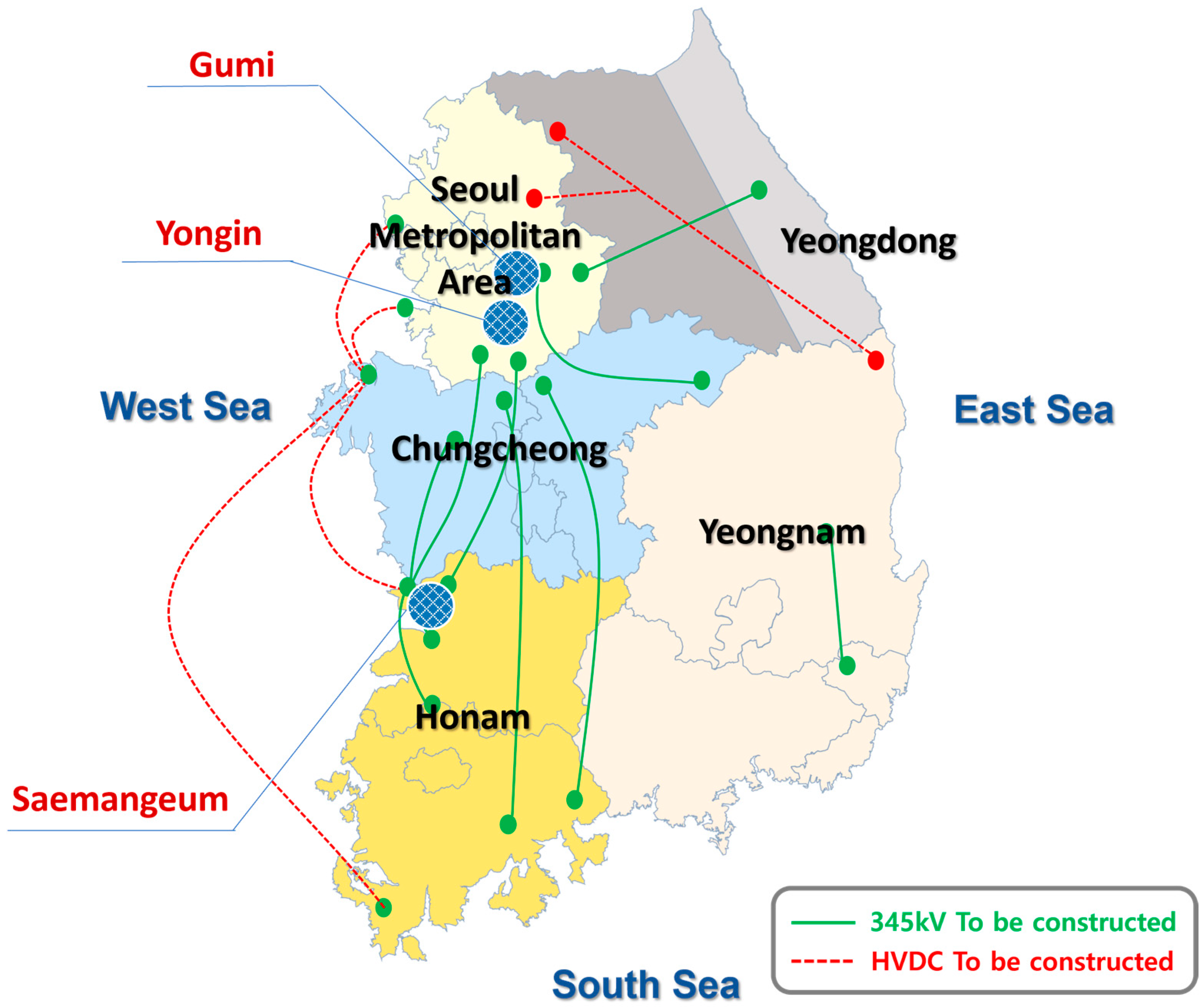
Beyond these macroeconomic and energy-system considerations, the spatial configuration of South Korea’s electricity network creates distinctive land-planning challenges for implementation of the LPTSE. Most of the additional carbon-free generation envisaged in the 11th NPE and 11th LPTSE is located along the East Sea coast and in the southern Honam and Yeongnam regions, whereas more than half of national electricity demand is concentrated in the SMA. This spatial mismatch requires the development of long-distance 345 kV and HVDC transmission corridors that traverse multiple provinces, land-use zones, and administrative jurisdictions, as illustrated conceptually in Figure 1. The figure presents major routes in the 11th LPTSE, showing planned 345 kV AC lines (green) and HVDC links (red) between coastal generation regions and the SMA. The map illustrates corridor concepts at national scale; detailed alignments and substation locations will be determined by subsequent siting and permitting procedures.
According to KEPCO’s official planning documents, the long-term transmission strategy is organized around several key axes: East Coast–SMA HVDC links to evacuate NP and RE generation from the Yeongdong belt; Honam–SMA submarine and overhead HVDC connections across the West Sea; and 345 kV reinforcements around advanced industrial clusters such as the Yongin semiconductor complex, Gumi, and Saemangeum. These corridors cut across diverse territorial settings including agricultural plains, coastal fishing communities, mountainous interior regions, and densely built-up metropolitan areas, implying heterogeneous local land-use constraints and social acceptance issues.
In this context, the economic assessment of LPTSE investment should be interpreted together with its spatial imprint on national territory. While the present study does not undertake parcel-level geospatial modeling—because detailed alignments and substation sites will be determined by future siting committees—the analysis explicitly engages with the plan-level geography of the 11th LPTSE. The paper therefore combines a national IOA with a qualitative spatial reading of KEPCO’s long-term route map and regional system plans, in order to discuss how macroeconomic ripple effects intersect with territorial patterns of infrastructure deployment, land-use trade-offs, and potential landscape transformation.
The rest of this article is made up of four sections. The following Section 2, which deals with the materials and methods, consists of four subsections. First, an overview of the 11th LPTSE is provided. Second, a brief review of related previous studies is presented. Third, a description of the basic model of the IOA is given. Fourth, specific models for the IOA are explained. Section 3 includes the data used and the results. Section 4 provides a discussion of the results and a discussion of the five complications in realizing the economic effects. Conclusions and policy implications are reported in Section 5.

2. Materials and Methods

2.1. Overview of the 11th LPTSE

Unless otherwise noted, the institutional background and operational details described in the subsequent paragraphs derive from the comprehensive planning documents released by the Korea Electric Power Corporation [3] which offer the most up-to-date roadmap for the national power grid.
The main task of LPTSE is to build an ultra-HVDC transmission network that connects power plants in the southwestern region of South Korea to the SMA via submarine cables. Since RE facilities are concentrated in the southwestern region of South Korea, the power generation in this region is expected to be greater than the region’s power demand. It will be important to make good use of the surplus electricity produced from the carbon-free power source at the demand site. Therefore, the 11th LPTSE includes a plan to install large-scale interregional flex lines that can send the dumped excess electricity from RE generation to the SMA.
The trend of increase in TSE due to the implementation of the 11th LPTSE is presented in Table 1. The capacity of transmission lines will increase from 35,596 C-km in 2023 to 61,183 C-km in 2038. Moreover, the number of substations will increase from 906 in 2023 to 1297 in 2038. In South Korea, there are four types of transmission lines: 765 kV, 345 kV, 154 kV, and HVDC. Among them, the facility related to 154 kV is expected to increase the most by 2038. For example, the length of 154 kV transmission lines will increase from 24,086 C-km in 2023 to 37,049 C-km in 2038. On the other hand, the length of 765 kV transmission lines will hardly increase.
This decision seems to have been made considering the characteristics of T&S facilities, which tend to be less acceptable to residents as the voltage increases. Unlike 765 kV transmission towers, HVDC transmission towers are small in size and can be buried underground. Therefore, they have the advantage of it being relatively easy to secure residents’ acceptance. In this regard, despite the high voltage of HVDC, related T&S facilities are expected to expand significantly. As a result, the total TSE in 2038 will be roughly 1.7 times larger than that in 2023.

2.2. Plan-Level Spatial Overview of the 11th LPTSE

This subsection provides additional plan-level spatial information on South Korea’s 11th LPTSE to complement the economic analysis. The land-planning implications of the LPTSE are examined using official documentation from KEPCO’s “11th Long-term Plan for Transmission and Substation Equipment (2024–2038)” and related government publications, together with the conceptual national route map reproduced in Figure 1. These materials specify, at the scale of regional corridors rather than exact alignments, the intended expansion of 765 kV, 345 kV, 154 kV, and HVDC infrastructure between the six major power-system regions of South Korea and the SMA.
They also provide indicative commissioning schedules, regional groupings (e.g., Honam, Yeongnam, Yeongdong, Chungcheong, and SMA), and qualitative guidance on co-location with transport corridors and the use of national assets for substation siting. Detailed line alignments and exact substation locations will only be determined at later stages by formal siting committees and statutory environmental impact assessments; accordingly, the spatial discussion here is framed at the level of regional corridors and indicative project clusters rather than parcel-scale geographic information.
The plan foresees an increase in total transmission line length from 35,596 C-km in 2023 to 61,183 C-km in 2038 and an increase in the number of substations from 906 to 1297, implying a substantial expansion of the physical footprint of the grid. This expansion is organized around several key regional axes that reflect the spatial mismatch between emerging carbon-free generation and electricity demand. First, a set of HVDC projects is planned along the East Sea corridor to evacuate power from large nuclear and renewable facilities on the eastern coast toward the SMA. These projects include multi-gigawatt submarine and overhead links connecting converter stations in the Yeongdong region to receiving terminals in the capital region, traversing intermediate inland provinces.
Second, the Honam–SMA and Honam–Chungcheong corridors across and along the West and South Seas are designed to integrate large-scale offshore wind and solar resources around Saemangeum and the southwestern coastline into the national grid through a combination of HVDC and 345 kV AC links. Third, a series of 345 kV reinforcements is planned around advanced industrial complexes such as Yongin, Gumi, and Saemangeum, as well as around major metropolitan centers, to ensure stable supply to new semiconductor and battery clusters and to strengthen meshed interconnections between the central and southern regions.
In this context, Figure 1 provides a national-scale visualization of the main corridors and their relationships to provincial territories and the three surrounding seas, depicting the approximate routing of planned 345 kV AC lines (green) and HVDC schemes (red) between coastal generation regions and the SMA. Because the map is conceptual, it should be interpreted as an indicative illustration of the LPTSE strategy rather than as a representation of finalized project routes. Nevertheless, it helps to clarify several important land-planning implications. Generation-rich coastal and southern provinces can be expected to host substantial new overhead and underground infrastructure, including both transmission lines and associated substations.
Intermediate “transit” provinces support interregional power flows while experiencing relatively limited direct demand growth. In contrast, the SMA is projected to receive a significant share of electricity transmitted through these corridors while accommodating comparatively fewer new long-distance lines, relying instead on expansion of its internal 154 kV and distribution networks. In the main article, the regional breakdown of these major projects is used to interpret the national input–output results in terms of broad territorial patterns of cost and benefit incidence, land-use pressures, and social acceptance challenges.
The LPTSE further outlines a series of measures intended to mitigate land-use conflicts and improve the social acceptance of T&S projects. These measures include promoting joint construction with other forms of social overhead capital (SOC), such as roads and railways, in order to minimize the need for additional linear infrastructure corridors; expanding the use of underground cables and submarine HVDC lines in environmentally sensitive or densely populated areas; and making active use of idle national land, including repurposed military sites and closed school grounds, for substation development.
Although the present study does not model these design choices explicitly, they are important for understanding the territorial context of the economic results reported in the main text. In particular, they imply that part of the investment cost associated with LPTSE implementation is a direct consequence of efforts to reconcile transmission expansion with existing land uses, regional development strategies, and landscape-protection objectives. Overall, this plan-level spatial reading reinforces the main message of the article: the LPTSE is not only a macroeconomic investment program but also a territorially differentiated infrastructure strategy whose long-distance corridors shape where physical impacts, land-use trade-offs, and local acceptance issues arise, even though the economic benefits of reliable power supply and induced production accrue primarily at the national scale.

2.3. Review of Related Studies and Research Gaps

As mentioned earlier, this study adopts the IOA to derive the economic effects of the investment required to implement the LPTSE. Previous studies where the IOA was applied to the power sector are reviewed in Table 2, which now includes an expanded set of a number of international cases. Table 2 summarizes their findings across diverse contexts.
While national-scale macroeconomic assessments specifically targeting T&S networks remain relatively scarce compared to power generation studies, a growing body of international literature has begun to quantify the economic footprint of grid infrastructure using input–output frameworks. For instance, Schreiner and Madlener [26] utilized a static IO analysis to evaluate Germany’s power grid expansion, revealing a positive net output multiplier despite mixed effects on value-added and employment, thereby highlighting the complex trade-offs inherent in energy transition infrastructure. Similarly, Pfeifenberger and Hou [27] estimated the employment impacts of transmission investments in the United States and Canada, finding that indirect and induced effects account for a substantial portion of job creation, with multipliers significantly exceeding those of direct construction activities. In the context of developing economies, the IFC Development Impact Department [28] assessed the Powerlinks Transmission project in India and Bhutan, reporting exceptionally high employment multipliers driven by labor-intensive construction practices.
Han et al. [29] and Kim and Yoo [30] investigated the national economic roles of four power sectors and the NP and RE sectors in South Korea, respectively. Nagashima et al. [31] estimated the production and value-added that the installation of wind power systems causes to the Japanese economy. Garrett-Peltier [32] compared the employment impacts of energy efficiency, renewables, and fossil fuels in the US electricity sector. O’Sullivan and Edler [33] quantified the gross employment effects of Germany’s RE industry from 2000 to 2018. Tourkolias and Mirasgedis [34] monetized employment benefits from renewable technologies in Greece.
Similarly, Corona et al. [35] assessed the socioeconomic effects of concentrated solar power in Spain using multiregional IO analysis, while Henriques et al. [36] evaluated the employment impacts of Portugal’s renewable electricity targets. Hongtao and Wenjia [37] examined the effects of various power sectors on China’s economy, Jongdeepaisal and Nasu [38] studied the economic impacts of biomass power plant resource production and consumption in Japan, Kamidelivand et al. [39] simulated the effects of renewables substituting gas/coal for electricity in Ireland, Mikulić et al. [40] analyzed wind power deployment effects in Croatia, Aniello et al. [41] investigated RE transitions in Germany’s North Rhine–Westphalia region, Allan et al. [42] explored UK offshore wind’s local content impacts, Wu et al. [43] measured the economic impacts of RE expansion investments in Taiwan, Lee et al. [44] compared the economic roles of electric power industries in South Korea and Japan with policy implications, and Luo et al. [45] examined the economic impacts of RE across multiple countries.
From this expanded literature review, two key implications emerge. First, IOA—long established in economic analysis—has gained traction in power sector studies across multiple continents, demonstrating its utility for tracing production, employment, and value-added multipliers in energy transitions. This validates the methodological approach here as consistent with global precedents. Second, despite this breadth, no prior IO applications target TSE investments as a distinct analytical object. To the authors’ knowledge, this study represents the first such effort, highlighting a substantive gap that underscores its originality.
Moreover, building on this expanded international literature review, several research gaps become evident. First, existing IO-based studies have predominantly focused on electricity generation, RE deployment, or broad green investment programs, while largely neglecting dedicated T&S investment plans as a distinct object of macroeconomic analysis. Second, although a growing body of work investigates the technical, regulatory, and social dimensions of transmission expansion in various countries, these studies seldom quantify national-scale production, value-added, wage, and employment multipliers associated with long-term T&S program using a consistent IO framework. Third, even in advanced power systems, there is a conspicuous absence of IO applications that combine a detailed sectoral representation of transmission- and substation-related investment with plan-level insights into the spatial configuration of grid expansion corridors. These gaps imply that the macroeconomic role of large-scale T&S investment remains underexplored in the international literature, and that the territorial context of such investments is rarely connected to formal economic modeling.
Against this background, the present study addresses three research questions: (1) What are the national production-, value-added-, wage-, and employment-inducing effects of implementing an LPTSE in a highly industrialized, export-oriented economy? (2) How do these economic effects compare with those of investment in the electricity generation sector, when evaluated within a unified IO framework? (3) In what ways can plan-level spatial information on major transmission corridors and substations complement IO-based macroeconomic indicators in interpreting the territorial implications of such investments? By answering these questions, the study makes three main contributions.
First, it provides, to the authors’ knowledge, the first IO-based assessment of the macroeconomic effects of a national T&S investment plan, thereby filling a substantive gap in the IO and energy-policy literature. Second, it develops an innovative materials and methods framework that integrates a demand-side IO model calibrated to recent national IOTs with a sector specifically constructed to represent the implementation of a long-term TSE plan, as well as with official investment schedules for 2024–2038. Third, it explicitly links the IO results to the plan-level spatial configuration of transmission corridors and substations, thereby opening a novel analytical perspective that connects national economic multipliers with land-use trade-offs, spatial equity considerations, and regional development challenges associated with grid expansion.

2.4. Methodological Scheme

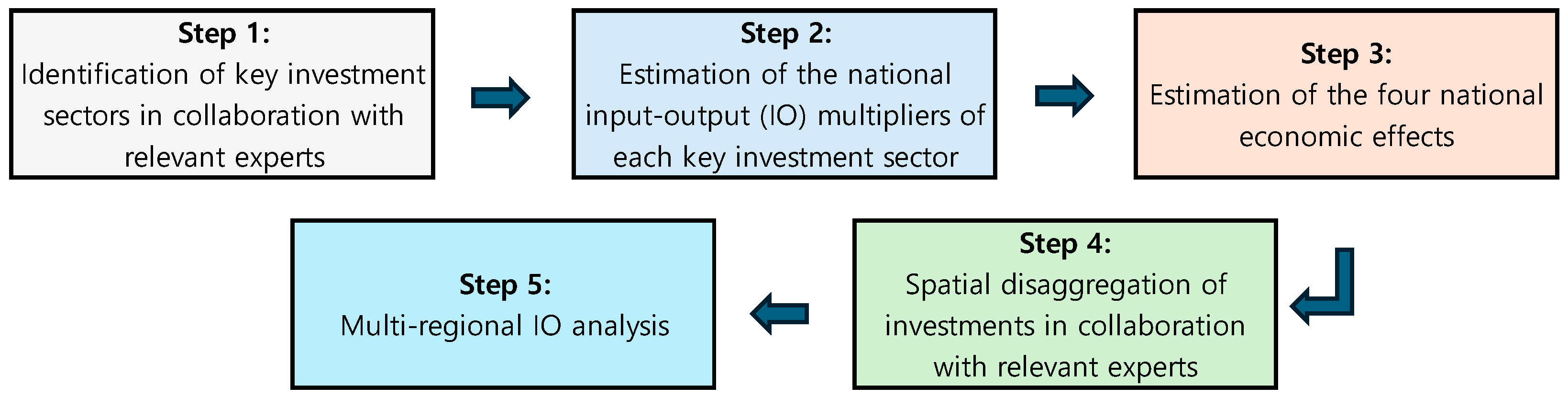
Figure 2 presents the comprehensive methodological scheme adopted in this study, structured as a sequential five-step process that integrates national IO analysis with multiregional spatial assessment to quantify the economic impacts of the 11th LPTSE implementation. This framework ensures methodological transparency, reproducibility, and explicit integration of spatial dimensions into the economic modeling, addressing the plan-level territorial configuration of transmission corridors and substations.
Step 1: Identification of key investment sectors in collaboration with relevant experts. The investment considered in this study for implementing the LPTSE is confined exclusively to capital expenditures for construction and does not incorporate any costs related to operation and maintenance. Accordingly, the economic effects discussed in the subsequent analysis refer solely to the former category of investment and do not apply to the latter. The first stage disaggregates LPTSE investments into constituent economic sectors using the Bank of Korea’s 380-subsector classification from the 2022 national IOT. Five primary investment sectors were identified (Table 3): (i) capacitors, rectifiers, and electric transmission equipment (15.51% share); (ii) electric wires and cables (7.91%); (iii) other electrical equipment (0.23%); (iv) architecture-related services (14.38%); (v) other constructions (61.97%). Sectoral shares were derived through triangulation of historical transmission/substation cost data and consultations with KEPCO technical experts, ensuring empirical grounding beyond arbitrary allocation.
The consultations with KEPCO technical experts were conducted as follows to identify investment sectors for LPTSE implementation. Historical investment records for TSE were systematically reviewed in collaboration with three technical specialists from KEPCO’s Transmission System Planning Department, each possessing over 10 years of hands-on experience in grid planning and development. These experts held senior positions—department head, deputy head, and assistant manager, respectively—and contributed domain-specific insights to ensure methodological rigor. The development of Table 3 proceeded in two distinct stages. First, investment breakdowns from historical TSE records were systematically mapped against the 380-sector classification of the Bank of Korea’s 2022 IOT, enabling the identification of five primary investment sectors relevant to LPTSE execution. Second, sector-specific allocation ratios were derived directly from these historical records, reflecting empirically observed cost structures across past LPTSE cycles. While future deviations are possible due to technological or regulatory changes, the analysis assumes continuity in these proportional patterns as a conservative baseline, consistent with standard practice in infrastructure IO modeling.
A common methodological pitfall in infrastructure IO assessments involves injecting total investment into a single “electricity supply” sector, which systematically overestimates multipliers by conflating capital expenditures with operational activities. The present analysis avoids this error through rigorous disaggregation into five empirically-grounded sectors or key investment sectors given in Table 3, validated against KEPCO cost structures and international precedents [26,27].
Step 2: Estimation of the national IO multipliers of each key investment sector. Applying the 2022 national IOT, demand-side exogenization procedures were executed for each of the five sectors to compute four core economic multipliers per unit output increase: production-inducing, value-added creation, wage-inducing, and job-creation effects. Exogenization decomposes total impacts into direct effects within the investment sector and indirect effects across 33 interdependent sectors, leveraging the Leontief inverse matrix (detailed in Section 2.6).
Step 3: Estimation of the four national economic effects. Annual investment projections from 2025 to 2038 (KRW 72.8 trillion total, Table 4) were multiplied by Step 2 multipliers to derive aggregate national economic effects over the LPTSE horizon. This step operationalizes plan-level investment commitments into quantifiable macroeconomic trajectories, with sensitivity anchored to KEPCO’s official cost estimates.
All LPTSE investment figures reported in Table 4 (KRW 72.8 trillion total, 2025–2038) represent nominal values in current prices, as published in KEPCO’s official 11th LPTSE [3]. These are multiplied by production-inducing, value-added, wage, and employment multipliers derived from the 2022 Bank of Korea IOT, also expressed in current prices. This ensures methodological consistency between investment injections and multiplier benchmarks, capturing nominal economic impacts relevant for policy evaluation and fiscal planning. Future real-term analyses could apply sectoral gross domestic product deflators to express results in constant 2022 prices; however, the nominal framework adopted here aligns with standard practice in demand-side IO assessments of public infrastructure programs.
Step 4: Spatial disaggregation of investments in collaboration with relevant experts. Investment totals from Step 3 were allocated across 17 South Korean regions following the Bank of Korea’s multiregional (MR) IOT (MRIOT) geography. Regional shares reflect LPTSE corridor configurations—e.g., higher allocations to Honam/Yeongnam (coastal RE/NP export hubs) and transit provinces versus SMA demand centers—derived via expert elicitation given the absence of finalized alignments.
Step 5: Multiregional (MR) IO (MRIO) analysis. The 2020 Bank of Korea MRIOT was employed to trace production-inducing and value-added creation effects across intra- and interregional flows induced by Step 4 investments. Employment/wage effects were omitted due to missing satellite employment accounts in the MRIOT; full exogenization across 17 × 17 = 289 regional-sector linkages was deemed computationally intractable, yielding instead aggregate intraregional (own-region) versus interregional spillovers. This step explicitly embeds LPTSE’s spatial structure into the economic assessment, revealing territorial benefit incidence patterns.
The sequential scheme culminates in a hybrid national–MRIO framework that bridges aggregate multipliers with corridor-level spatial equity implications, providing policymakers with both macroeconomic benchmarks and regionalized insights for LPTSE implementation.

2.5. Basic Method: IOA

The IOA is an economic technique first devised by Wassily Leontief. He won the Nobel Prize in Economics in recognition of this contribution in 1973. The IOA is a kind of general equilibrium model [46]. It focuses on the interdependence between sectors that make up a country’s economy [47]. Nonetheless, if one has a basic understanding of linear algebra, applying the IOA is not that difficult. Therefore, the IOA can be useful to analyze the macroeconomic impact of a specific shock on production, employment, exports, imports, and value-added within a country’s economy [48,49,50,51,52].
In order to apply the IOA, an IOT is basically used. The IOT is a table that organizes the flow from one sector to another in terms of inputs and outputs. In general, it is made for a national economy for a particular year. Usually, the statistical offices of each country publish the IOT. In South Korea, the Bank of Korea prepares it. Although the IOA was initially developed to be suitable for the analysis of macroeconomic issues, it can also be usefully applied to dealing with the economic impacts of investment or production in a particular sector on other sectors or on the national economy.
Originally, the inputs and outputs of each sector are determined endogenously. However, if the inputs and outputs of a specific sector are treated exogenously, the economic effects caused by investment or production in the sector can be obtained [53]. Although the IOA adopts several restrictive assumptions that assume the Leontief production system, this does not limit the applicability of the IOA. Consequently, this study adopts the IOA to explore the economic effects of investment for LPTSE implementation. More specifically, the IOA addresses the effects of the investment on production, value-added, wages, and employment. Since the effects focuses on the South Korean domestic economy, domestic IOT is used. All subsequent explanations are based on domestic IOT.
The columns and rows of the IOT contain the input and output values of each sector, respectively. When the IOT is interpreted in the direction of the rows, the total output of sector i , X i , is composed of the sum of intermediate demand, defined as the sum of what each sector demands as intermediate goods from sector i , and the final demand for sector i , Y i . For convenience, an n -sector economy is assumed. Let the intermediate goods input from sector i to sector j be z i j . Then, the relationship is established as follows:
j = 1 n z i j + Y i = X i
On the other hand, if the IOT is interpreted in terms of columns, the total input of sector j , X j , is composed of the sum of intermediate demands, defined as the sum of what each sector supplies as intermediate goods to sector j , and the value-added for sector i , V i . Then, the equation is derived as follows:
i = 1 n z i j + V j = X j

2.6. Demand-Side Model

Since directly handling Equation (1) is somewhat inefficient, Equation (1) needs to be converted into an equation utilizing matrices. The n -dimensional column vectors consisting of X i and Y i are defined as X and Y , respectively. The input coefficient, a i j , is defined as z i j / X j . This is the output of sector i input for producing one unit of sector j and refers to a kind of technical characteristic. Thus, a i j is also called the technical coefficient. When the matrix corresponding to a i j is defined as A and the n -dimensional identity matrix is defined as I , Equation (1) becomes
X = ( I A ) 1 Y
where ( I A ) 1 is a square matrix with entries α i j , which represents by how much X i changes when Y j changes by one unit. In other words, the total output is determined by the increase or decrease in the final demand. ( I A ) 1 and Equation (3) represent the Leontief inverse matrix and a demand-side model.
In this study, the input coefficients, a i j , are empirically derived using the transaction data from the 2022 IOT published by the Bank of Korea. Specifically, each coefficient is calculated by dividing the intermediate input flow from sector i to sector j , z i j , by the total output of sector X j , based on the producer price valuation. This process assumes a Leontief production function, where the technological relationship between inputs and output remains constant (fixed coefficients) within the analysis period. Consequently, the resulting A matrix represents the direct input requirements of each sector, capturing the prevailing industrial structure of the South Korean economy in 2022.
This paper tries to gauge the effect of a change in the output of the sector required for the implementation of the 11th LPTSE on the domestic economy, rather than that of a change in final demand. That is, a procedure is needed to treat the endogenous sector required for its implementation as an exogenous sector such as final demand. Accordingly, the process of exogenizing the endogenous sector required for the implementation of the 11th LPTSE is applied to Equation (3). When the sector input into the implementation of the 11th LPTSE is T , Equation (3) can be re-written in the form of sector T being exogenized as follows:
X e = I e A e 1 ( Y e + A T X T )
where X e and Y e are the n 1 -dimensional column vectors from which the elements related to sector T are excluded from X and Y , respectively. Moreover, I e A e 1 represents an n 1 -dimension square matrix from which both row and column concerning sector T are deleted from ( I A ) 1 , and A T means an n 1 -dimensional column vector with T th element, a T T , deleted from T th column of A . After the variability model is applied to both sides of Equation (4), if Y e = 0 is assumed, the following relationship is derived:
X e = I e A e 1 A T X T
where I e A e 1 A T , an n 1 -dimensional column vector, represents how much X e changes when X T changes by one unit. Therefore, the size of the production induced in other sectors by a USD 1 investment in the implementation of the LPTSE in sector T can be derived through Equation (5).
If Equation (5) is properly manipulated, the value-added creation effect, which represents how much the investment induces the value-added of other sectors, can also be derived. The n -dimensional column vector consisting of V j is defined as V . In addition, a j V and A V ^ are defined as V j / X j and the diagonal matrix of a j V ’s, respectively. Let V e be the n 1 -dimensional column vector remaining after the element, V T , is excluded from V , and let A e V ^ be the n 1 -dimensional square matrix remaining after both the row and column concerning sector T are deleted from A V ^ . The value-added creation effect of sector T can be obtained from the following equation.
V e = A e V ^ I e A e 1 A T X T
A e V ^ I e A e 1 A T , an n 1 -dimensional column vector, indicates how much V e changes when X T changes by one unit. Therefore, the size of the value-added that a USD 1 investment in implementing the LPTSE causes to other sectors can be derived through Equation (6). Similarly to Equation (6), the effect of a USD 1 investment in implementing LPTSE on wages or employment in other sectors can also be obtained by multiplying a diagonal matrix associated with wages or employment by the front part of Equation (5).
In summary, Equation (3) represents the total economic effects, encompassing both direct and indirect impacts across the entire economy. In contrast, Equations (4)–(6) quantify the spillover effects specifically transmitted to other sectors excluding the target sector itself. For each key investment sector, the direct impact—comprising the production-inducing, value-added creation, wage-inducing, and employment-inducing effects—is calculated as unity (1.0) for production, and as the sector-specific value-added ratio, wage coefficient, and employment coefficient, respectively. Consequently, the total economic effect is derived by summing the spillover effects on other sectors and the direct impacts on the key investment sector.
The credibility of the IOA hinges on the precise translation of the LPTSE investment budget into the exogenous demand vector ( X T ). In this study, the scenario design follows a rigorous “expenditure-to-sector mapping” process based on the technical specifications of the 11th LPTSE. As explained above, the total investment of KRW 72.8 trillion is decomposed into five key functional sectors: (1) capacitors, rectifiers, and electric transmission equipment; (2) electric wires and cables; (3) other electrical equipment; (4) architecture-related services; (5) other constructions.
This allocation is not arbitrary but is grounded in the standard cost composition ratios for HV transmission projects provided by KEPCO. Specifically, material costs are assigned to manufacturing sectors (Sectors 1–3), while installation and civil engineering costs are mapped to architecture-related services (Sector 4), and planning/design expenditures to other constructions (Sector 5). By treating these allocated investment values as an exogenous injection vector ( A T X T ) in Equation (5), the model simulates a supply-driven shock where the implementation of the LPTSE acts as a final demand stimulus to the national economy.

2.7. Spatial Analysis Using MRIOT

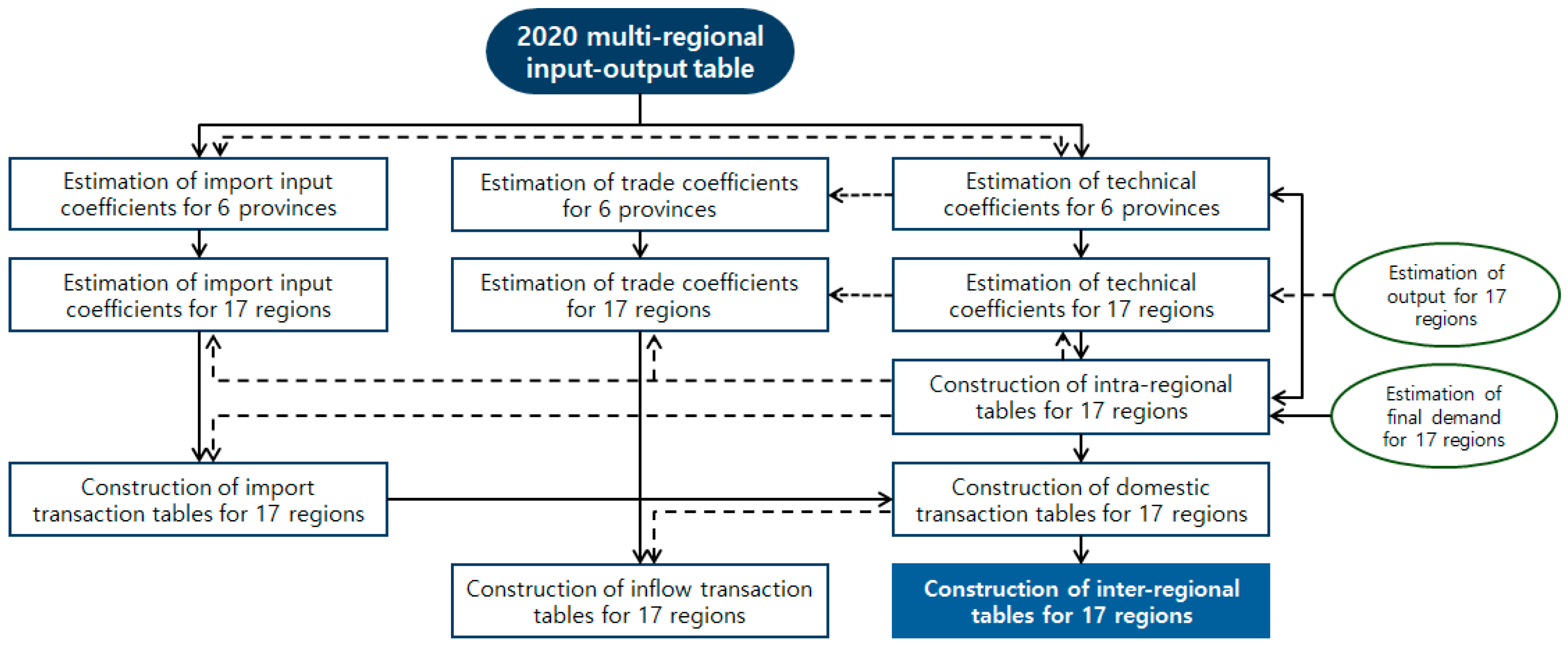
To complement the national IO analysis, MRIO analysis is employed to decompose LPTSE investment impacts into intraregional and interregional effects across South Korea’s 17 economic regions as defined by the Bank of Korea’s 2020 MRIOT. This approach operationalizes the plan-level spatial configuration of transmission corridors—concentrating investments in coastal generation-export regions (e.g., Honam and Yeongnam) and transit provinces while delivering economic spillovers primarily to the SMA demand center—into quantifiable territorial benefit incidence patterns. MRIOT analysis traces inter-industry flows across 17 × 17 = 289 regional sector linkages, revealing spatial asymmetries absent from aggregate national modeling. Figure 3 presents an overview of the 2020 MRIOT for South Korea.
The methodological foundation follows established precedents in energy infrastructure spatial economics. Osei-Owusu et al. [54] demonstrate MRIO’s utility for dissecting scenario-based MRIO analysis of energy footprints across Europe, while Li et al. [55] quantify interprovincial carbon transfers from coal-rich Shanxi using Chinese MRIO tables, isolating electricity sector spillovers. These validate MRIOT as the appropriate framework for LPTSE corridor analysis, where spatial mismatch between investment burdens and economic returns drives social acceptance challenges.
Implementation proceeded as follows. Annual investments from Table 4 were first allocated to 17 regions. Treating these regional sector outputs as exogenous demand shocks, the MRIOT Leontief inverse yielded production- and value-added-inducing effects disaggregated into the following: (i) intraregional effects (within-region multipliers capturing localized construction and supplier linkages); (ii) interregional effects (cross-region spillovers via trade with SMA manufacturing and service sectors). Employment/wage effects were omitted due to missing satellite accounts in the 2020 MRIOT, and full 289-linkage exogenization was simplified to aggregate regional totals given the computational complexity. This hybrid national IO–MRIO framework advances beyond single-region studies by explicitly embedding LPTSE’s corridor geography into economic assessment, providing policymakers with granular evidence on regional cost–benefit incidence essential for benefit-sharing mechanisms and NIMBY mitigation strategies.

3. Results

3.1. Data

Data selection and preparation followed the five-step methodological scheme outlined in Section 2.4, ensuring alignment between empirical inputs and analytical objectives. Step 1 data: LPTSE investments were disaggregated into five key sectors using the Bank of Korea’s 2022 national IOT at 380-subsector classification (Table 3). Sectoral shares reflect triangulation of historical transmission/substation cost structures and KEPCO expert consultations, with “other constructions” dominating at 61.97% due to tower foundations, trenching, and substation civil works.
Step 2 and 3 data: The 2022 extended national IOT (33 sectors, incorporating five key sectors) provides the core matrix for demand-side exogenization and multiplier estimation. Table 5 presents sector classification adopted for national IO analysis. This table—more current than the last full-survey 2020 measured IOT—was selected to capture post-2020 structural shifts in semiconductor/AI-driven demand patterns relevant to LPTSE timing (2025–2038). Annual investment schedules (KRW 72.8 trillion total; Table 4) were sourced from KEPCO’s official LPTSE documentation, denominated in constant 2022 prices.
Step 4 and 5 data: Spatial analysis employed the Bank of Korea’s 2020 MRIOT partitioning South Korea into 17 regions, with investment allocations reflecting corridor geography (e.g., Honam/Yeongnam emphasis for submarine HVDC and coastal evacuation). MRIOT employment/wage satellite accounts were unavailable, restricting Steps 4–5 to production- and value-added-inducing effects. For the spatial analysis, 165-sector aggregation (including the key 5 sectors) is used with data reproducibility ensured via Bank of Korea public releases. For national IOT analysis, demand-side exogenization was applied using the Bank of Korea’s 33 major sector classification, while for MRIO analysis—where full exogenization across 17 × 17 regional linkages proves computationally intractable—the more detailed 165-subsector classification was adopted without exogenization. This integrated dataset operationalizes the hybrid national MR framework, bridging plan-level investment commitments with spatially-disaggregated economic impacts.

3.2. Results from Estimating the Four National Economic Effects

Table 6 reports the three types of economic effects obtained from applying the above-mentioned model to the five key investment sectors. The economic effects are induced by output increases in each key investment sector due to investments in LPTSE implementation. In Table 6, each category of economic effect is decomposed into three components: the impact on the corresponding key investment sector, the spillover effects on the other sectors, and the sum of these two components. For the spillover effects, Equations (5) and (6) are used to quantify, for each key investment sector, the economic impacts transmitted to the 33 sectors listed in Table 6; however, for reasons of space, only the aggregate effects across these sectors are reported in the table.
According to the Bank of Korea, the term “job” is defined on a full-time equivalent (FTE) basis. The FTE measure of employment or employees is calculated by dividing the total hours actually worked by all workers by the average annual working hours of a full-time worker. This approach captures not only the number of persons employed but also the intensity of their labor input, thereby providing a more accurate measure of total labor volume. For instance, if two individuals, A and B, are employed for one year and work an average of 8 and 4 h per day, respectively, the headcount-based number of employed persons would be 2. However, when adjusted for working hours using the FTE method (assuming a full-time daily standard of 8 h), the number of FTE employees would be 1.5.
In Table 6, the multipliers decompose total effects into the following: (i) direct effects within each key investment sector (production = 1.0; value-added = wage/employment coefficients); (ii) indirect/induced spillovers to 32 other sectors via inter-industry linkages ( I e A e 1 A T ). Employment metrics follow the Bank of Korea FTE conventions (total hours/2096 annual full-time hours), capturing construction-phase labor intensity across manufacturing, services, and construction supply chains. Operational phase effects remain excluded, consistent with LPTSE capital expenditure focus.
The production-inducing, value-added creation, and wage-inducing effects represent the respective economic impacts per KRW 1.0 increase in output within the key investment sector, resulting from the investment associated with the implementation of the LPTSE. These indicators collectively measure the extent to which investment in the targeted sector stimulates overall economic activity, generates additional value throughout the production chain, and contributes to labor income growth across related industries (unit: KRW). On the other hand, the job-creation effect represents the number of employment opportunities generated per KRW 1 billion of output in the key investment sector, as a result of the investment undertaken for the implementation of the LPTSE. This indicator reflects the extent to which such investment contributes to labor market expansion and employment growth across related industries through inter-industry linkages.
For illustrative purposes, consider the case in which investment for the implementation of the LPTSE leads to an increase of KRW 1 in the output of sector 1 (capacitors, rectifiers, and electric transmission and distribution equipment). In this case, the model indicates that, within this key investment sector, total output, value-added, and wages rise by KRW 1, KRW 0.2578, and KRW 0.1355, respectively, while in the other sectors they increase by KRW 0.8841, KRW 0.2977, and KRW 0.1347, respectively, implying economy-wide increases of KRW 1.8841 in output, KRW 0.5555 in value-added, and KRW 0.2702 in wages. Likewise, when the output of sector 1 expands by KRW 1 billion, the associated job-creation effects amount to 1.7622 jobs in the key investment sector, 2.7524 jobs in the other sectors, and 4.5146 jobs in the national economy as a whole. The results of the economic impact analysis for the other four key investment sectors exhibit similar patterns and can be interpreted in a comparable manner.
By combining the information reported in Table 4 and Table 6, we derive the annual economic effects associated with investment for the implementation of the LPTSE over the period 2025–2038. These effects encompass the induced changes in production, value- added, wages, and employment generated through direct and indirect linkages in the national IO framework, and the resulting estimates are summarized in Table 7. On the basis of Table 7, it is then possible to project the nationwide impacts of the LPTSE-related investment on total output, value-added, wage income, and the number of jobs, thereby quantifying the macroeconomic implications of the long-term plan.
While the 2022 Bank of Korea IOT serves as the foundational data source for multiplier estimation, its application to project economic effects over the 2025–2038 LPTSE horizon warrants methodological justification. Static IO models, by design, assume fixed technical coefficients and structural relationships under ceteris paribus conditions, making them inherently suitable for short- to medium-term impact assessments where sectoral interdependencies remain relatively stable. Empirical evidence from prior IO applications in energy infrastructure planning supports this approach: for instance, multiyear projections of grid investments in Germany [26] and North America [27] have successfully employed single-year tables by anchoring multipliers to baseline structures and scaling them against official investment schedules, with sensitivity analyses confirming robustness to plausible structural shifts. In the South Korean context, the 2022 IOT reflects post-pandemic supply chains and the latest sectoral disaggregation available, capturing recent adjustments in construction, electrical equipment manufacturing, and architecture-related services—precisely the sectors dominating LPTSE expenditures (Table 3).
Moreover, South Korea’s IOTs exhibit high structural stability over decadal horizons, as evidenced by low variation in key multipliers between the 2016 and 2022 releases. To address potential long-term dynamics, future extensions could incorporate dynamic IO frameworks or hybrid IO–CGE models; however, for this plan-level benchmark analysis, the static approach provides a transparent, reproducible baseline consistent with established precedents in transmission investment evaluation.
Employing the Leontief temporal inverse (LTI) to enhance the reliability of long-term projections by explicitly modeling capital accumulation over time can be considered. This dynamic extension decomposes output changes into immediate demand-driven effects and lagged capital formation impacts, using capital–output ratios and depreciation schedules to trace inter-temporal spillovers. The LTI represents an extension of Wassily Leontief’s dynamic IO model, incorporating time-series variations into the inverse matrix framework. Whereas the conventional static Leontief inverse assumes fixed technical coefficients at a single point in time, LTI explicitly tracks annual changes in technical coefficients alongside capital accumulation processes, thereby enhancing the accuracy of long-term projections.
While this approach offers theoretical sophistication for multi-decadal forecasting, its implementation demands comprehensive time-series data on 380-sector capital coefficients, depreciation profiles, and investment-specific vintages—presently unavailable in Bank of Korea IOTs and exceeding the scope of this benchmark analysis. Prior applications remain concentrated on macroeconomic planning rather than sector-specific infrastructure evaluation, with limited validation against actual transmission outcomes. To date, no empirical applications of the LTI to dealing with TSE investments have been identified in the literature. The static demand-side IO framework adopted here thus provides a transparent baseline consistent with established precedents (e.g., [26,27]), while acknowledging that future extensions could integrate temporal dynamics via hybrid IO–CGE models calibrated to emerging South Korean capital stock data.

3.3. Spatial and Territorial Implications of LPTSE Implementation

Although the IOA is national in scope, the spatial configuration of projects under the 11th LPTSE suggests that the economic effects identified in Section 3.2 will be territorially differentiated. The East Coast–SMA HVDC projects and the Honam–SMA/Chungcheong HVDC links channel large volumes of power from generation-rich coastal and southern provinces to the demand-concentrated capital region, implying that physical land-use burdens and social acceptance issues will be concentrated in exporting and transit regions, while a large share of induced value-added and wages will accrue in and around the SMA.
At the same time, KEPCO’s planning documents emphasize strategies to reconcile these corridors with existing land uses, including co-construction with other SOCs such as roads and railways, the preferential use of underground cables or submarine HVDC in sensitive areas, and the active utilization of idle national land (military bases and closed schools) as substation sites. These measures are intended to reduce conflicts with agricultural production, forestry, and urban development while enhancing the social acceptance of new facilities, but they also tend to increase unit investment costs and may alter the composition of sectoral impacts captured by the IOA.
From a territorial perspective, generation-rich regions in Honam and along the East Sea coast are likely to bear a disproportionate share of visual, ecological, and land-use change impacts associated with new corridors, whereas the SMA primarily benefits from improved supply security and the macroeconomic gains associated with induced activity in manufacturing, professional services, and trade sectors. This spatial asymmetry underscores the importance of complementary policy instruments—such as targeted compensation, community benefit schemes, and coordinated regional development policies—to ensure that the net benefits of LPTSE implementation are perceived as fair across regions and stakeholder groups.
Table 8 presents the regional investment levels associated with the implementation of the LPTSE, reflecting the geographical configuration of the LPTSE corridors. These figures were prepared with the assistance of specialists at KEPCO, who provided expert judgement on the spatial allocation of planned investments. However, it should be noted that the detailed numerical values are indicative and remain subject to revision as project designs and cost estimates are updated over time.
Consistent with the expert consultation process outlined in Step 1 for sectoral disaggregation, the spatial allocation of investments for LPTSE implementation across South Korea’s 17 regions was also determined through structured discussions with the same three KEPCO technical specialists from the Transmission System Planning Department. Although precise locations for individual transmission lines and substations remain subject to final siting determinations via statutory environmental impact assessments and permitting procedures, these experts—who directly contributed to formulating the 11th LPTSE—provided authoritative preliminary designations of approximate corridor alignments and substation clusters at the regional scale. Investment budgets were subsequently apportioned according to these plan-level geographic configurations, with higher allocations directed toward generation-exporting regions (e.g., Honam, Yeongnam, and Yeongdong coastal zones) and key transit provinces facilitating long-distance HVDC/345 kV corridors to demand centers like the SMA.
For analytical simplicity and in line with standard practice in MRIO modeling of prospective infrastructure programs, the analysis assumes invariant regional investment proportions over the 2025–2038 horizon. While inter-annual variations may arise due to project sequencing, procurement schedules, or unforeseen siting adjustments, this stationary assumption establishes a robust baseline for projecting national economic multipliers while maintaining methodological transparency and reproducibility. Future refinements could incorporate dynamic regional profiles as detailed alignments are finalized by KEPCO’s regional system planning committees.

3.4. Results from the Spatial MRIO Analysis Using the 2020 MRIOT

By utilizing the 2020 MRIOT explained in Section 3.1, the MRIO model described in Section 2.7 is applied to the five investment sectors presented in Table 3. Through this application, both interregional and intraregional production-inducing effects, as well as value-added creation effects, can be estimated. These estimates provide a quantitative basis for understanding how investments in each sector contribute to regional economic linkages and value generation across different areas. The interregional and intraregional production-inducing and value-added creation effects resulting from output increases in each key investment sector, driven by investments for implementing the LPTSE, are presented in Table A1, Table A2, Table A3, Table A4 and Table A5 in Appendix A for “1. Capacitors, rectifiers, and electric transmission equipment,” “2. Electric wires and cables,” “3. Other electrical equipment,” “4. Architecture-related services,” and “5. Other construction,” respectively.
In the tables presented in Appendix A, the values located along the diagonal represent the intraregional economic effects and indicate the extent to which economic activities within a region stimulate additional production and value-creation in the same region. In contrast, the off-diagonal values correspond to the interregional economic effects, reflecting the spillover impacts that economic activities in one region impose on other regions through interregional trade and production linkages. Through the application of the spatial MRIO framework, the economic effects can be systematically decomposed into intraregional and interregional components. This decomposition enables the identification of economic impacts that occur within each region as well as those transmitted across regions through production linkages, trade flows, and interregional dependencies.
By integrating Table A1, Table A2, Table A3, Table A4 and Table A5 with Table 8, the yearly economic effects—specifically, the production-inducing and value-added creation effects—generated by the annual investments required for implementing the 11th LPTSE plan across South Korea’s 17 regions are derived. The resulting regional economic impacts are presented in Table 9 and Table 10, respectively, highlighting both the scale and spatial distribution of the induced effects.
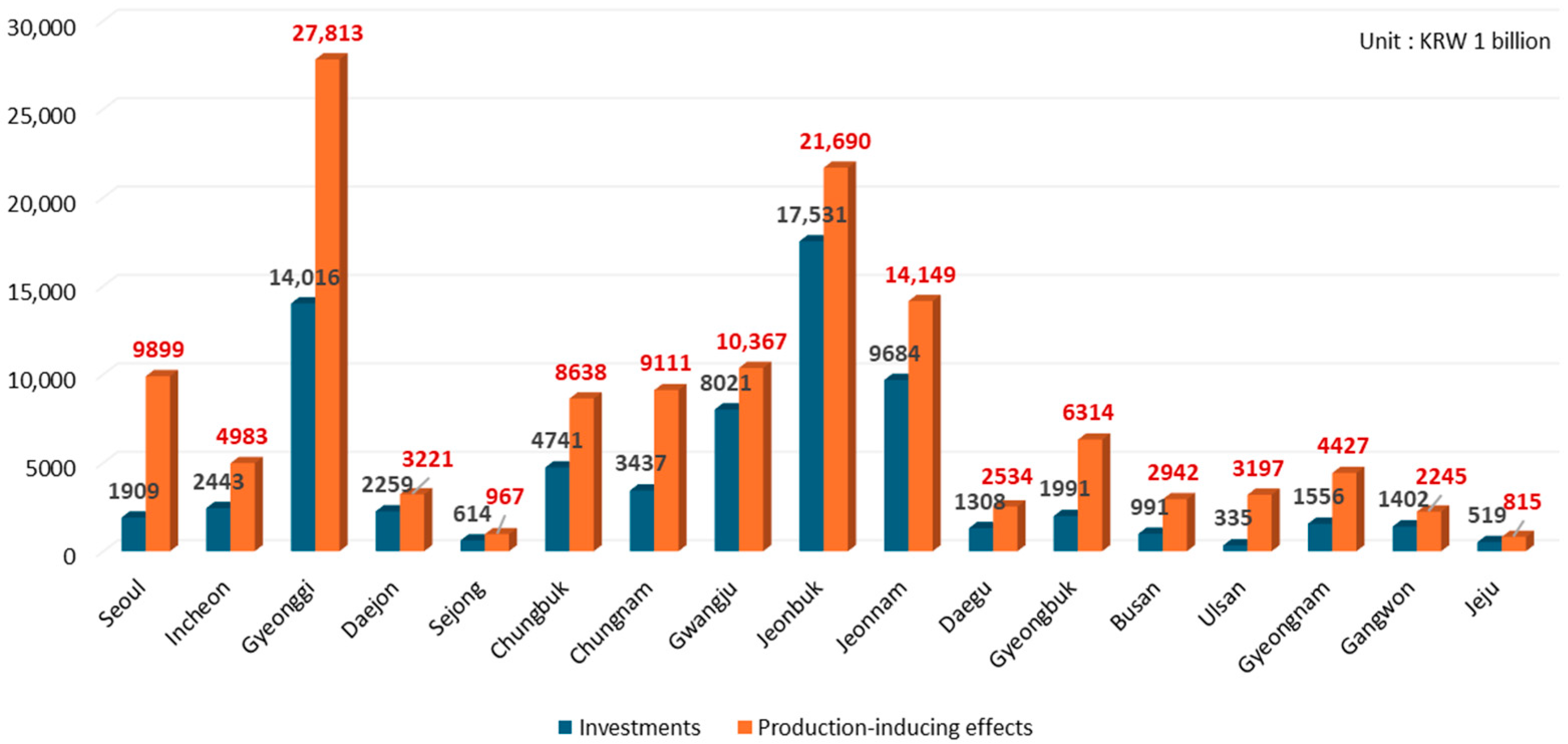
To explicitly capture the territorial dimensions of these economic effects, Figure 4 visualizes the spatial distribution of the regional investments detailed in Table 8 alongside the production-inducing effects reported in Table 9 across the 17 regions. A comparative assessment of these two datasets reveals a pronounced “spatial asymmetry” between the locus of capital injection and the subsequent realization of economic effects.
While Gyeonggi Province exhibits the highest production-inducing effect, estimated at KRW 27,813 billion, Table 8 identifies Jeonbuk as the primary recipient of direct investment for LPTSE implementation. This divergence—wherein Jeonbuk leads in investment volume yet Gyeonggi dominates in induced production—can be attributed to the structural concentration of high-value industrial capabilities and intermediate supply chains within the SMA. Consequently, the region functions as a central absorption node, capturing significant economic value generated by infrastructure projects located in peripheral areas
Specifically, although Jeonbuk records the second-largest production-inducing effect, a substantial portion of the intermediate demand generated by the investment in Jeonbuk “leaks” to Gyeonggi, where key manufacturing and high-value service sectors are clustered. Consequently, Gyeonggi captures the largest share of the nationwide economic stimulus, acting as the primary beneficiary of the supply-chain linkages activated by the LPTSE projects.
Conversely, Ulsan presents the lowest level of direct investment among the 17 regions, yet its production-inducing effect ranks 12th, not last. This disproportionately high induced impact reflects Ulsan’s status as a major industrial hub; its robust manufacturing base allows it to supply essential materials and equipment to other regions, thereby capturing indirect benefits even from investments occurring elsewhere.
In summary, these findings demonstrate that the magnitude of regional investment does not linearly dictate the scale of induced economic production. Instead, the spatial distribution of economic effects is heavily mediated by interregional IO linkages, with established industrial centers like Gyeonggi and Ulsan serving as key absorption nodes for the nationwide demand generated by the LPTSE. Ultimately, these findings confirm that the phenomenon of “spatial asymmetry of benefits”—often characterized by “spillover leakage” from peripheral investment sites to core industrial hubs—is distinctly observable in the context of the LPTSE implementation, consistent with established patterns in MRIO analysis.

4. Discussion

4.1. Discussion of the Results

Until now, the economic effects of investments in the implementation of the LPTSE have been analyzed and presented from the perspectives of production, value-added, wages, and employment using both the IOA and MRIO analysis based on the 2022 national IOT and the 2020 MRIOT, respectively. In this subsection, six aspects related to the utilization of these results will be discussed: a comparison of the findings from this research and those of the electricity generation sector, predictions of the economic effects caused by future investments in the implementation of the LPTSE, and identification of follow-up tasks to improve the weaknesses of this study.
First, the results presented earlier can be compared with the results for the power generation sector by utilizing the 2022 national IOT. Table 11 presents the results from the comparison. The former can be obtained by computing a weighted average of the economic effects for each key investment sector reported in Table 6, using the investment shares presented in Table 3 as the corresponding weights. The latter is derived by applying the model presented in Section 2.6 to the power generation sector, thereby obtaining the corresponding set of economic effects.
Interestingly, the economic effects derived from the former are greater than those from the latter. In other words, investment in the implementation of the LPTSE induces more production, value-added, wages, and employment than investment in the power generation sector in South Korea. This finding provides implications for where the country should prioritize its investments between TSE and power generation for the time being. Table 11 vividly reflects the reality of the country, which must invest more actively in the TSE sector than in the power generation sector.
Second, regarding the predicted economic effects for the period 2025–2038 reported in Table 7, Table 9 and Table 10, two preliminary issues warrant careful consideration. The first issue concerns whether it is appropriate to forecast future economic effects using the 2022 IOT. This question is directly related to the stability of the input coefficients a i j over time. One important point is that this study employs the Leontief inverse ( I A ) 1 rather than the technical coefficient matrix A itself. In the IO literature, the stability of the Leontief inverse is generally regarded as more critical than that of A , because the inverse encapsulates the full set of direct and indirect production linkages. Miller and Blair [47] report that, even when the elements of AA exhibit some temporal variability, the corresponding Leontief inverse tends to display a relatively stable structure. Therefore, using the 2022 ( I A ) 1 to project the production, value-added, wage, and employment effects of LPTSE-related investments through 2038 is not expected to raise serious methodological concerns, provided that no major structural breaks occur in the national production system.
The second issue is whether sufficiently reliable information on future investment costs can be secured. In this regard, the present study utilizes annual investment schedules for the period 2025–2038 that KEPCO has developed in cooperation with sectoral and planning experts. In South Korea, no dedicated national budget has yet been earmarked for LPTSE implementation; instead, KEPCO is responsible for financing the entire program and recovering the associated costs through electricity tariffs. According to KEPCO’s official planning documents, a total of KRW 72.8 trillion (approximately USD 52.3 billion) is planned to be invested between 2025 and 2038 to implement the 11th LPTSE. These forward-looking cost estimates, although subject to revision as projects are refined, represent the best available information for evaluating the prospective macroeconomic implications of the plan.
From an institutional perspective, demonstrating the economic impacts of LPTSE investment is a prerequisite for smooth project implementation. KEPCO must justify the economic rationale of the planned investments to its internal investment review committee, and the board of directors likewise requires transparent evidence on the magnitude and composition of the induced economic effects. The results presented in this study—encompassing production, value-added, wage, and employment effects at both the national and regional levels—can therefore serve as core reference material when these bodies deliberate on the desirability and timing of LPTSE-related expenditures.
Furthermore, because KEPCO is classified as a major public institution under South Korea’s Public Institutions Operation Act, the LPTSE investment program must pass a preliminary feasibility study conducted by the Ministry of Economy and Finance before it can proceed to full-scale execution. In such feasibility assessments, quantified economic effects are treated as key input information alongside financial and technical indicators. Accordingly, the estimates reported in this paper provide a structured evidence base that can support both internal corporate decision-making within KEPCO and external policy appraisal by the central government, thereby enhancing the transparency and legitimacy of large-scale grid investment under the 11th LPTSE.
Third, while direct comparisons are constrained by the scarcity of IO studies focusing exclusively on T&S networks, the estimated economic multipliers of this study can be meaningfully situated within the broader international literature on electricity infrastructure. As summarized in Table 11, our analysis derives a production-inducing multiplier of approximately 1.76 (KRW 128.2 trillion output/KRW 72.8 trillion investment) for the implementation of the LPTSE. This figure aligns closely with the findings of Schreiner and Madlener [26], who reported output multipliers in the range of 1.8–2.0 for power grid infrastructure investments in Germany. This convergence suggests that in manufacturing-intensive economies, large-scale grid expansions consistently generate robust backward linkages, driven by heavy reliance on domestic high-value industrial sectors such as electrical equipment and basic metals.
However, a notable divergence is observed in employment effects when compared to developing contexts. The employment multiplier derived in this study—approximately 7.9 jobs per KRW 1 billion—is significantly lower than the multiplier of 4.8 (Type II) reported by the IFC Development Impact Department [28] for the Powerlinks Transmission project in India. This discrepancy reflects the structural differences in labor intensity; whereas the Indian project involved labor-intensive construction practices typical of developing economies, the South Korean LPTSE prioritizes capital-intensive, HV technologies (e.g., HVDC and GIS substations) that rely more on automated manufacturing and specialized engineering than on direct manual labor.
Furthermore, in the context of the North American grid, Pfeifenberger and Hou [27] and Garrett-Peltier [32] highlighted that transmission investments often yield higher employment returns than fossil fuel sectors but lower returns than energy efficiency retrofits. Our results corroborate this “middle-ground” positioning, confirming that while T&S investments are potent drivers of industrial production, their job-creation mechanism is structurally distinct from decentralized, labor-intensive green energy projects.
Ultimately, this comparative analysis demonstrates that the economic impact of the LPTSE is not an isolated phenomenon but follows a predictable pattern consistent with global evidence for advanced industrial economies: high production stimulus mediated by domestic supply chains, coupled with moderate, technology-driven employment generation. Moreover, a critical contribution of this study is its explicit capture of the “spatial asymmetry of benefits”—a distributional dimension that is frequently obscured in conventional national aggregate assessments. By disaggregating these spatial disparities, the analysis offers a more nuanced understanding of how infrastructure investments interact with regional industrial hierarchies.
Fourth, the framework utilized in this study can be expanded in two ways. The first way is to apply a dynamic IOA instead of the static IOA adopted in this research. The latter is intuitive as it applies the IOA to a fixed point in time, but it does not reflect changes over time. In contrast, the former can account for changes over time, making it more useful for predicting the future. The application of a dynamic model that uses IOT from multiple years could be considered. For this, the collected IOT from various years must not only be unified from a sector classification perspective but also rewritten based on constant prices. Although this entails additional complex work, the insights gained could be more enriching.
The second way is to apply the framework adopted in this study to countries other than South Korea and compare the results. If the differences between countries are identified and the causes of these differences are elucidated, strategies for maximizing economic effects could also be sought.
Fifth, the findings highlight the importance of embedding spatial and territorial equity considerations into the governance framework for T&S investments. While the IOA demonstrates that implementing the 11th LPTSE generates substantial aggregate national benefits, the plan-level spatial configuration of long-distance 345 kV and HVDC corridors indicates that physical land-use burdens, landscape change, and social acceptance challenges will be concentrated in a limited number of exporting and transit regions. In contrast, a large share of the induced value-added, wages, and employment is expected to accrue in and around major demand centers, particularly the SMA, where relatively fewer new long-distance lines are required and most benefits materialize in the form of enhanced supply security and support for energy-intensive industries. Recognizing this spatial decoupling between where infrastructure is sited and where economic gains are realized implies that governance cannot rely solely on aggregate cost–benefit indicators when evaluating grid-expansion programs.
Instead, transmission planning and approval processes should explicitly incorporate territorial equity principles, transparent communication of plan-level spatial information, and mechanisms for sharing benefits with regions that host critical infrastructure but capture only a modest portion of the macroeconomic gains. Such mechanisms may include strengthened local compensation schemes for land-use and landscape impacts, community benefit funds linked to major corridors, or targeted regional development initiatives in generation-rich and corridor regions. Embedding these instruments in the institutional design of LPTSE implementation would not only enhance the perceived fairness of the transition to a more transmission-intensive power system, but would also reduce the risk of siting conflicts and project delays that arise when affected communities regard large-scale grid expansion as economically necessary at the national level yet territorially imbalanced at the local level.
Sixth, although this study employs the classic demand-side IO framework originally developed by Leontief, which excels at tracing linear production linkages and multiplier effects from exogenous investment shocks under fixed technical coefficients, more advanced economy-wide models such as CGE could provide complementary insights. CGE approaches incorporate endogenous price formation, factor substitution, and behavioral responses across producers and consumers, enabling simulation of general equilibrium adjustments to transmission infrastructure deployment—such as electricity price feedback, labor market clearing, and capital reallocation across energy-intensive sectors [56,57]. These dynamic features would be particularly relevant for assessing long-term LPTSE impacts amid South Korea’s evolving RE integration and AI-driven demand surge, where relative price signals could influence RE curtailment patterns and industrial relocation decisions.
Future research opportunities thus include CGE-based extensions calibrated to multiregional Korean IOTs, explicitly modeling interactions between transmission capacity expansion, RE curtailment mitigation, and SMA semiconductor cluster growth. Such analyses would capture substitution possibilities (e.g., between HVDC investment and alternative peaking plants) and macroeconomic feedback absent in static IO frameworks, offering policymakers a fuller spectrum of equilibrium outcomes for grid investment prioritization [58]. By delineating these extensions, the present IO assessment establishes a foundational benchmark for subsequent general equilibrium investigations.

4.2. Discussion of the Six Complications in Realizing the Economic Effects

Finally, it is necessary to mention the complications that confront South Korea in actually realizing the economic effects of the investment in the implementation of the LPTSE. In other words, identifying and resolving the following five complications has important policy implications. If they are not resolved, the economic effects will not be realized. These complications include the financial crisis of KEPCO, the investor in the LPTSE; the delay in the completion of the construction of the above-ground HVDC from the East Coast to the SMA, which is the east–west axis of South Korea as a peninsular country; the difficulty in securing public acceptance of the construction of the submarine HVDC and above-ground 345 kV transmission lines from the southwest to the SMA, which is the south–north axis of the country; technical challenges related to HVDC construction; and the necessity of attracting private investment for the implementation of the LPTSE.
The first complication is that KEPCO, which is responsible for executing the LPTSE, is currently facing a serious financial crisis. During 2022, amidst the skyrocketing prices of various energy sources, including natural gas due to the outbreak of the Russia–Ukraine war, KEPCO purchased electricity at an average price of KRW 162.48 per kWh and sold it at KRW 120.51 per kWh. In other words, even without considering other cost factors such as the expenses for constructing and operating transmission, substation, and distribution facilities, KEPCO incurred an average loss of KRW 41.97 per kWh in electricity sales that year.
Fortunately, in 2023, energy prices fell, and KEPCO returned to an operating profit starting in the fourth quarter, but its financial crisis is still ongoing. As of the end of 2024, total debt is expected to reach KRW 203 trillion (USD 150 billion), with accumulated losses amounting to KRW 40 trillion (USD 30 billion). Therefore, it is anticipated that KEPCO will be able to secure the funds necessary for LPTSE investment when at least one of the following two conditions is met: first, the government should allow steady increases in electricity retail rates; second, the government should provide financial support to KEPCO for the smooth implementation of the LPTSE.
The second complication is that KEPCO is facing significant local opposition regarding the construction of the 8 GW HVDC line from the East Coast to the SMA, which is considered the most critical task in the implementation of the LPTSE. This HVDC construction plan constitutes the longest-distance power grid project in South Korean history, transporting the large-scale generation capacity of the East Coast through three provinces and twelve cities and counties to the SMA. Especially, constraints on power generation due to a lack of T&S facilities are already occurring on a large scale, centered around the East Coast RE plants. Thus, this project is regarded as the most crucial task determining the success or failure of LPTSE implementation.
However, local governments are responding passively to the permitting process for TSE construction, prioritizing the residents’ opinions. The city of Hanam in Gyeonggi Province, where the power grid connects, has denied the expansion of the Dongseoul substation, which converts DC to alternating current, leading to an administrative dispute between KEPCO and Hanam City. Although KEPCO recently won in the administrative adjudication, local residents’ opposition persists. In this situation, in order for the construction of the HVDC and substations to be completed as planned, it seems necessary to first carry out procedures to enhance the acceptance of local residents.
The third complication is that KEPCO has not secured local acceptance regarding the construction of two submarine HVDC lines and five 345 kV transmission lines in the southwest to the SMA. The generation capacity in the southwest region, where solar and offshore wind power is concentrated, is excessive compared to the region’s electricity demand. The southwest region has abundant sunlight and lower land prices compared to the northern region, where the SMA is located. Therefore, the construction of TSE, which can transport surplus power from the southwest region to the SMA area where power demand is increasing, is necessary. Accordingly, KEPCO has determined that an additional nine 345 kV transmission lines connecting the southwest region and the SMA are needed.
However, with only two 345 kV transmission lines between the southwest region and the SMA currently in existence, constructing an additional nine is nearly impossible. Therefore, it was decided to build only five above-ground and the remaining four underwater. Considering the construction of the submarine HVDC, those four lines will be reduced to two. Despite this, the construction of the five onshore lines has not yet started, and the two West Sea submarine HVDC lines are facing issues with securing acceptance from local fishers. Since the West Sea is the most active area for fishing in the country, persuading the fishers must be prioritized before the installation of HVDC.
Fortunately, the National Power Grid Expansion Special Act and the Offshore Wind Power Promotion Special Act have been simultaneously passed by the National Assembly. To ensure the practical implementation of the LPTSE, the central government will take the initiative to convene stakeholders through the establishment of a special committee and mediate between them. Additionally, legal grounds have been established to significantly enhance community acceptance by providing sufficient compensation to local residents and drastically reduce the time required for various related permits and approvals. In particular, as dozens of different permits can now be processed in a one-stop manner, the construction of the LPTSE is expected to gain momentum.
The fourth complication involves the technical difficulties associated with the construction of large-scale HVDC systems. In South Korea, two submarine cables connecting the mainland and Jeju Island have been built, but they frequently malfunction. The HVDC on the mainland also experiences frequent breakdowns, and the disputes between the manufacturer of the HVDC facilities and KEPCO have not been fully resolved. Since the start of commercial operation in 2021, the HVDC line supplying power to the country’s largest semiconductor company has experienced over 20 malfunctions, and similar issues have arisen with the two submarine HVDC transmission lines connecting the mainland to Jeju Island. Given this reality, there are clear concerns about whether the larger and longer southwest–SMA submarine HVDC transmission lines can be operated without technical problems. Therefore, there is a growing demand for the government to actively support research and development for technological advances and stable operation of HVDC equipment.
The fifth complication is that attracting private capital for the implementation of the LPTSE needs to be considered, but social discussions on this have not yet matured. In South Korea, KEPCO monopolizes the TSE sector and current laws prohibit private operators from entering this sector. However, if private investment in the TSE sector becomes possible, the implementation of the LPTSE could become somewhat easier. Nevertheless, discussions on allowing the investment are not progressing due to opposition from labor unions concerned about the reduction in KEPCO’s business scope and opposition from some political circles and public opinion who misunderstand private investment in the T&S sector as the beginning of KEPCO’s privatization.
Of course, the government and KEPCO are actively considering ways to implement the LPTSE in collaboration with the private sector. For example, coal-fired power plants along the East Coast, where the installation of TSE is urgent, could make proactive investments in various projects for implementing the LPTSE, and then KEPCO could receive these facilities as donations for operation. KEPCO could help the private power companies recover their investment costs by providing discounts on TSE usage fees. Since KEPCO, as a public institution, owns and operates the power grid, it differs from typical privatization. It is necessary to create a social consensus on encouraging private investment in the power grid through appropriate public discourse. It should be emphasized that this investment is more about utilizing private creativity and capital in TSE investments rather than privatization.
Sixth, spatial equity and land-planning challenges may significantly constrain the realization of the projected economic effects. There are important spatial equity and land-planning challenges that may hinder the full realization of the economic effects estimated in this study. The plan-level corridor configuration of the 11th LPTSE indicates that a large share of new 345 kV and HVDC lines, as well as many substations, will be sited in generation-rich coastal and southern regions and in intermediate “transit” provinces, while the principal macroeconomic benefits accrue in the SMA and other major demand centers. This spatial decoupling between where infrastructure is hosted and where economic gains are realized can generate strong perceptions of territorial unfairness, especially in communities that experience landscape change, land-use constraints, and potential environmental impacts but see only limited local employment and income benefits. Under such conditions, political resistance, legal challenges, and protracted negotiation processes are likely, increasing the risk of construction delays and, in extreme cases, cancellation or down-scaling of key projects.
These spatial equity concerns interact closely with land-planning constraints. Transmission corridors and substations must compete with agriculture, forestry, conservation areas, and urban development for scarce land, particularly in regions where land prices and land-use conflicts are already pronounced. If routing and siting decisions are perceived as insensitive to local land-use plans or to cumulative landscape impacts, local governments and residents may oppose projects even when they are justified by national-level cost–benefit analysis. Addressing this sixth complication therefore requires governance arrangements that integrate territorial equity principles, transparent spatial information, and credible mechanisms for local compensation and benefit-sharing into the planning and approval of LPTSE projects; otherwise, the macroeconomic gains identified by the IOA may be significantly reduced, delayed, or unevenly distributed.

5. Conclusions

South Korea’s 11th LPTSE represents a large-scale grid expansion program intended to alleviate the structural mismatch between generation-rich coastal/southern regions (including rapidly growing RE capacity) and the demand-concentrated SMA. This study quantified the economy-wide impacts of the LPTSE investment program using a demand-side IOA based on the 2022 national IOT, and further interpreted the results through a spatial lens using the 2020 MRIOT to examine how induced effects propagate across regions and supply chains.

5.1. Key Takeaways and Broader Significance

First, LPTSE investment is associated with substantial macroeconomic ripple effects, confirming that T&S investments should be understood not only as “enabling infrastructure” for renewable integration but also as a material industrial stimulus. Specifically, the estimated multipliers indicate that each KRW 1.0 of investment induces KRW 1.7614 of total output, KRW 0.7437 of value-added, and KRW 0.4253 of wages, while KRW 1 billion of investment generates 7.9410 full-time-equivalent jobs. Over 2025–2038, the planned KRW 72.8 trillion investment is estimated to induce KRW 128.2 trillion in output, KRW 54.1 trillion in value-added, KRW 30.9 trillion in wages, and approximately 577,763 jobs nationwide.
Second, the findings clarify a mechanism that is central to the international relevance of grid investment assessments: induced benefits are largely mediated by upstream domestic supply chains (e.g., electrical equipment, cables, construction, and professional/technical services), implying that the magnitude and composition of economic effects depend on industrial structure, domestic content, and the technology mix embedded in grid plans (e.g., HVDC, undergrounding, and GIS substations).
Third, the study underscores that grid investment is inherently spatial, and that “where projects are built” is not necessarily “where benefits accrue.” The spatial MRIO results indicate that the territorial incidence of induced production and value-added can differ markedly from the regional distribution of capital expenditures. This spatial asymmetry of benefits (and associated spillover leakage through interregional production linkages) is a critical distributional dimension that can be obscured in national aggregate appraisals but is highly salient for siting conflicts, land-use planning, and the political economy of timely implementation.

5.2. Study Limitations

Several limitations should be acknowledged. First, as a demand-side IO framework, the analysis relies on fixed technical coefficients and does not endogenize price changes, substitution effects, capacity constraints, or technological progress; the estimates should therefore be interpreted as short- to medium-run demand-driven impacts under the IO assumptions. Second, the approach quantifies gross induced effects rather than net welfare changes; it does not replace cost–benefit analysis, financial feasibility assessment, or distributional compensation design. Third, the spatial component is based on plan-level corridor information rather than parcel-level alignments; hence, it cannot quantify site-specific land take, ecological impacts, or localized disamenities at the resolution required for permitting decisions. Fourth, results depend on the sectoral mapping of LPTSE expenditures into IO sectors and on the base-year structure of the 2020/2022 tables; alternative classification choices and future structural change could shift the estimated multipliers.
Finally, it is acknowledged that the quantitative findings of this study are predicated on a specific baseline scenario derived from the official investment projections of the 11th LPTSE. While this single-scenario approach provides a coherent reference point based on current policy commitments, it does not explicitly capture the range of uncertainties associated with potential cost overruns, schedule slippages, or changes in the technology mix. However, given the inherent linearity of the Leontief IO model, the multipliers reported herein serve as scalable coefficients. This implies that the economic impacts of alternative scenarios—whether pessimistic or optimistic—can be readily estimated by linearly scaling these multipliers in proportion to changes in investment volume, thereby offering flexibility for policymakers to adapt the findings to evolving conditions.

5.3. Future Research Directions

Four research extensions are proposed to strengthen inference and improve policy usability. First, dynamic IO or hybrid IO–CGE implementations should be developed to test sensitivity to structural change, import substitution, and price-mediated adjustments under alternative decarbonization pathways. Second, cross-country comparative applications using harmonized expenditure-to-sector concordances should be conducted to benchmark grid-investment multipliers across different industrial structures and grid architectures (e.g., offshore wind integration versus nuclear evacuation corridors). Third, once corridor alignments and substation sites are finalized, regional IO/MRIO models should be linked to quantitative geospatial indicators (land take, protected areas, agricultural conversion risk, landscape fragmentation) to produce an integrated “economic–land” appraisal at permitting-relevant resolution. Fourth, complementary empirical work should evaluate risk and acceptability dimensions (delay risk, litigation risk, compensation effectiveness, and social acceptance drivers) and translate these into scenarios that can be combined with IO/MRIO results to assess how schedule slippages and design changes alter realized economic impacts.

5.4. Policy Implications

Five policy implications follow from the evidence. (1) Large-scale T&S investment can generate sizable economy-wide production and value-added gains; therefore, transmission expansion should be treated as a core component of renewable integration strategies rather than as a residual constraint. (2) Given the spatial mismatch between coastal/southern supply growth and SMA demand concentration, timely delivery of long-distance HVDC and high-capacity AC corridors is central to reducing congestion and curtailment and unlocking system-wide benefits. (3) Because the realized benefits depend on avoiding delay, credible siting governance—transparent engagement, predictable compensation, and streamlined but robust permitting—should be designed as an economic performance condition, not merely a procedural requirement. (4) The financing burden associated with large capital expenditure underscores the need for stable regulatory and tariff frameworks and, where suitable, carefully structured private participation, while maintaining public oversight and reliability obligations. (5) Workforce and industrial policy can amplify co-benefits: given the concentration of induced effects in specific manufacturing and technical-service segments, targeted skills pipelines and supplier development programs can strengthen domestic content and improve both economic returns and implementation capacity.

Author Contributions

Conceptualization, J.-H.J. and M.-K.H.; methodology, S.-H.Y.; software, J.-H.J.; validation, J.-H.J. and M.-K.H.; formal analysis, S.-H.Y.; investigation, M.-K.H.; resources, S.-H.Y.; data curation, J.-H.J.; writing—original draft preparation, J.-H.J. and M.-K.H.; writing—review and editing, S.-H.Y.; supervision, S.-H.Y.; project administration, S.-H.Y. All authors have read and agreed to the published version of the manuscript.

Funding

This research received no external funding.

Data Availability Statement

The original data presented in the study are openly available in the Korean Economic Statistics System at https://ecos.bok.or.kr/ (accessed on 1 December 2025).

Conflicts of Interest

The authors declare no conflicts of interest.

Abbreviations

The following abbreviations are used in this manuscript:
AIArtificial intelligence
CGEComputable general equilibrium
DCDirect current
FTEFull-time equivalent
HVHigh-voltage
HVDCHigh-voltage direct current
IOInput–output
IOAInput–output approach
IOTInput–output table
KEPCOKorea Electric Power Corporation
LPTSELong-term plan for transmission and substation equipment
LTILeontief temporal inverse
MRIOTMultiregional input–output table
NIMBYNot-in-My-Back-Yard
NPNuclear power
NPENational Plan for Electricity Demand and Supply
RERenewable energy
SMASeoul Metropolitan Area
SOCSocial overhead capital
T&STransmission and substation
TSETransmission and substation equipment
TSEPTransmission and substation equipment plan

Appendix A

Table A1. Intraregional and interregional production-inducing and value-added creation effects induced by output increases in the “1. Capacitors, rectifiers, and electric transmission and distribution equipment” sector due to investments for implementing the long-term plan for transmission and substation equipment (LPTSE).
RegionsSeoulIncheonGyeonggiDaejonSejongChungbukChungnamGwangjuJeonbukJeonnamDaeguGyeongbukBusanUlsanGyeongnamGangwonJeju
Seoul1.20010.13910.13340.12900.12510.15160.13810.12940.11960.12880.10160.11260.10460.13380.12350.11660.1126
(0.4325)(0.0680)(0.0656)(0.0610)(0.0602)(0.0723)(0.0672)(0.0624)(0.0573)(0.0621)(0.0493)(0.0549)(0.0507)(0.0648)(0.0596)(0.0562)(0.0527)
Incheon0.05121.17250.05810.04420.04600.05160.04720.03680.04550.04050.04150.04140.03040.03100.04000.04470.0323
(0.0180)(0.3890)(0.0207)(0.0157)(0.0162)(0.0182)(0.0167)(0.0131)(0.0159)(0.0139)(0.0147)(0.0143)(0.0106)(0.0112)(0.0136)(0.0152)(0.0111)
Gyeonggi0.28880.28101.41890.22290.29060.30660.34550.23230.26530.25020.19080.22600.18930.21600.21580.28090.2559
(0.1103)(0.1058)(0.4955)(0.0841)(0.1112)(0.1165)(0.1327)(0.0886)(0.0995)(0.0933)(0.0737)(0.0859)(0.0727)(0.0824)(0.0840)(0.1046)(0.0963)
Daejon0.01300.00950.01001.12070.04530.02080.02540.01290.01290.01460.01100.01070.01010.01270.00990.01440.0144
(0.0049)(0.0039)(0.0040)(0.4026)(0.0211)(0.0087)(0.0116)(0.0053)(0.0052)(0.0060)(0.0044)(0.0043)(0.0043)(0.0054)(0.0040)(0.0056)(0.0057)
Sejong0.00510.00510.00540.01871.09290.00890.00930.00640.00540.00750.00550.00440.00490.00950.00390.00490.0033
(0.0018)(0.0019)(0.0020)(0.0068)(0.2814)(0.0033)(0.0038)(0.0025)(0.0020)(0.0029)(0.0020)(0.0017)(0.0017)(0.0037)(0.0014)(0.0018)(0.0012)
Chungbuk0.05190.05990.06150.10420.06401.24730.07130.06350.07740.07470.06520.05940.04950.04460.03870.07480.0632
(0.0161)(0.0193)(0.0187)(0.0354)(0.0228)(0.3525)(0.0215)(0.0219)(0.0248)(0.0265)(0.0204)(0.0186)(0.0157)(0.0144)(0.0129)(0.0242)(0.0192)
Chungnam0.10340.09390.09170.13390.13060.15651.23660.10830.07980.08310.07690.08770.07290.09350.11210.08980.0637
(0.0336)(0.0288)(0.0297)(0.0439)(0.0473)(0.0485)(0.3797)(0.0348)(0.0249)(0.0251)(0.0245)(0.0276)(0.0211)(0.0292)(0.0336)(0.0275)(0.0207)
Gwangju0.01120.01170.01260.01420.01250.00990.01121.22210.03330.05050.00860.01140.00910.01290.01100.00870.0140
(0.0038)(0.0039)(0.0042)(0.0044)(0.0049)(0.0036)(0.0038)(0.3792)(0.0115)(0.0186)(0.0030)(0.0038)(0.0032)(0.0040)(0.0037)(0.0030)(0.0048)
Jeonbuk0.01930.02080.01640.02530.01940.02310.02000.03521.16180.02360.01530.01640.02030.01760.01890.01600.0208
(0.0063)(0.0068)(0.0052)(0.0081)(0.0066)(0.0070)(0.0064)(0.0116)(0.4189)(0.0084)(0.0049)(0.0053)(0.0065)(0.0059)(0.0058)(0.0051)(0.0074)
Jeonnam0.04060.04280.03930.03620.04490.04930.03940.10630.05501.21210.04190.04730.05370.06570.04890.03250.0312
(0.0120)(0.0124)(0.0113)(0.0107)(0.0144)(0.0141)(0.0114)(0.0365)(0.0173)(0.4070)(0.0124)(0.0139)(0.0150)(0.0196)(0.0140)(0.0094)(0.0092)
Daegu0.02030.01360.01470.01990.03540.03080.02550.02420.01970.01941.17950.06230.02120.04600.02970.02220.0163
(0.0078)(0.0053)(0.0058)(0.0076)(0.0130)(0.0121)(0.0098)(0.0091)(0.0074)(0.0075)(0.4625)(0.0267)(0.0082)(0.0178)(0.0118)(0.0083)(0.0062)
Gyeongbuk0.05870.05500.05550.05480.08340.06270.07230.06210.06080.06850.09701.20520.06430.11610.06840.05850.0573
(0.0187)(0.0173)(0.0178)(0.0179)(0.0303)(0.0208)(0.0241)(0.0195)(0.0203)(0.0220)(0.0331)(0.4595)(0.0200)(0.0386)(0.0209)(0.0189)(0.0169)
Busan0.03460.02880.02770.03970.05280.03410.03790.03590.03530.04130.04460.03261.25560.09350.11210.04520.0591
(0.0139)(0.0117)(0.0110)(0.0156)(0.0197)(0.0138)(0.0149)(0.0147)(0.0144)(0.0162)(0.0171)(0.0136)(0.4400)(0.0422)(0.0467)(0.0183)(0.0232)
Ulsan0.04890.04120.03600.04400.04690.04600.04400.04640.03990.05480.05310.05430.05791.28360.05860.03460.0362
(0.0126)(0.0099)(0.0088)(0.0113)(0.0133)(0.0120)(0.0111)(0.0117)(0.0107)(0.0150)(0.0143)(0.0140)(0.0153)(0.3526)(0.0157)(0.0093)(0.0100)
Gyeongnam0.04590.03550.03570.05530.05150.04020.04460.05310.04240.04030.05090.05630.08250.08861.28610.04360.0385
(0.0163)(0.0122)(0.0128)(0.0203)(0.0193)(0.0144)(0.0157)(0.0191)(0.0155)(0.0147)(0.0182)(0.0201)(0.0294)(0.0318)(0.3865)(0.0168)(0.0132)
Gangwon0.01050.00860.00690.01220.01450.01030.00740.00690.00730.00660.00660.00640.00650.00650.00721.11350.0079
(0.0045)(0.0037)(0.0030)(0.0053)(0.0062)(0.0046)(0.0032)(0.0029)(0.0032)(0.0029)(0.0029)(0.0028)(0.0027)(0.0028)(0.0029)(0.4595)(0.0035)
Jeju0.00250.00220.00240.00250.00260.00240.00240.00370.00440.00430.00220.00230.00250.00260.00240.00221.1337
(0.0012)(0.0010)(0.0012)(0.0012)(0.0012)(0.0011)(0.0011)(0.0018)(0.0022)(0.0023)(0.0010)(0.0011)(0.0012)(0.0013)(0.0011)(0.0010)(0.4973)
Sum2.00572.02122.02612.07762.15842.25232.17802.18562.06582.12081.99232.03672.03532.27402.18712.00311.9606
(0.7144)(0.7010)(0.7172)(0.7519)(0.6891)(0.7235)(0.7347)(0.7348)(0.7509)(0.7441)(0.7585)(0.7679)(0.7183)(0.7278)(0.7183)(0.7849)(0.7986)
Notes: When the output of the “1. Capacitors, rectifiers, and electric transmission and distribution equipment” sector increases by KRW 1.0 within each region listed in the first column, the resulting economic effects on each region are presented in Columns 2 through 18. The value-added creation effects are shown in parentheses below the production-inducing effects. The production-inducing and value-added creation effects represent the respective economic impacts per KRW 1.0 increase in output within the key investment sector, resulting from the investment associated with the implementation of the LPTSE.
Table A2. Intraregional and interregional production-inducing and value-added creation effects induced by output increases in the “2. Electric wires and cables” sector due to investments for implementing the long-term plan for transmission and substation equipment (LPTSE).
RegionsSeoulIncheonGyeonggiDaejonSejongChungbukChungnamGwangjuJeonbukJeonnamDaeguGyeongbukBusanUlsanGyeongnamGangwonJeju
Seoul1.18340.13210.14050.08580.12350.16280.15080.12610.14100.15390.11540.14560.10180.12990.11520.14100.0000
(0.4590)(0.0648)(0.0694)(0.0420)(0.0594)(0.0781)(0.0727)(0.0608)(0.0677)(0.0732)(0.0560)(0.0709)(0.0494)(0.0629)(0.0554)(0.0666)(0.0000)
Incheon0.04111.15130.05110.02080.03630.05080.04130.02720.03830.06490.03400.04290.02820.02210.03810.10680.0000
(0.0127)(0.3545)(0.0155)(0.0075)(0.0118)(0.0156)(0.0139)(0.0095)(0.0124)(0.0174)(0.0110)(0.0130)(0.0089)(0.0081)(0.0109)(0.0231)(0.0000)
Gyeonggi0.19370.22441.35520.18860.25640.31830.30260.20790.17360.21400.13960.16080.15060.19750.13050.20180.0000
(0.0702)(0.0752)(0.3600)(0.0582)(0.0823)(0.1009)(0.0991)(0.0673)(0.0648)(0.0734)(0.0519)(0.0615)(0.0531)(0.0682)(0.0484)(0.0718)(0.0000)
Daejon0.01230.00920.00921.09190.05630.01970.02330.00970.01400.01340.00810.01320.00880.00980.01160.02130.0000
(0.0042)(0.0033)(0.0035)(0.4887)(0.0265)(0.0084)(0.0106)(0.0039)(0.0052)(0.0053)(0.0034)(0.0049)(0.0035)(0.0039)(0.0040)(0.0067)(0.0000)
Sejong0.00480.00360.00320.00911.11870.00660.00620.00430.00520.00470.00400.00440.00470.00430.00450.01030.0000
(0.0017)(0.0013)(0.0012)(0.0032)(0.2012)(0.0026)(0.0028)(0.0016)(0.0019)(0.0018)(0.0014)(0.0016)(0.0015)(0.0017)(0.0015)(0.0035)(0.0000)
Chungbuk0.03000.02350.02910.04830.03931.22400.05000.02610.05220.03600.06070.06690.02310.02310.02080.08700.0000
(0.0091)(0.0081)(0.0094)(0.0142)(0.0146)(0.2160)(0.0136)(0.0100)(0.0146)(0.0124)(0.0152)(0.0176)(0.0076)(0.0076)(0.0072)(0.0216)(0.0000)
Chungnam0.07970.07710.07780.06520.19480.17201.25960.07380.05830.09320.06710.07940.06960.06060.10690.12710.0000
(0.0227)(0.0205)(0.0224)(0.0216)(0.0537)(0.0412)(0.2710)(0.0227)(0.0179)(0.0237)(0.0198)(0.0231)(0.0172)(0.0190)(0.0272)(0.0315)(0.0000)
Gwangju0.00620.00710.00680.00600.00970.00850.00781.20240.02700.05150.00820.00910.00580.00630.01080.00680.0000
(0.0024)(0.0026)(0.0025)(0.0023)(0.0041)(0.0033)(0.0029)(0.3224)(0.0106)(0.0184)(0.0028)(0.0034)(0.0022)(0.0023)(0.0034)(0.0026)(0.0000)
Jeonbuk0.03480.01880.01570.01830.06160.05640.02000.08571.21020.02910.01300.01790.01080.01290.01290.01940.0000
(0.0084)(0.0049)(0.0047)(0.0055)(0.0143)(0.0125)(0.0061)(0.0201)(0.2072)(0.0088)(0.0041)(0.0054)(0.0036)(0.0043)(0.0040)(0.0057)(0.0000)
Jeonnam0.01990.02020.02440.01860.02390.03500.02810.05890.05151.26990.03360.02960.02230.02220.02510.02510.0000
(0.0065)(0.0065)(0.0075)(0.0059)(0.0083)(0.0110)(0.0088)(0.0227)(0.0170)(0.2747)(0.0107)(0.0096)(0.0069)(0.0074)(0.0078)(0.0079)(0.0000)
Daegu0.01920.01350.01430.01760.03700.02060.02240.01850.02030.02041.22190.08180.02480.02620.02620.03720.0000
(0.0071)(0.0050)(0.0055)(0.0062)(0.0114)(0.0083)(0.0080)(0.0069)(0.0075)(0.0078)(0.3218)(0.0327)(0.0083)(0.0104)(0.0093)(0.0117)(0.0000)
Gyeongbuk0.07510.05820.07810.09660.11120.06790.09480.08090.06020.09850.14441.24380.05500.07940.07330.07320.0000
(0.0187)(0.0151)(0.0193)(0.0224)(0.0303)(0.0194)(0.0238)(0.0203)(0.0175)(0.0253)(0.0370)(0.2127)(0.0153)(0.0238)(0.0190)(0.0203)(0.0000)
Busan0.02590.02370.02100.01760.02190.02120.02370.02450.02760.02810.04520.03971.20990.06830.07090.02370.0000
(0.0104)(0.0088)(0.0092)(0.0074)(0.0093)(0.0094)(0.0098)(0.0109)(0.0124)(0.0121)(0.0153)(0.0167)(0.3478)(0.0340)(0.0312)(0.0101)(0.0000)
Ulsan0.11700.07980.12330.06850.07050.05790.07050.08860.19340.05750.11150.25330.13571.34980.16960.03800.0000
(0.0216)(0.0153)(0.0217)(0.0135)(0.0157)(0.0130)(0.0141)(0.0170)(0.0338)(0.0136)(0.0209)(0.0449)(0.0248)(0.2871)(0.0303)(0.0089)(0.0000)
Gyeongnam0.02950.02420.03000.03060.04270.03170.05450.03680.03760.05570.04900.05710.06260.06571.19470.05380.0000
(0.0109)(0.0084)(0.0108)(0.0112)(0.0167)(0.0114)(0.0156)(0.0134)(0.0142)(0.0168)(0.0183)(0.0200)(0.0216)(0.0226)(0.3569)(0.0181)(0.0000)
Gangwon0.00730.00730.00620.00520.00940.00860.00710.00540.00590.00710.00940.00740.00520.00600.00501.12810.0000
(0.0032)(0.0033)(0.0028)(0.0023)(0.0042)(0.0040)(0.0031)(0.0024)(0.0026)(0.0033)(0.0041)(0.0033)(0.0023)(0.0027)(0.0022)(0.2987)(0.0000)
Jeju0.00220.00200.00230.00180.00300.00260.00260.00330.00600.00520.00240.00250.00240.00250.00210.00251.0000
(0.0011)(0.0010)(0.0011)(0.0009)(0.0014)(0.0013)(0.0013)(0.0016)(0.0027)(0.0027)(0.0011)(0.0012)(0.0011)(0.0012)(0.0010)(0.0012)(0.0000)
Sum1.88211.87601.98821.79062.21632.26472.16512.08012.12222.20312.06752.25541.92142.08652.01812.10301.0000
(0.6698)(0.5984)(0.5666)(0.7131)(0.5650)(0.5563)(0.5771)(0.6135)(0.5100)(0.5906)(0.5947)(0.5422)(0.5751)(0.5672)(0.6197)(0.6101)(0.0000)
Notes: When the output of the “2. Electric wires and cables” sector increases by KRW 1.0 within each region listed in the first column, the resulting economic effects on each region are presented in Columns 2 through 18. The value-added creation effects are shown in parentheses below the production-inducing effects. The production-inducing and value-added creation effects represent the respective economic impacts per KRW 1.0 increase in output within the key investment sector, resulting from the investment associated with the implementation of the LPTSE.
Table A3. Intraregional and interregional production-inducing and value-added creation effects induced by output increases in the “3. Other electrical equipment” sector due to investments for implementing the long-term plan for transmission and substation equipment (LPTSE).
RegionsSeoulIncheonGyeonggiDaejonSejongChungbukChungnamGwangjuJeonbukJeonnamDaeguGyeongbukBusanUlsanGyeongnamGangwonJeju
Seoul1.19500.14050.13790.12950.11660.15700.14540.13080.12080.11300.11190.13140.10840.10840.10820.14150.1256
(0.4463)(0.0698)(0.0690)(0.0618)(0.0564)(0.0763)(0.0714)(0.0641)(0.0592)(0.0552)(0.0550)(0.0647)(0.0533)(0.0532)(0.0529)(0.0682)(0.0600)
Incheon0.04341.18790.05930.04750.05630.05310.04860.04940.05280.03730.04150.04890.03470.02970.04130.06320.0534
(0.0153)(0.3190)(0.0206)(0.0163)(0.0183)(0.0187)(0.0171)(0.0164)(0.0175)(0.0126)(0.0144)(0.0164)(0.0119)(0.0104)(0.0136)(0.0202)(0.0167)
Gyeonggi0.36240.32931.47530.23750.27660.36060.38370.29560.27490.26330.23450.25240.23890.21760.20540.31370.2815
(0.1305)(0.1199)(0.4283)(0.0875)(0.1045)(0.1326)(0.1435)(0.1075)(0.1000)(0.0918)(0.0882)(0.0963)(0.0892)(0.0807)(0.0797)(0.1150)(0.1110)
Daejon0.01510.01180.01581.13440.03410.02160.02690.01540.01400.01090.01630.01370.01080.01370.00980.01480.0105
(0.0051)(0.0047)(0.0060)(0.3953)(0.0163)(0.0092)(0.0122)(0.0061)(0.0057)(0.0044)(0.0063)(0.0053)(0.0045)(0.0055)(0.0039)(0.0058)(0.0042)
Sejong0.00860.00880.00950.01421.10410.02980.01600.01070.00640.00730.01150.00770.00810.01300.00940.00540.0052
(0.0032)(0.0033)(0.0032)(0.0052)(0.3738)(0.0098)(0.0059)(0.0043)(0.0024)(0.0027)(0.0041)(0.0028)(0.0028)(0.0049)(0.0033)(0.0020)(0.0019)
Chungbuk0.05720.07530.08460.12730.06251.31680.10070.07970.10420.09320.07390.09200.09830.07630.07510.10570.0821
(0.0171)(0.0224)(0.0238)(0.0383)(0.0225)(0.2434)(0.0274)(0.0297)(0.0301)(0.0334)(0.0241)(0.0284)(0.0259)(0.0204)(0.0197)(0.0371)(0.0227)
Chungnam0.08280.11500.08940.11140.13020.13431.26320.09520.09730.07370.08330.09640.08040.07450.09320.11450.0615
(0.0254)(0.0321)(0.0270)(0.0365)(0.0420)(0.0410)(0.2940)(0.0293)(0.0284)(0.0219)(0.0250)(0.0285)(0.0227)(0.0229)(0.0270)(0.0334)(0.0189)
Gwangju0.01190.01740.01400.01590.01670.01410.01611.24930.04120.03580.01050.01880.01810.01060.01170.01140.0117
(0.0040)(0.0053)(0.0046)(0.0052)(0.0060)(0.0049)(0.0051)(0.3296)(0.0138)(0.0137)(0.0036)(0.0058)(0.0055)(0.0034)(0.0038)(0.0039)(0.0044)
Jeonbuk0.01780.02340.02150.02580.01900.03000.02780.04291.19310.02550.01870.02120.02460.01990.01710.02020.0196
(0.0058)(0.0076)(0.0065)(0.0082)(0.0064)(0.0092)(0.0086)(0.0143)(0.3450)(0.0088)(0.0061)(0.0069)(0.0080)(0.0066)(0.0055)(0.0067)(0.0073)
Jeonnam0.03360.03790.03850.02980.03740.03920.03790.09110.04871.14310.04800.04410.04690.03250.03540.03920.0361
(0.0100)(0.0112)(0.0110)(0.0093)(0.0124)(0.0121)(0.0112)(0.0328)(0.0155)(0.4499)(0.0149)(0.0136)(0.0132)(0.0101)(0.0106)(0.0112)(0.0111)
Daegu0.02120.01880.01980.02270.02190.04410.03480.03160.03350.02481.23830.10620.02750.06520.03960.06600.0255
(0.0081)(0.0070)(0.0074)(0.0087)(0.0083)(0.0168)(0.0126)(0.0113)(0.0116)(0.0091)(0.3775)(0.0408)(0.0103)(0.0228)(0.0147)(0.0218)(0.0095)
Gyeongbuk0.07010.05950.07520.06840.10190.09820.10210.07490.06590.07590.12031.28630.08250.12440.09650.07420.1471
(0.0215)(0.0181)(0.0228)(0.0206)(0.0327)(0.0297)(0.0317)(0.0227)(0.0205)(0.0230)(0.0385)(0.3623)(0.0246)(0.0386)(0.0281)(0.0233)(0.0426)
Busan0.02950.02580.02490.03130.03290.03800.03210.03180.03230.04370.04250.03401.21090.06200.10960.03340.0468
(0.0119)(0.0106)(0.0102)(0.0127)(0.0127)(0.0152)(0.0131)(0.0137)(0.0133)(0.0166)(0.0162)(0.0146)(0.3755)(0.0287)(0.0439)(0.0139)(0.0188)
Ulsan0.04720.04150.03900.04050.04410.04750.04580.04160.04340.04210.05000.06020.05541.17850.05100.04100.0339
(0.0125)(0.0102)(0.0094)(0.0107)(0.0124)(0.0128)(0.0117)(0.0109)(0.0109)(0.0117)(0.0133)(0.0162)(0.0152)(0.4109)(0.0140)(0.0112)(0.0097)
Gyeongnam0.03660.03370.03620.04780.06440.04410.04680.04580.04620.04010.04950.05570.08250.06721.22500.04680.0300
(0.0137)(0.0119)(0.0131)(0.0183)(0.0240)(0.0165)(0.0167)(0.0175)(0.0168)(0.0149)(0.0182)(0.0210)(0.0298)(0.0247)(0.4100)(0.0191)(0.0110)
Gangwon0.00960.00960.00750.00990.00920.01200.00830.00790.00720.00650.00710.00720.00740.00630.01091.15490.0076
(0.0040)(0.0039)(0.0032)(0.0042)(0.0039)(0.0052)(0.0035)(0.0032)(0.0030)(0.0027)(0.0030)(0.0031)(0.0030)(0.0026)(0.0039)(0.3523)(0.0033)
Jeju0.00230.00230.00240.00250.00270.00260.00240.00350.00410.00350.00260.00250.00260.00210.00230.00241.1665
(0.0011)(0.0011)(0.0012)(0.0012)(0.0013)(0.0013)(0.0011)(0.0017)(0.0022)(0.0018)(0.0012)(0.0012)(0.0012)(0.0010)(0.0011)(0.0012)(0.4356)
Sum2.04452.13832.15082.09662.13062.44302.33872.29732.18612.03972.16032.27872.13782.10182.14142.24832.1446
(0.7357)(0.6580)(0.6675)(0.7400)(0.7537)(0.6548)(0.6868)(0.7152)(0.6960)(0.7742)(0.7095)(0.7278)(0.6965)(0.7475)(0.7355)(0.7462)(0.7887)
Notes: When the output of the “3. Other electrical equipment” sector increases by KRW 1.0 within each region listed in the first column, the resulting economic effects on each region are presented in Columns 2 through 18. The value-added creation effects are shown in parentheses below the production-inducing effects. The production-inducing and value-added creation effects represent the respective economic impacts per KRW 1.0 increase in output within the key investment sector, resulting from the investment associated with the implementation of the LPTSE.
Table A4. Intraregional and interregional production-inducing and value-added creation effects induced by output increases in the “4. Architecture-related services” sector due to investments for implementing the long-term plan for transmission and substation equipment (LPTSE).
RegionsSeoulIncheonGyeonggiDaejonSejongChungbukChungnamGwangjuJeonbukJeonnamDaeguGyeongbukBusanUlsanGyeongnamGangwonJeju
Seoul1.17070.09900.10450.06980.07100.08250.08660.07070.07440.07940.06680.07700.06570.07400.07150.09000.0733
(0.8563)(0.0511)(0.0533)(0.0372)(0.0369)(0.0422)(0.0446)(0.0354)(0.0377)(0.0403)(0.0340)(0.0393)(0.0331)(0.0371)(0.0359)(0.0447)(0.0368)
Incheon0.01111.09600.01040.00940.00810.01030.01090.00800.00980.01060.00910.01060.00940.00790.00810.01040.0085
(0.0044)(0.8152)(0.0044)(0.0039)(0.0032)(0.0043)(0.0045)(0.0032)(0.0040)(0.0044)(0.0037)(0.0044)(0.0037)(0.0032)(0.0033)(0.0043)(0.0036)
Gyeonggi0.07100.07481.16130.05250.05210.06260.06910.05000.05540.05050.04920.05330.04570.04500.04730.06270.0535
(0.0301)(0.0310)(0.8437)(0.0228)(0.0226)(0.0269)(0.0298)(0.0214)(0.0236)(0.0217)(0.0215)(0.0233)(0.0196)(0.0197)(0.0204)(0.0266)(0.0225)
Daejon0.00450.00310.00341.11660.03610.00890.01960.00400.00460.00630.00370.00490.00450.00380.00320.00330.0037
(0.0020)(0.0013)(0.0015)(0.8253)(0.0175)(0.0042)(0.0104)(0.0017)(0.0020)(0.0028)(0.0016)(0.0021)(0.0019)(0.0017)(0.0014)(0.0014)(0.0016)
Sejong0.00110.00090.00100.00621.07560.00280.00550.00110.00160.00110.00090.00160.00110.00400.00080.00100.0009
(0.0004)(0.0004)(0.0004)(0.0025)(0.8067)(0.0012)(0.0027)(0.0004)(0.0006)(0.0004)(0.0004)(0.0006)(0.0004)(0.0015)(0.0003)(0.0004)(0.0003)
Chungbuk0.00940.00920.00970.01370.01411.11280.01280.01080.00970.00860.00950.01020.00870.00770.00760.01070.0083
(0.0034)(0.0032)(0.0034)(0.0052)(0.0056)(0.8240)(0.0045)(0.0044)(0.0034)(0.0031)(0.0034)(0.0036)(0.0031)(0.0026)(0.0026)(0.0038)(0.0029)
Chungnam0.01270.01180.01370.02540.04300.01481.10530.01160.01190.01390.01130.01250.01040.01010.01110.01170.0111
(0.0044)(0.0040)(0.0047)(0.0093)(0.0202)(0.0054)(0.8179)(0.0039)(0.0041)(0.0047)(0.0039)(0.0042)(0.0034)(0.0034)(0.0036)(0.0039)(0.0039)
Gwangju0.00230.00220.00210.00270.00270.00250.00251.11460.00980.03300.00190.00220.00220.00200.00210.00200.0053
(0.0009)(0.0009)(0.0009)(0.0012)(0.0012)(0.0011)(0.0011)(0.8284)(0.0050)(0.0162)(0.0008)(0.0009)(0.0009)(0.0008)(0.0009)(0.0008)(0.0028)
Jeonbuk0.00560.00480.00470.00740.00770.00480.00650.00871.12560.00830.00440.00490.00500.00460.00450.00500.0082
(0.0020)(0.0017)(0.0017)(0.0027)(0.0031)(0.0017)(0.0025)(0.0039)(0.8324)(0.0034)(0.0016)(0.0017)(0.0018)(0.0016)(0.0016)(0.0017)(0.0037)
Jeonnam0.00710.00680.00670.00680.00770.00660.00660.02720.01061.10050.00650.00660.00690.00680.00670.00620.0081
(0.0026)(0.0025)(0.0024)(0.0025)(0.0028)(0.0024)(0.0024)(0.0105)(0.0041)(0.8191)(0.0024)(0.0024)(0.0024)(0.0026)(0.0024)(0.0022)(0.0032)
Daegu0.00350.00320.00320.00400.00400.00760.00340.00530.00370.00381.12570.03080.00520.00590.00630.00370.0033
(0.0015)(0.0014)(0.0014)(0.0017)(0.0016)(0.0030)(0.0015)(0.0021)(0.0016)(0.0016)(0.8337)(0.0155)(0.0022)(0.0025)(0.0026)(0.0015)(0.0015)
Gyeongbuk0.00900.00820.00820.00860.01040.00840.00830.00940.00810.00820.02371.10570.01140.01350.01090.00870.0090
(0.0033)(0.0030)(0.0030)(0.0032)(0.0040)(0.0031)(0.0030)(0.0033)(0.0029)(0.0029)(0.0090)(0.8215)(0.0041)(0.0048)(0.0039)(0.0033)(0.0032)
Busan0.00640.00490.00510.00550.00530.00500.00530.00530.00550.00600.00710.00761.13580.04680.03710.00530.0069
(0.0028)(0.0022)(0.0023)(0.0023)(0.0023)(0.0022)(0.0023)(0.0023)(0.0024)(0.0026)(0.0031)(0.0035)(0.8381)(0.0252)(0.0183)(0.0023)(0.0031)
Ulsan0.00600.00550.00570.00570.00580.00530.00540.00550.00600.00680.00680.00750.00851.10020.00760.00570.0058
(0.0017)(0.0016)(0.0016)(0.0016)(0.0017)(0.0015)(0.0015)(0.0015)(0.0017)(0.0020)(0.0020)(0.0022)(0.0027)(0.8159)(0.0024)(0.0016)(0.0017)
Gyeongnam0.00680.00560.00610.00740.00580.00560.00630.00830.00620.00730.00960.00950.02460.01291.12260.00570.0056
(0.0026)(0.0021)(0.0023)(0.0030)(0.0022)(0.0022)(0.0025)(0.0031)(0.0024)(0.0028)(0.0037)(0.0037)(0.0103)(0.0051)(0.8304)(0.0022)(0.0022)
Gangwon0.00520.00410.00400.00530.00400.00430.00420.00270.00290.00320.00370.00480.00380.00300.00291.10760.0040
(0.0023)(0.0018)(0.0018)(0.0024)(0.0018)(0.0019)(0.0018)(0.0012)(0.0012)(0.0014)(0.0016)(0.0020)(0.0016)(0.0013)(0.0012)(0.8240)(0.0017)
Jeju0.00240.00200.00230.00210.00230.00200.00220.00280.00520.00530.00210.00230.00260.00210.00210.00171.1253
(0.0011)(0.0009)(0.0011)(0.0010)(0.0010)(0.0009)(0.0010)(0.0014)(0.0027)(0.0026)(0.0010)(0.0010)(0.0011)(0.0010)(0.0010)(0.0008)(0.8321)
Sum1.33501.34201.35221.34911.35591.34671.36041.34581.35121.35281.34221.35211.35161.35021.35251.34161.3408
(0.9219)(0.9242)(0.9299)(0.9278)(0.9344)(0.9282)(0.9341)(0.9279)(0.9318)(0.9321)(0.9272)(0.9321)(0.9304)(0.9300)(0.9322)(0.9257)(0.9267)
Notes: When the output of the “4. Architecture-related services” sector increases by KRW 1.0 within each region listed in the first column, the resulting economic effects on each region are presented in Columns 2 through 18. The value-added creation effects are shown in parentheses below the production-inducing effects. The production-inducing and value-added creation effects represent the respective economic impacts per KRW 1.0 increase in output within the key investment sector, resulting from the investment associated with the implementation of the LPTSE.
Table A5. Intraregional and interregional production-inducing and value-added creation effects induced by output increases in the “5. Other constructions” sector due to investments for implementing the long-term plan for transmission and substation equipment (LPTSE).
RegionsSeoulIncheonGyeonggiDaejonSejongChungbukChungnamGwangjuJeonbukJeonnamDaeguGyeongbukBusanUlsanGyeongnamGangwonJeju
Seoul1.15420.11270.11450.10700.10040.10980.10740.08780.09930.11720.08880.10860.09210.09810.09920.11230.0932
(0.6432)(0.0607)(0.0619)(0.0569)(0.0535)(0.0569)(0.0564)(0.0440)(0.0500)(0.0610)(0.0457)(0.0566)(0.0476)(0.0503)(0.0510)(0.0581)(0.0478)
Incheon0.03901.12170.03630.03350.02470.03390.02860.02460.03490.02490.02660.02860.02360.02150.02570.03260.0240
(0.0124)(0.6200)(0.0123)(0.0113)(0.0087)(0.0116)(0.0101)(0.0083)(0.0118)(0.0089)(0.0093)(0.0101)(0.0082)(0.0076)(0.0088)(0.0108)(0.0082)
Gyeonggi0.18510.17071.27710.16430.14920.16980.16540.15180.16560.16660.13550.14750.13580.12180.11710.20090.1497
(0.0677)(0.0612)(0.6629)(0.0582)(0.0560)(0.0619)(0.0619)(0.0539)(0.0595)(0.0599)(0.0497)(0.0560)(0.0496)(0.0458)(0.0452)(0.0704)(0.0529)
Daejon0.00860.00660.00821.10870.03560.01550.02410.00760.00870.00920.00830.00910.00660.00990.00690.00890.0067
(0.0040)(0.0029)(0.0034)(0.5974)(0.0178)(0.0067)(0.0124)(0.0032)(0.0037)(0.0039)(0.0034)(0.0038)(0.0028)(0.0038)(0.0029)(0.0037)(0.0028)
Sejong0.00380.00360.00480.00781.04590.01000.00940.00290.00280.00370.00380.00290.00310.00340.00260.00310.0023
(0.0012)(0.0011)(0.0013)(0.0026)(0.5606)(0.0028)(0.0032)(0.0010)(0.0011)(0.0011)(0.0012)(0.0010)(0.0010)(0.0013)(0.0009)(0.0011)(0.0008)
Chungbuk0.04140.03760.05180.08100.06281.18650.05100.03820.04380.03800.04250.05550.04940.04550.03720.06860.0583
(0.0114)(0.0107)(0.0134)(0.0212)(0.0182)(0.5845)(0.0140)(0.0106)(0.0118)(0.0105)(0.0117)(0.0140)(0.0120)(0.0111)(0.0096)(0.0172)(0.0135)
Chungnam0.07320.08330.07050.07840.12440.10091.22030.06950.08270.07360.06260.08400.06400.05730.07450.07790.0566
(0.0196)(0.0217)(0.0192)(0.0229)(0.0423)(0.0282)(0.6110)(0.0191)(0.0224)(0.0202)(0.0170)(0.0227)(0.0168)(0.0158)(0.0199)(0.0212)(0.0168)
Gwangju0.00830.00690.00810.01170.00820.00830.00821.14100.02290.04060.00790.00840.00690.00710.00620.00940.0095
(0.0028)(0.0024)(0.0028)(0.0037)(0.0031)(0.0029)(0.0029)(0.6273)(0.0087)(0.0198)(0.0027)(0.0030)(0.0025)(0.0024)(0.0023)(0.0031)(0.0036)
Jeonbuk0.01490.01220.01780.02520.01930.02170.02350.02671.18510.02360.01650.01620.01970.01170.01320.02140.0147
(0.0046)(0.0039)(0.0049)(0.0073)(0.0061)(0.0062)(0.0068)(0.0083)(0.5868)(0.0077)(0.0050)(0.0047)(0.0057)(0.0038)(0.0040)(0.0063)(0.0054)
Jeonnam0.03560.03390.03080.02760.04190.02760.03240.08580.05181.20330.04660.04590.04190.04870.03620.03820.0350
(0.0106)(0.0100)(0.0091)(0.0085)(0.0129)(0.0085)(0.0097)(0.0265)(0.0160)(0.5411)(0.0130)(0.0134)(0.0123)(0.0142)(0.0108)(0.0111)(0.0108)
Daegu0.01320.00960.01010.01150.01130.01300.01320.01420.01360.01421.13600.04800.01560.02670.01680.01630.0122
(0.0051)(0.0039)(0.0041)(0.0046)(0.0046)(0.0052)(0.0052)(0.0053)(0.0053)(0.0057)(0.6187)(0.0230)(0.0061)(0.0097)(0.0067)(0.0060)(0.0049)
Gyeongbuk0.06070.05320.05680.05600.07450.06210.05440.05940.05670.07280.09191.22480.06280.09290.07750.06690.0899
(0.0161)(0.0149)(0.0156)(0.0152)(0.0195)(0.0173)(0.0157)(0.0158)(0.0159)(0.0187)(0.0276)(0.5703)(0.0169)(0.0259)(0.0201)(0.0187)(0.0223)
Busan0.02390.01520.02040.02450.04000.02240.01890.02140.02490.03280.02900.02611.16770.06590.07930.02580.0358
(0.0089)(0.0061)(0.0078)(0.0090)(0.0138)(0.0084)(0.0073)(0.0081)(0.0094)(0.0122)(0.0105)(0.0104)(0.6072)(0.0336)(0.0338)(0.0095)(0.0123)
Ulsan0.03430.02830.03240.03510.03310.03160.02830.03360.03490.03730.04140.04550.05061.15010.04690.03330.0385
(0.0083)(0.0068)(0.0078)(0.0086)(0.0078)(0.0077)(0.0070)(0.0080)(0.0083)(0.0089)(0.0102)(0.0110)(0.0128)(0.5683)(0.0117)(0.0082)(0.0093)
Gyeongnam0.04350.02500.03080.04130.06030.02880.02780.02890.04220.06110.03570.05370.07770.08391.23440.02670.0284
(0.0134)(0.0083)(0.0099)(0.0131)(0.0187)(0.0094)(0.0091)(0.0096)(0.0134)(0.0185)(0.0119)(0.0170)(0.0270)(0.0258)(0.5952)(0.0090)(0.0092)
Gangwon0.01170.01230.01020.01190.01160.01260.00950.00790.01000.01420.00930.01190.01230.01180.01471.16140.0141
(0.0047)(0.0048)(0.0041)(0.0048)(0.0047)(0.0050)(0.0038)(0.0033)(0.0039)(0.0054)(0.0038)(0.0048)(0.0047)(0.0045)(0.0052)(0.5756)(0.0054)
Jeju0.00190.00170.00200.00190.00190.00180.00170.00240.00380.00600.00180.00200.00200.00190.00190.00211.1517
(0.0010)(0.0008)(0.0010)(0.0009)(0.0009)(0.0009)(0.0008)(0.0012)(0.0021)(0.0030)(0.0009)(0.0009)(0.0009)(0.0009)(0.0009)(0.0010)(0.6248)
Sum1.75341.73451.78241.82731.84521.85641.82381.80371.88381.93901.78431.91861.83181.85811.89021.90581.8206
(0.8350)(0.8401)(0.8416)(0.8462)(0.8492)(0.8241)(0.8374)(0.8533)(0.8301)(0.8066)(0.8422)(0.8226)(0.8341)(0.8248)(0.8288)(0.8312)(0.8508)
Notes: When the output of the “5. Other constructions” sector increases by KRW 1.0 within each region listed in the first column, the resulting economic effects on each region are presented in Columns 2 through 18. The value-added creation effects are shown in parentheses below the production-inducing effects. The production-inducing and value-added creation effects represent the respective economic impacts per KRW 1.0 increase in output within the key investment sector, resulting from the investment associated with the implementation of the LPTSE.

References

  1. International Energy Agency. Electricity Mid-Year Update; International Energy Agency (IEA): Paris, France, 2024. [Google Scholar]
  2. Korea Ministry of Trade, Industry and Energy. 11th National Plan for Electricity Demand and Supply; Korea Ministry of Trade, Industry and Energy: Sejong, Republic of Korea, 2025. (In Korean) [Google Scholar]
  3. Korea Electric Power Corporation. 11th Long-Term Plan for Transmission and Substation Equipment (2024–2038); Korea Electric Power Corporation: Naju, Republic of Korea, 2025. (In Korean) [Google Scholar]
  4. Kishore, T.S.; Singal, S.K. Optimal economic planning of power transmission lines: A review. Renew. Sustain. Energy Rev. 2014, 39, 949–974. [Google Scholar] [CrossRef]
  5. Gonzalez-Romero, I.C.; Wogrin, S.; Gómez, T. Review on generation and transmission expansion co-planning models under a market environment. IET Gener. Transm. Distrib. 2020, 14, 931–944. [Google Scholar] [CrossRef]
  6. Cao, S.; Bukhsh, W. A review of evolving challenges in transmission expansion planning problems. IEEE Access 2025, 13, 39964–39981. [Google Scholar] [CrossRef]
  7. Peker, M.; Kocaman, A.S.; Kara, B.Y. Substation Location and Transmission Network Expansion Problem in Power System. 2017. Available online: https://optimization-online.org/wp-content/uploads/2017/07/6144.pdf (accessed on 21 December 2025).
  8. Alayo, H.; Rider, M.J.; Contreras, J. Economic externalities in transmission network expansion planning. Energy Econ. 2017, 68, 109–115. [Google Scholar] [CrossRef]
  9. Khastieva, D. Investment Planning for Flexibility Sources and Transmission Lines in the Presence of Renewable Generation. Doctoral Dissertation, KTH Royal Institute of Technology, Stockholm, Sweden, 7 September 2020. [Google Scholar]
  10. Chamorro, J.M.; Abadie, L.M.; de Neufville, R.; Ilić, M. Market-based valuation of transmission network expansion. A heuristic application in GB. Energy 2012, 44, 302–320. [Google Scholar] [CrossRef]
  11. Özdemir, Ö.; Munoz, F.D.; Ho, J.L.; Hobbs, B.F. Economic analysis of transmission expansion planning with price-responsive demand and quadratic losses by successive LP. IEEE Trans. Power Syst. 2015, 31, 1096–1107. [Google Scholar] [CrossRef]
  12. Chen, J.; Zhuang, Y.; Chen, S.; Zhang, Z.; Zhang, Y. Post-evaluation model for 500 kV substation engineering projects using the fuzzy comprehensive evaluation method. Heliyon 2025, 11, e42327. [Google Scholar] [CrossRef]
  13. Grazzini, J.; Spelta, A. An empirical analysis of the global input–output network and its evolution. Phys. A Stat. Mech. Appl. 2022, 594, 126993. [Google Scholar] [CrossRef]
  14. Energy Systems Integration Group. Capacity Expansion Modeling for Transmission Planning. Available online: https://www.esig.energy/wp-content/uploads/2022/11/ESIG-CEM-workshop-summary-112922.pdf (accessed on 21 December 2025).
  15. Australian Energy Market Commission. Transmission Planning and Investment Review. Available online: https://www.aemc.gov.au/market-reviews-advice/transmission-planning-and-investment-review (accessed on 21 December 2025).
  16. Barbose, G.L.; Sanstad, A.H.; Goldman, C.A. Incorporating energy efficiency into electric power transmission planning: A western United States case study. Energy Policy 2014, 67, 319–329. [Google Scholar] [CrossRef]
  17. Nafi, N.S.; Ahmed, K.; Gregory, M.A.; Datta, M. A survey of smart grid architectures, applications, benefits and standardization. J. Netw. Comput. Appl. 2016, 76, 23–36. [Google Scholar] [CrossRef]
  18. Omidvar, B.; Azizi, R.; Abdollahi, Y. Seismic risk assessment of power substations. Environ. Energy Econ. Res. 2017, 1, 43–60. [Google Scholar]
  19. Beyza, J.; Garcia-Paricio, E.; Yusta, J.M. Ranking critical assets in interdependent energy transmission networks. Electr. Pow. Syst. Res. 2019, 172, 242–252. [Google Scholar] [CrossRef]
  20. Espinoza, S.; Poulos, A.; Rudnick, H.; de la Llera, J.C.; Panteli, M.; Mancarella, P. Risk and resilience assessment with component criticality ranking of electric power systems subject to earthquakes. IEEE Syst. J. 2020, 14, 2837–2848. [Google Scholar] [CrossRef]
  21. Xiao, J.; Li, G.; Xie, L.; Wang, S.; Yu, L. Decarbonizing China’s power sector by 2030 with consideration of technological progress and cross-regional power transmission. Energy Policy 2021, 150, 112150. [Google Scholar] [CrossRef]
  22. Gjorgiev, B.; Sansavini, G. Identifying and assessing power system vulnerabilities to transmission asset outages via cascading failure analysis. Reliab. Eng. Syst. Saf. 2022, 217, 108085. [Google Scholar] [CrossRef]
  23. Huang, R.; Yao, X. The role of power transmission infrastructure in income inequality: Fresh evidence from China. Energy Policy 2023, 177, 113564. [Google Scholar] [CrossRef]
  24. Harleman, M. Who bears the cost of renewable power transmission lines? Evidence from housing values. Energy Policy 2024, 191, 114179. [Google Scholar] [CrossRef]
  25. Uji, A.; Song, J.; Dolšak, N.; Prakash, A. Willingness to incur private costs for climate adaptation? Public support for undergrounding electricity transmission lines in California. Energy Policy 2024, 191, 114182. [Google Scholar] [CrossRef]
  26. Schreiner, L.; Madlener, R. A pathway to green growth? Macroeconomic impacts of power grid infrastructure investments in Germany. Energy Policy 2021, 156, 112289. [Google Scholar] [CrossRef]
  27. Pfeifenberger, J.; Hou, D. Employment and Economic Benefits of Transmission Infrastructure Investment in the U.S. and Canada; The Brattle Group: Boston, MA, USA, 2011. [Google Scholar]
  28. IFC Development Impact Department. Estimating Employment Effects of Powerlinks Transmission Limited Project in India & Bhutan. Available online: https://openknowledge.worldbank.org (accessed on 21 December 2025).
  29. Han, S.Y.; Yoo, S.H.; Kwak, S.J. The role of the four electric power sectors in the Korean national economy: An input–output analysis. Energy Policy 2004, 32, 1531–1543. [Google Scholar] [CrossRef]
  30. Kim, J.H.; Yoo, S.H. Comparison of the economic effects of nuclear power and renewable energy deployment in South Korea. Renew. Sustain. Energy Rev. 2021, 135, 110236. [Google Scholar] [CrossRef]
  31. Nagashima, S.; Uchiyama, Y.; Okajima, K. Environment, energy and economic analysis of wind power generation system installation with input-output table. Energy Procedia 2015, 75, 683–690. [Google Scholar] [CrossRef]
  32. Garrett-Peltier, H. Green versus brown: Comparing the employment impacts of energy efficiency, renewable energy, and fossil fuels using an input-output model. Econ. Model. 2017, 61, 439–447. [Google Scholar] [CrossRef]
  33. O’Sullivan, M.; Edler, D. Gross employment effects in the renewable energy industry in Germany—An input–output analysis from 2000 to 2018. Sustainability 2020, 12, 6163. [Google Scholar] [CrossRef]
  34. Tourkolias, C.; Mirasgedis, S. Quantification and monetization of employment benefits associated with renewable energy technologies in Greece. Renew. Sustain. Energy Rev. 2011, 15, 2876–2886. [Google Scholar] [CrossRef]
  35. Corona, B.; de la Rúa, C.; San Miguel, G. Socio-economic and environmental effects of concentrated solar power in Spain: A multiregional input output analysis. Sol. Energy Mater. Sol. Cells 2016, 156, 112–121. [Google Scholar] [CrossRef]
  36. Henriques, C.O.; Coelho, D.H.; Cassidy, N.L. Employment impact assessment of renewable energy targets for electricity generation by 2020—An IO LCA approach. Sustain. Cities Soc. 2016, 26, 519–530. [Google Scholar] [CrossRef]
  37. Hongtao, L.; Wenjia, L. The analysis of effects of clean energy power generation. Energy Procedia 2018, 152, 947–952. [Google Scholar] [CrossRef]
  38. Jongdeepaisal, C.; Nasu, S. Economic impact evaluation of a biomass power plant using a technical coefficient pre-adjustment in hybrid input-output analysis. Energies 2018, 11, 598. [Google Scholar] [CrossRef]
  39. Kamidelivand, M.; Cahill, C.; Llop, M.; Rogan, F.; O’Gallachoir, B. A comparative analysis of substituting imported gas and coal for electricity with renewables—An input-output simulation. Sustain. Energy Technol. Assess. 2018, 30, 1–10. [Google Scholar] [CrossRef]
  40. Mikulić, D.; Lovrinčević, Ž.; Keček, D. Economic Effects of Wind Power Plant Deployment on the Croatian Economy. Energies 2018, 11, 1881. [Google Scholar] [CrossRef]
  41. Aniello, G.; Többen, J.; Kuckshinrichs, W. The Transition to Renewable Energy Technologies—Impact on Economic Performance of North Rhine-Westphalia. Appl. Sci. 2019, 9, 3783. [Google Scholar] [CrossRef]
  42. Allan, G.; Comerford, D.; Connolly, K.; McGregor, P.; Ross, A.G. The economic and environmental impacts of UK offshore wind development: The importance of local content. Energy 2020, 199, 117436. [Google Scholar] [CrossRef]
  43. Wu, K.Y.; Huang, Y.H.; Wu, J.H. Economic analysis for renewable electricity development with professional disaggregation: The case of Taiwan. J. Clean. Prod. 2021, 279, 123346. [Google Scholar] [CrossRef]
  44. Lee, S.Y.; Bak, K.M.; Yoo, S.H. Comparison of the roles of the South Korean and Japanese electric power sectors in their national economies. Energies 2024, 17, 1186. [Google Scholar] [CrossRef]
  45. Luo, X.; Li, J.; Zhang, Y. The Regional and Personal Disparities of Global Renewable Energy Use from Four Perspectives. Sustainability 2025, 17, 7822. [Google Scholar] [CrossRef]
  46. Leontief, W. Input-Output Economics; Oxford University Press: Oxford, UK, 1986. [Google Scholar]
  47. Miller, R.E.; Blair, P.D. Input-Output Analysis: Foundations and Extensions; Cambridge University Press: Cambridge, UK, 2009. [Google Scholar]
  48. Llop, M.; Pié, L. Input–output analysis of alternative policies implemented on the energy activities: An application for Catalonia. Energy Policy 2008, 36, 1642–1648. [Google Scholar] [CrossRef]
  49. Choi, J.K.; Bakshi, B.R.; Haab, T. Effects of a carbon price in the US on economic sectors, resource use, and emissions: An input–output approach. Energy Policy 2010, 38, 3527–3536. [Google Scholar] [CrossRef]
  50. Zhang, H.; Hewings, G.J.; Zheng, X. The effects of carbon taxation in China: An analysis based on energy input–output model in hybrid units. Energy Policy 2019, 128, 223–234. [Google Scholar] [CrossRef]
  51. Shmelev, S.; Brook, H.R. Macro sustainability across countries: Key sector environmentally extended input–output analysis. Sustainability 2021, 13, 11657. [Google Scholar] [CrossRef]
  52. Gupta, R.; Guibentif, T.M.; Friedl, M.; Parra, D.; Patel, M.K. Macroeconomic analysis of a new green hydrogen industry using Input-Output analysis: The case of Switzerland. Energy Policy 2023, 183, 113768. [Google Scholar] [CrossRef]
  53. Chun, D.; Woo, C.; Seo, H.; Chung, Y.; Hong, S.; Kim, J. The role of hydrogen energy development in the Korean economy: An input–output analysis. Int. J. Hydrogen Energy 2014, 39, 7627–7633. [Google Scholar] [CrossRef]
  54. Osei-Owusu, A.K.; Read, Q.D.; Thomsen, M. Potential energy and environmental footprint savings from reducing food loss and waste in Europe: A scenario-based multiregional input–output analysis. Environ. Sci. Technol. 2023, 57, 16296–16308. [Google Scholar] [CrossRef] [PubMed]
  55. Li, W.; Wang, Q.; Jin, B.; Li, G.; Su, B. Multiregional input–output analysis of carbon transfer in interprovincial trade and sectoral strategies for mitigation: Case study of Shanxi province in China. J. Clean. Prod. 2023, 391, 136220. [Google Scholar] [CrossRef]
  56. Wing, I.S. The synthesis of bottom-up and top-down approaches to climate policy modeling: Electric power technology detail in a social accounting framework. Energy Econ. 2008, 30, 547–573. [Google Scholar] [CrossRef]
  57. Burfisher, M.E. Introduction to computable general equilibrium models; Cambridge University Press: Cambridge, UK, 2021. [Google Scholar]
  58. Böhringer, C.; Rutherford, T.F. Combining bottom-up and top-down. Energy Econ. 2018, 30, 574–596. [Google Scholar] [CrossRef]
Figure 1. Conceptual major routes in the 11th Long-term Plan for Transmission and Substation Equipment (2024–2038).
Land 15 00107 g001
Figure 2. Methodological scheme flowchart.
Land 15 00107 g002
Figure 3. Overview of the 2020 multiregional input–output table for South Korea.
Land 15 00107 g003
Figure 4. Spatial distribution of the regional investments alongside the production-inducing effects.
Land 15 00107 g004
Table 1. Past trend and future plan for transmission and substitution equipment in South Korea.
VoltagesLengths of Transmission Lines
(Unit: C-km)
Number of SubstationsCapacities of Substitution Facilities (Unit: MVA)
202320302038202320302038202320302038
765 kV10241032103289946,11056,11056,110
345 kV999413,13419,284117154179146,470193,970228,970
154 kV24,08631,31737,0497759511081160,586187,226204,646
High-voltage direct current4921768381861728440035,90055,400
Total35,59647,25161,18390611311297357,566473,206545,126
Table 2. Summary of related previous studies that dealt with electric power sector using input–output approach.
SourcesCountriesSpecific Electric Power Sector(s)
Schreiner and Madlener [26]GermanyPower grid infrastructure
Pfeifenberger and Hou [27]United States and CanadaTransmission infrastructure
IFC Development Impact Department [28]India and BhutanTransmission project
Han et al. [29]South KoreaElectricity generation
Kim and Yoo [30]South KoreaNuclear power and renewable energy
Nagashima et al. [31]JapanWind power generation
Garrett-Peltier [32]United StatesEnergy efficiency, renewables, fossil fuels in electricity
O’Sullivan and Edler [33]GermanyRenewable energy
Tourkolias and Mirasgedis [34]GreeceRenewable energy technologies
Corona et al. [35]SpainConcentrated solar power
Henriques et al. [36] PortugalRenewable energy targets for electricity generation
Hongtao and Wenjia [37]ChinaElectricity generation
Jongdeepaisal and Nasu [38]JapanBiomass power plants resource production and consumption
Kamidelivand et al. [39]IrelandRenewables substituting gas/coal for electricity
Mikulić et al. [40]CroatiaWind power plants
Aniello et al. [41]GermanyRenewable energy technologies
Allan et al. [42]United KingdomOffshore wind
Wu et al. [43]TaiwanRenewable energy
Lee et al. [44]Japan and South KoreaElectricity generation
Luo et al. [45]MultipleRenewable energy
Table 3. Key investment sectors in the implementation of the transmission and substation equipment plan.
SectorsDescriptionsInvestment Share
1.
Capacitors, rectifiers, and electric transmission and distribution equipment
Manufacturing of apparatus for converting electrical energy (e.g., inverters, rectifiers, and transformers), and devices for controlling electricity supply, distribution, and voltage regulation in power systems15.51%
2.
Electric wires and cables
Production of insulated wires, cables, optical fiber cables, and related conductors for power transmission, telecommunications, and electrical installations7.91%
3.
Other electrical equipment
Manufacturing of electrical equipment not elsewhere classified, including batteries, accumulators, lighting equipment, electrical fittings, and miscellaneous domestic appliances0.23%
4.
Architecture-related services
Professional services supporting construction, including architectural design, engineering consulting, surveying, and project management for buildings and civil infrastructure14.38%
5.
Other constructions
All other construction activities excluding specialized building or civil engineering, such as repair of structures, installation of industrial machinery, and general contracting for non-building works61.97%
Total 100.00%
Table 4. Sectoral investments for the implementation of the transmission and substation equipment plan.
Years1. Capacitors, Rectifiers, and Electric Transmission and Distribution Equipment2. Electric Wires and Cables3. Other Electrical Equipment4. Architecture-Related Services5. Other ConstructionsTotals
202510595401698242316827
20268114131275232395227
20277974061273931855140
20288044101274532125183
20299774981490639036298
2030120061218111247937734
203110635421698542456850
20327403771168629564770
20337723941171630844977
2034613312956824483950
2035613312956824483950
2036613312956824483950
2037613312956824483950
2038613312956824483950
Totals11,287575316710,46445,08772,757
Note: The values are expressed in billion Korean won (USD 719 thousand).
Table 5. Sector classification adopted for national input–output analysis.
Sector NumbersSectors
1.Agricultural, forest, and fishery goods
2.Mined and quarried goods
3.Food, beverages, and tobacco products
4.Textile and leather products
5.Wood and paper products and printing and reproduction of recorded media
6.Petroleum and coal products
7.Chemical products
8.Non-metallic mineral products
9.Basic metal products
10.Fabricated metal products, except machinery and furniture
11.Computing machinery, electronic equipment, and optical instruments
12.Electrical equipment
13.Machinery and equipment
14.Transport equipment
15.Other manufactured products
16.Manufacturing services and repair services of industrial equipment
17.Electricity, gas, and steam supply
18.Water supply and sewage and waste treatment and disposal services
19.Construction
20.Wholesale and retail trade and commodity brokerage services
21.Transportation
22.Food services and accommodation
23.Communications and broadcasting
24.Finance and insurance
25.Real estate services
26.Professional, scientific, and technical services
27.Business support services
28.Public administration, defense, and social security services
29.Education services
30.Health and social care services
31.Art, sports, and leisure services
32.Other services
33.Others
Table 6. Economic effects induced by output increases in each key investment sector due to investments for implementing the long-term plan for transmission and substation equipment (LPTSE).
1. Capacitors, Rectifiers, and Electric Transmission and Distribution Equipment2. Electric Wires and Cables3. Other Electrical Equipment4. Architecture-Related Services5. Other Constructions
Production-inducing effect (unit: KRW)1.88412.10371.88811.29371.7950
 Effects on the key investment sector1.00001.00001.00001.00001.0000
 Effects on other sectors0.88411.10370.88810.29370.7950
Value-added creation effect (unit: KRW)0.55550.50930.49550.89960.7854
 Effects on the key investment sector0.25780.15930.29890.77430.5275
 Effects on other sectors0.29770.34990.19660.12540.2579
Wage-inducing effect (unit: KRW)0.27020.23580.24560.50040.4715
 Effects on the key investment sector0.13550.07810.13630.44450.3517
 Effects on other sectors0.13470.15770.10930.05590.1198
Job-creation effect (unit: persons)4.51464.38714.93767.28839.4148
 Effects on the key investment sector1.76221.17682.14975.80116.9756
 Effects on other sectors2.75243.21032.78791.48722.4391
Note: The production-inducing, value-added creation, and wage-inducing effects represent the respective economic impacts per KRW 1.0 increase in output within the key investment sector, resulting from the investment associated with the implementation of the LPTSE, while the job-creation effect represents the number of employment opportunities generated per KRW 1 billion of output in the key investment sector, as a result of the investment undertaken for the implementation of the LPTSE.
Table 7. Annual economic effects of investment for the implementation of long-term plan for transmission and substation equipment over the period 2025–2038.
YearsScheduled InvestmentsProduction-Inducing EffectsValue-Added Creation EffectsWage-Inducing EffectsJob-Creation Effects
2025682712,0255077290354,212
2026522792073887222341,511
2027514090543823218640,818
2028518391293854220441,157
2029629811,0934684267850,013
2030773413,6235752328961,418
2031685012,0655094291354,396
2032477084013547202837,875
2033497787673701211739,525
2034395069582937168031,367
2035395069582937168031,367
2036395069582937168031,367
2037395069582937168031,367
2038395069582937168031,367
Sum72,757128,15354,10630,941577,763
Note: The unit of measurement for the output-inducing, value-added-creating, and wage-inducing effects is KRW 1.0 billion, whereas the unit for the job-creation effect is the number of employees.
Table 8. Regional investments for the implementation of the transmission and substation equipment plan.
Regions20252026202720282029203020312032203320342035203620372038Totals
Seoul1791371351361652031801251311041041041041041909
Incheon2291761731742112602301601671331331331331332443
Gyeonggi1315100799099812131490132091995976176176176176114,016
Daejon2121621601611962402131481551231231231231232259
Sejong5844434453655840423333333333614
Chungbuk4453413353384105044463113242572572572572574741
Chungnam3222472432452973653242252351871871871871873437
Gwangju7535765675716948537555265494354354354354358021
Jeonbuk16451260123912491518186416511149119995295295295295217,531
Jeonnam90969668469083810299126356635265265265265269684
Daegu123949293113139123868971717171711308
Gyeongbuk1871431411421722121871311361081081081081081991
Busan93717071861059365685454545454991
Ulsan3124242429363222231818181818335
Gyeongnam14611211011113516514710210685858585851556
Gangwon13210199100121149132929676767676761402
Jeju4937373745554934362828282828519
Note: The values are expressed in KRW 1.0 billion (USD 719 thousand).
Table 9. Yearly production-inducing effects—generated by the annual investments required for implementing the 11th long-term plan for the transmission and substation equipment across South Korea’s 17 regions.
Regions20252026202720282029203020312032203320342035203620372038Totals
Seoul92971169970585710529326496775375375375375379899
Incheon4683583523554315304693273412712712712712714983
Gyeonggi2610199819651981240829572619182319031510151015101510151027,813
Daejon3022312282292793423032112201751751751751753221
Sejong91696869841039163665353535353967
Chungbuk8116216106157489188135665914694694694694698638
Chungnam8556556446497899698585976234954954954954959111
Gwangju973745732738897110297668070956356356356356310,367
Jeonbuk2035155815321545187823062042142214841178117811781178117821,690
Jeonnam132810171000100812251504133292896876876876876876814,149
Daegu2381821791802192692391661731381381381381382534
Gyeongbuk5924544464505476715944144323433433433433436314
Busan2762112082102553132771932011601601601601602942
Ulsan3002302262282773403012102191741741741741743197
Gyeongnam4153183133153834714172903032402402402402404427
Gangwon2111611591601942392111471541221221221221222245
Jeju7759585871877753564444444444815
Totals12,50995789418949711,54014,17112,5518739912072387238723872387238133,312
Note: The values are expressed in billion Korean won (USD 719 thousand).
Table 10. Yearly value-added creation effects—generated by the annual investments required for implementing the 11th long-term plan for the transmission and substation equipment across South Korea’s 17 regions.
Regions20252026202720282029203020312032203320342035203620372038Totals
Seoul4783663603634415414803343482772772772772775094
Incheon2071581561571912342081451511201201201201202204
Gyeonggi117590088589210841331117982185768068068068068012,524
Daejon15411811611714217415410811289898989891640
Sejong4031303137464028292323232323429
Chungbuk3272502462483023703282282381891891891891893484
Chungnam3192442402422943613202232321841841841841843397
Gwangju4883733673704505524893413562822822822822825197
Jeonbuk961736724730887108996567270155655655655655610,245
Jeonnam5654324254295216405673954123273273273273276018
Daegu112868485103127113788265656565651196
Gyeongbuk2091601571581922362091461521211211211211212223
Busan121929192111137121848870707070701286
Ulsan7860595972897855574545454545833
Gyeongnam16312512312415018416311411994949494941734
Gangwon10076757692113100707358585858581060
Jeju3930303036443927292323232323418
Totals5534423841674202510662705553386740353202320232023202320258,983
Note: The values are expressed in billion Korean won (USD 719 thousand).
Table 11. Comparison of the economic effects of investment for the implementation of the transmission and substation equipment plan (TSEP) and investment in the electricity generation sector.
Investment for the Implementation of the TSEPInvestment in Electricity Generation Sector
Production-inducing effects of KRW 1.0 investment1.76141.6317
Value-added creation effects of KRW 1.0 investment0.74370.1153
Wage-inducing effects of KRW 1.0 investment0.42530.1372
Job-creation effects of KRW 1.0 billon investment7.94102.0703
Disclaimer/Publisher’s Note: The statements, opinions and data contained in all publications are solely those of the individual author(s) and contributor(s) and not of MDPI and/or the editor(s). MDPI and/or the editor(s) disclaim responsibility for any injury to people or property resulting from any ideas, methods, instructions or products referred to in the content.