Article

The Usability of Citizen Science Data for Research on Invasive Plant Species in Urban Cores and Fringes: A Hungarian Case Study


by
Georgina Veronika Visztra
* and
Péter Szilassi
Department of Natural and Environmental Geography, University of Szeged, Egyetem u. 2-6, H-6722 Szeged, Hungary
*
Author to whom correspondence should be addressed.
Land 2025, 14(7), 1389; https://doi.org/10.3390/land14071389
Submission received: 28 May 2025 / Revised: 24 June 2025 / Accepted: 30 June 2025 / Published: 2 July 2025

Abstract

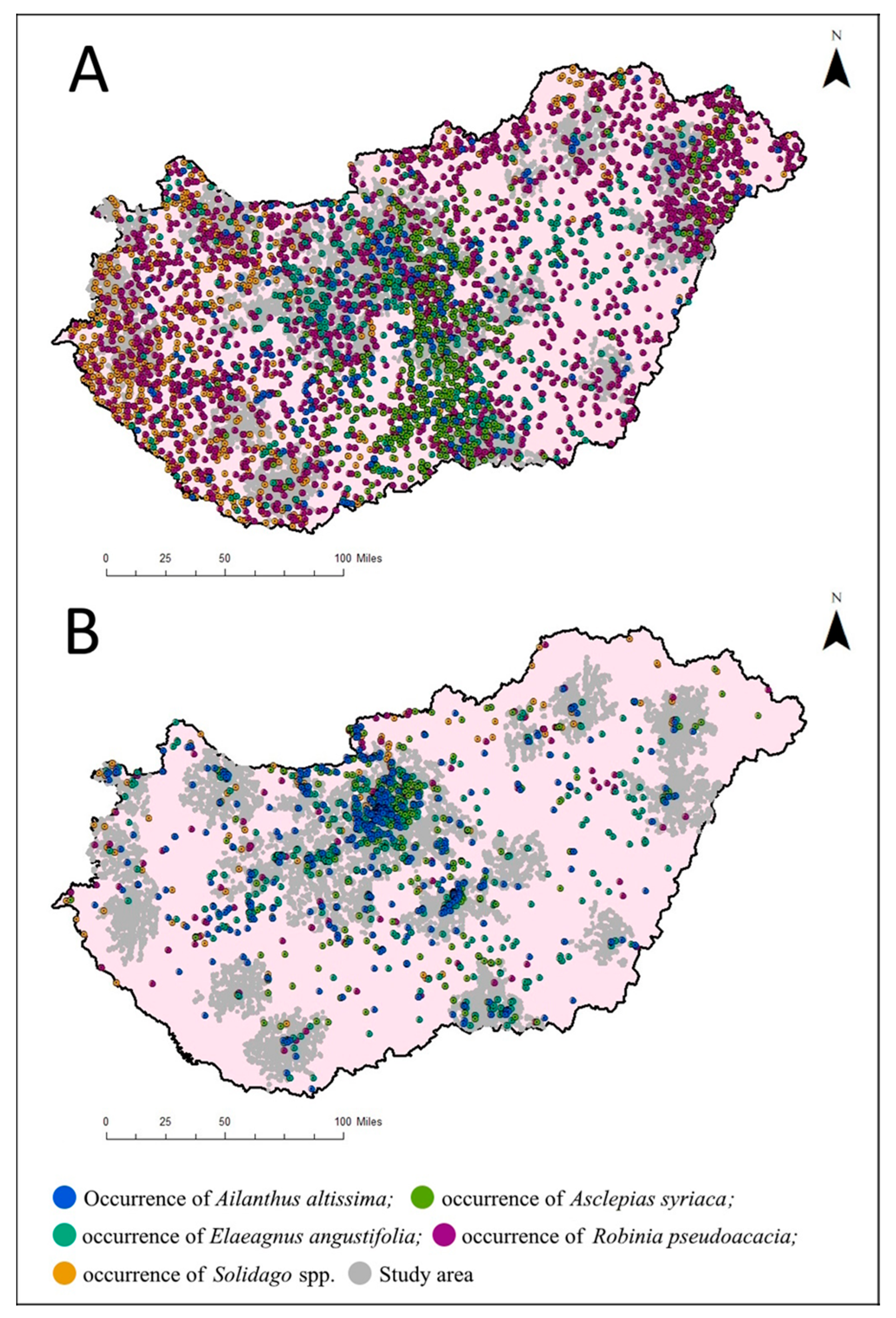
Citizen science data are easily accessible, which has led to their wide use for scientific data collection such as mapping invasive plant species. However, the crowd-sourced nature of citizen science data has led to criticism over the quality of the data owing to the fragmented spatial distribution of the data collection points. Despite inherent limitations, an increasing collection of research indicates that, when appropriately corrected for data quality issues, the data collected by volunteers can serve as a reliable source for identifying and analysing biodiversity patterns. Prior to utilising citizen science data, it is essential to identify its inherent flaws and limitations to develop appropriate strategies for its effective application. One viable approach to validating such data is to compare it with datasets collected by experts, particularly in urban areas where volunteer participation is high. In our comparative analyses, we evaluated the usability of citizen science data (Global Biodiversity Information Facility (GBIF)) for mapping the occurrence density of five invasive plant species (Ailanthus altissima, Asclepias syriaca, Elaeagnus angustifolia, Robinia pseudoacacia, and Solidago spp.) in urban cores and fringes in Hungary by comparison to maps obtained from spatially homogeneous data (EUROSTAT Land Use and Coverage Area Frame Survey (LUCAS)) collected by experts. The results showed that the volunteers collected valuable data on Ailanthus altissima, which is specific to urban areas, but they underestimated Robinia pseudoacacia, which is often planted for economic benefits. In addition, the volunteers collected much more data closer to urban cores. These results suggest that citizen science data may be suitable for mapping urbanophilic species in urban environments. Our research contributes to the assessment and scientific applicability of volunteer-collected data for mapping the distribution of invasive plant species.
Keywords: alien plants; crowd-sourced data; expert data; urban areas; urban fringe alien plants; crowd-sourced data; expert data; urban areas; urban fringe