Abstract
Enhancing the carbon sequestration (CS) capacity of urban green spaces is crucial for mitigating global warming, environmental degradation, and urbanisation-induced issues. This study focuses on the urban community unit to establish a system of determining factors for the CS capacity of green space, considering the built-up spatial pattern and green space morphology. An interpretable machine learning approach (Random Forest + Shapley Additive exPlanations) is employed to systematically analyse the non-linear relationship of built-up spatial pattern and green space morphology factors. Results demonstrate significant urban zonal heterogeneity in green space CS, whereas southern suburban area communities exhibited higher capacity. In terms of green space morphology factors, higher fractional vegetation cover (FVC) and cohesion were positively correlated with green space CS capacity. Leaf area index (LAI), canopy density (CD), and the evergreen-broadleaf forest ratio additionally further enhanced the positive effect of two-dimensional green space factors on CS. For built-up spatial pattern factors, communities with a high green space ratio and low development intensity exhibited higher CS capacity. And the optimal ranges of FVC, LAI and CD for effective facilitation of community green space CS were identified as 0.6–0.75, 4.85–5.5 and 0.68–0.7, respectively. Moreover, cohesion, LAI and CD bolstered the CS capacity in communities with a high building density and plot ratio. This study provides a rational basis for planning and layout of green space patterns to enhance CS efficiency at the urban community scale.
1. Introduction
With the severity of global climate change increasing, cities, as one of the primary sources of carbon emissions, have garnered widespread attention for their carbon reduction strategies. Among these strategies, urban green spaces sequester atmospheric carbon dioxide (CO2) into organic carbon via plant photosynthesis, mitigating climate change and achieving carbon neutrality goals [1,2]. Against the backdrop of global warming and rapid urbanisation, enhancing the annual carbon sequestration (CS) rate of urban green spaces, which refers to their immediate capacity to fix carbon annually, has been internationally recognised as an effective approach to mitigating the increase in atmospheric CO2 concentrations [3]. However, urban green spaces exhibit CS efficiency that are spatially heterogeneous, stipulating a complex scientific issue [4]. The biophysical environment of urban green spaces is highly complex, and their annual CS rate is influenced by multiple factors, including vegetation type, spatial structure, landscape morphology and characteristics of the built environment. The interactions between these factors lead to significant differences in the CS rate of urban green spaces [5]. Particularly in high-density urban environments, changes in green space CS are profoundly affected by built-up spatial patterns and human activities [6]. Therefore, elucidating the complex multifactorial influences of built-environment determinants on heterogeneous CS dynamics in urban green spaces, along with their underlying mechanisms, constitutes foundational research for enhancing the CS performance in urban planning.
The potential CS of urban green space ecosystems relies on diverse vegetation [7]. Regarding vegetation spatial factors, Sun et al. [8] observed a strong positive link between vegetation coverage and the CS of green spaces. The selection and configuration of suitable vegetation types are also identified as important factors that affect the CS ability of green spaces [9,10,11]. Trees have been shown to achieve the highest carbon storage levels owing to their substantial biomass, while the CS capacity of other green space types remains comparatively low [6,12]. Research has confirmed that the proportion of trees in urban green spaces was a key driver of park carbon density [13]. In addition, different tree species exhibit varying CS capacities. For example, Zhang et al. [14] observed that broadleaf forests have a stronger CS capacity than needleleaf forests. Moreover, the canopy structure of green spaces significantly affects their CS efficiency by directly influencing the photosynthetic process. The advancement of LiDAR remote sensing technology has facilitated the acquisition of vegetation canopy structure data in urban areas. This technology can capture three-dimensional characteristics of urban forests, such as canopy morphology and vegetation height, thereby prompting the analysis of green space morphological factors influencing CS to shift from two-dimensional composition to a three-dimensional element system [15,16]. The annual CS rate is directly contingent on leaf area. An increase in leaf area strengthens the ability of photosynthetic organs to capture and utilise light energy, thereby strengthening the CS benefits of vegetation [17,18]. Cui et al. [19] observed a significant positive correlation between the leaf area index and urban green space CS. Canopy height is another important factor, as taller canopies can capture more light energy during photosynthesis. Weissert et al. [20] demonstrated that trees with greater canopy height sequester significantly more carbon than those with smaller height. Canopy density, an index of forest stand structure and density, was confirmed to be positively correlated with carbon density in a study of Shanghai’s ancillary green spaces by Chen et al. [21]. In addition, different landscape patterns of urban green spaces indicate distinct spatial configurations and forms, which are also vital for CS functions [22]. As urban land-use structures become increasingly complex and diversified, it is vital to deeply understand how green space landscape patterns (e.g., fragmentation and shape complexity) affect CS processes. Ren et al. [23] found that lower shape complexity within urban green spaces can enhance CS effects by exploring relations between CS and urban green space pattern evolution under various scenarios. Li et al. [24] indicated that highly aggregated green space patches contribute to enhanced CS capacity.
The efficiency of the CS process of urban green spaces is subject to dual influences of spatial constraints and functional disturbances from the built environment, exhibiting notable heterogeneity that distinguishes it from that of natural ecosystems [25]. The encroachment of built-up areas leads to a direct diminishment of green spaces, thereby impeding their capacity for CS [26,27]. Previous studies confirmed that increases in impervious surface area directly affect the ecological functions of green spaces, leading to substantial carbon losses [28,29]. Godwin et al. [30] observed that forest CS in residential communities generally decreases with increasing building density. Concurrently, high-intensity development can lead to the fragmentation and reduced connectivity of green spaces, further diminishing their CS potential [8]. In addition, the density, layout and development intensity of buildings influence plant growth and carbon fixation rate by affecting the microclimatic environment of green spaces, such as by affecting the light availability [31,32]. Guo et al. [33] assessed the local microclimatic effect of buildings on CS based on the Digital Surface Model, Solar Radiation Analysis, and in situ observation methods, and found that dense and high-rise buildings can negatively affect CS in urban green spaces by shading the vegetation canopy and reducing photosynthetic efficiency. Moreover, building-related factors can interact with urban microclimatic effects. For instance, different configurations of building density, plot ratio, and average building height, in combination with urban green spaces, can create distinct local urban climate types, which in turn affect the CS process in green spaces [19,34,35]. The distribution of roads exerts multi-faceted effects on the CS of urban green spaces. While optimisation of green space layout and connectivity can enhance carbon sink efficiency, spatial fragmentation and human disturbances caused by roads can result in negative effects. For instance, Jiang et al. [36] observed that the proportion of road area within park green spaces was negatively correlated with CO2 concentration. Zhang et al. [37] discovered that road fragmentation created isolated plant communities with lower CS and weakened the long-term CS potential. Furthermore, population density, an important factor characterising resident population distribution within a built environment, have shown a positive correlation with CS in urban green space patches [24].
In high-density built environments with complex spatial configurations, analysing the combined impacts and underlying mechanisms of multiple factors on green space CS can more profoundly reveal the systemic interactions between the built environment and green space systems. Amid global urbanisation challenges, in-depth exploration of this field is necessary, as policies such as China’s ‘Dual Carbon’ goal and the UN Sustainable Development Goal 11 (Sustainable Cities and Communities) have explicitly required balancing urban development intensity with ecological resilience. While this research direction is emerging as a new trend, the relationships between driving factors (e.g., plot ratio, green space connectivity) and green space CS are inherently multi-dimensional and dynamic. The characteristic poses unique challenges for urban planners [13,38]. In practice, this dynamism often manifests as a stark trade-off: escalating development intensity, driven by demands for high-rise clusters and land-use efficiency, frequently compromises green space quality and CS capacity [29]. Yet existing studies often rely on linear relationships, employing correlation coefficients or traditional linear regression analyses [39,40], which are insufficient to capture the complex dynamic and non-linear effects of these factors embedded in this trade-off [16]. This methodological insufficiency hinders planners from formulating adaptive strategies to reconcile development goals with ecological targets. Recently, machine learning approaches, including Random Forest (RF) models and Shapley Additive exPlanations (SHAP) algorithms, have gained attention for their ability to more accurately reveal the non-linear dynamic characteristics and complex interactions between multiple factors [38,41]. Communities, as fundamental urban units characterised by dense built environments, are closely connected to the daily lives and activities of urban residents. They not only represent the smallest spatial units where complex dynamic interactions occur between green spaces and other urban built spaces but are also a critical resource for urban emission reduction and enhanced CS [42]. Therefore, it is essential to clarify the dynamic roles of complex driving factors of CS in green spaces at the community scale [43]. However, systematic analyses of the combined effects of multiple factors at the community scale remain limited [12,44].
Therefore, this study selects the diverse and complex built environment along the west bank of the Huangpu River in Shanghai and focuses on the community scale. This study employs net primary productivity (NPP) estimated by the improved Carnegie-Ames-Stanford-Approach (CASA) model and hotspot and coldspot analysis to quantitatively investigate the spatial heterogeneity of the annual green space CS performance in different built environments. Subsequently, the RF model and SHAP algorithm are utilised to explore the non-linear relationships between green space, built-up spatial pattern and CS effects. This approach further disentangles the dynamic interactions between multi-dimensional factors during the CS process. This study aims to fully elucidate the complexity of key influencing factors on the heterogeneity of green space CS within built-up community environments. Our findings are expected to guide the optimisation of green space layouts and the development of evidence-based environmental management strategies of urban communities.
2. Materials and Methods
2.1. Research Framework
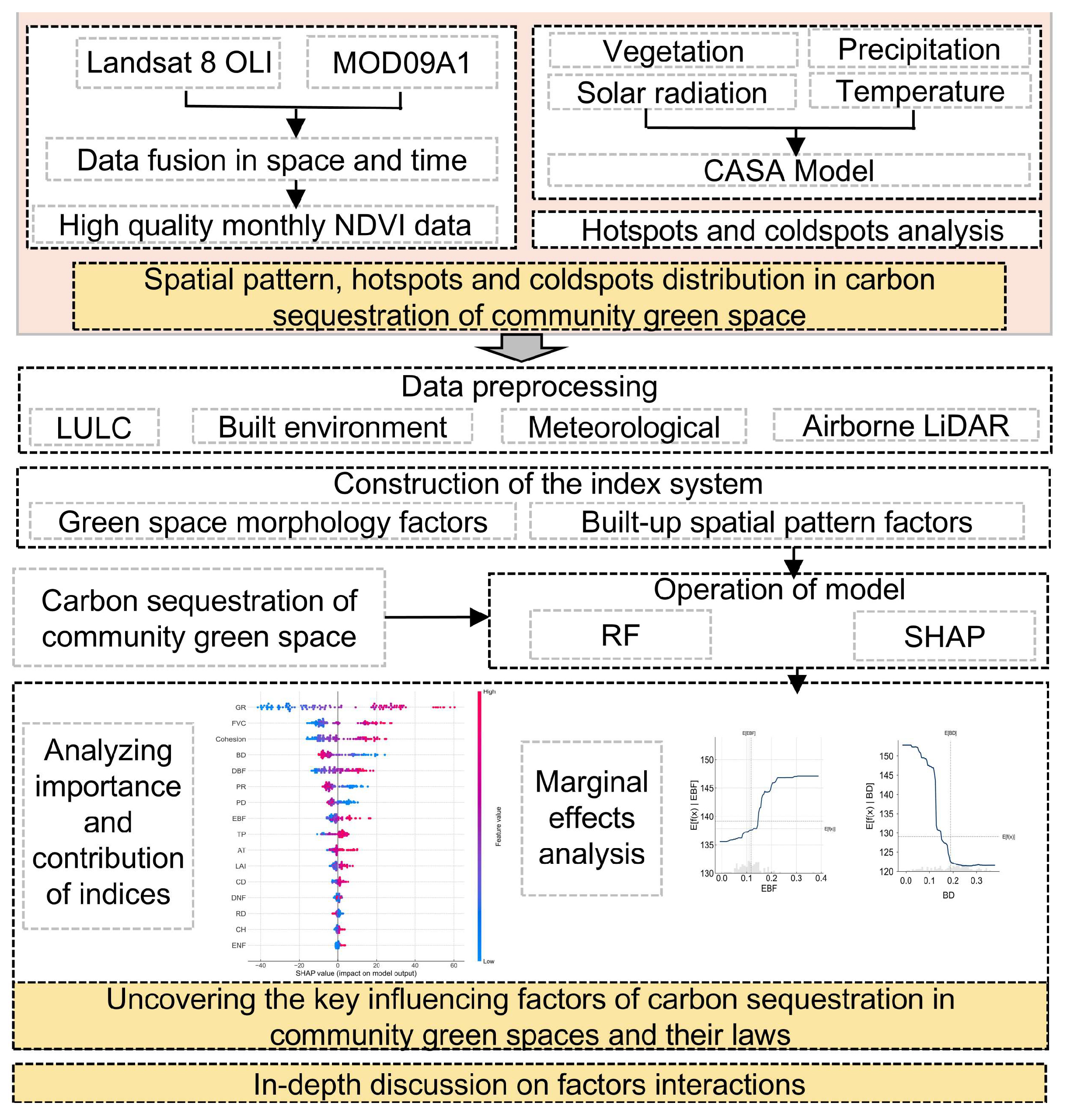
Through systematically reviewing studies on urban green space CS and the mechanisms and drivers, and by integrating multiple data sources and methods, this study establishes a research framework to assess the relationship between urban built-up spatial pattern, green space morphology and spatial heterogeneity of CS at the community scale (Figure 1). First, the CASA model is employed using multi-source data to obtain the heterogeneous pattern of CS across green spaces within the study area. Hotspot and coldspot analysis is then employed to examine the clustering of CS hotspots and coldspots in urban green spaces. Subsequently, based on the RF model and SHAP algorithm, a set of indices comprising 9 green space morphology metrics and 7 built-up spatial pattern metrics is selected to construct an index system. This system is used to quantitatively investigate the significance and marginal effects of these indices on the CS of urban green spaces. Furthermore, the complex interactions between green space morphology factors and built-up spatial pattern factors occurring during CS by community green spaces are explored in depth.
Figure 1.
Research framework for revealing the relationship between urban built-up spatial patterns, green space morphology and spatial heterogeneity of carbon sequestration at the community scale.
2.2. Study Area
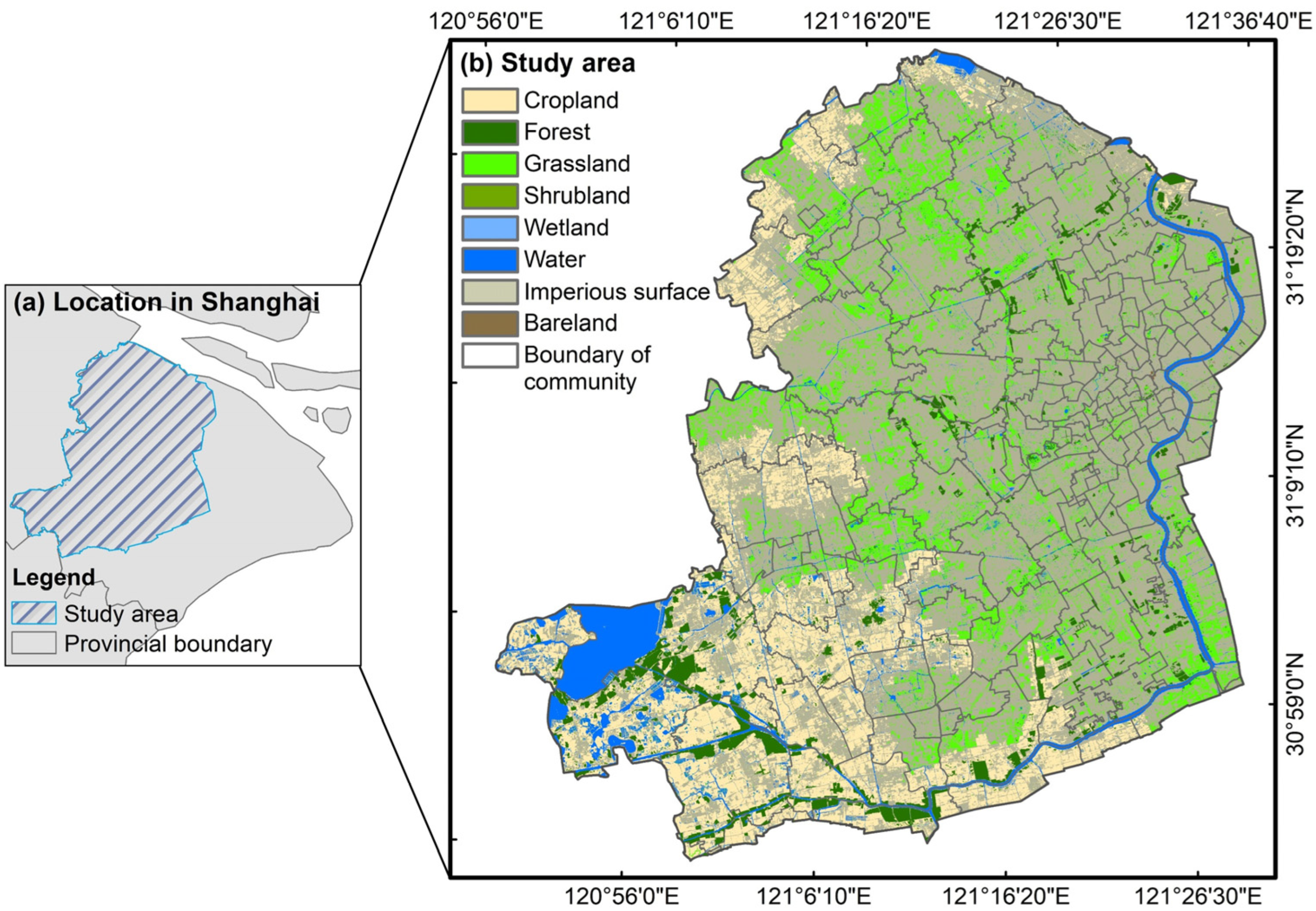
Shanghai is situated on the eastern edge of the Yangtze River Delta, at the midpoint of China’s north–south coastline and the estuary of the Yangtze River. The city features a sub-tropical monsoon climate, characterised by distinct seasons, abundant sunshine and ample rainfall. As China’s largest international economic centre and a key global financial hub, Shanghai is one of the most economically dynamic, open and innovative regions in the country. However, its advanced industrialisation has led to high levels of carbon emissions, exerting significant pressure on the urban ecosystem to reduce carbon emissions [45]. The dense population, developed economy and intensive land use make Shanghai a typical city with prominent contradictions between ecosystem services and land use [46]. Therefore, this study selects 158 communities within the enclosed area on the west bank of the Huangpu River in Shanghai as the study area (Figure 2), which encompasses the core built-up area of the city. This region, has a diverse and complex built environment alongside a relatively high level of greening, making it an ideal area for investigating the complex relationships between built-up spatial patterns, green space morphology and spatial heterogeneity of green space CS.
Figure 2.
The location of the study area in Shanghai (a) and land-use and land cover situation in the study area (b).
2.3. Data Sources
This study integrates a multi-source dataset, including land-use, remote sensing and built-environment data, with Table 1 presenting the detailed information and sources. The green space data were extracted from a 10 m resolution land-use dataset from 2017 developed by Gong et al. [47], covering three types of green spaces, namely forest, grassland and shrubland, with an overall accuracy of 72.76%. For the remote sensing data, the spatial and temporal resolution of Landsat 8 OLI data is 30 m and 16 days, respectively; four sets of data from 2017 with cloud cover of <15% were selected. The MOD09A1 data have a spatial resolution of 500 m and a temporal resolution of 8 days. The forest type data within the study area were derived using a machine learning algorithm based on the vegetation index and texture extracted features from Sentinel-2 data and ground-truth samples, resulting in the following four forest types: evergreen-needleleaf, evergreen-broadleaf, deciduous-needleleaf and deciduous-broadleaf forests.
Table 1.
Sources of data used in this study.
Meteorological data include 1 km resolution temperature (°C) and precipitation (mm) data, which have been validated against a dataset from 496 meteorological stations, with Pearson correlation coefficients (Cor) of 0.998 and 0.929 for temperature and precipitation, respectively [48]. The spatial and temporal resolution of solar radiation data is 0.1° and 3 h, respectively, with a coefficient of determination (R2) exceeding 0.8 [49].
Considering the spatial heterogeneity of the built environment at the community scale, indices such as main roads, land development intensity and population density within communities have been selected. Road and building distribution data have been obtained from vector data downloaded from the OpenStreetMap platform, while population density data have been sourced from raster data downloaded from the WorldPop platform.
Canopy structure data of urban green spaces in the study area were acquired by airborne LiDAR via a RIEGL mini VUX—1UAV lidar scanner mounted on a Feima D200 drone platform in 2017. The LiDAR data were filtered using LIDAR360 software (v5.2, GreenValley International, Berkeley, CA, USA). Specifical data process methods were (1) isolating individual trees by implementing a watershed segmentation algorithm on the processed point cloud, which provided estimates of canopy heights; (2) calculating canopy density as follows: within a 10 m × 10 m statistical unit, compute the ratio of the number of first-return vegetation points to the total number of first-return points; and (3) leaf area index estimation, performed by first constructing a 3D grid framework, where the cell dimension was set to 1.5 times the average point spacing within a 10 m × 10 m statistical unit. We then quantified the layered grid occupancy containing points and applied a frequency-based calculation, incorporating a leaf inclination correction factor to determine the LAI for each stratum. Summing these layer values produced the total LAI. Furthermore, canopy height, canopy density and leaf area index maps with a 10 m resolution for the study area were generated through integrated remote sensing data inversion algorithms. Finally, mean value statistics of canopy height, canopy density and leaf area index were computed within the spatial units corresponding to the annual NPP data.
2.4. Methods
2.4.1. Calculation Method of Carbon Sequestration
This study aimed to quantify the annual CS capacity of urban green spaces within communities (i.e., their ability to fix atmospheric carbon in a specific year) and the driving effects of various spatial indices thereon, rather than long-term carbon accumulation. Consequently, annual net primary productivity (NPP) was employed as a proxy indicator to measure the annual CS rate of urban green space ecosystems at the community scale. NPP is the net rate at which plants convert atmospheric CO2 into organic carbon per unit time, following the subtraction of respiratory carbon losses from the CO2 absorbed through photosynthesis [50]. It directly quantifies the rate and intensity of CS by green spaces and serves as one of the core ecological variables characterising the annual CS process. This study estimated NPP by the CASA model improved by Zhu et al. [51], which can spatially explicitly reflect the relative CS efficiency of different green space vegetation types. The model calculates NPP using two components: absorbed photosynthetically active radiation (APAR) that was absorbed by the vegetation, and light energy use efficiency (LUE). It simplifies some ecological processes to improve computational efficiency. For instance, the improved CASA model estimates the water stress factor through meteorological data instead of putting complex soil parameters into a soil water molecular in the original model. The formula is as follows:
where and denote the APAR (MJ m−2 month−1) and LUE (g C MJ−1) for pixel in month , respectively.
This study used the remote sensing spatiotemporal fusion technique to obtain high spatiotemporal resolution normalised difference vegetation index (NDVI) data to improve the accuracy of the CASA model. The Enhanced Spatiotemporal Adaptive Reflectance Fusion Model (ESTARFM) [52] was employed to fuse Landsat 8 OLI images and MOD09A1 images. Four pairs of Landsat and MODIS images (April, July, August, October in 2017) with cloud cover <15% and close temporal proximity were selected: two pairs for ESTARFM construction and two for validation. Validation against actual Landsat 8 OLI NDVI data confirmed the high accuracy of the fused product, as evidenced by an R value consistently greater than 0.75 and an RMSE remaining near 0.13. Based on these robust results, fusion methodology was employed to reconstruct a continuous high-resolution NDVI time series across the study area in ENVI 5.3. A maximum value composite method was employed to synthesise 46 periods of NDVI into a high-quality monthly NDVI dataset, yielding high spatiotemporal resolution NDVI data within a 30 m × 30 m spatial unit to improve CS quantification accuracy. Subsequently, monthly average temperature data, total precipitation data, total solar radiation data and CGLS-LC100 vegetation type data (https://land.copernicus.eu/global/lcviewer (accessed on 25 March 2023) were integrated into the improved CASA model to calculate annual NPP. Finally, the CS distribution of the green spaces within a 30 m × 30 m spatial unit of the study area was obtained.
2.4.2. Hotspot and Coldspot Analysis
Hotspot and coldspot analysis has been proven to effectively identify the spatial clustering of high-value (hotspots) and low-value (coldspots) areas of ecosystem services [53,54]. Using the Hot Spot Analysis (Getis-Ord Gi*) tool in the Spatial Statistics toolbox of ArcGIS 10.8, we classified hotspots and coldspots based on the Gi_Bin values and their corresponding confidence levels. This approach revealed the spatial distribution patterns of hotspots and coldspots of CS in green spaces within the study area, allowing for us to analyse the spatial differentiation of high and low CS areas among communities in the study area.
2.4.3. Factors Affecting the Carbon Sequestration Capacity of Communities
Drawing on a comprehensive investigation of various factors influencing the CS of urban green spaces, primarily encompassing both their intrinsic traits and external environmental conditions [10,19], we focused on two aspects: green space morphology and the spatial patterns of the built environment. The green space morphology factors encompassed vegetation spatial structure (fractional vegetation cover (FVC), canopy density (CD), leaf area index (LAI), canopy height (CH), proportion of evergreen-broadleaf forest in green spaces (EBF), proportion of deciduous-broadleaf forest in green spaces (DBF), proportion of evergreen-needleleaf forest in green spaces (ENF) and proportion of deciduous-needleleaf forest in green spaces (DNF)) and landscape pattern (cohesion) (Table 2). The built-up spatial pattern indictors included building morphology (building density (BD), plot ratio (PR), road density (RD)), spatial environment (green space ratio (GR), population density (PD)) and microclimatic (annual average temperature (AT), annual total precipitation (TP)) (Table 3). To ensure data consistency and comparability, this study standardised the resolution of the aforementioned data based on the spatial resolution of the CS distribution dataset. Subsequently, these indices were calculated and statistically analysed at the community scale across the study area to accurately assess the impacts of these driving factors on the CS of urban green spaces.
Table 2.
Green space morphology factors influencing green space carbon sequestration in the community.
Table 3.
Factors of built-up spatial patterns influencing green space carbon sequestration in the community.
2.4.4. Interpretable Machine Learning Methods for Revealing Complex Factor Influences
Traditional linear regression analyses, which have been widely used in the past, are limited to capturing linear relationships between factors and cannot account for the non-linear threshold effects of multiple factors on the dependent variable. By contrast, RF [55] can reveal the non-linear impacts of multi-dimensional factors on the dependent variable. Owing to its inherent dual randomness, the RF model is highly efficient, performs robustly, and effectively resists overfitting, leading to its broad adoption in various fields. SHAP has gained widespread usage in interpreting RF models [56] and can enhance the interpretability of machine learning predictions by identifying key features that significantly influence the target variable’s predictions.
Herein, we employed an RF model built with Python 3.12.4, combined with the SHAP algorithm, to analyse the non-linear effects of various indices on the CS heterogeneity across green spaces in 158 communities and explore the interactions between factors on CS process. Nine green space metrics and seven built-environment metrics were used as feature variables, and the average CS of community green spaces served as the dependent variable. The dataset was divided into training and testing sets at a ratio of 7:3 to construct the RF regression model. The hyperparameter optimisation process, integrating grid search with cross-validation, ultimately determined the following optimised parameter settings based on a trade-off between model performance and complexity: the number of decision trees was set to 150; the maximum number of features considered for splitting at each node was limited to 60% of the total features; the maximum depth of each decision tree was set to 5; the minimum number of samples required to form a leaf node was 5; and the minimum number of samples required to split an internal node was 10. To assess the model’s ability, 10-fold cross-validation was further employed [57,58,59].
3. Results
3.1. Spatial Pattern of Carbon Sequestration
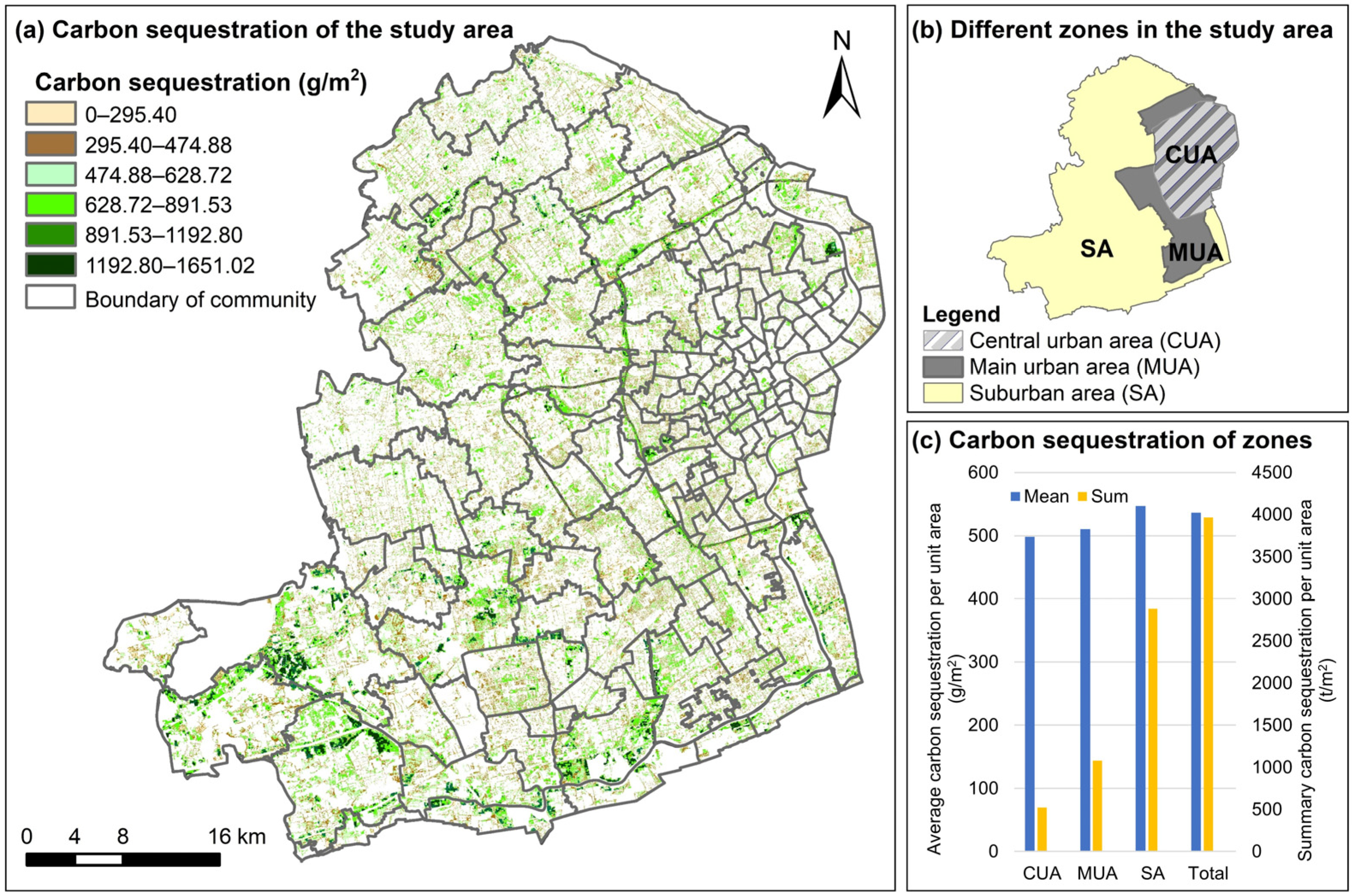
CS in the study area was divided into six categories by the natural breaks classification method (Figure 3). Results indicated significant spatial heterogeneity in the CS capacity of green spaces in the study area (Figure 3a,b). Regarding the spatial location of the built-up environment, the CS capacity of community green spaces was weakest in the central urban area (CUA), followed by that in the main urban area (MUA), with the highest capacity observed in the suburban area (SA). High CS values were predominantly observed in SA communities in the southern part of the study area, where forests and grasslands were concentrated. Areas with high CS capacity (>1192.80 g/m2) were rare, accounting for only 2.80% of the study area. By contrast, areas with low CS capacity (<474.88 g/m2) were more common, comprising 39.61% of the study area. The CUA communities had the lowest total CS in green spaces, representing only 13.19% of the total study area (Figure 3c), while the MUA accounted for 27.26%. The highest total CS was observed in the SA communities, comprising 72.74% of the total study area. The average per-unit-area CS capacity of green spaces followed a consistent pattern: SA > MUA > CUA. The average per-unit-area CS capacity of the CUA communities was 2.31% lower than that of the MUA, which was associated with its larger area of grasslands and forests in the western and southern regions. The average per-unit-area CS capacity in SA communities was 9.69% higher than that in the CUA, exceeding the study area’s overall mean value by 1.95%. This correlation can be strongly associated with extensive forests existing in the south, contributing to higher CS within SA communities.
Figure 3.
Spatial pattern of carbon sequestration in the study area: (a) carbon sequestration in the study area; (b) different zones within the study area: central urban area (CUA), main urban area (MUA) and suburban area (SA); (c) comparison of carbon sequestration capacity and total carbon sequestration between different zones.
3.2. Spatial Patterns of Carbon Sequestration Hotspots and Coldspots
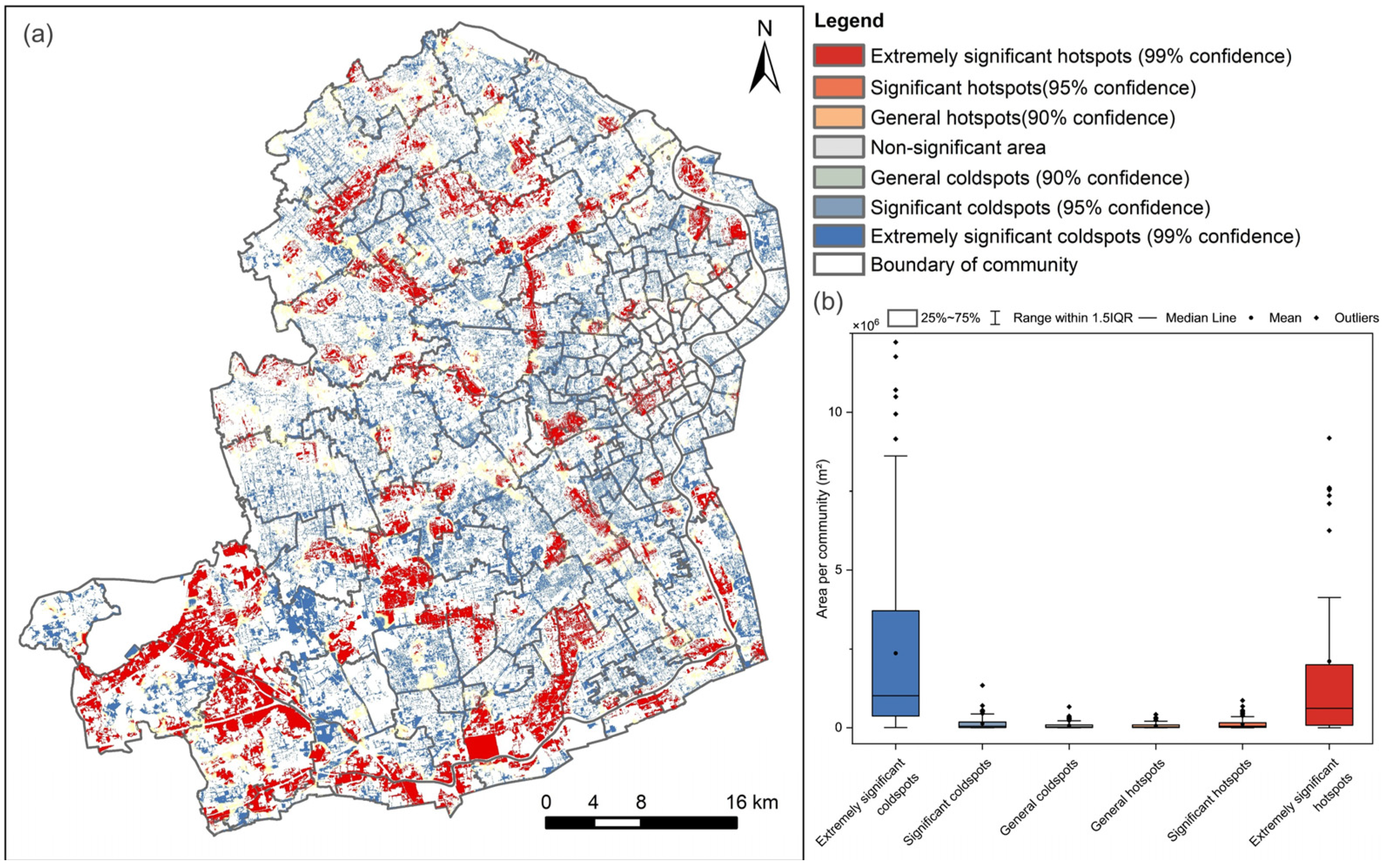
Statistically significant hotspots and coldspots of green space CS were identified, and their areas in each community were quantitatively analysed to further investigate the heterogeneity of CS capacity. Coldspots were widely distributed across eastern and central regions, particularly concentrated in the communities within the CUA characterised by densely built environments. By contrast, hotspots were primarily located in (1) communities in SA along large southern water bodies, where extensive forests and grasslands cluster; (2) communities in the SA to the northwest with extensive grasslands and low development intensity; and (3) southern expansion zones of the MUA, where several communities contain large grassland areas (Figure 4a).
Figure 4.
Map of the spatial pattern of carbon sequestration coldspots and hotspots in the study area (a); the area per community of the different levels of coldspots and hotspots (b).
The CS capacity of the communities was generally low. Coldspot areas significantly outnumbered hotspot areas by 40.55%, with extremely significant coldspot areas accounting for 48.32% of the total study area. There was significant spatial heterogeneity in the CS capacity of green spaces between different communities (Figure 4b). Specifically, the area of extremely significant hotspots showed considerable variability among communities. For instance, the community with the largest area of extremely significant hotspots had an area that was 12.57 times the average area of extremely significant hotspots across all communities. Similarly, the area of extremely significant coldspots also exhibited marked differences among communities. The community with the largest area of extremely significant coldspots had an area that was 5.16 times the average area of significant coldspots across all communities.
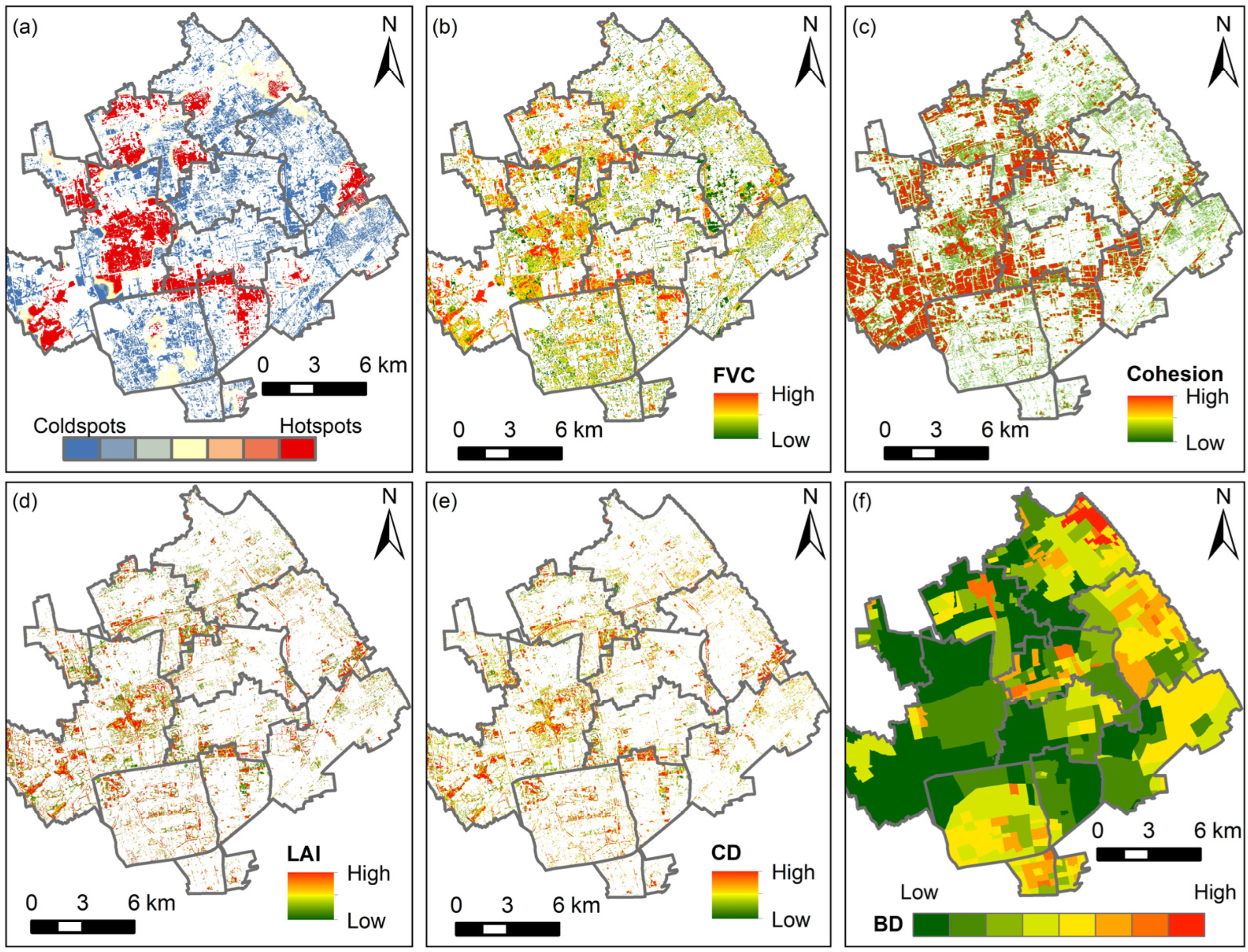
Further, several communities with typical differentiation in CS hotspots and coldspots in the southwestern part of the study area were selected as cases for in-depth analysis. It can be observed that communities with concentrated CS hotspots were characterised by higher FVC, highly aggregated green space patches, dense leaf arrangement and thick canopies, higher CD, and lower BD (Figure 5). In contrast, communities with concentrated CS coldspots exhibited higher BD, lower vegetation cover and dispersed and relatively fragmented green spaces, as well as lower LAI and CD.
Figure 5.
Spatial distribution map of carbon sequestration coldspots and hotspots (a) of the selected typical communities, along with spatial distribution maps of key indices including fractional vegetation cover (FVC) (b), cohesion (c), leaf area index (LAI) (d), canopy density (CD) (e) and building density (BD) (f).
3.3. Analysis of Factors Affecting Carbon Sequestration
3.3.1. Analysis of the Contribution of Each Factor to Carbon Sequestration
The final RF model achieved a coefficient of determination (R2) of 0.86, a Root Mean Square Error (RMSE) of 22.44, and a Mean Absolute Percentage Error (MAPE) of 19.39% on the test set. The 10-fold cross-validation results (training set average RMSE: 21.66 ± 0.64, validation set average RMSE: 24.99 ± 5.65; training set average R2: 0.87 ± 0.004, validation set average R2: 0.85 ± 0.042) were in very close proximity to the independent test set metrics. Collectively, these demonstrated good model robustness and generalisation capability, confirming that the selected 16 features effectively capture community-scale urban green space CS heterogeneity.
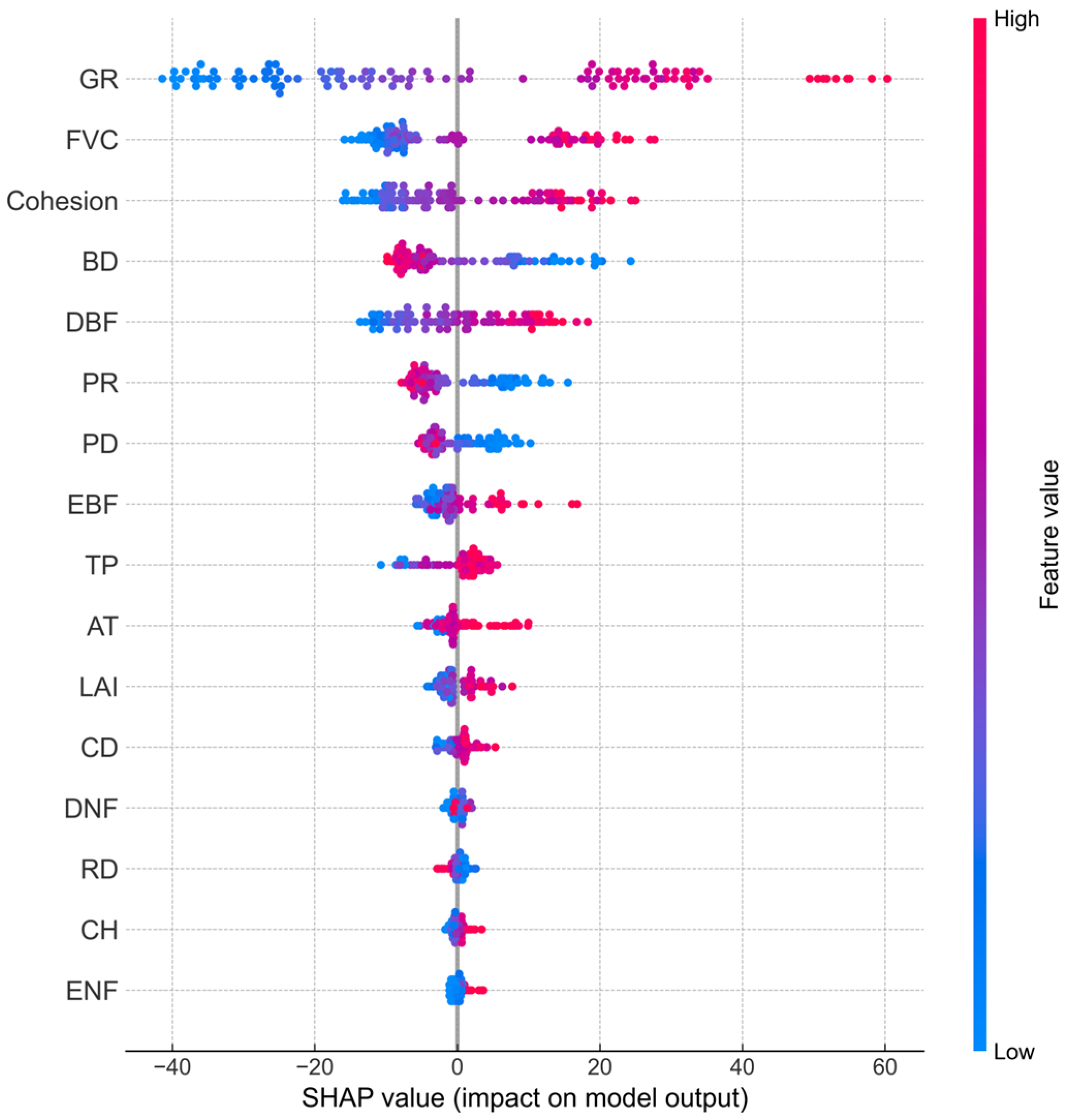
Based on the RF model and SHAP algorithm, we analysed the importance and contribution direction of green space morphology and built-up spatial pattern factors influencing urban green space CS efficiency at the community scale (Figure 6). In terms of green space morphology factors, vegetation spatial structure factor FVC (11.35%) and landscape pattern factor cohesion (9.84%) were the main factors affecting the green space CS capacity in the communities, exhibiting significant positive correlations with CS. The green space tree species indicator DBF (7.13%) and vegetation spatial structure factor EBF (3.22%) also showed high relative importance and positive correlations with CS. Of the built-up spatial pattern factors, GR (25.79%), BD (7.71%) and PR (7.53%) exhibited relatively high contribution rates. The spatial environment factor GR positively influenced the CS capacity of community green spaces. The building morphology factors BD and PR, which characterise the development intensity of communities, consistently showed negative effects on the CS capacity of community green spaces.
Figure 6.
Contribution of factors affecting carbon sequestration in green spaces in urban communities. The x-axis shows the Shapley Additive exPlanations (SHAP) values, indicating the positive and negative contributions of different influencing factors with green space carbon sequestration capacity. The y-axis shows the importance of these influencing factors. The colours of the data points, blue and red, correspond to low and high values of the predictions, respectively.
3.3.2. Marginal Effect Analysis of Factors on Carbon Sequestration
Partial dependency plots based on the RF model and SHAP algorithm were plotted to deeply explore the non-linear influence trends and marginal effects of green space morphology factors and built-up spatial pattern factors on the green space CS capacity of the communities.
- (1)
- Green space morphology factors
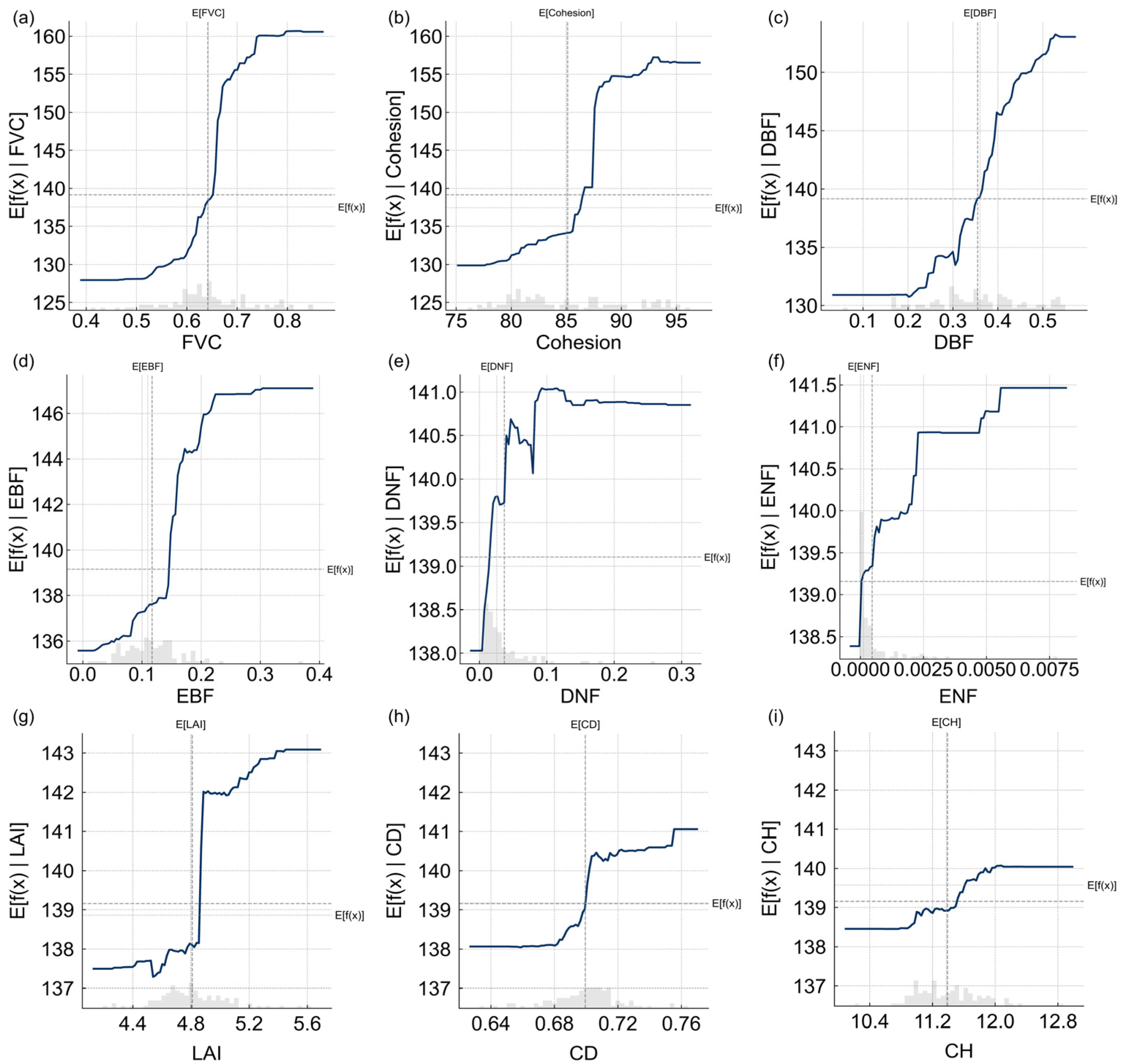
The vegetation spatial structure associated with green space indices, including FVC, DBF, EBF, DNF and ENF, exhibited an upwards trend in their marginal effect curves on green space CS, indicating a positive correlation with the CS capacity of green spaces in each community. As the most significant green space morphology factor influencing the green space CS of communities, when the FVC value falls within the range of 0.6 to 0.75, the marginal effect curve between FVC and green space CS exhibited a steep slope (Figure 7a). It indicated that an increase in FVC significantly enhanced the CS capacity within this interval. When the FVC value exceeded this interval and continued to increase, the variation in CS tended to flatten. Within the range of 0.3–0.4, the curve of the marginal effect of DBF on CS of community green space exhibited a sharp upward trend (Figure 7c), and increases in DBF during the stage exerted a pronounced positive effect on the CS capacity. Within the range of 0.14–0.22, increases in EBF significantly enhanced community green space CS (Figure 7d). The marginal effect curve of DNF on community green space CS showed an upward undulation, indicating an overall positive correlation between the two, especially the sharply upwards trend within the range of 0.001–0.0058 (Figure 7e). The clear upward trend of the marginal effect curve of ENF on community green space CS also indicated a positive correlation between the two (Figure 7f).
Figure 7.
Single-factor feature dependence graph: (a) fractional vegetation cover (FVC), (b) cohesion, (c) proportion of deciduous-broadleaf forest in green spaces (DBF), (d) proportion of evergreen-broadleaf forest in green spaces (EBF), (e) proportion of deciduous-needleleaf forest in green spaces (DNF), (f) proportion of evergreen-needleleaf forest in green spaces (ENF), (g) leaf area index (LAI), (h) canopy density (CD) and (i) canopy height (CH). In each subplot, the x-axis represents green space morphology factors, and the y-axis represents green space carbon sequestration of the communities predicted by the RF model. To ensure visual clarity, indices of the same dimension that exhibit similar impacts on carbon sequestration patterns and possess analogous value ranges affecting carbon sequestration were grouped together, with the y-axis value range unified for each set of indices.
Canopy structure factors including LAI, CD and CH were consistently observed to have positive correlations with green space CS in general. As a key parameter for measuring the photosynthetic capacity, within the range of 4.85–5.5, the curve of the marginal effect of LAI on green space CS exhibited a steep upward trend, indicating sharp increases in CS (Figure 7g). Within the range of 0.68–0.7 and the curve of the marginal effect of CD on green space CS exhibited a steep slope, indicating that increases in CD substantially enhanced the CS capacity of green spaces during this interval (Figure 7h). Within the range of 11.5–12, CH exhibited a pronounced positive correlation with green space CS (Figure 7i).
Regarding landscape pattern factor, cohesion exhibited a monotonic upwards trend in the curve of its marginal effect on CS (Figure 7b), and the increase in cohesion led to a substantial enhancement in CS.
- (2)
- Built-up spatial pattern factors
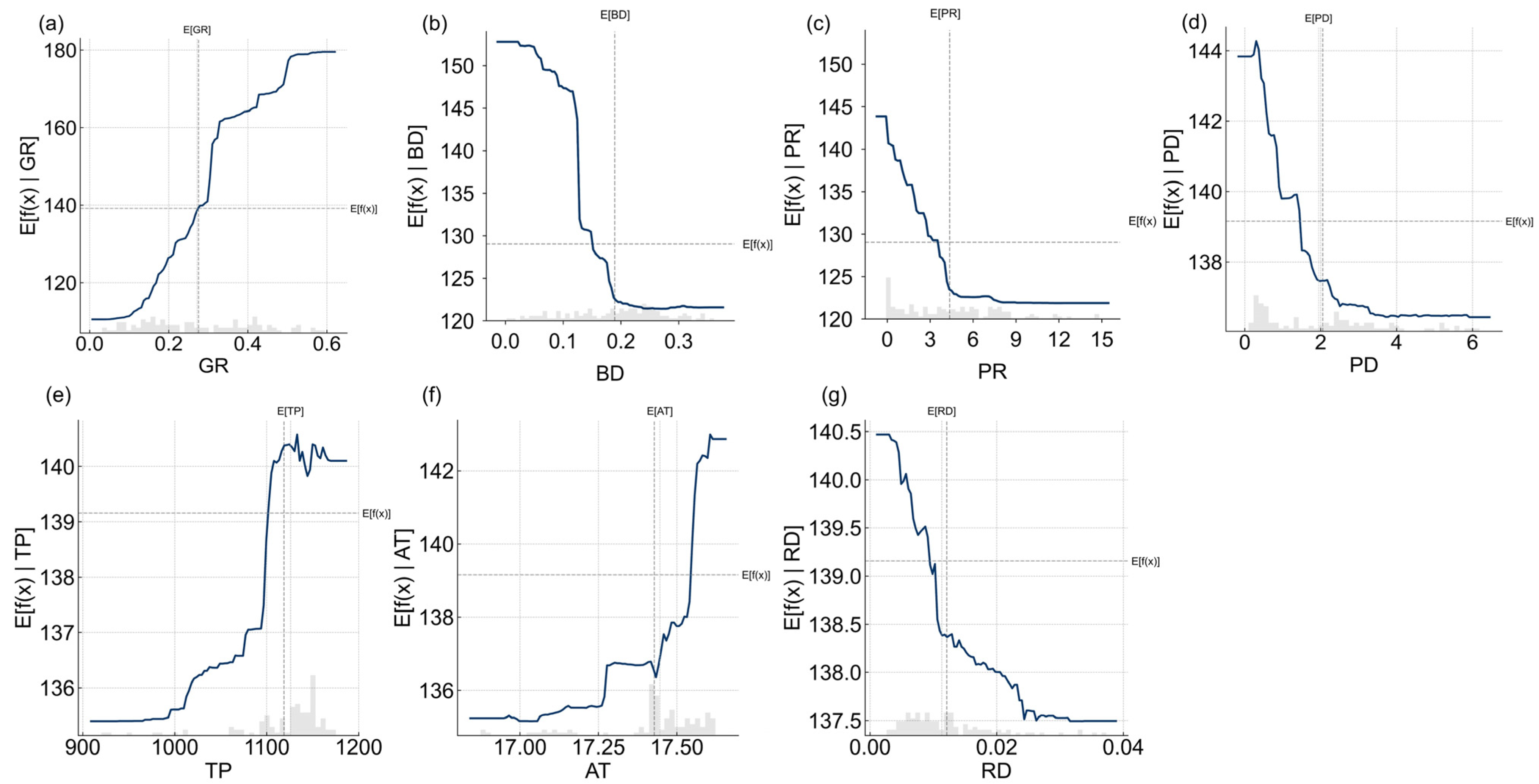
The building morphology factors BD and PR exhibited pronounced negative correlations with the green space CS capacity of the communities. As the most important building morphology factor, BD exerted a significant negative effect on CS (Figure 8b). Especially within the range of 0.05–0.2, increases in BD led to substantial declines in CS values, and the marginal effect curve flattened out when BD reached 0.3. The curve of the marginal effect of PR on community green space CS also exhibited a clear downward trend (Figure 8c), with particularly sharp declines occurring within the range of 0.1–5.2. For RD, the curve of the marginal effect of RD on community green space CS had been exhibiting an undulating downward trend before RD fell below 0.034 (Figure 8g).
Figure 8.
Single-factor feature dependence graph: (a) green space ratio (GR), (b) building density (BD), (c) plot ratio (PR), (d) population density (PD), (e) annual total precipitation (TP), (f) annual average temperature (AT) and (g) road density (RD). In each subplot, the x-axis represents built-up spatial pattern factors, and the y-axis represents the community green space carbon sequestration predicted by the RF model. To ensure visual clarity, indices of the same dimension that exhibit similar impacts on carbon sequestration patterns and possess analogous value ranges affecting carbon sequestration were grouped together, with the y-axis value range unified for each set of indices.
The CS capacity of community green spaces rapidly rose with the increase in spatial environment factor GR, indicating a strong positive effect (Figure 8a). This effect gradually diminished as GR approached 0.6. PD exhibited an initial weak positive correlation that transitioned to a pronounced negative correlation with community green space CS (Figure 8d). The marginal effect of the microclimatic factor TP on CS within the range of 992.85–1121.43 exhibited an obvious upward trend (Figure 8e). Within the range of 17.45–17.6, increases in AT led to substantial increases in CS values (Figure 8f).
4. Discussion
4.1. Canopy Structure Enhances the Effects of Two-Dimensional Green Space Factors on Carbon Sequestration
Recent studies have confirmed the complex interactions between numerous environmental and biological factors during the CS process of vegetation [13,38]; however, most existing research has focused on individual effects. Therefore, this study employed RF and SHAP models to investigate the interactive effects of these factors on the community green space CS process.
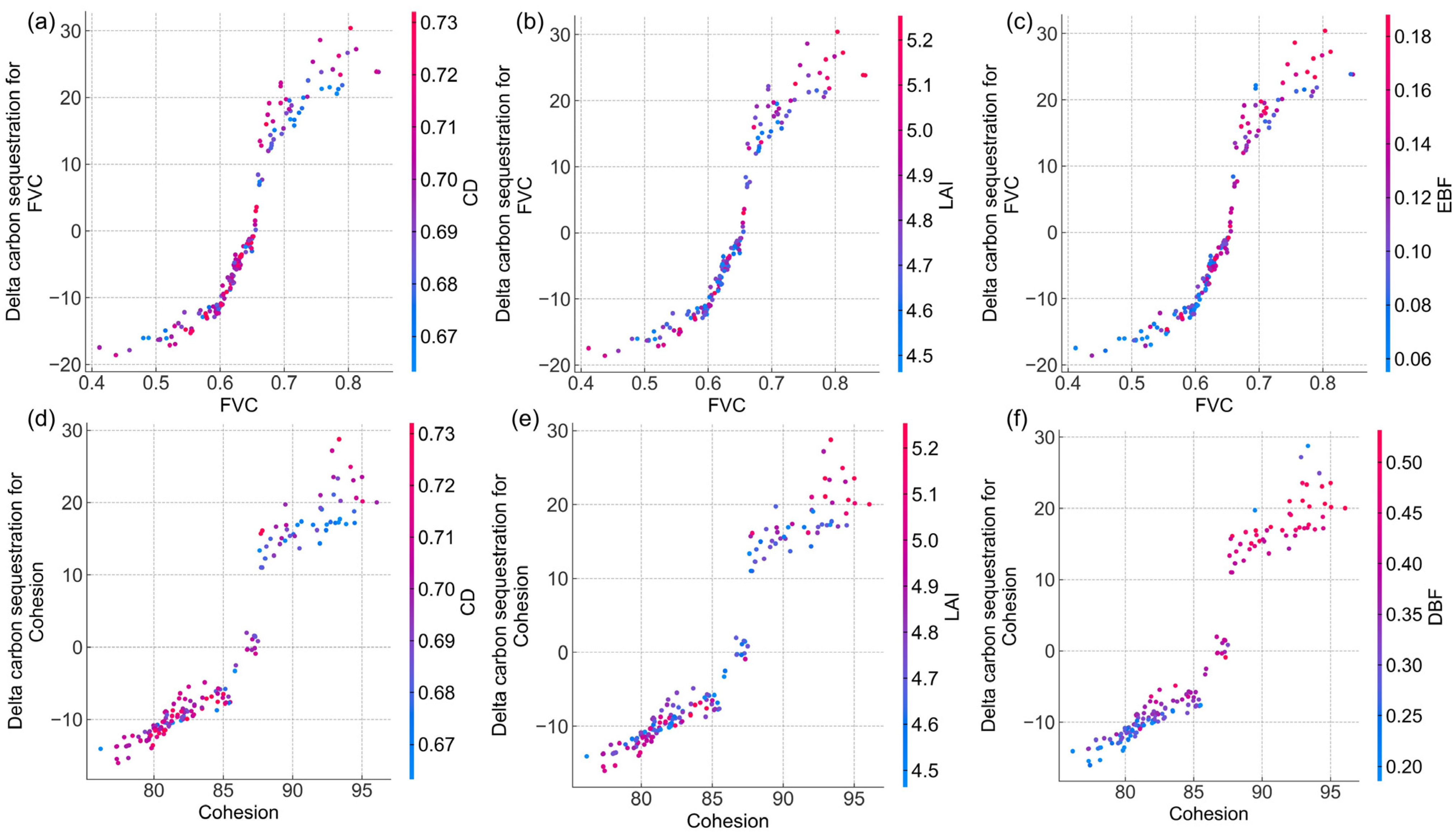
This study found substantial interactive effects between canopy structure factors and two-dimensional green space factors on community CS. Specifically, the community canopy structure factors of green spaces enhanced the positive effect on CS in areas with high FVC (Figure 9a–c). When FVC was large, most of the high values of CD were located above the low values, especially when FVC exceeded 0.65, indicating that high CD amplified the community CS benefits of high FVC (Figure 9a). The underlying mechanism may lie in the fact that high CD increases leaf layering per unit area under high FVC conditions. Dense canopies can reduce inefficient light loss (e.g., ground reflection), thereby allowing for more photosynthetically active radiation to be captured by leaves [60]. Furthermore, dense canopy structures within communities may optimise the micro-environment (e.g., by maintaining humidity and reducing wind speed), indirectly promoting photosynthesis and enhancing CS capacity. When FVC exceeded 0.70, higher LAI strengthened the promoting effect of FVC on CS (Figure 9b). High LAI signifies a greater total area of photosynthetic organs per unit ground area, which can improve light utilisation through layered canopies at different heights around buildings and reduce light competition [61]. Concurrently, this may expand the CO2 absorption area and significantly increases the photosynthetic rate of community greenery. When FVC was above 0.67, elevated EBF values boosted the positive effect of FVC on CS (Figure 9c), implying that evergreen-broadleaf trees enhance CS efficacy in high FVC communities.
Figure 9.
Partial factor bivariate dependency plot for the green space morphology factors influencing carbon sequestration. For each interaction subplot: the x-axis represents the values of the primary green space morphology feature; the y-axis denotes the delta carbon sequestration (the change in predicted carbon sequestration relative to the average SHAP value of the corresponding primary feature); the colour of the points indicates the value range of the secondary feature. Individual subplot descriptions: (a) Primary feature: FVC; Secondary feature: CD; (b) Primary feature: FVC; Secondary feature: LAI; (c) Primary feature: FVC; Secondary feature: EBF; (d) Primary feature: cohesion; Secondary feature: CD; (e) Primary feature: cohesion; Secondary feature: LAI; (f) Primary feature: cohesion; Secondary feature: DBF.
Similarly, a significant interaction also existed between community green space cohesion and canopy structure factors. At cohesion values of 87.5–94.0, higher CD within communities significantly reinforced the positive contribution of cohesion to CS (Figure 9d). In communities with concentrated greenery patches (e.g., those with contiguous woodland in the southwestern part of the study area), a higher degree of canopy overlap may facilitate interlocking canopies of adjacent trees, leading to more efficient light capture. Additionally, mutual shading among canopies can reduce transpirational water loss from leaves, thereby supporting more stable and sustained photosynthesis [62]. When cohesion exceeded 92.0, higher LAI also notably augmented cohesion’s positive CS contribution (Figure 9e). In communities with aggregated green spaces, dense foliage may better utilise the aggregated structure to mitigate extreme heat inhibition of photosynthetic enzymes, while multi-layered leaf structures optimally allocate light energy to maximise light-conversion efficiency, thereby enhancing CS rate. In the interactive effect of DBF and cohesion on CS, higher DBF amplified the positive contribution of cohesion to CS within cohesion values of 83.0–88.0 (Figure 9f).
4.2. Carbon Sequestration Interactions Between Green Space Morphology Factors and Building Morphology Factors
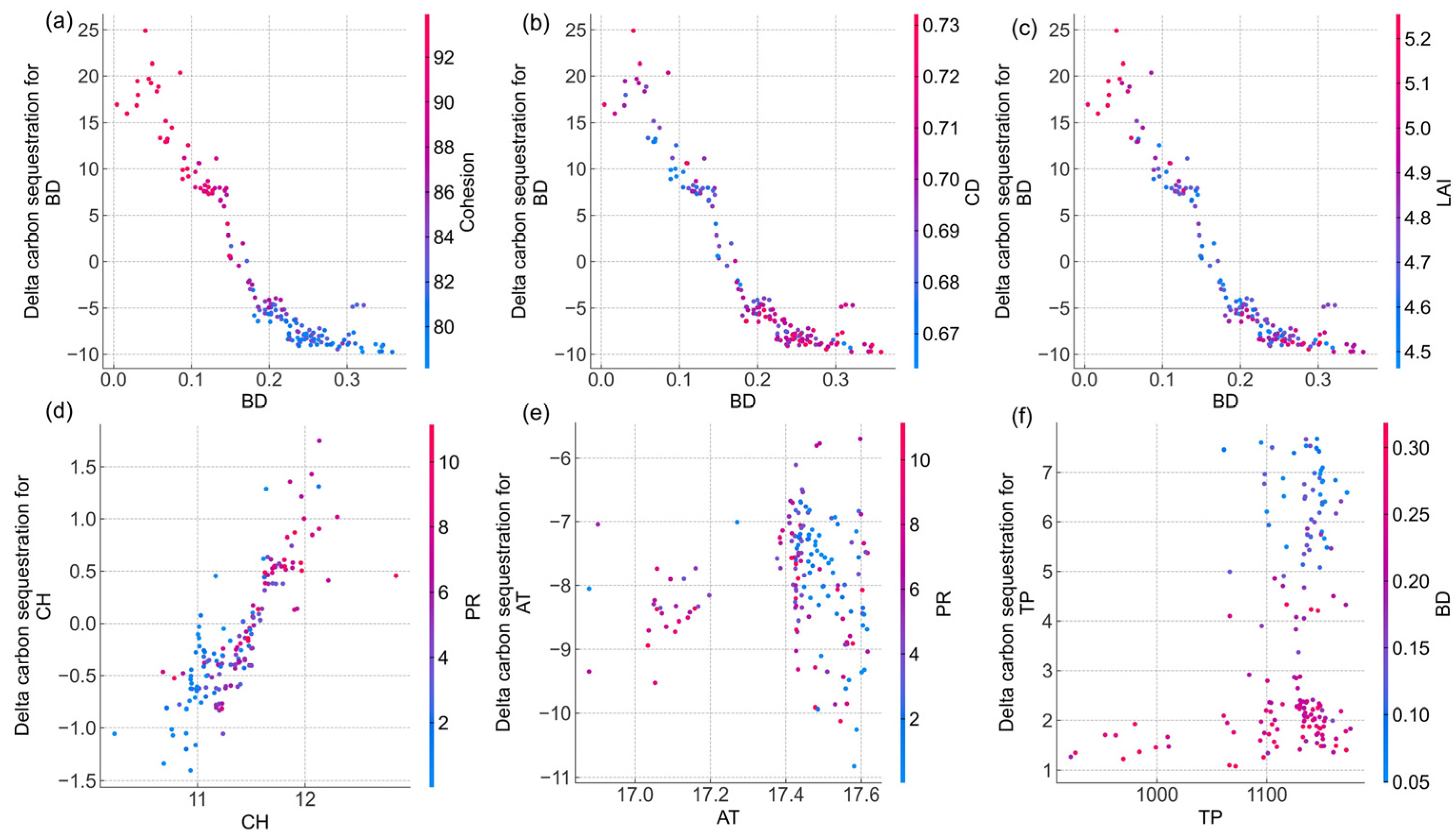
Further analysis revealed significant interactions between green space morphology and building morphology factors during the CS process of community green spaces (Figure 10). When BD was within the range of 0.08–0.22, high values of cohesion mitigated the negative effect of BD on community green space CS (Figure 10a). Elevated BD with higher cohesion may maintain a more stable microclimate (e.g., higher humidity) to reduce fluctuations exacerbated by dense buildings in the communities. In addition, high values of canopy structure factors (CD and LAI) enhanced the CS capacity in densely built environments within communities. When BD ranged from 0.02 to 0.32, increases in CD in the communities mitigated the negative effect of BD on green space CS (Figure 10b). Similarly, as BD increased from 0.05 to 0.13, higher LAI reduced the negative contribution of BD to community CS (Figure 10c). The complex interactive effects of the PR with canopy structure factor CH on the CS process at the community scale were also observed. When CH was within the range of 11–12.1, higher PR significantly diminished CH’s positive contribution to CS (Figure 10d). The findings suggested that despite increased tree height in community green spaces, high development intensity on vegetation CS may substantially constrain vegetation CS. Although greater CH typically expands the vertical space of the canopy and captures more photosynthetically active radiation [63], the shading effect from densely buildings within communities can limit the availability of such radiation during the CS process [64].
Figure 10.
Partial factor bivariate dependency plot for the green space morphology factors and built-up spatial pattern factors influencing carbon sequestration. For each interaction subplot: the x-axis represents the primary feature values, the y-axis denotes the delta carbon sequestration (the change in predicted carbon sequestration relative to the average SHAP value for the corresponding primary feature); the colour of the points indicates the value range of the secondary feature. Individual subplot descriptions: (a) Primary feature: BD; Secondary feature: cohesion; (b) Primary feature: BD; Secondary feature: CD; (c) Primary feature: BD; Secondary feature: LAI; (d) Primary feature: CH; Secondary feature: PR; (e) Primary feature: AT; Secondary feature: PR; (f) Primary feature: TP; Secondary feature: BD.
Additionally, when the microclimatic factor AT in built-up areas ranges from 17.1 to 17.56, lower PR values were predominantly associated with higher CS values, indicating that higher PR exerts a negative influence in the process of AT influencing CS (Figure 10e). This may be because communities with high development intensity are predominantly located in urban central areas in Shanghai. The dense concentration of high-rise buildings in these communities induced microclimatic alterations through shading effects or localised airflow modification casts shade on green spaces, altering light availability, airflow and thermal conditions. Restricted ventilation also impedes CO2 diffusion, thereby deteriorating photosynthetic conditions and adversely affecting the CS process [33]. When TP was within the range of 1056–1169, an increase in BD reduced the positive contribution of TP to green space CS (Figure 10f). A potential explanation is that rising building density alters humidity and thermal conditions around community green spaces. Moreover, a higher proportion of impervious surfaces within communities may reduce soil infiltration in green areas, leading to insufficient water availability for vegetation, which in turn inhibits plant growth and CS efficiency [65].
4.3. Comparison and Insights with Studies at Different Scales
This study found that the cohesion, FVC, DBF and DNF of community green spaces are positively correlated with CS, which is consistent with the findings of previous studies at other urban spatial scales [23,66,67]. In urban green spaces within communities, trees are the main contributors to CS, and their productivity during the growing season is the primary driver of annual NPP. Leaves of deciduous tree species develop rapidly in the growing season, forming dense canopies with vigorous photosynthetic capacity. This creates a period of extremely high carbon fixation rate and efficiency during the growth season, thereby significantly enhancing the annual productivity of community green spaces [68]. Furthermore, this study found that at the community level, a subset of the local scale, high BD and PR significantly suppressed the green space CS capacity, which aligns with the research result that there is a negative correlation between development intensity and green space CS at the macro city scale [28] and other local scales [30]. However, the underlying mechanisms may differ across scales: at the city scale, previous studies have illustrated that high-density development caused by urban expansion affects physiological processes such as photosynthesis and respiration of green spaces by altering regional climate (e.g., exacerbating the urban heat island effect and changing precipitation patterns), thereby influencing CS in green spaces [32,44,69,70]; at the local scale, existing studies have found that differences in building morphology and layout affect light, air flow and thermal environments within green spaces, altering their temperature–humidity conditions and CO2 diffusion [71]. These factors interact with urban green spaces to form distinct microclimatic environments, which in turn influence plant growth and CS processes [34,35]. For instance, Guo et al. [33] observed in street-scale studies that the geometric characteristics of street canyons (e.g., building height) regulate microclimatic conditions such as air flow and thermal dynamics, thereby affecting the CS capacity of surrounding green spaces; similarly, Dong et al. [22] revealed that the configuration of distinct building environmental elements within residential areas (e.g., BD and PR) induced variations in the microclimatic environment for CS in residential green spaces; this study further advances community-scale understanding, confirming that PR and BD exert negative effects on the microclimatic temperature and precipitation factors within communities, respectively, influencing CS.
This study employs basic community units to characterise spatial indices at a micro-scale and investigates the relationship between the CS capacity of green spaces and other spatial indices at the local scale, aiming to support spatial layout optimisation practices to improve urban carbon sink efficiency. Its unique contribution lies in revealing the regulatory characteristics of urban green space CS, which have not been sufficiently explored at other scales. First, this study identified the optimal ranges of FVC and LAI at the urban community scale (FVC: 0.6–0.75; LAI: 4.85–5.5). While these ranges are lower than the typical values of natural ecosystems or open green spaces, they exhibit rationality in high-density urban environments. This is primarily attributed to constraints such as spatial heterogeneity of green spaces, frequent artificial pruning and maintenance, and building shading, which make it generally difficult to achieve higher levels of vegetation coverage and CD. For instance, Cui et al. [19] classified FVC ranging from 0.5 to 0.7 as “high vegetation coverage” in accordance with relevant standards. Fini et al. [72], measured 15 tree species in urban parks in Rimini, Italy, and found LAI values ranging from 3.2 to 5.8. The results of this study are generally consistent with these findings, indicating that at the community scale, these ranges can already sustain effective CS functions. This also provides relevant references for the refined configuration of community green spaces in high-density megacities such as Shanghai. Furthermore, this study reveals the interactions between green space morphology and urban layout during the CS process at the community scale. For instance, high PR could diminish the CS benefits that would otherwise be enhanced by increased CH. This may be due to shading from high-rise buildings in dense built environments, which impairs photosynthesis or restricts plant growth, ultimately affecting their CS efficiency [33,73]. In addition, the canopy structure plays a key regulatory role in enhancing the CS capacity of communities. Specifically, higher CD and LAI could significantly mitigate the negative effects of high BD on the CS capacity in communities and could enhance the CS benefits in communities with high FVC. In contrast, previous studies have mainly focused on canopy structure factors affecting CS in small-scale plant communities or natural ecosystems [21,37] and have not yet explored the critical interactions between urban green space canopy structure and built form during the CS process.
Building on the aforementioned analysis of interactive effects and integrating Shanghai’s extant urban planning frameworks, this research proposes that an efficacious strategy for augmenting the green space CS in high-density communities resides in three-dimensional carbon sink designs. It encompasses rational tree species configurations [43], multi-layer planting systems [74] and complex canopy structures [75]. The findings demonstrate that strategically increasing the share of evergreen and deciduous broad-leaved species can effectively enhance CS efficiency at the community level. Additionally, multi-layer planting modes have been empirically proven to significantly enhance rainwater interception capacity and modulate microclimates, strongly aligning with Shanghai’s existing Sponge City policies [76]. By increasing vertical vegetation density, complex canopy structures reduce heat absorption by underlying hard surfaces, offering a measurable mitigation of the urban heat island effect [77].
4.4. Limitations and Prospects
This study provides an exploration of the complex non-linear effects and interactions between multi-dimensional green space factors and built-up environment factors on the CS heterogeneity of urban community green space. Nevertheless, several limitations remain.
First, while the modified CASA model employed for vegetation CS estimation has incorporated certain environmental conditions and vegetation characteristics, its simplified treatment of ecological processes may constrain the accuracy of CS estimation at the community scale and the applicability of simulation results [78]. The CS quantification method adopted in this study currently cannot elucidate the complex intrinsic biophysical mechanisms, including specific physiological pathways that regulate dynamic processes such as plant photosynthesis and respiration. Moreover, the instantaneous LiDAR data employed in this research may not be able to capture the annual canopy dynamics of deciduous tree species. In addition, the depth of the present study does not allow for the decoupling of the complex relationships between various buildings, microclimates and green space CS in local areas within communities.
It should be noted, however, that the core objective of this study was to investigate the relationship between green space morphological factors and CS differentiation characteristics, aiming to provide strategic support for optimising community CS patterns through landscape planting design. The relevant findings can offer valuable references for practical applications at the community level. In future research, multi-source fine-grained data, such as multi-temporal LiDAR and 3D building morphology, should be acquired to more elaborately decipher the influence mechanisms of canopy structure characteristics and built environments on CS.
5. Conclusions
Building upon the practical imperative to reconcile urban development with ecological protection under the dual-carbon goals, this study systematically investigated the non-linear and interactive effects of green space morphological factors and built-up spatial pattern factors on CS at the community scale. The study revealed significant spatial heterogeneity in community CS and identified key influencing factors: in terms of green space morphology, communities with higher FVC, cohesion, DBF and EBF delivered superior CS performance; for built-up spatial patterns, communities characterised by higher GR and lower BD and PR achieved higher CS efficiency. Another key finding of the study is the in-depth elucidation of complex interactive effects among multiple factors in CS process. In high BD communities, green spaces with elevated cohesion, LAI and CD achieved higher CS capacity. In addition, at the community scale, high-density built environments indirectly influenced other factors (e.g., CH and TP), attenuating their positive impacts on CS enhancement. These core findings can advance the theoretical understanding of carbon cycle dynamics in urban green spaces within complex built environments and anthropogenic landscapes, providing further empirical support for exploring the intricate trade-offs between development intensity in complex built environments and the ecological functions of green spaces.
Drawing on the aforementioned analyses, this study delineated the optimal ranges for key greening metrics. Specifically, the suggested ranges of FVC, LAI and CD that effectively promote community green space CS were identified as 0.6–0.75, 4.85–5.5 and 0.68–0.7, respectively. The study further proposes that an effective strategy to enhance CS capacity in green spaces of high-density communities is three-dimensional CS design. These findings offer actionable quantitative benchmarks for urban planners to design efficient community CS systems and optimise landscape spatial configurations, as well as valuable insights for similar large cities to develop adaptive greening strategies aligned with carbon neutrality and sustainable development goals. Future research should acquire multi-source fine-grained data to more precisely unravel the underlying mechanisms through which canopy structure characteristics and built environments regulate CS.
Author Contributions
Conceptualization, L.P. and Y.J.; methodology, L.P. and Y.J.; software, L.P. and X.L.; validation, L.P.; formal analysis, L.P.; investigation, L.P., C.L. and J.H.; resources, J.H.; data curation, L.P.; writing—original draft preparation, L.P.; writing—review and editing, Y.J. and X.L.; visualisation, L.P. and C.L.; supervision, Y.J.; project administration, Y.J.; funding acquisition, Y.J. All authors have read and agreed to the published version of the manuscript.
Funding
This research was funded by National Natural Science Foundation of China project, grant number 52578072, and the East China Normal University Project on AI–Enabled Transformation of Research Paradigms in Humanities and Social Sciences, grant number 2025ECNU–AI005.
Data Availability Statement
The original contributions presented in this study are included in the article. Further inquiries can be directed to the corresponding author.
Conflicts of Interest
The authors declare no conflicts of interest.
References
- Grimm, N.B.; Faeth, S.H.; Golubiewski, N.E.; Redman, C.L.; Wu, J.; Bai, X.; Briggs, J.M. Global Change and the Ecology of Cities. Science 2008, 319, 756–760. [Google Scholar] [CrossRef]
- Li, X.T.; Jia, B.Q.; Li, F.; Ma, J.; Liu, X.P.; Feng, F.; Liu, H.L. Effects of multi-scale structure of blue-green space on urban forest carbon density: Beijing, China case study. Sci. Total Environ. 2023, 883, 163682. [Google Scholar] [CrossRef] [PubMed]
- Carretero, E.M.; Moreno, G.; Duplancic, A.; Abud, A.; Vento, B.; Jauregui, J.A. Urban forest of Mendoza (Argentina): The role of Morus alba (Moraceae) in carbon storage. Carbon Manag. 2017, 8, 237–244. [Google Scholar] [CrossRef]
- Chen, W.Y. The role of urban green infrastructure in offsetting carbon emissions in 35 major Chinese cities: A nationwide estimate. Cities 2015, 44, 112–120. [Google Scholar] [CrossRef]
- Pataki, D.E.; Carreiro, M.M.; Cherrier, J.; Grulke, N.E.; Jennings, V.; Pincetl, S.; Pouyat, R.V.; Whitlow, T.H.; Zipperer, W.C. Coupling biogeochemical cycles in urban environments: Ecosystem services, green solutions, and misconceptions. Front. Ecol. Environ. 2011, 9, 27–36. [Google Scholar] [CrossRef]
- Ariluoma, M.; Ottelin, J.; Hautamäki, R.; Tuhkanen, E.-M.; Mänttäri, M. Carbon sequestration and storage potential of urban green in residential yards: A case study from Helsinki. Urban For. Urban Green. 2021, 57, 126939. [Google Scholar] [CrossRef]
- Dong, X.; He, B.-J. A standardized assessment framework for green roof decarbonization: A review of embodied carbon, carbon sequestration, bioenergy supply, and operational carbon scenarios. Renew. Sust. Energ. Rev. 2023, 182, 113376. [Google Scholar] [CrossRef]
- Sun, Y.; Xie, S.; Zhao, S.Q. Valuing urban green spaces in mitigating climate change: A city-wide estimate of aboveground carbon stored in urban green spaces of China’s Capital. Glob. Change Biol. 2019, 25, 1717–1732. [Google Scholar] [CrossRef] [PubMed]
- Xu, H.; Yue, C.; Zhang, Y.; Liu, D.; Piao, S.L. Forestation at the right time with the right species can generate persistent carbon benefits in China. Proc. Natl. Acad. Sci. USA 2023, 120, e230498. [Google Scholar] [CrossRef]
- Dong, H.; Chen, Y.; Huang, X. A new framework for analysis of the spatial patterns of 15-minute neighbourhood green space to enhance carbon sequestration performance: A case study in Nanjing, China. Ecol. Indic 2023, 156, 111196. [Google Scholar] [CrossRef]
- Zhang, Y.; Meng, W.; Yuan, X.; Yang, F.; Wang, H. Mapping carbon sinks in megacity ecosystem: Accuracy estimation coupling experiment and satellite data based on GEE. Int. J. Environ. Sci. Technol 2024, 22, 11017–11036. [Google Scholar] [CrossRef]
- Davies, Z.G.; Edmondson, J.L.; Heinemeyer, A.; Leake, J.R.; Gaston, K.J. Mapping an urban ecosystem service: Quantifying above-ground carbon storage at a city-wide scale. J. Appl. Ecol. 2011, 48, 1125–1134. [Google Scholar] [CrossRef]
- Jia, X.L.; Han, H.T.; Feng, Y.; Song, P.T.; He, R.Z.; Liu, Y.; Wang, P.; Zhang, K.H.; Du, C.Y.; Ge, S.D.; et al. Scale-dependent and driving relationships between spatial features and carbon storage and sequestration in an urban park of Zhengzhou, China. Sci. Total Environ. 2023, 894, 164916. [Google Scholar] [CrossRef] [PubMed]
- Zhang, X.M.; Brandt, M.; Yue, Y.M.; Tong, X.W.; Wang, K.L.; Fensholt, R. The carbon sink potential of southern China after two decades of afforestation. Earth’s Future 2022, 10, e2022EF002674. [Google Scholar] [CrossRef] [PubMed]
- Nowak, D.J.; Greenfield, E.J. Tree and impervious cover change in U.S. cities. Urban For. Urban Green. 2012, 11, 21–30. [Google Scholar] [CrossRef]
- McPherson, E.G.; Xiao, Q.F.; Aguaron, E. A new approach to quantify and map carbon stored, sequestered and emissions avoided by urban forests. Landsc. Urban Plan. 2013, 120, 70–84. [Google Scholar] [CrossRef]
- Chen, J.M.; Rich, P.M.; Gower, S.T.; Norman, J.M.; Plummer, S. Leaf area index of boreal forests: Theory, techniques, and measurements. J. Geophys. Res. Atmos. 1997, 102, 29429–29443. [Google Scholar] [CrossRef]
- Pan, N.; Wang, S.; Wei, F.L.; Shen, M.G.; Fu, B.J. Inconsistent changes in NPP and LAI determined from the parabolic LAI versus NPP relationship. Ecol. Indic. 2021, 131, 108134. [Google Scholar] [CrossRef]
- Cui, P.; Xv, D.; Tang, J.; Lu, J.; Wu, Y. Assessing the effects of urban green spaces metrics and spatial structure on LST and carbon sinks in Harbin, a cold region city in China. Sustain. Cities Soc. 2024, 113, 105659. [Google Scholar] [CrossRef]
- Weissert, L.F.; Salmond, J.A.; Schwendenmann, L. Photosynthetic CO2 uptake and carbon sequestration potential of deciduous and evergreen tree species in an urban environment. Urban Ecosyst. 2017, 20, 663–674. [Google Scholar] [CrossRef]
- Chen, L.S.; Wang, Y.; Zhu, E.Y.; Wu, H.F.; Feng, D.L. Carbon storage estimation and strategy optimization under low carbon objectives for urban attached green spaces. Sci. Total Environ. 2024, 923, 171507. [Google Scholar] [CrossRef] [PubMed]
- Dong, H.; Chen, Y.; Huang, X.; Cheng, S. Multi-scenario simulation of spatial structure and carbon sequestration evaluation in residential green space. Ecol. Indic. 2023, 154, 110902. [Google Scholar] [CrossRef]
- Ren, Y.J.; Zhou, M.D.; Zhu, A.T.; Shi, S.C.; Zhu, H.; Chen, Y.Z.; Li, S.S.; Fan, T.S. Evolution, reconfiguration and low-carbon performance of green space pattern under diverse urban development scenarios: A machine learning-based simulation approach. Ecol. Indic. 2024, 169, 112945. [Google Scholar] [CrossRef]
- Li, X.H.; Jiang, Y.F.; Liu, Y.Q.; Sun, Y.C.; Li, C.J. The impact of landscape spatial morphology on green carbon sink in the urban riverfront area. Cities 2024, 148, 104919. [Google Scholar] [CrossRef]
- Tran, T.J.; Helmus, M.R.; Behm, J.E. Green infrastructure space and traits (GIST) model: Integrating green infrastructure spatial placement and plant traits to maximize multifunctionality. Urban For. Urban Green. 2020, 49, 126635. [Google Scholar] [CrossRef]
- Hwang, J.; Choi, Y.; Sung, H.C.; Yoo, Y.; Lim, N.O.; Kim, Y.; Shin, Y.; Jeong, D.; Sun, Z.; Jeon, S.W. Evaluation of the function of suppressing changes in land use and carbon storage in green belts. Resour. Conserv. Recycl. 2022, 187, 106600. [Google Scholar] [CrossRef]
- Wu, B.W.; Zhang, Y.Y.; Wang, Y.; Lin, X.B.; Wu, Y.F.; Wang, J.W.; Wu, S.D.; He, Y.M. Urbanization promotes carbon storage or not? The evidence during the rapid process of China. J. Environ. Manag. 2024, 359, 121061. [Google Scholar] [CrossRef]
- Zhuang, Q.W.; Shao, Z.F.; Li, D.R.; Huang, X.; Altan, O.; Wu, S.X.; Li, Y.Z. Isolating the direct and indirect impacts of urbanization on vegetation carbon sequestration capacity in a large oasis city: Evidence from Urumqi, China. Geo-Spat. Inf. Sci. 2023, 26, 379–391. [Google Scholar] [CrossRef]
- Dong, X.; Ye, Y.; Zhou, T.; Haase, D.; Lausch, A. Effectiveness trade-off between green spaces and built-up land: Evaluating trade-off efficiency and its drivers in an expanding city. Remote. Sens. 2025, 17, 48. [Google Scholar] [CrossRef]
- Godwin, C.; Chen, G.; Singh, K.K. The impact of urban residential development patterns on forest carbon density: An integration of LiDAR, aerial photography and field mensuration. Landsc. Urban Plan. 2015, 136, 97–109. [Google Scholar] [CrossRef]
- Yang, S.W.; Wang, L.; Stathopoulos, T.; Marey, A.M. Urban microclimate and its impact on built environment—A review. Build. Environ. 2023, 238, 110334. [Google Scholar] [CrossRef]
- Wang, Z.; Zhou, R.; Rui, J.; Yu, Y. Revealing the impact of urban spatial morphology on land surface temperature in plain and plateau cities using explainable machine learning. Sustain. Cities Soc. 2025, 118, 106046. [Google Scholar] [CrossRef]
- Guo, Z.; Zhang, Z.W.; Wu, X.G.; Wang, J.; Zhang, P.D.; Ma, D.; Liu, Y. Building shading affects the ecosystem service of urban green spaces: Carbon capture in street canyons. Ecol. Model. 2020, 431, 109178. [Google Scholar] [CrossRef]
- Stewart, I.D.; Oke, T.R. Local climate zones for urban temperature studies. Bull. Am. Meteorol. Soc. 2012, 93, 1879–1900. [Google Scholar] [CrossRef]
- Yang, X.Y.; Li, Y.G. The impact of building density and building height heterogeneity on average urban albedo and street surface temperature. Build. Environ. 2015, 90, 146–156. [Google Scholar] [CrossRef]
- Jiang, Y.F.; Liu, Y.Q.; Sun, Y.C.; Li, X.H. Distribution of CO2 Concentration and its spatial influencing indices in urban park green space. Forests 2023, 14, 1396. [Google Scholar] [CrossRef]
- Zhang, X.G.; Huang, H.S.; Tu, K.; Li, R.; Zhang, X.Y.; Wang, P.; Li, Y.H.; Yang, Q.S.; Acerman, A.C.; Guo, N.; et al. Effects of plant community structural characteristics on carbon sequestration in urban green spaces. Sci. Rep. 2024, 14, 7382. [Google Scholar] [CrossRef] [PubMed]
- Li, C.; Zhang, S.Q. Assessing and explaining rising global carbon sink capacity in karst ecosystems. J. Clean. Prod. 2024, 477, 143862. [Google Scholar] [CrossRef]
- Wang, S.Q.; Huang, Y. Determinants of soil organic carbon sequestration and its contribution to ecosystem carbon sinks of planted forests. Glob. Change Biol. 2020, 26, 3163–3173. [Google Scholar] [CrossRef]
- Xu, X.H.; Wang, C.; Sun, Z.K.; Hao, Z.Z.; Day, D.S. How do urban forests with different land use histories influence soil organic carbon? Urban For. Urban Green. 2023, 83, 127918. [Google Scholar] [CrossRef]
- Cao, W.; Wang, L.Y.; Li, R.; Zhou, W.; Zhang, D.S. Unveiling the nonlinear relationships and co-mitigation effects of green and blue space landscapes on pm2.5 exposure through explainable machine learning. Sustain. Cities Soc. 2025, 122, 106234. [Google Scholar] [CrossRef]
- Kinnunen, A.; Talvitie, I.; Ottelin, J.; Heinonen, J.; Junnila, S. Carbon sequestration and storage potential of urban residential environment—A review. Sustain. Cities Soc. 2022, 84, 104027. [Google Scholar] [CrossRef]
- Zhao, D.; Cai, J.; Xu, Y.M.; Liu, Y.H.; Yao, M.M. Carbon sinks in urban public green spaces under carbon neutrality: A bibliometric analysis and systematic literature review. Urban For. Urban Green. 2023, 86, 12. [Google Scholar] [CrossRef]
- Zhao, S.Q.; Liu, S.G.; Zhou, D.C. Prevalent vegetation growth enhancement in urban environment. Proc. Natl. Acad. Sci USA 2016, 113, 6313–6318. [Google Scholar] [CrossRef]
- Zhu, E.Y.; Yao, J.; Zhang, X.H.; Chen, L.S. Explore the spatial pattern of carbon emissions in urban functional zones: A case study of Pudong, Shanghai, China. Environ. Sci. Pollut. Res. 2024, 31, 2117–2128. [Google Scholar] [CrossRef]
- Chen, Y.M.; Li, X.; Liu, X.P.; Zhang, Y.; Huang, M. Tele-connecting China’s future urban growth to impacts on ecosystem services under the shared socioeconomic pathways. Sci. Total Environ. 2019, 652, 765–779. [Google Scholar] [CrossRef]
- Gong, P.; Liu, H.; Zhang, M.; Li, C.; Wang, J.; Huang, H.; Clinton, N.; Ji, L.; Li, W.; Bai, Y.; et al. Stable classification with limited sample: Transferring a 30-m resolution sample set collected in 2015 to mapping 10-m resolution global land cover in 2017. Sci. Bull. 2019, 64, 370–373. [Google Scholar] [CrossRef]
- Peng, S.; Ding, Y.; Liu, W.; Li, Z. 1 km monthly temperature and precipitation dataset for China from 1901 to 2017. Earth Syst. Sci. Data 2019, 11, 1931–1946. [Google Scholar] [CrossRef]
- He, J.; Yang, K.; Tang, W.J.; Lu, H.; Qin, J.; Chen, Y.Y.; Li, X. The first high-resolution meteorological forcing dataset for land process studies over China. Sci. Data 2020, 7, 25. [Google Scholar] [CrossRef] [PubMed]
- Cao, M.; Woodward, F.I. Dynamic responses of terrestrial ecosystem carbon cycling to global climate change. Nature 1998, 393, 249–252. [Google Scholar] [CrossRef]
- Zhu, W.Q.; Pan, Y.Z.; Zhang, J.S. Estimation of net primary productivity of Chinese terrestrial vegetation based on remote sensing. Chin. J. Plant Ecol. 2007, 31, 413–434. (In Chinese) [Google Scholar]
- Zhu, X.L.; Chen, J.; Gao, F.; Chen, X.H.; Masek, J.G. An enhanced spatial and temporal adaptive reflectance fusion model for complex heterogeneous regions. Remote Sens. Environ. 2010, 114, 2610–2623. [Google Scholar]
- Li, Y.J.; Zhang, L.W.; Yan, J.P.; Wang, P.T.; Hu, N.K.; Cheng, W.; Fu, B.J. Mapping the hotspots and coldspots of ecosystem services in conservation priority setting. J. Geogr. Sci. 2017, 27, 681–696. [Google Scholar] [CrossRef]
- Peng, L.X.; Zhang, L.W.; Li, X.P.; Zhao, W.D.; Liu, Y.; Wang, Z.Z.; Wang, H.; Jiao, L. A spatially explicit framework for assessing ecosystem service supply risk under multiple land-use scenarios in the Xi’an Metropolitan Area of China. Land Degrad. Dev. 2024, 35, 2754–2770. [Google Scholar]
- Breiman, L. Random Forests. Mach. Learn. 2001, 45, 5–32. [Google Scholar] [PubMed]
- Lundberg, S.M.; Lee, S.-I. A Unified Approach to Interpreting Model Predictions. Adv. Neural Inf. Process. Syst. 2017, 30, 4768–4777. [Google Scholar]
- Huo, W.W.; Zhu, Z.D.; Sun, H.; Ma, B.R.; Yang, L. Development of machine learning models for the prediction of the compressive strength of calcium-based geopolymers. J. Clean. Prod. 2022, 380, 135159. [Google Scholar] [CrossRef]
- Stock, A.; Gregr, E.J.; Chan, K.M.A. Data leakage jeopardizes ecological applications of machine learning. Nat. Ecol. Evol. 2023, 7, 1743–1745. [Google Scholar] [CrossRef]
- Willcock, S.; Hooftman, D.A.P.; Neugarten, R.A.; Chaplin-Kramer, R.; Barredo, J.I.; Hickler, T.; Kindermann, G.; Lewis, A.R.; Lindeskog, M.; Martinez-Lopez, J.; et al. Model ensembles of ecosystem services fill global certainty and capacity gaps. Sci. Adv. 2023, 9, eadf5492. [Google Scholar] [CrossRef]
- Yan, Z.; Zhou, Q.; Teng, M.; Ji, H.; Zhang, J.; He, W.; Ye, Y.; Wang, B.; Wang, P. High planting density and leaf area index of masson pine forest reduce crown transmittance of photosynthetically active radiation. Glob. Ecol. Conserv. 2019, 20, e00759. [Google Scholar] [CrossRef]
- Lukeš, P.; Stenberg, P.; Rautiainen, M. Relationship between forest density and albedo in the boreal zone. Ecol. Model. 2013, 261–262, 74–79. [Google Scholar] [CrossRef]
- Yan, H.; Wang, S.Q.; Dai, J.H.; Wang, J.B.; Chen, J.; Shugart, H.H. Forest Greening Increases Land Surface Albedo During the Main Growing Period Between 2002 and 2019 in China. J. Geophys. Res.-Atmos 2021, 126, e2020JD033582. [Google Scholar] [CrossRef]
- Kuusinen, N.; Stenberg, P.T.; Korhonen, L.; Rautiainen, M.; Tomppo, E. Structural factors driving boreal forest albedo in Finland. Remote Sens. Environ. 2016, 175, 43–51. [Google Scholar] [CrossRef]
- Yu, B.; Liu, H.; Wu, J.; Lin, W.M. Investigating impacts of urban morphology on spatio-temporal variations of solar radiation with airborne LIDAR data and a solar flux model: A case study of downtown Houston. Int. J. Remote Sens. 2009, 30, 4359–4385. [Google Scholar] [CrossRef]
- Chowdhury, S.; Akpinar, D.; Nakhli, S.A.A.; Bowser, M.; Imhoff, E.; Yi, S.C.; Imhoff, P.T. Improving stormwater infiltration and retention in compacted urban soils at impervious/pervious surface disconnections with biochar. J. Environ. Manag. 2024, 360, 121032. [Google Scholar] [CrossRef] [PubMed]
- Yuan, Y.; Tang, S.; Zhang, J.; Guo, W. Quantifying the relationship between urban blue-green landscape spatial pattern and carbon sequestration: A case study of Nanjing’s central city. Ecol. Indic. 2023, 154, 110483. [Google Scholar] [CrossRef]
- Jiang, Y.; Xu, D.; Peng, L.; Li, X.; Song, T.; Zhan, F. Heterogeneity and Influencing Factors of Carbon Sequestration Efficiency of Green Space Patterns in Urban Riverfront Residential Blocks. Forests 2025, 16, 681. [Google Scholar] [CrossRef]
- Xia, C.Z.; Xiong, L.Y.; Zhuang, D.F.; Liu, X.Y. MODIS-based Approach to Estimate Terrestrial Gross Photosynthesis. Prog. Geogr. 2004, 23, 10–19. (In Chinese) [Google Scholar]
- Trusilova, K.; Churkina, G. The response of the terrestrial biosphere to urbanization: Land cover conversion, climate, and urban pollution. Biogeosciences 2008, 5, 1505–1515. [Google Scholar] [CrossRef]
- Feizizadeh, B.; Blaschke, T. Examining urban heat island relations to land use and air pollution: Multiple endmember spectral mixture analysis for thermal remote sensing. IEEE J. Sel. Top. Appl. Earth Obs. Remote Sens. 2013, 6, 1749–1756. [Google Scholar] [CrossRef]
- Wang, Y.N.; Chang, Q.; Li, X.Y. Promoting sustainable carbon sequestration of plants in urban greenspace by planting design: A case study in parks of Beijing. Urban For. Urban Green. 2021, 64, 127291. [Google Scholar] [CrossRef]
- Fini, A.; Vigevani, I.; Corsini, D.; Wężyk, P.; Bajorek-Zydroń, K.; Failla, O.; Cagnolati, E.; Mielczarek, L.; Comin, S.; Gibin, M.; et al. CO2-assimilation, sequestration, and storage by urban woody species growing in parks and along streets in two climatic zones. Sci. Total Environ. 2023, 903, 16. [Google Scholar] [CrossRef]
- Jim, C. Y Green-space preservation and allocation for sustainable greening of compact cities. Cities 2004, 21, 311–320. [Google Scholar] [CrossRef]
- Jeong, M.; Bae, J.; Yoo, G. Urban roadside greenery as a carbon sink: Systematic assessment considering understory shrubs and soil respiration. Sci. Total Environ. 2024, 927, 17. [Google Scholar] [CrossRef]
- Penne, C.; Ahrends, B.; Deurer, M.; Böttcher, J. The impact of the canopy structure on the spatial variability in forest floor carbon stocks. Geoderma 2010, 158, 282–297. [Google Scholar] [CrossRef]
- Ge, M.T.; Huang, Y.; Zhu, Y.F.Z.; Kim, M.T.; Cui, X.L. Examining the Microclimate Pattern and Related Spatial Perception of the Urban Stormwater Management Landscape: The Case of Rain Gardens. Atmosphere 2023, 14, 1138. [Google Scholar] [CrossRef]
- Jia, J.; Wang, L.; Yao, Y.L.; Jing, Z.W.; Zhai, Y.L.; Ren, Z.B.; He, X.Y.; Li, R.N.; Zhang, X.Y.; Chen, Y.Y.; et al. Nonlinear relationships between canopy structure and cooling effects in urban forests: Insights from 3D structural diversity at the single tree and community scales. Sustain. Cities Soc. 2025, 118, 106012. [Google Scholar] [CrossRef]
- Bao, G.; Bao, Y.; Qin, Z.; Xin, X.; Bao, Y.; Bayarsaikan, S.; Zhou, Y.; Chuntai, B. Modeling net primary productivity of terrestrial ecosystems in the semi-arid climate of the Mongolian Plateau using LSWI-based CASA ecosystem model. Int. J. Appl. Earth Obs. Geoinf. 2016, 46, 84–93. [Google Scholar] [CrossRef]
Disclaimer/Publisher’s Note: The statements, opinions and data contained in all publications are solely those of the individual author(s) and contributor(s) and not of MDPI and/or the editor(s). MDPI and/or the editor(s) disclaim responsibility for any injury to people or property resulting from any ideas, methods, instructions or products referred to in the content. |
© 2025 by the authors. Licensee MDPI, Basel, Switzerland. This article is an open access article distributed under the terms and conditions of the Creative Commons Attribution (CC BY) license (https://creativecommons.org/licenses/by/4.0/).