
Explication of Urban Park Narratives: From Land to the La Villette


Abstract
1. Introduction
1.1. Scope of the Research
1.2. Research Objectives and Inquiries
1.3. Thesis of the Research
1.4. Literature Review
1.4.1. Literature Review on Parc de la Villette
1.4.2. Epistemological and Methodological Approaches in Parc de la Villette Studies
1.4.3. Recent Parc de la Villette Studies
2. Materials and Methods
2.1. Research Method and Strategy
2.2. Dataset and Data Collection
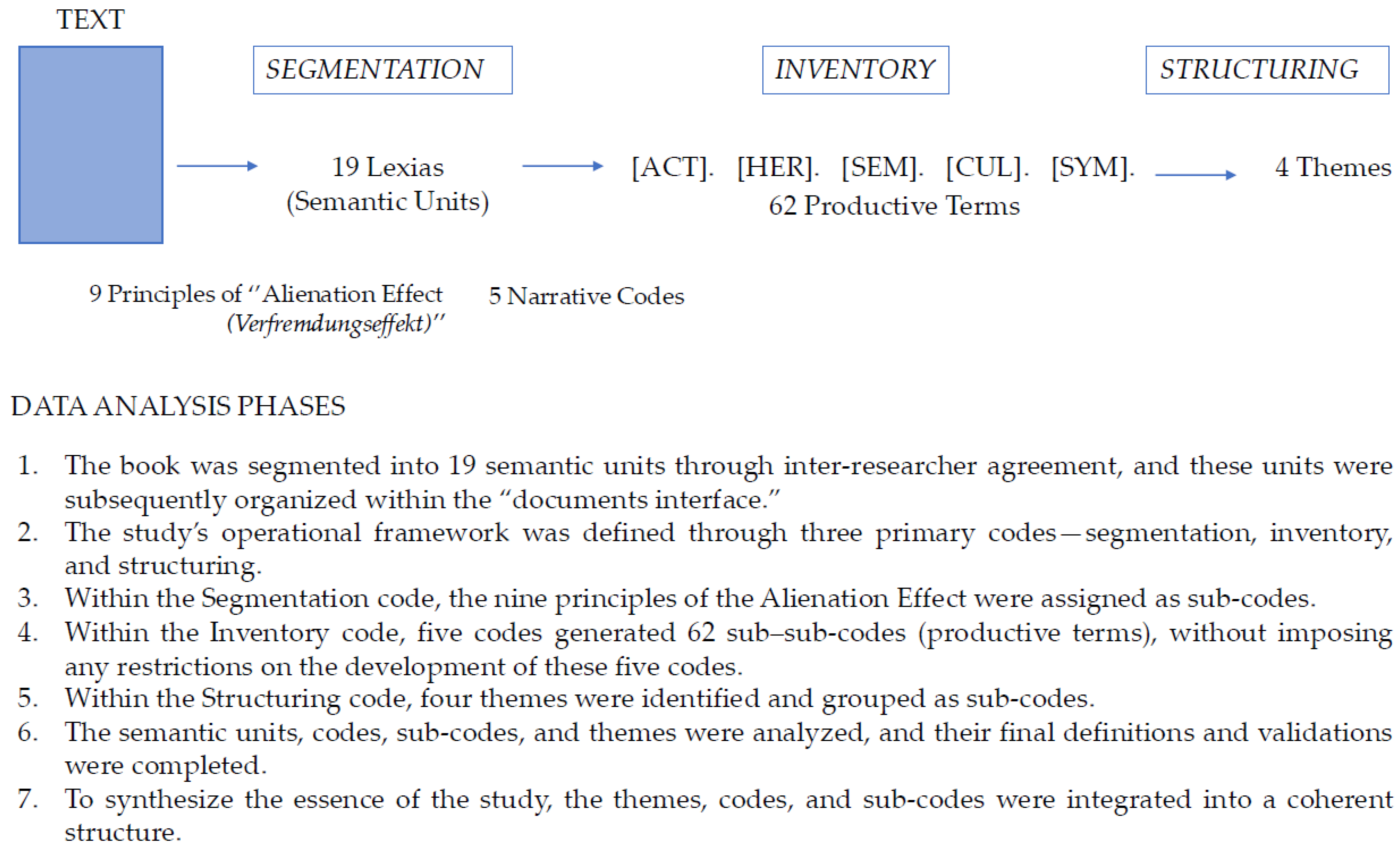
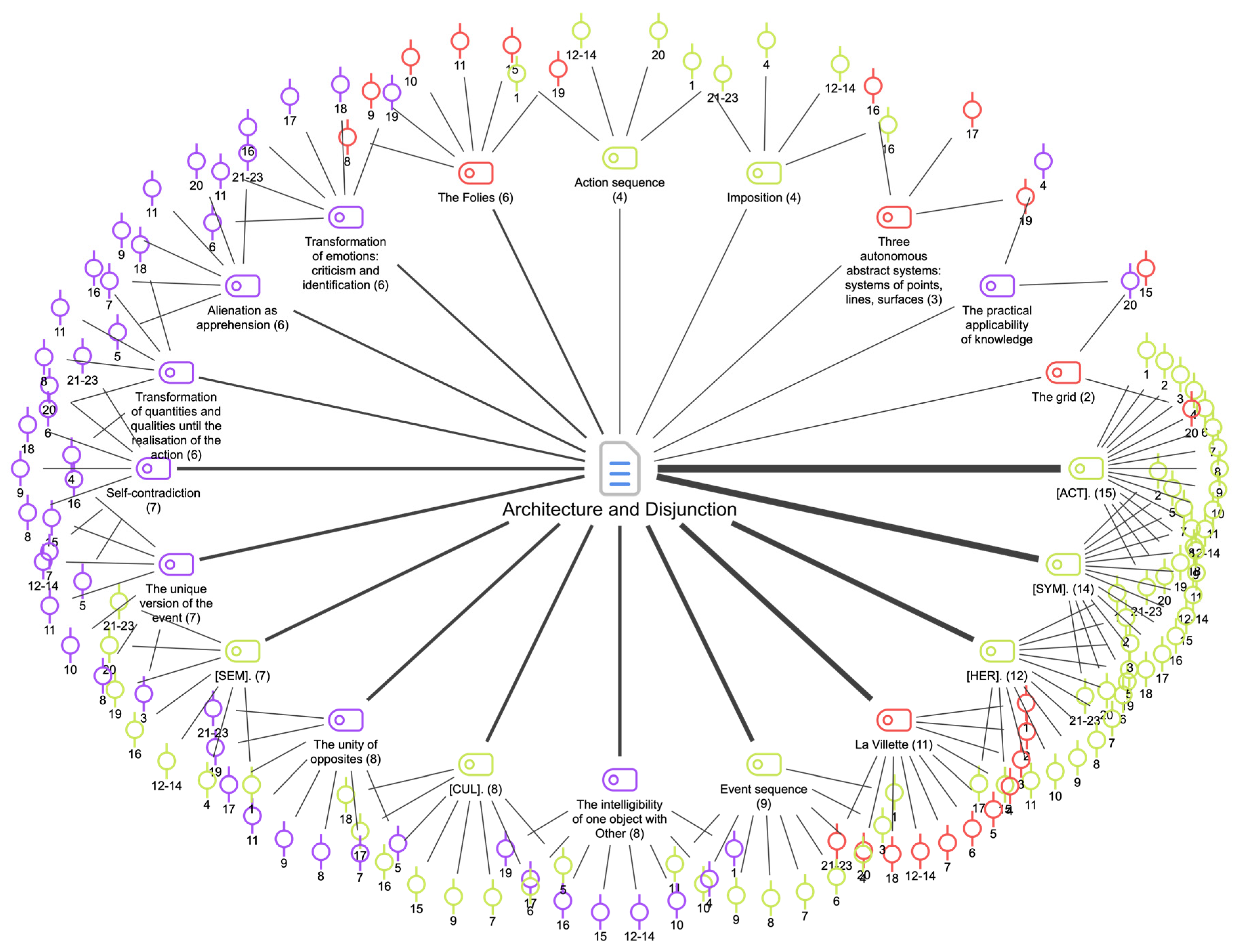
- Alienation as apprehension: Alienation allows the audience to approach the staged events with a critical distance, so that the receiver comprehends what is presented on stage not as natural or inevitable, but as a socially constructed reality.
- Transformation of quantities and qualities until the realisation of the action: Brecht’s dialectical theater emphasizes that events do not develop statically, but in constant change and transformation.
- The unique version of the event: Each scene is unique not only in terms of the meaning it represents but also in the way it is staged.
- Transformation of emotions: criticism and identification: By limiting the audience’s identification with the characters, Brecht aims to transform emotions not only empathically but also critically. In this way, emotional participation merges with critical consciousness and serves social analysis.
- Self-contradiction: The internal contradictions of characters and events make dialectical thinking visible on stage.
- The intelligibility of one object with Other: Everything becomes intelligible not only through itself, but also through its relation to its opposite or different.
- Saltation (saltus naturae): Sudden breaks in the dramatic structure and discontinuities in the narrative function directly as alienation, preventing the audience from getting used to the narrative.
- The unity of opposites: The juxtaposition of contradictory elements within the staging allows for the establishment of a dialectical unity.
- The practical applicability of knowledge: Brecht’s theater aims not only to produce knowledge but also to influence the social practices of the audience [7].
- Action code *ACT: This denotes the experimental voice that allows the narrative to be perceived as both a storyline and a sequence of actions.
- Hermeneutic code *HER: This code serves as the voice of authenticity, preserving enigmas, puzzles, and ambiguities throughout the narrative.
- Semantic code *SEM: This code conveys the mindset and perspective of the characters, thereby granting them a voice.
- Cultural code *CUL: This code pertains to scientific discourse and domains of knowledge, functioning as the voice of science.
2.3. Data Analysis
2.4. Theme Development
2.5. Data Coding
3. Results
4. Discussion
5. Conclusions
5.1. Limitations of the Study
5.2. Future Research Projections
- Pedagogical Alignment: When applied in architecture studios—particularly within design-driven, program-based learning outputs—this model can function as an adaptable, logic-oriented method that advances design decisions through justification rather than aesthetic preference. In this framework, the model supports reflective design practices grounded in Schön’s reflective practice model, Problem-Based Learning (PBL), and Design Thinking, specifically encouraging reasoning-based spatial cognition instead of taste-based validation. Here, instructors shift evaluative emphasis from subjective appreciation to systemic coherence, enabling them to assess and strengthen students’ design cognition by aligning studio deliverables with consistency-based design reasoning.
- Interdisciplinary Flexibility: Since the method operates as a transdisciplinary analytic framework connecting architecture, theatre, and narratology, it extends beyond architecture and can be re-implemented across other art and spatial narrative disciplines. This model provides structural and conceptual support for spatial interpretation provisions grounded in semantics, symbolism, and performativity. In this context, it can also follow potential narrative strata for a theatre director arranging kinetic stage compositions, a curator structuring an exhibition space, or a performance artist developing spatial rewritings, articulation the analytic readjustment and interdisciplinary reproducibility of narrative-space constructs.
- Digital Integration: When employing thematic content analysis and thematic discourse analysis, this model constructs themes through spatial clustering, code dispersion patterns, relational co-occurrence matrices, and pattern recognition features enabled via inductive coding. It can operate in parallel with digital analytic instruments, including network analysis, digital simulations, AI-driven prompt structures, eye-tracking tests, and computational pattern recognition models. In AI-prompt logic, the model first processes discourse by generating analytical output, then amplifies interpretive diversity through narrative sequencing, and finally consolidates it under a structural synthesis. Similarly, network analysis reveals and visualizes complex relational nodes, pattern infrastructures, and spatial semantic potentials; accordingly, the SIS model can be computationally transformed, simulated, tested, or integrated into broader digital workflows for spatial-narrative analytics.
- Contribution to Quantitative Methods: This model does not function solely through mathematical pattern measurement; instead, it further integrates qualitative user-experience strata into spatial configuration. Also, it complements quantitative methods such as space syntax by adding multimodal meaning-making filters, movement analytics, semantic dispersion layers, and performance-based spatial-narrative mapping. In this context, spatial configurations are not only computational but also meaning-bearing, synthesized through sensory, textual, semantic, and performative spatial-coding mechanisms.
- Urban Planning, Smart City Systems, and Intelligent Building Automation: Spatial performance measurement and interactive design procedures are receiving increasing emphasis in urban planning, smart city applications, and intelligent building automation systems. Integrating qualitative user experience into these domains enables the generation of lived-space behavioral observation models, semantic spatial-narrative chains, and experiential spatial-cognition patterns. The data patterns derived here contribute to developing systemic extensions of multi-criteria decision support infrastructures, post-occupancy evaluation (POE) traces, behavioral spatial-performance layers, everyday spatial rewritings, and meaning-centered, life-centric, design-reasoning models. In addition, it complements digital simulations by grounding design decisions on narrative–semantic spatial dispersion and relational spatial analytics.
- Theatre-Based Adaptability and Kinetic Stage Systems: This model can be re-implemented in theatre studio practices, adding a computational performance analytic layer for contemporary stage production and spatial narrative articulation. In addition to inclusion in static stage constructs using catalysts such as Chongqing 1949 Grand Theatre and House of Dancing Water Theatre, the model can be methodologically applied in kinetic stage systems by following sequence-driven spatial transformations comparable to multi-nuclei, narrative-based spatial rewritings, and meaning-bearing, configuration-driven spatial-coding layers.
Supplementary Materials
Author Contributions
Funding
Data Availability Statement
Acknowledgments
Conflicts of Interest
Appendix A

| 1 | The French philosopher Jacques Derrida is regarded as one of the key figures of post-structuralism, a movement that emerged in the 1970s in opposition to structuralism. Post-structuralism rejected the structuralist pursuit of a “science of signs” and instead emphasized deconstruction as an alternative to construction (structure) [1] (pp. 914–916). |
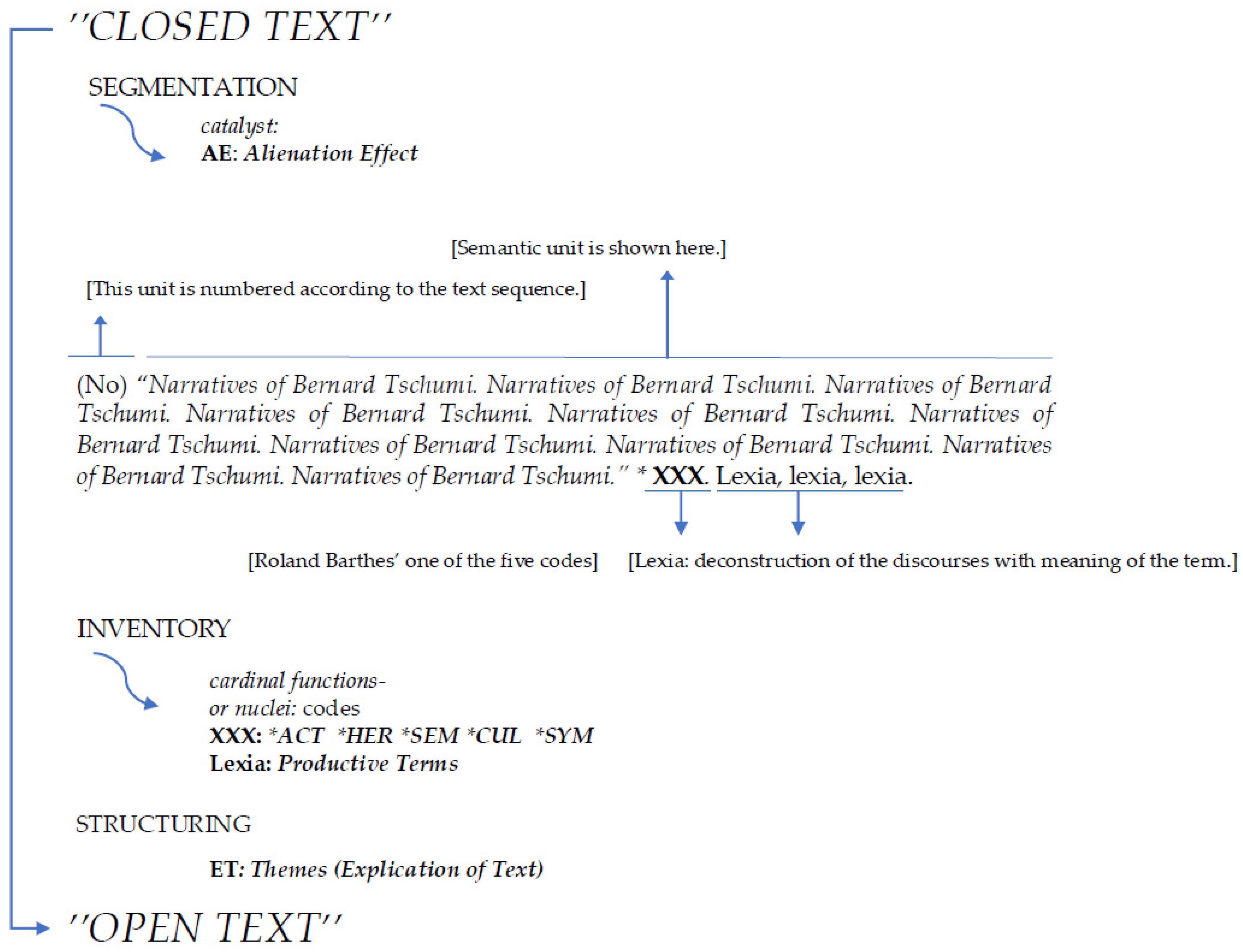
| 2 | Originally called Verfremdungseffekt, the “Alienation effect (Verfremdungseffekt)” is a critical staging technique that forms the core of Brecht’s epic theater theory and interrupts the audience’s identification with the play by creating distance between them and the performance. Detailed information about the “Alienation effect (Verfremdungseffekt),” and its coding principles, along with its hierarchical counterpart, is defined in the MAXQDA code book within the dataset and analysis section. Within the text, this concept will also be referred to as “AE” for the sake of analytical flow [7]. |
| 3 | According to Habermas (1934), “The post-avant-garde is also defined as a transition to post-modernity [13].” |
| 4 | Under the influence of theorists such as Marx, Sartre, Brecht, Saussure, Kjelmslev, Jakobson, Greimas, Barthes defines his own “shadow” times [63]. |
| 5 | Barthes states that when he wrote his critical work S/Z, he found himself and was now “out in the open [8].” |
| 6 | Semantic units are defined as dividing a text into parts according to the flow of meaning and obtaining the smallest and most expressive narrative sequences that are self-sufficient [8]. Before coding, two researchers completed the segmentation protocol to establish consistent unit boundaries. |
References
- Cevizci, A. Felsefe Sözlüğü; Paradigma Yayıncılık: İstanbul, Turkey, 1999. [Google Scholar]
- Tschumi, B. Architecture and Disjunction; MIT Press: London, UK, 1996. [Google Scholar]
- Tschumi, B. The place, the stage, the hall, the town, dramatic art, scenography and architecture at the end of the XXth century in Europe. In Personal Communication; University of Nevada, Reno: Reno, NV, USA, 1997. [Google Scholar]
- Bernard Tschumi Official Website. Available online: https://www.tschumi.com/ (accessed on 28 December 2024).
- Eisenman, P. Post/El Cards: A Reply to Jacques Derrida. Assemblage 1990, 12, 14–17. [Google Scholar] [CrossRef]
- Eisenman, P. Architecture as a Second Language: The Texts of Between. In Eisenman Inside Out: Selected Writings 1963–1988; Yale University Press: London, UK, 1988. [Google Scholar]
- Brecht, B. Über Epiches Theater, 1st ed.; Şipal, K., Ed.; Agora Kitaplığı: İstanbul, Turkey, 1967. [Google Scholar]
- Barthes, R. S/Z; Miller, R., Ed.; Farrar, Straus & Giroux: New York, NY, USA, 1974. [Google Scholar]
- Barthes, R.; Duisit, L. On Narrative and Narratives. New Lit. Hist. 1975, 6, 237–272. [Google Scholar] [CrossRef]
- Barthes, R. Writing the Image After Roland Barthes; University of Pennsylvania Press: Pennsylvania, PA, USA, 1997. [Google Scholar]
- Barthes, R. Göstergebilimsel Serüven; Rifat, M.R., Rifat, S., Eds.; Yapı Kredi Yayınları: İstanbul, Turkey, 2005. [Google Scholar]
- Barthes, R. Yazı ve Yorum; Yücel, T., Ed.; Metis: İstanbul, Turkey, 2015. [Google Scholar]
- Habermas, J. Postmodernizm; Zeka, N., Ed.; Kıyı Yayınları: İstanbul, Turkey, 1994. [Google Scholar]
- Harrison, C.; Wood, P. Art in Theory 1900–2000: An Anthology of Changing Ideas; Daldeniz, E., Ed.; Blackwell Publishing: Oxford, UK, 2003. [Google Scholar]
- Wocke, B. Derrida at Villette: (An)aesthetic of Space. Univ. Tor. Q. 2014, 83, 739–755. [Google Scholar] [CrossRef]
- Zivanovic, I.; Malesevic, M. Concept of Inter(con)textuality in Architectural Discourse and Production: Case Study: New Acropolis Museum. Prostor 2015, 23, 395–403. [Google Scholar]
- Monserrat-Gauchi, J.; Manuel Novo-Domínguez, R. Interrelations between the Media and Architecture: Contribution to Sustainable Development and the Conservation of Urban Spaces. Sustainability 2019, 11, 5631. [Google Scholar] [CrossRef]
- Bailly, A. La Perception de L’espace Urbain: Les Concepts, les Méthodes D’étude, Leur Utilisation Dans la Recherche Urbanistique; Centre de Recherche d’Urbanisme: Paris, France, 1977. [Google Scholar]
- Bailly, A. La Ville: Espace Vécu; Anthropos: Paris, France, 1996; pp. 159–165. [Google Scholar]
- Fekete, A.; van den Toorn, M. Teaching Fieldwork in Landscape Architecture in European Context; Some Backgrounds and Organisation. Land 2021, 10, 237. [Google Scholar] [CrossRef]
- Berdoulay, V. Place, Meaning, and Discourse in French Language Geography. In The Power of Place (RLE Social & Cultural Geography), 1st ed.; Agnew, J., Duncan, J., Eds.; Routledge: London, UK, 1989; pp. 124–139. [Google Scholar]
- Debarbieux, B. Le lieu, le territoire et trois figures de rhétorique. L’Espace Géogr. 1995, 24, 97–112. [Google Scholar] [CrossRef]
- Turner, T. Landscape Urbanism: Definitions and History. Landscape Architects Association. 2015. Available online: https://www.landscapearchitecture.org.uk/landscape-urbanism-definitions-and-history/ (accessed on 21 August 2023).
- McHarg, I.L. Design with Nature; The Natural History Press: New York, NY, USA, 1969. [Google Scholar]
- Tschumi, B.; Derrida, J.; Vidler, A. Tschumi Parc de La Villette; Artifice Press: London, UK, 2014. [Google Scholar]
- Canter, D.V. The Psychology of Place; Architectural Press: Oxford, UK, 1977. [Google Scholar]
- Baljon, L. Designing Parks: An Examination of Contemporary Approaches to Design in Landscape Architecture, Based on a Comparative Design Analysis of Entries for the Concours International: Parc De La Villette, Paris, 1982–1983; Wageningen University and Research/ProQuest Dissertations & Theses: Paris, France, 1992. [Google Scholar]
- Cruz, E.; Blanco, E.; Aujard, F.; Raskin, K. Has Biomimicry in Architecture Arrived in France? Diversity of Challenges and Opportunities for a Paradigm Shift. Biomimetics 2022, 7, 212. [Google Scholar] [CrossRef]
- López-Arquillo, J.D.; Ciborro Víctor, C.; Oliveira, C.; Penelas, J.L.E.; de Alba, F.; Arteaga Orozco, M.B. Ecological Design for Urban Regeneration in Industrial Metropolitan Areas: The Santa Cruz Refinery Case. Urban Sci. 2024, 8, 114. [Google Scholar] [CrossRef]
- Candito, C.; Meloni, A. Revelations of Folies through Geometric Transformations. Nexus Netw. J. 2023, 25, 269–276. [Google Scholar] [CrossRef]
- Hatipoglu, O. Performing Objects: Folies in Bernard Tschumi’s Parc de la Villette. Fr. Stud. Bull. 2014, 35, 23–25. [Google Scholar] [CrossRef]
- Martin Dominguez, G. Between Autonomy and Heteronomy: A Critical Inquiry into the Grid of Folies at Parc de La Villette. In Proceedings of the CRITIC-ALL: II International Conference on Architectural Design and Criticism, Madrid, Spain, 20–22 June 2016. [Google Scholar]
- Diomand, B. Landscape Cubism: Parks that Break the Pictorial Frame. J. Landsc. Archit. 2011, 6, 20–33. [Google Scholar] [CrossRef]
- Allen, G. Intertextuality; Routledge: London, UK, 2000. [Google Scholar]
- Baper, S.Y.; Ismael, Z.K. The Impact of Site Contexts in Increasing the Diversity of Architectural Concepts: Using an Interactive Architectural Approach. Buildings 2024, 14, 2567. [Google Scholar] [CrossRef]
- Kandinsky, W. Point and Line to Plane; Solomon, R., Ed.; Guggenheim Foundation: New York, NY, USA, 1947. [Google Scholar]
- Quan’an, C.; Junbo, L. Certainty and Uncertainty: The ‘Point, Line and Surface’ of Parc de La Villette in Paris. In Advances in Social Science, Education and Humanities Research; Atlantis Press: Amsterdam, The Netherlands, 2021. [Google Scholar]
- Eisenschmidt, A. Importing the City into Architecture: An Interview with Bernard Tschumi. Archit. Des. 2012, 82, 130–135. [Google Scholar] [CrossRef]
- Meyer, E.K. The Public Park as Avant-Garde (Landscape) Architecture: A Comparative Interpretation of Two Parisian Parks, Parc de la Villette (1983–1990) and Parc des Buttes-Chaumont (1864–1867). Landsc. J. 1991, 10, 16–26. [Google Scholar] [CrossRef]
- Crosta, P.P. Il Territorio “è L’uso Che se ne fa”; FrancoAngeli: Milano, Italy, 2010. [Google Scholar]
- A.R. Group. Complex Buildings, Generators, Linkers, Mixers & Storyteller; A+T Architecture Publishers: Vitoria-Gasteiz, Spain, 2017; Volume 48. [Google Scholar]
- A.R. Group. This Is Hybrid. In An Analysis of Mixed-Use Buildings; A+T Architecture Publishers: Vitoria-Gasteiz, Spain, 2014. [Google Scholar]
- Picon, A.; Rogers, R.G.; Piano, R. Du Plateau Beaubourg au Centre Georges Pompidou/Renzo Piano, Richard Rogers; Entretien Avec Antoine Picon; Association des Amis du Centre Pompidou: Paris, France, 1987. [Google Scholar]
- Price, C. Cedric Price: The Square Book; Academy Editions: Chichester, UK, 2003. [Google Scholar]
- Stock, M. Construire l’identité par la pratique des lieux. In Chez nous. Territoires et Identités dans les Mondes Contemporains; De Biase, A., Alessandro, C., Eds.; Éditions de la Villette: Paris, France, 2006; pp. 142–159. [Google Scholar]
- McEvilley, T. Art and Discontent: Theory at the Millennium (Documentext); McPherson & Co. Publishers: New York, NY, USA, 1998. [Google Scholar]
- Alhefnawi, M.A.M. Sustainability in Deconstructivism: A Flexibility Approach. Arab. J. Sci. Eng. 2018, 43, 5091–5099. [Google Scholar] [CrossRef]
- Barry, P. Beginning Theory; Manchester University Press: Manchester, UK, 1995. [Google Scholar]
- Wigley, M. The Architecture of Deconstruction: Derrida’s Haunt; MIT Press: Cambridge, MA, USA, 1993; pp. 41–42. [Google Scholar]
- Halland, I. The Unstable Object: Glifo, Blow and Sacco at MoMA, 1972. J. Des. Hist. 2020, 33, 329–345. [Google Scholar] [CrossRef]
- Derrida, J. Of Grammatology; The Johns Hopkins University Press: Maryland, MD, USA, 1967. [Google Scholar]
- Tošić, J. Deconstruction in Architecture–Continuous Translation through an Open Project. AM J. Art Media Stud. 2017, 12, 99–107. [Google Scholar] [CrossRef]
- Hegzi, Y.S.; Abdel-Fatah, N.A. Quantifying Students’ Perception for Deconstruction Architecture. Ain Shams Eng. J. 2018, 9, 2745–2754. [Google Scholar] [CrossRef]
- Fontana-Giusti, G.K. The Landscape of the Mind: A Conversation with Bernard Tschumi. Archit. Cult. 2016, 4, 263–280. [Google Scholar] [CrossRef]
- Conye, R. Derrida for Architects; Routledge: Milton Park, UK, 2011. [Google Scholar]
- Maslikova, I.; Svitlana, S. The Visualisation of Cosmological Ideas in Contemporary Architecture. Philos. Cosmol. 2022, 29, 26–39. [Google Scholar] [CrossRef]
- Ferrero, G.; Cotti, C.; Rossi, M.; Tedeschi, C. Geometries of Imaginary Space: Architectural Developments of the Ideas of M. C. Escher and Buckminster Fuller. Nexus Netw. J. 2009, 11, 305–316. [Google Scholar] [CrossRef]
- Bourriaud, N. Radicant; Sternberg Press: London, UK, 2009. [Google Scholar]
- Coates, N. Narrative Architecture; Wiley: New York, NY, USA, 2012. [Google Scholar]
- Eisenman, P. House III: To Adolf Loos and Bertolt Brecht. Prog. Archit. 1974, 55, 99. [Google Scholar]
- Tait, P. Introduction: Analysing Emotion and Theorising Affect. Humanities 2016, 5, 70. [Google Scholar] [CrossRef]
- Classen, A. Humanities—To Be or Not To Be, That Is the Question. Humanities 2012, 1, 54–61. [Google Scholar] [CrossRef]
- Barthes, R. Roland Barthes; Éditions du Seuil: Paris, France, 1975. [Google Scholar]
- Jamieson, C. ‘Wake/Up/And/Dream/For/The/Eighties’: Nigel Coates 1975–1982. J. Archit. 2015, 20, 122–151. [Google Scholar] [CrossRef]
- Short, T. Of Mice and Madness: Questions of Occupation Interpreted through Disneyland and Parc de la Villette. J. Archit. 2011, 3, 147–169. [Google Scholar] [CrossRef]
- Vidler, A. Architecture After the Rain. Archit. Des. 2018, 88, 16–23. [Google Scholar] [CrossRef]
- Clarivate—Web of Science (YTU Library). Available online: https://yordam.yildiz.edu.tr/vetisbt/?p=1&dil=tr (accessed on 2 February 2025).
- Bonicco-Donato, C. Philosophical deconstruction and architectural deconstructivism. Arch. Philos. 2020, 83, 125–144. [Google Scholar] [CrossRef]
- Atkin, A.; Albert, N. Peirce’s Theory of Signs; Cambridge University Press: Cambridge, UK, 2020. [Google Scholar]
- Liszka, J.J. A General Introduction to the Semiotic of Charles Sanders Peirce; Indiana University Press: Indiana, IN, USA, 2021. [Google Scholar]
- Peirce, C.S. The Essential Peirce. Selected Philosophical Writings; Indiana University Press: Bloomington, IN, USA, 1998; Volume 2. [Google Scholar]
- Eco, U. The Open Work; Cancogni, A., Ed.; Harvard University Press: Cambridge, MA, USA, 1989. [Google Scholar]
- Codeluppi, V. The Open Work Revisited; Springer: Berlin/Heidelberg, Germany, 2022. [Google Scholar]
- Gottdiener, M.; Mark, N. Postmodern Semiotics: Material Culture and the Forms of Postmodern Life; Palgrave Macmillan: London, UK, 2019. [Google Scholar]
- Vihma, S.; Susann, N. Design Semiotics in Use; Aalto University Press: Helsinki, Finland, 2010. [Google Scholar]
- Zumthor, P. Atmospheres: Architectural Environments—Surrounding Objects; Birkhauser Publishers for Architecture: Basel, Switzerland, 2006. [Google Scholar]
- Pallasmaa, J. The Eyes of the Skin; John Wiley & Sons: New Jersey, NJ, USA, 2020. [Google Scholar]
- Deleuze, G.; Guattari, F. A Thousand Plateaus: Capitalism and Schizophrenia; University of Minnesota Press: Minnesota, MN, USA, 1987. [Google Scholar]
- Rajchman, J. The Deleuze Connections; MIT Press: Cambridge, MA, USA, 2000. [Google Scholar]
- Armstrong, H. Urban Narratives and Spatial Storytelling; Routledge: London, UK, 2021. [Google Scholar]
- Franck, K.; Stevens, Q. Loose Space: Possibility and Diversity in Urban Life; Routledge: London, UK, 2007. [Google Scholar]
- Groat, L.; Wang, D. Architectural Research Methods; Wiley: Hoboken, NJ, USA, 2020. [Google Scholar]
- Goodman, N. Ways of Worldmaking; Hackett Publishing: Massachusetts, MA, USA, 1978. [Google Scholar]
- Fischer-Lichte, E. The Routledge Introduction to Theatre and Performance Studies; Routledge: London, UK, 2014. [Google Scholar]
- Lefebvre, H. Rhythmanalysis: Space, Time and Everyday Life; Continuum: London, UK, 2004. [Google Scholar]
- Rendell, J. Art and Architecture: A Place Between; I.B. Tauris: London, UK, 2010. [Google Scholar]
- Rendell, J. Critical Spatial Practice: An Essay; Sternberg Press: London, UK, 2018. [Google Scholar]
- Chase, J.; Crawford, M.; Kaliski, J. Everyday Urbanism; Monacelli Press: New York, NY, USA, 2008. [Google Scholar]
- Hillier, B.; Hanson, J. The Social Logic of Space; Cambridge University Press: Cambridge, UK, 1984. [Google Scholar]
- Hillier, B. Space is the Machine: A Configurational Theory of Architecture, revised ed.; Space Syntax Laboratory: London, UK, 2021. [Google Scholar]
- Batty, M. The New Science of Cities; MIT Press: Cambridge, MA, USA, 2013. [Google Scholar]
- Batty, M. Inventing Future Cities; MIT Press: Cambridge, MA, USA, 2019. [Google Scholar]
- Goffman, E. The Presentation of Self in Everyday Life; Anchor Books: Harpswell, ME, USA, 1959. [Google Scholar]
- McAuley, G. Space in Performance: Making Meaning in the Theatre; University of Michigan Press: Michigan, MI, USA, 2000. [Google Scholar]
- Kipnis, J. Towards a New Architecture; ANY Magazine/Anyone Corporation: New York, NY, USA, 1993. [Google Scholar]
- Schumacher, P. The Autopoiesis of Architecture; Wiley: New Jersey, NJ, USA, 2011. [Google Scholar]
- Tschumi, B. The Manhattan Transcripts; St. Martin’s Press: New York, NY, USA, 1981. [Google Scholar]
- Tschumi, B. Event-Cities; MIT Press: Cambridge, MA, USA, 1999. [Google Scholar]
- Cupers, K. Use Matters: An Alternative History of Architecture; Routledge: London, UK, 2013. [Google Scholar]
- Carpo, M. The Second Digital Turn: Design Beyond Intelligence; MIT Press: Cambridge, MA, USA, 2017. [Google Scholar]
- Oxman, N. Material Ecology. Des. Stud. 2017, 58, 1–21. [Google Scholar] [CrossRef]
- Picon, A. Smart Cities: A Spatialised Intelligence; Wiley: New Jersey, NJ, USA, 2018. [Google Scholar]
- Kim, J.; Nam, S.-T. Exodus as Intermediation between the Berlin Wall and Manhattan Grid: Disjunction, Subdivision and Programmatization of Void. J. Asian Archit. Build. Eng. 2025, 24, 4742–4757. [Google Scholar] [CrossRef]
- Kutay Karaçor, E.; Uzun Yüksel, K.; Şenik, B. Modernity vs. Postmodernity: Assessing the Design Quality of Urban Parks by AHP. Sanat Ve Tasarım Derg. 2021, 11, 63–72. [Google Scholar] [CrossRef]
- Canclini, A. Counterpoint to the Parc de la Villette. Aut Aut 2015, 368, 183–196. [Google Scholar]
- Jovanovic, V.; Baumann, C. The ‘versatile monument’ question: Parc de la Villette as managed reality. J. Landsc. Archit. 2015, 10, 78–89. [Google Scholar] [CrossRef]
- Šćitaroci, B.B.O.; Matuhina, N. Landscape Urbanism: New Spatial Paradigm. Prostor 2012, 20, 106–117. [Google Scholar]
- Tao, H.; Wen, Y.; Liu, M.; Wu, Y. Industrial Heritage Protection from the Perspective of Spatial Narrative. Land 2025, 14, 1105. [Google Scholar] [CrossRef]
- Deleuze, G. Kıvrım (Leibniz ve Barok); Yücefer, Ç.H., Ed.; Bağlam Yayınları: İstanbul, Turkey, 2006. [Google Scholar]
- Barthes, R. Eleştirel Denemeler; Özdoğan, Ç.E., Ed.; Yapı Kredi Yayınları: İstanbul, Turkey, 2018. [Google Scholar]
- Creswell, J.W. Qualitative Inquiry and Research Design: Choosing Among Five Approaches; Sage: Thousand Oaks, CA, USA, 2007. [Google Scholar]
- Creswell, J.W.; Creswell, J.D. Research Design: Qualitative, Quantitative, and Mixed Methods Approaches; Sage: Thousand Oaks, CA, USA, 2017. [Google Scholar]
- Braun, V.; Clarke, V. Using thematic analysis in psychology. Qual. Res. Psychol. 2006, 3, 77–101. [Google Scholar] [CrossRef]
- Scharp, K.M.; Sanders, M.L. What is a theme? Teaching thematic analysis in qualitative communication research methods. Commun. Teach. 2019, 33, 117–121. [Google Scholar] [CrossRef]
- Kuckartz, U.; Stefan, R. Using MAXQDA for Mixed Methods Research; Johnson, B.R., Onwuegbuzie, A.J., Eds.; Routledge: New York, NY, USA, 2021; pp. 305–318. [Google Scholar]
- Landis, J.R.; Koch, G.G. The measurement of observer agreement for categorical data. Biometrics 1977, 33, 159–174. [Google Scholar] [CrossRef]
- Barthes, R. Introduction to the Structural Analysis of Narratives. In Image, Music, Text; Hill and Wang: New York, NY, USA, 1977. [Google Scholar]
- Barthes, R. Image Music Text; Fontana Press: London, UK, 1977. [Google Scholar]
- Thomson, D. Gilbert Adair: Novelist, Critic and Screenwriter Whose Work Shone with Wit and Playfulness. Available online: https://www.independent.co.uk/news/obituaries/gilbert-adair-novelist-critic-and-screenwriter-whose-work-shone-with-wit-and-playfulness-6276065.html (accessed on 1 December 2025).
- Tschumi, B. Architecture Concepts: Red is Not a Color; Rizzoli: New York, NY, USA, 2012. [Google Scholar]



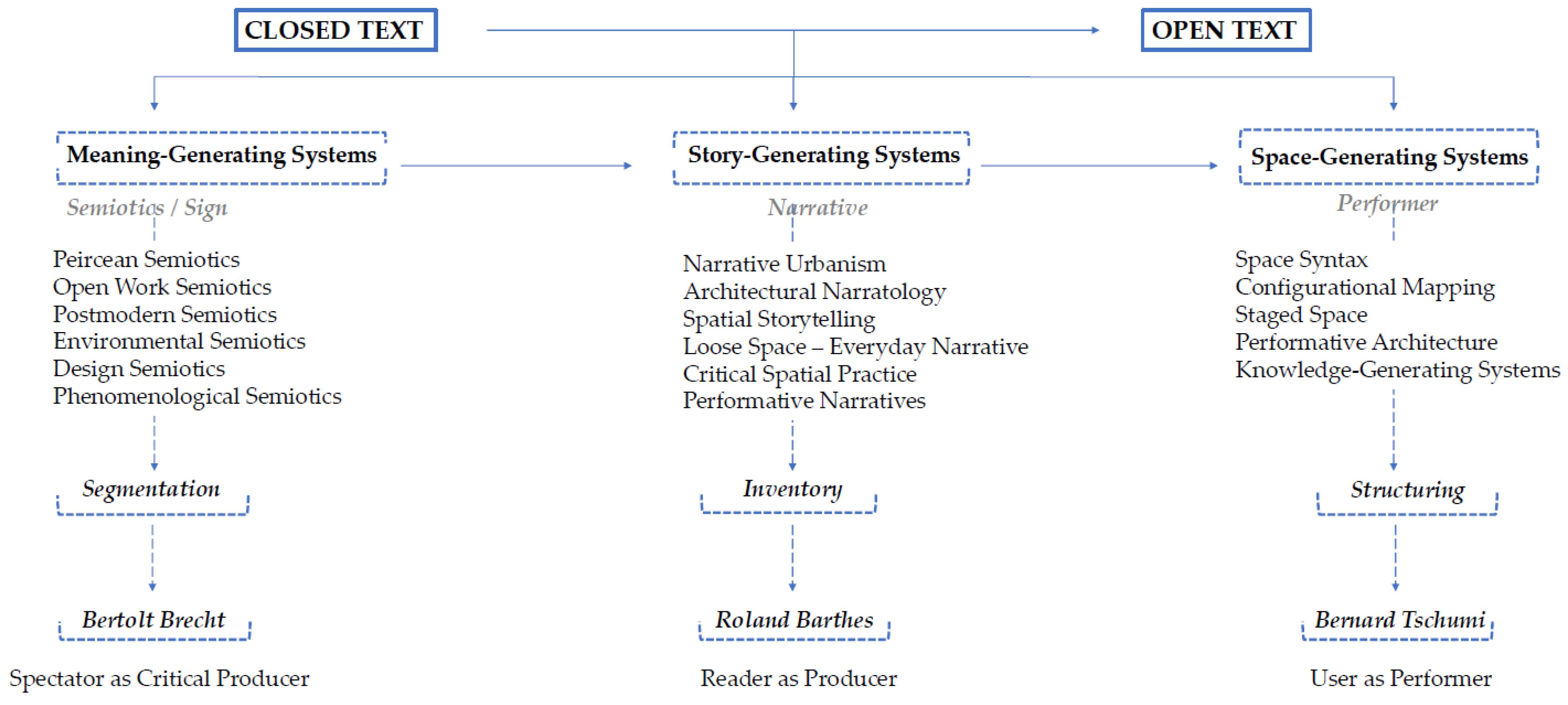
| Theory/Approach “Meaning-Generating Systems” | Epistemological Origins | Ontological Conception of Space | Knowledge Produced in Architecture | Core Statements | Positioning Relative to Brecht |
|---|---|---|---|---|---|
| Peircean Semiotics [69,70,71] | Pragmatic semiotics; triadic sign theory | Space as a field of signification structured through icon–index–symbol relations | Contextual reading of spatial sign systems; relational meaning | Architecture operates through triadic semiosis, where spatial meaning emerges from icon–index–symbol relations within contextual environments. | Supports Brechtian critical distancing by analytically decomposing meaning into discrete semantic units6. |
| Open Work Semiotics [72,73] | Interpretive semiotics, openness, reader-centered theory | Space as an open, interpretive “work” with multiple semantic potentials | Emphasizes indeterminacy and interpretive multiplicity in spatial meaning | Architectural meaning remains open, unfinished, and co-produced by users through interpretive interaction. | Directly aligns with Brecht’s “Alienation Effect (Verfremdungseffekt)” by transforming the user into an active co-producer of meaning. |
| Postmodern Semiotics [74] | Cultural semiotics, critical theory, symbolic economy | Space as a socio-cultural and ideological construct | Enables critique of symbolic consumption and cultural codes in architecture | Architecture operates as a cultural and ideological sign-system shaped by symbolic economy and collective codes. | Reinforces Brecht’s critical stance through the deconstruction of ideological codes and cultural mythologies. |
| Design Semiotics [75] | Product semantics and design linguistics | Space mediated through objects and their semiotic functions | Systematic decoding of design language and artefact–space relationships | Architectural meaning emerges from the semiotic performance of designed objects within spatial environments. | Parallels Brecht’s notion of gestus by foregrounding the performative and constructed nature of design objects. |
| Phenomenological Semiotics [76,77] | Phenomenology; embodied perception; lived experience | Space as an experiential, perceptually constituted phenomenon | Produces knowledge about atmosphere, embodiment, sensory interaction | Architectural meaning arises through embodied perception, sensory presence, and lived spatial experience. | It enhances bodily awareness and foregrounds the process of identification that Brecht seeks to interrupt through alienation. |
| Deleuzian Spatial Semiosis [78,79] | Poststructural philosoph, difference, becoming | Space as a dynamic assemblage of flows, intensities, folds | Diagrammatic, process-based understanding of spatial events | Architecture is a non-representational field of becoming, where space emerges from continuous flows, intensities and diagrammatic relations. | Strongly resonates with Brecht’s “Other” logic by emphasizing discontinuity, multiplicity, and non-representational becoming. |
| Theory/Approach “Story-Generating Systems” | Epistemological Origins | Ontological Conception of Space | Knowledge Produced in Architecture | Core Statements | Positioning Relative to Barthes |
|---|---|---|---|---|---|
| Narrative Urbanism [59,80,81] | Postmodern narrative theory; design storytelling | City as a narrative field structured through events | Urban sequences, event-based readings of city form | Urban form is interpreted as a sequence of narratively structured events that generate meaning through spatial episodes. | Extends Barthes’ narrative codes by treating urban form as a sequence of legible spatial episodes. |
| Architectural Narratology [82,83] | Structuralist and post-structural narratology | Space conceptualized as text | Produces grammars, codes, and narrative structures embedded in architecture | Architecture operates as a narrativized text whose spatial grammar and code structures organize meaning. | Fully aligned with Barthes’ structural narratology through its use of grammar, codes, and syntagmatic organization. |
| Performative Narratives [84,85] | Performance studies; act theory | Space as an enacted field shaped through embodied actions | Knowledge of spatial performance, ritual, and bodily inscription | Spatial meaning emerges through embodied actions that script, enact, and transform architectural situations. | Resonates with Barthes’ concept of the “writerly text” by producing meaning through embodied, enacted narrative acts. |
| Critical Spatial Practice [86,87] | Feminist theory; critical theory; situated knowledge | Space as a political and socially constructed practice | Knowledge on power, positionality, and situated critique | Architecture is a situated cultural practice where spatial meaning is produced through critical, political, and relational interventions. | Parallels Barthes’ myth deconstruction by exposing ideological structures and enabling critical reinterpretation of space. |
| Loose Space/Everyday Narrative [81,88] | Everyday urbanism; social practice theory | Space as re-appropriated by users unpredictably | Knowledge about informal, emergent spatial practices | Spatial meaning is continually rewritten through users’ spontaneous, informal, and everyday appropriations. | Directly matches Barthes’ idea of the “reader as producer,” foregrounding users’ active rewriting of spatial meaning. |
| Theory/Approach “Space-Generating Systems” | Epistemological Origins | Ontological Conception of Space | Knowledge Produced in Architecture | Core Statements | Positioning Relative to Tschumi |
|---|---|---|---|---|---|
| Space Syntax [89,90] | Spatial configuration theory | Space as a relational topological system | Predictive knowledge of movement, visibility, and integration | Architecture is understood as a topological field where spatial relations produce measurable patterns of movement and social interaction. | Methodologically parallel to Tschumi’s diagrammatic abstractions, as both treat space as a relational system whose patterns can be analytically mapped. |
| Configurational Mapping [91,92] | Diagrammatic and analytical epistemology | Space as geometric/topological matrix | Relational mapping of spatial properties | Architectural knowledge emerges through diagrammatic mapping that reveals geometric, topological, and configurational structures of space. | Highly consistent with Tschumi’s diagrammatic logic, reading space as a geometric–topological matrix structured through relational mappings. |
| Staged Space [93,94] | Dramaturgical theory; performance studies | Space as a stage facilitating action | Knowledge on spatial dramaturgy, scenography | Space functions as a dramaturgical field where actions, framing and mise-en-scène produce performative spatial meaning. | Intersects with Brechtian stage theory and Tschumi’s event diagrams by conceptualizing space as a dramaturgical field that frames and activates action. |
| Performative Architecture/ Urbanism [2,86,87,95,96,97,98,99] | Performative theory; event philosophy | Space as an event-producing mechanism | Knowledge of architectural actions, scripts, programmatic activation | Architecture becomes a performative system in which events, bodily actions and programmatic scripts actively generate space. | Fundamentally aligned with Tschumi’s Event Architecture, emphasizing the generation of space through events, bodily actions, and programmatic scripts. |
| Knowledge- Generating Systems [100,101,102] | Complexity theory; computational design; adaptive systems | Space as a dynamic generator of data and knowledge | Data-driven, systemic, adaptive architectural strategies | Space operates as a dynamic knowledge apparatus where emergent patterns, feedback loops, and algorithmic processes continuously generate architectural intelligence. | Resonates with Tschumi’s “process over form” principle by treating space as a dynamic, data-driven apparatus that continually produces architectural knowledge through emergent and iterative processes. |
| Author(s) | Year | Topic | Method | Database |
|---|---|---|---|---|
| Junhyuk Kim, Sung-Taeg Nam [103] | 2025 | Exodus as intermediation between the Berlin Wall and Manhattan Grid: disjunction, subdivision and programmatization of void | This study adopts a qualitative, interpretive, theory-driven analytical framework. | Scopus |
| Cristina Càndito, Alessandro Meloni [30] | 2023 | Revelations of Folies through Geometric Transformations | The study employs a qualitative, practice-based, student-centered studio methodology grounded in geometric transformation theory. | Scopus |
| Elif Kutay Karaçor, Kıymet Uzun Yüksel, Berfin Şenik [104] | 2021 | Modernity vs. Postmodernity: Assessing the Design Quality of Urban Parks by AHP | This study employs the quantitative Analytic Hierarchy Process (AHP) to compare the design quality of modern and postmodern urban parks, evaluating them based on expert criteria. | WoS |
| Andrea Canclini [105] | 2015 | Counterpoint to the Parc de la Villette | (The full text of this article was not accessible.) | Scopus |
| Vesna Jovanovic, Céline Baumann [106] | 2015 | The ‘versatile monument’ question: Parc de la Villette as managed reality | This study uses a qualitative interpretive approach, integrating document review and site observation to analyse Parc de la Villette as a managed spatial reality. | WoS |
| Brendon Wocke [15] | 2014 | Derrida at Villette: (An)aesthetic of Space | (The full text of this article was not accessible.) | Scopus |
| Ozum Hatipoglu [31] | 2014 | Performing Objects: Folies In Bernard Tschumi’s Parc de la Villette | (The full text of this article was not accessible.) | Scopus |
| Bojana Bojanić Obad Šćitaroci, Nikola Matuhina [107] | 2012 | Landscape Urbanism: New spatial paradigm | This study employs a qualitative methodology based on historical and comparative analysis framework. | Scopus |
| Beth Diamond [33] | 2012 | Landscape Cubism: parks that break the pictorial frame | This study employs an analytical qualitative framework that incorporates a convergent case study and a comparative analysis of contemporary parklands. | Scopus |
| Thematic Content Analysis | Thematic Discourse Analysis | |
|---|---|---|
| 1 | Formulating the theoretical background and preparing the data | Describing the thematic framework |
| 2 | Segmenting the texts into semantic units | Establishing relationships among codes, sub-codes, and themes |
| 3 | Examining the semantic units and assigning codes and sub-codes | Analyzing the themes |
| 4 | Grouping sub-codes to identify thematic patterns | Analyzing the results |
| 5 | Interpreting thematic patterns using appropriate sampling techniques | Interpreting the results through visual representations |
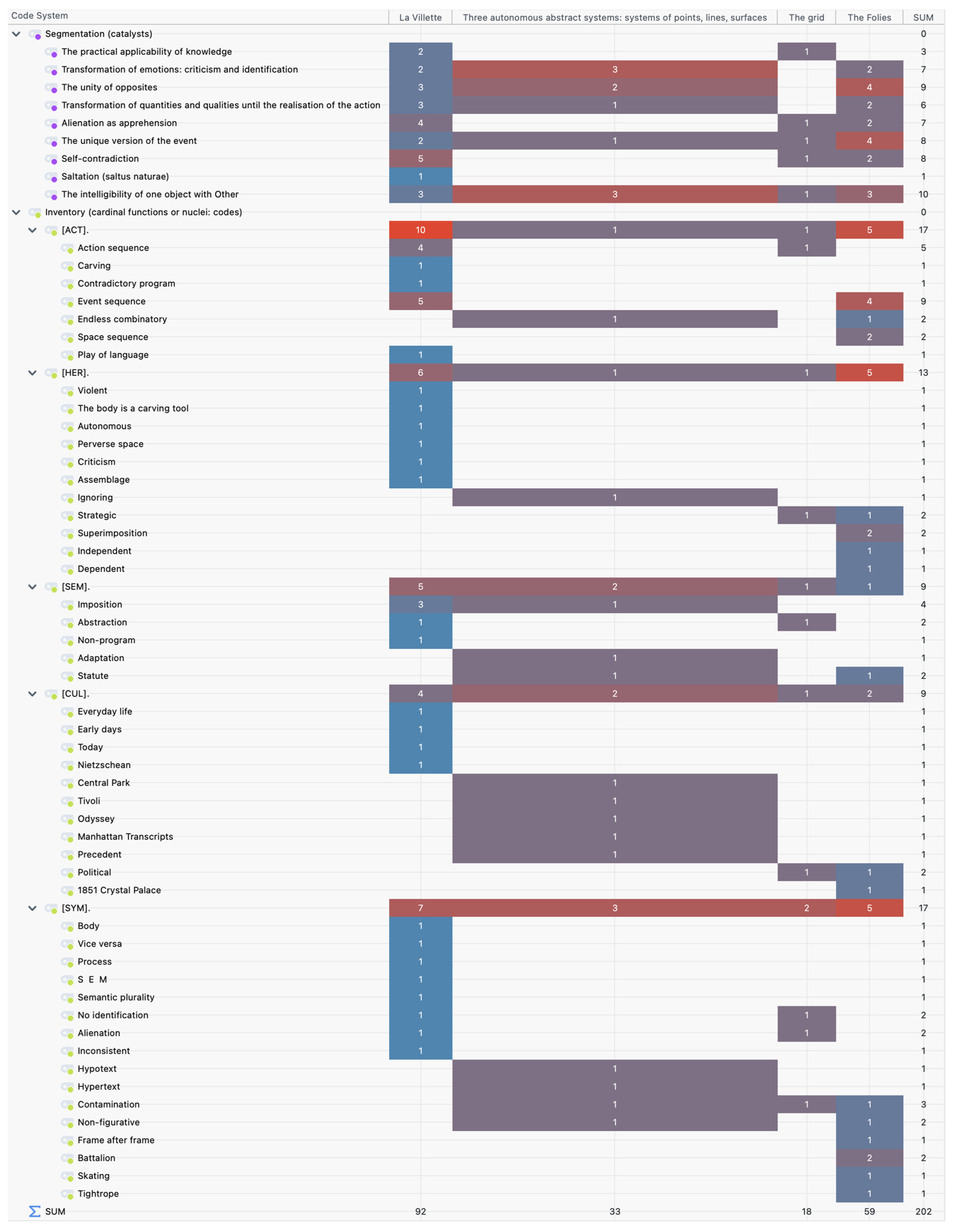
| AE Saltation (saltus naturae), Self-contradiction, The intelligibility of one object with Other, The unity of opposites, Transformation of quantities and qualities until the realisation of the action, The practical applicability of knowledge, Alienation as apprehension, Transformation of emotions: criticism and identification, The unique version of the event. |
| ACT. Action sequence, Carving, Condictory program, and Event sequence are the productive terms demonstrated through this code. HER. Violent, The body is a carving tool, Autonomous, Perverse space, Criticism, and Assemblage are the productive terms that have been demonstrated through this code. SEM. Imposition, Abstraction, and Non-program are productive terms demonstrated through this code. CUL. Everyday life, Early days, Today, and Nietzschean are productive terms that have been demonstrated through this code. SYM. Body, Vice versa, Process, S E M, Semantic plurality, No identification, Alienation, and Inconsistent are the productive terms that have been demonstrated through this code. |
| ET La Villette |
| AE Transformation of quantities and qualities until the realization of the action, The unique version of the event, Transformation of emotions: criticism and identification, The intelligibility of one object with Other, The unity of opposites. |
| ACT. Endless combinatory is the productive term that has been demonstrated through this code. HER. Ignoring is the productive term, having been demonstrated through this code. SEM. Adaptation, Imposition, and Statute are productive terms that have been demonstrated through this code. CUL. Central Park, Tivoli, Odyssey, Manhattan Transcripts, and Precedent are productive terms that have been demonstrated through this code. SYM. Hypotext, Hypertext, Contamination, and Non-figurative are productive terms that have been demonstrated through this code. |
| ET Three autonomous abstract systems: systems of points, lines, surfaces |
| AE The unique version of the event, The intelligibility of one object with Other, The practical applicability of knowledge, Self-contradiction, Alienation as apprehension |
| ACT. Action sequence is the productive term having been demonstrated through this code. HER. Strategic is the productive term having been demonstrated through this code. SEM. Abstraction is the productive term having been demonstrated through this code. CUL. Political is the productive term having been demonstrated through this code. SYM. Contamination, No identification, and Alienation are productive terms demonstrated through this code. |
| ET The grid |
| AE The transformation of quantities and qualities until the realisation of the action, The unique version of the event, Self-contradiction, The unity of opposites, Alienation as apprehension, The unique version of the event, Transformation of emotions: criticism and identification, The intelligibility of one object with Other. |
| ACT. Event sequence, Space sequence, and Endless combinatory are the productive terms that have been demonstrated through this code. HER. Superimposition, Independent, Dependent, and Strategic are the productive terms demonstrated through this code. SEM. Statute is the productive terms having been demonstrated through this code. CUL. 1851 Crystal Palace, and Political are the productive terms having been demonstrated through this code. SYM. Frame after frame, Battalion, skating, tightrope, Contamination, and Non-figurative are the productive terms that have been demonstrated through this code. |
| ET The Folies |
Disclaimer/Publisher’s Note: The statements, opinions and data contained in all publications are solely those of the individual author(s) and contributor(s) and not of MDPI and/or the editor(s). MDPI and/or the editor(s) disclaim responsibility for any injury to people or property resulting from any ideas, methods, instructions or products referred to in the content. |
© 2025 by the authors. Licensee MDPI, Basel, Switzerland. This article is an open access article distributed under the terms and conditions of the Creative Commons Attribution (CC BY) license (https://creativecommons.org/licenses/by/4.0/).
Share and Cite
Yılmaz, E.; Akbulut, M.T. Explication of Urban Park Narratives: From Land to the La Villette. Land 2025, 14, 2391. https://doi.org/10.3390/land14122391
Yılmaz E, Akbulut MT. Explication of Urban Park Narratives: From Land to the La Villette. Land. 2025; 14(12):2391. https://doi.org/10.3390/land14122391
Chicago/Turabian StyleYılmaz, Esin, and Muzaffer Tolga Akbulut. 2025. "Explication of Urban Park Narratives: From Land to the La Villette" Land 14, no. 12: 2391. https://doi.org/10.3390/land14122391
APA StyleYılmaz, E., & Akbulut, M. T. (2025). Explication of Urban Park Narratives: From Land to the La Villette. Land, 14(12), 2391. https://doi.org/10.3390/land14122391