Article

From Rapid Growth to Slowdown: A Geodetector-Based Analysis of the Driving Mechanisms of Urban–Rural Spatial Transformation in China


1
School of Geography and Planning, Sun Yat-sen University, Guangzhou 510006, China
2
United Research Institute for Rural Revitalization, Sun Yat-sen University, Guangzhou 510275, China
3
Institute of Guangdong Province Practice of Chinese Modernization, Sun Yat-sen University, Guangzhou 510275, China
4
Land Research Center, Sun Yat-sen University, Guangzhou 510275, China
*
Author to whom correspondence should be addressed.
Land 2025, 14(12), 2385; https://doi.org/10.3390/land14122385 (registering DOI)
Submission received: 19 October 2025 / Revised: 27 November 2025 / Accepted: 4 December 2025 / Published: 6 December 2025
(This article belongs to the Section Urban Contexts and Urban-Rural Interactions)

Abstract

Against the backdrop of China’s slowing urbanization and increasing regional disparities, existing research on the spatiotemporal evolution and multidimensional drivers of urban–rural transformation (URT) requires further elaboration, particularly regarding county-level differentiation and the dynamic interactions among these drivers. This study integrates spatiotemporal hot spot analysis with a multi-factor geographical detector model to systematically examine China’s URT from 1990 to 2023. The findings reveal the following: (1) The area of urban–rural construction land increased by 149.54% overall from 1990 to 2023, but the annual average growth rate dropped sharply to 4.32% during 2000–2023, indicating overall deceleration in spatial expansion. (2) Significant structural adjustments occurred at the county level: the proportion of counties with high spatial expansion degree decreased by 20%, while counties experiencing spatial contraction increased by 6%, suggesting that growth dynamics have become increasingly concentrated in limited counties. (3) Spatially, a clear “northern contraction and southern expansion” divergence emerged, which was primarily driven by the synergistic effects of policy reorientation, market-driven factor mobility, and differential natural endowments. (4) Expanding counties benefited from urban agglomeration plans, population influx, industrial upgrading, and favorable terrain, whereas contracting counties were constrained by rigid ecological and farmland conservation policies, population outmigration, undiversified industries, and topographical limitations. These findings provide an important premise for formulating feasible policies on differentiated spatial governance and urban–rural sustainable development.

1. Introduction

Globally, rapid industrialization and urbanization have reshaped urban–rural relationships while driving economic growth. Western countries universally experienced a transition from a phase of urban clustering and expansion, through urban–rural imbalance, toward coordinated development [1,2,3]. Nevertheless, significant urban–rural disparities persist, manifesting in forms such as population decline and inadequate public services in European rural areas, as well as economic stagnation in the American Rust Belt and limited healthcare access in remote communities [4,5]. After achieving high urbanization, urban–rural systems in developed countries have evolved into a new phase shaped by stringent spatial planning, market-led restructuring, and environmental conservation, manifesting in growth slowdown, spatial reorganization, and a priority on functional integration and rural sustainability [6,7,8]. Following decades of rapid urbanization, China’s urbanization rate now exceeds 65%, entering a critical phase characterized by slowing growth and an emphasis on quality enhancement [9]. In this new context, the urban–rural development dynamic is undergoing a fundamental transition: the extensive growth model, previously dominated by urban polarization effects and large-scale construction land expansion, is no longer sustainable. Urban–rural transformation (URT), understood as the systematic evolution of the urban–rural territorial system in spatial structure, functional linkages, and element flows to meet sustainable development needs [10,11], has seen its core agenda shift from spatial expansion to spatial structural optimization and functional integration. However, current research still lacks a systematic analysis of the spatiotemporal evolutionary stages, regionally differentiated patterns, and core driving mechanisms of China’s URT in this new urbanization context.
China’s rapid urbanization since the 1978 reforms has driven remarkable economic growth, yet persistent urban–rural imbalances remain evident. While the population urbanization rate surged from around 18% to 67% in 2024, the urban–rural income ratio stayed high, stabilizing near 2.6 (2.4 in 2024), reflecting structural disparities rooted in long-standing urban–priority policies and the dual urban–rural structure [12,13]. These have led to chronically uneven flows and inefficient allocation of production factors. Concurrently, the average annual population urbanization growth rate has slowed considerably, from about 3.6% (2000–2012) to roughly 2.0% (2012–2024), signaling a shift from rapid expansion toward quality-oriented development. Despite benefits from urban diffusion and technological innovations alleviating agricultural poverty, rural areas still face chain-reaction pressures, such as population outflow, farmland abandonment, environmental degradation, and inadequate public services [3,14]. Therefore, systematically analyzing the spatiotemporal evolution and driving mechanisms of URT, with a focus on construction land dynamics, is essential for fostering urban–rural integration and sustainable development.
Scholars have conducted comprehensive research on URT from both theoretical and empirical perspectives. Theoretically, early research drew on the urban–rural dual economy and growth pole theories [15,16], which illuminated the structural causes of urban–rural disparity and the role of cities as drivers of unbalanced development. However, these frameworks offered limited insight into whether diffusion effects could spontaneously narrow the urban–rural gap. Core–periphery theory elucidates the structural roots of regional disparity through polarization effects, whereas the pole–axis system supports polycentric networked development along transport corridors to foster urban–rural linkages and reduce inequality [17,18]. Recent URT research has increasingly focused on coordinated development within the integrated urban–rural system. Grounded in the human–environment territorial system, theories such as urban–rural equivalence and spatial equilibrium [19,20] treat urban and rural areas as a functional whole, aiming for coordinated development and multi-dimensional equity rather than purely economic or spatial objectives. This marks a theoretical shift toward balanced human–environment relations and high-quality development. Empirically, studies have employed remote sensing [6], spatial statistics [21], and models such as coupling coordination [2], decoupling analysis [22,23], and multi-dimensional “population–land-industry” evaluations [3] to examine URT dynamics. Methods including multiscale geographically weighted regression [24] and geographical detector [11] have revealed spatiotemporal heterogeneity and key drivers, such as public services, migration, and environmental inequality [25,26,27]. To assess transformation degree and potential, scholars have also developed multidimensional indicator systems, such as the rural structure intensity index [28], and have applied Gini coefficients [29], panel quantile regression [30], and welfare economics models [13], offering theoretical and empirical pathways toward balanced, sustainable development.
In general, URT remains a core issue concerning urban–rural sustainable development. However, most existing studies have focused on describing general trends, with limited attention given to the detailed delineation of transformation types at the county scale and fine characterization of spatiotemporal differentiation patterns. Quantitative assessments of spatial evolution often rely on composite indicator systems to measure average transformation degrees and classify types. While useful, such approaches capture only the outcomes within a specific period and fail to reflect the dynamic evolutionary characteristics across different development stages. Moreover, discussions on driving mechanisms tend to focus on single factors or static analysis, lacking the capacity to reveal the complex interactions among multidimensional drivers, including policy, socio-economic, and natural location factors. Therefore, the research questions are as follows: How have the spatiotemporal patterns and multidimensional driving mechanisms of China’s URT evolved from 1990 to 2023, and what are the implications for sustainable regional development? To address these gaps, this study applied spatiotemporal hot spot analysis to examine the dynamic evolution of URT and classified transformation types. By constructing a multi-factor geographical detector model, we further quantified the influence intensity and interaction effects of socioeconomic, topographic, and transportation location factors on URT, with the aim of revealing its dynamic driving mechanisms. This research seeks to deepen the systematic study of URT, explore its practical implications for coordinated urban–rural development, and provide a theoretical and empirical foundation for promoting strategies like new urbanization and rural revitalization.

2. Theoretical Framework

The Territorial System Theory of Human–Environment conceptualizes urban and rural areas as interconnected subsystems forming an integrated territorial entity through flows of elements, functional complementarity, and spatial interaction [31]. Urban–rural spatial transformation (URST) represents a key manifestation of spatial evolution within this system, driven by both internal dynamics and external environmental factors [32]. During urbanization, urban construction land expands due to population clustering and industrial upgrading, while rural construction land changes reflect functional transitions in rural territories [2]. Together, these changes spatially articulate evolving urban–rural relationships. This study defines “urban–rural construction land” as all artificial surfaces, including cities, towns, villages, industrial sites, and transportation infrastructure [22]. We operationalize URST as systematic regional changes in the scale (total area), pattern (spatial expansion or contraction), and function (dominant usage) of such land during urban–rural development interactions [21]. Specific manifestations include construction land expansion or contraction, spatial clustering or dispersion, and land conversions between agricultural or ecological uses and construction purposes (functional urbanization or ecological restoration). This approach effectively links abstract transformation processes to concrete, measurable spatial changes.
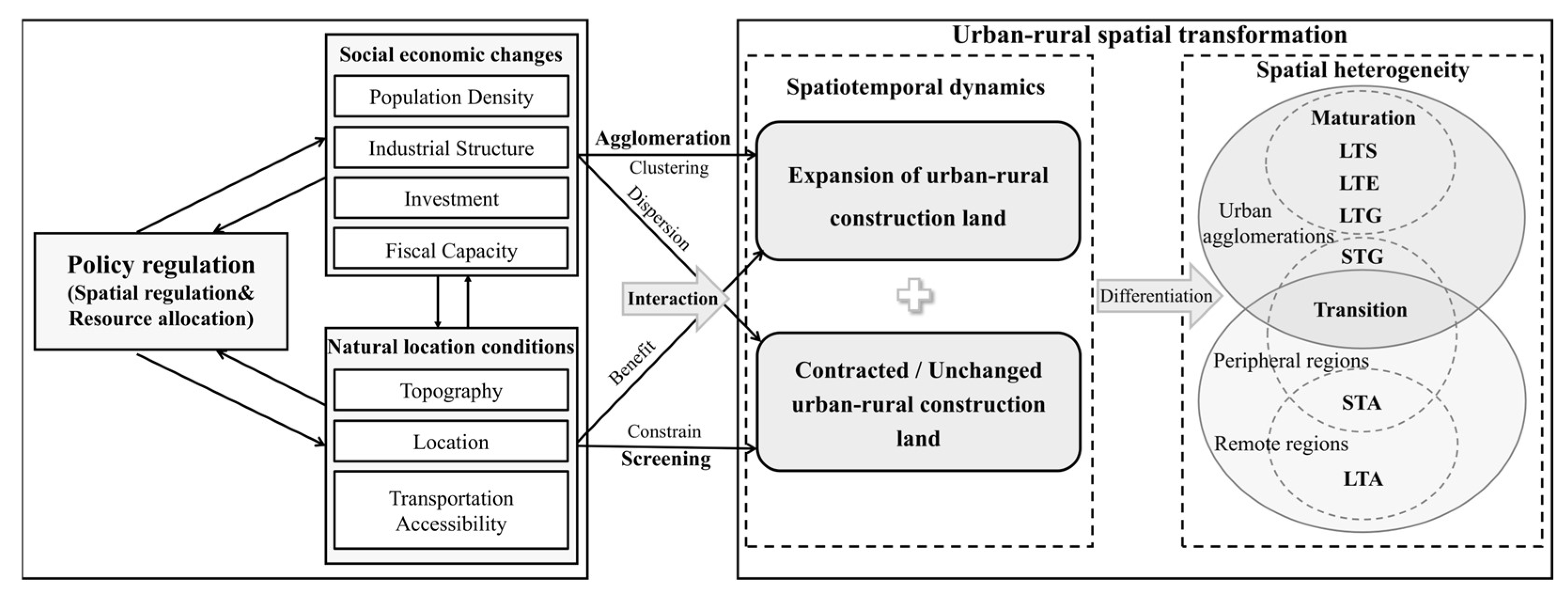
URST arises from the synergistic interaction of multiple elements within the human–environment territorial system [33]. Essentially, URST embodies the concentrated interplay between “human” (socioeconomic activities) and “environment” (physical geography) within a specific “region” (the space shaped by policies and institutions). Three core dimensions drive this evolution: policy systems, socioeconomic factors, and natural location conditions, which collectively shape construction land pathways and patterns [11]. Policies and institutions form the regulatory foundation, guiding construction land allocation through regional strategies, spatial planning, and land management systems [18,34], such as directing land toward urban agglomerations or implementing withdrawal mechanisms in ecologically sensitive areas. The socioeconomic dimension, including population clustering, capital accumulation, and industrial restructuring, reshapes land use scale, structure, and efficiency through demand-pull and efficiency-oriented mechanisms [35,36]. Natural location conditions, comprising topography, ecological sensitivity, and accessibility, establish development suitability thresholds and influence expansion potential [37]. These dimensions interact synergistically: policies guide spatial order and element flows; economic activities respond with changing land demands; and natural conditions continuously determine development feasibility. Collectively, these drive the dynamic adaptation of construction land in scale, structure, and function.
This study develops a three-dimensional analytical framework encompassing transformation degree, pattern, and direction to systematically examine URST (Figure 1). Transformation degree refers to the intensity and pace of construction land change, measured by the area change rate, which reflects the overall activity level of spatial transformation. Transformation pattern describes the spatial distribution and morphological characteristics of land change, identified through methods such as spatiotemporal hot spot analysis and spatial clustering, revealing the spatial organization rules and heterogeneity of the transformation process. Transformation direction indicates the evolutionary pathway of the territorial system, which may manifest as continuous expansion, stable balance, or decline and contraction, and may involve functional shifts, for example, from ecological and agricultural production to industrial and residential uses. These three dimensions form a scale–structure–pathway feedback loop through their dynamic interactions. The transformation degree, serving as the overall representation of system change, is moderated by the spatial organization reflected in the transformation pattern; these collectively influence the system’s long-term evolutionary direction. The transformation pattern, through processes of spatial concentration or dispersion, influences the regional differentiation of the transformation degree and guides functional reconfiguration. In turn, the transformation direction constrains the possible boundaries of scale expansion and the trends of pattern evolution from a pathway perspective. Furthermore, the three driving dimensions correspond respectively to these analytical aspects. Policy institutions directly influence the transformation degree through goal-setting and regulatory instruments. Economic factors reshape the transformation pattern via market allocation and competitive efficiency. Natural conditions, based on carrying capacity and locational advantages, define the feasibility thresholds for transformation direction.
This theoretical framework overcomes the limitations of a single-dimensional perspective by establishing three regulatory pathways: policy adjustments determine the forms of spatial organization and functional structure; socioeconomic drivers influence the rate and scale of spatial change; and the natural base delineates the transformation thresholds and evolutionary boundaries. By revealing the transformation logic of “scale change, pattern optimization, and pathway adaptation”, this framework provides a systemic perspective for understanding URST mechanisms, thus establishing the theoretical foundation for the spatiotemporal hot spot analysis and geographical detector modeling employed in this study.

3. Materials and Methods

3.1. Data Description

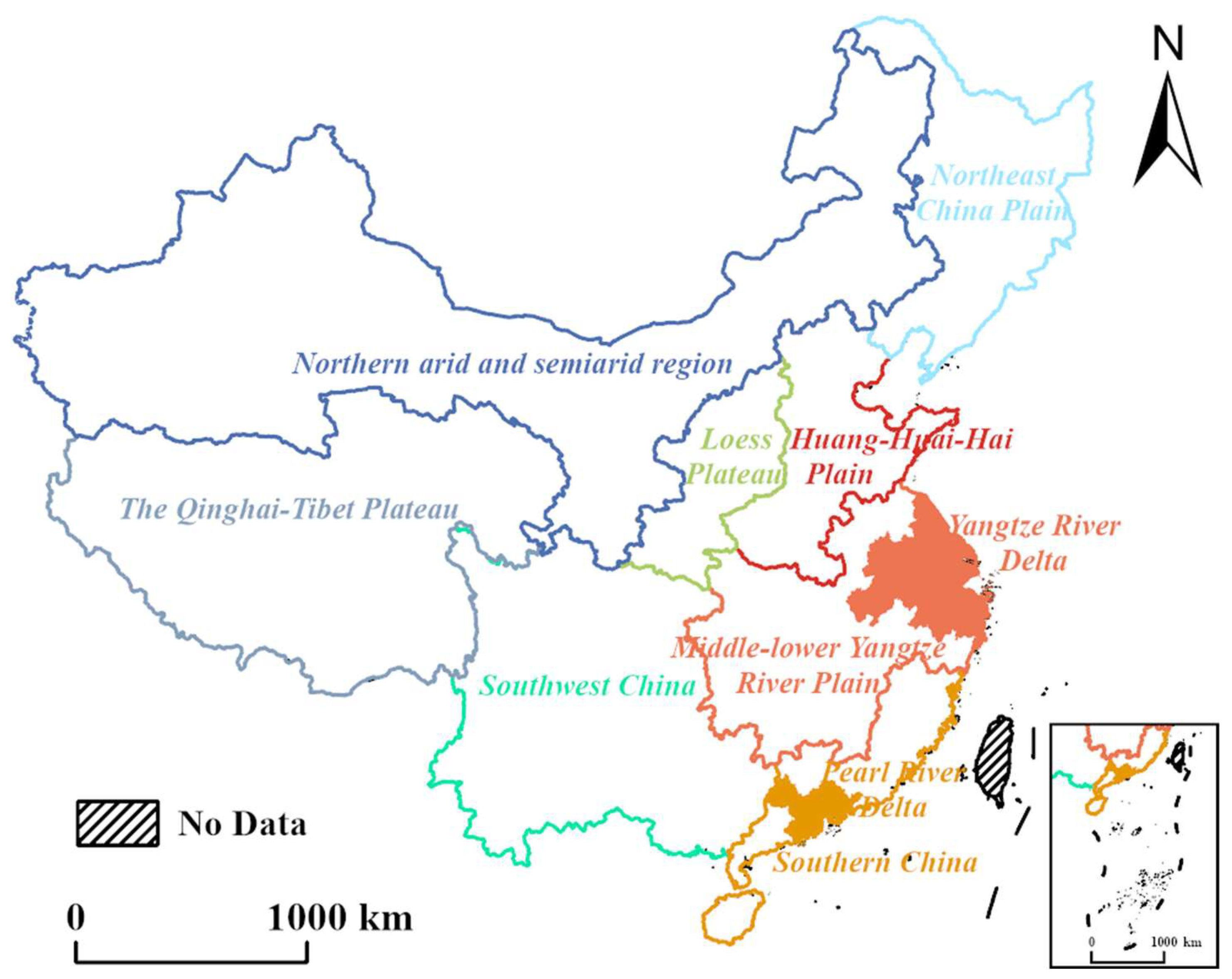
The data used in this study include land cover data, socioeconomic statistics, and natural condition and terrain data. Due to limitations in the availability and accuracy of nationwide data across categories, the research period for analyzing formation mechanisms spanned from 2000 to 2023. Hong Kong, Macao, and Taiwan were excluded from the study due to lack of data. Among the data sources, land use data for China from 1990 to 2023 were derived from a publicly available 30 m high-resolution dataset [38]. County-level socioeconomic data were primarily obtained from the China County Statistical Yearbook, including population density (total county population divided by county area), per capita gross regional product, the urban–rural income gap (ratio of urban to rural disposable income per capita), urbanization rate (urban population divided by total population), value-added of the primary, secondary, and tertiary industries, fixed asset investment, tax revenue, and export value. For natural condition data, slope and elevation data were sourced from the Scientific Data Center of the Chinese Academy of Sciences (http://www.csdb.cn/). Administrative boundaries at various levels, major rivers, and road networks were obtained from the National Geomatics Center of China (https://www.ngcc.cn/). The nearest distances from each county to major rivers, roads of different classes, provincial capitals, and prefecture-level cities were calculated using the proximity analysis tool in ArcGIS Pro version 3.1.6. Landform data came from the 1:4 million Geomorphological Atlas of China vector dataset [39]. Based on the existing literature, the geographic zoning of China is presented in Figure 2 [40].

3.2. Methods

3.2.1. URST Degree

Referring to the measurement methods of existing studies [32], this study characterized the speed and direction of URST using the spatial expansion intensity of urban–rural construction land to identify the spatial heterogeneity characteristics of URST. Recognizing counties as the fundamental units of China’s economic development and social governance, and following established research practices, this study divided the entire study region into 5 km × 5 km grids and calculated the average annual area growth rate of urban–rural construction land in each grid. The URST degree is calculated as follows [41]:
U R S T i   = S a S b Δ T S G × 100 %
where URSTi represents the URST degree in year i (unit: %); Sa indicates the area of construction land within a single grid during period a; ΔT denotes the time interval between periods a and b (unit: year); and SG represents the area of a single grid. The URST degree in the county is indicated by the average expansion intensity in all grids within the county.

3.2.2. Hot Spot Analysis and Type Classification of URST

Emerging Hot Spot Analysis (EHSA) is a spatiotemporal pattern mining method that explores different types of trends in the spatial location of geographic elements over time, which can find diminishing, sporadic, new, and intensifying hot and cold spots [42]. The method first maps the time point elements of URST into a single bin, and then the bins at different locations are aggregated into spatiotemporal bins (Bin Time Series) at a given time step to create the Space–Time Cube (STC) of URST in NetCDF format. The Mann–Kendall trend test is finally used to assess the hot and cold spot trends after calculating the Getis-Ord Gi* statistics and significance (p value) of each bin by the neighborhood distance and time step of the location [43]. The computation model is given below [44]:
G i * = j = 1 n w i , j x j X - j = 1 n w i , j V n j = 1 n w i , j 2 j = 1 n w i , j 2 n 1
X - = j = 1 n x j n
V = j = 1 n x j 2 n X - 2
G i * is the Z-Score at grid i, x j denotes the URST degree at grid i, w i , j is the spatial weight between grid i and j, V denotes the standard deviation, and n is the total number of grids. The Z-Score with statistical significance was examined to determine whether the location is a hot spot (positive score) or a cold spot (negative score) of URST. In this study, the time step interval was 1 year and the neighborhood distance was set as 50 km. The Mann–Kendall trend test statistics were calculated based on the difference in Getis-Ord Gi* statistics before and after each time interval, and the trend test statistics S for a time series with n samples are as follows [42]:
  S   = i = 0 n 1 j = i + 1 n s i g n x j x i
s i g n x j x i 1 , 0 , 1 ,   x j x i   >   0 x j x i = 0 x j x i   <   0
where sign is defined as the sign function for the trend test. Here, xj represents the URST degree in the year j, and j > i. If the statistic follows a normal distribution, then the variance Var(S) and Z-Score are calculated as follows:
V a r S = n n 1 2 n + 5 18
Z c = S 1 V a r ( S ) , S   >   0 0 , S = 0 S 1 V a r ( S ) , S   <   0
A Z-Score of zero indicates no significant trend of the URST degree in a given time. Likewise, positive (>1.65) and negative (<−1.65) values with statistical significance reflect increasing and declining trends over space and time (location). Eventually, the hot and cold trends will be identified as a new, consecutive, intensifying, persistent, diminishing, sporadic, oscillating, or historical hot or cold spot pattern according to the Z-Score and p value.
To further reveal the regional evolutionary characteristics and diverse patterns of URST across China, vector data of landform types were overlaid with spatiotemporal hot spots of construction land expansion, enabling a scientific classification of URST types. This approach facilitated the identification of differentiated transformation patterns under varying geographical environmental contexts. Taking into account China’s regional development disparities and geographical patterns, eight representative sample counties were selected along the east–west and north–south spatial gradients, covering the eastern, western, southern, northern, and central regions. To avoid homogenization effects from highly urbanized areas, municipal districts were excluded from the selection. This ensured that the chosen counties clearly and typically represent the differences and characteristics of URST across various regional and typological units.

3.2.3. Geographical Detection of Driving Factors

The geographic detector (GD) is a spatial statistics method used to detect spatial stratified heterogeneity and reveal its driving forces [45]. Its core principle posits that if an independent variable significantly influences a dependent variable, their spatial distributions will exhibit similarity [46]. Particularly suitable for this research, GD requires no linear assumptions, handles diverse data types effectively, and detects interactive effects between socioeconomic and natural location factors. Our analysis using optimally parameterized GD includes both factor and interaction detectors to quantify these complex driving mechanisms.
1.
Factor detector
Indicator q was introduced based on the geographic detector model to measure the explanatory power of influencing factors on the spatial heterogeneity of the URST degree [47]. The formula is as follows:
  q   =   1 1 n σ 2 h = 1 L n h σ h 2
where nh represents the number of samples within a certain type h (associated with one or more sub-regions) of the factor, n represents the total number of samples in the entire study area. L denotes the number of categories for a certain factor, such as population density and elevation, which are divided into different categories in this study. Additionally, σ2 indicates the discrete variance of the whole study area, and the range of q is [0, 1]. When q = 0, it is suggested that some factors have no explanatory power for the spatial heterogeneity of URST degree; the greater the value of q, the greater explanatory power the factor has. Statistical significance of the q-value was assessed at the p < 0.05 level.
2.
Interaction detector
The interaction detector was used to identify the interaction effect between two factors, e.g., X1 and X2, on the response variable Y (URST degree) [48]. This was achieved by first calculating the q values of the two factors X1 and X2 on Y separately, q(X1) and q(X2), as well as their interaction effect (by overlapping the geographical layers of X1 and X2 to form a new layer). Then, the q value of the new layer was compared with those of X1 and X2, respectively, to determine whether the two factors, X1 and X2, when taken together, had stronger or weaker influences on the URST degree than they did independently.
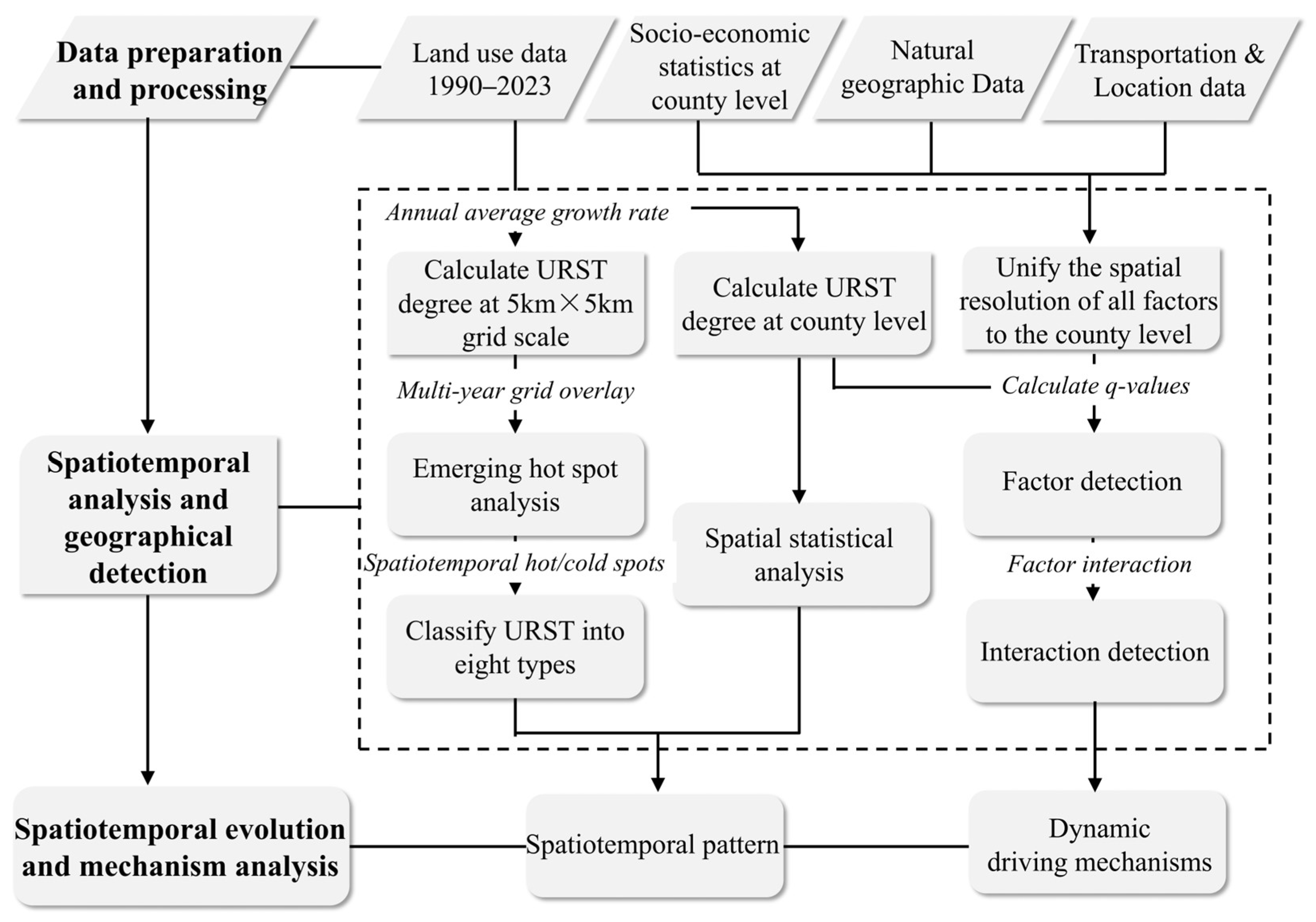
Drawing on existing studies [11,32], this paper constructed an index system of influencing factors for URST by selecting 18 factors across three dimensions: socio-economy, natural condition, and traffic location. The detailed factors and their types are presented in Table 1. The flowchart for this study is shown in Figure 3.

4. Results

4.1. The Spatiotemporal Evolution Pattern of URST

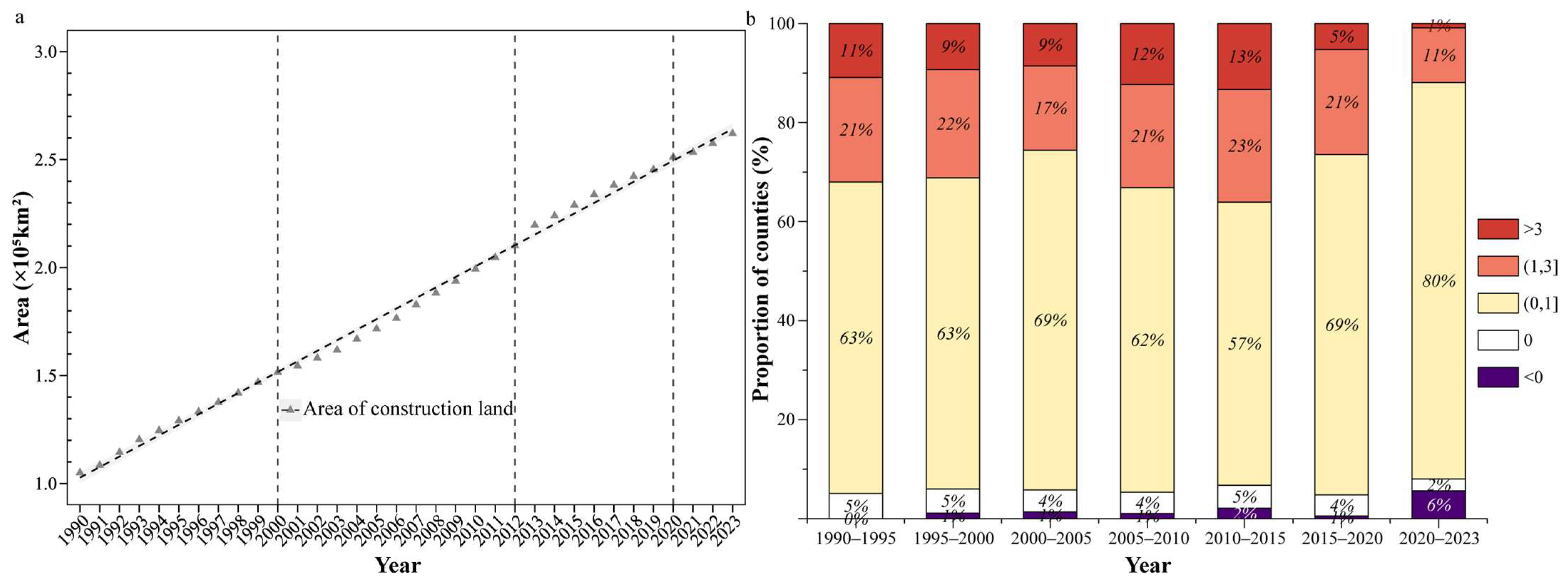
During the study period, the total area of urban–rural construction land in China showed a continuous upward trend, increasing by 149.54% overall, with a net increase of 1.56 × 10⁵ km2 (Figure 4a). The periods 1990–2000 and 2012–2020 witnessed rapid expansion of urban–rural construction land, particularly in the Huang-Huai-Hai Plain and the coastal economically developed regions, such as the Yangtze River Delta and Pearl River Delta. In contrast, growth rates declined markedly during 2000–2012 and 2020–2023, with the rate dropping to 4.32% in 2000–2023. This deceleration was largely attributable to construction land contraction in the Loess Plateau, the Middle-Lower Yangtze Plain, and southwestern China, alongside decelerated or stagnant expansion in eastern coastal areas. A similar trend was observed at the county level (Figure 4b). From 1990 to 2023, the proportion of counties with a positive URST degree (>0) decreased from 95% to 92%. Among them, the share of counties with a high transformation degree (>1%) fell by 20%, while the proportion of counties experiencing negative growth (<0) increased by 6%. These changes reflect a general slowdown in the expansion of urban–rural construction land and the emergence of spatial contraction, indicating a decline in the intensity of China’s URST to varying degrees.
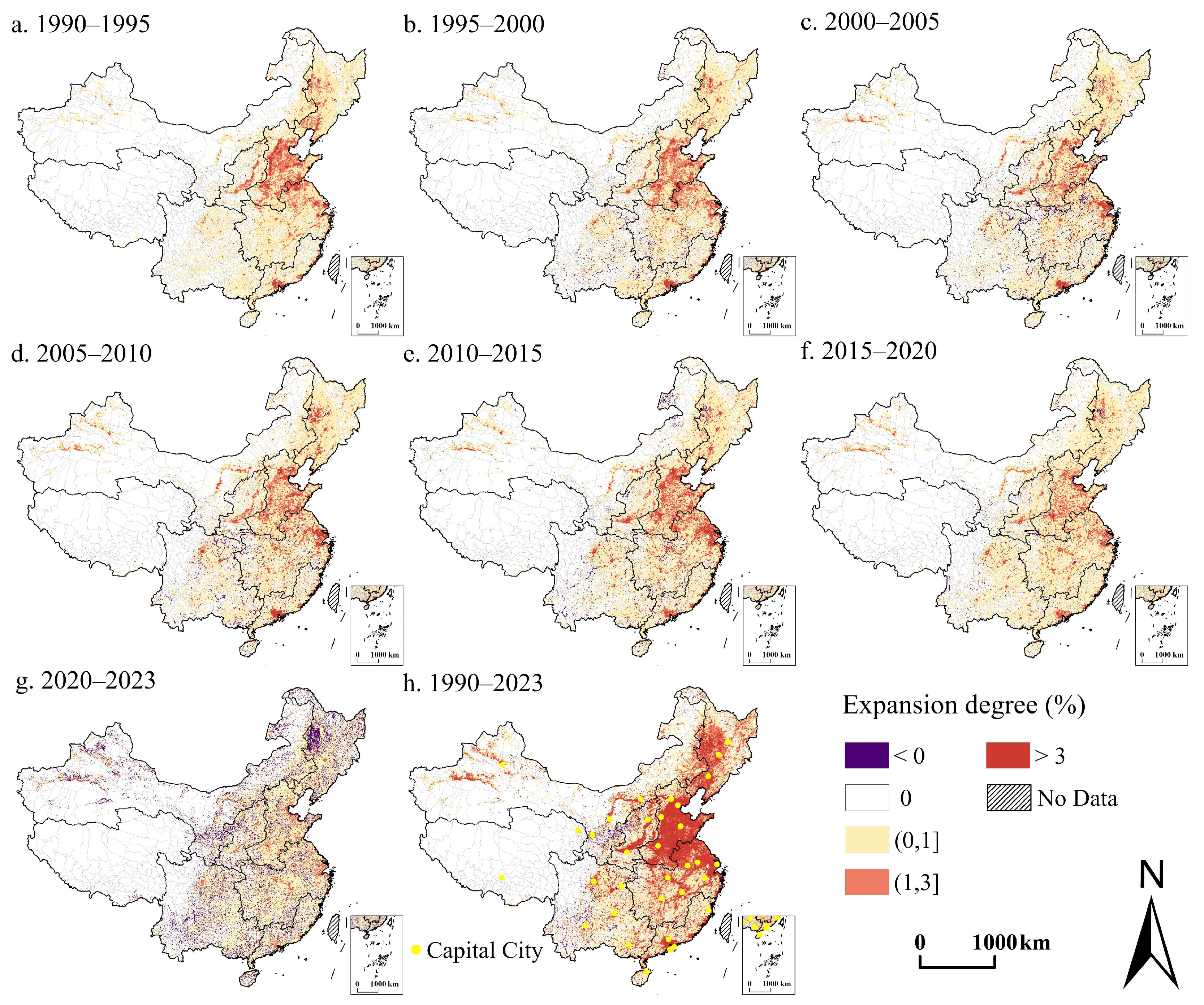
Between 1990 and 2023, urban–rural construction land expansion displayed significant spatiotemporal heterogeneity across China (Figure 5). Arid and semi-arid northern regions, the northwestern Loess Plateau, the Tibetan Plateau, and western southwestern China showed minimal expansion, with most counties recording expansion degrees at or below 0% (Figure 5h). In contrast, counties in the Northeast China Plain, Huang-Huai-Hai Plain, Middle-Lower Yangtze Plain, and eastern southwestern China generally exhibited positive expansion, with areas in the western Northeast China Plain, southeastern Loess Plateau, Huang-Huai-Hai Plain, Yangtze River Delta, and Pearl River Delta exceeding 3%, primarily around provincial capitals, reflecting sustained socioeconomically driven growth. Temporally, a pronounced north-south divergence emerged, characterized by “northern contraction and southern expansion”. From 1990 to 2020, continuous growth persisted in key regions, with some maintaining expansion above 3%. Contraction first appeared between 1995 and 2010 in parts of the Loess Plateau, Middle-Lower Yangtze Plain, and southwestern China. By 2010–2020, shrinkage extended to eastern arid and semi-arid regions and the western Northeast China Plain. During 2020–2023, more widespread contraction was observed across northern arid and semi-arid zones, the western Northeast China Plain, northwestern Loess Plateau, and southwestern China. Concurrently, most eastern coastal counties registered expansion below 3%, indicating a nationwide slowdown in construction land growth.
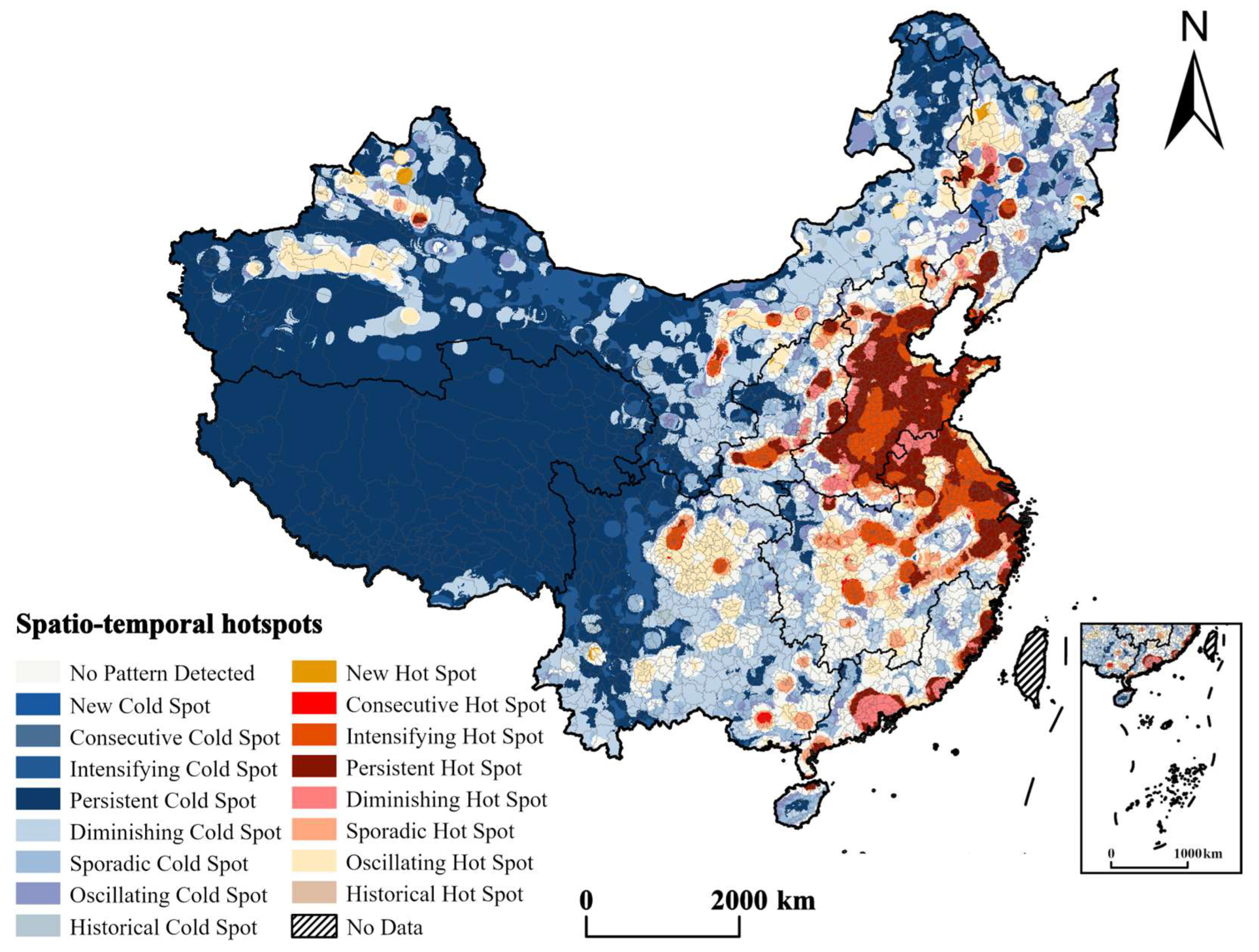
Analysis of spatiotemporal clustering characteristics (Figure 6) indicated that cold and hot spots of URST exhibited significant aggregation. Among eight categories of spatiotemporal hot spots, oscillating and consecutive hot spots were the most numerous, accounting for 33.87% and 27.80%, respectively. The former were mainly distributed in the western and central arid and semi-arid regions of northern China, the northwestern Northeast China Plain, the western Middle-Lower Yangtze Plain, and the northeastern part of southwestern China. The latter clustered in the Huang-Huai-Hai Plain, Yangtze River Delta, and Pearl River Delta. Spatiotemporal cold spots also fell into eight types, with consecutive cold spots (57.41%) and diminishing cold spots (19.56%) predominating. Consecutive cold spots were primarily located in western China, while diminishing cold spots were scattered across central and eastern regions, mostly on the outermost peripheries of provincial capitals. This clustering pattern reflects regional differences in response to urban–rural development: eastern plains experienced extensive construction land expansion driven by accelerated urbanization, sustaining a high transformation degree, whereas most western regions consistently showed a low transformation degree due to natural constraints and economic limitations. This spatial heterogeneity underscores the interaction between regional natural conditions and development levels.
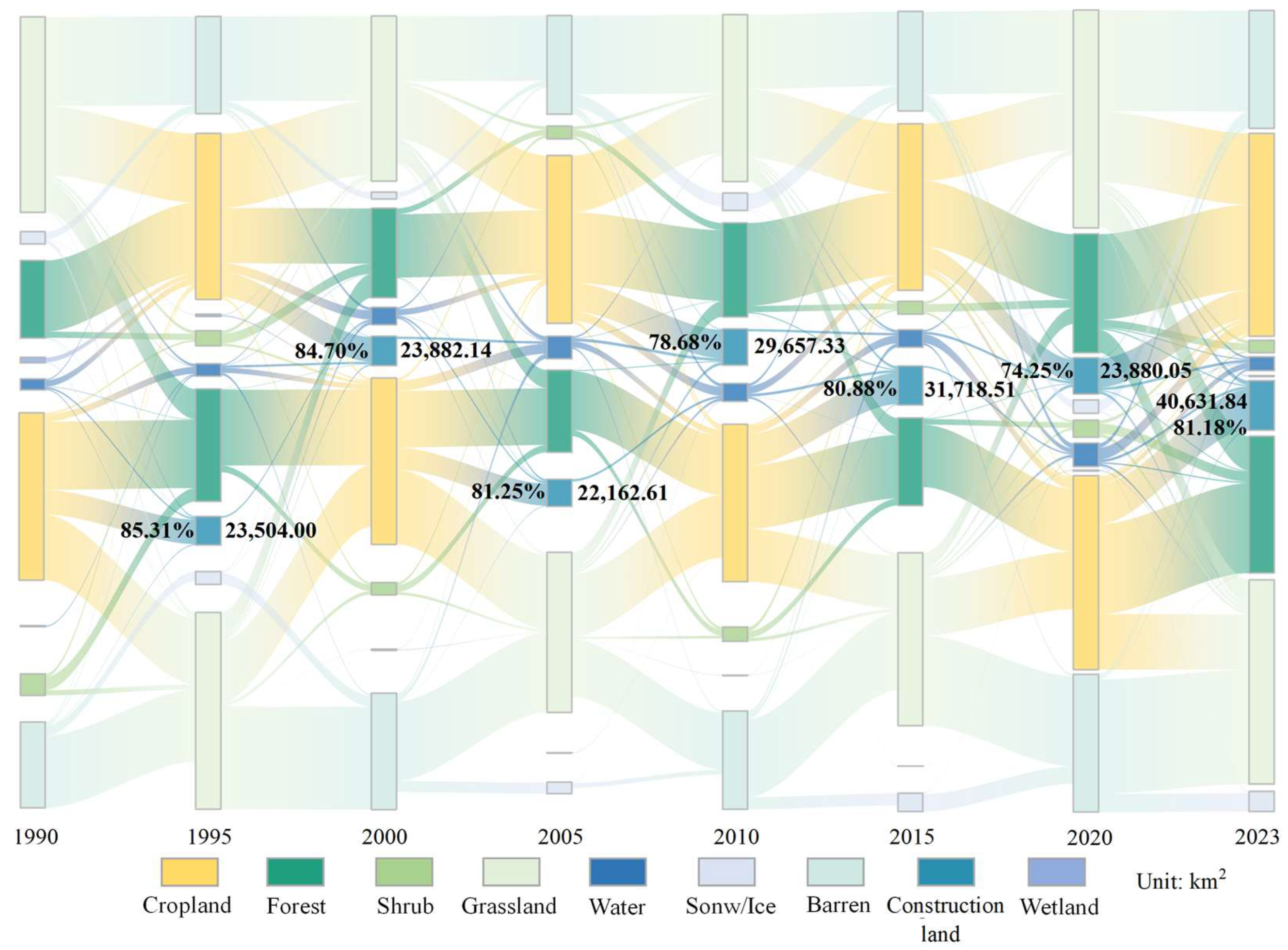
To further identify the primary sources of long-term expansion in construction land, statistical analysis was conducted on land use conversions (Figure 7). From 1990 to 2023, the total area converted to construction land was 2.62 × 10⁵ km2, while 1.06 × 10⁵ km2 of construction land was converted to other land, resulting in net growth. Cropland contributed 1.42 × 10⁵ km2 of land converted to construction land. Despite declines of 7.20% (1.72 × 10³ km2) during 2000–2005 and 24.71% (7.84 × 10³ km2) during 2015–2020, cropland conversion remained substantial, reaching 4.06 × 10⁴ km2 in 2000–2023. On average, cropland conversion accounted for 80.89% of all land converted to construction land over the study period, representing the main driver of construction land expansion. Conversions from ecological lands such as grassland and forest to construction land amounted to 9.86 × 10³ km2 and 6.02 × 10³ km2, respectively, and both increased over time, indicating persistent risk of construction encroachment into ecological spaces.

4.2. Classification and Comparison of URST Types

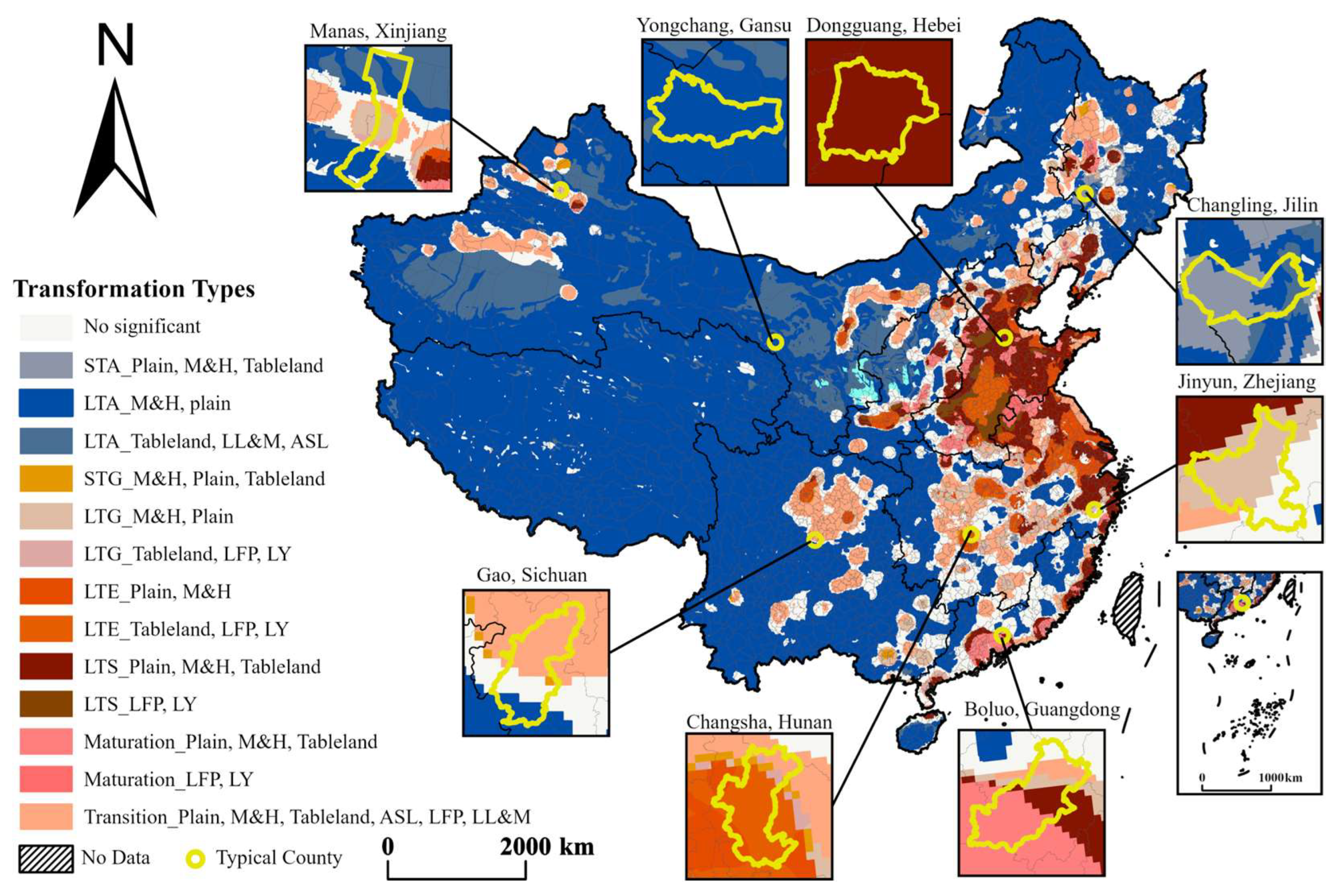
Based on a systematic analysis of the evolutionary characteristics of China’s URST patterns from 1990 to 2023, this study identified eight distinct transformation types according to the long-term dynamic trends of urban–rural construction land expansion (Figure 5): short-term attenuated (STA), long-term attenuated (LTA), short-term growth (STG), long-term growth (LTG), long-term enhanced (LTE), long-term stable (LTS), mature, and transitional types. Spatially, specific landform units are closely associated with particular URST types (Figure 8 and Table 2). Growth, enhanced, stable, and mature types are predominantly distributed in plain areas, such as the Huang-Huai-Hai Plain, the Middle-Lower Yangtze Plain, and the Pearl River Delta. In contrast, attenuated types are mainly concentrated in the ecologically fragile and economically lagging western and northwestern regions, including mountains and hills (M&H), aeolian sediment landform (ASL), and the Loess Plateau, which encompasses loess liang and mao (LL&M), and loess yuan (LY). Transitional types are widely distributed in the outermost peripheries of provincial capitals, spanning all landform types, including plains, M&H, tableland, low flood plain (LFP), and LL&M. This distribution highlights a significant coupling relationship between transformation types and landform types, reflecting the foundational influence of physical geographical conditions on URST, with a notable “screening” effect.
In terms of spatial structure, eastern regions exhibit a typical circle layer differentiation structure: the core areas are dominated by highly urbanized types such as LTG and LTE types, while the outer and outermost peripheries successively feature LTS, STG, Transitional, and STA types. This pattern reflects the distance–decay effect of urban radiation, suggesting that regions farther from urban centers tend to remain in earlier or transitional phases of transformation. Additionally, complex terrain and ecological constraints in western regions lead to leapfrog or mosaic distributions of transformation types. In contrast, the prevalence of mature transformation types in eastern coastal developed economic zones signifies a more advanced stage of URST, reflecting the substantial impact of economic development levels and policy support. It is noteworthy that multiple transformation types frequently coexist at the county scale, suggesting that differentiated urban–rural development within counties leads to URST being at different stages. Overall, the significant regional differentiation of URST types mirrors the dual constraints and co-evolution shaped by both physical geographical conditions and socioeconomic factors.

4.3. Influencing Factors of URST

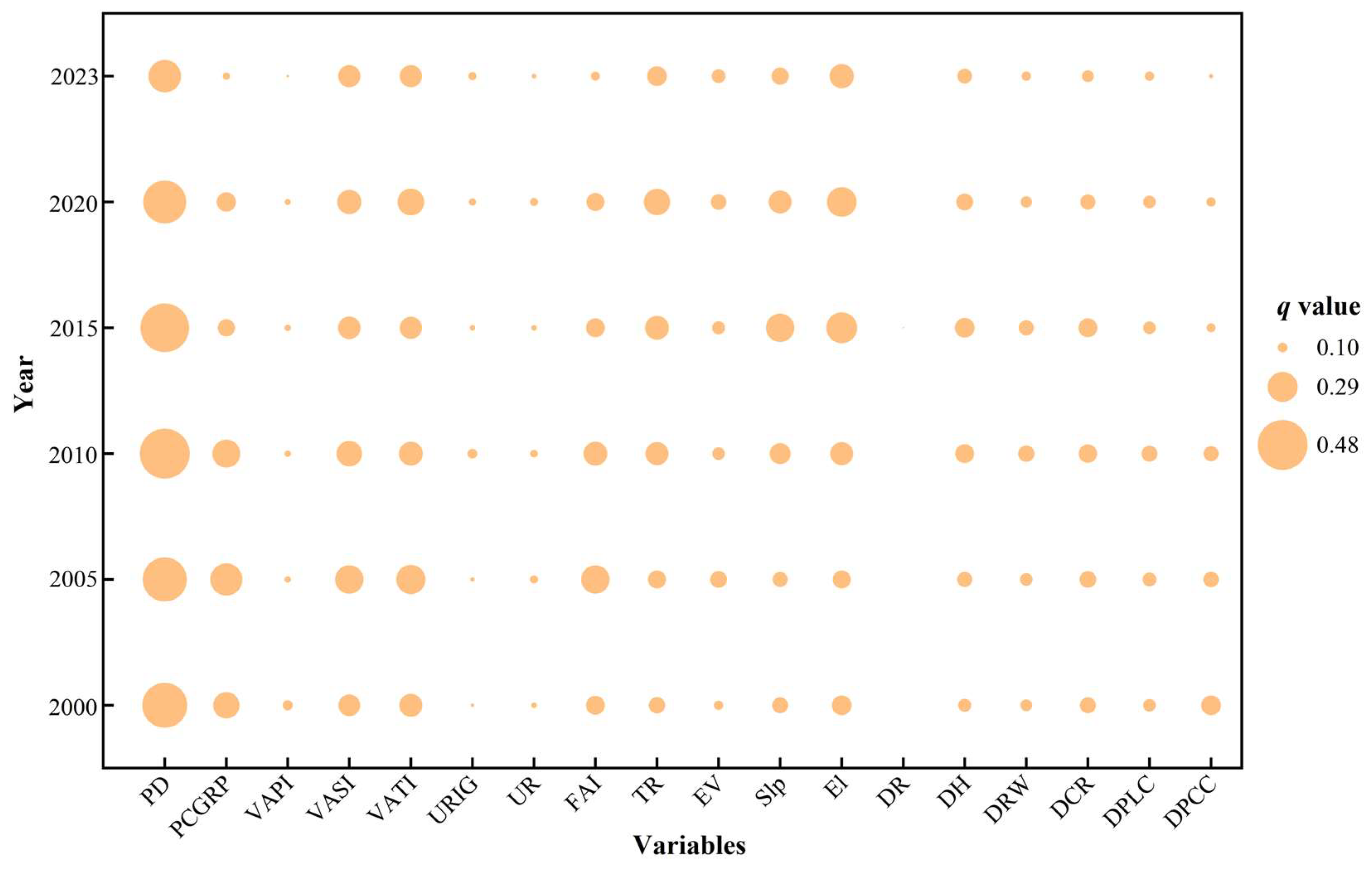
URST resulted from the combined effects of physical geographical conditions and socioeconomic development. Given the challenges associated with rasterizing certain socioeconomic indicators, this study quantitatively identified the main influencing factors of URST at the county scale. To facilitate the comparison of interannual changes in the influence of different factors, the factor detection results from 2000 to 2023 were analyzed and compared (Figure 9). During 2000–2023, factors exhibiting substantial influence (mean q-value > 0.2) on the regional differentiation of URST included population density (PD), per capita gross regional product (PCRGP), value-added of secondary industry (VASI), value-added of tertiary industry (VATI), tax revenue (TR), slope (Slp), and elevation (El), indicating their dominant roles. Factors with moderate influence (mean q-value > 0.1) included fixed asset investment (FAI), export value (EV), distance from highways (DH), distance from railways (DRW), distance from city roads (DCR), distance from provincial capital cities (DPCC), and distance from prefecture-level cities (DPLC), suggesting their important secondary effects. Notably, the q-values of most socioeconomic factors followed an inverted U-shaped trend over time, including PD, PCRGP, VASI, VATI, FAI, and TR, implying that the influence of regional socioeconomic development level, investment intensity, and fiscal capacity on URST differentiation gradually weakened. Conversely, the explanatory power of the urbanization rate (UR) was relatively low. Meanwhile, the q-values of natural topographic factors generally increased and maintained high explanatory power. For instance, the q-value for Slp rose from 0.15 to 0.16, and for El from 0.19 to 0.23 between 2000 and 2023, highlighting the growing constraining effect of natural topography on URST.
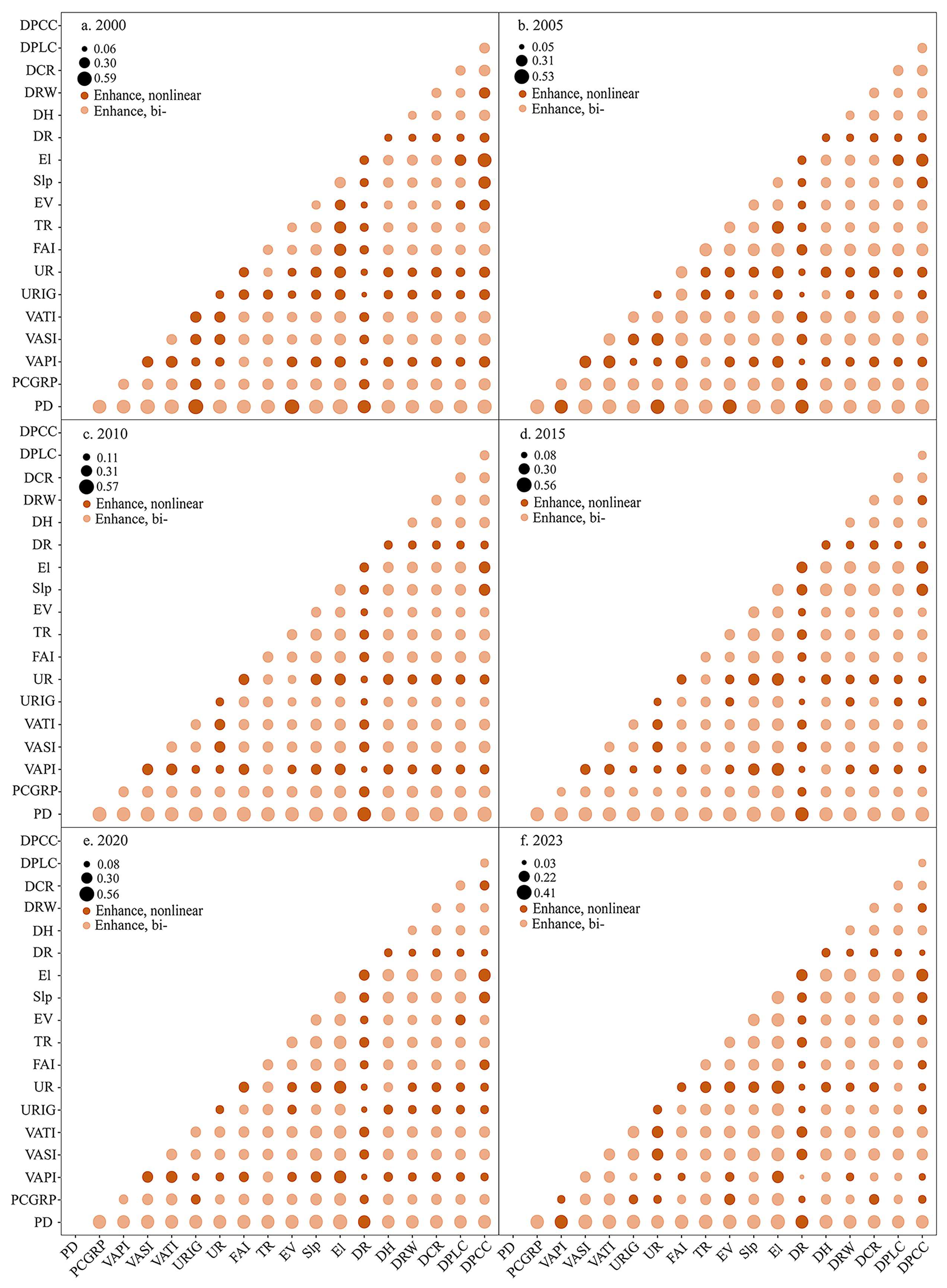
Results from interaction detection during the study period (Figure 10) revealed that interactions between all factor pairs exhibited enhancement relationships, including both bi-factor and nonlinear enhancement. This indicates that the interaction of any two factors strengthened the explanatory power regarding URST differentiation, affirming that URST was shaped by the synergistic effects of multiple factors. Specifically, interactions involving PD, PCRGP, VASI, VATI, FAI, and TR with other factors consistently yielded high multi-year average q-values (above 0.28). Interactions involving EV, DH, DRW, DCR, DPCC, and DPLC with other factors also showed substantial multi-year average q-values (greater than 0.24). The interaction between PD and El was the strongest (multi-year average q-value reaching 0.53), followed by PD and VASI (0.50). However, as the influence of socioeconomic factors on URST weakened, the strength of their interactions with other factors also declined. The maximum q-value (for PD∩El) decreased from 0.59 to 0.41 during the study period, and interactions involving other socioeconomic factors similarly diminished to varying degrees, further corroborating the reduced explanatory power of socioeconomic elements on URST differentiation.
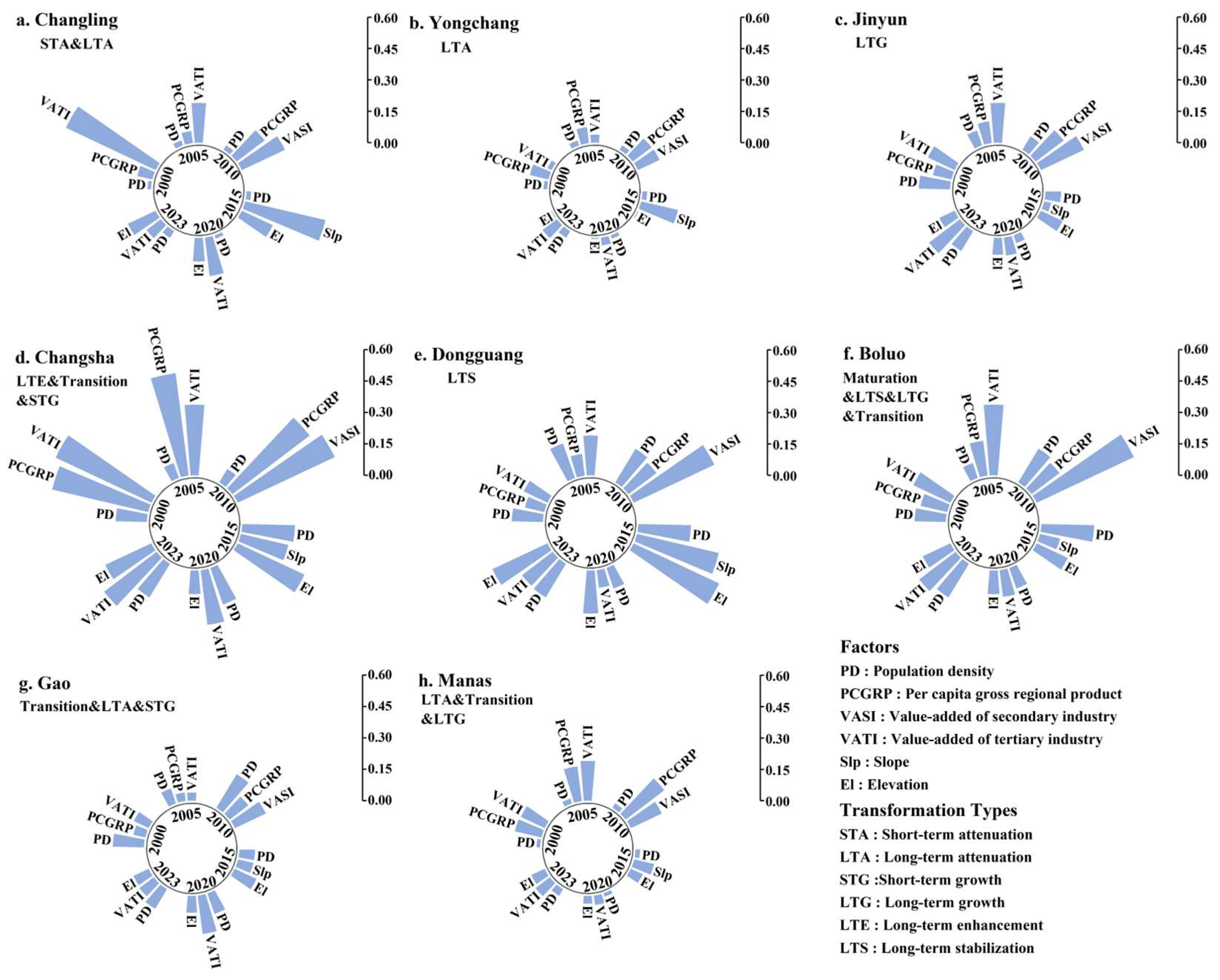
Under the combined influence of high-impact factors, such as PD, PCRGP, industrial structure, and topography from 2000 to 2023, the URST degree in various typical counties showed significant divergence (Figure 11). Counties located in flat southeastern areas (e.g., Changsha, Boluo), characterized by population clustering and developed secondary and tertiary industries, predominantly exhibited LTE or LTG types. Economically developed counties (e.g., Jinyun, Dongguang), often with dominant industries, were mainly classified as LTG or LTS. In contrast, northern counties with low population density (e.g., Changling County, Yongchang), affected by outmigration and a simplistic industrial structure, mostly displayed STA or LTA types. Furthermore, economically vulnerable areas (e.g., Manas, Gao), constrained by topography, tended to be LTA or transitional types. Over time, the transformation degree in growth-type counties continued to rise, stable types maintained high levels, and attenuated types experienced stagnation or decline. Transitional counties showed fluctuating transformation degrees, highlighting developmental uncertainties and transformation challenges. Economic factors emerged as the core driver determining the direction of transformation, with high values generally promoting LTG, LTE, or LTS. Topographic factors constituted a fundamental constraint, where unfavorable conditions led to more volatile development patterns and LTA. Overall, growth and stability typically resulted from the long-term synergistic effect of multiple factors, whereas attenuation was commonly driven by the persistent negative influence of a single or few factors, such as economic recession or population exodus.

5. Discussion

5.1. Overall Trend of URST and New Directions in Policy Response

This study reveals a weak influence of population urbanization rate on urban–rural construction land expansion, confirming the long-standing asynchrony in China’s urbanization where land expansion outpaces population clustering [49]. Contrary to expectations of sustained rapid growth [23], we identified marked deceleration in nationwide construction land expansion, indicating slowing land urbanization. County-level analysis showed declining proportions of high-transformation counties and rising negative-growth counties, reflecting diminishing returns from traditional “point–axis” development and widening regional divergence under ecological constraints. This trend arises both from intrinsic economic evolution and strategic policy shifts, particularly the strict implementation of Ecological Conservation Redlines and Urban Construction Land Boundaries that reoriented priorities from expansion to optimization. While previous studies have effectively described general trends using composite indices [2,11], our integrated EHSA and multi-factor GD model provides a more dynamic and mechanistic understanding. EHSA captures spatial clusters with their temporal evolution, enabling fine-grained transformation typology, while GD quantifies interactive effects among multidimensional drivers often missed in conventional analyses. Early regional policies prioritizing coastal and riverine regions created city-centered patterns with significant disparity [9,18]. Recent coordinated urbanization and rural revitalization strategies have shifted focus to county-level development [3], enhancing the local carrying capacity and addressing urban–rural dichotomy. This reorientation responds to slowing land expansion and diverging regional dynamics while marking a fundamental transition in development logic. This shift parallels developed economies’ transition from expansion management to quality enhancement [5], though China’s experience differs in scale, pace, and top-down policy dominance. Northern counties with population outflow and single industrial structures show stagnation resembling the U.S. Rust Belt [4], while core regions, like the Pearl River Delta, are stabilizing as key drivers weaken. Unlike market-dominated Western models, China’s URST exhibits distinctly policy-guided characteristics, with spatial heterogeneity shaped fundamentally by interventions like urban agglomeration plans, farmland requisition–compensation balance, and ecological protection redlines. This highlights a novel policy paradigm integrating national strategy with local practice to address sustainable development challenges in rapidly urbanizing regions worldwide.

5.2. Theoretical Connotations, Realistic Impacts, and Spatial Governance Insights of the URST Pattern

The observed pattern of northern contraction and southern expansion represented not only a spatial manifestation of regional disparity in URST but also a realistic mapping of core–periphery dynamics and spatial equilibrium mechanisms within national land development [19]. Under the core–periphery structure, southern regions, particularly urban agglomerations such as the Yangtze River Delta and Pearl River Delta, continued to attract population and capital, forming high-intensity transformation hot spots with obvious spatial polarization and radiation effects [50,51]. In contrast, parts of northern and central-western China, constrained by a single industrial structure reliant on traditional sectors, like resource extraction and heavy industry, and sustained population outflow, leading to labor shrinkage and weakened demand, experienced sluggish growth or even contraction in construction land, revealing the relative disadvantage of peripheral regions in factor competition [33]. This pattern extended beyond regional coordination to profoundly impact national ecological and food security. Although construction land contraction in some northern areas reflected insufficient development momentum, it simultaneously created spatial opportunities for cropland protection and ecological restoration. Concurrently, rigid regulatory policies, such as ecological conservation redlines and permanent basic cropland protection have effectively curbed previous extensive expansion in northern plain agricultural zones and ecologically fragile areas [52]. However, sustained construction expansion in the south exacerbates risks of high-quality cropland loss and ecological space compression [53]. Therefore, this spatial heterogeneity resulted from market-based resource allocation while simultaneously embodying the gradual optimization of territorial spatial functions and regional development pathways under national food and ecological security strategies. Although policies like the Permanent Basic Farmland Protection have been implemented to mitigate these risks, the persistent expansion in the south indicates that balancing development pressure with ecological conservation remains a significant challenge, requiring more stringent spatial governance and differentiated regional policies. Coordinating regional development between northern and southern regions while safeguarding grain production and ecological functions emerges as essential for fostering a new order of green, secure, and balanced urban–rural development.

5.3. Driving Mechanisms of County-Level Type Differentiation

The significant differentiation in county-level URST pathways, as discussed below, serves as an empirical validation of the theoretical analysis framework. The emergence of distinct types at the county level can be interpreted as the outcome of the synergistic interactions among the three driving dimensions. Counties exhibited significant differentiation in their URST pathways. In the southeastern coastal plains, counties such as Changsha (equipment manufacturing) and Boluo (electronics clusters) have leveraged flat terrain and transportation accessibility to integrate into urban agglomerations, driving industrial upgrading and population clustering [37]. Jinyun (eco-industry) and Yongchang (diversified industrial system) have followed industry-driven pathways, achieving growth through “Eco-industrial Transformation” and “Strong Industry Initiatives”, respectively [3]. Northern counties like Changling (agro-pastoral transition zone) and Yongchang, constrained by population outflow and locational disadvantages, have exhibited attenuated transformation types. Economically vulnerable and topographically complex counties such as Manas (vineyard foothills) and Gao (hilly tea plantations) have demonstrated that targeted policies like resource conversion and agricultural modernization face multiple constraints [11]. These limitations significantly restrict construction land expansion, resulting in delayed transformation that typically manifests as transitional or attenuation types. The declining trend of socio-economic factors’ q-values suggests that in the later stages of urbanization, the driving force of conventional socio-economic factors on spatial differentiation weakens, potentially due to market saturation, policy homogenization efforts, or the increasing prominence of inherent natural constraints as expansion reaches ecological and geographical limits. Furthermore, influenced by variations in natural resource endowment, economic foundation, and policy support, multiple transformation types, including growth, transitional, and attenuated, generally coexisted within individual counties, reflecting the complexity and spatial heterogeneity of the transformation process. This coexistence stems from intra-county variations in topography (e.g., plains vs. mountains), policy zoning, and uneven resource allocation, creating different development patterns. The geographical screening effect operates through natural constraints (e.g., slope, elevation) determining development feasibility by increasing costs or limiting accessibility, as shown in the high q-values of topographic factors. The regional differentiation of URST stems from the nonlinear coupling of three fundamental forces: natural conditions establishing basal constraints, socioeconomic factors providing initial impetus, and policy steering guiding development direction (Figure 12). As transformation has deepened, development has shifted from extensive expansion toward endogenous growth, amplifying natural constraints while reducing reliance on traditional socioeconomic drivers. Policies have evolved from dominant drivers to allocation optimizers within natural frameworks, revealing a systemic shift from economically dominated dynamics to complex multi-factor interactions. This mechanistic evolution provides crucial insights for spatial planning and differentiated governance.

6. Conclusions

This study examined the spatiotemporal evolution and multidimensional driving mechanisms underlying the regional differentiation of URST in China from 1990 to 2023. It addresses a key methodological gap in the existing literature: the lack of integrated dynamic and interactive analysis of URST at the county scale. While previous studies have described general trends or examined static drivers, they have often failed to capture the evolving spatiotemporal patterns and the synergistic effects of multi-dimensional factors. To fill this gap, we integrated spatiotemporal hot spot analysis (EHSA) with a multi-factor geographical detector model, enabling a systematic investigation of both the evolutionary pathways and the complex driving mechanisms. The main findings and novelty of this study are as follows: (1) From 1990 to 2023, China’s urban–rural construction land expanded continuously, and the annual average growth rate accelerated during 1990–2000 and 2012–2020, concentrated in the Huang-Huai-Hai Plain, Middle-Lower Yangtze Plain, and developed southern regions. However, spatial expansion decelerated markedly in 2000–2012 and 2020–2023, plunging to 4.32% in the latter period. Construction land contracted in the Loess Plateau, Middle-Lower Yangtze Plain, and southwestern China, while eastern coastal expansion slowed. (2) Significant structural adjustments occurred at the county level: the proportion of high-transformation counties decreased by 20%, while negative-growth counties increased by 6%. This reflects the concentration of growth dynamics in limited counties and confirms URST’s transition toward localized slowdown and contraction. (3) Spatially, a clear “northern contraction and southern expansion” divergence emerged. Growth types clustered in eastern plains, attenuated types concentrated in fragile western regions, and transitional types spread around provincial capitals. Eastern regions showed circle-layer structures centered on cities, while western areas displayed leapfrog patterns due to topographic constraints. Multiple transformation types coexisted within single counties, particularly in areas with strong urban radiation and varied topography. (4) The dominant drivers identified include PD, PCGRP, VASI, VATI, FAI, TR, Slp, and El, supplemented by EV, transportation accessibility, and distance to central cities. The divergence stems from distinct regional drivers. Expanding southeastern counties benefited from urban agglomeration plans that allocated construction land quotas and attracted industrial investments, reinforced by population influx, industrial growth, strong fiscal revenue, active investment, and favorable terrain. Contracting northern and western counties faced ecological redlines and farmland protection that limited expansion, along with population outmigration, undiversified industries, sluggish economic growth, and restrictive natural conditions, such as complex topography and ecological fragility.
The planning and policy implications of our research are substantial. The identified URST types and their driving mechanisms provide a scientific basis for spatially targeted regulation and differentiated sustainable development policies across regions. For instance, continued expansion in southern hot spots necessitates strict cropland protection and growth boundaries, enforced through policies such as the Permanent Basic Farmland Protection Redline [53]. Conversely, prevalent attenuation in northern and western regions calls for strategies focused on ecological restoration and adaptive reuse of vacant land. Regionally differentiated approaches should be prioritized: eastern regions ought to optimize spatial stock and enhance land use efficiency [32], while western regions should control development intensity and foster green industries like eco-tourism [54]. Deepening reforms in land, household registration, and industrial policy by establishing a unified urban–rural construction land market and strengthening public service equalization is crucial for systematic governance improvement [16]. Future research should integrate policy text mining to quantify policy impacts and employ dynamic models to simulate scenarios under interventions. To address county-scale data limitations masking intra-county heterogeneity, multi-scale analysis with finer-grained data is essential. Applying this methodology to other rapidly urbanizing countries while incorporating dynamic simulations of environmental factors will achieve a more precise characterization of URST evolution.

Author Contributions

Conceptualization, Y.S. and R.Y.; methodology, Y.S. and R.Y.; software, Y.S.; validation, Y.S. and R.Y.; formal analysis, Y.S. and R.Y.; investigation, Y.S. and R.Y.; resources, Y.S. and R.Y.; data curation, Y.S.; writing—original draft preparation, Y.S. and R.Y.; writing—review and editing, Y.S. and R.Y.; visualization, Y.S.; supervision, R.Y.; project administration, R.Y.; funding acquisition, R.Y. All authors have read and agreed to the published version of the manuscript.

Funding

This research was funded by the Key Projects of Philosophy and Social Sciences Research, Ministry of Education of China (No. 23JZD008), the National Natural Science Foundation of China (No. 42171193), the Key Project of Guangdong Provincial Philosophy and Social Sciences Planning (No. GD24ES013, GD25ZX04), the 2025 Guangzhou Basic and Applied Basic Research Special Project (No. 2025A04J7127), and the Fundamental Research Funds for the Central Universities, Sun Yat-sen University (No. 24wkjc11).

Data Availability Statement

The raw data supporting the conclusions of this article will be made available by the authors on request.

Conflicts of Interest

The authors declare no conflicts of interest.

Abbreviations

The following abbreviations are used in this manuscript:
URTUrban–rural transformation
URSTUrban–rural spatial transformation
PDPopulation density
PCGRPPer capita gross regional product
VAPIValue-added of primary industry
VASIValue-added of secondary industry
VATIValue-added of tertiary industry
URIGUrban–rural income gap
URUrbanization rate
FAIFixed asset investment
TRTax revenue
EVExport value
SlpSlope
ElElevation
DRDistance from rivers
DHDistance from highways
DRWDistance from railways
DCRDistance from city roads
DPLCDistance from prefecture-level cities
DPCCDistance from provincial capital cities
STAShort-term attenuated
LTALong-term attenuated
STGShort-term growth
LTGLong-term growth
LTELong-term enhanced
LTSLong-term stable
M&HMountains and hills
ASLAeolian sediment landform
LL&MLoess liang and mao
LYLoess yuan
LFPLow flood plain

References

  1. Bai, X.; Shi, P.; Liu, Y. Society: Realizing China’s urban dream. Nature 2014, 509, 158–160. [Google Scholar] [CrossRef]
  2. Lyu, X.; Wang, Y.; Zhao, Y.; Niu, S. Spatio-temporal pattern and mechanism of coordinated development of “population-land-industry-money” in rural areas of three provinces in Northeast China. Growth Change 2022, 53, 1333–1361. [Google Scholar] [CrossRef]
  3. Li, X.; Liu, Y.; Guo, Y. The spatial pattern of population-land-industry coupling coordinated development and its influencing factor detection in rural China. J. Geogr. Sci. 2023, 33, 2257–2277. [Google Scholar] [CrossRef]
  4. Pottie-Sherman, Y. Rust and reinvention: Im/migration and urban change in the American Rust Belt. Geogr. Compass 2020, 14, e12482. [Google Scholar] [CrossRef]
  5. Humer, A. Linking polycentricity concepts to periphery: Implications foran integrative Austrian strategic spatial planning practice. Eur. Plann. Stud. 2018, 26, 635–652. [Google Scholar] [CrossRef]
  6. Balta, S.; Atik, M. Rural planning guidelines for urban-rural transition zones as a tool for the protection of rural landscape characters and retaining urban sprawl: Antalya case from Mediterranean. Land Use Policy 2022, 119, 106144. [Google Scholar] [CrossRef]
  7. Acosta, C.; Baldomero-Quintana, L. Quality of communications infrastructure, local structural transformation, and inequality. J. Econ. Geogr. 2024, 24, 117–144. [Google Scholar] [CrossRef]
  8. Leichenko, R.; Taylor, C. Promoting rural sustainability transformations: Insights from US bicycle route and trail studies. J. Rural Stud. 2024, 106, 103205. [Google Scholar] [CrossRef]
  9. Ren, Y.; Yang, J.; Zhang, Z.; Zhao, Z. Urbanization of county in China: Differentiation and influencing factors of spatial matching relationships between urban population and urban land. China Land Sci. 2023, 37, 92–103. [Google Scholar]
  10. Tshikovhi, N.; More, K.; Cele, Z. Driving sustainable growth for small and medium enterprises in emerging urban-rural economies. Sustainability 2023, 15, 15337. [Google Scholar] [CrossRef]
  11. Ma, L.; Chen, M.; Fang, F.; Che, X. Research on the spatiotemporal variation of rural-urban transformation and its driving mechanisms in underdeveloped regions: Gansu Province in western China as an example. Sustain. Cities Soc. 2019, 50, 101675. [Google Scholar] [CrossRef]
  12. Carson, D.; Carson, D.; Argent, N. Cities, hinterlands and disconnected urban-rural development: Perspectives from sparsely populated areas. J. Rural Stud. 2022, 93, 104–111. [Google Scholar] [CrossRef]
  13. Wang, Y.; Lu, Y.; Zhu, Y. Can the integration between urban and rural areas be realized? A new theoretical analytical framework. J. Geogr. Sci. 2024, 34, 3–24. [Google Scholar] [CrossRef]
  14. Petrescu-Mag, R.M.; Petrescu, D.C.; Azadi, H. From scythe to smartphone: Rural transformation in Romania evidenced by the perception of rural land and population. Land Use Policy 2022, 113, 105851. [Google Scholar] [CrossRef]
  15. Perroux, F. The concept of growth pole. Appl. Econ. 1970, 8, 307–320. [Google Scholar]
  16. Liu, Y.; Schen, C.; Li, Y. Differentiation regularity of urban-rural equalized development at prefecture-level city in China. J. Geogr. Sci. 2015, 25, 1075–1088. [Google Scholar] [CrossRef]
  17. Friedmann, J. Regional development policy: A case of Venezuela; MIT Press: Cambridge, MA, USA, 1966. [Google Scholar]
  18. Lu, D. Formation and dynamics of the “Pole-Axis” spatial system. Sci. Geogr. Sin. 2002, 22, 1–6. (In Chinese) [Google Scholar]
  19. Fan, J.; Li, S.; Sun, Z.; Guo, R.; Zhou, K.; Chen, D.; Wu, J. The functional evolution and system equilibrium of urban and rural territories. J. Geogr. Sci. 2022, 32, 1203–1224. [Google Scholar] [CrossRef]
  20. Sokol, M. Financialisation, financial chains and uneven geographical development: Towards a research agenda. Res. Int. Bus. Financ. 2017, 39, 678–685. [Google Scholar] [CrossRef]
  21. Alam, T.; Banerjee, A. Characterizing land transformation and densification using urban sprawl metrics in the South Bengal region of India. Sustain. Cities Soc. 2023, 89, 104295. [Google Scholar] [CrossRef]
  22. Zhu, C.; Zhang, X.; Wang, K.; Yuan, S.; Yang, L.; Skitmore, M. Urban-rural construction land transition and its coupling relationship with population flow in China’s urban agglomeration region. Cities 2020, 101, 102701. [Google Scholar] [CrossRef]
  23. Cai, E.; Liu, Y.; Li, J.; Chen, W. Spatiotemporal Characteristics of Urban-Rural Construction Land Transition and Rural-Urban Migrants in Rapid-Urbanization Areas of Central China. J. Urban. Plan. Dev. 2020, 146, 05019023. [Google Scholar] [CrossRef]
  24. Zhou, Q.; Zhang, S.; Deng, W.; Wang, J. Has rural public services weakened population migration in the Sichuan-Chongqing region? Spatiotemporal association patterns and their influencing factors. Agriculture 2023, 13, 1300. [Google Scholar] [CrossRef]
  25. Delazeri, L.; Da Cunha, D.; Vicerra, P.; Oliveira, L. Rural outmigration in Northeast Brazil: Evidence from shared socioeconomic pathways and climate change scenarios. J. Rural Stud. 2022, 91, 73–85. [Google Scholar] [CrossRef]
  26. Hérivaux, C.; Le Coent, P. Environmental inequalities and heterogeneity in preferences for nature-based solutions. Dév. Durab. Territ. 2023, 14, 23149. [Google Scholar]
  27. Wang, Z.; Zheng, X.; Wang, Y.; Bi, G. A multidimensional investigation on spatiotemporal characteristics and influencing factors of China’s urban-rural income gap (URIG) since the 21st century. Cities 2024, 148, 104920. [Google Scholar] [CrossRef]
  28. Hennebry, B.; Stryjakiewicz, T. Classification of structurally weak rural regions: Application of a rural development index for Austria and Portugal. Quaest. Geogr. 2020, 39, 5–14. [Google Scholar] [CrossRef]
  29. Komatsu, S.; Suzuki, A. The impact of different levels of income inequality on subjective well-being in China: A panel data analysis. Chin. Econ. 2023, 56, 104–123. [Google Scholar] [CrossRef]
  30. Niu, B.; Ge, D.; Sun, J.; Sun, D.; Ma, Y.; Ni, Y.; Lu, Y. Multi-scales urban-rural integrated development and land-use transition: The story of China. Habitat. Int. 2023, 132, 102744. [Google Scholar] [CrossRef]
  31. Wu, C. The core of study of geography: Man-land relationship areal system. Econ. Geogr. 1991, 11, 1–6. (In Chinese) [Google Scholar]
  32. Yang, R.; Zhang, J.; Xu, Q.; Luo, X. Urban-rural spatial transformation process and influences from the perspective of land use: A case study of the Pearl River Delta Region. Habitat. Int. 2020, 104, 102234. [Google Scholar] [CrossRef]
  33. He, R. Urban-rural integration and rural revitalization: Theory, mechanism and implementation. Geogr. Res. 2018, 37, 2127–2140. (In Chinese) [Google Scholar]
  34. Morandell, T.; Wicki, M.; Kaufmann, D. Between fragmentation and integration: Exploring urban-rural coordination in the planning of medium-sized European cities. Territ. Polit. Gov. 2025, 1–24. [Google Scholar] [CrossRef]
  35. Frings, H.; Kamb, R. The relative importance of portable and non-portable agglomeration effects for the urban wage premium. Reg. Sci. Urban. Econ. 2022, 95, 103786. [Google Scholar] [CrossRef]
  36. Martin, D.; Grodach, C.; Taylor, L.; Hurley, J. Zoning and urban restructuring: Long-term change in the location of manufacturing in industrialised city-regions. Reg. Stud. 2025, 59, 2438316. [Google Scholar] [CrossRef]
  37. Xu, H.; Song, Y.; Tian, Y. Simulation of land-use pattern evolution in hilly mountainous areas of North China: A case study in Jincheng. Land Use Policy 2022, 112, 105826. [Google Scholar] [CrossRef]
  38. Yang, J.; Huang, X. The 30 m annual land cover dataset and its dynamics in China from 1990 to 2019. Earth Syst. Sci. Data 2021, 13, 3907–3925. [Google Scholar] [CrossRef]
  39. National Tibetan Plateau/Third Pole Environment Data Center. Available online: https://cstr.cn/18406.11.Geogra.tpdc.270602 (accessed on 17 March 2024).
  40. Han, B.; Jin, X.B.; Sun, R.; Li, H.B.; Liang, X.Y.; Zhou, Y.K. Understanding land-use sustainability with a systematical framework: An evaluation case of China. Land Use Policy 2023, 132, 106767. [Google Scholar] [CrossRef]
  41. Wang, L. Study on Beijing’s urban-rural construction land expansion and evolution of Its spatial morphology. City Plan. Rev. 2016, 40, 50–59. [Google Scholar]
  42. Nielsen, C.; Amrhein, C.; Shah, P.; Stieb, D.; Osornio-Vargas, A. Space-time hot spots of critically ill small for gestational age newborns and industrial air pollutants in major metropolitan areas of Canada. Environ. Res. 2020, 186, 109472. [Google Scholar] [CrossRef]
  43. Getis, A.; Ord, J. The analysis of spatial association by use of distance statistics. Geogr. Anal. 1992, 24, 189–206. [Google Scholar] [CrossRef]
  44. Ord, J.K.; Getis, A. Local spatial autocorrelation statistics: Distributional issues and an application. Geogr. Anal. 1995, 27, 286–306. [Google Scholar] [CrossRef]
  45. Wang, J.; Li, X.; Christakos, G.; Liao, Y.; Zhang, T.; Gu, X.; Zheng, X. Geographical detectors-based health risk assessment and its application in the neural tube defects study of the Heshun Region, China. Int. J. Geogr. Inf. Sci. 2010, 24, 107–127. [Google Scholar] [CrossRef]
  46. Dong, Y.; Li, L.; Huang, X. Spatiotemporal differentiation and driving factors of urban-rural integration in counties of Yangtze River Economic Belt. Land 2025, 14, 889. [Google Scholar] [CrossRef]
  47. Wang, J.; Haining, R.; Liu, T.; Li, L.; Jiang, C. Sandwich estimation for multi-unit reporting on a stratified heterogeneous surface. Environ. Plann. A 2013, 45, 2515–2534. [Google Scholar] [CrossRef]
  48. Zhan, D.; Zhang, Q.; Zhang, W.; Yu, J. City Health Examination Evaluation and Subjective Well-Being in Resource-Based Cities in China. J. Urban. Plan. Dev. 2023, 149, 05023036. [Google Scholar] [CrossRef]
  49. Bai, X.; Chen, J.; Shi, P. Landscape urbanization and economic growth in China: Positive feedbacks and sustainability dilemmas. Environ. Sci. Technol. 2012, 46, 132–139. [Google Scholar] [CrossRef] [PubMed]
  50. Liu, H.; Li, X.; Gong, Y.; Li, S.; Cong, X. Resilience evolution of urban network structures from a complex network perspective: A case study of urban agglomeration along the Middle Reaches of the Yangtze River. J. Urban. Plan. Dev. 2025, 151, 05024042. [Google Scholar] [CrossRef]
  51. Niu, X.; Liao, F.; Liu, Z.; Wu, G. Spatial-temporal characteristics and driving mechanisms of land-use transition from the perspective of urban-rural transformation development: A case study of the Yangtze River Delta. Land 2022, 11, 631. [Google Scholar] [CrossRef]
  52. Wu, X.; Zhao, N.; Wang, Y.; Zhang, L.; Wang, W.; Liu, Y. Cropland non-agriculturalization caused by the expansion of built-up areas in China during 1990-2020. Land Use Policy 2024, 146, 107312. [Google Scholar] [CrossRef]
  53. Zhou, Y.; Zhong, Z.; Cheng, G. Cultivated land loss and construction land expansion in China: Evidence from national land surveys in 1996, 2009 and 2019. Land Use Policy 2023, 125, 106496. [Google Scholar] [CrossRef]
  54. Yu, T.; Jia, S.; Dai, B.; Cui, X. Spatial configuration and layout optimization of the ecological networks in a high-population-density urban agglomeration: A case study of the Central Plains Urban Agglomeration. Land 2025, 14, 768. [Google Scholar] [CrossRef]
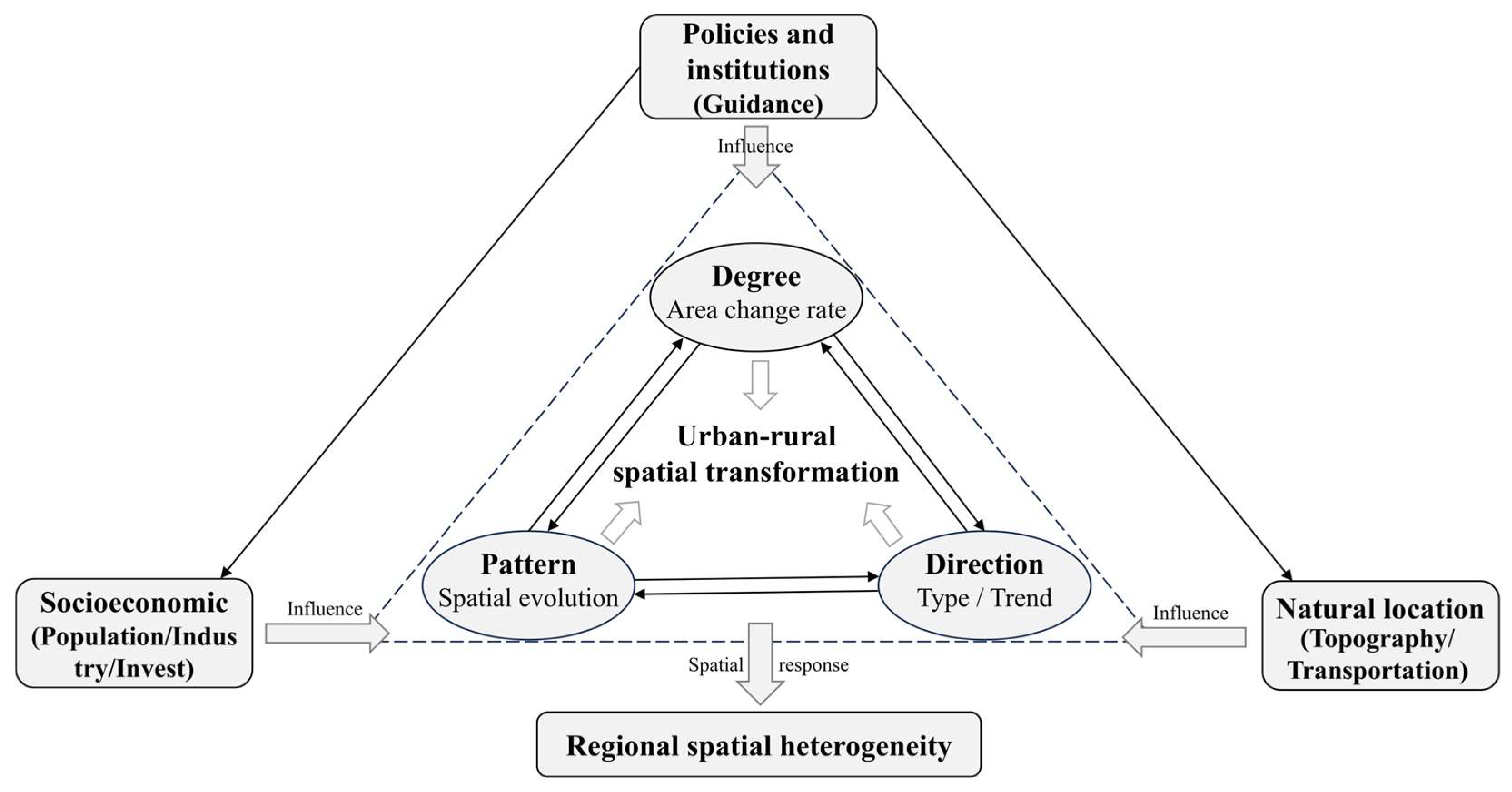
Figure 1. Theoretical analysis framework of URST.
Land 14 02385 g001
Figure 2. Geographic zoning in China.
Land 14 02385 g002
Figure 3. Research flowchart for URST in China.
Land 14 02385 g003
Figure 4. (a) Statistics on the changes in construction land area from 1990 to 2023; (b) the proportion of construction land expansion degree of counties in China, 1990–2023.
Land 14 02385 g004
Figure 5. Spatiotemporal pattern of urban–rural construction land expansion in China, 1990–2023.
Land 14 02385 g005
Figure 6. Spatiotemporal hot spots of urban–rural construction land expansion in China, 1990–2023.
Land 14 02385 g006
Figure 7. Sankey diagram of conversion between construction land and other land in China, 1990–2023.
Land 14 02385 g007
Figure 8. Classification of URST types. Note: Geomorphic types are listed in descending order of areal extent.
Land 14 02385 g008
Figure 9. Results of factor detection from 2000 to 2023.
Land 14 02385 g009
Figure 10. Results of interaction detection from 2000 to 2023. Note: Enhance, nonlinear: q(X1∩X2) > q(X1) + q(X2); Enhance, bi-: q(X1∩X2) > Max(q(X1), q(X2)); Max(q(X1), q(X2)) refers to the maximum of q(X1) and q(X2); q(X1) + q(X2) refers to the sum of q(X1) and q(X2).
Land 14 02385 g010
Figure 11. Changes in URST degree in typical counties under key influencing factors, 2000–2023.
Land 14 02385 g011
Figure 12. Dynamic driving mechanisms of spatial heterogeneity in URST.
Land 14 02385 g012
Table 1. Index system of factors influencing urban–rural spatial transformation.
FactorsVariablesUnit
Social economyPopulation density (PD)person/km2
Per capita gross regional product (PCGRP)yuan/person
Value-added of primary industry (VAPI)USD
Value-added of secondary industry (VASI)yuan
Value-added of tertiary industry (VATI)yuan
Urban–rural income gap (URIG)
Urbanization rate (UR)%
Fixed asset investment (FAI)yuan
Tax revenue (TR)yuan
Export value (EV)USD
Natural and
locational conditions
Slope (Slp)°
Elevation (El)m
Distance from rivers (DR)km
Distance from highways (DH)km
Distance from railways (DRW)km
Distance from city roads (DCR)km
Distance from prefecture-level cities (DPLC)km
Distance from provincial capital cities (DPCC)km
Table 2. Characteristics of URST types.
TypesGeomorphology Spatial Distribution
STAPlain, M&H, TablelandNortheast region
LTAM&H, plain
Tableland, LL&M, ASL
Broad distribution
Loess Plateau, northwest in northern arid and semiarid region
STGM&H, Plain, TablelandNorthwest, southwest, and outermost periphery of provincial capitals in the northeastern region
LTGM&H, PlainNorthwest and outermost periphery of provincial capitals in the eastern and southwestern region
Periphery of the eastern and southwestern provincial capitals
Tableland, LFP, LY
LTEPlain, M&H
Tableland, LFP, LY
Core area of the eastern and southwestern provincial capitals
Core and peripheral areas of the eastern and southwestern provincial capitals
LTSPlain, M&H, Tableland
LFP, LY
Periphery of the eastern and northwestern provincial capitals
Parts of the eastern peripheral region
MaturationPlain, M&H, Tableland
LFP, LY
Mid-eastern and southern coastal region
Mid-eastern provinces border
TransitionPlain, M&H, Tableland, ASL, LFP, LL&MOutermost periphery of provincial capitals in the eastern region
Disclaimer/Publisher’s Note: The statements, opinions and data contained in all publications are solely those of the individual author(s) and contributor(s) and not of MDPI and/or the editor(s). MDPI and/or the editor(s) disclaim responsibility for any injury to people or property resulting from any ideas, methods, instructions or products referred to in the content.